WO2020179807A1 - 体内測定システム、体内測定プログラム、及びコンピュータ読み取り可能な非一時的記憶媒体 - Google Patents
体内測定システム、体内測定プログラム、及びコンピュータ読み取り可能な非一時的記憶媒体 Download PDFInfo
- Publication number
- WO2020179807A1 WO2020179807A1 PCT/JP2020/009026 JP2020009026W WO2020179807A1 WO 2020179807 A1 WO2020179807 A1 WO 2020179807A1 JP 2020009026 W JP2020009026 W JP 2020009026W WO 2020179807 A1 WO2020179807 A1 WO 2020179807A1
- Authority
- WO
- WIPO (PCT)
- Prior art keywords
- precision
- low
- measurement
- reference value
- accuracy
- Prior art date
- Legal status (The legal status is an assumption and is not a legal conclusion. Google has not performed a legal analysis and makes no representation as to the accuracy of the status listed.)
- Ceased
Links
Images



Classifications
-
- A—HUMAN NECESSITIES
- A61—MEDICAL OR VETERINARY SCIENCE; HYGIENE
- A61B—DIAGNOSIS; SURGERY; IDENTIFICATION
- A61B5/00—Measuring for diagnostic purposes; Identification of persons
- A61B5/05—Detecting, measuring or recording for diagnosis by means of electric currents or magnetic fields; Measuring using microwaves or radio waves
- A61B5/053—Measuring electrical impedance or conductance of a portion of the body
- A61B5/0537—Measuring body composition by impedance, e.g. tissue hydration or fat content
-
- A—HUMAN NECESSITIES
- A61—MEDICAL OR VETERINARY SCIENCE; HYGIENE
- A61B—DIAGNOSIS; SURGERY; IDENTIFICATION
- A61B5/00—Measuring for diagnostic purposes; Identification of persons
- A61B5/48—Other medical applications
- A61B5/4869—Determining body composition
-
- A—HUMAN NECESSITIES
- A61—MEDICAL OR VETERINARY SCIENCE; HYGIENE
- A61B—DIAGNOSIS; SURGERY; IDENTIFICATION
- A61B5/00—Measuring for diagnostic purposes; Identification of persons
- A61B5/48—Other medical applications
- A61B5/4869—Determining body composition
- A61B5/4872—Body fat
-
- A—HUMAN NECESSITIES
- A61—MEDICAL OR VETERINARY SCIENCE; HYGIENE
- A61B—DIAGNOSIS; SURGERY; IDENTIFICATION
- A61B5/00—Measuring for diagnostic purposes; Identification of persons
- A61B5/48—Other medical applications
- A61B5/4869—Determining body composition
- A61B5/4875—Hydration status, fluid retention of the body
-
- A—HUMAN NECESSITIES
- A61—MEDICAL OR VETERINARY SCIENCE; HYGIENE
- A61B—DIAGNOSIS; SURGERY; IDENTIFICATION
- A61B5/00—Measuring for diagnostic purposes; Identification of persons
- A61B5/72—Signal processing specially adapted for physiological signals or for diagnostic purposes
- A61B5/7221—Determining signal validity, reliability or quality
-
- A—HUMAN NECESSITIES
- A61—MEDICAL OR VETERINARY SCIENCE; HYGIENE
- A61B—DIAGNOSIS; SURGERY; IDENTIFICATION
- A61B5/00—Measuring for diagnostic purposes; Identification of persons
- A61B5/72—Signal processing specially adapted for physiological signals or for diagnostic purposes
- A61B5/7235—Details of waveform analysis
- A61B5/7264—Classification of physiological signals or data, e.g. using neural networks, statistical classifiers, expert systems or fuzzy systems
-
- A—HUMAN NECESSITIES
- A61—MEDICAL OR VETERINARY SCIENCE; HYGIENE
- A61B—DIAGNOSIS; SURGERY; IDENTIFICATION
- A61B5/00—Measuring for diagnostic purposes; Identification of persons
- A61B5/74—Details of notification to user or communication with user or patient; User input means
- A61B5/742—Details of notification to user or communication with user or patient; User input means using visual displays
-
- G—PHYSICS
- G01—MEASURING; TESTING
- G01G—WEIGHING
- G01G19/00—Weighing apparatus or methods adapted for special purposes not provided for in the preceding groups
- G01G19/44—Weighing apparatus or methods adapted for special purposes not provided for in the preceding groups for weighing persons
-
- G—PHYSICS
- G16—INFORMATION AND COMMUNICATION TECHNOLOGY [ICT] SPECIALLY ADAPTED FOR SPECIFIC APPLICATION FIELDS
- G16H—HEALTHCARE INFORMATICS, i.e. INFORMATION AND COMMUNICATION TECHNOLOGY [ICT] SPECIALLY ADAPTED FOR THE HANDLING OR PROCESSING OF MEDICAL OR HEALTHCARE DATA
- G16H10/00—ICT specially adapted for the handling or processing of patient-related medical or healthcare data
- G16H10/60—ICT specially adapted for the handling or processing of patient-related medical or healthcare data for patient-specific data, e.g. for electronic patient records
-
- G—PHYSICS
- G16—INFORMATION AND COMMUNICATION TECHNOLOGY [ICT] SPECIALLY ADAPTED FOR SPECIFIC APPLICATION FIELDS
- G16H—HEALTHCARE INFORMATICS, i.e. INFORMATION AND COMMUNICATION TECHNOLOGY [ICT] SPECIALLY ADAPTED FOR THE HANDLING OR PROCESSING OF MEDICAL OR HEALTHCARE DATA
- G16H50/00—ICT specially adapted for medical diagnosis, medical simulation or medical data mining; ICT specially adapted for detecting, monitoring or modelling epidemics or pandemics
- G16H50/20—ICT specially adapted for medical diagnosis, medical simulation or medical data mining; ICT specially adapted for detecting, monitoring or modelling epidemics or pandemics for computer-aided diagnosis, e.g. based on medical expert systems
-
- G—PHYSICS
- G16—INFORMATION AND COMMUNICATION TECHNOLOGY [ICT] SPECIALLY ADAPTED FOR SPECIFIC APPLICATION FIELDS
- G16H—HEALTHCARE INFORMATICS, i.e. INFORMATION AND COMMUNICATION TECHNOLOGY [ICT] SPECIALLY ADAPTED FOR THE HANDLING OR PROCESSING OF MEDICAL OR HEALTHCARE DATA
- G16H50/00—ICT specially adapted for medical diagnosis, medical simulation or medical data mining; ICT specially adapted for detecting, monitoring or modelling epidemics or pandemics
- G16H50/30—ICT specially adapted for medical diagnosis, medical simulation or medical data mining; ICT specially adapted for detecting, monitoring or modelling epidemics or pandemics for calculating health indices; for individual health risk assessment
-
- G—PHYSICS
- G01—MEASURING; TESTING
- G01G—WEIGHING
- G01G19/00—Weighing apparatus or methods adapted for special purposes not provided for in the preceding groups
- G01G19/44—Weighing apparatus or methods adapted for special purposes not provided for in the preceding groups for weighing persons
- G01G19/50—Weighing apparatus or methods adapted for special purposes not provided for in the preceding groups for weighing persons having additional measuring devices, e.g. for height
Definitions
- the present invention relates to an in-vivo measurement system, an in-vivo measurement program, and a computer-readable non-transitory storage medium.
- a BIA body composition meter capable of measuring in-vivo information such as body water content, body fat content, and muscle mass based on the bioelectrical impedance method (BIA). Since the BIA body composition meter calculates in-vivo information applicable to many people by a statistical calculation formula, it is excellent in tracking relative changes in in-vivo information of an individual.
- Patent Document 1 Japanese Patent Application Laid-Open No. 2-60626
- Patent Document 2 Japanese Patent Application Laid-Open No. 2-60626
- Each body information obtained by a conventional BIA body composition meter includes DXA (Dual Energy X-Ray Absorptiometry), MRI (Magnetic Resonance Imaging), CT (Computed Tomography), heavy water dilution method, 4C model (4 compartment model), etc.
- DXA Direct Energy X-Ray Absorptiometry
- MRI Magnetic Resonance Imaging
- CT Computerized Tomography
- heavy water dilution method 4C model (4 compartment model), etc.
- in-vivo information obtained by a simple BIA body composition analyzer for example, a single-frequency 4-electrode BIA body composition analyzer, whole body method BIA body composition analyzer
- internal information compared to the simple BIA body composition analyzer When compared with in-vivo information obtained by a high-accuracy BIA body composition meter (for example, a multi-frequency multi-electrode BIA body composition meter, site-specific BIA body composition meter) with high measurement accuracy of information, there may be a difference in absolute value. ..
- the purpose of this disclosure is to provide an in-vivo measurement system and a program for acquiring highly accurate in-vivo information.
- the in-vivo measurement system of one aspect includes a storage unit that stores the in-vivo information obtained by the measurement of the first accuracy as a reference value, and a second accuracy lower than the first accuracy. Based on a low-precision measuring unit that acquires low-precision internal information by inputting the measured values obtained in the measurement into a predetermined algorithm, the reference value stored in the storage unit, and the degree to which the reference value is emphasized.
- a correction unit that corrects the algorithm or the low-precision in-vivo information, and the low-precision in-vivo information acquired by the low-precision measurement unit using the algorithm corrected by the correction unit, or the low-precision It is provided with an output unit that outputs the low-precision internal information acquired by the measuring unit and corrected by the correction unit as corrected internal information.
- the algorithm corrected using the reference value (hereinafter, also referred to as “high accuracy reference value”) obtained by the measurement of the first accuracy (hereinafter, also referred to as “high accuracy”) is
- the corrected in-vivo information can be obtained by inputting the measurement value obtained by the measurement with the second accuracy lower than the accuracy of 1 (hereinafter, also referred to as “low accuracy”).
- the corrected internal information can be obtained by correcting the user's low-precision internal information (hereinafter, also referred to as "low-precision internal information”) acquired by the low-precision measuring unit using a high-precision reference value. ..
- the high-accuracy reference value for obtaining the corrected in-vivo information the in-vivo information obtained by the high-accuracy measurement is not used as it is, but the degree of giving importance to the high-accuracy reference value (hereinafter, also referred to as “adjustment parameter”). .) Is used to adjust the high-precision reference value before use. Therefore, the correction can be performed using a more appropriate high-precision reference value, and high-precision internal information can be obtained as the corrected internal information.
- the adjustment parameter is determined, for example, during high-precision measurement and during measurement of low-precision in-vivo information (hereinafter, also referred to as “low-precision reference value”) for determining a correction method by adjusting the high-precision reference value. (Hereinafter, also referred to as “at the time of low-precision measurement”) may be performed to the extent necessary depending on the possibility or degree of difference in body composition, and the high-precision reference value may not be adjusted. May be.
- the degree may be determined according to the degree of contribution of the reference value stored in the storage unit to the low-precision in-vivo information acquired by the low-precision measuring unit.
- the degree can be determined in consideration of the contribution of low-precision in-vivo information to the reference value.
- the degree may be determined based on the difference between the weight when the measurement of the first accuracy is performed and the weight when the algorithm or the low accuracy in-vivo information is corrected.
- the degree may be determined based on the period from the measurement of the first accuracy to the correction of the algorithm or the low-accuracy in-vivo information.
- the degree may be determined also based on the difference between the reference value and the low-precision in-vivo information acquired by the low-precision measurement unit when correcting the algorithm or the low-precision in-vivo information.
- the possibility or degree of difference in body composition between high-accuracy measurement and low-accuracy measurement can be determined by the difference between the reference value and the low-accuracy in-vivo information as the low-accuracy reference value.
- the degree may be determined based on the user's choice.
- the degree can be determined based on the user's choice.
- the storage unit may store the corrected algorithm or the correction function for correcting the low-precision internal information and the corrected internal information.
- the corrected algorithm or correction function and the corrected internal information are stored, so that they can be referred to later.
- the output unit changes the appearance so that the corrected in-vivo information and the low-precision in-vivo information acquired by inputting the measurement value in the low-precision measurement unit into the predetermined algorithm can be distinguished. It may be displayed.
- the output unit may display information regarding the accuracy of the corrected in-vivo information based on the degree.
- the output unit may display an alert based on the period from the high-precision measurement to the acquisition of the low-precision in-vivo information.
- the in-vivo measurement program of one aspect causes a computer to function as a storage unit, a low-accuracy measurement unit, a correction unit, an output unit, and an input unit that configure the above-described in-vivo measurement system.
- FIG. 1 is a perspective view of a simplified BIA body composition meter according to an embodiment.
- FIG. 2 is a block diagram showing a functional configuration of the simple BIA body composition analyzer according to the embodiment.
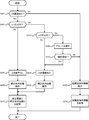
- FIG. 3 is a first flow chart showing the operation of the simple BIA body composition meter for determining the correction function according to the first embodiment.
- FIG. 4 is a second flowchart showing the operation of the simple BIA body composition meter for determining the correction function according to the first embodiment.
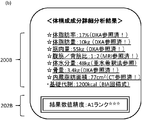
- FIG. 5A is a diagram showing a first result display screen of the simplified BIA body composition meter according to the first embodiment.
- FIG. 5B is a diagram showing a second result display screen of the simplified BIA body composition meter according to the first embodiment.
- FIG. 6 is a first flowchart showing the operation of the simple BIA body composition meter for determining the correction function according to the second embodiment.
- FIG. 7 is a second flowchart showing the operation of the simple BIA body composition meter for determining the correction function according to the third embodiment.
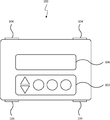
- FIG. 8 is a front view of a card-type simple BIA body composition meter according to the embodiment.
- FIG. 1 is a perspective view of a simplified BIA body composition meter 100 according to an embodiment of the present invention.
- the simple BIA body composition meter 100 has an input unit 102, a low-precision measuring unit 104, and an output unit 106.
- the input unit 102 is a means for inputting information to the simplified BIA body composition analyzer 100.
- the information input method by the input unit 102 may be a manual method, a method via a recording medium, a method by wired communication, a method by wireless communication, or other methods.
- the manual input method may be, for example, a button type, a dial type, or a touch sensor type.
- the method via a recording medium may be, for example, a method using a flash memory, a method using a CD-ROM, or a method using a DVD-ROM.
- the wireless communication method may be, for example, an Internet method, a wireless LAN method such as Wi-Fi (registered trademark), or a short-distance wireless communication method such as Bluetooth (registered trademark) or NFC (Near Field Communication). ..
- the input unit 102 is a manual input method and is of a button type.
- Information related to body composition is input to the input unit 102. Specifically, for example, information such as age, height, and gender that cannot be measured by the simple BIA body composition meter 100 is input to the input unit 102.
- the input unit 102 further includes a simple BIA body composition among body information such as body fat percentage, body fat mass, muscle mass, abdominal muscle / back muscle ratio, body water content, bone mass, visceral fat area, and basal metabolism.
- Body composition measurement (estimation) method for example, DXA, MRI, CT, heavy water dilution method, 4C model
- high precision BIA body composition meter multi-frequency multi-electrode BIA body composition
- the weight and the measurement date and time when the high-precision internal information is measured are also input to the input unit 102.
- the input information is stored in the storage unit 110 described later.
- the low-accuracy measuring unit 104 is a measuring unit that measures the low-accuracy internal information of the user (low-accuracy internal information) by inputting the measured value into a predetermined algorithm.
- the measured values are, for example, body weight, bioelectrical impedance and the like.
- the predetermined algorithm may be, for example, a regression equation that calculates low-accuracy in-vivo information from measured values, or may be a machine learning model that inputs measured values and outputs low-accuracy in-vivo information.
- the low-precision measuring unit 104 includes a weight measuring means for measuring the weight of the user, a bioelectrical impedance measuring means for measuring the bioelectrical impedance of the user by BIA, and a date and time specifying means for specifying the measurement date and time. At least bioelectrical impedance is included in the algorithm as a measured value, and the low-precision in-vivo information is arithmetically operated.
- the measuring unit of the BIA body composition meter has many types of applied current frequencies, the more electrodes there are, and the more accurately it is possible to measure each part of the body than the case where only the whole body can be measured. Information can be measured.
- the measurement part of the multi-frequency multi-electrode BIA body composition meter has higher measurement accuracy of the in-vivo information than the measurement part of the single frequency 4-electrode BIA body composition meter, and is more accurate by site than the measurement part of the whole body method BIA body composition meter.
- the measurement unit of the BIA body composition meter has higher measurement accuracy of internal information.
- the low-precision measuring unit 104 is a single-frequency 4-electrode type measuring unit that measures low-precision internal information.
- the output unit 106 is an output means for outputting the measurement result of the user.
- the output unit 106 includes, for example, an LCD (Liquid Crystal Display), an OLED (Organic Light Emitting Diode), and the like.
- the output unit 106 may be integrated with the simple BIA body composition meter 100, or may not be integrated with the simple BIA body composition meter 100 such as a smartphone or a tablet.
- output unit 106 is an LCD integrated with simple BIA body composition meter 100.
- the output unit 106 outputs the measurement result of the user.
- the output may be, for example, a display of numerical values, characters, a figure of a body shape, etc. reflecting the measurement result of the user, or may be an output in a voice or other format.
- the output unit 106 displays the weight measured by the low-accuracy measuring unit 104, the low-accuracy in-vivo information, the corrected in-vivo information described later, the information relating to the measurement accuracy, and the alert prompting the measurement of the high-accuracy reference value. To do.
- FIG. 2 is a block diagram showing a functional configuration of a simplified BIA body composition meter 100 according to an embodiment of the present invention.
- the simplified BIA body composition meter 100 has a control unit 108, a storage unit 110, and a correction unit 112 in addition to the input unit 102, the low-precision measurement unit 104, and the output unit 106 as shown in FIG.
- the control unit 108 is a control device that controls the input unit 102, the low-precision measuring unit 104, the output unit 106, the storage unit 110, and the correction unit 112.
- the control unit 108 has a CPU (Central Processing Unit).
- the control unit 108 is telecommunications connected to each unit.
- the control unit 108 realizes the function of each unit by executing the program stored in the storage unit 110.
- the program may be downloaded in the simplified BIA body composition meter 100 having a communication function, or may be read from a portable non-transitory storage medium and loaded into the simplified BIA body composition meter 100.
- the storage unit 110 is a memory capable of storing data.
- the memory may be, for example, a volatile memory (eg, RAM) or a non-volatile memory (eg, ROM).
- the storage unit 110 may be built in the simple BIA body composition meter 100, or may be provided outside the simple BIA body composition meter 100 such as an external hard disk drive or an external server. You may be.
- storage unit 110 is built in simple BIA body composition analyzer 100.
- the storage unit 110 stores a program executed by the control unit 108, a correction function described later, information in the correction body, and the like.
- the storage unit 110 stores the information input to the input unit 102.
- the storage unit 110 has information such as age, height, sex, high-accuracy reference value, weight when measuring high-accuracy in-vivo information, and measurement date and time, which are input to the input unit 102.
- the storage unit 110 stores the information used by the low-precision measurement unit 104.
- the storage unit 110 contains information used by the low-precision measurement unit 104, for example, statistical information related to the weight, age, height, gender, and internal information of the general user, and measurement obtained by low-precision measurement.
- Information such as a predetermined algorithm (for example, regression equation) for obtaining low-precision in-vivo information from the value is stored.
- the storage unit 110 stores the information acquired by the low-precision measurement unit 104. Specifically, the storage unit 110 stores, as the information acquired by the low-accuracy measuring unit 104, information such as weight, bioelectrical impedance, low-accuracy in-vivo information, measurement date and time, and corrected in-vivo information described later.
- the correction unit 112 is a correction unit that corrects the algorithm or the low-precision in-vivo information based on the high-accuracy reference value stored in the storage unit 110 and the degree (adjustment parameter) of emphasizing the reference value.
- the adjustment parameter is a parameter for adjusting the high-precision reference value by, for example, multiplying and counting the high-precision reference value.
- the correction unit 112 may be built in the simple BIA body composition meter 100, or may be provided outside the simple BIA body composition meter 100 such as an external server. In the present embodiment, the correction unit 112 is built in the simple BIA body composition meter 100.
- the correction unit 112 of the present embodiment determines a correction function for correcting low-precision internal information so as to reduce this difference.
- the difference between the high-accuracy reference value and the low-accuracy in-vivo information (low-accuracy reference value) at the time of measuring the low-accuracy in-vivo information for determining the correction function (at the time of low-accuracy measurement) is determined by the measurement accuracy of the low-accuracy measuring unit 104.
- the body composition at the time of high-accuracy measurement and the body composition at the time of low-accuracy measurement be the same or very close.
- the correction unit 112 determines whether the body composition at the time of high-accuracy basic measurement and the body composition at the time of low-accuracy measurement are different from each other or the degree to which the high-accuracy reference value used for determining the adjustment parameter is higher than the high-accuracy reference value. (Hereinafter, referred to as "contribution of high-precision reference value”) is obtained, and the adjustment parameter is determined according to this contribution. In view of the above circumstances, the contribution of the high-precision reference value is determined based on the predetermined conditions illustrated below.
- the timing for determining the correction method based on the adjustment parameter is typically immediately after the low-precision measurement is performed, so the timing for determining the correction method (that is, strictly speaking, the timing for determining the low-precision measurement is For convenience, it may be regarded as a low-precision measurement.
- the timing for determining the correction method deviates from the timing at which the low-accuracy measurement is performed by a relatively large amount, it is desirable to set the low-accuracy measurement time as the low-accuracy measurement time.
- weight difference the absolute value of the difference between the weight during high-accuracy measurement and the weight during low-accuracy measurement
- the correction unit 112 high by determining the adjustment parameter Y 0 in accordance with the degree of contribution of high-precision reference value, Y 0 the primary regulating multiplying the high precision reference value "Y 0 ⁇ Precision reference value" Adjust the accuracy reference value.
- Y 0 a different value is adopted depending on whether the weight is increased or decreased, and the type of internal information (eg, fat mass, muscle) that is a high-accuracy reference value. Different values depending on the amount, body water content, etc.).
- Y 0 used for adjusting body fat (amount/rate) which is a high precision reference value
- Y 0 used for adjusting the muscle mass is a value slightly larger than 1 or 1
- Y 0 used for adjusting the body water content is a value slightly larger than 1 or 1. Note that setting Y 0 to 1 is synonymous with not performing the primary adjustment.
- Y 0 used for adjusting body fat (amount or rate) which is a high precision reference value is slightly larger than 1 or 1.
- Y 0 used for adjusting the muscle mass is a value slightly smaller than 1 or 1
- Y 0 used for adjusting the body water content is a value slightly smaller than 1 or 1.
- the correction unit 112 determines the adjustment parameters Y 1 to Y 5 (hereinafter, referred to as “Y 1 to 5 ”) according to the contribution degree of the high precision reference value, and sets Y 1 to 5 to the high precision reference value.
- the high precision reference value is adjusted by the primary adjustment "Y 1 to 5 x high precision reference value" to be multiplied by.
- Y 1 to 5 similar to Y 0 , different values are adopted depending on whether the weight is increased or decreased, and the type of in-vivo information used as the high-accuracy reference value. Different values are adopted depending on (for example, body fat mass, muscle mass, body water content, etc.).
- Y 1 to 5 used for adjusting body fat (amount or rate), which is a high-accuracy reference value, should be a value smaller than 1.
- Y 1 to 5 used for adjusting muscle mass shall be a value larger than 1
- Y 1 to 5 used for adjusting body water content shall be a value larger than 1.
- Y 1 to 5 used for adjusting body fat (amount/rate), which is a high precision reference value is a value larger than 1. Therefore, Y 1 to 5 used for adjusting muscle mass shall be a value smaller than 1, and Y 1 to 5 used for adjusting body water content shall be a value smaller than 1.
- the weight difference is ⁇ or more (weight difference ⁇ )
- the absolute value of the difference between the high-accuracy reference value and the low-accuracy in-vivo information by the simple BIA body composition analyzer 100 (hereinafter, “in-body difference”) is ⁇ or more.
- body weight divergence is seen, so there is a change in body composition between high-precision measurement and low-precision measurement, but with an average body composition estimated from statistical values.
- Judges that the contribution of the high-precision reference value is rather low in order to reflect the body composition of the user who is greatly deviated.
- the high precision reference value is adjusted by the primary adjustment “Y 1 to 5 ⁇ high precision reference value” similar to “weight difference ⁇ ”.
- the correction unit 112 does not perform the correction based on the high precision reference value adjusted by the adjustment parameter.
- the predetermined condition for example, there is one that uses a period from high-precision measurement to low-precision measurement (hereinafter referred to as “elapsed days”) as an index.
- the correction unit 112 performs only the primary adjustment, and does not adjust the high-precision reference value (secondary adjustment) based on the number of elapsed days.
- the correction unit 112 adjusts the primary adjusted high-precision reference value by using the low-precision reference value according to the contribution of the high-precision reference value. Specifically, the correction unit 112 adjusts the high precision reference value by the secondary adjustment “(a ⁇ Y 0 to 5 ⁇ high precision reference value + b ⁇ low precision reference value) / 2”.
- the correction unit 112 decreases the value of a and increases the value of b as the number of elapsed days is longer.
- the secondary adjustment when the secondary adjustment is performed (that is, when the elapsed days are larger than z1 and within z2), only the primary adjustment is performed as the primary adjustment parameters Y 0 to 5 (that is, when the elapsed days are within z1).
- a value different from the value of Y 0 to 5 in () may be adopted. This is because when the number of elapsed days is within “z1 days”, that is, when the number of elapsed days is relatively short, it is considered that the reason for the weight difference is a change in body water content, while the number of elapsed days is z1 days. It is difficult to identify the reason for the weight difference when the number of days elapsed is relatively long, that is, when the number of days elapsed is relatively long. Because.
- Y 0 to 5 used to adjust the high-accuracy reference values of body fat (volume or rate), muscle mass, and body water content are all values of 1 or more.
- Y 0 used for adjusting body fat (volume or rate), muscle mass, and body water content that are high precision reference values. All of to 5 are values of 1 or less.
- the correction unit 112 does not determine the adjustment parameter and does not adjust the high precision reference value.
- the user selects the secondary adjustment (hereinafter referred to as “adjustment selection”). If so, the adjustment parameter related to the secondary adjustment is determined, and the high precision reference value is adjusted by the secondary adjustment “(a ⁇ Y 0 to 5 ⁇ high precision reference value+b ⁇ low precision reference value)/2”. May be good.
- the adjustment parameters Y 0 to 5 of the primary adjustment that reflect the contribution of the high-precision reference value are parameters that are greatly affected by the weight difference.
- the adjustment parameters a and b of the secondary adjustment which also reflect the contribution of the high-precision reference value, are parameters that are not so significantly affected by the number of elapsed days. That is, there is a qualitative difference between the adjustment parameters Y 0 to 5 of the primary adjustment and the adjustment parameters a and b of the secondary adjustment in the degree of influence on the parameters of the weight difference and the elapsed days.
- the predetermined condition is a condition for determining the contribution of the high-accuracy reference value
- the ratio of the weight during high-accuracy measurement to the weight during low-accuracy measurement may be used as an index.
- the predetermined condition is not divided into three stages of “weight difference ⁇ ”, “weight difference ⁇ ”, and “weight difference ⁇ ” even if the weight difference is used as an index. It may be divided into many stages. Similarly, even if the number of elapsed days is used as an index, the predetermined condition may be divided into less or more stages instead of being divided into two stages of "z1 day or less" and "z2 day or less”. ..
- the adjustment of the high-accuracy reference value may be performed not only by performing the secondary adjustment after the primary adjustment, but also by performing the adjustment of the third or higher order such as further weighting after the secondary adjustment. That is, the formula for calculating the adjusted high-precision reference value may be obtained by using some adjustment formulas.
- the correction unit 112 causes the correction internal body to be corrected based on the high-accuracy reference value and the low-accuracy reference value adjusted using the adjustment parameter. Determine the correction function that correlates the information with the low-precision internal information. Then, the corrected in-vivo information is acquired by correcting the low-precision in-vivo information by this correction function. In the measurement after the correction function is determined, the correction unit 112 acquires the correction internal information by correcting the low-precision internal information calculated by the low-precision measurement unit 104 using a predetermined algorithm by the correction function. The correction function can be updated when the high-precision reference value is newly acquired.
- the parameters c and d of the correction function are respectively expressed by the equations (1) to (3).
- (Adjusted high-precision reference value) c ⁇ (low-precision reference value) + d ... (1')
- FIG. 3 is a first flowchart showing the operation of the simple BIA body composition measuring instrument 100 for determining the correction function according to the first embodiment of the present invention.
- the first flow according to the first embodiment is a flow for primary adjusting high-precision internal information using the body weight difference as an index.
- the user operates the simplified BIA body composition meter 100 to start the process of determining the correction function, the first flow starts.
- the low-precision measuring unit 104 measures the in-vivo information of the user (step S102).
- the storage unit 110 stores the low-precision reference value (step S104).
- the correction unit 112 determines whether or not there is the high precision reference value stored in the storage unit 110 (step S106) and the weight difference (step S108).
- step S106 When it is determined that “weight difference ⁇ ” in “there is a high-accuracy reference value” stored in the storage unit 110 (step S106: Yes, step S108: Yes), the correction unit 112 causes the high-accuracy reference value to contribute. Then, the adjustment parameter Y 0 is determined, the high-accuracy reference value is adjusted by the primary adjustment “Y 0 ⁇ high-accuracy reference value” (step S110), and the flow ends.
- the correction unit 112 determines the adjustment parameter Y 0 according to the contribution of the high precision reference value, and adjusts the high precision reference value by the primary adjustment “Y 0 ⁇ high precision reference value”.
- step S106 if it is determined that the “high accuracy reference value” stored in the storage unit 110 is not “weight difference ⁇ ” (step S106: Yes, step S108: No), the correction unit 112 causes the weight difference again. Is determined (step S112).
- step S112 determines the adjustment parameters Y 1 to 5 according to the degree of contribution of the high-accuracy reference value, and the primary adjustment “Y 1 The high-precision reference value is adjusted according to " ⁇ 5 x high-precision reference value" (step S114), and the flow ends.
- the correction unit 112 determines the adjustment parameters Y 1 to 5 according to the contribution of the high precision reference value, and adjusts the high precision reference value by the primary adjustment “Y 1 to 5 ⁇ high precision reference value”. ..
- step S106: No whether it is determined that there is no “high precision reference value” stored in the storage unit 110 (step S106: No), or “high precision reference value exists”, but “weight difference ⁇ ”, not “weight difference ⁇ ”. If it is determined that the weight difference is not ⁇ "(step S106: Yes, step S108: No, step S112: No), the correction unit 112 uses a correction function based on the primary adjusted high-precision reference value to perform a low-precision reference.
- the storage unit 110 stores the high-accuracy reference value as a reference value without correcting the value (step S116), and the flow ends.
- the correction unit 112 does not perform correction.
- the contribution of the high-precision reference value is evaluated using the body weight difference as an index.
- the high accuracy reference value is adjusted by the primary adjustment “Y 0 ⁇ high accuracy reference value”, and when the weight deviation is seen to some extent (weight difference ⁇ ), 1
- the high-precision reference value is adjusted by the next adjustment "Y 1 to 5 x high-precision reference value", and when the weight deviation is large (weight difference ⁇ ⁇ ), no correction is performed.
- the adjustment reflecting the contribution of the high-precision reference value is performed. Determine the parameters and adjust the high precision reference value with these adjustment parameters.
- the contribution degree can be evaluated based on the body weight difference regardless of the difference in the measurement method, and the adjustment parameter reflecting the contribution degree in detail can be determined.
- the difference between the high accuracy reference value and the low accuracy reference value is the measurement accuracy of the simple BIA body composition meter 100.
- the adjustment parameter is determined so that the contribution of the high-accuracy reference value increases.
- FIG. 4 is a second flowchart showing the operation of the simplified BIA body composition meter 100 for determining the correction function according to the first embodiment of the present invention.
- the second flow is a flow for secondarily adjusting the high-accuracy reference value that has been primarily adjusted, using the number of days elapsed from the time of high-accuracy measurement to the time of low-accuracy measurement as an index.
- the second flow starts.
- the correction unit 112 determines whether or not there is a primary adjustment (step S202) and the number of elapsed days (step S204).
- step S202 When it is determined that the number of elapsed days is “within z1 days” in “with primary adjustment” (step S202: Yes, step S204: Yes), the correction unit 112 does not perform the secondary adjustment (step S206), and the correction unit 112 determines a correction function based on the first-order adjusted high-precision reference value, corrects the low-precision reference value by this correction function, and the output unit 106 corrects the low-precision internal information as the corrected low-precision reference value. It is displayed as internal information (step S208). Then, the storage unit 110 stores the correction function and the corrected in-vivo information (step S210), and the flow ends.
- the correction unit 112 does not perform the secondary adjustment.
- step S202 determines whether the number of elapsed days is "within z1 days" in "with primary adjustment" (step S202: Yes, step S204: No).
- the correction unit 112 determines the number of elapsed days again (step S212). ..
- the correction unit 112 determines the adjustment parameters Y 0 to 5 , a, and b according to the contribution degree of the high-accuracy reference value, and the secondary parameters
- the high precision reference value is adjusted by the adjustment "(a x Y 0 to 5 x high precision reference value + b x low precision reference value) / 2" (step S214).
- the correction unit 112 determines a correction function based on the secondary-adjusted high-accuracy reference value, corrects the low-accuracy reference value by this correction function, and the output unit 106 sets a low value as the corrected low-accuracy reference value.
- the accuracy internal information is displayed as the corrected internal information (step S216), the storage unit 110 stores the correction function and the corrected internal information (step S210), and the flow ends.
- the correction unit 112 determines the adjustment parameters Y 0 to 5 , a and b according to the contribution degree of the high precision reference value, and performs the secondary adjustment “(a ⁇ Y 0 to 5 ⁇ high precision reference value+b ⁇ Adjust the high precision reference value according to "low precision reference value)/2".
- step S202: No if it is determined that it is not "with primary adjustment” (step S202: No), or if it is determined that the number of elapsed days is not "within z2 days" in "with primary adjustment” (step S202: Yes, Step S204: No, step S212: No), the output unit 106 displays the low-precision internal information as the low-precision reference value without the correction unit 112 correcting the low-precision reference value by the correction function (step S218).
- the storage unit 110 stores the low-precision internal information as the low-precision reference value (step S220), and the flow ends.
- the body composition is measured between high-precision measurement and low-precision measurement. It is considered that the change is large, and the contribution of the high-precision reference value is small. At this time, the correction unit 112 does not perform correction.
- the contribution of the high-accuracy reference value is evaluated using the elapsed days as an index.
- the low-precision internal information as the low-precision reference value is corrected by the correction function based on the primary-adjusted high-precision reference value.
- the low-precision internal information as the corrected low-precision reference value is displayed as the corrected internal information, and the correction function and the corrected internal information are stored.
- the low-precision internal information as the low-precision reference value is corrected by the correction function based on the second-adjusted high-precision reference value, and the corrected low-precision
- the low-precision in-vivo information as the reference value is displayed as the corrected in-vivo information, and the correction function and the corrected in-vivo information are stored.
- the low-precision in-vivo information as the low-precision reference value is displayed without correction by the correction function. Then, the low-precision internal information as a low-precision reference value is stored.
- the adjustment parameter reflecting the contribution of the high-accuracy reference value is determined.
- the correction function can be determined using the high-precision reference value and the low-precision reference value.
- the contribution of the high precision reference value can be evaluated based on the elapse of time, and the adjustment parameter that reflects the contribution of the high precision reference value in detail can be determined.
- a high precision reference value and a low precision internal value as a low precision reference value during low precision measurement are used. It is determined that the difference from the information is due to the measurement accuracy of the simple BIA body composition analyzer 100, and the adjustment parameter is determined such that the contribution of the high accuracy reference value is large.
- the difference between the high-accuracy reference value and the low-accuracy in-vivo information as the low-accuracy reference value at the time of low-accuracy measurement is It is determined that the cause is a change in the body composition of the user, and the adjustment parameter is determined so that the contribution of the high-precision reference value becomes small. Therefore, it is possible to provide a highly accurate in-vivo measurement system and program tailored to the individual.
- the simple BIA body composition meter 100 can be used. The more it is used, the more accurately it becomes possible to reflect individual differences, and it is possible to provide a highly accurate in-vivo measurement system and program tailored to an individual.
- the evaluation is not performed only by a predetermined algorithm (for example, a regression equation), but is evaluated by a correction function corresponding to an individual according to an individual's high-precision reference value, so that the measurement is simple but highly compatible with individual differences. It can be adjusted to the accurate body composition measurement result.
- a predetermined algorithm for example, a regression equation
- the relative change can be tracked from the value with the simple BIA body composition meter 100, unlike the body composition measurement (estimation) method and the high-accuracy BIA body composition meter, which are usually difficult to measure, the daily detailed Since it is possible to catch the change in time without failing to know the change and to have the advantages of both, it is possible to provide a highly accurate in-vivo measurement system and program tailored to an individual.
- the second flow reflecting the low-precision in-vivo information as the low-precision reference value via the adjustment parameters a and b, and the first flow reflecting only the high-precision reference value via the adjustment parameters Y 0 to 5 By being subordinate to, it is possible to prevent excessive correction due to the first flow, so that it is possible to provide a highly accurate in-vivo measurement system and program tailored to the individual.
- FIG. 5A is a diagram showing a first result display screen of the simplified BIA body composition meter 100 according to the first embodiment
- FIG. 5B is a simplified BIA body composition meter according to the first embodiment of the present invention. It is a figure which shows the 2nd result display screen of 100.
- the output unit 106 displays the corrected in-vivo information 200A.
- the output unit 106 uses the corrected body information 200A as, for example, body fat percentage: 17%, body fat mass: 10 kg, muscle mass: 55 kg, abdominal muscle / back muscle ratio: 1: 2, body water content: 48 kg, bone mass: 3. 4 kg, visceral fat area: 77 cm 2 , basal metabolism: 1200 kcal. This allows the user to know the corrected in-vivo information.
- the output unit 106 displays the corrected in-vivo information 200B and the low-precision in-vivo information with different appearances so that they can be distinguished from each other.
- a different appearance refer to the display with a mark such as ⁇ , the display with different fonts, sizes, and colors, the body composition measurement (estimation) method, and the high-precision BIA body composition meter. It means to display the fact.
- the output unit 106 displays “ ⁇ body fat percentage: 17% (DXA referenced!), ⁇ body fat amount: 10 kg (DXA referenced!), ⁇ muscle mass: 55 kg (DXA referenced!). , ⁇ abdominal muscle/back muscle ratio: 1:2 (referenced by MRI!), ⁇ body water content: 48 kg (see heavy water dilution method!), ⁇ bone mass: 3.4 kg (referenced DXA!), ⁇ internal fat area: 77 cm 2 (CT referenced!), Basal metabolism: 1200 kcal (BIA regression equation) "is displayed.
- the corrected internal information 200B excluding "basal metabolism: 1200 kcal (BIA regression equation)" is marked with a star and displayed in association with the body composition measurement (estimation) method and the measurement method of the high-precision BIA body composition meter.
- “Basal metabolism: 1200 kcal (BIA regression equation)” is displayed with a different appearance so that the corrected internal information 200B and the low-precision internal information can be distinguished by not displaying them.
- the output unit 106 displays information 202B relating to the accuracy of the corrected internal information based on the degree.
- the output unit 106 displays information 202B relating to the accuracy of the corrected internal information, for example, based on the contribution of the high accuracy reference value.
- the information 202B related to the accuracy of the corrected internal information is displayed as "A" when there is a high accuracy reference value, and when there is no high accuracy reference value and only the internal information measured with low accuracy by the simple BIA body composition meter 100 is available. Is displayed as “B”. Furthermore, even when "A” is displayed, A1, A2, A3, etc. are ranked in order according to the contribution of the high-precision reference value, using the accuracy of the high-precision reference value, the weight difference, and the number of days elapsed as indicators. To display.
- the accuracy of the high-precision reference value is high, it is determined that "weight difference ⁇ ", and the number of elapsed days is determined to be "z1 day or less", it is ranked as A1.
- information 202B relating to the accuracy of the corrected internal information is displayed.
- the output unit 106 displays the corrected in-vivo information 200B and the low-precision in-vivo information with different appearances so that the user can know whether or not the in-vivo information has been improved in accuracy. it can. Further, the output unit 106 displays the information related to the measurement accuracy based on the contribution of the high accuracy reference value, so that the user can know how highly the measurement result is improved.
- the output unit 106 displays how much the measurement result has been improved by inputting the high-precision reference value, and simply expresses the contribution of the high-precision reference value by the reference measurement method and the number of elapsed days. This allows the user to feel the improvement in accuracy. Therefore, it is possible to provide a highly accurate in-vivo measurement system and program tailored to the individual.
- the configuration of the body composition measuring instrument according to the second embodiment is the same as the configuration of the body composition measuring instrument described above, and therefore its explanation is omitted. Since the operation of the body composition meter according to the second embodiment is different from the first flow according to the first embodiment described above only in the first flow, only this difference will be described below.
- FIG. 6 is a first flowchart showing the operation of the simplified BIA body composition meter 100 for determining the correction function according to the second embodiment.
- the first flow according to the second embodiment is a flow for performing primary adjustment of high-precision in-vivo information using an in-vivo difference as an index in addition to a weight difference.
- the low-precision measuring unit 104 measures the in-vivo information of the user (step S302).
- the storage unit 110 stores the low-accuracy reference value (step S304).
- the correction unit 112 determines whether or not there is the high precision reference value stored in the storage unit 110 (step S306) and the weight difference (step S308).
- step S306 When it is determined that "weight difference ⁇ " is determined by "there is a high precision reference value" stored in the storage unit 110 (step S306: Yes, step S308: Yes), the correction unit 112 contributes the high precision reference value.
- the adjustment parameter Y 0 is determined according to the above, and the high accuracy reference value is adjusted by the primary adjustment “Y 0 ⁇ high accuracy reference value” (step S310), and the flow ends.
- the correction unit 112 determines the adjustment parameter Y 0 according to the contribution of the high-precision reference value, and adjusts the high-precision reference value by the primary adjustment “Y 0 ⁇ high-precision reference value”.
- step S306 Yes, step S308: No
- the correction unit 112 causes the weight difference again. Is determined (step S312). Then, whether it is determined that "weight difference ⁇ " (step S312: Yes), or if it is determined that "in-body difference ⁇ " is not "weight difference ⁇ " (step S312: No, step S316: Yes). ), the correction unit 112 determines the adjustment parameters Y 1 to 5 according to the high precision reference value, and adjusts the high precision reference value by the primary adjustment “Y 1 to 5 ⁇ high precision reference value” (step S314). , The flow ends.
- the high-precision reference value is adjusted by the same primary adjustment “Y 1 to 5 ⁇ high-precision reference value” as in the case of “weight difference ⁇ ”.
- step S306 whether it is determined that there is no “high precision reference value” stored in the storage unit 110 (step S306: No), or “there is a high precision reference value”, but “weight difference ⁇ ”, not “weight difference ⁇ ”.
- step S306: Yes, step S308: No, step S312: No, step S316: No the correction unit 112 is primarily adjusted.
- the storage unit 110 only stores the high-precision reference value as a reference value without correcting the low-precision reference value by the correction function based on the high-precision reference value (step S318), and the flow ends.
- the correction unit 112 does not perform the correction.
- the contribution of the high-precision reference value is evaluated using the body weight difference and the internal difference as indexes.
- body weight difference ⁇ body weight difference
- body difference ⁇ body difference ⁇
- the high-precision reference value is adjusted according to the "high-precision reference value", and if the difference in the body is small, no correction is performed.
- the difference in the in-body information of the individual (The adjustment parameter that reflects the contribution of the high-accuracy reference value can be determined based on the difference in the body. Therefore, it is possible to provide a highly accurate in-vivo measurement system and program tailored to the individual.
- FIG. 7 is a second flowchart showing the operation of the simplified BIA body composition meter 100 for determining the correction function according to the third embodiment of the present invention.
- the primary adjusted high-precision reference value is set by using the user's adjustment selection as an index in addition to the elapsed days. This is a flow for further secondary adjustment.
- the second flow according to the third embodiment starts.
- the correction unit 112 determines whether or not there is a primary adjustment (step S402) and the number of elapsed days (step S404).
- step S402 When it is determined that the number of elapsed days is “within z1 days” in “with primary adjustment” (step S402: Yes, step S404: Yes), the correction unit 112 does not perform the secondary adjustment (step S406), and the correction unit 112 determines a correction function based on the first-order adjusted high-precision reference value, corrects the low-precision reference value by this correction function, and the output unit 106 corrects the low-precision internal information as the corrected low-precision reference value. It is displayed as internal information (step S408). Then, the correction unit 112 stores the correction function and the corrected in-vivo information (step S410), and the flow ends.
- the correction unit 112 does not perform the secondary adjustment.
- step S402 determines that “there is primary adjustment” and the elapsed days are not “within z1 days” (step S402: Yes, step S404: No), the correction unit 112 determines the elapsed days again (step S412). ..
- step S412 determines whether the number of elapsed days is determined to be "within z2 days" (step S412: Yes), or the number of elapsed days is not “within z2 days", and an "alert is presented to prompt the user to measure the high-precision reference value".
- the correction unit 112 determines the adjustment parameters Y 0 to 5 , a, and b according to the degree of contribution. Then, the high precision reference value is adjusted by the secondary adjustment “(a ⁇ Y 0 to 5 ⁇ high precision reference value + b ⁇ low precision reference value) / 2” (step S414).
- the correction unit 112 corrects the low-precision reference value by the correction function based on the second-order adjusted high-precision reference value, and the output unit 106 uses the low-precision internal information as the corrected low-precision reference value as the corrected internal information. Displayed (step S416), the storage unit 110 stores the correction function and the corrected internal information (step S410), and the flow ends.
- the correction unit 112 sets the high precision reference value.
- the adjustment parameters Y 0 to 5 , a, and b according to the contribution degree of the high precision reference by the secondary adjustment “(a ⁇ Y 0 to 5 ⁇ high precision reference value+b ⁇ low precision reference value)/2” Adjust the value.
- step S402 determines that it is not "with primary adjustment” (step S402: No), or the number of elapsed days is neither "z1 day” nor “z2 day” with “primary adjustment”, and the user is notified. If it is determined that the user did not make an "adjustment selection", although "alert was presented" to prompt measurement of the high-accuracy reference value (step S402: Yes, step S404: No, step S412: No, Steps S418 and S420: No), the correction unit 112 does not correct the low precision reference value by the correction function, and the output unit 106 displays the low precision in-vivo information as the low precision reference value (Step S422). 110 stores the low-precision internal information as the low-precision reference value (step S424), and the flow ends.
- the contribution of the high-accuracy reference value is evaluated using the elapsed days and the user's adjustment selection as an index.
- the secondary adjustment is performed.
- the low-precision reference value is corrected by the correction function based on the high-precision reference value, the low-precision in-vivo information as the corrected low-precision reference value is displayed as the in-vivo information, and the correction function and the in-vivo information are stored. ..
- the low-precision internal information as the low-precision reference value is not corrected by the correction function, but is used as the low-precision reference value. Display low-precision internal information and store low-precision internal information as a low-precision reference value.
- the secondary adjustment can be determined based on the user's selection in addition to the elapsed days. Therefore, it is possible to provide a highly accurate in-vivo measurement system and program tailored to the individual.
- an alert prompts the user to measure a new high-precision reference value, and the high-precision in-body measurement system is performed. Since it is possible to motivate the change, it is possible to provide a highly accurate in-vivo measurement system and program tailored to the individual.
- the timing of “presenting an alert” whether or not “within z2 days” from the time of high precision measurement is used as an index.
- the number of elapsed days “within 2 days” can be changed depending on the method of measuring the high-accuracy reference value. For example, when measuring a high-accuracy reference value using a body composition measurement (estimation) method with high measurement accuracy of in-vivo information such as DXA, it is not a measurement method that can be frequently measured, so set z2 to a relatively long number of days.
- z2 may be set to a relatively short number of days.
- the user can obtain highly accurate in-vivo information while performing simple measurement with the simple BIA body composition meter 100.
- the form of the simple BIA body composition meter 100 may be any form such as a flat type, a stand type, an input unit 102 as shown in FIG. 8, a low-precision measuring unit 104, and a card type having an output unit 106, which is simple.
- the measurement may be any measurement as long as the measurement accuracy of the in-vivo information is lower than that of the body composition measurement (estimation) method such as simple both-foot measurement and simple two-hand measurement.
- the flow of the above embodiment is composed of a first flow and a second flow, but there may be no second flow and only the first flow.
- the adjustment parameter can be determined only based on the weight difference between the high-precision measurement and the low-precision measurement, and the high-precision reference value can be adjusted to determine the correction function.
- the correction unit 112 determines a correction function based on the primary adjusted high-precision reference value and the low-precision internal information, and the correction function determines the low-precision internal information. To correct. Then, the corrected low-precision internal information is displayed as the corrected internal information, and the correction function and the corrected internal information are stored. This step can be provided as a step following each of step S110 and step S114.
- the low-precision internal information as the corrected low-precision reference value may be the average value of the primary-adjusted high-precision reference value and the low-precision internal information as the low-precision reference value corrected by the correction function.
- the flow of the above embodiment is composed of a first flow and a second flow, but there may be no first flow and only a second flow.
- the adjustment parameter can be determined based on only the number of days elapsed between the high-accuracy measurement and the low-accuracy measurement, and the high-accuracy reference value can be adjusted to determine the correction function.
- the second flow starts.
- a step of measuring the in-vivo information of the user by the low-precision measuring unit 104 and a step of storing the low-precision in-vivo information in the storage unit 110 are performed.
- the correction unit 112 determines the presence/absence of the primary adjustment (step S202)
- the correction unit 112 determines the presence/absence of the high-accuracy reference value stored in the storage unit 110. After that, the steps from step S204 to the end can be determined.
- the correction unit 112 corrects the low-precision internal information obtained by the low-precision measurement unit 104 with a high-precision reference value and a correction function based on the low-precision reference value to correct the correction internal information.
- the method of acquiring the corrected in-vivo information is not limited to this.
- the correction unit 112 may correct the algorithm used by the low-precision measurement unit 104 based on the high-precision reference value and the low-precision reference value.
- the low-precision measuring unit 104 acquires the corrected internal information by inputting the measured value into the algorithm corrected by the correction unit 112.
- the correction unit 112 uses a predetermined regression equation that outputs low-accuracy in-vivo information when the measurement value is input, and adjusts the high accuracy when the measurement value during low-precision measurement is input. Correct the regression formula that outputs the accuracy reference value.
- the storage unit 110 stores the corrected regression equation, and in the subsequent low-precision measurement, the low-precision measuring unit 104 inputs the measured value into the corrected regression equation to acquire the corrected in-vivo information. When the high-accuracy reference value is newly acquired, the regression equation can be updated.
- the correction unit 112 may correct the low-accuracy in-vivo information calculated by the low-accuracy measurement unit 104 according to a predetermined algorithm using the correction function, as in the above embodiment, As in the above modification, the algorithm itself for calculating the low-precision internal information from the measured value in the low-precision measuring unit 104 may be corrected.
- the correction unit 112 may, after acquiring the corrected in-vivo information once, correct the predetermined algorithm itself based on the corrected in-vivo information and the low-precision in-vivo information calculated by the predetermined algorithm. Once the algorithm is corrected, the results of subsequent low-precision measurements approach the corrected in-house information. Therefore, once the algorithm is corrected, the difference between the corrected in-vivo information and the result of the low-precision measurement becomes small, and a highly accurate in-vivo measurement system and program tailored to an individual can be provided.
- the correction function is set by one measurement by the low accuracy measuring unit 104, but the correction function may be set after a plurality of measurements.
- the low-precision measuring unit 104 performs the measurement twice on the first day and the second day, and uses the average of the low-precision in-vivo information as the low-accuracy reference values on the first day and the second day to use the correction function. May be set.
- the correction function may be set at the time of measurement by the low-precision measuring unit 104 on the second day.
- the correction function can be set using the low-precision in-vivo information in consideration of the variation. Therefore, it is possible to provide a highly accurate in-vivo measurement system and program tailored to the individual.
Landscapes
- Health & Medical Sciences (AREA)
- Life Sciences & Earth Sciences (AREA)
- Engineering & Computer Science (AREA)
- Public Health (AREA)
- Medical Informatics (AREA)
- General Health & Medical Sciences (AREA)
- Biomedical Technology (AREA)
- Pathology (AREA)
- Physics & Mathematics (AREA)
- Molecular Biology (AREA)
- Heart & Thoracic Surgery (AREA)
- Biophysics (AREA)
- Surgery (AREA)
- Animal Behavior & Ethology (AREA)
- Veterinary Medicine (AREA)
- Artificial Intelligence (AREA)
- Primary Health Care (AREA)
- Epidemiology (AREA)
- Nuclear Medicine, Radiotherapy & Molecular Imaging (AREA)
- Radiology & Medical Imaging (AREA)
- Computer Vision & Pattern Recognition (AREA)
- Physiology (AREA)
- Data Mining & Analysis (AREA)
- Psychiatry (AREA)
- Signal Processing (AREA)
- Databases & Information Systems (AREA)
- Evolutionary Computation (AREA)
- General Physics & Mathematics (AREA)
- Mathematical Physics (AREA)
- Fuzzy Systems (AREA)
- Measurement And Recording Of Electrical Phenomena And Electrical Characteristics Of The Living Body (AREA)
Priority Applications (3)
| Application Number | Priority Date | Filing Date | Title |
|---|---|---|---|
| CN202080018564.1A CN113556973B (zh) | 2019-03-06 | 2020-03-04 | 体内测定系统、体内测定程序以及计算机可读取的非临时性存储介质 |
| EP20765506.9A EP3936042B1 (en) | 2019-03-06 | 2020-03-04 | In-body measurement system, in-body measurement program, and computer-readable non-transitory storage medium |
| US17/463,683 US20210393158A1 (en) | 2019-03-06 | 2021-09-01 | In-body measurement system, in-body measurement program, and computer-readale non-transitory storage medium |
Applications Claiming Priority (2)
| Application Number | Priority Date | Filing Date | Title |
|---|---|---|---|
| JP2019-040713 | 2019-03-06 | ||
| JP2019040713A JP7214207B2 (ja) | 2019-03-06 | 2019-03-06 | 体内測定システム及びプログラム |
Related Child Applications (1)
| Application Number | Title | Priority Date | Filing Date |
|---|---|---|---|
| US17/463,683 Continuation US20210393158A1 (en) | 2019-03-06 | 2021-09-01 | In-body measurement system, in-body measurement program, and computer-readale non-transitory storage medium |
Publications (1)
| Publication Number | Publication Date |
|---|---|
| WO2020179807A1 true WO2020179807A1 (ja) | 2020-09-10 |
Family
ID=72337475
Family Applications (1)
| Application Number | Title | Priority Date | Filing Date |
|---|---|---|---|
| PCT/JP2020/009026 Ceased WO2020179807A1 (ja) | 2019-03-06 | 2020-03-04 | 体内測定システム、体内測定プログラム、及びコンピュータ読み取り可能な非一時的記憶媒体 |
Country Status (5)
| Country | Link |
|---|---|
| US (1) | US20210393158A1 (https=) |
| EP (1) | EP3936042B1 (https=) |
| JP (4) | JP7214207B2 (https=) |
| CN (1) | CN113556973B (https=) |
| WO (1) | WO2020179807A1 (https=) |
Families Citing this family (4)
| Publication number | Priority date | Publication date | Assignee | Title |
|---|---|---|---|---|
| WO2020212950A1 (en) * | 2019-04-19 | 2020-10-22 | Baracoda | Smart scale systems and methods of using the same |
| TWI790910B (zh) * | 2022-01-28 | 2023-01-21 | 興友科技股份有限公司 | 體組成分析儀之資料整合系統 |
| TWI835111B (zh) * | 2022-04-06 | 2024-03-11 | 啟德電子股份有限公司 | 生物阻抗技術評估核心肌群之方法 |
| JP2025151517A (ja) * | 2024-03-28 | 2025-10-09 | テルモ株式会社 | 身体組成計測装置、および制御方法 |
Citations (4)
| Publication number | Priority date | Publication date | Assignee | Title |
|---|---|---|---|---|
| US4895163A (en) | 1988-05-24 | 1990-01-23 | Bio Analogics, Inc. | System for body impedance data acquisition |
| JPH0260626B2 (https=) | 1983-07-18 | 1990-12-17 | Kuraray Co | |
| WO2010095709A1 (ja) * | 2009-02-20 | 2010-08-26 | オムロンヘルスケア株式会社 | 生体情報測定装置、生体情報測定方法、および体組成測定装置 |
| JP2019040713A (ja) | 2017-08-24 | 2019-03-14 | スタンレー電気株式会社 | 車両用灯具 |
Family Cites Families (12)
| Publication number | Priority date | Publication date | Assignee | Title |
|---|---|---|---|---|
| JP4434678B2 (ja) * | 2003-04-25 | 2010-03-17 | 勝三 川西 | 健康指標推定装置、方法、及びプログラム |
| JP4453330B2 (ja) * | 2003-10-14 | 2010-04-21 | オムロンヘルスケア株式会社 | 健康管理指針アドバイス方法,健康管理指針アドバイス装置及び健康管理指針アドバイスシステム |
| WO2005051194A1 (en) * | 2003-11-26 | 2005-06-09 | Biospace Co. Ltd | Apparatus and method for measuring segmental body fat using bioelectrical impedance |
| JP4024774B2 (ja) * | 2004-04-05 | 2007-12-19 | 株式会社タニタ | 体脂肪測定装置 |
| EP1741385B1 (en) * | 2005-07-07 | 2008-10-22 | Tanita Corporation | Truncal visceral/subcutaneous fat measuring method and apparatus |
| JP5088184B2 (ja) * | 2008-03-18 | 2012-12-05 | オムロンヘルスケア株式会社 | 体組成計 |
| US8406865B2 (en) * | 2008-09-30 | 2013-03-26 | Covidien Lp | Bioimpedance system and sensor and technique for using the same |
| JP5802748B2 (ja) * | 2010-07-02 | 2015-11-04 | インぺディメッド リミテッドImpedimed Limited | 組織指標の決定 |
| JP2013116258A (ja) * | 2011-12-05 | 2013-06-13 | Katsuzo Kawanishi | 健康管理装置および健康管理プログラム |
| JP6157067B2 (ja) * | 2012-07-04 | 2017-07-05 | 川西 勝三 | 健康管理装置、健康管理プログラムおよび健康管理方法 |
| JP6885583B2 (ja) | 2017-03-15 | 2021-06-16 | 株式会社タニタ | 体組成変化予測装置、方法、及びプログラム |
| CN107153764B (zh) | 2017-05-08 | 2020-07-28 | 杭州变啦网络科技有限公司 | 一种智能人体成分秤的数据修正方法 |
-
2019
- 2019-03-06 JP JP2019040713A patent/JP7214207B2/ja active Active
-
2020
- 2020-03-04 EP EP20765506.9A patent/EP3936042B1/en active Active
- 2020-03-04 WO PCT/JP2020/009026 patent/WO2020179807A1/ja not_active Ceased
- 2020-03-04 CN CN202080018564.1A patent/CN113556973B/zh active Active
-
2021
- 2021-09-01 US US17/463,683 patent/US20210393158A1/en active Pending
-
2023
- 2023-01-11 JP JP2023002261A patent/JP7393835B2/ja active Active
- 2023-11-17 JP JP2023196296A patent/JP7681918B2/ja active Active
-
2025
- 2025-05-01 JP JP2025076002A patent/JP2025107328A/ja active Pending
Patent Citations (4)
| Publication number | Priority date | Publication date | Assignee | Title |
|---|---|---|---|---|
| JPH0260626B2 (https=) | 1983-07-18 | 1990-12-17 | Kuraray Co | |
| US4895163A (en) | 1988-05-24 | 1990-01-23 | Bio Analogics, Inc. | System for body impedance data acquisition |
| WO2010095709A1 (ja) * | 2009-02-20 | 2010-08-26 | オムロンヘルスケア株式会社 | 生体情報測定装置、生体情報測定方法、および体組成測定装置 |
| JP2019040713A (ja) | 2017-08-24 | 2019-03-14 | スタンレー電気株式会社 | 車両用灯具 |
Also Published As
| Publication number | Publication date |
|---|---|
| JP2024020461A (ja) | 2024-02-14 |
| JP7214207B2 (ja) | 2023-01-30 |
| EP3936042A1 (en) | 2022-01-12 |
| JP7393835B2 (ja) | 2023-12-07 |
| JP7681918B2 (ja) | 2025-05-23 |
| JP2023052313A (ja) | 2023-04-11 |
| JP2025107328A (ja) | 2025-07-17 |
| EP3936042A4 (en) | 2022-11-09 |
| CN113556973B (zh) | 2026-03-20 |
| US20210393158A1 (en) | 2021-12-23 |
| CN113556973A (zh) | 2021-10-26 |
| EP3936042B1 (en) | 2025-10-29 |
| JP2020141863A (ja) | 2020-09-10 |
Similar Documents
| Publication | Publication Date | Title |
|---|---|---|
| JP7393835B2 (ja) | 体内測定システム及びプログラム | |
| JP4646614B2 (ja) | 体組成測定装置 | |
| US20180184941A1 (en) | Apparatus and Method for the Analysis of the Change of Body Composition and Hydration Status and for Dynamic Indirect Individualized Measurement of Components of the Human Energy Metabolism | |
| JP2025182107A (ja) | 体組成測定システム及び体組成測定プログラム | |
| US10653333B2 (en) | Systems and methods for high frequency impedance spectroscopy detection of daily changes of dielectric properties of the human body to measure body composition and hydration status | |
| JP6240937B2 (ja) | 身体指標変化予測装置 | |
| US20240127911A1 (en) | Blood sugar constitution determination device, blood sugar constitution determination method, and recording medium | |
| JP2017169974A (ja) | 生体情報計測装置 | |
| US11934174B2 (en) | Method and system for determining a tension value of a limb of a person and computer program | |
| CN108618754A (zh) | 身体组成变化预测装置、方法、以及计算机可读存储介质 | |
| EP3949851A1 (en) | Body composition monitor, body composition monitoring program, and computer-readable non-transitory storage medium | |
| TWM630144U (zh) | 體組成分析儀之資料整合系統 | |
| CN113768487A (zh) | 用户体脂检测方法和装置、计算机设备以及介质 | |
| US20200146617A1 (en) | Muscle Mass Estimation Method, Muscle Mass Estimation Device, and Storage Medium Storing A Muscle Mass Estimation Program | |
| JP6343849B2 (ja) | 血圧値処理装置、血圧値処理方法及び血圧値処理プログラム | |
| JP6268235B2 (ja) | 体重管理システム及びプログラム | |
| US20250014758A1 (en) | Method and system for determining a gut microbiome maturation state of an infant | |
| KR102075350B1 (ko) | 족압 측정기 및 측정 방법 | |
| JP7670303B2 (ja) | 体組成計測装置、体組成推定装置、システム、及びコンピュータプログラム | |
| JP2023110874A (ja) | 体組成分析装置のデータ統合システム | |
| CN118510442A (zh) | 身体判定系统和身体判定程序 | |
| JP2006239229A (ja) | 体組成計 |
Legal Events
| Date | Code | Title | Description |
|---|---|---|---|
| 121 | Ep: the epo has been informed by wipo that ep was designated in this application |
Ref document number: 20765506 Country of ref document: EP Kind code of ref document: A1 |
|
| NENP | Non-entry into the national phase |
Ref country code: DE |
|
| ENP | Entry into the national phase |
Ref document number: 2020765506 Country of ref document: EP Effective date: 20211006 |
|
| WWG | Wipo information: grant in national office |
Ref document number: 2020765506 Country of ref document: EP |