WO2020179744A1 - ネガ型感光性樹脂組成物、それを用いた硬化膜の製造方法およびタッチパネル - Google Patents
ネガ型感光性樹脂組成物、それを用いた硬化膜の製造方法およびタッチパネル Download PDFInfo
- Publication number
- WO2020179744A1 WO2020179744A1 PCT/JP2020/008738 JP2020008738W WO2020179744A1 WO 2020179744 A1 WO2020179744 A1 WO 2020179744A1 JP 2020008738 W JP2020008738 W JP 2020008738W WO 2020179744 A1 WO2020179744 A1 WO 2020179744A1
- Authority
- WO
- WIPO (PCT)
- Prior art keywords
- resin composition
- photosensitive resin
- negative photosensitive
- group
- cured film
- Prior art date
- Legal status (The legal status is an assumption and is not a legal conclusion. Google has not performed a legal analysis and makes no representation as to the accuracy of the status listed.)
- Ceased
Links
Classifications
-
- G—PHYSICS
- G03—PHOTOGRAPHY; CINEMATOGRAPHY; ANALOGOUS TECHNIQUES USING WAVES OTHER THAN OPTICAL WAVES; ELECTROGRAPHY; HOLOGRAPHY
- G03F—PHOTOMECHANICAL PRODUCTION OF TEXTURED OR PATTERNED SURFACES, e.g. FOR PRINTING, FOR PROCESSING OF SEMICONDUCTOR DEVICES; MATERIALS THEREFOR; ORIGINALS THEREFOR; APPARATUS SPECIALLY ADAPTED THEREFOR
- G03F7/00—Photomechanical, e.g. photolithographic, production of textured or patterned surfaces, e.g. printing surfaces; Materials therefor, e.g. comprising photoresists; Apparatus specially adapted therefor
- G03F7/004—Photosensitive materials
- G03F7/075—Silicon-containing compounds
- G03F7/0757—Macromolecular compounds containing Si-O, Si-C or Si-N bonds
-
- C—CHEMISTRY; METALLURGY
- C08—ORGANIC MACROMOLECULAR COMPOUNDS; THEIR PREPARATION OR CHEMICAL WORKING-UP; COMPOSITIONS BASED THEREON
- C08F—MACROMOLECULAR COMPOUNDS OBTAINED BY REACTIONS ONLY INVOLVING CARBON-TO-CARBON UNSATURATED BONDS
- C08F2/00—Processes of polymerisation
- C08F2/46—Polymerisation initiated by wave energy or particle radiation
- C08F2/48—Polymerisation initiated by wave energy or particle radiation by ultraviolet or visible light
- C08F2/50—Polymerisation initiated by wave energy or particle radiation by ultraviolet or visible light with sensitising agents
-
- C—CHEMISTRY; METALLURGY
- C08—ORGANIC MACROMOLECULAR COMPOUNDS; THEIR PREPARATION OR CHEMICAL WORKING-UP; COMPOSITIONS BASED THEREON
- C08F—MACROMOLECULAR COMPOUNDS OBTAINED BY REACTIONS ONLY INVOLVING CARBON-TO-CARBON UNSATURATED BONDS
- C08F290/00—Macromolecular compounds obtained by polymerising monomers on to polymers modified by introduction of aliphatic unsaturated end or side groups
- C08F290/02—Macromolecular compounds obtained by polymerising monomers on to polymers modified by introduction of aliphatic unsaturated end or side groups on to polymers modified by introduction of unsaturated end groups
- C08F290/06—Polymers provided for in subclass C08G
- C08F290/068—Polysiloxanes
-
- G—PHYSICS
- G03—PHOTOGRAPHY; CINEMATOGRAPHY; ANALOGOUS TECHNIQUES USING WAVES OTHER THAN OPTICAL WAVES; ELECTROGRAPHY; HOLOGRAPHY
- G03F—PHOTOMECHANICAL PRODUCTION OF TEXTURED OR PATTERNED SURFACES, e.g. FOR PRINTING, FOR PROCESSING OF SEMICONDUCTOR DEVICES; MATERIALS THEREFOR; ORIGINALS THEREFOR; APPARATUS SPECIALLY ADAPTED THEREFOR
- G03F7/00—Photomechanical, e.g. photolithographic, production of textured or patterned surfaces, e.g. printing surfaces; Materials therefor, e.g. comprising photoresists; Apparatus specially adapted therefor
- G03F7/004—Photosensitive materials
- G03F7/038—Macromolecular compounds which are rendered insoluble or differentially wettable
-
- G—PHYSICS
- G03—PHOTOGRAPHY; CINEMATOGRAPHY; ANALOGOUS TECHNIQUES USING WAVES OTHER THAN OPTICAL WAVES; ELECTROGRAPHY; HOLOGRAPHY
- G03F—PHOTOMECHANICAL PRODUCTION OF TEXTURED OR PATTERNED SURFACES, e.g. FOR PRINTING, FOR PROCESSING OF SEMICONDUCTOR DEVICES; MATERIALS THEREFOR; ORIGINALS THEREFOR; APPARATUS SPECIALLY ADAPTED THEREFOR
- G03F7/00—Photomechanical, e.g. photolithographic, production of textured or patterned surfaces, e.g. printing surfaces; Materials therefor, e.g. comprising photoresists; Apparatus specially adapted therefor
- G03F7/004—Photosensitive materials
- G03F7/075—Silicon-containing compounds
-
- G—PHYSICS
- G03—PHOTOGRAPHY; CINEMATOGRAPHY; ANALOGOUS TECHNIQUES USING WAVES OTHER THAN OPTICAL WAVES; ELECTROGRAPHY; HOLOGRAPHY
- G03F—PHOTOMECHANICAL PRODUCTION OF TEXTURED OR PATTERNED SURFACES, e.g. FOR PRINTING, FOR PROCESSING OF SEMICONDUCTOR DEVICES; MATERIALS THEREFOR; ORIGINALS THEREFOR; APPARATUS SPECIALLY ADAPTED THEREFOR
- G03F7/00—Photomechanical, e.g. photolithographic, production of textured or patterned surfaces, e.g. printing surfaces; Materials therefor, e.g. comprising photoresists; Apparatus specially adapted therefor
- G03F7/20—Exposure; Apparatus therefor
-
- G—PHYSICS
- G06—COMPUTING OR CALCULATING; COUNTING
- G06F—ELECTRIC DIGITAL DATA PROCESSING
- G06F3/00—Input arrangements for transferring data to be processed into a form capable of being handled by the computer; Output arrangements for transferring data from processing unit to output unit, e.g. interface arrangements
- G06F3/01—Input arrangements or combined input and output arrangements for interaction between user and computer
- G06F3/03—Arrangements for converting the position or the displacement of a member into a coded form
- G06F3/041—Digitisers, e.g. for touch screens or touch pads, characterised by the transducing means
Definitions
- the present invention relates to a negative photosensitive resin composition containing a siloxane resin having a radically polymerizable group, a monoma having a radically polymerizable group, and a photoradical polymerization initiator, a method for producing a cured film using the same, and a touch panel. ..
- the touch panel is composed of a display unit such as a liquid crystal panel and a touch panel sensor or the like that detects information input at a specific position.
- the touch panel method is roughly classified into a resistive film method, a capacitance method, an optical method, an electromagnetic induction method, an ultrasonic method, and the like, depending on the input position detection method.
- a capacitance type touch panel is widely used because of its optical brightness, excellent design, simple structure, and excellent functionality.
- a transparent electrode substrate having a transparent electrode formed on the substrate is used for the display unit of the touch panel, and as the transparent electrode, indium oxide (ITO) doped with tin has been conventionally used.
- a photosensitive resin composition which is excellent in pattern processability and gives sufficient chemical resistance and substrate adhesion even at low temperature curing of 150° C. or lower
- a photoreactive resin containing an ethylenically unsaturated group and a carboxyl group is used as a photosensitive resin composition which is excellent in pattern processability and gives sufficient chemical resistance and substrate adhesion even at low temperature curing of 150° C. or lower.
- a photosensitive resin composition containing a specific epoxy compound, a specific polyfunctional epoxy compound and a photopolymerization initiator see, for example, Patent Document 1 has been proposed.
- an adhesion promoter containing a siloxane oligomer having a crosslinkable functional group, a photopolymerization initiator, and a coordination compound of aluminum and/or zirconium is used as a raw material composition of an insulating coating having excellent adhesion and chemical resistance.
- a composition for an insulating material to be contained (for example, see Patent Document 2) has been proposed.
- benzoin-based, benzophenone-based, thioxanthone-based, acetophenone-based, and acylphosphine-based agents are known as photoradical polymerization initiators.
- oxime ester-based products have also been introduced (see Patent Document 3 and Patent Document 4).
- the present invention was devised in view of the problems of the prior art, and has a high resolution and a high pencil hardness even when cured at a low temperature of 150° C. or lower, excellent in chemical resistance, weather resistance, electrode and wiring processing. It is an object of the present invention to provide a negative type photosensitive resin composition capable of forming a cured film capable of suppressing the generation of outgas at the time.
- the object of the present invention is achieved by the following means.
- the following negative photosensitive resin composition (A) A siloxane resin having a radically polymerizable group, (B) a monoma having a radically polymerizable group, and (C) having a light absorption peak in the wavelength region of 350 to 370 nm, and the absorbance at a wavelength of 400 nm is that of the absorbance at a wavelength of 365 nm.
- a negative photosensitive resin composition containing 10% or less of a photo radical polymerization initiator.
- Method for producing a cured film which comprises a step of applying the negative photosensitive resin composition of the present invention onto a substrate, a step of exposing the composition, and a step of curing the exposed composition at a temperature of 150° C. or lower. ..
- a touch panel having a substrate, electrodes and/or wirings containing copper, and a cured film obtained by curing the negative photosensitive resin composition of the present invention.
- the negative photosensitive resin composition of the present invention has a high resolution. According to the negative photosensitive resin composition of the present invention, even when cured at a low temperature of 150° C. or less, the pencil hardness is high, the chemical resistance and the weather resistance are high. It is possible to obtain a cured film having excellent properties and capable of suppressing the generation of outgas during processing of electrodes and wiring.
- the negative photosensitive resin composition of the present invention contains at least (A) a siloxane resin having a radical polymerizable group (hereinafter sometimes simply referred to as “(A) siloxane resin”) and (B) a radical polymerizable group.
- the radical polymerization of the monoma having the (A) siloxane resin radical-polymerizable group and (B) radical-polymerizable group proceeds in the light irradiation section. It is possible to process a negative type pattern in which the light irradiation portion is insolubilized.
- the siloxane resin has a siloxane skeleton having high heat resistance and weather resistance in the main chain, has a radically polymerizable group, and the silanol condensation reaction proceeds even at 150 ° C. or lower.
- the crosslink density of the cured film can be increased, chemical resistance and weather resistance can be improved, and the pencil hardness can be increased.
- the present invention in the exposure using a general ultra-high pressure mercury lamp or LED as a light source having a strong emission line emission spectrum for i-line (wavelength 365 nm), the present invention causes an absorption peak in a wavelength region of 350 to 370 nm.
- the photoradical polymerization initiator By using the photoradical polymerization initiator to have, the concentration of radicals generated in the light irradiation section is increased, and the reaction of the radically polymerizable group is promoted.
- the crosslink density of the film due to photocuring can be increased, and the pencil hardness and chemical resistance can be improved.
- the weather resistance can be improved and the outgas during electrode and wiring processing can be reduced.
- the photoradical polymerization initiator of the present invention having an absorbance at a wavelength of 400 nm of 10% or less of the absorbance at a wavelength of 365 nm can improve the resolution because it suppresses the absorption of long-wavelength light which causes a decrease in the resolution. it can.
- the absorbance at each wavelength, and h-line (405 nm) or g having an emission spectrum having a wavelength longer than that of i-line was selected as an index of the absorbance in a wavelength region such as a line (436 nm).
- the fact that the absorbance at a wavelength of 400 nm is 10% or less of the absorbance at a wavelength of 365 nm means that light in the wavelength region of the i-line is selectively absorbed.
- the negative photosensitive resin composition of the present invention contains (A) a siloxane resin.
- the siloxane resin refers to a polymer having a repeating unit having a siloxane skeleton.
- the siloxane resin (A) in the present invention has a radically polymerizable group, and a hydrolyzed condensate of an organosilane compound having a radically polymerizable group is preferable.
- a hydrolyzable group is directly linked to the silicon atom of this organosilane compound. Examples of the hydrolyzable group include an alkoxy group and a carboxyl group.
- the weight average molecular weight (Mw) of the (A) siloxane resin is preferably 500 or more, more preferably 1,000 or more, from the viewpoint of further improving chemical resistance.
- the Mw of the siloxane resin (A) is preferably 10,000 or less, more preferably 5,000 or less, from the viewpoint of improving the solubility in the developing solution when forming a pattern.
- (A) Mw of the siloxane resin means a polystyrene-equivalent value measured by gel permeation chromatography (GPC).
- Examples of the radically polymerizable group include a vinyl group, an ⁇ -methylvinyl group, an allyl group, a styryl group, a (meth) acryloyl group and the like.
- a (meth) acryloyl group is preferable from the viewpoint of further improving the pencil hardness of the cured film and the sensitivity during pattern processing.
- the double bond equivalent of the siloxane resin (A) is preferably 150 g / mol or more, and more preferably 200 g / mol or more, from the viewpoint of improving the adhesion to the underlying substrate.
- the double bond equivalent of the (A) siloxane resin is preferably 2,000 g/mol or less from the viewpoint of further increasing the crosslink density of the cured film, further improving the chemical resistance, and further increasing the pencil hardness. , 500 g / mol or less is more preferable.
- the double bond equivalent of the acryloyl group and the meta-acryloyl group combined further increases the crosslink density of the cured film and is resistant to chemicals. From the viewpoint of further improving the properties and increasing the pencil hardness, 2,000 g / mol or less is preferable, and 1,500 g / mol or less is more preferable.
- the double bond equivalent of the siloxane resin can be calculated by measuring the iodine value. ..
- organosilane compound having a radically polymerizable group examples include vinyltrimethoxysilane, vinyltriethoxysilane, vinyltri (methoxyethoxy) silane, vinylmethyldimethoxysilane, vinylmethyldiethoxysilane, vinylmethyldi (methoxyethoxy) silane, and allyl.
- 3-acryloxypropyltrimethoxysilane, 3-acryloxypropyltriethoxysilane, 3-methacryloxypropyltrimethoxysilane, and 3-methacryloxypropyltrimethoxysilane from the viewpoint of further improving the pencil hardness of the cured film and the sensitivity during pattern processing.
- -Methoxyloxypropyltriethoxysilane is preferred.
- the siloxane resin (A) may be a hydrolyzed condensate of the above-mentioned organosilane compound having a radically polymerizable group and another organosilane compound. Also in the latter organosilane compound, it is preferable that a hydrolyzable group is directly bonded to a silicon atom. Examples of the hydrolyzable group include an alkoxy group and a carboxyl group.
- organosilane compounds examples include methyltrimethoxysilane, methyltriethoxysilane, methyltri (methoxyethoxy) silane, methyltripropoxysilane, methyltriisopropoxysilane, methyltributoxysilane, ethyltrimethoxysilane, and ethyltri.
- methyltrimethoxysilane, phenyltrimethoxysilane, tetraethoxysilane, 3-glycidoxypropyltrimethoxysilane and the like are preferable.
- the siloxane resin (A) of the present invention can be obtained by hydrolyzing and condensing the above-mentioned organosilane compound.
- it can be obtained by hydrolyzing an organosilane compound having a hydrolyzable group and then subjecting the obtained silanol compound to a condensation reaction in the presence of an organic solvent or in the absence of a solvent.
- the (A) siloxane resin is not completely condensed, and a hydrolyzable group or a silanol group remains. preferable. When these functional groups disappear, the molecular weight is increased and further cross-linking causes difficulty in dissolving or dispersing in a solvent or mixing with other additives.
- Various conditions of the hydrolysis reaction can be appropriately set in consideration of the reaction scale, the size and shape of the reaction vessel, and the like. For example, it is preferable to add an acid catalyst and water to the organosilane compound in a solvent over 1 to 180 minutes, and then react at room temperature to 110 ° C. for 1 to 180 minutes. By carrying out the hydrolysis reaction under such conditions, a rapid reaction can be suppressed.
- the reaction temperature is more preferably 30 to 105 ° C.
- the hydrolysis reaction is preferably carried out in the presence of an acid catalyst.
- an acid catalyst an acidic aqueous solution containing formic acid, acetic acid, phosphoric acid and nitric acid is preferable.
- the amount of the acid catalyst added is preferably 0.05 to 5 parts by weight with respect to 100 parts by weight of the total organosilane compound used in the hydrolysis reaction. By setting the amount of the acid catalyst within the above range, the hydrolysis reaction can proceed more efficiently.
- a condensation reaction by heating the reaction solution as it is at 50 ° C. or higher and below the boiling point of the solvent for 1 to 100 hours after generating a silanol group by a hydrolysis reaction of the organosilane compound to obtain a silanol compound. Further, in order to increase the degree of polymerization of polysiloxane, reheating or addition of a base catalyst may be performed.
- organic solvent used for the hydrolysis reaction of the organosilane compound and the condensation reaction of the silanol compound examples include, for example, methanol, ethanol, propanol, isopropanol, butanol, isobutanol, t-butanol, pentanol, 4-methyl-2-pentene.
- Alcohols such as tanol, 3-methyl-2-butanol, 3-methyl-3-methoxy-1-butanol, 1-t-butoxy-2-propanol, diacetone alcohol; glycols such as ethylene glycol and propylene glycol; Ethylene glycol monomethyl ether, ethylene glycol monoethyl ether, propylene glycol monomethyl ether, propylene glycol monoethyl ether, propylene glycol monopropyl ether, propylene glycol monobutyl ether, ethylene glycol dimethyl ether, ethylene glycol diethyl ether, ethylene glycol dibutyl ether, diethyl ether, etc.
- glycols such as ethylene glycol and propylene glycol
- Ethylene glycol monomethyl ether ethylene glycol monoethyl ether, propylene glycol monomethyl ether, propylene glycol monoethyl ether, propylene glycol monopropyl ether, propy
- Ethers methyl ethyl ketone, acetylacetone, methyl propyl ketone, methyl butyl ketone, methyl isobutyl ketone, diisobutyl ketone, cyclopentanone, 2-heptanone, and other ketones; dimethylformamide, dimethylacetamide, and other amides; ethyl acetate, propyl acetate , Butyl acetate, isobutyl acetate, ethylene glycol monoethyl ether acetate, propylene glycol monomethyl ether acetate, 3-methoxybutyl acetate, 3-methyl-3-methoxybutyl acetate, methyl lactate, ethyl lactate, butyl lactate and other acetates; toluene , Aromatic or aliphatic hydrocarbons such as xylene, hexane and cyclohexane, ⁇ -butyrolactone, N
- diacetone alcohol propylene glycol monomethyl ether, propylene glycol monomethyl ether acetate, propylene glycol monoethyl ether, propylene glycol mono t-butyl ether, propylene glycol monopropyl ether, propylene glycol Monobutyl ether, ⁇ -butyrolactone and the like are preferably used.
- a solvent When a solvent is generated by the hydrolysis reaction, it is also possible to hydrolyze without a solvent. It is also preferable to adjust the concentration to an appropriate level as the resin composition by further adding a solvent after the reaction is completed. Further, depending on the purpose, after hydrolysis, an appropriate amount of the produced alcohol or the like may be distilled off and removed under heating and / or reduced pressure, and then a suitable solvent may be added.
- the amount of the solvent used in the hydrolysis reaction is preferably 80 parts by mass or more and 500 parts by mass or less with respect to 100 parts by mass of the total organosilane compound. By setting the amount of the solvent within the above range, the hydrolysis reaction can proceed more efficiently.
- the water used for the hydrolysis reaction is preferably ion-exchanged water.
- the amount of water is preferably 1.0 to 4.0 mol per 1 mol of silicon atom.
- the content of the siloxane resin having a radically polymerizable group (A) in the negative photosensitive resin composition of the present invention increases the crosslink density of the cured film by the silanol condensation reaction to increase the pencil hardness of the cured film, and the electrode. From the viewpoint of further suppressing the generation of outgas during wiring processing, 30% by mass or more is preferable, 40% by mass or more is more preferable, and 50% by mass or more is further preferable. On the other hand, from the viewpoint of further improving the chemical resistance of the cured film, the content of the (A) siloxane resin is preferably 70% by mass or less, more preferably 60% by mass or less in the solid content.
- the negative photosensitive resin composition of the present invention contains (B) a monomer having a radically polymerizable group.
- the radically polymerizable group the group exemplified as the radically polymerizable group of the (A) siloxane resin is preferable, and the (meth) acryloryl group is more preferable.
- (B) monomers having radically polymerizable groups are (B1) polyfunctional monomers and (B2) aromatic rings and / or It is preferable to contain a monomer having an alicyclic carbon ring.
- the (B1) polyfunctional monomer refers to a compound having two or more radically polymerizable groups, and preferably has two or more (meth) acryloyl groups.
- Examples of the compound having two (meth) acryloyl groups include ethylene glycol di (meth) acrylate, diethylene glycol di (meth) acrylate, trimethylpropantri (meth) acrylate, glycerin di (meth) acrylate, and tripropylene glycol di.
- Compounds having three or more (meth) acryloyl groups include, for example, glycerintri (meth) acrylate, pentaerythritol tri (meth) acrylate, pentaerythritol tetra (meth) acrylate, pentaerythritol tri (meth) acrylate, and penta.
- a compound having two or more radically polymerizable groups shall be classified as (B1) polyfunctional monoma even if it contains an aromatic ring or an alicyclic carbon ring.
- Examples of the monomer having an aromatic ring and / or an alicyclic carbon ring include 2,2- [9H-fluorene-9,9-diylbis (1,4-phenylene) bisoxy] diethanoldi (meth).
- Examples thereof include acrylates, acrylates such as dimethyloltricyclodecanedi (meth) acrylates and ethoxylated bisphenol A di (meth) acrylates. You may contain 2 or more types of these.
- the content of the (B2) monoma having an aromatic ring and / or an alicyclic carbon ring in the negative photosensitive resin composition of the present invention is from the viewpoint of increasing the hydrophobicity of the cured film and further improving the chemical resistance. , 10% by mass or more, more preferably 15% by mass or more, based on the solid content.
- the content of the monoma having an aromatic ring and / or an alicyclic carbon ring is in the solid content. It is preferably 35% by mass or less, and more preferably 25% by mass or less.
- the total content of the monomer having a radically polymerizable group is preferably 20% by mass or more, preferably 30% by mass or more, from the viewpoint of increasing the crosslink density and hydrophobicity of the cured film to further improve the chemical resistance. The above is more preferable.
- the negative photosensitive resin composition of the present invention contains (C) a photoradical polymerization initiator having an absorption peak in the wavelength region of 350 to 370 nm and having an absorbance at a wavelength of 400 nm of 10% or less of the absorbance at a wavelength of 365 nm.
- C photoradical polymerization initiators
- examples of such (C) photoradical polymerization initiators include TR-PBG-326, TR-PBG-331, TR-PBG-345 (trade name, all manufactured by TRONLY), and "Irgacure” (registered trademark).
- OXE03 trade name, manufactured by BASF
- NCI-738 trade name, manufactured by ADEKA Corporation
- those containing two or more ketoxime ester groups in one molecule represented by the following general formula (1), such as TR-PBG-345, are particularly preferable.
- the radical concentration can be further increased because the radicals are cleaved by light irradiation and the radicals are generated at two or more places.
- the reaction of radically polymerizable groups is promoted, so that the crosslink density of the film due to photocuring can be increased, and the pencil hardness and chemical resistance can be further improved.
- the weather resistance can be further improved and the outgas during electrode and wiring processing can be reduced.
- the oxime ester group is a ketooxime ester group, high transparency can be maintained even after light irradiation.
- n is an integer of 2 or more. n is preferably 6 or less, more preferably 4 or less, and further preferably 3 or less.
- R 1 represents a hydrogen atom, an alkyl group or a phenyl group, and from the viewpoint of reactivity, a methyl group that produces a highly reactive methyl radical with little steric hindrance is most preferred.
- R 2 represents an alkyl group, a cycloalkyl group or a cycloalkylalkyl group, and the number of carbon atoms is preferably 1 to 7 from the viewpoint of solubility in a solvent. In the general formula (1), there are a plurality of R 1 and R 2 respectively.
- R 1 may be the same or different.
- R 2 may be the same or different.
- Ar represents an aromatic group.
- Ar may contain nitrogen, oxygen, sulfur, and a carbonyl group, as disclosed in Patent Documents 3 and 4. And Ar includes the following structures, bonds between these structures, and those to which other functional groups are bonded.
- the absorption peak wavelength and absorbance of the photoradical polymerization initiator can be determined by the following methods. First, the photoradical polymerization initiator is diluted with propylene glycol methyl ether acetate to a concentration of 0.001% by weight. The absorbance of the obtained diluent is measured at a wavelength of 300 to 400 nm using an ultraviolet-visible spectrophotometer UV-2600 (manufactured by Shimadzu Corporation). From the obtained absorbance spectrum, the absorption peak wavelength, the absorbance at a wavelength of 365 nm, and the absorbance at a wavelength of 400 nm can be obtained, respectively.
- UV-2600 ultraviolet-visible spectrophotometer
- the content of the (C) photoradical polymerization initiator in the negative photosensitive resin composition of the present invention sufficiently promotes radical curing, further improves chemical resistance, increases pencil hardness, and processes electrodes and wiring. From the viewpoint of further suppressing the generation of outgas at the time, 0.1% by weight or more is preferable, 1% by weight or more is more preferable, and 4% by weight or more is further preferable. On the other hand, from the viewpoint of (C) suppressing the residue of the photoradical polymerization initiator to further improve the chemical resistance and suppressing excessive radical generation to further improve the resolution, the (C) photoradical polymerization initiator is contained. The amount is preferably 20% by weight or less, more preferably 10% by weight or less, still more preferably 6% by weight or less in the solid content.
- the negative photosensitive resin composition of the present invention may further contain a photoradical polymerization initiator other than the photoradical polymerization initiator represented by the general formula (1).
- a photoradical polymerization initiator other than the photoradical polymerization initiator represented by the general formula (1).
- an alkylphenone-based photoradical polymerization initiator. Acylphosphine oxide-based photoradical polymerization initiator, one oxime ester-based photoradical polymerization initiator in one molecule, benzophenone-based photoradical polymerization initiator, oxantone-based photoradical polymerization initiator, imidazole-based photoradical polymerization initiator, Benzothiazole-based photoradical polymerization initiator, benzoxazole-based photoradical polymerization initiator, carbazole-based photoradical polymerization initiator, triazine-based photoradical polymerization initiator, benzoic acid ester-based photoradical polymerization initiator
- the negative photosensitive resin composition of the present invention may contain an adhesion improver such as a silane coupling agent.
- a silane coupling agent include a silane coupling agent having a functional group such as a vinyl group, an epoxy group, a styryl group, a methacryloxy group, an acryloxy group and an amino group.
- the negative photosensitive resin composition of the present invention may contain various curing agents, and can accelerate or facilitate the curing of the negative photosensitive resin composition.
- the curing agent include nitrogen-containing organic substances, silicone resin curing agents, metal alkoxides, metal chelates, isocyanate compounds and polymers thereof, epoxy compounds and polymers thereof, methylolated melamine derivatives, methylolated urea derivatives and the like. You may contain 2 or more types of these. Among them, a metal chelate compound, a methylolated melamine derivative, and a methylolated urea derivative are preferably used because of the stability of the curing agent and the processability of the obtained coating film.
- thermoacid generator examples include various onium salt-based compounds such as aromatic diazonium salt, sulfonium salt, diaryliodonium salt, triarylsulfonium salt and triarylselenium salt, sulfonic acid ester and halogen compound.
- the negative photosensitive resin composition of the present invention may contain a polymerization inhibitor.
- a polymerization inhibitor By containing the polymerization inhibitor, the storage stability and resolution of the negative photosensitive resin composition can be further improved.
- the polymerization inhibitor include phenol, catechol, resorcinol, hydroquinone, 4-t-butylcatechol, 2,6-di (t-butyl) -p-cresol, phenothiazine, 4-methoxyphenol and the like.
- the content of the polymerization inhibitor in the negative photosensitive resin composition of the present invention is preferably 0.01% by mass or more, more preferably 0.05% by mass or more in the solid content.
- the content of the polymerization inhibitor is preferably 5% by mass or less, and more preferably 1% by mass or less in the solid content.
- the negative photosensitive resin composition of the present invention may contain an ultraviolet absorber as long as it does not interfere with the effects of the present invention. By containing the ultraviolet absorber, the resolution of the negative photosensitive resin composition and the weather resistance of the cured film can be further improved.
- an ultraviolet absorber a benzotriazole-based compound, a benzophenone-based compound, and a triazine-based compound are preferably used from the viewpoint of transparency and non-coloring property.
- benzotriazole-based compound examples include 2- (2H benzotriazole-2-yl) phenol, 2- (2H-benzotriazole-2-yl) -4,6-t-pentylphenol, and 2- (2H benzotriazole).
- 2--yl) -4- (1,1,3,3-tetramethylbutyl) phenol examples include 2- (2H-benzotriazole-2-yl) -6-dodecyl-4-methylphenol, 2- (2'- Hydroxy-5'-methacryloxyethylphenyl) -2H-benzotriazole, RUVA-93 (trade name, manufactured by Otsuka Chemical Co., Ltd.) and the like can be mentioned.
- benzophenone compound examples include 2-hydroxy-4-methoxybenzophenone.
- triazine compound examples include 2- (4,6-diphenyl-1,3,5-triazine-2-yl) -5-[(hexyl) oxy] -phenol, Tinuvin477 (trade name, manufactured by BASF) and the like. Can be mentioned.
- the content of the ultraviolet absorber in the negative photosensitive resin composition of the present invention is preferably 10% by weight or less in the solid content, from the viewpoint of improving the adhesion to a substrate such as glass as the base of the cured film. 5, 5% by weight or less is more preferable.
- the negative photosensitive resin composition of the present invention may contain a solvent.
- a solvent By containing a solvent, each component can be uniformly dissolved.
- the solvent include aliphatic hydrocarbons, carboxylic acid esters, ketones, ethers, alcohols and the like. You may contain 2 or more types of these. From the viewpoint of uniformly dissolving each component and improving the transparency of the obtained coating film, a compound having an alcoholic hydroxyl group and a cyclic compound having a carbonyl group are preferable.
- Examples of the compound having an alcoholic hydroxyl group include acetol, 3-hydroxy-3-methyl-2-butanone, 4-hydroxy-3-methyl-2-butanone, 5-hydroxy-2-pentanone, and 4-hydroxy-4.
- -Methyl-2-pentanone diacetone alcohol
- ethyl lactate butyl lactate
- propylene glycol monomethyl ether propylene glycol monoethyl ether
- propylene glycol mono n-propyl ether propylene glycol mono n-butyl ether
- propylene glycol mono t-butyl ether propylene glycol mono t-butyl ether
- 3-methoxy-1-butanol 3-methyl-3-methoxy-1-butanol and the like.
- cyclic compound having a carbonyl group examples include ⁇ -butyrolactone, ⁇ -valerolactone, ⁇ -valerolactone, propylene carbonate, N-methylpyrrolidone, cyclohexanone, cycloheptanone and the like. Of these, ⁇ -butyrolactone is particularly preferably used.
- Examples of the aliphatic hydrocarbon include xylene, ethylbenzene, solvent naphtha and the like.
- carboxylic acid ester examples include benzyl acetate, ethyl benzoate, ⁇ -butyrolactone, methyl benzoate, diethyl malonate, 2-ethylhexyl acetate, 2-butoxyethyl acetate, 3-methoxy-3-methyl-butyl acetate, diethyl oxalate.
- Ethyl Acetate Cyclohexyl Acetate, 3-methoxy-Butyl Acetate, Methyl Acetate Acetate, Ethyl-3-ethoxypropionate, 2-Ethyl Butyl Acetate, Isopentyl Propionate, Propropylene Glycol Monomethyl Ether Propionate, Propylene Glycol Examples thereof include monoethyl ether acetate, ethyl acetate, butyl acetate, isopentyl acetate, pentyl acetate, and propylene glycol monomethyl ether acetate.
- ketones examples include cyclopentanone and cyclohexanone.
- ether examples include aliphatic ethers such as propylene glycol derivatives such as propylene glycol monomethyl ether, propylene glycol monoethyl ether, propylene glycol tertiary butyl ether, and dipropylene glycol monomethyl ether.
- propylene glycol derivatives such as propylene glycol monomethyl ether, propylene glycol monoethyl ether, propylene glycol tertiary butyl ether, and dipropylene glycol monomethyl ether.
- the negative photosensitive resin composition of the present invention may contain a surfactant.
- a surfactant By containing a surfactant, the flowability at the time of coating can be improved.
- the surfactant include a fluorine-based surfactant; a silicone-based surfactant; a fluorothermally decomposable surfactant; a polyether-modified siloxane-based surfactant; a polyalkylene oxide-based surfactant; a poly (meth).
- Acrylic surfactants such as ammonium lauryl sulfate, polyoxyethylene alkyl ether sulfate triethanolamine; cationic surfactants such as stearylamine acetate and lauryltrimethylammonium chloride; lauryldimethylamine oxide, laurylcarboxymethyl Amphoteric surfactants such as hydroxyethyl imidazolium betaine; nonionic surfactants such as polyoxyethylene lauryl ether, polyoxyethylene stearyl ether, sorbitan monostearate and the like. You may contain 2 or more types of these.
- fluorine-based surfactants include, for example, "Mega Fvck” (registered trademark) F142D, F172, F173, F183, F445, F470, F475, and F477 (above, DIC Corporation). ), NBX-15, FTX-218 (manufactured by Neos Co., Ltd.) and the like.
- silicone-based surfactants include "BYK” (registered trademark) -333, BYK-301, BYK-331, BYK-345, and BYK-307 (manufactured by Big Chemie Japan Co., Ltd.). Be done.
- Examples of commercially available products of the fluorine-containing pyrolytic surfactant include “Mega Fvck” (registered trademark) DS-21 (manufactured by DIC Corporation).
- Commercially available products of the polyether-modified siloxane-based surfactant include, for example, “BYK” (registered trademark) -345, BYK-346, BYK-347, BYK-348, BYK-349 (above, Big Chemie Japan Co., Ltd.).
- “Silface” registered trademark
- SAG002, SAG005, SAG0503A, SAG008 all manufactured by Nisshin Chemical Industry Co., Ltd.
- the negative photosensitive resin composition of the present invention may contain a dispersant.
- the dispersant include polyacrylic acid-based dispersants, polycarboxylic acid-based dispersants, phosphoric acid-based dispersants, and silicone-based dispersants.
- the negative photosensitive resin composition of the present invention may contain a resin other than the (A) siloxane resin, and may contain, for example, a siloxane resin having no radically polymerizable group.
- a cured film can be obtained by curing the negative photosensitive resin composition of the present invention.
- a method for producing the cured film a method having a step of applying the negative photosensitive resin composition of the present invention on a substrate, a step of exposing the film, and a step of curing at a temperature of 180 ° C. or lower is preferable.
- a negative type photosensitive resin composition is applied onto a substrate to obtain a coating film.
- the substrate include a glass base material and a resin film. Electrodes and wirings containing metals such as ITO, copper, and copper alloys may be formed on the surface of these base materials.
- the coating method include rotary coating using a spinner, spray coating, inkjet coating, die coating, roll coating and the like.
- the film thickness of the coating film can be appropriately selected depending on the coating method and the like. Generally, the film thickness after drying is 0.1 to 10 ⁇ m.
- the obtained coating film is dried to obtain a dry film.
- the drying method include heat drying, air drying, reduced pressure drying, and infrared irradiation.
- the heating / drying device include an oven and a hot plate.
- the drying temperature is preferably 50 to 150 ° C., and the drying time is preferably 1 minute to several hours.
- the obtained dry film is irradiated (exposed) with chemical rays through a mask having a desired pattern to obtain an exposed film.
- the chemical beam to be irradiated include ultraviolet rays, visible rays, electron beams, X-rays and the like.
- the negative photosensitive resin composition of the present invention is preferably irradiated with the i-line (365 nm) of a mercury lamp or with light containing the i-line.
- the unexposed portion is removed by developing the obtained exposed film with an alkaline developer or the like to obtain a pattern.
- alkaline compound used in the alkaline developing solution include inorganic alkalis such as sodium hydroxide, potassium hydroxide, sodium carbonate, potassium carbonate, sodium silicate, sodium metasilicate, and aqueous ammonia; ethylamine, n-propylamine, etc.
- TMAH tetramethylammonium hydroxide
- alcohol amines such as triethanolamine, diethanolamine, monoethanolamine, dimethylaminoethanol, diethylaminoethanol
- pyrrole piperidine, 1,8-diazabicyclo[5,4,0]-7-undecene
- organic alkalis such as cyclic amines such as 1,5-diazabicyclo [4,3,0] -5-nonane and morpholin.
- the concentration of the alkaline compound in the alkaline developer is generally 0.01 to 50% by weight, preferably 0.02 to 1% by weight.
- a surfactant such as a nonionic surfactant may be added in an amount of 0.1 to 5% by weight.
- a water-soluble organic solvent such as ethanol, ⁇ -butyrolactone, dimethylformamide, or N-methyl-2-pyrrolidone may be added to the developer.
- Development methods include, for example, dipping method, spraying method, paddle method and the like.
- the obtained pattern may be rinsed with pure water or the like.
- the pattern By heat-treating (post-baking) the obtained pattern, the pattern can be cured to obtain a patterned cured film.
- the heat treatment may be performed in air, in a nitrogen atmosphere, or in a vacuum state.
- the heating temperature is preferably 80 to 180 ° C., and the heating time is preferably 0.25 to 5 hours.
- the heating temperature may be changed continuously or stepwise.
- the touch panel of the present invention has a base material, copper-containing electrodes and / or wiring, and a cured film obtained by curing the negative photosensitive resin composition of the present invention.
- a base material copper-containing electrodes and / or wiring
- a cured film obtained by curing the negative photosensitive resin composition of the present invention.
- Examples of the base material include a glass base material and a resin film.
- Examples of electrodes and wiring include thin films and laminated films of metals such as copper, copper alloys, gold, silver, aluminum, molybdenum, and molybdenum-niobium alloys.
- the negative photosensitive resin composition of the present invention can be cured at a low temperature of 150° C. or lower. Therefore, it can be suitably used in combination with a copper-containing electrode and / or wiring.
- the electrodes and wiring preferably have a so-called metal mesh pattern in which conductor wires are arranged in a mesh pattern.
- an electrode thin film containing copper is formed on the base material.
- the method for forming the electrode thin film include physical methods such as vacuum deposition, sputtering, ion plating, and ion beam deposition; chemical vapor deposition, and the like.
- a resist material is applied onto the electrode thin film, pattern processing is performed by photolithography technology, the electrode thin film is chemically etched with an etching solution, and the resist is peeled with a stripping solution to conduct X-axis electrode conduction. Form the wiring.
- a transparent insulating film is formed by forming a cured film by the above-mentioned method at the intersection of the X-axis electrode conductive wiring and the Y-axis electrode conductive wiring to be formed later.
- the connection wiring with the IC driver and the Y-axis electrode conduction wiring are formed in the same manner as the X-axis electrode conduction wiring.
- a transparent protective film can be formed and a touch panel can be obtained by forming a cured film on a portion other than the connection portion with the IC driver at the end of the base material by the above-mentioned method.
- the negative photosensitive resin composition of the present invention includes, for example, various protective films such as a protective film for a touch panel and a protective film for metal wiring, an insulating film for a touch panel, a glass reinforced resin layer, an insulating film for a TFT, and an interlayer insulating film. It is suitably used as various insulating films, various hard coating materials, flattening films for TFTs, overcoats for color filters, passivation films, antireflection films, optical filters, photo spacers for color filters, and microlenses. Since it has negative photosensitive properties, it is suitably used for TFT flattening films, insulating films, antireflection films, color filter overcoats, pillar materials, etc. for liquid crystals and organic EL displays.
- various protective films such as a protective film for a touch panel and a protective film for metal wiring, an insulating film for a touch panel, a glass reinforced resin layer, an insulating film for a TFT, and an interlayer insulating film.
- a copper-containing electrode and / or wiring is provided because it has high chemical resistance even when cured at a low temperature of 180 ° C. or lower and can suppress the generation of outgas during electrode and wiring processing. It can be suitably used as an insulating film for a touch panel, a protective film, and a glass reinforced resin layer.
- a substrate was prepared by laminating molybdenum / niobium / copper / molybdenum / niobium on a non-alkali glass substrate (glass thickness 0.55 mm) in this order.
- metal laminated substrate The film thicknesses of the laminated molybdenum / niobium / copper / molybdenum / niobium were 20 nm, 300 nm, and 20 nm, respectively.
- the negative photosensitive resin composition obtained in each of Examples and Comparative Examples was spin-coated on a metal laminated substrate using a spin coater (MS-A150 manufactured by Mikasa Co., Ltd.).
- a metal laminated substrate coated with a negative photosensitive resin composition was prebaked at 90 ° C. for 2 minutes using a hot plate (HHP-230SQ manufactured by AS ONE Corporation) to prepare a prebaked film having a film thickness of 2.3 ⁇ m.
- the obtained prebake film was exposed to an exposure amount of 100 mJ / cm 2 (i-line conversion) using a mask aligner (LA-610 manufactured by Sanaga Denki Seisakusho Co., Ltd.) using an ultra-high pressure mercury lamp as a light source.
- the negative photosensitive resin composition obtained in each Example and Comparative Example was spin-coated on a non-alkali glass substrate (glass thickness 0.55 mm) using a spin coater (MS-A150 manufactured by Mikasa Co., Ltd.). did.
- the non-alkali glass substrate coated with the negative photosensitive resin composition was prebaked at 90° C. for 2 minutes using a hot plate (HHP-230SQ manufactured by As One Co., Ltd.) to prepare a prebaked film having a thickness of 2.3 ⁇ m. ..
- the obtained prebaked film was used in a mask aligner (LA-610 manufactured by Sanei Denki Seisakusho Co., Ltd.) with an ultra-high pressure mercury lamp as a light source to form a 5, 10, 20, 30, 40, 50 ⁇ m wide 1:1 L&S pattern.
- a mask gap of 200 ⁇ m was exposed with a mask gap of 200 ⁇ m.
- an automatic developing device AD-1200 manufactured by Takizawa Sangyo Co., Ltd.
- shower development was carried out for 60 seconds using a 0.5 wt% potassium hydroxide aqueous solution (manufactured by Mitsubishi Gas Chemical Co., Inc.), and then with water Rinse for 30 seconds.
- the minimum pattern size after development was measured and used as the resolution.
- ⁇ b * was calculated from the value of b * before and after the test using an ultraviolet-visible spectrophotometer UV-2600 (manufactured by Shimadzu Corporation) to evaluate the weather resistance.
- the weather resistance was evaluated from ⁇ b * according to the following criteria. A or higher was accepted. A: ⁇ b * is less than 1. B: ⁇ b * is 1 or more and less than 3. C: ⁇ b * is 3 or more.
- B and above were accepted.
- the flask was immersed in an oil bath at 40° C., and while stirring the contents, an aqueous nitric acid solution prepared by dissolving 3.1 g of 1 mol/L nitric acid (0.1 part by weight with respect to the charged monomers) in 55.8 g of water was added dropwise. Add on funnel over 10 minutes. After stirring at 40° C. for 1 hour, the oil bath temperature was set at 70° C. and stirring was performed for 1 hour, and the oil bath was further heated to 115° C. over 30 minutes. The internal temperature of the solution reached 100° C. 1 hour after the start of temperature increase, and from there, the mixture was heated and stirred for 2 hours at an internal temperature of 100 to 120° C.
- the flask is immersed in an oil bath at 40 ° C., and while stirring the contents, an aqueous nitric acid solution prepared by dissolving 3.0 g of 1 mol / L nitric acid (0.1 part by weight with respect to the charged monoma) in 55.8 g of water is added dropwise. It was added in a funnel over 10 minutes.
- the oil bath temperature was set at 70° C. and stirring was performed for 1 hour, and the oil bath was further heated to 115° C. over 30 minutes.
- the internal temperature of the solution reached 100 ° C. 1 hour after the start of temperature rise, and the mixture was heated and stirred at an internal temperature of 100 to 120 ° C. for 2 hours thereafter.
- the flask was immersed in an oil bath at 40° C., and while stirring the contents, an aqueous nitric acid solution prepared by dissolving 2.9 g of 1 mol/L nitric acid (0.1 part by weight with respect to the charged monomers) in 56.7 g of water was added dropwise. It was added in a funnel over 10 minutes. After stirring at 40° C. for 1 hour, the oil bath temperature was set to 70° C. and stirring was performed for 1 hour, and the oil bath was heated to 115° C. over 30 minutes. The internal temperature of the solution reached 100 ° C. 1 hour after the start of temperature rise, and the mixture was heated and stirred at an internal temperature of 100 to 120 ° C. for 2 hours thereafter.
- an aqueous nitric acid solution prepared by dissolving 2.9 g of 1 mol/L nitric acid (0.1 part by weight with respect to the charged monomers) in 56.7 g of water was added dropwise. It was added in a funnel over 10 minutes. After stirring at
- PGMEA was added to the obtained PGMEA solution of cardo resin so that the solid content concentration was 30% by weight to obtain a cardo resin solution (PA-2).
- PA-2 cardo resin solution
- the acid value of the obtained cardo resin was 100 mgKOH/g.
- a negative photosensitive resin composition C-1 having a solid content concentration of 15% by weight.
- a cured film was prepared in the same manner as the evaluation method described in the above "Chemical resistance” or “resolution”, and each item was evaluated by the above-mentioned method. ..
- Example 2 Example 1 except that pentaerythritol tetraacrylate ("Light acrylate (registered trademark)" PE-4A (trade name) "manufactured by Kyoeisha Chemical Co., Ltd.) was added instead of" Kayarad "DPHA (trade name)”.
- Negative photosensitive resin composition C-2 was prepared in the same manner as in. Using the obtained negative photosensitive resin composition C-2, evaluation was performed in the same manner as in Example 1.
- Example 3 Under a yellow light, 0.71 g of "TR-PBG-345 (trade name)" and 0.014 g of TBC were dissolved in 64.79 g of PGMEA, and 0.30 g of a 10 wt% solution of "BYK” -333 (trade name) ". , "" Kayarad "DPHA (trade name)” 2.85 g, dimethylol-tricyclodecanediacrylate ((""lightacrylate” DCP-A (trade name) "manufactured by Kyoeisha Chemical Co., Ltd.) 2.85 g, synthetic example 28.49 g of the siloxane resin solution (PS-1) obtained in 1 was added and stirred. Then, filtration was performed with a 0.20 ⁇ m filter to obtain a negative photosensitive resin composition C-3 having a solid content concentration of 15% by mass. The negative photosensitive resin composition C-3 thus obtained was used and evaluated in the same manner as in Example 1.
- Example 4 Under yellow light, 0.43 g of “TR-PBG-345 (trade name)” and 0.014 g of TBC are dissolved in 61.69 g of PGMEA, and “0.18 g of “Tinuvin” 477 (trade name)” and “BYK”- 333 (trade name)” PGMEA 10 wt% solution 0.30 g, ""Kayarad” DPHA (trade name) 2.88 g, ""Ogsol "EA-0250P (trade name)” 5.75 g, obtained by Synthesis Example 1 28.76 g of the obtained siloxane resin solution (PS-1) was added and stirred. Then, the mixture was filtered with a 0.20 ⁇ m filter to prepare a negative photosensitive resin composition C-4 having a solid content concentration of 15% by mass. Using the obtained negative photosensitive resin composition C-4, evaluation was carried out in the same manner as in Example 1.
- Example 5 Under yellow light, 1.10 g of “TR-PBG-345 (trade name)” and 0.014 g of TBC are dissolved in 62.74 g of PGMEA, and “0.18 g of “Tinuvin” 477 (trade name)” and ““BYK”- 333 (trade name)” PGMEA 10 mass% solution 0.30 g, ""Kayarad” DPHA (trade name) 2.74 g, ""Ogsol "EA-0250P (trade name)” 5.49 g, obtained by Synthesis Example 1 27.44 g of the obtained siloxane resin solution (PS-1) was added and stirred. Then, the mixture was filtered with a 0.20 ⁇ m filter to prepare a negative photosensitive resin composition C-5 having a solid content concentration of 15% by weight. Using the obtained negative photosensitive resin composition C-5, evaluation was carried out in the same manner as in Example 1.
- Example 6 Under yellow light, 0.71 g of "TR-PBG-345 (trade name)" and 0.014 g of TBC are dissolved in 63.39 g of PGMEA, and 0.18 g of ""Tinuvin” 477 (trade name)” and “"BYK”- 333 (trade name)” PGMEA 10% by weight solution 0.30 g, ""Kayarad” DPHA (trade name) 4.09 g, ""Ogsol "EA-0250P (trade name)” 3.10 g, obtained by Synthesis Example 1 28.22 g of the obtained siloxane resin solution (PS-1) was added and stirred. Then, the mixture was filtered with a 0.20 ⁇ m filter to prepare a negative photosensitive resin composition C-6 having a solid content concentration of 15% by weight. Using the obtained negative photosensitive resin composition C-6, evaluation was carried out in the same manner as in Example 1.
- Example 8 Under yellow light, 0.71 g of "TR-PBG-345 (trade name)" and 0.014 g of TBC are dissolved in 64.71 g of PGMEA, and 0.18 g of ""Tinuvin” 477 (trade name)" and ""BYK”- 0.33 g of a 10% by weight PGMEA solution of "333 (trade name)", 3.53 g of ""Kayarad” DPHA (trade name)", "05” of "OGSOL” EA-0250P (trade name)", obtained by Synthesis Example 1 23.52 g of the obtained siloxane resin solution (PS-1) was added and stirred. Then, the mixture was filtered with a 0.20 ⁇ m filter to prepare a negative photosensitive resin composition C-8 having a solid content concentration of 15% by weight. Using the obtained negative photosensitive resin composition C-8, evaluation was carried out in the same manner as in Example 1.
- Example 9 Under yellow light, 0.71 g of "TR-PBG-345 (trade name)" and 0.014 g of TBC are dissolved in 59.53 g of PGMEA, and 0.18 g of ""Tinuvin” 477 (trade name)" and ""BYK”- 0.33 g of a 10% by weight PGMEA solution of "333 (trade name)", “Kayalad” DPHA (trade name) 2.11 g, ""Ogsol” EA-0250P (trade name)” 4.23 g, obtained by Synthesis Example 1 32.92 g of the obtained siloxane resin solution (PS-1) was added and stirred. Then, the mixture was filtered with a 0.20 ⁇ m filter to prepare a negative photosensitive resin composition C-9 having a solid content concentration of 15% by weight. The negative photosensitive resin composition C-9 obtained was used for evaluation in the same manner as in Example 1.
- Example 10 The solid content concentration was 15 weight in the same manner as in Example 1 except that the siloxane resin solution (PS-2) obtained in Synthesis Example 2 was added instead of the siloxane resin solution (PS-1) obtained in Synthesis Example 1. % Negative photosensitive resin composition C-10 was prepared. Using the obtained negative photosensitive resin composition C-10, evaluation was carried out in the same manner as in Example 1.
- Example 11 Solid content concentration of 15% by weight in the same manner as in Example 3 except that the siloxane resin solution (PS-2) obtained in Synthesis Example 2 was added in place of the siloxane resin solution (PS-1) obtained in Synthesis Example 1. % Negative photosensitive resin composition C-11 was prepared. The negative photosensitive resin composition C-11 obtained was used for evaluation in the same manner as in Example 1.
- Example 12 Negative type having a solid content concentration of 15% by weight in the same manner as in Example 1 except that "TR-PBG-331 (trade name)" (manufactured by TRONLY) was added in place of "TR-PBG-345 (trade name)”.
- Photosensitive resin composition C-12 was prepared. Using the obtained negative photosensitive resin composition C-12, evaluation was carried out in the same manner as in Example 1.
- Example 13 Solid content concentration 15% by weight in the same manner as in Example 1 except that "Irgacure” (registered trademark) OXE03 (trademark) "(manufactured by BASF) was added instead of” TR-PBG-345 (trade name) ".
- Negative-type photosensitive resin composition C-12 was prepared. Using the obtained negative photosensitive resin composition C-12, evaluation was carried out in the same manner as in Example 1.
- Negative-type photosensitive resin composition was obtained in the same manner as in Example 1 except that ““IRGACURE” (registered trademark) OXE01 (trade name)” (manufactured by BASF) was added instead of “TR-PBG-345 (trade name)”.
- Product C-14 was prepared. Using the obtained negative photosensitive resin composition C-14, evaluation was carried out in the same manner as in Example 1.
- a negative photosensitive resin composition C-15 was prepared in the same manner as in Example 1 except that ““IRGACURE OXE02 (trade name)” (manufactured by BASF) was added instead of “TR-PBG-345 (trade name)”. Prepared. Using the obtained negative photosensitive resin composition C-15, evaluation was carried out in the same manner as in Example 1.
- Example 1 was repeated except that "TR-PBG-345 (trade name)” was replaced with ""Adeka Archurus” (registered trademark) NCI-930 (trade name)” (manufactured by ADEKA Corporation).
- a negative photosensitive resin composition C-17 having a solid content concentration of 15% by weight was prepared. Using the obtained negative photosensitive resin composition C-17, evaluation was carried out in the same manner as in Example 1.
- Example 1 was repeated except that "TR-PBG-345 (trade name)” was replaced with "Adeka Archurus” (registered trademark) N-1919 (trade name) (manufactured by ADEKA Corporation). Thus, a negative photosensitive resin composition C-18 having a solid content concentration of 15% by weight was prepared. The obtained negative photosensitive resin composition C-18 was used for evaluation in the same manner as in Example 1.
- Example 1 was repeated except that "TR-PBG-345 (trade name)” was replaced with "Adeka Archurus” (registered trademark) NCI-831 (trade name) (manufactured by ADEKA Corporation). To prepare a negative photosensitive resin composition C-19. The negative photosensitive resin composition C-19 obtained was used for evaluation in the same manner as in Example 1.
- Negative-type photosensitive resin composition was obtained in the same manner as in Example 1 except that ““Omnirad” (registered trademark) 819 (trade name)” (manufactured by IGM) was added instead of “TR-PBG-345 (trade name)”.
- Product C-20 was prepared. Using the obtained negative photosensitive resin composition C-20, evaluation was carried out in the same manner as in Example 1.
- Negative photosensitive resin was prepared in the same manner as in Example 1 except that the siloxane resin solution (PS-3) obtained in Synthesis Example 3 was added in place of the siloxane resin solution (PS-1) obtained in Synthesis Example 1.
- the composition C-21 was prepared. Using the obtained negative photosensitive resin composition C-21, evaluation was carried out in the same manner as in Example 1.
- Negative photosensitive resin in the same manner as in Example 1 except that the acrylic resin solution (PA-1) obtained in Synthesis Example 4 was added instead of the siloxane resin solution (PS-1) obtained in Synthesis Example 1.
- Composition C-22 was prepared. Using the obtained negative photosensitive resin composition C-22, evaluation was carried out in the same manner as in Example 1.
- Table 1 shows the composition of the negative photosensitive resin composition (excluding TBC, surfactant, and solvent) in each Example and Comparative Example, and Table 2 shows the evaluation results.
- the negative photosensitive resin composition produced in the examples has high resolution, high pencil hardness even when cured at 130 ° C., excellent chemical resistance and weather resistance, and generates outgas during electrode and wiring processing. It can be seen that a cured film that can be suppressed can be formed.
- the photosensitive negative type photosensitive resin composition of the present invention has high resolution, has high pencil hardness even when cured at a low temperature of 150 ° C. or lower, has excellent chemical resistance and weather resistance, and outgas during electrode and wiring processing. Since a cured film capable of suppressing the occurrence of the above can be obtained, it can be suitably used as an insulating film for a touch panel, a protective film, and a glass-reinforced resin layer having electrodes and / or wirings containing copper.
Landscapes
- Physics & Mathematics (AREA)
- Engineering & Computer Science (AREA)
- General Physics & Mathematics (AREA)
- Chemical & Material Sciences (AREA)
- General Engineering & Computer Science (AREA)
- Theoretical Computer Science (AREA)
- Spectroscopy & Molecular Physics (AREA)
- Chemical Kinetics & Catalysis (AREA)
- Medicinal Chemistry (AREA)
- Polymers & Plastics (AREA)
- Organic Chemistry (AREA)
- Health & Medical Sciences (AREA)
- Human Computer Interaction (AREA)
- Materials For Photolithography (AREA)
Abstract
本発明は解像度が高く、150℃以下の低温で硬化しても、鉛筆硬度が高く、耐薬品性、耐候性に優れ、電極や配線加工時のアウトガスの発生を抑制することができる硬化膜を形成することができるネガ型感光性樹脂組成物を提供することを課題とする。 本発明は(A)ラジカル重合性基有するシロキサン樹脂、(B)ラジカル重合性基を有するモノマおよび(C)波長350~370nmの領域に吸収ピークを有し、波長400nmにおける吸光度が波長365nmにおける吸光度の10%以下である光ラジカル重合開始剤を含有するネガ型感光性樹脂組成物である。
Description
本発明は、ラジカル重合性基を有するシロキサン樹脂、ラジカル重合性基を有するモノマ、光ラジカル重合開始剤を含有するネガ型感光性樹脂組成物と、それを用いた硬化膜の製造方法およびタッチパネルに関する。
近年、入力手段としてタッチパネルが広く用いられている。タッチパネルは、液晶パネルなどの表示部と、特定の位置に入力された情報を検出するタッチパネルセンサー等から構成される。タッチパネルの方式は、入力位置の検出方法により、抵抗膜方式、静電容量方式、光学方式、電磁誘導方式、超音波方式などに大別される。中でも、光学的に明るいこと、意匠性に優れること、構造が簡易であることおよび機能的に優れること等の理由により、静電容量方式のタッチパネルが広く用いられている。タッチパネルの表示部には、基板上に透明電極を形成した透明電極基板が用いられており、透明電極としては、従来、スズをドープした酸化インジウム(ITO)などが用いられてきた。タッチパネルの大画面化やペンタッチによる検出を可能にするため、さらなる低抵抗化が求められているが、ITOは抵抗率が高いことが課題となっていた。そこで、近年、銅や銅合金などの導電性金属からなる導体線を網目状に配した、いわゆるメタルメッシュと称される電極を有するタッチパネルが提案されている。しかし、銅は高温条件下においては容易に酸化されて酸化膜を形成し、抵抗値が上昇することから、かかるタッチパネルの絶縁層や保護層として用いられる材料として、150℃以下の低温硬化可能な材料が求められている。
そこで、パターン加工性に優れ、150℃以下の低温硬化でも十分な耐薬品性および基板密着性を与える感光性樹脂組成物として、例えば、エチレン性不飽和基およびカルボキシル基を含有する光反応性樹脂、特定のエポキシ化合物、特定の多官能エポキシ化合物および光重合開始剤を含有する感光性樹脂組成物(例えば、特許文献1参照)が提案されている。
また、密着力や耐薬品性に優れた絶縁性被膜の原料組成物として、架橋性官能基を有するシロキサンオリゴマー、光重合開始剤、及びアルミニウム及び/又はジルコニウムの配位化合物を含む密着促進剤を含有する絶縁材料用組成物(例えば、特許文献2参照)などが提案されている。
一方、光ラジカル重合開始剤としては、ベンゾイン系、ベンゾフェノン系、チオキサントン系、アセトフェノン系、アシルホスフィン系が知られている。最近ではオキシムエステル系のものも紹介されている(特許文献3および特許文献4参照)。
特許文献1に記載された技術により、低温で硬化した場合であっても、耐薬品性、基板密着性に優れた硬化膜を得ることができるものの、硬化膜の鉛筆硬度、耐候性が不十分で、未反応のラジカル重合性基の残存に起因して配線加工時にアウトガスが発生する課題があった。また、特許文献2に記載された技術により、鉛筆硬度に優れた硬化膜を得ることができるものの、解像度が不十分である課題があった。また、硬化膜の架橋密度が不十分であるため、絶縁膜の上に電極を形成する際にエッチング液が絶縁膜に浸透するなど耐薬品性が不十分である課題があった。
本発明は、かかる従来技術の課題に鑑み創案されたもので、解像度が高く、150℃以下の低温で硬化しても、鉛筆硬度が高く、耐薬品性、耐候性に優れ、電極や配線加工時のアウトガスの発生を抑制することができる硬化膜を形成することができるネガ型感光性樹脂組成物を提供することを目的とする。
本発明の目的は以下の手段により達成される。
まず、以下のネガ型感光性樹脂組成物である。(A)ラジカル重合性基有するシロキサン樹脂、(B)ラジカル重合性基を有するモノマおよび(C)波長350~370nmの領域に光の吸収ピークを有し、波長400nmにおける吸光度が波長365nmにおける吸光度の10%以下である光ラジカル重合開始剤、を含有するネガ型感光性樹脂組成物。
そして、本発明が開示するネガ型感光性樹脂組成物の特性により、以下の発明も包含される。
本発明のネガ型感光性樹脂組成物を基材上に塗布する工程、前記組成物を露光する工程および露光された前記組成物を150℃以下の温度で硬化させる工程を有する硬化膜の製造方法。
基材、銅を含有する電極および/または配線、ならびに、本発明のネガ型感光性樹脂組成物を硬化させてなる硬化膜を有するタッチパネル。
本発明のネガ型感光性樹脂組成物を基材上に塗布する工程、前記組成物を露光する工程および露光された前記組成物を150℃以下の温度で硬化させる工程を有する硬化膜の製造方法。
基材、銅を含有する電極および/または配線、ならびに、本発明のネガ型感光性樹脂組成物を硬化させてなる硬化膜を有するタッチパネル。
本発明のネガ型感光性樹脂組成物は解像度が高く、本発明のネガ型感光性樹脂組成物によれば、150℃以下の低温で硬化しても、鉛筆硬度が高く、耐薬品性、耐候性に優れ、電極や配線加工時のアウトガスの発生を抑制することができる硬化膜を得ることができる。
以下、本発明を更に詳細に説明する。
本発明のネガ型感光性樹脂組成物は、少なくとも(A)ラジカル重合性基を有するシロキサン樹脂(以下単に「(A)シロキサン樹脂」と記載する場合がある)、(B)ラジカル重合性基を有するモノマ、(C)波長350~370nmの領域に吸収ピークを有し、波長400nmにおける吸光度が波長365nmにおける吸光度の10%以下である光ラジカル重合開始剤(以下単に「(C)光ラジカル重合開始剤」と記載する場合がある)を含有することを特徴とする。(A)シロキサン樹脂および(C)光重合開始剤を含有することにより、光照射部において(A)シロキサン樹脂のラジカル重合性基および(B)ラジカル重合性基を有するモノマのラジカル重合が進行し、光照射部が不溶化するネガ型のパターン加工を可能にすることができる。(A)シロキサン樹脂は高い耐熱性、耐候性を有するシロキサン骨格を主鎖に有すること、ラジカル重合性基を有することに加え、150℃以下でであってもシラノール縮合反応が進行する、そのため、硬化膜の架橋密度を高めることができ、耐薬品性および耐候性を向上させ、鉛筆硬度を高くすることができる。
一方、従来公知のネガ型感光性樹脂組成物の場合、150℃以下の硬化温度では、架橋が十分に進行せず、膜の耐薬品性が低下する課題があった。これに対して、本発明は、i線(波長365nm)に強い輝線発光スペクトルを有する一般的な超高圧水銀灯やLEDを光源とする露光において、本発明では波長350~370nmの領域に吸収ピークを有する光ラジカル重合開始剤を用いることにより、光照射部において生成するラジカル濃度が高まり、ラジカル重合性基の反応が促進される。そのため光硬化による膜の架橋密度を高めることができ、鉛筆硬度や耐薬品性を向上させることができる。また、未反応のラジカル重合性基の残存を抑制することができることから、耐候性を向上させ、電極や配線加工時のアウトガスを低減することができる。
また波長400nmにおける吸光度が波長365nmにおける吸光度の10%以下である本発明の光ラジカル重合開始剤は、解像度を低下させる要因となる長波長の光の吸収を抑制するため、解像度を向上させることができる。
本発明においては、i線の波長領域において選択的に吸収を有する光ラジカル重合開始剤として、各波長における吸光度に着目し、i線よりも長波長の発光スペクトルを有するh線(405nm)やg線(436nm)などの波長領域の吸光度の指標として波長400nmにおける吸光度を選択した。波長400nmにおける吸光度が波長365nmにおける吸光度の10%以下であることは、i線の波長領域の光を選択的に吸収することを意味する。
本発明のネガ型感光性樹脂組成物は、(A)シロキサン樹脂を含有する。シロキサン樹脂とは、シロキサン骨格を有する繰り返し単位を有するポリマーを言う。本発明における(A)シロキサン樹脂は、ラジカル重合性基を有するものであり、ラジカル重合性基を有するオルガノシラン化合物の加水分解縮合物が好ましい。加水分解縮合反応のためには、このオルガノシラン化合物のケイ素原子に加水分解性基が直結していることが好ましい。加水分解性基としてはアルコキシ基、カルボキシル基などが例示される。
(A)シロキサン樹脂の重量平均分子量(Mw)は、耐薬品性をより向上させる観点から、500以上が好ましく、1,000以上がより好ましい。一方、(A)シロキサン樹脂のMwは、パターン形成する際の現像液への溶解性を向上させる観点から、10,000以下が好ましく、5,000以下がより好ましい。ここで、(A)シロキサン樹脂のMwとは、ゲルパーミエーションクロマトグラフィー(GPC)で測定されるポリスチレン換算値を言う。
ラジカル重合性基としては、例えば、ビニル基、α-メチルビニル基、アリル基、スチリル基、(メタ)アクリロイル基などが挙げられる。硬化膜の鉛筆硬度やパターン加工時の感度をより向上させる観点から、(メタ)アクリロイル基が好ましい。
(A)シロキサン樹脂の二重結合当量は、下地の基板との密着性を向上させる観点から、150g/mol以上が好ましく、200g/mol以上がより好ましい。一方、(A)シロキサン樹脂の二重結合当量は、硬化膜の架橋密度をより高め、耐薬品性をより向上させ、鉛筆硬度をより高くする観点から、2,000g/mol以下が好ましく、1,500g/mol以下がより好ましい。上述のとおり(メタ)アクリロイル基が好ましいことから、両方の官能基を必須とはしないが、アクリロイル基およびメタアクリロイル基を合わせた二重結合当量は、硬化膜の架橋密度をより高め、耐薬品性をより向上させ、鉛筆硬度をより高くする観点から、2,000g/mol以下が好ましく、1,500g/mol以下がより好ましい。ここで、シロキサン樹脂の二重結合当量は、ヨウ素価を測定することにより算出することができる。
ラジカル重合性基を有するオルガノシラン化合物としては、例えば、ビニルトリメトキシシラン、ビニルトリエトキシシラン、ビニルトリ(メトキシエトキシ)シラン、ビニルメチルジメトキシシラン、ビニルメチルジエトキシシラン、ビニルメチルジ(メトキシエトキシ)シラン、アリルトリメトキシシラン、アリルトリエトキシシラン、アリルトリ(メトキシエトキシ)シラン、アリルメチルジメトキシシラン、アリルメチルジエトキシシラン、アリルメチルジ(メトキシエトキシ)シラン、スチリルトリメトキシシラン、スチリルトリエトキシシラン、スチリルトリ(メトキシエトキシ)シラン、スチリルメチルジメトキシシラン、スチリルメチルジエトキシシラン、スチリルメチルジ(メトキシエトキシ)シラン、3-アクリロキシプロピルトリメトキシシラン、3-アクリロキシプロピルトリエトキシシラン、3-アクリロキシプロピルトリ(メトキシエトキシ)シラン、3-メタクリロキシプロピルトリメトキシシラン、3-メタクリロキシプロピルトリエトキシシラン、3-メタクリロキシプロピルトリ(メトキシエトキシ)シラン、3-メタクリロキシプロピルメチルジメトキシシラン、3-メタクリロキシプロピルメチルジエトキシシラン、3-アクリロキシプロピルメチルジメトキシシラン、3-アクリロキシプロピルメチルジエトキシシラン、3-メタクリロキシプロピル(メトキシエトキシ)シランなどが挙げられる。これらを2種以上用いてもよい。これらのうち、硬化膜の鉛筆硬度やパターン加工時の感度をより向上させる観点から、3-アクリロキシプロピルトリメトキシシラン、3-アクリロキシプロピルトリエトキシシラン、3-メタクリロキシプロピルトリメトキシシラン、3-メタクリロキシプロピルトリエトキシシランが好ましい。
(A)シロキサン樹脂は、前述のラジカル重合性基を有するオルガノシラン化合物と、その他のオルガノシラン化合物との加水分解縮合物であってもよい。後者のオルガノシラン化合物もケイ素原子に加水分解性基が直結していることが好ましい。加水分解性基としてはアルコキシ基、カルボキシル基などが例示される。
その他のオルガノシラン化合物としては、例えば、メチルトリメトキシシラン、メチルトリエトキシシラン、メチルトリ(メトキシエトキシ)シラン、メチルトリプロポキシシラン、メチルトリイソプロポキシシラン、メチルトリブトキシシラン、エチルトリメトキシシラン、エチルトリエトキシシラン、ヘキシルトリメトキシシラン、オクタデシルトリメトキシシラン、オクタデシルトリエトキシシラン、フェニルトリメトキシシラン、フェニルトリエトキシシラン、3-アミノプロピルトリエトキシシラン、N-(2-アミノエチル)-3-アミノプロピルトリメトキシシラン、3-クロロプロピルトリメトキシシラン、3-(N,N-ジグリシジル)アミノプロピルトリメトキシシラン、3-グリシドキシプロピルトリメトキシシラン、3-アミノプロピルトリメトキシシラン、3-アミノプロピルトリエトキシシラン、N-2-(アミノエチル)-3-アミノプロピルトリメトキシシラン、2-シアノエチルトリエトキシシラン、グリシドキシメチルトリメトキシシラン、グリシドキシメチルトリエトキシシラン、1-グリシドキシエチルトリメトキシシラン、1-グリシドキシエチルトリエトキシシラン、2-グリシドキシエチルトリメトキシシラン、2-グリシドキシエチルトリエトキシシラン、1-グリシドキシプロピルトリメトキシシラン、1-グリシドキシプロピルトリエトキシシラン、2-グリシドキシプロピルトリメトキシシラン、2-グリシドキシプロピルトリエトキシシラン、3-グリシドキシプロピルトリメトキシシラン、3-グリシドキシプロピルトリエトキシシラン、3-グリシドキシプロピルトリプロポキシシシラン、3-グリシドキシプロピルトリイソプロポキシシシラン、3-グリシドキシプロピルトリブトキシシラン、3-グリシドキシプロピルトリ(メトキシエトキシ)シラン、1-グリシドキシブチルトリメトキシシラン、1-グリシドキシブチルトリエトキシシラン、2-グリシドキシブチルトリメトキシシラン、2-グリシドキシブチルトリエトキシシラン、3-グリシドキシブチルトリメトキシシラン、3-グリシドキシブチルトリエトキシシラン、4-グリシドキシブチルトリメトキシシラン、4-グリシドキシブチルトリエトキシシラン、(3,4-エポキシシクロヘキシル)メチルトリメトキシシラン、(3,4-エポキシシクロヘキシル)メチルトリエトキシシラン、2-(3,4-エポキシシクロヘキシル)エチルトリプロポキシシラン、2-(3,4-エポキシシクロヘキシル)エチルトリブトキシシラン、2-(3,4-エポキシシクロヘキシル)エチルトリメトキシシラン、2-(3,4-エポキシシクロヘキシル)エチルトリエトキシシラン、2-(3,4-エポキシシクロヘキシル)エチルトリフェノキシシラン、3-(3,4-エポキシシクロヘキシル)プロピルトリメトキシシラン、3-(3,4-エポキシシクロヘキシル)プロピルトリエトキシシラン、4-(3,4-エポキシシクロヘキシル)ブチルトリメトキシシラン、4-(3,4-エポキシシクロヘキシル)ブチルトリエトキシシラン、ジメチルジメトキシシラン、ジメチルジエトキシシラン、3-グリシドキシプロピルメチルジメトキシシラン、3-アミノプロピルメチルジメトキシシラン、3-アミノプロピルメチルジエトキシシラン、N-(2-アミノエチル)-3-アミノプロピルメチルジメトキシシラン、グリシドキシメチルジメトキシシラン、グリシドキシメチルメチルジエトキシシラン、1-グリシドキシエチルメチルジメトキシシラン、1-グリシドキシエチルメチルジエトキシシラン、2-グリシドキシエチルメチルジメトキシシラン、2-グリシドキシエチルメチルジエトキシシラン、1-グリシドキシプロピルメチルジメトキシシラン、1-グリシドキシプロピルメチルジエトキシシラン、2-グリシドキシプロピルメチルジメトキシシラン、2-グリシドキシプロピルメチルジエトキシシラン、3-グリシドキシプロピルメチルジメトキシシラン、3-グリシドキシプロピルメチルジエトキシシラン、3-グリシドキシプロピルメチルジプロポキシシラン、2-グリシドキシプロピルメチルジブトキシシラン、3-グリシドキシプロピルメチルジ(メトキシエトキシ)シラン、3-グリシドキシプロピルエチルジメトキシシラン、3-グリシドキシプロピルエチルジエトキシシラン、3-クロロプロピルメチルジメトキシシラン、3-クロロプロピルメチルジエトキシシラン、シクロヘキシルメチルジメトキシシラン、オクタデシルメチルジメトキシシラン、テトラメトキシシラン、テトラエトキシシラン、トリフルオロメチルトリメトキシシラン、トリフルオロメチルトリエトキシシラン、トリフルオロプロピルトリメトキシシラン、トリフルオロプロピルトリエトキシシラン、パーフルオロプロピルトリメトキシシラン、パーフルオロプロピルトリエトキシシラン、パーフルオロペンチルトリメトキシシラン、パーフルオロペンチルトリエトキシシラン、トリデカフルオロオクチルトリメトキシシラン、トリデカフルオロオクチルトリエトキシシラン、トリデカフルオロオクチルトリプロポキシシラン、トリデカフルオロオクチルトリイソプロポキシシラン、ヘプタデカフルオロデシルトリメトキシシラン、ヘプタデカフルオロデシルトリエトキシシラン、ビス(トリフルオロメチル)ジメトキシシラン、ビス(トリフルオロプロピル)ジメトキシシラン、ビス(トリフルオロプロピル)ジエトキシシラン、トリフルオロプロピルメチルジメトキシシラン、トリフルオロプロピルメチルジエトキシシラン、トリフルオロプロピルエチルジメトキシシラン、トリフルオロプロピルエチルジエトキシシラン、ヘプタデカフルオロデシルメチルジメトキシシラン、3-トリメトキシシリルプロピルコハク酸無水物、3-トリエトキシシリルプロピルコハク酸無水物、3-トリフェノキシシリルプロピルコハク酸無水物、3-トリメトキシシシリルプロピルシクロヘキシルジカルボン酸無水物、3-トリメトキシシシリルプロピルフタル酸無水物などが挙げられる。これらを2種以上用いてもよい。これらのうち、メチルトリメトキシシラン、フェニルトリメトキシシラン、テトラエトキシシラン、3-グリシドキシプロピルトリメトキシシランなどが好ましい。
本発明の(A)シロキサン樹脂は、上述のオルガノシラン化合物を加水分解縮合することにより得ることができる。例えば、加水分解性基を有するオルガノシラン化合物を加水分解した後、得られるシラノール化合物を有機溶媒の存在下または無溶媒で縮合反応させることによって得ることができる。
本発明のネガ型感光性樹脂組成物は、パターン加工後、さらに硬化させたいので、(A)シロキサン樹脂は、完全に縮合はせず、加水分解性基またはシラノール基が残存していることが好ましい。これらの官能基が消滅すると高分子量化、さらには架橋することにより、溶媒への溶解または分散や、他の添加物との混合が困難になる。
加水分解反応の各種条件は、反応スケール、反応容器の大きさ、形状などを考慮して適宜設定することができる。例えば、溶媒中、オルガノシラン化合物に酸触媒および水を1~180分間かけて添加した後、室温~110℃で1~180分間反応させることが好ましい。このような条件で加水分解反応を行うことにより、急激な反応を抑制することができる。反応温度は、より好ましくは30~105℃である。
加水分解反応は、酸触媒の存在下で行うことが好ましい。酸触媒としては、蟻酸、酢酸、リン酸、硝酸を含む酸性水溶液が好ましい。酸触媒の添加量は、加水分解反応時に使用される全オルガノシラン化合物100重量部に対して、0.05~5重量部が好ましい。酸触媒の量を上記範囲とすることにより、加水分解反応をより効率的に進めることができる。
オルガノシラン化合物の加水分解反応により、シラノール基を生じさせシラノール化合物を得た後、反応液をそのまま50℃以上、溶媒の沸点以下で1~100時間加熱し、縮合反応を行うことが好ましい。また、ポリシロキサンの重合度を上げるために、再加熱または塩基触媒添加を行ってもよい。
オルガノシラン化合物の加水分解反応およびシラノール化合物の縮合反応に用いられる有機溶媒としては、例えば、メタノール、エタノール、プロパノール、イソプロパノール、ブタノール、イソブタノール、t-ブタノール、ペンタノール、4-メチル-2-ペンタノール、3-メチル-2-ブタノール、3-メチル-3-メトキシ-1-ブタノール、1-t-ブトキシ-2-プロパノール、ダイアセトンアルコールなどのアルコール類;エチレングリコール、プロピレングリコールなどのグリコール類;エチレングリコールモノメチルエーテル、エチレングリコールモノエチルエーテル、プロピレングリコールモノメチルエーテル、プロピレングリコールモノエチルエーテル、プロピレングリコールモノプロピルエーテル、プロピレングリコールモノブチルエーテル、エチレングリコールジメチルエーテル、エチレングリコールジエチルエーテル、エチレングリコールジブチルエーテル、ジエチルエーテルなどのエーテル類;メチルエチルケトン、アセチルアセトン、メチルプロピルケトン、メチルブチルケトン、メチルイソブチルケトン、ジイソブチルケトン、シクロペンタノン、2-ヘプタノンなどのケトン類;ジメチルホルムアミド、ジメチルアセトアミドなどのアミド類;エチルアセテート、プロピルアセテート、ブチルアセテート、イソブチルアセテート、エチレングリコールモノエチルエーテルアセテート、プロピレングリコールモノメチルエーテルアセテート、3-メトキシブチルアセテート、3-メチル-3-メトキシブチルアセテート、乳酸メチル、乳酸エチル、乳酸ブチルなどのアセテート類;トルエン、キシレン、ヘキサン、シクロヘキサンなどの芳香族あるいは脂肪族炭化水素、γ-ブチロラクトン、N-メチル-2-ピロリドン、ジメチルスルホキシドなどを挙げることができる。これらを2種以上用いてもよい。硬化膜の透過率、耐クラック性などの点から、ダイアセトンアルコール、プロピレングリコールモノメチルエーテル、プロピレングリコールモノメチルエーテルアセテート、プロピレングリコールモノエチルエーテル、プロピレングリコールモノt-ブチルエーテル、プロピレングリコールモノプロピルエーテル、プロピレングリコールモノブチルエーテル、γ-ブチロラクトンなどが好ましく用いられる。
加水分解反応によって溶媒が生成する場合には、無溶媒で加水分解させることも可能である。反応終了後に、さらに溶媒を添加することにより、樹脂組成物として適切な濃度に調整することも好ましい。また、目的に応じて加水分解後に、生成アルコールなどを加熱および/または減圧下にて適量を留出、除去し、その後好適な溶媒を添加してもよい。
加水分解反応において使用する溶媒の量は、全オルガノシラン化合物100質量部に対して80質量部以上、500質量部以下が好ましい。溶媒の量を上記範囲とすることにより、加水分解反応をより効率的に進めることができる。
また、加水分解反応に用いる水は、イオン交換水が好ましい。水の量は、ケイ素原子1モルに対して、1.0~4.0モルが好ましい。
本発明のネガ型感光性樹脂組成物における(A)ラジカル重合性基を有するシロキサン樹脂の含有量は、シラノール縮合反応により硬化膜の架橋密度を高めて硬化膜の鉛筆硬度をより高くし、電極や配線加工時のアウトガスの発生をより抑制する観点から、固形分中30質量%以上が好ましく、40質量%以上がより好ましく、50質量%以上がさらに好ましい。一方、硬化膜の耐薬品性をより向上させる観点から、(A)シロキサン樹脂の含有量は、固形分中70質量%以下が好ましく、60質量%以下がより好ましい。
本発明のネガ型感光性樹脂組成物は、(B)ラジカル重合性基を有するモノマを含有する。ラジカル重合性基としては、(A)シロキサン樹脂が有するラジカル重合性基として例示した基が好ましく、(メタ)アクリロリル基がより好ましい。硬化膜の架橋密度および疎水性をより高めることにより耐薬品性をより向上させる観点から、(B)ラジカル重合性基を有するモノマが(B1)多官能モノマと(B2)芳香族環および/または脂環式炭素環を有するモノマを含有することが好ましい。
(B1)多官能モノマとは、2つ以上のラジカル重合性基を有する化合物をいい、(メタ)アクリロイル基を2つ以上有することが好ましい。2つの(メタ)アクリロイル基を有する化合物としては、例えば、エチレングリコールジ(メタ)アクリレート、ジエチレングリコールジ(メタ)アクリレート、トリメチロールプロパントリ(メタ)アクリレート、グリセリンジ(メタ)アクリレート、トリプロピレングリコールジ(メタ)アクリレート、1,3-ブタンジオールジ(メタ)アクリレート、ネオペンチルグリコールジ(メタ)アクリレート、1,4-ブタンジオールジ(メタ)アクリレート、1,6-ヘキサンジオールジ(メタ)アクリレート、1,9-ノナンジオールジ(メタ)アクリレート、1,10-デカンジオールジ(メタ)アクリレートなどが挙げられる。3つ以上の(メタ)アクリロイル基を有する化合物しては、例えば、グリセリントリ(メタ)アクリレート、ペンタエリスリトールトリ(メタ)アクリレート、ペンタエリスリトールテトラ(メタ)アクリレート、ペンタエリスリトールトリ(メタ)アクリレート、ペンタエリスリトールテトラ(メタ)アクリレート、エトキシ化ペンタエリスリトールテトラ(メタ)アクリレート、ジペンタエリスリトールヘキサ(メタ)アクリレート、トリペンタエリスリトールヘプタ(メタ)アクリレート、トリペンタエリスリトールオクタ(メタ)アクリレート、テトラペンタエリスリトールノナ(メタ)アクリレート、テトラペンタエリスリトールデカ(メタ)アクリレート、ペンタペンタエリスリトールウンデカ(メタ)アクリレート、ペンタペンタエリスリトールドデカ(メタ)アクリレートなどが挙げられる。これらを2種以上含有してもよい。なお、2つ以上のラジカル重合性基を有する化合物であれば、芳香族環や脂環式炭素環を含む場合であっても(B1)多官能モノマに分類するものとする。
(B2)芳香族環および/または脂環式炭素環を有するモノマとしては、例えば、2,2-[9H-フルオレン-9,9-ジイルビス(1,4-フェニレン)ビスオキシ]ジエタノールジ(メタ)アクリレート、ジメチロールトリシクロデカンジ(メタ)アクリレート、エトキシ化ビスフェノールAジ(メタ)アクリレートなどのアクリル酸エステルなどが挙げられる。これらを2種以上含有してもよい。
本発明のネガ型感光性樹脂組成物における(B2)芳香族環および/または脂環式炭素環を有するモノマの含有量は、硬化膜の疎水性を高めて耐薬品性をより向上させる観点から、固形分中10質量%以上が好ましく、15質量%以上がより好ましい。一方、パターン形成する際の現像液への溶解性を向上させて解像度をより向上させる観点から、(B2)芳香族環および/または脂環式炭素環を有するモノマの含有量は、固形分中35質量%以下が好ましく、25質量%以下がより好ましい。
(B)ラジカル重合性基を有するモノマの合計含有量は、硬化膜の架橋密度および疎水性を高めて耐薬品性をより向上させる観点から、固形分中20質量%以上が好ましく、30質量%以上がより好ましい。
本発明のネガ型感光性樹脂組成物は、(C)波長350~370nmの領域に吸収ピークを有し、波長400nmにおける吸光度が波長365nmにおける吸光度の10%以下である光ラジカル重合開始剤を含有する。このような(C)光ラジカル重合開始剤としては、例えば、TR-PBG-326、TR-PBG-331、TR-PBG-345(商品名、いずれもTRONLY製)、“イルガキュア”(登録商標)OXE03(商品名、BASF製)、NCI-738(商品名、(株)ADEKA製)などが挙げられる。これらを2種以上含有してもよい。これらの光重合開始剤の中でも特にTR-PBG-345のように下記一般式(1)で示される1分子中に2つ以上のケトオキシムエステル基を含有するものが好ましい。1分子中に2つ以上のオキシムエステル基を含有することで、光照射により開裂し、ラジカルが生成する箇所が2箇所以上になるため、ラジカル濃度をさらに高めることができる。これにより、ラジカル重合性基の反応が促進されることから、光硬化による膜の架橋密度を高めることができ、鉛筆硬度や耐薬品性をさらに向上させることができる。また、硬化膜への未反応のラジカル重合性基の残存を抑制することができることから、耐候性をより向上させ、電極や配線加工時のアウトガスを低減することができる。さらにオキシムエステル基がケトオキシムエステル基であるため、光照射後も高い透明性を維持できる。
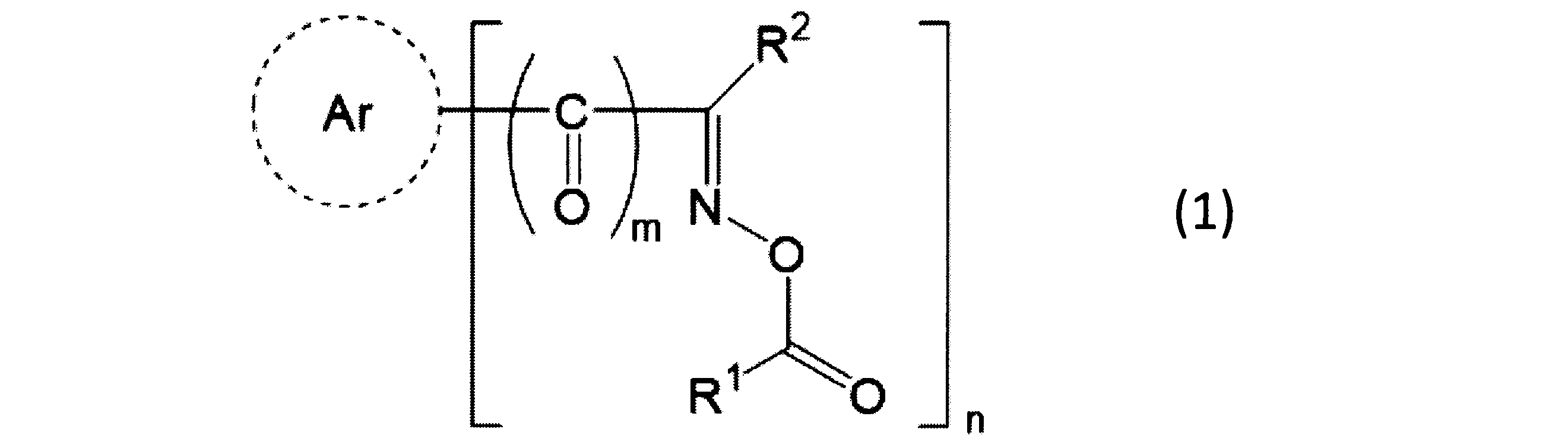
上記一般式(1)中、mは0または1である。nは2以上の整数である。nは6以下が好ましく、さらに4以下、また3以下が好ましい。R1は水素原子、アルキル基またはフェニル基を表し、反応性の観点から立体障害が小さく、かつ反応性の高いメチルラジカルを生成するメチル基が最も好ましい。R2はアルキル基、シクロアルキル基またはシクロアルキルアルキル基を表し、溶媒への溶解性の観点から炭素数は1~7であることが好ましい。一般式(1)では、R1およびR2がそれぞれ複数存在する。R1は同一でも異なっていてもいい。R2も同一であっても異なっていてもいい。Arは芳香族基を表す。Arは特許文献3および特許文献4が開示するように、窒素、酸素、硫黄、カルボニル基を含んでいてもよい。そしてArには以下の構造およびそれらの構造同士の結合物、さらにそれらに他の官能基が結合したものも含まれる。
9H-フルオレン、9H-カルバゾ-ル、ジベンゾ〔b,d]フラン、ジベンゾ[b,d]チオフェン、9H-フルオレン-9-オン、9,10-ジヒドロアントラセン、9H-チオキサンテン、9,10-ジヒドロアクリジン、9H-キサンテンアントラセン-9,10H-オン、9H-チオキサンテン-9-オン、9H-キサンテン-9-オン、アクリジン-9,10H-オン、10H-フェノキサジン、フェノキサチイン、10H-フェノチアジン、オキサントレン、5,10-ジヒドロフェナジン、チアントレン、アントラセン-9,10-ジオン。
1H-インデン、1H-インド-ル、1-ベンゾフラン、1一ベンゾチオフェン、1H-インデン-1-オン。
9H-フルオレン、9H-カルバゾ-ル、ジベンゾ〔b,d]フラン、ジベンゾ[b,d]チオフェン、9H-フルオレン-9-オン、9,10-ジヒドロアントラセン、9H-チオキサンテン、9,10-ジヒドロアクリジン、9H-キサンテンアントラセン-9,10H-オン、9H-チオキサンテン-9-オン、9H-キサンテン-9-オン、アクリジン-9,10H-オン、10H-フェノキサジン、フェノキサチイン、10H-フェノチアジン、オキサントレン、5,10-ジヒドロフェナジン、チアントレン、アントラセン-9,10-ジオン。
1H-インデン、1H-インド-ル、1-ベンゾフラン、1一ベンゾチオフェン、1H-インデン-1-オン。
光ラジカル重合開始剤の吸収ピーク波長および吸光度は、以下の方法により求めることができる。まず、光ラジカル重合開始剤を、プロピレングリコールメチルエーテルアセテートを用いて濃度0.001重量%に希釈する。得られた希釈液について、紫外-可視分光光度計UV-2600((株)島津製作所製)を用いて、波長300~400nmにおける吸光度を測定する。得られた吸光度スペクトルから、吸収ピーク波長、波長365nmにおける吸光度、波長400nmにおける吸光度をそれぞれ求めることができる。
本発明のネガ型感光性樹脂組成物における(C)光ラジカル重合開始剤の含有量は、ラジカル硬化を十分に進め、耐薬品性をより向上させ、鉛筆硬度をより高くし、電極や配線加工時のアウトガスの発生をより抑制する観点から、固形分中0.1重量%以上が好ましく、1重量%以上がより好ましく、4重量%以上がさらに好ましい。一方、(C)光ラジカル重合開始剤の残留を抑制して耐薬品性をより向上させ、過剰なラジカル発生を抑制して解像度をより向上させる観点から、(C)光ラジカル重合開始剤の含有量は、固形分中20重量%以下が好ましく、10重量%以下がより好ましく、6重量%以下がさらに好ましい。
本発明のネガ型感光性樹脂組成物は、さらに一般式(1)で示される光ラジカル重合開始剤以外の光ラジカル重合開始剤を含有してもよく、例えば、アルキルフェノン系光ラジカル重合開始剤、アシルホスフィンオキサイド系光ラジカル重合開始剤、1分子中に1つのオキシムエステル系光ラジカル重合開始剤、ベンゾフェノン系光ラジカル重合開始剤、オキサントン系光ラジカル重合開始剤、イミダゾール系光ラジカル重合開始剤、ベンゾチアゾール系光ラジカル重合開始剤、ベンゾオキサゾール系光ラジカル重合開始剤、カルバゾール系光ラジカル重合開始剤、トリアジン系光ラジカル重合開始剤、安息香酸エステル系光ラジカル重合開始剤、リン系光ラジカル重合開始剤、チタネート等の無機系光ラジカル重合開始剤などが挙げられる。これらを2種以上含有してもよい。
本発明のネガ型感光性樹脂組成物は、シランカップリング剤などの密着改良剤を含有してもよい。シランカップリング剤としては、例えば、ビニル基、エポキシ基、スチリル基、メタクリロキシ基、アクリロキシ基、アミノ基等の官能基を有するシランカップリング剤が挙げられる。
具体的には、3-グリシドキシプロピルトリメトキシシラン、3-グリシドキシプロピルトリエトキシシラン、3-グリシドキシプロピルメチルジメトキシシラン、3-グリシドキシプロピルメチルジエトキシシラン、2-(3,4-エポキシシクロヘキシル)エチルトリメトキシシラン、3-クロロプロピルメチルジメトキシシラン、3-クロロプロピルトリメトキシシラン、ビニルトリメトキシシラン、ビニルトリエトキシシラン、ビニルトリス(2-メトキシエトキシ)シラン、N-(2-アミノエチル)-3-アミノプロピルメチルジメトキシシラン、N-(2-アミノエチル)-3-アミノプロピルトリメトキシシラン、3-メタクリロキシプロピルトリメトキシシラン、3-アクリロキシプロピルトリメトキシシラン、3-アミノプロピルトリメトキシシラン、3-アミノプロピルトリエトキシシラン、3-トリエトキシシリル-N-(1,3-ジメチル-ブチリデン)プロピルアミン、3-メルカプトプロピルトリメトキシシラン、3-ウレイドプロピルトリエトキシシラン、3-イソシアネートプロピルトリエトキシシラン、p-スリチルトリメトキシシランなどが好ましい。
本発明のネガ型感光性樹脂組成物は、各種の硬化剤を含有してもよく、ネガ型感光性樹脂組成物の硬化を促進または容易にすることができる。硬化剤としては、例えば、窒素含有有機物、シリコーン樹脂硬化剤、金属アルコキシド、金属キレート、イソシアネート化合物およびその重合体、エポキシ化合物およびその重合体、メチロール化メラミン誘導体、メチロール化尿素誘導体などが挙げられる。これらを2種以上含有してもよい。なかでも、硬化剤の安定性、得られた塗布膜の加工性などから金属キレート化合物、メチロール化メラミン誘導体、メチロール化尿素誘導体が好ましく用いられる。
(A)シロキサン樹脂は酸により硬化が促進されるので、本発明のネガ型感光性樹脂組成物中に熱酸発生剤などの硬化触媒を含有してもよい。熱酸発生剤としては、例えば、芳香族ジアゾニウム塩、スルフォニウム塩、ジアリールヨードニウム塩、トリアリールスルフォニウム塩、トリアリールセレニウム塩などの各種オニウム塩系化合物、スルホン酸エステル、ハロゲン化合物などが挙げられる。
本発明のネガ型感光性樹脂組成物は、重合禁止剤を含有してもよい。重合禁止剤を含有することにより、ネガ型感光性樹脂組成物の保存安定性および解像度をより向上させることができる。重合禁止剤としては、例えば、フェノール、カテコール、レゾルシノール、ハイドロキノン、4-t-ブチルカテコール、2,6-ジ(t-ブチル)-p-クレゾール、フェノチアジン、4-メトキシフェノール等が挙げられる。
本発明のネガ型感光性樹脂組成物における重合禁止剤の含有量は、固形分中、0.01質量%以上が好ましく、0.05質量%以上がより好ましい。一方、硬化膜の鉛筆硬度をより向上させる観点から、重合禁止剤の含有量は、固形分中、5質量%以下が好ましく、1質量%以下がより好ましい。
本発明のネガ型感光性樹脂組成物は、本発明の効果を妨げない限り、紫外線吸収剤を含有してもよい。紫外線吸収剤を含有することにより、ネガ型感光性樹脂組成物の解像度および硬化膜の耐候性をより向上させることができる。紫外線吸収剤としては、透明性、非着色性の面から、ベンゾトリアゾール系化合物、ベンゾフェノン系化合物、トリアジン系化合物が好ましく用いられる。
ベンゾトリアゾール系化合物としては、例えば、2-(2Hベンゾトリアゾール-2-イル)フェノール、2-(2H-ベンゾトリアゾール-2-イル)-4,6-t-ペンチルフェノール、2-(2Hベンゾトリアゾール-2-イル)-4-(1,1,3,3-テトラメチルブチル)フェノール、2(2H-ベンゾトリアゾール-2-イル)-6-ドデシル-4-メチルフェノール、2-(2’-ヒドロキシ-5’-メタクリロキシエチルフェニル)-2H-ベンゾトリアゾール、RUVA-93(商品名、大塚化学(株)製)等が挙げられる。
ベンゾフェノン系化合物としては、例えば、2-ヒドロキシ-4-メトキシベンゾフェノン等が挙げられる。
トリアジン系化合物としては、例えば、2-(4,6-ジフェニル-1,3,5トリアジン-2-イル)-5-[(ヘキシル)オキシ]-フェノール、Tinuvin477(商品名、BASF製)等が挙げられる。
本発明のネガ型感光性樹脂組成物における紫外線吸収剤の含有量は、硬化膜の下地となるガラスなどの基材との密着性を向上させる観点から、固形分中、10重量%以下が好ましく、5重量%以下がより好ましい。
本発明のネガ型感光性樹脂組成物は、溶媒を含有してもよい。溶媒を含有することにより、各成分を均一に溶解することができる。溶媒としては、例えば、脂肪族炭化水素、カルボン酸エステル、ケトン、エーテル、アルコール類などが挙げられる。これらを2種以上含有してもよい。各成分を均一に溶解し、得られる塗布膜の透明性を向上させる観点から、アルコール性水酸基を有する化合物、カルボニル基を有する環状化合物が好ましい。
アルコール性水酸基を有する化合物としては、例えば、アセトール、3-ヒドロキシ-3-メチル-2-ブタノン、4-ヒドロキシ-3-メチル-2-ブタノン、5-ヒドロキシ-2-ペンタノン、4-ヒドロキシ-4-メチル-2-ペンタノン(ダイアセトンアルコール)、乳酸エチル、乳酸ブチル、プロピレングリコールモノメチルエーテル、プロピレングリコールモノエチルエーテル、プロピレングリコールモノn-プロピルエーテル、プロピレングリコールモノn-ブチルエーテル、プロピレングリコールモノt-ブチルエーテル、3-メトキシ-1-ブタノール、3-メチル-3-メトキシ-1-ブタノールなどが挙げられる。
カルボニル基を有する環状化合物の具体例としては、γ-ブチロラクトン、γ-バレロラクトン、δ-バレロラクトン、炭酸プロピレン、N-メチルピロリドン、シクロヘキサノン、シクロヘプタノンなどが挙げられる。これらの中でも、γ-ブチロラクトンが特に好ましく用いられる。
脂肪族炭化水素としては、例えば、キシレン、エチルベンゼン、ソルベントナフサなどが挙げられる。
カルボン酸エステルとしては、例えば、ベンジルアセテート、エチルベンゾエート、γ-ブチロラクトン、メチルベンゾエート、マロン酸ジエチル、2-エチルヘキシルアセテート、2-ブトキシエチルアセテート、3-メトキシ-3-メチル-ブチルアセテート、シュウ酸ジエチル、アセト酢酸エチル、シクロヘキシルアセテート、3-メトキシ-ブチルアセテート、アセト酢酸メチル、エチル-3-エトキシプロピオネート、2-エチルブチルアセテート、イソペンチルプロピオネート、プロピレングリコールモノメチルエーテルプロピオネート、プロピレングリコールモノエチルエーテルアセテート、酢酸エチル、酢酸ブチル、酢酸イソペンチル、酢酸ペンチル、プロピレングリコールモノメチルエーテルアセテートなどが挙げられる。
ケトンとしては、例えば、シクロペンタノン、シクロヘキサノンなどが挙げられる。
エーテルとしては、例えば、プロピレングリコールモノメチルエーテル、プロピレングリコールモノエチルエーテル、プロピレングリコールターシャリーブチルエーテル、ジプロピレングリコールモノメチルエーテルなどのプロピレングリコール誘導体などの脂肪族エーテル類などが挙げられる。
本発明のネガ型感光性樹脂組成物は、界面活性剤を含有してもよい。界面活性剤を含有することにより、塗布時のフロー性を向上させることができる。界面活性剤としては、例えば、フッ素系界面活性剤;シリコーン系界面活性剤;含フッ素熱分解性界面活性剤;ポリエーテル変性シロキサン系界面活性剤;ポリアルキレンオキシド系界面活性剤;ポリ(メタ)アクリレート系界面活性剤;ラウリル硫酸アンモニウム、ポリオキシエチレンアルキルエーテル硫酸トリエタノールアミンなどの陰イオン界面活性剤;ステアリルアミンアセテート、ラウリルトリメチルアンモニウムクロライドなどの陽イオン界面活性剤;ラウリルジメチルアミンオキサイド、ラウリルカルボキシメチルヒドロキシエチルイミダゾリウムベタインなどの両性界面活性剤;ポリオキシエチレンラウリルエーテル、ポリオキシエチレンステアリルエーテル、ソルビタンモノステアレートなどの非イオン界面活性剤などが挙げられる。これらを2種以上含有してもよい。
フッ素系界面活性剤の市販品としては、例えば、“メガファック”(登録商標)F142D、同F172、同F173、同F183、同F445、同F470、同F475、同F477(以上、DIC(株)製)、NBX-15、FTX-218((株)ネオス製)などが挙げられる。シリコーン系界面活性剤の市販品としては、例えば、“BYK”(登録商標)-333、BYK-301、BYK-331、BYK-345、BYK-307(ビックケミー・ジャパン(株)製)などが挙げられる。含フッ素熱分解性界面活性剤の市販品としては、例えば、“メガファック”(登録商標)DS-21(DIC(株)製)などが挙げられる。ポリエーテル変性シロキサン系界面活性剤の市販品としては、例えば、“BYK”(登録商標)-345、BYK-346、BYK-347、BYK-348、BYK-349(以上、ビックケミー・ジャパン(株)製)、“シルフェイス”(登録商標)SAG002、同SAG005、同SAG0503A、同SAG008(以上、日信化学工業(株)製)などが挙げられる。
本発明のネガ型感光性樹脂組成物は、分散剤を含有してもよい。分散剤としては、例えば、ポリアクリル酸系分散剤、ポリカルボン酸系分散剤、リン酸系分散剤、シリコーン系分散剤などが挙げられる。
本発明のネガ型感光性樹脂組成物は、(A)シロキサン樹脂以外の樹脂を含有してもよく、例えば、ラジカル重合性基を有しないシロキサン樹脂を含有してもよい。
次に、本発明のネガ型感光性樹脂組成物の製造方法について説明する。本発明のネガ型感光性樹脂組成物の製造方法としては、(A)シロキサン樹脂、(B)ラジカル重合性基を有するモノマ、(C)光ラジカル重合開始剤および必要に応じてその他成分を撹拌・混合する方法が一般的である。
本発明のネガ型感光性樹脂組成物を硬化させることにより、硬化膜を得ることができる。硬化膜の製造方法としては、本発明のネガ型感光性樹脂組成物を基材上に塗布する工程、露光する工程および180℃以下の温度で硬化させる工程を有する方法が好ましい。
次に、本発明のネガ型感光性樹脂組成物から硬化膜を製造する方法について、例を挙げて説明する。
ネガ型感光性樹脂組成物を基板上に塗布して、塗膜を得る。基板としては、ガラス基材や樹脂フィルムなどが挙げられる。これら基材は、その表面に、ITOや、銅、銅合金などの金属を含有する電極や配線が形成されていてもよい。塗布方法としては、例えば、スピンナーを用いた回転塗布、スプレー塗布、インクジェット塗布、ダイコーティング、ロールコーティングなどが挙げられる。塗膜の膜厚は、塗布方法等によって適宜選択することができる。乾燥後の膜厚を0.1~10μmとすることが一般的である。
得られた塗膜を乾燥して、乾燥膜を得る。乾燥方法としては、例えば、加熱乾燥、風乾、減圧乾燥、赤外線照射等が挙げられる。加熱乾燥装置としては、例えば、オーブン、ホットプレートなどが挙げられる。乾燥温度は50~150℃が好ましく、乾燥時間は1分間~数時間が好ましい。
得られた乾燥膜に、所望のパターンを有するマスクを介して化学線を照射(露光)して、露光膜を得る。照射する化学線としては、例えば、紫外線、可視光線、電子線、X線などが挙げられる。本発明のネガ型感光性樹脂組成物に対しては、水銀灯のi線(365nm)で、またはi線を含む光で照射することが好ましい。
得られた露光膜を、アルカリ性現像液等を用いて現像することにより未露光部を除去し、パターンを得る。アルカリ性現像液に用いられるアルカリ性化合物としては、例えば、水酸化ナトリウム、水酸化カリウム、炭酸ナトリウム、炭酸カリウム、ケイ酸ナトリウム、メタケイ酸ナトリウム、アンモニア水等の無機アルカリ類;エチルアミン、n-プロピルアミン等の1級アミン類;ジエチルアミン、ジ-n-プロピルアミン等の2級アミン類;トリエチルアミン、メチルジエチルアミン等の3級アミン類;テトラメチルアンモニウムヒドロキシド(TMAH)等のテトラアルキルアンモニウムヒドロキシド類、コリン等の4級アンモニウム塩;トリエタノールアミン、ジエタノールアミン、モノエタノールアミン、ジメチルアミノエタノール、ジエチルアミノエタノール等のアルコールアミン類;ピロール、ピペリジン、1,8-ジアザビシクロ[5,4,0]-7-ウンデセン、1,5-ジアザビシクロ[4,3,0]-5-ノナン、モルホリン等の環状アミン類等の有機アルカリ類が挙げられる。
アルカリ性現像液におけるアルカリ性化合物の濃度は0.01~50重量%が一般的であり、0.02~1重量%が好ましい。また、現像後のパターン形状をより良好なものとするため、非イオン系界面活性剤等の界面活性剤を0.1~5重量%添加しても構わない。さらに現像液がアルカリ水溶液の場合には、現像液にエタノール、γ-ブチロラクトン、ジメチルホルムアミド、N-メチル-2-ピロリドン等の水溶性有機溶剤を添加しても構わない。
現像方法としては、例えば、浸漬法、スプレー法、パドル法などが挙げられる。得られたパターンに、純水等を用いてリンス洗浄をしても構わない。
得られたパターンを加熱処理(ポストベイク)することによりパターンを硬化させ、パターニングされた硬化膜を得ることができる。加熱処理は、空気中、窒素雰囲気下、真空状態のいずれで行ってもよい。加熱温度は80~180℃が好ましく、加熱時間は0.25~5時間が好ましい。加熱温度を連続的に変化させてもよいし、段階的に変化させてもよい。
硬化膜をパターニングする必要がない場合においても、乾燥膜全面を露光し、硬化膜を光硬化させた後に加熱処理することが好ましい。加熱処理前に光硬化することにより、加熱処理における急激な膜収縮を抑制することができ、硬化膜と基板との密着性をより向上させることができる。
次に、本発明のタッチパネルについて説明する。本発明のタッチパネルは、基材、銅を含有する電極および/または配線、ならびに、本発明のネガ型感光性樹脂組成物を硬化させてなる硬化膜を有する。例えば、基材上に、X軸電極導通配線およびY軸電極導通配線を有し、これら配線の交差する部位に、前記硬化膜からなる透明絶縁膜を有することが好ましい。
基材としては、ガラス基材や樹脂フィルムなどが挙げられる。
電極および配線としては、例えば、銅、銅合金、金、銀、アルミニウム、モリブデン、モリブデン-ニオブ合金等の金属の薄膜や積層膜などが挙げられる。本発明のネガ型感光性樹脂組成物は150℃以下の低温で硬化可能である。そこで銅を含有する電極および/または配線との組み合わせにおいて好適に用いることができる。電極および配線は、導体線を網目状に配した、いわゆるメタルメッシュと称されるパターンを有することが好ましい。
次に、本発明のタッチパネルの製造方法について、前述の構成を有するタッチパネルを例に説明する。まず、基材上に銅を含有する電極薄膜を形成する。電極薄膜の形成方法としては、例えば、真空蒸着、スパッタリング、イオンプレーティング、イオンビーム蒸着等の物理的方法;化学的気相成長法などが挙げられる。次に、電極薄膜上にレジスト材料を塗布し、フォトリソグラフィー技術によりパターン加工した後、エッチング液を用いて電極薄膜を薬液エッチングし、剥離液を用いてレジストを剥離することにより、X軸電極導通配線を形成する。続いて、X軸電極導通配線と、後から形成するY軸電極導通配線の交差部位に、前述の方法により硬化膜を形成することにより、透明絶縁膜を形成する。その後、ICドライバとの接続配線およびY軸電極導通配線を、X軸電極導通配線と同様に形成する。最後に、基材端部のICドライバとの接続部位以外の部分に前述の方法により硬化膜を形成することにより、透明保護膜を形成し、タッチパネルを得ることができる。
本発明のネガ型感光性樹脂組成物は、例えば、タッチパネル用保護膜や金属配線用保護膜などの各種保護膜、タッチパネル用絶縁膜、ガラス強化樹脂層、TFT用絶縁膜、層間絶縁膜などの各種絶縁膜、各種ハードコート材、TFT用平坦化膜、カラーフィルター用オーバーコート、パッシベーション膜、反射防止膜、光学フィルター、カラーフィルター用フォトスペーサー、マイクロレンズとして好適に用いられる。ネガ型感光性を有することから、液晶や有機ELディスプレイのTFT用平坦化膜、絶縁膜、反射防止膜、カラーフィルター用オーバーコート、柱材などに好適に用いられる。これらの中でも、特に、180℃以下の低温で硬化しても、耐薬品性が高く、電極や配線加工時アウトガスの発生を抑制することができることから、銅を含有する電極および/または配線を有するタッチパネル用絶縁膜、保護膜、ガラス強化樹脂層として好適に用いることができる。
以下、実施例および比較例を用いて、本発明を更に詳細に説明するが、本発明は以下の実施例に限定されるものではない。
<評価方法>
「吸光度」
各実施例および比較例に用いた光ラジカル重合開始剤を、プロピレングリコールメチルエーテルアセテート(以下、「PGMEA」)を用いて濃度0.001質量%に希釈した。得られた希釈液について、紫外-可視分光光度計UV-2600((株)島津製作所製)を用いて波長300~400nmにおける吸光度を測定した。得られた吸光度スペクトルから、吸収ピーク波長、波長365nmにおける吸光度、波長400nmにおける吸光度をそれぞれ求めた。
「吸光度」
各実施例および比較例に用いた光ラジカル重合開始剤を、プロピレングリコールメチルエーテルアセテート(以下、「PGMEA」)を用いて濃度0.001質量%に希釈した。得られた希釈液について、紫外-可視分光光度計UV-2600((株)島津製作所製)を用いて波長300~400nmにおける吸光度を測定した。得られた吸光度スペクトルから、吸収ピーク波長、波長365nmにおける吸光度、波長400nmにおける吸光度をそれぞれ求めた。
「二重結合当量」
合成例1~2により得られたシロキサン樹脂について、電位差自動滴定装置(AT-510;京都電子工業(株)製)を用い、ヨウ素供給源としてICl溶液(ICl3=7.9g、I2=8.9g、AcOH(酢酸)=1,000mLの混合溶液)、未反応ヨウ素の捕捉水溶液として100g/LのKI水溶液、滴定試薬として0.1mol/LのNa2S2O3水溶液を用いて、JIS K0070:1992「化学製品の酸価、けん化価、エステル価、よう素価、水酸基価及び不けん化物の試験方法」の「第6項よう素価」に記載の方法に基づき、ウィイス法により、ヨウ素価を測定した。測定したヨウ素価(単位はgI/100g)の値から、二重結合当量(単位はg/mol)を算出した。
合成例1~2により得られたシロキサン樹脂について、電位差自動滴定装置(AT-510;京都電子工業(株)製)を用い、ヨウ素供給源としてICl溶液(ICl3=7.9g、I2=8.9g、AcOH(酢酸)=1,000mLの混合溶液)、未反応ヨウ素の捕捉水溶液として100g/LのKI水溶液、滴定試薬として0.1mol/LのNa2S2O3水溶液を用いて、JIS K0070:1992「化学製品の酸価、けん化価、エステル価、よう素価、水酸基価及び不けん化物の試験方法」の「第6項よう素価」に記載の方法に基づき、ウィイス法により、ヨウ素価を測定した。測定したヨウ素価(単位はgI/100g)の値から、二重結合当量(単位はg/mol)を算出した。
「酸価」
合成例4により得られたアクリル樹脂および合成例5により得られたカルド系樹脂について、電位差自動滴定装置(AT-510;京都電子工業(株)製)を用い、滴定試薬として0.1mol/LのNaOH/エタノール溶液、滴定溶剤としてキシレン/N,N――ジメチルホルムアミド(DMF)=1/1(質量比)を用いて、「JIS K2501(2003)」に基づき、電位差滴定法により、酸価(単位はmgKOH/g)を測定して求めた。
合成例4により得られたアクリル樹脂および合成例5により得られたカルド系樹脂について、電位差自動滴定装置(AT-510;京都電子工業(株)製)を用い、滴定試薬として0.1mol/LのNaOH/エタノール溶液、滴定溶剤としてキシレン/N,N――ジメチルホルムアミド(DMF)=1/1(質量比)を用いて、「JIS K2501(2003)」に基づき、電位差滴定法により、酸価(単位はmgKOH/g)を測定して求めた。
「耐薬品性」
無アルカリガラス基板(ガラス厚み0.55mm)上にモリブデン・ニオブ/銅/モリブデン・ニオブをこの順で積層し、基板を準備した。以下、「メタル積層基板」と。積層したモリブデン・ニオブ/銅/モリブデン・ニオブのそれぞれの膜厚は20nm、300nm、20nmであった。メタル積層基板上に、各実施例および比較例により得られたネガ型感光性樹脂組成物を、スピンコーター(ミカサ(株)製MS-A150)を用いてスピンコートした。ネガ型感光性樹脂組成物を塗布したメタル積層基板を、ホットプレート(アズワン(株)製HHP-230SQ)を用いて90℃で2分間プリベークし、膜厚2.3μmのプリベーク膜を作製した。得られたプリベーク膜を、マスクアライナー(三永電機製作所(株)製LA-610)を用いて、超高圧水銀灯を光源とし、露光量100mJ/cm2(i線換算)で露光した。その後、自動現像装置(滝沢産業(株)製AD-1200)を用いて、0.5重量%水酸化カリウム水溶液(三菱ガス化学(株)製)を用いて60秒間シャワー現像し、次いで水で30秒間リンスした。最後に、オーブン(エスペック(株)製DHS-42)を用いて、空気中130℃で30分間キュアし、膜厚2.0μmの硬化膜を作製した。得られた硬化膜に対して、メタルエッチング液である「過酸化水素水(30%)(商品名)」(富士フイルム和光純薬(株)製)に30℃で2分間浸漬した後、硬化膜下のメタルの変色の有無を目視観察した。変色が認められない場合、さらに3分間追加浸漬(合計5分間)し、メタルの変色の有無を目視観察した。変色が認められない場合、さらに2分間追加浸漬(合計7分間)し、メタルの変色の有無を目視観察した。変色が認められない場合、さらに3分間追加浸漬(合計10分間)し、メタルの変色の有無を目視観察した。浸漬時間と変色の関係から、以下の基準により耐薬品性を評価した。なお、試験前のモリブデン-ニオブ合金層由来の黒色が、試験後にモリブデン-ニオブ合金の腐食によって銅層由来の赤色に変化している場合に、変色と判断した。
A:試験10分後で、硬化膜下のメタルに変色が見られない。
B:試験10分後で、硬化膜下のメタルが変色した。
C:試験7分後で、硬化膜下のメタルが変色した。
D:試験5分後で、硬化膜下のメタルが変色した。
E:試験2分後で、硬化膜下のメタルが変色した。
無アルカリガラス基板(ガラス厚み0.55mm)上にモリブデン・ニオブ/銅/モリブデン・ニオブをこの順で積層し、基板を準備した。以下、「メタル積層基板」と。積層したモリブデン・ニオブ/銅/モリブデン・ニオブのそれぞれの膜厚は20nm、300nm、20nmであった。メタル積層基板上に、各実施例および比較例により得られたネガ型感光性樹脂組成物を、スピンコーター(ミカサ(株)製MS-A150)を用いてスピンコートした。ネガ型感光性樹脂組成物を塗布したメタル積層基板を、ホットプレート(アズワン(株)製HHP-230SQ)を用いて90℃で2分間プリベークし、膜厚2.3μmのプリベーク膜を作製した。得られたプリベーク膜を、マスクアライナー(三永電機製作所(株)製LA-610)を用いて、超高圧水銀灯を光源とし、露光量100mJ/cm2(i線換算)で露光した。その後、自動現像装置(滝沢産業(株)製AD-1200)を用いて、0.5重量%水酸化カリウム水溶液(三菱ガス化学(株)製)を用いて60秒間シャワー現像し、次いで水で30秒間リンスした。最後に、オーブン(エスペック(株)製DHS-42)を用いて、空気中130℃で30分間キュアし、膜厚2.0μmの硬化膜を作製した。得られた硬化膜に対して、メタルエッチング液である「過酸化水素水(30%)(商品名)」(富士フイルム和光純薬(株)製)に30℃で2分間浸漬した後、硬化膜下のメタルの変色の有無を目視観察した。変色が認められない場合、さらに3分間追加浸漬(合計5分間)し、メタルの変色の有無を目視観察した。変色が認められない場合、さらに2分間追加浸漬(合計7分間)し、メタルの変色の有無を目視観察した。変色が認められない場合、さらに3分間追加浸漬(合計10分間)し、メタルの変色の有無を目視観察した。浸漬時間と変色の関係から、以下の基準により耐薬品性を評価した。なお、試験前のモリブデン-ニオブ合金層由来の黒色が、試験後にモリブデン-ニオブ合金の腐食によって銅層由来の赤色に変化している場合に、変色と判断した。
A:試験10分後で、硬化膜下のメタルに変色が見られない。
B:試験10分後で、硬化膜下のメタルが変色した。
C:試験7分後で、硬化膜下のメタルが変色した。
D:試験5分後で、硬化膜下のメタルが変色した。
E:試験2分後で、硬化膜下のメタルが変色した。
「鉛筆硬度」
無アルカリガラス基板(ガラス厚み0.55mm)上に、各実施例および比較例により得られたネガ型感光性樹脂組成物を用いて、前記「耐薬品性」の評価に記載の方法と同様にして膜厚2.0μmの硬化膜を作製した。得られた硬化膜に対して、JIS JIS「K5600-5-4(制定年月日=1999/04/20)」に準じて鉛筆硬度を測定した。
無アルカリガラス基板(ガラス厚み0.55mm)上に、各実施例および比較例により得られたネガ型感光性樹脂組成物を用いて、前記「耐薬品性」の評価に記載の方法と同様にして膜厚2.0μmの硬化膜を作製した。得られた硬化膜に対して、JIS JIS「K5600-5-4(制定年月日=1999/04/20)」に準じて鉛筆硬度を測定した。
「解像度」
無アルカリガラス基板(ガラス厚み0.55mm)上に、各実施例および比較例により得られたネガ型感光性樹脂組成物を、スピンコーター(ミカサ(株)製MS-A150)を用いてスピンコートした。ネガ型感光性樹脂組成物を塗布した無アルカリガラス基板を、ホットプレート(アズワン(株)製HHP-230SQ)を用いて90℃で2分間プリベークし、膜厚2.3μmのプリベーク膜を作製した。得られたプリベーク膜を、マスクアライナー(三永電機製作所(株)製LA-610)を用いて、超高圧水銀灯を光源とし、5、10、20、30、40、50μm幅の1対1L&Sパターンを持つマスクを用い、マスクギャップ200μmで露光した。その後、自動現像装置(滝沢産業(株)製AD-1200)を用いて、0.5重量%水酸化カリウム水溶液(三菱ガス化学(株)製)を用いて60秒間シャワー現像し、次いで水で30秒間リンスした。現像後の最小パターン寸法を測定し、これを解像度とした。
無アルカリガラス基板(ガラス厚み0.55mm)上に、各実施例および比較例により得られたネガ型感光性樹脂組成物を、スピンコーター(ミカサ(株)製MS-A150)を用いてスピンコートした。ネガ型感光性樹脂組成物を塗布した無アルカリガラス基板を、ホットプレート(アズワン(株)製HHP-230SQ)を用いて90℃で2分間プリベークし、膜厚2.3μmのプリベーク膜を作製した。得られたプリベーク膜を、マスクアライナー(三永電機製作所(株)製LA-610)を用いて、超高圧水銀灯を光源とし、5、10、20、30、40、50μm幅の1対1L&Sパターンを持つマスクを用い、マスクギャップ200μmで露光した。その後、自動現像装置(滝沢産業(株)製AD-1200)を用いて、0.5重量%水酸化カリウム水溶液(三菱ガス化学(株)製)を用いて60秒間シャワー現像し、次いで水で30秒間リンスした。現像後の最小パターン寸法を測定し、これを解像度とした。
「耐候性」
無アルカリガラス基板(ガラス厚み0.55mm)上に、各実施例および比較例により得られたネガ型感光性樹脂組成物を用いて、前記「耐薬品性」の評価に記載の方法と同様にして膜厚2.0μmの硬化膜を作製した。得られた硬化膜に対して、耐候性試験機(商品名「Q-Sun」、Q-Lab社製)を用いて0.55W/m2(340nm)、63℃の条件で、疑似太陽光を300時間照射し、紫外-可視分光光度計UV-2600((株)島津製作所製)を用いて試験前後のb*の値からΔb*を算出し、耐候性の評価を行った。Δb*から以下の基準により耐候性を評価した。A以上を合格とした。
A:Δb*が1未満。
B:Δb*が1以上、3未満。
C:Δb*が3以上。
無アルカリガラス基板(ガラス厚み0.55mm)上に、各実施例および比較例により得られたネガ型感光性樹脂組成物を用いて、前記「耐薬品性」の評価に記載の方法と同様にして膜厚2.0μmの硬化膜を作製した。得られた硬化膜に対して、耐候性試験機(商品名「Q-Sun」、Q-Lab社製)を用いて0.55W/m2(340nm)、63℃の条件で、疑似太陽光を300時間照射し、紫外-可視分光光度計UV-2600((株)島津製作所製)を用いて試験前後のb*の値からΔb*を算出し、耐候性の評価を行った。Δb*から以下の基準により耐候性を評価した。A以上を合格とした。
A:Δb*が1未満。
B:Δb*が1以上、3未満。
C:Δb*が3以上。
「アウトガス」
シリコンウエハ基板上に、各実施例および比較例により得られたネガ型感光性樹脂組成物を用いて、前記「耐薬品性」の評価に記載の方法と同様にして膜厚2.0μmの硬化膜を作製した。得られた硬化膜を、ヘリウム50mL/minの雰囲気下、室温から400℃まで10℃/minの昇温速度で加熱しながら、MS装置(GC/MS QP2010(8)、島津製作所製)を用いて硬化膜からの気体発生量を測定した気体発生量をもとに、(各気体の発生重量/試料重量)×106の計算式から濃度を算出し、以下の基準によりアウトガスを評価した。B以上を合格とした。
A:250wtppm未満。
B:250wtppm以上500wtppm未満。
C:500wtppm以上750wtppm未満。
D:750wtppm以上1000wtppm未満。
E:1000wtppm以上。
シリコンウエハ基板上に、各実施例および比較例により得られたネガ型感光性樹脂組成物を用いて、前記「耐薬品性」の評価に記載の方法と同様にして膜厚2.0μmの硬化膜を作製した。得られた硬化膜を、ヘリウム50mL/minの雰囲気下、室温から400℃まで10℃/minの昇温速度で加熱しながら、MS装置(GC/MS QP2010(8)、島津製作所製)を用いて硬化膜からの気体発生量を測定した気体発生量をもとに、(各気体の発生重量/試料重量)×106の計算式から濃度を算出し、以下の基準によりアウトガスを評価した。B以上を合格とした。
A:250wtppm未満。
B:250wtppm以上500wtppm未満。
C:500wtppm以上750wtppm未満。
D:750wtppm以上1000wtppm未満。
E:1000wtppm以上。
〔合成例1〕
500mLの三口フラスコにメチルトリメトキシシランを40.86g(0.30mol)、フェニルトリメトキシシランを59.49g(0.30mol)、テトラエトキシシランを20.83g(0.10mol)、3-グリシドキシプロピルトリメトキシシランを23.63g(0.10mol)、3-メタクリロキシプロピルトリメトキシシランを49.68g(0.20mol)、PGMEAを220.99g仕込んだ。フラスコを40℃のオイルバスに漬けて、内容物を撹拌しながら、水55.8gに1mol/Lの硝酸3.1g(仕込みモノマに対して0.1重量部)を溶かした硝酸水溶液を滴下ロートで10分間かけて添加した。40℃で1時間撹拌した後、オイルバス温度を70℃に設定して1時間撹拌し、さらにオイルバスを30分間かけて115℃まで昇温した。昇温開始1時間後に溶液の内温が100℃に到達し、そこから2時間、内温100~120℃で加熱撹拌した。反応中に副生成物であるメタノール及び水が合計120g留出した。得られたシロキサン樹脂のPGMEA溶液に、ポリマー濃度が30重量%となるようにPGMEAを加えてシロキサン樹脂溶液(PS-1)を得た。なお、得られたシロキサン樹脂の重量平均分子量(以下、「Mw」)をGPCにより測定したところ、2,000(ポリスチレン換算)であった。また、前述の方法により測定した二重結合当量は630g/molであった。
500mLの三口フラスコにメチルトリメトキシシランを40.86g(0.30mol)、フェニルトリメトキシシランを59.49g(0.30mol)、テトラエトキシシランを20.83g(0.10mol)、3-グリシドキシプロピルトリメトキシシランを23.63g(0.10mol)、3-メタクリロキシプロピルトリメトキシシランを49.68g(0.20mol)、PGMEAを220.99g仕込んだ。フラスコを40℃のオイルバスに漬けて、内容物を撹拌しながら、水55.8gに1mol/Lの硝酸3.1g(仕込みモノマに対して0.1重量部)を溶かした硝酸水溶液を滴下ロートで10分間かけて添加した。40℃で1時間撹拌した後、オイルバス温度を70℃に設定して1時間撹拌し、さらにオイルバスを30分間かけて115℃まで昇温した。昇温開始1時間後に溶液の内温が100℃に到達し、そこから2時間、内温100~120℃で加熱撹拌した。反応中に副生成物であるメタノール及び水が合計120g留出した。得られたシロキサン樹脂のPGMEA溶液に、ポリマー濃度が30重量%となるようにPGMEAを加えてシロキサン樹脂溶液(PS-1)を得た。なお、得られたシロキサン樹脂の重量平均分子量(以下、「Mw」)をGPCにより測定したところ、2,000(ポリスチレン換算)であった。また、前述の方法により測定した二重結合当量は630g/molであった。
〔合成例2〕
500mLの三口フラスコにメチルトリメトキシシランを40.86g(0.30mol)、フェニルトリメトキシシランを59.49g(0.30mol)、テトラエトキシシランを20.83g(0.10mol)、3-グリシドキシプロピルトリメトキシシランを23.63g(0.10mol)、3-アクリロキシプロピルトリメトキシシランを46.86g(0.20mol)、PGMEAを216.98g仕込んだ。フラスコを40℃のオイルバスに漬けて、内容物を撹拌しながら、水55.8gに1mol/Lの硝酸3.0g(仕込みモノマに対して0.1重量部)を溶かした硝酸水溶液を滴下ロートで10分間かけて添加した。40℃で1時間撹拌した後、オイルバス温度を70℃に設定して1時間撹拌し、さらにオイルバスを30分間かけて115℃まで昇温した。昇温開始1時間後に溶液の内温が100℃に到達し、そこから2時間、内温100~120℃で加熱撹拌した。反応中に副生成物であるメタノール及び水が合計120g留出した。得られたシロキサン樹脂のPGMEA溶液に、ポリマー濃度が30重量%となるようにPGMEAを加えてシロキサン樹脂ン溶液(PS-2)を得た。なお、得られたシロキサン樹脂のMwをGPCにより測定したところ、2,000(ポリスチレン換算)であった。また、前述の方法により測定した二重結合当量は610g/molであった。
500mLの三口フラスコにメチルトリメトキシシランを40.86g(0.30mol)、フェニルトリメトキシシランを59.49g(0.30mol)、テトラエトキシシランを20.83g(0.10mol)、3-グリシドキシプロピルトリメトキシシランを23.63g(0.10mol)、3-アクリロキシプロピルトリメトキシシランを46.86g(0.20mol)、PGMEAを216.98g仕込んだ。フラスコを40℃のオイルバスに漬けて、内容物を撹拌しながら、水55.8gに1mol/Lの硝酸3.0g(仕込みモノマに対して0.1重量部)を溶かした硝酸水溶液を滴下ロートで10分間かけて添加した。40℃で1時間撹拌した後、オイルバス温度を70℃に設定して1時間撹拌し、さらにオイルバスを30分間かけて115℃まで昇温した。昇温開始1時間後に溶液の内温が100℃に到達し、そこから2時間、内温100~120℃で加熱撹拌した。反応中に副生成物であるメタノール及び水が合計120g留出した。得られたシロキサン樹脂のPGMEA溶液に、ポリマー濃度が30重量%となるようにPGMEAを加えてシロキサン樹脂ン溶液(PS-2)を得た。なお、得られたシロキサン樹脂のMwをGPCにより測定したところ、2,000(ポリスチレン換算)であった。また、前述の方法により測定した二重結合当量は610g/molであった。
〔合成例3〕
500mLの三口フラスコにメチルトリメトキシシランを47.67g(0.35mol)、フェニルトリメトキシシランを69.41g(0.35mol)、テトラエトキシシランを31.25g(0.15mol)、3-グリシドキシプロピルトリメトキシシランを35.45g(0.15mol)、PGMEAを204.83g仕込んだ。フラスコを40℃のオイルバスに漬けて、内容物を撹拌しながら、水56.7gに1mol/Lの硝酸2.9g(仕込みモノマに対して0.1重量部)を溶かした硝酸水溶液を滴下ロートで10分間かけて添加した。40℃で1時間撹拌した後、オイルバス温度を70℃に設定して1時間撹拌し、さらにオイルバスを30分間かけて115℃まで昇温した。昇温開始1時間後に溶液の内温が100℃に到達し、そこから2時間、内温100~120℃で加熱撹拌した。反応中に副生成物であるメタノール及び水が合計120g留出した。得られたシロキサン樹脂のPGMEA溶液に、ポリマー濃度が30重量%となるようにPGMEAを加えてシロキサン樹脂溶液(PS-3)を得た。なお、得られたシロキサン樹脂のMwをGPCにより測定したところ、2,000(ポリスチレン換算)であった。
500mLの三口フラスコにメチルトリメトキシシランを47.67g(0.35mol)、フェニルトリメトキシシランを69.41g(0.35mol)、テトラエトキシシランを31.25g(0.15mol)、3-グリシドキシプロピルトリメトキシシランを35.45g(0.15mol)、PGMEAを204.83g仕込んだ。フラスコを40℃のオイルバスに漬けて、内容物を撹拌しながら、水56.7gに1mol/Lの硝酸2.9g(仕込みモノマに対して0.1重量部)を溶かした硝酸水溶液を滴下ロートで10分間かけて添加した。40℃で1時間撹拌した後、オイルバス温度を70℃に設定して1時間撹拌し、さらにオイルバスを30分間かけて115℃まで昇温した。昇温開始1時間後に溶液の内温が100℃に到達し、そこから2時間、内温100~120℃で加熱撹拌した。反応中に副生成物であるメタノール及び水が合計120g留出した。得られたシロキサン樹脂のPGMEA溶液に、ポリマー濃度が30重量%となるようにPGMEAを加えてシロキサン樹脂溶液(PS-3)を得た。なお、得られたシロキサン樹脂のMwをGPCにより測定したところ、2,000(ポリスチレン換算)であった。
〔合成例4〕
500mlのフラスコに2,2’-アゾビス(イソブチロニトリル)を3g、PGMEAを50g仕込んだ。その後、メタクリル酸を30g、ベンジルメタクリレートを35g、トリシクロ[5.2.1.02,6]デカン-8-イルメタクリレートを35g仕込み、室温でしばらく撹拌し、フラスコ内を窒素置換した後、内温70℃で5時間加熱撹拌した。次に、得られた溶液にメタクリル酸グリシジルを15g、ジメチルベンジルアミンを1g、p-メトキシフェノールを0.2g、PGMEAを100g添加し、90℃で4時間加熱撹拌した。得られたアクリル樹脂のPGMEA溶液に固形分濃度が30重量%になるようにPGMEAを加えアクリル樹脂溶液(PA-1)を得た。得られたアクリル樹脂のMwをGPCにより測定したところ、10,000であった。また、得られたアクリル樹脂の酸価は118mgKOH/gであった。
500mlのフラスコに2,2’-アゾビス(イソブチロニトリル)を3g、PGMEAを50g仕込んだ。その後、メタクリル酸を30g、ベンジルメタクリレートを35g、トリシクロ[5.2.1.02,6]デカン-8-イルメタクリレートを35g仕込み、室温でしばらく撹拌し、フラスコ内を窒素置換した後、内温70℃で5時間加熱撹拌した。次に、得られた溶液にメタクリル酸グリシジルを15g、ジメチルベンジルアミンを1g、p-メトキシフェノールを0.2g、PGMEAを100g添加し、90℃で4時間加熱撹拌した。得られたアクリル樹脂のPGMEA溶液に固形分濃度が30重量%になるようにPGMEAを加えアクリル樹脂溶液(PA-1)を得た。得られたアクリル樹脂のMwをGPCにより測定したところ、10,000であった。また、得られたアクリル樹脂の酸価は118mgKOH/gであった。
〔合成例5〕
500mlのフラスコに9,9-ビス(4-グリシジルオキシフェニル)フルオレン(大阪ガスケミカル社製「PG-100(商品名)」)92.2g、アクリル酸14.4g、テトラブチルアンモニウムアセテート0.32g、2,6-ジ-tert-ブチルカテコール0.26gおよびPGMEA110gを仕込み、内温120℃で9時間撹拌した。次に、ビフェニルテトラカルボン酸二無水物34.8gおよびPGMEA50gを加え、さらに120℃で5時間撹拌した。得られたカルド系樹脂のPGMEA溶液に固形分濃度が30重量%になるようにPGMEAを加えてカルド系樹脂溶液(PA-2)を得た。得られたカルド系樹脂のMwをGPCにより測定したところ、5,700であった。また、得られたカルド系樹脂の酸価は100mgKOH/gであった。
500mlのフラスコに9,9-ビス(4-グリシジルオキシフェニル)フルオレン(大阪ガスケミカル社製「PG-100(商品名)」)92.2g、アクリル酸14.4g、テトラブチルアンモニウムアセテート0.32g、2,6-ジ-tert-ブチルカテコール0.26gおよびPGMEA110gを仕込み、内温120℃で9時間撹拌した。次に、ビフェニルテトラカルボン酸二無水物34.8gおよびPGMEA50gを加え、さらに120℃で5時間撹拌した。得られたカルド系樹脂のPGMEA溶液に固形分濃度が30重量%になるようにPGMEAを加えてカルド系樹脂溶液(PA-2)を得た。得られたカルド系樹脂のMwをGPCにより測定したところ、5,700であった。また、得られたカルド系樹脂の酸価は100mgKOH/gであった。
〔実施例1〕
黄色灯下にて「TR-PBG-345(商品名)」(TRONLY製)0.71g、4-t-ブチルカテコール(以下、TBCという)0.014gをPGMEA62.12gに溶解させ、「“Tinuvin”(登録商標)477(商品名)」(BASF製)0.18g、シリコーン系界面活性剤である「“BYK”(登録商標)-333(商品名)」(ビックケミージャパン(株)製)のPGMEA10質量%溶液0.30g(濃度300ppmに相当)、ジペンタエリスリトールヘキサアクリレート(「“カヤラッド”(登録商標)DPHA(商品名)」日本化薬(株)製)2.82g、9,9-ビス[4-(2-アクリロイルオキシエトキシ)フェニル]フルオレンのPGMEA50質量%溶液「“オグソール”(登録商標)EA-0250P(商品名)」(大阪ガスケミカル(株)製)5.64g、合成例1により得られたシロキサン樹脂溶液(PS-1)28.22gを加え、撹拌した。次いで0.20μmのフィルターでろ過を行い、固形分濃度15重量%のネガ型感光性樹脂組成物C-1を調製した。得られたネガ型感光性樹脂組成物C-1について、前記「耐薬品性」、または「解像度」に記載の評価方法と同様にして硬化膜を作製し、前述の方法により各項目を評価した。
黄色灯下にて「TR-PBG-345(商品名)」(TRONLY製)0.71g、4-t-ブチルカテコール(以下、TBCという)0.014gをPGMEA62.12gに溶解させ、「“Tinuvin”(登録商標)477(商品名)」(BASF製)0.18g、シリコーン系界面活性剤である「“BYK”(登録商標)-333(商品名)」(ビックケミージャパン(株)製)のPGMEA10質量%溶液0.30g(濃度300ppmに相当)、ジペンタエリスリトールヘキサアクリレート(「“カヤラッド”(登録商標)DPHA(商品名)」日本化薬(株)製)2.82g、9,9-ビス[4-(2-アクリロイルオキシエトキシ)フェニル]フルオレンのPGMEA50質量%溶液「“オグソール”(登録商標)EA-0250P(商品名)」(大阪ガスケミカル(株)製)5.64g、合成例1により得られたシロキサン樹脂溶液(PS-1)28.22gを加え、撹拌した。次いで0.20μmのフィルターでろ過を行い、固形分濃度15重量%のネガ型感光性樹脂組成物C-1を調製した。得られたネガ型感光性樹脂組成物C-1について、前記「耐薬品性」、または「解像度」に記載の評価方法と同様にして硬化膜を作製し、前述の方法により各項目を評価した。
〔実施例2〕
「“カヤラッド”DPHA(商品名)」の代わりにペンタエリスリトールテトラアクリレート(「“ライトアクリレート(登録商標)”PE-4A(商品名)」共栄社化学(株)製)を添加した以外は実施例1と同様にしてネガ型感光性樹脂組成物C-2を調製した。得られたネガ型感光性樹脂組成物C-2を用いて、実施例1と同様に評価を行った。
「“カヤラッド”DPHA(商品名)」の代わりにペンタエリスリトールテトラアクリレート(「“ライトアクリレート(登録商標)”PE-4A(商品名)」共栄社化学(株)製)を添加した以外は実施例1と同様にしてネガ型感光性樹脂組成物C-2を調製した。得られたネガ型感光性樹脂組成物C-2を用いて、実施例1と同様に評価を行った。
〔実施例3〕
黄色灯下にて「TR-PBG-345(商品名)」0.71g、TBC0.014gをPGMEA64.79gに溶解させ、「“BYK”-333(商品名)」のPGMEA10重量%溶液0.30g、「“カヤラッド”DPHA(商品名)」2.85g、ジメチロール-トリシクロデカンジアクリレート((「“ライトアクリレート”DCP-A(商品名)」共栄社化学(株)製)2.85g、合成例1により得られたシロキサン樹脂溶液(PS-1)28.49gを加え、撹拌した。次いで0.20μmのフィルターでろ過を行い、固形分濃度15質量%のネガ型感光性樹脂組成物C-3を調製した。得られたネガ型感光性樹脂組成物C-3を用いて、実施例1と同様に評価を行った。
黄色灯下にて「TR-PBG-345(商品名)」0.71g、TBC0.014gをPGMEA64.79gに溶解させ、「“BYK”-333(商品名)」のPGMEA10重量%溶液0.30g、「“カヤラッド”DPHA(商品名)」2.85g、ジメチロール-トリシクロデカンジアクリレート((「“ライトアクリレート”DCP-A(商品名)」共栄社化学(株)製)2.85g、合成例1により得られたシロキサン樹脂溶液(PS-1)28.49gを加え、撹拌した。次いで0.20μmのフィルターでろ過を行い、固形分濃度15質量%のネガ型感光性樹脂組成物C-3を調製した。得られたネガ型感光性樹脂組成物C-3を用いて、実施例1と同様に評価を行った。
〔実施例4〕
黄色灯下にて「TR-PBG-345(商品名)」0.43g、TBC0.014gをPGMEA61.69gに溶解させ、「“Tinuvin”477(商品名)」0.18g、「“BYK”-333(商品名)」のPGMEA10重量%溶液0.30g、「“カヤラッド”DPHA(商品名)」2.88g、「“オグソール”EA-0250P(商品名)」5.75g、合成例1により得られたシロキサン樹脂溶液(PS-1)28.76gを加え、撹拌した。次いで0.20μmのフィルターでろ過を行い、固形分濃度15質量%のネガ型感光性樹脂組成物C-4を調製した。得られたネガ型感光性樹脂組成物C-4を用いて、実施例1と同様に評価を行った。
黄色灯下にて「TR-PBG-345(商品名)」0.43g、TBC0.014gをPGMEA61.69gに溶解させ、「“Tinuvin”477(商品名)」0.18g、「“BYK”-333(商品名)」のPGMEA10重量%溶液0.30g、「“カヤラッド”DPHA(商品名)」2.88g、「“オグソール”EA-0250P(商品名)」5.75g、合成例1により得られたシロキサン樹脂溶液(PS-1)28.76gを加え、撹拌した。次いで0.20μmのフィルターでろ過を行い、固形分濃度15質量%のネガ型感光性樹脂組成物C-4を調製した。得られたネガ型感光性樹脂組成物C-4を用いて、実施例1と同様に評価を行った。
〔実施例5〕
黄色灯下にて「TR-PBG-345(商品名)」1.10g、TBC0.014gをPGMEA62.74gに溶解させ、「“Tinuvin”477(商品名)」0.17g、「“BYK”-333(商品名)」のPGMEA10質量%溶液0.30g、「“カヤラッド”DPHA(商品名)」2.74g、「“オグソール”EA-0250P(商品名)」5.49g、合成例1により得られたシロキサン樹脂溶液(PS-1)27.44gを加え、撹拌した。次いで0.20μmのフィルターでろ過を行い、固形分濃度15重量%のネガ型感光性樹脂組成物C-5を調製した。得られたネガ型感光性樹脂組成物C-5を用いて、実施例1と同様に評価を行った。
黄色灯下にて「TR-PBG-345(商品名)」1.10g、TBC0.014gをPGMEA62.74gに溶解させ、「“Tinuvin”477(商品名)」0.17g、「“BYK”-333(商品名)」のPGMEA10質量%溶液0.30g、「“カヤラッド”DPHA(商品名)」2.74g、「“オグソール”EA-0250P(商品名)」5.49g、合成例1により得られたシロキサン樹脂溶液(PS-1)27.44gを加え、撹拌した。次いで0.20μmのフィルターでろ過を行い、固形分濃度15重量%のネガ型感光性樹脂組成物C-5を調製した。得られたネガ型感光性樹脂組成物C-5を用いて、実施例1と同様に評価を行った。
〔実施例6〕
黄色灯下にて「TR-PBG-345(商品名)」0.71g、TBC0.014gをPGMEA63.39gに溶解させ、「“Tinuvin”477(商品名)」0.18g、「“BYK”-333(商品名)」のPGMEA10重量%溶液0.30g、「“カヤラッド”DPHA(商品名)」4.09g、「“オグソール”EA-0250P(商品名)」3.10g、合成例1により得られたシロキサン樹脂溶液(PS-1)28.22gを加え、撹拌した。次いで0.20μmのフィルターでろ過を行い、固形分濃度15重量%のネガ型感光性樹脂組成物C-6を調製した。得られたネガ型感光性樹脂組成物C-6を用いて、実施例1と同様に評価を行った。
黄色灯下にて「TR-PBG-345(商品名)」0.71g、TBC0.014gをPGMEA63.39gに溶解させ、「“Tinuvin”477(商品名)」0.18g、「“BYK”-333(商品名)」のPGMEA10重量%溶液0.30g、「“カヤラッド”DPHA(商品名)」4.09g、「“オグソール”EA-0250P(商品名)」3.10g、合成例1により得られたシロキサン樹脂溶液(PS-1)28.22gを加え、撹拌した。次いで0.20μmのフィルターでろ過を行い、固形分濃度15重量%のネガ型感光性樹脂組成物C-6を調製した。得られたネガ型感光性樹脂組成物C-6を用いて、実施例1と同様に評価を行った。
〔実施例7〕
黄色灯下にて「TR-PBG-345(商品名)」0.71g、TBC0.014gをPGMEA60.71gに溶解させ、「“Tinuvin”477(商品名)」0.18g、「“BYK”-333(商品名)」のPGMEA10重量%溶液0.30g、「“カヤラッド”DPHA(商品名)」1.41g、「“オグソール”EA-0250P(商品名)」8.47g、合成例1により得られたシロキサン樹脂(PS-1)28.22gを加え、撹拌した。次いで0.20μmのフィルターでろ過を行い、固形分濃度15重量%のネガ型感光性樹脂組成物C-7を調製した。得られたネガ型感光性樹脂組成物C-7を用いて、実施例1と同様に評価を行った。
黄色灯下にて「TR-PBG-345(商品名)」0.71g、TBC0.014gをPGMEA60.71gに溶解させ、「“Tinuvin”477(商品名)」0.18g、「“BYK”-333(商品名)」のPGMEA10重量%溶液0.30g、「“カヤラッド”DPHA(商品名)」1.41g、「“オグソール”EA-0250P(商品名)」8.47g、合成例1により得られたシロキサン樹脂(PS-1)28.22gを加え、撹拌した。次いで0.20μmのフィルターでろ過を行い、固形分濃度15重量%のネガ型感光性樹脂組成物C-7を調製した。得られたネガ型感光性樹脂組成物C-7を用いて、実施例1と同様に評価を行った。
〔実施例8〕
黄色灯下にて「TR-PBG-345(商品名)」0.71g、TBC0.014gをPGMEA64.71gに溶解させ、「“Tinuvin”477(商品名)」0.18g、「“BYK”-333(商品名)」のPGMEA10重量%溶液0.30g、「“カヤラッド”DPHA(商品名)」3.53g、「“オグソール”EA-0250P(商品名)」7.05g、合成例1により得られたシロキサン樹脂溶液(PS-1)23.52gを加え、撹拌した。次いで0.20μmのフィルターでろ過を行い、固形分濃度15重量%のネガ型感光性樹脂組成物C-8を調製した。得られたネガ型感光性樹脂組成物C-8を用いて、実施例1と同様に評価を行った。
黄色灯下にて「TR-PBG-345(商品名)」0.71g、TBC0.014gをPGMEA64.71gに溶解させ、「“Tinuvin”477(商品名)」0.18g、「“BYK”-333(商品名)」のPGMEA10重量%溶液0.30g、「“カヤラッド”DPHA(商品名)」3.53g、「“オグソール”EA-0250P(商品名)」7.05g、合成例1により得られたシロキサン樹脂溶液(PS-1)23.52gを加え、撹拌した。次いで0.20μmのフィルターでろ過を行い、固形分濃度15重量%のネガ型感光性樹脂組成物C-8を調製した。得られたネガ型感光性樹脂組成物C-8を用いて、実施例1と同様に評価を行った。
〔実施例9〕
黄色灯下にて「TR-PBG-345(商品名)」0.71g、TBC0.014gをPGMEA59.53gに溶解させ、「“Tinuvin”477(商品名)」0.18g、「“BYK”-333(商品名)」のPGMEA10重量%溶液0.30g、「“カヤラッド”DPHA(商品名)」2.11g、「“オグソール”EA-0250P(商品名)」4.23g、合成例1により得られたシロキサン樹脂溶液(PS-1)32.92gを加え、撹拌した。次いで0.20μmのフィルターでろ過を行い、固形分濃度15重量%のネガ型感光性樹脂組成物C-9を調製した。得られたネガ型感光性樹脂組成物C-9を用いて、実施例1と同様に評価を行った。
黄色灯下にて「TR-PBG-345(商品名)」0.71g、TBC0.014gをPGMEA59.53gに溶解させ、「“Tinuvin”477(商品名)」0.18g、「“BYK”-333(商品名)」のPGMEA10重量%溶液0.30g、「“カヤラッド”DPHA(商品名)」2.11g、「“オグソール”EA-0250P(商品名)」4.23g、合成例1により得られたシロキサン樹脂溶液(PS-1)32.92gを加え、撹拌した。次いで0.20μmのフィルターでろ過を行い、固形分濃度15重量%のネガ型感光性樹脂組成物C-9を調製した。得られたネガ型感光性樹脂組成物C-9を用いて、実施例1と同様に評価を行った。
〔実施例10〕
合成例1により得られたシロキサン樹脂溶液(PS-1)の代わりに合成例2により得られたシロキサン樹脂溶液(PS-2)を添加した以外は実施例1と同様にして固形分濃度15重量%のネガ型感光性樹脂組成物C-10を調製した。得られたネガ型感光性樹脂組成物C-10を用いて、実施例1と同様に評価を行った。
合成例1により得られたシロキサン樹脂溶液(PS-1)の代わりに合成例2により得られたシロキサン樹脂溶液(PS-2)を添加した以外は実施例1と同様にして固形分濃度15重量%のネガ型感光性樹脂組成物C-10を調製した。得られたネガ型感光性樹脂組成物C-10を用いて、実施例1と同様に評価を行った。
〔実施例11〕
合成例1により得られたシロキサン樹脂溶液(PS-1)の代わりに合成例2により得られたシロキサン樹脂溶液(PS-2)を添加した以外は実施例3と同様にして固形分濃度15重量%のネガ型感光性樹脂組成物C-11を調製した。得られたネガ型感光性樹脂組成物C-11を用いて、実施例1と同様に評価を行った。
合成例1により得られたシロキサン樹脂溶液(PS-1)の代わりに合成例2により得られたシロキサン樹脂溶液(PS-2)を添加した以外は実施例3と同様にして固形分濃度15重量%のネガ型感光性樹脂組成物C-11を調製した。得られたネガ型感光性樹脂組成物C-11を用いて、実施例1と同様に評価を行った。
〔実施例12〕
「TR-PBG-345(商品名)」の代わりに「TR-PBG-331(商品名)」(TRONLY製)を添加した以外は実施例1と同様にして固形分濃度15重量%のネガ型感光性樹脂組成物C-12を調製した。得られたネガ型感光性樹脂組成物C-12を用いて、実施例1と同様に評価を行った。
「TR-PBG-345(商品名)」の代わりに「TR-PBG-331(商品名)」(TRONLY製)を添加した以外は実施例1と同様にして固形分濃度15重量%のネガ型感光性樹脂組成物C-12を調製した。得られたネガ型感光性樹脂組成物C-12を用いて、実施例1と同様に評価を行った。
〔実施例13〕
「TR-PBG-345(商品名)」の代わりに「“イルガキュア”(登録商標)OXE03(商品名)」(BASF製)を添加した以外は実施例1と同様にして固形分濃度15重量%のネガ型感光性樹脂組成物C-12を調製した。得られたネガ型感光性樹脂組成物C-12を用いて、実施例1と同様に評価を行った。
「TR-PBG-345(商品名)」の代わりに「“イルガキュア”(登録商標)OXE03(商品名)」(BASF製)を添加した以外は実施例1と同様にして固形分濃度15重量%のネガ型感光性樹脂組成物C-12を調製した。得られたネガ型感光性樹脂組成物C-12を用いて、実施例1と同様に評価を行った。
〔比較例1〕
「TR-PBG-345(商品名)」の代わりに「“イルガキュア”(登録商標)OXE01(商品名)」(BASF製)を添加した以外は実施例1と同様にしてネガ型感光性樹脂組成物C-14を調製した。得られたネガ型感光性樹脂組成物C-14を用いて、実施例1と同様に評価を行った。
「TR-PBG-345(商品名)」の代わりに「“イルガキュア”(登録商標)OXE01(商品名)」(BASF製)を添加した以外は実施例1と同様にしてネガ型感光性樹脂組成物C-14を調製した。得られたネガ型感光性樹脂組成物C-14を用いて、実施例1と同様に評価を行った。
〔比較例2〕
「TR-PBG-345(商品名)」の代わりに「“イルガキュアOXE02(商品名)」(BASF製)を添加した以外は実施例1と同様にしてネガ型感光性樹脂組成物C-15を調製した。得られたネガ型感光性樹脂組成物C-15を用いて、実施例1と同様に評価を行った。
「TR-PBG-345(商品名)」の代わりに「“イルガキュアOXE02(商品名)」(BASF製)を添加した以外は実施例1と同様にしてネガ型感光性樹脂組成物C-15を調製した。得られたネガ型感光性樹脂組成物C-15を用いて、実施例1と同様に評価を行った。
〔比較例3〕
「TR-PBG-345(商品名)」の代わりに「“アデカアークルズ”(登録商標)NCI-730(商品名)」((株)ADEKA製)を添加した以外は実施例1と同様にして固形分濃度15重量%のネガ型感光性樹脂組成物C-16を調製した。得られたネガ型感光性樹脂組成物C-16を用いて、実施例1と同様に評価を行った。
「TR-PBG-345(商品名)」の代わりに「“アデカアークルズ”(登録商標)NCI-730(商品名)」((株)ADEKA製)を添加した以外は実施例1と同様にして固形分濃度15重量%のネガ型感光性樹脂組成物C-16を調製した。得られたネガ型感光性樹脂組成物C-16を用いて、実施例1と同様に評価を行った。
〔比較例4〕
「TR-PBG-345(商品名)」の代わりに「“アデカアークルズ”(登録商標)NCI-930(商品名)」((株)ADEKA製)を添加した以外は実施例1と同様にして固形分濃度15重量%のネガ型感光性樹脂組成物C-17を調製した。得られたネガ型感光性樹脂組成物C-17を用いて、実施例1と同様に評価を行った。
「TR-PBG-345(商品名)」の代わりに「“アデカアークルズ”(登録商標)NCI-930(商品名)」((株)ADEKA製)を添加した以外は実施例1と同様にして固形分濃度15重量%のネガ型感光性樹脂組成物C-17を調製した。得られたネガ型感光性樹脂組成物C-17を用いて、実施例1と同様に評価を行った。
〔比較例5〕
「TR-PBG-345(商品名)」の代わりに「“アデカアークルズ”(登録商標)N-1919(商品名)」((株)ADEKA製)を添加した以外は実施例1と同様にして固形分濃度15重量%のネガ型感光性樹脂組成物C-18を調製した。得られたネガ型感光性樹脂組成物C-18を用いて、実施例1と同様に評価を行った。
「TR-PBG-345(商品名)」の代わりに「“アデカアークルズ”(登録商標)N-1919(商品名)」((株)ADEKA製)を添加した以外は実施例1と同様にして固形分濃度15重量%のネガ型感光性樹脂組成物C-18を調製した。得られたネガ型感光性樹脂組成物C-18を用いて、実施例1と同様に評価を行った。
〔比較例6〕
「TR-PBG-345(商品名)」の代わりに「“アデカアークルズ”(登録商標)NCI-831(商品名)」((株)ADEKA製)を添加した以外は実施例1と同様にしてネガ型感光性樹脂組成物C-19を調製した。得られたネガ型感光性樹脂組成物C-19を用いて、実施例1と同様に評価を行った。
「TR-PBG-345(商品名)」の代わりに「“アデカアークルズ”(登録商標)NCI-831(商品名)」((株)ADEKA製)を添加した以外は実施例1と同様にしてネガ型感光性樹脂組成物C-19を調製した。得られたネガ型感光性樹脂組成物C-19を用いて、実施例1と同様に評価を行った。
〔比較例7〕
「TR-PBG-345(商品名)」の代わりに「“Omnirad”(登録商標)819(商品名)」(IGM製)を添加した以外は実施例1と同様にしてネガ型感光性樹脂組成物C-20を調製した。得られたネガ型感光性樹脂組成物C-20を用いて、実施例1と同様に評価を行った。
「TR-PBG-345(商品名)」の代わりに「“Omnirad”(登録商標)819(商品名)」(IGM製)を添加した以外は実施例1と同様にしてネガ型感光性樹脂組成物C-20を調製した。得られたネガ型感光性樹脂組成物C-20を用いて、実施例1と同様に評価を行った。
〔比較例8〕
合成例1により得られたシロキサン樹脂溶液(PS-1)の代わりに合成例3により得られたシロキサン樹脂溶液(PS-3)を添加した以外は実施例1と同様にしてネガ型感光性樹脂組成物C-21を調製した。得られたネガ型感光性樹脂組成物C-21を用いて、実施例1と同様に評価を行った。
合成例1により得られたシロキサン樹脂溶液(PS-1)の代わりに合成例3により得られたシロキサン樹脂溶液(PS-3)を添加した以外は実施例1と同様にしてネガ型感光性樹脂組成物C-21を調製した。得られたネガ型感光性樹脂組成物C-21を用いて、実施例1と同様に評価を行った。
〔比較例9〕
合成例1により得られたシロキサン樹脂溶液(PS-1)の代わりに合成例4により得られたアクリル樹脂溶液(PA-1)を添加した以外は実施例1と同様にしてネガ型感光性樹脂組成物C-22を調製した。得られたネガ型感光性樹脂組成物C-22を用いて、実施例1と同様に評価を行った。
合成例1により得られたシロキサン樹脂溶液(PS-1)の代わりに合成例4により得られたアクリル樹脂溶液(PA-1)を添加した以外は実施例1と同様にしてネガ型感光性樹脂組成物C-22を調製した。得られたネガ型感光性樹脂組成物C-22を用いて、実施例1と同様に評価を行った。
〔比較例10〕
黄色灯下にて「“イルガキュア”OXE01(商品名)」(BASF製)0.75g、TBC0.015g、多官能エポキシ化合物「“テクモア”(登録商標)VG-3101L(商品名)」((株)プリンテック製)1.20gをPGMEA69.03gに溶解させ、「“BYK”-333(商品名)」のPGMEA10重量%溶液0.30g、「“カヤラッド”DPHA(商品名)」4.49g、4-ヒドロキシブチルアクリレートグリシジルエーテル(「4HBAGE(商品名)」日本化成(株)製)1.79g、合成例5により得られたカルド系樹脂溶液(PA-2)22.43gを加え、撹拌した。次いで0.20μmのフィルターでろ過を行い、固形分濃度15重量%のネガ型感光性樹脂組成物C-23を調製した。得られたネガ型感光性樹脂組成物C-23を用いて、実施例1と同様に評価を行った。
黄色灯下にて「“イルガキュア”OXE01(商品名)」(BASF製)0.75g、TBC0.015g、多官能エポキシ化合物「“テクモア”(登録商標)VG-3101L(商品名)」((株)プリンテック製)1.20gをPGMEA69.03gに溶解させ、「“BYK”-333(商品名)」のPGMEA10重量%溶液0.30g、「“カヤラッド”DPHA(商品名)」4.49g、4-ヒドロキシブチルアクリレートグリシジルエーテル(「4HBAGE(商品名)」日本化成(株)製)1.79g、合成例5により得られたカルド系樹脂溶液(PA-2)22.43gを加え、撹拌した。次いで0.20μmのフィルターでろ過を行い、固形分濃度15重量%のネガ型感光性樹脂組成物C-23を調製した。得られたネガ型感光性樹脂組成物C-23を用いて、実施例1と同様に評価を行った。
各実施例および比較例におけるネガ型感光性樹脂組成物の組成(TBC、界面活性剤、溶剤を除く)を表1に、評価結果を表2に示す。
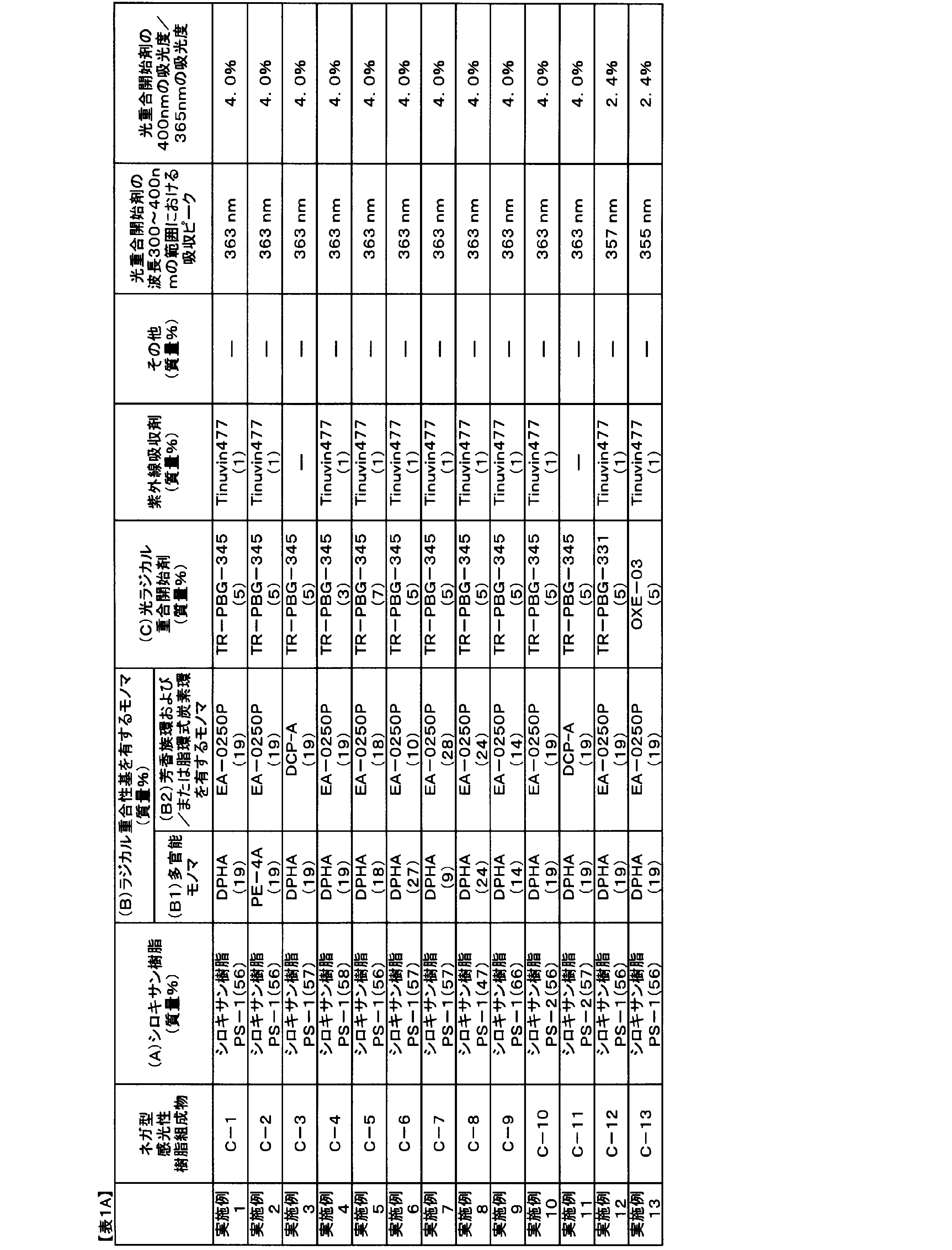
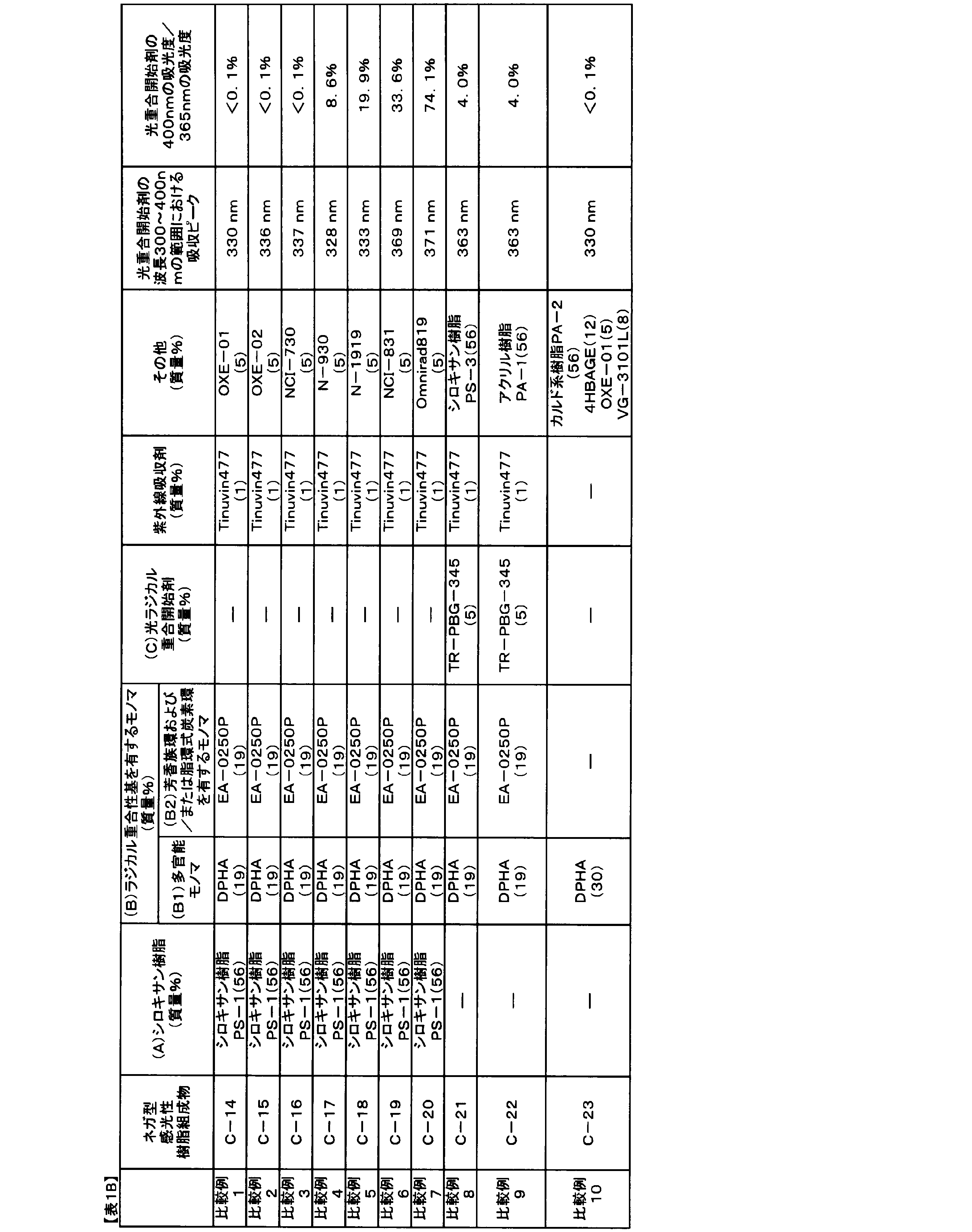
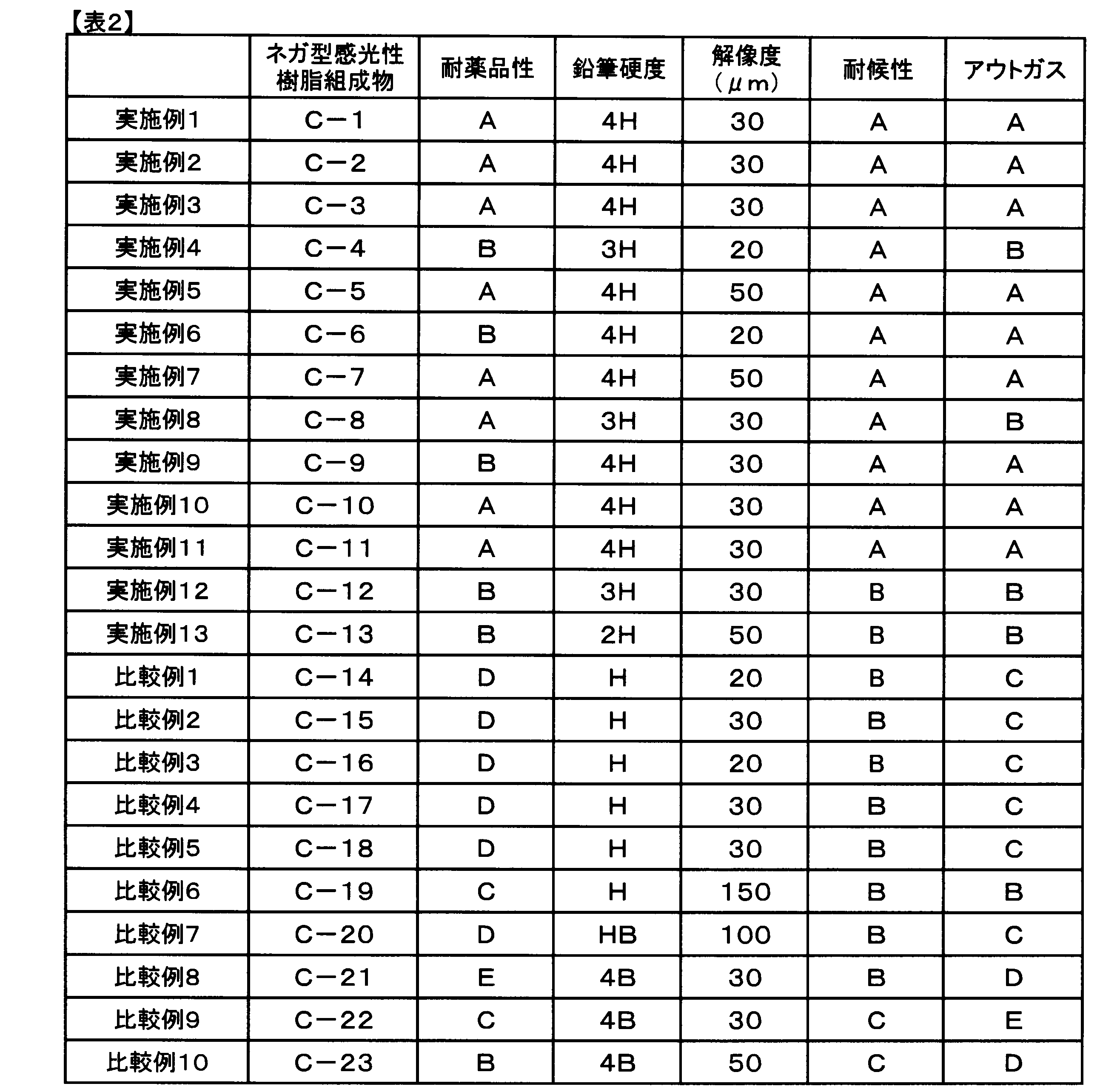
実施例において作製したネガ型感光性樹脂組成物は、解像度が高く、130℃で硬化しても、鉛筆硬度が高く、耐薬品性、耐候性に優れ、電極や配線加工時のアウトガスの発生を抑制することができる硬化膜を形成できることがわかる。
本発明の感光性ネガ型感光性樹脂組成物は、解像度が高く、150℃以下の低温で硬化しても、鉛筆硬度が高く、耐薬品性、耐候性に優れ、電極や配線加工時のアウトガスの発生を抑制することができる硬化膜が得られるため、銅を含有する電極および/または配線を有するタッチパネル用絶縁膜、保護膜、ガラス強化樹脂層として好適に用いることができる。
Claims (6)
- (A)ラジカル重合性基を有するシロキサン樹脂、
(B)ラジカル重合性基を有するモノマおよび
(C)波長350~370nmの領域に光の吸収ピークを有し、波長400nmにおける吸光度が波長365nmにおける吸光度の10%以下である光ラジカル重合開始剤、を含有するネガ型感光性樹脂組成物。 - 前記(C)光ラジカル重合開始剤が、下記一般式(1)で示される1分子中に2つ以上のケトオキシムエステル基を含有する請求項1に記載のネガ型感光性樹脂組成物。

- 前記(B)ラジカル重合性基を有するモノマが、(B1)多官能モノマならびに(B2)芳香族環および/または脂環式炭素環を有するモノマを含有する請求項1または2に記載のネガ型感光性樹脂組成物。
- 前記(B2)芳香族環および/または脂環式炭素環を有するモノマを固形分中10重量%以上含有する請求項3に記載のネガ型感光性樹脂組成物。
- 請求項1~4のいずれかに記載のネガ型感光性樹脂組成物を基材上に塗布する工程、前記組成物を露光する工程および露光された前記組成物を150℃以下の温度で硬化させる工程を有する硬化膜の製造方法。
- 基材、銅を含有する電極および/または配線、ならびに、請求項1~4のいずれかに記載のネガ型感光性樹脂組成物を硬化させてなる硬化膜を有するタッチパネル。
Priority Applications (3)
| Application Number | Priority Date | Filing Date | Title |
|---|---|---|---|
| CN202080016528.1A CN113474730B (zh) | 2019-03-05 | 2020-03-02 | 负型感光性树脂组合物、使用它的固化膜的制造方法及触控面板 |
| JP2020515784A JP7405075B2 (ja) | 2019-03-05 | 2020-03-02 | ネガ型感光性樹脂組成物、それを用いた硬化膜の製造方法およびタッチパネル |
| KR1020217023351A KR102675832B1 (ko) | 2019-03-05 | 2020-03-02 | 네가티브형 감광성 수지 조성물, 이것을 사용한 경화막의 제조 방법 및 터치패널 |
Applications Claiming Priority (2)
| Application Number | Priority Date | Filing Date | Title |
|---|---|---|---|
| JP2019-039268 | 2019-03-05 | ||
| JP2019039268 | 2019-03-05 |
Publications (1)
| Publication Number | Publication Date |
|---|---|
| WO2020179744A1 true WO2020179744A1 (ja) | 2020-09-10 |
Family
ID=72338710
Family Applications (1)
| Application Number | Title | Priority Date | Filing Date |
|---|---|---|---|
| PCT/JP2020/008738 Ceased WO2020179744A1 (ja) | 2019-03-05 | 2020-03-02 | ネガ型感光性樹脂組成物、それを用いた硬化膜の製造方法およびタッチパネル |
Country Status (5)
| Country | Link |
|---|---|
| JP (1) | JP7405075B2 (ja) |
| KR (1) | KR102675832B1 (ja) |
| CN (1) | CN113474730B (ja) |
| TW (1) | TWI837317B (ja) |
| WO (1) | WO2020179744A1 (ja) |
Cited By (1)
| Publication number | Priority date | Publication date | Assignee | Title |
|---|---|---|---|---|
| JP2022154563A (ja) * | 2021-03-30 | 2022-10-13 | サカタインクス株式会社 | 皮膜形成用組成物、該皮膜形成用組成物を塗工してなる積層体、該積層体を用いてなる指紋認証センサー、及び、硬化皮膜の形成方法 |
Families Citing this family (1)
| Publication number | Priority date | Publication date | Assignee | Title |
|---|---|---|---|---|
| KR20250104543A (ko) * | 2023-12-29 | 2025-07-08 | 주식회사 헤라켐테크놀러지 | 감광성 수지 조성물 및 이를 이용하여 패턴을 형성하는 방법 |
Citations (5)
| Publication number | Priority date | Publication date | Assignee | Title |
|---|---|---|---|---|
| JP2017003995A (ja) * | 2015-06-15 | 2017-01-05 | 株式会社Dnpファインケミカル | カラーフィルタ用色材分散液、カラーフィルタ用感光性着色樹脂組成物、カラーフィルタ、及び表示装置 |
| JP2017219850A (ja) * | 2014-03-17 | 2017-12-14 | 旭化成株式会社 | 感光性樹脂組成物 |
| WO2018021184A1 (ja) * | 2016-07-29 | 2018-02-01 | 富士フイルム株式会社 | 着色組成物、カラーフィルタ、パターン形成方法、固体撮像素子、および、画像表示装置 |
| WO2018105532A1 (ja) * | 2016-12-05 | 2018-06-14 | 旭化成株式会社 | 感光性樹脂組成物、感光性樹脂積層体、樹脂パターンの製造方法及び硬化膜パターン製造方法 |
| JP2018146958A (ja) * | 2017-03-02 | 2018-09-20 | 東レ株式会社 | ネガ型感光性樹脂組成物およびそれを用いた硬化膜 |
Family Cites Families (5)
| Publication number | Priority date | Publication date | Assignee | Title |
|---|---|---|---|---|
| ATE458010T1 (de) | 2005-12-20 | 2010-03-15 | Basf Se | Oximester-photoinitiatoren |
| EP2714659B1 (en) | 2011-05-25 | 2017-07-05 | American Dye Source, Inc. | Compounds with oxime ester and/or acyl groups |
| TWI612101B (zh) | 2013-05-15 | 2018-01-21 | Rasa工業股份有限公司 | 絕緣材料用組成物 |
| US20210198416A1 (en) | 2015-12-25 | 2021-07-01 | Toray Industries, Inc. | Photosensitive resin composition, cured film, laminate, member for touch panel, and method for manufacturing cured film |
| CN110869847B (zh) * | 2017-08-10 | 2024-03-08 | Dnp精细化工股份有限公司 | 感光性着色树脂组合物及其固化物、滤色器和显示装置 |
-
2020
- 2020-03-02 CN CN202080016528.1A patent/CN113474730B/zh active Active
- 2020-03-02 JP JP2020515784A patent/JP7405075B2/ja active Active
- 2020-03-02 WO PCT/JP2020/008738 patent/WO2020179744A1/ja not_active Ceased
- 2020-03-02 KR KR1020217023351A patent/KR102675832B1/ko active Active
- 2020-03-04 TW TW109107090A patent/TWI837317B/zh active
Patent Citations (5)
| Publication number | Priority date | Publication date | Assignee | Title |
|---|---|---|---|---|
| JP2017219850A (ja) * | 2014-03-17 | 2017-12-14 | 旭化成株式会社 | 感光性樹脂組成物 |
| JP2017003995A (ja) * | 2015-06-15 | 2017-01-05 | 株式会社Dnpファインケミカル | カラーフィルタ用色材分散液、カラーフィルタ用感光性着色樹脂組成物、カラーフィルタ、及び表示装置 |
| WO2018021184A1 (ja) * | 2016-07-29 | 2018-02-01 | 富士フイルム株式会社 | 着色組成物、カラーフィルタ、パターン形成方法、固体撮像素子、および、画像表示装置 |
| WO2018105532A1 (ja) * | 2016-12-05 | 2018-06-14 | 旭化成株式会社 | 感光性樹脂組成物、感光性樹脂積層体、樹脂パターンの製造方法及び硬化膜パターン製造方法 |
| JP2018146958A (ja) * | 2017-03-02 | 2018-09-20 | 東レ株式会社 | ネガ型感光性樹脂組成物およびそれを用いた硬化膜 |
Cited By (2)
| Publication number | Priority date | Publication date | Assignee | Title |
|---|---|---|---|---|
| JP2022154563A (ja) * | 2021-03-30 | 2022-10-13 | サカタインクス株式会社 | 皮膜形成用組成物、該皮膜形成用組成物を塗工してなる積層体、該積層体を用いてなる指紋認証センサー、及び、硬化皮膜の形成方法 |
| JP7776935B2 (ja) | 2021-03-30 | 2025-11-27 | サカタインクス株式会社 | 皮膜形成用組成物、該皮膜形成用組成物を塗工してなる積層体、該積層体を用いてなる指紋認証センサー、及び、硬化皮膜の形成方法 |
Also Published As
| Publication number | Publication date |
|---|---|
| KR20210135217A (ko) | 2021-11-12 |
| CN113474730B (zh) | 2024-10-01 |
| TW202035471A (zh) | 2020-10-01 |
| KR102675832B1 (ko) | 2024-06-14 |
| CN113474730A (zh) | 2021-10-01 |
| JP7405075B2 (ja) | 2023-12-26 |
| TWI837317B (zh) | 2024-04-01 |
| JPWO2020179744A1 (ja) | 2020-09-10 |
Similar Documents
| Publication | Publication Date | Title |
|---|---|---|
| US9651865B2 (en) | Negative-type photosensitive coloring composition, cured film, light-shielding pattern for touch panel, and touch panel manufacturing method | |
| US9690197B2 (en) | Negative-type photosensitive white composition for touch panel, touch panel and touch panel production method | |
| KR101839397B1 (ko) | 실란커플링제, 네거티브형 감광성 수지 조성물, 경화막, 및 터치 패널용 부재 | |
| JP5504689B2 (ja) | ネガ型感光性樹脂組成物およびそれを用いたタッチパネル用材料 | |
| CN102667625B (zh) | 正型感光性树脂组合物、由该组合物形成的固化膜及具有固化膜的元件 | |
| KR101842891B1 (ko) | 감광성 조성물, 그것으로 형성된 경화막 및 경화막을 갖는 소자 | |
| JPWO2019176785A1 (ja) | ネガ型感光性着色組成物、硬化膜、それを用いたタッチパネル | |
| JP5327345B2 (ja) | ネガ型感光性樹脂組成物、硬化膜、およびタッチパネル用部材。 | |
| JP6489288B1 (ja) | 透明樹脂組成物、透明被膜および透明樹脂被覆ガラス基板 | |
| JPWO2011129312A1 (ja) | ネガ型感光性樹脂組成物、硬化膜、およびタッチパネル用部材 | |
| JP7405075B2 (ja) | ネガ型感光性樹脂組成物、それを用いた硬化膜の製造方法およびタッチパネル | |
| JP2018120069A (ja) | ネガ型感光性樹脂組成物、硬化膜およびタッチパネル部材 | |
| JP2018146958A (ja) | ネガ型感光性樹脂組成物およびそれを用いた硬化膜 | |
| JP2023136705A (ja) | 感光性樹脂組成物、硬化膜およびタッチパネル | |
| JP2020100819A (ja) | 樹脂組成物、硬化膜およびその製造方法 | |
| JP7831317B2 (ja) | 感光性樹脂組成物、マイクロレンズ | |
| JP7826767B2 (ja) | 感光性樹脂組成物および硬化膜 |
Legal Events
| Date | Code | Title | Description |
|---|---|---|---|
| ENP | Entry into the national phase |
Ref document number: 2020515784 Country of ref document: JP Kind code of ref document: A |
|
| 121 | Ep: the epo has been informed by wipo that ep was designated in this application |
Ref document number: 20766740 Country of ref document: EP Kind code of ref document: A1 |
|
| NENP | Non-entry into the national phase |
Ref country code: DE |
|
| 122 | Ep: pct application non-entry in european phase |
Ref document number: 20766740 Country of ref document: EP Kind code of ref document: A1 |