WO2020174744A1 - 石膏粉末及び石膏スラリーの製造方法 - Google Patents
石膏粉末及び石膏スラリーの製造方法 Download PDFInfo
- Publication number
- WO2020174744A1 WO2020174744A1 PCT/JP2019/041649 JP2019041649W WO2020174744A1 WO 2020174744 A1 WO2020174744 A1 WO 2020174744A1 JP 2019041649 W JP2019041649 W JP 2019041649W WO 2020174744 A1 WO2020174744 A1 WO 2020174744A1
- Authority
- WO
- WIPO (PCT)
- Prior art keywords
- gypsum
- slurry
- gypsum powder
- water
- powder
- Prior art date
- Legal status (The legal status is an assumption and is not a legal conclusion. Google has not performed a legal analysis and makes no representation as to the accuracy of the status listed.)
- Ceased
Links
Classifications
-
- A—HUMAN NECESSITIES
- A61—MEDICAL OR VETERINARY SCIENCE; HYGIENE
- A61C—DENTISTRY; APPARATUS OR METHODS FOR ORAL OR DENTAL HYGIENE
- A61C13/00—Dental prostheses; Making same
- A61C13/34—Making or working of models, e.g. preliminary castings, trial dentures; Dowel pins [4]
-
- A—HUMAN NECESSITIES
- A61—MEDICAL OR VETERINARY SCIENCE; HYGIENE
- A61K—PREPARATIONS FOR MEDICAL, DENTAL OR TOILETRY PURPOSES
- A61K6/00—Preparations for dentistry
Definitions
- the present invention relates to a method for producing gypsum powder and gypsum slurry.
- ⁇ A gypsum model is generally made by using an impression material, pouring the gypsum slurry into a negative mold that takes an impression of the oral cavity, and then hardening it.
- gypsum powder and water are put in a small rubber bowl (rubber bowl) and then a plaster slurry is prepared by kneading with a gypsum spatula.
- the mass ratio of water to the gypsum powder when preparing the gypsum slurry that is, the water mixing ratio
- the strength of the cured gypsum is improved, but the fluidity of the gypsum slurry is reduced.
- An aspect of the present invention is to provide a gypsum powder capable of improving the fluidity of a gypsum slurry and the strength of a cured gypsum body.
- One aspect of the present invention includes gypsum powder, hemihydrate gypsum, and a calcium salt having a solubility in water at 20° C. of 2 g/L or more.
- a gypsum powder capable of improving the fluidity of a gypsum slurry and the strength of a cured gypsum body.
- the gypsum powder of the present embodiment contains hemihydrate gypsum and a calcium salt whose solubility in water at 20° C. is 2 g/L or more, it is possible to improve the fluidity of the gypsum slurry and the strength of the gypsum hardened body.
- hemihydrate gypsum examples include ⁇ hemihydrate gypsum and ⁇ hemihydrate gypsum, and ⁇ hemihydrate gypsum and ⁇ hemihydrate gypsum may be used in combination.
- the calcium salt is not particularly limited as long as it has a solubility in water at 20° C. of 2 g/L or more.
- Calcium propionate, calcium lactate, calcium L-ascorbate, calcium benzoate and the like, and two or more kinds may be used in combination.
- calcium chloride, calcium nitrate, calcium formate, and calcium benzoate are preferable from the viewpoint of fluidity of the gypsum slurry and strength of the cured gypsum.
- solubility of calcium salt in water at 20° C. is preferably 10 g/L or more.
- Table 1 shows the solubility of calcium salt in water at 20°C.
- the solubility of calcium salt in water at 20°C can be measured as follows. First, at 20° C., an excessive amount of calcium salt is added to a predetermined amount of water and sufficiently stirred to obtain a saturated aqueous solution of calcium salt. Next, the calcium salt that was not dissolved in water is filtered, dried, and the mass is measured. Finally, after subtracting the mass of the calcium salt not dissolved in water from the mass of the added calcium salt, it is divided by the volume of water.
- the mass ratio of calcium salt to hemihydrate gypsum in the gypsum powder of the present embodiment is 0.1% or more and 3% or less, preferably 0.5% or more and 2% or less.
- the mass ratio of the calcium salt to hemihydrate gypsum in the gypsum powder of the present embodiment is 0.1% or more, the fluidity of the gypsum slurry and the strength of the gypsum hardened body are further improved, and 3% or less, Curing expansion of the gypsum cured product can be suppressed.
- the gypsum powder of the present embodiment preferably further contains gypsum dihydrate. This improves the curability of the gypsum slurry.
- dihydrate gypsum examples include natural gypsum and chemical gypsum, and natural gypsum and chemical gypsum may be used in combination.
- the mass ratio of gypsum dihydrate to gypsum hemihydrate in the gypsum powder of the present embodiment is preferably 0.5% or more and 8% or less, and more preferably 1% or more and 5% or less. If the mass ratio of gypsum dihydrate to hemihydrate gypsum in the gypsum powder of the present embodiment is 0.5% or more, the curability of the gypsum slurry is further improved, and if it is 8% or less, the cured gypsum is hardened. Expansion can be suppressed.
- the gypsum powder of the present embodiment preferably further contains a water reducing agent. This further improves the fluidity of the gypsum slurry.
- the water reducing agent is not particularly limited, but includes modified polycarboxylic acid water reducing agents, polyether/polycarboxylic acid water reducing agents, melamine sulfonic acid water reducing agents, naphthalene sulfonic acid water reducing agents, lignin sulfonic acid water reducing agents, and the like.
- modified polycarboxylic acid water reducing agents polyether/polycarboxylic acid water reducing agents
- melamine sulfonic acid water reducing agents melamine sulfonic acid water reducing agents
- naphthalene sulfonic acid water reducing agents lignin sulfonic acid water reducing agents
- lignin sulfonic acid water reducing agents and the like.
- two or more kinds may be used in combination.
- modified polycarboxylic acid type water reducing agents examples include MELFLUX AP 101 F (manufactured by SKW East Asia).
- Examples of commercially available polyether/polycarboxylic acid-based water reducing agents include MELFLUX 2641 F, MELFLUX 2651 F, MELFLUX 4930 F, MELFLUX 5581 F, MELFLUX 6681 F, MELFLUX BF 11 F (above, SKW East Asia). Is mentioned.
- Examples of commercially available melamine sulfonic acid type water reducing agents include MELMENT F10M, MELMENT F4000 (above, manufactured by SKW East Asia) NL-G400 (manufactured by BASF) and the like.
- naphthalenesulfonic acid-based water reducing agents examples include Mighty 100 (manufactured by Kao) and POWERCON-100 (manufactured by SKW East Asia).
- Examples of commercially available lignin sulfonic acid type water reducing agents include LIGNOSULFONATE ARBO N18, LIGNOSULFONATE ARBO S01P, NORLIG SA (above, manufactured by SKW East Asia).
- the mass ratio of the water reducing agent to hemihydrate gypsum in the gypsum powder of the present embodiment is preferably 0.05% or more and 0.5% or less, and more preferably 0.1% or more and 0.3% or less. preferable.
- the mass ratio of the water reducing agent to hemihydrate gypsum in the gypsum powder of the present embodiment is 0.05% or more, the fluidity of the gypsum slurry is further improved, and when it is 0.5% or less, the gypsum hardened body is Strength is further improved.
- the gypsum powder of this embodiment preferably further contains potassium sulfate. This improves the curability of the gypsum slurry.
- the mass ratio of potassium sulfate to hemihydrate gypsum in the gypsum powder of the present embodiment is preferably 0.1% or more and 2% or less, and more preferably 0.5% or more and 1.5% or less.
- the mass ratio of potassium sulfate to hemihydrate gypsum in the gypsum powder of the present embodiment is 0.1% or more and 2% or less, the curability of the gypsum slurry is further improved.
- the gypsum powder of the present embodiment preferably further contains potassium tartrate. Thereby, the hardening and expansion of the gypsum hardened body can be suppressed.
- the mass ratio of potassium tartrate to hemihydrate gypsum in the gypsum powder of the present embodiment is preferably 0.05% or more and 1% or less, and more preferably 0.1% or more and 0.5% or less.
- the mass ratio of potassium sulfate to hemihydrate gypsum in the gypsum powder of the present embodiment is 0.05% or more, hardening expansion of the gypsum hardened product can be further suppressed, and when it is 1% or less, the gypsum slurry. The curability of is improved.
- the gypsum powder of the present embodiment may further contain a hardening expansion inhibitor such as sodium sulfate, a pigment such as magnesium sulfate, and the like.
- a hardening expansion inhibitor such as sodium sulfate, a pigment such as magnesium sulfate, and the like.
- the gypsum powder of this embodiment can be applied to dental gypsum powder, medical gypsum bandage forming gypsum powder, ceramic model gypsum powder, industrial model gypsum powder, and the like.
- a gypsum slurry can be manufactured by mixing the gypsum powder of this embodiment with water.
- a gypsum slurry can be produced by putting the gypsum powder of the present embodiment and water in a small rubber bowl (rubber bowl) and then kneading the mixture with a gypsum spatula.
- the gypsum slurry can be manufactured by putting the gypsum powder of this embodiment and water into a bottle, sealing the bottle, and then shaking the bottle.
- the mass ratio (mixed water ratio) of water to the gypsum powder of the present embodiment is preferably 0.18 or more and 0.25 or less, and more preferably 0.19 or more and 0.20 or less.
- the mass ratio of water to the gypsum powder of the present embodiment is 0.18 or more, the fluidity of the gypsum slurry is further improved, and when it is 0.25 or less, the strength of the gypsum hardened body is further improved.
- Gypsum base material ⁇ hemihydrate gypsum, dihydrate gypsum
- additives potassium sulfate, sodium sulfate, magnesium sulfate, potassium tartrate
- water reducing agent calcium salt
- MELFLUX 2651 F Polyether/polycarboxylic acid water reducing agent (manufactured by SKW East Asia)
- MELFLUX 4930 F Polyether/polycarboxylic acid type water reducing agent (manufactured by SKW East Asia)
- MELFUX 5581 F Polyether/polycarboxylic acid-based water reducing agent (manufactured by SKW East Asia)
- MELMENT F10M Melamine sulfonic acid type water reducing agent (manufactured by SKW East Asia)
- NL-G400 Melamine sulfonic acid type water reducing agent (manufactured by BASF)
- Gypsum powder and water were placed in a rubber bowl at a predetermined water mixing ratio (see Table 2) and then kneaded with a gypsum spatula to prepare a gypsum slurry.
- the fluidity of the gypsum slurry was measured by the method specified in JIS T6601 “Cementitious investment material for dental casting”. The gypsum slurry was judged to be excellent when it had a fluidity of 60 mm or more, good when it was 40 mm or more and less than 60 mm, and not good when it was less than 40 mm.
- the strength A of the cured gypsum was measured by the method specified in JIS T6605 "Hard dental plaster".
- the criteria for determining the strength A of the cured gypsum are as follows.
- the strength B of the cured gypsum was measured by the method specified in JIS T6605 "Hard dental plaster".
- the criteria for determining the strength B of the cured gypsum are as follows.
- the gypsum powders of Examples 1 to 14 have high fluidity of the gypsum slurry and high strengths A and B of the gypsum hardened body.
- the gypsum powders of Comparative Examples 1 and 2 do not contain a calcium salt having a solubility in water at 20° C. of 2 g/L or more, when the water mixing ratio is 0.20, the gypsum slurry will flow. When the water-mixing ratio is 0.23, the strength B of the gypsum hardened product decreases.
Landscapes
- Health & Medical Sciences (AREA)
- Oral & Maxillofacial Surgery (AREA)
- Epidemiology (AREA)
- Life Sciences & Earth Sciences (AREA)
- Animal Behavior & Ethology (AREA)
- General Health & Medical Sciences (AREA)
- Public Health (AREA)
- Veterinary Medicine (AREA)
- Dentistry (AREA)
- Dental Preparations (AREA)
- Curing Cements, Concrete, And Artificial Stone (AREA)
Abstract
本発明の一態様は、石膏粉末において、半水石膏と、20℃における水に対する溶解度が2g/L以上であるカルシウム塩を含む。
Description
本発明は、石膏粉末及び石膏スラリーの製造方法に関する。
歯科分野においては、口腔内に装着されるインレー、クラウン、ブリッジ、部分床義歯、全部床義歯等の歯科補綴物を作製する際に、患者の口腔内状態を再現した石膏模型(例えば、作業用模型、顎模型)が用いられている。
石膏模型は、一般に、印象材を用いて、口腔内の印象を採得した陰型内に、石膏スラリーを流し込んだ後、硬化させて作製する。
ここで、歯科医院や歯科技工所では、ゴム製の小型ボウル(ラバーボウル)に、石膏粉末と水を入れた後、石膏スパチュラを用いて練和することにより、石膏スラリーを調製する。
一方、高齢化社会に対応するために、訪問診療が増えると考えられている。
しかしながら、訪問診療時に、上記のようにして、石膏スラリーを調製すると、多種類の用具を用意する必要があり、煩雑である。
そこで、より簡便な石膏スラリーの調製方法として、石膏粉末と水をボトルに入れて密封した後、ボトルを振とうする方法が知られている(例えば、特許文献1参照)。
しかしながら、石膏スラリーの流動性及び石膏硬化体の強度をさらに向上させることが望まれている。
ここで、石膏スラリーを調製する際の石膏粉末に対する水の質量比、即ち、混水比を小さくすると、石膏硬化体の強度が向上するが、石膏スラリーの流動性が低下する。
本発明の一態様は、石膏スラリーの流動性及び石膏硬化体の強度を向上させることが可能な石膏粉末を提供することを目的とする。
本発明の一態様は、石膏粉末において、半水石膏と、20℃における水に対する溶解度が2g/L以上であるカルシウム塩を含む。
本発明の一態様によれば、石膏スラリーの流動性及び石膏硬化体の強度を向上させることが可能な石膏粉末を提供することができる。
以下、本発明を実施するための形態について説明する。本発明は、下記の実施形態に制限されることはなく、特許請求の範囲に記載された範囲を逸脱することなく、下記の実施形態に種々の変形及び置換を加えることができる。
<石膏粉末>
本実施形態の石膏粉末は、半水石膏と、20℃における水に対する溶解度が2g/L以上であるカルシウム塩を含むため、石膏スラリーの流動性及び石膏硬化体の強度を向上させることができる。
本実施形態の石膏粉末は、半水石膏と、20℃における水に対する溶解度が2g/L以上であるカルシウム塩を含むため、石膏スラリーの流動性及び石膏硬化体の強度を向上させることができる。
<半水石膏>
半水石膏としては、α半水石膏、β半水石膏が挙げられ、α半水石膏とβ半水石膏を併用してもよい。
半水石膏としては、α半水石膏、β半水石膏が挙げられ、α半水石膏とβ半水石膏を併用してもよい。
<カルシウム塩>
カルシウム塩は、20℃における水に対する溶解度が2g/L以上であれば、特に限定されないが、例えば、硝酸カルシウム、塩化カルシウム、臭化カルシウム、ヨウ化カルシウム、過塩素酸カルシウム、ギ酸カルシウム、酢酸カルシウム、プロピオン酸カルシウム、乳酸カルシウム、L-アスコルビン酸カルシウム、安息香酸カルシウム等が挙げられ、二種以上を併用してもよい。これらの中でも、石膏スラリーの流動性及び石膏硬化体の強度の点で、塩化カルシウム、硝酸カルシウム、ギ酸カルシウム、安息香酸カルシウムが好ましい。
カルシウム塩は、20℃における水に対する溶解度が2g/L以上であれば、特に限定されないが、例えば、硝酸カルシウム、塩化カルシウム、臭化カルシウム、ヨウ化カルシウム、過塩素酸カルシウム、ギ酸カルシウム、酢酸カルシウム、プロピオン酸カルシウム、乳酸カルシウム、L-アスコルビン酸カルシウム、安息香酸カルシウム等が挙げられ、二種以上を併用してもよい。これらの中でも、石膏スラリーの流動性及び石膏硬化体の強度の点で、塩化カルシウム、硝酸カルシウム、ギ酸カルシウム、安息香酸カルシウムが好ましい。
なお、カルシウム塩の20℃における水に対する溶解度は、10g/L以上であることが好ましい。
表1に、カルシウム塩の20℃における水に対する溶解度を示す。

本実施形態の石膏粉末中の半水石膏に対するカルシウム塩の質量比は、0.1%以上3%以下であり、0.5%以上2%以下であることが好ましい。本実施形態の石膏粉末中の半水石膏に対するカルシウム塩の質量比が0.1%以上であると、石膏スラリーの流動性及び石膏硬化体の強度がさらに向上し、3%以下であると、石膏硬化体の硬化膨張を抑制することができる。
<二水石膏>
本実施形態の石膏粉末は、二水石膏をさらに含むことが好ましい。これにより、石膏スラリーの硬化性が向上する。
本実施形態の石膏粉末は、二水石膏をさらに含むことが好ましい。これにより、石膏スラリーの硬化性が向上する。
二水石膏としては、天然石膏、化学石膏が挙げられ、天然石膏と化学石膏を併用してもよい。
本実施形態の石膏粉末中の半水石膏に対する二水石膏の質量比は、0.5%以上8%以下であることが好ましく、1%以上5%以下であることがさらに好ましい。本実施形態の石膏粉末中の半水石膏に対する二水石膏の質量比が0.5%以上であると、石膏スラリーの硬化性がさらに向上し、8%以下であると、石膏硬化体の硬化膨張を抑制することができる。
<減水剤>
本実施形態の石膏粉末は、減水剤をさらに含むことが好ましい。これにより、石膏スラリーの流動性がさらに向上する。
本実施形態の石膏粉末は、減水剤をさらに含むことが好ましい。これにより、石膏スラリーの流動性がさらに向上する。
減水剤としては、特に限定されないが、変性ポリカルボン酸系減水剤、ポリエーテル・ポリカルボン酸系減水剤、メラミンスルホン酸系減水剤、ナフタレンスルホン酸系減水剤、リグニンスルホン酸系減水剤等が挙げられ、二種以上を併用してもよい。
変性ポリカルボン酸系減水剤の市販品としては、例えば、MELFLUX AP 101 F(SKWイーストアジア製)等が挙げられる。
ポリエーテル・ポリカルボン酸系減水剤の市販品としては、例えば、MELFLUX 2641 F、MELFLUX 2651 F、MELFLUX 4930 F、MELFLUX 5581 F、MELFLUX 6681 F、MELFLUX BF 11 F(以上、SKWイーストアジア製)等が挙げられる。
メラミンスルホン酸系減水剤の市販品としては、例えば、MELMENT F10M、MELMENT F4000(以上、SKWイーストアジア製)NL-G400(BASF製)等が挙げられる。
ナフタレンスルホン酸系減水剤の市販品としては、例えば、マイテイ100(花王製)、POWERCON-100(SKWイーストアジア製)等が挙げられる。
リグニンスルホン酸系減水剤の市販品としては、例えば、LIGNOSULFONATE ARBO N18、LIGNOSULFONATE ARBO S01P、NORLIG SA(以上、SKWイーストアジア製)等が挙げられる。
本実施形態の石膏粉末中の半水石膏に対する減水剤の質量比は、0.05%以上0.5%以下であることが好ましく、0.1%以上0.3%以下であることがさらに好ましい。本実施形態の石膏粉末中の半水石膏に対する減水剤の質量比が0.05%以上であると、石膏スラリーの流動性がさらに向上し、0.5%以下であると、石膏硬化体の強度がさらに向上する。
<硫酸カリウム>
本実施形態の石膏粉末は、硫酸カリウムをさらに含むことが好ましい。これにより、石膏スラリーの硬化性が向上する。
本実施形態の石膏粉末は、硫酸カリウムをさらに含むことが好ましい。これにより、石膏スラリーの硬化性が向上する。
本実施形態の石膏粉末中の半水石膏に対する硫酸カリウムの質量比は、0.1%以上2%以下であることが好ましく、0.5%以上1.5%以下であることがさらに好ましい。本実施形態の石膏粉末中の半水石膏に対する硫酸カリウムの質量比が0.1%以上2%以下であると、石膏スラリーの硬化性がさらに向上する。
<酒石酸カリウム>
本実施形態の石膏粉末は、酒石酸カリウムをさらに含むことが好ましい。これにより、石膏硬化体の硬化膨張を抑制することができる。
本実施形態の石膏粉末は、酒石酸カリウムをさらに含むことが好ましい。これにより、石膏硬化体の硬化膨張を抑制することができる。
本実施形態の石膏粉末中の半水石膏に対する酒石酸カリウムの質量比は、0.05%以上1%以下であることが好ましく、0.1%以上0.5%以下であることがさらに好ましい。本実施形態の石膏粉末中の半水石膏に対する硫酸カリウムの質量比が0.05%以上であると、石膏硬化体の硬化膨張をさらに抑制することができ、1%以下であると、石膏スラリーの硬化性が向上する。
<他の成分>
本実施形態の石膏粉末は、硫酸ナトリウム等の硬化膨張抑制剤、硫酸マグネシウム等の顔料等をさらに含んでいてもよい。
本実施形態の石膏粉末は、硫酸ナトリウム等の硬化膨張抑制剤、硫酸マグネシウム等の顔料等をさらに含んでいてもよい。
<石膏粉末の用途>
本実施形態の石膏粉末は、歯科用石膏粉末、医療用ギプス包帯成形用石膏粉末、陶磁器型材用石膏粉末、工業模型用石膏粉末等に適用することができる。
本実施形態の石膏粉末は、歯科用石膏粉末、医療用ギプス包帯成形用石膏粉末、陶磁器型材用石膏粉末、工業模型用石膏粉末等に適用することができる。
<石膏スラリーの製造方法>
本実施形態の石膏粉末と水を混合することにより、石膏スラリーを製造することができる。
本実施形態の石膏粉末と水を混合することにより、石膏スラリーを製造することができる。
例えば、本実施形態の石膏粉末と水をゴム製の小型ボウル(ラバーボウル)に入れた後、石膏スパチュラを用いて練和することにより、石膏スラリーを製造することができる。
また、本実施形態の石膏粉末と水をボトルに入れて密封した後、ボトルを振とうすることにより、石膏スラリーを製造することができる。
本実施形態の石膏粉末に対する水の質量比(混水比)は、0.18以上0.25以下であることが好ましく、0.19以上0.20以下であることがさらに好ましい。本実施形態の石膏粉末に対する水の質量比が0.18以上であると、石膏スラリーの流動性がさらに向上し、0.25以下であると、石膏硬化体の強度がさらに向上する。
以下、本発明の実施例を説明するが、本発明は、実施例に限定されない。
<実施例1~14、比較例1、2>
石膏母材(α半水石膏、二水石膏)、添加剤(硫酸カリウム、硫酸ナトリウム、硫酸マグネシウム、酒石酸カリウム)、減水剤、カルシウム塩(表2参照)をポットミルに入れた後、30分間混合し、石膏粉末を作製した。
石膏母材(α半水石膏、二水石膏)、添加剤(硫酸カリウム、硫酸ナトリウム、硫酸マグネシウム、酒石酸カリウム)、減水剤、カルシウム塩(表2参照)をポットミルに入れた後、30分間混合し、石膏粉末を作製した。
なお、表2における略称の意味は、以下の通りである。
MELFLUX 2651 F:ポリエーテル・ポリカルボン酸系減水剤(SKWイーストアジア製)
MELFLUX 4930 F:ポリエーテル・ポリカルボン酸系減水剤(SKWイーストアジア製)
MELFLUX 5581 F:ポリエーテル・ポリカルボン酸系減水剤(SKWイーストアジア製)
MELMENT F10M:メラミンスルホン酸系減水剤(SKWイーストアジア製)
NL-G400:メラミンスルホン酸系減水剤(BASF製)
次に、石膏粉末を用いて、石膏スラリーを調製した後、石膏スラリーの流動性、石膏スラリーの硬化時間、石膏硬化体の強度を測定した。
MELFLUX 4930 F:ポリエーテル・ポリカルボン酸系減水剤(SKWイーストアジア製)
MELFLUX 5581 F:ポリエーテル・ポリカルボン酸系減水剤(SKWイーストアジア製)
MELMENT F10M:メラミンスルホン酸系減水剤(SKWイーストアジア製)
NL-G400:メラミンスルホン酸系減水剤(BASF製)
次に、石膏粉末を用いて、石膏スラリーを調製した後、石膏スラリーの流動性、石膏スラリーの硬化時間、石膏硬化体の強度を測定した。
<石膏スラリーの調製方法A>
石膏粉末及び水を、所定の混水比(表2参照)で、ラバーボウルに入れた後、石膏スパチュラを用いて練和し、石膏スラリーを調製した。
石膏粉末及び水を、所定の混水比(表2参照)で、ラバーボウルに入れた後、石膏スパチュラを用いて練和し、石膏スラリーを調製した。
<石膏スラリーの調製方法B>
石膏粉末及び水を、所定の混水比(表2参照)で、ポリスチレン製の円筒形状のボトルとしての、ラボランスチロール棒瓶200mL(アズワン製)に入れて密封した後、振とうし、石膏スラリーを調製した。
石膏粉末及び水を、所定の混水比(表2参照)で、ポリスチレン製の円筒形状のボトルとしての、ラボランスチロール棒瓶200mL(アズワン製)に入れて密封した後、振とうし、石膏スラリーを調製した。
<石膏スラリーの流動性>
JIS T6601「歯科鋳造用こう系埋没材」に定められた方法により、石膏スラリーの流動性を測定した。なお、石膏スラリーの流動性が60mm以上である場合を優、40mm以上60mm未満である場合を良、40mm未満である場合を不可として、判定した。
JIS T6601「歯科鋳造用こう系埋没材」に定められた方法により、石膏スラリーの流動性を測定した。なお、石膏スラリーの流動性が60mm以上である場合を優、40mm以上60mm未満である場合を良、40mm未満である場合を不可として、判定した。
<石膏スラリーの硬化時間>
JIS T6605「歯科用硬質石膏」に定められた方法により、石膏スラリーの硬化時間を測定した。
JIS T6605「歯科用硬質石膏」に定められた方法により、石膏スラリーの硬化時間を測定した。
<石膏硬化体の強度A>
石膏スラリーを印象材へ流し込んだ後、10分経過した時点で、印象材から石膏硬化体(石膏模型)を取り外した。
石膏スラリーを印象材へ流し込んだ後、10分経過した時点で、印象材から石膏硬化体(石膏模型)を取り外した。
JIS T6605「歯科用硬質石膏」に定められた方法により、石膏硬化体の強度Aを測定した。
なお、石膏硬化体の強度Aの判定基準は、下記の通りである。
優:石膏硬化体の強度Aが10MPa以上である場合
良:石膏硬化体の強度Aが5MPa以上10MPa未満である場合
不可:石膏硬化体の強度Aが5MPa未満である場合
<石膏硬化体の強度B>
石膏スラリーを印象材へ流し込んだ後、60分経過した時点で、印象材から石膏硬化体(石膏模型)を取り外した。
良:石膏硬化体の強度Aが5MPa以上10MPa未満である場合
不可:石膏硬化体の強度Aが5MPa未満である場合
<石膏硬化体の強度B>
石膏スラリーを印象材へ流し込んだ後、60分経過した時点で、印象材から石膏硬化体(石膏模型)を取り外した。
JIS T6605「歯科用硬質石膏」に定められた方法により、石膏硬化体の強度Bを測定した。
なお、石膏硬化体の強度Bの判定基準は、下記の通りである。
優:石膏硬化体の強度Bが50MPa以上である場合
良:石膏硬化体の強度Bが43MPa以上50MPa未満である場合
不可:石膏硬化体の強度Bが43MPa未満である場合
表2に、石膏スラリーの流動性、石膏スラリーの硬化時間、石膏硬化体の強度A、Bの測定結果を示す。
良:石膏硬化体の強度Bが43MPa以上50MPa未満である場合
不可:石膏硬化体の強度Bが43MPa未満である場合
表2に、石膏スラリーの流動性、石膏スラリーの硬化時間、石膏硬化体の強度A、Bの測定結果を示す。
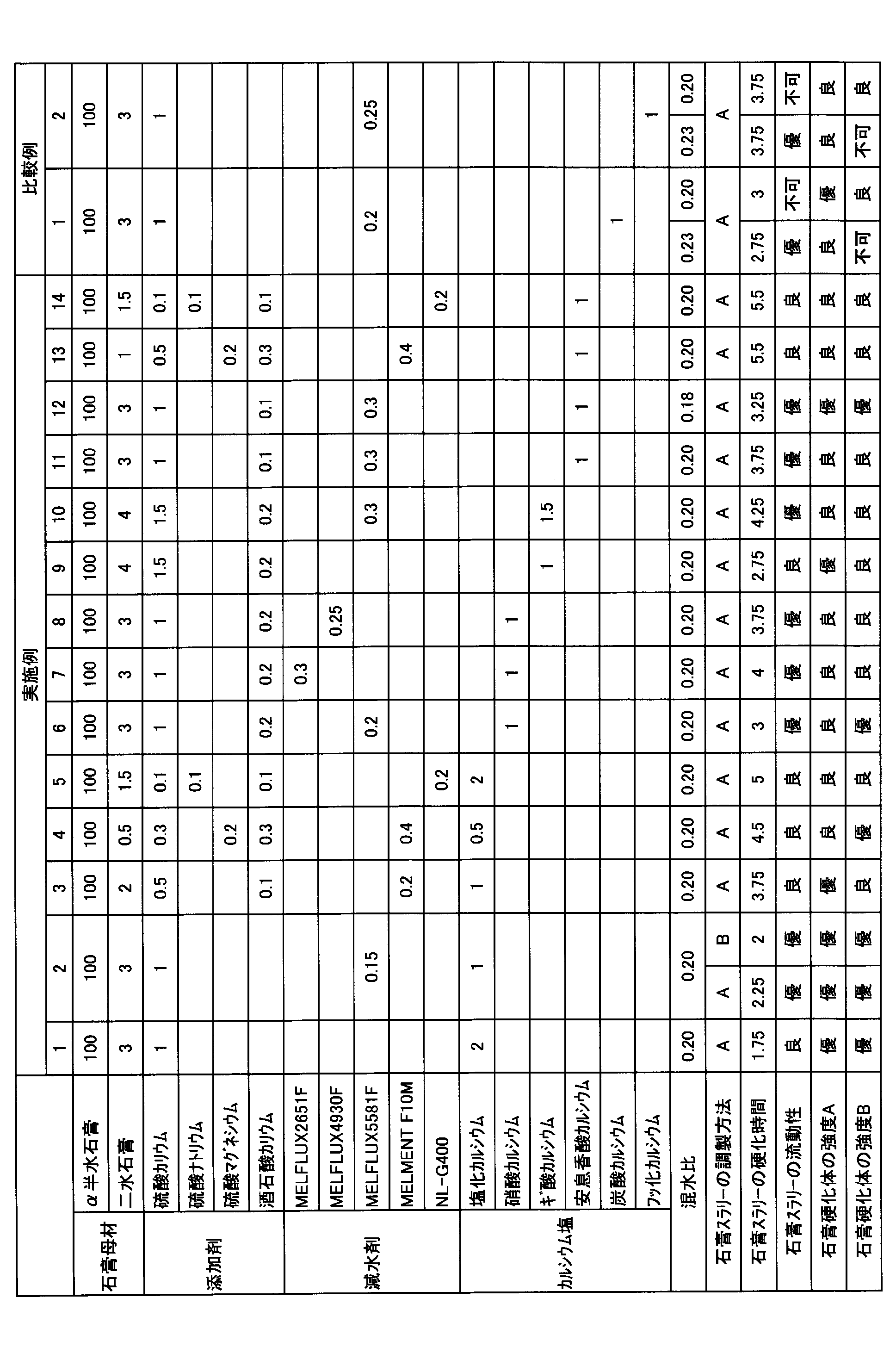
これに対して、比較例1、2の石膏粉末は、20℃における水に対する溶解度が2g/L以上であるカルシウム塩を含まないため、混水比が0.20であると、石膏スラリーの流動性が低下し、混水比が0.23であると、石膏硬化体の強度Bが低下する。
本願は、日本特許庁に2019年2月28日に出願された基礎出願2019-035438号の優先権を主張するものであり、その全内容を参照によりここに援用する。
Claims (10)
- 半水石膏と、
20℃における水に対する溶解度が2g/L以上であるカルシウム塩を含む、石膏粉末。 - 前記半水石膏に対する前記カルシウム塩の質量比が0.1%以上3%以下である、請求項1に記載の石膏粉末。
- 前記カルシウム塩は、塩化カルシウム、硝酸カルシウム、ギ酸カルシウム及び安息香酸カルシウムからなる群より選択される一種以上である、請求項1に記載の石膏粉末。
- 二水石膏をさらに含む、請求項1に記載の石膏粉末。
- 減水剤をさらに含む、請求項1に記載の石膏粉末。
- 硫酸カリウムをさらに含む、請求項1に記載の石膏粉末。
- 酒石酸カリウムをさらに含む、請求項1に記載の石膏粉末。
- 歯科用石膏粉末である、請求項1に記載の石膏粉末。
- 請求項1に記載の石膏粉末と水を混合することを特徴とする石膏スラリーの製造方法。
- 前記石膏粉末に対する前記水の質量比が0.18以上0.25以下である、請求項9に記載の石膏スラリーの製造方法。
Priority Applications (1)
| Application Number | Priority Date | Filing Date | Title |
|---|---|---|---|
| JP2021501551A JP7300498B2 (ja) | 2019-02-28 | 2019-10-24 | 石膏粉末及び石膏スラリーの製造方法 |
Applications Claiming Priority (2)
| Application Number | Priority Date | Filing Date | Title |
|---|---|---|---|
| JP2019035438 | 2019-02-28 | ||
| JP2019-035438 | 2019-02-28 |
Publications (1)
| Publication Number | Publication Date |
|---|---|
| WO2020174744A1 true WO2020174744A1 (ja) | 2020-09-03 |
Family
ID=72239307
Family Applications (1)
| Application Number | Title | Priority Date | Filing Date |
|---|---|---|---|
| PCT/JP2019/041649 Ceased WO2020174744A1 (ja) | 2019-02-28 | 2019-10-24 | 石膏粉末及び石膏スラリーの製造方法 |
Country Status (2)
| Country | Link |
|---|---|
| JP (1) | JP7300498B2 (ja) |
| WO (1) | WO2020174744A1 (ja) |
Citations (4)
| Publication number | Priority date | Publication date | Assignee | Title |
|---|---|---|---|---|
| JP2014057949A (ja) * | 2012-09-14 | 2014-04-03 | Natoo Kenkyusho:Kk | 公害型廃石膏類の処理法ならびに無公害型石膏組成物 |
| JP2015107239A (ja) * | 2013-12-05 | 2015-06-11 | 朝倉 真紀子 | 袋入り歯科用材料、歯科用トレーへの印象採得材盛り付け方法、歯科用模型製作方法 |
| WO2017208662A1 (ja) * | 2016-05-30 | 2017-12-07 | 株式会社ジーシー | 歯科用石膏粉末の練和方法 |
| WO2018230028A1 (ja) * | 2017-06-13 | 2018-12-20 | 株式会社ジーシー | 歯科用石膏スラリー |
Family Cites Families (3)
| Publication number | Priority date | Publication date | Assignee | Title |
|---|---|---|---|---|
| JPS6021882A (ja) * | 1983-07-14 | 1985-02-04 | 阿部 賢一 | 炭酸石膏発泡体の製法 |
| JP2014189536A (ja) | 2013-03-28 | 2014-10-06 | Gc Corp | 歯科用石こう粉末 |
| JP6591137B2 (ja) | 2013-03-28 | 2019-10-16 | 株式会社ジーシー | 歯科用石膏粉末 |
-
2019
- 2019-10-24 JP JP2021501551A patent/JP7300498B2/ja active Active
- 2019-10-24 WO PCT/JP2019/041649 patent/WO2020174744A1/ja not_active Ceased
Patent Citations (4)
| Publication number | Priority date | Publication date | Assignee | Title |
|---|---|---|---|---|
| JP2014057949A (ja) * | 2012-09-14 | 2014-04-03 | Natoo Kenkyusho:Kk | 公害型廃石膏類の処理法ならびに無公害型石膏組成物 |
| JP2015107239A (ja) * | 2013-12-05 | 2015-06-11 | 朝倉 真紀子 | 袋入り歯科用材料、歯科用トレーへの印象採得材盛り付け方法、歯科用模型製作方法 |
| WO2017208662A1 (ja) * | 2016-05-30 | 2017-12-07 | 株式会社ジーシー | 歯科用石膏粉末の練和方法 |
| WO2018230028A1 (ja) * | 2017-06-13 | 2018-12-20 | 株式会社ジーシー | 歯科用石膏スラリー |
Also Published As
| Publication number | Publication date |
|---|---|
| JPWO2020174744A1 (ja) | 2020-09-03 |
| JP7300498B2 (ja) | 2023-06-29 |
Similar Documents
| Publication | Publication Date | Title |
|---|---|---|
| EP2783675B1 (en) | Dental gypsum powder | |
| JP6310772B2 (ja) | 歯科用水硬性セメント組成物 | |
| JP7300498B2 (ja) | 石膏粉末及び石膏スラリーの製造方法 | |
| JP6209655B2 (ja) | 粉末状歯科用セメント組成物 | |
| JP6305550B2 (ja) | 歯科用石膏系埋没材粉末 | |
| JP2004149685A (ja) | 注入材 | |
| JP7094956B2 (ja) | 歯科用石膏スラリー | |
| TWI710358B (zh) | 牙科用石膏粉末 | |
| US1901054A (en) | Dental model stone composition | |
| JP2017055850A (ja) | 歯科用石膏粉末 | |
| JP2004035699A (ja) | 注入材及びこれを用いた注入施工方法 | |
| JP6835909B2 (ja) | 歯科用石膏粉末 | |
| RU2836150C1 (ru) | Материал на основе гидравлических цементов для пломбирования корневых каналов | |
| JP5101027B2 (ja) | 石膏組成物 | |
| EP4052693A1 (en) | Hardened calcium silicate-based dental material with improved mechanical properties | |
| JP2013159602A (ja) | 歯科用石こう粉末 | |
| US20220087907A1 (en) | Medical cement composition | |
| JP4134299B2 (ja) | 高強度硬化体の形成が可能な生体骨補強治療用リン酸カルシウムセメント | |
| JP2014189536A (ja) | 歯科用石こう粉末 | |
| JP2003335613A (ja) | 歯科用埋没材 |
Legal Events
| Date | Code | Title | Description |
|---|---|---|---|
| 121 | Ep: the epo has been informed by wipo that ep was designated in this application |
Ref document number: 19916734 Country of ref document: EP Kind code of ref document: A1 |
|
| ENP | Entry into the national phase |
Ref document number: 2021501551 Country of ref document: JP Kind code of ref document: A |
|
| NENP | Non-entry into the national phase |
Ref country code: DE |
|
| 122 | Ep: pct application non-entry in european phase |
Ref document number: 19916734 Country of ref document: EP Kind code of ref document: A1 |