WO2020166682A1 - 光学フィルム、偏光板、光学フィルムの製造方法 - Google Patents
光学フィルム、偏光板、光学フィルムの製造方法 Download PDFInfo
- Publication number
- WO2020166682A1 WO2020166682A1 PCT/JP2020/005693 JP2020005693W WO2020166682A1 WO 2020166682 A1 WO2020166682 A1 WO 2020166682A1 JP 2020005693 W JP2020005693 W JP 2020005693W WO 2020166682 A1 WO2020166682 A1 WO 2020166682A1
- Authority
- WO
- WIPO (PCT)
- Prior art keywords
- monomer
- optical film
- mass
- film
- methacrylic resin
- Prior art date
- Legal status (The legal status is an assumption and is not a legal conclusion. Google has not performed a legal analysis and makes no representation as to the accuracy of the status listed.)
- Ceased
Links
Images
Classifications
-
- C—CHEMISTRY; METALLURGY
- C08—ORGANIC MACROMOLECULAR COMPOUNDS; THEIR PREPARATION OR CHEMICAL WORKING-UP; COMPOSITIONS BASED THEREON
- C08J—WORKING-UP; GENERAL PROCESSES OF COMPOUNDING; AFTER-TREATMENT NOT COVERED BY SUBCLASSES C08B, C08C, C08F, C08G or C08H
- C08J5/00—Manufacture of articles or shaped materials containing macromolecular substances
- C08J5/18—Manufacture of films or sheets
-
- C—CHEMISTRY; METALLURGY
- C08—ORGANIC MACROMOLECULAR COMPOUNDS; THEIR PREPARATION OR CHEMICAL WORKING-UP; COMPOSITIONS BASED THEREON
- C08F—MACROMOLECULAR COMPOUNDS OBTAINED BY REACTIONS ONLY INVOLVING CARBON-TO-CARBON UNSATURATED BONDS
- C08F220/00—Copolymers of compounds having one or more unsaturated aliphatic radicals, each having only one carbon-to-carbon double bond, and only one being terminated by only one carboxyl radical or a salt, anhydride ester, amide, imide or nitrile thereof
- C08F220/02—Monocarboxylic acids having less than ten carbon atoms; Derivatives thereof
- C08F220/10—Esters
- C08F220/12—Esters of monohydric alcohols or phenols
- C08F220/14—Methyl esters, e.g. methyl (meth)acrylate
-
- C—CHEMISTRY; METALLURGY
- C08—ORGANIC MACROMOLECULAR COMPOUNDS; THEIR PREPARATION OR CHEMICAL WORKING-UP; COMPOSITIONS BASED THEREON
- C08F—MACROMOLECULAR COMPOUNDS OBTAINED BY REACTIONS ONLY INVOLVING CARBON-TO-CARBON UNSATURATED BONDS
- C08F265/00—Macromolecular compounds obtained by polymerising monomers on to polymers of unsaturated monocarboxylic acids or derivatives thereof as defined in group C08F20/00
- C08F265/04—Macromolecular compounds obtained by polymerising monomers on to polymers of unsaturated monocarboxylic acids or derivatives thereof as defined in group C08F20/00 on to polymers of esters
- C08F265/06—Polymerisation of acrylate or methacrylate esters on to polymers thereof
-
- C—CHEMISTRY; METALLURGY
- C08—ORGANIC MACROMOLECULAR COMPOUNDS; THEIR PREPARATION OR CHEMICAL WORKING-UP; COMPOSITIONS BASED THEREON
- C08L—COMPOSITIONS OF MACROMOLECULAR COMPOUNDS
- C08L21/00—Compositions of unspecified rubbers
-
- C—CHEMISTRY; METALLURGY
- C08—ORGANIC MACROMOLECULAR COMPOUNDS; THEIR PREPARATION OR CHEMICAL WORKING-UP; COMPOSITIONS BASED THEREON
- C08L—COMPOSITIONS OF MACROMOLECULAR COMPOUNDS
- C08L33/00—Compositions of homopolymers or copolymers of compounds having one or more unsaturated aliphatic radicals, each having only one carbon-to-carbon double bond, and only one being terminated by only one carboxyl radical, or of salts, anhydrides, esters, amides, imides or nitriles thereof; Compositions of derivatives of such polymers
- C08L33/04—Homopolymers or copolymers of esters
- C08L33/06—Homopolymers or copolymers of esters of esters containing only carbon, hydrogen and oxygen, which oxygen atoms are present only as part of the carboxyl radical
-
- C—CHEMISTRY; METALLURGY
- C08—ORGANIC MACROMOLECULAR COMPOUNDS; THEIR PREPARATION OR CHEMICAL WORKING-UP; COMPOSITIONS BASED THEREON
- C08L—COMPOSITIONS OF MACROMOLECULAR COMPOUNDS
- C08L33/00—Compositions of homopolymers or copolymers of compounds having one or more unsaturated aliphatic radicals, each having only one carbon-to-carbon double bond, and only one being terminated by only one carboxyl radical, or of salts, anhydrides, esters, amides, imides or nitriles thereof; Compositions of derivatives of such polymers
- C08L33/04—Homopolymers or copolymers of esters
- C08L33/06—Homopolymers or copolymers of esters of esters containing only carbon, hydrogen and oxygen, which oxygen atoms are present only as part of the carboxyl radical
- C08L33/10—Homopolymers or copolymers of methacrylic acid esters
- C08L33/12—Homopolymers or copolymers of methyl methacrylate
-
- G—PHYSICS
- G02—OPTICS
- G02B—OPTICAL ELEMENTS, SYSTEMS OR APPARATUS
- G02B1/00—Optical elements characterised by the material of which they are made; Optical coatings for optical elements
- G02B1/10—Optical coatings produced by application to, or surface treatment of, optical elements
- G02B1/14—Protective coatings, e.g. hard coatings
-
- G—PHYSICS
- G02—OPTICS
- G02B—OPTICAL ELEMENTS, SYSTEMS OR APPARATUS
- G02B5/00—Optical elements other than lenses
- G02B5/30—Polarising elements
-
- G—PHYSICS
- G02—OPTICS
- G02B—OPTICAL ELEMENTS, SYSTEMS OR APPARATUS
- G02B5/00—Optical elements other than lenses
- G02B5/30—Polarising elements
- G02B5/3025—Polarisers, i.e. arrangements capable of producing a definite output polarisation state from an unpolarised input state
- G02B5/3033—Polarisers, i.e. arrangements capable of producing a definite output polarisation state from an unpolarised input state in the form of a thin sheet or foil, e.g. Polaroid
-
- C—CHEMISTRY; METALLURGY
- C08—ORGANIC MACROMOLECULAR COMPOUNDS; THEIR PREPARATION OR CHEMICAL WORKING-UP; COMPOSITIONS BASED THEREON
- C08J—WORKING-UP; GENERAL PROCESSES OF COMPOUNDING; AFTER-TREATMENT NOT COVERED BY SUBCLASSES C08B, C08C, C08F, C08G or C08H
- C08J2333/00—Characterised by the use of homopolymers or copolymers of compounds having one or more unsaturated aliphatic radicals, each having only one carbon-to-carbon double bond, and only one being terminated by only one carboxyl radical, or of salts, anhydrides, esters, amides, imides, or nitriles thereof; Derivatives of such polymers
- C08J2333/04—Characterised by the use of homopolymers or copolymers of compounds having one or more unsaturated aliphatic radicals, each having only one carbon-to-carbon double bond, and only one being terminated by only one carboxyl radical, or of salts, anhydrides, esters, amides, imides, or nitriles thereof; Derivatives of such polymers esters
- C08J2333/06—Characterised by the use of homopolymers or copolymers of compounds having one or more unsaturated aliphatic radicals, each having only one carbon-to-carbon double bond, and only one being terminated by only one carboxyl radical, or of salts, anhydrides, esters, amides, imides, or nitriles thereof; Derivatives of such polymers esters of esters containing only carbon, hydrogen, and oxygen, the oxygen atom being present only as part of the carboxyl radical
- C08J2333/10—Homopolymers or copolymers of methacrylic acid esters
- C08J2333/12—Homopolymers or copolymers of methyl methacrylate
-
- C—CHEMISTRY; METALLURGY
- C08—ORGANIC MACROMOLECULAR COMPOUNDS; THEIR PREPARATION OR CHEMICAL WORKING-UP; COMPOSITIONS BASED THEREON
- C08J—WORKING-UP; GENERAL PROCESSES OF COMPOUNDING; AFTER-TREATMENT NOT COVERED BY SUBCLASSES C08B, C08C, C08F, C08G or C08H
- C08J2421/00—Characterised by the use of unspecified rubbers
Definitions
- the present invention relates to an optical film, a polarizing plate, and a method for manufacturing an optical film.
- optical films such as polarizing plate protective films are used.
- a methacrylic resin film containing a methacrylic resin such as polymethyl methacrylate as a main component may be used because it has excellent transparency, dimensional stability, and low hygroscopicity.
- Patent Document 1 discloses an acrylic resin film containing an acrylic resin and rubber elastic particles as an outer protective film of a polarizing plate (a protective film arranged on the side opposite to the liquid crystal cell).
- Patent Document 2 discloses an optical film obtained by stretching a thermoplastic resin composition containing an acrylic resin and rubber particles.
- Patent Document 3 discloses an optical film containing an acrylic copolymer of methyl methacrylate and a polymerizable monomer having a cyclic partial structure.
- the optical film has higher toughness in accordance with further demands such as making the display device flexible and making the polarizing plate highly functional. Therefore, it is desired that the optical films shown in Patent Documents 1 to 3 also have higher toughness than ever.
- the methacrylic resin film may be produced by a solution casting method (casting method) from the viewpoint that a resin having a relatively high molecular weight can be used and a film having good toughness can be easily obtained.
- a solution film forming method a film is obtained through a step of casting a dope prepared by dissolving a resin in an organic solvent (hereinafter referred to as “solvent”) on a support, and then removing the solvent.
- solvent organic solvent
- Patent Document 3 the drying property can be enhanced by using an acrylic copolymer of methyl methacrylate and a polymerizable monomer having a cyclic partial structure.
- the drying property can be improved without using a large amount of the polymerizable monomer having a cyclic partial structure. ..
- the present invention has been made in view of the above circumstances, and an object thereof is to provide an optical film, a polarizing plate, and a method for producing an optical film which can be obtained with high drying efficiency and have sufficient flexibility. ..
- the optical film of the present invention includes a methacrylic resin containing a structural unit derived from methyl methacrylate and a structural unit derived from a copolymerizable monomer other than the methyl methacrylate that is copolymerizable therewith, and rubber particles,
- the structural unit derived from the copolymerization monomer includes a structural unit derived from a specific copolymerization monomer represented by the following formula (1) and having a movable volume of 0.5 to 3.6.
- Formula (1): Movable volume Hard sphere volume of monomer/Molecular weight of monomer (In the formula (1), the hard sphere volume is the volume of a hard sphere whose radius is the radius of inertia obtained by analyzing the structure of the monomer. )
- the polarizing plate of the present invention includes the optical film of the present invention.
- the method for producing an optical film of the present invention comprises a structural unit derived from methyl methacrylate and a structural unit derived from a copolymerizable monomer other than the methyl methacrylate copolymerizable therewith, and derived from the copolymerized monomer.
- the structural unit comprises a methacrylic resin containing a structural unit derived from a specific copolymerizable monomer having a movable volume of 0.5 to 3.6 represented by the following formula (1), rubber particles, and a solvent.
- the method includes: a step of obtaining a dope containing the material; a step of casting the dope on a support and then peeling the dope to obtain a film-like material;
- Movable volume Hard sphere volume of monomer/Molecular weight of monomer (In the formula (1), the hard sphere volume is the volume of a hard sphere whose radius is the radius of inertia obtained by analyzing the structure of the monomer. )
- an optical film it is possible to provide an optical film, a polarizing plate and a method for producing an optical film which can be obtained with high drying efficiency and have sufficient flexibility.
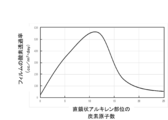
- FIG. 1 is a graph showing an example of the relationship between the number of carbon atoms in the linear alkylene moiety in the copolymerizable monomer that constitutes the methacrylic resin and the oxygen permeability of the film.
- the present inventors have used a methacrylic resin containing a structural unit derived from a specific copolymerizable monomer having a movable volume within a specific range to produce a film by a solution casting method. It was found that the solvent removability, that is, the drying property, can be remarkably enhanced.
- the movable volume of the copolymerization monomer depends on the unit molecular weight of the copolymerization monomer within the range in which the group serving as the side chain of the methacrylic resin (specifically, the group containing a linear alkylene moiety) can move. The higher the value, the wider the range in which the side chain group can move.
- the movable volume of the copolymerization monomer has a correlation with the number of carbon atoms in the linear alkylene moiety. That is, the larger the number of carbon atoms in the linear alkylene moiety, the larger the movable volume of the copolymerization monomer.
- the drying property of the film has a certain degree of correlation with the oxygen permeability of the film. That is, as the oxygen permeability of the film is higher, the drying property of the film generally tends to be higher.
- FIG. 1 is a graph showing an example of the relationship between the number of carbon atoms in the linear alkylene moiety in the copolymerized monomer and the oxygen permeability of the film.
- the higher the number of carbon atoms in the linear alkylene moiety in the copolymerized monomer the higher the oxygen permeability of the film; however, when it increases to a certain degree, the oxygen permeability of the film decreases.
- the present inventors set the number of carbon atoms of the linear alkylene moiety in the copolymerization monomer, and thus the movable volume of the copolymerization monomer within a specific range (0.5 to 3.6, preferably 1.2 to 3). It was found that the oxygen permeability of the film, and by extension, the drying property, can be remarkably enhanced by adjusting the ratio to .2).
- the movable volume of the copolymerizable monomer is less than or equal to the upper limit value, excessive entanglement of the side chains of the methacrylic resin can be suppressed, so that the voids (spaces) formed when the solvent molecules move are closed. It is possible to suppress the peeling.
- a film containing a methacrylic resin containing a structural unit derived from a specific copolymerizable monomer whose movable volume is adjusted has high toughness. It is presumed that the toughness was improved because the range in which the side chains of the methacrylic resin could move was increased due to the increased movable volume.
- the present invention has been made based on these findings.
- optical film of the present invention contains a methacrylic resin and rubber particles.
- Methacrylic Resin A methacrylic resin is a copolymer containing a structural unit derived from methyl methacrylate and a structural unit derived from a copolymerizable monomer copolymerizable therewith.
- the structural unit derived from the copolymerization monomer includes a structural unit derived from a specific copolymerization monomer represented by the following formula (1) and having a movable volume of 0.5 to 3.6.
- Formula (1): Movable volume Hard sphere volume of monomer/Molecular weight of monomer
- the hard sphere volume in formula (1) indicates the volume of the hard sphere whose radius is the radius of inertia obtained by analyzing the structure of the monomer with the radius of inertia analysis software.
- the movable volume of the specific copolymerizable monomer is 0.5 or more, excessive entanglement of the main chains of the methacrylic resin can be suppressed, so that the solvent molecules in the resin matrix can change the resin chain of the methacrylic resin.
- the movable volume of the specific copolymerizable monomer is 3.6 or less, excessive entanglement of the side chains of the methacrylic resin can be suppressed, so that the space formed when the solvent molecules move is blocked. Can be suppressed.
- the space in which solvent molecules can move is less likely to be lost, so that the drying property during solution film formation can be improved.
- the movable volume of the specific copolymerizable monomer is more preferably 1.2 to 3.2.
- the movable volume of a specific copolymerized monomer can be measured by the following procedure. 1) First, regarding the structure of a specific copolymerizable monomer, Quench calculation is performed for 500 ps with an NVT ensemble at room temperature, and energy evaluation is performed every 1 ps. Drying is used for the force field. Then, the result of the Quench calculation is analyzed by the Radius of gyration (inertial radius) analysis module, and the average value of the inertial radius distribution (average inertial radius value) is calculated as the “inertia radius”. For the analysis, as the simulation software, Materials Studio 2017R2 Force module (Dassault Systdiags Biovia Co., Ltd.) can be used.
- hard sphere volume the volume of a hard sphere having a radius equal to the inertial radius of the obtained copolymerized monomer is referred to as "hard sphere volume”.
- the hard sphere volume calculated in 1) above and the molecular weight of a specific copolymerization monomer are applied to the above equation (1) to calculate the movable volume.
- the specific copolymerizable monomer preferably has a linear alkylene moiety from the viewpoint of easily adjusting the movable volume within the above range. That is, the movable volume of the specific copolymerizable monomer can be adjusted by the length (the number of carbon atoms) of the linear alkylene moiety of the specific copolymerizable monomer and the presence or absence of branching. In order to increase the movable volume of the specific copolymerizable monomer, it is preferable to increase the number of carbon atoms in the linear alkylene moiety of the specific copolymerizable monomer, and it is more preferable that the specific copolymerizable monomer does not have a branched structure.
- the specific copolymerizable monomer preferably has a linear alkylene moiety having 4 to 20 carbon atoms, preferably 5 to 15 carbon atoms, and more preferably 8 to 15 carbon atoms.
- "Having a linear alkylene moiety having 4 to 20 carbon atoms” means not only the case of having a linear alkylene group having 4 to 20 carbon atoms itself but also a straight chain having 4 to 20 carbon atoms. It also includes the case of having a branched alkylene group having a moiety.
- Examples of such specific copolymerizable monomers include n-butyl (meth)acrylate (the number of carbon atoms in the linear alkylene moiety: 4), pentyl (meth)acrylate (carbon atoms in the linear alkylene moiety).
- (meth)acryl means acryl or methacryl.
- a (meth)acrylic acid alkyl ester having a linear alkylene moiety having 5 to 15 carbon atoms is more preferable, and from the viewpoint of easily adjusting the movable volume of a specific copolymerizable monomer to 1.2 or more, the number of carbon atoms is More preferred are (meth)acrylic acid alkyl esters having 8 to 15 linear alkylene moieties.
- the specific copolymerizable monomer may have a movable volume within the above range and may further have a ring structure (aromatic ring or aliphatic ring).
- the methacrylic resin may further include a structural unit derived from a copolymerization monomer other than the specific copolymerization monomer, if necessary.
- the other copolymerizable monomer preferably does not have a linear alkylene moiety having 4 to 20 carbon atoms.
- Examples of other comonomers include: Methyl acrylate, ethyl (meth)acrylate, propyl (meth)acrylate, t-butyl (meth)acrylate, 2-hydroxyethyl (meth)acrylate, phenyl (meth)acrylate, benzyl (meth)acrylate , 2-phenoxyethyl (meth)acrylate, dicyclopentanyl (meth)acrylate, isobornyl (meth)acrylate, adamantyl (meth)acrylate, cyclohexyl (meth)acrylate, etc.
- (Meth)acrylic acid alkyl ester having less than 4 carbon atoms Aromatic vinyls such as styrene, o-methylstyrene, m-methylstyrene, p-methylstyrene, ⁇ -methylstyrene; Alicyclic vinyls such as vinylcyclohexane; Unsaturated nitriles such as (meth)acrylonitrile and (meth)acrylonitrile-styrene copolymer; Unsaturated carboxylic acids such as (meth)acrylic acid, crotonic acid, (meth)acrylic acid, itaconic acid, itaconic acid monoester, maleic acid, maleic acid monoester; Olefins such as vinyl acetate, ethylene and propylene; Vinyl halides such as vinyl chloride, vinylidene chloride, vinylidene fluoride; (Meth)acrylamides such as (meth)acrylamide, methyl(meth)acrylamide,
- the other copolymerizable monomer may be a monomer having a ring structure, from the viewpoint of increasing the glass transition temperature and making it easier to further enhance the drying property during solution film formation.
- Examples of the monomer having a ring structure include Having an aliphatic ring such as dicyclopentanyl (meth)acrylate, isobornyl (meth)acrylate, adamantyl (meth)acrylate, cyclohexyl (meth)acrylate, and a six-membered ring lactone (meth)acrylate (meta) ) Acrylic ester; Aromatic vinyls such as styrene, o-methylstyrene, m-methylstyrene, p-methylstyrene, ⁇ -methylstyrene; Alicyclic vinyls such as vinylcyclohexane; Maleimides such as N-phenylmaleimide, N-ethylmaleimide, N-propylmaleimide, N-cyclohexylmaleimide, and N-o-chlorophenylmaleimide are included.
- an aliphatic ring such as dicyclopentanyl (meth)
- the total amount of structural units derived from the comonomer forming the methacrylic resin is preferably 1 to 50% by mass, and preferably 5 to 40% by mass, based on all structural units forming the methacrylic resin. More preferably, it is more preferably 10 to 30% by mass.
- the content of the structural unit derived from a specific copolymer monomer having a movable volume within the above range is, for example, from the viewpoint of easily increasing the drying property and toughness of the film, the structural unit derived from the copolymerizing monomer is It is preferably 100% by mass with respect to the total amount.
- the content of the structural unit derived from the specific copolymerizable monomer is preferably 1 to 50% by mass based on all structural units constituting the methacrylic resin.
- the content of the structural unit derived from the specific copolymerizable monomer is 1% by mass or more, when the solvent molecule moves while pushing away the resin chain of the methacrylic resin in the film material containing the methacrylic resin. Since many spaces where solvent molecules can easily move can be formed, it is easy to sufficiently enhance the drying property during solution film formation.
- the content of the structural unit derived from the specific copolymerizable monomer is 50% by mass or less, the glass transition temperature (Tg) of the methacrylic resin does not become too low, so that heat resistance is not easily impaired, and It is also possible to suppress a decrease in drying property due to a decrease in drying temperature.
- the content of the structural unit derived from the specific copolymerizable monomer is more preferably 5 to 40% by mass, and more preferably 10 to 30% by mass, based on all the structural units constituting the methacrylic resin. Is more preferable.
- the methacrylic resin may further include a structural unit derived from, for example, a monomer having a ring structure (another copolymerized monomer).
- the content ratio of the structural unit derived from the specific copolymer monomer to the structural unit derived from the monomer having a ring structure may be, for example, 50/50 to 90/10 (mass ratio).
- the type and composition of the monomer of the methacrylic resin can be specified by 1 H-NMR.
- the glass transition temperature (Tg) of the methacrylic resin is preferably 80° C. or higher, more preferably 100° C. or higher, from the viewpoint of handling properties and post-processing (stretchability, etc.). From the viewpoint of making the toughness of the optical film less likely to be impaired, the upper limit of the glass transition temperature (Tg) of the methacrylic resin can be set to 160°C, for example.
- the glass transition temperature (Tg) of the methacrylic resin can be measured in accordance with JIS K7121-2012 using DSC (Differential Scanning Colorimetry).
- the glass transition temperature (Tg) of methacrylic resin can be adjusted by the type and composition of the monomer.
- the content of the structural unit derived from a specific copolymerization monomer is set to a certain level or less, or the linear alkylene moiety of the specific copolymerization monomer is contained. It is preferable to keep the number of carbon atoms below a certain level.
- the weight average molecular weight (Mw) of the methacrylic resin is preferably 600 to 3,000,000.
- the weight average molecular weight of the methacrylic resin is within the above range, the film-forming property and the drying property are less likely to be impaired while imparting sufficient mechanical strength (toughness) to the film.
- the weight average molecular weight of the methacrylic resin is more preferably 1 to 3,000,000.
- the weight average molecular weight (Mw) of the methacrylic resin can be measured in terms of polystyrene by gel permeation chromatography (GPC). Specifically, it can be measured using a Tosoh HLC8220GPC) and a column (Tosoh TSK-GEL G6000HXL-G5000HXL-G5000HXL-G4000HXL-G3000HXL series). The measurement conditions may be the same as in the examples described below.
- the content of the methacrylic resin may be preferably 70% by mass or more, more preferably 80% by mass or more based on the optical film.
- the rubber particles can facilitate the movement of the molecular chains of the methacrylic resin in the drying step during solution film formation of the optical film, and can improve the drying property during solution film formation.
- the rubber particles can impart flexibility and toughness to the optical film, and at the same time, form irregularities on the surface of the optical film to impart slipperiness.
- the rubber particles are core-shell type rubber particles having a graft copolymer containing a rubber-like polymer (cross-linked polymer), that is, a core portion made of the rubber-like polymer (cross-linked polymer) and a shell portion covering the core portion. Is preferred.
- the glass transition temperature (Tg) of the rubber particles is preferably ⁇ 10° C. or lower. When the glass transition temperature (Tg) of the rubber particles is ⁇ 10° C. or lower, it is easy to impart sufficient toughness to the film.
- the glass transition temperature (Tg) of the rubber particles is more preferably ⁇ 15° C. or lower, further preferably ⁇ 20° C. or lower.
- the glass transition temperature (Tg) of the rubber particles is measured by the same method as described above.
- the glass transition temperature (Tg) of the rubber particles is, for example, the monomer composition of the core part or the shell part, the mass ratio of the core part and the shell part (grafting rate), and the mass ratio of the soft layer and the hard layer as described later. Can be adjusted by.
- Tg glass transition temperature
- the number of carbon atoms of the alkyl group in the monomer mixture (a′) constituting the acrylic rubber-like polymer (a) of the core part It is preferable to increase the total mass ratio of acrylic acid ester/copolymerizable monomer having 4 or more (for example, 3 or more, preferably 4 or more and 10 or less).
- rubber-like polymers examples include butadiene-based cross-linked polymers, (meth)acrylic cross-linked polymers, and organosiloxane cross-linked polymers.
- a (meth)acrylic cross-linked polymer is preferable, and an acrylic cross-linked polymer (acrylic rubber-like polymer) is preferable from the viewpoint that the difference in the refractive index from the methacrylic resin is small and the transparency of the optical film is not easily impaired. More preferable.
- the rubber particles are preferably an acrylic graft copolymer containing the acrylic rubber-like polymer (a).
- the acrylic graft copolymer containing the acrylic rubber-like polymer (a) is a core-shell type particle having a core portion containing the acrylic rubber-like polymer (a) and a shell portion covering the core portion.
- a core-shell type particle is a multi-stage polymer obtained by polymerizing at least one step of a monomer mixture (b) containing a methacrylic acid ester as a main component in the presence of an acrylic rubber-like polymer (a). is there.
- the polymerization can be carried out by an emulsion polymerization method.
- the acrylic rubber-like polymer (a) that constitutes the core portion is a cross-linked polymer having an acrylic ester as a main component.
- the acrylic rubber-like polymer (a) is a monomer mixture (a') containing an acrylate ester and an arbitrary monomer copolymerizable therewith, and two or more non-conjugated reactive double bonds per molecule. It is a cross-linked polymer obtained by polymerizing a polyfunctional monomer having a (radical polymerizable group).
- the acrylic rubber-like polymer (a) may be obtained by mixing and polymerizing all of these monomers, or may be obtained by polymerizing twice or more by changing the monomer composition.
- the acrylate ester is preferably an acrylate alkyl ester having 1 to 12 carbon atoms in the alkyl group such as methyl acrylate and butyl acrylate.
- the acrylate ester may be one type or two or more types. From the viewpoint of keeping the glass transition temperature of the rubber particles at ⁇ 15° C. or lower, the acrylic ester preferably contains at least an alkyl acrylate having 4 to 10 carbon atoms.
- the content of the acrylate ester is preferably 50 to 100% by mass, more preferably 60 to 99% by mass, and 70 to 99% by mass with respect to 100% by mass of the monomer mixture (a'). Is more preferable.
- the content of the acrylic ester is 50% by weight or more, it is easy to give sufficient toughness to the film.
- an alkyl acrylate having an alkyl group having 4 or more carbon atoms/other copolymerizable monomer is preferably 3 or more, and more preferably 4 or more and 10 or less.
- copolymerizable monomers examples include methacrylic acid esters such as methyl methacrylate; styrenes such as styrene and methylstyrene; unsaturated nitriles such as acrylonitrile and methacrylonitrile.
- polyfunctional monomers examples include allyl (meth)acrylate, triallyl cyanurate, triallyl isocyanurate, diallyl phthalate, diallylmaleate, divinyl adipate, divinylbenzene, ethylene glycol di(meth)acrylate, diethylene glycol (meth).
- Acrylate, triethylene glycol di(meth)acrylate, trimethylol propane tri(meth)acrylate, tetromethylolmethane tetra(meth)acrylate, dipropylene glycol di(meth)acrylate, polyethylene glycol di(meth)acrylate are included.
- the content of the polyfunctional monomer is preferably 0.05 to 10% by mass, and more preferably 0.1 to 5% by mass based on 100% by mass of the total of the monomer mixture (a').
- the content of the polyfunctional monomer is 0.05% by mass or more, since the degree of crosslinking of the obtained acrylic rubber-like polymer (a) is easily increased, the hardness and rigidity of the obtained film are not excessively impaired, When the content is 10% by mass or less, the toughness of the film is less likely to be impaired.
- the polymer of the monomer mixture (b) constituting the shell part is a graft component for the acrylic rubber-like polymer (a).
- the monomer mixture (b) contains methacrylic acid ester as a main component.
- the methacrylic acid ester is preferably a methacrylic acid alkyl ester having an alkyl group having 1 to 12 carbon atoms such as methyl methacrylate.
- the methacrylic acid ester may be one kind or two or more kinds.
- the content of methacrylic acid ester is preferably 50% by mass or more based on 100% by mass of the monomer mixture (b).
- the content of the methacrylic acid ester is 50% by mass or more, it may be difficult to reduce the hardness and rigidity of the obtained film.
- the content of the methacrylic acid ester is more preferably 70% by mass or more and 80% by mass or more with respect to 100% by mass of the monomer mixture (b). Is more preferable.
- the monomer mixture (b) may further contain other monomers, if necessary.
- examples of other monomers include acrylic acid esters such as methyl acrylate, ethyl acrylate, and n-butyl acrylate; benzyl (meth)acrylate, dicyclopentanyl (meth)acrylate, phenoxy (meth)acrylate. Included are (meth)acrylic monomers having an alicyclic structure, a heterocyclic structure, or an aromatic group such as ethyl (ring structure-containing (meth)acrylic monomer).
- acrylic graft copolymer examples include at least 95 to 25 parts by mass of a monomer mixture (b) containing methacrylic acid ester as a main component in the presence of 5 to 75 parts by mass of the acrylic rubbery polymer (a). Included are polymers polymerized in one step.
- the acrylic graft copolymer may further include a hard polymer inside the acrylic rubber-like polymer (a), if necessary.
- Such an acrylic graft copolymer can be obtained through the following polymerization steps (I) to (III).
- a monomer mixture (c1) comprising 40 to 100% by weight of a methacrylic acid ester and 60 to 0% by weight of another monomer copolymerizable therewith, and 0.01 to 10 parts by weight of a polyfunctional monomer (monomer mixture (C) totaling 100 parts by mass) to obtain a hard polymer (II) from 60 to 100% by mass of an acrylic ester and 0 to 40% by mass of another monomer copolymerizable therewith
- a soft polymer by polymerizing the following monomer mixture (a1) and 0.1 to 5 parts by mass of a polyfunctional monomer (based on a total of 100 parts by mass of the monomer mixture (a1))
- Methacrylic acid ester A monomer mixture (b1) comprising 60 to 100% by
- the acrylic graft copolymer may be obtained through the polymerization step (IV).
- Monomer mixture (b2) consisting of 40 to 100% by weight of methacrylic acid ester, 0 to 60% by weight of acrylic acid ester, and 0 to 5% by weight of other copolymerizable monomer, and polyfunctional monomer 0 to 10
- a hard polymer is obtained by polymerizing parts by mass (based on 100 parts by mass of the monomer mixture (b2)).
- methacrylic acid ester acrylic acid ester, other copolymerizable monomer, and polyfunctional monomer used in each step, the same ones as described above can be used.
- the soft layer can give impact absorption to the optical film.
- the soft layer include a layer made of an acrylic rubber-like polymer (a) containing acrylate as a main component.
- the hard layer makes it difficult to impair the toughness of the optical film and can suppress the coarsening and agglomeration of particles during the production of rubber particles.
- the hard layer include a layer made of a polymer containing methacrylic acid ester as a main component.
- the graft ratio (mass ratio of the graft component to the acrylic rubber-like polymer (a)) in the acrylic graft copolymer is preferably 10 to 250%, more preferably 25 to 200%, and 40 It is more preferably from 200 to 200%, further preferably from 60 to 150%.
- the graft ratio is 10% or more, the ratio of the shell portion does not decrease too much, so that the hardness and rigidity of the film are not easily impaired.
- the graft ratio of the acrylic graft copolymer is 250% or less, the ratio of the acrylic rubber-like polymer (a) does not become too small, so that the effect of improving the toughness and brittleness of the film is not easily impaired.
- the average particle diameter of the rubber particles is preferably 100 to 400 nm, more preferably 150 to 300 nm.
- the average particle size is 100 nm or more, it is easy to impart sufficient toughness to the film, and when the average particle size is 400 nm or less, the transparency of the film is less likely to decrease.
- the average particle diameter of rubber particles is specified as the average value of the equivalent circle diameters of 100 particles obtained by SEM or TEM photography of the film surface and section.
- the equivalent circle diameter can be obtained by converting the projected area of particles obtained by photographing into the diameter of a circle having the same area.
- the rubber particles (acrylic graft copolymer) observed by SEM observation and/or TEM observation at a magnification of 5000 are used for calculating the average particle diameter.
- the average particle size of the rubber particles (acrylic graft copolymer) in the dispersion can be measured with a zeta potential/particle size measuring system (ELSZ-2000ZS manufactured by Otsuka Electronics Co., Ltd.).
- the content of rubber particles is preferably 2 to 30 mass% with respect to the methacrylic resin.
- the content of the rubber particles is 2% by mass or more, not only the drying property during solution film formation can be sufficiently enhanced, but also sufficient toughness can be imparted to the obtained film. Haze does not rise too much as it is 30 mass% or less. From the above viewpoint, the content of the rubber particles is more preferably 2 to 20% by mass based on the methacrylic resin.
- the methacrylic resin used in the present invention can impart good toughness derived from a specific copolymerizable monomer to the film, and therefore the content of rubber particles can be reduced.
- the content of the rubber particles may be 5 to 10% by mass based on the methacrylic resin.
- the optical film may further contain components other than the above components within a range that does not impair the effects of the present invention.
- examples of other components include fine particles, residual solvents, ultraviolet absorbers, antioxidants and the like.
- the optical film may further contain inorganic fine particles or organic fine particles other than rubber particles as a matting agent from the viewpoint of further improving the slipperiness.
- Examples of the inorganic material forming the inorganic fine particles include silicon dioxide (SiO 2 ), titanium dioxide, aluminum oxide, zirconium oxide, calcium carbonate, calcium carbonate, talc, clay, calcined kaolin, calcined calcium silicate, hydrated silicic acid. Calcium, aluminum silicate, magnesium silicate, and calcium phosphate are included, and silicon dioxide is preferable from the viewpoint of reducing the increase in haze.
- the organic fine particles are resin particles having a glass transition temperature (Tg) of preferably 80° C. or higher. Among them, organic fine particles are preferable from the viewpoint of easily increasing the toughness of the film.
- Organic solvent Since the optical film is produced by the solution casting method as described later, it may contain a residual solvent derived from the solvent of the dope used in the solution casting method.
- the amount of residual solvent is preferably 700 ppm or less with respect to the optical film, and more preferably 30 to 700 ppm.
- the content of the residual solvent can be adjusted by the drying conditions of the dope cast on the support in the optical film production process described below.
- the amount of residual solvent in the optical film can be measured by headspace gas chromatography.
- the sample is enclosed in a container, heated, and the gas in the container is quickly injected into the gas chromatograph in a state where the container is filled with volatile components, and mass spectrometry is performed to identify the compound. Volatile components are quantified while performing.
- the headspace method it is possible to observe all peaks of volatile components by gas chromatography, and by using an analytical method that utilizes electromagnetic interaction, it is possible to quantify volatile substances and monomers with high accuracy. It can be done together.
- the total content of other components is preferably 10% by mass or less based on the optical film.
- the optical film can be manufactured with high drying efficiency.
- the drying coefficient (D) of the optical film is preferably 0.02 or more, more preferably 0.05 or more, and further preferably 0.1 or more.
- the drying coefficient (D) of the optical film can be measured by the following method. 1) First, an optical film is cut into a predetermined size to prepare a sample. This sample is dried at 90° C. for 60 minutes, and then the mass is measured to be the “mass before heat treatment”. 2) Next, after heat-treating this sample at 140° C. for 15 minutes, the mass is measured to be “mass after heat treatment”. 3) The value obtained in 1) and 2) above is applied to the following formula to calculate the residual solvent amount Z after the heat treatment.
- Amount of residual solvent Z (%) (mass before heat treatment of sample ⁇ mass after heat treatment of sample)/(mass after heat treatment of sample) ⁇ 100 4)
- the residual solvent amount Z (%), the initial value Zo (%), and the heating time t (minutes) obtained in 3) above are applied to the following formula to calculate the drying coefficient (D).
- the initial value Zo (%) is set to 5 (%).
- Formula (II): D ( ⁇ 1/t) ⁇ ln(Z/Zo)
- the drying coefficient (D) of the optical film can be adjusted by the monomer composition of the methacrylic resin.
- the content of the structural unit derived from the specific copolymerization monomer in the methacrylic resin is increased, or the linear alkylene moiety in the specific copolymerization monomer is added. It is preferable that the number of carbon atoms is within the range of 4 to 20.
- the oxygen transmission rate of the optical film measured according to JIS K 7126-2 (2006) is preferably 200 to 700 (cc/m 2 ⁇ day).
- the oxygen transmission rate is more preferably 250 to 700 (cc/m 2 ⁇ day), and further preferably 350 to 700 (cc/m 2 ⁇ day).
- the oxygen permeability of the optical film can be adjusted by the monomer composition of the methacrylic resin.
- the content of the structural unit derived from the specific copolymerization monomer in the methacrylic resin is increased or the linear alkylene moiety in the specific copolymerization monomer is added. It is preferable that the number of carbon atoms is within the range of 4 to 20.
- the optical film preferably has high transparency.
- the haze of the optical film is preferably 4.0% or less, more preferably 2.0% or less, and further preferably 1.0% or less.
- the haze can be measured according to JISK-6714 with a haze meter (HGM-2DP, Suga Tester) at 25° C. and 60% RH on a sample of 40 mm ⁇ 80 mm.
- the retardation Ro in the in-plane direction measured under an environment of a measurement wavelength of 550 nm and 23° C. and 55% RH is preferably 0 to 10 nm. , 0 to 5 nm is more preferable.
- the retardation Rt in the thickness direction of the optical film is preferably ⁇ 20 to 20 nm, more preferably ⁇ 10 to 10 nm.
- Ro and Rt are each defined by the following formula.
- Formula (2a): Ro (nx ⁇ ny) ⁇ d
- Formula (2b): Rt ((nx+ny)/2-nz) ⁇ d
- nx represents the refractive index in the in-plane slow axis direction (direction in which the refractive index becomes maximum) of the film
- ny represents the refractive index in the direction orthogonal to the in-plane slow axis of the film
- nz represents the refractive index in the thickness direction of the film
- d represents the thickness (nm) of the film.
- the in-plane slow axis of the optical film is the axis where the refractive index is maximum on the film surface.
- the in-plane slow axis of the optical film can be confirmed by an automatic birefringence meter Axoscan (Axo Scan Mueller Matrix Polarimeter: manufactured by Axometrics).
- Ro and Rt can be measured by the following methods. 1) The optical film is conditioned for 24 hours in an environment of 23° C. and 55% RH. The average refractive index of this film is measured with an Abbe refractometer, and the thickness d is measured with a commercially available micrometer. 2) The retardation Ro and Rt at a measurement wavelength of 550 nm of the film after humidity adjustment were respectively measured at 23° C. and 55% RH using an automatic birefringence meter Axoscan (Axo Scan Mueller Matrix Polarimeter: manufactured by Axometrics). Measure under the environment.
- the retardation Ro and Rt of the optical film can be adjusted, for example, by the type of methacrylic resin.
- a methacrylic resin that hardly causes retardation by stretching is used (for example, a structural unit derived from a monomer having negative birefringence and a monomer derived from a monomer having positive birefringence). It is preferable that the monomer ratio is such that the phase difference with the structural unit of
- the thickness of the optical film may be, for example, 5 to 100 ⁇ m, preferably 5 to 40 ⁇ m.
- the method for producing an optical film of the present invention is not particularly limited, but from the viewpoint that there are few restrictions on the materials that can be used such as a high molecular weight resin, the solution film forming method (casting method) is preferable.
- the optical film of the present invention includes 1) a step of obtaining a dope containing at least a methacrylic resin, rubber particles, and a solvent, and 2) casting the obtained dope on a support, and drying and peeling the dope. To obtain a film-like product, and 3) a step of further drying the obtained film-like product.
- Step 1) for example, a methacrylic resin and rubber particles can be dissolved or dispersed in a solvent to obtain a dope.
- the methacrylic resin and the rubber particles are the same as described above.
- the solvent used for the dope contains at least an organic solvent (good solvent) capable of dissolving the methacrylic resin.
- good solvents include chlorine-based organic solvents such as methylene chloride; non-chlorine-based organic solvents such as methyl acetate, ethyl acetate, acetone, and tetrahydrofuran. Of these, methylene chloride is preferable.
- the solvent used for the dope may further contain a poor solvent.
- the poor solvent include linear or branched aliphatic alcohols having 1 to 4 carbon atoms. When the proportion of alcohol in the dope is high, the film-like material is likely to be gelled, and peeling from the metal support is easy.
- the linear or branched aliphatic alcohol having 1 to 4 carbon atoms include methanol, ethanol, n-propanol, iso-propanol, n-butanol, sec-butanol and tert-butanol. Of these, ethanol is preferred because it has a stable dope, a relatively low boiling point, and a good drying property.
- the dope may be prepared by directly adding a methacrylic resin and rubber particles to a solvent and mixing them; a resin solution in which a methacrylic resin is dissolved in a solvent, and rubber particles in a solvent.
- the rubber particle dispersion liquid in which is dispersed may be prepared in advance, and they may be mixed to prepare.
- Step 2 In this step, the obtained dope is cast on a support.
- the casting of the dope can be performed by discharging from the casting die.
- the solvent in the dope cast on the support is appropriately evaporated (after being dried), and then the support is peeled off to obtain a film.
- the residual solvent amount of the dope when peeled from the support is, for example, preferably 25% by mass or more, more preferably 30 to 37% by mass, and 30 More preferably, it is from about 35% by mass.
- the amount of residual solvent at the time of peeling is 25% by mass or more, the solvent is likely to be volatilized at once from the film-form material after peeling. Further, when the residual solvent amount at the time of peeling is 37% by mass or less, it is possible to prevent the film-like material from being excessively elongated due to peeling.
- the heat treatment for measuring the amount of residual solvent is a heat treatment at 140° C. for 15 minutes.
- the amount of residual solvent at the time of peeling can be adjusted by the drying temperature and drying time of the dope on the support, the temperature of the support and the like.
- step 3 the obtained film-like material is dried.
- Drying may be performed in one step or in multiple steps. Further, the drying may be carried out while stretching if necessary.
- Stretching may be performed according to the required optical characteristics, and it is preferable to stretch in at least one direction, and stretching in two directions orthogonal to each other (for example, the width direction (TD direction) of the film and the direction orthogonal thereto). It may be biaxially stretched in the transport direction (MD direction).
- TD direction width direction
- MD direction transport direction
- the stretch ratio can be 1.01 to 2 times from the viewpoint of using the optical film as a retardation film for IPS, for example.
- the draw ratio is defined as (size in the draw direction of the film after drawing)/(size in the draw direction of the film before drawing).
- the in-plane slow axis direction of the optical film (direction in which the in-plane refractive index is maximum) is usually the direction in which the draw ratio is maximum.
- the drying temperature (stretching temperature) during stretching is preferably Tg (°C) or higher, more preferably (Tg+10) to (Tg+50)°C, where Tg is the glass transition temperature of the methacrylic resin.
- Tg is the glass transition temperature of the methacrylic resin.
- the stretching temperature may be 115° C. or higher, for example.
- the stretching temperature is (a) when drying with a non-contact heating type such as a tenter stretching machine, and (b) when drying with a contact heating type such as a heating roller or an atmospheric temperature such as hot air temperature.
- a non-contact heating type such as a tenter stretching machine
- a contact heating type such as a heating roller or an atmospheric temperature such as hot air temperature.
- it is preferable to measure the ambient temperature such as the temperature inside the stretching machine or the hot air temperature.
- the amount of residual solvent in the film at the start of stretching is preferably approximately the same as the amount of residual solvent in the film at the time of peeling, for example, preferably 20 to 30% by mass, and 25 to 30% by mass. % Is more preferable.
- TD direction (width direction) stretching of the film can be performed, for example, by fixing both ends of the film with clips or pins and widening the interval between the clips or pins in the traveling direction (tenter method).
- the stretching of the film in the MD direction can be performed by, for example, a method (roll method) in which a plurality of rolls are provided with a peripheral speed difference and the peripheral speed difference between the rolls is used.
- the film-like material obtained after stretching is further dried while being transported by a roll or the like.
- the drying temperature at this time is preferably (Tg-40) to (Tg+30)° C., where Tg is the glass transition temperature of the methacrylic resin, It is more preferably (Tg-30) to Tg°C.
- Tg is the glass transition temperature of the methacrylic resin
- Tg+30 the drying temperature is (Tg-40)° C. or higher, preferably (Tg-30)° C. or higher, the solvent can be sufficiently volatilized and removed from the stretched film, and (Tg+30)° C. or lower, preferably Tg° C.
- the drying temperature it is preferable to measure the ambient temperature such as (a) the temperature inside the stretching machine or the hot air temperature, as described above.
- the film material contains the above-mentioned methacrylic resin.
- a film-like material can form a relatively large space in which solvent molecules can move when the solvent molecules move while pushing away the resin chain of the methacrylic resin, so that the drying step, especially drying after stretching.
- the solvent can be easily removed from the film-like material by volatilization.
- the drying speed can be increased as compared with the conventional one, or a drying speed equal to or higher than the conventional one can be realized even at a low drying temperature.
- the optical film of the present invention is used as an optical member in a display device such as a liquid crystal display device or an organic EL display device.
- the optical member include a polarizing plate protective film (including a retardation film and a brightness enhancement film), a transparent substrate, and a light diffusion film.
- the optical film of the present invention is preferably used as a polarizing plate protective film.
- the polarizing plate of the present invention has a polarizer, the optical film of the present invention, and an adhesive layer arranged between them.
- Polarizer A polarizer is a polyvinyl alcohol-based polarizing film, which is an element that allows only light having a plane of polarization in a certain direction to pass therethrough.
- the polyvinyl alcohol-based polarizing film includes a polyvinyl alcohol-based film dyed with iodine and a polyvinyl alcohol-based film dyed with a dichroic dye.
- the polyvinyl alcohol-based polarizing film may be a film obtained by uniaxially stretching a polyvinyl alcohol-based film and then dyeing it with iodine or a dichroic dye (preferably a film further subjected to durability treatment with a boron compound); A film obtained by dyeing an alcohol-based film with iodine or a dichroic dye and then uniaxially stretching it (preferably a film further subjected to a durability treatment with a boron compound) may be used.
- the absorption axis of the polarizer is usually parallel to the maximum stretching direction.
- the content of ethylene units is 1 to 4 mol %
- the degree of polymerization is 2000 to 4000
- the degree of saponification is 99.0 to 99.99 mol %.
- Ethylene-modified polyvinyl alcohol is used.
- the thickness of the polarizer is preferably 5 to 30 ⁇ m, and more preferably 5 to 20 ⁇ m in order to make the polarizing plate thin.
- the optical film of the present invention is arranged on at least one surface of the polarizer (at least the surface facing the liquid crystal cell).
- the optical film can function as a polarizing plate protective film.
- optical film of the present invention When the optical film of the present invention is arranged on only one surface of the polarizer, another optical film may be arranged on the other surface of the polarizer.
- other optical films commercially available cellulose ester film (for example, Konica Minolta TAC KC8UX, KC5UX, KC4UX, KC8UCR3, KC4SR, KC4BR, KC4CR, KC4DR, KC4FR, KC4KR, KC8UY, KC6UY, KC4UY, KC4UE, KC8UE, KC8UY-HA, KC2UA, KC4UA, KC6UA, KC8UA, KC2UAH, KC4UAH, KC6UAH, Konica Minolta Co. Ltd.
- the above includes Fuji Film Co., Ltd., etc.
- the thickness of the other optical film may be, for example, 5 to 100 ⁇ m, preferably 40 to 80 ⁇ m.
- the adhesive layer is disposed between the optical film (or other optical film) and the polarizer.
- the thickness of the adhesive layer may be, for example, 0.01 to 10 ⁇ m, and preferably about 0.03 to 5 ⁇ m.
- the polarizing plate of the present invention can be obtained by bonding the polarizer and the optical film of the present invention via an adhesive.
- the adhesive may be a fully saponified polyvinyl alcohol aqueous solution (water glue) or an active energy ray curable adhesive.
- the active energy ray-curable adhesive may be a photoradical polymerization type composition utilizing photoradical polymerization, a photocationic polymerization type composition utilizing photocationic polymerization, or a combination thereof.
- the liquid crystal display device of the present invention includes a liquid crystal cell, a first polarizing plate arranged on one surface of the liquid crystal cell, and a second polarizing plate arranged on the other surface of the liquid crystal cell.
- the display mode of the liquid crystal cell is, for example, STN (Super-Twisted Nematic), TN (Twisted Nematic), OCB (Optically Compensated Bend), HAN (Hybrid aligned Nematic), VA (Vertical Alignment, MVA (Multi-domain Vertical Alignment), PVA. (Patterned Vertical Alignment), IPS (In-Plane-Switching), and the like.
- the VA (MVA, PVA) mode and the IPS mode are preferable.
- the polarizing plate of the present invention is preferably arranged such that the optical film of the present invention is on the liquid crystal cell side.
- the movable volume, glass transition temperature (Tg) and weight average molecular weight (Mw) of the copolymerized monomers of the methacrylic resins 1 to 13 were measured by the following methods.
- Glass transition temperature (Tg) The glass transition temperature of the methacrylic resin was measured according to JIS K 7121-2012 using DSC (Differential Scanning Colorimetry).
- the weight average molecular weight (Mw) of the methacrylic resin was measured using gel permeation chromatography (Tosoh HLC8220GPC) and column (Tosoh TSK-GEL G6000HXL-G5000HXL-G5000HXL-G4000HXL-G3000HXL series). 20 ⁇ 0.5 mg of the sample was dissolved in 10 ml of tetrahydrofuran and filtered through a 0.45 mm filter. 100 ml of this solution was injected into a column (temperature 40° C.), measured at a detector RI temperature of 40° C., and converted into styrene to obtain a weight average molecular weight.
- Rubber particles ⁇ Rubber particles R1> Acrylic rubber particles M-210 (core part: acrylic rubber-like polymer, shell part: methacrylic acid ester-based polymer containing methyl methacrylate as a main component) core-shell type rubber particles, Tg: about -10°C , Average particle size: 220 nm)
- ⁇ Rubber particles R2> The following compounds were charged in an 8 L polymerization apparatus equipped with a stirrer.
- Deionized water 175 parts by mass
- Polyoxyethylene lauryl ether phosphoric acid 0.104 parts by mass
- Boric acid 0.4725 parts by mass
- Sodium carbonate 0.04725 parts by mass
- the internal temperature was set to 80° C., and 27 parts by mass of the monomer mixture (c1) (97% by mass of methyl methacrylate, 3% by mass of butyl acrylate) and 0.135% by mass of allyl methacrylate. 26 mass% of a mixture of 10 parts by mass was added all at once to the polymerizer, then 0.0645 parts by mass of sodium formaldehyde sulfoxylate, 0.0056 parts by mass of ethylenediaminetetraacetic acid-2-sodium, and 0.1.
- the obtained latex was salted out with magnesium chloride, coagulated, washed with water and dried to obtain a white powder-like graft copolymer (rubber particles C1).
- the graft ratio of the rubber particles C1 was 24.2%, the glass transition temperature (Tg) was ⁇ 30° C., and the average particle diameter was 250 nm.
- Fine particles ⁇ Fine particles A1> As the fine particles A1, organic fine particles prepared by the following method were used.
- a polymerization vessel equipped with a stirrer and a thermometer was charged with 1000 g of deionized water, charged with 50 g of methyl methacrylate and 6 g of t-dodecyl mercaptan, and heated to 70° C. under nitrogen with stirring. The internal temperature was kept at 70° C., 20 g of deionized water in which 1 g of potassium persulfate was dissolved was added as a polymerization initiator, and then polymerization was performed for 10 hours. The average particle size of seed particles in the obtained emulsion was 0.05 ⁇ m.
- a polymerization vessel equipped with a stirrer and a thermometer was charged with 800 g of deionized water in which 2.4 g of sodium lauryl sulfate was dissolved as a gelation inhibitor, and 66 g of methyl methacrylate as a monomer mixture, 20 g of styrene and ethylene glycol dichloride were added thereto.
- a mixed liquid of 64 g of methacrylate and 1 g of azobisisobutyronitrile as a polymerization initiator was added. Then, the mixed solution was mixed with T.
- the dispersion was obtained by stirring with a K homomixer (made by Tokushu Kika Kogyo Co., Ltd.).
- the obtained dispersion liquid 60 g of the emulsion containing the seed particles was added, and the mixture was stirred at 30° C. for 1 hour to allow the seed particles to absorb the monomer mixture. Next, the absorbed monomer mixture is heated under a nitrogen stream at 50° C. for 5 hours to polymerize, and then cooled to room temperature (about 25° C.) to obtain a slurry of polymer fine particles (organic fine particles). Obtained.
- the obtained organic fine particles had an average particle diameter of 0.14 ⁇ m and a glass transition temperature (Tg) of 280° C.
- Fine particles A2 As the fine particles A2, inorganic fine particles (Aerosil (registered trademark) R812, manufactured by Nippon Aerosil Co., Ltd.) were used.
- the average particle diameter of rubber particles and fine particles was measured by the following method.
- the dispersed particle size of the fine particles in the obtained dispersion was measured with a zeta potential/particle size measuring system (ELSZ-2000ZS manufactured by Otsuka Electronics Co., Ltd.).
- the average particle size of the fine particles measured using a zeta potential/particle size measurement system (ELSZ-2000ZS manufactured by Otsuka Electronics Co., Ltd.) is almost the same as the average particle size of the fine particles measured by TEM observation of the film. Is.
- a dope having the following composition was prepared. First, methylene chloride and ethanol were added to the pressure dissolution tank. Then, the methacrylic resin 1 was put into the pressure dissolution tank while stirring. Next, the above-prepared fine particle dispersion liquid was added, and this was heated to 60° C. and completely dissolved while stirring. The heating temperature was increased from room temperature at 5°C/min, dissolved in 30 minutes, and then lowered at 3°C/min. After filtering the obtained solution, a dope was obtained. Methacrylic resin 1: 100 parts by mass Methylene chloride: 318 parts by mass Ethanol: 61 parts by mass Rubber particle dispersion: 400 parts by mass
- the dope was uniformly cast on a stainless belt support at a temperature of 31° C. and a width of 1800 mm.
- the temperature of the stainless belt was controlled at 28°C.
- the transport speed of the stainless belt was 20 m/min.
- the solvent was evaporated on a stainless belt support until the amount of residual solvent in the cast film was 30%.
- it was peeled from the stainless belt support with a peeling tension of 128 N/m. While the peeled film is conveyed by a large number of rolls, the obtained film-like material is 1.2 times in the width direction under a condition of (Tg+10)° C. (Tg represents Tg of methacrylic resin) with a tenter. It was stretched.
- Tg represents Tg of methacrylic resin
- Tg represents Tg of methacrylic resin
- Fine particle dispersion liquid 1 12 parts by mass of the fine particles A1 and 388 parts by mass of methylene chloride were stirred and mixed with a dissolver for 50 minutes, and then dispersed under a 1500 rpm condition using a Milder disperser Milder Disperser (manufactured by Daiheiyo Kiko Co., Ltd.). Thus, a fine particle dispersion liquid 1 was obtained.
- the oxygen permeability, the drying coefficient, and the MIT flexibility of the obtained optical films 101 to 117 were evaluated by the following methods.
- the oxygen transmittance of the optical film was measured according to JIS K 7126-2 2006. Specifically, a 100 mm square film was prepared as a test piece. The oxygen permeability of this film was measured according to JIS K 7126-2 2006 using a gas permeation tester (oxygen permeability meter OX-TRAN1_50 manufactured by MOCON). The measurement temperature was 23°C.
- Amount of residual solvent Z (%) (mass before heat treatment of sample ⁇ mass after heat treatment of sample)/(mass after heat treatment of sample) ⁇ 100 4)
- the obtained residual solvent amount Z (%), initial value Zo (%) and heating time t (minute) were applied to the following formula to calculate the drying coefficient (D).
- the initial value Zo (%) was set to 5 (%).
- Formula (II): D ( ⁇ 1/t) ⁇ ln(Z/Zo)
- Drying coefficient (D) is 0.1 or more
- Drying coefficient (D) is 0.05 or more and less than 0.1
- Drying coefficient (D) is 0.02 or more and less than 0.05
- Drying coefficient (D ) Is less than 0.02
- the larger the value of D the better the solvent escape (dryability) during the production by the solution casting method. When it was ⁇ or more, it was judged as good.
- the obtained optical film was cut into a width of 15 mm and a length of 150 mm to obtain a test piece.
- the test piece was allowed to stand for 1 hour or more at a temperature of 25° C. and a relative humidity of 65% RH.
- a folding endurance tester MIT, BE-201, manufactured by Tester Sangyo Co., Ltd., bending radius of curvature 0.38 mm
- the test piece was tested under a load of 500 g in accordance with JIS P8115:2001.
- the number of bends before breaking was measured.
- the MIT flexibility of the optical film was evaluated according to the following criteria.
- Table 2 shows the evaluation results of the optical films 101 to 117.
- the drying property becomes higher by setting the movable volume of the copolymerized monomer to 1.2 or more (comparison between optical films 103 and 107). This is because when the movable volume of the copolymerization monomer is larger, the space in which the solvent can move, which is formed when the solvent molecule moves while pushing away the resin chain of the methacrylic resin in the resin matrix, becomes larger. It is thought that this is because it is possible. Further, it is understood that the drying property becomes higher by setting the movable volume of the copolymerization monomer to 3.2 or less (comparison between films 101 and 108).
- the drying property of the obtained optical film is further improved (comparison between the optical films 102, 110 and 111).
- the flexibility of the obtained optical film can be further enhanced by further containing the organic fine particles (comparison between the optical films 102 and 104).
- the optical films 112 and 113 containing the methacrylic resin in which the movable volume of the copolymerizable monomer is outside the range of the formula (1) have low drying coefficients (drying properties).
- the space in which the solvent can move is likely to be small; in the optical film 113, the movable volume of the copolymerization monomer is too large, so that the entanglement of the copolymerization monomer itself occurs. Therefore, it is considered that the space in which the solvent can move tends to be small, and the drying property is deteriorated in both cases.
- the optical film 114 containing no rubber particles has low drying property and flexibility.
- the decrease in flexibility is considered to be due to the fact that the optical film became more brittle due to the absence of rubber particles; the decrease in drying property was due to the absence of rubber particles, making it difficult for the resin to move during drying and to reduce solvent molecules. It is considered that it is difficult to move.
Landscapes
- Chemical & Material Sciences (AREA)
- Health & Medical Sciences (AREA)
- Chemical Kinetics & Catalysis (AREA)
- Medicinal Chemistry (AREA)
- Polymers & Plastics (AREA)
- Organic Chemistry (AREA)
- Physics & Mathematics (AREA)
- General Physics & Mathematics (AREA)
- Optics & Photonics (AREA)
- Engineering & Computer Science (AREA)
- Manufacturing & Machinery (AREA)
- Materials Engineering (AREA)
- Manufacture Of Macromolecular Shaped Articles (AREA)
- Compositions Of Macromolecular Compounds (AREA)
- Polarising Elements (AREA)
Abstract
Description
式(1):可動体積=モノマーの剛球体体積/モノマーの分子量
(式(1)において、剛球体体積は、モノマーの構造から解析して得られる慣性半径を半径とする剛球体の体積を示す)
式(1):可動体積=モノマーの剛球体体積/モノマーの分子量
(式(1)において、剛球体体積は、モノマーの構造から解析して得られる慣性半径を半径とする剛球体の体積を示す)
本発明の光学フィルムは、メタクリル系樹脂と、ゴム粒子とを含む。
メタクリル系樹脂は、メタクリル酸メチルに由来する構造単位と、それと共重合可能な共重合モノマーに由来する構造単位とを含む共重合体である。そして、共重合モノマーに由来する構造単位は、下記式(1)で表される可動体積が0.5~3.6である特定の共重合モノマーに由来する構造単位を含む。
式(1):可動体積=モノマーの剛球体体積/モノマーの分子量
1)まず、特定の共重合モノマーの構造について、室温にて、NVTアンサンブルでQuench計算を500ps計算し、1psごとにエネルギー評価を行う。力場には、Dreidingを使用する。そして、Quench計算の結果を、Radius of gyration(慣性半径)解析モジュールで解析して、慣性半径分布の平均値(平均慣性半径値)を「慣性半径」として算出する。解析には、シミュレーションソフトとして、Materials Studio 2017R2 Forciteモジュール(ダッソー・システムズ・バイオビア株式会社)を用いることができる。そして、得られた共重合モノマーの慣性半径に等しい半径を有する剛体球の体積を、「剛体球体積」とする。
2)上記1)で算出した剛体球体積と、特定の共重合モノマーの分子量とを、上記式(1)に当てはめて、可動体積を算出する。
アクリル酸メチル、(メタ)アクリル酸エチル、(メタ)アクリル酸プロピル、(メタ)アクリル酸t-ブチル、(メタ)アクリル酸2-ヒドロキシエチル、(メタ)アクリル酸フェニル、(メタ)アクリル酸ベンジル、(メタ)アクリル酸2-フェノキシエチル、(メタ)アクリル酸ジシクロペンタニル、(メタ)アクリル酸イソボルニル、(メタ)アクリル酸アダマンチル、(メタ)アクリル酸シクロヘキシルなどの、直鎖状アルキレン部位の炭素原子数が4未満の(メタ)アクリル酸アルキルエステル;
スチレン、o-メチルスチレン、m-メチルスチレン、p-メチルスチレン、α-メチルスチレンなどの芳香族ビニル類;
ビニルシクロヘキサンなどの脂環式ビニル類;
(メタ)アクリロニトリル、(メタ)アクリロニトリル-スチレン共重合体などの不飽和ニトリル類;
(メタ)アクリル酸、クロトン酸、(メタ)アクリル酸、イタコン酸、イタコン酸モノエステル、マレイン酸、マレイン酸モノエステルなどの不飽和カルボン酸類;
酢酸ビニル、エチレンやプロピレンなどのオレフィン類;
塩化ビニル、塩化ビニリデン、フッ化ビニリデンなどのハロゲン化ビニル類;
(メタ)アクリルアミド、メチル(メタ)アクリルアミド、エチル(メタ)アクリルアミド、プロピル(メタ)アクリルアミド、ブチル(メタ)アクリルアミド、tert-ブチル(メタ)アクリルアミド、フェニル(メタ)アクリルアミドなどの(メタ)アクリルアミド類;
(メタ)アクリル酸グリシジルなどの不飽和グリシジル類;
N-フェニルマレイミド、N-エチルマレイミド、N-プロピルマレイミド、N-シクロヘキシルマレイミド、N-o-クロロフェニルマレイミドなどのマレイミド類が含まれる。これらは、単独で用いてもよいし、2種以上を併用してもよい。
(メタ)アクリル酸ジシクロペンタニル、(メタ)アクリル酸イソボルニル、(メタ)アクリル酸アダマンチル、(メタ)アクリル酸シクロヘキシル、六員環ラクトン(メタ)アクリル酸エステルなどの脂肪族環を有する(メタ)アクリル酸エステル;
スチレン、o-メチルスチレン、m-メチルスチレン、p-メチルスチレン、α-メチルスチレンなどの芳香族ビニル類;
ビニルシクロヘキサンなどの脂環式ビニル類;
N-フェニルマレイミド、N-エチルマレイミド、N-プロピルマレイミド、N-シクロヘキシルマレイミド、N-o-クロロフェニルマレイミドなどのマレイミド類が含まれる。
ゴム粒子は、光学フィルムの溶液製膜時の乾燥工程において、メタクリル系樹脂の分子鎖を動きやすくし、溶液製膜時の乾燥性を高めうる。また、ゴム粒子は、光学フィルムに柔軟性や靱性を付与しつつ、光学フィルムの表面に凹凸を形成して滑り性を付与しうる。
コア部を構成するアクリル系ゴム状重合体(a)は、アクリル酸エステルを主成分とする架橋重合体である。アクリル系ゴム状重合体(a)は、アクリル酸エステルと、それと共重合可能な任意のモノマーとを含むモノマー混合物(a’)、および、1分子あたり2以上の非共役な反応性二重結合(ラジカル重合性基)を有する多官能性モノマーを重合させて得られる架橋重合体である。アクリル系ゴム状重合体(a)は、これらのモノマーを全部混合して重合させて得てもよいし、モノマー組成を変化させて2回以上で重合させて得てもよい。
シェル部を構成するモノマー混合物(b)の重合体は、アクリル系ゴム状重合体(a)に対するグラフト成分である。モノマー混合物(b)は、メタアクリル酸エステルを主成分として含む。
アクリル系グラフト共重合体の例には、アクリル系ゴム状重合体(a)5~75質量部の存在下で、メタクリル酸エステルを主成分とするモノマー混合物(b)95~25質量部を少なくとも1段階で重合させた重合体が含まれる。
(I)メタクリル酸エステル40~100質量%と、これと共重合可能な他のモノマー60~0質量%からなるモノマー混合物(c1)、および多官能性モノマー0.01~10質量部(モノマー混合物(c1)の合計100質量部に対して)を重合して硬質重合体を得る工程
(II)アクリル酸エステル60~100質量%と、これと共重合可能な他のモノマー0~40質量%からなるモノマー混合物(a1)、および多官能性モノマー0.1~5質量部(モノマー混合物(a1)の合計100質量部に対して)を重合して軟質重合体を得る工程
(III)メタクリル酸エステル60~100質量%と、これと共重合可能な他のモノマー40~0質量%からなるモノマー混合物(b1)、および多官能性モノマー0~10質量部(モノマー混合物(b1)の合計100質量部に対して)を重合して硬質重合体を得る工程
(IV)メタクリル酸エステル40~100質量%、アクリル酸エステル0~60質量%、および共重合可能な他のモノマー0~5質量%からなるモノマー混合物(b2)、ならびに多官能性モノマー0~10質量部(モノマー混合物(b2)100質量部に対して)を重合して硬質重合体を得る。
1)アクリル系グラフト共重合体2gを、メチルエチルケトン50mlに溶解させ、遠心分離機(日立工機(株)製、CP60E)を用い、回転数30000rpm、温度12℃にて1時間遠心し、不溶分と可溶分とに分離する(遠心分離作業を合計3回セット)。
2)得られた不溶分の重量を下記式に当てはめて、グラフト率を算出する。
グラフト率(%)=[{(メチルエチルケトン不溶分の重量)-(アクリル系ゴム状重合体(a)の重量)}/(アクリル系ゴム状重合体(a)の重量)]×100
光学フィルムは、本発明の効果を損なわない範囲で、上記以外の他の成分をさらに含んでいてもよい。他の成分の例には、微粒子、残留溶媒、紫外線吸収剤、酸化防止剤などが含まれる。
光学フィルムは、滑り性をさらに高める観点などから、マット剤として、無機微粒子またはゴム粒子以外の有機微粒子をさらに含んでもよい。
光学フィルムは、後述するように溶液製膜法により製造されることから、溶液製膜法で用いられるドープの溶媒に由来する残留溶媒を含んでいてもよい。
(乾燥係数)
光学フィルムは、前述の通り、高い乾燥効率で製造されうる。具体的には、光学フィルムの乾燥係数(D)は、0.02以上であることが好ましく、0.05以上であることがより好ましく、0.1以上であることがさらに好ましい。
1)まず、光学フィルムを所定の大きさにカットし、試料とする。この試料を、90℃で60分間乾燥させた後、質量を測定して、「加熱処理前質量」とする。
2)次いで、この試料を140℃で15分間加熱処理した後、質量を測定し、「加熱処理後質量」とする。
3)上記1)および2)で得られた値を下記式に当てはめて、加熱処理後の残留溶媒量Zを算出する。
残留溶媒量Z(%)=(試料の加熱処理前質量-試料の加熱処理後質量)/(試料の加熱処理後質量)×100
4)上記3)で得られた残留溶媒量Z(%)、初期値Zo(%)および加熱時間t(分)を、下記式に当てはめて、乾燥係数(D)を算出する。初期値Zo(%)は、5(%)とする。
式(II):D=(-1/t)×ln(Z/Zo)
光学フィルムの、JIS K 7126-2(2006)に準拠して測定される酸素透過率は、200~700(cc/m2・day)であることが好ましい。酸素透過率が200(cc/m2・day)以上であると、乾燥性が高く、700(cc/m2・day)以下であると、光学フィルムの可撓性が高くなりすぎず、ハンドリング性が損なわれにくい。酸素透過率は、250~700(cc/m2・day)であることがより好ましく、350~700(cc/m2・day)であることがさらに好ましい。
光学フィルムは、透明性が高いことが好ましい。光学フィルムのヘイズは、4.0%以下であることが好ましく、2.0%以下であることがより好ましく、1.0%以下であることがさらに好ましい。ヘイズは、試料40mm×80mmを25℃、60%RHでヘイズメーター(HGM-2DP、スガ試験機)で、JISK-6714に従って測定することができる。
光学フィルムは、例えばIPSモード用の位相差フィルムとして用いる観点では、測定波長550nm、23℃55%RHの環境下で測定される面内方向の位相差Roは、0~10nmであることが好ましく、0~5nmであることがより好ましい。光学フィルムの厚み方向の位相差Rtは、-20~20nmであることが好ましく、-10~10nmであることがより好ましい。
式(2a):Ro=(nx-ny)×d
式(2b):Rt=((nx+ny)/2-nz)×d
(式中、
nxは、フィルムの面内遅相軸方向(屈折率が最大となる方向)の屈折率を表し、
nyは、フィルムの面内遅相軸に直交する方向の屈折率を表し、
nzは、フィルムの厚み方向の屈折率を表し、
dは、フィルムの厚み(nm)を表す。)
1)光学フィルムを23℃55%RHの環境下で24時間調湿する。このフィルムの平均屈折率をアッベ屈折計で測定し、厚みdを市販のマイクロメーターを用いて測定する。
2)調湿後のフィルムの、測定波長550nmにおけるリターデーションRoおよびRtを、それぞれ自動複屈折率計アクソスキャン(Axo Scan Mueller Matrix Polarimeter:アクソメトリックス社製)を用いて、23℃55%RHの環境下で測定する。
光学フィルムの厚みは、例えば5~100μm、好ましくは5~40μmとしうる。
本発明の光学フィルムの製造方法は、特に制限されないが、高分子量の樹脂を用いることができるなど、使用できる材料の制限が少ない観点から、溶液製膜法(キャスト法)が好ましい。
本工程では、例えばメタクリル系樹脂と、ゴム粒子とを、溶媒に溶解または分散させて、ドープを得ることができる。メタクリル系樹脂およびゴム粒子は、それぞれ前述のものである。
本工程では、得られたドープを、支持体上に流延する。ドープの流延は、流延ダイから吐出させて行うことができる。
ドープの残留溶媒量(質量%)=(ドープの加熱処理前質量-ドープの加熱処理後質量)/ドープの加熱処理後質量×100
なお、残留溶媒量を測定する際の加熱処理とは、140℃15分の加熱処理をいう。
本工程では、得られた膜状物を乾燥させる。
本発明の偏光板は、偏光子と、本発明の光学フィルムと、それらの間に配置された接着層とを有する。
偏光子は、一定方向の偏波面の光だけを通す素子であり、ポリビニルアルコール系偏光フィルムである。ポリビニルアルコール系偏光フィルムには、ポリビニルアルコール系フィルムにヨウ素を染色させたものと、二色性染料を染色させたものとがある。
本発明の光学フィルムは、偏光子の少なくとも一方の面(少なくとも液晶セルと対向する面)に配置されている。光学フィルムは、偏光板保護フィルムとして機能しうる。
接着層は、光学フィルム(または他の光学フィルム)と偏光子との間に配置されている。接着層の厚みは、例えば0.01~10μm、好ましくは0.03~5μm程度でありうる。
本発明の偏光板は、偏光子と本発明の光学フィルムを、接着剤を介して貼り合わせて得ることができる。接着剤は、完全ケン化型ポリビニルアルコール水溶液(水糊)、または活性エネルギー線硬化性接着剤でありうる。活性エネルギー線硬化性接着剤は、光ラジカル重合を利用した光ラジカル重合型組成物、光カチオン重合を利用した光カチオン重合型組成物、またはそれらの併用物のいずれであってもよい。
本発明の液晶表示装置は、液晶セルと、液晶セルの一方の面に配置された第1偏光板と、液晶セルの他方の面に配置された第2偏光板とを含む。
(1)メタクリル系樹脂の調製
表1に示されるメタクリル系樹脂1~13を準備した。
1)まず、共重合モノマーの構造について、室温にて、NVTアンサンブルでQuench計算を500ps計算し、1psごとにエネルギー評価を行った。力場には、Dreidingを使用した。そして、Quench計算の結果を、Radius of gyration(慣性半径)解析モジュールで解析して、慣性半径分布の平均値(平均慣性半径値)を「慣性半径」として算出した。解析には、シミュレーションソフトとして、Materials Studio 2017 R2 Forciteモジュール(ダッソー・システムズ・バイオビア株式会社)を用いた。そして、得られた共重合モノマーの慣性半径に等しい半径を有する剛球体の体積を、「剛球体体積」として算出した。
2)上記1)で得られた剛体球体積と、共重合体モノマーの分子量とを、下記式(1)に当てはめて、可動体積を算出した。
式(1):可動体積=共重合モノマーの剛球体体積/共重合モノマーの分子量
メタクリル系樹脂のガラス転移温度を、DSC(Differential Scanning Colorimetry:示差走査熱量法)を用いて、JIS K 7121-2012に準拠して測定した。
メタクリル系樹脂の重量平均分子量(Mw)を、ゲル浸透クロマトグラフィー(東ソー社製 HLC8220GPC)、カラム(東ソー社製 TSK-GEL G6000HXL-G5000HXL-G5000HXL-G4000HXL-G3000HXL 直列)を用いて測定した。試料20±0.5mgをテトラヒドロフラン10mlに溶解し、0.45mmのフィルターで濾過した。この溶液をカラム(温度40℃)に100ml注入し、検出器RI温度40℃で測定し、スチレン換算して、重量平均分子量を求めた。

<ゴム粒子R1>
アクリル系ゴム粒子M-210(コア部:アクリル系ゴム状重合体、シェル部:メタアクリル酸メチルを主成分とするメタクリル酸エステル系重合体、のコアシェル型のゴム粒子、Tg:約-10℃、平均粒子径:220nm)
撹拌機付き8L重合装置に、以下の化合物を仕込んだ。
脱イオン水:175質量部
ポリオキシエチレンラウリルエーテルリン酸:0.104質量部
ホウ酸:0.4725質量部
炭酸ナトリウム:0.04725質量部
次に、水酸化ナトリウム0.0098質量部を2質量%水溶液の形態で、ポリオキシエチレンラウリルエーテルリン酸0.0852質量部をそのまま追加し、上記混合物の残り74質量%を60分かけて連続的に添加した。添加終了30分後に、t-ブチルハイドロパーオキサイド0.069質量部を追加し、さらに30分重合を継続することにより、重合物を得た。重合転化率は100.0%であった。
<微粒子A1>
微粒子A1として、以下の方法で調製した有機微粒子を用いた。
攪拌機、温度計を備えた重合器に、脱イオン水1000gを入れ、そこへメタクリル酸メチル50g、t-ドデシルメルカプタン6gを仕込み、攪拌下に窒素置換しながら70℃まで加温した。内温を70℃に保ち、重合開始剤として過硫酸カリウム1gを溶解した脱イオン水20gを添加した後、10時間重合させた。得られたエマルジョン中の種粒子の平均粒子径は、0.05μmであった。
攪拌機、温度計を備えた重合器に、ゲル化抑制剤としてラウリル硫酸ナトリウム2.4gを溶解した脱イオン水800gを入れ、そこへ単量体混合物としてメタクリル酸メチル66g、スチレン20gおよびエチレングリコールジメタクリレート64gと、重合開始剤としてアゾビスイソブチロニトリル1gとの混合液を入れた。次いで、混合液をT.Kホモミキサー(特殊機化工業社製)にて攪拌して、分散液を得た。
このエマルジョンを噴霧乾燥機としての坂本技研社製のスプレードライヤー(型式:アトマイザーテイクアップ方式、型番:TRS-3WK)で次の条件下にて噴霧乾燥して複合体1の集合体を得た。重合体粒子の集合体の平均粒子径は、30μmであった。
供給速度:25ml/min
アトマイザー回転数:11000rpm
風量:2m3/min
噴霧乾燥機のスラリー入口温度:100℃
重合体粒子集合体出口温度:50℃
微粒子A2として、無機微粒子(アエロジル(登録商標)R812、日本アエロジル株式会社製)を用いた。
得られた分散液中の微粒子の分散粒径を、ゼータ電位・粒径測定システム(大塚電子株式会社製 ELSZ-2000ZS)で測定した。なお、ゼータ電位・粒径測定システム(大塚電子株式会社製 ELSZ-2000ZS)用いて測定される微粒子の平均粒子径は、フィルムをTEM観察して測定される微粒子の平均粒子径とほぼ一致するものである。
<光学フィルム101の作製>
(ゴム粒子分散液の調製)
20質量部のゴム粒子R1と、380質量部のメチレンクロライドとを、ディゾルバーで50分間撹拌混合した後、マイルダー分散機マイルダー分散機(大平洋機工株式会社製)を用いて1500rpm条件下で分散し、ゴム粒子分散液を得た。
次いで、下記組成のドープを調製した。まず、加圧溶解タンクにメチレンクロライド、およびエタノールを添加した。次いで、加圧溶解タンクに、メタクリル系樹脂1を撹拌しながら投入した。次いで、上記調製した微粒子分散液を投入して、これを60℃に加熱し、撹拌しながら、完全に溶解した。加熱温度は、室温から5℃/minで昇温し、30分間で溶解した後、3℃/minで降温した。得られた溶液を濾過した後、ドープを得た。
メタクリル系樹脂1:100質量部
メチレンクロライド:318質量部
エタノール:61質量部
ゴム粒子分散液:400質量部
次いで、無端ベルト流延装置を用い、ドープを温度31℃、1800mm幅でステンレスベルト支持体上に均一に流延した。ステンレスベルトの温度は28℃に制御した。ステンレスベルトの搬送速度は20m/minとした。
ステンレスベルト支持体上で、流延(キャスト)したフィルム中の残留溶媒量が30%になるまで溶剤を蒸発させた。次いで、剥離張力128N/mで、ステンレスベルト支持体上から剥離した。剥離したフィルムを多数のロールで搬送させながら、得られた膜状物を、テンターにて(Tg+10)℃(Tgは、メタクリル系樹脂のTgを示す)の条件下で幅方向に1.2倍延伸した。その後、ロールで搬送しながら、(Tg-30)℃(Tgは、メタクリル系樹脂のTgを示す)でさらに乾燥させ、テンタークリップで挟んだ端部をレーザーカッターでスリットして巻き取り、膜厚40μmの光学フィルムを得た。
メタクリル系樹脂の種類を表2に示されるように変更した以外は光学フィルム101と同様にして、光学フィルムを作製した。
(微粒子分散液1の調製)
12質量部の上記微粒子A1と、388質量部のメチレンクロライドとを、ディゾルバーで50分間撹拌混合した後、マイルダー分散機マイルダー分散機(大平洋機工株式会社製)を用いて1500rpm条件下で分散し、微粒子分散液1を得た。
メタクリル系樹脂2:100質量部
メチレンクロライド:296質量部
エタノール:61質量部
ゴム粒子分散液:400質量部
微粒子分散液1:23質量部
(微粒子分散液2の調製)
11.3質量部の上記微粒子A2と、84質量部のエタノールとを、ディゾルバーで50分間撹拌混合した後、マントンゴーリンで分散させた。
一方、溶解タンク中の十分攪拌されているメチレンクロライド(100質量部)に、5質量部の上記得られた溶液を、ゆっくりと添加した。さらに、二次粒子の粒径が所定の大きさとなるようにアトライターにて分散を行った。これを日本精線株式会社製のファインメットNFでろ過し、微粒子分散液2を得た。
ゴム粒子の種類を表2に示されるように変更した以外は光学フィルム102と同様にして光学フィルムを得た。
ゴム粒子の含有量を表2に示されるように変更した以外は光学フィルム102と同様にして光学フィルムを得た。
光学フィルムの酸素透過率を、JIS K 7126-2 2006に準拠して測定した。具体的には、試験片として、100mm角のフィルムを準備した。このフィルムの酸素透過率を、ガス透過試験機(MOCON社製酸素透過率測定器OX-TRAN1_50)を用いて、JIS K 7126-2 2006に準拠して測定した。測定温度は、23℃とした。
1)まず、光学フィルムを所定の大きさにカットし、試料とした。この試料を、90℃で60分間乾燥させた後、質量を測定して、「加熱処理前質量」とした。
2)次いで、この試料を140℃で15分間加熱処理した後、質量を測定し、「加熱処理後質量」とした。
3)上記1)および2)で得られた値を下記式に当てはめて、加熱処理後の残留溶媒量Zを算出した。
残留溶媒量Z(%)=(試料の加熱処理前質量-試料の加熱処理後質量)/(試料の加熱処理後質量)×100
4)次いで、得られた残留溶媒量Z(%)、初期値Zo(%)および加熱時間t(分)を、下記式に当てはめて、乾燥係数(D)を算出した。初期値Zo(%)は、5(%)とした。
式(II):D=(-1/t)×ln(Z/Zo)
◎:乾燥係数(D)が0.1以上
○:乾燥係数(D)が0.05以上0.1未満
△:乾燥係数(D)が0.02以上0.05未満
×:乾燥係数(D)が0.02未満
Dの値が大きいほど、溶液製膜法で製造する際の溶媒の抜け(乾燥性)がよいことを示す。△以上であれば良好と判断した。
得られた光学フィルムを、幅15mm、長さ150mmにカットし、試験片とした。この試験片を、温度25℃、相対湿度65%RHの状態で1時間以上静置させた。その後、耐折度試験機(テスター産業株式会社製、MIT、BE-201型、折り曲げ曲率半径0.38mm)を用いて、JIS P8115:2001に準拠して、荷重500gの条件で、試験片が破断するまでの折り曲げ回数を測定した。そして、光学フィルムのMIT屈曲性を、以下の基準で評価した。
◎:20000回以上
○:15000回~19999回
△:5000回~14999回
×:4999回以下
破断するまでの折り曲げ回数が多いほど、屈曲性に優れており、繰り返しの折り曲げ耐性に優れていることを示す。
△以上であれば良好と判断した。
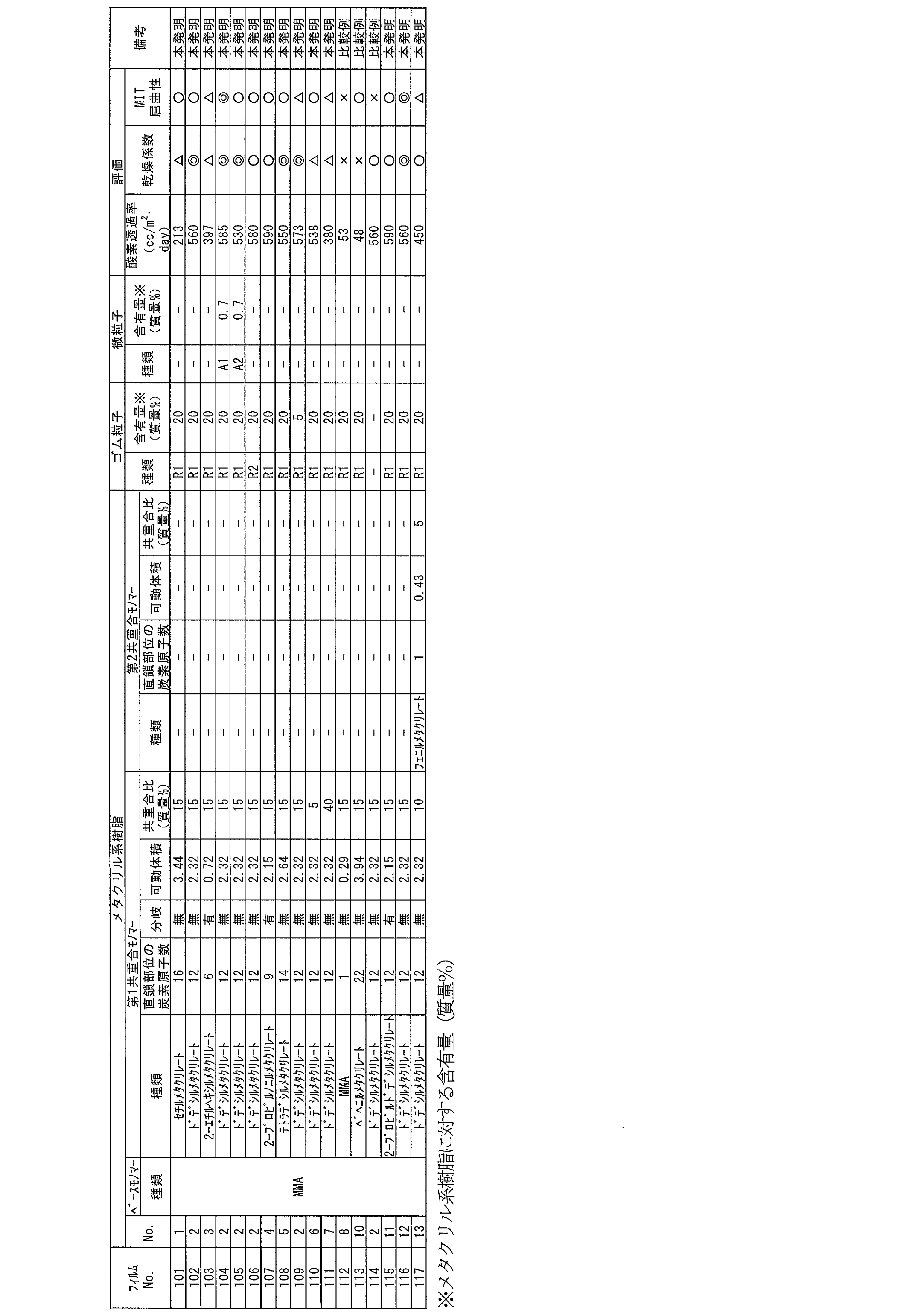
Claims (11)
- メタクリル酸メチルに由来する構造単位と、それと共重合可能な前記メタクリル酸メチル以外の共重合モノマーに由来する構造単位とを含むメタクリル系樹脂と、
ゴム粒子とを含み、
前記共重合モノマーに由来する構造単位は、下記式(1)で表される可動体積が0.5~3.6である特定の共重合モノマーに由来する構造単位を含む、光学フィルム。
式(1):可動体積=モノマーの剛球体体積/モノマーの分子量
(式(1)において、剛球体体積は、モノマーの構造から解析して得られる慣性半径を半径とする剛球体の体積を示す) - 前記特定の共重合モノマーの可動体積は、1.2~3.2である、
請求項1に記載の光学フィルム。 - JIS K 7126-2(2006)に準拠して測定される酸素透過率は、250~700(cc/m2・day)である、
請求項1または2に記載の光学フィルム。 - 前記特定の共重合モノマーは、炭素原子数5~15の直鎖状アルキレン部位を有する、
請求項1~3のいずれか一項に記載の光学フィルム。 - 前記特定の共重合モノマーに由来する構造単位の含有量は、前記メタクリル系樹脂を構成する全構造単位に対して10~30質量%である、
請求項1~4のいずれか一項に記載の光学フィルム。 - 前記メタクリル系樹脂の重量平均分子量は、60~300万である、
請求項1~5のいずれか一項に記載の光学フィルム。 - 前記ゴム粒子の含有量は、前記メタクリル系樹脂に対して5~10質量%である、
請求項1~6のいずれか一項に記載の光学フィルム。 - 前記メタクリル系樹脂の含有量は、前記光学フィルムに対して80質量%以上である、
請求項1~7のいずれか一項に記載の光学フィルム。 - 請求項1~8のいずれか一項に記載の光学フィルムを含む、
偏光板。 - メタクリル酸メチルに由来する構造単位と、それと共重合可能な前記メタクリル酸メチル以外の共重合モノマーに由来する構造単位とを含み、かつ前記共重合モノマーに由来する構造単位は、下記式(1)で表される可動体積が0.5~3.6である特定の共重合モノマーに由来する構造単位を含むメタクリル系樹脂と、ゴム粒子と、溶媒とを含むドープを得る工程と、
前記ドープを支持体上に流延した後、剥離して膜状物を得る工程と、
前記膜状物を乾燥させる工程とを含む、
光学フィルムの製造方法。
式(1):可動体積=モノマーの剛球体体積/モノマーの分子量
(式(1)において、剛球体体積は、モノマーの構造から解析して得られる慣性半径を半径とする剛球体の体積を示す) - 前記特定の共重合モノマーの可動体積は、1.2~3.2である、
請求項10に記載の光学フィルムの製造方法。
Priority Applications (2)
| Application Number | Priority Date | Filing Date | Title |
|---|---|---|---|
| KR1020217024614A KR102598379B1 (ko) | 2019-02-15 | 2020-02-14 | 광학 필름, 편광판, 광학 필름의 제조 방법 |
| JP2020572323A JP7468368B2 (ja) | 2019-02-15 | 2020-02-14 | 光学フィルム及び偏光板 |
Applications Claiming Priority (2)
| Application Number | Priority Date | Filing Date | Title |
|---|---|---|---|
| JP2019-025927 | 2019-02-15 | ||
| JP2019025927 | 2019-02-15 |
Publications (1)
| Publication Number | Publication Date |
|---|---|
| WO2020166682A1 true WO2020166682A1 (ja) | 2020-08-20 |
Family
ID=72044234
Family Applications (1)
| Application Number | Title | Priority Date | Filing Date |
|---|---|---|---|
| PCT/JP2020/005693 Ceased WO2020166682A1 (ja) | 2019-02-15 | 2020-02-14 | 光学フィルム、偏光板、光学フィルムの製造方法 |
Country Status (3)
| Country | Link |
|---|---|
| JP (1) | JP7468368B2 (ja) |
| KR (1) | KR102598379B1 (ja) |
| WO (1) | WO2020166682A1 (ja) |
Citations (3)
| Publication number | Priority date | Publication date | Assignee | Title |
|---|---|---|---|---|
| JPS6377963A (ja) * | 1986-09-19 | 1988-04-08 | Mitsubishi Rayon Co Ltd | 熱可塑性樹脂組成物 |
| JP2010231015A (ja) * | 2009-03-27 | 2010-10-14 | Sumitomo Chemical Co Ltd | 偏光子保護フィルム、偏光板及び液晶表示装置 |
| WO2014203637A1 (ja) * | 2013-06-17 | 2014-12-24 | コニカミノルタ株式会社 | 偏光板及び液晶表示装置 |
Family Cites Families (5)
| Publication number | Priority date | Publication date | Assignee | Title |
|---|---|---|---|---|
| WO2009150926A1 (ja) * | 2008-06-13 | 2009-12-17 | コニカミノルタオプト株式会社 | アクリルフィルムの製造方法およびその製造方法で作製したアクリルフィルム |
| JP2012013850A (ja) | 2010-06-30 | 2012-01-19 | Sumitomo Chemical Co Ltd | 偏光板のセット及びこれを備えた液晶パネル並びに液晶表示装置 |
| JP2014038180A (ja) | 2012-08-15 | 2014-02-27 | Konica Minolta Inc | 光学フィルム、光学フィルムの製造方法、偏光板及び液晶表示装置 |
| KR20140084416A (ko) * | 2012-12-26 | 2014-07-07 | 도레이첨단소재 주식회사 | 터치 스크린 패널 공정용 내열보호 필름 및 그 제조방법 |
| JP6784665B2 (ja) | 2015-03-30 | 2020-11-11 | 株式会社カネカ | 光学フィルムの製造方法及び光学フィルム |
-
2020
- 2020-02-14 WO PCT/JP2020/005693 patent/WO2020166682A1/ja not_active Ceased
- 2020-02-14 JP JP2020572323A patent/JP7468368B2/ja active Active
- 2020-02-14 KR KR1020217024614A patent/KR102598379B1/ko active Active
Patent Citations (3)
| Publication number | Priority date | Publication date | Assignee | Title |
|---|---|---|---|---|
| JPS6377963A (ja) * | 1986-09-19 | 1988-04-08 | Mitsubishi Rayon Co Ltd | 熱可塑性樹脂組成物 |
| JP2010231015A (ja) * | 2009-03-27 | 2010-10-14 | Sumitomo Chemical Co Ltd | 偏光子保護フィルム、偏光板及び液晶表示装置 |
| WO2014203637A1 (ja) * | 2013-06-17 | 2014-12-24 | コニカミノルタ株式会社 | 偏光板及び液晶表示装置 |
Also Published As
| Publication number | Publication date |
|---|---|
| JP7468368B2 (ja) | 2024-04-16 |
| KR20210110689A (ko) | 2021-09-08 |
| KR102598379B1 (ko) | 2023-11-03 |
| JPWO2020166682A1 (ja) | 2021-12-09 |
Similar Documents
| Publication | Publication Date | Title |
|---|---|---|
| JP7379933B2 (ja) | 光学フィルム用ドープの製造方法および光学フィルムの製造方法 | |
| JP7452421B2 (ja) | 光学フィルム、偏光板保護フィルム、光学フィルムのロール体、および光学フィルムの製造方法 | |
| JP7314942B2 (ja) | 光学フィルム、偏光板保護フィルムおよび偏光板 | |
| JP7533217B2 (ja) | 光学フィルム、偏光板、および光学フィルムの製造方法 | |
| JP5600843B2 (ja) | 光学フィルム用樹脂組成物、それを含む偏光子保護フィルム及び液晶表示装置 | |
| WO2020203833A1 (ja) | 光学フィルム、偏光板および光学フィルムの製造方法 | |
| JP2020071449A (ja) | 光学フィルムおよびそれを用いた偏光板の製造方法 | |
| JP2008179813A (ja) | 面状熱可塑性樹脂成形体 | |
| JP7468368B2 (ja) | 光学フィルム及び偏光板 | |
| KR102596316B1 (ko) | 편광판 및 액정 표시 장치 | |
| CN112226027A (zh) | 光学膜和偏振片 | |
| TW201315760A (zh) | 光學樹脂材料、光學樹脂材料的製造方法、光學膜片的製造方法、顯示器用光學膜片、液晶顯示器用光學膜片、偏光板保護膜片、光學膜片、偏光面光源裝置、透鏡、光屏、光學零件以及光路徑中配置元件 | |
| JP7298617B2 (ja) | (メタ)アクリル系樹脂フィルムおよび光学フィルム、(メタ)アクリル系樹脂フィルムの製造方法 | |
| JP7293691B2 (ja) | 光学フィルム、偏光板、光学フィルムの製造方法 | |
| JP7314988B2 (ja) | 光学フィルム、偏光板、光学フィルムの製造方法 | |
| CN113454502B (zh) | 光学膜用混合料、光学膜及其制造方法以及偏振片 | |
| WO2024122626A1 (ja) | アクリル樹脂粉粒体およびフィルム | |
| JPWO2019221137A1 (ja) | 光学フィルム、位相差フィルム、偏光板および液晶表示装置 | |
| WO2020137577A1 (ja) | 光学材料用樹脂組成物、光学フィルム及び表示装置 |
Legal Events
| Date | Code | Title | Description |
|---|---|---|---|
| 121 | Ep: the epo has been informed by wipo that ep was designated in this application |
Ref document number: 20756675 Country of ref document: EP Kind code of ref document: A1 |
|
| ENP | Entry into the national phase |
Ref document number: 2020572323 Country of ref document: JP Kind code of ref document: A |
|
| ENP | Entry into the national phase |
Ref document number: 20217024614 Country of ref document: KR Kind code of ref document: A |
|
| NENP | Non-entry into the national phase |
Ref country code: DE |
|
| 122 | Ep: pct application non-entry in european phase |
Ref document number: 20756675 Country of ref document: EP Kind code of ref document: A1 |