WO2020166476A1 - 円偏光板およびそれを用いる有機el表示装置 - Google Patents
円偏光板およびそれを用いる有機el表示装置 Download PDFInfo
- Publication number
- WO2020166476A1 WO2020166476A1 PCT/JP2020/004517 JP2020004517W WO2020166476A1 WO 2020166476 A1 WO2020166476 A1 WO 2020166476A1 JP 2020004517 W JP2020004517 W JP 2020004517W WO 2020166476 A1 WO2020166476 A1 WO 2020166476A1
- Authority
- WO
- WIPO (PCT)
- Prior art keywords
- group
- liquid crystal
- polarizing plate
- film
- polymerizable liquid
- Prior art date
- Legal status (The legal status is an assumption and is not a legal conclusion. Google has not performed a legal analysis and makes no representation as to the accuracy of the status listed.)
- Ceased
Links
- 0 *C1C2=Nc3c(*)c(*)c(*)c(*)c3*C2/C(/*)=C(\*)/COC1 Chemical compound *C1C2=Nc3c(*)c(*)c(*)c(*)c3*C2/C(/*)=C(\*)/COC1 0.000 description 1
Classifications
-
- G—PHYSICS
- G02—OPTICS
- G02B—OPTICAL ELEMENTS, SYSTEMS OR APPARATUS
- G02B5/00—Optical elements other than lenses
- G02B5/30—Polarising elements
- G02B5/3083—Birefringent or phase retarding elements
-
- H—ELECTRICITY
- H10—SEMICONDUCTOR DEVICES; ELECTRIC SOLID-STATE DEVICES NOT OTHERWISE PROVIDED FOR
- H10K—ORGANIC ELECTRIC SOLID-STATE DEVICES
- H10K59/00—Integrated devices, or assemblies of multiple devices, comprising at least one organic light-emitting element covered by group H10K50/00
- H10K59/80—Constructional details
- H10K59/8791—Arrangements for improving contrast, e.g. preventing reflection of ambient light
-
- C—CHEMISTRY; METALLURGY
- C08—ORGANIC MACROMOLECULAR COMPOUNDS; THEIR PREPARATION OR CHEMICAL WORKING-UP; COMPOSITIONS BASED THEREON
- C08F—MACROMOLECULAR COMPOUNDS OBTAINED BY REACTIONS ONLY INVOLVING CARBON-TO-CARBON UNSATURATED BONDS
- C08F220/00—Copolymers of compounds having one or more unsaturated aliphatic radicals, each having only one carbon-to-carbon double bond, and only one being terminated by only one carboxyl radical or a salt, anhydride ester, amide, imide or nitrile thereof
- C08F220/02—Monocarboxylic acids having less than ten carbon atoms; Derivatives thereof
- C08F220/10—Esters
- C08F220/26—Esters containing oxygen in addition to the carboxy oxygen
- C08F220/30—Esters containing oxygen in addition to the carboxy oxygen containing aromatic rings in the alcohol moiety
-
- C—CHEMISTRY; METALLURGY
- C09—DYES; PAINTS; POLISHES; NATURAL RESINS; ADHESIVES; COMPOSITIONS NOT OTHERWISE PROVIDED FOR; APPLICATIONS OF MATERIALS NOT OTHERWISE PROVIDED FOR
- C09K—MATERIALS FOR MISCELLANEOUS APPLICATIONS, NOT PROVIDED FOR ELSEWHERE
- C09K19/00—Liquid crystal materials
- C09K19/04—Liquid crystal materials characterised by the chemical structure of the liquid crystal components, e.g. by a specific unit
- C09K19/38—Polymers
-
- C—CHEMISTRY; METALLURGY
- C09—DYES; PAINTS; POLISHES; NATURAL RESINS; ADHESIVES; COMPOSITIONS NOT OTHERWISE PROVIDED FOR; APPLICATIONS OF MATERIALS NOT OTHERWISE PROVIDED FOR
- C09K—MATERIALS FOR MISCELLANEOUS APPLICATIONS, NOT PROVIDED FOR ELSEWHERE
- C09K19/00—Liquid crystal materials
- C09K19/52—Liquid crystal materials characterised by components which are not liquid crystals, e.g. additives with special physical aspect: solvents, solid particles
- C09K19/60—Pleochroic dyes
-
- G—PHYSICS
- G02—OPTICS
- G02B—OPTICAL ELEMENTS, SYSTEMS OR APPARATUS
- G02B1/00—Optical elements characterised by the material of which they are made; Optical coatings for optical elements
- G02B1/04—Optical elements characterised by the material of which they are made; Optical coatings for optical elements made of organic materials, e.g. plastics
-
- G—PHYSICS
- G02—OPTICS
- G02B—OPTICAL ELEMENTS, SYSTEMS OR APPARATUS
- G02B1/00—Optical elements characterised by the material of which they are made; Optical coatings for optical elements
- G02B1/10—Optical coatings produced by application to, or surface treatment of, optical elements
- G02B1/14—Protective coatings, e.g. hard coatings
-
- G—PHYSICS
- G02—OPTICS
- G02B—OPTICAL ELEMENTS, SYSTEMS OR APPARATUS
- G02B5/00—Optical elements other than lenses
- G02B5/30—Polarising elements
-
- G—PHYSICS
- G02—OPTICS
- G02B—OPTICAL ELEMENTS, SYSTEMS OR APPARATUS
- G02B5/00—Optical elements other than lenses
- G02B5/30—Polarising elements
- G02B5/3016—Polarising elements involving passive liquid crystal elements
-
- G—PHYSICS
- G09—EDUCATION; CRYPTOGRAPHY; DISPLAY; ADVERTISING; SEALS
- G09F—DISPLAYING; ADVERTISING; SIGNS; LABELS OR NAME-PLATES; SEALS
- G09F9/00—Indicating arrangements for variable information in which the information is built-up on a support by selection or combination of individual elements
- G09F9/30—Indicating arrangements for variable information in which the information is built-up on a support by selection or combination of individual elements in which the desired character or characters are formed by combining individual elements
-
- H—ELECTRICITY
- H05—ELECTRIC TECHNIQUES NOT OTHERWISE PROVIDED FOR
- H05B—ELECTRIC HEATING; ELECTRIC LIGHT SOURCES NOT OTHERWISE PROVIDED FOR; CIRCUIT ARRANGEMENTS FOR ELECTRIC LIGHT SOURCES, IN GENERAL
- H05B33/00—Electroluminescent light sources
- H05B33/02—Details
-
- H—ELECTRICITY
- H10—SEMICONDUCTOR DEVICES; ELECTRIC SOLID-STATE DEVICES NOT OTHERWISE PROVIDED FOR
- H10K—ORGANIC ELECTRIC SOLID-STATE DEVICES
- H10K59/00—Integrated devices, or assemblies of multiple devices, comprising at least one organic light-emitting element covered by group H10K50/00
- H10K59/50—OLEDs integrated with light modulating elements, e.g. with electrochromic elements, photochromic elements or liquid crystal elements
Definitions
- the present invention relates to a circularly polarizing plate and an organic EL display device using the circularly polarizing plate.
- organic EL panel has a problem that clear black display cannot be obtained because external light is reflected by the internal metal electrodes.
- a circularly polarizing plate on the visible surface, it is possible to suppress the reflection of external light. That is, the stacking order from the viewer is circular polarizing plate ⁇ organic EL display.
- the circularly polarizing plate can be generally produced by laminating a polarizing plate and a retardation film.
- polarizing plate generally, a polarizer in which PVA (polyvinyl alcohol) is stretched and dyed with iodine and a transparent protective film is laminated, and as the retardation film, a stretched film or a retardation film in which liquid crystal molecules are aligned ( ⁇ /4 plate) is used.
- a ⁇ /4 plate having a property of increasing birefringence as the wavelength becomes longer is preferably used.
- the organic EL layer deteriorates due to oxygen and moisture depending on the use environment and does not emit light
- both surfaces of the organic EL panel may be protected by a low moisture-permeable base material such as glass. ..
- the outermost surface of the panel may also be protected from the water resistant surface by a base material having low moisture permeability.
- color change occurs in a high temperature environment depending on the type of retardation film.
- a small amount of water contained in the protective film forming the polarizing plate, polyvinyl alcohol, etc. remains in the system, and the water causes hydrolysis of the retardation film, which causes a color change.
- a polarizing plate in which a polarizing film containing a dichroic dye and a transparent protective film having a thickness of 10 ⁇ m or more and 80 ⁇ m or less are laminated, and a retardation film which is a cured product of a composition containing a polymerizable liquid crystal compound B.
- a circularly polarizing plate including The retardation film has a thickness of 5 ⁇ m or less,
- the polymerizable liquid crystal compound B is a compound having an ester bond in the molecular structure,
- a circularly polarizing plate having an equilibrium water content of 1.5% by mass or less at a temperature of 23° C. and a relative humidity of 50%.
- Re(450)/Re(550) ⁇ 1 [In the formula, Re(450) and Re(550) represent in-plane retardation values at wavelengths of 450 nm and 550 nm, respectively. ] [9] The circularly polarizing plate according to any one of [1] to [8], wherein an angle formed by the slow axis of the retardation film and the absorption axis of the polarizing film is substantially 45°. [10] The circularly polarizing plate according to any one of [1] to [9], wherein the polymerizable liquid crystal compound B has at least one polymerizable group of an acryloyloxy group and a methacryloyloxy group. [11] The circularly polarizing plate according to any one of [1] to [10], wherein the polymerizable liquid crystal compound B is a compound represented by the following formula (II).
- Ar represents a divalent aromatic group which may have a substituent.
- G 1 and G 2 each independently represent a divalent aromatic group or a divalent alicyclic hydrocarbon group.
- L 1 and L 2 are each independently a divalent linking group having an ester structure.
- T 1 and T 2 are each independently a single bond or a divalent linking group.
- h and i each independently represent an integer of 0 to 3 and satisfy the relation of 1 ⁇ h+i.
- T 1 and T 2 , and G 1 and G 2 may be the same as or different from each other.
- E 1 and E 2 each independently represent an alkanediyl group having 1 to 17 carbon atoms, wherein the hydrogen atom contained in the alkanediyl group may be substituted with a halogen atom and is contained in the alkanediyl group.
- —CH 2 — may be substituted with —O—, —S—, and —COO—, and when they have a plurality of —O—, —S—, and —COO—, they are not adjacent to each other.
- P 1 and P 2 each independently represent a polymerizable group or a hydrogen atom, and at least one is a polymerizable group.
- the circularly polarizing plate of the present invention can prevent color change even in a high temperature environment.
- the circularly polarizing plate is composed of a polarizing plate and a retardation film.
- it is necessary to control the equilibrium water content of the polarizing plate at a temperature of 23° C. and a humidity of 50% to 1.5% by mass or less.
- the equilibrium water content is defined as the water content in a state where the water content in the material reaches equilibrium in the atmosphere in air at a constant temperature and humidity.
- a polarizing plate (size: width 4 cm, length 10 cm) is kept in a clean room with a temperature of 23° C. and a relative humidity of 50% for 1 day to measure the mass, and then the polarizing plate is dried at 105° C. for 1 hour to measure the mass.
- the equilibrium water content of the polarizing plate is higher than 1.5% by mass, color change of the circularly polarizing plate is likely to occur at high temperature, which is not preferable.
- the equilibrium water content of the polarizing plate is preferably 1.0% by mass or less, more preferably 0.5% by mass or less.
- the lower limit of the equilibrium water content of the polarizing plate may be 0.
- the equilibrium water content of the polarizing plate is higher than 1.5% by mass, the equilibrium water content can be lowered by drying. Drying is appropriately performed, such as standing in a dry environment, in addition to heating.
- the circularly polarizing plate of the present invention is a cured product of a polarizing plate in which a polarizing film containing a dichroic dye and a transparent protective film having a thickness of 10 ⁇ m or more and 80 ⁇ m or less are laminated, and a composition containing the polymerizable liquid crystal compound B. Including a phase difference film.
- the polarizing film is a film having a function of light absorption anisotropy.
- the polarizing film may be a stretched film having a dichroic dye adsorbed thereon, or may be a cured product of a composition containing a horizontally aligned polymerizable liquid crystal compound and a horizontally aligned dichroic dye.
- the polarizing film is more preferably a polarizing film made of a polymer of a polymerizable liquid crystal compound.
- a film containing a stretched film having a dichroic dye adsorbed thereon as a polarizing film is usually a step of uniaxially stretching a polyvinyl alcohol-based resin film, and a dichroic dye is obtained by dyeing the polyvinyl alcohol-based resin film with the dichroic dye. It is manufactured through a step of adsorbing, a step of treating the polyvinyl alcohol-based resin film on which the dichroic dye is adsorbed with an aqueous solution of boric acid, and a step of washing with water after the aqueous solution of boric acid.
- Polyvinyl alcohol resin is obtained by saponifying polyvinyl acetate resin.
- polyvinyl acetate-based resin in addition to polyvinyl acetate which is a homopolymer of vinyl acetate, a copolymer of vinyl acetate and another monomer copolymerizable therewith is used.
- the other monomer copolymerizable with vinyl acetate include unsaturated carboxylic acids, olefins, vinyl ethers, unsaturated sulfonic acids, and acrylamides having an ammonium group.
- the saponification degree of the polyvinyl alcohol resin is usually about 85 to 100 mol%, preferably 98 mol% or more.
- the polyvinyl alcohol-based resin may be modified, and for example, polyvinyl formal or polyvinyl acetal modified with aldehydes can also be used.
- the degree of polymerization of the polyvinyl alcohol resin is usually about 1,000 to 10,000, preferably 1,500 to 5,000.
- a film produced from such a polyvinyl alcohol resin is used as the original film for the polarizing film.
- the method for forming a film of the polyvinyl alcohol-based resin is not particularly limited, and the film can be formed by a known method.
- the film thickness of the polyvinyl alcohol-based original film can be set to, for example, about 10 to 150 ⁇ m.
- the uniaxial stretching of the polyvinyl alcohol resin film can be performed before dyeing with the dichroic dye, simultaneously with dyeing, or after dyeing.
- the uniaxial stretching may be performed before the boric acid treatment or during the boric acid treatment. It is also possible to carry out uniaxial stretching in these plural stages.
- stretching may be uniaxial between rolls having different peripheral speeds, or uniaxial stretching may be performed using hot rolls.
- the uniaxial stretching may be dry stretching in which stretching is performed in the atmosphere, or wet stretching in which a polyvinyl alcohol-based resin film is swollen in a solvent and stretched.
- the draw ratio is usually about 3 to 8 times.
- the dyeing of the polyvinyl alcohol-based resin film with the dichroic dye is performed by, for example, immersing the polyvinyl alcohol-based resin film in an aqueous solution containing the dichroic dye.
- dichroic pigment iodine or a dichroic organic dye is used as the dichroic pigment.
- dichroic organic dye examples include C.I. I.
- the polyvinyl alcohol-based resin film is preferably immersed in water before dyeing.
- iodine When iodine is used as the dichroic dye, a method of immersing a polyvinyl alcohol-based resin film in an aqueous solution containing iodine and potassium iodide and dyeing is usually employed.
- the content of iodine in this aqueous solution is usually about 0.01 to 1 part by mass per 100 parts by mass of water.
- the content of potassium iodide is usually about 0.5 to 20 parts by mass per 100 parts by mass of water.
- the temperature of the aqueous solution used for dyeing is usually about 20 to 40°C.
- the immersion time (dyeing time) in this aqueous solution is usually about 20 to 1800 seconds.
- a method of immersing a polyvinyl alcohol resin film in an aqueous solution containing a water-soluble dichroic dye and dyeing is usually employed.
- the content of the dichroic organic dye in this aqueous solution is usually about 1 ⁇ 10 ⁇ 4 to 10 parts by mass, preferably 1 ⁇ 10 ⁇ 3 to 1 part by mass, and more preferably 100 parts by mass of water. Is 1 ⁇ 10 ⁇ 3 to 1 ⁇ 10 ⁇ 2 parts by mass.
- This aqueous solution may contain an inorganic salt such as sodium sulfate as a dyeing aid.
- the temperature of the dichroic dye aqueous solution used for dyeing is usually about 20 to 80°C.
- the immersion time (dyeing time) in this aqueous solution is usually about 10 to 1800 seconds.
- the boric acid treatment after dyeing with the dichroic dye can usually be performed by a method of immersing the dyed polyvinyl alcohol resin film in an aqueous boric acid solution.
- the content of boric acid in this aqueous boric acid solution is usually about 2 to 15 parts by mass, preferably 5 to 12 parts by mass, per 100 parts by mass of water.
- the aqueous boric acid solution preferably contains potassium iodide, and the content of potassium iodide in this case is usually 0.1 to 100 parts by mass of water.
- the amount is about 15 parts by mass, preferably 5 to 12 parts by mass.
- the immersion time in the aqueous boric acid solution is usually about 60 to 1,200 seconds, preferably 150 to 600 seconds, more preferably 200 to 400 seconds.
- the temperature of boric acid treatment is usually 50° C. or higher, preferably 50 to 85° C., more preferably 60 to 80° C.
- the polyvinyl alcohol-based resin film after the boric acid treatment is usually washed with water.
- the water washing treatment can be performed by, for example, a method of immersing the polyvinyl alcohol-based resin film treated with boric acid in water.
- the temperature of water in the washing treatment is usually about 5 to 40°C.
- the immersion time is usually about 1 to 120 seconds.
- a drying process is applied to obtain a polarizing film.
- the drying treatment can be performed using, for example, a hot air dryer or a far infrared heater.
- the temperature of the drying treatment is usually about 30 to 100°C, preferably 50 to 80°C.
- the drying treatment time is usually about 60 to 600 seconds, preferably 120 to 600 seconds.
- the water content of the polarizer is reduced to a practical level.
- the water content thereof is usually about 5 to 20% by mass, preferably 8 to 15% by mass.
- the water content is less than 5% by mass, the flexibility of the polarizing film is lost, and the polarizing film may be damaged or broken after being dried. Further, if the water content exceeds 20 mass %, the thermal stability of the polarizing film may deteriorate.
- the thickness of the polarizing film obtained by uniaxially stretching the polyvinyl alcohol resin film, dyeing it with a dichroic dye, treating with boric acid, washing with water and drying is preferably 5 to 40 ⁇ m.
- the polarizing film is a cured product of a composition containing a horizontally aligned polymerizable liquid crystal compound and a horizontally aligned dichroic dye (hereinafter sometimes referred to as the polymerizable liquid crystal composition (A)).
- the polymerizable liquid crystal compound may be a thermotropic liquid crystal or a lyotropic liquid crystal, but when mixed with a dichroic dye, the thermotropic liquid crystal is preferable.
- it may be a thermotropic liquid crystal compound showing a nematic liquid crystal phase or a thermotropic liquid crystal compound showing a smectic liquid crystal phase.
- the liquid crystal state of the polymerizable liquid crystal compound is preferably a smectic phase. Specific examples of such compounds will be described later.
- the polymerizable liquid crystal composition (A) is a liquid crystal compound having at least one polymerizable group, and preferably has a smectic liquid crystallinity (hereinafter, also referred to as “polymerizable liquid crystal compound (A)”). Comprises. By using a polymerizable liquid crystal compound exhibiting smectic liquid crystallinity, a polarizing film having a high degree of alignment order can be formed.
- the liquid crystal state of the polymerizable liquid crystal compound (A) is preferably a smectic phase (smectic liquid crystal state), and is a higher-order smectic phase (higher-order smectic liquid crystal state) from the viewpoint that a higher degree of alignment order can be realized.
- the higher order smectic phase means a smectic B phase, a smectic D phase, a smectic E phase, a smectic F phase, a smectic G phase, a smectic H phase, a smectic I phase, a smectic J phase, a smectic K phase and a smectic L phase.
- the smectic B phase, the smectic F phase and the smectic I phase are more preferable.
- the liquid crystal property may be a thermotropic liquid crystal or a lyotropic liquid crystal, but the thermotropic liquid crystal is preferable in that precise film thickness control is possible.
- the polymerizable liquid crystal compound may be a monomer, but may be an oligomer or a polymer in which a polymerizable group is polymerized.
- the polymerizable liquid crystal compound (A) is a liquid crystal compound having at least one polymerizable group.
- the polymerizable group refers to a group that can participate in the polymerization reaction by an active radical or an acid generated from the polymerization initiator.
- Examples of the polymerizable group contained in the polymerizable liquid crystal compound (A) include vinyl group, vinyloxy group, 1-chlorovinyl group, isopropenyl group, 4-vinylphenyl group, acryloyloxy group, methacryloyloxy group, oxiranyl group, Examples include an oxetanyl group.
- a radical polymerizable group is preferable, an acryloyloxy group, a methacryloyloxy group, a vinyl group and a vinyloxy group are more preferable, and an acryloyloxy group and a methacryloyloxy group are further preferable.
- the polymerizable liquid crystal compound (A) is not particularly limited as long as it is a liquid crystal compound having at least one polymerizable group, and a known polymerizable liquid crystal compound can be used, for example, represented by the following formula (A1).
- X 1 and X 2 each independently represent a divalent aromatic group or a divalent alicyclic hydrocarbon group, wherein the divalent aromatic group or the divalent alicyclic hydrocarbon group is used.
- the hydrogen atom contained in the group may be substituted with a halogen atom, an alkyl group having 1 to 4 carbon atoms, a fluoroalkyl group having 1 to 4 carbon atoms, an alkoxy group having 1 to 4 carbon atoms, a cyano group or a nitro group.
- the carbon atom constituting the divalent aromatic group or the divalent alicyclic hydrocarbon group may be substituted with an oxygen atom, a sulfur atom or a nitrogen atom.
- at least one of X 1 and X 2 is a 1,4-phenylene group which may have a substituent or a cyclohexane-1,4-diyl group which may have a substituent. ..
- Y 1 is a single bond or a divalent linking group.
- n is 1 to 3, and when n is 2 or more, a plurality of X 1's may be the same as or different from each other.
- X 2 may be the same as or different from any or all of the plurality of X 1 .
- n is preferably 2 or more.
- U 1 represents a hydrogen atom or a (meth)acryloyloxy group.
- U 2 represents a (meth)acryloyloxy group.
- W 1 and W 2 are, independently of each other, a single bond or a divalent linking group.
- V 1 and V 2 each independently represent an optionally substituted alkanediyl group having 1 to 20 carbon atoms, and —CH 2 — constituting the alkanediyl group is —O—, It may be replaced with —CO—, —S— or NH—.
- X 1 and X 2 are independently of each other, preferably a 1,4-phenylene group which may have a substituent, or a substituent which may have a substituent.
- the 1,4-phenylene group which may have a substituent or the cyclohexane-1,4-diyl group which may have a substituent may have a methyl group or an ethyl group.
- examples thereof include an alkyl group having 1 to 4 carbon atoms such as a group and a butyl group, a cyano group, and a halogen atom such as a chlorine atom and a fluorine atom. It is preferably unsubstituted.
- the polymerizable liquid crystal compound (A1) has the formula (A1-1): -(X 1 -Y 1 -) n -X 2 -(A1-1) [In the formula, X 1 , Y 1 , X 2 and n each have the same meaning as described above. ]
- a portion represented by [hereinafter referred to as a partial structure (A1-1). ] Is preferably an asymmetric structure from the viewpoint of easily exhibiting smectic liquid crystallinity.
- the polymerizable liquid crystal compound (A1) in which the partial structure (A1-1) is an asymmetric structure is, for example, a polymerizable liquid crystal compound (A1) in which n is 1 and one X 1 and X 2 are different from each other.
- n 2 and two Y 1 have the same structure as each other, two X 1 have the same structure as each other, and one X 2 has a structure different from these two X 1.
- the polymerizable liquid crystal compound (A1), X 1 to bind to W 1 of the two X 1 is a structure that is different from the other of X 1 and X 2, the other of X 1 and X 2 and are mutually the same structure
- the polymerizable liquid crystal compound (A1) is also included.
- R a and R b each independently represent a hydrogen atom or an alkyl group having 1 to 4 carbon atoms.
- Y 1 is, -CH 2 CH 2 -, - more preferably COO- or a single bond, when a plurality of Y 1 are present, Y 1 which binds to X 2 is, -CH 2 CH 2 - or - More preferably CH 2 O—.
- X 1 and X 2 all have the same structure, it is preferable that there are two or more Y 1 which are bonding methods different from each other.
- the structure becomes asymmetric, so that smectic liquid crystallinity tends to be exhibited.
- U 2 is a (meth)acryloyloxy group.
- U 1 is a hydrogen atom or a (meth)acryloyloxy group, preferably a (meth)acryloyloxy group. From the viewpoint of improving the adhesion between layers of the polarizing film and improving the heat resistance, it is preferable that both U 1 and U 2 are (meth)acryloyloxy groups.
- the (meth)acryloyloxy group may be in a polymerized state or an unpolymerized state, but is preferably an unpolymerized state.
- Examples of the alkanediyl group represented by V 1 and V 2 include methylene group, ethylene group, propane-1,3-diyl group, butane-1,3-diyl group, butane-1,4-diyl group, pentane- 1,5-diyl group, hexane-1,6-diyl group, heptane-1,7-diyl group, octane-1,8-diyl group, decane-1,10-diyl group, tetradecane-1,14-diyl group Group and icosane-1,20-diyl group and the like.
- V 1 and V 2 are preferably alkanediyl groups having 2 to 12 carbon atoms, and more preferably alkanediyl groups having 6 to 12 carbon atoms.
- Examples of the substituent optionally possessed by the alkanediyl group include a cyano group and a halogen atom.
- the alkanediyl group is preferably unsubstituted, and is an unsubstituted linear alkanediyl group. Is more preferable.
- W 1 and W 2 are preferably a single bond, —O—, —S—, —COO— or —OCOO—, and more preferably a single bond or —O—.
- the polymerizable liquid crystal compound (A) is specifically a polymerizable liquid crystal compound having a structure represented by the formulas (Aa) to (Ai) and showing a smectic liquid crystallinity. Is more preferable. From the viewpoint of easily exhibiting high-order smectic liquid crystallinity, it is more preferable to have a structure represented by formula (Aa), formula (Ab) or formula (Ac). In formulas (Aa) to (Ai), * represents a bond (single bond).
- polymerizable liquid crystal compound (A1) examples include compounds represented by formula (A-1) to formula (A-25).
- the cyclohexane-1,4-diyl group is preferably a trans isomer.
- the polymerizable liquid crystal compound (A1) one type may be used alone, or two or more types may be used in combination.
- the polymerizable liquid crystal compound (A1) is described in, for example, Lub et al., Recl. Trav. Chim. It can be produced by a known method described in Pays-Bas, 115, 321-328 (1996), Japanese Patent No. 4719156 or the like.
- the polymerizable liquid crystal composition (A) may contain a polymerizable liquid crystal compound other than the polymerizable liquid crystal compound (A) as long as the effect of the present invention is not impaired, but a polarizing film having a high degree of alignment order is required.
- the ratio of the polymerizable liquid crystal compound (A) to the total mass of all the polymerizable liquid crystal compounds contained in the polymerizable liquid crystal composition (A) is preferably 51% by mass or more, and more preferably 70% by mass. It is above, and more preferably 90% by mass or more.
- the polymerizable liquid crystal composition (A) contains two or more kinds of polymerizable liquid crystal compounds (A), at least one of them may be the polymerizable liquid crystal compound (A1), all of which are polymerizable. It may be a liquid crystal compound (A1). By combining a plurality of polymerizable liquid crystal compounds, it may be possible to temporarily maintain the liquid crystallinity even at a temperature below the liquid crystal-crystal phase transition temperature.
- the content of the polymerizable liquid crystal compound in the polymerizable liquid crystal composition (A) is preferably 40 to 99.9% by mass, more preferably 60 to 99% by mass, based on the solid content of the polymerizable liquid crystal composition. And more preferably 70 to 99% by mass.
- solid content means the total amount of the components excluding the solvent from the polymerizable liquid crystal composition.
- the polymerizable liquid crystal composition (A) comprises a dichroic dye.
- the dichroic dye means a dye having a property in which the absorbance in the major axis direction of the molecule and the absorbance in the minor axis direction are different.
- the dichroic dye is a dye that aligns with the liquid crystal compound and exhibits dichroism, and the dichroic dye itself may have polymerizability or may have liquid crystallinity.
- the dichroic dye that can be used in the present invention is not particularly limited as long as it has the above properties, and may be a dye or a pigment. Further, two or more kinds of dyes or pigments may be used in combination, or a dye and a pigment may be used in combination.
- the dichroic dye preferably has a maximum absorption wavelength ( ⁇ MAX ) in the range of 300 to 700 nm.
- ⁇ MAX maximum absorption wavelength
- dichroic dyes include acridine dyes, oxazine dyes, cyanine dyes, naphthalene dyes, azo dyes, and anthraquinone dyes.
- the azo dye examples include a monoazo dye, a bisazo dye, a trisazo dye, a tetrakisazo dye and a stilbeneazo dye, and a bisazo dye and a trisazo dye are preferable.
- a compound represented by the formula (I) (hereinafter, referred to as “compound (I)” is also mentioned.
- K 1 and K 3 independently of each other may have a phenyl group which may have a substituent, a naphthyl group which may have a substituent or a substituent which may have a substituent. It represents a good monovalent heterocyclic group.
- K 2 is a p-phenylene group which may have a substituent, a naphthalene-1,4-diyl group which may have a substituent, or a divalent heterocyclic ring which may have a substituent.
- p represents an integer of 1 to 4.
- a plurality of K 2 may be the same as or different from each other.
- Examples of the monovalent heterocyclic group include groups in which one hydrogen atom has been removed from a heterocyclic compound such as quinoline, thiazole, benzothiazole, thienothiazole, imidazole, benzimidazole, oxazole, and benzoxazole.
- Examples of the divalent heterocyclic group include groups obtained by removing two hydrogen atoms from the above heterocyclic compound.
- the unsubstituted amino group is —NH 2. ) and the like.
- B 1 to B 30 are each independently a hydrogen atom, an alkyl group having 1 to 6 carbon atoms, an alkoxy group having 1 to 4 carbon atoms, a cyano group, a nitro group, a substituted or unsubstituted amino group (substituted amino group). And the definition of the unsubstituted amino group are as described above), chlorine atom or trifluoromethyl group.
- n1 to n4 each independently represent an integer of 0 to 3.
- n1 is 2 or more
- a plurality of B 2 may be the same or different from each other
- n2 is 2 or more
- a plurality of B 6 may be the same or different from each other
- n3 is 2 or more
- plural B 9 may be the same or different from each other
- n4 is 2 or more
- a plurality of B 14 may be the same as or different from each other.
- the anthraquinone dye is preferably a compound represented by the formula (I-9).
- R 1 to R 8 each independently represent a hydrogen atom, —R x , —NH 2 , —NHR x , —NR x 2 , —SR x, or a halogen atom.
- R x represents an alkyl group having 1 to 4 carbon atoms or an aryl group having 6 to 12 carbon atoms.
- oxazone dye a compound represented by the formula (I-10) is preferable.
- R 9 to R 15 each independently represent a hydrogen atom, —R x , —NH 2 , —NHR x , —NR x 2 , —SR x, or a halogen atom.
- R x represents an alkyl group having 1 to 4 carbon atoms or an aryl group having 6 to 12 carbon atoms.
- acridine dye a compound represented by the formula (I-11) is preferable.
- R 16 to R 23 each independently represent a hydrogen atom, —R x , —NH 2 , —NHR x , —NR x 2 , —SR x, or a halogen atom.
- R x represents an alkyl group having 1 to 4 carbon atoms or an aryl group having 6 to 12 carbon atoms.
- the alkyl group having 1 to 6 carbon atoms of R x is a methyl group, an ethyl group, a propyl group, a butyl group or a pentyl group.
- the aryl group having 6 to 12 carbon atoms include phenyl group, toluyl group, xylyl group and naphthyl group.
- cyanine dye a compound represented by the formula (I-12) and a compound represented by the formula (I-13) are preferable.
- D 1 and D 2 each independently represent a group represented by any one of formulas (I-12a) to (I-12d).
- n5 represents an integer of 1 to 3.
- D 3 and D 4 each independently represent a group represented by any one of formulas (I-13a) to (1-13h).
- n6 represents an integer of 1 to 3.
- the content of the dichroic dye in the polymerizable liquid crystal composition (A) can be appropriately determined according to the type of the dichroic dye to be used, etc., but is preferably 0.
- the amount is 1 to 50 parts by mass, more preferably 0.1 to 20 parts by mass, and further preferably 0.1 to 12 parts by mass.
- the content of the dichroic dye is within the above range, it is difficult to disturb the alignment of the polymerizable liquid crystal compound, and a polarizing film having a high degree of alignment order can be obtained.
- the polymerizable liquid crystal composition (A) may further contain a polymerization initiator.
- the polymerization initiator is a compound capable of initiating the polymerization reaction of the polymerizable liquid crystal compound, and is preferably a photopolymerization initiator because it can initiate the polymerization reaction under lower temperature conditions. Specific examples include photopolymerization initiators capable of generating active radicals or acids by the action of light, and among them, photopolymerization initiators capable of generating radicals by the action of light are preferable.
- the polymerization initiators may be used alone or in combination of two or more.
- polymerization initiator examples include benzoin compounds, benzophenone compounds, alkylphenone compounds, acylphosphine oxide compounds, triazine compounds, iodonium salts and sulfonium salts.
- benzoin compound examples include benzoin, benzoin methyl ether, benzoin ethyl ether, benzoin isopropyl ether and benzoin isobutyl ether.
- benzophenone compound examples include benzophenone, methyl o-benzoylbenzoate, 4-phenylbenzophenone, 4-benzoyl-4′-methyldiphenyl sulfide, 3,3′,4,4′-tetra(tert-butylperoxycarbonyl)benzophenone. And 2,4,6-trimethylbenzophenone and the like.
- alkylphenone compound examples include diethoxyacetophenone, 2-methyl-2-morpholino-1-(4-methylthiophenyl)propan-1-one, 2-dimethylamino-2-benzyl-1-(4-morpholinophenyl)butane.
- 1-one 2-hydroxy-2-methyl-1-phenylpropan-1-one, 1,2-diphenyl-2,2-dimethoxyethane-1-one, 2-hydroxy-2-methyl-1-[ 4-(2-hydroxyethoxy)phenyl]propan-1-one, 1-hydroxycyclohexylphenylketone and 2-hydroxy-2-methyl-1-[4-(1-methylvinyl)phenyl]propan-1-one Oligomer etc. are mentioned.
- acylphosphine oxide compound examples include 2,4,6-trimethylbenzoyldiphenylphosphine oxide and bis(2,4,6-trimethylbenzoyl)phenylphosphine oxide.
- triazine compound examples include 2,4-bis(trichloromethyl)-6-(4-methoxyphenyl)-1,3,5-triazine and 2,4-bis(trichloromethyl)-6-(4-methoxynaphthyl).
- a commercially available initiator can be used as the polymerization initiator.
- examples of commercially available polymerization initiators include “Irgacure (registered trademark) 907”, “Irgacure (registered trademark) 184”, “Irgacure (registered trademark) 651”, “Irgacure (registered trademark) 819”, and “Irgacure (registered trademark) 819”.
- the content may be appropriately determined according to the type and amount of the polymerizable liquid crystal compound contained in the polymerizable liquid crystal composition (A).
- the content of the polymerizable initiator is within the above range, the polymerizable liquid crystal compound can be polymerized without disturbing the alignment.
- the polymerizable liquid crystal composition (A) may further contain a photosensitizer.
- a photosensitizer By using the photosensitizer, the polymerization reaction of the polymerizable liquid crystal compound can be further promoted.
- photosensitizers include xanthone compounds such as xanthone and thioxanthone (eg, 2,4-diethylthioxanthone and 2-isopropylthioxanthone); anthracene compounds such as anthracene and alkoxy group-containing anthracene (eg dibutoxyanthracene); Examples include phenothiazine and rubrene.
- the photosensitizers may be used alone or in combination of two or more.
- the content of the photosensitizer in the polymerizable liquid crystal composition (A) may be appropriately determined depending on the types and the amounts of the photopolymerization initiator and the polymerizable liquid crystal compound, but the content of the polymerizable liquid crystal compound is 100 parts by mass. On the other hand, 0.1 to 30 parts by mass is preferable, 0.5 to 10 parts by mass is more preferable, and 0.5 to 8 parts by mass is further preferable.
- the polymerizable liquid crystal composition (A) may further contain a leveling agent.
- the leveling agent has the function of adjusting the fluidity of the polymerizable liquid crystal composition (A) and making the coating film obtained by applying the polymerizable liquid crystal composition (A) even more flat.
- surfactants As the leveling agent, at least one selected from the group consisting of a leveling agent containing a polyacrylate compound as a main component and a leveling agent containing a fluorine atom-containing compound as a main component is preferable.
- the leveling agents can be used alone or in combination of two or more kinds.
- leveling agent containing a polyacrylate compound as a main component examples include “BYK-350”, “BYK-352”, “BYK-353”, “BYK-354”, “BYK-355”, “BYK-358N”. , “BYK-361N”, “BYK-380”, “BYK-381” and “BYK-392” (BYK Chemie).
- leveling agent containing a fluorine atom-containing compound as a main component examples include, for example, “Megafuck (registered trademark) R-08”, “R-30”, “R-90”, “F-410”, and “F-410”.
- F-411 same “F-443”, same “F-445”, same “F-470”, same "F-471", same “F-477”, same “F-479”, same “ F-482” and “F-483” (DIC Corporation);
- E1830 "E5844” (Daikin Fine Chemical Research Institute, Inc.) "F-top EF301", “F-top EF303”, “F-top EF351” and “F-top EF352” (Mitsubishi Materials Electronic Chemicals).
- the content of the leveling agent in the polymerizable liquid crystal composition (A) is preferably 0.05 to 5 parts by mass, more preferably 0.05 to 3 parts by mass with respect to 100 parts by mass of the polymerizable liquid crystal compound.
- the content of the leveling agent is within the above range, the polymerizable liquid crystal compound is likely to be horizontally aligned, unevenness is unlikely to occur, and a smoother polarizing film tends to be obtained.
- the polymerizable liquid crystal composition (A) may further contain other additives besides the polymerization initiator, the photosensitizer and the leveling agent.
- Other additives include, for example, release agents, stabilizers, coloring agents such as bluing agents, flame retardants and lubricants.
- the content of the other additives is more than 0% and 20% by mass with respect to the solid content of the polymerizable liquid crystal composition (A). It is preferably the following or less, more preferably more than 0% and 10% by mass or less.
- the polymerizable liquid crystal composition (A) may further contain a solvent.
- a solvent in general, a compound exhibiting a smectic liquid crystallinity has a high viscosity, and therefore it is easy to apply it by adding a solvent to the polymerizable liquid crystal composition, and as a result, a polarizing film is often formed easily.
- the solvent can be appropriately selected depending on the solubility of the polymerizable liquid crystal compound and the dichroic dye, and specifically, for example, water, methanol, ethanol, ethylene glycol, isopropyl alcohol, propylene glycol, methyl cellosolve, butyl cellosolve.
- Alcohol solvent such as propylene glycol monomethyl ether, ester solvent such as ethyl acetate, butyl acetate, ethylene glycol methyl ether acetate, ⁇ -butyrolactone, propylene glycol methyl ether acetate, ethyl lactate, acetone, methyl ethyl ketone, cyclopentanone, cyclohexanone, methyl Amyl ketone, ketone solvent such as methyl isobutyl ketone, pentane, hexane, aliphatic hydrocarbon solvent such as heptane, toluene, aromatic hydrocarbon solvent such as xylene, nitrile solvent such as acetonitrile, tetrahydrofuran, ether solvent such as dimethoxyethane, And chlorinated hydrocarbon solvents such as chloroform and chlorobenzene.
- ester solvent such as ethyl acetate, butyl acetate,
- the content of the solvent is preferably 100 to 1900 parts by mass, more preferably 150 to 900 parts by mass, and further preferably 180 to 600 with respect to 100 parts by mass of the solid component constituting the polymerizable liquid crystal composition. It is a mass part.
- the polymerizable liquid crystal composition (A) can be produced by a conventionally known method for preparing a polymerizable liquid crystal composition, and usually the polymerizable liquid crystal compound and the dichroic dye, and if necessary, the above-mentioned additives and It can be prepared by mixing and stirring a solvent and the like.
- the polymerizable liquid crystal composition (A) contains a polymerizable liquid crystal compound that exhibits a smectic liquid crystal phase and cures in a horizontal alignment state
- the polymerizable liquid crystal composition (A) has an excellent effect of suppressing the photodegradation of the dichroic dye, and the polarization performance of the composition is improved with time. It is possible to obtain a polarizing film that is less likely to deteriorate from the polymerizable liquid crystal composition (A).
- a polarizing film is formed from the polymerizable liquid crystal composition (A) containing a polymerizable liquid crystal compound that exhibits a smectic liquid crystal phase and is cured in a horizontally aligned state, a polarizing film having a high degree of alignment order can be obtained.
- a Bragg peak derived from a higher-order structure such as a hexatic phase or a crystal phase can be obtained by X-ray diffraction measurement.
- the Bragg peak means a peak derived from the plane periodic structure of molecular orientation. Therefore, in the polarizing film formed from the polymerizable liquid crystal composition of the present invention, it is preferable that the polymerizable liquid crystal compound or a polymer thereof is oriented so that the polarizing film exhibits a Bragg peak in X-ray diffraction measurement.
- the “horizontal alignment” in which the molecules of the polymerizable liquid crystal compound are aligned in the direction of absorbing light is more preferable.
- a polarizing film having a molecular orientation plane periodicity of 3.0 to 6.0 ⁇ is preferable.
- a high degree of orientational order showing a Bragg peak can be realized by controlling the type of polymerizable liquid crystal compound used, the type and amount of dichroic dye, and the like.
- the polarizing film in the present invention is, for example, to form a coating film of the polymerizable liquid crystal composition (A), Removing solvent from the coating, Increasing the temperature of the polymerizable liquid crystal compound (A) to a temperature at which the liquid phase transitions to a liquid phase or higher, and then decreasing the temperature to cause the polymerizable liquid crystal compound to undergo a phase transition to a smectic phase (smectic liquid crystal state); It can be produced by a method including polymerizing a polymerizable liquid crystal compound while maintaining the smectic phase (smectic liquid crystal state).
- the coating film of the polymerizable liquid crystal composition (A) is formed, for example, by the polymerizable liquid crystal composition (A) on a substrate or an alignment film described later, particularly a polymerizable liquid crystal in which a solvent is added to adjust the viscosity. It can be performed by applying the composition (A) (hereinafter, also referred to as “polarizing film forming composition”). Further, the composition for forming a polarizing film may be directly applied onto the retardation film or other layers constituting the polarizing plate of the present invention.
- Examples of the method for applying the composition for forming a polarizing film to a substrate include spin coating method, extrusion method, gravure coating method, die coating method, bar coating method, coating method such as applicator method, and flexo printing method.
- a known method such as a method can be used.
- the solvent is removed by drying or the like under the condition that the polymerizable liquid crystal compound (A) contained in the coating film obtained from the composition for forming a polarizing film is not polymerized to form a dry coating film.
- the drying method include a natural drying method, a ventilation drying method, a heat drying method and a reduced pressure drying method.
- the temperature is raised to a temperature at which the polymerizable liquid crystal compound undergoes a phase transition to a liquid phase or higher, and then the temperature is lowered to allow the polymerizable liquid crystal compound to undergo a smectic phase (smectic liquid crystal State).
- phase transition may be performed after removing the solvent in the coating film, or may be performed simultaneously with the removal of the solvent.
- the light to be applied to the dry coating film includes the type of the photopolymerization initiator contained in the dry coating film and the type of the polymerizable liquid crystal compound (A) (in particular, the polymerization of the polymerizable liquid crystal compound (A)). It is appropriately selected depending on the type of the functional group) and the amount thereof.
- ultraviolet light is preferable in that it is easy to control the progress of the polymerization reaction, and that widely used in the art as a photopolymerization device can be used, and by ultraviolet light, as photopolymerizable, It is preferable to select the type of the polymerizable liquid crystal compound or photopolymerization initiator contained in the polymerizable liquid crystal composition.
- the polymerization temperature can be controlled by irradiating with light while cooling the dried coating film by an appropriate cooling means.
- the polarizing film can be appropriately formed even if the substrate has relatively low heat resistance. It is also possible to obtain a patterned polarizing film by performing masking or development during photopolymerization.
- the ultraviolet irradiation intensity is usually 10 to 3,000 mW/cm 2 .
- the ultraviolet irradiation intensity is preferably an intensity in a wavelength region effective for activation of the photopolymerization initiator.
- the irradiation time with light is usually 0.1 second to 10 minutes, preferably 1 second to 5 minutes, more preferably 5 seconds to 3 minutes, and further preferably 10 seconds to 1 minute.
- the integrated light amount thereof is 10 to 3,000 mJ/cm 2 , preferably 50 to 2,000 mJ/cm 2 , and more preferably 100 to 1,000 mJ/cm 2. It is 2 .
- the polarizing film is accompanied by the action of the dichroic dye, so that the conventional host guest type polarizing film (that is, nematic) is used. It has an advantage that the polarization performance is high as compared with a polarizing film having a liquid crystal state of a phase). Further, it has an advantage that it is superior in strength as compared with the case where only the dichroic dye or the lyotropic liquid crystal is applied.
- the thickness of the polarizing film can be appropriately selected according to the applied display device, and is preferably 0.1 to 10 ⁇ m, more preferably 0.3 to 4 ⁇ m, and further preferably 0.5 to 3 ⁇ m.
- the polarizing film is preferably formed on the alignment film.
- the alignment film has an alignment regulating force for aligning the polymerizable liquid crystal compound (A) in a desired direction.
- the alignment film has solvent resistance that does not dissolve by coating the polymerizable liquid crystal compound composition (A) and the like, and also has heat resistance in heat treatment for removing the solvent and aligning the polymerizable liquid crystal compound (A). Those having are preferable.
- Examples of such an alignment film include an alignment film containing an alignment polymer, a photo-alignment film and a glub alignment film having a concavo-convex pattern and a plurality of grooves on the surface, a stretched film stretched in the alignment direction, and the like. And from the viewpoint of quality, a photo-alignment film is preferable.
- the oriented polymer for example, polyamides or gelatins having an amide bond in the molecule, polyimide having an imide bond in the molecule and polyamic acid which is a hydrolyzate thereof, polyvinyl alcohol, alkyl modified polyvinyl alcohol, polyacrylamide, poly Examples include oxazole, polyethyleneimine, polystyrene, polyvinylpyrrolidone, polyacrylic acid and polyacrylic acid esters. Of these, polyvinyl alcohol is preferable.
- the oriented polymer may be used alone or in combination of two or more kinds.
- the orientation film containing the orientation polymer is usually obtained by applying a composition in which the orientation polymer is dissolved in a solvent (hereinafter, sometimes referred to as “orientation polymer composition”) to a substrate and removing the solvent, or It is obtained by applying the oriented polymer composition to a substrate, removing the solvent, and rubbing (rubbing method).
- a solvent hereinafter, sometimes referred to as “orientation polymer composition”
- the solvent include the same solvents as those exemplified above as the solvent that can be used when forming the polarizing film.
- the concentration of the orienting polymer in the orienting polymer composition may be within a range in which the orienting polymer material can be completely dissolved in a solvent, but is preferably 0.1 to 20% in terms of solid content in the solution, and 0 It is more preferably about 1 to 10%.
- a commercially available alignment film material may be used as it is as the alignment polymer composition.
- Examples of commercially available alignment film materials include Sanever (registered trademark, manufactured by Nissan Chemical Industries, Ltd.), Optomer (registered trademark, manufactured by JSR Corporation), and the like.
- Examples of the method for removing the solvent contained in the oriented polymer composition include a natural drying method, a ventilation drying method, a heat drying method, and a reduced pressure drying method.
- Rubbing treatment can be performed as necessary to give the alignment control force to the alignment film (rubbing method).
- a rubbing cloth is wrapped around a rubbing roll that is rotated, and the orientational polymer composition is applied to the substrate and annealed to form the substrate surface.
- a method of bringing a film of an oriented polymer into contact can be mentioned.
- the photo-alignment film is usually obtained by applying a composition containing a polymer or monomer having a photoreactive group and a solvent (hereinafter, also referred to as "composition for forming photo-alignment film") to a substrate and polarizing (preferably, It is obtained by irradiating polarized UV).
- composition for forming photo-alignment film a composition containing a polymer or monomer having a photoreactive group and a solvent
- the photo-alignment film is more preferable in that the direction of the alignment regulating force can be arbitrarily controlled by selecting the polarization direction of the polarized light to be irradiated.
- Photoreactive group refers to a group that produces a liquid crystal alignment ability when irradiated with light. Specific examples thereof include a group involved in a photoreaction which is a source of liquid crystal alignment ability such as orientation induction or isomerization reaction of molecules generated by light irradiation, dimerization reaction, photocrosslinking reaction or photodecomposition reaction. Among them, a group involved in the dimerization reaction or the photocrosslinking reaction is preferable because of excellent orientation.
- a photoreactive group involved in the photodimerization reaction is preferable, and the amount of polarized light irradiation required for photoalignment is relatively small, and in that a photoalignment film excellent in thermal stability and stability over time is easily obtained, Cinnamoyl and chalcone groups are preferred.
- the polymer having a photoreactive group a polymer having a cinnamoyl group such that the end portion of the polymer side chain has a cinnamic acid structure is particularly preferable.
- the photo-alignment inducing layer can be formed on the base material by applying the photo-alignment film forming composition onto the base material.
- the solvent contained in the composition include the same solvents as those exemplified above as the solvent that can be used when forming the polarizing film, and are appropriately selected depending on the solubility of the polymer or monomer having a photoreactive group. You can choose.
- the content of the polymer or monomer having a photoreactive group in the composition for forming a photo-alignment film can be appropriately adjusted depending on the kind of the polymer or the monomer and the thickness of the desired photo-alignment film. It is preferably at least 0.2% by mass, and more preferably in the range of 0.3 to 10% by mass.
- the composition for forming a photo-alignment film may contain a polymer material such as polyvinyl alcohol or polyimide, or a photosensitizer as long as the characteristics of the photo-alignment film are not significantly impaired.
- the same method as the method of applying the alignment composition to the base material can be mentioned.
- the method for removing the solvent from the applied composition for forming a photo-alignment film include a natural drying method, a ventilation drying method, a heat drying method and a reduced pressure drying method.
- polarized light is irradiated from the base material side and the polarized light is transmitted.
- the irradiation may be performed.
- the polarized light is substantially parallel light.
- the wavelength of the polarized light to be irradiated is preferably in the wavelength range in which the photoreactive group of the polymer or monomer having a photoreactive group can absorb light energy. Specifically, UV (ultraviolet) having a wavelength of 250 to 400 nm is particularly preferable.
- Examples of the light source used for the irradiation of polarized light include a xenon lamp, a high-pressure mercury lamp, an ultra-high-pressure mercury lamp, a metal halide lamp, an ultraviolet laser such as KrF and ArF, and the like.
- a high pressure mercury lamp, an ultrahigh pressure mercury lamp, and a metal halide lamp are preferable because they have high emission intensity of ultraviolet rays having a wavelength of 313 nm.
- Polarized UV can be irradiated by irradiating the light from the light source through an appropriate polarizer.
- a polarizing filter, a polarizing prism such as Glan-Thompson or Glan-Teller, or a wire grid type polarizer can be used.
- masking can be performed to form a plurality of regions (patterns) having different liquid crystal alignment directions.
- the groove alignment film is a film having an uneven pattern or a plurality of grooves (grooves) on the film surface.
- a polymerizable liquid crystal compound is applied to a film having a plurality of linear globbings arranged at equal intervals, liquid crystal molecules are aligned in the direction along the groove.
- a method for obtaining the glube alignment film after exposure through an exposure mask having a patterned slit on the photosensitive polyimide film surface, a method of developing and rinsing to form an uneven pattern, a plate having grooves on the surface
- a method of developing and rinsing to form an uneven pattern, a plate having grooves on the surface To form a layer of UV-curable resin before curing on a sheet-shaped master, and transfer the formed resin layer to a substrate and then cure, and to a film of the UV-curable resin before curing formed on the substrate, Examples include a method in which a roll-shaped master having a plurality of grooves is pressed to form irregularities and then cured.
- the thickness of the alignment film is usually in the range of 10 to 10000 nm, preferably 10 to 1000 nm, more preferably 500 nm or less, and further preferably The range is 10 to 200 nm, and particularly preferably 50 to 150 nm.
- the polarizing plate of the present invention can be obtained by laminating a transparent protective film having a thickness of 10 ⁇ m or more and 80 ⁇ m or less on at least one surface of the polarizing film via an adhesive composition.
- the adhesive composition is not particularly limited, and a known adhesive may be used.
- the polarizing plate in the invention preferably has a transparent protective film laminated only on one surface of the polarizing film.
- the transparent protective film means a base material having a transparency capable of transmitting light, particularly visible light, and the transparency means a characteristic that the transmittance for a light ray having a wavelength of 380 to 780 nm is 80% or more.
- Specific transparent protective films include polyolefins such as polyethylene and polypropylene; cyclic olefin resins such as norbornene polymers; polyvinyl alcohol; polyethylene terephthalate; polymethacrylic acid esters; polyacrylic acid esters; triacetyl cellulose, diacetyl cellulose, cellulose.
- Cellulose ester such as acetate propionate; polyethylene naphthalate; polycarbonate; polysulfone; polyether sulfone; polyether ketone; polyphenylene sulfide and polyphenylene oxide.
- polyethylene terephthalate, polymethacrylic acid ester, cellulose ester, cyclic olefin resin or polycarbonate is preferable.
- the cellulose ester is one in which some or all of the hydroxyl groups contained in cellulose have been esterified, and can be easily obtained from the market. Further, the cellulose ester base material can be easily obtained from the market.
- cellulose ester base materials examples include “Fujituck Film” (Fuji Photo Film Co., Ltd.); “KC8UX2M”, “KC8UY” and “KC4UY” (Konica Minolta Opto Co., Ltd.). Of these, from the viewpoint of equilibrium water content, cyclic olefin resins, polyethylene terephthalate and polycarbonate are preferable, and cyclic olefin resins are more preferable.
- the characteristics required of the transparent protective film differ depending on the configuration of the polarizing plate, but normally, a film with the smallest possible retardation is preferable.
- the film having the smallest retardation include zero-tack (Konica Minolta Opto Co., Ltd.), Z-tack (Fuji Film Co., Ltd.) and other cellulose ester films having no retardation.
- An unstretched cyclic olefin resin film is also preferable.
- the surface of the transparent protective film on which the polarizing film is not laminated may be subjected to hard coat treatment, antireflection treatment, antistatic treatment, or the like.
- the thickness of the transparent protective film is usually 10 to 80 ⁇ m, preferably 20 to 60 ⁇ m, and more preferably 20 to 40 ⁇ m, because if it is too thin, the strength tends to decrease and the workability tends to be poor.
- the retardation film has the following formula (1): 100 ⁇ Re(550) ⁇ 180 (1) [In the formula, Re(550) represents an in-plane retardation value at a wavelength of 550 nm] It is preferable to satisfy.
- the retardation film has the in-plane retardation value represented by the above (1), it functions as a so-called ⁇ /4 plate.
- the formula (1) is preferably 100 nm ⁇ Re(550) ⁇ 180 nm, more preferably 120 nm ⁇ Re(550) ⁇ 160 nm.
- Re(550) can be measured by the method described in the examples.
- the retardation film has the following formula (2): Re(450)/Re(550) ⁇ 1 (2) [In the formula, Re(450) and Re(550) represent in-plane retardation values at wavelengths of 450 nm and 550 nm, respectively] It is preferable to satisfy.
- the retardation film satisfying the above formula (2) has so-called reverse wavelength dispersion and exhibits excellent polarization performance.
- the value of Re(450)/Re(550) is preferably 0.93 or less, more preferably 0.88 or less, further preferably 0.86 or less, preferably 0.80 or more, more preferably 0. 82 or more.
- the retardation film is generally obtained by polymerizing a polymerizable liquid crystal compound in an aligned state.
- the polymerizable liquid crystal compound forming the retardation film (hereinafter, also referred to as “polymerizable liquid crystal compound B”) means a liquid crystal compound having a polymerizable group, particularly a photopolymerizable group.
- the photopolymerizable group refers to a group that can participate in a polymerization reaction by an active radical generated from a photopolymerization initiator or an acid.
- Examples of the photopolymerizable group include vinyl group, vinyloxy group, 1-chlorovinyl group, isopropenyl group, 4-vinylphenyl group, acryloyloxy group, methacryloyloxy group, oxiranyl group and oxetanyl group.
- an acryloyloxy group, a methacryloyloxy group, a vinyloxy group, an oxiranyl group and an oxetanyl group are preferable, an acryloyloxy group and a methacryloyloxy group are more preferable, and an acryloyloxy group is still more preferable.
- the liquid crystal property may be thermotropic liquid crystal or lyotropic liquid crystal, and the phase ordered structure may be nematic liquid crystal or smectic liquid crystal.
- the polymerizable liquid crystal compound B only one kind may be used, or two or more kinds may be used in combination.
- Examples of the polymerizable liquid crystal compound B include compounds satisfying all of the following (a) to (d) from the viewpoint of providing ease of film formation and the characteristics represented by the formula (Y).
- a compound having thermotropic liquid crystallinity (A) Having ⁇ electrons in the major axis direction (a) of the polymerizable liquid crystal compound. (C) ⁇ electrons are present in the direction [intersection direction (b)] that intersects with the major axis direction (a). (D) A polymerizable liquid crystal compound defined by the following formula (i), where N( ⁇ a) is the total of ⁇ electrons existing in the major axis direction (a) and N(Aa) is the total of molecular weights present in the major axis direction.
- ⁇ electron density in the major axis direction (a) of: D( ⁇ a) N( ⁇ a)/N(Aa) (i) And a total of ⁇ electrons existing in the cross direction (b) is N( ⁇ b) and a total of molecular weights existing in the cross direction (b) is N(Ab), and the polymerizable liquid crystal compound is defined by the following formula (ii).
- ⁇ electron density in the cross direction (b) of: D( ⁇ b) N( ⁇ b)/N(Ab) (ii) And 0 ⁇ [D( ⁇ a)/D( ⁇ b)] ⁇ 1 (Ie, the ⁇ electron density in the cross direction (b) is higher than the ⁇ electron density in the major axis direction (a)).
- the polymerizable liquid crystal compound B satisfying all of the above (a) to (d) can form a nematic phase by applying it on the alignment film formed by the rubbing treatment and heating it above the phase transition temperature.
- the polymerizable liquid crystal compounds are usually aligned so that the major axis directions thereof are parallel to each other, and the major axis direction is the alignment direction of the nematic phase. ..
- the polymerizable liquid crystal compound B having the above properties generally exhibits reverse wavelength dispersion.
- Specific examples of the compound satisfying the above characteristics (a) to (d) include compounds represented by the following formula (II):
- the compounds represented may be mentioned.
- the compounds represented by the above formula (II) can be used alone or in combination of two or more kinds.
- Ar represents a divalent aromatic group which may have a substituent.
- the aromatic group as used herein means a group having a planar cyclic structure, and the cyclic structure has a number of ⁇ electrons of [4n+2] according to Huckel's rule.
- n represents an integer.
- the divalent aromatic group preferably contains at least one of nitrogen atom, oxygen atom and sulfur atom.
- G 1 and G 2 each independently represent a divalent aromatic group or a divalent alicyclic hydrocarbon group.
- the hydrogen atom contained in the divalent aromatic group or the divalent alicyclic hydrocarbon group is a halogen atom, an alkyl group having 1 to 4 carbon atoms, a fluoroalkyl group having 1 to 4 carbon atoms, or a carbon atom.
- the carbon atom which may be substituted with an alkoxy group, a cyano group or a nitro group of the formulas 1 to 4 and which constitutes the divalent aromatic group or the divalent alicyclic hydrocarbon group is an oxygen atom or a sulfur atom. Alternatively, it may be substituted with a nitrogen atom.
- L 1 and L 2 are each independently a divalent linking group having an ester structure.
- T 1 and T 2 are each independently a single bond or a divalent linking group.
- h and i each independently represent an integer of 0 to 3 and satisfy the relationship of 1 ⁇ h+i.
- T 1 and T 2 and G 1 and G 2 may be the same or different from each other.
- E 1 and E 2 each independently represent an alkanediyl group having 1 to 17 carbon atoms, wherein the hydrogen atom contained in the alkanediyl group may be substituted with a halogen atom.
- the contained —CH 2 — may be substituted with —O—, —S—, —Si—, and —COO—.
- P 1 and P 2 independently of each other represent a polymerizable group or a hydrogen atom, and at least one is a polymerizable group.
- G 1 and G 2 are each independently preferably a 1,4-phenylenediyl group optionally substituted with at least one substituent selected from the group consisting of a halogen atom and an alkyl group having 1 to 4 carbon atoms.
- a 1,4-cyclohexanediyl group which may be substituted with at least one substituent selected from the group consisting of a halogen atom and an alkyl group having 1 to 4 carbon atoms, more preferably 1 substituted with a methyl group.
- a substituted 1,4-trans-cyclohexanediyl group is a substituted 1,4-trans-cyclohexanediyl group.
- at least one of a plurality of G 1 and G 2 present is preferably a divalent alicyclic hydrocarbon group, and at least 1 of G 1 and G 2 bonded to L 1 or L 2 More preferably, it is a divalent alicyclic hydrocarbon group.
- L 1 and L 2 are each independently preferably —R a1 COOR a2 — (R a1 and R a2 each independently represent a single bond or an alkylene group having 1 to 4 carbon atoms), and more preferably — COOR a2-1 - a (R a2-1 is a single bond, -CH 2 -, - - CH 2 CH 2 of representing any), more preferably -COO- or -COOCH 2 CH 2 - is.
- T 1 and T 2 are each independently preferably a single bond, an alkylene group having 1 to 4 carbon atoms, —O—, —S—, —R a9 OR a10 —, —R a11 COOR a12 —, or —R a13.
- R a9 to R a16 each independently represent a single bond or an alkylene group having 1 to 4 carbon atoms.
- T 1 and T 2 are each independently more preferably a single bond, —OR a10-1 —, —CH 2 —, —CH 2 CH 2 —, —COOR a12-1 —, or OCOR a14-1 —. ..
- R a10-1 , R a12-1 , and R a14-1 each independently represents a single bond, —CH 2 —, or —CH 2 CH 2 —.
- T 1 and T 2 are each independently more preferably a single bond, —O—, —CH 2 CH 2 —, —COO—, —COOCH 2 CH 2 —, —OCO—, or OCOCH 2 CH 2 —. ..
- E 1 and E 2 are each independently preferably an alkanediyl group having 1 to 17 carbon atoms, and more preferably an alkanediyl group having 4 to 12 carbon atoms.
- Examples of the polymerizable group represented by P 1 or P 2 include an epoxy group, a vinyl group, a vinyloxy group, a 1-chlorovinyl group, an isopropenyl group, a 4-vinylphenyl group, an acryloyloxy group, a methacryloyloxy group and an oxiranyl group. , And an oxetanyl group.
- an acryloyloxy group, a methacryloyloxy group, a vinyloxy group, an oxiranyl group and an oxetanyl group are preferable, and an acryloyloxy group is more preferable.
- Ar preferably has at least one selected from an aromatic hydrocarbon ring that may have a substituent, an aromatic heterocycle that may have a substituent, and an electron-withdrawing group.
- aromatic hydrocarbon ring examples include a benzene ring, a naphthalene ring, and an anthracene ring, and a benzene ring and a naphthalene ring are preferable.
- the aromatic heterocycle includes a furan ring, a benzofuran ring, a pyrrole ring, an indole ring, a thiophene ring, a benzothiophene ring, a pyridine ring, a pyrazine ring, a pyrimidine ring, a triazole ring, a triazine ring, a pyrroline ring, an imidazole ring and a pyrazole ring.
- a thiazole ring, a benzothiazole ring, or a benzofuran ring is preferable, and a benzothiazole group is more preferable.
- Ar contains a nitrogen atom, the nitrogen atom preferably has ⁇ electrons.
- the total number N ⁇ of ⁇ electrons contained in the divalent aromatic group represented by Ar is preferably 8 or more, more preferably 10 or more, further preferably 14 or more, and particularly It is preferably 16 or more. Further, it is preferably 30 or less, more preferably 26 or less, and further preferably 24 or less.
- Examples of the aromatic group represented by Ar include groups represented by the following formulas (Ar-1) to (Ar-23).
- Z 0 , Z 1 and Z 2 are each independently a hydrogen atom, a halogen atom or an alkyl group having 1 to 12 carbon atoms.
- Q 1 and Q 2 each independently, -CR 2 'R 3' - , - S -, - NH -, - NR 2 '-, - CO- or O- to represent, R 2' and R 3 '
- J 1 and J 2 each independently represent a carbon atom or a nitrogen atom.
- Y 1 , Y 2 and Y 3 each independently represent an optionally substituted aromatic hydrocarbon group or aromatic heterocyclic group.
- W 1 and W 2 each independently represent a hydrogen atom, a cyano group, a methyl group or a halogen atom, and m represents an integer of 0 to 6.
- Examples of the aromatic hydrocarbon group for Y 1 , Y 2 and Y 3 include an aromatic hydrocarbon group having 6 to 20 carbon atoms such as a phenyl group, a naphthyl group, an anthryl group, a phenanthryl group and a biphenyl group, and a phenyl group.
- a naphthyl group is preferable, and a phenyl group is more preferable.
- the aromatic heterocyclic group includes a furyl group, a pyrrolyl group, a thienyl group, a pyridinyl group, a thiazolyl group, a benzothiazolyl group and the like, a nitrogen atom, an oxygen atom, a sulfur atom and the like, which has at least one hetero atom and has 4 to 20 carbon atoms.
- Examples of the aromatic heterocyclic group include furyl group, thienyl group, pyridinyl group, thiazolyl group and benzothiazolyl group.
- Y 1 and Y 2 may each independently be an optionally substituted polycyclic aromatic hydrocarbon group or polycyclic aromatic heterocyclic group.
- the polycyclic aromatic hydrocarbon group means a condensed polycyclic aromatic hydrocarbon group or a group derived from an aromatic ring assembly.
- the polycyclic aromatic heterocyclic group means a fused polycyclic aromatic heterocyclic group or a group derived from an aromatic ring assembly.
- Z 0 , Z 1 and Z 2 are preferably each independently a hydrogen atom, a halogen atom, an alkyl group having 1 to 12 carbon atoms, a cyano group, a nitro group or an alkoxy group having 1 to 12 carbon atoms
- Z 0 is more preferably a hydrogen atom, an alkyl group having 1 to 12 carbon atoms or a cyano group
- Z 1 and Z 2 are further preferably a hydrogen atom, a fluorine atom, a chlorine atom, a methyl group or a cyano group.
- Q 1 and Q 2 are preferably —NH—, —S—, —NR 2′ — and —O—, and R 2′ is preferably a hydrogen atom.
- R 2′ is preferably a hydrogen atom.
- —S—, —O—, and —NH— are particularly preferable.
- formulas (Ar-1) to (Ar-23), formula (Ar-6) and formula (Ar-7) are preferable from the viewpoint of molecular stability.
- Y 1 may form an aromatic heterocyclic group together with the nitrogen atom to which it is bonded and Z 0 .
- the aromatic heterocyclic group include those described above as the aromatic heterocyclic ring which Ar may have, and examples thereof include a pyrrole ring, an imidazole ring, a pyrroline ring, a pyridine ring, a pyrazine ring, a pyrimidine ring and an indole. Ring, quinoline ring, isoquinoline ring, purine ring, pyrrolidine ring and the like. This aromatic heterocyclic group may have a substituent.
- Y 1 may be the above-mentioned optionally substituted polycyclic aromatic hydrocarbon group or polycyclic aromatic heterocyclic group together with the nitrogen atom to which it is bonded and Z 0 .
- examples thereof include a benzofuran ring, a benzothiazole ring and a benzoxazole ring.
- the compound represented by the formula (II) can be produced, for example, according to the method described in JP 2010-31223A.
- the content of the polymerizable liquid crystal compound B in the polymerizable liquid crystal composition (B) constituting the retardation film is, for example, 70 to 99.5 with respect to 100 parts by mass of the solid content of the polymerizable liquid crystal composition (B). It is a mass part, preferably 80 to 99 mass parts, more preferably 90 to 98 mass parts. When the content is within the above range, the orientation of the retardation film tends to be high.
- the solid content refers to the total amount of components excluding volatile components such as a solvent from the polymerizable liquid crystal composition (B).
- the polymerizable liquid crystal composition (B) may contain a polymerization initiator for initiating the polymerization reaction of the polymerizable liquid crystal compound B.
- a polymerization initiator for initiating the polymerization reaction of the polymerizable liquid crystal compound B.
- the polymerization initiator include the same as those exemplified above as the polymerization initiator that can be used in the polymerizable liquid crystal composition (A).
- the polymerizable liquid crystal composition (B) contains, as necessary, a photosensitizer, a leveling agent, and the additives exemplified as the additives contained in the polymerizable liquid crystal composition (A). Good.
- the photosensitizer and the leveling agent include the same as those exemplified above as those usable in the polymerizable liquid crystal composition (A).
- the retardation film is a composition prepared by adding a solvent to the polymerizable liquid crystal composition (B) containing the polymerizable liquid crystal compound B, and optionally a polymerization initiator, an additive and the like, and mixing and stirring the mixture (
- composition for forming a retardation film is applied onto a substrate or an alignment film, the solvent is removed by drying, and the polymerizable liquid crystal compound B in the obtained coating film is heated and/or It can be obtained by curing with active energy rays.
- the base material and/or the alignment film used for producing the retardation film the same ones as those exemplified above as those usable for producing the above-mentioned polarizing film can be mentioned.
- the solvent used for the composition for forming a retardation film, the coating method of the composition for forming a retardation film, the curing conditions by active energy rays, etc. are all the same as those that can be adopted in the method for producing the above-mentioned polarizing film. Is mentioned.
- the thickness of the retardation film can be appropriately selected according to the applied display device, but from the viewpoint of thinning and flexibility, it is preferably 0.1 to 10 ⁇ m, more preferably 1 to 5 ⁇ m. More preferably, it is 1 to 3 ⁇ m.
- the circularly polarizing plate of the present invention comprises the above-mentioned polarizing plate and a retardation film, and the above-mentioned polarizing plate is preferably formed by laminating a transparent protective film, an alignment film (particularly a photo-alignment film) and a polarization film in this order. It becomes.
- the polarizing plate of the present invention preferably has a transparent protective film laminated on only one side of the polarizing film, and further preferably has the polarizing film and the retardation film laminated.
- the circularly polarizing plate of the present invention may further include layers other than the polarizing plate and the retardation film (protective layer, adhesive layer, etc.).
- the above-mentioned polarizing film and retardation film may be bonded via an adhesive layer or a pressure-sensitive adhesive layer, and the retardation film forming composition is directly attached to the above-mentioned polarizing film.
- the retardation film may be directly formed on the polarizing film of the present invention by coating.
- the angle formed by the slow axis of the retardation film and the absorption axis of the polarizing film is preferably substantially 45°.
- substantially 45° means 45° ⁇ 5°.
- the thickness of the circularly polarizing plate of the present invention is preferably 10 to 300 ⁇ m, more preferably 20 to 200 ⁇ m, and further preferably 25 to 100 ⁇ m from the viewpoint of flexibility and visibility of the display device.
- the present invention includes a display device including the circularly polarizing plate of the present invention.
- the display device of the present invention can be obtained, for example, by laminating the polarizing film or the polarizing plate of the present invention on the surface of the display device via an adhesive layer.
- the effect of the circularly polarizing plate of the present invention is more exerted when the circularly polarizing plate has a hydrophobic base material on both sides.
- the hydrophobic substrate means, for example, a substrate having a water vapor transmission rate of 10 g/m 2 ⁇ d (40° C./90% RH) (JISK 7129) or less.
- the type of hydrophobic substrate is not particularly limited, but examples thereof include glass.
- a display device is a device having a display mechanism and includes a light-emitting element or a light-emitting device as a light-emitting source.
- a liquid crystal display device an organic electroluminescence (EL) display device, an inorganic electroluminescence (EL) display device, a touch panel display device, an electron emission display device (field emission display device (FED, etc.), surface field emission display device). (SED)), electronic paper (display device using electronic ink or electrophoretic element), plasma display device, projection display device (grating light valve (GLV) display device, display device having digital micromirror device (DMD)) Etc.) and piezoelectric ceramic displays.
- EL organic electroluminescence
- EL inorganic electroluminescence
- FED field emission display device
- SED surface field emission display device
- electronic paper display device using electronic ink or electrophoretic element
- plasma display device projection display device (grating light valve (GLV) display device, display device having digital micromirror device (DM
- the liquid crystal display device includes any of a transmissive liquid crystal display device, a transflective liquid crystal display device, a reflective liquid crystal display device, a direct-view liquid crystal display device, a projection liquid crystal display device, and the like. These display devices may be display devices that display two-dimensional images or stereoscopic display devices that display three-dimensional images.
- an organic EL display device and a touch panel display device are preferable, and an organic EL display device is particularly preferable.
- Example 1 ⁇ Production of polarizing plate> [Polarizing plate: production of polarizing plate including a polarizing film formed from a stretched film] A polyvinyl alcohol film having a thickness of 30 ⁇ m (average degree of polymerization: about 2400, saponification degree: 99.9 mol% or more) was uniaxially stretched about 5 times by dry stretching, and while maintaining a tension state, pure water at 40° C. For 40 seconds. Then, the dyeing treatment was carried out by immersing in a dyeing aqueous solution having a iodine/potassium iodide/water mass ratio of 0.044/5.7/100 at 28° C. for 30 seconds.
- a water-based adhesive was injected between the obtained polarizer and the cycloolefin film (ZF14 manufactured by Zeon Corporation), and they were pasted with a nip roll. While maintaining the tension of the obtained bonded product at 430 N/m, it was dried at 60° C. for 2 minutes to obtain a polarizing plate I having a cycloolefin film as a transparent protective film on one surface.
- the above water-based adhesive is 100 parts of water, 3 parts of a carboxyl group-modified polyvinyl alcohol (Kuraray Poval KL318; made by Kuraray Co., Ltd.), and a water-soluble polyamide epoxy resin (Sumiraz resin 650; made by Sumika Chemtex Co., Ltd., 1.5 parts of an aqueous solution having a solid content of 30%) was added.
- a carboxyl group-modified polyvinyl alcohol Kuraray Poval KL318; made by Kuraray Co., Ltd.
- a water-soluble polyamide epoxy resin Sudiraz resin 650; made by Sumika Chemtex Co., Ltd., 1.5 parts of an aqueous solution having a solid content of 30%
- composition for forming photo-alignment film was prepared by mixing 5 parts of the following photo-alignment material (number average molecular weight of 28,000) and 95 parts of cyclopentanone (solvent) and stirring the resulting mixture at 80° C. for 1 hour. Obtained.
- Polymerizable liquid crystal compound B1 (86.0 parts) having the following structure, polymerizable liquid crystal compound A1 (14.0 parts), polyacrylate compound (leveling agent) (BYK-361N; manufactured by BYK-Chemie) (0. 12 parts) and a photopolymerization initiator 2-dimethylamino-2-benzyl-1-(4-morpholinophenyl)butan-1-one (Irgacure 369; Ciba Specialty Chemicals) (3.0 parts) are mixed. Then, a polymerizable liquid crystal composition (B1) containing the polymerizable liquid crystal compound B1 and the polymerizable liquid crystal compound A1 was obtained.
- a cycloolefin polymer film (COP; ZF-14; manufactured by Nippon Zeon Co., Ltd.) was used with a corona treatment device (AGF-B10; manufactured by Kasuga Denki KK) at an output of 0.3 kW and a treatment speed of 3 m/min. Processed twice.
- the composition for forming a photo-alignment film was applied on a surface subjected to corona treatment by a bar coater and dried at 80° C. for 1 minute, and then a polarized UV irradiation device (SPOT CURE SP-7 with a polarizer unit; manufactured by USHIO INC.) was used.
- the polymerizable liquid crystal composition B1 was applied onto the alignment film at a speed of 50 mm/sec with a wire of a bar coater set to #30, and dried at 120° C. for 1 minute. Then, using a high pressure mercury lamp (Unicure VB-15201BY-A; manufactured by Ushio Inc.), ultraviolet rays were irradiated from the surface side coated with the polymerizable liquid crystal composition B1 (in a nitrogen atmosphere, a cumulative light amount at a wavelength of 313 nm: 500 mJ. /Cm 2 ) to form a laminate of the retardation film A and the cycloolefin polymer film. When the thickness of the obtained retardation film A was measured with a laser microscope (LEXT; manufactured by Olympus Corporation), it was 2.3 ⁇ m.
- LXT laser microscope
- the polyvinyl alcohol side of the polarizing plate I produced as described above and the retardation film A side of the layered product of the retardation film A and the cycloolefin polymer film are compared with the absorption axis of the polarizing plate I and the retardation phase of the retardation film A. After sticking using an acrylic pressure-sensitive adhesive (colorless transparent, non-oriented) so that the angle ( ⁇ ) formed by the axis becomes 45°, the cycloolefin polymer film of the retardation film was peeled off, and the circularly polarizing plate was formed. It was made.
- composition for forming polarizing layer (Production of composition for forming polarizing layer) The following components were mixed and stirred at 80° C. for 1 hour to obtain a composition for forming a polarizing layer.
- a polarized UV irradiation device (SPOT CURE SP-7; manufactured by Ushio Inc.) was used to irradiate the coating layer for the alignment layer with polarized UV at an integrated light amount of 50 mJ/cm 2 (313 nm standard) to form an alignment layer. Formed.
- the composition for forming a polarizing layer was applied onto the obtained alignment layer using a bar coater, and then dried in a drying oven set at 110° C. for 1 minute.
- Example 3 A polarizing plate and a circle were used in the same manner as in Example 2 except that a cycloolefin polymer film (COP; ZF-14; manufactured by Nippon Zeon Co., Ltd.) was used as the base material (transparent protective film) layer instead of the triacetyl cellulose film.
- COP cycloolefin polymer film
- ZF-14 cycloolefin polymer film
- a polarizing plate was prepared and evaluated. The results are shown in Table 1.
- Example 4 Regarding the retardation film, a polarizing plate and a circularly polarizing plate were produced in the same manner as in Example 2 except that the following polymerizable compound B2 described in JP-A-2016-81035 was used instead of the polymerizable liquid crystal compound B1. Then, the evaluation was carried out. The results are shown in Table 1. Polymerizable compound B2 described in JP-A-2016-81035 was used instead of the polymerizable liquid crystal compound B1. Then, the evaluation was carried out. The results are shown in Table 1. Polymerizable compound B2 described in JP-A-2016-81035 was used instead of the polymerizable liquid crystal compound B1. Then, the evaluation was carried out. The results are shown in Table 1. Polymerizable compound B2 described in JP-A-2016-81035 was used instead of the polymerizable liquid crystal compound B1. Then, the evaluation was carried out. The results are shown in Table 1. Polymerizable compound B2 described in JP-A-2016-81035 was used instead of the poly
- Example 5 Regarding the retardation film, a polarizing plate and a circularly polarizing plate were prepared and evaluated in the same manner as in Example 2 except that the following polymerizable compound B3 was used instead of the polymerizable liquid crystal compound B1. The results are shown in Table 1. Polymerizable compound B3
- Example 1 A polarizing plate and a circularly polarizing plate were produced in the same manner as in Example 1 except that a triacetyl cellulose film (TAC; KC2UA; manufactured by Konica Minolta Co., Ltd.) was used as a transparent protective film on both sides of the polarizer as a polarizing plate. , Evaluation was carried out. The results are shown in Table 1.
- TAC triacetyl cellulose film
- a triacetyl cellulose film (TAC; KC2UA; manufactured by Konica Minolta Co., Ltd.) is used on one side as a protective film for the polarizing plate, and a cycloolefin polymer film (COP; ZF-14; manufactured by Nippon Zeon Co., Ltd.) is used on the other side of the polarizing plate.
- a polarizing plate and a circularly polarizing plate were prepared and evaluated in the same manner as in Example 1 except that the retardation layer was attached to the triacetyl cellulose film side. The results are shown in Table 1.
- Comparative Example 3 A polarizing plate and a circularly polarizing plate were prepared and evaluated in the same manner as in Comparative Example 2 except that the same polymerizable liquid crystal compound as in Example 4 was used as the polymerizable liquid crystal compound in the retardation film. The results are shown in Table 1.
- Comparative Example 4 A polarizing plate and a circularly polarizing plate were prepared and evaluated in the same manner as in Comparative Example 2 except that the same polymerizable liquid crystal compound as in Example 5 was used as the polymerizable liquid crystal compound in the retardation film.
Landscapes
- Chemical & Material Sciences (AREA)
- Physics & Mathematics (AREA)
- General Physics & Mathematics (AREA)
- Organic Chemistry (AREA)
- Optics & Photonics (AREA)
- Crystallography & Structural Chemistry (AREA)
- Engineering & Computer Science (AREA)
- Materials Engineering (AREA)
- Health & Medical Sciences (AREA)
- Chemical Kinetics & Catalysis (AREA)
- Medicinal Chemistry (AREA)
- Polymers & Plastics (AREA)
- Theoretical Computer Science (AREA)
- Polarising Elements (AREA)
- Electroluminescent Light Sources (AREA)
- Addition Polymer Or Copolymer, Post-Treatments, Or Chemical Modifications (AREA)
- Liquid Crystal Substances (AREA)
- Devices For Indicating Variable Information By Combining Individual Elements (AREA)
- Macromonomer-Based Addition Polymer (AREA)
Abstract
本発明は、二色性色素を含む偏光膜と厚み10μm以上80μm以下の透明保護フィルムとが積層された偏光板と、重合性液晶化合物Bを含む組成物の硬化物である位相差膜と、を含む円偏光板であって、 前記位相差膜が厚み5μm以下を有し、 前記重合性液晶化合物Bが分子構造中にエステル結合を有する化合物であり、 前記偏光板が温度23℃で湿度50%における平衡含水率1.5質量%以下を有する円偏光板を提供する。
Description
本発明は、円偏光板およびそれを用いる有機EL表示装置に関する。
近年、薄型ディスプレイの普及と共に、有機ELパネルを搭載したディスプレイ(有機EL表示装置)が普及している。有機ELパネルは内部の金属電極で外光が反射されてしまうため明瞭な黒表示が得られないという問題を生じる。この問題に対して、円偏光板を視認面に設けることによって、外光反射防止を抑制することができる。すなわち、視認者からの積層順としては、円偏光板→有機ELディスプレイである。円偏光板は、一般的に偏光板と位相差膜を積層する事で作製することができる。偏光板としては、一般的にPVA(ポリビニルアルコール)を延伸しヨウ素で染色した偏光子に透明保護フィルムを積層したものが、位相差膜としては、延伸フィルムや液晶分子配向させた位相差膜(λ/4板)が用いられる。この際、長波長ほど複屈折性が大きくなる性質(逆波長分散特性)を示すようなλ/4板が好適に用いられている。
有機EL表示装置においては、使用環境によって有機EL層が酸素並びに水分によって劣化し発光しなくなるという課題があり、有機ELパネルの両面をガラス等の透湿度の低い基材によって保護される場合がある。また、パネルの最表面も耐水面から透湿度の低い基材によって保護される場合がある。しかしながら、このような構成時、位相差膜の種類によっては高温環境下で色変化を生じるという問題があることがわかった。鋭意検討した結果、偏光板を形成する保護フィルムやポリビニルアルコール等が有するわずかな水分が系内に残留し、その水分によって位相差膜の加水分解が起こり、これが色変化を引き起こす事がわかった。
そこで、本発明においては、高温環境下にて色変化の小さい優れた円偏光板並びに円偏光板付き有機EL表示装置を提供することを目的とする。
本発明は、以下の好適な態様[1]~[12]に関する。
[1]二色性色素を含む偏光膜と厚み10μm以上80μm以下の透明保護フィルムとが積層された偏光板と、重合性液晶化合物Bを含む組成物の硬化物である位相差膜と、を含む円偏光板であって、
前記位相差膜が厚み5μm以下を有し、
前記重合性液晶化合物Bが分子構造中にエステル結合を有する化合物であり、
前記偏光板が温度23℃で相対湿度50%における平衡含水率1.5質量%以下を有する円偏光板。
[2]二色性色素がアゾ色素である[1]に記載の円偏光板。
[3]透明保護フィルムが環状オレフィン系樹脂である[1]または[2]に記載の円偏光板。
[4]前記偏光膜は、重合性基としてアクリロイルオキシ基またはメタクリロイルオキシ基を有する重合性液晶化合物Aの硬化物を更に含む[1]~[3]のいずれかに記載の円偏光板。
[5]前記偏光膜がX線回折測定においてブラッグピークを示す[1]~[4]のいずれかに記載の円偏光板。
[6]該重合性液晶化合物Aの硬化物が、スメクチック液晶相を示し水平配向状態で硬化されている[4]に記載の円偏光板。
[7]前記位相差膜が下記式(1)を満たす[1]~[6]いずれかに記載の円偏光板。
100 ≦ Re(550) ≦ 180 (1)
[式中、Re(550)は波長550nmにおける面内位相差値を表す。]
[8]前記位相差膜が式(2)を満たす、[1]~[7]いずれかに記載の円偏光板。
Re(450)/Re(550)<1 (2)
[式中、Re(450)およびRe(550)はそれぞれ波長450nmおよび550nmにおける面内位相差値を表す。]
[9]前記位相差膜の遅相軸と前記偏光膜の吸収軸との成す角度が実質的に45°である[1]~[8]のいずれかに記載の円偏光板。
[10]前記重合性液晶化合物Bが、アクリロイルオキシ基及びメタクリロイルオキシ基の少なくとも一方の重合性基を有する[1]~[9]のいずれかに記載の円偏光板。
[11]前記重合性液晶化合物Bが下記式(II)で表される化合物である[1]~[10]のいずれかに記載の円偏光板。
[1]二色性色素を含む偏光膜と厚み10μm以上80μm以下の透明保護フィルムとが積層された偏光板と、重合性液晶化合物Bを含む組成物の硬化物である位相差膜と、を含む円偏光板であって、
前記位相差膜が厚み5μm以下を有し、
前記重合性液晶化合物Bが分子構造中にエステル結合を有する化合物であり、
前記偏光板が温度23℃で相対湿度50%における平衡含水率1.5質量%以下を有する円偏光板。
[2]二色性色素がアゾ色素である[1]に記載の円偏光板。
[3]透明保護フィルムが環状オレフィン系樹脂である[1]または[2]に記載の円偏光板。
[4]前記偏光膜は、重合性基としてアクリロイルオキシ基またはメタクリロイルオキシ基を有する重合性液晶化合物Aの硬化物を更に含む[1]~[3]のいずれかに記載の円偏光板。
[5]前記偏光膜がX線回折測定においてブラッグピークを示す[1]~[4]のいずれかに記載の円偏光板。
[6]該重合性液晶化合物Aの硬化物が、スメクチック液晶相を示し水平配向状態で硬化されている[4]に記載の円偏光板。
[7]前記位相差膜が下記式(1)を満たす[1]~[6]いずれかに記載の円偏光板。
100 ≦ Re(550) ≦ 180 (1)
[式中、Re(550)は波長550nmにおける面内位相差値を表す。]
[8]前記位相差膜が式(2)を満たす、[1]~[7]いずれかに記載の円偏光板。
Re(450)/Re(550)<1 (2)
[式中、Re(450)およびRe(550)はそれぞれ波長450nmおよび550nmにおける面内位相差値を表す。]
[9]前記位相差膜の遅相軸と前記偏光膜の吸収軸との成す角度が実質的に45°である[1]~[8]のいずれかに記載の円偏光板。
[10]前記重合性液晶化合物Bが、アクリロイルオキシ基及びメタクリロイルオキシ基の少なくとも一方の重合性基を有する[1]~[9]のいずれかに記載の円偏光板。
[11]前記重合性液晶化合物Bが下記式(II)で表される化合物である[1]~[10]のいずれかに記載の円偏光板。

Arは置換基を有していてもよい二価の芳香族基を表す。
G1及びG2はそれぞれ独立に、二価の芳香族基または二価の脂環式炭化水素基を表す。
L1及びL2はそれぞれ独立に、エステル構造を有する二価の連結基である。
T1及びT2はそれぞれ独立に、単結合又は二価の連結基である。
h及びiはそれぞれ独立に0~3の整数を表し、1≦h+i関係を満たす。ここで、2≦h+iである場合、T1及びT2、G1及びG2は、それぞれ互いに同一であってもよく、異なっていてもよい。
E1及びE2はそれぞれ独立に、炭素数1~17のアルカンジイル基を表し、ここで、アルカンジイル基に含まれる水素原子はハロゲン原子で置換されていてもよく、アルカンジイル基に含まれる-CH2-は、-O-、-S-、-COO-で置換されていてもよく、-O-、-S-、-COO-を複数有する場合は互いに隣接しない。
P1及びP2は互いに独立に、重合性基又は水素原子を表し、少なくとも1つは重合性基である。
[12]偏光板は、偏光膜の片面のみに透明保護フィルムを積層している[1]~[11]のいずれかに記載の円偏光板。
[13][1]~[12]のいずれかに記載の円偏光板を含む有機EL表示装置。
本発明の円偏光板は、高温環境下であっても色変化を防止できる。
円偏光板は、偏光板と位相差膜とから構成されている。本発明では、偏光板の温度23℃で湿度50%における平衡含水率を1.5質量%以下に制御することが必要である。平衡含水率は、一定の温度、湿度の空気中において材質中の水分量がその雰囲気中で平衡に達した状態における含水率であると定義される。本発明では、偏光板(サイズ:幅4cm長さ10cm)を温度23℃、相対湿度50%のクリーンルームで1日間保持し質量を測定した後、その偏光板を105℃1時間乾燥させ質量を測定し、以下の式で計算した値を平衡含水率とする:
(温度23℃で相対湿度50%での質量-105℃で1時間乾燥後の質量)÷(温度23℃で相対湿度50%での質量)×100
(温度23℃で相対湿度50%での質量-105℃で1時間乾燥後の質量)÷(温度23℃で相対湿度50%での質量)×100
本発明では、偏光板の平衡含水率が1.5質量%よりも高いと、高温下での円偏光板の色変化が起こりやすくなり好ましくない。偏光板の平衡含水率は、好ましくは1.0質量%以下、より好ましくは0.5質量%以下である。偏光板の平衡含水率の下限は、0であってもよい。偏光板の平衡含水率が1.5質量%より高いときは、乾燥することにより、平衡含水率を下げることができる。乾燥は、加熱の他、乾燥環境に静置する等適宜行われる。
本発明の円偏光板は、二色性色素を含む偏光膜と厚み10μm以上80μm以下の透明保護フィルムとが積層された偏光板、及び重合性液晶化合物Bを含む組成物の硬化物である位相差膜を含む。
<偏光膜>
偏光膜は、光吸収異方性の機能を有する膜である。偏光膜は、二色性色素を吸着させた延伸フィルムであってもよいし、水平配向された重合性液晶化合物と水平配向された二色性色素とを含む組成物の硬化物であってもよい。前記平衡含水率の観点から偏光膜は重合性液晶化合物の重合体からなる偏光膜の方がより好ましい。
偏光膜は、光吸収異方性の機能を有する膜である。偏光膜は、二色性色素を吸着させた延伸フィルムであってもよいし、水平配向された重合性液晶化合物と水平配向された二色性色素とを含む組成物の硬化物であってもよい。前記平衡含水率の観点から偏光膜は重合性液晶化合物の重合体からなる偏光膜の方がより好ましい。
二色性色素を吸着させた延伸フィルムを偏光膜として含むフィルムは通常、ポリビニルアルコール系樹脂フィルムを一軸延伸する工程、ポリビニルアルコール系樹脂フィルムを二色性色素で染色することにより二色性色素を吸着させる工程、二色性色素が吸着されたポリビニルアルコール系樹脂フィルムをホウ酸水溶液で処理する工程、およびホウ酸水溶液による処理後に水洗する工程を経て製造される。
ポリビニルアルコール系樹脂は、ポリ酢酸ビニル系樹脂をケン化することによって得られる。ポリ酢酸ビニル系樹脂としては、酢酸ビニルの単独重合体であるポリ酢酸ビニルの他、酢酸ビニルとそれに共重合可能な他の単量体との共重合体が用いられる。酢酸ビニルに共重合可能な他の単量体としては、例えば、不飽和カルボン酸類、オレフィン類、ビニルエーテル類、不飽和スルホン酸類、アンモニウム基を有するアクリルアミド類などが挙げられる。
ポリビニルアルコール系樹脂のケン化度は、通常85~100モル%程度であり、好ましくは98モル%以上である。ポリビニルアルコール系樹脂は変性されていてもよく、例えば、アルデヒド類で変性されたポリビニルホルマールやポリビニルアセタールも使用することができる。ポリビニルアルコール系樹脂の重合度は、通常1,000~10,000程度であり、好ましくは1,500~5,000の範囲である。
このようなポリビニルアルコール系樹脂を製膜したものが、偏光膜の原反フィルムとして用いられる。ポリビニルアルコール系樹脂を製膜する方法は、特に限定されるものでなく、公知の方法で製膜することができる。ポリビニルアルコール系原反フィルムの膜厚は、例えば、10~150μm程度とすることができる。
ポリビニルアルコール系樹脂フィルムの一軸延伸は、二色性色素による染色の前、染色と同時、または染色の後で行うことができる。一軸延伸を染色の後で行う場合、この一軸延伸は、ホウ酸処理の前に行ってもよいし、ホウ酸処理中に行ってもよい。また、これらの複数の段階で一軸延伸を行うことも可能である。一軸延伸にあたっては、周速の異なるロール間で一軸に延伸してもよいし、熱ロールを用いて一軸に延伸してもよい。また一軸延伸は、大気中で延伸を行う乾式延伸であってもよいし、溶媒を用い、ポリビニルアルコール系樹脂フィルムを膨潤させた状態で延伸を行う湿式延伸であってもよい。延伸倍率は、通常3~8倍程度である。
ポリビニルアルコール系樹脂フィルムの二色性色素による染色は、例えば、二色性色素を含有する水溶液に、ポリビニルアルコール系樹脂フィルムを浸漬する方法によって行われる。
二色性色素として、具体的には、ヨウ素や二色性の有機染料が用いられる。二色性の有機染料としては、C.I.DIRECT RED 39などのジスアゾ化合物からなる二色性直接染料および、トリスアゾ、テトラキスアゾなどの化合物からなる二色性直接染料等が挙げられる。ポリビニルアルコール系樹脂フィルムは、染色処理前に、水への浸漬処理を施しておくことが好ましい。
二色性色素としてヨウ素を用いる場合は通常、ヨウ素およびヨウ化カリウムを含有する水溶液に、ポリビニルアルコール系樹脂フィルムを浸漬して染色する方法が採用される。
この水溶液におけるヨウ素の含有量は、水100質量部あたり、通常、0.01~1質量部程度である。またヨウ化カリウムの含有量は、水100質量部あたり、通常、0.5~20質量部程度である。染色に用いる水溶液の温度は、通常20~40℃程度である。また、この水溶液への浸漬時間(染色時間)は、通常20~1,800秒程度である。
この水溶液におけるヨウ素の含有量は、水100質量部あたり、通常、0.01~1質量部程度である。またヨウ化カリウムの含有量は、水100質量部あたり、通常、0.5~20質量部程度である。染色に用いる水溶液の温度は、通常20~40℃程度である。また、この水溶液への浸漬時間(染色時間)は、通常20~1,800秒程度である。
一方、二色性色素として二色性の有機染料を用いる場合は通常、水溶性二色性染料を含む水溶液にポリビニルアルコール系樹脂フィルムを浸漬して染色する方法が採用される。
この水溶液における二色性有機染料の含有量は、水100質量部あたり、通常、1×10⁻⁴~10質量部程度であり、好ましくは1×10⁻³~1質量部であり、さらに好ましくは1×10⁻³~1×10⁻²質量部である。この水溶液は、硫酸ナトリウム等の無機塩を染色助剤として含んでいてもよい。染色に用いる二色性染料水溶液の温度は、通常、20~80℃程度である。また、この水溶液への浸漬時間(染色時間)は、通常、10~1,800秒程度である。
この水溶液における二色性有機染料の含有量は、水100質量部あたり、通常、1×10⁻⁴~10質量部程度であり、好ましくは1×10⁻³~1質量部であり、さらに好ましくは1×10⁻³~1×10⁻²質量部である。この水溶液は、硫酸ナトリウム等の無機塩を染色助剤として含んでいてもよい。染色に用いる二色性染料水溶液の温度は、通常、20~80℃程度である。また、この水溶液への浸漬時間(染色時間)は、通常、10~1,800秒程度である。
二色性色素による染色後のホウ酸処理は通常、染色されたポリビニルアルコール系樹脂フィルムをホウ酸水溶液に浸漬する方法により行うことができる。このホウ酸水溶液におけるホウ酸の含有量は、水100質量部あたり、通常2~15質量部程度であり、好ましくは5~12質量部である。二色性色素としてヨウ素を用いた場合には、このホウ酸水溶液はヨウ化カリウムを含有することが好ましく、その場合のヨウ化カリウムの含有量は、水100質量部あたり、通常0.1~15質量部程度であり、好ましくは5~12質量部である。ホウ酸水溶液への浸漬時間は、通常60~1,200秒程度であり、好ましくは150~600秒、さらに好ましくは200~400秒である。ホウ酸処理の温度は、通常50℃以上であり、好ましくは50~85℃、さらに好ましくは60~80℃である。
ホウ酸処理後のポリビニルアルコール系樹脂フィルムは通常、水洗処理される。水洗処理は、例えば、ホウ酸処理されたポリビニルアルコール系樹脂フィルムを水に浸漬する方法により行うことができる。水洗処理における水の温度は、通常5~40℃程度である。
また浸漬時間は、通常1~120秒程度である。
また浸漬時間は、通常1~120秒程度である。
水洗後に乾燥処理が施されて、偏光膜が得られる。乾燥処理は例えば、熱風乾燥機や遠赤外線ヒーターを用いて行うことができる。乾燥処理の温度は、通常30~100℃程度であり、好ましくは50~80℃である。乾燥処理の時間は、通常60~600秒程度であり、好ましくは120~600秒である。乾燥処理により、偏光子の水分率は実用程度にまで低減される。その水分率は、通常5~20質量%程度であり、好ましくは8~15質量%である。水分率が5質量%を下回ると、偏光膜の可撓性が失われ、偏光膜がその乾燥後に損傷したり、破断したりすることがある。また、水分率が20質量%を上回ると、偏光膜の熱安定性が悪くなる可能性がある。
こうしてポリビニルアルコール系樹脂フィルムに、一軸延伸、二色性色素による染色、ホウ酸処理、水洗および乾燥をして得られる偏光膜の厚さは好ましくは5~40μmである。
偏光膜が、水平配向された重合性液晶化合物と水平配向された二色性色素とを含む組成物(以下、重合性液晶組成物(A)という場合がある)の硬化物である偏光膜の場合、重合性液晶化合物はサーモトロピック液晶でもリオトロピック液晶でもよいが、二色性色素と混合する場合にはサーモトロピック液晶が好ましい。サーモトロピック液晶である場合は、ネマチック液晶相を示すサーモトロピック性液晶化合物であってもよいし、スメクチック液晶相を示すサーモトロピック性液晶化合物であってもよい。重合性液晶化合物を重合反応により硬化膜として偏光機能を発現する際には、重合性液晶化合物が示す液晶状態は、スメクチック相であることが好ましい。このような化合物の具体例は後述する。
重合性液晶組成物(A)は、少なくとも1つの重合性基を有する液晶化合物であって、好ましくはスメクチック液晶性を示す重合性液晶化合物(以下、「重合性液晶化合物(A)」ともいう)を含んでなる。スメクチック液晶性を示す重合性液晶化合物を用いることにより、配向秩序度の高い偏光膜を形成することができる。
重合性液晶化合物(A)の示す液晶状態は、好ましくはスメクチック相(スメクチック液晶状態)であり、より高い配向秩序度を実現し得る観点から、高次スメクチック相(高次スメクチック液晶状態)であることがより好ましい。ここで、高次スメクチック相とは、スメクチックB相、スメクチックD相、スメクチックE相、スメクチックF相、スメクチックG相、スメクチックH相、スメクチックI相、スメクチックJ相、スメクチックK相およびスメクチックL相を意味し、これらの中でも、スメクチックB相、スメクチックF相およびスメクチックI相がより好ましい。液晶性はサーモトロピック性液晶でもリオトロピック性液晶でもよいが、緻密な膜厚制御が可能な点でサーモトロピック性液晶が好ましい。また、重合性液晶化合物はモノマーであってもよいが、重合性基が重合したオリゴマーであってもポリマーであってもよい。
重合性液晶化合物(A)の示す液晶状態は、好ましくはスメクチック相(スメクチック液晶状態)であり、より高い配向秩序度を実現し得る観点から、高次スメクチック相(高次スメクチック液晶状態)であることがより好ましい。ここで、高次スメクチック相とは、スメクチックB相、スメクチックD相、スメクチックE相、スメクチックF相、スメクチックG相、スメクチックH相、スメクチックI相、スメクチックJ相、スメクチックK相およびスメクチックL相を意味し、これらの中でも、スメクチックB相、スメクチックF相およびスメクチックI相がより好ましい。液晶性はサーモトロピック性液晶でもリオトロピック性液晶でもよいが、緻密な膜厚制御が可能な点でサーモトロピック性液晶が好ましい。また、重合性液晶化合物はモノマーであってもよいが、重合性基が重合したオリゴマーであってもポリマーであってもよい。
重合性液晶化合物(A)は、少なくとも1つの重合性基を有する液晶化合物である。ここで、重合性基とは、重合開始剤から発生する活性ラジカルや酸などによって重合反応に関与し得る基のことをいう。重合性液晶化合物(A)が有する重合性基としては、例えば、ビニル基、ビニルオキシ基、1-クロロビニル基、イソプロペニル基、4-ビニルフェニル基、アクリロイルオキシ基、メタクリロイルオキシ基、オキシラニル基、オキセタニル基等が挙げられる。中でも、ラジカル重合性基が好ましく、アクリロイルオキシ基、メタクリロイルオキシ基、ビニル基、ビニルオキシ基がより好ましく、アクリロイルオキシ基、メタクリロイルオキシ基が更に好ましい。
重合性液晶化合物(A)としては、少なくとも1つの重合性基を有する液晶化合物であれば特に限定されず、公知の重合性液晶化合物を用いることができ、例えば、下記式(A1)で表される化合物(以下、「重合性液晶化合物(A1)」ともいう)が挙げられる。
U1-V1-W1-(X1-Y1-)n-X2-W2-V2-U2 (A1)
[式(A1)中、
X1及びX2は、互いに独立して、2価の芳香族基又は2価の脂環式炭化水素基を表し、ここで、該2価の芳香族基又は2価の脂環式炭化水素基に含まれる水素原子は、ハロゲン原子、炭素数1~4のアルキル基、炭素数1~4のフルオロアルキル基、炭素数1~4のアルコキシ基、シアノ基又はニトロ基に置換されていてもよく、該2価の芳香族基又は2価の脂環式炭化水素基を構成する炭素原子が、酸素原子、硫黄原子又は窒素原子に置換されていてもよい。好ましくは、X1及びX2のうち少なくとも1つは、置換基を有していてもよい1,4-フェニレン基又は置換基を有していてもよいシクロヘキサン-1,4-ジイル基である。
Y1は、単結合又は二価の連結基である。
nは1~3であり、nが2以上の場合、複数のX1は互いに同じであってもよいし、異なっていてもよい。X2は、複数のX1のうちのいずれか又は全てと同じであってもよいし、異なっていてもよい。nが2以上の場合、複数のY1は互いに同じであってもよいし、異なっていてもよい。液晶性の観点からnは2以上が好ましい。
U1は、水素原子又は(メタ)アクリロイルオキシ基を表わす。
U2は、(メタ)アクリロイルオキシ基を表わす。
W1及びW2は、互いに独立して、単結合又は二価の連結基である。
V1及びV2は、互いに独立して、置換基を有していてもよい炭素数1~20のアルカンジイル基を表し、該アルカンジイル基を構成する-CH2-は、-O-、-CO-、-S-又はNH-に置き換わっていてもよい。]
U1-V1-W1-(X1-Y1-)n-X2-W2-V2-U2 (A1)
[式(A1)中、
X1及びX2は、互いに独立して、2価の芳香族基又は2価の脂環式炭化水素基を表し、ここで、該2価の芳香族基又は2価の脂環式炭化水素基に含まれる水素原子は、ハロゲン原子、炭素数1~4のアルキル基、炭素数1~4のフルオロアルキル基、炭素数1~4のアルコキシ基、シアノ基又はニトロ基に置換されていてもよく、該2価の芳香族基又は2価の脂環式炭化水素基を構成する炭素原子が、酸素原子、硫黄原子又は窒素原子に置換されていてもよい。好ましくは、X1及びX2のうち少なくとも1つは、置換基を有していてもよい1,4-フェニレン基又は置換基を有していてもよいシクロヘキサン-1,4-ジイル基である。
Y1は、単結合又は二価の連結基である。
nは1~3であり、nが2以上の場合、複数のX1は互いに同じであってもよいし、異なっていてもよい。X2は、複数のX1のうちのいずれか又は全てと同じであってもよいし、異なっていてもよい。nが2以上の場合、複数のY1は互いに同じであってもよいし、異なっていてもよい。液晶性の観点からnは2以上が好ましい。
U1は、水素原子又は(メタ)アクリロイルオキシ基を表わす。
U2は、(メタ)アクリロイルオキシ基を表わす。
W1及びW2は、互いに独立して、単結合又は二価の連結基である。
V1及びV2は、互いに独立して、置換基を有していてもよい炭素数1~20のアルカンジイル基を表し、該アルカンジイル基を構成する-CH2-は、-O-、-CO-、-S-又はNH-に置き換わっていてもよい。]
重合性液晶化合物(A1)において、X1及びX2は、互いに独立して、好ましくは、置換基を有していてもよい1,4-フェニレン基、又は、置換基を有していてもよいシクロヘキサン-1,4-ジイル基であり、X1及びX2のうちの少なくとも1つは、置換基を有していてもよい1,4-フェニレン基、又は、置換基を有していてもよいシクロヘキサン-1,4-ジイル基であり、トランス-シクロへキサン-1,4-ジイル基であることが好ましい。置換基を有していてもよい1,4-フェニレン基、又は、置換基を有していてもよいシクロへキサン-1,4-ジイル基が任意に有する置換基としては、メチル基、エチル基及びブチル基などの炭素数1~4のアルキル基、シアノ基及び塩素原子、フッ素原子などのハロゲン原子が挙げられる。好ましくは無置換である。
重合性液晶化合物(A1)は、式(A1)中、式(A1-1):
-(X1-Y1-)n-X2- (A1-1)
〔式中、X1、Y1、X2及びnはそれぞれ上記と同じ意味を示す。〕
で示される部分〔以下、部分構造(A1-1)と称する。〕が非対称構造であることが、スメクチック液晶性を発現し易い点で、好ましい。
部分構造(A1-1)が非対称構造である重合性液晶化合物(A1)としては、例えば、nが1であり、1つのX1とX2とが互いに異なる構造である重合性液晶化合物(A1)が挙げられる。また、nが2であり、2つのY1が互いに同じ構造である化合物であって、2つのX1が互いに同じ構造であり、1つのX2はこれら2つのX1とは異なる構造である重合性液晶化合物(A1)、2つのX1のうちのW1に結合するX1が、他方のX1及びX2とは異なる構造であり、他方のX1とX2とは互いに同じ構造である重合性液晶化合物(A1)も挙げられる。さらに、nが3であり、3つのY1が互いに同じ構造である化合物であって、3つのX1及び1つのX2のうちのいずれか1つが他の3つの全てと異なる構造である重合性液晶化合物(A1)が挙げられる。
-(X1-Y1-)n-X2- (A1-1)
〔式中、X1、Y1、X2及びnはそれぞれ上記と同じ意味を示す。〕
で示される部分〔以下、部分構造(A1-1)と称する。〕が非対称構造であることが、スメクチック液晶性を発現し易い点で、好ましい。
部分構造(A1-1)が非対称構造である重合性液晶化合物(A1)としては、例えば、nが1であり、1つのX1とX2とが互いに異なる構造である重合性液晶化合物(A1)が挙げられる。また、nが2であり、2つのY1が互いに同じ構造である化合物であって、2つのX1が互いに同じ構造であり、1つのX2はこれら2つのX1とは異なる構造である重合性液晶化合物(A1)、2つのX1のうちのW1に結合するX1が、他方のX1及びX2とは異なる構造であり、他方のX1とX2とは互いに同じ構造である重合性液晶化合物(A1)も挙げられる。さらに、nが3であり、3つのY1が互いに同じ構造である化合物であって、3つのX1及び1つのX2のうちのいずれか1つが他の3つの全てと異なる構造である重合性液晶化合物(A1)が挙げられる。
Y1は、-CH2CH2-、-CH2O-、-CH2CH2O-、-COO-、-OCOO-、単結合、-N=N-、-CRa=CRb-、-C≡C-、-CRa=N-又は-CO-NRa-が好ましい。Ra及びRbは、互いに独立して、水素原子又は炭素数1~4のアルキル基を表わす。Y1は、-CH2CH2-、-COO-又は単結合であることがより好ましく、複数のY1が存在する場合、X2と結合するY1は、-CH2CH2-又は-CH2O-であることがより好ましい。X1及びX2が全て同一構造である場合、互いに異なる結合方式である2以上のY1が存在することが好ましい。互いに異なる結合方式である複数のY1が存在する場合には、非対称構造となるため、スメクチック液晶性が発現しやすい傾向にある。
U2は、(メタ)アクリロイルオキシ基である。U1は、水素原子又は(メタ)アクリロイルオキシ基であり、好ましくは(メタ)アクリロイルオキシ基である。偏光フィルムの層間の密着性及び耐熱性向上の観点から、U1及びU2がともに(メタ)アクリロイルオキシ基であることが好ましい。(メタ)アクリロイルオキシ基は重合している状態であってもよいし、未重合の状態であってもよいが、好ましくは未重合の状態である。
V1及びV2で表されるアルカンジイル基としては、メチレン基、エチレン基、プロパン-1,3-ジイル基、ブタン-1,3-ジイル基、ブタン-1,4-ジイル基、ペンタン-1,5-ジイル基、ヘキサン-1,6-ジイル基、ヘプタン-1,7-ジイル基、オクタン-1,8-ジイル基、デカン-1,10-ジイル基、テトラデカン-1,14-ジイル基及びイコサン-1,20-ジイル基等が挙げられる。V1及びV2は、好ましくは炭素数2~12のアルカンジイル基であり、より好ましくは炭素数6~12のアルカンジイル基である。
該アルカンジイル基が任意に有する置換基としては、シアノ基及びハロゲン原子等が挙げられるが、該アルカンジイル基は、無置換であることが好ましく、無置換の直鎖状アルカンジイル基であることがより好ましい。
W1及びW2は、互いに独立に、単結合、-O-、-S-、-COO-又は-OCOO-が好ましく、単結合又は-O-がより好ましい。
重合性液晶化合物(A)は、具体的には式(A-a)~(A-i)により示される構造を有する重合性液晶化合物であってスメクチック液晶性を示す重合性液晶化合物であることがより好ましい。高次スメクチック液晶性を示しやすいという観点から式(A-a)、式(A-b)又は式(A-c)で示される構造を有することがより好ましい。なお、式(A-a)~式(A-i)において、*は結合手(単結合)を表す。

重合性液晶化合物(A1)としては、具体的には例えば、式(A-1)~式(A-25)で表される化合物が挙げられる。重合性液晶化合物(A1)がシクロヘキサン-1,4-ジイル基を有する場合、そのシクロヘキサン-1,4-ジイル基は、トランス体であることが好ましい。
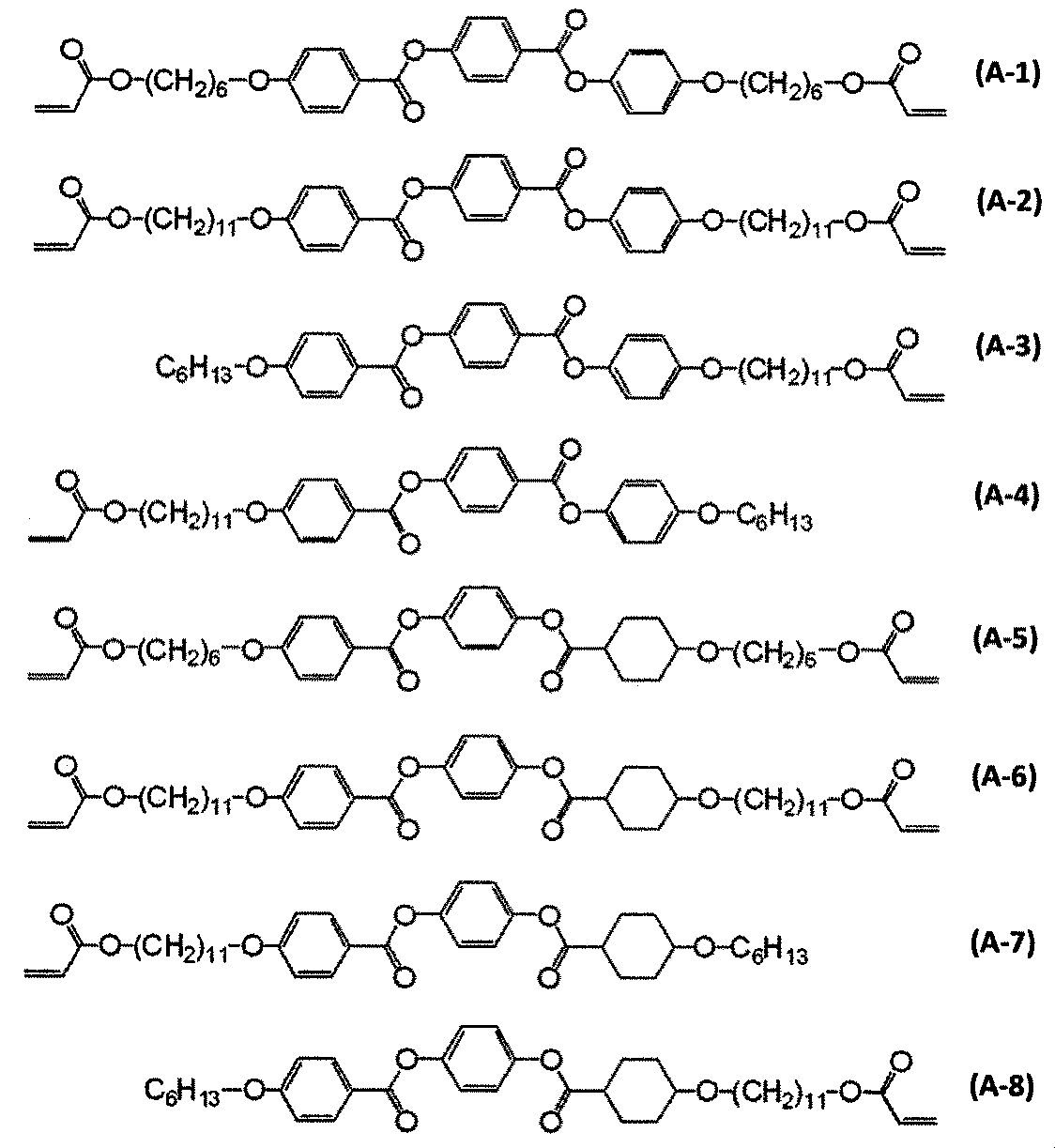

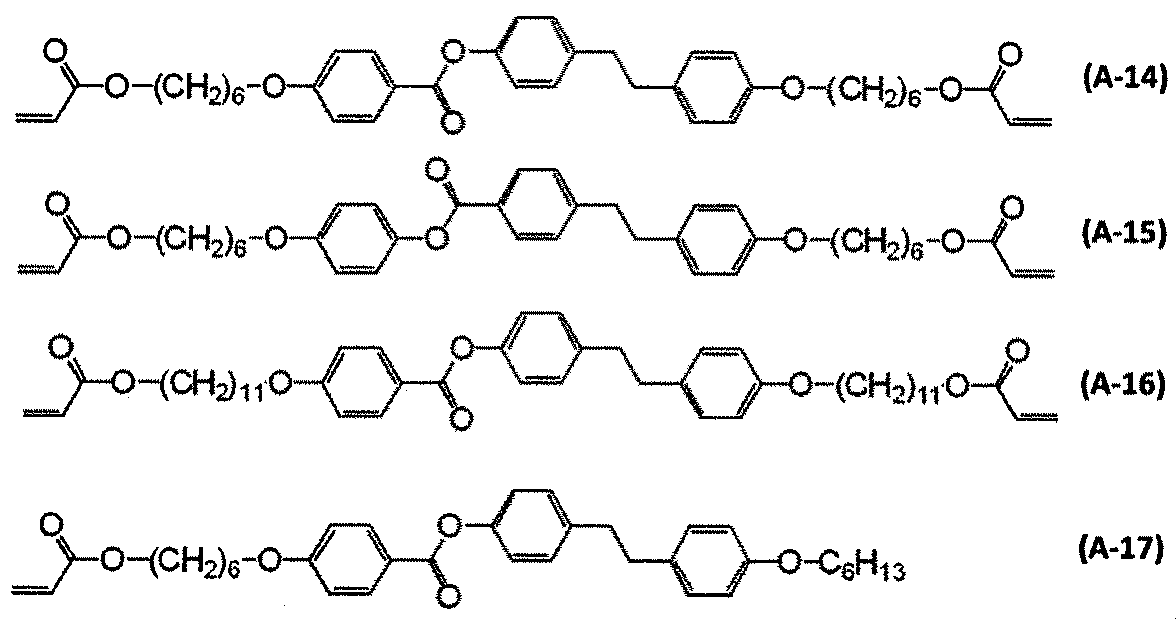
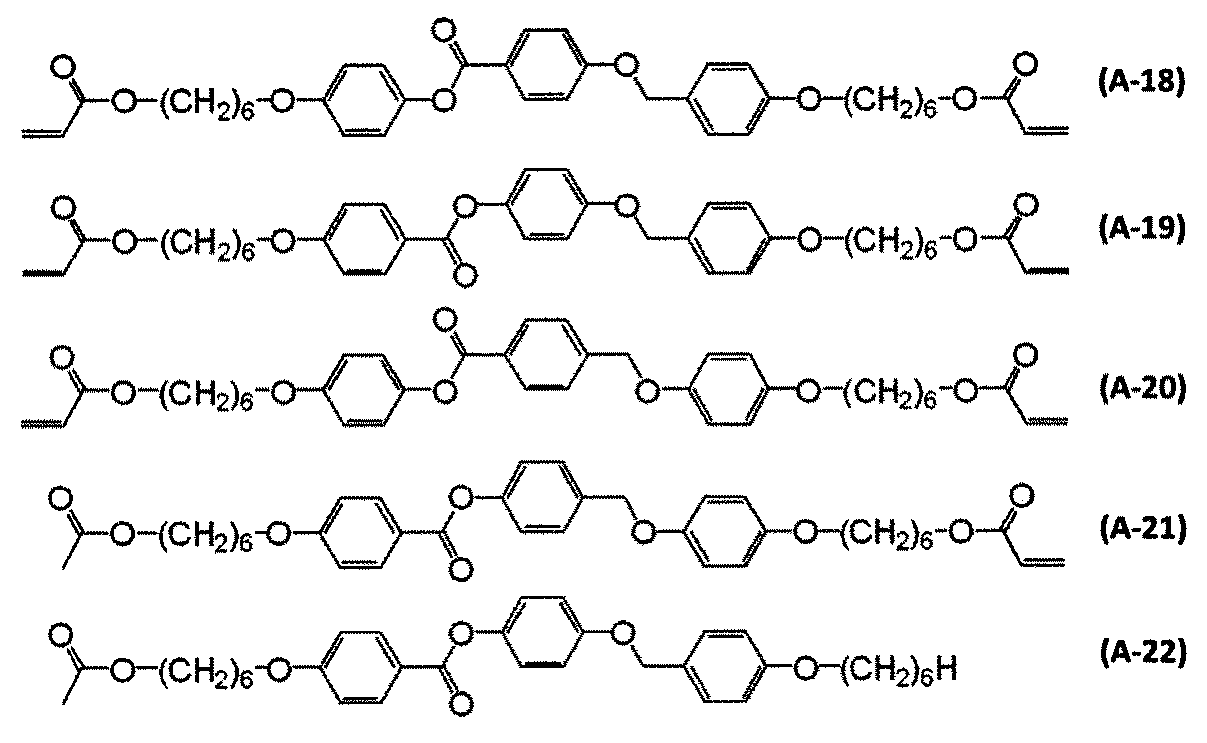
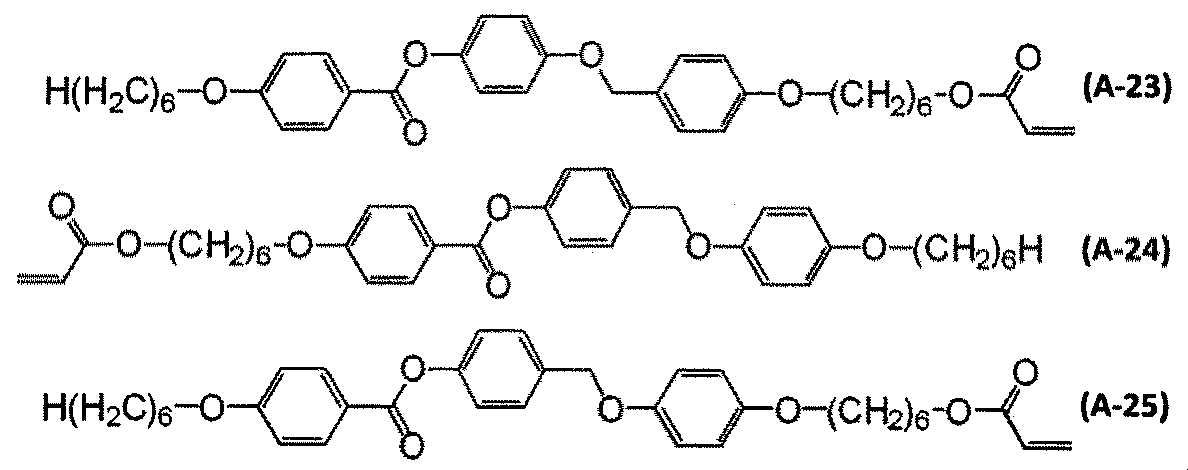
これらの中でも、式(A-2)、式(A-3)、式(A-4)、式(A-5)、式(A-6)、式(A-7)、式(A-8)、式(A-13)、式(A-14)、式(A-15)、式(A-16)および式(A-17)で表される化合物からなる群より選ばれる少なくとも1種が好ましい。重合性液晶化合物(A1)として、1種を単独で用いてもよく、2種以上を組み合わせて用いてもよい。
重合性液晶化合物(A1)は、例えば、Lub等、Recl.Trav.Chim.Pays-Bas、115、321-328(1996)、または特許第4719156号などに記載の公知の方法で製造できる。
重合性液晶組成物(A)は、本発明の効果を損なわない限り、重合性液晶化合物(A)以外の他の重合性液晶化合物を含んでいてもよいが、配向秩序度の高い偏光膜を得る観点から、重合性液晶組成物(A)に含まれる全重合性液晶化合物の総質量に対する重合性液晶化合物(A)の割合は、好ましくは51質量%以上であり、より好ましくは70質量%以上であり、さらに好ましくは90質量%以上である。
また、重合性液晶組成物(A)が2種以上の重合性液晶化合物(A)を含む場合、そのうちの少なくとも1種が重合性液晶化合物(A1)であってもよく、その全てが重合性液晶化合物(A1)であってもよい。複数の重合性液晶化合物を組み合わせることにより、液晶-結晶相転移温度以下の温度でも一時的に液晶性を保持することができる場合がある。
重合性液晶組成物(A)における重合性液晶化合物の含有量は、重合性液晶組成物の固形分に対して、好ましくは40~99.9質量%であり、より好ましくは60~99質量%であり、さらに好ましくは70~99質量%である。重合性液晶化合物の含有量が上記範囲内であると、重合性液晶化合物の配向性が高くなる傾向がある。なお、本明細書において、固形分とは、重合性液晶組成物から溶剤を除いた成分の合計量をいう。
重合性液晶組成物(A)は二色性色素を含んでなる。ここで、二色性色素とは、分子の長軸方向における吸光度と、短軸方向における吸光度とが異なる性質を有する色素を意味する。二色性色素は、液晶化合物とともに配向して二色性を示す色素であり、二色性色素自身が重合性を有していてもよいし、液晶性を有していてもよい。本発明において用い得る二色性色素は、上記性質を有するものであれば特に制限されず、染料であっても、顔料であってもよい。また、2種以上の染料または顔料をそれぞれ組み合わせて用いてもよいし、染料と顔料とを組み合わせて用いてもよい。
二色性色素としては、300~700nmの範囲に極大吸収波長(λMAX)を有するものが好ましい。このような二色性色素としては、例えば、アクリジン色素、オキサジン色素、シアニン色素、ナフタレン色素、アゾ色素およびアントラキノン色素等が挙げられる。
アゾ色素としては、モノアゾ色素、ビスアゾ色素、トリスアゾ色素、テトラキスアゾ色素およびスチルベンアゾ色素等が挙げられ、ビスアゾ色素およびトリスアゾ色素が好ましく、例えば、式(I)で表される化合物(以下、「化合物(I)」ともいう。)が挙げられる。
K1(-N=N-K2)p-N=N-K3 (I)
[式(I)中、K1およびK3は、互いに独立に、置換基を有していてもよいフェニル基、置換基を有していてもよいナフチル基または置換基を有していてもよい1価の複素環基を表わす。K2は、置換基を有していてもよいp-フェニレン基、置換基を有していてもよいナフタレン-1,4-ジイル基または置換基を有していてもよい2価の複素環基を表わす。pは1~4の整数を表わす。pが2以上の整数である場合、複数のK2は互いに同一でも異なっていてもよい。可視域に吸収を示す範囲で-N=N-結合が-C=C-、-COO-、-NHCO-、-N=CH-結合に置き換わっていてもよい。]
K1(-N=N-K2)p-N=N-K3 (I)
[式(I)中、K1およびK3は、互いに独立に、置換基を有していてもよいフェニル基、置換基を有していてもよいナフチル基または置換基を有していてもよい1価の複素環基を表わす。K2は、置換基を有していてもよいp-フェニレン基、置換基を有していてもよいナフタレン-1,4-ジイル基または置換基を有していてもよい2価の複素環基を表わす。pは1~4の整数を表わす。pが2以上の整数である場合、複数のK2は互いに同一でも異なっていてもよい。可視域に吸収を示す範囲で-N=N-結合が-C=C-、-COO-、-NHCO-、-N=CH-結合に置き換わっていてもよい。]
1価の複素環基としては、例えば、キノリン、チアゾール、ベンゾチアゾール、チエノチアゾール、イミダゾール、ベンゾイミダゾール、オキサゾール、ベンゾオキサゾールなどの複素環化合物から1個の水素原子を除いた基が挙げられる。2価の複素環基としては、前記複素環化合物から2個の水素原子を除いた基が挙げられる。
K1およびK3におけるフェニル基、ナフチル基および1価の複素環基、並びにK2におけるp-フェニレン基、ナフタレン-1,4-ジイル基および2価の複素環基が任意に有する置換基としては、炭素数1~4のアルキル基;メトキシ基、エトキシ基、ブトキシ基などの炭素数1~4のアルコキシ基;トリフルオロメチル基などの炭素数1~4のフッ化アルキル基;シアノ基;ニトロ基;ハロゲン原子;アミノ基、ジエチルアミノ基、ピロリジノ基などの置換または無置換アミノ基(置換アミノ基とは、炭素数1~6のアルキル基を1つまたは2つ有するアミノ基、あるいは2つの置換アルキル基が互いに結合して炭素数2~8のアルカンジイル基を形成しているアミノ基を意味する。無置換アミノ基は-NH2である。)等が挙げられる。
化合物(I)の中でも、以下の式(I-1)~式(I-6)のいずれかで表される化合物が好ましい。

B1~B30は、互いに独立して、水素原子、炭素数1~6のアルキル基、炭素数1~4のアルコキシ基、シアノ基、ニトロ基、置換または無置換のアミノ基(置換アミノ基および無置換アミノ基の定義は前記のとおり)、塩素原子またはトリフルオロメチル基を表わす。
n1~n4は、互いに独立に0~3の整数を表わす。
n1が2以上である場合、複数のB2は互いに同一でも異なっていてもよく、
n2が2以上である場合、複数のB6は互いに同一でも異なっていてもよく、
n3が2以上である場合、複数のB9は互いに同一でも異なっていてもよく、
n4が2以上である場合、複数のB14は互いに同一でも異なっていてもよい。]
前記アントラキノン色素としては、式(I-9)で表される化合物が好ましい。
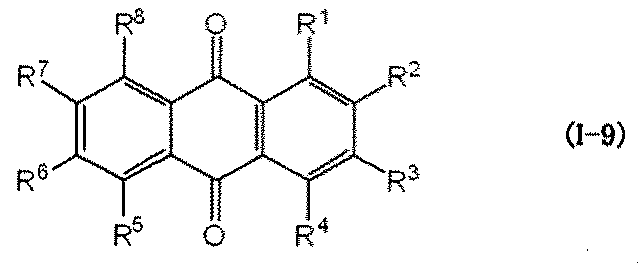
R1~R8は、互いに独立して、水素原子、-Rx、-NH2、-NHRx、-NRx 2、-SRxまたはハロゲン原子を表わす。
Rxは、炭素数1~4のアルキル基または炭素数6~12のアリール基を表わす。]
前記オキサゾン色素としては、式(I-10)で表される化合物が好ましい。
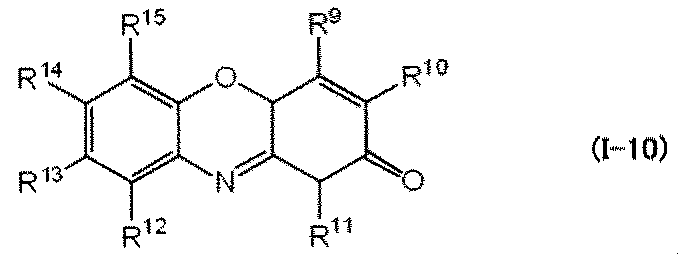
R9~R15は、互いに独立して、水素原子、-Rx、-NH2、-NHRx、-NRx 2、-SRxまたはハロゲン原子を表わす。
Rxは、炭素数1~4のアルキル基または炭素数6~12のアリール基を表わす。]
前記アクリジン色素としては、式(I-11)で表される化合物が好ましい。
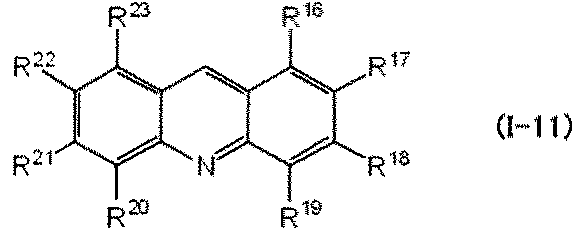
R16~R23は、互いに独立して、水素原子、-Rx、-NH2、-NHRx、-NRx 2、-SRxまたはハロゲン原子を表わす。
Rxは、炭素数1~4のアルキル基または炭素数6~12のアリール基を表わす。]
式(I-9)、式(I-10)および式(I-11)において、Rxの炭素数1~6のアルキル基としては、メチル基、エチル基、プロピル基、ブチル基、ペンチル基およびヘキシル基等が挙げられ、炭素数6~12のアリール基としては、フェニル基、トルイル基、キシリル基およびナフチル基等が挙げられる。
前記シアニン色素としては、式(I-12)で表される化合物および式(I-13)で表される化合物が好ましい。
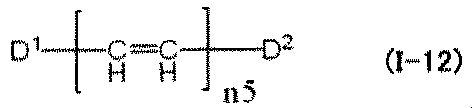
D1およびD2は、互いに独立に、式(I-12a)~式(I-12d)のいずれかで表される基を表わす。

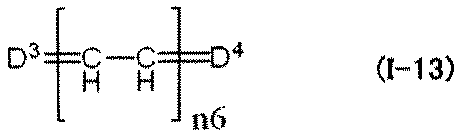
D3およびD4は、互いに独立に、式(I-13a)~式(1-13h)のいずれかで表される基を表わす。

重合性液晶組成物(A)における二色性色素の含有量は、用いる二色性色素の種類などに応じて適宜決定し得るが、重合性液晶化合物100質量部に対して、好ましくは0.1~50質量部であり、より好ましくは0.1~20質量部であり、さらに好ましくは0.1~12質量部である。二色性色素の含有量が、上記範囲内であると、重合性液晶化合物の配向を乱し難く、高い配向秩序度を有する偏光膜を得ることができる。
重合性液晶組成物(A)は、更に重合開始剤を含有していてもよい。重合開始剤は、重合性液晶化合物の重合反応を開始し得る化合物であり、より低温条件下で、重合反応を開始できる点で、光重合開始剤が好ましい。具体的には、光の作用により活性ラジカルまたは酸を発生できる光重合開始剤が挙げられ、中でも、光の作用によりラジカルを発生する光重合開始剤が好ましい。重合開始剤は単独または二種以上組み合わせて使用できる。
重合開始剤としては、ベンゾイン化合物、ベンゾフェノン化合物、アルキルフェノン化合物、アシルホスフィンオキサイド化合物、トリアジン化合物、ヨードニウム塩およびスルホニウム塩等が挙げられる。
ベンゾイン化合物としては、ベンゾイン、ベンゾインメチルエーテル、ベンゾインエチルエーテル、ベンゾインイソプロピルエーテルおよびベンゾインイソブチルエーテル等が挙げられる。
ベンゾフェノン化合物としては、ベンゾフェノン、o-ベンゾイル安息香酸メチル、4-フェニルベンゾフェノン、4-ベンゾイル-4’-メチルジフェニルサルファイド、3,3’,4,4’-テトラ(tert-ブチルパーオキシカルボニル)ベンゾフェノンおよび2,4,6-トリメチルベンゾフェノン等が挙げられる。
アルキルフェノン化合物としては、ジエトキシアセトフェノン、2-メチル-2-モルホリノ-1-(4-メチルチオフェニル)プロパン-1-オン、2-ジメチルアミノ-2-ベンジル-1-(4-モルホリノフェニル)ブタン-1-オン、2-ヒドロキシ-2-メチル-1-フェニルプロパン-1-オン、1,2-ジフェニル-2,2-ジメトキシエタン-1-オン、2-ヒドロキシ-2-メチル-1-〔4-(2-ヒドロキシエトキシ)フェニル〕プロパン-1-オン、1-ヒドロキシシクロヘキシルフェニルケトンおよび2-ヒドロキシ-2-メチル-1-〔4-(1-メチルビニル)フェニル〕プロパン-1-オンのオリゴマー等が挙げられる。
アシルホスフィンオキサイド化合物としては、2,4,6-トリメチルベンゾイルジフェニルホスフィンオキサイドおよびビス(2,4,6-トリメチルベンゾイル)フェニルホスフィンオキサイド等が挙げられる。
トリアジン化合物としては、2,4-ビス(トリクロロメチル)-6-(4-メトキシフェニル)-1,3,5-トリアジン、2,4-ビス(トリクロロメチル)-6-(4-メトキシナフチル)-1,3,5-トリアジン、2,4-ビス(トリクロロメチル)-6-(4-メトキシスチリル)-1,3,5-トリアジン、2,4-ビス(トリクロロメチ_ル)-6-〔2-(5-メチルフラン-2-イル)エテニル〕-1,3,5-トリアジン、2,4-ビス(トリクロロメチル)-6-〔2-(フラン-2-イル)エテニル〕-1,3,5-トリアジン、2,4-ビス(トリクロロメチル)-6-〔2-(4-ジエチルアミノ-2-メチルフェニル)エテニル〕-1,3,5-トリアジンおよび2,4-ビス(トリクロロメチル)-6-〔2-(3,4-ジメトキシフェニル)エテニル〕-1,3,5-トリアジン等が挙げられる。
重合開始剤には、市販のものを用いることができる。市販の重合開始剤としては、例えば、“イルガキュア(Irgacure)(登録商標)907”、“イルガキュア(登録商標)184”、“イルガキュア(登録商標)651”、“イルガキュア(登録商標)819”、“イルガキュア(登録商標)250”、“イルガキュア(登録商標)369”(チバ・ジャパン(株));“セイクオール(登録商標)BZ”、“セイクオール(登録商標)Z”、“セイクオール(登録商標)BEE”(精工化学(株));“カヤキュアー(kayacure)(登録商標)BP100”(日本化薬(株));“カヤキュアー(登録商標)UVI-6992”(ダウ社製);“アデカオプトマーSP-152”、“アデカオプトマーSP-170”((株)ADEKA);“TAZ-A”、“TAZ-PP”(日本シイベルヘグナー社);および“TAZ-104”(三和ケミカル社)等が挙げられる。
重合性液晶組成物(A)が重合開始剤を含有する場合、その含有量は、重合性液晶組成物(A)に含まれる重合性液晶化合物の種類およびその量に応じて適宜決定すればよいが、重合性液晶化合物100質量部に対して、0.1~30質量部が好ましく、0.5~10質量部がより好ましく、0.5~8質量部がさらに好ましい。重合性開始剤の含有量が上記範囲内であると、重合性液晶化合物の配向を乱すことなく重合させることができる。
重合性液晶組成物(A)が光重合開始剤を含有する場合、光増感剤をさらに含有していてもよい。光増感剤を用いることにより重合性液晶化合物の重合反応をより促進させることができる。光増感剤としては、キサントン、チオキサントンなどのキサントン化合物(例えば、2,4-ジエチルチオキサントン、2-イソプロピルチオキサントンなど);アントラセン、アルコキシ基含有アントラセン(例えば、ジブトキシアントラセンなど)などのアントラセン化合物;フェノチアジンおよびルブレン等が挙げられる。光増感剤は単独または2種以上組み合わせて使用できる。
重合性液晶組成物(A)における光増感剤の含有量は、光重合開始剤および重合性液晶化合物の種類およびその量に応じて適宜決定すればよいが、重合性液晶化合物100質量部に対して、0.1~30質量部が好ましく、0.5~10質量部がより好ましく、0.5~8質量部がさらに好ましい。
重合性液晶組成物(A)は、更にレベリング剤を含んでいてもよい。レベリング剤は、重合性液晶組成物(A)の流動性を調整し、重合性液晶組成物(A)を塗布することにより得られる塗膜をより平坦にする機能を有し、具体的には、界面活性剤が挙げられる。レベリング剤としては、ポリアクリレート化合物を主成分とするレベリング剤およびフッ素原子含有化合物を主成分とするレベリング剤からなる群から選ばれる少なくとも1種が好ましい。レベリング剤は単独または2種以上組み合わせて使用できる。
ポリアクリレート化合物を主成分とするレベリング剤としては、例えば、“BYK-350”、“BYK-352”、“BYK-353”、“BYK-354”、“BYK-355”、“BYK-358N”、“BYK-361N”、“BYK-380”、“BYK-381”および“BYK-392”(BYK Chemie社)が挙げられる。
フッ素原子含有化合物を主成分とするレベリング剤としては、例えば、“メガファック(登録商標)R-08”、同“R-30”、同“R-90”、同“F-410”、同“F-411”、同“F-443”、同“F-445”、同“F-470”、同“F-471”、同“F-477”、同“F-479”、同“F-482”および同“F-483”(DIC(株));“サーフロン(登録商標)S-381”、同“S-382”、同“S-383”、同“S-393”、同“SC-101”、同“SC-105”、“KH-40”および“SA-100”(AGCセイミケミカル(株));“E1830”、“E5844”((株)ダイキンファインケミカル研究所);“エフトップEF301”、“エフトップEF303”、“エフトップEF351”および“エフトップEF352”(三菱マテリアル電子化成(株))が挙げられる。
重合性液晶組成物(A)におけるレベリング剤の含有量は、重合性液晶化合物100質量部に対して、0.05~5質量部が好ましく、0.05~3質量部がより好ましい。レベリング剤の含有量が前記範囲内であると、重合性液晶化合物を水平配向させやすく、かつ、ムラが生じ難く、より平滑な偏光膜を得られる傾向がある。
重合性液晶組成物(A)は、更に重合開始剤、光増感剤およびレベリング剤、以外の他の添加剤を含有してよい。他の添加剤としては、例えば、離型剤、安定剤、ブルーイング剤等の着色剤、難燃剤および滑剤などが挙げられる。重合性液晶組成物(A)が他の添加剤を含有する場合、他の添加剤の含有量は、重合性液晶組成物(A)の固形分に対して、0%を超えて20質量%以下であることが好ましく、より好ましくは0%を超えて10質量%以下である。
重合性液晶組成物(A)は、更に溶剤を含んでいてもよい。一般にスメクチック液晶性を示す化合物は粘度が高いため、重合性液晶組成物に溶媒を加えることで塗布が容易であり、結果として偏光膜の形成がし易くなる場合が多い。溶剤は、重合性液晶化合物および二色性色素の溶解性に応じて適宜選択することができ、具体的には例えば、水、メタノール、エタノール、エチレングリコール、イソプロピルアルコール、プロピレングリコール、メチルセロソルブ、ブチルセロソルブ、プロピレングリコールモノメチルエーテル等のアルコール溶剤、酢酸エチル、酢酸ブチル、エチレングリコールメチルエーテルアセテート、γ-ブチロラクトン、プロピレングリコールメチルエーテルアセテート、乳酸エチル等のエステル溶剤、アセトン、メチルエチルケトン、シクロペンタノン、シクロヘキサノン、メチルアミルケトン、メチルイソブチルケトン等のケトン溶剤、ペンタン、ヘキサン、ヘプタン等の脂肪族炭化水素溶剤、トルエン、キシレン等の芳香族炭化水素溶剤、アセトニトリル等のニトリル溶剤、テトラヒドロフラン、ジメトキシエタン等のエーテル溶剤、および、クロロホルム、クロロベンゼン等の塩素化炭化水素溶剤などが挙げられる。これらの溶剤は、単独または2種以上組み合わせて使用できる。溶剤の含有量は、重合性液晶組成物を構成する固形成分100質量部に対して、好ましくは100~1900質量部であり、より好ましくは150~900質量部であり、さらに好ましくは180~600質量部である。
重合性液晶組成物(A)は、従来公知の重合性液晶組成物の調製方法により製造することができ、通常、重合性液晶化合物および二色性色素、並びに必要に応じて上述の添加剤および溶剤等を混合、撹拌することにより調製することができる。
重合性液晶組成物(A)は、スメクチック液晶相を示し水平配向状態で硬化する重合性液晶化合物を含む場合、二色性色素の光劣化に対する抑制効果に優れており、偏光性能の経時的な低下が生じ難い偏光膜を該重合性液晶組成物(A)より得ることができる。特に、スメクチック液晶相を示し水平配向状態で硬化する重合性液晶化合物を含む重合性液晶組成物(A)より偏光膜をする場合、配向秩序度が高い偏光膜を得ることができる。
配向秩序度の高い偏光膜は、X線回折測定においてヘキサチック相やクリスタル相といった高次構造由来のブラッグピークが得られる。ブラッグピークとは、分子配向の面周期構造に由来するピークを意味する。したがって、本発明の重合性液晶組成物から形成される偏光膜において、重合性液晶化合物またはその重合体が、X線回折測定において該偏光膜がブラッグピークを示すように配向していることが好ましく、光を吸収する方向に重合性液晶化合物の分子が配向する「水平配向」であることがより好ましい。本発明においては分子配向の面周期間隔が3.0~6.0Åである偏光膜が好ましい。ブラッグピークを示すような高い配向秩序度は、用いる重合性液晶化合物の種類、二色性色素の種類やその量等を制御することにより実現し得る。
本発明における偏光膜は、例えば、重合性液晶組成物(A)の塗膜を形成すること、
前記塗膜から溶剤を除去すること、
重合性液晶化合物(A)が液体相に相転移する温度以上まで昇温した後降温して、該重合性液晶化合物をスメクチック相(スメクチック液晶状態)に相転移させること、および、
前記スメクチック相(スメクチック液晶状態)を保持したまま重合性液晶化合物を重合させること
を含む方法により製造することができる。
前記塗膜から溶剤を除去すること、
重合性液晶化合物(A)が液体相に相転移する温度以上まで昇温した後降温して、該重合性液晶化合物をスメクチック相(スメクチック液晶状態)に相転移させること、および、
前記スメクチック相(スメクチック液晶状態)を保持したまま重合性液晶化合物を重合させること
を含む方法により製造することができる。
重合性液晶組成物(A)の塗膜の形成は、例えば、基材上や後述する配向膜上などに重合性液晶組成物(A)、特に、溶剤を加えて粘度を調整した重合性液晶組成物(A)(以下、「偏光膜形成用組成物」ともいう)を塗布することにより行うことができる。また、本発明の偏光板を構成する位相差膜やその他の層上に偏光膜形成用組成物を直接塗布してもよい。
偏光膜形成用組成物を基材等に塗布する方法としては、スピンコーティング法、エクストルージョン法、グラビアコーティング法、ダイコーティング法、バーコーティング法、アプリケータ法などの塗布法、フレキソ法などの印刷法などの公知の方法が挙げられる。
次いで、偏光膜形成用組成物から得られた塗膜中に含まれる重合性液晶化合物(A)が重合しない条件で、溶剤を乾燥等により除去することにより、乾燥塗膜が形成される。乾燥方法としては、自然乾燥法、通風乾燥法、加熱乾燥および減圧乾燥法等が挙げられる。
さらに、重合性液晶化合物(A)を液体相に相転移させるため、重合性液晶化合物が液体相に相転移する温度以上まで昇温した後降温し、該重合性液晶化合物をスメクチック相(スメクチック液晶状態)に相転移させる。かかる相転移は、前記塗膜中の溶媒除去後に行ってもよいし、溶媒の除去と同時に行ってもよい。
重合性液晶化合物(A)のスメクチック液晶状態を保持したまま、重合性液晶化合物(A)を重合させることにより、重合性液晶組成物(A)の硬化層として偏光膜が形成される。重合方法としては光重合法が好ましい。光重合において、乾燥塗膜に照射する光としては、当該乾燥塗膜に含まれる光重合開始剤の種類、重合性液晶化合物(A)の種類(特に、重合性液晶化合物(A)が有する重合性基の種類)およびその量に応じて適宜選択される。その具体例としては、可視光、紫外光、赤外光、X線、α線、β線およびγ線からなる群より選択される1種以上の光や活性電子線が挙げられる。中でも、重合反応の進行を制御し易い点や、光重合装置として当分野で広範に用いられているものが使用できるという点で、紫外光が好ましく、紫外光によって、光重合可能なように、重合性液晶組成物に含有される重合性液晶化合物や光重合開始剤の種類を選択しておくことが好ましい。また、重合時に、適切な冷却手段により乾燥塗膜を冷却しながら、光照射することで、重合温度を制御することもできる。このような冷却手段の採用により、より低温で重合性液晶化合物の重合を実施すれば、基材が比較的耐熱性が低いものを用いたとしても、適切に偏光膜を形成できる。光重合の際、マスキングや現像を行うなどによって、パターニングされた偏光膜を得ることもできる。
前記活性エネルギー線の光源としては、低圧水銀ランプ、中圧水銀ランプ、高圧水銀ランプ、超高圧水銀ランプ、キセノンランプ、ハロゲンランプ、カーボンアーク灯、タングステンランプ、ガリウムランプ、エキシマレーザー、波長範囲380~440nmを発光するLED光源、ケミカルランプ、ブラックライトランプ、マイクロウェーブ励起水銀灯、メタルハライドランプ等が挙げられる。
紫外線照射強度は、通常、10~3,000mW/cm2である。紫外線照射強度は、好ましくは光重合開始剤の活性化に有効な波長領域における強度である。光を照射する時間は、通常0.1秒~10分であり、好ましくは1秒~5分、より好ましくは5秒~3分、さらに好ましくは10秒~1分である。このような紫外線照射強度で1回または複数回照射すると、その積算光量は、10~3,000mJ/cm2、好ましくは50~2,000mJ/cm2、より好ましくは100~1,000mJ/cm2である。
偏光膜は、重合性液晶化合物(A)がスメクチック相の液晶状態を保持したまま重合して得られる場合、前記二色性色素の作用にも伴い、従来のホストゲスト型偏光フィルム(すなわち、ネマチック相の液晶状態からなる偏光膜)と比較して、偏光性能が高いという利点がある。さらに、二色性色素やリオトロピック液晶のみを塗布したものと比較して、強度に優れるという利点もある。
偏光膜の厚みは、適用される表示装置に応じて適宜選択でき、好ましくは0.1~10μm、より好ましくは0.3~4μm、さらに好ましくは0.5~3μmである。
偏光膜は配向膜上に形成されることが好ましい。該配向膜は、重合性液晶化合物(A)を所望の方向に液晶配向させる、配向規制力を有するものである。配向膜としては、重合性液晶化合組成物(A)の塗布等により溶解しない溶剤耐性を有し、また、溶剤の除去や重合性液晶化合物(A)の配向のための加熱処理における耐熱性を有するものが好ましい。かかる配向膜としては、配向性ポリマーを含む配向膜、光配向膜および表面に凹凸パターンや複数の溝を有するグルブ配向膜、配向方向に延伸してある延伸フィルム等が挙げられ、配向角の精度および品質の観点から、光配向膜が好ましい。
配向性ポリマーとしては、例えば、分子内にアミド結合を有するポリアミドやゼラチン類、分子内にイミド結合を有するポリイミドおよびその加水分解物であるポリアミック酸、ポリビニルアルコール、アルキル変性ポリビニルアルコール、ポリアクリルアミド、ポリオキサゾール、ポリエチレンイミン、ポリスチレン、ポリビニルピロリドン、ポリアクリル酸およびポリアクリル酸エステル類が挙げられる。中でも、ポリビニルアルコールが好ましい。配向性ポリマーは単独または2種以上組み合わせて使用できる。
配向性ポリマーを含む配向膜は、通常、配向性ポリマーが溶剤に溶解した組成物(以下、「配向性ポリマー組成物」ということがある)を基材に塗布し、溶剤を除去する、または、配向性ポリマー組成物を基材に塗布し、溶剤を除去し、ラビングする(ラビング法)ことで得られる。溶剤としては、偏光膜を形成する際に用い得る溶剤として先に例示した溶剤と同様のものが挙げられる。
配向性ポリマー組成物中の配向性ポリマーの濃度は、配向性ポリマー材料が、溶剤に完溶できる範囲であればよいが、溶液に対して固形分換算で0.1~20%が好ましく、0.1~10%程度がさらに好ましい。
配向性ポリマー組成物として、市販の配向膜材料をそのまま使用してもよい。市販の配向膜材料としては、サンエバー(登録商標、日産化学工業(株)製)、オプトマー(登録商標、JSR(株)製)などが挙げられる。
配向性ポリマー組成物を基材に塗布する方法としては、偏光膜形成用組成物を基材へ塗布する方法として例示したものと同様のものが挙げられる。
配向性ポリマー組成物に含まれる溶剤を除去する方法としては、自然乾燥法、通風乾燥法、加熱乾燥および減圧乾燥法等が挙げられる。
配向膜に配向規制力を付与するために、必要に応じてラビング処理を行うことができる(ラビング法)。
ラビング法により配向規制力を付与する方法としては、ラビング布が巻きつけられ、回転しているラビングロールに、配向性ポリマー組成物を基材に塗布しアニールすることで基材表面に形成された配向性ポリマーの膜を、接触させる方法が挙げられる。
光配向膜は、通常、光反応性基を有するポリマーまたはモノマーと溶剤とを含む組成物(以下、「光配向膜形成用組成物」ともいう)を基材に塗布し、偏光(好ましくは、偏光UV)を照射することで得られる。光配向膜は、照射する偏光の偏光方向を選択することにより、配向規制力の方向を任意に制御できる点でより好ましい。
光反応性基とは、光照射することにより液晶配向能を生じる基をいう。具体的には、光照射により生じる分子の配向誘起または異性化反応、二量化反応、光架橋反応もしくは光分解反応等の液晶配向能の起源となる光反応に関与する基が挙げられる。中でも、二量化反応または光架橋反応に関与する基が、配向性に優れる点で好ましい。光反応性基として、不飽和結合、特に二重結合を有する基が好ましく、炭素-炭素二重結合(C=C結合)、炭素-窒素二重結合(C=N結合)、窒素-窒素二重結合(N=N結合)および炭素-酸素二重結合(C=O結合)からなる群より選ばれる少なくとも1つを有する基が特に好ましい。
C=C結合を有する光反応性基としては、ビニル基、ポリエン基、スチルベン基、スチルバゾ-ル基、スチルバゾリウム基、カルコン基およびシンナモイル基等が挙げられる。
C=N結合を有する光反応性基としては、芳香族シッフ塩基、芳香族ヒドラゾンなどの構造を有する基が挙げられる。N=N結合を有する光反応性基としては、アゾベンゼン基、アゾナフタレン基、芳香族複素環アゾ基、ビスアゾ基、ホルマザン基、および、アゾキシベンゼン構造を有する基等が挙げられる。C=O結合を有する光反応性基としては、ベンゾフェノン基、クマリン基、アントラキノン基およびマレイミド基等が挙げられる。これらの基は、アルキル基、アルコキシ基、アリ-ル基、アリルオキシ基、シアノ基、アルコキシカルボニル基、ヒドロキシル基、スルホン酸基、ハロゲン化アルキル基などの置換基を有していてもよい。
C=N結合を有する光反応性基としては、芳香族シッフ塩基、芳香族ヒドラゾンなどの構造を有する基が挙げられる。N=N結合を有する光反応性基としては、アゾベンゼン基、アゾナフタレン基、芳香族複素環アゾ基、ビスアゾ基、ホルマザン基、および、アゾキシベンゼン構造を有する基等が挙げられる。C=O結合を有する光反応性基としては、ベンゾフェノン基、クマリン基、アントラキノン基およびマレイミド基等が挙げられる。これらの基は、アルキル基、アルコキシ基、アリ-ル基、アリルオキシ基、シアノ基、アルコキシカルボニル基、ヒドロキシル基、スルホン酸基、ハロゲン化アルキル基などの置換基を有していてもよい。
中でも、光二量化反応に関与する光反応性基が好ましく、光配向に必要な偏光照射量が比較的少なく、かつ、熱安定性や経時安定性に優れる光配向膜が得られやすいという点で、シンナモイル基およびカルコン基が好ましい。光反応性基を有するポリマーとしては、当該ポリマー側鎖の末端部が桂皮酸構造となるようなシンナモイル基を有するものが特に好ましい。
光配向膜形成用組成物を基材上に塗布することにより、基材上に光配向誘起層を形成することができる。該組成物に含まれる溶剤としては、偏光膜を形成する際に用い得る溶剤として先に例示した溶剤と同様のものが挙げられ、光反応性基を有するポリマーあるいはモノマーの溶解性に応じて適宜選択することができる。
光配向膜形成用組成物中の光反応性基を有するポリマーまたはモノマーの含有量は、ポリマーまたはモノマーの種類や目的とする光配向膜の厚みによって適宜調節できるが、光配向膜形成用組成物の質量に対して、少なくとも0.2質量%とすることが好ましく、0.3~10質量%の範囲がより好ましい。光配向膜の特性が著しく損なわれない範囲で、光配向膜形成用組成物は、ポリビニルアルコ-ルやポリイミドなどの高分子材料や光増感剤を含んでいてもよい。
光配向膜形成用組成物を基材に塗布する方法としては、配向性組成物を基材に塗布する方法と同様の方法が挙げられる。塗布された光配向膜形成用組成物から、溶剤を除去する方法としては例えば、自然乾燥法、通風乾燥法、加熱乾燥および減圧乾燥法等が挙げられる。
偏光を照射するには、基板上に塗布された光配向膜形成用組成物から、溶剤を除去したものに直接、偏光UVを照射する形式でも、基材側から偏光を照射し、偏光を透過させて照射する形式でもよい。また、当該偏光は、実質的に平行光であると特に好ましい。照射する偏光の波長は、光反応性基を有するポリマーまたはモノマーの光反応性基が、光エネルギーを吸収し得る波長領域のものがよい。具体的には、波長250~400nmの範囲のUV(紫外線)が特に好ましい。当該偏光照射に用いる光源としては、キセノンランプ、高圧水銀ランプ、超高圧水銀ランプ、メタルハライドランプ、KrF、ArFなどの紫外光レ-ザ-などが挙げられ、高圧水銀ランプ、超高圧水銀ランプおよびメタルハライドランプがより好ましい。これらの中でも、高圧水銀ランプ、超高圧水銀ランプおよびメタルハライドランプが、波長313nmの紫外線の発光強度が大きいため好ましい。前記光源からの光を、適当な偏光子を通過して照射することにより、偏光UVを照射することができる。かかる偏光子としては、偏光フィルターやグラントムソン、グランテ-ラ-などの偏光プリズムやワイヤーグリッドタイプの偏光子を用いることができる。
なお、ラビングまたは偏光照射を行う時に、マスキングを行えば、液晶配向の方向が異なる複数の領域(パターン)を形成することもできる。
グルブ(groove)配向膜は、膜表面に凹凸パターンまたは複数のグルブ(溝)を有する膜である。等間隔に並んだ複数の直線状のグルブを有する膜に重合性液晶化合物を塗布した場合、その溝に沿った方向に液晶分子が配向する。
グルブ配向膜を得る方法としては、感光性ポリイミド膜表面にパターン形状のスリットを有する露光用マスクを介して露光後、現像およびリンス処理を行って凹凸パターンを形成する方法、表面に溝を有する板状の原盤に、硬化前のUV硬化樹脂の層を形成し、形成された樹脂層を基材へ移してから硬化する方法、および、基材に形成した硬化前のUV硬化樹脂の膜に、複数の溝を有するロール状の原盤を押し当てて凹凸を形成し、その後硬化する方法等が挙げられる。
配向膜(配向性ポリマーを含む配向膜または光配向膜)の厚さは、通常10~10000nmの範囲であり、好ましくは10~1000nmの範囲であり、より好ましくは500nm以下であり、さらに好ましくは10~200nm、特に好ましい50~150nmの範囲である。
偏光膜の少なくとも一方の面に、接着剤組成物を介して厚み10μm以上80μm以下の透明保護フィルムを積層することにより本発明における偏光板が得られる。接着剤組成物は特に限定されず、公知の接着剤を使用してよい。本発明における偏光板は、偏光膜の片面のみに透明保護フィルムを積層していることが好ましい。
<透明保護フィルム>
透明保護フィルムは、光、特に可視光を透過し得る透明性を有する基材を意味し、透明性とは、波長380~780nmにわたる光線に対しての透過率が80%以上となる特性をいう。具体的な透明保護フィルムとしては、ポリエチレン、ポリプロピレンなどのポリオレフィン;ノルボルネン系ポリマーなどの環状オレフィン系樹脂;ポリビニルアルコール;ポリエチレンテレフタレート;ポリメタクリル酸エステル;ポリアクリル酸エステル;トリアセチルセルロース、ジアセチルセルロース、セルロースアセテートプロピオネートなどのセルロースエステル;ポリエチレンナフタレート;ポリカーボネート;ポリスルホン;ポリエーテルスルホン;ポリエーテルケトン;ポリフェニレンスルフィドおよびポリフェニレンオキシド等が挙げられる。入手のしやすさや透明性の観点から、ポリエチレンテレフタレート、ポリメタクリル酸エステル、セルロースエステル、環状オレフィン系樹脂またはポリカーボネートが好ましい。セルロースエステルは、セルロースに含まれる水酸基の一部または全部が、エステル化されたものであり、市場から容易に入手することができる。また、セルロースエステル基材も市場から容易に入手することができる。市販のセルロースエステル基材としては、例えば、“フジタックフィルム”(富士写真フィルム(株));“KC8UX2M”、“KC8UY”および“KC4UY”(コニカミノルタオプト(株))などが挙げられる。またこの中でも平衡含水率の観点からは、環状オレフィン系樹脂、ポリエチレンテレフタレート、ポリカーボネートが好ましく、環状オレフィン系樹脂がより好ましい。
透明保護フィルムは、光、特に可視光を透過し得る透明性を有する基材を意味し、透明性とは、波長380~780nmにわたる光線に対しての透過率が80%以上となる特性をいう。具体的な透明保護フィルムとしては、ポリエチレン、ポリプロピレンなどのポリオレフィン;ノルボルネン系ポリマーなどの環状オレフィン系樹脂;ポリビニルアルコール;ポリエチレンテレフタレート;ポリメタクリル酸エステル;ポリアクリル酸エステル;トリアセチルセルロース、ジアセチルセルロース、セルロースアセテートプロピオネートなどのセルロースエステル;ポリエチレンナフタレート;ポリカーボネート;ポリスルホン;ポリエーテルスルホン;ポリエーテルケトン;ポリフェニレンスルフィドおよびポリフェニレンオキシド等が挙げられる。入手のしやすさや透明性の観点から、ポリエチレンテレフタレート、ポリメタクリル酸エステル、セルロースエステル、環状オレフィン系樹脂またはポリカーボネートが好ましい。セルロースエステルは、セルロースに含まれる水酸基の一部または全部が、エステル化されたものであり、市場から容易に入手することができる。また、セルロースエステル基材も市場から容易に入手することができる。市販のセルロースエステル基材としては、例えば、“フジタックフィルム”(富士写真フィルム(株));“KC8UX2M”、“KC8UY”および“KC4UY”(コニカミノルタオプト(株))などが挙げられる。またこの中でも平衡含水率の観点からは、環状オレフィン系樹脂、ポリエチレンテレフタレート、ポリカーボネートが好ましく、環状オレフィン系樹脂がより好ましい。
透明保護フィルムに求められる特性は、偏光板の構成によって異なるが、通常、位相差性ができるだけ小さいフィルムが好ましい。位相差性ができるだけ小さいフィルムとしては、ゼロタック(コニカミノルタオプト株式会社)、Zタック(富士フィルム株式会社)等の位相差を有しないセルロースエステルフィルム等が挙げられる。また、未延伸の環状オレフィン系樹脂フィルムも好ましい。偏光膜が積層されていない透明保護フィルムの面には、ハードコート処理、反射防止処理、帯電防止処理等がなされてもよい。
透明保護フィルムの厚みは、薄すぎると強度が低下し、加工性に劣る傾向があるため、通常10~80μmであり、好ましくは20~60μm、より好ましくは20~40μmである。
<位相差膜>
本発明において、位相差膜は、下記式(1):
100 ≦ Re(550) ≦180 (1)
〔式中、Re(550)は波長550nmにおける面内位相差値を表す〕
を満たすことが好ましい。
位相差膜が上記(1)で表される面内位相差値を有すると、いわゆるλ/4板として機能する。前記式(1)は、好ましくは100nm≦Re(550)≦180nm、さらに好ましくは120nm≦Re(550)≦160nmである。なお、Re(550)は実施例に記載の方法により測定できる。
本発明において、位相差膜は、下記式(1):
100 ≦ Re(550) ≦180 (1)
〔式中、Re(550)は波長550nmにおける面内位相差値を表す〕
を満たすことが好ましい。
位相差膜が上記(1)で表される面内位相差値を有すると、いわゆるλ/4板として機能する。前記式(1)は、好ましくは100nm≦Re(550)≦180nm、さらに好ましくは120nm≦Re(550)≦160nmである。なお、Re(550)は実施例に記載の方法により測定できる。
さらに、位相差膜が下記式(2):
Re(450)/Re(550) < 1 (2)
〔式中、Re(450)およびRe(550)は、それぞれ波長450nmおよび550nmにおける面内位相差値を表す〕
を満たすことが好ましい。上記式(2)を満たす位相差膜は、いわゆる逆波長分散性を有し、優れた偏光性能を示す。Re(450)/Re(550)の値は、好ましくは0.93以下であり、より好ましくは0.88以下、さらに好ましくは0.86以下、好ましくは0.80以上、より好ましくは0.82以上である。
Re(450)/Re(550) < 1 (2)
〔式中、Re(450)およびRe(550)は、それぞれ波長450nmおよび550nmにおける面内位相差値を表す〕
を満たすことが好ましい。上記式(2)を満たす位相差膜は、いわゆる逆波長分散性を有し、優れた偏光性能を示す。Re(450)/Re(550)の値は、好ましくは0.93以下であり、より好ましくは0.88以下、さらに好ましくは0.86以下、好ましくは0.80以上、より好ましくは0.82以上である。
前記位相差膜は、一般的に配向状態の重合性液晶化合物を重合させることにより得られる。位相差膜を形成する重合性液晶化合物(以下、「重合性液晶化合物B」ともいう)は、重合性基、特に光重合性基を有する液晶化合物を意味する。光重合性基とは、光重合開始剤から発生した活性ラジカルや酸などによって重合反応に関与し得る基のことをいう。光重合性基としては、ビニル基、ビニルオキシ基、1-クロロビニル基、イソプロペニル基、4-ビニルフェニル基、アクリロイルオキシ基、メタクリロイルオキシ基、オキシラニル基、オキセタニル基等が挙げられる。中でも、アクリロイルオキシ基、メタクリロイルオキシ基、ビニルオキシ基、オキシラニル基およびオキセタニル基が好ましく、アクリロイルオキシ基及びメタクリロイルオキシ基がより好ましく、アクリロイルオキシ基が更に好ましい。液晶性はサーモトロピック性液晶でもリオトロピック性液晶でもよく、相秩序構造としてはネマチック液晶でもスメクチック液晶でもよい。重合性液晶化合物Bとして、1種のみを用いてもよく、2種以上を組み合わせて用いてもよい。
重合性液晶化合物Bとしては、成膜の容易性および前記式(Y)で表される特性を付与するという観点から、下記(ア)~(エ)を全て満たす化合物が挙げられる。
(ア)サーモトロピック液晶性を有する化合物である;
(イ)該重合性液晶化合物の長軸方向(a)上にπ電子を有する。
(ウ)長軸方向(a)に対して交差する方向〔交差方向(b)〕上にπ電子を有する。
(エ)長軸方向(a)に存在するπ電子の合計をN(πa)、長軸方向に存在する分子量の合計をN(Aa)として下記式(i)で定義される重合性液晶化合物の長軸方向(a)のπ電子密度:
D(πa)=N(πa)/N(Aa) (i)
と、交差方向(b)に存在するπ電子の合計をN(πb)、交差方向(b)に存在する分子量の合計をN(Ab)として下記式(ii)で定義される重合性液晶化合物の交差方向(b)のπ電子密度:
D(πb)=N(πb)/N(Ab) (ii)
とが、
0≦〔D(πa)/D(πb)〕≦1
の関係にある〔すなわち、交差方向(b)のπ電子密度が、長軸方向(a)のπ電子密度よりも大きい〕。
なお、上記(ア)~(エ)を全て満たす重合性液晶化合物Bは、ラビング処理により形成した配向膜上に塗布し、相転移温度以上に加熱することにより、ネマチック相を形成することが可能である。この重合性液晶化合物Bが配向して形成されたネマチック相では通常、重合性液晶化合物の長軸方向が互いに平行になるように配向しており、この長軸方向がネマチック相の配向方向となる。
(イ)該重合性液晶化合物の長軸方向(a)上にπ電子を有する。
(ウ)長軸方向(a)に対して交差する方向〔交差方向(b)〕上にπ電子を有する。
(エ)長軸方向(a)に存在するπ電子の合計をN(πa)、長軸方向に存在する分子量の合計をN(Aa)として下記式(i)で定義される重合性液晶化合物の長軸方向(a)のπ電子密度:
D(πa)=N(πa)/N(Aa) (i)
と、交差方向(b)に存在するπ電子の合計をN(πb)、交差方向(b)に存在する分子量の合計をN(Ab)として下記式(ii)で定義される重合性液晶化合物の交差方向(b)のπ電子密度:
D(πb)=N(πb)/N(Ab) (ii)
とが、
0≦〔D(πa)/D(πb)〕≦1
の関係にある〔すなわち、交差方向(b)のπ電子密度が、長軸方向(a)のπ電子密度よりも大きい〕。
なお、上記(ア)~(エ)を全て満たす重合性液晶化合物Bは、ラビング処理により形成した配向膜上に塗布し、相転移温度以上に加熱することにより、ネマチック相を形成することが可能である。この重合性液晶化合物Bが配向して形成されたネマチック相では通常、重合性液晶化合物の長軸方向が互いに平行になるように配向しており、この長軸方向がネマチック相の配向方向となる。
上記特性を有する重合性液晶化合物Bは、一般に逆波長分散性を示すものであることが多い。上記(ア)~(エ)の特性を満たす化合物として、具体的には、例えば、下記式(II):

式(II)中、Arは置換基を有していてもよい二価の芳香族基を表す。ここでいう芳香族基とは、平面性を有する環状構造の基であり、該環状構造が有するπ電子数がヒュッケル則に従い[4n+2]個であるものをいう。ここで、nは整数を表す。-N=や-S-等のヘテロ原子を含んで環構造を形成している場合、これらヘテロ原子上の非共有結合電子対を含めてヒュッケル則を満たし、芳香族性を有する場合も含む。該二価の芳香族基中には窒素原子、酸素原子、硫黄原子のうち少なくとも1つ以上が含まれることが好ましい。
G1およびG2はそれぞれ独立に、二価の芳香族基または二価の脂環式炭化水素基を表す。ここで、該二価の芳香族基または二価の脂環式炭化水素基に含まれる水素原子は、ハロゲン原子、炭素数1~4のアルキル基、炭素数1~4のフルオロアルキル基、炭素数1~4のアルコキシ基、シアノ基またはニトロ基に置換されていてもよく、該二価の芳香族基または二価の脂環式炭化水素基を構成する炭素原子が、酸素原子、硫黄原子または窒素原子に置換されていてもよい。
L1およびL2は、それぞれ独立に、エステル構造を有する二価の連結基である。
T1およびT2はそれぞれ独立に、単結合または二価の連結基である。
T1およびT2はそれぞれ独立に、単結合または二価の連結基である。
h、iは、それぞれ独立に0~3の整数を表し、1≦h+iの関係を満たす。ここで、2≦h+iである場合、T1およびT2、G1およびG2は、それぞれ互いに同一であってもよく、異なっていてもよい。
E1およびE2はそれぞれ独立に、炭素数1~17のアルカンジイル基を表し、ここで、アルカンジイル基に含まれる水素原子は、ハロゲン原子で置換されていてもよく、該アルカンジイル基に含まれる-CH2-は、-O-、-S-、-Si-、-COO-で置換されていてもよい。P1およびP2は互いに独立に、重合性基または水素原子を表し、少なくとも1つは重合性基である。
G1およびG2は、それぞれ独立に、好ましくは、ハロゲン原子および炭素数1~4のアルキル基からなる群から選ばれる少なくとも1つの置換基で置換されていてもよい1,4-フェニレンジイル基、ハロゲン原子および炭素数1~4のアルキル基からなる群から選ばれる少なくとも1つの置換基で置換されていてもよい1,4-シクロヘキサンジイル基であり、より好ましくはメチル基で置換された1,4-フェニレンジイル基、無置換の1,4-フェニレンジイル基、または無置換の1,4-trans-シクロヘキサンジイル基であり、特に好ましくは無置換の1,4-フェニレンジイル基、または無置換の1,4-trans-シクロへキサンジイル基である。また、複数存在するG1およびG2のうち少なくとも1つは二価の脂環式炭化水素基であることが好ましく、また、L1またはL2に結合するG1およびG2のうち少なくとも1つは二価の脂環式炭化水素基であることがより好ましい。
L1およびL2は、それぞれ独立に、好ましくは-Ra1COORa2-(Ra1およびRa2はそれぞれ独立に単結合または炭素数1~4のアルキレン基を表す)であり、より好ましくは-COORa2-1-(Ra2-1は単結合、-CH2-、-CH2CH2-のいずれかを表す)であり、さらに好ましくは-COO-または-COOCH2CH2-である。
T1およびT2はそれぞれ独立に、好ましくは、単結合、炭素数1~4のアルキレン基、-O-、-S-、-Ra9ORa10-、-Ra11COORa12-、-Ra13OCORa14-、またはRa15OC=OORa16-である。ここで、Ra9~Ra16はそれぞれ独立に単結合、または炭素数1~4のアルキレン基を表す。T1およびT2はそれぞれ独立に、より好ましくは単結合、-ORa10-1-、-CH2-、-CH2CH2-、-COORa12-1-、またはOCORa14-1-である。ここで、Ra10-1、Ra12-1、Ra14-1はそれぞれ独立に単結合、-CH2-、-CH2CH2-のいずれかを表す。T1およびT2はそれぞれ独立に、さらに好ましくは単結合、-O-、-CH2CH2-、-COO-、-COOCH2CH2-、-OCO-、またはOCOCH2CH2-である。
hおよびiは、逆波長分散性発現の観点から2≦h+i≦6の範囲が好ましく、h+i=4であることが好ましく、h=2かつi=2であることがより好ましい。h=2かつi=2であると対称構造となるためさらに好ましい。
E1およびE2はそれぞれ独立に、炭素数1~17のアルカンジイル基が好ましく、炭素数4~12のアルカンジイル基がより好ましい。
P1またはP2で表される重合性基としては、エポキシ基、ビニル基、ビニルオキシ基、1-クロロビニル基、イソプロペニル基、4-ビニルフェニル基、アクリロイルオキシ基、メタクリロイルオキシ基、オキシラニル基、およびオキセタニル基等が挙げられる。これらの中でも、アクリロイルオキシ基、メタクリロイルオキシ基、ビニルオキシ基、オキシラニル基およびオキセタニル基が好ましく、アクリロイルオキシ基がより好ましい。
Arは置換基を有していてもよい芳香族炭化水素環、置換基を有していてもよい芳香族複素環、および電子吸引性基から選ばれる少なくとも1つを有することが好ましい。当該芳香族炭化水素環としては、例えば、ベンゼン環、ナフタレン環、アントラセン環等が挙げられ、ベンゼン環、ナフタレン環が好ましい。当該芳香族複素環としては、フラン環、ベンゾフラン環、ピロール環、インドール環、チオフェン環、ベンゾチオフェン環、ピリジン環、ピラジン環、ピリミジン環、トリアゾール環、トリアジン環、ピロリン環、イミダゾール環、ピラゾール環、チアゾール環、ベンゾチアゾール環、チエノチアゾール環、オキサゾール環、ベンゾオキサゾール環、およびフェナンスロリン環等が挙げられる。これらの中でも、チアゾール環、ベンゾチアゾール環、またはベンゾフラン環を有することが好ましく、ベンゾチアゾール基を有することがさらに好ましい。また、Arに窒素原子が含まれる場合、当該窒素原子はπ電子を有することが好ましい。
式(II)中、Arで表される2価の芳香族基に含まれるπ電子の合計数Nπは8以上が好ましく、より好ましくは10以上であり、さらに好ましくは14以上であり、特に好ましくは16以上である。また、好ましくは30以下であり、より好ましくは26以下であり、さらに好ましくは24以下である。
Arで表される芳香族基としては、例えば以下の式(Ar-1)~式(Ar-23)の基が挙げられる。
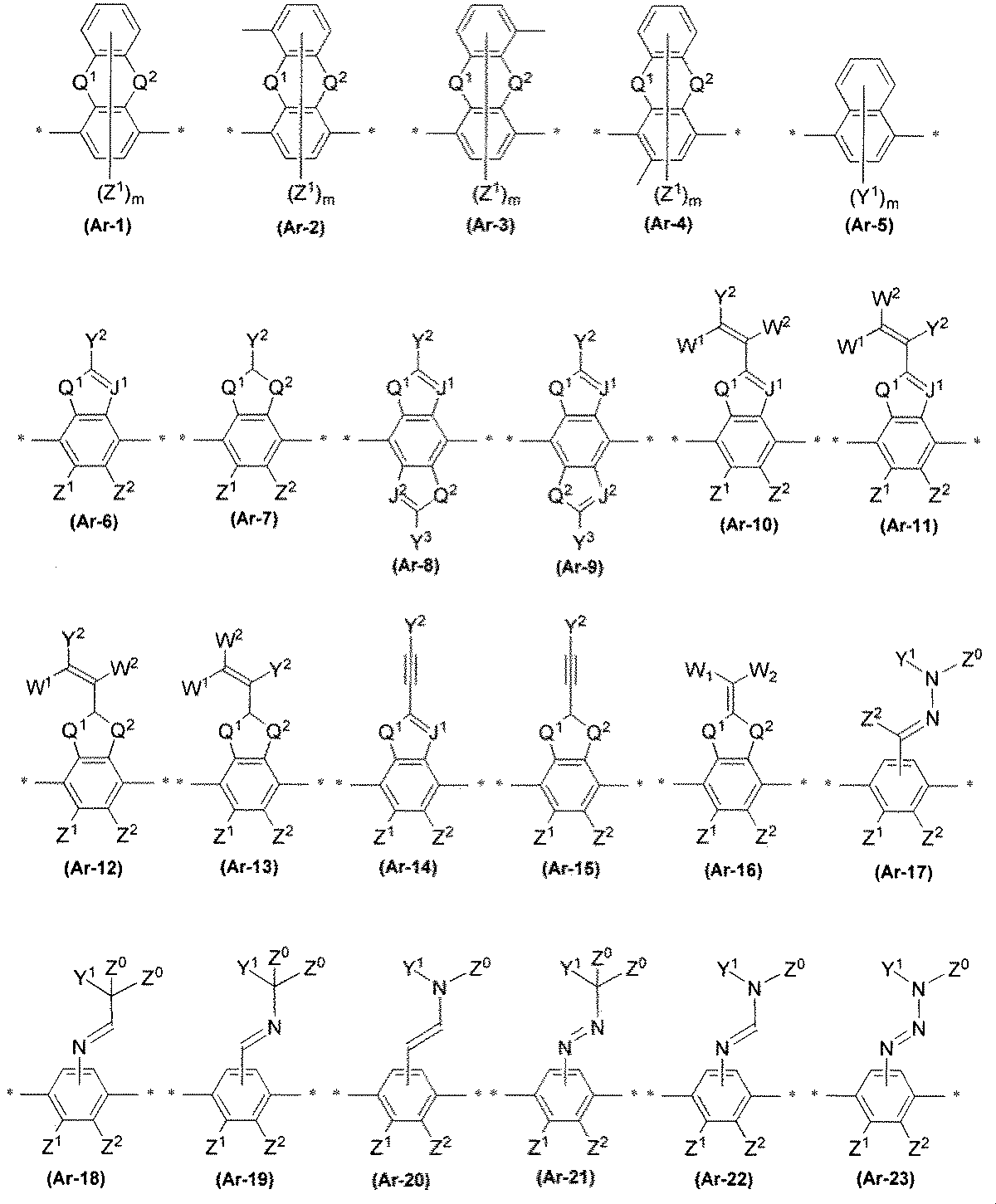
式(Ar-1)~式(Ar-23)中、*印は連結部を表し、Z0、Z1およびZ2は、それぞれ独立に、水素原子、ハロゲン原子、炭素数1~12のアルキル基、シアノ基、ニトロ基、炭素数1~12のアルキルスルフィニル基、炭素数1~12のアルキルスルホニル基、カルボキシル基、炭素数1~12のフルオロアルキル基、炭素数1~6のアルコキシ基、炭素数1~12のアルキルチオ基、炭素数1~12のN-アルキルアミノ基、炭素数2~12のN,N-ジアルキルアミノ基、炭素数1~12のN-アルキルスルファモイル基または炭素数2~12のN,N-ジアルキルスルファモイル基を表す。
Q1およびQ2は、それぞれ独立に、-CR2’R3’-、-S-、-NH-、-NR2’-、-CO-またはO-を表し、R2’およびR3’は、それぞれ独立に、水素原子または炭素数1~4のアルキル基を表す。
J1およびJ2は、それぞれ独立に、炭素原子、または窒素原子を表す。
Y1、Y2およびY3は、それぞれ独立に、置換されていてもよい芳香族炭化水素基または芳香族複素環基を表す。
W1およびW2は、それぞれ独立に、水素原子、シアノ基、メチル基またはハロゲン原子を表し、mは0~6の整数を表す。
Y1、Y2およびY3における芳香族炭化水素基としては、フェニル基、ナフチル基、アンスリル基、フェナンスリル基、ビフェニル基等の炭素数6~20の芳香族炭化水素基が挙げられ、フェニル基、ナフチル基が好ましく、フェニル基がより好ましい。芳香族複素環基としては、フリル基、ピロリル基、チエニル基、ピリジニル基、チアゾリル基、ベンゾチアゾリル基等の窒素原子、酸素原子、硫黄原子等のヘテロ原子を少なくとも1つ含む炭素数4~20の芳香族複素環基が挙げられ、フリル基、チエニル基、ピリジニル基、チアゾリル基、ベンゾチアゾリル基が好ましい。
Y1およびY2は、それぞれ独立に、置換されていてもよい多環系芳香族炭化水素基または多環系芳香族複素環基であってもよい。多環系芳香族炭化水素基は、縮合多環系芳香族炭化水素基、または芳香環集合に由来する基をいう。多環系芳香族複素環基は、縮合多環系芳香族複素環基、または芳香環集合に由来する基をいう。
Z0、Z1およびZ2は、それぞれ独立に、水素原子、ハロゲン原子、炭素数1~12のアルキル基、シアノ基、ニトロ基、炭素数1~12のアルコキシ基であることが好ましく、Z0は、水素原子、炭素数1~12のアルキル基、シアノ基がさらに好ましく、Z1およびZ2は、水素原子、フッ素原子、塩素原子、メチル基、シアノ基がさらに好ましい。
Q1およびQ2は、-NH-、-S-、-NR2’-、-O-が好ましく、R2’は水素原子が好ましい。中でも-S-、-O-、-NH-が特に好ましい。
式(Ar-1)~(Ar-23)の中でも、式(Ar-6)および式(Ar-7)が分子の安定性の観点から好ましい。
式(Ar-17)~(Ar-23)において、Y1は、これが結合する窒素原子およびZ0と共に、芳香族複素環基を形成していてもよい。芳香族複素環基としては、Arが有していてもよい芳香族複素環として前記したものが挙げられるが、例えば、ピロール環、イミダゾール環、ピロリン環、ピリジン環、ピラジン環、ピリミジン環、インドール環、キノリン環、イソキノリン環、プリン環、ピロリジン環等が挙げられる。この芳香族複素環基は、置換基を有していてもよい。また、Y1は、これが結合する窒素原子およびZ0と共に、前述した置換されていてもよい多環系芳香族炭化水素基または多環系芳香族複素環基であってもよい。例えば、ベンゾフラン環、ベンゾチアゾール環、ベンゾオキサゾール環等が挙げられる。なお、前記式(II)で表される化合物は、例えば、特開2010-31223号公報に記載の方法に準じて製造することができる。
位相差膜を構成する重合性液晶組成物(B)中の重合性液晶化合物Bの含有量は、重合性液晶組成物(B)の固形分100質量部に対して、例えば70~99.5質量部であり、好ましくは80~99質量部であり、より好ましくは90~98質量部である。含有量が上記範囲内であると、位相差膜の配向性が高くなる傾向がある。ここで、固形分とは、重合性液晶組成物(B)から溶剤等の揮発性成分を除いた成分の合計量のことをいう。
重合性液晶組成物(B)は、重合性液晶化合物Bの重合反応を開始するための重合開始剤を含んでいてもよい。重合開始剤としては、重合性液晶組成物(A)において使用し得る重合開始剤として先に例示したものと同様のものが挙げられる。また、重合性液晶組成物(B)は、必要に応じて、光増感剤、レベリング剤、および、重合性液晶組成物(A)に含まれる添加剤として例示した添加剤等を含有してもよい。光増感剤およびレベリング剤としては、重合性液晶組成物(A)において使用し得るものとして先に例示したものと同様のものが挙げられる。
位相差膜は、重合性液晶化合物B、および必要に応じて重合開始剤、添加剤等を含む重合性液晶組成物(B)に溶剤を加えて混合および撹拌することにより調製される組成物(以下、「位相差膜形成用組成物」ともいう)を、基材または配向膜上に塗布し、乾燥により溶媒を除去し、得られた塗膜中の重合性液晶化合物Bを加熱および/または活性エネルギー線によって硬化させて得ることができる。位相差膜の作製に用いられる基材および/または配向膜としては、上述の偏光膜を作製する際に用い得るものとして先に例示したものと同様のものが挙げられる。
位相差膜形成用組成物に用いる溶剤、位相差膜形成用組成物の塗布方法、活性エネルギー線による硬化条件等は、いずれも、上述の偏光膜の作製方法において採用し得るものと同様のものが挙げられる。
位相差膜の厚みは、適用される表示装置に応じて適宜選択できるが、薄膜化および屈曲性等の観点から、0.1~10μmであることが好ましく、1~5μmであることがより好ましく、1~3μmであることがさらに好ましい。
<円偏光板>
本発明の円偏光板は、上述の偏光板及び位相差膜を備えてなり、上述の偏光板は、好ましくは、透明保護フィルム、配向膜(特に光配向膜)および偏光膜がこの順に積層されてなる。本発明の円偏光板において、偏光板は、偏光膜の片面のみに透明保護フィルムを積層していることが好ましく、更に該偏光膜と該位相差膜とが積層されていることが好ましい。
本発明の円偏光板は、さらに偏光板及び位相差膜以外の他の層(保護層、粘接着剤層等)を含んでいてもよい。
本発明の円偏光板において、上述の偏光膜と位相差膜とは接着剤層または粘着剤層を介して貼合されていてもよく、位相差膜形成用組成物を上述の偏光膜に直接塗布することにより、位相差膜が本発明の偏光膜上に直接形成されていてもよい。
本発明の円偏光板は、上述の偏光板及び位相差膜を備えてなり、上述の偏光板は、好ましくは、透明保護フィルム、配向膜(特に光配向膜)および偏光膜がこの順に積層されてなる。本発明の円偏光板において、偏光板は、偏光膜の片面のみに透明保護フィルムを積層していることが好ましく、更に該偏光膜と該位相差膜とが積層されていることが好ましい。
本発明の円偏光板は、さらに偏光板及び位相差膜以外の他の層(保護層、粘接着剤層等)を含んでいてもよい。
本発明の円偏光板において、上述の偏光膜と位相差膜とは接着剤層または粘着剤層を介して貼合されていてもよく、位相差膜形成用組成物を上述の偏光膜に直接塗布することにより、位相差膜が本発明の偏光膜上に直接形成されていてもよい。
本発明の円偏光板において、位相差膜の遅相軸と偏光膜の吸収軸との成す角度は、好ましくは実質的に45°である。なお、本発明において「実質的に45°」とは、45°±5°を意味する。
本発明の円偏光板の厚みは、表示装置の屈曲性や視認性の観点から、好ましくは10~300μm、より好ましくは20~200μm、さらに好ましくは25~100μmである。
<表示装置>
本発明は、本発明の円偏光板を備えてなる表示装置を包含する。
本発明の表示装置は、例えば、粘接着剤層を介して本発明の偏光膜または偏光板を表示装置の表面に貼合することにより得ることができる。円偏光板の両面に疎水性基材を有した構成であると本願円偏光板の効果をより発揮する。疎水性基材とは、例えば透湿度が10g/m2・d(40℃・90%RH)(JISK 7129)以下の基材のことを表す。
疎水性基材の種類は特に制限されないが、例えばガラス等が挙げられる。
表示装置とは、表示機構を有する装置であり、発光源として発光素子または発光装置を含む。表示装置としては、液晶表示装置、有機エレクトロルミネッセンス(EL)表示装置、無機エレクトロルミネッセンス(EL)表示装置、タッチパネル表示装置、電子放出表示装置(電場放出表示装置(FED等)、表面電界放出表示装置(SED))、電子ペーパー(電子インクや電気泳動素子を用いた表示装置)、プラズマ表示装置、投射型表示装置(グレーティングライトバルブ(GLV)表示装置、デジタルマイクロミラーデバイス(DMD)を有する表示装置等)および圧電セラミックディスプレイ等が挙げられる。
液晶表示装置は、透過型液晶表示装置、半透過型液晶表示装置、反射型液晶表示装置、直視型液晶表示装置および投写型液晶表示装置等の何れをも含む。これら表示装置は、2次元画像を表示する表示装置であってもよいし、3次元画像を表示する立体表示装置であってもよい。特に、本発明の表示装置としては、有機EL表示装置およびタッチパネル表示装置が好ましく、特に有機EL表示装置が好ましい。
本発明は、本発明の円偏光板を備えてなる表示装置を包含する。
本発明の表示装置は、例えば、粘接着剤層を介して本発明の偏光膜または偏光板を表示装置の表面に貼合することにより得ることができる。円偏光板の両面に疎水性基材を有した構成であると本願円偏光板の効果をより発揮する。疎水性基材とは、例えば透湿度が10g/m2・d(40℃・90%RH)(JISK 7129)以下の基材のことを表す。
疎水性基材の種類は特に制限されないが、例えばガラス等が挙げられる。
表示装置とは、表示機構を有する装置であり、発光源として発光素子または発光装置を含む。表示装置としては、液晶表示装置、有機エレクトロルミネッセンス(EL)表示装置、無機エレクトロルミネッセンス(EL)表示装置、タッチパネル表示装置、電子放出表示装置(電場放出表示装置(FED等)、表面電界放出表示装置(SED))、電子ペーパー(電子インクや電気泳動素子を用いた表示装置)、プラズマ表示装置、投射型表示装置(グレーティングライトバルブ(GLV)表示装置、デジタルマイクロミラーデバイス(DMD)を有する表示装置等)および圧電セラミックディスプレイ等が挙げられる。
液晶表示装置は、透過型液晶表示装置、半透過型液晶表示装置、反射型液晶表示装置、直視型液晶表示装置および投写型液晶表示装置等の何れをも含む。これら表示装置は、2次元画像を表示する表示装置であってもよいし、3次元画像を表示する立体表示装置であってもよい。特に、本発明の表示装置としては、有機EL表示装置およびタッチパネル表示装置が好ましく、特に有機EL表示装置が好ましい。
以下、実施例および比較例により本発明をさらに詳細に説明する。実施例および比較例中の「%」および「部」は、特記しない限り、「質量%」および「質量部」である。
[実施例1]
<偏光板の作製>
[偏光板:延伸フィルムから形成される偏光膜を含む偏光板の製造]
厚さ30μmのポリビニルアルコールフィルム(平均重合度約2400、ケン化度99.9モル%以上)を、乾式延伸により約5倍に一軸延伸し、さらに緊張状態を保ったまま、40℃の純水に40秒間浸漬した。その後、ヨウ素/ヨウ化カリウム/水の質量比が0.044/5.7/100の染色水溶液に28℃で30秒間浸漬して染色処理を行った。
次に、ヨウ化カリウム/ホウ酸/水の質量比が11.0/6.2/100のホウ酸水溶液に70℃で120秒間浸漬した。引き続き、8℃の純水で15秒間洗浄した後、300Nの張力で保持した状態で、60℃で50秒間、次いで75℃で20秒間乾燥して、ポリビニルアルコールフィルムにヨウ素が吸着配向している厚さ12μmの偏光子を得た。
<偏光板の作製>
[偏光板:延伸フィルムから形成される偏光膜を含む偏光板の製造]
厚さ30μmのポリビニルアルコールフィルム(平均重合度約2400、ケン化度99.9モル%以上)を、乾式延伸により約5倍に一軸延伸し、さらに緊張状態を保ったまま、40℃の純水に40秒間浸漬した。その後、ヨウ素/ヨウ化カリウム/水の質量比が0.044/5.7/100の染色水溶液に28℃で30秒間浸漬して染色処理を行った。
次に、ヨウ化カリウム/ホウ酸/水の質量比が11.0/6.2/100のホウ酸水溶液に70℃で120秒間浸漬した。引き続き、8℃の純水で15秒間洗浄した後、300Nの張力で保持した状態で、60℃で50秒間、次いで75℃で20秒間乾燥して、ポリビニルアルコールフィルムにヨウ素が吸着配向している厚さ12μmの偏光子を得た。
得られた偏光子と、シクロオレフィンフィルム(日本ゼオン株式会社製 ZF14)の間に水系接着剤を注入し、ニップロールで貼り合わせた。得られた貼合物の張力を430N/mに保ちながら、60℃で2分間乾燥して、片面に透明保護フィルムとしてシクロオレフィンフィルムを有する偏光板Iを得た。なお、上記水系接着剤は、水100部に、カルボキシル基変性ポリビニルアルコール(クラレポバール KL318;株式会社クラレ製)3部と、水溶性ポリアミドエポキシ樹脂(スミレーズレジン650;住化ケムテックス株式会社製、固形分濃度30%の水溶液)1.5部とを添加して調製した。
<偏光板の23℃50%における平衡含水率>
作製した偏光板の試験片(サイズ:幅4cm長さ10cm)を23℃、相対湿度50%のクリーンルームで1日間保持し重量を測定した後、試験片を105℃1時間乾燥させ重量を測定し、温度23℃、相対湿度50%時の平衡含水率を三菱化学アナリテック製CA-200型で測定した。結果を表1に示す。
作製した偏光板の試験片(サイズ:幅4cm長さ10cm)を23℃、相対湿度50%のクリーンルームで1日間保持し重量を測定した後、試験片を105℃1時間乾燥させ重量を測定し、温度23℃、相対湿度50%時の平衡含水率を三菱化学アナリテック製CA-200型で測定した。結果を表1に示す。
<位相差膜の作製>
[光配向膜形成用組成物の調製]
下記光配向性材料5部(数平均分子量28000)とシクロペンタノン(溶剤)95部とを混合し、得られた混合物を80℃で1時間撹拌することにより、光配向膜形成用組成物を得た。
[光配向膜形成用組成物の調製]
下記光配向性材料5部(数平均分子量28000)とシクロペンタノン(溶剤)95部とを混合し、得られた混合物を80℃で1時間撹拌することにより、光配向膜形成用組成物を得た。
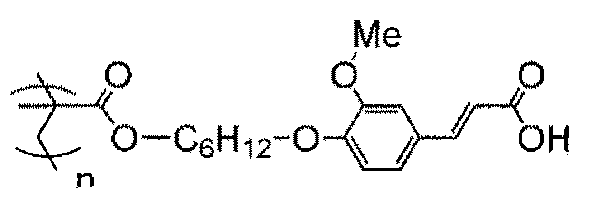
[重合性液晶組成物の調製]
下記構造の重合性液晶化合物B1(86.0部)と、重合性液晶化合物A1(14.0部)と、ポリアクリレート化合物(レベリング剤)(BYK-361N;BYK-Chemie社製)(0.12部)と、光重合開始剤2-ジメチルアミノ-2-ベンジル-1-(4-モルホリノフェニル)ブタン-1-オン(イルガキュア369;チバ スペシャルティケミカルズ社製)(3.0部)とを混合し、重合性液晶化合物B1および重合性液晶化合物A1を含む重合性液晶組成物(B1)を得た。
下記構造の重合性液晶化合物B1(86.0部)と、重合性液晶化合物A1(14.0部)と、ポリアクリレート化合物(レベリング剤)(BYK-361N;BYK-Chemie社製)(0.12部)と、光重合開始剤2-ジメチルアミノ-2-ベンジル-1-(4-モルホリノフェニル)ブタン-1-オン(イルガキュア369;チバ スペシャルティケミカルズ社製)(3.0部)とを混合し、重合性液晶化合物B1および重合性液晶化合物A1を含む重合性液晶組成物(B1)を得た。
重合性液晶化合物B1:

重合性液晶化合物A1:
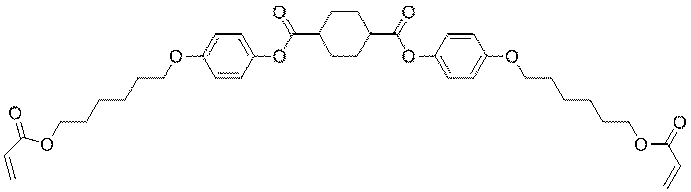
[位相差膜の製造方法]
シクロオレフィンポリマーフィルム(COP;ZF-14;日本ゼオン株式会社製)を、コロナ処理装置(AGF-B10;春日電機株式会社製)を用いて出力0.3kW、処理速度3m/分の条件で1回処理した。コロナ処理を施した表面に、前記光配向膜形成用組成物をバーコーター塗布し、80℃で1分間乾燥し、偏光UV照射装置(偏光子ユニット付SPOT CURE SP-7;ウシオ電機株式会社製)を用いて、100mJ/cm2の積算光量で偏光UV露光を実施し、配向膜を形成した。得られた配向膜の厚さをエリプソメータ M-220(日本分光株式会社製)で測定したところ、100nmであった。
シクロオレフィンポリマーフィルム(COP;ZF-14;日本ゼオン株式会社製)を、コロナ処理装置(AGF-B10;春日電機株式会社製)を用いて出力0.3kW、処理速度3m/分の条件で1回処理した。コロナ処理を施した表面に、前記光配向膜形成用組成物をバーコーター塗布し、80℃で1分間乾燥し、偏光UV照射装置(偏光子ユニット付SPOT CURE SP-7;ウシオ電機株式会社製)を用いて、100mJ/cm2の積算光量で偏光UV露光を実施し、配向膜を形成した。得られた配向膜の厚さをエリプソメータ M-220(日本分光株式会社製)で測定したところ、100nmであった。
続いて、前記配向膜上に、重合性液晶組成物B1を、バーコーターのワイヤーを#30に設定して50mm/secの速度で塗布し、120℃で1分間乾燥した。その後、高圧水銀ランプ(ユニキュアVB-15201BY-A;ウシオ電機株式会社製)を用いて、重合性液晶組成物B1を塗布した面側から紫外線を照射(窒素雰囲気下、波長313nmにおける積算光量:500mJ/cm2)することにより、位相差膜Aとシクロオレフィンポリマーフィルムとの積層体を形成した。得られた位相差膜Aの厚みをレーザー顕微鏡(LEXT;オリンパス株式会社製)で測定したところ、2.3μmであった。
<円偏光板の作製>
上記のように作製した偏光板Iのポリビニルアルコール側と、位相差膜Aとシクロオレフィンポリマーフィルムとの積層体の位相差膜A側を、偏光板Iの吸収軸と位相差膜Aの遅相軸の為す角度(θ)が45°となるようにアクリル系感圧式粘着剤(無色透明、無配向)を用いて貼合した後に位相差膜のシクロオレフィンポリマーフィルムを剥離し、円偏光板を作製した。
<耐久性試験>
得られた円偏光板の位相差膜側、偏光板側の両側にアクリル系感圧式粘着剤(無色透明、無配向)を介して0.4mm厚のガラス(コーニング社製)に貼合し、位相差膜の位相差値を測定した。その後90℃RHオーブンに500時間投入し、位相差膜の位相差値を再度測定し、差異を求めた。位相差値の差を表1に示した。また、その耐久性評価を以下の基準で表1に示した。
耐久性評価
○:差異が1nm未満。
△:差異が1nm以上10nm未満。
×:差異が10nm以上。
表1には、偏光板の構成材料および位相差膜の主要構成材料を記載した。
得られた円偏光板の位相差膜側、偏光板側の両側にアクリル系感圧式粘着剤(無色透明、無配向)を介して0.4mm厚のガラス(コーニング社製)に貼合し、位相差膜の位相差値を測定した。その後90℃RHオーブンに500時間投入し、位相差膜の位相差値を再度測定し、差異を求めた。位相差値の差を表1に示した。また、その耐久性評価を以下の基準で表1に示した。
耐久性評価
○:差異が1nm未満。
△:差異が1nm以上10nm未満。
×:差異が10nm以上。
表1には、偏光板の構成材料および位相差膜の主要構成材料を記載した。
[実施例2]
<偏光板の作製>
[偏光板:重合性液晶化合物を含む組成物から形成される偏光膜を含む偏光板の製造]
(配向層形成用組成物の製造)
下記に記載のポリマー2部及びo-キシレン 98部を混合し、得られた混合物を80℃で1時間攪拌することにより、光配向膜形成用組成物である配向層形成用組成物を得た。
<偏光板の作製>
[偏光板:重合性液晶化合物を含む組成物から形成される偏光膜を含む偏光板の製造]
(配向層形成用組成物の製造)
下記に記載のポリマー2部及びo-キシレン 98部を混合し、得られた混合物を80℃で1時間攪拌することにより、光配向膜形成用組成物である配向層形成用組成物を得た。
・下記に示す光反応性基を有するポリマー(数平均分子量28000) 2部

(偏光層形成用組成物の製造)
下記の成分を混合し、80℃で1時間攪拌することで、偏光層形成用組成物を得た。
下記の成分を混合し、80℃で1時間攪拌することで、偏光層形成用組成物を得た。
・式(1-6)で表される重合性液晶化合物 75部

・式(1-7)で表される重合性液晶化合物 25部

・下記に示す二色性色素(1) 2.8部

・下記に示す二色性色素(2) 2.8部

・下記に示す二色性色素(3) 2.8部

・下記に示す重合開始剤 6部
2-ジメチルアミノ-2-ベンジル-1-(4-モルホリノフェニル)ブタン-1-オン(イルガキュア369;チバスペシャルティケミカルズ社製)
2-ジメチルアミノ-2-ベンジル-1-(4-モルホリノフェニル)ブタン-1-オン(イルガキュア369;チバスペシャルティケミカルズ社製)
・下記に示すレベリング剤 1.2部
ポリアクリレート化合物(BYK-361N;BYK-Chemie社製)
ポリアクリレート化合物(BYK-361N;BYK-Chemie社製)
・下記に示す溶剤 250部
シクロペンタノン
シクロペンタノン
(偏光板の製造)
基材(透明保護フィルム)層としてのトリアセチルセルロースフィルム(TAC;KC2UA;コニカミノルタ株式会社製)の表面にコロナ処理(AGF-B10、春日電機株式会社製)を施した。コロナ処理が施されたフィルム表面に、バーコーターを用いて配向層形成用組成物を塗布した後、120℃に設定した乾燥オーブンで1分間乾燥し、配向層用塗工層を得た。配向層用塗工層上に偏光UV照射装置(SPOT CURE SP-7;ウシオ電機株式会社製)を用いて、偏光UVを、50mJ/cm2(313nm基準)の積算光量で照射し配向層を形成した。得られた配向層上に、バーコーターを用いて偏光層形成用組成物を塗布した後、110℃に設定した乾燥オーブンで1分間乾燥した。その後高圧水銀ランプ(ユニキュアVB-15201BY-A、ウシオ電機株式会社製)を用いて、紫外線を照射(窒素雰囲気下、波長:365nm、波長365nmにおける積算光量:1000mJ/cm2)することにより、重合性液晶化合物及び二色性色素が配向した偏光板を得た。
この偏光板を用いたこと以外は実施例1と同様に、円偏光板を作製し、評価を実施した。結果を表1に示す。
基材(透明保護フィルム)層としてのトリアセチルセルロースフィルム(TAC;KC2UA;コニカミノルタ株式会社製)の表面にコロナ処理(AGF-B10、春日電機株式会社製)を施した。コロナ処理が施されたフィルム表面に、バーコーターを用いて配向層形成用組成物を塗布した後、120℃に設定した乾燥オーブンで1分間乾燥し、配向層用塗工層を得た。配向層用塗工層上に偏光UV照射装置(SPOT CURE SP-7;ウシオ電機株式会社製)を用いて、偏光UVを、50mJ/cm2(313nm基準)の積算光量で照射し配向層を形成した。得られた配向層上に、バーコーターを用いて偏光層形成用組成物を塗布した後、110℃に設定した乾燥オーブンで1分間乾燥した。その後高圧水銀ランプ(ユニキュアVB-15201BY-A、ウシオ電機株式会社製)を用いて、紫外線を照射(窒素雰囲気下、波長:365nm、波長365nmにおける積算光量:1000mJ/cm2)することにより、重合性液晶化合物及び二色性色素が配向した偏光板を得た。
この偏光板を用いたこと以外は実施例1と同様に、円偏光板を作製し、評価を実施した。結果を表1に示す。
[実施例3]
基材(透明保護フィルム)層としてトリアセチルセルロースフィルムの代わりにシクロオレフィンポリマーフィルム(COP;ZF-14;日本ゼオン株式会社製)を用いたこと以外は実施例2と同様に、偏光板及び円偏光板を作製し、評価を実施した。結果を表1に示す。
基材(透明保護フィルム)層としてトリアセチルセルロースフィルムの代わりにシクロオレフィンポリマーフィルム(COP;ZF-14;日本ゼオン株式会社製)を用いたこと以外は実施例2と同様に、偏光板及び円偏光板を作製し、評価を実施した。結果を表1に示す。
[実施例4]
位相差膜について重合性液晶化合物B1の代わりにとして特開2016-81035号公報に記載の下記重合性化合物B2を用いたこと以外は、実施例2と同様に、偏光板及び円偏光板を作製し、評価を実施した。結果を表1に示す。
重合性化合物B2
位相差膜について重合性液晶化合物B1の代わりにとして特開2016-81035号公報に記載の下記重合性化合物B2を用いたこと以外は、実施例2と同様に、偏光板及び円偏光板を作製し、評価を実施した。結果を表1に示す。
重合性化合物B2

[実施例5]
位相差膜について重合性液晶化合物B1の代わりに下記重合性化合物B3を用いたこと以外は実施例2と同様に、偏光板及び円偏光板を作製し、評価を実施した。結果を表1に示す。
重合性化合物B3
位相差膜について重合性液晶化合物B1の代わりに下記重合性化合物B3を用いたこと以外は実施例2と同様に、偏光板及び円偏光板を作製し、評価を実施した。結果を表1に示す。
重合性化合物B3
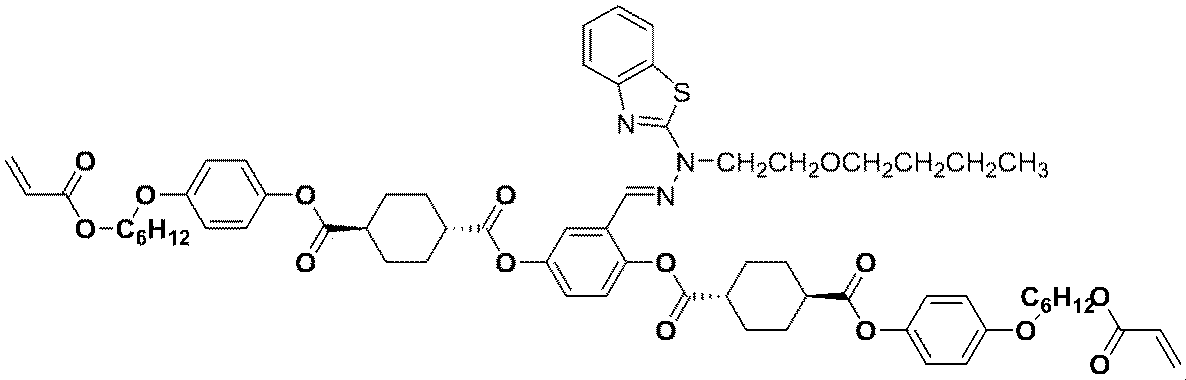
[比較例1]
偏光板として偏光子の両側にトリアセチルセルロースフィルム(TAC;KC2UA;コニカミノルタ株式会社製)を透明保護フィルムとして用いたこと以外は、実施例1と同様に、偏光板及び円偏光板を作製し、評価を実施した。結果を表1に示す。
偏光板として偏光子の両側にトリアセチルセルロースフィルム(TAC;KC2UA;コニカミノルタ株式会社製)を透明保護フィルムとして用いたこと以外は、実施例1と同様に、偏光板及び円偏光板を作製し、評価を実施した。結果を表1に示す。
[比較例2]
偏光板の保護フィルムとして片面にトリアセチルセルロースフィルム(TAC;KC2UA;コニカミノルタ株式会社製)、もう片面にシクロオレフィンポリマーフィルム(COP;ZF-14;日本ゼオン株式会社製)を用い、偏光板のトリアセチルセルロースフィルム側に位相差層を貼合したこと以外は、実施例1と同様に、偏光板及び円偏光板を作製し、評価を実施した。結果を表1に示す。
偏光板の保護フィルムとして片面にトリアセチルセルロースフィルム(TAC;KC2UA;コニカミノルタ株式会社製)、もう片面にシクロオレフィンポリマーフィルム(COP;ZF-14;日本ゼオン株式会社製)を用い、偏光板のトリアセチルセルロースフィルム側に位相差層を貼合したこと以外は、実施例1と同様に、偏光板及び円偏光板を作製し、評価を実施した。結果を表1に示す。
[比較例3]
位相差膜の重合性液晶化合物として実施例4と同様の重合性液晶化合物を用いたこと以外は比較例2と同様に、偏光板及び円偏光板を作製し、評価を実施した。結果を表1に示す。
位相差膜の重合性液晶化合物として実施例4と同様の重合性液晶化合物を用いたこと以外は比較例2と同様に、偏光板及び円偏光板を作製し、評価を実施した。結果を表1に示す。
[比較例4]
位相差膜の重合性液晶化合物として実施例5と同様の重合性液晶化合物を用いたこと以外は比較例2と同様に、偏光板及び円偏光板を作製し、評価を実施した。
位相差膜の重合性液晶化合物として実施例5と同様の重合性液晶化合物を用いたこと以外は比較例2と同様に、偏光板及び円偏光板を作製し、評価を実施した。
[参考例1]
位相差膜としてシクロオレフィンポリマーフィルム(COP;ZD-12;日本ゼオン株式会社製)を用いたこと以外は比較例1と同様に、偏光板及び円偏光板を作製し、評価を実施した。結果を表1に示す。
位相差膜としてシクロオレフィンポリマーフィルム(COP;ZD-12;日本ゼオン株式会社製)を用いたこと以外は比較例1と同様に、偏光板及び円偏光板を作製し、評価を実施した。結果を表1に示す。

上記表1の結果から明らかなように、偏光板の23℃50%(相対湿度)における平衡含水率が、実施例1~5では1.5%以下であり、その場合の耐久性が○および△であるのに対して、平衡含水率が1.5%を超える比較例1~4の場合耐久性が×であり、結果の差は明らかである。参考例1は、偏光板の平衡含水率が1.5%を超えても、位相差膜を延伸フィルムからなる位相差膜(重合性液晶化合物を含まない位相差膜)にした場合は、耐久性は良好であった。位相差膜が偏光板中の水分により影響を受けないものと考える。
Claims (13)
- 二色性色素を含む偏光膜と厚み10μm以上80μm以下の透明保護フィルムとが積層された偏光板と、重合性液晶化合物Bを含む組成物の硬化物である位相差膜と、を含む円偏光板であって、
前記位相差膜が厚み5μm以下を有し、
前記重合性液晶化合物Bが分子構造中にエステル結合を有する化合物であり、
前記偏光板が温度23℃で相対湿度50%における平衡含水率1.5質量%以下を有する円偏光板。 - 二色性色素がアゾ色素である請求項1に記載の円偏光板。
- 透明保護フィルムが環状オレフィン系樹脂である請求項1または2に記載の円偏光板。
- 前記偏光膜は、重合性基としてアクリロイルオキシ基またはメタクリロイルオキシ基を有する重合性液晶化合物Aの硬化物を更に含む請求項1~3のいずれかに記載の円偏光板。
- 前記偏光膜がX線回折測定においてブラッグピークを示す請求項1~4のいずれかに記載の円偏光板。
- 該重合性液晶化合物Aの硬化物が、スメクチック液晶相を示し水平配向状態で硬化されている請求項4に記載の円偏光板。
- 前記位相差膜が下記式(1)を満たす請求項1~6いずれかに記載の円偏光板。
100 ≦ Re(550) ≦ 180 (1)
[式中、Re(550)は波長550nmにおける面内位相差値を表す。] - 前記位相差膜が式(2)を満たす、請求項1~7いずれかに記載の円偏光板。
Re(450)/Re(550)<1 (2)
[式中、Re(450)およびRe(550)はそれぞれ波長450nmおよび550nmにおける面内位相差値を表す。] - 前記位相差膜の遅相軸と前記偏光膜の吸収軸との成す角度が実質的に45°である請求項1~8のいずれかに記載の円偏光板。
- 前記重合性液晶化合物Bが、アクリロイルオキシ基及びメタクリロイルオキシ基の少なくとも一方の重合性基を有する請求項1~9のいずれかに記載の円偏光板。
- 前記重合性液晶化合物Bが下記式(II)で表される化合物である請求項1~10のいずれかに記載の円偏光板。

Arは置換基を有していてもよい二価の芳香族基を表す。
G1及びG2はそれぞれ独立に、二価の芳香族基または二価の脂環式炭化水素基を表す。
L1及びL2はそれぞれ独立に、エステル構造を有する二価の連結基である。
T1及びT2はそれぞれ独立に、単結合又は二価の連結基である。
h及びiはそれぞれ独立に0~3の整数を表し、1≦h+i関係を満たす。ここで、2≦h+iである場合、T1及びT2、G1及びG2は、それぞれ互いに同一であってもよく、異なっていてもよい。
E1及びE2はそれぞれ独立に、炭素数1~17のアルカンジイル基を表し、ここで、アルカンジイル基に含まれる水素原子はハロゲン原子で置換されていてもよく、アルカンジイル基に含まれる-CH2-は、-O-、-S-、-COO-で置換されていてもよく、-O-、-S-、-COO-を複数有する場合は互いに隣接しない。
P1及びP2は互いに独立に、重合性基又は水素原子を表し、少なくとも1つは重合性基である。 - 偏光板は、偏光膜の片面のみに透明保護フィルムを積層している請求項1~11のいずれかに記載の円偏光板。
- 請求項1~12のいずれかに記載の円偏光板を含む有機EL表示装置。
Priority Applications (2)
| Application Number | Priority Date | Filing Date | Title |
|---|---|---|---|
| KR1020217025373A KR102901044B1 (ko) | 2019-02-12 | 2020-02-06 | 원편광판 및 그것을 사용하는 유기 el 표시 장치 |
| CN202080009401.7A CN113302528B (zh) | 2019-02-12 | 2020-02-06 | 圆偏光板及使用其的有机el显示装置 |
Applications Claiming Priority (2)
| Application Number | Priority Date | Filing Date | Title |
|---|---|---|---|
| JP2019022659 | 2019-02-12 | ||
| JP2019-022659 | 2019-02-12 |
Publications (1)
| Publication Number | Publication Date |
|---|---|
| WO2020166476A1 true WO2020166476A1 (ja) | 2020-08-20 |
Family
ID=72045362
Family Applications (1)
| Application Number | Title | Priority Date | Filing Date |
|---|---|---|---|
| PCT/JP2020/004517 Ceased WO2020166476A1 (ja) | 2019-02-12 | 2020-02-06 | 円偏光板およびそれを用いる有機el表示装置 |
Country Status (5)
| Country | Link |
|---|---|
| JP (2) | JP7549452B2 (ja) |
| KR (1) | KR102901044B1 (ja) |
| CN (1) | CN113302528B (ja) |
| TW (1) | TWI846815B (ja) |
| WO (1) | WO2020166476A1 (ja) |
Cited By (1)
| Publication number | Priority date | Publication date | Assignee | Title |
|---|---|---|---|---|
| CN116438060A (zh) * | 2020-11-11 | 2023-07-14 | 日东电工株式会社 | 带相位差层的偏振片的制造方法 |
Families Citing this family (7)
| Publication number | Priority date | Publication date | Assignee | Title |
|---|---|---|---|---|
| JP7549452B2 (ja) * | 2019-02-12 | 2024-09-11 | 住友化学株式会社 | 円偏光板およびそれを用いる有機el表示装置 |
| KR20210121811A (ko) * | 2020-03-31 | 2021-10-08 | 동우 화인켐 주식회사 | 편광 적층체 및 이를 포함하는 화상 표시 장치 |
| JP7462597B2 (ja) | 2020-12-24 | 2024-04-05 | 住友化学株式会社 | 円偏光板、光学積層体及び画像表示装置 |
| WO2023054595A1 (ja) | 2021-10-01 | 2023-04-06 | 住友化学株式会社 | 光学積層体及び画像表示装置 |
| TW202330250A (zh) | 2021-10-01 | 2023-08-01 | 日商住友化學股份有限公司 | 積層膜、光學積層體及圖像顯示裝置 |
| JP2023115630A (ja) | 2022-02-08 | 2023-08-21 | 住友化学株式会社 | 光学積層体 |
| JP2025134252A (ja) | 2024-03-04 | 2025-09-17 | 住友化学株式会社 | 光学積層体及びその製造方法 |
Citations (7)
| Publication number | Priority date | Publication date | Assignee | Title |
|---|---|---|---|---|
| JP2010085696A (ja) * | 2008-09-30 | 2010-04-15 | Fujifilm Corp | 液晶表示装置 |
| JP2014063143A (ja) * | 2012-08-31 | 2014-04-10 | Sumitomo Chemical Co Ltd | 円偏光板および表示装置 |
| JP2015143754A (ja) * | 2014-01-31 | 2015-08-06 | 富士フイルム株式会社 | 透明フィルム及びその製造方法、透明導電フィルム、タッチパネル、反射防止フィルム、偏光板および表示装置 |
| WO2016194999A1 (ja) * | 2015-06-03 | 2016-12-08 | 富士フイルム株式会社 | 光学フィルム、偏光板および画像表示装置 |
| WO2017090644A1 (ja) * | 2015-11-26 | 2017-06-01 | 富士フイルム株式会社 | 光学フィルム、偏光板、画像表示装置および重合性化合物ならびに1,4-シクロヘキサンジカルボン酸モノアリールエステルの製造方法 |
| JP2017111264A (ja) * | 2015-12-16 | 2017-06-22 | コニカミノルタ株式会社 | 偏光板保護フィルムの製造方法及び偏光板の製造方法 |
| JP2018022152A (ja) * | 2016-07-21 | 2018-02-08 | 住友化学株式会社 | 楕円偏光板 |
Family Cites Families (11)
| Publication number | Priority date | Publication date | Assignee | Title |
|---|---|---|---|---|
| JP2001337225A (ja) * | 2000-05-29 | 2001-12-07 | Nitto Denko Corp | 積層光学素子及び液晶表示装置 |
| CN101253229B (zh) * | 2005-08-30 | 2012-07-04 | 柯尼卡美能达精密光学株式会社 | 纤维素酯薄膜、偏光片及显示装置 |
| JP2012247664A (ja) * | 2011-05-30 | 2012-12-13 | Nitto Denko Corp | 位相差層付偏光板 |
| CN105473653B (zh) * | 2013-08-12 | 2018-07-17 | 柯尼卡美能达株式会社 | 酰化纤维素膜、偏振片和液晶显示装置 |
| JP6238415B2 (ja) * | 2013-12-27 | 2017-11-29 | 富士フイルム株式会社 | 光学フィルム、それを用いた偏光板および液晶表示装置 |
| CN105510999B (zh) * | 2016-01-28 | 2019-05-28 | 京东方科技集团股份有限公司 | 减反射结构及其制造方法、显示器及其制造方法 |
| JP6285529B2 (ja) * | 2016-03-15 | 2018-02-28 | 住友化学株式会社 | 楕円偏光板 |
| JP6940930B2 (ja) * | 2016-05-10 | 2021-09-29 | 日東電工株式会社 | 有機el表示装置用光学フィルム、有機el表示装置用偏光フィルム、有機el表示装置用粘着剤層付き偏光フィルム、及び有機el表示装置 |
| JP7033043B2 (ja) * | 2018-09-28 | 2022-03-09 | 富士フイルム株式会社 | 光学積層体、液晶表示装置および有機電界発光装置 |
| JP7549452B2 (ja) * | 2019-02-12 | 2024-09-11 | 住友化学株式会社 | 円偏光板およびそれを用いる有機el表示装置 |
| JP7541435B2 (ja) * | 2019-03-05 | 2024-08-28 | 住友化学株式会社 | ガラス板付き円偏光板 |
-
2020
- 2020-02-04 JP JP2020017117A patent/JP7549452B2/ja active Active
- 2020-02-06 KR KR1020217025373A patent/KR102901044B1/ko active Active
- 2020-02-06 WO PCT/JP2020/004517 patent/WO2020166476A1/ja not_active Ceased
- 2020-02-06 CN CN202080009401.7A patent/CN113302528B/zh active Active
- 2020-02-07 TW TW109103815A patent/TWI846815B/zh active
-
2024
- 2024-08-30 JP JP2024148113A patent/JP2024159941A/ja active Pending
Patent Citations (7)
| Publication number | Priority date | Publication date | Assignee | Title |
|---|---|---|---|---|
| JP2010085696A (ja) * | 2008-09-30 | 2010-04-15 | Fujifilm Corp | 液晶表示装置 |
| JP2014063143A (ja) * | 2012-08-31 | 2014-04-10 | Sumitomo Chemical Co Ltd | 円偏光板および表示装置 |
| JP2015143754A (ja) * | 2014-01-31 | 2015-08-06 | 富士フイルム株式会社 | 透明フィルム及びその製造方法、透明導電フィルム、タッチパネル、反射防止フィルム、偏光板および表示装置 |
| WO2016194999A1 (ja) * | 2015-06-03 | 2016-12-08 | 富士フイルム株式会社 | 光学フィルム、偏光板および画像表示装置 |
| WO2017090644A1 (ja) * | 2015-11-26 | 2017-06-01 | 富士フイルム株式会社 | 光学フィルム、偏光板、画像表示装置および重合性化合物ならびに1,4-シクロヘキサンジカルボン酸モノアリールエステルの製造方法 |
| JP2017111264A (ja) * | 2015-12-16 | 2017-06-22 | コニカミノルタ株式会社 | 偏光板保護フィルムの製造方法及び偏光板の製造方法 |
| JP2018022152A (ja) * | 2016-07-21 | 2018-02-08 | 住友化学株式会社 | 楕円偏光板 |
Cited By (1)
| Publication number | Priority date | Publication date | Assignee | Title |
|---|---|---|---|---|
| CN116438060A (zh) * | 2020-11-11 | 2023-07-14 | 日东电工株式会社 | 带相位差层的偏振片的制造方法 |
Also Published As
| Publication number | Publication date |
|---|---|
| CN113302528B (zh) | 2023-09-22 |
| JP7549452B2 (ja) | 2024-09-11 |
| TW202040181A (zh) | 2020-11-01 |
| CN113302528A (zh) | 2021-08-24 |
| KR102901044B1 (ko) | 2025-12-16 |
| JP2024159941A (ja) | 2024-11-08 |
| JP2020134934A (ja) | 2020-08-31 |
| TWI846815B (zh) | 2024-07-01 |
| KR20210127704A (ko) | 2021-10-22 |
Similar Documents
| Publication | Publication Date | Title |
|---|---|---|
| JP7549452B2 (ja) | 円偏光板およびそれを用いる有機el表示装置 | |
| JP7640623B2 (ja) | 重合性液晶組成物、偏光膜およびその製造方法、偏光板ならびに表示装置 | |
| JP7560940B2 (ja) | 液晶硬化膜形成用組成物及びその用途 | |
| JP7684453B2 (ja) | 偏光フィルムおよびその製造方法 | |
| WO2019082745A1 (ja) | 偏光フィルム及びその製造方法 | |
| JP2024147587A (ja) | 重合性液晶組成物、偏光膜、偏光フィルムおよび偏光板 | |
| JP7339014B2 (ja) | 重合性液晶組成物 | |
| JP7405576B2 (ja) | 光学異方性膜 | |
| US12310237B2 (en) | Optically anisotropic film and laminate including the same | |
| WO2020026805A1 (ja) | 水平配向液晶硬化膜およびこれを含む積層体 | |
| JP7743187B2 (ja) | 重合性液晶組成物、偏光膜、偏光フィルム、円偏光板ならびに表示装置 | |
| TW202506420A (zh) | 積層體及顯示裝置 | |
| JP2024144086A (ja) | 偏光フィルム | |
| JP2024143360A (ja) | 積層体 | |
| JP2024143509A (ja) | 積層体及び表示装置 | |
| WO2019151228A1 (ja) | 偏光膜形成用組成物 |
Legal Events
| Date | Code | Title | Description |
|---|---|---|---|
| 121 | Ep: the epo has been informed by wipo that ep was designated in this application |
Ref document number: 20755331 Country of ref document: EP Kind code of ref document: A1 |
|
| NENP | Non-entry into the national phase |
Ref country code: DE |
|
| 122 | Ep: pct application non-entry in european phase |
Ref document number: 20755331 Country of ref document: EP Kind code of ref document: A1 |