WO2020162561A1 - 溶融亜鉛めっき鋼板およびその製造方法 - Google Patents
溶融亜鉛めっき鋼板およびその製造方法 Download PDFInfo
- Publication number
- WO2020162561A1 WO2020162561A1 PCT/JP2020/004651 JP2020004651W WO2020162561A1 WO 2020162561 A1 WO2020162561 A1 WO 2020162561A1 JP 2020004651 W JP2020004651 W JP 2020004651W WO 2020162561 A1 WO2020162561 A1 WO 2020162561A1
- Authority
- WO
- WIPO (PCT)
- Prior art keywords
- steel sheet
- hot
- temperature
- less
- soaking
- Prior art date
- Legal status (The legal status is an assumption and is not a legal conclusion. Google has not performed a legal analysis and makes no representation as to the accuracy of the status listed.)
- Ceased
Links
Images


Classifications
-
- C—CHEMISTRY; METALLURGY
- C23—COATING METALLIC MATERIAL; COATING MATERIAL WITH METALLIC MATERIAL; CHEMICAL SURFACE TREATMENT; DIFFUSION TREATMENT OF METALLIC MATERIAL; COATING BY VACUUM EVAPORATION, BY SPUTTERING, BY ION IMPLANTATION OR BY CHEMICAL VAPOUR DEPOSITION, IN GENERAL; INHIBITING CORROSION OF METALLIC MATERIAL OR INCRUSTATION IN GENERAL
- C23C—COATING METALLIC MATERIAL; COATING MATERIAL WITH METALLIC MATERIAL; SURFACE TREATMENT OF METALLIC MATERIAL BY DIFFUSION INTO THE SURFACE, BY CHEMICAL CONVERSION OR SUBSTITUTION; COATING BY VACUUM EVAPORATION, BY SPUTTERING, BY ION IMPLANTATION OR BY CHEMICAL VAPOUR DEPOSITION, IN GENERAL
- C23C2/00—Hot-dipping or immersion processes for applying the coating material in the molten state without affecting the shape; Apparatus therefor
- C23C2/04—Hot-dipping or immersion processes for applying the coating material in the molten state without affecting the shape; Apparatus therefor characterised by the coating material
- C23C2/12—Aluminium or alloys based thereon
-
- C—CHEMISTRY; METALLURGY
- C22—METALLURGY; FERROUS OR NON-FERROUS ALLOYS; TREATMENT OF ALLOYS OR NON-FERROUS METALS
- C22C—ALLOYS
- C22C38/00—Ferrous alloys, e.g. steel alloys
- C22C38/18—Ferrous alloys, e.g. steel alloys containing chromium
- C22C38/40—Ferrous alloys, e.g. steel alloys containing chromium with nickel
- C22C38/58—Ferrous alloys, e.g. steel alloys containing chromium with nickel with more than 1.5% by weight of manganese
-
- B—PERFORMING OPERATIONS; TRANSPORTING
- B21—MECHANICAL METAL-WORKING WITHOUT ESSENTIALLY REMOVING MATERIAL; PUNCHING METAL
- B21C—MANUFACTURE OF METAL SHEETS, WIRE, RODS, TUBES, PROFILES OR LIKE SEMI-MANUFACTURED PRODUCTS OTHERWISE THAN BY ROLLING; AUXILIARY OPERATIONS USED IN CONNECTION WITH METAL-WORKING WITHOUT ESSENTIALLY REMOVING MATERIAL
- B21C47/00—Winding-up, coiling or winding-off metal wire, metal band or other flexible metal material characterised by features relevant to metal processing only
- B21C47/02—Winding-up or coiling
-
- B—PERFORMING OPERATIONS; TRANSPORTING
- B32—LAYERED PRODUCTS
- B32B—LAYERED PRODUCTS, i.e. PRODUCTS BUILT-UP OF STRATA OF FLAT OR NON-FLAT, e.g. CELLULAR OR HONEYCOMB, FORM
- B32B15/00—Layered products comprising a layer of metal
- B32B15/01—Layered products comprising a layer of metal all layers being exclusively metallic
- B32B15/013—Layered products comprising a layer of metal all layers being exclusively metallic one layer being formed of an iron alloy or steel, another layer being formed of a metal other than iron or aluminium
-
- C—CHEMISTRY; METALLURGY
- C21—METALLURGY OF IRON
- C21D—MODIFYING THE PHYSICAL STRUCTURE OF FERROUS METALS; GENERAL DEVICES FOR HEAT TREATMENT OF FERROUS OR NON-FERROUS METALS OR ALLOYS; MAKING METAL MALLEABLE, e.g. BY DECARBURISATION OR TEMPERING
- C21D1/00—General methods or devices for heat treatment, e.g. annealing, hardening, quenching or tempering
- C21D1/26—Methods of annealing
-
- C—CHEMISTRY; METALLURGY
- C21—METALLURGY OF IRON
- C21D—MODIFYING THE PHYSICAL STRUCTURE OF FERROUS METALS; GENERAL DEVICES FOR HEAT TREATMENT OF FERROUS OR NON-FERROUS METALS OR ALLOYS; MAKING METAL MALLEABLE, e.g. BY DECARBURISATION OR TEMPERING
- C21D1/00—General methods or devices for heat treatment, e.g. annealing, hardening, quenching or tempering
- C21D1/78—Combined heat-treatments not provided for above
-
- C—CHEMISTRY; METALLURGY
- C21—METALLURGY OF IRON
- C21D—MODIFYING THE PHYSICAL STRUCTURE OF FERROUS METALS; GENERAL DEVICES FOR HEAT TREATMENT OF FERROUS OR NON-FERROUS METALS OR ALLOYS; MAKING METAL MALLEABLE, e.g. BY DECARBURISATION OR TEMPERING
- C21D6/00—Heat treatment of ferrous alloys
- C21D6/005—Heat treatment of ferrous alloys containing Mn
-
- C—CHEMISTRY; METALLURGY
- C21—METALLURGY OF IRON
- C21D—MODIFYING THE PHYSICAL STRUCTURE OF FERROUS METALS; GENERAL DEVICES FOR HEAT TREATMENT OF FERROUS OR NON-FERROUS METALS OR ALLOYS; MAKING METAL MALLEABLE, e.g. BY DECARBURISATION OR TEMPERING
- C21D8/00—Modifying the physical properties of ferrous metals or ferrous alloys by deformation combined with, or followed by, heat treatment
- C21D8/02—Modifying the physical properties of ferrous metals or ferrous alloys by deformation combined with, or followed by, heat treatment during manufacturing of plates or strips
- C21D8/021—Modifying the physical properties of ferrous metals or ferrous alloys by deformation combined with, or followed by, heat treatment during manufacturing of plates or strips involving particular fabrication steps or treatments of ingots or slabs
-
- C—CHEMISTRY; METALLURGY
- C21—METALLURGY OF IRON
- C21D—MODIFYING THE PHYSICAL STRUCTURE OF FERROUS METALS; GENERAL DEVICES FOR HEAT TREATMENT OF FERROUS OR NON-FERROUS METALS OR ALLOYS; MAKING METAL MALLEABLE, e.g. BY DECARBURISATION OR TEMPERING
- C21D8/00—Modifying the physical properties of ferrous metals or ferrous alloys by deformation combined with, or followed by, heat treatment
- C21D8/02—Modifying the physical properties of ferrous metals or ferrous alloys by deformation combined with, or followed by, heat treatment during manufacturing of plates or strips
- C21D8/0221—Modifying the physical properties of ferrous metals or ferrous alloys by deformation combined with, or followed by, heat treatment during manufacturing of plates or strips characterised by the working steps
- C21D8/0226—Hot rolling
-
- C—CHEMISTRY; METALLURGY
- C21—METALLURGY OF IRON
- C21D—MODIFYING THE PHYSICAL STRUCTURE OF FERROUS METALS; GENERAL DEVICES FOR HEAT TREATMENT OF FERROUS OR NON-FERROUS METALS OR ALLOYS; MAKING METAL MALLEABLE, e.g. BY DECARBURISATION OR TEMPERING
- C21D8/00—Modifying the physical properties of ferrous metals or ferrous alloys by deformation combined with, or followed by, heat treatment
- C21D8/02—Modifying the physical properties of ferrous metals or ferrous alloys by deformation combined with, or followed by, heat treatment during manufacturing of plates or strips
- C21D8/0221—Modifying the physical properties of ferrous metals or ferrous alloys by deformation combined with, or followed by, heat treatment during manufacturing of plates or strips characterised by the working steps
- C21D8/0236—Cold rolling
-
- C—CHEMISTRY; METALLURGY
- C21—METALLURGY OF IRON
- C21D—MODIFYING THE PHYSICAL STRUCTURE OF FERROUS METALS; GENERAL DEVICES FOR HEAT TREATMENT OF FERROUS OR NON-FERROUS METALS OR ALLOYS; MAKING METAL MALLEABLE, e.g. BY DECARBURISATION OR TEMPERING
- C21D8/00—Modifying the physical properties of ferrous metals or ferrous alloys by deformation combined with, or followed by, heat treatment
- C21D8/02—Modifying the physical properties of ferrous metals or ferrous alloys by deformation combined with, or followed by, heat treatment during manufacturing of plates or strips
- C21D8/0247—Modifying the physical properties of ferrous metals or ferrous alloys by deformation combined with, or followed by, heat treatment during manufacturing of plates or strips characterised by the heat treatment
- C21D8/0263—Modifying the physical properties of ferrous metals or ferrous alloys by deformation combined with, or followed by, heat treatment during manufacturing of plates or strips characterised by the heat treatment following hot rolling
-
- C—CHEMISTRY; METALLURGY
- C21—METALLURGY OF IRON
- C21D—MODIFYING THE PHYSICAL STRUCTURE OF FERROUS METALS; GENERAL DEVICES FOR HEAT TREATMENT OF FERROUS OR NON-FERROUS METALS OR ALLOYS; MAKING METAL MALLEABLE, e.g. BY DECARBURISATION OR TEMPERING
- C21D9/00—Heat treatment, e.g. annealing, hardening, quenching or tempering, adapted for particular articles; Furnaces therefor
- C21D9/46—Heat treatment, e.g. annealing, hardening, quenching or tempering, adapted for particular articles; Furnaces therefor for sheet metals
-
- C—CHEMISTRY; METALLURGY
- C22—METALLURGY; FERROUS OR NON-FERROUS ALLOYS; TREATMENT OF ALLOYS OR NON-FERROUS METALS
- C22C—ALLOYS
- C22C38/00—Ferrous alloys, e.g. steel alloys
- C22C38/001—Ferrous alloys, e.g. steel alloys containing N
-
- C—CHEMISTRY; METALLURGY
- C22—METALLURGY; FERROUS OR NON-FERROUS ALLOYS; TREATMENT OF ALLOYS OR NON-FERROUS METALS
- C22C—ALLOYS
- C22C38/00—Ferrous alloys, e.g. steel alloys
- C22C38/002—Ferrous alloys, e.g. steel alloys containing In, Mg, or other elements not provided for in one single group C22C38/001 - C22C38/60
-
- C—CHEMISTRY; METALLURGY
- C22—METALLURGY; FERROUS OR NON-FERROUS ALLOYS; TREATMENT OF ALLOYS OR NON-FERROUS METALS
- C22C—ALLOYS
- C22C38/00—Ferrous alloys, e.g. steel alloys
- C22C38/005—Ferrous alloys, e.g. steel alloys containing rare earths, i.e. Sc, Y, Lanthanides
-
- C—CHEMISTRY; METALLURGY
- C22—METALLURGY; FERROUS OR NON-FERROUS ALLOYS; TREATMENT OF ALLOYS OR NON-FERROUS METALS
- C22C—ALLOYS
- C22C38/00—Ferrous alloys, e.g. steel alloys
- C22C38/008—Ferrous alloys, e.g. steel alloys containing tin
-
- C—CHEMISTRY; METALLURGY
- C22—METALLURGY; FERROUS OR NON-FERROUS ALLOYS; TREATMENT OF ALLOYS OR NON-FERROUS METALS
- C22C—ALLOYS
- C22C38/00—Ferrous alloys, e.g. steel alloys
- C22C38/02—Ferrous alloys, e.g. steel alloys containing silicon
-
- C—CHEMISTRY; METALLURGY
- C22—METALLURGY; FERROUS OR NON-FERROUS ALLOYS; TREATMENT OF ALLOYS OR NON-FERROUS METALS
- C22C—ALLOYS
- C22C38/00—Ferrous alloys, e.g. steel alloys
- C22C38/04—Ferrous alloys, e.g. steel alloys containing manganese
-
- C—CHEMISTRY; METALLURGY
- C22—METALLURGY; FERROUS OR NON-FERROUS ALLOYS; TREATMENT OF ALLOYS OR NON-FERROUS METALS
- C22C—ALLOYS
- C22C38/00—Ferrous alloys, e.g. steel alloys
- C22C38/06—Ferrous alloys, e.g. steel alloys containing aluminium
-
- C—CHEMISTRY; METALLURGY
- C22—METALLURGY; FERROUS OR NON-FERROUS ALLOYS; TREATMENT OF ALLOYS OR NON-FERROUS METALS
- C22C—ALLOYS
- C22C38/00—Ferrous alloys, e.g. steel alloys
- C22C38/08—Ferrous alloys, e.g. steel alloys containing nickel
-
- C—CHEMISTRY; METALLURGY
- C22—METALLURGY; FERROUS OR NON-FERROUS ALLOYS; TREATMENT OF ALLOYS OR NON-FERROUS METALS
- C22C—ALLOYS
- C22C38/00—Ferrous alloys, e.g. steel alloys
- C22C38/12—Ferrous alloys, e.g. steel alloys containing tungsten, tantalum, molybdenum, vanadium, or niobium
-
- C—CHEMISTRY; METALLURGY
- C22—METALLURGY; FERROUS OR NON-FERROUS ALLOYS; TREATMENT OF ALLOYS OR NON-FERROUS METALS
- C22C—ALLOYS
- C22C38/00—Ferrous alloys, e.g. steel alloys
- C22C38/14—Ferrous alloys, e.g. steel alloys containing titanium or zirconium
-
- C—CHEMISTRY; METALLURGY
- C22—METALLURGY; FERROUS OR NON-FERROUS ALLOYS; TREATMENT OF ALLOYS OR NON-FERROUS METALS
- C22C—ALLOYS
- C22C38/00—Ferrous alloys, e.g. steel alloys
- C22C38/16—Ferrous alloys, e.g. steel alloys containing copper
-
- C—CHEMISTRY; METALLURGY
- C22—METALLURGY; FERROUS OR NON-FERROUS ALLOYS; TREATMENT OF ALLOYS OR NON-FERROUS METALS
- C22C—ALLOYS
- C22C38/00—Ferrous alloys, e.g. steel alloys
- C22C38/18—Ferrous alloys, e.g. steel alloys containing chromium
-
- C—CHEMISTRY; METALLURGY
- C22—METALLURGY; FERROUS OR NON-FERROUS ALLOYS; TREATMENT OF ALLOYS OR NON-FERROUS METALS
- C22C—ALLOYS
- C22C38/00—Ferrous alloys, e.g. steel alloys
- C22C38/18—Ferrous alloys, e.g. steel alloys containing chromium
- C22C38/22—Ferrous alloys, e.g. steel alloys containing chromium with molybdenum or tungsten
-
- C—CHEMISTRY; METALLURGY
- C22—METALLURGY; FERROUS OR NON-FERROUS ALLOYS; TREATMENT OF ALLOYS OR NON-FERROUS METALS
- C22C—ALLOYS
- C22C38/00—Ferrous alloys, e.g. steel alloys
- C22C38/18—Ferrous alloys, e.g. steel alloys containing chromium
- C22C38/26—Ferrous alloys, e.g. steel alloys containing chromium with niobium or tantalum
-
- C—CHEMISTRY; METALLURGY
- C22—METALLURGY; FERROUS OR NON-FERROUS ALLOYS; TREATMENT OF ALLOYS OR NON-FERROUS METALS
- C22C—ALLOYS
- C22C38/00—Ferrous alloys, e.g. steel alloys
- C22C38/18—Ferrous alloys, e.g. steel alloys containing chromium
- C22C38/28—Ferrous alloys, e.g. steel alloys containing chromium with titanium or zirconium
-
- C—CHEMISTRY; METALLURGY
- C22—METALLURGY; FERROUS OR NON-FERROUS ALLOYS; TREATMENT OF ALLOYS OR NON-FERROUS METALS
- C22C—ALLOYS
- C22C38/00—Ferrous alloys, e.g. steel alloys
- C22C38/18—Ferrous alloys, e.g. steel alloys containing chromium
- C22C38/32—Ferrous alloys, e.g. steel alloys containing chromium with boron
-
- C—CHEMISTRY; METALLURGY
- C22—METALLURGY; FERROUS OR NON-FERROUS ALLOYS; TREATMENT OF ALLOYS OR NON-FERROUS METALS
- C22C—ALLOYS
- C22C38/00—Ferrous alloys, e.g. steel alloys
- C22C38/18—Ferrous alloys, e.g. steel alloys containing chromium
- C22C38/34—Ferrous alloys, e.g. steel alloys containing chromium with more than 1.5% by weight of silicon
-
- C—CHEMISTRY; METALLURGY
- C22—METALLURGY; FERROUS OR NON-FERROUS ALLOYS; TREATMENT OF ALLOYS OR NON-FERROUS METALS
- C22C—ALLOYS
- C22C38/00—Ferrous alloys, e.g. steel alloys
- C22C38/18—Ferrous alloys, e.g. steel alloys containing chromium
- C22C38/38—Ferrous alloys, e.g. steel alloys containing chromium with more than 1.5% by weight of manganese
-
- C—CHEMISTRY; METALLURGY
- C22—METALLURGY; FERROUS OR NON-FERROUS ALLOYS; TREATMENT OF ALLOYS OR NON-FERROUS METALS
- C22C—ALLOYS
- C22C38/00—Ferrous alloys, e.g. steel alloys
- C22C38/18—Ferrous alloys, e.g. steel alloys containing chromium
- C22C38/40—Ferrous alloys, e.g. steel alloys containing chromium with nickel
- C22C38/42—Ferrous alloys, e.g. steel alloys containing chromium with nickel with copper
-
- C—CHEMISTRY; METALLURGY
- C22—METALLURGY; FERROUS OR NON-FERROUS ALLOYS; TREATMENT OF ALLOYS OR NON-FERROUS METALS
- C22C—ALLOYS
- C22C38/00—Ferrous alloys, e.g. steel alloys
- C22C38/18—Ferrous alloys, e.g. steel alloys containing chromium
- C22C38/40—Ferrous alloys, e.g. steel alloys containing chromium with nickel
- C22C38/44—Ferrous alloys, e.g. steel alloys containing chromium with nickel with molybdenum or tungsten
-
- C—CHEMISTRY; METALLURGY
- C22—METALLURGY; FERROUS OR NON-FERROUS ALLOYS; TREATMENT OF ALLOYS OR NON-FERROUS METALS
- C22C—ALLOYS
- C22C38/00—Ferrous alloys, e.g. steel alloys
- C22C38/18—Ferrous alloys, e.g. steel alloys containing chromium
- C22C38/40—Ferrous alloys, e.g. steel alloys containing chromium with nickel
- C22C38/46—Ferrous alloys, e.g. steel alloys containing chromium with nickel with vanadium
-
- C—CHEMISTRY; METALLURGY
- C22—METALLURGY; FERROUS OR NON-FERROUS ALLOYS; TREATMENT OF ALLOYS OR NON-FERROUS METALS
- C22C—ALLOYS
- C22C38/00—Ferrous alloys, e.g. steel alloys
- C22C38/18—Ferrous alloys, e.g. steel alloys containing chromium
- C22C38/40—Ferrous alloys, e.g. steel alloys containing chromium with nickel
- C22C38/48—Ferrous alloys, e.g. steel alloys containing chromium with nickel with niobium or tantalum
-
- C—CHEMISTRY; METALLURGY
- C22—METALLURGY; FERROUS OR NON-FERROUS ALLOYS; TREATMENT OF ALLOYS OR NON-FERROUS METALS
- C22C—ALLOYS
- C22C38/00—Ferrous alloys, e.g. steel alloys
- C22C38/18—Ferrous alloys, e.g. steel alloys containing chromium
- C22C38/40—Ferrous alloys, e.g. steel alloys containing chromium with nickel
- C22C38/50—Ferrous alloys, e.g. steel alloys containing chromium with nickel with titanium or zirconium
-
- C—CHEMISTRY; METALLURGY
- C22—METALLURGY; FERROUS OR NON-FERROUS ALLOYS; TREATMENT OF ALLOYS OR NON-FERROUS METALS
- C22C—ALLOYS
- C22C38/00—Ferrous alloys, e.g. steel alloys
- C22C38/18—Ferrous alloys, e.g. steel alloys containing chromium
- C22C38/40—Ferrous alloys, e.g. steel alloys containing chromium with nickel
- C22C38/52—Ferrous alloys, e.g. steel alloys containing chromium with nickel with cobalt
-
- C—CHEMISTRY; METALLURGY
- C22—METALLURGY; FERROUS OR NON-FERROUS ALLOYS; TREATMENT OF ALLOYS OR NON-FERROUS METALS
- C22C—ALLOYS
- C22C38/00—Ferrous alloys, e.g. steel alloys
- C22C38/18—Ferrous alloys, e.g. steel alloys containing chromium
- C22C38/40—Ferrous alloys, e.g. steel alloys containing chromium with nickel
- C22C38/54—Ferrous alloys, e.g. steel alloys containing chromium with nickel with boron
-
- C—CHEMISTRY; METALLURGY
- C22—METALLURGY; FERROUS OR NON-FERROUS ALLOYS; TREATMENT OF ALLOYS OR NON-FERROUS METALS
- C22C—ALLOYS
- C22C38/00—Ferrous alloys, e.g. steel alloys
- C22C38/60—Ferrous alloys, e.g. steel alloys containing lead, selenium, tellurium, or antimony, or more than 0.04% by weight of sulfur
-
- C—CHEMISTRY; METALLURGY
- C23—COATING METALLIC MATERIAL; COATING MATERIAL WITH METALLIC MATERIAL; CHEMICAL SURFACE TREATMENT; DIFFUSION TREATMENT OF METALLIC MATERIAL; COATING BY VACUUM EVAPORATION, BY SPUTTERING, BY ION IMPLANTATION OR BY CHEMICAL VAPOUR DEPOSITION, IN GENERAL; INHIBITING CORROSION OF METALLIC MATERIAL OR INCRUSTATION IN GENERAL
- C23C—COATING METALLIC MATERIAL; COATING MATERIAL WITH METALLIC MATERIAL; SURFACE TREATMENT OF METALLIC MATERIAL BY DIFFUSION INTO THE SURFACE, BY CHEMICAL CONVERSION OR SUBSTITUTION; COATING BY VACUUM EVAPORATION, BY SPUTTERING, BY ION IMPLANTATION OR BY CHEMICAL VAPOUR DEPOSITION, IN GENERAL
- C23C2/00—Hot-dipping or immersion processes for applying the coating material in the molten state without affecting the shape; Apparatus therefor
- C23C2/02—Pretreatment of the material to be coated, e.g. for coating on selected surface areas
-
- C—CHEMISTRY; METALLURGY
- C23—COATING METALLIC MATERIAL; COATING MATERIAL WITH METALLIC MATERIAL; CHEMICAL SURFACE TREATMENT; DIFFUSION TREATMENT OF METALLIC MATERIAL; COATING BY VACUUM EVAPORATION, BY SPUTTERING, BY ION IMPLANTATION OR BY CHEMICAL VAPOUR DEPOSITION, IN GENERAL; INHIBITING CORROSION OF METALLIC MATERIAL OR INCRUSTATION IN GENERAL
- C23C—COATING METALLIC MATERIAL; COATING MATERIAL WITH METALLIC MATERIAL; SURFACE TREATMENT OF METALLIC MATERIAL BY DIFFUSION INTO THE SURFACE, BY CHEMICAL CONVERSION OR SUBSTITUTION; COATING BY VACUUM EVAPORATION, BY SPUTTERING, BY ION IMPLANTATION OR BY CHEMICAL VAPOUR DEPOSITION, IN GENERAL
- C23C2/00—Hot-dipping or immersion processes for applying the coating material in the molten state without affecting the shape; Apparatus therefor
- C23C2/02—Pretreatment of the material to be coated, e.g. for coating on selected surface areas
- C23C2/022—Pretreatment of the material to be coated, e.g. for coating on selected surface areas by heating
- C23C2/0224—Two or more thermal pretreatments
-
- C—CHEMISTRY; METALLURGY
- C23—COATING METALLIC MATERIAL; COATING MATERIAL WITH METALLIC MATERIAL; CHEMICAL SURFACE TREATMENT; DIFFUSION TREATMENT OF METALLIC MATERIAL; COATING BY VACUUM EVAPORATION, BY SPUTTERING, BY ION IMPLANTATION OR BY CHEMICAL VAPOUR DEPOSITION, IN GENERAL; INHIBITING CORROSION OF METALLIC MATERIAL OR INCRUSTATION IN GENERAL
- C23C—COATING METALLIC MATERIAL; COATING MATERIAL WITH METALLIC MATERIAL; SURFACE TREATMENT OF METALLIC MATERIAL BY DIFFUSION INTO THE SURFACE, BY CHEMICAL CONVERSION OR SUBSTITUTION; COATING BY VACUUM EVAPORATION, BY SPUTTERING, BY ION IMPLANTATION OR BY CHEMICAL VAPOUR DEPOSITION, IN GENERAL
- C23C2/00—Hot-dipping or immersion processes for applying the coating material in the molten state without affecting the shape; Apparatus therefor
- C23C2/04—Hot-dipping or immersion processes for applying the coating material in the molten state without affecting the shape; Apparatus therefor characterised by the coating material
- C23C2/06—Zinc or cadmium or alloys based thereon
-
- C—CHEMISTRY; METALLURGY
- C23—COATING METALLIC MATERIAL; COATING MATERIAL WITH METALLIC MATERIAL; CHEMICAL SURFACE TREATMENT; DIFFUSION TREATMENT OF METALLIC MATERIAL; COATING BY VACUUM EVAPORATION, BY SPUTTERING, BY ION IMPLANTATION OR BY CHEMICAL VAPOUR DEPOSITION, IN GENERAL; INHIBITING CORROSION OF METALLIC MATERIAL OR INCRUSTATION IN GENERAL
- C23C—COATING METALLIC MATERIAL; COATING MATERIAL WITH METALLIC MATERIAL; SURFACE TREATMENT OF METALLIC MATERIAL BY DIFFUSION INTO THE SURFACE, BY CHEMICAL CONVERSION OR SUBSTITUTION; COATING BY VACUUM EVAPORATION, BY SPUTTERING, BY ION IMPLANTATION OR BY CHEMICAL VAPOUR DEPOSITION, IN GENERAL
- C23C2/00—Hot-dipping or immersion processes for applying the coating material in the molten state without affecting the shape; Apparatus therefor
- C23C2/26—After-treatment
- C23C2/28—Thermal after-treatment, e.g. treatment in oil bath
-
- C—CHEMISTRY; METALLURGY
- C23—COATING METALLIC MATERIAL; COATING MATERIAL WITH METALLIC MATERIAL; CHEMICAL SURFACE TREATMENT; DIFFUSION TREATMENT OF METALLIC MATERIAL; COATING BY VACUUM EVAPORATION, BY SPUTTERING, BY ION IMPLANTATION OR BY CHEMICAL VAPOUR DEPOSITION, IN GENERAL; INHIBITING CORROSION OF METALLIC MATERIAL OR INCRUSTATION IN GENERAL
- C23C—COATING METALLIC MATERIAL; COATING MATERIAL WITH METALLIC MATERIAL; SURFACE TREATMENT OF METALLIC MATERIAL BY DIFFUSION INTO THE SURFACE, BY CHEMICAL CONVERSION OR SUBSTITUTION; COATING BY VACUUM EVAPORATION, BY SPUTTERING, BY ION IMPLANTATION OR BY CHEMICAL VAPOUR DEPOSITION, IN GENERAL
- C23C2/00—Hot-dipping or immersion processes for applying the coating material in the molten state without affecting the shape; Apparatus therefor
- C23C2/34—Hot-dipping or immersion processes for applying the coating material in the molten state without affecting the shape; Apparatus therefor characterised by the shape of the material to be treated
- C23C2/36—Elongated material
- C23C2/40—Plates; Strips
-
- C—CHEMISTRY; METALLURGY
- C21—METALLURGY OF IRON
- C21D—MODIFYING THE PHYSICAL STRUCTURE OF FERROUS METALS; GENERAL DEVICES FOR HEAT TREATMENT OF FERROUS OR NON-FERROUS METALS OR ALLOYS; MAKING METAL MALLEABLE, e.g. BY DECARBURISATION OR TEMPERING
- C21D2211/00—Microstructure comprising significant phases
- C21D2211/001—Austenite
-
- C—CHEMISTRY; METALLURGY
- C21—METALLURGY OF IRON
- C21D—MODIFYING THE PHYSICAL STRUCTURE OF FERROUS METALS; GENERAL DEVICES FOR HEAT TREATMENT OF FERROUS OR NON-FERROUS METALS OR ALLOYS; MAKING METAL MALLEABLE, e.g. BY DECARBURISATION OR TEMPERING
- C21D2211/00—Microstructure comprising significant phases
- C21D2211/002—Bainite
-
- C—CHEMISTRY; METALLURGY
- C21—METALLURGY OF IRON
- C21D—MODIFYING THE PHYSICAL STRUCTURE OF FERROUS METALS; GENERAL DEVICES FOR HEAT TREATMENT OF FERROUS OR NON-FERROUS METALS OR ALLOYS; MAKING METAL MALLEABLE, e.g. BY DECARBURISATION OR TEMPERING
- C21D2211/00—Microstructure comprising significant phases
- C21D2211/003—Cementite
-
- C—CHEMISTRY; METALLURGY
- C21—METALLURGY OF IRON
- C21D—MODIFYING THE PHYSICAL STRUCTURE OF FERROUS METALS; GENERAL DEVICES FOR HEAT TREATMENT OF FERROUS OR NON-FERROUS METALS OR ALLOYS; MAKING METAL MALLEABLE, e.g. BY DECARBURISATION OR TEMPERING
- C21D2211/00—Microstructure comprising significant phases
- C21D2211/005—Ferrite
-
- C—CHEMISTRY; METALLURGY
- C21—METALLURGY OF IRON
- C21D—MODIFYING THE PHYSICAL STRUCTURE OF FERROUS METALS; GENERAL DEVICES FOR HEAT TREATMENT OF FERROUS OR NON-FERROUS METALS OR ALLOYS; MAKING METAL MALLEABLE, e.g. BY DECARBURISATION OR TEMPERING
- C21D2211/00—Microstructure comprising significant phases
- C21D2211/008—Martensite
-
- C—CHEMISTRY; METALLURGY
- C21—METALLURGY OF IRON
- C21D—MODIFYING THE PHYSICAL STRUCTURE OF FERROUS METALS; GENERAL DEVICES FOR HEAT TREATMENT OF FERROUS OR NON-FERROUS METALS OR ALLOYS; MAKING METAL MALLEABLE, e.g. BY DECARBURISATION OR TEMPERING
- C21D2211/00—Microstructure comprising significant phases
- C21D2211/009—Pearlite
Definitions
- the present invention relates to a hot-dip galvanized steel sheet and a manufacturing method thereof, and mainly relates to a high-strength hot-dip galvanized steel sheet which is formed into various shapes as a steel sheet for automobiles by press working and the like and a manufacturing method thereof.
- the hot-dip galvanized steel sheet used for automobile parts is required to have not only strength but also various workability necessary for forming parts such as press formability and weldability. Specifically, from the viewpoint of press formability, the steel sheet is required to have excellent elongation (total elongation in tensile test: El) and stretch flangeability (hole expansion ratio: ⁇ ).
- TRIP steel sheets Transformation Induced Plasticity
- Patent Documents 1 to 3 disclose a technology relating to a high-strength TRIP steel sheet in which elongation and hole expansion rate are improved by controlling the structural composition fraction within a predetermined range.
- the steel sheet is heated and soaked in the reverse transformation temperature range (>Ac1) and then cooled to room temperature, and the temperature is about 460°C. It needs to be immersed in a hot dip galvanizing bath.
- the steel sheet is heated and soaked in the reverse transformation temperature range (>Ac1) and then cooled to room temperature, and the temperature is about 460°C. It needs to be immersed in a hot dip galvanizing bath.
- it is necessary to cool the steel sheet to room temperature, then heat the steel sheet again to the hot dip galvanizing bath temperature and immerse it in the bath.
- it is usually necessary to reheat the steel sheet to a temperature range of 460° C. or higher because an alloying treatment is performed after immersion in a plating bath.
- Patent Document 12 discloses a high-strength cold-rolled steel sheet containing a small amount of Cu, Cr, Nb, Ni, etc. as a chemical composition and having a tensile strength of 120 kgf/mm 2 or more with a bainite-based structure as a steel structure. It is described that such a high strength cold rolled steel sheet is excellent in delayed fracture resistance.
- Patent Document 14 discloses a high-strength thin steel sheet utilizing the hydrogen trapping action of the retained austenite by controlling the amount and dispersed form of the retained austenite contained in the steel structure, and the high-strength thin steel sheet is hydrogen resistant. It is described as having excellent brittleness characteristics.
- Patent Document 15 adjusts the volume fractions of a soft phase (ferrite) and a hard phase (martensite, retained austenite), which are void generation sources, and adjusts a hard mesophase (ferrite as a soft phase and martensite as a hard phase).
- a soft phase ferrite
- a hard phase martensite, retained austenite
- a hard mesophase ferrite as a soft phase and martensite as a hard phase
- cementite is contained in the steel sheet structure while maintaining strength and hole expandability while containing soft ferrite to some extent. It is described that when contained, hydrogen trap sites are generated, strength is secured, and elongation, delayed fracture resistance (hydrogen embrittlement resistance) characteristics, and hole expandability are obtained.
- Hot rolling step including finish rolling and then winding of the slab having the chemical composition described in (1), which satisfies the following conditions (A1) to (A4).
- Hot rolling step (A1) The time during which the slab stays at the temperature T B or less is 300 seconds or less from the slab extraction to the finish rolling entry side. (In the formula, [B] and [N] represent mass% of boron (B) and nitrogen (N), respectively.)
- finish rolling the finish rolling inlet temperature is 900 to 1050° C., the finish rolling outlet temperature is 850° C.
- the average cooling rate between the finish rolling exit temperature and 800° C. is V° C./sec or more, (In the formula, [B] and [N] represent mass% of boron (B) and nitrogen (N), respectively.)
- the winding temperature is 450 to 680° C., and (B) the obtained steel sheet is heated for first soaking, the first soaked steel sheet is first cooled, and then the second soaking is performed.
- thermoforming a hot-dip galvanized steel sheet which is excellent in press formability, specifically ductility/hole expandability, and hydrogen embrittlement resistance after introduction of plastic strain.
- the reference figure of a SEM secondary electron image is shown.
- 3 is a temperature-thermal expansion curve when a heat cycle corresponding to the hot dip galvanizing treatment according to the embodiment of the present invention is simulated by a thermal expansion measuring device. It is a figure which shows typically the test method for evaluating the hydrogen embrittlement resistance after plastic deformation.
- C is an essential element for ensuring the strength of the steel sheet. If less than 0.050%, the required high strength cannot be obtained, so the C content is set to 0.050% or more.
- the C content may be 0.070% or more, 0.085% or more, or 0.100% or more. On the other hand, if it exceeds 0.350%, the workability and weldability deteriorate, so the C content is made 0.350% or less.
- the C content may be 0.340% or less, 0.320% or less, or 0.300% or less.
- Si 0.10% to 2.50%
- Si is an element that suppresses the formation of iron carbide and contributes to the improvement of strength and formability, but excessive addition deteriorates the weldability of the steel sheet. Therefore, its content is set to 0.10 to 2.50%.
- the Si content may be 0.20% or more, 0.30% or more, 0.40% or more or 0.50% or more, and/or 2.20% or less, 2.00% or less or 1. It may be 90% or less.
- Mn 1.00% to 3.50%
- Mn manganese
- Mn is a strong austenite stabilizing element and is an element effective for increasing the strength of a steel sheet. Excessive addition deteriorates weldability and low temperature toughness. Therefore, its content is set to 1.00 to 3.50%.
- the Mn content may be 1.10% or higher, 1.30% or higher or 1.50% or higher, and/or 3.30% or lower, 3.10% or lower or 3.00% or lower. Good.
- P 0.050% or less
- P phosphorus
- the P content is limited to 0.050% or less.
- it is 0.045% or less, 0.035% or less, or 0.020% or less.
- the P removal cost becomes high, so from the viewpoint of economy, it is preferable to set the lower limit to 0.001%.
- S sulfur
- S is an element contained as an impurity and forms MnS in steel to deteriorate toughness and hole expandability. Therefore, the S content is limited to 0.0100% or less as a range in which the deterioration of the toughness and the hole expandability is not remarkable. It is preferably 0.0050% or less, 0.0040% or less, or 0.0030% or less. However, in order to extremely reduce the S content, the desulfurization cost becomes high, and therefore the lower limit is preferably 0.0001% from the viewpoint of economy.
- Al 0.001% to 1.500%
- Al aluminum
- the upper limit of the amount of Al is 1.500%. It is preferably 1.200% or less, 1.000% or less, or 0.800% or less.
- N nitrogen
- nitrogen is an element contained as an impurity, and if its content exceeds 0.0100%, coarse nitride is formed in the steel to deteriorate bendability and hole expandability. Therefore, the N content is limited to 0.0100% or less. It is preferably 0.0080% or less, 0.0060% or less, or 0.0050% or less. However, in order to extremely reduce the N content, the cost for removing N becomes high, and therefore the lower limit is preferably 0.0001% from the viewpoint of economy.
- Ti titanium
- TiN titanium
- B boron
- TiC coarse titanium carbide
- the Ti content may be 0.008% or more, 0.010% or more or 0.013% or more, and/or 0.150% or less, 0.120% or less or 0.100% or less. Good.
- B (boron) is segregated at the former austenite grain boundaries and lowers the energy of the former austenite grain boundaries, thereby improving the hardenability of the steel sheet. Further, in the present invention, B atoms are segregated at the former austenite grain boundaries, and the peel strength at the former austenite grain boundaries is increased, so that the hydrogen embrittlement resistance is improved. To obtain the above effect, at least 0.0005% or more must be added. On the other hand, if it is added excessively, not only the effect is saturated, but also boride is formed in the steel, which deteriorates the hardenability of the steel sheet. Therefore, the upper limit of the added amount is 0.0100%. B content may be 0.0006% or more, 0.0008% or more or 0.0010% or more, and/or 0.0060% or less, 0.0040% or less or 0.0035% or less Good.
- the basic chemical composition of the base steel sheet according to the embodiment of the present invention is as described above. Further, the base steel sheet may contain the following elements, if necessary.
- the contents are V:0% to 1.00%, Nb:0% to 0.100%, Cr:0% to 2.00%, Ni:0% to 1.00%, Cu:0%. ⁇ 1.00%, Co:0% ⁇ 1.00%, Mo:0% ⁇ 1.00%, W:0% ⁇ 1.00%, Sn:0% ⁇ 1.00%, Sb:0% ⁇ 1.00%.
- Each element may be 0.005% or more or 0.010% or more.
- Ferrite has excellent ductility but has a soft structure. In order to improve the elongation of the steel sheet, it may be contained depending on the required strength or ductility. However, if it is contained excessively, it becomes difficult to secure a desired steel plate strength. Therefore, the content may be 45% or less, 40% or less, or 35% or less with the upper limit being 50% in terms of volume fraction.
- the ferrite content may be 0% in volume fraction, for example, 3% or more, 5% or more, or 10% or more.
- fresh martensite means martensite that has not been tempered, that is, martensite that does not contain carbide. Since this fresh martensite has a brittle structure, it becomes a starting point of fracture during plastic deformation and deteriorates the local ductility of the steel sheet. Therefore, its content is 0 to 10% in terms of volume fraction. It is more preferably 0 to 8% or 0 to 5%. The fresh martensite content may be 1% or more or 2% or more in terms of volume fraction.
- Retained austenite improves the ductility of the steel sheet by the TRIP effect of transforming to martensite by the work-induced transformation during the deformation of the steel sheet.
- the upper limit of the retained austenite is 30% in volume fraction, and may be 25% or less or 20% or less.
- the content thereof is preferably 6% or more in terms of volume fraction, and may be 8% or more or 10% or more.
- the Si content in the base steel sheet is preferably 0.50% or more by mass %.
- total of pearlite and cementite 0-5%
- pearlite contains hard and coarse cementite and serves as a starting point of fracture during plastic deformation, it deteriorates the local ductility of the steel sheet. Therefore, the content thereof may be 0 to 5%, 0 to 3% or 0 to 2% in terms of volume fraction in combination with cementite.
- the remaining structure other than the above structure may be 0%, but if it exists, it is bainite.
- the bainite having the remaining structure may be any of upper bainite, lower bainite, or a mixed structure thereof.
- the concentration of B atoms in the former austenite grain boundaries is 2.0 atm% or more.
- B atoms are segregated at the former austenite grain boundaries to increase the peel strength of the former austenite grain boundaries and improve the hydrogen embrittlement resistance. If it is less than 2.0 atm %, the effect of improving the hydrogen embrittlement resistance cannot be sufficiently obtained.
- the concentration of B atoms in the former austenite grain boundary may be 2.5 atm% or more or 3.0 atm% or more.
- the base material steel sheet according to the embodiment of the present invention has an average effective crystal grain size of 7.0 ⁇ m or less.
- the average effective crystal grain size refers to a value calculated when one crystal grain is defined as a grain having an orientation difference of 15 degrees or more between adjacent grains. Hydrogen embrittlement resistance can be improved by reducing the average effective crystal grain size in addition to improving the exfoliation strength of the former austenite grain boundary by the B atom. When the average effective crystal grain size exceeds 7.0 ⁇ m, the effect of improving the hydrogen embrittlement resistance cannot be sufficiently obtained.
- the average effective crystal grain size may be 6.0 ⁇ m or less, 5.5 ⁇ m or less, or 5.0 ⁇ m or less.
- the steel structure fraction of the hot dip galvanized steel sheet is evaluated by the SEM-EBSD method (electron beam backscattering diffraction method) and SEM secondary electron image observation.
- the area where cementite is lamellarly precipitated is judged to be pearlite (or the sum of pearlite and cementite).
- a region having low brightness and no substructure is judged to be ferrite (for example, see the reference diagram of FIG. 1 ).
- a region where the brightness is high and the underlying structure is not exposed by etching is determined as fresh martensite and retained austenite (for example, see the reference diagram of FIG. 1 ).
- An area that does not correspond to any of the above areas is determined to be bainite.
- the volume ratio of each tissue is calculated by the point counting method.
- the volume ratio of fresh martensite can be calculated by subtracting the volume ratio of retained austenite obtained by the X-ray diffraction method.
- the volume ratio of retained austenite is measured by the X-ray diffraction method. Measure the area ratio of FCC iron by the X-ray diffraction method by finishing the surface parallel to the plate surface to a mirror surface in the range of 1/8th to 3/8thth centering on the 1/4th thickness from the surface of the base steel sheet Then, the volume ratio of retained austenite is defined as that.
- the crystal structure and orientation are analyzed by SEM-EBSD method to identify the former austenite grain boundaries.
- a region including the former austenite grain boundaries is extracted by FIB processing in the SEM.
- Ar ion milling or the like is used to reduce the thickness to about 70 nm.
- an electron energy loss spectrum (EELS) is taken along a line crossing the prior austenite grain boundaries by an aberration correction STEM.
- the scanning step during line analysis is preferably about 0.1 nm.
- the base material steel sheet according to the embodiment of the present invention has a hot-dip galvanized layer on at least one surface, preferably both surfaces.
- the plating layer may be a hot-dip galvanized layer or an alloyed hot-dip galvanized layer having any composition known to those skilled in the art, and may contain an additive element such as Al in addition to Zn.
- the amount of the plated layer attached is not particularly limited and may be a general amount.
- the winding temperature is 450 to 680°C. If the coiling temperature is lower than 450°C, the strength of the hot-rolled sheet becomes excessive, which may impair the cold rolling property. On the other hand, when the coiling temperature is higher than 680° C., the cementite becomes coarse, and unmelted cementite remains, which may impair the workability. Further, coarse boride is precipitated in the hot rolled steel sheet, and the amount of boron existing as a solid solution is reduced, so that the segregation amount of boron to the austenite grain boundaries in the final product is reduced.
- the winding temperature may be 470° C. or higher and/or 650° C. or lower.
- the “average cooling rate in the temperature range of 700 to 600° C.” is obtained by dividing 100° C., which is the difference between 700° C. and 600, by the elapsed time from 700° C. to 600° C. It is the value that is given.
- the second soaking treatment which is held in the range of 480° C. to 600° C. for 80 to 500 seconds, is performed in order to further increase the segregation concentration of B atoms in the austenite grain boundaries.
- the temperature of the second soaking treatment is lower than 480° C. or higher than 600° C., or when the holding time is shorter than 80 seconds, segregation of B atoms into the austenite grain size does not proceed sufficiently.
- the holding time exceeds 500 seconds, the bainite transformation excessively proceeds, so that the metal structure according to the embodiment of the present invention cannot be satisfied.
- the temperature of the second soaking treatment may be 500° C.
- the steel sheet is dipped in hot dip galvanizing.
- the steel plate temperature at this time has a small effect on the steel plate performance, but if the difference between the steel plate temperature and the plating bath temperature is too large, the plating bath temperature may change and operation may be hindered. It is desirable to provide a step of cooling the steel sheet within the range of 20°C to the plating bath temperature +20°C.
- Hot-dip galvanizing may be performed according to a conventional method.
- the plating bath temperature may be 440 to 460° C.
- the immersion time may be 5 seconds or less.
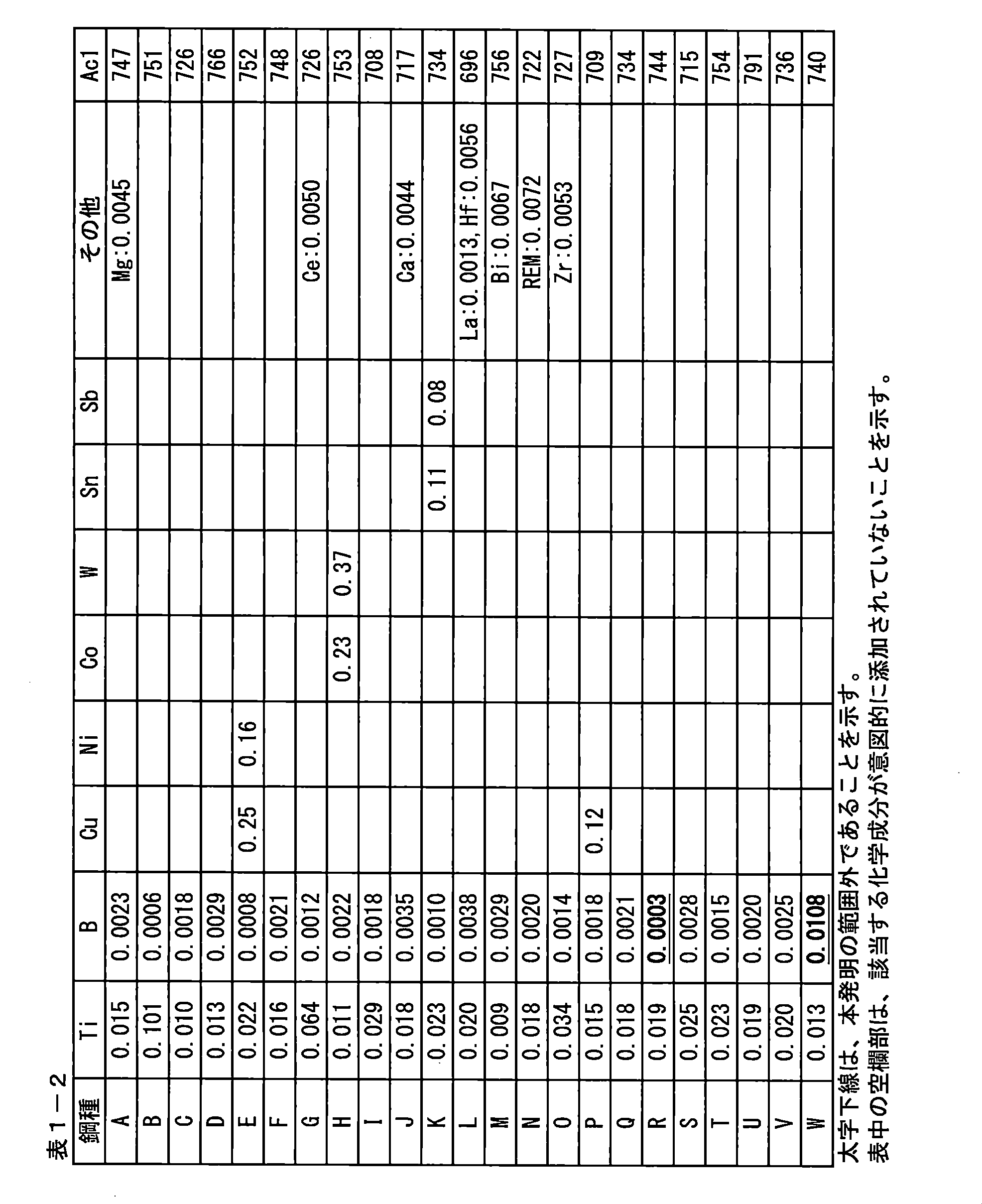
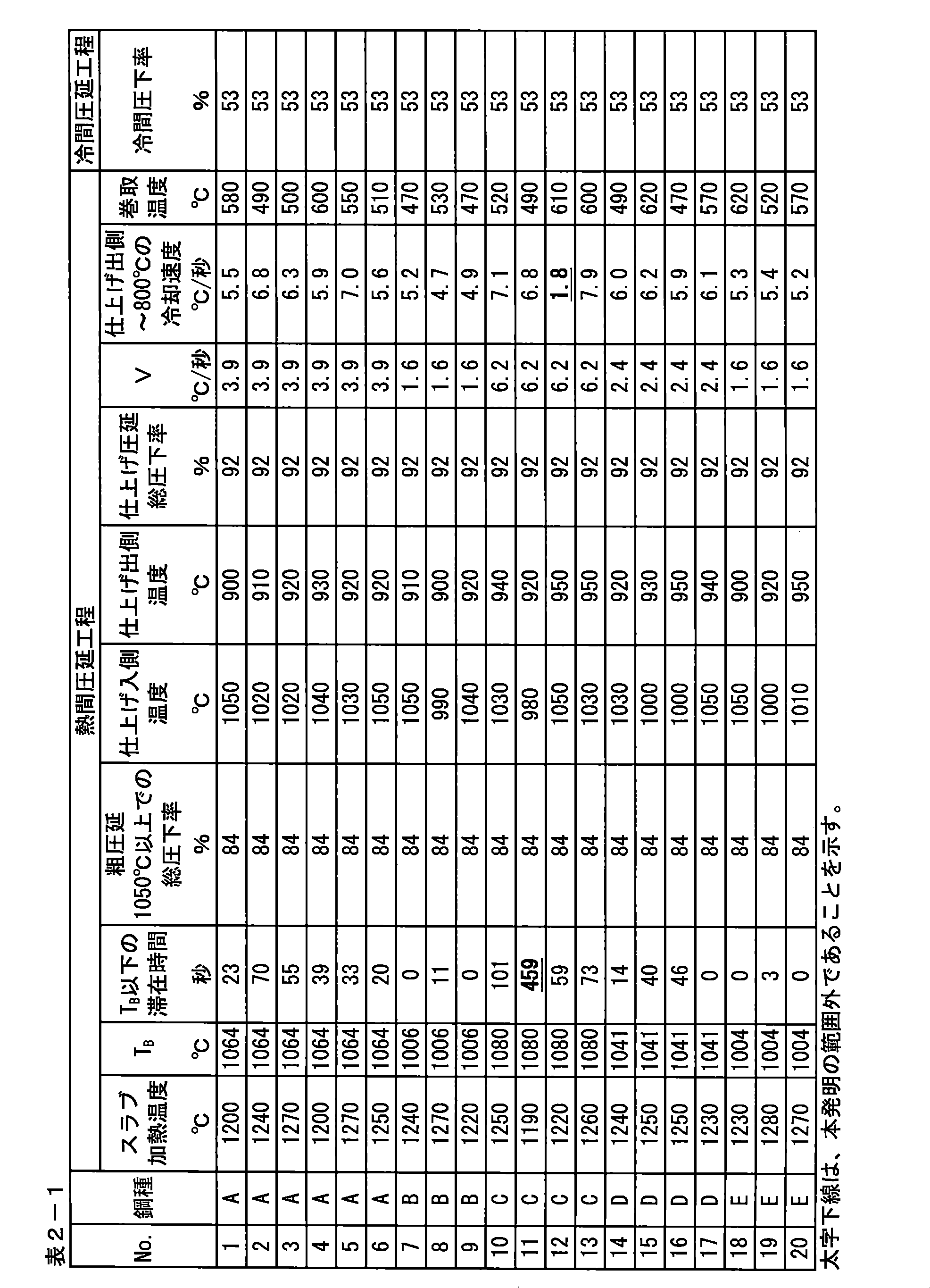
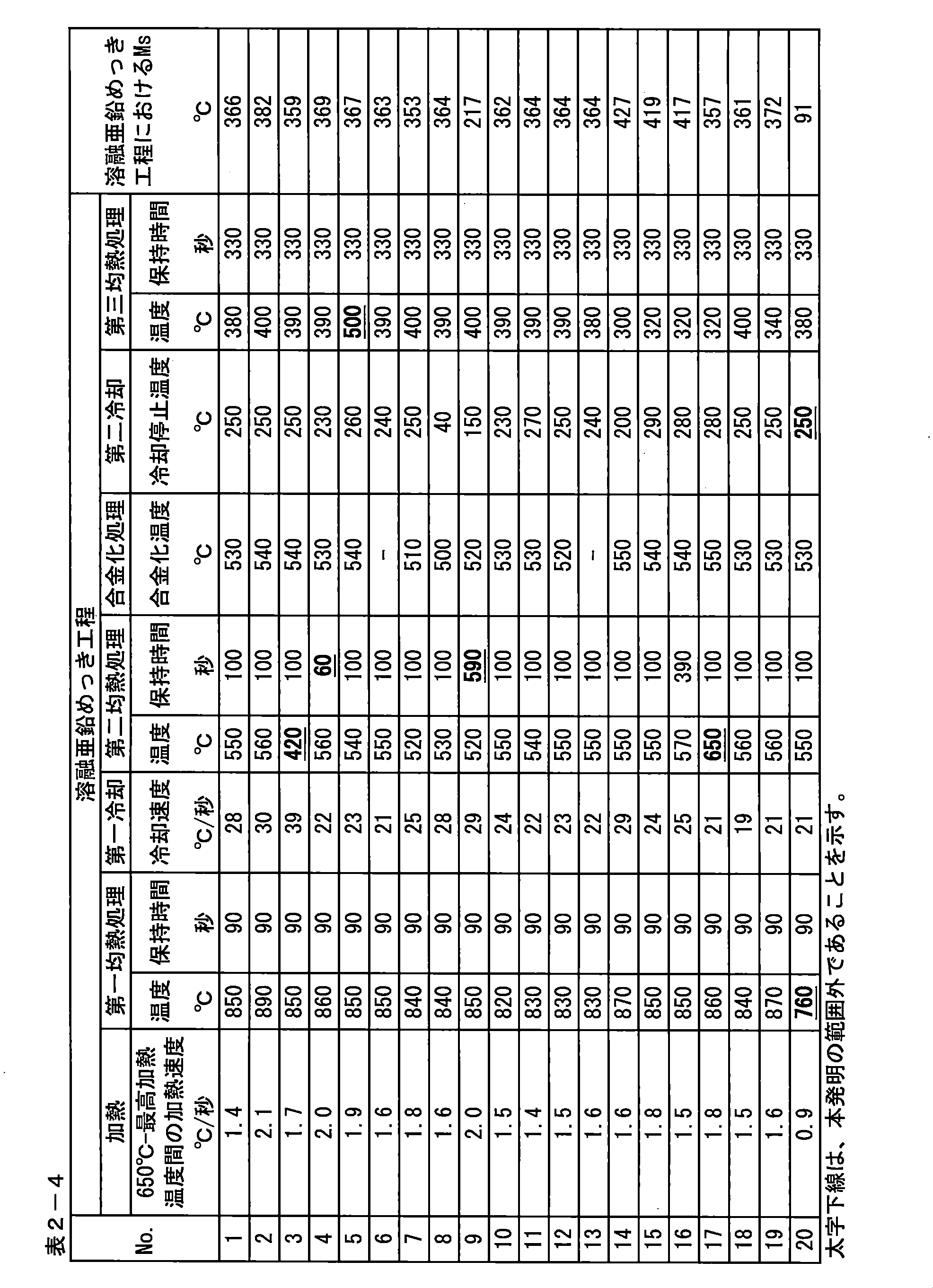
- Example A Steel having the chemical composition shown in Table 1 was cast to produce a slab. The balance other than the components shown in Table 1 is Fe and impurities. These slabs were hot rolled under the conditions shown in Table 2 to produce hot rolled steel sheets. Then, the hot rolled steel sheet was pickled to remove the scale on the surface. Then, it cold-rolled. Further, the obtained steel sheet was subjected to a continuous hot dip galvanizing treatment under the conditions shown in Table 2 and an appropriate alloying treatment. In each soaking treatment shown in Table 2, the temperature was maintained within the temperature range of ⁇ 10°C shown in Table 2. The component composition of the base steel sheet obtained by analyzing the sample collected from the manufactured hot-dip galvanized steel sheet was the same as that of the steel shown in Table 1.
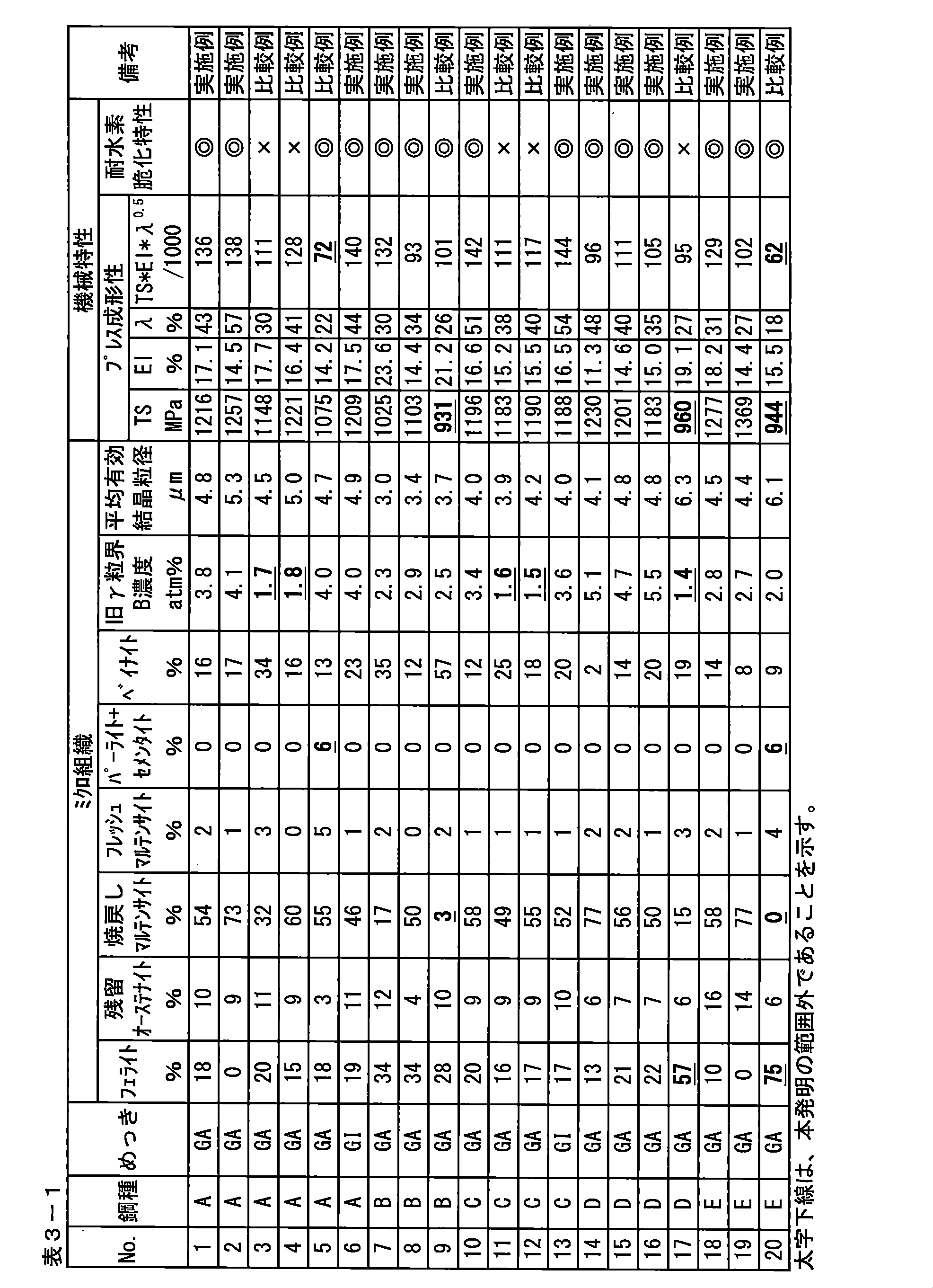
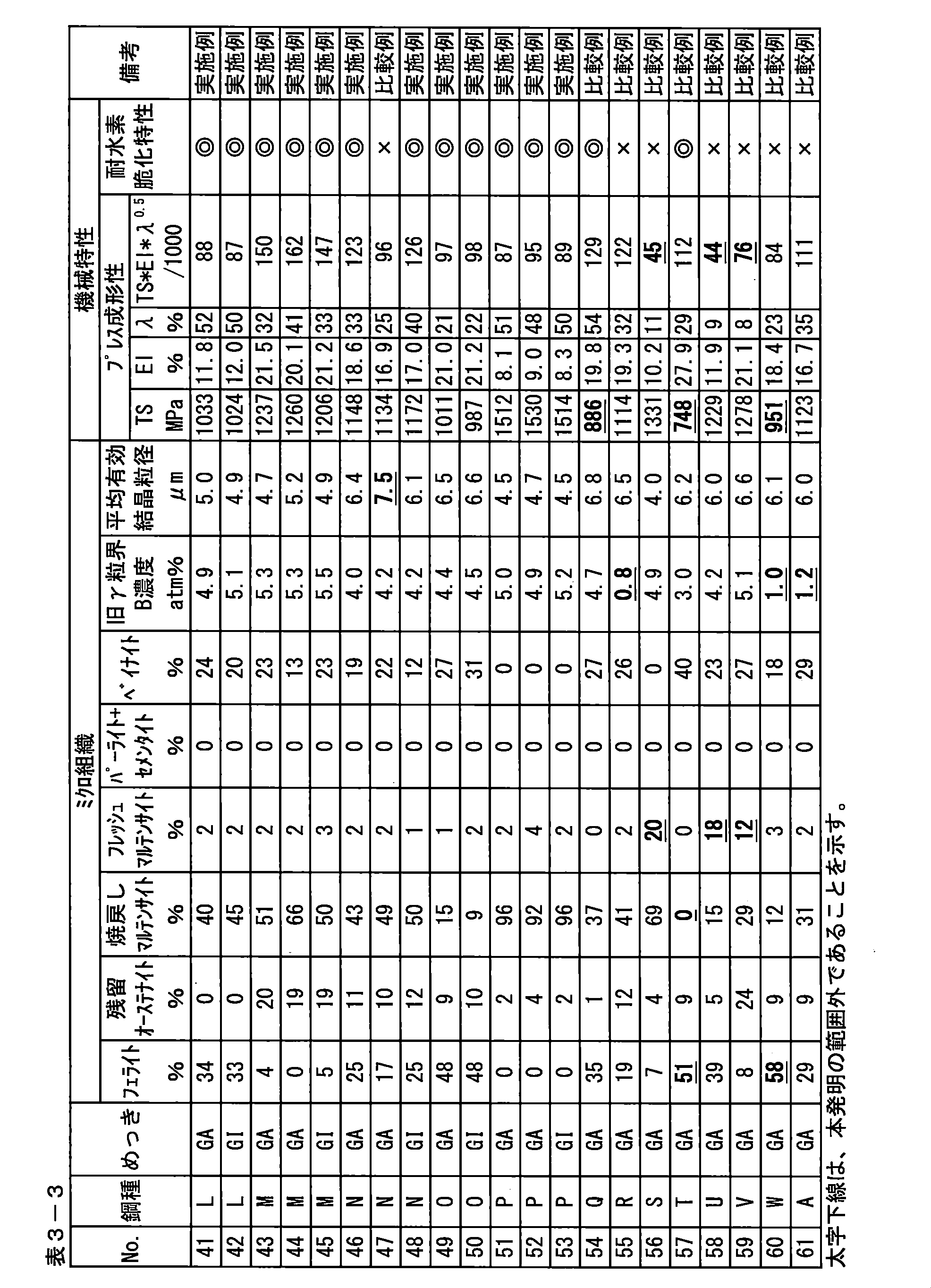
- the hot-dip galvanized steel sheets of the examples have a tensile strength of 980 MPa or more and a TS ⁇ El ⁇ 0.5 /1000 of 80 or more, and further have good hydrogen embrittlement resistance after plastic deformation. From this, it is understood that the press formability and the hydrogen embrittlement resistance after plastic working are excellent.
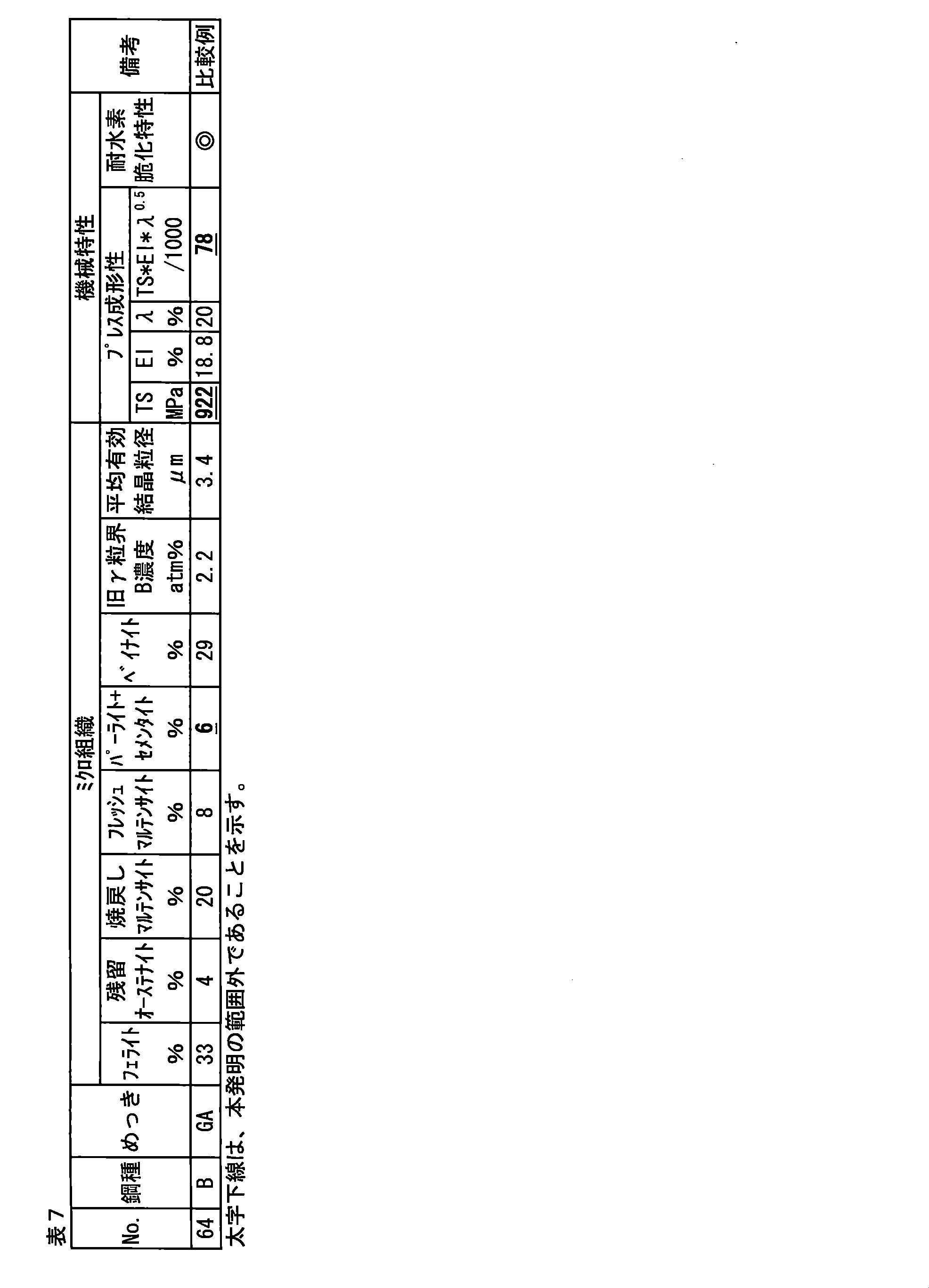
- Example C In this example, the relationship between the soaking treatment and the plating treatment was similarly examined. First, a slab having the chemical composition shown in Table 1 was produced, and then, as shown in Table 6, the slab of Example A was subjected to plating alloying treatment after the third soaking treatment, not after the second soaking treatment. A galvanized steel sheet was obtained in the same manner as in the case. The steel structure and mechanical properties of the obtained hot-dip galvanized steel sheet were examined by the same method as in Example A. The results are shown in Table 7. In each soaking treatment shown in Table 6, the temperature was maintained within the temperature range shown in Table 6 ⁇ 10°C.
Landscapes
- Chemical & Material Sciences (AREA)
- Engineering & Computer Science (AREA)
- Mechanical Engineering (AREA)
- Materials Engineering (AREA)
- Metallurgy (AREA)
- Organic Chemistry (AREA)
- Physics & Mathematics (AREA)
- Thermal Sciences (AREA)
- Chemical Kinetics & Catalysis (AREA)
- Crystallography & Structural Chemistry (AREA)
- Oil, Petroleum & Natural Gas (AREA)
- Heat Treatment Of Sheet Steel (AREA)
Abstract
Description
(i)連続溶融亜鉛めっき熱処理工程において、めっき処理またはめっき合金化処理の後に、Ms以下まで冷却することでマルテンサイトを生成させる。さらにその後、再加熱および等温保持を施すことでマルテンサイトを適度に焼き戻すとともに、残留オーステナイトを含む鋼板の場合には、さらに当該残留オーステナイトを安定化させることもできる。このような熱処理により、マルテンサイトがめっき処理またはめっき合金化処理により過剰に焼き戻されなくなるため、強度と延性のバランスが改善する。
(ii)水素脆化割れは、亀裂が結晶粒界に沿って進展することにより進行する。従って、結晶粒界を安定化させることが耐水素脆化割れの改善に有効である。そこで、オーステナイト粒界を安定化させる効果のあるボロン(B)に着目し、ボロンのオーステナイト粒界偏析濃度を増加させることを考えた。具体的には、連続溶融亜鉛めっき熱処理において、均熱工程および冷却工程の後にボロンがオーステナイト粒界に偏析しやすい480~600℃程度の温度域で等温保持を施すことで、ボロンの粒界偏析濃度が上昇することを見出した。しかしながら、めっき処理後あるいはマルテンサイト変態後にこのような処理を実施してしまうと、めっき層のパウダリング性が劣化してしまうことや、マルテンサイトが過剰に焼き戻されるために強度と延性のバランスが劣化してしまう。そこで、前記等温保持はめっき処理前に実施する必要がある。
(iii)上記ボロンの粒界偏析効果をより一層向上させるためには、連続溶融亜鉛めっき熱処理に至るまでの工程において、ボロン化物の析出・粗大化を抑制し、ボロンを固溶状態として存在させる必要がある。具体的には、熱間圧延工程においてボロン化物の析出・粗大化を抑制するために、熱間圧延および熱間圧延後の冷却条件を制約する。その上で、上記(i)および(ii)を満足する連続溶融亜鉛めっき熱処理を施すことで、耐水素脆化特性がより一層向上する。
(1)母材鋼板の少なくとも一方の表面に溶融亜鉛めっき層を有する溶融亜鉛めっき鋼板であって、前記母材鋼板が、質量%で、
C:0.050%~0.350%、
Si:0.10%~2.50%、
Mn:1.00%~3.50%、
P:0.050%以下、
S:0.0100%以下、
Al:0.001%~1.500%、
N:0.0100%以下、
O:0.0100%以下、
Ti:0.005%~0.200%、
B:0.0005%~0.0100%、
V:0%~1.00%、
Nb:0%~0.100%、
Cr:0%~2.00%、
Ni:0%~1.00%、
Cu:0%~1.00%、
Co:0%~1.00%、
Mo:0%~1.00%、
W:0%~1.00%、
Sn:0%~1.00%、
Sb:0%~1.00%、
Ca:0%~0.0100%、
Mg:0%~0.0100%、
Ce:0%~0.0100%、
Zr:0%~0.0100%、
La:0%~0.0100%、
Hf:0%~0.0100%、
Bi:0%~0.0100%、および
Ce、La以外のREM:0%~0.0100%
を含有し、残部がFeおよび不純物からなる化学組成を有し、
前記母材鋼板の表面から1/4厚の位置を中心とした1/8厚~3/8厚の範囲における鋼組織が、体積分率で、
フェライト:0%~50%、
残留オーステナイト:0%~30%、
焼き戻しマルテンサイト:5%以上、
フレッシュマルテンサイト:0%~10%、および
パーライトとセメンタイトの合計:0%~5%
を含有し、残部組織が存在する場合には、前記残部組織がベイナイトからなり、
旧オーステナイト粒界におけるB原子の濃度が2.0atm%以上であり、かつ、
平均有効結晶粒径が7.0μm以下であることを特徴とする、溶融亜鉛めっき鋼板。
(2)前記鋼組織が、さらに、体積分率で、残留オーステナイト:6%~30%を含有することを特徴とする、上記(1)に記載の溶融亜鉛めっき鋼板。
(3)(A)上記(1)に記載の化学組成を有するスラブを仕上げ圧延し、次いで巻き取ることを含む熱間圧延工程であって、以下の(A1)~(A4)の条件を満足する熱間圧延工程
(A1)スラブの抽出から仕上げ圧延入側までの間に、前記スラブが温度TB以下に滞在する時間が300秒以下であること、

(A2)仕上げ圧延において、仕上げ圧延入側温度が900~1050℃であり、仕上げ圧延出側温度が850℃~1000℃であり、総圧下率が70~95%であること、
(A3)仕上げ圧延後の鋼板の冷却において、仕上げ圧延出側温度~800℃の間の平均冷却速度がV℃/秒以上であること、

(A4)巻取温度が450~680℃であること、ならびに
(B)得られた鋼板を加熱して第一均熱処理すること、第一均熱処理された鋼板を第一冷却し次いで第二均熱処理すること、第二均熱処理された鋼板を溶融亜鉛めっき浴に浸漬すること、めっきを施された鋼板を第二冷却すること、および第二冷却された鋼板を加熱し次いで第三均熱処理することを含む溶融亜鉛めっき工程であって、以下の(B1)~(B7)の条件を満足する溶融亜鉛めっき工程
(B1)第一均熱処理前の鋼板加熱時において、650℃~Ac1+30℃以上950℃以下の最高加熱温度までの平均加熱速度が0.5℃/秒~10.0℃/秒であること、
(B2)前記鋼板を前記最高加熱温度で1秒~1000秒間保持すること(第一均熱処理)、
(B3)第一冷却における700~600℃までの温度範囲の平均冷却速度が10~100℃/秒であること、
(B4)第一冷却された鋼板を480~600℃の範囲で80秒~500秒間保持すること(第二均熱処理)、
(B5)第二均熱処理された鋼板を溶融亜鉛めっき浴に浸漬した後、合金化処理を施す場合には、前記合金化処理は460~600℃の範囲で行われること、
(B6)第二冷却がMs-50℃以下まで行われること、
(B7)第二冷却された鋼板を200~420℃の温度域に加熱し、次いで前記温度域で5~1000秒間保持すること(第三均熱処理)
を含むことを特徴とする、上記(1)または(2)に記載の溶融亜鉛めっき鋼板の製造方法。
本発明の実施形態に係る溶融亜鉛めっき鋼板は、母材鋼板の少なくとも一方の表面に溶融亜鉛めっき層を有し、前記母材鋼板が、質量%で、
C:0.050%~0.350%、
Si:0.10%~2.50%、
Mn:1.00%~3.50%、
P:0.050%以下、
S:0.0100%以下、
Al:0.001%~1.500%、
N:0.0100%以下、
O:0.0100%以下、
Ti:0.005%~0.200%、
B:0.0005%~0.0100%、
V:0%~1.00%、
Nb:0%~0.100%、
Cr:0%~2.00%、
Ni:0%~1.00%、
Cu:0%~1.00%、
Co:0%~1.00%、
Mo:0%~1.00%、
W:0%~1.00%、
Sn:0%~1.00%、
Sb:0%~1.00%、
Ca:0%~0.0100%、
Mg:0%~0.0100%、
Ce:0%~0.0100%、
Zr:0%~0.0100%、
La:0%~0.0100%、
Hf:0%~0.0100%、
Bi:0%~0.0100%、および
Ce、La以外のREM:0%~0.0100%
を含有し、残部がFeおよび不純物からなる化学組成を有し、
前記母材鋼板の表面から1/4厚の位置を中心とした1/8厚~3/8厚の範囲における鋼組織が、体積分率で、
フェライト:0%~50%、
残留オーステナイト:0%~30%、
焼き戻しマルテンサイト:5%以上、
フレッシュマルテンサイト:0%~10%、および
パーライトとセメンタイトの合計:0%~5%
を含有し、残部組織が存在する場合には、前記残部組織がベイナイトからなり、
旧オーステナイト粒界におけるB原子の濃度が2.0atm%以上であり、かつ、
平均有効結晶粒径が7.0μm以下であることを特徴としている。
まず、本発明の実施形態に係る母材鋼板(以下、単に鋼板とも称する)の化学組成を上述のように限定した理由について説明する。なお、本明細書において化学組成を規定する「%」は特に断りのない限り全て「質量%」である。また、本明細書において、数値範囲を示す「~」とは、特に断りがない場合、その前後に記載される数値を下限値および上限値として含む意味で使用される。
Cは、鋼板強度確保のために必須の元素である。0.050%未満では所要の高強度が得られないので、C含有量は0.050%以上とする。C含有量は0.070%以上、0.085%以上または0.100%以上であってもよい。一方、0.350%を超えると、加工性や溶接性が低下するので、C含有量は0.350%以下とする。C含有量は0.340%以下、0.320%以下または0.300%以下であってもよい。
Siは、鉄炭化物の生成を抑制し、強度と成形性の向上に寄与する元素であるが、過度の添加は鋼板の溶接性を劣化させる。従って、その含有量は0.10~2.50%とする。Si含有量は0.20%以上、0.30%以上、0.40%以上もしくは0.50%以上であってもよく、および/または2.20%以下、2.00%以下もしくは1.90%以下であってもよい。
Mn(マンガン)は強力なオーステナイト安定化元素であり、鋼板の高強度化に有効な元素である。過度の添加は溶接性や低温靭性を劣化させる。従って、その含有量は1.00~3.50%とする。Mn含有量は1.10%以上、1.30%以上もしくは1.50%以上であってもよく、および/または3.30%以下、3.10%以下もしくは3.00%以下であってもよい。
P(リン)は固溶強化元素であり、鋼板の高強度化に有効な元素であるが、過度の添加は溶接性および靱性を劣化させる。従って、P含有量は0.050%以下と制限する。好ましくは0.045%以下、0.035%以下または0.020%以下である。ただし、P含有量を極度に低減させるには、脱Pコストが高くなるため、経済性の観点から下限を0.001%とすることが好ましい。
S(硫黄)は不純物として含有される元素であり、鋼中でMnSを形成して靱性や穴広げ性を劣化させる。したがって、靱性や穴広げ性の劣化が顕著でない範囲として、S含有量を0.0100%以下と制限する。好ましくは0.0050%以下、0.0040%以下または0.0030%以下である。ただし、S含有量を極度に低減させるには、脱硫コストが高くなるため、経済性の観点から下限を0.0001%とすることが好ましい。
Al(アルミニウム)は、鋼の脱酸のため少なくとも0.001%を添加する。しかし、過剰に添加しても効果が飽和し徒にコスト上昇を招くばかりか、鋼の変態温度を上昇させ熱間圧延時の負荷を増大させる。従ってAl量は1.500%を上限とする。好ましくは1.200%以下、1.000%以下または0.800%以下である。
N(窒素)は不純物として含有される元素であり、その含有量が0.0100%を超えると鋼中に粗大な窒化物を形成して曲げ性や穴広げ性を劣化させる。したがって、N含有量は0.0100%以下と制限する。好ましくは0.0080%以下、0.0060%以下または0.0050%以下である。ただし、N含有量を極度に低減させるには、脱Nコストが高くなるため、経済性の観点から下限を0.0001%とすることが好ましい。
O(酸素)は不純物として含有される元素であり、その含有量が0.0100%を超えると鋼中に粗大な酸化物を形成して曲げ性や穴広げさせる。従って、O含有量は0.0100%以下と制限する。好ましくは0.0080%以下、0.0060%以下または0.0050%以下である。ただし、製造コストの観点から、下限を0.0001%とすることが好ましい。
Ti(チタン)は鋼中に不純物として存在するN(窒素)をTiNとして固定し、B(ホウ素)が窒化物として析出することを抑制するために添加する。上記効果を得るには少なくとも0.005%の添加を必要とする。一方、過度に添加すると飽和するばかりか粗大な炭化チタン(TiC)を形成し、鋼板の延性や靭性を劣化させる。そのため添加量の上限は0.200%とする。Ti含有量は0.008%以上、0.010%以上もしくは0.013%以上であってもよく、および/または0.150%以下、0.120%以下もしくは0.100%以下であってもよい。
B(ホウ素)は旧オーステナイト粒界に偏析し、旧オーステナイト粒界のエネルギーを低下させることにより、鋼板の焼き入れ性を向上させる。さらに、本発明においては、旧オーステナイト粒界にB原子が偏析し、旧オーステナイト粒界の剥離強度を高めるため、耐水素脆性を向上させる。上記効果を得るには少なくとも0.0005%以上の添加を要する。一方、過度に添加すると効果が飽和するばかりか鋼中にホウ化物を形成し、鋼板の焼き入れ性を低下させる。そのため添加量の上限は0.0100%とする。B含有量は0.0006%以上、0.0008%以上もしくは0.0010%以上であってもよく、および/または0.0060%以下、0.0040%以下もしくは0.0035%以下であってもよい。
V(バナジウム)、Nb(ニオブ)、Cr(クロム)、Ni(ニッケル)、Cu(銅)、Co(コバルト)、Mo(モリブデン)、W(タングステン)、Sn(錫)およびSb(アンチモン)はいずれも鋼板の高強度化に有効な元素である。このため、必要に応じてこれらの元素のうち1種または2種以上を添加してもよい。しかしこれらの元素を過度に添加すると効果が飽和し徒にコストの増大を招く。従って、その含有量はV:0%~1.00%、Nb:0%~0.100%、Cr:0%~2.00%、Ni:0%~1.00%、Cu:0%~1.00%、Co:0%~1.00%、Mo:0%~1.00%、W:0%~1.00%、Sn:0%~1.00%、Sb:0%~1.00%とする。各元素は0.005%以上または0.010%以上であってもよい。
Ca(カルシウム)、Mg(マグネシウム)、Ce(セリウム)、Zr(ジルコニウム)、La(ランタン)、Hf(ハフニウム)およびCe、La以外のREM(希土類元素)は鋼中介在物の微細分散化に寄与する元素であり、Bi(ビスマス)は鋼中におけるMn、Si等の置換型合金元素のミクロ偏析を軽減する元素である。それぞれ鋼板の加工性向上に寄与することから、必要に応じてこれらの元素のうち1種または2種以上を添加してもよい。ただし過度の添加は延性の劣化を引き起こす。従ってその含有量は0.0100%を上限とする。また、各元素は0.0005%以上または0.0010%以上であってもよい。
次に、本発明の実施形態に係る母材鋼板の内部組織の限定理由について説明する。
フェライトは延性に優れるが軟質な組織である。鋼板の伸びを向上させるために、要求される強度または延性に応じて含有させてもよい。但し、過度に含有すると所望の鋼板強度を確保することが困難となる。従って、その含有量は体積分率で50%を上限とし、45%以下、40%以下または35%以下であってもよい。フェライト含有量は体積分率で0%であってもよく、例えば、3%以上、5%以上または10%以上であってもよい。
焼戻しマルテンサイトは高強度かつ強靭な組織であり、本発明において必須となる金属組織である。強度、延性、穴広げ性を高い水準でバランスさせるために体積分率で少なくとも5%以上を含有させる。好ましくは体積分率で10%以上であり、15%以上または20%以上であってもよい。例えば、焼戻しマルテンサイト含有量は体積分率で96%以下、85%以下、80%以下または70%以下であってもよい。
本発明において、フレッシュマルテンサイトとは、焼き戻されていないマルテンサイトすなわち炭化物を含まないマルテンサイトを言うものである。このフレッシュマルテンサイトは脆い組織であるため、塑性変形時に破壊の起点となり、鋼板の局部延性を劣化させる。従って、その含有量は体積分率で0~10%とする。より好ましくは0~8%または0~5%である。フレッシュマルテンサイト含有量は体積分率で1%以上または2%以上であってもよい。
残留オーステナイトは、鋼板の変形中に加工誘起変態によりマルテンサイトへと変態するTRIP効果により鋼板の延性を改善する。一方、多量の残留オーステナイトを得るにはC等の合金元素を多量に含有させる必要がある。そのため、残留オーステナイトの上限値は体積分率で30%とし、25%以下または20%以下であってもよい。但し、鋼板の延性を向上させたい場合は、その含有量は体積分率で6%以上とすることが好ましく、8%以上または10%以上であってもよい。また、残留オーステナイトの含有量を6%以上とする場合には、母材鋼板中のSi含有量は質量%で0.50%以上とすることが好ましい。
パーライトは硬質かつ粗大なセメンタイトを含み、塑性変形時に破壊の起点となるため、鋼板の局部延性を劣化させる。従って、その含有量はセメンタイトと合わせて体積分率で0~5%とし、0~3%または0~2%であってもよい。
本発明の実施形態に係る母材鋼板は、旧オーステナイト粒界におけるB原子の濃度が2.0atm%以上である。本発明においては、B原子は旧オーステナイト粒界に偏析することで、旧オーステナイト粒界の剥離強度を高め、耐水素脆性を向上させる。2.0atm%を下回る場合、耐水素脆化特性の改善効果が十分に得られない。旧オーステナイト粒界におけるB原子の濃度は2.5atm%以上または3.0atm%以上であってもよい。
本発明の実施形態に係る母材鋼板は、平均有効結晶粒径が7.0μm以下である。本発明において、平均有効結晶粒径とは、隣接する粒の方位差が15度以上のものを1つの結晶粒と定義した場合に算出される値を言うものである。B原子による旧オーステナイト粒界の剥離強度向上に加えて、当該平均有効結晶粒径を小さくすることで、耐水素脆化特性を向上させることができる。平均有効結晶粒径が7.0μmを超えると、耐水素脆化特性の改善効果が十分に得られない。当該平均有効結晶粒径は6.0μm以下、5.5μm以下または5.0μm以下であってもよい。

本発明の実施形態に係る母材鋼板は、少なくとも一方の表面、好ましくは両方の表面に溶融亜鉛めっき層を有する。当該めっき層は、当業者に公知の任意の組成を有する溶融亜鉛めっき層または合金化溶融亜鉛めっき層であってよく、Zn以外にもAl等の添加元素を含んでいてよい。また、当該めっき層の付着量は、特に制限されず一般的な付着量であってよい。
次に、本発明の実施形態に係る溶融亜鉛めっき鋼板の製造方法について説明する。以下の説明は、本発明の実施形態に係る溶融亜鉛めっき鋼板を製造するための特徴的な方法の例示を意図するものであって、当該溶融亜鉛めっき鋼板を以下に説明するような製造方法によって製造されるものに限定することを意図するものではない。
(A1)スラブの抽出から仕上げ圧延入側までの間に、前記スラブが温度TB以下に滞在する時間が300秒以下であること、

(A2)仕上げ圧延において、仕上げ圧延入側温度が900~1050℃であり、仕上げ圧延出側温度が850℃~1000℃であり、総圧下率が70~95%であること、
(A3)仕上げ圧延後の鋼板の冷却において、仕上げ圧延出側温度~800℃の間の平均冷却速度がV℃/秒以上であること、

(A4)巻取温度が450~680℃であること、ならびに
(B)得られた鋼板を加熱して第一均熱処理すること、第一均熱処理された鋼板を第一冷却し次いで第二均熱処理すること、第二均熱処理された鋼板を溶融亜鉛めっき浴に浸漬すること、めっきを施された鋼板を第二冷却すること、および第二冷却された鋼板を加熱し次いで第三均熱処理することを含む溶融亜鉛めっき工程であって、以下の(B1)~(B7)の条件を満足する溶融亜鉛めっき工程
(B1)第一均熱処理前の鋼板加熱時において、650℃~Ac1+30℃以上950℃以下の最高加熱温度までの平均加熱速度が0.5℃/秒~10.0℃/秒であること、
(B2)前記鋼板を前記最高加熱温度で1秒~1000秒間保持すること(第一均熱処理)、
(B3)第一冷却における700~600℃までの温度範囲の平均冷却速度が10~100℃/秒であること、
(B4)第一冷却された鋼板を480~600℃の範囲で80秒~500秒間保持すること(第二均熱処理)、
(B5)第二均熱処理された鋼板を溶融亜鉛めっき浴に浸漬した後、合金化処理を施す場合には、前記合金化処理は460~600℃の範囲で行われること、
(B6)第二冷却がMs-50℃以下まで行われること、
(B7)第二冷却された鋼板を200~420℃の温度域に加熱し、次いで前記温度域で5~1000秒間保持すること(第三均熱処理)
を含むことを特徴としている。
まず、熱間圧延工程では、母材鋼板に関して上で説明した化学組成と同じ化学組成を有するスラブが熱間圧延前に加熱される。スラブの加熱温度は、特に限定されないが、ホウ化物や炭化物などを十分溶解するため、一般的には1150℃以上とすることが好ましい。なお使用する鋼スラブは、製造性の観点から連続鋳造法にて鋳造することが好ましいが、造塊法、薄スラブ鋳造法で製造してもよい。
本方法では、鋳造設備から抽出されたスラブが仕上げ圧延入側までの間に以下の式(1)で表される温度TB以下に滞在する時間が300秒以下に制御される。TBは窒化ボロン(BN)が析出する熱力学的駆動力が発生する温度であり、鋼がTB以下の温度に長時間滞在した場合、BNの析出が開始し、十分な固溶Bが得られなくなり、最終製品におけるオーステナイト粒界へのBの偏析量が減少する。従って、TB以下に滞在する時間は300秒以下に制限し、例えば200秒以下または150秒以下であってもよい。

本方法では、例えば、加熱されたスラブに対し、板厚調整等のために、仕上げ圧延の前に粗圧延を施してもよい。このような粗圧延は、特に限定されないが、1050℃以上での総圧下率が60%以上となるように実施することが好ましい。総圧下率が60%未満であると、熱間圧延中の再結晶が不十分となるため、熱延板組織の不均質化につながる場合がある。上記の総圧下率は、例えば、90%以下であってもよい。
仕上げ圧延は、仕上げ圧延入側温度が900~1050℃、仕上げ圧延出側温度が850℃~1000℃、および総圧下率が70~95%の条件を満足する範囲で実施される。仕上げ圧延入側温度が900℃を下回るか、仕上げ圧延出側温度が850℃を下回るか、または総圧下率が95%を上回った場合、熱延鋼板の集合組織が発達するため、最終製品板における異方性が顕在化する。一方、仕上げ圧延入側温度が1050℃を上回るか、仕上げ圧延出側温度が1000℃を上回るか、または総圧下率が70%を下回った場合、熱延鋼板の結晶粒径が粗大化し、最終製品板組織の粗大化を引き起こし、平均有効結晶粒径が所定の範囲を満足しない。例えば、仕上げ圧延入側温度は950℃以上であってもよい。仕上げ圧延出側温度は900℃以上であってもよい。総圧下率は75%以上または80%以上であってもよい。
仕上げ圧延後、ボロンが窒化物として析出することを抑制するために、得られた鋼板を仕上げ圧延出側温度~800℃の範囲においてV℃/秒以上の平均冷却速度で冷却する。冷却速度がV℃/秒を下回った場合、BNの析出に起因して固溶状態として存在するボロンが減少するため、最終製品におけるオーステナイト粒界へのボロンの偏析量が減少する。ここで、Vは以下の式(2)で表される。

巻取温度は450~680℃とする。巻取温度は450℃を下回ると、熱延板強度が過大となり、冷間圧延性を損なう場合がある。一方、巻取温度が680℃を上回ると、セメンタイトが粗大化し、未溶解のセメンタイトが残存するために加工性を損なう場合がある。また、熱延鋼板中に粗大なホウ化物が析出し、固溶状態として存在するボロンが減少するため、最終製品におけるオーステナイト粒界へのボロンの偏析量が減少する。巻取温度は470℃以上であってよく、および/または650℃以下であってもよい。
本方法において、熱間圧延および/または酸洗後は、そのまま連続溶融亜鉛めっきラインで熱処理を施してもよいし、冷間圧延を施した後、連続溶融亜鉛めっきラインで熱処理してもよい。冷間圧延を施す場合、冷間圧下率は25%以上または30%以上とすることが好ましい。一方、過度の圧下は圧延加重が過大となり冷延ミルの負荷増大を招くため、その上限は75%または70%とすることが好ましい。
[650℃~Ac1+30℃以上950℃以下の最高加熱温度までの平均加熱速度:0.5~10.0℃/秒]
本方法においては、熱間加熱工程後、得られた鋼板は、溶融亜鉛めっき工程においてめっき処理を施される。当該溶融亜鉛めっき工程では、まず、鋼板が加熱され、第一均熱処理にさらされる。この鋼板加熱時において、650℃~Ac1+30℃以上950℃以下の最高加熱温度までの平均加熱速度は0.5~10.0℃/秒に制限される。平均加熱速度が10.0℃/秒を超えると、フェライトの再結晶が十分進行せず、鋼板の伸びが劣化する場合がある。一方、平均加熱速度が0.5℃/秒を下回ると、オーステナイトが粗大化するため、最終的に得られる鋼組織が粗大なものとなる場合がある。この平均加熱速度は1.0℃/秒以上であってもよく、および/または8.0℃/秒以下もしくは5.0℃/秒以下であってもよい。本発明において、「平均加熱速度」とは、650℃と最高加熱温度との差を650℃から最高加熱温度に至るまでの経過時間で割ることにより得られた値をいうものである。
十分にオーステナイト化を進行させるため、鋼板を少なくともAc1+30℃以上に加熱し、当該温度(最高加熱温度)で均熱処理を行う。但し、過剰に加熱温度を上げると、オーステナイト粒径の粗大化による靭性の劣化を招くばかりか、焼鈍設備の損傷にも繋がる。そのため上限は950℃、好ましくは900℃とする。均熱時間が短いとオーステナイト化が十分進行しないため、少なくとも1秒以上とする。好ましくは30秒以上または60秒以上である。一方、均熱時間が長すぎると生産性を阻害することから上限は1000秒、好ましくは500秒とする。均熱中は鋼板を必ずしも一定温度に保持する必要はなく、上記条件を満足する範囲で変動しても構わない。第一均熱処理ならびに後述する第二均熱処理および第三均熱処理における「保持」とは、各均熱処理において規定される上下限値を超えない範囲で温度を所定の温度±20℃、好ましくは±10℃の範囲内に維持することを意味するものである。したがって、例えば、徐々に加熱しまたは徐々に冷却することで、各均熱処理において規定される温度範囲内を40℃、好ましくは20℃を超えて変動する加熱または冷却操作は、本発明の実施形態に係る第一、第二および第三均熱処理には包含されない。
最高加熱温度で保持した後は第一冷却を行う。冷却停止温度は、続く第二均熱処理の温度である480℃~600℃である。700℃~600℃の温度範囲の平均冷却速度は10~100℃/秒とする。平均冷却速度が10℃/秒を下回ると所望のフェライト分率が得られない場合がある。平均冷却速度は15℃/秒以上または20℃/秒以上であってもよい。また、平均冷却速度は80℃/秒以下または60℃/秒以下であってもよい。また、本発明において、「700~600℃の温度範囲の平均冷却速度」とは、700℃と600との差である100℃を700℃から600℃に至るまでの経過時間で割ることにより得られた値をいうものである。
480℃~600℃の範囲で80~500秒間保持する第二均熱処理は、オーステナイト粒界におけるB原子の偏析濃度をより一層上昇させるために行う。第二均熱処理の温度が480℃を下回るかまたは600℃を上回る場合、あるいは、保持時間が80秒を下回る場合、オーステナイト粒径へのB原子の偏析が十分進行しない。一方、保持時間が500秒を上回ると、ベイナイト変態が過剰に進行するため、本発明の実施形態に係る金属組織を満足することができない。第二均熱処理の温度は500℃以上であってもよく、および/または570℃以下であってもよい。また、保持時間は100秒以上であってもよく、および/または400秒以下であってもよい。これに関連して、単に第二均熱処理を適切に実施したとしても、熱間圧延工程において十分な固溶Bを確保できていない場合には、最終製品におけるオーステナイト粒界へのBの偏析量は減少してしまう。したがって、本発明の実施形態に係る溶融亜鉛めっき鋼板の製造方法では、最終製品におけるオーステナイト粒界へのBの偏析量を増加させるためには、熱間圧延工程において上で説明した(A1)、(A3)及び(A4)の条件を満たしつつ、溶融亜鉛めっき工程において第二均熱処理を適切に実施することが重要である。
なお、本方法では、本発明の実施形態に係る溶融亜鉛めっき鋼板を製造するために、第二均熱処理の後、所定のめっき処理を行う必要があるが、仮に第二均熱処理をめっき浴浸漬の後に行うと、めっき層の耐パウダリング性が著しく劣化する場合がある。これは、めっき浴浸漬後に480℃以上で80秒以上の熱処理を行うと、めっきと鋼板の間の合金化反応が過度に進行し、めっき被膜内の構造が、延性に優れるδ相から延性が劣位なΓ相に変化するためである。
溶融亜鉛めっき層を形成した溶融亜鉛めっき鋼板に対して、必要に応じて合金化処理を行ってもよい。その場合、合金化処理温度が460℃未満であると、合金化速度が遅くなり生産性を損なうばかりでなく、合金化処理むらが発生するので、合金化処理温度は460℃以上とする。一方、合金化処理温度が600℃を超えると、合金化が過度に進行して、鋼板のめっき密着性が劣化する場合がある。また、パーライト変態が進み所望の金属組織を得られない場合がある。したがって、合金化処理温度は600℃以下とする。合金化処理温度は、500℃以上であってもよく、または580℃以下であってもよい。
めっき処理またはめっき合金化処理後の鋼板にオーステナイトの一部ないしは大部分をマルテンサイトに変態させるため、マルテンサイト変態開始温度(Ms)-50℃以下まで冷却する第二冷却を行う。ここで生成したマルテンサイトは後の再加熱および第三均熱処理により焼戻され、焼戻しマルテンサイトとなる。冷却停止温度がMs-50℃を超えると、焼戻しマルテンサイトが十分形成されないため、所望の金属組織が得られない。鋼板の延性を改善するために残留オーステナイトを活用したい場合には、冷却停止温度に下限を設けることが望ましい。具体的には、冷却停止温度はMs-50℃~Ms-180℃の範囲に制御することが望ましい。
第二冷却の後、200℃~420℃の範囲に再加熱し第三均熱処理を行う。この工程では、第二冷却時に生成したマルテンサイトを焼き戻す。保持温度が200℃未満または保持時間が5秒未満の場合、焼き戻しが十分に進行しない。一方、ベイナイト変態が十分進行しないため、所望の残留オーステナイト量を得ることが困難となる。一方、保持温度が420℃を超えるか、あるいは保持時間が1000秒を超えると、マルテンサイトが過剰に焼き戻されるとともに、ベイナイト変態が過剰に進行するために所望の強度および金属組織を得ることが困難となる。第三均熱処理の温度は240℃以上であってもよく、400℃以下であってもよい。また、保持時間は15秒以上または100秒以上であってもよく、600秒以下であってもよい。
表1に示す化学組成を有する鋼を鋳造し、スラブを作製した。表1に示す成分以外の残部はFeおよび不純物である。これらのスラブを表2に示す条件で熱間圧延を行い、熱延鋼板を製造した。その後、熱延鋼板を酸洗し、表面のスケールを除去した。その後、冷間圧延した。さらに、得られた鋼板について、表2に示す条件で連続溶融亜鉛めっき処理を実施し、適宜合金化処理を行った。表2に示す各均熱処理では、温度は表2に示される温度±10℃の範囲内に維持された。製造した溶融亜鉛めっき鋼板から採取した試料を分析した母材鋼板の成分組成は、表1に示す鋼の成分組成と同等であった。






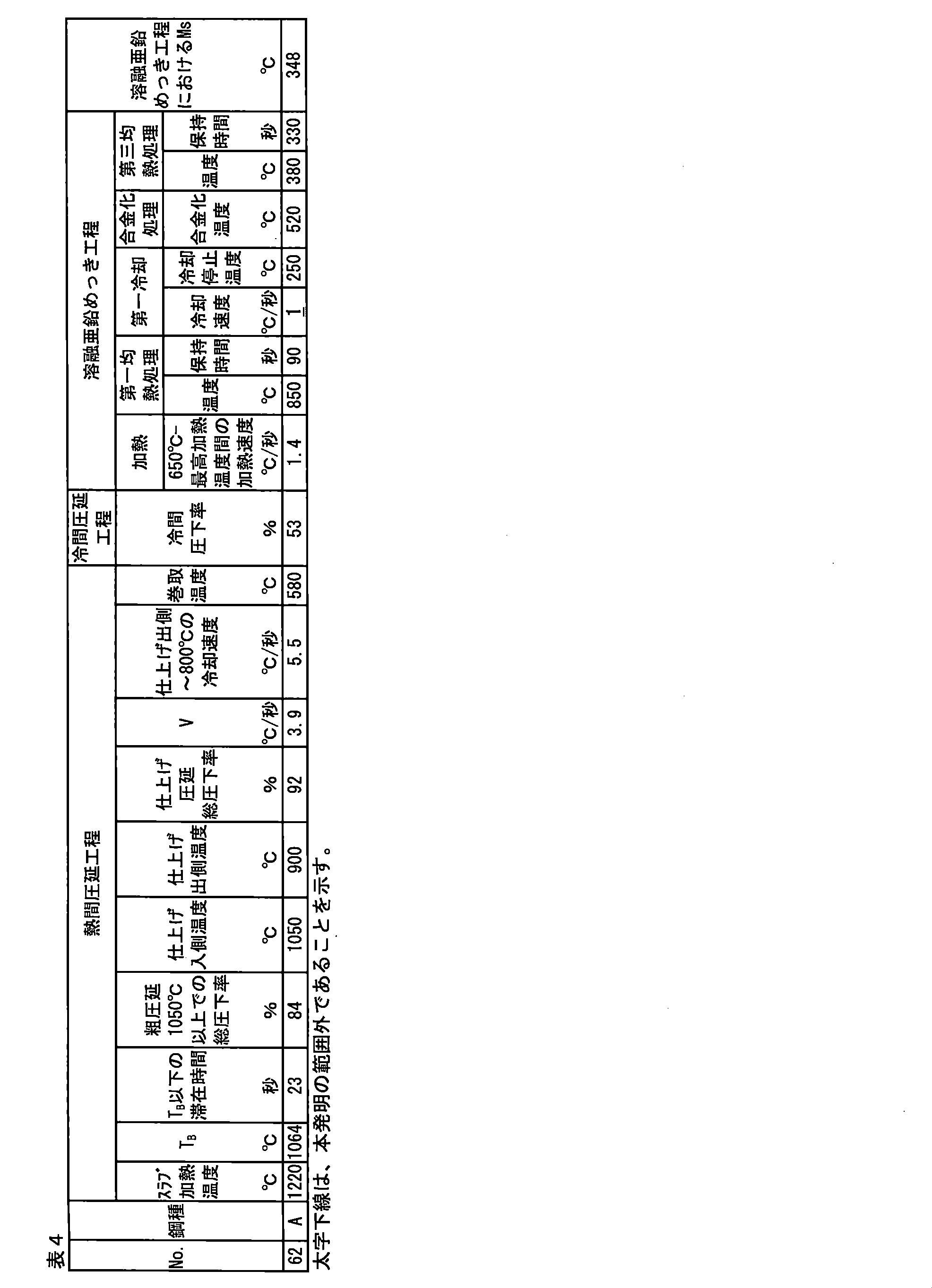
本例では、特定の均熱処理の有無について検討した。まず、表1に示す化学組成を有するスラブを作製し、次いで表4に示すように第一冷却を徐冷とし、第二均熱処理を省略したこと以外は例Aの場合と同様にして、溶融亜鉛めっき鋼板を得た。得られた溶融亜鉛めっき鋼板における鋼組織並びに機械特性は、例Aの場合と同様の方法により調べた。その結果を表5に示す。表4に示す各均熱処理では、温度は表4に示される温度±10℃の範囲内に維持された。

本例では、同様に均熱処理とめっき処理の関係について検討した。まず、表1に示す化学組成を有するスラブを作製し、次いで表6に示すように、第二均熱処理の後ではなく第三均熱処理の後にめっき合金化処理を施したこと以外は例Aの場合と同様にして、溶融亜鉛めっき鋼板を得た。得られた溶融亜鉛めっき鋼板における鋼組織並びに機械特性は、例Aの場合と同様の方法により調べた。その結果を表7に示す。表6に示す各均熱処理では、温度は表6に示される温度±10℃の範囲内に維持された。

Claims (3)
- 母材鋼板の少なくとも一方の表面に溶融亜鉛めっき層を有する溶融亜鉛めっき鋼板であって、前記母材鋼板が、質量%で、
C:0.050%~0.350%、
Si:0.10%~2.50%、
Mn:1.00%~3.50%、
P:0.050%以下、
S:0.0100%以下、
Al:0.001%~1.500%、
N:0.0100%以下、
O:0.0100%以下、
Ti:0.005%~0.200%、
B:0.0005%~0.0100%、
V:0%~1.00%、
Nb:0%~0.100%、
Cr:0%~2.00%、
Ni:0%~1.00%、
Cu:0%~1.00%、
Co:0%~1.00%、
Mo:0%~1.00%、
W:0%~1.00%、
Sn:0%~1.00%、
Sb:0%~1.00%、
Ca:0%~0.0100%、
Mg:0%~0.0100%、
Ce:0%~0.0100%、
Zr:0%~0.0100%、
La:0%~0.0100%、
Hf:0%~0.0100%、
Bi:0%~0.0100%、および
Ce、La以外のREM:0%~0.0100%
を含有し、残部がFeおよび不純物からなる化学組成を有し、
前記母材鋼板の表面から1/4厚の位置を中心とした1/8厚~3/8厚の範囲における鋼組織が、体積分率で、
フェライト:0%~50%、
残留オーステナイト:0%~30%、
焼き戻しマルテンサイト:5%以上、
フレッシュマルテンサイト:0%~10%、および
パーライトとセメンタイトの合計:0%~5%
を含有し、残部組織が存在する場合には、前記残部組織がベイナイトからなり、
旧オーステナイト粒界におけるB原子の濃度が2.0atm%以上であり、かつ、
平均有効結晶粒径が7.0μm以下であることを特徴とする、溶融亜鉛めっき鋼板。 - 前記鋼組織が、さらに、体積分率で、残留オーステナイト:6%~30%を含有することを特徴とする、請求項1に記載の溶融亜鉛めっき鋼板。
- (A)請求項1に記載の化学組成を有するスラブを仕上げ圧延し、次いで巻き取ることを含む熱間圧延工程であって、以下の(A1)~(A4)の条件を満足する熱間圧延工程
(A1)スラブの抽出から仕上げ圧延入側までの間に、前記スラブが温度TB以下に滞在する時間が300秒以下であること、

(A2)仕上げ圧延において、仕上げ圧延入側温度が900~1050℃であり、仕上げ圧延出側温度が850℃~1000℃であり、総圧下率が70~95%であること、
(A3)仕上げ圧延後の鋼板の冷却において、仕上げ圧延出側温度~800℃の間の平均冷却速度がV℃/秒以上であること、

(A4)巻取温度が450~680℃であること、ならびに
(B)得られた鋼板を加熱して第一均熱処理すること、第一均熱処理された鋼板を第一冷却し次いで第二均熱処理すること、第二均熱処理された鋼板を溶融亜鉛めっき浴に浸漬すること、めっきを施された鋼板を第二冷却すること、および第二冷却された鋼板を加熱し次いで第三均熱処理することを含む溶融亜鉛めっき工程であって、以下の(B1)~(B7)の条件を満足する溶融亜鉛めっき工程
(B1)第一均熱処理前の鋼板加熱時において、650℃~Ac1+30℃以上950℃以下の最高加熱温度までの平均加熱速度が0.5℃/秒~10.0℃/秒であること、
(B2)前記鋼板を前記最高加熱温度で1秒~1000秒間保持すること(第一均熱処理)、
(B3)第一冷却における700~600℃までの温度範囲の平均冷却速度が10~100℃/秒であること、
(B4)第一冷却された鋼板を480~600℃の範囲で80秒~500秒間保持すること(第二均熱処理)、
(B5)第二均熱処理された鋼板を溶融亜鉛めっき浴に浸漬した後、合金化処理を施す場合には、前記合金化処理は460~600℃の範囲で行われること、
(B6)第二冷却がMs-50℃以下まで行われること、
(B7)第二冷却された鋼板を200~420℃の温度域に加熱し、次いで前記温度域で5~1000秒間保持すること(第三均熱処理)
を含むことを特徴とする、請求項1または2に記載の溶融亜鉛めっき鋼板の製造方法。
Priority Applications (7)
| Application Number | Priority Date | Filing Date | Title |
|---|---|---|---|
| JP2020530703A JP6750772B1 (ja) | 2019-02-06 | 2020-02-06 | 溶融亜鉛めっき鋼板およびその製造方法 |
| KR1020217024030A KR102604112B1 (ko) | 2019-02-06 | 2020-02-06 | 용융 아연 도금 강판 및 그 제조 방법 |
| CN202080010582.5A CN113330133B (zh) | 2019-02-06 | 2020-02-06 | 热浸镀锌钢板及其制造方法 |
| US17/427,870 US11905570B2 (en) | 2019-02-06 | 2020-02-06 | Hot dip galvanized steel sheet and method for producing same |
| EP20752477.8A EP3922745A4 (en) | 2019-02-06 | 2020-02-06 | HOT GALVANIZED STEEL SHEET AND METHOD OF PRODUCTION THEREOF |
| MX2021009452A MX2021009452A (es) | 2019-02-06 | 2020-02-06 | Lamina de acero galvanizada por inmersion en caliente y metodo para producir la misma. |
| US18/410,064 US20240182997A1 (en) | 2019-02-06 | 2024-01-11 | Hot dip galvanized steel sheet and method for producing same |
Applications Claiming Priority (2)
| Application Number | Priority Date | Filing Date | Title |
|---|---|---|---|
| JP2019020067 | 2019-02-06 | ||
| JP2019-020067 | 2019-02-06 |
Related Child Applications (2)
| Application Number | Title | Priority Date | Filing Date |
|---|---|---|---|
| US17/427,870 A-371-Of-International US11905570B2 (en) | 2019-02-06 | 2020-02-06 | Hot dip galvanized steel sheet and method for producing same |
| US18/410,064 Division US20240182997A1 (en) | 2019-02-06 | 2024-01-11 | Hot dip galvanized steel sheet and method for producing same |
Publications (1)
| Publication Number | Publication Date |
|---|---|
| WO2020162561A1 true WO2020162561A1 (ja) | 2020-08-13 |
Family
ID=71947703
Family Applications (1)
| Application Number | Title | Priority Date | Filing Date |
|---|---|---|---|
| PCT/JP2020/004651 Ceased WO2020162561A1 (ja) | 2019-02-06 | 2020-02-06 | 溶融亜鉛めっき鋼板およびその製造方法 |
Country Status (7)
| Country | Link |
|---|---|
| US (2) | US11905570B2 (ja) |
| EP (1) | EP3922745A4 (ja) |
| JP (1) | JP6750772B1 (ja) |
| KR (1) | KR102604112B1 (ja) |
| CN (1) | CN113330133B (ja) |
| MX (1) | MX2021009452A (ja) |
| WO (1) | WO2020162561A1 (ja) |
Cited By (14)
| Publication number | Priority date | Publication date | Assignee | Title |
|---|---|---|---|---|
| WO2022050021A1 (ja) * | 2020-09-07 | 2022-03-10 | 株式会社神戸製鋼所 | 高強度鋼板、電気亜鉛めっき鋼板、溶融亜鉛めっき鋼板及び合金化溶融亜鉛めっき鋼板、並びにそれらの製造方法 |
| WO2022136684A1 (en) * | 2020-12-23 | 2022-06-30 | Voestalpine Stahl Gmbh | Coiling temperature influenced cold rolled strip or steel |
| JP2023505693A (ja) * | 2019-12-13 | 2023-02-10 | アルセロールミタル | 熱処理された冷間圧延鋼板及びその製造方法 |
| WO2023032424A1 (ja) * | 2021-08-30 | 2023-03-09 | Jfeスチール株式会社 | 高強度鋼板,高強度めっき鋼板及びそれらの製造方法,並びに部材 |
| WO2023032423A1 (ja) * | 2021-08-30 | 2023-03-09 | Jfeスチール株式会社 | 高強度鋼板,高強度めっき鋼板及びそれらの製造方法,並びに部材 |
| CN116635556A (zh) * | 2020-12-09 | 2023-08-22 | 浦项股份有限公司 | 延展性和成型性优异的高强度热浸镀锌钢板及其制造方法 |
| JP2023547102A (ja) * | 2020-10-23 | 2023-11-09 | ポスコ カンパニー リミテッド | 延性に優れた超高強度鋼板及びその製造方法 |
| WO2024135558A1 (ja) | 2022-12-23 | 2024-06-27 | 日本製鉄株式会社 | スポット溶接継手、スポット溶接継手の製造方法、及び自動車部品 |
| WO2024135560A1 (ja) | 2022-12-23 | 2024-06-27 | 日本製鉄株式会社 | ろう付された重ね継手、ろう付された重ね継手の製造方法、及び自動車部品 |
| WO2024203491A1 (ja) * | 2023-03-28 | 2024-10-03 | Jfeスチール株式会社 | 鋼板、部材及びそれらの製造方法 |
| JPWO2024203492A1 (ja) * | 2023-03-28 | 2024-10-03 | ||
| JP2024543130A (ja) * | 2021-11-25 | 2024-11-19 | ポスコ カンパニー リミテッド | 成形性に優れた超高強度熱延鋼板及びその製造方法 |
| EP4400614A4 (en) * | 2021-09-09 | 2024-12-11 | Nippon Steel Corporation | COLD ROLLED STEEL SHEET AND ITS MANUFACTURING PROCESS |
| KR20250058052A (ko) | 2022-12-23 | 2025-04-29 | 닛폰세이테츠 가부시키가이샤 | 스폿 용접 조인트, 스폿 용접 조인트의 제조 방법, 및 자동차 부품 |
Families Citing this family (8)
| Publication number | Priority date | Publication date | Assignee | Title |
|---|---|---|---|---|
| US12529131B2 (en) * | 2020-01-10 | 2026-01-20 | Jfe Steel Corporation | High-strength galvanized steel sheet and method for manufacturing the same |
| KR102451003B1 (ko) * | 2020-12-18 | 2022-10-11 | 주식회사 포스코 | 도금밀착성 및 점용접성이 우수한 고강도 용융아연도금강판 및 그 제조방법 |
| US20250163553A1 (en) * | 2021-11-26 | 2025-05-22 | Nippon Steel Corporation | Galvanized steel sheet |
| CN117286396A (zh) * | 2022-06-17 | 2023-12-26 | 宝山钢铁股份有限公司 | 一种耐氢致开裂冷轧热镀锌超高强双相钢及其制造方法 |
| CN115927992B (zh) * | 2022-12-26 | 2025-11-11 | 首钢集团有限公司 | 一种镀锌高强钢及其制备方法和应用 |
| CN116288023B (zh) * | 2023-02-24 | 2025-08-01 | 中国科学院金属研究所 | 一种高可镀性、高强塑积trip钢及其制造方法 |
| WO2025034059A1 (ko) * | 2023-08-09 | 2025-02-13 | 주식회사 포스코 | 강판 및 이의 제조방법 |
| DE102023207862A1 (de) | 2023-08-16 | 2025-02-20 | Volkswagen Aktiengesellschaft | Verfahren zur Herstellung eines warmumgeformten Stahlblechbauteils |
Citations (10)
| Publication number | Priority date | Publication date | Assignee | Title |
|---|---|---|---|---|
| JP2006104532A (ja) | 2004-10-06 | 2006-04-20 | Nippon Steel Corp | 伸びと穴拡げ性に優れた高強度薄鋼板およびその製造方法 |
| JP2011184757A (ja) | 2010-03-09 | 2011-09-22 | Jfe Steel Corp | 高強度鋼板の製造方法 |
| JP2013144830A (ja) | 2012-01-13 | 2013-07-25 | Nippon Steel & Sumitomo Metal Corp | 合金化溶融亜鉛めっき鋼板およびその製造方法 |
| WO2014020640A1 (ja) | 2012-07-31 | 2014-02-06 | Jfeスチール株式会社 | 成形性及び形状凍結性に優れた高強度溶融亜鉛めっき鋼板、並びにその製造方法 |
| JP2016050343A (ja) * | 2014-08-29 | 2016-04-11 | 新日鐵住金株式会社 | 耐水素脆化特性に優れた超高強度冷延鋼板およびその製造方法 |
| WO2016113789A1 (ja) | 2015-01-15 | 2016-07-21 | Jfeスチール株式会社 | 高強度溶融亜鉛めっき鋼板およびその製造方法 |
| WO2018011978A1 (ja) * | 2016-07-15 | 2018-01-18 | 新日鐵住金株式会社 | 溶融亜鉛めっき鋼板 |
| WO2018055695A1 (ja) * | 2016-09-21 | 2018-03-29 | 新日鐵住金株式会社 | 鋼板 |
| WO2019003541A1 (ja) * | 2017-06-30 | 2019-01-03 | Jfeスチール株式会社 | 熱間プレス部材およびその製造方法ならびに熱間プレス用冷延鋼板およびその製造方法 |
| WO2019187124A1 (ja) * | 2018-03-30 | 2019-10-03 | 日本製鉄株式会社 | 溶融亜鉛めっき鋼板及び合金化溶融亜鉛めっき鋼板 |
Family Cites Families (15)
| Publication number | Priority date | Publication date | Assignee | Title |
|---|---|---|---|---|
| JPH05195149A (ja) | 1992-01-21 | 1993-08-03 | Nkk Corp | 曲げ加工性及び衝撃特性の優れた超高強度冷延鋼板 |
| JP3247907B2 (ja) | 1992-11-05 | 2002-01-21 | 川崎製鉄株式会社 | 延性と耐遅れ破壊特性に優れた高強度冷延鋼板およびその製造方法 |
| JP3514276B2 (ja) | 1995-10-19 | 2004-03-31 | Jfeスチール株式会社 | 耐遅れ破壊特性に優れた超高強度鋼板及びその製造方法 |
| JPH101740A (ja) | 1996-06-12 | 1998-01-06 | Kobe Steel Ltd | 耐遅れ破壊特性にすぐれる超高強度鋼板及びその製造方法 |
| JP4174592B2 (ja) | 2005-12-28 | 2008-11-05 | 株式会社神戸製鋼所 | 超高強度薄鋼板 |
| EP1975266B1 (en) | 2005-12-28 | 2012-07-11 | Kabushiki Kaisha Kobe Seiko Sho (Kobe Steel, Ltd.) | Ultrahigh-strength steel sheet |
| JP5194811B2 (ja) * | 2007-03-30 | 2013-05-08 | Jfeスチール株式会社 | 高強度溶融亜鉛めっき鋼板 |
| JP4977879B2 (ja) | 2010-02-26 | 2012-07-18 | Jfeスチール株式会社 | 曲げ性に優れた超高強度冷延鋼板 |
| JP5327410B1 (ja) | 2011-09-30 | 2013-10-30 | 新日鐵住金株式会社 | 耐衝撃特性に優れた高強度溶融亜鉛めっき鋼板およびその製造方法、並びに、高強度合金化溶融亜鉛めっき鋼板およびその製造方法 |
| US8876987B2 (en) | 2011-10-04 | 2014-11-04 | Jfe Steel Corporation | High-strength steel sheet and method for manufacturing same |
| JP6052471B2 (ja) | 2015-01-15 | 2016-12-27 | Jfeスチール株式会社 | 高強度溶融亜鉛めっき鋼板およびその製造方法 |
| ES2769086T3 (es) | 2015-04-22 | 2020-06-24 | Nippon Steel Corp | Lámina de acero chapada |
| JP6536294B2 (ja) | 2015-08-31 | 2019-07-03 | 日本製鉄株式会社 | 溶融亜鉛めっき鋼板、合金化溶融亜鉛めっき鋼板、およびそれらの製造方法 |
| KR102121415B1 (ko) | 2016-04-14 | 2020-06-10 | 제이에프이 스틸 가부시키가이샤 | 고강도 강판 및 그의 제조 방법 |
| CN110809834B (zh) | 2017-06-30 | 2024-02-23 | 松下知识产权经营株式会社 | 非水电解质二次电池 |
-
2020
- 2020-02-06 US US17/427,870 patent/US11905570B2/en active Active
- 2020-02-06 CN CN202080010582.5A patent/CN113330133B/zh active Active
- 2020-02-06 MX MX2021009452A patent/MX2021009452A/es unknown
- 2020-02-06 KR KR1020217024030A patent/KR102604112B1/ko active Active
- 2020-02-06 JP JP2020530703A patent/JP6750772B1/ja active Active
- 2020-02-06 WO PCT/JP2020/004651 patent/WO2020162561A1/ja not_active Ceased
- 2020-02-06 EP EP20752477.8A patent/EP3922745A4/en active Pending
-
2024
- 2024-01-11 US US18/410,064 patent/US20240182997A1/en active Pending
Patent Citations (10)
| Publication number | Priority date | Publication date | Assignee | Title |
|---|---|---|---|---|
| JP2006104532A (ja) | 2004-10-06 | 2006-04-20 | Nippon Steel Corp | 伸びと穴拡げ性に優れた高強度薄鋼板およびその製造方法 |
| JP2011184757A (ja) | 2010-03-09 | 2011-09-22 | Jfe Steel Corp | 高強度鋼板の製造方法 |
| JP2013144830A (ja) | 2012-01-13 | 2013-07-25 | Nippon Steel & Sumitomo Metal Corp | 合金化溶融亜鉛めっき鋼板およびその製造方法 |
| WO2014020640A1 (ja) | 2012-07-31 | 2014-02-06 | Jfeスチール株式会社 | 成形性及び形状凍結性に優れた高強度溶融亜鉛めっき鋼板、並びにその製造方法 |
| JP2016050343A (ja) * | 2014-08-29 | 2016-04-11 | 新日鐵住金株式会社 | 耐水素脆化特性に優れた超高強度冷延鋼板およびその製造方法 |
| WO2016113789A1 (ja) | 2015-01-15 | 2016-07-21 | Jfeスチール株式会社 | 高強度溶融亜鉛めっき鋼板およびその製造方法 |
| WO2018011978A1 (ja) * | 2016-07-15 | 2018-01-18 | 新日鐵住金株式会社 | 溶融亜鉛めっき鋼板 |
| WO2018055695A1 (ja) * | 2016-09-21 | 2018-03-29 | 新日鐵住金株式会社 | 鋼板 |
| WO2019003541A1 (ja) * | 2017-06-30 | 2019-01-03 | Jfeスチール株式会社 | 熱間プレス部材およびその製造方法ならびに熱間プレス用冷延鋼板およびその製造方法 |
| WO2019187124A1 (ja) * | 2018-03-30 | 2019-10-03 | 日本製鉄株式会社 | 溶融亜鉛めっき鋼板及び合金化溶融亜鉛めっき鋼板 |
Cited By (31)
| Publication number | Priority date | Publication date | Assignee | Title |
|---|---|---|---|---|
| JP2023506477A (ja) * | 2019-12-13 | 2023-02-16 | アルセロールミタル | 熱処理された冷間圧延鋼板及びその製造方法 |
| JP2024153872A (ja) * | 2019-12-13 | 2024-10-29 | アルセロールミタル | 熱処理された冷間圧延鋼板及びその製造方法 |
| JP2024138480A (ja) * | 2019-12-13 | 2024-10-08 | アルセロールミタル | 熱処理された冷間圧延鋼板及びその製造方法 |
| JP2023505693A (ja) * | 2019-12-13 | 2023-02-10 | アルセロールミタル | 熱処理された冷間圧延鋼板及びその製造方法 |
| US12534774B2 (en) | 2020-09-07 | 2026-01-27 | Kobe Steel, Ltd. | High-strength steel sheet, electrogalvanized steel sheet, hot-dip galvanized steel sheet, alloyed hot-dip galvanized steel sheet, and manufacturing methods of these |
| JP7461840B2 (ja) | 2020-09-07 | 2024-04-04 | 株式会社神戸製鋼所 | 高強度鋼板、電気亜鉛めっき鋼板、溶融亜鉛めっき鋼板及び合金化溶融亜鉛めっき鋼板、並びにそれらの製造方法 |
| WO2022050021A1 (ja) * | 2020-09-07 | 2022-03-10 | 株式会社神戸製鋼所 | 高強度鋼板、電気亜鉛めっき鋼板、溶融亜鉛めっき鋼板及び合金化溶融亜鉛めっき鋼板、並びにそれらの製造方法 |
| JP2022044505A (ja) * | 2020-09-07 | 2022-03-17 | 株式会社神戸製鋼所 | 高強度鋼板、電気亜鉛めっき鋼板、溶融亜鉛めっき鋼板及び合金化溶融亜鉛めっき鋼板、並びにそれらの製造方法 |
| JP2023547102A (ja) * | 2020-10-23 | 2023-11-09 | ポスコ カンパニー リミテッド | 延性に優れた超高強度鋼板及びその製造方法 |
| JP7698043B2 (ja) | 2020-10-23 | 2025-06-24 | ポスコ カンパニー リミテッド | 延性に優れた超高強度鋼板及びその製造方法 |
| CN116635556A (zh) * | 2020-12-09 | 2023-08-22 | 浦项股份有限公司 | 延展性和成型性优异的高强度热浸镀锌钢板及其制造方法 |
| WO2022136684A1 (en) * | 2020-12-23 | 2022-06-30 | Voestalpine Stahl Gmbh | Coiling temperature influenced cold rolled strip or steel |
| WO2023032424A1 (ja) * | 2021-08-30 | 2023-03-09 | Jfeスチール株式会社 | 高強度鋼板,高強度めっき鋼板及びそれらの製造方法,並びに部材 |
| WO2023032423A1 (ja) * | 2021-08-30 | 2023-03-09 | Jfeスチール株式会社 | 高強度鋼板,高強度めっき鋼板及びそれらの製造方法,並びに部材 |
| JP7255759B1 (ja) * | 2021-08-30 | 2023-04-11 | Jfeスチール株式会社 | 高強度鋼板,高強度めっき鋼板及びそれらの製造方法,並びに部材 |
| JP7260073B1 (ja) * | 2021-08-30 | 2023-04-18 | Jfeスチール株式会社 | 高強度鋼板,高強度めっき鋼板及びそれらの製造方法,並びに部材 |
| EP4386098A4 (en) * | 2021-08-30 | 2024-12-25 | JFE Steel Corporation | HIGH-STRENGTH STEEL SHEET, HIGH-STRENGTH PLATED STEEL SHEET, PRODUCTION METHODS THEREOF, AND ELEMENT |
| EP4400614A4 (en) * | 2021-09-09 | 2024-12-11 | Nippon Steel Corporation | COLD ROLLED STEEL SHEET AND ITS MANUFACTURING PROCESS |
| JP2024543130A (ja) * | 2021-11-25 | 2024-11-19 | ポスコ カンパニー リミテッド | 成形性に優れた超高強度熱延鋼板及びその製造方法 |
| EP4640354A1 (en) | 2022-12-23 | 2025-10-29 | Nippon Steel Corporation | Brazed lap joint, method for producing brazed lap joint, and automotive component |
| KR20250057039A (ko) | 2022-12-23 | 2025-04-28 | 닛폰세이테츠 가부시키가이샤 | 경납땜된 겹침 조인트, 경납땜된 겹침 조인트의 제조 방법, 및 자동차 부품 |
| KR20250058052A (ko) | 2022-12-23 | 2025-04-29 | 닛폰세이테츠 가부시키가이샤 | 스폿 용접 조인트, 스폿 용접 조인트의 제조 방법, 및 자동차 부품 |
| WO2024135560A1 (ja) | 2022-12-23 | 2024-06-27 | 日本製鉄株式会社 | ろう付された重ね継手、ろう付された重ね継手の製造方法、及び自動車部品 |
| EP4640359A1 (en) | 2022-12-23 | 2025-10-29 | Nippon Steel Corporation | Spot-welded joint, method for manufacturing spot-welded joint, and automobile component |
| WO2024135558A1 (ja) | 2022-12-23 | 2024-06-27 | 日本製鉄株式会社 | スポット溶接継手、スポット溶接継手の製造方法、及び自動車部品 |
| WO2024203492A1 (ja) * | 2023-03-28 | 2024-10-03 | Jfeスチール株式会社 | めっき鋼板、部材及びそれらの製造方法 |
| JPWO2024203492A1 (ja) * | 2023-03-28 | 2024-10-03 | ||
| WO2024203491A1 (ja) * | 2023-03-28 | 2024-10-03 | Jfeスチール株式会社 | 鋼板、部材及びそれらの製造方法 |
| JP7655454B2 (ja) | 2023-03-28 | 2025-04-02 | Jfeスチール株式会社 | めっき鋼板、部材及びそれらの製造方法 |
| JPWO2024203491A1 (ja) * | 2023-03-28 | 2024-10-03 | ||
| JP7838657B2 (ja) | 2023-03-28 | 2026-04-01 | Jfeスチール株式会社 | 鋼板、部材及びそれらの製造方法 |
Also Published As
| Publication number | Publication date |
|---|---|
| US20220119908A1 (en) | 2022-04-21 |
| US11905570B2 (en) | 2024-02-20 |
| KR20210108461A (ko) | 2021-09-02 |
| CN113330133A (zh) | 2021-08-31 |
| MX2021009452A (es) | 2021-09-14 |
| EP3922745A4 (en) | 2022-08-17 |
| EP3922745A1 (en) | 2021-12-15 |
| CN113330133B (zh) | 2022-08-05 |
| KR102604112B1 (ko) | 2023-11-23 |
| JP6750772B1 (ja) | 2020-09-02 |
| JPWO2020162561A1 (ja) | 2021-02-18 |
| US20240182997A1 (en) | 2024-06-06 |
Similar Documents
| Publication | Publication Date | Title |
|---|---|---|
| JP6750772B1 (ja) | 溶融亜鉛めっき鋼板およびその製造方法 | |
| JP6777272B1 (ja) | 溶融亜鉛めっき鋼板およびその製造方法 | |
| KR102407357B1 (ko) | 고강도 냉연 강판 및 그의 제조 방법 | |
| JP6777274B1 (ja) | 溶融亜鉛めっき鋼板およびその製造方法 | |
| JP6791371B2 (ja) | 高強度冷延鋼板及びその製造方法 | |
| US12454733B2 (en) | High strength member, method for manufacturing high strength member, and method for manufacturing steel sheet for high strength member | |
| US11359256B2 (en) | High-strength cold-rolled steel sheet and method for manufacturing same | |
| US11332804B2 (en) | High-strength cold-rolled steel sheet, high-strength coated steel sheet, and method for producing the same | |
| WO2019212047A1 (ja) | 亜鉛系めっき鋼板及びその製造方法 | |
| KR20210091790A (ko) | 강판 | |
| WO2019212045A1 (ja) | 亜鉛系めっき鋼板及びその製造方法 | |
| JP6750771B1 (ja) | 溶融亜鉛めっき鋼板およびその製造方法 | |
| JP7464887B2 (ja) | 鋼板およびその製造方法 | |
| WO2022102218A1 (ja) | 鋼板およびその製造方法 | |
| KR102274284B1 (ko) | 고강도 냉연 강판 및 그의 제조 방법 | |
| JP7846395B2 (ja) | 冷延鋼板およびその製造方法 |
Legal Events
| Date | Code | Title | Description |
|---|---|---|---|
| ENP | Entry into the national phase |
Ref document number: 2020530703 Country of ref document: JP Kind code of ref document: A |
|
| 121 | Ep: the epo has been informed by wipo that ep was designated in this application |
Ref document number: 20752477 Country of ref document: EP Kind code of ref document: A1 |
|
| ENP | Entry into the national phase |
Ref document number: 20217024030 Country of ref document: KR Kind code of ref document: A |
|
| NENP | Non-entry into the national phase |
Ref country code: DE |
|
| ENP | Entry into the national phase |
Ref document number: 2020752477 Country of ref document: EP Effective date: 20210906 |
|
| WWG | Wipo information: grant in national office |
Ref document number: MX/A/2021/009452 Country of ref document: MX |