WO2020158529A1 - 連続炭素繊維束パッケージ - Google Patents
連続炭素繊維束パッケージ Download PDFInfo
- Publication number
- WO2020158529A1 WO2020158529A1 PCT/JP2020/002053 JP2020002053W WO2020158529A1 WO 2020158529 A1 WO2020158529 A1 WO 2020158529A1 JP 2020002053 W JP2020002053 W JP 2020002053W WO 2020158529 A1 WO2020158529 A1 WO 2020158529A1
- Authority
- WO
- WIPO (PCT)
- Prior art keywords
- fiber bundle
- carbon fiber
- continuous carbon
- container
- continuous
- Prior art date
- Legal status (The legal status is an assumption and is not a legal conclusion. Google has not performed a legal analysis and makes no representation as to the accuracy of the status listed.)
- Ceased
Links
Images

Classifications
-
- B—PERFORMING OPERATIONS; TRANSPORTING
- B65—CONVEYING; PACKING; STORING; HANDLING THIN OR FILAMENTARY MATERIAL
- B65H—HANDLING THIN OR FILAMENTARY MATERIAL, e.g. SHEETS, WEBS, CABLES
- B65H54/00—Winding, coiling, or depositing filamentary material
- B65H54/76—Depositing materials in cans or receptacles
-
- D—TEXTILES; PAPER
- D01—NATURAL OR MAN-MADE THREADS OR FIBRES; SPINNING
- D01F—CHEMICAL FEATURES IN THE MANUFACTURE OF ARTIFICIAL FILAMENTS, THREADS, FIBRES, BRISTLES OR RIBBONS; APPARATUS SPECIALLY ADAPTED FOR THE MANUFACTURE OF CARBON FILAMENTS
- D01F9/00—Artificial filaments or the like of other substances; Manufacture thereof; Apparatus specially adapted for the manufacture of carbon filaments
- D01F9/08—Artificial filaments or the like of other substances; Manufacture thereof; Apparatus specially adapted for the manufacture of carbon filaments of inorganic material
- D01F9/12—Carbon filaments; Apparatus specially adapted for the manufacture thereof
- D01F9/14—Carbon filaments; Apparatus specially adapted for the manufacture thereof by decomposition of organic filaments
- D01F9/20—Carbon filaments; Apparatus specially adapted for the manufacture thereof by decomposition of organic filaments from polyaddition, polycondensation or polymerisation products
- D01F9/21—Carbon filaments; Apparatus specially adapted for the manufacture thereof by decomposition of organic filaments from polyaddition, polycondensation or polymerisation products from macromolecular compounds obtained by reactions only involving carbon-to-carbon unsaturated bonds
- D01F9/22—Carbon filaments; Apparatus specially adapted for the manufacture thereof by decomposition of organic filaments from polyaddition, polycondensation or polymerisation products from macromolecular compounds obtained by reactions only involving carbon-to-carbon unsaturated bonds from polyacrylonitriles
Definitions
- the present invention relates to a continuous carbon fiber bundle package having excellent storability in a packaging container and excellent handleability when pulling out the continuous carbon fiber bundle from the packaging container.
- Carbon fiber has excellent specific strength and specific elastic modulus, and by using it as a reinforcing fiber for fiber-reinforced composite materials, it is possible to significantly reduce the weight of members, making it an essential material for realizing a society with high energy utilization efficiency. It is used in a wide range of fields. On the other hand, in order to accelerate the use in fields with strong cost consciousness such as automobiles and electronic equipment housings, the cost reduction of carbon fiber reinforced composite materials, which tend to be expensive compared to other industrial materials, is required. It is essential.
- a continuous carbon fiber bundle is manufactured and then packed as a continuous carbon fiber bundle package and transported to a higher-level processing facility, so if the storability of the continuous carbon fiber bundle package can be improved, the transportation cost can be reduced. it can.
- a continuous carbon fiber bundle package that has improved storability and excellent handleability has advantages such as a reduction in the number of continuous carbon fiber bundles to be placed in a high-order processing facility and a compact creel facility.
- a continuous carbon fiber bundle is wound on a bobbin.
- Patent Document 1 when winding a continuous carbon fiber bundle having a large fineness onto a bobbin, a continuous carbon fiber that is hard to be collapsed at a high winding density by controlling a winding angle and a winding ratio at the start and end of winding. A bundle package is proposed.
- a carbon fiber precursor fiber bundle of large fineness in order to carry out efficient transportation by enlarging the fiber bundle package, a carbon fiber precursor fiber bundle of large fineness and There is a packaging method by shaking off the flameproof fiber bundle.
- Patent Documents 2 to 4 a packing method and storage of a carbon fiber precursor fiber bundle and a flameproof fiber bundle for controlling the moisture content of the fiber bundle, the rocking speed of a chute that shakes off the fiber bundle, and the reciprocating speed of a packing container. Highly efficient fiber bundle packages have been proposed.
- Patent Document 5 proposes a technique of maximizing the storage efficiency of the fiber bundle in the packaging container by compressing the carbon fiber precursor fiber bundle and the flameproof fiber bundle from above with a compression member.
- Patent Document 6 proposes a method of storing a carbon fiber bundle having a large number of filaments in a packaging container without winding the carbon fiber bundle around a bobbin.
- Patent Document 1 has a high winding density as a continuous carbon fiber bundle wound on a bobbin, but is a creel when the continuous carbon fiber bundle is wound on the bobbin or when the wound continuous carbon fiber bundle is pulled out from the bobbin. Since equipment is required, there is a problem that a large cost reduction is not achieved. Further, when winding the continuous carbon fiber bundle around the bobbin, there is a problem that the bobbin falls over and the handleability is deteriorated.
- Patent Documents 2 to 5 although the packing weight of the carbon fiber precursor fiber bundle and the flameproof fiber bundle is increased, it is significantly different from the continuous carbon fiber bundle having a high elasticity and rigidity, and therefore the packing of the continuous carbon fiber bundle is performed. There is no suggestion or reference to the handleability when storing in a container or withdrawing a continuous carbon fiber bundle from a packing container.
- Patent Documents 2 to 4 there is a problem that antiseptic measures are required because moisture is applied to the fiber bundles and the fiber bundles are stored in a packaging container, and the fiber bundles tend to be liable to be dried and the handleability is deteriorated after drying.
- Patent Document 5 since the fiber bundle is compressed by the compression member from the upper portion and packed, the fiber bundle is rubbed or entangled, and there is a problem in handleability when the fiber bundle is taken out from the packaging container.
- Patent Document 6 Although a large number of carbon fiber bundles are packed in a high density, the inventors of the present invention retested and found that the drape value of the carbon fiber bundles was small and the carbon fiber bundles were easy to handle when taken out from the packaging container. There's a problem. Further, since the untwisted carbon fiber bundle is packed, the carbon fiber bundle spreads and there is a problem in handleability when taking it out.
- the present invention is a continuous carbon fiber bundle package in which a continuous carbon fiber bundle is fed into a container, and the continuous carbon fiber bundle has a drape value at 25° C. of 2.0 cm or more, and When one end is a fixed end and the other end is a free end, the number of twists remaining in the continuous carbon fiber bundle is 2 turns/m or more, and the mass (X) per unit area of the continuous carbon fiber bundle is 3.5 kg. / m 2 or more, a bulk density (Y) is 170 kg / m 3 or more, to provide a continuous carbon fiber bundle package.
- a continuous carbon fiber bundle having a density of 1.5 to 2.0 g/cm 3 , a single fiber diameter of 4.0 ⁇ m or more, a total fineness of 2000 dtex or more, and a drape value at 25° C. of 2.0 cm or more is stored in a container.
- the number of twists remaining in the continuous carbon fiber bundle is 2 turns/m or more when one end is a fixed end and the other end is a free end. It is spilled into every corner of the packing container from the bottom to the top opening of the packing container, the mass (X) per unit area of the continuous carbon fiber bundle in the container is 3.5 kg/m 2 or more, and the bulk density (Y). Of 170 kg/m 3 or more is provided.
- the container means a container in which the continuous carbon fiber bundle is packed, and is also called a packing container.
- the continuous carbon fiber bundle package of the present invention has a high bulk density with respect to the mass per unit area of the continuous carbon fiber bundle in the packaging container, and stores a large amount of the continuous carbon fiber bundle compactly in a packaging container of a predetermined size. can do. Space can be reduced and creel equipment can be omitted in the process of drawing out the continuous carbon fiber bundles from the packaging container. Further, it is easy to handle when the continuous carbon fiber bundle is pulled out from the packing container. By storing the continuous carbon fiber bundle in this manner, the step of winding the continuous carbon fiber bundle can be omitted.
- the continuous carbon fiber bundle of the present invention is a bundle of carbon fibers having a length of 10 m or more, preferably 100 m or more and having substantially no upper limit in length. If the carbon fiber bundle is a continuous carbon fiber bundle, various carbon fiber reinforced composite material manufacturing methods such as prepreg, filament winding, and pultrusion (pultrusion molding) can be selected when the carbon fiber bundle is supplied to a higher-order processing process.
- the form of the continuous carbon fiber bundle of the present invention may be a sliver or spun yarn, as well as a general continuous single fiber bundle. Further, a plurality of continuous carbon fiber bundles may be bundled and used as a yarn, or may be used as a rope or a braid.
- the length of the continuous carbon fiber bundle is preferably long, but from the viewpoint of handling such as transportation, it is preferably 200,000 m or less.
- the packaging container is also simply referred to as a container. Further, the continuous carbon fiber bundle stored in the packing container may include a plurality of ends from the viewpoint of storage efficiency in the packing container.
- the continuous carbon fiber bundle of the present invention can be manufactured by the method described below.
- the continuous carbon fiber bundle package of the present invention the continuous carbon fiber bundle is laid in every corner of the packaging container from the bottom portion of the packaging container to the upper opening.
- the continuous carbon fiber bundles are being transferred from the bottom of the packing container to the opening at the top of the packing container to every corner of the packing container, which means that the bottom surface of the packing container is exposed when the packing container into which the continuous carbon fiber bundle is transferred is viewed from directly above.
- the non-exposed state means a state in which the exposed bottom surface has an area of 10% or less when observed from directly above.
- the continuous carbon fiber bundle By feeding the continuous carbon fiber bundle from the bottom of the packaging container to the opening of the top of the packaging container to every corner of the packaging container, the space inside the packaging container can be efficiently used, and as a result, the storability in the packaging container can be improved. it can.
- the continuous carbon fiber bundle can be fed into every corner of the packing container from the bottom part of the packing container to the upper end opening by a method described later.
- the mass X per unit area of the continuous carbon fiber bundle in the packaging container is 3.5 kg/m 2 or more, preferably 7.0 kg/m 2 or more, and more preferably Is 10.0 kg/m 2 or more.
- the larger the mass X the larger the number of continuous carbon fiber bundles stored in the packaging container having the same bottom area. If the mass X is 3.5 kg/m 2 or more, a predetermined size is obtained. Since the continuous carbon fiber bundle can be compactly stored in the packing container, the space can be reduced in the process of drawing the continuous carbon fiber bundle from the packing container. Regarding the upper limit, if the mass X is 500 kg/m 2 or less, the size of the packaging container becomes easy to handle.
- the mass X of the continuous carbon fiber bundle per unit area in the packing container means that the continuous carbon fiber bundle is fed into the packing container from the bottom to the top opening of the packaging container, and the continuous carbon fiber bundle is fed. Is a value obtained by dividing the mass of by the bottom area of the packaging container.
- the bottom area of the packaging container is the area of the shadow created when the packaging container is illuminated by parallel light from directly above, and when the sides of the packaging container form an angle perpendicular to the bottom surface, Match the area.
- the mass X of the continuous carbon fiber bundle per unit area in the packing container can be controlled by adjusting the size of the packing container, the density of the continuous carbon fiber bundle to be transferred, and the total fineness by a known method.
- the size of the packaging container (simple container)
- the size of the packaging container of the package body in which the carbon fiber bundle is wound around the bobbin is referred to, and the bottom area is preferably 0.1 to 5 m 2 .
- the shape of the container or bottom area There is no limit to the shape of the container or bottom area. If the bottom area of the container is too large, it becomes difficult to evenly feed the continuous carbon fiber bundle to every corner of the container, and the weight becomes too large, which hinders carrying.
- the bottom area of the container is more preferably 0.1 to 1 m 2 .
- the carbon fiber bundle is compactly inserted along the inner wall of the container, and the continuous carbon fiber bundle can be stored with a high bulk density, which is preferable.
- the continuous carbon fiber bundle package of the present invention has a storage bulk density Y of the continuous carbon fiber bundle in a packing container of 170 kg/m 3 or more, preferably 200 kg/m 3 or more, more preferably 220 kg/m 3 or more. And more preferably 250 kg/m 3 or more.
- the larger the bulk density Y the larger the number of continuous carbon fiber bundles stored in the packaging container.
- the storage bulk density is 170 kg/m 3 or more, both efficient storage in the packaging container and transportation can be achieved.
- There is no particular upper limit to the stored bulk density but it is practically about 600 kg/m 3 .
- the storage bulk density Y of the continuous carbon fiber bundle in the packing container is a value obtained by dividing the mass X of the continuous carbon fiber bundle in the packing container per unit area by the transfer height.
- the transfer height is the height from the bottom of the packaging container to the upper part of the continuous carbon fiber bundle and is evaluated by the measuring method described later.
- the storage bulk density Y of the continuous carbon fiber bundle in the packaging container is the density of the continuous carbon fiber bundle stored in the continuous carbon fiber bundle package of the present invention described later, the single fiber diameter, the total fineness, the heating loss at 450° C., It can be controlled by adjusting the twist number of the fiber bundle during the carbonization treatment.
- the mass X [kg/m 2 ] per unit area of the continuous carbon fiber bundle in the packaging container and the storage bulk density Y [kg/m 3 ] satisfy the expression (1).
- lnY and lnX are logarithms whose base is the natural logarithm e of each value of the mass X and the storage bulk density Y.
- lnY is a function of lnX, and the value of lnY when lnX is zero corresponds to the intercept.
- the stored bulk density may be simply referred to as the bulk density.
- the intercept in formula (1) is more preferably 4.2, and further preferably 4.3.
- the mass X and the stored bulk density Y satisfy the formula (1), it means that the mass X is increased and the continuous carbon fiber bundle located in the lower part of the packaging container is compressed by its own weight to increase the bulk density Y.
- a large amount of continuous carbon fiber bundles can be stored in the packing container. If the intercept in the formula (1) is 4.0 or more, a continuous carbon fiber bundle package having an excellent balance of efficient storage in a packaging container and convergence and handling when drawing out the continuous carbon fiber bundle from the packaging container. Is preferable because it can be obtained.
- the density of the continuous carbon fiber bundle stored in the continuous carbon fiber bundle package of the present invention is 1.5 to 2.0 g/cm 3 , and preferably 1.6 to 2.0 g/cm 3. It is more preferably 0.7 to 2.0 g/cm 3 .
- the higher the density the higher the storage bulk density when storing the same volume of continuous carbon fiber bundles in the packaging container.
- the density of the continuous carbon fiber bundle is 1.5 to 2.0 g/cm 3
- the continuous carbon has an excellent balance of efficient storage in the packaging container and handleability when pulling out the continuous carbon fiber bundle from the packaging container.
- a fiber bundle package can be obtained.
- the method for evaluating the density will be described later.
- the density can be controlled by a known method such as the carbonization temperature and the carbonization time.
- the continuous carbon fiber bundle contained in the continuous carbon fiber bundle package of the present invention has a single fiber diameter of 4.0 ⁇ m or more, preferably 6.1 ⁇ m or more, and more preferably 6.5 ⁇ m or more.
- the thickness is more preferably 6.9 ⁇ m or more, particularly preferably 7.1 ⁇ m or more. It has been found as a result of the study by the present inventors that the larger the diameter of the single fiber, the stronger the resistance of the single fiber itself against bending and the stronger the so-called stiffness, which is advantageous to the handleability of the entire fiber bundle.
- the single fiber diameter is 4.0 ⁇ m or more, the handleability when pulling out the continuous carbon fiber bundle from the packaging container is at a satisfactory level.
- the upper limit of the single fiber diameter is not particularly limited, but is actually about 15 ⁇ m. The method for evaluating the single fiber diameter will be described later.
- the single fiber diameter can be controlled by the discharge amount from the spinneret at the time of spinning the carbon fiber precursor fiber bundle, the drawing ratio, the total draw ratio in the flameproofing to carbonization steps, and the like.
- the total fineness of the continuous carbon fiber bundle stored in the continuous carbon fiber bundle package of the present invention is 2000 dtex or more, preferably 7,000 dtex or more, and more preferably 15000 dtex or more.
- the larger the total fineness the more efficiently the continuous carbon fiber bundle can be stored in the packaging container. Further, the larger the total fineness, the higher the productivity of the continuous carbon fiber bundle.
- the total fineness of the continuous carbon fiber bundles is the total fineness of all the fiber bundles.
- the total fineness is 2000 dtex or more, it is possible to achieve both the productivity of the continuous carbon fiber bundle and the storage efficiency in the packaging container.
- the total fineness can be calculated from the density of the fiber bundle, the basis weight, and the single fiber diameter.
- half of all the ends of the continuous carbon fiber bundle is the number of fiber bundles.
- the upper limit of the total fineness is not particularly limited and may be set according to the intended use.
- the fineness of one continuous carbon fiber bundle may be controlled, or the number of fiber bundles may be increased.
- a plurality of fiber bundles may be further bundled and packed, or may be separately packed in a package. It is preferable to arrange both ends of the end of the continuous carbon fiber bundle near the surface of the package in terms of easy extraction from the package and connection with the continuous carbon fiber bundle in another package.
- the drape value of the continuous carbon fiber bundle in the packaging container of the present invention at 25° C. is 2.0 cm or more, preferably 2.5 cm or more, and more preferably 3.0 cm or more.
- the drape value is a value representing the hardness of the continuous carbon fiber bundle, and the larger the drape value, the harder the continuous carbon fiber bundle shows. If the drape value is less than 2 cm, the fiber bundle is soft and the convergence is poor, and when the continuous carbon fiber bundle is pulled out after being stored in the packaging container, fluffing tends to occur and the fiber bundle tends to be entangled. When the drape value is 2.0 cm or more, the converging property and the handling property when the continuous carbon fiber bundle is drawn out after being housed in the packaging container are at a satisfactory level.
- the drape value There is no particular upper limit to the drape value, but if the drape value is 10 cm or less, it often does not adversely affect the storage in the packaging container.
- the drape value is evaluated by the measuring method described later.
- the precursor fiber bundle, the flameproof fiber bundle, or the pre-carbonized fiber bundle is once wound on the bobbin, and then the bobbin is wound in the unwinding direction. It can be controlled by a method of turning to a plane orthogonal to the above, a method of imparting twist by contacting a rotating roller or belt with a running fiber bundle, and an amount of a sizing agent attached.
- the drape value has a correlation with the twist remaining in the continuous carbon fiber bundle, it also depends on other factors such as the amount of the sizing agent attached.
- the continuous carbon fiber bundle packed in the continuous carbon fiber bundle package of the present invention preferably has a heating weight loss rate at 120° C. of 2.0% or less, more preferably 1.5% or less, and 1 It is more preferably at most 0.0%.
- a detailed evaluation method of the heating loss rate at 120° C. will be described later, but a constant amount of the continuous carbon fiber bundle to be evaluated is weighed and heated in an inert gas atmosphere oven set at a temperature of 120° C. for 15 minutes. And the mass change rate before and after heating at 120°C.
- a continuous carbon fiber bundle with a low heating loss rate means that the adsorbed water content is low, and even if the packaging container containing the continuous carbon fiber bundle is stored for a long period of time, the growth of bacteria and mold can be suppressed, and the carbon fiber It is possible to suppress deterioration of mechanical properties when a reinforced composite material is used.
- the heating weight loss rate is 2.0% or less, encapsulation of the desiccant and sealing of the packaging container are not required, and the packaging can be simplified.
- the heating loss rate can be controlled by not applying a sizing agent or water.
- the continuous carbon fiber bundle packed in the continuous carbon fiber bundle package of the present invention has a heating weight loss rate at 450° C. of preferably 0.15% or less, more preferably 0.10% or less, and 0 It is more preferably at most 0.07%, most preferably at most 0.05%.
- a detailed evaluation method of the heating weight loss rate at 450° C. will be described later, but a constant amount of the continuous carbon fiber bundle to be evaluated is weighed and heated for 15 minutes in an inert gas atmosphere oven set at a temperature of 120° C. After that, the mixture was allowed to cool to room temperature and the mass after heating at 120° C. was recorded. Further, it was heated for 15 minutes in an oven of an inert gas atmosphere set at a temperature of 450° C. and then allowed to cool to room temperature, 450 The mass after heating at 0°C was recorded, and the change in mass before and after heating at 450°C was divided by the mass after heating at 12°C and expressed as a percentage.
- a continuous carbon fiber bundle with a small heating loss rate has a small amount of thermal decomposition products when molded at high temperature when the continuous carbon fiber bundles are pulled out from the packaging container and used, and the thermal decomposition products at the interface between the matrix resin and the carbon fibers. And bubbles are less likely to be generated due to thermal decomposition. That is, even when a matrix resin having high heat resistance or a molding process requiring high temperature is used, it is easy to increase the adhesive strength between the matrix resin and the carbon fibers in the carbon fiber reinforced composite material.
- the thermal decomposition product mainly includes a sizing agent and other surface deposits generated at 120° C. or higher and 450° C. or lower.
- the heating weight loss rate is affected by the amount of the sizing agent attached, the heating weight loss rate can be controlled by reducing the amount of the sizing agent attached or by not adding the sizing agent.
- the heating weight loss rate may be larger than 0.15% even if the amount of the sizing agent attached is small. Regardless of the amount of the sizing agent attached, it suffices to simply determine whether the heating weight loss rate is 0.15% or less.
- the continuous carbon fiber bundle packaged in the continuous carbon fiber bundle package of the present invention has a twist of 2 turns/m or more when one end is a fixed end and the other end is a free end, and the twist is 5 to 120 turns/m. Is more preferable, 16 to 80 turns/m is more preferable, 31 to 80 turns/m is further preferable, and 46 to 80 turns/m is most preferable.
- the term “fixed end” refers to an arbitrary portion on the fiber bundle that is fixed so that the fiber bundle cannot be rotated about the longitudinal direction of the fiber bundle. It can be realized by restraining.
- the free end refers to the end that appears when a continuous fiber bundle is cut in a cross section perpendicular to its longitudinal direction, is not fixed to anything, and rotates around the longitudinal direction of the fiber bundle. It is the end that can be.
- the twist remains, which means that the carbon fiber bundle has a semi-permanent twist.
- Semi-permanent twist refers to twist that cannot be unintentionally unwound without the action of external force. The number of remaining twists is the number of twists per 1 m of semi-permanent twist of a continuous carbon fiber bundle, and one rotation is counted as one turn.
- the fiber bundle when the carbon fiber bundle has a semi-permanent twist, the fiber bundle naturally converges without being loosened, so that the continuous carbon fiber bundle is efficiently stored in the packaging container and the continuous carbon fiber bundle is pulled out from the packaging container. It is possible to obtain a continuous carbon fiber bundle having an excellent balance of handling properties.
- a normal carbon fiber bundle that does not have a semi-permanent twist is forcibly twisted, if the fiber bundle is not always under tension, the carbon fiber bundles that have been forcibly twisted May form a higher order twist and may be folded like knitting a rope, whereas if the carbon fiber bundle has a semi-permanent twist, the higher order twist will be applied regardless of the presence or absence of tension.
- the continuous carbon fiber bundle is flexible and has high handleability.
- a continuous carbon fiber bundle having a drape value of 2.0 cm or more if the storability is improved, the convergence property and the handleability when pulling out the continuous carbon fiber bundle are further improved, which is preferable. Therefore, it can be stored in a container with a high bulk density even if it is wound on a bobbin and stored in a container, and also has good characteristics when pulled out.
- a carbon fiber bundle in which a twist of 2 turns/m or more remains when one end is a fixed end and the other end is a free end can be produced according to the method for producing a carbon fiber bundle of the present invention described later. Specifically, the number of twists remaining can be controlled by adjusting the number of twists of the fiber bundle in the carbonization step.
- the number of twists remaining in the present invention is the value converted per 1 m.
- the continuous carbon fiber bundle packed in the continuous carbon fiber bundle package of the present invention when one end is a fixed end and the other end is a free end, untwisting does not occur and, as a result, 0.2° is formed on the surface layer of the fiber bundle. It is preferable that the above twist remains, and the twist angle of the remaining fiber bundle surface layer is preferably 0.7 to 41.5°, more preferably 0.7 to 30.5°, and 2. The angle is more preferably 0 to 30.5°, particularly preferably 2.0 to 24.0°, and most preferably 2.5 to 12.5°.
- the twist angle of the surface layer of the remaining fiber bundle is 0.2° or more, the convergence of the fiber bundle is improved, and as a result, the storage bulk density of the continuous carbon fiber bundle of the packaging container can be increased.
- the twist angle of the surface layer of the remaining fiber bundle can be calculated from the number of twists measured by the method described later, the number of filaments of the carbon fiber bundle, and the single fiber diameter.
- a continuous carbon fiber bundle in which a twist of 0.2° or more remains can be produced according to the method for producing a continuous carbon fiber bundle described below.
- the twist angle of the remaining fiber bundle surface layer can be controlled by adjusting the number of filaments and the diameter of single fiber in the carbonization step, in addition to adjusting the number of twists of the fiber bundle.
- the continuous carbon fiber bundle package of the present invention can be obtained by storing it in a packaging container.
- a packing container a triangular prism, a quadrangular prism, a cylinder, or the like is used, but a quadrangular prism is preferably used from the viewpoint of transportation and storage of the packing container.
- the material of the packaging container is generally made of hard paper, plastic, wood, metal or the like, but is not limited to this.
- the continuous carbon fiber bundle package of the present invention can be obtained by rolling it into every corner of the packaging container from the bottom portion of the packaging container to the upper opening.
- the method of feeding continuous carbon fiber bundles to every corner of the packaging container is from the viewpoint of handleability when pulling out the continuous carbon fiber bundles from the packaging container, and the continuous carbon fiber bundles are deposited and drawn in a circle in the packaging container and then fed.
- a method or a method of depositing in a zigzag shape and feeding in is preferably used.
- the height at which the continuous carbon fiber bundle is fed may be 0.5 to 3 m from the upper end opening, and the speed may be 1 to 30 m/min according to the speed for producing the continuous carbon fiber bundle.
- the bulk density in the packaging container may be increased by moving the packaging container in the circular direction or the reciprocating direction or by vibrating the packaging container.
- the carbon fiber precursor fiber bundle which is the basis of the continuous carbon fiber bundle of the present invention can be obtained by spinning a spinning solution of a polyacrylonitrile polymer.
- polyacrylonitrile-based polymer not only a homopolymer obtained only from acrylonitrile but also other monomers in addition to the main component acrylonitrile may be used.
- the above-mentioned polyacrylonitrile-based polymer is dissolved in a solvent in which the polyacrylonitrile-based polymer is soluble to prepare a spinning solution.
- the average fineness of the single fibers contained in the carbon fiber precursor fiber bundle is preferably 0.4 dtex or more, more preferably 0.9 dtex or more, further preferably 1 dtex or more, and 1.1 dtex or more. Is most preferred.
- the higher the average fineness of the single fiber of the precursor fiber bundle the larger the diameter of the single fiber of the continuous carbon fiber bundle can be adjusted, and as a result, the resistance to bending of the single fiber itself is strong, and the so-called stiffness becomes strong. Operates favorably in handleability.
- the average fineness of the single fiber of the precursor fiber bundle is 0.8 dtex or more, it is easy to increase the storage efficiency of the obtained continuous carbon fiber bundle in the packing container.
- the average fineness of the single fibers of the precursor fiber bundle can be controlled by a known method such as the discharge amount of the spinning solution from the spinneret and the stretching ratio.
- the obtained carbon fiber precursor fiber bundle is usually in the form of continuous fibers, and the total fineness thereof is preferably 3000 dtex or more.
- the precursor fiber bundle may be combined before the flameproofing treatment to 2000 dtex which is the preferable total fineness of the final continuous carbon fiber bundle, and after the flameproofing fiber bundle is prepared by the method described below, the preliminary carbonization treatment is performed.
- the fiber may be 2,000 dtex or more before being subjected to the above step, or may be 2,000 dtex or more after the pre-carbonized fiber bundle is prepared by the method described later and then subjected to the carbonization treatment.
- the carbon fiber bundle of the present invention can be obtained by subjecting the above-mentioned carbon fiber precursor fiber bundle to flameproofing treatment, and then sequentially performing preliminary carbonization treatment and carbonization treatment.
- preliminary carbonization is performed subsequent to the flame resistance.
- the obtained flame-resistant fiber bundle is heat-treated in an inert atmosphere at a maximum temperature of 500 to 1200° C. until the density becomes 1.5 to 1.8 g/cm 3 .
- carbonization will be performed subsequent to the preliminary carbonization.
- the carbonization step it is preferable to heat-treat the obtained pre-carbonized fiber bundle at a maximum temperature of 1200 to 3000° C. in an inert atmosphere.
- the highest temperature in the carbonization step is preferably higher from the viewpoint of increasing the strand elastic modulus of the obtained continuous carbon fiber bundle, but when it is too high, it becomes a rigid continuous carbon fiber bundle, and thus fluffing occurs when it is stored in a packaging container. It may be easier to set, so it is better to set it in consideration of the trade-off.
- the total draw ratio in the flameproofing-carbonizing step is 0.9 to 1.3 times.
- the total draw ratio within the above range the single fiber diameter of the continuous carbon fiber bundle can be adjusted within a preferable range.
- the number of twists of the fiber bundle during the carbonization treatment is preferably 2 turns/m or more.
- the twist number is preferably 5 to 120 turns/m, and more preferably 20 to 80 turns/m.
- the upper limit of the number of twists is not particularly limited, but in order to avoid complicating the twisting process, it is preferable to set the upper limit to about 500 turns/m.
- the remaining twist angle of the surface layer of the continuous carbon fiber bundle obtained after the carbonization treatment is controlled by adjusting the number of twists according to the total fineness of the continuous carbon fiber bundle.
- the number of twists is such that the precursor fiber bundle, the flame-resistant fiber bundle, or the pre-carbonized fiber bundle is once wound around the bobbin, and when the fiber bundle is unwound, the bobbin is swung in a plane orthogonal to the unwinding direction. It can be controlled by a method of applying a twist, a method of applying a twist by contacting a rotating roller or belt with a running fiber bundle without winding the bobbin.
- the continuous carbon fiber bundle obtained by the above production method may be subjected to additional carbonization treatment in an inert atmosphere up to 3000° C., and the strand elastic modulus may be appropriately adjusted according to the application.
- the continuous carbon fiber bundle obtained as described above may be surface-treated to introduce a functional group containing an oxygen atom in order to improve the adhesive strength between the carbon fiber and the matrix resin.
- a functional group containing an oxygen atom in order to improve the adhesive strength between the carbon fiber and the matrix resin.
- the surface treatment method gas phase oxidation, liquid phase oxidation and liquid phase electrolytic oxidation are used, but liquid phase electrolytic oxidation is preferably used from the viewpoint of high productivity and uniform treatment.
- the liquid-phase electrolytic oxidation method is not particularly limited, and a known method may be used.
- a sizing agent can be attached to further improve the handleability and higher-order processability of the obtained continuous carbon fiber bundle or to increase the adhesive strength between the carbon fiber and the matrix resin.
- the amount of the sizing agent attached is preferably as small as possible, and the amount attached is preferably 0.1% or less.
- the sizing adhesion amount is more preferably 0.05% or less, and it is even better not to perform the sizing treatment.
- a certain amount or more of a sizing agent was required to impart a converging property to the continuous carbon fiber bundle, but the continuous carbon fiber bundle of the present invention has a residual twist, so the sizing agent is extremely small. , Or even if not given at all, shows high convergence.
- a continuous carbon fiber bundle of a predetermined amount is put into a packing container of a predetermined size from the bottom of the packing container to the opening of the upper end of the packing container to every corner of the packing container.
- a value obtained by dividing the mass of the continuous carbon fiber bundle transferred by the bottom area of the packing container is defined as the mass X (kg/m 2 ) of the continuous carbon fiber bundle in the packing container per unit area.
- the height from the bottom of the packaging container to the upper part of the continuous carbon fiber bundle is measured at 5 points, and the average value is taken as the transfer height (m), and the mass X per unit area of the continuous carbon fiber bundle in the packing container is transferred.
- the value obtained by dividing by the height is defined as the storage bulk density Y (kg/m 3 ).
- A Number of times of catching: 0 to 3 times, particularly good handleability
- B Number of times of catching: 4 to 10 times
- good handleability Number of times of catching: 11 times or more Poor handleability.
- ⁇ Density of continuous carbon fiber bundle The continuous carbon fiber bundle to be measured is sampled for 1 m, and the specific gravity liquid is measured as o-dichloroethylene by the Archimedes method. The number of samples is 3, and the test is performed. The density (g/cm 3 ) was obtained from the obtained mass (g) and volume (cm 3 ), and the average value was taken as the density (g/cm 3 ) of the continuous carbon fiber bundle.
- ⁇ Single fiber diameter of continuous carbon fiber bundle> The mass (g/m) per unit length of the continuous carbon fiber bundle is divided by the density (g/cm 3 ), and further divided by the number of filaments.
- ⁇ Drape value of continuous carbon fiber bundle at 25°C> A continuous carbon fiber bundle is cut into a length of 30 cm, and divided or combined so that the mass of the carbon fiber bundle is 0.3 to 0.6 g to obtain a carbon fiber bundle for measurement. As shown in FIG. 1, the carbon fiber bundle 2 is placed so that the carbon fiber bundle 2 does not break so that the carbon fiber bundle 25 cm protrudes from the rectangular horizontal base 1 with 90° corners. Secure with tape. After that, remove the support of the carbon fiber bundle 2 protruding from the horizontal base 1 and let it hang down, and measure the length of the horizontal distance L from the fulcrum 1 second later. The number n of measurements is 5 times and the average value is the drape value. And The higher the rape value, the harder the continuous carbon fiber bundle.
- a guide bar was installed at a height of 60 cm from the horizontal plane, and a continuous carbon fiber bundle was placed at a position 50 cm away from the fixed end after the continuous end of the continuous carbon fiber bundle was taped to the guide bar with a tape. Cut the bundle to form the free end. Enclose the free end so that it is sandwiched between tapes, and treat it so that it does not become loose. In order to eliminate twists that return temporarily or with time other than semi-permanent twists, leave it in this state for 5 minutes, then rotate the free end while counting the number of times until it is completely untwisted. Record the number of turns n (turns). The number of remaining twists is calculated by the following formula. The average of three times of the above measurements is taken as the number of twists remaining in the present invention.
- Diameter of entire fiber bundle ( ⁇ m) ⁇ (single fiber diameter) 2 ⁇ number of filaments ⁇ 0.5
- the remaining twist angle (°) of the fiber bundle surface layer atan (diameter of the entire fiber bundle ⁇ 10 ⁇ 6 ⁇ the number of remaining twists).
- Examples 1 to 6 and Comparative Example 1 A monomer composition composed of acrylonitrile and itaconic acid was polymerized by a solution polymerization method using dimethyl sulfoxide as a solvent to obtain a spinning solution containing a polyacrylonitrile polymer. The obtained spinning solution was filtered, then once discharged into the air from the spinneret and introduced into a coagulation bath made of an aqueous solution of dimethylsulfoxide to obtain a coagulated filament. Further, after washing the coagulated yarn with water, drawing in a bath, applying a silicone oil agent, and drying with a heated roller, a total draw ratio of 12 times, and a carbon fiber having a single fiber fineness of 1.1 dtex.
- a precursor fiber bundle was obtained.
- the obtained precursor fiber bundle was heat-treated in an oven at 230 to 280° C. in an air atmosphere with 24,000 single fibers to obtain a flame-resistant fiber bundle.
- the obtained flame-resistant fiber bundle was twisted to impart a twist of 50 turns/m, and pre-carbonized in a nitrogen atmosphere at a temperature of 300 to 800° C. to obtain a pre-carbonized fiber bundle. ..
- the preliminary carbonized fiber bundle was subjected to the carbonization treatment with the maximum temperature in the carbonization treatment being 1900° C., and then a sizing agent was not applied to obtain a continuous carbon fiber bundle.
- the total draw ratio in the flame resistance to carbonization process was 1.0 times.
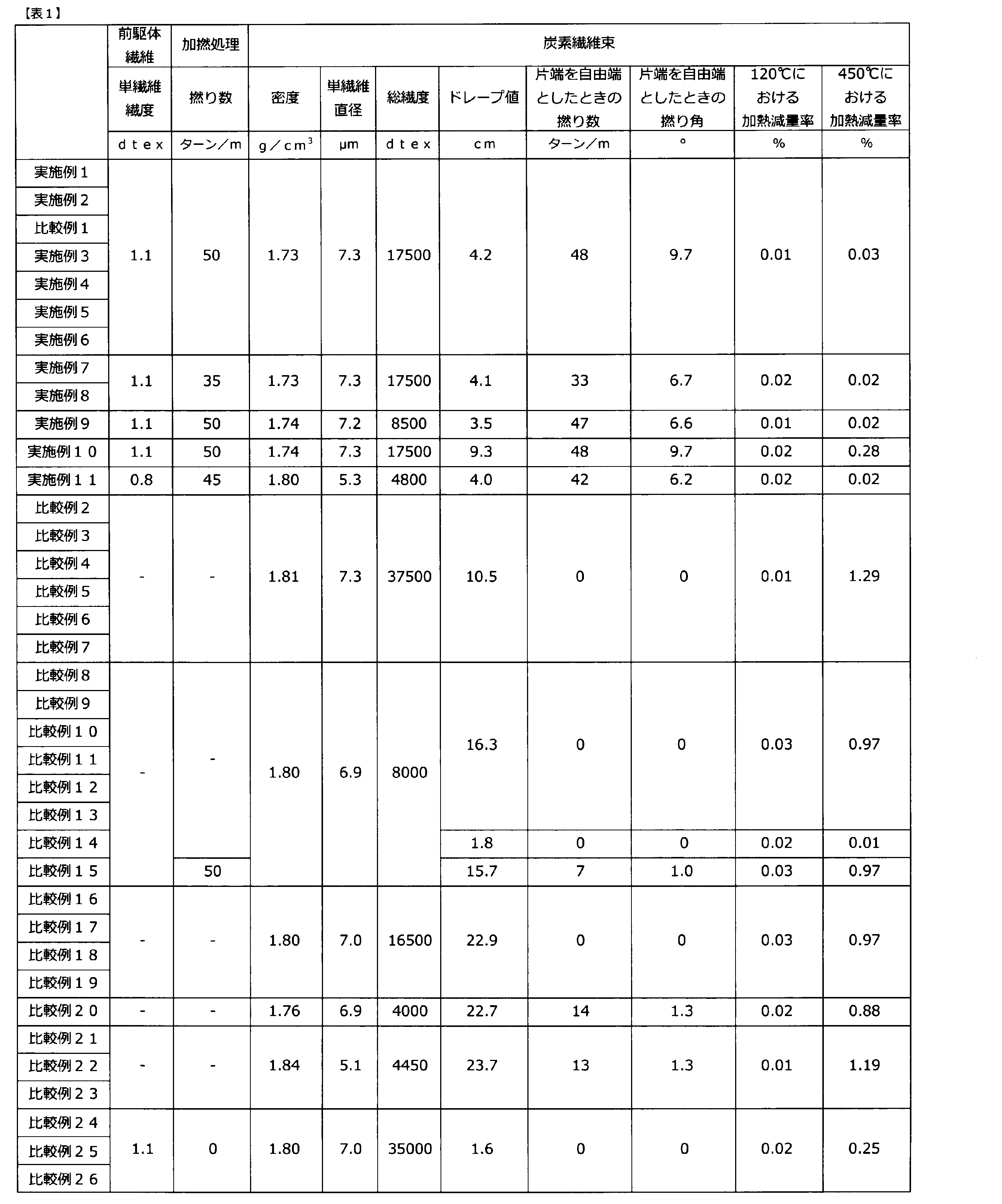
- Table 1 shows the evaluation results of the obtained precursor fiber bundles and carbon fiber bundles, and the twisting treatment conditions
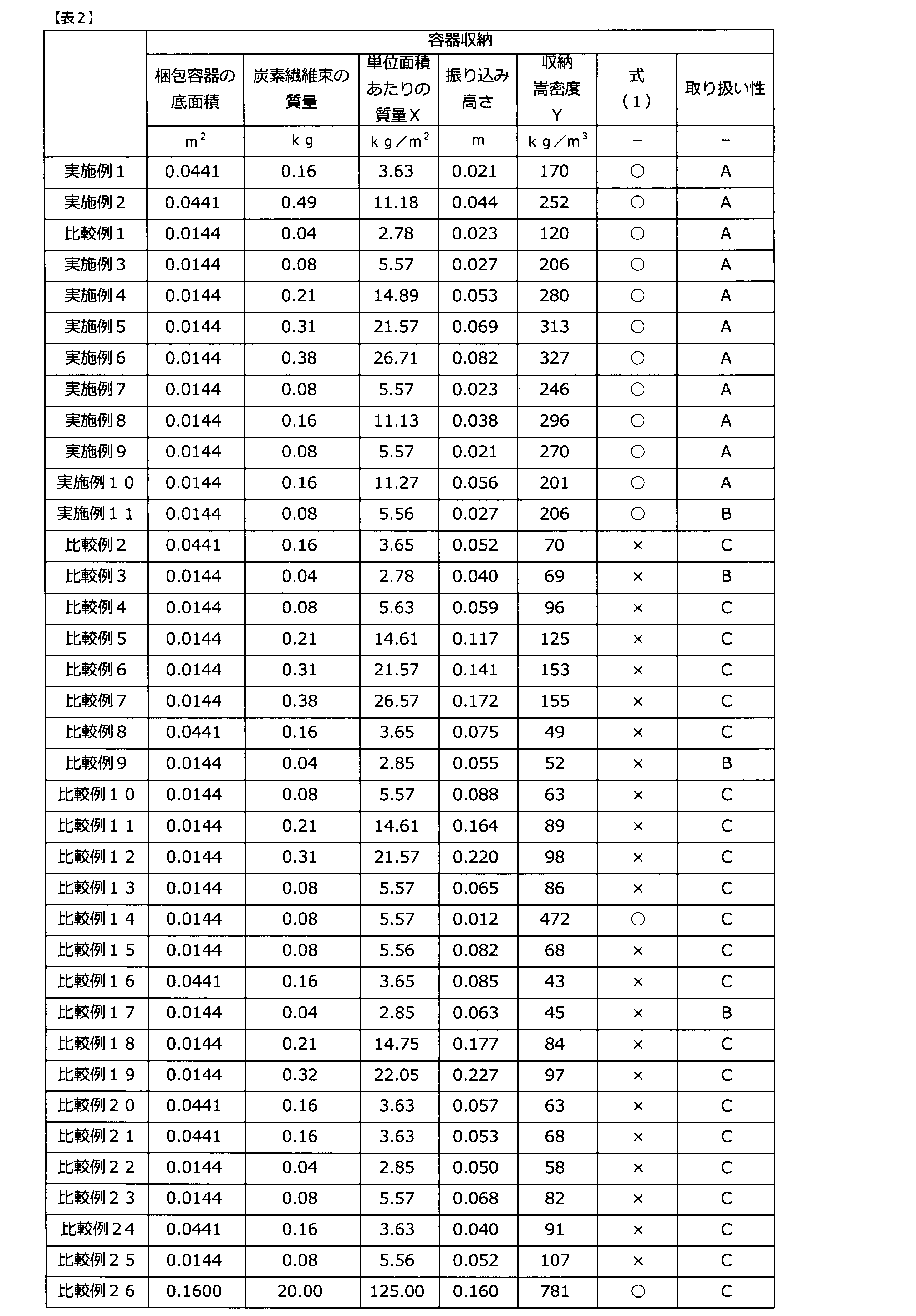
- Table 2 shows the evaluation results of the obtained continuous carbon fiber bundle packages.
- Example 7 and 8 Continuous carbon fiber bundles were obtained in the same manner as in Examples 1 to 6 except that the number of twists was 35 turns/m. Next, the obtained continuous carbon fiber bundle was stored in a packaging container under the conditions shown in Table 2. Table 1 shows the evaluation results of the obtained precursor fiber bundles and carbon fiber bundles, and the twisting treatment conditions, and Table 2 shows the evaluation results of the obtained continuous carbon fiber bundle packages.
- Example 9 Continuous carbon fiber bundles were obtained in the same manner as in Examples 1 to 6 except that the number of single fibers in the precursor fiber bundle was 12,000. Next, the obtained continuous carbon fiber bundle was stored in a packaging container under the conditions shown in Table 2. Table 1 shows the evaluation results of the obtained precursor fiber bundles and carbon fiber bundles, and the twisting treatment conditions, and Table 2 shows the evaluation results of the obtained continuous carbon fiber bundle packages.
- Example 10 Continuous carbon fiber bundles were obtained in the same manner as in Examples 1 to 6 except that the sizing agent was added after the carbonization treatment. Next, the obtained continuous carbon fiber bundle was stored in a packaging container under the conditions shown in Table 2. Table 1 shows the evaluation results of the obtained precursor fiber bundles and carbon fiber bundles, and the twisting treatment conditions, and Table 2 shows the evaluation results of the obtained continuous carbon fiber bundle packages.
- Example 11 A continuous carbon fiber bundle was obtained in the same manner as in Example 9 except that the single fiber fineness of the carbon fiber precursor fiber bundle was 0.8 dtex, the twist number was 45 turns/m, and the carbonization treatment temperature was 1500°C. Next, the obtained continuous carbon fiber bundle was stored in a packaging container under the conditions shown in Table 2. Table 1 shows the evaluation results of the obtained precursor fiber bundles and carbon fiber bundles, and the twisting treatment conditions, and Table 2 shows the evaluation results of the obtained continuous carbon fiber bundle packages.
- Comparative Examples 24 to 26 The number of filaments was 50,000 (single yarn: 0.63 denier), no twist was applied, and the maximum temperature in the carbonization treatment was set to 1400°C. A continuous carbon fiber bundle was obtained in the same manner. Next, in Comparative Example 26, the carbon fiber bundle, which is the condition of Example 2 of Patent Document 6, was put into a carton case of 400 mm ⁇ 400 mm ⁇ 400 mm from a height of 3 m with the bottom of the packaging container as a base point. The obtained continuous carbon fiber bundle was stored in a packaging container under the conditions shown in Table 2. Table 1 shows the evaluation results of the obtained precursor fiber bundles and carbon fiber bundles, and the twisting treatment conditions, and Table 2 shows the evaluation results of the obtained continuous carbon fiber bundle packages.
- the continuous carbon fiber bundle package of the present invention has a high storage bulk density in a packaging container. Therefore, the space can be reduced in the process of drawing the continuous carbon fiber bundle from the packaging container, which can contribute to the improvement of productivity.
Landscapes
- Chemical & Material Sciences (AREA)
- Chemical Kinetics & Catalysis (AREA)
- General Chemical & Material Sciences (AREA)
- Engineering & Computer Science (AREA)
- Textile Engineering (AREA)
- Coiling Of Filamentary Materials In General (AREA)
- Filamentary Materials, Packages, And Safety Devices Therefor (AREA)
- Inorganic Fibers (AREA)
- Packaging Of Annular Or Rod-Shaped Articles, Wearing Apparel, Cassettes, Or The Like (AREA)
Abstract
容器への収納に優れ、容器から連続炭素繊維束を引き出す際に取り扱い性に優れた連続炭素繊維束パッケージを得ること。そのためには、密度が1.5~2.0g/cm3、単繊維直径が4.0μm以上、総繊度が2000dtex以上、25℃におけるドレープ値が2.0cm以上の連続炭素繊維束が、容器に収納された連続炭素繊維束パッケージであって、連続炭素繊維束は、片端を固定端、もう一方を自由端としたとき、連続炭素繊維束に残存する撚り数が2ターン/m以上であり、連続炭素繊維束が前記梱包容器の底部から上端開口部にかけて前記梱包容器の隅々まで振り込まれており、前記連続炭素繊維束の単位面積あたりの質量(X)が3.5kg/m2以上、嵩密度(Y)が170kg/m3以上である連続炭素繊維束のパッケージである。
Description
本発明は、梱包容器への優れた収納性と梱包容器から連続炭素繊維束を引き出す際の取り扱い性に優れた連続炭素繊維束パッケージに関する。
炭素繊維は比強度、比弾性率に優れ、繊維強化複合材料の強化繊維として用いることにより部材の大幅な軽量化が可能となることから、エネルギー利用効率の高い社会の実現に不可欠な材料の一つとして幅広い分野で利用されている。一方で、自動車や電子機器筐体などをはじめとしたコスト意識の強い分野における利用を加速するには、他の工業材料と比較して依然として高価格となりがちな炭素繊維強化複合材料のコストダウンが不可欠である。
通常、連続炭素繊維束は製造された後に連続炭素繊維束パッケージとして梱包されて高次加工設備に運搬されるため、連続炭素繊維束パッケージの収納性を高めることができれば運搬コストを削減することができる。また、収納性を高めるとともに取り扱い性に優れた連続炭素繊維束パッケージであれば、高次加工設備への連続炭素繊維束の仕掛け回数の減少やクリール設備のコンパクト化などの利点がある。
通常、連続炭素繊維束はボビンに巻き上げる。例えば、特許文献1では、太繊度の連続炭素繊維束をボビン上に巻き取る上で、巻き始めおよび巻き終わりの綾角やワインド比を制御することにより高巻密度で巻崩れしにくい連続炭素繊維束のパッケージが提案されている。
また、連続炭素繊維束ではないが、炭素繊維前駆体繊維束および耐炎化繊維束においては、繊維束パッケージを大型化して高効率な運搬をする目的で、太繊度の炭素繊維前駆体繊維束および耐炎化繊維束の振り落としによる梱包方法がある。例えば、特許文献2~4では、繊維束の水分率や繊維束を振り落とすシュートの揺動速度や梱包容器の往復速度を制御する炭素繊維前駆体繊維束および耐炎化繊維束の梱包方法や収納効率の高い繊維束パッケージが提案されている。また、特許文献5では、炭素繊維前駆体繊維束および耐炎化繊維束を上部から圧縮部材により圧縮することで梱包容器中の繊維束の収納効率を最大限に高める技術が提案されている。特許文献6では、フィラメント数の大きな炭素繊維束をボビンに巻き取らずに梱包容器に収納する方法が提案されている。
しかしながら、背景技術には次のような課題がある。
特許文献1は、ボビンに巻き取られた状態の連続炭素繊維束としての巻密度は高いものの、連続炭素繊維束をボビンに巻き上げる工程や巻き取った連続炭素繊維束をボビンから引き出す際に、クリール設備が必要になるため、大きなコストダウンとならない問題がある。また、連続炭素繊維束のボビンへの巻取りでは、ボビンが転倒して取り扱い性が低下するという問題がある。
特許文献2~5では、炭素繊維前駆体繊維束および耐炎化繊維束の梱包重量を高めているものの、弾性率が高く剛直である連続炭素繊維束とは大きく異なるため、連続炭素繊維束の梱包容器への収納や梱包容器から連続炭素繊維束を引き出す際の取り扱い性に関して何ら示唆も言及もない。特許文献2~4では、繊維束に水分を付与して梱包容器に収納するため防腐対策が必要であり、また、乾燥した後には繊維束がさばけやすく取り扱い性が低下する問題がある。特許文献5では、繊維束を上部から圧縮部材で圧縮して梱包するため繊維束の擦過や絡まりが生じて梱包容器から繊維束を取り出す際の取り扱い性に問題がある。
特許文献6では、多くの炭素繊維束を高密度に梱包しているものの、本発明者らの追試したところでは炭素繊維束のドレープ値が小さく梱包容器から炭素繊維束を取り出す際の取り扱い性に問題がある。また、撚りがない炭素繊維束を梱包しているために、炭素繊維束が拡がってしまい取り出す際の取り扱い性に課題があった。
上述したように、従来は、連続炭素繊維束の梱包容器への収納性と梱包容器から連続炭素繊維束を引き出す際の取り扱い性を高める炭素繊維束の特性については、何らの示唆もなかった。今後拡大が予想される自動車や電子機器筐体用途におけるニーズを満たすには、ボビンに巻き上げずに連続炭素繊維束を容器に収納したパッケージの創出が課題であった。
上記の課題を解決するため、本発明では、容器に、連続炭素繊維束が振り込まれた連続炭素繊維束パッケージであって、連続炭素繊維束は、25℃におけるドレープ値が2.0cm以上、かつ、片端を固定端、もう一方を自由端としたとき、連続炭素繊維束に残存する撚り数が2ターン/m以上であり、連続炭素繊維束の単位面積あたりの質量(X)が3.5kg/m2以上、嵩密度(Y)が170kg/m3以上である、連続炭素繊維束パッケージを提供する。
また、密度が1.5~2.0g/cm3、単繊維直径が4.0μm以上、総繊度が2000dtex以上、25℃におけるドレープ値が2.0cm以上の連続炭素繊維束が、容器に収納されてなる連続炭素繊維束パッケージであって、連続炭素繊維束が、片端を固定端、もう一方を自由端としたとき、連続炭素繊維束に残存する撚り数が2ターン/m以上であり、梱包容器の底部から上端開口部にかけて梱包容器の隅々まで振り込まれており、容器中の連続炭素繊維束の単位面積あたりの質量(X)が3.5kg/m2以上、嵩密度(Y)が170kg/m3以上である連続炭素繊維束パッケージを提供する。ここで、容器とは連続炭素繊維束が梱包される容器のことで、梱包容器ともいう。
本発明の連続炭素繊維束パッケージは、梱包容器中の連続炭素繊維束の単位面積あたりの質量に対して嵩密度が高く、大量の連続炭素繊維束を所定の大きさの梱包容器にコンパクトに収納することができる。梱包容器から連続炭素繊維束を引き出す工程においてスペース削減やクリール設備の省略化が可能となる。さらに、梱包容器から連続炭素繊維束を引き出す際の取り扱い性が良好である。このようにして連続炭素繊維束の収納を行えば、連続炭素繊維束を巻き上げる工程を省略することができる。
本発明の連続炭素繊維束とは、10m以上であり、好ましくは100m以上の、実質的に長さの上限のない炭素繊維の束である。連続炭素繊維束であれば、高次加工プロセスに供給する場合において、プリプレグやフィラメントワインディング、プルトルージョン(引抜成形)など、様々な炭素繊維強化複合材料の製造方法を選択することができる。
本発明の連続炭素繊維束の形態は、一般的な連続単繊維の繊維束だけでなく、スライバーや紡績糸を用いても良い。また、複数の連続炭素繊維束を束ねて合糸して用いても良く、ロープ状や三つ編み状に合糸して用いても良い。連続炭素繊維束の長さは長いほうが良いが、運搬等の取り扱いの観点から200000m以下が好ましい。なお、梱包容器を単に容器ともいう。また、梱包容器に収納する連続炭素繊維束は、梱包容器への収納効率の観点から複数の末端を含んでも良い。本発明の連続炭素繊維束は後述する方法で製造することができる。
本発明の連続炭素繊維束パッケージは、連続炭素繊維束が梱包容器の底部から上端開口部にかけて梱包容器の隅々まで振り込まれている。連続炭素繊維束が梱包容器の底部から上端開口部にかけて梱包容器の隅々まで振り込まれているとは、連続炭素繊維束を振り込んだ梱包容器を真上から見たときに梱包容器底面が露出していない状態である。すなわち、連続炭素繊維束をボビンに巻いたような集合体を梱包容器に収納している場合は底面が露出しており、このような従来のパッケージを本発明では含まない。本発明では、露出していない状態とは、真上から観察したときに、露出した底面が10%以下の面積である状態をいう。
連続炭素繊維束を梱包容器の底部から上端開口部にかけて梱包容器の隅々まで振り込むことで梱包容器内の空間を効率的に利用することができ、結果として梱包容器への収納性を高めることができる。連続炭素繊維束は、後述の方法により梱包容器の底部から上端開口部にかけて梱包容器の隅々まで振り込むことができる。
本発明の連続炭素繊維束パッケージは、梱包容器中の連続炭素繊維束の単位面積あたりの質量Xが3.5kg/m2以上であり、好ましくは7.0kg/m2以上であり、より好ましくは10.0kg/m2以上である。かかる質量Xが大きいほど同じ底面積の梱包容器に対して多くの連続炭素繊維束が収納されていることを意味し、質量Xが3.5kg/m2以上であれば、所定の大きさの梱包容器にコンパクトに連続炭素繊維束を収納できるため、梱包容器から連続炭素繊維束を引き出す工程においてスペースを削減することができる。上限については、質量Xが500kg/m2以下であれば、梱包容器のサイズが取り扱いやすいものとなる。
本発明において、梱包容器中の連続炭素繊維束の単位面積あたりの質量Xとは、連続炭素繊維束を梱包容器の底部から上端開口部にかけて梱包容器の隅々まで振り込み、振り込んだ連続炭素繊維束の質量を梱包容器の底面積で除した値である。梱包容器の底面積とは、梱包容器を真上から平行な光で照らした場合にできる影の面積であり、梱包容器の側面が底面と垂直の角をなす場合には、梱包容器の底面における面積と一致する。梱包容器中の連続炭素繊維束の単位面積あたりの質量Xは、梱包容器の大きさや振り込む連続炭素繊維束の密度や総繊度を公知の方法で調整することで制御できる。
梱包容器(単に容器)の大きさについては、炭素繊維束をボビンに巻いたパッケージ体の梱包容器の大きさを参考とし、底面積が0.1~5m2が好ましい。容器や底面積の形状に限りはない。容器の底面積が大きすぎると、容器の隅々まで均一に連続炭素繊維束を振り込むことが難しくなり、また、重量が大きくなりすぎて持ち運びに支障がある。容器の底面積は、0.1~1m2がより好ましい。底面積が範囲内の容器では、連続する炭素繊維束の屈曲やターンに無駄がなく、容器の内壁により沿うようにコンパクトに振り込まれ、高い嵩密度で連続炭素繊維束が収納でき、好ましい。
本発明の連続炭素繊維束パッケージは、梱包容器中の連続炭素繊維束の収納嵩密度Yが170kg/m3以上であり、好ましくは200kg/m3以上であり、より好ましくは220kg/m3以上であり、さらに好ましくは250kg/m3以上である。かかる嵩密度Yが大きいほど梱包容器に多くの連続炭素繊維束が収納されていることを意味する。収納嵩密度が170kg/m3以上であれば、梱包容器への効率的な収納と運送を両立することができる。収納嵩密度に特に上限はないが、現実的に600kg/m3程度である。梱包容器中の連続炭素繊維束の収納嵩密度Yとは、梱包容器中の連続炭素繊維束の単位面積あたりの質量Xを振り込み高さで除した値である。振り込み高さとは、梱包容器底面から連続炭素繊維束上部までの高さであり、後述する測定法で評価する。梱包容器中の連続炭素繊維束の収納嵩密度Yは、後述する本発明の連続炭素繊維束パッケージに収納されている連続炭素繊維束の密度や単繊維直径、総繊度、450℃における加熱減量、炭化処理中の繊維束の撚り数を調整することにより制御することができる。
本発明の連続炭素繊維束パッケージは、梱包容器中の連続炭素繊維束の単位面積あたりの質量X[kg/m2]と収納嵩密度Y[kg/m3]が式(1)を満たすことが好ましい。lnYとlnXとは、質量Xと収納嵩密度Yの各値の自然対数eを底とする対数である。そして、横軸にlnXを取り、縦軸にlnYをとるグラフにおいて、lnYはlnXの関数で、lnXがゼロの時のlnYの値が切片にあたる。収納嵩密度は、単に、嵩密度と呼ぶこともある。
lnY>0.4×lnX+4.0 ・・・式(1)。
lnY>0.4×lnX+4.0 ・・・式(1)。
本発明の連続炭素繊維束パッケージにおいて、式(1)における切片が4.2であることがより好ましく、4.3であることがさらに好ましい。かかる質量Xと収納嵩密度Yが式(1)を満たす場合には、質量Xが高まることで梱包容器下部に位置する連続炭素繊維束が自重で圧縮されて嵩密度Yが高まることを意味し、梱包容器に大量の連続炭素繊維束を収納することができる。式(1)における切片が4.0以上であれば、梱包容器への効率的な収納と梱包容器から連続炭素繊維束を引き出す際の収束性や取り扱い性のバランスに優れた連続炭素繊維束パッケージを得ることができるために好ましい。かかる質量Xと収納嵩密度Yを式(1)に制御するには、後述する連続炭素繊維束の密度や単繊維直径、総繊度および25℃におけるドレープ値を本発明の範囲内に制御すると良い。
本発明の連続炭素繊維束パッケージに収納されている連続炭素繊維束の密度は1.5~2.0g/cm3であり、1.6~2.0g/cm3であることが好ましく、1.7~2.0g/cm3であることがより好ましい。密度が高いほど同じ体積の連続炭素繊維束を梱包容器に収納するときの収納嵩密度を高めることができる。連続炭素繊維束の密度が1.5~2.0g/cm3であれば、梱包容器への効率的な収納と梱包容器から連続炭素繊維束を引き出す際の取り扱い性のバランスに優れた連続炭素繊維束パッケージを得ることができる。密度の評価法は後述する。密度は、炭素化処理温度や炭素化処理時間など、公知の方法により制御できる。
本発明の連続炭素繊維束パッケージに収納されている連続炭素繊維束の単繊維直径は4.0μm以上であり、6.1μm以上であることが好ましく、6.5μm以上であることがより好ましく、6.9μm以上であることがさらに好ましく、7.1μm以上であることが特に好ましい。単繊維直径が大きいほど単繊維自体の曲げに対する抵抗が強く、いわゆるコシが強くなるため、繊維束全体の取り扱い性に有利に働くことが、本発明者らの検討の結果としてわかった。単繊維直径が4.0μm以上であれば、梱包容器から連続炭素繊維束を引き出す際の取り扱い性が満足できるレベルとなる。単繊維直径の上限は、特に制限はないが、現実的に15μm程度である。単繊維直径の評価法は後述する。単繊維直径は、炭素繊維前駆体繊維束の紡糸時の口金からの吐出量や延伸比、耐炎化~炭素化工程における総延伸倍率などにより制御できる。
本発明の連続炭素繊維束パッケージに収納されている連続炭素繊維束の総繊度は2000dtex以上であり、7000dtex以上であることが好ましく、15000dtex以上であることがより好ましい。総繊度が大きいほど効率的に梱包容器に連続炭素繊維束を収納することができる。また、総繊度が大きいほど連続炭素繊維束の生産性を高めることができる。連続炭素繊維束の複数を梱包容器に収納する場合、かかる連続炭素繊維束の総繊度は全ての繊維束の繊度の合計とする。
ここで、総繊度が2000dtex以上であれば連続炭素繊維束の生産性と梱包容器への収納効率を両立することができる。かかる総繊度は繊維束の密度と目付、単繊維直径から計算することができる。目付を測定する際に、連続炭素繊維束の全ての末端の半数が繊維束本数となる。かかる総繊度の上限に特に制限はなく、目的の用途に応じて設定すればよい。総繊度を制御するためには、1束の連続炭素繊維束の繊度を制御しても良いし、繊維束本数を増やしても良い。その際、複数の繊維束をさらに束にまとめて梱包しても良いし、別々にパッケージに梱包しても良い。なお、連続炭素繊維束の末端の両端をパッケージ表面付近に配置すると、パッケージからの引き出しやすさと他のパッケージ内の連続炭素繊維束との接続の点において好ましい。
本発明の梱包容器中の連続炭素繊維束の25℃におけるドレープ値は、2.0cm以上であり、2.5cm以上であることが好ましく、3.0cm以上であることがより好ましい。ドレープ値とは連続炭素繊維束の硬さを表す値であり、ドレープ値が大きいほど連続炭素繊維束が硬い特性を示す。ドレープ値が2cm未満の場合、繊維束が柔らかいため収束性が悪く、梱包容器に収納したのちに連続炭素繊維束を引き出す際に毛羽立ちやすくなり繊維束が絡まりやすくなる。ドレープ値が2.0cm以上であれば梱包容器に収納したのちに連続炭素繊維束を引き出す際の収束性や取り扱い性が満足できるレベルとなる。ドレープ値の上限は特にないが、10cm以下であれば梱包容器への収納に悪影響を及ぼさないことが多い。ドレープ値は、後述する測定法で評価する。ドレープ値を所定の大きさに制御するには、前駆体繊維束または耐炎化繊維束、予備炭素化繊維束を一旦ボビンに巻き取った後、該繊維束を巻き出す際にボビンを巻き出し方向に対して直交する面に旋回させる方法や、走行中の繊維束に対して回転するローラーやベルトを接触させて撚りを付与する方法や、サイジング剤の付着量等により制御することができる。ドレープ値は、連続炭素繊維束に残存する撚りとも相関があるが、サイジング剤の付着量などほかの要因にも左右される。
本発明の連続炭素繊維束パッケージに梱包されている連続炭素繊維束は、120℃における加熱減量率が2.0%以下であることが好ましく、1.5%以下であることがより好ましく、1.0%以下であることがさらに好ましい。本発明において、120℃における加熱減量率の詳しい評価手法は後述するが、評価対象の連続炭素繊維束を一定量秤量し、120℃の温度に設定した不活性ガス雰囲気のオーブン中で15分間加熱し、120℃における加熱の前後での質量変化率のことを指す。加熱減量率が少ない連続炭素繊維束は、吸着している水分が少ないことを意味し、連続炭素繊維束を収納した梱包容器を長期保管しても、バクテリアやカビの増殖を抑制でき、炭素繊維強化複合材料としたときの力学特性の低下を抑えることができる。前記加熱減量率が2.0%以下であれば、乾燥剤の封入や梱包容器の密閉作業などが不要であり、パッケージングを簡素化することができる。かかる加熱減量率は、サイジング剤や水分を付与しないことにより制御することができる。
本発明の連続炭素繊維束パッケージに梱包されている連続炭素繊維束は、450℃における加熱減量率が0.15%以下であることが好ましく、0.10%以下であることがより好ましく、0.07%以下であることがさらに好ましく、0.05%以下であることが最も好ましい。本発明において、450℃における加熱減量率の詳しい評価手法は後述するが、評価対象の連続炭素繊維束を一定量秤量し、120℃の温度に設定した不活性ガス雰囲気のオーブン中で15分間加熱したのちに室温まで放冷し、120℃で加熱した後の質量を記録し、さらに450℃の温度に設定した不活性ガス雰囲気のオーブン中で15分間加熱したのちに室温まで放冷し、450℃で加熱した後の質量を記録し、450℃における加熱の前後での質量変化を12℃で加熱した後の質量で除して百分率で表したものとする。
加熱減量率が少ない連続炭素繊維束は、梱包容器から連続炭素繊維束を引き出して使用する際に、高温で成形加工したときの熱分解物が少なく、マトリックス樹脂と炭素繊維の界面に熱分解物や熱分解に伴う気泡が発生しにくい。つまり、耐熱性の高いマトリックス樹脂や高温を必要とする成形加工プロセスを用いた場合であっても、炭素繊維強化複合材料におけるマトリックス樹脂と炭素繊維との接着強度を高めやすい。ここで、前記熱分解物としては、主に、サイジング剤、120℃以上450℃以下で発生するその他の表面付着物が挙げられる。加熱減量率は、サイジング剤の付着量の影響を受けるため、サイジング剤の付着量を少なくするか、サイジング剤を付与しないことにより、加熱減量率を制御することができる。炭素繊維束そのものの熱安定性が低い場合には、サイジング剤の付着量が少なくても、前記加熱減量率が0.15%より大きくなることがある。サイジング剤の付着量にとらわれず、単純に加熱減量率が0.15%以下かどうかを基準にすればよい。
本発明の連続炭素繊維束パッケージに梱包されている連続炭素繊維束は、片端を固定端、もう一方を自由端としたとき、2ターン/m以上の撚りが残存し、5~120ターン/mであることが好ましく、16~80ターン/mであることがより好ましく、31~80ターン/mであることがさらに好ましく、46~80ターン/mであることが最も好ましい。ターンとは、本発明において、固定端とは繊維束の長手方向を軸とした回転ができないように固定された繊維束上の任意の部分であり、粘着テープなどを用いて繊維束の回転を拘束することなどによって実現できる。自由端とは、連続した繊維束をその長手方向に垂直な断面で切断したときに出現する端部のことを指し、何にも固定されておらず、繊維束の長手方向を軸とした回転が可能な端部のことである。片端を固定端、もう一方を自由端としたとき、撚りが残存するとは、炭素繊維束が半永久的な撚りを有することを意味する。半永久的な撚りとは、外力の作用なしには勝手に解けることのない撚りを指す。残存する撚り数とは、連続する炭素繊維束の半永久的な撚りの、1mあたりの撚り数のことで、1回転を1ターンと数える。
本発明者らが検討したところ、炭素繊維束が半永久的な撚りを有する場合、繊維束が捌けることなく自ずと収束するため、梱包容器への効率的な収納と梱包容器から連続炭素繊維束を引き出す際の取り扱い性のバランスに優れた連続炭素繊維束を得ることができる。また、半永久的な撚りを有さない一般的な炭素繊維束に強制的に撚りを付与した場合、繊維束に常に張力をかけておかないと、強制的な撚りを付与された炭素繊維束同士がさらに高次の撚りを形成し、ロープを編むように折りたたまれてしまう場合があるのに対して、炭素繊維束が半永久的な撚りを有する場合は、張力の有無によらず、高次の撚りを形成することはなく、しなやかで取り扱い性の高い連続炭素繊維束となる。ドレープ値が2.0cm以上の連続炭素繊維束においては、収納性が向上すると、連続炭素繊維束を引き出す際の収束性や取り扱い性がさらに良好となり、好ましい。よって、ボビンに巻き取らすとも容器に振り分けて収納する方法で、嵩密度が高くコンパクトに収納でき、かつ、引き出す際にも良好な特性となる。
片端を固定端、もう一方を自由端としたとき、撚りが解けることなく、結果的に2ターン/m以上の撚りが残存すれば繊維束の取り扱い性や高次加工性が高まる。残存する撚り数は多いほど収束性が高くなるため好ましいが、加撚する製造プロセスの制約上、500ターン/m程度が上限である。片端を固定端、もう一方を自由端としたとき、2ターン/m以上の撚りが残存する炭素繊維束は、後述する本発明の炭素繊維束の製造方法に従って作製することができる。具体的には、残存する撚り数は、炭素化工程における繊維束の撚り数を調整することにより制御することができる。残存する撚り数の詳しい評価手法は後述するが、繊維束上の任意の箇所をテープなどでしっかりと固定して固定端とした後に、固定端から離れた位置で繊維束を切断して自由端を形成し、固定端が最上部に来るように繊維束を懸垂させてしばらく静置したあと、自由端を把持して解撚していき、完全に解撚するまでに要した撚り数を長さ1mあたり換算したものを、本発明における、残存する撚り数とする。
本発明の連続炭素繊維束パッケージに梱包されている連続炭素繊維束は、片端を固定端、もう一方を自由端としたとき、撚りが解けることなく、結果的に繊維束表層に0.2°以上の撚りが残存することが好ましく、残存する繊維束表層の撚り角は0.7~41.5°であることが好ましく、0.7~30.5°であることがより好ましく、2.0~30.5°であることがさらに好ましく、2.0~24.0°であることが特に好ましく、2.5~12.5°であることが最も好ましい。残存する繊維束表層の撚り角が0.2°以上であれば、繊維束の収束性が高まり結果として梱包容器の連続炭素繊維束の収納嵩密度を高めることができる。残存する繊維束表層の撚り角は大きいほど収束性が高くなるため好ましいが、加撚する製造プロセスの制約上、繊維束表層の撚り角は52.5°程度が上限である。
残存する繊維束表層の撚り角は、後述する手法により測定した撚り数と炭素繊維束のフィラメント数、単繊維直径より算出することができる。片端を固定端、もう一方を自由端としたとき、0.2°以上の撚りが残存する連続炭素繊維束は、後述する連続炭素繊維束の製造方法に従って作製することができる。具体的には、残存する繊維束表層の撚り角は、繊維束の撚り数を調整することに加えて、炭素化工程におけるフィラメント数と単繊維直径を調整することにより制御することができる。
次に、連続炭素繊維束を容器に収納した連続炭素繊維束パッケージの製造方法を説明する。
本発明の連続炭素繊維束パッケージは、梱包容器に収納して得ることができる。梱包容器としては、三角柱や四角柱、円柱などが用いられるが、梱包容器の運搬や保管の観点から四角柱が好ましく用いられる。梱包容器の材質としては、一般的に硬質の紙製、プラスチック製、木製、金属製等のものが使用されるが、これに限定されるものではない。
本発明の連続炭素繊維束パッケージは、梱包容器の底部から上端開口部にかけて梱包容器の隅々まで振り込まれて得ることができる。梱包容器の隅々まで連続炭素繊維束を振り込む方法は、梱包容器から連続炭素繊維束を引き出す際の取り扱い性の観点から、連続炭素繊維束を梱包容器内で円を描くように堆積させて振り込む方法やジグザグ状に堆積させて振り込む方法が好ましく用いられる。例えば、連続炭素繊維束を振り込む高さは、上端開口部から0.5~3mの高さが挙げられ、速度は連続炭素繊維束を製造する速度に合わせて1~30m/分が挙げられる。また、梱包容器を円方向や往復方向に移動させることで、あるいは梱包容器を振動させることで、梱包容器内の嵩密度を高めても良い。
本発明の連続炭素繊維束パッケージに梱包されている連続炭素繊維束の好ましい製造方法を説明する。
本発明の連続炭素繊維束のもととなる炭素繊維前駆体繊維束は、ポリアクリロニトリル系重合体の紡糸溶液を紡糸して得ることができる。
ポリアクリロニトリル系重合体としては、アクリロニトリルのみから得られる単独重合体だけではなく、主成分であるアクリロニトリルに加えて他の単量体を用いても良い。
前記したポリアクリロニトリル系重合体を、ポリアクリロニトリル系重合体が可溶な溶媒に溶解し、紡糸溶液とする。
炭素繊維前駆繊維束が含む単繊維の平均繊度は、0.4dtex以上であることが好ましく、0.9dtex以上であることがより好ましく、1dtex以上であることがさらに好ましく、1.1dtex以上であることが最も好ましい。前駆体繊維束の単繊維の平均繊度が高いほど、連続炭素繊維束の単繊維直径を大きく調整でき、結果として単繊維自体の曲げに対する抵抗が強く、いわゆるコシが強くなるため、繊維束全体の取り扱い性に有利に働く。前駆体繊維束の単繊維の平均繊度が0.8dtex以上であれば、得られる連続炭素繊維束の梱包容器への収納効率を高めやすい。前駆体繊維束の単繊維の平均繊度が高すぎると、耐炎化工程において均一に処理することが難しくなる場合があり、製造プロセスが不安定となったり、得られる炭素繊維束の力学的特性が低下したりすることがある。前駆体繊維束の単繊維の平均繊度は、口金からの紡糸溶液の吐出量や延伸比など、公知の方法により制御できる。
得られる炭素繊維前駆体繊維束は、通常、連続繊維の形態であり、その総繊度は3000dtex以上であることが好ましい。前駆体繊維束は耐炎化処理を行う前に合糸して最終的な連続炭素繊維束の好ましい総繊度である2000dtexとしても良く、後述の方法により耐炎化繊維束とした後、予備炭素化処理を行う前に合糸して2000dtex以上としても良く、後述する方法により予備炭素化繊維束とした後、炭素化処理を行う前に合糸して2000dtex以上としても良い。
本発明の炭素繊維束は、前記した炭素繊維前駆体繊維束を耐炎化処理した後、予備炭素化処理、炭素化処理を順に行うことにより得ることができる。
本発明では、前記耐炎化に引き続いて、予備炭素化を行う。予備炭素化工程においては、得られた耐炎化繊維束を、不活性雰囲気中、最高温度500~1200℃において、密度1.5~1.8g/cm3になるまで熱処理することが好ましい。
さらに、前記予備炭素化に引き続いて、炭素化を行う。炭素化工程においては、得られた予備炭素化繊維束を、不活性雰囲気中、最高温度1200~3000℃において熱処理することが好ましい。炭素化工程における最高温度は、得られる連続炭素繊維束のストランド弾性率を高める観点からは、高い方が好ましいが、高すぎると剛直な連続炭素繊維束となるため梱包容器に収納する際に毛羽立ちやすくなる場合があり、トレードオフを考慮して設定するのが良い。
また、本発明において、耐炎化~炭素化工程における総延伸倍率は0.9~1.3倍とすることが好ましい。かかる総延伸倍率を上記範囲に制御することで、連続炭素繊維束の単繊維直径を好ましい範囲に調整することができる。
本発明の炭素化処理後に得られる連続炭素繊維束について、炭素化処理中の繊維束の撚り数を2ターン/m以上とすることが好ましい。撚り数は5~120ターン/mとすることが好ましく、20~80ターン/mとすることがより好ましい。かかる撚り数を上記範囲に制御することで、梱包容器への効率的な収納と梱包容器から連続炭素繊維束を引き出す際の取り扱い性のバランスに優れた連続炭素繊維束を得ることができる。かかる撚り数の上限に特に制限はないが、加撚工程が煩雑となることを避けるため、500ターン/m程度を一応の上限とするのが好ましい。
また、連続炭素繊維束の総繊度に応じてかかる撚り数を調整することで、炭素化処理後に得られる連続炭素繊維束の表層の残存する撚り角を制御することが好ましい。かかる撚り数は、前駆体繊維束または耐炎化繊維束、予備炭素化繊維束を一旦ボビンに巻き取った後、該繊維束を巻き出す際にボビンを巻き出し方向に対して直交する面に旋回させる方法や、ボビンに巻き取らず走行中の繊維束に対して回転するローラーやベルトを接触させて撚りを付与する方法などにより制御することができる。
前記製造方法で得られた連続炭素繊維束は、さらに最高3000℃までの不活性雰囲気において追加の炭素化処理を行い、用途に応じてストランド弾性率を適宜調整してもよい。
以上のようにして得られた連続炭素繊維束は、炭素繊維とマトリックス樹脂との接着強度を向上させるために、表面処理が施され、酸素原子を含む官能基を導入しても良い。表面処理方法としては、気相酸化、液相酸化および液相電解酸化が用いられるが、生産性が高く、均一処理ができるという観点から、液相電解酸化が好ましく用いられる。本発明において、液相電解酸化の方法については特に制約はなく、公知の方法で行えばよい。
かかる電解処理の後、得られた連続炭素繊維束の取り扱い性や高次加工性をさらに高めるため、あるいは炭素繊維とマトリックス樹脂との接着強度を高めるため、サイジング剤を付着させることもできる。本発明においては、サイジング剤の付着量をできる限り少なくするのが良く、付着量は0.1%以下とすることが好ましい。サイジング付着量は0.05%以下とすることがより好ましく、サイジング処理を行わないことがさらに良い。サイジング剤の付着量が少ないと、サイジング剤による拘束が小さくなるため連続炭素繊維束が柔軟になり、結果として梱包容器中の連続炭素繊維束の収納嵩密度を高めやすくなる。通常、連続炭素繊維束に収束性を付与するために、ある一定量以上のサイジング剤が必要であったが、本発明の連続炭素繊維束は残存する撚りを有するため、サイジング剤が極めて少ないか、あるいは全く付与されていない場合であっても、高い収束性を示す。
本明細書に記載の各種物性値の測定方法は以下の通りである。
<梱包容器中の連続炭素繊維束の単位面積あたりの質量Xおよび収納嵩密度Y>
所定の大きさの梱包容器に、所定量の連続炭素繊維束を梱包容器の底部から上端開口部にかけて梱包容器の隅々まで振り込む。振り込んだ連続炭素繊維束の質量を梱包容器の底面積で除した値を梱包容器中の連続炭素繊維束の単位面積あたりの質量X(kg/m2)とする。連続炭素繊維束を梱包容器に振り込んだのちに梱包容器を30回タップして連続炭素繊維束をならす。そして、梱包容器底面から連続炭素繊維束上部までの高さを5点測定してその平均値を振り込み高さ(m)とし、梱包容器中の連続炭素繊維束の単位面積あたりの質量Xを振り込み高さで除した値を収納嵩密度Y(kg/m3)とする。
所定の大きさの梱包容器に、所定量の連続炭素繊維束を梱包容器の底部から上端開口部にかけて梱包容器の隅々まで振り込む。振り込んだ連続炭素繊維束の質量を梱包容器の底面積で除した値を梱包容器中の連続炭素繊維束の単位面積あたりの質量X(kg/m2)とする。連続炭素繊維束を梱包容器に振り込んだのちに梱包容器を30回タップして連続炭素繊維束をならす。そして、梱包容器底面から連続炭素繊維束上部までの高さを5点測定してその平均値を振り込み高さ(m)とし、梱包容器中の連続炭素繊維束の単位面積あたりの質量Xを振り込み高さで除した値を収納嵩密度Y(kg/m3)とする。
次に、質量(X)[kg/m2]と嵩密度(Y)[kg/m3]の関係について、横軸にlnX、縦軸にlnYのグラフにおいて、式(1)を求め、式(1)を満たす場合を「〇」、満たさない場合を「×」とする。
lnY>0.4×lnX+4.0 ・・・式(1)
<梱包容器から連続炭素繊維束を引き出す際の取り扱い性>
梱包容器に振り込んだ連続炭素繊維束を梱包容器と垂直方向に1秒に25cm引き出す速度で、10m手で引き出す。このとき、引き出す連続炭素繊維束が梱包容器内の連続炭素繊維束に引っかかる回数について次の評価を行った。引っかかるとは、連続炭素繊維束がスムースに取り出せないことを言い、引き出し荷重が3倍以上かかることをいう。
lnY>0.4×lnX+4.0 ・・・式(1)
<梱包容器から連続炭素繊維束を引き出す際の取り扱い性>
梱包容器に振り込んだ連続炭素繊維束を梱包容器と垂直方向に1秒に25cm引き出す速度で、10m手で引き出す。このとき、引き出す連続炭素繊維束が梱包容器内の連続炭素繊維束に引っかかる回数について次の評価を行った。引っかかるとは、連続炭素繊維束がスムースに取り出せないことを言い、引き出し荷重が3倍以上かかることをいう。
A:引っかかり回数:0~3回 取り扱い性が特に良好
B:引っかかり回数:4~10回 取り扱い性が良好
C:引っかかり回数:11回以上 取り扱い性が不良 とする。
B:引っかかり回数:4~10回 取り扱い性が良好
C:引っかかり回数:11回以上 取り扱い性が不良 とする。
<連続炭素繊維束の密度>
測定する連続炭素繊維束について、1mサンプリングし、比重液をo-ジクロロエチレンとしてアルキメデス法で測定する。試料数は3で試験を行う。得られた質量(g)と体積(cm3)から密度(g/cm3)を求め、その平均値を連続炭素繊維束の密度(g/cm3)とした。
測定する連続炭素繊維束について、1mサンプリングし、比重液をo-ジクロロエチレンとしてアルキメデス法で測定する。試料数は3で試験を行う。得られた質量(g)と体積(cm3)から密度(g/cm3)を求め、その平均値を連続炭素繊維束の密度(g/cm3)とした。
<連続炭素繊維束の単繊維直径>
連続炭素繊維束の単位長さ当たりの質量(g/m)を密度(g/cm3)で除して、さらにフィラメント数で除して求める。
連続炭素繊維束の単位長さ当たりの質量(g/m)を密度(g/cm3)で除して、さらにフィラメント数で除して求める。
<連続炭素繊維束の25℃におけるドレープ値>
連続炭素繊維束を30cmの長さに切断し、かかる炭素繊維束の質量が0.3~0.6gとなるように分割または合糸して測定に供する炭素繊維束とする。図1に示すように、角が90°の長方形の水平台1から炭素繊維束が25cmはみ出るように、炭素繊維束2が折れないように支えながら置き、水平台1上の炭素繊維束2をテープで固定する。その後、水平台1からはみ出た炭素繊維束2の支えを取り除いて垂れ下がらせ、1秒後に支点からの水平距離Lの長さを測定する、測定のn数は5回で平均値をドレープ値とする。とレープ値が大きいほど、連続炭素繊維束が硬いことを示す。
連続炭素繊維束を30cmの長さに切断し、かかる炭素繊維束の質量が0.3~0.6gとなるように分割または合糸して測定に供する炭素繊維束とする。図1に示すように、角が90°の長方形の水平台1から炭素繊維束が25cmはみ出るように、炭素繊維束2が折れないように支えながら置き、水平台1上の炭素繊維束2をテープで固定する。その後、水平台1からはみ出た炭素繊維束2の支えを取り除いて垂れ下がらせ、1秒後に支点からの水平距離Lの長さを測定する、測定のn数は5回で平均値をドレープ値とする。とレープ値が大きいほど、連続炭素繊維束が硬いことを示す。
<連続炭素繊維束の120℃における加熱減量率>
評価対象となる連続炭素繊維束を質量2.5gとなるよう切断したものを直径3cm程度の輪状に巻き、熱処理前の質量w0(g)を秤量する。次いで、温度120℃の窒素雰囲気のオーブン中で15分間加熱し、デシケーター中で室温になるまで放冷した後に加熱後質量w1(g)を秤量する。以下の式により、120℃における加熱減量率を計算する。なお、評価は3回行い、その平均値を採用する。
120℃における加熱減量率(%)=(w0-w1)/w0×100(%)。
評価対象となる連続炭素繊維束を質量2.5gとなるよう切断したものを直径3cm程度の輪状に巻き、熱処理前の質量w0(g)を秤量する。次いで、温度120℃の窒素雰囲気のオーブン中で15分間加熱し、デシケーター中で室温になるまで放冷した後に加熱後質量w1(g)を秤量する。以下の式により、120℃における加熱減量率を計算する。なお、評価は3回行い、その平均値を採用する。
120℃における加熱減量率(%)=(w0-w1)/w0×100(%)。
<連続炭素繊維束の450℃における加熱減量率>
評価対象となる連続炭素繊維束を質量2.5gとなるよう切断したものを直径3cm程度の輪状に巻く。次いで、温度120℃の窒素雰囲気のオーブン中で15分間加熱し、デシケーター中で室温になるまで放冷した後に加熱後質量w1(g)を秤量する。さらに、温度450℃の窒素雰囲気のオーブン中で15分間加熱し、デシケーター中で室温になるまで放冷した後に加熱後質量w2(g)を秤量する。以下の式により、450℃における加熱減量率を計算する。なお、評価は3回行い、その平均値を採用する。
450℃における加熱減量率(%)=(w1-w2)/w1×100(%)。
評価対象となる連続炭素繊維束を質量2.5gとなるよう切断したものを直径3cm程度の輪状に巻く。次いで、温度120℃の窒素雰囲気のオーブン中で15分間加熱し、デシケーター中で室温になるまで放冷した後に加熱後質量w1(g)を秤量する。さらに、温度450℃の窒素雰囲気のオーブン中で15分間加熱し、デシケーター中で室温になるまで放冷した後に加熱後質量w2(g)を秤量する。以下の式により、450℃における加熱減量率を計算する。なお、評価は3回行い、その平均値を採用する。
450℃における加熱減量率(%)=(w1-w2)/w1×100(%)。
<片端を固定端、もう一方を自由端としたときに残存する撚り数>
水平面から60cmの高さの位置にガイドバーを設置し、連続炭素繊維束の任意の位置をガイドバーにテープで貼り付けることによって固定端とした後、固定端から50cm離れた箇所で連続炭素繊維束を切断し、自由端を形成する。自由端はテープに挟み込むように封入して、単繊維単位にほどけないように処理する。半永久的な撚り以外の一時的、あるいは時間と共に戻っていく撚りを排除するため、この状態で5分間静置したのち、回数を数えながら自由端を回転させてゆき、完全に解撚されるまでに回転させた回数n(ターン)を記録する。以下の式により、残存する撚り数を算出する。上記測定を3回実施した平均を、本発明における残存する撚り数とする。
水平面から60cmの高さの位置にガイドバーを設置し、連続炭素繊維束の任意の位置をガイドバーにテープで貼り付けることによって固定端とした後、固定端から50cm離れた箇所で連続炭素繊維束を切断し、自由端を形成する。自由端はテープに挟み込むように封入して、単繊維単位にほどけないように処理する。半永久的な撚り以外の一時的、あるいは時間と共に戻っていく撚りを排除するため、この状態で5分間静置したのち、回数を数えながら自由端を回転させてゆき、完全に解撚されるまでに回転させた回数n(ターン)を記録する。以下の式により、残存する撚り数を算出する。上記測定を3回実施した平均を、本発明における残存する撚り数とする。
残存する撚り数(ターン/m)=n(ターン)/0.5(m)。
<片端を固定端、もう一方を自由端としたときの繊維束表層の残存する撚り角>
前記単繊維直径(μm)およびフィラメント数から以下の式により繊維束全体の直径(μm)を算出した後、前記残存する撚り数(ターン/m)を用いて以下の式により、繊維束表層の残存する撚り角(°)を算出する。
前記単繊維直径(μm)およびフィラメント数から以下の式により繊維束全体の直径(μm)を算出した後、前記残存する撚り数(ターン/m)を用いて以下の式により、繊維束表層の残存する撚り角(°)を算出する。
繊維束全体の直径(μm)={(単繊維直径)2×フィラメント数}0.5
繊維束表層の残存する撚り角(°)=atan(繊維束全体の直径×10-6×π×残存する撚り数)。
繊維束表層の残存する撚り角(°)=atan(繊維束全体の直径×10-6×π×残存する撚り数)。
[実施例1~6、比較例1]
アクリロニトリルおよびイタコン酸からなるモノマー組成物を、ジメチルスルホキシドを溶媒として溶液重合法により重合させ、ポリアクリロニトリル系重合体を含む紡糸溶液を得た。得られた紡糸溶液を濾過したのち、紡糸口金から一旦空気中に吐出し、ジメチルスルホキシドの水溶液からなる凝固浴に導入する乾湿式紡糸法により凝固糸条を得た。また、その凝固糸条を水洗した後、浴中で延伸し、さらにシリコーン油剤を付与し、加熱したローラーを用いて乾燥を行い、総延伸倍率12倍で、単繊維繊度1.1dtexの炭素繊維前駆体繊維束を得た。次に、得られた前駆体繊維束を、単繊維本数24000本で、空気雰囲気230~280℃のオーブン中で熱処理し、耐炎化繊維束を得た。得られた耐炎化繊維束に加撚処理を行い、50ターン/mの撚りを付与し、温度300~800℃の窒素雰囲気中において、予備炭素化処理を行い、予備炭素化繊維束を得た。次いで、かかる予備炭素化繊維束に、炭素化処理における最高温度を1900℃として炭素化処理を施した後、サイジング剤は付与せず、連続炭素繊維束を得た。耐炎化~炭素化工程の総延伸倍率は1.0倍とした。
アクリロニトリルおよびイタコン酸からなるモノマー組成物を、ジメチルスルホキシドを溶媒として溶液重合法により重合させ、ポリアクリロニトリル系重合体を含む紡糸溶液を得た。得られた紡糸溶液を濾過したのち、紡糸口金から一旦空気中に吐出し、ジメチルスルホキシドの水溶液からなる凝固浴に導入する乾湿式紡糸法により凝固糸条を得た。また、その凝固糸条を水洗した後、浴中で延伸し、さらにシリコーン油剤を付与し、加熱したローラーを用いて乾燥を行い、総延伸倍率12倍で、単繊維繊度1.1dtexの炭素繊維前駆体繊維束を得た。次に、得られた前駆体繊維束を、単繊維本数24000本で、空気雰囲気230~280℃のオーブン中で熱処理し、耐炎化繊維束を得た。得られた耐炎化繊維束に加撚処理を行い、50ターン/mの撚りを付与し、温度300~800℃の窒素雰囲気中において、予備炭素化処理を行い、予備炭素化繊維束を得た。次いで、かかる予備炭素化繊維束に、炭素化処理における最高温度を1900℃として炭素化処理を施した後、サイジング剤は付与せず、連続炭素繊維束を得た。耐炎化~炭素化工程の総延伸倍率は1.0倍とした。
次いで、得られた連続炭素繊維束を表2に示す条件で梱包容器に収納した。得られた前駆体繊維束ならびに炭素繊維束の評価結果および加撚処理の条件を表1に、得られた連続炭素繊維束パッケージの評価結果を表2に記載する。
[実施例7、8]
撚り数を35ターン/mとした以外は、実施例1~6と同様にして連続炭素繊維束を得た。次いで、得られた連続炭素繊維束を表2に示す条件で梱包容器に収納した。得られた前駆体繊維束ならびに炭素繊維束の評価結果および加撚処理の条件を表1に、得られた連続炭素繊維束パッケージの評価結果を表2に記載する。
撚り数を35ターン/mとした以外は、実施例1~6と同様にして連続炭素繊維束を得た。次いで、得られた連続炭素繊維束を表2に示す条件で梱包容器に収納した。得られた前駆体繊維束ならびに炭素繊維束の評価結果および加撚処理の条件を表1に、得られた連続炭素繊維束パッケージの評価結果を表2に記載する。
[実施例9]
前駆体繊維束の単繊維本数を12000本とした以外は実施例1~6と同様にして連続炭素繊維束を得た。次いで、得られた連続炭素繊維束を表2に示す条件で梱包容器に収納した。得られた前駆体繊維束ならびに炭素繊維束の評価結果および加撚処理の条件を表1に、得られた連続炭素繊維束パッケージの評価結果を表2に記載する。
前駆体繊維束の単繊維本数を12000本とした以外は実施例1~6と同様にして連続炭素繊維束を得た。次いで、得られた連続炭素繊維束を表2に示す条件で梱包容器に収納した。得られた前駆体繊維束ならびに炭素繊維束の評価結果および加撚処理の条件を表1に、得られた連続炭素繊維束パッケージの評価結果を表2に記載する。
[実施例10]
炭素化処理後にサイジング剤を付与した以外は実施例1~6と同様にして連続炭素繊維束を得た。次いで、得られた連続炭素繊維束を表2に示す条件で梱包容器に収納した。得られた前駆体繊維束ならびに炭素繊維束の評価結果および加撚処理の条件を表1に、得られた連続炭素繊維束パッケージの評価結果を表2に記載する。
炭素化処理後にサイジング剤を付与した以外は実施例1~6と同様にして連続炭素繊維束を得た。次いで、得られた連続炭素繊維束を表2に示す条件で梱包容器に収納した。得られた前駆体繊維束ならびに炭素繊維束の評価結果および加撚処理の条件を表1に、得られた連続炭素繊維束パッケージの評価結果を表2に記載する。
[実施例11]
炭素繊維前駆体繊維束の単繊維繊度を0.8dtex、撚り数を45ターン/m、炭素化処理温度を1500℃とした以外は実施例9と同様にして連続炭素繊維束を得た。次いで、得られた連続炭素繊維束を表2に示す条件で梱包容器に収納した。得られた前駆体繊維束ならびに炭素繊維束の評価結果および加撚処理の条件を表1に、得られた連続炭素繊維束パッケージの評価結果を表2に記載する。
炭素繊維前駆体繊維束の単繊維繊度を0.8dtex、撚り数を45ターン/m、炭素化処理温度を1500℃とした以外は実施例9と同様にして連続炭素繊維束を得た。次いで、得られた連続炭素繊維束を表2に示す条件で梱包容器に収納した。得られた前駆体繊維束ならびに炭素繊維束の評価結果および加撚処理の条件を表1に、得られた連続炭素繊維束パッケージの評価結果を表2に記載する。
[比較例2~7]
フィラメント数が50000本であるゾルテック株式会社製“Panex(登録商標)”PX35の連続炭素繊維束を表2に示す条件で梱包容器に収納した。得られた前駆体繊維束ならびに炭素繊維束の評価結果および加撚処理の条件を表1に、得られた連続炭素繊維束パッケージの評価結果を表2に記載する。
フィラメント数が50000本であるゾルテック株式会社製“Panex(登録商標)”PX35の連続炭素繊維束を表2に示す条件で梱包容器に収納した。得られた前駆体繊維束ならびに炭素繊維束の評価結果および加撚処理の条件を表1に、得られた連続炭素繊維束パッケージの評価結果を表2に記載する。
[比較例8~12]
フィラメント数が12000本である東レ株式会社製“トレカ(登録商標)”T700SCの連続炭素繊維束を表2に示す条件で梱包容器に収納した。得られた前駆体繊維束ならびに炭素繊維束の評価結果および加撚処理の条件を表1に、得られた連続炭素繊維束パッケージの評価結果を表2に記載する。
フィラメント数が12000本である東レ株式会社製“トレカ(登録商標)”T700SCの連続炭素繊維束を表2に示す条件で梱包容器に収納した。得られた前駆体繊維束ならびに炭素繊維束の評価結果および加撚処理の条件を表1に、得られた連続炭素繊維束パッケージの評価結果を表2に記載する。
[比較例13]
フィラメント数が12000本である東レ株式会社製“トレカ(登録商標)”T700SCの連続炭素繊維束を比較例10と同様にして梱包容器に収納したのちに、1kPaの圧力が連続炭素繊維束に対して負荷されるように鉄板を5分間のせ、鉄板を取り除いた5分後の振り込み高さを測定した。得られた前駆体繊維束ならびに炭素繊維束の評価結果および加撚処理の条件を表1に、得られた連続炭素繊維束パッケージの評価結果を表2に記載する。比較例10に対して収納嵩密度は若干高まるものの、連続炭素繊維束が圧縮されたため梱包容器から連続炭素繊維束を引き出す際の取り扱い性は低下した。
フィラメント数が12000本である東レ株式会社製“トレカ(登録商標)”T700SCの連続炭素繊維束を比較例10と同様にして梱包容器に収納したのちに、1kPaの圧力が連続炭素繊維束に対して負荷されるように鉄板を5分間のせ、鉄板を取り除いた5分後の振り込み高さを測定した。得られた前駆体繊維束ならびに炭素繊維束の評価結果および加撚処理の条件を表1に、得られた連続炭素繊維束パッケージの評価結果を表2に記載する。比較例10に対して収納嵩密度は若干高まるものの、連続炭素繊維束が圧縮されたため梱包容器から連続炭素繊維束を引き出す際の取り扱い性は低下した。
[比較例14]
フィラメント数が12000本である東レ株式会社製“トレカ(登録商標)”T700SCの連続炭素繊維束を室温のトルエンに1時間浸漬したのち、室温のアセトンに1時間浸漬する操作を2回繰り返し、風の少ない冷暗所で24時間以上自然乾燥させたのち、得られた連続炭素繊維束を表2に示す条件で梱包容器に収納した。得られた前駆体繊維束ならびに炭素繊維束の評価結果および加撚処理の条件を表1に、得られた連続炭素繊維束パッケージの評価結果を表2に記載する。梱包容器の収納嵩密度は良好であるものの、連続炭素繊維束にコシがなく取り扱い性が悪いため梱包容器から連続炭素繊維束を引き出す際に毛羽が大量に発生した。
フィラメント数が12000本である東レ株式会社製“トレカ(登録商標)”T700SCの連続炭素繊維束を室温のトルエンに1時間浸漬したのち、室温のアセトンに1時間浸漬する操作を2回繰り返し、風の少ない冷暗所で24時間以上自然乾燥させたのち、得られた連続炭素繊維束を表2に示す条件で梱包容器に収納した。得られた前駆体繊維束ならびに炭素繊維束の評価結果および加撚処理の条件を表1に、得られた連続炭素繊維束パッケージの評価結果を表2に記載する。梱包容器の収納嵩密度は良好であるものの、連続炭素繊維束にコシがなく取り扱い性が悪いため梱包容器から連続炭素繊維束を引き出す際に毛羽が大量に発生した。
[比較例15]
フィラメント数が12000本である東レ株式会社製“トレカ(登録商標)”T700SCの連続炭素繊維束に50ターン/mの撚りを付与したのち、得られた連続炭素繊維束を表2に示す条件で梱包容器に収納した。得られた前駆体繊維束ならびに炭素繊維束の評価結果および加撚処理の条件を表1に記載する。
フィラメント数が12000本である東レ株式会社製“トレカ(登録商標)”T700SCの連続炭素繊維束に50ターン/mの撚りを付与したのち、得られた連続炭素繊維束を表2に示す条件で梱包容器に収納した。得られた前駆体繊維束ならびに炭素繊維束の評価結果および加撚処理の条件を表1に記載する。
[比較例16~19]
フィラメント数が24000本である東レ株式会社製“トレカ(登録商標)”T700SCの連続炭素繊維束を表2に示す条件で梱包容器に収納した。得られた前駆体繊維束ならびに炭素繊維束の評価結果および加撚処理の条件を表1に、得られた連続炭素繊維束パッケージの評価結果を表2に記載する。
フィラメント数が24000本である東レ株式会社製“トレカ(登録商標)”T700SCの連続炭素繊維束を表2に示す条件で梱包容器に収納した。得られた前駆体繊維束ならびに炭素繊維束の評価結果および加撚処理の条件を表1に、得られた連続炭素繊維束パッケージの評価結果を表2に記載する。
[比較例20]
フィラメント数が6000本である東レ株式会社製“トレカ(登録商標)”T300の連続炭素繊維束を表2に示す条件で梱包容器に収納した。得られた前駆体繊維束ならびに炭素繊維束の評価結果および加撚処理の条件を表1に、得られた連続炭素繊維束パッケージの評価結果を表2に記載する。
フィラメント数が6000本である東レ株式会社製“トレカ(登録商標)”T300の連続炭素繊維束を表2に示す条件で梱包容器に収納した。得られた前駆体繊維束ならびに炭素繊維束の評価結果および加撚処理の条件を表1に、得られた連続炭素繊維束パッケージの評価結果を表2に記載する。
[比較例21~23]
フィラメント数が12000本である東レ株式会社製“トレカ(登録商標)”M46Jの連続炭素繊維束を表2に示す条件で梱包容器に収納した。得られた前駆体繊維束ならびに炭素繊維束の評価結果および加撚処理の条件を表1に、得られた連続炭素繊維束パッケージの評価結果を表2に記載する。
フィラメント数が12000本である東レ株式会社製“トレカ(登録商標)”M46Jの連続炭素繊維束を表2に示す条件で梱包容器に収納した。得られた前駆体繊維束ならびに炭素繊維束の評価結果および加撚処理の条件を表1に、得られた連続炭素繊維束パッケージの評価結果を表2に記載する。
[比較例24~26]
フィラメント数が50000本(単糸:0.63デニール)、撚りを付与せず、炭素化処理における最高温度を1400℃として炭素化処理を施した後、サイジング剤は付与する以外は実施例1と同様にして連続炭素繊維束を得た。次いで、比較例26では、特許文献6の実施例2の条件である、炭素繊維束を梱包容器の底を基点として3mの高さから400mm×400mm×400mmのカートンケースに振り入れた。得られた連続炭素繊維束を表2に示す条件で梱包容器に収納した。得られた前駆体繊維束ならびに炭素繊維束の評価結果および加撚処理の条件を表1に、得られた連続炭素繊維束パッケージの評価結果を表2に記載する。
フィラメント数が50000本(単糸:0.63デニール)、撚りを付与せず、炭素化処理における最高温度を1400℃として炭素化処理を施した後、サイジング剤は付与する以外は実施例1と同様にして連続炭素繊維束を得た。次いで、比較例26では、特許文献6の実施例2の条件である、炭素繊維束を梱包容器の底を基点として3mの高さから400mm×400mm×400mmのカートンケースに振り入れた。得られた連続炭素繊維束を表2に示す条件で梱包容器に収納した。得られた前駆体繊維束ならびに炭素繊維束の評価結果および加撚処理の条件を表1に、得られた連続炭素繊維束パッケージの評価結果を表2に記載する。
本発明の連続炭素繊維束パッケージは、梱包容器中で高い収納嵩密度を有する。従って、梱包容器から連続炭素繊維束を引き出す工程においてスペースを削減することができるため、生産性の向上に寄与することができる。
1:水平台
2:炭素繊維束
L:水平距離
2:炭素繊維束
L:水平距離
Claims (10)
- 容器に、連続炭素繊維束が振り込まれた連続炭素繊維束パッケージであって、
連続炭素繊維束は、25℃におけるドレープ値が2.0cm以上、かつ、片端を固定端、もう一方を自由端としたとき、連続炭素繊維束に残存する撚り数が2ターン/m以上であり、
連続炭素繊維束の単位面積あたりの質量(X)が3.5kg/m2以上、嵩密度(Y)が170kg/m3以上である、連続炭素繊維束パッケージ。 - 密度が1.5~2.0g/cm3、単繊維直径が4.0μm以上、総繊度が2000dtex以上、25℃におけるドレープ値が2.0cm以上の連続炭素繊維束が容器に収納された連続炭素繊維束パッケージであって、
連続炭素繊維束は、片端を固定端、もう一方を自由端としたとき、連続炭素繊維束に残存する撚り数が2ターン/m以上であり、容器中に振り込まれた連続炭素繊維束の単位面積あたりの質量(X)が3.5kg/m2以上、嵩密度(Y)が170kg/m3以上である連続炭素繊維束パッケージ。 - 連続炭素繊維束が振り込まれた容器を真上から観察したとき、連続炭素繊維束が底面を覆わない露出面の面積が、容器の内積における底面積の10%以下である請求項1または2に記載の連続炭素繊維束パッケージ。
- 容器中に振り込まれた連続炭素繊維束の嵩密度Yが200kg/m3以上である請求項1~3いずれかに記載の連続炭素繊維束パッケージ。
- 容器中に振り込まれた連続炭素繊維束の単位面積あたりの質量(X)[kg/m2]と嵩密度(Y)[kg/m3]が式(1)を満たす請求項1~4いずれかに記載の連続炭素繊維束パッケージ。ここで、lnは自然数eを底とする対数である。
lnY>0.4×lnX+4.0 ・・・式(1) - 連続炭素繊維束の単繊維直径が6.1μm以上である請求項2~5のいずれかに記載の連続炭素繊維束パッケージ。
- 連続炭素繊維束の総繊度が7000dtex以上である請求項2~6のいずれかに記載の連続炭素繊維束パッケージ。
- 連続炭素繊維束の120℃における加熱減量率が2.0%以下である請求項1~7のいずれかに記載の連続炭素繊維束パッケージ。
- 連続炭素繊維束の450℃における加熱減量率が0.15%以下である請求項1~8のいずれかに記載の連続炭素繊維束パッケージ。
- 片端を固定端、もう一方を自由端としたとき、連続炭素繊維束の表層に残存する撚り角が0.2°以上である請求項1~9のいずれかに記載の連続炭素繊維束パッケージ。
Priority Applications (1)
| Application Number | Priority Date | Filing Date | Title |
|---|---|---|---|
| JP2020504426A JP7456377B2 (ja) | 2019-02-01 | 2020-01-22 | 連続炭素繊維束パッケージ |
Applications Claiming Priority (2)
| Application Number | Priority Date | Filing Date | Title |
|---|---|---|---|
| JP2019-016802 | 2019-02-01 | ||
| JP2019016802 | 2019-02-01 |
Publications (1)
| Publication Number | Publication Date |
|---|---|
| WO2020158529A1 true WO2020158529A1 (ja) | 2020-08-06 |
Family
ID=71840952
Family Applications (1)
| Application Number | Title | Priority Date | Filing Date |
|---|---|---|---|
| PCT/JP2020/002053 Ceased WO2020158529A1 (ja) | 2019-02-01 | 2020-01-22 | 連続炭素繊維束パッケージ |
Country Status (3)
| Country | Link |
|---|---|
| JP (1) | JP7456377B2 (ja) |
| TW (1) | TW202035266A (ja) |
| WO (1) | WO2020158529A1 (ja) |
Citations (5)
| Publication number | Priority date | Publication date | Assignee | Title |
|---|---|---|---|---|
| JPS51105419A (ja) * | 1975-02-17 | 1976-09-18 | Morganite Modmor Ltd | |
| JP2002220726A (ja) * | 2001-01-24 | 2002-08-09 | Mitsubishi Rayon Co Ltd | 炭素繊維前駆体糸条の製造方法 |
| JP2003182766A (ja) * | 2001-12-17 | 2003-07-03 | Toho Tenax Co Ltd | ポリアクリロニトリル系繊維束梱包体 |
| JP2006274497A (ja) * | 2005-03-30 | 2006-10-12 | Toray Ind Inc | 炭素繊維パッケージとその製造方法 |
| JP2014125688A (ja) * | 2012-12-26 | 2014-07-07 | Toray Ind Inc | サイジング剤塗布炭素繊維およびサイジング剤塗布炭素繊維の製造方法 |
-
2020
- 2020-01-22 JP JP2020504426A patent/JP7456377B2/ja active Active
- 2020-01-22 WO PCT/JP2020/002053 patent/WO2020158529A1/ja not_active Ceased
- 2020-01-22 TW TW109102467A patent/TW202035266A/zh unknown
Patent Citations (5)
| Publication number | Priority date | Publication date | Assignee | Title |
|---|---|---|---|---|
| JPS51105419A (ja) * | 1975-02-17 | 1976-09-18 | Morganite Modmor Ltd | |
| JP2002220726A (ja) * | 2001-01-24 | 2002-08-09 | Mitsubishi Rayon Co Ltd | 炭素繊維前駆体糸条の製造方法 |
| JP2003182766A (ja) * | 2001-12-17 | 2003-07-03 | Toho Tenax Co Ltd | ポリアクリロニトリル系繊維束梱包体 |
| JP2006274497A (ja) * | 2005-03-30 | 2006-10-12 | Toray Ind Inc | 炭素繊維パッケージとその製造方法 |
| JP2014125688A (ja) * | 2012-12-26 | 2014-07-07 | Toray Ind Inc | サイジング剤塗布炭素繊維およびサイジング剤塗布炭素繊維の製造方法 |
Also Published As
| Publication number | Publication date |
|---|---|
| JPWO2020158529A1 (ja) | 2021-12-02 |
| JP7456377B2 (ja) | 2024-03-27 |
| TW202035266A (zh) | 2020-10-01 |
Similar Documents
| Publication | Publication Date | Title |
|---|---|---|
| CN111788341B (zh) | 碳纤维束及其制造方法 | |
| JP5772012B2 (ja) | フィラメントワインディング成形用炭素繊維およびその製造方法 | |
| CN112368432B (zh) | 碳纤维及其制造方法 | |
| JPH0424264A (ja) | 開繊性の優れた無撚炭素繊維パッケージ | |
| EP4570974A1 (en) | Carbon fiber bundle, and carbon fiber-reinforced composite material using same | |
| JPWO2019172246A1 (ja) | 炭素繊維およびその製造方法 | |
| JP7456377B2 (ja) | 連続炭素繊維束パッケージ | |
| JP2019151956A (ja) | 炭素繊維束および炭素繊維ならびに炭素繊維束の製造方法 | |
| JP3047731B2 (ja) | フィラメントワインディング成形用炭素繊維およびその製造方法 | |
| CN107532342B (zh) | 并纱纱条束的制造方法及使用所得的并纱纱条束的碳纤维的制造方法 | |
| JP5100867B2 (ja) | フィラメントワインディング用炭素繊維束の製造方法 | |
| JPH10167564A (ja) | 炭素繊維パッケージおよび炭素繊維梱包体 | |
| JP7608831B2 (ja) | 炭素繊維束の製造方法 | |
| JP7711364B2 (ja) | 炭素繊維およびその製造方法 | |
| JP2007154371A (ja) | 酸化繊維及び炭素繊維の製造方法 | |
| JP3448994B2 (ja) | 炭素繊維束およびその製造方法 | |
| JP2002294568A (ja) | フィラメントワインディング用炭素繊維束 | |
| KR20240097812A (ko) | 탄소 섬유 다발 및 그 제조 방법 | |
| JP7831713B1 (ja) | サイジング剤付着炭素繊維束及びその製造方法、炭素繊維強化複合材料並びに圧力容器 | |
| JP2023133739A (ja) | 炭素繊維束 | |
| JP2695355B2 (ja) | 炭素繊維の製造方法 | |
| WO2026094759A1 (ja) | サイジング剤付着炭素繊維束及びその製造方法、炭素繊維強化複合材料並びに圧力容器 | |
| JP2003055844A (ja) | 炭素繊維の製造方法および炭素繊維ボビン | |
| JP2020007656A (ja) | 炭素繊維束の製造方法 | |
| JPH0681220A (ja) | 炭素繊維の製造方法 |
Legal Events
| Date | Code | Title | Description |
|---|---|---|---|
| ENP | Entry into the national phase |
Ref document number: 2020504426 Country of ref document: JP Kind code of ref document: A |
|
| 121 | Ep: the epo has been informed by wipo that ep was designated in this application |
Ref document number: 20749771 Country of ref document: EP Kind code of ref document: A1 |
|
| NENP | Non-entry into the national phase |
Ref country code: DE |
|
| 122 | Ep: pct application non-entry in european phase |
Ref document number: 20749771 Country of ref document: EP Kind code of ref document: A1 |