WO2020153485A1 - 固体電解質、電解質層および電池 - Google Patents
固体電解質、電解質層および電池 Download PDFInfo
- Publication number
- WO2020153485A1 WO2020153485A1 PCT/JP2020/002552 JP2020002552W WO2020153485A1 WO 2020153485 A1 WO2020153485 A1 WO 2020153485A1 JP 2020002552 W JP2020002552 W JP 2020002552W WO 2020153485 A1 WO2020153485 A1 WO 2020153485A1
- Authority
- WO
- WIPO (PCT)
- Prior art keywords
- less
- oxygen
- numerical value
- formula
- solid electrolyte
- Prior art date
- Legal status (The legal status is an assumption and is not a legal conclusion. Google has not performed a legal analysis and makes no representation as to the accuracy of the status listed.)
- Ceased
Links
Images





















Classifications
-
- H—ELECTRICITY
- H01—ELECTRIC ELEMENTS
- H01M—PROCESSES OR MEANS, e.g. BATTERIES, FOR THE DIRECT CONVERSION OF CHEMICAL ENERGY INTO ELECTRICAL ENERGY
- H01M8/00—Fuel cells; Manufacture thereof
- H01M8/10—Fuel cells with solid electrolytes
- H01M8/12—Fuel cells with solid electrolytes operating at high temperature, e.g. with stabilised ZrO2 electrolyte
-
- C—CHEMISTRY; METALLURGY
- C01—INORGANIC CHEMISTRY
- C01G—COMPOUNDS CONTAINING METALS NOT COVERED BY SUBCLASSES C01D OR C01F
- C01G39/00—Compounds of molybdenum
- C01G39/006—Compounds containing molybdenum, with or without oxygen or hydrogen, and containing two or more other elements
-
- C—CHEMISTRY; METALLURGY
- C01—INORGANIC CHEMISTRY
- C01G—COMPOUNDS CONTAINING METALS NOT COVERED BY SUBCLASSES C01D OR C01F
- C01G25/00—Compounds of zirconium
- C01G25/006—Compounds containing zirconium, with or without oxygen or hydrogen, and containing two or more other elements
-
- C—CHEMISTRY; METALLURGY
- C01—INORGANIC CHEMISTRY
- C01G—COMPOUNDS CONTAINING METALS NOT COVERED BY SUBCLASSES C01D OR C01F
- C01G41/00—Compounds of tungsten
- C01G41/006—Compounds containing tungsten, with or without oxygen or hydrogen, and containing two or more other elements
-
- C—CHEMISTRY; METALLURGY
- C01—INORGANIC CHEMISTRY
- C01G—COMPOUNDS CONTAINING METALS NOT COVERED BY SUBCLASSES C01D OR C01F
- C01G45/00—Compounds of manganese
- C01G45/12—Complex oxides containing manganese and at least one other metal element
-
- C—CHEMISTRY; METALLURGY
- C01—INORGANIC CHEMISTRY
- C01G—COMPOUNDS CONTAINING METALS NOT COVERED BY SUBCLASSES C01D OR C01F
- C01G51/00—Compounds of cobalt
- C01G51/40—Complex oxides containing cobalt and at least one other metal element
- C01G51/66—Complex oxides containing cobalt and at least one other metal element containing alkaline earth metals, e.g. SrCoO3
-
- C—CHEMISTRY; METALLURGY
- C01—INORGANIC CHEMISTRY
- C01G—COMPOUNDS CONTAINING METALS NOT COVERED BY SUBCLASSES C01D OR C01F
- C01G53/00—Compounds of nickel
- C01G53/40—Complex oxides containing nickel and at least one other metal element
- C01G53/66—Complex oxides containing nickel and at least one other metal element containing alkaline earth metals, e.g. SrNiO3 or SrNiO2
-
- C—CHEMISTRY; METALLURGY
- C01—INORGANIC CHEMISTRY
- C01G—COMPOUNDS CONTAINING METALS NOT COVERED BY SUBCLASSES C01D OR C01F
- C01G55/00—Compounds of ruthenium, rhodium, palladium, osmium, iridium, or platinum
- C01G55/002—Compounds containing ruthenium, rhodium, palladium, osmium, iridium or platinum, with or without oxygen or hydrogen, and containing two or more other elements
-
- C—CHEMISTRY; METALLURGY
- C01—INORGANIC CHEMISTRY
- C01G—COMPOUNDS CONTAINING METALS NOT COVERED BY SUBCLASSES C01D OR C01F
- C01G56/00—Compounds of transuranic elements
- C01G56/003—Compounds containing transuranic elements, with or without oxygen or hydrogen, and containing two or more other elements
-
- C—CHEMISTRY; METALLURGY
- C04—CEMENTS; CONCRETE; ARTIFICIAL STONE; CERAMICS; REFRACTORIES
- C04B—LIME, MAGNESIA; SLAG; CEMENTS; COMPOSITIONS THEREOF, e.g. MORTARS, CONCRETE OR LIKE BUILDING MATERIALS; ARTIFICIAL STONE; CERAMICS; REFRACTORIES; TREATMENT OF NATURAL STONE
- C04B35/00—Shaped ceramic products characterised by their composition; Ceramics compositions; Processing powders of inorganic compounds preparatory to the manufacturing of ceramic products
- C04B35/01—Shaped ceramic products characterised by their composition; Ceramics compositions; Processing powders of inorganic compounds preparatory to the manufacturing of ceramic products based on oxide ceramics
-
- H—ELECTRICITY
- H01—ELECTRIC ELEMENTS
- H01B—CABLES; CONDUCTORS; INSULATORS; SELECTION OF MATERIALS FOR THEIR CONDUCTIVE, INSULATING OR DIELECTRIC PROPERTIES
- H01B1/00—Conductors or conductive bodies characterised by the conductive materials; Selection of materials as conductors
- H01B1/06—Conductors or conductive bodies characterised by the conductive materials; Selection of materials as conductors mainly consisting of other non-metallic substances
-
- H—ELECTRICITY
- H01—ELECTRIC ELEMENTS
- H01M—PROCESSES OR MEANS, e.g. BATTERIES, FOR THE DIRECT CONVERSION OF CHEMICAL ENERGY INTO ELECTRICAL ENERGY
- H01M8/00—Fuel cells; Manufacture thereof
- H01M8/10—Fuel cells with solid electrolytes
- H01M8/12—Fuel cells with solid electrolytes operating at high temperature, e.g. with stabilised ZrO2 electrolyte
- H01M8/124—Fuel cells with solid electrolytes operating at high temperature, e.g. with stabilised ZrO2 electrolyte characterised by the process of manufacturing or by the material of the electrolyte
- H01M8/1246—Fuel cells with solid electrolytes operating at high temperature, e.g. with stabilised ZrO2 electrolyte characterised by the process of manufacturing or by the material of the electrolyte the electrolyte consisting of oxides
-
- C—CHEMISTRY; METALLURGY
- C01—INORGANIC CHEMISTRY
- C01B—NON-METALLIC ELEMENTS; COMPOUNDS THEREOF; METALLOIDS OR COMPOUNDS THEREOF NOT COVERED BY SUBCLASS C01C
- C01B25/00—Phosphorus; Compounds thereof
- C01B25/16—Oxyacids of phosphorus; Salts thereof
- C01B25/26—Phosphates
- C01B25/45—Phosphates containing plural metal, or metal and ammonium
-
- C—CHEMISTRY; METALLURGY
- C01—INORGANIC CHEMISTRY
- C01P—INDEXING SCHEME RELATING TO STRUCTURAL AND PHYSICAL ASPECTS OF SOLID INORGANIC COMPOUNDS
- C01P2002/00—Crystal-structural characteristics
- C01P2002/70—Crystal-structural characteristics defined by measured X-ray, neutron or electron diffraction data
- C01P2002/72—Crystal-structural characteristics defined by measured X-ray, neutron or electron diffraction data by d-values or two theta-values, e.g. as X-ray diagram
-
- C—CHEMISTRY; METALLURGY
- C01—INORGANIC CHEMISTRY
- C01P—INDEXING SCHEME RELATING TO STRUCTURAL AND PHYSICAL ASPECTS OF SOLID INORGANIC COMPOUNDS
- C01P2002/00—Crystal-structural characteristics
- C01P2002/70—Crystal-structural characteristics defined by measured X-ray, neutron or electron diffraction data
- C01P2002/77—Crystal-structural characteristics defined by measured X-ray, neutron or electron diffraction data by unit-cell parameters, atom positions or structure diagrams
-
- C—CHEMISTRY; METALLURGY
- C04—CEMENTS; CONCRETE; ARTIFICIAL STONE; CERAMICS; REFRACTORIES
- C04B—LIME, MAGNESIA; SLAG; CEMENTS; COMPOSITIONS THEREOF, e.g. MORTARS, CONCRETE OR LIKE BUILDING MATERIALS; ARTIFICIAL STONE; CERAMICS; REFRACTORIES; TREATMENT OF NATURAL STONE
- C04B2235/00—Aspects relating to ceramic starting mixtures or sintered ceramic products
- C04B2235/02—Composition of constituents of the starting material or of secondary phases of the final product
- C04B2235/30—Constituents and secondary phases not being of a fibrous nature
- C04B2235/32—Metal oxides, mixed metal oxides, or oxide-forming salts thereof, e.g. carbonates, nitrates, (oxy)hydroxides, chlorides
- C04B2235/3205—Alkaline earth oxides or oxide forming salts thereof, e.g. beryllium oxide
- C04B2235/3215—Barium oxides or oxide-forming salts thereof
-
- C—CHEMISTRY; METALLURGY
- C04—CEMENTS; CONCRETE; ARTIFICIAL STONE; CERAMICS; REFRACTORIES
- C04B—LIME, MAGNESIA; SLAG; CEMENTS; COMPOSITIONS THEREOF, e.g. MORTARS, CONCRETE OR LIKE BUILDING MATERIALS; ARTIFICIAL STONE; CERAMICS; REFRACTORIES; TREATMENT OF NATURAL STONE
- C04B2235/00—Aspects relating to ceramic starting mixtures or sintered ceramic products
- C04B2235/02—Composition of constituents of the starting material or of secondary phases of the final product
- C04B2235/30—Constituents and secondary phases not being of a fibrous nature
- C04B2235/32—Metal oxides, mixed metal oxides, or oxide-forming salts thereof, e.g. carbonates, nitrates, (oxy)hydroxides, chlorides
- C04B2235/3231—Refractory metal oxides, their mixed metal oxides, or oxide-forming salts thereof
- C04B2235/3251—Niobium oxides, niobates, tantalum oxides, tantalates, or oxide-forming salts thereof
-
- C—CHEMISTRY; METALLURGY
- C04—CEMENTS; CONCRETE; ARTIFICIAL STONE; CERAMICS; REFRACTORIES
- C04B—LIME, MAGNESIA; SLAG; CEMENTS; COMPOSITIONS THEREOF, e.g. MORTARS, CONCRETE OR LIKE BUILDING MATERIALS; ARTIFICIAL STONE; CERAMICS; REFRACTORIES; TREATMENT OF NATURAL STONE
- C04B2235/00—Aspects relating to ceramic starting mixtures or sintered ceramic products
- C04B2235/02—Composition of constituents of the starting material or of secondary phases of the final product
- C04B2235/30—Constituents and secondary phases not being of a fibrous nature
- C04B2235/32—Metal oxides, mixed metal oxides, or oxide-forming salts thereof, e.g. carbonates, nitrates, (oxy)hydroxides, chlorides
- C04B2235/3231—Refractory metal oxides, their mixed metal oxides, or oxide-forming salts thereof
- C04B2235/3256—Molybdenum oxides, molybdates or oxide forming salts thereof, e.g. cadmium molybdate
-
- H—ELECTRICITY
- H01—ELECTRIC ELEMENTS
- H01M—PROCESSES OR MEANS, e.g. BATTERIES, FOR THE DIRECT CONVERSION OF CHEMICAL ENERGY INTO ELECTRICAL ENERGY
- H01M8/00—Fuel cells; Manufacture thereof
- H01M8/10—Fuel cells with solid electrolytes
- H01M8/12—Fuel cells with solid electrolytes operating at high temperature, e.g. with stabilised ZrO2 electrolyte
- H01M2008/1293—Fuel cells with solid oxide electrolytes
-
- H—ELECTRICITY
- H01—ELECTRIC ELEMENTS
- H01M—PROCESSES OR MEANS, e.g. BATTERIES, FOR THE DIRECT CONVERSION OF CHEMICAL ENERGY INTO ELECTRICAL ENERGY
- H01M2300/00—Electrolytes
- H01M2300/0017—Non-aqueous electrolytes
- H01M2300/0065—Solid electrolytes
- H01M2300/0068—Solid electrolytes inorganic
- H01M2300/0071—Oxides
-
- H—ELECTRICITY
- H01—ELECTRIC ELEMENTS
- H01M—PROCESSES OR MEANS, e.g. BATTERIES, FOR THE DIRECT CONVERSION OF CHEMICAL ENERGY INTO ELECTRICAL ENERGY
- H01M2300/00—Electrolytes
- H01M2300/0017—Non-aqueous electrolytes
- H01M2300/0065—Solid electrolytes
- H01M2300/0068—Solid electrolytes inorganic
- H01M2300/0071—Oxides
- H01M2300/0074—Ion conductive at high temperature
-
- Y—GENERAL TAGGING OF NEW TECHNOLOGICAL DEVELOPMENTS; GENERAL TAGGING OF CROSS-SECTIONAL TECHNOLOGIES SPANNING OVER SEVERAL SECTIONS OF THE IPC; TECHNICAL SUBJECTS COVERED BY FORMER USPC CROSS-REFERENCE ART COLLECTIONS [XRACs] AND DIGESTS
- Y02—TECHNOLOGIES OR APPLICATIONS FOR MITIGATION OR ADAPTATION AGAINST CLIMATE CHANGE
- Y02E—REDUCTION OF GREENHOUSE GAS [GHG] EMISSIONS, RELATED TO ENERGY GENERATION, TRANSMISSION OR DISTRIBUTION
- Y02E60/00—Enabling technologies; Technologies with a potential or indirect contribution to GHG emissions mitigation
- Y02E60/30—Hydrogen technology
- Y02E60/50—Fuel cells
-
- Y—GENERAL TAGGING OF NEW TECHNOLOGICAL DEVELOPMENTS; GENERAL TAGGING OF CROSS-SECTIONAL TECHNOLOGIES SPANNING OVER SEVERAL SECTIONS OF THE IPC; TECHNICAL SUBJECTS COVERED BY FORMER USPC CROSS-REFERENCE ART COLLECTIONS [XRACs] AND DIGESTS
- Y02—TECHNOLOGIES OR APPLICATIONS FOR MITIGATION OR ADAPTATION AGAINST CLIMATE CHANGE
- Y02P—CLIMATE CHANGE MITIGATION TECHNOLOGIES IN THE PRODUCTION OR PROCESSING OF GOODS
- Y02P70/00—Climate change mitigation technologies in the production process for final industrial or consumer products
- Y02P70/50—Manufacturing or production processes characterised by the final manufactured product
Definitions
- the present invention relates to a solid electrolyte used for a solid electrolyte layer of a fuel cell, an electrolyte layer using the same, and a battery.
- SOFC solid oxide fuel cells
- the SOFC is configured by including a solid electrolyte-electrode laminated body in which a fuel electrode and an air electrode are provided on both sides of the solid electrolyte layer.
- a solid electrolyte layer used for SOFC yttria-stabilized zirconia (ZrO 2 —Y 2 O 3 ) (hereinafter referred to as “YSZ”) is known as oxide ion (O 2 ⁇ ) conductive ceramics.
- Patent Document 1 discloses a crystalline inorganic compound capable of conducting at least one carrier selected from the group consisting of anions, cations, protons, electrons and holes.
- Non-Patent Document 1 discloses Ba 7 Nb 4 MoO 20 which is a hexagonal perovskite-related compound having a high ionic conductivity ( ⁇ ).
- the SOFC using the conventional YSZ as the solid electrolyte needs to be operated at a high temperature to obtain sufficient performance.
- the reason is that YSZ requires a high temperature of approximately 700° C. or higher to secure the oxide ion conductivity required for the battery.
- a high temperature of 700° C. or higher In order to operate a battery at a high temperature of 700° C. or higher, an environment and space for operating the battery, another device for keeping the battery at a high temperature and shutting off or cooling so that other environments do not become a high temperature are required.
- the present invention has been made in view of the above circumstances, and an object thereof is to provide a solid electrolyte having high electric conductivity even in a low temperature region, an electrolyte layer using the same, and a battery.
- Ba 7- ⁇ Nb (4- x-y) M Albany (1 + x) M y O (20 + z) ⁇ (1)
- M is Ag, Al, At, Au, Be, Bi, Br, Ca, Cd, Ce, Co, Cr, Cu, Dy, Er, Eu, Fe, Ga, Gd, Ge, Hf.
- Hg Ho, I, In, Ir, La, Li, Lu, Mg, Mn, Na, Nb, Nd, Ni, Np, Os, P, Pb, Pd, Po, Pr, Pt, Pu, Re, Rh , Ru, S, Sb, Sc, Se, Si, Sm, Sn, Sr, Ta, Tb, Tc, Te, Ti, Tl, Tm, U, V, W, Xe, Y, Yb, Zn and Zr. It is a cation of at least one element selected from the group.
- ⁇ is the amount of Ba deficiency and is 0 or more and 0.5 or less
- x is ⁇ 1.1 or more and 1.1 or less
- y is 0 or more and 1.1 or less
- z is indefinite of oxygen It is a specificity and represents a numerical value of ⁇ 2.0 or more and 2.0 or less.
- +y ⁇ 0.01 is satisfied.
- M is a cation of at least one element selected from the group consisting of W, V, Cr, Mn, Ge, Si and Zr.
- ⁇ is the amount of Ba deficiency and is 0 or more and 0.5 or less, x is ⁇ 1.1 or more and 1.1 or less, y is 0 or more and 1.1 or less and
- z is a nonstoichiometric ratio of oxygen, and represents a numerical value of ⁇ 2.0 or more and 2.0 or less.
- Ba 7 Nb (4-x) Mo (1+x) O (20+z) (3) [In the formula (3), x is a value of ⁇ 1.1 or more and ⁇ 0.01 or less, or 0.01 or more and 1.1 or less, z is an oxygen nonstoichiometry, and ⁇ 2.0 or more is 2. Represents a numerical value of 0 or less.
- M is a cation of at least one element selected from the group consisting of V, Mn, Ge, Si and Zr.
- y represents a numerical value of 0.01 or more and 1.1 or less, and z represents a nonstoichiometric ratio of oxygen and represents a numerical value of ⁇ 2.0 or more and 2.0 or less.
- Ba 7 Nb 4 M Springfield (1- y) M y O (20 + z) ⁇ (5)
- M is a cation of at least one element selected from the group consisting of V and Mn.
- z is a nonstoichiometry of oxygen and represents a numerical value of ⁇ 2.0 or more and 2.0 or less, and y represents a numerical value of 0.01 or more and 1.1 or less.
- Ba 7 Nb (4-y) MoCr y O (20+z) (6) [In the formula (6), z is an oxygen nonstoichiometry and represents a numerical value of ⁇ 2.0 or more and 2.0 or less, and y represents a numerical value of 0.01 or more and 1.1 or less.
- z is a nonstoichiometry of oxygen and represents a numerical value of ⁇ 2.0 or more and 2.0 or less
- y represents a numerical value of 0.01 or more and 1.1 or less.
- Ba 3 W (1-x) V (1+x) O (8.5+z) (8) [In the formula (8), x is a numerical value of ⁇ 0.8 or more and 0.2 or less, and z is a nonstoichiometric ratio of oxygen and represents a numerical value of ⁇ 1.0 or more and 1.0 or less.
- z is a non-stoichiometry of oxygen and represents a numerical value of ⁇ 1.0 or more and 1.0 or less.
- [4] The solid electrolyte according to [1] or [2], wherein x is 0.06 or more and 0.30 or less.
- [5] The solid electrolyte according to [3], wherein the compound is a compound represented by the general formula (3), and x is 0.06 or more and 0.30 or less.
- [6] The solid electrolyte according to [4] or [5], wherein x is 0.19 or more and 0.21 or less.
- the a-axis length, the b-axis length, the c-axis length ( ⁇ ), the ⁇ angle, the ⁇ angle, and the ⁇ angle (o) of the lattice constant of the compound are respectively 5.35 ⁇ a ⁇ in the formula (2). 6.56, 5.35 ⁇ b ⁇ 6.56, 15.14 ⁇ c ⁇ 18.52, 89 ⁇ 91, 89 ⁇ 91, 119 ⁇ 121, according to [2].
- the a-axis length, the b-axis length, the c-axis length ( ⁇ ), the ⁇ angle, the ⁇ angle, and the ⁇ angle (o) of the lattice constants are respectively defined by the formulas (3) to (7).
- Solid oxide fuel cells SOFC
- sensors batteries, electrodes, electrolytes, oxygen concentrators, oxygen separation membranes, oxygen permeable membranes, oxygen pumps, catalysts, photocatalysts, electric/electronic/communication equipment, energy/environment
- the solid electrolyte according to any one of [1] to [10], which is a related device or an optical device.
- Solid electrolyte Solid electrolyte.
- the battery according to [14] which is a solid oxide fuel cell (SOFC).
- M is Ag, Al, At, Au, Be, Bi, Br, Cd, Co, Cr, Cu, Fe, Ga, Ge, Hf, Hg, I, In, Ir, Li, Mg.
- Ti, Tl, U, V, W, Xe, Zn, and Zr are cations of at least one element selected from the group consisting of: ⁇ is the amount of Ba deficiency and is 0 or more and 0.5 or less, x is ⁇ 0.15 or more and ⁇ 0.01 or less, or 0.01 or more and 0.35 or less, y is 0.01 or more.
- a numerical value of 0.35 or less and z is a non-stoichiometric ratio of oxygen and represents a numerical value of ⁇ 0.2 or more and 0.2 or less.
- [2A] A solid electrolyte containing a hexagonal perovskite-related compound, wherein the compound is a compound represented by the following general formula (2). Ba 7- ⁇ Nb (4- x-y) M réelle (1 + x) M y O (20 + z) ⁇ (2) [In the formula (2), M is a cation of at least one element selected from the group consisting of W, V, Cr, Ge, Si and Zr.
- ⁇ is the amount of Ba deficiency and is 0 or more and 0.5 or less
- x is ⁇ 0.15 or more and ⁇ 0.01 or less, or 0.01 or more and 0.35 or less
- y is 0.01 or more.
- a numerical value of 0.35 or less and z is a non-stoichiometric ratio of oxygen and represents a numerical value of ⁇ 0.2 or more and 0.2 or less.
- x is a value of ⁇ 0.15 or more and ⁇ 0.01 or less, or 0.01 or more and 0.20 or less
- z is a nonstoichiometry of oxygen
- z is ⁇ 0.2 or more and 0. Represents a numerical value of 2 or less.
- M is a cation of at least one element selected from the group consisting of W, V, Ge, Si and Zr.
- y is a numerical value of 0.01 or more and 0.2 or less
- z is a nonstoichiometric ratio of oxygen, and a numerical value of ⁇ 0.2 or more and 0.2 or less.
- Ba 7 Nb 4 Mo (1-y) V y O (20+z) (5) [In the formula (5), z is a nonstoichiometry of oxygen and represents a numerical value of ⁇ 0.2 or more and 0.2 or less, and y represents a numerical value of 0.01 or more and 0.2 or less.
- [6A] The compound has lattice constants of a-axis length, b-axis length, c-axis length ( ⁇ ), ⁇ angle, ⁇ angle, and ⁇ angle (o) of 5.83 ⁇ a ⁇ 6.08, 5 respectively. 0.83 ⁇ b ⁇ 6.08, 16.4 ⁇ c ⁇ 17.17, 89 ⁇ 91, 89 ⁇ 91, 119 ⁇ 121, [1A] to [5A]. 2.
- [7A] When the electrical conductivity at 300° C. is measured, the electrical conductivity represented by l og [ ⁇ (Scm ⁇ 1 )] is ⁇ 6.2 or more, and the electrical conductivity is any one of [1A] to [6A]. The solid electrolyte described.
- a solid electrolyte having high electric conductivity even in a low temperature region, an electrolyte layer using the solid electrolyte, and a battery can be obtained.
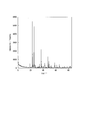
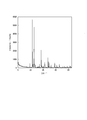
- XRD X-ray-diffraction
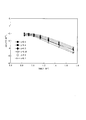
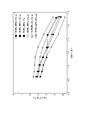
- FIG. 7 is a graph showing the electric conductivity of Ba 7 Nb (4-x) Mo (1+x) O (20+z) in which the Mo excess x is 0.02 to 0.10. For comparison, this graph also shows the electric conductivity of Ba 7 Nb 4 MoO 20 in which the Mo excess x in the test example of this example is 0.0.
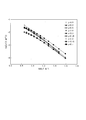
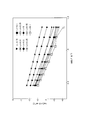
- FIG. 4 is a graph showing the electric conductivity of Ba 7 Nb (4-x) Mo (1+x) O (20+z) in which the Mo excess x is 0.10 to 0.18 in the test example of the present example. For comparison, this graph also shows the electric conductivity of Ba 7 Nb 4 MoO 20 in which the Mo excess x in the test example of this example is 0.0.
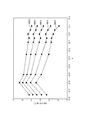
- FIG. 6 is a graph showing the electric conductivity of Ba 7 Nb (4-y) MoCr y O (20+z) in which the Cr doping amount y is 0.10 to 0.30 in the test example of the present example.
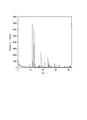
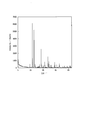
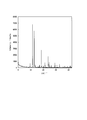
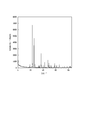
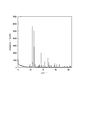
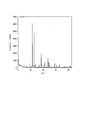
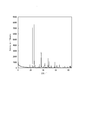
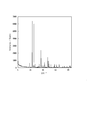
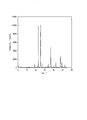
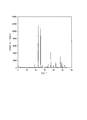
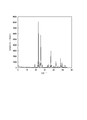
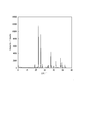
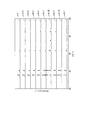
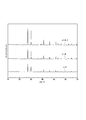
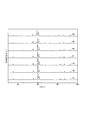
- FIG. 9 is a graph showing XRD patterns of Ba 7 Nb (4-x) Mo (1+x) O (20+z) which are Test Examples 22 to 27.
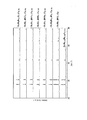
- the XRD measurement diagrams of Ba 7 Nb (4-x) Mo (1+x) O (20+z) are shown for Test Examples 28-37 having different compositions.
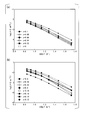
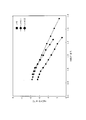
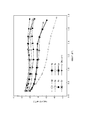
- (A ) The conductivity of Ba 7 Nb (4-x) Mo (1+x) O (20+z ) in Test Examples 22 to 27 is shown by temperature dependence.
- (B) The conductivity of Ba 7 Nb (4-x) Mo (1+x) O (20+z) is shown in temperature dependence for Test Examples 28 to 35 having different compositions.
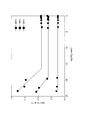
- the conductivity of Ba 7 Nb (4-x) Mo (1+x) O (20+z) in Test Examples 22 to 35 at a certain temperature is shown by the composition dependence.
- Ba 7 Nb is a graph showing an XRD pattern of (4-y) M SpringfieldCr y O (20 + z).
- the conductivity of Ba 7 Nb (4-y) MoCr y O (20+z) which is Test Examples 40 to 44 and 46, is shown by temperature dependence.
- the conductivity of Ba 7 Nb (4-y) MoCr y O (20+z) in Test Examples 22, 40 to 44 and 46 is shown by composition dependence.
- Ba 7 Nb is a graph showing an XRD pattern of (4-y) MoW y O (20 + z).
- the total electric conductivity of Test Examples 52 to 58, 81, and 82 of Ba 7 Nb (4-y) MoW y O (20+z) is shown with temperature dependence.
- the total electric conductivity of Ba 7 Nb (4-y) MoW y O (20+z) which is Test Examples 22, 52 to 58, 81, and 82, is shown by composition dependence. It is a graph which shows the XRD pattern of Test Examples 38, 39, 45, 47-51.
- the electrical conductivity of Test Examples 38, 39, and 47 to 50 is shown by temperature dependence.
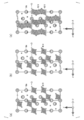
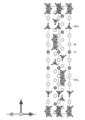
- 3 shows the crystal structures of Ba 3 WVO 8.5- based materials of Test Examples 59 to 67.
- FIG. 6 is a graph showing the XRD patterns of Ba 3 W (1-x) V (1+x) O (8.5+z) in Test Examples 59 to 67.
- the electrical conductivity of Ba 3 W (1-x) V (1+x) O (8.5+z) in Test Examples 59 to 67 is shown by temperature dependence.
- the electrical conductivity of Ba 3 W (1-x) V (1+x) O (8.5+z) in Test Examples 59 to 67 is shown by composition dependence.
- the Ba 3 W 1.6 V 0.4 O 8.8 of Test Example 66 shows the oxygen partial pressure P(O 2 ) dependence of the total electrical conductivity.
- the conductivity in dry air and the conductivity in wet air are shown with temperature dependence.
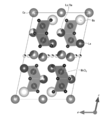
- FIG. 7 shows a crystal structure of Ba 3 MoTiO 8 in Test Example 68.
- Ba 3 Mo (1-x) Ti (1+x) O (8+z) of Test Examples 69 and 70 also have similar crystal structures.
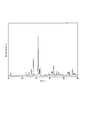
- FIG. 11 is a graph showing XRD patterns of Ba 3 Mo (1-x) Ti (1+x) O (8+z) in Test Examples 68 to 70.
- the electrical conductivity of Ba 3 Mo (1-x) Ti (1+x) O (8+z) in Test Examples 68 to 70 is shown by temperature dependence.
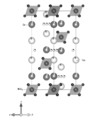
- the crystal structure of Ba 7 Ca 2 Mn 5 O 20 Test Example 71 shows the.
- FIG. 3 shows crystal structures of Ba 5 M 2 Al 2 ZrO 13 based materials of Test Examples 74 to 80.
- 9 is a graph showing XRD patterns of Ba 5 M 2 Al 2 ZrO 13 of Test Examples 74 to 80.
- FIG. The total electric conductivity of Ba 5 M 2 Al 2 ZrO 13 of Test Examples 74 to 80 is shown by temperature dependence.
- the solid electrolyte of the present embodiment includes a hexagonal perovskite-related compound, and this compound includes a compound represented by a specific general formula described later.
- the solid electrolyte is a material that conducts ions, and also includes a material that conducts both ions and (protons, electrons or holes thereof).
- the hexagonal perovskite-related compound in the present embodiment is a compound having a layered structure containing a hexagonal perovskite unit or a compound having a structure similar thereto.
- the hexagonal perovskite-related compound in the solid electrolyte of the present embodiment increases or decreases the Nb concentration or the Mo concentration and/or forms one or more cations with respect to the conventionally known Ba 7 Nb 4 MoO 20 .
- the composition has an increased concentration of the element.
- the above-mentioned cation-forming elements are Ag, Al, At, Au, Be, Bi, Br, Ca, Cd, Ce, Co, Cr, Cu, Dy, Er, Eu, Fe, Ga, Gd, Ge, Hf, Hg, Ho, I, In, Ir, La, Li, Lu, Mg, Mn, Na, Nb, Nd, Ni, Np, Os, P, Pb, Pd, Po, Pr, Pt, Pu, Re, From Rh, Ru, S, Sb, Sc, Se, Si, Sm, Sn, Sr, Ta, Tb, Tc, Te, Ti, Tl, Tm, U, V, W, Xe, Y, Yb, Zn and Zr At least one element selected from the group consisting of W, V, Cr, Mn, Ge, Si and Zr is more preferable.
- the solid electrolyte of the present embodiment contains a hexagonal perovskite-related compound represented by any of the following general formulas (1) to (13).
- M is Ag, Al, At, Au, Be, Bi, Br, Ca, Cd, Ce, Co, Cr, Cu, Dy, Er, Eu, Fe, Ga, Gd, Ge, Hf.
- Hg Ho, I, In, Ir, La, Li, Lu, Mg, Mn, Na, Nb, Nd, Ni, Np, Os, P, Pb, Pd, Po, Pr, Pt, Pu, Re, Rh , Ru, S, Sb, Sc, Se, Si, Sm, Sn, Sr, Ta, Tb, Tc, Te, Ti, Tl, Tm, U, V, W, Xe, Y, Yb, Zn and Zr. It is a cation of at least one element selected from the group.
- ⁇ is the amount of Ba deficiency and is 0 or more and 0.5 or less
- x is ⁇ 1.1 or more and 1.1 or less
- y is 0 or more and 1.1 or less
- z is indefinite of oxygen It is a specificity and represents a numerical value of ⁇ 2.0 or more and 2.0 or less.
- +y ⁇ 0.01 is satisfied.
- M is a cation of at least one element selected from the group consisting of W, V, Cr, Mn, Ge, Si and Zr.
- ⁇ is the amount of Ba deficiency and is 0 or more and 0.5 or less, x is ⁇ 1.1 or more and 1.1 or less, y is 0 or more and 1.1 or less and
- the numerical value satisfying z, z is a nonstoichiometric ratio of oxygen, and represents a numerical value of ⁇ 2.0 or more and 2.0 or less.
- M is a cation of at least one element selected from the group consisting of V, Mn, Ge, Si and Zr.
- y represents a numerical value of 0.01 or more and 1.1 or less, and
- z represents a nonstoichiometric ratio of oxygen and represents a numerical value of ⁇ 2.0 or more and 2.0 or less.
- M is a cation of at least one element selected from the group consisting of V and Mn.
- z is a nonstoichiometry of oxygen and represents a numerical value of ⁇ 2.0 or more and 2.0 or less, and y represents a numerical value of 0.01 or more and 1.1 or less.
- x is preferably 0.01 or more and 0.34 or less, more preferably 0.18 or more and 0.22 or less, and 0.19 or more. It is particularly preferably 0.21 or less. When x is a value close to the above value, particularly 0.20, the electrical conductivity at low temperature becomes particularly high.
- y is preferably 0.06 or more and 0.24 or less, more preferably 0.08 or more and 0.22 or less, and 0.09 or more and 0.21 or less. Is particularly preferable.
- y is the above-mentioned value, particularly 0.1 or more and 0.2 or less, the electric conductivity at low temperature becomes particularly high.
- y is preferably 0.06 or more and 0.14 or less, more preferably 0.08 or more and 0.12 or less, and 0.09 or more and 0.11 or less. Is particularly preferable.
- y is a value close to the above value, particularly 0.10, the electrical conductivity at low temperatures is particularly high.
- y is preferably 0.16 or more and 0.24 or less, more preferably 0.18 or more and 0.22 or less, and 0.19 or more and 0.21 or less. Particularly preferred. When y is a value close to the above value, particularly 0.20, the electrical conductivity at low temperatures is particularly high. In the above formula (7), y is preferably 0.11 or more and 0.19 or less, more preferably 0.13 or more and 0.17 or less, and 0.14 or more and 0.16 or less. Particularly preferred. When y is a value close to the above value, particularly 0.15, the electrical conductivity at low temperature becomes particularly high.
- x is preferably -0.8 or more and 0.2 or less, more preferably -0.64 or more and -0.56 or less, and -0.62 or more- It is more preferably 0.58 or less, and more preferably -0.61 or more and -0.59 or less.
- x has a value particularly close to ⁇ 0.60, the electric conductivity at low temperatures becomes particularly high.
- z is a non-stoichiometry of oxygen and represents a numerical value of ⁇ 1.0 or more and 1.0 or less. ] Is also preferable.
- x is preferably -0.3 or more and 0.1 or less, more preferably -0.14 or more and -0.06 or less, and -0.12 or more- It is more preferably 0.08 or less, and more preferably -0.11 or more and -0.09 or less.
- z is a non-stoichiometric ratio of oxygen and represents a numerical value of ⁇ 0.1 or more and 0.3 or less. ] Is also preferable.
- Ba 7 Ca 2 Mn 5 O (20 + z) ⁇ (10) [In the formula (10), z is a nonstoichiometric ratio of oxygen and represents a numerical value of ⁇ 1.0 or more and 1.0 or less. ] Is also preferable.
- Ba 2.6 Ca 2.4 La 4 Mn 4 O (19+z) (11) [In the formula (11), z is a non-stoichiometric ratio of oxygen and represents a numerical value of ⁇ 1.0 or more and 1.0 or less. ] Is also preferable.
- La 2 Ca 2 MnO (7+z) (12) [In the formula (12), z is a nonstoichiometric ratio of oxygen and represents a numerical value of ⁇ 1.0 or more and 1.0 or less.
- preferable examples include those having an increased Mo/Nb ratio with respect to the conventionally known Ba 7 Nb 4 MoO 20 . That is, when x in the general formula (3) is the Mo excess x, it is preferable that x be a positive value, specifically, 0.01 or more and 0.50 or less, The value of 0.01 or more and 0.34 or less is more preferable, the value of 0.18 or more and 0.22 or less is more preferable, and the value of 0.19 or more and 0.21 or less is particularly preferable. Specifically, when the Mo excess x is 0.20 with respect to Ba 7 Nb 4 MoO 20 , particularly high electrical conductivity is obtained.
- the Mo excess x is in the range of -1.1 or more and 1.1 or less, and the amount that can be easily produced can be appropriately adjusted depending on the raw material used and the adjusting process.
- the excess amount x may be a value of 0.01 or more and 0.20 or less, or may be 0.09 or more and 0.11 or less, and even with these values, high conductivity is obtained. Further, for example, even when the Mo excess x is 0.10 with respect to Ba 7 Nb 4 MoO 20 , high conductivity is obtained.
- the a-axis length, the b-axis length, the c-axis length ( ⁇ ), the ⁇ angle, the ⁇ angle, and the ⁇ angle (o) of the lattice constant of the hexagonal perovskite-related compound in the present embodiment are represented by formulas (2) to (7), respectively. 5.35 ⁇ a ⁇ 6.56, 5.35 ⁇ b ⁇ 6.56, 15.14 ⁇ c ⁇ 18.52, 89 ⁇ 91, 89 ⁇ 91, 119 ⁇ 121, Regarding formula (8), 5.23 ⁇ a ⁇ 6.4, 5.23 ⁇ b ⁇ 6.4, 18.96 ⁇ c ⁇ 23.19, 89 ⁇ 91, 89 ⁇ 91, 119 ⁇ .
- the lattice constant is a constant that defines the shape and size of the unit cell of this embodiment.
- the lattice constant can be obtained by using an XRD (X-ray diffraction) pattern in this embodiment.
- the theoretically possible value of the lattice constant can also be obtained by structure optimization by density functional theory (DFT) calculation.
- DFT density functional theory
- the compound having each of the above conditions can obtain effective electric conductivity (oxide ion conductivity) when used as an oxide ion (O 2 ⁇ ) conductor or a solid electrolyte.
- the oxide ion (O 2 ⁇ ) conductor is a compound in which electricity is conducted by conduction (movement) of oxide ions.
- the solid electrolyte using the compound of the present embodiment is preferably used under the temperature condition of 300 to 1200° C., more preferably under the temperature condition of 300 to 1000° C., and used at 300° C. or higher and lower than 700° C. Is more preferable, and use at 300 to 600° C. is particularly preferable.
- the solid electrolyte using the compound of the present embodiment can be operated at a temperature higher than 600° C. as in the conventional SOFC.
- the electric conductivity represented by l og [ ⁇ (Scm ⁇ 1 )] is preferably ⁇ 7 or more, and from ⁇ 5.0. Is more preferable, and -3.5 or more is particularly preferable. Since the electric conductivity at 300° C. is sufficiently high, it has a high electric conductivity at a low temperature and can be particularly suitably used for a battery and other devices that operate at a low temperature.
- the solid electrolyte of the present embodiment can be used as a solid electrolyte layer by forming it in a layered form or included in a layered structure.
- the solid electrolyte layer may include other ion conductors and the like in addition to the solid electrolyte of the present embodiment.
- the solid electrolyte contains 70 mass% or more of the hexagonal perovskite-related compound of the present embodiment.
- the solid electrolyte of the present embodiment or the electrolyte layer containing the solid electrolyte can be used in a battery including the solid electrolyte.
- the solid electrolyte of the present embodiment can be particularly suitably used for a solid oxide fuel cell (SOFC).
- SOFC solid oxide fuel cell
- the SOFC in the present embodiment refers to a battery in which all electrodes and electrolytes forming the battery are solid.
- the ionic conduction between the electrodes may be oxide ions.
- the battery using the solid electrolyte or the electrolyte layer containing this solid electrolyte according to the present embodiment can be particularly suitably used as a low temperature operation battery.
- the low-temperature operating battery is a battery operating at 300 to 1200° C., preferably 300 to 1000° C., more preferably 300 to 700° C., and particularly preferably 300 to 600° C., as described above.
- the battery according to the present embodiment includes, for example, an anode, a cathode, and the above-mentioned solid electrolyte layer interposed therebetween.
- the cathode and the solid electrolyte may form an integrated cathode-solid electrolyte layer assembly.
- the solid electrolyte of this embodiment includes, in addition to the solid oxide fuel cell (SOFC) described above, other batteries, sensors, electrodes, electrolytes, oxygen concentrators, oxygen separation membranes, oxygen permeable membranes, oxygen pumps, catalysts. , Photocatalyst, electric/electronic/communication equipment, energy/environment-related equipment or optical equipment.
- SOFC solid oxide fuel cell
- the solid electrolyte layer of the present embodiment described above can be used for a solid oxide fuel cell (SOFC), a sensor, an oxygen concentrator, an oxygen separation membrane, an oxygen permeable membrane, an oxygen pump, or the like.
- SOFC solid oxide fuel cell
- the solid electrolyte of the present embodiment can be used as an electrolyte such as a gas sensor as a sensor.
- a gas sensor, a gas detector, or the like can be configured by mounting a sensitive electrode on the electrolyte according to the gas to be detected.
- a carbon dioxide gas sensor can be obtained by using a sensitive electrode containing carbonate
- a NOx sensor can be obtained by using a sensitive electrode containing nitrate
- a SOx sensor can be obtained by using a sensitive electrode containing sulfate.
- a trapping device or a decomposing device for NOx and/or SOx contained in the exhaust gas can be configured.
- the solid electrolyte of the present embodiment can be used as the solid electrolyte of the present embodiment, an adsorbent or an adsorbent/separator for ions, or various catalysts.
- the solid electrolyte of the present embodiment may also act as an activator in which various rare earth elements in the ionic conductor form luminescence centers (color centers). In this case, it can be used as a wavelength changing material or the like.
- the solid electrolyte of this embodiment may also become a superconductor by being doped with electron carriers or hole carriers.
- the solid electrolyte of the present embodiment also uses the solid electrolyte as an ion conductor, and an inorganic compound or the like that is colored or discolored by the insertion/desorption of conductive ions is attached to the surface of the solid electrolyte, and a transparent electrode such as ITO is further formed thereon. It is also possible to produce an all-solid-state electrochromic device by forming By using this all-solid-state electrochromic element, it is possible to provide an electrochromic display having memory characteristics with reduced power consumption.
- Example synthesis (Test Examples 1 to 21)
- the compounds shown in “Composition” of Test Examples 1 to 21 in Table 1 were prepared by the solid phase reaction method.
- the oxidation number of Ba is +2
- the oxidation number of Nb is +5
- the oxidation number of Mo is +6
- the oxidation number of oxygen O is -2
- the oxidation number of W is +6,
- the oxidation number of V is +5.
- the oxygen amount calculated from the electrically neutral condition is shown.
- the oxygen amount (20+z) is not limited to the indicated numerical value.
- BaCO 3 , Nb 2 O 5 , MoO 3 , WO 3 , V 2 O 5 , Cr 2 O 3 , GeO 2 , SiO 2 , and ZrO 2 were used as a starting material.
- the starting material was previously dried in an electric furnace at 250 to 300° C. for 12 hours, and then weighed with an electronic balance so that the molar ratio of cations became the desired chemical composition. Dry mixing grinding and wet mixing grinding using ethanol were repeatedly performed for 30 minutes to 2 hours using an agate mortar.
- the obtained mixture was calcined at 900° C. in the atmosphere for 10 to 12 hours using an electric furnace.
- the calcined mixture was subjected to wet mixing grinding using ethanol and dry mixing grinding in an agate mortar for 30 minutes to 2 hours.
- the mixture was molded into a cylindrical pellet having a diameter of 10 to 20 mm by applying a pressure of 62 to 150 MPa using a uniaxial press.
- the obtained pellets were placed in an electric furnace and sintered in the atmosphere at 1100° C. for 24 hours. As a result, pellets that were sintered bodies were obtained.
- a high-density sample was prepared by means of applying hydrostatic pressure once before sintering.
- a sample sintered without hydrostatic treatment before sintering is called a low density sample.
- the high-density sample of Test Example 1 had a density of 5.2725 g/cm 3 and a relative density of 90.1%.
- the low-density sample of Test Example 1 had a density of 3.9659 g/cm 3 and a relative density of 67.8%.
- the high-density sample of Test Example 6 had a density of 5.5951 g/cm 3 and a relative density of 95.6%.
- the low-density sample of Test Example 6 had a density of 3.9165 g/cm 3 and a relative density of 66.9%.
- XRD measurement was performed using a diffractometer Bruker D8.
- the obtained XRD pattern was indexed using DICVOL06 to determine the lattice constant.
- the XRD pattern of Test Example 1 is shown in FIG.
- the results of XRD measurement for Test Examples 2 to 21 are shown in FIGS. 2 to 21, respectively.
- the lattice constant was determined from the obtained XRD pattern.
- Table 1 shows the lattice constants (a, b, c, ⁇ , ⁇ , ⁇ ) and lattice volume V of Test Examples 1 to 21.
- Test Example 21 The electrical conductivity of each test example in Table 1 except Test Example 21 was measured by a DC four-terminal method. After reducing the particle size of the sample prepared in the above (Sample synthesis) using a ball mill, it was molded into pellets of 5 mm ⁇ by uniaxial pressing and sintered to prepare a sample for conductivity measurement. Four platinum wires were wound around a sintered body for measuring the total electric conductivity by the DC four-terminal method, and a platinum paste was coated on the platinum wire to bring the sample and the platinum wire into close contact with each other. It was heated at 900° C. for 1 hour in order to remove the organic component contained in the platinum or gold paste.
- the electrical conductivity measured for each test example is shown in Tables 2-9.
- the oxidation number of Ba is +2, the oxidation number of Nb is +5, the oxidation number of Mo is +6, the oxidation number of oxygen O is -2, the oxidation number of W is +6, and the oxidation number of V is Is 5 and the oxidation number of Cr is +6, the oxidation number of Ge is +4, the oxidation number of Si is +4, and the oxidation number of Zr is +4, the oxygen amount calculated from the electrical neutral condition is shown.
- the oxygen non-stoichiometry z depends on the molar ratio of cations, temperature, oxygen partial pressure, synthesis method, thermal history, etc., so that the oxygen amount (20+z) is not limited to the indicated numerical value.
- the electrical conductivity represented by l[g( ⁇ (Scm ⁇ 1 )]] in the temperature range of 280 to 909° C. is ⁇ 7.0 to ⁇ 1.0. It is within the range of.
- the electrical conductivity at 300° C. or the electrical conductivity represented by l[g( ⁇ (Scm ⁇ 1 )] when obtained by extrapolation from the above data and FIGS. 22 to 26 is ⁇ 6.2 in Test Examples 2 to 20. That is all. Therefore, in each of Test Examples 2 to 20, high electrical conductivity can be obtained at low temperatures. Further, the electrical conductivity at 300° C. is higher than ⁇ 5.0 in Test Examples 2, 3, 5, 6 (high density), 8 to 11, 16 and 20.
- Test Example 6 the above-mentioned test example having the highest electric conductivity at around 300° C. is Test Example 6, and the value of the electric conductivity lOg [ ⁇ (Scm ⁇ 1 )] at 280° C. is ⁇ 3.7. Is. Although the electrical conductivity of Test Example 21 was not measured, it is considered that it exhibits electric (ion) conduction similarly to Ba 7 Nb 4.05 Mo 0.95 O 19.975 of Test Example 20.
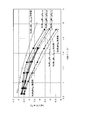
- FIG. 23 shows an Arrhenius plot of the electric conductivity of Ba 7 Nb 4 MoO 20 in which the Mo excess amount x in the general formula (7) is 0.02 to 0. 10 and the Mo excess amount x is 0.10 to 0.
- FIG. 24 shows an Arrhenius plot of the electric conductivity of Ba 7 Nb 4 MoO 20 prepared as No. 18.
- FIGS. 23 and 24 also show the electric conductivity of Ba 7 Nb 4 MoO 20 having a Mo excess x of 0.0 in the test example of this example.
- the above-mentioned Test Example 1 high density, low density
- 2, 3, 4, 5, 6 high density, low density
- 7, 8, 9 and 10 are each Mo excess x (general formula (7)).
- Ba 7 Nb 4 MoO 20 (general formula) in which W, V (substitute a part of Mo), V (substitute a part of Nb), Cr, Si, Ge, and Zr is set to 0.1.
- the above-mentioned Test Examples 11, 12, 13, 14, 17, 18 and 19 are W (substitute a part of Nb), V (substitute a part of Mo), V, Cr, Ge, Si and Zr(respectively). This corresponds to the result of the compound in which a part of Nb is substituted) is doped.
- the W-doped compound has the highest electric conductivity in all of the plotted temperature ranges.
- the compounds doped with Cr and V (substituting a part of Mo) have high electric conductivity at high temperature, but 1000T ⁇ 1 /K ⁇ 1 is 1.4 or more, that is, about 441° C. or less.
- the electrical conductivity of the Si-doped compound increases.
- An Arrhenius plot of the electric conductivity of O (20+z) ) is shown in FIG.
- the above-mentioned test examples 14, 15, and 16 correspond to the samples with the doping amounts y of 0.10, 0.20, and 0.30, respectively.
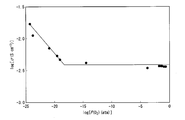
- the oxygen partial pressure dependence of the total electrical conductivity was measured in the oxygen partial pressure range of 3.5 ⁇ 10 ⁇ 25 to 0.2 atm and 900° C.
- the oxygen partial pressure was monitored using an oxygen sensor installed downstream of the device.
- the N 2 / H 2 mixed gas was controlled oxygen partial pressure by mixing a small amount of nitrogen gas.
- FIG. 27 shows a graph in which the measured electrical conductivity log [ ⁇ (Scm ⁇ 1 )] is plotted on the vertical axis against the oxygen partial pressure log [P(O 2 )/atm] on the horizontal axis. Since the total electric conductivity takes a substantially constant value without depending on the oxygen partial pressure, it was strongly suggested that the oxide ion is the dominant carrier in the electric conduction of the compound of Test Example 1. Test Examples 2 to 21 having a similar crystal structure are also considered to be compounds having an oxide ion as a dominant carrier.
- Test Example 6 In order to determine the oxide ion transport number, an electromotive force was measured by an oxygen concentration battery using air gas and N 2 /O 2 mixed gas. After reducing the particle size of the sample prepared in the above (Sample synthesis) using a ball mill, it was molded into a pellet of 25 mm ⁇ by uniaxial pressing, and hydrostatic pressure was applied. A high-density sample of Test Example 6 for measuring an electromotive force was prepared by sintering at 1200° C. for 12 hours. The surface of the sample was ground and smoothed with diamond slurry. The relative density of the pellets of Test Example 6 was 96.0%.
- a Pt paste having a diameter of about 10 mm was applied to the center of the pellet and heated at 1000° C. for 1 hour in order to remove the organic component contained in the platinum paste.
- the platinum paste and the platinum electrode were adhered with an instant adhesive, the alumina tube and the glass seal, and the sample was also adhered with an instant adhesive, and the platinum electrode was attached.
- Alumina fasteners were used for the presser used for the measurement. After heating for 1 hour at 1000° C. to adhere the glass seal, the transport number of oxide ion in Test Example 6 was determined at 800° C. and 900° C. by measuring the electromotive force using an oxygen concentration battery.
- Structural optimization calculation based on the density functional theory was carried out for Ba 7 Nb 3 M0 MO 20 .
- M is Ag, Al, At, Au, Be, Bi, Br, Ca, Cd, Ce, Co, Cr, Cu, Dy, Er, Eu, Fe, Ga, Gd, Ge, Hf, Hg, Ho.
- Tables 10 to 12 and 33 to 36 show the results of lattice constants obtained by the structural optimization.
- the optimized structures for both compositions retained the original crystal structures of the hexagonal perovskite-related compounds, indicating the possibility of synthesizing these compositions. It is considered that these compositions also show oxide ion conduction.
- Test Examples 22 to 83 The compounds shown in "Composition" of Test Examples 22 to 41 shown in Table 13, Test Examples 42 to 61 shown in Table 14 and Test Examples 62 to 83 shown in Table 15 were prepared according to the following procedures.
- the Ba oxidation number is +2
- the Nb oxidation number is +5
- the Mo oxidation number is +6
- the oxygen O oxidation number is -2
- the W oxidation number is +6
- the V oxidation number is +6.
- the oxygen amount calculated from the neutral condition is shown.
- the oxygen non-stoichiometry z depends on the molar ratio of cations, temperature, oxygen partial pressure, synthesis method, thermal history, etc., so the oxygen amount (20+z) is It is not limited to the numbers shown.
- Test Examples 22 to 58 and 81 to 83 The compounds shown in “Composition” of Test Examples 22 to 41 of Table 13, Test Examples 42 to 58 of Table 14, and Test Examples 81 to 83 of Table 15 were prepared by the solid phase reaction method.
- a starting material BaCO 3 , Nb 2 O 5 , MoO 3 , WO 3 , V 2 O 5 , Cr 2 O 3 , MnO 2 , GeO 2 , SiO 2 , and ZrO 2 were used.
- the starting material was previously dried in an electric furnace at 250 to 300° C. for 12 hours, and then weighed with an electronic balance so that the molar ratio of cations became the desired chemical composition.
- Dry mixing grinding and wet mixing grinding using ethanol were repeatedly performed for 30 minutes to 2 hours using an agate mortar.
- the obtained mixture was calcined at 900° C. in the atmosphere for 10 to 12 hours using an electric furnace.
- the calcined mixture was subjected to dry mixing grinding and wet mixing grinding using ethanol in an agate mortar repeatedly for 30 minutes to 2 hours.
- the mixture was molded into a cylindrical pellet having a diameter of 10 to 20 mm by applying a pressure of 62 to 150 MPa using a uniaxial press.
- the obtained pellets were placed in an electric furnace and sintered in the atmosphere at 1100° C. for 24 hours. As a result, pellets that were sintered bodies were obtained.
- Test Examples 59 to 67 The compounds shown in “Composition” of Test Examples 59 to 61 of Table 14 and Test Examples 62 to 67 of Table 15 were prepared by the solid phase reaction method. BaCO 3 , WO 3 , and V 2 O 5 were used as starting materials. The starting material was previously dried in an electric furnace at 300° C. for 12 hours, and then weighed with an electronic balance so that the molar ratio of cations became the target chemical composition. Using an agate mortar, dry mixed grinding and wet mixed grinding with ethanol were repeated for 1 hour. The obtained mixture was calcined at 950° C. for 15 hours in the air using an electric furnace.
- the calcined mixture was repeatedly mixed and ground in an agate mortar for 1 hour by a dry method and a wet method using ethanol.
- the mixture was molded into a cylindrical pellet having a diameter of 10 mm by applying a pressure of 150 MPa using a uniaxial press.
- the obtained pellets were placed in an electric furnace and sintered in the atmosphere at 1020° C. for 24 hours. As a result, pellets that were sintered bodies were obtained.
- the electrical conductivity was measured using the obtained sintered body.
- XRD X-ray diffraction
- a part of the sintered body was crushed for about 20 minutes by a crusher made of tungsten carbide (WC) and then ground in an agate mortar for about 1 hour. did.
- Test Examples 68 to 70 The compounds shown in "Composition" of Test Examples 68 to 70 in Table 15 were prepared by the solid phase reaction method. BaCO 3 , TiO 2 , and MoO 3 were used as starting materials. The starting material was previously dried in an electric furnace at 250 to 300° C. for 12 hours, and then weighed with an electronic balance so that the molar ratio of cations became the desired chemical composition. Using an agate mortar, dry mixed grinding and wet mixed grinding with ethanol were repeated for 30 minutes. The obtained mixture was calcined at 900° C. for 12 hours in the air using an electric furnace. The calcined mixture was repeatedly mixed and ground in an agate mortar by a dry method and a wet method using ethanol for about 1 hour.
- the mixture was molded into a cylindrical pellet having a diameter of 20 mm by applying a pressure of 150 MPa using a uniaxial press.
- the obtained pellets were placed in an electric furnace and sintered in the atmosphere at 1100° C. for 24 hours.
- the obtained sintered body was crushed for 20 minutes by a crusher made of tungsten carbide (WC) and then crushed for about 1 hour in an agate mortar.
- the mixture was molded into a cylindrical pellet having a diameter of 5 mm by applying a pressure of 150 MPa using a uniaxial press.
- the obtained pellets were placed in an electric furnace and sintered in the atmosphere at 1100° C. for 12 hours. As a result, pellets that were sintered bodies were obtained.
- the electrical conductivity was measured using the obtained sintered body.
- Test Example 71 The compounds shown in "Composition" of Test Example 71 in Table 15 were prepared by the solid phase reaction method. BaCO 3 , MnO 2 , and CaCO 3 were used as starting materials. The starting material was previously dried in an electric furnace at 250 to 300° C. for 12 hours, and then weighed with an electronic balance so that the molar ratio of cations became the desired chemical composition. Using an agate mortar, dry mixed grinding and wet mixed grinding with ethanol were repeatedly performed for about 1 hour. The obtained mixture was calcined at 900° C. for 12 hours in the air using an electric furnace. The calcined mixture was repeatedly subjected to dry mixing and grinding and wet mixing and grinding using ethanol in an agate mortar for 30 minutes.
- the mixture was molded into a cylindrical pellet having a diameter of 20 mm by applying a pressure of 150 MPa using a uniaxial press.
- the obtained pellets were placed in an electric furnace and sintered at 1200° C. for 12 hours in the atmosphere.
- the obtained sintered body was crushed for 20 minutes by a crusher made of tungsten carbide (WC) and then crushed for about 1 hour in an agate mortar.
- the mixture was molded into a cylindrical pellet having a diameter of 5 mm by applying a pressure of 150 MPa using a uniaxial press.
- the obtained pellets were placed in an electric furnace and sintered in the atmosphere at 1400° C. for 24 hours. As a result, pellets that were sintered bodies were obtained.
- the electrical conductivity was measured using the obtained sintered body.
- Test Example 72 The compounds shown in "Composition" of Test Example 72 in Table 15 were prepared by the solid phase reaction method. BaCO 3 , MnO 2 , La 2 O 3 , and CaCO 3 were used as starting materials. The starting material was previously dried in an electric furnace at 250 to 300° C. for 12 hours, and then weighed with an electronic balance so that the molar ratio of cations became the desired chemical composition. Using an agate mortar, dry mixed grinding and wet mixed grinding with ethanol were repeatedly performed for about 1 hour. The obtained mixture was calcined at 900° C. for 10 hours in the air using an electric furnace. The calcined mixture was repeatedly mixed and ground in an agate mortar for about 1 hour by a dry method and a wet method using ethanol.
- the mixture was molded into a cylindrical pellet having a diameter of 5 mm by applying a pressure of 150 MPa using a uniaxial press.
- the obtained pellets were placed in an electric furnace and sintered at 1200° C. for 12 hours in the atmosphere.
- the obtained sintered body was crushed for 20 minutes by a crusher made of tungsten carbide (WC) and then crushed for about 1 hour in an agate mortar.
- the mixture was molded into a cylindrical pellet having a diameter of 5 mm by applying a pressure of 150 MPa using a uniaxial press.
- the obtained pellets were placed in an electric furnace and sintered at 1200° C. for 12 hours in the atmosphere.
- pellets that were sintered bodies were obtained.
- the electrical conductivity was measured using the obtained sintered body.
- Test Example 73 The compounds shown in "Composition" of Test Example 73 in Table 15 were prepared by the solid phase reaction method. La 2 O 3 , MnO 2 , and CaCO 3 were used as starting materials. The starting material was previously dried in an electric furnace at 250 to 300° C. for 12 hours, and then weighed with an electronic balance so that the molar ratio of cations became the desired chemical composition. Dry mixing and grinding using an agate mortar and wet mixing and grinding using ethanol were repeated for about 1 hour. The obtained mixture was calcined at 900° C. for 12 hours in the air using an electric furnace. The calcined mixture was repeatedly mixed and ground in an agate mortar by a dry method and a wet method using ethanol for about 1 hour.
- the mixture was molded into a cylindrical pellet having a diameter of 5 mm by applying a pressure of 150 MPa using a uniaxial press.
- the obtained pellets were placed in an electric furnace and sintered at 1200° C. for 12 hours in the atmosphere. As a result, pellets that were sintered bodies were obtained.
- XRD X-ray diffraction
- a part of the sintered body was crushed for 20 minutes by a crusher made of tungsten carbide (WC) and then ground in an agate mortar for about 1 hour. .. Since this compound also has a crystal structure similar to the compounds of Test Examples 1 to 21, it is considered to have oxide ion conductivity.
- Test Examples 74 to 80 The compounds shown in "Composition" of Test Examples 74 to 80 in Table 15 were prepared by the solid phase reaction method.
- the starting material BaCO 3 , Al 2 O 3 , ZrO 2, Gd 2 O 3 , Dy 2 O 3 , Ho 2 O 3 , Er 2 O 3 , Tm 2 O 3 , Yb 2 O 3 , Lu 2 O 3 are used. It was used.
- the starting material was previously dried in an electric furnace at 300° C. for 12 hours, and then weighed with an electronic balance so that the molar ratio of cations became the target chemical composition. Using an agate mortar, dry mixed grinding and wet mixed grinding with ethanol were repeated for 30 minutes. The obtained mixture was calcined at 900° C.
- the calcined mixture was dry-mixed and ground for 30 minutes in an agate mortar.
- the mixture was molded into a cylindrical pellet having a diameter of 20 mm by applying a pressure of about 50 MPa using a uniaxial press.
- the obtained pellets were placed in an electric furnace and sintered in the atmosphere at 1600° C. for 12 hours to obtain a sintered body.
- the electrical conductivity was measured using the obtained sintered body.
- XRD X-ray diffraction
- a part of the sintered body was crushed for 20 minutes by a crusher made of tungsten carbide (WC) and then ground for about 30 minutes in an agate mortar. ..
- FIG. 30 shows the crystal structure of Ba 7 Nb 4 MoO 20 used in Test Example 22.
- 31 and 32 are graphs showing XRD patterns of Ba 7 Nb (4-x) Mo (1+x) O (20+z) .
- the measurement figure of 2, 0.22, 0.25, 0.3, 0.4, 0.5 is shown.
- the conductivity of Ba 7 Nb (4-x) Mo (1+x) O (20+z) is plotted in FIG. 33 with temperature dependence for each value of x and in FIG. 34 with composition dependence for each value of temperature.
- FIG. 35 is a graph showing an XRD pattern of Ba 7 Nb (4-y) MoCr y O (20+z) used in Test Examples 40 to 44 and 46.
- the measurement figure of x 0.1, 0.2, 0.25, 0.3, 0.4, 0.5 is shown.
- the conductivity of Ba 7 Nb (4-x) Mo (1+x) O (20+z) is plotted in FIG. 36 as a function of temperature.
- FIG. 38 is a graph showing an XRD pattern of Ba 7 Nb (4-y) MoW y O (20+z) used in Test Examples 52 to 58 and 81 to 83.
- FIG. 39 shows the temperature dependence of the total electrical conductivity of Ba 7 Nb (4-y) MoW y O (20+z) .
- FIG. 40 shows the compositional dependence of the total electric conductivity of Ba 7 Nb (4-y) MoW y O (20+z) .
- FIG. 41 shows Ba 7 Nb 3.9 MoM 0.1 O (20+z) (M is V, Mn, Ge, Si or Zr) as another solid solution used in Test Examples 38, 39, 45 and 47 to 51.
- FIG. 42 shows the electric conductivity of the solid solutions used in Test Examples 38, 39 and 47 to 50 as a function of temperature.
- FIG. 43 shows the crystal structure of the Ba 3 WVO 8.5- based material used in Test Examples 59 to 67.
- this Ba 3 WVO 8.5 system is said to have the crystal structure of (a), but the crystal structures of FIGS. (b) and (c) have been proposed from the analysis results.
- FIG. 44 is a graph showing an XRD pattern of Ba 3 W (1-x) V (1+x) O (8.5+z) .
- FIG. 45 shows the electric conductivity as a function of temperature.
- FIG. 46 shows the electrical conductivity with composition dependence.
- the electrical conductivity increases with increasing temperature. At 600° C., the electrical conductivity ⁇ of Ba 3 W 1.6 V 0.4 O 8.8 of Test Example 66 is 85 times higher than that of Ba 3 WVO 8.5 of Test Example 59. It was found that the electrical conductivity is improved by making the W content excessive. The same can be considered for Test Examples 59 to 65 and 67 which are the same Ba 3 WVO 8.5- based material.
- FIG. 47 shows the P(O 2 ) dependence of the conductivity of Ba 3 W 1.6 V 0.4 O 8.8 of Test Example 66. Since there is a region where the total electric conductivity does not depend on the oxygen partial pressure and has a substantially constant value, it is suggested that in the electric conductivity of the compound of Test Example 66, the oxide ion is the dominant carrier in that region. To be done.
- FIG. 48 shows the conductivities in dry air and wet air for Ba 3 W 1.6 V 0.4 O 8.8 . No change in the total electric conductivity was confirmed by the measurement in wet air and dry air for Test Example 66, which strongly suggests that Proton Conduction did not occur in Test Example 66. The same can be considered for Test Examples 59 to 65 and 67 which are the same Ba 3 WVO 8.5- based material.
- FIG. 49 shows the crystal structure of the Ba 3 MoTiO 8 type material used in Test Examples 68 to 70.
- FIG. 50 is a graph showing an XRD pattern of Ba 3 Mo (1-x) Ti (1+x) O (8+z) . Also, the electric conductivity of Ba 3 Mo 1.1 Ti 0.9 O 8.1 and Ba 3 Mo 1.2 Ti 0.8 O 8.2 in which the Ti excess x is set to ⁇ 0.1 and ⁇ 0.2.
- FIG. 51 shows the temperature dependence of the degree.
- the temperature dependence of the electrical conductivity of Ba 3 MoTiO 8 having a Mo excess x of 0.0 in the test example of this example is also shown.
- the samples having Mo excess x in the range of ⁇ 0.1 and ⁇ 0.2 show higher electric conductivity than the sample of Ba 3 MoTiO 8 (Test Example 68) in which x is 0.0.
- the sample having the Mo excess x of ⁇ 0.1 has the highest electric conductivity, and the high electric conductivity is maintained even at a low temperature of about 300° C.
- FIG. 52 shows a graph in which the measured electrical conductivity log [ ⁇ (Scm ⁇ 1 )] is plotted on the vertical axis against the oxygen partial pressure log [P(O 2 )/atm] on the horizontal axis. Since the total electric conductivity takes a substantially constant value without depending on the oxygen partial pressure, it was strongly suggested that the oxide ion is the dominant carrier in the electric conduction of the compound of Test Example 69. The same can be considered for Test Examples 68 and 70, which are the same Ba 3 MoTiO 8 system material.
- FIG. 53 shows the crystal structure of the Ba 7 Ca 2 Mn 5 O 20 based material used in Test Example 71.
- the space group R-3m No. 166
- c 51.371 ⁇ .
- FIG. 54 is a graph showing an XRD pattern of Ba 7 Ca 2 Mn 5 O 20 .
- FIG. 55 shows the total electric conductivity of Ba 7 Ca 2 Mn 5 O 20 with temperature dependence.
- FIG. 56 shows the crystal structure of the Ba 2.6 Ca 1.4 La 4 Mn 4 O 19 series material used in Test Example 72.
- FIG. 57 is a graph showing an XRD pattern of Ba 2.6 Ca 1.4 La 4 Mn 4 O 19 .
- FIG. 58 shows the total electric conductivity of Ba 2.6 Ca 1.4 La 4 Mn 4 O 19 as a function of temperature.
- FIG. 59 shows the crystal structure of the La 2 Ca 2 MnO 7 based material used in Test Example 73.
- FIG. 60 is a graph showing an XRD pattern of La 2 Ca 2 MnO 7 .
- FIG. 61 shows the crystal structure of the Ba 5 M 2 Al 2 ZrO 13 system material used in Test Examples 74 to 80.
- FIG. 62 is a graph showing an XRD pattern of Ba 5 M 2 Al 2 ZrO 13 (M is Gd, Dy, Er, Ho, Tm, Yb, Lu).
- M is Gd, Dy, Er, Ho, Tm, Yb, Lu
- the total electric conductivity of Ba 5 M 2 Al 2 ZrO 13 measured in the atmosphere is shown as a temperature dependence.
- Test Example 76 the total electric conductivity in dry air (Dry air) is also shown as a temperature dependence. It is suggested that Test Example 76 exhibits proton conduction due to the reduced conductivity in dry air.
- Test Examples 74, 75, 77 to 80 which are also Ba 5 M 2 Al 2 ZrO
- Tables 16 to 32 show the results of the electrical conductivity measurements of Test Examples 22 to 83.
- the oxidation number of Ba is +2
- the oxidation number of Nb is +5
- the oxidation number of Mo is +6
- the oxidation number of oxygen O is -2
- the oxidation number of W is +6, and the oxidation number of V is +5, Cr oxidation number +6, Ge oxidation number +4, Si oxidation number +4, Zr oxidation number +4, Ti oxidation number +4, Al oxidation number +3, Gd oxidation number +3,
- the oxidation number of Dy is +3,
- the oxidation number of Er is +3
- the oxidation number of Ho is +3
- the oxidation number of Tm is +3,
- the oxygen amount calculated from the neutral condition is shown.
- the oxygen non-stoichiometry z depends on the molar ratio of cations, temperature, oxygen partial pressure, synthesis method, thermal history, etc., so the oxygen amount (20+z) is It is not limited to the numbers shown.
- the electrical conductivity represented by l[g( ⁇ (Scm ⁇ 1 )]] in the temperature range of 280 to 909° C. is within the range of ⁇ 7.0 to ⁇ 1.0. Has become.
- Test Example 32 showed a high electric conductivity at a low temperature of ⁇ 3.4 to ⁇ 2.0 at 306 to 606° C.
- the compounds having the compositions of Test Examples 84 to 152 have the optimized structure retaining the original crystal structure of the hexagonal perovskite-related compound, which indicates the possibility of synthesizing these compositions. Similar to Test Examples 1 to 83, it is considered that when these compositions are also used for the solid electrolyte, excellent properties are exhibited, for example, in electric conductivity at low temperature.
- the solid electrolyte of the present invention is also a solid oxide fuel cell, sensor, battery, electrode, electrolyte, oxygen concentrator, oxygen separation membrane, oxygen permeable membrane, oxygen pump, catalyst, photocatalyst, electric/electronic/communication equipment, energy.
- -It can be used for environment-related equipment or optical equipment.
Landscapes
- Chemical & Material Sciences (AREA)
- Organic Chemistry (AREA)
- Inorganic Chemistry (AREA)
- Engineering & Computer Science (AREA)
- Manufacturing & Machinery (AREA)
- Life Sciences & Earth Sciences (AREA)
- Sustainable Energy (AREA)
- Electrochemistry (AREA)
- General Chemical & Material Sciences (AREA)
- Chemical Kinetics & Catalysis (AREA)
- Sustainable Development (AREA)
- Ceramic Engineering (AREA)
- General Life Sciences & Earth Sciences (AREA)
- Geology (AREA)
- Materials Engineering (AREA)
- Structural Engineering (AREA)
- Conductive Materials (AREA)
- Fuel Cell (AREA)
Abstract
Description
[1] 六方ペロブスカイト関連化合物を含む固体電解質であって、前記化合物は、下記一般式(1)で表される化合物である、固体電解質。
Ba7-αNb(4-x-y)Mо(1+x)MyO(20+z) ・・・(1)
[式(1)中、MはAg、Al、At、Au、Be、Bi、Br、Ca、Cd、Ce、Co、Cr、Cu、Dy、Er、Eu、Fe、Ga、Gd、Ge、Hf、Hg、Ho、I、In、Ir、La、Li、Lu、Mg、Mn、Na、Nb、Nd、Ni、Np、Os、P、Pb、Pd、Po、Pr、Pt、Pu、Re、Rh、Ru、S、Sb、Sc、Se、Si、Sm、Sn、Sr、Ta、Tb、Tc、Te、Ti、Tl、Tm、U、V、W、Xe、Y、Yb、ZnおよびZrからなる群より選ばれた少なくとも1種の元素の陽イオンである。αはBa欠損量であり0以上で0.5以下の数値、xは-1.1以上で1.1以下の数値、yは0以上で1.1以下を満たす数値、zは酸素の不定比性であり-2.0以上で2.0以下の数値を表す。ただし式(1)中、|x|+y≧0.01を満たす。]
[2] 六方ペロブスカイト関連化合物を含む固体電解質であって、前記化合物は、下記一般式(2)で表される化合物である、固体電解質。
Ba7-αNb(4-x―y)Mо(1+x)MyO(20+z) ・・・(2)
[式(2)中、MはW、V、Cr、Mn、Ge、SiおよびZrからなる群より選ばれた少なくとも1種の元素の陽イオンである。αはBa欠損量であり0以上で0.5以下の数値、xは-1.1以上で1.1以下の数値、yは0以上で1.1以下かつ|x|+y≧0.01を満たす数値、zは酸素の不定比性であり-2.0以上で2.0以下の数値を表す。]
[3] 六方ペロブスカイト関連化合物を含む固体電解質であって、前記化合物は、下記一般式(3)~(13)のいずれかで表される化合物である、固体電解質。
Ba7Nb(4-x)Mо(1+x)O(20+z) ・・・(3)
[式(3)中、xは-1.1以上で-0.01以下または0.01以上で1.1以下の数値、zは酸素の不定比性であり-2.0以上で2.0以下の数値を表す。]
Ba7Nb(4-y)MоMyO(20+z) ・・・(4)
[式(4)中、Mは、V、Mn、Ge、SiおよびZrからなる群より選ばれた少なくとも1種の元素の陽イオンである。yは0.01以上で1.1以下の数値、zは酸素の不定比性であり-2.0以上で2.0以下の数値を表す。]
Ba7Nb4Mо(1-y)MyO(20+z) ・・・(5)
[式(5)中、Mは、VおよびMnからなる群より選ばれた少なくとも1種の元素の陽イオンである。zは酸素の不定比性であり-2.0以上で2.0以下の数値、yは0.01以上で1.1以下の数値を表す。]
Ba7Nb(4-y)MоCryO(20+z) ・・・(6)
[式(6)中、zは酸素の不定比性であり-2.0以上で2.0以下の数値、yは0.01以上で1.1以下の数値を表す。]
Ba7Nb(4-y)MoWyO(20+z) ・・・(7)
[式(7)中、zは酸素の不定比性であり-2.0以上で2.0以下の数値、yは0.01以上で1.1以下の数値を表す。]
Ba3W(1-x)V(1+x)O(8.5+z) ・・・(8)
[式(8)中、xは-0.8以上で0.2以下の数値、zは酸素の不定比性であり-1.0以上で1.0以下の数値を表す。]
Ba3Mo(1-x)Ti(1+x)O(8+z) ・・・(9)
[式(9)中、xは-0.3以上で0.1以下の数値、zは酸素の不定比性であり-0.1以上で0.3以下の数値を表す。]
Ba7Ca2Mn5O(20+z) ・・・(10)
[式(10)中、zは酸素の不定比性であり-1.0以上で1.0以下の数値を表す。]
Ba2.6Ca2.4La4Mn4O(19+z) ・・・(11)
[式(11)中、zは酸素の不定比性であり-1.0以上で1.0以下の数値を表す。]
La2Ca2MnO(7+z) ・・・(12)
[式(12)中、zは酸素の不定比性であり-1.0以上で1.0以下の数値を表す。]
Ba5M2Al2ZrO(13+z) ・・・(13)
[式(13)中、MはGd、Dy、Ho、Er、Tm、Yb又はLuのいずれかを示す。zは酸素の不定比性であり-1.0以上で1.0以下の数値を表す。]
[4] 前記xが0.06以上0.30以下である、[1]又は[2]に記載の固体電解質。
[5] 前記化合物が一般式(3)で表される化合物であって、前記xが0.06以上0.30以下である、[3]に記載の固体電解質。
[6] 前記xが0.19以上0.21以下である、[4]又は[5]に記載の固体電解質。
[7] 前記化合物は、格子定数のa軸長、b軸長、c軸長(Å)、α角、β角、γ角(o)がそれぞれ、式(2)について5.35<a<6.56、5.35<b<6.56、15.14<c<18.52、89<α<91、89<β<91、119<γ<121である、[2]に記載の固体電解質。
[8] 前記化合物は、格子定数のa軸長、b軸長、c軸長(Å)、α角、β角、γ角(o)がそれぞれ、式(3)~(7)について5.35<a<6.56、5.35<b<6.56、15.14<c<18.52、89<α<91、89<β<91、119<γ<121、式(8)について5.23<a<6.4、5.23<b<6.4、18.96<c<23.19、89<α<91、89<β<91、119<γ<121、式(9)について5.34<a<6.54、5.34<b<6.54、19.12<c<23.39、89<α<91、89<β<91、119<γ<121、式(10)について5.23<a<6.41、5.23<b<6.41、46.23<c<56.51、89<α<91、89<β<91、119<γ<121、式(11)について8.85<a<10.83、5.11<b<6.26、14.07<c<17.21、89<α<91、100<β<104、89<γ<91、式(12)について5.05<a<6.19、5.05<b<6.19、15.57<c<19.03、89<α<91、89<β<91、119<γ<121、式(13)について5.35<a<6.55、5.35<b<6.55、22.23<c<27.18、89<α<91、89<β<91、119<γ<121の数値範囲内である、[3]に記載の固体電解質。
[9] 酸化物イオン(O2-)伝導体として用いられる固体電解質であって、300~1200℃の温度条件で用いるための、[1]から[8]のいずれか1に記載の固体電解質。
[10] 300℃における電気伝導度を測定したとき、lоg[σ(Scm-1)]で表される電気伝導度が-7以上の、[1]から[9]のいずれか1記載の固体電解質。
[11] 固体酸化物形燃料電池(SOFC)、センサ、電池、電極、電解質、酸素濃縮器、酸素分離膜、酸素透過膜、酸素ポンプ、触媒、光触媒、電気・電子・通信機器、エネルギー・環境関連用機器または光学機器である、[1]から[10]のいずれか1記載の固体電解質。
[12] 固体酸化物形燃料電池(SOFC)、センサ、酸素濃縮器、酸素分離膜、酸素透過膜または酸素ポンプに用いられる電解質層用である、[1]から[11]のいずれか1記載の固体電解質。
[13] [1]から[12]のいずれか1記載の固体電解質を含む電解質層。
[14] [13]に記載の固体電解質を含む電解質層を備える電池。
[15] 固体酸化物形燃料電池(SOFC)である、[14]に記載の電池。
[1A] 六方ペロブスカイト関連化合物を含む固体電解質であって、前記化合物は、下記一般式(1)で表される化合物である、固体電解質。
Ba7-αNb(4-x-y)Mо(1+x)MyO(20+z) ・・・(1)
[式(1)中、MはAg、Al、At、Au、Be、Bi、Br、Cd、Co、Cr、Cu、Fe、Ga、Ge、Hf、Hg、I、In、Ir、Li、Mg、Mn、Mo、Nb、Ni、Np、Os、P、Pb、Pd、Po、Pt、Pu、Re、Rh、Ru、S、Sb、Sc、Se、Si、Sn、Ta、Tb、Tc、Te、Ti、Tl、U、V、W、Xe、ZnおよびZrからなる群より選ばれた少なくとも1種の元素の陽イオンである。αはBa欠損量であり0以上で0.5以下の数値、xは-0.15以上で-0.01以下または0.01以上で0.35以下の数値、yは0.01以上で0.35以下の数値、zは酸素の不定比性であり-0.2以上で0.2以下の数値を表す。]
[2A] 六方ペロブスカイト関連化合物を含む固体電解質であって、前記化合物は、下記一般式(2)で表される化合物である、固体電解質。
Ba7-αNb(4-x―y)Mо(1+x)MyO(20+z) ・・・(2)
[式(2)中、MはW、V、Cr、Ge、SiおよびZrからなる群より選ばれた少なくとも1種の元素の陽イオンである。αはBa欠損量であり0以上で0.5以下の数値、xは-0.15以上で-0.01以下または0.01以上で0.35以下の数値、yは0.01以上で0.35以下の数値、zは酸素の不定比性であり-0.2以上で0.2以下の数値を表す。]
[3A] 六方ペロブスカイト関連化合物を含む固体電解質であって、前記化合物は、下記一般式(3)~(6)のいずれかで表される化合物である、固体電解質。
Ba7Nb(4-x)Mо(1+x)O(20+z) ・・・(3)
[式(3)中、xは-0.15以上で-0.01以下または0.01以上で0.20以下の数値、zは酸素の不定比性であり-0.2以上で0.2以下の数値を表す。]
Ba7Nb(4-y)MоMyO(20+z) ・・・(4)
[式(4)中、Mは、W、V、Ge、SiおよびZrからなる群より選ばれた少なくとも1種の元素の陽イオンである。yは0.01以上で0.2以下の数値、zは酸素の不定比性であり-0.2以上で0.2以下の数値を表す。]
Ba7Nb4Mо(1-y)VyO(20+z) ・・・(5)
[式(5)中、zは酸素の不定比性であり-0.2以上で0.2以下の数値、yは0.01以上で0.2以下の数値を表す。]
Ba7Nb(4-y)MоCryO(20+z) ・・・(6)
[式(6)中、zは酸素の不定比性であり-0.2以上で0.2以下の数値、yは0.01以上で0.35以下の数値を表す。]
[4A] 前記xが0.06以上0.12以下である、[1A]から[3A]のいずれか1に記載の固体電解質。
[5A] 前記xが0.09以上0.11以下である、[4A]に記載の固体電解質。
[6A] 前記化合物は、格子定数のa軸長、b軸長、c軸長(Å)、α角、β角、γ角(o)がそれぞれ、5.83<a<6.08、5.83<b<6.08、16.4<c<17.17、89<α<91、89<β<91、119<γ<121の数値範囲内である、[1A]から[5A]のいずれか1に記載の固体電解質。
[7A] 300℃における電気伝導度を測定したとき、lоg[σ(Scm-1)]で表される電気伝導度が-6.2以上の、[1A]から[6A]のいずれか1に記載の固体電解質。
本実施形態の固体電解質は、六方ペロブスカイト関連化合物を含み、この化合物は、後述する特定の一般式で表されるものを含む。ここで、固体電解質とは、イオンが伝導する材料であり、イオンおよび(プロトン、電子またはそのホール)の両方が伝導する材料も含む。本実施形態における六方ペロブスカイト関連化合物とは、六方ペロブスカイトユニットを含む層状構造をもつ化合物またはそれに類似した構造をもつ化合物である。
[式(1)中、MはAg、Al、At、Au、Be、Bi、Br、Ca、Cd、Ce、Co、Cr、Cu、Dy、Er、Eu、Fe、Ga、Gd、Ge、Hf、Hg、Ho、I、In、Ir、La、Li、Lu、Mg、Mn、Na、Nb、Nd、Ni、Np、Os、P、Pb、Pd、Po、Pr、Pt、Pu、Re、Rh、Ru、S、Sb、Sc、Se、Si、Sm、Sn、Sr、Ta、Tb、Tc、Te、Ti、Tl、Tm、U、V、W、Xe、Y、Yb、ZnおよびZrからなる群より選ばれた少なくとも1種の元素の陽イオンである。αはBa欠損量であり0以上で0.5以下の数値、xは-1.1以上で1.1以下の数値、yは0以上で1.1以下を満たす数値、zは酸素の不定比性であり-2.0以上で2.0以下の数値を表す。ただし式(1)中、|x|+y≧0.01を満たす。]
[式(2)中、MはW、V、Cr、Mn、Ge、SiおよびZrからなる群より選ばれた少なくとも1種の元素の陽イオンである。αはBa欠損量であり0以上で0.5以下の数値、xは-1.1以上で1.1以下の数値、yは0以上で1.1以下かつ|x|+y≧0.01を満たす数値、zは酸素の不定比性であり-2.0以上で2.0以下の数値を表す。]
[式(3)中、xは-1.1以上で-0.01以下または0.01以上で1.1以下の数値、zは酸素の不定比性であり-2.0以上で2.0以下の数値を表す。]
[式(4)中、Mは、V、Mn、Ge、SiおよびZrからなる群より選ばれた少なくとも1種の元素の陽イオンである。yは0.01以上で1.1以下の数値、zは酸素の不定比性であり-2.0以上で2.0以下の数値を表す。]
[式(5)中、Mは、VおよびMnからなる群より選ばれた少なくとも1種の元素の陽イオンである。zは酸素の不定比性であり-2.0以上で2.0以下の数値、yは0.01以上で1.1以下の数値を表す。]
[式(6)中、zは酸素の不定比性であり-2.0以上で2.0以下の数値、yは0.01以上で1.1以下の数値を表す。]
[式(7)中、zは酸素の不定比性であり-2.0以上で2.0以下の数値、yは0.01以上で1.1以下の数値を表す。]
上記式(4)、(5)において、yは0.06以上0.14以下であることが好ましく、0.08以上0.12以下であることがより好ましく、0.09以上0.11以下であることが特に好ましい。yが上記値、特に0.10に近い値であると、低温における電気伝導度が特に高くなる。
上記式(6)において、yは0.16以上0.24以下であることが好ましく、0.18以上0.22以下であることがより好ましく、0.19以上0.21以下であることが特に好ましい。yが上記値、特に0.20に近い値であると、低温における電気伝導度が特に高くなる。
上記式(7)において、yは0.11以上0.19以下であることが好ましく、0.13以上0.17以下であることがより好ましく、0.14以上0.16以下であることが特に好ましい。yが上記値、特に0.15に近い値であると、低温における電気伝導度が特に高くなる。
[式(8)中、xは-0.8以上で0.2以下であることが好ましく、-0.64以上で-0.56以下であることがより好ましく、-0.62以上で-0.58以下であることがより好ましく、-0.61以上で-0.59以下であることがより好ましい。xが特に-0.60に近い値であると、低温における電気伝導度が特に高くなる。zは酸素の不定比性であり-1.0以上で1.0以下の数値を表す。]を満たしていることも好ましい。
Ba3Mo(1-x)Ti(1+x)O(8+z) ・・・(9)
[式(9)中、xは-0.3以上で0.1以下であることが好ましく、-0.14以上で-0.06以下であることがより好ましく、-0.12以上で-0.08以下であることがより好ましく、-0.11以上で-0.09以下であることがより好ましい。xが特に-0.10に近い値であると、低温における電気伝導度が特に高くなる。zは酸素の不定比性であり-0.1以上で0.3以下の数値を表す。]を満たしていることも好ましい。
また、Ba7Ca2Mn5O(20+z) ・・・(10)
[式(10)中、zは酸素の不定比性であり-1.0以上で1.0以下の数値を表す。]を満たしていることも好ましい。
また、Ba2.6Ca2.4La4Mn4O(19+z) ・・・(11)
[式(11)中、zは酸素の不定比性であり-1.0以上で1.0以下の数値を表す。]を満たしていることも好ましい。
また、La2Ca2MnO(7+z) ・・・(12)
[式(12)中、zは酸素の不定比性であり-1.0以上で1.0以下の数値を表す。]を満たしていることも好ましい。
また、Ba5M2Al2ZrO(13+z) ・・・(13)
[式(13)中、MはGd、Dy、Ho、Er、Tm、Yb又はLuのいずれかを示す。zは酸素の不定比性であり-1.0以上で1.0以下の数値を表す。]を満たしていることも好ましい。
また、前記Mo過剰量xは-1.1以上で1.1以下の範囲内で、使用する原料や調整工程によって、製造しやすい量を適宜調整することもできる。例えば、前記過剰量xは0.01以上で0.20以下の値であってもよく、0.09以上0.11以下であってもよく、これらの値でも高い伝導度が得られる。また、例えば、Ba7Nb4MoO20に対してMo過剰量xが0.10である場合も、高い伝導度が得られる。
また、上記式(1)~(13)からBa3W(1-x)V(1+x)O(8.5+z)(x=-0.75、-0.60、-0.50、-0.40、-0.25、-0.10、-0.05、0.0、0.05、0.10)およびBa2.6Ca1.4La4Mn4O19を除くものから選択されてもよい。
この格子定数を有する化合物は、低温における電気伝導度が高いという効果が得られる。
なお、本実施形態の化合物を用いた固体電解質は、従来のSOFCのような600℃を超える温度で動作させることも可能である。
また、本実施形態の固体電解質は、層状に形成し、または層状の構造に含まれるよう形成して、固体電解質層として用いることができる。固体電解質層は、本実施形態の固体電解質以外にも他のイオン伝導体等を含んでいてもよい。本実施形態の固体電解質を用いた電池等が有効な電気伝導度を発揮し、また、特に後述の低温作動電池として有効に動作させるためには、例えば固体電解質層の50質量%以上、好ましくは70質量%以上、本実施形態の六方ペロブスカイト関連化合物を含む固体電解質を含有することが好ましい。
本実施形態の固体電解質、またはこの固体電解質を含む電解質層は、これを含む電池に用いることができる。本実施形態の固体電解質は、このうち上述したように固体酸化物形燃料電池(SOFC)に特に好適に用いることができる。
従来、ペロブスカイト関連化合物及びそれを含む固体電解質は、高いイオン伝導度を示すことから、電池、センサ、イオン濃縮器、イオン分離や透過等に用いる膜、及び触媒等にも幅広く応用されているが、本実施形態の固体電解質は、これらと同様に応用することができる。例えば、本実施形態の固体電解質は、前述した固体酸化物形燃料電池(SOFC)の他、その他の電池、センサ、電極、電解質、酸素濃縮器、酸素分離膜、酸素透過膜、酸素ポンプ、触媒、光触媒、電気・電子・通信機器、エネルギー・環境関連用機器または光学機器等に用いることができる。
本実施形態の固体電解質はまた、イオン伝導体中の各種希土類が発光中心(カラーセンター)を形成する賦活剤として作用する場合がある。この場合、波長変更材料等として用いることができる。
本実施形態の固体電解質はまた、電子キャリアまたは正孔キャリアをドープすることにより、超伝導体になる場合がある。
(試験例1~21)
表1の試験例1~21の「組成」に示す化合物を固相反応法により作製した。なお表1の組成では、Baの酸化数を+2、Nbの酸化数を+5、Moの酸化数を+6、酸素Oの酸化数を-2、Wの酸化数を+6、Vの酸化数を+5、Crの酸化数を+6、Geの酸化数を+4、Siの酸化数を+4、Zrの酸化数を+4と仮定して、電気的中性条件から計算した酸素量を示しているが、酸素の不定比性zは陽イオンのモル比、温度、酸素分圧、合成法および熱履歴等に依存するため、酸素量(20+z)は表記された数値の限りではない。出発原料としては、BaCO3、Nb2O5、MoO3、WO3、V2O5、Cr2O3、GeO2、SiO2、ZrO2を使用した。あらかじめ出発原料を電気炉にて250~300℃で12時間乾燥させた後、陽イオンのモル比が目的の化学組成になるように電子天秤で秤量した。メノウ乳鉢を用いて、乾式の混合磨砕、およびエタノールを用いた湿式の混合磨砕を、繰り返し30分~2時間行った。得られた混合物を、電気炉を用い、大気下900℃で10~12時間仮焼した。仮焼した混合物を、メノウ乳鉢にてエタノールを用いた湿式の混合磨砕、乾式の混合磨砕を、30分~2時間の間繰り返し行った。一軸プレス機を用いて62~150MPaで加圧することで、混合物を直径10~20mmの円筒状のペレットに成型した。得られたペレットを電気炉に入れ、大気下にて1100℃で24時間焼結した。その結果、焼結体であるペレットを得た。得られた化合物の生成相をX線回折(XRD)により評価するため、焼結体の一部をタングステンカーバイド(WC)製の粉砕器で20分粉砕後、メノウ乳鉢で30分~1時間磨砕した。
試験例1の高密度サンプルは密度5.2725g/cm3、相対密度は90.1%であった。
試験例1の低密度サンプルは密度3.9659g/cm3、相対密度は67.8%であった。
試験例6の高密度サンプルは密度5.5951g/cm3、相対密度は95.6%であった。
試験例6の低密度サンプルは密度3.9165g/cm3、相対密度は66.9%であった。

試験例21を除く表1の各試験例の電気伝導度を、直流四端子法により測定した。ボールミルを使用して上述の(試料合成)において調製した試料の粒径を小さくした後、一軸加圧により5mmφのペレットに成型し、焼結して、伝導度測定用試料を作製した。直流四端子法による全電気伝導度測定用の焼結体に四本の白金線を巻きつけ、サンプルと白金線を密着させるために白金線上に白金ペーストを塗った。白金もしくは金ペーストに含まれる有機物成分を取り除くために、900℃で1時間加熱した。各試験例について測定した電気伝導度を表2~9に示す。なお表2~9の組成では、Baの酸化数を+2、Nbの酸化数を+5、Moの酸化数を+6、酸素Oの酸化数を-2、Wの酸化数を+6、Vの酸化数を+5、Crの酸化数を+6、Geの酸化数を+4、Siの酸化数を+4、Zrの酸化数を+4と仮定して、電気的中性条件から計算した酸素量を示しているが、酸素の不定比性zは陽イオンのモル比、温度、酸素分圧、合成法および熱履歴等に依存するため、酸素量(20+z)は表記された数値の限りではない。
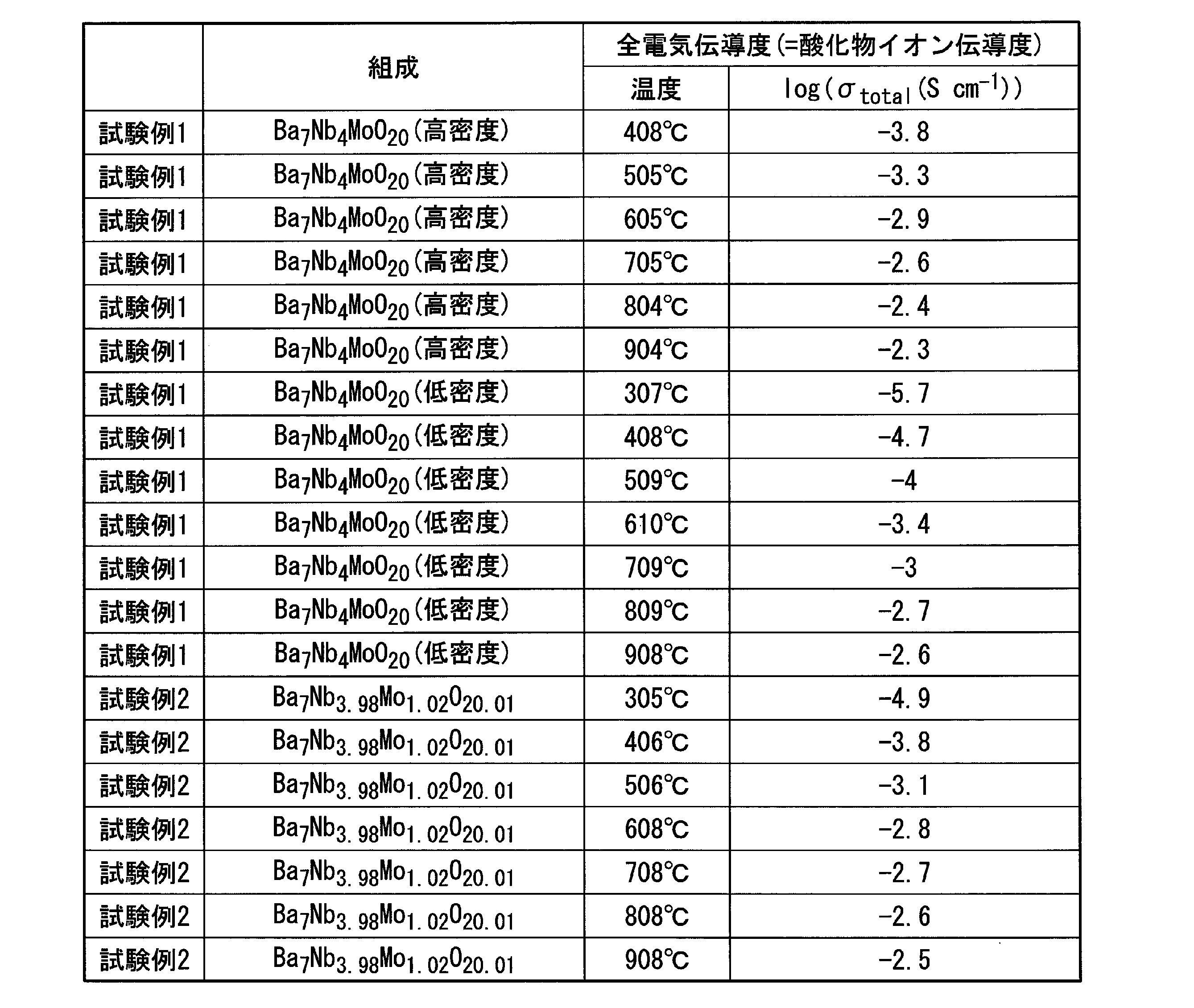

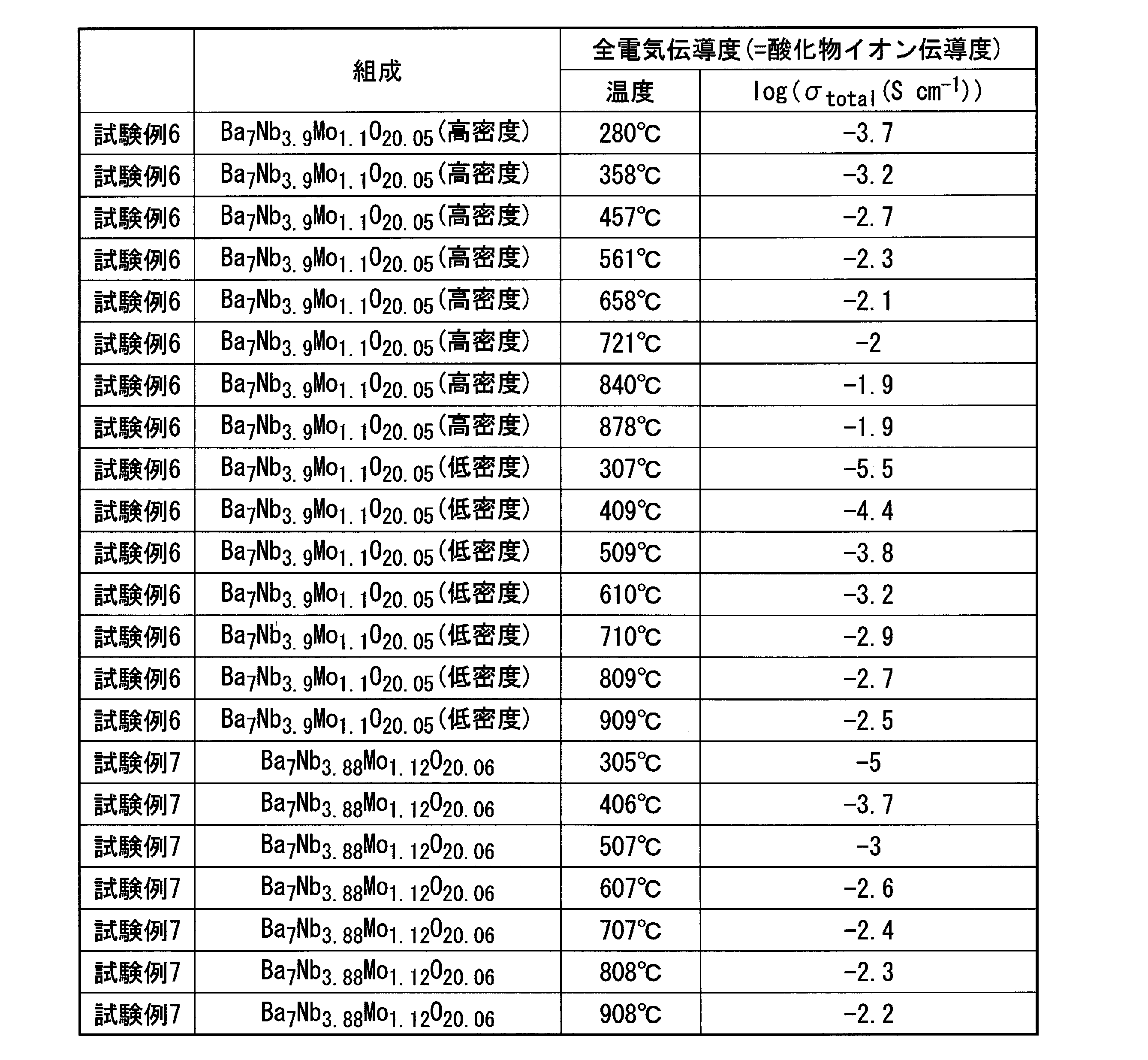
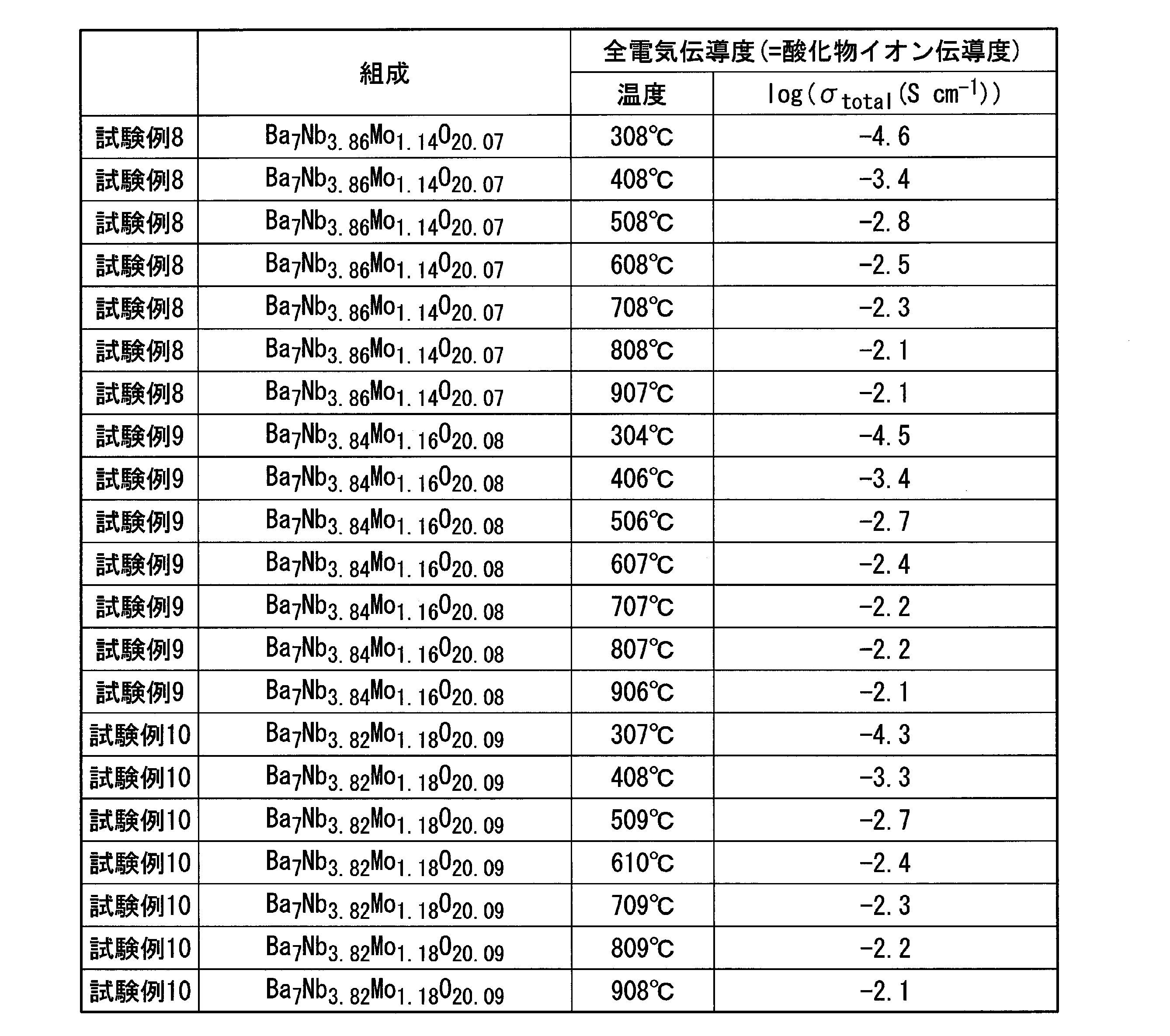

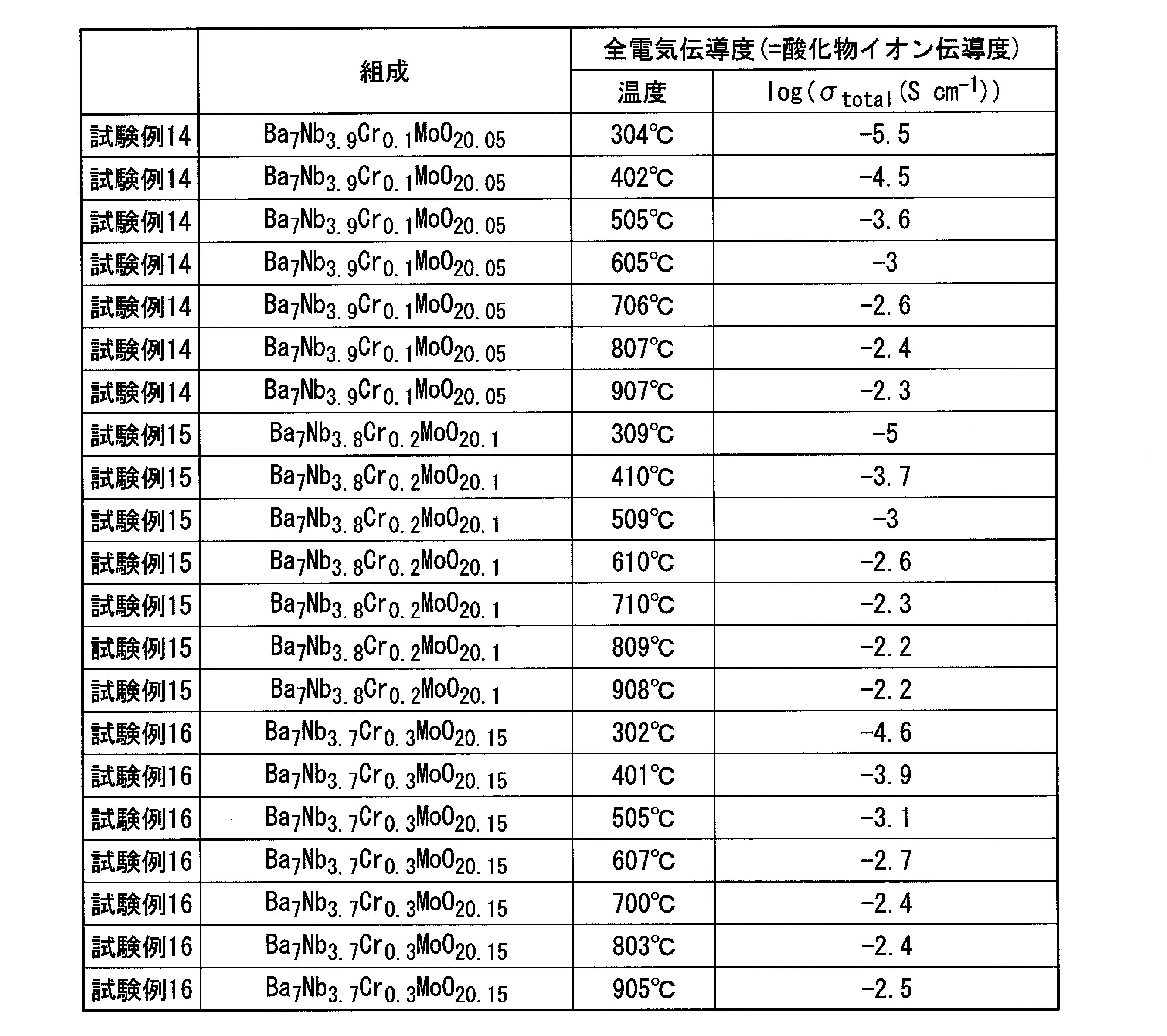

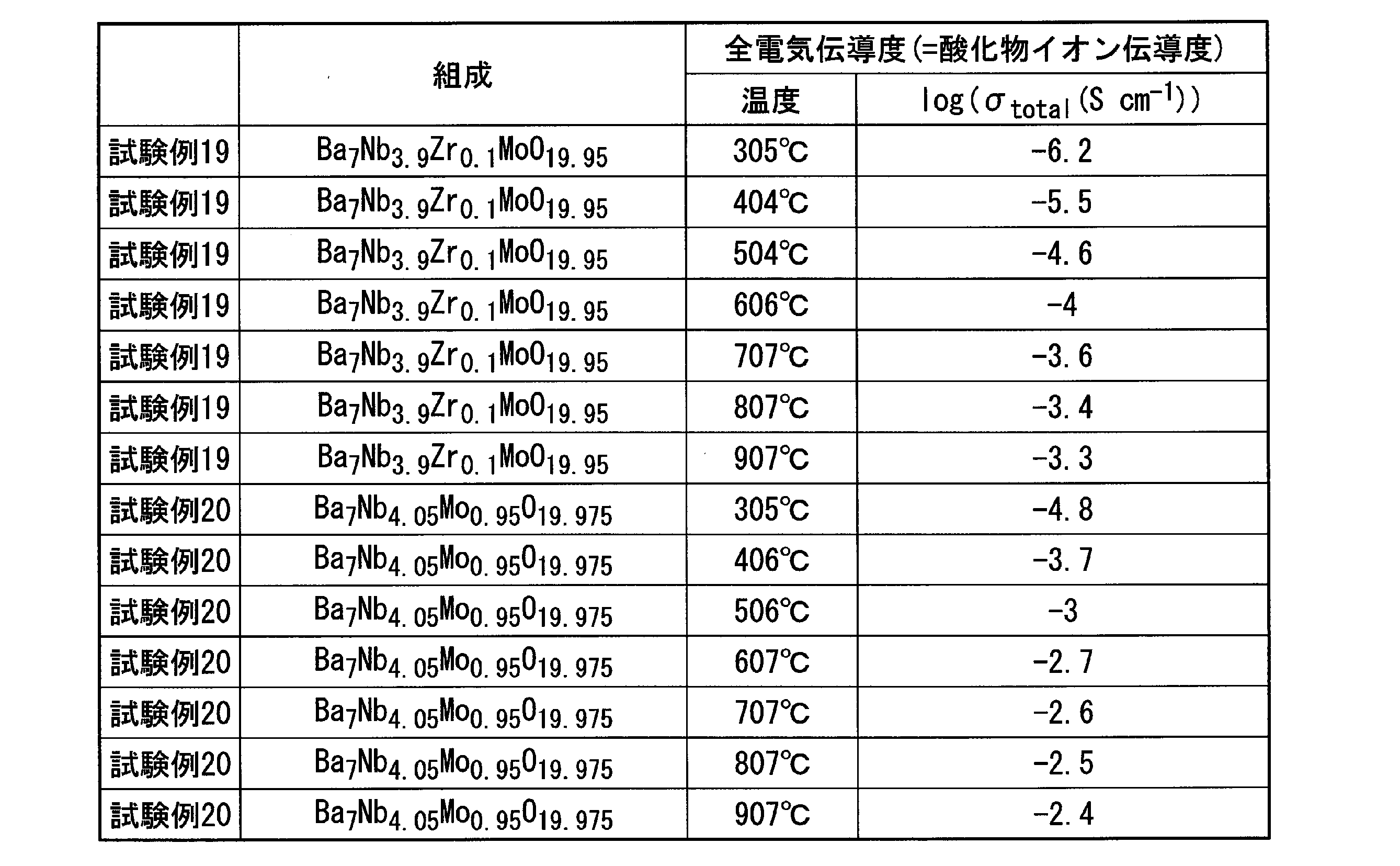
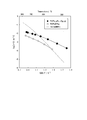
図22より、電気伝導度は温度が上昇するにつれて上昇している。600℃において、試験例1のBa7Nb4MoO20の電気伝導度に比べて、Mo過剰量xを0.10にした試験例6の電気伝導度σは5.5倍高く、Mo量を過剰にすることにより電気伝導度が向上することがわかった。
従来の試験例1は、600℃においてlog[σ(Scm-1)]=-2.7程度となる。Mo過剰量xを0.10にした試験例6は、590℃またはそれ以下の温度においてlog[σ(Scm-1)]がYSZ、試験例1のいずれよりも高く、従来用いられていた電解質よりも電気伝導度が高いことが示された。
高密度サンプルの試験例1(x=0)および試験例6(x=0.10)の電気伝導度は、いずれの温度でも低密度のサンプルよりも高い。
Mo過剰量xが0.02~0.18の範囲のサンプル(試験例2~10)のいずれも、xが0のBa7Nb4MoO20(試験例1)の低密度のサンプルよりも、高い電気伝導度を示す。Mo過剰量xが0.10の高密度サンプルの電気伝導度が最も高く、およそ300℃の低温でも高い電気伝導度が維持されている。
試験例1については、全電気伝導度の酸素分圧依存性を測定した。サンプルは上述の(全電気伝導度測定)と同様に準備した。また酸素O2ガス、窒素N2ガス、N2/H2混合ガスを用いて酸素分圧を制御した。
試験例6については、酸化物イオン輸率を決定するため、空気ガスとN2/O2混合ガスを用いた酸素濃淡電池による起電力測定を行った。ボールミルを使用して上述の(試料合成)で調製した試料の粒径を小さくした後、一軸加圧により25mmφのペレットに成型し、静水圧を加えた。1200℃で12時間焼結して、起電力測定用の試験例6の高密度のサンプルを調整した。サンプルの表面をダイヤモンドスラリーで削り、滑らかにした。試験例6のペレットの相対密度は96.0%であった。ペレットの中心に直径約10mmのPtペーストを塗り、白金ペーストに含まれる有機物成分を除くために、1000℃で1時間加熱した。白金ペーストと白金電極を瞬間接着剤で接着し、アルミナ管とガラスシール、サンプルも瞬間接着剤でそれぞれ接着し、白金電極を取り付けた。測定に用いる押さえにはアルミナ製の留め具を用いた。ガラスシール密着のために1000℃で1時間加熱したのち、酸素濃淡電池による起電力測定により、800℃と900℃で試験例6の酸化物イオンの輸率を求めた。
密度汎関数理論に基づく構造最適化計算をBa7Nb3MоMO20について実施した。ここで、MはAg、Al、At、Au、Be、Bi、Br、Ca、Cd、Ce、Co、Cr、Cu、Dy、Er、Eu、Fe、Ga、Gd、Ge、Hf、Hg、Ho、I、In、Ir、La、Li、Lu、Mg、Mn、Mo、Na、Nb、Nd、Ni、Np、Os、P、Pb、Pd、Po、Pr、Pt、Pu、Re、Rh、Ru、S、Sb、Sc、Se、Si、Sm、Sn、Sr、Ta、Tb、Tc、Te、Ti、Tl、Tm、U、V、W、Xe、Y、Yb、ZnおよびZrからなる群より選ばれた少なくとも1種の元素の陽イオンである。また、構造最適化計算をBa7Nb3Mо2O20について実施した。プログラムVASPを利用して一般化勾配化近似とPBE汎関数を用いた密度汎関数理論計算を行った。表10~12および33~36に構造最適化により得られた格子定数の結果を示す。いずれの組成も最適化した構造は元の六方ペロブスカイト関連化合物の結晶構造を保っており、これらの組成を合成できる可能性を示している。これらの組成も酸化物イオン伝導を示すと考えられる。


表13に示す試験例22~41、表14に示す試験例42~61、表15に示す試験例62~83の「組成」に示す化合物を、以下の手順に従い作製した。なお表13~15の組成では、Baの酸化数を+2、Nbの酸化数を+5、Moの酸化数を+6、酸素Oの酸化数を-2、Wの酸化数を+6、Vの酸化数を+5、Crの酸化数を+6、Geの酸化数を+4、Siの酸化数を+4、Zrの酸化数を+4、Tiの酸化数を+4、Alの酸化数を+3、Gdの酸化数を+3、Dyの酸化数を+3、Erの酸化数を+3、Hoの酸化数を+3、Tmの酸化数を+3、Ybの酸化数を+3、Luの酸化数を+3と仮定して、電気的中性条件から計算した酸素量を示しているが、酸素の不定比性zは陽イオンのモル比、温度、酸素分圧、合成法および熱履歴等に依存するため、酸素量(20+z)は表記された数値の限りではない。
(試験例22~58と81~83)
表13の試験例22~41、表14の試験例42~58、表15の試験例81~83の「組成」に示す化合物を固相反応法により作製した。出発原料としては、BaCO3、Nb2O5、MoO3、WO3、V2O5、Cr2O3、MnO2、GeO2、SiO2、ZrO2を使用した。あらかじめ出発原料を電気炉にて250~300℃で12時間乾燥させた後、陽イオンのモル比が目的の化学組成になるように電子天秤で秤量した。メノウ乳鉢を用いて、乾式の混合磨砕、およびエタノールを用いた湿式の混合磨砕を、繰り返し30分~2時間行った。得られた混合物を、電気炉を用い、大気下900℃で10~12時間仮焼した。仮焼した混合物について、メノウ乳鉢にて、乾式の混合磨砕、およびエタノールを用いた湿式の混合磨砕を、30分~2時間繰り返し行った。一軸プレス機を用いて62~150MPaで加圧することで、混合物を直径10~20mmの円筒状のペレットに成型した。得られたペレットを電気炉に入れ、大気下にて1100℃で24時間焼結した。その結果、焼結体であるペレットを得た。得られた化合物の生成相をX線回折(XRD)により評価するため、焼結体の一部をタングステンカーバイド(WC)製の粉砕器で約20分粉砕後、メノウ乳鉢で30分~1時間磨砕した。
表14の試験例59~61と表15の試験例62~67の「組成」に示す化合物を固相反応法により作製した。出発原料としては、BaCO3、WO3、V2O5を使用した。あらかじめ出発原料を電気炉にて300℃で12時間乾燥させた後、陽イオンのモル比が目的の化学組成になるように電子天秤で秤量した。メノウ乳鉢を用いて、乾式の混合磨砕、およびエタノールを用いた湿式の混合磨砕を、繰り返し1時間行った。得られた混合物を、電気炉を用い、大気下950℃で15時間仮焼した。仮焼した混合物を、メノウ乳鉢にて乾式とエタノールを用いた湿式で、1時間繰り返し混合磨砕した。一軸プレス機を用いて150MPaで加圧することで、混合物を直径10mmの円筒状のペレットに成型した。得られたペレットを電気炉に入れ、大気下にて1020℃で24時間焼結した。その結果、焼結体であるペレットを得た。得られた焼結体を用いて電気伝導度を測定した。得られた化合物の生成相をX線回折(XRD)により評価するため、焼結体の一部をタングステンカーバイド(WC)製の粉砕器で約20分粉砕後、メノウ乳鉢で約1時間磨砕した。
表15の試験例68~70の「組成」に示す化合物を固相反応法により作製した。出発原料としては、BaCO3、TiO2、MoO3を使用した。あらかじめ出発原料を電気炉にて250~300℃で12時間乾燥させた後、陽イオンのモル比が目的の化学組成になるように電子天秤で秤量した。メノウ乳鉢を用いて、乾式の混合磨砕、およびエタノールを用いた湿式の混合磨砕を、繰り返し30分行った。得られた混合物を、電気炉を用い、大気下900℃で12時間仮焼した。仮焼した混合物を、メノウ乳鉢にて、乾式とエタノールを用いた湿式で約1時間繰り返し混合磨砕した。一軸プレス機を用いて150MPaで加圧することで、混合物を直径20mmの円筒状のペレットに成型した。得られたペレットを電気炉に入れ、大気下にて1100℃で24時間焼結した。得られた焼結体をタングステンカーバイド(WC)製の粉砕器で20分粉砕後、メノウ乳鉢で約1時間磨砕した。一軸プレス機を用いて150MPaで加圧することで、混合物を直径5mmの円筒状のペレットに成型した。得られたペレットを電気炉に入れ、大気下にて1100℃で12時間焼結した。その結果、焼結体であるペレットを得た。得られた焼結体を用いて電気伝導度を測定した。得られた化合物の生成相をX線回折(XRD)により評価するため、焼結体の一部をタングステンカーバイド(WC)製の粉砕器で20分粉砕後、メノウ乳鉢で約1時間磨砕した。
表15の試験例71の「組成」に示す化合物を固相反応法により作製した。出発原料としては、BaCO3、MnO2、CaCO3を使用した。あらかじめ出発原料を電気炉にて250~300℃で12時間乾燥させた後、陽イオンのモル比が目的の化学組成になるように電子天秤で秤量した。メノウ乳鉢を用いて、乾式の混合磨砕、およびエタノールを用いた湿式の混合磨砕を、繰り返し約1時間行った。得られた混合物を、電気炉を用い、大気下900℃で12時間仮焼した。仮焼した混合物を、メノウ乳鉢にて、乾式の混合磨砕、およびエタノールを用いた湿式の混合磨砕を、30分間繰り返し行った。一軸プレス機を用いて150MPaで加圧することで、混合物を直径20mmの円筒状のペレットに成型した。得られたペレットを電気炉に入れ、大気下にて1200℃で12時間焼結した。得られた焼結体をタングステンカーバイド(WC)製の粉砕器で20分粉砕後、メノウ乳鉢で約1時間磨砕した。一軸プレス機を用いて150MPaで加圧することで、混合物を直径5mmの円筒状のペレットに成型した。得られたペレットを電気炉に入れ、大気下にて1400℃で24時間焼結した。その結果、焼結体であるペレットを得た。得られた焼結体を用いて電気伝導度を測定した。得られた化合物の生成相をX線回折(XRD)により評価するため、焼結体の一部をタングステンカーバイド(WC)製の粉砕器で20分粉砕後、メノウ乳鉢で約1時間磨砕した。
表15の試験例72の「組成」に示す化合物を固相反応法により作製した。出発原料としては、BaCO3、MnO2、La2O3、CaCO3を使用した。あらかじめ出発原料を電気炉にて250~300℃で12時間乾燥させた後、陽イオンのモル比が目的の化学組成になるように電子天秤で秤量した。メノウ乳鉢を用いて、乾式の混合磨砕、およびエタノールを用いた湿式の混合磨砕を、繰り返し約1時間行った。得られた混合物を、電気炉を用い、大気下900℃で10時間仮焼した。仮焼した混合物を、メノウ乳鉢にて乾式およびエタノールを用いた湿式で、約1時間繰り返し混合磨砕した。一軸プレス機を用いて150MPaで加圧することで、混合物を直径5mmの円筒状のペレットに成型した。得られたペレットを電気炉に入れ、大気下にて1200℃で12時間焼結した。得られた焼結体をタングステンカーバイド(WC)製の粉砕器で20分粉砕後、メノウ乳鉢で約1時間磨砕した。一軸プレス機を用いて150MPaで加圧することで、混合物を直径5mmの円筒状のペレットに成型した。得られたペレットを電気炉に入れ、大気下にて1200℃で12時間焼結した。その結果、焼結体であるペレットを得た。得られた焼結体を用いて電気伝導度を測定した。得られた化合物の生成相をX線回折(XRD)により評価するため、焼結体の一部をタングステンカーバイド(WC)製の粉砕器で20分粉砕後、メノウ乳鉢で約1時間磨砕した。
表15の試験例73の「組成」に示す化合物を固相反応法により作製した。出発原料としては、La2O3、MnO2、CaCO3を使用した。あらかじめ出発原料を電気炉にて250~300℃で12時間乾燥させた後、陽イオンのモル比が目的の化学組成になるように電子天秤で秤量した。メノウ乳鉢を用いて乾式の混合磨砕、およびエタノールを用いた湿式の混合磨砕を、繰り返し約1時間分行った。得られた混合物を、電気炉を用い、大気下900℃で12時間仮焼した。仮焼した混合物を、メノウ乳鉢にて、乾式とエタノールを用いた湿式で約1時間繰り返し混合磨砕した。一軸プレス機を用いて150MPaで加圧することで、混合物を直径5mmの円筒状のペレットに成型した。得られたペレットを電気炉に入れ、大気下にて1200℃で12時間焼結した。その結果、焼結体であるペレットを得た。得られた化合物の生成相をX線回折(XRD)により評価するため、焼結体の一部をタングステンカーバイド(WC)製の粉砕器で20分粉砕後、メノウ乳鉢で約1時間磨砕した。この化合物も試験例1~21の化合物と類似の結晶構造を持つため、酸化物イオン伝導性をもつと考えられる。
表15の試験例74~80の「組成」に示す化合物を固相反応法により作製した。出発原料としては、BaCO3、Al2O3、ZrO2、Gd2O3、Dy2O3、Ho2O3、Er2O3、Tm2O3、Yb2O3、Lu2O3を使用した。あらかじめ出発原料を電気炉にて300℃で12時間乾燥させた後、陽イオンのモル比が目的の化学組成になるように電子天秤で秤量した。メノウ乳鉢を用いて、乾式の混合磨砕、およびエタノールを用いた湿式の混合磨砕を、繰り返し30分行った。得られた混合物を、電気炉を用い、大気下900℃で10時間仮焼した。仮焼した混合物を、メノウ乳鉢にて、乾式で30分間混合磨砕した。一軸プレス機を用いて約50MPaで加圧することで、混合物を直径20mmの円筒状のペレットに成型した。得られたペレットを電気炉に入れ、大気下にて1600℃で12時間焼結し、焼結体を得た。得られた焼結体を用いて電気伝導度を測定した。得られた化合物の生成相をX線回折(XRD)により評価するため、焼結体の一部をタングステンカーバイド(WC)製の粉砕器で20分粉砕後、メノウ乳鉢で約30分磨砕した。
各表には、試験例22~83の格子定数及び格子体積Vも示した。また、一部試験例については全電気伝導度の温度依存性から見積もった伝導度の活性化エネルギーEa(eV)も示した。なお、900℃における試験例27の輸率は100%であった。
また、Ti過剰量xを-0.1および-0.2にしたBa3Mo1.1Ti0.9O8.1とBa3Mo1.2Ti0.8O8.2の電気伝導度の温度依存性を図51に示す。本実施例の試験例のMo過剰量xが0.0であるBa3MoTiO8の電気伝導度の温度依存性も示す。Mo過剰量xが-0.1、-0.2の範囲のサンプルのいずれも、xが0.0のBa3MoTiO8(試験例68)のサンプルよりも、高い電気伝導度を示す。620℃以下では、Mo過剰量xが-0.1のサンプルの電気伝導度が最も高く、およそ300℃の低温でも高い電気伝導度が維持されている。
試験例69については、全電気伝導度の酸素分圧依存性を測定した。横軸の酸素分圧log[P(O2)/atm]に対して、測定した電気伝導度log[σ(Scm-1)]を縦軸にプロットしたグラフを図52に示す。全電気伝導度が酸素分圧に依存せずほぼ一定な値をとることから、試験例69の化合物の電気伝導において酸化物イオンが支配的なキャリアであることが強く示唆された。同じBa3MoTiO8系の材料である試験例68と70についても同様の事が考えられる.

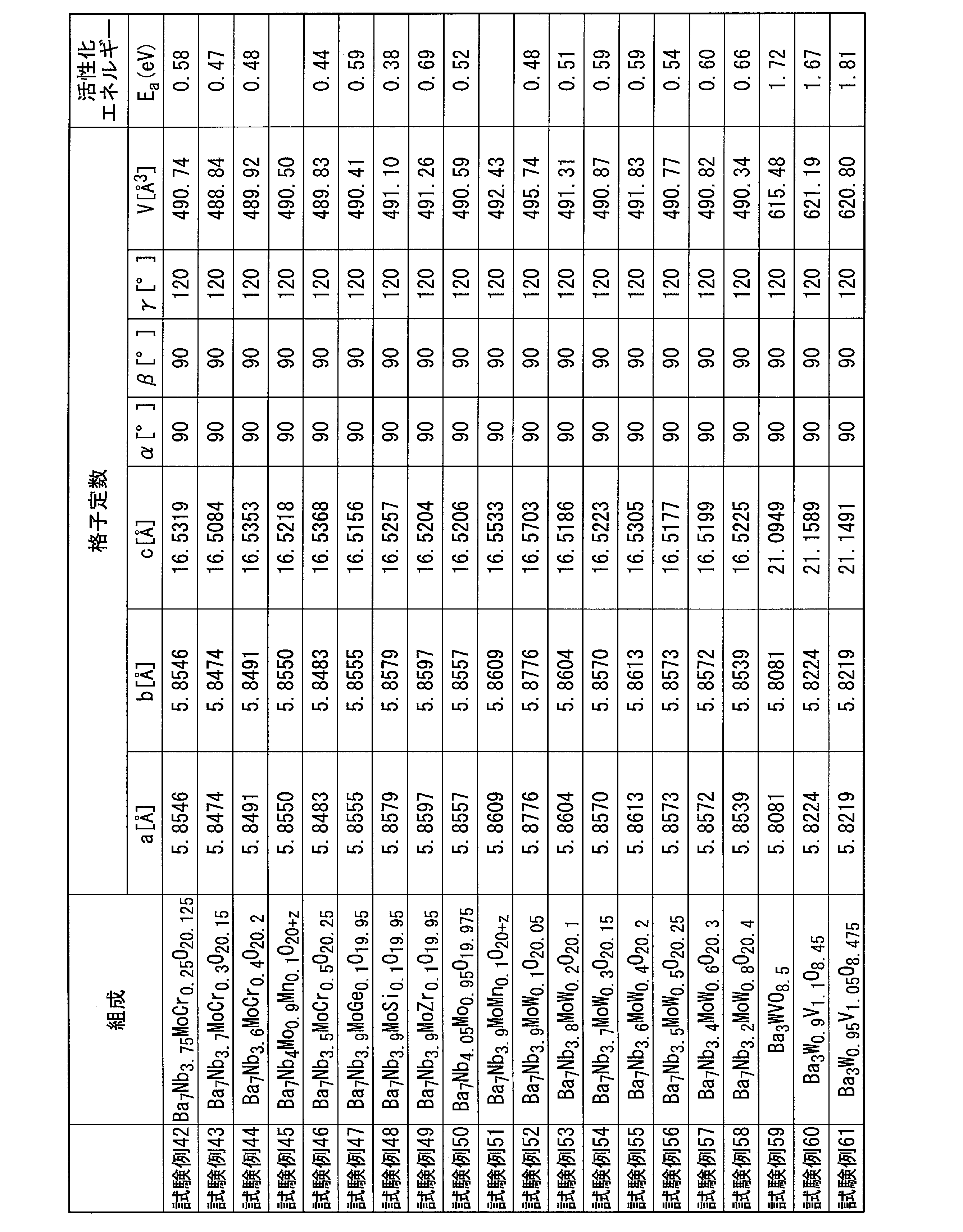

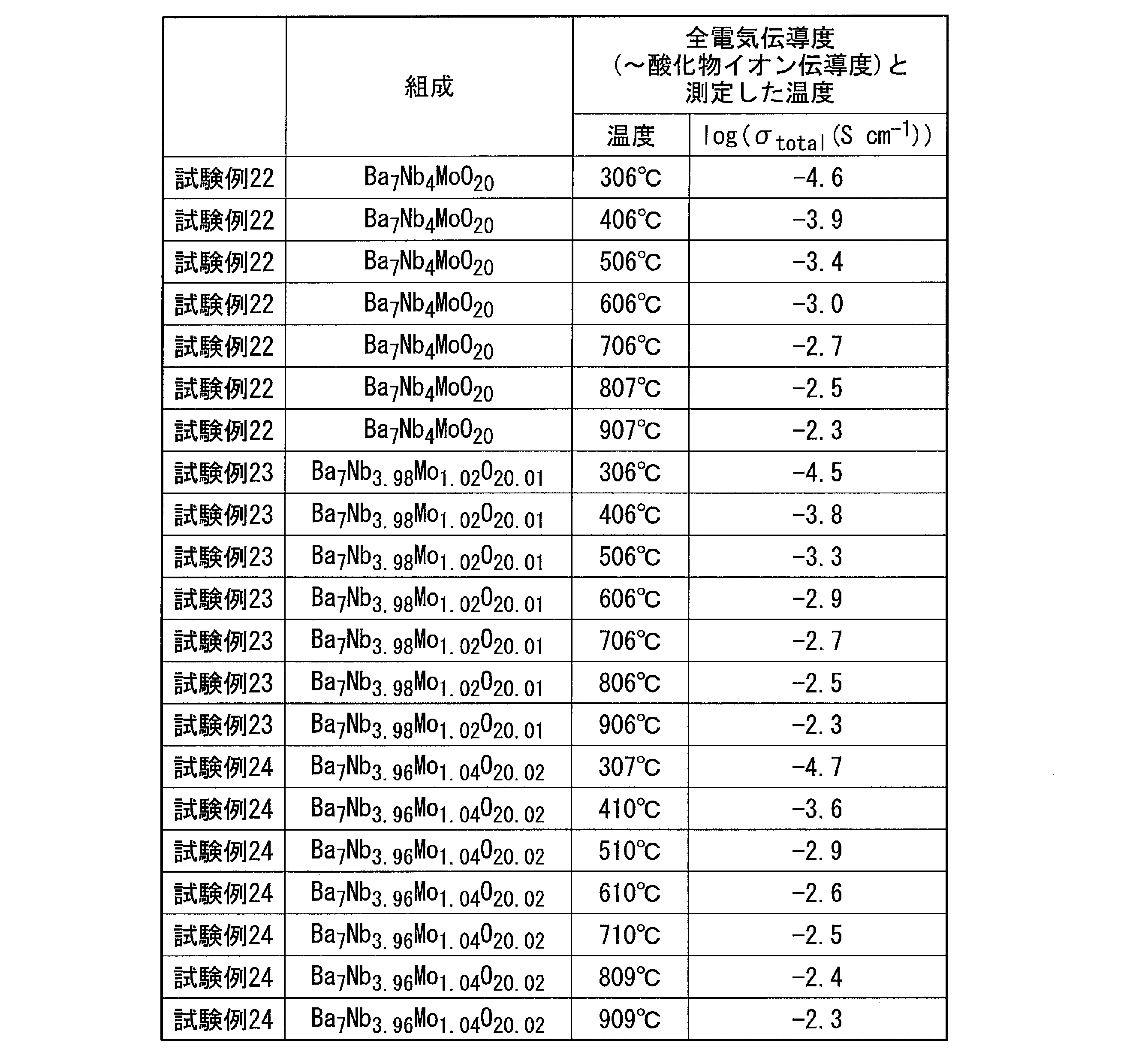


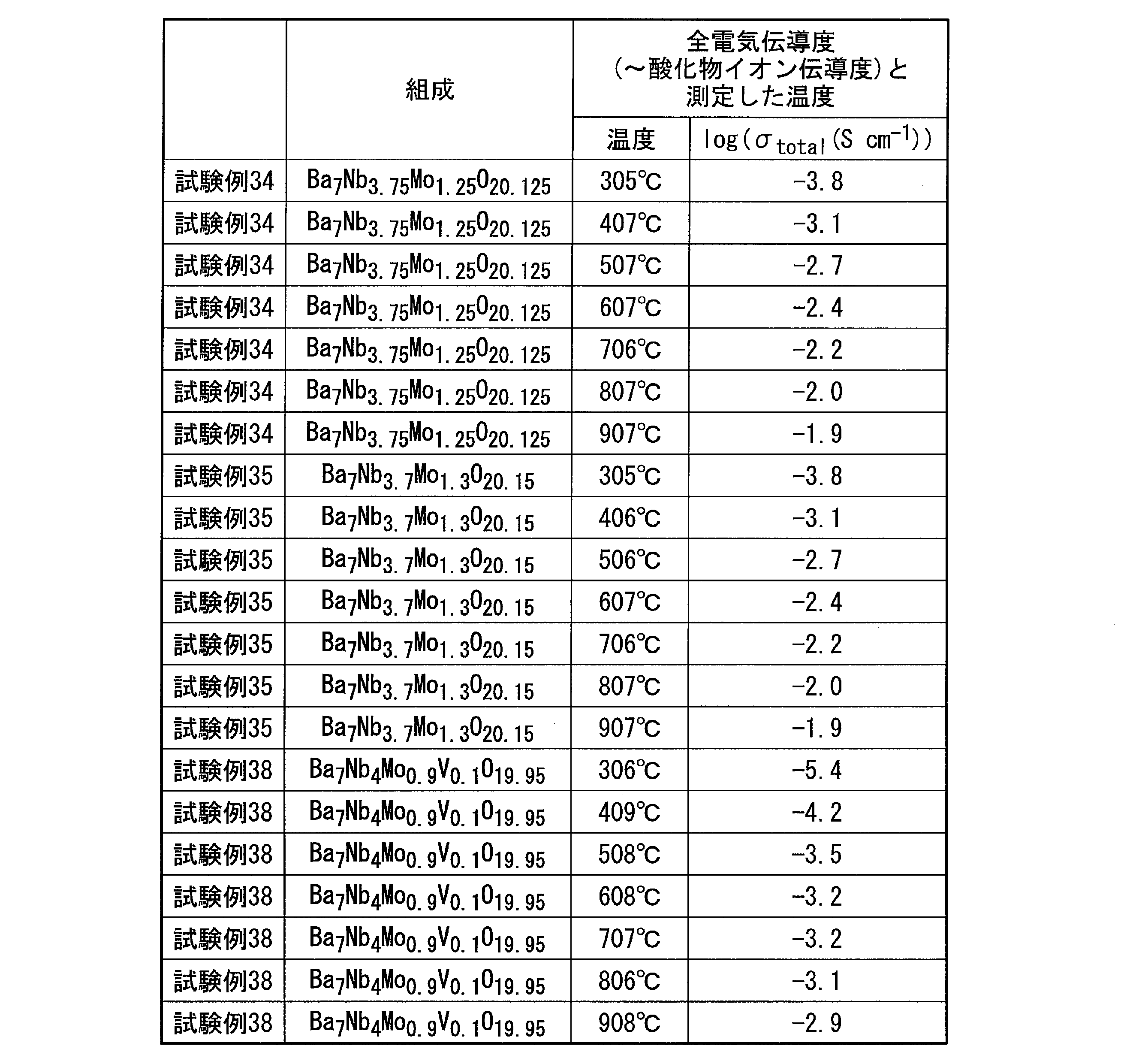

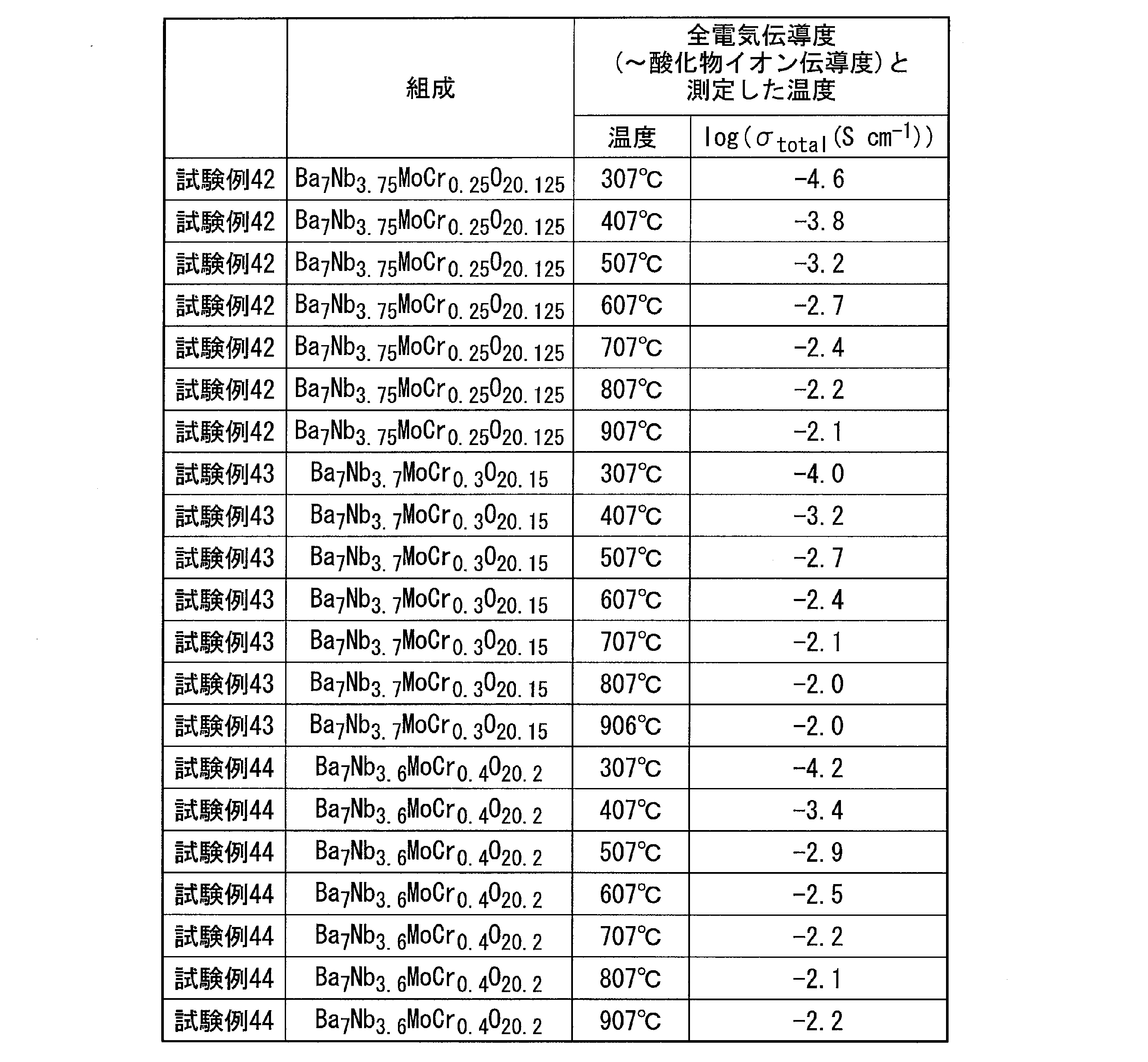
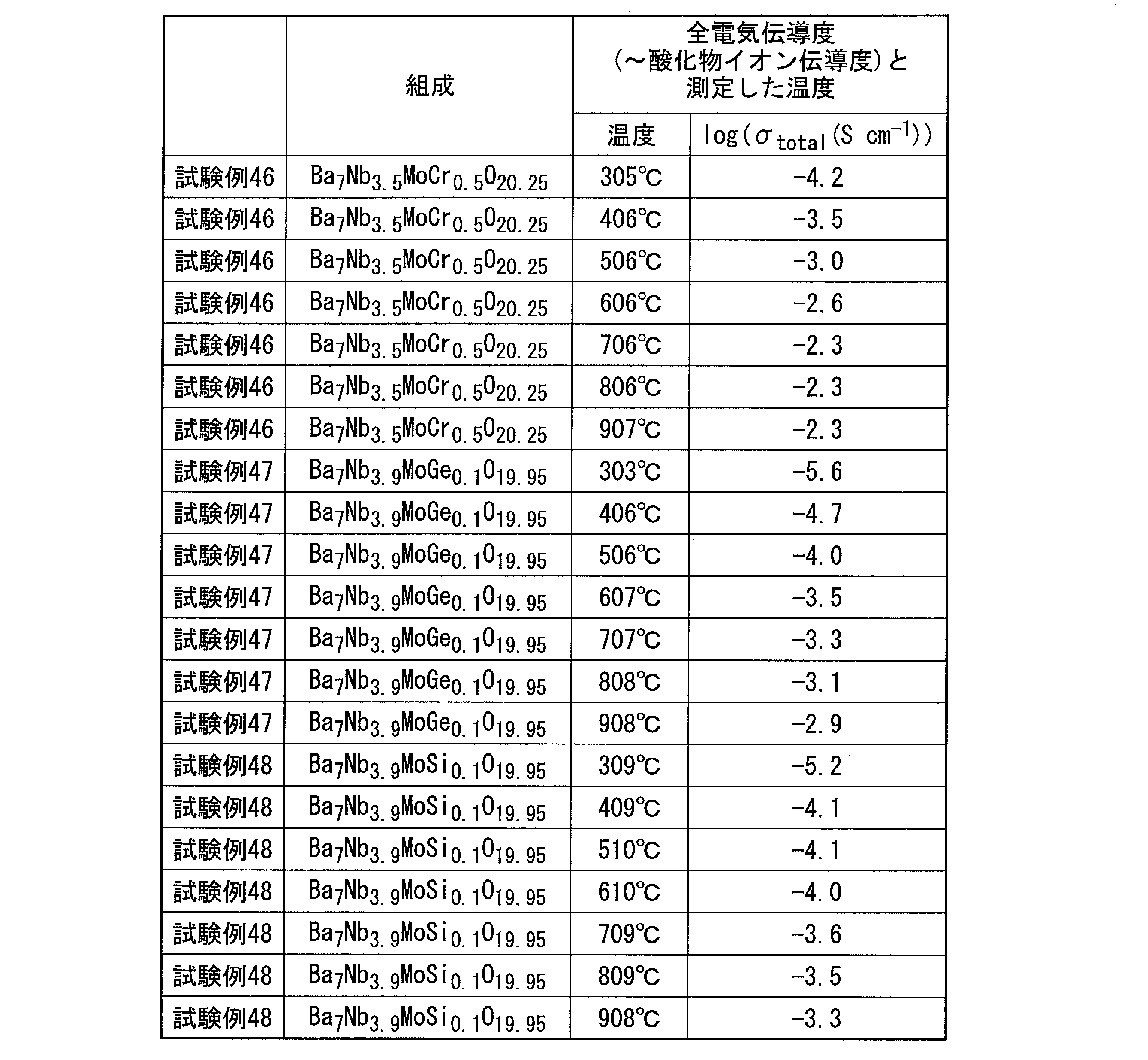
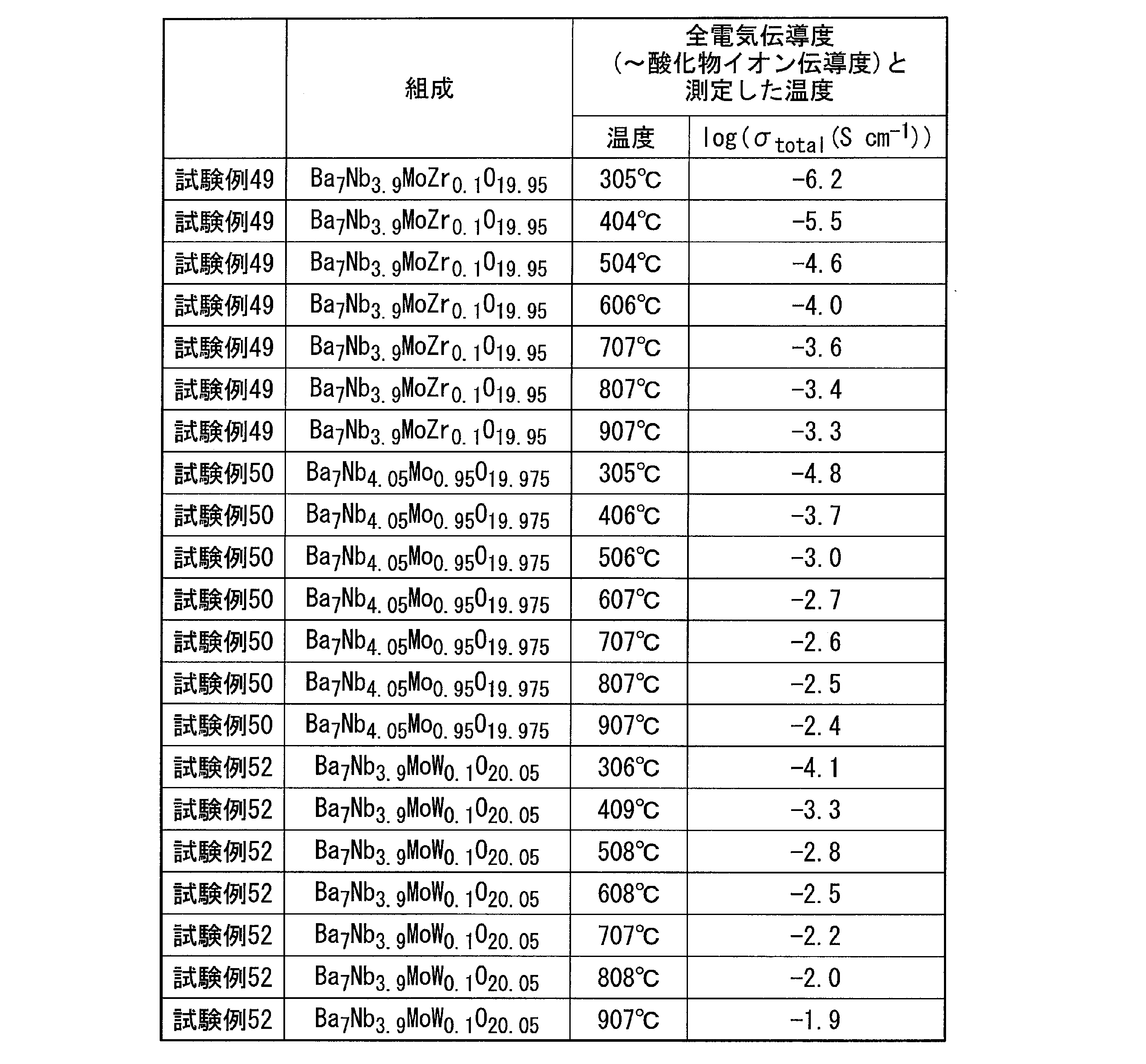
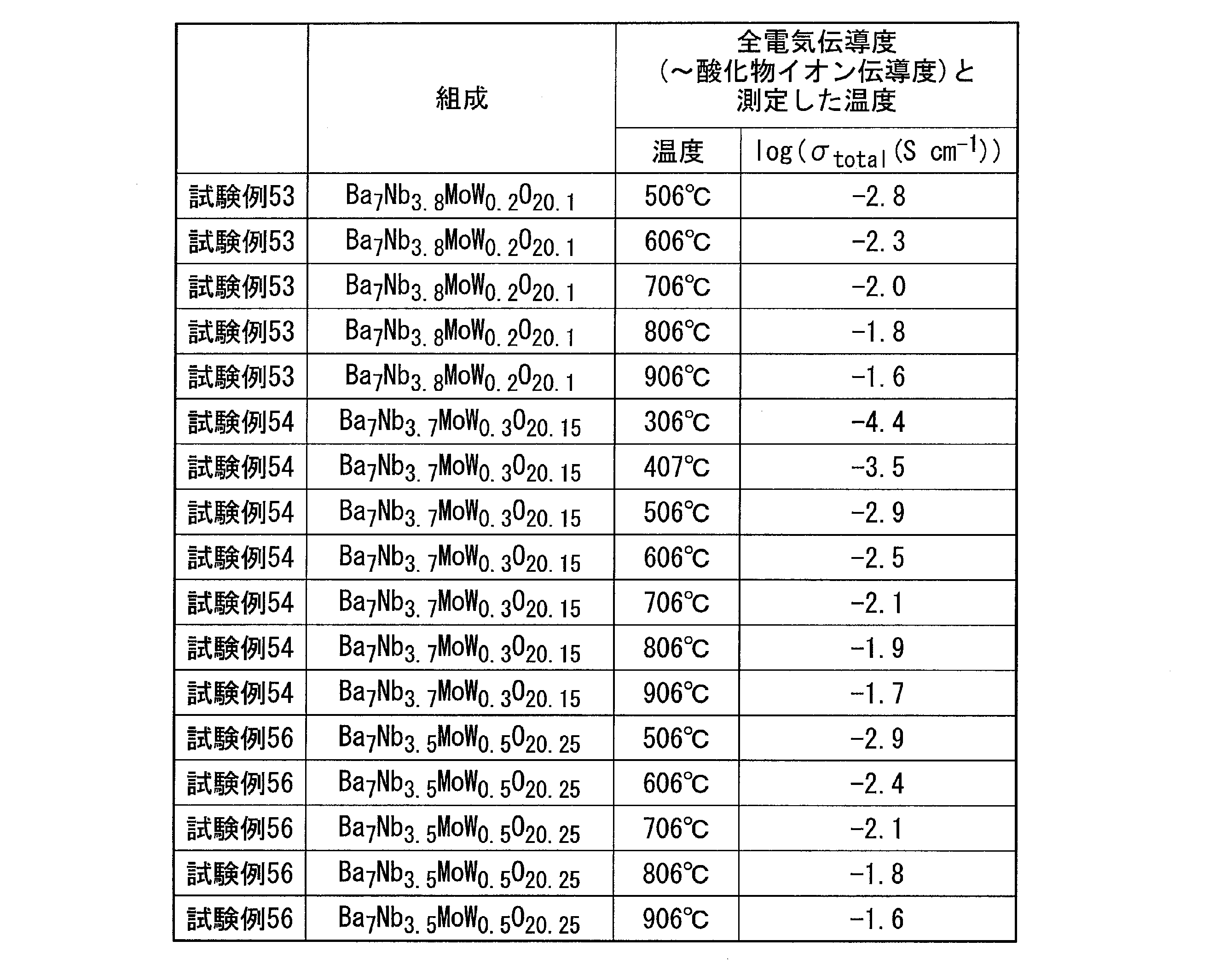


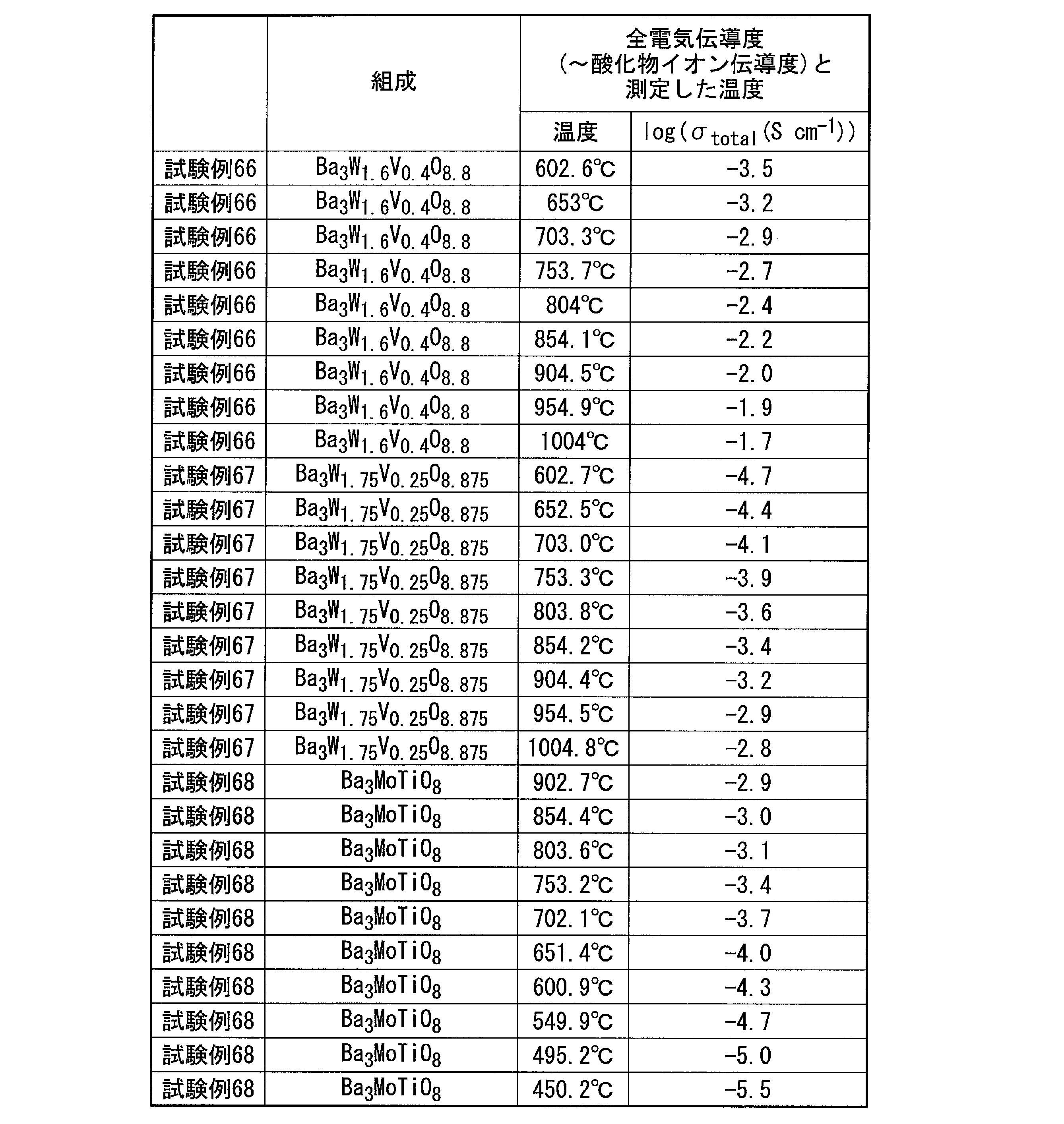
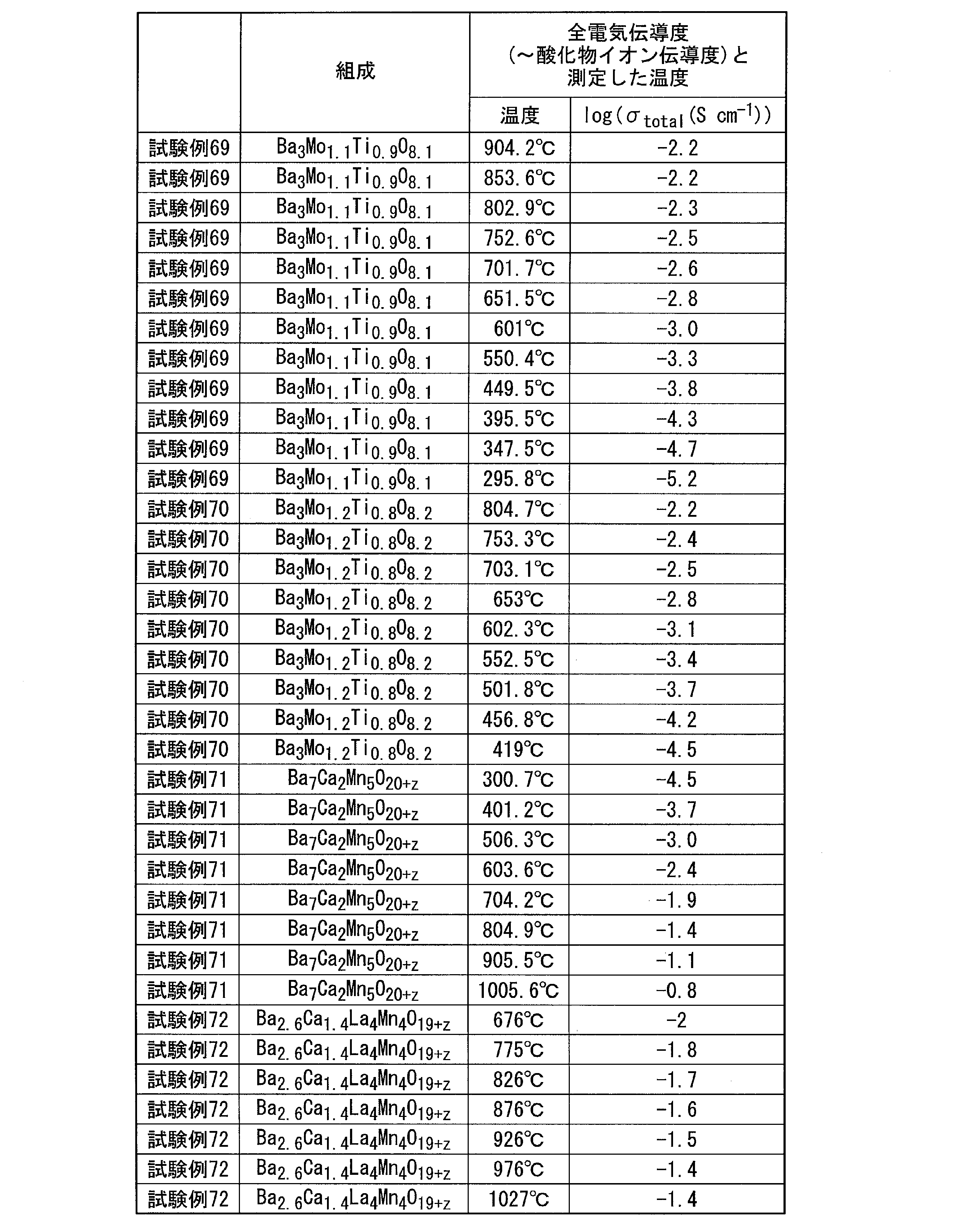
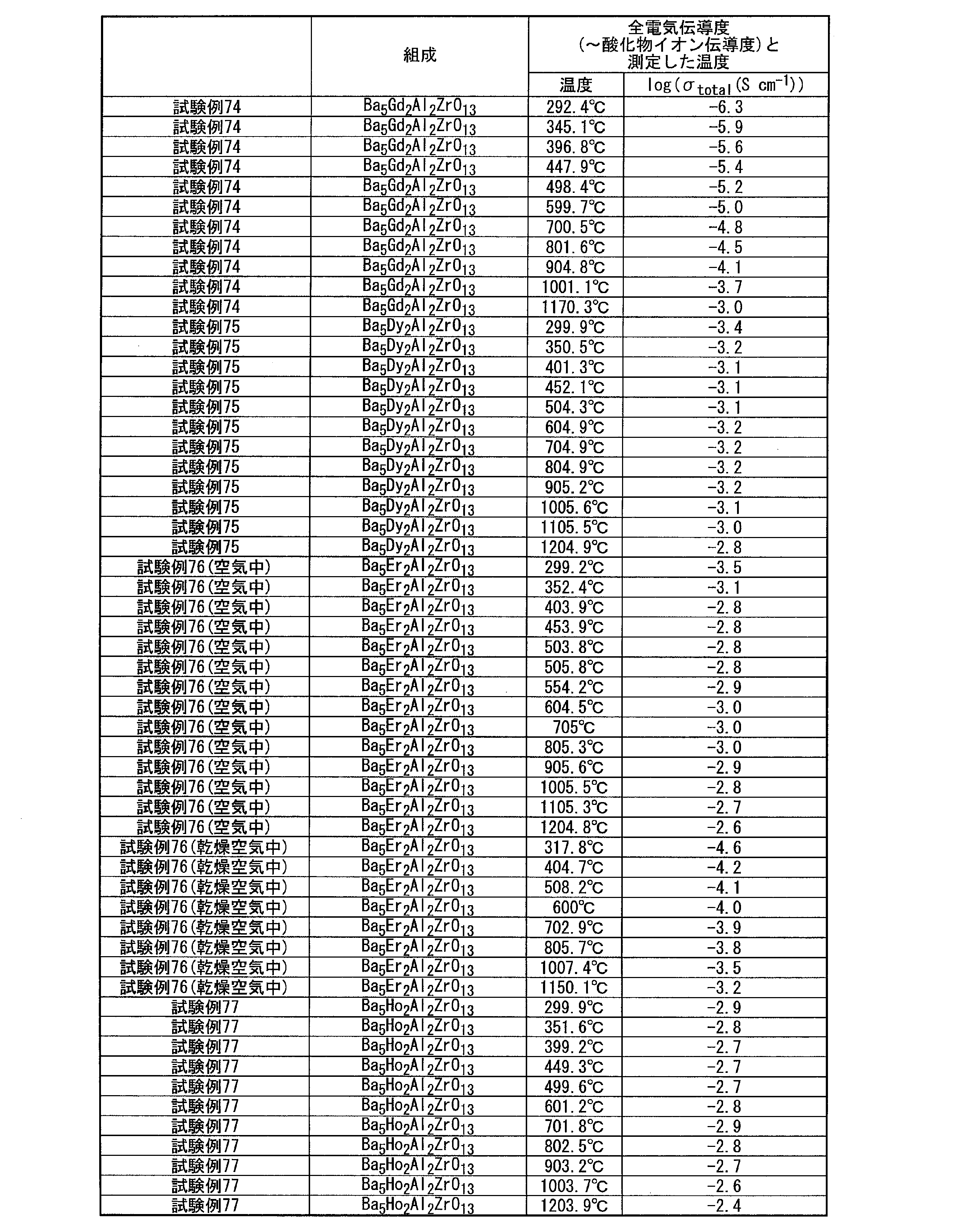
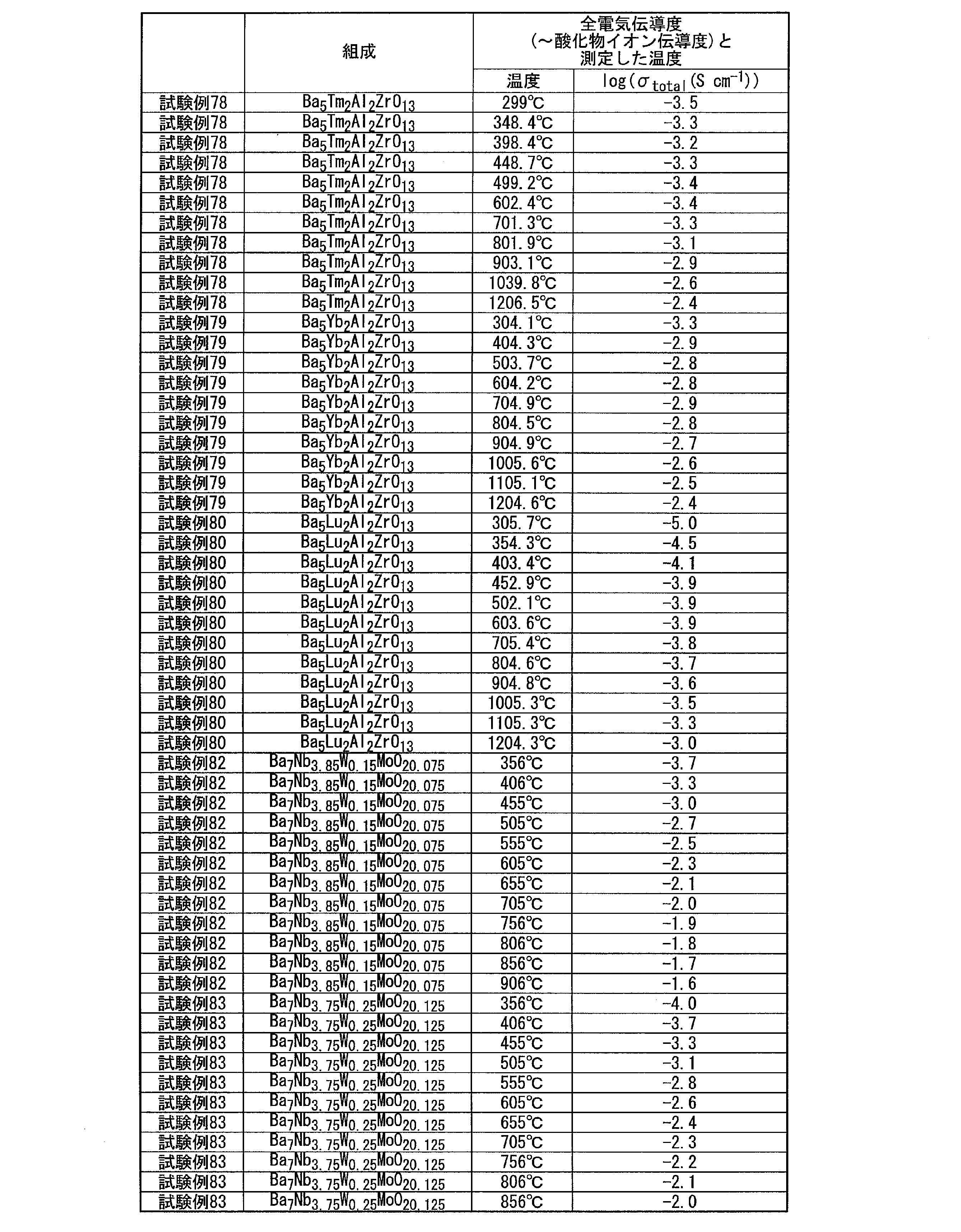
Ba7Nb4MoO20について、Nbの一部を他の元素に置換した構造を設計し、格子定数のa軸長、b軸長、c軸長(Å)、α角、β角、γ角(o)を計算で求めた。(試験例84~152、表33~36)
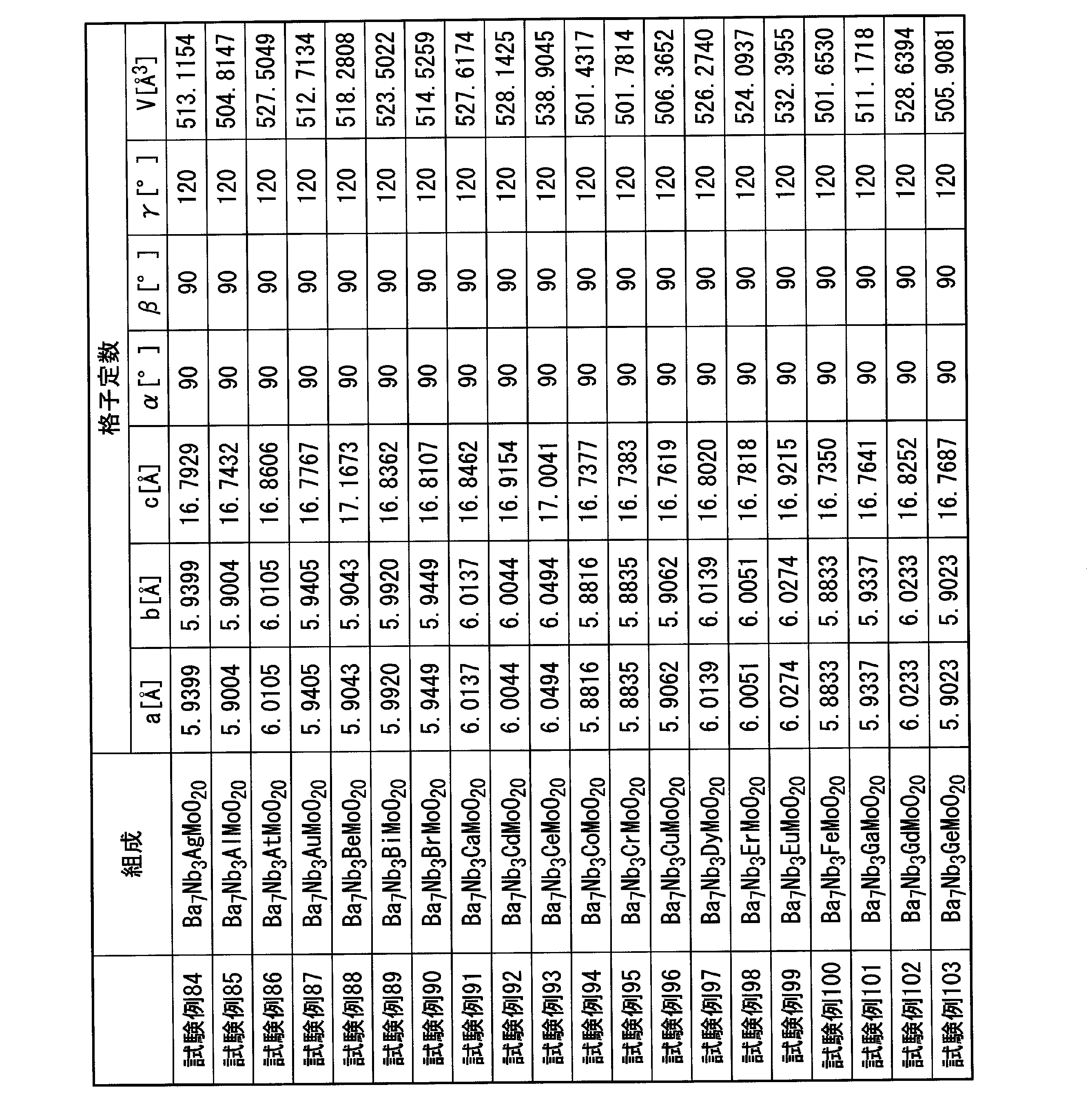
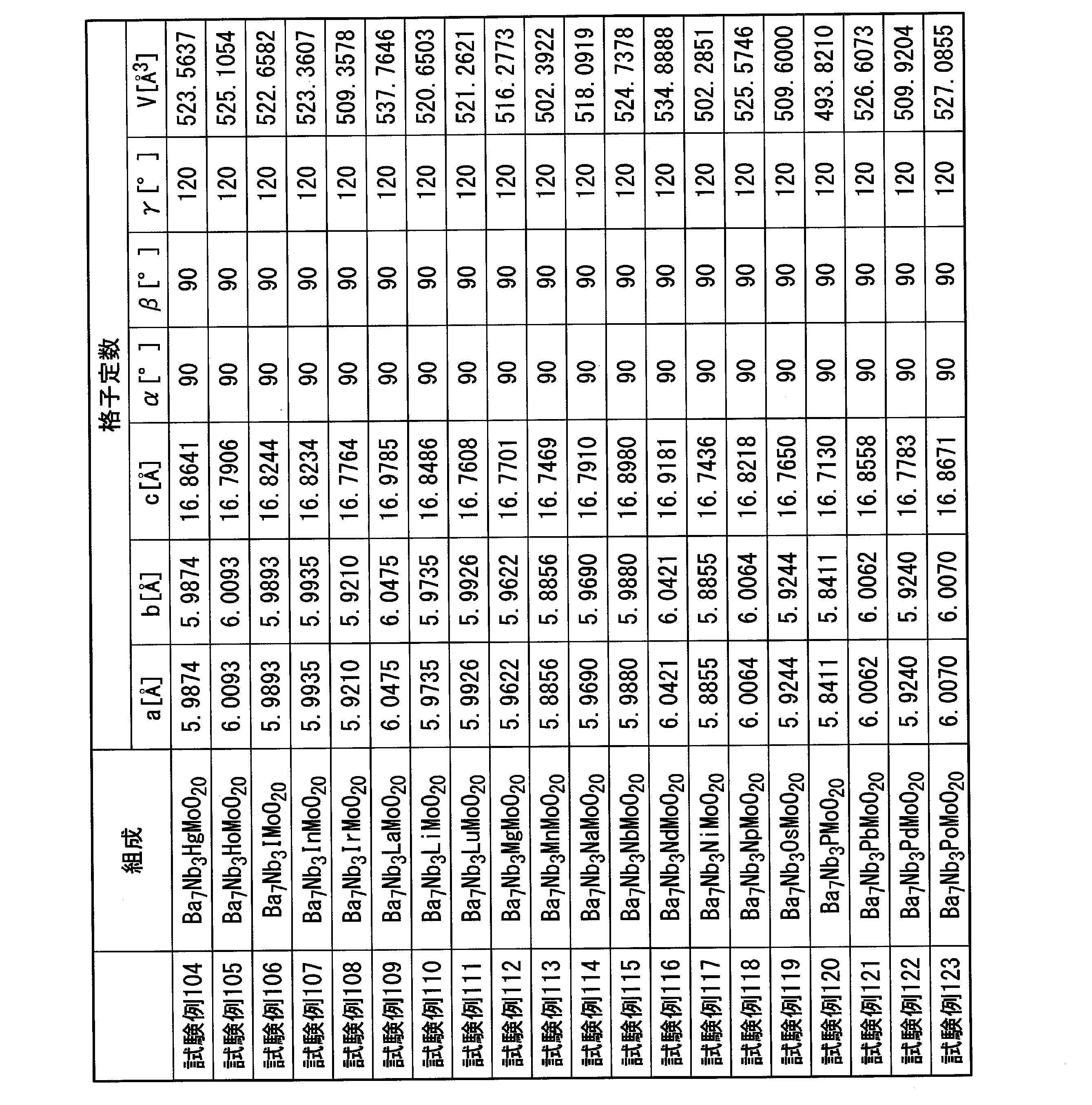


Claims (15)
- 六方ペロブスカイト関連化合物を含む固体電解質であって、前記化合物は、下記一般式(1)で表される化合物である、固体電解質。
Ba7-αNb(4-x-y)Mо(1+x)MyO(20+z) ・・・(1)
[式(1)中、MはAg、Al、At、Au、Be、Bi、Br、Ca、Cd、Ce、Co、Cr、Cu、Dy、Er、Eu、Fe、Ga、Gd、Ge、Hf、Hg、Ho、I、In、Ir、La、Li、Lu、Mg、Mn、Na、Nb、Nd、Ni、Np、Os、P、Pb、Pd、Po、Pr、Pt、Pu、Re、Rh、Ru、S、Sb、Sc、Se、Si、Sm、Sn、Sr、Ta、Tb、Tc、Te、Ti、Tl、Tm、U、V、W、Xe、Y、Yb、ZnおよびZrからなる群より選ばれた少なくとも1種の元素の陽イオンである。αはBa欠損量であり0以上で0.5以下の数値、xは-1.1以上で1.1以下の数値、yは0以上で1.1以下を満たす数値、zは酸素の不定比性であり-2.0以上で2.0以下の数値を表す。ただし式(1)中、|x|+y≧0.01を満たす。] - 六方ペロブスカイト関連化合物を含む固体電解質であって、前記化合物は、下記一般式(2)で表される化合物である、固体電解質。
Ba7-αNb(4-x―y)Mо(1+x)MyO(20+z) ・・・(2)
[式(2)中、MはW、V、Cr、Mn、Ge、SiおよびZrからなる群より選ばれた少なくとも1種の元素の陽イオンである。αはBa欠損量であり0以上で0.5以下の数値、xは-1.1以上で1.1以下の数値、yは0以上で1.1以下かつ|x|+y≧0.01を満たす数値、zは酸素の不定比性であり-2.0以上で2.0以下の数値を表す。] - 六方ペロブスカイト関連化合物を含む固体電解質であって、前記化合物は、下記一般式(3)~(13)のいずれかで表される化合物である、固体電解質。
Ba7Nb(4-x)Mо(1+x)O(20+z) ・・・(3)
[式(3)中、xは-1.1以上で-0.01以下または0.01以上で1.1以下の数値、zは酸素の不定比性であり-2.0以上で2.0以下の数値を表す。]
Ba7Nb(4-y)MоMyO(20+z) ・・・(4)
[式(4)中、Mは、V、Mn、Ge、SiおよびZrからなる群より選ばれた少なくとも1種の元素の陽イオンである。yは0.01以上で1.1以下の数値、zは酸素の不定比性であり-2.0以上で2.0以下の数値を表す。]
Ba7Nb4Mо(1-y)MyO(20+z) ・・・(5)
[式(5)中、Mは、VおよびMnからなる群より選ばれた少なくとも1種の元素の陽イオンである。zは酸素の不定比性であり-2.0以上で2.0以下の数値、yは0.01以上で1.1以下の数値を表す。]
Ba7Nb(4-y)MоCryO(20+z) ・・・(6)
[式(6)中、zは酸素の不定比性であり-2.0以上で2.0以下の数値、yは0.01以上で1.1以下の数値を表す。]
Ba7Nb(4-y)MoWyO(20+z) ・・・(7)
[式(7)中、zは酸素の不定比性であり-2.0以上で2.0以下の数値、yは0.01以上で1.1以下の数値を表す。]
Ba3W(1-x)V(1+x)O(8.5+z) ・・・(8)
[式(8)中、xは-0.8以上で0.2以下の数値、zは酸素の不定比性であり-1.0以上で1.0以下の数値を表す。]
Ba3Mo(1-x)Ti(1+x)O(8+z) ・・・(9)
[式(9)中、xは-0.3以上で0.1以下の数値、zは酸素の不定比性であり-1.0以上で0.3以下の数値を表す。]
Ba7Ca2Mn5O(20+z) ・・・(10)
[式(10)中、zは酸素の不定比性であり-1.0以上で1.0以下の数値を表す。]
Ba2.6Ca2.4La4Mn4O(19+z) ・・・(11)
[式(11)中、zは酸素の不定比性であり-1.0以上で1.0以下の数値を表す。]
La2Ca2MnO(7+z) ・・・(12)
[式(12)中、zは酸素の不定比性であり-1.0以上で1.0以下の数値を表す。]
Ba5M2Al2ZrO(13+z) ・・・(13)
[式(13)中、MはGd、Dy、Ho、Er、Tm、Yb又はLuのいずれかを示す。zは酸素の不定比性であり-1.0以上で1.0以下の数値を表す。] - 前記xが0.06以上0.30以下である、請求項1又は2に記載の固体電解質。
- 前記化合物が一般式(3)で表される化合物であって、前記xが0.06以上0.30以下である、請求項3に記載の固体電解質。
- 前記xが0.19以上0.21以下である、請求項4又は5に記載の固体電解質。
- 前記化合物は、格子定数のa軸長、b軸長、c軸長(Å)、α角、β角、γ角(o)がそれぞれ、式(2)について5.35<a<6.56、5.35<b<6.56、15.14<c<18.52、89<α<91、89<β<91、119<γ<121である、請求項2に記載の固体電解質。
- 前記化合物は、格子定数のa軸長、b軸長、c軸長(Å)、α角、β角、γ角(o)がそれぞれ、式(3)~(7)について5.35<a<6.56、5.35<b<6.56、15.14<c<18.52、89<α<91、89<β<91、119<γ<121、式(8)について5.23<a<6.4、5.23<b<6.4、18.96<c<23.19、89<α<91、89<β<91、119<γ<121、式(9)について5.34<a<6.54、5.34<b<6.54、19.12<c<23.39、89<α<91、89<β<91、119<γ<121、式(10)について5.23<a<6.41、5.23<b<6.41、46.23<c<56.51、89<α<91、89<β<91、119<γ<121、式(11)について8.85<a<10.83、5.11<b<6.26、14.07<c<17.21、89<α<91、100<β<104、89<γ<91、式(12)について5.05<a<6.19、5.05<b<6.19、15.57<c<19.03、89<α<91、89<β<91、119<γ<121、式(13)について5.35<a<6.55、5.35<b<6.55、22.23<c<27.18、89<α<91、89<β<91、119<γ<121の数値範囲内である、請求項3に記載の固体電解質。
- 酸化物イオン(O2-)伝導体として用いられる固体電解質であって、300~1200℃の温度条件で用いるための、請求項1から8のいずれか1項に記載の固体電解質。
- 300℃における電気伝導度を測定したとき、lоg[σ(Scm-1)]で表される電気伝導度が-7以上の、請求項1から9のいずれか1項に記載の固体電解質。
- 固体酸化物形燃料電池(SOFC)、センサ、電池、電極、電解質、酸素濃縮器、酸素分離膜、酸素透過膜、酸素ポンプ、触媒、光触媒、電気・電子・通信機器、エネルギー・環境関連用機器または光学機器である、請求項1から10のいずれか1項に記載の固体電解質。
- 固体酸化物形燃料電池(SOFC)、センサ、酸素濃縮器、酸素分離膜、酸素透過膜または酸素ポンプに用いられる電解質層用である、請求項1から11のいずれか1項に記載の固体電解質。
- 請求項1から12のいずれか1項に記載の固体電解質を含む電解質層。
- 請求項13に記載の固体電解質を含む電解質層を備える電池。
- 固体酸化物形燃料電池(SOFC)である、請求項14に記載の電池。
Priority Applications (4)
| Application Number | Priority Date | Filing Date | Title |
|---|---|---|---|
| US17/424,432 US12586804B2 (en) | 2019-01-24 | 2020-01-24 | Solid electrolyte, electrolyte layer and battery |
| JP2020567722A JP7478439B2 (ja) | 2019-01-24 | 2020-01-24 | 固体電解質、電解質層および電池 |
| CN202080010123.7A CN113316557B (zh) | 2019-01-24 | 2020-01-24 | 固体电解质、电解质层及电池 |
| EP20743953.0A EP3915936B1 (en) | 2019-01-24 | 2020-01-24 | SOLID ELECTROLYTE, ELECTROLYTE LAYER AND BATTERY |
Applications Claiming Priority (2)
| Application Number | Priority Date | Filing Date | Title |
|---|---|---|---|
| JP2019010280 | 2019-01-24 | ||
| JP2019-010280 | 2019-01-24 |
Publications (1)
| Publication Number | Publication Date |
|---|---|
| WO2020153485A1 true WO2020153485A1 (ja) | 2020-07-30 |
Family
ID=71736275
Family Applications (1)
| Application Number | Title | Priority Date | Filing Date |
|---|---|---|---|
| PCT/JP2020/002552 Ceased WO2020153485A1 (ja) | 2019-01-24 | 2020-01-24 | 固体電解質、電解質層および電池 |
Country Status (5)
| Country | Link |
|---|---|
| US (1) | US12586804B2 (ja) |
| EP (1) | EP3915936B1 (ja) |
| JP (1) | JP7478439B2 (ja) |
| CN (1) | CN113316557B (ja) |
| WO (1) | WO2020153485A1 (ja) |
Cited By (3)
| Publication number | Priority date | Publication date | Assignee | Title |
|---|---|---|---|---|
| CN113644303A (zh) * | 2021-08-03 | 2021-11-12 | 陈沁锴 | 固体氧化物型燃料电池及其制备方法 |
| WO2024053651A1 (ja) | 2022-09-05 | 2024-03-14 | 国立大学法人東京工業大学 | プロトン伝導性固体電解質、電解質層および電池 |
| WO2025135124A1 (ja) * | 2023-12-22 | 2025-06-26 | ニッコー株式会社 | 固体電解質、金属空気電池、及び、固体電解質の製造方法 |
Families Citing this family (4)
| Publication number | Priority date | Publication date | Assignee | Title |
|---|---|---|---|---|
| KR102842222B1 (ko) * | 2022-02-24 | 2025-08-04 | 한국에너지기술연구원 | 프로톤 전도성 전해질의 제조 방법, 이로부터 제조된 프로톤 전도성 전해질, 이를 포함하는 연료 전지, 및 이를 포함하는 수전해 전지 |
| CN115377483B (zh) * | 2022-08-12 | 2024-12-17 | 浙江大学 | 高性能硫化物固态电解质材料及其制备方法和在全固态电池中的应用 |
| CN115332618B (zh) * | 2022-08-19 | 2025-07-22 | 同济大学 | 一种高熵卤化物固态电解质材料及其制备方法与应用 |
| CN115986203B (zh) * | 2023-03-21 | 2023-06-20 | 中创新航技术研究院(江苏)有限公司 | 固体电解质、其制备方法及包含该电解质的电池 |
Citations (5)
| Publication number | Priority date | Publication date | Assignee | Title |
|---|---|---|---|---|
| JPH0148020B2 (ja) | 1985-02-14 | 1989-10-17 | Matsushita Electric Works Ltd | |
| JP2003146754A (ja) * | 2001-11-20 | 2003-05-21 | Tdk Corp | 高周波用誘電体磁器組成物及びそれを用いた高周波用電子部品 |
| JP2009519191A (ja) * | 2005-08-09 | 2009-05-14 | ザ・ユニバーシティー・オブ・ヒューストン・システム | 固体状酸化物燃料電池/イオン輸送膜用の新規な陰極と電解質材料 |
| JP2012528438A (ja) * | 2009-05-28 | 2012-11-12 | ザ ユニバーシティ オブ リバプール | カソード |
| JP2015041597A (ja) * | 2013-08-23 | 2015-03-02 | Agcセイミケミカル株式会社 | 固体酸化物型燃料電池用複合酸化物粉末及びその製造方法 |
Family Cites Families (6)
| Publication number | Priority date | Publication date | Assignee | Title |
|---|---|---|---|---|
| JPH09183657A (ja) * | 1995-12-28 | 1997-07-15 | Tosoh Corp | 固体電解質 |
| JP3598700B2 (ja) * | 1996-12-18 | 2004-12-08 | 株式会社豊田中央研究所 | 複合セラミックス粒子及びその製造方法 |
| JP4074452B2 (ja) | 2001-11-01 | 2008-04-09 | 新日本製鐵株式会社 | 磁器組成物、複合材料、酸素分離装置、及び化学反応装置 |
| JP2010170998A (ja) * | 2008-12-24 | 2010-08-05 | Mitsubishi Heavy Ind Ltd | 燃料電池用電極触媒およびその選定方法 |
| CN103316668B (zh) * | 2013-06-25 | 2015-02-04 | 桂林理工大学 | 可见光响应的光催化剂Ba3MoTiO8及其制备方法 |
| JP6448020B2 (ja) | 2013-08-27 | 2019-01-09 | 国立大学法人東京工業大学 | 電気伝導体 |
-
2020
- 2020-01-24 EP EP20743953.0A patent/EP3915936B1/en active Active
- 2020-01-24 CN CN202080010123.7A patent/CN113316557B/zh active Active
- 2020-01-24 US US17/424,432 patent/US12586804B2/en active Active
- 2020-01-24 WO PCT/JP2020/002552 patent/WO2020153485A1/ja not_active Ceased
- 2020-01-24 JP JP2020567722A patent/JP7478439B2/ja active Active
Patent Citations (5)
| Publication number | Priority date | Publication date | Assignee | Title |
|---|---|---|---|---|
| JPH0148020B2 (ja) | 1985-02-14 | 1989-10-17 | Matsushita Electric Works Ltd | |
| JP2003146754A (ja) * | 2001-11-20 | 2003-05-21 | Tdk Corp | 高周波用誘電体磁器組成物及びそれを用いた高周波用電子部品 |
| JP2009519191A (ja) * | 2005-08-09 | 2009-05-14 | ザ・ユニバーシティー・オブ・ヒューストン・システム | 固体状酸化物燃料電池/イオン輸送膜用の新規な陰極と電解質材料 |
| JP2012528438A (ja) * | 2009-05-28 | 2012-11-12 | ザ ユニバーシティ オブ リバプール | カソード |
| JP2015041597A (ja) * | 2013-08-23 | 2015-03-02 | Agcセイミケミカル株式会社 | 固体酸化物型燃料電池用複合酸化物粉末及びその製造方法 |
Non-Patent Citations (3)
| Title |
|---|
| N.FLOROS ET AL.: "The n=2 Member of the New Layered Structural Family Ba5+nCa2Mn3+n03n+14 Derived from the Hexagonal Perovskite:Ba7Ca2Mn5020", JURNAL OF SOLID STATE CHEMISTRY, vol. 168, pages 11 - 17 * |
| SACHA FOP: "Novel oxide ion conductors in the hexagonal perovskite family", UK. BL. ETHOS. 701786, 25 December 2018 (2018-12-25), Retrieved from the Internet <URL:https://ethos.bl.uk/OrderDetails.do?uin=uk.bl.ethos.701786> |
| See also references of EP3915936A4 |
Cited By (5)
| Publication number | Priority date | Publication date | Assignee | Title |
|---|---|---|---|---|
| CN113644303A (zh) * | 2021-08-03 | 2021-11-12 | 陈沁锴 | 固体氧化物型燃料电池及其制备方法 |
| WO2024053651A1 (ja) | 2022-09-05 | 2024-03-14 | 国立大学法人東京工業大学 | プロトン伝導性固体電解質、電解質層および電池 |
| JPWO2024053651A1 (ja) * | 2022-09-05 | 2024-03-14 | ||
| KR20250065827A (ko) | 2022-09-05 | 2025-05-13 | 고쿠리츠다이가쿠호진 도쿄가가쿠 다이가쿠 | 프로톤 전도성 고체 전해질, 전해질층, 및 전지 |
| WO2025135124A1 (ja) * | 2023-12-22 | 2025-06-26 | ニッコー株式会社 | 固体電解質、金属空気電池、及び、固体電解質の製造方法 |
Also Published As
| Publication number | Publication date |
|---|---|
| US20220115684A1 (en) | 2022-04-14 |
| JP7478439B2 (ja) | 2024-05-07 |
| EP3915936B1 (en) | 2025-12-31 |
| JPWO2020153485A1 (ja) | 2020-07-30 |
| CN113316557A (zh) | 2021-08-27 |
| EP3915936A4 (en) | 2023-06-14 |
| US12586804B2 (en) | 2026-03-24 |
| CN113316557B (zh) | 2025-02-25 |
| EP3915936A1 (en) | 2021-12-01 |
Similar Documents
| Publication | Publication Date | Title |
|---|---|---|
| JP7478439B2 (ja) | 固体電解質、電解質層および電池 | |
| Zhou et al. | Evaluation of A-site cation-deficient (Ba0. 5Sr0. 5) 1− xCo0. 8Fe0. 2O3− δ (x> 0) perovskite as a solid-oxide fuel cell cathode | |
| Blennow et al. | Electrochemical characterization and redox behavior of Nb-doped SrTiO3 | |
| Hui et al. | Electrical conductivity of yttrium-doped SrTiO3: influence of transition metal additives | |
| Sandoval et al. | In-depth study of the Ruddlesden-Popper LaxSr2− xMnO4±δ family as possible electrode materials for symmetrical SOFC | |
| Lenka et al. | Comparative investigation on the functional properties of alkaline earth metal (Ca, Ba, Sr) doped Nd2NiO4+ δ oxygen electrode material for SOFC applications | |
| Zheng et al. | A promising Bi-doped La0. 8Sr0. 2Ni0. 2Fe0. 8O3-δ oxygen electrode for reversible solid oxide cells | |
| Yang et al. | Mechanism of the interfacial reaction between cation-deficient La0. 56Li0. 33TiO3 and metallic lithium at room temperature | |
| Lai et al. | Effects of trivalent dopants on phase stability and catalytic activity of YBaCo 4 O 7-based cathodes in solid oxide fuel cells | |
| Padmasree et al. | Synthesis and characterization of Ca3-xLaxCo4-yCuyO9+ δ cathodes for intermediate temperature solid oxide fuel cells | |
| Chaianansutcharit et al. | Ni doped PrSr3Fe3O10-δ Ruddlesden-Popper oxide for active oxygen reduction cathode for solid oxide fuel cell | |
| EP1829151B1 (en) | Proton conductors | |
| Yang et al. | Sr-substituted SmBa0. 75Ca0. 25CoFeO5+ δ as a cathode for intermediate-temperature solid oxide fuel cells | |
| Wang et al. | Decreasing the polarization resistance of LaSrCoO4 cathode by Fe substitution for Ba (Zr0. 1Ce0. 7Y0. 2) O3 based protonic ceramic fuel cells | |
| Kim et al. | Crystal chemistry and electrochemical properties of Ln (Sr, Ca) 3 (Fe, Co) 3 O 10 intergrowth oxide cathodes for solid oxide fuel cells | |
| JP2022136049A (ja) | 固体電解質、電解質層、電池及び固体電解質の製造方法 | |
| US20260088321A1 (en) | Proton-conducting solid electrolyte, electrolyte layer, and battery | |
| Meng et al. | Electrochemical characterization of B-site cation-excess Pr2Ni0. 75Cu0. 25Ga0. 05O4+ δ cathode for IT-SOFCs | |
| US20240290992A1 (en) | Conformal coating scaffold electrodes for reversible solid oxide cells | |
| Li et al. | Structural, transport, thermal, and electrochemical properties of (La1− x Sr x) 2CoO4±δ cathode in solid-oxide fuel cells | |
| Osinkin et al. | Structural stability and features of electrical and electrochemical behavior under reducing conditions of Pr 0.4 Sr 0.6 Co 0.2 Fe 0.7 Nb 0.1 O 3–δ material for the symmetrical SOFCs | |
| Xie et al. | Pervoskite-type BaCo0. 7Fe0. 2Ta0. 1O3− δ cathode for proton conducting IT-SOFC | |
| US7758992B2 (en) | Copper-substituted perovskite compositions for solid oxide fuel cell cathodes and oxygen reduction electrodes in other electrochemical devices | |
| JP2023090680A (ja) | 電気伝導体、固体電解質、電解質層および電池 | |
| Le et al. | Promotion on electrochemical performance of Ba‐deficient Ba1− x Bi0. 05Co0. 8Nb0. 15O3− δ cathode for intermediate temperature solid oxide fuel cells |
Legal Events
| Date | Code | Title | Description |
|---|---|---|---|
| 121 | Ep: the epo has been informed by wipo that ep was designated in this application |
Ref document number: 20743953 Country of ref document: EP Kind code of ref document: A1 |
|
| ENP | Entry into the national phase |
Ref document number: 2020567722 Country of ref document: JP Kind code of ref document: A |
|
| NENP | Non-entry into the national phase |
Ref country code: DE |
|
| ENP | Entry into the national phase |
Ref document number: 2020743953 Country of ref document: EP Effective date: 20210824 |
|
| WWG | Wipo information: grant in national office |
Ref document number: 202080010123.7 Country of ref document: CN |
|
| WWG | Wipo information: grant in national office |
Ref document number: 2020743953 Country of ref document: EP |
|
| WWG | Wipo information: grant in national office |
Ref document number: 17424432 Country of ref document: US |