WO2020149232A1 - 共重合体および樹脂組成物 - Google Patents
共重合体および樹脂組成物 Download PDFInfo
- Publication number
- WO2020149232A1 WO2020149232A1 PCT/JP2020/000675 JP2020000675W WO2020149232A1 WO 2020149232 A1 WO2020149232 A1 WO 2020149232A1 JP 2020000675 W JP2020000675 W JP 2020000675W WO 2020149232 A1 WO2020149232 A1 WO 2020149232A1
- Authority
- WO
- WIPO (PCT)
- Prior art keywords
- mass
- copolymer
- polymer
- formula
- unit
- Prior art date
- Legal status (The legal status is an assumption and is not a legal conclusion. Google has not performed a legal analysis and makes no representation as to the accuracy of the status listed.)
- Ceased
Links
Classifications
-
- C—CHEMISTRY; METALLURGY
- C08—ORGANIC MACROMOLECULAR COMPOUNDS; THEIR PREPARATION OR CHEMICAL WORKING-UP; COMPOSITIONS BASED THEREON
- C08F—MACROMOLECULAR COMPOUNDS OBTAINED BY REACTIONS ONLY INVOLVING CARBON-TO-CARBON UNSATURATED BONDS
- C08F287/00—Macromolecular compounds obtained by polymerising monomers on to block polymers
-
- C—CHEMISTRY; METALLURGY
- C08—ORGANIC MACROMOLECULAR COMPOUNDS; THEIR PREPARATION OR CHEMICAL WORKING-UP; COMPOSITIONS BASED THEREON
- C08L—COMPOSITIONS OF MACROMOLECULAR COMPOUNDS
- C08L39/00—Compositions of homopolymers or copolymers of compounds having one or more unsaturated aliphatic radicals, each having only one carbon-to-carbon double bond, and at least one being terminated by a single or double bond to nitrogen or by a heterocyclic ring containing nitrogen; Compositions of derivatives of such polymers
- C08L39/04—Homopolymers or copolymers of monomers containing heterocyclic rings having nitrogen as ring member
-
- C—CHEMISTRY; METALLURGY
- C08—ORGANIC MACROMOLECULAR COMPOUNDS; THEIR PREPARATION OR CHEMICAL WORKING-UP; COMPOSITIONS BASED THEREON
- C08L—COMPOSITIONS OF MACROMOLECULAR COMPOUNDS
- C08L51/00—Compositions of graft polymers in which the grafted component is obtained by reactions only involving carbon-to-carbon unsaturated bonds; Compositions of derivatives of such polymers
-
- C—CHEMISTRY; METALLURGY
- C09—DYES; PAINTS; POLISHES; NATURAL RESINS; ADHESIVES; COMPOSITIONS NOT OTHERWISE PROVIDED FOR; APPLICATIONS OF MATERIALS NOT OTHERWISE PROVIDED FOR
- C09D—COATING COMPOSITIONS, e.g. PAINTS, VARNISHES OR LACQUERS; FILLING PASTES; CHEMICAL PAINT OR INK REMOVERS; INKS; CORRECTING FLUIDS; WOODSTAINS; PASTES OR SOLIDS FOR COLOURING OR PRINTING; USE OF MATERIALS THEREFOR
- C09D123/00—Coating compositions based on homopolymers or copolymers of unsaturated aliphatic hydrocarbons having only one carbon-to-carbon double bond; Coating compositions based on derivatives of such polymers
-
- C—CHEMISTRY; METALLURGY
- C09—DYES; PAINTS; POLISHES; NATURAL RESINS; ADHESIVES; COMPOSITIONS NOT OTHERWISE PROVIDED FOR; APPLICATIONS OF MATERIALS NOT OTHERWISE PROVIDED FOR
- C09D—COATING COMPOSITIONS, e.g. PAINTS, VARNISHES OR LACQUERS; FILLING PASTES; CHEMICAL PAINT OR INK REMOVERS; INKS; CORRECTING FLUIDS; WOODSTAINS; PASTES OR SOLIDS FOR COLOURING OR PRINTING; USE OF MATERIALS THEREFOR
- C09D139/00—Coating compositions based on homopolymers or copolymers of compounds having one or more unsaturated aliphatic radicals, each having only one carbon-to-carbon double bond, and at least one being terminated by a single or double bond to nitrogen or by a heterocyclic ring containing nitrogen; Coating compositions based on derivatives of such polymers
- C09D139/04—Homopolymers or copolymers of monomers containing heterocyclic rings having nitrogen as ring member
-
- C—CHEMISTRY; METALLURGY
- C09—DYES; PAINTS; POLISHES; NATURAL RESINS; ADHESIVES; COMPOSITIONS NOT OTHERWISE PROVIDED FOR; APPLICATIONS OF MATERIALS NOT OTHERWISE PROVIDED FOR
- C09D—COATING COMPOSITIONS, e.g. PAINTS, VARNISHES OR LACQUERS; FILLING PASTES; CHEMICAL PAINT OR INK REMOVERS; INKS; CORRECTING FLUIDS; WOODSTAINS; PASTES OR SOLIDS FOR COLOURING OR PRINTING; USE OF MATERIALS THEREFOR
- C09D151/00—Coating compositions based on graft polymers in which the grafted component is obtained by reactions only involving carbon-to-carbon unsaturated bonds; Coating compositions based on derivatives of such polymers
- C09D151/06—Coating compositions based on graft polymers in which the grafted component is obtained by reactions only involving carbon-to-carbon unsaturated bonds; Coating compositions based on derivatives of such polymers grafted on to homopolymers or copolymers of aliphatic hydrocarbons containing only one carbon-to-carbon double bond
-
- C—CHEMISTRY; METALLURGY
- C09—DYES; PAINTS; POLISHES; NATURAL RESINS; ADHESIVES; COMPOSITIONS NOT OTHERWISE PROVIDED FOR; APPLICATIONS OF MATERIALS NOT OTHERWISE PROVIDED FOR
- C09D—COATING COMPOSITIONS, e.g. PAINTS, VARNISHES OR LACQUERS; FILLING PASTES; CHEMICAL PAINT OR INK REMOVERS; INKS; CORRECTING FLUIDS; WOODSTAINS; PASTES OR SOLIDS FOR COLOURING OR PRINTING; USE OF MATERIALS THEREFOR
- C09D153/00—Coating compositions based on block copolymers containing at least one sequence of a polymer obtained by reactions only involving carbon-to-carbon unsaturated bonds; Coating compositions based on derivatives of such polymers
-
- C—CHEMISTRY; METALLURGY
- C09—DYES; PAINTS; POLISHES; NATURAL RESINS; ADHESIVES; COMPOSITIONS NOT OTHERWISE PROVIDED FOR; APPLICATIONS OF MATERIALS NOT OTHERWISE PROVIDED FOR
- C09D—COATING COMPOSITIONS, e.g. PAINTS, VARNISHES OR LACQUERS; FILLING PASTES; CHEMICAL PAINT OR INK REMOVERS; INKS; CORRECTING FLUIDS; WOODSTAINS; PASTES OR SOLIDS FOR COLOURING OR PRINTING; USE OF MATERIALS THEREFOR
- C09D5/00—Coating compositions, e.g. paints, varnishes or lacquers, characterised by their physical nature or the effects produced; Filling pastes
Definitions
- the present invention relates to a copolymer and a resin composition containing the copolymer.
- Patent Documents 1 and 2 Conventionally, polymers containing an oxazoline group are known (for example, Patent Documents 1 and 2).
- the oxazoline group-containing polymers disclosed in Patent Documents 1 and 2 are obtained by copolymerizing 2-isopropenyl-2-oxazoline with styrene or further with acrylonitrile. It can be used as a compatibilizing agent or as a primer for improving the adhesion to a substrate.
- JP-A-4-81458 Japanese Patent Laid-Open No. 10-46010
- the inventors of the present invention examined the adhesion of various polymers to the oxazoline group-containing polymers disclosed in Patent Documents 1 and 2, and found that the polymers composed of polyolefin having a relatively low polarity were used. However, it was revealed that they did not exhibit sufficient adhesion.
- the present invention has been made in view of the above circumstances, and an object thereof is to provide a copolymer (P) which exhibits high adhesion to a base material (resin base material or the like) having a relatively low polarity, and It is to provide a resin composition (Q) containing the same.
- the present invention includes the following inventions.
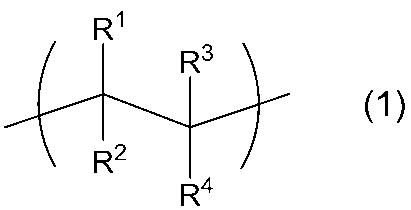
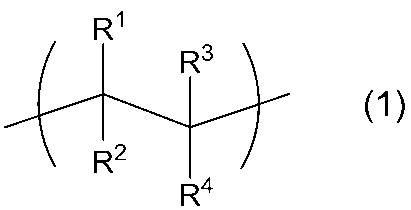
- R 1 to R 4 each independently represent a hydrogen atom or an alkyl group having 1 to 20 carbon atoms.
- the polymer chain (A) has a polymer block (a1) having a unit represented by the formula (1) and a polymer block (a2) having a unit derived from an aromatic vinyl monomer [ The copolymer (P) according to any one of 1] to [4].
- the polymer chain (B) further has a unit derived from an aromatic vinyl monomer and/or a unit derived from an unsaturated carboxylic acid ester, In the polymer chain (B), the total content of the units derived from the oxazoline group-containing monomer, the units derived from the aromatic vinyl monomer and/or the units derived from the unsaturated carboxylic acid ester is 80% by mass or more.
- the copolymer (P) according to any one of [1] to [5].
- the oxazoline group-containing monomer-derived monomer is used.
- a layer containing the copolymer (P) according to any one of [1] to [6] or the resin composition (Q) according to any of [7] to [11] is a resin substrate.
- the following formula (1) which comprises a step of polymerizing a monomer component containing an oxazoline group-containing monomer in the presence of a polymer having a unit represented by the following formula (1).
- R 1 to R 4 each independently represent a hydrogen atom or an alkyl group having 1 to 20 carbon atoms.
- the copolymer (P) and the resin composition (Q) of the present invention include a polymer chain (A) having a unit represented by the formula (1) and a polymer chain (A) having a unit derived from an oxazoline group-containing monomer ( Since it has B), it has excellent adhesion to various base materials including polyolefin.
- the copolymer (P) of the present invention has a polymer chain (A) having a unit represented by the following formula (1) and a polymer chain (B) having a unit derived from an oxazoline group-containing monomer. Is.
- R 1 to R 4 each independently represent a hydrogen atom or an alkyl group having 1 to 20 carbon atoms. Since the copolymer (P) of the present invention has the polymer chain (A) and the polymer chain (B), it has excellent adhesiveness to various base materials and affinity with various resins.
- the unit represented by the above formula (1) contained in the polymer chain (A) (hereinafter, referred to as “unit of the formula (1)”) is a resin having low adhesion to a substrate having low polarity and resin having low polarity. Acts to increase affinity. Since the unit of the formula (1) is the same as or similar to the polymer constitutional unit of the low-polarity base material or the low-polarity resin, the intermolecular force is exerted between the low-polarity base material and the low-polarity resin. It is considered that the adhesion and the affinity are enhanced by the interaction such as.
- Examples of the alkyl group represented by R 1 to R 4 in the above formula (1) include methyl group, ethyl group, n-propyl group, isopropyl group, n-butyl group, isobutyl group, t-butyl group, n-pentyl group, isopentyl group.
- n-hexyl group isohexyl group, n-heptyl group, isoheptyl group, n-octyl group, 2-ethylhexyl group and other linear or branched alkyl groups, cyclopropyl group, cyclobutyl group, Examples thereof include cyclic alkyl groups such as cyclopentyl group, cyclohexyl group, cyclononyl group, cyclodecyl group, dicyclopentanyl group and adamantyl group.
- a linear or branched alkyl group is preferable as the alkyl group represented by R 1 to R 4 .
- the alkyl group of R 1 to R 4 preferably has 1 to 12 carbon atoms, more preferably has 1 to 8 carbon atoms, and further preferably has 1 to 6 carbon atoms.
- the unit of formula (1) can be formed by (co)polymerizing an olefin or a conjugated diene.
- R 1 and R 2 in the formula (1) are each independently a hydrogen atom or a linear or branched chain having 1 to 6 carbon atoms. It is preferably an alkyl group, and R 3 and R 4 are preferably hydrogen atoms.
- the double bond may be hydrogenated to form the unit of the formula (1).
- the unit of formula (1) may be formed by (co)polymerizing a diene compound other than the conjugated diene and hydrogenating the double bond contained in the obtained (co)polymer.
- Examples of the olefin forming the unit of the formula (1) include ethylene, propylene, 1-butene, isobutene, 2-methyl-1-butene, 3-methyl-1-butene, 1-tetradecene and 1-octadecene. Can be mentioned.
- the carbon number of the olefin is preferably 2 or more, more preferably 3 or more, preferably 20 or less, more preferably 12 or less, and further preferably 6 or less.
- Examples of the conjugated diene include 1,3-butadiene, 2-methyl-1,3-butadiene and 1,3-pentadiene.
- the carbon number of the conjugated diene is preferably 4 or more, more preferably 5 or more, preferably 20 or less, more preferably 10 or less, and further preferably 8 or less.
- the polymer chain (A) is an olefin (co)polymer chain such as polyethylene, polypropylene, polybutylene, polyisobutylene, ethylene-propylene copolymer, ethylene-1-butene copolymer partially or in the main chain structure. It is preferable to include it as a whole.
- olefin (co)polymer polyethylene, polypropylene, polybutylene and ethylene-1-butene copolymer are more preferable.
- the polymer chain (A) may further have a unit represented by the following formula (2-1) and/or a unit represented by the following formula (2-2).
- a unit represented by the following formula (2-1) and the unit represented by the following formula (2-2) may be collectively referred to as a “unit of the formula (2)”.
- R 5 represents an alkenyl group having 2 to 20 carbon atoms
- R 6 to R 8 are each independently a hydrogen atom, an alkyl group having 1 to 20 carbon atoms, or a carbon number. It represents 2 to 20 alkenyl groups.
- R 9 and R 10 each independently represent a hydrogen atom or an alkyl group having 1 to 20 carbon atoms, and even if R 9 and R 10 are in the cis position with each other. It may well be in the trans position.
- the copolymer (P) having the polymer chain (A) containing the unit of the formula (1) and the unit of the formula (2) is also excellent in adhesion to various base materials and affinity with various resins. Become.
- the alkenyl group of R 5 to R 8 having 2 to 20 carbon atoms in the formula (2-1) is a group in which one of the C—C bonds contained in the alkyl group of R 1 to R 4 is replaced with a C ⁇ C bond. And a linear or branched alkenyl group is preferable.
- the alkenyl group represented by R 5 to R 8 preferably has 2 to 12 carbon atoms, more preferably has 2 to 8 carbon atoms, and further preferably has 2 to 6 carbon atoms.
- a vinyl group is particularly preferable as the alkenyl group for R 5 to R 8 .
- R 5 in the formula (2-1) is preferably a linear or branched alkenyl group having 2 to 6 carbon atoms.
- R 6 is preferably a hydrogen atom or a linear or branched alkyl group having 1 to 6 carbon atoms, and R 7 and R 8 are preferably hydrogen atoms.
- R 9 and R 10 in the formula (2-2) are preferably a hydrogen atom or a linear or branched alkyl group having 1 to 6 carbon atoms, more preferably a hydrogen atom or a methyl group, and a hydrogen atom. Is more preferable.
- Such a unit of the formula (2) can be introduced into the polymer chain (A) by copolymerizing a diene with an olefin, or homopolymerizing or copolymerizing a conjugated diene.
- the diene forming the unit of the formula (2) include 1,3-butadiene (alias: butadiene), 2-methyl-1,3-butadiene (alias: isoprene), 1,3-pentadiene, 1,4-pentadiene.
- Alkadienes such as 1,5-hexadiene and 2,5-dimethyl-1,5-hexadiene (also known as diisobutene) are preferable, and among them, 1,3-butadiene, 2-methyl-1,3-butadiene and 1,3- More preferred are conjugated dienes such as pentadiene.
- the carbon number of the diene is preferably 4 or more, more preferably 5 or more, preferably 20 or less, more preferably 10 or less, and further preferably 8 or less.
- the polymer chain (A) having the unit of the formula (1) and the unit of the formula (2) is formed of, for example, an olefin and a diene such as an ethylene-isoprene copolymer, a butene-butadiene copolymer and an isobutene-isoprene copolymer. It is preferable to include the copolymer chain partially or entirely in the structure of the main chain.
- the copolymer of olefin and diene is preferably a random copolymer.
- the polymer chain (A) may further have units derived from other unsaturated monomers.
- the other unsaturated monomer is not particularly limited as long as it is a compound having a polymerizable double bond, and examples thereof include vinyl esters such as vinyl acetate and vinyl propionate; (meth)acrylic acid, maleic anhydride, (meth ) Unsaturated carboxylic acids such as methyl acrylate and ethyl (meth)acrylate and their esters; aromatic vinyl compounds such as styrene, vinyltoluene, methoxystyrene, ⁇ -methylstyrene, 2-vinylpyridine; vinyltrimethoxysilane, Examples thereof include vinylsilanes such as ⁇ -(meth)acryloyloxypropylmethoxysilane.
- the polymer chain (A) may be a copolymer of these other unsaturated monomers and olefins, or a copolymer of these other unsaturated
- the polymer chain (A) preferably contains the unit of the above formula (1) as a main component, and the content ratio of the unit of the formula (1) in the polymer chain (A) is preferably 50% by mass or more, 55 Mass% or more is more preferable, and 60 mass% or more is further preferable. As a result, the adhesion of the copolymer (P) to various substrates can be easily increased, and the affinity with various resins can be easily increased.
- the upper limit of the content ratio of the unit of the formula (1) in the polymer chain (A) is not particularly limited, and the polymer chain (A) may be composed of only the unit of the formula (1).
- the content of the unit of the formula (1) may be 98% by mass or less, 95% by mass or less, or 90% by mass or less.
- the polymer chain (A) may have a total content of units of formula (1) and units of formula (2) of 50% by mass or more, 55% by mass or more, or 60% by mass or more. Further, the polymer chain (A) may be composed of only the unit of the formula (1) and the unit of the formula (2), and the unit of the formula (1) and the unit of the formula (2) in the polymer chain (A). May be 98 mass% or less, 95 mass% or less, or 90 mass% or less.
- the polymer chain (A) When the polymer chain (A) has a unit derived from another unsaturated monomer, the polymer chain (A) includes a unit of the formula (1) (or a unit of the formula (2)) and another unsaturated monomer. It may be a random copolymer containing a body-derived unit or a block copolymer.
- the polymer chain (A) is a block copolymer, the polymer chain (A) is a polymer block (a1) having a unit of the formula (1) and a heavy chain having a unit derived from another unsaturated monomer. It is preferable to have a united block (a2).
- the polymer block (a1) includes the unit of the formula (1), the unit of the formula (2) and other units. It may have a unit derived from the unsaturated monomer.
- the other unsaturated monomer in this case include vinyl esters such as vinyl acetate and vinyl propionate; (meth)acrylic acid, maleic anhydride, methyl (meth)acrylate, ethyl (meth)acrylate, etc.
- the polymer block (a1) preferably contains more units of the formula (1), and the content ratio of the unit of the formula (1) in the polymer block (a1) is preferably 70% by mass or more. , 80% by mass or more is more preferable, and 90% by mass or more is still more preferable.
- the polymer block (a1) may be substantially composed of only the unit of the formula (1), and for example, the unit of the formula (1) may be 99% by mass or more.
- the total content of the units of the formula (1) and the unit of the formula (2) in the polymer block (a1) is preferably 70% by mass or more, more preferably 80% by mass or more, and 90% by mass or more. Is more preferable.
- the polymer block (a1) may be substantially composed only of the unit of the formula (1) and the unit of the formula (2).
- the unit of the formula (1) and the unit of the formula (2) are 99 mass. % Or more.
- the polymer block (a2) is composed of a unit derived from an aromatic vinyl monomer.
- the polymer block (a1) can function as a soft component and the polymer block (a2) can function as a hard component, and a copolymer (P) and a resin composition containing the copolymer (P) can be used. Elasticity can be imparted to (Q).
- the aromatic vinyl monomer is not particularly limited as long as it is a compound having a vinyl group bonded to an aromatic ring, and examples thereof include styrene, vinyltoluene, methoxystyrene, ⁇ -methylstyrene, ⁇ -hydroxymethylstyrene, ⁇ -hydroxyethyl.
- Styrene type monomers such as styrene; polycyclic aromatic hydrocarbon ring vinyl monomers such as 2-vinylnaphthalene; aromatic heterocyclic vinyl units such as N-vinylcarbazole, 2-vinylpyridine, vinylimidazole, vinylthiophene, etc. Examples thereof include a polymer. Of these, styrene-based monomers are preferable.
- the styrene-based monomer includes not only styrene but also a styrene vinyl group or a styrene derivative in which an arbitrary substituent is bonded to a benzene ring, and the substituent includes an alkyl group, an alkoxy group, a hydroxyl group, a halogen group. Group, amino group, nitro group, sulfo group and the like.
- the alkyl group and alkoxy group bonded to styrene preferably have 1 to 4 carbon atoms, and more preferably 1 to 2 carbon atoms.
- At least a part of hydrogen atoms is a hydroxyl group or a halogen atom. It may be substituted with a group.
- the styrene-based monomer is preferably unsubstituted styrene having no substituent bonded to the vinyl group of styrene and the benzene ring.
- the polymer block (a2) may have units derived from other unsaturated monomers in addition to the units derived from the aromatic vinyl monomer.
- the other unsaturated monomer in this case include vinyl esters such as vinyl acetate and vinyl propionate; (meth)acrylic acid, maleic anhydride, methyl (meth)acrylate, ethyl (meth)acrylate, etc. And unsaturated carboxylic acids and esters thereof; vinyl silanes such as vinyltrimethoxysilane and ⁇ -(meth)acryloyloxypropylmethoxysilane.
- the polymer block (a2) preferably contains more units derived from the aromatic vinyl monomer, and the content of the units derived from the aromatic vinyl monomer in the polymer block (a2) is 70% by mass. It is preferably at least 80% by mass, more preferably at least 80% by mass, still more preferably at least 90% by mass.
- the polymer block (a2) may be substantially composed only of units derived from an aromatic vinyl monomer, and for example, the units derived from an aromatic vinyl monomer may be 99% by mass or more.
- Examples of the polymer chain (A) having a polymer block (a1) having a unit of the formula (2) and a polymer block (a2) having a unit derived from an aromatic vinyl monomer include, for example, styrene-butadiene- Hydrogenated products of styrene block copolymers (eg styrene-ethylene/butylene-styrene block copolymers), hydrogenated products of styrene-isoprene-styrene block copolymers (eg styrene-ethylene/propylene-styrene block copolymers) Polymers), hydrogenated products of styrene-isoprene block copolymers, and the like.
- the hydrogenated products are those in which the polymer block (a1) has a unit of the formula (1).
- the polymer block (a1) when partially hydrogenated, has a unit of the formula (1) and a unit of the formula (2).
- each block is divided by "-", and the notation "/" in each block represents the monomer unit constituting the block.
- the polymer chain (A) made of a block copolymer is preferably a polymer block (a1) having polymer blocks (a2) bonded to both sides thereof, and more preferably a triblock copolymer. ..
- triblock copolymers include hydrogenated products of styrene-butadiene-styrene block copolymers and hydrogenated products of styrene-isoprene-styrene block copolymers.
- the content ratio of the polymer block (a1) in the polymer chain (A) is preferably 50% by mass or more, 55 mass% or more is more preferable, 60 mass% or more is still more preferable, 95 mass% or less is preferable, 93 mass% or less is more preferable, and 91 mass% or less is further preferable.
- the polymer chain (A) preferably has the polymer block (a1) and does not have the polymer block (a2).
- the polymer chain (A) is preferably composed of the unit of the formula (1) or the unit of the formula (1) and the unit of the formula (2), and is composed of only the unit of the formula (1). More preferably.
- the weight average molecular weight of the polymer chain (A) is preferably 50,000 or more, more preferably 10,000 or more, even more preferably 20,000 or more, even more preferably 30,000 or more, and preferably 300,000 or less, 250,000. The following is more preferable, 200,000 or less is still more preferable, and 150,000 or less is even more preferable.
- the polymer chain (B) has a unit derived from an oxazoline group-containing monomer.
- the unit derived from the oxazoline group-containing monomer acts to enhance the adhesiveness and affinity between the copolymer (P) and the highly polar base material or the highly polar resin.
- the oxazoline group-containing monomer is not particularly limited as long as it is a compound having an oxazoline group and a polymerizable double bond, 2-vinyl-2-oxazoline, 5-methyl-2-vinyl-2-oxazoline, 4, Preferred are vinyl oxazolines such as 4-dimethyl-2-vinyl-2-oxazoline, 2-isopropenyl-2-oxazoline and 4,4-dimethyl-2-isopropenyl-2-oxazoline. Among these, 2-isopropenyl-2-oxazoline is preferably used from the viewpoint of easy availability and reactivity.
- the polymer chain (B) may further have units derived from other unsaturated monomers.
- the other unsaturated monomer is not particularly limited as long as it is a compound having a polymerizable double bond, and examples thereof include vinyl esters such as vinyl acetate and vinyl propionate; vinyl cyanide compounds such as acrylonitrile; and (meth)acryl.
- Unsaturated carboxylic acids such as acids, maleic anhydride, methyl (meth)acrylate, ethyl (meth)acrylate and their esters; aromatics such as styrene, vinyltoluene, methoxystyrene, ⁇ -methylstyrene, 2-vinylpyridine Vinyl compounds; vinyl silanes such as vinyltrimethoxysilane and ⁇ -(meth)acryloyloxypropylmethoxysilane.
- the polymer chain (B) preferably has a unit derived from a vinyl cyanide monomer, a unit derived from an aromatic vinyl monomer and/or a unit derived from an unsaturated carboxylic acid ester.
- the unit derived from the aromatic vinyl monomer is preferably a unit derived from a styrene monomer, and the unit derived from the unsaturated carboxylic acid ester is preferably a unit derived from a (meth)acrylic acid ester.
- the aromatic vinyl monomer and the styrene-based monomer the description regarding the aromatic vinyl monomer and the styrene-based monomer of the polymer block (a2) is referred to.
- the heat resistance of the copolymer (P) can be improved, and when the polymer chain (B) is polymerized and formed.
- the reaction of the oxazoline group-containing monomer can be promoted. It is also advantageous in terms of manufacturing cost.
- unsaturated carboxylic acid ester preferably (meth)acrylic acid ester
- unsaturated carboxylic acid ester include linear, branched, or cyclic aliphatic groups at the oxygen atom of the ester bond of (meth)acrylic acid.
- examples thereof include (meth)acrylic acid ester having a hydrocarbon group or an aromatic hydrocarbon group bonded thereto.
- Examples of the (meth)acrylic acid ester having a linear or branched aliphatic hydrocarbon group include methyl (meth)acrylate, ethyl (meth)acrylate, n-propyl (meth)acrylate, and (meth). Isopropyl acrylate, n-butyl (meth)acrylate, isobutyl (meth)acrylate, sec-butyl (meth)acrylate, tert-butyl (meth)acrylate, pentyl (meth)acrylate, (meth)acrylic acid Examples thereof include alkyl (meth)acrylates such as n-hexyl and 2-ethylhexyl (meth)acrylate.
- the alkyl group of the alkyl (meth)acrylate preferably has 1 or more carbon atoms, preferably 18 or less, more preferably 12 or less, and further preferably 6 or less.
- Examples of the (meth)acrylic acid ester having a cyclic aliphatic hydrocarbon group include (meth)acrylic acid cyclopropyl, (meth)acrylic acid cyclobutyl, (meth)acrylic acid cyclopentyl, (meth)acrylic acid cyclohexyl, and the like (meth ) Cycloalkyl acrylate; and crosslinked cyclic (meth)acrylates such as isobornyl (meth)acrylate.
- 3 or more are preferable, as for carbon number of the cycloalkyl group of cycloalkyl (meth)acrylate, 4 or more are more preferable, 5 or more are more preferable, 20 or less are more preferable, 12 or less are more preferable, 10 or less are more preferable. ..
- Examples of the (meth)acrylic acid ester having an aromatic hydrocarbon group include phenyl (meth)acrylate, tolyl (meth)acrylate, xylyl (meth)acrylate, naphthyl (meth)acrylate, and binaphthyl (meth)acrylate.
- Aryl (meth)acrylates such as anthryl (meth)acrylate; aralkyl (meth)acrylates such as benzyl (meth)acrylate; aryloxyalkyl (meth)acrylates such as phenoxyethyl (meth)acrylate; Can be mentioned.
- the aryl group of the aryl (meth)acrylate preferably has 6 or more carbon atoms, preferably 20 or less, and more preferably 14 or less.
- the aralkyl group of the aralkyl (meth)acrylate preferably has 7 or more carbon atoms, preferably 14 or less carbon atoms, and more preferably 12 or less carbon atoms.
- the aryloxyalkyl group of the aryloxyalkyl (meth)acrylate preferably has 7 or more carbon atoms, preferably 14 or less carbon atoms, and more preferably 12 or less carbon atoms.
- the affinity of the copolymer (P) with various resins can be further improved.
- the polymer chain (B) When the polymer chain (B) has a unit derived from another unsaturated monomer, the polymer chain (B) is a random copolymer of an oxazoline group-containing monomer and another unsaturated monomer, although it may be a block copolymer, it is preferably a random copolymer from the viewpoint of easy production of the polymer chain (B).
- the content of the unit derived from the oxazoline group-containing monomer in the polymer chain (B) is preferably 1% by mass or more, more preferably 2% by mass or more, and preferably 50% by mass or less, 40% by mass or less. Is more preferable. This facilitates enhancing the adhesiveness improving effect and the affinity improving effect of the copolymer (P) and facilitates the formation of the polymer chain (B).
- the polymer chain (B) has a unit derived from an aromatic vinyl monomer as a unit derived from another unsaturated monomer, a unit derived from an oxazoline group-containing monomer and a unit derived from an aromatic vinyl monomer are used.
- the total content of the units is preferably 70% by mass or more, more preferably 80% by mass or more, further preferably 90% by mass or more, even more preferably 95% by mass or more, and 98% by mass or more. Particularly preferred.
- the polymer chain (B) is preferably grafted to the polymer chain (A). Therefore, the copolymer (P) is preferably a graft copolymer having the polymer chain (B) as a graft chain.
- a grafted polymer is a "bonded to a main chain as a side chain in a polymer. When there are one or several types of blocks, and these side chains have different structural (chemical structure) or arrangement characteristics from the main chain, this polymer is referred to as a graft polymer.” There is.
- the graft copolymer can be obtained by a known production method such as a chain transfer reaction method, a polymer initiator method, a coupling method, a macromonomer method or a surface graft method, and only one of these methods is adopted. Alternatively, a plurality of them may be used in combination. The details of these methods can be referred to the 6th edition of the Chemical Handbook (Applied Chemistry), edited by The Chemical Society of Japan.
- the copolymer (P) can be easily produced by addition-polymerizing the monomer component forming the polymer chain (B) to the polymer chain (A). Therefore, the copolymer (P) is a monomer containing an oxazoline group-containing monomer in the presence of a polymer having a unit of the formula (1) (hereinafter referred to as “raw material polymer (P1)”). Those obtained by polymerizing the components are preferred.
- raw material polymer (P1) refer to the above description of the polymer chain (A).
- the raw material polymer (P1) further has a unit of the formula (2) or a unit of the formula (1). It may have the polymer block (a1) having and the polymer block (a2) having a unit derived from another unsaturated monomer.
- the polymer chain (B) is preferably grafted, for example, to the unit of the formula (1) of the polymer chain (A).
- the polymer chain (B) may be grafted to the unit of formula (2).
- the polymer chain (B) may be bonded to a carbon atom of the main chain of the unit of the formula (1) or the unit of the formula (2), and is a hydrocarbon group bonded to the main chain as a substituent (side chain). It may be bonded to a carbon atom.
- the polymer chain (B) may be bonded to the polymer chain (A) via an arbitrary linking group (eg, ester bond, amide bond, urethane bond, etc.).
- the weight average molecular weight of the copolymer (P) is preferably 10,000 or more, more preferably 20,000 or more, further preferably 30,000 or more, even more preferably 50,000 or more, particularly preferably 70,000 or more, and 700,000. The following is preferable, 500,000 or less is more preferable, 300,000 or less is further preferable, 200,000 or less is even more preferable. By setting the weight average molecular weight of the copolymer (P) in such a range, it becomes easy to improve the handleability of the copolymer (P).
- the weight average molecular weight of the copolymer (P) is preferably 1.1 times or more, more preferably 1.2 times or more, still more preferably 1.3 times or more the weight average molecular weight of the polymer chain (A), and 20 It is preferably not more than 10 times, more preferably not more than 12 times, even more preferably not more than 10 times, even more preferably not more than 7 times, particularly preferably not more than 5 times. This makes it easy to increase the adhesiveness and affinity of the copolymer (P).
- the copolymer (P) can be obtained by a production method including a step (polymerization step) of polymerizing a monomer component containing an oxazoline group-containing monomer in the presence of the raw material polymer (P1).
- a polymer chain (B) is formed by polymerizing a monomer component containing an oxazoline group-containing monomer in the polymerization step, and the raw material polymer (P1) gives a polymer chain (A), whereby a polymer chain ( A copolymer (P) in which B) is bonded to the polymer chain (A) is obtained.
- the polymer chain (B) is bonded to the unit of the formula (1) of the starting polymer (P1) (the unit of the formula (1) or the unit of the formula (2) when the unit of the formula (2) is also present). From the viewpoint of doing so, it is preferable that hydrogen is abstracted from the hydrocarbon group of the unit in the polymerization step. As a result, a radical is generated at the location, and the monomer component forming the polymer chain (B) can be addition-polymerized.
- the raw material polymer (P1) may be used alone or in combination of two or more. In the latter case, it becomes easy to adjust the weight average molecular weight and the physical properties of the copolymer (P).
- the monomer component used for forming the polymer chain (B) other unsaturated monomer can be used in addition to the oxazoline group-containing monomer.
- the other unsaturated monomer it is preferable to use vinyl cyanide monomer, aromatic vinyl monomer and/or unsaturated carboxylic acid ester.
- the description of the oxazoline group-containing monomer forming the polymer chain (B) and the other unsaturated monomer forming the polymer chain (B) is referred to.
- the polymerization of the monomer component can be carried out by using a known polymerization method such as a bulk polymerization method, a solution polymerization method, an emulsion polymerization method or a suspension polymerization method, but it is preferable to use the solution polymerization method.
- a known polymerization method such as a bulk polymerization method, a solution polymerization method, an emulsion polymerization method or a suspension polymerization method, but it is preferable to use the solution polymerization method.
- the polymerization method for example, either a batch polymerization method or a continuous polymerization method can be used.
- the amount of the raw material polymer (P1) used during the polymerization is preferably 5 parts by mass or more, more preferably 10 parts by mass or more, based on 100 parts by mass of the total amount of the raw material polymer (P1) and the monomer components.
- the amount is preferably 15 parts by mass or more, more preferably 80 parts by mass or less, more preferably 70 parts by mass or less, still more preferably 60 parts by mass or less, still more preferably 50 parts by mass or less.
- the amount of the monomer component used is preferably 20 parts by mass or more, more preferably 30 parts by mass or more, and further preferably 40 parts by mass or more with respect to 100 parts by mass of the total amount of the raw material polymer (P1) and the monomer component.
- the amount is preferably 50 parts by mass or more, more preferably 95 parts by mass or less, more preferably 90 parts by mass or less, and further preferably 85 parts by mass or less.
- the solvent used during the polymerization can be appropriately selected according to the composition of the monomer component, and an organic solvent used in a usual radical polymerization reaction can be used.
- aromatic hydrocarbons such as toluene, xylene, and ethylbenzene
- aliphatic hydrocarbons such as hexane and cyclohexane
- ketones such as acetone, methyl ethyl ketone, methyl isobutyl ketone, and cyclohexanone
- esters such as ethyl acetate, butyl acetate, propylene glycol monomethyl ether acetate and 3-methoxybutyl acetate
- cellosolves such as methyl cellosolve, ethyl cellosolve and butyl cellosolve
- the polymerization reaction of the raw material polymer (P1) and the monomer component is preferably carried out in the presence of a polymerization initiator.
- a polymerization initiator examples include 2,2′-azobisisobutyronitrile, 2,2′-azobis(2-amidinopropane) dihydrochloride, dimethyl-2,2′-azobis(2-methylproton Azo compounds such as pionate) and 4,4′-azobis(4-cyanopentanoic acid); persulfates such as potassium persulfate; cumene hydroperoxide, diisopropylbenzene hydroperoxide, di-t-butyl peroxide, Lauroyl peroxide, benzoyl peroxide, t-butylperoxyisopropyl carbonate, t-amylperoxy-2-ethylhexanoate, t-amylperoxyoctoate, t-amylperoxyisononanoate, t-a
- the amount of the polymerization initiator used is preferably, for example, 0.05 to 3 parts by mass with respect to 100 parts by mass of the monomer component.
- the total concentration of the raw material polymer (P1) and the monomer component in the reaction solution is preferably 3% by mass or more, more preferably 5% by mass or more, further preferably 10% by mass or more, and preferably 80% by mass or less. , 70% by mass or less is more preferable. It is also possible to appropriately add the raw material polymer (P1), the monomer component, the polymerization catalyst, the solvent and the like during the polymerization reaction.
- the polymerization reaction is preferably performed in an atmosphere of an inert gas such as nitrogen gas or under an air stream.
- the reaction temperature is preferably 50°C to 200°C.
- the reaction time may be appropriately adjusted while observing the degree of progress of the copolymerization reaction, and for example, 1 hour to 20 hours is preferable.
- the monomer components may be charged all at once or added in portions. In addition, it is preferable to charge the monomer components all at once because it is easy to graft polymerize the oxazoline group-containing monomer to the polymer chain (A) to form the polymer chain (B).
- the present invention also provides a resin composition (Q) containing the copolymer (P) having the polymer chain (A) and the polymer chain (B) described above.
- the resin composition (Q) of the present invention has excellent adhesion to various base materials and excellent affinity with various resins.
- the resin composition (Q) may contain the copolymer (P) as a resin component, or may contain another polymer as a resin component.
- the other polymer is preferably an oxazoline group-containing polymer and/or a polymer having a unit of the formula (1), more preferably an oxazoline group-containing polymer. It is preferably used, and the homogeneity of the resin composition (Q) is enhanced by containing these other polymers.
- the oxazoline group-containing polymer contained as another polymer in the resin composition (Q) may be any polymer having a unit derived from the oxazoline group-containing monomer described in the polymer chain (B), and the polymer described above. It may have units derived from other unsaturated monomers described in the chain (B). From the viewpoint of enhancing the compatibility with the copolymer (P), the oxazoline group-containing polymer more preferably has the same monomer-derived unit as the monomer-derived unit of the polymer chain (B).
- the polymer having the unit of the formula (1) contained in the resin composition (Q) as another polymer may be any polymer having the unit of the formula (1) described in the polymer chain (A). It may have a polymer having the unit of the formula (2) described in the polymer chain (A) or a unit derived from another unsaturated monomer.
- the polymer having the unit of the formula (1) has the same monomer-derived unit as the monomer-derived unit of the polymer chain (A) from the viewpoint of enhancing the compatibility with the copolymer (P). Is more preferable.
- the resin composition (Q) contains a copolymer (P), an oxazoline group-containing polymer, and a polymer having a unit of the formula (1) in a total amount of 100 parts by mass.
- the amount is preferably 10 parts by mass or more, more preferably 12 parts by mass or more, still more preferably 15 parts by mass or more.
- the upper limit of the content ratio of the copolymer (P) in the resin composition (Q) is not particularly limited, and the resin composition (Q) may be composed only of the copolymer (P).
- the content ratio of the copolymer (P) may be 90 parts by mass or less based on 100 parts by mass of the total amount of the (P), the oxazoline group-containing polymer and the polymer having the unit of the formula (1). It may be less than or equal to 70 parts by mass, or less than or equal to 60 parts by mass.
- the resin composition (Q) has a content ratio of the polymer chain (A) of 5 with respect to 100 parts by mass in total of the copolymer (P), the oxazoline group-containing polymer and the polymer having the unit of the formula (1). It is preferably at least 8 parts by mass, more preferably at least 8 parts by mass, further preferably at least 12 parts by mass, preferably at most 80 parts by mass, more preferably at most 70 parts by mass, further preferably at most 60 parts by mass, 50 Even more preferably, it is at most parts by mass. This makes it easier to increase the adhesion of the resin composition (Q) to various base materials.
- the content ratio of the polymer chain (A) in the resin composition (Q) is determined by the polymer chain (A) contained in the copolymer (P) and the polymer chain contained in the polymer having the unit of the formula (1). It means the total content of (A).
- the content ratio of the unit of the formula (1) is 100 parts by mass of the total amount of the copolymer (P), the oxazoline group-containing polymer and the polymer having the unit of the formula (1). It is preferably 3 parts by mass or more, more preferably 5 parts by mass or more, still more preferably 10 parts by mass or more, preferably 80 parts by mass or less, more preferably 70 parts by mass or less, further preferably 60 parts by mass or less, Even more preferably 50 parts by mass or less. This makes it easier to increase the adhesion of the resin composition (Q) to various base materials.
- the resin composition (Q) contains the unit of the formula (1) and the formula (1) based on 100 parts by mass of the copolymer (P), the oxazoline group-containing polymer and the polymer having the unit of the formula (1).
- the total content of the units (2) may be 3 parts by mass or more, 5 parts by mass or more, or 10 parts by mass or more, and 80 parts by mass or less, 70 parts by mass or less, 60 parts by mass or less, or 50 parts by mass. It may be equal to or less than a part.
- the content ratio of the unit of the formula (1) in the resin composition (Q) is included in the polymer having the unit of the formula (1) and the unit of the formula (1) contained in the copolymer (P).
- the content of the units of the formula (1) is the same as that of the units of the formula (2) contained in the copolymer (P). It means the total content of the units of the formula (2) contained in the polymer having the units of the formula (1). Further, the content ratio of the unit of the formula (2) means the total content ratio of the unit represented by the formula (2-1) and the unit represented by the formula (2-2).
- the resin composition (Q) contains 100 units by weight of the copolymer (P), the oxazoline group-containing polymer and the polymer having the unit of the formula (1), and the oxazoline group-containing monomer-derived unit
- the content ratio is preferably 0.5 parts by mass or more, more preferably 1.0 parts by mass or more, further preferably 1.5 parts by mass or more, and preferably 49 parts by mass or less, more preferably 40 parts by mass or less. , 30 parts by mass or less is more preferable. This makes it easier to increase the adhesion of the resin composition (Q) to various base materials.
- the content ratio of the unit derived from the oxazoline group-containing monomer in the resin composition (Q) is included in the unit derived from the oxazoline group-containing monomer and the oxazoline group-containing polymer contained in the copolymer (P). Means the total content of units derived from the oxazoline group-containing monomer.
- the resin composition (Q) contains the unit of the formula (1) and the oxazoline group based on 100 parts by mass of the total amount of the copolymer (P), the oxazoline group-containing polymer and the polymer having the unit of the formula (1).
- the total content of the monomer-derived units is preferably 5 parts by mass or more, more preferably 10 parts by mass or more, even more preferably 15 parts by mass or more, still more preferably 20 parts by mass or more. This makes it easier to increase the adhesion of the resin composition (Q) to various base materials.
- the upper limit of the content ratio of the unit of the formula (1) and the unit derived from the oxazoline group-containing monomer in the resin composition (Q) is not particularly limited, and the resin composition (Q) is substantially the same as that of the formula (1).
- Units and units derived from the oxazoline group-containing monomer may be included, and the total amount of the copolymer (P), the oxazoline group-containing polymer and the polymer having the unit of the formula (1) is 100 parts by mass.
- the total content of the units of the formula (1) and the units derived from the oxazoline group-containing monomer is 90 parts by mass or less, 80 parts by mass or less, 70 parts by mass or less, 60 parts by mass or less, or 50 parts by mass or less. May be.
- the resin composition (Q) contains the unit of the formula (1) and the formula (1) based on 100 parts by mass of the copolymer (P), the oxazoline group-containing polymer and the polymer having the unit of the formula (1).
- the total content of the units of (2) and the units derived from the oxazoline group-containing monomer may be 5 parts by mass or more, 10 parts by mass or more, 15 parts by mass or more, 20 parts by mass or more, or 22 parts by mass or more. Further, it may be 90 parts by mass or less, 80 parts by mass or less, 70 parts by mass or less, 60 parts by mass or less, or 50 parts by mass or less.
- the content ratio of the unit of the formula (1) is 100 parts by mass of the total amount of the copolymer (P), the oxazoline group-containing polymer and the polymer having the unit of the formula (1). It is particularly preferable that the content is 10 parts by mass or more, and the total content ratio of the unit of the formula (1) and the unit derived from the oxazoline group-containing monomer is 20 parts by mass or more.
- the resin composition (Q) contains the unit of the formula (1) and the formula (1) based on 100 parts by mass of the copolymer (P), the oxazoline group-containing polymer and the polymer having the unit of the formula (1).
- the total content of the units of (2) is 10 parts by mass or more, and the total content of the units of the formula (1), the formula (2), and the units derived from the oxazoline group-containing monomer is 20 parts by mass or more. Is particularly preferable.
- the content ratio of the unit of the formula (1) is 10 parts by mass or more based on 100 parts by mass of the unit of the formula (1) and the unit derived from the oxazoline group-containing monomer. Is more preferable, 20 parts by mass or more is more preferable, 30 parts by mass or more is further preferable, 98 parts by mass or less is preferable, 95 parts by mass or less is more preferable, and 93 parts by mass or less is further preferable. This makes it easier to increase the adhesion of the resin composition (Q) to various base materials.
- the resin composition (Q) has a unit of the formula (1), a unit of the formula (2), and a unit of the unit derived from the oxazoline group-containing monomer, based on 100 units by mass of the unit of the formula (1).
- the total content of the units of (2) may be 10 parts by mass or more, 20 parts by mass or more, or 30 parts by mass or more, and 98 parts by mass or less, 95 parts by mass or less, or 93 parts by mass or less, Good.
- the content ratio of the unit of the formula (1), the content ratio of the unit of the formula (2) and the content ratio of the unit derived from the oxazoline group-containing monomer in the resin composition (Q) are the same as those of the copolymer (P) and the oxazoline. From the amount of each monomer used for polymerizing the group-containing polymer and the monomer residual ratio (the ratio of the monomer remaining without reaction to the obtained reaction liquid) , Can be determined by calculating the amount of each unit incorporated in the copolymer (P) or the oxazoline group-containing polymer.
- the raw material polymer (P1) is used.
- the content ratio of the unit of the formula (1) or the content ratio of the unit of the formula (2) in the resin composition (Q) The content ratio of the units derived from the oxazoline group-containing monomer is calculated.
- all the raw material polymer (P1) reacts with the monomer component, and the residual rate is considered to be 0%.
- the residual rate of the raw material polymer (P1) is regarded as 0%, and the raw material polymer (P1) may be contained in the resin composition (Q).
- the total content of the copolymer (P) and the oxazoline group-containing polymer in 100 parts by mass of the solid content of the resin composition (Q) is preferably 50 parts by mass or more, more preferably 70 parts by mass or more, and 80 parts by mass. The above is more preferable, and 90 parts by mass or more is even more preferable.
- the upper limit of the content ratio of the copolymer (P) and the oxazoline group-containing polymer in the resin composition (Q) is not particularly limited, and the resin composition (Q) substantially includes the copolymer (P) and the oxazoline group. It may be composed of only the contained polymer.
- the total content of the copolymer (P) and the oxazoline group-containing polymer is 99 parts by mass or more in 100 parts by mass of the solid content of the resin composition (Q). May be.
- the resin composition (Q) contains a solvent
- the solid content of the resin composition (Q) means the amount of the resin composition (Q) excluding the solvent.
- the resin composition (Q) may contain a polymer other than the oxazoline group-containing polymer and the polymer having the unit of the formula (1).
- a polymer include vinyl chloride and chlorine.
- Halogen-containing polymers such as vinyl chloride resin; acrylic polymers such as polymethylmethacrylate; polystyrene, styrene-methyl methacrylate copolymer, styrene-acrylonitrile copolymer, acrylonitrile-butadiene-styrene copolymer, etc.
- Styrene-based polymers include polyesters such as polyethylene terephthalate, polybutylene terephthalate and polyethylene naphthalate; polyamides such as nylon 6, nylon 66, nylon 610; polyacetals; polycarbonates; polyphenylene oxides; polyphenylene sulfides; polyether ether ketones; polysulfone; polyethers.
- polyesters such as polyethylene terephthalate, polybutylene terephthalate and polyethylene naphthalate
- polyamides such as nylon 6, nylon 66, nylon 610; polyacetals; polycarbonates; polyphenylene oxides; polyphenylene sulfides; polyether ether ketones; polysulfone; polyethers.
- rubber polymers such as ABS resin and ASA resin mixed with sulfone; polyoxypentylene; polyamideimide; polybutadiene rubber and (meth)acrylic rubber.
- the resin composition (Q) may contain a solvent.
- a solvent aromatic hydrocarbons such as toluene, xylene, and ethylbenzene; aliphatic hydrocarbons such as hexane and cyclohexane; ketones such as acetone, methyl ethyl ketone, methyl isobutyl ketone, and cyclohexanone; tetrahydrofuran, dioxane, ethylene glycol dimethyl ether, Ethers such as diethylene glycol dimethyl ether and anisole; esters such as ethyl acetate, butyl acetate, propylene glycol monomethyl ether acetate, 3-methoxybutyl acetate; cellosolves such as methyl cellosolve, ethyl cellosolve, butyl cellosolve; methanol, ethanol, isopropanol, n -Alcohols such as butanol;
- the resin composition (Q) may contain various additives.
- the additive include antioxidants such as hindered phenol-based, phosphorus-based, and sulfur-based; stabilizers such as light resistance stabilizers, weather resistance stabilizers, and heat stabilizers; reinforcing materials such as glass fibers and carbon fibers; ultraviolet rays.
- each additive in the resin composition (Q) is preferably in the range of 0 to 5 parts by mass, more preferably 0 to 2 parts by mass in 100 parts by mass of the solid content of the resin composition (Q). ..
- the weight average molecular weight of the resin composition (Q) is preferably 10,000 or more, more preferably 20,000 or more, still more preferably 30,000 or more, even more preferably 50,000 or more, particularly preferably 70,000 or more, and 700,000. The following is preferable, 500,000 or less is more preferable, 300,000 or less is further preferable, 200,000 or less is even more preferable.
- the weight average molecular weight of the resin composition (Q) means a value in terms of polystyrene measured by gel permeation chromatography of the resin composition (Q), and the resin composition (Q) is a copolymer (P) and oxazoline. When the group-containing polymer and the polymer having the unit of the formula (1) are contained, the weight average molecular weight of the resin composition (Q) is the total weight average molecular weight of these plural kinds of polymers.
- the weight average molecular weight of the resin composition (Q) is preferably 1.1 times or more, more preferably 1.2 times or more, and 1.3 times the weight average molecular weight of the polymer chain (A) of the copolymer (P).
- the above is more preferable, 20 times or less is preferable, 12 times or less is more preferable, 10 times or less is further preferable, 7 times or less is further more preferable, and 5 times or less is particularly preferable. This makes it easier to increase the adhesion of the resin composition (Q) to various base materials.
- the method for producing the resin composition (Q) is not particularly limited, but the copolymer (P) is polymerized by polymerizing the raw material polymer (P1) and a monomer component containing an oxazoline group-containing monomer. At this time, it is convenient to polymerize the oxazoline group-containing polymer together.
- an oxazoline group-containing polymer corresponding to the polymer chain (B) of the copolymer (P) is simultaneously produced together with the copolymer (P).
- the copolymer (P), the oxazoline group-containing polymer, and the polymer having the unit of the formula (1) present as the unreacted raw material polymer (P1) are not separated, so that the copolymer (P)
- a resin composition (Q) containing an oxazoline group-containing polymer and a polymer having a unit of the formula (1) can be obtained.
- the resin composition (Q) is produced by the steps of the copolymer (P), the oxazoline group-containing polymer and the unit of the formula (1) according to the polymerization step described in the method of producing the copolymer (P). The resulting polymer will be obtained.
- the method for producing the resin composition (Q) is not limited to the above method, and the copolymer (P) may be isolated and mixed with another polymer to prepare the resin composition (Q). Further, in the above-mentioned method for producing the copolymer (P), after completion of the graft copolymerization reaction to the raw material polymer (P1), another monomer is further added to carry out the polymerization reaction to carry out the resin composition (Q). You may get Alternatively, another weight may be added to the mixture of the copolymer (P) obtained by the method for producing the copolymer (P), the oxazoline group-containing polymer and the polymer having the unit of the formula (1).
- a resin composition (Q) may be prepared by adding a polymer (for example, another polymer containing an oxazoline group).
- a polymer for example, another polymer containing an oxazoline group.
- another polymer may be melt-kneaded, and in this case, a general device such as a kneader or a multi-screw extruder can be used.
- the copolymer (P) and the resin composition (Q) include a polymer chain (A) having a unit of the formula (1) and a polymer chain (B) having a unit derived from an oxazoline group-containing monomer.
- a primer also referred to as an undercoating agent, an undercoating agent, or a sealer
- a coating layer mainly composed of acrylic polymer or urethane polymer on a polymethylmethacrylate substrate or a polycarbonate substrate, which is a resin substrate with a relatively high polarity, or with a resin substrate with a relatively low polarity.
- a coating layer containing an acrylic polymer, a urethane polymer or the like as a main component is formed on a polyolefin base material, the base material and the coating layer can be formed by using the copolymer (P) or the resin composition (Q) as a primer. It is possible to improve the adhesion.
- the present invention also provides a resin molded product in which a layer containing the above-described copolymer (P) or resin composition (Q) is formed on the surface of a resin base material.
- the layer containing the copolymer (P) or the resin composition (Q) formed in the resin molded product of the present invention has excellent adhesion to various resin base materials, and therefore the layer peels from the resin base material. It is difficult for problems such as
- the layer containing the copolymer (P) or the resin composition (Q) has a high affinity with various resins of high polarity to low polarity (nonpolar), and therefore another resin layer is formed on the layer. When the (coating layer) is laminated, the adhesion between the coating layer and the resin molding is high, and problems such as peeling of the coating layer are unlikely to occur.
- the resin base material constituting the resin molded body is preferably a hydrocarbon resin or a resin having a hetero atom-containing group or a bond containing a hetero atom.
- the hydrocarbon-based resin may be any of an aliphatic hydrocarbon resin, an alicyclic hydrocarbon resin, and an aromatic hydrocarbon resin, but an aliphatic hydrocarbon resin is preferable, and a polyolefin such as polyethylene or polypropylene is preferable. Resins are more preferred.
- the hetero atom include an oxygen atom, a nitrogen atom, and a sulfur atom.
- the hetero atom-containing group include a hydroxy group, a carboxy group, a sulfo group, and a carbamoyl group.
- hetero atom-containing bond examples include an ether bond, an ester bond, a carbonic acid ester bond, an amide bond, and a thioether. Examples include binding.
- the resin having a hetero atom-containing group or a hetero atom-containing bond is preferably a resin having at least one selected from a carboxy group, an ester bond and a carbonic acid ester bond.
- the copolymer (P) and the resin composition (Q) are also useful as a compatibilizing agent for various resins, for example, improving miscibility with a polyolefin resin or polyester resin having low polarity, or a mixture of a plurality of resins. It is possible to improve the stability of one liquid.
- the copolymer (P) or the resin composition (Q) is used as a compatibilizing agent for various resins, the compounding amount is, for example, 1 part by mass with respect to 100 parts by mass of the total of the resins to be compatibilized.
- additives for melt-kneading resins dispersants for melt-kneading compositions containing resins and auxiliary materials (for example, fibers, fillers, pigments, etc.), resins, hot melts and asphalt modifications It can also be used as a substance.
- compatibility, fluidity, heat resistance, impact resistance, scratch resistance, Effects such as improvement of paintability on the surface of the molded product and prevention of blocking can be expected.
- the copolymer (P) or the resin composition (Q) can be used as a modifier of a polyolefin resin having low polarity or a modifier of various thermoplastic resins containing an acidic proton.
- the modifier for the polyolefin resin specifically modifies properties such as hardness, tensile strength, impact strength, heat resistance, weather resistance, workability, adhesion, and compatibility of the polyolefin resin. be able to.
- an acidic proton-containing thermoplastic resin specifically, it is possible to suppress or prevent deterioration of various characteristics (heat resistance, hardness, tensile strength, etc.) of the acidic proton-containing thermoplastic resin while It is possible to modify properties such as strength, tensile strength, impact strength, heat resistance, weather resistance, workability, adhesion and compatibility.
- the acidic proton-containing thermoplastic resin include polycarbonate, polyarylate, and polyamide.
- the mixture was aged under reflux for 3 hours.
- the residual ratio of styrene in the obtained reaction liquid was 4.2% by mass, and the residual ratio of isopropenyloxazoline was 0.0% by mass.
- the obtained reaction solution was cooled, diluted with toluene so that the solid content was 40% by mass, and then slowly added to a large amount of n-hexane with stirring.
- the precipitated white solid was taken out, dried at 90° C. for about 3 days, and the solvent was removed to obtain a copolymer formed by polymerization of isopropenyloxazoline and styrene, and the copolymer chain was a SEBS block copolymer chain.
- the resin composition 1 containing the ethylene/butylene block-bonded graft copolymer.
- the resin composition 1 had a weight average molecular weight of 162,000 and a number average molecular weight of 35,000, and had a cloudy latex appearance.
- the weight average molecular weight and the number average molecular weight were determined by gel permeation chromatography (GPC) in terms of polystyrene (the weight average molecular weight and the number average molecular weight in the following preparation examples were also determined in the same manner).
- the SEBS block copolymer Tuftec (registered trademark) P1083 used as a raw material is a hydrogenated product of a styrene-butadiene-styrene block copolymer, and the polymerizable double bond equivalent determined by an iodometric titration method is 2 It was 0.65 mmol/g. This corresponds to that the ratio of the unit of the formula (1) in the butadiene block is 82% by mass, and the content of styrene unit in Tuftec (registered trademark) P1083 is 20% by mass. The content ratio of the unit of formula (1) in the copolymer was 66% by mass.
- the residual ratio of styrene in the obtained reaction liquid was 6.5% by mass, and the residual ratio of isopropenyloxazoline was 0.0% by mass.
- the resin composition 2 had a weight average molecular weight of 15,000 and a number average molecular weight of 38,000, and had a cloudy latex appearance.
- the mixture was aged under reflux for 3 hours.
- the residual ratio of styrene in the obtained reaction liquid was 10.1% by mass, and the residual ratio of isopropenyloxazoline was 0.0% by mass.
- the obtained reaction solution was cooled, diluted with toluene so that the solid content was 40% by mass, and then slowly added to a large amount of n-hexane with stirring.
- the precipitated white solid was taken out, dried at 90° C. for about 3 days, and the solvent was removed to obtain a copolymer formed by polymerization of isopropenyloxazoline and styrene, and the copolymer chain was a SEBS block copolymer chain.
- the resin composition 3 containing the ethylene/butylene block-bonded graft copolymer.
- the resin composition 3 had a weight average molecular weight of 175,000 and a number average molecular weight of 63,000, and the appearance was a cloudy latex form.
- the residual ratio of styrene in the obtained reaction liquid was 8.3% by mass, and the residual ratio of isopropenyloxazoline was 0.0% by mass.
- the obtained reaction solution was cooled, diluted with toluene so that the solid content was 40% by mass, and then slowly added to a large amount of n-hexane while stirring.
- the precipitated white solid was taken out, dried at 90° C. for about 3 days, and the solvent was removed to obtain a copolymer formed by polymerization of isopropenyloxazoline and styrene, and the copolymer chain was a SEBS block copolymer chain.
- a resin composition 4 containing the ethylene/butylene block-bonded graft copolymer of The resin composition 4 had a weight average molecular weight of 172,000 and a number average molecular weight of 51,000, and had a cloudy latex appearance.
- the obtained reaction solution was cooled and slowly added into a large amount of n-hexane with stirring.
- the precipitated white solid was taken out and dried at 90° C. for about 3 days to remove the solvent, whereby a resin composition 5 containing a copolymer (oxazoline group-containing polymer) formed by polymerization from isopropenyloxazoline and styrene was obtained. Obtained.
- the resin composition 5 had a weight average molecular weight of 20,000,000 and a number average molecular weight of 10,000,000, and the appearance was colorless and transparent.
- an initiator solution prepared by dissolving 3.0 g of tert-butylperoxyisopropyl carbonate in 20 g of toluene was added dropwise at a constant rate for 5 hours, and solution polymerization was performed while maintaining the temperature at 105°C to 120°C.
- the mixture was aged under reflux for 3 hours.
- the residual ratio of styrene in the obtained reaction liquid was 2.3% by mass, the residual ratio of acrylonitrile was 0.2%, and the residual ratio of isopropenyloxazoline was 0.3% by mass.
- the obtained reaction solution was cooled and slowly added to a large amount of n-hexane with stirring.
- the precipitated white solid was taken out, dried at 90° C. for about 3 days, and the solvent was removed to give a copolymer formed by polymerization of isopropenyloxazoline, acrylonitrile, and styrene, and the copolymer chain of SEBS block copolymer.
- a resin composition 8 containing a graft copolymer bonded to an ethylene/butylene block of a united chain was obtained.
- the resin composition 8 had a weight average molecular weight of 236,000 and a number average molecular weight of 32,000, and had a cloudy latex appearance.
- the residual rate of methyl methacrylate in the obtained reaction liquid was 1.2% by mass, and the residual rate of isopropenyloxazoline was 0.1% by mass.
- the resin composition 9 had a weight average molecular weight of 282,000 and a number average molecular weight of 30,000, and the appearance was colorless and transparent.
- Resin compositions 1 to 4 and 7 to 9 were added to tetrahydrofuran (THF) so that the concentration of each was 20% by mass, and they were mixed for 30 minutes with a paint shaker.
- THF tetrahydrofuran
- the resin compositions 1 to 4 and 8 were milky white translucent uniform liquids, and the resin composition 9 was colorless and transparent uniform liquids, whereas the resin composition 7 Separated into two layers.
- Resin compositions 1 to 4, 8, and 9 containing a copolymer obtained by grafting an oxazoline group-containing polymer chain onto a SEBS block copolymer chain are resin compositions obtained by blending an oxazoline group-containing polymer and a SEBS block copolymer. Different from 7, the uniformity was excellent.
- Coating film adhesion test (3-1) Coating film adhesion test 1 6 g of the resin composition and 24 g of THF were placed in a glass container with a lid (Maru-M Corporation, screw tube bottle) having a volume of 50 mL, the lid was closed, and the mixture was shaken and stirred with a paint shaker to prepare a 20 mass% resin solution. The resin solution was applied to the test plate using a #60 bar coater and dried at 80° C. for 30 minutes to form a coating film having a film thickness of about 20 ⁇ m.
- the residual rate of the coating film is 80% or more, it is evaluated as “A”, and when the residual rate of the coating film is 20% or more and less than 80%, it is evaluated as “B”, and the residual rate of the coating film is less than 20%. The case was evaluated as "C”.
- a PP (polypropylene) plate standard test plate PP, 2.0 mm ⁇ 70 mm ⁇ 150 mm, manufactured by Nippon Test Panel Co., Ltd.) was used.
- the resin compositions 1 to 5, 8 and 9 were examined for adhesion to a PP plate.
- Table 1 shows the ratio of the charged amounts of the raw materials of the resin compositions 1 to 5, the composition of the resin composition and the average molecular weight, and the results of the adhesion test in Table 1.
- the ratio of the charged amounts of the raw materials of the resin compositions 8 and 9 Table 2 shows the average molecular weight, and the results of the adhesion test.
- the composition of the resin composition shows the content ratio of each unit based on the amount of the polymer, and was calculated from the charged amount of raw materials and the residual monomer ratio.
- the resin compositions 1 to 4, 8, and 9 contain a copolymer having a polymer chain (A) derived from SEBS and a polymer chain (B) having a unit derived from an oxazoline group-containing monomer, and a polymer chain ( A) contained ethylene units (—CH 2 —CH 2 —) and butylene units (—CH(—CH 2 —CH 3 )—CH 2 —) as units of the formula (1).
- the resin composition 5 contained a copolymer composed of only the polymer chain (B).
- the resin compositions 1 to 3 and 8 were evaluated as A, and the resin compositions 4 and 9 were evaluated as B, while the resin composition 5 was evaluated as C.
- the resin compositions 1 to 4, 8 and 9 have excellent adhesion to the PP plate.
- a cutter knife (NT-A, A-300) blade is applied perpendicularly to the coating film to make a cut, and 11 crosscut lines are provided at 1 mm intervals in each of the vertical and horizontal rows to form a square of 1 mm 2 .
- 100 squares were prepared.
- Cellophane adhesive tape (Cellophane (registered trademark), width 15 mm, manufactured by Nichiban Co., Ltd.) was adhered to the cut surface of the coating film of 100 squares so that air did not enter, and the tape was rubbed firmly with a finger.
- test plate a PBT (polybutylene terephthalate) plate (engineering test service company, PBT3300, 2.0 mm x 70 mm x 150 mm), a PC (polycarbonate) plate (japan test panel company, standard test plate PC, 2.0 mm) ⁇ 70 mm ⁇ 150 mm) and a PMMA (polymethylmethacrylate) plate (PMMA, 2.0 mm ⁇ 60 mm ⁇ 120 mm, manufactured by Engineering Test Service Co., Ltd.) were used.
- PBT polybutylene terephthalate
- PC polycarbonate
- PMMA polymethylmethacrylate
- the resin compositions 2 to 6, 8 and 9 were examined for adhesion to PBT plate, PC plate and PMMA plate. The results are shown in Tables 3 and 4. While the resin compositions 2 to 4, 8, and 9 were evaluated as A for all the test plates, the resin compositions 5 and 6 were inferior in adhesiveness to those, and the resin composition 6 had The test plate was also rated C. The resin compositions 2 to 4, 8 and 9 also have excellent adhesion to PBT plates, PC plates and PMMA plates.
- the mixture was sealed and mixed with a shaker machine (shaker) for 1 minute to obtain a resin mixed solution (X+Y).
- the resin mixed solution (X+Y) was stirred and left for 10 minutes and then separated into two layers.
- 5 g of the resin solution 3 obtained by adding the resin composition 3 to tetrahydrofuran (THF) so that the concentration of the resin composition 3 is 20% by mass is added to the resin mixed solution (X+Y), and the mixture is sealed with a lid and shaker machine (shaker). )
- the resin mixed solution (X+Y) containing the resin composition 3 was a uniform solution without separating into two layers even if left for 10 minutes after stirring and mixing.
- the resin composition 3 containing the copolymer obtained by grafting the oxazoline group-containing polymer chain onto the SEBS block copolymer chain improves the miscibility between the polystyrene-based resin and the polystyrene-based resin and serves as a compatibilizer. It can be said that it worked.
- the copolymer (P) and the resin composition (Q) of the present invention are primers, adhesives, compatibilizers and additives for various resins, which enhance the adhesion between various base materials such as metals and plastics and the resin coating layer.
Landscapes
- Chemical & Material Sciences (AREA)
- Organic Chemistry (AREA)
- Wood Science & Technology (AREA)
- Chemical Kinetics & Catalysis (AREA)
- Life Sciences & Earth Sciences (AREA)
- Engineering & Computer Science (AREA)
- Materials Engineering (AREA)
- Medicinal Chemistry (AREA)
- Polymers & Plastics (AREA)
- Health & Medical Sciences (AREA)
- Graft Or Block Polymers (AREA)
- Compositions Of Macromolecular Compounds (AREA)
- Paints Or Removers (AREA)
- Addition Polymer Or Copolymer, Post-Treatments, Or Chemical Modifications (AREA)
Abstract
比較的極性が低い基材に対しても高い密着性を示す共重合体(P)と、これを含む樹脂組成物(Q)を提供する。 式(1)で表される単位を有するポリマー鎖(A)と、オキサゾリン基含有単量体由来の単位を有するポリマー鎖(B)とを有する共重合体(P)。式(1)中、R1~R4はそれぞれ独立して、水素原子または炭素数1~20のアルキル基を表す。
Description
本発明は、共重合体とそれを含有する樹脂組成物に関する。
従来、オキサゾリン基を含有する重合体が知られている(例えば、特許文献1、2)。特許文献1、2に開示されるオキサゾリン基含有重合体は、2-イソプロペニル-2-オキサゾリンとスチレンあるいはさらにアクリロニトリルとを共重合させたものであり、オキサゾリン基特有の極性効果によって、各種樹脂の相溶化剤として用いたり、基材との密着性を改善するためのプライマーに用いることができる。
本発明者らが、特許文献1、2に開示されるオキサゾリン基含有重合体について、様々な基材との密着性を検討したところ、比較的極性が低いポリオレフィン等から構成された基材に対しては、十分な密着性を示さないことが明らかになった。本発明は前記事情に鑑みてなされたものであり、その目的は、比較的極性が低い基材(樹脂基材など)に対しても高い密着性を示す共重合体(P)と、これを含む樹脂組成物(Q)を提供することにある。
本発明は、以下の発明を含む。
[1]下記式(1)で表される単位を有するポリマー鎖(A)と、オキサゾリン基含有単量体由来の単位を有するポリマー鎖(B)とを有することを特徴とする共重合体(P)。
[式(1)中、R1~R4はそれぞれ独立して、水素原子または炭素数1~20のアルキル基を表す。]
[2]ポリマー鎖(B)がポリマー鎖(A)にグラフトしている[1]に記載の共重合体(P)。
[3]前記ポリマー鎖(A)中、前記式(1)で表される単位の含有割合が50質量%以上である[1]または[2]に記載の共重合体(P)。
[4]前記ポリマー鎖(B)中、オキサゾリン基含有単量体由来の単位の含有割合が1質量%以上50質量%以下である[1]~[3]のいずれかに記載の共重合体(P)。
[5]前記ポリマー鎖(A)が、前記式(1)で表される単位を有する重合体ブロック(a1)と芳香族ビニル単量体由来の単位を有する重合体ブロック(a2)を有する[1]~[4]のいずれかに記載の共重合体(P)。
[6]前記ポリマー鎖(B)がさらに芳香族ビニル単量体由来の単位および/または不飽和カルボン酸エステル由来の単位を有し、
前記ポリマー鎖(B)中、オキサゾリン基含有単量体由来の単位と、芳香族ビニル単量体由来の単位および/または不飽和カルボン酸エステル由来の単位との合計含有割合が80質量%以上である[1]~[5]のいずれかに記載の共重合体(P)。
[7][1]~[6]のいずれかに記載の共重合体(P)を含有することを特徴とする樹脂組成物(Q)。
[8][1]~[6]のいずれかに記載の共重合体(P)とオキサゾリン基含有重合体とを含有することを特徴とする樹脂組成物(Q)。
[9]前記共重合体(P)と前記オキサゾリン基含有重合体と前記式(1)で表される単位を有する重合体の合計100質量部に対して、前記ポリマー鎖(A)の含有割合が5質量部以上80質量部以下である[8]に記載の樹脂組成物(Q)。
[10]前記共重合体(P)と前記オキサゾリン基含有重合体と前記式(1)で表される単位を有する重合体の合計100質量部に対して、前記式(1)で表される単位の含有割合が3質量部以上80質量部以下である[8]または[9]に記載の樹脂組成物(Q)。
[11]前記共重合体(P)と前記オキサゾリン基含有重合体と前記式(1)で表される単位を有する重合体の合計100質量部に対して、前記オキサゾリン基含有単量体由来の単位の含有割合が0.5質量部以上49質量部以下である[8]~[10]のいずれかに記載の樹脂組成物(Q)。
[12][1]~[6]のいずれかに記載の共重合体(P)または[7]~[11]のいずれかに記載の樹脂組成物(Q)を含有することを特徴とするプライマー。
[13][1]~[6]のいずれかに記載の共重合体(P)または[7]~[11]のいずれかに記載の樹脂組成物(Q)を含有する層が樹脂基材の表面に形成されている樹脂成形体。
[14]前記樹脂基材が、炭化水素系樹脂、あるいはヘテロ原子含有基またはヘテロ原子含有結合を有する樹脂である[13]に記載の樹脂成形体。
[15][1]~[6]のいずれかに記載の共重合体(P)または[7]~[11]のいずれかに記載の樹脂組成物(Q)を含有することを特徴とする相溶化剤。
[16]下記式(1)で表される単位を有する重合体の存在下、オキサゾリン基含有単量体を含む単量体成分を重合する工程を有することを特徴とする、下記式(1)で表される単位を有するポリマー鎖(A)と、オキサゾリン基含有単量体由来の単位を有するポリマー鎖(B)とを有する共重合体(P)の製造方法。
[式(1)中、R1~R4はそれぞれ独立して、水素原子または炭素数1~20のアルキル基を表す。]
[1]下記式(1)で表される単位を有するポリマー鎖(A)と、オキサゾリン基含有単量体由来の単位を有するポリマー鎖(B)とを有することを特徴とする共重合体(P)。
[2]ポリマー鎖(B)がポリマー鎖(A)にグラフトしている[1]に記載の共重合体(P)。
[3]前記ポリマー鎖(A)中、前記式(1)で表される単位の含有割合が50質量%以上である[1]または[2]に記載の共重合体(P)。
[4]前記ポリマー鎖(B)中、オキサゾリン基含有単量体由来の単位の含有割合が1質量%以上50質量%以下である[1]~[3]のいずれかに記載の共重合体(P)。
[5]前記ポリマー鎖(A)が、前記式(1)で表される単位を有する重合体ブロック(a1)と芳香族ビニル単量体由来の単位を有する重合体ブロック(a2)を有する[1]~[4]のいずれかに記載の共重合体(P)。
[6]前記ポリマー鎖(B)がさらに芳香族ビニル単量体由来の単位および/または不飽和カルボン酸エステル由来の単位を有し、
前記ポリマー鎖(B)中、オキサゾリン基含有単量体由来の単位と、芳香族ビニル単量体由来の単位および/または不飽和カルボン酸エステル由来の単位との合計含有割合が80質量%以上である[1]~[5]のいずれかに記載の共重合体(P)。
[7][1]~[6]のいずれかに記載の共重合体(P)を含有することを特徴とする樹脂組成物(Q)。
[8][1]~[6]のいずれかに記載の共重合体(P)とオキサゾリン基含有重合体とを含有することを特徴とする樹脂組成物(Q)。
[9]前記共重合体(P)と前記オキサゾリン基含有重合体と前記式(1)で表される単位を有する重合体の合計100質量部に対して、前記ポリマー鎖(A)の含有割合が5質量部以上80質量部以下である[8]に記載の樹脂組成物(Q)。
[10]前記共重合体(P)と前記オキサゾリン基含有重合体と前記式(1)で表される単位を有する重合体の合計100質量部に対して、前記式(1)で表される単位の含有割合が3質量部以上80質量部以下である[8]または[9]に記載の樹脂組成物(Q)。
[11]前記共重合体(P)と前記オキサゾリン基含有重合体と前記式(1)で表される単位を有する重合体の合計100質量部に対して、前記オキサゾリン基含有単量体由来の単位の含有割合が0.5質量部以上49質量部以下である[8]~[10]のいずれかに記載の樹脂組成物(Q)。
[12][1]~[6]のいずれかに記載の共重合体(P)または[7]~[11]のいずれかに記載の樹脂組成物(Q)を含有することを特徴とするプライマー。
[13][1]~[6]のいずれかに記載の共重合体(P)または[7]~[11]のいずれかに記載の樹脂組成物(Q)を含有する層が樹脂基材の表面に形成されている樹脂成形体。
[14]前記樹脂基材が、炭化水素系樹脂、あるいはヘテロ原子含有基またはヘテロ原子含有結合を有する樹脂である[13]に記載の樹脂成形体。
[15][1]~[6]のいずれかに記載の共重合体(P)または[7]~[11]のいずれかに記載の樹脂組成物(Q)を含有することを特徴とする相溶化剤。
[16]下記式(1)で表される単位を有する重合体の存在下、オキサゾリン基含有単量体を含む単量体成分を重合する工程を有することを特徴とする、下記式(1)で表される単位を有するポリマー鎖(A)と、オキサゾリン基含有単量体由来の単位を有するポリマー鎖(B)とを有する共重合体(P)の製造方法。
本発明の共重合体(P)および樹脂組成物(Q)は、式(1)で表される単位を有するポリマー鎖(A)と、オキサゾリン基含有単量体由来の単位を有するポリマー鎖(B)とを有するため、ポリオレフィンを含む各種基材との密着性に優れるものとなる。
本発明の共重合体(P)は、下記式(1)で表される単位を有するポリマー鎖(A)と、オキサゾリン基含有単量体由来の単位を有するポリマー鎖(B)とを有するものである。下記式(1)において、R1~R4はそれぞれ独立して、水素原子または炭素数1~20のアルキル基を表す。本発明の共重合体(P)は、ポリマー鎖(A)とポリマー鎖(B)を有するため、各種基材への密着性や各種樹脂との親和性に優れるものとなる。
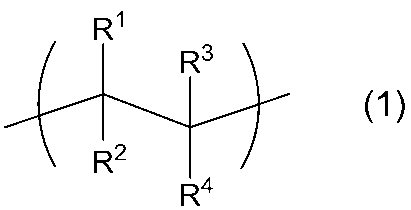
ポリマー鎖(A)に含まれる上記式(1)で表される単位(以下、「式(1)の単位」と称する)は、極性が低い基材への密着性や極性が低い樹脂との親和性を高めるように作用する。式(1)の単位は、極性が低い基材や極性が低い樹脂のポリマー構成単位と同じかもしくは類似しているために、極性が低い基材や極性が低い樹脂との間に分子間力等の相互作用が生じ、密着性や親和性が高まるものと考えられる。
上記式(1)のR1~R4のアルキル基としては、メチル基、エチル基、n-プロピル基、イソプロピル基、n-ブチル基、イソブチル基、t-ブチル基、n-ペンチル基、イソペンチル基、n-ヘキシル基、イソへキシル基、n-ヘプチル基、イソヘプチル基、n-オクチル基、2-エチルヘキシル基等の直鎖状または分岐鎖状のアルキル基や、シクロプロピル基、シクロブチル基、シクロペンチル基、シクロヘキシル基、シクロノニル基、シクロデシル基、ジシクロペンタニル基、アダマンチル基等の環状のアルキル基等が挙げられる。これらの中でも、R1~R4のアルキル基としては、直鎖または分岐鎖状のアルキル基が好ましい。R1~R4のアルキル基の炭素数は、1~12が好ましく、1~8がより好ましく、1~6がさらに好ましい。
式(1)の単位は、オレフィンや共役ジエンを(共)重合することにより形成できる。そのような(共)重合体を形成することが容易な点から、式(1)のR1とR2はそれぞれ独立して、水素原子または炭素数1~6の直鎖または分岐鎖状のアルキル基であることが好ましく、R3とR4は水素原子であることが好ましい。なお、共役ジエンを(共)重合させた際に、二重結合を有する基が主鎖や側鎖に残る場合は、当該二重結合を水素化して式(1)の単位を形成することが好ましい。また、共役ジエン以外のジエン化合物を(共)重合させ、得られた(共)重合体に含まれる二重結合を水素化することにより、式(1)の単位を形成してもよい。
式(1)の単位を形成するオレフィンとしては、例えば、エチレン、プロピレン、1-ブテン、イソブテン、2-メチル-1-ブテン、3-メチル-1-ブテン、1-テトラデセン、1-オクタデセン等が挙げられる。当該オレフィンの炭素数は、2以上が好ましく、3以上がより好ましく、また20以下が好ましく、12以下がより好ましく、6以下がさらに好ましい。共役ジエンとしては、1,3-ブタジエン、2-メチル-1,3-ブタジエン、1,3-ペンタジエン等が挙げられる。当該共役ジエンの炭素数は、4以上が好ましく、5以上がより好ましく、また20以下が好ましく、10以下がより好ましく、8以下がさらに好ましい。
ポリマー鎖(A)は、ポリエチレン、ポリプロピレン、ポリブチレン、ポリイソブチレン、エチレン-プロピレン共重合体、エチレン-1-ブテン共重合体等のオレフィン(共)重合体鎖を主鎖の構造中に部分的または全体として含むことが好ましい。オレフィン(共)重合体としては、ポリエチレン、ポリプロピレン、ポリブチレン、エチレン-1-ブテン共重合体がより好ましい。
ポリマー鎖(A)は、さらに下記式(2-1)で表される単位および/または下記式(2-2)で表される単位を有していてもよい。以下、下記式(2-1)で表される単位と下記式(2-2)で表される単位をまとめて、「式(2)の単位」と称する場合がある。
下記式(2-1)において、R5は、炭素数2~20のアルケニル基を表し、R6~R8はそれぞれ独立して、水素原子、炭素数1~20のアルキル基、または炭素数2~20のアルケニル基を表す。下記式(2-2)において、R9とR10はそれぞれ独立して、水素原子または炭素数1~20のアルキル基を表し、R9とR10は互いにはcis位の関係にあってもよくtrans位の関係にあってもよい。下記式(2-1)で表される単位と下記式(2-2)で表される単位も極性が低い基材や極性が低い樹脂のポリマー構成単位と類似しているため、これらの基材や樹脂との間に相互作用が生じ、密着性や親和性が高まると考えられる。そのため、式(1)の単位と式(2)の単位を含むポリマー鎖(A)を有する共重合体(P)も、各種基材への密着性や各種樹脂との親和性に優れるものとなる。
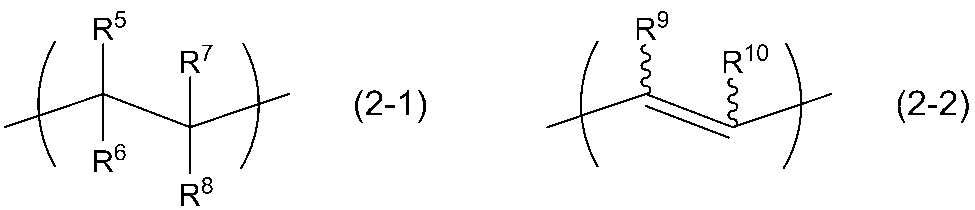
式(2-1)と式(2-2)のR6~R10の炭素数1~20のアルキル基については、上記のR1~R4のアルキル基の説明が参照される。式(2-1)のR5~R8の炭素数2~20のアルケニル基としては、R1~R4のアルキル基に含まれるC-C結合の1つがC=C結合に置き換わった基が挙げられ、直鎖または分岐鎖状のアルケニル基が好ましい。R5~R8のアルケニル基の炭素数は、2~12が好ましく、2~8がより好ましく、2~6がさらに好ましい。R5~R8のアルケニル基としては、ビニル基が特に好ましい。
式(2-1)で表される単位を形成することが容易な点から、式(2-1)のR5は炭素数2~6の直鎖または分岐鎖状のアルケニル基であることが好ましく、R6は水素原子または炭素数1~6の直鎖または分岐鎖状のアルキル基であることが好ましく、R7とR8は水素原子であることが好ましい。また、式(2-2)のR9とR10は水素原子または炭素数1~6の直鎖または分岐鎖状のアルキル基であることが好ましく、水素原子またはメチル基がより好ましく、水素原子がさらに好ましい。このような式(2)の単位は、ジエンをオレフィンと共重合させたり、共役ジエンを単独または共重合させることにより、ポリマー鎖(A)に導入することができる。式(2)の単位を形成するジエンとしては、1,3-ブタジエン(別名:ブタジエン)、2-メチル-1,3-ブタジエン(別名:イソプレン)、1,3-ペンタジエン、1,4-ペンタジエン、1,5-ヘキサジエン、2,5-ジメチル-1,5-ヘキサジエン(別名:ジイソブテン)等のアルカジエンが好ましく、中でも1,3-ブタジエン、2-メチル-1,3-ブタジエン、1,3-ペンタジエン等の共役ジエンがより好ましい。当該ジエンの炭素数は、4以上が好ましく、5以上がより好ましく、また20以下が好ましく、10以下がより好ましく、8以下がさらに好ましい。
式(1)の単位と式(2)の単位を有するポリマー鎖(A)は、例えば、エチレン-イソプレン共重合体、ブテン-ブタジエン共重合体、イソブテン-イソプレン共重合体等のオレフィンとジエンの共重合体鎖を主鎖の構造中に部分的または全体として含むことが好ましい。オレフィンとジエンの共重合体は、ランダム共重合体であることが好ましい。
ポリマー鎖(A)は、さらに他の不飽和単量体由来の単位を有していてもよい。他の不飽和単量体は、重合性二重結合を有する化合物であれば特に限定されず、例えば、酢酸ビニル、プロピオン酸ビニル等のビニルエステル;(メタ)アクリル酸、無水マレイン酸、(メタ)アクリル酸メチル、(メタ)アクリル酸エチル等の不飽和カルボン酸とそのエステル;スチレン、ビニルトルエン、メトキシスチレン、α-メチルスチレン、2-ビニルピリジン等の芳香族ビニル化合物;ビニルトリメトキシシラン、γ-(メタ)アクリロイルオキシプロピルメトキシシラン等のビニルシラン等が挙げられる。ポリマー鎖(A)は、これら他の不飽和単量体とオレフィンとの共重合体、または、これら他の不飽和単量体とオレフィンとジエンとの共重合体であってもよい。
ポリマー鎖(A)は上記式(1)の単位を主成分として含むことが好ましく、ポリマー鎖(A)中、式(1)の単位の含有割合が50質量%以上であることが好ましく、55質量%以上がより好ましく、60質量%以上がさらに好ましい。これにより、共重合体(P)の各種基材への密着性を高めやすく、また各種樹脂との親和性を高めやすくなる。ポリマー鎖(A)中の式(1)の単位の含有割合の上限は特に限定されず、ポリマー鎖(A)は式(1)の単位のみから構成されていてもよく、ポリマー鎖(A)中の式(1)の単位の含有割合が98質量%以下、95質量%以下、または90質量%以下であってもよい。
ポリマー鎖(A)は、式(1)の単位と式(2)の単位の合計含有割合が50質量%以上、55質量%以上、または60質量%以上であってもよい。また、ポリマー鎖(A)が式(1)の単位と式(2)の単位のみから構成されていてもよく、ポリマー鎖(A)中の式(1)の単位と式(2)の単位の合計含有割合が98質量%以下、95質量%以下、または90質量%以下であってもよい。
ポリマー鎖(A)が他の不飽和単量体由来の単位を有する場合、ポリマー鎖(A)は、式(1)の単位(あるいはさらに式(2)の単位)と他の不飽和単量体由来の単位を含むランダム共重合体であってもよく、ブロック共重合体であってもよい。ポリマー鎖(A)がブロック共重合体である場合は、ポリマー鎖(A)は、式(1)の単位を有する重合体ブロック(a1)と他の不飽和単量体由来の単位を有する重合体ブロック(a2)とを有することが好ましい。
ポリマー鎖(A)が重合体ブロック(a1)と重合体ブロック(a2)とを有する場合、重合体ブロック(a1)は、式(1)の単位に加え、式(2)の単位やさらに他の不飽和単量体由来の単位を有していてもよい。この場合の他の不飽和単量体としては、例えば、酢酸ビニル、プロピオン酸ビニル等のビニルエステル;(メタ)アクリル酸、無水マレイン酸、(メタ)アクリル酸メチル、(メタ)アクリル酸エチル等の不飽和カルボン酸とそのエステル;スチレン、ビニルトルエン、メトキシスチレン、α-メチルスチレン、2-ビニルピリジン等の芳香族ビニル化合物;ビニルトリメトキシシラン、γ-(メタ)アクリロイルオキシプロピルメトキシシラン等のビニルシラン等が挙げられる。なお、重合体ブロック(a1)は式(1)の単位をより多く含むことが好ましく、重合体ブロック(a1)中、式(1)の単位の含有割合が70質量%以上であることが好ましく、80質量%以上がより好ましく、90質量%以上がさらに好ましい。重合体ブロック(a1)は、実質的に式(1)の単位のみから構成されていてもよく、例えば式(1)の単位が99質量%以上であってもよい。あるいは、重合体ブロック(a1)中、式(1)の単位と式(2)の単位の合計含有割合が70質量%以上であることが好ましく、80質量%以上がより好ましく、90質量%以上がさらに好ましい。重合体ブロック(a1)は、実質的に式(1)の単位と式(2)の単位のみから構成されていてもよく、例えば式(1)の単位と式(2)の単位が99質量%以上であってもよい。
ポリマー鎖(A)が他の不飽和単量体由来の単位を有する重合体ブロック(a2)を有するものである場合、重合体ブロック(a2)は芳香族ビニル単量体由来の単位から構成されることが好ましい。この場合、重合体ブロック(a1)をソフト成分として機能させ、重合体ブロック(a2)をハード成分として機能させることができ、共重合体(P)および共重合体(P)を含む樹脂組成物(Q)に弾力性を付与することができる。芳香族ビニル単量体は、芳香環にビニル基が結合した化合物であれば特に限定されず、例えば、スチレン、ビニルトルエン、メトキシスチレン、α-メチルスチレン、α-ヒドロキシメチルスチレン、α-ヒドロキシエチルスチレン等のスチレン系単量体;2-ビニルナフタレン等の多環芳香族炭化水素環ビニル単量体;N-ビニルカルバゾール、2-ビニルピリジン、ビニルイミダゾール、ビニルチオフェン等の芳香族複素環ビニル単量体等が挙げられる。これらの中でも、スチレン系単量体が好ましい。スチレン系単量体には、スチレンのみならず、スチレンのビニル基やベンゼン環に任意の置換基が結合したスチレン誘導体も含まれ、当該置換基としては、アルキル基、アルコキシ基、ヒドロキシル基、ハロゲン基、アミノ基、ニトロ基、スルホ基等が挙げられる。スチレンに結合したアルキル基とアルコキシ基は、炭素数1~4が好ましく、炭素数1~2がより好ましく、スチレンに結合したアルキル基とアルコキシ基は、水素原子の少なくとも一部がヒドロキシル基またはハロゲン基で置換されていてもよい。なお、スチレン系単量体は、スチレンのビニル基とベンゼン環に置換基が結合していない無置換のスチレンであることが好ましい。
重合体ブロック(a2)は、芳香族ビニル単量体由来の単位に加え、さらに他の不飽和単量体由来の単位を有していてもよい。この場合の他の不飽和単量体としては、例えば、酢酸ビニル、プロピオン酸ビニル等のビニルエステル;(メタ)アクリル酸、無水マレイン酸、(メタ)アクリル酸メチル、(メタ)アクリル酸エチル等の不飽和カルボン酸とそのエステル;ビニルトリメトキシシラン、γ-(メタ)アクリロイルオキシプロピルメトキシシラン等のビニルシラン等が挙げられる。なお、重合体ブロック(a2)は芳香族ビニル単量体由来の単位をより多く含むことが好ましく、重合体ブロック(a2)中、芳香族ビニル単量体由来の単位の含有割合が70質量%以上であることが好ましく、80質量%以上がより好ましく、90質量%以上がさらに好ましい。重合体ブロック(a2)は、実質的に芳香族ビニル単量体由来の単位のみから構成されていてもよく、例えば芳香族ビニル単量体由来の単位が99質量%以上であってもよい。
式(1)の単位を有する重合体ブロック(a1)と、芳香族ビニル単量体由来の単位を有する重合体ブロック(a2)とを有するポリマー鎖(A)、あるいは式(1)の単位と式(2)の単位を有する重合体ブロック(a1)と、芳香族ビニル単量体由来の単位を有する重合体ブロック(a2)とを有するポリマー鎖(A)としては、例えば、スチレン-ブタジエン-スチレンブロック共重合体の水添物(例えば、スチレン-エチレン/ブチレン-スチレンブロック共重合体)、スチレン-イソプレン-スチレンブロック共重合体の水添物(例えば、スチレン-エチレン/プロピレン-スチレンブロック共重合体)、スチレン-イソプレンブロック共重合体の水添物等が挙げられる。これらの水添物はブタジエンやイソプレンといったジエン由来の単位の一部または全部が水素化されており、全部水素化されたものは、重合体ブロック(a1)は式(1)の単位を有するものとなり、一部水素化されたものは、重合体ブロック(a1)は式(1)の単位と式(2)の単位を有するものとなる。なお、前記表記において、各ブロックは「-」で区分され、各ブロック中の「/」の表記は、当該ブロック中を構成する単量体単位を表す。
ブロック共重合体からなるポリマー鎖(A)としては、重合体ブロック(a1)の両側に重合体ブロック(a2)が結合したものであることが好ましく、トリブロック共重合体であることがより好ましい。このようなトリブロック共重合体としては、スチレン-ブタジエン-スチレンブロック共重合体の水添物、スチレン-イソプレン-スチレンブロック共重合体の水添物等が挙げられる。共重合体(P)がこのようなポリマー鎖(A)を有していれば、例えば共重合体(P)を含む樹脂塗膜を形成した場合に、塗膜の柔軟性を高めて塗膜の硬脆さを低減することができる。
ポリマー鎖(A)が重合体ブロック(a1)と重合体ブロック(a2)を有する場合、ポリマー鎖(A)中の重合体ブロック(a1)の含有割合は50質量%以上であることが好ましく、55質量%以上がより好ましく、60質量%以上がさらに好ましく、また95質量%以下が好ましく、93質量%以下がより好ましく、91質量%以下がさらに好ましい。
なお、ポリマー鎖(A)は、重合体ブロック(a1)を有し、重合体ブロック(a2)を有しないことが好ましい。またポリマー鎖(A)は、式(1)の単位から構成されるか、式(1)の単位と式(2)の単位から構成されることが好ましく、式(1)の単位のみから構成されることがより好ましい。
ポリマー鎖(A)の重量平均分子量は、0.5万以上が好ましく、1万以上がより好ましく、2万以上がさらに好ましく、3万以上がさらにより好ましく、また30万以下が好ましく、25万以下がより好ましく、20万以下がさらに好ましく、15万以下がさらにより好ましい。ポリマー鎖(A)の重量平均分子量をこのような範囲とすることで、共重合体(P)の取り扱い性を高めやすくなる。
共重合体(P)に含まれるポリマー鎖(B)について説明する。ポリマー鎖(B)は、オキサゾリン基含有単量体由来の単位を有するものである。オキサゾリン基含有単量体由来の単位は、共重合体(P)と極性が高い基材や極性が高い樹脂との密着性や親和性を高めるように作用する。オキサゾリン基含有単量体としては、オキサゾリン基と重合性二重結合を有する化合物であれば特に限定されず、2-ビニル-2-オキサゾリン、5-メチル-2-ビニル-2-オキサゾリン、4,4-ジメチル-2-ビニル-2-オキサゾリン、2-イソプロペニル-2-オキサゾリン、4,4-ジメチル-2-イソプロペニル-2-オキサゾリン等のビニルオキサゾリンが好ましく挙げられる。これらの中でも、2-イソプロペニル-2-オキサゾリンが、入手容易性と反応性の点から好ましく用いられる。
ポリマー鎖(B)は、さらに他の不飽和単量体由来の単位を有していてもよい。他の不飽和単量体は、重合性二重結合を有する化合物であれば特に限定されず、例えば、酢酸ビニル、プロピオン酸ビニル等のビニルエステル;アクリロニトリル等のシアン化ビニル化合物;(メタ)アクリル酸、無水マレイン酸、(メタ)アクリル酸メチル、(メタ)アクリル酸エチル等の不飽和カルボン酸とそのエステル;スチレン、ビニルトルエン、メトキシスチレン、α-メチルスチレン、2-ビニルピリジン等の芳香族ビニル化合物;ビニルトリメトキシシラン、γ-(メタ)アクリロイルオキシプロピルメトキシシラン等のビニルシラン等が挙げられる。これらの中でも、ポリマー鎖(B)は、シアン化ビニル単量体由来の単位、芳香族ビニル単量体由来の単位および/または不飽和カルボン酸エステル由来の単位を有することが好ましく、芳香族ビニル単量体由来の単位および/または不飽和カルボン酸エステル由来の単位を有することがより好ましく、芳香族ビニル単量体由来の単位を有することがさらに好ましい。前記芳香族ビニル単量体由来の単位としてはスチレン系単量体由来の単位が好ましく、前記不飽和カルボン酸エステル由来の単位としては(メタ)アクリル酸エステル由来の単位好ましい。芳香族ビニル単量体およびスチレン系単量体の説明は、上記の重合体ブロック(a2)の芳香族ビニル単量体およびスチレン系単量体に関する説明が参照される。ポリマー鎖(B)が芳香族ビニル単量体由来の単位を有していれば、共重合体(P)の耐熱性を向上させることができ、またポリマー鎖(B)を重合形成する際にオキサゾリン基含有単量体の反応を促進することができる。また、製造コストの面からも有利になる。
前記不飽和カルボン酸エステル(好ましくは、(メタ)アクリル酸エステル)としては、具体的には、(メタ)アクリル酸のエステル結合の酸素原子に、直鎖状、分岐鎖状または環状の脂肪族炭化水素基や芳香族炭化水素基が結合した(メタ)アクリル酸エステルが挙げられる。
直鎖状または分岐鎖状の脂肪族炭化水素基を有する(メタ)アクリル酸エステルとしては、(メタ)アクリル酸メチル、(メタ)アクリル酸エチル、(メタ)アクリル酸n-プロピル、(メタ)アクリル酸イソプロピル、(メタ)アクリル酸n-ブチル、(メタ)アクリル酸イソブチル、(メタ)アクリル酸sec-ブチル、(メタ)アクリル酸tert-ブチル、(メタ)アクリル酸ペンチル、(メタ)アクリル酸n-ヘキシル、(メタ)アクリル酸2-エチルヘキシル等の(メタ)アクリル酸アルキルが挙げられる。(メタ)アクリル酸アルキルのアルキル基の炭素数は、1以上が好ましく、また18以下が好ましく、12以下がより好ましく、6以下がさらに好ましい。
環状の脂肪族炭化水素基を有する(メタ)アクリル酸エステルとしては、(メタ)アクリル酸シクロプロピル、(メタ)アクリル酸シクロブチル、(メタ)アクリル酸シクロペンチル、(メタ)アクリル酸シクロヘキシル等の(メタ)アクリル酸シクロアルキル;(メタ)アクリル酸イソボルニル等の架橋環式(メタ)アクリレート等が挙げられる。(メタ)アクリル酸シクロアルキルのシクロアルキル基の炭素数は、3以上が好ましく、4以上がより好ましく、5以上がさらに好ましく、また20以下が好ましく、12以下がより好ましく、10以下がさらに好ましい。
芳香族炭化水素基を有する(メタ)アクリル酸エステルとしては、(メタ)アクリル酸フェニル、(メタ)アクリル酸トリル、(メタ)アクリル酸キシリル、(メタ)アクリル酸ナフチル、(メタ)アクリル酸ビナフチル、(メタ)アクリル酸アントリル等の(メタ)アクリル酸アリール;(メタ)アクリル酸ベンジル等の(メタ)アクリル酸アラルキル;(メタ)アクリル酸フェノキシエチル等の(メタ)アクリル酸アリールオキシアルキル等が挙げられる。(メタ)アクリル酸アリールのアリール基の炭素数は、6以上が好ましく、また20以下が好ましく、14以下がより好ましい。(メタ)アクリル酸アラルキルのアラルキル基の炭素数は、7以上が好ましく、また14以下が好ましく、12以下がより好ましい。(メタ)アクリル酸アリールオキシアルキルのアリールオキシアルキル基の炭素数は、7以上が好ましく、また14以下が好ましく、12以下がより好ましい。
ポリマー鎖(B)が不飽和カルボン酸エステル由来の単位を有していれば、共重合体(P)の各種樹脂(特に、極性が高い樹脂)との親和性をさらに向上させることができる。
ポリマー鎖(B)が他の不飽和単量体由来の単位を有する場合、ポリマー鎖(B)は、オキサゾリン基含有単量体と他の不飽和単量体とのランダム共重合体であってもよく、ブロック共重合体であってもよいが、ポリマー鎖(B)の製造容易性の点から、ランダム共重合体であることが好ましい。
ポリマー鎖(B)中のオキサゾリン基含有単量体由来の単位の含有割合は1質量%以上であることが好ましく、2質量%以上がより好ましく、また50質量%以下が好ましく、40質量%以下がより好ましい。これにより、共重合体(P)の密着性向上効果や親和性向上効果を高めやすくなるとともに、ポリマー鎖(B)の形成が容易になる。
ポリマー鎖(B)は、他の不飽和単量体由来の単位として芳香族ビニル単量体由来の単位を有する場合には、オキサゾリン基含有単量体由来の単位と芳香族ビニル単量体由来の単位の合計含有割合が70質量%以上であることが好ましく、80質量%以上であることがより好ましく、90質量%以上がさらに好ましく、95質量%以上がさらにより好ましく、98質量%以上が特に好ましい。
ポリマー鎖(B)はポリマー鎖(A)にグラフトしていることが好ましい。従って、共重合体(P)はポリマー鎖(B)をグラフト鎖として有するグラフト共重合体であることが好ましい。なお、国際純正応用化学連合(IUPAC)高分子命名法委員会による高分子科学の基本的術語の用語集によると、グラフト高分子とは、「ある高分子中に側鎖として主鎖に結合した1種または数種のブロックがあり、しかもこれらの側鎖が主鎖とは異なる構成(化学構造)上または配置上の特徴をもつ場合、この高分子をグラフト高分子という。」と説明されている。グラフト共重合体は、連鎖移動反応法、高分子開始剤法、カップリング法、マクロモノマー法、表面グラフト法等の公知の製造方法により得ることができ、これらの方法から1つのみを採用してもよく、複数を組み合わせて用いてもよい。これらの方法の詳細は、日本化学会編、化学便覧(応用化学編)第6版を参考にできる。
共重合体(P)は、ポリマー鎖(A)に、ポリマー鎖(B)を形成する単量体成分を付加重合することにより製造することが簡便である。従って、共重合体(P)は、式(1)の単位を有する重合体(以下、「原料重合体(P1)」と称する)の存在下で、オキサゾリン基含有単量体を含む単量体成分を重合することによって得られるものが好ましい。原料重合体(P1)の詳細は上記のポリマー鎖(A)の説明が参照され、原料重合体(P1)は、さらに式(2)の単位を有していたり、式(1)の単位を有する重合体ブロック(a1)と他の不飽和単量体由来の単位を有する重合体ブロック(a2)を有するものであってもよい。
ポリマー鎖(B)は、例えば、ポリマー鎖(A)の式(1)の単位にグラフトしていることが好ましい。ポリマー鎖(A)が式(2)の単位を有する場合は、ポリマー鎖(B)は式(2)の単位にグラフトしていてもよい。ポリマー鎖(B)は式(1)の単位または式(2)の単位の主鎖の炭素原子に結合していてもよく、当該主鎖に置換基(側鎖)として結合した炭化水素基の炭素原子に結合していてもよい。また、任意の連結基(例えば、エステル結合、アミド結合、ウレタン結合等)を介して、ポリマー鎖(B)がポリマー鎖(A)に結合していてもよい。
共重合体(P)の重量平均分子量は、1万以上が好ましく、2万以上がより好ましく、3万以上がさらに好ましく、5万以上がさらにより好ましく、7万以上が特に好ましく、また70万以下が好ましく、50万以下がより好ましく、30万以下がさらに好ましく、20万以下がさらにより好ましい。共重合体(P)の重量平均分子量をこのような範囲とすることで、共重合体(P)の取り扱い性を高めやすくなる。
共重合体(P)の重量平均分子量は、ポリマー鎖(A)の重量平均分子量の1.1倍以上が好ましく、1.2倍以上がより好ましく、1.3倍以上がさらに好ましく、また20倍以下が好ましく、12倍以下がより好ましく、10倍以下がさらに好ましく、7倍以下がさらにより好ましく、5倍以下が特に好ましい。これにより、共重合体(P)の密着性や親和性を高めやすくなる。
共重合体(P)は、原料重合体(P1)の存在下で、オキサゾリン基含有単量体を含む単量体成分を重合する工程(重合工程)を含む製造方法により得ることができる。重合工程でオキサゾリン基含有単量体を含む単量体成分が重合することによりポリマー鎖(B)が形成され、原料重合体(P1)がポリマー鎖(A)を与え、これにより、ポリマー鎖(B)がポリマー鎖(A)に結合した共重合体(P)が得られる。
重合工程においてポリマー鎖(B)が原料重合体(P1)の式(1)の単位(式(2)の単位も存在する場合は式(1)の単位または式(2)の単位)に結合するようにする点から、重合工程では、当該単位の炭化水素基から水素が引き抜かれるようにすることが好ましい。これにより当該箇所でラジカルが生成し、ポリマー鎖(B)を形成する単量体成分を付加重合させることができる。
重合工程において、原料重合体(P1)は、1種のみを用いてもよく、2種以上を併用してもよい。後者の場合、共重合体(P)の重量平均分子量や物性を調整することが容易となる。
ポリマー鎖(B)の形成に用いられる単量体成分としては、オキサゾリン基含有単量体に加え、他の不飽和単量体を用いることもできる。他の不飽和単量体としては、シアン化ビニル単量体、芳香族ビニル単量体および/または不飽和カルボン酸エステルを用いることが好ましい。これらの単量体成分の詳細は、上記のポリマー鎖(B)を形成するオキサゾリン基含有単量体、ポリマー鎖(B)を形成する他の不飽和単量体の説明が参照される。
単量体成分の重合は、塊状重合法、溶液重合法、乳化重合法、懸濁重合法等の公知の重合法を用いて行うことができるが、溶液重合法を用いることが好ましい。重合形式としては、例えば、バッチ重合法、連続重合法のいずれも用いることができる。
重合の際の原料重合体(P1)の使用量は、原料重合体(P1)と単量体成分の合計100質量部に対して、5質量部以上が好ましく、10質量部以上がより好ましく、15質量部以上がさらに好ましく、また80質量部以下が好ましく、70質量部以下がより好ましく、60質量部以下がさらに好ましく、50質量部以下がさらにより好ましい。単量体成分の使用量は、原料重合体(P1)と単量体成分の合計100質量部に対して、20質量部以上が好ましく、30質量部以上がより好ましく、40質量部以上がさらに好ましく、50質量部以上がさらにより好ましく、また95質量部以下が好ましく、90質量部以下がより好ましく、85質量部以下がさらに好ましい。
重合の際に用いる溶媒は、単量体成分の組成に応じて適宜選択でき、通常のラジカル重合反応で使用される有機溶媒を用いることができる。具体的には、トルエン、キシレン、エチルベンゼン等の芳香族炭化水素類;ヘキサン、シクロヘキサン等の脂肪族炭化水素類;アセトン、メチルエチルケトン、メチルイソブチルケトン、シクロヘキサノン等のケトン類;テトラヒドロフラン、ジオキサン、エチレングリコールジメチルエーテル、ジエチレングリコールジメチルエーテル、アニソール等のエーテル類;酢酸エチル、酢酸ブチル、プロピレングリコールモノメチルエーテルアセテート、3-メトキシブチルアセテート等のエステル類;メチルセロソルブ、エチルセロソルブ、ブチルセロソルブ等のセロソルブ類;メタノール、エタノール、イソプロパノール、n-ブタノール等のアルコール類;アセトニトリル、プロピオニトリル、ブチロニトリル、ベンゾニトリル等のニトリル類;クロロホルム;ジメチルスルホキシド等が挙げられる。これらの溶媒は、1種のみを用いてもよく、2種以上を併用してもよい。
原料重合体(P1)と単量体成分との重合反応は、重合開始剤の存在下で行うことが好ましい。重合開始剤としては、例えば、2,2’-アゾビスイソブチロニトリル、2,2’-アゾビス(2-アミジノプロパン)・二塩酸塩、ジメチル-2,2’-アゾビス(2-メチルプロピオネート)、4,4’-アゾビス(4-シアノペンタン酸)等のアゾ化合物;過硫酸カリウム等の過硫酸塩類;クメンハイドロパーオキサイド、ジイソプロピルベンゼンハイドロパーオキサイド、ジ-t-ブチルパーオキサイド、ラウロイルパーオキサイド、ベンゾイルパーオキサイド、t-ブチルパーオキシイソプロピルカーボネート、t-アミルパーオキシ-2-エチルヘキサノエート、t-アミルパーオキシオクトエート、t-アミルパーオキシイソノナノエート、t-アミルパーオキシイソプロピルカーボネート、t-アミルパーオキシ2-エチルヘキシルカーボネート等の有機過酸化物等を用いることができる。これらは1種のみを用いてもよく、2種以上を併用してもよい。これらの中でも、水素引き抜き力が強い有機過酸化物を用いることが好ましく、特にパーオキシカーボネート系の過酸化物を用いることが好ましい。重合開始剤の使用量は、例えば、単量体成分100質量部に対して0.05~3質量部とすることが好ましい。
反応液中の原料重合体(P1)と単量体成分の合計濃度は、3質量%以上が好ましく、5質量%以上がより好ましく、10質量%以上がさらに好ましく、また80質量%以下が好ましく、70質量%以下がより好ましい。重合反応中に、原料重合体(P1)、単量体成分、重合触媒、溶媒等を適宜追加することも可能である。
重合反応は、窒素ガス等の不活性ガスの雰囲気または気流下で行うのが好ましい。反応温度は、50℃~200℃が好ましい。反応時間は、共重合反応の進行度合を見ながら適宜調整すればよく、例えば1時間~20時間行うことが好ましい。
重合の際、単量体成分は一括で仕込んでもよく、分割添加してもよい。なお、ポリマー鎖(A)にオキサゾリン基含有単量体をグラフト重合させてポリマー鎖(B)を形成することが容易な点から、単量体成分は一括で仕込むことが好ましい。
本発明は、上記に説明したポリマー鎖(A)とポリマー鎖(B)とを有する共重合体(P)を含有する樹脂組成物(Q)も提供する。本発明の樹脂組成物(Q)は、各種基材への密着性や各種樹脂との親和性に優れるものとなる。
樹脂組成物(Q)は、共重合体(P)を樹脂成分として含んでいてもよく、他の重合体を樹脂成分として含むものでもよい。樹脂組成物(Q)が他の重合体を含む場合、他の重合体としてはオキサゾリン基含有重合体、および/または式(1)の単位を有する重合体が好ましく、オキサゾリン基含有重合体がより好ましく用いられ、これら他の重合体を含むことにより樹脂組成物(Q)の均質性が高まる。
樹脂組成物(Q)に他の重合体として含むオキサゾリン基含有重合体は、上記のポリマー鎖(B)で説明したオキサゾリン基含有単量体由来の単位を有するものであればよく、上記のポリマー鎖(B)で説明した他の不飽和単量体由来の単位を有していてもよい。オキサゾリン基含有重合体は、共重合体(P)との相溶性を高める観点から、ポリマー鎖(B)が有する単量体由来の単位と同じ単量体由来の単位を有することがより好ましい。
樹脂組成物(Q)に他の重合体として含む式(1)の単位を有する重合体は、上記ポリマー鎖(A)で説明した式(1)の単位を有するものであればよく、上記のポリマー鎖(A)で説明した式(2)の単位を有する重合体や他の不飽和単量体由来の単位を有していてもよい。式(1)の単位を有する重合体は、共重合体(P)との相溶性を高める観点から、ポリマー鎖(A)が有する単量体由来の単位と同じ単量体由来の単位を有することがより好ましい。
樹脂組成物(Q)は、共重合体(P)とオキサゾリン基含有重合体と式(1)の単位を有する重合体の合計100質量部に対して、共重合体(P)の含有割合が10質量部以上が好ましく、12質量部以上がより好ましく、15質量部以上がさらに好ましい。樹脂組成物(Q)中の共重合体(P)の含有割合の上限は特に限定されず、樹脂組成物(Q)は共重合体(P)のみから構成されていてもよく、共重合体(P)とオキサゾリン基含有重合体と式(1)の単位を有する重合体の合計100質量部に対して、共重合体(P)の含有割合が90質量部以下であってもよく、80質量部以下、70質量部以下、または60質量部以下であってもよい。
樹脂組成物(Q)は、共重合体(P)とオキサゾリン基含有重合体と式(1)の単位を有する重合体の合計100質量部に対して、ポリマー鎖(A)の含有割合が5質量部以上であることが好ましく、8質量部以上がより好ましく、12質量部以上がさらに好ましく、また80質量部以下が好ましく、70質量部以下がより好ましく、60質量部以下がさらに好ましく、50質量部以下がさらにより好ましい。これにより、樹脂組成物(Q)の各種基材への密着性を高めやすくなる。なお、樹脂組成物(Q)中のポリマー鎖(A)の含有割合は、共重合体(P)に含まれるポリマー鎖(A)と式(1)の単位を有する重合体に含まれるポリマー鎖(A)の合計の含有割合を意味する。
樹脂組成物(Q)は、共重合体(P)とオキサゾリン基含有重合体と式(1)の単位を有する重合体の合計100質量部に対して、式(1)の単位の含有割合が3質量部以上であることが好ましく、5質量部以上がより好ましく、10質量部以上がさらに好ましく、また80質量部以下が好ましく、70質量部以下がより好ましく、60質量部以下がさらに好ましく、50質量部以下がさらにより好ましい。これにより、樹脂組成物(Q)の各種基材への密着性を高めやすくなる。あるいは、樹脂組成物(Q)は、共重合体(P)とオキサゾリン基含有重合体と式(1)の単位を有する重合体の合計100質量部に対して、式(1)の単位と式(2)の単位の合計含有割合が3質量部以上、5質量部以上、または10質量部以上であってもよく、また80質量部以下、70質量部以下、60質量部以下、または50質量部以下であってもよい。なお、樹脂組成物(Q)中の式(1)の単位の含有割合は、共重合体(P)に含まれる式(1)の単位と式(1)の単位を有する重合体に含まれる式(1)の単位の合計の含有割合を意味し、樹脂組成物(Q)中の式(2)の単位の含有割合は、共重合体(P)に含まれる式(2)の単位と式(1)の単位を有する重合体に含まれる式(2)の単位の合計の含有割合を意味する。また、式(2)の単位の含有割合は、式(2-1)で表される単位と式(2-2)で表される単位の合計含有割合を意味する。
樹脂組成物(Q)は、共重合体(P)とオキサゾリン基含有重合体と式(1)の単位を有する重合体の合計100質量部に対して、オキサゾリン基含有単量体由来の単位の含有割合が0.5質量部以上であることが好ましく、1.0質量部以上がより好ましく、1.5質量部以上がさらに好ましく、また49質量部以下が好ましく、40質量部以下がより好ましく、30質量部以下がさらに好ましい。これにより、樹脂組成物(Q)の各種基材への密着性を高めやすくなる。なお、樹脂組成物(Q)中のオキサゾリン基含有単量体由来の単位の含有割合は、共重合体(P)に含まれるオキサゾリン基含有単量体由来の単位とオキサゾリン基含有重合体に含まれるオキサゾリン基含有単量体由来の単位の合計の含有割合を意味する。
樹脂組成物(Q)は、共重合体(P)とオキサゾリン基含有重合体と式(1)の単位を有する重合体の合計100質量部に対して、式(1)の単位とオキサゾリン基含有単量体由来の単位の合計含有割合が5質量部以上であることが好ましく、10質量部以上がより好ましく、15質量部以上がさらに好ましく、20質量部以上がさらにより好ましい。これにより、樹脂組成物(Q)の各種基材への密着性を高めやすくなる。樹脂組成物(Q)中の式(1)の単位とオキサゾリン基含有単量体由来の単位の含有割合の上限は特に限定されず、樹脂組成物(Q)は実質的に式(1)の単位とオキサゾリン基含有単量体由来の単位のみから構成されていてもよく、共重合体(P)とオキサゾリン基含有重合体と式(1)の単位を有する重合体の合計100質量部に対して、式(1)の単位とオキサゾリン基含有単量体由来の単位の合計含有割合が90質量部以下、80質量部以下、70質量部以下、60質量部以下、または50質量部以下であってもよい。あるいは、樹脂組成物(Q)は、共重合体(P)とオキサゾリン基含有重合体と式(1)の単位を有する重合体の合計100質量部に対して、式(1)の単位と式(2)の単位とオキサゾリン基含有単量体由来の単位の合計含有割合が5質量部以上、10質量部以上、15質量部以上、20質量部以上、または22質量部以上であってもよく、また90質量部以下、80質量部以下、70質量部以下、60質量部以下、または50質量部以下であってもよい。
樹脂組成物(Q)は、共重合体(P)とオキサゾリン基含有重合体と式(1)の単位を有する重合体の合計100質量部に対して、式(1)の単位の含有割合が10質量部以上であり、かつ式(1)の単位とオキサゾリン基含有単量体由来の単位の合計含有割合が20質量部以上であることが特に好ましい。あるいは、樹脂組成物(Q)は、共重合体(P)とオキサゾリン基含有重合体と式(1)の単位を有する重合体の合計100質量部に対して、式(1)の単位と式(2)の単位の合計含有割合が10質量部以上であり、かつ式(1)の単位と式(2)の単位とオキサゾリン基含有単量体由来の単位の合計含有割合が20質量部以上であることが特に好ましい。
樹脂組成物(Q)は、式(1)の単位とオキサゾリン基含有単量体由来の単位の合計100質量部に対して、式(1)の単位の含有割合が10質量部以上であることが好ましく、20質量部以上がより好ましく、30質量部以上がさらに好ましく、また98質量部以下が好ましく、95質量部以下がより好ましく、93質量部以下がさらに好ましい。これにより、樹脂組成物(Q)の各種基材への密着性を高めやすくなる。あるいは、樹脂組成物(Q)は、式(1)の単位と式(2)の単位とオキサゾリン基含有単量体由来の単位の合計100質量部に対して、式(1)の単位と式(2)の単位の合計含有割合が10質量部以上、20質量部以上、または30質量部以上であってもよく、また98質量部以下、95質量部以下、または93質量部以下であってもよい。
樹脂組成物(Q)中の式(1)の単位の含有割合や式(2)の単位の含有割合やオキサゾリン基含有単量体由来の単位の含有割合は、共重合体(P)やオキサゾリン基含有重合体を重合形成する際の各単量体の使用量および単量体残存率(反応せず残存している単量体が、得られた反応液中に含有している割合)から、共重合体(P)やオキサゾリン基含有重合体に取り込まれた各単位の量を算出することにより求めることができる。後述するように、原料重合体(P1)の存在下でオキサゾリン基含有単量体を含む単量体成分を重合することにより樹脂組成物(Q)を得る場合は、原料重合体(P1)に含まれる式(1)の単位や式(2)の単位の量も考慮して、樹脂組成物(Q)中の式(1)の単位の含有割合や式(2)の単位の含有割合やオキサゾリン基含有単量体由来の単位の含有割合を算出する。この際、原料重合体(P1)は全て単量体成分と反応し、その残存率は0%であるとみなす。なお、含有割合の算出にあたり原料重合体(P1)の残存率を0%とみなすのみであり、樹脂組成物(Q)中には原料重合体(P1)を含有していてもよい。
樹脂組成物(Q)の固形分100質量部中、共重合体(P)とオキサゾリン基含有重合体の合計含有割合は、50質量部以上が好ましく、70質量部以上がより好ましく、80質量部以上がさらに好ましく、90質量部以上がさらにより好ましい。樹脂組成物(Q)中の共重合体(P)とオキサゾリン基含有重合体の含有割合の上限は特に限定されず、樹脂組成物(Q)は実質的に共重合体(P)とオキサゾリン基含有重合体のみから構成されていてもよく、例えば樹脂組成物(Q)の固形分100質量部中、共重合体(P)とオキサゾリン基含有重合体の合計含有割合が99質量部以上であってもよい。樹脂組成物(Q)の固形分とは、樹脂組成物(Q)が溶媒を含む場合は、溶媒を除く樹脂組成物(Q)の量を意味する。
樹脂組成物(Q)は、オキサゾリン基含有重合体および式(1)の単位を有する重合体以外の重合体を含有していてもよく、そのような重合体としては、例えば、塩化ビニル、塩素化ビニル樹脂等の含ハロゲン系重合体;ポリメタクリル酸メチル等のアクリル系重合体;ポリスチレン、スチレン-メタクリル酸メチル共重合体、スチレン-アクリロニトリル共重合体、アクリロニトリル-ブタジエン-スチレン共重合体等のスチレン系重合体;ポリエチレンテレフタレート、ポリブチレンテレフタレート、ポリエチレンナフタレート等のポリエステル;ナイロン6、ナイロン66、ナイロン610等のポリアミド;ポリアセタール;ポリカーボネート;ポリフェニレンオキシド;ポリフェニレンスルフィド;ポリエーテルエーテルケトン;ポリサルホン;ポリエーテルサルホン;ポリオキシペンジレン;ポリアミドイミド;ポリブタジエン系ゴム、(メタ)アクリル系ゴムを配合したABS樹脂やASA樹脂等のゴム質重合体が挙げられる。
樹脂組成物(Q)は溶媒を含有していてもよい。溶媒としては、トルエン、キシレン、エチルベンゼン等の芳香族炭化水素類;ヘキサン、シクロヘキサン等の脂肪族炭化水素類;アセトン、メチルエチルケトン、メチルイソブチルケトン、シクロヘキサノン等のケトン類;テトラヒドロフラン、ジオキサン、エチレングリコールジメチルエーテル、ジエチレングリコールジメチルエーテル、アニソール等のエーテル類;酢酸エチル、酢酸ブチル、プロピレングリコールモノメチルエーテルアセテート、3-メトキシブチルアセテート等のエステル類;メチルセロソルブ、エチルセロソルブ、ブチルセロソルブ等のセロソルブ類;メタノール、エタノール、イソプロパノール、n-ブタノール等のアルコール類;アセトニトリル、プロピオニトリル、ブチロニトリル、ベンゾニトリル等のニトリル類;クロロホルム;ジメチルスルホキシド等が挙げられる。これらの溶媒は、1種のみが含まれていてもよく、2種以上が含まれていてもよい。
樹脂組成物(Q)は、種々の添加剤を含んでいてもよい。添加剤としては、例えば、ヒンダードフェノール系、リン系、イオウ系等の酸化防止剤;耐光安定剤、耐候安定剤、熱安定剤等の安定剤;ガラス繊維、炭素繊維等の補強材;紫外線吸収剤;近赤外線吸収剤;トリス(ジブロモプロピル)ホスフェート、トリアリルホスフェート、酸化アンチモン等の難燃剤;アニオン系、カチオン系、ノニオン系の界面活性剤を含む帯電防止剤;無機顔料、有機顔料、染料等の着色剤;有機フィラーや無機フィラー;樹脂改質剤;有機充填剤や無機充填剤;等が挙げられる。樹脂組成物(Q)における各添加剤の含有割合は、樹脂組成物(Q)の固形分100質量部中、好ましくは0~5質量部、より好ましくは0~2質量部の範囲内である。
樹脂組成物(Q)の重量平均分子量は、1万以上が好ましく、2万以上がより好ましく、3万以上がさらに好ましく、5万以上がさらにより好ましく、7万以上が特に好ましく、また70万以下が好ましく、50万以下がより好ましく、30万以下がさらに好ましく、20万以下がさらにより好ましい。樹脂組成物(Q)の重量平均分子量は、樹脂組成物(Q)をゲルパーミエーションクロマトグラフィーにより測定したポリスチレン換算の値を意味し、樹脂組成物(Q)が共重合体(P)とオキサゾリン基含有重合体と式(1)の単位を有する重合体を含有する場合は、樹脂組成物(Q)の重量平均分子量は、これら複数種類の重合体の全体の重量平均分子量となる。
樹脂組成物(Q)の重量平均分子量は、共重合体(P)のポリマー鎖(A)の重量平均分子量の1.1倍以上が好ましく、1.2倍以上がより好ましく、1.3倍以上がさらに好ましく、また20倍以下が好ましく、12倍以下がより好ましく、10倍以下がさらに好ましく、7倍以下がさらにより好ましく、5倍以下が特に好ましい。これにより、樹脂組成物(Q)の各種基材への密着性を高めやすくなる。
樹脂組成物(Q)の製造方法は特に限定されないが、前記原料重合体(P1)とオキサゾリン基含有単量体を含む単量体成分を重合することにより、共重合体(P)を重合生成する際に、オキサゾリン基含有重合体も一緒に重合生成することが簡便である。上記に説明した共重合体(P)の製造方法では、共重合体(P)とともに、共重合体(P)のポリマー鎖(B)に対応したオキサゾリン基含有重合体も同時に生成するが、この際、共重合体(P)とオキサゾリン基含有重合体と未反応の原料重合体(P1)として存在する式(1)の単位を有する重合体とを分離しないことにより、共重合体(P)とオキサゾリン基含有重合体と式(1)の単位を有する重合体を含む樹脂組成物(Q)を得ることができる。この場合の樹脂組成物(Q)の製造方法は、共重合体(P)の製造方法で説明した重合工程により、共重合体(P)とオキサゾリン基含有重合体と式(1)の単位を有する重合体が得られるものとなる。
樹脂組成物(Q)の製造方法は、上記の方法に限定されず、共重合体(P)を単離して、別の重合体と混合して樹脂組成物(Q)としてもよい。また、上記の共重合体(P)の製造方法において、原料重合体(P1)へのグラフト共重合反応終了後に、さらに別の単量体を追加して重合反応を行い樹脂組成物(Q)を得てもよい。あるいは、上記の共重合体(P)の製造方法で得られた共重合体(P)とオキサゾリン基含有重合体と式(1)の単位を有する重合体の混合物に対して、さらに別の重合体(例えば、別のオキサゾリン基含有重合体)を加えて樹脂組成物(Q)としてもよい。他の重合体を加えて混合する場合は、溶融混練してもよく、この場合、例えばニーダーや多軸押出機などの一般的な装置を使用することができる。
共重合体(P)および樹脂組成物(Q)は、式(1)の単位を有するポリマー鎖(A)と、オキサゾリン基含有単量体由来の単位を有するポリマー鎖(B)とを含むことにより、高極性から低極性(非極性)の各種基材への密着性や各種樹脂との親和性に優れるものとなる。そのため、基材上に樹脂層を形成する際の密着性を改善するプライマー(下地調整剤、下塗り剤、シーラーとも称される)として好適に用いることができる。例えば、比較的極性が高い樹脂基材であるポリメチルメタクリレート基材やポリカーボネート基材上にアクリルポリマーやウレタンポリマー等が主成分のコーティング層を形成する場合や、比較的極性が低い樹脂基材であるポリオレフィン基材上にアクリルポリマーやウレタンポリマー等が主成分のコーティング層を形成する場合において、共重合体(P)や樹脂組成物(Q)をプライマーとして用いることにより、基材とコーティング層との密着性を高めることができる。
本発明は、上記に説明した共重合体(P)または樹脂組成物(Q)を含有する層を樹脂基材の表面に形成した樹脂成形体も提供する。本発明の樹脂成形体に形成された共重合体(P)または樹脂組成物(Q)を含有する層は、種々の樹脂基材との密着性に優れるため、樹脂基材から層が剥離するなどの不具合が起こり難い。また、共重合体(P)または樹脂組成物(Q)を含有する層は、高極性から低極性(非極性)の各種樹脂との親和性が高いため、該層上にさらに別の樹脂層(コーティング層)を積層形成した際には、コーティング層と樹脂成形体との密着性が高く、コーティング層の剥離などの不具合が起こり難い。
樹脂成形体を構成する樹脂基材としては、炭化水素系樹脂、あるいはヘテロ原子含有基またはヘテロ原子含有結合を有する樹脂であることが好ましい。前記炭化水素系樹脂としては、脂肪族炭化水素樹脂、脂環族炭化水素樹脂、および芳香族炭化水素樹脂のいずれであってもよいが、脂肪族炭化水素樹脂が好ましく、ポリエチレン、ポリプロピレン等のポリオレフィン樹脂がより好ましい。前記ヘテロ原子としては、酸素原子、窒素原子、硫黄原子などが挙げられる。前記ヘテロ原子含有基としては、例えば、ヒドロキシ基、カルボキシ基、スルホ基、カルバモイル基などが挙げられ、前記ヘテロ原子含有結合としては、例えば、エーテル結合、エステル結合、炭酸エステル結合、アミド結合、チオエーテル結合などが挙げられる。ヘテロ原子含有基またはヘテロ原子含有結合を有する樹脂としては、カルボキシ基、エステル結合および炭酸エステル結合から選ばれる少なくとも1つを有する樹脂が好ましい。
共重合体(P)および樹脂組成物(Q)は、各種樹脂の相溶化剤としても有用であり、例えば、極性が低いポリオレフィン樹脂やポリエステル樹脂との混和性を改善したり、複数の樹脂混合物の一液安定性を高めることができる。共重合体(P)または樹脂組成物(Q)を各種樹脂の相溶化剤として使用する場合の配合量は、相溶化させる樹脂の合計100質量部に対して、例えば1質量部であり、5質量部以上が好ましく、10質量部以上がより好ましく、例えば60質量部以下であり、55質量部以下が好ましく、50質量部以下がより好ましい。また、樹脂を溶融混錬する際の添加剤、樹脂と副資材(例えば、繊維、フィラー、顔料等)を含有する組成物を溶融混錬する際の分散剤、樹脂やホットメルトやアスファルトの改質剤として用いることもできる。さらに、共重合体(P)や樹脂組成物(Q)を樹脂に添加することにより、相溶性の向上、流動性の改善、耐熱性の向上、耐衝撃性の向上、耐擦傷性の向上、成形品表面の塗装性向上およびブロッキング防止等の効果も期待できる。例えば、共重合体(P)や樹脂組成物(Q)は、極性が低いポリオレフィン樹脂の改質剤や、酸性プロトンを含有する種々の熱可塑性樹脂の改質剤として用いることができる。なお、ポリオレフィン樹脂の改質剤としては具体的には、ポリオレフィン樹脂の硬さ、引張強さ、耐衝撃強さ、耐熱性、耐候性、加工性、密着性、相溶性といった特性を改質することができる。また、酸性プロトン含有熱可塑性樹脂の改質剤としては具体的には、酸性プロトン含有熱可塑性樹脂の各種特性(耐熱性、硬さ、引張強さなど)の低下を抑制または防止しつつ、硬さ、引張強さ、耐衝撃強さ、耐熱性、耐候性、加工性、密着性、相溶性といった特性を改質することができる。前記酸性プロトン含有熱可塑性樹脂としては、例えば、ポリカーボネート、ポリアリレート、ポリアミドなどが挙げられる。
本願は、2019年1月15日に出願された日本国特許出願第2019-004296号、および2019年12月26日に出願された日本国特許出願第2019-237076号に基づく優先権の利益を主張するものである。2019年1月15日に出願された日本国特許出願第2019-004296号、および2019年12月26日に出願された日本国特許出願第2019-237076号の明細書の全内容が、本願に参考のため援用される。
以下、本発明を実施例および比較例を示してより具体的に説明するが、本発明はこれらによって限定されるものではない。
(1)樹脂組成物の調製
(1-1)調製例1
撹拌装置、温度センサー、冷却管、窒素導入管を備えた2Lの反応器に、SEBSブロック共重合体として、タフテック(登録商標)P1083(旭化成社製、スチレン単位含有量20質量%)40gとトルエン200gを仕込み、撹拌しながら80℃に加温してSEBSブロック共重合体を溶解させた。そこにイソプロペニルオキサゾリン(IPO)48gとスチレン(St)112gを加え、窒素を通じつつ油浴温度を120℃まで昇温した。トルエン1.6gにtert-ブチルパーオキシイソプロピルカーボネート(化薬アクゾ社製、カヤカルボン(登録商標)BIC-75)0.64gを溶解させた開始剤溶液をそこに加え、15分間撹拌しながら還流下で反応を行った。その後、トルエン20gにtert-ブチルパーオキシイソプロピルカーボネート0.96gを溶解させた開始剤溶液を5時間一定速度で滴下供給し、105℃~120℃に保持しながら溶液重合を行った。開始剤の供給終了後、引き続き還流下で3時間熟成させた。得られた反応液中のスチレン残存率は4.2質量%、イソプロペニルオキサゾリン残存率は0.0質量%であった。その後、得られた反応溶液を冷却して、固形分40質量%となるようにトルエンを加え希釈した後、大量のn-ヘキサン中に撹拌しながらゆっくり加えた。沈殿した白色の固体を取り出し、90℃で約3日乾燥し溶媒を除去することで、イソプロペニルオキサゾリンとスチレンから重合形成された共重合体と、当該共重合体鎖がSEBSブロック共重合体鎖のエチレン・ブチレンブロックに結合したグラフト共重合体とを含む樹脂組成物1を得た。樹脂組成物1の重量平均分子量は16.2万、数平均分子量は3.5万であり、外観は白濁したラテックス状であった。重量平均分子量および数平均分子量は、ゲルパーミエーションクロマトグラフィー(GPC)を用い、ポリスチレン換算により求めた(以下の調製例における重量平均分子量と数平均分子量も同様にして求めた)。
なお、原料として用いたSEBSブロック共重合体のタフテック(登録商標)P1083は、スチレン-ブタジエン-スチレンブロック共重合体の水添物であり、ヨウ素滴定法により求めた重合性二重結合当量は2.65mmol/gであった。これは、ブタジエンブロック中の式(1)の単位の割合が82質量%であることに相当し、タフテック(登録商標)P1083中のスチレン単位含有量は20質量%であることから、原料SEBSブロック共重合体の中の式(1)の単位の含有割合は66質量%であった。
(1-2)調製例2
調製例1において、イソプロペニルオキサゾリン(IPO)の使用量を48gから16gに変更し、スチレン(St)の使用量を112gから144gに変更した以外は、調製例1と同様の操作を行うことで、イソプロペニルオキサゾリンとスチレンから重合形成された共重合体と、当該共重合体鎖がSEBSブロック共重合体鎖のエチレン・ブチレンブロックに結合したグラフト共重合体とを含む樹脂組成物2を得た。得られた反応液中のスチレン残存率は6.5質量%、イソプロペニルオキサゾリン残存率は0.0質量%であった。樹脂組成物2の重量平均分子量は15.5万、数平均分子量は3.8万であり、外観は白濁したラテックス状であった。
調製例1において、イソプロペニルオキサゾリン(IPO)の使用量を48gから16gに変更し、スチレン(St)の使用量を112gから144gに変更した以外は、調製例1と同様の操作を行うことで、イソプロペニルオキサゾリンとスチレンから重合形成された共重合体と、当該共重合体鎖がSEBSブロック共重合体鎖のエチレン・ブチレンブロックに結合したグラフト共重合体とを含む樹脂組成物2を得た。得られた反応液中のスチレン残存率は6.5質量%、イソプロペニルオキサゾリン残存率は0.0質量%であった。樹脂組成物2の重量平均分子量は15.5万、数平均分子量は3.8万であり、外観は白濁したラテックス状であった。
(1-3)調製例3
撹拌装置、温度センサー、冷却管、窒素導入管を備えた2Lの反応器に、SEBSブロック共重合体として、タフテック(登録商標)P1083(旭化成社製)80gとトルエン240gを仕込み、撹拌しながら80℃に加温してSEBSブロック共重合体を溶解させた。そこにイソプロペニルオキサゾリン(IPO)4.8gとスチレン(St)155.2gを加え、窒素を通じつつ油浴温度を120℃まで昇温した。トルエン0.64gにtert-ブチルパーオキシイソプロピルカーボネート(化薬アクゾ社製、カヤカルボン(登録商標)BIC-75)0.64gを溶解させた開始剤溶液をそこに加え、15分間撹拌しながら還流下で反応を行った。その後、トルエン20gにtert-ブチルパーオキシイソプロピルカーボネート0.96gを溶解させた開始剤溶液を5時間一定速度で滴下供給し、105℃~120℃に保持しながら溶液重合を行った。開始剤の供給終了後、引き続き還流下で3時間熟成させた。得られた反応液中のスチレン残存率は10.1質量%、イソプロペニルオキサゾリン残存率は0.0質量%であった。その後、得られた反応溶液を冷却して、固形分40質量%となるようにトルエンを加え希釈した後、大量のn-ヘキサン中に撹拌しながらゆっくり加えた。沈殿した白色の固体を取り出し、90℃で約3日乾燥し溶媒を除去することで、イソプロペニルオキサゾリンとスチレンから重合形成された共重合体と、当該共重合体鎖がSEBSブロック共重合体鎖のエチレン・ブチレンブロックに結合したグラフト共重合体とを含む樹脂組成物3を得た。樹脂組成物3の重量平均分子量は17.5万、数平均分子量は6.3万であり、外観は白濁したラテックス状であった。
撹拌装置、温度センサー、冷却管、窒素導入管を備えた2Lの反応器に、SEBSブロック共重合体として、タフテック(登録商標)P1083(旭化成社製)80gとトルエン240gを仕込み、撹拌しながら80℃に加温してSEBSブロック共重合体を溶解させた。そこにイソプロペニルオキサゾリン(IPO)4.8gとスチレン(St)155.2gを加え、窒素を通じつつ油浴温度を120℃まで昇温した。トルエン0.64gにtert-ブチルパーオキシイソプロピルカーボネート(化薬アクゾ社製、カヤカルボン(登録商標)BIC-75)0.64gを溶解させた開始剤溶液をそこに加え、15分間撹拌しながら還流下で反応を行った。その後、トルエン20gにtert-ブチルパーオキシイソプロピルカーボネート0.96gを溶解させた開始剤溶液を5時間一定速度で滴下供給し、105℃~120℃に保持しながら溶液重合を行った。開始剤の供給終了後、引き続き還流下で3時間熟成させた。得られた反応液中のスチレン残存率は10.1質量%、イソプロペニルオキサゾリン残存率は0.0質量%であった。その後、得られた反応溶液を冷却して、固形分40質量%となるようにトルエンを加え希釈した後、大量のn-ヘキサン中に撹拌しながらゆっくり加えた。沈殿した白色の固体を取り出し、90℃で約3日乾燥し溶媒を除去することで、イソプロペニルオキサゾリンとスチレンから重合形成された共重合体と、当該共重合体鎖がSEBSブロック共重合体鎖のエチレン・ブチレンブロックに結合したグラフト共重合体とを含む樹脂組成物3を得た。樹脂組成物3の重量平均分子量は17.5万、数平均分子量は6.3万であり、外観は白濁したラテックス状であった。
(1-4)調製例4
撹拌装置、温度センサー、冷却管、窒素導入管を備えた2Lの反応器に、SEBSブロック共重合体として、タフテック(登録商標)P1083(旭化成社製)40gとトルエン120gを仕込み、撹拌しながら80℃に加温してSEBSブロック共重合体を溶解させた。そこにイソプロペニルオキサゾリン(IPO)2.4gとスチレン(St)77.6gを加え、窒素を通じつつ油浴温度を120℃に昇温した。トルエン1.6gにtert-ブチルパーオキシイソプロピルカーボネート(化薬アクゾ社製、カヤカルボン(登録商標)BIC-75)0.32gを溶解させた開始剤溶液をそこに加え、15分間撹拌しながら還流下で反応を行った。その後、トルエン50gにイソプロペニルオキサゾリン(IPO)2.4gとスチレン(St)77.6gを溶解させた単量体成分の溶液を3時間一定速度で滴下供給し、トルエン20gにtert-ブチルパーオキシイソプロピルカーボネート1.28gを溶解させた開始剤溶液を5時間一定速度で滴下供給し、105℃~120℃に保持しながら溶液重合を行った。開始剤の供給終了後、引き続き還流下で3時間熟成させた。得られた反応液中のスチレン残存率は8.3質量%、イソプロペニルオキサゾリン残存率は0.0質量%であった。その後、得られた反応溶液を冷却して、固形分40質量%となるようにトルエンを加え希釈した後、大量のn-ヘキサン中に撹拌しながらゆっくり添加した。沈殿した白色の固体を取り出し、90℃で約3日乾燥し溶媒を除去することで、イソプロペニルオキサゾリンとスチレンから重合形成された共重合体と、当該共重合体鎖がSEBSブロック共重合体鎖のエチレン・ブチレンブロックに結合したグラフト共重合体とを含む樹脂組成物4を得た。樹脂組成物4の重量平均分子量は17.2万、数平均分子量は5.1万であり、外観は白濁したラテックス状であった。
撹拌装置、温度センサー、冷却管、窒素導入管を備えた2Lの反応器に、SEBSブロック共重合体として、タフテック(登録商標)P1083(旭化成社製)40gとトルエン120gを仕込み、撹拌しながら80℃に加温してSEBSブロック共重合体を溶解させた。そこにイソプロペニルオキサゾリン(IPO)2.4gとスチレン(St)77.6gを加え、窒素を通じつつ油浴温度を120℃に昇温した。トルエン1.6gにtert-ブチルパーオキシイソプロピルカーボネート(化薬アクゾ社製、カヤカルボン(登録商標)BIC-75)0.32gを溶解させた開始剤溶液をそこに加え、15分間撹拌しながら還流下で反応を行った。その後、トルエン50gにイソプロペニルオキサゾリン(IPO)2.4gとスチレン(St)77.6gを溶解させた単量体成分の溶液を3時間一定速度で滴下供給し、トルエン20gにtert-ブチルパーオキシイソプロピルカーボネート1.28gを溶解させた開始剤溶液を5時間一定速度で滴下供給し、105℃~120℃に保持しながら溶液重合を行った。開始剤の供給終了後、引き続き還流下で3時間熟成させた。得られた反応液中のスチレン残存率は8.3質量%、イソプロペニルオキサゾリン残存率は0.0質量%であった。その後、得られた反応溶液を冷却して、固形分40質量%となるようにトルエンを加え希釈した後、大量のn-ヘキサン中に撹拌しながらゆっくり添加した。沈殿した白色の固体を取り出し、90℃で約3日乾燥し溶媒を除去することで、イソプロペニルオキサゾリンとスチレンから重合形成された共重合体と、当該共重合体鎖がSEBSブロック共重合体鎖のエチレン・ブチレンブロックに結合したグラフト共重合体とを含む樹脂組成物4を得た。樹脂組成物4の重量平均分子量は17.2万、数平均分子量は5.1万であり、外観は白濁したラテックス状であった。
(1-5)調製例5
撹拌装置、温度センサー、冷却管、窒素導入管を備えた2Lの反応器に、トルエン306g、イソプロペニルオキサゾリン(IPO)9.45g、スチレン(St)305.55gを仕込み、窒素を通じつつ油浴温度を120℃まで昇温した。トルエン9.0gにtert-アミルパーオキシ3,5,5-トリメチルヘキサノエート(化薬アクゾ社製、カヤエステル(登録商標)AN)1.37gを溶解させた開始剤溶液をそこに加え、15分間撹拌しながら還流下で反応を行った。その後、トルエン558gにイソプロペニルオキサゾリン(IPO)17.55gとスチレン(St)567.45gを溶解させた液を3時間一定速度で滴下供給した後、トルエン27gにtert-アミルパーオキシ3,5,5-トリメチルヘキサノエート39.13gを溶解させた開始剤溶液を5時間一定速度で滴下供給し、105℃~120℃に保持しながら溶液重合を行った。開始剤の供給終了後、引き続き還流下3時間熟成させた。その後、得られた反応溶液を冷却して、大量のn-ヘキサン中に撹拌しながらゆっくり添加した。沈殿した白色の固体を取り出し、90℃で約3日乾燥し溶媒を除去することで、イソプロペニルオキサゾリンとスチレンから重合形成された共重合体(オキサゾリン基含有重合体)を含む樹脂組成物5を得た。樹脂組成物5の重量平均分子量は20.0万、数平均分子量は10.0万であり、外観は無色透明であった。
撹拌装置、温度センサー、冷却管、窒素導入管を備えた2Lの反応器に、トルエン306g、イソプロペニルオキサゾリン(IPO)9.45g、スチレン(St)305.55gを仕込み、窒素を通じつつ油浴温度を120℃まで昇温した。トルエン9.0gにtert-アミルパーオキシ3,5,5-トリメチルヘキサノエート(化薬アクゾ社製、カヤエステル(登録商標)AN)1.37gを溶解させた開始剤溶液をそこに加え、15分間撹拌しながら還流下で反応を行った。その後、トルエン558gにイソプロペニルオキサゾリン(IPO)17.55gとスチレン(St)567.45gを溶解させた液を3時間一定速度で滴下供給した後、トルエン27gにtert-アミルパーオキシ3,5,5-トリメチルヘキサノエート39.13gを溶解させた開始剤溶液を5時間一定速度で滴下供給し、105℃~120℃に保持しながら溶液重合を行った。開始剤の供給終了後、引き続き還流下3時間熟成させた。その後、得られた反応溶液を冷却して、大量のn-ヘキサン中に撹拌しながらゆっくり添加した。沈殿した白色の固体を取り出し、90℃で約3日乾燥し溶媒を除去することで、イソプロペニルオキサゾリンとスチレンから重合形成された共重合体(オキサゾリン基含有重合体)を含む樹脂組成物5を得た。樹脂組成物5の重量平均分子量は20.0万、数平均分子量は10.0万であり、外観は無色透明であった。
(1-6)調製例6
SEBSブロック共重合体であるタフテック(登録商標)P1083(旭化成社製)を樹脂組成物6として使用した。
SEBSブロック共重合体であるタフテック(登録商標)P1083(旭化成社製)を樹脂組成物6として使用した。
(1-7)調製例7
4.8gの樹脂組成物5と1.2gの樹脂組成物6を混合し(質量比8:2で配合)、樹脂組成物7とした。
4.8gの樹脂組成物5と1.2gの樹脂組成物6を混合し(質量比8:2で配合)、樹脂組成物7とした。
(1-8)調製例8
撹拌装置、温度センサー、冷却管、窒素導入管を備えた2Lの反応器に、SEBSブロック共重合体として、タフテック(登録商標)P1083(旭化成社製、スチレン単位含有量20質量%)40gとトルエン350gを仕込み、撹拌しながら80℃に加温してSEBSブロック共重合体を溶解させた。そこにイソプロペニルオキサゾリン(IPO)16gとアクリロニトリル(AN)32gとスチレン(St)112gを加え、窒素を通じつつ油浴温度を120℃まで昇温した。トルエン1.6gにtert-ブチルパーオキシイソプロピルカーボネート(化薬アクゾ社製、カヤカルボン(登録商標)BIC-75)0.64gを溶解させた開始剤溶液をそこに加え、15分間撹拌しながら還流下で反応を行った。その後、トルエン20gにtert-ブチルパーオキシイソプロピルカーボネート3.0gを溶解させた開始剤溶液を5時間一定速度で滴下供給し、105℃~120℃に保持しながら溶液重合を行った。開始剤の供給終了後、引き続き還流下で3時間熟成させた。得られた反応液中のスチレン残存率は2.3質量%、アクリロニトリル残存率は0.2%、イソプロペニルオキサゾリン残存率は0.3質量%であった。その後、得られた反応溶液を冷却して、大量のn-ヘキサン中に撹拌しながらゆっくり加えた。沈殿した白色の固体を取り出し、90℃で約3日乾燥し溶媒を除去することで、イソプロペニルオキサゾリンとアクリロニトリルとスチレンから重合形成された共重合体と、当該共重合体鎖がSEBSブロック共重合体鎖のエチレン・ブチレンブロックに結合したグラフト共重合体とを含む樹脂組成物8を得た。樹脂組成物8の重量平均分子量は23.6万、数平均分子量は3.2万であり、外観は白濁したラテックス状であった。
撹拌装置、温度センサー、冷却管、窒素導入管を備えた2Lの反応器に、SEBSブロック共重合体として、タフテック(登録商標)P1083(旭化成社製、スチレン単位含有量20質量%)40gとトルエン350gを仕込み、撹拌しながら80℃に加温してSEBSブロック共重合体を溶解させた。そこにイソプロペニルオキサゾリン(IPO)16gとアクリロニトリル(AN)32gとスチレン(St)112gを加え、窒素を通じつつ油浴温度を120℃まで昇温した。トルエン1.6gにtert-ブチルパーオキシイソプロピルカーボネート(化薬アクゾ社製、カヤカルボン(登録商標)BIC-75)0.64gを溶解させた開始剤溶液をそこに加え、15分間撹拌しながら還流下で反応を行った。その後、トルエン20gにtert-ブチルパーオキシイソプロピルカーボネート3.0gを溶解させた開始剤溶液を5時間一定速度で滴下供給し、105℃~120℃に保持しながら溶液重合を行った。開始剤の供給終了後、引き続き還流下で3時間熟成させた。得られた反応液中のスチレン残存率は2.3質量%、アクリロニトリル残存率は0.2%、イソプロペニルオキサゾリン残存率は0.3質量%であった。その後、得られた反応溶液を冷却して、大量のn-ヘキサン中に撹拌しながらゆっくり加えた。沈殿した白色の固体を取り出し、90℃で約3日乾燥し溶媒を除去することで、イソプロペニルオキサゾリンとアクリロニトリルとスチレンから重合形成された共重合体と、当該共重合体鎖がSEBSブロック共重合体鎖のエチレン・ブチレンブロックに結合したグラフト共重合体とを含む樹脂組成物8を得た。樹脂組成物8の重量平均分子量は23.6万、数平均分子量は3.2万であり、外観は白濁したラテックス状であった。
(1-9)調製例9
調製例8において、単量体成分であるイソプロペニルオキサゾリン(IPO)16gとアクリロニトリル(AN)32gとスチレン(St)112gを、イソプロペニルオキサゾリン(IPO)16gとメチルメタクリレート(MMA)144gに変更した以外は、調整例8と同様の操作を行うことで、イソプロペニルオキサゾリンとメチルメタクリレートから重合形成された共重合体と、当該共重合体鎖がSEBSブロック共重合体鎖のエチレン・ブチレンブロックに結合したグラフト共重合体とを含む樹脂組成物9を得た。得られた反応液中のメチルメタクリレート残存率は1.2質量%、イソプロペニルオキサゾリン残存率は0.1質量%であった。樹脂組成物9の重量平均分子量は28.2万、数平均分子量は3.0万であり、外観は無色透明であった。
調製例8において、単量体成分であるイソプロペニルオキサゾリン(IPO)16gとアクリロニトリル(AN)32gとスチレン(St)112gを、イソプロペニルオキサゾリン(IPO)16gとメチルメタクリレート(MMA)144gに変更した以外は、調整例8と同様の操作を行うことで、イソプロペニルオキサゾリンとメチルメタクリレートから重合形成された共重合体と、当該共重合体鎖がSEBSブロック共重合体鎖のエチレン・ブチレンブロックに結合したグラフト共重合体とを含む樹脂組成物9を得た。得られた反応液中のメチルメタクリレート残存率は1.2質量%、イソプロペニルオキサゾリン残存率は0.1質量%であった。樹脂組成物9の重量平均分子量は28.2万、数平均分子量は3.0万であり、外観は無色透明であった。
(2)溶解性実験
樹脂組成物1~4、7~9を、それぞれ濃度20質量%となるようにテトラヒドロフラン(THF)に加え、ペイントシェーカーで30分間混合した。混合後の樹脂THF溶液を観察したところ、樹脂組成物1~4、8は乳白色半透明の均一な液、樹脂組成物9は無色透明の均一な液となったのに対し、樹脂組成物7は2層に分離した。オキサゾリン基含有重合体鎖をSEBSブロック共重合体鎖にグラフトした共重合体を含む樹脂組成物1~4、8、9は、オキサゾリン基含有重合体とSEBSブロック共重合体をブレンドした樹脂組成物7とは異なり、均一性に優れるものとなった。
樹脂組成物1~4、7~9を、それぞれ濃度20質量%となるようにテトラヒドロフラン(THF)に加え、ペイントシェーカーで30分間混合した。混合後の樹脂THF溶液を観察したところ、樹脂組成物1~4、8は乳白色半透明の均一な液、樹脂組成物9は無色透明の均一な液となったのに対し、樹脂組成物7は2層に分離した。オキサゾリン基含有重合体鎖をSEBSブロック共重合体鎖にグラフトした共重合体を含む樹脂組成物1~4、8、9は、オキサゾリン基含有重合体とSEBSブロック共重合体をブレンドした樹脂組成物7とは異なり、均一性に優れるものとなった。
(3)塗膜密着性試験
(3-1)塗膜密着性試験1
容量50mLの蓋付きガラス容器(マルエム社製、スクリュー管瓶)に樹脂組成物6gとTHF24gを入れて蓋を閉め、ペイントシェーカーで振とう撹拌して20質量%濃度の樹脂溶液を調製した。試験板に#60のバーコーターを使用して樹脂溶液を塗布し、80℃で30分間乾燥し、膜厚20μm程度の塗膜を形成した。塗膜に対して垂直にカッターナイフ(エヌティー社製、A-300)の刃を当てて切り込みを入れ、縦列、横列にそれぞれ1mm間隔で11本のクロスカット線を設けることによって1mm2の四角を100マス作製した。カットした100マスの塗膜に対し、試験板上の剥がれが生じなかった塗膜の数(塗膜の残存数)を計測し、次式により塗膜の残存率を求めた:塗膜の残存率(%)=塗膜の残存数/100×100。塗膜の残存率が80%以上の場合を「A」と評価し、塗膜の残存率が20%以上80%未満の場合を「B」と評価し、塗膜の残存率が20%未満の場合を「C」と評価した。試験板としては、PP(ポリプロピレン)板(日本テストパネル社製、標準試験板PP、2.0mm×70mm×150mm)を用いた。
樹脂組成物1~5、8、9についてPP板への密着性を調べた。樹脂組成物1~5の原料仕込み量の比、樹脂組成物の組成と平均分子量、密着性試験の結果を表1に、樹脂組成物8、9の原料仕込み量の比、樹脂組成物の組成と平均分子量、密着性試験の結果を表2に示す。樹脂組成物の組成は、重合体の量を基準とした各単位の含有割合を示しており、原料仕込み量と単量体残存率から算出した。樹脂組成物1~4、8、9は、SEBS由来のポリマー鎖(A)とオキサゾリン基含有単量体由来の単位を有するポリマー鎖(B)とを有する共重合体を含有し、ポリマー鎖(A)には式(1)の単位としてエチレン単位(-CH2-CH2-)とブチレン単位(-CH(-CH2-CH3)-CH2-)が含まれていた。樹脂組成物5はポリマー鎖(B)のみから構成された共重合体を含有するものであった。PP板への密着性は、樹脂組成物1~3、8がA評価となり、樹脂組成物4、9がB評価となったのに対し、樹脂組成物5はC評価となった。樹脂組成物1~4、8、9はPP板への密着性に優れるものとなった。
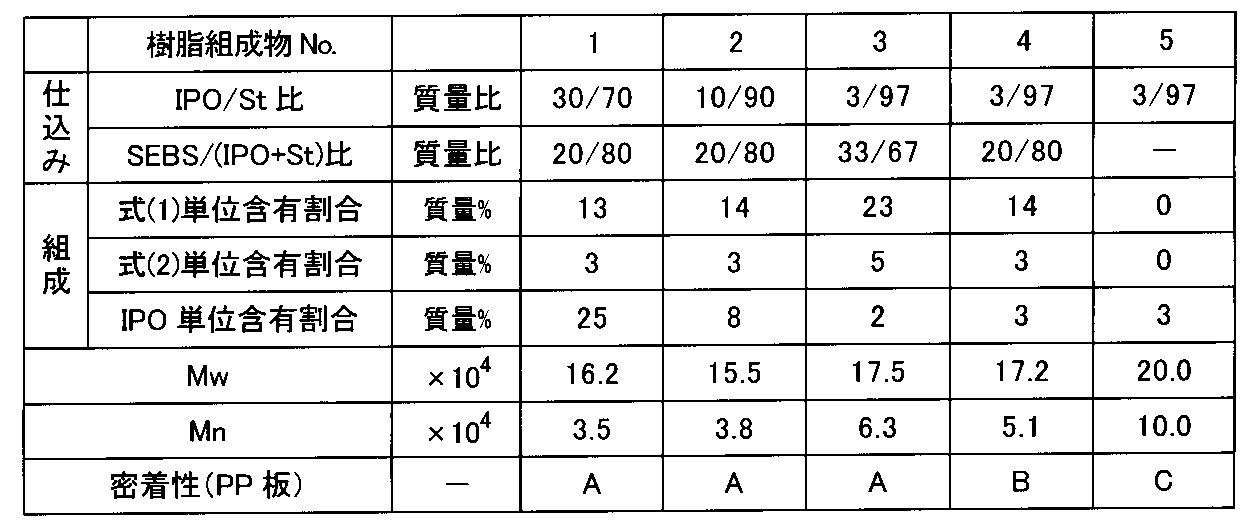
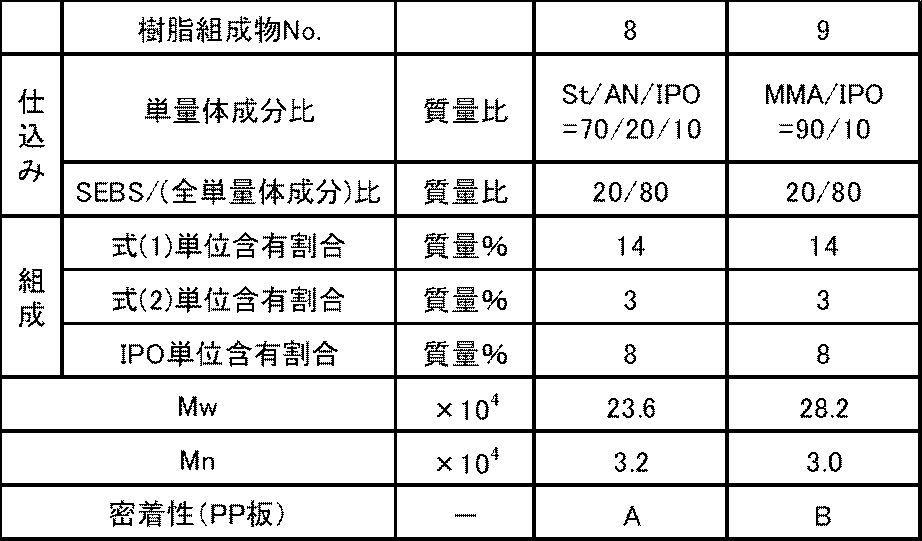
(3-2)塗膜密着性試験2
容量50mLの蓋付きガラス容器(マルエム社製、スクリュー管瓶)に樹脂組成物6gとTHF(テトラヒドロフラン)24gを入れて蓋を閉め、ペイントシェーカーで振とう撹拌して20質量%濃度の樹脂溶液を調製した。試験板に#60のバーコーターを使用して樹脂溶液を塗布し、80℃で30分間乾燥し、膜厚20μm程度の塗膜を形成した。塗膜に対して垂直にカッターナイフ(エヌティー社製、A-300)の刃を当てて切り込みを入れ、縦列、横列にそれぞれ1mm間隔で11本のクロスカット線を設けることによって1mm2の四角を100マス作製した。カットした100マスの塗膜表面に、セロハン粘着テープ(ニチバン社製、セロテープ(登録商標)、幅15mm)を空気が入らないように貼り付け、しっかりと指でテープをこすりつけた。10秒放置した後、テープの端を持って塗膜面に直角に保ち、テープを瞬間的に引き剥がし、剥がれが生じなかった塗膜のマス目の数を計測し、次式により塗膜の残存率を求めた:塗膜の残存率(%)=塗膜の残存数/100×100。塗膜の残存率が80%以上の場合を「A」と評価し、塗膜の残存率が20%以上80%未満の場合を「B」と評価し、塗膜の残存率が20%未満の場合を「C」と評価した。試験板としては、PBT(ポリブチレンテレフタレート)板(エンジニアリングテストサービス社製、PBT3300、2.0mm×70mm×150mm)、PC(ポリカーボネート)板(日本テストパネル社製、標準試験板PC、2.0mm×70mm×150mm)、PMMA(ポリメチルメタクリレート)板(エンジニアリングテストサービス社製、PMMA、2.0mm×60mm×120mm)を用いた。
容量50mLの蓋付きガラス容器(マルエム社製、スクリュー管瓶)に樹脂組成物6gとTHF(テトラヒドロフラン)24gを入れて蓋を閉め、ペイントシェーカーで振とう撹拌して20質量%濃度の樹脂溶液を調製した。試験板に#60のバーコーターを使用して樹脂溶液を塗布し、80℃で30分間乾燥し、膜厚20μm程度の塗膜を形成した。塗膜に対して垂直にカッターナイフ(エヌティー社製、A-300)の刃を当てて切り込みを入れ、縦列、横列にそれぞれ1mm間隔で11本のクロスカット線を設けることによって1mm2の四角を100マス作製した。カットした100マスの塗膜表面に、セロハン粘着テープ(ニチバン社製、セロテープ(登録商標)、幅15mm)を空気が入らないように貼り付け、しっかりと指でテープをこすりつけた。10秒放置した後、テープの端を持って塗膜面に直角に保ち、テープを瞬間的に引き剥がし、剥がれが生じなかった塗膜のマス目の数を計測し、次式により塗膜の残存率を求めた:塗膜の残存率(%)=塗膜の残存数/100×100。塗膜の残存率が80%以上の場合を「A」と評価し、塗膜の残存率が20%以上80%未満の場合を「B」と評価し、塗膜の残存率が20%未満の場合を「C」と評価した。試験板としては、PBT(ポリブチレンテレフタレート)板(エンジニアリングテストサービス社製、PBT3300、2.0mm×70mm×150mm)、PC(ポリカーボネート)板(日本テストパネル社製、標準試験板PC、2.0mm×70mm×150mm)、PMMA(ポリメチルメタクリレート)板(エンジニアリングテストサービス社製、PMMA、2.0mm×60mm×120mm)を用いた。
樹脂組成物2~6、8、9についてPBT板、PC板、PMMA板への密着性を調べた。結果を表3および4に示す。樹脂組成物2~4、8、9はいずれの試験板に対してもA評価となったのに対し、樹脂組成物5、6はそれよりも密着性が劣り、樹脂組成物6ではいずれの試験板に対してもC評価となった。樹脂組成物2~4、8、9は、PBT板、PC板、PMMA板への密着性にも優れるものとなった。なお、樹脂組成物4よりもさらにSEBS由来のポリマー鎖(A)の含有割合が少ない共重合体を含有する樹脂組成物、すなわちSEBS/(IPO+St)比におけるSEBSの数値が20未満の樹脂組成物であり、SEBS/(IPO+St)比が例えば15/85や10/90などの樹脂組成物でも、樹脂組成物6よりもPBT板、PC板、PMMA板に対する密着性の向上効果が得られた。また、樹脂組成物5よりもPBT板に対する密着性の向上効果が得られた。
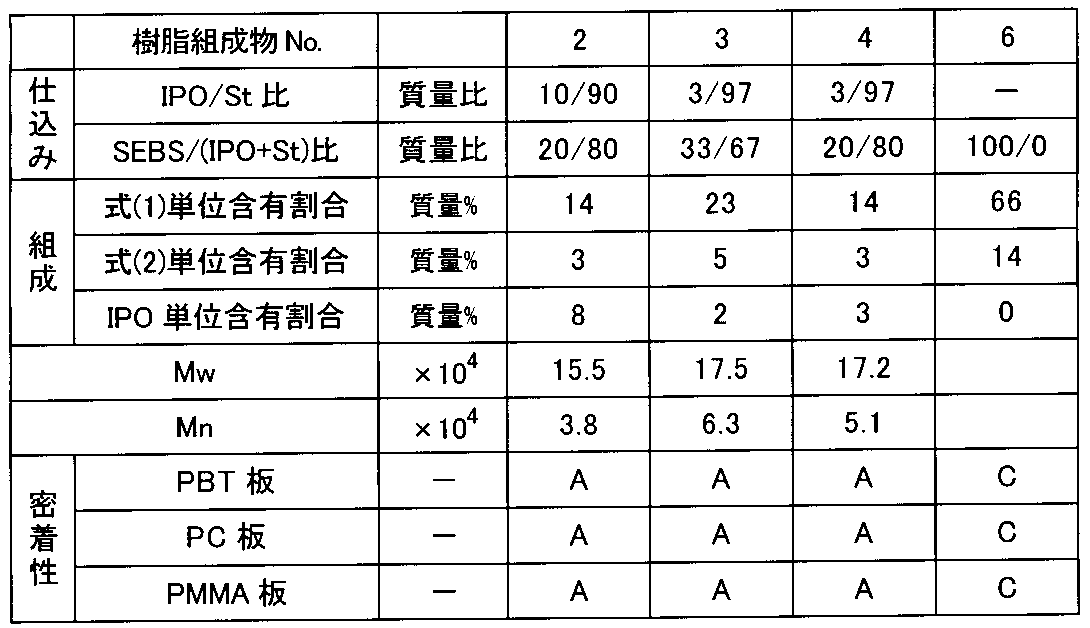
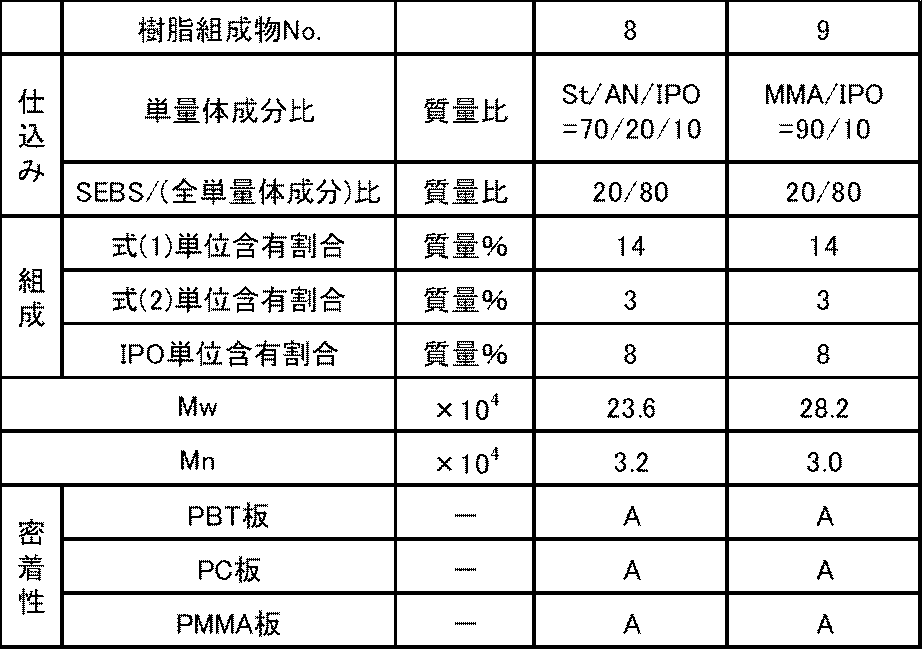
(4)相溶化性試験
ポリスチレン系樹脂(エポクロス(登録商標)RPS-1005;日本触媒社製)を濃度20質量%となるようにテトラヒドロフラン(THF)に加えた樹脂溶液Xと、オレフィン成分含有樹脂(タフテック(登録商標)P1083;旭化成社製)を濃度20質量%となるようにテトラヒドロフラン(THF)に加えた樹脂溶液Yとをそれぞれ5gずつ20mLのガラス製容器(スクリュー管)に入れ、蓋で密封してシェーカー機(振とう機)で1分間混合し樹脂混合溶液(X+Y)を得た。該樹脂混合溶液(X+Y)は、撹拌混合後10分間放置したところ、2層に分離した。次に、樹脂混合溶液(X+Y)に前記樹脂組成物3を濃度20質量%となるようにテトラヒドロフラン(THF)に加えた樹脂溶液3を5g加えて、蓋で密封してシェーカー機(振とう機)で1分間混合した。該樹脂組成物3を加えた樹脂混合溶液(X+Y)は、撹拌混合後10分間放置しても2層に分離せず均一な溶液であった。つまり、オキサゾリン基含有重合体鎖をSEBSブロック共重合体鎖にグラフトした共重合体を含む樹脂組成物3が、前記ポリスチレン系樹脂と前記ポリスチレン系樹脂との混和性を改善し、相溶化剤として作用したといえる。
ポリスチレン系樹脂(エポクロス(登録商標)RPS-1005;日本触媒社製)を濃度20質量%となるようにテトラヒドロフラン(THF)に加えた樹脂溶液Xと、オレフィン成分含有樹脂(タフテック(登録商標)P1083;旭化成社製)を濃度20質量%となるようにテトラヒドロフラン(THF)に加えた樹脂溶液Yとをそれぞれ5gずつ20mLのガラス製容器(スクリュー管)に入れ、蓋で密封してシェーカー機(振とう機)で1分間混合し樹脂混合溶液(X+Y)を得た。該樹脂混合溶液(X+Y)は、撹拌混合後10分間放置したところ、2層に分離した。次に、樹脂混合溶液(X+Y)に前記樹脂組成物3を濃度20質量%となるようにテトラヒドロフラン(THF)に加えた樹脂溶液3を5g加えて、蓋で密封してシェーカー機(振とう機)で1分間混合した。該樹脂組成物3を加えた樹脂混合溶液(X+Y)は、撹拌混合後10分間放置しても2層に分離せず均一な溶液であった。つまり、オキサゾリン基含有重合体鎖をSEBSブロック共重合体鎖にグラフトした共重合体を含む樹脂組成物3が、前記ポリスチレン系樹脂と前記ポリスチレン系樹脂との混和性を改善し、相溶化剤として作用したといえる。
本発明の共重合体(P)および樹脂組成物(Q)は、金属やプラスチック等の各種基材と樹脂コーティング層との密着性を高めるプライマーや接着剤、各種樹脂の相溶化剤、添加剤、改質剤として用いることができる。具体的には、光学フィルム、プリント配線板、タイヤコードなどのゴム補強用樹脂、各種エンジニアリングプラスチックとしてバンパー、インパネ、電装部品などの自動車・輸送機器関連内外装部品、家電、家具、雑貨などの日用品関連製品、建築・土木、文具・事務用品などの産業資材に使用される。
Claims (16)
- 下記式(1)で表される単位を有するポリマー鎖(A)と、オキサゾリン基含有単量体由来の単位を有するポリマー鎖(B)とを有することを特徴とする共重合体(P)。
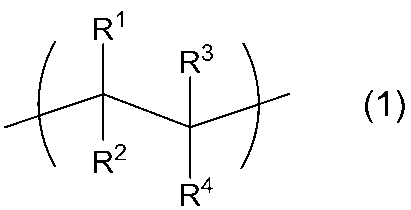
- ポリマー鎖(B)がポリマー鎖(A)にグラフトしている請求項1に記載の共重合体(P)。
- 前記ポリマー鎖(A)中、前記式(1)で表される単位の含有割合が50質量%以上である請求項1または2に記載の共重合体(P)。
- 前記ポリマー鎖(B)中、オキサゾリン基含有単量体由来の単位の含有割合が1質量%以上50質量%以下である請求項1~3のいずれかに記載の共重合体(P)。
- 前記ポリマー鎖(A)が、前記式(1)で表される単位を有する重合体ブロック(a1)と芳香族ビニル単量体由来の単位を有する重合体ブロック(a2)を有する請求項1~4のいずれかに記載の共重合体(P)。
- 前記ポリマー鎖(B)がさらに芳香族ビニル単量体由来の単位および/または不飽和カルボン酸エステル由来の単位を有し、
前記ポリマー鎖(B)中、オキサゾリン基含有単量体由来の単位と、芳香族ビニル単量体由来の単位および/または不飽和カルボン酸エステル由来の単位との合計含有割合が80質量%以上である請求項1~5のいずれかに記載の共重合体(P)。 - 請求項1~6のいずれかに記載の共重合体(P)を含有することを特徴とする樹脂組成物(Q)。
- 請求項1~6のいずれかに記載の共重合体(P)とオキサゾリン基含有重合体とを含有することを特徴とする樹脂組成物(Q)。
- 前記共重合体(P)と前記オキサゾリン基含有重合体と前記式(1)で表される単位を有する重合体の合計100質量部に対して、前記ポリマー鎖(A)の含有割合が5質量部以上80質量部以下である請求項8に記載の樹脂組成物(Q)。
- 前記共重合体(P)と前記オキサゾリン基含有重合体と前記式(1)で表される単位を有する重合体の合計100質量部に対して、前記式(1)で表される単位の含有割合が3質量部以上80質量部以下である請求項8または9に記載の樹脂組成物(Q)。
- 前記共重合体(P)と前記オキサゾリン基含有重合体と前記式(1)で表される単位を有する重合体の合計100質量部に対して、前記オキサゾリン基含有単量体由来の単位の含有割合が0.5質量部以上49質量部以下である請求項8~10のいずれかに記載の樹脂組成物(Q)。
- 請求項1~6のいずれかに記載の共重合体(P)または請求項7~11のいずれかに記載の樹脂組成物(Q)を含有することを特徴とするプライマー。
- 請求項1~6のいずれかに記載の共重合体(P)または請求項7~11のいずれかに記載の樹脂組成物(Q)を含有する層が樹脂基材の表面に形成されている樹脂成形体。
- 前記樹脂基材が、炭化水素系樹脂、あるいはヘテロ原子含有基またはヘテロ原子含有結合を有する樹脂である請求項13に記載の樹脂成形体。
- 請求項1~6のいずれかに記載の共重合体(P)または請求項7~11のいずれかに記載の樹脂組成物(Q)を含有することを特徴とする相溶化剤。
- 下記式(1)で表される単位を有する重合体の存在下、オキサゾリン基含有単量体を含む単量体成分を重合する工程を有することを特徴とする、下記式(1)で表される単位を有するポリマー鎖(A)と、オキサゾリン基含有単量体由来の単位を有するポリマー鎖(B)とを有する共重合体(P)の製造方法。
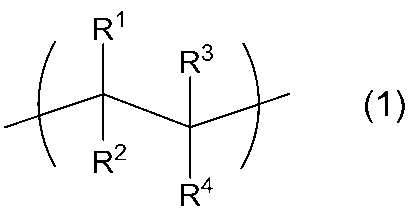
Priority Applications (1)
| Application Number | Priority Date | Filing Date | Title |
|---|---|---|---|
| JP2020566400A JP7212069B2 (ja) | 2019-01-15 | 2020-01-10 | 樹脂組成物および樹脂組成物の製造方法 |
Applications Claiming Priority (4)
| Application Number | Priority Date | Filing Date | Title |
|---|---|---|---|
| JP2019004296 | 2019-01-15 | ||
| JP2019-004296 | 2019-01-15 | ||
| JP2019-237076 | 2019-12-26 | ||
| JP2019237076 | 2019-12-26 |
Publications (1)
| Publication Number | Publication Date |
|---|---|
| WO2020149232A1 true WO2020149232A1 (ja) | 2020-07-23 |
Family
ID=71613338
Family Applications (1)
| Application Number | Title | Priority Date | Filing Date |
|---|---|---|---|
| PCT/JP2020/000675 Ceased WO2020149232A1 (ja) | 2019-01-15 | 2020-01-10 | 共重合体および樹脂組成物 |
Country Status (3)
| Country | Link |
|---|---|
| JP (1) | JP7212069B2 (ja) |
| TW (1) | TW202037625A (ja) |
| WO (1) | WO2020149232A1 (ja) |
Citations (6)
| Publication number | Priority date | Publication date | Assignee | Title |
|---|---|---|---|---|
| JPS6475548A (en) * | 1987-09-17 | 1989-03-22 | Tonen Sekiyukagaku Kk | Thermoplastic resin composition |
| JPH03220215A (ja) * | 1989-08-11 | 1991-09-27 | Nippon Petrochem Co Ltd | グラフト変性物及びその製法・グラフト変性物を用いた熱可塑性樹脂組成物 |
| JPH03505344A (ja) * | 1989-04-05 | 1991-11-21 | ザ ルブリゾル コーポレイション | グラフト共重合体,および例えば分散剤―粘度改良剤を含有する潤滑剤 |
| JP2002317076A (ja) * | 2001-04-20 | 2002-10-31 | Jsr Corp | 相溶化剤組成物並びにこれを用いた熱可塑性重合体組成物及びその製造方法 |
| WO2007066749A1 (ja) * | 2005-12-09 | 2007-06-14 | Mitsui Chemicals, Inc. | オレフィン系重合体及びその組成物、並びに該組成物からなる接着性樹脂 |
| JP2017036354A (ja) * | 2015-08-06 | 2017-02-16 | 藤森工業株式会社 | ホットメルト接着性樹脂フィルムおよびその製造方法 |
-
2020
- 2020-01-10 WO PCT/JP2020/000675 patent/WO2020149232A1/ja not_active Ceased
- 2020-01-10 JP JP2020566400A patent/JP7212069B2/ja active Active
- 2020-01-14 TW TW109101172A patent/TW202037625A/zh unknown
Patent Citations (6)
| Publication number | Priority date | Publication date | Assignee | Title |
|---|---|---|---|---|
| JPS6475548A (en) * | 1987-09-17 | 1989-03-22 | Tonen Sekiyukagaku Kk | Thermoplastic resin composition |
| JPH03505344A (ja) * | 1989-04-05 | 1991-11-21 | ザ ルブリゾル コーポレイション | グラフト共重合体,および例えば分散剤―粘度改良剤を含有する潤滑剤 |
| JPH03220215A (ja) * | 1989-08-11 | 1991-09-27 | Nippon Petrochem Co Ltd | グラフト変性物及びその製法・グラフト変性物を用いた熱可塑性樹脂組成物 |
| JP2002317076A (ja) * | 2001-04-20 | 2002-10-31 | Jsr Corp | 相溶化剤組成物並びにこれを用いた熱可塑性重合体組成物及びその製造方法 |
| WO2007066749A1 (ja) * | 2005-12-09 | 2007-06-14 | Mitsui Chemicals, Inc. | オレフィン系重合体及びその組成物、並びに該組成物からなる接着性樹脂 |
| JP2017036354A (ja) * | 2015-08-06 | 2017-02-16 | 藤森工業株式会社 | ホットメルト接着性樹脂フィルムおよびその製造方法 |
Also Published As
| Publication number | Publication date |
|---|---|
| TW202037625A (zh) | 2020-10-16 |
| JPWO2020149232A1 (ja) | 2021-10-14 |
| JP7212069B2 (ja) | 2023-01-24 |
Similar Documents
| Publication | Publication Date | Title |
|---|---|---|
| CN102076725B (zh) | 改性的聚烯烃 | |
| CN101696249A (zh) | 改性聚合物及包含所述改性聚合物的组合物 | |
| JP2010525148A (ja) | 誘起フリーラジカル連鎖成長重合による(コ)ポリマー組成物の製造方法 | |
| US20100016509A1 (en) | Method for producing branched vinyl polymer having functional group | |
| US20090280318A1 (en) | Olefin polymer, composition thereof and adhesive resin comprising the composition | |
| WO2001048079A1 (en) | Thermoplastic crosslinked rubber compositions | |
| JPS60233131A (ja) | ポリオレフイン系樹脂用改質剤 | |
| CN101151287A (zh) | 改性的热塑性树脂 | |
| JP7141871B2 (ja) | 樹脂組成物及びその製造方法 | |
| CN1809601B (zh) | 改性聚烯烃树脂及组合物 | |
| JP7212069B2 (ja) | 樹脂組成物および樹脂組成物の製造方法 | |
| CN107109001B (zh) | 制备多相丙烯共聚物的方法 | |
| KR100955558B1 (ko) | 폴리올레핀계 하이브리드 폴리머 및 그 제조 방법 | |
| CN102333830B (zh) | 基于聚烯烃-接枝-聚(甲基)丙烯酸酯共聚物的用于聚烯烃表面的打底剂 | |
| TWI858129B (zh) | 樹脂組成物 | |
| CN100393790C (zh) | 制备改性聚烯烃树脂的方法 | |
| JP2002256036A (ja) | ゴム強化ビニル系樹脂およびゴム強化ビニル系樹脂組成物 | |
| JP7158929B2 (ja) | (メタ)アクリル系共重合体の製造方法及び樹脂組成物 | |
| JP2023061155A (ja) | オレフィン変性アクリル樹脂、樹脂組成物、塗料組成物及びそれらの塗装物 | |
| JP7257108B2 (ja) | グラフト重合体および熱可塑性樹脂組成物 | |
| TWI257409B (en) | Heat resistant rubber-modified styrenic resin composition | |
| JP4501406B2 (ja) | グラフト共重合体、それを含む組成物及びその成形体、並びにその製造方法 | |
| JP2004018691A (ja) | ポリプロピレン樹脂組成物および該組成物を原料とする自動車外装材部品 | |
| JP2004075984A (ja) | ポリプロピレン樹脂組成物 | |
| JP3337730B2 (ja) | 樹脂組成物 |
Legal Events
| Date | Code | Title | Description |
|---|---|---|---|
| 121 | Ep: the epo has been informed by wipo that ep was designated in this application |
Ref document number: 20741966 Country of ref document: EP Kind code of ref document: A1 |
|
| ENP | Entry into the national phase |
Ref document number: 2020566400 Country of ref document: JP Kind code of ref document: A |
|
| NENP | Non-entry into the national phase |
Ref country code: DE |
|
| 122 | Ep: pct application non-entry in european phase |
Ref document number: 20741966 Country of ref document: EP Kind code of ref document: A1 |