WO2020149117A1 - 表面保護フィルム - Google Patents
表面保護フィルム Download PDFInfo
- Publication number
- WO2020149117A1 WO2020149117A1 PCT/JP2019/050630 JP2019050630W WO2020149117A1 WO 2020149117 A1 WO2020149117 A1 WO 2020149117A1 JP 2019050630 W JP2019050630 W JP 2019050630W WO 2020149117 A1 WO2020149117 A1 WO 2020149117A1
- Authority
- WO
- WIPO (PCT)
- Prior art keywords
- weight
- protective film
- surface protective
- sensitive adhesive
- adherend
- Prior art date
- Legal status (The legal status is an assumption and is not a legal conclusion. Google has not performed a legal analysis and makes no representation as to the accuracy of the status listed.)
- Ceased
Links
Images
Classifications
-
- C—CHEMISTRY; METALLURGY
- C09—DYES; PAINTS; POLISHES; NATURAL RESINS; ADHESIVES; COMPOSITIONS NOT OTHERWISE PROVIDED FOR; APPLICATIONS OF MATERIALS NOT OTHERWISE PROVIDED FOR
- C09J—ADHESIVES; NON-MECHANICAL ASPECTS OF ADHESIVE PROCESSES IN GENERAL; ADHESIVE PROCESSES NOT PROVIDED FOR ELSEWHERE; USE OF MATERIALS AS ADHESIVES
- C09J7/00—Adhesives in the form of films or foils
- C09J7/30—Adhesives in the form of films or foils characterised by the adhesive composition
- C09J7/38—Pressure-sensitive adhesives [PSA]
-
- B—PERFORMING OPERATIONS; TRANSPORTING
- B32—LAYERED PRODUCTS
- B32B—LAYERED PRODUCTS, i.e. PRODUCTS BUILT-UP OF STRATA OF FLAT OR NON-FLAT, e.g. CELLULAR OR HONEYCOMB, FORM
- B32B27/00—Layered products comprising a layer of synthetic resin
-
- C—CHEMISTRY; METALLURGY
- C09—DYES; PAINTS; POLISHES; NATURAL RESINS; ADHESIVES; COMPOSITIONS NOT OTHERWISE PROVIDED FOR; APPLICATIONS OF MATERIALS NOT OTHERWISE PROVIDED FOR
- C09J—ADHESIVES; NON-MECHANICAL ASPECTS OF ADHESIVE PROCESSES IN GENERAL; ADHESIVE PROCESSES NOT PROVIDED FOR ELSEWHERE; USE OF MATERIALS AS ADHESIVES
- C09J11/00—Features of adhesives not provided for in group C09J9/00, e.g. additives
- C09J11/02—Non-macromolecular additives
- C09J11/06—Non-macromolecular additives organic
-
- C—CHEMISTRY; METALLURGY
- C09—DYES; PAINTS; POLISHES; NATURAL RESINS; ADHESIVES; COMPOSITIONS NOT OTHERWISE PROVIDED FOR; APPLICATIONS OF MATERIALS NOT OTHERWISE PROVIDED FOR
- C09J—ADHESIVES; NON-MECHANICAL ASPECTS OF ADHESIVE PROCESSES IN GENERAL; ADHESIVE PROCESSES NOT PROVIDED FOR ELSEWHERE; USE OF MATERIALS AS ADHESIVES
- C09J11/00—Features of adhesives not provided for in group C09J9/00, e.g. additives
- C09J11/08—Macromolecular additives
-
- C—CHEMISTRY; METALLURGY
- C09—DYES; PAINTS; POLISHES; NATURAL RESINS; ADHESIVES; COMPOSITIONS NOT OTHERWISE PROVIDED FOR; APPLICATIONS OF MATERIALS NOT OTHERWISE PROVIDED FOR
- C09J—ADHESIVES; NON-MECHANICAL ASPECTS OF ADHESIVE PROCESSES IN GENERAL; ADHESIVE PROCESSES NOT PROVIDED FOR ELSEWHERE; USE OF MATERIALS AS ADHESIVES
- C09J121/00—Adhesives based on unspecified rubbers
-
- C—CHEMISTRY; METALLURGY
- C09—DYES; PAINTS; POLISHES; NATURAL RESINS; ADHESIVES; COMPOSITIONS NOT OTHERWISE PROVIDED FOR; APPLICATIONS OF MATERIALS NOT OTHERWISE PROVIDED FOR
- C09J—ADHESIVES; NON-MECHANICAL ASPECTS OF ADHESIVE PROCESSES IN GENERAL; ADHESIVE PROCESSES NOT PROVIDED FOR ELSEWHERE; USE OF MATERIALS AS ADHESIVES
- C09J133/00—Adhesives based on homopolymers or copolymers of compounds having one or more unsaturated aliphatic radicals, each having only one carbon-to-carbon double bond, and at least one being terminated by only one carboxyl radical, or of salts, anhydrides, esters, amides, imides, or nitriles thereof; Adhesives based on derivatives of such polymers
-
- C—CHEMISTRY; METALLURGY
- C09—DYES; PAINTS; POLISHES; NATURAL RESINS; ADHESIVES; COMPOSITIONS NOT OTHERWISE PROVIDED FOR; APPLICATIONS OF MATERIALS NOT OTHERWISE PROVIDED FOR
- C09J—ADHESIVES; NON-MECHANICAL ASPECTS OF ADHESIVE PROCESSES IN GENERAL; ADHESIVE PROCESSES NOT PROVIDED FOR ELSEWHERE; USE OF MATERIALS AS ADHESIVES
- C09J175/00—Adhesives based on polyureas or polyurethanes; Adhesives based on derivatives of such polymers
- C09J175/04—Polyurethanes
-
- C—CHEMISTRY; METALLURGY
- C09—DYES; PAINTS; POLISHES; NATURAL RESINS; ADHESIVES; COMPOSITIONS NOT OTHERWISE PROVIDED FOR; APPLICATIONS OF MATERIALS NOT OTHERWISE PROVIDED FOR
- C09J—ADHESIVES; NON-MECHANICAL ASPECTS OF ADHESIVE PROCESSES IN GENERAL; ADHESIVE PROCESSES NOT PROVIDED FOR ELSEWHERE; USE OF MATERIALS AS ADHESIVES
- C09J183/00—Adhesives based on macromolecular compounds obtained by reactions forming in the main chain of the macromolecule a linkage containing silicon, with or without sulfur, nitrogen, oxygen, or carbon only; Adhesives based on derivatives of such polymers
- C09J183/04—Polysiloxanes
-
- C—CHEMISTRY; METALLURGY
- C09—DYES; PAINTS; POLISHES; NATURAL RESINS; ADHESIVES; COMPOSITIONS NOT OTHERWISE PROVIDED FOR; APPLICATIONS OF MATERIALS NOT OTHERWISE PROVIDED FOR
- C09J—ADHESIVES; NON-MECHANICAL ASPECTS OF ADHESIVE PROCESSES IN GENERAL; ADHESIVE PROCESSES NOT PROVIDED FOR ELSEWHERE; USE OF MATERIALS AS ADHESIVES
- C09J2301/00—Additional features of adhesives in the form of films or foils
- C09J2301/30—Additional features of adhesives in the form of films or foils characterized by the chemical, physicochemical or physical properties of the adhesive or the carrier
- C09J2301/312—Additional features of adhesives in the form of films or foils characterized by the chemical, physicochemical or physical properties of the adhesive or the carrier parameters being the characterizing feature
Definitions
- the present invention relates to a surface protection film.
- the optical member or the electronic member In the manufacturing process of an optical member or an electronic member, in order to prevent the surface of the optical member or the electronic member from being damaged during processing, assembly, inspection, transportation, etc., the optical member or the electronic member is generally used. A surface protection film is attached to the exposed surface of the member. Such a surface protection film is peeled from the optical member or the electronic member when the surface protection is no longer needed (Patent Document 1).
- the optical member or the electronic member is provided with a easily breakable member such as thin glass or a barrier film
- the conventional surface protective film having light peeling property is used. Even if it is used, the peeling force may damage the fragile member.
- Patent Document 2 a surface protective film having lighter peeling property, that is, ultra-light peeling property than the conventional surface protecting film having light peeling property has been reported.
- the conventional technology has a problem that, for example, when it is stored in a harsh environment for a long period of time, the adhesive strength increases with time, resulting in heavy peeling.
- An object of the present invention is that it is not easily peeled off from an adherend, and even when it is stored for a long time in a harsh environment, it is possible to sufficiently suppress heavy delamination over time, and to adhere to an adherend.
- An object of the present invention is to provide a surface protective film having a sufficiently low stain resistance on the surface of the adherend.
- the surface protection film of the present invention A surface protective film having an adhesive layer
- the surface protective film was peeled from the glass plate at a temperature of 23° C. at a peeling angle of 180 degrees and a peeling speed of 300 mm/min.
- the peeling force A is 0.005 N/25 mm to 0.50 N/25 mm
- the surface protective film was peeled from the glass plate at a temperature of 23° C.
- peeling force B the peeling force temporal increase rate P1 calculated by (peeling force B/peeling force A) ⁇ 100 is 200% or less.
- the storage elastic modulus at 23° C. of the pressure-sensitive adhesive layer is a storage elastic modulus X1
- the storage elastic modulus at a temperature of 23° C. after leaving the surface protective film at a temperature of 80° C. for 7 days is a storage elastic modulus.
- the storage modulus change rate Q1 calculated by (storage modulus Y1/storage modulus X1) ⁇ 100 is 150% or less.
- the pressure-sensitive adhesive layer of the surface protective film is attached to a glass plate and allowed to stand at a temperature of 23° C. for 7 days, and then the surface protective film is peeled from the glass plate at an angle of 180° at a temperature of 23° C.
- peeling force C the peeling force temporal increase rate P2 calculated by (peeling force C/peeling force A) ⁇ 100 is 160% or less.
- the surface protection film of the present invention has a residual adhesion rate to a glass plate at 23°C of 50% or more.
- the pressure-sensitive adhesive forming the pressure-sensitive adhesive layer is formed from a pressure-sensitive adhesive composition, and the pressure-sensitive adhesive composition contains a heat-resistant stabilizer.
- the pressure-sensitive adhesive composition contains a base polymer, a low molecular weight polyol, a silicone-based additive and/or a fluorine-based additive.
- the silicone-based additive is at least one selected from a siloxane bond-containing compound, a hydroxyl group-containing silicone compound, and a crosslinkable functional group-containing silicone compound.
- the fluorine-based additive is at least one selected from a fluorine-containing compound, a hydroxyl group-containing fluorine compound, and a crosslinkable functional group-containing fluorine compound.
- the base polymer is at least one selected from urethane prepolymer, polyol, acrylic resin, rubber resin, and silicone resin.
- the optical member of the present invention has the surface protective film of the present invention attached thereto.
- the electronic member of the present invention has the surface protective film of the present invention attached thereto.
- the present invention it is not easily peeled off from the adherend, and even if the initial peeling force after being adhered to the adherend is large, it is possible to sufficiently suppress heavy delamination over time, and to adhere to the adherend. It is possible to provide a surface protective film which has a sufficiently low stain resistance on the surface of the adherend due to being applied.
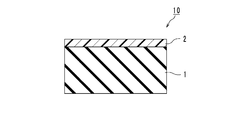
- FIG. 1 is a schematic cross-sectional view of a surface protection film according to one embodiment of the present invention.
- the surface protection film of the present invention has an adhesive layer.
- the surface protective film of the present invention may be provided with any appropriate other member as long as it has a pressure-sensitive adhesive layer, as long as the effect of the present invention is not impaired.
- the surface protective film of the present invention has a base material layer and an adhesive layer.
- FIG. 1 is a schematic sectional view of a surface protection film according to one embodiment of the present invention.
- the surface protection film 10 includes a base material layer 1 and an adhesive layer 2.
- the base material layer 1 and the adhesive layer 2 are directly laminated.
- the surface of the pressure-sensitive adhesive layer 2 opposite to the base material layer 1 is provided with any suitable release liner (also referred to as a release sheet or a separator) for protection before use. May be provided (not shown).
- the release liner include a release liner in which the surface of a base material (liner base material) such as paper or plastic film is treated with silicone, and a surface of a base material (liner base material) such as paper or plastic film is formed of a polyolefin resin.
- Examples include laminated release liners.
- the plastic film as the liner substrate for example, polyethylene film, polypropylene film, polybutene film, polybutadiene film, polymethylpentene film, polyvinyl chloride film, vinyl chloride copolymer film, polyethylene terephthalate film, polybutylene terephthalate film, Examples thereof include a polyurethane film and an ethylene-vinyl acetate copolymer film.
- the plastic film as the liner base material is preferably a polyethylene film.
- the thickness of the release liner is preferably 1 ⁇ m to 500 ⁇ m, more preferably 3 ⁇ m to 450 ⁇ m, further preferably 5 ⁇ m to 400 ⁇ m, and particularly preferably 10 ⁇ m to 300 ⁇ m.
- the thickness of the surface protective film is preferably 5 ⁇ m to 500 ⁇ m, more preferably 10 ⁇ m to 450 ⁇ m, further preferably 15 ⁇ m to 400 ⁇ m, particularly preferably 20 ⁇ m to 300 ⁇ m.
- the surface protective film of the present invention has a pressure-sensitive adhesive layer of the surface protective film bonded to a glass plate and left for 30 minutes at a temperature of 23° C., and then at a temperature of 23° C., a peeling angle of 180° from the glass plate,
- the peeling force A is preferably 0.005 N/25 mm to 0.50 N/25 mm, more preferably 0.007 N/25 mm.
- the surface protective film of the present invention may be difficult to be easily peeled off from the adherend, and typically, during the manufacturing process of the optical member or the electronic member, the optical member or The surface protection film of the present invention attached to the exposed surface of the electronic member may be less likely to peel off. The details of the measurement of the peeling force A will be described later.
- the surface protection film of the present invention has a pressure-sensitive adhesive layer of the surface protection film bonded to a glass plate and left for 2 days at a temperature of 100° C., and then at a temperature of 23° C., the surface protection film is peeled off from the glass plate at an angle of 180°,
- the peeling force B is preferably 0.010 N/25 mm to 1.0 N/25 mm, more preferably 0.010 N/25 mm.
- the surface protective film of the present invention can more sufficiently suppress heavy peeling over time even when stored for a long time in a harsh environment. The details of the measurement of the peeling force B will be described later.
- the peeling force temporal increase rate P1 calculated by (peeling force B/peeling force A) ⁇ 100 is preferably 200% or less, more preferably Is 190% or less, more preferably 180% or less, particularly preferably 170% or less, and most preferably 160% or less.
- the lower limit of the increase rate P1 of the peeling force with time is preferably as small as possible, but in reality, it is preferably 80% or more.
- the surface protective film of the present invention does not easily peel off from the adherend, and even when stored for a long time in a harsh environment, the surface protection film has Peeling can be sufficiently suppressed.
- the surface protective film of the present invention is obtained by laminating the pressure-sensitive adhesive layer of the surface protective film on a glass plate and leaving it at 23° C. for 7 days, and then peeling the surface protective film from the glass plate at a peeling angle of 180° at a temperature of 23° C.
- the peeling force C is preferably 0.001 N/25 mm to 0.50 N/25 mm, more preferably 0.001 N/25 mm to 0.30 N/25 mm, more preferably 0.001 N/25 mm to 0.20 N/25 mm, further preferably 0.003 N/25 mm to 0.10 N/25 mm, further preferably 0.005 N/25 mm To 0.075 N/25 mm, particularly preferably 0.008 N/25 mm to 0.050 N/25 mm, and most preferably 0.010 N/25 mm to 0.040 N/25 mm.
- the surface protective film of the present invention can more sufficiently suppress heavy peeling over time even when stored for a long time in a severe environment. The details of the measurement of the peeling force C will be described later.
- the surface protective film of the present invention preferably has a peeling force temporal increase rate P2 calculated by (peeling force C/peeling force A) ⁇ 100 of 160% or less, and more preferably Is 155% or less, more preferably 150% or less, particularly preferably 145% or less, and most preferably 140% or less.
- the lower limit of the peeling force increase rate P2 with time is preferably as small as possible, but in reality, it is preferably 80% or more.
- the peeling force increase rate P2 with time is within the above range, the surface protective film of the present invention does not peel off from the adherend more easily, and even when stored for a long period of time in a harsh environment. Heavy exfoliation can be suppressed more sufficiently.
- the storage elastic modulus X1 of the pressure-sensitive adhesive layer at 23° C. is preferably 1.0 ⁇ 10 5 Pa to 1.0 ⁇ 10 7 Pa, more preferably 3.0 ⁇ 10 5. 5 Pa to 7.0 ⁇ 10 6 Pa, more preferably 5.0 ⁇ 10 5 Pa to 5.0 ⁇ 10 6 Pa, and particularly preferably 6.0 ⁇ 10 5 Pa to 4.0 ⁇ 10. 6 Pa, and most preferably 7.0 ⁇ 10 5 Pa to 3.0 ⁇ 10 6 Pa.
- the surface protective film of the present invention does not easily peel off from the adherend, and even if the initial peeling force after sticking to the adherend is large, In this case, it is possible to more sufficiently suppress the heavy peeling, and it is possible to further exhibit the effect that the contamination property of the surface of the adherend due to being adhered to the adherend is sufficiently low.
- the details of the measurement of the storage elastic modulus X1 will be described later.
- the storage elastic modulus Y1 at a temperature of 23° C. after leaving the surface protective film at a temperature of 80° C. for 7 days is preferably 1.0 ⁇ 10 5 Pa to 1.0 ⁇ 10 7. Pa, more preferably 2.0 ⁇ 10 5 Pa to 7.0 ⁇ 10 6 Pa, further preferably 3.0 ⁇ 10 5 Pa to 5.0 ⁇ 10 6 Pa, particularly preferably 5 It is 0.0 ⁇ 10 5 Pa to 3.0 ⁇ 10 6 Pa, and most preferably 6.0 ⁇ 10 5 Pa to 2.0 ⁇ 10 6 Pa.
- the surface protective film of the present invention does not peel off from the adherend more easily, and even if the initial peeling force after sticking to the adherend is large, In this case, it is possible to more sufficiently suppress the heavy peeling, and it is possible to further exhibit the effect that the contamination property of the surface of the adherend due to being adhered to the adherend is sufficiently low.
- the details of the measurement of the storage elastic modulus Y1 will be described later.
- the surface protective film of the present invention has a storage elastic modulus change rate Q1 calculated by (storage elastic modulus Y1/storage elastic modulus X1) ⁇ 100 with respect to the storage elastic modulus X1 and the storage elastic modulus Y1, preferably 150% or less. Yes, more preferably 145% or less, further preferably 140% or less, particularly preferably 135% or less, and most preferably 130% or less.
- the lower limit of the storage elastic modulus change rate Q1 is preferably as small as possible, but in reality, it is preferably 80% or more.
- the surface protective film of the present invention does not peel off more easily from the adherend, and the initial peeling force after sticking to the adherend is large. Also, it is possible to more sufficiently suppress the heavy delamination over time, and it is possible to further exhibit the effect that the contamination property of the surface of the adherend due to being adhered to the adherend is sufficiently low.
- the storage elastic modulus X2 of the pressure-sensitive adhesive layer at 100° C. is preferably 1.0 ⁇ 10 5 Pa to 7.0 ⁇ 10 6 Pa, more preferably 3.0 ⁇ 10 5. 5 Pa to 5.0 ⁇ 10 6 Pa, more preferably 5.0 ⁇ 10 5 Pa to 3.0 ⁇ 10 6 Pa, and particularly preferably 6.0 ⁇ 10 5 Pa to 2.0 ⁇ 10. 6 Pa, and most preferably 6.5 ⁇ 10 5 Pa to 1.5 ⁇ 10 6 Pa.
- the surface protective film of the present invention does not peel off more easily from the adherend, and even when the initial peeling force after being adhered to the adherend is large, In this case, it is possible to more sufficiently suppress the heavy peeling, and it is possible to further exhibit the effect that the contamination property of the surface of the adherend due to being adhered to the adherend is sufficiently low.
- the details of the measurement of the storage elastic modulus X2 will be described later.
- the storage elastic modulus Y2 at a temperature of 100° C. after standing the surface protective film at a temperature of 80° C. for 7 days is preferably 1.0 ⁇ 10 5 Pa to 1.0 ⁇ 10 7. Pa, more preferably 2.0 ⁇ 10 5 Pa to 7.0 ⁇ 10 6 Pa, further preferably 3.0 ⁇ 10 5 Pa to 5.0 ⁇ 10 6 Pa, particularly preferably 5 It is 0.0 ⁇ 10 5 Pa to 2.0 ⁇ 10 6 Pa, and most preferably 5.5 ⁇ 10 5 Pa to 1.0 ⁇ 10 6 Pa.
- the surface protective film of the present invention does not peel off from the adherend more easily, and even if the initial peeling force after sticking to the adherend is large, In this case, it is possible to more sufficiently suppress the heavy peeling, and it is possible to further exhibit the effect that the contamination property of the surface of the adherend due to being adhered to the adherend is sufficiently low.
- the details of the measurement of the storage elastic modulus Y2 will be described later.
- the surface protection film of the present invention has a storage elastic modulus change rate Q2 calculated by (storage elastic modulus Y2/storage elastic modulus X2) ⁇ 100 with respect to the storage elastic modulus X2 and the storage elastic modulus Y2, preferably 150% or less. Yes, more preferably 145% or less, further preferably 140% or less, particularly preferably 135% or less, and most preferably 130% or less.
- the lower limit of the storage elastic modulus change rate Q2 is preferably as small as possible, but in reality, it is preferably 80% or more.
- the surface protective film of the present invention does not easily peel off from the adherend, and the initial peeling force after being adhered to the adherend is large. Also, it is possible to more sufficiently suppress the heavy delamination over time, and it is possible to further exhibit the effect that the contamination property of the surface of the adherend due to being adhered to the adherend is sufficiently low.
- the surface protection film of the present invention has a residual adhesion rate of preferably 50% or more, more preferably 60% to 100%, further preferably 70% to 100%, particularly preferably 80% to 100%. %, and most preferably 85% to 100%.
- the surface protective film of the present invention can exhibit an effect that the adherence to the adherend has a sufficiently low contamination property on the surface of the adherend. The details of the measurement of the residual adhesion rate will be described later.
- the surface protective film of the present invention can be manufactured by any appropriate method.
- a manufacturing method for example, (1) A method of applying a solution of a material for forming a pressure-sensitive adhesive layer or a hot melt onto a base material layer, (2) A method of applying a solution of a material for forming a pressure-sensitive adhesive layer or a hot melt onto a separator to transfer the pressure-sensitive adhesive layer formed on the base material layer, (3) A method of extruding a material for forming an adhesive layer onto a base material layer to form and apply it, (4) A method of extruding the base material layer and the pressure-sensitive adhesive layer in two layers or multiple layers, (5) A method of laminating a pressure-sensitive adhesive layer as a single layer on a base material layer, or a method of laminating two layers of pressure-sensitive adhesive layers together with a laminate layer, (6) A method of laminating a pressure-sensitive adhesive layer and a base material layer-forming material such as a film or a laminate layer in a two-layer or multi
- a coating method for example, a roll coater method, a comma coater method, a die coater method, a reverse coater method, a silk screen method, a gravure coater method or the like can be used.
- Base material layer may be only one layer or two or more layers.
- the base material layer may be stretched.
- the thickness of the base material layer is preferably 4 ⁇ m to 450 ⁇ m, more preferably 8 ⁇ m to 400 ⁇ m, further preferably 12 ⁇ m to 350 ⁇ m, and particularly preferably 16 ⁇ m to 250 ⁇ m.
- a fatty acid amide, polyethyleneimine, a long-chain alkyl-based additive may be added to the base material layer for the purpose of forming a wound body that can be easily unwound.
- Etc. may be added for release treatment, or a coating layer made of any appropriate release agent such as silicone-based, long-chain alkyl-based, or fluorine-based release agent may be provided.
- the material of the base material layer any appropriate material can be adopted depending on the application.
- plastic, paper, metal film, non-woven fabric, etc. may be mentioned.
- Preferred is plastic.
- the base material layer is preferably a plastic film.
- the base material layer may be composed of one kind of material, or may be composed of two or more kinds of materials. For example, it may be composed of two or more kinds of plastics.
- polyester resins examples include polyester resins, polyamide resins, polyolefin resins, and the like.
- polyester resins include polyethylene terephthalate, polybutylene terephthalate, and polyethylene naphthalate.
- polyolefin-based resin examples include homopolymers of olefin monomers and copolymers of olefin monomers.
- polystyrene-based resin examples include homopolypropylene; propylene-based copolymers such as block-based, random-based, and graft-based resins having an ethylene component as a copolymerization component; reactor TPO; low density, high density, linear Low density, ultra low density ethylene polymers; ethylene/propylene copolymers, ethylene/vinyl acetate copolymers, ethylene/methyl acrylate copolymers, ethylene/ethyl acrylate copolymers, ethylene/acrylic acid Examples thereof include an ethylene-based copolymer such as a butyl copolymer, an ethylene/methacrylic acid copolymer, an ethylene/methyl methacrylate copolymer, and the like.
- the base material layer may contain any appropriate additive as required.
- additives that can be contained in the base material layer include antioxidants, ultraviolet absorbers, light stabilizers, antistatic agents, fillers and pigments.
- the type, number, and amount of additives that can be contained in the base material layer can be appropriately set according to the purpose.
- the material of the base material layer is plastic, it is preferable to contain some of the above additives for the purpose of preventing deterioration and the like. From the viewpoint of improving weather resistance and the like, as the additive, an antioxidant, an ultraviolet absorber, a light stabilizer, and a filler are particularly preferable.
- any suitable antioxidant can be adopted as the antioxidant.
- antioxidants include phenol-based antioxidants, phosphorus-based processing heat stabilizers, lactone-based processing heat stabilizers, sulfur heat-resistant stabilizers, and phenol/phosphorus-based antioxidants.
- the content of the antioxidant is preferably 1% by weight or less with respect to the base resin of the base material layer (when the base material layer is a blend, the blended product is the base resin), and more preferably It is 0.5% by weight or less, and more preferably 0.01% by weight to 0.2% by weight.
- any appropriate UV absorber can be adopted.
- examples of such UV absorbers include benzotriazole-based UV absorbers, triazine-based UV absorbers, and benzophenone-based UV absorbers.
- the content ratio of the ultraviolet absorber is preferably 2% by weight or less with respect to the base resin forming the base material layer (when the base material layer is a blend, the blended product is the base resin). It is preferably 1% by weight or less, and more preferably 0.01% by weight to 0.5% by weight.
- any suitable light stabilizer can be adopted.
- Examples of such light stabilizers include hindered amine light stabilizers and benzoate light stabilizers.
- the content ratio of the light stabilizer is preferably 2% by weight or less with respect to the base resin forming the base material layer (when the base material layer is a blend, the blended product is the base resin). It is preferably 1% by weight or less, and more preferably 0.01% by weight to 0.5% by weight.
- any suitable filler can be adopted as the filler.
- suitable fillers include inorganic fillers.
- Specific examples of the inorganic filler include carbon black, titanium oxide, zinc oxide and the like.
- the content ratio of the filler is preferably 20% by weight or less based on the base resin forming the base material layer (when the base material layer is a blend, the blended product is the base resin), and more preferably Is 10% by weight or less, and more preferably 0.01% by weight to 10% by weight.
- inorganic, low molecular weight and high molecular weight antistatic agents such as surfactants, inorganic salts, polyhydric alcohols, metal compounds and carbon are also preferably mentioned.
- a high molecular weight antistatic agent and carbon are preferable.
- Adhesive layer ⁇ The adhesive layer may be composed of an adhesive.
- the adhesive may be formed from the adhesive composition.
- the adhesive layer may be formed by any appropriate method.
- coating methods include roll coating, gravure coating, reverse coating, roll brushing, spray coating, air knife coating, extrusion coating with a die coater, and the like.
- the thickness of the pressure-sensitive adhesive layer is preferably 1 ⁇ m to 150 ⁇ m, more preferably 2 ⁇ m to 140 ⁇ m, further preferably 3 ⁇ m to 130 ⁇ m, further preferably 4 ⁇ m to 120 ⁇ m, further preferably 5 ⁇ m to 100 ⁇ m. , More preferably 10 ⁇ m to 90 ⁇ m, particularly preferably 20 ⁇ m to 85 ⁇ m, and most preferably 30 ⁇ m to 80 ⁇ m.
- the pressure-sensitive adhesive composition preferably contains a heat resistance stabilizer.
- a heat-resistant stabilizer in the pressure-sensitive adhesive composition, not only the heat resistance is simply improved, but also the peeling force does not easily separate from the adherend, and the initial peeling force after being attached to the adherend. It is possible to provide a surface protection film which can sufficiently prevent heavy delamination over time even if it is large, and have a sufficiently low contamination property on the surface of the adherend due to being attached to the adherend.
- the heat resistance stabilizer coexists with other components that can be contained in the pressure-sensitive adhesive composition (for example, a low molecular weight polyol, a silicone-based additive and/or a fluorine-based additive, etc.), so that an effect which has not been obtained conventionally can be obtained. It is presumed that this is because it can be expressed.
- a low molecular weight polyol for example, a silicone-based additive and/or a fluorine-based additive, etc.
- the heat-resistant stabilizer that can be contained in the pressure-sensitive adhesive composition may be only one type, or may be two or more types.
- any appropriate heat resistance stabilizer can be adopted as long as the effects of the present invention are not impaired.
- Typical examples of such heat resistance stabilizers include antioxidants, light stabilizers, heat stabilizers, and ultraviolet absorbers. From the standpoint that the effects of the present invention can be further exhibited, the heat resistance stabilizer is preferably an antioxidant or a light stabilizer. Further, an antioxidant and a light stabilizer may be used in combination.
- antioxidants examples include radical chain inhibitors and peroxide decomposers.
- radical chain inhibitors examples include phenolic antioxidants and amine antioxidants.
- peroxide decomposers examples include sulfur-based antioxidants and phosphorus-based antioxidants.
- phenolic antioxidants include monophenolic antioxidants, bisphenolic antioxidants, polymeric phenolic antioxidants, and the like.
- Examples of the monophenol antioxidant include 2,6-di-t-butyl-p-cresol, butylated hydroxyanisole, 2,6-di-t-butyl-4-ethylphenol, stearin- ⁇ -( 3,5-di-t-butyl-4-hydroxyphenyl)propionate and the like.
- bisphenol-based antioxidant examples include 2,2′-methylenebis(4-methyl-6-t-butylphenol), 2,2′-methylenebis(4-ethyl-6-t-butylphenol), 4,4′ -Thiobis(3-methyl-6-t-butylphenol), 4,4'-butylidenebis(3-methyl-6-t-butylphenol), 3,9-bis[1,1-dimethyl-2-[ ⁇ -( 3-t-butyl-4-hydroxy-5-methylphenyl)propionyloxy]ethyl]2,4,8,10-tetraoxaspiro[5,5]undecane and the like can be mentioned.
- polymeric phenolic antioxidant examples include 1,1,3-tris(2-methyl-4-hydroxy-5-t-butylphenyl)butane, 1,3,5-trimethyl-2,4, and the like. 6-tris(3,5-di-t-butyl-4-hydroxybenzyl)benzene, tetrakis-[methylene-3-(3',5'-di-t-butyl-4'-hydroxyphenyl)propionate]methane , Bis[3,3'-bis-(4'-hydroxy-3'-t-butylphenyl)butyric acid]glycol ester, 1,3,5-tris(3',5'-di-t-butyl) -4'-hydroxybenzyl)-S-triazine-2,4,6-(1H,3H,5H)trione, tocophenol and the like.
- sulfur-based antioxidant examples include dilauryl 3,3'-thiodipropionate, dimyristyl 3,3'-thiodipropionate, distearyl 3,3'-thiodipropionate and the like.
- phosphorus antioxidants examples include triphenyl phosphite, diphenyl isodecyl phosphite, phenyl diisodecyl phosphite, and the like.
- Examples of the light stabilizer include hindered amine light stabilizers and ultraviolet light stabilizers.
- hindered amine light stabilizer examples include [bis(2,2,6,6-tetramethyl-4-piperidyl) sebacate], bis(1,2,2,6,6-pentamethyl-4-piperidyl) sebacate , Methyl 1,2,2,6,6-pentamethyl-4-piperidyl sebacate and the like.
- UV stabilizer examples include nickel bis(octylphenyl) sulfide, [2,2′-thiobis(4-tert-octylphenolate)]-n-butylamine nickel, nickel complex-3,5-di-tert- Examples include butyl-4-hydroxybenzyl-phosphate monoethylate, nickel-dibutyldithiocarbamate, benzoate type quencher, nickel-dibutyldithiocarbamate and the like.
- heat stabilizers examples include phosphoric acid processing stabilizers, liquid processing and heat stabilizers for polyurethane resins, vitamin E-based processing heat stabilizers, and sulfur-based heat stabilizers.
- ultraviolet absorber examples include benzophenone ultraviolet absorbers, benzotriazole ultraviolet absorbers, salicylic acid ultraviolet absorbers, oxalic acid anilide ultraviolet absorbers, cyanoacrylate ultraviolet absorbers, and triazine ultraviolet absorbers.
- benzophenone-based ultraviolet absorber examples include 2,4-dihydroxybenzophenone, 2-hydroxy-4-methoxybenzophenone, 2-hydroxy-4-octoxybenzophenone, 2-hydroxy-4-dodecyloxybenzophenone, 2,2′. -Dihydroxy-4-dimethoxybenzophenone, 2,2'-dihydroxy-4,4'-dimethoxybenzophenone, 2-hydroxy-4-methoxy-5-sulfobenzophenone, bis(2-methoxy-4-hydroxy-5-benzoylphenyl) ) Methane and the like.
- benzotriazole-based ultraviolet absorber examples include 2-(2′-hydroxy-5′-methylphenyl)benzotriazole, 2-(2′-hydroxy-5′-tert-butylphenyl)benzotriazole, 2-( 2'-hydroxy-3',5'-di-tert-butylphenyl)benzotriazole, 2-(2'-hydroxy-3'-tert-butyl-5'-methylphenyl)-5-chlorobenzotriazole, 2 -(2'-hydroxy-3',5'-di-tert-butylphenyl)5-chlorobenzotriazole, 2-(2'-hydroxy-3',5'-di-tert-amylphenyl)benzotriazole, 2-(2'-hydroxy-4'-octoxyphenyl)benzotriazole, 2-[2'-hydroxy-3'-(3'',4'',5'',6'',-tetrahydrophthalimidomethyl )
- salicylic acid-based ultraviolet absorbers examples include phenyl salicylate, p-tert-butylphenyl salicylate, p-octylphenyl salicylate, and the like.
- Examples of the cyanoacrylate-based ultraviolet absorber include 2-ethylhexyl-2-cyano-3,3'-diphenyl acrylate and ethyl-2-cyano-3,3'-diphenyl acrylate.
- the content ratio of the heat stabilizer in the pressure-sensitive adhesive composition is preferably 1.0% by weight to 30% by weight, and more preferably 1.5% by weight to 27.5% by weight, based on 100 parts by weight of the base polymer. %, more preferably 2.0% to 25% by weight, further preferably 2.5% to 22.5% by weight, further preferably 2.75% to 20% by weight. , More preferably 3.0 to 15% by weight, further preferably 3.5 to 12% by weight, particularly preferably 4.0 to 10% by weight, most preferably 4% by weight. 0.5 to 10% by weight.
- the content ratio of the heat-resistant stabilizer to 100 parts by weight of the base polymer in the pressure-sensitive adhesive composition within the above range, not only the heat resistance becomes excellent, but also it can be easily peeled off from the adherend.
- the initial peeling force after being adhered to the adherend is large, it is possible to more sufficiently suppress heavy delamination over time, and the contamination of the surface of the adherend due to being adhered to the adherend is more sufficient.
- a low surface protection film can be provided.
- a liquid heat resistance stabilizer is preferable. Since the heat-resistant stabilizer is in a liquid state, for example, compared with a solid heat-resistant stabilizer, the dispersibility in the pressure-sensitive adhesive composition is improved, which not only makes it more excellent in heat resistance, It does not peel off from the adherend even more easily, and even if the initial peeling force after sticking to the adherend is large, it is possible to more sufficiently suppress heavy peeling over time, and to adhere to the adherend. It is possible to provide a surface protective film in which the stain resistance of the adherend surface by the method is much lower.
- the heat resistance stabilizer is preferably a heat resistance stabilizer having a hindered phenol structure.
- the content ratio of the heat-resistant stabilizer having a hindered phenol structure in the pressure-sensitive adhesive composition is preferably 1. 0% to 30% by weight, more preferably 1.5% to 27.5% by weight, further preferably 2.0% to 25% by weight, and further preferably 2.5% by weight.
- % particularly preferably 4.0% to 10% by weight, and most preferably 4.5% to 10% by weight.
- the content ratio of the heat-resistant stabilizer having a hindered phenol structure to 100 parts by weight of the base polymer in the pressure-sensitive adhesive composition within the above range, not only the heat resistance becomes excellent, but also from the adherend. It does not peel off more easily, and even if the initial peeling force after being applied to the adherend is large, it is possible to more sufficiently suppress heavy delamination over time, and the surface of the adherend by being adhered to the adherend It is possible to provide a surface protective film having a sufficiently low stain resistance.
- heat resistance stabilizer having a hindered phenol structure examples include, for example, a group having a large steric hindrance such as a tertiary butyl group bonded to at least one of carbon atoms adjacent to a carbon atom on an aromatic ring to which an OH group of phenol is bonded.
- Any appropriate heat-resistant stabilizer can be adopted as long as it is a heat-resistant stabilizer having a hindered phenol structure.
- a specific heat-resistant stabilizer called a heat-resistant stabilizer having such a hindered phenol structure
- a heat-resistant stabilizer having such a hindered phenol structure not only the heat resistance becomes excellent, but also the adherend is not easily peeled off, Even if the initial peeling force after sticking to the substrate is large, it is possible to more sufficiently suppress heavy peeling over time, and the contamination of the surface of the adherend due to being stuck to the adherend is sufficiently lower, surface protection A film can be provided.
- heat resistance stabilizer having a hindered phenol structure examples include dibutylhydroxytoluene (BHT); trade name “IRGANOX1010” (manufactured by BASF), trade name “IRGANOX1010FF” (manufactured by BASF), trade name “IRGANOX1035”.
- a liquid heat resistance stabilizer is preferable, and a heat resistance stabilizer having a hindered phenol structure is preferable. Therefore, a heat-resistant stabilizer having a hindered phenol structure in a liquid state such as a trade name “IRGANOX 1135” (manufactured by BASF) is more preferable.
- the adhesive composition preferably contains a base polymer.
- the pressure-sensitive adhesive composition preferably contains a low molecular weight polyol.
- the pressure-sensitive adhesive composition preferably contains a silicone-based additive and/or a fluorine-based additive.
- the adhesive composition more preferably contains a base polymer and a low molecular weight polyol. Since the pressure-sensitive adhesive composition contains the base polymer and the low molecular weight polyol, the surface protective film of the present invention does not easily peel off from the adherend, and the initial peeling after sticking to the adherend. Even if the force is large, it is possible to more sufficiently suppress heavy delamination over time, and it is possible to exert an effect that the contamination property of the surface of the adherend by sticking to the adherend is sufficiently low.
- the pressure-sensitive adhesive composition further preferably contains a base polymer, a low molecular weight polyol, and a silicone-based additive and/or a fluorine-based additive. Since the pressure-sensitive adhesive composition contains the base polymer, the low molecular weight polyol, the silicone-based additive and/or the fluorine-based additive, the surface protective film of the present invention can be more easily peeled from the adherend. In addition, even if the initial peeling force after being adhered to the adherend is large, it is possible to more sufficiently suppress heavy delamination over time, and the contamination of the surface of the adherend due to being adhered to the adherend is more sufficient. The effect of being low can be expressed.
- a low molecular weight polyol when used in combination with a silicone-based additive and/or a fluorine-based additive, it does not peel off more easily from the adherend, and the initial stage after application to the adherend.
- Surface protective film capable of more sufficiently suppressing heavy peeling over time even with a large peeling force, and exhibiting an effect that the adherence to the adherend has a sufficiently low contamination property on the surface of the adherend. Can be provided.
- the content ratio of the total amount of the base polymer, the low molecular weight polyol, the silicone-based additive and the fluorine-based additive in the adhesive composition is preferably 50% by weight to 100% by weight, more preferably 60% by weight. To 100% by weight, more preferably 70% to 100% by weight, particularly preferably 75% to 100% by weight, most preferably 80% to 100% by weight. If the content ratio of the total amount of the base polymer, the silicone-based additive, and the fluorine-based additive in the pressure-sensitive adhesive composition is within the above range, the surface protective film of the present invention can be easily peeled from the adherend. Even if the initial peeling force after being adhered to the adherend is large, it is possible to sufficiently suppress heavy delamination over time, and to sufficiently adhere the adherend surface to the adherend. The effect of being low can be more expressed.
- the content of the low molecular weight polyol in the pressure-sensitive adhesive composition is preferably 0.01 to 50 parts by weight, more preferably 0.05 to 25 parts by weight, based on 100 parts by weight of the base polymer. %, more preferably 0.07 to 30 parts by weight, further preferably 0.1 to 20 parts by weight, further preferably 0.3 to 15 parts by weight, particularly preferably The amount is 0.5 to 10 parts by weight, most preferably 0.7 to 7.0 parts by weight. If the content of the low-molecular weight polyol in the pressure-sensitive adhesive composition is within the above range, the surface protective film of the present invention does not peel off more easily from the adherend, and the initial stage after being attached to the adherend. Even if the peeling force is large, it is possible to more sufficiently suppress the heavy peeling over time, and it is possible to further exhibit the effect that the contamination on the surface of the adherend due to being adhered to the adherend is sufficiently low.
- the content of the silicone-based additive and/or the fluorine-based additive in the pressure-sensitive adhesive composition is preferably 0.001 part by weight as the total amount of the silicone-based additive and the fluorine-based additive with respect to 100 parts by weight of the base polymer.
- To 50 parts by weight more preferably 0.005 to 25 parts by weight, still more preferably 0.01 to 10 parts by weight, still more preferably 0.01 to 1 part by weight. %, more preferably 0.01 to 0.50 parts by weight, particularly preferably 0.01 to 0.30 parts by weight, and most preferably 0.01 to 0.10 parts by weight.
- the surface protective film of the present invention does not peel off from the adherend more easily. The effect that even if the initial peeling force after sticking to the body is large, heavy peeling over time can be more sufficiently suppressed, and the contamination property of the adherend surface by sticking to the adherend is sufficiently low Can be expressed more.
- the content ratio of the silicone-based additive to 100 parts by weight of the base polymer is preferably 0.001 to 50 parts by weight.
- the surface protective film of the present invention does not peel off more easily from the adherend, and after being attached to the adherend. Even if the initial peeling force is large, it is possible to more sufficiently suppress the heavy peeling over time, and it is possible to further exhibit the effect that the contamination on the surface of the adherend due to being adhered to the adherend is sufficiently low.
- the content ratio of the fluorine-based additive to 100 parts by weight of the base polymer is preferably 0.001 to 50 parts by weight. Parts, more preferably 0.005 to 25 parts by weight, further preferably 0.01 to 10 parts by weight, further preferably 0.01 to 1 parts by weight, and It is preferably 0.01 part by weight to 0.50 part by weight, particularly preferably 0.01 part by weight to 0.30 part by weight, and most preferably 0.01 part by weight to 0.10 part by weight.
- the surface protective film of the present invention does not easily peel off from the adherend, and after being attached to the adherend. Even if the initial peeling force is large, it is possible to more sufficiently suppress the heavy peeling over time, and it is possible to further exhibit the effect that the contamination on the surface of the adherend due to being adhered to the adherend is sufficiently low.
- the total content ratio of the silicone-based additive and the fluorine-based additive to 100 parts by weight of the base polymer is preferably 0. 001 to 50 parts by weight, more preferably 0.005 to 25 parts by weight, still more preferably 0.01 to 10 parts by weight, still more preferably 0.01 to 1 part by weight.
- the surface protective film of the present invention does not peel off more easily from the adherend, The effect that even if the initial peeling force after sticking to the body is large, heavy peeling over time can be more sufficiently suppressed, and the contamination property of the adherend surface by sticking to the adherend is sufficiently low Can be expressed more.
- silicone-based additive and/or the fluorine-based additive it is preferable to essentially include a hydroxyl group-containing fluorine compound and/or a hydroxyl group-containing silicone compound from the viewpoint that the effects of the present invention can be more exhibited. That is, preferred embodiments of the silicone-based additive and/or the fluorine-based additive include (1) a form essentially containing a hydroxyl group-containing fluorine compound and no hydroxyl group-containing silicone compound, and (2) a hydroxyl group-containing silicone compound.
- the content ratio of the hydroxyl group-containing fluorine-based compound in the total amount of the silicone-based additive and the fluorine-based additive is preferably 50% by weight or more from the viewpoint that the effect of the present invention can be further exhibited. 100% by weight, more preferably 70% by weight to 100% by weight, further preferably 90% by weight to 100% by weight, particularly preferably 95% by weight to 100% by weight, most preferably substantially. Is 100% by weight.
- the content ratio of the hydroxyl group-containing silicone compound in the total amount of the silicone additive and the fluorine additive is preferably 50% by weight or more from the viewpoint that the effect of the present invention can be more exerted. 100% by weight, more preferably 70% by weight to 100% by weight, further preferably 90% by weight to 100% by weight, particularly preferably 95% by weight to 100% by weight, most preferably substantially. Is 100% by weight.
- the total content ratio of both the hydroxyl group-containing fluorine compound and the hydroxyl group-containing silicone compound in the total amount of the silicone-based additive and the fluorine-based additive causes the effect of the present invention to be more manifested.
- it is preferably 50% by weight to 100% by weight, more preferably 70% by weight to 100% by weight, further preferably 90% by weight to 100% by weight, particularly preferably 95% by weight to 100% by weight.
- % By weight, most preferably substantially 100% by weight.
- the base polymer is preferably at least one selected from urethane prepolymer, polyol, acrylic resin, rubber resin, and silicone resin. If the base polymer is at least one selected from urethane prepolymers, polyols, acrylic resins, rubber resins, and silicone resins, the surface protective film of the present invention does not easily peel off from the adherend. , Even if the initial peeling force after being adhered to the adherend is large, it is possible to more sufficiently suppress heavy delamination over time, and it is possible to more sufficiently contaminate the surface of the adherend due to being adhered to the adherend. The effect of being low can be more expressed.
- the urethane prepolymer is preferably a polyurethane polyol, and more preferably, the polyester polyol (a1) or the polyether polyol (a2) alone or as a mixture of (a1) and (a2) is used in the presence of a catalyst. It is obtained by reacting with an organic polyisocyanate compound (a3) under a non-catalyst condition.
- polyester polyol (a1) examples include polyester polyols obtained by reacting an acid component and a glycol component.
- the acid component examples include terephthalic acid, adipic acid, azelaic acid, sebacic acid, phthalic anhydride, isophthalic acid and trimellitic acid.
- glycol component examples include ethylene glycol, propylene glycol, diethylene glycol, butylene glycol, 1,6-hexane glycol, 3-methyl-1,5-pentanediol, 3,3′-dimethylolheptane, polyoxyethylene glycol, Examples thereof include polyoxypropylene glycol, 1,4-butanediol, neopentyl glycol, butylethylpentanediol, and glycerin, trimethylolpropane, pentaerythritol, etc. as the polyol component.
- polyester polyol (a1) include polyester polyols obtained by ring-opening polymerization of lactones such as polycaprolactone, poly( ⁇ -methyl- ⁇ -valerolactone), and polyvalerolactone.
- the molecular weight of the polyester polyol (a1) a low molecular weight to a high molecular weight can be used.
- the number average molecular weight Mn is preferably 100 to 100,000. If the number average molecular weight Mn is less than 100, the reactivity becomes high and gelation may occur easily. When the number average molecular weight Mn is more than 100,000, the reactivity becomes low, and further, the cohesive force of the polyurethane polyol itself may be low.
- the amount of the polyester polyol (a1) used is preferably 0 mol% to 90 mol% in the polyol constituting the polyurethane polyol.
- any appropriate polyether polyol may be used as the polyether polyol (a2).
- examples of such polyether polyol (a2) include low molecular weight polyols such as water, propylene glycol, ethylene glycol, glycerin and trimethylolpropane as an initiator, and ethylene oxide, propylene oxide, butylene oxide, tetrahydrofuran and the like.
- the polyether polyol obtained by polymerizing an oxirane compound is mentioned.
- Specific examples of such a polyether polyol (a2) include polyether polyols having 2 or more functional groups such as polypropylene glycol, polyethylene glycol, and polytetramethylene glycol.
- the molecular weight of the polyether polyol (a2) a low molecular weight to a high molecular weight can be used.
- the number average molecular weight Mn is preferably 100 to 100,000. If the number average molecular weight Mn is less than 100, the reactivity becomes high and gelation may occur easily. When the number average molecular weight Mn is more than 100,000, the reactivity becomes low, and further, the cohesive force of the polyurethane polyol itself may be low.
- the amount of the polyether polyol (a2) used is preferably 0 mol% to 90 mol% in the polyol constituting the polyurethane polyol.
- the polyether polyol (a2) may include a part thereof such as ethylene glycol, 1,4-butanediol, neopentyl glycol, butylethylpentanediol, glycerin, trimethylolpropane, pentaerythritol, and other glycols, Polyamines such as ethylenediamine, N-aminoethylethanolamine, isophoronediamine and xylylenediamine can be used in place of polyvalent amines.
- the polyether polyol (a2) only a bifunctional polyether polyol may be used, or a polyether having a number average molecular weight Mn of 100 to 100,000 and having at least three or more hydroxyl groups in one molecule. Part or all of the ether polyol may be used.
- the polyether polyol (a2) has a number average molecular weight Mn of 100 to 100,000 and part or all of the polyether polyol having at least 3 or more hydroxyl groups in one molecule, the adhesive strength and removability are improved. Can be well balanced. In such a polyether polyol, when the number average molecular weight Mn is less than 100, the reactivity becomes high, and gelation may easily occur.
- the number average molecular weight Mn exceeds 100,000, the reactivity becomes low, and further, the cohesive force of the polyurethane polyol itself may be low.
- the number average molecular weight Mn of such a polyether polyol is more preferably 100 to 10,000.
- organic polyisocyanate compound (a3) Any appropriate organic polyisocyanate compound may be used as the organic polyisocyanate compound (a3).
- organic polyisocyanate compound (a3) include aromatic polyisocyanate, aliphatic polyisocyanate, araliphatic polyisocyanate, and alicyclic polyisocyanate.
- aromatic polyisocyanates examples include 1,3-phenylene diisocyanate, 4,4′-diphenyl diisocyanate, 1,4-phenylene diisocyanate, 4,4′-diphenylmethane diisocyanate, 2,4-tolylene diisocyanate, 2,6 -Tolylene diisocyanate, 4,4'-toluidine diisocyanate, 2,4,6-triisocyanate toluene, 1,3,5-triisocyanate benzene, dianisidine diisocyanate, 4,4'-diphenyl ether diisocyanate, 4,4', 4′′-triphenylmethane triisocyanate and the like.
- aliphatic polyisocyanate examples include trimethylene diisocyanate, tetramethylene diisocyanate, hexamethylene diisocyanate, pentamethylene diisocyanate, 1,2-propylene diisocyanate, 2,3-butylene diisocyanate, 1,3-butylene diisocyanate, dodecamethylene diisocyanate, 2,4,4-trimethylhexamethylene diisocyanate and the like can be mentioned.
- Examples of the araliphatic polyisocyanate include ⁇ , ⁇ ′-diisocyanate-1,3-dimethylbenzene, ⁇ , ⁇ ′-diisocyanate-1,4-dimethylbenzene, ⁇ , ⁇ ′-diisocyanate-1,4-diethylbenzene. , 1,4-tetramethylxylylene diisocyanate, 1,3-tetramethylxylylene diisocyanate and the like.
- Examples of the alicyclic polyisocyanate include 3-isocyanate methyl-3,5,5-trimethylcyclohexyl isocyanate, 1,3-cyclopentane diisocyanate, 1,3-cyclohexane diisocyanate, 1,4-cyclohexane diisocyanate and methyl-2. , 4-cyclohexanediisocyanate, methyl-2,6-cyclohexanediisocyanate, 4,4'-methylenebis(cyclohexylisocyanate), 1,4-bis(isocyanatomethyl)cyclohexane, 1,4-bis(isocyanatomethyl)cyclohexane, etc.
- 3-isocyanate methyl-3,5,5-trimethylcyclohexyl isocyanate 1,3-cyclopentane diisocyanate
- 1,3-cyclohexane diisocyanate 1,4-cyclohexane diisocyanate
- organic polyisocyanate compound (a3) a trimethylolpropane adduct body, a buret body reacted with water, a trimer having an isocyanurate ring, etc. can be used in combination.
- Any appropriate catalyst may be used as the catalyst that can be used to obtain the polyurethane polyol.
- Examples of such a catalyst include tertiary amine compounds and organometallic compounds.
- tertiary amine compound examples include triethylamine, triethylenediamine, 1,8-diazabicyclo(5,4,0)-undecene-7 (DBU) and the like.
- organometallic compound examples include tin compounds and non-tin compounds.
- tin-based compound examples include dibutyltin dichloride, dibutyltin oxide, dibutyltin dibromide, dibutyltin dimaleate, dibutyltin dilaurate (DBTDL), dibutyltin diacetate, dibutyltin sulfide, tributyltin sulfide, tributyltin oxide, tributyl.
- DBTDL dibutyltin dilaurate
- Examples thereof include tin acetate, triethyltin ethoxide, tributyltin ethoxide, dioctyltin oxide, tributyltin chloride, tributyltin trichloroacetate and tin 2-ethylhexanoate.
- non-tin compounds examples include titanium compounds such as dibutyl titanium dichloride, tetrabutyl titanate and butoxy titanium trichloride; lead compounds such as lead oleate, lead 2-ethylhexanoate, lead benzoate and lead naphthenate.
- titanium compounds such as dibutyl titanium dichloride, tetrabutyl titanate and butoxy titanium trichloride
- lead compounds such as lead oleate, lead 2-ethylhexanoate, lead benzoate and lead naphthenate.
- Iron compounds such as iron 2-ethylhexanoate and iron acetylacetonate
- cobalt compounds such as cobalt benzoate and cobalt 2-ethylhexanoate
- zinc compounds such as zinc naphthenate and zinc 2-ethylhexanoate
- Zirconium compounds such as zirconium naphthenate; and the like.
- Examples of such a combination of two kinds of catalysts include tertiary amine/organometallic system, tin system/non-tin system, tin system/tin system, and preferably tin system/tin system, more preferably Is a combination of dibutyltin dilaurate and tin 2-ethylhexanoate.
- the compounding ratio is a weight ratio of tin 2-ethylhexanoate/dibutyltin dilaurate of preferably less than 1, and more preferably 0.2 to 0.6. If the blending ratio is 1 or more, gelation may be likely due to the balance of catalytic activity.
- the amount of the catalyst used is preferably 0.01 based on the total amount of the polyester polyol (a1), the polyether polyol (a2) and the organic polyisocyanate compound (a3). % By weight to 1.0% by weight.
- the reaction temperature is preferably less than 100°C, more preferably 85°C to 95°C.
- the temperature is 100° C. or higher, it may be difficult to control the reaction rate and the crosslinked structure, and it may be difficult to obtain a polyurethane polyol having a predetermined molecular weight.
- the reaction temperature is preferably 100° C. or higher, more preferably 110° C. or higher.
- a method for obtaining a polyurethane polyol for example, 1) a method in which a polyester polyol, a polyether polyol, a catalyst and an organic polyisocyanate are completely charged in a flask, and 2) a polyester polyol, a polyether polyol and a catalyst are charged in a flask and an organic polyisocyanate is used.
- the method of adding by dropping is mentioned.
- the method 2) is preferable in terms of controlling the reaction.
- Any suitable solvent may be used when obtaining the polyurethane polyol.
- a solvent include methyl ethyl ketone, ethyl acetate, toluene, xylene, acetone and the like. Of these solvents, toluene is preferable.
- polyol examples include polyester polyol, polyether polyol, polycaprolactone polyol, polycarbonate polyol, and castor oil-based polyol.
- the polyol is more preferably a polyether polyol.
- the polyester polyol can be obtained, for example, by an esterification reaction between a polyol component and an acid component.
- polyol component examples include ethylene glycol, diethylene glycol, 1,3-butanediol, 1,4-butanediol, neopentyl glycol, 3-methyl-1,5-pentanediol, 2-butyl-2-ethyl-1.
- the acid component examples include succinic acid, methylsuccinic acid, adipic acid, pimelic acid, azelaic acid, sebacic acid, 1,12-dodecanedioic acid, 1,14-tetradecanedioic acid, dimer acid, 2-methyl-1, 4-cyclohexanedicarboxylic acid, 2-ethyl-1,4-cyclohexanedicarboxylic acid, terephthalic acid, isophthalic acid, phthalic acid, isophthalic acid, terephthalic acid, 1,4-naphthalenedicarboxylic acid, 4,4′-biphenyldicarboxylic acid , And these acid anhydrides.
- polyether polyol examples include water, low-molecular-weight polyols (propylene glycol, ethylene glycol, glycerin, trimethylolpropane, pentaerythritol, etc.), bisphenols (bisphenol A, etc.), dihydroxybenzenes (catechol, resorcin, hydroquinone, etc.), etc.
- a polyether polyol obtained by addition-polymerizing an alkylene oxide such as ethylene oxide, propylene oxide or butylene oxide can be mentioned.
- Specific examples include polyethylene glycol, polypropylene glycol, polytetramethylene glycol and the like.
- polycaprolactone polyols examples include caprolactone-based polyester diols obtained by ring-opening polymerization of cyclic ester monomers such as ⁇ -caprolactone and ⁇ -valerolactone.
- polycarbonate polyol examples include a polycarbonate polyol obtained by polycondensing the above polyol component and phosgene; the above polyol component, dimethyl carbonate, diethyl carbonate, diprobyl carbonate, diisopropyl carbonate, dibutyl carbonate, ethylbutyl carbonic acid, ethylene carbonate, and the like.
- castor oil-based polyols examples include castor oil-based polyols obtained by reacting castor oil fatty acid with the above polyol components. Specific examples include castor oil-based polyols obtained by reacting castor oil fatty acid with polypropylene glycol.
- the number average molecular weight Mn of the polyol is preferably 300 to 100,000, more preferably 400 to 75,000, further preferably 450 to 50,000, and particularly preferably 500 to 30,000.
- the surface protective film of the present invention does not peel off from the adherend more easily and has a large initial peeling force after being attached to the adherend. Also, it is possible to more sufficiently suppress heavy delamination over time, and it is possible to exhibit the effect that the contamination property of the surface of the adherend due to being attached to the adherend is sufficiently low.
- the polyol preferably contains a polyol (A1) having three OH groups and a number average molecular weight Mn of 300 to 100,000. Only one type of polyol (A1) may be used, or two or more types may be used.
- the content ratio of the polyol (A1) in the polyol is preferably 5% by weight or more, more preferably 25% by weight to 100% by weight, and further preferably 50% by weight to 100% by weight.
- the surface protective film of the present invention does not peel off from the adherend more easily, and the initial peeling after sticking to the adherend. Even if the force is large, it is possible to more sufficiently suppress heavy delamination over time, and it is possible to further exhibit the effect that the contamination property of the surface of the adherend due to being adhered to the adherend is sufficiently low.
- the number average molecular weight Mn of the polyol (A1) is preferably 1000 to 100,000, more preferably more than 1000 and 80,000 or less, further preferably 1100 to 70,000, further preferably 1200 to 60,000, and It is preferably 1300 to 50000, more preferably 1400 to 40,000, further preferably 1500 to 35000, particularly preferably 1700 to 32000, and most preferably 2000 to 30000.
- the surface protective film of the present invention does not peel off more easily from the adherend, and the initial peeling force after being attached to the adherend. Even if it is large, it is possible to more sufficiently suppress heavy delamination over time, and it is possible to further exhibit the effect that the contamination property of the surface of the adherend due to being attached to the adherend is sufficiently low.
- the polyol may contain a polyol (A2) having three or more OH groups and a number average molecular weight Mn of 20,000 or less.
- the number of types of the polyol (A2) may be only one, or may be two or more.
- the number average molecular weight Mn of the polyol (A2) is preferably 100 to 20000, more preferably 150 to 10000, further preferably 200 to 7500, particularly preferably 300 to 6000, and most preferably 300. ⁇ 5000. If the number average molecular weight Mn of the polyol (A2) deviates from the above range, there is a possibility that the peeling force of the surface protective film of the present invention may increase in time.
- the polyol (A2) is preferably a polyol having three OH groups (triol), a polyol having four OH groups (tetraol), a polyol having five OH groups (pentaol), and six OH groups.
- the total amount of the polyol having four OH groups (tetraol), the polyol having five OH groups (pentaol), and the polyol having six OH groups (hexaol) is The content ratio is preferably 70% by weight or less, more preferably 60% by weight or less, further preferably 40% by weight or less, and particularly preferably 30% by weight or less.
- the content ratio in the polyol is in the above range, it is possible to provide a pressure-sensitive adhesive layer having excellent transparency, and the surface protective film of the present invention does not easily peel off from the adherend, and thus the adherend.
- the effect of being able to more sufficiently suppress heavy delamination over time even if the initial peeling force after sticking to the adherend is large, and having a sufficiently low contamination property of the adherend surface by sticking to the adherend. Can be expressed more.
- the content of the polyol (A2) in the polyol is preferably 95% by weight or less, more preferably 0% by weight to 75% by weight.
- the surface protective film of the present invention does not peel off from the adherend more easily, and the initial peeling after being attached to the adherend. Even if the force is large, heavy peeling with time can be more sufficiently suppressed, and the effect that the contamination property of the surface of the adherend due to being attached to the adherend is sufficiently low can be exhibited.
- the content ratio of the polyol (A2) having four or more OH groups and having a number average molecular weight Mn of 20,000 or less is preferably less than 70% by weight, and more preferably 60% by weight or less, based on the entire polyol. And more preferably 50% by weight or less, particularly preferably 40% by weight or less, and most preferably 30% by weight or less.
- an adhesive layer having excellent transparency is provided.
- the surface protective film of the present invention does not peel off more easily from the adherend, and even if the initial peeling force after sticking to the adherend is large, the heavy peeling over time is more sufficiently achieved. It can be suppressed, and the effect that the contamination on the surface of the adherend due to being adhered to the adherend is sufficiently low can be further exhibited.
- acrylic resin any suitable acrylic pressure-sensitive adhesive such as a known acrylic pressure-sensitive adhesive described in JP 2013-241606 A can be adopted as long as the effect of the present invention is not impaired.
- the acrylic resin may contain any appropriate component as long as the effect of the present invention is not impaired.
- examples of such components include resin components other than acrylic resins, tackifiers, inorganic fillers, organic fillers, metal powders, pigments, foils, softeners, antioxidants, conductive agents, and ultraviolet absorbers.
- any appropriate rubber-based pressure-sensitive adhesive such as a known rubber-based pressure-sensitive adhesive described in JP-A-2005-074771 can be adopted as long as the effect of the present invention is not impaired. These may be only one kind or two or more kinds.
- the rubber-based resin may contain any appropriate component as long as the effect of the present invention is not impaired.
- examples of such components include resin components other than rubber-based resins, tackifiers, inorganic fillers, organic fillers, metal powders, pigments, foils, softeners, antioxidants, conductive agents, and ultraviolet absorbers.
- any appropriate silicone-based pressure-sensitive adhesive such as a known silicone-based pressure-sensitive adhesive described in JP-A-2014-047280 can be adopted as long as the effect of the present invention is not impaired. These may be only one kind or two or more kinds.
- the silicone resin may contain any appropriate component as long as the effect of the present invention is not impaired.
- examples of such components include resin components other than silicone-based resins, tackifiers, inorganic fillers, organic fillers, metal powders, pigments, foils, softeners, antioxidants, conductive agents, and ultraviolet absorbers.
- the low molecular weight polyol may be only one type or two or more types.
- any appropriate low molecular weight polyol can be adopted as long as the effect of the present invention is not impaired.
- a polyol having a number average molecular weight Mn of 1500 or less is preferably used.
- the number average molecular weight Mn of the low molecular weight polyol is preferably 1400 or less, more preferably 1300 or less, further preferably 1200 or less, particularly preferably 1100 or less, and most preferably 1000 or less.
- the lower limit of the number average molecular weight Mn of the low molecular weight polyol is preferably 50 or more, more preferably 80 or more, still more preferably 100 or more, and particularly preferably 120 or more.
- the surface protective film of the present invention does not peel off more easily from the adherend, and the initial peeling force after sticking to the adherend Even if it is large, it is possible to more sufficiently suppress the heavy delamination over time, and it is possible to further exhibit the effect that the contamination property of the surface of the adherend due to being attached to the adherend is sufficiently low.
- Examples of the low molecular weight polyol preferably include polyester polyol, polyether polyol, polycaprolactone polyol, polycarbonate polyol, and castor oil-based polyol.
- the low molecular weight polyol is more preferably a polyether polyol.
- polyether polyol examples include water, low-molecular-weight polyols (propylene glycol, ethylene glycol, glycerin, trimethylolpropane, pentaerythritol, etc.), bisphenols (bisphenol A, etc.), dihydroxybenzenes (catechol, resorcin, hydroquinone, etc.), etc.
- a polyether polyol obtained by addition-polymerizing an alkylene oxide such as ethylene oxide, propylene oxide or butylene oxide can be mentioned.
- Specific examples include polyethylene glycol, polypropylene glycol, polytetramethylene glycol, polyoxypropylene glyceryl ether, and the like.
- the number of OH groups contained in the low molecular weight polyol is preferably 2 to 6, more preferably 3 to 5, even more preferably 3 to 4, and particularly preferably 3. ..
- the surface protective film of the present invention does not peel off more easily from the adherend, and the initial peeling force after being attached to the adherend. Even if it is large, it is possible to more sufficiently suppress heavy delamination over time, and it is possible to exert an effect that the contamination property of the surface of the adherend due to being adhered to the adherend is sufficiently low.
- silicone type additive any appropriate silicone-based additive can be adopted as long as the effect of the present invention is not impaired.
- a silicone-based additive preferably, at least one selected from a siloxane bond-containing compound, a hydroxyl group-containing silicone compound, and a crosslinkable functional group-containing silicone compound is included, and more preferably, a hydroxyl group-containing silicone-based compound. It is a compound.
- the silicone-based additive may be only one type, or may be two or more types.
- siloxane bond-containing compound examples include a polyether-modified polyorganosiloxane in which a polyether group is introduced into the main chain or side chain of a polyorganosiloxane skeleton (polydimethylsiloxane, etc.), or the main chain or side chain of the polyorganosiloxane skeleton.
- Polyester-modified polyorganosiloxane having a polyester group introduced therein, organic compound-introduced polyorganosiloxane having an organic compound introduced into the main chain or side chain of a polyorganosiloxane skeleton, and silicone-modified (polyorganosiloxane introduced into a (meth)acrylic resin examples thereof include (meth)acrylic resins, silicone-modified organic compounds obtained by introducing polyorganosiloxane into an organic compound, and silicone-containing organic compounds obtained by copolymerizing an organic compound and a silicone compound.
- siloxane bond-containing polymer commercially available products include, for example, trade name "LE-302" (manufactured by Kyoeisha Chemical Co., Ltd.), BYK series leveling agent ("BYK-300” manufactured by Big Chemie Japan Co., Ltd.).
- hydroxyl group-containing silicone compound examples include a polyether-modified polyorganosiloxane in which a polyether group is introduced into the main chain or side chain of a polyorganosiloxane skeleton (polydimethylsiloxane, etc.), or the main chain or side chain of the polyorganosiloxane skeleton.
- Polyester-modified polyorganosiloxane in which polyester group is introduced Polyorganosiloxane in which organic compound is introduced in main chain or side chain of polyorganosiloxane skeleton, Silicon-modified in which polyorganosiloxane is introduced in (meth)acrylic resin
- (meth)acrylic resins silicone-modified organic compounds obtained by introducing polyorganosiloxane into an organic compound, and silicone-containing organic compounds obtained by copolymerizing an organic compound and a silicone compound.
- the hydroxyl group may be contained in the polyorganosiloxane skeleton, and may be contained in the polyether group, polyester group, (meth)acryloyl group, or organic compound.
- hydroxyl group-containing silicone compound commercially available products include, for example, trade names “X-22-4015”, “X-22-4039”, “KF6000”, “KF6001”, “KF6002”, and “KF6003”. , "X-22-170BX”, “X-22-170DX”, “X-22-176DX”, “X-22-176F” (manufactured by Shin-Etsu Chemical Co., Ltd.), manufactured by Big Chemie Japan Co., Ltd. Examples thereof include “BYK-370”, “BYK-SILCLEAN 3700”, and “BYK-SILCLEAN 3720”.
- crosslinkable functional group-containing silicone compound examples include, for example, a polyether-modified polyorganosiloxane in which a polyether group is introduced into the main chain or side chain of a polyorganosiloxane skeleton (polydimethylsiloxane, etc.) or a main chain of a polyorganosiloxane skeleton.
- examples thereof include a silicone-modified (meth)acrylic resin introduced, a silicone-modified organic compound obtained by introducing polyorganosiloxane into an organic compound, and a silicone-containing organic compound obtained by copolymerizing an organic compound and a silicone compound.
- the crosslinkable functional group may be contained in the polyorganosiloxane skeleton, and may be contained in the polyether group, the polyester group, the (meth)acryloyl group, or the organic compound.
- the crosslinkable functional group include amino groups, epoxy groups, mercapto groups, carboxyl groups, isocyanate groups, and methacrylate groups.
- isocyanate group-containing silicone commercially available products include, for example, "BY16-855", “SF8413", “BY16-839”, “SF8421”, and "BY16-750" manufactured by Toray Dow Corning Co., Ltd.
- Fluorine-based additive any suitable fluorine-based additive can be adopted as long as the effect of the present invention is not impaired.
- a fluorine-based additive preferably, at least one selected from a fluorine-containing compound, a hydroxyl group-containing fluorine-based compound, and a crosslinkable functional group-containing fluorine-based compound is used.
- a fluorine-containing compound having a hydroxyl group is preferable from the viewpoint that the effect of the present invention can be further exhibited.
- the fluorine-based additive may be only one kind, or may be two or more kinds.
- fluorine-containing compound examples include compounds having a fluoroaliphatic hydrocarbon skeleton, fluorine-containing organic compounds obtained by copolymerizing an organic compound and a fluorine compound, fluorine-containing compounds containing an organic compound, and the like.
- fluoroaliphatic hydrocarbon skeleton examples include fluoromethane, fluoroethane, fluoropropane, fluoroisopropane, fluorobutane, fluoroisobutane, fluoro t-butane, fluoropentane, fluoroC1-C10 alkanes such as fluorohexane, and the like.
- fluorine-containing compound commercially available products include, for example, a surflon series leveling agent (“S-242”, “S-243”, “S-420”, “S-420” manufactured by AGC Seimi Chemical Co., Ltd.). S-611”, “S-651”, “S-386”, etc.), BYK series leveling agent (“BYK-340” etc.) made by Big Chemie Japan, and AC series leveling made by Algin Chemie.
- a surflon series leveling agent (“S-242”, “S-243”, “S-420”, “S-420” manufactured by AGC Seimi Chemical Co., Ltd.
- BYK series leveling agent BYK-340” etc.
- AC series leveling made by Algin Chemie.
- hydroxyl group-containing fluorine compound for example, a conventionally known resin can be used.
- a conventionally known resin can be used.
- examples thereof include hydroxyl group-containing fluororesins described in WO 97/11130, WO 96/26254, and the like.
- examples of other hydroxyl group-containing fluororesins include fluoroolefins described in, for example, JP-A-8-231919, JP-A-10-265731, JP-A-10-204374, and JP-A-8-12922.
- polymers for example, JP-A-8-231919, JP-A-10-265731, JP-A-10-204374, and JP-A-8-12922. Examples thereof include polymers.
- hydroxyl group-containing fluorine compound examples include a copolymer of a compound having a fluorinated alkyl group in a hydroxyl group-containing compound, a fluorine-containing organic compound obtained by copolymerizing a hydroxyl-containing compound with a fluorine-containing compound, and a fluorine-containing compound containing a hydroxyl-containing organic compound.
- a hydroxyl group-containing fluorine compound commercially available products include, for example, the product name “Lumiflon” (manufactured by Asahi Glass Co., Ltd.), the product name “Sefraral Coat” (manufactured by Central Glass Co., Ltd.), and the product name “Zaflon”.
- crosslinkable functional group-containing fluorine compound examples include a carboxylic acid compound having a fluorinated alkyl group such as perfluorooctanoic acid, and a compound having a fluorinated alkyl group in the crosslinkable functional group-containing compound.
- examples thereof include polymers, fluorine-containing organic compounds obtained by copolymerizing a fluorine-containing compound with a crosslinkable functional group-containing compound, and fluorine-containing compounds containing a crosslinkable functional group-containing compound.
- Examples of commercially available products of such a fluorine compound containing a crosslinkable functional group include trade names "Megafuck F-570”, “Megafuck RS-55”, “Megafuck RS-56”, and “Megafuck”. “RS-72-K”, “Megafuck RS-75”, “Megafuck RS-76-E”, “Megafuck RS-76-NS”, “Megafuck RS-78”, “Megafuck RS-90” (Manufactured by DIC Corporation) and the like.
- a low molecular weight polyol in combination with a silicone-based additive and/or a fluorine-based additive, it will not peel off from the adherend more easily, and the weight will increase with time even when stored for a long time in a harsh environment. It is possible to provide a surface protective film that can more sufficiently suppress peeling and have a sufficiently low contamination property on the surface of the adherend when it is attached to the adherend.
- the content of the low molecular weight polyol in the pressure-sensitive adhesive composition is preferably 0.01 part by weight, based on 100 parts by weight of the base polymer. To 50 parts by weight, more preferably 0.05 to 25 parts by weight, still more preferably 0.07 to 30 parts by weight, still more preferably 0.1 to 20 parts by weight. %, more preferably 0.3 to 15 parts by weight, particularly preferably 0.5 to 10 parts by weight, and most preferably 0.7 to 7.0 parts by weight.
- the surface protective film of the present invention can be adhered if the content of the low molecular weight polyol in the pressure-sensitive adhesive composition is within the above range. It does not peel off more easily from the body, and even if the initial peeling force after being applied to the adherend is large, it is possible to more sufficiently suppress heavy delamination over time, and the adhesion by applying to the adherend. The effect that the contamination of the body surface is sufficiently low can be further exhibited.
- the content of the silicone-based additive and/or the fluorine-based additive in the pressure-sensitive adhesive composition may be 100 parts by weight of the base polymer.
- the total amount of the system-based additive and the fluorine-based additive is preferably 0.001 part by weight to 50 parts by weight, more preferably 0.005 part by weight to 25 parts by weight, and further preferably 0.01 part by weight.
- the present invention is 30 parts by weight, and most preferably 0.01 part by weight to 0.10 part by weight.
- a low molecular weight polyol and a silicone-based additive and/or a fluorine-based additive are used in combination, if the content of the silicone-based additive and/or the fluorine-based additive in the pressure-sensitive adhesive composition is within the above range, the present invention
- the surface protective film of does not peel off more easily from the adherend, and even if the initial peeling force after sticking to the adherend is large, it is possible to more sufficiently suppress heavy delamination over time, The effect that the adherence of the adherend to the surface of the adherend is sufficiently low can be further exhibited. Specifically, it is as follows.
- the content of the silicone-based additive in the adhesive composition is preferably 0.001 with respect to 100 parts by weight of the base polymer.
- the surface protective film of the present invention is It does not peel off more easily from the adherend, and even if the initial peeling force after being attached to the adherend is large, it is possible to more sufficiently suppress heavy delamination over time, The effect that the stain resistance of the adherend surface is sufficiently low can be further exhibited.
- the content of the fluorine-based additive in the adhesive composition is preferably 0.001 with respect to 100 parts by weight of the base polymer.
- the content of the fluorine-based additive in the pressure-sensitive adhesive composition is within the above range, the surface protective film of the present invention is It does not peel off more easily from the adherend, and even if the initial peeling force after being attached to the adherend is large, it is possible to more sufficiently suppress heavy delamination over time, The effect that the stain resistance of the adherend surface is sufficiently low can be further exhibited.
- the total content ratio of the silicone-based additive and the fluorine-based additive is preferably 0.001 to 50 parts by weight with respect to 100 parts by weight of the base polymer. Parts, more preferably 0.005 to 25 parts by weight, further preferably 0.01 to 10 parts by weight, further preferably 0.01 to 1 parts by weight, and It is preferably 0.01 part by weight to 0.50 part by weight, particularly preferably 0.01 part by weight to 0.30 part by weight, and most preferably 0.01 part by weight to 0.10 part by weight.
- the surface of the present invention does not peel off more easily from the adherend, and even if the initial peeling force after being adhered to the adherend is large, it is possible to more sufficiently suppress heavy delamination over time and to adhere to the adherend. The effect that the contamination of the surface of the adherend due to application is sufficiently low can be exhibited.
- Urethane resin The above-mentioned urethane prepolymer and polyol as the base polymer can each be a component of a composition for forming a urethane resin by combining with the polyfunctional isocyanate compound (B).
- the surface protective film of the present invention was not easily peeled off from the adherend and was adhered to the adherend. Even if the initial peeling force afterwards is large, it is possible to sufficiently suppress heavy delamination over time, and it is possible to further exhibit the effect that the contamination property of the surface of the adherend due to being adhered to the adherend is sufficiently low.
- the composition for forming the urethane-based resin may contain any appropriate other component as long as the effect of the present invention is not impaired.
- examples of such components include resin components other than urethane resins, tackifiers, inorganic fillers, organic fillers, metal powders, pigments, foils, softeners, antioxidants, conductive agents, and ultraviolet absorbers.
- the composition for forming the urethane resin preferably contains a deterioration inhibitor such as an antioxidant, an ultraviolet absorber or a light stabilizer. Since the composition for forming the urethane-based resin contains the deterioration inhibitor, the adhesive residue may be left on the adherend even if the adhesive layer to be formed is attached to the adherend and stored in a heated state. For example, it may be difficult to remove the adhesive residue.
- the deterioration preventing agent may be only one kind or two or more kinds. As the deterioration preventing agent, an antioxidant is particularly preferable.
- antioxidants examples include radical chain inhibitors and peroxide decomposers.
- radical chain inhibitors examples include phenolic antioxidants and amine antioxidants.
- peroxide decomposers examples include sulfur-based antioxidants and phosphorus-based antioxidants.
- phenolic antioxidants include monophenolic antioxidants, bisphenolic antioxidants, polymeric phenolic antioxidants, and the like.
- Examples of the monophenol antioxidant include 2,6-di-t-butyl-p-cresol, butylated hydroxyanisole, 2,6-di-t-butyl-4-ethylphenol, stearin- ⁇ -( 3,5-di-t-butyl-4-hydroxyphenyl)propionate and the like.
- bisphenol-based antioxidant examples include 2,2′-methylenebis(4-methyl-6-t-butylphenol), 2,2′-methylenebis(4-ethyl-6-t-butylphenol), 4,4′ -Thiobis(3-methyl-6-t-butylphenol), 4,4'-butylidenebis(3-methyl-6-t-butylphenol), 3,9-bis[1,1-dimethyl-2-[ ⁇ -( 3-t-butyl-4-hydroxy-5-methylphenyl)propionyloxy]ethyl]2,4,8,10-tetraoxaspiro[5,5]undecane and the like can be mentioned.
- polymeric phenolic antioxidant examples include 1,1,3-tris(2-methyl-4-hydroxy-5-t-butylphenyl)butane, 1,3,5-trimethyl-2,4, and the like. 6-tris(3,5-di-t-butyl-4-hydroxybenzyl)benzene, tetrakis-[methylene-3-(3',5'-di-t-butyl-4'-hydroxyphenyl)propionate]methane , Bis[3,3'-bis-(4'-hydroxy-3'-t-butylphenyl)butyric acid]glycol ester, 1,3,5-tris(3',5'-di-t-butyl) -4'-hydroxybenzyl)-S-triazine-2,4,6-(1H,3H,5H)trione, tocophenol and the like.
- sulfur-based antioxidant examples include dilauryl 3,3'-thiodipropionate, dimyristyl 3,3'-thiodipropionate, distearyl 3,3'-thiodipropionate and the like.
- phosphorus antioxidants examples include triphenyl phosphite, diphenyl isodecyl phosphite, phenyl diisodecyl phosphite, and the like.
- ultraviolet absorber examples include benzophenone ultraviolet absorbers, benzotriazole ultraviolet absorbers, salicylic acid ultraviolet absorbers, oxalic acid anilide ultraviolet absorbers, cyanoacrylate ultraviolet absorbers, and triazine ultraviolet absorbers.
- benzophenone-based ultraviolet absorber examples include 2,4-dihydroxybenzophenone, 2-hydroxy-4-methoxybenzophenone, 2-hydroxy-4-octoxybenzophenone, 2-hydroxy-4-dodecyloxybenzophenone, 2,2′. -Dihydroxy-4-dimethoxybenzophenone, 2,2'-dihydroxy-4,4'-dimethoxybenzophenone, 2-hydroxy-4-methoxy-5-sulfobenzophenone, bis(2-methoxy-4-hydroxy-5-benzoylphenyl) ) Methane and the like.
- benzotriazole-based ultraviolet absorber examples include 2-(2′-hydroxy-5′-methylphenyl)benzotriazole, 2-(2′-hydroxy-5′-tert-butylphenyl)benzotriazole, 2-( 2'-hydroxy-3',5'-di-tert-butylphenyl)benzotriazole, 2-(2'-hydroxy-3'-tert-butyl-5'-methylphenyl)-5-chlorobenzotriazole, 2 -(2'-hydroxy-3',5'-di-tert-butylphenyl)5-chlorobenzotriazole, 2-(2'-hydroxy-3',5'-di-tert-amylphenyl)benzotriazole, 2-(2'-hydroxy-4'-octoxyphenyl)benzotriazole, 2-[2'-hydroxy-3'-(3'',4'',5'',6'',-tetrahydrophthalimidomethyl )
- salicylic acid-based ultraviolet absorbers examples include phenyl salicylate, p-tert-butylphenyl salicylate, p-octylphenyl salicylate, and the like.
- Examples of the cyanoacrylate-based ultraviolet absorber include 2-ethylhexyl-2-cyano-3,3'-diphenyl acrylate and ethyl-2-cyano-3,3'-diphenyl acrylate.
- Examples of the light stabilizer include hindered amine light stabilizers and ultraviolet light stabilizers.
- hindered amine light stabilizers examples include bis(2,2,6,6-tetramethyl-4-piperidyl) sebacate, bis(1,2,2,6,6-pentamethyl-4-piperidyl) sebacate, and methyl. Examples include -1,2,2,6,6-pentamethyl-4-piperidyl sebacate.
- UV stabilizer examples include nickel bis(octylphenyl) sulfide, [2,2′-thiobis(4-tert-octylphenolate)]-n-butylamine nickel, nickel complex-3,5-di-tert- Examples include butyl-4-hydroxybenzyl-phosphate monoethylate, nickel-dibutyldithiocarbamate, benzoate type quencher, nickel-dibutyldithiocarbamate and the like.
- the urethane-based resin formed from the composition containing the urethane prepolymer and the polyfunctional isocyanate compound (B) is, for example, formed from the composition containing the polyurethane polyol as the urethane prepolymer and the polyfunctional isocyanate compound (B). Urethane resin.
- the urethane prepolymer may be only one kind or two or more kinds.
- the polyfunctional isocyanate compound (B) may be only one kind or two or more kinds.
- polyfunctional isocyanate compound (B) any suitable polyfunctional isocyanate compound that can be used in the urethanization reaction can be adopted.
- polyfunctional isocyanate compounds (B) include polyfunctional aliphatic isocyanate compounds, polyfunctional alicyclic isocyanate compounds, and polyfunctional aromatic isocyanate compounds.
- polyfunctional aliphatic isocyanate compound examples include trimethylene diisocyanate, tetramethylene diisocyanate, hexamethylene diisocyanate, pentamethylene diisocyanate, 1,2-propylene diisocyanate, 1,3-butylene diisocyanate, dodecamethylene diisocyanate, 2,4.
- polyfunctional alicyclic isocyanate compound examples include 1,3-cyclopentene diisocyanate, 1,3-cyclohexane diisocyanate, 1,4-cyclohexane diisocyanate, isophorone diisocyanate, hydrogenated diphenylmethane diisocyanate, hydrogenated xylylene diisocyanate, Examples thereof include hydrogenated tolylene diisocyanate and hydrogenated tetramethylxylylene diisocyanate.
- polyfunctional aromatic diisocyanate compound examples include phenylene diisocyanate, 2,4-tolylene diisocyanate, 2,6-tolylene diisocyanate, 2,2'-diphenylmethane diisocyanate, 4,4'-diphenylmethane diisocyanate, and , 4'-toluidine diisocyanate, 4,4'-diphenyl ether diisocyanate, 4,4'-diphenyl diisocyanate, 1,5-naphthalene diisocyanate, xylylene diisocyanate and the like.
- polyfunctional isocyanate compound (B) also include trimethylolpropane adducts of the various polyfunctional isocyanate compounds described above, burettes reacted with water, and trimers having an isocyanurate ring. Moreover, you may use these together.
- composition containing the urethane prepolymer and the polyfunctional isocyanate compound (B) may contain any appropriate other component as long as the effect of the present invention is not impaired.
- other components for example, resin components other than polyurethane resin, tackifiers, inorganic fillers, organic fillers, metal powders, pigments, foils, softening agents, antioxidants, conductive agents, Examples thereof include ultraviolet absorbers, antioxidants, light stabilizers, surface lubricants, leveling agents, corrosion inhibitors, heat resistance stabilizers, polymerization inhibitors, lubricants, solvents and catalysts.
- any method for forming a polyurethane resin from a composition containing a urethane prepolymer and a polyfunctional isocyanate compound (B) any method can be used as long as it is a method for producing a polyurethane resin using a so-called “urethane prepolymer” as a raw material. Can be adopted.
- the number average molecular weight Mn of the urethane prepolymer is preferably 3,000 to 1,000,000.
- the equivalent ratio of NCO groups to OH groups in the urethane prepolymer and the polyfunctional isocyanate compound (B), as NCO groups/OH groups is preferably 5.0 or less, more preferably 0.01 to 4.75. It is more preferably 0.02 to 4.5, particularly preferably 0.03 to 4.25, and most preferably 0.05 to 4.0.
- the equivalent ratio of NCO group/OH group is within the above range, the surface protective film of the present invention does not peel off more easily from the adherend, and the initial peeling force after being adhered to the adherend. Even if it is large, it is possible to more sufficiently suppress the heavy delamination over time, and it is possible to exhibit the effect that the contamination property of the surface of the adherend due to being attached to the adherend is sufficiently low.
- the content of the polyfunctional isocyanate compound (B) is preferably 0.01% by weight to 30% by weight, more preferably 0.05% by weight, based on the urethane prepolymer. % To 25% by weight, more preferably 0.1% to 20% by weight, particularly preferably 0.5% to 17.5% by weight, most preferably 1% to 15% by weight. is there.
- the content ratio of the polyfunctional isocyanate compound (B) is within the above range, the surface protective film of the present invention does not peel off from the adherend more easily, and the initial peeling after sticking to the adherend. Even if the force is large, it is possible to more sufficiently suppress heavy delamination over time, and it is possible to exert an effect that the contamination property of the surface of the adherend by sticking to the adherend is sufficiently low.
- the urethane resin formed from the composition containing the polyol and the polyfunctional isocyanate compound (B) is preferably obtained by curing the composition containing the polyol and the polyfunctional isocyanate compound (B). It is a urethane resin.
- the number of polyols may be only one, or may be two or more.
- the polyfunctional isocyanate compound (B) may be only one kind or two or more kinds.
- polyfunctional isocyanate compound (B) examples include those mentioned above.
- the equivalent ratio of NCO groups to OH groups in the polyol (A) and the polyfunctional isocyanate compound (B) is preferably 5.0 or less as NCO groups/OH groups, more preferably 0.1 to 3.0. And more preferably 0.2 to 2.5, particularly preferably 0.3 to 2.25, and most preferably 0.5 to 2.0.
- the equivalent ratio of NCO group/OH group is within the above range, the surface protective film of the present invention does not peel off more easily from the adherend, and the initial peeling force after being adhered to the adherend. Even if it is large, it is possible to more sufficiently suppress the heavy delamination over time, and it is possible to further exhibit the effect that the contamination property of the surface of the adherend due to being attached to the adherend is sufficiently low.
- the content ratio of the polyfunctional isocyanate compound (B) is preferably 1.0% by weight to 30% by weight, and more preferably 1.5% by weight to 27% by weight, based on the polyol. %, more preferably 2.0 to 25% by weight, particularly preferably 2.3 to 23% by weight, and most preferably 2.5 to 20% by weight.
- the surface protective film of the present invention does not peel off from the adherend more easily, and the initial peeling after sticking to the adherend. Even if the force is large, it is possible to more sufficiently suppress heavy delamination over time, and it is possible to exert an effect that the contamination property of the surface of the adherend by sticking to the adherend is sufficiently low.
- the polyurethane resin is preferably formed by curing a composition containing a polyol and a polyfunctional isocyanate compound (B).
- a method for curing a composition containing a polyol and a polyfunctional isocyanate compound (B) to form a urethane-based resin a urethane-forming reaction method using bulk polymerization, solution polymerization or the like, which does not impair the effects of the present invention Any suitable method may be adopted within the range.
- a catalyst is preferably used to cure the composition containing the polyol and the polyfunctional isocyanate compound (B).
- catalysts include organometallic compounds and tertiary amine compounds.
- organometallic compound examples include iron compounds, tin compounds, titanium compounds, zirconium compounds, lead compounds, cobalt compounds, zinc compounds, and the like.
- iron compounds and tin compounds are preferable in terms of reaction rate and pot life of the pressure-sensitive adhesive layer.
- iron compounds include iron acetylacetonate and iron 2-ethylhexanoate.
- tin compounds include dibutyltin dichloride, dibutyltin oxide, dibutyltin dibromide, dibutyltin maleate, dibutyltin dilaurate, dibutyltin diacetate, dibutyltin sulfide, tributyltin methoxide, tributyltin acetate, triethyltin ethoxide, Examples thereof include tributyltin ethoxide, dioctyltin oxide, dioctyltin dilaurate, tributyltin chloride, tributyltin trichloroacetate and tin 2-ethylhexanoate.
- titanium compounds examples include dibutyltitanium dichloride, tetrabutyltitanate, butoxytitanium trichloride, and the like.
- zirconium compounds include zirconium naphthenate and zirconium acetylacetonate.
- lead compounds examples include lead oleate, lead 2-ethylhexanoate, lead benzoate, and lead naphthenate.
- cobalt compounds examples include cobalt 2-ethylhexanoate and cobalt benzoate.
- Examples of zinc compounds include zinc naphthenate and zinc 2-ethylhexanoate.
- tertiary amine compound examples include triethylamine, triethylenediamine, 1,8-diazabicycle-(5,4,0)-undecene-7 and the like.
- the catalyst may be only one kind or two or more kinds. Further, a catalyst and a crosslinking retarder may be used in combination.
- the amount of the catalyst is preferably 0.005% by weight to 1.00% by weight, more preferably 0.01% by weight to 0.75% by weight, further preferably 0.01% by weight, based on the polyol. % To 0.50% by weight, particularly preferably 0.01% to 0.20% by weight.
- the surface protective film of the present invention does not peel off more easily from the adherend, and even if the initial peeling force after sticking to the adherend is large, Heavy peeling can be more sufficiently suppressed, and the effect that the contamination property of the surface of the adherend due to being adhered to the adherend is sufficiently low can be further exhibited.
- composition containing the polyol and the polyfunctional isocyanate compound (B) may contain any appropriate other component as long as the effect of the present invention is not impaired.
- other components for example, resin components other than polyurethane resin, tackifiers, inorganic fillers, organic fillers, metal powders, pigments, foils, softening agents, antioxidants, conductive agents, Examples thereof include ultraviolet absorbers, antioxidants, light stabilizers, surface lubricants, leveling agents, corrosion inhibitors, heat resistance stabilizers, polymerization inhibitors, lubricants, solvents and catalysts.
- the pressure-sensitive adhesive composition may contain any appropriate other component as long as the effect of the present invention is not impaired.
- examples of such other components include other resin components, tackifiers, inorganic fillers, organic fillers, metal powders, pigments, foils, softeners, antiaging agents, conductive agents, and ultraviolet absorbers. , Antioxidants, light stabilizers, surface lubricants, leveling agents, corrosion inhibitors, polymerization inhibitors, lubricants, solvents, catalysts and the like.
- the adhesive composition may include an ionic liquid containing a fluoroorganic anion.
- an ionic liquid containing a fluoroorganic anion By containing the ionic liquid containing the fluoroorganic anion in the pressure-sensitive adhesive composition, it is possible to provide a pressure-sensitive adhesive composition having very excellent antistatic properties.
- Such ionic liquid may be only one kind or two or more kinds.
- the ionic liquid means a molten salt (ionic compound) which is liquid at 25°C.
- any suitable ionic liquid can be adopted as long as it is an ionic liquid containing a fluoroorganic anion within a range that does not impair the effects of the present invention.
- Such an ionic liquid is preferably an ionic liquid composed of a fluoroorganic anion and an onium cation.
- any appropriate onium cation can be adopted as long as the effect of the present invention is not impaired.
- Such an onium cation is preferably at least one selected from nitrogen-containing onium cations, sulfur-containing onium cations, and phosphorus-containing onium cations. By selecting these onium cations, a pressure-sensitive adhesive composition having extremely excellent antistatic properties can be provided.
- any appropriate fluoroorganic anion can be adopted as long as the effect of the present invention is not impaired.
- Such a fluoroorganic anion may be completely fluorinated (perfluorinated) or partially fluorinated.
- fluoroorganic anion examples include fluorinated aryl sulfonate, perfluoroalkane sulfonate, bis(fluorosulfonyl)imide, bis(perfluoroalkanesulfonyl)imide, cyanoperfluoroalkanesulfonylamide, bis(cyano).
- Perfluoroalkanesulfonylmethide cyano-bis-(perfluoroalkanesulfonyl)methide, tris(perfluoroalkanesulfonyl)methide, trifluoroacetate, perfluoroalkylate, tris(perfluoroalkanesulfonyl)methide, (perfluoroalkane Sulfonyl)trifluoroacetamide and the like.
- the ionic liquid As the ionic liquid, a commercially available one may be used, but it is also possible to synthesize it as follows.
- the method for synthesizing an ionic liquid is not particularly limited as long as the desired ionic liquid can be obtained, but in general, the literature "Ionic liquids-the forefront and future of development-" (CMC Publishing Co., Ltd.) Issue), a halide method, a hydroxide method, an acid ester method, a complex formation method, a neutralization method and the like are used.
- the blending amount of the ionic liquid cannot be unconditionally defined because it varies depending on the compatibility between the polymer used and the ionic liquid, but in general, it is preferably 0.001 with respect to 100 parts by weight of the base polymer. Parts by weight to 50 parts by weight, more preferably 0.01 parts by weight to 40 parts by weight, further preferably 0.01 parts by weight to 30 parts by weight, particularly preferably 0.01 parts by weight to 20 parts by weight. Parts, and most preferably 0.01 to 10 parts by weight.
- By adjusting the blending amount of the ionic liquid within the above range it is possible to provide a pressure-sensitive adhesive composition having extremely excellent antistatic properties. If the amount of the ionic liquid is less than 0.01 part by weight, sufficient antistatic properties may not be obtained. If the amount of the ionic liquid blended exceeds 50 parts by weight, contamination of the adherend tends to increase.
- the pressure-sensitive adhesive composition may contain a modified silicone oil as long as the effect of the present invention is not impaired.
- the pressure-sensitive adhesive composition contains the modified silicone oil, the effect of antistatic property can be exhibited.
- the effect of antistatic properties can be exhibited even more effectively.
- the content ratio thereof is preferably 0.001 part by weight to 50 parts by weight, more preferably 0.005 part by weight to 40 parts by weight, based on 100 parts by weight of the base polymer. Parts by weight, more preferably 0.007 parts by weight to 30 parts by weight, particularly preferably 0.008 parts by weight to 20 parts by weight, and most preferably 0.01 parts by weight to 10 parts by weight.
- modified silicone oil any appropriate modified silicone oil can be adopted as long as the effect of the present invention is not impaired.
- modified silicone oil include modified silicone oil available from Shin-Etsu Chemical Co., Ltd.
- the modified silicone oil is preferably a polyether modified silicone oil.
- the effect of the antistatic property can be more effectively exhibited.
- polyether modified silicone oil examples include side chain type polyether modified silicone oil and both-end type polyether modified silicone oil.
- the both-end type polyether-modified silicone oil is preferable in that the effect of the antistatic property can be sufficiently and effectively exhibited.
- the surface protective film of the present invention does not easily peel off from the adherend, and even if the initial peeling force after being attached to the adherend is large, it is possible to sufficiently suppress heavy delamination over time, The effect that the adherence to the adherend surface is sufficiently low on the adherend can be exhibited. Therefore, it can be suitably used for surface protection of optical members and electronic members.
- the optical member of the present invention has the surface protective film of the present invention attached thereto.
- the electronic member of the present invention has the surface protective film of the present invention attached thereto.
- the evaluation sample was set in the tensile tester and the tensile test was started. Specifically, the load when the surface protective film was peeled from the glass plate was measured, and the average load at that time was defined as the peeling force A of the surface protective film from the glass plate.
- the conditions of the tensile test were a test environment temperature: 23° C., a peeling angle: 180 degrees, and a peeling speed (pulling speed): 300 mm/min.
- the adhesive layer side of the surface protective film (width 25 mm x length 140 mm) from which the separator has been peeled off is stuck to a glass plate (soda lime glass, manufactured by Matsunami Glass Industry Co., Ltd.) with one reciprocation of a 2 kg hand roller, and the temperature is 100°C. It was left in the environment for 2 days.
- the evaluation sample obtained as described above was measured by a tensile tester. As the tensile tester, a trade name “Autograph AG-Xplus HS 6000 mm/min high speed model (AG-50NX plus)” manufactured by Shimadzu Corporation was used.
- the evaluation sample was set in the tensile tester and the tensile test was started. Specifically, the load when the surface protection film was peeled from the glass plate was measured, and the average load at that time was defined as the peeling force B of the surface protection film from the glass plate.
- the conditions of the tensile test were a test environment temperature: 23° C., a peeling angle: 180 degrees, and a peeling speed (pulling speed): 300 mm/min.
- the evaluation sample was set in the tensile tester and the tensile test was started. Specifically, the load when the surface protection film was peeled from the glass plate was measured, and the average load at that time was defined as the peeling force C of the surface protection film from the glass plate.
- the conditions of the tensile test were a test environment temperature: 23° C., a peeling angle: 180 degrees, and a peeling speed (pulling speed): 300 mm/min.
- a glass plate (Matsunami glass, 1.35 mm x 10 cm x 10 cm) is pasted with the pressure-sensitive adhesive layer side of the surface protective film from which the separator has been peeled off on one side of a 2 kg hand roller, and the temperature is 23°C and the humidity is 55% RH.
- the surface protective film was peeled off at a speed of 0.3 m/min to prepare a treated glass plate. Then, on the surface of the treated glass plate from which the surface protection film was peeled off, No.
- a 31B tape (manufactured by Nitto Denko Corporation, substrate thickness: 25 ⁇ m) was attached by a single reciprocation of a 2 kg hand roller in an atmosphere of a temperature of 23° C. and a humidity of 55% RH. After curing for 30 minutes in an atmosphere of a temperature of 23° C. and a humidity of 55% RH, a tensile tester (trade name “Autograph AG-Xplus HS 6000 mm/min high speed model (AG-50NX plus)” manufactured by Shimadzu Corporation) was peeled at a peeling angle of 180 degrees and a peeling speed of 300 mm/min, and the adhesive force a was measured.
- Residual adhesion rate (%) (Adhesive force a/Adhesive force b) x 100 This residual adhesion rate is an index of how much the components of the pressure-sensitive adhesive layer of the surface protective film are transferred to the surface of the adherend and contaminated with respect to the adherend.
- ⁇ Storage elastic modulus X1, X2, Y1, Y2> (Sample preparation method)
- the pressure-sensitive adhesive composition was applied to a release-treated surface of a 38 ⁇ m-thick polyester film (trade name: MRF, manufactured by Mitsubishi Chemical Co., Ltd.), one side of which was release-treated with silicone, by a fountain roll so that the thickness after drying was 50 ⁇ m, It was cured and dried under the conditions of a drying temperature of 130° C. and a drying time of 3 minutes. In this way, the pressure-sensitive adhesive layer was prepared on the substrate.
- a polyester film having a thickness of 38 ⁇ m (trade name: MRF, manufactured by Mitsubishi Chemical Co., Ltd.), one surface of which was peel-treated with silicone, was prepared so that the peel-treated surface of the film would be the pressure-sensitive adhesive layer side. Coated.
- the surface protection film for evaluation was produced.
- the one under the environment of the temperature of 23° C. was used for measuring the storage elastic moduli X1 and X2, and the one under the environment of the temperature of 23° C. after leaving it at the temperature of 80° C. for 7 days was the storage elastic modulus. It was used for measuring Y1 and Y2.
- the urethane prepolymer solution A was obtained by holding for 2 hours while controlling as above.
- toluene was appropriately added dropwise in order to control the temperature during the polymerization and prevent the deterioration of the stirring property due to the increase in viscosity.
- the total amount of dropped toluene was 320 g.
- the solid content concentration of the urethane prepolymer solution A was 50% by weight.
- Example 1 As shown in Table 1, 100 parts by weight of the obtained urethane prepolymer solution A in terms of polymer solids and an isocyanate-based cross-linking agent (trade name "Coronate HL", manufactured by Nippon Polyurethane Industry Co., Ltd.) were added in terms of solids of 20.
- an isocyanate-based cross-linking agent trade name "Coronate HL", manufactured by Nippon Polyurethane Industry Co., Ltd.
- the pressure-sensitive adhesive composition (1) was obtained by diluting with ethyl acetate so that the content was 45% by weight.
- the obtained pressure-sensitive adhesive composition (1) was applied to a substrate made of polyester resin (trade name “T100-75S", thickness 75 ⁇ m, manufactured by Mitsubishi Chemical Corporation) so that the thickness after drying was 75 ⁇ m, and dried. It was cured and dried under the conditions of a temperature of 130° C. and a drying time of 3 minutes. In this way, a pressure-sensitive adhesive layer made of the pressure-sensitive adhesive composition (1) was produced on the substrate. Then, the surface of the obtained pressure-sensitive adhesive layer is treated with silicone on one surface of a release sheet made of a polyester resin having a thickness of 25 ⁇ m (trade name “MRF25”, thickness 25 ⁇ m, manufactured by Mitsubishi Chemical Corporation) The surfaces were stuck together to obtain a surface protective film (1). The surface protection film (1) thus obtained was aged at room temperature for 7 days and evaluated. The release sheet was released immediately before evaluation. The results are shown in Table 2.
- Example 2 As shown in Table 1, the same procedure as in Example 1 was repeated except that the amount of the heat resistance stabilizer (trade name “Irganox 1010”, manufactured by BASF) was changed to 6.0 parts by weight in terms of solid content, and adhesion was performed. A pressure-sensitive adhesive layer made of the agent composition (2) was prepared to obtain a surface protective film (2). The results are shown in Table 2.
- the amount of the heat resistance stabilizer trade name “Irganox 1010”, manufactured by BASF
- Example 3 As shown in Table 1, the same procedure as in Example 1 was repeated except that the amount of the heat resistance stabilizer (trade name “Irganox 1010”, manufactured by BASF) was changed to 8.0 parts by weight in terms of solid content, and adhesion was performed. A pressure-sensitive adhesive layer made of the agent composition (3) was prepared to obtain a surface protective film (3). The results are shown in Table 2.
- the amount of the heat resistance stabilizer trade name “Irganox 1010”, manufactured by BASF
- Example 4 As shown in Table 1, the same procedure as in Example 1 was repeated except that the amount of the heat-resistant stabilizer (trade name “Irganox 1010”, manufactured by BASF) was changed to 10.0 parts by weight in terms of solid content, and adhesion was performed. A pressure-sensitive adhesive layer made of the agent composition (4) was prepared to obtain a surface protective film (4). The results are shown in Table 2.
- Example 5 As shown in Table 1, the same procedure as in Example 1 was repeated except that the amount of the heat resistance stabilizer (trade name “Irganox 1010”, manufactured by BASF) was changed to 15.0 parts by weight in terms of solid content, and adhesion was performed. A pressure-sensitive adhesive layer made of the agent composition (5) was prepared to obtain a surface protective film (5). The results are shown in Table 2.
- Example 6 As shown in Table 1, instead of using no heat resistance stabilizer (trade name “Irganox 1010”, manufactured by BASF), a heat resistance stabilizer (trade name “Irganox 1135", manufactured by BASF) was calculated in terms of solid content.
- a pressure-sensitive adhesive layer made of the pressure-sensitive adhesive composition (6) was prepared in the same manner as in Example 1 except that the surface protection film (6) was obtained. The results are shown in Table 2.
- Example 7 As shown in Table 1, instead of using the heat resistance stabilizer (trade name “Irganox 1010”, manufactured by BASF), the heat resistance stabilizer (trade name “Irganox 1135”, manufactured by BASF) was calculated in terms of solid content. Except having used it as 0 weight part, it carried out like Example 1 and produced the adhesive layer which consists of adhesive composition (7), and obtained the surface protection film (7). The results are shown in Table 2.
- Example 8 As shown in Table 1, instead of using no heat resistance stabilizer (trade name “Irganox 1010”, manufactured by BASF), a heat resistance stabilizer (trade name “Irganox 1135", manufactured by BASF) was calculated in terms of solid content.
- a surface protective film (8) was obtained in the same manner as in Example 1 except that 0 part by weight was used to prepare a pressure-sensitive adhesive layer made of the pressure-sensitive adhesive composition (8). The results are shown in Table 2.
- Example 9 As shown in Table 1, instead of using no heat resistance stabilizer (trade name “Irganox 1010”, manufactured by BASF), a heat resistance stabilizer (trade name “Irganox 1135", manufactured by BASF) was calculated as 10. A pressure-sensitive adhesive layer made of the pressure-sensitive adhesive composition (9) was prepared in the same manner as in Example 1 except that the surface protective film (9) was obtained. The results are shown in Table 2.
- Example 10 As shown in Table 1, instead of using no heat-resistant stabilizer (trade name “Irganox 1010”, manufactured by BASF), a heat-resistant stabilizer (trade name “Irganox 1135", manufactured by BASF) was used in solid content conversion of 15. A pressure-sensitive adhesive layer made of the pressure-sensitive adhesive composition (10) was produced in the same manner as in Example 1 except that the surface protective film (10) was obtained. The results are shown in Table 2.
- Example 11 As shown in Table 1, a pressure-sensitive adhesive composition was prepared in the same manner as in Example 1 except that a heat stabilizer (trade name "TINUVIN765", manufactured by BASF) was additionally used in an amount of 4.0 parts by weight in terms of solid content. A pressure-sensitive adhesive layer made of (11) was prepared to obtain a surface protective film (11). The results are shown in Table 2.
- a heat stabilizer trade name "TINUVIN765", manufactured by BASF
- Example 12 As shown in Table 1, instead of using the heat resistance stabilizer (trade name “Irganox 1010”, manufactured by BASF), the heat resistance stabilizer (trade name “Irganox 1135”, manufactured by BASF) was calculated in terms of solid content. It was carried out in the same manner as in Example 1 except that the heat resistance stabilizer (trade name "TINUVIN765", manufactured by BASF) was additionally used in an amount of 4.0 parts by weight in terms of solid content. A pressure-sensitive adhesive layer made of 12) was produced to obtain a surface protective film (12). The results are shown in Table 2.
- Example 13 As shown in Table 1, the amount of isocyanate cross-linking agent (trade name "Coronate HL”, manufactured by Nippon Polyurethane Co., Ltd.) was changed to 18.8 parts by weight in terms of solid content, and a heat stabilizer (trade name "IRGA Knox 1010", manufactured by BASF) is used in place of the heat stabilizer (trade name "Irganox 1135" manufactured by BASF) as 4.0 parts by weight in terms of solid content, and the heat stabilizer (trade name "TINUVIN765" is used.
- Example 14 As shown in Table 1, the amount of the isocyanate cross-linking agent (trade name "Coronate HL”, manufactured by Nippon Polyurethane Industry Co., Ltd.) was changed to 26.0 parts by weight in terms of solid content, and the heat stabilizer (trade name "IRGA Knox 1010", manufactured by BASF) was used in place of the heat stabilizer (trade name "Irganox 1135" manufactured by BASF) as 4.0 parts by weight in terms of solid content, and the heat stabilizer (trade name "TINUVIN765" was used.
- the heat stabilizer trade name "IRGA Knox 1010”
- Example 15 As shown in Table 1, the amount of isocyanate cross-linking agent (trade name "Coronate HL”, manufactured by Nippon Polyurethane Co., Ltd.) was changed to 33.2 parts by weight in terms of solid content, and the heat stabilizer (trade name "IRGA Knox 1010", manufactured by BASF) is used in place of the heat stabilizer (trade name "Irganox 1135" manufactured by BASF) as 4.0 parts by weight in terms of solid content, and the heat stabilizer (trade name "TINUVIN765" is used.
- the heat stabilizer trade name "IRGA Knox 1010”
- Example 16 As shown in Table 1, the amount of isocyanate cross-linking agent (trade name "Coronate HL”, manufactured by Nippon Polyurethane Co., Ltd.) was changed to 40.8 parts by weight in terms of solid content, and the heat resistance stabilizer (trade name "IRGA Knox 1010", manufactured by BASF) was used in place of the heat stabilizer (trade name "Irganox 1135" manufactured by BASF) as 4.0 parts by weight in terms of solid content, and the heat stabilizer (trade name "TINUVIN765" was used.
- Example 17 As shown in Table 1, the amount of isocyanate cross-linking agent (trade name "Coronate HL”, manufactured by Nippon Polyurethane Co., Ltd.) was changed to 18.8 parts by weight in terms of solid content, and a heat stabilizer (trade name "IRGA Knox 1010", manufactured by BASF) is used in place of the heat stabilizer (trade name "Irganox 1135" manufactured by BASF) as 4.0 parts by weight in terms of solid content, and the heat stabilizer (trade name "TINUVIN765" is used.
- a heat stabilizer trade name "IRGA Knox 1010”
- Example 18 As shown in Table 1, the amount of the isocyanate cross-linking agent (trade name "Coronate HL”, manufactured by Nippon Polyurethane Industry Co., Ltd.) was changed to 26.0 parts by weight in terms of solid content, and the heat stabilizer (trade name "IRGA Knox 1010", manufactured by BASF) is used in place of the heat stabilizer (trade name "Irganox 1135" manufactured by BASF) as 4.0 parts by weight in terms of solid content, and the heat stabilizer (trade name "TINUVIN765" is used.
- the heat stabilizer trade name "IRGA Knox 1010”
- Example 19 As shown in Table 1, the amount of isocyanate cross-linking agent (trade name "Coronate HL”, manufactured by Nippon Polyurethane Co., Ltd.) was changed to 33.2 parts by weight in terms of solid content, and the heat stabilizer (trade name "IRGA Knox 1010", manufactured by BASF) was used in place of the heat stabilizer (trade name "Irganox 1135" manufactured by BASF) as 4.0 parts by weight in terms of solid content, and the heat stabilizer (trade name "TINUVIN765" was used.
- the heat stabilizer trade name "IRGA Knox 1010”
- Example 20 As shown in Table 1, the amount of isocyanate cross-linking agent (trade name "Coronate HL”, manufactured by Nippon Polyurethane Industry Co., Ltd.) was changed to 40.6 parts by weight in terms of solid content, and a heat stabilizer (trade name "IRGA Knox 1010", manufactured by BASF) was used in place of the heat stabilizer (trade name "Irganox 1135" manufactured by BASF) as 4.0 parts by weight in terms of solid content, and the heat stabilizer (trade name "TINUVIN765" was used.
- a heat stabilizer trade name "IRGA Knox 1010”
- Example 2 In the same manner as in Example 1 except that the amount was changed to 0.075 parts by weight in terms of solid content, a pressure-sensitive adhesive layer made of the pressure-sensitive adhesive composition (20) was produced, and a surface protective film (20) was obtained. The results are shown in Table 2.
- Example 21 As shown in Table 1, the amount of isocyanate cross-linking agent (trade name "Coronate HL”, manufactured by Nippon Polyurethane Industry Co., Ltd.) was changed to 16.0 parts by weight in terms of solid content, and a heat resistance stabilizer (trade name "IRGA Knox 1010", manufactured by BASF) was used in place of a heat stabilizer (trade name "Irganox 1135" manufactured by BASF) as 8.0 parts by weight in terms of solid content, and a polyol (trade name "Sannicks GP250”) was used.
- Mn 250, manufactured by Sanyo Chemical Industry Co., Ltd.
- a fluorine-containing polymer (trade name “F-571”, manufactured by DIC Corporation) was not used.
- a hydroxyl group-containing silicone (trade name “X-22-4015”, manufactured by Shin-Etsu Chemical Co., Ltd.) was used as 0.05 parts by weight in terms of solid content, and the same procedure as in Example 1 was carried out.
- a pressure-sensitive adhesive layer composed of (1) was prepared to obtain a surface protective film (21). The results are shown in Table 2.
- Example 2 Same as Example 1 except that the amount was changed to 1.0 part by weight and the fatty acid ester (trade name "Saracos 816", manufactured by Nisshin Oilio Co., Ltd.) was added in an amount of 1.0 part by weight in terms of solid content. Then, a pressure-sensitive adhesive layer made of the pressure-sensitive adhesive composition (C4) was prepared to obtain a surface protective film (C4). The results are shown in Table 2.
- Example 2 Same as Example 1 except that the amount was changed to 3.0 parts by weight and the fatty acid ester (trade name "Saracos 816", manufactured by Nisshin Oillio Co., Ltd.) was added in an amount of 1.0 parts by weight in terms of solid content. Then, a pressure-sensitive adhesive layer made of the pressure-sensitive adhesive composition (C5) was prepared to obtain a surface protective film (C5). The results are shown in Table 2.
- Example 2 Same as Example 1 except that the amount was changed to 5.0 parts by weight and the fatty acid ester (trade name "Saracos 816", manufactured by Nisshin Oillio Co., Ltd.) was added in an amount of 1.0 parts by weight in terms of solid content. Then, a pressure-sensitive adhesive layer made of the pressure-sensitive adhesive composition (C6) was prepared to obtain a surface protective film (C6). The results are shown in Table 2.
- the amount was changed to 1.5 parts by weight, and instead of using a fluorine-containing polymer (trade name "F-571", manufactured by DIC Corporation), a hydroxyl group-containing silicone (trade name "X-22-4015", Shin-Etsu) was used. Chemical Industry Co., Ltd.) was used in the same manner as in Example 1 except that 0.05 parts by weight in terms of solid content was used to prepare a pressure-sensitive adhesive layer made of the pressure-sensitive adhesive composition (C7), and a surface protective film ( C7) was obtained. The results are shown in Table 2.
- Example 22 to 42 For each of the surface protective films (1) to (21) obtained in Examples 1 to 21, the separator was peeled off, and the pressure-sensitive adhesive layer side was provided with a polarizing plate (manufactured by Nitto Denko Corporation, trade name “Nitto Denko Corporation”). TEG1465DUHC”) to obtain an optical member having a surface protective film attached thereto.
- Example 43 to 63 With respect to each of the surface protective films (1) to (21) obtained in Examples 1 to 21, the separator was peeled off, and the adhesive layer side was a conductive film as an electronic member (manufactured by Nitto Denko Corporation, trade name "Electrista V270L-TFMP") to obtain an electronic member having a surface protective film attached thereto.
- the surface protective film of the present invention can be used for any appropriate application.
- the surface protective film of the present invention is preferably used in the field of optical members and electronic members.
Landscapes
- Chemical & Material Sciences (AREA)
- Organic Chemistry (AREA)
- Chemical Kinetics & Catalysis (AREA)
- Adhesive Tapes (AREA)
- Adhesives Or Adhesive Processes (AREA)
- Laminated Bodies (AREA)
Abstract
Description
粘着剤層を有する表面保護フィルムであって、
該表面保護フィルムの該粘着剤層をガラス板に貼り合わせて温度23℃で30分間放置した後に、温度23℃で該表面保護フィルムを該ガラス板から剥離角度180度、剥離速度300mm/分で剥がした際の剥離力を剥離力Aとしたときに、剥離力Aが0.005N/25mm~0.50N/25mmであり、
該表面保護フィルムの該粘着剤層をガラス板に貼り合わせて温度100℃で2日間放置した後に、温度23℃で該表面保護フィルムを該ガラス板から剥離角度180度、剥離速度300mm/分で剥がした際の剥離力を剥離力Bとしたときに、(剥離力B/剥離力A)×100で算出される剥離力経時上昇率P1が200%以下である。
本発明の表面保護フィルムは、粘着剤層を有する。本発明の表面保護フィルムは、粘着剤層を有していれば、本発明の効果を損なわない範囲で、任意の適切な他の部材を備えていてもよい。代表的には、本発明の表面保護フィルムは、基材層と粘着剤層を有する。
(1)粘着剤層の形成材料の溶液や熱溶融液を基材層上に塗布する方法、
(2)粘着剤層の形成材料の溶液や熱溶融液をセパレーター上に塗布して形成した粘着剤層を基材層上に移着する方法、
(3)粘着剤層の形成材料を基材層上に押出して形成塗布する方法、
(4)基材層と粘着剤層を二層または多層にて押出しする方法、
(5)基材層上に粘着剤層を単層ラミネートする方法またはラミネート層とともに粘着剤層を二層ラミネートする方法、
(6)粘着剤層とフィルムやラミネート層等の基材層形成材料とを二層または多層ラミネートする方法、
などの、任意の適切な製造方法に準じて行うことができる。
基材層は、1層のみであってもよいし、2層以上であってもよい。基材層は、延伸されたものであってもよい。
粘着剤層は、粘着剤から構成され得る。粘着剤は、粘着剤組成物から形成され得る。
ベースポリマーは、好ましくは、ウレタンプレポリマー、ポリオール、アクリル系樹脂、ゴム系樹脂、シリコーン系樹脂から選ばれる少なくとも1種である。ベースポリマーが、ウレタンプレポリマー、ポリオール、アクリル系樹脂、ゴム系樹脂、シリコーン系樹脂から選ばれる少なくとも1種であれば、本発明の表面保護フィルムは、被着体からより容易に剥がれることがなく、被着体に貼り付けた後の初期の剥離力が大きくても経時における重剥離化をより十分に抑制でき、被着体に貼り付けることによる該被着体表面の汚染性がより十分に低いという効果をより発現し得る。
ウレタンプレポリマーは、好ましくは、ポリウレタンポリオールであり、より好ましくは、ポリエステルポリオール(a1)またはポリエーテルポリオール(a2)を、それぞれ単独で、もしくは、(a1)と(a2)の混合物で、触媒存在下または無触媒下で、有機ポリイソシアネ-ト化合物(a3)と反応させてなるものである。
ポリオールとしては、例えば、好ましくは、ポリエステルポリオール、ポリエーテルポリオール、ポリカプロラクトンポリオール、ポリカーボネートポリオール、ひまし油系ポリオールが挙げられる。ポリオールとしては、より好ましくは、ポリエーテルポリオールである。
アクリル系樹脂としては、本発明の効果を損なわない範囲で、例えば、特開2013-241606号公報などに記載の公知のアクリル系粘着剤など、任意の適切なアクリル系粘着剤を採用し得る。
ゴム系樹脂としては、本発明の効果を損なわない範囲で、例えば、特開2015-074771号公報などに記載の公知のゴム系粘着剤など、任意の適切なゴム系粘着剤を採用し得る。これらは、1種のみであってもよいし、2種以上であってもよい。
シリコーン系樹脂としては、本発明の効果を損なわない範囲で、例えば、特開2014-047280号公報などに記載の公知のシリコーン系粘着剤など、任意の適切なシリコーン系粘着剤を採用し得る。これらは、1種のみであってもよいし、2種以上であってもよい。
低分子量ポリオールは、1種のみであってもよいし、2種以上であってもよい。
シリコーン系添加剤は、本発明の効果を損なわない範囲で、任意の適切なシリコーン系添加剤を採用し得る。このようなシリコーン系添加剤としては、好ましくは、シロキサン結合含有化合物、水酸基含有シリコーン系化合物、架橋性官能基含有シリコーン系化合物から選ばれる少なくとも1種が挙げられ、より好ましくは、水酸基含有シリコーン系化合物である。
フッ素系添加剤は、本発明の効果を損なわない範囲で、任意の適切なフッ素系添加剤を採用し得る。このようなフッ素系添加剤としては、好ましくは、フッ素含有化合物、水酸基含有フッ素系化合物、架橋性官能基含有フッ素系化合物から選ばれる少なくとも1種が挙げられる。本発明の効果をより発現させ得る点で、水酸基含有フッ素系化合物が好ましい。
上記のベースポリマーとしてのウレタンプレポリマーおよびポリオールは、それぞれ、多官能イソシアネート化合物(B)と組み合わせて、ウレタン系樹脂を形成するための組成物の成分となり得る。ウレタン系樹脂を形成するための組成物の成分として上記のようなものを採用することにより、本発明の表面保護フィルムは、被着体から容易に剥がれることがなく、被着体に貼り付けた後の初期の剥離力が大きくても経時における重剥離化を十分に抑制でき、被着体に貼り付けることによる該被着体表面の汚染性が十分に低いという効果をより発現し得る。
ウレタンプレポリマーと多官能イソシアネート化合物(B)を含有する組成物から形成されるウレタン系樹脂は、例えば、ウレタンプレポリマーとしてのポリウレタンポリオールと多官能イソシアネート化合物(B)を含有する組成物から形成されるウレタン系樹脂が挙げられる。
ポリオールと多官能イソシアネート化合物(B)を含有する組成物から形成されるウレタン系樹脂は、具体的には、好ましくは、ポリオールと多官能イソシアネート化合物(B)を含有する組成物を硬化させて得られるウレタン系樹脂である。
粘着剤組成物は、本発明の効果を損なわない範囲で、任意の適切な他の成分を含有し得る。このような他の成分としては、例えば、他の樹脂成分、粘着付与剤、無機充填剤、有機充填剤、金属粉、顔料、箔状物、軟化剤、老化防止剤、導電剤、紫外線吸収剤、酸化防止剤、光安定剤、表面潤滑剤、レベリング剤、腐食防止剤、重合禁止剤、滑剤、溶剤、触媒などが挙げられる。
本発明の表面保護フィルムは、被着体から容易に剥がれることがなく、被着体に貼り付けた後の初期の剥離力が大きくても経時における重剥離化を十分に抑制でき、被着体に貼り付けることによる該被着体表面の汚染性が十分に低いという効果を発現し得る。このため、光学部材や電子部材の表面保護に好適に用いることができる。本発明の光学部材は、本発明の表面保護フィルムが貼着されたものである。本発明の電子部材は、本発明の表面保護フィルムが貼着されたものである。
セパレーターを剥がした表面保護フィルム(幅25mm×長さ140mm)の粘着剤層側をガラス板(ソーダライムガラス、松浪硝子工業株式会社製)に2kgハンドローラー1往復にて貼り合わせ、23℃の環境温度下で30分間放置した。
上記のようにして得られた評価用試料を、引張試験機にて測定した。引張試験機としては、島津製作所社製の商品名「オートグラフAG-Xplus HS 6000mm/min高速モデル(AG-50NX plus)」を用いた。引張試験機に評価用試料をセットし、引張試験を開始した。具体的には、上記ガラス板から表面保護フィルムを剥離した時の荷重を測定し、その際の平均荷重を表面保護フィルムのガラス板からの剥離力Aとした。引張試験の条件は、試験環境温度:23℃、剥離角度:180度、剥離速度(引張速度):300mm/分とした。
セパレーターを剥がした表面保護フィルム(幅25mm×長さ140mm)の粘着剤層側をガラス板(ソーダライムガラス、松浪硝子工業株式会社製)に2kgハンドローラー1往復にて貼り合わせ、100℃の温度環境下で2日間放置した。
上記のようにして得られた評価用試料を、引張試験機にて測定した。引張試験機としては、島津製作所社製の商品名「オートグラフAG-Xplus HS 6000mm/min高速モデル(AG-50NX plus)」を用いた。引張試験機に評価用試料をセットし、引張試験を開始した。具体的には、上記ガラス板から表面保護フィルムを剥離した時の荷重を測定し、その際の平均荷重を表面保護フィルムのガラス板からの剥離力Bとした。引張試験の条件は、試験環境温度:23℃、剥離角度:180度、剥離速度(引張速度):300mm/分とした。
セパレーターを剥がした表面保護フィルム(幅25mm×長さ140mm)の粘着剤層側をガラス板(ソーダライムガラス、松浪硝子工業株式会社製)に2kgハンドローラー1往復にて貼り合わせ、23℃の温度環境下で7日間放置した。
上記のようにして得られた評価用試料を、引張試験機にて測定した。引張試験機としては、島津製作所社製の商品名「オートグラフAG-Xplus HS 6000mm/min高速モデル(AG-50NX plus)」を用いた。引張試験機に評価用試料をセットし、引張試験を開始した。具体的には、上記ガラス板から表面保護フィルムを剥離した時の荷重を測定し、その際の平均荷重を表面保護フィルムのガラス板からの剥離力Cとした。引張試験の条件は、試験環境温度:23℃、剥離角度:180度、剥離速度(引張速度):300mm/分とした。
ガラス板(松浪硝子製、1.35mm×10cm×10cm)に、セパレーターを剥がした表面保護フィルムの粘着剤層側を2kgハンドローラー1往復にて全面に貼り合せ、温度23℃、湿度55%RHの雰囲気下で、24時間保管した後、0.3m/minの速度で表面保護フィルムを剥離し、処理済みガラス板を準備した。
続いて、上記処理済みガラス板の表面保護フィルムが剥離された面に、長さ150mmに切断した19mm幅のNo.31Bテープ(日東電工(株)製、基材厚:25μm)を、温度23℃、湿度55%RHの雰囲気下で、2kgハンドローラー1往復により貼り付けた。温度23℃、湿度55%RHの雰囲気下で、30分間養生した後、引張試験機(島津製作所社製の商品名「オートグラフAG-Xplus HS 6000mm/min高速モデル(AG-50NX plus)」)を用い、剥離角度:180度、剥離速度:300mm/minで剥離し、粘着力aを測定した。
別途、上記のような表面保護フィルムの貼り合わせと剥離の処理を行っていないガラス板(松浪硝子製、1.35mm×10cm×10cm)に対しても、上記と同様に、19mm幅のNo.31Bテープの粘着力bを測定した。
下記の式によって残留接着率を算出した。
残留接着率(%)=(粘着力a/粘着力b)×100
この残留接着率は、表面保護フィルムの粘着剤層の成分が被着体に対してどの程度被着体の表面に転写して汚染しているかの指標となる。残留接着率の値が高いほど、被着体の表面を粘着剤層の成分で汚染しにくい表面保護フィルムであり、残留接着率の値が低いほど、被着体の表面を粘着剤層の成分で汚染しやすい表面保護フィルムである。
(サンプル作製方法)
粘着剤組成物を、片面をシリコーンで剥離処理した厚み38μmのポリエステルフィルム(商品名:MRF、三菱ケミカル株式会社製)の剥離処理面にファウンテンロールで乾燥後の厚みが50μmとなるよう塗布し、乾燥温度130℃、乾燥時間3分の条件でキュアーして乾燥した。このようにして、基材上に粘着剤層を作製した。次いで、粘着剤層の表面に、片面をシリコーンで剥離処理した厚み38μmのポリエステルフィルム(商品名:MRF、三菱ケミカル株式会社製)を、該フィルムの剥離処理面が粘着剤層側になるようにして被覆した。このようにして、評価用表面保護フィルムを作製した。この評価用表面保護フィルムについて、温度23℃の環境下のものを貯蔵弾性率X1、X2の測定用とし、温度80℃で7日間放置した後に温度23℃の環境下としたものを貯蔵弾性率Y1、Y2の測定用とした。
(測定方法)
得られた評価用表面保護フィルムからから粘着剤層のみを取り出し、積層して約2mmの厚みとし、これをφ7.9mmに打ち抜き、円柱状のペレットを作製して測定用サンプルとした。測定サンプルをφ7.9mmパラレルプレートの治具に固定し、動的粘弾性測定装置(レオメトリックス社製、ARES)により、貯蔵弾性率G’を算出した。測定条件は下記の通りである。なお、表中に記載の「a E+b」は、一般によく知られるように、「a×10b」を意味する。
測定:せん断モード
温度範囲:-70℃~150℃
昇温速度:5℃/min
周波数:1Hz
1L丸底セパラブルフラスコ、セパラブルカバー、分液ロート、温度計、窒素導入管、リービッヒ冷却器、バキュームシール、攪拌棒、攪拌羽が装備された重合用実験装置に、ポリプロピレングリコール(製品名「サンニックスPP-2000」、Mn=2000、三洋化成工業社製)を150g、ポリエステルポリオール(製品名「クラレポリオールP-2010」、Mn=2000、クラレ社製)を150g、溶剤としてトルエン(東ソー社製)を110g、触媒としてジラウリン酸ジブチルすず(IV)(和光純薬工業社製)を0.041g、を投入し、撹拌しながら、常温で窒素置換を1時間実施した。その後、窒素流入下、攪拌しながら、ヘキサメチレンジイソシアネート(製品名「HDI」、東ソー社製)を33.5g投入し、ウォーターバスにて実験装置内溶液温度が90±2℃となるように制御しつつ、4時間保持した後、ポリプロピレングリコール(製品名「GP1000」、Mn=1000、三洋化成工業社製)を74.9g投入し、ウォーターバスにて実験装置内溶液温度が90±2℃となるように制御しつつ、2時間保持した後、ヘキサメチレンジイソシアネート(製品名「HDI」、東ソー社製)を25.4g投入し、ウォーターバスにて実験装置内溶液温度が90±2℃となるように制御しつつ、2時間保持し、ウレタンプレポリマー溶液Aを得た。なお、重合途中に、重合中の温度制御および粘度上昇による撹拌性低下防止のために、適宜トルエンを滴下した。滴下したトルエンの総量は320gであった。ウレタンプレポリマー溶液Aの固形分濃度は50重量%であった。
表1に示すように、得られたウレタンプレポリマー溶液Aをポリマー固形分換算で100重量部と、イソシアネート系架橋剤(商品名「コロネートHL」、日本ポリウレタン株式会社製)を固形分換算で20.0重量部と、耐熱安定剤(商品名「イルガノックス1010」、BASF製)を固形分換算で4.0重量部と、ポリオール(商品名「サンニックスGP250」、Mn=250、三洋化成工業株式会社製)を固形分換算で3.0重量部と、フッ素含有ポリマー(商品名「F-571」、DIC株式会社製)を固形分換算で0.05重量部を加えて、全体の固形分が45重量%となるように酢酸エチルで希釈し、粘着剤組成物(1)を得た。得られた粘着剤組成物(1)を、ポリエステル樹脂からなる基材(商品名「T100-75S」、厚み75μm、三菱ケミカル株式会社製)に乾燥後の厚みが75μmとなるよう塗布し、乾燥温度130℃、乾燥時間3分の条件でキュアーして乾燥した。このようにして、基材上に、粘着剤組成物(1)からなる粘着剤層を作製した。次いで、得られた粘着剤層の表面に、一方の面にシリコーン処理を施した厚さ25μmのポリエステル樹脂からなる剥離シート(商品名「MRF25」、厚み25μm、三菱ケミカル株式会社製)のシリコーン処理面を貼合せて、表面保護フィルム(1)を得た。得られた表面保護フィルム(1)は、常温で7日間エージングを行い、評価を行った。剥離シートは評価の直前に剥離した。結果を表2に示した。
表1に示すように、耐熱安定剤(商品名「イルガノックス1010」、BASF製)の使用量を固形分換算で6.0重量部に変更した以外は、実施例1と同様に行い、粘着剤組成物(2)からなる粘着剤層を作製し、表面保護フィルム(2)を得た。結果を表2に示した。
表1に示すように、耐熱安定剤(商品名「イルガノックス1010」、BASF製)の使用量を固形分換算で8.0重量部に変更した以外は、実施例1と同様に行い、粘着剤組成物(3)からなる粘着剤層を作製し、表面保護フィルム(3)を得た。結果を表2に示した。
表1に示すように、耐熱安定剤(商品名「イルガノックス1010」、BASF製)の使用量を固形分換算で10.0重量部に変更した以外は、実施例1と同様に行い、粘着剤組成物(4)からなる粘着剤層を作製し、表面保護フィルム(4)を得た。結果を表2に示した。
表1に示すように、耐熱安定剤(商品名「イルガノックス1010」、BASF製)の使用量を固形分換算で15.0重量部に変更した以外は、実施例1と同様に行い、粘着剤組成物(5)からなる粘着剤層を作製し、表面保護フィルム(5)を得た。結果を表2に示した。
表1に示すように、耐熱安定剤(商品名「イルガノックス1010」、BASF製)を用いない代わりに、耐熱安定剤(商品名「イルガノックス1135」、BASF製)を固形分換算で2.0重量部として用いた以外は、実施例1と同様に行い、粘着剤組成物(6)からなる粘着剤層を作製し、表面保護フィルム(6)を得た。結果を表2に示した。
表1に示すように、耐熱安定剤(商品名「イルガノックス1010」、BASF製)を用いない代わりに、耐熱安定剤(商品名「イルガノックス1135」、BASF製)を固形分換算で4.0重量部として用いた以外は、実施例1と同様に行い、粘着剤組成物(7)からなる粘着剤層を作製し、表面保護フィルム(7)を得た。結果を表2に示した。
表1に示すように、耐熱安定剤(商品名「イルガノックス1010」、BASF製)を用いない代わりに、耐熱安定剤(商品名「イルガノックス1135」、BASF製)を固形分換算で8.0重量部として用いた以外は、実施例1と同様に行い、粘着剤組成物(8)からなる粘着剤層を作製し、表面保護フィルム(8)を得た。結果を表2に示した。
表1に示すように、耐熱安定剤(商品名「イルガノックス1010」、BASF製)を用いない代わりに、耐熱安定剤(商品名「イルガノックス1135」、BASF製)を固形分換算で10.0重量部として用いた以外は、実施例1と同様に行い、粘着剤組成物(9)からなる粘着剤層を作製し、表面保護フィルム(9)を得た。結果を表2に示した。
表1に示すように、耐熱安定剤(商品名「イルガノックス1010」、BASF製)を用いない代わりに、耐熱安定剤(商品名「イルガノックス1135」、BASF製)を固形分換算で15.0重量部として用いた以外は、実施例1と同様に行い、粘着剤組成物(10)からなる粘着剤層を作製し、表面保護フィルム(10)を得た。結果を表2に示した。
表1に示すように、耐熱安定剤(商品名「TINUVIN765」、BASF製)を固形分換算で4.0重量部を追加で用いた以外は、実施例1と同様に行い、粘着剤組成物(11)からなる粘着剤層を作製し、表面保護フィルム(11)を得た。結果を表2に示した。
表1に示すように、耐熱安定剤(商品名「イルガノックス1010」、BASF製)を用いない代わりに、耐熱安定剤(商品名「イルガノックス1135」、BASF製)を固形分換算で4.0重量部として用い、耐熱安定剤(商品名「TINUVIN765」、BASF製)を固形分換算で4.0重量部を追加で用いた以外は、実施例1と同様に行い、粘着剤組成物(12)からなる粘着剤層を作製し、表面保護フィルム(12)を得た。結果を表2に示した。
表1に示すように、イソシアネート系架橋剤(商品名「コロネートHL」、日本ポリウレタン株式会社製)の使用量を固形分換算で18.8重量部に変更し、耐熱安定剤(商品名「イルガノックス1010」、BASF製)を用いない代わりに、耐熱安定剤(商品名「イルガノックス1135」、BASF製)を固形分換算で4.0重量部として用い、耐熱安定剤(商品名「TINUVIN765」、BASF製)を固形分換算で4.0重量部を追加で用い、ポリオール(商品名「サンニックスGP250」、Mn=250、三洋化成工業株式会社製)を用いない代わりに、トリメチロールプロパン(商品名「TMP」、Mn=134、三菱ガス化学株式会社製)を固形分換算で2.0重量部として用い、フッ素含有ポリマー(商品名「F-571」、DIC株式会社製)を用いない以外は、実施例1と同様に行い、粘着剤組成物(13)からなる粘着剤層を作製し、表面保護フィルム(13)を得た。結果を表2に示した。
表1に示すように、イソシアネート系架橋剤(商品名「コロネートHL」、日本ポリウレタン株式会社製)の使用量を固形分換算で26.0重量部に変更し、耐熱安定剤(商品名「イルガノックス1010」、BASF製)を用いない代わりに、耐熱安定剤(商品名「イルガノックス1135」、BASF製)を固形分換算で4.0重量部として用い、耐熱安定剤(商品名「TINUVIN765」、BASF製)を固形分換算で4.0重量部を追加で用い、ポリオール(商品名「サンニックスGP250」、Mn=250、三洋化成工業株式会社製)を用いない代わりに、トリメチロールプロパン(商品名「TMP」、Mn=134、三菱ガス化学株式会社製)を固形分換算で3.0重量部として用い、フッ素含有ポリマー(商品名「F-571」、DIC株式会社製)を用いない以外は、実施例1と同様に行い、粘着剤組成物(14)からなる粘着剤層を作製し、表面保護フィルム(14)を得た。結果を表2に示した。
表1に示すように、イソシアネート系架橋剤(商品名「コロネートHL」、日本ポリウレタン株式会社製)の使用量を固形分換算で33.2重量部に変更し、耐熱安定剤(商品名「イルガノックス1010」、BASF製)を用いない代わりに、耐熱安定剤(商品名「イルガノックス1135」、BASF製)を固形分換算で4.0重量部として用い、耐熱安定剤(商品名「TINUVIN765」、BASF製)を固形分換算で4.0重量部を追加で用い、ポリオール(商品名「サンニックスGP250」、Mn=250、三洋化成工業株式会社製)を用いない代わりに、トリメチロールプロパン(商品名「TMP」、Mn=134、三菱ガス化学株式会社製)を固形分換算で4.0重量部として用い、フッ素含有ポリマー(商品名「F-571」、DIC株式会社製)を用いない以外は、実施例1と同様に行い、粘着剤組成物(15)からなる粘着剤層を作製し、表面保護フィルム(15)を得た。結果を表2に示した。
表1に示すように、イソシアネート系架橋剤(商品名「コロネートHL」、日本ポリウレタン株式会社製)の使用量を固形分換算で40.8重量部に変更し、耐熱安定剤(商品名「イルガノックス1010」、BASF製)を用いない代わりに、耐熱安定剤(商品名「イルガノックス1135」、BASF製)を固形分換算で4.0重量部として用い、耐熱安定剤(商品名「TINUVIN765」、BASF製)を固形分換算で4.0重量部を追加で用い、ポリオール(商品名「サンニックスGP250」、Mn=250、三洋化成工業株式会社製)を用いない代わりに、トリメチロールプロパン(商品名「TMP」、Mn=134、三菱ガス化学株式会社製)を固形分換算で5.0重量部として用い、フッ素含有ポリマー(商品名「F-571」、DIC株式会社製)を用いない以外は、実施例1と同様に行い、粘着剤組成物(16)からなる粘着剤層を作製し、表面保護フィルム(16)を得た。結果を表2に示した。
表1に示すように、イソシアネート系架橋剤(商品名「コロネートHL」、日本ポリウレタン株式会社製)の使用量を固形分換算で18.8重量部に変更し、耐熱安定剤(商品名「イルガノックス1010」、BASF製)を用いない代わりに、耐熱安定剤(商品名「イルガノックス1135」、BASF製)を固形分換算で4.0重量部として用い、耐熱安定剤(商品名「TINUVIN765」、BASF製)を固形分換算で4.0重量部を追加で用い、ポリオール(商品名「サンニックスGP250」、Mn=250、三洋化成工業株式会社製)を用いない代わりに、トリメチロールプロパン(商品名「TMP」、Mn=134、三菱ガス化学株式会社製)を固形分換算で2.0重量部として用い、フッ素含有ポリマー(商品名「F-571」、DIC株式会社製)の使用量を固形分換算で0.075重量部に変更した以外は、実施例1と同様に行い、粘着剤組成物(17)からなる粘着剤層を作製し、表面保護フィルム(17)を得た。結果を表2に示した。
表1に示すように、イソシアネート系架橋剤(商品名「コロネートHL」、日本ポリウレタン株式会社製)の使用量を固形分換算で26.0重量部に変更し、耐熱安定剤(商品名「イルガノックス1010」、BASF製)を用いない代わりに、耐熱安定剤(商品名「イルガノックス1135」、BASF製)を固形分換算で4.0重量部として用い、耐熱安定剤(商品名「TINUVIN765」、BASF製)を固形分換算で4.0重量部を追加で用い、ポリオール(商品名「サンニックスGP250」、Mn=250、三洋化成工業株式会社製)を用いない代わりに、トリメチロールプロパン(商品名「TMP」、Mn=134、三菱ガス化学株式会社製)を固形分換算で3.0重量部として用い、フッ素含有ポリマー(商品名「F-571」、DIC株式会社製)の使用量を固形分換算で0.075重量部に変更した以外は、実施例1と同様に行い、粘着剤組成物(18)からなる粘着剤層を作製し、表面保護フィルム(18)を得た。結果を表2に示した。
表1に示すように、イソシアネート系架橋剤(商品名「コロネートHL」、日本ポリウレタン株式会社製)の使用量を固形分換算で33.2重量部に変更し、耐熱安定剤(商品名「イルガノックス1010」、BASF製)を用いない代わりに、耐熱安定剤(商品名「イルガノックス1135」、BASF製)を固形分換算で4.0重量部として用い、耐熱安定剤(商品名「TINUVIN765」、BASF製)を固形分換算で4.0重量部を追加で用い、ポリオール(商品名「サンニックスGP250」、Mn=250、三洋化成工業株式会社製)を用いない代わりに、トリメチロールプロパン(商品名「TMP」、Mn=134、三菱ガス化学株式会社製)を固形分換算で4.0重量部として用い、フッ素含有ポリマー(商品名「F-571」、DIC株式会社製)の使用量を固形分換算で0.075重量部に変更した以外は、実施例1と同様に行い、粘着剤組成物(19)からなる粘着剤層を作製し、表面保護フィルム(19)を得た。結果を表2に示した。
表1に示すように、イソシアネート系架橋剤(商品名「コロネートHL」、日本ポリウレタン株式会社製)の使用量を固形分換算で40.6重量部に変更し、耐熱安定剤(商品名「イルガノックス1010」、BASF製)を用いない代わりに、耐熱安定剤(商品名「イルガノックス1135」、BASF製)を固形分換算で4.0重量部として用い、耐熱安定剤(商品名「TINUVIN765」、BASF製)を固形分換算で4.0重量部を追加で用い、ポリオール(商品名「サンニックスGP250」、Mn=250、三洋化成工業株式会社製)を用いない代わりに、トリメチロールプロパン(商品名「TMP」、Mn=134、三菱ガス化学株式会社製)を固形分換算で5.0重量部として用い、フッ素含有ポリマー(商品名「F-571」、DIC株式会社製)の使用量を固形分換算で0.075重量部に変更した以外は、実施例1と同様に行い、粘着剤組成物(20)からなる粘着剤層を作製し、表面保護フィルム(20)を得た。結果を表2に示した。
表1に示すように、イソシアネート系架橋剤(商品名「コロネートHL」、日本ポリウレタン株式会社製)の使用量を固形分換算で16.0重量部に変更し、耐熱安定剤(商品名「イルガノックス1010」、BASF製)を用いない代わりに、耐熱安定剤(商品名「イルガノックス1135」、BASF製)を固形分換算で8.0重量部として用い、ポリオール(商品名「サンニックスGP250」、Mn=250、三洋化成工業株式会社製)の使用量を固形分換算で1.5重量部に変更し、フッ素含有ポリマー(商品名「F-571」、DIC株式会社製)を用いない代わりに、水酸基含有シリコーン(商品名「X-22-4015」、信越化学工業株式会社製)を固形分換算で0.05重量部として用い、実施例1と同様に行い、粘着剤組成物(21)からなる粘着剤層を作製し、表面保護フィルム(21)を得た。結果を表2に示した。
表1に示すように、イソシアネート系架橋剤(商品名「コロネートHL」、日本ポリウレタン株式会社製)の使用量を固形分換算で6.5重量部に変更し、耐熱安定剤(商品名「イルガノックス1010」、BASF製)の使用量を固形分換算で0.5重量部に変更し、ポリオール(商品名「サンニックスGP250」、Mn=250、三洋化成工業株式会社製)の使用量を固形分換算で1.0重量部に変更した以外は、実施例1と同様に行い、粘着剤組成物(C1)からなる粘着剤層を作製し、表面保護フィルム(C1)を得た。結果を表2に示した。
表1に示すように、イソシアネート系架橋剤(商品名「コロネートHL」、日本ポリウレタン株式会社製)の使用量を固形分換算で13.2重量部に変更し、耐熱安定剤(商品名「イルガノックス1010」、BASF製)の使用量を固形分換算で0.5重量部に変更し、ポリオール(商品名「サンニックスGP250」、Mn=250、三洋化成工業株式会社製)の使用量を固形分換算で3.0重量部に変更した以外は、実施例1と同様に行い、粘着剤組成物(C2)からなる粘着剤層を作製し、表面保護フィルム(C2)を得た。結果を表2に示した。
表1に示すように、イソシアネート系架橋剤(商品名「コロネートHL」、日本ポリウレタン株式会社製)の使用量を固形分換算で20.0重量部に変更し、耐熱安定剤(商品名「イルガノックス1010」、BASF製)の使用量を固形分換算で0.5重量部に変更し、ポリオール(商品名「サンニックスGP250」、Mn=250、三洋化成工業株式会社製)の使用量を固形分換算で5.0重量部に変更した以外は、実施例1と同様に行い、粘着剤組成物(C3)からなる粘着剤層を作製し、表面保護フィルム(C3)を得た。結果を表2に示した。
表1に示すように、イソシアネート系架橋剤(商品名「コロネートHL」、日本ポリウレタン株式会社製)の使用量を固形分換算で6.5重量部に変更し、耐熱安定剤(商品名「イルガノックス1010」、BASF製)の使用量を固形分換算で0.5重量部に変更し、ポリオール(商品名「サンニックスGP250」、Mn=250、三洋化成工業株式会社製)の使用量を固形分換算で1.0重量部に変更し、脂肪酸エステル(商品名「サラコス816」、日清オイリオ株式会社製)を固形分換算で1.0重量部を追加した以外は、実施例1と同様に行い、粘着剤組成物(C4)からなる粘着剤層を作製し、表面保護フィルム(C4)を得た。結果を表2に示した。
表1に示すように、イソシアネート系架橋剤(商品名「コロネートHL」、日本ポリウレタン株式会社製)の使用量を固形分換算で13.2重量部に変更し、耐熱安定剤(商品名「イルガノックス1010」、BASF製)の使用量を固形分換算で0.5重量部に変更し、ポリオール(商品名「サンニックスGP250」、Mn=250、三洋化成工業株式会社製)の使用量を固形分換算で3.0重量部に変更し、脂肪酸エステル(商品名「サラコス816」、日清オイリオ株式会社製)を固形分換算で1.0重量部を追加した以外は、実施例1と同様に行い、粘着剤組成物(C5)からなる粘着剤層を作製し、表面保護フィルム(C5)を得た。結果を表2に示した。
表1に示すように、イソシアネート系架橋剤(商品名「コロネートHL」、日本ポリウレタン株式会社製)の使用量を固形分換算で20.0重量部に変更し、耐熱安定剤(商品名「イルガノックス1010」、BASF製)の使用量を固形分換算で0.5重量部に変更し、ポリオール(商品名「サンニックスGP250」、Mn=250、三洋化成工業株式会社製)の使用量を固形分換算で5.0重量部に変更し、脂肪酸エステル(商品名「サラコス816」、日清オイリオ株式会社製)を固形分換算で1.0重量部を追加した以外は、実施例1と同様に行い、粘着剤組成物(C6)からなる粘着剤層を作製し、表面保護フィルム(C6)を得た。結果を表2に示した。
表1に示すように、イソシアネート系架橋剤(商品名「コロネートHL」、日本ポリウレタン株式会社製)の使用量を固形分換算で16.0重量部に変更し、耐熱安定剤(商品名「イルガノックス1010」、BASF製)の使用量を固形分換算で0.5重量部に変更し、ポリオール(商品名「サンニックスGP250」、Mn=250、三洋化成工業株式会社製)の使用量を固形分換算で1.5重量部に変更し、フッ素含有ポリマー(商品名「F-571」、DIC株式会社製)を用いない代わりに、水酸基含有シリコーン(商品名「X-22-4015」、信越化学工業株式会社製)を固形分換算で0.05重量部として用いた以外は、実施例1と同様に行い、粘着剤組成物(C7)からなる粘着剤層を作製し、表面保護フィルム(C7)を得た。結果を表2に示した。

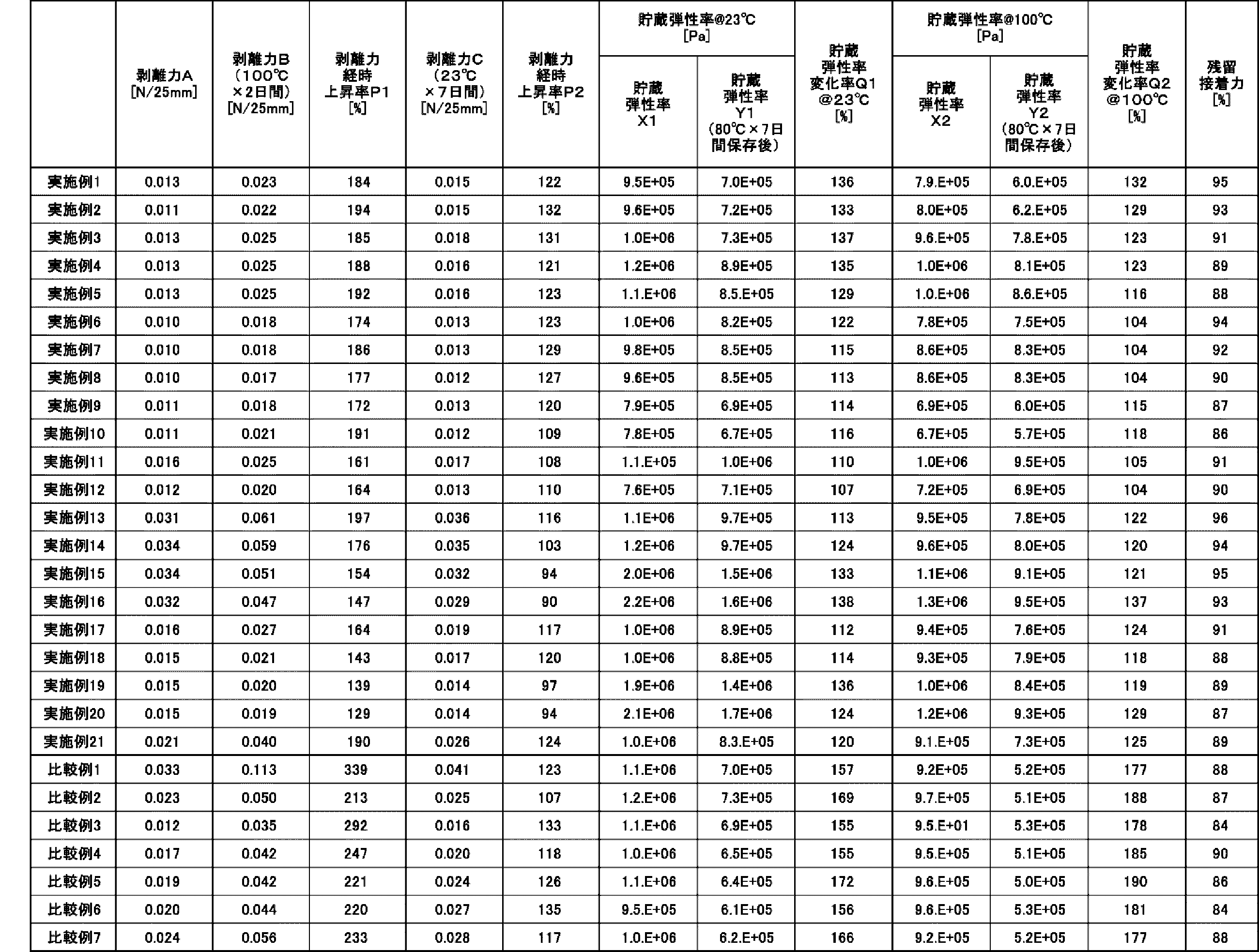
実施例1~21で得られた表面保護フィルム(1)~(21)のそれぞれについて、セパレーターを剥離し、粘着剤層側を、光学部材である偏光板(日東電工株式会社製、商品名「TEG1465DUHC」)に貼着し、表面保護フィルムが貼着された光学部材を得た。
実施例1~21で得られた表面保護フィルム(1)~(21)のそれぞれについて、セパレーターを剥離し、粘着剤層側を、電子部材である導電性フィルム(日東電工株式会社製、商品名「エレクリスタV270L-TFMP」)に貼着し、表面保護フィルムが貼着された電子部材を得た。
2 粘着剤層
10 表面保護フィルム
Claims (11)
- 粘着剤層を有する表面保護フィルムであって、
該表面保護フィルムの該粘着剤層をガラス板に貼り合わせて温度23℃で30分間放置した後に、温度23℃で該表面保護フィルムを該ガラス板から剥離角度180度、剥離速度300mm/分で剥がした際の剥離力を剥離力Aとしたときに、剥離力Aが0.005N/25mm~0.50N/25mmであり、
該表面保護フィルムの該粘着剤層をガラス板に貼り合わせて温度100℃で2日間放置した後に、温度23℃で該表面保護フィルムを該ガラス板から剥離角度180度、剥離速度300mm/分で剥がした際の剥離力を剥離力Bとしたときに、(剥離力B/剥離力A)×100で算出される剥離力経時上昇率P1が200%以下である、
表面保護フィルム。 - 前記粘着剤層の23℃における貯蔵弾性率を貯蔵弾性率X1とし、前記表面保護フィルムを温度80℃で7日間放置した後の温度23℃における貯蔵弾性率を貯蔵弾性率Y1としたときに、(貯蔵弾性率Y1/貯蔵弾性率X1)×100で算出される貯蔵弾性率変化率Q1が150%以下である、請求項1に記載の表面保護フィルム。
- 前記表面保護フィルムの前記粘着剤層をガラス板に貼り合わせて温度23℃で7日間放置した後に、温度23℃で該表面保護フィルムを該ガラス板から剥離角度180度、剥離速度300mm/分で剥がした際の剥離力を剥離力Cとしたときに、(剥離力C/剥離力A)×100で算出される剥離力経時上昇率P2が160%以下である、請求項1または2に記載の表面保護フィルム。
- 23℃におけるガラス板に対する残留接着率が50%以上である、請求項1から3までのいずれかに記載の表面保護フィルム。
- 前記粘着剤層を構成する粘着剤が粘着剤組成物から形成され、該粘着剤組成物が耐熱安定剤を含む、請求項1から4までのいずれかに記載の表面保護フィルム。
- 前記粘着剤組成物が、ベースポリマーと、低分子量ポリオールと、シリコーン系添加剤および/またはフッ素系添加剤とを含む、請求項5に記載の表面保護フィルム。
- 前記シリコーン系添加剤が、シロキサン結合含有化合物、水酸基含有シリコーン系化合物、架橋性官能基含有シリコーン系化合物から選ばれる少なくとも1種である、請求項6に記載の表面保護フィルム。
- 前記フッ素系添加剤が、フッ素含有化合物、水酸基含有フッ素系化合物、架橋性官能基含有フッ素系化合物から選ばれる少なくとも1種である、請求項6に記載の表面保護フィルム。
- 前記ベースポリマーが、ウレタンプレポリマー、ポリオール、アクリル系樹脂、ゴム系樹脂、シリコーン系樹脂から選ばれる少なくとも1種である、請求項6から8までのいずれかに記載の表面保護フィルム。
- 請求項1から9までのいずれかに記載の表面保護フィルムが貼着された光学部材。
- 請求項1から9までのいずれかに記載の表面保護フィルムが貼着された電子部材。
Priority Applications (3)
| Application Number | Priority Date | Filing Date | Title |
|---|---|---|---|
| KR1020217021908A KR102726741B1 (ko) | 2019-01-18 | 2019-12-24 | 표면 보호 필름 |
| CN201980089283.2A CN113302049A (zh) | 2019-01-18 | 2019-12-24 | 表面保护薄膜 |
| JP2020566175A JP7538046B2 (ja) | 2019-01-18 | 2019-12-24 | 表面保護フィルム |
Applications Claiming Priority (2)
| Application Number | Priority Date | Filing Date | Title |
|---|---|---|---|
| JP2019007162 | 2019-01-18 | ||
| JP2019-007162 | 2019-01-18 |
Publications (1)
| Publication Number | Publication Date |
|---|---|
| WO2020149117A1 true WO2020149117A1 (ja) | 2020-07-23 |
Family
ID=71613296
Family Applications (1)
| Application Number | Title | Priority Date | Filing Date |
|---|---|---|---|
| PCT/JP2019/050630 Ceased WO2020149117A1 (ja) | 2019-01-18 | 2019-12-24 | 表面保護フィルム |
Country Status (5)
| Country | Link |
|---|---|
| JP (1) | JP7538046B2 (ja) |
| KR (1) | KR102726741B1 (ja) |
| CN (1) | CN113302049A (ja) |
| TW (1) | TWI835970B (ja) |
| WO (1) | WO2020149117A1 (ja) |
Cited By (1)
| Publication number | Priority date | Publication date | Assignee | Title |
|---|---|---|---|---|
| JP2023167112A (ja) * | 2022-05-11 | 2023-11-24 | 日東電工株式会社 | 表面保護フィルム |
Citations (8)
| Publication number | Priority date | Publication date | Assignee | Title |
|---|---|---|---|---|
| JP2014111701A (ja) * | 2012-08-31 | 2014-06-19 | Nitto Denko Corp | ウレタン系粘着剤およびそれを用いた表面保護フィルム |
| JP2014162821A (ja) * | 2013-02-22 | 2014-09-08 | Nitto Denko Corp | 表面保護フィルム |
| JP2015131886A (ja) * | 2014-01-10 | 2015-07-23 | 日東電工株式会社 | ウレタン系粘着剤およびそれを用いた表面保護フィルム |
| JP2016176068A (ja) * | 2015-03-20 | 2016-10-06 | 東洋インキScホールディングス株式会社 | 粘着剤および粘着テープ |
| JP2017160422A (ja) * | 2016-03-04 | 2017-09-14 | 日東電工株式会社 | 表面保護フィルム |
| JP2018062595A (ja) * | 2016-10-14 | 2018-04-19 | 東洋インキScホールディングス株式会社 | 粘着剤および粘着シート |
| WO2019208148A1 (ja) * | 2018-04-25 | 2019-10-31 | 日東電工株式会社 | 表面保護フィルム |
| JP2019218472A (ja) * | 2018-06-20 | 2019-12-26 | 日東電工株式会社 | 表面保護フィルム |
Family Cites Families (6)
| Publication number | Priority date | Publication date | Assignee | Title |
|---|---|---|---|---|
| JP2015098503A (ja) * | 2013-11-18 | 2015-05-28 | 日東電工株式会社 | ウレタン系粘着剤およびそれを用いた表面保護フィルム |
| JP6613516B2 (ja) | 2014-07-07 | 2019-12-04 | リンテック株式会社 | 表面保護フィルム |
| KR102641791B1 (ko) * | 2015-08-24 | 2024-03-04 | 닛토덴코 가부시키가이샤 | 표면 보호 필름을 갖는 광학 부재 |
| TWM546399U (zh) * | 2016-03-02 | 2017-08-01 | 利昌電氣工業有限公司 | 加熱可降低黏著力的黏著膠帶 |
| JP7252697B2 (ja) * | 2017-03-22 | 2023-04-05 | 日東電工株式会社 | 表面保護フィルム |
| JP6570684B2 (ja) | 2018-03-14 | 2019-09-04 | 日東電工株式会社 | ウレタン系粘着剤の製造方法 |
-
2019
- 2019-12-24 WO PCT/JP2019/050630 patent/WO2020149117A1/ja not_active Ceased
- 2019-12-24 JP JP2020566175A patent/JP7538046B2/ja active Active
- 2019-12-24 CN CN201980089283.2A patent/CN113302049A/zh active Pending
- 2019-12-24 KR KR1020217021908A patent/KR102726741B1/ko active Active
-
2020
- 2020-01-09 TW TW109100723A patent/TWI835970B/zh active
Patent Citations (8)
| Publication number | Priority date | Publication date | Assignee | Title |
|---|---|---|---|---|
| JP2014111701A (ja) * | 2012-08-31 | 2014-06-19 | Nitto Denko Corp | ウレタン系粘着剤およびそれを用いた表面保護フィルム |
| JP2014162821A (ja) * | 2013-02-22 | 2014-09-08 | Nitto Denko Corp | 表面保護フィルム |
| JP2015131886A (ja) * | 2014-01-10 | 2015-07-23 | 日東電工株式会社 | ウレタン系粘着剤およびそれを用いた表面保護フィルム |
| JP2016176068A (ja) * | 2015-03-20 | 2016-10-06 | 東洋インキScホールディングス株式会社 | 粘着剤および粘着テープ |
| JP2017160422A (ja) * | 2016-03-04 | 2017-09-14 | 日東電工株式会社 | 表面保護フィルム |
| JP2018062595A (ja) * | 2016-10-14 | 2018-04-19 | 東洋インキScホールディングス株式会社 | 粘着剤および粘着シート |
| WO2019208148A1 (ja) * | 2018-04-25 | 2019-10-31 | 日東電工株式会社 | 表面保護フィルム |
| JP2019218472A (ja) * | 2018-06-20 | 2019-12-26 | 日東電工株式会社 | 表面保護フィルム |
Cited By (1)
| Publication number | Priority date | Publication date | Assignee | Title |
|---|---|---|---|---|
| JP2023167112A (ja) * | 2022-05-11 | 2023-11-24 | 日東電工株式会社 | 表面保護フィルム |
Also Published As
| Publication number | Publication date |
|---|---|
| TW202035609A (zh) | 2020-10-01 |
| JPWO2020149117A1 (ja) | 2021-12-02 |
| TWI835970B (zh) | 2024-03-21 |
| JP7538046B2 (ja) | 2024-08-21 |
| KR102726741B1 (ko) | 2024-11-07 |
| KR20210116471A (ko) | 2021-09-27 |
| CN113302049A (zh) | 2021-08-24 |
Similar Documents
| Publication | Publication Date | Title |
|---|---|---|
| KR102539986B1 (ko) | 표면 보호 필름 | |
| JP6648168B2 (ja) | 表面保護フィルム | |
| KR102475546B1 (ko) | 표면 보호 필름 | |
| CN116685468A (zh) | 表面保护薄膜 | |
| JP6247936B2 (ja) | ウレタン系粘着剤およびそれを用いた表面保護フィルム | |
| WO2017150290A1 (ja) | 表面保護フィルム | |
| CN116670242A (zh) | 表面保护薄膜 | |
| WO2020149117A1 (ja) | 表面保護フィルム | |
| KR102711753B1 (ko) | 점착제 조성물, 점착제층, 및 보호 필름 | |
| CN116635228A (zh) | 表面保护薄膜 | |
| WO2022138114A1 (ja) | 表面保護フィルム |
Legal Events
| Date | Code | Title | Description |
|---|---|---|---|
| 121 | Ep: the epo has been informed by wipo that ep was designated in this application |
Ref document number: 19909741 Country of ref document: EP Kind code of ref document: A1 |
|
| ENP | Entry into the national phase |
Ref document number: 2020566175 Country of ref document: JP Kind code of ref document: A |
|
| ENP | Entry into the national phase |
Ref document number: 20217021908 Country of ref document: KR Kind code of ref document: A |
|
| NENP | Non-entry into the national phase |
Ref country code: DE |
|
| 122 | Ep: pct application non-entry in european phase |
Ref document number: 19909741 Country of ref document: EP Kind code of ref document: A1 |