WO2020148968A1 - 分解洗浄組成物、接着性ポリマーの洗浄方法、及びデバイスウェハの製造方法 - Google Patents
分解洗浄組成物、接着性ポリマーの洗浄方法、及びデバイスウェハの製造方法 Download PDFInfo
- Publication number
- WO2020148968A1 WO2020148968A1 PCT/JP2019/042936 JP2019042936W WO2020148968A1 WO 2020148968 A1 WO2020148968 A1 WO 2020148968A1 JP 2019042936 W JP2019042936 W JP 2019042936W WO 2020148968 A1 WO2020148968 A1 WO 2020148968A1
- Authority
- WO
- WIPO (PCT)
- Prior art keywords
- cleaning composition
- group
- compound
- mass
- decomposition
- Prior art date
- Legal status (The legal status is an assumption and is not a legal conclusion. Google has not performed a legal analysis and makes no representation as to the accuracy of the status listed.)
- Ceased
Links
- 0 *N(CCC1)C1=O Chemical compound *N(CCC1)C1=O 0.000 description 1
Classifications
-
- C—CHEMISTRY; METALLURGY
- C11—ANIMAL OR VEGETABLE OILS, FATS, FATTY SUBSTANCES OR WAXES; FATTY ACIDS THEREFROM; DETERGENTS; CANDLES
- C11D—DETERGENT COMPOSITIONS; USE OF SINGLE SUBSTANCES AS DETERGENTS; SOAP OR SOAP-MAKING; RESIN SOAPS; RECOVERY OF GLYCEROL
- C11D7/00—Compositions of detergents based essentially on non-surface-active compounds
- C11D7/50—Solvents
- C11D7/5004—Organic solvents
- C11D7/5013—Organic solvents containing nitrogen
-
- C—CHEMISTRY; METALLURGY
- C11—ANIMAL OR VEGETABLE OILS, FATS, FATTY SUBSTANCES OR WAXES; FATTY ACIDS THEREFROM; DETERGENTS; CANDLES
- C11D—DETERGENT COMPOSITIONS; USE OF SINGLE SUBSTANCES AS DETERGENTS; SOAP OR SOAP-MAKING; RESIN SOAPS; RECOVERY OF GLYCEROL
- C11D3/00—Other compounding ingredients of detergent compositions covered in group C11D1/00
- C11D3/43—Solvents
-
- H—ELECTRICITY
- H10—SEMICONDUCTOR DEVICES; ELECTRIC SOLID-STATE DEVICES NOT OTHERWISE PROVIDED FOR
- H10P—GENERIC PROCESSES OR APPARATUS FOR THE MANUFACTURE OR TREATMENT OF DEVICES COVERED BY CLASS H10
- H10P50/00—Etching of wafers, substrates or parts of devices
- H10P50/20—Dry etching; Plasma etching; Reactive-ion etching
- H10P50/28—Dry etching; Plasma etching; Reactive-ion etching of insulating materials
- H10P50/282—Dry etching; Plasma etching; Reactive-ion etching of insulating materials of inorganic materials
- H10P50/283—Dry etching; Plasma etching; Reactive-ion etching of insulating materials of inorganic materials by chemical means
-
- B—PERFORMING OPERATIONS; TRANSPORTING
- B08—CLEANING
- B08B—CLEANING IN GENERAL; PREVENTION OF FOULING IN GENERAL
- B08B3/00—Cleaning by methods involving the use or presence of liquid or steam
- B08B3/04—Cleaning involving contact with liquid
- B08B3/08—Cleaning involving contact with liquid the liquid having chemical or dissolving effect
-
- C—CHEMISTRY; METALLURGY
- C11—ANIMAL OR VEGETABLE OILS, FATS, FATTY SUBSTANCES OR WAXES; FATTY ACIDS THEREFROM; DETERGENTS; CANDLES
- C11D—DETERGENT COMPOSITIONS; USE OF SINGLE SUBSTANCES AS DETERGENTS; SOAP OR SOAP-MAKING; RESIN SOAPS; RECOVERY OF GLYCEROL
- C11D3/00—Other compounding ingredients of detergent compositions covered in group C11D1/00
- C11D3/16—Organic compounds
- C11D3/24—Organic compounds containing halogen
- C11D3/245—Organic compounds containing halogen containing fluorine
-
- C—CHEMISTRY; METALLURGY
- C11—ANIMAL OR VEGETABLE OILS, FATS, FATTY SUBSTANCES OR WAXES; FATTY ACIDS THEREFROM; DETERGENTS; CANDLES
- C11D—DETERGENT COMPOSITIONS; USE OF SINGLE SUBSTANCES AS DETERGENTS; SOAP OR SOAP-MAKING; RESIN SOAPS; RECOVERY OF GLYCEROL
- C11D3/00—Other compounding ingredients of detergent compositions covered in group C11D1/00
- C11D3/16—Organic compounds
- C11D3/26—Organic compounds containing nitrogen
- C11D3/28—Heterocyclic compounds containing nitrogen in the ring
-
- C—CHEMISTRY; METALLURGY
- C11—ANIMAL OR VEGETABLE OILS, FATS, FATTY SUBSTANCES OR WAXES; FATTY ACIDS THEREFROM; DETERGENTS; CANDLES
- C11D—DETERGENT COMPOSITIONS; USE OF SINGLE SUBSTANCES AS DETERGENTS; SOAP OR SOAP-MAKING; RESIN SOAPS; RECOVERY OF GLYCEROL
- C11D3/00—Other compounding ingredients of detergent compositions covered in group C11D1/00
- C11D3/16—Organic compounds
- C11D3/26—Organic compounds containing nitrogen
- C11D3/30—Amines; Substituted amines ; Quaternized amines
-
- C—CHEMISTRY; METALLURGY
- C11—ANIMAL OR VEGETABLE OILS, FATS, FATTY SUBSTANCES OR WAXES; FATTY ACIDS THEREFROM; DETERGENTS; CANDLES
- C11D—DETERGENT COMPOSITIONS; USE OF SINGLE SUBSTANCES AS DETERGENTS; SOAP OR SOAP-MAKING; RESIN SOAPS; RECOVERY OF GLYCEROL
- C11D3/00—Other compounding ingredients of detergent compositions covered in group C11D1/00
- C11D3/16—Organic compounds
- C11D3/26—Organic compounds containing nitrogen
- C11D3/32—Amides; Substituted amides
-
- C—CHEMISTRY; METALLURGY
- C11—ANIMAL OR VEGETABLE OILS, FATS, FATTY SUBSTANCES OR WAXES; FATTY ACIDS THEREFROM; DETERGENTS; CANDLES
- C11D—DETERGENT COMPOSITIONS; USE OF SINGLE SUBSTANCES AS DETERGENTS; SOAP OR SOAP-MAKING; RESIN SOAPS; RECOVERY OF GLYCEROL
- C11D3/00—Other compounding ingredients of detergent compositions covered in group C11D1/00
- C11D3/16—Organic compounds
- C11D3/34—Organic compounds containing sulfur
- C11D3/3427—Organic compounds containing sulfur containing thiol, mercapto or sulfide groups, e.g. thioethers or mercaptales
-
- C—CHEMISTRY; METALLURGY
- C11—ANIMAL OR VEGETABLE OILS, FATS, FATTY SUBSTANCES OR WAXES; FATTY ACIDS THEREFROM; DETERGENTS; CANDLES
- C11D—DETERGENT COMPOSITIONS; USE OF SINGLE SUBSTANCES AS DETERGENTS; SOAP OR SOAP-MAKING; RESIN SOAPS; RECOVERY OF GLYCEROL
- C11D3/00—Other compounding ingredients of detergent compositions covered in group C11D1/00
- C11D3/16—Organic compounds
- C11D3/34—Organic compounds containing sulfur
- C11D3/3445—Organic compounds containing sulfur containing sulfino groups, e.g. dimethyl sulfoxide
-
- C—CHEMISTRY; METALLURGY
- C11—ANIMAL OR VEGETABLE OILS, FATS, FATTY SUBSTANCES OR WAXES; FATTY ACIDS THEREFROM; DETERGENTS; CANDLES
- C11D—DETERGENT COMPOSITIONS; USE OF SINGLE SUBSTANCES AS DETERGENTS; SOAP OR SOAP-MAKING; RESIN SOAPS; RECOVERY OF GLYCEROL
- C11D3/00—Other compounding ingredients of detergent compositions covered in group C11D1/00
- C11D3/16—Organic compounds
- C11D3/34—Organic compounds containing sulfur
- C11D3/3454—Organic compounds containing sulfur containing sulfone groups, e.g. vinyl sulfones
-
- C—CHEMISTRY; METALLURGY
- C11—ANIMAL OR VEGETABLE OILS, FATS, FATTY SUBSTANCES OR WAXES; FATTY ACIDS THEREFROM; DETERGENTS; CANDLES
- C11D—DETERGENT COMPOSITIONS; USE OF SINGLE SUBSTANCES AS DETERGENTS; SOAP OR SOAP-MAKING; RESIN SOAPS; RECOVERY OF GLYCEROL
- C11D3/00—Other compounding ingredients of detergent compositions covered in group C11D1/00
- C11D3/16—Organic compounds
- C11D3/34—Organic compounds containing sulfur
- C11D3/3481—Organic compounds containing sulfur containing sulfur in a heterocyclic ring, e.g. sultones or sulfolanes
-
- C—CHEMISTRY; METALLURGY
- C11—ANIMAL OR VEGETABLE OILS, FATS, FATTY SUBSTANCES OR WAXES; FATTY ACIDS THEREFROM; DETERGENTS; CANDLES
- C11D—DETERGENT COMPOSITIONS; USE OF SINGLE SUBSTANCES AS DETERGENTS; SOAP OR SOAP-MAKING; RESIN SOAPS; RECOVERY OF GLYCEROL
- C11D7/00—Compositions of detergents based essentially on non-surface-active compounds
- C11D7/22—Organic compounds
- C11D7/28—Organic compounds containing halogen
-
- C—CHEMISTRY; METALLURGY
- C11—ANIMAL OR VEGETABLE OILS, FATS, FATTY SUBSTANCES OR WAXES; FATTY ACIDS THEREFROM; DETERGENTS; CANDLES
- C11D—DETERGENT COMPOSITIONS; USE OF SINGLE SUBSTANCES AS DETERGENTS; SOAP OR SOAP-MAKING; RESIN SOAPS; RECOVERY OF GLYCEROL
- C11D7/00—Compositions of detergents based essentially on non-surface-active compounds
- C11D7/22—Organic compounds
- C11D7/32—Organic compounds containing nitrogen
- C11D7/3209—Amines or imines with one to four nitrogen atoms; Quaternized amines
-
- C—CHEMISTRY; METALLURGY
- C11—ANIMAL OR VEGETABLE OILS, FATS, FATTY SUBSTANCES OR WAXES; FATTY ACIDS THEREFROM; DETERGENTS; CANDLES
- C11D—DETERGENT COMPOSITIONS; USE OF SINGLE SUBSTANCES AS DETERGENTS; SOAP OR SOAP-MAKING; RESIN SOAPS; RECOVERY OF GLYCEROL
- C11D7/00—Compositions of detergents based essentially on non-surface-active compounds
- C11D7/22—Organic compounds
- C11D7/32—Organic compounds containing nitrogen
- C11D7/3263—Amides or imides
-
- C—CHEMISTRY; METALLURGY
- C11—ANIMAL OR VEGETABLE OILS, FATS, FATTY SUBSTANCES OR WAXES; FATTY ACIDS THEREFROM; DETERGENTS; CANDLES
- C11D—DETERGENT COMPOSITIONS; USE OF SINGLE SUBSTANCES AS DETERGENTS; SOAP OR SOAP-MAKING; RESIN SOAPS; RECOVERY OF GLYCEROL
- C11D7/00—Compositions of detergents based essentially on non-surface-active compounds
- C11D7/50—Solvents
-
- C—CHEMISTRY; METALLURGY
- C11—ANIMAL OR VEGETABLE OILS, FATS, FATTY SUBSTANCES OR WAXES; FATTY ACIDS THEREFROM; DETERGENTS; CANDLES
- C11D—DETERGENT COMPOSITIONS; USE OF SINGLE SUBSTANCES AS DETERGENTS; SOAP OR SOAP-MAKING; RESIN SOAPS; RECOVERY OF GLYCEROL
- C11D7/00—Compositions of detergents based essentially on non-surface-active compounds
- C11D7/50—Solvents
- C11D7/5004—Organic solvents
- C11D7/5009—Organic solvents containing phosphorus, sulfur or silicon, e.g. dimethylsulfoxide
-
- H—ELECTRICITY
- H10—SEMICONDUCTOR DEVICES; ELECTRIC SOLID-STATE DEVICES NOT OTHERWISE PROVIDED FOR
- H10P—GENERIC PROCESSES OR APPARATUS FOR THE MANUFACTURE OR TREATMENT OF DEVICES COVERED BY CLASS H10
- H10P70/00—Cleaning of wafers, substrates or parts of devices
- H10P70/20—Cleaning during device manufacture
-
- H—ELECTRICITY
- H10—SEMICONDUCTOR DEVICES; ELECTRIC SOLID-STATE DEVICES NOT OTHERWISE PROVIDED FOR
- H10P—GENERIC PROCESSES OR APPARATUS FOR THE MANUFACTURE OR TREATMENT OF DEVICES COVERED BY CLASS H10
- H10P70/00—Cleaning of wafers, substrates or parts of devices
- H10P70/40—Cleaning for reclaiming
-
- H—ELECTRICITY
- H10—SEMICONDUCTOR DEVICES; ELECTRIC SOLID-STATE DEVICES NOT OTHERWISE PROVIDED FOR
- H10P—GENERIC PROCESSES OR APPARATUS FOR THE MANUFACTURE OR TREATMENT OF DEVICES COVERED BY CLASS H10
- H10P72/00—Handling or holding of wafers, substrates or devices during manufacture or treatment thereof
- H10P72/70—Handling or holding of wafers, substrates or devices during manufacture or treatment thereof for supporting or gripping
- H10P72/74—Handling or holding of wafers, substrates or devices during manufacture or treatment thereof for supporting or gripping using temporarily an auxiliary support
-
- H—ELECTRICITY
- H10—SEMICONDUCTOR DEVICES; ELECTRIC SOLID-STATE DEVICES NOT OTHERWISE PROVIDED FOR
- H10P—GENERIC PROCESSES OR APPARATUS FOR THE MANUFACTURE OR TREATMENT OF DEVICES COVERED BY CLASS H10
- H10P72/00—Handling or holding of wafers, substrates or devices during manufacture or treatment thereof
- H10P72/70—Handling or holding of wafers, substrates or devices during manufacture or treatment thereof for supporting or gripping
- H10P72/74—Handling or holding of wafers, substrates or devices during manufacture or treatment thereof for supporting or gripping using temporarily an auxiliary support
- H10P72/7416—Handling or holding of wafers, substrates or devices during manufacture or treatment thereof for supporting or gripping using temporarily an auxiliary support used during dicing or grinding
-
- H—ELECTRICITY
- H10—SEMICONDUCTOR DEVICES; ELECTRIC SOLID-STATE DEVICES NOT OTHERWISE PROVIDED FOR
- H10P—GENERIC PROCESSES OR APPARATUS FOR THE MANUFACTURE OR TREATMENT OF DEVICES COVERED BY CLASS H10
- H10P72/00—Handling or holding of wafers, substrates or devices during manufacture or treatment thereof
- H10P72/70—Handling or holding of wafers, substrates or devices during manufacture or treatment thereof for supporting or gripping
- H10P72/74—Handling or holding of wafers, substrates or devices during manufacture or treatment thereof for supporting or gripping using temporarily an auxiliary support
- H10P72/744—Details of chemical or physical process used for separating the auxiliary support from a device or a wafer
-
- B—PERFORMING OPERATIONS; TRANSPORTING
- B08—CLEANING
- B08B—CLEANING IN GENERAL; PREVENTION OF FOULING IN GENERAL
- B08B2220/00—Type of materials or objects being removed
- B08B2220/01—Adhesive materials
-
- B—PERFORMING OPERATIONS; TRANSPORTING
- B08—CLEANING
- B08B—CLEANING IN GENERAL; PREVENTION OF FOULING IN GENERAL
- B08B2220/00—Type of materials or objects being removed
- B08B2220/04—Polymers
-
- C—CHEMISTRY; METALLURGY
- C11—ANIMAL OR VEGETABLE OILS, FATS, FATTY SUBSTANCES OR WAXES; FATTY ACIDS THEREFROM; DETERGENTS; CANDLES
- C11D—DETERGENT COMPOSITIONS; USE OF SINGLE SUBSTANCES AS DETERGENTS; SOAP OR SOAP-MAKING; RESIN SOAPS; RECOVERY OF GLYCEROL
- C11D2111/00—Cleaning compositions characterised by the objects to be cleaned; Cleaning compositions characterised by non-standard cleaning or washing processes
- C11D2111/10—Objects to be cleaned
- C11D2111/14—Hard surfaces
- C11D2111/22—Electronic devices, e.g. PCBs or semiconductors
-
- C—CHEMISTRY; METALLURGY
- C11—ANIMAL OR VEGETABLE OILS, FATS, FATTY SUBSTANCES OR WAXES; FATTY ACIDS THEREFROM; DETERGENTS; CANDLES
- C11D—DETERGENT COMPOSITIONS; USE OF SINGLE SUBSTANCES AS DETERGENTS; SOAP OR SOAP-MAKING; RESIN SOAPS; RECOVERY OF GLYCEROL
- C11D7/00—Compositions of detergents based essentially on non-surface-active compounds
- C11D7/22—Organic compounds
- C11D7/32—Organic compounds containing nitrogen
- C11D7/3281—Heterocyclic compounds
-
- C—CHEMISTRY; METALLURGY
- C11—ANIMAL OR VEGETABLE OILS, FATS, FATTY SUBSTANCES OR WAXES; FATTY ACIDS THEREFROM; DETERGENTS; CANDLES
- C11D—DETERGENT COMPOSITIONS; USE OF SINGLE SUBSTANCES AS DETERGENTS; SOAP OR SOAP-MAKING; RESIN SOAPS; RECOVERY OF GLYCEROL
- C11D7/00—Compositions of detergents based essentially on non-surface-active compounds
- C11D7/22—Organic compounds
- C11D7/34—Organic compounds containing sulfur
Definitions
- the present disclosure relates to a decomposition cleaning composition, an adhesive polymer cleaning method, and a device wafer manufacturing method.
- the present disclosure is for disintegrating and cleaning an adhesive that remains on a device wafer and that includes an adhesive polymer used for temporary adhesion between a device wafer and a support wafer (carrier wafer) in a thinning process of a semiconductor wafer.
- the present invention relates to a decomposition cleaning composition used in, a method for cleaning an adhesive polymer using the decomposition cleaning composition, and a method for manufacturing a device wafer.
- the thickness of each semiconductor wafer is reduced, and a plurality of semiconductor wafers connected by silicon through electrodes (TSV) are stacked. Specifically, after thinning the surface (rear surface) of the device wafer on which the semiconductor device is not formed by polishing, an electrode including TSV is formed on the rear surface.
- a support wafer also called a carrier wafer
- a carrier wafer is temporarily bonded to the semiconductor device formation surface of the device wafer using an adhesive in order to give mechanical strength to the device wafer.
- a glass wafer or a silicon wafer is used, for example, as a support wafer.
- a metal wiring or electrode pad containing Al, Cu, Ni, Au, or the like, an inorganic film such as an oxide film or a nitride film, or a resin containing polyimide or the like is provided on the polished surface (back surface) of the device wafer, if necessary. A layer is formed.
- the device wafer is fixed to the tape by bonding the back surface of the device wafer to the tape having the acrylic adhesive layer, which is fixed by the ring frame. After that, the device wafer is separated from the support wafer (debonding), the adhesive on the device wafer is peeled off, and the residue of the adhesive on the device wafer is washed away with a cleaning agent.
- Adhesives containing a polyorganosiloxane compound with good heat resistance as an adhesive polymer are used for temporary adhesion of device wafers.
- the cleaning agent is required to have two functions of breaking the Si—O bond and dissolving the decomposition product by the solvent.
- examples of such a detergent include those obtained by dissolving a fluorine-based compound such as tetrabutylammonium fluoride (TBAF) in a polar aprotic solvent. Since the fluoride ion of TBAF is involved in the cleavage of the Si—O bond through the formation of the Si—F bond, the cleaning agent can be provided with the etching performance. Since the polar aprotic solvent can dissolve TBAF and does not form a solvation via a hydrogen bond with the fluoride ion, the reactivity of the fluoride ion can be increased.
- Non-Patent Document 1 Advanced Materials, 11, 6, 492 (1999)
- a 1.0M TBAF solution using aprotic THF as a solvent is used for decomposition and dissolution removal of polydimethylsiloxane (PDMS).
- PDMS polydimethylsiloxane
- Non-Patent Document 2 (Advanced Materials, 13, 8, 570 (2001)), NMP, DMF, or DMSO, which is an aprotic solvent, is used as a solvent for TBAF, similar to THF.
- Non-Patent Document 3 (Macromolecular Chemistry and Physics, 217, 284-291 (2016)) describes the results of investigating the etching rate of PDMS with TBAF/organic solvent for each solvent, and THF and Regarding DMF, a comparison of etching rates of TBAF solutions using mixed solvents having different THF/DMF ratios is also described.
- Patent Document 1 Korean Patent Publication No. 10-2016-8708709
- Patent Document 2 US Patent Publication No. 2017/0158888
- TBAF was dissolved in a solvent of a nitrogen-containing heterocyclic compound. The cleaning liquid is described.
- an adhesive tape in which an acrylic adhesive layer is formed on a polyester base material is used.
- an inorganic film such as an oxide film or a nitride film, or a resin containing polyimide or the like. Layers may be present and corrosion or deterioration of these materials may occur when the ingredients contained in the cleaning agent come into contact with these metals, inorganic materials or organic materials.
- the organic solvent component of the cleaning agent may dissolve or swell the acrylic adhesive layer, or wrinkles may occur in the acrylic adhesive layer.
- the device wafer is peeled off from the fixing tape in such a state, a part of the acrylic adhesive layer may remain on the device wafer, so-called adhesive residue or contamination may occur.
- Patent Document 3 International Publication No. WO 2014/061774.
- a solvent-resistant base protective film is used as a base film.
- Patent Document 4 JP-A-2015-730566
- the mass ratio of methyl (meth)acrylate, the mass ratio of the cross-linking agent, and the gel fraction are set within a predetermined range with respect to the total mass of the acrylic copolymer. By doing so, the solvent resistance to the low polar organic solvent limonene is improved.
- Patent Document 5 Japanese Patent Laid-Open No. 2009-224621 describes that a pressure-sensitive adhesive layer formed from an energy ray-curable acrylic resin composition and having a gel fraction within a predetermined range has excellent solvent resistance.
- Japanese Patent Application Laid-Open No. 2013-239595 discloses that in a dicing tape, a region where a semiconductor wafer or a ring frame is not adhered is cured by irradiation with ultraviolet rays so that an adhesive in a region in contact with an organic solvent is adhered. A method of modifying the layer to improve the solvent resistance of the dicing tape is described.
- the role of the solvent in the cleaning agent containing a fluorine compound such as TBAF and a solvent is that the fluorine compound having a high polarity, which is a reactive substance, is sufficiently dissolved, and the affinity with the surface of the adhesive having a low polarity is sufficient. It is considered that the decomposition products of the adhesive are dissolved while ensuring the reactivity of the fluoride ions contained in the fluorine compound.
- Substituents may be introduced into the adhesive polymer contained in the adhesive for the purpose of improving heat resistance, releasability, etc., whereby the surface of the adhesive may exhibit various polarities. It is desirable that the cleaning agent exhibit a good affinity for the surface of such various polar adhesives, thereby achieving a high etch rate.
- the cleaning agent does not enter between the adhesive layer of the fixing tape to which the device wafer is attached and the device wafer.
- To impart solvent resistance to the fixing tape by imparting solvent resistance to the organic solvent component of the cleaning agent or modifying the adhesive layer by irradiating only a predetermined area of the fixing tape with UV. Is not desirable because it requires changes in the material of the fixing tape or the manufacturing process. Rather, it is sought to improve the composition and properties of the cleaning agent so that the acrylic adhesive layer does not dissolve or swell, or penetrate into the acrylic adhesive layer, without requiring modification of the fixing tape material or manufacturing process. ing.
- the present disclosure provides a decomposing/cleaning composition of an adhesive polymer, which has a high etching rate and in which the infiltration into a contact interface between a substrate such as a device wafer and an adhesive layer such as a fixing tape is suppressed.
- the present inventors have used a decomposing cleaning composition of an adhesive polymer containing a quaternary alkylammonium fluoride or a hydrate thereof, by using a combination of a plurality of specific aprotic solvents, thereby decomposing the cleaning composition. It has been found that the infiltration of the decomposition cleaning composition into the contact interface between the substrate and the adhesive layer can be suppressed while ensuring the etching rate of the product.
- the present invention includes the following [1] to [16].
- [1] A quaternary alkylammonium fluoride or hydrate of a quaternary alkylammonium fluoride, and an aprotic solvent, which is a decomposition cleaning composition for an adhesive polymer, wherein the aprotic solvent is: Decomposition cleaning composition containing (A) an N-substituted amide compound having no active hydrogen on a nitrogen atom, and (B) at least one organic sulfur oxide selected from the group consisting of sulfoxide compounds and sulfone compounds ..
- the (A) N-substituted amide compound has the formula (1): (In the formula (1), R 1 represents an alkyl group having 1 to 4 carbon atoms.)
- the sulfoxide compound is a cyclic sulfoxide compound having 4 to 6 carbon atoms, or a compound of formula (2): R 2 (SO)R 3 (2) (In the formula (2), R 2 and R 3 are each independently a methyl group, an ethyl group, an n-propyl group, an isopropyl group, an n-butyl group, an isobutyl group, a sec-butyl group, and a t-butyl group.
- the sulfone compound is a cyclic sulfone compound having 4 to 6 carbon atoms, or a compound represented by the formula (3): R 4 (SO 2 ) R 5 (3) (In the formula (3), R 4 and R 5 each independently represent a group selected from the group consisting of an alkyl group having 1 to 8 carbon atoms, a phenyl group, and a benzyl group.)
- the decomposition cleaning composition according to [6] wherein the sulfone compound is sulfolane or 3-methylsulfolane.
- the content of the (A) N-substituted amide compound is 10 to 99.9 mass %, and the content of the (B) organic sulfur oxide is 0.1 to 100 mass% of the aprotic solvent.
- the content of the (A) N-substituted amide compound is 70 to 98 mass% and the content of the (B) organic sulfur oxide is 2 to 30 mass% with respect to 100 mass% of the aprotic solvent.
- the quaternary alkylammonium fluoride is a tetraalkylammonium fluoride represented by R 6 R 7 R 8 R 9 N + F ⁇ , wherein R 6 to R 9 are each independently a methyl group, an ethyl group,
- the decomposition cleaning composition of the present disclosure has a high affinity with an adhesive polymer and therefore has a high etching rate, and decomposes and cleans a contact interface between a substrate such as a device wafer and an adhesive layer such as a fixing tape. Penetration of the composition can be suppressed. Therefore, the degradative cleaning composition of the present disclosure can be used as a high-performance cleaning agent for cleaning and removing the adhesive polymer, which does not require modification of the material for the fixing tape of the device wafer and the manufacturing process. ..
- the degradative cleaning composition of one embodiment comprises a quaternary alkylammonium fluoride or a hydrate of a quaternary alkylammonium fluoride and a specific aprotic solvent.
- the aprotic solvent is (A) an N-substituted amide compound having no active hydrogen on the nitrogen atom, and (B) at least one organic sulfur oxide selected from the group consisting of sulfoxide compounds and sulfone compounds. Including.
- quaternary alkyl ammonium fluoride or hydrate thereof The quaternary alkylammonium fluoride or its hydrate releases fluoride ions that participate in the cleavage of the Si-O bond.
- the quaternary alkylammonium moiety can dissolve the salt quaternary alkylammonium fluoride in an aprotic solvent.
- various compounds can be used without particular limitation. Hydrates of quaternary alkylammonium fluoride include, for example, trihydrate, tetrahydrate and pentahydrate.
- the quaternary alkyl ammonium fluoride may be one kind or a combination of two or more kinds.
- the quaternary alkylammonium fluoride is a tetraalkylammonium fluoride represented by R 6 R 7 R 8 R 9 N + F ⁇ , wherein R 6 to R 9 are each independently a methyl group.
- An alkyl group selected from the group consisting of an ethyl group, an n-propyl group, an isopropyl group, and an n-butyl group.
- Examples of such quaternary fluorinated alkylammonium include tetramethylammonium fluoride, tetraethylammonium fluoride, tetrapropylammonium fluoride, tetrabutylammonium fluoride and the like.
- the quaternary alkyl fluoride ammonium is preferably tetrabutylammonium fluoride (TBAF).
- the content of the quaternary alkylammonium fluoride in the decomposition cleaning composition is preferably 0.1 to 15% by mass, more preferably 1.0 to 10% by mass, and 3.0 to 8% by mass. More preferably, it is 0.0% by mass.
- the "content of quaternary alkylammonium fluoride” means that when the hydrate of the quaternary alkylammonium fluoride is contained in the decomposition cleaning composition, the mass of the hydrate is excluded. It is a value converted as the mass of only the quaternary alkylammonium fluoride.
- the adhesive polymer When the content of the quaternary alkylammonium fluoride is 0.1% by mass or more, the adhesive polymer can be effectively decomposed and washed, and when it is 15% by mass or less, the device of the device wafer is Corrosion of the metal portion included in the formation surface can be prevented or suppressed.
- the content of the quaternary alkylammonium fluoride in the decomposition cleaning composition is preferably 0.1 to 15% by mass, and 1.0 The amount is more preferably from 10 to 10% by mass, further preferably from 2.0 to 8.0% by mass.
- the adhesive polymer can be effectively decomposed and washed, and by setting it to 15% by mass or less. It is possible to prevent or suppress the corrosion of the metal part included in the device formation surface of the device wafer.
- the content of the quaternary alkylammonium fluoride in the decomposition cleaning composition is preferably 0.1 to 15% by mass, and 0.5 It is more preferably from 10 to 10% by mass, further preferably from 1.0 to 5.0% by mass.
- the adhesive polymer can be effectively decomposed and washed, and by setting it to 15% by mass or less. It is possible to prevent or suppress the corrosion of the metal part included in the device formation surface of the device wafer.
- the aprotic solvent is (A) an N-substituted amide compound having no active hydrogen on the nitrogen atom, and (B) at least one organic sulfur oxide selected from the group consisting of sulfoxide compounds and sulfone compounds. Including. Since these aprotic solvents are compatible with water, the substrate or device wafer can be rinsed with inexpensive and safe water after the adhesive polymer is decomposed and washed.
- the content of the aprotic solvent in the decomposition cleaning composition is 70 to 99.9% by mass, preferably 80 to 99% by mass, and preferably 90 to 99% by mass. More preferable.
- the (A) N-substituted amide compound having no active hydrogen on the nitrogen atom (also simply referred to as “(A) N-substituted amide compound” in the present disclosure) is an aprotic solvent having a relatively high polarity.
- the quaternary alkylammonium fluoride and its hydrate can be uniformly dissolved or dispersed in the decomposition cleaning composition.
- “(A) N-substituted amide compound” also includes a urea compound (carbamide compound) having no active hydrogen on the nitrogen atom.
- the (A) N-substituted amide compound preferably has 3 to 12 carbon atoms.
- Examples of the (A) N-substituted amide compound include N,N-dimethylformamide, N,N-diethylformamide, N,N-dimethylacetamide, N,N-diethylacetamide, N,N-dimethylpropionamide, N , N-diethylpropionamide, acyclic N-substituted amides such as tetramethylurea, 2-pyrrolidone derivatives, 2-piperidone derivatives, ⁇ -caprolactam derivatives, 1,3-dimethyl-2-imidazolidinone, 1-methyl- 3-ethyl-2-imidazolidinone, 1,3-diethyl-2-imidazolidinone, 1,3-dimethyl-3,4,5,6-tetrahydro-2(
- the (A)N-substituted amide compound has the formula (1):
- R 1 represents an alkyl group having 1 to 4 carbon atoms.
- a 2-pyrrolidone derivative compound represented by Examples of the alkyl group having 1 to 4 carbon atoms include methyl group, ethyl group, n-propyl group, isopropyl group, n-butyl group, isobutyl group, sec-butyl group and t-butyl group. The ethyl group is preferred.
- Examples of the 2-pyrrolidone derivative compound represented by the formula (1) include N-methylpyrrolidone, N-ethylpyrrolidone, N-propylpyrrolidone and N-butylpyrrolidone.
- R 1 in formula (1) is a methyl group or
- the 2-pyrrolidone derivative compound having an ethyl group is preferable, and the 2-pyrrolidone derivative compound having a methyl group as R 1 in the formula (1), that is, N-methylpyrrolidone is more preferable.
- a system can be formed.
- the decomposition cleaning composition using such a mixed solvent system can achieve a high etching rate in which the reaction activity of the quaternary alkylammonium fluoride is effectively utilized, and the decomposition cleaning composition can be fixed on a device wafer.
- the affinity of the tape with the adhesive layer, particularly the affinity with the acrylic adhesive layer can be reduced to prevent the decomposition cleaning composition from entering the contact interface between the substrate and the adhesive layer.
- the organic sulfur oxide (B) various compounds can be used without particular limitation as long as they are sulfoxide compounds and sulfone compounds.
- the (B) organic sulfur oxide may be one kind or a combination of two or more kinds.
- the sulfoxide compound is a cyclic sulfoxide compound having 4 to 6 carbon atoms, or a compound of formula (2): R 2 (SO)R 3 (2)
- R 2 and R 3 are each independently a methyl group, an ethyl group, an n-propyl group, an isopropyl group, an n-butyl group, an isobutyl group, a sec-butyl group, and a t-butyl group.
- Examples of the cyclic sulfoxide compound having 4 to 6 carbon atoms include tetramethylene sulfoxide (tetrahydrothiophene 1-oxide), 3-methyltetramethylene sulfoxide, and 2,4-dimethyltetramethylene sulfoxide.
- the cyclic sulfoxide compound having 4 to 6 carbon atoms is preferably tetramethylene sulfoxide from the viewpoint of decomposition cleaning performance, availability, cost, and the like.
- Examples of the acyclic sulfoxide compound represented by the formula (2) include dimethyl sulfoxide, diethyl sulfoxide, di-n-propyl sulfoxide, diisopropyl sulfoxide, di-n-butyl sulfoxide, diisobutyl sulfoxide, disec-butyl sulfoxide, di-t-butyl. Included are sulfoxides, methyl ethyl sulfoxide, and methyl isobutyl sulfoxide.
- R 2 and R 3 are preferably each independently a methyl group, an ethyl group or an isopropyl group.
- the acyclic sulfoxide compound represented by the formula (2) is preferably dimethyl sulfoxide, from the viewpoint of decomposition cleaning performance, availability, cost, and the like.
- the sulfone compound is a cyclic sulfone compound having 4 to 6 carbon atoms, or a compound of formula (3): R 4 (SO 2 ) R 5 (3) (In the formula (3), R 4 and R 5 each independently represent a group selected from the group consisting of an alkyl group having 1 to 8 carbon atoms, a phenyl group, and a benzyl group.) It is preferably an acyclic sulfone compound represented by
- Examples of the cyclic sulfone compound having 4 to 6 carbon atoms include sulfolane (tetrahydrothiophene 1,1-dioxide), 3-methylsulfolane (tetrahydro-3-methylthiophene 1,1-dioxide), and 2,4-dimethylsulfolane. (Tetrahydro-2,4-dimethylthiophene 1,1-dioxide).
- the cyclic sulfone compound having 4 to 6 carbon atoms is preferably sulfolane or 3-methylsulfolane, more preferably sulfolane, from the viewpoints of decomposition cleaning performance, availability, cost and the like.
- Examples of the acyclic sulfone compound represented by the formula (3) include dimethyl sulfone, ethyl methyl sulfone, diethyl sulfone, isopropyl methyl sulfone, ethyl isopropyl sulfone, dibutyl sulfone, di-n-octyl sulfone, benzylphenyl sulfone, and diphenyl sulfone.
- R 4 and R 5 are preferably each independently a methyl group, an ethyl group or an isopropyl group.
- the acyclic sulfone compound represented by the formula (3) is preferably ethyl methyl sulfone or ethyl isopropyl sulfone from the viewpoint of decomposition cleaning performance, availability, cost, and the like.
- the content of the (A) N-substituted amide compound is 10 to 99.9 mass% and the content of the (B) organic sulfur oxide is 0 when the aprotic solvent is 100 mass %. It is preferable to set the content of the (A) N-substituted amide compound to 30 to 99% by mass, and the content of the (B) organic sulfur oxide to 1 to 70% by mass.
- the content of (A) N-substituted amide compound is 50 to 99% by mass, and the content of (B) organic sulfur oxide is 1 to 50% by mass, and (A) N-substituted More preferably, the content of the amide compound is 70 to 98% by mass, and the content of the organic sulfur oxide (B) is 2 to 30% by mass.
- the contents of the (A) N-substituted amide compound and the (B) organic sulfur oxide are set within the above ranges, whereby the quaternary alkylammonium fluoride and its hydrate are decomposed in the decomposition cleaning composition.
- the content of the (A) N-substituted amide compound is 10 to 90% by mass, and the content of the sulfoxide compound is (A) when the aprotic solvent is 100% by mass.
- the content is preferably 10 to 90% by mass, more preferably the content of the (A) N-substituted amide compound is 30 to 80% by mass, and the content of the sulfoxide compound is 20 to 70% by mass, More preferably, the content of the (A) N-substituted amide compound is 50 to 70% by mass, and the content of the sulfoxide compound is 30 to 50% by mass.
- the quaternary alkylammonium fluoride and its hydrate are uniformly dissolved in the decomposition cleaning composition. It is possible to obtain a higher etching rate for various adhesive polymers, and to improve the affinity of the decomposition cleaning composition with the adhesive layer of the device wafer fixing tape, particularly with the acrylic adhesive layer. It is possible to further suppress the infiltration of the decomposition cleaning composition into the contact interface between the base material and the adhesive layer.
- the content of the (A) N-substituted amide compound is 60 to 99.9% by mass, and the sulfone compound is 100% by mass.
- the content of the compound is preferably 0.1 to 40% by mass, the content of the (A) N-substituted amide compound is 85 to 99.9% by mass, and the content of the sulfone compound is 0.1 to 15% by mass. %, more preferably the content of the (A) N-substituted amide compound is 96 to 99% by mass, and the content of the sulfone compound is 1 to 4% by mass.
- the contents of the (A) N-substituted amide compound and the sulfone compound are in the above ranges, whereby the quaternary alkylammonium fluoride and its hydrate are uniformly dissolved in the decomposition cleaning composition. It is possible to obtain a higher etching rate for various adhesive polymers, and to improve the affinity of the decomposition cleaning composition with the adhesive layer of the device wafer fixing tape, particularly with the acrylic adhesive layer. It is possible to further suppress the infiltration of the decomposition cleaning composition into the contact interface between the base material and the adhesive layer.
- the (B) organic sulfur oxide may be a combination of a sulfoxide compound and a sulfone compound.
- the content of the (A) N-substituted amide compound is 10 to 89.9 mass% and the content of the sulfoxide compound is 10 to 80 mass% when the aprotic solvent is 100 mass %.
- the content of the sulfone compound is preferably 0.1 to 40% by mass.
- the content of the (A) N-substituted amide compound, the sulfoxide compound and the sulfone compound is set within the above range so that the quaternary alkylammonium fluoride and its hydrate are uniformly distributed in the decomposition cleaning composition.
- the property can be effectively reduced, and the infiltration of the decomposition cleaning composition into the contact interface between the substrate and the adhesive layer can be further suppressed.
- the decomposition cleaning composition may contain additives such as an antioxidant, a surfactant, an antiseptic and an antifoaming agent as optional components, as long as the effects of the present invention are not significantly impaired.
- the decomposition cleaning composition preferably has a low content of protic solvent.
- the content of the protic solvent in the decomposition cleaning composition is preferably 5% by mass or less, 3% by mass or less, or 1% by mass or less.
- the protic solvent that may be included in the decomposition cleaning composition may be water derived from a quaternary alkylammonium fluoride hydrate.
- the degradative cleaning composition is substantially free or free of sulfonic acid compounds.
- the content of the sulfonic acid compound in the decomposition cleaning composition can be 1% by mass or less, 0.5% by mass or less, or 0.1% by mass or less. In this embodiment, it is possible to prevent corrosion or deterioration of the metal or inorganic material existing on the back surface of the device wafer or the like due to the acidic component.
- the degrading cleaning composition of the present disclosure can be used as a degrading cleaning composition of an adhesive polymer contained in various adhesives.
- the adhesive polymer is not particularly limited as long as it can be washed using the decomposition cleaning composition of the present disclosure.
- the adhesive may contain, as an optional component, a curing agent, a curing accelerator, a cross-linking agent, a surfactant, a leveling agent, a filler and the like in addition to the adhesive polymer.
- the adhesive polymer comprises Si-O bonds.
- the adhesive polymer loses its molecular weight or loses its cross-linking structure due to the cleavage of the Si—O bond by the fluoride ion of the quaternary alkylammonium fluoride, and becomes soluble in an aprotic solvent.
- the adhesive polymer can be removed from the surface of the material.
- the adhesive polymer containing a Si—O bond is preferably a polyorganosiloxane compound. Since the polyorganosiloxane compound contains a large number of siloxane (Si—O—Si) bonds, it can be effectively decomposed and cleaned by using the decomposition cleaning composition.
- the polyorganosiloxane compound include silicone resins such as silicone elastomers, silicone gels, and MQ resins, and their modified products such as epoxy modified products, acrylic modified products, methacrylic modified products, amino modified products, and mercapto modified products. ..
- the polyorganosiloxane compound may be a silicone-modified polymer such as silicone-modified polyurethane or silicone-modified acrylic resin.
- the adhesive polymer is an addition-curable silicone elastomer, silicone gel, or silicone resin.
- These addition-curable silicones contain an ethylenically unsaturated group-containing polyorganosiloxane, such as vinyl-terminated polydimethylsiloxane or vinyl-terminated MQ resin, and a polyorganohydrogensiloxane as a crosslinking agent, such as polymethylhydrogensiloxane. It is cured using a hydrosilylation catalyst such as a platinum catalyst.
- the adhesive polymer comprises aralkyl-, epoxy-, or phenyl-group-containing polydiorganosiloxanes, especially aralkyl-, epoxy-, or phenyl-group-containing polydimethylsiloxanes.
- An adhesive containing such an adhesive polymer may be used for temporary adhesion in combination with an adhesive containing the above addition-curable silicone.
- the cleaning of the adhesive polymer on the substrate such as the device wafer can be performed by using the decomposition cleaning composition by various conventionally known methods.
- a method for cleaning the adhesive polymer for example, while the substrate is rotated at a predetermined speed using a spin coater or the like, the decomposition cleaning composition is discharged onto the substrate so as to come into contact with the adhesive polymer (spin etching), Examples include spraying the degrading cleaning composition onto the adhesive polymer on the substrate (spray), immersing the substrate having the adhesive polymer in a tank containing the degrading cleaning composition (dipping), and the like.
- the temperature of the decomposition washing may vary depending on the kind and the amount of the adhesive polymer on the substrate, and is generally 20°C to 90°C, preferably 40°C to 60°C.
- the time for decomposition cleaning may vary depending on the type and amount of the adhesive polymer on the substrate, and is generally 5 seconds to 10 hours, preferably 10 seconds to 2 hours.
- Ultrasonic waves may be applied to the bath or substrate of the degradative cleaning composition during the degradative cleaning.
- the cleaning of the adhesive polymer may be performed with the back surface of the base material being fixed with a fixing tape of an acrylic pressure-sensitive adhesive.
- the base material may be rinsed with alcohol such as isopropyl alcohol (IPA) or water such as ion-exchanged water (DIW), and the base material is sprayed with nitrogen gas, air, etc., under normal pressure or You may dry by heating under reduced pressure. Since the aprotic solvent contained in the decomposition cleaning composition has compatibility with water, the substrate can be rinsed with inexpensive and safe water.
- alcohol such as isopropyl alcohol (IPA) or water such as ion-exchanged water (DIW)
- DIW ion-exchanged water
- a method of making a device wafer comprises cleaning the adhesive polymer on the front surface of the device wafer with a degradative cleaning composition. After cleaning, the device wafer may be rinsed with alcohol such as isopropyl alcohol (IPA) or water such as ion-exchanged water (DIW) if necessary, and the device wafer is sprayed with nitrogen gas, air, or the like, You may dry by heating under normal pressure or reduced pressure. Since the aprotic solvent contained in the decomposition cleaning composition has compatibility with water, the device wafer can be rinsed with inexpensive and safe water.
- IPA isopropyl alcohol
- DIW ion-exchanged water
- the method of manufacturing a device wafer further includes the following steps: forming a semiconductor device on a substrate such as a silicon wafer to obtain a device wafer, and facing the semiconductor device forming surface of the device wafer and a supporting wafer to each other. And the supporting wafer are temporarily adhered to each other via an adhesive containing an adhesive polymer, and the device wafer is thinned by polishing the surface opposite to the device forming surface (back surface) of the device wafer. Separating the wafer may be included.
- the formation of the semiconductor device, the temporary adhesion of the device wafer and the supporting wafer, the polishing of the back surface of the device wafer, and the separation of the device wafer from the supporting wafer can be performed by conventionally known methods, and are not particularly limited.
- the device wafer manufacturing method may further include forming a through electrode, an insulating film, or a circuit on the back surface of the device wafer after thinning the device wafer.
- the device wafer manufacturing method may further include, after thinning the device wafer, adhering the acrylic adhesive layer of the fixing tape having the acrylic adhesive layer to the back surface of the device wafer.
- the degradative cleaning composition may be used to clean the adhesive polymer on the front surface of the device wafer while the device wafer is in contact with the acrylic adhesive.
- the acrylic adhesive layer may include a UV-curable acrylic adhesive.
- the UV-curable acrylic pressure-sensitive adhesive generally contains a pressure-sensitive acrylic polymer having an ethylenically unsaturated group such as a (meth)acrylic group, and optionally a photopolymerization initiator such as a benzophenone compound or an acetophenone compound.
- a photopolymerization initiator such as a benzophenone compound or an acetophenone compound.
- the tacky acrylic polymer may be crosslinked with an isocyanate compound, a melamine-formaldehyde resin, an epoxy compound or the like.
- the tacky acrylic polymer may have a benzophenone structure in the side chain and may itself be photopolymerizable.
- Example 1 Preparation Example of Decomposition Cleaning Composition (5% by Mass TBAF/Mixed Solvent)
- TBAF/3H 2 O tetrabutylammonium fluoride trihydrate
- NMP tetrabutylammonium fluoride trihydrate
- DMSO dimethyl sulfoxide
- Examples 2-7 and Comparative Examples 1-4 A decomposition cleaning composition was prepared by the same procedure as in Example 1 except that the composition was as described in Table 1.
- Test Piece for Penetration Test A 12-inch (300 mm) silicon wafer (thickness: 770 ⁇ m) was divided and cut into a 3 cm ⁇ 3 cm square. This is called a Si test piece. Cut the Si wafer fixing tape that has been subjected to UV irradiation treatment on the UV-curable acrylic adhesive layer into a square size of 2 cm x 2 cm, remove the cover film, and attach the Si wafer fixing tape to the center of the Si test piece for penetration test The test piece was used. The surface of the Si test piece was exposed at a width of 0.5 cm outside each side of the Si wafer fixing tape.
- the Si wafer fixing tape was a laminate having a thickness of 170 ⁇ m, which includes a polyester substrate having a thickness of 50 ⁇ m, an acrylic intermediate layer having a thickness of 100 ⁇ m, and a UV-curable acrylic adhesive layer having a thickness of 20 ⁇ m in this order.
- the specimen for the penetration test was put in a petri dish made of SUS304 having a diameter of 50 mm and a depth of 15 mm with the Si wafer fixing tape facing upward.
- 3.5 mL of the decomposition cleaning composition (5% by mass TBAF/solvent) was put into a petri dish made of SUS304 using a pipette, the test piece was immersed in the decomposition cleaning composition, and the glass petri dish was covered.
- the test piece was immersed in the decomposition cleaning composition for 30 minutes at room temperature (25° C.), then taken out with tweezers, thoroughly rinsed with a washing bottle of ion-exchanged water (DIW), and then sprayed with nitrogen gas to remove moisture.
- DIW ion-exchanged water
- the mass of the Si test piece and the test piece for the penetration test (Si test piece + Si wafer fixing tape) before wetting and after soaking, washing with water and drying were weighed to calculate the mass increase and mass increase rate of the tape after soaking. ..
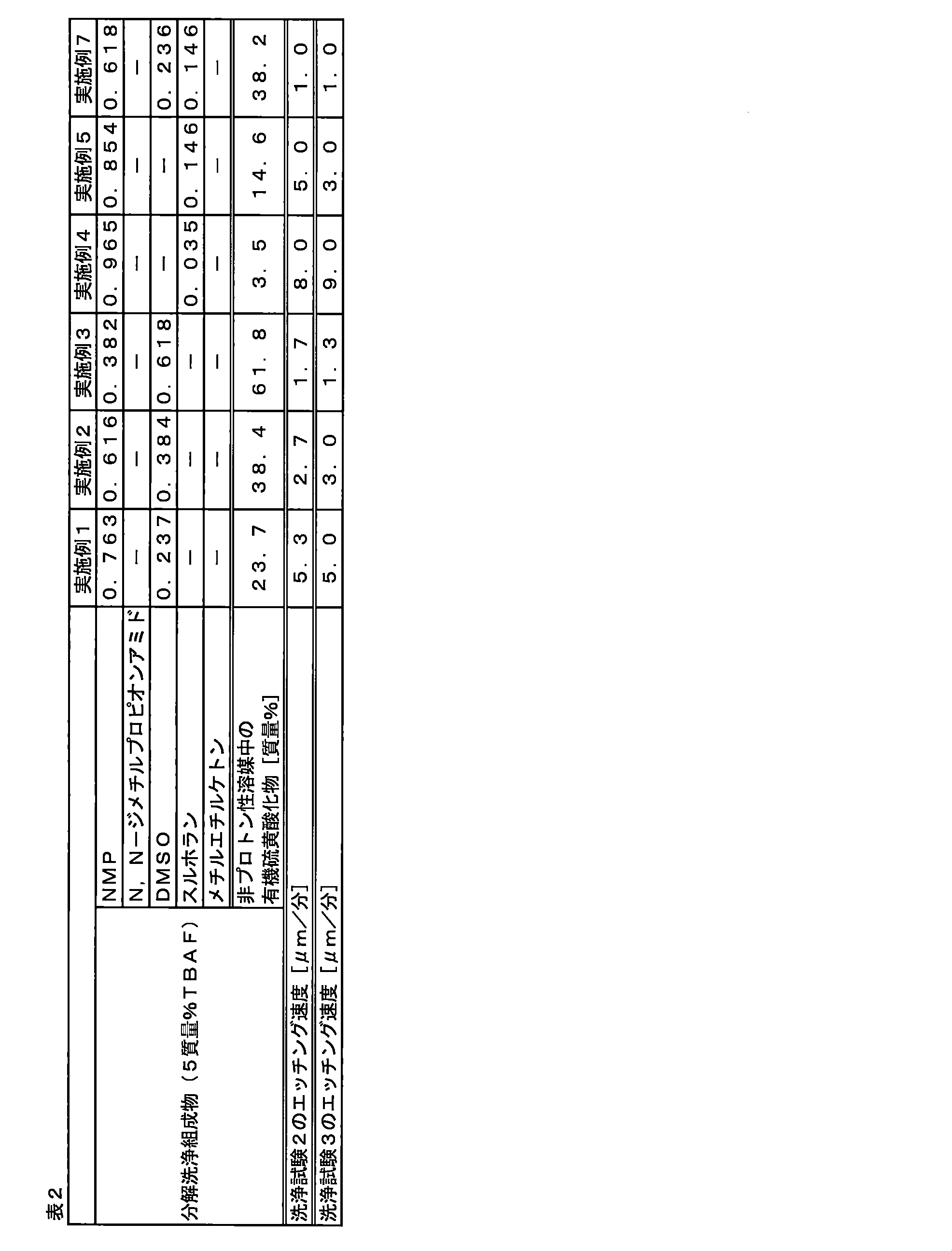
- Preparation method A of test piece for cleaning test A 12-inch (300 mm) silicon wafer (thickness: 770 ⁇ m) was applied with an addition-curable silicone resin by spin coating so that the dry film thickness was 110 ⁇ m. Then, it was heated at 140° C. for 15 minutes and at 190° C. for 10 minutes on a hot plate to form an adhesive layer containing a polyorganosiloxane compound as an adhesive polymer on the silicon wafer. The silicon wafer having this adhesive layer was divided into a size of 4 cm ⁇ 4 cm to prepare a test piece for cleaning test, and the thickness of the center part of the test piece was measured using a micrometer.
- etching rate (ER) of the decomposition cleaning composition was calculated by dividing the difference in the thickness of the test piece before and after the immersion by the immersion time in the decomposition cleaning composition.
- Etching rate (ER) ( ⁇ m/min) [(thickness of test piece before immersion-thickness of test piece after immersion/washing/drying) ( ⁇ m)]/immersion time (5 minutes)
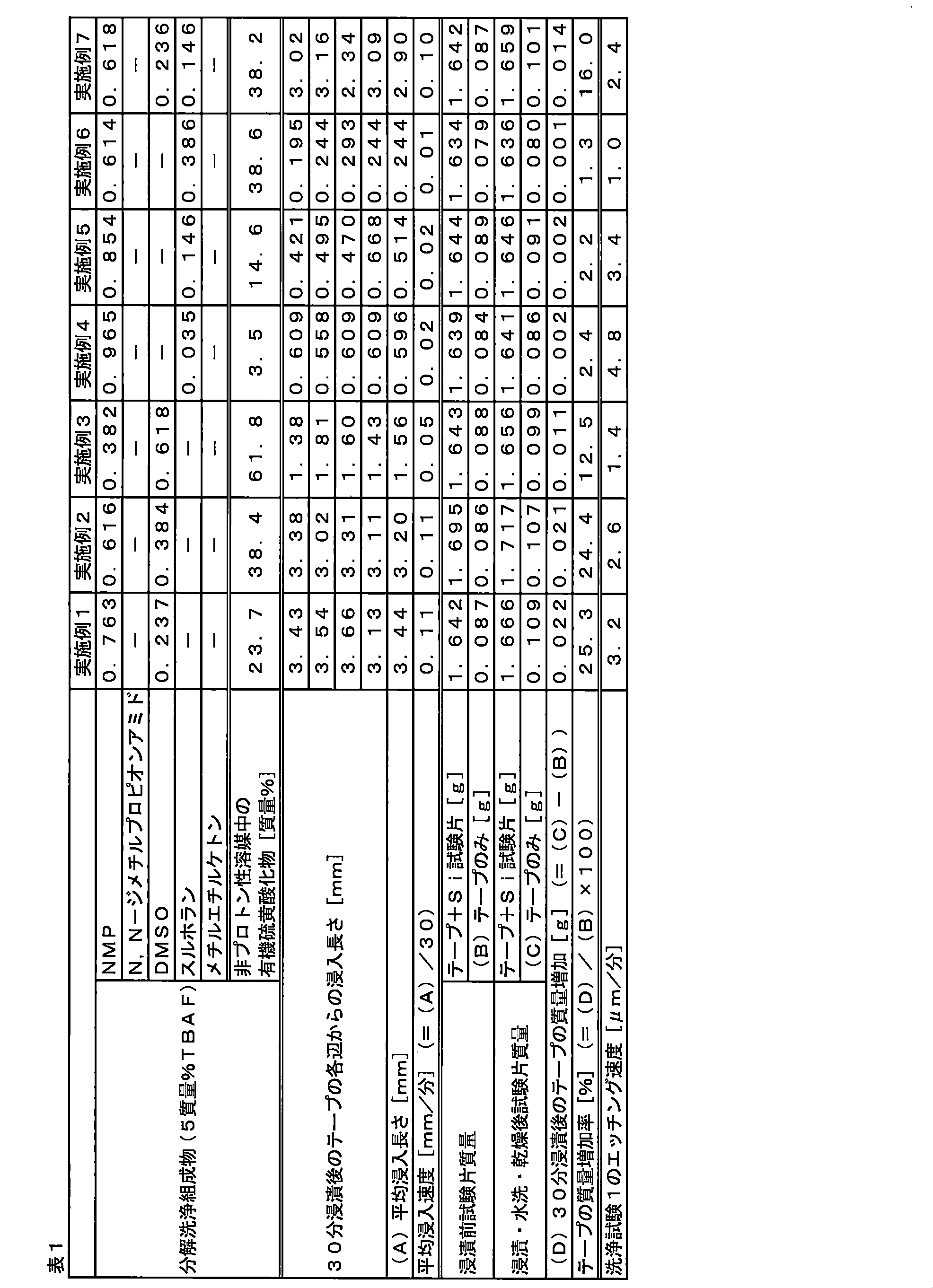
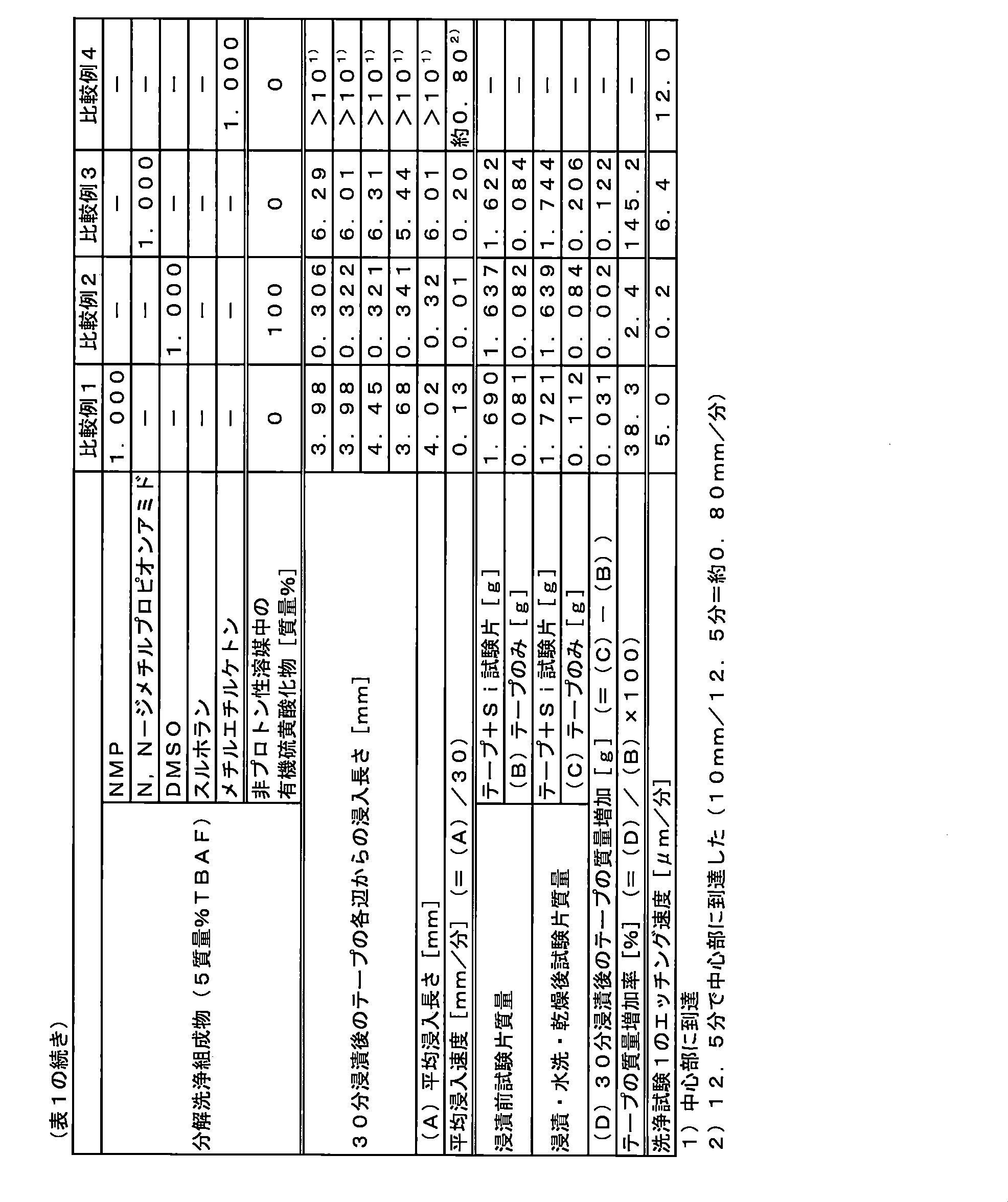
- Table 1 shows the composition of the decomposition cleaning compositions of Examples 1 to 7 and Comparative Examples 1 to 4, and the results of the penetration test and cleaning test 1.
- Examples 1 to 3 penetration could be suppressed by increasing the DMSO ratio while ensuring the etching rate.
- Examples 4 to 6 NMP-sulfolane
- Example 7 NMP-DMSO-sulfolane
- the addition of DMSO or sulfolane allows the infiltration of the decomposition cleaning composition into the contact interface between the acrylic adhesive layer of the Si wafer fixing tape and the Si wafer. You can understand that it was suppressed.
- Comparative Example 1 NMP only
- Comparative Example 3 N,N-dimethylpropionamide only
- the etching rate is high, but the penetration length after 30 minutes of immersion is large, the Si wafer fixing tape swells, and the Si wafer The fixing tape had wrinkles.
- Comparative Example 2 DMSO only
- the penetration length was small, but the etching rate was 0.2 ⁇ m/min, which was extremely low.
- Comparative Example 4 (only methyl ethyl ketone) could not be evaluated because the decomposition cleaning composition quickly penetrated to the center.
- Preparation method B of test piece for cleaning test A silicon wafer test piece was produced in the same manner as in the above-mentioned method A except that the silicon wafer having the adhesive layer was divided into a size of 1.5 cm ⁇ 1.5 cm to obtain a test piece.
- a 50 mL screw vial was placed on top of the magnetic stirrer. 15.0 mL of the decomposition cleaning composition immediately after preparation (within 30 minutes after preparation) and a stirring bar were put into a screw tube bottle.
- One piece of the test piece prepared by the above method B was immersed in the decomposition cleaning composition, and the stirrer was rotated at a rotation speed of 900 rpm for 3 minutes at room temperature (25° C.). After the immersion, the test piece was taken out with tweezers and thoroughly rinsed with a washing bottle of isopropyl alcohol (IPA). After nitrogen gas was blown onto the test piece to dry it, the thickness of the central portion of the test piece was measured using a micrometer.
- IPA isopropyl alcohol
- etching rate (ER) of the composition was calculated by dividing the difference in the thickness of the test piece before and after the immersion by the immersion time in the decomposition cleaning composition.
- Etching rate (ER) ( ⁇ m/min) [(thickness of test piece before immersion-thickness of test piece after immersion/washing/drying) ( ⁇ m)]/immersion time (3 minutes)
- Preparation method C of test piece for cleaning test A 12 inch (300 mm) silicon wafer (thickness: 770 ⁇ m) was divided into a size of 1.5 cm ⁇ 1.5 cm. An adhesive prepared by mixing 2.036 g of a main agent of SYLGARD (registered trademark) 184 (manufactured by Toray Dow Corning Co., Ltd.) and 0.209 g of a curing agent was sucked out with a Pasteur pipette, and one drop was dropped on the divided silicon wafer. Then, it heated for 20 minutes with a drier (125 degreeC), and formed the adhesive bond layer on the silicon wafer. Using this as a test piece, the thickness of the central portion of the test piece was measured using a micrometer.
- the etching rate (ER) of the decomposed cleaning composition was calculated in the same manner as the cleaning test 2 except that the test piece prepared by the above method C was used.
- Table 2 shows the compositions of the decomposition cleaning compositions of Examples 1 to 5, 7 and Comparative Examples 1 to 4 and the results of Cleaning Test 2 and Cleaning Test 3.
- Example 8 and Comparative Example 5 A decomposition cleaning composition was prepared in the same procedure as in Example 1 except that N-ethyl-2-pyrrolidone (NEP) was used as the N-substituted amide compound and the composition was as shown in Table 3.
- NEP N-ethyl-2-pyrrolidone
- Table 3 shows the composition of the decomposition cleaning composition of Example 8 and Comparative Example 5, the results of the infiltration test and the cleaning tests 2 and 3.
- Example 9 and Comparative Example 6 A decomposition cleaning composition was prepared by the same procedure as in Example 1 except that 1,3-dimethyl-2-imidazolidinone (DMI) was used as the N-substituted amide compound and the composition was as shown in Table 4. did.
- DMI 1,3-dimethyl-2-imidazolidinone
- Table 4 shows the composition of the decomposition cleaning composition of Example 9 and Comparative Example 6, the results of the penetration test and the cleaning tests 2 and 3.
- the decomposition cleaning composition according to the present disclosure is suitable for use in decomposition cleaning of an adhesive used in a semiconductor wafer thinning process, in particular, a residue of an adhesive containing a polyorganosiloxane compound as an adhesive polymer on a device wafer. Can be used.
Landscapes
- Chemical & Material Sciences (AREA)
- Chemical Kinetics & Catalysis (AREA)
- Life Sciences & Earth Sciences (AREA)
- Engineering & Computer Science (AREA)
- Oil, Petroleum & Natural Gas (AREA)
- Wood Science & Technology (AREA)
- Organic Chemistry (AREA)
- General Chemical & Material Sciences (AREA)
- Detergent Compositions (AREA)
- Cleaning Or Drying Semiconductors (AREA)
Abstract
Description
[1]
第四級フッ化アルキルアンモニウム又は第四級フッ化アルキルアンモニウムの水和物と、非プロトン性溶媒とを含む、接着性ポリマーの分解洗浄組成物であって、前記非プロトン性溶媒が、
(A)窒素原子上に活性水素を有さないN-置換アミド化合物、及び
(B)スルホキシド化合物及びスルホン化合物からなる群より選択される少なくとも1種の有機硫黄酸化物
を含む、分解洗浄組成物。
[2]
前記(A)N-置換アミド化合物が式(1):
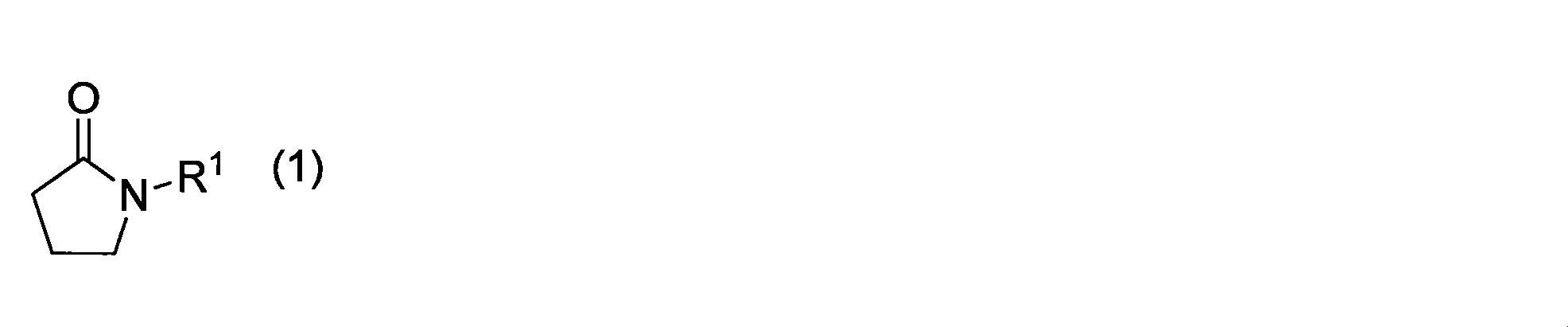
で表される2-ピロリドン誘導体化合物である、[1]に記載の分解洗浄組成物。
[3]
前記(A)N-置換アミド化合物が、式(1)においてR1がメチル基又はエチル基である2-ピロリドン誘導体化合物である、[2]に記載の分解洗浄組成物。
[4]
前記スルホキシド化合物が、炭素原子数4~6の環状スルホキシド化合物、又は式(2):
R2(SO)R3 (2)
(式(2)において、R2及びR3はそれぞれ独立してメチル基、エチル基、n-プロピル基、イソプロピル基、n-ブチル基、イソブチル基、sec-ブチル基、及びt-ブチル基からなる群より選択されるアルキル基を表す。)
で表される非環状スルホキシド化合物である、[1]~[3]のいずれかに記載の分解洗浄組成物。
[5]
前記スルホキシド化合物がジメチルスルホキシドである、[4]に記載の分解洗浄組成物。
[6]
前記スルホン化合物が、炭素原子数4~6の環状スルホン化合物、又は式(3):
R4(SO2)R5 (3)
(式(3)において、R4及びR5はそれぞれ独立して炭素原子数1~8のアルキル基、フェニル基、及びベンジル基からなる群より選択される基を表す。)
で表される非環状スルホン化合物である、[1]~[5]のいずれかに記載の分解洗浄組成物。
[7]
前記スルホン化合物がスルホラン又は3-メチルスルホランである、[6]に記載の分解洗浄組成物。
[8]
前記非プロトン性溶媒100質量%に対して、前記(A)N-置換アミド化合物の含有量が10~99.9質量%であり、前記(B)有機硫黄酸化物の含有量が0.1~90質量%である、[1]~[7]のいずれかに記載の分解洗浄組成物。
[9]
前記非プロトン性溶媒100質量%に対して、前記(A)N-置換アミド化合物の含有量が70~98質量%であり、前記(B)有機硫黄酸化物の含有量が2~30質量%である、[1]~[7]のいずれかに記載の分解洗浄組成物。
[10]
前記第四級フッ化アルキルアンモニウムの含有量が、0.1~15質量%である、[1]~[9]のいずれかに記載の分解洗浄組成物。
[11]
前記第四級フッ化アルキルアンモニウムが、R6R7R8R9N+F-で表されるフッ化テトラアルキルアンモニウムであり、R6~R9がそれぞれ独立してメチル基、エチル基、n-プロピル基、イソプロピル基、及びn-ブチル基からなる群より選択されるアルキル基である、[1]~[10]のいずれかに記載の分解洗浄組成物。
[12]
前記接着性ポリマーがポリオルガノシロキサン化合物である、[1]~[11]のいずれかに記載の分解洗浄組成物。
[13]
[1]~[12]のいずれかに記載の分解洗浄組成物を用いて基材上の接着性ポリマーを洗浄する方法。
[14]
前記基材がアクリル粘着剤に接触した状態で前記洗浄を行うことを含む、[13]に記載の方法。
[15]
[1]~[12]のいずれかに記載の分解洗浄組成物を用いてデバイスウェハおもて面上の接着性ポリマーを洗浄することを含む、デバイスウェハの製造方法。
[16]
前記デバイスウェハがアクリル粘着剤に接触した状態で前記洗浄を行うことを含む、[15]に記載の方法。
一実施態様の分解洗浄組成物は、第四級フッ化アルキルアンモニウム又は第四級フッ化アルキルアンモニウムの水和物と、特定の非プロトン性溶媒とを含む。非プロトン性溶媒は、(A)窒素原子上に活性水素を有さないN-置換アミド化合物、及び(B)スルホキシド化合物及びスルホン化合物からなる群より選択される少なくとも1種の有機硫黄酸化物を含む。
第四級フッ化アルキルアンモニウム又はその水和物は、Si-O結合の切断に関与するフッ化物イオンを放出する。第四級アルキルアンモニウム部分は、塩である第四級フッ化アルキルアンモニウムを非プロトン性溶媒に溶解させることができる。第四級フッ化アルキルアンモニウムとしては、特に制限なく様々な化合物を使用することができる。第四級フッ化アルキルアンモニウムの水和物として、例えば三水和物、四水和物及び五水和物が挙げられる。第四級フッ化アルキルアンモニウムは、1種又は2種以上の組み合わせであってよい。
非プロトン性溶媒は、(A)窒素原子上に活性水素を有さないN-置換アミド化合物、及び(B)スルホキシド化合物及びスルホン化合物からなる群より選択される少なくとも1種の有機硫黄酸化物を含む。これらの非プロトン性溶媒は水に対して相溶性を有していることから、接着性ポリマーの分解洗浄後、基材又はデバイスウェハを安価かつ安全な水でリンスすることができる。
(A)窒素原子上に活性水素を有さないN-置換アミド化合物(本開示において単に「(A)N-置換アミド化合物」ともいう。)は、比較的極性が高い非プロトン性溶媒であり、分解洗浄組成物中に第四級フッ化アルキルアンモニウム及びその水和物を均一に溶解又は分散することができる。本開示において「(A)N-置換アミド化合物」は、窒素原子上に活性水素を有さない尿素化合物(カルバミド化合物)も包含する。(A)N-置換アミド化合物として、特に制限なく様々な化合物を使用することができる。一実施態様では(A)N-置換アミド化合物の炭素原子数は3~12であることが好ましい。(A)N-置換アミド化合物としては、例えば、N,N-ジメチルホルムアミド、N,N-ジエチルホルムアミド、N,N-ジメチルアセトアミド、N,N-ジエチルアセトアミド、N,N-ジメチルプロピオンアミド、N,N-ジエチルプロピオンアミド、テトラメチル尿素などの非環状N-置換アミド、2-ピロリドン誘導体、2-ピペリドン誘導体、ε-カプロラクタム誘導体、1,3-ジメチル-2-イミダゾリジノン、1-メチル-3-エチル-2-イミダゾリジノン、1,3-ジエチル-2-イミダゾリジノン、1,3-ジメチル-3,4,5,6-テトラヒドロ-2(1H)-ピリミジノン(N,N’-ジメチルプロピレン尿素)などの環状N-置換アミドが挙げられる。(A)N-置換アミド化合物は、1種又は2種以上の組み合わせであってよい。
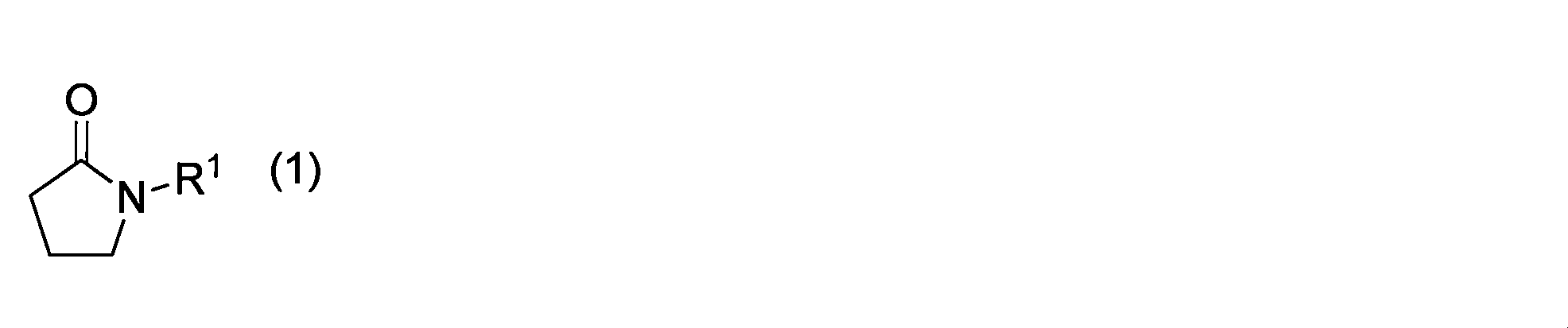
で表される2-ピロリドン誘導体化合物であることが好ましい。炭素原子数1~4のアルキル基として、メチル基、エチル基、n-プロピル基、イソプロピル基、n-ブチル基、イソブチル基、sec-ブチル基、t-ブチル基などが挙げられ、メチル基又はエチル基が好ましい。式(1)で表される2-ピロリドン誘導体化合物として、例えば、N-メチルピロリドン、N-エチルピロリドン、N-プロピルピロリドン、N-ブチルピロリドンなどが挙げられる。
スルホキシド化合物及びスルホン化合物からなる群より選択される少なくとも1種の(B)有機硫黄酸化物を(A)N-置換アミド化合物と組み合わせることで、接着性ポリマーに対して高い親和性を示す混合溶媒系を形成することができる。そのような混合溶媒系を用いた分解洗浄組成物は、第四級フッ化アルキルアンモニウムの反応活性が有効に利用された高いエッチング速度を達成することができ、かつ分解洗浄組成物のデバイスウェハ固定テープの粘着層との親和性、特にアクリル粘着層との親和性を低下させて、基材と粘着層の接触界面への分解洗浄組成物の浸入を抑制することができる。(B)有機硫黄酸化物として、スルホキシド化合物及びスルホン化合物であれば、特に制限なく様々な化合物を使用することができる。(B)有機硫黄酸化物は、1種又は2種以上の組み合わせであってよい。
R2(SO)R3 (2)
(式(2)において、R2及びR3はそれぞれ独立してメチル基、エチル基、n-プロピル基、イソプロピル基、n-ブチル基、イソブチル基、sec-ブチル基、及びt-ブチル基からなる群より選択されるアルキル基を表す。)
で表される非環状スルホキシド化合物であることが好ましい。
R4(SO2)R5 (3)
(式(3)において、R4及びR5はそれぞれ独立して炭素原子数1~8のアルキル基、フェニル基、及びベンジル基からなる群より選択される基を表す。)
で表される非環状スルホン化合物であることが好ましい。
分解洗浄組成物は、本発明の効果を顕著に損なわない範囲で、任意成分として、酸化防止剤、界面活性剤、防腐剤、発泡防止剤などの添加剤を含んでもよい。
本開示の分解洗浄組成物は、様々な接着剤に含まれる接着性ポリマーの分解洗浄組成物として使用することができる。接着性ポリマーは、本開示の分解洗浄組成物を用いて洗浄することができるものであれば特に制限されない。接着剤は接着性ポリマーに加えて、任意成分として、硬化剤、硬化促進剤、架橋剤、界面活性剤、レベリング剤、充填材などを含んでもよい。
一実施態様では、デバイスウェハの製造方法は、分解洗浄組成物を用いてデバイスウェハおもて面上の接着性ポリマーを洗浄することを含む。洗浄後、必要に応じてデバイスウェハをイソプロピルアルコール(IPA)などのアルコール、又はイオン交換水(DIW)などの水を用いてリンスしてもよく、デバイスウェハを窒素ガス、空気等の吹付け、常圧下又は減圧下での加熱などにより乾燥してもよい。分解洗浄組成物に含まれる非プロトン性溶媒は水に対して相溶性を有していることから、デバイスウェハを安価かつ安全な水でリンスすることができる。
実施例1
125mLのポリエチレン容器に、0.272gのテトラブチルアンモニウムフルオライド・三水和物(TBAF・3H2O)(関東化学株式会社、97%特級)を投入し、3.135gのN-メチル-2-ピロリドン(以下、「NMP」という。)を投入し、その後有機硫黄酸化物として0.976gのジメチルスルホキシド(以下、「DMSO」という。)を投入し、混合することでTBAF・3H2Oを溶解させた。このようにして、NMP:DMSOの質量比が0.763:0.237である5質量%TBAF/混合溶媒の分解洗浄組成物を調製した。
組成が表1に記載したとおりとなるようにした以外は、実施例1と同様の手順で分解洗浄組成物を調製した。
12インチ(300mm)シリコンウェハ(厚さ770μm)を分割して、3cm×3cmの正方形に切り出した。これをSi試験片という。UV硬化型アクリル粘着層に紫外線照射処理を行ったSiウェハ固定テープを2cm×2cmの正方形のサイズに切り取り、カバーフィルムを取り外してSi試験片の中央にSiウェハ固定テープを貼り付け、浸入試験用試験片とした。Siウェハ固定テープの各辺の外側にはSi試験片の表面が幅0.5cmで露出していた。Siウェハ固定テープは、50μm厚のポリエステル基材、100μm厚のアクリル中間層、及び20μm厚のUV硬化型アクリル粘着層をこの順で含む、厚さ170μmの積層体であった。
浸入試験用試験片を直径50mm、深さ15mmのSUS304製のシャーレに、Siウェハ固定テープが上になるように入れた。分解洗浄組成物(5質量%TBAF/溶媒)3.5mLを、ピペットを用いてSUS304製シャーレに投入し、試験片を分解洗浄組成物に浸漬し、ガラス製のシャーレで蓋をした。試験片を室温(25℃)で30分間分解洗浄組成物に浸漬させた後に、ピンセットで取り出し、イオン交換水(DIW)の洗瓶を用いて十分にリンスをした後、窒素ガスを吹き付けて水分を除去し、室温で十分に乾燥した。浸漬及び乾燥後の試験片の写真を、Siウェハ固定テープが貼られた面から撮影した。Siウェハ固定テープのアクリル粘着層とSi試験片の接触界面に分解洗浄組成物が浸入した長さを、正方形のテープの各辺に直交する方向に沿ってその辺から浸入痕までの最大直線距離として測定した。正方形のSi固定テープの4つの辺からの浸入長さの平均値を算出して平均浸入長さ(mm)とし、これを浸漬時間30分で割って平均浸入速度(mm/分)を算出した。また、Si試験片及び浸入試験用試験片(Si試験片+Siウェハ固定テープ)の浸漬前及び浸漬・水洗・乾燥後の質量を秤量し、浸漬後のテープの質量増加及び質量増加率を算出した。
12インチ(300mm)シリコンウェハ(厚さ770μm)上に、付加硬化型シリコーン樹脂をスピンコートにより乾燥膜厚が110μmとなるように塗布した。その後、ホットプレート上で、140℃で15分間、190℃で10分間加熱して、シリコンウェハ上にポリオルガノシロキサン化合物を接着性ポリマーとして含む接着剤層を形成した。この接着剤層を有するシリコンウェハを4cm×4cmのサイズに分割して洗浄試験用試験片とし、マイクロメーターを用いて試験片の中心部の厚さを測定した。
直径90mmのSUS製シャーレに、7.0mLの調製直後(調製後30分以内)の分解洗浄組成物を投入した。分解洗浄組成物の中に上記の方法Aで作製した洗浄試験用試験片1枚を浸漬し、室温(25℃)で5分間、1Hzの振動数で前後にシャーレを振とうさせた。浸漬後、試験片をピンセットで取り出し、イソプロピルアルコール(IPA)に浸漬し、さらにIPAの洗瓶を用いて十分にリンスした。その後、試験片をイオン交換水(DIW)に浸漬し、同様にDIWの洗瓶を用いて十分にリンスした。試験片に窒素ガスを吹き付けて付着した水を除去した後、125℃の乾燥機で30分間加熱乾燥した。マイクロメーターを用いて乾燥後の試験片の中心部の厚さを測定した。
エッチング速度(ER)(μm/分)=[(浸漬前の試験片の厚さ-浸漬・洗浄・乾燥後の試験片の厚さ)(μm)]/浸漬時間(5分)
接着剤層を有するシリコンウェハを1.5cm×1.5cmのサイズに分割して試験片とした以外は、上記の方法Aと同様にして、シリコンウェハ試験片を作製した。
マグネチックスターラーの上に容積50mLのスクリュー管瓶を置いた。スクリュー管瓶に15.0mLの調製直後(調製後30分以内)の分解洗浄組成物と撹拌子を投入した。分解洗浄組成物の中に上記の方法Bで作製した試験片1枚を浸漬し、室温(25℃)で3分間、900rpmの回転数で撹拌子を回転させた。浸漬後、試験片をピンセットで取り出し、イソプロピルアルコール(IPA)の洗瓶を用いて十分にリンスした。試験片に窒素ガスを吹き付けて乾燥させた後、マイクロメーターを用いて試験片の中心部の厚さを測定した。
エッチング速度(ER)(μm/分)=[(浸漬前の試験片の厚さ-浸漬・洗浄・乾燥後の試験片の厚さ)(μm)]/浸漬時間(3分)
12インチ(300mm)シリコンウェハ(厚さ770μm)を、1.5cm×1.5cmのサイズに分割した。SYLGARD(登録商標)184(東レ・ダウコーニング株式会社製)の主剤2.036gと硬化剤0.209gを混合した接着剤をパスツールピペットで吸い出し、分割したシリコンウェハ上に1滴滴下した。その後、乾燥機(125℃)で20分間加熱して、シリコンウェハ上に接着剤層を形成した。これを試験片とし、マイクロメーターを用いて試験片の中心部の厚さを測定した。
上記の方法Cで作製した試験片を用いたこと以外は、洗浄試験2と同様にして、分解洗浄組成物のエッチング速度(ER)を算出した。

N-置換アミド化合物としてN-エチル-2-ピロリドン(NEP)を用い、組成を表3に記載したとおりとした以外は、実施例1と同様の手順で分解洗浄組成物を調製した。

N-置換アミド化合物として1,3-ジメチル-2-イミダゾリジノン(DMI)を用い、組成を表4に記載したとおりとした以外は、実施例1と同様の手順で分解洗浄組成物を調製した。

Claims (16)
- 第四級フッ化アルキルアンモニウム又は第四級フッ化アルキルアンモニウムの水和物と、非プロトン性溶媒とを含む、接着性ポリマーの分解洗浄組成物であって、前記非プロトン性溶媒が、
(A)窒素原子上に活性水素を有さないN-置換アミド化合物、及び
(B)スルホキシド化合物及びスルホン化合物からなる群より選択される少なくとも1種の有機硫黄酸化物
を含む、分解洗浄組成物。 - 前記(A)N-置換アミド化合物が式(1):

で表される2-ピロリドン誘導体化合物である、請求項1に記載の分解洗浄組成物。 - 前記(A)N-置換アミド化合物が、式(1)においてR1がメチル基又はエチル基である2-ピロリドン誘導体化合物である、請求項2に記載の分解洗浄組成物。
- 前記スルホキシド化合物が、炭素原子数4~6の環状スルホキシド化合物、又は式(2):
R2(SO)R3 (2)
(式(2)において、R2及びR3はそれぞれ独立してメチル基、エチル基、n-プロピル基、イソプロピル基、n-ブチル基、イソブチル基、sec-ブチル基、及びt-ブチル基からなる群より選択されるアルキル基を表す。)
で表される非環状スルホキシド化合物である、請求項1~3のいずれか一項に記載の分解洗浄組成物。 - 前記スルホキシド化合物がジメチルスルホキシドである、請求項4に記載の分解洗浄組成物。
- 前記スルホン化合物が、炭素原子数4~6の環状スルホン化合物、又は式(3):
R4(SO2)R5 (3)
(式(3)において、R4及びR5はそれぞれ独立して炭素原子数1~8のアルキル基、フェニル基、及びベンジル基からなる群より選択される基を表す。)
で表される非環状スルホン化合物である、請求項1~5のいずれか一項に記載の分解洗浄組成物。 - 前記スルホン化合物がスルホラン又は3-メチルスルホランである、請求項6に記載の分解洗浄組成物。
- 前記非プロトン性溶媒100質量%に対して、前記(A)N-置換アミド化合物の含有量が10~99.9質量%であり、前記(B)有機硫黄酸化物の含有量が0.1~90質量%である、請求項1~7のいずれか一項に記載の分解洗浄組成物。
- 前記非プロトン性溶媒100質量%に対して、前記(A)N-置換アミド化合物の含有量が70~98質量%であり、前記(B)有機硫黄酸化物の含有量が2~30質量%である、請求項1~7のいずれか一項に記載の分解洗浄組成物。
- 前記第四級フッ化アルキルアンモニウムの含有量が、0.1~15質量%である、請求項1~9のいずれか一項に記載の分解洗浄組成物。
- 前記第四級フッ化アルキルアンモニウムが、R6R7R8R9N+F-で表されるフッ化テトラアルキルアンモニウムであり、R6~R9がそれぞれ独立してメチル基、エチル基、n-プロピル基、イソプロピル基、及びn-ブチル基からなる群より選択されるアルキル基である、請求項1~10のいずれか一項に記載の分解洗浄組成物。
- 前記接着性ポリマーがポリオルガノシロキサン化合物である、請求項1~11のいずれか一項に記載の分解洗浄組成物。
- 請求項1~12のいずれか一項に記載の分解洗浄組成物を用いて基材上の接着性ポリマーを洗浄する方法。
- 前記基材がアクリル粘着剤に接触した状態で前記洗浄を行うことを含む、請求項13に記載の方法。
- 請求項1~12のいずれか一項に記載の分解洗浄組成物を用いてデバイスウェハおもて面上の接着性ポリマーを洗浄することを含む、デバイスウェハの製造方法。
- 前記デバイスウェハがアクリル粘着剤に接触した状態で前記洗浄を行うことを含む、請求項15に記載の方法。
Priority Applications (5)
| Application Number | Priority Date | Filing Date | Title |
|---|---|---|---|
| SG11202106504VA SG11202106504VA (en) | 2019-01-15 | 2019-10-31 | Decomposing/cleaning composition, method for cleaning adhesive polymer, and method for producing device wafer |
| KR1020217016098A KR102544429B1 (ko) | 2019-01-15 | 2019-10-31 | 분해세정 조성물, 접착성 폴리머의 세정 방법, 및 디바이스 웨이퍼의 제조 방법 |
| JP2020566112A JP7405100B2 (ja) | 2019-01-15 | 2019-10-31 | 分解洗浄組成物、接着性ポリマーの洗浄方法、及びデバイスウェハの製造方法 |
| CN201980089054.0A CN113302269B (zh) | 2019-01-15 | 2019-10-31 | 分解清洗组合物、粘接性聚合物的清洗方法及器件晶圆的制造方法 |
| US17/420,569 US12221595B2 (en) | 2019-01-15 | 2019-10-31 | Decomposing/cleaning composition, method for cleaning adhesive polymer, and method for producing device wafer |
Applications Claiming Priority (2)
| Application Number | Priority Date | Filing Date | Title |
|---|---|---|---|
| JP2019004292 | 2019-01-15 | ||
| JP2019-004292 | 2019-01-15 |
Publications (1)
| Publication Number | Publication Date |
|---|---|
| WO2020148968A1 true WO2020148968A1 (ja) | 2020-07-23 |
Family
ID=71614461
Family Applications (1)
| Application Number | Title | Priority Date | Filing Date |
|---|---|---|---|
| PCT/JP2019/042936 Ceased WO2020148968A1 (ja) | 2019-01-15 | 2019-10-31 | 分解洗浄組成物、接着性ポリマーの洗浄方法、及びデバイスウェハの製造方法 |
Country Status (7)
| Country | Link |
|---|---|
| US (1) | US12221595B2 (ja) |
| JP (1) | JP7405100B2 (ja) |
| KR (1) | KR102544429B1 (ja) |
| CN (1) | CN113302269B (ja) |
| SG (1) | SG11202106504VA (ja) |
| TW (1) | TWI829802B (ja) |
| WO (1) | WO2020148968A1 (ja) |
Cited By (2)
| Publication number | Priority date | Publication date | Assignee | Title |
|---|---|---|---|---|
| JPWO2022234804A1 (ja) * | 2021-05-06 | 2022-11-10 | ||
| JPWO2022244593A1 (ja) * | 2021-05-21 | 2022-11-24 |
Families Citing this family (3)
| Publication number | Priority date | Publication date | Assignee | Title |
|---|---|---|---|---|
| CN120199681A (zh) * | 2021-09-16 | 2025-06-24 | 日产化学株式会社 | 半导体基板的清洗方法、经加工的半导体基板的制造方法以及剥离和溶解用组合物 |
| CN116285995A (zh) * | 2021-12-20 | 2023-06-23 | 李长荣化学工业股份有限公司 | 用于移除硅的蚀刻组成物及使用其移除硅的方法 |
| WO2023120322A1 (ja) * | 2021-12-24 | 2023-06-29 | 株式会社レゾナック | 分解洗浄組成物及びその製造方法 |
Citations (3)
| Publication number | Priority date | Publication date | Assignee | Title |
|---|---|---|---|---|
| JPH1167632A (ja) * | 1997-08-18 | 1999-03-09 | Mitsubishi Gas Chem Co Inc | 半導体装置用洗浄剤 |
| JP2005500408A (ja) * | 2001-07-09 | 2005-01-06 | マリンクロッド・ベイカー・インコーポレイテッド | 選択的フォトレジストストリッピングおよびプラズマ灰化残渣洗浄のための、アンモニア不含フッ化物塩含有マイクロエレクトロニクス洗浄組成物 |
| WO2014092022A1 (ja) * | 2012-12-11 | 2014-06-19 | 富士フイルム株式会社 | シロキサン樹脂の除去剤、それを用いたシロキサン樹脂の除去方法並びに半導体基板製品及び半導体素子の製造方法 |
Family Cites Families (11)
| Publication number | Priority date | Publication date | Assignee | Title |
|---|---|---|---|---|
| SG150509A1 (en) * | 2004-03-01 | 2009-03-30 | Mallinckrodt Baker Inc | Nanoelectronic and microelectronic cleaning compositions |
| US8030263B2 (en) * | 2004-07-01 | 2011-10-04 | Air Products And Chemicals, Inc. | Composition for stripping and cleaning and use thereof |
| JP5184161B2 (ja) | 2008-03-17 | 2013-04-17 | 古河電気工業株式会社 | 半導体加工用テープ |
| TW201311882A (zh) | 2011-09-13 | 2013-03-16 | Anji Microelectronics Co Ltd | 含氟清洗液 |
| JP5901422B2 (ja) | 2012-05-15 | 2016-04-13 | 古河電気工業株式会社 | 半導体ウェハのダイシング方法およびこれに用いる半導体加工用ダイシングテープ |
| JP6195839B2 (ja) | 2012-10-19 | 2017-09-13 | リンテック株式会社 | 電子部品加工用粘着シートおよび半導体装置の製造方法 |
| JP6210827B2 (ja) | 2013-10-04 | 2017-10-11 | リンテック株式会社 | 半導体加工用シート |
| US9957469B2 (en) * | 2014-07-14 | 2018-05-01 | Versum Materials Us, Llc | Copper corrosion inhibition system |
| KR102180284B1 (ko) | 2015-01-13 | 2020-11-18 | 동우 화인켐 주식회사 | 실리콘계 수지 제거용 조성물 및 이를 이용한 박막 기판 제조 방법 |
| CN107034028B (zh) | 2015-12-04 | 2021-05-25 | 三星电子株式会社 | 用于除去有机硅树脂的组合物、使用其薄化基材和制造半导体封装体的方法及使用其的系统 |
| WO2017126554A1 (ja) | 2016-01-22 | 2017-07-27 | 富士フイルム株式会社 | 処理液 |
-
2019
- 2019-10-31 JP JP2020566112A patent/JP7405100B2/ja active Active
- 2019-10-31 CN CN201980089054.0A patent/CN113302269B/zh active Active
- 2019-10-31 SG SG11202106504VA patent/SG11202106504VA/en unknown
- 2019-10-31 US US17/420,569 patent/US12221595B2/en active Active
- 2019-10-31 WO PCT/JP2019/042936 patent/WO2020148968A1/ja not_active Ceased
- 2019-10-31 KR KR1020217016098A patent/KR102544429B1/ko active Active
- 2019-11-12 TW TW108140953A patent/TWI829802B/zh active
Patent Citations (3)
| Publication number | Priority date | Publication date | Assignee | Title |
|---|---|---|---|---|
| JPH1167632A (ja) * | 1997-08-18 | 1999-03-09 | Mitsubishi Gas Chem Co Inc | 半導体装置用洗浄剤 |
| JP2005500408A (ja) * | 2001-07-09 | 2005-01-06 | マリンクロッド・ベイカー・インコーポレイテッド | 選択的フォトレジストストリッピングおよびプラズマ灰化残渣洗浄のための、アンモニア不含フッ化物塩含有マイクロエレクトロニクス洗浄組成物 |
| WO2014092022A1 (ja) * | 2012-12-11 | 2014-06-19 | 富士フイルム株式会社 | シロキサン樹脂の除去剤、それを用いたシロキサン樹脂の除去方法並びに半導体基板製品及び半導体素子の製造方法 |
Cited By (5)
| Publication number | Priority date | Publication date | Assignee | Title |
|---|---|---|---|---|
| JPWO2022234804A1 (ja) * | 2021-05-06 | 2022-11-10 | ||
| WO2022234804A1 (ja) * | 2021-05-06 | 2022-11-10 | 日本化薬株式会社 | 硬化性樹脂組成物の硬化物の分解方法 |
| JPWO2022244593A1 (ja) * | 2021-05-21 | 2022-11-24 | ||
| WO2022244593A1 (ja) * | 2021-05-21 | 2022-11-24 | 昭和電工株式会社 | 分解洗浄組成物及びその製造方法、並びに接着性ポリマーの洗浄方法 |
| JP7852632B2 (ja) | 2021-05-21 | 2026-04-28 | 株式会社レゾナック | 分解洗浄組成物及びその製造方法、並びに接着性ポリマーの洗浄方法 |
Also Published As
| Publication number | Publication date |
|---|---|
| CN113302269A (zh) | 2021-08-24 |
| TWI829802B (zh) | 2024-01-21 |
| US12221595B2 (en) | 2025-02-11 |
| CN113302269B (zh) | 2023-08-01 |
| KR20210082233A (ko) | 2021-07-02 |
| KR102544429B1 (ko) | 2023-06-20 |
| US20220119739A1 (en) | 2022-04-21 |
| JPWO2020148968A1 (ja) | 2021-12-02 |
| JP7405100B2 (ja) | 2023-12-26 |
| TW202045703A (zh) | 2020-12-16 |
| SG11202106504VA (en) | 2021-07-29 |
Similar Documents
| Publication | Publication Date | Title |
|---|---|---|
| JP7405100B2 (ja) | 分解洗浄組成物、接着性ポリマーの洗浄方法、及びデバイスウェハの製造方法 | |
| JP7322891B2 (ja) | 組成物、接着性ポリマーの洗浄方法、デバイスウェハの製造方法、及び支持ウェハの再生方法 | |
| KR102669766B1 (ko) | 조성물, 및 접착성 폴리머의 세정 방법 | |
| US12545862B2 (en) | Method for producing decomposing/cleaning composition | |
| WO2021205885A1 (ja) | 組成物、及び接着性ポリマーの洗浄方法 | |
| TWI862980B (zh) | 半導體基板之洗淨方法、加工後之半導體基板之製造方法、以及剝離及溶解用組成物 | |
| KR20240070529A (ko) | 반도체 기판의 세정 방법, 가공된 반도체 기판의 제조 방법, 및 박리 및 용해용 조성물 | |
| JP7852632B2 (ja) | 分解洗浄組成物及びその製造方法、並びに接着性ポリマーの洗浄方法 | |
| JP2024173330A (ja) | 接着性ポリマーの洗浄方法 | |
| WO2023120322A1 (ja) | 分解洗浄組成物及びその製造方法 | |
| KR20250068639A (ko) | 반도체 기판의 세정 방법, 가공된 반도체 기판의 제조 방법, 및 박리 및 용해용 조성물 | |
| KR20250068635A (ko) | 반도체 기판의 세정 방법, 가공된 반도체 기판의 제조 방법, 및 박리 및 용해용 조성물 |
Legal Events
| Date | Code | Title | Description |
|---|---|---|---|
| 121 | Ep: the epo has been informed by wipo that ep was designated in this application |
Ref document number: 19909805 Country of ref document: EP Kind code of ref document: A1 |
|
| ENP | Entry into the national phase |
Ref document number: 2020566112 Country of ref document: JP Kind code of ref document: A |
|
| ENP | Entry into the national phase |
Ref document number: 20217016098 Country of ref document: KR Kind code of ref document: A |
|
| NENP | Non-entry into the national phase |
Ref country code: DE |
|
| 122 | Ep: pct application non-entry in european phase |
Ref document number: 19909805 Country of ref document: EP Kind code of ref document: A1 |