WO2020145178A1 - オルガノポリシロキサン架橋物と(メタ)アクリル重合体からなる相互侵入網目重合体及びその製造方法 - Google Patents
オルガノポリシロキサン架橋物と(メタ)アクリル重合体からなる相互侵入網目重合体及びその製造方法 Download PDFInfo
- Publication number
- WO2020145178A1 WO2020145178A1 PCT/JP2019/051106 JP2019051106W WO2020145178A1 WO 2020145178 A1 WO2020145178 A1 WO 2020145178A1 JP 2019051106 W JP2019051106 W JP 2019051106W WO 2020145178 A1 WO2020145178 A1 WO 2020145178A1
- Authority
- WO
- WIPO (PCT)
- Prior art keywords
- group
- meth
- acrylic
- component
- interpenetrating network
- Prior art date
- Legal status (The legal status is an assumption and is not a legal conclusion. Google has not performed a legal analysis and makes no representation as to the accuracy of the status listed.)
- Ceased
Links
Classifications
-
- C—CHEMISTRY; METALLURGY
- C08—ORGANIC MACROMOLECULAR COMPOUNDS; THEIR PREPARATION OR CHEMICAL WORKING-UP; COMPOSITIONS BASED THEREON
- C08F—MACROMOLECULAR COMPOUNDS OBTAINED BY REACTIONS ONLY INVOLVING CARBON-TO-CARBON UNSATURATED BONDS
- C08F290/00—Macromolecular compounds obtained by polymerising monomers on to polymers modified by introduction of aliphatic unsaturated end or side groups
- C08F290/02—Macromolecular compounds obtained by polymerising monomers on to polymers modified by introduction of aliphatic unsaturated end or side groups on to polymers modified by introduction of unsaturated end groups
- C08F290/06—Polymers provided for in subclass C08G
- C08F290/068—Polysiloxanes
-
- C—CHEMISTRY; METALLURGY
- C08—ORGANIC MACROMOLECULAR COMPOUNDS; THEIR PREPARATION OR CHEMICAL WORKING-UP; COMPOSITIONS BASED THEREON
- C08F—MACROMOLECULAR COMPOUNDS OBTAINED BY REACTIONS ONLY INVOLVING CARBON-TO-CARBON UNSATURATED BONDS
- C08F2/00—Processes of polymerisation
- C08F2/44—Polymerisation in the presence of compounding ingredients, e.g. plasticisers, dyestuffs, fillers
-
- C—CHEMISTRY; METALLURGY
- C08—ORGANIC MACROMOLECULAR COMPOUNDS; THEIR PREPARATION OR CHEMICAL WORKING-UP; COMPOSITIONS BASED THEREON
- C08F—MACROMOLECULAR COMPOUNDS OBTAINED BY REACTIONS ONLY INVOLVING CARBON-TO-CARBON UNSATURATED BONDS
- C08F20/00—Homopolymers and copolymers of compounds having one or more unsaturated aliphatic radicals, each having only one carbon-to-carbon double bond, and only one being terminated by only one carboxyl radical or a salt, anhydride, ester, amide, imide or nitrile thereof
-
- C—CHEMISTRY; METALLURGY
- C08—ORGANIC MACROMOLECULAR COMPOUNDS; THEIR PREPARATION OR CHEMICAL WORKING-UP; COMPOSITIONS BASED THEREON
- C08F—MACROMOLECULAR COMPOUNDS OBTAINED BY REACTIONS ONLY INVOLVING CARBON-TO-CARBON UNSATURATED BONDS
- C08F220/00—Copolymers of compounds having one or more unsaturated aliphatic radicals, each having only one carbon-to-carbon double bond, and only one being terminated by only one carboxyl radical or a salt, anhydride ester, amide, imide or nitrile thereof
- C08F220/02—Monocarboxylic acids having less than ten carbon atoms; Derivatives thereof
- C08F220/04—Acids; Metal salts or ammonium salts thereof
- C08F220/06—Acrylic acid; Methacrylic acid; Metal salts or ammonium salts thereof
-
- C—CHEMISTRY; METALLURGY
- C08—ORGANIC MACROMOLECULAR COMPOUNDS; THEIR PREPARATION OR CHEMICAL WORKING-UP; COMPOSITIONS BASED THEREON
- C08F—MACROMOLECULAR COMPOUNDS OBTAINED BY REACTIONS ONLY INVOLVING CARBON-TO-CARBON UNSATURATED BONDS
- C08F283/00—Macromolecular compounds obtained by polymerising monomers on to polymers provided for in subclass C08G
- C08F283/12—Macromolecular compounds obtained by polymerising monomers on to polymers provided for in subclass C08G on to polysiloxanes
-
- C—CHEMISTRY; METALLURGY
- C08—ORGANIC MACROMOLECULAR COMPOUNDS; THEIR PREPARATION OR CHEMICAL WORKING-UP; COMPOSITIONS BASED THEREON
- C08F—MACROMOLECULAR COMPOUNDS OBTAINED BY REACTIONS ONLY INVOLVING CARBON-TO-CARBON UNSATURATED BONDS
- C08F290/00—Macromolecular compounds obtained by polymerising monomers on to polymers modified by introduction of aliphatic unsaturated end or side groups
- C08F290/02—Macromolecular compounds obtained by polymerising monomers on to polymers modified by introduction of aliphatic unsaturated end or side groups on to polymers modified by introduction of unsaturated end groups
- C08F290/06—Polymers provided for in subclass C08G
-
- C—CHEMISTRY; METALLURGY
- C08—ORGANIC MACROMOLECULAR COMPOUNDS; THEIR PREPARATION OR CHEMICAL WORKING-UP; COMPOSITIONS BASED THEREON
- C08G—MACROMOLECULAR COMPOUNDS OBTAINED OTHERWISE THAN BY REACTIONS ONLY INVOLVING UNSATURATED CARBON-TO-CARBON BONDS
- C08G77/00—Macromolecular compounds obtained by reactions forming a linkage containing silicon with or without sulfur, nitrogen, oxygen or carbon in the main chain of the macromolecule
- C08G77/04—Polysiloxanes
- C08G77/12—Polysiloxanes containing silicon bound to hydrogen
-
- C—CHEMISTRY; METALLURGY
- C08—ORGANIC MACROMOLECULAR COMPOUNDS; THEIR PREPARATION OR CHEMICAL WORKING-UP; COMPOSITIONS BASED THEREON
- C08G—MACROMOLECULAR COMPOUNDS OBTAINED OTHERWISE THAN BY REACTIONS ONLY INVOLVING UNSATURATED CARBON-TO-CARBON BONDS
- C08G77/00—Macromolecular compounds obtained by reactions forming a linkage containing silicon with or without sulfur, nitrogen, oxygen or carbon in the main chain of the macromolecule
- C08G77/04—Polysiloxanes
- C08G77/20—Polysiloxanes containing silicon bound to unsaturated aliphatic groups
-
- C—CHEMISTRY; METALLURGY
- C08—ORGANIC MACROMOLECULAR COMPOUNDS; THEIR PREPARATION OR CHEMICAL WORKING-UP; COMPOSITIONS BASED THEREON
- C08L—COMPOSITIONS OF MACROMOLECULAR COMPOUNDS
- C08L33/00—Compositions of homopolymers or copolymers of compounds having one or more unsaturated aliphatic radicals, each having only one carbon-to-carbon double bond, and only one being terminated by only one carboxyl radical, or of salts, anhydrides, esters, amides, imides or nitriles thereof; Compositions of derivatives of such polymers
- C08L33/04—Homopolymers or copolymers of esters
-
- C—CHEMISTRY; METALLURGY
- C08—ORGANIC MACROMOLECULAR COMPOUNDS; THEIR PREPARATION OR CHEMICAL WORKING-UP; COMPOSITIONS BASED THEREON
- C08L—COMPOSITIONS OF MACROMOLECULAR COMPOUNDS
- C08L51/00—Compositions of graft polymers in which the grafted component is obtained by reactions only involving carbon-to-carbon unsaturated bonds; Compositions of derivatives of such polymers
- C08L51/08—Compositions of graft polymers in which the grafted component is obtained by reactions only involving carbon-to-carbon unsaturated bonds; Compositions of derivatives of such polymers grafted on to macromolecular compounds obtained otherwise than by reactions only involving unsaturated carbon-to-carbon bonds
- C08L51/085—Compositions of graft polymers in which the grafted component is obtained by reactions only involving carbon-to-carbon unsaturated bonds; Compositions of derivatives of such polymers grafted on to macromolecular compounds obtained otherwise than by reactions only involving unsaturated carbon-to-carbon bonds on to polysiloxanes
-
- C—CHEMISTRY; METALLURGY
- C08—ORGANIC MACROMOLECULAR COMPOUNDS; THEIR PREPARATION OR CHEMICAL WORKING-UP; COMPOSITIONS BASED THEREON
- C08L—COMPOSITIONS OF MACROMOLECULAR COMPOUNDS
- C08L83/00—Compositions of macromolecular compounds obtained by reactions forming in the main chain of the macromolecule a linkage containing silicon with or without sulfur, nitrogen, oxygen or carbon only; Compositions of derivatives of such polymers
- C08L83/04—Polysiloxanes
-
- C—CHEMISTRY; METALLURGY
- C08—ORGANIC MACROMOLECULAR COMPOUNDS; THEIR PREPARATION OR CHEMICAL WORKING-UP; COMPOSITIONS BASED THEREON
- C08L—COMPOSITIONS OF MACROMOLECULAR COMPOUNDS
- C08L2205/00—Polymer mixtures characterised by other features
- C08L2205/04—Polymer mixtures characterised by other features containing interpenetrating networks
Definitions
- the present invention relates to a polymer having an interpenetrating network structure in which a crosslinked product of an organopolysiloxane and a (meth)acrylic polymer are entangled and crosslinked with each other, and a method for producing the same.
- Organopolysiloxane has excellent heat resistance, weather resistance, stability in a wide temperature range, electrical insulation, water repellency, low toxicity, and feel to the touch, so it is used as an additive or main agent for various applications.
- the organopolysiloxane polymer and the crosslinked product have low tensile strength and hardness and cannot be used as a molded product.
- Tensile product is the product of tensile strength and tensile elongation at break and is used as an index of energy to break a material.
- the tensile product of the crosslinked organopolysiloxane is 20 to 200 without the filler, and the tensile strength is less than 2 MPa.
- acrylic resin has the advantages of high hardness, high tensile strength, transparency, gloss, and workability, and is used in applications such as paints, adhesives, and aquarium water tanks.
- the acrylic resin which is excellent in tensile strength, has a low tensile elongation at break of 2 to 7%, and therefore has a low tensile product of 100 to 500.
- the interpenetrating network polymer is also called an IPN resin and has a structure in which another resin chain passes through the crosslinked network of one resin. Due to this structure, even resins having poor compatibility can exist as a uniform polymer without being separated.
- interpenetrating network polymers are made by polymerizing a first polymer to create a first network and then a second polymer.
- the compatibility between the organopolysiloxane and the acrylic polymer is poor, and even if they are mixed, the two layers are immediately separated. For this reason, there are few reports of an interpenetrating network polymer composed of an organopolysiloxane and an acrylic polymer.
- Patent Document 1 discloses a resin composite material in which a resin and a molecular chain of a silane polymer such as silsesquioxane form an IPN structure.
- Preferred resins include polyolefin and polyamide. , Polystyrene, polycarbonate, polyurethane, ABS resin.
- 100 parts by mass of the above resin and 10-40 parts by mass of 3-glycidoxypropyltriethoxysilane or vinyltriethoxysilane are melt-kneaded in Laboplast mill. Then, after reacting the vinyl group or the glycidoxy group with the resin, a sheet is formed by pressing and immersed in warm water at 80° C.
- the condensation reaction of silane is required for a long time, and the condensation reaction with warm water has a different degree of progress of reaction between the outside and inside of the resin, so that the inside may not be sufficiently cured.
- the viscoelasticity and the coefficient of linear expansion are checked to confirm the IPN conversion, but the mechanical properties have not been measured.
- Patent Document 2 Japanese Patent No. 3993143 (Patent Document 2) relates to a method for producing a semi-IPN complex, in which a cross-linking agent containing a terminal silanol group-containing polysiloxane and a trialkoxysilane having an ammonium salt structure and a radically polymerizable monomer. It is proposed that the bodies are mixed and polymerized. This application is for paints that inhibit the adhesion of marine organisms, and the semi-IPN structure has biofouling repellent activity. Moreover, there is no description about the mechanical properties of the resin.
- Patent Document 3 discloses a hydrous polymer gel material for a medical material molded article having the properties of two kinds of polymers constituting a polymer gel having a network structure, which is a cellulose derivative.
- a polymer having reactivity with an isocyanate group such as, and a polymer copolymerizable with a (meth)acrylic group or a vinyl group are crosslinked with a (meth)acrylic acid derivative or a vinyl derivative having an isocyanate group. ..
- the highest tensile product in the examples is 550, which is not high.
- the present invention has been made in view of the above circumstances, and an interpenetrating network composed of a crosslinked organopolysiloxane and a (meth)acrylic polymer having both high tensile elongation at break of organopolysiloxane and high tensile strength of acrylic resin. It is an object to provide a polymer and a method for producing the polymer.
- the inventors of the present invention have made (A) a crosslinked organopolysiloxane to contain (b) a (meth) acrylic monomer and then polymerize a (meth) acrylic group.
- (B) (meth) acrylic polymer or (b) alkenyl group-containing organopolysiloxane and (a2) organohydrogen polysiloxane are added in a solution containing (meth) acrylic monomer.
- the interpenetrating network polymer composed of 90 to 30 parts by mass of the product and 10 to 70 parts by mass of the (B) (meth)acrylic polymer (however, the total of the components (A) and (B) is 100 parts by mass).
- the tensile product obtained by using a 2 mm thick sheet according to the evaluation method according to ISO37 is 1,000 or more, and the mechanical properties are significantly improved compared to conventional products. Therefore, the present invention has been completed.
- the present invention provides the following interpenetrating network polymer and a method for producing the same.
- the tensile product product of tensile strength (MPa) and tensile elongation at break (%) of a 2 mm-thick sheet containing no filler obtained by measurement according to ISO37 (JIS K 6251) is 1,000 or more.
- An interpenetrating network polymer characterized by the following. 2. 2.
- the interpenetrating network polymer according to 1 which has a tensile strength of 3 MPa or more and a tensile elongation at break of 300% or more obtained by a measurement of a 2 mm-thick sheet containing no filler according to ISO37. 3.
- the interpenetrating network polymer according to 1 or 2 wherein the (A) crosslinked organopolysiloxane is an addition reaction product of (a1) alkenyl group-containing organopolysiloxane and (a2) organohydrogenpolysiloxane.
- the (A) crosslinked organopolysiloxane contains (b) a (meth) acrylic monomer, and the (meth) acrylic group is polymerized to obtain a (B) (meth) acrylic polymer.
- Process for producing interpenetrating network polymer 6.
- (B) In a solution containing a (meth)acrylic monomer, (a1) an alkenyl group-containing organopolysiloxane and (a2) an organohydrogenpolysiloxane are subjected to an addition reaction to obtain (A) a crosslinked organopolysiloxane, 5.
- the interpenetrating network polymer of the present invention is excellent in tensile strength and tensile elongation at break, has a tensile product of 1,000 or more, and has a high resistance which is not possible without the conventional incorporation of a large amount of filler. Have a stretch. For this reason, it becomes possible to make a molded body that is more robust than a (meth)acrylic resin that has not been available in the past, a sealant that is not easily broken, and is not brittle.
- the interpenetrating network polymer of the present invention comprises 90 to 30 parts by mass of (A) organopolysiloxane crosslinked product and 10 to 70 parts by mass of (B) (meth)acrylic polymer (provided that components (A) and (B) are The total is 100 parts by mass.).
- the mixing ratio of the (A) component and the (B) component is 90 to 30 parts by mass of the (A) component, 10 to 70 parts by mass of the (B) component, and preferably 80 to 50 parts by mass of the (A) component.
- the component (B) is 20 to 50 parts by mass, and the component (A)+(B) is 100 parts by mass.
- the component (A) is a crosslinked organopolysiloxane.
- Examples of the method for synthesizing the crosslinked organopolysiloxane product include condensation, peroxide crosslinking, UV crosslinking, and addition reaction. Among them, the addition reaction type having a short reaction time is preferable.
- the addition reaction type organopolysiloxane crosslinked product will be specifically described. After the components (a1), (a2) and (c) below are mixed to prepare an addition reaction type organopolysiloxane composition, the composition is prepared. Can be produced by heat curing.
- the component (a1) is an alkenyl group-containing organopolysiloxane and has a weight average molecular weight of 800 or more and 80,000 or less and a vinyl value of 0.003 mol/100 g or more and 0.7 mol/ which is represented by the following general formula (1). It is preferably 100 g or less of an organopolysiloxane having two or more alkenyl groups in the molecule.
- M is R 3 SiO 1/2
- M vi is R 2 KSiO 1/2
- D is R 2 SiO 2/2
- D vi is RKSiO 2/2
- T is RSiO 3/2
- T vi is KSiO 3/2 and Q are SiO 4/2
- R is independently an unsubstituted or substituted monovalent hydrocarbon group having 1 to 12 carbon atoms and having no aliphatic unsaturated bond
- E, g, and i cannot be 0 at the same time, 2 ⁇ e+g+i ⁇ 500, f is a positive number from 10 to 1,000, h is 0 or a positive number less than 20, and j is It is a positive number less than 0 or 10.
- each R is independently an unsubstituted or substituted monovalent hydrocarbon group having 1 to 12 carbon atoms and having no aliphatic unsaturated bond, and R having 1 to 10 carbon atoms. Particularly, those having 1 to 8 carbon atoms are preferable.
- alkyl groups such as methyl group, ethyl group, propyl group, butyl group and octyl group, cycloalkyl groups such as cyclohexyl group, phenyl group and tolyl group.
- Groups such as aryl groups, benzyl groups, phenethyl groups, and other aralkyl groups, and the like.
- Halogen atom substitutions such as chloropropyl groups and trifluoropropyl groups in which some or all of these hydrogen atoms are replaced with halogen atoms, etc.
- An alkyl group is mentioned.
- R is preferably a methyl group or a phenyl group.
- the alkenyl group represented by —(CH 2 ) L —CH ⁇ CH 2 (L is a positive number of 0 or 6 or less) of K is specifically a vinyl group, an allyl group, a butenyl group, a propenyl group. , 5-hexenyl group, octenyl group and the like, among which vinyl group is preferable.
- D, e, g, and i in the formula (1) are each independently 0 or a positive number exceeding 0, d is preferably a positive number of 0 or 100 or less, and e is a positive number of 0 or 100 or less. Is preferred, g is preferably 0 or a positive number of 500 or less, and i is preferably 0 or a positive number of 100 or less. e, g, and i do not become 0 at the same time, and e+g+i is a positive number of 2 or more and 500 or less, preferably 2 or more and 200 or less.
- the number f of D (R 2 SiO 2/2 structure) units in the formula (1) is a positive number of 10 or more and 1,000 or less, preferably a positive number of 40 or more and 800 or less, and more preferably 100 or more. It is a positive number of 600 or less. If f is less than 10, tensile elongation at break may be too low. If f is more than 1,000, the hardness may be too low.
- h is 0 or a positive number of 20 or less, preferably 0 or 10 or less
- j is a positive number of 0 or 10 or less, preferably 0 or 5 or less.
- the vinyl value of the alkenyl group-containing organopolysiloxane represented by the formula (1) is 0.00105 mol/100 g or more and 0.7 mol/100 g or less, preferably 0.005 mol/100 g or more and 0.5 mol/100 g or less, and more preferably It is preferably 0.005 mol/100 g or more and 0.3 mol/100 g or less. If the vinyl value is less than 0.003 mol/100 g, the hardness may be too low. If the vinyl value is 0.7 mol/100 g or more, the tensile elongation at break may be too low.
- the weight average molecular weight of the alkenyl group-containing organopolysiloxane represented by the formula (1) is 800 or more and 80,000 or less, preferably 3,000 or more and 60,000 or less, and more preferably 5,000 or more and 40, It is 000 or less. If the weight average molecular weight is lower than 800, the tensile elongation at break may be too low. If it is higher than 80,000, the hardness may be too low. In the present invention, the weight average molecular weight is a value determined by 29 Si-NMR (hereinafter the same).
- Kinematic viscosity at 25 ° C. of the alkenyl group-containing organopolysiloxane represented by the formula (1) is preferably 7 ⁇ 30,000mm 2 / s, more preferably 100 ⁇ 3,000mm 2 / s.
- the kinematic viscosity is a value measured by an Ostwald viscometer (hereinafter the same).
- alkenyl group-containing organopolysiloxane represented by the formula (1) include both-end-alkenyl-group-containing siloxanes, side-chain alkenyl-group-containing siloxanes, one end and side-chain alkenyl-group-containing siloxanes, both ends and Examples thereof include a side chain alkenyl group-containing siloxane and a branched terminal alkenyl group-containing siloxane.
- More specific structural examples include M Vi 2 D 100 , M 2 D 97 D Vi 3 , M 2 D 26 D Vi 4 , M 2 D 96 D Vi 4 , M 2 D 95 D Vi 5 , M Vi 3 D 100 T 1 , M Vi 4 D 100 T 2 , M Vi 2 D 97 D Vi 1 , M Vi 2 D 95 D Vi 3 , M 3 D 93 D Vi 3 T Vi 1 , M Vi 2 D 150 , M Vi 2 D 1000, M 2 D 900 D Vi 20 and the like.
- the component (a2) is an organohydrogenpolysiloxane having a kinematic viscosity at 25° C. of 2 mm 2 /s or more and 500 mm 2 /s or less and at least a hydrogen atom (SiH group) bonded to a silicon atom in one molecule. It is preferably an organohydrogenpolysiloxane having two.
- the crosslinked organopolysiloxane (A) is formed by the addition reaction between the SiH group of the organohydrogenpolysiloxane of the component (a2) and the alkenyl group of the alkenyl group-containing organopolysiloxane of the component (a1).
- the number of hydrogen atoms (SiH groups) bonded to a silicon atom in one molecule is preferably 2 to 100, more preferably 4 to 80.
- the content of SiH group in the component (a2) is preferably 0.0021 to 3.5 mol/100 g, more preferably 0.01 to 2.5 mol/100 g, and further preferably 0.02 to 2. It is 0 mol/100 g. If the SiH group content is too low, the curability may deteriorate, and if it is too high, the tensile elongation at break may be too low.
- the kinematic viscosity of the component (a2) at 25° C. is preferably 2 mm 2 /s or more and 500 mm 2 /s or less, more preferably 2 mm 2 /s or more and 300 mm 2 /s or less, and further preferably 5 mm 2 /s. It is s or more and 200 mm 2 /s or less. If the kinematic viscosity is less than 2 mm 2 /s, the tensile elongation at break may be too low. If it is higher than 500 mm 2 /s, the curing property may deteriorate. In the present invention, the kinematic viscosity can be measured with an Ostwald viscometer.
- the organohydrogenpolysiloxane of the component (a2) may contain a (meth)acrylic group, and when it contains a (meth)acrylic group, the (meth)acrylic group of the component (b) is It can be polymerized with a (meth)acrylic group in a (meth)acrylic monomer to form a polymer having a strong interpenetrating network structure.
- a (meth)acrylic group its content is preferably 0.016 to 1.6 mol/100 g, more preferably 0.02 to 1.0 mol/100 g. If the content of the (meth)acrylic group is too small, it may not react with the acrylic monomer and the mechanical strength may not change, and if it is too large, a uniform interpenetrating network structure may not be formed.
- organohydrogenpolysiloxane as the component (a2), those having a structure represented by the following general formula (2) are preferable.
- M U is R 2 VSiO 1/2
- M H is R 2 HSiO 1/2
- D U is RVSiO 2/2
- D H is RHSiO 2/2
- T U is VSiO 3/2
- Q is SiO 4/2
- R is independently an unsubstituted or substituted monovalent hydrocarbon group having 1 to 12 carbon atoms and having no aliphatic unsaturated bond.
- m, n, o and q are each independently 0 or a positive number exceeding 0, p is a positive number of 2 to 100, r is a positive number of 0 or 10 or less, and s is a positive number of 0 or 10 or less. Yes, n, p, and r do not become 0 at the same time, and 2 ⁇ n+p+r ⁇ 100.)
- each R is independently an unsubstituted or substituted monovalent hydrocarbon group having 1 to 12 carbon atoms and having no aliphatic unsaturated bond, and is the same as R in the formula (1).
- Examples thereof include alkyl groups having 1 to 8 carbon atoms.
- M, n, o, and q in formula (2) are each independently 0 or a positive number exceeding 0, m is preferably a positive number of 0 or 10 or less, and n is a positive number of 0 or 10 or less. It is preferably a number, o is preferably a positive number of 0 or 100 or less, and q is preferably a positive number of 0 or 10 or less. Further, p is a positive number of 2 to 100, preferably 4 to 80, r is a positive number of 0 or 10 or less, preferably 0 or 5 or less, and s is 0 or 10 or less. Is a positive number, preferably 0 or a positive number of 5 or less. In addition, n+p+r is a positive number of 2 to 100, preferably 4 to 80.
- the weight average molecular weight of the organohydrogenpolysiloxane is preferably 194 to 10,000, more preferably 874 to 8,500. If the weight average molecular weight is too small, the tensile elongation at break may be too low, and if it is too large, the reactivity may be deteriorated and the curing property may be lowered.
- organohydrogenpolysiloxane of the component (a2) include hydrogen silyl group-containing siloxanes having both terminals, side chain hydrogen silyl group-containing siloxanes, one-terminal and side chain hydrogen silyl group-containing siloxanes, Examples include siloxanes containing hydrogen silyl groups at both ends and side chains.
- the blending amount of the component (a2) is such that the hydrogen atom (SiH group) bonded to a silicon atom is in the range of 0.5 to 5 mol with respect to 1 mol of the alkenyl group of the component (a1). This corresponds to 0.00105 to 0.7 mol/100 g as the amount of alkenyl groups and 0.0021 to 3.5 mol/100 g when considering the amount of SiH functional groups. If the amount of the component (a2) is too large, the crosslink density is low and the network structure of the crosslink is large in some cases, resulting in a weak strength structure.
- the component (c) is a platinum group metal-based catalyst, and a known catalyst used as an addition reaction catalyst can be used.
- platinum group metal-based catalysts include platinum-based, palladium-based, rhodium-based, and ruthenium-based catalysts, and of these, platinum-based catalysts are particularly preferably used.
- platinum-based catalysts include chloroplatinic acid, alcoholic or aldehyde solutions of chloroplatinic acid, complexes of chloroplatinic acid with various olefins or vinylsiloxanes, complexes of platinum with various olefins or vinylsiloxanes, and the like. ..
- the addition amount of the (c) platinum group metal-based catalyst is not particularly limited as long as it is a catalytically effective amount, but the mass of the composition (for example, (a1), (a2), (b), (c) component, and the later-described Platinum group metal mass (platinum group metal mass/composition total mass ((a1)+(a2)+(b)+(c)+(d)+(e) with respect to the total mass of components (d) and (e)) )))) is preferably 1 to 200 ppm, particularly preferably 5 to 100 ppm.
- the addition reaction control agent of the component (d) is a component which is added as necessary, and controls the catalytic activity of the platinum group metal-based catalyst, and is composed of various organic nitrogen compounds, organic phosphorus compounds, acetylene compounds, oxime compounds. , Organic chloro compounds and the like.
- Acetylene-based alcohols such as oat and phenylbutynol
- acetylene-based compounds such as 3-methyl-3--1-pentene-1-yne and 3,5-dimethyl-1-hexyne-3-yne
- organic nitrogen compounds such as benzotriazole and other organic phosphorus compounds, oxime compounds, Examples thereof include maleic acid compounds and organic chromium compounds.
- the addition amount of the addition reaction control agent (d) should be 0.01 to 100 parts by weight in total of the components (A) and (B), as long as good treatment bath stability can be obtained. It is 5 parts by mass, preferably 0.1 to 3 parts by mass.
- the addition reaction type organopolysiloxane crosslinked product is an addition reaction type organopolysiloxane obtained by mixing the above-mentioned component (a1), component (a2), component (c) and, if necessary, component (d). After the composition is prepared, it can be produced by heat-curing the composition at 20 to 200° C., especially 40 to 150° C. for 10 seconds to 2 hours, especially 1 minute to 1.5 hours.
- the addition reaction type organopolysiloxane crosslinked product preferably has a reaction rate of 90% or more between the component (a1) and the component (a2), and is 93 to 100%. More preferably.
- the reaction rate can be calculated by measuring the hydrogen gas generation amount. How to obtain hydrogen gas generation rate; 5 to 10 g of the crosslinked organopolysiloxane and the organopolysiloxane composition are placed in a Meyer, diluted with about 10 g of n-butanol, and set in a gas buret. The solution is stirred with a stir bar. 20 ml of 20 mass% NaOH aqueous solution is put into the dropping funnel, and dropped into the Mayer.
- Hydrogen gas generation rate (ml/g) [value of scaled hydrogen gas generation rate ml/g] x 273 / (temperature (°C) + 273) x atmospheric pressure (hPa) / 1013 (hPa) How to obtain the reaction rate; It is calculated from the above hydrogen gas generation amount by the following calculation formula.
- Reaction rate (%) ⁇ 1-(hydrogen gas generation amount of crosslinked organopolysiloxane (composition after reaction) (ml/g)/hydrogen gas generation amount of organopolysiloxane composition (composition before reaction) (ml) /G)) ⁇ 100
- the component (B) is a (meth)acrylic polymer, and is obtained by polymerizing the (meth)acrylic monomer (b).
- the (meth)acrylic monomer includes a compound having one (meth)acrylic group and two or more compounds.
- the compound containing a (meth)acrylic group preferably has a weight average molecular weight of 72 to 1,000 and is represented by the following formula (3).
- (CH 2 CR 1 COY) a Z (3)
- R 1 is a hydrogen atom or a methyl group
- Y is an oxygen atom or NR 2 (R 2 is a hydrogen atom or R)
- R is a carbon atom having no aliphatic unsaturated bond. It is an unsubstituted or substituted monovalent hydrocarbon group of the number 1 to 12.
- a is an integer of 1 to 4
- Z is a mono to tetravalent organic group.
- Y is an oxygen atom or NR 2 (R 2 is a hydrogen atom or R).
- R is an unsubstituted or substituted monovalent hydrocarbon group having 1 to 12 carbon atoms, which does not have an aliphatic unsaturated bond, and is the same as that exemplified as R in the above formula (1). It can be illustrated.
- a is an integer of 1 to 4, preferably an integer of 1 to 3.
- Z is a monovalent to tetravalent organic group, and when a is 4, Z is preferably a carbon atom. When a is 3, Z is preferably a trivalent group having 2 to 12 carbon atoms such as (—CH 2 ) 3 CR (R is the same as above). When a is 2, Z is an alkylene group having 1 to 30 carbon atoms, an arylene group having 6 to 30 carbon atoms, a bisphenylene group, a fluorene group, an oxyalkylene group having 2 or 3 carbon atoms, or the number of carbon atoms. It is preferably 4 to 20 polyoxyalkylene groups, and a hydroxyl group, an epoxy group, or an isocyanate group may be partially present.
- Z is a hydrogen atom, a ureido group, a glycidyl group, a tetrahydrofurfuryl group, or a carbon atom which may have an ether bond, a carbonyl bond or an ester bond, and which may be fluorine- or hydroxy-substituted. It is preferably a monovalent hydrocarbon group having a number of 1 to 30, preferably 1 to 24. )
- the alkylene group having 1 to 30 carbon atoms is preferably an alkylene group having 1 to 20 carbon atoms, more preferably 1 to 10 carbon atoms, and specific examples thereof include methylene, ethylene and propylene. , Trimethylene, n-butylene, isobutylene, s-butylene, n-octylene, 2-ethylhexylene, n-decylene, n-undecylene, n-dodecylene, n-tridecylene, n-tetradecylene, n-pentadecylene, n-hexadecylene.
- the arylene group having 6 to 30 carbon atoms is preferably an arylene group having 6 to 12 carbon atoms, and specific examples thereof include o-phenylene, m-phenylene, p-phenylene, 1,2-naphthylene, 1,8-naphthylene, 2,3-naphthylene, 4,4′-biphenylene group and the like can be mentioned.
- Examples of the oxyalkylene group include an oxyethylene group, oxypropylene group and oxybutylene group, and examples of the polyoxyalkylene group include a polyoxyethylene group, a polyoxypropylene group and a polyoxybutylene group. Further, a hydroxyl group, an epoxy group, or an isocyanate group may exist in a part of hydrogen atoms of these groups.
- Examples of the monovalent hydrocarbon group having 1 to 30 carbon atoms, preferably 1 to 24 carbon atoms include methyl group, ethyl group, propyl group, isopropyl group, butyl group, isobutyl group, tert-butyl group, pentyl group, neopentyl group.
- specific examples of the compound containing one (meth)acrylic group include the following compounds. 2-ethylhexyl acrylate, 2-hydroxyethyl acrylate, hydroxypropyl acrylate, 4-hydroxybutyl acrylate, acrylic acid, butyl acrylate, methyl acrylate, ethyl acrylate, tertiary butyl acrylate, isobutyl acrylate, methacrylic acid, isodecyl acrylate, stearyl Acrylate, behenyl acrylate, lauryl acrylate, ethyl diglycol acrylate, propylheptyl acrylate, dicyclopentanyl acrylate, isobornyl acrylate, cyclohexyl methacrylate, tertiary butyl methacrylate, ureido methacrylate, lauryl methacrylate, stearyl methacrylate, be
- the compound containing two or more (meth)acrylic groups in the (b) (meth)acrylic monomer may be mentioned as specific examples.
- isobornyl acrylate is particularly preferable because the compatibility with the crosslinked organopolysiloxane is slightly better than other acrylic monomers.
- the polymerization of (b) (meth) acrylic monomer can be carried out using (e) radical initiator.
- the polymerization of the (b) (meth) acrylic monomer may be carried out by adding the component (b) to the component (A) or by mixing the components (a1), (a2) and (b) in advance, and ), it is preferable to polymerize the component (b) after the addition reaction of the component (a2).
- the radical initiator (e) is a component that is added to polymerize the (meth)acrylic monomer, and is a compound that decomposes by heat or light irradiation to generate radicals.
- the (meth)acrylic group is polymerized by the generated radicals.
- the radical initiator known ones can be used, for example, organic peroxide, dihalogen, azo compound, redox catalyst, triethylborane, diethylzinc, alkylphenone photopolymerization initiator, acylphosphine oxide photopolymerization initiator.
- the compounding amount of the (e) radical initiator is generally 0.01 to 100 parts by mass with respect to 100 parts by mass of the total of the components (A) and (b) (or the total of (a1), (a2) and (b)).
- the amount is preferably 25 parts by mass, more preferably 0.1 to 15 parts by mass, still more preferably 1 to 10 parts by mass. If the amount of the component (e) is too small, the polymerization of the component (b) may not proceed, and if it is too large, the termination reaction may easily occur and the degree of polymerization may be low.
- organic solvent an organic solvent soluble in organopolysiloxane such as toluene, hexane, xylene or methyl ethyl ketone (not including a siloxane solvent), a low viscosity cyclic siloxane such as octamethyl tetrasiloxane or decamethyl pentasiloxane, M 2 D n (M and D are the same as above.
- organopolysiloxane such as toluene, hexane, xylene or methyl ethyl ketone (not including a siloxane solvent)
- a low viscosity cyclic siloxane such as octamethyl tetrasiloxane or decamethyl pentasiloxane
- M 2 D n M and D are the same as above.
- n is a positive number of 0 or less than 200, preferably a positive number of 1 to 50), etc.
- M 2+m D n T m M , D and T are the same as above, n is a positive number of 0 or less than 200, preferably a positive number of 1 to 50, m is a positive number of 1 to 10, preferably a positive number of 1 to 3.
- organopolysiloxane siloxane solvent
- siloxane solvent such as the branched-chain siloxane.
- the amount of the solvent to be used is 0 of the total (or the total of (a1), (a2) and (b) components) mass of the crosslinked organopolysiloxane of the (A) component and the (meth)acrylic monomer of the (b) component. It is preferably ⁇ 50 times, and particularly preferably 8 to 30 times.
- high molecular weight hydrocarbons for the purpose of giving slipperiness, high molecular weight linear organopolysiloxanes, silicone resins having aryl groups, silicone resins, silica, silicone powders, fillers such as talc and mica to increase mechanical strength, Acrylic silicone or the like can be added as a compatibilizer, if necessary.
- the addition amount of the optional component can be a normal amount within a range that does not impair the effects of the present invention.
- the interpenetrating network polymer of the present invention is prepared, for example, by mixing the above-mentioned component (A) with the component (b) and the component (e), and adding the (meth)acrylic group of the component (b) and the component (A).
- the interpenetrating network polymer can be prepared by polymerizing these (meth)acrylic groups to obtain the component (B), but the above (a1), ( a2) and (b) components, further (c) and (e) components, and optionally (d) component and other components are mixed in advance to prepare a composition for an interpenetrating network polymer, and the composition is prepared.
- the components (a1) and (a2) therein are subjected to an addition reaction to obtain the component (A), and then the component (b) has a (meth)acrylic group and the component (A) has a (meth)acrylic group.
- the component (B) it is preferable to prepare the interpenetrating network polymer by polymerizing these (meth)acrylic groups to obtain the component (B).
- the above-mentioned components (a1), (a2), (b), (d), (e) and optional components are uniformly mixed in advance and then the component (c) is added.
- Each component may be used alone or in combination of two or more.
- the mixing ratio of these components (a1) to (a2) and (b) is The total mass ratio of components (a1) and (a2):component (b) is preferably 90:10 to 30:70, and more preferably 80:20 to 50:50.
- the kinematic viscosity at 25° C. of the obtained composition for interpenetrating network polymer is preferably 3,000 mm 2 /s or less, more preferably 100 to 2,000 mm 2 /s, and 150 to 1 , 500 mm 2 /s is more preferable. If the kinematic viscosity is too low, the tensile elongation at break may be too low. If it is too high, the curability may deteriorate.
- the addition reaction conditions of the components (a1) and (a2) in the above preparation method are preferably 20 to 180° C., particularly 40 to 150° C., and 10 minutes to 3 hours, particularly 30 minutes to 2 hours.
- the polymerization of the (meth)acrylic group of the component (b) or the (meth)acrylic group in the component (A) can be carried out by UV irradiation, and the polymerization conditions are, specifically, 200 Irradiate with UV light having a wavelength of up to 500 nm for 1 to 60 seconds.
- the integrated light amount is preferably 2,000 to 10,000 mJ/cm 2 , and more preferably 3,000 to 8,000 mJ/cm 2 .
- a tensile product (tensile strength (MPa) and tensile rupture) of a 2 mm-thick sheet containing no filler obtained by measurement according to ISO37 (JIS K6251)
- the product of elongation (%) is 1,000 or more, preferably 1,000 to 10,000, and more preferably 1,000 to 5,000.
- the tensile product is less than 1,000, the polymer becomes brittle.
- the reaction rate of the components (a1) and (a2) is 90% or more, and for the acrylic polymerization, the non-volatile content of the interpenetrating network polymer is preferably 90% or more.
- the nonvolatile content of the interpenetrating network polymer is preferably 85% or more, more preferably 90% or more.
- the nonvolatile content can be measured by extracting the obtained interpenetrating network polymer with toluene and drying it, then measuring the mass of the residual polymer, and measuring the difference from the mass of the polymer before extraction with toluene.
- the tensile strength is preferably 3 MPa or more, particularly 3 to 20 MPa, and the tensile elongation at break is preferably 300% or more, particularly 300 to 1,000%.
- the interpenetrating network polymer of the present invention is excellent in tensile strength and tensile elongation at break, and has a tensile product of 1,000 or more, which is a high tensile product that could not be achieved without a conventional large amount of filler. Therefore, it becomes possible to manufacture a molded body that is more robust than a (meth)acrylic resin, which is not available in the past, and a sealant that is hard to break and is not brittle. Specifically, it is useful as a housing for electronic parts, remote controllers, personal computers, mobile phones, televisions, and the like.
- the reaction rate was calculated by measuring the hydrogen gas generation amount, the hydrogen gas generation amount was measured by the method shown below, and the nonvolatile content was 100 times the polymer mass. It can be determined from the difference between the polymer mass obtained by impregnating the polymer in toluene of a corresponding mass for 1 day, removing the toluene, and drying the swollen polymer at 100° C. for 1 hour and the mass of the polymer before impregnation with toluene. it can.
- the weight average molecular weight of the organopolysiloxanes listed below as starting materials was determined by 29 Si-NMR.
- Methyl vinyl polysiloxane (1) 87.5 parts by mass as the component (a1), methyl hydrogen polysiloxane (2) 12.5 parts by mass as the component (a2), and isobornyl acrylate (4) 38 as the component (b).
- composition for an interpenetrating network polymer having a ratio of SiH groups in the above was prepared. After the above composition was put into a fluorine-coated mold frame having a depth of 2 mm and an area of 15 cm ⁇ 20 cm, a fluorine-coated metal plate was placed and sandwiched, and the mixture was heated at 50° C. for 1 hour to obtain an organopolysiloxane.
- the component (a1) and the component (a2) were crosslinked (reaction rate 94%).
- 4,000 mJ/cm 2 of the crosslinked organopolysiloxane containing the component (b) was irradiated with a metal halide lamp (wavelength: 200 to 500 nm, particularly a large output of 300 to 450 nm) in a nitrogen atmosphere using a UV irradiation device.
- the acrylic group in the composition (in the component (b)) was polymerized by irradiating with UV with the integrated light amount of (3) to synthesize an interpenetrating network polymer (90% non-volatile content of the interpenetrating network polymer).
- Methyl vinyl polysiloxane (1) 86.1 parts by mass as the component (a1), acryl group-containing methyl hydrogen polysiloxane (3) 13.9 parts by mass as the component (a2), and isobornyl acrylate (as the component (b) ( 4) 43 parts by mass, (d) 0.15 parts by mass of 1,1-dimethylpropynyloxytrimethylsilane as an addition reaction control agent component, and (e) 4 parts by mass of Irgacure 1173 as a radical initiator were added until uniform.
- Example 2 The production was carried out under the same conditions as in Example 1 (reaction rate of the component (a1) and the component (a2) was 96%), and an interpenetrating network polymer was synthesized (nonvolatile content of the interpenetrating network polymer was 92%).
- Methyl vinyl polysiloxane (1) 86.1 parts by mass as the component (a1), acryl group-containing methyl hydrogen polysiloxane (3) 13.9 parts by mass as the component (a2), and isobornyl acrylate (as the component (b) ( 4) 78.9 parts by mass, (d) 0.15 parts by mass of 1,1-dimethylpropynyloxytrimethylsilane as an addition reaction control agent component, and (e) 4 parts by mass of Irgacure 1173 as a radical initiator were added to obtain a uniform mixture.
- Isobornyl acrylate (4) Compound represented by the following formula (4) (molecular weight 208.3, specific gravity 0.983 g/ml)
Landscapes
- Chemical & Material Sciences (AREA)
- Health & Medical Sciences (AREA)
- Chemical Kinetics & Catalysis (AREA)
- Medicinal Chemistry (AREA)
- Polymers & Plastics (AREA)
- Organic Chemistry (AREA)
- Compositions Of Macromolecular Compounds (AREA)
- Macromonomer-Based Addition Polymer (AREA)
- Graft Or Block Polymers (AREA)
- Polymerisation Methods In General (AREA)
Abstract
(A)オルガノポリシロキサン架橋物90~30質量部と(B)(メタ)アクリル重合体10~70質量部(但し、(A)、(B)成分の合計は100質量部である。)からなり、フィラーを含有しない2mm厚のシートのISO37(JIS K 6251)に準じた測定で得られる抗張積(引張強度(MPa)と引張破断伸び(%)の積)が1,000以上となることを特徴とする相互侵入網目重合体は、オルガノポリシロキサンが持つ高い引張破断伸びと、アクリル樹脂が持つ高い引張強度を併せ持つ。
Description
本発明は、オルガノポリシロキサン架橋物と(メタ)アクリル重合体が相互に分子鎖を絡まり合わせて架橋した相互侵入網目構造を有する重合体及びその製造方法に関するものである。
オルガノポリシロキサンは、耐熱性、耐候性、広い温度範囲における安定性、電気絶縁性、撥水性、低毒性、肌触りに優れるため、さまざまな用途に対して添加剤あるいは主剤として用いられている。しかし、オルガノポリシロキサン重合体や架橋物は、引張強度と硬度が低く、成型体として用いることはできない。
このようなオルガノポリシロキサン重合体の引張強度を上げるため、シリカ等の各種フィラーを配合し、熱架橋型シリコーンゴムや室温硬化型シリコーンゴムが作られているが、フィラーの配合により引張破断伸びが大幅に低下する。
抗張積とは引張強度と引張破断伸びの積であり、材料を破壊するエネルギーの指標として用いられている。オルガノポリシロキサン架橋物の抗張積はフィラーを配合しないと20~200であり、引張強度は2MPaを下回る。
一方、アクリル樹脂は、高硬度、高引張強度、透明性、光沢、加工性が長所であり、塗料、粘着剤、水族館の水槽といった用途に使用されている。しかし、引張強度に優れるアクリル樹脂は、引張破断伸びが2~7%と低いため、抗張積は低く、100~500である。
2種類以上の樹脂をアロイ化することにより、双方の樹脂の欠点を補ったり、樹脂のコストを安くしたりすることが行われている。アロイ化の中にはABS樹脂のように一部の特性が向上する場合もあるが、ほとんどのケースにおいて、アロイ化は相分離による境界部分が十分接着できないことから、元々の樹脂の機械特性を上回ることは難しい。特に相溶性の悪い樹脂同士のアロイ化は例が少ない。
オルガノポリシロキサン架橋物とアクリル重合体は、引張強度と引張破断伸びに関し、長所と短所が対照的なものであり、アロイ化により互いの欠点を補い合うことが期待されるが、オルガノポリシロキサン架橋物とアクリル重合体は相溶性が悪く、2層分離してしまう。
オルガノポリシロキサン架橋物とアクリル重合体は、引張強度と引張破断伸びに関し、長所と短所が対照的なものであり、アロイ化により互いの欠点を補い合うことが期待されるが、オルガノポリシロキサン架橋物とアクリル重合体は相溶性が悪く、2層分離してしまう。
相互侵入網目重合体はIPN樹脂とも言われ、一方の樹脂の架橋の網目の中を他の樹脂鎖が通る構造を持つものである。この構造により相溶性が悪い樹脂同士でも分離することなく均一な重合体として存在できる。
一般に、相互侵入網目重合体は、第一のポリマーを重合させて第一の網目構造を作り、次いで第二のポリマーを重合させることにより作られる。
しかし、オルガノポリシロキサンとアクリル重合体は相溶性が悪く、混合しても直ちに2層分離してしまう。このためオルガノポリシロキサンとアクリル重合体からなる相互侵入網目重合体の報告例は少ない。
しかし、オルガノポリシロキサンとアクリル重合体は相溶性が悪く、混合しても直ちに2層分離してしまう。このためオルガノポリシロキサンとアクリル重合体からなる相互侵入網目重合体の報告例は少ない。
相互侵入網目重合体に関する報告としては、特開2014-28919号公報、特許第3993143号公報、特開2017-95722号公報(特許文献1~3)がある。
特開2014-28919号公報(特許文献1)は、樹脂とシルセスキオキサンなどのシラン重合物の分子鎖がIPN構造を形成している樹脂複合材料が開示され、好ましい樹脂として、ポリオレフィン、ポリアミド、ポリスチレン、ポリカーボネート、ポリウレタン、ABS樹脂が挙げられ、実施例はラボプラストミル中、上記樹脂100質量部と3-グリシドキシプロピルトリエトキシシランやビニルトリエトキシシラン10~40質量部とを溶融混練し、ビニル基やグリシドキシ基と樹脂を反応させた後、プレス加工によりシート成形し、80℃の温水中に24時間浸漬させることによりアルコキシ基を縮合させている。
この製造方法はシランの縮合反応が長時間必要なこと、温水による縮合反応は樹脂の外側と内部で反応の進み度合いが異なり、内部は硬化が不十分な場合がある。また、評価は粘弾性と線膨張率を見てIPN化の確認を行っているが、機械特性は測定されていない。
この製造方法はシランの縮合反応が長時間必要なこと、温水による縮合反応は樹脂の外側と内部で反応の進み度合いが異なり、内部は硬化が不十分な場合がある。また、評価は粘弾性と線膨張率を見てIPN化の確認を行っているが、機械特性は測定されていない。
特許第3993143号公報(特許文献2)は、セミIPN複合体の製造方法に関するものであり、末端シラノール基含有ポリシロキサンとアンモニウム塩構造を有するトリアルコキシシランを含有する架橋剤とラジカル重合性単量体を混合し、重合させたものが提案されている。
この用途は海中生物の付着を阻害する塗料用であり、セミIPN構造が生物付着忌避活性を有する。また、樹脂の機械特性に関する記述はない。
この用途は海中生物の付着を阻害する塗料用であり、セミIPN構造が生物付着忌避活性を有する。また、樹脂の機械特性に関する記述はない。
特開2017-95722号公報(特許文献3)は、網目構造を有する高分子ゲルを構成する2種類のポリマーの性質を併せ持つ医療材料成形品用含水高分子ゲル材料が開示され、これはセルロース誘導体等のイソシアネート基と反応性を有するポリマーと、(メタ)アクリル基又はビニル基と共重合可能なポリマーとが、イソシアネート基を有する(メタ)アクリル酸誘導体又はビニル誘導体により架橋されているものである。
この高分子ゲル材料において、実施例の中で最も高い抗張積は550と高くない。
この高分子ゲル材料において、実施例の中で最も高い抗張積は550と高くない。
上記のように、機械特性に優れるオルガノポリシロキサン架橋物と(メタ)アクリル重合体の相互侵入網目構造を有する重合体に関する報告はない。
本発明は、上記事情に鑑みなされたもので、オルガノポリシロキサンが持つ高い引張破断伸びと、アクリル樹脂が持つ高い引張強度を併せ持つオルガノポリシロキサン架橋物と(メタ)アクリル重合体からなる相互侵入網目重合体、及びその製造方法を提供することを目的とする。
本発明者らは、上記目的を達成するために鋭意検討を重ねた結果、(A)オルガノポリシロキサン架橋物に(b)(メタ)アクリルモノマーを含有させた後、(メタ)アクリル基を重合させて(B)(メタ)アクリル重合体を得る、あるいは(b)(メタ)アクリルモノマーを含有する溶液中で、(a1)アルケニル基含有オルガノポリシロキサンと(a2)オルガノハイドロジェンポリシロキサンを付加反応させて(A)オルガノポリシロキサン架橋物を得、その後(メタ)アクリル基を重合させて(B)(メタ)アクリル重合体を得る等の方法により製造された、(A)オルガノポリシロキサン架橋物90~30質量部と(B)(メタ)アクリル重合体10~70質量部(但し、(A)、(B)成分の合計は100質量部である。)からなる相互侵入網目重合体は、フィラーを配合しないにも拘らず、ISO37に準じた評価方法で2mm厚のシートを用いて測定し得られる抗張積が1,000以上であり、従来と比較して大幅に機械特性が向上することを見出し、本発明をなすに至った。
従って、本発明は、下記の相互侵入網目重合体及びその製造方法を提供する。
1.
(A)オルガノポリシロキサン架橋物90~30質量部と(B)(メタ)アクリル重合体10~70質量部(但し、(A)、(B)成分の合計は100質量部である。)からなり、フィラーを含有しない2mm厚のシートのISO37(JIS K 6251)に準じた測定で得られる抗張積(引張強度(MPa)と引張破断伸び(%)の積)が1,000以上となることを特徴とする相互侵入網目重合体。
2.
フィラーを含有しない2mm厚のシートのISO37に準じた測定で得られる引張強度が3MPa以上、かつ引張破断伸びが300%以上である1に記載の相互侵入網目重合体。
3.
上記(A)オルガノポリシロキサン架橋物が、(a1)アルケニル基含有オルガノポリシロキサンと(a2)オルガノハイドロジェンポリシロキサンの付加反応物である1又は2に記載の相互侵入網目重合体。
4.
(a2)オルガノハイドロジェンポリシロキサンが、(メタ)アクリル基を含有するものである3に記載の相互侵入網目重合体。
5.
(A)オルガノポリシロキサン架橋物に(b)(メタ)アクリルモノマーを含有させ、(メタ)アクリル基を重合させて(B)(メタ)アクリル重合体を得る1~4のいずれかに記載の相互侵入網目重合体の製造方法。
6.
(b)(メタ)アクリルモノマーを含有する溶液中で、(a1)アルケニル基含有オルガノポリシロキサンと(a2)オルガノハイドロジェンポリシロキサンを付加反応させて(A)オルガノポリシロキサン架橋物を得、その後(メタ)アクリル基を重合させて(B)(メタ)アクリル重合体を得る1~4のいずれかに記載の相互侵入網目重合体の製造方法。
7.
UV照射により(メタ)アクリル基を重合させる5又は6に記載の相互侵入網目重合体の製造方法。
1.
(A)オルガノポリシロキサン架橋物90~30質量部と(B)(メタ)アクリル重合体10~70質量部(但し、(A)、(B)成分の合計は100質量部である。)からなり、フィラーを含有しない2mm厚のシートのISO37(JIS K 6251)に準じた測定で得られる抗張積(引張強度(MPa)と引張破断伸び(%)の積)が1,000以上となることを特徴とする相互侵入網目重合体。
2.
フィラーを含有しない2mm厚のシートのISO37に準じた測定で得られる引張強度が3MPa以上、かつ引張破断伸びが300%以上である1に記載の相互侵入網目重合体。
3.
上記(A)オルガノポリシロキサン架橋物が、(a1)アルケニル基含有オルガノポリシロキサンと(a2)オルガノハイドロジェンポリシロキサンの付加反応物である1又は2に記載の相互侵入網目重合体。
4.
(a2)オルガノハイドロジェンポリシロキサンが、(メタ)アクリル基を含有するものである3に記載の相互侵入網目重合体。
5.
(A)オルガノポリシロキサン架橋物に(b)(メタ)アクリルモノマーを含有させ、(メタ)アクリル基を重合させて(B)(メタ)アクリル重合体を得る1~4のいずれかに記載の相互侵入網目重合体の製造方法。
6.
(b)(メタ)アクリルモノマーを含有する溶液中で、(a1)アルケニル基含有オルガノポリシロキサンと(a2)オルガノハイドロジェンポリシロキサンを付加反応させて(A)オルガノポリシロキサン架橋物を得、その後(メタ)アクリル基を重合させて(B)(メタ)アクリル重合体を得る1~4のいずれかに記載の相互侵入網目重合体の製造方法。
7.
UV照射により(メタ)アクリル基を重合させる5又は6に記載の相互侵入網目重合体の製造方法。
本発明の相互侵入網目重合体は、引張強度と引張破断伸びに優れ、抗張積が1,000以上となるものであり、従来のようなフィラーの大量配合なしでは不可能であった高い抗張積を有する。このため従来にはない(メタ)アクリル樹脂よりも頑強な成型体、壊れにくく脆くないシーラント等を作ることが可能となる。
以下、本発明についてより詳細に説明する。
本発明の相互侵入網目重合体は、(A)オルガノポリシロキサン架橋物90~30質量部と(B)(メタ)アクリル重合体10~70質量部(但し、(A)、(B)成分の合計は100質量部である。)からなるものである。
本発明の相互侵入網目重合体は、(A)オルガノポリシロキサン架橋物90~30質量部と(B)(メタ)アクリル重合体10~70質量部(但し、(A)、(B)成分の合計は100質量部である。)からなるものである。
(A)成分と(B)成分の配合割合は、(A)成分が90~30質量部に対し(B)成分は10~70質量部であり、好ましくは(A)成分が80~50質量部に対し(B)成分は20~50質量部であり、この時(A)成分+(B)成分=100質量部である。(A)成分が多すぎる((B)成分が少なすぎる)と引張強度が低すぎる場合があり、(A)成分が少なすぎる((B)成分が多すぎる)と引張破断伸びが低すぎる場合がある。
<(A)成分>
(A)成分は、オルガノポリシロキサン架橋物である。本オルガノポリシロキサン架橋物の合成方法は、縮合、パーオキサイド架橋、UVによる架橋、付加反応等を挙げることができるが、中でも反応時間の短い付加反応型が好ましい。
(A)成分は、オルガノポリシロキサン架橋物である。本オルガノポリシロキサン架橋物の合成方法は、縮合、パーオキサイド架橋、UVによる架橋、付加反応等を挙げることができるが、中でも反応時間の短い付加反応型が好ましい。
付加反応型のオルガノポリシロキサン架橋物について具体的に説明すると、下記(a1)、(a2)及び(c)成分を混合して付加反応型のオルガノポリシロキサン組成物を調製した後、該組成物を加熱硬化することにより製造することができる。
(a1)成分は、アルケニル基含有オルガノポリシロキサンであり、下記一般式(1)で示される、重量平均分子量が800以上80,000以下で、ビニル価が0.003mol/100g以上0.7mol/100g以下の、分子中にアルケニル基を2個以上有するオルガノポリシロキサンであることが好ましい。
MdMvi eDfDvi gThTvi iQj (1)
(式中、MはR3SiO1/2、MviはR2KSiO1/2、DはR2SiO2/2、DviはRKSiO2/2、TはRSiO3/2、TviはKSiO3/2、QはSiO4/2であり、Rはそれぞれ独立に脂肪族不飽和結合を有さない炭素原子数1~12の非置換又は置換の一価炭化水素基であり、Kは-(CH2)L-CH=CH2(Lは0もしくは6以下の正数)で表されるアルケニル基である。d、e、g、iはそれぞれ独立に0もしくは0を超える正数で、e、g、iが同時に0になることはなく、2≦e+g+i≦500であり、fは10~1,000の正数であり、hは0もしくは20以下の正数であり、jは0もしくは10以下の正数である。)
MdMvi eDfDvi gThTvi iQj (1)
(式中、MはR3SiO1/2、MviはR2KSiO1/2、DはR2SiO2/2、DviはRKSiO2/2、TはRSiO3/2、TviはKSiO3/2、QはSiO4/2であり、Rはそれぞれ独立に脂肪族不飽和結合を有さない炭素原子数1~12の非置換又は置換の一価炭化水素基であり、Kは-(CH2)L-CH=CH2(Lは0もしくは6以下の正数)で表されるアルケニル基である。d、e、g、iはそれぞれ独立に0もしくは0を超える正数で、e、g、iが同時に0になることはなく、2≦e+g+i≦500であり、fは10~1,000の正数であり、hは0もしくは20以下の正数であり、jは0もしくは10以下の正数である。)
上記式(1)において、Rはそれぞれ独立に脂肪族不飽和結合を有さない炭素原子数1~12の非置換又は置換の一価炭化水素基であり、炭素原子数1~10のものが好ましく、特に炭素原子数1~8のものが好ましく、具体的には、メチル基、エチル基、プロピル基、ブチル基、オクチル基等のアルキル基、シクロヘキシル基等のシクロアルキル基、フェニル基、トリル基等のアリール基、ベンジル基、フェネチル基等のアラルキル基などが挙げられ、またこれらの水素原子の一部又は全部をハロゲン原子などで置換したクロロプロピル基、トリフルオロプロピル基等のハロゲン原子置換アルキル基が挙げられる。Rとしては、メチル基、フェニル基が好ましい。
また、Kの-(CH2)L-CH=CH2(Lは0もしくは6以下の正数)で表されるアルケニル基として、具体的には、ビニル基、アリル基、ブテニル基、プロペニル基、5-ヘキセニル基、オクテニル基等が挙げられ、中でもビニル基が好ましい。
式(1)におけるd、e、g、iは、それぞれ独立に0もしくは0を超える正数で、dは0もしくは100以下の正数であることが好ましく、eは0もしくは100以下の正数であることが好ましく、gは0もしくは500以下の正数であることが好ましく、iは0もしくは100以下の正数であることが好ましい。e、g、iが同時に0になることはなく、e+g+iは2以上500以下の正数であり、好ましくは2以上200以下の正数である。
式(1)におけるD(R2SiO2/2構造)単位の数fは、10以上1,000以下の正数であり、好ましくは40以上800以下の正数であり、さらに好ましくは100以上600以下の正数である。fが10より少ないと引張破断伸びが低くなりすぎる場合がある。またfが1,000より多くなると硬度が低くなりすぎる場合がある。
式(1)におけるhは、0もしくは20以下の正数、好ましくは0もしくは10以下の正数であり、jは0もしくは10以下の正数、好ましくは0もしくは5以下の正数である。
式(1)におけるhは、0もしくは20以下の正数、好ましくは0もしくは10以下の正数であり、jは0もしくは10以下の正数、好ましくは0もしくは5以下の正数である。
式(1)で示されるアルケニル基含有オルガノポリシロキサンのビニル価としては、0.00105mol/100g以上0.7mol/100g以下であり、0.005mol/100g以上0.5mol/100g以下が好ましく、より好ましくは0.005mol/100g以上0.3mol/100g以下である。ビニル価が0.003mol/100g未満だと硬度が低くなりすぎる場合がある。またビニル価が0.7mol/100g以上だと引張破断伸びが低くなりすぎる場合がある。
式(1)で示されるアルケニル基含有オルガノポリシロキサンの重量平均分子量は、800以上80,000以下であり、好ましくは3,000以上60,000以下であり、より好ましくは5,000以上40,000以下である。重量平均分子量が800より低いと引張破断伸びが低くなりすぎる場合がある。また80,000より高いと硬度が低くなりすぎる場合がある。なお、本発明において、重量平均分子量は、29Si-NMRにより求めた値である(以下、同じ)。
式(1)で示されるアルケニル基含有オルガノポリシロキサンの25℃における動粘度は、7~30,000mm2/sであることが好ましく、100~3,000mm2/sであることがより好ましい。なお、本発明において、動粘度は、オストワルド粘度計により測定した値である(以下、同じ)。
このような式(1)で示されるアルケニル基含有オルガノポリシロキサンとして、具体的には、両末端アルケニル基含有シロキサン、側鎖アルケニル基含有シロキサン、片末端及び側鎖アルケニル基含有シロキサン、両末端及び側鎖アルケニル基含有シロキサン、分岐型末端アルケニル基含有シロキサン等を挙げることができる。
構造式で表すと、MVi 2Df、M2DfDVi g、MVi 3DfT1、MVi 4DfT2、MVi 2DfDVi g、MVi 2DfQ1、MαDfDVi gTVi i(M、Mvi、D、DVi、T、Tvi、Q、f、g、iは上記と同じ。以下同様。)等を挙げることができる。さらに具体的な構造例としては、MVi 2D100、M2D97DVi 3、M2D26DVi 4、M2D96DVi 4、M2D95DVi 5、MVi 3D100T1、MVi 4D100T2、MVi 2D97DVi 1、MVi 2D95DVi 3、M3D93DVi 3TVi 1、MVi 2D150、MVi 2D1000、M2D900DVi 20等を挙げることができる。
構造式で表すと、MVi 2Df、M2DfDVi g、MVi 3DfT1、MVi 4DfT2、MVi 2DfDVi g、MVi 2DfQ1、MαDfDVi gTVi i(M、Mvi、D、DVi、T、Tvi、Q、f、g、iは上記と同じ。以下同様。)等を挙げることができる。さらに具体的な構造例としては、MVi 2D100、M2D97DVi 3、M2D26DVi 4、M2D96DVi 4、M2D95DVi 5、MVi 3D100T1、MVi 4D100T2、MVi 2D97DVi 1、MVi 2D95DVi 3、M3D93DVi 3TVi 1、MVi 2D150、MVi 2D1000、M2D900DVi 20等を挙げることができる。
(a2)成分は、オルガノハイドロジェンポリシロキサンであり、25℃における動粘度が2mm2/s以上500mm2/s以下であり、1分子中にケイ素原子に結合した水素原子(SiH基)を少なくとも2個有するオルガノハイドロジェンポリシロキサンであることが好ましい。この(a2)成分のオルガノハイドロジェンポリシロキサンのSiH基と(a1)成分のアルケニル基含有オルガノポリシロキサンのアルケニル基とが付加反応することにより、オルガノポリシロキサン架橋物(A)が形成される。
(a2)成分において、1分子中にケイ素原子に結合した水素原子(SiH基)は、好ましくは2~100個、より好ましくは4~80個である。
また、(a2)成分のSiH基含有量としては、0.0021~3.5mol/100gが好ましく、より好ましくは0.01~2.5mol/100gであり、さらに好ましくは0.02~2.0mol/100gである。SiH基含有量が少なすぎるとキュアー性が悪くなる場合があり、多すぎると引張破断伸びが低くなりすぎる場合がある。
また、(a2)成分のSiH基含有量としては、0.0021~3.5mol/100gが好ましく、より好ましくは0.01~2.5mol/100gであり、さらに好ましくは0.02~2.0mol/100gである。SiH基含有量が少なすぎるとキュアー性が悪くなる場合があり、多すぎると引張破断伸びが低くなりすぎる場合がある。
(a2)成分の25℃における動粘度は、2mm2/s以上500mm2/s以下であることが好ましく、より好ましくは2mm2/s以上300mm2/s以下であり、さらに好ましくは5mm2/s以上200mm2/s以下である。動粘度が2mm2/s未満であると引張破断伸びが低くなりすぎる場合がある。また500mm2/sより高いとキュアー性が悪くなる場合がある。なお、本発明において、動粘度はオストワルド粘度計により測定することができる。
また、(a2)成分のオルガノハイドロジェンポリシロキサンは、(メタ)アクリル基を含有していてもよく、(メタ)アクリル基を含有する場合、該(メタ)アクリル基が(b)成分の(メタ)アクリルモノマー中の(メタ)アクリル基と共に重合して強固な相互侵入網目構造を有する重合体となり得る。
(メタ)アクリル基を有する場合、その含有量は、0.016~1.6mol/100gが好ましく、より好ましくは0.02~1.0mol/100gである。(メタ)アクリル基含有量が少なすぎるとアクリルモノマーと反応できず機械強度が変わらない場合があり、多すぎると均一な相互侵入網目構造が作れない場合がある。
(メタ)アクリル基を有する場合、その含有量は、0.016~1.6mol/100gが好ましく、より好ましくは0.02~1.0mol/100gである。(メタ)アクリル基含有量が少なすぎるとアクリルモノマーと反応できず機械強度が変わらない場合があり、多すぎると均一な相互侵入網目構造が作れない場合がある。
(a2)成分のオルガノハイドロジェンポリシロキサンとしては、下記一般式(2)で表される構造を有するものが好ましい。
MU mMH nDU oDH pTU qTH rQs (2)
(式中、MUはR2VSiO1/2、MHはR2HSiO1/2、DUはRVSiO2/2、DHはRHSiO2/2、TUはVSiO3/2、THはHSiO3/2、QはSiO4/2であり、Rはそれぞれ独立に脂肪族不飽和結合を有さない炭素原子数1~12の非置換又は置換の一価炭化水素基である。VはRもしくは-(CH2)L-O-(CO)-CW=CH2(Lは0もしくは6以下の正数であり、WはHもしくはメチル基である。)である。m、n、o、qはそれぞれ独立に0もしくは0を超える正数であり、pは2~100の正数であり、rは0もしくは10以下の正数であり、sは0もしくは10以下の正数であり、n、p、rが同時に0になることはなく、2≦n+p+r≦100である。)
MU mMH nDU oDH pTU qTH rQs (2)
(式中、MUはR2VSiO1/2、MHはR2HSiO1/2、DUはRVSiO2/2、DHはRHSiO2/2、TUはVSiO3/2、THはHSiO3/2、QはSiO4/2であり、Rはそれぞれ独立に脂肪族不飽和結合を有さない炭素原子数1~12の非置換又は置換の一価炭化水素基である。VはRもしくは-(CH2)L-O-(CO)-CW=CH2(Lは0もしくは6以下の正数であり、WはHもしくはメチル基である。)である。m、n、o、qはそれぞれ独立に0もしくは0を超える正数であり、pは2~100の正数であり、rは0もしくは10以下の正数であり、sは0もしくは10以下の正数であり、n、p、rが同時に0になることはなく、2≦n+p+r≦100である。)
上記式(2)において、Rはそれぞれ独立に脂肪族不飽和結合を有さない炭素原子数1~12の非置換又は置換の一価炭化水素基であり、式(1)のRと同様のものが例示でき、これらの中でも炭素原子数1~8のアルキル基が好ましい。
式(2)におけるm、n、o、qは、それぞれ独立に0もしくは0を超える正数であり、mは0もしくは10以下の正数であることが好ましく、nは0もしくは10以下の正数であることが好ましく、oは0もしくは100以下の正数であることが好ましく、qは0もしくは10以下の正数であることが好ましい。また、pは2~100の正数、好ましくは4~80の正数であり、rは0もしくは10以下の正数、好ましくは0もしくは5以下の正数であり、sは0もしくは10以下の正数、好ましくは0もしくは5以下の正数である。また、n+p+rは2~100の正数、好ましくは4~80の正数である。
該オルガノハイドロジェンポリシロキサンの重量平均分子量は、194~10,000であることが好ましく、より好ましくは874~8,500である。重量平均分子量が小さすぎると引張破断伸びが低くなりすぎる場合があり、大きすぎると反応性が悪くなりキュアー性が低下する場合がある。
このような(a2)成分のオルガノハイドロジェンポリシロキサンとして、具体的には、両末端ハイドロジェンシリル基含有シロキサン、側鎖ハイドロジェンシリル基含有シロキサン、片末端及び側鎖ハイドロジェンシリル基含有シロキサン、両末端及び側鎖ハイドロジェンシリル基含有シロキサン等を挙げることができる。
構造式で表すと、MH 2Do、M2DH p、M2DoDH p、MH 2DoDH p、MH 3DoT1、MH 4DoT2、MmDoDH pTH r(M、MH、D、DH、T、TH、Q、m、o、p、rは上記と同じ。以下同様。)等を挙げることができる。さらに具体的な構造例としては、MH 2D10、MH 2D100、M2D27DH 3、M2D97DH 3、M2D26DH 4、M2D25DH 5、M2D24DH 6、M2D96DH 4、M2D95DH 5、MH 3D100T1、MH 4D100T2、MH 2D97DH 1、MH 2D95DH 3、M3D93DH 3TH 1、MU' 2D27DH 3、MU' 2D95DH 5等を挙げることができる(MU'はR2V’SiO1/2であり、V’は-(CH2)3-O-(CO)-C(CH3)=CH2を表す。)。
構造式で表すと、MH 2Do、M2DH p、M2DoDH p、MH 2DoDH p、MH 3DoT1、MH 4DoT2、MmDoDH pTH r(M、MH、D、DH、T、TH、Q、m、o、p、rは上記と同じ。以下同様。)等を挙げることができる。さらに具体的な構造例としては、MH 2D10、MH 2D100、M2D27DH 3、M2D97DH 3、M2D26DH 4、M2D25DH 5、M2D24DH 6、M2D96DH 4、M2D95DH 5、MH 3D100T1、MH 4D100T2、MH 2D97DH 1、MH 2D95DH 3、M3D93DH 3TH 1、MU' 2D27DH 3、MU' 2D95DH 5等を挙げることができる(MU'はR2V’SiO1/2であり、V’は-(CH2)3-O-(CO)-C(CH3)=CH2を表す。)。
(a2)成分の配合量は、(a1)成分のアルケニル基1モルに対してケイ素原子に結合した水素原子(SiH基)が0.5~5モルの範囲となる量である。これはアルケニル基量として0.00105~0.7mol/100g、SiH官能基量として考えると0.0021~3.5mol/100gに相当する。(a2)成分が多すぎると架橋密度が低く、架橋の網目構造が大きい強度の弱い構造になる場合があり、少なすぎるとキュアー性が不十分となる。
<(c)白金族金属系触媒>
(c)成分は、白金族金属系触媒であり、付加反応触媒として用いられる公知のものが使用できる。このような白金族金属系触媒としては、例えば、白金系、パラジウム系、ロジウム系、ルテニウム系等の触媒が挙げられ、これらの中で特に白金系触媒が好ましく用いられる。この白金系触媒としては、例えば、塩化白金酸、塩化白金酸のアルコール溶液又はアルデヒド溶液、塩化白金酸の各種オレフィン又はビニルシロキサンとの錯体、白金と各種オレフィン又はビニルシロキサンとの錯体等が挙げられる。
(c)成分は、白金族金属系触媒であり、付加反応触媒として用いられる公知のものが使用できる。このような白金族金属系触媒としては、例えば、白金系、パラジウム系、ロジウム系、ルテニウム系等の触媒が挙げられ、これらの中で特に白金系触媒が好ましく用いられる。この白金系触媒としては、例えば、塩化白金酸、塩化白金酸のアルコール溶液又はアルデヒド溶液、塩化白金酸の各種オレフィン又はビニルシロキサンとの錯体、白金と各種オレフィン又はビニルシロキサンとの錯体等が挙げられる。
(c)白金族金属系触媒の添加量は触媒有効量であれば特に限定されないが、組成物の質量(例えば、(a1)、(a2)、(b)、(c)成分、及び後述する(d)、(e)成分の合計質量)に対する白金族金属質量(白金族金属質量÷組成物全質量((a1)+(a2)+(b)+(c)+(d)+(e))が、1~200ppm、特に5~100ppmであることが好ましい。
<(d)付加反応制御剤>
(d)成分の付加反応制御剤は、必要に応じ配合される成分で、白金族金属系触媒の触媒活性を制御するものであり、各種有機窒素化合物、有機リン化合物、アセチレン系化合物、オキシム化合物、有機クロロ化合物等が挙げられる。具体的には、1-エチニル-1-シクロヘキサノール、3-メチル-1-ブチン-3-オール、3,5-ジメチル-1-ヘキシン-3-オール、3-メチル-1-ペンテン-3-オール、フェニルブチノール等のアセチレン系アルコール、3-メチル-3-1-ペンテン-1-イン、3,5-ジメチル-1-ヘキシン-3-イン等のアセチレン系化合物、1,1-ジメチルプロピニルオキシトリメチルシラン等のアセチレン系化合物とアルコキシシランもしくはシロキサン又はハイドロジェンシランとの反応物、テトラメチルビニルシロキサン環状体等のビニルシロキサン、ベンゾトリアゾール等の有機窒素化合物及びその他の有機リン化合物、オキシム化合物、マレイン酸化合物、有機クロム化合物等が挙げられる。
(d)成分の付加反応制御剤は、必要に応じ配合される成分で、白金族金属系触媒の触媒活性を制御するものであり、各種有機窒素化合物、有機リン化合物、アセチレン系化合物、オキシム化合物、有機クロロ化合物等が挙げられる。具体的には、1-エチニル-1-シクロヘキサノール、3-メチル-1-ブチン-3-オール、3,5-ジメチル-1-ヘキシン-3-オール、3-メチル-1-ペンテン-3-オール、フェニルブチノール等のアセチレン系アルコール、3-メチル-3-1-ペンテン-1-イン、3,5-ジメチル-1-ヘキシン-3-イン等のアセチレン系化合物、1,1-ジメチルプロピニルオキシトリメチルシラン等のアセチレン系化合物とアルコキシシランもしくはシロキサン又はハイドロジェンシランとの反応物、テトラメチルビニルシロキサン環状体等のビニルシロキサン、ベンゾトリアゾール等の有機窒素化合物及びその他の有機リン化合物、オキシム化合物、マレイン酸化合物、有機クロム化合物等が挙げられる。
付加反応制御剤(d)を配合する場合の配合量は、良好な処理浴安定性が得られればよく、一般に(A)成分、(B)成分の合計100質量部に対して0.01~5質量部、好ましくは0.1~3質量部である。
付加反応型のオルガノポリシロキサン架橋物は、上述したように、上記(a1)成分、(a2)成分、(c)成分、及び必要により(d)成分を混合して付加反応型のオルガノポリシロキサン組成物を調製した後、該組成物を20~200℃、特に40~150℃で10秒~2時間、特に1分~1.5時間加熱硬化することにより製造することができる。
また、上記付加反応型のオルガノポリシロキサン架橋物は、柔軟性を有する点から、上記(a1)成分と(a2)成分との反応率が90%以上であることが好ましく、93~100%であることがより好ましい。なお、上記反応率は、水素ガス発生量を測定することにより算出できる。
水素ガス発生量の求め方;
オルガノポリシロキサン架橋物及びオルガノポリシロキサン組成物5~10gをそれぞれマイヤーに入れ、n-ブタノール約10gで希釈し、ガスビュレットにセットする。この溶液を撹拌子で撹拌する。滴下ロートに20質量%NaOH水溶液を20ml投入し、マイヤーへ滴下する。10分間撹拌後、水素ガスを下記の計算式より求める。
水素ガス発生量(ml/g)=[目盛りの水素ガス発生量の値ml/g]×273÷(気温(℃)+273)×気圧(hPa)÷1013(hPa)
反応率の求め方;
上記水素ガス発生量から下記の計算式により求める。
反応率(%)={1-(オルガノポリシロキサン架橋物(反応後組成物)の水素ガス発生量(ml/g)÷オルガノポリシロキサン組成物(反応前組成物)の水素ガス発生量(ml/g))}×100
水素ガス発生量の求め方;
オルガノポリシロキサン架橋物及びオルガノポリシロキサン組成物5~10gをそれぞれマイヤーに入れ、n-ブタノール約10gで希釈し、ガスビュレットにセットする。この溶液を撹拌子で撹拌する。滴下ロートに20質量%NaOH水溶液を20ml投入し、マイヤーへ滴下する。10分間撹拌後、水素ガスを下記の計算式より求める。
水素ガス発生量(ml/g)=[目盛りの水素ガス発生量の値ml/g]×273÷(気温(℃)+273)×気圧(hPa)÷1013(hPa)
反応率の求め方;
上記水素ガス発生量から下記の計算式により求める。
反応率(%)={1-(オルガノポリシロキサン架橋物(反応後組成物)の水素ガス発生量(ml/g)÷オルガノポリシロキサン組成物(反応前組成物)の水素ガス発生量(ml/g))}×100
<(B)成分>
(B)成分は、(メタ)アクリル重合体であり、(b)(メタ)アクリルモノマーを重合することにより得られるものである。(b)(メタ)アクリルモノマーには、(メタ)アクリル基が1つの化合物と2つ以上の化合物がある。
(B)成分は、(メタ)アクリル重合体であり、(b)(メタ)アクリルモノマーを重合することにより得られるものである。(b)(メタ)アクリルモノマーには、(メタ)アクリル基が1つの化合物と2つ以上の化合物がある。
(b)(メタ)アクリルモノマーのうち、(メタ)アクリル基を含有する化合物は、重量平均分子量が72~1,000であり、下記式(3)で表されるものであることが好ましい。
(CH2=CR1COY)aZ (3)
(式中、R1は水素原子又はメチル基であり、Yは酸素原子又はNR2(R2は水素原子又はR)であり、ここで、Rは脂肪族不飽和結合を有さない炭素原子数1~12の非置換又は置換の一価炭化水素基である。aは1~4の整数であり、Zは1~4価の有機基である。)
(CH2=CR1COY)aZ (3)
(式中、R1は水素原子又はメチル基であり、Yは酸素原子又はNR2(R2は水素原子又はR)であり、ここで、Rは脂肪族不飽和結合を有さない炭素原子数1~12の非置換又は置換の一価炭化水素基である。aは1~4の整数であり、Zは1~4価の有機基である。)
上記式(3)において、Yは酸素原子又はNR2(R2は水素原子又はR)である。ここで、Rは脂肪族不飽和結合を有さない炭素原子数1~12の非置換又は置換の一価炭化水素基であり、上記式(1)のRとして例示したものと同様のものを例示することができる。
aは1~4の整数、好ましくは1~3の整数である。
aは1~4の整数、好ましくは1~3の整数である。
Zは1~4価の有機基であり、aが4の場合、Zは炭素原子であることが好ましい。aが3の場合、Zは(-CH2)3CR(Rは上記と同じ)等の炭素原子数2~12の3価の基であることが好ましい。aが2の場合、Zは炭素原子数1~30のアルキレン基、炭素原子数6~30のアリーレン基、ビスフェニレン基、フルオレン基、炭素原子数2又は3のオキシアルキレン基、又は炭素原子数4~20のポリオキシアルキレン基であることが好ましく、一部に水酸基、エポキシ基、イソシアネート基が存在しても構わない。aが1の場合、Zは水素原子、ウレイド基、グリシジル基、テトラヒドロフルフリル基、又はエーテル結合、カルボニル結合あるいはエステル結合を介在させていてもよく、フッ素あるいはヒドロキシ置換されていてもよい炭素原子数1~30、好ましくは1~24の1価炭化水素基であることが好ましい。)
ここで、炭素原子数1~30のアルキレン基としては、好ましくは炭素原子数1~20、より好ましくは炭素原子数1~10のアルキレン基であり、その具体例としては、メチレン、エチレン、プロピレン、トリメチレン、n-ブチレン、イソブチレン、s-ブチレン、n-オクチレン、2-エチルヘキシレン、n-デシレン、n-ウンデシレン、n-ドデシレン、n-トリデシレン、n-テトラデシレン、n-ペンタデシレン、n-ヘキサデシレン、n-ヘプタデシレン、n-オクタデシレン、n-ノナデシレン、n-エイコサニレン基、1,4-シクロへキシレン基、トリシクロデカンジメチレン基等が挙げられる。
炭素原子数6~30のアリーレン基としては、好ましくは炭素原子数6~12のアリーレン基であり、その具体例としては、o-フェニレン、m-フェニレン、p-フェニレン、1,2-ナフチレン、1,8-ナフチレン、2,3-ナフチレン、4,4’-ビフェニレン基等が挙げられる。
前記オキシアルキレン基としては、オキシエチレン基、オキシプロピレン基、オキシブチレン基等が挙げられ、前記ポリオキシアルキレン基としてはポリオキシエチレン基、ポリオキシプロピレン基、ポリオキシブチレン基等が挙げられる。
また、これらの基の水素原子の一部に水酸基、エポキシ基、イソシアネート基が存在しても構わない。
炭素原子数6~30のアリーレン基としては、好ましくは炭素原子数6~12のアリーレン基であり、その具体例としては、o-フェニレン、m-フェニレン、p-フェニレン、1,2-ナフチレン、1,8-ナフチレン、2,3-ナフチレン、4,4’-ビフェニレン基等が挙げられる。
前記オキシアルキレン基としては、オキシエチレン基、オキシプロピレン基、オキシブチレン基等が挙げられ、前記ポリオキシアルキレン基としてはポリオキシエチレン基、ポリオキシプロピレン基、ポリオキシブチレン基等が挙げられる。
また、これらの基の水素原子の一部に水酸基、エポキシ基、イソシアネート基が存在しても構わない。
炭素原子数1~30、好ましくは1~24の1価炭化水素基としては、例えば、メチル基、エチル基、プロピル基、イソプロピル基、ブチル基、イソブチル基、tert-ブチル基、ペンチル基、ネオペンチル基、ヘキシル基、シクロヘキシル基、オクチル基、エチルヘキシル基、デシル基、イソデシル基、sec-デシル基、tert-デシル基、ネオデシル基、シクロデシル基、ラウリル基、ステアリル基、ベヘニル基、ノルボルニル基、イソボルニル基、アダマンチル基、ジシクロペンタニル基等のアルキル基、ビニル基、アリル基、プロペニル基等のアルケニル基、フェニル基、トリル基、キシリル基、ナフチル基等のアリール基、ベンジル基、フェニルエチル基、フェニルプロピル基等のアラルキル基などや、これらの基の水素原子の一部又は全部がフッ素原子あるいはヒドロキシ基などで置換されたもの等が挙げられる。また、これら1価炭化水素基は、エーテル結合、カルボニル結合あるいはエステル結合を介在させていてもよい。
(b)(メタ)アクリルモノマーのうち、(メタ)アクリル基を1つ含有する化合物としては、具体的な例として、下記の化合物が挙げられる。
2-エチルヘキシルアクリレート、2-ヒドロキシエチルアクリレート、ヒドロキシプロピルアクリレート、4-ヒドロキシブチルアクリレート、アクリル酸、ブチルアクリレート、メチルアクリレート、エチルアクリレート、ターシャリーブチルアクリレート、イソブチルアクリレート、メタアクリル酸、イソデシルアクリレート、ステアリルアクリレート、ベヘニルアクリレート、ラウリルアクリレート、エチルジグリコールアクリレート、プロピルヘプチルアクリレート、ジシクロペンタニルアクリレート、イソボルニルアクリレート、シクロヘキシルメタクリレート、ターシャリーブチルメタクリレート、ウレイドメタクリレート、ラウリルメタクリレート、ステアリルメタクリレート、ベヘニルメタクリレート、テトラヒドロフルフリルメタクリレート、ベンジルメタクリレート、フェノキシエチルメタクリレート、イソボルニルメタクリレート、2-ヒドロキシエチルメタクリレート、グリシジルメタクリレート、2-メタクリロイロキシエチルコハク酸、トリフロロエチルメタクリレート。
2-エチルヘキシルアクリレート、2-ヒドロキシエチルアクリレート、ヒドロキシプロピルアクリレート、4-ヒドロキシブチルアクリレート、アクリル酸、ブチルアクリレート、メチルアクリレート、エチルアクリレート、ターシャリーブチルアクリレート、イソブチルアクリレート、メタアクリル酸、イソデシルアクリレート、ステアリルアクリレート、ベヘニルアクリレート、ラウリルアクリレート、エチルジグリコールアクリレート、プロピルヘプチルアクリレート、ジシクロペンタニルアクリレート、イソボルニルアクリレート、シクロヘキシルメタクリレート、ターシャリーブチルメタクリレート、ウレイドメタクリレート、ラウリルメタクリレート、ステアリルメタクリレート、ベヘニルメタクリレート、テトラヒドロフルフリルメタクリレート、ベンジルメタクリレート、フェノキシエチルメタクリレート、イソボルニルメタクリレート、2-ヒドロキシエチルメタクリレート、グリシジルメタクリレート、2-メタクリロイロキシエチルコハク酸、トリフロロエチルメタクリレート。
また、(b)(メタ)アクリルモノマーのうち、(メタ)アクリル基を2つ以上含有する化合物としては、具体的な例として、下記の化合物が挙げられる。
テトラエチレングリコールジアクリレート、ノナエチレングリコールジアクリレート、テトラデカニルエチレングリコールジアクリレート、トリシクロデカンジメタノールジアクリレート、1,10-デカンジオールジアクリレート、1,6-ヘキサンジオールジアクリレート、1,9-ノナンジオールジアクリレート、ジプロピレングリコールジアクリレート、ヘプタプロピレングリコールジアクリレート、トリメチロールプロパントリアクリレート、テトラエチレングリコールジメタクリレート、ノナエチレングリコールジメタクリレート、テトラデカニルエチレングリコールジメタクリレート、トリシクロデカンジメタノールジメタクリレート、1,10-デカンジオールジメタクリレート、1,6-ヘキサンジオールジメタクリレート、1,9-ノナンジオールジメタクリレート、ジプロピレングリコールジメタクリレート、ヘプタプロピレングリコールジメタクリレート、トリメチロールプロパントリメタクリレート、グリセリンジメタクリレート、2-ヒドロキシ-3-アクリロイロキシプロピルメタクリレート。
テトラエチレングリコールジアクリレート、ノナエチレングリコールジアクリレート、テトラデカニルエチレングリコールジアクリレート、トリシクロデカンジメタノールジアクリレート、1,10-デカンジオールジアクリレート、1,6-ヘキサンジオールジアクリレート、1,9-ノナンジオールジアクリレート、ジプロピレングリコールジアクリレート、ヘプタプロピレングリコールジアクリレート、トリメチロールプロパントリアクリレート、テトラエチレングリコールジメタクリレート、ノナエチレングリコールジメタクリレート、テトラデカニルエチレングリコールジメタクリレート、トリシクロデカンジメタノールジメタクリレート、1,10-デカンジオールジメタクリレート、1,6-ヘキサンジオールジメタクリレート、1,9-ノナンジオールジメタクリレート、ジプロピレングリコールジメタクリレート、ヘプタプロピレングリコールジメタクリレート、トリメチロールプロパントリメタクリレート、グリセリンジメタクリレート、2-ヒドロキシ-3-アクリロイロキシプロピルメタクリレート。
(b)(メタ)アクリルモノマーとしては、中でもイソボルニルアクリレートが、オルガノポリシロキサン架橋体との相溶性が他のアクリルモノマーより少し良いため好ましい。
(b)(メタ)アクリルモノマーの重合は、(e)ラジカル開始剤を用いて行うことができる。なお、(b)(メタ)アクリルモノマーの重合は、(A)成分に(b)成分を含有させて重合させるか、(a1)、(a2)及び(b)成分を予め混合し、(a1)、(a2)成分を付加反応させた後に(b)成分を重合させることが好ましい。
<(e)ラジカル開始剤>
(e)ラジカル開始剤は、(メタ)アクリルモノマーを重合するために配合される成分で、熱又は光照射により分解し、ラジカルを発生する化合物である。発生したラジカルにより(メタ)アクリル基が重合する。
ラジカル開始剤は、公知のものが使用可能で、例えば、有機過酸化物、ジハロゲン、アゾ化合物、レドックス触媒、トリエチルボラン、ジエチル亜鉛、アルキルフェノン系光重合開始剤、アシルフォスフォンオキサイド系光重合開始剤、分子内水素引き抜き型光重合開始剤、オキシムエステル系光重合開始剤、複数の光重合開始剤のブレンド等が挙げられる。
(e)ラジカル開始剤は、(メタ)アクリルモノマーを重合するために配合される成分で、熱又は光照射により分解し、ラジカルを発生する化合物である。発生したラジカルにより(メタ)アクリル基が重合する。
ラジカル開始剤は、公知のものが使用可能で、例えば、有機過酸化物、ジハロゲン、アゾ化合物、レドックス触媒、トリエチルボラン、ジエチル亜鉛、アルキルフェノン系光重合開始剤、アシルフォスフォンオキサイド系光重合開始剤、分子内水素引き抜き型光重合開始剤、オキシムエステル系光重合開始剤、複数の光重合開始剤のブレンド等が挙げられる。
(e)ラジカル開始剤の配合量は、一般に(A)成分、(b)成分の合計(又は(a1)、(a2)及び(b)成分の合計)100質量部に対して0.01~25質量部であることが好ましく、より好ましくは0.1~15質量部であり、さらに好ましくは1~10質量部である。(e)成分が少なすぎると(b)成分の重合が進まない場合があり、多すぎると停止反応が起こり易く、重合度が低くなる場合がある。
[任意成分]
本発明の相互侵入網目重合体の製造には、その他の成分を必要に応じて本発明の目的、効果を損なわない範囲で添加することができる。また有機溶剤に希釈した場合もその特性は低下するものではない。
本発明の相互侵入網目重合体の製造には、その他の成分を必要に応じて本発明の目的、効果を損なわない範囲で添加することができる。また有機溶剤に希釈した場合もその特性は低下するものではない。
有機溶剤としては、トルエン、ヘキサン、キシレン、メチルエチルケトン等のオルガノポリシロキサンに可溶な有機溶剤(シロキサン溶剤を含まない)や、オクタメチルテトラシロキサン、デカメチルペンタシロキサン等の低粘度の環状シロキサン、M2Dn(M、Dは上記と同じ。nは0もしくは200以下の正数、好ましくは1~50の正数である。)等の直鎖シロキサン、M2+mDnTm(M、D、Tは上記と同じ。nは0もしくは200以下の正数、好ましくは1~50の正数、mは1~10の正数、好ましくは1~3の正数である。)等の分岐鎖シロキサンなどのオルガノポリシロキサン(シロキサン溶剤)を用いるのが好ましい。
溶剤の使用量は、(A)成分のオルガノポリシロキサン架橋物と(b)成分の(メタ)アクリルモノマーとの合計(又は(a1)、(a2)及び(b)成分の合計)質量の0~50倍であることが好ましく、特に8~30倍であることが好ましい。
また滑り性を与える目的で高分子量の炭化水素、高分子量直鎖型オルガノポリシロキサン、アリール基を有するシリコーン樹脂、機械強度を上げるためにシリコーンレジン、シリカ、シリコーンパウダー、タルクやマイカなどのフィラー、相溶化剤としてアクリルシリコーンなどを、必要に応じて添加することができる。なお、任意成分の添加量は、本発明の効果を妨げない範囲で通常量とすることができる。
[相互侵入網目重合体の調製]
本発明の相互侵入網目重合体の調製は、例えば、上記(A)成分と(b)成分及び(e)成分を混合し、(b)成分の(メタ)アクリル基、及び(A)成分中に(メタ)アクリル基を有する場合には、これらの(メタ)アクリル基を重合させて(B)成分を得ることにより相互侵入網目重合体を調製することもできるが、上記(a1)、(a2)及び(b)成分、さらには(c)、(e)成分、及び必要により(d)成分や、その他の成分を予め混合した相互侵入網目重合体用組成物を調製し、該組成物中の(a1)、(a2)成分を付加反応させて(A)成分を得た後、(b)成分の(メタ)アクリル基、及び(A)成分中に(メタ)アクリル基を有する場合には、これらの(メタ)アクリル基を重合させて(B)成分を得ることにより相互侵入網目重合体を調製することが好ましい。
この場合、上述した(a1)、(a2)、(b)、(d)、(e)成分及び任意成分を予め均一に混合した後、(c)成分を添加することが好ましい。各成分は、単一種類で使用しても二種以上を併用してもよい。
本発明の相互侵入網目重合体の調製は、例えば、上記(A)成分と(b)成分及び(e)成分を混合し、(b)成分の(メタ)アクリル基、及び(A)成分中に(メタ)アクリル基を有する場合には、これらの(メタ)アクリル基を重合させて(B)成分を得ることにより相互侵入網目重合体を調製することもできるが、上記(a1)、(a2)及び(b)成分、さらには(c)、(e)成分、及び必要により(d)成分や、その他の成分を予め混合した相互侵入網目重合体用組成物を調製し、該組成物中の(a1)、(a2)成分を付加反応させて(A)成分を得た後、(b)成分の(メタ)アクリル基、及び(A)成分中に(メタ)アクリル基を有する場合には、これらの(メタ)アクリル基を重合させて(B)成分を得ることにより相互侵入網目重合体を調製することが好ましい。
この場合、上述した(a1)、(a2)、(b)、(d)、(e)成分及び任意成分を予め均一に混合した後、(c)成分を添加することが好ましい。各成分は、単一種類で使用しても二種以上を併用してもよい。
なお、(a1)、(a2)及び(b)成分を混合後に(A)及び(B)成分を重合させる場合、これら(a1)成分と(a2)成分及び(b)成分の配合割合は、(a1)及び(a2)成分の合計:(b)成分が質量比で90:10~30:70であることが好ましく、より好ましくは80:20~50:50である。
得られた相互侵入網目重合体用組成物の25℃における動粘度は、3,000mm2/s以下であることが好ましく、100~2,000mm2/sであることがより好ましく、150~1,500mm2/sであることがさらに好ましい。動粘度が低すぎると引張破断伸びが低くなりすぎる場合がある。高すぎるとキュアー性が悪くなる場合がある。
上記調製方法における(a1)及び(a2)成分の付加反応条件としては、20~180℃、特に40~150℃で、10分~3時間、特に30分~2時間とすることが好ましい。
さらに、(b)成分の(メタ)アクリル基、又はこれと(A)成分中の(メタ)アクリル基の重合は、UV照射により行うことができ、該重合条件として、具体的には、200~500nmの波長のUV光を用いて1~60秒光を照射する。また、積算光量は2,000~10,000mJ/cm2であることが好ましく、3,000~8,000mJ/cm2であることがより好ましい。
このようにして得られる本発明の相互侵入網目重合体において、フィラーを含有しない2mm厚のシートのISO37(JIS K 6251)に準じた測定で得られる抗張積(引張強度(MPa)と引張破断伸び(%)の積)は、1,000以上であり、好ましくは1,000~10,000であり、より好ましくは1,000~5,000である。抗張積が1,000未満であると重合体が脆くなる。なお、本発明において、上記抗張積を1,000以上とするためには、シリコーンの柔軟性とアクリル樹脂の強度を併せ持つことが重要で、付加反応とアクリル重合が十分進行している必要がある。付加反応については(a1)成分と(a2)成分との反応が90%以上の反応率であり、アクリル重合については相互侵入網目重合体の不揮発分が90%以上であることが好ましい。
上記相互侵入網目重合体の不揮発分は、85%以上であることが好ましく、90%以上であることがより好ましい。なお、上記不揮発分は、得られた相互侵入網目重合体をトルエン抽出して乾燥した後、残存重合体の質量を測定し、トルエン抽出前の重合体質量との差分から測定できる。
また、上記引張強度は、3MPa以上、特に3~20MPaであることが好ましく、かつ上記引張破断伸びは、300%以上、特に300~1,000%であることが好ましい。
本発明の相互侵入網目重合体は、引張強度と引張破断伸びに優れ、抗張積が1,000以上と、従来のようなフィラーの大量配合なしでは不可能であった高い抗張積を有するため、従来にはない(メタ)アクリル樹脂よりも頑強な成型体、壊れにくく脆くないシーラント等を作ることが可能となる。具体的には、電子部品、リモコン、パーソナルコンピューター、携帯電話、テレビ等の筐体として有用である。
以下、実施例及び比較例を示し、本発明を具体的に説明するが、本発明は下記の実施例に制限されるものではない。なお、下記例において、反応率は水素ガス発生量を測定することにより算出したものであり、水素ガス発生量は下記に示す方法により測定したものであり、不揮発分は重合体質量の100倍に相当する質量のトルエン中に重合体を1日含浸後、トルエンを除き、膨潤したポリマーを100℃、1時間乾燥し求めた重合体質量とトルエン含浸前の重合体質量との差分から求めることができる。また、下記使用原料に挙げるオルガノポリシロキサンの重量平均分子量は29Si-NMRにより求めた。
水素ガス発生量の測定方法
5~10gサンプル((a1)成分と(a2)成分とを架橋させた相互侵入網目重合体用組成物(付加反応後の組成物)、及び相互侵入網目重合体用組成物(付加反応前の組成物))それぞれをマイヤーに入れ、n-ブタノール約10gで希釈し、ガスビュレットにセットした。この溶液を撹拌子で撹拌した。滴下ロートに20質量%NaOH水溶液を20ml投入し、マイヤーへ滴下した。10分間撹拌後、水素ガスを下記の計算式より求めた。
水素ガス発生量(ml/g)=[目盛りの水素ガス発生量の値ml/g]×273÷(気温(℃)+273)×気圧(hPa)÷1013(hPa)
反応率の算出方法
上記の方法で得られた水素ガス発生量から、下記の計算式により求めた。
反応率(%)={1-((a1)成分と(a2)成分とを架橋させた相互侵入網目重合体用組成物(付加反応後の組成物)の水素ガス発生量(ml/g)÷相互侵入網目重合体用組成物(付加反応前の組成物)の水素ガス発生量(ml/g))}×100
5~10gサンプル((a1)成分と(a2)成分とを架橋させた相互侵入網目重合体用組成物(付加反応後の組成物)、及び相互侵入網目重合体用組成物(付加反応前の組成物))それぞれをマイヤーに入れ、n-ブタノール約10gで希釈し、ガスビュレットにセットした。この溶液を撹拌子で撹拌した。滴下ロートに20質量%NaOH水溶液を20ml投入し、マイヤーへ滴下した。10分間撹拌後、水素ガスを下記の計算式より求めた。
水素ガス発生量(ml/g)=[目盛りの水素ガス発生量の値ml/g]×273÷(気温(℃)+273)×気圧(hPa)÷1013(hPa)
反応率の算出方法
上記の方法で得られた水素ガス発生量から、下記の計算式により求めた。
反応率(%)={1-((a1)成分と(a2)成分とを架橋させた相互侵入網目重合体用組成物(付加反応後の組成物)の水素ガス発生量(ml/g)÷相互侵入網目重合体用組成物(付加反応前の組成物)の水素ガス発生量(ml/g))}×100
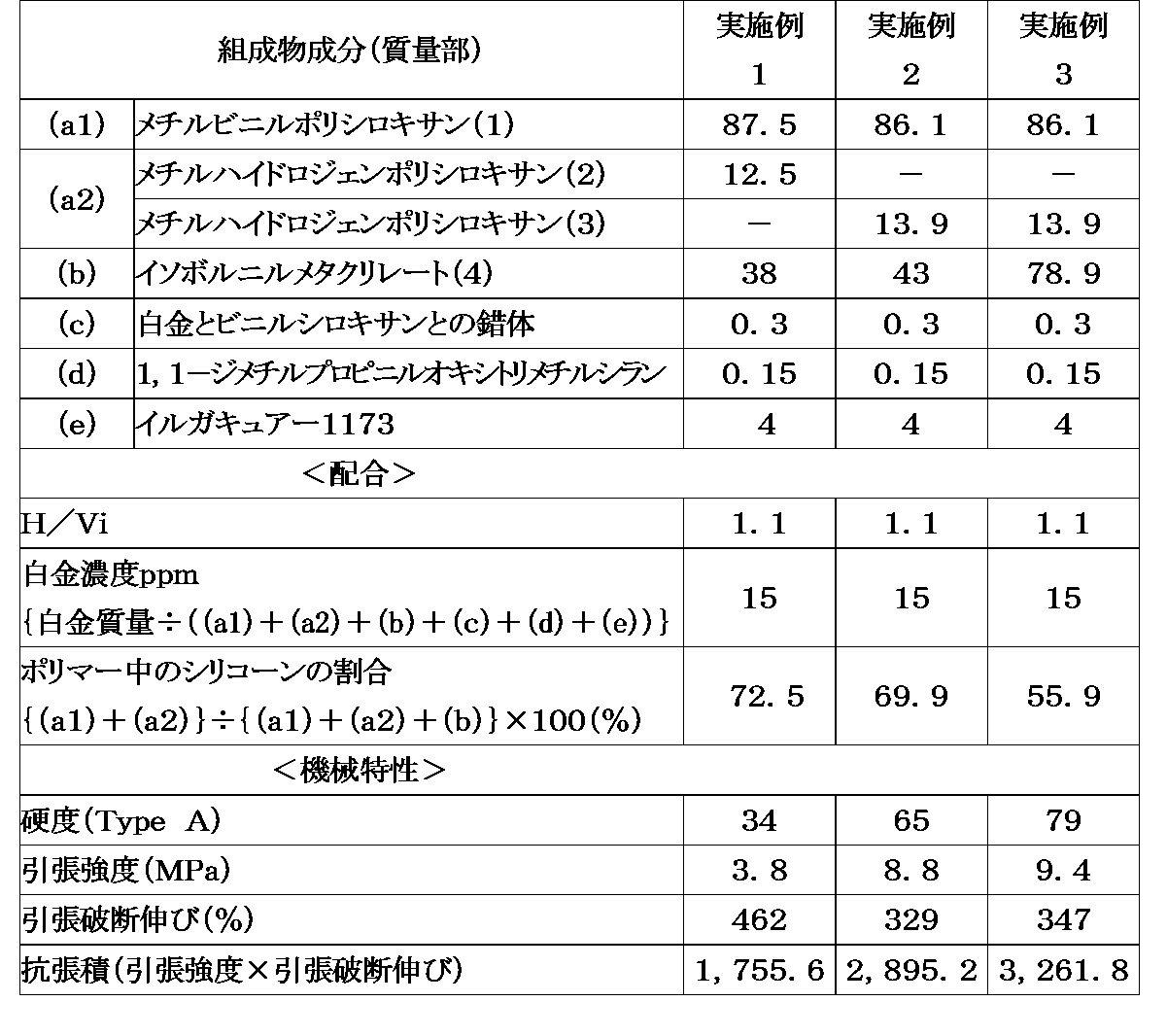
[実施例1]
(a1)成分としてメチルビニルポリシロキサン(1)87.5質量部、(a2)成分としてメチルハイドロジェンポリシロキサン(2)12.5質量部、(b)成分としてイソボルニルアクリレート(4)38質量部、(d)付加反応制御剤成分として1,1-ジメチルプロピニルオキシトリメチルシラン0.15質量部、(e)ラジカル開始剤としてイルガキュアー1173(2-ハイドロキシ-2-メチル-1-フェニルプロパノン)を4質量部加え、均一になるまで攪拌した後、(c)付加反応触媒として白金とビニルシロキサンとの錯体を(a1)、(a2)、(b)、(c)、(d)及び(e)成分の合計質量に対して白金原子質量換算で15ppmになるように加え、均一となるまで攪拌し、動粘度301mm2/s、H/Vi(組成物中のアルケニル基に対する組成物中のSiH基の割合)=1.1の相互侵入網目重合体用組成物を調製した。
深さが2mm、面積が15cm×20cmのフッ素コートされた金型枠の中に上記組成物を投入後、フッ素コートされた金板を乗せて挟み、50℃で1時間加熱し、オルガノポリシロキサン(a1)成分と(a2)成分を架橋した(反応率94%)。この(b)成分を含むオルガノポリシロキサン架橋物を、UV照射装置を用いて窒素雰囲気下、メタルハライドランプ(波長:200~500nmで特に300~450nmの出力が多いもの)で4,000mJ/cm2の積算光量でUV照射することにより組成物中((b)成分中)のアクリル基を重合し、相互侵入網目重合体を合成した(相互侵入網目重合体の不揮発分90%)。
(a1)成分としてメチルビニルポリシロキサン(1)87.5質量部、(a2)成分としてメチルハイドロジェンポリシロキサン(2)12.5質量部、(b)成分としてイソボルニルアクリレート(4)38質量部、(d)付加反応制御剤成分として1,1-ジメチルプロピニルオキシトリメチルシラン0.15質量部、(e)ラジカル開始剤としてイルガキュアー1173(2-ハイドロキシ-2-メチル-1-フェニルプロパノン)を4質量部加え、均一になるまで攪拌した後、(c)付加反応触媒として白金とビニルシロキサンとの錯体を(a1)、(a2)、(b)、(c)、(d)及び(e)成分の合計質量に対して白金原子質量換算で15ppmになるように加え、均一となるまで攪拌し、動粘度301mm2/s、H/Vi(組成物中のアルケニル基に対する組成物中のSiH基の割合)=1.1の相互侵入網目重合体用組成物を調製した。
深さが2mm、面積が15cm×20cmのフッ素コートされた金型枠の中に上記組成物を投入後、フッ素コートされた金板を乗せて挟み、50℃で1時間加熱し、オルガノポリシロキサン(a1)成分と(a2)成分を架橋した(反応率94%)。この(b)成分を含むオルガノポリシロキサン架橋物を、UV照射装置を用いて窒素雰囲気下、メタルハライドランプ(波長:200~500nmで特に300~450nmの出力が多いもの)で4,000mJ/cm2の積算光量でUV照射することにより組成物中((b)成分中)のアクリル基を重合し、相互侵入網目重合体を合成した(相互侵入網目重合体の不揮発分90%)。
[実施例2]
(a1)成分としてメチルビニルポリシロキサン(1)86.1質量部、(a2)成分としてアクリル基含有メチルハイドロジェンポリシロキサン(3)13.9質量部、(b)成分としてイソボルニルアクリレート(4)43質量部、(d)付加反応制御剤成分として1,1-ジメチルプロピニルオキシトリメチルシラン0.15質量部、(e)ラジカル開始剤としてイルガキュアー1173を4質量部加え、均一となるまで攪拌した後、(c)付加反応触媒として白金とビニルシロキサンとの錯体を(a1)、(a2)、(b)、(c)、(d)及び(e)成分の合計質量に対して白金原子質量換算で15ppmになるように加え、均一となるまで攪拌し、動粘度273mm2/s、H/Vi(組成物中のアルケニル基に対する組成物中のSiH基の割合)=1.1の相互侵入網目重合体用組成物を調製した。
実施例1と同条件で製造を行い((a1)成分と(a2)成分との反応率96%)、相互侵入網目重合体を合成した(相互侵入網目重合体の不揮発分92%)。
(a1)成分としてメチルビニルポリシロキサン(1)86.1質量部、(a2)成分としてアクリル基含有メチルハイドロジェンポリシロキサン(3)13.9質量部、(b)成分としてイソボルニルアクリレート(4)43質量部、(d)付加反応制御剤成分として1,1-ジメチルプロピニルオキシトリメチルシラン0.15質量部、(e)ラジカル開始剤としてイルガキュアー1173を4質量部加え、均一となるまで攪拌した後、(c)付加反応触媒として白金とビニルシロキサンとの錯体を(a1)、(a2)、(b)、(c)、(d)及び(e)成分の合計質量に対して白金原子質量換算で15ppmになるように加え、均一となるまで攪拌し、動粘度273mm2/s、H/Vi(組成物中のアルケニル基に対する組成物中のSiH基の割合)=1.1の相互侵入網目重合体用組成物を調製した。
実施例1と同条件で製造を行い((a1)成分と(a2)成分との反応率96%)、相互侵入網目重合体を合成した(相互侵入網目重合体の不揮発分92%)。
[実施例3]
(a1)成分としてメチルビニルポリシロキサン(1)86.1質量部、(a2)成分としてアクリル基含有メチルハイドロジェンポリシロキサン(3)13.9質量部、(b)成分としてイソボルニルアクリレート(4)78.9質量部、(d)付加反応制御剤成分として1,1-ジメチルプロピニルオキシトリメチルシラン0.15質量部、(e)ラジカル開始剤としてイルガキュアー1173を4質量部加え、均一となるまで攪拌した後、(c)付加反応触媒として白金とビニルシロキサンとの錯体を(a1)、(a2)、(b)、(c)、(d)及び(e)成分の合計質量に対して白金原子質量換算で15ppmになるように加え、均一となるまで攪拌し、動粘度158mm2/s、H/Vi(組成物中のアルケニル基に対する組成物中のSiH基の割合)=1.1の相互侵入網目重合体用組成物を調製した。
実施例1と同条件で製造を行い((a1)成分と(a2)成分との反応率96%)、相互侵入網目重合体を合成した(相互侵入網目重合体の不揮発分93%)。
(a1)成分としてメチルビニルポリシロキサン(1)86.1質量部、(a2)成分としてアクリル基含有メチルハイドロジェンポリシロキサン(3)13.9質量部、(b)成分としてイソボルニルアクリレート(4)78.9質量部、(d)付加反応制御剤成分として1,1-ジメチルプロピニルオキシトリメチルシラン0.15質量部、(e)ラジカル開始剤としてイルガキュアー1173を4質量部加え、均一となるまで攪拌した後、(c)付加反応触媒として白金とビニルシロキサンとの錯体を(a1)、(a2)、(b)、(c)、(d)及び(e)成分の合計質量に対して白金原子質量換算で15ppmになるように加え、均一となるまで攪拌し、動粘度158mm2/s、H/Vi(組成物中のアルケニル基に対する組成物中のSiH基の割合)=1.1の相互侵入網目重合体用組成物を調製した。
実施例1と同条件で製造を行い((a1)成分と(a2)成分との反応率96%)、相互侵入網目重合体を合成した(相互侵入網目重合体の不揮発分93%)。
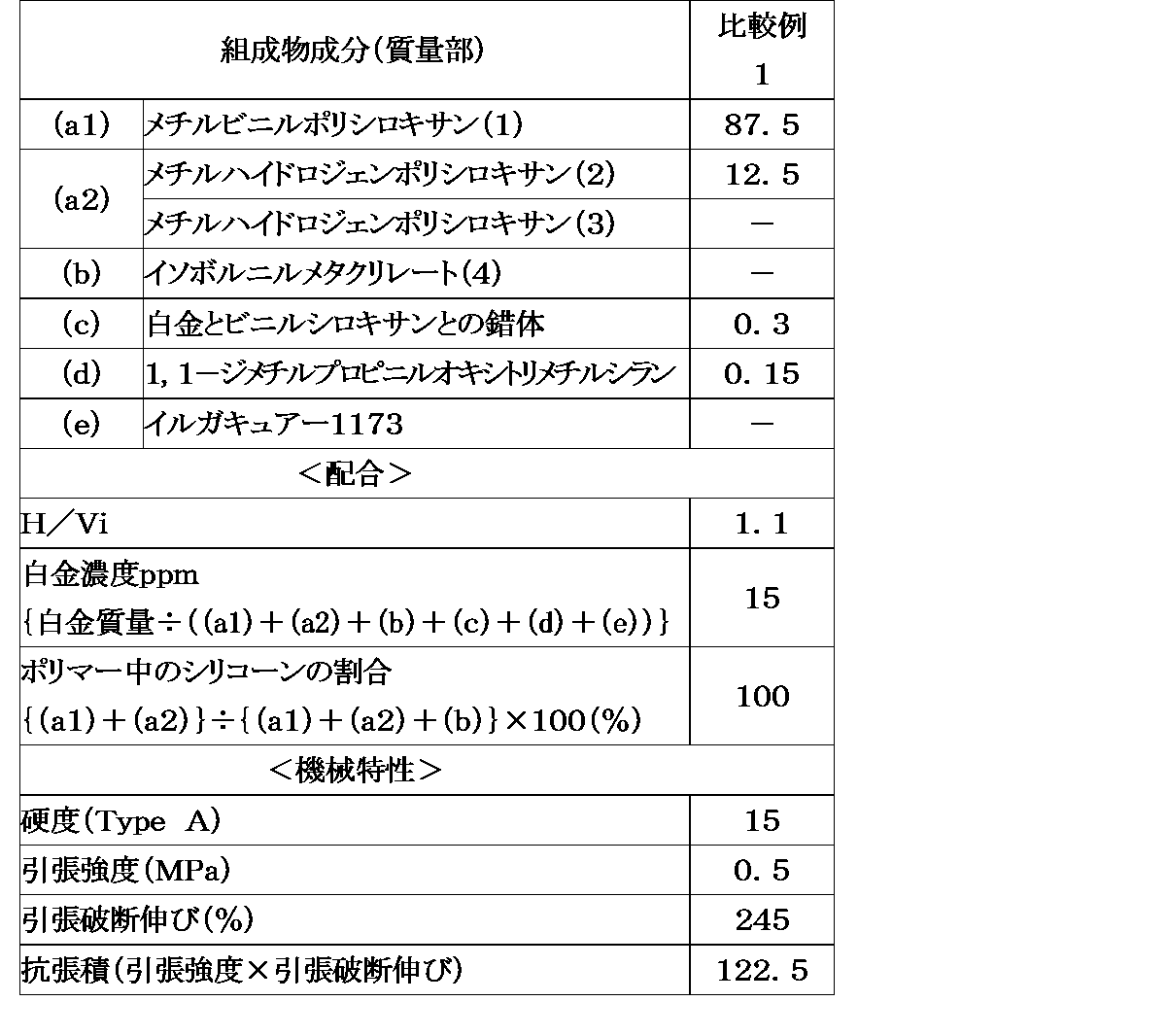
[比較例1]
実施例1からイソボルニルアクリレートとイルガキュアー1173を除いた、動粘度807mm2/s、H/Vi(組成物中のアルケニル基に対する組成物中のSiH基の割合)=1.1の組成物を調製した。
深さが2mm、面積が15cm×20cmのフッ素コートされた金型枠の中に上記組成物を投入後、フッ素コートされた金板を乗せて挟み、50℃で1時間加熱し、オルガノポリシロキサン(a1)成分と(a2)成分を架橋した(反応率95%)。
実施例1からイソボルニルアクリレートとイルガキュアー1173を除いた、動粘度807mm2/s、H/Vi(組成物中のアルケニル基に対する組成物中のSiH基の割合)=1.1の組成物を調製した。
深さが2mm、面積が15cm×20cmのフッ素コートされた金型枠の中に上記組成物を投入後、フッ素コートされた金板を乗せて挟み、50℃で1時間加熱し、オルガノポリシロキサン(a1)成分と(a2)成分を架橋した(反応率95%)。
-使用原料の説明-
メチルビニルポリシロキサン(1)
分子鎖両末端がジメチルビニルシロキシ基で封鎖され、両末端以外は全て(CH3)2SiO単位からなる、ビニル価が0.013mol/100g、動粘度が1,000mm2/s、重量平均分子量が15,000のポリシロキサン
{(CH2=CH)(CH3)2SiO1/2}2{(CH3)2SiO}200
メチルビニルポリシロキサン(1)
分子鎖両末端がジメチルビニルシロキシ基で封鎖され、両末端以外は全て(CH3)2SiO単位からなる、ビニル価が0.013mol/100g、動粘度が1,000mm2/s、重量平均分子量が15,000のポリシロキサン
{(CH2=CH)(CH3)2SiO1/2}2{(CH3)2SiO}200
メチルハイドロジェンポリシロキサン(2)
分子鎖両末端がトリメチルシロキシ基で封鎖され、主鎖が(CH3)HSiO単位と(CH3)2SiO単位からなり、SiH基含有量が0.1mol/100g、動粘度が110mm2/s、重量平均分子量が6,500であるメチルハイドロジェンポリシロキサン
分子鎖両末端がトリメチルシロキシ基で封鎖され、主鎖が(CH3)HSiO単位と(CH3)2SiO単位からなり、SiH基含有量が0.1mol/100g、動粘度が110mm2/s、重量平均分子量が6,500であるメチルハイドロジェンポリシロキサン
メチルハイドロジェンポリシロキサン(3)
分子鎖両末端がアクリルジメチルシロキシ基で封鎖され、主鎖が(CH3)HSiO単位と(CH3)2SiO単位からなり、SiH基含有量が0.089mol/100g、アクリル基含有量が0.025mol/100g、動粘度が130mm2/s、重量平均分子量が8,100であるメチルハイドロジェンポリシロキサン
分子鎖両末端がアクリルジメチルシロキシ基で封鎖され、主鎖が(CH3)HSiO単位と(CH3)2SiO単位からなり、SiH基含有量が0.089mol/100g、アクリル基含有量が0.025mol/100g、動粘度が130mm2/s、重量平均分子量が8,100であるメチルハイドロジェンポリシロキサン
イソボルニルアクリレート(4)
下記式(4)で表される化合物(分子量208.3、比重0.983g/ml)

下記式(4)で表される化合物(分子量208.3、比重0.983g/ml)
上記の実施例及び比較例の重合体について、下記の機械特性評価を行った結果を、組成物の配合量と共に表1、表2に示す。
〔硬度〕
ASTM D 2240に準じてタイプAのデュロメーターを使用し、測定した。
ASTM D 2240に準じてタイプAのデュロメーターを使用し、測定した。
〔引張強度と引張破断伸び〕
2mm厚のシートをJIS 5号のダンベルで打ち抜き試験サンプルを作製し、AGS-X((株)島津製作所製)を用いてISO37(JIS K 6251)に準じて測定した。
2mm厚のシートをJIS 5号のダンベルで打ち抜き試験サンプルを作製し、AGS-X((株)島津製作所製)を用いてISO37(JIS K 6251)に準じて測定した。
Claims (7)
- (A)オルガノポリシロキサン架橋物90~30質量部と(B)(メタ)アクリル重合体10~70質量部(但し、(A)、(B)成分の合計は100質量部である。)からなり、フィラーを含有しない2mm厚のシートのISO37(JIS K 6251)に準じた測定で得られる抗張積(引張強度(MPa)と引張破断伸び(%)の積)が1,000以上となることを特徴とする相互侵入網目重合体。
- フィラーを含有しない2mm厚のシートのISO37に準じた測定で得られる引張強度が3MPa以上、かつ引張破断伸びが300%以上である請求項1に記載の相互侵入網目重合体。
- 上記(A)オルガノポリシロキサン架橋物が、(a1)アルケニル基含有オルガノポリシロキサンと(a2)オルガノハイドロジェンポリシロキサンの付加反応物である請求項1又は2に記載の相互侵入網目重合体。
- (a2)オルガノハイドロジェンポリシロキサンが、(メタ)アクリル基を含有するものである請求項3に記載の相互侵入網目重合体。
- (A)オルガノポリシロキサン架橋物に(b)(メタ)アクリルモノマーを含有させ、(メタ)アクリル基を重合させて(B)(メタ)アクリル重合体を得る請求項1~4のいずれか1項に記載の相互侵入網目重合体の製造方法。
- (b)(メタ)アクリルモノマーを含有する溶液中で、(a1)アルケニル基含有オルガノポリシロキサンと(a2)オルガノハイドロジェンポリシロキサンを付加反応させて(A)オルガノポリシロキサン架橋物を得、その後(メタ)アクリル基を重合させて(B)(メタ)アクリル重合体を得る請求項1~4のいずれか1項に記載の相互侵入網目重合体の製造方法。
- UV照射により(メタ)アクリル基を重合させる請求項5又は6に記載の相互侵入網目重合体の製造方法。
Priority Applications (2)
| Application Number | Priority Date | Filing Date | Title |
|---|---|---|---|
| KR1020217024684A KR102845679B1 (ko) | 2019-01-07 | 2019-12-26 | 오르가노폴리실록산 가교물과 (메타)아크릴 중합체로 이루어지는 상호 침입 망상 중합체 및 그 제조 방법 |
| CN201980088026.7A CN113260640B (zh) | 2019-01-07 | 2019-12-26 | 包含有机聚硅氧烷交联物和(甲基)丙烯酸系聚合物的互穿网络聚合物及其制造方法 |
Applications Claiming Priority (2)
| Application Number | Priority Date | Filing Date | Title |
|---|---|---|---|
| JP2019-000634 | 2019-01-07 | ||
| JP2019000634A JP7031614B2 (ja) | 2019-01-07 | 2019-01-07 | オルガノポリシロキサン架橋物と(メタ)アクリル重合体からなる相互侵入網目重合体及びその製造方法 |
Publications (1)
| Publication Number | Publication Date |
|---|---|
| WO2020145178A1 true WO2020145178A1 (ja) | 2020-07-16 |
Family
ID=71520707
Family Applications (1)
| Application Number | Title | Priority Date | Filing Date |
|---|---|---|---|
| PCT/JP2019/051106 Ceased WO2020145178A1 (ja) | 2019-01-07 | 2019-12-26 | オルガノポリシロキサン架橋物と(メタ)アクリル重合体からなる相互侵入網目重合体及びその製造方法 |
Country Status (5)
| Country | Link |
|---|---|
| JP (1) | JP7031614B2 (ja) |
| KR (1) | KR102845679B1 (ja) |
| CN (1) | CN113260640B (ja) |
| TW (1) | TWI837268B (ja) |
| WO (1) | WO2020145178A1 (ja) |
Cited By (2)
| Publication number | Priority date | Publication date | Assignee | Title |
|---|---|---|---|---|
| WO2024070200A1 (ja) * | 2022-09-28 | 2024-04-04 | 信越化学工業株式会社 | 光および熱硬化型シリコーン組成物ならびにその硬化物の製造方法 |
| WO2024070199A1 (ja) * | 2022-09-28 | 2024-04-04 | 信越化学工業株式会社 | 熱および光硬化型シリコーン組成物ならびにその硬化物の製造方法 |
Families Citing this family (2)
| Publication number | Priority date | Publication date | Assignee | Title |
|---|---|---|---|---|
| JP7721483B2 (ja) * | 2022-06-02 | 2025-08-12 | 信越化学工業株式会社 | 付加硬化型シリコーンコーティング剤及びゴム物品 |
| JP2024172196A (ja) * | 2023-05-31 | 2024-12-12 | 信越化学工業株式会社 | 熱ラジカル硬化性熱伝導性シリコーン組成物及びその製造方法 |
Citations (3)
| Publication number | Priority date | Publication date | Assignee | Title |
|---|---|---|---|---|
| JPS50151958A (ja) * | 1974-05-06 | 1975-12-06 | ||
| JPS61264013A (ja) * | 1985-04-16 | 1986-11-21 | ゼネラル・エレクトリツク・カンパニイ | 新規なシリコ−ン含有相互浸透重合体網状構造物 |
| EP0315836A2 (en) * | 1987-10-30 | 1989-05-17 | HÜLS AMERICA INC. (a Delaware corporation) | Polyorganosiloxane based interpenetrating network polymers and methods of making |
Family Cites Families (12)
| Publication number | Priority date | Publication date | Assignee | Title |
|---|---|---|---|---|
| DE2917754A1 (de) * | 1979-05-02 | 1980-11-13 | Wacker Chemie Gmbh | Hydrophile, vernetzte, modifizierte organopolysiloxane verfahren zu ihrer herstellung und ihre verwendung |
| DE3737985A1 (de) * | 1987-11-09 | 1989-05-18 | Bayer Ag | Am aromatischen kern fluor enthaltende fluormethoxy- und fluormethylthio-aminobenzole und deren herstellung |
| FR2709756B1 (fr) * | 1993-09-10 | 1995-10-20 | Essilor Int | Matériau hydrophile, transparent à haute perméabilité à l'oxygène, à base d'un polymère à réseaux interpénétrés, son mode de préparation et fabrication de lentilles de contact souples à haute perméabilité à l'oxygène. |
| JP3993143B2 (ja) | 2003-08-25 | 2007-10-17 | 独立行政法人科学技術振興機構 | セミipn型複合体およびその製造方法、並びに防汚塗料 |
| EP1819775B1 (en) | 2004-11-19 | 2008-09-24 | Dow Corning Corporation | Organohydrogenpoly siloxane resin and silicon composition |
| KR100836731B1 (ko) * | 2005-10-13 | 2008-06-10 | 주식회사 엘지화학 | 아크릴-실리콘계 고무 복합 중합체, 이의 제조방법 및 용도 |
| JP6135896B2 (ja) | 2011-03-25 | 2017-05-31 | Jsr株式会社 | 高分子ゲル及びその製造方法 |
| EP2803703A4 (en) | 2012-01-12 | 2015-07-15 | Sekisui Chemical Co Ltd | RESIN COMPOSITE MATERIAL AND METHOD FOR PRODUCING A RESIN COMPOSITE MATERIAL |
| CN103289267B (zh) * | 2012-12-07 | 2015-05-27 | 杭州师范大学 | 一种含氢聚硅氧烷与聚丙烯酸酯半互穿网络聚合物的制备方法与应用 |
| KR102268045B1 (ko) * | 2014-06-27 | 2021-06-22 | 엘지전자 주식회사 | 쇼 윈도우에 전시된 제품의 제품 정보 제공 장치 및 방법 |
| JP6762189B2 (ja) * | 2016-10-03 | 2020-09-30 | モメンティブ・パフォーマンス・マテリアルズ・ジャパン合同会社 | 硬化性ポリオルガノシロキサン組成物および電気・電子機器 |
| TWI801443B (zh) | 2017-10-27 | 2023-05-11 | 美商陶氏有機矽公司 | 可固化聚有機矽氧烷組成物、藉由固化該等組成物獲得之固化體、及包含其之電子裝置 |
-
2019
- 2019-01-07 JP JP2019000634A patent/JP7031614B2/ja active Active
- 2019-12-26 WO PCT/JP2019/051106 patent/WO2020145178A1/ja not_active Ceased
- 2019-12-26 CN CN201980088026.7A patent/CN113260640B/zh active Active
- 2019-12-26 KR KR1020217024684A patent/KR102845679B1/ko active Active
-
2020
- 2020-01-06 TW TW109100279A patent/TWI837268B/zh active
Patent Citations (3)
| Publication number | Priority date | Publication date | Assignee | Title |
|---|---|---|---|---|
| JPS50151958A (ja) * | 1974-05-06 | 1975-12-06 | ||
| JPS61264013A (ja) * | 1985-04-16 | 1986-11-21 | ゼネラル・エレクトリツク・カンパニイ | 新規なシリコ−ン含有相互浸透重合体網状構造物 |
| EP0315836A2 (en) * | 1987-10-30 | 1989-05-17 | HÜLS AMERICA INC. (a Delaware corporation) | Polyorganosiloxane based interpenetrating network polymers and methods of making |
Non-Patent Citations (1)
| Title |
|---|
| WU, S ET AL.: "Damping properties of polyorganosiloxane/poly(methyl methacrylate) interpenetrating networks", MACROMOLECULAR MATERIALS AND ENGINEERING, vol. 287, no. 4, 1 April 2002 (2002-04-01), pages 231 - 235, XP055725463 * |
Cited By (6)
| Publication number | Priority date | Publication date | Assignee | Title |
|---|---|---|---|---|
| WO2024070200A1 (ja) * | 2022-09-28 | 2024-04-04 | 信越化学工業株式会社 | 光および熱硬化型シリコーン組成物ならびにその硬化物の製造方法 |
| WO2024070199A1 (ja) * | 2022-09-28 | 2024-04-04 | 信越化学工業株式会社 | 熱および光硬化型シリコーン組成物ならびにその硬化物の製造方法 |
| JP2024048448A (ja) * | 2022-09-28 | 2024-04-09 | 信越化学工業株式会社 | 熱および光硬化型シリコーン組成物ならびにその硬化物の製造方法 |
| JP2024048452A (ja) * | 2022-09-28 | 2024-04-09 | 信越化学工業株式会社 | 光および熱硬化型シリコーン組成物ならびにその硬化物の製造方法 |
| JP7790307B2 (ja) | 2022-09-28 | 2025-12-23 | 信越化学工業株式会社 | 光および熱硬化型シリコーン組成物ならびにその硬化物の製造方法 |
| JP7790306B2 (ja) | 2022-09-28 | 2025-12-23 | 信越化学工業株式会社 | 熱および光硬化型シリコーン組成物ならびにその硬化物の製造方法 |
Also Published As
| Publication number | Publication date |
|---|---|
| CN113260640A (zh) | 2021-08-13 |
| KR102845679B1 (ko) | 2025-08-13 |
| JP7031614B2 (ja) | 2022-03-08 |
| JP2020109140A (ja) | 2020-07-16 |
| TW202033666A (zh) | 2020-09-16 |
| TWI837268B (zh) | 2024-04-01 |
| CN113260640B (zh) | 2023-04-25 |
| KR20210112352A (ko) | 2021-09-14 |
Similar Documents
| Publication | Publication Date | Title |
|---|---|---|
| JP5956697B1 (ja) | 難燃性ポリオルガノシロキサン組成物、難燃性硬化物、光学用部材、光源用レンズまたはカバー、および成形方法 | |
| WO2020145178A1 (ja) | オルガノポリシロキサン架橋物と(メタ)アクリル重合体からなる相互侵入網目重合体及びその製造方法 | |
| JP4590253B2 (ja) | オルガノポリシロキサンおよびシリコーン組成物 | |
| KR102846844B1 (ko) | 폴리(메트)아크릴레이트기를 갖는 폴리오가노실록산 및 이의 제조 및 사용 방법 | |
| JP6120105B2 (ja) | 無機微粒子複合体とその製造方法、組成物及び硬化物 | |
| JP5294414B2 (ja) | オルガノポリシルメチレン組成物及びその硬化物 | |
| JPWO2007119627A1 (ja) | 硬化性組成物、シルセスキオキサン硬化物、及びこれらの製造方法 | |
| JPWO2009119253A1 (ja) | シラノール基含有硬化性籠型シルセスキオキサン化合物、籠型構造含有硬化性シリコーン共重合体、及びこれらの製造方法、並びに硬化性樹脂組成物 | |
| EP0798342A2 (en) | Curable organosiloxane composition with improved hysteresis characteristics | |
| CN101857727B (zh) | 固化性树脂组合物和固化物 | |
| JP6257906B2 (ja) | 付加硬化型シリコーンゴム組成物 | |
| CN113913022B (zh) | 具有延长的硫化操作时间的加成型硅橡胶组合物及其制备方法 | |
| JP5797844B2 (ja) | アミノ官能性オルガノシリコン化合物の銅錯体及びその使用 | |
| KR20230023665A (ko) | 부가 반응 경화형 오르가노폴리실록산 조성물, 및 박리지 및 박리 필름 | |
| JP2011158797A (ja) | 耐熱性複合型レンズ | |
| TW202406993A (zh) | 倍半矽氧烷衍生物及其製造方法、硬化性組成物、硬塗劑、硬化物、硬塗層、以及基材 | |
| EP4688259A1 (en) | Encapsulated catalyst, method of preparation, composition and methods involving hydrosilylation | |
| JP2020152860A (ja) | 接着剤、接着剤の製造方法、及びその使用方法 | |
| US20230203341A1 (en) | Coating resin composition and coating film comprising cured article thereof as coating layer | |
| WO2023100992A1 (ja) | シルセスキオキサン誘導体、硬化性組成物、硬化物及び基材 | |
| JPH1149956A (ja) | 水性硬化性樹脂組成物およびシリコーンアクリルエマルション |
Legal Events
| Date | Code | Title | Description |
|---|---|---|---|
| 121 | Ep: the epo has been informed by wipo that ep was designated in this application |
Ref document number: 19908755 Country of ref document: EP Kind code of ref document: A1 |
|
| NENP | Non-entry into the national phase |
Ref country code: DE |
|
| ENP | Entry into the national phase |
Ref document number: 20217024684 Country of ref document: KR Kind code of ref document: A |
|
| 122 | Ep: pct application non-entry in european phase |
Ref document number: 19908755 Country of ref document: EP Kind code of ref document: A1 |