WO2020141614A2 - ポリイミド、ポリアミド酸、樹脂溶液、コーティング剤及びポリイミドフィルム - Google Patents
ポリイミド、ポリアミド酸、樹脂溶液、コーティング剤及びポリイミドフィルム Download PDFInfo
- Publication number
- WO2020141614A2 WO2020141614A2 PCT/JP2020/016172 JP2020016172W WO2020141614A2 WO 2020141614 A2 WO2020141614 A2 WO 2020141614A2 JP 2020016172 W JP2020016172 W JP 2020016172W WO 2020141614 A2 WO2020141614 A2 WO 2020141614A2
- Authority
- WO
- WIPO (PCT)
- Prior art keywords
- polyimide
- aliphatic
- group
- polyamic acid
- resin solution
- Prior art date
- Legal status (The legal status is an assumption and is not a legal conclusion. Google has not performed a legal analysis and makes no representation as to the accuracy of the status listed.)
- Ceased
Links
Images
Classifications
-
- C—CHEMISTRY; METALLURGY
- C08—ORGANIC MACROMOLECULAR COMPOUNDS; THEIR PREPARATION OR CHEMICAL WORKING-UP; COMPOSITIONS BASED THEREON
- C08G—MACROMOLECULAR COMPOUNDS OBTAINED OTHERWISE THAN BY REACTIONS ONLY INVOLVING UNSATURATED CARBON-TO-CARBON BONDS
- C08G73/00—Macromolecular compounds obtained by reactions forming a linkage containing nitrogen with or without oxygen or carbon in the main chain of the macromolecule, not provided for in groups C08G12/00 - C08G71/00
- C08G73/06—Polycondensates having nitrogen-containing heterocyclic rings in the main chain of the macromolecule
- C08G73/10—Polyimides; Polyester-imides; Polyamide-imides; Polyamide acids or similar polyimide precursors
- C08G73/1003—Preparatory processes
- C08G73/1007—Preparatory processes from tetracarboxylic acids or derivatives and diamines
-
- C—CHEMISTRY; METALLURGY
- C08—ORGANIC MACROMOLECULAR COMPOUNDS; THEIR PREPARATION OR CHEMICAL WORKING-UP; COMPOSITIONS BASED THEREON
- C08G—MACROMOLECULAR COMPOUNDS OBTAINED OTHERWISE THAN BY REACTIONS ONLY INVOLVING UNSATURATED CARBON-TO-CARBON BONDS
- C08G73/00—Macromolecular compounds obtained by reactions forming a linkage containing nitrogen with or without oxygen or carbon in the main chain of the macromolecule, not provided for in groups C08G12/00 - C08G71/00
- C08G73/06—Polycondensates having nitrogen-containing heterocyclic rings in the main chain of the macromolecule
- C08G73/10—Polyimides; Polyester-imides; Polyamide-imides; Polyamide acids or similar polyimide precursors
-
- C—CHEMISTRY; METALLURGY
- C08—ORGANIC MACROMOLECULAR COMPOUNDS; THEIR PREPARATION OR CHEMICAL WORKING-UP; COMPOSITIONS BASED THEREON
- C08J—WORKING-UP; GENERAL PROCESSES OF COMPOUNDING; AFTER-TREATMENT NOT COVERED BY SUBCLASSES C08B, C08C, C08F, C08G or C08H
- C08J5/00—Manufacture of articles or shaped materials containing macromolecular substances
- C08J5/18—Manufacture of films or sheets
-
- C—CHEMISTRY; METALLURGY
- C09—DYES; PAINTS; POLISHES; NATURAL RESINS; ADHESIVES; COMPOSITIONS NOT OTHERWISE PROVIDED FOR; APPLICATIONS OF MATERIALS NOT OTHERWISE PROVIDED FOR
- C09D—COATING COMPOSITIONS, e.g. PAINTS, VARNISHES OR LACQUERS; FILLING PASTES; CHEMICAL PAINT OR INK REMOVERS; INKS; CORRECTING FLUIDS; WOODSTAINS; PASTES OR SOLIDS FOR COLOURING OR PRINTING; USE OF MATERIALS THEREFOR
- C09D179/00—Coating compositions based on macromolecular compounds obtained by reactions forming in the main chain of the macromolecule a linkage containing nitrogen, with or without oxygen, or carbon only, not provided for in groups C09D161/00 - C09D177/00
- C09D179/04—Polycondensates having nitrogen-containing heterocyclic rings in the main chain; Polyhydrazides; Polyamide acids or similar polyimide precursors
- C09D179/08—Polyimides; Polyester-imides; Polyamide-imides; Polyamide acids or similar polyimide precursors
-
- C—CHEMISTRY; METALLURGY
- C08—ORGANIC MACROMOLECULAR COMPOUNDS; THEIR PREPARATION OR CHEMICAL WORKING-UP; COMPOSITIONS BASED THEREON
- C08J—WORKING-UP; GENERAL PROCESSES OF COMPOUNDING; AFTER-TREATMENT NOT COVERED BY SUBCLASSES C08B, C08C, C08F, C08G or C08H
- C08J2379/00—Characterised by the use of macromolecular compounds obtained by reactions forming in the main chain of the macromolecule a linkage containing nitrogen with or without oxygen, or carbon only, not provided for in groups C08J2361/00 - C08J2377/00
- C08J2379/04—Polycondensates having nitrogen-containing heterocyclic rings in the main chain; Polyhydrazides; Polyamide acids or similar polyimide precursors
- C08J2379/08—Polyimides; Polyester-imides; Polyamide-imides; Polyamide acids or similar polyimide precursors
Definitions
- the present invention relates to a polyimide, a polyamic acid, a resin solution, a coating agent and a polyimide film.
- Patent Document 1 discloses a polyimide having a repeating unit represented by a specific general formula. Such a polyimide had sufficient heat resistance and light transmittance.
- the polyimide described in Patent Document 1 has sufficient heat resistance and light transmittance as described above, and was sufficiently usable as a glass substitute.
- the polyimide described in Patent Document 1 is used in applications where it is necessary to transmit light having a short wavelength such as KrF excimer laser light having a wavelength of 248 nm (for example, short wavelengths in the fields of semiconductors, resists, lasers, etc.). It was not always sufficient in terms of application to areas where it is necessary to transmit light in the area).
- the present invention has been made in view of the above problems of the prior art, and is a polyimide capable of having a sufficient transmittance of light having a wavelength of 248 nm; a precursor of the polyimide, and the polyimide being manufactured.
- a polyamic acid that can be suitably used for: a resin solution containing at least one resin of the polyimide and the polyamic acid; a coating agent comprising the resin solution; and a resin solution obtained by using the resin solution. It is intended to provide a polyimide film.
- polyimide is a cycloaliphatic tetracarboxylic dianhydride having an aliphatic 6-membered ring structure and a primary amino group is a primary amino group.
- the present invention has been found to make it possible to obtain sufficient transmittance of light having a wavelength of 248 nm by using a polycondensation product with an aliphatic diamine having a structural site bonded to a carbon atom, and thus the present invention Has been completed.
- the polyimide of the present invention A cycloaliphatic tetracarboxylic dianhydride having an aliphatic 6-membered ring structure,
- An aliphatic diamine (A) having two structural moieties (a) in which a primary amino group is bonded to a primary carbon atom in the molecule, and the structural moiety (a) and the primary amino in the molecule.
- polyamic acid of the present invention A cycloaliphatic tetracarboxylic dianhydride having an aliphatic 6-membered ring structure
- An aliphatic diamine (A) having two structural moieties (a) in which a primary amino group is bonded to a primary carbon atom in the molecule, and the structural moiety (a) and the primary amino in the molecule.
- the resin solution of the present invention contains at least one resin selected from the polyimide of the present invention and the polyamic acid of the present invention, and an organic solvent.
- the coating agent of the present invention comprises the resin solution of the present invention.
- the polyimide film of the present invention is a cured product of the resin solution of the present invention.
- a polyimide capable of having a sufficient transmittance of light having a wavelength of 248 nm; a polyamic acid which is a precursor of the polyimide and can be preferably used for producing the polyimide. It is possible to provide a resin solution containing at least one resin of the polyimide and the polyamic acid; a coating agent comprising the resin solution; and a polyimide film obtained by using the resin solution.
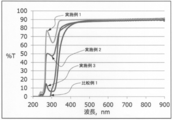
- 5 is a graph showing the transmittance of light having a wavelength of 200 nm to 900 nm for the polyimide films obtained in Examples 1 to 3 and Comparative Example 1.
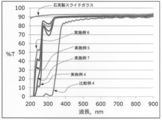
- 5 is a graph showing the transmittances of light having a wavelength of 200 nm to 900 nm of the polyimide-coated glass obtained in Examples 4 to 7 and Comparative Example 4, and quartz sly glass.
- the polyimide of the present invention comprises a polycondensate of the above-mentioned cycloaliphatic tetracarboxylic dianhydride having an aliphatic 6-membered ring structure and the above aliphatic diamine compound.
- Such a cycloaliphatic tetracarboxylic dianhydride has an aliphatic 6-membered ring structure.
- the “aliphatic 6-membered ring structure” may be a ring having 6 carbon atoms forming the cyclic structure portion, and for example, a ring having 6 carbon atoms may be used.
- it may have a structure of a so-called bridged ring (for example, a norbornane ring) in addition to the structure of a cyclohexane ring.
- the “aliphatic 6-membered ring structure” means, for example, when a polycyclic structure is formed (for example, a bicyclic ring structure containing a bridge structure such as a norbornane ring structure or a bicyclooctane ring structure). Structure), the number of carbon atoms in any one of the cyclic structures may be six.
- Such an aliphatic 6-membered ring structure is not particularly limited, but for example, the following formulas (i) to (iii):
- the cyclic structure represented by As such an aliphatic 6-membered ring structure from the viewpoint that higher heat resistance can be obtained, the cyclic structure represented by the general formula (i) (structure of cyclohexane ring), the general formula (ii) ) Is preferable, and the cyclic structure represented by the general formula (ii) is more preferable.
- cycloaliphatic tetracarboxylic dianhydride having such an aliphatic 6-membered ring structure
- examples of the cycloaliphatic tetracarboxylic dianhydride having such an aliphatic 6-membered ring structure include, for example, the following general formula (I):
- X 1 represents a tetravalent organic group having the aliphatic 6-membered ring structure.
- the tetracarboxylic dianhydride represented by The tetravalent organic group having an aliphatic 6-membered ring structure, which may be selected as X 1 in the formula (I), may have the aliphatic 6-membered ring structure, Various atoms such as a hydrogen atom and an atom other than a hydrogen atom, and other substituents (including other organic groups) may be bonded to the carbon atom forming the group 6-membered ring structure.
- R 1 , R 2 and R 3 each independently represent one selected from the group consisting of a hydrogen atom, an alkyl group having 1 to 10 carbon atoms and a fluorine atom, and n is 0 to 12
- m represents an integer of 0 to 2
- R 4 are each independently selected from the group consisting of a hydrogen atom and an alkyl group having 1 to 10 carbon atoms.
- symbols *1 to *4 are any of four bonds in which the bonds with the symbols are respectively bonded to X 1 . Is shown.
- the tetravalent organic group represented by the formula (4) is preferable, the tetravalent organic group represented by the general formulas (c) and (e) is more preferable, and the tetravalent organic group represented by the general formula (c) is preferable. Is particularly preferable.
- the alkyl groups that can be selected as R 1 , R 2 , and R 3 in the formula (c) and R 4 in the formula (e) are all alkyl groups having 1 to 10 carbon atoms.
- the number of carbon atoms of such an alkyl group is preferably 1 to 6, more preferably 1 to 5, and further preferably 1 to 4, from the viewpoint of easier purification. It is particularly preferably 1 to 3.
- such an alkyl group that can be selected as R 1 , R 2 , R 3 in the formula (c) and R 4 in the formula (e) may be linear or branched. ..
- a methyl group and an ethyl group are more preferable from the viewpoint of easy purification.
- R 1 , R 2 , and R 3 in the above formula (c) and R 4 in the above formula (e) are each independently independently selected from the viewpoint that a high degree of heat resistance can be obtained when a resin is produced.
- a hydrogen atom, a methyl group, an ethyl group, an n-propyl group or an isopropyl group is more preferable, a hydrogen atom or a methyl group is further preferable, and a hydrogen atom is particularly preferable.
- the plurality of R 1 , R 2 and R 3 in the formula (c) are the same from the viewpoint of easiness of purification and the like.
- R 4 s in the above formula (e) are the same from the same viewpoint.
- the upper limit value is more preferably 5 (particularly preferably 3) from the viewpoint of easier purification
- n in the formula (c) is From the viewpoint of the stability of the raw material compound, the lower limit value is more preferably 1 (particularly preferably 2), and particularly preferably 2.
- n in the general formula (c) is particularly preferably an integer of 2 to 3.
- n in the general formula (d) is an integer of 0 to 2 (more preferably 1 to 2, and further preferably 1). When such a value of m exceeds the upper limit, manufacturing and purification tend to be difficult.
- cycloaliphatic tetracarboxylic acid dianhydride having such an aliphatic 6-membered ring structure
- examples of the cycloaliphatic tetracarboxylic acid dianhydride having such an aliphatic 6-membered ring structure include bicycloheptane tetracarboxylic acid dianhydride (BHDA) and dimethanonaphthalene tetracarboxylic acid dianhydride (DNDA).
- BHDA bicycloheptane tetracarboxylic acid dianhydride
- DNDA dimethanonaphthalene tetracarboxylic acid dianhydride
- bicyclooctane tetracarboxylic dianhydride BODA
- dicyclohexane-3,3′,4,4′-tetracarboxylic dianhydride also known as “3,3′,4,4′-bicyclohexyl tetracarboxylic acid Acid dianhydride, [1,1′-bi(cyclohexane)]-3,3′,4,4′-tetracarboxylic dianhydride”: H-BPDA), 1,2,4,5-cyclohexanetetra Carboxylic dianhydride (H-PMDA), [1,1′-bi(cyclohexane)]-2,3,3′,4′-tetracarboxylic dianhydride (alias: [1,1′-bi( Cyclohexane)]-2,2',3,3'-tetracarboxylic dianhydride), 4,4'-methylenebis(cyclohexane-1,2-dicarboxy
- norbornane-2-spiro- ⁇ -cyclopentanone- ⁇ '- is particularly preferable from the viewpoint of transparency and heat resistance.
- Spiro-2′′-norbornane-5,5′′,6,6′′-tetracarboxylic dianhydride CpODA
- H-PMDA 1,2,4,5-cyclohexanetetracarboxylic dianhydride
- H-BPDA dicyclohexane-3,3′,4,4′-tetracarboxylic dianhydride
- norbornane-2-spiro- ⁇ -cyclo Particularly preferred is pentanone- ⁇ '-spiro-2''-norbornane-5,5'',6,6''-tetracarboxylic dianhydride (CpODA).
- the method for preparing the cycloaliphatic tetracarboxylic dianhydride containing such an aliphatic 6-membered ring is not particularly limited, and a known method can be appropriately used (for example, when preparing CpODA, The method described in International Publication No. 2011/099518 may be appropriately adopted).
- a commercial product may be appropriately used as the cycloaliphatic tetracarboxylic dianhydride containing such an aliphatic 6-membered ring.
- the cyclic aliphatic tetracarboxylic acid dianhydride containing an aliphatic 6-membered ring includes at least one selected from the group consisting of ester compounds of reaction intermediates (triester compounds, diester compounds, monoester compounds). Ester compounds) may be included.
- ester compounds of reaction intermediates examples include but are not limited to, but are not limited to, but are not limited to, but are not limited to, but are not limited to the reaction intermediate.
- an ester compound as a reaction intermediate is a case where the cycloaliphatic tetracarboxylic dianhydride containing an aliphatic 6-membered ring is CpODA, and tetramethyl ester is used as a raw material at the time of its production.
- a triester compound represented by the following formula (X) a diester compound (half ester) represented by the following formula (Y), and a monoester compound represented by the following formula (Z) may be mentioned. it can.
- the cycloaliphatic tetracarboxylic acid when the dianhydride contains the ester compound of the reaction intermediate as described above, the content of the ester compound of the reaction intermediate is preferably smaller, more preferably 5% by mass or less, and 2% by mass. % Or less is more preferable.
- the content of the ester compound of the reaction intermediate contained in such a cycloaliphatic tetracarboxylic dianhydride containing an aliphatic 6-membered ring is determined by 1 H-NMR measurement of the compound, It can be calculated using the ratio.
- the amount of water contained in such a cycloaliphatic tetracarboxylic acid dianhydride containing an aliphatic 6-membered ring is such that the polyimide precursor varnish (polyamic acid varnish) obtained by using the compound, the storage stability of the polyimide varnish From the viewpoint of the property, it is preferably 500 ppm or less, and more preferably 300 ppm or less.
- the amic acid site in the polymer chain in the varnish is hydrolyzed due to the water content, and since the molecular weight is reduced, the viscosity of the varnish is reduced. It tends to decrease.
- the water content (water content) in the cycloaliphatic tetracarboxylic dianhydride containing an aliphatic 6-membered ring may be a value measured by the Karl Fischer method by coulometric titration. it can.
- the aliphatic diamine compound according to the present invention is an aliphatic diamine (A) having two structural sites (a) in which a primary amino group is bonded to a primary carbon atom in the molecule, and a molecule At least one compound selected from the group consisting of the aliphatic diamine (B) having the structural moiety (a) and the structural moiety (b) having a primary amino group bonded to a secondary carbon atom therein. Is.
- a structural moiety (a) in which a primary amino group is bonded to a primary carbon atom means a structural moiety represented by the formula: —CH 2 —NH 2 (in the formula, The carbon atom is a primary carbon atom, and among the bonds described in the formula, a bond that is not bonded to NH 2 is bonded to another carbon atom).
- a structural moiety (b) in which an amino group is bonded to a secondary carbon atom is a structural moiety represented by the formula: >CH—NH 2 (wherein the carbon atom is a secondary carbon atom, Of the bonds described therein, two bonds that are not bonded to NH 2 are bonded to different carbon atoms).
- the aliphatic diamine (A) having two such structural moieties (a) in the molecule is represented by the following general formula (XI): H 2 N—CH 2 —X 2 —CH 2 —NH 2 (XI)
- X 2 in the formula is a single bond or an ether bond (formula: structural part represented by —O—), a siloxane bond (formula: structural part represented by —Si—O—Si—) and thioether.
- Aliphatic diamines represented by are preferred.
- the compound represented by the formula (XI) when X 2 is a single bond, the compound is a compound represented by the formula: H 2 N—CH 2 —CH 2 —NH 2 .
- the divalent aliphatic hydrocarbon group that can be selected as X 2 is more preferably one having 1 to 50 carbon atoms.
- the divalent aliphatic hydrocarbon group that can be selected as X 2 may be acyclic or cyclic. When such a divalent aliphatic hydrocarbon group is acyclic, it may be linear or branched, but it is From the viewpoint, a linear chain is preferable. When the divalent aliphatic hydrocarbon group is cyclic, the divalent aliphatic hydrocarbon group may have a bridge structure (for example, a structure containing a norbornane ring. etc).
- Examples of the divalent aliphatic hydrocarbon group that can be selected as X 2 include a divalent linear aliphatic hydrocarbon group that may have a substituent and a substituent.
- a divalent cyclic aliphatic hydrocarbon group (including one having a bridged structure), which may have a substituent and whose main chain has a carbon atom substituted with an oxygen atom as a hetero atom;
- a preferable example is a divalent linear aliphatic hydrocarbon group having a structural portion represented by —Si— introduced therein.
- the carbon number thereof is preferably 1 to 50, and 2 to 40. Is more preferable, and 4 to 30 is further preferable. If the carbon number is less than the lower limit, the carbon tends to be brittle, while if it exceeds the upper limit, the heat resistance tends to decrease.
- an alkylene group having a carbon number in the above range is particularly preferable.
- the divalent aliphatic hydrocarbon group that can be selected as X 2 is a divalent cycloaliphatic hydrocarbon group, it preferably has 3 to 50 carbon atoms and 4 to 40 carbon atoms. More preferably, it is more preferably 5 to 30. If the carbon number is less than the lower limit, the carbon tends to be brittle, while if it exceeds the upper limit, the heat resistance tends to decrease.
- Examples of such a divalent cycloaliphatic hydrocarbon group include a residue obtained by removing two hydrogen atoms from a cycloaliphatic hydrocarbon group such as cyclopropane, cyclobutane, cyclopentane, cyclohexane, norbornane (cycloalkylene). Groups, etc.) and the like.
- the cyclic structure when the cyclic structure is a structure other than a bridged ring, the 1-position and 3-position (when it is a 6-membered ring) Further, it is preferable that the structural part (a) is bound to each of the so-called meta positions), and when the cyclic structure is a bridged ring, it is bonded to the carbon atom at the 1-position (carbon atom at the bridgehead). Those in which the structural site (a) is bonded to each of the two carbon atoms having the lowest position number among the three carbon atoms are preferable.
- the divalent cyclic aliphatic hydrocarbon group is a cyclohexylene group, it is preferably a 1,3-cyclohexylene group, and the cyclic aliphatic hydrocarbon group has two hydrogen atoms from the norbornane ring.
- the residue in which atoms are removed those having the structural site (a) bonded to the positions 2 and 6 are preferable.
- the divalent aliphatic hydrocarbon group which can be selected as X 2 is a structural portion represented by the formula: —O— in which a carbon atom in the main chain is replaced by an oxygen atom as a hetero atom (ether bond )
- the compound represented by the formula: *—CH 2 —O—CH 2 —CH 2 —O—CH 2 —* (* in the formula represents a bond for bonding to the structural unit (a)) .) and a divalent group represented by the formula (4) can be preferably used.
- the divalent linear aliphatic hydrocarbon group in which the structural portion represented by the formula: —Si—O—Si— is introduced into the main chain for example, the formula: *—R a —Si( CH 3 ) 2 —O—Si(CH 3 ) 2 —R a ⁇ * (* in the formula represents a bond for bonding to the structural unit (a), Ra represents a single bond or an alkylene group having 1 to 46 carbon atoms.
- the divalent aliphatic hydrocarbon group that may be selected as X 2 may have a substituent such as a methyl group, an ethyl group, an n-propyl group, an isopropyl group, an n-butyl group, an isobutyl group. , A tert-butyl group, a sec-butyl group, a pentyl group, a hexyl group, and the like, among which a methyl group and an ethyl group are preferable.
- Bis(aminomethyl)norbornane represented by (for example, 2,5-bis(aminomethyl)bicyclo[2.2.1]heptane, 2,6-bis(aminomethyl)bicyclo[2.2.1]heptane Etc), the following formula:
- Examples of such aliphatic diamine (A) include 1,3-bis(aminomethyl)cyclohexane and 2,6-bis(aminomethyl)bicyclo[2. 2.1] Heptane, 1,6-hexanediamine, 1,4-bis(aminomethyl)cyclohexane, 1,2-bis(2-aminoethoxy)ethane, 1,3-bis(3-aminopropyl) Tetramethyldisiloxane is preferred.
- 1,3-bis(aminomethyl)cyclohexane, 1,6-hexanediamine, 1,2-bis(2) from the viewpoint of light transmittance.
- 1,3-Aminoethoxy)ethane and 1,3-bis(3-aminopropyl)tetramethyldisiloxane are more preferable, 1,3-bis(aminomethyl)cyclohexane, 1,6-hexanediamine and 1,3-bis (3-Aminopropyl)tetramethyldisiloxane is more preferred.
- Examples of the aliphatic diamine (B) having the structural part (a) and the structural part (b) include the following general formula (XII): H 2 N—X 3 —CH 2 —NH 2 (XII) (X 3 in the formula represents a divalent chain aliphatic hydrocarbon group which may have a substituent and contains a secondary carbon atom which is directly bonded to the amino group (—NH 2 ) or a substituent. It has shown a optionally be bivalent alicyclic hydrocarbon group. However, the amino group directly bonded to X 3 (-NH 2), the secondary carbon atom in X 3 (e.g. cycloaliphatic A carbon atom forming a cyclic structure of a group hydrocarbon group) to form a structural site represented by the formula: >CH—NH 2 in the compound.) Aliphatic diamines represented by are preferred.
- the divalent chain aliphatic hydrocarbon group which can be selected as X 3 has preferably 2 to 50 carbon atoms, more preferably 3 to 40 carbon atoms, and 4 to 30 carbon atoms. Is more preferable.
- the divalent cycloaliphatic hydrocarbon group which can be selected as X 3 has preferably 3 to 50 carbon atoms, more preferably 4 to 40 carbon atoms, and 5 to 30 carbon atoms. More preferably. If the carbon number is less than the lower limit, the carbon tends to be brittle, while if it exceeds the upper limit, the heat resistance tends to decrease.
- divalent cycloaliphatic hydrocarbon group that can be selected as X 3
- the same divalent cycloaliphatic hydrocarbon group as described above for X 2 can be used.
- the “secondary carbon atom directly bonded to the amino group (—NH 2 )” in the divalent chain aliphatic hydrocarbon group that can be selected as X 3 is, for example, the above-mentioned X 2
- the amino group (—NH 2 ) in formula (XII) is directly bonded to a carbon atom other than the terminal carbon atom of the “divalent linear aliphatic hydrocarbon group” described above, resulting in the amino group ( —NH 2 ) in the case where the carbon atom to which it is bonded becomes a secondary carbon atom, or the same carbon atom at the end of the above-mentioned “divalent linear aliphatic hydrocarbon group”
- a divalent chain aliphatic hydrocarbon group containing a secondary carbon atom directly bonded to an amino group (—NH 2 ) which can be selected as X 3 results in an amino group ( It is sufficient that the carbon atom to which —NH 2 ) is bonded becomes a secondary carbon atom, and the group itself may be linear or branched.
- divalent cyclic aliphatic hydrocarbon group and the divalent chain aliphatic hydrocarbon group which can be selected as X 3 are each a substituent from the viewpoint of light transmittance and film forming property.
- 1,1-ethylene group, 1,1-propylene group, 1,2-propylene group, 1,1-butylene group, 1,2-butylene group, 2,3-butylene group, which may have A cyclooctylene group, a cycloheptylene group, a cyclohexylene group, a cyclopentylene group, a cyclobutylene group, a cyclopropylene group and the like are preferable, and a cyclohexylene group which may have a substituent is particularly preferable.
- the substituent which the divalent chain aliphatic hydrocarbon group or the divalent cyclic aliphatic hydrocarbon group may have is not particularly limited, but a methyl group, an ethyl group, n- Examples thereof include a propyl group, an isopropyl group, an n-butyl group, an isobutyl group, a tert-butyl group, a sec-butyl group, a pentyl group and a hexyl group, and among them, a methyl group and an ethyl group are preferable.
- aliphatic diamine (B) examples include isophorone diamine (also known as 1-amino-3-aminomethyl-3,5,5-trimethylcyclohexane), 1-methyl-1,2-ethylenediamine (1 , 2-diaminopropane), 1-ethyl-1,2-ethylenediamine, 1-propyl-1,2-ethylenediamine, 1-butyl-1,2-ethylenediamine, 1-methyl-1,3-diaminopropane, 2- Methyl-1,3-diaminobutane, 1-amino-5-aminomethylcyclooctane, 1-amino-4-aminomethylcyclooctane, 1-amino-3-aminomethylcyclooctane, 1-amino-2-aminomethyl Cyclooctane, 1-amino-4-aminomethylcycloheptane, 1-amino-3-aminomethylcycloheptane, 1-amino-2-aminomethyl
- the aliphatic diamine compound according to the present invention is at least one compound selected from the group consisting of aliphatic diamine (A) and aliphatic diamine (B).
- aliphatic diamine compounds include 1,3-bis(aminomethyl)cyclohexane and 2,6-bis(aminomethyl)bicyclo[2.2 from the viewpoint of light transmission and film-forming properties.
- an aliphatic diamine compound one kind may be used alone, or two or more kinds may be used in combination.
- the polyimide of the present invention comprises a polycondensation product of the cycloaliphatic tetracarboxylic dianhydride having the aliphatic 6-membered ring structure and the aliphatic diamine compound.
- a polyimide is obtained by subjecting a cycloaliphatic tetracarboxylic acid dianhydride having an aliphatic 6-membered ring structure and the aliphatic diamine compound to a ring-opening addition reaction to form a polyaddition product of these ( It is obtained by forming a polyamic acid that is an addition polymer or a ring-opening polyaddition product) and then subjecting the polyamic acid to ring-closing condensation (dehydration ring-closing: intramolecular condensation).
- the polyimide of the present invention is obtained by polycondensation of the cycloaliphatic tetracarboxylic dianhydride having the aliphatic 6-membered ring structure and the aliphatic diamine compound.
- a cycloaliphatic tetracarboxylic dianhydride having the above aliphatic 6-membered ring structure is used as the tetracarboxylic dianhydride, and the aliphatic diamine compound is used as the diamine.
- a method adopted in a known polyimide production method for example, the method described in International Publication No. 2011/099518
- a tetracarboxylic dianhydride and a diamine are reacted to form a polyimide.
- a method similar to can be adopted.
- the cycloaliphatic tetracarboxylic dianhydride and the aliphatic diamine compound are selectively combined and used, thereby obtaining relatively high polymerization reactivity.
- the present inventor believes that a known method for producing a polyimide can be appropriately adopted to produce a polyimide without requiring a special operation.
- polyimide of the present invention examples include the following general formulas (1) and (2):
- X 1 is the same meaning as X 1 in formula (I)
- X 2 has the same meaning as X 2 in the formula (XI)
- X 3 is synonymous with X 3 in the formula (XII) (Note that the bond of X 3 that is not bonded to CH 2 is bonded to the secondary carbon atom in X 3 ).
- a polyimide having at least one kind of repeating unit among the repeating units represented by The repeating unit represented by the above formula (1) can be formed by being derived from the compound represented by the formula (I) and the compound represented by the formula (XI).
- the repeating unit represented by 2) can be formed by being derived from the compound represented by the formula (I) and the compound represented by the formula (XII).
- the polyimide of the present invention may be a polycondensation product of the cycloaliphatic tetracarboxylic dianhydride having the aliphatic 6-membered ring structure and the aliphatic diamine compound,
- a repeating unit other than the repeating unit formed by polycondensation of the cycloaliphatic tetracarboxylic dianhydride having the aliphatic 6-membered ring structure and the aliphatic diamine compound may be used. May be included.
- Such other repeating unit may be any one that can be used as a repeating unit of polyimide, and can be appropriately contained by a known method.
- Such a polyimide of the present invention has a repeating unit formed by polycondensation of the cycloaliphatic tetracarboxylic dianhydride having the aliphatic 6-membered ring structure and the aliphatic diamine compound as a main repeating unit.
- the content of repeating units formed by polycondensation of the cycloaliphatic tetracarboxylic dianhydride having an aliphatic 6-membered ring structure and the aliphatic diamine compound, all repeating units in the polyimide It is preferably at least 70% or more, more preferably 80 to 100 mol%, further preferably 90 to 100 mol%, particularly preferably 95 to 100 mol%, Most preferably, it is mol %.
- such a polyimide preferably has a glass transition temperature (Tg) of 200° C. or higher, more preferably 250 to 550° C., further preferably 300 to 550° C. If the glass transition temperature (Tg) is less than the lower limit, the heat resistance tends to decrease, while if it exceeds the upper limit, it tends to be difficult to produce a polyimide having such properties. ..
- the glass transition temperature (Tg) can be measured in a tensile mode using a thermomechanical analyzer (trade name “TMA8310” manufactured by Rigaku).
- the polyimide of the present invention preferably has a 5% weight loss temperature of 400°C or higher, more preferably 450 to 550°C. If the 5% weight loss temperature is less than the lower limit, the heat resistance tends to decrease, while if it exceeds the upper limit, it tends to be difficult to produce a polyimide having such properties.
- a 5% weight loss temperature is raised from room temperature (for example, 25° C.) to 40° C. under a nitrogen gas atmosphere while flowing nitrogen gas, and then gradually heated to 40° C. as a measurement start temperature. This can be determined by measuring the temperature at which the weight of the sample used decreases by 5%.
- the number average molecular weight (Mn) of such a polyimide is preferably 1,000 to 1,000,000, and more preferably 10,000 to 500,000 in terms of polystyrene.
- the weight average molecular weight (Mw) of such a polyimide is preferably 1,000 to 5,000,000, more preferably 5,000 to 5,000,000, and even more preferably 10,000 to 500,000 in terms of polystyrene. If Mn and Mw are less than the lower limits, it is difficult to achieve sufficient heat resistance, and it tends to be difficult to obtain a film-formable polyimide. On the other hand, if the upper limits are exceeded, the viscosity increases. In addition, it takes a long time to dissolve, requires a large amount of solvent, and tends to be difficult to process such as wrinkles during film formation.
- the molecular weight distribution (Mw/Mn) of such a polyimide is preferably 1.1 to 5.0, and more preferably 1.5 to 3.0. If the molecular weight distribution is less than the lower limit, it tends to be difficult to produce, while if it exceeds the upper limit, it tends to be difficult to obtain a uniform film.
- the molecular weight (Mw or Mn) and the molecular weight distribution (Mw/Mn) of such a polyimide are measured by a gel permeation chromatography (GPC) measuring device (manufactured by Tosoh Corporation, trade name: HLC-8320GPC/).
- such a polyimide preferably has a sufficiently high transparency when a film is formed, and has a total light transmittance of 80% or more (more preferably 85% or more, particularly preferably 90% or more). ) Is more preferable.
- a total light transmittance can be easily achieved by appropriately selecting the kind of polyimide and the like.
- a polyimide having a haze (turbidity) of 5 to 0 is more preferable from the viewpoint of obtaining a higher degree of colorless transparency. If the haze value exceeds the upper limit, it tends to be difficult to achieve a higher level of colorless transparency.
- such a polyimide has a yellowness (YI) of 5 to -2 (more preferably 4 to -2, particularly preferably 3 to -2) from the viewpoint of obtaining a higher degree of colorless transparency. Those are more preferable. If the yellowness exceeds the upper limit, it tends to be difficult to achieve a higher level of colorless transparency.
- YI yellowness index
- ASTM E313-05 published in 2005.
- the absolute value of the retardation (Rth) in the thickness direction measured at a wavelength of 590 nm is more preferably 100 nm or less, further preferably 50 nm or less in terms of a thickness of 10 ⁇ m. If the absolute value of the retardation (Rth) in the thickness direction exceeds the upper limit, a clear image cannot be obtained when used in a display device, and the display quality tends to deteriorate. When the absolute value of the retardation (Rth) is less than or equal to the upper limit, a clear image is obtained and the display quality tends to be higher when used in a display device. As a method of measuring such a retardation (Rth) value, the method described in the section of Examples can be adopted.
- such a polyimide preferably has a dielectric loss tangent (tan ⁇ ) at a frequency of 10 GHz of 0.05 or less (more preferably 0.0001 to 0.05). If the dielectric loss tangent ( ⁇ r) exceeds the upper limit, the degree of electric energy loss in the dielectric body tends to increase. Further, such a polyimide preferably has a relative dielectric constant ( ⁇ r) at a frequency of 10 GHz of 5.0 or less (more preferably 2.0 to 5.0). If the relative permittivity ( ⁇ r) exceeds the upper limit, the signal delay time tends to increase when used as a high frequency substrate material.
- the dielectric loss tangent (tan ⁇ ) and the relative dielectric constant ( ⁇ r) can be measured according to ASTM D2520.
- the polyimide of the present invention depending on its application, for example, an antioxidant, an ultraviolet absorber/hindered amine light stabilizer, a nucleating agent/clearing agent, an inorganic filler (glass fiber, glass hollow spheres, talc, mica, (Alumina, titania, silica, etc.), heavy metal deactivator/filler-filled plastic additive, flame retardant, processability improver/lubricant/water dispersion type stabilizer, permanent antistatic agent, toughness improver, surfactant, It may further contain additional components such as carbon fibers.
- an antioxidant for example, an antioxidant, an ultraviolet absorber/hindered amine light stabilizer, a nucleating agent/clearing agent, an inorganic filler (glass fiber, glass hollow spheres, talc, mica, (Alumina, titania, silica, etc.), heavy metal deactivator/filler-filled plastic additive, flame retardant, processability improver/lubricant/water dispersion type stabilizer, permanent antistatic agent,
- the shape of such polyimide is not particularly limited, and may be, for example, a film shape or a powder shape, or may be a pellet shape by extrusion molding.
- the polyimide of the present invention can be formed into a film shape, a pellet shape by extrusion molding, or can be appropriately formed into various shapes by a known method.
- the polyimide of the present invention is used in applications where it is necessary to transmit light having a short wavelength such as KrF excimer laser light having a wavelength of 248 nm (for example, light in a short wavelength region in the semiconductor field, resist field, laser-related field, etc.). It can be suitably applied to a field which needs to be transmitted.
- the resolution can be increased by shortening the wavelength used, and therefore, in recent years, the wavelength of shorter wavelength is shorter than that of near-ultraviolet resist such as g-line (436 nm) and i-line (365 nm).
- Deep ultraviolet resists using a KrF excimer laser (248 nm) or the like have been mainly adopted, and in particular, a KrF excimer laser has become a main force in device production.
- wholly aromatic polyimides and semi-aromatic polyimides showed absorption in the deep ultraviolet region and originally did not transmit deep ultraviolet light, so they could not be used for deep ultraviolet resists.
- the polyimide of the present invention can have a sufficient transmittance for light having a wavelength of 248 nm. Therefore, the polyimide of the present invention can be suitably used for a deep ultraviolet resist using a KrF excimer laser (wavelength 248 nm).
- the transmittance of light having a wavelength 248 nm is 1 to 70% (more preferably 10 to 60). %, more preferably 20 to 50%).
- the transmittance of light having a wavelength of 248 nm is less than the lower limit, the penetration of KrF excimer laser light into polyimide tends to be small, and the resolution tends to be lowered.
- the upper limit is exceeded, KrF excimer laser light passes through, so the sensitivity tends to decrease.
- polyimides can be used for various purposes, for example, films for flexible wiring boards, heat-resistant insulating tapes, wire enamel, protective coating agents for semiconductors, liquid crystal alignment films, transparent conductive films for organic EL, flexible substrate films.
- Polyimide belt transparent electrode substrate (transparent electrode substrate for organic EL, solar cell transparent electrode substrate, transparent electrode substrate for electronic paper, etc.), interlayer insulating film, sensor substrate, image sensor substrate, light emitting diode ( LED) reflector (LED lighting reflector: LED reflector), LED lighting cover, LED reflector lighting cover, coverlay film, highly ductile composite substrate, semiconductor resist, lithium ion battery, organic memory
- LED lighting reflector LED lighting reflector: LED reflector
- such a polyimide has a shape other than the above-mentioned uses, such as a powdery body or various molded bodies, for example, automobile parts, aerospace parts, bearing parts, seals. It can also be appropriately used for materials, bearing parts, gear wheels and valve parts.
- the polyamic acid of the present invention comprises a polyaddition product of the cycloaliphatic tetracarboxylic dianhydride having the aliphatic 6-membered ring structure and the aliphatic diamine compound.
- the "cycloaliphatic tetracarboxylic dianhydride having an aliphatic 6-membered ring structure” as used herein is the same as that described for the polyimide of the present invention, and the preferred ones are also the same. ..
- the "aliphatic diamine compound” is also the same as that described for the above-mentioned polyimide of the present invention, and the preferred ones are also the same.
- Such a polyamic acid of the present invention is obtained by subjecting the cycloaliphatic tetracarboxylic dianhydride having the aliphatic 6-membered ring structure to the aliphatic diamine compound through an addition polymerization reaction (ring opening polyaddition reaction). It is composed of the obtained reaction product.
- addition polymerization reaction ring-opening polyaddition reaction
- ring-opening polyaddition reaction is well known except that the cycloaliphatic tetracarboxylic acid dianhydride having the aliphatic 6-membered ring structure and the aliphatic diamine compound are used.
- the same reaction conditions as those used in the method for producing a polyamic acid (polyamic acid) (for example, the method described in WO 2011/099518) can be appropriately adopted to proceed.
- the polyamic acid of the present invention is a known polyamic acid except that it uses the cycloaliphatic tetracarboxylic dianhydride having the aliphatic 6-membered ring structure and the aliphatic diamine compound. It can be manufactured by appropriately adopting a method.
- polyamic acid of the present invention examples include the following general formulas (3) and (4):
- X 1 is the same meaning as X 1 in formula (I)
- X 2 has the same meaning as X 2 in the formula (XI)
- X 3 is synonymous with X 3 in the formula (XII) (Note that the bond of X 3 that is not bonded to CH 2 is bonded to the secondary carbon atom in X 3 ).
- Polyamic acid having at least one kind of repeating unit represented by the following.
- the repeating unit represented by the above formula (3) can be formed by being derived from the compound represented by the formula (I) and the compound represented by the formula (XI).
- the repeating unit represented by 4) can be formed by being derived from the compound represented by the formula (I) and the compound represented by the formula (XII).
- the polyamic acid of the present invention may be the polyaddition product of the cycloaliphatic tetracarboxylic dianhydride having the aliphatic 6-membered ring structure and the aliphatic diamine compound, or its polyaddition. It may be a derivative derived from a product. As such a derivative, for example, after forming a polyaddition product having a repeating unit represented by the general formula (3) and/or (4), the polyaddition product of the general formula (3 ) And/or (4), the structural portion of the amide bond represented by the formula: —CO—NH— is represented by the formula: —CO—NY— (wherein Y is an alkyl group having 1 to 6 carbon atoms and a carbon number).
- 3 to 9 represents one kind of substituent selected from the group consisting of alkylsilyl groups) and a hydrogen atom in the amide bond is changed to a substituent represented by Y above.
- Y can be changed by appropriately changing the manufacturing conditions of the kind of the substituent and the introduction rate of the substituent.
- Y in the structural portion represented by the formula: —CO—NY—, when Y is an alkyl group having 1 to 6 carbon atoms (preferably 1 to 3 carbon atoms), the storage stability of the polyamic acid is It tends to be better. Further, when Y is an alkylsilyl group having 3 to 9 carbon atoms, the solubility of the polyamic acid tends to be more excellent.
- Y is an alkylsilyl group having 3 to 9 carbon atoms
- Y is more preferably a trimethylsilyl group or a t-butyldimethylsilyl group.
- the amide bond portion represented by the formula: —CO—NH— is represented by the formula: —CO—NY— (Y in the formula has 1 to 6 carbon atoms).
- the method for preparing the repeating unit having a structure represented by the formula (1 represents a substituent selected from the group consisting of an alkyl group and an alkylsilyl group having 3 to 9 carbon atoms).
- the polyamic acid of the present invention is a polyaddition product of the cycloaliphatic tetracarboxylic dianhydride having the aliphatic 6-membered ring structure and the aliphatic diamine compound. Is more preferable.
- the polyamic acid of the present invention may be a polyaddition product of the cycloaliphatic tetracarboxylic dianhydride having the aliphatic 6-membered ring structure and the aliphatic diamine compound,
- Other than repeating units formed by the addition polymerization reaction of the cycloaliphatic tetracarboxylic dianhydride having an aliphatic 6-membered ring structure and the aliphatic diamine compound, within a range that does not impair the effect of Units may be included.
- Such other repeating unit may be any as long as it can be used as a repeating unit of a polyamic acid, and can be appropriately contained by a known method.
- the polyamic acid of the present invention has a repeating unit mainly composed of a repeating unit formed by an addition polymerization reaction of the cycloaliphatic tetracarboxylic dianhydride having the aliphatic 6-membered ring structure and the aliphatic diamine compound.
- the content of the repeating unit formed by the addition polymerization reaction of the cycloaliphatic tetracarboxylic dianhydride having an aliphatic 6-membered ring structure and the aliphatic diamine compound is preferably It is preferably at least 70% or more, more preferably 80 to 100 mol%, further preferably 90 to 100 mol%, particularly preferably 95 to 100 mol% based on all repeating units. It is preferably 100 mol% and most preferably 100 mol %.
- the intrinsic viscosity [ ⁇ ] of such a polyamic acid is preferably 0.05 to 3.0 dL/g, and more preferably 0.1 to 2.0 dL/g.
- an intrinsic viscosity [ ⁇ ] is less than 0.05 dL/g, when a film-shaped polyimide is produced using this, the obtained film tends to be brittle, while on the other hand, 3.0 dL/g
- it exceeds the above range the viscosity is too high and the processability is lowered. For example, wrinkles are generated in the case of producing a film, and it is difficult to obtain a uniform film.
- an intrinsic viscosity [ ⁇ ] a value measured as follows is adopted.
- N,N-dimethylacetamide was used as a solvent, and the polyamic acid was dissolved in the N,N-dimethylacetamide at a concentration of 0.5 g/dL to prepare a measurement sample (solution). obtain.
- the viscosity of the measurement sample is measured using a kinematic viscometer under the temperature condition of 30° C., and the obtained value is adopted as the intrinsic viscosity [ ⁇ ].
- a kinematic viscometer an automatic viscosity measuring device (trade name "VMC-252") manufactured by Rikyu Co., Ltd. is used.
- such a polyamic acid can be preferably used when producing the polyimide of the present invention (which can be obtained as a reaction intermediate (precursor) when producing the polyimide of the present invention. It is possible.)
- the method that can be suitably adopted as the method for producing the polyamic acid of the present invention is not particularly limited, but, for example, in the presence of an organic solvent, the cyclic aliphatic tetracarboxylic acid is used. Examples thereof include a method for obtaining the polyamic acid of the present invention by subjecting the dianhydride and the aliphatic diamine compound to an addition polymerization reaction.
- the organic solvent used in such a method is an organic solvent capable of dissolving both the cycloaliphatic tetracarboxylic dianhydride having the aliphatic 6-membered ring structure and the aliphatic diamine compound. Is preferred.
- organic solvent include N-methyl-2-pyrrolidone (NMP), N,N-dimethylacetamide (DMAc), N,N-dimethylformamide, dimethylsulfoxide, ⁇ -butyrolactone, propylene carbonate and tetramethyl.
- Aprotic polar solvents such as urea, 1,3-dimethyl-2-imidazolidinone, hexamethylphosphoric triamide and pyridine; phenolic solvents such as m-cresol, xylenol, phenol and halogenated phenols; tetrahydrofuran , Ether solvents such as dioxane, cellosolve and glyme; aromatic solvents such as benzene, toluene and xylene; ketone solvents such as cyclopentanone and cyclohexanone; nitrile solvents such as acetonitrile and benzonitrile.
- Such organic solvents may be used alone or in combination of two or more.
- the amount of such an organic solvent used is such that the total amount of the cycloaliphatic tetracarboxylic dianhydride having an aliphatic 6-membered ring structure used in the reaction and the aliphatic diamine compound is equal to the total amount of the reaction solution.
- the amount is preferably 1 to 80% by mass (more preferably 5 to 50% by mass). If the amount of the organic solvent used is less than the lower limit, it tends to be impossible to efficiently obtain the polyamic acid. On the other hand, if the amount exceeds the upper limit, it becomes difficult to stir due to high viscosity, and a high molecular weight polymer cannot be obtained. There is a tendency.
- reaction temperature at which the cycloaliphatic tetracarboxylic acid dianhydride having the aliphatic 6-membered ring structure and the aliphatic diamine compound are subjected to the addition polymerization reaction is capable of advancing these addition polymerization reactions.
- the temperature may be appropriately adjusted to any appropriate temperature and is not particularly limited, but is preferably 15 to 100°C.
- the aliphatic diamine compound is dissolved in a solvent.
- a method may be employed in which the cycloaliphatic tetracarboxylic dianhydride having the aliphatic 6-membered ring structure is added at the reaction temperature and then the reaction is performed for 10 to 48 hours. If the reaction temperature or reaction time is less than the lower limit described above, it tends to be difficult to sufficiently react, while if it exceeds the upper limit, the probability of incorporation of a substance (such as oxygen) that deteriorates the polymer increases and the molecular weight increases. It tends to decrease.
- a substance such as oxygen
- the method that can be preferably used as the method for producing the polyimide of the present invention is not particularly limited, but, for example, as described above, the polyamic acid of the present invention can be used.
- ring-closing condensation dehydration ring-closing: intramolecular condensation
- the conditions for imidizing the polyamic acid by ring-closing condensation are not particularly limited, and known imidization methods (for example, described in International Publication No. 2011/099518). The conditions employed in the imidization method, etc.) can be appropriately adopted.
- the resin solution of the present invention contains at least one resin selected from the polyimide of the present invention and the polyamic acid (polyamic acid) of the present invention, and an organic solvent.
- the organic solvent used for such a resin solution is not particularly limited as long as it can be used for the solution of polyimide and the solution of polyamic acid, and known ones (for example, International Publication No.
- the solvent described in paragraph [0175] and paragraphs [0133] to [0134] of 2018/066522 can be appropriately used.
- Examples of such an organic solvent include those exemplified as the organic solvent capable of dissolving both the above-mentioned cycloaliphatic tetracarboxylic dianhydride having an aliphatic 6-membered ring structure and the aliphatic diamine compound. It can be used suitably.
- the resin (the total amount (total amount) of the polyimide of the present invention and/or the polyamic acid of the present invention) contained in such a resin solution (varnish) is not particularly limited, but may be 1 to 80% by mass. It is preferably 5 to 50% by mass and more preferably. When the content is out of the above range, it tends to be difficult to use as a varnish for producing a film.
- a resin solution can be suitably used for producing polyimides of various shapes. For example, a film-shaped polyimide can be easily manufactured by applying such a resin solution onto various substrates and curing the same.
- the method for preparing such a resin solution (varnish) is not particularly limited, and a known method can be adopted as appropriate.
- such a resin solution appropriately contains, for example, the above-mentioned additive components (antioxidant, ultraviolet absorber/hindered amine light stabilizer, nucleating agent/clearing agent, inorganic filler, etc.) depending on its use. You may let me.
- additive components antioxidant, ultraviolet absorber/hindered amine light stabilizer, nucleating agent/clearing agent, inorganic filler, etc.
- the coating agent of the present invention comprises the resin solution of the present invention.
- a coating agent is, for example, a coating layer (a surface protective film, an insulating film, a permanent film, a shielding film, a crack preventing film, a photosensitive adhesive layer) for protecting various semiconductor devices and electronic components in various fields of electronics. It can be suitably used as a material for forming a layer.
- the method for forming a coating layer using such a coating agent is not particularly limited, but, for example, after forming a coating film of the coating agent comprising the resin solution of the present invention on an object to be coated, the solvent is removed. Then, a method of heating and curing the coating film (coat film) can be adopted.
- the heating time and heating temperature used for such heat curing are not particularly limited, and conditions capable of heat curing can be appropriately adopted depending on the type of the resin solution.
- a step of heating at a temperature of about 100 to 500° C. for 0.1 to 10 hours) may be performed.
- the polyimide film of the present invention is a cured product of the resin solution of the present invention.
- the method for preparing such a polyimide film of the present invention is not particularly limited, for example, when the resin in the resin solution (varnish) of the present invention is the polyamic acid of the present invention, such resin solution (In this case, a polyamic acid solution (which serves as a polyamic acid varnish) is applied on the substrate to remove the solvent, and then imidized (ring-closing condensation) to form a cured product of polyimide.
- a polyamic acid solution which serves as a polyamic acid varnish
- the method of obtaining a polyimide film, which is a cured product of polyimide, by applying the above to the substrate and removing the solvent may be appropriately adopted.
- a so-called baking step preferably a step of heating at a temperature of about 100 to 500° C. for 0.1 to 10 hours
- a cured product may be obtained by curing.
- the thickness of the polyimide film of the present invention is not particularly limited, but is preferably 1 to 500 ⁇ m, more preferably 10 to 200 ⁇ m. When such a thickness is less than the lower limit, the strength tends to be low and handling tends to be difficult. On the other hand, when the thickness exceeds the upper limit, coating may be required a plurality of times or the processing becomes complicated. Tends to occur.
- the shape of such a polyimide film is not particularly limited as long as it is a film shape, and can be appropriately designed in various shapes (disk shape, cylindrical shape (film processed into a cylindrical shape), etc.).
- Example 1 ⁇ Process for preparing polyamic acid> First, a 100 ml three-necked flask was heated with a heat gun to be sufficiently dried. Next, the atmosphere gas in the sufficiently dried three-necked flask was replaced with nitrogen to create a nitrogen atmosphere in the three-necked flask. Then, 1.4225 g (10 mmol) of 1,3-bis(aminomethyl)cyclohexane (abbreviation “1,3-BAC”, manufactured by Tokyo Chemical Industry Co., Ltd.) and norbornane-2-spiro- ⁇ were placed in the three-necked flask.
- 1,3-BAC 1,3-bis(aminomethyl)cyclohexane
- CpODA -Cyclopentanone- ⁇ '-spiro-2''-norbornane-5,5'',6,6''-tetracarboxylic dianhydride
- water content including Water amount: 106 ppm
- DMAc N,N-dimethylacetamide
- the resin solution thus obtained is partially used, and an automatic viscosity measuring device (trade name "VMC-252") manufactured by Riego Co., Ltd. is used to remove the polyamic acid (CpODA and 1,3) from the resin solution.
- the intrinsic viscosity [ ⁇ ] was measured as described above by sampling -BAC polyadduct).
- the intrinsic viscosity [ ⁇ ] of the cycloaliphatic polyamic acid was 0.393 dL/g.
- a large-sized slide glass (trade name "S9213” manufactured by Matsunami Glass Industry Co., Ltd., length: 76 mm, width 52 m, thickness 1.3 mm) was prepared, and the resin solution obtained as described above was added to the glass.
- a coating film was formed on the glass substrate by spin coating on the surface of the substrate so that the thickness of the coating film after heat curing was 10 ⁇ m. Then, the glass substrate on which the coating film was formed was placed on a hot plate at 70° C. and allowed to stand for 0.5 hours to evaporate and remove the solvent from the coating film (solvent removal treatment).
- the glass substrate on which the coating film was formed after the solvent removal treatment was placed in a low oxygen clean oven SCO-11H-BL manufactured by ESPEC Co., Ltd., and under a nitrogen atmosphere (oxygen concentration ⁇ 10 ppm). After being left to stand at a temperature condition of 30° C. for 0.5 hours, then heated at a temperature condition of 80° C. for 0.5 hours, and then heated at a temperature condition of 300° C. (final heating temperature: baking temperature) for 60 minutes (calcination The coating film was cured by After that, the cured coating film was cooled to 80° C. under a nitrogen atmosphere to obtain a polyimide-coated glass in which a thin film made of polyimide (polycondensation product of CpODA and 1,3-BAC) was coated on the glass substrate. ..
- the polyimide-coated glass thus obtained was immersed in hot water at 90° C., and the polyimide film was peeled off from the glass substrate to obtain a polyimide film (length 76 mm, width 52 mm, thickness 10 ⁇ m).
- Example 2 In the step of preparing a polyamic acid, 1.1621 g (10 mmol) of 1,6-hexanediamine (abbreviation “1,6-HMD”, manufactured by Tokyo Chemical Industry Co., Ltd.) was used in place of 1,3-BAC, and DMAc was used. In the same manner as in Example 1 except that the amount was changed to 19.98 g and the temperature condition during the reaction was changed to 25° C., a polyamic acid having a solid content concentration of 20% by mass (of CpODA and 1,6-HMD) was prepared. After obtaining a resin solution of polyaddition product), a polyimide film (length: 76 mm, width: 52 mm, thickness: 10 ⁇ m) was obtained.
- 1,6-HMD 1,6-hexanediamine
- the intrinsic viscosity [ ⁇ ] was measured using a part of the obtained resin solution in the same manner as in Example 1. As a result, the cycloaliphatic polyamic acid (polyaddition product of CpODA and 1,6-HMD) was obtained. The intrinsic viscosity [ ⁇ ] was 0.484 dL/g.
- NBDA Bis(aminomethyl)norbornane
- 2,5-bis(aminomethyl)bicyclo[2.2.1]heptane and 2, 1.5425 g (10 mmol) of 6-bis(aminomethyl)bicyclo[2.2.1]heptane) was used, the amount of DMAc used was changed to 21.55 g, and the temperature condition during the reaction was 80° C.
- 4,4′-diaminodiphenyl ether 4,4′-DDE, manufactured by Tokyo Kasei Kogyo Co., Ltd.: 4,4′-DDE is an aromatic type instead of 1,3-BAC.
- the solid content was the same as in Example 1 except that 2.0024 g (10 mmol) of a diamine compound was used, the amount of DMAc used was changed to 23.38 g, and the temperature condition during the reaction was changed to 25° C.
- the transmittance (unit: %) of light having a wavelength of 248 nm was determined as follows. That is, the polyimide film obtained in each example or the like was used as a sample for measurement as it was, and UV-VIS SPECTRO PHOTO METER (trade name "UV-2550" manufactured by SHIMADZU) was used as a measuring device and air was used as a reference.
- the transmittance of the obtained polyimide at a wavelength of 248 nm was determined by measuring the transmittance of the sample at 190 to 900 nm.
- the yellowness index (YI) was determined by performing measurement according to ASTM E313-05 (issued in 2005) using a trade name “Spectrocolorimeter SD6000” manufactured by Nippon Denshoku Industries Co., Ltd. as a measuring device.
- the 5% weight loss temperature of the obtained polyimide was measured as follows. That is, first, a sample of 2 to 4 mg was prepared from each of the polyimide films obtained in each of the examples, and the sample was placed in an aluminum sample pan, and a thermogravimetric analyzer (SII Nano Technology Co., Ltd.) was used as a measuring device. Manufactured under the trade name "TG/DTA7200”), the scanning temperature was set from 30°C to 550°C under a nitrogen gas atmosphere, and the sample was heated at a heating rate of 10°C/min. It was determined by measuring the temperature at which the weight decreased by 5%.
- the dielectric loss tangent (tan ⁇ ) and the relative dielectric constant ( ⁇ r) of the polyimide film (length 76 mm, width 52 mm, thickness 10 ⁇ m) obtained in each example and the like are calculated by the split post dielectric (SPDR) resonator method.
- SPDR split post dielectric
- the measuring device After drying, it was carried out in a laboratory controlled under an environment of 23° C. and 50% relative humidity.
- the value of the refractive index of light having a wavelength of 590 nm (the in-plane refractive index of 590 nm) of the polyimide film obtained in each example and the like was determined as follows. That is, first, the polyimide film (width: 52 mm, length: 76 mm, film thickness: 10 ⁇ m) obtained in each of the examples and each of the comparative examples was used as a measurement sample as it was, and a refractive index measurement device (a product of Metricon Corporation) was used as a measurement device.
- the value of the refractive index of light of 590 nm is obtained by Cauchy fitting. It was
- the retardation value (Rth) per 10 ⁇ m thickness of the polyimide film obtained in each example and the like was measured as follows. That is, a film having a width of 52 mm, a length of 76 mm, and a film thickness of 10 ⁇ m was prepared as a measurement sample using each polyimide film, and a product name “AxoScan” manufactured by AXOMETRICS was used as a measurement device, as described above.
- the value of the refractive index (590 nm) of the polyimide film measured in advance by inputting it to the above-mentioned measuring device and automatically measuring it with the light of the wavelength of 590 nm under the conditions of temperature: 25° C. and humidity: 40%.
- the measured value absolute value
- the polyimide film obtained in Comparative Example 1 using an aromatic diamine has a cutoff wavelength of 292 nm in the first place. While the light having a wavelength shorter than 292 nm cannot be transmitted, the polyimide films obtained in Examples 1 to 3 have a transmittance of light having a wavelength of 248 nm of 1.3% or more, which is as short as 248 nm. It has been found that it is possible to sufficiently transmit light of a wavelength. Considering such transmittance of light having a wavelength of 248 nm, the polyimide films obtained in Examples 1 to 3 need to transmit light having a short wavelength such as KrF excimer laser light having a wavelength of 248 nm. It is apparent that it can be suitably applied to such applications (fields in which it is necessary to transmit light in the short wavelength region, such as semiconductor fields, resist fields, and laser-related fields).
- the polyimide films obtained in Examples 1 to 3 had a total light transmittance of 90.1% or more and a YI of 1.1 or less, and thus were transparent. It was confirmed that the film had sufficiently high properties. Furthermore, it was also confirmed that the polyimide films obtained in Examples 1 to 3 had Td of 5% of 473° C. or higher, and also had sufficiently high heat resistance. Therefore, it is also clear that the polyimide films obtained in Examples 1 to 3 can be suitably used, for example, for glass replacement and the like because of their high transparency and heat resistance.
- the polyimide films obtained in Examples 1 to 3 had sufficiently low values of dielectric loss tangent and relative permittivity. From such characteristics of dielectric loss tangent and relative dielectric constant, it is considered that the polyimide films obtained in Examples 1 to 3 can sufficiently suppress electric loss in the high-speed communication field. It is also clear that it can be suitably applied to high-speed communication materials, millimeter-wave laser materials, flexible printed wiring board materials and the like.
- the polyimide films obtained in Examples 1 to 3 have a sufficiently low thickness direction retardation value (Rth: absolute value). confirmed. From these results, the polyimide films obtained in Examples 1 to 3 can be preferably applied to substrates for display devices such as liquid crystal displays (LCD) and organic EL displays (OLED). It is also clear that there is.
- LCD liquid crystal displays
- OLED organic EL displays
- Example 4 In Example 1, except that 1.4225 g (10 mmol) of 1,4-bis(aminomethyl)cyclohexane (abbreviation “1,4-BAC”, manufactured by Tokyo Chemical Industry Co., Ltd.) was used instead of 1,3-BAC.
- a resin solution of a polyamic acid (polyaddition product of CpODA and 1,4-BAC) having a solid content concentration of 20 mass% was obtained in the same manner as in the adopted polyamic acid preparation step.
- a glass slide made of quartz quartz (quartz glass slide manufactured by Tokyo Glass Instrument Co., Ltd., length: 76 mm, width 26 mm, thickness 0.5 mm) was used as a glass substrate instead of the large glass slide.
- the final product was a polyimide-coated glass obtained by coating a glass substrate with a thin film made of polyimide, without performing the step of peeling the polyimide film from the glass substrate by immersing it in 90° C. hot water.
- a polyimide-coated glass (a laminated body of a polyimide-coated layer/quartz slide glass: “/” indicates that they are laminated) in the same manner as in the polyimide preparation step used in Example 1. Obtained.
- the intrinsic viscosity [ ⁇ ] was measured by partially utilizing the resin solution obtained in Example 4 in the same manner as in Example 1, the intrinsic viscosity [ ⁇ ] of the cycloaliphatic polyamic acid was 0. It was 797 dL/g.
- Example 5 1,2-bis(2-aminoethoxy)ethane (manufactured by Tokyo Chemical Industry Co., Ltd., 1.4821 g, 10 mmol) was used in place of 1,4-BAC, and the amount of DMAc used was changed to 21.30 g to prepare a resin solution.
- a polyamic acid (CpODA and 1,2-bis(2-aminoethoxy)) having a solid content concentration of 20 mass% was prepared in the same manner as in Example 4 except that the temperature condition during the reaction for obtaining After obtaining a resin solution of ethane polyaddition product), a polyimide coated glass (polyimide coated layer/quartz slide glass laminate) was obtained using the resin solution.
- the intrinsic viscosity [ ⁇ ] was measured by partially utilizing the obtained resin solution in the same manner as in Example 1, the intrinsic viscosity [ ⁇ ] of the cycloaliphatic polyamic acid was 0.304 dL/g. there were.
- Example 6 1,3-bis(3-aminopropyl)tetramethyldisiloxane (manufactured by Tokyo Chemical Industry Co., Ltd., 2.4852 g, 10 mmol) was used in place of 1,4-BAC, and the amount of DMAc used was changed to 25.32 g.
- the polyamic acid having a solid content concentration of 20% by mass CpODA and 1,3-bis(3- After obtaining a resin solution of (aminopropyl)tetramethyldisiloxane polyaddition product), a polyimide coated glass (a laminate of polyimide coated layer/quartz slide glass) was obtained using the resin solution.
- the intrinsic viscosity [ ⁇ ] was measured by partially utilizing the obtained resin solution in the same manner as in Example 1, the intrinsic viscosity [ ⁇ ] of the cycloaliphatic polyamic acid was 0.220 dL/g. there were.
- Example 7 Isophoronediamine (manufactured by Tokyo Kasei Kogyo Co., Ltd., 1.7030 g, 10 mmol) was used in place of 1,4-BAC, the amount of DMAc used was changed to 22.19 g, and the temperature conditions during the reaction when obtaining the resin solution were changed. After obtaining a resin solution of a polyamic acid (polyaddition product of CpODA and isophoronediamine) having a solid content concentration of 20% by mass in the same manner as in Example 4 except that the temperature was changed to 25° C., the resin solution was used. A polyimide coated glass (a laminated body of a polyimide coated layer/quartz slide glass) was obtained.
- the intrinsic viscosity [ ⁇ ] was measured using a part of the obtained resin solution in the same manner as in Example 1, the intrinsic viscosity [ ⁇ ] of the cycloaliphatic polyamic acid was 0.355 dL/g. there were.
- the polyimide solution was used to obtain a polyimide-coated glass (a laminated body of polyimide coating layer/quartz slide glass).
- the intrinsic viscosity [ ⁇ ] was measured using a part of the obtained resin solution in the same manner as in Example 1.
- the cycloaliphatic polyamic acid (polyaddition product of PMDA and 1,6-HMD) was obtained.
- the intrinsic viscosity [ ⁇ ] was 0.391 dL/g.
- the transmittance of the quartz slide glass (manufactured by Tokyo Glass Instrument Co., Ltd.) itself used as the glass substrate for light having a wavelength of 200 nm to 900 nm was also determined in the same manner. The obtained results are shown in Table 2 and FIG.
- the polyimide coating layers obtained in Examples 4 to 7 need to transmit light having a short wavelength such as KrF excimer laser light having a wavelength of 248 nm. It is obvious that it can be suitably applied to various applications (fields in which it is necessary to transmit light in the short wavelength region, such as semiconductor fields, resist fields, and laser fields).
- the polyimide films obtained in Examples 4 to 7 had a total light transmittance of 90.5% or more and a YI of 0.5 or less, and thus were transparent. It was confirmed that the film had sufficiently high properties.
- a polyimide capable of having a sufficient transmittance of light having a wavelength of 248 nm; a precursor of the polyimide, which is suitably used for producing the polyimide. And a resin solution containing at least one resin of the polyimide and the polyamic acid; a coating agent comprising the resin solution; and a polyimide film obtained by using the resin solution.
- the polyimide of the present invention is particularly useful as a resin material and the like applied to fields in which it is necessary to transmit light in the short wavelength region, such as semiconductor fields, resist fields, and laser-related fields.
Landscapes
- Chemical & Material Sciences (AREA)
- Chemical Kinetics & Catalysis (AREA)
- Organic Chemistry (AREA)
- Engineering & Computer Science (AREA)
- Materials Engineering (AREA)
- Health & Medical Sciences (AREA)
- Medicinal Chemistry (AREA)
- Polymers & Plastics (AREA)
- Manufacturing & Machinery (AREA)
- Life Sciences & Earth Sciences (AREA)
- Wood Science & Technology (AREA)
- Macromolecular Compounds Obtained By Forming Nitrogen-Containing Linkages In General (AREA)
Abstract
脂肪族6員環構造を有する環状脂肪族テトラカルボン酸二無水物と;分子中に第1級アミノ基が第1級炭素原子に結合した構造部位(a)を2つ有する脂肪族系ジアミン(A)、及び、分子中に前記構造部位(a)と第1級アミノ基が第2級炭素原子に結合した構造部位(b)とを有する脂肪族系ジアミン(B)からなる群から選択される少なくとも1種の脂肪族系ジアミン化合物と;の重縮合物からなる、ポリイミド。
Description
本発明は、ポリイミド、ポリアミド酸、樹脂溶液、コーティング剤並びにポリイミドフィルムに関する。
従来より、高度な耐熱性を有しかつ軽くて柔軟な素材としてポリイミドが着目されている。このようなポリイミドの分野においては、近年では、耐熱性とともにガラス代替用途等に使用可能な十分な光透過性を有するポリイミドが求められており、様々なポリイミドが開発されてきた。例えば、国際公開第2011/099518号(特許文献1)においては、特定の一般式で記載される繰り返し単位を有するポリイミドが開示されている。このようなポリイミドは十分な耐熱性及び光透過性を有するものであった。
上記特許文献1に記載のポリイミドは、前述のように、十分な耐熱性及び光透過性を有するものであり、ガラス代替用途に十分に利用可能であった。しかしながら、上記特許文献1に記載のポリイミドは、波長248nmのKrFエキシマレーザー光のような短波長の光を透過させる必要があるような用途(例えば半導体分野、レジスト分野、レーザー関連分野等の短波長領域の光を透過させる必要がある分野)に応用するといった点では必ずしも十分なものではなかった。
本発明は、前記従来技術の有する課題に鑑みてなされたものであり、波長248nmの光の透過率を十分なものとすることが可能なポリイミド;該ポリイミドの前駆体であり、該ポリイミドを製造するために好適に使用することが可能なポリアミド酸;前記ポリイミド及びポリアミド酸のうちの少なくとも1種の樹脂を含む樹脂溶液;かかる樹脂溶液からなるコーティング剤;並びに、前記樹脂溶液を用いて得られるポリイミドフィルムを提供することを目的とする。
本発明者らは、前記目的を達成すべく鋭意研究を重ねた結果、ポリイミドを、脂肪族6員環構造を有する環状脂肪族テトラカルボン酸二無水物と、第1級アミノ基が第1級炭素原子に結合した構造部位を有する脂肪族系ジアミンとの重縮合物からなるものとすることにより、波長248nmの光の透過率を十分なものとすることが可能となることを見出し、本発明を完成するに至った。
すなわち、本発明のポリイミドは、
脂肪族6員環構造を有する環状脂肪族テトラカルボン酸二無水物と、
分子中に第1級アミノ基が第1級炭素原子に結合した構造部位(a)を2つ有する脂肪族系ジアミン(A)、及び、分子中に前記構造部位(a)と第1級アミノ基が第2級炭素原子に結合した構造部位(b)とを有する脂肪族系ジアミン(B)からなる群から選択される少なくとも1種の脂肪族系ジアミン化合物と、
の重縮合物からなるものである。
脂肪族6員環構造を有する環状脂肪族テトラカルボン酸二無水物と、
分子中に第1級アミノ基が第1級炭素原子に結合した構造部位(a)を2つ有する脂肪族系ジアミン(A)、及び、分子中に前記構造部位(a)と第1級アミノ基が第2級炭素原子に結合した構造部位(b)とを有する脂肪族系ジアミン(B)からなる群から選択される少なくとも1種の脂肪族系ジアミン化合物と、
の重縮合物からなるものである。
また、本発明のポリアミド酸は、
脂肪族6員環構造を有する環状脂肪族テトラカルボン酸二無水物と、
分子中に第1級アミノ基が第1級炭素原子に結合した構造部位(a)を2つ有する脂肪族系ジアミン(A)、及び、分子中に前記構造部位(a)と第1級アミノ基が第2級炭素原子に結合した構造部位(b)とを有する脂肪族系ジアミン(B)からなる群から選択される少なくとも1種の脂肪族系ジアミン化合物と、
の重付加物からなるものである。
脂肪族6員環構造を有する環状脂肪族テトラカルボン酸二無水物と、
分子中に第1級アミノ基が第1級炭素原子に結合した構造部位(a)を2つ有する脂肪族系ジアミン(A)、及び、分子中に前記構造部位(a)と第1級アミノ基が第2級炭素原子に結合した構造部位(b)とを有する脂肪族系ジアミン(B)からなる群から選択される少なくとも1種の脂肪族系ジアミン化合物と、
の重付加物からなるものである。
さらに、本発明の樹脂溶液は、上記本発明のポリイミド及び上記本発明のポリアミド酸の中から選択される少なくとも1種の樹脂と、有機溶媒とを含有するものである。
また、本発明のコーティング剤は、上記本発明の樹脂溶液からなるものである。
また、本発明のポリイミドフィルムは、上記本発明の樹脂溶液の硬化物である。
本発明によれば、波長248nmの光の透過率を十分なものとすることが可能なポリイミド;該ポリイミドの前駆体であり、該ポリイミドを製造するために好適に使用することが可能なポリアミド酸;前記ポリイミド及びポリアミド酸のうちの少なくとも1種の樹脂を含む樹脂溶液;かかる樹脂溶液からなるコーティング剤;並びに、前記樹脂溶液を用いて得られるポリイミドフィルムを提供することが可能となる。
以下、本発明をその好適な実施形態に即して詳細に説明する。
<ポリイミド>
本発明のポリイミドは、前記脂肪族6員環構造を有する環状脂肪族テトラカルボン酸二無水物と、前記脂肪族系ジアミン化合物との重縮合物からなるものである。
本発明のポリイミドは、前記脂肪族6員環構造を有する環状脂肪族テトラカルボン酸二無水物と、前記脂肪族系ジアミン化合物との重縮合物からなるものである。
このような環状脂肪族テトラカルボン酸二無水物は、脂肪族6員環構造を有するものである。ここで、「脂肪族6員環構造」としては、環状の構造部分を形成する炭素原子の数が6個となっている環であればよく、例えば、炭素原子の数が6個の環を含む構造であれば、シクロへキサン環の構造の他、いわゆる橋かけ環(例えばノルボルナン環等)の構造を有するものであってもよい。このように、本発明において「脂肪族6員環構造」は、例えば、多環構造を形成している場合(例えば、ノルボルナン環構造やビシクロオクタン環構造のような架橋構造を含む二環式の構造等)においても、そのうちのいずれかの環状構造の部分の炭素原子の数が6個となっていればよい。
このような脂肪族6員環構造としては、特に制限されるものではないが、例えば、下記式(i)~(iii):

で表される環状構造が挙げられる。このような脂肪族6員環構造としては、より高度な耐熱性が得られるといった観点から、上記一般式(i)で表される環状構造(シクロへキサン環の構造)、上記一般式(ii)で表される環状構造(ノルボルナン環の構造)であることが好ましく、上記一般式(ii)で表される環状構造がより好ましい。
また、このような脂肪族6員環構造を有する環状脂肪族テトラカルボン酸二無水物としては、例えば、下記一般式(I):
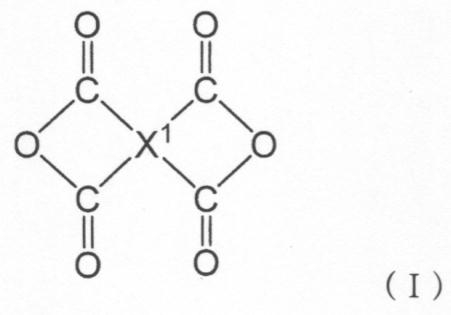
[式(I)中、X1は前記脂肪族6員環構造を有する4価の有機基を示す。]
で表されるテトラカルボン酸二無水物が挙げられる。このような式(I)中のX1として選択され得る、前記脂肪族6員環構造を有する4価の有機基としては、前記脂肪族6員環構造を有していればよく、前記脂肪族6員環構造を形成する炭素原子には、水素原子、水素原子以外の原子等の各種原子や、他の置換基(他の有機基を含む)等が結合していてもよい。
で表されるテトラカルボン酸二無水物が挙げられる。このような式(I)中のX1として選択され得る、前記脂肪族6員環構造を有する4価の有機基としては、前記脂肪族6員環構造を有していればよく、前記脂肪族6員環構造を形成する炭素原子には、水素原子、水素原子以外の原子等の各種原子や、他の置換基(他の有機基を含む)等が結合していてもよい。
このようなX1としては、中でも、透明性や耐熱性の観点から、下記式(a)~(e):
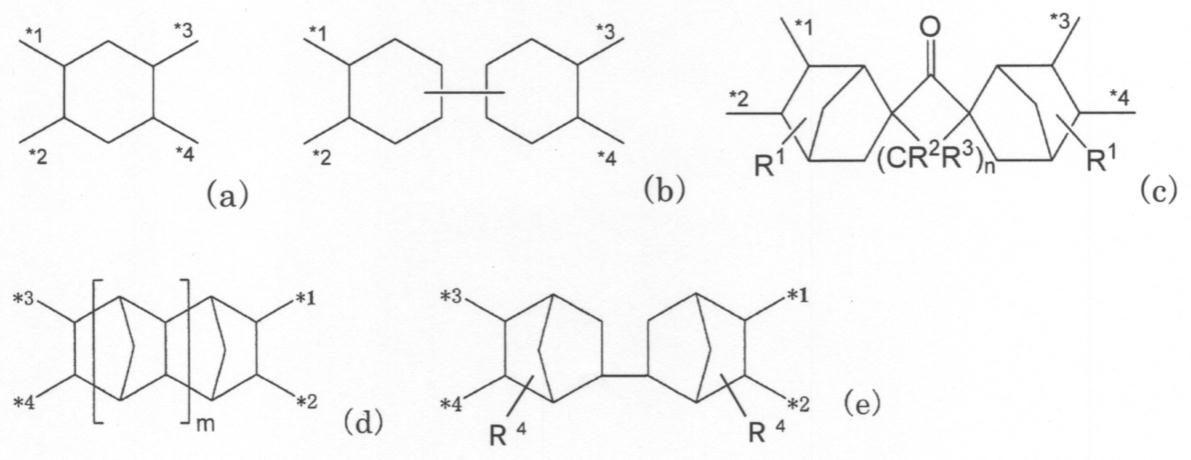
[式(c)中、R1、R2、R3はそれぞれ独立に水素原子、炭素数1~10のアルキル基及びフッ素原子よりなる群から選択される1種を示し、nは0~12の整数を示し、式(d)中、mは0~2の整数を示し、式(e)中、R4はそれぞれ独立に水素原子及び炭素数1~10のアルキル基よりなる群から選択される1種を示し、式(a)~(e)中、記号*1~*4は該記号の付された結合手がそれぞれX1に結合している4本の結合手のうちのいずれかであることを示す。]
で表される4価の有機基が好ましく、上記一般式(c)及び(e)で表される4価の有機基がより好ましく、上記一般式(c)で表される4価の有機基が特に好ましい。
で表される4価の有機基が好ましく、上記一般式(c)及び(e)で表される4価の有機基がより好ましく、上記一般式(c)で表される4価の有機基が特に好ましい。
ここにおいて、前記式(c)中のR1、R2、R3及び式(e)中のR4として選択され得るアルキル基はいずれも炭素数1~10のアルキル基である。このようなアルキル基の炭素数としては、精製がより容易となるという観点から、1~6であることが好ましく、1~5であることがより好ましく、1~4であることが更に好ましく、1~3であることが特に好ましい。また、このような式(c)中のR1、R2、R3及び式(e)中のR4として選択され得るアルキル基は直鎖状であっても分岐鎖状であってもよい。更に、このようなアルキル基としては精製の容易さの観点から、メチル基、エチル基がより好ましい。また、前記式(c)中のR1、R2、R3及び上記式(e)中のR4としては、樹脂を製造した際により高度な耐熱性が得られるという観点から、それぞれ独立に、水素原子、メチル基、エチル基、n-プロピル基又はイソプロピル基であることがより好ましく、水素原子又はメチル基であることが更に好ましく、いずれも水素原子であることが特に好ましい。また、このような式(c)中の複数のR1、R2、R3としては、精製の容易さ等の観点から、同一のものであることが特に好ましい。また、上記式(e)中のR4も同様の観点から同一のものであることが特に好ましい。さらに、前記一般式(c)中のnに関して、より精製が容易となるといった観点から、上限値は5(特に好ましくは3)であることがより好ましく、また、式(c)中のnは、原料化合物の安定性の観点から、下限値は1(特に好ましくは2)であることがより好ましく、2であることが特に好ましい。このように、一般式(c)中のnとしては、2~3の整数であることが特に好ましい。
また、一般式(d)中のmは0~2(より好ましくは1~2、更に好ましくは1)の整数である。このようなmの値が前記上限を超えると製造および精製が困難となる傾向にある。
また、このような脂肪族6員環構造を有する環状脂肪族テトラカルボン酸二無水物としては、例えば、ビシクロヘプタンテトラカルボン酸二無水物(BHDA)、ジメタノナフタレンテトラカルボン酸二無水物(DNDA)、ビシクロオクタンテトラカルボン酸二無水物(BODA)、ジシクロヘキサン-3,3’,4,4’-テトラカルボン酸二無水物(別名「3,3’,4,4’-ビシクロヘキシルテトラカルボン酸二無水物、[1,1’-ビ(シクロヘキサン)]-3,3’,4,4’-テトラカルボン酸二無水物」:H-BPDA)、1,2,4,5-シクロヘキサンテトラカルボン酸二無水物(H-PMDA)、[1,1’-ビ(シクロヘキサン)]-2,3,3’,4’-テトラカルボン酸二無水物(別名:[1,1’-ビ(シクロヘキサン)]-2,2’,3,3’-テトラカルボン酸二無水物)、4,4’-メチレンビス(シクロヘキサン-1,2-ジカルボン酸無水物)、4,4’-(プロパン-2,2-ジイル)ビス(シクロヘキサン-1,2-ジカルボン酸無水物)、4,4’-オキシビス(シクロヘキサン-1,2-ジカルボン酸無水物)、4,4’-チオビス(シクロヘキサン-1,2-ジカルボン酸無水物)、4,4’-スルホニルビス(シクロヘキサン-1,2-ジカルボン酸無水物)、4,4’-(ジメチルシランジイル)ビス(シクロヘキサン-1,2-ジカルボン酸無水物)、4,4’-(テトラフルオロプロパン-2,2-ジイル)ビス(シクロヘキサン-1,2-ジカルボン酸無水物)、オクタヒドロペンタレン-1,3,4,6-テトラカルボン酸二無水物、ビシクロ[2.2.1]ヘプタン-2,3,5,6-テトラカルボン酸二無水物、6-(カルボキシメチル)ビシクロ[2.2.1]ヘプタン-2,3,5-トリカルボン酸二無水物、ビシクロ[2.2.2]オクタン-2,3,5,6-テトラカルボン酸二無水物、ビシクロ[2.2.2]オクタ-5-エン-2,3,7,8-テトラカルボン酸二無水物、トリシクロ[4.2.2.02,5]デカン-3,4,7,8-テトラカルボン酸二無水物、トリシクロ[4.2.2.02,5]デカ-7-エン-3,4,9,10-テトラカルボン酸二無水物、9-オキサトリシクロ[4.2.1.02,5]ノナン-3,4,7,8-テトラカルボン酸二無水物、(4arH,8acH)-デカヒドロ-1t,4t:5c,8c-ジメタノナフタレン-2c,3c,6c,7c-テトラカルボン酸二無水物、(4arH,8acH)-デカヒドロ-1t,4t:5c,8c-ジメタノナフタレン-2t,3t,6c,7c-テトラカルボン酸二無水物、ビシクロ[2.2.1]ヘプタン-2,3,5,6-テトラカルボン酸二無水物、ビシクロ[2.2.2]オクタン-2,3,5,6-テトラカルボン酸二無水物、(4arH,8acH)-デカヒドロ-1t,4t:5c,8c-ジメタノナフタレン-2c,3c,6c,7c-テトラカルボン酸二無水物、ノルボルナン-2-スピロ-α-シクロペンタノン-α’-スピロ-2’’-ノルボルナン-5,5’’,6,6’’-テトラカルボン酸二無水物(CpODA)、ノルボルナン-2-スピロ-α-シクロヘキサノン-α’-スピロ-2’’-ノルボルナン-5,5’’,6,6’’-テトラカルボン酸二無水物、[2,2’-ビ(ノルボルナン)]-5,5’,6,6’-テトラカルボン酸二無水物、1,4-フェニレンビス(2-ノルボルナン-5,6-ジカルボン酸無水物)、4,4’-ビフェニレンビス(2-ノルボルナン-5,6-ジカルボン酸無水物)、4,4’’-ターフェニレンビス(2-ノルボルナン-5,6-ジカルボン酸無水物)、1,2,4,5-シクロヘキサンテトラカルボン酸二無水物のトランス異性体、1,2,4,5-シクロヘキサンテトラカルボン酸二無水物のシス異性体等が挙げられる。
また、このような脂肪族6員環を含む環状脂肪族テトラカルボン酸二無水物としては、中でも、透明性や耐熱性の観点から、ノルボルナン-2-スピロ-α-シクロペンタノン-α’-スピロ-2’’-ノルボルナン-5,5’’,6,6’’-テトラカルボン酸二無水物(CpODA)、1,2,4,5-シクロヘキサンテトラカルボン酸二無水物(H-PMDA)及びジシクロヘキサン-3,3’,4,4’-テトラカルボン酸二無水物(H-BPDA)からなる群から選択される少なくとも1種であることが好ましく、ノルボルナン-2-スピロ-α-シクロペンタノン-α’-スピロ-2’’-ノルボルナン-5,5’’,6,6’’-テトラカルボン酸二無水物(CpODA)が特に好ましい。なお、このような脂肪族6員環を含む環状脂肪族テトラカルボン酸二無水物の調製方法は特に制限されず、公知の方法を適宜利用することができる(例えばCpODAを調製する場合には、国際公開第2011/099518号に記載されている方法を適宜採用してもよい)。また、このような脂肪族6員環を含む環状脂肪族テトラカルボン酸二無水物は市販品を適宜利用してもよい。
本発明において、前記脂肪族6員環を含む環状脂肪族テトラカルボン酸二無水物には、反応中間体のエステル化合物(トリエステル化合物、ジエステル化合物、モノエステル化合物からなる群から選択される少なくとも1種のエステル化合物)が含まれていてもよい。一般に、テトラカルボン酸二無水物は、テトラエステル化合物を原料として製造することが可能であるが(例えば、テトラエステル化合物を酸無水物化することにより製造可能である)、その製造時の条件によっては、テトラカルボン酸二無水物に反応中間体のエステル化合物が含まれる場合がある。このような反応中間体のエステル化合物としては、例えば、脂肪族6員環を含む環状脂肪族テトラカルボン酸二無水物がCpODAである場合であって、その製造時の原料にテトラメチルエステルを利用した場合には、下記式(X)で表されるトリエステル化合物、下記式(Y)で表されるジエステル化合物(ハーフエステル)、下記式(Z)で表されるモノエステル化合物を挙げることができる。

また、このような脂肪族6員環を含む環状脂肪族テトラカルボン酸二無水物を用いて製造されるポリイミドフィルムの靭性をより向上させることが可能となることから、該環状脂肪族テトラカルボン酸二無水物に前述のような反応中間体のエステル化合物が含まれる場合、その反応中間体のエステル化合物の含有量は、より少ないことが好ましく、5質量%以下であることがより好ましく、2質量%以下であることが更に好ましい。なお、このような脂肪族6員環を含む環状脂肪族テトラカルボン酸二無水物中に含まれる反応中間体のエステル化合物の含有量は、その化合物の1H-NMR測定を行い、そのプロトン積分比を用いて算出することができる。
また、このような脂肪族6員環を含む環状脂肪族テトラカルボン酸二無水物に含まれる水分量は、当該化合物を用いて得られるポリイミド前駆体ワニス(ポリアミド酸ワニス)、ポリイミドワニスの保存安定性の観点から、500ppm以下であることが好ましく、300ppm以下であることがより好ましい。このような水分量が前記上限値を超えると、その水分に起因してワニス中においてポリマー鎖中のアミド酸部位が加水分解を受けてしまい、分子量が低下してしまうことから、ワニスの粘度が低下してしまう傾向にある。なお、このような脂肪族6員環を含む環状脂肪族テトラカルボン酸二無水物における水分量(含水量)は、電量滴定法によるカールフィッシャー法を採用して測定される値を採用することができる。
また、本発明にかかる脂肪族系ジアミン化合物は、分子中に第1級アミノ基が第1級炭素原子に結合した構造部位(a)を2つ有する脂肪族系ジアミン(A)、及び、分子中に前記構造部位(a)と第1級アミノ基が第2級炭素原子に結合した構造部位(b)とを有する脂肪族系ジアミン(B)からなる群から選択される少なくとも1種の化合物である。
ここで、本明細書において「第1級アミノ基が第1級炭素原子に結合した構造部位(a)」は、式:-CH2-NH2で表される構造部位(なお、式中の炭素原子は第1級炭素原子であり、式中に記載されている結合手のうちのNH2に結合していない結合手は別の炭素原子に結合する)であり、また、「第1級アミノ基が第2級炭素原子に結合した構造部位(b)」は、式:>CH-NH2で表される構造部位(なお、式中の炭素原子は第2級炭素原子であり、式中に記載されている結合手のうちのNH2に結合していない2つの結合手はそれぞれ別の炭素原子に結合する)である。
このような構造部位(a)を分子中に2つ有する脂肪族系ジアミン(A)としては、下記一般式(XI):
H2N-CH2-X2-CH2-NH2 (XI)
(式中のX2は、単結合、又は、エーテル結合(式:-O-で表される構造部分)、シロキサン結合(式:-Si-O-Si-で表される構造部分)及びチオエーテル構造(式:-S-で表される構造部分)の中から選択される少なくとも1種の結合部位を有していてもよい2価の脂肪族炭化水素基を示す。)
で表される脂肪族ジアミンを好適なものとして挙げることができる。なお、このような式(XI)で表される化合物において、X2が単結合である場合、その化合物は式:H2N-CH2-CH2-NH2で表される化合物となる。また、このようなX2として選択され得る2価の脂肪族炭化水素基としては、炭素数が1~50のものがより好ましい。
H2N-CH2-X2-CH2-NH2 (XI)
(式中のX2は、単結合、又は、エーテル結合(式:-O-で表される構造部分)、シロキサン結合(式:-Si-O-Si-で表される構造部分)及びチオエーテル構造(式:-S-で表される構造部分)の中から選択される少なくとも1種の結合部位を有していてもよい2価の脂肪族炭化水素基を示す。)
で表される脂肪族ジアミンを好適なものとして挙げることができる。なお、このような式(XI)で表される化合物において、X2が単結合である場合、その化合物は式:H2N-CH2-CH2-NH2で表される化合物となる。また、このようなX2として選択され得る2価の脂肪族炭化水素基としては、炭素数が1~50のものがより好ましい。
また、このようなX2として選択され得る2価の脂肪族炭化水素基は、非環式のものであっても、あるいは、環式のものであってもよい。また、このような2価の脂肪族炭化水素基が非環式のものである場合には、直鎖状のものであっても、分岐鎖状のものであってもよいが、耐熱性の観点から、直鎖状のものが好ましい。また、2価の脂肪族炭化水素基が環式のものである場合には、2価の脂肪族炭化水素基は、橋かけ構造を有するものであってもよい(例えば、ノルボルナン環を含む構造等)。
このようなX2として選択され得る2価の脂肪族炭化水素基としては、例えば、置換基を有していてもよい2価の直鎖状脂肪族炭化水素基、置換基を有していてもよい2価の環状脂肪族炭化水素基(橋かけ構造を有するものを含む)、置換基を有していてもよくかつ主鎖中に炭素原子がヘテロ原子としての酸素原子に置換されて式:-O-で表される構造部分(エーテル結合)が導入された2価の直鎖状脂肪族炭化水素基、置換基を有していてもよくかつ主鎖中に式:-Si-O-Si-で表される構造部分が導入された2価の直鎖状脂肪族炭化水素基を好適なものとして挙げることができる。
このようなX2として選択され得る2価の脂肪族炭化水素基が2価の直鎖状の脂肪族炭化水素基である場合、その炭素数は1~50であることが好ましく、2~40であることがより好ましく、4~30であることが更に好ましい。このような炭素数が前記下限未満では脆くなる傾向にあり、他方、前記上限を超えると耐熱性が低下する傾向にある。このように、X2として選択され得る2価の直鎖状の脂肪族炭化水素基としては、炭素数が上記範囲にあるアルキレン基が特に好ましい。
また、上記X2として選択され得る2価の脂肪族炭化水素基が、2価の環状脂肪族炭化水素基である場合、その炭素数は3~50であることが好ましく、4~40であることがより好ましく、5~30であることが更に好ましい。このような炭素数が前記下限未満では脆くなる傾向にあり、他方、前記上限を超えると耐熱性が低下する傾向にある。
このような2価の環状脂肪族炭化水素基としては、例えば、シクロプロパン、シクロブタン、シクロペンタン、シクロヘキサン、ノルボルナン等の環状脂肪族炭化水素基から2つの水素原子が除かれた残基(シクロアルキレン基等)等が挙げられる。さらに、このような2価の環状脂肪族炭化水素基としては、フィルム靱性の観点から、環状構造が橋かけ環以外の構造の場合には1位と3位の位置(6員環である場合に、いわゆるメタ位に相当する部分)にそれぞれ構造部位(a)が結合しているものが好ましく、環状構造が橋架け環の場合には1位の炭素原子(橋頭の炭素原子)に結合する3つの炭素原子のうちの位置番号が低い2つ炭素原子にそれぞれ構造部位(a)が結合しているものが好ましい。例えば、2価の環状脂肪族炭化水素基がシクロヘキシレン基の場合には、1,3-シクロヘキシレン基であることが好ましく、また、環式の脂肪族炭化水素基がノルボルナン環から2つの水素原子が除かれた残基である場合、2位と6位の位置に構造部位(a)が結合しているものが好ましい。
また、上記X2として選択され得る2価の脂肪族炭化水素基が、主鎖中に炭素原子がヘテロ原子としての酸素原子に置換されて式:-O-で表される構造部分(エーテル結合)が導入された2価の直鎖状脂肪族炭化水素基である場合、かかる基としては、前述の2価の直鎖状脂肪族炭化水素基中の炭素原子の少なくとも1つが酸素原子に置換されたものを好適に利用でき、例えば、式:*-CH2-O-CH2-CH2-O-CH2-*(式中の*は構造単位(a)に結合する結合手を示す。)で表される2価の基等を好適に利用できる。また、主鎖中に式:-Si-O-Si-で表される構造部分が導入された2価の直鎖状脂肪族炭化水素基としては、例えば、式:*-Ra-Si(CH3)2-O-Si(CH3)2-Ra-*(式中の*は構造単位(a)に結合する結合手を示し、Raは単結合又は炭素数1~46のアルキレン基を示す。)で表される2価の基等を好適に利用できる。
なお、上記X2として選択され得る2価の脂肪族炭化水素基が有していてもよい置換基としては、メチル基、エチル基、n-プロピル基、イソプロピル基、n-ブチル基、イソブチル基、tert-ブチル基、sec-ブチル基、ペンチル基、ヘキシル基などを挙げることができ、中でも、メチル基、エチル基が好ましい。
また、このような脂肪族系ジアミン(A)としては、1,6-ヘキサンジアミン、1,3-ビス(アミノメチル)シクロへキサン、下記式:
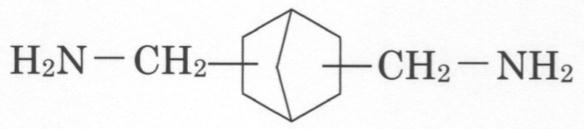
で表されるビス(アミノメチル)ノルボルナン(例えば、2,5-ビス(アミノメチル)ビシクロ[2.2.1]ヘプタン、2,6-ビス(アミノメチル)ビシクロ[2.2.1]ヘプタン等)、下記式:
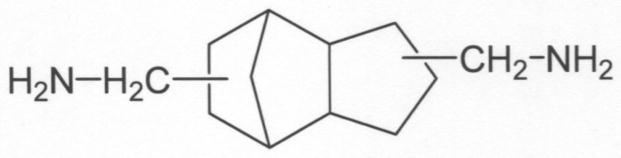
で表される3(4),8(9)-ビス(アミノメチル)トリシクロ[5.2.1.02,6]デカン、1,4-ビス(アミノメチル)シクロヘキサン、1,2-ビス(2-アミノエトキシ)エタン、1,3-ビス(3-アミノプロピル)テトラメチルジシロキサン、エチレンジアミン、トリメチレンジアミン、テトラメチレンジアミン、ペンタメチレンジアミン、ヘプタメチレンジアミン、オクタメチレンジアミン、ノナメチレンジアミン、デカメチレンジアミン、ウンデカメチレエンジアミン、ドデカメチレンジアミン、トリデカメチレンジアミン、テトラデカメチレンジアミン、ペンタデカメチレンジアミン、ヘキサデカメチレンジアミン、ヘプタデカメチレンジアミン、オクタデカメチレンジアミン、ノナデカメチレンジアミン、エイコサメチレンジアミン、4,9-ジオキサ-1,12-ドデカンジアミン、cis-ヘキサヒドロ-m-キシリレンジアミン、trans-ヘキサヒドロ-m-キシリレンジアミン、プロピレンジアミン、1,2-ジアミノ-2-メチルプロパン、2-メチル-1,5-ジアミノペンタン、2-メチル-1,3-プロパンジアミン、2,2’-オキシビス(エチルアミン)、ジエチレングリコールビス(3-アミノプロピル)エーテル、トリエチレングリコールビス(2-アミノエチル)エーテル、ポリエチレングリコールビス(3-アミノプロピル)エーテル、2,2’-チオビス(エチルアミン)、信越化学製アミノ変性シリコーンオイル(例えば、商品名:X-22-1660B-3(Mw:4400)、X-22-161B(Mw:3000)、X-22-161A(Mw:1600)、X-22-9409(Mw:1340)等)、Gelest社製ジメチルシロキサン型ジアミン(例えば、商品名:DMS-A11、DMS-A12、DMS-A15、DMS-A21、DMS-A31、DMS-A32、DMS-A35等)等が挙げられる。
このような脂肪族系ジアミン(A)としては、光透過性や製膜性の観点から、1,3-ビス(アミノメチル)シクロへキサン、2,6-ビス(アミノメチル)ビシクロ[2.2.1]ヘプタン、1,6-ヘキサンジアミン、1,4-ビス(アミノメチル)シクロへキサン、1,2-ビス(2-アミノエトキシ)エタン、1,3-ビス(3-アミノプロピル)テトラメチルジシロキサンが好ましい。また、このような脂肪族系ジアミン(A)の中でも、光透過性の観点からは、1,3-ビス(アミノメチル)シクロへキサン、1,6-ヘキサンジアミン、1,2-ビス(2-アミノエトキシ)エタン、1,3-ビス(3-アミノプロピル)テトラメチルジシロキサンがより好ましく、1,3-ビス(アミノメチル)シクロへキサン、1,6-ヘキサンジアミン、1,3-ビス(3-アミノプロピル)テトラメチルジシロキサンが更に好ましい。
前記構造部位(a)と前記構造部位(b)とを有する脂肪族系ジアミン(B)としては、下記一般式(XII):
H2N-X3-CH2-NH2 (XII)
(式中のX3は、置換基を有していてもよくかつアミノ基(-NH2)と直接結合する第2級炭素原子を含む2価の鎖状脂肪族炭化水素基または置換基を有していてもよい2価の環状脂肪族炭化水素基を示す。ただし、X3に直接結合しているアミノ基(-NH2)は、X3中の第2級炭素原子(例えば環状脂肪族炭化水素基の環状構造を形成する炭素原子)に結合し、化合物中において式:>CH-NH2で表される構造部位を形成する。)
で表される脂肪族ジアミンを好適なものとして挙げることができる。
H2N-X3-CH2-NH2 (XII)
(式中のX3は、置換基を有していてもよくかつアミノ基(-NH2)と直接結合する第2級炭素原子を含む2価の鎖状脂肪族炭化水素基または置換基を有していてもよい2価の環状脂肪族炭化水素基を示す。ただし、X3に直接結合しているアミノ基(-NH2)は、X3中の第2級炭素原子(例えば環状脂肪族炭化水素基の環状構造を形成する炭素原子)に結合し、化合物中において式:>CH-NH2で表される構造部位を形成する。)
で表される脂肪族ジアミンを好適なものとして挙げることができる。
このようなX3として選択され得る前記2価の鎖状脂肪族炭化水素基は、炭素数が2~50であることが好ましく、3~40であることがより好ましく、4~30であることが更に好ましい。また、このようなX3として選択され得る前記2価の環状脂肪族炭化水素基は、炭素数が3~50であることが好ましく、4~40であることがより好ましく、5~30であることが更に好ましい。このような炭素数が前記下限未満では脆くなる傾向にあり、他方、前記上限を超えると耐熱性が低下する傾向にある。
また、このようなX3として選択され得る2価の環状脂肪族炭化水素基としては、上記X2において説明した2価の環状脂肪族炭化水素基と同様のものを利用できる。
なお、このようなX3として選択され得る、2価の鎖状脂肪族炭化水素基における「アミノ基(-NH2)と直接結合する第2級炭素原子」は、例えば、前述のX2において説明した「2価の直鎖状脂肪族炭化水素基」の末端の炭素原子以外の炭素原子に式(XII)中のアミノ基(-NH2)が直接結合して、結果的にアミノ基(-NH2)が結合している炭素原子が第2級炭素原子となるような場合における該炭素原子や、前述の「2価の直鎖状脂肪族炭化水素基」中の末端の同じ炭素原子に式(XII)中の式:-CH2-NH2で表される基及びアミノ基(-NH2)が結合して、結果的に式(XII)中においてアミノ基(-NH2)が結合する炭素原子が第2級炭素原子となるような場合における該炭素原子等であってもよい。このような観点から、X3として選択され得る、アミノ基(-NH2)と直接結合する第2級炭素原子を含む2価の鎖状脂肪族炭化水素基は、結果的に、アミノ基(-NH2)が結合する炭素原子が第2級炭素原子となるものであればよく、その基自体は直鎖状のものであっても分岐鎖状のものであってもよい。
また、このようなX3として選択され得る前記2価の環状脂肪族炭化水素基及び前記2価の鎖状脂肪族炭化水素基としては、光透過性や製膜性の観点から、それぞれ置換基を有していてもよい、1,1-エチレン基、1、1-プロピレン基、1,2-プロピレン基、1,1-ブチレン基、1,2-ブチレン基、2,3-ブチレン基、シクロオクチレン基、シクロヘプチレン基、シクロヘキシレン基、シクロペンチレン基、シクロブチレン基、シクロプロピレン基などが好ましく、中でも、置換基を有していてもよいシクロヘキシレン基が特に好ましい。
また、このような2価の鎖状脂肪族炭化水素基や前記2価の環状脂肪族炭化水素基が有していてもよい置換基としては特に制限されないが、メチル基、エチル基、n-プロピル基、イソプロピル基、n-ブチル基、イソブチル基、tert-ブチル基、sec-ブチル基、ペンチル基、ヘキシル基などが挙げられ、中でも、メチル基、エチル基が好ましい。
このような脂肪族系ジアミン(B)としては、例えば、イソホロンジアミン(別名:1-アミノ-3-アミノメチル-3,5,5-トリメチルシクロヘキサン)、1-メチル-1,2-エチレンジアミン(1,2-ジアミノプロパン)、1-エチル-1,2-エチレンジアミン、1-プロピル-1,2-エチレンジアミン、1-ブチル-1,2-エチレンジアミン、1-メチル-1,3-ジアミノプロパン、2-メチル-1,3-ジアミノブタン、1-アミノ-5-アミノメチルシクロオクタン、1-アミノ-4-アミノメチルシクロオクタン、1-アミノ-3-アミノメチルシクロオクタン、1-アミノ-2-アミノメチルシクロオクタン、1-アミノ-4-アミノメチルシクロヘプタン、1-アミノ-3-アミノメチルシクロヘプタン、1-アミノ-2-アミノメチルシクロヘプタン、1-アミノ-4-アミノメチルシクロヘキサン、1-アミノ-3-アミノメチルシクロヘキサン、1-アミノ-2-アミノメチルシクロヘキサン、1-アミノ-3-アミノメチルシクロペンタン、1-アミノ-2-アミノメチルシクロペンタン、1-アミノ-3-アミノメチルシクロブタン、1-アミノ-2-アミノメチルシクロブタン、1-アミノ-2-アミノメチルシクロプロパンなどが挙げられる。このような脂肪族系ジアミン(B)の中でも、光透過性や製膜性の観点から、イソホロンジアミン、1-アミノ-3-アミノメチルシクロヘキサンが好ましい。
また、本発明にかかる脂肪族系ジアミン化合物は、脂肪族系ジアミン(A)及び脂肪族系ジアミン(B)からなる群から選択される少なくとも1種の化合物である。このような脂肪族系ジアミン化合物としては、光透過性や製膜性の観点からは、1,3-ビス(アミノメチル)シクロへキサン、2,6-ビス(アミノメチル)ビシクロ[2.2.1]ヘプタン、1,6-ヘキサンジアミン、1,4-ビス(アミノメチル)シクロへキサン、1,2-ビス(2-アミノエトキシ)エタン、1,3-ビス(3-アミノプロピル)テトラメチルジシロキサン、イソホロンジアミン、1-アミノ-3-アミノメチルシクロヘキサンがより好ましく、1,3-ビス(アミノメチル)シクロへキサン、1,6-ヘキサンジアミン、1,2-ビス(2-アミノエトキシ)エタン、1,3-ビス(3-アミノプロピル)テトラメチルジシロキサン、が特に好ましい。このような脂肪族系ジアミン化合物としては、1種を単独で利用してもよく、あるいは、2種以上を組み合わせて利用してもよい。
また、本発明のポリイミドは、前記脂肪族6員環構造を有する環状脂肪族テトラカルボン酸二無水物と前記脂肪族系ジアミン化合物との重縮合物からなるものである。なお、このようなポリイミドは、前記脂肪族6員環構造を有する環状脂肪族テトラカルボン酸二無水物と、前記脂肪族系ジアミン化合物とを開環付加反応させることにより、これらの重付加物(付加重合体、開環重付加体)であるポリアミド酸を形成し、その後、該ポリアミド酸を閉環縮合(脱水閉環:分子内縮合)させることにより得られるものである。したがって、本発明のポリイミドは、前記脂肪族6員環構造を有する環状脂肪族テトラカルボン酸二無水物と前記脂肪族系ジアミン化合物との重縮合により得られるものであるといえる。
このようなポリイミドを得る方法としては、テトラカルボン酸二無水物として上記脂肪族6員環構造を有する環状脂肪族テトラカルボン酸二無水物を用い、かつ、ジアミンとして前記脂肪族系ジアミン化合物を用いる以外は、テトラカルボン酸二無水物とジアミンとを反応せしめてポリイミドを形成する、公知のポリイミドの製造方法(例えば、国際公開第2011/099518号に記載されている方法)において採用している方法と同様の方法を採用することができる。
なお、従来は、ポリイミドの製造時に、脂肪族系のテトラカルボン酸二無水物と脂肪族系のジアミン化合物とを反応させようとしても、基本的に、反応中に塩が副生されるものと認識されていた。そして、このような塩の発生を抑制するためには、その化合物の種類に応じて、特殊な溶媒を選択して使用したり、あるいは、弱酸等を適宜利用したりする等といった、特殊な操作を行うことが必要と従来は考えられてきた。このような点から、従来は、そもそも脂肪族系のテトラカルボン酸二無水物と、脂肪族系のジアミン化合物を利用して全脂肪族系のポリイミドを容易に得ることは困難と考えられてきた。これに対して、本発明においては、前記環状脂肪族テトラカルボン酸二無水物と、前記脂肪族系ジアミン化合物とを選択的に組み合わせて利用しており、これにより比較的高い重合反応性を得ることを可能として、特殊な操作を行うことなく、公知のポリイミドの製造方法を適宜採用してポリイミドを製造できるものと本発明者は考えている。
このような本発明のポリイミドとしては、例えば、下記一般式(1)及び(2):

[式中、X1は式(I)中のX1と同義であり、X2は式(XI)中のX2と同義であり、X3は式(XII)中のX3と同義である(なお、CH2と結合していないX3の結合手はX3中の第2級炭素原子に結合する)。]
で表される繰り返し単位のうちの少なくとも1種の繰り返し単位を有するポリイミドが挙げられる。なお、上記式(1)で表される繰り返し単位は、式(I)で表される化合物と式(XI)で表される化合物とに由来して形成させることができ、また、上記式(2)で表される繰り返し単位は、式(I)で表される化合物と式(XII)で表される化合物とに由来して形成させることができる。
で表される繰り返し単位のうちの少なくとも1種の繰り返し単位を有するポリイミドが挙げられる。なお、上記式(1)で表される繰り返し単位は、式(I)で表される化合物と式(XI)で表される化合物とに由来して形成させることができ、また、上記式(2)で表される繰り返し単位は、式(I)で表される化合物と式(XII)で表される化合物とに由来して形成させることができる。
また、本発明のポリイミドは、前記脂肪族6員環構造を有する環状脂肪族テトラカルボン酸二無水物と、前記脂肪族系ジアミン化合物との重縮合物からなるものであればよく、本発明の効果を損なわない範囲で、前記脂肪族6員環構造を有する環状脂肪族テトラカルボン酸二無水物と前記脂肪族系ジアミン化合物との重縮合により形成される繰り返し単位以外の他の繰り繰り返し単位を含んでいてもよい。このような他の繰り返し単位としては、ポリイミドの繰り返し単位として利用可能なものであればよく、公知の方法で適宜含有させることができる。このような本発明のポリイミドは、前記脂肪族6員環構造を有する環状脂肪族テトラカルボン酸二無水物と前記脂肪族系ジアミン化合物との重縮合により形成される繰り返し単位を主たる繰り返し単位とするものが好ましく、前記脂肪族6員環構造を有する環状脂肪族テトラカルボン酸二無水物と前記脂肪族系ジアミン化合物との重縮合により形成される繰り返し単位の含有量が、ポリイミド中の全繰り返し単位に対して少なくとも70%以上であることが好ましく、80~100モル%であることがより好ましく、90~100モル%であることが更に好ましく、95~100モル%であることが特に好ましく、100モル%であることが最も好ましい。
また、このようなポリイミドとしては、ガラス転移温度(Tg)が200℃以上のものが好ましく、250~550℃のものがより好ましく、300~550℃のものが更に好ましい。このようなガラス転移温度(Tg)が前記下限未満では、耐熱性が低下する傾向にあり、他方、前記上限を超えると、そのような特性を有するポリイミドを製造することが困難となる傾向にある。なお、このようなガラス転移温度(Tg)は、熱機械的分析装置(リガク製の商品名「TMA8310」)を使用して引張モードにより測定することができる。
また、本発明のポリイミドとしては、5%重量減少温度が400℃以上のものが好ましく、450~550℃のものがより好ましい。このような5%重量減少温度が前記下限未満では耐熱性が低下する傾向にあり、他方、前記上限を超えると、そのような特性を有するポリイミドを製造することが困難となる傾向にある。なお、このような5%重量減少温度は、窒素ガス雰囲気下、窒素ガスを流しながら室温(例えば、25℃)から40℃に昇温した後、40℃を測定開始温度として徐々に加熱していき、用いた試料の重量が5%減少する温度を測定することにより求めることができる。
さらに、このようなポリイミドの数平均分子量(Mn)としては、ポリスチレン換算で1000~1000000であることが好ましく、10000~500000であることがより好ましい。このようなポリイミドの重量平均分子量(Mw)としては、ポリスチレン換算で1000~5000000であることが好ましく、5000~5000000であることがより好ましく、10000~500000であることが更に好ましい。このようなMn及びMwが前記下限未満では十分な耐熱性が達成困難となるばかりか、製膜可能なポリイミドを得ることが困難となる傾向にあり、他方、前記上限を超えると粘性が増大し、溶解させるのに長時間を要し、溶剤を大量に必要とするとともに、製膜時にシワが寄るなど加工が困難となる傾向にある。
さらに、このようなポリイミドの分子量分布(Mw/Mn)は1.1~5.0であることが好ましく、1.5~3.0であることがより好ましい。このような分子量分布が前記下限未満では製造することが困難となる傾向にあり、他方、前記上限を超えると均一なフィルムを得にくい傾向にある。なお、このようなポリイミドの分子量(Mw又はMn)や分子量の分布(Mw/Mn)は、測定装置としてゲルパーミエーションクロマトグラフィー(GPC)測定装置(東ソー株式会社製、商品名:HLC-8320GPC/カラム4本:東ソー株式会社製、商品名:TSK gel SuperAW4000,3000,2500,SuperH-RC、溶媒:N,N-ジメチルアセトアミド(DMAc))を用いて測定したデータをポリスチレンで換算して求めることができる。なお、このようなポリイミドにおいては、分子量の測定が困難な場合には、そのポリイミドの製造に用いるポリアミド酸の粘度に基づいて、分子量等を類推して、用途等に応じたポリイミドを選別して使用してもよい。
また、このようなポリイミドとしては、フィルムを形成した場合に透明性が十分に高いものであることが好ましく、全光線透過率が80%以上(更に好ましくは85%以上、特に好ましくは90%以上)であるものがより好ましい。このような全光線透過率は、ポリイミドの種類等を適宜選択することにより容易に達成することができる。このようなポリイミドとしては、より高度な無色透明性を得るといった観点から、ヘイズ(濁度)が5~0(更に好ましくは4~0、特に好ましくは3~0)であるものがより好ましい。このようなヘイズの値が前記上限を超えると、より高度な水準の無色透明性を達成することが困難となる傾向にある。さらに、このようなポリイミドとしては、より高度な無色透明性を得るといった観点から、黄色度(YI)が5~-2(更に好ましくは4~-2、特に好ましくは3~-2)であるものがより好ましい。このような黄色度が前記上限を超えると、より高度な水準の無色透明性を達成することが困難となる傾向にある。なお、このような全光線透過率は、JIS K7361-1(1997年発行)に準拠した測定を行うことにより求めることができ、ヘイズ(濁度)はJIS K7136(2000年発行)に準拠した測定を行うことにより求めることができ、黄色度(YI)はASTM E313-05(2005年発行)に準拠した測定を行うことにより求めることができる。
このようなポリイミドフィルムは、波長590nmで測定される厚み方向のリタデーション(Rth)の絶対値が、厚み10μmに換算して、100nm以下であることがより好ましく、50nm以下であることが更に好ましい。このような厚み方向のリタデーション(Rth)の絶対値が前記上限を超えると、ディスプレイ機器に使用した際に、鮮明な画像が得られず、表示品質が低下してしまう傾向にある。なお、前記リタデーション(Rth)の絶対値が前記上限以下の場合には、ディスプレイ機器に使用した際に、鮮明な画像が得られるとともに、表示品質がより高度なものとなる傾向にある。なお、このようなリタデーション(Rth)の値の測定方法は、実施例の欄に記載されている方法を採用できる。
また、このようなポリイミドは、周波数10GHzにおける誘電正接(tanδ)が0.05以下(より好ましくは0.0001~0.05)であることが好ましい。このような誘電正接(εr)が前記上限を超えると誘電体内での電気エネルギー損失の度合いが大きくなる傾向にある。また、このようなポリイミドは、周波数10GHzにおける比誘電率(εr)は5.0以下(より好ましくは2.0~5.0)であることが好ましい。このような比誘電率(εr)が前記上限を超えると高周波用基板材料として使用した場合、信号遅延時間が大きくなる傾向にある。なお、このような誘電正接(tanδ)や比誘電率(εr)は、ASTM D2520に準拠して測定することができる。
なお、本発明のポリイミドは、その用途に応じ、例えば、酸化防止剤、紫外線吸収剤・ヒンダードアミン系光安定剤、核剤・透明化剤、無機フィラー(ガラス繊維、ガラス中空球、タルク、マイカ、アルミナ、チタニア、シリカなど)、重金属不活性化剤・フィラー充填プラスチック用添加剤、難燃剤、加工性改良剤・滑剤/水分散型安定剤、永久帯電防止剤、靱性向上剤、界面活性剤、炭素繊維等の添加成分を更に含有していてもよい。
また、このようなポリイミドの形状は特に制限されず、例えば、フィルム形状や粉状としたり、更には、押出成形によりペレット形状等としてもよい。このように、本発明のポリイミドは、フィルム形状にしたり、押出成形によりペレット形状としたり、公知の方法で各種の形状に適宜成形することもできる。
また、本発明のポリイミドは、波長248nmのKrFエキシマレーザー光のような短波長の光を透過させる必要があるような用途(例えば半導体分野、レジスト分野、レーザー関連分野等の短波長領域の光を透過させる必要がある分野)に好適に応用することができる。なお、フォトレジストの分野においては、使用する波長を短くすることによって解像度を上げることができるため、近年では、g線(436nm)やi線(365nm)といった近紫外レジストよりも、より短波長のKrFエキシマレーザ(248nm)等を利用する深紫外レジストが主に採用されるようになってきており、特に、KrFエキシマレーザがデバイス生産の主力となってきている。これに対して、全芳香族ポリイミドや半芳香族ポリイミドでは深紫外領域に吸収が見られ、そもそも深紫外光を透過しないため深紫外レジストに使用することは出来なかった。これに対して、本発明のポリイミドは、波長248nmの光の透過率を十分なものとすることが可能である。そのため、本発明のポリイミドは、KrFエキシマレーザ(波長248nm)を用いた深紫外レジストに好適に利用できる。
また、本発明のポリイミドとしては、KrFエキシマレーザ(波長248nm)を用いた深紫外レジストに好適に利用するといった観点から、波長248nmの光の透過率が1~70%(より好ましくは10~60%、さらに好ましくは20~50%)のものが好ましい。なお、このような波長248nmの光の透過率が前記下限未満では、ポリイミド中へのKrFエキシマレーザ光の侵入度が小さくなって解像度が低下してしまう傾向にあり、他方、前記上限を超えると、KrFエキシマレーザ光が素通りしてしまうことから感度が低下する傾向にある。
また、このようなポリイミドは、各種用途に利用でき、例えば、フレキシブル配線基板用フィルム、耐熱絶縁テープ、電線エナメル、半導体の保護コーティング剤、液晶配向膜、有機EL用透明導電性フィルム、フレキシブル基板フィルム、フレキシブル透明導電性フィルム、有機薄膜型太陽電池用透明導電性フィルム、色素増感型太陽電池用透明導電性フィルム、フレキシブルガスバリアフィルム、タッチパネル用フィルム、フラットパネルディテクタ用TFT基板フィルム、複写機用シームレスポリイミドベルト(いわゆる転写ベルト)、透明電極基板(有機EL用透明電極基板、太陽電池用透明電極基板、電子ペーパーの透明電極基板等)、層間絶縁膜、センサー基板、イメージセンサーの基板、発光ダイオード(LED)の反射板(LED照明の反射板:LED反射板)、LED照明用のカバー、LED反射板照明用カバー、カバーレイフィルム、高延性複合体基板、半導体向けレジスト、リチウムイオンバッテリー、有機メモリ用基板、有機トランジスタ用基板、有機半導体用基板、カラーフィルタ基材等を製造するための材料として特に有用である。また、このようなポリイミドは、上述のような用途以外にも、その形状を粉状体としたり、各種成形体とすること等により、例えば、自動車用部品、航空宇宙用部品、軸受部品、シール材、ベアリング部品、ギアホイールおよびバルブ部品などに、適宜利用することも可能である。
<ポリアミド酸>
本発明のポリアミド酸は、前記脂肪族6員環構造を有する環状脂肪族テトラカルボン酸二無水物と前記脂肪族系ジアミン化合物との重付加物からなるものである。なお、ここにいう「脂肪族6員環構造を有する環状脂肪族テトラカルボン酸二無水物」は前述の本発明のポリイミドにおいて説明したものと同様のものであり、その好適なものも同様である。また、「脂肪族系ジアミン化合物」も前述の本発明のポリイミドにおいて説明したものと同様のものであり、その好適なものも同様である。
本発明のポリアミド酸は、前記脂肪族6員環構造を有する環状脂肪族テトラカルボン酸二無水物と前記脂肪族系ジアミン化合物との重付加物からなるものである。なお、ここにいう「脂肪族6員環構造を有する環状脂肪族テトラカルボン酸二無水物」は前述の本発明のポリイミドにおいて説明したものと同様のものであり、その好適なものも同様である。また、「脂肪族系ジアミン化合物」も前述の本発明のポリイミドにおいて説明したものと同様のものであり、その好適なものも同様である。
このような本発明のポリアミド酸は、前記脂肪族6員環構造を有する環状脂肪族テトラカルボン酸二無水物と、前記脂肪族系ジアミン化合物とを付加重合反応(開環重付加反応)させて得られる反応物からなるものである。このような付加重合反応(開環重付加反応)は、前記脂肪族6員環構造を有する環状脂肪族テトラカルボン酸二無水物と、前記脂肪族系ジアミン化合物とを利用する以外は、公知のポリアミド酸(ポリアミック酸)の製造方法(例えば、国際公開第2011/099518号に記載されている方法等)において採用している反応条件と同様の条件を適宜採用して進行させることができる。このように、本発明のポリアミド酸は、前記脂肪族6員環構造を有する環状脂肪族テトラカルボン酸二無水物と、前記脂肪族系ジアミン化合物とを利用する以外は、公知のポリアミド酸の製造方法を適宜採用して製造することができる。
このような本発明のポリアミド酸としては、例えば、下記一般式(3)及び(4):

[式中、X1は式(I)中のX1と同義であり、X2は式(XI)中のX2と同義であり、X3は式(XII)中のX3と同義である(なお、CH2と結合していないX3の結合手はX3中の第2級炭素原子に結合する)。]
で表される繰り返し単位のうちの少なくとも1種の繰り返し単位を有するポリアミド酸が挙げられる。なお、上記式(3)で表される繰り返し単位は、式(I)で表される化合物と式(XI)で表される化合物とに由来して形成させることができ、また、上記式(4)で表される繰り返し単位は、式(I)で表される化合物と式(XII)で表される化合物とに由来して形成させることができる。
で表される繰り返し単位のうちの少なくとも1種の繰り返し単位を有するポリアミド酸が挙げられる。なお、上記式(3)で表される繰り返し単位は、式(I)で表される化合物と式(XI)で表される化合物とに由来して形成させることができ、また、上記式(4)で表される繰り返し単位は、式(I)で表される化合物と式(XII)で表される化合物とに由来して形成させることができる。
なお、本発明のポリアミド酸は、前記脂肪族6員環構造を有する環状脂肪族テトラカルボン酸二無水物と前記脂肪族系ジアミン化合物との重付加物そのものであっても、あるいは、その重付加物から誘導される誘導体であってもよい。このような誘導体としては、例えば、上記一般式(3)及び/又は(4)で表される繰り返し単位を有する重付加物を形成した後、その重付加物に対して、上記一般式(3)及び/又は(4)中の式:-CO-NH-で表されるアミド結合の構造部分が式:-CO-NY-(式中のYは炭素数1~6のアルキル基及び炭素数3~9のアルキルシリル基よりなる群から選択される1種の置換基を示す)で表される構造部分となるように、前記アミド結合中の水素原子を上記Yで表される置換基に置換して得られるものが挙げられる。このようなYは、その置換基の種類、及び、置換基の導入率を、その製造条件を適宜変更することで変化させることができる。また、このような式:-CO-NY-で表される構造部分において、Yが炭素数1~6(好ましくは炭素数1~3)のアルキル基である場合、ポリアミド酸の保存安定性がより優れたものとなる傾向にある。また、かかるYが炭素数3~9のアルキルシリル基である場合、ポリアミド酸の溶解性がより優れたものとなる傾向にある。なお、このようにYが炭素数3~9のアルキルシリル基である場合、Yはトリメチルシリル基又はt-ブチルジメチルシリル基であることがより好ましい。また、上記一般式(3)及び(4)中の式:-CO-NH-で表されるアミド結合の部分が、式:-CO-NY-(式中のYは炭素数1~6のアルキル基及び炭素数3~9のアルキルシリル基よりなる群から選択される1種の置換基を示す)で表される構造となるような繰り返し単位の調製方法は特に制限されず、例えば、アミド結合中の水素原子が上記Yで表される置換基に置換することが可能な公知の方法を適宜採用することができる。なお、調製の容易さ等の観点からは、本発明のポリアミド酸は、前記脂肪族6員環構造を有する環状脂肪族テトラカルボン酸二無水物と前記脂肪族系ジアミン化合物との重付加物そのものであることがより好ましい。
また、本発明のポリアミド酸は、前記脂肪族6員環構造を有する環状脂肪族テトラカルボン酸二無水物と、前記脂肪族系ジアミン化合物との重付加物からなるものであればよく、本発明の効果を損なわない範囲で、前記脂肪族6員環構造を有する環状脂肪族テトラカルボン酸二無水物と前記脂肪族系ジアミン化合物との付加重合反応により形成される繰り返し単位以外の他の繰り繰り返し単位を含んでいてもよい。このような他の繰り返し単位としては、ポリアミド酸の繰り返し単位として利用可能なものであればよく、公知の方法で適宜含有させることができる。なお、本発明のポリアミド酸は、前記脂肪族6員環構造を有する環状脂肪族テトラカルボン酸二無水物と前記脂肪族系ジアミン化合物との付加重合反応により形成される繰り返し単位を主たる繰り返し単位とするものが好ましく、前記脂肪族6員環構造を有する環状脂肪族テトラカルボン酸二無水物と前記脂肪族系ジアミン化合物との付加重合反応により形成される繰り返し単位の含有量が、ポリアミド酸中の全繰り返し単位に対して少なくとも70%以上であることが好ましく、80~100モル%であることがより好ましく、90~100モル%であることが更に好ましく、95~100モル%であることが特に好ましく、100モル%であることが最も好ましい。
また、このようなポリアミド酸としては、固有粘度[η]が0.05~3.0dL/gであることが好ましく、0.1~2.0dL/gであることがより好ましい。このような固有粘度[η]が0.05dL/gより小さいと、これを用いてフィルム状のポリイミドを製造した際に、得られるフィルムが脆くなる傾向にあり、他方、3.0dL/gを超えると、粘度が高すぎて加工性が低下し、例えばフィルムを製造した場合にシワが発生する等して均一なフィルムを得ることが困難となる。また、このような固有粘度[η]は、以下のようにして測定される値を採用する。すなわち、先ず、溶媒としてN,N-ジメチルアセトアミドを用い、そのN,N-ジメチルアセトアミド中に前記ポリアミド酸を濃度が0.5g/dLとなるようにして溶解させて、測定試料(溶液)を得る。次に、前記測定試料を用いて、30℃の温度条件下において動粘度計を用いて、前記測定試料の粘度を測定し、求められた値を固有粘度[η]として採用する。なお、このような動粘度計としては、離合社製の自動粘度測定装置(商品名「VMC-252」)を用いる。
また、このようなポリアミド酸は、本発明のポリイミドを製造する際に好適に利用することが可能なものである(本発明のポリイミドを製造する際の反応中間体(前駆体)として得ることが可能なものである。)。
以下、上記本発明のポリアミド酸や上記本発明のポリイミドを製造するための方法として好適に採用することが可能な方法について簡単に説明する。
上記本発明のポリアミド酸を製造するための方法として好適に採用することが可能な方法としては、特に制限されるものではないが、例えば、有機溶媒の存在下において、前記環状脂肪族テトラカルボン酸二無水物と、前記脂肪族系ジアミン化合物とを付加重合反応させて、上記本発明のポリアミド酸を得る方法を挙げることができる。
このような方法に用いる有機溶媒としては、前記脂肪族6員環構造を有する環状脂肪族テトラカルボン酸二無水物と前記脂肪族系ジアミン化合物の両者を溶解することが可能な有機溶媒であることが好ましい。このような有機溶媒としては、例えば、N-メチル-2-ピロリドン(NMP)、N,N-ジメチルアセトアミド(DMAc)、N,N-ジメチルホルムアミド、ジメチルスルホキシド、γ-ブチロラクトン、プロピレンカーボネート、テトラメチル尿素、1,3-ジメチル-2-イミダゾリジノン、ヘキサメチルホスホリックトリアミド、ピリジンなどの非プロトン系極性溶媒;m-クレゾール、キシレノール、フェノール、ハロゲン化フェノールなどのフェノール系溶媒;テトラハイドロフラン、ジオキサン、セロソルブ、グライムなどのエーテル系溶媒;ベンゼン、トルエン、キシレンなどの芳香族系溶媒;シクロペンタノンやシクロヘキサノン等のケトン系溶媒;アセトニトリル、ベンゾニトリル等のニトリル系溶媒;などが挙げられる。このような有機溶媒は、1種を単独であるいは2種以上を混合して使用してもよい。
このような有機溶媒の使用量としては、反応に用いられる前記脂肪族6員環構造を有する環状脂肪族テトラカルボン酸二無水物と前記脂肪族系ジアミン化合物との総量が、反応溶液の全量に対して1~80質量%(より好ましくは5~50質量%)になるような量であることが好ましい。このような有機溶媒の使用量が前記下限未満では効率よくポリアミド酸を得ることができなくなる傾向にあり、他方、前記上限を超えると高粘度化により攪拌が困難となり、高分子量体が得られない傾向にある。
また、前記脂肪族6員環構造を有する環状脂肪族テトラカルボン酸二無水物と前記脂肪族系ジアミン化合物とを付加重合反応させる際の反応温度は、これらの付加重合反応を進行させることが可能な温度に適宜調整すればよく、特に制限されないが、15~100℃とすることが好ましい。また、このような付加重合反応を行う際には、特に制限されないが、例えば、大気圧中、又は、窒素、ヘリウム、アルゴン等の不活性雰囲気下において、前記脂肪族系ジアミン化合物を溶媒に溶解させた後、前記反応温度において前記脂肪族6員環構造を有する環状脂肪族テトラカルボン酸二無水物を添加し、その後、10~48時間反応させる方法を採用してもよい。このような反応温度や反応時間が前記下限未満では十分に反応させることが困難となる傾向にあり、他方、前記上限を超えると重合物を劣化させる物質(酸素等)の混入確率が高まり分子量が低下する傾向にある。
また、上記本発明のポリイミドを製造するための方法として好適に採用することが可能な方法としては、特に制限されるものではないが、例えば、前述のようにして、上記本発明のポリアミド酸を得た後、かかるポリアミド酸を閉環縮合(脱水閉環:分子内縮合)させてイミド化することにより、ポリイミドを得る方法を挙げることができる。なお。このようなポリアミド酸を閉環縮合(脱水閉環:分子内縮合)させてイミド化するための条件は特に制限されず、公知のイミド化の方法(例えば、国際公開第2011/099518号に記載されているイミド化の方法等)において採用されている条件を適宜採用することができる。
<樹脂溶液>
本発明の樹脂溶液は、上記本発明のポリイミド及び上記本発明のポリアミド酸(ポリアミック酸)の中から選択される少なくとも1種の樹脂と、有機溶媒とを含有するものである。
本発明の樹脂溶液は、上記本発明のポリイミド及び上記本発明のポリアミド酸(ポリアミック酸)の中から選択される少なくとも1種の樹脂と、有機溶媒とを含有するものである。
このような樹脂溶液(ワニス)に用いる有機溶媒としては、ポリイミドの溶液及びポリアミド酸の溶液に利用することが可能なものであればよく、特に制限されず、公知のもの(例えば、国際公開第2018/066522号公報の段落[0175]及び段落[0133]~[0134]に記載されている溶媒)を適宜利用することができる。このような有機溶媒としては、上述の脂肪族6員環構造を有する環状脂肪族テトラカルボン酸二無水物と前記脂肪族系ジアミン化合物の両者を溶解することが可能な有機溶媒として例示したものを好適に利用できる。なお、このような有機溶媒は、1種を単独であるいは2種以上を混合して使用してもよい。
このような樹脂溶液(ワニス)に含まれる前記樹脂(上記本発明のポリイミド及び/又は上記本発明のポリアミド酸の合計量(総量))は特に制限されないが、1~80質量%であることが好ましく、5~50質量%であることがより好ましい。このような含有量が前記範囲外となると、フィルムを製造するためのワニスとして利用することが困難になる傾向にある。なお、このような樹脂溶液は、各種形状のポリイミドを製造するために好適に利用できる。例えば、このような樹脂溶液を各種基板の上に塗布し、これを硬化することで、容易にフィルム形状のポリイミドを製造することもできる。なお、このような樹脂溶液(ワニス)の調製方法は特に制限されず、公知の方法を適宜採用することができる。
また、このような樹脂溶液には、その用途に応じ、例えば、前述の添加成分(酸化防止剤、紫外線吸収剤・ヒンダードアミン系光安定剤、核剤・透明化剤、無機フィラー等)を適宜含有させていてもよい。
<コーティング剤>
本発明のコーティング剤は、上記本発明の樹脂溶液からなるものである。このようなコーティング剤は、例えば、様々なエレクトロニクスの分野において、各種半導体デバイスや電子部品を保護するためのコーティング層(表面保護膜、絶縁膜、永久膜、遮蔽膜、クラック防止膜、感光性接着層)を形成するための材料として好適に利用できるものである。
本発明のコーティング剤は、上記本発明の樹脂溶液からなるものである。このようなコーティング剤は、例えば、様々なエレクトロニクスの分野において、各種半導体デバイスや電子部品を保護するためのコーティング層(表面保護膜、絶縁膜、永久膜、遮蔽膜、クラック防止膜、感光性接着層)を形成するための材料として好適に利用できるものである。
このようなコーティング剤を用いてコーティング層を形成する方法としては、特に制限されないが、例えば、コーティングの対象物に上記本発明の樹脂溶液からなるコーティング剤の塗膜を形成した後、溶媒を除去し、その後、該塗膜(コート膜)を加熱硬化する方法等を採用できる。このような加熱硬化に際して採用する加熱時間や加熱温度は特に制限されず、樹脂溶液の種類に応じて、加熱硬化することが可能な条件を適宜採用でき、最終的な硬化に際して、いわゆる焼成工程(好ましくは100~500℃程度の温度で0.1~10時間加熱する工程)を施してもよい。
<ポリイミドフィルム>
また、本発明のポリイミドフィルムは、上記本発明の樹脂溶液の硬化物である。
また、本発明のポリイミドフィルムは、上記本発明の樹脂溶液の硬化物である。
このような本発明のポリイミドフィルムを調製するための方法は特に制限されないが、例えば、上記本発明の樹脂溶液(ワニス)中の樹脂が上記本発明のポリアミド酸である場合には、かかる樹脂溶液(この場合には、ポリアミド酸溶液(ポリアミド酸ワニス)となる)を基材上に塗布して溶媒を除去した後、イミド化(閉環縮合)することによりポリイミドからなる硬化物を形成することにより、該硬化物からなるポリイミドフィルムを得る方法、あるいは、上記本発明の樹脂溶液(ワニス)中の樹脂がポリイミドである場合、その樹脂溶液(この場合には、ポリイミド溶液(ポリイミドワニス)となる)を基材上に塗布して溶媒を除去することにより、ポリイミドの硬化物であるポリイミドフィルムを得る方法等を適宜採用してもよい。なお、これらの方法を利用する場合には、硬化物を得る際に、いわゆる焼成工程(好ましくは100~500℃程度の温度で0.1~10時間加熱する工程)を施して、樹脂溶液を硬化させることにより硬化物を得てもよい。このような焼成工程により、加熱硬化物として効率よくポリイミドフィルムを得ることができる。
また、本発明のポリイミドフィルムの厚みは特に制限されないが、1~500μmであることが好ましく、10~200μmであることがより好ましい。このような厚みが前記下限未満では強度が低下し取扱いが困難となる傾向にあり、他方、前記上限を超えると、複数回の塗工が必要となる場合が生じたり、加工が複雑化する場合が生じる傾向にある。
このようなポリイミドフィルムの形態は、フィルム状であればよく、特に制限されず、各種形状(円盤状、円筒状(フィルムを筒状に加工したもの)等)に適宜設計することができる。
以下、実施例及び比較例に基づいて本発明をより具体的に説明するが、本発明は以下の実施例に限定されるものではない。
(実施例1)
<ポリアミド酸の調製工程>
先ず、100mlの三口フラスコをヒートガンで加熱して十分に乾燥させた。次に、十分に乾燥させた前記三口フラスコ内の雰囲気ガスを窒素で置換し、前記三口フラスコ内を窒素雰囲気とした。次いで、前記三口フラスコ内に、1,3-ビス(アミノメチル)シクロヘキサン(略称「1,3-BAC」、東京化成工業株式会社製)1.4225g(10mmol)と、ノルボルナン-2-スピロ-α-シクロペンタノン-α’-スピロ-2’’-ノルボルナン-5,5’’,6,6’’-テトラカルボン酸二無水物(略称「CpODA」、JXTGエネルギー株式会社製、水分量(含水量):106ppm、上記式(X)、上記式(Y)及び上記式(Z)で表されるエステル化合物の含有量(総量):1.81質量%)3.8438g(10mmol)と、溶媒としてのN,N-ジメチルアセトアミド(略称「DMAc」)21.07gとを添加することにより、CpODAと1,3-BACを固形分濃度が20質量%となる割合で含む混合液を調製し、かかる混合液中においてCpODAと1,3-BACを60℃の温度条件で24時間反応させて、固形分濃度が20質量%のポリアミド酸(CpODAと1,3-BACの重付加物)の樹脂溶液を得た。
<ポリアミド酸の調製工程>
先ず、100mlの三口フラスコをヒートガンで加熱して十分に乾燥させた。次に、十分に乾燥させた前記三口フラスコ内の雰囲気ガスを窒素で置換し、前記三口フラスコ内を窒素雰囲気とした。次いで、前記三口フラスコ内に、1,3-ビス(アミノメチル)シクロヘキサン(略称「1,3-BAC」、東京化成工業株式会社製)1.4225g(10mmol)と、ノルボルナン-2-スピロ-α-シクロペンタノン-α’-スピロ-2’’-ノルボルナン-5,5’’,6,6’’-テトラカルボン酸二無水物(略称「CpODA」、JXTGエネルギー株式会社製、水分量(含水量):106ppm、上記式(X)、上記式(Y)及び上記式(Z)で表されるエステル化合物の含有量(総量):1.81質量%)3.8438g(10mmol)と、溶媒としてのN,N-ジメチルアセトアミド(略称「DMAc」)21.07gとを添加することにより、CpODAと1,3-BACを固形分濃度が20質量%となる割合で含む混合液を調製し、かかる混合液中においてCpODAと1,3-BACを60℃の温度条件で24時間反応させて、固形分濃度が20質量%のポリアミド酸(CpODAと1,3-BACの重付加物)の樹脂溶液を得た。
なお、このようにして得られた樹脂溶液を一部利用し、離合社製の自動粘度測定装置(商品名「VMC-252」)を用いて、該樹脂溶液からポリアミド酸(CpODAと1,3-BACの重付加物)をサンプリングすることにより、前述のようにして固有粘度[η]を測定した。その結果、前記環状脂肪族ポリアミック酸(CpODAと1,3-BACの重付加物)の固有粘度[η]は0.393dL/gであった。
また、かかる樹脂溶液の調製に利用したCpODA(JXTGエネルギー株式会社製)に関して、水分量(含水量)は、カールフィッシャー試薬(ハネウェルリサーチケミカルズ社製の商品名「ハイドラナール クーロマットAG」)を用い、測定装置としてカールフィッシャー水分計(京都電子工業株式会社社製の商品名「MKC-610」)と気化装置(京都電子工業株式会社社製の商品名「ADP-611」)を用いて電量滴定法により測定した。更に、かかるCpODAに関して、上記式(X)、上記式(Y)及び上記式(Z)で表されるエステル化合物の含有量(総量)は以下のようにして求めた。先ず、CpODAに対して1H-NMR測定を行い、1H-NMRスペクトルにおける全シグナルの積分値を求めた。次に、1H-NMRスペクトルにおけるδ1.2付近のダブレットのシグナル(ノルボルナン橋頭位の4つのプロトンのうちの2プロトン分)の積分値を100とした場合における、δ3.5~3.6のシングレットのシグナル2本の積分値Aを算出した(なお、δ3.5~3.6のシングレットのシグナル2本は、エステル化合物のメチルエステル基のプロトン由来のシグナルである)。次いで、積分値Aで求められた値(メチルエステル基のプロトン由来のシグナルの全量)が、上記式(Y)で表されるハーフエステル由来(6プロトン分)のものであるとみなして、下記計算式(1):
[B(質量%)]=(A×430×100)/(300×384) (1)
を計算することにより、ハーフエステル残存率Bを算出した(なお、このような式(1)中において、430は上記式(Y)で表されるハーフエステルの分子量の値を示し、384はCpODAの分子量の値を示し、Aは前記積分値Aの値を示し、Bはハーフエステル残存率を示す)。このように、ハーフエステル残存率Bを算出した後、その値を利用して、下記計算式(2):
[エステル化合物の含有量(質量%)]={B/(100+B)}×100 (2)
を計算することにより、エステル化合物の含有量を求めた。なお、かかる計算に利用した前記積分値Aは4.92であり、上記計算で求められた前記ハーフエステル残存率Bは1.84質量%であった。
[B(質量%)]=(A×430×100)/(300×384) (1)
を計算することにより、ハーフエステル残存率Bを算出した(なお、このような式(1)中において、430は上記式(Y)で表されるハーフエステルの分子量の値を示し、384はCpODAの分子量の値を示し、Aは前記積分値Aの値を示し、Bはハーフエステル残存率を示す)。このように、ハーフエステル残存率Bを算出した後、その値を利用して、下記計算式(2):
[エステル化合物の含有量(質量%)]={B/(100+B)}×100 (2)
を計算することにより、エステル化合物の含有量を求めた。なお、かかる計算に利用した前記積分値Aは4.92であり、上記計算で求められた前記ハーフエステル残存率Bは1.84質量%であった。
<ポリイミドの調製工程>
ガラス基板として大型スライドガラス(松浪硝子工業株式会社製の商品名「S9213」、縦:76mm、横52m、厚み1.3mm)を準備し、上述のようにして得られた樹脂溶液を、前記ガラス基板の表面上に加熱硬化後の塗膜の厚みが10μmとなるようにスピンコートして、前記ガラス基板上に塗膜を形成した。その後、前記塗膜の形成されたガラス基板を70℃のホットプレート上に載せて0.5時間静置して、前記塗膜から溶媒を蒸発させて除去した(溶媒除去処理)。次に、前記溶媒除去処理を施した後の前記塗膜が形成されたガラス基板を、エスペック株式会社製の低酸素クリーンオーブンSCO-11H-BLに投入し、窒素雰囲気下(酸素濃度<10ppm)、30℃の温度条件で0.5時間静置し、次いで、80℃の温度条件で0.5時間加熱した後、300℃の温度条件(最終加熱温度:焼成温度)で60分間加熱(焼成)することにより前記塗膜を硬化せしめた。その後、硬化後の塗膜を窒素雰囲気下で80℃まで冷却し、前記ガラス基板上にポリイミド(CpODAと1,3-BACの重縮合物)からなる薄膜がコートされたポリイミドコートガラスを得た。
ガラス基板として大型スライドガラス(松浪硝子工業株式会社製の商品名「S9213」、縦:76mm、横52m、厚み1.3mm)を準備し、上述のようにして得られた樹脂溶液を、前記ガラス基板の表面上に加熱硬化後の塗膜の厚みが10μmとなるようにスピンコートして、前記ガラス基板上に塗膜を形成した。その後、前記塗膜の形成されたガラス基板を70℃のホットプレート上に載せて0.5時間静置して、前記塗膜から溶媒を蒸発させて除去した(溶媒除去処理)。次に、前記溶媒除去処理を施した後の前記塗膜が形成されたガラス基板を、エスペック株式会社製の低酸素クリーンオーブンSCO-11H-BLに投入し、窒素雰囲気下(酸素濃度<10ppm)、30℃の温度条件で0.5時間静置し、次いで、80℃の温度条件で0.5時間加熱した後、300℃の温度条件(最終加熱温度:焼成温度)で60分間加熱(焼成)することにより前記塗膜を硬化せしめた。その後、硬化後の塗膜を窒素雰囲気下で80℃まで冷却し、前記ガラス基板上にポリイミド(CpODAと1,3-BACの重縮合物)からなる薄膜がコートされたポリイミドコートガラスを得た。
次に、このようにして得られたポリイミドコートガラスを、90℃のお湯の中に浸漬して、前記ガラス基板からポリイミドフィルムを剥離することにより、ポリイミドフィルム(縦76mm、横52mm、厚み10μmの大きさのフィルム:前記樹脂溶液の硬化物からなるフィルム)を得た。
(実施例2)
ポリアミド酸の調製工程において、1,3-BACの代わりに1,6-ヘキサンジアミン(略称「1,6-HMD」、東京化成工業株式会社製)を1.1621g(10mmol)用い、DMAcの使用量を19.98gに変更し、反応時の温度条件を25℃に変更した以外は、実施例1と同様にして、固形分濃度が20質量%のポリアミド酸(CpODAと1,6-HMDの重付加物)の樹脂溶液を得た後、ポリイミドフィルム(縦76mm、横52mm、厚み10μmの大きさのフィルム)を得た。なお、実施例1と同様にして、得られた樹脂溶液を一部利用して固有粘度[η]を測定したところ、前記環状脂肪族ポリアミック酸(CpODAと1,6-HMDの重付加物)の固有粘度[η]は0.484dL/gであった。
ポリアミド酸の調製工程において、1,3-BACの代わりに1,6-ヘキサンジアミン(略称「1,6-HMD」、東京化成工業株式会社製)を1.1621g(10mmol)用い、DMAcの使用量を19.98gに変更し、反応時の温度条件を25℃に変更した以外は、実施例1と同様にして、固形分濃度が20質量%のポリアミド酸(CpODAと1,6-HMDの重付加物)の樹脂溶液を得た後、ポリイミドフィルム(縦76mm、横52mm、厚み10μmの大きさのフィルム)を得た。なお、実施例1と同様にして、得られた樹脂溶液を一部利用して固有粘度[η]を測定したところ、前記環状脂肪族ポリアミック酸(CpODAと1,6-HMDの重付加物)の固有粘度[η]は0.484dL/gであった。
(実施例3)
ポリアミド酸の調製工程において、1,3-BACの代わりに式:
ポリアミド酸の調製工程において、1,3-BACの代わりに式:
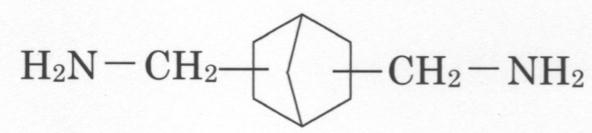
で表されるビス(アミノメチル)ノルボルナン(略称「NBDA」、三井化学ファイン株式会社製:なお、かかるNBDAは、2,5-ビス(アミノメチル)ビシクロ[2.2.1]ヘプタン及び2,6-ビス(アミノメチル)ビシクロ[2.2.1]ヘプタンの混合物である)を1.5425g(10mmol)用い、DMAcの使用量を21.55gに変更し、反応時の温度条件を80℃に変更した以外は、実施例1と同様にして、固形分濃度が20質量%のポリアミド酸(CpODAとNBDAの重付加物)の樹脂溶液を得た後、ポリイミドフィルム(縦76mm、横52mm、厚み10μmの大きさのフィルム)を得た。なお、実施例1と同様にして、得られた樹脂溶液を一部利用して固有粘度[η]を測定したところ、前記環状脂肪族ポリアミック酸(CpODAとNBDAの重付加物)の固有粘度[η]は0.348dL/gであった。
(比較例1)
ポリアミド酸の調製工程において、1,3-BACの代わりに4,4’-ジアミノジフェニルエーテル(4,4’-DDE、東京化成工業株式会社製:なお、4,4’-DDEは芳香族系のジアミン化合物である)を2.0024g(10mmol)用い、DMAcの使用量を23.38gに変更し、反応時の温度条件を25℃に変更した以外は、実施例1と同様にして、固形分濃度が20質量%のポリアミド酸(CpODAと4,4’-DDEの重付加物)の樹脂溶液を得た後、ポリイミドフィルム(縦76mm、横52mm、厚み10μmの大きさのフィルム)を得た。なお、実施例1と同様にして、得られた樹脂溶液を一部利用して固有粘度[η]を測定したところ、前記環状脂肪族ポリアミック酸(CpODAと4,4’-DDEの重付加物)の固有粘度[η]は0.997dL/gであった。
ポリアミド酸の調製工程において、1,3-BACの代わりに4,4’-ジアミノジフェニルエーテル(4,4’-DDE、東京化成工業株式会社製:なお、4,4’-DDEは芳香族系のジアミン化合物である)を2.0024g(10mmol)用い、DMAcの使用量を23.38gに変更し、反応時の温度条件を25℃に変更した以外は、実施例1と同様にして、固形分濃度が20質量%のポリアミド酸(CpODAと4,4’-DDEの重付加物)の樹脂溶液を得た後、ポリイミドフィルム(縦76mm、横52mm、厚み10μmの大きさのフィルム)を得た。なお、実施例1と同様にして、得られた樹脂溶液を一部利用して固有粘度[η]を測定したところ、前記環状脂肪族ポリアミック酸(CpODAと4,4’-DDEの重付加物)の固有粘度[η]は0.997dL/gであった。
(比較例2)
1,3-BACの代わりにtrans-シクロヘキサンジアミン(東京化成工業株式会社製:上記式:>CH-NH2で表される構造部位(第1級アミノ基が第2級炭素原子に結合した構造部位(b))を2つ有する脂肪族系ジアミン化合物)を1.1419g(10mmol)用い、DMAcの使用量を19.94gに変更し、反応時の温度条件を25℃に変更した以外は、実施例1で採用しているポリアミド酸の調製工程と同様にして、ポリアミド酸の樹脂溶液の調製を試みたが、塩が析出して固化してしまい、樹脂溶液を得ることができなかった。
1,3-BACの代わりにtrans-シクロヘキサンジアミン(東京化成工業株式会社製:上記式:>CH-NH2で表される構造部位(第1級アミノ基が第2級炭素原子に結合した構造部位(b))を2つ有する脂肪族系ジアミン化合物)を1.1419g(10mmol)用い、DMAcの使用量を19.94gに変更し、反応時の温度条件を25℃に変更した以外は、実施例1で採用しているポリアミド酸の調製工程と同様にして、ポリアミド酸の樹脂溶液の調製を試みたが、塩が析出して固化してしまい、樹脂溶液を得ることができなかった。
(比較例3)
1,3-BACの代わりにtrans-シクロヘキサンジアミン(東京化成工業株式会社製)を1.1419g(10mmol)用い、DMAcの代わりにN-メチル-2-ピロリドン(略称「NMP」)を19.94g用い、反応時の温度条件を25℃に変更した以外は、実施例1で採用しているポリアミド酸の調製工程と同様にして、ポリアミド酸の樹脂溶液の調製を試みたが、塩が析出して固化してしまい、樹脂溶液を得ることができなかった。
1,3-BACの代わりにtrans-シクロヘキサンジアミン(東京化成工業株式会社製)を1.1419g(10mmol)用い、DMAcの代わりにN-メチル-2-ピロリドン(略称「NMP」)を19.94g用い、反応時の温度条件を25℃に変更した以外は、実施例1で採用しているポリアミド酸の調製工程と同様にして、ポリアミド酸の樹脂溶液の調製を試みたが、塩が析出して固化してしまい、樹脂溶液を得ることができなかった。
<実施例1~3及び比較例1で得られたポリイミドフィルムの特性の評価>
実施例1~3及び比較例1で得られたポリイミドフィルムについて、波長248nmの光の透過率、全光線透過率、YI、Td5%、誘電率、誘電正接、波長590nmの光の屈折率、Rthを、以下のようにして測定した。得られた結果を表1に示す。
実施例1~3及び比較例1で得られたポリイミドフィルムについて、波長248nmの光の透過率、全光線透過率、YI、Td5%、誘電率、誘電正接、波長590nmの光の屈折率、Rthを、以下のようにして測定した。得られた結果を表1に示す。
〈波長248nmの光の透過率の測定〉
波長248nmの光の透過率(単位:%)は、以下のようにして求めた。すなわち、各実施例等で得られたポリイミドフィルムをそのまま測定用の試料として用い、測定装置としてUV-VIS SPECTRO PHOTO METER(SHIMADZU製の商品名「UV-2550」)を用いて、リファレンスを空気として190~900nmにおける前記試料の透過率を測定することにより、得られたポリイミドの波長248nmの光の透過率を求めた。
波長248nmの光の透過率(単位:%)は、以下のようにして求めた。すなわち、各実施例等で得られたポリイミドフィルムをそのまま測定用の試料として用い、測定装置としてUV-VIS SPECTRO PHOTO METER(SHIMADZU製の商品名「UV-2550」)を用いて、リファレンスを空気として190~900nmにおける前記試料の透過率を測定することにより、得られたポリイミドの波長248nmの光の透過率を求めた。
〈全光線透過率の測定〉
各実施例等で得られたポリイミドフィルムをそのまま測定用の試料として用い、測定装置として日本電色工業株式会社製の商品名「ヘーズメーターNDH-5000」を用いて、JIS K7361-1(1997年発行)に準拠した測定を行うことにより、得られたポリイミドの全光線透過率の値(単位:%)を求めた。
各実施例等で得られたポリイミドフィルムをそのまま測定用の試料として用い、測定装置として日本電色工業株式会社製の商品名「ヘーズメーターNDH-5000」を用いて、JIS K7361-1(1997年発行)に準拠した測定を行うことにより、得られたポリイミドの全光線透過率の値(単位:%)を求めた。
〈YIの測定〉
黄色度(YI)は、測定装置として日本電色工業株式会社製の商品名「分光色彩計SD6000」を用い、ASTM E313-05(2005年発行)に準拠した測定を行うことにより求めた。
黄色度(YI)は、測定装置として日本電色工業株式会社製の商品名「分光色彩計SD6000」を用い、ASTM E313-05(2005年発行)に準拠した測定を行うことにより求めた。
〈5%重量減少温度(Td5%)の測定〉
各実施例等で得られたポリイミドフィルムを用いて、得られたポリイミドの5%重量減少温度を以下のようにして測定した。すなわち、先ず、各実施例で得られたポリイミドフィルムから、それぞれ2~4mgの試料を準備し、かかる試料をアルミ製サンプルパンに入れ、測定装置として熱重量分析装置(エスアイアイ・ナノテクノロジー株式会社製の商品名「TG/DTA7200」)を使用して、窒素ガス雰囲気下、走査温度を30℃から550℃に設定し、昇温速度10℃/分の条件で加熱して、用いた試料の重量が5%減少する温度を測定することにより求めた。
各実施例等で得られたポリイミドフィルムを用いて、得られたポリイミドの5%重量減少温度を以下のようにして測定した。すなわち、先ず、各実施例で得られたポリイミドフィルムから、それぞれ2~4mgの試料を準備し、かかる試料をアルミ製サンプルパンに入れ、測定装置として熱重量分析装置(エスアイアイ・ナノテクノロジー株式会社製の商品名「TG/DTA7200」)を使用して、窒素ガス雰囲気下、走査温度を30℃から550℃に設定し、昇温速度10℃/分の条件で加熱して、用いた試料の重量が5%減少する温度を測定することにより求めた。
〈誘電正接(tanδ)及び比誘電率(εr)の測定方法〉
各実施例等で得られたポリイミドフィルム(縦76mm、横52mm、厚み10μmの大きさのフィルム)の誘電正接(tanδ)及び比誘電率(εr)を、スプリットポスト誘電体(SPDR)共振器法を採用し、以下のようにして測定した。すなわち、このような誘電正接(tanδ)及び比誘電率(εr)の値の測定は、それぞれ、上述の試験片(幅:52mm、長さ:76mm、膜厚:10μm)を85℃で2時間乾燥した後、23℃、相対湿度50%の環境下に調節した実験室にて行った。また、測定装置としてはキーサイト・テクノロジー合同会社(旧アジレント・テクノロジー株式会社)製の商品名「ベクトルネットワークアナライザ PNA-X N5247A」を利用した。また、測定に際しては、前記試験片を前記測定装置のSPDR誘電体共振器にセットし、周波数を10GHzとして、誘電正接(tanδ)及び比誘電率(εr)の実測値をそれぞれ求めた。そして、このような実測値の測定を計4回行い、それらの平均値を求めることにより、誘電正接(tanδ)及び比誘電率(εr)の値を求めた。このように、誘電正接(tanδ)及び比誘電率(εr)の値としては、4回の測定により得られた実測値の平均値を採用した。
各実施例等で得られたポリイミドフィルム(縦76mm、横52mm、厚み10μmの大きさのフィルム)の誘電正接(tanδ)及び比誘電率(εr)を、スプリットポスト誘電体(SPDR)共振器法を採用し、以下のようにして測定した。すなわち、このような誘電正接(tanδ)及び比誘電率(εr)の値の測定は、それぞれ、上述の試験片(幅:52mm、長さ:76mm、膜厚:10μm)を85℃で2時間乾燥した後、23℃、相対湿度50%の環境下に調節した実験室にて行った。また、測定装置としてはキーサイト・テクノロジー合同会社(旧アジレント・テクノロジー株式会社)製の商品名「ベクトルネットワークアナライザ PNA-X N5247A」を利用した。また、測定に際しては、前記試験片を前記測定装置のSPDR誘電体共振器にセットし、周波数を10GHzとして、誘電正接(tanδ)及び比誘電率(εr)の実測値をそれぞれ求めた。そして、このような実測値の測定を計4回行い、それらの平均値を求めることにより、誘電正接(tanδ)及び比誘電率(εr)の値を求めた。このように、誘電正接(tanδ)及び比誘電率(εr)の値としては、4回の測定により得られた実測値の平均値を採用した。
〈波長590nmの光の屈折率の測定〉
各実施例等で得られたポリイミドフィルムに関して、波長590nmの光の屈折率(590nmの面内屈折率)の値を以下のようにして求めた。すなわち、先ず、各実施例及び各比較例で得られたポリイミドフィルム(幅:52mm、長さ:76mm、膜厚:10μm)を、そのまま測定試料とし、測定装置として屈折率測定装置(メトリコン社の商品名「プリズム カプラ Model 2010/M」)を用い、473nm、594nm、656nmの各レーザーを用いて各波長毎の屈折率を求めた後、Cauchyフィッティングにより波長590nmの光の屈折率の値を求めた。
各実施例等で得られたポリイミドフィルムに関して、波長590nmの光の屈折率(590nmの面内屈折率)の値を以下のようにして求めた。すなわち、先ず、各実施例及び各比較例で得られたポリイミドフィルム(幅:52mm、長さ:76mm、膜厚:10μm)を、そのまま測定試料とし、測定装置として屈折率測定装置(メトリコン社の商品名「プリズム カプラ Model 2010/M」)を用い、473nm、594nm、656nmの各レーザーを用いて各波長毎の屈折率を求めた後、Cauchyフィッティングにより波長590nmの光の屈折率の値を求めた。
〈厚み10μmあたりのリタデーション値(Rth)の測定〉
各実施例等で得られたポリイミドフィルムに関して、厚み10μmあたりのリタデーション値(Rth)を以下のようにして測定した。すなわち、各ポリイミドフィルムを利用して測定試料として幅:52mm、長さ:76mm、膜厚:10μmのフィルムを準備し、測定装置としてAXOMETRICS社製の商品名「AxoScan」を用い、上述のようにして予め測定したポリイミドフィルムの屈折率(590nm)の値を、前記測定装置にインプットし、温度:25℃、湿度:40%の条件下、波長590nmの光を用いて自動測定することによりRthの測定値(絶対値)を求めた(なお、フィルムの厚みが10μmであるため、求めたRthは、そのままポリイミドフィルムの厚み10μmあたりのリタデーション値として採用した)。
各実施例等で得られたポリイミドフィルムに関して、厚み10μmあたりのリタデーション値(Rth)を以下のようにして測定した。すなわち、各ポリイミドフィルムを利用して測定試料として幅:52mm、長さ:76mm、膜厚:10μmのフィルムを準備し、測定装置としてAXOMETRICS社製の商品名「AxoScan」を用い、上述のようにして予め測定したポリイミドフィルムの屈折率(590nm)の値を、前記測定装置にインプットし、温度:25℃、湿度:40%の条件下、波長590nmの光を用いて自動測定することによりRthの測定値(絶対値)を求めた(なお、フィルムの厚みが10μmであるため、求めたRthは、そのままポリイミドフィルムの厚み10μmあたりのリタデーション値として採用した)。

また、実施例1~3及び比較例1で得られたポリイミドフィルムについて、上述の波長248nmの光の透過率の測定の際に得られる波長200nm~900nmの光の透過率のグラフを図1に示す。
このような表1及び図1に示す結果からも明らかなように、芳香族系のジアミンを利用して比較例1で得られたポリイミドフィルムは、そもそもカットオフ波長が292nmとなっており、波長292nmよりも短波長の光を透過できないのに対して、実施例1~3で得られたポリイミドフィルムは、波長248nmの光の透過率が1.3%以上となっており、波長248nmといった短波長の光を十分に透過することが可能なものであることが分かった。このような波長248nmの光の透過率を考慮すれば、実施例1~3で得られたポリイミドフィルムは、例えば、波長248nmのKrFエキシマレーザー光のような短波長の光を透過させる必要があるような用途(半導体分野、レジスト分野、レーザー関連分野等の短波長領域の光を透過させる必要がある分野)に好適に応用することが可能であることが明らかである。
また、表1に示す結果からも明らかなように、実施例1~3で得られたポリイミドフィルムは、全光線透過率が90.1%以上かつYIが1.1以下となっており、透明性が十分に高いフィルムであることが確認された。更に、実施例1~3で得られたポリイミドフィルムは、Td5%が473℃以上となっており、十分に高度な耐熱性も有することも確認された。そのため、実施例1~3で得られたポリイミドフィルムは、その高度な透明性と耐熱性とから、例えば、ガラス代替用途等に好適に利用することが可能であることも明らかである。
また、表1に示す結果からも明らかなように、実施例1~3で得られたポリイミドフィルムは、誘電正接及び比誘電率が十分に低い値となってることが確認された。このような誘電正接及び比誘電率の特性から、実施例1~3で得られたポリイミドフィルムは、高速通信分野において電気ロスを十分に抑制できるものと考えられることから、例えば、高周波数帯材料、高速通信材料、ミリ波レーザー材料、フレキシブルプリント配線基板材料等にも好適に応用することが可能であることも明らかである。
さらに、表1に示す結果からも明らかなように、実施例1~3で得られたポリイミドフィルムは、十分に低い厚み方向のリタデーション値(Rth:絶対値)を有するものとなっていることが確認された。このような結果から、実施例1~3で得られたポリイミドフィルムは、例えば、液晶ディスプレイ(LCD)や有機ELディスプレイ(OLED)等の表示装置の基板等にも好適に応用することが可能であることも明らかである。
また、比較例2~3においては、各比較例で異なる溶媒を利用しながら、ジアミンとしてtrans-シクロヘキサンジアミン(上記構造単位(b)を2つ有する脂肪族系ジアミン化合物)を用いてポリイミドの製造を試みたものの、樹脂溶液の製造段階において副生成物の塩の発生を抑制することができなかった。このような結果を勘案すると、実施例1~3のように、ポリイミドの製造時に、分子中に上記構造部位(a)を2つ有する脂肪族系ジアミンを利用することで、効率よく全脂肪族系のポリイミドを製造できることも分かった。このような結果から、実施例1~3で得られた樹脂溶液は、その硬化物であるポリイミドフィルムを製造するためのワニス等として好適に利用可能であることも明らかとなった。
(実施例4)
1,3-BACの代わりに1,4-ビス(アミノメチル)シクロヘキサン(略称「1,4-BAC」、東京化成工業社製)を1.4225g(10mmol)用いた以外は、実施例1で採用しているポリアミド酸の調製工程と同様にして、固形分濃度が20質量%のポリアミド酸(CpODAと1,4-BACの重付加物)の樹脂溶液を得た。このようにして得られた樹脂溶液を用い、大型スライドガラスの代わりに石英製スライドガラス(東京硝子器械株式会社製の石英スライドグラス、縦:76mm、横26mm、厚み0.5mm)をガラス基板として用い、90℃のお湯の中に浸漬して前記ガラス基板からポリイミドフィルムを剥離する工程を施さずに、最終製造物を、ガラス基板上にポリイミドからなる薄膜がコートされたポリイミドコートガラスとした以外は、実施例1で採用しているポリイミドの調製工程と同様にして、ポリイミドコートガラス(ポリイミドコート層/石英スライドグラスの積層体:なお、「/」は積層されていることを示す。)を得た。
1,3-BACの代わりに1,4-ビス(アミノメチル)シクロヘキサン(略称「1,4-BAC」、東京化成工業社製)を1.4225g(10mmol)用いた以外は、実施例1で採用しているポリアミド酸の調製工程と同様にして、固形分濃度が20質量%のポリアミド酸(CpODAと1,4-BACの重付加物)の樹脂溶液を得た。このようにして得られた樹脂溶液を用い、大型スライドガラスの代わりに石英製スライドガラス(東京硝子器械株式会社製の石英スライドグラス、縦:76mm、横26mm、厚み0.5mm)をガラス基板として用い、90℃のお湯の中に浸漬して前記ガラス基板からポリイミドフィルムを剥離する工程を施さずに、最終製造物を、ガラス基板上にポリイミドからなる薄膜がコートされたポリイミドコートガラスとした以外は、実施例1で採用しているポリイミドの調製工程と同様にして、ポリイミドコートガラス(ポリイミドコート層/石英スライドグラスの積層体:なお、「/」は積層されていることを示す。)を得た。
なお、実施例1と同様にして、実施例4で得られた樹脂溶液を一部利用して固有粘度[η]を測定したところ、前記環状脂肪族ポリアミック酸の固有粘度[η]は0.797dL/gであった。
(実施例5)
1,4-BACの代わりに1,2-ビス(2-アミノエトキシ)エタン(東京化成工業社製、1.4821g、10mmol)を用い、DMAcの使用量を21.30gに変更し、樹脂溶液を得る際の反応時の温度条件を25℃に変更した以外は、実施例4と同様にして、固形分濃度が20質量%のポリアミド酸(CpODAと1,2-ビス(2-アミノエトキシ)エタンの重付加物)の樹脂溶液を得た後、その樹脂溶液を用いてポリイミドコートガラス(ポリイミドコート層/石英スライドグラスの積層体)を得た。なお、実施例1と同様にして、得られた樹脂溶液を一部利用して固有粘度[η]を測定したところ、前記環状脂肪族ポリアミック酸の固有粘度[η]は0.304dL/gであった。
1,4-BACの代わりに1,2-ビス(2-アミノエトキシ)エタン(東京化成工業社製、1.4821g、10mmol)を用い、DMAcの使用量を21.30gに変更し、樹脂溶液を得る際の反応時の温度条件を25℃に変更した以外は、実施例4と同様にして、固形分濃度が20質量%のポリアミド酸(CpODAと1,2-ビス(2-アミノエトキシ)エタンの重付加物)の樹脂溶液を得た後、その樹脂溶液を用いてポリイミドコートガラス(ポリイミドコート層/石英スライドグラスの積層体)を得た。なお、実施例1と同様にして、得られた樹脂溶液を一部利用して固有粘度[η]を測定したところ、前記環状脂肪族ポリアミック酸の固有粘度[η]は0.304dL/gであった。
(実施例6)
1,4-BACの代わりに1,3-ビス(3-アミノプロピル)テトラメチルジシロキサン(東京化成工業社製、2.4852g、10mmol)を用い、DMAcの使用量を25.32gに変更し、樹脂溶液を得る際の反応時の温度条件を25℃に変更した以外は、実施例4と同様にして、固形分濃度が20質量%のポリアミド酸(CpODAと1,3-ビス(3-アミノプロピル)テトラメチルジシロキサンの重付加物)の樹脂溶液を得た後、その樹脂溶液を用いてポリイミドコートガラス(ポリイミドコート層/石英スライドグラスの積層体)を得た。なお、実施例1と同様にして、得られた樹脂溶液を一部利用して固有粘度[η]を測定したところ、前記環状脂肪族ポリアミック酸の固有粘度[η]は0.220dL/gであった。
1,4-BACの代わりに1,3-ビス(3-アミノプロピル)テトラメチルジシロキサン(東京化成工業社製、2.4852g、10mmol)を用い、DMAcの使用量を25.32gに変更し、樹脂溶液を得る際の反応時の温度条件を25℃に変更した以外は、実施例4と同様にして、固形分濃度が20質量%のポリアミド酸(CpODAと1,3-ビス(3-アミノプロピル)テトラメチルジシロキサンの重付加物)の樹脂溶液を得た後、その樹脂溶液を用いてポリイミドコートガラス(ポリイミドコート層/石英スライドグラスの積層体)を得た。なお、実施例1と同様にして、得られた樹脂溶液を一部利用して固有粘度[η]を測定したところ、前記環状脂肪族ポリアミック酸の固有粘度[η]は0.220dL/gであった。
(実施例7)
1,4-BACの代わりにイソホロンジアミン(東京化成工業社製、1.7030g、10mmol)を用い、DMAcの使用量を22.19gに変更し、樹脂溶液を得る際の反応時の温度条件を25℃に変更した以外は、実施例4と同様にして、固形分濃度が20質量%のポリアミド酸(CpODAとイソホロンジアミンの重付加物)の樹脂溶液を得た後、その樹脂溶液を用いてポリイミドコートガラス(ポリイミドコート層/石英スライドグラスの積層体)を得た。なお、実施例1と同様にして、得られた樹脂溶液を一部利用して固有粘度[η]を測定したところ、前記環状脂肪族ポリアミック酸の固有粘度[η]は0.355dL/gであった。
1,4-BACの代わりにイソホロンジアミン(東京化成工業社製、1.7030g、10mmol)を用い、DMAcの使用量を22.19gに変更し、樹脂溶液を得る際の反応時の温度条件を25℃に変更した以外は、実施例4と同様にして、固形分濃度が20質量%のポリアミド酸(CpODAとイソホロンジアミンの重付加物)の樹脂溶液を得た後、その樹脂溶液を用いてポリイミドコートガラス(ポリイミドコート層/石英スライドグラスの積層体)を得た。なお、実施例1と同様にして、得られた樹脂溶液を一部利用して固有粘度[η]を測定したところ、前記環状脂肪族ポリアミック酸の固有粘度[η]は0.355dL/gであった。
(比較例4)
CpODAの代わりにピロメリット酸二無水物(略称「PMDA」、東京化成工業社製)を2.1812g(10mmol)用い、1,3-BACの代わりに1,6-HMDを1.1621g(10mmol)用い、DMAcの使用量を13.37gに変更し、樹脂溶液を得る際の反応時の温度条件を25℃に変更した以外は、実施例4と同様にして、固形分濃度が20質量%のポリアミド酸(PMDAと1,6-HMDの重付加物)の樹脂溶液を得た後、その樹脂溶液を用いてポリイミドコートガラス(ポリイミドコート層/石英スライドグラスの積層体)を得た。なお、実施例1と同様にして、得られた樹脂溶液を一部利用して固有粘度[η]を測定したところ、前記環状脂肪族ポリアミック酸(PMDAと1,6-HMDの重付加物)の固有粘度[η]は0.391dL/gであった。
CpODAの代わりにピロメリット酸二無水物(略称「PMDA」、東京化成工業社製)を2.1812g(10mmol)用い、1,3-BACの代わりに1,6-HMDを1.1621g(10mmol)用い、DMAcの使用量を13.37gに変更し、樹脂溶液を得る際の反応時の温度条件を25℃に変更した以外は、実施例4と同様にして、固形分濃度が20質量%のポリアミド酸(PMDAと1,6-HMDの重付加物)の樹脂溶液を得た後、その樹脂溶液を用いてポリイミドコートガラス(ポリイミドコート層/石英スライドグラスの積層体)を得た。なお、実施例1と同様にして、得られた樹脂溶液を一部利用して固有粘度[η]を測定したところ、前記環状脂肪族ポリアミック酸(PMDAと1,6-HMDの重付加物)の固有粘度[η]は0.391dL/gであった。
<実施例4~7及び比較例4で得られたポリイミドコート層の特性の評価>
実施例4~7及び比較例4で得られたポリイミドコートガラス(ポリイミドコート層/石英スライドグラスの積層体)をそれぞれ用いて、上述の〈波長248nmの光の透過率の測定〉で採用している方法と同様にして、波長248nmの光の透過率を測定するとともに、波長200nm~900nmの光の透過率のグラフを求めた。なお、参照のために、ガラス基板として用いた石英製スライドガラス(東京硝子器械株式会社製)自体の波長200nm~900nmの光の透過率も同様にして求めた。得られた結果を表2及び図2に示す。
実施例4~7及び比較例4で得られたポリイミドコートガラス(ポリイミドコート層/石英スライドグラスの積層体)をそれぞれ用いて、上述の〈波長248nmの光の透過率の測定〉で採用している方法と同様にして、波長248nmの光の透過率を測定するとともに、波長200nm~900nmの光の透過率のグラフを求めた。なお、参照のために、ガラス基板として用いた石英製スライドガラス(東京硝子器械株式会社製)自体の波長200nm~900nmの光の透過率も同様にして求めた。得られた結果を表2及び図2に示す。
また、実施例4~7及び比較例4で得られたポリイミドコートガラスについて、上述の〈全光線透過率の測定〉及び〈YIの測定〉で採用している方法と同様にして、全光線透過率及びYIを測定した。得られた結果を表2に示す。
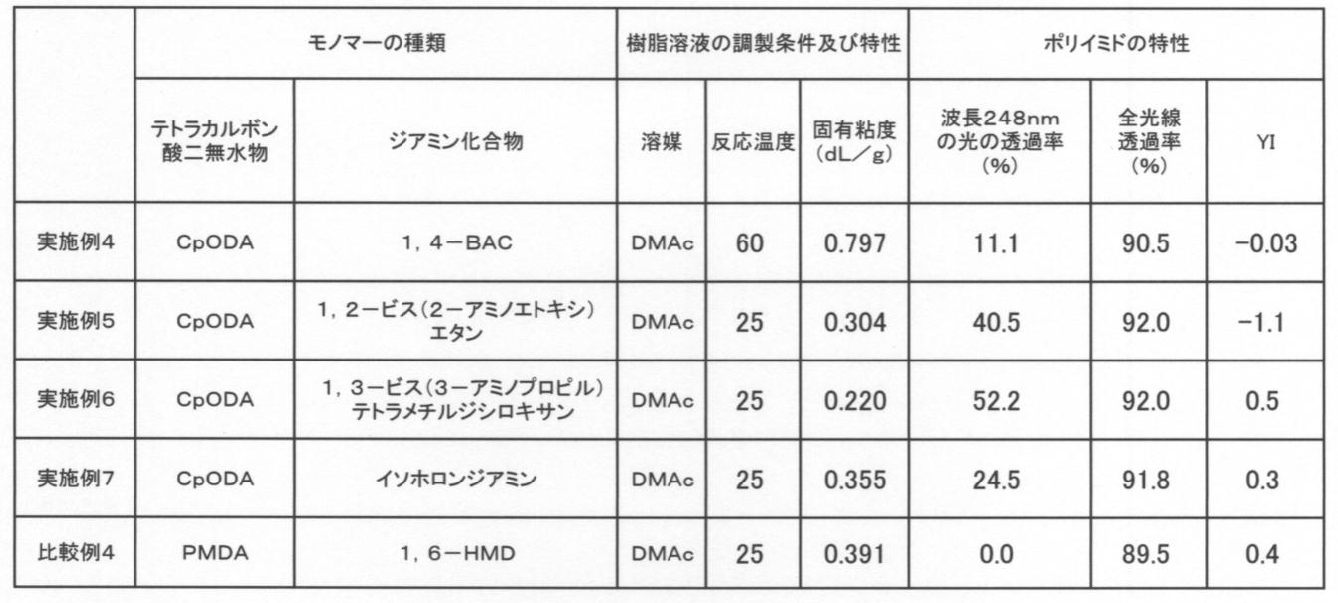
図2及び表2に示す結果からポリイミドコート層の光の透過率(%T)を検討すると、芳香族系のテトラカルボン酸二無水物を利用して比較例4で得られたポリイミドコート層/石英スライドグラスの積層体は、波長248nmの光を透過させることができないものとなっているのに対して、実施例4~7で得られたポリイミドコート層/石英スライドグラスの積層体は波長248nmの光の透過率が11.1%~52.2%の範囲内の値となっており、各実施例で調製したポリイミドコート層が、波長248nmといった短波長の光を十分に透過することが可能なものとなっていることが分かった。このような、波長248nmの光の透過率から、実施例4~7で得られたポリイミドコート層は、例えば、波長248nmのKrFエキシマレーザー光のような短波長の光を透過させる必要があるような用途(半導体分野、レジスト分野、レーザー関連分野等の短波長領域の光を透過させる必要がある分野)等に好適に応用することが可能であることが明らかである。
また、表2に示す結果からも明らかなように、実施例4~7で得られたポリイミドフィルムは、全光線透過率が90.5%以上かつYIが0.5以下となっており、透明性が十分に高いフィルムであることが確認された。
また、実施例4~7の結果から、ポリイミドの製造時に、分子中に上記構造部位(a)を2つ有する脂肪族系ジアミン、又は、分子中に上記構造部位(a)及び上記構造単位(b)を有する脂肪族系ジアミン(イソホロンジアミン)を利用することで、効率よく全脂肪族系のポリイミドを製造できることも分かった。また、実施例4~7で得られた樹脂溶液は、その硬化物であるポリイミドコート層(ポリイミドのコーティング層)を形成するためのコーティング剤として利用可能であることも分かった。
以上説明したように、本発明によれば、波長248nmの光の透過率を十分なものとすることが可能なポリイミド;該ポリイミドの前駆体であり、該ポリイミドを製造するために好適に使用することが可能なポリアミド酸;前記ポリイミド及びポリアミド酸のうちの少なくとも1種の樹脂を含む樹脂溶液;かかる樹脂溶液からなるコーティング剤;並びに、前記樹脂溶液を用いて得られるポリイミドフィルムを提供することが可能となる。したがって、本発明のポリイミドは、特に、半導体分野、レジスト分野、レーザー関連分野等の短波長領域の光を透過させる必要がある分野に応用する樹脂材料等として有用である。
Claims (5)
- 脂肪族6員環構造を有する環状脂肪族テトラカルボン酸二無水物と、
分子中に第1級アミノ基が第1級炭素原子に結合した構造部位(a)を2つ有する脂肪族系ジアミン(A)、及び、分子中に前記構造部位(a)と第1級アミノ基が第2級炭素原子に結合した構造部位(b)とを有する脂肪族系ジアミン(B)からなる群から選択される少なくとも1種の脂肪族系ジアミン化合物と、
の重縮合物からなる、ポリイミド。 - 脂肪族6員環構造を有する環状脂肪族テトラカルボン酸二無水物と、
分子中に第1級アミノ基が第1級炭素原子に結合した構造部位(a)を2つ有する脂肪族系ジアミン(A)、及び、分子中に前記構造部位(a)と第1級アミノ基が第2級炭素原子に結合した構造部位(b)とを有する脂肪族系ジアミン(B)からなる群から選択される少なくとも1種の脂肪族系ジアミン化合物と、
の重付加物からなる、ポリアミド酸。 - 請求項1に記載のポリイミド及び請求項2に記載のポリアミド酸の中から選択される少なくとも1種の樹脂と、有機溶媒とを含有する、樹脂溶液。
- 請求項3に記載の樹脂溶液からなる、コーティング剤。
- 請求項3に記載の樹脂溶液の硬化物である、ポリイミドフィルム。
Priority Applications (3)
| Application Number | Priority Date | Filing Date | Title |
|---|---|---|---|
| JP2020563880A JPWO2020141614A1 (ja) | 2019-05-10 | 2020-04-10 | |
| KR1020217036709A KR20220007059A (ko) | 2019-05-10 | 2020-04-10 | 폴리이미드, 폴리아미드산, 수지 용액, 코팅제 및 폴리이미드 필름 |
| CN202080033006.2A CN113874418A (zh) | 2019-05-10 | 2020-04-10 | 聚酰亚胺、聚酰胺酸、树脂溶液、涂布剂和聚酰亚胺膜 |
Applications Claiming Priority (2)
| Application Number | Priority Date | Filing Date | Title |
|---|---|---|---|
| JP2019089826 | 2019-05-10 | ||
| JP2019-089826 | 2019-05-10 |
Publications (2)
| Publication Number | Publication Date |
|---|---|
| WO2020141614A2 true WO2020141614A2 (ja) | 2020-07-09 |
| WO2020141614A3 WO2020141614A3 (ja) | 2020-09-03 |
Family
ID=71406862
Family Applications (1)
| Application Number | Title | Priority Date | Filing Date |
|---|---|---|---|
| PCT/JP2020/016172 Ceased WO2020141614A2 (ja) | 2019-05-10 | 2020-04-10 | ポリイミド、ポリアミド酸、樹脂溶液、コーティング剤及びポリイミドフィルム |
Country Status (5)
| Country | Link |
|---|---|
| JP (1) | JPWO2020141614A1 (ja) |
| KR (1) | KR20220007059A (ja) |
| CN (1) | CN113874418A (ja) |
| TW (1) | TW202102583A (ja) |
| WO (1) | WO2020141614A2 (ja) |
Cited By (3)
| Publication number | Priority date | Publication date | Assignee | Title |
|---|---|---|---|---|
| JP2022101116A (ja) * | 2020-12-24 | 2022-07-06 | 日鉄ケミカル&マテリアル株式会社 | ポリイミド、接着剤フィルム、積層体、カバーレイフィルム、樹脂付き銅箔、金属張積層板、回路基板及び多層回路基板 |
| CN115873243A (zh) * | 2021-09-29 | 2023-03-31 | 中国石油化工股份有限公司 | 一种聚酰亚胺胶黏材料及其制备方法和应用 |
| WO2023199718A1 (ja) * | 2022-04-15 | 2023-10-19 | 三菱瓦斯化学株式会社 | 共重合ポリイミド |
Family Cites Families (8)
| Publication number | Priority date | Publication date | Assignee | Title |
|---|---|---|---|---|
| EP0896014B1 (en) * | 1996-12-27 | 2004-11-17 | Maruzen Petrochemical Co., Ltd. | Soluble polyimide resin, process for preparing the same, and polyimide resin solution composition |
| JP2003141936A (ja) * | 2001-11-02 | 2003-05-16 | Mitsubishi Gas Chem Co Inc | 透明導電性フィルム |
| US6962756B2 (en) * | 2001-11-02 | 2005-11-08 | Mitsubishi Gas Chemical Company, Inc. | Transparent electrically-conductive film and its use |
| WO2009069688A1 (ja) * | 2007-11-30 | 2009-06-04 | Mitsui Chemicals, Inc. | ポリイミド系複合材料およびそのフィルム |
| KR101730210B1 (ko) | 2010-02-09 | 2017-05-11 | 제이엑스 에네루기 가부시키가이샤 | 노르보난-2-스피로-α-시클로알카논-α'-스피로-2"-노르보난-5,5",6,6"-테트라카르복실산 2무수물류, 노르보난-2-스피로-α-시클로알카논-α'-스피로-2"-노르보난-5,5",6,6"-테트라카르복실산 및 그의 에스테르류, 노르보난-2-스피로-α-시클로알카논-α'-스피로-2"-노르보난-5,5",6,6"-테트라카르복실산 2무수물류의 제조 방법, 그것을 사용하여 얻어지는 폴리이미드, 및 폴리이미드의 제조 방법 |
| JP5531781B2 (ja) * | 2010-05-25 | 2014-06-25 | 東洋紡株式会社 | 積層体、電気回路付加積層板、半導体付加積層体およびその製造方法 |
| US9771519B2 (en) * | 2012-10-31 | 2017-09-26 | Jnc Corporation | Liquid crystal display device and method for manufacturing same |
| JP6492934B2 (ja) * | 2015-04-27 | 2019-04-03 | 宇部興産株式会社 | ポリアミック酸溶液組成物およびポリイミドフィルム |
-
2020
- 2020-04-10 CN CN202080033006.2A patent/CN113874418A/zh active Pending
- 2020-04-10 KR KR1020217036709A patent/KR20220007059A/ko not_active Withdrawn
- 2020-04-10 JP JP2020563880A patent/JPWO2020141614A1/ja active Pending
- 2020-04-10 WO PCT/JP2020/016172 patent/WO2020141614A2/ja not_active Ceased
- 2020-05-07 TW TW109115207A patent/TW202102583A/zh unknown
Cited By (5)
| Publication number | Priority date | Publication date | Assignee | Title |
|---|---|---|---|---|
| JP2022101116A (ja) * | 2020-12-24 | 2022-07-06 | 日鉄ケミカル&マテリアル株式会社 | ポリイミド、接着剤フィルム、積層体、カバーレイフィルム、樹脂付き銅箔、金属張積層板、回路基板及び多層回路基板 |
| JP7642368B2 (ja) | 2020-12-24 | 2025-03-10 | 日鉄ケミカル&マテリアル株式会社 | ポリイミド、接着剤フィルム、積層体、カバーレイフィルム、樹脂付き銅箔、金属張積層板、回路基板及び多層回路基板 |
| CN115873243A (zh) * | 2021-09-29 | 2023-03-31 | 中国石油化工股份有限公司 | 一种聚酰亚胺胶黏材料及其制备方法和应用 |
| CN115873243B (zh) * | 2021-09-29 | 2025-04-25 | 中国石油化工股份有限公司 | 一种聚酰亚胺胶黏材料及其制备方法和应用 |
| WO2023199718A1 (ja) * | 2022-04-15 | 2023-10-19 | 三菱瓦斯化学株式会社 | 共重合ポリイミド |
Also Published As
| Publication number | Publication date |
|---|---|
| WO2020141614A3 (ja) | 2020-09-03 |
| JPWO2020141614A1 (ja) | 2020-07-09 |
| CN113874418A (zh) | 2021-12-31 |
| TW202102583A (zh) | 2021-01-16 |
| KR20220007059A (ko) | 2022-01-18 |
Similar Documents
| Publication | Publication Date | Title |
|---|---|---|
| JP7163437B2 (ja) | 接着力が向上したポリアミック酸組成物及びこれを含むポリイミドフィルム | |
| KR102116229B1 (ko) | 폴리이미드 전구체 및 그것을 함유하는 수지 조성물 | |
| KR102066385B1 (ko) | 수지 전구체 및 그것을 함유하는 수지 조성물, 수지 필름 및 그 제조 방법, 그리고, 적층체 및 그 제조 방법 | |
| JP6669074B2 (ja) | ポリイミドフィルム、ポリイミド前駆体、及びポリイミド | |
| JP6627510B2 (ja) | ポリイミド前駆体組成物、ポリイミドの製造方法、ポリイミド、ポリイミドフィルム、及び基板 | |
| JP6254197B2 (ja) | ポリイミド前駆体及びそれを含有する樹脂組成物 | |
| KR102519088B1 (ko) | 폴리이미드 전구체, 폴리이미드 및 폴리이미드 필름 | |
| JP7047852B2 (ja) | ポリイミド前駆体、ポリイミド、ポリイミドフィルム、ワニス、及び基板 | |
| KR20160095910A (ko) | 폴리(이미드-아미드) 코폴리머, 폴리(이미드-아미드) 코폴리머를 포함하는 성형품, 상기 성형품을 포함하는 디스플레이 장치 | |
| WO2013161970A1 (ja) | ポリアミック酸溶液組成物、及びポリイミド | |
| TW201922848A (zh) | 聚醯亞胺樹脂、聚醯亞胺清漆及聚醯亞胺薄膜 | |
| JP7069478B2 (ja) | ポリイミド、ポリイミド溶液組成物、ポリイミドフィルム、及び基板 | |
| WO2020141614A2 (ja) | ポリイミド、ポリアミド酸、樹脂溶液、コーティング剤及びポリイミドフィルム | |
| JP7659592B2 (ja) | ポリアミック酸樹脂及びこれを用いた透明なポリイミドフィルム | |
| JPWO2020095693A1 (ja) | ポリイミド前駆体、ポリイミド、ポリイミド樹脂膜、およびフレキシブルデバイス | |
| JP2009216919A (ja) | ポリマー光導波路 | |
| JP2024028411A (ja) | ポリアミック酸組成物、及びこれを用いた透明ポリイミドフィルム | |
| JP6638744B2 (ja) | ポリイミド前駆体組成物、ポリイミドの製造方法、ポリイミド、ポリイミドフィルム、及び基板 | |
| WO2023085325A1 (ja) | 樹脂組成物、成形体およびフィルム | |
| JPWO2019181699A1 (ja) | 樹脂、樹脂前駆体及び樹脂前駆体溶液 |
Legal Events
| Date | Code | Title | Description |
|---|---|---|---|
| 121 | Ep: the epo has been informed by wipo that ep was designated in this application |
Ref document number: 20735887 Country of ref document: EP Kind code of ref document: A2 |
|
| ENP | Entry into the national phase |
Ref document number: 2020563880 Country of ref document: JP Kind code of ref document: A |
|
| NENP | Non-entry into the national phase |
Ref country code: DE |
|
| 122 | Ep: pct application non-entry in european phase |
Ref document number: 20735887 Country of ref document: EP Kind code of ref document: A2 |