WO2020138481A1 - ピロリジン化合物の結晶 - Google Patents
ピロリジン化合物の結晶 Download PDFInfo
- Publication number
- WO2020138481A1 WO2020138481A1 PCT/JP2019/051570 JP2019051570W WO2020138481A1 WO 2020138481 A1 WO2020138481 A1 WO 2020138481A1 JP 2019051570 W JP2019051570 W JP 2019051570W WO 2020138481 A1 WO2020138481 A1 WO 2020138481A1
- Authority
- WO
- WIPO (PCT)
- Prior art keywords
- crystal
- crystals
- phosphoric acid
- added
- pyrrolidine
- Prior art date
- Legal status (The legal status is an assumption and is not a legal conclusion. Google has not performed a legal analysis and makes no representation as to the accuracy of the status listed.)
- Ceased
Links
Images

Classifications
-
- C—CHEMISTRY; METALLURGY
- C07—ORGANIC CHEMISTRY
- C07D—HETEROCYCLIC COMPOUNDS
- C07D401/00—Heterocyclic compounds containing two or more hetero rings, having nitrogen atoms as the only ring hetero atoms, at least one ring being a six-membered ring with only one nitrogen atom
- C07D401/14—Heterocyclic compounds containing two or more hetero rings, having nitrogen atoms as the only ring hetero atoms, at least one ring being a six-membered ring with only one nitrogen atom containing three or more hetero rings
-
- A—HUMAN NECESSITIES
- A61—MEDICAL OR VETERINARY SCIENCE; HYGIENE
- A61K—PREPARATIONS FOR MEDICAL, DENTAL OR TOILETRY PURPOSES
- A61K31/00—Medicinal preparations containing organic active ingredients
- A61K31/33—Heterocyclic compounds
- A61K31/395—Heterocyclic compounds having nitrogen as a ring hetero atom, e.g. guanethidine or rifamycins
- A61K31/435—Heterocyclic compounds having nitrogen as a ring hetero atom, e.g. guanethidine or rifamycins having six-membered rings with one nitrogen as the only ring hetero atom
- A61K31/44—Non condensed pyridines; Hydrogenated derivatives thereof
- A61K31/445—Non condensed piperidines, e.g. piperocaine
- A61K31/4523—Non condensed piperidines, e.g. piperocaine containing further heterocyclic ring systems
- A61K31/454—Non condensed piperidines, e.g. piperocaine containing further heterocyclic ring systems containing a five-membered ring with nitrogen as a ring hetero atom, e.g. pimozide, domperidone
-
- A—HUMAN NECESSITIES
- A61—MEDICAL OR VETERINARY SCIENCE; HYGIENE
- A61P—SPECIFIC THERAPEUTIC ACTIVITY OF CHEMICAL COMPOUNDS OR MEDICINAL PREPARATIONS
- A61P1/00—Drugs for disorders of the alimentary tract or the digestive system
- A61P1/04—Drugs for disorders of the alimentary tract or the digestive system for ulcers, gastritis or reflux esophagitis, e.g. antacids, inhibitors of acid secretion, mucosal protectants
-
- A—HUMAN NECESSITIES
- A61—MEDICAL OR VETERINARY SCIENCE; HYGIENE
- A61P—SPECIFIC THERAPEUTIC ACTIVITY OF CHEMICAL COMPOUNDS OR MEDICINAL PREPARATIONS
- A61P1/00—Drugs for disorders of the alimentary tract or the digestive system
- A61P1/16—Drugs for disorders of the alimentary tract or the digestive system for liver or gallbladder disorders, e.g. hepatoprotective agents, cholagogues, litholytics
-
- A—HUMAN NECESSITIES
- A61—MEDICAL OR VETERINARY SCIENCE; HYGIENE
- A61P—SPECIFIC THERAPEUTIC ACTIVITY OF CHEMICAL COMPOUNDS OR MEDICINAL PREPARATIONS
- A61P13/00—Drugs for disorders of the urinary system
- A61P13/12—Drugs for disorders of the urinary system of the kidneys
-
- A—HUMAN NECESSITIES
- A61—MEDICAL OR VETERINARY SCIENCE; HYGIENE
- A61P—SPECIFIC THERAPEUTIC ACTIVITY OF CHEMICAL COMPOUNDS OR MEDICINAL PREPARATIONS
- A61P17/00—Drugs for dermatological disorders
-
- A—HUMAN NECESSITIES
- A61—MEDICAL OR VETERINARY SCIENCE; HYGIENE
- A61P—SPECIFIC THERAPEUTIC ACTIVITY OF CHEMICAL COMPOUNDS OR MEDICINAL PREPARATIONS
- A61P17/00—Drugs for dermatological disorders
- A61P17/06—Antipsoriatics
-
- A—HUMAN NECESSITIES
- A61—MEDICAL OR VETERINARY SCIENCE; HYGIENE
- A61P—SPECIFIC THERAPEUTIC ACTIVITY OF CHEMICAL COMPOUNDS OR MEDICINAL PREPARATIONS
- A61P17/00—Drugs for dermatological disorders
- A61P17/14—Drugs for dermatological disorders for baldness or alopecia
-
- A—HUMAN NECESSITIES
- A61—MEDICAL OR VETERINARY SCIENCE; HYGIENE
- A61P—SPECIFIC THERAPEUTIC ACTIVITY OF CHEMICAL COMPOUNDS OR MEDICINAL PREPARATIONS
- A61P19/00—Drugs for skeletal disorders
- A61P19/02—Drugs for skeletal disorders for joint disorders, e.g. arthritis, arthrosis
-
- A—HUMAN NECESSITIES
- A61—MEDICAL OR VETERINARY SCIENCE; HYGIENE
- A61P—SPECIFIC THERAPEUTIC ACTIVITY OF CHEMICAL COMPOUNDS OR MEDICINAL PREPARATIONS
- A61P19/00—Drugs for skeletal disorders
- A61P19/06—Antigout agents, e.g. antihyperuricemic or uricosuric agents
-
- A—HUMAN NECESSITIES
- A61—MEDICAL OR VETERINARY SCIENCE; HYGIENE
- A61P—SPECIFIC THERAPEUTIC ACTIVITY OF CHEMICAL COMPOUNDS OR MEDICINAL PREPARATIONS
- A61P25/00—Drugs for disorders of the nervous system
-
- A—HUMAN NECESSITIES
- A61—MEDICAL OR VETERINARY SCIENCE; HYGIENE
- A61P—SPECIFIC THERAPEUTIC ACTIVITY OF CHEMICAL COMPOUNDS OR MEDICINAL PREPARATIONS
- A61P25/00—Drugs for disorders of the nervous system
- A61P25/04—Centrally acting analgesics, e.g. opioids
-
- A—HUMAN NECESSITIES
- A61—MEDICAL OR VETERINARY SCIENCE; HYGIENE
- A61P—SPECIFIC THERAPEUTIC ACTIVITY OF CHEMICAL COMPOUNDS OR MEDICINAL PREPARATIONS
- A61P27/00—Drugs for disorders of the senses
- A61P27/02—Ophthalmic agents
-
- A—HUMAN NECESSITIES
- A61—MEDICAL OR VETERINARY SCIENCE; HYGIENE
- A61P—SPECIFIC THERAPEUTIC ACTIVITY OF CHEMICAL COMPOUNDS OR MEDICINAL PREPARATIONS
- A61P29/00—Non-central analgesic, antipyretic or antiinflammatory agents, e.g. antirheumatic agents; Non-steroidal antiinflammatory drugs [NSAID]
-
- A—HUMAN NECESSITIES
- A61—MEDICAL OR VETERINARY SCIENCE; HYGIENE
- A61P—SPECIFIC THERAPEUTIC ACTIVITY OF CHEMICAL COMPOUNDS OR MEDICINAL PREPARATIONS
- A61P31/00—Antiinfectives, i.e. antibiotics, antiseptics, chemotherapeutics
-
- A—HUMAN NECESSITIES
- A61—MEDICAL OR VETERINARY SCIENCE; HYGIENE
- A61P—SPECIFIC THERAPEUTIC ACTIVITY OF CHEMICAL COMPOUNDS OR MEDICINAL PREPARATIONS
- A61P31/00—Antiinfectives, i.e. antibiotics, antiseptics, chemotherapeutics
- A61P31/04—Antibacterial agents
-
- A—HUMAN NECESSITIES
- A61—MEDICAL OR VETERINARY SCIENCE; HYGIENE
- A61P—SPECIFIC THERAPEUTIC ACTIVITY OF CHEMICAL COMPOUNDS OR MEDICINAL PREPARATIONS
- A61P31/00—Antiinfectives, i.e. antibiotics, antiseptics, chemotherapeutics
- A61P31/12—Antivirals
- A61P31/14—Antivirals for RNA viruses
- A61P31/18—Antivirals for RNA viruses for HIV
-
- A—HUMAN NECESSITIES
- A61—MEDICAL OR VETERINARY SCIENCE; HYGIENE
- A61P—SPECIFIC THERAPEUTIC ACTIVITY OF CHEMICAL COMPOUNDS OR MEDICINAL PREPARATIONS
- A61P35/00—Antineoplastic agents
-
- A—HUMAN NECESSITIES
- A61—MEDICAL OR VETERINARY SCIENCE; HYGIENE
- A61P—SPECIFIC THERAPEUTIC ACTIVITY OF CHEMICAL COMPOUNDS OR MEDICINAL PREPARATIONS
- A61P37/00—Drugs for immunological or allergic disorders
- A61P37/02—Immunomodulators
-
- A—HUMAN NECESSITIES
- A61—MEDICAL OR VETERINARY SCIENCE; HYGIENE
- A61P—SPECIFIC THERAPEUTIC ACTIVITY OF CHEMICAL COMPOUNDS OR MEDICINAL PREPARATIONS
- A61P37/00—Drugs for immunological or allergic disorders
- A61P37/02—Immunomodulators
- A61P37/04—Immunostimulants
-
- A—HUMAN NECESSITIES
- A61—MEDICAL OR VETERINARY SCIENCE; HYGIENE
- A61P—SPECIFIC THERAPEUTIC ACTIVITY OF CHEMICAL COMPOUNDS OR MEDICINAL PREPARATIONS
- A61P43/00—Drugs for specific purposes, not provided for in groups A61P1/00-A61P41/00
-
- A—HUMAN NECESSITIES
- A61—MEDICAL OR VETERINARY SCIENCE; HYGIENE
- A61P—SPECIFIC THERAPEUTIC ACTIVITY OF CHEMICAL COMPOUNDS OR MEDICINAL PREPARATIONS
- A61P9/00—Drugs for disorders of the cardiovascular system
- A61P9/10—Drugs for disorders of the cardiovascular system for treating ischaemic or atherosclerotic diseases, e.g. antianginal drugs, coronary vasodilators, drugs for myocardial infarction, retinopathy, cerebrovascula insufficiency, renal arteriosclerosis
-
- C—CHEMISTRY; METALLURGY
- C07—ORGANIC CHEMISTRY
- C07B—GENERAL METHODS OF ORGANIC CHEMISTRY; APPARATUS THEREFOR
- C07B2200/00—Indexing scheme relating to specific properties of organic compounds
- C07B2200/13—Crystalline forms, e.g. polymorphs
Definitions
- the present invention provides 1- ⁇ 2-[(3S,4R)-1-[(3R,4R)-1-cyclopentyl-3-fluoro-4-(4-methoxyphenyl)pyrrolidine-3-carbonyl]-4-( Methoxymethyl)pyrrolidin-3-yl]-5-(trifluoromethyl)phenyl ⁇ piperidine-4-carboxylic acid (hereinafter sometimes referred to as “pyrrolidine compound A” or “compound A”) and phosphoric acid Regarding crystals.
- the crystal of the present invention a crystal containing equimolar amounts of pyrrolidine compound A and phosphoric acid, which has excellent properties as a drug substance (hereinafter, may be referred to as “the crystal of the present invention”), and this as an active ingredient
- the present invention relates to a pharmaceutical composition containing the same.
- Patent Document 1 International Publication WO2015/182723 pamphlet (hereinafter referred to as Patent Document 1) describes a pyrrolidine compound having a melanocortin receptor 1 (MC1R) agonistic activity (agonist activity) or a pharmacologically acceptable salt thereof, and these compounds and these compounds. It is disclosed that the pharmaceutical composition containing the active ingredient is useful for treating or preventing various diseases in which improvement of the pathological condition is expected by activation of MC1R, and Example 19 describes the hydrochloride of pyrrolidine compound A. Has been done. However, Patent Document 1 does not describe or suggest crystals of the pyrrolidine compound A.
- M1R melanocortin receptor 1
- An object of the present invention is to provide a crystal of pyrrolidine compound A having a certain quality, which can be used as a drug substance for pharmaceuticals.
- the hydrochloride salt of pyrrolidine compound A did not crystallize, had deliquescent properties, and was not suitable as a drug substance for pharmaceuticals. Therefore, the present inventors have attempted to crystallize pyrrolidine compound A under conditions of more than 1000 in order to obtain crystals having a certain quality that can be used as a drug substance. As a result, from the viewpoints of purity, thermal stability, hygroscopicity, deliquescent, chemical stability and safety, a crystal containing equimolar amounts of pyrrolidine compound A and phosphoric acid can be used as a drug substance in a certain amount. The inventors have found that the crystals have a quality and have completed the present invention.
- the present inventors have examined the conditions for obtaining crystals having sufficient purity with good reproducibility and in a short time. Depending on the crystallization temperature and the composition of the crystallization solvent, problems such as an increase in impurities, a delay in precipitation, and deterioration of stirring fluidity and filterability due to finer crystals were observed. In order to solve these problems, the present inventors have diligently studied the crystallization procedure and the like in addition to the types and amounts of reagents and solvents used for crystallization, the ratio, etc., and have low impurities and operability such as filtration. We have found a method to efficiently obtain crystals with a quality suitable for a good drug substance.
- the present invention relates to the following.
- [1] An equimolar amount of 1- ⁇ 2-[(3S,4R)-1-[(3R,4R)-1-cyclopentyl-3-fluoro-4-(4-methoxyphenyl)pyrrolidine-3-carbonyl]-4- A crystal containing (methoxymethyl)pyrrolidin-3-yl]-5-(trifluoromethyl)phenyl ⁇ piperidine-4-carboxylic acid and phosphoric acid.
- a pharmaceutical composition comprising the crystal according to any one of [1] to [7] and a pharmaceutically acceptable additive.
- the pharmaceutical composition according to [9] which is used for preventing or treating a disease whose pathological condition is expected to be improved by activation of melanocortin receptor 1.
- [11] Diseases are rheumatoid arthritis, gouty arthritis, osteoarthritis, inflammatory bowel disease, systemic sclerosis, psoriasis, fibrosis, protoporphyria, systemic lupus erythematosus, melanoma, skin cancer, vitiligo, hair loss, pain , Ischemia/reperfusion injury, cerebral inflammatory disease, hepatitis, sepsis/septic shock, nephritis, transplantation, exacerbation of HIV disease, vasculitis, uveitis, retinitis pigmentosa, age-related macular degeneration, microorganisms
- the pharmaceutical composition according to [10] which is one or more diseases selected from infection, celiac disease, nephrotic syndrome, and melanoma infiltration.
- the crystal according to any one of [1] to [7] which is used for preventing or treating a disease in which the improvement of the pathological condition is expected by the activation of melanocortin receptor 1.
- the invention also relates to: [15] 1- ⁇ 2-[(3S,4R)-1-[(3R,4R)-1-cyclopentyl-3-fluoro-4-(4-methoxyphenyl)pyrrolidine-3-carbonyl]-4-(methoxymethyl) Any one of [1] to [5], comprising adding seed crystals to a mixture of pyrrolidin-3-yl]-5-(trifluoromethyl)phenyl ⁇ piperidine-4-carboxylic acid, phosphoric acid and a good solvent
- the method for producing a crystal according to item 1.
- Crystals containing equimolar amounts of pyrrolidine compound A and phosphoric acid do not retain the solvent used for obtaining the crystals, have excellent thermal stability, are stable with little weight change with respect to humidity, and have a deliquescent state. Without, excellent chemical stability, a crystal that does not contain a compound that may adversely affect the living body from the viewpoint of safety, since the crystal can be obtained with a reproducibly industrially suitable method, It is useful as a drug substance.
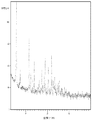
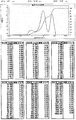
- FIG. 1 is a diagram showing the result of powder X-ray diffraction measurement of the crystal of the present invention.
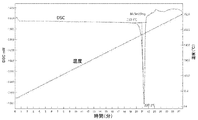
- FIG. 2 is a diagram showing the results of differential scanning calorimetry of the crystal of the present invention.
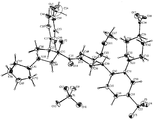
- FIG. 3 is a view showing an Ortep diagram based on single crystal X-ray diffraction measurement of molecules in the crystal of the present invention.
- FIG. 4 is a view showing a packing diagram (a-axis projection diagram) based on single crystal X-ray diffraction measurement of molecules in the crystal of the present invention.
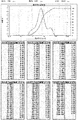
- FIG. 5-1 is a diagram showing a particle size distribution of crystals obtained under Condition 1 in Experimental Example 7.
- FIG. 5-2 is a diagram showing a particle size distribution of crystals obtained under Condition 3 in Experimental Example 7.
- the present invention relates to a crystal containing an equimolar amount of pyrrolidine compound A represented by the following formula and phosphoric acid, and a pharmaceutical composition containing the crystal as an active ingredient.
- the pyrrolidine compound A and/or phosphoric acid in the crystal of the present invention may be a compound labeled with an isotope (eg, 3 H, 13 C, 14 C, 15 N, 18 F, 32 P, etc.) and a deuterium converter. Include.
- a crystal containing equimolar amounts of pyrrolidine compound A and phosphoric acid does not have other molecules such as a solvent used for obtaining crystals, and pyrrolidine compound A and phosphoric acid have a ratio of 1:1.
- the crystals are formed in a molar ratio, that is, phosphoric acid is contained in 1 molar equivalent with respect to the pyrrolidine compound A.
- the pyrrolidine compound A and phosphoric acid do not form a salt, and the pyrrolidine compound A and phosphoric acid are bound by a nonionic bond and/or a noncovalent bond at a molar ratio of 1:1.
- Co-crystals can be mentioned.
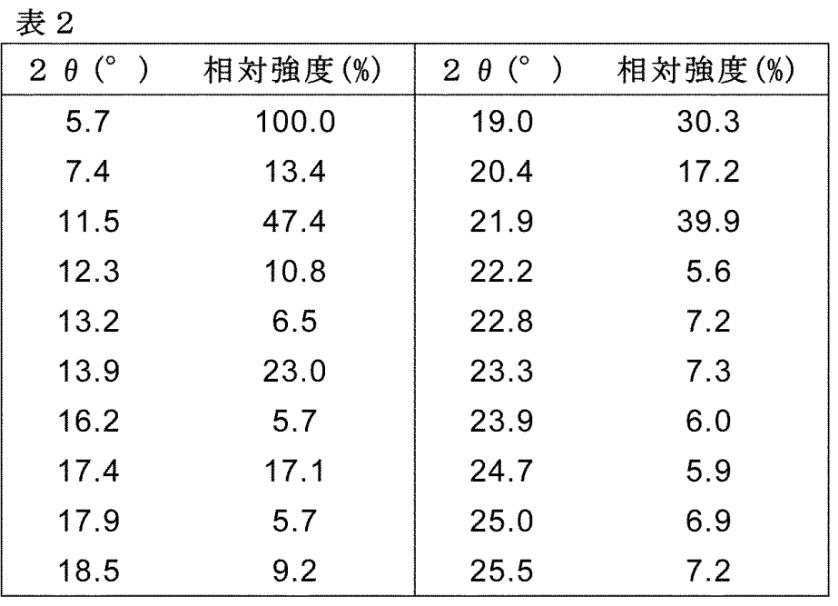
- the crystal of the present invention exhibits the powder X-ray diffraction pattern shown in FIG. 1, and the characteristic peaks are 5.7°, 11.5°, 13.9°, 19 at the diffraction angle shown by 2 ⁇ .
- each ⁇ 0.2° 0.0° and/or 21.9° (each ⁇ 0.2°), and more specifically, 5.7°, 11.5°, 13.9° at the diffraction angle indicated by 2 ⁇ , It has peaks at 17.4°, 19.0°, 20.4° and/or 21.9° (each ⁇ 0.2°), and more specifically at a diffraction angle of 2 ⁇ of 5.7°. , 7.4°, 11.5°, 12.3°, 13.9°, 17.4°, 19.0°, 20.4° and/or 21.9° (each ⁇ 0.2°).
- the B-type crystal exhibits a differential scanning calorimetry (hereinafter sometimes referred to as DSC) curve shown in FIG. 2 and has an endothermic peak at 230° C. to 240° C.
- DSC differential scanning calorimetry
- the crystal of the present invention is advantageous in that the residual solvent is a crystal whose standard value is equal to or lower than the reference value set by the International Conference for Harmonization of Pharmaceutical Regulations (Technical Requirements for for Pharmaceuticals for Human) Have. Another advantage is that the crystals are organic impurities, inorganic impurities, residual metals, residual solvents, genotoxic impurities, etc., which are below the reference values set in the ICH guidelines.
- the crystal of the present invention is preferably produced as a crystal in which the mode diameter of the non-aggregated crystal is 7 ⁇ m or more, more preferably 7 to 15 ⁇ m, and particularly preferably 8 to 12 ⁇ m. It can be mentioned.
- the mode diameter is a particle diameter when the volume% of the particle size distribution has a maximum value.
- at least 70% or more, preferably 80% or more, more preferably 90% or more of all the crystals have such a mode diameter to facilitate filtration of the crystals. The operability is improved.
- the crystal of the present invention can be produced, for example, according to the method described in Example 19 of Patent Document 1, with 1 mol of pyrrolidine compound A being 1 to 10 mol, preferably 1 to 5 mol of phosphoric acid. It can be obtained by reacting moles. In addition to this, it can also be manufactured by a method shown in Examples described later.
- the solvent used for obtaining the crystal of the present invention can be appropriately selected.
- a good solvent or a poor solvent can be used alone or in an appropriate combination.
- the good solvent is not limited as long as it is a solvent having a high solubility of pyrrolidine compound A, and examples thereof include ketones (eg, acetone, 2-butanone, etc.), esters (eg, ethyl acetate, methyl acetate, etc.), alcohols ( (Eg, methanol, ethanol, i-propanol, etc.), and mixtures of these solvents.
- the poor solvent is not limited as long as it is a solvent having a low solubility of pyrrolidine compound A, and examples thereof include water, alkanes (eg, hexane, heptane, etc.), aromatic hydrocarbons (eg, benzene, toluene, etc.), ethers. (Eg, diethyl ether, dimethyl ether, diisopropyl ether, etc.), and mixtures of these solvents.
- alkanes eg, hexane, heptane, etc.
- aromatic hydrocarbons eg, benzene, toluene, etc.
- ethers eg, diethyl ether, dimethyl ether, diisopropyl ether, etc.
- One embodiment of the method for obtaining the crystals of the present invention is a method in which phosphoric acid is added to a mixture of pyrrolidine compound A and a good solvent, seed crystals are added to the obtained mixture, and filtration is performed.
- Preferred is a method in which the pyrrolidine compound A is dissolved in a good solvent, phosphoric acid is added, and seed crystals are added to the resulting mixture, followed by filtration.
- More preferred is a method in which pyrrolidine compound A is dissolved in ethyl acetate or ethanol, phosphoric acid is added, seed crystals are added to the resulting mixture, and then filtration is performed.
- Another embodiment is a method in which phosphoric acid is added to a mixture of pyrrolidine compound A and a good solvent, a poor solvent is added to the obtained mixture, and filtration is performed.
- a method in which pyrrolidine compound A is dissolved in a good solvent, phosphoric acid is added, a poor solvent is added to the resulting mixture, and then seed crystals are added, and filtration is performed.
- Examples of a suitable good solvent when a good solvent and water are used in combination include ethyl acetate, ethanol and the like.
- first water Of the pyrrolidine compound A is 3 times by volume ratio with respect to the weight of the pyrrolidine compound A, and the amount of water (second addition of water) added after the seed crystal is added by volume ratio with respect to the weight of the pyrrolidine compound A. 4.5 times is preferable.
- a method in which the amount of water to be added is 5 to 10 times the volume of the pyrrolidine compound A by volume and the water is added separately before and after the seed crystals are added.
- the amount of water is 6 to 9 times, and more preferably 7.5 times, the volume ratio of the weight of pyrrolidine compound A.
- the volume ratio of the amount of water added for the first time and the amount of water added for the second time is 1:1 to 1:2, preferably 2:3, can be mentioned.
- water is added before the seed crystals are added to the extent that 70% or more, preferably 80% or more of the crystals are precipitated before the water is added after the seed crystals are added.
- the temperature at which the seed crystal is added is set to 28 to 32°C, preferably 30°C. Also for these temperatures, it is preferable to select a temperature at which 70% or more, preferably 80% or more, of crystals are precipitated before the addition of water after the seed crystals are added.
- the seed crystal of the crystal of the present invention can be obtained by the method described in Example 3, Experimental Example 2 or Experimental Example 3 described later. Also, the crystals obtained by these methods are used as seed crystals of the crystals of the present invention, and seed crystals are also obtained by, for example, the method described in Example 1 or 2 or a method according to the method described in Example 1 or 2. Obtainable.
- the crystal of the present invention Since the crystal of the present invention has human MC1R agonist activity, it can be used as an active ingredient of a melanocortin receptor 1 agonist, and the crystal of the present invention and a pharmaceutical composition containing the crystal of the present invention as an active ingredient show MC1R activity. It is useful for the treatment or prevention of various diseases that are expected to improve the pathological condition. Examples of such diseases include rheumatoid arthritis, gouty arthritis, osteoarthritis, inflammatory bowel disease, systemic sclerosis, psoriasis, fibrosis, protoporphyria (for example, erythroblastic protoporphyria).
- Etc. systemic lupus erythematosus, melanoma, skin cancer, vitiligo, hair loss, pain, ischemia/reperfusion injury, cerebral inflammatory disease, hepatitis, sepsis/septic shock, nephritis, transplantation, exacerbation of HIV disease , Vasculitis, uveitis, retinitis pigmentosa, age-related macular degeneration, microbial infection, celiac disease, nephrotic syndrome, and one or more diseases selected from melanoma infiltration.
- one or more diseases selected from systemic sclerosis, psoriasis, protoporphyria, melanoma, skin cancer, leukoplakia, alopecia, retinitis pigmentosa, age-related macular degeneration, and nephrotic syndrome, or the like Useful for prevention. Particularly, it is useful for treating or preventing one or more diseases selected from systemic scleroderma, protoporphyria, melanoma, leukoplakia, retinitis pigmentosa, age-related macular degeneration, and nephrotic syndrome. ..
- a pharmaceutical composition containing the crystal of the present invention as an active ingredient is a pharmaceutically acceptable additive such as an excipient, a disintegrating agent, a binder, a lubricant, a coating agent, a pigment, a diluent, a group. It can be obtained by mixing with an agent and a tonicity agent.
- the crystal of the present invention and a pharmaceutical composition containing the crystal as an active ingredient are prepared into suitable dosage forms, for example, powders, injections, tablets, capsules and topical external preparations, and then suitable for the dosage form. It can be administered to patients by administration methods such as intravenous administration, oral administration and transdermal administration.
- suitable dosage forms for example, powders, injections, tablets, capsules and topical external preparations, and then suitable for the dosage form. It can be administered to patients by administration methods such as intravenous administration, oral administration and transdermal administration.
- patient in the present invention is an individual, preferably a mammal, more preferably a human, who is a subject of prevention or treatment by the crystal of the present invention.
- the dose depends on the patient's age, weight, general health condition, sex, diet, administration time, administration method, excretion rate, drug combination, and the degree of medical condition of the patient being treated at the time of administration, and other factors. Can be decided in consideration.
- the crystal of the present invention and a pharmaceutical composition containing the crystal as an active ingredient have low toxicity and can be safely used.
- the daily dose (that is, the effective amount) depends on the patient's condition, body weight, administration route, etc.
- Varying but for example, about 0.0001 to 1000 mg/person/day, preferably about 0.001 to 1000 mg/person/day, particularly preferably 0.01 to 500 mg/person/day, is parenterally administered, and It is desirable to orally administer about 0.0001 to 1000 mg/person/day, preferably 0.01 to 500 mg/person/day.
- prevention means the act of administering the crystal of the present invention or a pharmaceutical composition containing the same to an individual who has not developed a disease, disorder or symptom.
- treatment refers to the act of administering the crystal of the present invention or a pharmaceutical composition containing the same to an individual who has already developed a disease, disorder or symptom. Therefore, the act of administering to an individual who has already developed a disease, illness or symptom to prevent the deterioration of the symptom, seizure prevention or recurrence is one aspect of “treatment”.
- Example 1 Synthesis of crystal of the present invention
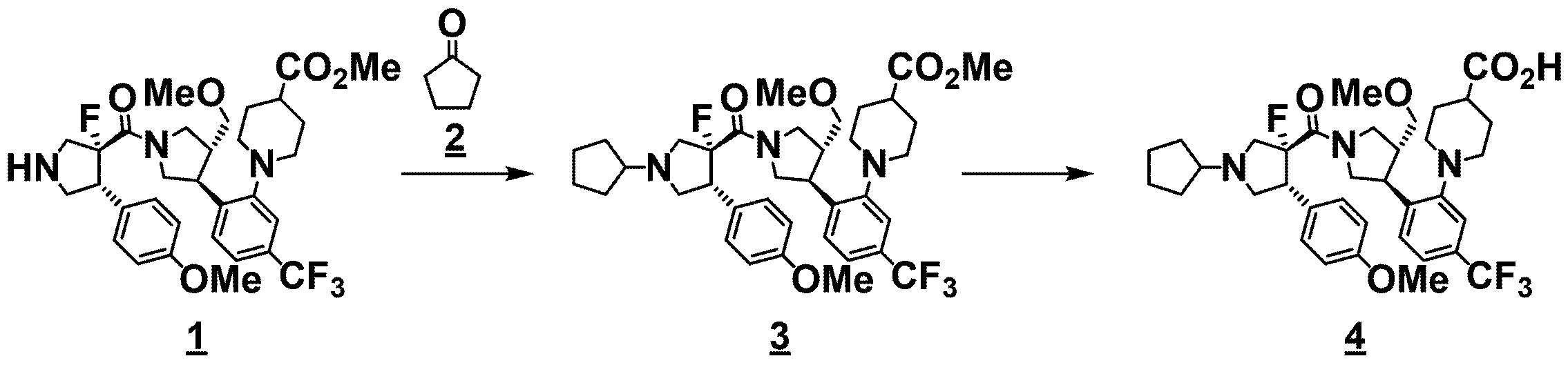
- Compound 1 (26.18 g) was dissolved in dichloromethane (207 mL), compound 2 (4.4 mL) and acetic acid (3.56 mL) were added thereto, and the mixture was stirred at room temperature for 30 minutes. Then, sodium triacetoxyborohydride (13.2 g) was further added, and the mixture was stirred at room temperature for 1 hr. After adding a saturated aqueous sodium hydrogen carbonate solution and stirring, the mixture was extracted with dichloromethane. The obtained organic layer was washed with saturated saline, dried over magnesium sulfate, and concentrated under reduced pressure.
- XRPD ⁇ Powder X-ray diffraction (hereinafter sometimes referred to as XRPD) measurement> It measured on the following conditions using the powder X-ray-diffraction measuring apparatus X'PertPro (made by PANalyticalBV).
- X-ray generator X-ray tube (anticathode: copper, tube voltage: 45 kV, tube current: 40 mA)
- Table 2 shows peaks having relative peak intensities of 5 or more when the peak intensity at a diffraction angle of 2 ⁇ of 5.7° is 100.
- DSC ⁇ Differential scanning calorimetry (DSC) measurement> The measurement was carried out using a differential scanning calorimeter X-DSC7000 (SII Nanotechnology Inc.) under the following conditions. Temperature rising rate: 10°C/min (25°C to 300°C) Atmosphere: Nitrogen 100mL/min The results are shown in Fig. 2. An endothermic peak was observed at about 230°C to 240°C.
- FIG. 3 The orthep diagram of the molecule in the crystal of the present invention is shown in FIG. 3, and the packing diagram is shown in FIG.
- one molecule of pyrrolidine compound A and one molecule of phosphoric acid were independently present in the asymmetric unit.
- the crystal of the present invention shows 1 molecule of 1- ⁇ 2-[(3S,4R)-1 shown in FIG. -[(3R,4R)-1-Cyclopentyl-3-fluoro-4-(4-methoxyphenyl)pyrrolidin-3-carbonyl]-4-(methoxymethyl)pyrrolidin-3-yl]-5-(trifluoromethyl ) Phenyl ⁇ piperidine-4-carboxylic acid and one molecule of phosphoric acid were confirmed to be crystals having a structural unit.
- the pyrrolidine compound A needs to accept a proton as a Bronsted base when ionic interaction is observed with the pyrrolidine compound A.
- the pyrrolidine compound A it is three nitrogens (N18, N19, N20) that may accept a proton from phosphoric acid.
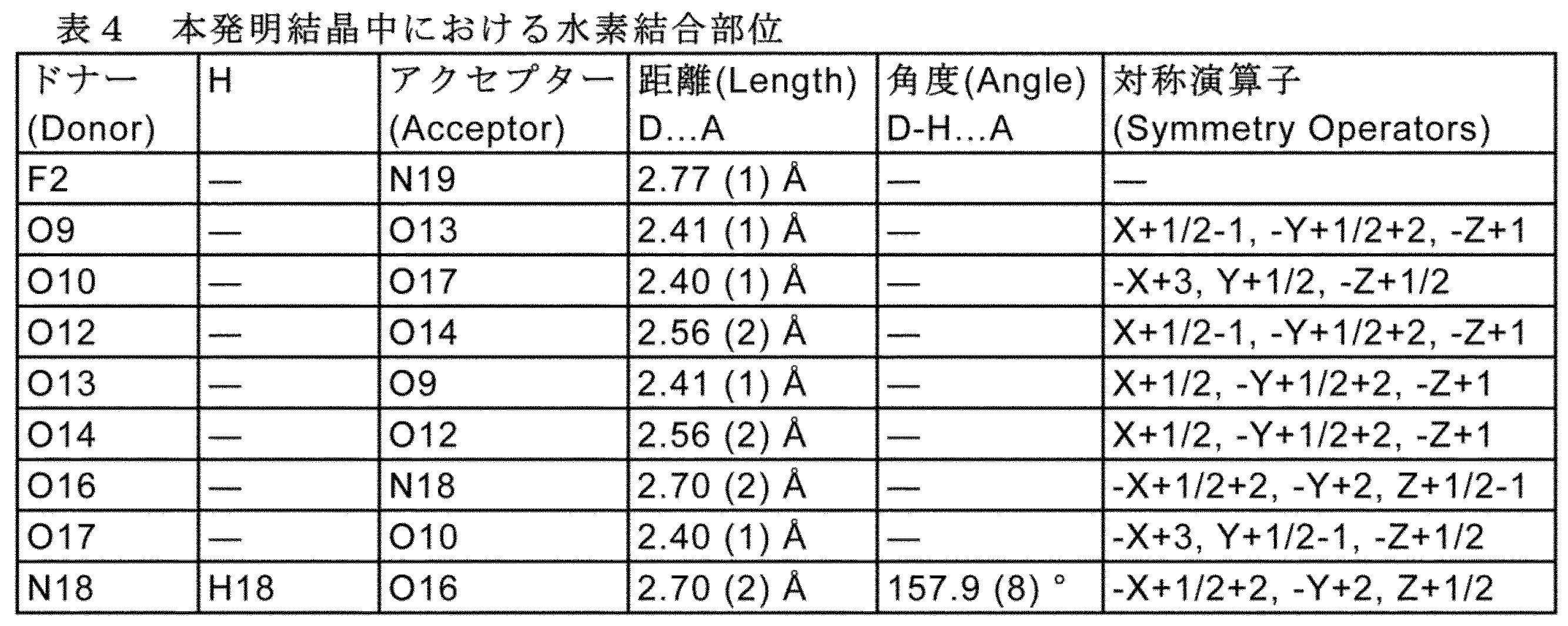
- N18, N19, N20 all hydrogen bonding sites in the crystal of the present invention are shown in Table 4.
- N18 N18 is a sp3-hybridized nitrogen, which is the most basic nitrogen in the pyrrolidine compound A and has a possibility of accepting a proton from phosphoric acid.
- N18 (more precisely, a hydrogen atom bonded to N18) is an oxygen atom () of the carboxylic acid of the adjacent pyrrolidine compound A (symmetry operators: -X+1/2+2, -Y+2, Z+1/2). It was determined that a hydrogen bond with O16) was formed and that a proton was donated. Therefore, N18 cannot accept a proton from phosphoric acid.
- the interatomic distance between N18 and any oxygen in the adjacent phosphoric acid exceeds the sum of van der Waals radii, so it was determined that phosphoric acid does not exist at a distance where ionic interactions are possible.
- N19 Since N19 is sp2-hybridized nitrogen, it was considered to be weakly basic and unable to form a salt. At the same time, since the interatomic distance of oxygen (O13) of phosphoric acid, which is the closest distance to N19, is the sum of van der Waals radii, it was judged that the distance was not within a distance where ionic interaction was possible.
- N20 Since N20 is also sp2-hybridized nitrogen, it was considered to be weakly basic and unable to form a salt. At the same time, since the interatomic distance between N20 and any oxygen in the adjacent phosphoric acid exceeds the sum of van der Waals radii, it was determined that phosphoric acid does not exist at a distance where ionic interaction is possible.
- a solution of phosphoric acid (12.0 kg) in water (55.7 L) and water (55.7 L) were sequentially added to the solution of compound 4 at 30°C.
- the crystal of the present invention was added as a seed crystal (928 g), and the mixture was stirred for 14 hours.
- Water (167.0 L) was added, and the mixture was stirred for 4 hours and then cooled to 25°C.
- the solid was filtered off and washed with water (182 L). The solid was dried at 50° C. or lower to obtain the crystal of the present invention (35.2 kg). This crystal was excellent in operability such as filterability.
- 21 kinds of acids including phosphoric acid, hydrochloric acid, L(-)-malic acid, L(+)-tartaric acid, maleic acid, sulfuric acid and malonic acid, and 8 kinds of bases including sodium hydroxide and L-arginine
- 45 ⁇ L of a 0.1 mol/L solution (90 ⁇ L of a 0.05 mol/L solution for 1 part of acid) is dissolved in each of the eight solvents described below. Dispensed. The solvent was evaporated by opening for one day and night, and then dried under reduced pressure for 4 hours.
- Phosphoric acid type A crystals L(,) from vials of a combination of phosphoric acid and ethyl acetate, a combination of L( ⁇ )-malic acid and toluene, a combination of L(+)-tartaric acid and acetone, and a combination of maleic acid and toluene, respectively.
- -)-Malic acid type D crystals, L(+)-tartaric acid type E crystals and maleic acid type F crystals were obtained.
- no crystals were obtained from all eight solvents from the vial containing hydrochloric acid.
- no crystals were obtained in any solvent from the vial containing sulfuric acid, malonic acid and L-arginine.
- 22 kinds of acids including phosphoric acid, hydrochloric acid, L(-)-malic acid, L(+)-tartaric acid, maleic acid, sulfuric acid and malonic acid, 8 kinds of bases including sodium hydroxide and L-arginine ( Hereinafter, it may be referred to as a counter compound.)
- 30 mol of a 0.1 mol/L solution for 1 part of the acid, 60 mol of a 0.05 mol/L solution
- 12 kinds of solvents described below is placed in each vial. Dispensed. After dispensing, nitrogen was blown to evaporate the solvent.
- the solvent was evaporated at room temperature for the vial having no precipitate, and when a solid was observed after about 1 month, the solid was sampled and the XRPD was measured.
- the XRPD measuring device and the measuring conditions are the same as those in the first embodiment.
- the combination vials from which the crystals were obtained are shown in Table 5 below.
- ⁇ indicates that crystals were not obtained, and A and B indicate that A type crystals and B type crystals were obtained, respectively. That is, the maleic acid F-type crystal obtained this time has the same XRPD pattern as the maleic acid F-type crystal obtained in Experimental Example 2, and the phosphoric acid B-type crystal obtained this time is obtained in Experimental Example 2. It shows that the crystals are different from the phosphoric acid type A crystals.
- there was a vial in which crystals of only the counter compound could be confirmed as in Experimental Example 2.
- no crystals were obtained from all 12 solvents from the vial containing hydrochloric acid.
- L( ⁇ )-malic acid and L(+)-tartaric acid crystals were obtained in Experimental Example 2, but this time, no crystals were obtained with all 12 kinds of solvents.
- ⁇ L(-)-malic acid, L(+)-tartaric acid and sulfuric acid > About 80 mg of pyrrolidine compound A was dissolved in 4 mL of tetrahydrofuran, and 100 ⁇ L was dispensed into each vial of a 96-well plate (about 2 mg/vial). Further, 30 ⁇ L of a 0.1 mol/L solution prepared by dissolving L( ⁇ )-malic acid, L(+)-tartaric acid and sulfuric acid in a solvent described later was dispensed into each vial.
- the L-arginine K-type crystal obtained in Experimental Example 3 was added as a seed crystal, but since it was dissolved, 1.2 mL of toluene was added, and the mixture was stirred day and night. Since it was a solution, the solvent was evaporated by blowing nitrogen, and the residue was measured by XRPD to be amorphous. 0.6 mL of heptane was added thereto, and the mixture was stirred at room temperature overnight, and then observed under a microscope. No crystalline component was found.
- ⁇ Galonic acid malonic acid crystal> About 325 mg of pyrrolidine compound A was weighed and dissolved in 1 mL of acetone at room temperature. 55 mg of malonic acid was measured, dissolved in 0.5 mL of acetone at room temperature, and added to the solution of the pyrrolidine compound A. 6 mL of toluene was added dropwise to this solution. A small amount of malonic acid type I crystal described later was used as a seed crystal, and the mixture was stirred at room temperature for 2 nights. The whole amount was filtered and dried under reduced pressure at 40° C. for 3.5 hours to obtain 317 mg of crystals. It was confirmed by 1H-NMR that the obtained crystals contained 1 equivalent of toluene. Amorphization was observed as a result of storage for 72 hours at 25° C. and 70% RH using a dynamic vapor adsorption measurement (DVS) device for the purpose of replacing toluene with water. Was given.
- DVDS dynamic vapor adsorption measurement
- ⁇ H-type malonic acid crystal> About 65 mg of pyrrolidine compound A was measured and dissolved in 2 mL of a mixed solvent of ethyl acetate and heptane with a mixing ratio of 3:7 at room temperature. 11 mg of malonic acid was measured, dissolved in 0.3 mL of ethyl acetate at room temperature, and added to the solution of the pyrrolidine compound A. Since a hard gum was generated, 3 mL of ethyl acetate was added to make a suspension.
- ⁇ Malonic acid type I crystal> About 65 mg of pyrrolidine compound A was weighed and dissolved in 2.3 mL of a mixed solvent of acetone and toluene with a mixing ratio of 1:9 at room temperature. Malonic acid (11 mg) was measured, dissolved in acetone (0.1 mL) at room temperature, and added to the pyrrolidine compound A solution. After stirring at room temperature for 3 nights, the whole amount was filtered and dried under reduced pressure at 40° C. for 2 hours to obtain 51 mg of crystals. It was confirmed by 1H-NMR that the obtained crystals contained 1 equivalent of toluene. Since this crystal may be a toluene solvate, about 5 mg was dried under reduced pressure at 60° C. for 4 hours for the purpose of confirming whether a solvent-free crystal could be obtained by further drying under reduced pressure. About 0.5 equivalent of toluene remained, and it was confirmed that the crystal form did not change.
- Example 3 Synthesis of crystal of the present invention (3)
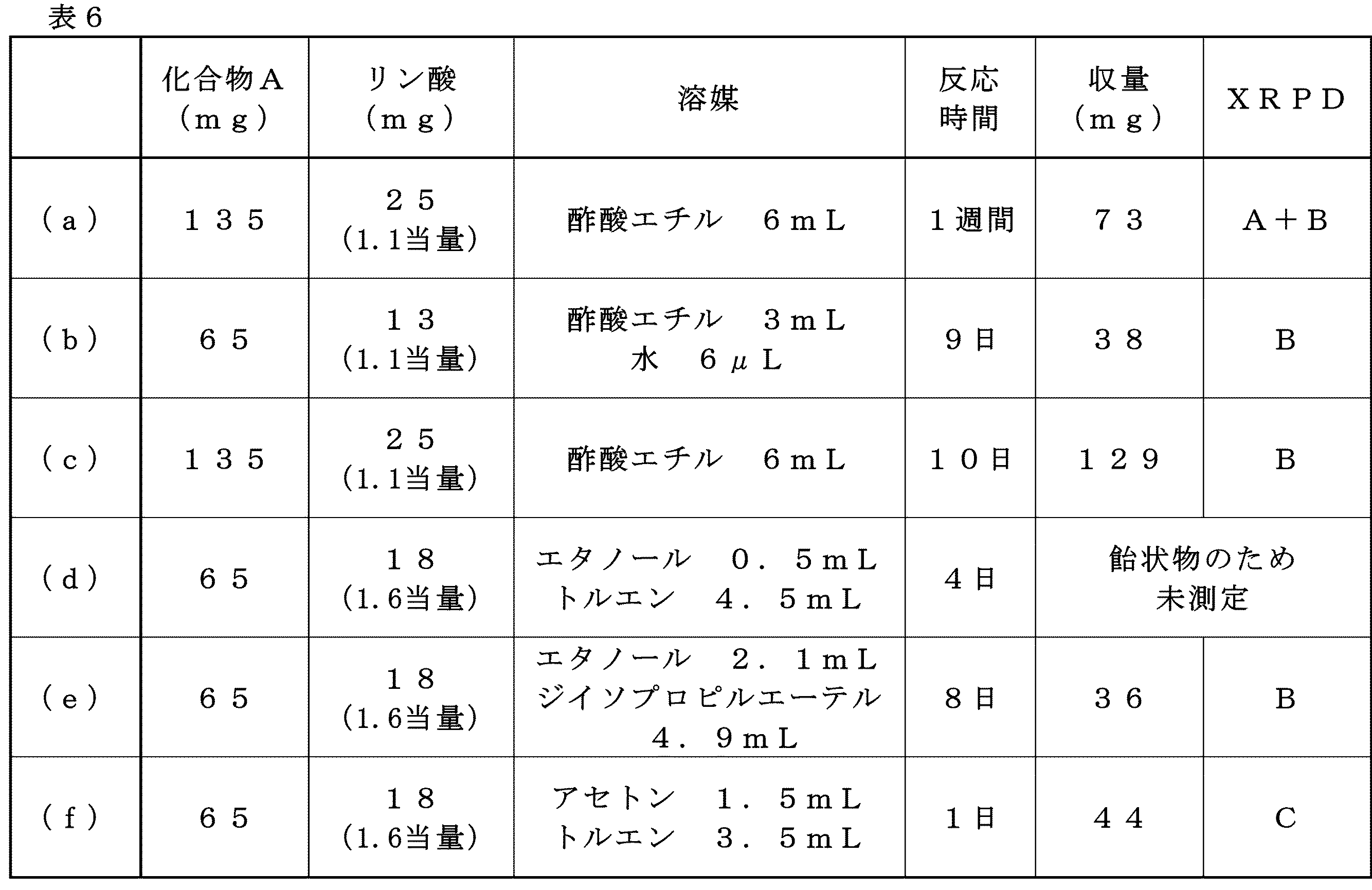
- the amounts of pyrrolidine compound A and phosphoric acid shown in Table 6 below were added to the solvent shown below, and the mixture was stirred for the time shown below.
- the results are shown in Table 6 below.
- the XRPD measuring device and the measuring conditions are the same as those in the first embodiment.
- the result of XRPD shows that A is the same crystal as the phosphoric acid type A crystal obtained in Experimental Example 2, and B is the same crystal as the phosphoric acid type B crystal obtained in Experimental Example 3. Further, the phosphoric acid type B crystal was the same as the crystal of the present invention crystal obtained in Example 1.
- an amorphous or candy-like product was formed immediately after the addition of phosphoric acid, but the amorphous was stirred at room temperature for 7 to 10 days. Or, crystals could be obtained by the operation of frequently scraping the candy with a spatula for a long time. Further, in the method (d), although it was a suspension of crystals one day after the start of crystallization, it became a candy-like substance when stirring at room temperature was continued for 4 days. Further, this was subjected to solvent evaporation with nitrogen, and stirred in ethanol overnight at room temperature to obtain a B-form crystal.
- the free form amorphous substance is a free form amorphous substance of pyrrolidine compound A, and the results of compound 4 obtained by the method described in Example 1 are shown.
- the free form crystals are crystals of the free form of the pyrrolidine compound A, and it was shown in Experimental Example 1 that the residual solvent in the crystals could not fall below the reference value determined by ICH. Therefore, it has been confirmed that the crystals are not suitable as drug substance.
- the phosphoric acid type A+B type crystal was obtained by the method (a) described in Example 3, and the phosphoric acid type B crystal was obtained by the method described in Example 1.
- the obtained crystals of the present invention were obtained by the method of (f) described in Example 3 for the phosphoric acid C-type crystals, and by the method of Experimental Example 4 for the maleic acid F-type crystals. The results of the F-type maleic acid crystals are shown.
- the malonic acid H-form crystal showed the result of the malonic acid H-form crystal obtained by the method described in Experimental Example 4.
- Malonic acid has been able to obtain G-form and I-form crystals in addition to H-form, but these all contain toluene in the molecule.
- Toluene is a compound known to cause damage to the central nervous system and the like, and inclusion in the drug substance is not preferable from the viewpoint of safety.
- G- and I-form crystals are used as drug substances. No comparative tests were carried out on these, as they are clearly not suitable crystals.
- thermogravimetric/differential thermal simultaneous measurement device TG/DTA7200 (SII Nano Technology Co., Ltd.), evaluation was performed under the following conditions. Temperature rising rate: 10 K/min Atmosphere: Nitrogen 200 mL/min
- Pyrrolidine compound A and a mixture containing the same are reproducible solids as amorphous hydrochloride, free amorphous, free crystalline, phosphoric acid A+B crystalline, phosphoric acid which is one embodiment of the crystal of the present invention.
- B-type crystals, phosphoric acid C-type crystals, maleic acid F-type crystals, malonic acid G-type crystals, malonic acid H-type crystals, and malonic acid I-type crystals have been found.
- free form crystals cannot keep the residual solvent below the standard value specified by ICH, and malonic acid G type crystals and malonic acid type I crystals contain toluene in the molecule, which is a safety aspect. Therefore, it was not a suitable crystal as a drug substance.
- both the free form amorphous and the phosphoric acid type A+B type crystal showed a weight change of 2% or more when heated to 130° C., but the phosphoric acid type B crystal showed a weight change even at 200° C. or higher.
- the crystal was excellent in thermal stability.
- Ethanol 24.32 g was added to the obtained concentrated mixture until the volume reached 45 mL, 24% aqueous sodium hydroxide solution (4.79 g) and purified water (12 mL) were added dropwise at 25°C, and the mixture was stirred at 300 rpm for 6 hours. It was stirred.
- 85% phosphoric acid aqueous solution (6.61 g) and purified water (22.5 mL, 1.5 times by volume based on the weight of compound 4 ) were added dropwise over 5 minutes, and then purified water (90 mL, (Volume ratio of 6.0 times the weight of compound 4 ) was added dropwise over 30 minutes.
- purified water (30.0 mL, 6.0 times by volume relative to the weight of compound 4 ) was added over 2 hours. After 10 hours, the reaction temperature was brought to 20° C. and stirring was continued. After 27 hours, the solid was collected by filtration and washed with purified water (25.23 g, 5 times by volume based on the weight of compound 4 ). The solid was dried at 50° C. to obtain crystals of the present invention (4.01 g). Sampling was carried out 16 hours and 21 hours after the addition of the seed crystals, and the precipitation rate of the crystals was calculated by HPLC and calculated to be 4% and 97%, respectively.
- the temperature is set to about 30° C.
- purified water in an amount as described in condition 3 is added, and then seed crystals are added, and after a certain period of time, the crystals are grown to a large size and further purified.
- water By adding water, crystals were obtained with a good precipitation rate and good operability.
- Reactor and stirring conditions Condition 1 Reactor: EasyMax (registered trademark) (METTLER TOLEDO) Stirring condition: 300 rpm
- Particle trend measurement conditions Device name: Particle Track (registered trademark) MALVERN, Mastersizer 2000 (wet type) Measuring range: 0.020 to 2000.000 ⁇ m Measurement time: 10 seconds Measurement intensity range: 3.0-20.0% Agitation speed: about 2000 rpm
- HBL was suspended in cAMP assay buffer containing 0.5 mM IBMX so as to be 5 ⁇ 10 4 /mL, dispensed in the 96-well plate, mixed and allowed to stand at 37° C. for 30 minutes, and then the intracellular cAMP concentration was adjusted. It was measured by a fluorescence method using Envision (ex.320 nm, em.590 nm and 665 nm).
- the obtained data was calculated from the ratio value (665 nm measurement value/590 nm measurement value ⁇ 10000) using Prism 5.02 to calculate the quantitative value of the cAMP concentration, and the induction% value (the cAMP concentration average value of vehicle was 0%,
- the EC 50 value was calculated by calculating (% of each sample when the average value of cAMP concentration at 10 ⁇ 6 M of ⁇ MSH was 100%).
- the crystal of the present invention had an EC 50 value of 5.3 nM and was a crystal having a strong human MC1R agonist activity.
- the crystal of the present invention does not remain the solvent used in obtaining the crystal, has excellent thermal stability, is stable with little change in weight with respect to humidity, does not deliquesce, and has excellent chemical stability. Also, from the viewpoint of safety, it is a crystal that does not contain a compound that may adversely affect the living body, and since the crystal can be obtained by a method that is highly reproducible and industrially suitable, it is an excellent drug substance. It is a crystal.
Landscapes
- Health & Medical Sciences (AREA)
- Chemical & Material Sciences (AREA)
- Organic Chemistry (AREA)
- Life Sciences & Earth Sciences (AREA)
- Veterinary Medicine (AREA)
- General Health & Medical Sciences (AREA)
- Medicinal Chemistry (AREA)
- Pharmacology & Pharmacy (AREA)
- Public Health (AREA)
- Animal Behavior & Ethology (AREA)
- General Chemical & Material Sciences (AREA)
- Nuclear Medicine, Radiotherapy & Molecular Imaging (AREA)
- Chemical Kinetics & Catalysis (AREA)
- Engineering & Computer Science (AREA)
- Bioinformatics & Cheminformatics (AREA)
- Immunology (AREA)
- Communicable Diseases (AREA)
- Dermatology (AREA)
- Rheumatology (AREA)
- Pain & Pain Management (AREA)
- Oncology (AREA)
- Neurology (AREA)
- Neurosurgery (AREA)
- Urology & Nephrology (AREA)
- Virology (AREA)
- Physical Education & Sports Medicine (AREA)
- Biomedical Technology (AREA)
- Orthopedic Medicine & Surgery (AREA)
- AIDS & HIV (AREA)
- Ophthalmology & Optometry (AREA)
- Tropical Medicine & Parasitology (AREA)
- Molecular Biology (AREA)
- Vascular Medicine (AREA)
- Cardiology (AREA)
- Heart & Thoracic Surgery (AREA)
- Gastroenterology & Hepatology (AREA)
- Epidemiology (AREA)
- Pharmaceuticals Containing Other Organic And Inorganic Compounds (AREA)
- Plural Heterocyclic Compounds (AREA)
Abstract
Description
さらに、当該等モル量のピロリジン化合物Aとリン酸を含む結晶は結晶化しにくいことが判明した。そこで、本発明者らは再現性よく、短い時間で、十分な純度を有する結晶を得るための条件を検討した。晶析温度、晶析溶媒の組成によっては不純物の増加、析出の遅延、結晶の微細化による撹拌流動性および濾過性の悪化といった課題が認められた。これらの課題を解決するため、本発明者らは結晶化に用いる試薬や溶媒の種類や量、比率などに加え、結晶化の手順なども鋭意検討し、不純物が少なく、ろ過などの操作性も良い医薬品原薬に適した品質の結晶を効率よく取得する方法を見出した。
[1]
等モル量の1-{2-[(3S,4R)-1-[(3R,4R)-1-シクロペンチル-3-フルオロ-4-(4-メトキシフェニル)ピロリジン-3-カルボニル]-4-(メトキシメチル)ピロリジン-3-イル]-5-(トリフルオロメチル)フェニル}ピペリジン-4-カルボン酸とリン酸を含む結晶。
[2]
等モル量の1-{2-[(3S,4R)-1-[(3R,4R)-1-シクロペンチル-3-フルオロ-4-(4-メトキシフェニル)ピロリジン-3-カルボニル]-4-(メトキシメチル)ピロリジン-3-イル]-5-(トリフルオロメチル)フェニル}ピペリジン-4-カルボン酸とリン酸からなる、[1]に記載の結晶。
[3]
1-{2-[(3S,4R)-1-[(3R,4R)-1-シクロペンチル-3-フルオロ-4-(4-メトキシフェニル)ピロリジン-3-カルボニル]-4-(メトキシメチル)ピロリジン-3-イル]-5-(トリフルオロメチル)フェニル}ピペリジン-4-カルボン酸とリン酸の共結晶である[1]または[2]のいずれかに記載の結晶。
[4]
粉末X線回折スペクトルにおいて、2θで示される回折角度として5.7°、11.5°、13.9°、19.0°及び21.9°(それぞれ±0.2°)にピークを示す[1]~[3]のいずれか1つに記載の結晶。
[5]
示差走査熱量測定分析で230℃~240℃に吸熱ピークを有する[1]~[4]のいずれか1つに記載の結晶。
[6]
1-{2-[(3S,4R)-1-[(3R,4R)-1-シクロペンチル-3-フルオロ-4-(4-メトキシフェニル)ピロリジン-3-カルボニル]-4-(メトキシメチル)ピロリジン-3-イル]-5-(トリフルオロメチル)フェニル}ピペリジン-4-カルボン酸、リン酸および良溶媒の混合物に種晶を加えることにより得られる、[1]~[5]のいずれか1つに記載の結晶。
[7]
1-{2-[(3S,4R)-1-[(3R,4R)-1-シクロペンチル-3-フルオロ-4-(4-メトキシフェニル)ピロリジン-3-カルボニル]-4-(メトキシメチル)ピロリジン-3-イル]-5-(トリフルオロメチル)フェニル}ピペリジン-4-カルボン酸、リン酸および良溶媒の混合物に貧溶媒を加え、種晶を加えた後、さらに貧溶媒を加えることにより得られる、[1]~[6]のいずれか1つに記載の結晶。
[8]
[1]~[7]のいずれか1つに記載の結晶を有効成分として含有するメラノコルチン受容体1作動薬。
[9]
[1]~[7]のいずれか1つに記載の結晶と製薬上許容される添加剤を含有する医薬組成物。
[10]
メラノコルチン受容体1の活性化により病態の改善が見込まれる疾患を予防又は治療するための[9]に記載の医薬組成物。
[11]
疾患が関節リウマチ、痛風性関節炎、変形性関節症、炎症性腸疾患、全身性強皮症、乾癬、線維症、プロトポルフィリン症、全身性エリテマトーデス、黒色腫、皮膚癌、白斑症、脱毛、疼痛、虚血/再かん流傷害、脳の炎症性疾患、肝炎、敗血症/敗血症性ショック、腎炎、移植、HIV疾患の増悪、血管炎、ブドウ膜炎、網膜色素変性症、加齢黄斑変性、微生物感染、セリアック病、ネフローゼ症候群およびメラノーマ浸潤から選ばれる1つ以上の疾患である[10]に記載の医薬組成物。
[12]
[1]~[7]のいずれか1つに記載の結晶の有効量を患者に投与することを含む、メラノコルチン受容体1の活性化により病態の改善が見込まれる疾患を予防又は治療する方法。
[13]
メラノコルチン受容体1の活性化により病態の改善が見込まれる疾患を予防又は治療するための医薬の製造における、[1]~[7]のいずれか1つに記載の結晶の使用。
[14]
メラノコルチン受容体1の活性化により病態の改善が見込まれる疾患を予防又は治療するための、[1]~[7]のいずれか1つに記載の結晶。
[15]
1-{2-[(3S,4R)-1-[(3R,4R)-1-シクロペンチル-3-フルオロ-4-(4-メトキシフェニル)ピロリジン-3-カルボニル]-4-(メトキシメチル)ピロリジン-3-イル]-5-(トリフルオロメチル)フェニル}ピペリジン-4-カルボン酸、リン酸および良溶媒の混合物に種晶を加えることを含む、[1]~[5]のいずれか1つに記載の結晶の製造方法。
[16]
1-{2-[(3S,4R)-1-[(3R,4R)-1-シクロペンチル-3-フルオロ-4-(4-メトキシフェニル)ピロリジン-3-カルボニル]-4-(メトキシメチル)ピロリジン-3-イル]-5-(トリフルオロメチル)フェニル}ピペリジン-4-カルボン酸、リン酸および良溶媒の混合物に貧溶媒を加え、種晶を加えた後、さらに貧溶媒を加えることを含む、[15]に記載の製造方法。


粉末X線回折測定装置X’PertPro(PANalyticalB.V.社製)を用いて、以下の条件で測定した。
X線発生装置:X線管球(対陰極:銅、管電圧:45kV、管電流:40mA)
入射光学系:フォーカシング集光ミラー
受光光学系:高速半導体アレイ検出器(X-Celerator)、拡張受光側アーム
サンプルステージ:HTSサンプルステージ(X軸方向に4mm幅で振動)
積算回数:5回(それぞれ入射角を-2、-1、0、1、及び2°に変更)
測定範囲:2θ=3~40°
スキャン速度:0.668451°/秒
ステップ:0.0167°
示差走査熱量測定装置X-DSC7000(エスアイアイ・ナノテクノロジー株式会社)を用いて、以下の条件で測定した。
昇温速度:10℃/min(25℃~300℃)
雰囲気:窒素 100mL/min
結果を図2に示した。吸熱ピークが約230℃~240℃に認められた。
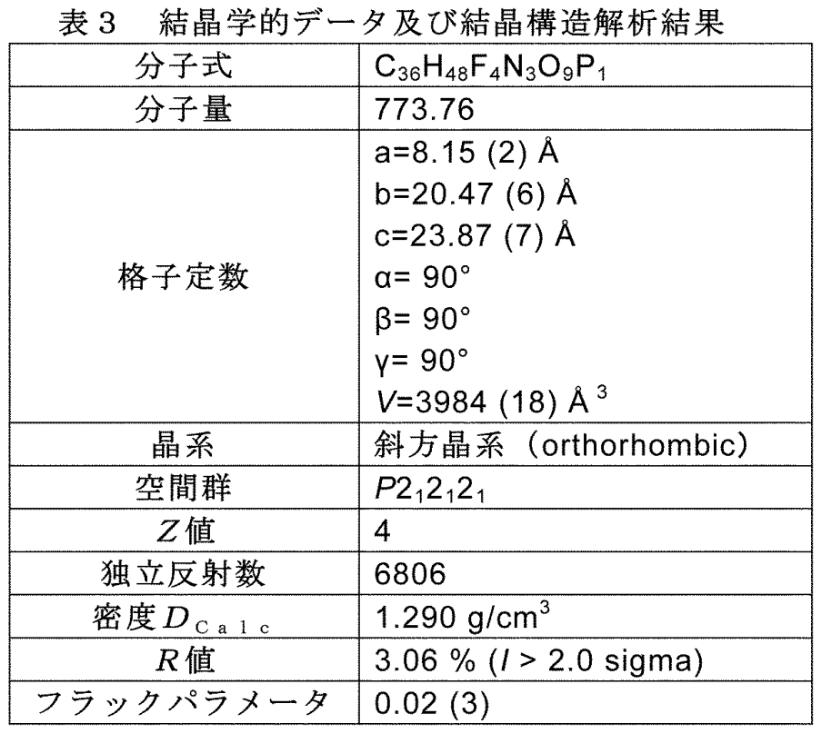
エタノール2mLにスパーテル(小)半分程度の本発明結晶を加えて溶かし、室温で4日間静置し、結晶化を行った。得られた結晶を単結晶X線回折装置R-AXIS RAPID/R(リガク社)(CuKα線)により、23℃で格子定数の決定及び回折ピーク強度の測定、続いて直接法による位相決定,フルマトリクス最小自乗法による構造精密化を行い、構造を解析した。得られた結晶学的データ及び結晶構造解析結果を表3に示した。なお、信頼度因子(R値)は3.06%であり、他の各種パラメータも本結晶構造解析が十分に信頼性の高い解析結果であることを示した。
N18はsp3混成の窒素であり、ピロリジン化合物Aの中で最も塩基性が高く、リン酸からプロトンを受容する可能性がある窒素である。しかしながらN18(より厳密には、N18に結合している水素原子)は隣接したピロリジン化合物A(対称演算子(symmetry operators):-X+1/2+2,-Y+2,Z+1/2)のカルボン酸の酸素(O16)との水素結合を形成しており、プロトンの授与が行われていると判断した。そのため、N18はリン酸からプロトンを受容できない。同時にN18と隣接するリン酸のいずれの酸素との原子間距離もファンデルワールス半径の和を上回ることから、イオン的相互作用が可能な距離にリン酸は存在しないと判断した。
N19はsp2混成の窒素であるため、塩基性が弱く、塩を形成できないと考えた。同時にN19と最も近い距離にあるリン酸の酸素(O13)の原子間距離がファンデルワールス半径の和であることから、イオン的相互作用が可能な距離に無いと判断した。
N20もsp2混成の窒素であるため、塩基性が弱く、塩を形成できないと考えた。同時にN20と隣接するリン酸のいずれの酸素との原子間距離もファンデルワールス半径の和を上回ることから、イオン的相互作用が可能な距離にリン酸は存在しないと判断した。

ピロリジン化合物Aを用いて、単一溶媒25種及び混合溶媒44種を用いた長期保存による結晶化検討、貧溶媒(Anti-solvent)2種及び良溶媒(Good-solvent)12種を用いて溶媒の混合比を変えて作成した96種の混合溶媒を用いた1か月撹拌による結晶化検討、並びに添加溶媒26種を用いたgrindingによる結晶化検討を実施した。その結果、長期保存及び1か月撹拌による結晶化検討で結晶を得ることができた。得られた結晶の粉末X線回折を測定した結果、全ての結晶でピークは一致しており、同一の結晶形であった。晶析条件を検討したが、結晶が得られる全ての条件で結晶中に溶媒が残留していた。結晶を乾燥させる工程についても検討したが、残留溶媒をICHが定める残留溶媒基準値以下にすることはできなかった。
従って、フリー体であるピロリジン化合物Aは結晶化するが、結晶を得る際に使用した溶媒が残留してしまい、また、化学的安定性も低かったので、医薬品原薬として採用することはできない。
約900mgのピロリジン化合物Aをテトラヒドロフラン30mLに溶解させ、96ウェルプレートの各バイアルに100μLずつ分注した(約3mg/バイアル)。また、リン酸、塩酸、L(-)-リンゴ酸、L(+)-酒石酸、マレイン酸、硫酸及びマロン酸を含む21種の酸並びに水酸化ナトリウム及びL-アルギニンを含む8種の塩基(以下、カウンター化合物と称することがある。)を後述する8種の溶媒に溶解させた0.1mol/L溶液45μL(1部の酸については、0.05mol/L溶液90μL)をそれぞれ各バイアルに分注した。1昼夜開放により溶媒を蒸散させた後、4時間減圧乾燥した。酢酸エチル、アセトン及びトルエンを含む8種の溶媒250μLを各バイアルに分注後、5分間超音波により撹拌し、密栓して、室温で6日間撹拌した。析出物のあるバイアルについては析出物を濾取し、XRPDを測定した。析出物の無いバイアルについては室温で溶媒を蒸散させ、固体の見られた場合には濾取してXRPDを測定した。XRPD測定装置及び測定条件は実施例1と同じである。
約800mgのピロリジン化合物Aをテトラヒドロフラン40mLに溶解させ、96ウェルプレートの各バイアルに100μLずつ分注した(約2mg/バイアル)。また、リン酸、塩酸、L(-)-リンゴ酸、L(+)-酒石酸、マレイン酸、硫酸及びマロン酸を含む22種の酸、水酸化ナトリウム及びL-アルギニンを含む8種の塩基(以下、カウンター化合物と称することがある。)を後述する12種の溶媒に溶解させた0.1mol/L溶液30μL(1部の酸については、0.05mol/L溶液60μL)をそれぞれ各バイアルに分注した。分注後、窒素を吹付け、溶媒を蒸散させた。混合比3:7及び1:9のエタノールとトルエンの混合溶媒、混合比3:7のエタノールとジイソプロピルエーテルの混合溶媒、混合比3:7及び1:9のアセトンとトルエンの混合溶媒、及び混合比3:7の酢酸エチルとヘプタンの混合溶媒を含む12種の溶媒200μLを各バイアルに分注し、密栓して、室温で3日間撹拌した。析出物のあるバイアルについては析出物を濾取して、XRPDを測定した。析出物の無いバイアルについては室温で溶媒を蒸散させ、約1か月後に固体が認められた場合には、固体を採取してXRPDを測定した。XRPD測定装置及び測定条件は実施例1と同じである。

実験例2及び3で得られた結晶の中でリン酸A形結晶及びリン酸B形結晶以外について、再現性の確認を行った。その結果、L(-)-リンゴ酸D形結晶、L(+)-酒石酸E形結晶、硫酸J形結晶及びL-アルギニンK形結晶については、再度取得することはできなかった。一方、マレイン酸及びマロン酸との組み合わせにおいては再度結晶を取得することができた。
ピロリジン化合物A約80mgをテトラヒドロフラン4mLに溶解させ、96ウェルプレートの各バイアルに100μLずつ分注した(約2mg/バイアル)。また、L(-)-リンゴ酸、L(+)-酒石酸及び硫酸を後述する溶媒に溶解させた0.1mol/L溶液30μLをそれぞれ各バイアルに分注した。分注後、窒素吹付けにより溶媒を蒸散させた後、L(-)-リンゴ酸を入れたバイアルにはトルエン、L(+)-酒石酸を入れたバイアルにはアセトン、及び硫酸を入れたバイアルには混合比3:7の酢酸エチルとヘプタンの混合溶媒を200μL各バイアルに分注し、密栓したものを各サンプルについて8つ作成した。合計24個のバイアルを室温で7日間撹拌したが、全てのバイアルで析出物は得られなかった。
ピロリジン化合物Aを約65mg測り取り、エタノール0.3mL、及びトルエン2.1mLに室温で溶解させた。L-アルギニンを約19mg測り取り、エタノール0.6mL、及び水0.6mLに溶解し、前記ピロリジン化合物Aの溶液に加えた。溶液だったため、窒素吹付けにより溶媒を蒸散させたところ、一部白い粉を含む飴状物が得られた。これをエタノール0.3mLに再溶解し、ジイソプロピルエーテルを0.6mL滴下した。実験例3で得られたL-アルギニンK形結晶を種晶として加えたが溶解したため、トルエンを1.2mL加え、昼夜撹拌した。溶液だったので、窒素吹付けにより溶媒を蒸散させ、残渣をXRPD測定したところ、非晶質だった。これにヘプタン0.6mLを加え、室温で一晩撹拌した後、顕微鏡観察した。結晶成分は認められなかった。
ピロリジン化合物Aを約65mg測り取り、トルエン0.5mLに室温で溶解させた。そこに、マレイン酸約13mgをエタノール75μLに溶解させたものと、先に得られたマレイン酸F形結晶を種晶として少量加えたところ、反応液がゲル状(寒天状)となり撹拌不能となった。トルエン1.0mLをさらに加え、スパーテルで激しくこすったところ、懸濁液となった。濾取した結晶を40℃で5時間減圧乾燥して、57mgのマレイン酸F形結晶が得られた。得られた結晶中には、0.1当量のトルエンが残留していたことを1H-NMRで確認した。
ピロリジン化合物Aを約325mg測り取り、アセトン1mLに室温で溶解させた。マロン酸55mgを測り取り、アセトン0.5mLに室温で溶解させ、前記ピロリジン化合物Aの溶液に加えた。この溶液にトルエンを6mL滴下した。後述のマロン酸I形結晶を種晶として少量を加え、2晩室温で撹拌した。全量をろ過して40℃で3.5時間減圧乾燥し、317mgの結晶を得た。得られた結晶中には、1当量のトルエンを含んでいることを1H-NMRで確認した。トルエンを水に置換することを目的に、動的水蒸気吸着測定(Dynamic Vapour Sorption:DVS)装置を用いて、25℃、70%RHの条件下で72時間保存した結果、非晶質化が認められた。
ピロリジン化合物Aを約65mg測り取り、混合比3:7の酢酸エチルとヘプタンの混合溶媒2mLに室温で溶解させた。マロン酸11mgを測り取り、酢酸エチル0.3mLに室温で溶解させ、前記ピロリジン化合物Aの溶液に加えた。固いガム状物が生成したため、酢酸エチル3mLを加え懸濁液とした。3日間室温撹拌した後、窒素吹付により溶媒を蒸散させ、乾固物に酢酸エチル3mLを加え撹拌し、ヘプタン1.2mLを徐々に加えた。実験例3で得られたマロン酸G形結晶を種晶として少量を加えると急激に析出物が生じた。2晩室温で撹拌後、全量をろ過して40℃で3.5時間減圧乾燥し、38mgの結晶を得た。
ピロリジン化合物Aを約65mg測り取り、混合比1:9のアセトンとトルエンの混合溶媒2.3mLに室温で溶解させた。マロン酸11mgを測り取り、アセトン0.1mLに室温で溶解させ、前記ピロリジン化合物Aの溶液に加えた。室温で3晩撹拌し、全量をろ過して40℃で2時間減圧乾燥し、51mgの結晶を得た。得られた結晶中には、1当量のトルエンを含んでいることを1H-NMRで確認した。この結晶はトルエン和物である可能性があるため、さらに減圧乾燥することにより溶媒を含まない結晶が得られるかを確認することを目的に、約5mgを60℃で4時間減圧乾燥したところ、トルエンが約0.5当量残留しており、結晶形に変化がないことを確認した。
以下の表6に示す量のピロリジン化合物A及びリン酸を以下に示す溶媒に加え、以下に示す時間撹拌した。結果を以下の表6に示す。XRPD測定装置及び測定条件は実施例1と同じである。XRPDの結果でAは実験例2で得られたリン酸A形結晶と同じ結晶、Bは実験例3で得られたリン酸B形結晶と同じ結晶であることを示している。さらに、リン酸B形結晶は実施例1で得られた本発明結晶の結晶と同じであった。
特許文献1の実施例19に記載のピロリジン化合物Aの塩酸塩は非晶質であり、その後の検討でもピロリジン化合物Aの塩酸塩の結晶は得られていない(上記実験例2及び3を参照)ことから、非晶質のピロリジン化合物Aの塩酸塩を比較試験に用いた。また、以下に示す比較試験結果において、塩酸塩はピロリジン化合物Aの塩酸塩であり、実験例5に記載の方法により得られた化合物の結果を示した。
熱重量/示差熱同時測定装置TG/DTA7200(エスアイアイ・ナノテクノロジー株式会社)を用いて、以下の条件で評価した。
昇温速度:10K/分
雰囲気:窒素200mL/分
水分吸着測定装置DVS-1又はDVS-intrinsic(Surface Measurement Systems Limited社)を用いて、次のようにして評価した。試料を予め風袋重量を補正したセルに取り、装置の精密天秤に吊るして測定開始時の重量を精密に測定した。段階的に湿度を変化させた時の重量変化を経時的に記録し、各湿度での平衡重量を求めた。乾燥時(0%RH)又は、別法で確認した開始時の水分量より換算した無水物を基準とし、各湿度での重量の変化率を求めた。
試料を60℃密栓状態及び60℃75%RHで1週間保存し、保存前後での類縁物質の増減を高速液体クロマトグラフ法により個々のピークの面積百分率により算出し、さらに保存後の状態を観察した。
結果を以下の表7に示す。


化合物5(15.00g)の酢酸エチル(67.75g)溶液に、炭酸カリウム水溶液(炭酸カリウム2.64g、精製水75mL)を25℃で滴下し、30分間300rpmで撹拌した。有機層を分離し、精製水で洗浄した後、減圧濃縮した。エタノール(59.03g)を加えて体積が27mLになるまで減圧濃縮する作業を二度繰り返した。
得られた濃縮混合物に、体積が45mLになるまでエタノール(24.32g)を加え、24%水酸化ナトリウム水溶液(4.79g)と精製水(12mL)を25℃で滴下し、300rpmで6時間撹拌した。反応混合物に85%リン酸水溶液(6.61g)および精製水(22.5mL、化合物4の重量に対して体積比で1.5倍量)を5分間で滴下し、次いで精製水(90mL、化合物4の重量に対して体積比で6.0倍量)を30分かけて滴下した。精製水の滴下終了後、30分間撹拌し、反応温度を35℃にして種晶(0.3746g、化合物4の重量に対して重量比で0.025倍量)を加えた。種晶の添加から10時間後に反応温度を20℃にし、さらに30分間撹拌した後、不溶物をろ取し、減圧乾燥して本発明結晶(7.48g)を得た。
得られた結晶はろ過性が悪く、ろ過に時間がかかったうえ、乾燥前の湿体はスラリー状になって作業性が悪かった。
得られた結晶の粒子サイズを測定すると、モード径は6μm程度であった。条件1で得られた結晶の粒子サイズ分布を測定した(図5-1)。
化合物3(17.58g)のエタノール溶液(53.20g)に水酸化ナトリウム水溶液(24%、4.67g)および精製水(16.20g)を加えて40℃で3時間撹拌して化合物4の溶液(73.14g)を得た。得られた化合物4の溶液のうち18.28gにリン酸(1.91g、2.6当量)および精製水(7.49g、化合物4の重量に対して体積比で1.5倍量)を35℃で加え、1時間撹拌した後、種晶(125mg、化合物4の重量に対して重量比で0.025倍量)を加えた。種晶の添加から17時間30分後、2時間かけて精製水(30.0mL、化合物4の重量に対して体積比で6.0倍)を添加した。10時間後、反応温度を20℃にし、撹拌を続けた。27時間後、固体を濾取し、該固体を精製水(25.23g、化合物4の重量に対して体積比で5倍量)で洗浄した。固体を50℃で乾燥して、本発明結晶(4.01g)を得た。
種晶の添加から16時間後および21時間後にサンプリングし、HPLCにより定量して結晶の析出率を算出したところ、それぞれ4%および97%であった。
条件2のように種晶接種前の精製水量が少ない場合には、結晶析出率が極めて低くなることがわかった。すなわち、本発明結晶を析出させるためには、エタノール溶液に添加する精製水量、すなわち晶析溶媒の組成が重要であることがわかった。また、析出率が低い溶液に精製水をさらに添加すると結晶は析出したが、条件1と同様にろ過などの操作性が不良な結晶が得られた。
化合物3(26.37g)のエタノール溶液(79.82g)に水酸化ナトリウム水溶液(24%、7.01g)および精製水(24.30g)を加えて40℃で4時間30分撹拌して化合物4の溶液を得た。得られた化合物4の溶液に20℃にてリン酸(9.70g、2.2当量)および精製水(45.00g、化合物4の重量に対して体積比で1.5倍量)を加え、さらに精製水(45.13g、化合物4の重量に対して体積比で1.5倍量)を加えて30℃にて40分間撹拌した後、種晶(751mg、化合物4の重量に対して重量比で0.025倍量)を加えた。16時間後、2時間かけて精製水(135mL、化合物4の重量に対して体積比で4.5倍)を添加した。6時間後に温度を20℃とし、さらに1時間撹拌した。固体を濾取し、該固体を精製水(150.02g、化合物4の重量に対して体積比で5倍量)で洗浄した。固体を50℃で乾燥して、本発明結晶(26.95g)を得た。
得られた結晶の粒子サイズを測定すると、モード径は10μm程度であった。得られた結晶は、ろ過などの操作性は良好であった。条件3で得られた結晶の粒子サイズ分布を測定した(図5-2)。
上記の通り、温度を30℃程度に設定し、条件3に記載した程度の量の精製水を加えてから種晶を添加し、一定程度の時間をおいて結晶を大きく成長させた後にさらに精製水を添加することによって、良好な析出率および操作性で結晶を取得した。

条件1
反応装置:EasyMax(登録商標)(メトラー・トレド社)
撹拌条件:300rpm
反応装置:OptyMax(登録商標)(メトラー・トレド社)
撹拌条件:250rpm
機器名:
カラム:GL Science, Inertsil ODS-3V(5μm、4.6X150mm)
流動層A:水/アセトニトリル/トリフルオロ酢酸=1900:100:1
流動層B:水/アセトニトリル/トリフルオロ酢酸=100:1900:1
機器名:Particle Track(登録商標)MALVERN,Mastersizer 2000(湿式)
測定範囲:0.020~2000.000μm
測定時間:10秒間
測定強度範囲:3.0~20.0%
撹拌速度:約2000rpm
本発明結晶を用いて、特許文献1の実験例1に記載の以下の方法に準じて、細胞内cAMP濃度を測定し、EC50値を算出した。
(1)細胞の培養方法
ヒトMC1Rアゴニスト活性測定にはヒトメラノーマ細胞株HBLを用いた。HBLの培養:10%FCS、Penicillin-streptomycinを含むF-10 Nutrient Mixtureを用いて培養した。
(2)cAMPアッセイおよびデータの算出
各濃度の化合物溶液をcAMPアッセイバッファー(10mM HEPES、0.1%BSAを含むHBSS(Hank's Balanced Salt Solution))と混和し、96ウェルプレートに分注した。HBLは5×10⁴/mLとなるように0.5mM IBMXを含むcAMPアッセイバッファーに懸濁し、上記96ウェルプレートに分注後に混和し、37℃で30分間静置後、細胞内cAMP濃度をEnvisionを用いた蛍光法により測定した(ex.320nm、em.590nm及び665nm)。得られたデータはratio値(665nm測定値/590nm測定値×10000)から、Prism 5.02を用いてcAMP濃度の定量値を算出し、induction%値(vehicleのcAMP濃度平均値を0%、αMSHの10-6MでのcAMP濃度平均値を100%としたときの各サンプルの%)を算出し、EC50値を計算した。
結果、本発明結晶はEC50値5.3nMを示し、強いヒトMC1Rアゴニスト活性を有する結晶であった。
Claims (14)
- 等モル量の1-{2-[(3S,4R)-1-[(3R,4R)-1-シクロペンチル-3-フルオロ-4-(4-メトキシフェニル)ピロリジン-3-カルボニル]-4-(メトキシメチル)ピロリジン-3-イル]-5-(トリフルオロメチル)フェニル}ピペリジン-4-カルボン酸とリン酸を含む結晶。
- 等モル量の1-{2-[(3S,4R)-1-[(3R,4R)-1-シクロペンチル-3-フルオロ-4-(4-メトキシフェニル)ピロリジン-3-カルボニル]-4-(メトキシメチル)ピロリジン-3-イル]-5-(トリフルオロメチル)フェニル}ピペリジン-4-カルボン酸とリン酸からなる、請求項1に記載の結晶。
- 1-{2-[(3S,4R)-1-[(3R,4R)-1-シクロペンチル-3-フルオロ-4-(4-メトキシフェニル)ピロリジン-3-カルボニル]-4-(メトキシメチル)ピロリジン-3-イル]-5-(トリフルオロメチル)フェニル}ピペリジン-4-カルボン酸とリン酸の共結晶である請求項1又は2のいずれかに記載の結晶。
- 粉末X線回折スペクトルにおいて、2θで示される回折角度として5.7°、11.5°、13.9°、19.0°及び21.9°(それぞれ±0.2°)にピークを示す請求項1~3のいずれか1項に記載の結晶。
- 示差走査熱量測定分析で230℃~240℃に吸熱ピークを有する請求項1~4のいずれか1項に記載の結晶。
- 1-{2-[(3S,4R)-1-[(3R,4R)-1-シクロペンチル-3-フルオロ-4-(4-メトキシフェニル)ピロリジン-3-カルボニル]-4-(メトキシメチル)ピロリジン-3-イル]-5-(トリフルオロメチル)フェニル}ピペリジン-4-カルボン酸、リン酸および良溶媒の混合物に種晶を加えることにより得られる、請求項1~5のいずれか1項に記載の結晶。
- 1-{2-[(3S,4R)-1-[(3R,4R)-1-シクロペンチル-3-フルオロ-4-(4-メトキシフェニル)ピロリジン-3-カルボニル]-4-(メトキシメチル)ピロリジン-3-イル]-5-(トリフルオロメチル)フェニル}ピペリジン-4-カルボン酸、リン酸および良溶媒の混合物に貧溶媒を加え、種晶を加えた後、さらに貧溶媒を加えることにより得られる、請求項1~6のいずれか1項に記載の結晶。
- 請求項1~7のいずれか1項に記載の結晶を有効成分として含有するメラノコルチン受容体1作動薬。
- 請求項1~7のいずれか1項に記載の結晶と製薬上許容される添加剤を含有する医薬組成物。
- メラノコルチン受容体1の活性化により病態の改善が見込まれる疾患を予防又は治療するための請求項9に記載の医薬組成物。
- 疾患が関節リウマチ、痛風性関節炎、変形性関節症、炎症性腸疾患、全身性強皮症、乾癬、線維症、プロトポルフィリン症、全身性エリテマトーデス、黒色腫、皮膚癌、白斑症、脱毛、疼痛、虚血/再かん流傷害、脳の炎症性疾患、肝炎、敗血症/敗血症性ショック、腎炎、移植、HIV疾患の増悪、血管炎、ブドウ膜炎、網膜色素変性症、加齢黄斑変性、微生物感染、セリアック病、ネフローゼ症候群およびメラノーマ浸潤から選ばれる1つ以上の疾患である請求項10に記載の医薬組成物。
- 請求項1~7のいずれか1項に記載の結晶の有効量を患者に投与することを含む、メラノコルチン受容体1の活性化により病態の改善が見込まれる疾患を予防又は治療する方法。
- メラノコルチン受容体1の活性化により病態の改善が見込まれる疾患を予防又は治療するための医薬の製造における、請求項1~7のいずれか1項に記載の結晶の使用。
- メラノコルチン受容体1の活性化により病態の改善が見込まれる疾患を予防又は治療するための、請求項1~7のいずれか1項に記載の結晶。
Priority Applications (13)
| Application Number | Priority Date | Filing Date | Title |
|---|---|---|---|
| CN202510225181.6A CN120081827A (zh) | 2018-12-28 | 2019-12-27 | 吡咯烷化合物的晶体 |
| US17/418,563 US12077524B2 (en) | 2018-12-28 | 2019-12-27 | Crystal of pyrrolidine compound |
| CN201980086473.9A CN113226314B (zh) | 2018-12-28 | 2019-12-27 | 吡咯烷化合物的晶体 |
| EP24193769.7A EP4434582A3 (en) | 2018-12-28 | 2019-12-27 | Crystal of pyrrolidine compound |
| EP19905349.7A EP3903785B1 (en) | 2018-12-28 | 2019-12-27 | Cocrystal of phosphoric acid and a mc1r agonsist |
| CN202510224370.1A CN120081826A (zh) | 2018-12-28 | 2019-12-27 | 吡咯烷化合物的晶体 |
| ES19905349T ES2991904T3 (es) | 2018-12-28 | 2019-12-27 | Cocristal de ácido fosfórico y un agonista de MC1R |
| JP2020562542A JP6977185B2 (ja) | 2018-12-28 | 2019-12-27 | ピロリジン化合物の結晶 |
| EP25183270.5A EP4603143A3 (en) | 2018-12-28 | 2019-12-27 | Crystal of pyrrolidine compound |
| EP26175127.5A EP4763282A2 (en) | 2018-12-28 | 2019-12-27 | Crystal of pyrrolidine compound |
| JP2021183553A JP7652682B2 (ja) | 2018-12-28 | 2021-11-10 | ピロリジン化合物の結晶 |
| US18/781,544 US20250002474A1 (en) | 2018-12-28 | 2024-07-23 | Crystal of pyrrolidine compound |
| JP2025041552A JP2025085744A (ja) | 2018-12-28 | 2025-03-14 | ピロリジン化合物の結晶 |
Applications Claiming Priority (2)
| Application Number | Priority Date | Filing Date | Title |
|---|---|---|---|
| JP2018-247437 | 2018-12-28 | ||
| JP2018247437 | 2018-12-28 |
Related Child Applications (2)
| Application Number | Title | Priority Date | Filing Date |
|---|---|---|---|
| US17/418,563 A-371-Of-International US12077524B2 (en) | 2018-12-28 | 2019-12-27 | Crystal of pyrrolidine compound |
| US18/781,544 Continuation US20250002474A1 (en) | 2018-12-28 | 2024-07-23 | Crystal of pyrrolidine compound |
Publications (1)
| Publication Number | Publication Date |
|---|---|
| WO2020138481A1 true WO2020138481A1 (ja) | 2020-07-02 |
Family
ID=71127176
Family Applications (1)
| Application Number | Title | Priority Date | Filing Date |
|---|---|---|---|
| PCT/JP2019/051570 Ceased WO2020138481A1 (ja) | 2018-12-28 | 2019-12-27 | ピロリジン化合物の結晶 |
Country Status (8)
| Country | Link |
|---|---|
| US (2) | US12077524B2 (ja) |
| EP (4) | EP3903785B1 (ja) |
| JP (3) | JP6977185B2 (ja) |
| CN (3) | CN120081826A (ja) |
| ES (1) | ES2991904T3 (ja) |
| MA (1) | MA54619A (ja) |
| TW (3) | TWI834791B (ja) |
| WO (1) | WO2020138481A1 (ja) |
Cited By (10)
| Publication number | Priority date | Publication date | Assignee | Title |
|---|---|---|---|---|
| JP6959478B1 (ja) * | 2020-06-10 | 2021-11-02 | 田辺三菱製薬株式会社 | ポルフィリン症の予防又は治療剤 |
| WO2021251452A1 (ja) | 2020-06-10 | 2021-12-16 | 田辺三菱製薬株式会社 | 光線性皮膚疾患の予防又は治療剤 |
| KR20220152166A (ko) * | 2021-05-07 | 2022-11-15 | 주식회사 엘지화학 | 멜라노코르틴 수용체 작용제 화합물과 바닐린의 공결정 및 이의 제조방법 |
| KR20220151569A (ko) * | 2021-05-06 | 2022-11-15 | 주식회사 엘지화학 | 멜라노코르틴 수용체 작용제 화합물의 결정형 v 및 이의 제조방법 |
| KR20220151570A (ko) * | 2021-05-06 | 2022-11-15 | 주식회사 엘지화학 | 멜라노코르틴 수용체 작용제 화합물의 결정형 ⅶ 및 이의 제조방법 |
| KR20220152165A (ko) * | 2021-05-07 | 2022-11-15 | 주식회사 엘지화학 | 멜라노코르틴 수용체 작용제 화합물의 황산염의 결정형 및 이의 제조방법 |
| KR20220152164A (ko) * | 2021-05-07 | 2022-11-15 | 주식회사 엘지화학 | 멜라노코르틴 수용체 작용제 화합물의 유기산 염의 결정형 ⅳ 및 이의 제조방법 |
| KR20230016006A (ko) | 2020-06-10 | 2023-01-31 | 미쓰비시 타나베 파마 코퍼레이션 | 포르피린증의 예방 또는 치료제 |
| WO2023145959A1 (ja) | 2022-01-31 | 2023-08-03 | 田辺三菱製薬株式会社 | メラノコルチン1受容体アゴニストの新規用途 |
| WO2024029599A1 (ja) | 2022-08-03 | 2024-02-08 | 田辺三菱製薬株式会社 | 1-{2-[(3s,4r)-1-{[(3r,4r)-1-シクロペンチル-3-フルオロ-4-(4-メトキシフェニル)ピロリジン-3-イル]カルボニル}-4-(メトキシメチル)ピロリジン-3-イル]-5-(トリフルオロメチル)フェニル}ピペリジン-4-カルボン酸もしくはその医薬的に許容し得る塩又は共結晶を含有する医薬組成物 |
Citations (2)
| Publication number | Priority date | Publication date | Assignee | Title |
|---|---|---|---|---|
| WO2015182723A1 (ja) | 2014-05-29 | 2015-12-03 | 田辺三菱製薬株式会社 | 新規ピロリジン化合物およびメラノコルチン受容体作動薬としての用途 |
| JP2017105765A (ja) * | 2015-11-27 | 2017-06-15 | 田辺三菱製薬株式会社 | 医薬組成物 |
Family Cites Families (2)
| Publication number | Priority date | Publication date | Assignee | Title |
|---|---|---|---|---|
| AU2005283326B2 (en) | 2004-09-13 | 2011-07-21 | Ono Pharmaceutical Co., Ltd. | Nitrogenous heterocyclic derivative and medicine containing the same as an active ingredient |
| EP1951286A4 (en) * | 2005-10-07 | 2009-11-04 | Waratah Pharmaceuticals Inc | COMBINED USE OF INHIBITORS OF DPP-IV AND GASTRIN COMPOUNDS |
-
2019
- 2019-12-27 CN CN202510224370.1A patent/CN120081826A/zh active Pending
- 2019-12-27 MA MA054619A patent/MA54619A/fr unknown
- 2019-12-27 TW TW108148109A patent/TWI834791B/zh active
- 2019-12-27 EP EP19905349.7A patent/EP3903785B1/en active Active
- 2019-12-27 CN CN201980086473.9A patent/CN113226314B/zh active Active
- 2019-12-27 WO PCT/JP2019/051570 patent/WO2020138481A1/ja not_active Ceased
- 2019-12-27 ES ES19905349T patent/ES2991904T3/es active Active
- 2019-12-27 CN CN202510225181.6A patent/CN120081827A/zh active Pending
- 2019-12-27 TW TW113104509A patent/TWI870228B/zh active
- 2019-12-27 EP EP26175127.5A patent/EP4763282A2/en active Pending
- 2019-12-27 JP JP2020562542A patent/JP6977185B2/ja active Active
- 2019-12-27 US US17/418,563 patent/US12077524B2/en active Active
- 2019-12-27 EP EP25183270.5A patent/EP4603143A3/en active Pending
- 2019-12-27 TW TW113147267A patent/TWI919623B/zh active
- 2019-12-27 EP EP24193769.7A patent/EP4434582A3/en not_active Withdrawn
-
2021
- 2021-11-10 JP JP2021183553A patent/JP7652682B2/ja active Active
-
2024
- 2024-07-23 US US18/781,544 patent/US20250002474A1/en active Pending
-
2025
- 2025-03-14 JP JP2025041552A patent/JP2025085744A/ja active Pending
Patent Citations (2)
| Publication number | Priority date | Publication date | Assignee | Title |
|---|---|---|---|---|
| WO2015182723A1 (ja) | 2014-05-29 | 2015-12-03 | 田辺三菱製薬株式会社 | 新規ピロリジン化合物およびメラノコルチン受容体作動薬としての用途 |
| JP2017105765A (ja) * | 2015-11-27 | 2017-06-15 | 田辺三菱製薬株式会社 | 医薬組成物 |
Cited By (29)
| Publication number | Priority date | Publication date | Assignee | Title |
|---|---|---|---|---|
| KR20260055518A (ko) | 2020-06-10 | 2026-04-23 | 다나베 파마 가부시키가이샤 | 포르피린증의 예방 또는 치료제 |
| KR20230016008A (ko) | 2020-06-10 | 2023-01-31 | 미쓰비시 타나베 파마 코퍼레이션 | 광선성 피부질환의 예방 또는 치료제 |
| WO2021251450A1 (ja) | 2020-06-10 | 2021-12-16 | 田辺三菱製薬株式会社 | ポルフィリン症の予防又は治療剤 |
| JP2022008925A (ja) * | 2020-06-10 | 2022-01-14 | 田辺三菱製薬株式会社 | ポルフィリン症の予防又は治療剤 |
| US12667563B2 (en) | 2020-06-10 | 2026-06-30 | Tanabe Pharma Corporation | Prophylactic or therapeutic agent for porphyria |
| AU2021289913B2 (en) * | 2020-06-10 | 2024-03-28 | Mitsubishi Tanabe Pharma Corporation | Prophylactic or therapeutic agent for porphyria |
| WO2021251452A1 (ja) | 2020-06-10 | 2021-12-16 | 田辺三菱製薬株式会社 | 光線性皮膚疾患の予防又は治療剤 |
| JP7768720B2 (ja) | 2020-06-10 | 2025-11-12 | 田辺三菱製薬株式会社 | ポルフィリン症の予防又は治療剤 |
| EP4585214A1 (en) | 2020-06-10 | 2025-07-16 | Mitsubishi Tanabe Pharma Corporation | Prophylactic or therapeutic agent for porphyria |
| JP6959478B1 (ja) * | 2020-06-10 | 2021-11-02 | 田辺三菱製薬株式会社 | ポルフィリン症の予防又は治療剤 |
| KR20230016006A (ko) | 2020-06-10 | 2023-01-31 | 미쓰비시 타나베 파마 코퍼레이션 | 포르피린증의 예방 또는 치료제 |
| AU2024203992B2 (en) * | 2020-06-10 | 2026-03-19 | Tanabe Pharma Corporation | Prophylactic or therapeutic agent for porphyria |
| KR20220151570A (ko) * | 2021-05-06 | 2022-11-15 | 주식회사 엘지화학 | 멜라노코르틴 수용체 작용제 화합물의 결정형 ⅶ 및 이의 제조방법 |
| KR102854595B1 (ko) | 2021-05-06 | 2025-09-03 | 주식회사 엘지화학 | 멜라노코르틴 수용체 작용제 화합물의 결정형 v 및 이의 제조방법 |
| KR20220151569A (ko) * | 2021-05-06 | 2022-11-15 | 주식회사 엘지화학 | 멜라노코르틴 수용체 작용제 화합물의 결정형 v 및 이의 제조방법 |
| KR102854596B1 (ko) | 2021-05-06 | 2025-09-03 | 주식회사 엘지화학 | 멜라노코르틴 수용체 작용제 화합물의 결정형 ⅶ 및 이의 제조방법 |
| KR20220152165A (ko) * | 2021-05-07 | 2022-11-15 | 주식회사 엘지화학 | 멜라노코르틴 수용체 작용제 화합물의 황산염의 결정형 및 이의 제조방법 |
| KR102854597B1 (ko) | 2021-05-07 | 2025-09-03 | 주식회사 엘지화학 | 멜라노코르틴 수용체 작용제 화합물의 유기산 염의 결정형 ⅳ 및 이의 제조방법 |
| KR102854599B1 (ko) | 2021-05-07 | 2025-09-03 | 주식회사 엘지화학 | 멜라노코르틴 수용체 작용제 화합물과 바닐린의 공결정 및 이의 제조방법 |
| KR102854598B1 (ko) | 2021-05-07 | 2025-09-03 | 주식회사 엘지화학 | 멜라노코르틴 수용체 작용제 화합물의 황산염의 결정형 및 이의 제조방법 |
| KR20220152164A (ko) * | 2021-05-07 | 2022-11-15 | 주식회사 엘지화학 | 멜라노코르틴 수용체 작용제 화합물의 유기산 염의 결정형 ⅳ 및 이의 제조방법 |
| KR20220152166A (ko) * | 2021-05-07 | 2022-11-15 | 주식회사 엘지화학 | 멜라노코르틴 수용체 작용제 화합물과 바닐린의 공결정 및 이의 제조방법 |
| KR20240145490A (ko) | 2022-01-31 | 2024-10-07 | 미쓰비시 타나베 파마 코퍼레이션 | 멜라노코르틴 1 수용체 아고니스트의 신규 용도 |
| US12533350B2 (en) | 2022-01-31 | 2026-01-27 | Tanabe Pharma Corporation | Use of melanocortin-1 receptor agonist |
| WO2023145959A1 (ja) | 2022-01-31 | 2023-08-03 | 田辺三菱製薬株式会社 | メラノコルチン1受容体アゴニストの新規用途 |
| JP7527582B2 (ja) | 2022-08-03 | 2024-08-05 | 田辺三菱製薬株式会社 | 1-{2-[(3s,4r)-1-{[(3r,4r)-1-シクロペンチル-3-フルオロ-4-(4-メトキシフェニル)ピロリジン-3-イル]カルボニル}-4-(メトキシメチル)ピロリジン-3-イル]-5-(トリフルオロメチル)フェニル}ピペリジン-4-カルボン酸もしくはその医薬的に許容し得る塩又は共結晶を含有する医薬組成物 |
| JPWO2024029599A1 (ja) * | 2022-08-03 | 2024-02-08 | ||
| WO2024029599A1 (ja) | 2022-08-03 | 2024-02-08 | 田辺三菱製薬株式会社 | 1-{2-[(3s,4r)-1-{[(3r,4r)-1-シクロペンチル-3-フルオロ-4-(4-メトキシフェニル)ピロリジン-3-イル]カルボニル}-4-(メトキシメチル)ピロリジン-3-イル]-5-(トリフルオロメチル)フェニル}ピペリジン-4-カルボン酸もしくはその医薬的に許容し得る塩又は共結晶を含有する医薬組成物 |
| EP4566609A4 (en) * | 2022-08-03 | 2026-07-15 | Tanabe pharma corp | PHARMACEUTICAL COMPOSITION CONTAINING 1-2-[(3S,4R)-1-{[(3R,4R)-1-CYCLOPENTYL-3-FLUORO-4-(4-METHOXYPHENYL)PYRROLIDIN-3-YL]CARBONYL}-4-(METHOXYMETHYL)PYRROLIDIN-3-YL]-5-(TRIFLUOROMETHYL)PHENYL}PIPERIDIN-4-CARBOXYLIC ACID OR A PHARMACEUTICALLY ACCEPTABLE SALT OR CO-CRYSTAL THEREOF |
Also Published As
| Publication number | Publication date |
|---|---|
| ES2991904T3 (es) | 2024-12-05 |
| TWI919623B (zh) | 2026-03-21 |
| MA54619A (fr) | 2021-11-03 |
| CN120081827A (zh) | 2025-06-03 |
| JP2025085744A (ja) | 2025-06-05 |
| JP7652682B2 (ja) | 2025-03-27 |
| EP3903785A4 (en) | 2022-08-10 |
| EP4603143A3 (en) | 2025-11-05 |
| EP4603143A2 (en) | 2025-08-20 |
| EP3903785A1 (en) | 2021-11-03 |
| TWI870228B (zh) | 2025-01-11 |
| TW202039464A (zh) | 2020-11-01 |
| CN113226314A (zh) | 2021-08-06 |
| TW202421621A (zh) | 2024-06-01 |
| JPWO2020138481A1 (ja) | 2021-09-27 |
| CN120081826A (zh) | 2025-06-03 |
| EP3903785B1 (en) | 2024-10-02 |
| EP4434582A3 (en) | 2024-12-18 |
| US12077524B2 (en) | 2024-09-03 |
| TW202517631A (zh) | 2025-05-01 |
| JP2022024034A (ja) | 2022-02-08 |
| TWI834791B (zh) | 2024-03-11 |
| EP4434582A2 (en) | 2024-09-25 |
| JP6977185B2 (ja) | 2021-12-08 |
| US20250002474A1 (en) | 2025-01-02 |
| CN113226314B (zh) | 2025-03-18 |
| EP4763282A2 (en) | 2026-06-24 |
| US20220073497A1 (en) | 2022-03-10 |
Similar Documents
| Publication | Publication Date | Title |
|---|---|---|
| JP6977185B2 (ja) | ピロリジン化合物の結晶 | |
| US10023577B2 (en) | Crystalline form of JAK kinase inhibitor bisulfate and a preparation method thereof | |
| AU2015330554B2 (en) | Crystal form of bisulfate of JAK inhibitor and preparation method therefor | |
| AU2016239028B2 (en) | P-toluenesulfonate for MEK kinase inhibitor, and crystal form thereof and preparation method therefor | |
| US20090076272A1 (en) | Polymorphs of eszopiclone malate | |
| JP5875863B2 (ja) | マレイン酸オルブピタントの無水結晶形 | |
| JP2026012851A (ja) | ノボビオシン類似体とプロリンとの共結晶形態 | |
| CN114437076A (zh) | 一种酮咯酸与异烟肼共晶及其制备方法 | |
| US20180244628A1 (en) | Crystalline form of androgen receptor inhibitor and preparation method thereof | |
| CN114380833A (zh) | 一种酮咯酸与4-吡啶甲酰胺共晶及其制备方法 | |
| JP6761564B2 (ja) | ナトリウム・グルコース共輸送体2阻害薬のl−プロリン化合物、およびl−プロリン化合物の一水和物および結晶 | |
| HK40130190A (en) | Crystal of pyrrolidine compound | |
| JP6985137B2 (ja) | スルホンアミド化合物の結晶形 | |
| US20120059034A1 (en) | Novel crystalline hydrate, amorphous and polymorphic forms of dihydro-benzoxazole-6-yl-acetamide derivative and processes for their preparation | |
| WO2019099761A1 (en) | Solid state forms of elafibranor | |
| CN111902406B (zh) | 氮杂双环基取代的三唑类衍生物的可药用盐、晶型及制备方法 | |
| WO2019143829A1 (en) | Fasoracetam crystalline forms |
Legal Events
| Date | Code | Title | Description |
|---|---|---|---|
| 121 | Ep: the epo has been informed by wipo that ep was designated in this application |
Ref document number: 19905349 Country of ref document: EP Kind code of ref document: A1 |
|
| ENP | Entry into the national phase |
Ref document number: 2020562542 Country of ref document: JP Kind code of ref document: A |
|
| NENP | Non-entry into the national phase |
Ref country code: DE |
|
| ENP | Entry into the national phase |
Ref document number: 2019905349 Country of ref document: EP Effective date: 20210728 |
|
| WWG | Wipo information: grant in national office |
Ref document number: 201980086473.9 Country of ref document: CN |