WO2020138334A1 - 発泡性経口固形製剤 - Google Patents
発泡性経口固形製剤 Download PDFInfo
- Publication number
- WO2020138334A1 WO2020138334A1 PCT/JP2019/051234 JP2019051234W WO2020138334A1 WO 2020138334 A1 WO2020138334 A1 WO 2020138334A1 JP 2019051234 W JP2019051234 W JP 2019051234W WO 2020138334 A1 WO2020138334 A1 WO 2020138334A1
- Authority
- WO
- WIPO (PCT)
- Prior art keywords
- mass
- less
- component
- solid preparation
- acid
- Prior art date
- Legal status (The legal status is an assumption and is not a legal conclusion. Google has not performed a legal analysis and makes no representation as to the accuracy of the status listed.)
- Ceased
Links
Classifications
-
- A—HUMAN NECESSITIES
- A61—MEDICAL OR VETERINARY SCIENCE; HYGIENE
- A61K—PREPARATIONS FOR MEDICAL, DENTAL OR TOILETRY PURPOSES
- A61K9/00—Medicinal preparations characterised by special physical form
- A61K9/20—Pills, tablets, discs, rods
- A61K9/2004—Excipients; Inactive ingredients
- A61K9/2068—Compounds of unknown constitution, e.g. material from plants or animals
-
- A—HUMAN NECESSITIES
- A23—FOODS OR FOODSTUFFS; TREATMENT THEREOF, NOT COVERED BY OTHER CLASSES
- A23G—COCOA; COCOA PRODUCTS, e.g. CHOCOLATE; SUBSTITUTES FOR COCOA OR COCOA PRODUCTS; CONFECTIONERY; CHEWING GUM; ICE-CREAM; PREPARATION THEREOF
- A23G3/00—Sweetmeats; Confectionery; Marzipan; Coated or filled products
-
- A—HUMAN NECESSITIES
- A23—FOODS OR FOODSTUFFS; TREATMENT THEREOF, NOT COVERED BY OTHER CLASSES
- A23G—COCOA; COCOA PRODUCTS, e.g. CHOCOLATE; SUBSTITUTES FOR COCOA OR COCOA PRODUCTS; CONFECTIONERY; CHEWING GUM; ICE-CREAM; PREPARATION THEREOF
- A23G3/00—Sweetmeats; Confectionery; Marzipan; Coated or filled products
- A23G3/34—Sweetmeats, confectionery or marzipan; Processes for the preparation thereof
- A23G3/36—Sweetmeats, confectionery or marzipan; Processes for the preparation thereof characterised by the composition containing organic or inorganic compounds
- A23G3/48—Sweetmeats, confectionery or marzipan; Processes for the preparation thereof characterised by the composition containing organic or inorganic compounds containing plants or parts thereof, e.g. fruits, seeds, extracts
-
- A—HUMAN NECESSITIES
- A23—FOODS OR FOODSTUFFS; TREATMENT THEREOF, NOT COVERED BY OTHER CLASSES
- A23G—COCOA; COCOA PRODUCTS, e.g. CHOCOLATE; SUBSTITUTES FOR COCOA OR COCOA PRODUCTS; CONFECTIONERY; CHEWING GUM; ICE-CREAM; PREPARATION THEREOF
- A23G3/00—Sweetmeats; Confectionery; Marzipan; Coated or filled products
- A23G3/34—Sweetmeats, confectionery or marzipan; Processes for the preparation thereof
- A23G3/50—Sweetmeats, confectionery or marzipan; Processes for the preparation thereof characterised by shape, structure or physical form, e.g. products with supported structure
- A23G3/52—Aerated, foamed, cellular or porous products
-
- A—HUMAN NECESSITIES
- A23—FOODS OR FOODSTUFFS; TREATMENT THEREOF, NOT COVERED BY OTHER CLASSES
- A23L—FOODS, FOODSTUFFS OR NON-ALCOHOLIC BEVERAGES, NOT OTHERWISE PROVIDED FOR; PREPARATION OR TREATMENT THEREOF
- A23L2/00—Non-alcoholic beverages; Dry compositions or concentrates therefor; Preparation or treatment thereof
- A23L2/40—Effervescence-generating compositions
-
- A—HUMAN NECESSITIES
- A23—FOODS OR FOODSTUFFS; TREATMENT THEREOF, NOT COVERED BY OTHER CLASSES
- A23L—FOODS, FOODSTUFFS OR NON-ALCOHOLIC BEVERAGES, NOT OTHERWISE PROVIDED FOR; PREPARATION OR TREATMENT THEREOF
- A23L27/00—Spices; Flavouring agents or condiments; Artificial sweetening agents; Table salts; Dietetic salt substitutes; Preparation or treatment thereof
- A23L27/10—Natural spices, flavouring agents or condiments; Extracts thereof
-
- A—HUMAN NECESSITIES
- A23—FOODS OR FOODSTUFFS; TREATMENT THEREOF, NOT COVERED BY OTHER CLASSES
- A23L—FOODS, FOODSTUFFS OR NON-ALCOHOLIC BEVERAGES, NOT OTHERWISE PROVIDED FOR; PREPARATION OR TREATMENT THEREOF
- A23L33/00—Modifying nutritive qualities of foods; Dietetic products; Preparation or treatment thereof
- A23L33/10—Modifying nutritive qualities of foods; Dietetic products; Preparation or treatment thereof using additives
-
- A—HUMAN NECESSITIES
- A23—FOODS OR FOODSTUFFS; TREATMENT THEREOF, NOT COVERED BY OTHER CLASSES
- A23L—FOODS, FOODSTUFFS OR NON-ALCOHOLIC BEVERAGES, NOT OTHERWISE PROVIDED FOR; PREPARATION OR TREATMENT THEREOF
- A23L33/00—Modifying nutritive qualities of foods; Dietetic products; Preparation or treatment thereof
- A23L33/10—Modifying nutritive qualities of foods; Dietetic products; Preparation or treatment thereof using additives
- A23L33/105—Plant extracts, their artificial duplicates or their derivatives
-
- A—HUMAN NECESSITIES
- A61—MEDICAL OR VETERINARY SCIENCE; HYGIENE
- A61K—PREPARATIONS FOR MEDICAL, DENTAL OR TOILETRY PURPOSES
- A61K31/00—Medicinal preparations containing organic active ingredients
- A61K31/185—Acids; Anhydrides, halides or salts thereof, e.g. sulfur acids, imidic, hydrazonic or hydroximic acids
- A61K31/19—Carboxylic acids, e.g. valproic acid
- A61K31/194—Carboxylic acids, e.g. valproic acid having two or more carboxyl groups, e.g. succinic, maleic or phthalic acid
-
- A—HUMAN NECESSITIES
- A61—MEDICAL OR VETERINARY SCIENCE; HYGIENE
- A61K—PREPARATIONS FOR MEDICAL, DENTAL OR TOILETRY PURPOSES
- A61K31/00—Medicinal preparations containing organic active ingredients
- A61K31/33—Heterocyclic compounds
- A61K31/335—Heterocyclic compounds having oxygen as the only ring hetero atom, e.g. fungichromin
- A61K31/365—Lactones
- A61K31/375—Ascorbic acid, i.e. vitamin C; Salts thereof
-
- A—HUMAN NECESSITIES
- A61—MEDICAL OR VETERINARY SCIENCE; HYGIENE
- A61K—PREPARATIONS FOR MEDICAL, DENTAL OR TOILETRY PURPOSES
- A61K33/00—Medicinal preparations containing inorganic active ingredients
-
- A—HUMAN NECESSITIES
- A61—MEDICAL OR VETERINARY SCIENCE; HYGIENE
- A61K—PREPARATIONS FOR MEDICAL, DENTAL OR TOILETRY PURPOSES
- A61K36/00—Medicinal preparations of undetermined constitution containing material from algae, lichens, fungi or plants, or derivatives thereof, e.g. traditional herbal medicines
- A61K36/18—Magnoliophyta (angiosperms)
- A61K36/185—Magnoliopsida (dicotyledons)
- A61K36/81—Solanaceae (Potato family), e.g. tobacco, nightshade, tomato, belladonna, capsicum or jimsonweed
-
- A—HUMAN NECESSITIES
- A61—MEDICAL OR VETERINARY SCIENCE; HYGIENE
- A61K—PREPARATIONS FOR MEDICAL, DENTAL OR TOILETRY PURPOSES
- A61K36/00—Medicinal preparations of undetermined constitution containing material from algae, lichens, fungi or plants, or derivatives thereof, e.g. traditional herbal medicines
- A61K36/18—Magnoliophyta (angiosperms)
- A61K36/88—Liliopsida (monocotyledons)
- A61K36/906—Zingiberaceae (Ginger family)
- A61K36/9068—Zingiber, e.g. garden ginger
-
- A—HUMAN NECESSITIES
- A61—MEDICAL OR VETERINARY SCIENCE; HYGIENE
- A61K—PREPARATIONS FOR MEDICAL, DENTAL OR TOILETRY PURPOSES
- A61K47/00—Medicinal preparations characterised by the non-active ingredients used, e.g. carriers or inert additives; Targeting or modifying agents chemically bound to the active ingredient
- A61K47/06—Organic compounds, e.g. natural or synthetic hydrocarbons, polyolefins, mineral oil, petrolatum or ozokerite
- A61K47/08—Organic compounds, e.g. natural or synthetic hydrocarbons, polyolefins, mineral oil, petrolatum or ozokerite containing oxygen, e.g. ethers, acetals, ketones, quinones, aldehydes, peroxides
- A61K47/12—Carboxylic acids; Salts or anhydrides thereof
-
- A—HUMAN NECESSITIES
- A61—MEDICAL OR VETERINARY SCIENCE; HYGIENE
- A61K—PREPARATIONS FOR MEDICAL, DENTAL OR TOILETRY PURPOSES
- A61K47/00—Medicinal preparations characterised by the non-active ingredients used, e.g. carriers or inert additives; Targeting or modifying agents chemically bound to the active ingredient
- A61K47/06—Organic compounds, e.g. natural or synthetic hydrocarbons, polyolefins, mineral oil, petrolatum or ozokerite
- A61K47/22—Heterocyclic compounds, e.g. ascorbic acid, tocopherol or pyrrolidones
-
- A—HUMAN NECESSITIES
- A61—MEDICAL OR VETERINARY SCIENCE; HYGIENE
- A61K—PREPARATIONS FOR MEDICAL, DENTAL OR TOILETRY PURPOSES
- A61K47/00—Medicinal preparations characterised by the non-active ingredients used, e.g. carriers or inert additives; Targeting or modifying agents chemically bound to the active ingredient
- A61K47/06—Organic compounds, e.g. natural or synthetic hydrocarbons, polyolefins, mineral oil, petrolatum or ozokerite
- A61K47/26—Carbohydrates, e.g. sugar alcohols, amino sugars, nucleic acids, mono-, di- or oligo-saccharides; Derivatives thereof, e.g. polysorbates, sorbitan fatty acid esters or glycyrrhizin
-
- A—HUMAN NECESSITIES
- A61—MEDICAL OR VETERINARY SCIENCE; HYGIENE
- A61K—PREPARATIONS FOR MEDICAL, DENTAL OR TOILETRY PURPOSES
- A61K9/00—Medicinal preparations characterised by special physical form
- A61K9/0012—Galenical forms characterised by the site of application
- A61K9/0053—Mouth and digestive tract, i.e. intraoral and peroral administration
- A61K9/0056—Mouth soluble or dispersible forms; Suckable, eatable, chewable coherent forms; Forms rapidly disintegrating in the mouth; Lozenges; Lollipops; Bite capsules; Baked products; Baits or other oral forms for animals
-
- A—HUMAN NECESSITIES
- A61—MEDICAL OR VETERINARY SCIENCE; HYGIENE
- A61K—PREPARATIONS FOR MEDICAL, DENTAL OR TOILETRY PURPOSES
- A61K9/00—Medicinal preparations characterised by special physical form
- A61K9/0012—Galenical forms characterised by the site of application
- A61K9/0053—Mouth and digestive tract, i.e. intraoral and peroral administration
- A61K9/006—Oral mucosa, e.g. mucoadhesive forms, sublingual droplets; Buccal patches or films; Buccal sprays
-
- A—HUMAN NECESSITIES
- A61—MEDICAL OR VETERINARY SCIENCE; HYGIENE
- A61K—PREPARATIONS FOR MEDICAL, DENTAL OR TOILETRY PURPOSES
- A61K9/00—Medicinal preparations characterised by special physical form
- A61K9/20—Pills, tablets, discs, rods
- A61K9/2004—Excipients; Inactive ingredients
- A61K9/2009—Inorganic compounds
-
- A—HUMAN NECESSITIES
- A61—MEDICAL OR VETERINARY SCIENCE; HYGIENE
- A61K—PREPARATIONS FOR MEDICAL, DENTAL OR TOILETRY PURPOSES
- A61K9/00—Medicinal preparations characterised by special physical form
- A61K9/20—Pills, tablets, discs, rods
- A61K9/2004—Excipients; Inactive ingredients
- A61K9/2013—Organic compounds, e.g. phospholipids, fats
-
- A—HUMAN NECESSITIES
- A61—MEDICAL OR VETERINARY SCIENCE; HYGIENE
- A61K—PREPARATIONS FOR MEDICAL, DENTAL OR TOILETRY PURPOSES
- A61K9/00—Medicinal preparations characterised by special physical form
- A61K9/20—Pills, tablets, discs, rods
- A61K9/2004—Excipients; Inactive ingredients
- A61K9/2013—Organic compounds, e.g. phospholipids, fats
- A61K9/2018—Sugars, or sugar alcohols, e.g. lactose, mannitol; Derivatives thereof, e.g. polysorbates
-
- A—HUMAN NECESSITIES
- A61—MEDICAL OR VETERINARY SCIENCE; HYGIENE
- A61P—SPECIFIC THERAPEUTIC ACTIVITY OF CHEMICAL COMPOUNDS OR MEDICINAL PREPARATIONS
- A61P1/00—Drugs for disorders of the alimentary tract or the digestive system
- A61P1/02—Stomatological preparations, e.g. drugs for caries, aphtae, periodontitis
-
- A—HUMAN NECESSITIES
- A61—MEDICAL OR VETERINARY SCIENCE; HYGIENE
- A61P—SPECIFIC THERAPEUTIC ACTIVITY OF CHEMICAL COMPOUNDS OR MEDICINAL PREPARATIONS
- A61P31/00—Antiinfectives, i.e. antibiotics, antiseptics, chemotherapeutics
- A61P31/04—Antibacterial agents
-
- A—HUMAN NECESSITIES
- A61—MEDICAL OR VETERINARY SCIENCE; HYGIENE
- A61P—SPECIFIC THERAPEUTIC ACTIVITY OF CHEMICAL COMPOUNDS OR MEDICINAL PREPARATIONS
- A61P31/00—Antiinfectives, i.e. antibiotics, antiseptics, chemotherapeutics
- A61P31/12—Antivirals
-
- A—HUMAN NECESSITIES
- A61—MEDICAL OR VETERINARY SCIENCE; HYGIENE
- A61P—SPECIFIC THERAPEUTIC ACTIVITY OF CHEMICAL COMPOUNDS OR MEDICINAL PREPARATIONS
- A61P43/00—Drugs for specific purposes, not provided for in groups A61P1/00-A61P41/00
-
- A—HUMAN NECESSITIES
- A23—FOODS OR FOODSTUFFS; TREATMENT THEREOF, NOT COVERED BY OTHER CLASSES
- A23V—INDEXING SCHEME RELATING TO FOODS, FOODSTUFFS OR NON-ALCOHOLIC BEVERAGES AND LACTIC OR PROPIONIC ACID BACTERIA USED IN FOODSTUFFS OR FOOD PREPARATION
- A23V2002/00—Food compositions, function of food ingredients or processes for food or foodstuffs
-
- A—HUMAN NECESSITIES
- A23—FOODS OR FOODSTUFFS; TREATMENT THEREOF, NOT COVERED BY OTHER CLASSES
- A23V—INDEXING SCHEME RELATING TO FOODS, FOODSTUFFS OR NON-ALCOHOLIC BEVERAGES AND LACTIC OR PROPIONIC ACID BACTERIA USED IN FOODSTUFFS OR FOOD PREPARATION
- A23V2200/00—Function of food ingredients
- A23V2200/20—Ingredients acting on or related to the structure
- A23V2200/226—Foaming agent
-
- A—HUMAN NECESSITIES
- A23—FOODS OR FOODSTUFFS; TREATMENT THEREOF, NOT COVERED BY OTHER CLASSES
- A23V—INDEXING SCHEME RELATING TO FOODS, FOODSTUFFS OR NON-ALCOHOLIC BEVERAGES AND LACTIC OR PROPIONIC ACID BACTERIA USED IN FOODSTUFFS OR FOOD PREPARATION
- A23V2250/00—Food ingredients
- A23V2250/20—Natural extracts
- A23V2250/21—Plant extracts
Definitions
- the present invention relates to an effervescent oral solid preparation.
- Saliva is important for maintaining homeostasis in the oral cavity, and is known to have self-cleaning action, buffering action, mucosal protection action, and antibacterial/antiviral action.
- salivary glands There are three salivary glands, a parotid gland that mainly opens in the buccal mucosa, and a sublingual gland and a submandibular gland that open under the tongue. It has been reported that the antiviral action of saliva is higher in saliva derived from the tongue/submandibular gland than in saliva derived from the parotid gland (Non-patent Document 1). Therefore, in order to enhance the antiviral effect of saliva and prevent viral infection, it is particularly useful to promote secretion of tongue/submandibular saliva.
- Patent Document 1 carbonic acid foaming with organic acids and carbonates or bicarbonates
- Patent Document 2 fruits of plants belonging to the genus Salmaria, crushed products thereof, pressed products thereof or extracts thereof
- Patent Document 2 is saliva. It has been reported to promote secretion, and an oral solid preparation containing an effervescent ingredient and a spice extract has been proposed.
- Patent Document 1 Japanese Patent Laid-Open No. 2002-184
- Patent Document 2 Japanese Patent Laid-Open No. 2011-68642
- Non-Patent Document 1 Oral Microbiology Immunology 2009, 24(1), p. 18-24
- the present invention comprises the following components (A), (B) and (C): (A) Spice extract 0.001% by mass or more and 0.11% by mass or less (B) Carbonate 7% by mass or more and 40% by mass or less (C) Organic acid or salt thereof is contained, and acid group of component (C) Is 50 mmol/100 g or more and 600 mmol/100 g or less, and the ratio of the number of moles (mol) of the component (B) to the number of moles of the acid group of the component (C) [the number of moles of the (B) salt ( The molar number (mol) of the acid group of (mol)/(C)] is 0.25 or more and 3.0 or less.
- the present invention relates to providing an effervescent oral solid preparation which enhances the secretion of tongue/submandibular saliva and maintains the secretion of tongue/submandibular saliva, which is not harmful to the oral mucosa.
- the present inventor as a result of diligent studies, contains a spice extract, a carbonate and an organic acid or a salt thereof in a specific amount, and specifies the number of moles of the carbonate and the number of acid groups of the organic acid or the salt. It was found that, by setting the ratio to the ratio, the effervescent oral solid preparation that enhances the secretion of tongue/submandibular saliva without causing harm to the oral mucous membrane and is excellent in its sustainability can be obtained.
- the present invention it is possible to provide an effervescent oral solid preparation that enhances secretion of tongue/submandibular saliva and sustains the secretion of tongue/submandibular saliva. Since the effervescent oral solid preparation of the present invention is not harmful to the oral mucosa and tooth enamel, it has a good feeling in use.
- the “effervescent oral solid preparation” means a preparation in a solid state at 20° C. ⁇ 15° C., which generates carbon dioxide gas by contacting with water such as saliva in the oral cavity.
- Specific formulations include, for example, tablets (including chewable tablets and the like), capsules, granules, powders, troches and the like. Among them, tablets or lozenges are preferable, and lozenges are more preferable, from the viewpoint of improving the amount of saliva secreted from the tongue/submandibular gland and improving the persistence of secretion of tongue/submandibular saliva.
- the effervescent oral solid preparation of the present invention contains a spice extract as component (A).
- the “spice extract” is an extract obtained from spices, and may be in a liquid form at room temperature, a solid form, or a semisolid form.
- the spices are not particularly limited, and those prepared from plant seeds, fruits, leaves, flowers, buds, stems, bark, root masses, rhizomes and the like can be used, for example, pepper, ginger, pepper , Horseradish, pepper, sage, thyme, salmon, garlic and the like. These can be used alone or in combination of two or more. Among them, ginger and pepper are preferable, and ginger is more preferable, from the viewpoint of improving the secretion sustainability of tongue/submandibular saliva.
- the extraction method for obtaining the spice extract may be any of dipping, infusion, leaching, reflux extraction, distillation, supercritical extraction, ultrasonic extraction, microwave extraction and the like.
- the extraction solvent may be either a polar solvent or a non-polar solvent, and examples thereof include water; alcohols such as methanol and ethanol; subcritical or supercritical carbon dioxide; fats, waxes and other oils; and mixtures thereof. ..
- the amount of the solvent used in the extraction and the extraction conditions are not particularly limited as long as sufficient extraction can be performed, and can be appropriately adjusted.
- the spice extract may be a crudely purified product, and if necessary, it may be inactive by known techniques such as liquid-liquid distribution, solid-liquid distribution, filtration membrane, activated carbon, adsorption resin, ion exchange resin, and precipitation. It may be one that has been subjected to treatments such as removal of impurities, deodorization, and decolorization. Further, the purity may be increased by appropriately combining known separation and purification methods. Examples of the purification means include organic solvent precipitation, centrifugation, ultrafiltration membrane, high performance liquid chromatograph and column chromatograph.
- the spice extract commercially available products such as 6-gingeol (Fujifilm Wako Pure Chemical Industries, Ltd., purity 100%), 6-shogaol (Fujifilm Wako Pure Chemical Industries, Ltd., purity 100%) are used. It is also possible to use, for example, a powdered extract obtained by using an excipient such as dextrin or maltitol, such as Ginger Extract Powder E (Ikeda Gokuka Kogyo Co., Ltd.).
- the component (A) is a ginger extract
- 6-gingerol and 6-shogaol may be contained individually, but it is preferable that 6-gingerol and 6-shogaol are contained.
- the ginger extract preferably contains 6-gingerol and 6-shogaol in a total amount of 50% by mass or more with respect to the total amount of the ginger extract, from the viewpoint of improving the secretion sustainability of the tongue/submandibular saliva.
- the content is more preferably 80% by mass or more, further preferably 100% by mass. That is, the ginger extract is preferably 6-gingerol and 6-gingaol.
- the component (A) is a pepper extract, it preferably contains capsaicin.
- the pepper extract preferably contains 50 mass% or more of capsaicin, more preferably 80 mass% or more, based on the total amount of pepper extract. It is preferable that the content is 100% by mass. That is, the pepper extract is preferably capsaicin. 6-gingerol and 6-shogaol, as well as capsaicin can be analyzed according to the methods described in the examples below.
- the component (A) is xavicin and piperine in the case of pepper extract, sinigulin in the case of wasabi extract, and sinigulin, allyl isothiocyanate, cinarubin and p-hydroxybenzyl benzyl isoate in the case of pepper extract.
- Thiocyanate, salvan, pinene, cineole and borneol in the case of sage extract, thymol and carvacrol in the case of thyme extract, and the active ingredients of salmon extract are sanshool, dipentene, citronellal, geraniol and ferrandrene.
- the garlic extract preferably contains diallyl disulfide, propyl allyl disulfide and diallyl trisulfide, respectively.
- Each of the above extracts preferably contains 50% by mass or more of each of the above components, more preferably 80% by mass or more, and further preferably 100% by mass with respect to the total amount of the extract. preferable.
- allyl disulfide and diallyl trisulfide can be carried out by a method that is generally known and suitable for the situation of the measurement sample.
- the content of the component (A) in the effervescent oral solid preparation of the present invention is 0.001% by mass or more and 0.11% by mass or less.
- the preparation can improve the amount of saliva secretion of the tongue/submandibular gland and the persistence of secretion of the tongue/submandibular saliva. Further, since it does not cause harm to the oral mucosa and the like, discomfort can be reduced.
- the content of the component (A) in the effervescent oral solid preparation is 0.001 mass from the viewpoint of increasing the amount of tongue/submandibular saliva secretion and improving the sustainability of tongue/submandibular saliva secretion.
- % Or more preferably 0.002 mass% or more, more preferably 0.005 mass% or more, still more preferably 0.006 mass% or more, still more preferably 0.008 mass% or more, and From the viewpoint of reducing the discomfort of the mucous membrane, it is 0.11% by mass or less, preferably 0.10% by mass or less, more preferably 0.07% by mass or less, further preferably 0.03% by mass or less, and further It is preferably 0.025 mass% or less.
- the content of the component (A) in the effervescent oral solid preparation is 0.001 to 0.11% by mass, preferably 0.002 to 0.10% by mass, more preferably 0.005 to 0.07.
- the amount is preferably 0.006 to 0.03% by mass, more preferably 0.006 to 0.025% by mass, and further preferably 0.008 to 0.025% by mass.
- the effervescent oral solid preparation of the present invention contains a carbonate as the component (B).
- the carbonate include sodium carbonate, sodium hydrogen carbonate, potassium carbonate, potassium hydrogen carbonate, ammonium carbonate, sodium sesquicarbonate and the like. These can be used alone or in combination of two or more. Of these, sodium carbonate, sodium hydrogen carbonate, and potassium carbonate are preferable, and sodium hydrogen carbonate is more preferable, from the viewpoint of improving the amount of saliva secreted from the tongue/submandibular gland.
- the content of the component (B) in the effervescent oral solid preparation of the present invention is 7% by mass or more and 40% by mass or less.
- the content of the component (B) in the effervescent oral solid preparation is 7% by mass or more from the viewpoint of increasing the tongue/submandibular saliva secretion amount and improving the sustainability of tongue/submandibular saliva secretion.
- the content of the component (B) in the effervescent oral solid preparation is 7 to 40% by mass, preferably 10 to 35% by mass, more preferably 15 to 30% by mass. In this specification, the content of the component (B) is a carbonic acid equivalent value.
- the number of moles (mmol/100 g) of component (B) in the effervescent oral solid preparation of the present invention refers to the number of moles when converted to carbonate ions or bicarbonate ions in component (B).
- the content of component (B) in the effervescent oral solid preparation is preferably 80 mmol/from the viewpoint of increasing the secretion of tongue/submandibular saliva and improving the sustainability of secretion of tongue/submandibular saliva.
- the number of moles (mmol/100g) of the component (B) in the effervescent oral solid preparation is preferably 80 to 480mmol/100g, more preferably 115 to 420mmol/100g, and further preferably 175 to 360mmol/100g. ..
- the content ratio [(A)/(B)] of the component (A) to the component (B) increases the tongue/submandibular salivary secretion, the tongue/jaw.
- it is preferably 0.0001 or more, more preferably 0.0002 or more, still more preferably 0.00025 or more.
- it is preferably 0.0035 or less, more preferably 0.0015 or less, still more preferably 0.001 or less, still more preferably 0.0007. It is as follows.
- the content mass ratio [(A)/(B)] of the component (A) to the component (B) is preferably 0.0001 to 0.0035, more preferably 0.0002 to 0.0015. , More preferably 0.0002 to 0.001, and still more preferably 0.00025 to 0.0007.
- the effervescent oral solid preparation of the present invention contains an organic acid or a salt thereof as the component (C).
- the organic acid or salt thereof is not particularly limited, but is preferably one or more selected from hydroxycarboxylic acid, dicarboxylic acid, ascorbic acid and salts thereof.
- the hydroxycarboxylic acid include lactic acid, citric acid, isocitric acid, malic acid, tartaric acid, gluconic acid, quinic acid and the like.
- Examples of the dicarboxylic acid include oxalic acid, malonic acid, succinic acid, glutaric acid, adipic acid, fumaric acid, maleic acid and the like.
- Ascorbic acid includes the stereoisomers L-ascorbic acid and erythorbic acid.
- the salt is preferably an alkali metal salt, more preferably one selected from sodium salt and potassium salt, and further preferably sodium salt.
- hydroxycarboxylic acid and ascorbic acid are preferable from the viewpoints of increasing the tongue/submandibular salivary secretion, improving the secretion persistence of the tongue/submandibular saliva, and reducing mucosal discomfort.
- one or more selected from salts thereof more preferably citric acid, tartaric acid, and L-ascorbic acid, and still more preferably citric acid from the viewpoint of reducing discomfort in the mucous membrane.
- the number of moles (mmol/100 g) of the acid group of the component (C) is 50 mmol/100 g or more and 600 mmol/100 g or less.
- the mol number (mmol/100g) of the acid group of the component (C) in the effervescent oral solid preparation improves the secretion persistence of the tongue/submandibular saliva from the viewpoint of increasing the tongue/submandibular saliva secretion amount. From the viewpoint and from the viewpoint of reducing discomfort of the mucous membrane, it is 50 mmol/100 g or more, preferably 70 mmol/100 g or more, more preferably 110 mmol/100 g or more, further preferably 150 mmol/100 g or more, further preferably 200 mmol/100 g.
- 600 mmol/100 g or less preferably 500 mmol/100 g or less, more preferably 470 mmol/100 g or less, further preferably 360 mmol/100 g or less, and further preferably 280 mmol/100 g or less. is there.
- the number of moles (mmol/100 g) of the acid group of the component (C) in the effervescent oral solid preparation is 50 to 600 mmol/100 g, preferably 70 to 500 mmol/100 g, more preferably 110 to 470 mmol/100 g, and further The amount is preferably 150 to 470 mmol/100 g, more preferably 150 to 360 mmol/100 g, and further preferably 200 to 280 mmol/100 g.
- ascorbic acid is an organic acid having one acid group, and the number of moles of the acid group is calculated.
- the content of the component (C) in the effervescent oral solid preparation of the present invention is such that the amount of tongue/submandibular saliva secretion is increased, the amount of tongue/submandibular saliva secretion is improved, and From the viewpoint of reducing discomfort, it is preferably 5% by mass or more, more preferably 7% by mass or more, further preferably 10% by mass or more, further preferably 13% by mass or more, and from the same viewpoint, preferably It is 40 mass% or less, more preferably 30 mass% or less, further preferably 25 mass% or less, and further preferably 18 mass% or less.
- the content of the component (C) in the effervescent oral solid preparation is preferably 5 to 40% by mass, more preferably 7 to 30% by mass, further preferably 10 to 25% by mass, further preferably 13 to 18% by mass.
- the content of the component (C) is an organic acid conversion value.
- the effervescent oral solid preparation of the present invention has a ratio [moles (mol)/(C) of (B)] of the number of mols (mol) of the component (B) and the mols (mol) of acid groups of the component (C).
- the number of moles (mol) of the acid group of is 0.25 or more and 3.0 or less.
- the mucosal discomfort can be reduced by setting the number of moles of the carbonate and the number of moles of the acid group of the organic acid or its salt to such a specific ratio.
- the secretion of saliva of the tongue/submandibular gland can be increased, and the amount of saliva secretion of the tongue/submandibular gland can be increased, and its sustainability is also improved.
- Ratio of the number of moles (mol) of component (B) and the number of moles (mol) of acid groups of component (C) [the number of moles of (B) (mol)/the number of moles of acid groups of (C) (mol)] Is 0.25 or more, preferably from the viewpoint of increasing the amount of saliva secretion of the tongue/submandibular gland, improving the sustainability of secretion of the tongue/submandibular saliva, and reducing discomfort of the mucous membrane, Is 0.3 or more, more preferably 0.5 or more, still more preferably 0.8 or more, and from the same viewpoint, it is 3.0 or less, preferably 2.6 or less, more preferably 2 or less.
- Ratio of the number of moles (mol) of component (B) and the number of moles (mol) of acid groups of component (C) [the number of moles of (B) (mol)/the number of moles of acid groups of (C) (mol)] Is 0.25 to 3.0, preferably 0.3 to 2.6, more preferably 0.3 to 2.5, further preferably 0.5 to 2, and further preferably 0.5 to 1. 0.5, and more preferably 0.8 to 1.5.
- the content ratio [(B)/(C)] of the component (B) to the component (C) increases the tongue/submandibular salivary secretion, the tongue/jaw. From the viewpoint of improving the secretion sustainability of the parotid saliva and reducing the discomfort of the mucous membrane, it is preferably 0.35 or more, more preferably 0.4 or more, still more preferably 0.65 or more. Yes, still more preferably 1.0 or more, and from the same viewpoint, preferably 4.0 or less, more preferably 3.3 or less, further preferably 2.7 or less, and More preferably, it is 2.0 or less.
- the content mass ratio [(B)/(C)] of the component (B) to the component (C) is preferably 0.3 to 4.0, more preferably Is 0.4 to 3.3, more preferably 0.65 to 2.7, and even more preferably 1.0 to 2.0.
- the content mass ratio [((B)+(C))/(A)] of the total amount of the components (B) and (C) to the component (A) is From the viewpoint of reducing discomfort in the mucous membrane, increasing the amount of salivary secretion of the tongue/submandibular gland, and improving the sustainability of secretion of submandibular saliva, preferably 500 or more, more preferably 1,000 or more. , More preferably 3,000 or more, preferably 30,000 or less, more preferably 20,000 or less, still more preferably 7,000 or less.
- the content mass ratio [((B)+(C))/(A)] of the total amount of the components (B) and (C) to the component (A) is It is preferably 500 to 30,000, more preferably 1,000 to 20,000, and further preferably 3,000 to 7,000.
- Effervescent oral solid preparation of the present invention sweeteners, vitamins, minerals, epigallocatechin gallate, tea catechins such as theaflavin and oolong homobisflavan, extracts in the range that does not impair the effects of the present invention in addition to the above components.
- a kind, a fragrance, a coloring agent, a preservative and the like may be appropriately mixed.
- the content of the additive can be appropriately set within a range that does not impair the object of the present invention.
- the content of the acidulant other than the component (C) is preferably 1% by mass or less, more preferably 0.5% by mass or less, from the viewpoint of reducing discomfort of the mucous membrane. And more preferably 0.1% by mass or less, and even more preferably substantially 0% by mass.
- the effervescent oral solid preparation of the present invention can contain an acceptable carrier as necessary.
- excipients for example, monosaccharides such as glucose, galactose and fructose, disaccharides such as sucrose, lactose, maltose, trehalose and palatinose, sugar alcohols such as maltitol, xylitol, erythritol, sorbitol and reduced palatinose
- Agents eg, hydroxypropylmethylcellulose, hydroxypropylcellulose, gelatin, pregelatinized starch, polyvinylpyrrolidone, polyvinyl alcohol, pullulan, methylcellulose, hydrogenated oil, etc.
- disintegrants eg, carmellose, carmellose calcium, croscarmellose sodium, cross
- lubricants eg, calcium stearate, magnesium stearate, sucrose
- the effervescent oral solid preparation of the present invention contains sugar alcohol to reduce the discomfort of the mucous membrane, to increase the tongue/submandibular salivary secretion, and to secrete submandibular saliva. It is preferable from the viewpoint of improving sustainability.
- the sugar alcohol may be anhydrous or hydrated.
- the content of the sugar alcohol in the effervescent oral solid preparation is preferably 10% by mass or more, more preferably 20% by mass or more, and further preferably 30% by mass or more, from the viewpoint of reducing discomfort of the mucous membrane.
- the content of sugar alcohol in the effervescent oral solid preparation is preferably 10 to 85% by mass, more preferably 20 to 85% by mass, and further preferably 30 to 80% by mass.
- HPLC can be used as a quantitative method for the sugar alcohol.
- an air impermeable container especially a carbon dioxide impermeable container is preferable, and various plastics such as a laminated packaging container made of metal such as aluminum or aluminum. It is possible to use a packaging container in which silica or the like is vapor-deposited, or a container using metal, glass or the like.
- the carbon dioxide impermeability as used herein means that the carbon dioxide permeability is 50 cc/m 2 ⁇ day ⁇ atm (ASTD-1434) or less.
- the effervescent oral solid preparation of the present invention can be produced according to a conventional method, and an appropriate method can be adopted.
- the component (A), the component (B) and the component (C), a carrier and/or an additive as necessary, the content of the component (A) and the component (B), and the acid group of the component (C) Produced by mixing so that the number of moles is within the above range and the ratio of the number of moles (mol) of component (B) and the number of moles (mol) of the acid groups of component (C) is within the above range. can do.
- the order of mixing the components is not particularly limited, and they may be added in any order or simultaneously.
- the mixing system of the mixing device may be a container rotating type or a container fixed type.
- the container rotation type for example, a horizontal cylinder type, a V type, a double cone type, a cubic type or the like can be adopted.
- the container fixed type for example, a ribbon type, a screw type, a conical screw type, a paddle type, a fluidized bed type, a Phillips blender or the like can be adopted. Further, it may be granulated by a known granulation method.
- Examples of the granulation method include spray granulation, fluidized bed granulation, compression granulation, tumbling granulation, stirring granulation, extrusion granulation and powder coating granulation.
- Granulation conditions can be appropriately selected depending on the granulation method.
- the granulated product may be compressed by a tablet molding machine to be molded.
- a tableting machine such as a rotary tableting machine or a single-shot tableting machine can be used.
- the compression molding pressure during tableting is preferably about 10 to 30 MPa from the viewpoint of maintaining the hardness of the molded product.
- the tablet hardness is preferably a hardness that can withstand transportation, storage, etc., and is preferably about 10 N to 200 N.
- the shape of the tablet may be various irregularly shaped tablets having a surface shape such as a circular shape, an elliptical shape, an oval shape, or a square shape, but a circular shape is preferable from the viewpoint of ingestion.
- the diameter is preferably 3 to 30 mm, more preferably 10 to 20 mm, from the viewpoint of ingestability.
- the weight of each tablet is 0.1 to 6 g, more preferably 0.3 to 3 g, in terms of simplicity and effectiveness.
- the effervescent oral solid preparation of the present invention increases the secretion of tongue/submandibular saliva, which has high antiviral activity among saliva, and further sustains the secretion, frequent preventive measures are required on a daily basis. It is useful as a preparation for preventing viral infections such as influenza and cold.
- the effervescent oral solid preparation of the present invention is Components (A), (B) and (C): (A) One or more selected from ginger extract and pepper extract 0.001% by mass or more and 0.11% by mass or less (B) Carbonate 7% by mass or more and 40% by mass or less (C) Organic acid or salt thereof And the number of moles of the acid group of the component (C) is 50 mmol/100 g or more and 600 mmol/100 g or less, and the number of moles (mol) of the component (B) and the number of moles (mol) of the acid group of the component (C) are The ratio [the number of moles of the salt of (B) (mol)/the number of moles of the acid group of (C)] is 0.25 or more and 3.0 or less, and the components
- the effervescent oral solid preparation of the present invention from the viewpoint of reducing mucosal discomfort, increasing the amount of tongue/submandibular saliva secretion, and improving the persistence of secretion of tongue/submandibular saliva,
- the number of moles of the acid group of the component (C) is 50 mmol/100 g or more and 600 mmol/100 g or less
- the number of moles (mol) of the component (B) and the number of moles (mol) of the acid group of the component (C) are The ratio [(B) the number of moles of the salt (mol)/the number of moles of the acid group of (C)] is 0.25 or more and 3.0 or less, and the content mass of the component
- the ratio [(A)/(B)] is 0.0001 or more and 0.0035 or less, and the content mass ratio of the total amount of the components (B) and (C) to the component (A) [((B)+( C))/(A)] is preferably an effervescent oral solid preparation having 500 or more and 30,000 or less.
- the effervescent oral solid preparation of the present invention from the viewpoint of reducing mucosal discomfort, increasing the amount of tongue/submandibular saliva secretion, and improving the persistence of secretion of tongue/submandibular saliva,
- the content mass ratio [((B)+(C))/(A)] of the total amount of the components (B) and (C) to the component (A) is It is preferably an effervescent oral solid preparation of 500 or more and 30,000 or less.
- the present invention discloses the following effervescent oral solid preparation.
- ⁇ 2> The effervescent oral solid preparation according to ⁇ 1>, wherein the component (A) is preferably one or more selected from ginger extract and pepper extract, and more preferably ginger extract.
- the content of the ⁇ 3> component (A) is 0.001% by mass or more, preferably 0.002% by mass or more, more preferably 0.005% by mass or more, further preferably 0.006% by mass or more, More preferably 0.008 mass% or more, and 0.11 mass% or less, preferably 0.10 mass% or less, more preferably 0.07 mass% or less, still more preferably 0.03 mass%.
- the component (B) is preferably one or more selected from sodium carbonate, sodium hydrogen carbonate, potassium carbonate, potassium hydrogen carbonate, calcium carbonate, magnesium carbonate and sodium sesquicarbonate, more preferably carbonic acid.
- the content of the component (B) is 7% by mass or more, preferably 10% by mass or more, more preferably 15% by mass or more, and 40% by mass or less, preferably 35% by mass. Or less, more preferably 30% by mass or less, and 7 to 40% by mass, preferably 10 to 35% by mass, more preferably 15 to 30% by mass, any one of ⁇ 1> to ⁇ 4>
- the content of the component (B) is preferably 80 mmol/100 g or more, more preferably 115 mmol/100 g or more, further preferably 175 mmol/100 g or more, and preferably 480 mmol/100 g or less, more preferably 420 mmol. /100 g or less, more preferably 360 mmol/100 g or less, preferably 80 to 480 mmol/100 g, more preferably 115 to 420 mmol/100 g, still more preferably 175 to 360 mmol/100 g ⁇ 1> to ⁇ 5>
- the effervescent oral solid preparation according to any one of 1.
- the content ratio [(A)/(B)] of the component (A) to the component (B) is preferably 0.0001 or more, more preferably 0.0002 or more, still more preferably 0.00025 or more. And preferably 0.0035 or less, more preferably 0.0015 or less, further preferably 0.001 or less, still more preferably 0.0007 or less, and preferably 0.0001 to 0.0035,
- Oral solid formulation is preferably 0.0001 or more, more preferably 0.0002 or more, still more preferably 0.00025 or more.
- Component (C) is preferably one or more selected from hydroxycarboxylic acid, dicarboxylic acid, ascorbic acid and salts thereof, more preferably lactic acid, citric acid, isocitric acid, malic acid, One or more selected from tartaric acid, gluconic acid, quinic acid, oxalic acid, malonic acid, succinic acid, glutaric acid, adipic acid, fumaric acid, maleic acid, L-ascorbic acid, erythorbic acid and salts thereof.
- citric acid malic acid, tartaric acid, succinic acid, fumaric acid, L-ascorbic acid and salts thereof, and further preferably citric acid, tartaric acid, L-ascorbin.
- ⁇ 1> to ⁇ 7> which is one or more selected from an acid and a salt thereof, and more preferably one or two or more selected from a citric acid and a salt thereof.
- the number of moles (mmol/100g) of the acid group of the component (C) is 50 mmol/100 g or more, preferably 70 mmol/100 g or more, more preferably 110 mmol/100 g or more, still more preferably 150 mmol/100 g or more, More preferably 200 mmol/100 g or more, and 600 mmol/100 g or less, preferably 500 mmol/100 g or less, more preferably 470 mmol/100 g or less, further preferably 360 mmol/100 g or less, and further preferably 280 mmol/100 g or less.
- the effervescent oral solid preparation according to any one of ⁇ 1> to ⁇ 8>, which is preferably 200 to 280 mmol/100 g.
- the content of the ⁇ 10> component (C) is preferably 5% by mass or more, more preferably 7% by mass or more, further preferably 10% by mass or more, further preferably 13% by mass or more, and preferably 40% by mass or more.
- Mass% or less more preferably 30 mass% or less, further preferably 25 mass% or less, further preferably 18 mass% or less, and preferably 5 to 40 mass%, more preferably 7 to 30 mass%,
- Ratio of the number of moles (mol) of the component (B) and the number of moles of the acid group of the component (C) [the number of moles of (B) (mol)/the number of moles of the acid group of (C) ( mol)] is 0.25 or more, preferably 0.3 or more, more preferably 0.5 or more, still more preferably 0.8 or more, and 3.0 or less, preferably 2. 6 or less, more preferably 2.5 or less, further preferably 2 or less, further preferably 1.5 or less, and 0.25 to 3.0, preferably 0.3 to 2.6.
- the effervescent oral solid preparation according to any one of 10>.
- the content ratio [(B)/(C)] of the component (B) to the ⁇ 12> component (C) is preferably 0.35 or more, more preferably 0.4 or more, still more preferably 0.65 or more, It is even more preferably 1.0 or more, preferably 4.0 or less, more preferably 3.3 or less, still more preferably 2.7 or less, still more preferably 2.0 or less, and preferably Is 0.3 to 4.0, more preferably 0.4 to 3.3, still more preferably 0.65 to 2.7, still more preferably 1.0 to 2.0.
- the content mass ratio [((B)+(C))/(A)] of the total amount of the components (B) and (C) to the component (A) is preferably 500 or more, more preferably 1 2,000 or more, more preferably 3,000 or more, preferably 30,000 or less, more preferably 20,000 or less, further preferably 7,000 or less, and preferably 500 to 30,000.
- the content of the acidulant other than the component (C) is preferably 1% by mass or less, more preferably 0.5% by mass or less, still more preferably 0.1% by mass or less, still more preferably substantially 0% by mass. %, the effervescent oral solid preparation according to any one of ⁇ 1> to ⁇ 13>.
- the content of ⁇ 16> sugar alcohol is preferably 10% by mass or more, more preferably 20% by mass or more, further preferably 30% by mass or more, and preferably 85% by mass or less, more preferably 80% by mass.
- the effervescent oral solid preparation according to ⁇ 15> which is the following, preferably 10 to 85% by mass, more preferably 20 to 85% by mass, and further preferably 30 to 80% by mass.
- ⁇ 17> The effervescent oral solid preparation according to any one of ⁇ 1> to ⁇ 16>, which is preferably sealed in an air impermeable container, more preferably in a carbon dioxide impermeable container. Any of ⁇ 1> to ⁇ 17>, wherein the ⁇ 18> form is preferably a tablet, capsule, granule, powder or troche, more preferably a tablet or troche, and further preferably a troche.
- HPLC high performance liquid chromatography
- Methanol was added to the sample, ultrasonic treatment was carried out for 10 minutes, and then a constant volume was used as an analytical sample for HPLC.
- HPLC analysis conditions are as follows. ⁇ HPLC operating conditions> Column: Shim-pack FC-ODS ⁇ 4.6 mm ⁇ 7.5 cm (Shimadzu GC) Column temperature: 50°C Detector: Fluorescence detector (excitation wavelength: 283 nm, measurement wavelength: 316 nm) Mobile phase: Water, acetonitrile, acetic acid mixed solution Flow rate: 1.0 mL/min
- the method for analyzing the content of carbonate in the effervescent oral solid preparation is as follows. 0.1 to 0.2 g of the effervescent oral solid preparation was collected, 10 mL of water and 2 mL of 50% phosphoric acid were added, and the container was sealed. After sonication for 10 minutes, one hour left headspace gas determine the amount of CO 2 was subjected to gas chromatography, was calculated from the generated amount of CO 2.
- the method for analyzing the content of the organic acid in the effervescent oral solid preparation is as follows. 1 g of the effervescent oral solid preparation was added, 20 mL of 5% perchloric acid was added, and the mixture was shaken for 10 minutes for extraction. This was adjusted to 200 mL with water and sonicated for 10 minutes. After filtration, it was subjected to high performance liquid chromatography (HPLC).
- HPLC high performance liquid chromatography
- Ginger extract powder E (Ikeda Gokuka Kogyo Co., Ltd., 6-gingerol content: 0.93% by mass, 6-shogaol: 2.30% by mass, 6-gingerol+6-shogaol: 3.
- Examples 1 to 16 and Comparative Examples 1 to 14 Each component was mixed with the composition shown in Table 1. Next, using a single-shot tableting machine (manufactured by RIKEN), tableting was performed with a tableting pressure of 18 MPa using a ring-shaped punch having a hole diameter of 15 mm to obtain a circular tablet having a tablet weight of 1 g/1 tablet and a diameter of 15 mm. ..
- the composition for example, when a tablet is prepared using Ginger Extract Powder E (Ikeda Gokuka Kogyo Co., Ltd.), the composition inevitably contains an excipient such as dextrin. It is included in the maltitol content, not specifically stated in the table.
- the obtained tablets were evaluated as follows.
- Examples 17 and 18 Tablets were obtained in the same manner as in Example 1 by uniformly mixing the components with the composition shown in Table 2. The obtained tablets were measured and sensory evaluated in the same manner as in Example 1. The results are shown in Table 2.
- Examples 19-21 Tablets were obtained in the same manner as in Example 1 by uniformly mixing the respective components with the blending composition shown in Table 3. The obtained tablets were measured and sensory evaluated in the same manner as in Example 1. The results are shown in Table 3.
- the contents of the component (A) and the component (B), the number of moles of the acid group of the component (C) are within the specific ranges, and the number of moles (mol) of the component (B) and the component (C) are The ratio of the molar number (mol) of) is within a specific range to enhance the secretion of tongue/submandibular saliva, and to maintain the secretion of tongue/submandibular saliva. It was confirmed that a solid preparation was obtained. In addition, the effervescent oral solid preparation had less discomfort on the mucous membrane.
- the following formulations can be prepared by a conventional method.
Landscapes
- Health & Medical Sciences (AREA)
- Life Sciences & Earth Sciences (AREA)
- Chemical & Material Sciences (AREA)
- Veterinary Medicine (AREA)
- Medicinal Chemistry (AREA)
- Pharmacology & Pharmacy (AREA)
- Animal Behavior & Ethology (AREA)
- General Health & Medical Sciences (AREA)
- Public Health (AREA)
- Engineering & Computer Science (AREA)
- Epidemiology (AREA)
- Natural Medicines & Medicinal Plants (AREA)
- Food Science & Technology (AREA)
- Polymers & Plastics (AREA)
- Nutrition Science (AREA)
- General Chemical & Material Sciences (AREA)
- Chemical Kinetics & Catalysis (AREA)
- Botany (AREA)
- Mycology (AREA)
- Nuclear Medicine, Radiotherapy & Molecular Imaging (AREA)
- Organic Chemistry (AREA)
- Oil, Petroleum & Natural Gas (AREA)
- Molecular Biology (AREA)
- Inorganic Chemistry (AREA)
- Physiology (AREA)
- Zoology (AREA)
- Biophysics (AREA)
- Bioinformatics & Cheminformatics (AREA)
- Communicable Diseases (AREA)
- Oncology (AREA)
- Alternative & Traditional Medicine (AREA)
- Biotechnology (AREA)
- Medical Informatics (AREA)
- Microbiology (AREA)
- Biochemistry (AREA)
- Virology (AREA)
- Medicinal Preparation (AREA)
- Confectionery (AREA)
- Coloring Foods And Improving Nutritive Qualities (AREA)
- Medicines Containing Plant Substances (AREA)
Abstract
舌・顎下腺唾液の分泌を高め、その舌・顎下腺唾液の分泌を持続させる、口腔粘膜や歯のエナメル質への為害性がない発泡性経口固形製剤の提供。 次の成分(A)、(B)及び(C):
(A)香辛料抽出物 0.001質量%以上0.11質量%以下
(B)炭酸塩 7質量%以上40質量%以下
(C)有機酸又はその塩
を含有し、成分(C)の酸基のモル数が50mmol/100g以上600mmol/100g以下であり、成分(B)のモル数(mol)と成分(C)の酸基のモル数(mol)の比[(B)のモル数(mol)/(C)の酸基のモル数(mol)]が0.25以上3.0以下である発泡性経口固形製剤。
Description
本発明は、発泡性経口固形製剤に関する。
唾液は口腔内の恒常性維持に重要であり、自浄作用、緩衝作用、粘膜保護作用、抗菌・抗ウイルス作用を有することが知られている。唾液腺は、主に頬内側の粘膜に開口する耳下腺と、舌下に開口する舌下腺及び顎下腺の3つがある。唾液の抗ウイルス作用は、耳下腺由来の唾液に比べて舌・顎下腺由来の唾液においてその効果が高いことが報告されている(非特許文献1)。このことから、唾液の抗ウイルス効果を高め、ウイルス感染症を予防するには、特に舌・顎下腺唾液の分泌を促進することが有用である。
これまでに、有機酸及び炭酸塩又は重炭酸塩による炭酸発泡(特許文献1)、サンショウ属に属する植物の果実、その粉砕物、その圧搾物又はそれらの抽出物(特許文献2)が唾液分泌を促進することが報告され、発泡成分や香辛料抽出物を配合した経口固形製剤が提案されている。
(特許文献1)特開2002-184号公報
(特許文献2)特開2011-68642号公報
(特許文献2)特開2011-68642号公報
(非特許文献1)Oral Microbiology Immunology 2009年、24(1)、p.18-24
本発明は、次の成分(A)、(B)及び(C):
(A)香辛料抽出物 0.001質量%以上0.11質量%以下
(B)炭酸塩 7質量%以上40質量%以下
(C)有機酸又はその塩
を含有し、成分(C)の酸基のモル数が50mmol/100g以上600mmol/100g以下であり、成分(B)のモル数(mol)と成分(C)の酸基のモル数(mol)の比[(B)塩のモル数(mol)/(C)の酸基のモル数(mol)]が0.25以上3.0以下である発泡性経口固形製剤を提供するものである。
(A)香辛料抽出物 0.001質量%以上0.11質量%以下
(B)炭酸塩 7質量%以上40質量%以下
(C)有機酸又はその塩
を含有し、成分(C)の酸基のモル数が50mmol/100g以上600mmol/100g以下であり、成分(B)のモル数(mol)と成分(C)の酸基のモル数(mol)の比[(B)塩のモル数(mol)/(C)の酸基のモル数(mol)]が0.25以上3.0以下である発泡性経口固形製剤を提供するものである。
しかしながら、有機酸は粘膜刺激性が強く、唾液分泌量を向上させる為に十分な量を配合することができず、また、口腔粘膜等への為害性が生じる。また、有機酸及び、炭酸塩又は重炭酸塩による炭酸発泡は、唾液分泌が持続しないことが課題として見つかった。さらに、香辛料抽出物と組み合わせることによる舌・顎下腺唾液の分泌促進効果に関しては検証されていない。
本発明は、舌・顎下腺唾液の分泌を高め、その舌・顎下腺唾液の分泌を持続させる、口腔粘膜への為害性がない発泡性経口固形製剤を提供することに関する。
本発明は、舌・顎下腺唾液の分泌を高め、その舌・顎下腺唾液の分泌を持続させる、口腔粘膜への為害性がない発泡性経口固形製剤を提供することに関する。
本発明者は、鋭意検討の結果、香辛料抽出物、炭酸塩及び有機酸又はその塩を特定量で含有させ、且つ炭酸塩のモル数と有機酸又はその塩の酸基のモル数とを特定の比とすることで、口腔粘膜等への為害性を生じさせることなく、舌・顎下腺唾液の分泌を高め、その持続性にも優れる発泡性経口固形製剤が得られることを見出した。
本発明によれば、舌・顎下腺唾液の分泌を高め、その舌・顎下腺唾液の分泌を持続させる発泡性経口固形製剤を提供することができる。本発明の発泡性経口固形製剤は、口腔粘膜や歯のエナメル質への為害性がないため、使用感も良好である。
本明細書において「発泡性経口固形製剤」とは、口腔内で唾液等の水分と接触して炭酸ガスを発生する、20℃±15℃で固形状態の製剤を意味する。具体的な製剤(剤形)としては、例えば、錠剤(チュアブル錠等を含む)、カプセル剤、顆粒剤、散剤、トローチ剤等が挙げられる。なかでも、舌・顎下腺唾液分泌量を向上させる観点、及び舌・顎下腺唾液の分泌持続性を向上させる観点から、好ましくは錠剤又はトローチ剤であり、より好ましくはトローチ剤である。
本発明の発泡性経口固形製剤は、成分(A)として香辛料抽出物を含有する。
本明細書において「香辛料抽出物」は、香辛料から得られる抽出物であり、常温で液状、固形状、半固形状のいずれの形態であっても構わない。
香辛料は、特に制限はなく、植物の種子、果実、葉、花、蕾、茎、樹皮、根塊、根茎等の部位から調製されたものを用いることができるが、例えば、コショウ、ショウガ、唐辛子、わさび、辛子、セージ、タイム、サンショウ、ガーリック等が挙げられる。これらは1種又は2種以上を組み合わせて用いることができる。なかでも、舌・顎下腺唾液の分泌持続性を向上させる観点から、好ましくはショウガ、唐辛子であり、より好ましくはショウガである。
本明細書において「香辛料抽出物」は、香辛料から得られる抽出物であり、常温で液状、固形状、半固形状のいずれの形態であっても構わない。
香辛料は、特に制限はなく、植物の種子、果実、葉、花、蕾、茎、樹皮、根塊、根茎等の部位から調製されたものを用いることができるが、例えば、コショウ、ショウガ、唐辛子、わさび、辛子、セージ、タイム、サンショウ、ガーリック等が挙げられる。これらは1種又は2種以上を組み合わせて用いることができる。なかでも、舌・顎下腺唾液の分泌持続性を向上させる観点から、好ましくはショウガ、唐辛子であり、より好ましくはショウガである。
香辛料抽出物を得る抽出方法は、浸漬、煎出、浸出、還流抽出、蒸留、超臨界抽出、超音波抽出、マイクロ波抽出等のいずれでもよい。
抽出溶剤は、極性溶剤、非極性溶剤のいずれでもよく、例えば、水;メタノール、エタノール等のアルコール類;亜臨界又は超臨界二酸化炭素;油脂、ワックス等その他オイル類;並びにこれらの混合物が挙げられる。
抽出における溶剤の使用量、抽出条件は、十分な抽出が行える条件であれば特に限定されず、適宜調整することができる。
香辛料抽出物は、粗精製物であってもよく、必要に応じて、液々分配、固液分配、濾過膜、活性炭、吸着樹脂、イオン交換樹脂、澱出し等の公知の技術によって不活性な夾雑物の除去、脱臭、脱色等の処理を施したものであってもよい。また、公知の分離精製方法を適宜組み合わせて純度を高めてもよい。精製手段としては、有機溶剤沈殿、遠心分離、限界濾過膜、高速液体クロマトグラフやカラムクロマトグラフ等が挙げられる。
香辛料抽出物は、6-ジンゲオール(富士フイルム和光純薬工業(株)、純度100%)、6-ショウガオール(富士フイルム和光純薬工業(株)、純度100%)等の市販品を使用することが可能であり、また、ジンジャーエキスパウダーE(池田糖化工業(株))等の、デキストリンやマルチトール等の賦形剤により抽出物を粉末化したもの等を用いることもできる。
抽出溶剤は、極性溶剤、非極性溶剤のいずれでもよく、例えば、水;メタノール、エタノール等のアルコール類;亜臨界又は超臨界二酸化炭素;油脂、ワックス等その他オイル類;並びにこれらの混合物が挙げられる。
抽出における溶剤の使用量、抽出条件は、十分な抽出が行える条件であれば特に限定されず、適宜調整することができる。
香辛料抽出物は、粗精製物であってもよく、必要に応じて、液々分配、固液分配、濾過膜、活性炭、吸着樹脂、イオン交換樹脂、澱出し等の公知の技術によって不活性な夾雑物の除去、脱臭、脱色等の処理を施したものであってもよい。また、公知の分離精製方法を適宜組み合わせて純度を高めてもよい。精製手段としては、有機溶剤沈殿、遠心分離、限界濾過膜、高速液体クロマトグラフやカラムクロマトグラフ等が挙げられる。
香辛料抽出物は、6-ジンゲオール(富士フイルム和光純薬工業(株)、純度100%)、6-ショウガオール(富士フイルム和光純薬工業(株)、純度100%)等の市販品を使用することが可能であり、また、ジンジャーエキスパウダーE(池田糖化工業(株))等の、デキストリンやマルチトール等の賦形剤により抽出物を粉末化したもの等を用いることもできる。
成分(A)がショウガ抽出物の場合、6-ジンゲロール及び6-ショウガオールをそれぞれ単独で含有しても良いが、6-ジンゲロール及び6-ショウガオールを含有することが好ましい。ショウガ抽出物は、ショウガ抽出物全量に対して、舌・顎下腺唾液の分泌持続性を向上させる観点から、6-ジンゲロール及び6-ショウガオールを合計で50質量%以上含有することが好ましく、80質量%以上含有することがより好ましく、100質量%含有することがさらに好ましい。すなわち、ショウガ抽出物は6-ジンゲロール及び6-ショウガオールであることが好ましい。
また、成分(A)が唐辛子抽出物の場合、カプサイシンを含有することが好ましい。唐辛子抽出物は、唐辛子抽出物全量に対して、舌・顎下腺唾液の分泌持続性を向上させる観点から、カプサイシンを50質量%以上含有することが好ましく、80質量%以上含有することがより好ましく、100質量%含有することがさらに好ましい。すなわち、唐辛子抽出物はカプサイシンであることが好ましい。
6-ジンゲロール及び6-ショウガオール、並びにカプサイシンは、後掲の実施例に記載の方法に従って分析することができる。
また、成分(A)が唐辛子抽出物の場合、カプサイシンを含有することが好ましい。唐辛子抽出物は、唐辛子抽出物全量に対して、舌・顎下腺唾液の分泌持続性を向上させる観点から、カプサイシンを50質量%以上含有することが好ましく、80質量%以上含有することがより好ましく、100質量%含有することがさらに好ましい。すなわち、唐辛子抽出物はカプサイシンであることが好ましい。
6-ジンゲロール及び6-ショウガオール、並びにカプサイシンは、後掲の実施例に記載の方法に従って分析することができる。
同様に、成分(A)が、コショウ抽出物の場合はシャビシン及びピペリンを、わさび抽出物の場合はシニグリンを、辛子抽出物の場合はシニグリン、アリルイソチオシアネート、シナルビン及びp-ヒロドキシベンジルイソチオシアネートを、セージ抽出物の場合はサルヴァン、ピネン、シネオール及びボルネオールを、タイム抽出物の場合はチモール及びカルバクロールを、サンショウ抽出物の有効成分はサンショオール、ジペンテン、シトロネラール、ゲラニオール及びフェランドレンを、ガーリック抽出物の場合は、ジアリルジスルフィド、プロピルアリルジスルフィド及びジアリルトリスルフィドを、それぞれ含有することが好ましい。上記の各々の抽出物は、抽出物全量に対して、上記の各々の成分を50質量%以上含有することが好ましく、80質量%以上含有することがより好ましく、100質量%含有することがさらに好ましい。シャビシン、ピペリン、シニグリン、アリルイソチオシアネート、シナルビン、p-ヒロドキシベンジルイソチオシアネート、サルヴァン、ピネン、シネオール、ボルネオール、チモール、カルバクロール、サンショオール、ジペンテン、シトロネラール、ゲラニオール、フェランドレン、ジアリルジスルフィド、プロピルアリルジスルフィド、ジアリルトリスルフィドの分析は、通常知られている分析法のうち測定試料の状況に適した方法により分析することができる。
本発明の発泡性経口固形製剤中の成分(A)の含有量は、0.001質量%以上、0.11質量%以下である。製剤が、成分(A)を斯かる特定量で含有することで、舌・顎下腺唾液分泌量を向上させ、かつ舌・顎下腺唾液の分泌の持続性を向上させることができる。また、口腔粘膜等への為害性を生じさせないため、不快感を低減できる。
発泡性経口固形製剤中の成分(A)の含有量は、舌・顎下腺唾液分泌量を増加させる観点、及び舌・顎下腺唾液の分泌持続性を向上させる観点から、0.001質量%以上であって、好ましくは0.002質量%以上、より好ましくは0.005質量%以上、さらに好ましくは0.006質量%以上、よりさらに好ましくは0.008質量%以上であり、また、粘膜の不快感を低減する観点から、0.11質量%以下であって、好ましくは0.10質量%以下、より好ましくは0.07質量%以下、さらに好ましくは0.03質量%以下、さらに好ましくは0.025質量%以下である。発泡性経口固形製剤中の成分(A)の含有量は、0.001~0.11質量%であり、好ましくは0.002~0.10質量%、より好ましくは0.005~0.07質量%、さらに好ましくは0.006~0.03質量%、よりさらに好ましくは0.006~0.025質量%であり、ことさらに好ましくは0.008~0.025質量%である。
発泡性経口固形製剤中の成分(A)の含有量は、舌・顎下腺唾液分泌量を増加させる観点、及び舌・顎下腺唾液の分泌持続性を向上させる観点から、0.001質量%以上であって、好ましくは0.002質量%以上、より好ましくは0.005質量%以上、さらに好ましくは0.006質量%以上、よりさらに好ましくは0.008質量%以上であり、また、粘膜の不快感を低減する観点から、0.11質量%以下であって、好ましくは0.10質量%以下、より好ましくは0.07質量%以下、さらに好ましくは0.03質量%以下、さらに好ましくは0.025質量%以下である。発泡性経口固形製剤中の成分(A)の含有量は、0.001~0.11質量%であり、好ましくは0.002~0.10質量%、より好ましくは0.005~0.07質量%、さらに好ましくは0.006~0.03質量%、よりさらに好ましくは0.006~0.025質量%であり、ことさらに好ましくは0.008~0.025質量%である。
本発明の発泡性経口固形製剤は、成分(B)として炭酸塩を含有する。炭酸塩としては、例えば、炭酸ナトリウム、炭酸水素ナトリウム、炭酸カリウム、炭酸水素カリウム、炭酸アンモニウム、セスキ炭酸ナトリウム等が挙げられる。これらは1種又は2種以上を組み合わせて用いることができる。なかでも、舌・顎下腺唾液分泌量を向上させる観点から、好ましくは炭酸ナトリウム、炭酸水素ナトリウム、炭酸カリウムであり、より好ましくは炭酸水素ナトリウムである。
本発明の発泡性経口固形製剤中の成分(B)の含有量は、7質量%以上40質量%以下である。成分(B)を斯かる特定量で含有させることで、舌・顎下腺唾液の分泌を高め、舌・顎下腺唾液分泌量を増加させることができる。
発泡性経口固形製剤中の成分(B)の含有量は、舌・顎下腺唾液分泌量を増加させる観点、及び舌・顎下腺唾液の分泌持続性を向上させる観点から、7質量%以上であって、好ましくは10質量%以上であり、より好ましくは15質量%以上であり、また、粘膜の不快感を低減する観点から、40質量%以下であって、好ましくは35質量%以下、より好ましくは30質量%以下である。発泡性経口固形製剤中の成分(B)の含有量は、7~40質量%であり、好ましくは10~35質量%、より好ましくは15~30質量%である。
本明細書において、成分(B)の含有量は炭酸換算値である。
発泡性経口固形製剤中の成分(B)の含有量は、舌・顎下腺唾液分泌量を増加させる観点、及び舌・顎下腺唾液の分泌持続性を向上させる観点から、7質量%以上であって、好ましくは10質量%以上であり、より好ましくは15質量%以上であり、また、粘膜の不快感を低減する観点から、40質量%以下であって、好ましくは35質量%以下、より好ましくは30質量%以下である。発泡性経口固形製剤中の成分(B)の含有量は、7~40質量%であり、好ましくは10~35質量%、より好ましくは15~30質量%である。
本明細書において、成分(B)の含有量は炭酸換算値である。
本発明の発泡性経口固形製剤中の成分(B)のモル数(mmol/100g)は、成分(B)中の炭酸イオン或いは重炭酸イオンに換算したときのモル数を指す。
発泡性経口固形製剤中の成分(B)の含有量は、舌・顎下腺唾液分泌量を増加させる観点、及び舌・顎下腺唾液の分泌持続性を向上させる観点から、好ましくは80mmol/100g以上であり、より好ましくは115mmol/100g以上、さらに好ましくは175mmol/100g以上であり、また、粘膜の不快感を低減する観点から、好ましくは480mmol/100g以下であり、より好ましくは420mmol/100g以下、さらに好ましくは360mmol/100g以下である。発泡性経口固形製剤中の成分(B)のモル数(mmol/100g)は、好ましくは80~480mmol/100gであり、より好ましくは115~420mmol/100g、さらに好ましくは175~360mmol/100gである。
発泡性経口固形製剤中の成分(B)の含有量は、舌・顎下腺唾液分泌量を増加させる観点、及び舌・顎下腺唾液の分泌持続性を向上させる観点から、好ましくは80mmol/100g以上であり、より好ましくは115mmol/100g以上、さらに好ましくは175mmol/100g以上であり、また、粘膜の不快感を低減する観点から、好ましくは480mmol/100g以下であり、より好ましくは420mmol/100g以下、さらに好ましくは360mmol/100g以下である。発泡性経口固形製剤中の成分(B)のモル数(mmol/100g)は、好ましくは80~480mmol/100gであり、より好ましくは115~420mmol/100g、さらに好ましくは175~360mmol/100gである。
本発明の発泡性経口固形製剤は、成分(B)に対する成分(A)の含有質量比[(A)/(B)]が、舌・顎下腺唾液分泌量を増加させる観点、舌・顎下腺唾液の分泌持続性を向上させる観点、及び粘膜の不快感を低減する観点から、好ましくは0.0001以上であり、より好ましくは0.0002以上であり、さらに好ましくは0.00025以上であり、また、粘膜の不快感を低減する観点から、好ましくは0.0035以下であり、より好ましくは0.0015以下であり、さらに好ましくは0.001以下であり、よりさらに好ましくは0.0007以下である。そして、成分(B)に対する成分(A)の含有質量比[(A)/(B)]は、好ましくは0.0001~0.0035であり、より好ましくは0.0002~0.0015であり、さらに好ましくは0.0002~0.001であり、よりさらに好ましくは0.00025~0.0007である。
本発明の発泡性経口固形製剤は、成分(C)として有機酸又はその塩を含有する。有機酸又はその塩は、特に制限はないが、ヒドロキシカルボン酸、ジカルボン酸、アスコルビン酸及びそれらの塩から選ばれる1種又は2種以上であることが好ましい。
ヒドロキシカルボン酸としては、例えば、乳酸、クエン酸、イソクエン酸、リンゴ酸、酒石酸、グルコン酸、キナ酸等が挙げられる。
ジカルボン酸としては、例えば、シュウ酸、マロン酸、コハク酸、グルタル酸、アジピン酸、フマル酸、マレイン酸等が挙げられる。
アスコルビン酸には、立体異性体であるL-アスコルビン酸及びエリソルビン酸が含まれる。
塩としては、アルカリ金属塩が好ましく、さらにナトリウム塩及びカリウム塩から選ばれる1種が好ましく、さらにナトリウム塩が好ましい。
なかでも、舌・顎下腺唾液分泌量を増加させる観点、舌・顎下腺唾液の分泌持続性を向上させる観点、及び粘膜の不快感を低減する観点から、好ましくはヒドロキシカルボン酸、アスコルビン酸及びそれらの塩から選ばれる1種又は2種以上であり、より好ましくはクエン酸、酒石酸、L-アスコルビン酸であり、粘膜の不快感を低減する観点から、さらに好ましくはクエン酸である。
ヒドロキシカルボン酸としては、例えば、乳酸、クエン酸、イソクエン酸、リンゴ酸、酒石酸、グルコン酸、キナ酸等が挙げられる。
ジカルボン酸としては、例えば、シュウ酸、マロン酸、コハク酸、グルタル酸、アジピン酸、フマル酸、マレイン酸等が挙げられる。
アスコルビン酸には、立体異性体であるL-アスコルビン酸及びエリソルビン酸が含まれる。
塩としては、アルカリ金属塩が好ましく、さらにナトリウム塩及びカリウム塩から選ばれる1種が好ましく、さらにナトリウム塩が好ましい。
なかでも、舌・顎下腺唾液分泌量を増加させる観点、舌・顎下腺唾液の分泌持続性を向上させる観点、及び粘膜の不快感を低減する観点から、好ましくはヒドロキシカルボン酸、アスコルビン酸及びそれらの塩から選ばれる1種又は2種以上であり、より好ましくはクエン酸、酒石酸、L-アスコルビン酸であり、粘膜の不快感を低減する観点から、さらに好ましくはクエン酸である。
本発明の発泡性経口固形製剤中、成分(C)の酸基のモル数(mmol/100g)は、50mmol/100g以上、600mmol/100g以下である。成分(C)の酸基のモル数が斯かる特定量となるように含有させることで、舌・顎下腺唾液の分泌を高め、舌・顎下腺唾液分泌量を増加させることができる。また、有機酸の刺激を緩和し、粘膜の不快感を低減できる。
発泡性経口固形製剤中の成分(C)の酸基のモル数(mmol/100g)は、舌・顎下腺唾液分泌量を増加させる観点、舌・顎下腺唾液の分泌持続性を向上させる観点、及び粘膜の不快感を低減する観点から、50mmol/100g以上であって、好ましくは70mmol/100g以上、より好ましくは110mmol/100g以上、さらに好ましくは150mmol/100g以上、さらに好ましくは200mmol/100g以上であり、また、同様の観点から、600mmol/100g以下であって、好ましくは500mmol/100g以下、より好ましくは470mmol/100g以下、さらに好ましくは360mmol/100g以下、さらに好ましくは280mmol/100g以下である。発泡性経口固形製剤中の成分(C)の酸基のモル数(mmol/100g)は、50~600mmol/100gであり、好ましくは70~500mmol/100g、より好ましくは110~470mmol/100g、さらに好ましくは150~470mmol/100g、よりさらに好ましくは150~360mmol/100g、ことさらに好ましくは200~280mmol/100gである。
なお、本発明においてアスコルビン酸は1つの酸基を有する有機酸として前記酸基のモル数を計算するものとする。
発泡性経口固形製剤中の成分(C)の酸基のモル数(mmol/100g)は、舌・顎下腺唾液分泌量を増加させる観点、舌・顎下腺唾液の分泌持続性を向上させる観点、及び粘膜の不快感を低減する観点から、50mmol/100g以上であって、好ましくは70mmol/100g以上、より好ましくは110mmol/100g以上、さらに好ましくは150mmol/100g以上、さらに好ましくは200mmol/100g以上であり、また、同様の観点から、600mmol/100g以下であって、好ましくは500mmol/100g以下、より好ましくは470mmol/100g以下、さらに好ましくは360mmol/100g以下、さらに好ましくは280mmol/100g以下である。発泡性経口固形製剤中の成分(C)の酸基のモル数(mmol/100g)は、50~600mmol/100gであり、好ましくは70~500mmol/100g、より好ましくは110~470mmol/100g、さらに好ましくは150~470mmol/100g、よりさらに好ましくは150~360mmol/100g、ことさらに好ましくは200~280mmol/100gである。
なお、本発明においてアスコルビン酸は1つの酸基を有する有機酸として前記酸基のモル数を計算するものとする。
本発明の発泡性経口固形製剤中の成分(C)の含有量は、舌・顎下腺唾液分泌量を増加させる観点、舌・顎下腺唾液の分泌持続性を向上させる観点、及び粘膜の不快感を低減する観点から、好ましくは5質量%以上、より好ましくは7質量%以上、さらに好ましくは10質量%以上、さらに好ましくは13質量%以上であり、また、同様の観点から、好ましくは40質量%以下、より好ましくは30質量%以下、さらに好ましくは25質量%以下、さらに好ましくは18質量%以下である。発泡性経口固形製剤中の成分(C)の含有量は、好ましくは5~40質量%、より好ましくは7~30質量%、さらに好ましくは10~25質量%、さらに好ましくは13~18質量%である。
本明細書において、成分(C)の含有量は有機酸換算値である。
本明細書において、成分(C)の含有量は有機酸換算値である。
本発明の発泡性経口固形製剤は、成分(B)のモル数(mol)と成分(C)の酸基のモル数(mol)の比[(B)のモル数(mol)/(C)の酸基のモル数(mol)]が0.25以上3.0以下である。炭酸塩のモル数と有機酸又はその塩の酸基のモル数を斯かる特定の比とすることで、粘膜の不快感を低減できる。また、舌・顎下腺唾液の分泌を高め、舌・顎下腺唾液分泌量を増加させることができ、その持続性も向上する。
成分(B)のモル数(mol)と成分(C)の酸基のモル数(mol)の比[(B)のモル数(mol)/(C)の酸基のモル数(mol)]は、舌・顎下腺唾液分泌量を増加させる観点、舌・顎下腺唾液の分泌持続性を向上させる観点、及び粘膜の不快感を低減する観点から、0.25以上であって、好ましくは0.3以上、より好ましくは0.5以上、さらに好ましくは0.8以上であり、また、同様の観点から、3.0以下であって、好ましくは2.6以下、より好ましくは2.5以下、さらに好ましくは2以下、さらに好ましくは1.5以下である。成分(B)のモル数(mol)と成分(C)の酸基のモル数(mol)の比[(B)のモル数(mol)/(C)の酸基のモル数(mol)]は、0.25~3.0であり、好ましくは0.3~2.6、より好ましくは0.3~2.5、さらに好ましくは0.5~2、さらに好ましくは0.5~1.5であり、よりさらに好ましくは0.8~1.5である。
成分(B)のモル数(mol)と成分(C)の酸基のモル数(mol)の比[(B)のモル数(mol)/(C)の酸基のモル数(mol)]は、舌・顎下腺唾液分泌量を増加させる観点、舌・顎下腺唾液の分泌持続性を向上させる観点、及び粘膜の不快感を低減する観点から、0.25以上であって、好ましくは0.3以上、より好ましくは0.5以上、さらに好ましくは0.8以上であり、また、同様の観点から、3.0以下であって、好ましくは2.6以下、より好ましくは2.5以下、さらに好ましくは2以下、さらに好ましくは1.5以下である。成分(B)のモル数(mol)と成分(C)の酸基のモル数(mol)の比[(B)のモル数(mol)/(C)の酸基のモル数(mol)]は、0.25~3.0であり、好ましくは0.3~2.6、より好ましくは0.3~2.5、さらに好ましくは0.5~2、さらに好ましくは0.5~1.5であり、よりさらに好ましくは0.8~1.5である。
本発明の発泡性経口固形製剤は、成分(C)に対する成分(B)の含有質量比[(B)/(C)]が、舌・顎下腺唾液分泌量を増加させる観点、舌・顎下腺唾液の分泌持続性を向上させる観点、及び粘膜の不快感を低減する観点から、好ましくは0.35以上であり、より好ましくは0.4以上であり、さらに好ましくは0.65以上であり、よりさらに好ましくは1.0以上であり、また、同様の観点から、好ましくは4.0以下であり、より好ましくは3.3以下であり、さらに好ましくは2.7以下であり、よりさらに好ましくは2.0以下である。そして、本発明の発泡性経口固形製剤は、成分(C)に対する成分(B)の含有質量比[(B)/(C)]が、好ましくは0.3~4.0であり、より好ましくは0.4~3.3であり、さらに好ましくは0.65~2.7であり、よりさらに好ましくは1.0~2.0である。
また、本発明の発泡性経口固形製剤は、成分(A)に対する、成分(B)及び(C)の合計量の含有質量比[((B)+(C))/(A)]が、粘膜の不快感を低減する観点、舌・顎下腺唾液分泌量を増加させる観点、及び顎下腺唾液の分泌の持続性を向上させる観点から、好ましくは500以上、より好ましくは1,000以上、さらに好ましくは3,000以上であり、また、好ましくは30,000以下、より好ましくは20,000以下であり、さらに好ましくは7,000以下である。そして、本発明の発泡性経口固形製剤は、成分(A)に対する、成分(B)及び(C)の合計量の含有質量比[((B)+(C))/(A)]が、好ましくは500~30,000であり、より好ましくは1,000~20,000、さらに好ましくは3,000~7,000である。
本発明の発泡性経口固形製剤は、上記成分の他に本発明の効果を損なわない範囲において、甘味料、ビタミン、ミネラル、エピガロカテキンガレート、テアフラビンやウーロンホモビスフラバン等の茶カテキン類、エキス類、香料、着色料、保存料等が適宜配合されていてもよい。添加剤の含有量は、本発明の目的を損なわない範囲内で適宜設定することができる。
本発明の飲料用粉末食品は、成分(C)以外の酸味料の含有量は、粘膜の不快感を低減する観点から、好ましくは1質量%以下であり、より好ましくは0.5質量%以下であり、さらに好ましくは0.1質量%以下であり、よりさらに好ましくは実質0質量%である。
また、本発明の発泡性経口固形製剤は、必要に応じて許容される担体を含有することができる。例えば、賦形剤(例えば、グルコース、ガラクトース、フルクトース等の単糖類、スクロース、ラクトース、マルトース、トレハロース、パラチノース等の二糖類、マルチトール、キシリトール、エリスリトール、ソルビトール、還元パラチノース等の糖アルコール);結合剤(例えば、ヒドロキシプロピルメチルセルロース、ヒドロキシプロピルセルロース、ゼラチン、アルファー化デンプン、ポリビニルピロリドン、ポリビニルアルコール、プルラン、メチルセルロース、硬化油等);崩壊剤(例えば、カルメロース、カルメロースカルシウム、クロスカルメロースナトリウム、クロスポピドン、トウモロコシデンプン、低置換度ヒドロキシプロピルセルロース等);滑沢剤(例えば、ステアリン酸カルシウム、ステアリン酸マグネシウム、ショ糖脂肪酸エステル、フマル酸ステアリルナトリウム、タルク、二酸化ケイ素等);嬌味剤(例えば、ステビア等);オリゴ糖、寒天、結晶セルロース、粉末セルロース、軽質無水ケイ酸、リン酸水素カルシウム、増量剤、界面活性剤、分散剤、緩衝剤、希釈剤等の担体が挙げられる。担体の含有量は、本発明の目的を損なわない範囲内で適宜設定することができる。
なかでも、本発明の発泡性経口固形製剤は糖アルコールを含有することが、粘膜の不快感を低減する観点、舌・顎下腺唾液分泌量を増加させる観点、及び顎下腺唾液の分泌の持続性を向上させる観点から好ましい。糖アルコールは、無水物、水和物のいずれでもよい。
発泡性経口固形製剤中の糖アルコールの含有量は、粘膜の不快感を低減する観点から、好ましくは10質量%以上、より好ましくは20質量%以上であり、さらに好ましくは30質量%以上であり、また、舌・顎下腺唾液分泌量を増加させる観点、及び顎下腺唾液の分泌の持続性を向上させる観点から、好ましくは85質量%以下、より好ましくは80質量%以下である。発泡性経口固形製剤中の糖アルコールの含有量は、好ましくは10~85質量%、より好ましくは20~85質量%、さらに好ましくは30~80質量%である。
糖アルコールの定量法としてはHPLCを用いることができる。例えば、アミノ系カラムを用いて示差屈折検出法により分析することができる(食物繊維基礎と応用 監修:日本食物繊維学会 編集:日本食物繊維学会編集委員会 ほか著:青木誠一郎 出版社:第一出版株式会社 発売日:2008年10月)。
発泡性経口固形製剤中の糖アルコールの含有量は、粘膜の不快感を低減する観点から、好ましくは10質量%以上、より好ましくは20質量%以上であり、さらに好ましくは30質量%以上であり、また、舌・顎下腺唾液分泌量を増加させる観点、及び顎下腺唾液の分泌の持続性を向上させる観点から、好ましくは85質量%以下、より好ましくは80質量%以下である。発泡性経口固形製剤中の糖アルコールの含有量は、好ましくは10~85質量%、より好ましくは20~85質量%、さらに好ましくは30~80質量%である。
糖アルコールの定量法としてはHPLCを用いることができる。例えば、アミノ系カラムを用いて示差屈折検出法により分析することができる(食物繊維基礎と応用 監修:日本食物繊維学会 編集:日本食物繊維学会編集委員会 ほか著:青木誠一郎 出版社:第一出版株式会社 発売日:2008年10月)。
本発明において発泡性経口錠剤を封入するための密封容器としては、空気非透過性の容器、なかでも二酸化炭素非透過性の容器が好ましく、各種プラスティックにアルミ等の金属のラミネート包装容器や、アルミ、シリカ等を蒸着した包装容器、また金属、ガラス等を利用した容器を使用することができる。ここでいう二酸化炭素非透過性とは、二酸化炭素透過度が50cc/m2・day・atm(ASTD-1434)以下であるものをいう。このような素材を使用した容器をシールするなどして密閉することで、炭酸ガスが漏れないように密封することができる。
本発明の発泡性経口固形製剤は、常法にしたがって製造することが可能であり、適宜の方法を採り得る。例えば、成分(A)、成分(B)及び成分(C)、必要に応じて担体及び/又は添加剤を、成分(A)及び成分(B)の含有量、成分(C)の酸基のモル数が上記範囲内となるように、且つ成分(B)のモル数(mol)と成分(C)の酸基のモル数(mol)の比が上記範囲内になるように混合して製造することができる。各成分の混合順序は特に限定されず、任意の順序で添加しても、同時に添加してもよい。混合方法としては、撹拌、震盪等の適宜の方法を採用することが可能であり、混合装置を使用しても構わない。混合装置の混合方式は、容器回転型でも、容器固定型でもよい。容器回転型として、例えば、水平円筒型、V型、ダブルコーン型、立方体型等を採用することができる。
また、容器固定型として、例えば、リボン型、スクリュー型、円錐形スクリュー型、パドル型、流動層型、フィリップスブレンダ-等を採用することができる。
また、公知の造粒法により造粒物としてもよい。造粒方法としては、例えば、噴霧造粒、流動層造粒、圧縮造粒、転動造粒、撹拌造粒、押出造粒、粉末被覆造粒等が挙げられる。造粒条件は、造粒方法により適宜選択することができる。
また、容器固定型として、例えば、リボン型、スクリュー型、円錐形スクリュー型、パドル型、流動層型、フィリップスブレンダ-等を採用することができる。
また、公知の造粒法により造粒物としてもよい。造粒方法としては、例えば、噴霧造粒、流動層造粒、圧縮造粒、転動造粒、撹拌造粒、押出造粒、粉末被覆造粒等が挙げられる。造粒条件は、造粒方法により適宜選択することができる。
錠剤とする場合には、成分(A)、成分(B)及び成分(C)、必要に応じて担体及び/又は添加剤の混合物を原料粉末として直接圧縮して成形しても、上記の造粒方法により造粒してから、造粒物を打錠成形機で圧縮して成形しても良い。
直接又は造粒物を圧縮して成形して錠剤を製造する場合、打錠成形機としてはロータリー式打錠機や単発式打錠機等通常使用されるものを用いることができる。
打錠時の圧縮成形圧は、成形物の硬度維持の観点から、10~30MPa程度が好ましい。
また、錠剤硬度は、運搬や保存等に耐え得る硬度であることが好ましく、10N~200N程度が好ましい。
錠剤の形状は、円形又は楕円形、長円形、四角形等の面形を有する各種異形錠であってもよいが、服用性の観点から円形であることが好ましい。円形錠の場合、服用性の観点から、直径3~30mmが好ましく、10~20mmがより好ましい。また、錠剤は、一製剤当たり0.1~6g、さらに0.3~3gの重さとするのが、簡便性及び有効性の点で好ましい。
直接又は造粒物を圧縮して成形して錠剤を製造する場合、打錠成形機としてはロータリー式打錠機や単発式打錠機等通常使用されるものを用いることができる。
打錠時の圧縮成形圧は、成形物の硬度維持の観点から、10~30MPa程度が好ましい。
また、錠剤硬度は、運搬や保存等に耐え得る硬度であることが好ましく、10N~200N程度が好ましい。
錠剤の形状は、円形又は楕円形、長円形、四角形等の面形を有する各種異形錠であってもよいが、服用性の観点から円形であることが好ましい。円形錠の場合、服用性の観点から、直径3~30mmが好ましく、10~20mmがより好ましい。また、錠剤は、一製剤当たり0.1~6g、さらに0.3~3gの重さとするのが、簡便性及び有効性の点で好ましい。
本発明の発泡性経口固形製剤は、唾液のなかでも抗ウィルス活性が高い舌・顎下腺唾液の分泌量を増加させ、さらにその分泌を持続させることから、日常的に頻繁な予防対応が求められるインフルエンザ、風邪等のウィルス感染予防用の製剤として有用である。
本発明の発泡性経口固形製剤は、粘膜の不快感を低減する観点、舌・顎下腺唾液分泌量を増加させる観点、及び顎下腺唾液の分泌の持続性を向上させる観点から、次の成分(A)、(B)及び(C):
(A)ショウガ抽出物及び唐辛子抽出物から選ばれる1種以上 0.001質量%以上0.11質量%以下
(B)炭酸塩 7質量%以上40質量%以下
(C)有機酸又はその塩
を含有し、成分(C)の酸基のモル数が50mmol/100g以上600mmol/100g以下であり、成分(B)のモル数(mol)と成分(C)の酸基のモル数(mol)の比[(B)塩のモル数(mol)/(C)の酸基のモル数(mol)]が0.25以上3.0以下であり、成分(A)に対する、成分(B)及び(C)の合計量の含有質量比[((B)+(C))/(A)]が、500以上30,000以下である発泡性経口固形製剤であることが好ましい。
(A)ショウガ抽出物及び唐辛子抽出物から選ばれる1種以上 0.001質量%以上0.11質量%以下
(B)炭酸塩 7質量%以上40質量%以下
(C)有機酸又はその塩
を含有し、成分(C)の酸基のモル数が50mmol/100g以上600mmol/100g以下であり、成分(B)のモル数(mol)と成分(C)の酸基のモル数(mol)の比[(B)塩のモル数(mol)/(C)の酸基のモル数(mol)]が0.25以上3.0以下であり、成分(A)に対する、成分(B)及び(C)の合計量の含有質量比[((B)+(C))/(A)]が、500以上30,000以下である発泡性経口固形製剤であることが好ましい。
本発明の発泡性経口固形製剤は、粘膜の不快感を低減する観点、舌・顎下腺唾液分泌量を増加させる観点、及び舌・顎下腺唾液の分泌の持続性を向上させる観点から、次の成分(A)、(B)及び(C):
(A)ショウガ抽出物及び唐辛子抽出物から選ばれる1種以上 0.001質量%以上0.11質量%以下
(B)炭酸塩 7質量%以上40質量%以下
(C)有機酸又はその塩
を含有し、成分(C)の酸基のモル数が50mmol/100g以上600mmol/100g以下であり、成分(B)のモル数(mol)と成分(C)の酸基のモル数(mol)の比[(B)塩のモル数(mol)/(C)の酸基のモル数(mol)]が0.25以上3.0以下であり、成分(B)に対する成分(A)の含有質量比[(A)/(B)]が0.0001以上0.0035以下であり、成分(A)に対する、成分(B)及び(C)の合計量の含有質量比[((B)+(C))/(A)]が、500以上30,000以下である発泡性経口固形製剤であることが好ましい。
(A)ショウガ抽出物及び唐辛子抽出物から選ばれる1種以上 0.001質量%以上0.11質量%以下
(B)炭酸塩 7質量%以上40質量%以下
(C)有機酸又はその塩
を含有し、成分(C)の酸基のモル数が50mmol/100g以上600mmol/100g以下であり、成分(B)のモル数(mol)と成分(C)の酸基のモル数(mol)の比[(B)塩のモル数(mol)/(C)の酸基のモル数(mol)]が0.25以上3.0以下であり、成分(B)に対する成分(A)の含有質量比[(A)/(B)]が0.0001以上0.0035以下であり、成分(A)に対する、成分(B)及び(C)の合計量の含有質量比[((B)+(C))/(A)]が、500以上30,000以下である発泡性経口固形製剤であることが好ましい。
本発明の発泡性経口固形製剤は、粘膜の不快感を低減する観点、舌・顎下腺唾液分泌量を増加させる観点、及び舌・顎下腺唾液の分泌の持続性を向上させる観点から、次の成分(A)、(B)及び(C):
(A)ショウガ抽出物 0.001質量%以上0.11質量%以下
(B)炭酸塩 7質量%以上40質量%以下
(C)有機酸又はその塩
を含有し、成分(C)の酸基のモル数が50mmol/100g以上600mmol/100g以下であり、成分(B)のモル数(mol)と成分(C)の酸基のモル数(mol)の比[(B)塩のモル数(mol)/(C)の酸基のモル数(mol)]が0.25以上3.0以下であり、成分(B)に対する成分(A)の含有質量比[(A)/(B)]が0.0001以上0.0035以下であり、成分(A)に対する、成分(B)及び(C)の合計量の含有質量比[((B)+(C))/(A)]が、500以上30,000以下である発泡性経口固形製剤であることが好ましい。
(A)ショウガ抽出物 0.001質量%以上0.11質量%以下
(B)炭酸塩 7質量%以上40質量%以下
(C)有機酸又はその塩
を含有し、成分(C)の酸基のモル数が50mmol/100g以上600mmol/100g以下であり、成分(B)のモル数(mol)と成分(C)の酸基のモル数(mol)の比[(B)塩のモル数(mol)/(C)の酸基のモル数(mol)]が0.25以上3.0以下であり、成分(B)に対する成分(A)の含有質量比[(A)/(B)]が0.0001以上0.0035以下であり、成分(A)に対する、成分(B)及び(C)の合計量の含有質量比[((B)+(C))/(A)]が、500以上30,000以下である発泡性経口固形製剤であることが好ましい。
上述した実施形態に関し、本発明は以下の発泡性経口固形製剤を開示する。
<1>次の成分(A)、(B)及び(C):
(A)香辛料抽出物 0.001質量%以上0.11質量%以下
(B)炭酸塩 7質量%以上40質量%以下
(C)有機酸又はその塩
を含有し、成分(C)の酸基のモル数が50mmol/100g以上600mmol/100g以下であり、成分(B)のモル数(mol)と成分(C)の酸基のモル数(mol)の比[(B)塩のモル数(mol)/(C)の酸基のモル数(mol)]が0.25以上3.0以下である発泡性経口固形製剤。
(A)香辛料抽出物 0.001質量%以上0.11質量%以下
(B)炭酸塩 7質量%以上40質量%以下
(C)有機酸又はその塩
を含有し、成分(C)の酸基のモル数が50mmol/100g以上600mmol/100g以下であり、成分(B)のモル数(mol)と成分(C)の酸基のモル数(mol)の比[(B)塩のモル数(mol)/(C)の酸基のモル数(mol)]が0.25以上3.0以下である発泡性経口固形製剤。
<2>成分(A)が、好ましくはショウガ抽出物及び唐辛子抽出物から選ばれる1種又は2種以上であり、より好ましくはショウガ抽出物である<1>に記載の発泡性経口固形製剤。
<3>成分(A)の含有量が、0.001質量%以上であり、好ましくは0.002質量%以上、より好ましくは0.005質量%以上、さらに好ましくは0.006質量%以上、よりさらに好ましくは0.008質量%以上であり、また、0.11質量%以下であり、好ましくは0.10質量%以下、より好ましくは0.07質量%以下、さらに好ましくは0.03質量%以下、さらに好ましくは0.025質量%以下であり、また、0.001~0.11質量%であり、好ましくは0.002~0.10質量%、より好ましくは0.005~0.07質量%、さらに好ましくは0.006~0.03質量%、よりさらに好ましくは0.006~0.025質量%であり、ことさらに好ましくは0.008~0.025質量%である<1>又は<2>に記載の発泡性経口固形製剤。
<4>成分(B)が、好ましくは炭酸ナトリウム、炭酸水素ナトリウム、炭酸カリウム、炭酸水素カリウム、炭酸カルシウム、炭酸マグネシウム及びセスキ炭酸ナトリウムから選ばれる1種又は2種以上であり、より好ましくは炭酸ナトリウム及び炭酸水素ナトリウムから選ばれる1種又は2種であり、さらに好ましくは炭酸水素ナトリウムである<1>~<3>のいずれかに記載の発泡性経口固形製剤。
<5>成分(B)の含有量が、7質量%以上であり、好ましくは10質量%以上、より好ましくは15質量%以上であり、また、40質量%以下であり、好ましくは35質量%以下、より好ましくは30質量%以下であり、また、7~40質量%であり、好ましくは10~35質量%、より好ましくは15~30質量%である<1>~<4>のいずれかに記載の発泡性経口固形製剤。
<6>成分(B)の含有量が、好ましくは80mmol/100g以上、より好ましくは115mmol/100g以上、さらに好ましくは175mmol/100g以上であり、また、好ましくは480mmol/100g以下、より好ましくは420mmol/100g以下、さらに好ましくは360mmol/100g以下であり、また、好ましくは80~480mmol/100g、より好ましくは115~420mmol/100g、さらに好ましくは175~360mmol/100gである<1>~<5>のいずれかに記載の発泡性経口固形製剤。
<7>成分(B)に対する成分(A)の含有質量比[(A)/(B)]が、好ましくは0.0001以上、より好ましくは0.0002以上、さらに好ましくは0.00025以上であり、また、好ましくは0.0035以下、より好ましくは0.0015以下、さらに好ましくは0.001以下、よりさらに好ましくは0.0007以下であり、また、好ましくは0.0001~0.0035、より好ましくは0.0002~0.0015、さらに好ましくは0.0002~0.001、よりさらに好ましくは0.00025~0.0007である<1>~<6>のいずれかに記載の発泡性経口固形製剤。
<8>成分(C)が、好ましくはヒドロキシカルボン酸、ジカルボン酸、アスコルビン酸及びそれらの塩から選ばれる1種又は2種以上であり、より好ましくは乳酸、クエン酸、イソクエン酸、リンゴ酸、酒石酸、グルコン酸、キナ酸、シュウ酸、マロン酸、コハク酸、グルタル酸、アジピン酸、フマル酸、マレイン酸、L-アスコルビン酸、エリソルビン酸及びそれらの塩から選ばれる1種又は2種以上であり、より好ましくはクエン酸、リンゴ酸、酒石酸、コハク酸、フマル酸、L-アスコルビン酸及びそれらの塩から選ばれる1種又は2種以上であり、さらに好ましくはクエン酸、酒石酸、L-アスコルビン酸及びそれらの塩から選ばれる1種又は2種以上であり、よりさらに好ましくはクエン酸及びそれらの塩から選ばれる1種又は2種以上である<1>~<7>のいずれかに記載の発泡性経口固形製剤。
<9>成分(C)の酸基のモル数(mmol/100g)が、50mmol/100g以上であり、好ましくは70mmol/100g以上、より好ましくは110mmol/100g以上、さらに好ましくは150mmol/100g以上、さらに好ましくは200mmol/100g以上であり、また、600mmol/100g以下であり、好ましくは500mmol/100g以下、より好ましくは470mmol/100g以下、さらに好ましくは360mmol/100g以下、さらに好ましくは280mmol/100g以下であり、また、50~600mmol/100gであり、好ましくは70~500mmol/100g、より好ましくは110~470mmol/100g、さらに好ましくは150~470mmol/100g、よりさらに好ましくは150~360mmol/100g、ことさらに好ましくは200~280mmol/100gである<1>~<8>のいずれかに記載の発泡性経口固形製剤。
<10>成分(C)の含有量が、好ましくは5質量%以上、より好ましくは7質量%以上、さらに好ましくは10質量%以上、さらに好ましくは13質量%以上であり、また、好ましくは40質量%以下、より好ましくは30質量%以下、さらに好ましくは25質量%以下、さらに好ましくは18質量%以下であり、また、好ましくは5~40質量%、より好ましくは7~30質量%、さらに好ましくは10~25質量%、さらに好ましくは13~18質量%である<1>~<9>のいずれかに記載の発泡性経口固形製剤。
<11>成分(B)のモル数(mol)と成分(C)の酸基のモル数(mol)の比[(B)のモル数(mol)/(C)の酸基のモル数(mol)]が、0.25以上であり、好ましくは0.3以上、より好ましくは0.5以上、さらに好ましくは0.8以上であり、また、3.0以下であり、好ましくは2.6以下、より好ましくは2.5以下、さらに好ましくは2以下、さらに好ましくは1.5以下であり、また、0.25~3.0であり、好ましくは0.3~2.6、より好ましくは0.3~2.5、さらに好ましくは0.5~2、さらに好ましくは0.5~1.5であり、よりさらに好ましくは0.8~1.5である<1>~<10>のいずれかに記載の発泡性経口固形製剤。
<12>成分(C)に対する成分(B)の含有質量比[(B)/(C)]が、好ましくは0.35以上、より好ましくは0.4以上、さらに好ましくは0.65以上、よりさらに好ましくは1.0以上であり、また、好ましくは4.0以下、より好ましくは3.3以下、さらに好ましくは2.7以下、よりさらに好ましくは2.0以下であり、また、好ましくは0.3~4.0、より好ましくは0.4~3.3、さらに好ましくは0.65~2.7、よりさらに好ましくは1.0~2.0である<1>~<11>のいずれかに記載の発泡性経口固形製剤。
<13>成分(A)に対する、成分(B)及び(C)の合計量の含有質量比[((B)+(C))/(A)]が、好ましくは500以上、より好ましくは1,000以上、さらに好ましくは3,000以上であり、また、好ましくは30,000以下、より好ましくは20,000以下、さらに好ましくは7,000以下であり、また、好ましくは500~30,000、より好ましくは1,000~20,000、さらに好ましくは3,000~7,000である<1>~<12>のいずれかに記載の発泡性経口固形製剤。
<14>成分(C)以外の酸味料の含有量が、好ましくは1質量%以下、より好ましくは0.5質量%以下、さらに好ましくは0.1質量%以下、よりさらに好ましくは実質0質量%である<1>~<13>のいずれかに記載の発泡性経口固形製剤。
<15>さらに糖アルコールを含有する<1>~<14>のいずれかに記載の発泡性経口固形製剤。
<16>糖アルコールの含有量が、好ましくは10質量%以上、より好ましくは20質量%以上、さらに好ましくは30質量%以上であり、また、好ましくは85質量%以下、より好ましくは80質量%以下であり、また、好ましくは10~85質量%、より好ましくは20~85質量%、さらに好ましくは30~80質量%である<15>記載の発泡性経口固形製剤。
<17>好ましくは空気非透過性の容器、より好ましくは二酸化炭素非透過性の容器に封入された<1>~<16>のいずれかに記載の発泡性経口固形製剤。
<18>形態が、好ましくは錠剤、カプセル剤、顆粒剤、散剤又はトローチ剤であり、より好ましくは錠剤又はトローチ剤であり、さらに好ましくはトローチ剤である<1>~<17>のいずれかに記載の発泡性経口固形製剤。
<3>成分(A)の含有量が、0.001質量%以上であり、好ましくは0.002質量%以上、より好ましくは0.005質量%以上、さらに好ましくは0.006質量%以上、よりさらに好ましくは0.008質量%以上であり、また、0.11質量%以下であり、好ましくは0.10質量%以下、より好ましくは0.07質量%以下、さらに好ましくは0.03質量%以下、さらに好ましくは0.025質量%以下であり、また、0.001~0.11質量%であり、好ましくは0.002~0.10質量%、より好ましくは0.005~0.07質量%、さらに好ましくは0.006~0.03質量%、よりさらに好ましくは0.006~0.025質量%であり、ことさらに好ましくは0.008~0.025質量%である<1>又は<2>に記載の発泡性経口固形製剤。
<4>成分(B)が、好ましくは炭酸ナトリウム、炭酸水素ナトリウム、炭酸カリウム、炭酸水素カリウム、炭酸カルシウム、炭酸マグネシウム及びセスキ炭酸ナトリウムから選ばれる1種又は2種以上であり、より好ましくは炭酸ナトリウム及び炭酸水素ナトリウムから選ばれる1種又は2種であり、さらに好ましくは炭酸水素ナトリウムである<1>~<3>のいずれかに記載の発泡性経口固形製剤。
<5>成分(B)の含有量が、7質量%以上であり、好ましくは10質量%以上、より好ましくは15質量%以上であり、また、40質量%以下であり、好ましくは35質量%以下、より好ましくは30質量%以下であり、また、7~40質量%であり、好ましくは10~35質量%、より好ましくは15~30質量%である<1>~<4>のいずれかに記載の発泡性経口固形製剤。
<6>成分(B)の含有量が、好ましくは80mmol/100g以上、より好ましくは115mmol/100g以上、さらに好ましくは175mmol/100g以上であり、また、好ましくは480mmol/100g以下、より好ましくは420mmol/100g以下、さらに好ましくは360mmol/100g以下であり、また、好ましくは80~480mmol/100g、より好ましくは115~420mmol/100g、さらに好ましくは175~360mmol/100gである<1>~<5>のいずれかに記載の発泡性経口固形製剤。
<7>成分(B)に対する成分(A)の含有質量比[(A)/(B)]が、好ましくは0.0001以上、より好ましくは0.0002以上、さらに好ましくは0.00025以上であり、また、好ましくは0.0035以下、より好ましくは0.0015以下、さらに好ましくは0.001以下、よりさらに好ましくは0.0007以下であり、また、好ましくは0.0001~0.0035、より好ましくは0.0002~0.0015、さらに好ましくは0.0002~0.001、よりさらに好ましくは0.00025~0.0007である<1>~<6>のいずれかに記載の発泡性経口固形製剤。
<8>成分(C)が、好ましくはヒドロキシカルボン酸、ジカルボン酸、アスコルビン酸及びそれらの塩から選ばれる1種又は2種以上であり、より好ましくは乳酸、クエン酸、イソクエン酸、リンゴ酸、酒石酸、グルコン酸、キナ酸、シュウ酸、マロン酸、コハク酸、グルタル酸、アジピン酸、フマル酸、マレイン酸、L-アスコルビン酸、エリソルビン酸及びそれらの塩から選ばれる1種又は2種以上であり、より好ましくはクエン酸、リンゴ酸、酒石酸、コハク酸、フマル酸、L-アスコルビン酸及びそれらの塩から選ばれる1種又は2種以上であり、さらに好ましくはクエン酸、酒石酸、L-アスコルビン酸及びそれらの塩から選ばれる1種又は2種以上であり、よりさらに好ましくはクエン酸及びそれらの塩から選ばれる1種又は2種以上である<1>~<7>のいずれかに記載の発泡性経口固形製剤。
<9>成分(C)の酸基のモル数(mmol/100g)が、50mmol/100g以上であり、好ましくは70mmol/100g以上、より好ましくは110mmol/100g以上、さらに好ましくは150mmol/100g以上、さらに好ましくは200mmol/100g以上であり、また、600mmol/100g以下であり、好ましくは500mmol/100g以下、より好ましくは470mmol/100g以下、さらに好ましくは360mmol/100g以下、さらに好ましくは280mmol/100g以下であり、また、50~600mmol/100gであり、好ましくは70~500mmol/100g、より好ましくは110~470mmol/100g、さらに好ましくは150~470mmol/100g、よりさらに好ましくは150~360mmol/100g、ことさらに好ましくは200~280mmol/100gである<1>~<8>のいずれかに記載の発泡性経口固形製剤。
<10>成分(C)の含有量が、好ましくは5質量%以上、より好ましくは7質量%以上、さらに好ましくは10質量%以上、さらに好ましくは13質量%以上であり、また、好ましくは40質量%以下、より好ましくは30質量%以下、さらに好ましくは25質量%以下、さらに好ましくは18質量%以下であり、また、好ましくは5~40質量%、より好ましくは7~30質量%、さらに好ましくは10~25質量%、さらに好ましくは13~18質量%である<1>~<9>のいずれかに記載の発泡性経口固形製剤。
<11>成分(B)のモル数(mol)と成分(C)の酸基のモル数(mol)の比[(B)のモル数(mol)/(C)の酸基のモル数(mol)]が、0.25以上であり、好ましくは0.3以上、より好ましくは0.5以上、さらに好ましくは0.8以上であり、また、3.0以下であり、好ましくは2.6以下、より好ましくは2.5以下、さらに好ましくは2以下、さらに好ましくは1.5以下であり、また、0.25~3.0であり、好ましくは0.3~2.6、より好ましくは0.3~2.5、さらに好ましくは0.5~2、さらに好ましくは0.5~1.5であり、よりさらに好ましくは0.8~1.5である<1>~<10>のいずれかに記載の発泡性経口固形製剤。
<12>成分(C)に対する成分(B)の含有質量比[(B)/(C)]が、好ましくは0.35以上、より好ましくは0.4以上、さらに好ましくは0.65以上、よりさらに好ましくは1.0以上であり、また、好ましくは4.0以下、より好ましくは3.3以下、さらに好ましくは2.7以下、よりさらに好ましくは2.0以下であり、また、好ましくは0.3~4.0、より好ましくは0.4~3.3、さらに好ましくは0.65~2.7、よりさらに好ましくは1.0~2.0である<1>~<11>のいずれかに記載の発泡性経口固形製剤。
<13>成分(A)に対する、成分(B)及び(C)の合計量の含有質量比[((B)+(C))/(A)]が、好ましくは500以上、より好ましくは1,000以上、さらに好ましくは3,000以上であり、また、好ましくは30,000以下、より好ましくは20,000以下、さらに好ましくは7,000以下であり、また、好ましくは500~30,000、より好ましくは1,000~20,000、さらに好ましくは3,000~7,000である<1>~<12>のいずれかに記載の発泡性経口固形製剤。
<14>成分(C)以外の酸味料の含有量が、好ましくは1質量%以下、より好ましくは0.5質量%以下、さらに好ましくは0.1質量%以下、よりさらに好ましくは実質0質量%である<1>~<13>のいずれかに記載の発泡性経口固形製剤。
<15>さらに糖アルコールを含有する<1>~<14>のいずれかに記載の発泡性経口固形製剤。
<16>糖アルコールの含有量が、好ましくは10質量%以上、より好ましくは20質量%以上、さらに好ましくは30質量%以上であり、また、好ましくは85質量%以下、より好ましくは80質量%以下であり、また、好ましくは10~85質量%、より好ましくは20~85質量%、さらに好ましくは30~80質量%である<15>記載の発泡性経口固形製剤。
<17>好ましくは空気非透過性の容器、より好ましくは二酸化炭素非透過性の容器に封入された<1>~<16>のいずれかに記載の発泡性経口固形製剤。
<18>形態が、好ましくは錠剤、カプセル剤、顆粒剤、散剤又はトローチ剤であり、より好ましくは錠剤又はトローチ剤であり、さらに好ましくはトローチ剤である<1>~<17>のいずれかに記載の発泡性経口固形製剤。
[6-ジンゲロール、6-ショウガオールの分析]
6-ジンゲロール、6-ショウガオールの含有量は、高速液体クロマトグラフィー(HPLC)にて測定した。試料に水及びメタノールを加え、10分間の超音波処理を行った後、定容したものをHPLC用分析試料とした。
HPLCの分析条件は下記の通りである。
<HPLC分析条件>
カラム:Inertsil ODS-2,Φ4.6mm×250mm,5μm(ジーエルサイエンス(株))
カラム温度:40℃
検出器:UV=280nm
移動相:水、アセトニトリル、ギ酸の混液
流速:1.0mL/min
6-ジンゲロール、6-ショウガオールの含有量は、高速液体クロマトグラフィー(HPLC)にて測定した。試料に水及びメタノールを加え、10分間の超音波処理を行った後、定容したものをHPLC用分析試料とした。
HPLCの分析条件は下記の通りである。
<HPLC分析条件>
カラム:Inertsil ODS-2,Φ4.6mm×250mm,5μm(ジーエルサイエンス(株))
カラム温度:40℃
検出器:UV=280nm
移動相:水、アセトニトリル、ギ酸の混液
流速:1.0mL/min
[カプサイシンの分析]
カプサイシンの含有量は、高速液体クロマトグラフィー(HPLC)にて測定した。試料にメタノールを加え、10分間の超音波処理を行った後、定容したものをHPLC用分析試料とした。
HPLCの分析条件は下記の通りである。
<HPLC操作条件>
カラム:Shim-pack FC-ODS Φ4.6mm×7.5cm((株)島津ジーエルシー)
カラム温度:50℃
検出器:蛍光検出器(励起波長:283nm、測定波長:316nm)
移動相:水、アセトニトリル、酢酸の混液
流速:1.0mL/min
カプサイシンの含有量は、高速液体クロマトグラフィー(HPLC)にて測定した。試料にメタノールを加え、10分間の超音波処理を行った後、定容したものをHPLC用分析試料とした。
HPLCの分析条件は下記の通りである。
<HPLC操作条件>
カラム:Shim-pack FC-ODS Φ4.6mm×7.5cm((株)島津ジーエルシー)
カラム温度:50℃
検出器:蛍光検出器(励起波長:283nm、測定波長:316nm)
移動相:水、アセトニトリル、酢酸の混液
流速:1.0mL/min
[炭酸塩の分析]
発泡性経口固形製剤中の炭酸塩の含有量の分析方法は以下の通りである。
発泡性経口固形製剤を0.1~0.2g採取し、水10mLと50%りん酸2mLを加え密栓した。10分間超音波処理を行った後、1時間放置しヘッドスペースガスをガスクロマトグラフに供してCO2量を求め、発生したCO2量から算出した。
<ガスクロマトグラフ操作条件>
機種:GC-14B、(株)島津製作所
検出器:TCD
カラム:Chromosorb101,80~100mesh
ガラス管,φ3.2mm×2m
温度:カラム50℃,注入口及び検出器100℃
セル電流75mA
ガス圧力:ヘリウム(キャリヤーガス)100kPa
注入量:ヘッドスペースガス0.2mL
発泡性経口固形製剤中の炭酸塩の含有量の分析方法は以下の通りである。
発泡性経口固形製剤を0.1~0.2g採取し、水10mLと50%りん酸2mLを加え密栓した。10分間超音波処理を行った後、1時間放置しヘッドスペースガスをガスクロマトグラフに供してCO2量を求め、発生したCO2量から算出した。
<ガスクロマトグラフ操作条件>
機種:GC-14B、(株)島津製作所
検出器:TCD
カラム:Chromosorb101,80~100mesh
ガラス管,φ3.2mm×2m
温度:カラム50℃,注入口及び検出器100℃
セル電流75mA
ガス圧力:ヘリウム(キャリヤーガス)100kPa
注入量:ヘッドスペースガス0.2mL
[有機酸の分析]
発泡性経口固形製剤中の有機酸の含有量の分析方法は以下の通りである。
発泡性経口固形製剤を1g採取し5%過塩素酸20mLを加え、10分間振とうすることで抽出した。これを水で200mLに定容し10分間超音波処理を行った。ろ過後高速液体クロマトグラフィー(HPLC)に供した。
<HPLC操作条件>
機種:LC-20AD、(株)島津製作所
検出器:紫外可視吸光光度計SPD-20AV、(株)島津製作所
カラム:Shim-pack SCR-102H 300×80(長さ×内径(mm))(株)島津製作所
カラム温度:40℃
移動相:3mmоl/L過塩素酸
反応液:0.2mmоl/Lブロムチモールブルー含有
15mmоl/Lりん酸水素二ナトリウム溶液
流量:移動相1.0mL/min、反応液1.4mL/min
測定波長:445nm
発泡性経口固形製剤中の有機酸の含有量の分析方法は以下の通りである。
発泡性経口固形製剤を1g採取し5%過塩素酸20mLを加え、10分間振とうすることで抽出した。これを水で200mLに定容し10分間超音波処理を行った。ろ過後高速液体クロマトグラフィー(HPLC)に供した。
<HPLC操作条件>
機種:LC-20AD、(株)島津製作所
検出器:紫外可視吸光光度計SPD-20AV、(株)島津製作所
カラム:Shim-pack SCR-102H 300×80(長さ×内径(mm))(株)島津製作所
カラム温度:40℃
移動相:3mmоl/L過塩素酸
反応液:0.2mmоl/Lブロムチモールブルー含有
15mmоl/Lりん酸水素二ナトリウム溶液
流量:移動相1.0mL/min、反応液1.4mL/min
測定波長:445nm
〔原料〕
ショウガ抽出物:ジンジャーエキスパウダーE(池田糖化工業(株)、6-ジンゲロールの含有量:0.93質量%、6-ショウガオール:2.30質量%、6-ジンゲロール+6-ショウガオール:3.23質量%)
唐辛子抽出物:カプサイシン(富士フイルム和光純薬工業(株))
炭酸水素ナトリウム:重曹(食添C)(東ソー(株))
クエン酸:クエン酸フソウ(無水)(扶桑化学工業(株))
酒石酸:L-酒石酸(扶桑化学工業(株))
アスコルビン酸:L-アスコルビン酸、ビタミンC TypeS(扶桑化学工業(株))
マルチトール:アマルティMR-50(三菱商事フードテック(株))
粉末セルロース:KCフロックW400-G(日本製紙ケミカル(株))
ステアリン酸カルシウム:ステアリン酸カルシウム(植物性)(太平化学産業(株))
二酸化ケイ素:カープレックスFPS-500(DSLジャパン)
ショウガ抽出物:ジンジャーエキスパウダーE(池田糖化工業(株)、6-ジンゲロールの含有量:0.93質量%、6-ショウガオール:2.30質量%、6-ジンゲロール+6-ショウガオール:3.23質量%)
唐辛子抽出物:カプサイシン(富士フイルム和光純薬工業(株))
炭酸水素ナトリウム:重曹(食添C)(東ソー(株))
クエン酸:クエン酸フソウ(無水)(扶桑化学工業(株))
酒石酸:L-酒石酸(扶桑化学工業(株))
アスコルビン酸:L-アスコルビン酸、ビタミンC TypeS(扶桑化学工業(株))
マルチトール:アマルティMR-50(三菱商事フードテック(株))
粉末セルロース:KCフロックW400-G(日本製紙ケミカル(株))
ステアリン酸カルシウム:ステアリン酸カルシウム(植物性)(太平化学産業(株))
二酸化ケイ素:カープレックスFPS-500(DSLジャパン)
実施例1~16及び比較例1~14
表1に記載の配合組成で各成分を混合した。次に単発式打錠機(RIKEN製)を用いて、穴径15mmのリング状杵で、18MPaの打錠圧で打錠し、錠剤重量1g/1錠、直径15mmの円形の錠剤を得た。なお、各組成物において、例えばジンジャーエキスパウダーE(池田糖化工業(株))を用いて錠剤を作成した場合には、組成物中にデキストリンなどの賦形剤を不可避的に含むが、それらは具体的に表に明示せず、マルチトールの含有量中に含まれているものとする。
得られた錠剤について、次の評価を行った。
表1に記載の配合組成で各成分を混合した。次に単発式打錠機(RIKEN製)を用いて、穴径15mmのリング状杵で、18MPaの打錠圧で打錠し、錠剤重量1g/1錠、直径15mmの円形の錠剤を得た。なお、各組成物において、例えばジンジャーエキスパウダーE(池田糖化工業(株))を用いて錠剤を作成した場合には、組成物中にデキストリンなどの賦形剤を不可避的に含むが、それらは具体的に表に明示せず、マルチトールの含有量中に含まれているものとする。
得られた錠剤について、次の評価を行った。
〔舌・顎下腺唾液分泌量〕
上記の各実施例及び比較例で得られた錠剤を舌上に1分間静置した際の舌・顎下腺唾液分泌量を評価した。評価基準は下記の通りとし、専門パネル3名が官能試験を行い、専門パネルの評点の平均値を求め、小数点以下2桁目を四捨五入して評価点を決定した。なお、服用時に、強く唾液分泌が認められた実施例16を「5」とし、わずかに唾液分泌が認められた比較例5を評価基準の「2」として5段階評価した。
評価基準
5:強く唾液分泌が認められた
4:唾液分泌が認められた
3:やや唾液分泌が認められた
2:わずかに唾液分泌が認められた
1:唾液分泌が認められなかった
上記の各実施例及び比較例で得られた錠剤を舌上に1分間静置した際の舌・顎下腺唾液分泌量を評価した。評価基準は下記の通りとし、専門パネル3名が官能試験を行い、専門パネルの評点の平均値を求め、小数点以下2桁目を四捨五入して評価点を決定した。なお、服用時に、強く唾液分泌が認められた実施例16を「5」とし、わずかに唾液分泌が認められた比較例5を評価基準の「2」として5段階評価した。
評価基準
5:強く唾液分泌が認められた
4:唾液分泌が認められた
3:やや唾液分泌が認められた
2:わずかに唾液分泌が認められた
1:唾液分泌が認められなかった
〔舌・顎下腺唾液分泌の持続性〕
上記の各実施例及び比較例で得られた錠剤を舌上に1分間静置した後、錠剤を取り出し、取り出してから10分後の舌・顎下腺唾液分泌の持続性を評価した。評価基準は下記の通りとし、専門パネル3名が官能試験を行い、専門パネルの評点の平均値を求め、小数点以下2桁目を四捨五入して評価点を決定した。なお、服用時に、強く唾液分泌が認められた実施例16を「5」とし、わずかに唾液分泌が認められた比較例4を評価基準の「2」として5段階で評価した。
評価基準
5:強く唾液分泌が認められた
4:唾液分泌が認められた
3:やや唾液分泌が認められた
2:わずかに唾液分泌が認められた
1:唾液分泌が認められなかった
上記の各実施例及び比較例で得られた錠剤を舌上に1分間静置した後、錠剤を取り出し、取り出してから10分後の舌・顎下腺唾液分泌の持続性を評価した。評価基準は下記の通りとし、専門パネル3名が官能試験を行い、専門パネルの評点の平均値を求め、小数点以下2桁目を四捨五入して評価点を決定した。なお、服用時に、強く唾液分泌が認められた実施例16を「5」とし、わずかに唾液分泌が認められた比較例4を評価基準の「2」として5段階で評価した。
評価基準
5:強く唾液分泌が認められた
4:唾液分泌が認められた
3:やや唾液分泌が認められた
2:わずかに唾液分泌が認められた
1:唾液分泌が認められなかった
〔粘膜の不快感の無さ〕
上記の各実施例及び比較例で得られた錠剤を舌上に1分間静置した際の粘膜の不快感を評価した。評価基準は下記の通りとし、専門パネル3名が官能試験を行い、専門パネルの評点の平均値を求め、小数点以下2桁目を四捨五入して評価点を決定した。なお、服用時に、刺激味による不快感をまったく感じない実施例1を「5」とし、刺激味による不快感を強く感じる比較例4を評価基準の「1」として5段階で評価した。
評価基準
5:まったく不快感を感じない
4:ごくわずかに不快感を感じる
3:わずかに不快感を感じる
2:不快感を感じる
1:強く不快感を感じる
結果を表1-1及び表1-2に示す。
上記の各実施例及び比較例で得られた錠剤を舌上に1分間静置した際の粘膜の不快感を評価した。評価基準は下記の通りとし、専門パネル3名が官能試験を行い、専門パネルの評点の平均値を求め、小数点以下2桁目を四捨五入して評価点を決定した。なお、服用時に、刺激味による不快感をまったく感じない実施例1を「5」とし、刺激味による不快感を強く感じる比較例4を評価基準の「1」として5段階で評価した。
評価基準
5:まったく不快感を感じない
4:ごくわずかに不快感を感じる
3:わずかに不快感を感じる
2:不快感を感じる
1:強く不快感を感じる
結果を表1-1及び表1-2に示す。


実施例17及び18
表2に記載の配合組成で各成分を均一に混合し、実施例1と同様の方法で錠剤を得た。
得られた錠剤について、実施例1と同様の方法で測定と官能評価を行った。その結果を表2に示す。
表2に記載の配合組成で各成分を均一に混合し、実施例1と同様の方法で錠剤を得た。
得られた錠剤について、実施例1と同様の方法で測定と官能評価を行った。その結果を表2に示す。
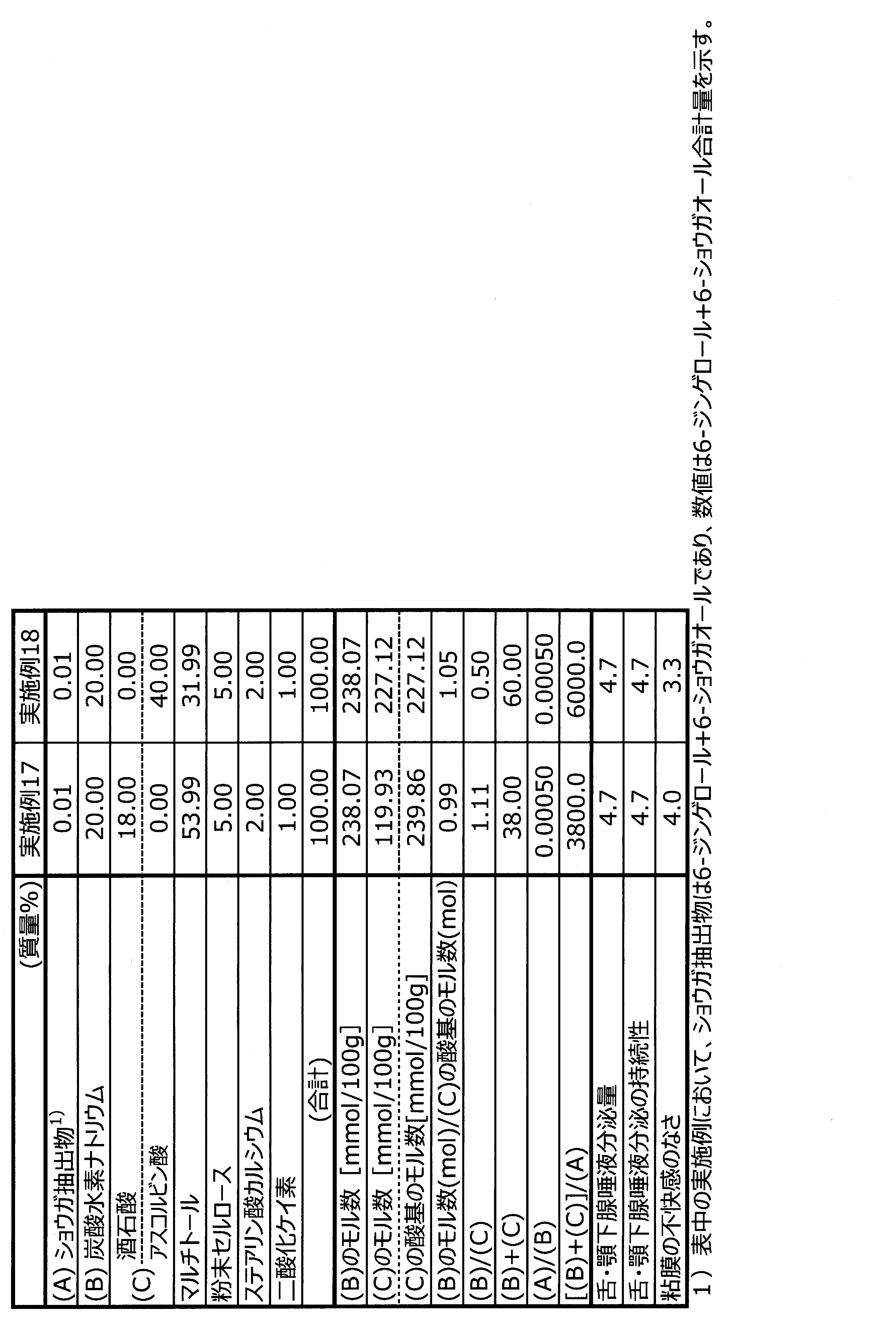
実施例19~21
表3に記載の配合組成で各成分を均一に混合し、実施例1と同様の方法で錠剤を得た。
得られた錠剤について、実施例1と同様の方法で測定と官能評価を行った。その結果を表3に示す。
表3に記載の配合組成で各成分を均一に混合し、実施例1と同様の方法で錠剤を得た。
得られた錠剤について、実施例1と同様の方法で測定と官能評価を行った。その結果を表3に示す。

表1~3から、成分(A)及び成分(B)の含有量、成分(C)の酸基のモル数を特定範囲内とし、且つ成分(B)のモル数(mol)と成分(C)の酸基のモル数(mol)の比が特定範囲内になるようにすることで、舌・顎下腺唾液の分泌を高め、さらに舌・顎下腺唾液の分泌を持続させる発泡性経口固形製剤が得られることが確認された。また、当該発泡性経口固形製剤は粘膜の不快感も少なかった。
本発明の発泡性経口固形製剤として、下記に示す処方を常法により各々調製することができる。
[処方例1 発泡性経口固形製剤]
テアフラビン 0.5質量%
ショウガ抽出物(6-ジンゲオール及び6-ショウガオール)
0.01質量%
炭酸水素ナトリウム 20.00質量%
クエン酸 15.30質量%
マルチトール 56.19質量%
粉末セルロース 5.00質量%
ステアリン酸カルシウム 2.00質量%
二酸化ケイ素 1.00質量%
計 100質量%
[処方例2 発泡性経口固形製剤]
テアフラビン 1.0質量%
ショウガ抽出物(6-ジンゲオール及び6-ショウガオール)
0.01質量%
炭酸水素ナトリウム 20.00質量%
クエン酸 15.30質量%
マルチトール 55.69質量%
粉末セルロース 5.00質量%
ステアリン酸カルシウム 2.00質量%
二酸化ケイ素 1.00質量%
計 100質量%
[処方例3 発泡性経口固形製剤]
テアフラビン 2.0質量%
ショウガ抽出物(6-ジンゲオール及び6-ショウガオール)
0.01質量%
炭酸水素ナトリウム 20.00質量%
クエン酸 15.30質量%
マルチトール 54.69質量%
粉末セルロース 5.00質量%
ステアリン酸カルシウム 2.00質量%
二酸化ケイ素 1.00質量%
計 100質量%
テアフラビン 0.5質量%
ショウガ抽出物(6-ジンゲオール及び6-ショウガオール)
0.01質量%
炭酸水素ナトリウム 20.00質量%
クエン酸 15.30質量%
マルチトール 56.19質量%
粉末セルロース 5.00質量%
ステアリン酸カルシウム 2.00質量%
二酸化ケイ素 1.00質量%
計 100質量%
[処方例2 発泡性経口固形製剤]
テアフラビン 1.0質量%
ショウガ抽出物(6-ジンゲオール及び6-ショウガオール)
0.01質量%
炭酸水素ナトリウム 20.00質量%
クエン酸 15.30質量%
マルチトール 55.69質量%
粉末セルロース 5.00質量%
ステアリン酸カルシウム 2.00質量%
二酸化ケイ素 1.00質量%
計 100質量%
[処方例3 発泡性経口固形製剤]
テアフラビン 2.0質量%
ショウガ抽出物(6-ジンゲオール及び6-ショウガオール)
0.01質量%
炭酸水素ナトリウム 20.00質量%
クエン酸 15.30質量%
マルチトール 54.69質量%
粉末セルロース 5.00質量%
ステアリン酸カルシウム 2.00質量%
二酸化ケイ素 1.00質量%
計 100質量%
Claims (5)
- 次の成分(A)、(B)及び(C):
(A)香辛料抽出物 0.001質量%以上0.11質量%以下
(B)炭酸塩 7質量%以上40質量%以下
(C)有機酸又はその塩
を含有し、成分(C)の酸基のモル数が50mmol/100g以上600mmol/100g以下であり、成分(B)のモル数(mol)と成分(C)の酸基のモル数(mol)の比[(B)のモル数(mol)/(C)の酸基のモル数(mol)]が0.25以上3.0以下である発泡性経口固形製剤。 - 成分(A)がショウガ抽出物及び/又は唐辛子抽出物である請求項1記載の発泡性経口固形製剤。
- 成分(C)がヒドロキシカルボン酸、アスコルビン酸及びそれらの塩から選ばれる1種又は2種以上である請求項1又は2記載の発泡性経口固形製剤。
- 成分(A)に対する、成分(B)及び(C)の合計量の含有質量比[((B)+(C))/(A)]が、500以上30,000以下である請求項1~3のいずれか1項記載の発泡性経口固形製剤。
- さらに糖アルコールを10質量%以上85質量%以下で含有する請求項1~4のいずれか1項記載の発泡性経口固形製剤。
Priority Applications (2)
| Application Number | Priority Date | Filing Date | Title |
|---|---|---|---|
| CN201980086373.6A CN113226046A (zh) | 2018-12-27 | 2019-12-26 | 发泡性经口固体制剂 |
| KR1020217019510A KR20210095905A (ko) | 2018-12-27 | 2019-12-26 | 발포성 경구 고형 제제 |
Applications Claiming Priority (4)
| Application Number | Priority Date | Filing Date | Title |
|---|---|---|---|
| JP2018246295 | 2018-12-27 | ||
| JP2018-246295 | 2018-12-27 | ||
| JP2019-102021 | 2019-05-31 | ||
| JP2019102021 | 2019-05-31 |
Publications (1)
| Publication Number | Publication Date |
|---|---|
| WO2020138334A1 true WO2020138334A1 (ja) | 2020-07-02 |
Family
ID=71127720
Family Applications (1)
| Application Number | Title | Priority Date | Filing Date |
|---|---|---|---|
| PCT/JP2019/051234 Ceased WO2020138334A1 (ja) | 2018-12-27 | 2019-12-26 | 発泡性経口固形製剤 |
Country Status (5)
| Country | Link |
|---|---|
| JP (1) | JP2020195364A (ja) |
| KR (1) | KR20210095905A (ja) |
| CN (1) | CN113226046A (ja) |
| TW (1) | TW202038920A (ja) |
| WO (1) | WO2020138334A1 (ja) |
Families Citing this family (3)
| Publication number | Priority date | Publication date | Assignee | Title |
|---|---|---|---|---|
| JP2020147552A (ja) * | 2019-03-15 | 2020-09-17 | 花王株式会社 | 抗ウイルス活性向上剤 |
| JP7507015B2 (ja) * | 2019-06-21 | 2024-06-27 | 三生医薬株式会社 | 唾液分泌促進用組成物及びその製造方法 |
| JP7594929B2 (ja) * | 2020-05-15 | 2024-12-05 | 花王株式会社 | 密封容器入り発泡性経口錠剤 |
Citations (8)
| Publication number | Priority date | Publication date | Assignee | Title |
|---|---|---|---|---|
| WO2001097627A1 (fr) * | 2000-06-21 | 2001-12-27 | Kao Corporation | Agents therapeutiques pour la gorge |
| JP2003048838A (ja) * | 2001-08-03 | 2003-02-21 | Kao Corp | 喉ケア剤 |
| WO2004058301A1 (ja) * | 2002-12-26 | 2004-07-15 | Yamada Apiculture Center, Inc. | 嚥下反射障害改善用組成物 |
| JP2004537575A (ja) * | 2001-08-06 | 2004-12-16 | ザ キグリー コーポレーション | 栄養補助剤およびそれらの使用方法 |
| US20070087053A1 (en) * | 2005-10-14 | 2007-04-19 | Hayward Marshall A | Lozenge for treatment of dry mouth and related conditions |
| WO2010074163A1 (ja) * | 2008-12-24 | 2010-07-01 | ハウス食品株式会社 | 複合体及びその製造方法 |
| JP2014080410A (ja) * | 2012-10-18 | 2014-05-08 | Kochi Univ | 嚥下機能改善剤 |
| JP2014513723A (ja) * | 2011-05-16 | 2014-06-05 | コルゲート・パーモリブ・カンパニー | オーラルケア組成物 |
Family Cites Families (3)
| Publication number | Priority date | Publication date | Assignee | Title |
|---|---|---|---|---|
| JP2002000184A (ja) * | 2000-06-21 | 2002-01-08 | Kao Corp | のどケア用アメ |
| US6592896B2 (en) * | 2001-08-06 | 2003-07-15 | The Quigley Corporation | Medicinal composition and method of using it |
| JP2011068642A (ja) | 2009-08-28 | 2011-04-07 | Arimento Kogyo Kk | 唾液分泌促進剤 |
-
2019
- 2019-12-25 TW TW108147568A patent/TW202038920A/zh unknown
- 2019-12-26 JP JP2019236713A patent/JP2020195364A/ja active Pending
- 2019-12-26 KR KR1020217019510A patent/KR20210095905A/ko not_active Withdrawn
- 2019-12-26 WO PCT/JP2019/051234 patent/WO2020138334A1/ja not_active Ceased
- 2019-12-26 CN CN201980086373.6A patent/CN113226046A/zh active Pending
Patent Citations (8)
| Publication number | Priority date | Publication date | Assignee | Title |
|---|---|---|---|---|
| WO2001097627A1 (fr) * | 2000-06-21 | 2001-12-27 | Kao Corporation | Agents therapeutiques pour la gorge |
| JP2003048838A (ja) * | 2001-08-03 | 2003-02-21 | Kao Corp | 喉ケア剤 |
| JP2004537575A (ja) * | 2001-08-06 | 2004-12-16 | ザ キグリー コーポレーション | 栄養補助剤およびそれらの使用方法 |
| WO2004058301A1 (ja) * | 2002-12-26 | 2004-07-15 | Yamada Apiculture Center, Inc. | 嚥下反射障害改善用組成物 |
| US20070087053A1 (en) * | 2005-10-14 | 2007-04-19 | Hayward Marshall A | Lozenge for treatment of dry mouth and related conditions |
| WO2010074163A1 (ja) * | 2008-12-24 | 2010-07-01 | ハウス食品株式会社 | 複合体及びその製造方法 |
| JP2014513723A (ja) * | 2011-05-16 | 2014-06-05 | コルゲート・パーモリブ・カンパニー | オーラルケア組成物 |
| JP2014080410A (ja) * | 2012-10-18 | 2014-05-08 | Kochi Univ | 嚥下機能改善剤 |
Also Published As
| Publication number | Publication date |
|---|---|
| KR20210095905A (ko) | 2021-08-03 |
| CN113226046A (zh) | 2021-08-06 |
| JP2020195364A (ja) | 2020-12-10 |
| TW202038920A (zh) | 2020-11-01 |
Similar Documents
| Publication | Publication Date | Title |
|---|---|---|
| JP2020512322A (ja) | 回復されたアントラージュ効果を有する組成物の迅速な制御された送達 | |
| KR20070119545A (ko) | 입냄새 치료를 위한 항미생물 활성을 갖는 화합물 | |
| JP5259880B2 (ja) | 経口剤 | |
| KR101432940B1 (ko) | 플라즈마 처리에 의해 생리기능성이 증가된 페놀화합물의 제조방법 | |
| KR20000030006A (ko) | 경구용조성물의불쾌한맛의억제방법 | |
| JP2020195364A (ja) | 発泡性経口固形製剤 | |
| EP2262534B1 (en) | Palatable solid composition comprising antacid and saliva stimulant | |
| JP3241955B2 (ja) | 口腔用組成物 | |
| KR101647495B1 (ko) | 플라본계 화합물 또는 캠페리아 파비플로라 추출물을 함유하는 치주질환 개선 조성물 | |
| JP5467800B2 (ja) | 唾液分泌促進剤及び唾液分泌促進用組成物 | |
| KR102133638B1 (ko) | 산청목 추출물 및 계피 추출물을 포함하는 구강질환의 예방 또는 치료용 조성물 | |
| JP6467205B2 (ja) | 発泡性固形状組成物の製造方法 | |
| KR101911753B1 (ko) | 산청목 추출물 및 산초 추출물을 포함하는 구강질환의 예방 또는 치료용 조성물 | |
| JP4553730B2 (ja) | 経口用育毛剤 | |
| JP2020183350A (ja) | 歯磨剤 | |
| JP6771274B2 (ja) | 内服用組成物 | |
| KR101429197B1 (ko) | 전호 추출물을 포함하는 항균 조성물 | |
| JP2005082546A (ja) | α−グルコシダーゼ阻害剤 | |
| JP7106345B2 (ja) | 歯周病抑制剤およびこれを利用する口腔用組成物 | |
| JP5145769B2 (ja) | 圧縮成型物およびその製造方法 | |
| WO2017068805A1 (ja) | 唾液分泌促進剤、これを含有する口腔用組成物及び飲料用組成物 | |
| KR101561441B1 (ko) | 도깨비가지 추출물을 유효성분으로 함유하는 치주질환 예방 또는 치료용 조성물 | |
| KR102878745B1 (ko) | 항균용 조성물 | |
| KR102251717B1 (ko) | 음용 가능한 구강질환의 예방 또는 치료용 조성물 | |
| JP7594929B2 (ja) | 密封容器入り発泡性経口錠剤 |
Legal Events
| Date | Code | Title | Description |
|---|---|---|---|
| 121 | Ep: the epo has been informed by wipo that ep was designated in this application |
Ref document number: 19906139 Country of ref document: EP Kind code of ref document: A1 |
|
| ENP | Entry into the national phase |
Ref document number: 20217019510 Country of ref document: KR Kind code of ref document: A |
|
| NENP | Non-entry into the national phase |
Ref country code: DE |
|
| 122 | Ep: pct application non-entry in european phase |
Ref document number: 19906139 Country of ref document: EP Kind code of ref document: A1 |