WO2020138322A1 - 加飾層を有する油性化粧料 - Google Patents
加飾層を有する油性化粧料 Download PDFInfo
- Publication number
- WO2020138322A1 WO2020138322A1 PCT/JP2019/051206 JP2019051206W WO2020138322A1 WO 2020138322 A1 WO2020138322 A1 WO 2020138322A1 JP 2019051206 W JP2019051206 W JP 2019051206W WO 2020138322 A1 WO2020138322 A1 WO 2020138322A1
- Authority
- WO
- WIPO (PCT)
- Prior art keywords
- oil
- decorative layer
- powder
- component
- cosmetic
- Prior art date
- Legal status (The legal status is an assumption and is not a legal conclusion. Google has not performed a legal analysis and makes no representation as to the accuracy of the status listed.)
- Ceased
Links
Images

Classifications
-
- A—HUMAN NECESSITIES
- A61—MEDICAL OR VETERINARY SCIENCE; HYGIENE
- A61K—PREPARATIONS FOR MEDICAL, DENTAL OR TOILETRY PURPOSES
- A61K8/00—Cosmetics or similar toiletry preparations
- A61K8/02—Cosmetics or similar toiletry preparations characterised by special physical form
- A61K8/0216—Solid or semisolid forms
- A61K8/0233—Distinct layers, e.g. core/shell sticks
- A61K8/0237—Striped compositions
-
- A—HUMAN NECESSITIES
- A61—MEDICAL OR VETERINARY SCIENCE; HYGIENE
- A61K—PREPARATIONS FOR MEDICAL, DENTAL OR TOILETRY PURPOSES
- A61K8/00—Cosmetics or similar toiletry preparations
- A61K8/02—Cosmetics or similar toiletry preparations characterised by special physical form
- A61K8/0216—Solid or semisolid forms
- A61K8/022—Powders; Compacted Powders
-
- A—HUMAN NECESSITIES
- A61—MEDICAL OR VETERINARY SCIENCE; HYGIENE
- A61K—PREPARATIONS FOR MEDICAL, DENTAL OR TOILETRY PURPOSES
- A61K8/00—Cosmetics or similar toiletry preparations
- A61K8/18—Cosmetics or similar toiletry preparations characterised by the composition
- A61K8/19—Cosmetics or similar toiletry preparations characterised by the composition containing inorganic ingredients
- A61K8/25—Silicon; Compounds thereof
-
- A—HUMAN NECESSITIES
- A61—MEDICAL OR VETERINARY SCIENCE; HYGIENE
- A61K—PREPARATIONS FOR MEDICAL, DENTAL OR TOILETRY PURPOSES
- A61K8/00—Cosmetics or similar toiletry preparations
- A61K8/18—Cosmetics or similar toiletry preparations characterised by the composition
- A61K8/19—Cosmetics or similar toiletry preparations characterised by the composition containing inorganic ingredients
- A61K8/29—Titanium; Compounds thereof
-
- A—HUMAN NECESSITIES
- A61—MEDICAL OR VETERINARY SCIENCE; HYGIENE
- A61K—PREPARATIONS FOR MEDICAL, DENTAL OR TOILETRY PURPOSES
- A61K8/00—Cosmetics or similar toiletry preparations
- A61K8/18—Cosmetics or similar toiletry preparations characterised by the composition
- A61K8/30—Cosmetics or similar toiletry preparations characterised by the composition containing organic compounds
- A61K8/31—Hydrocarbons
-
- A—HUMAN NECESSITIES
- A61—MEDICAL OR VETERINARY SCIENCE; HYGIENE
- A61K—PREPARATIONS FOR MEDICAL, DENTAL OR TOILETRY PURPOSES
- A61K8/00—Cosmetics or similar toiletry preparations
- A61K8/18—Cosmetics or similar toiletry preparations characterised by the composition
- A61K8/30—Cosmetics or similar toiletry preparations characterised by the composition containing organic compounds
- A61K8/33—Cosmetics or similar toiletry preparations characterised by the composition containing organic compounds containing oxygen
- A61K8/34—Alcohols
- A61K8/347—Phenols
-
- A—HUMAN NECESSITIES
- A61—MEDICAL OR VETERINARY SCIENCE; HYGIENE
- A61K—PREPARATIONS FOR MEDICAL, DENTAL OR TOILETRY PURPOSES
- A61K8/00—Cosmetics or similar toiletry preparations
- A61K8/18—Cosmetics or similar toiletry preparations characterised by the composition
- A61K8/30—Cosmetics or similar toiletry preparations characterised by the composition containing organic compounds
- A61K8/33—Cosmetics or similar toiletry preparations characterised by the composition containing organic compounds containing oxygen
- A61K8/37—Esters of carboxylic acids
- A61K8/375—Esters of carboxylic acids the alcohol moiety containing more than one hydroxy group
-
- A—HUMAN NECESSITIES
- A61—MEDICAL OR VETERINARY SCIENCE; HYGIENE
- A61K—PREPARATIONS FOR MEDICAL, DENTAL OR TOILETRY PURPOSES
- A61K8/00—Cosmetics or similar toiletry preparations
- A61K8/18—Cosmetics or similar toiletry preparations characterised by the composition
- A61K8/30—Cosmetics or similar toiletry preparations characterised by the composition containing organic compounds
- A61K8/40—Cosmetics or similar toiletry preparations characterised by the composition containing organic compounds containing nitrogen
-
- A—HUMAN NECESSITIES
- A61—MEDICAL OR VETERINARY SCIENCE; HYGIENE
- A61K—PREPARATIONS FOR MEDICAL, DENTAL OR TOILETRY PURPOSES
- A61K8/00—Cosmetics or similar toiletry preparations
- A61K8/18—Cosmetics or similar toiletry preparations characterised by the composition
- A61K8/30—Cosmetics or similar toiletry preparations characterised by the composition containing organic compounds
- A61K8/58—Cosmetics or similar toiletry preparations characterised by the composition containing organic compounds containing atoms other than carbon, hydrogen, halogen, oxygen, nitrogen, sulfur or phosphorus
- A61K8/585—Organosilicon compounds
-
- A—HUMAN NECESSITIES
- A61—MEDICAL OR VETERINARY SCIENCE; HYGIENE
- A61K—PREPARATIONS FOR MEDICAL, DENTAL OR TOILETRY PURPOSES
- A61K8/00—Cosmetics or similar toiletry preparations
- A61K8/18—Cosmetics or similar toiletry preparations characterised by the composition
- A61K8/30—Cosmetics or similar toiletry preparations characterised by the composition containing organic compounds
- A61K8/67—Vitamins
- A61K8/678—Tocopherol, i.e. vitamin E
-
- A—HUMAN NECESSITIES
- A61—MEDICAL OR VETERINARY SCIENCE; HYGIENE
- A61K—PREPARATIONS FOR MEDICAL, DENTAL OR TOILETRY PURPOSES
- A61K8/00—Cosmetics or similar toiletry preparations
- A61K8/18—Cosmetics or similar toiletry preparations characterised by the composition
- A61K8/72—Cosmetics or similar toiletry preparations characterised by the composition containing organic macromolecular compounds
- A61K8/73—Polysaccharides
- A61K8/732—Starch; Amylose; Amylopectin; Derivatives thereof
-
- A—HUMAN NECESSITIES
- A61—MEDICAL OR VETERINARY SCIENCE; HYGIENE
- A61K—PREPARATIONS FOR MEDICAL, DENTAL OR TOILETRY PURPOSES
- A61K8/00—Cosmetics or similar toiletry preparations
- A61K8/18—Cosmetics or similar toiletry preparations characterised by the composition
- A61K8/72—Cosmetics or similar toiletry preparations characterised by the composition containing organic macromolecular compounds
- A61K8/81—Cosmetics or similar toiletry preparations characterised by the composition containing organic macromolecular compounds obtained by reactions involving only carbon-to-carbon unsaturated bonds
- A61K8/8105—Compositions of homopolymers or copolymers of unsaturated aliphatic hydrocarbons having only one carbon-to-carbon double bond; Compositions of derivatives of such polymers
- A61K8/8111—Homopolymers or copolymers of aliphatic olefines, e.g. polyethylene, polyisobutene; Compositions of derivatives of such polymers
-
- A—HUMAN NECESSITIES
- A61—MEDICAL OR VETERINARY SCIENCE; HYGIENE
- A61K—PREPARATIONS FOR MEDICAL, DENTAL OR TOILETRY PURPOSES
- A61K8/00—Cosmetics or similar toiletry preparations
- A61K8/18—Cosmetics or similar toiletry preparations characterised by the composition
- A61K8/72—Cosmetics or similar toiletry preparations characterised by the composition containing organic macromolecular compounds
- A61K8/81—Cosmetics or similar toiletry preparations characterised by the composition containing organic macromolecular compounds obtained by reactions involving only carbon-to-carbon unsaturated bonds
- A61K8/8188—Compositions of homopolymers or copolymers of compounds having one or more unsaturated aliphatic radicals, each having only one carbon-to-carbon double bonds, and at least one being terminated by a bond to sulfur or by a hertocyclic ring containing sulfur; Compositions of derivatives of such polymers
-
- A—HUMAN NECESSITIES
- A61—MEDICAL OR VETERINARY SCIENCE; HYGIENE
- A61K—PREPARATIONS FOR MEDICAL, DENTAL OR TOILETRY PURPOSES
- A61K8/00—Cosmetics or similar toiletry preparations
- A61K8/18—Cosmetics or similar toiletry preparations characterised by the composition
- A61K8/72—Cosmetics or similar toiletry preparations characterised by the composition containing organic macromolecular compounds
- A61K8/84—Cosmetics or similar toiletry preparations characterised by the composition containing organic macromolecular compounds obtained by reactions otherwise than those involving only carbon-carbon unsaturated bonds
- A61K8/89—Polysiloxanes
- A61K8/891—Polysiloxanes saturated, e.g. dimethicone, phenyl trimethicone, C24-C28 methicone or stearyl dimethicone
-
- A—HUMAN NECESSITIES
- A61—MEDICAL OR VETERINARY SCIENCE; HYGIENE
- A61Q—SPECIFIC USE OF COSMETICS OR SIMILAR TOILETRY PREPARATIONS
- A61Q1/00—Make-up preparations; Body powders; Preparations for removing make-up
- A61Q1/02—Preparations containing skin colorants, e.g. pigments
-
- A—HUMAN NECESSITIES
- A61—MEDICAL OR VETERINARY SCIENCE; HYGIENE
- A61Q—SPECIFIC USE OF COSMETICS OR SIMILAR TOILETRY PREPARATIONS
- A61Q1/00—Make-up preparations; Body powders; Preparations for removing make-up
- A61Q1/12—Face or body powders for grooming, adorning or absorbing
-
- A—HUMAN NECESSITIES
- A61—MEDICAL OR VETERINARY SCIENCE; HYGIENE
- A61K—PREPARATIONS FOR MEDICAL, DENTAL OR TOILETRY PURPOSES
- A61K2800/00—Properties of cosmetic compositions or active ingredients thereof or formulation aids used therein and process related aspects
- A61K2800/40—Chemical, physico-chemical or functional or structural properties of particular ingredients
- A61K2800/42—Colour properties
- A61K2800/43—Pigments; Dyes
- A61K2800/437—Diffractive phenomena; Photonic arrays
-
- A—HUMAN NECESSITIES
- A61—MEDICAL OR VETERINARY SCIENCE; HYGIENE
- A61K—PREPARATIONS FOR MEDICAL, DENTAL OR TOILETRY PURPOSES
- A61K2800/00—Properties of cosmetic compositions or active ingredients thereof or formulation aids used therein and process related aspects
- A61K2800/40—Chemical, physico-chemical or functional or structural properties of particular ingredients
- A61K2800/48—Thickener, Thickening system
Definitions
- the present invention relates to a decorated oily cosmetic. More specifically, the present invention relates to a transparent oil-based cosmetic having a decorative layer that is formed so as to be visible from the outside of a transparent oil-based base that constitutes the cosmetic and has excellent aesthetics.
- Patent Document 1 discloses a powder composition for decoration for drawing characters, patterns, and the like on the surface of cosmetics using a printing technique, and a powder surface-treated with a silane compound or a silazane compound has a glossy surface. It is said that it is possible to delicately and clearly print patterns and characters that exhibit.
- Patent Document 3 As an example of decorating a transparent cosmetic, in Patent Document 3, a transparent cosmetic layer having a mortar-shaped recess on the upper surface is formed in a transparent container, and cosmetics colored in different colors are laminated on the transparent cosmetic layer. As a result, a multicolor cosmetic that has a gradation pattern when viewed from the outside of the transparent container is disclosed.
- Patent Document 4 discloses a stick-shaped oily solid cosmetic in which a transparent outer layer portion is provided around a colored inner layer portion. More recently, transparent lipsticks with imitations of flowers and gold dust inside are also on the market (trade name: Kairijumei Tint Flower Lip).
- the above-mentioned conventional techniques can only be decorated with one design.
- the above-mentioned commercial products enclose a decoration made of an imitation product other than the cosmetic ingredients, and it takes a lot of time to manufacture the decoration.
- the object of the present invention is to decorate transparent oil-based cosmetics, it is possible to decorate in various designs using cosmetic ingredients, and yet it is possible to easily decorate using a printing technique or the like. It is to provide a transparent oily cosmetic.
- the present inventors have solved the above problems by including a powder having a higher refractive index than the liquid oil contained in the oil-based cosmetics in the powder component used for decorating the transparent oil-based cosmetics, and added various designs.
- the present invention has been completed by finding that it is possible to easily form a decorative layer and obtain a cosmetic having excellent aesthetics that allows the decorative layer to be clearly visible from the outside of the cosmetic.
- the present invention is An oily solid cosmetic having (A) a transparent oily base and (B) at least one decorative layer,
- the transparent oily base (A) contains a thickening component (a1) and a liquid oil component (a2)
- the (B) decorative layer contains the (b1) powder component
- the powder component (b1) contains at least one powder having a refractive index higher than that of the liquid oil (a2).
- Oily solid cosmetics according to the present invention (hereinafter, also simply referred to as "oily cosmetics"), because the refractive index of the powder contained in the decorative layer is set higher than the refractive index of the liquid oil of the transparent oily base.
- the decorative layer is clearly visible when viewed from the outside of the cosmetic, which is excellent in aesthetics.
- both the transparent oily base and the decorative layer can be composed of only the cosmetic ingredient, and the entire cosmetic including the decorative layer can be used as it is. Further, it can be easily manufactured by using an existing device or the like.
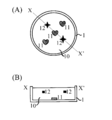
- (A) It is a top view which shows an example of the oil-based cosmetics of this invention.
- (B) It is a cross-sectional view taken along the line segment XX' of the top view.
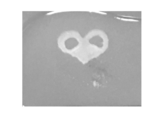
- 3 is a photograph showing the appearance of another example of the oily cosmetic of the present invention.
- 5 is a photograph showing the appearance of Comparative Example 1.
- FIG. 1 is a schematic view showing an example of the oily cosmetic of the present invention.
- 1A is a top view
- FIG. 1B is a cross-sectional view.
- the cosmetic shown in FIG. 1 is filled in a flat dish container 1 and has a transparent oily base 10, a first decorative layer 11 and a second decorative layer 12.
- the first decorative layer 11 is composed of a plurality of (three in FIG. 1) heart-shaped layers that are linearly spaced apart from each other, and the plurality of layers are on the same plane. It is provided on the (bottom surface of the container).
- the second decorative layer 12 is composed of a plurality of (two in FIG. 1) star-shaped layers that are linearly spaced apart from each other when viewed from above, and the plurality of layers are on the same plane. It is provided on (the bottom surface of the container and the surface not in contact with the surface of the cosmetic).
- the first decorative layer and the second decorative layer are formed in different colors.
- a portion of the oily cosmetic of FIG. 1 other than the first and second decorative layers is composed of a transparent oily base 10.
- FIG. 1 what is shown in FIG. 1 is an example of the oily cosmetic of the present invention, and does not limit the scope of the present invention.
- one or a plurality of decorative layers may be provided on the same surface or a plurality of different surfaces, and the shape, color, size and thickness thereof may be the same or different.
- the decorative layer may be provided on the bottom surface of the container like the first decorative layer in FIG. 1 or on the surface of the transparent base, even if it is transparent oily like the second decorative layer in FIG. It may be provided inside the base material.
- the oil-based cosmetic of the present invention sets the refractive index of the powder contained in the decorative layer higher than the refractive index of the liquid oil component of the transparent oily base, the outer edge of the decorative layer becomes clear from the outside of the cosmetic. It is visible and has excellent aesthetics. Furthermore, when the decorative layer is provided inside the transparent oily base as in the example shown in FIG.
- one of the light emitted from above the cosmetic is The part is absorbed by the decorative layer and the decorative layer is projected on the bottom surface of the container, etc., and the shadow of the decorative layer is visible from the outside of the cosmetic, so not only the shape and color of the decorative layer itself, but also light and shadow It is a cosmetic that exhibits the beauty that has been achieved.
- the transparent oily base constituting the oily cosmetic of the present invention contains (a1) a thickening component and (a2) a liquid oil component.
- the thickening component is not particularly limited as long as it is a cosmetic component having an action of thickening the liquid oil component by dissolving in the liquid oil component or swelling with the liquid oil component.
- examples thereof include dextrin fatty acid esters, sucrose fatty acid esters, glyceryl fatty acid esters, amino acid gelling agents, fatty acids such as 12-hydroxystearic acid or salts thereof, and organically modified clay minerals.
- dextrin fatty acid ester, especially dextrin palmitate is preferably used.
- the dextrin fatty acid ester is preferably represented by the following formula (1).
- A is a residue obtained by removing n hydroxyl groups from dextrin
- R is a linear or branched alkyl group having 3 to 30 carbon atoms
- n is an integer of 1 or more.
- R in the above formula (1) examples include propyl group, butyl group, pentyl group, hexyl group, heptyl group, octyl group, nonyl group, decyl group, undecyl group, dodecyl group, tridecyl group, myristyl group, pentadecyl group.
- the molecular weight of the dextrin fatty acid ester used in the present invention is not particularly limited, but it is preferably 1,000 to 300,000, more preferably 1,000 to 100,000.
- Specific compound names included in the dextrin fatty acid ester represented by the general formula (1) include octanoic acid dextrin, decanoic acid dextrin, laurate dextrin, myristic acid dextrin, stearic acid dextrin, behenic acid dextrin, and coconut oil. Examples thereof include fatty acid dextrin, dextrin palmitate, dextrin 2-ethylhexanoate and myristic acid/dextrin palmitate.
- sucrose fatty acid ester a fatty acid having a linear or branched chain, saturated or unsaturated, and having 12 to 22 carbon atoms can be preferably used.
- sucrose caprylate, sucrose caprate, sucrose laurate, sucrose myristate, sucrose palmitate, sucrose stearate, sucrose oleate, sucrose elca An acid ester etc. can be mentioned.
- Glyceryl fatty acid ester is an esterification reaction product obtained by reacting glycerin, a dibasic acid having 18 to 28 carbon atoms and a fatty acid having 8 to 28 carbon atoms (excluding dibasic acid). As long as it is one generally used, it can be used without particular limitation. Specific examples thereof include (behenic acid/isostearic acid/eicosandioic acid) glyceryl, (behenic acid/eicosandioic acid) glyceryl, and (behenic acid/eicosandioic acid) polyglyceryl-10.
- amino acid-based gelling agent examples include dibutyl lauroyl glutamide, dibutyl ethyl hexanoyl glutamide, polyamide-8 and polyamide-3.
- fatty acids examples include myristic acid, palmitic acid, stearic acid, behenic acid, and 12-hydroxystearic acid.
- salts of fatty acids examples include calcium salts, magnesium salts, aluminum salts and the like.
- organically modified clay minerals include dimethyl distearyl ammonium hectorite, dimethyl alkyl ammonium hectorite, benzyl dimethyl stearyl ammonium hectorite, distearyl dimethyl ammonium chloride treated aluminum magnesium silicate, and the like.
- examples of commercially available products include Benton 27 (benzyldimethylstearylammonium chloride-treated hectorite: manufactured by Elementis Japan) and Benton 38 (distearyldimethylammonium chloride-treated hectorite: manufactured by Elementis Japan).
- the content of the thickening component (a1) in the cosmetic of the present invention is usually 0.1 to 30% by mass, preferably 1 to 25% by mass, and more preferably 5 to 20% by mass relative to the total amount of the transparent oily base. It is% by mass. If the blending amount is less than 0.1% by mass, the hardness of the transparent oily base becomes extremely low and it becomes difficult to support the decorative layer. If the blending amount exceeds 30% by mass, the container is uniformly filled. becomes difficult.
- liquid oil component used in the present invention is not particularly limited as long as it can be thickened (gelled) by the thickening component to form a transparent oily base, and is usually blended in cosmetics. It can be selected from oils that are liquid at room temperature (25°C). As a typical example, a liquid oil component selected from hydrocarbon oil, ester oil, silicone oil, and liquid oil is preferably used. Specific examples are shown below, but the invention is not limited thereto.
- hydrocarbon oil examples include liquid paraffin, hydrogenated polydecene, squalane, pristane, paraffin, squalene, triethylhexanoin, ⁇ -olefin oligomer, isododecane, isohexadecane, and light isoparaffin.
- ester oil isopropyl myristate, cetyl octanoate, octyldodecyl myristate, isopropyl palmitate, butyl stearate, hexyl laurate, myristyl myristate, decyl oleate, hexyldecyl dimethyloctanoate, cetyl lactate, myristyl lactate, Lanolin acetate, isocetyl stearate, isocetyl isostearate, cholesteryl 12-hydroxystearate, ethylene glycol di-2-ethylhexanoate, dipentaerythritol fatty acid ester, N-alkyl glycol monoisostearate, neopentyl glycol dicaprate, malic acid Diisostearyl, glycerin di-2-heptylundecanoate, trimethylolpropane tri-2-ethyl
- silicone oil examples include chain polysiloxanes such as dimethylpolysiloxane, methylphenylpolysiloxane, methylhydrogenpolysiloxane, diphenylsiloxyphenyltrimethicone, decamethylcyclopentasiloxane, octamethylcyclotetrasiloxane, and hexamethylcyclotrisiloxane.
- chain polysiloxanes such as dimethylpolysiloxane, methylphenylpolysiloxane, methylhydrogenpolysiloxane, diphenylsiloxyphenyltrimethicone, decamethylcyclopentasiloxane, octamethylcyclotetrasiloxane, and hexamethylcyclotrisiloxane.
- liquid oils and fats include avocado oil, camellia oil, turtle oil, macadamia nut oil, corn oil, mink oil, olive oil, rapeseed oil, egg yolk oil, sesame oil, persic oil, wheat germ oil, southern oil, castor oil, linseed oil. , Safflower oil, cottonseed oil, eno oil, soybean oil, peanut oil, teaseed oil, kaya oil, rice bran oil, cinnamon oil, Japanese tung oil, jojoba oil, germ oil, triglycerin, trioctanoic acid glycerin, triisopalmitic acid Examples thereof include glycerin.
- the liquid oil component (a2) can be used alone or in combination of two or more, but the weighted average value of the refractive index of each liquid oil component to be blended (this value is referred to as "the refractive index of the liquid oil component" in the present invention). (Defined as) is preferably in the range of 1.4 to 1.6, and more preferably the refractive index of the liquid oil component is 1.42 to 1.52.
- the refractive index of the oil used in the present invention is, for example, a precision Abbe refractometer (type manufactured by ATAGO: The value measured at 20° C. using 3T) can be used.
- the amount of the liquid oil (a2) is not particularly limited, but is usually 20 to 99.5% by mass, preferably 50 to 90% by mass with respect to the total amount of the transparent oily base, and the desired cosmetic form It is appropriately determined according to the hardness and hardness.
- the transparent oily base of the present invention may contain other optional components within a range that does not impair the effects of the present invention.
- Other optional components include, but are not limited to, solid or semi-solid oils, humectants, aqueous components, preservatives, antioxidants, UV absorbers, polymers, surfactants, dyes, dyes, pigments, defoamers. Examples include agents (such as simethicone), various agents (such as tocopherol), lower alcohols (having less than 6 carbon atoms), solvents and fragrances.
- the solid or semi-solid oil component is not particularly limited as long as it can be mixed in the cosmetic.
- solid fats and oils, waxes, hydrocarbon oils, higher alcohols and the like can be exemplified.
- solid fats and oils include cacao butter, coconut oil, horse oil, hardened coconut oil, palm oil, beef tallow, sheep fat, hardened beef tallow, palm kernel oil, pork fat, beef bone fat, sorghum kernel oil, hardened oil, beef.
- Leg oil, syrup, hydrogenated castor oil and the like can be mentioned.
- waxes examples include beeswax, candelilla wax, cotton wax, carnauba wax, bayberry wax, ivorot wax, whale wax, montan wax, nuka wax, lanolin, kapok wax, liquid lanolin, sugar cane wax, lanolin fatty acid isopropyl, reduced lanolin, jojoba wax, hard lanolin, shellac wax. , POE lanolin alcohol ether, POE lanolin alcohol acetate, POE cholesterol ether, lanolin fatty acid polyethylene glycol, POE hydrogenated lanolin alcohol ether and the like.
- hydrocarbon oil solid or semi-solid
- examples of the hydrocarbon oil include ozokerite, ceresin, petrolatum, microcrystalline wax and the like.
- higher alcohols include linear alcohols such as lauryl alcohol, cetyl alcohol, stearyl alcohol, behenyl alcohol, myristyl alcohol, oleyl alcohol, cetostearyl alcohol, monostearyl glycerin ether (batyl alcohol), 2-decyltetradecinol, and lanolin.
- linear alcohols such as lauryl alcohol, cetyl alcohol, stearyl alcohol, behenyl alcohol, myristyl alcohol, oleyl alcohol, cetostearyl alcohol, monostearyl glycerin ether (batyl alcohol), 2-decyltetradecinol, and lanolin.
- branched chain alcohols such as alcohol, cholesterol, phytosterol, hexyldodecanol, octyldodecanol, and the like.
- moisturizers include polyhydric alcohols and sugar alcohols, and specific examples thereof include glycols such as dipropylene glycol and 1,3-butylene glycol, glycerin, mannitol, sorbitol and the like.
- the term “transparent” in the present invention includes a range from “transparent” to “translucent” in the meaning generally used in the field of cosmetics as long as the decorative layer can be visually recognized from the outside of the cosmetic.
- a cell having a transmittance of light of 900 nm at least 50% or more by a spectrophotometer is It may be defined as the "transparent oily base" in the invention.
- the (A) transparent oily base in the present invention may be a water-in-oil type containing an aqueous component or an oil-in-water-in-oil type containing an aqueous component as long as it satisfies the requirement of "transparency" described above. It may be in an emulsified form. Further, it may be colorless or colored as long as the transparency can be ensured.
- These oily bases can be manufactured by the method generally used for the cosmetics of each form.
- the (A) transparent oily base of the present invention is preferably solid.
- the "solid” in the present invention means a composition that is not fluid at room temperature (25°C) and atmospheric pressure.
- a composition having a hardness of 50 to 300 measured at 25° C. with a rheometer (3 mm ⁇ , 1.0 mm needle penetration, 2K range, 2 cm/min) may be defined as “solid” in the present invention. If the hardness is less than 50, it becomes difficult to support the decorative layer, and if it exceeds 300, it does not spread evenly when filled in a container, and it becomes difficult to form the decorative layer on the surface.
- the (B) decorative layer in the oily cosmetic of the present invention contains (b1) a powder component.
- the powder component (b1) contains at least one powder having a refractive index higher than that of the liquid oil (a2).
- the powder component (b1) is an essential component for exhibiting the decorative effect of the decorative layer, and is selected from white pigments, color pigments, inorganic pigments such as pearlescent agents and organic powders that can be mixed in cosmetics. It is preferable to use a powder.
- powders that can be blended include, but are not limited to, talc, kaolin, mica (mica), sericite (sericite), muscovite, biotite, phlogopite, synthetic mica, permiculite, magnesium carbonate, calcium carbonate, Aluminum silicate, barium silicate, calcium silicate, magnesium silicate, metal tungstate metal, magnesium, silica, zeolite, cerium oxide, zirconium oxide, tin oxide, aluminum oxide, magnesium oxide, barium sulfate, barium titanate, calcination Inorganic powder of calcium sulfate, gypsum, calcium phosphate, fluoroapatite, hydroxyapatite, ceramic powder, metal soap (zinc myristate, calcium palmitate, aluminum stearate, etc.); polyamide resin powder (nylon powder, etc.), polyethylene powder, poly Organic powder such as methyl methacrylate powder, polystyrene powder, PMMA powder, sty
- Red No. 205 Red 220, Red 228, Red 405, Orange 203, Orange 204, Yellow 205, Yellow 401, Blue 404 and other organic pigments; Red 3, Red 104, Red 227, Red No. 401, orange No. 205, yellow No. 4, yellow No. 202, green No. 3, blue No. 1, etc., organic pigments such as zirconium, barium, aluminum lake; and natural pigments such as chlorophyll and ⁇ -carotene.
- the powder may be used alone or as a mixture of two or more kinds.
- the powder component (b1) is at least one powder having a refractive index higher than that of the liquid oil (a2) contained in the transparent oily base (A) (hereinafter, also referred to as “high refractive index powder”). Contains seeds.
- the high refractive index powder preferably has a refractive index higher than that of the liquid oil component (a2) by 0.01 or more, more preferably 0.05 or more, further preferably 0.1 or more, and most preferably 0.5 or more. Select the powder you have.
- the high refractive index powder is not particularly limited, but it is preferable to select from powders having a refractive index of 1.45 or more.
- Specific examples of the powder having a refractive index of 1.45 or more include titanium oxide (rutile type, anatase type), barium titanate, cerium oxide, zirconium oxide, bismuth oxychloride, zinc oxide, tin oxide, aluminum oxide, magnesium oxide. Barium sulfate, polystyrene, kaolin, mica, talc, nylon, PMMA, and silica.
- the (b1) powder component may contain at least one high-refractive-index powder, but the proportion of the high-refractive-index powder in the (b1) powder component is 50% by mass or more, 70% by mass or more, or 80% by mass.
- the content is preferably at least mass%, and the powder component (b1) may be composed of only the high refractive index powder.
- (b1) preparing a dispersion (hereinafter also referred to as “ink composition”) in which a powder component is dispersed in a medium (b2) in which the powder component can be dispersed, and spraying the ink composition. It is preferable to form the decorative layer.
- the (b2) dispersion medium in the ink composition is not particularly limited as long as it is a medium having fluidity that can disperse the (b1) powder component, but has a low boiling point in consideration of the drying rate at the time of forming the decorative layer.
- a medium for example, a lower alcohol having 3 or less carbon atoms such as ethanol is preferable.
- the decorative layer is formed on the surface of the above-mentioned (A) transparent oily base, in order to prevent the (B) decorative layer from bleeding, it is added to the (A) transparent oily base. It is preferable to select a medium having low compatibility with the oil content.
- the ink composition preferably contains (b1) the powder component and (b2) the dispersion medium, and also contains a binder component for binding the powders to each other in the decorative layer. Further, a moisturizing agent such as glycerin and a thickening agent such as (dimethylacrylamide/acryloyldimethyltaurine Na) crosspolymer may be appropriately contained.
- the oily cosmetic of the present invention is manufactured through a step of forming a decorative layer on the bottom surface of the container or the surface of the transparent oily base filled in the container.
- a decorative layer it is convenient and preferable to use the above ink composition and apply the ink composition by coating, spraying, printing or the like so as to obtain an intended shape/pattern.
- a stencil technique of applying the ink composition from the pattern paper using a pattern paper in which an intended shape/pattern is cut out and removing the pattern paper is used.
- a method, a method of spraying the ink composition using the same pattern, a method of using a screen printing technique, a method of drawing with the ink composition using an inkjet printer, and the like can be used.
- the ink composition is used for forming the decorative layer as described above and the ink composition is applied through a nozzle such as spraying or an inkjet printer, the ink composition is used from the viewpoint of preventing clogging of the nozzle. It is preferable to control the viscosity of the product to 10,000 mPa ⁇ s or less, preferably 8000 mPa ⁇ s or less.
- the blending amount of the (b1) powder component in the ink composition is not particularly limited, but is preferably 5 to 20% by mass, and more preferably 7 to 15% by mass based on the total amount of the ink composition. Further, from the viewpoint of preventing nozzle clogging, the average particle size of the powder contained in (b1) is preferably 200 ⁇ m or less, and more preferably 100 ⁇ m or less.
- the present invention provides a method for producing the above-mentioned oily cosmetic of the present invention.
- the method is (1) a step of forming a decorative layer (B) by drawing with the ink composition prepared by dispersing the powder component (b1) in a dispersion medium (b2); and (2) the transparent layer (A). Filling the container with an oily base.
- a method for producing the oil-based cosmetic material of the present invention by using a stencil technique for forming the decorative layer will be described with reference to FIG.
- a stencil pattern (a pattern in which three heart shapes are cut out) is applied to the bottom surface of the flat dish container 1 and the ink composition (first ink composition) for forming the first decorative layer 11 is imprinted.
- the first decorative layer 11 is formed.
- the transparent oily base 10 is filled up to the height of the bottom surface of the second decorative layer 12.
- the ink composition (second ink composition) for forming the second decorative layer 12 is imprinted by a stencil technique using a paper pattern in which two star shapes are cut out, and then the second decorative layer 12 is printed. To form. After being dried appropriately, the transparent oily base 10 is filled from the above until the container is filled.
- a transparent oily cosmetic having a plurality of decorative layers can be manufactured.
- the thickness of the decorative layer is not particularly limited, but is usually about 0.01 to 1 mm.
- the first ink composition and the second ink composition contain powder components of different colors.
- the manufacturing method using the above stencil technique can be changed to an automated manufacturing method using a screen printing device, an inkjet printing device, or the like.
- FIG. 2 is a photograph showing another example of the oily cosmetic of the present invention produced according to the above method.
- the cosmetic material of this example has a butterfly-shaped decorative layer three-dimensionally arranged in three colors.
- the whole of the oily cosmetic is transparent and has a peculiar appearance having a layered (film-shaped) decorative layer of a plurality of colors inside, and the cosmetic surface There is a visual effect that a shadow is formed under the decorative layer when the light is emitted from the decorative layer, and the decorative layer appears to be three-dimensionally raised.
- the oily cosmetic of the present invention is particularly suitable for use as a makeup cosmetic, making use of the unique appearance (aesthetics) as described above. Although not particularly limited, it is preferably provided as a lipstick, a base, an eye base (a base for eye shadow), and the like.
- the powder components to be blended were surface-hydrophobicized. With or without, the bright red decorative layer was clearly visible from the outside of the cosmetic.
- the decorative layer was formed by drawing on the bottom surface of the container using the ink composition having the composition described in Example C of Table 2, and the transparent oily base of Table 1 was filled thereon (Comparative Example 1). Since the decorative layer contains only powder (silica) having a refractive index lower than that of the liquid oil, the outline of the decorative layer is blurred and cannot be clearly seen, resulting in poor aesthetics (Fig. 3).
Landscapes
- Health & Medical Sciences (AREA)
- Life Sciences & Earth Sciences (AREA)
- Animal Behavior & Ethology (AREA)
- General Health & Medical Sciences (AREA)
- Public Health (AREA)
- Veterinary Medicine (AREA)
- Birds (AREA)
- Epidemiology (AREA)
- Chemical & Material Sciences (AREA)
- Inorganic Chemistry (AREA)
- Emergency Medicine (AREA)
- Cosmetics (AREA)
Abstract
Description
(A)透明油性基剤と、(B)少なくとも1つの加飾層とを有する油性固形化粧料であって、
前記(A)透明油性基剤が(a1)増粘成分及び(a2)液状油分を含有し、
前記(B)加飾層が(b1)粉末成分を含有し、
前記(b1)粉末成分が、前記(a2)液状油分の屈折率より高い屈折率を有する粉末を少なくとも1種含むことを特徴とする、油性固形化粧料を提供する。
図1は、本発明の油性化粧料の一例を示す模式図である。図1(A)は上面図、(B)は断面図である。
図1に示す化粧料は、平皿容器1内に充填されており、透明油性基剤10と第1の加飾層11及び第2の加飾層12を有している。
図1の油性化粧料における前記第1及び第2の加飾層以外の部分は、透明油性基剤10から構成されている。
例えば、加飾層の数は同一面上又は複数の異なる面上に1つ又は複数設けてよく、それらの形状、色、大きさ及び厚みは同一でも異なっていてもよい。また、加飾層は、図1における第1の加飾層のように容器底面に設けても、透明基剤の表面に設けても、図1における第2の加飾層のように透明油性基剤の内部に設けてもよい。
本発明の油性化粧料を構成する透明油性基剤は、(a1)増粘成分と、(a2)液状油分とを含む。

本発明で用いるデキストリン脂肪酸エステルの分子量は、特に限定されないが、好ましくは1,000~300,000であり、さらに好ましくは1,000~100,000である。
本発明に用いられる液状油分は、前記増粘成分によって増粘(ゲル化)されて透明油性基剤を形成できるものであれば特に限定されず、化粧料に通常配合される常温(25℃)で液状の油分から選択することができる。代表例としては、炭化水素油、エステル油、シリコーン油、及び液体油脂から選択される液状油分が好ましく使用される。以下に具体例を例示するが、これらに限定されない。
なお、本発明における油の屈折率としては、例えば、ガラス板上に油を2gとり、金ベラを用いて均一なスラリー状になるまで練り合わせたものを、精密アッベ屈折計(ATAGO社製 タイプ:3T)を用いて20℃で測定した値を用いることができる。
固体油脂としては、例えば、カカオ脂、ヤシ油、馬油、硬化ヤシ油、パーム油、牛脂、羊脂、硬化牛脂、パーム核油、豚脂、牛骨脂、モクロウ核油、硬化油、牛脚脂、モクロウ、硬化ヒマシ油等が挙げられる。
本発明の油性化粧料における(B)加飾層は(b1)粉末成分を含有する。(b1)粉末成分は、上記(a2)液状油分の屈折率より高い屈折率を有する粉末を少なくとも1種含んでいる。
(1)前記(b1)粉末成分を(b2)分散媒体中に分散させたインク組成物を用いて描画することにより(B)加飾層を形成する工程、及び
(2)前記(A)透明油性基剤を容器内に充填する工程、を含む。
以下に、本発明の油性化粧料を、加飾層の形成にステンシルの技法を用いて製造する方法について、図1を参照して説明する。
なお、図1においては、前記の第1のインク組成物と第2のインク組成物は、互いに異なる色の粉末成分を含有している。
また、上記のステンシル技法を用いた製造方法は、スクリーン印刷装置又はインクジェット印刷装置等を用いて自動化した製造方法に変更することが可能である。
図2の写真には明瞭に現れていないが、この油性化粧料の全体は透明であり、内部に複数の色の層状(膜状)の加飾層を有する特異な外観を持ち、化粧料表面から光を照射すると加飾層の下に陰影が形成されて加飾層が立体的に浮き上がって見えるといった視覚効果がある。
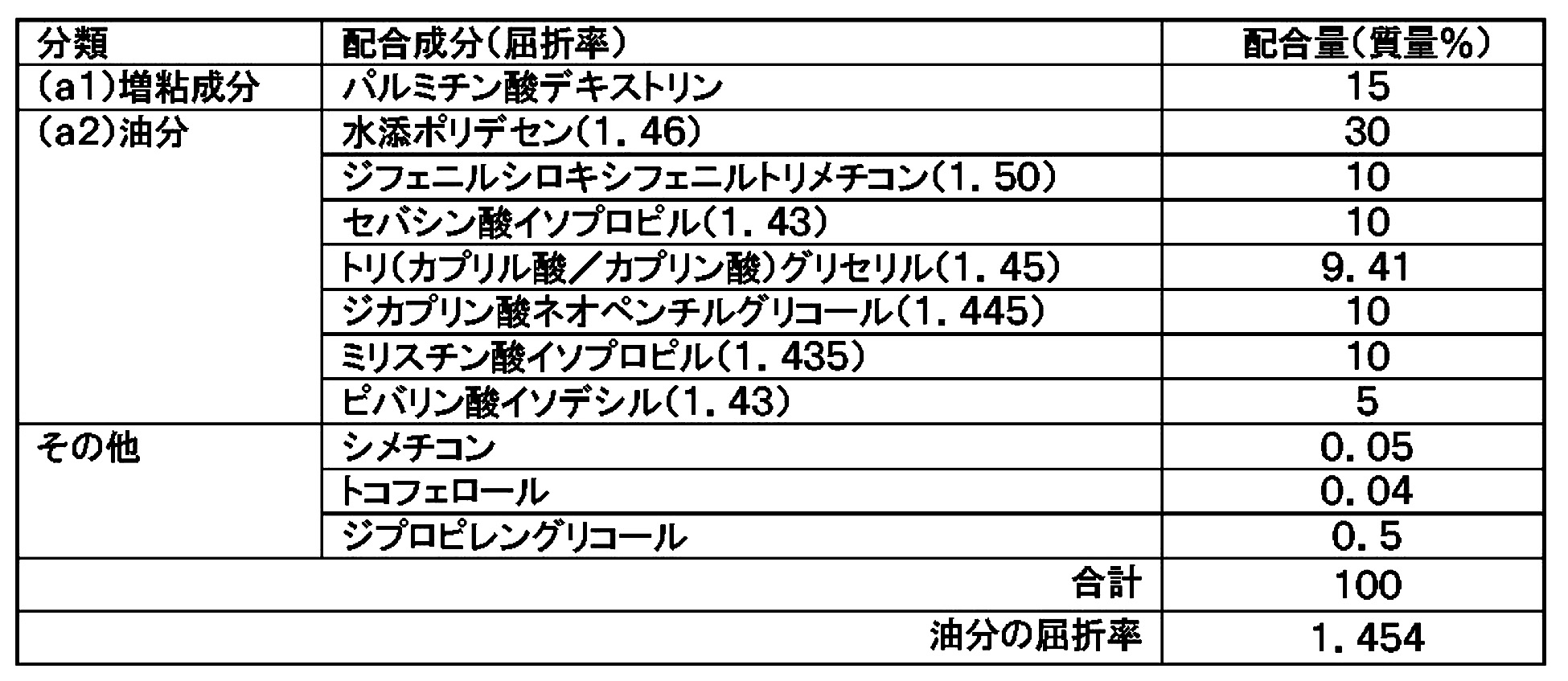
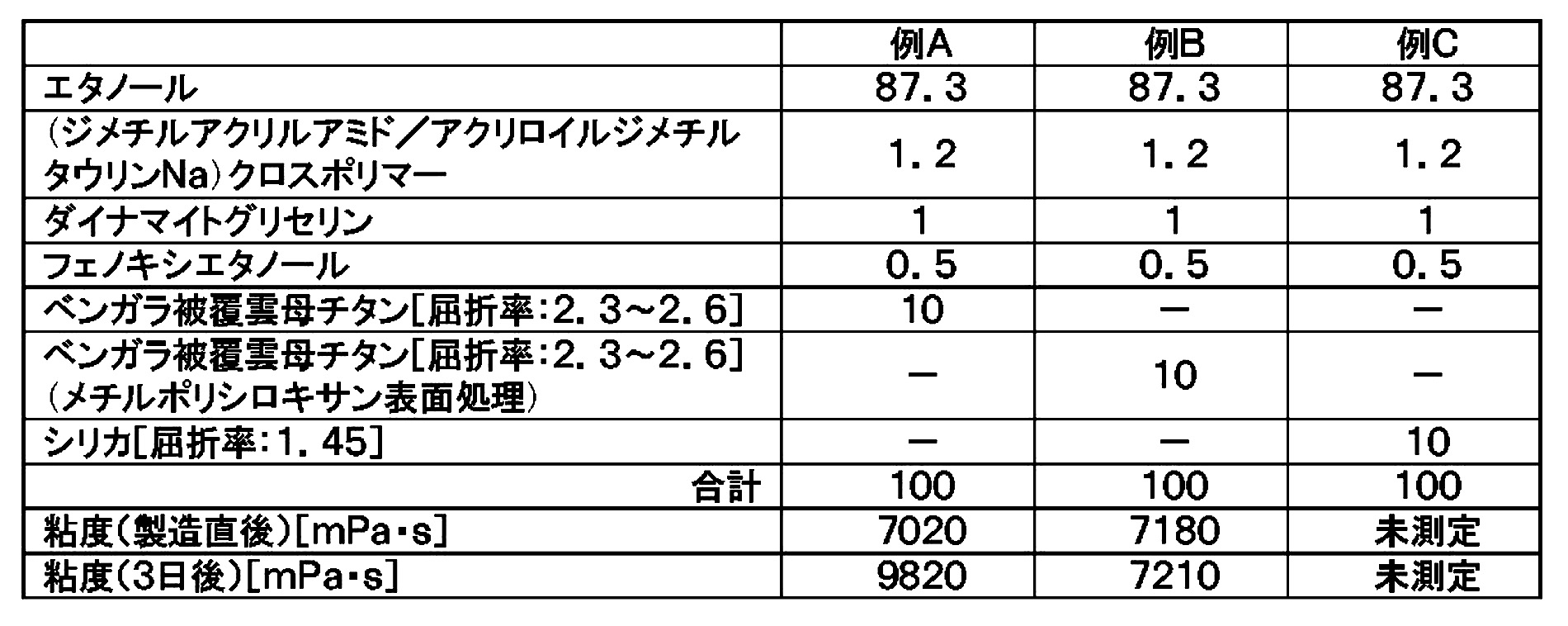
しかし、表2の例Cに記載した組成のインク組成物を用いて容器底面に描画して加飾層を形成し、その上に表1の透明油性基剤を充填した場合(比較例1)では、加飾層が液状油分の屈折率より低い屈折率の粉末(シリカ)しか含んでいないため、加飾層の輪郭がぼやけて明瞭に視認できず、審美性に劣るものとなった(図3参照)。
Claims (5)
- (A)透明油性基剤と、(B)少なくとも1つの加飾層とを有する油性固形化粧料であって、
前記(A)透明油性基剤が(a1)増粘成分及び(a2)液状油分を含有し、
前記(B)加飾層が(b1)粉末成分を含有し、
前記(b1)粉末成分が、前記(a2)液状油分の屈折率より高い屈折率を有する粉末を含むことを特徴とする、油性固形化粧料。 - 前記(a2)液状油分より高い屈折率を有する粉末が、前記(a2)液状油分の屈折率より0.01以上高い屈折率を有する、請求項1に記載の油性固形化粧料。
- 前記(a2)液状油分が1.42~1.52の屈折率を有する油からなる、請求項1又は2に記載の油性固形化粧料。
- 前記(b1)粉末成分が、1.45より高い屈折率を有する粉末を含む、請求項1から3のいずれか一項に記載の油性固形化粧料。
- 前記(b1)粉末成分を(b2)分散媒体中に分散させたインク組成物を用いて描画することにより(B)加飾層を形成する工程、及び
前記(A)透明油性基剤を容器内に充填する工程、
を含む、請求項1に記載の油性固形化粧料の製造方法。
Priority Applications (2)
| Application Number | Priority Date | Filing Date | Title |
|---|---|---|---|
| US17/418,614 US12383473B2 (en) | 2018-12-27 | 2019-12-26 | Oil-based cosmetic product having decorative layer |
| CN201980085043.5A CN113226265B (zh) | 2018-12-27 | 2019-12-26 | 具有加饰层的油性化妆品 |
Applications Claiming Priority (2)
| Application Number | Priority Date | Filing Date | Title |
|---|---|---|---|
| JP2018-244017 | 2018-12-27 | ||
| JP2018244017A JP7226988B2 (ja) | 2018-12-27 | 2018-12-27 | 加飾層を有する油性化粧料 |
Publications (1)
| Publication Number | Publication Date |
|---|---|
| WO2020138322A1 true WO2020138322A1 (ja) | 2020-07-02 |
Family
ID=71129515
Family Applications (1)
| Application Number | Title | Priority Date | Filing Date |
|---|---|---|---|
| PCT/JP2019/051206 Ceased WO2020138322A1 (ja) | 2018-12-27 | 2019-12-26 | 加飾層を有する油性化粧料 |
Country Status (5)
| Country | Link |
|---|---|
| US (1) | US12383473B2 (ja) |
| JP (1) | JP7226988B2 (ja) |
| CN (1) | CN113226265B (ja) |
| TW (1) | TW202038889A (ja) |
| WO (1) | WO2020138322A1 (ja) |
Families Citing this family (5)
| Publication number | Priority date | Publication date | Assignee | Title |
|---|---|---|---|---|
| JP7038071B2 (ja) * | 2019-02-21 | 2022-03-17 | 株式会社アルビオン | 化粧料の製造方法 |
| JP7048528B2 (ja) * | 2019-02-21 | 2022-04-05 | 株式会社アルビオン | 化粧料の製造方法 |
| JP7595082B2 (ja) * | 2020-10-16 | 2024-12-05 | 株式会社 資生堂 | 固形化粧料および固形化粧料の製造方法 |
| JP7675419B2 (ja) * | 2020-11-11 | 2025-05-13 | アサヌマ コーポレーション株式会社 | 単層領域及び二層領域を有する固形化粧料、並びにその製造方法 |
| WO2022122837A1 (en) * | 2020-12-09 | 2022-06-16 | Dsm Ip Assets B.V. | Increased solubilization of bemotrizinol |
Citations (8)
| Publication number | Priority date | Publication date | Assignee | Title |
|---|---|---|---|---|
| JP2002068925A (ja) * | 2000-08-30 | 2002-03-08 | Shiseido Co Ltd | 透明部分を含む外用固形組成物 |
| JP2005089337A (ja) * | 2003-09-12 | 2005-04-07 | Shiseido Co Ltd | 多層状透明ゲル組成物及びその製造方法 |
| JP3657148B2 (ja) * | 1999-07-28 | 2005-06-08 | 株式会社資生堂 | 透明化粧料 |
| JP2005239600A (ja) * | 2004-02-25 | 2005-09-08 | Key Tranding Co Ltd | 化粧製品および化粧製品の製造方法 |
| JP2010099226A (ja) * | 2008-10-23 | 2010-05-06 | Nippon Shikizai Inc | 化粧料構成体又は化粧品の装飾方法並びに装飾される化粧品 |
| JP2010105952A (ja) * | 2008-10-30 | 2010-05-13 | Shiseido Co Ltd | 油性固形化粧料 |
| JP2011032181A (ja) * | 2009-07-30 | 2011-02-17 | Key Tranding Co Ltd | 組み合わせ化粧料およびその製法 |
| JP2014162791A (ja) * | 2013-02-28 | 2014-09-08 | Nippon Shikizai Inc | 化粧料 |
Family Cites Families (2)
| Publication number | Priority date | Publication date | Assignee | Title |
|---|---|---|---|---|
| US8333955B2 (en) * | 2007-03-19 | 2012-12-18 | Elc Management Llc | High shine, stick-shaped cosmetic products |
| EP3536497B1 (en) * | 2016-11-02 | 2021-01-06 | Toppan Printing Co., Ltd. | Decorative material |
-
2018
- 2018-12-27 JP JP2018244017A patent/JP7226988B2/ja active Active
-
2019
- 2019-12-26 CN CN201980085043.5A patent/CN113226265B/zh active Active
- 2019-12-26 WO PCT/JP2019/051206 patent/WO2020138322A1/ja not_active Ceased
- 2019-12-26 US US17/418,614 patent/US12383473B2/en active Active
- 2019-12-27 TW TW108148037A patent/TW202038889A/zh unknown
Patent Citations (8)
| Publication number | Priority date | Publication date | Assignee | Title |
|---|---|---|---|---|
| JP3657148B2 (ja) * | 1999-07-28 | 2005-06-08 | 株式会社資生堂 | 透明化粧料 |
| JP2002068925A (ja) * | 2000-08-30 | 2002-03-08 | Shiseido Co Ltd | 透明部分を含む外用固形組成物 |
| JP2005089337A (ja) * | 2003-09-12 | 2005-04-07 | Shiseido Co Ltd | 多層状透明ゲル組成物及びその製造方法 |
| JP2005239600A (ja) * | 2004-02-25 | 2005-09-08 | Key Tranding Co Ltd | 化粧製品および化粧製品の製造方法 |
| JP2010099226A (ja) * | 2008-10-23 | 2010-05-06 | Nippon Shikizai Inc | 化粧料構成体又は化粧品の装飾方法並びに装飾される化粧品 |
| JP2010105952A (ja) * | 2008-10-30 | 2010-05-13 | Shiseido Co Ltd | 油性固形化粧料 |
| JP2011032181A (ja) * | 2009-07-30 | 2011-02-17 | Key Tranding Co Ltd | 組み合わせ化粧料およびその製法 |
| JP2014162791A (ja) * | 2013-02-28 | 2014-09-08 | Nippon Shikizai Inc | 化粧料 |
Also Published As
| Publication number | Publication date |
|---|---|
| CN113226265A (zh) | 2021-08-06 |
| CN113226265B (zh) | 2025-02-18 |
| JP7226988B2 (ja) | 2023-02-21 |
| US12383473B2 (en) | 2025-08-12 |
| JP2020105096A (ja) | 2020-07-09 |
| TW202038889A (zh) | 2020-11-01 |
| US20220142876A1 (en) | 2022-05-12 |
Similar Documents
| Publication | Publication Date | Title |
|---|---|---|
| US12383473B2 (en) | Oil-based cosmetic product having decorative layer | |
| JP7036456B2 (ja) | 化粧料からなる絵の具材料、絵の具材料用希釈剤、絵の具及び絵の具セット | |
| TWI606844B (zh) | Eye cosmetic composition | |
| CN107205905B (zh) | 彩妆化妆品 | |
| JP2015218113A (ja) | うるおい補給用スティック状化粧料 | |
| JPWO2011002002A1 (ja) | 固型粉末化粧料 | |
| WO2013115099A1 (ja) | メーキャップ化粧料 | |
| TW200528135A (en) | Transparent solid composition and transparent solid cosmetic preparation containing the same as base | |
| JP4202873B2 (ja) | 多層状透明ゲル化粧料及びその製造方法 | |
| TWI643634B (zh) | Makeup cosmetics | |
| JP5894784B2 (ja) | 油性メイクアップ化粧料 | |
| JP7595082B2 (ja) | 固形化粧料および固形化粧料の製造方法 | |
| JP2001019613A (ja) | ペンシル状又はスティック状固形化粧料 | |
| JP6231748B2 (ja) | 油性固形化粧料 | |
| JP7319718B2 (ja) | 化粧料からなる絵の具材料及び化粧料を絵の具材料として使用するための選択方法 | |
| CN113272023A (zh) | 能变成粉末的化妆品组合物 | |
| JP2014136704A (ja) | 化粧料 | |
| JP7365193B2 (ja) | 口唇化粧料 | |
| JP2014162791A (ja) | 化粧料 | |
| CN114901239A (zh) | 化妆品 | |
| HK1240816A1 (en) | Makeup cosmetic | |
| TW201924650A (zh) | 粉末化妝料 | |
| HK1236846A1 (en) | Makeup cosmetic | |
| WO2016117640A1 (ja) | メーキャップ化粧料 | |
| HK1240816B (en) | Makeup cosmetic |
Legal Events
| Date | Code | Title | Description |
|---|---|---|---|
| 121 | Ep: the epo has been informed by wipo that ep was designated in this application |
Ref document number: 19903431 Country of ref document: EP Kind code of ref document: A1 |
|
| NENP | Non-entry into the national phase |
Ref country code: DE |
|
| 122 | Ep: pct application non-entry in european phase |
Ref document number: 19903431 Country of ref document: EP Kind code of ref document: A1 |
|
| WWG | Wipo information: grant in national office |
Ref document number: 201980085043.5 Country of ref document: CN |
|
| WWG | Wipo information: grant in national office |
Ref document number: 17418614 Country of ref document: US |