WO2020138092A1 - 水素ガスを用いた前処理によるレジスト下層膜のエッチング耐性を向上する方法 - Google Patents
水素ガスを用いた前処理によるレジスト下層膜のエッチング耐性を向上する方法 Download PDFInfo
- Publication number
- WO2020138092A1 WO2020138092A1 PCT/JP2019/050644 JP2019050644W WO2020138092A1 WO 2020138092 A1 WO2020138092 A1 WO 2020138092A1 JP 2019050644 W JP2019050644 W JP 2019050644W WO 2020138092 A1 WO2020138092 A1 WO 2020138092A1
- Authority
- WO
- WIPO (PCT)
- Prior art keywords
- group
- film
- methyl
- resist
- etching
- Prior art date
- Legal status (The legal status is an assumption and is not a legal conclusion. Google has not performed a legal analysis and makes no representation as to the accuracy of the status listed.)
- Ceased
Links
Classifications
-
- G—PHYSICS
- G03—PHOTOGRAPHY; CINEMATOGRAPHY; ANALOGOUS TECHNIQUES USING WAVES OTHER THAN OPTICAL WAVES; ELECTROGRAPHY; HOLOGRAPHY
- G03F—PHOTOMECHANICAL PRODUCTION OF TEXTURED OR PATTERNED SURFACES, e.g. FOR PRINTING, FOR PROCESSING OF SEMICONDUCTOR DEVICES; MATERIALS THEREFOR; ORIGINALS THEREFOR; APPARATUS SPECIALLY ADAPTED THEREFOR
- G03F7/00—Photomechanical, e.g. photolithographic, production of textured or patterned surfaces, e.g. printing surfaces; Materials therefor, e.g. comprising photoresists; Apparatus specially adapted therefor
- G03F7/004—Photosensitive materials
- G03F7/09—Photosensitive materials characterised by structural details, e.g. supports, auxiliary layers
- G03F7/11—Photosensitive materials characterised by structural details, e.g. supports, auxiliary layers having cover layers or intermediate layers, e.g. subbing layers
-
- H—ELECTRICITY
- H10—SEMICONDUCTOR DEVICES; ELECTRIC SOLID-STATE DEVICES NOT OTHERWISE PROVIDED FOR
- H10P—GENERIC PROCESSES OR APPARATUS FOR THE MANUFACTURE OR TREATMENT OF DEVICES COVERED BY CLASS H10
- H10P50/00—Etching of wafers, substrates or parts of devices
- H10P50/20—Dry etching; Plasma etching; Reactive-ion etching
- H10P50/24—Dry etching; Plasma etching; Reactive-ion etching of semiconductor materials
- H10P50/242—Dry etching; Plasma etching; Reactive-ion etching of semiconductor materials of Group IV materials
-
- H—ELECTRICITY
- H10—SEMICONDUCTOR DEVICES; ELECTRIC SOLID-STATE DEVICES NOT OTHERWISE PROVIDED FOR
- H10P—GENERIC PROCESSES OR APPARATUS FOR THE MANUFACTURE OR TREATMENT OF DEVICES COVERED BY CLASS H10
- H10P76/00—Manufacture or treatment of masks on semiconductor bodies, e.g. by lithography or photolithography
Definitions
- the present invention relates to a method for improving the etching resistance of a resist underlayer film by pretreatment using hydrogen gas.
- a thin film of photoresist is formed on a semiconductor substrate such as a silicon wafer, and active rays such as ultraviolet rays are radiated through a mask pattern on which a semiconductor device pattern is drawn. Then, the substrate is developed, and the obtained photoresist pattern is used as a protective film to etch the substrate to form fine irregularities corresponding to the pattern on the substrate surface.
- active light rays have a tendency to have a shorter wavelength as described above
- the influence of reflection of active light rays from a semiconductor substrate has become a serious problem, and photoresists and workpieces have been processed.
- a method of providing a resist underlayer film called an antireflection film (Bottom Anti-Reflective Coating, BARC) between substrates has been widely applied.
- an antireflection film for example, an underlayer film containing silicon or the like has been proposed (Patent Document 1, Patent Document 2, etc.).
- the rate of removal by etching depends on the gas species used for etching due to the difference in the constituent components between the resist and the lower layer film, and by appropriately selecting the gas species, the target pattern can be obtained. Planned.
- a pattern inversion method there is a pattern inversion method.
- a resist pattern is formed on a semiconductor substrate, then the resist pattern is covered with a silicon-based coating liquid, the space between the resist patterns is filled with the coating liquid, and this is baked to form a coating film.
- the upper part of the silicon-containing coating film is etched back to expose the upper part of the resist pattern, and then the gas is changed to remove the resist pattern by etching.
- the silicon-based pattern remains, and the pattern is inverted.
- the inverted pattern is transferred and the pattern is formed on the substrate.
- Patent Documents 3 to 6 A composition containing polysiloxane has been proposed as a material used for forming such an inversion pattern.
- a resist underlayer film for such a process unlike a conventional high etch rate resist underlayer film, a resist underlayer film for lithography having a dry etching rate selection ratio close to that of a resist, and a dry etching rate smaller than that of a resist are selected.
- the present invention aims to provide a new method for improving the resistance to halogen-containing gas etching.
- the present inventors have found that before the halogen-containing gas etching, the silicon-containing film is etched or ashed with a hydrogen gas-containing gas to obtain a film after the treatment. In the present invention, they found that the etching resistance to the halogen-containing gas etching was improved, and completed the present invention.
- the present invention is a method of improving the halogen-containing gas etching resistance of a silicon-containing film, which comprises a step of etching or ashing the silicon-containing film with a hydrogen gas-containing gas before the halogen-containing gas etching. Including, regarding the method.
- a second aspect relates to the method for improving the etching resistance according to the first aspect, wherein the silicon-containing film is a resist underlayer film.
- a step of forming a resist underlayer film from a silicon-containing resist underlayer film forming composition on a semiconductor substrate A step of etching or ashing the resist underlayer film with a gas containing hydrogen gas, A step of forming a resist film on the resist underlayer film etched or ashed with a gas containing hydrogen gas, A step of forming a resist pattern by irradiation with light or an electron beam and development,
- the present invention relates to a method for manufacturing a semiconductor device, including a step of etching the resist underlayer film with the formed resist pattern, and a step of processing a semiconductor substrate with the patterned resist film and the patterned resist underlayer film.
- a step of forming a resist film on the substrate A step of forming a resist pattern by irradiation with light or an electron beam and development, A step of applying a silicon-containing thin film forming composition on a resist film on which a pattern is formed during or after development and baking to form a thin film, Etching or ashing the thin film with a gas containing hydrogen gas, Etching and removing the patterned resist film, inverting the pattern, And a method for manufacturing a semiconductor device.
- a fifth aspect is a method for producing a resist underlayer film having improved halogen-containing gas etching resistance, Including a step of etching or ashing the lower layer film with a gas containing hydrogen gas,
- the underlayer film is a cured product of a silicon-containing resist underlayer film forming composition, It relates to a manufacturing method.
- the silicon-containing resist underlayer film forming composition has a polysiloxane composed of a hydrolytic condensate of a hydrolyzable silane, a reaction product of a silanol group and an alcohol contained in the condensate, and a condensate of the polysiloxane.
- the manufacturing method according to the fifth aspect As a seventh aspect, the production method according to the sixth aspect, wherein the polysiloxane is a hydrolysis-condensation product of a hydrolyzable silane containing at least one hydrolyzable silane represented by the following formula (1).
- R 1 is an organic group having an alkyl group, an aryl group, a halogenated alkyl group, a halogenated aryl group, an alkoxyaryl group, an alkenyl group, or an epoxy group, an acryloyl group, a methacryloyl group, a mercapto group, or a cyano group. It is shown, and are those that are bonded to a silicon atom by Si-C bond, R 2 represents an alkoxy group, an acyloxy group, or a halogen atom, a is an integer of 0 to 3.
- the present invention it is possible to improve the halogen-containing gas etching resistance of the silicon-containing film by etching or ashing the silicon-containing film with a hydrogen gas-containing gas in advance.
- the present invention relates to a method for improving the halogen-containing gas etching resistance of a silicon-containing film, including the step of etching or ashing the silicon-containing film with a hydrogen gas-containing gas.
- the present invention also relates to a method for manufacturing a semiconductor device, which includes a step of etching or ashing a resist underlayer film or a thin film with a gas containing hydrogen gas.
- the present invention relates to a method for producing a resist underlayer film having improved halogen-containing gas etching resistance.
- halogen-containing gas for improving the gas etching resistance (dry etching resistance) means a gas that is a molecule containing a halogen atom (fluorine, chlorine, bromine, etc.) as a constituent atom, and is, for example, tetrafluoro Methane (CF 4 ), perfluorocyclobutane (C 4 F 8 ), perfluoropropane (C 3 F 8 ), trifluoromethane (CHF 3 ), difluoromethane (CH 2 F 2 ), sulfur hexafluoride, trifluoride Examples thereof include, but are not limited to, fluorine-containing gases such as nitrogen; chlorine-containing gases such as chlorine, chlorine trifluoride, trichloroborane and dichloroborane; and bromine-containing gases such as hydrogen bromide (HBr).
- fluorine-containing gases such as nitrogen
- chlorine-containing gases such as chlorine, chlorine trifluoride, trichloroborane and dichloro
- the gas used for the etching or ashing treatment is not particularly limited as long as it is a hydrogen gas-containing gas.
- the “hydrogen gas-containing gas” means a gas containing hydrogen gas (H 2 ), and the hydrogen gas (H 2 ) itself or a mixed gas of hydrogen (H 2 ) and nitrogen (N 2 ), for example.
- a mixed gas of hydrogen gas (H 2 ) such as a mixed gas of hydrogen (H 2 ) and helium (He) and another gas.
- the etching treatment can be carried out usually at 20 to 50° C.
- the ashing treatment can be carried out usually at 20 to 320° C.
- the total flow rate of all gases in the etching process or the ashing process and the flow rate of the hydrogen gas (H 2 ) when a mixed gas is used are appropriately determined in consideration of the desired halogen-containing gas etching resistance level and other circumstances.
- the etching rate in the present invention can be measured, for example, with a dry etching apparatus Lam2300 manufactured by Lam Research.
- the silicon-containing film (resist underlayer film, thin film) to be etched/ashed to which the present invention is applied can be formed from a composition containing polysiloxane.
- the silicon-containing film (resist underlayer film, thin film) By subjecting the silicon-containing film (resist underlayer film, thin film) to etching or ashing with the above-mentioned hydrogen gas-containing gas, the halogen-containing gas etching resistance can be improved and the halogen-containing gas etching resistance can be improved. It is possible to manufacture a silicon-containing film (resist underlayer film, thin film).
- the polysiloxane includes a polysiloxane composed of a hydrolyzed condensate of a hydrolyzable silane, and may also include a modified polysiloxane in which a part of silanol groups of the polysiloxane composed of the hydrolyzed condensate is modified. Good. Further, the polysiloxane may have a structure having any of a cage type, a ladder type, a linear type, and a branched type main chain.
- the weight average molecular weight of the polysiloxane can be 1,000 to 1,000,000. For example, a preferable weight average molecular weight can be 1,000 to 100,000, or 1,000 to 50,000 or 1,200 to 20,000.
- the compounds described in Patent Documents 1 to 6 described above can be used, and commercially available polysiloxane can be used.
- the above-mentioned polysiloxane usually contains a hydrolytic condensate of a hydrolyzable silane.
- the hydrolyzable silane can include one or more silanes.
- Examples of the polysiloxane include a hydrolysis-condensation product of a hydrolyzable silane containing at least one hydrolyzable silane represented by the following formula (1).
- R 1 has an alkyl group, an aryl group, a halogenated alkyl group, a halogenated aryl group, an alkoxyaryl group, an alkenyl group, or an epoxy group, an acryloyl group, a methacryloyl group, a mercapto group, or a cyano group. It represents an organic group and is bonded to a silicon atom by a Si—C bond, R 2 represents an alkoxy group, an acyloxy group, or a halogen atom, and a represents an integer of 0 to 3.
- the polysiloxane is a hydrolysis-condensation product of a hydrolyzable silane (ii) in which a in the formula (1) is 1, a hydrolyzable silane (i) in which a in the formula (1) is 0, and A co-hydrolysis condensate with a hydrolyzable silane (ii) in which a in 1 is 1 can be used.
- the above-mentioned polysiloxane can be used in the range of hydrolyzable silane (i):hydrolyzable silane (ii) in a molar ratio of 0:100 to 50:50, or 10:90 to 50:50.
- the above-mentioned polysiloxane (hydrolyzed condensate) can also be used as a mixture of hydrolyzable silane or its hydrolyzed product.
- a partial hydrolyzate or a silane compound which is not completely hydrolyzed when obtaining a hydrolyzed condensate is mixed with the hydrolyzed condensate, the mixture can also be used.
- This condensate is a polymer having a polysiloxane structure.
- the alkyl group includes, for example, a linear or branched alkyl group having 1 to 10 carbon atoms, and examples thereof include a methyl group, an ethyl group, an n-propyl group, an i-propyl group, and an n-group.
- a cyclic alkyl group can also be used, and examples of the cyclic alkyl group having 3 to 10 carbon atoms include cyclopropyl group, cyclobutyl group, 1-methyl-cyclopropyl group, 2-methyl-cyclopropyl group, cyclopentyl group, and 1 -Methyl-cyclobutyl group, 2-methyl-cyclobutyl group, 3-methyl-cyclobutyl group, 1,2-dimethyl-cyclopropyl group, 2,3-dimethyl-cyclopropyl group, 1-ethyl-cyclopropyl group, 2- Ethyl-cyclopropyl group, cyclohexyl group, 1-methyl-cyclopentyl group, 2-methyl-cyclopentyl group, 3-methyl-cyclopentyl group, 1-ethyl-cyclobutyl group, 2-ethyl-cyclobutyl group, 3-ethyl-cyclobutyl group , 1,2-dimethyl-cyclobut
- aryl group examples include aryl groups having 6 to 20 carbon atoms, such as phenyl group, o-methylphenyl group, m-methylphenyl group, p-methylphenyl group, o-chlorophenyl group, m- Chlorphenyl group, p-chlorophenyl group, o-fluorophenyl group, p-mercaptophenyl group, o-methoxyphenyl group, p-methoxyphenyl group, p-aminophenyl group, p-cyanophenyl group, ⁇ -naphthyl group , ⁇ -naphthyl group, o-biphenylyl group, m-biphenylyl group, p-biphenylyl group, 1-anthryl group, 2-anthryl group, 9-anthryl group, 1-phenanthryl group, 2-phenanthryl group, 3-phenanthryl group And 4-phenanth
- alkenyl group examples include alkenyl groups having 2 to 10 carbon atoms, such as ethenyl group (vinyl group), 1-propenyl group, 2-propenyl group, 1-methyl-1-ethenyl group, 1-butenyl group, 2-butenyl group, 3-butenyl group, 2-methyl-1-propenyl group, 2-methyl-2-propenyl group, 1-ethylethenyl group, 1-methyl-1-propenyl group, 1-methyl-2-propenyl group , 1-pentenyl group, 2-pentenyl group, 3-pentenyl group, 4-pentenyl group, 1-n-propylethenyl group, 1-methyl-1-butenyl group, 1-methyl-2-butenyl group, 1- Methyl-3-butenyl group, 2-ethyl-2-propenyl group, 2-methyl-1-butenyl group, 2-methyl-2-butenyl group, 2-methyl-3-butenyl group, 3-methyl-1-buten
- Examples of the organic group having an epoxy group include a glycidoxymethyl group, a glycidoxyethyl group, a glycidoxypropyl group, a glycidoxybutyl group, and an epoxycyclohexyl group.
- Examples of the organic group having an acryloyl group include an acryloylmethyl group, an acryloylethyl group, and an acryloylpropyl group.
- Examples of the organic group having a methacryloyl group include a methacryloylmethyl group, a methacryloylethyl group, and a methacryloylpropyl group.
- Examples of the organic group having a mercapto group include an ethylmercapto group, a butylmercapto group, a hexylmercapto group, and an octylmercapto group.
- Examples of the organic group having a cyano group include a cyanoethyl group and a cyanopropyl group.
- alkoxy group examples include an alkoxy group having a linear, branched, or cyclic alkyl moiety having 1 to 20 carbon atoms.
- linear or branched alkoxy group examples include methoxy group, ethoxy group, n-propoxy group, i-propoxy group, n-butoxy group, i-butoxy group, s-butoxy group, t-butoxy group, n -Pentyloxy group, 1-methyl-n-butoxy group, 2-methyl-n-butoxy group, 3-methyl-n-butoxy group, 1,1-dimethyl-n-propoxy group, 1,2-dimethyl-n- Propoxy group, 2,2-dimethyl-n-propoxy group, 1-ethyl-n-propoxy group, n-hexyloxy group, 1-methyl-n-pentyloxy group, 2-methyl-n-pentyloxy group, 3-methyl- n-pentyloxy group, 4-methyl-n-pentyloxy group, 1,1-
- cyclic alkoxy group examples include cyclopropoxy group, cyclobutoxy group, 1-methyl-cyclopropoxy group, 2-methyl-cyclopropoxy group, cyclopentyloxy group, 1-methyl-cyclobutoxy group, 2-methyl- Cyclobutoxy group, 3-methyl-cyclobutoxy group, 1,2-dimethyl-cyclopropoxy group, 2,3-dimethyl-cyclopropoxy group, 1-ethyl-cyclopropoxy group, 2-ethyl-cyclopropoxy group, cyclohexyloxy Group, 1-methyl-cyclopentyloxy group, 2-methyl-cyclopentyloxy group, 3-methyl-cyclopentyloxy group, 1-ethyl-cyclobutoxy group, 2-ethyl-cyclobutoxy group, 3-ethyl-cyclo Butoxy group, 1,2-dimethyl-cyclobutoxy group, 1,3-dimethyl-cyclobutoxy group, 2,2-dimethyl-cyclobutoxy group, 2,3-dimethyl-cyclobutoxy group
- acyloxy group examples include an acyloxy group having 2 to 20 carbon atoms, and examples thereof include a methylcarbonyloxy group, an ethylcarbonyloxy group, an n-propylcarbonyloxy group, an i-propylcarbonyloxy group and an n-butylcarbonyloxy group.
- the above halogen atom includes a fluorine atom, a chlorine atom, a bromine atom, an iodine atom and the like.
- the hydrolyzable silane represented by the above formula (1) is a tetraalkoxysilane in which a is 0 in the formula (1), a methyltrialkoxysilane in which a is 1 in the formula (1), a vinyltrialkoxysilane, or It is preferable to contain any one of phenyltrialkoxysilane and dimethyldialkoxysilane in which a is 2 in the formula (1).
- a modified polysiloxane in which at least a part of silanol groups is modified can be used as the polysiloxane.
- the modified polysiloxane is a product obtained by reacting a part of the silanol groups of the condensate with a hydroxy group of an alcohol in the hydrolysis-condensation product of the above-mentioned hydrolyzable silane.
- Examples thereof include a dehydration reaction product of the polysiloxane, which is composed of a decomposition condensate, an alcohol and an acid, and a modified product obtained by protecting a part of the silanol group of the condensate with an acetal group.
- a monohydric alcohol can be used.
- 3-methoxybutanol ethylene glycol monomethyl ether, ethylene glycol monoethyl ether, diethylene glycol monomethyl ether, diethylene glycol monoethyl ether, propylene glycol monomethyl ether (1-methoxy-2-propanol), propylene glycol monoethyl ether (1-ethoxy Alkoxy group-containing alcohols such as -2-propanol) and propylene glycol monobutyl ether (1-butoxy-2-propanol) can be used.
- the reaction between the silanol group contained in the condensate and the hydroxy group of the alcohol is carried out by contacting the polysiloxane with the alcohol and reacting at a temperature of 110 to 160° C., for example 150° C. for 0.1 to 48 hours, for example 24 hours.
- a modified polysiloxane capped with silanol groups can be obtained.
- the alcohol of the capping agent can be used as a solvent in the composition containing the polysiloxane.
- the dehydration reaction product of the polysiloxane composed of the hydrolysis-condensation product of the hydrolyzable silane with the alcohol and the acid reacts the polysiloxane with the alcohol and the acid, and removes water generated by dehydration to the outside of the reaction system.
- the acid an organic acid having an acid dissociation constant (pka) of -1 to 5, preferably 4 to 5, can be used.
- the acid can be exemplified by trifluoroacetic acid, maleic acid, benzoic acid, isobutyric acid, acetic acid and the like, and among them, benzoic acid, isobutyric acid, acetic acid and the like.
- an acid having a boiling point of 70 to 160° C. can be used, and examples thereof include trifluoroacetic acid, isobutyric acid, and acetic acid.
- the above-mentioned acid is preferably one having an acid dissociation constant (pka) of 4 to 5 or a boiling point of 70 to 160° C. That is, the one having a weak acidity or the one having a strong acidity but a low boiling point can be used.
- any property can be used from the properties of acid dissociation constant and boiling point.
- a vinyl ether for example, a vinyl ether represented by the following formula (3)
- the partial structure represented by the following formula (2) is converted into a polyether by the reaction. It can be introduced into the siloxane.
- R 1a , R 2a , and R 3a each represent a hydrogen atom or an alkyl group having 1 to 10 carbon atoms
- R 4a represents an alkyl group having 1 to 10 carbon atoms
- R 2a And R 4a may combine with each other to form a ring.
- the above-mentioned examples of the alkyl group can be mentioned.
- R 1 ′, R 2 ′, and R 3 ′ each represent a hydrogen atom or an alkyl group having 1 to 10 carbon atoms
- R 4 ′ is an alkyl group having 1 to 10 carbon atoms.
- R 2 ′ and R 4 ′ may combine with each other to form a ring.
- * indicates a bond with an adjacent atom.
- the adjacent atom include an oxygen atom of a siloxane bond, an oxygen atom of a silanol group, and a carbon atom derived from R 1 of formula (1).
- the above-mentioned examples of the alkyl group can be mentioned.
- Examples of the vinyl ether represented by the above formula (3) include aliphatic vinyl ether compounds such as methyl vinyl ether, ethyl vinyl ether, isopropyl vinyl ether, normal butyl vinyl ether, 2-ethylhexyl vinyl ether, tert-butyl vinyl ether, and cyclohexyl vinyl ether; Cyclic vinyl ether compounds such as 3-dihydrofuran, 4-methyl-2,3-dihydrofuran, and 3,4-dihydro-2H-pyran can be used.
- ethyl vinyl ether propyl vinyl ether, butyl vinyl ether, ethylhexyl vinyl ether, cyclohexyl vinyl ether, 3,4-dihydro-2H-pyran, or 2,3-dihydrofuran can be preferably used.
- the acetal protection of the silanol group is carried out by using polysiloxane, the vinyl ether, and an aprotic solvent such as propylene glycol monomethyl ether acetate, ethyl acetate, dimethylformamide, tetrahydrofuran, 1,4-dioxane as a solvent, and pyridium paratoluene. It can be carried out by using a catalyst such as sulfonic acid, trifluoromethanesulfonic acid, paratoluenesulfonic acid, methanesulfonic acid, hydrochloric acid, sulfuric acid.
- a catalyst such as sulfonic acid, trifluoromethanesulfonic acid, paratoluenesulfonic acid, methanesulfonic acid, hydrochloric acid, sulfuric acid.
- the hydrolysis-condensation product of the above hydrolyzable silane (which may include a polysiloxane and a modified product) has a weight average molecular weight of, for example, 1,000 to 1,000,000, or 1,000 to 100,000, or It can be a condensate of 1,000 to 50,000 and 1,200 to 20,000. These molecular weights are molecular weights obtained by GPC analysis in terms of polystyrene.
- the measurement conditions of GPC are, for example, GPC device (trade name HLC-8220GPC, manufactured by Tosoh Corporation), GPC column (trade name Shodex (registered trademark) KF803L, KF802, KF801, manufactured by Showa Denko KK), and column temperature is 40° C.
- the eluent (elution solvent) is tetrahydrofuran
- the flow rate (flow rate) is 1.0 ml/min
- the standard sample is polystyrene (Showa Denko KK).
- one of the hydrolyzable groups is used. 0.1 to 100 mol, preferably 1 to 10 mol of water is used per mol.
- the hydrolysis may be performed with or without a hydrolysis catalyst. When the hydrolysis catalyst is used, 0.0001 to 10 mol, preferably 0.001 to 1 mol of the hydrolysis catalyst can be used per 1 mol of the hydrolyzable group.
- the reaction temperature at the time of carrying out hydrolysis and condensation can be carried out usually in the range of room temperature or higher and the reflux temperature of the organic solvent used for hydrolysis at normal pressure or lower, and is, for example, 20 to 110°C.
- the hydrolysis may be complete hydrolysis, that is, all hydrolyzable groups may be converted into silanol groups, or may be partially hydrolyzed, that is, unreacted hydrolyzable groups may be left. That is, after the hydrolysis and condensation reaction, uncondensed hydrolyzate or monomers may remain in the hydrolyzed condensate.
- the hydrolysis catalyst that can be used for hydrolysis and condensation include metal chelate compounds, organic acids, inorganic acids, organic bases, and inorganic bases.
- Examples of the metal chelate compound as a hydrolysis catalyst include triethoxy mono(acetylacetonato)titanium, tri-n-propoxy mono(acetylacetonato)titanium, tri-i-propoxy mono(acetylacetonato)titanium, tritium.
- Organic acids as hydrolysis catalysts include, for example, acetic acid, propionic acid, butanoic acid, pentanoic acid, hexanoic acid, heptanoic acid, octanoic acid, nonanoic acid, decanoic acid, oxalic acid, maleic acid, methylmalonic acid, adipic acid, sebacine.
- the inorganic acid as the hydrolysis catalyst include hydrochloric acid, nitric acid, sulfuric acid, hydrofluoric acid, phosphoric acid and the like.
- Organic bases as hydrolysis catalysts include, for example, pyridine, pyrrole, piperazine, pyrrolidine, piperidine, picoline, trimethylamine, triethylamine, monoethanolamine, diethanolamine, dimethylmonoethanolamine, monomethyldiethanolamine, triethanolamine, diazabicyclooctane, diazamine.
- Examples thereof include zabicyclononane, diazabicycloundecene, tetramethylammonium hydroxide and tetraethylammonium hydroxide.
- the inorganic base as the hydrolysis catalyst include ammonia, sodium hydroxide, potassium hydroxide, barium hydroxide, calcium hydroxide and the like.
- metal chelate compounds organic acids and inorganic acids are preferable, and these may be used alone or in combination of two or more.
- organic solvent usable in the hydrolysis reaction examples include n-pentane, i-pentane, n-hexane, i-hexane, n-heptane, i-heptane, 2,2,4-trimethylpentane, n-octane, Aliphatic hydrocarbon solvents such as i-octane, cyclohexane and methylcyclohexane; benzene, toluene, xylene, ethylbenzene, trimethylbenzene, methylethylbenzene, n-propylbenzene, i-propylbenzene, diethylbenzene, i-butylbenzene, triethylbenzene , Aromatic hydrocarbon solvents such as di-i-propylbenzene, n-amylnaphthalene and trimethylbenzene; methanol, ethanol, n-propano
- Monoalcohol solvent ethylene glycol, propylene glycol, 1,3-butylene glycol, 2,4-pentanediol, 2-methyl-2,4-pentanediol, 2,5-hexanediol, 2,4-heptanediol , 2-ethyl-1,3-hexanediol, diethylene glycol, dipropylene glycol, triethylene glycol, tripropylene glycol, glycerin and other polyhydric alcohol solvents; acetone, methyl ethyl ketone, methyl-n-propyl ketone, methyl-n- Butyl ketone, diethyl ketone, methyl-i-butyl ketone, methyl-n-pentyl ketone, ethyl-n-butyl ketone, methyl-n-hexyl ketone, di-i-butyl ketone, trimethyl nona Ketone solvents such as
- the hydrolyzable silane is hydrolyzed and condensed using a catalyst in a solvent, and the resulting hydrolyzed condensate (polymer) is removed by distillation such as vacuum distillation to remove by-product alcohol and the used hydrolysis catalyst and water at the same time. can do. Further, the acid or base catalyst used for hydrolysis can be removed by neutralization or ion exchange.
- the hydrolyzed condensate (polysiloxane) thus obtained is obtained in the form of a polysiloxane varnish dissolved in an organic solvent, which can be used as it is as a composition containing polysiloxane.
- the obtained polysiloxane varnish may be replaced with a solvent, or may be appropriately diluted with a solvent. If the storage stability of the obtained polysiloxane varnish is not bad, the organic solvent can be distilled off to obtain a solid content of 100%.
- the organic solvent used for solvent substitution or dilution of the polysiloxane varnish may be the same as or different from the organic solvent used for the hydrolysis reaction of the hydrolyzable silane.
- the solvent for dilution is not particularly limited, and one kind or two or more kinds can be arbitrarily selected and used.
- composition Containing Polysiloxane includes the above-mentioned hydrolyzable silane, its hydrolyzate, its hydrolyzed condensate (which may include polysiloxane and modified products), and a solvent.
- the solid content in the composition containing polysiloxane (hereinafter, also simply referred to as composition) is, for example, 0.1 to 50 mass %, 0.1 to 30 mass %, 0.1 to 25 mass %, 0.5 to It is 20.0 mass %, or 1.0 to 10.0 mass %.
- the solid content refers to the ratio of all components of the composition excluding the solvent component.
- the proportion of hydrolyzable silane, its hydrolyzate, and its hydrolyzed condensate (which may include polysiloxane and modified products) in the solid content is 20% by mass or more, for example, 50 to 100% by mass, It is 60 to 100% by mass, 70 to 100% by mass, 80 to 100% by mass, and 80 to 99% by mass.
- the concentration of the hydrolyzable silane, its hydrolyzate, and its hydrolyzed condensate (which may include polysiloxane and modified products) in the composition is 0.5 to 20.0% by mass.
- the solvent can be used without particular limitation as long as it can dissolve the solid content contained in the composition, an organic solvent used in the hydrolysis reaction of the hydrolyzable silane, and also silanol
- the alcohols used for modifying the group (capping) can be used.
- the solvent include methyl cellosolve acetate, ethyl cellosolve acetate, propylene glycol, propylene glycol monomethyl ether, propylene glycol monoethyl ether, methyl isobutyl carbinol, propylene glycol monobutyl ether, propylene glycol monomethyl ether acetate, propylene glycol monoether.
- additives can be added to the above composition depending on the use of the composition.
- the additive include a curing catalyst (ammonium salt, phosphine, phosphonium salt, sulfonium salt, nitrogen-containing silane compound, etc.), cross-linking agent, cross-linking catalyst, stabilizer (organic acid, water, alcohol, etc.), organic Polymer compounds, photoacid generators (onium salt compounds, sulfonimide compounds, disulfonyldiazomethane compounds, etc.), surfactants (nonionic surfactants, anionic surfactants, cationic surfactants, silicon surfactants) , Fluorine-based surfactants, UV-curable surfactants, etc.), rheology modifiers, adhesion aids, resist underlayer films, antireflection films, pattern reversal films, and other various films that can be used in the manufacture of semiconductor devices.
- Known additives to be blended with the material (composition) for forming the can be mentioned.
- ammonium salts As the curing catalyst, ammonium salts, phosphines, phosphonium salts, sulfonium salts, etc. can be used.
- the following salts described as curing catalysts may be added in the form of salts, or those that form a salt in the composition (added as a separate compound at the time of addition and form a salt in the system). ).
- the ammonium salt has the formula (D-1): (In the formula, m is an integer of 2 to 11, n is an integer of 2 to 3, R 21 is an alkyl group or an aryl group, and Y ⁇ is an anion.)
- the phosphonium salt has the formula (D-7): (In the formula, R 31 , R 32 , R 33 , and R 34 represent an alkyl group or an aryl group, P represents a phosphorus atom, Y ⁇ represents an anion, and R 31 , R 32 , R 33 , and R 33 And 34 are each linked to a phosphorus atom by a CP bond).
- the above sulfonium salt has the formula (D-8): (In the formula, R 35 , R 36 , and R 37 represent an alkyl group or an aryl group, S represents a sulfur atom, Y ⁇ represents an anion, and R 35 , R 36 , and R 37 represent C—S, respectively. And a tertiary sulfonium salt represented by the formula (which is bonded to a sulfur atom by a bond).
- the compound of the formula (D-1) is a quaternary ammonium salt derived from an amine, m is 2 to 11, and n is an integer of 2 to 3.
- R 21 of this quaternary ammonium salt represents an alkyl group having 1 to 18 carbon atoms, preferably 2 to 10 carbon atoms, or an aryl group having 6 to 18 carbon atoms, such as an ethyl group, a propyl group and a butyl group.
- the anion (Y ⁇ ) is a halide ion such as chlorine ion (Cl ⁇ ), bromine ion (Br ⁇ ), iodine ion (I ⁇ ), carboxylate (—COO ⁇ ), sulphonate (—SO 3 ⁇ ). ), alcoholate (—O ⁇ ), and the like.
- the compound of the above formula (D-2) is a quaternary ammonium salt represented by R 22 R 23 R 24 R 25 N + Y ⁇ .
- R 22 , R 23 , R 24 and R 25 of this quaternary ammonium salt are an alkyl group having 1 to 18 carbon atoms or an aryl group having 6 to 18 carbon atoms.
- the anion (Y ⁇ ) is a halide ion such as chlorine ion (Cl ⁇ ), bromine ion (Br ⁇ ), iodine ion (I ⁇ ), carboxylate (—COO ⁇ ), sulphonate (—SO 3 ⁇ ).
- acid groups such as alcoholate (—O ⁇ ).
- This quaternary ammonium salt is commercially available, for example, tetramethylammonium acetate, tetrabutylammonium acetate, triethylbenzylammonium chloride, triethylbenzylammonium bromide, trioctylmethylammonium chloride, tributylbenzyl chloride.
- Examples include ammonium and trimethylbenzylammonium chloride.
- the compound of the above formula (D-3) is a quaternary ammonium salt derived from 1-substituted imidazole, wherein R 26 and R 27 have 1 to 18 carbon atoms, and R 26 and R 27 are The total number of carbon atoms is preferably 7 or more.
- R 26 may be a methyl group, an ethyl group, a propyl group, a phenyl group or a benzyl group
- R 27 may be a benzyl group, an octyl group or an octadecyl group.
- the anion (Y ⁇ ) is a halide ion such as chlorine ion (Cl ⁇ ), bromine ion (Br ⁇ ), iodine ion (I ⁇ ), carboxylate (—COO ⁇ ), sulphonate (—SO 3 ⁇ ). And acid groups such as alcoholate (—O ⁇ ).
- this compound can be obtained as a commercial product, for example, by reacting an imidazole compound such as 1-methylimidazole or 1-benzylimidazole with an alkyl halide or aryl halide such as benzyl bromide or methyl bromide. Can be manufactured.
- the compound of the above formula (D-4) is a quaternary ammonium salt derived from pyridine, and R 28 is an alkyl group having 1 to 18 carbon atoms, preferably 4 to 18 carbon atoms, or a carbon atom. It is an aryl group of the formulas 6 to 18, and examples thereof include a butyl group, an octyl group, a benzyl group, and a lauryl group.
- the anion (Y ⁇ ) is a halide ion such as chlorine ion (Cl ⁇ ), bromine ion (Br ⁇ ), iodine ion (I ⁇ ), carboxylate (—COO ⁇ ), sulphonate (—SO 3 ⁇ ). And acid groups such as alcoholate (—O ⁇ ).
- This compound can be obtained as a commercial product, but is produced, for example, by reacting pyridine with an alkyl halide such as lauryl chloride, benzyl chloride, benzyl bromide, methyl bromide, octyl bromide, or an aryl halide. can do. Examples of this compound include N-laurylpyridinium chloride and N-benzylpyridinium bromide.
- the compound of the above formula (D-5) is a quaternary ammonium salt derived from a substituted pyridine represented by picoline and the like, and R 29 has 1 to 18 carbon atoms, preferably 4 to 18 carbon atoms. Or an aryl group having 6 to 18 carbon atoms, and examples thereof include a methyl group, an octyl group, a lauryl group, and a benzyl group.
- R 30 is an alkyl group having 1 to 18 carbon atoms or an aryl group having 6 to 18 carbon atoms, and when it is, for example, a quaternary ammonium derived from picoline, R 30 is a methyl group.
- the anion (Y ⁇ ) is a halide ion such as chlorine ion (Cl ⁇ ), bromine ion (Br ⁇ ), iodine ion (I ⁇ ), carboxylate (—COO ⁇ ), sulphonate (—SO 3 ⁇ ). And acid groups such as alcoholate (—O ⁇ ).
- This compound can be obtained as a commercial product, but for example, a substituted pyridine such as picoline is reacted with an alkyl halide such as methyl bromide, octyl bromide, lauryl chloride, benzyl chloride or benzyl bromide, or an aryl halide. Can be manufactured. Examples of this compound include N-benzylpicolinium chloride, N-benzylpicolinium bromide, N-laurylpicolinium chloride and the like.
- the compound of the above formula (D-6) is a tertiary ammonium salt derived from an amine, m is 2 to 11, and n is an integer of 2 to 3.
- the anion (Y ⁇ ) is a halide ion such as chlorine ion (Cl ⁇ ), bromine ion (Br ⁇ ), iodine ion (I ⁇ ), carboxylate (—COO ⁇ ), sulphonate (—SO 3 ⁇ ). ), alcoholate (—O ⁇ ), and the like.
- This compound can be produced by reacting an amine with a weak acid such as carboxylic acid or phenol. Examples of the carboxylic acid include formic acid and acetic acid.
- the anion (Y ⁇ ) is (HCOO ⁇ ), and when acetic acid is used, the anion (Y ⁇ ) is (CH 3 COO - ). When phenol is used, the anion (Y ⁇ ) is (C 6 H 5 O ⁇ ).
- the compound of the above formula (D-7) is a quaternary phosphonium salt having a structure of R 31 R 32 R 33 R 34 P + Y ⁇ .
- R 31 , R 32 , R 33 , and R 34 are an alkyl group having 1 to 18 carbon atoms or an aryl group having 6 to 18 carbon atoms, and preferably among the four substituents of R 31 to R 34 .
- And 3 are phenyl groups or substituted phenyl groups, and examples thereof include a phenyl group and a tolyl group, and the remaining one is an alkyl group having 1 to 18 carbon atoms and 6 to 18 carbon atoms. It is an aryl group.
- the anion (Y ⁇ ) is a halide ion such as chlorine ion (Cl ⁇ ), bromine ion (Br ⁇ ), iodine ion (I ⁇ ), carboxylate (—COO ⁇ ), sulphonate (—SO 3 ⁇ ). ), alcoholate (—O ⁇ ), and the like.
- This compound can be obtained as a commercially available product, for example, tetra-n-butylphosphonium halide, tetra-n-propylphosphonium halide and other tetraalkylphosphonium halides, triethylbenzylphosphonium halide and other trialkylbenzyl halides.
- Alkylphosphonium (above, a halogen atom is a chlorine atom or a bromine atom) is mentioned.
- halogens such as triphenylmethylphosphonium halides and triphenylmonoalkylphosphonium halides such as triphenylethylphosphonium halides, triphenylmonoarylphosphonium halides such as triphenylbenzylphosphonium halides, and tritolylmonophenylphosphonium halides.
- Preferred are tritolylmonoarylphosphonium halides and tritolylmonoalkylphosphonium halides (halogen atom is chlorine atom or bromine atom) such as tritolylmonomethylphosphonium halide.
- phosphines methylphosphine, ethylphosphine, propylphosphine, isopropylphosphine, isobutylphosphine, primary phosphine such as phenylphosphine, dimethylphosphine, diethylphosphine, diisopropylphosphine, diisoamylphosphine, secondary phosphine such as diphenylphosphine And tertiary phosphines such as trimethylphosphine, triethylphosphine, triphenylphosphine, methyldiphenylphosphine and dimethylphenylphosphine.
- the compound of the above formula (D-8) is a tertiary sulfonium salt having a structure of R 35 R 36 R 37 S + Y ⁇ .
- R 35 , R 36 , and R 37 are each an alkyl group having 1 to 18 carbon atoms or an aryl group having 6 to 18 carbon atoms, and preferably two of the three substituents of R 35 to R 37 are phenyl.
- Group or a substituted phenyl group, and examples thereof include a phenyl group and a tolyl group, and the remaining one is an alkyl group having 1 to 18 carbon atoms or an aryl group having 6 to 18 carbon atoms. is there.
- the anion (Y ⁇ ) is a halide ion such as chlorine ion (Cl ⁇ ), bromine ion (Br ⁇ ), iodine ion (I ⁇ ), carboxylate (—COO ⁇ ), sulphonate (—SO 3 ⁇ ). ), alcoholate (—O ⁇ ), maleate anion, nitrate anion and the like.
- This compound can be obtained as a commercial product, for example, tri-n-butylsulfonium halide, tri-n-propylsulfonium halide and other trialkylsulfonium halides, and diethylbenzylbenzylsulfonium halide and other dialkylbenzylsulfonium halides.
- a nitrogen-containing silane compound can be added as a curing catalyst.
- the nitrogen-containing silane compound include imidazole ring-containing silane compounds such as N-(3-triethoxysilylpropyl)-4,5-dihydroimidazole.
- the curing catalyst When the curing catalyst is used, it is 0.01 to 10 parts by mass, or 0.01 to 5 parts by mass, or 0.01 to 3 parts by mass with respect to 100 parts by mass of polysiloxane. ..
- An organic acid, water, alcohol, or a combination thereof can be added as the stabilizer.
- the organic acid include oxalic acid, malonic acid, methylmalonic acid, succinic acid, maleic acid, malic acid, tartaric acid, phthalic acid, citric acid, glutaric acid, lactic acid and salicylic acid. Of these, oxalic acid and maleic acid are preferable.
- the addition amount is usually 0.01 parts by mass to 5.0 parts by mass with respect to 100 parts by mass of polysiloxane, but in an embodiment, 0.1 parts by mass to 5.0 parts by mass. It is a mass part.
- As the water pure water, ultrapure water, ion-exchanged water, or the like can be used.
- the addition amount is 1 part by mass to 20 parts by mass with respect to 100 parts by mass of the composition containing polysiloxane. can do.
- the alcohol is preferably one that is easily scattered by heating after coating, and examples thereof include methanol, ethanol, propanol, isopropanol, butanol and the like.
- the addition amount thereof can be 1 part by mass to 20 parts by mass with respect to 100 parts by mass of the composition containing the polysiloxane.
- the organic polymer compound is not particularly limited, and various organic polymers can be used, such as polycondensation polymer and addition polymerization polymer.
- addition polymerization polymers and condensation polymerization polymers such as polyester, polystyrene, polyimide, acrylic polymer, methacrylic polymer, polyvinyl ether, phenol novolac, naphthol novolac, polyether, polyamide and polycarbonate can be used.
- the addition amount thereof is 1 part by mass to 200 parts by mass, or 5 parts by mass to 100 parts by mass, or 10 parts by mass to 50 parts by mass, or 100 parts by mass of polysiloxane, or It is 20 to 30 parts by mass.
- Examples of the photoacid generator include onium salt compounds, sulfonimide compounds, and disulfonyldiazomethane compounds.
- Examples of the onium salt compound include diphenyliodonium hexafluorophosphate, diphenyliodonium trifluoromethanesulfonate, diphenyliodonium nonafluoronormal butane sulfonate, diphenyliodonium perfluoronormal octane sulfonate, diphenyliodonium camphorsulfonate, bis(4-tert-butylphenyl)iodonium camphorsulfonate.
- sulfonimide compound examples include N-(trifluoromethanesulfonyloxy)succinimide, N-(nonafluoronormalbutanesulfonyloxy)succinimide, N-(camphorsulfonyloxy)succinimide and N-(trifluoromethanesulfonyloxy)naphthalimide. Can be mentioned.
- disulfonyldiazomethane compound examples include bis(trifluoromethylsulfonyl)diazomethane, bis(cyclohexylsulfonyl)diazomethane, bis(phenylsulfonyl)diazomethane, bis(p-toluenesulfonyl)diazomethane, bis(2,4-dimethylbenzenesulfonyl).
- Diazomethane methylsulfonyl-p-toluenesulfonyldiazomethane and the like.
- the photoacid generator may be used alone or in combination of two or more.
- its addition amount is 0.01 part by mass to 30 parts by mass, 0.01 part by mass to 15 parts by mass, or 0.1 part by mass with respect to 100 parts by mass of polysiloxane. To 10 parts by mass.
- the above-mentioned surfactant is effective in suppressing the occurrence of pinholes and installations when the composition is applied to a substrate.
- the surfactants include nonionic surfactants, anionic surfactants, cationic surfactants, silicon surfactants, fluorine surfactants, UV-curable surfactants and the like. More specifically, for example, polyoxyethylene lauryl ether, polyoxyethylene stearyl ether, polyoxyethylene cetyl ether, polyoxyethylene oleyl ether, and other polyoxyethylene alkyl ethers, polyoxyethylene octylphenol ether, polyoxyethylene nonylphenol.
- Polyoxyethylene alkylaryl ethers such as ethers, polyoxyethylene/polyoxypropylene block copolymers, sorbitan monolaurate, sorbitan monopalmitate, sorbitan monostearate, sorbitan monooleate, sorbitan trioleate, sorbitan tristearate
- Polyoxyethylene such as sorbitan fatty acid esters, polyoxyethylene sorbitan monolaurate, polyoxyethylene sorbitan monopalmitate, polyoxyethylene sorbitan monostearate, polyoxyethylene sorbitan trioleate, polyoxyethylene sorbitan tristearate, etc.
- Nonionic surfactants such as sorbitan fatty acid esters, trade name F Top (registered trademark) EF301, EF303, EF352 (manufactured by Mitsubishi Materials Electronic Chemicals Co., Ltd.), trade name Mega Fac (registered trademark) F171, F173, R- 08, R-30, R-30N, R-40LM (manufactured by DIC Co., Ltd.), Florard FC430, FC431 (manufactured by 3M Japan Co., Ltd.), trade name Asahi Guard (registered trademark) AG710 (manufactured by Asahi Glass Co., Ltd.) , Surflon (registered trademark) S-382, SC101, SC102, SC103, SC104, SC105, SC106 (manufactured by AGC Seimi Chemical Co., Ltd.) and organosiloxane polymer KP341 (Shin-Etsu Chemical Co., Ltd.) and organosiloxane polymer KP34
- the rheology control agent mainly improves the fluidity of the composition, and particularly improves the film thickness uniformity of the silicon-containing film (resist underlayer film, thin film) formed in the baking step, and the composition inside the hole. Is added for the purpose of enhancing the filling property of.
- phthalic acid derivatives such as dimethyl phthalate, diethyl phthalate, diisobutyl phthalate, dihexyl phthalate, and butyl isodecyl phthalate, dinormal butyl adipate, diisobutyl adipate, diisooctyl adipate, adipic acid derivatives such as octyl decyl adipate, and diphenyl phthalate.
- Maleic acid derivatives such as normal butyl maleate, diethyl maleate and dinonyl maleate, oleic acid derivatives such as methyl oleate, butyl oleate and tetrahydrofurfuryl oleate, and stearic acid derivatives such as normal butyl stearate and glyceryl stearate. You can When these rheology control agents are used, the addition amount thereof is usually less than 30% by mass based on the total solid content of the composition.
- the above-mentioned adhesion aid mainly improves the adhesion between the substrate or the resist and the silicon-containing film (resist underlayer film, thin film) formed from the composition, and particularly for the purpose of suppressing/preventing the peeling of the resist during development.
- Specific examples include chlorosilanes such as trimethylchlorosilane, dimethylvinylchlorosilane, methyldiphenylchlorosilane, chloromethyldimethylchlorosilane, trimethylmethoxysilane, dimethyldiethoxysilane, methyldimethoxysilane, dimethylvinylethoxysilane, diphenyldimethoxysilane, and phenyltriethoxy.
- Alkoxysilanes such as silane, hexamethyldisilazane, N,N'-bis(trimethylsilyl)urea, dimethyltrimethylsilylamine, silazanes such as trimethylsilylimidazole, vinyltrichlorosilane, ⁇ -chloropropyltrimethoxysilane, ⁇ -aminopropyltriamine
- silanes such as ethoxysilane, ⁇ -glycidoxypropyltrimethoxysilane, benzotriazole, benzimidazole, indazole, imidazole, 2-mercaptobenzimidazole, 2-mercaptobenzothiazole, 2-mercaptobenzoxazole, urazole, thiouracil
- a heterocyclic compound such as mercaptoimidazole and mercaptopyrimidine, urea such as 1,1-dimethylurea and 1,3-dimethylurea, or a thioure
- the composition may be applied to a base material and then baked if necessary.
- the composition may be applied by any method, for example, spin coating method, dipping method, flow coating method, inkjet method, spray method, bar coating method, gravure coating method, slit coating method, roll coating method, transfer printing method, A brush coating method, a blade coating method, an air knife coating method and the like can be adopted.
- the substrate silicon, glass on which indium tin oxide (ITO) is formed, glass on which indium zinc oxide (IZO) is formed, polyethylene terephthalate (PET), plastic, glass, quartz, ceramics And the like, and a flexible base material having flexibility can also be used.
- the composition can be filtered before use, and the effective filtering area and material of the filter material are not particularly limited, and may be filtered according to the intended product.
- baking can be performed for the purpose of evaporating the solvent.
- the calcination temperature is not particularly limited and may be 40 to 400° C., for example.
- the baking may be performed in two or more stages of temperature change for the purpose of imparting high uniformity to the distribution of the film thickness and exhibiting high uniformity, and promoting the reaction of the crosslinking agent and the like on the substrate.
- the firing method is not particularly limited, and for example, a hot plate or an oven may be used to evaporate the solvent in an appropriate atmosphere such as the atmosphere, an inert gas such as nitrogen, or a vacuum.
- hydrolyzable silane, its hydrolyzed product, its hydrolyzed condensate, and its modified product have a resin component different from that of the resist or the like.
- a gas species in the dry etching process by selecting a gas species in the dry etching process, a new pattern is formed by the hydrolysis-condensation product (polysiloxane) filled by selectively removing the resist and the like by dry etching.
- substrates used in the manufacture of semiconductor devices eg, silicon wafer substrates, silicon/silicon dioxide coated substrates, silicon nitride substrates, glass substrates, ITO substrates, polyimide substrates, and low dielectric constant materials (low-k materials).
- the resist underlayer film forming composition is applied onto a coated substrate or the like) by an appropriate application method such as a spinner or a coater, and then baked to form a resist underlayer film.
- the firing conditions are appropriately selected from a firing temperature of 40° C. to 400° C. or 80° C. to 250° C. and a firing time of 0.3 to 60 minutes.
- the firing temperature is preferably 150° C. to 500° C. and the firing time is 0.5 to 2 minutes.
- the film thickness of the resist underlayer film formed is, for example, 10 to 1,000 nm, or 20 to 500 nm, or 50 to 300 nm, or 100 to 200 nm, or 10 to 100 nm. Is.
- the organic underlayer film may be formed on the substrate, and the resist underlayer film may be formed on the organic underlayer film.
- the organic underlayer film used here is not particularly limited and can be arbitrarily selected from those conventionally used in the lithography process.
- a step of etching or ashing the underlayer film with a gas containing hydrogen gas is performed.
- the gas used for the above etching or ashing treatment and the etching or ashing treatment conditions are as described above.
- a photoresist layer (resist film) is formed on the resist underlayer film.
- the resist film can be formed by a well-known method, that is, by coating the resist composition solution on the resist underlayer film and baking.
- the film thickness of the resist film is, for example, 50 to 10,000 nm, or 100 to 2,000 nm, or 200 to 1,000 nm, or 30 to 200 nm.
- the photoresist used for the resist film formed on the resist underlayer film is not particularly limited as long as it is sensitive to the light used for exposure. Both negative and positive photoresists can be used. Positive photoresist consisting of novolak resin and 1,2-naphthoquinonediazide sulfonic acid ester, chemically amplified photoresist consisting of a binder having a group that decomposes by an acid to increase the alkali dissolution rate, and a photo-acid generator, and an acid
- a KrF excimer laser (wavelength 248 nm), an ArF excimer laser (wavelength 193 nm), an F2 excimer laser (wavelength 157 nm), or the like can be used.
- post-exposure heating post exposure bake
- the post-exposure heating is performed under conditions appropriately selected from a heating temperature of 70° C. to 150° C. and a heating time of 0.3 to 10 minutes.
- an electron beam lithography resist or an EUV resist can be used instead of the photoresist.
- the electron beam resist either a negative type or a positive type can be used.
- Chemically amplified resist consisting of an acid generator and a binder having a group that decomposes by acid to change the alkali dissolution rate, a low-molecular compound that decomposes by an alkali-soluble binder, acid generator and acid to change the alkali dissolution rate of the resist A chemically amplified resist consisting of an acid generator and a binder having a group that decomposes with an acid to change the alkali dissolution rate, and a chemically amplified resist composed of a low molecular weight compound that decomposes with an acid to change the alkali dissolution rate of the resist, There are non-chemically amplified resists made of a binder having a group that decomposes by an electron beam to change the alkali
- a developing solution for example, an alkaline developing solution
- a developer for example, an alkaline developing solution
- an alkali developer an aqueous solution of an alkali metal hydroxide such as potassium hydroxide or sodium hydroxide, an aqueous solution of quaternary ammonium hydroxide such as tetramethylammonium hydroxide, tetraethylammonium hydroxide or choline, ethanol
- an alkaline aqueous solution such as an amine aqueous solution of amine, propylamine, or ethylenediamine can be used.
- a surfactant or the like can be added to these developers.
- the development conditions are appropriately selected from a temperature of 5 to 50° C. and a time of 10 to 600 seconds.
- an organic solvent can be used as a developing solution, and development is carried out by a developing solution (solvent) after exposure.
- a developing solution solvent
- the photoresist in the unexposed portion is removed and a photoresist pattern is formed.
- the developing solution for example, methyl acetate, butyl acetate, ethyl acetate, isopropyl acetate, amyl acetate, isoamyl acetate, ethyl methoxyacetate, ethyl ethoxyacetate, propylene glycol monomethyl ether acetate, ethylene glycol monoethyl ether acetate, Ethylene glycol monopropyl ether acetate, ethylene glycol monobutyl ether acetate, ethylene glycol monophenyl ether acetate, diethylene glycol monomethyl ether acetate, diethylene glycol monopropyl ether acetate, diethylene glycol monoethyl ether acetate, diethylene glycol monophenyl ether acetate, diethylene glycol monobutyl ether acetate, diethylene glycol monobutyl ether acetate Ethyl ether acetate, 2-methoxybutyl acetate, 2-meth
- the resist underlayer film is removed by using the pattern of the resist film thus formed as a protective film.
- the resist underlayer film is removed by dry etching, and tetrafluoromethane (CF 4 ), perfluorocyclobutane (C 4 F 8 ), perfluoropropane (C 3 F 8 ), trifluoromethane, carbon monoxide, argon, oxygen.
- Gases such as nitrogen, sulfur hexafluoride, difluoromethane, nitrogen trifluoride and chlorine trifluoride, chlorine, trichloroborane and dichloroborane can be used.
- the organic underlayer film When the organic underlayer film is provided between the substrate and the resist underlayer film, the organic underlayer film can be removed by using the film composed of the patterned resist film and the patterned resist underlayer film as a protective film. Done.
- the organic underlayer film is preferably formed by dry etching with an oxygen-based gas.
- the semiconductor substrate is processed by using the film composed of the patterned resist film and the patterned resist underlayer film (optionally patterned organic underlayer film) as a protective film.
- the semiconductor substrate is preferably processed by dry etching with a fluorine-based gas.
- the fluorine-based gas include tetrafluoromethane (CF 4 ), perfluorocyclobutane (C 4 F 8 ), perfluoropropane (C 3 F 8 ), trifluoromethane, and difluoromethane (CH 2 F 2 ).
- CF 4 tetrafluoromethane
- C 4 F 8 perfluorocyclobutane
- C 3 F 8 perfluoropropane
- CH 2 F 2 difluoromethane
- a resist film is formed on the above-mentioned substrate by the above-described method, exposed through a predetermined mask, and developed to form a resist pattern.
- various resists for forming a resist film, a light source used for exposure, a developing solution, and resist film forming conditions and exposure/development conditions, those described above can be adopted.
- the resist pattern may be a pattern formed by nanoimprint.
- a silicon-containing thin film forming composition is applied onto the resist film on which a pattern is formed during or after development, and a baked thin film is formed.
- the firing conditions are as described above.
- the silicon-containing thin film forming composition is embedded in the formed resist pattern.
- etching or ashing the thin film with a gas containing hydrogen gas is performed.
- the gas used for the above etching or ashing treatment and the etching or ashing treatment conditions are as described above.
- the patterned resist film (resist pattern) is removed by etching to invert the pattern.
- the resist film is removed by dry etching, and tetrafluoromethane, perfluorocyclobutane (C 4 F 8 ), perfluoropropane (C 3 F 8 ), trifluoromethane, carbon monoxide, argon, oxygen, nitrogen, and hexafluoride are used. Gases such as sulfur dioxide, difluoromethane, nitrogen trifluoride and chlorine trifluoride can be used.
- a step of exposing the surface of the resist pattern by etching back the surface of the thin film formed from the above-mentioned silicon-containing thin film forming composition can be included.
- the resist pattern surface and the surface of the thin film are matched, and due to the difference in the gas etching rate between the resist pattern and the thin film, only the resist component is removed, and the component formed from the silicon-containing thin film forming composition is Remaining, resulting in pattern inversion.
- the etch back can be performed with a gas capable of removing the thin film (the gas used for removing the resist underlayer film described above).
- a step of etching or ashing the surface of the thin film with a gas containing hydrogen gas may be performed, and then a step of inverting the pattern by etching away the patterned resist film may be performed.
- the initial resist pattern is removed, and a reverse pattern of polysiloxane (polymer for pattern inversion formation) contained in the silicon-containing thin film forming composition is formed on the substrate, and the reverse pattern is used to form a semiconductor substrate. Is processed.
- the apparatus and conditions used for analyzing the physical properties of the sample are as follows. (1) Molecular weight measurement HLC-8320 manufactured by Tosoh Corporation (2) Film thickness measurement, SC-3 made, RE-3100
- Example 1 53.9 g of tetraethoxysilane (containing 50 mol% in total silane), 46.1 g of methyltriethoxysilane (containing 50 mol% in total silane) and 100 g of acetone were placed in a flask.
- a dropping funnel containing 32.6 g of an aqueous hydrochloric acid solution (0.01 mol/liter) prepared by attaching a cooling tube to the flask was set, and the aqueous hydrochloric acid solution was slowly added dropwise at room temperature, followed by stirring for several minutes. Then, the mixture was reacted in an oil bath at 85°C for 4 hours.
- reaction product polysiloxane of Example 1 (the formula (1- Polymer corresponding to 1)). Further, acetone was replaced with propylene glycol monoethyl ether by using an evaporator.
- the solid content in the obtained reaction product was 13% by mass as a result of measurement by a firing method.
- the molecular weight (Mw) of the obtained product (solid content) was 3,700.
- Example 2 82.5 g of vinyltrimethoxysilane (containing 100 mol% in all silanes) and 123 g of acetone were placed in the flask.
- reaction product polysiloxane of Example 2 (the formula (1- Polymer corresponding to 2)). Furthermore, 20 g of the prepared polymer solution was placed in a two-necked flask and reacted in an oil bath at 95° C. for 12 hours. In addition, the solid content in the obtained reaction product was 30.0 mass% as a result of measurement by a firing method. The molecular weight (Mw) of the obtained product (solid content) was 10,000.
- Example 3 116.52 g of tetraethoxysilane (75 mol% in total silane), 33.24 g of methyltriethoxysilane (25 mol% in total silane) and 99.84 g of acetone were placed in the flask.
- a dropping funnel containing 50.36 g of an aqueous hydrochloric acid solution (0.01 mol/liter) prepared by attaching a cooling tube was set in the flask, and the aqueous hydrochloric acid solution was slowly added dropwise at room temperature, followed by stirring for several minutes. Then, the mixture was reacted in an oil bath at 85°C for 4 hours.
- reaction product polysiloxane
- acetone was replaced with propylene glycol monoethyl ether by using an evaporator.
- the solid content in the obtained reaction product was 21.12 mass% as a result of measurement by a firing method.
- the molecular weight (Mw) of the obtained product (solid content) was 2430.
- Example 4 22.2 g of tetraethoxysilane (containing 30 mol% in all silanes), 44.4 g of methyltriethoxysilane (containing 70 mol% in all silanes) and 100 g of acetone were placed in a 500 ml flask and placed in the flask. While stirring the mixed solution with a magnetic stirrer, 21.2 g of 0.01 mol/L hydrochloric acid was added dropwise to the mixed solution. After the dropping, the flask was transferred to an oil bath adjusted to 85° C., and the mixture was reacted for 4 hours while heating under reflux.
- reaction solution was cooled to room temperature, 100 g of 4-methyl-2-pentanol (methylisobutylcarbinol) was added to the reaction solution, and acetone, water and hydrochloric acid, and ethanol as a reaction byproduct were depressurized from the reaction solution. After distilling off and concentrating, a solution of a cohydrolysis condensate (polysiloxane) in methylisobutylcarbinol was obtained. The solid content concentration was adjusted to be 13% by mass in terms of solid residue at 140°C. 20 mg of acetic acid was added to 15 g of the prepared polymer solution.
- the flask was transferred to an oil bath adjusted to 150° C., and reacted under heating under reflux for 48 hours.
- the silanol group of polysiloxane was capped with 4-methyl-2-pentanol (1,3-dimethylbutyl group).
- a modified polysiloxane (polysiloxane of Example 4) was synthesized (a polymer corresponding to the formula (1-4) described later).
- the weight average molecular weight Mw of the obtained product (solid content) by GPC was 5,300 in terms of polystyrene.
- the resulting polysiloxane was a polysiloxane in which some silanol groups were capped with 4-methyl-2-pentanol.
- Tetraethoxysilane (100.09 g (85 mol% in total silane), methyltriethoxysilane (15.08 g, 15 mol% in total silane) and acetone (172.52 g) were placed in the flask.
- a dropping funnel containing 30.37 g of an aqueous hydrochloric acid solution (0.01 mol/liter) prepared by attaching a cooling tube was set in the flask, and the aqueous hydrochloric acid solution was slowly added dropwise at room temperature, followed by stirring for several minutes. Then, the mixture was reacted in an oil bath at 85°C for 4 hours.
- reaction product polysiloxane
- acetone was replaced with propylene glycol monomethyl ether using an evaporator.
- solid content in the obtained reaction product was 19.7 mass% as a result of measuring by a calcination method.
- Mw molecular weight
- Example 6 As the polysiloxane of Example 6, a cage methylsilsesquioxane (trade name: SR-13, manufactured by Konishi Chemical Industry Co., Ltd.) was used (a polymer corresponding to the formula (1-6) described later).
- Preparation Example 1-6 Preparation of polysiloxane-containing composition
- the polysiloxanes of Examples 1 to 6 above, the curing catalyst, and the solvent were mixed in the proportions shown in Table 1 below, and then filtered through a 0.1 ⁇ m fluororesin filter to prepare the polysiloxane of Preparation Example 1-6.
- a siloxane-containing composition was prepared.
- the addition ratio of the polymer in Table 1 below shows the addition amount of the polymer itself, not the addition amount of the polymer solution.
- the polysiloxane-containing compositions prepared in Preparation Examples 1 to 6 were coated on a silicon wafer using a spinner. On a hot plate, each was heated for 1 minute under the conditions of Table 2 to obtain cured films (Si-containing composition films) 1 to 6. Table 2 also shows the thickness of each cured film obtained. Then, H 2 /N 2 etching or H 2 /He ashing was performed on each cured film under the conditions shown in Table 3 and the following conditions related to the apparatus and the like.
- the Cl 2 dry etching rate was measured for the film subjected to the above-mentioned etching treatment or ashing treatment under the following conditions regarding the apparatus and the like (Example 1-1 to Example 1-6: H 2 /N 2 ). Cl 2 dry etching rate for etching processed film, Example 2-1 to Example 2-6: Cl 2 dry etching rate for H 2 /He ashing processed film). In addition, the Cl 2 dry etching rate was similarly measured for the film not subjected to H 2 /N 2 etching or H 2 /He ashing (etching/ashing untreated film) (Reference Examples 1 to 7: Cl 2 dry etching rate for the treated film). The results obtained are shown in Table 4. Also, it is shown in Table 4 together with respect to Cl 2 dry etching rate of the etching / ashing untreated membrane, the reduction rate of the Cl 2 dry etching rate of the etching / ashing process film.
- the etching resistance of the halogen-containing gas is improved by the fact that the silicon-containing film (polysiloxane) undergoes some chemical/physical structural change due to the etching/ashing treatment with the hydrogen gas-containing gas. It is presumed as one of the reasons.
Landscapes
- Engineering & Computer Science (AREA)
- Architecture (AREA)
- Structural Engineering (AREA)
- Physics & Mathematics (AREA)
- General Physics & Mathematics (AREA)
- Silicon Polymers (AREA)
- Materials For Photolithography (AREA)
- Photosensitive Polymer And Photoresist Processing (AREA)
- Exposure And Positioning Against Photoresist Photosensitive Materials (AREA)
- Exposure Of Semiconductors, Excluding Electron Or Ion Beam Exposure (AREA)
Abstract
【課題】ハロゲン含有ガスエッチングに対する耐性を向上させる、新たな方法を提供すること。
【解決手段】シリコン含有膜のハロゲン含有ガスエッチング耐性を向上させる方法であって、ハロゲン含有ガスエッチングの前に、シリコン含有膜を水素ガス含有ガスでエッチング又はアッシングする工程を含む方法。
Description
本発明は水素ガスを用いた前処理によるレジスト下層膜のエッチング耐性を向上する方法に関する。
半導体装置の製造分野では、基板上に微細なパターンを形成し、このパターンに従ってエッチングを行い基板を加工する技術が広く用いられている。
リソグラフィー技術の進展に伴い微細パターン化が進み、KrFエキシマレーザー、ArFエキシマレーザーが用いられ、更に電子線やEUV(極端紫外線)を用いた露光技術が検討されている。
リソグラフィー技術の進展に伴い微細パターン化が進み、KrFエキシマレーザー、ArFエキシマレーザーが用いられ、更に電子線やEUV(極端紫外線)を用いた露光技術が検討されている。
フォトレジストを用いたリソグラフィーによる微細加工では、シリコンウエハー等の半導体基板上にフォトレジストの薄膜を形成し、その上に半導体デバイスのパターンが描かれたマスクパターンを介して紫外線などの活性光線を照射し、現像し、得られたフォトレジストパターンを保護膜として基板をエッチング処理することにより、基板表面に、前記パターンに対応する微細凹凸を形成する。近年、半導体デバイスの高集積度化が進み、上記のように活性光線が短波長化される傾向にあり、活性光線の半導体基板からの反射の影響が大きな問題となる中、フォトレジストと被加工基板の間に反射防止膜(BottomAnti-ReflectiveCoating、BARC)と呼ばれるレジスト下層膜を設ける方法が広く適用されるようになってきた。
上記のレジスト下層膜として、例えばシリコン等を含有する下層膜が提案されている(特許文献1、特許文献2等)。この場合、レジストと下層膜ではその構成成分の相違により、エッチングによって除去される速度はエッチングに使用されるガス種に依存し、ガス種を適切に選択することにより、目的のパターンを得ることが図られる。
上記のレジスト下層膜として、例えばシリコン等を含有する下層膜が提案されている(特許文献1、特許文献2等)。この場合、レジストと下層膜ではその構成成分の相違により、エッチングによって除去される速度はエッチングに使用されるガス種に依存し、ガス種を適切に選択することにより、目的のパターンを得ることが図られる。
またパターン形成技術の一つとして、パターン反転法がある。この技術は、まず半導体基板上にレジストパターンを形成した後、該レジストパターンをシリコン系塗布液で被覆し、レジストパターン間を該塗布液で充填し、これを焼成して塗膜を形成する。その後シリコン含有塗膜の上部をエッチングすることによりエッチバックしてレジストパターン上部を露出させ、続いてガスを変えてレジストパターンをエッチングにより除去すると、消失したレジストパターンに代わりシリコン系塗膜に由来するシリコン系のパターンが残り、パターンの反転が行われる。この反転パターンが形成されたシリコン系膜をエッチングマスクとして、その下層や基板のエッチングを行うと反転パターンが転写され、基板上にパターンが形成される。
このような反転パターンの形成に使用する材料として、ポリシロキサンを含有する組成物が提案されている(特許文献3乃至特許文献6)。
このような反転パターンの形成に使用する材料として、ポリシロキサンを含有する組成物が提案されている(特許文献3乃至特許文献6)。
今後、レジストパターンの微細化が進行すると、解像度の問題やレジストパターンが現像後に倒れるという問題が生じ、レジストの薄膜化が望まれてくる。そのため、基板加工に充分なレジストパターン膜厚を得ることが難しく、レジストパターンだけではなく、レジストと加工する半導体基板との間に作成されるレジスト下層膜にも基板加工時のマスクとしての機能を持たせるプロセスが必要になってきた。このようなプロセス用のレジスト下層膜として従来の高エッチレート性レジスト下層膜とは異なり、レジストに近いドライエッチング速度の選択比を持つリソグラフィー用レジスト下層膜、レジストに比べて小さいドライエッチング速度の選択比を持つリソグラフィー用レジスト下層膜や半導体基板に比べて小さいドライエッチング速度の選択比を持つリソグラフィー用レジスト下層膜が要求されるようになってきている。
また、レジストパターン上にパターン反転のためのポリシロキサン組成物を塗布する方法において、レジストパターンをエッチングにより消失して反転パターンを得る時にエッチング耐性の向上が求められるのは勿論、シリコン系膜をエッチングマスクとしてその下層や基板のエッチングを行う際、これら下層や基板に比べて小さいドライエッチング速度の選択比を有する材料が求められる。
また、レジストパターン上にパターン反転のためのポリシロキサン組成物を塗布する方法において、レジストパターンをエッチングにより消失して反転パターンを得る時にエッチング耐性の向上が求められるのは勿論、シリコン系膜をエッチングマスクとしてその下層や基板のエッチングを行う際、これら下層や基板に比べて小さいドライエッチング速度の選択比を有する材料が求められる。
本発明は、ハロゲン含有ガスエッチングに対する耐性を向上させる、新たな方法を提供することを目的とする。
本発明者らは、上記の課題を解決するべく鋭意検討を行った結果、ハロゲン含有ガスエッチングの前に、シリコン含有膜を水素ガス含有ガスでエッチング又はアッシング処理することにより、該処理後の膜においてハロゲン含有ガスエッチングに対するエッチング耐性が向上することを見出し、本発明を完成させた。
すなわち本発明は、第1観点として、シリコン含有膜のハロゲン含有ガスエッチング耐性を向上させる方法であって、ハロゲン含有ガスエッチングの前に、シリコン含有膜を水素ガス含有ガスでエッチング又はアッシングする工程を含む、方法に関する。
第2観点として、前記シリコン含有膜が、レジスト下層膜である、第1観点に記載のエッチング耐性を向上させる方法に関する。
第3観点として、半導体基板上に、シリコン含有レジスト下層膜形成組成物からレジスト下層膜を形成する工程、
前記レジスト下層膜を水素ガス含有ガスでエッチング又はアッシングする工程、
水素ガス含有ガスでエッチング又はアッシングしたレジスト下層膜の上にレジスト膜を形成する工程、
光又は電子線の照射と現像によりレジストパターンを形成する工程、
形成されたレジストパターンにより該レジスト下層膜をエッチングする工程、及び
パターン化されたレジスト膜とパターン化されたレジスト下層膜により半導体基板を加工する工程を含む、半導体装置の製造方法に関する。
第4観点として、基板上にレジスト膜を形成する工程、
光又は電子線の照射と現像によりレジストパターンを形成する工程、
現像中又は現像後のパターンが形成されたレジスト膜上にシリコン含有薄膜形成組成物を塗布し、焼成して薄膜を形成する工程、
前記薄膜を水素ガス含有ガスでエッチング又はアッシングする工程、
パターン化されたレジスト膜をエッチングして除去し、パターンを反転する工程、
を含む、半導体装置の製造方法に関する。
第5観点として、ハロゲン含有ガスエッチング耐性が向上されたレジスト下層膜の製造方法であって、
前記下層膜を水素ガス含有ガスでエッチング又はアッシングする工程を含み、
前記下層膜がシリコン含有レジスト下層膜形成組成物の硬化物である、
製造方法に関する。
第6観点として、前記シリコン含有レジスト下層膜形成組成物が、加水分解性シランの加水分解縮合物からなるポリシロキサン、該縮合物が有するシラノール基とアルコールとの反応生成物、該縮合物が有するシラノール基をアセタール基で保護して得られた変性ポリシロキサン、又は、該加水分解性シランの加水分解縮合物からなるポリシロキサンとアルコール及び酸との脱水反応物の少なくとも一種を含む、
第5観点に記載の製造方法に関する。
第7観点として、前記ポリシロキサンが、下記式(1)で表される少なくとも1種の加水分解性シランを含む、加水分解性シランの加水分解縮合物である、第6観点に記載の製造方法に関する。

(式中、R1はアルキル基、アリール基、ハロゲン化アルキル基、ハロゲン化アリール基、アルコキシアリール基、アルケニル基、又はエポキシ基、アクリロイル基、メタクリロイル基、メルカプト基、もしくはシアノ基を有する有機基を示し、且つSi-C結合によりケイ素原子と結合しているものであり、R2はアルコキシ基、アシルオキシ基、又はハロゲン原子を示し、aは0乃至3の整数を示す。)
第2観点として、前記シリコン含有膜が、レジスト下層膜である、第1観点に記載のエッチング耐性を向上させる方法に関する。
第3観点として、半導体基板上に、シリコン含有レジスト下層膜形成組成物からレジスト下層膜を形成する工程、
前記レジスト下層膜を水素ガス含有ガスでエッチング又はアッシングする工程、
水素ガス含有ガスでエッチング又はアッシングしたレジスト下層膜の上にレジスト膜を形成する工程、
光又は電子線の照射と現像によりレジストパターンを形成する工程、
形成されたレジストパターンにより該レジスト下層膜をエッチングする工程、及び
パターン化されたレジスト膜とパターン化されたレジスト下層膜により半導体基板を加工する工程を含む、半導体装置の製造方法に関する。
第4観点として、基板上にレジスト膜を形成する工程、
光又は電子線の照射と現像によりレジストパターンを形成する工程、
現像中又は現像後のパターンが形成されたレジスト膜上にシリコン含有薄膜形成組成物を塗布し、焼成して薄膜を形成する工程、
前記薄膜を水素ガス含有ガスでエッチング又はアッシングする工程、
パターン化されたレジスト膜をエッチングして除去し、パターンを反転する工程、
を含む、半導体装置の製造方法に関する。
第5観点として、ハロゲン含有ガスエッチング耐性が向上されたレジスト下層膜の製造方法であって、
前記下層膜を水素ガス含有ガスでエッチング又はアッシングする工程を含み、
前記下層膜がシリコン含有レジスト下層膜形成組成物の硬化物である、
製造方法に関する。
第6観点として、前記シリコン含有レジスト下層膜形成組成物が、加水分解性シランの加水分解縮合物からなるポリシロキサン、該縮合物が有するシラノール基とアルコールとの反応生成物、該縮合物が有するシラノール基をアセタール基で保護して得られた変性ポリシロキサン、又は、該加水分解性シランの加水分解縮合物からなるポリシロキサンとアルコール及び酸との脱水反応物の少なくとも一種を含む、
第5観点に記載の製造方法に関する。
第7観点として、前記ポリシロキサンが、下記式(1)で表される少なくとも1種の加水分解性シランを含む、加水分解性シランの加水分解縮合物である、第6観点に記載の製造方法に関する。
本発明によれば、シリコン含有膜を事前に水素ガス含有ガスでエッチング又はアッシング処理することにより、シリコン含有膜のハロゲン含有ガスエッチング耐性を向上させることができる。
本発明は、シリコン含有膜を水素ガス含有ガスでエッチング又はアッシングする工程を含む、シリコン含有膜のハロゲン含有ガスエッチング耐性を向上させる方法に関する。
また本発明は、レジスト下層膜又は薄膜を水素ガス含有ガスでエッチング又はアッシングする工程を含む、半導体装置の製造方法に関する。
さらに本発明は、ハロゲン含有ガスエッチング耐性が向上されたレジスト下層膜の製造方法に関する。
上記ガスエッチング耐性(ドライエッチング耐性)の向上を対象とする「ハロゲン含有ガス」は、ハロゲン原子(フッ素、塩素、臭素等)を構成原子として含有する分子であるガスを意味し、例えば、テトラフルオロメタン(CF4)、パーフルオロシクロブタン(C4F8)、パーフルオロプロパン(C3F8)、トリフルオロメタン(CHF3)、ジフルオロメタン(CH2F2)、六フッ化硫黄、三フッ化窒素等の含フッ素系ガス;塩素、三フッ化塩素、トリクロロボラン、ジクロロボラン等の含塩素系ガス;臭化水素(HBr)等の含臭素系ガスなどが挙げられるが、これらに限定されない。
なお従来、高エッチレートを実現するために、対象物を事前にエッチングする技術は提案されているものの、エッチング耐性の向上を目的とする、事前のエッチング技術に関する提案はこれまでない。
また本発明は、レジスト下層膜又は薄膜を水素ガス含有ガスでエッチング又はアッシングする工程を含む、半導体装置の製造方法に関する。
さらに本発明は、ハロゲン含有ガスエッチング耐性が向上されたレジスト下層膜の製造方法に関する。
上記ガスエッチング耐性(ドライエッチング耐性)の向上を対象とする「ハロゲン含有ガス」は、ハロゲン原子(フッ素、塩素、臭素等)を構成原子として含有する分子であるガスを意味し、例えば、テトラフルオロメタン(CF4)、パーフルオロシクロブタン(C4F8)、パーフルオロプロパン(C3F8)、トリフルオロメタン(CHF3)、ジフルオロメタン(CH2F2)、六フッ化硫黄、三フッ化窒素等の含フッ素系ガス;塩素、三フッ化塩素、トリクロロボラン、ジクロロボラン等の含塩素系ガス;臭化水素(HBr)等の含臭素系ガスなどが挙げられるが、これらに限定されない。
なお従来、高エッチレートを実現するために、対象物を事前にエッチングする技術は提案されているものの、エッチング耐性の向上を目的とする、事前のエッチング技術に関する提案はこれまでない。
上記エッチング又はアッシング処理に用いるガスとしては、水素ガス含有ガスであれば特に限定されない。ここで、「水素ガス含有ガス」とは、水素ガス(H2)を含有するガスを意味し、水素ガス(H2)自体や、例えば水素(H2)と窒素(N2)の混合ガス、水素(H2)とヘリウム(He)の混合ガス等の水素ガス(H2)とそれ以外のガスの混合ガスを挙げることができる。
上記エッチング処理は、通常20~50℃で、また、上記アッシング処理は、通常20~320℃で実施することができる。
エッチング処理又はアッシング処理における全てのガスの合計流量や混合ガスを用いた場合における水素ガス(H2)の流量は、所望のハロゲン含有ガスエッチング耐性の程度やその他の事情を勘案して、適宜定められる。
本発明においては、ハロゲン含有ガスエッチング耐性の向上の程度は、エッチングレート低下率(%)=100-{[水素ガス含有ガスでエッチング又はアッシングした後のシリコン含有膜をハロゲン含有ガスでエッチングした場合のエッチングレート]/[水素ガス含有ガスでエッチング又はアッシングする前のシリコン含有膜にハロゲン含有ガスでエッチングした場合のエッチングレート]×100}で表され、エッチングレート低下率は、通常1%以下であり、好ましい態様においては5%以下、より好ましい態様においては10%以下、より一層好ましい態様においては20%以下、更に好ましい態様においては25%以下である。
なお、本発明のおけるエッチングレートは、例えば、Lam Research社製 ドライエッチング装置 Lam2300で測定することができる。
上記エッチング処理は、通常20~50℃で、また、上記アッシング処理は、通常20~320℃で実施することができる。
エッチング処理又はアッシング処理における全てのガスの合計流量や混合ガスを用いた場合における水素ガス(H2)の流量は、所望のハロゲン含有ガスエッチング耐性の程度やその他の事情を勘案して、適宜定められる。
本発明においては、ハロゲン含有ガスエッチング耐性の向上の程度は、エッチングレート低下率(%)=100-{[水素ガス含有ガスでエッチング又はアッシングした後のシリコン含有膜をハロゲン含有ガスでエッチングした場合のエッチングレート]/[水素ガス含有ガスでエッチング又はアッシングする前のシリコン含有膜にハロゲン含有ガスでエッチングした場合のエッチングレート]×100}で表され、エッチングレート低下率は、通常1%以下であり、好ましい態様においては5%以下、より好ましい態様においては10%以下、より一層好ましい態様においては20%以下、更に好ましい態様においては25%以下である。
なお、本発明のおけるエッチングレートは、例えば、Lam Research社製 ドライエッチング装置 Lam2300で測定することができる。
<シリコン含有膜>
本発明が適用されるエッチング/アッシング対象となるシリコン含有膜(レジスト下層膜、薄膜)はポリシロキサンを含有する組成物から形成することができる。
本シリコン含有膜(レジスト下層膜、薄膜)を、前述の水素ガス含有ガスでエッチング又はアッシングする処理を経ることにより、ハロゲン含有ガスエッチング耐性を向上させることができ、ハロゲン含有ガスエッチング耐性が向上されたシリコン含有膜(レジスト下層膜、薄膜)を製造することができる。
本発明が適用されるエッチング/アッシング対象となるシリコン含有膜(レジスト下層膜、薄膜)はポリシロキサンを含有する組成物から形成することができる。
本シリコン含有膜(レジスト下層膜、薄膜)を、前述の水素ガス含有ガスでエッチング又はアッシングする処理を経ることにより、ハロゲン含有ガスエッチング耐性を向上させることができ、ハロゲン含有ガスエッチング耐性が向上されたシリコン含有膜(レジスト下層膜、薄膜)を製造することができる。
[ポリシロキサン]
上記ポリシロキサンは、加水分解性シランの加水分解縮合物からなるポリシロキサンを含み、また該加水分解縮合物からなるポリシロキサンのシラノール基の一部が変性されている変性ポリシロキサンを含んでいてもよい。また上記ポリシロキサンは、かご型、ラダー型、直鎖型、分岐型のいずれの主鎖を有する構造であるものとすることができる。
上記ポリシロキサンの重量平均分子量は1,000~1,000,000とすることができる。例えば好ましい重量平均分子量は、1,000~100,000、或いは1,000~50,000、1,200~20,000とすることができる。
上記ポリシロキサンとしては、前述の特許文献1乃至特許文献6に挙げた化合物を使用可能であり、また、市販のポリシロキサンを使用することができる。
上記ポリシロキサンは、加水分解性シランの加水分解縮合物からなるポリシロキサンを含み、また該加水分解縮合物からなるポリシロキサンのシラノール基の一部が変性されている変性ポリシロキサンを含んでいてもよい。また上記ポリシロキサンは、かご型、ラダー型、直鎖型、分岐型のいずれの主鎖を有する構造であるものとすることができる。
上記ポリシロキサンの重量平均分子量は1,000~1,000,000とすることができる。例えば好ましい重量平均分子量は、1,000~100,000、或いは1,000~50,000、1,200~20,000とすることができる。
上記ポリシロキサンとしては、前述の特許文献1乃至特許文献6に挙げた化合物を使用可能であり、また、市販のポリシロキサンを使用することができる。
上記ポリシロキサンは、通常、加水分解性シランの加水分解縮合物を含む。加水分解性シランは一種又は二種以上のシランを含むことができる。
上記ポリシロキサンとして、例えば下記式(1)で表される少なくとも1種の加水分解性シランを含む、加水分解性シランの加水分解縮合物を挙げることができる。

式(1)中、R1はアルキル基、アリール基、ハロゲン化アルキル基、ハロゲン化アリール基、アルコキシアリール基、アルケニル基、又はエポキシ基、アクリロイル基、メタクリロイル基、メルカプト基、もしくはシアノ基を有する有機基を示し、且つSi-C結合によりケイ素原子と結合しているものであり、R2はアルコキシ基、アシルオキシ基、又はハロゲン原子を示し、aは0乃至3の整数を示す。
上記ポリシロキサンは、上記式(1)中のaが1である加水分解性シラン(ii)の加水分解縮合物、式(1)中のaが0である加水分解性シラン(i)と式(1)中のaが1である加水分解性シラン(ii)との共加水分解縮合物を用いることができる。
上記ポリシロキサンは、加水分解性シラン(i):加水分解性シラン(ii)がモル比として0:100乃至50:50、又は10:90乃至50:50の割合の範囲で用いることができる。
上記ポリシロキサンは、加水分解性シラン(i):加水分解性シラン(ii)がモル比として0:100乃至50:50、又は10:90乃至50:50の割合の範囲で用いることができる。
また上記ポリシロキサン(加水分解縮合物)は、加水分解性シラン、又はその加水分解物を混合物として用いることもできる。加水分解縮合物を得る際に加水分解が完全に完了しない部分加水分解物やシラン化合物が加水分解縮合物に混合している場合、その混合物も用いることもできる。この縮合物はポリシロキサン構造を有するポリマーである。
上記式(1)中、アルキル基として、例えば直鎖又は分枝を有する炭素原子数1乃至10のアルキル基が挙げられ、例えばメチル基、エチル基、n-プロピル基、i-プロピル基、n-ブチル基、i-ブチル基、s-ブチル基、t-ブチル基、n-ペンチル基、1-メチル-n-ブチル基、2-メチル-n-ブチル基、3-メチル-n-ブチル基、1,1-ジメチル-n-プロピル基、1,2-ジメチル-n-プロピル基、2,2-ジメチル-n-プロピル基、1-エチル-n-プロピル基、n-ヘキシル基、1-メチル-n-ペンチル基、2-メチル-n-ペンチル基、3-メチル-n-ペンチル基、4-メチル-n-ペンチル基、1,1-ジメチル-n-ブチル基、1,2-ジメチル-n-ブチル基、1,3-ジメチル-n-ブチル基、2,2-ジメチル-n-ブチル基、2,3-ジメチル-n-ブチル基、3,3-ジメチル-n-ブチル基、1-エチル-n-ブチル基、2-エチル-n-ブチル基、1,1,2-トリメチル-n-プロピル基、1,2,2-トリメチル-n-プロピル基、1-エチル-1-メチル-n-プロピル基及び1-エチル-2-メチル-n-プロピル基等が挙げられる。
また環状アルキル基を用いることもでき、例えば炭素原子数3乃至10の環状アルキル基として、シクロプロピル基、シクロブチル基、1-メチル-シクロプロピル基、2-メチル-シクロプロピル基、シクロペンチル基、1-メチル-シクロブチル基、2-メチル-シクロブチル基、3-メチル-シクロブチル基、1,2-ジメチル-シクロプロピル基、2,3-ジメチル-シクロプロピル基、1-エチル-シクロプロピル基、2-エチル-シクロプロピル基、シクロヘキシル基、1-メチル-シクロペンチル基、2-メチル-シクロペンチル基、3-メチル-シクロペンチル基、1-エチル-シクロブチル基、2-エチル-シクロブチル基、3-エチル-シクロブチル基、1,2-ジメチル-シクロブチル基、1,3-ジメチル-シクロブチル基、2,2-ジメチル-シクロブチル基、2,3-ジメチル-シクロブチル基、2,4-ジメチル-シクロブチル基、3,3-ジメチル-シクロブチル基、1-n-プロピル-シクロプロピル基、2-n-プロピル-シクロプロピル基、1-i-プロピル-シクロプロピル基、2-i-プロピル-シクロプロピル基、1,2,2-トリメチル-シクロプロピル基、1,2,3-トリメチル-シクロプロピル基、2,2,3-トリメチル-シクロプロピル基、1-エチル-2-メチル-シクロプロピル基、2-エチル-1-メチル-シクロプロピル基、2-エチル-2-メチル-シクロプロピル基及び2-エチル-3-メチル-シクロプロピル基等が挙げられる。
アリ-ル基としては、炭素原子数6乃至20のアリール基が挙げられ、例えばフェニル基、o-メチルフェニル基、m-メチルフェニル基、p-メチルフェニル基、o-クロルフェニル基、m-クロルフェニル基、p-クロルフェニル基、o-フルオロフェニル基、p-メルカプトフェニル基、o-メトキシフェニル基、p-メトキシフェニル基、p-アミノフェニル基、p-シアノフェニル基、α-ナフチル基、β-ナフチル基、o-ビフェニリル基、m-ビフェニリル基、p-ビフェニリル基、1-アントリル基、2-アントリル基、9-アントリル基、1-フェナントリル基、2-フェナントリル基、3-フェナントリル基、4-フェナントリル基及び9-フェナントリル基等が挙げられる。
上記アルケニル基としては炭素原子数2乃至10のアルケニル基が挙げられ、例えばエテニル基(ビニル基)、1-プロペニル基、2-プロペニル基、1-メチル-1-エテニル基、1-ブテニル基、2-ブテニル基、3-ブテニル基、2-メチル-1-プロペニル基、2-メチル-2-プロペニル基、1-エチルエテニル基、1-メチル-1-プロペニル基、1-メチル-2-プロペニル基、1-ペンテニル基、2-ペンテニル基、3-ペンテニル基、4-ペンテニル基、1-n-プロピルエテニル基、1-メチル-1-ブテニル基、1-メチル-2-ブテニル基、1-メチル-3-ブテニル基、2-エチル-2-プロペニル基、2-メチル-1-ブテニル基、2-メチル-2-ブテニル基、2-メチル-3-ブテニル基、3-メチル-1-ブテニル基、3-メチル-2-ブテニル基、3-メチル-3-ブテニル基、1,1-ジメチル-2-プロペニル基、1-i-プロピルエテニル基、1,2-ジメチル-1-プロペニル基、1,2-ジメチル-2-プロペニル基、1-シクロペンテニル基、2-シクロペンテニル基、3-シクロペンテニル基、1-ヘキセニル基、2-ヘキセニル基、3-ヘキセニル基、4-ヘキセニル基、5-ヘキセニル基、1-メチル-1-ペンテニル基、1-メチル-2-ペンテニル基、1-メチル-3-ペンテニル基、1-メチル-4-ペンテニル基、1-n-ブチルエテニル基、2-メチル-1-ペンテニル基、2-メチル-2-ペンテニル基、2-メチル-3-ペンテニル基、2-メチル-4-ペンテニル基、2-n-プロピル-2-プロペニル基、3-メチル-1-ペンテニル基、3-メチル-2-ペンテニル基、3-メチル-3-ペンテニル基、3-メチル-4-ペンテニル基、3-エチル-3-ブテニル基、4-メチル-1-ペンテニル基、4-メチル-2-ペンテニル基、4-メチル-3-ペンテニル基、4-メチル-4-ペンテニル基、1,1-ジメチル-2-ブテニル基、1,1-ジメチル-3-ブテニル基、1,2-ジメチル-1-ブテニル基、1,2-ジメチル-2-ブテニル基、1,2-ジメチル-3-ブテニル基、1-メチル-2-エチル-2-プロペニル基、1-s-ブチルエテニル基、1,3-ジメチル-1-ブテニル基、1,3-ジメチル-2-ブテニル基、1,3-ジメチル-3-ブテニル基、1-i-ブチルエテニル基、2,2-ジメチル-3-ブテニル基、2,3-ジメチル-1-ブテニル基、2,3-ジメチル-2-ブテニル基、2,3-ジメチル-3-ブテニル基、2-i-プロピル-2-プロペニル基、3,3-ジメチル-1-ブテニル基、1-エチル-1-ブテニル基、1-エチル-2-ブテニル基、1-エチル-3-ブテニル基、1-n-プロピル-1-プロペニル基、1-n-プロピル-2-プロペニル基、2-エチル-1-ブテニル基、2-エチル-2-ブテニル基、2-エチル-3-ブテニル基、1,1,2-トリメチル-2-プロペニル基、1-t-ブチルエテニル基、1-メチル-1-エチル-2-プロペニル基、1-エチル-2-メチル-1-プロペニル基、1-エチル-2-メチル-2-プロペニル基、1-i-プロピル-1-プロペニル基、1-i-プロピル-2-プロペニル基、1-メチル-2-シクロペンテニル基、1-メチル-3-シクロペンテニル基、2-メチル-1-シクロペンテニル基、2-メチル-2-シクロペンテニル基、2-メチル-3-シクロペンテニル基、2-メチル-4-シクロペンテニル基、2-メチル-5-シクロペンテニル基、2-メチレン-シクロペンチル基、3-メチル-1-シクロペンテニル基、3-メチル-2-シクロペンテニル基、3-メチル-3-シクロペンテニル基、3-メチル-4-シクロペンテニル基、3-メチル-5-シクロペンテニル基、3-メチレン-シクロペンチル基、1-シクロヘキセニル基、2-シクロヘキセニル基及び3-シクロヘキセニル基等が挙げられる。
上記エポキシ基を有する有機基としては、グリシドキシメチル基、グリシドキシエチル基、グリシドキシプロピル基、グリシドキシブチル基、エポキシシクロヘキシル基等が挙げられる。
上記アクリロイル基を有する有機基としては、アクリロイルメチル基、アクリロイルエチル基、アクリロイルプロピル基等が挙げられる。
上記メタクリロイル基を有する有機基としては、メタクリロイルメチル基、メタクリロイルエチル基、メタクリロイルプロピル基等が挙げられる。
上記メルカプト基を有する有機基としては、エチルメルカプト基、ブチルメルカプト基、ヘキシルメルカプト基、オクチルメルカプト基等が挙げられる。
上記シアノ基を有する有機基としては、シアノエチル基、シアノプロピル基等が挙げられる。
上記アクリロイル基を有する有機基としては、アクリロイルメチル基、アクリロイルエチル基、アクリロイルプロピル基等が挙げられる。
上記メタクリロイル基を有する有機基としては、メタクリロイルメチル基、メタクリロイルエチル基、メタクリロイルプロピル基等が挙げられる。
上記メルカプト基を有する有機基としては、エチルメルカプト基、ブチルメルカプト基、ヘキシルメルカプト基、オクチルメルカプト基等が挙げられる。
上記シアノ基を有する有機基としては、シアノエチル基、シアノプロピル基等が挙げられる。
上記アルコキシ基としては、炭素原子数1乃至20の直鎖、分岐、環状のアルキル部分を有するアルコキシ基が挙げられる。直鎖又は分枝を有するアルコキシ基としては、例えばメトキシ基、エトキシ基、n-プロポキシ基、i-プロポキシ基、n-ブトキシ基、i-ブトキシ基、s-ブトキシ基、t-ブトキシ基、n-ペンチロキシ基、1-メチル-n-ブトキシ基、2-メチル-n-ブトキシ基、3-メチル-n-ブトキシ基、1,1-ジメチル-n-プロポキシ基、1,2-ジメチル-n-プロポキシ基、2,2-ジメチル-n-プロポキシ基、1-エチル-n-プロポキシ基、n-ヘキシロキシ基、1-メチル-n-ペンチロキシ基、2-メチル-n-ペンチロキシ基、3-メチル-n-ペンチロキシ基、4-メチル-n-ペンチロキシ基、1,1-ジメチル-n-ブトキシ基、1,2-ジメチル-n-ブトキシ基、1,3-ジメチル-n-ブトキシ基、2,2-ジメチル-n-ブトキシ基、2,3-ジメチル-n-ブトキシ基、3,3-ジメチル-n-ブトキシ基、1-エチル-n-ブトキシ基、2-エチル-n-ブトキシ基、1,1,2-トリメチル-n-プロポキシ基、1,2,2-トリメチル-n-プロポキシ基、1-エチル-1-メチル-n-プロポキシ基及び1-エチル-2-メチル-n-プロポキシ基等が挙げられる。また環状のアルコキシ基としては、例えばシクロプロポキシ基、シクロブトキシ基、1-メチル-シクロプロポキシ基、2-メチル-シクロプロポキシ基、シクロペンチロキシ基、1-メチル-シクロブトキシ基、2-メチル-シクロブトキシ基、3-メチル-シクロブトキシ基、1,2-ジメチル-シクロプロポキシ基、2,3-ジメチル-シクロプロポキシ基、1-エチル-シクロプロポキシ基、2-エチル-シクロプロポキシ基、シクロヘキシロキシ基、1-メチル-シクロペンチロキシ基、2-メチル-シクロペンチロキシ基、3-メチル-シクロペンチロキシ基、1-エチル-シクロブトキシ基、2-エチル-シクロブトキシ基、3-エチル-シクロブトキシ基、1,2-ジメチル-シクロブトキシ基、1,3-ジメチル-シクロブトキシ基、2,2-ジメチル-シクロブトキシ基、2,3-ジメチル-シクロブトキシ基、2,4-ジメチル-シクロブトキシ基、3,3-ジメチル-シクロブトキシ基、1-n-プロピル-シクロプロポキシ基、2-n-プロピル-シクロプロポキシ基、1-i-プロピル-シクロプロポキシ基、2-i-プロピル-シクロプロポキシ基、1,2,2-トリメチル-シクロプロポキシ基、1,2,3-トリメチル-シクロプロポキシ基、2,2,3-トリメチル-シクロプロポキシ基、1-エチル-2-メチル-シクロプロポキシ基、2-エチル-1-メチル-シクロプロポキシ基、2-エチル-2-メチル-シクロプロポキシ基及び2-エチル-3-メチル-シクロプロポキシ基等が挙げられる。
上記アシルオキシ基としては、炭素原子数2乃至20のアシルオキシ基が挙げられ、例えばメチルカルボニルオキシ基、エチルカルボニルオキシ基、n-プロピルカルボニルオキシ基、i-プロピルカルボニルオキシ基、n-ブチルカルボニルオキシ基、i-ブチルカルボニルオキシ基、s-ブチルカルボニルオキシ基、t-ブチルカルボニルオキシ基、n-ペンチルカルボニルオキシ基、1-メチル-n-ブチルカルボニルオキシ基、2-メチル-n-ブチルカルボニルオキシ基、3-メチル-n-ブチルカルボニルオキシ基、1,1-ジメチル-n-プロピルカルボニルオキシ基、1,2-ジメチル-n-プロピルカルボニルオキシ基、2,2-ジメチル-n-プロピルカルボニルオキシ基、1-エチル-n-プロピルカルボニルオキシ基、n-ヘキシルカルボニルオキシ基、1-メチル-n-ペンチルカルボニルオキシ基、2-メチル-n-ペンチルカルボニルオキシ基、3-メチル-n-ペンチルカルボニルオキシ基、4-メチル-n-ペンチルカルボニルオキシ基、1,1-ジメチル-n-ブチルカルボニルオキシ基、1,2-ジメチル-n-ブチルカルボニルオキシ基、1,3-ジメチル-n-ブチルカルボニルオキシ基、2,2-ジメチル-n-ブチルカルボニルオキシ基、2,3-ジメチル-n-ブチルカルボニルオキシ基、3,3-ジメチル-n-ブチルカルボニルオキシ基、1-エチル-n-ブチルカルボニルオキシ基、2-エチル-n-ブチルカルボニルオキシ基、1,1,2-トリメチル-n-プロピルカルボニルオキシ基、1,2,2-トリメチル-n-プロピルカルボニルオキシ基、1-エチル-1-メチル-n-プロピルカルボニルオキシ基、1-エチル-2-メチル-n-プロピルカルボニルオキシ基、フェニルカルボニルオキシ基、及びトシルカルボニルオキシ基等が挙げられる。
上記ハロゲン原子としてはフッ素原子、塩素原子、臭素原子、ヨウ素原子等が挙げられる。
以上に記載した基の例は、ハロゲン化アルキル基、ハロゲン化アリール基、アルコキシアリール基におけるアルキル基、アリール基、アルコキシ基及びハロゲン原子の部分にも適用される。
上記式(1)で表される加水分解性シランは、式(1)中、aが0であるテトラアルコキシシラン、式(1)中aが1であるメチルトリアルコキシシラン、ビニルトリアルコキシシラン又はフェニルトリアルコキシシラン、式(1)中aが2であるジメチルジアルコキシシランのうちいずれかを含んでいることが好ましい。
上述したように、ポリシロキサンとして、シラノール基の少なくとも一部が変性されている変性ポリシロキサンを用いることができる。
該変性ポリシロキサンは、上記の加水分解性シランの加水分解縮合物において、該縮合物が有するシラノール基の一部をアルコールのヒドロキシ基との反応により得られる生成物、(加水分解性シランの加水分解縮合物からなる)前記ポリシロキサンとアルコール及び酸との脱水反応物、また、該縮合物が有するシラノール基の一部をアセタール基で保護した変性物等を挙げることができる。
該変性ポリシロキサンは、上記の加水分解性シランの加水分解縮合物において、該縮合物が有するシラノール基の一部をアルコールのヒドロキシ基との反応により得られる生成物、(加水分解性シランの加水分解縮合物からなる)前記ポリシロキサンとアルコール及び酸との脱水反応物、また、該縮合物が有するシラノール基の一部をアセタール基で保護した変性物等を挙げることができる。
上記アルコールとしては1価のアルコールを用いることができ、例えばメタノール、エタノール、2-プロパノール、1-ブタノール、2-ブタノール、イソブチルアルコール、tert-ブチルアルコール、1-ペンタノール、2-ペンタノール、3-ペンタノール、1-ヘプタノール、2-ヘプタノール、tert-アミルアルコール、ネオペンチルアルコール、2-メチル-1-プロパノール、2-メチル-1-ブタノール、3-メチル-1-ブタノール、3-メチル-3-ペンタノール、シクロペンタノール、1-ヘキサノール、2-ヘキサノール、3-ヘキサノール、2,3-ジメチル-2-ブタノール、3,3-ジメチル-1-ブタノール、3,3-ジメチル-2-ブタノール、2-ジエチル-1-ブタノール、2-メチル-1-ペンタノール、2-メチル-2-ペンタノール、2-メチル-3-ペンタノール、3-メチル-1-ペンタノール、3-メチル-2-ペンタノール、3-メチル-3-ペンタノール、4-メチル-1-ペンタノール、4-メチル-2-ペンタノール、4-メチル-3-ペンタノール及びシクロヘキサノールが挙げられる。
また例えば3-メトキシブタノール、エチレングリコールモノメチルエーテル、エチレングリコールモノエチルエーテル、ジエチレングリコールモノメチルエーテル、ジエチレングリコールモノエチルエーテル、プロピレングリコールモノメチルエーテル(1-メトキシ-2-プロパノール)、プロピレングリコールモノエチルエーテル(1-エトキシ-2-プロパノール)、プロピレングリコールモノブチルエーテル(1-ブトキシ-2-プロパノール)等のアルコキシ基含有アルコールを用いることができる。
また例えば3-メトキシブタノール、エチレングリコールモノメチルエーテル、エチレングリコールモノエチルエーテル、ジエチレングリコールモノメチルエーテル、ジエチレングリコールモノエチルエーテル、プロピレングリコールモノメチルエーテル(1-メトキシ-2-プロパノール)、プロピレングリコールモノエチルエーテル(1-エトキシ-2-プロパノール)、プロピレングリコールモノブチルエーテル(1-ブトキシ-2-プロパノール)等のアルコキシ基含有アルコールを用いることができる。
前記縮合物が有するシラノール基と、アルコールのヒドロキシ基との反応は、ポリシロキサンとアルコールと接触させ、温度110乃至160℃、例えば150℃にて、0.1乃至48時間、例えば24時間反応させることで、シラノール基がキャッピングされた変性ポリシロキサンが得られる。この時、キャッピング剤のアルコールは、ポリシロキサンを含有する組成物において溶媒として使用することができる。
また前記加水分解性シランの加水分解縮合物からなるポリシロキサンとアルコール及び酸との脱水反応物は、前記ポリシロキサンをアルコール及び酸と反応させ、脱水により生じた生成水を、反応系外に除去することにより製造することができる。
上記の酸は、酸解離定数(pka)が-1乃至5、好ましくは4乃至5である有機酸を用いることができる。例えば、酸は、トリフルオロ酢酸、マレイン酸、安息香酸、イソ酪酸、酢酸等、中でも安息香酸、イソ酪酸、酢酸等を例示することができる。
また、酸は、70乃至160℃の沸点を有する酸を用いることができ、例えば、トリフルオロ酢酸、イソ酪酸、酢酸等が挙げられる。
このように上記の酸としては、酸解離定数(pka)が4乃至5であるか、又は沸点が70乃至160℃であるか、いずれかの物性を有するものが好ましい。即ち、酸性度が弱いものか、又は酸性度は強くても沸点が低いものを用いることができる。
そして、酸としては酸解離定数、沸点の性質からいずれの性質を利用することも可能である。
上記の酸は、酸解離定数(pka)が-1乃至5、好ましくは4乃至5である有機酸を用いることができる。例えば、酸は、トリフルオロ酢酸、マレイン酸、安息香酸、イソ酪酸、酢酸等、中でも安息香酸、イソ酪酸、酢酸等を例示することができる。
また、酸は、70乃至160℃の沸点を有する酸を用いることができ、例えば、トリフルオロ酢酸、イソ酪酸、酢酸等が挙げられる。
このように上記の酸としては、酸解離定数(pka)が4乃至5であるか、又は沸点が70乃至160℃であるか、いずれかの物性を有するものが好ましい。即ち、酸性度が弱いものか、又は酸性度は強くても沸点が低いものを用いることができる。
そして、酸としては酸解離定数、沸点の性質からいずれの性質を利用することも可能である。
前記縮合物が有するシラノール基のアセタール保護はビニルエーテルを用いて、例えば下記式(3)で表されるビニルエーテルを用いることができ、これらの反応により下記式(2)で表される部分構造をポリシロキサンに導入することができる。

式(3)中、R1a、R2a、及びR3aはそれぞれ水素原子、又は炭素原子数1乃至10のアルキル基を表し、R4aは炭素原子数1乃至10のアルキル基を表し、R2aとR4aは互いに結合して環を形成していてもよい。上記アルキル基は上述の例示を挙げることができる。
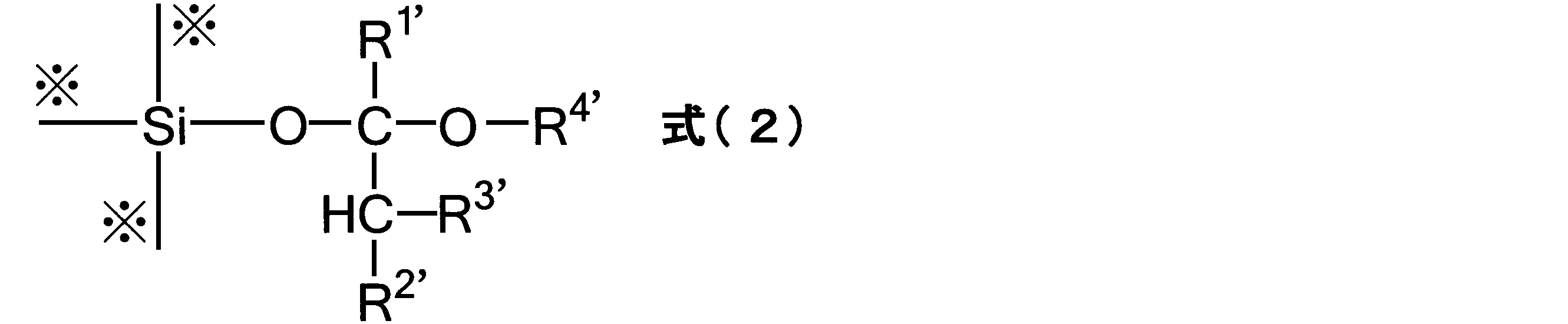
式(2)中、R1’、R2’、及びR3’はそれぞれ水素原子、又は炭素原子数1乃至10のアルキル基を表し、R4’は炭素原子数1乃至10のアルキル基を示し、R2’とR4’は互いに結合して環を形成していてもよい。式(2)において※印は隣接原子との結合を示す。隣接原子は例えばシロキサン結合の酸素原子や、シラノール基の酸素原子や、式(1)のR1に由来する炭素原子が挙げられる。上記アルキル基は上述の例示を挙げることができる。
上記式(3)で表されるビニルエーテルとしては、例えばメチルビニルエーテル、エチルビニルエーテル、イソプロピルビニルエーテル、ノルマルブチルビニルエーテル、2-エチルヘキシルビニルエーテル、tert-ブチルビニルエーテル、及びシクロヘキシルビニルエーテル等の脂肪族ビニルエーテル化合物や、2,3-ジヒドロフラン、4-メチル-2,3-ジヒドロフラン、及び3,4-ジヒドロ-2H-ピラン等の環状ビニルエーテル化合物を用いることができる。特に、エチルビニルエーテル、プロピルビニルエーテル、ブチルビニルエーテル、エチルヘキシルビニルエーテル、シクロヘキシルビニルエーテル、3,4-ジヒドロ-2H-ピラン、又は2,3-ジヒドロフランが好ましく用いることができる。
上記シラノール基のアセタール保護は、ポリシロキサンと、上記ビニルエーテルと、溶媒としてプロピレングリコールモノメチルエーテルアセテート、酢酸エチル、ジメチルホルムアミド、テトラヒドロフラン、1,4-ジオキサン等の非プロトン性溶媒を用い、ピリジウムパラトルエンスルホン酸、トリフルオロメタンスルホン酸、パラトルエンスルホン酸、メタンスルホン酸、塩酸、硫酸等の触媒を用いて実施できる。
上記の加水分解性シランの加水分解縮合物(ポリシロキサン、変性物も含み得る)は、その重量平均分子量を、例えば1,000乃至1,000,000、又は1,000乃至100,000、或いは1,000乃至50,000、1,200乃至20,000の縮合物とすることができる。これらの分子量はGPC分析によるポリスチレン換算にて得られる分子量である。GPCの測定条件は、例えばGPC装置(商品名HLC-8220GPC、東ソー株式会社製)、GPCカラム(商品名Shodex(登録商標)KF803L、KF802、KF801、昭和電工株式会社製)、カラム温度は40℃、溶離液(溶出溶媒)はテトラヒドロフラン、流量(流速)は1.0ml/min、標準試料はポリスチレン(昭和電工株式会社製)を用いて行うことができる。
式(1)における-Si-R2基、すなわち、アルコキシシリル基、アシロキシシリル基、又はハロゲン化シリル基(以下、加水分解性基と称する)の加水分解には、加水分解性基の1モル当たり、0.1乃至100モル、好ましくは1乃至10モルの水を用いる。加水分解は加水分解触媒を用いてもよいし、用いずに行うこともできる。加水分解触媒を用いる場合は、加水分解性基の1モル当たり0.0001乃至10モル、好ましくは0.001乃至1モルの加水分解触媒を用いることができる。加水分解と縮合を行う際の反応温度は、通常室温以上、加水分解に用いられる有機溶媒の常圧での還流温度以下の範囲で実施され得、例えば20乃至110℃である。加水分解は完全に加水分解を行う、すなわち、全ての加水分解性基をシラノール基に変えてもよいし、部分加水分解する、即ち未反応の加水分解基を残してもよい。即ち、加水分解及び縮合反応後に、加水分解縮合物中に未縮合の加水分解物や、またモノマーが残存していてもよい。
加水分解し縮合させる際に使用可能な加水分解触媒としては、金属キレート化合物、有機酸、無機酸、有機塩基、無機塩基を挙げることができる。
加水分解し縮合させる際に使用可能な加水分解触媒としては、金属キレート化合物、有機酸、無機酸、有機塩基、無機塩基を挙げることができる。
加水分解触媒としての金属キレート化合物は、例えばトリエトキシ・モノ(アセチルアセトナート)チタン、トリ-n-プロポキシ・モノ(アセチルアセトナート)チタン、トリ-i-プロポキシ・モノ(アセチルアセトナート)チタン、トリ-n-ブトキシ・モノ(アセチルアセトナート)チタン、トリ-sec-ブトキシ・モノ(アセチルアセトナート)チタン、トリ-t-ブトキシ・モノ(アセチルアセトナート)チタン、ジエトキシ・ビス(アセチルアセトナート)チタン、ジ-n-プロポキシ・ビス(アセチルアセトナート)チタン、ジ-i-プロポキシ・ビス(アセチルアセトナート)チタン、ジ-n-ブトキシ・ビス(アセチルアセトナート)チタン、ジ-sec-ブトキシ・ビス(アセチルアセトナート)チタン、ジ-t-ブトキシ・ビス(アセチルアセトナート)チタン、モノエトキシ・トリス(アセチルアセトナート)チタン、モノ-n-プロポキシ・トリス(アセチルアセトナート)チタン、モノ-i-プロポキシ・トリス(アセチルアセトナート)チタン、モノ-n-ブトキシ・トリス(アセチルアセトナート)チタン、モノ-sec-ブトキシ・トリス(アセチルアセトナート)チタン、モノ-t-ブトキシ・トリス(アセチルアセトナート)チタン、テトラキス(アセチルアセトナート)チタン、トリエトキシ・モノ(エチルアセトアセテート)チタン、トリ-n-プロポキシ・モノ(エチルアセトアセテート)チタン、トリ-i-プロポキシ・モノ(エチルアセトアセテート)チタン、トリ-n-ブトキシ・モノ(エチルアセトアセテート)チタン、トリ-sec-ブトキシ・モノ(エチルアセトアセテート)チタン、トリ-t-ブトキシ・モノ(エチルアセトアセテート)チタン、ジエトキシ・ビス(エチルアセトアセテート)チタン、ジ-n-プロポキシ・ビス(エチルアセトアセテート)チタン、ジ-i-プロポキシ・ビス(エチルアセトアセテート)チタン、ジ-n-ブトキシ・ビス(エチルアセトアセテート)チタン、ジ-sec-ブトキシ・ビス(エチルアセトアセテート)チタン、ジ-t-ブトキシ・ビス(エチルアセトアセテート)チタン、モノエトキシ・トリス(エチルアセトアセテート)チタン、モノ-n-プロポキシ・トリス(エチルアセトアセテート)チタン、モノ-i-プロポキシ・トリス(エチルアセトアセテート)チタン、モノ-n-ブトキシ・トリス(エチルアセトアセテート)チタン、モノ-sec-ブトキシ・トリス(エチルアセトアセテート)チタン、モノ-t-ブトキシ・トリス(エチルアセトアセテート)チタン、テトラキス(エチルアセトアセテート)チタン、モノ(アセチルアセトナート)トリス(エチルアセトアセテート)チタン、ビス(アセチルアセトナート)ビス(エチルアセトアセテート)チタン、トリス(アセチルアセトナート)モノ(エチルアセトアセテート)チタン等のチタンキレート化合物;トリエトキシ・モノ(アセチルアセトナート)ジルコニウム、トリ-n-プロポキシ・モノ(アセチルアセトナート)ジルコニウム、トリ-i-プロポキシ・モノ(アセチルアセトナート)ジルコニウム、トリ-n-ブトキシ・モノ(アセチルアセトナート)ジルコニウム、トリ-sec-ブトキシ・モノ(アセチルアセトナート)ジルコニウム、トリ-t-ブトキシ・モノ(アセチルアセトナート)ジルコニウム、ジエトキシ・ビス(アセチルアセトナート)ジルコニウム、ジ-n-プロポキシ・ビス(アセチルアセトナート)ジルコニウム、ジ-i-プロポキシ・ビス(アセチルアセトナート)ジルコニウム、ジ-n-ブトキシ・ビス(アセチルアセトナート)ジルコニウム、ジ-sec-ブトキシ・ビス(アセチルアセトナート)ジルコニウム、ジ-t-ブトキシ・ビス(アセチルアセトナート)ジルコニウム、モノエトキシ・トリス(アセチルアセトナート)ジルコニウム、モノ-n-プロポキシ・トリス(アセチルアセトナート)ジルコニウム、モノ-i-プロポキシ・トリス(アセチルアセトナート)ジルコニウム、モノ-n-ブトキシ・トリス(アセチルアセトナート)ジルコニウム、モノ-sec-ブトキシ・トリス(アセチルアセトナート)ジルコニウム、モノ-t-ブトキシ・トリス(アセチルアセトナート)ジルコニウム、テトラキス(アセチルアセトナート)ジルコニウム、トリエトキシ・モノ(エチルアセトアセテート)ジルコニウム、トリ-n-プロポキシ・モノ(エチルアセトアセテート)ジルコニウム、トリ-i-プロポキシ・モノ(エチルアセトアセテート)ジルコニウム、トリ-n-ブトキシ・モノ(エチルアセトアセテート)ジルコニウム、トリ-sec-ブトキシ・モノ(エチルアセトアセテート)ジルコニウム、トリ-t-ブトキシ・モノ(エチルアセトアセテート)ジルコニウム、ジエトキシ・ビス(エチルアセトアセテート)ジルコニウム、ジ-n-プロポキシ・ビス(エチルアセトアセテート)ジルコニウム、ジ-i-プロポキシ・ビス(エチルアセトアセテート)ジルコニウム、ジ-n-ブトキシ・ビス(エチルアセトアセテート)ジルコニウム、ジ-sec-ブトキシ・ビス(エチルアセトアセテート)ジルコニウム、ジ-t-ブトキシ・ビス(エチルアセトアセテート)ジルコニウム、モノエトキシ・トリス(エチルアセトアセテート)ジルコニウム、モノ-n-プロポキシ・トリス(エチルアセトアセテート)ジルコニウム、モノ-i-プロポキシ・トリス(エチルアセトアセテート)ジルコニウム、モノ-n-ブトキシ・トリス(エチルアセトアセテート)ジルコニウム、モノ-sec-ブトキシ・トリス(エチルアセトアセテート)ジルコニウム、モノ-t-ブトキシ・トリス(エチルアセトアセテート)ジルコニウム、テトラキス(エチルアセトアセテート)ジルコニウム、モノ(アセチルアセトナート)トリス(エチルアセトアセテート)ジルコニウム、ビス(アセチルアセトナート)ビス(エチルアセトアセテート)ジルコニウム、トリス(アセチルアセトナート)モノ(エチルアセトアセテート)ジルコニウム等のジルコニウムキレート化合物;トリス(アセチルアセトナート)アルミニウム、トリス(エチルアセトアセテート)アルミニウム等のアルミニウムキレート化合物;などを挙げることができる。
加水分解触媒としての有機酸は、例えば酢酸、プロピオン酸、ブタン酸、ペンタン酸、ヘキサン酸、ヘプタン酸、オクタン酸、ノナン酸、デカン酸、シュウ酸、マレイン酸、メチルマロン酸、アジピン酸、セバシン酸、没食子酸、酪酸、メリット酸、アラキドン酸、シキミ酸、2-エチルヘキサン酸、オレイン酸、ステアリン酸、リノール酸、リノレイン酸、サリチル酸、安息香酸、p-アミノ安息香酸、p-トルエンスルホン酸、ベンゼンスルホン酸、モノクロロ酢酸、ジクロロ酢酸、トリクロロ酢酸、トリフルオロ酢酸、ギ酸、マロン酸、スルホン酸、フタル酸、フマル酸、クエン酸、酒石酸等を挙げることができる。
加水分解触媒としての無機酸は、例えば塩酸、硝酸、硫酸、フッ酸、リン酸等を挙げることができる。
加水分解触媒としての無機酸は、例えば塩酸、硝酸、硫酸、フッ酸、リン酸等を挙げることができる。
加水分解触媒としての有機塩基は、例えばピリジン、ピロール、ピペラジン、ピロリジン、ピペリジン、ピコリン、トリメチルアミン、トリエチルアミン、モノエタノールアミン、ジエタノールアミン、ジメチルモノエタノールアミン、モノメチルジエタノールアミン、トリエタノールアミン、ジアザビシクロオクタン、ジアザビシクロノナン、ジアザビシクロウンデセン、テトラメチルアンモニウムハイドロオキサイド、テトラエチルアンモニウムハイドロオキサイド等を挙げることができる。
加水分解触媒としての無機塩基としては、例えばアンモニア、水酸化ナトリウム、水酸化カリウム、水酸化バリウム、水酸化カルシウム等を挙げることができる。
加水分解触媒としての無機塩基としては、例えばアンモニア、水酸化ナトリウム、水酸化カリウム、水酸化バリウム、水酸化カルシウム等を挙げることができる。
これら触媒の内、金属キレート化合物、有機酸、無機酸が好ましく、これらは1種あるいは2種以上を組み合わせて使用してもよい。
加水分解反応時に使用可能な有機溶媒としては、例えばn-ペンタン、i-ペンタン、n-ヘキサン、i-ヘキサン、n-ヘプタン、i-ヘプタン、2,2,4-トリメチルペンタン、n-オクタン、i-オクタン、シクロヘキサン、メチルシクロヘキサン等の脂肪族炭化水素系溶媒;ベンゼン、トルエン、キシレン、エチルベンゼン、トリメチルベンゼン、メチルエチルベンゼン、n-プロピルベンセン、i-プロピルベンセン、ジエチルベンゼン、i-ブチルベンゼン、トリエチルベンゼン、ジ-i-プロピルベンセン、n-アミルナフタレン、トリメチルベンゼン等の芳香族炭化水素系溶媒;メタノール、エタノール、n-プロパノール、i-プロパノール、n-ブタノール、i-ブタノール、sec-ブタノール、t-ブタノール、n-ペンタノール、i-ペンタノール、2-メチルブタノール、sec-ペンタノール、t-ペンタノール、3-メトキシブタノール、n-ヘキサノール、2-メチルペンタノール、sec-ヘキサノール、2-エチルブタノール、n-ヘプタノール、sec-ヘプタノール、3-ヘプタノール、n-オクタノール、2-エチルヘキサノール、sec-オクタノール、n-ノニルアルコール、2,6-ジメチル-4-ヘプタノール、n-デカノール、sec-ウンデシルアルコール、トリメチルノニルアルコール、sec-テトラデシルアルコール、sec-ヘプタデシルアルコール、フェノール、シクロヘキサノール、メチルシクロヘキサノール、3,3,5-トリメチルシクロヘキサノール、ベンジルアルコール、フェニルメチルカルビノール、ジアセトンアルコール、クレゾール等のモノアルコール系溶媒;エチレングリコール、プロピレングリコール、1,3-ブチレングリコール、2,4-ペンタンジオール、2-メチル-2,4-ペンタンジオール、2,5-ヘキサンジオール、2,4-ヘプタンジオール、2-エチル-1,3-ヘキサンジオール、ジエチレングリコール、ジプロピレングリコール、トリエチレングリコール、トリプロピレングリコール、グリセリン等の多価アルコール系溶媒;アセトン、メチルエチルケトン、メチル-n-プロピルケトン、メチル-n-ブチルケトン、ジエチルケトン、メチル-i-ブチルケトン、メチル-n-ペンチルケトン、エチル-n-ブチルケトン、メチル-n-ヘキシルケトン、ジ-i-ブチルケトン、トリメチルノナノン、シクロヘキサノン、メチルシクロヘキサノン、2,4-ペンタンジオン、アセトニルアセトン、ジアセトンアルコール、アセトフェノン、フェンチョン等のケトン系溶媒;エチルエーテル、i-プロピルエーテル、n-ブチルエーテル、n-ヘキシルエーテル、2-エチルヘキシルエーテル、エチレンオキシド、1,2-プロピレンオキシド、ジオキソラン、4-メチルジオキソラン、ジオキサン、ジメチルジオキサン、エチレングリコールモノメチルエーテル、エチレングリコールモノエチルエーテル、エチレングリコールジエチルエーテル、エチレングリコールモノ-n-ブチルエーテル、エチレングリコールモノ-n-ヘキシルエーテル、エチレングリコールモノフェニルエーテル、エチレングリコールモノ-2-エチルブチルエーテル、エチレングリコールジブチルエーテル、ジエチレングリコールモノメチルエーテル、ジエチレングリコールモノエチルエーテル、ジエチレングリコールジエチルエーテル、ジエチレングリコールモノ-n-ブチルエーテル、ジエチレングリコールジ-n-ブチルエーテル、ジエチレングリコールモノ-n-ヘキシルエーテル、エトキシトリグリコール、テトラエチレングリコールジ-n-ブチルエーテル、プロピレングリコールモノメチルエーテル、プロピレングリコールモノエチルエーテル、プロピレングリコールモノプロピルエーテル、プロピレングリコールモノブチルエーテル、ジプロピレングリコールモノメチルエーテル、ジプロピレングリコールモノエチルエーテル、ジプロピレングリコールモノプロピルエーテル、ジプロピレングリコールモノブチルエーテル、トリプロピレングリコールモノメチルエーテル、テトラヒドロフラン、2-メチルテトラヒドロフラン等のエーテル系溶媒;ジエチルカーボネート、酢酸メチル、酢酸エチル、γ-ブチロラクトン、γ-バレロラクトン、酢酸n-プロピル、酢酸i-プロピル、酢酸n-ブチル、酢酸i-ブチル、酢酸sec-ブチル、酢酸n-ペンチル、酢酸sec-ペンチル、酢酸3-メトキシブチル、酢酸メチルペンチル、酢酸2-エチルブチル、酢酸2-エチルヘキシル、酢酸ベンジル、酢酸シクロヘキシル、酢酸メチルシクロヘキシル、酢酸n-ノニル、アセト酢酸メチル、アセト酢酸エチル、酢酸エチレングリコールモノメチルエーテル、酢酸エチレングリコールモノエチルエーテル、酢酸ジエチレングリコールモノメチルエーテル、酢酸ジエチレングリコールモノエチルエーテル、酢酸ジエチレングリコールモノ-n-ブチルエーテル、酢酸プロピレングリコールモノメチルエーテル、酢酸プロピレングリコールモノエチルエーテル、酢酸プロピレングリコールモノプロピルエーテル、酢酸プロピレングリコールモノブチルエーテル、酢酸ジプロピレングリコールモノメチルエーテル、酢酸ジプロピレングリコールモノエチルエーテル、ジ酢酸グリコール、酢酸メトキシトリグリコール、エチレングリコールジアセテート、トリエチレングリコールメチルエーテルアセテート、プロピオン酸エチル、プロピオン酸n-ブチル、プロピオン酸i-アミル、シュウ酸ジエチル、シュウ酸ジ-n-ブチル、乳酸メチル、乳酸エチル、乳酸n-ブチル、乳酸n-アミル、マロン酸ジエチル、フタル酸ジメチル、フタル酸ジエチル等のエステル系溶媒;N-メチルホルムアミド、N,N-ジメチルホルムアミド、N,N-ジエチルホルムアミド、アセトアミド、N-メチルアセトアミド、N,N-ジメチルアセトアミド、N-メチルプロピオンアミド、N-メチル-2-ピロリドン等の含窒素系溶媒;硫化ジメチル、硫化ジエチル、チオフェン、テトラヒドロチオフェン、ジメチルスルホキシド、スルホラン、1,3-プロパンスルトン等の含硫黄系溶媒等を挙げることができる。これらの溶剤は1種又は2種以上の組み合わせで用いることができる。
加水分解性シランを溶剤中で触媒を用いて加水分解し縮合し、得られた加水分解縮合物(ポリマー)は減圧蒸留等により副生成物のアルコールや、用いた加水分解触媒や水を同時に除去することができる。また、加水分解に用いた酸や塩基触媒を中和やイオン交換により取り除くことができる。
このようにして得られた加水分解縮合物(ポリシロキサン)は、有機溶媒中に溶解しているポリシロキサンワニスの形態として得られ、これをそのままポリシロキサンを含有する組成物として用いることができる。得られたポリシロキサンワニスは溶媒置換してもよいし、また適宜溶媒で希釈してもよい。なお得られたポリシロキサンワニスは、その保存安定性が悪くなければ、有機溶媒を留去し、固形分濃度100%とすることもできる。
前記ポリシロキサンワニスの溶媒置換や希釈等に用いる有機溶媒は、加水分解性シランの加水分解反応に用いた有機溶媒と同じでも異なってもよい。この希釈用溶媒は、特に限定されず、1種でも2種以上でも任意に選択して用いることができる。
前記ポリシロキサンワニスの溶媒置換や希釈等に用いる有機溶媒は、加水分解性シランの加水分解反応に用いた有機溶媒と同じでも異なってもよい。この希釈用溶媒は、特に限定されず、1種でも2種以上でも任意に選択して用いることができる。
[ポリシロキサンを含有する組成物]
ポリシロキサンを含有する組成物は、上記加水分解性シラン、その加水分解物、その加水分解縮合物(ポリシロキサン、変性物も含み得る)と、溶媒とを含む。
ポリシロキサンを含有する組成物(以下、単に組成物ともいう)における固形分は、例えば0.1乃至50質量%、0.1乃至30質量%、0.1乃至25質量%、0.5乃至20.0質量%、又は1.0乃至10.0質量%である。固形分とは該組成物の全成分から溶媒成分を除いたものの割合を指す。
上記固形分中に占める加水分解性シラン、その加水分解物、及びその加水分解縮合物(ポリシロキサン、変性物も含み得る)の割合は、20質量%以上であり、例えば50乃至100質量%、60乃至100質量%、70乃至100質量%、80乃至100質量%、80乃至99質量%である。
また該組成物中の上記加水分解性シラン、その加水分解物、及びその加水分解縮合物(ポリシロキサン、変性物も含み得る)の濃度は、0.5乃至20.0質量%である。
ポリシロキサンを含有する組成物は、上記加水分解性シラン、その加水分解物、その加水分解縮合物(ポリシロキサン、変性物も含み得る)と、溶媒とを含む。
ポリシロキサンを含有する組成物(以下、単に組成物ともいう)における固形分は、例えば0.1乃至50質量%、0.1乃至30質量%、0.1乃至25質量%、0.5乃至20.0質量%、又は1.0乃至10.0質量%である。固形分とは該組成物の全成分から溶媒成分を除いたものの割合を指す。
上記固形分中に占める加水分解性シラン、その加水分解物、及びその加水分解縮合物(ポリシロキサン、変性物も含み得る)の割合は、20質量%以上であり、例えば50乃至100質量%、60乃至100質量%、70乃至100質量%、80乃至100質量%、80乃至99質量%である。
また該組成物中の上記加水分解性シラン、その加水分解物、及びその加水分解縮合物(ポリシロキサン、変性物も含み得る)の濃度は、0.5乃至20.0質量%である。
上記溶媒としては、当該組成物に含まれる固形分を溶解できる溶媒であれば特に制限なく使用することができ、前記の加水分解性シランの加水分解反応に用いた有機溶媒や、また上記のシラノール基の変性(キャッピング)に用いたアルコール類を用いることができる。
上記の溶媒としては、例えば、メチルセロソルブアセテート、エチルセロソルブアセテート、プロピレングリコール、プロピレングリコールモノメチルエーテル、プロピレングリコールモノエチルエーテル、メチルイソブチルカルビノール、プロピレングリコールモノブチルエーテル、プロピレングリコールモノメチルエーテルアセテート、プロピレングリコールモノエテルエーテルアセテート、プロピレングリコールモノプロピルエーテルアセテート、プロピレングリコールモノブチルエーテルアセテート、トルエン、キシレン、メチルエチルケトン、シクロペンタノン、シクロヘキサノン、2-ヒドロキシプロピオン酸エチル、2-ヒドロキシ-2-メチルプロピオン酸エチル、エトキシ酢酸エチル、ヒドロキシ酢酸エチル、2-ヒドロキシ-3-メチルブタン酸メチル、3-メトキシプロピオン酸メチル、3-メトキシプロピオン酸エチル、3-エトキシプロピオン酸エチル、3-エトキシプロピオン酸メチル、ピルビン酸メチル、ピルビン酸エチル、エチレングリコールモノメチルエーテル、エチレングリコールモノエチルエーテル、エチレングリコールモノプロピルエーテル、エチレングリコールモノブチルエーテル、エチレングリコールモノメチルエーテルアセテート、エチレングリコールモノエチルエーテルアセテート、エチレングリコールモノプロピルエーテルアセテート、エチレングリコールモノブチルエーテルアセテート、ジエチレングリコールジメチルエーテル、ジエチレングリコールジエチルエーテル、ジエチレングリコールジプロピルエーテル、ジエチレングリコールジブチルエーテルプロピレングリコールモノメチルエーテル、プロピレングリコールジメチルエーテル、プロピレングリコールジエチルエーテル、プロピレングリコールジプロピルエーテル、プロピレングリコールジブチルエーテル、乳酸エチル、乳酸プロピル、乳酸イソプロピル、乳酸ブチル、乳酸イソブチル、ギ酸メチル、ギ酸エチル、ギ酸プロピル、ギ酸イソプロピル、ギ酸ブチル、ギ酸イソブチル、ギ酸アミル、ギ酸イソアミル、酢酸メチル、酢酸エチル、酢酸アミル、酢酸イソアミル、酢酸ヘキシル、プロピオン酸メチル、プロピオン酸エチル、プロピオン酸プロピル、プロピオン酸イソプロピル、プロピオン酸ブチル、プロピオン酸イソブチル、酪酸メチル、酪酸エチル、酪酸プロピル、酪酸イソプロピル、酪酸ブチル、酪酸イソブチル、ヒドロキシ酢酸エチル、2-ヒドロキシ-2-メチルプロピオン酸エチル、3-メトキシ-2-メチルプロピオン酸メチル、2-ヒドロキシ-3-メチル酪酸メチル、メトキシ酢酸エチル、エトキシ酢酸エチル、3-メトキシプロピオン酸メチル、3-エトキシプロピオン酸エチル、3-メトキシプロピオン酸エチル、3-メトキシブチルアセテート、3-メトキシプロピルアセテート、3-メチル-3-メトキシブチルアセテート、3-メチル-3-メトキシブチルプロピオネート、3-メチル-3-メトキシブチルブチレート、アセト酢酸メチル、トルエン、キシレン、メチルエチルケトン、メチルプロピルケトン、メチルブチルケトン、2-ヘプタノン、3-ヘプタノン、4-ヘプタノン、シクロヘキサノン、N、N-ジメチルホルムアミド、N-メチルアセトアミド、N,N-ジメチルアセトアミド、N-メチル-2-ピロリドン、4-メチル-2-ペンタノール、及びγ-ブチロラクトン等を挙げることができる。これらの溶媒は単独で、または二種以上の組み合わせで使用することができる。
上記の溶媒としては、例えば、メチルセロソルブアセテート、エチルセロソルブアセテート、プロピレングリコール、プロピレングリコールモノメチルエーテル、プロピレングリコールモノエチルエーテル、メチルイソブチルカルビノール、プロピレングリコールモノブチルエーテル、プロピレングリコールモノメチルエーテルアセテート、プロピレングリコールモノエテルエーテルアセテート、プロピレングリコールモノプロピルエーテルアセテート、プロピレングリコールモノブチルエーテルアセテート、トルエン、キシレン、メチルエチルケトン、シクロペンタノン、シクロヘキサノン、2-ヒドロキシプロピオン酸エチル、2-ヒドロキシ-2-メチルプロピオン酸エチル、エトキシ酢酸エチル、ヒドロキシ酢酸エチル、2-ヒドロキシ-3-メチルブタン酸メチル、3-メトキシプロピオン酸メチル、3-メトキシプロピオン酸エチル、3-エトキシプロピオン酸エチル、3-エトキシプロピオン酸メチル、ピルビン酸メチル、ピルビン酸エチル、エチレングリコールモノメチルエーテル、エチレングリコールモノエチルエーテル、エチレングリコールモノプロピルエーテル、エチレングリコールモノブチルエーテル、エチレングリコールモノメチルエーテルアセテート、エチレングリコールモノエチルエーテルアセテート、エチレングリコールモノプロピルエーテルアセテート、エチレングリコールモノブチルエーテルアセテート、ジエチレングリコールジメチルエーテル、ジエチレングリコールジエチルエーテル、ジエチレングリコールジプロピルエーテル、ジエチレングリコールジブチルエーテルプロピレングリコールモノメチルエーテル、プロピレングリコールジメチルエーテル、プロピレングリコールジエチルエーテル、プロピレングリコールジプロピルエーテル、プロピレングリコールジブチルエーテル、乳酸エチル、乳酸プロピル、乳酸イソプロピル、乳酸ブチル、乳酸イソブチル、ギ酸メチル、ギ酸エチル、ギ酸プロピル、ギ酸イソプロピル、ギ酸ブチル、ギ酸イソブチル、ギ酸アミル、ギ酸イソアミル、酢酸メチル、酢酸エチル、酢酸アミル、酢酸イソアミル、酢酸ヘキシル、プロピオン酸メチル、プロピオン酸エチル、プロピオン酸プロピル、プロピオン酸イソプロピル、プロピオン酸ブチル、プロピオン酸イソブチル、酪酸メチル、酪酸エチル、酪酸プロピル、酪酸イソプロピル、酪酸ブチル、酪酸イソブチル、ヒドロキシ酢酸エチル、2-ヒドロキシ-2-メチルプロピオン酸エチル、3-メトキシ-2-メチルプロピオン酸メチル、2-ヒドロキシ-3-メチル酪酸メチル、メトキシ酢酸エチル、エトキシ酢酸エチル、3-メトキシプロピオン酸メチル、3-エトキシプロピオン酸エチル、3-メトキシプロピオン酸エチル、3-メトキシブチルアセテート、3-メトキシプロピルアセテート、3-メチル-3-メトキシブチルアセテート、3-メチル-3-メトキシブチルプロピオネート、3-メチル-3-メトキシブチルブチレート、アセト酢酸メチル、トルエン、キシレン、メチルエチルケトン、メチルプロピルケトン、メチルブチルケトン、2-ヘプタノン、3-ヘプタノン、4-ヘプタノン、シクロヘキサノン、N、N-ジメチルホルムアミド、N-メチルアセトアミド、N,N-ジメチルアセトアミド、N-メチル-2-ピロリドン、4-メチル-2-ペンタノール、及びγ-ブチロラクトン等を挙げることができる。これらの溶媒は単独で、または二種以上の組み合わせで使用することができる。
上記組成物には、組成物の用途に応じて種々の添加剤を配合可能である。
上記添加剤としては、例えば、硬化触媒(アンモニウム塩、ホスフィン類、ホスホニウム塩、スルホニウム塩、窒素含有シラン化合物等)、架橋剤、架橋触媒、安定化剤(有機酸、水、アルコール等)、有機ポリマー化合物、光酸発生剤(オニウム塩化合物、スルホンイミド化合物、ジスルホニルジアゾメタン化合物等)、界面活性剤(ノニオン系界面活性剤、アニオン系界面活性剤、カチオン系界面活性剤、シリコン系界面活性剤、フッ素系界面活性剤、UV硬化型界面活性剤等)、レオロジー調整剤、接着補助剤等、レジスト下層膜や、反射防止膜、パターン反転用膜など、半導体装置の製造に使用され得る各種膜を形成する材料(組成物)に配合される公知の添加剤を挙げることができる。
なお以下に各種添加剤を例示するが、これらに限定されるものではない。
上記添加剤としては、例えば、硬化触媒(アンモニウム塩、ホスフィン類、ホスホニウム塩、スルホニウム塩、窒素含有シラン化合物等)、架橋剤、架橋触媒、安定化剤(有機酸、水、アルコール等)、有機ポリマー化合物、光酸発生剤(オニウム塩化合物、スルホンイミド化合物、ジスルホニルジアゾメタン化合物等)、界面活性剤(ノニオン系界面活性剤、アニオン系界面活性剤、カチオン系界面活性剤、シリコン系界面活性剤、フッ素系界面活性剤、UV硬化型界面活性剤等)、レオロジー調整剤、接着補助剤等、レジスト下層膜や、反射防止膜、パターン反転用膜など、半導体装置の製造に使用され得る各種膜を形成する材料(組成物)に配合される公知の添加剤を挙げることができる。
なお以下に各種添加剤を例示するが、これらに限定されるものではない。
前記硬化触媒としては、アンモニウム塩、ホスフィン類、ホスホニウム塩、スルホニウム塩等を用いることができる。なお硬化触媒として記載した下記の塩類は、塩の形態にて添加してもよいし、前記組成物中において塩を形成するもの(添加時には別化合物として添加され、系内で塩を形成するもの)のいずれであってもよい。
上記アンモニウム塩としては、式(D-1):

(式中、mは2乃至11、nは2乃至3の整数を、R21はアルキル基又はアリール基を、Y-は陰イオンを表す。)で表される構造を有する第4級アンモニウム塩、
式(D-2):

(式中、R22、R23、R24及びR25はアルキル基又はアリール基を、Nは窒素原子を、Y-は陰イオンを表し、且つR22、R23、R24、及びR25はそれぞれC-N結合により窒素原子と結合されているものである)で表される構造を有する第4級アンモニウム塩、
式(D-3):

(式中、R26及びR27はアルキル基又はアリール基を、Nは窒素原子を、Y-は陰イオンを表す)で表される構造を有する第4級アンモニウム塩、
式(D-4):

(式中、R28はアルキル基又はアリール基を、Nは窒素原子を、Y-は陰イオンを表す)で表される構造を有する第4級アンモニウム塩、
式(D-5):
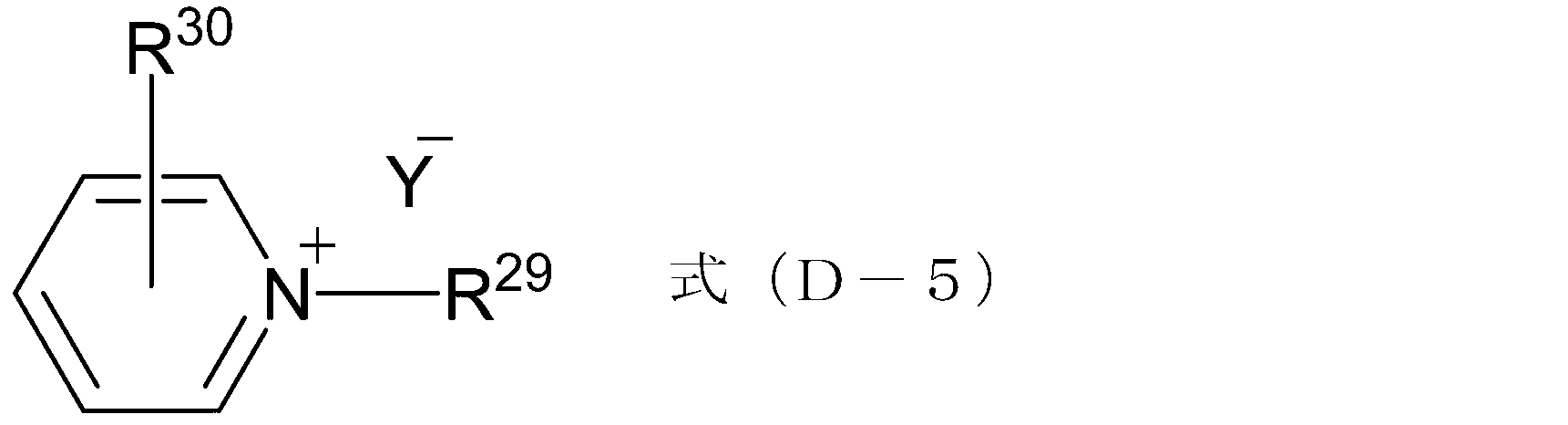
(式中、R29及びR30はアルキル基又はアリール基を、Nは窒素原子を、Y-は陰イオンを表す)で表される構造を有する第4級アンモニウム塩、
式(D-6):

(式中、mは2乃至11、nは2乃至3の整数を、Hは水素原子を、Nは窒素原子を、Y-は陰イオンを表す)で表される構造を有する第3級アンモニウム塩を挙げることができる。
式(D-2):
式(D-3):
式(D-4):
式(D-5):
式(D-6):
また、上記ホスホニウム塩としては、式(D-7):

(式中、R31、R32、R33、及びR34はアルキル基又はアリール基を、Pはリン原子を、Y-は陰イオンを表し、且つR31、R32、R33、及びR34はそれぞれC-P結合によりリン原子と結合されているものである)で表される第4級ホスホニウム塩を挙げることができる。
また、上記スルホニウム塩としては、式(D-8):

(式中、R35、R36、及びR37はアルキル基又はアリール基を、Sは硫黄原子を、Y-は陰イオンを表し、且つR35、R36、及びR37はそれぞれC-S結合により硫黄原子と結合されているものである)で表される第3級スルホニウム塩を挙げることができる。
上記の式(D-1)の化合物は、アミンから誘導される第4級アンモニウム塩であり、mは2乃至11、nは2乃至3の整数を示す。この第4級アンモニウム塩のR21は炭素原子数1乃至18、好ましくは2乃至10のアルキル基、又は炭素原子数6乃至18のアリール基を示し、例えば、エチル基、プロピル基、ブチル基等の直鎖アルキル基や、ベンジル基、シクロヘキシル基、シクロヘキシルメチル基、ジシクロペンタジエニル基等が挙げられる。また陰イオン(Y-)は、塩素イオン(Cl-)、臭素イオン(Br-)、ヨウ素イオン(I-)等のハロゲン化物イオンや、カルボキシラート(-COO-)、スルホナト(-SO3
-)、アルコラート(-O-)等の酸基を挙げることができる。
上記の式(D-2)の化合物は、R22R23R24R25N+Y-で示される第4級アンモニウム塩である。この第4級アンモニウム塩のR22、R23、R24及びR25は炭素原子数1乃至18のアルキル基、又は炭素原子数6乃至18のアリール基である。陰イオン(Y-)は、塩素イオン(Cl-)、臭素イオン(Br-)、ヨウ素イオン(I-)等のハロゲン化物イオンや、カルボキシラート(-COO-)、スルホナト(-SO3
-)、アルコラート(-O-)等の酸基を挙げることができる。この第4級アンモニウム塩は、市販品で入手することが可能であり、例えばテトラメチルアンモニウムアセテート、テトラブチルアンモニウムアセテート、塩化トリエチルベンジルアンモニウム、臭化トリエチルベンジルアンモニウム、塩化トリオクチルメチルアンモニウム、塩化トリブチルベンジルアンモニウム、塩化トリメチルベンジルアンモニウム等が例示される。
上記の式(D-3)の化合物は、1-置換イミダゾールから誘導される第4級アンモニウム塩であり、R26及びR27の炭素原子数は1乃至18であり、R26及びR27の炭素原子数の総和が7以上であることが好ましい。例えばR26はメチル基、エチル基、プロピル基、フェニル基、ベンジル基を、R27はベンジル基、オクチル基、オクタデシル基を例示することができる。陰イオン(Y-)は、塩素イオン(Cl-)、臭素イオン(Br-)、ヨウ素イオン(I-)等のハロゲン化物イオンや、カルボキシラート(-COO-)、スルホナト(-SO3
-)、アルコラート(-O-)等の酸基を挙げることができる。この化合物は、市販品で入手することもできるが、例えば1-メチルイミダゾール、1-ベンジルイミダゾール等のイミダゾール系化合物と、臭化ベンジル、臭化メチル等のハロゲン化アルキルやハロゲン化アリールを反応させて製造することができる。
上記の式(D-4)の化合物は、ピリジンから誘導される第4級アンモニウム塩であり、R28は炭素原子数1乃至18、好ましくは炭素原子数4乃至18のアルキル基、又は炭素原子数6乃至18のアリール基であり、例えばブチル基、オクチル基、ベンジル基、ラウリル基を例示することができる。陰イオン(Y-)は、塩素イオン(Cl-)、臭素イオン(Br-)、ヨウ素イオン(I-)等のハロゲン化物イオンや、カルボキシラート(-COO-)、スルホナト(-SO3
-)、アルコラート(-O-)等の酸基を挙げることができる。この化合物は、市販品として入手することもできるが、例えばピリジンと、塩化ラウリル、塩化ベンジル、臭化ベンジル、臭化メチル、臭化オクチル等のハロゲン化アルキル、又はハロゲン化アリールを反応させて製造することができる。この化合物は例えば、塩化N-ラウリルピリジニウム、臭化N-ベンジルピリジニウム等を例示することができる。
上記の式(D-5)の化合物は、ピコリン等に代表される置換ピリジンから誘導される第4級アンモニウム塩であり、R29は炭素原子数1乃至18、好ましくは炭素原子数4乃至18のアルキル基、又は炭素原子数6乃至18のアリール基であり、例えばメチル基、オクチル基、ラウリル基、ベンジル基等を例示することができる。R30は炭素原子数1乃至18のアルキル基、又は炭素原子数6乃至18のアリール基であり、例えばピコリンから誘導される第4級アンモニウムである場合には、R30はメチル基である。陰イオン(Y-)は、塩素イオン(Cl-)、臭素イオン(Br-)、ヨウ素イオン(I-)等のハロゲン化物イオンや、カルボキシラート(-COO-)、スルホナト(-SO3
-)、アルコラート(-O-)等の酸基を挙げることができる。この化合物は市販品として入手することもできるが、例えばピコリン等の置換ピリジンと、臭化メチル、臭化オクチル、塩化ラウリル、塩化ベンジル、臭化ベンジル等のハロゲン化アルキル、又はハロゲン化アリールを反応させて製造することができる。この化合物は例えば、N-ベンジルピコリニウムクロリド、N-ベンジルピコリニウムブロミド、N-ラウリルピコリニウムクロリド等を例示することができる。
上記の式(D-6)の化合物は、アミンから誘導される第3級アンモニウム塩であり、mは2乃至11、nは2乃至3の整数を示す。また陰イオン(Y-)は、塩素イオン(Cl-)、臭素イオン(Br-)、ヨウ素イオン(I-)等のハロゲン化物イオンや、カルボキシラート(-COO-)、スルホナト(-SO3
-)、アルコラート(-O-)等の酸基を挙げることができる。本化合物は、アミンとカルボン酸やフェノール等の弱酸との反応によって製造することができる。カルボン酸としてはギ酸や酢酸が挙げられ、ギ酸を使用した場合は、陰イオン(Y-)は(HCOO-)であり、酢酸を使用した場合は、陰イオン(Y-)は(CH3COO-)である。またフェノールを使用した場合は、陰イオン(Y-)は(C6H5O-)である。
上記の式(D-7)の化合物は、R31R32R33R34P+Y-の構造を有する第4級ホスホニウム塩である。R31、R32、R33、及びR34は炭素原子数1乃至18のアルキル基、又は炭素原子数6乃至18のアリール基であり、好ましくはR31乃至R34の4つの置換基の内で3つがフェニル基又は置換されたフェニル基であり、例えばフェニル基やトリル基を例示することができ、また残りの1つは炭素原子数1乃至18のアルキル基、炭素原子数6乃至18のアリール基である。また陰イオン(Y-)は、塩素イオン(Cl-)、臭素イオン(Br-)、ヨウ素イオン(I-)等のハロゲン化物イオンや、カルボキシラート(-COO-)、スルホナト(-SO3
-)、アルコラート(-O-)等の酸基を挙げることができる。この化合物は市販品として入手することが可能であり、例えばハロゲン化テトラn-ブチルホスホニウム、ハロゲン化テトラn-プロピルホスホニウム等のハロゲン化テトラアルキルホスホニウム、ハロゲン化トリエチルベンジルホスホニウム等のハロゲン化トリアルキルベンジルホスホニウム、ハロゲン化トリフェニルメチルホスホニウム、ハロゲン化トリフェニルエチルホスホニウム等のハロゲン化トリフェニルモノアルキルホスホニウム、ハロゲン化トリフェニルベンジルホスホニウム、ハロゲン化テトラフェニルホスホニウム、ハロゲン化トリトリルモノアリールホスホニウム、或いはハロゲン化トリトリルモノアルキルホスホニウム(以上、ハロゲン原子は塩素原子又は臭素原子)が挙げられる。特に、ハロゲン化トリフェニルメチルホスホニウム、ハロゲン化トリフェニルエチルホスホニウム等のハロゲン化トリフェニルモノアルキルホスホニウム、ハロゲン化トリフェニルベンジルホスホニウム等のハロゲン化トリフェニルモノアリールホスホニウム、ハロゲン化トリトリルモノフェニルホスホニウム等のハロゲン化トリトリルモノアリールホスホニウムや、ハロゲン化トリトリルモノメチルホスホニウム等のハロゲン化トリトリルモノアルキルホスホニウム(ハロゲン原子は塩素原子又は臭素原子)が好ましい。
また、ホスフィン類としては、メチルホスフィン、エチルホスフィン、プロピルホスフィン、イソプロピルホスフィン、イソブチルホスフィン、フェニルホスフィン等の第一ホスフィン、ジメチルホスフィン、ジエチルホスフィン、ジイソプロピルホスフィン、ジイソアミルホスフィン、ジフェニルホスフィン等の第二ホスフィン、トリメチルホスフィン、トリエチルホスフィン、トリフェニルホスフィン、メチルジフェニルホスフィン、ジメチルフェニルホスフィン等の第三ホスフィンが挙げられる。
上記の式(D-8)の化合物は、R35R36R37S+Y-の構造を有する第3級スルホニウム塩である。R35、R36、及びR37は炭素原子数1乃至18のアルキル基又は炭素原子数6乃至18のアリール基であり、好ましくはR35乃至R37の3つの置換基の内で2つがフェニル基又は置換されたフェニル基であり、例えばフェニル基やトリル基を例示することができ、また残りの1つは炭素原子数1乃至18のアルキル基、又は炭素原子数6乃至18のアリール基である。また陰イオン(Y-)は、塩素イオン(Cl-)、臭素イオン(Br-)、ヨウ素イオン(I-)等のハロゲン化物イオンや、カルボキシラート(-COO-)、スルホナト(-SO3
-)、アルコラート(-O-)、マレイン酸アニオン、硝酸アニオン等の酸基を挙げることができる。この化合物は市販品として入手することが可能であり、例えばハロゲン化トリn-ブチルスルホニウム、ハロゲン化トリn-プロピルスルホニウム等のハロゲン化トリアルキルスルホニウム、ハロゲン化ジエチルベンジルスルホニウム等のハロゲン化ジアルキルベンジルスルホニウム、ハロゲン化ジフェニルメチルスルホニウム、ハロゲン化ジフェニルエチルスルホニウム等のハロゲン化ジフェニルモノアルキルスルホニウム、ハロゲン化トリフェニルスルホニウム(以上、ハロゲン原子は塩素原子又は臭素原子)、トリn-ブチルスルホニウムカルボキシラート、トリn-プロピルスルホニウムカルボキシラート等のトリアルキルスルホニウムカルボキシラート、ジエチルベンジルスルホニウムカルボキシラート等のジアルキルベンジルスルホニウムカルボキシラート、ジフェニルメチルスルホニウムカルボキシラート、ジフェニルエチルスルホニウムカルボキシラート等のジフェニルモノアルキルスルホニウムカルボキシラート、トリフェニルスルホニウムカルボキシラート、トリフェニルスルホニウム硝酸塩等が挙げられる。また、ハロゲン化トリフェニルスルホニウム、トリフェニルスルホニウムカルボキシラート、トリフェニルスルホニウム硝酸塩を好ましく用いることができる。
また、本発明では硬化触媒として窒素含有シラン化合物を添加することができる。窒素含有シラン化合物としてはN-(3-トリエトキシシリプロピル)-4,5-ジヒドロイミダゾール等のイミダゾール環含有シラン化合物が挙げられる。
硬化触媒が使用される場合、ポリシロキサン100質量部に対して、0.01質量部乃至10質量部、または0.01質量部乃至5質量部、または0.01質量部乃至3質量部である。
前記安定化剤として有機酸、水、アルコール、又はそれらの組み合わせを添加することができる。
上記有機酸としては、例えばシュウ酸、マロン酸、メチルマロン酸、コハク酸、マレイン酸、リンゴ酸、酒石酸、フタル酸、クエン酸、グルタル酸、乳酸、サリチル酸等が挙げられる。中でも、シュウ酸、マレイン酸等が好ましい。有機酸を添加する場合、その添加量は、ポリシロキサン100質量部に対して、通常0.01質量部乃至5.0質量部であるが、ある態様においては0.1質量部乃至5.0質量部である。
上記水としては、純水、超純水、イオン交換水等を用いることができ、使用する場合、その添加量はポリシロキサンを含む組成物100質量部に対して1質量部乃至20質量部とすることができる。
上記アルコールとしては塗布後の加熱により飛散しやすいものが好ましく、例えばメタノール、エタノール、プロパノール、イソプロパノール、ブタノール等が挙げられる。アルコールを添加する場合、その添加量は、ポリシロキサンを含む組成物100質量部に対して1質量部乃至20質量部とすることができる。
上記有機酸としては、例えばシュウ酸、マロン酸、メチルマロン酸、コハク酸、マレイン酸、リンゴ酸、酒石酸、フタル酸、クエン酸、グルタル酸、乳酸、サリチル酸等が挙げられる。中でも、シュウ酸、マレイン酸等が好ましい。有機酸を添加する場合、その添加量は、ポリシロキサン100質量部に対して、通常0.01質量部乃至5.0質量部であるが、ある態様においては0.1質量部乃至5.0質量部である。
上記水としては、純水、超純水、イオン交換水等を用いることができ、使用する場合、その添加量はポリシロキサンを含む組成物100質量部に対して1質量部乃至20質量部とすることができる。
上記アルコールとしては塗布後の加熱により飛散しやすいものが好ましく、例えばメタノール、エタノール、プロパノール、イソプロパノール、ブタノール等が挙げられる。アルコールを添加する場合、その添加量は、ポリシロキサンを含む組成物100質量部に対して1質量部乃至20質量部とすることができる。
上記有機ポリマー化合物は、該組成物に添加することにより、該組成物から形成されるシリコン含有膜(レジスト下層膜、薄膜)のドライエッチング速度(単位時間当たりの膜厚の減少量)や、また減衰係数や屈折率等を調整することができる。
有機ポリマー化合物としては特に制限はなく、種々の有機ポリマーを使用することができ、縮重合ポリマー及び付加重合ポリマー等を使用することができる。例えばポリエステル、ポリスチレン、ポリイミド、アクリルポリマー、メタクリルポリマー、ポリビニルエーテル、フェノールノボラック、ナフトールノボラック、ポリエーテル、ポリアミド、ポリカーボネート等の付加重合ポリマー及び縮重合ポリマーを使用することができる。
有機ポリマー化合物が使用される場合、その添加量は、ポリシロキサン100質量部に対して、1質量部乃至200質量部、または5質量部乃至100質量部、または10質量部乃至50質量部、または20質量部乃至30質量部である。
有機ポリマー化合物としては特に制限はなく、種々の有機ポリマーを使用することができ、縮重合ポリマー及び付加重合ポリマー等を使用することができる。例えばポリエステル、ポリスチレン、ポリイミド、アクリルポリマー、メタクリルポリマー、ポリビニルエーテル、フェノールノボラック、ナフトールノボラック、ポリエーテル、ポリアミド、ポリカーボネート等の付加重合ポリマー及び縮重合ポリマーを使用することができる。
有機ポリマー化合物が使用される場合、その添加量は、ポリシロキサン100質量部に対して、1質量部乃至200質量部、または5質量部乃至100質量部、または10質量部乃至50質量部、または20質量部乃至30質量部である。
上記光酸発生剤としては、オニウム塩化合物、スルホンイミド化合物、及びジスルホニルジアゾメタン化合物等を挙げることができる。
オニウム塩化合物としてはジフェニルヨードニウムヘキサフルオロホスフェート、ジフェニルヨードニウムトリフルオロメタンスルホネート、ジフェニルヨードニウムノナフルオロノルマルブタンスルホネート、ジフェニルヨードニウムパーフルオロノルマルオクタンスルホネート、ジフェニルヨードニウムカンファースルホネート、ビス(4-tert-ブチルフェニル)ヨードニウムカンファースルホネート、ビス(4-tert-ブチルフェニル)ヨードニウムトリフルオロメタンスルホネート等のヨードニウム塩化合物、及びトリフェニルスルホニウムヘキサフルオロアンチモネート、トリフェニルスルホニウムノナフルオロノルマルブタンスルホネート、トリフェニルスルホニウムカンファースルホネート及びトリフェニルスルホニウムトリフルオロメタンスルホネート等のスルホニウム塩化合物等が挙げられる。
スルホンイミド化合物としては、例えばN-(トリフルオロメタンスルホニルオキシ)スクシンイミド、N-(ノナフルオロノルマルブタンスルホニルオキシ)スクシンイミド、N-(カンファースルホニルオキシ)スクシンイミド及びN-(トリフルオロメタンスルホニルオキシ)ナフタルイミド等が挙げられる。
ジスルホニルジアゾメタン化合物としては、例えば、ビス(トリフルオロメチルスルホニル)ジアゾメタン、ビス(シクロヘキシルスルホニル)ジアゾメタン、ビス(フェニルスルホニル)ジアゾメタン、ビス(p-トルエンスルホニル)ジアゾメタン、ビス(2,4-ジメチルベンゼンスルホニル)ジアゾメタン、及びメチルスルホニル-p-トルエンスルホニルジアゾメタン等が挙げられる。
光酸発生剤は一種のみを使用することができ、または二種以上を組み合わせて使用することができる。
光酸発生剤が使用される場合、その添加量は、ポリシロキサン100質量部に対して、0.01質量部乃至30質量部、0.01質量部乃至15質量部、または0.1質量部乃至10質量部である。
光酸発生剤が使用される場合、その添加量は、ポリシロキサン100質量部に対して、0.01質量部乃至30質量部、0.01質量部乃至15質量部、または0.1質量部乃至10質量部である。
上記界面活性剤は、前記組成物を基板に塗布した際に、ピンホール及びストレーション等の発生を抑制するのに有効である。前記界面活性剤としては、ノニオン系界面活性剤、アニオン系界面活性剤、カチオン系界面活性剤、シリコン系界面活性剤、フッ素系界面活性剤、UV硬化型界面活性剤等が挙げられる。より具体的には、例えば、ポリオキシエチレンラウリルエーテル、ポリオキシエチレンステアリルエーテル、ポリオキシエチレンセチルエーテル、ポリオキシエチレンオレイルエーテル等のポリオキシエチレンアルキルエーテル類、ポリオキシエチレンオクチルフェノールエーテル、ポリオキシエチレンノニルフェノールエーテル等のポリオキシエチレンアルキルアリールエーテル類、ポリオキシエチレン・ポリオキシプロピレンブロックコポリマー類、ソルビタンモノラウレート、ソルビタンモノパルミテート、ソルビタンモノステアレート、ソルビタンモノオレエート、ソルビタントリオレエート、ソルビタントリステアレート等のソルビタン脂肪酸エステル類、ポリオキシエチレンソルビタンモノラウレート、ポリオキシエチレンソルビタンモノパルミテート、ポリオキシエチレンソルビタンモノステアレート、ポリオキシエチレンソルビタントリオレエート、ポリオキシエチレンソルビタントリステアレート等のポリオキシエチレンソルビタン脂肪酸エステル類等のノニオン系界面活性剤、商品名エフトップ(登録商標)EF301、EF303、EF352(三菱マテリアル電子化成(株)製)、商品名メガファック(登録商標)F171、F173、R-08、R-30、R-30N、R-40LM(DIC(株)製)、フロラードFC430、FC431(スリーエムジャパン(株)製)、商品名アサヒガード(登録商標)AG710(旭硝子(株)製)、サーフロン(登録商標)S-382、SC101、SC102、SC103、SC104、SC105、SC106(AGCセイミケミカル(株)製)等のフッ素系界面活性剤、及びオルガノシロキサンポリマ-KP341(信越化学工業(株)製)等を挙げることができる。これらの界面活性剤は単独で使用してもよいし、また二種以上の組み合わせで使用することもできる。
界面活性剤が使用される場合、その添加量は、ポリシロキサン100質量部に対して0.0001質量部乃至5質量部、または0.001質量部乃至1質量部、または0.01質量部乃至1質量部である。
界面活性剤が使用される場合、その添加量は、ポリシロキサン100質量部に対して0.0001質量部乃至5質量部、または0.001質量部乃至1質量部、または0.01質量部乃至1質量部である。
上記レオロジー調整剤は、主に組成物の流動性を向上させ、特にベーキング工程において、形成されるシリコン含有膜(レジスト下層膜、薄膜)の膜厚均一性の向上や、ホール内部への組成物の充填性を高める目的で添加される。具体例としては、ジメチルフタレート、ジエチルフタレート、ジイソブチルフタレート、ジヘキシルフタレート、ブチルイソデシルフタレート等のフタル酸誘導体、ジノルマルブチルアジペート、ジイソブチルアジペート、ジイソオクチルアジペート、オクチルデシルアジペート等のアジピン酸誘導体、ジノルマルブチルマレート、ジエチルマレート、ジノニルマレート等のマレイン酸誘導体、メチルオレート、ブチルオレート、テトラヒドロフルフリルオレート等のオレイン酸誘導体、またはノルマルブチルステアレート、グリセリルステアレート等のステアリン酸誘導体等を挙げることができる。
これらのレオロジー調整剤が使用される場合、その添加量は、組成物の全固形分に対して通常30質量%未満の割合である。
これらのレオロジー調整剤が使用される場合、その添加量は、組成物の全固形分に対して通常30質量%未満の割合である。
上記接着補助剤は、主に基板あるいはレジストと当該組成物から形成されるシリコン含有膜(レジスト下層膜、薄膜)との密着性を向上させ、特に現像においてレジストの剥離を抑制・防止する目的で添加される。具体例としては、トリメチルクロロシラン、ジメチルビニルクロロシラン、メチルジフェニルクロロシラン、クロロメチルジメチルクロロシラン等のクロロシラン類、トリメチルメトキシシラン、ジメチルジエトキシシラン、メチルジメトキシシラン、ジメチルビニルエトキシシラン、ジフェニルジメトキシシラン、フェニルトリエトキシシラン等のアルコキシシラン類、ヘキサメチルジシラザン、N,N’ービス(トリメチルシリル)ウレア、ジメチルトリメチルシリルアミン、トリメチルシリルイミダゾール等のシラザン類、ビニルトリクロロシラン、γークロロプロピルトリメトキシシラン、γーアミノプロピルトリエトキシシラン、γーグリシドキシプロピルトリメトキシシラン等のその他のシラン類、ベンゾトリアゾール、ベンズイミダゾール、インダゾール、イミダゾール、2ーメルカプトベンズイミダゾール、2ーメルカプトベンゾチアゾール、2ーメルカプトベンゾオキサゾール、ウラゾール、チオウラシル、メルカプトイミダゾール、メルカプトピリミジン等の複素環式化合物や、1,1ージメチルウレア、1,3ージメチルウレア等の尿素、またはチオ尿素化合物を挙げることができる。
これらの接着補助剤が使用される場合、その添加量は、組成物の全固形分に対して通常5質量%未満、好ましくは2質量%未満の割合である。
これらの接着補助剤が使用される場合、その添加量は、組成物の全固形分に対して通常5質量%未満、好ましくは2質量%未満の割合である。
上記ポリシロキサンを含有する組成物からシリコン含有膜を形成するには、該組成物を基材に塗布し、その後、必要に応じて焼成すればよい。
上記組成物の塗布方法は任意であり、例えば、スピンコート法、ディップ法、フローコート法、インクジェット法、スプレー法、バーコート法、グラビアコート法、スリットコート法、ロールコート法、転写印刷法、刷毛塗り、ブレードコート法、エアーナイフコート法等の方法を採用できる。
また、基材としては、シリコン、インジウム錫酸化物(ITO)が成膜されたガラス、インジウム亜鉛酸化物(IZO)が成膜されたガラス、ポリエチレンテレフタレート(PET)、プラスチック、ガラス、石英、セラミックス等からなる基材等が挙げられ、可撓性を有するフレキシブル基材を用いることもできる。
なお上記組成物は、使用前にろ過を行うことができ、ろ過材の有効ろ過面積、材質には特に限定されず、目的の製品に合わせて濾過すればよい。
上記組成物の塗布方法は任意であり、例えば、スピンコート法、ディップ法、フローコート法、インクジェット法、スプレー法、バーコート法、グラビアコート法、スリットコート法、ロールコート法、転写印刷法、刷毛塗り、ブレードコート法、エアーナイフコート法等の方法を採用できる。
また、基材としては、シリコン、インジウム錫酸化物(ITO)が成膜されたガラス、インジウム亜鉛酸化物(IZO)が成膜されたガラス、ポリエチレンテレフタレート(PET)、プラスチック、ガラス、石英、セラミックス等からなる基材等が挙げられ、可撓性を有するフレキシブル基材を用いることもできる。
なお上記組成物は、使用前にろ過を行うことができ、ろ過材の有効ろ過面積、材質には特に限定されず、目的の製品に合わせて濾過すればよい。
上記組成物を基板に塗布した後、溶媒を蒸発させる目的で焼成を行うことができる。焼成温度は特に限定されず、例えば40~400℃で行うことができる。焼成は、膜厚の分布に偏りがなく、高い均一性を発現させたり、また基材上で架橋剤等の反応を進行させたりする目的で、2段階以上の温度変化をつけてもよい。
焼成方法としては、特に限定されるものではなく、例えば、ホットプレートやオーブンを用いて、大気、窒素等の不活性ガス、真空中等の適切な雰囲気下で溶媒を蒸発させればよい。
焼成方法としては、特に限定されるものではなく、例えば、ホットプレートやオーブンを用いて、大気、窒素等の不活性ガス、真空中等の適切な雰囲気下で溶媒を蒸発させればよい。
上記加水分解性シラン、その加水分解物、及びその加水分解縮合物、その変性物はレジスト等とは異なる樹脂成分を有するものである。それにより、後述する半導体装置の製造の際、ドライエッチング工程におけるガス種の選定により、レジスト等を選択的にドライエッチング除去して充填した加水分解縮合物(ポリシロキサン)による新たなパターンが形成される。
<半導体装置の製造方法>
以下、上記組成物をレジスト下層膜形成組成物として使用した、半導体装置の製造方法について説明する。
以下、上記組成物をレジスト下層膜形成組成物として使用した、半導体装置の製造方法について説明する。
まず、半導体装置の製造に使用される基板(例えば、シリコンウエハー基板、シリコン/二酸化シリコン被覆基板、シリコンナイトライド基板、ガラス基板、ITO基板、ポリイミド基板、及び低誘電率材料(low-k材料)被覆基板等)の上に、スピナー、コーター等の適当な塗布方法によりレジスト下層膜形成組成物を塗布し、その後、焼成することによりレジスト下層膜を形成する。
焼成する条件としては、焼成温度40℃乃至400℃、又は80℃乃至250℃、焼成時間0.3乃至60分間の中から適宜、選択される。好ましくは、焼成温度150℃乃至500℃、焼成時間0.5乃至2分間である。
ここで、形成されるレジスト下層膜の膜厚としては、例えば、10乃至1,000nmであり、または20乃至500nmであり、または50乃至300nmであり、または100乃至200nmであり、または10乃至100nmである。
焼成する条件としては、焼成温度40℃乃至400℃、又は80℃乃至250℃、焼成時間0.3乃至60分間の中から適宜、選択される。好ましくは、焼成温度150℃乃至500℃、焼成時間0.5乃至2分間である。
ここで、形成されるレジスト下層膜の膜厚としては、例えば、10乃至1,000nmであり、または20乃至500nmであり、または50乃至300nmであり、または100乃至200nmであり、または10乃至100nmである。
なお、前記基板上に有機下層膜を成膜し、この上に上記レジスト下層膜を形成してよい。ここで使用する有機下層膜としては、特に制限はなく、これまでリソグラフィープロセスにおいて慣用されているものの中から任意に選択して使用することができる。
レジスト下層膜の形成後、該下層膜を水素ガス含有ガスでエッチング又はアッシングする工程を実施する。
上記のエッチング又はアッシング処理に用いるガスや、エッチング処理又はアッシング処理条件は前述したとおりである。
上記のエッチング又はアッシング処理に用いるガスや、エッチング処理又はアッシング処理条件は前述したとおりである。
次いでそのレジスト下層膜上に、例えばフォトレジストの層(レジスト膜)が形成される。レジスト膜の形成は、周知の方法、すなわち、レジスト組成物溶液のレジスト下層膜上への塗布及び焼成によって行なうことができる。
レジスト膜の膜厚としては例えば50乃至10,000nmであり、または100乃至2,000nmであり、または200乃至1,000nmであり、または30乃至200nmである。
レジスト膜の膜厚としては例えば50乃至10,000nmであり、または100乃至2,000nmであり、または200乃至1,000nmであり、または30乃至200nmである。
上記レジスト下層膜上に形成されるレジスト膜に使用されるフォトレジストとしては露光に使用される光に感光するものであれば特に限定はない。ネガ型フォトレジスト及びポジ型フォトレジストのいずれも使用できる。ノボラック樹脂と1,2-ナフトキノンジアジドスルホン酸エステルとからなるポジ型フォトレジスト、酸により分解してアルカリ溶解速度を上昇させる基を有するバインダーと光酸発生剤からなる化学増幅型フォトレジスト、酸により分解してフォトレジストのアルカリ溶解速度を上昇させる低分子化合物とアルカリ可溶性バインダーと光酸発生剤とからなる化学増幅型フォトレジスト、及び酸により分解してアルカリ溶解速度を上昇させる基を有するバインダーと酸により分解してフォトレジストのアルカリ溶解速度を上昇させる低分子化合物と光酸発生剤からなる化学増幅型フォトレジストなどがある。
市販品として入手可能な具体例としては、シプレー社製商品名APEX-E、住友化学(株)製商品名PAR710、及び信越化学工業(株)製商品名SEPR430等が挙げられる。また、例えば、Proc.SPIE,Vol.3999,330-334(2000)、Proc.SPIE,Vol.3999,357-364(2000)、やProc.SPIE,Vol.3999,365-374(2000)に記載されているような、含フッ素原子ポリマー系フォトレジストを挙げることができる。
市販品として入手可能な具体例としては、シプレー社製商品名APEX-E、住友化学(株)製商品名PAR710、及び信越化学工業(株)製商品名SEPR430等が挙げられる。また、例えば、Proc.SPIE,Vol.3999,330-334(2000)、Proc.SPIE,Vol.3999,357-364(2000)、やProc.SPIE,Vol.3999,365-374(2000)に記載されているような、含フッ素原子ポリマー系フォトレジストを挙げることができる。
次に、所定のマスクを通して露光を行う。露光には、KrFエキシマレーザー(波長248nm)、ArFエキシマレーザー(波長193nm)及びF2エキシマレーザー(波長157nm)等を使用することができる。露光後、必要に応じて露光後加熱(post exposure bake)を行なうこともできる。露光後加熱は、加熱温度70℃乃至150℃、加熱時間0.3乃至10分間から適宜、選択された条件で行われる。
また、上記レジスト下層膜上に形成されるレジスト膜には、フォトレジストに替えて電子線リソグラフィー用レジスト、又はEUVレジストを用いることができる。電子線レジストとしてはネガ型、ポジ型いずれも使用できる。酸発生剤と酸により分解してアルカリ溶解速度を変化させる基を有するバインダーからなる化学増幅型レジスト、アルカリ可溶性バインダーと酸発生剤と酸により分解してレジストのアルカリ溶解速度を変化させる低分子化合物からなる化学増幅型レジスト、酸発生剤と酸により分解してアルカリ溶解速度を変化させる基を有するバインダーと酸により分解してレジストのアルカリ溶解速度を変化させる低分子化合物からなる化学増幅型レジスト、電子線によって分解してアルカリ溶解速度を変化させる基を有するバインダーからなる非化学増幅型レジスト、電子線によって切断されアルカリ溶解速度を変化させる部位を有するバインダーからなる非化学増幅型レジストなどがある。これらの電子線レジストを用いた場合も照射源を電子線としてフォトレジストを用いた場合と同様にレジストパターンを形成することができる。
また、EUVレジストとしてはメタクリレート樹脂系レジストを用いることができる。
また、EUVレジストとしてはメタクリレート樹脂系レジストを用いることができる。
次いで、現像液(例えばアルカリ現像液)によって現像が行なわれる。これにより、例えばポジ型フォトレジストが使用された場合は、露光された部分のフォトレジストが除去され、フォトレジストのパターンが形成される。
現像液(アルカリ現像液)としては、水酸化カリウム、水酸化ナトリウムなどのアルカリ金属水酸化物の水溶液、水酸化テトラメチルアンモニウム、水酸化テトラエチルアンモニウム、コリンなどの水酸化四級アンモニウムの水溶液、エタノールアミン、プロピルアミン、エチレンジアミンなどのアミン水溶液等のアルカリ性水溶液を例として挙げることができる。さらに、これらの現像液に界面活性剤などを加えることもできる。現像の条件としては、温度5乃至50℃、時間10乃至600秒から適宜選択される。
現像液(アルカリ現像液)としては、水酸化カリウム、水酸化ナトリウムなどのアルカリ金属水酸化物の水溶液、水酸化テトラメチルアンモニウム、水酸化テトラエチルアンモニウム、コリンなどの水酸化四級アンモニウムの水溶液、エタノールアミン、プロピルアミン、エチレンジアミンなどのアミン水溶液等のアルカリ性水溶液を例として挙げることができる。さらに、これらの現像液に界面活性剤などを加えることもできる。現像の条件としては、温度5乃至50℃、時間10乃至600秒から適宜選択される。
また本発明では、現像液として有機溶剤を用いることができ、露光後に現像液(溶剤)によって現像が行なわれる。これにより、例えばポジ型フォトレジストが使用された場合は、露光されない部分のフォトレジストが除去され、フォトレジストのパターンが形成される。
現像液(有機溶剤)としては、例えば、酢酸メチル、酢酸ブチル、酢酸エチル、酢酸イソプロピル、酢酸アミル、酢酸イソアミル、メトキシ酢酸エチル、エトキシ酢酸エチル、プロピレングリコールモノメチルエーテルアセテート、エチレングリコールモノエチルエーテルアセテート、エチレングリコールモノプロピルエーテルアセテート、エチレングリコールモノブチルエーテルアセテート、エチレングリコールモノフェニルエーテルアセテート、ジエチレングリコールモノメチルエーテルアセテート、ジエチレングリコールモノプロピルエーテルアセテート、ジエチレングリコールモノエチルエーテルアセテート、ジエチレングリコールモノフェニルエーテルアセテート、ジエチレングリコールモノブチルエーテルアセテート、ジエチレングリコールモノエチルエーテルアセテート、2-メトキシブチルアセテート、3-メトキシブチルアセテート、4-メトキシブチルアセテート、3-メチル-3-メトキシブチルアセテート、3-エチル-3-メトキシブチルアセテート、プロピレングリコールモノメチルエーテルアセテート、プロピレングリコールモノエチルエーテルアセテート、プロピレングリコールモノプロピルエーテルアセテート、2-エトキシブチルアセテート、4-エトキシブチルアセテート、4-プロポキシブチルアセテート、2-メトキシペンチルアセテート、3-メトキシペンチルアセテート、4-メトキシペンチルアセテート、2-メチル-3-メトキシペンチルアセテート、3-メチル-3-メトキシペンチルアセテート、3-メチル-4-メトキシペンチルアセテート、4-メチル-4-メトキシペンチルアセテート、プロピレングリコールジアセテート、ギ酸メチル、ギ酸エチル、蟻酸ブチル、蟻酸プロピル、乳酸エチル、乳酸ブチル、乳酸プロピル、炭酸エチル、炭酸プロピル、炭酸ブチル、ピルビン酸メチル、ピルビン酸エチル、ピルビン酸プロピル、ピルビン酸ブチル、アセト酢酸メチル、アセト酢酸エチル、プロピオン酸メチル、プロピオン酸エチル、プロピオン酸プロピル、プロピオン酸イソプロピル、2-ヒドロキシプロピオン酸メチル、2-ヒドロキシプロピオン酸エチル、メチル-3-メトキシプロピオネート、エチル-3-メトキシプロピオネート、エチル-3-エトキシプロピオネート、プロピル-3-メトキシプロピオネート等を例として挙げることができる。さらに、これらの現像液に界面活性剤などを加えることもできる。現像の条件としては、温度は5乃至50℃、時間は10乃至600秒から適宜選択される。
現像液(有機溶剤)としては、例えば、酢酸メチル、酢酸ブチル、酢酸エチル、酢酸イソプロピル、酢酸アミル、酢酸イソアミル、メトキシ酢酸エチル、エトキシ酢酸エチル、プロピレングリコールモノメチルエーテルアセテート、エチレングリコールモノエチルエーテルアセテート、エチレングリコールモノプロピルエーテルアセテート、エチレングリコールモノブチルエーテルアセテート、エチレングリコールモノフェニルエーテルアセテート、ジエチレングリコールモノメチルエーテルアセテート、ジエチレングリコールモノプロピルエーテルアセテート、ジエチレングリコールモノエチルエーテルアセテート、ジエチレングリコールモノフェニルエーテルアセテート、ジエチレングリコールモノブチルエーテルアセテート、ジエチレングリコールモノエチルエーテルアセテート、2-メトキシブチルアセテート、3-メトキシブチルアセテート、4-メトキシブチルアセテート、3-メチル-3-メトキシブチルアセテート、3-エチル-3-メトキシブチルアセテート、プロピレングリコールモノメチルエーテルアセテート、プロピレングリコールモノエチルエーテルアセテート、プロピレングリコールモノプロピルエーテルアセテート、2-エトキシブチルアセテート、4-エトキシブチルアセテート、4-プロポキシブチルアセテート、2-メトキシペンチルアセテート、3-メトキシペンチルアセテート、4-メトキシペンチルアセテート、2-メチル-3-メトキシペンチルアセテート、3-メチル-3-メトキシペンチルアセテート、3-メチル-4-メトキシペンチルアセテート、4-メチル-4-メトキシペンチルアセテート、プロピレングリコールジアセテート、ギ酸メチル、ギ酸エチル、蟻酸ブチル、蟻酸プロピル、乳酸エチル、乳酸ブチル、乳酸プロピル、炭酸エチル、炭酸プロピル、炭酸ブチル、ピルビン酸メチル、ピルビン酸エチル、ピルビン酸プロピル、ピルビン酸ブチル、アセト酢酸メチル、アセト酢酸エチル、プロピオン酸メチル、プロピオン酸エチル、プロピオン酸プロピル、プロピオン酸イソプロピル、2-ヒドロキシプロピオン酸メチル、2-ヒドロキシプロピオン酸エチル、メチル-3-メトキシプロピオネート、エチル-3-メトキシプロピオネート、エチル-3-エトキシプロピオネート、プロピル-3-メトキシプロピオネート等を例として挙げることができる。さらに、これらの現像液に界面活性剤などを加えることもできる。現像の条件としては、温度は5乃至50℃、時間は10乃至600秒から適宜選択される。
そして、このようにして形成されたレジスト膜のパターンを保護膜としてレジスト下層膜の除去が行われる。レジスト下層膜の除去はドライエッチングによって行われ、テトラフルオロメタン(CF4)、パーフルオロシクロブタン(C4F8)、パーフルオロプロパン(C3F8)、トリフルオロメタン、一酸化炭素、アルゴン、酸素、窒素、六フッ化硫黄、ジフルオロメタン、三フッ化窒素及び三フッ化塩素、塩素、トリクロロボラン及びジクロロボラン等のガスを使用することができる。
なお、基板とレジスト下層膜の間に有機下層膜を有している場合には、パターン化されたレジスト膜とパターン化されたレジスト下層膜からなる膜を保護膜として、有機下層膜の除去が行われる。有機下層膜は酸素系ガスによるドライエッチングによって行なわれることが好ましい。
次いで、パターン化されたレジスト膜及びパターン化されたレジスト下層膜(所望によりパターン化された有機下層膜)からなる膜を保護膜として、半導体基板の加工が行われる。半導体基板の加工はフッ素系ガスによるドライエッチングによって行なわれることが好ましい。
フッ素系ガスとしては、例えば、テトラフルオロメタン(CF4)、パーフルオロシクロブタン(C4F8)、パーフルオロプロパン(C3F8)、トリフルオロメタン、及びジフルオロメタン(CH2F2)等が挙げられる。
フッ素系ガスとしては、例えば、テトラフルオロメタン(CF4)、パーフルオロシクロブタン(C4F8)、パーフルオロプロパン(C3F8)、トリフルオロメタン、及びジフルオロメタン(CH2F2)等が挙げられる。
次に、上記組成物をリバース材料(パターン反転材料)(シリコン含有薄膜形成組成物)として使用する、半導体装置の製造方法について説明する。
まず上述の基板上に、上述した方法にてレジスト膜を形成し、所定のマスクを通して露光を行い、現像を行いレジストパターンを形成する。ここで使用する基板、レジスト膜の形成に係る各種レジスト、露光に使用する光源、現像液、そしてレジスト膜形成条件や露光・現像条件としては、上述のものを採用できる。
また上記レジストパターンは、ナノインプリントで形成されたパターンを用いることができる。
また上記レジストパターンは、ナノインプリントで形成されたパターンを用いることができる。
次いで、現像中又は現像後のパターンが形成されたレジスト膜上に、シリコン含有薄膜形成組成物を塗布し、焼成した薄膜を形成する。この焼成条件は前述のとおりである。この工程により、形成されたレジストパターン内に、シリコン含有薄膜形成組成物が埋め込まれることとなる。
その後、該薄膜を水素ガス含有ガスでエッチング又はアッシングする工程を実施する。
上記のエッチング又はアッシング処理に用いるガスや、エッチング処理又はアッシング処理条件は前述したとおりである。
上記のエッチング又はアッシング処理に用いるガスや、エッチング処理又はアッシング処理条件は前述したとおりである。
続いて、パターン化されたレジスト膜(レジストパターン)をエッチング除去してパターンを反転させる。レジスト膜の除去はドライエッチングによって行われ、テトラフルオロメタン、パーフルオロシクロブタン(C4F8)、パーフルオロプロパン(C3F8)、トリフルオロメタン、一酸化炭素、アルゴン、酸素、窒素、六フッ化硫黄、ジフルオロメタン、三フッ化窒素及び三フッ化塩素等のガスを使用することができる。
なお、本工程の前に、前述のシリコン含有薄膜形成組成物から形成された薄膜の表面をエッチバックしてレジストパターン表面を露出する工程を含むことができる。これにより、後の工程において、レジストパターン表面と薄膜の表面が一致し、レジストパターンと薄膜のガスエッチング速度の違いから、レジスト成分のみを除去し、シリコン含有薄膜形成組成物から形成された成分が残り、結果的にパターンの反転が生じる。エッチバックは薄膜を除去できるガス(前述のレジスト下層膜の除去に使用するガス)により実施され得る。またこのエッチバック工程の後、薄膜の表面を水素ガス含有ガスでエッチング又はアッシングする工程を実施し、その後にパターン化されたレジスト膜をエッチング除去してパターンを反転させる工程を経てもよい。
なお、本工程の前に、前述のシリコン含有薄膜形成組成物から形成された薄膜の表面をエッチバックしてレジストパターン表面を露出する工程を含むことができる。これにより、後の工程において、レジストパターン表面と薄膜の表面が一致し、レジストパターンと薄膜のガスエッチング速度の違いから、レジスト成分のみを除去し、シリコン含有薄膜形成組成物から形成された成分が残り、結果的にパターンの反転が生じる。エッチバックは薄膜を除去できるガス(前述のレジスト下層膜の除去に使用するガス)により実施され得る。またこのエッチバック工程の後、薄膜の表面を水素ガス含有ガスでエッチング又はアッシングする工程を実施し、その後にパターン化されたレジスト膜をエッチング除去してパターンを反転させる工程を経てもよい。
これにより当初のレジストパターンを除去し、シリコン含有薄膜形成組成物中に含まれていたポリシロキサン(パターン反転形成用ポリマー)によるリバースパターンが基板上に形成され、このリバースパターンを用いて、半導体基板の加工が行われる。
以下、実施例を挙げて本発明をより具体的に説明するが、本発明は下記の実施例に限定されるものではない。
なお実施例において、試料の物性の分析に使用した装置及び条件は、以下のとおりである。
(1)分子量測定
東ソー(株)製、HLC-8320
(2)膜厚測定
SCREEN社製、RE-3100
なお実施例において、試料の物性の分析に使用した装置及び条件は、以下のとおりである。
(1)分子量測定
東ソー(株)製、HLC-8320
(2)膜厚測定
SCREEN社製、RE-3100
(例1)
テトラエトキシシラン53.9g(全シラン中に50モル%含有する)、メチルトリエトキシシラン46.1g(全シラン中に50モル%含有する)及びアセトン100gをフラスコに入れた。このフラスコに、冷却管を取り付け調製しておいた塩酸水溶液(0.01モル/リットル)32.6gを入れた滴下ロートをセットし、室温下で塩酸水溶液をゆっくり滴下し数分撹拌した。その後オイルバスにて85℃で4時間反応させた。反応終了後、反応溶液の入ったフラスコを放冷してからエバポレーターにセットし、反応中生成したエタノールを除去して反応生成物(例1のポリシロキサン)を得た(後述の式(1-1)に相当するポリマー)。さらに、エバポレーターを用いてアセトンをプロピレングリコールモノエチルエーテルに置換した。尚、得られた反応生成物中の固形分は、焼成法により測定した結果、13質量%であった。また、得られた生成物(固形分)の分子量(Mw)は3,700であった。
テトラエトキシシラン53.9g(全シラン中に50モル%含有する)、メチルトリエトキシシラン46.1g(全シラン中に50モル%含有する)及びアセトン100gをフラスコに入れた。このフラスコに、冷却管を取り付け調製しておいた塩酸水溶液(0.01モル/リットル)32.6gを入れた滴下ロートをセットし、室温下で塩酸水溶液をゆっくり滴下し数分撹拌した。その後オイルバスにて85℃で4時間反応させた。反応終了後、反応溶液の入ったフラスコを放冷してからエバポレーターにセットし、反応中生成したエタノールを除去して反応生成物(例1のポリシロキサン)を得た(後述の式(1-1)に相当するポリマー)。さらに、エバポレーターを用いてアセトンをプロピレングリコールモノエチルエーテルに置換した。尚、得られた反応生成物中の固形分は、焼成法により測定した結果、13質量%であった。また、得られた生成物(固形分)の分子量(Mw)は3,700であった。
(例2)
ビニルトリメトキシシラン82.5g(全シラン中に100モル%含有する)及びアセトン123gをフラスコに入れた。このフラスコに、冷却管を取り付け調製しておいた塩酸水溶液(0.01モル/リットル)30.0gを入れた滴下ロートをセットし、室温下で塩酸水溶液をゆっくり滴下し数分撹拌した。その後オイルバスにて95℃で12時間反応させた。反応終了後、反応溶液の入ったフラスコを放冷してからエバポレーターにセットし、反応中生成したエタノールを除去して反応生成物(例2のポリシロキサン)を得た(後述の式(1-2)に相当するポリマー)。さらに、作成したポリマー溶液20gを二口フラスコにとり、オイルバスにて95℃で12時間反応させた。尚、得られた反応生成物中の固形分は、焼成法により測定した結果、30.0質量%であった。また、得られた生成物(固形分)の分子量(Mw)は10,000であった。
ビニルトリメトキシシラン82.5g(全シラン中に100モル%含有する)及びアセトン123gをフラスコに入れた。このフラスコに、冷却管を取り付け調製しておいた塩酸水溶液(0.01モル/リットル)30.0gを入れた滴下ロートをセットし、室温下で塩酸水溶液をゆっくり滴下し数分撹拌した。その後オイルバスにて95℃で12時間反応させた。反応終了後、反応溶液の入ったフラスコを放冷してからエバポレーターにセットし、反応中生成したエタノールを除去して反応生成物(例2のポリシロキサン)を得た(後述の式(1-2)に相当するポリマー)。さらに、作成したポリマー溶液20gを二口フラスコにとり、オイルバスにて95℃で12時間反応させた。尚、得られた反応生成物中の固形分は、焼成法により測定した結果、30.0質量%であった。また、得られた生成物(固形分)の分子量(Mw)は10,000であった。
(例3)
テトラエトキシシラン116.52g(全シラン中に75モル%含有する)、メチルトリエトキシシラン33.24g(全シラン中に25モル%含有する)及びアセトン99.84gをフラスコに入れた。このフラスコに、冷却管を取り付け調製しておいた塩酸水溶液(0.01モル/リットル)50.36gを入れた滴下ロートをセットし、室温下で塩酸水溶液をゆっくり滴下し数分撹拌した。その後オイルバスにて85℃で4時間反応させた。反応終了後、反応溶液の入ったフラスコを放冷してからエバポレーターにセットし、反応中生成したエタノールを除去して反応生成物(ポリシロキサン)を得た(後述の式(1-1)に相当するポリマー)。さらに、エバポレーターを用いてアセトンをプロピレングリコールモノエチルエーテルに置換した。尚、得られた反応生成物中の固形分は、焼成法により測定した結果、21.12質量%であった。また、得られた生成物(固形分)の分子量(Mw)は2430であった。
上記得られたポリシロキサン60.01g、プロピレングリコールモノエチルエーテル40.10g、及びマレイン酸0.120gをフラスコに入れた。このフラスコに、冷却管を取り付けオイルバスにて60℃で15時間反応させポリシロキサンのシラノール基をエトキシイソプロピル基でキャッピングした変性ポリシロキサン(例3のポリシロキサン)を合成した(後述の式(1-3)に相当するポリマー)。尚、得られた反応生成物中の固形分は、焼成法により測定した結果、12.12質量%であった。また、得られた生成物(固形分)の分子量(Mw)は2,300であった。
テトラエトキシシラン116.52g(全シラン中に75モル%含有する)、メチルトリエトキシシラン33.24g(全シラン中に25モル%含有する)及びアセトン99.84gをフラスコに入れた。このフラスコに、冷却管を取り付け調製しておいた塩酸水溶液(0.01モル/リットル)50.36gを入れた滴下ロートをセットし、室温下で塩酸水溶液をゆっくり滴下し数分撹拌した。その後オイルバスにて85℃で4時間反応させた。反応終了後、反応溶液の入ったフラスコを放冷してからエバポレーターにセットし、反応中生成したエタノールを除去して反応生成物(ポリシロキサン)を得た(後述の式(1-1)に相当するポリマー)。さらに、エバポレーターを用いてアセトンをプロピレングリコールモノエチルエーテルに置換した。尚、得られた反応生成物中の固形分は、焼成法により測定した結果、21.12質量%であった。また、得られた生成物(固形分)の分子量(Mw)は2430であった。
上記得られたポリシロキサン60.01g、プロピレングリコールモノエチルエーテル40.10g、及びマレイン酸0.120gをフラスコに入れた。このフラスコに、冷却管を取り付けオイルバスにて60℃で15時間反応させポリシロキサンのシラノール基をエトキシイソプロピル基でキャッピングした変性ポリシロキサン(例3のポリシロキサン)を合成した(後述の式(1-3)に相当するポリマー)。尚、得られた反応生成物中の固形分は、焼成法により測定した結果、12.12質量%であった。また、得られた生成物(固形分)の分子量(Mw)は2,300であった。
(例4)
テトラエトキシシラン22.2g(全シラン中に30モル%含有する)、メチルトリエトキシシラン44.4g(全シラン中に70モル%含有する)及びアセトン100gを500mlのフラスコに入れ、そのフラスコ内の混合溶液をマグネチックスターラーにて撹拌しながら、0.01mol/Lの塩酸21.2gをその混合溶液に滴下した。滴下後、85℃に調整されたオイルバスにフラスコを移し、加温還流下で4時間反応させた。その後、反応溶液を室温まで冷却し、その反応溶液に4-メチル-2-ペンタノール(メチルイソブチルカルビノール)を100g加え、アセトン、水及び塩酸、並びに反応副生物であるエタノールを反応溶液から減圧留去し濃縮して、共加水分解縮合物(ポリシロキサン)のメチルイソブチルカルビノール溶液を得た。固形分濃度は140℃における固形残物換算で13質量%となるように調整した。
作成したポリマー溶液15gに対し酢酸を20mg加えた。150℃に調整されたオイルバスにフラスコを移し、加温還流下で48時間反応させた、ポリシロキサンのシラノール基を4-メチル-2-ペンタノール(1,3-ジメチルブチル基)でキャピングした変性ポリシロキサン(例4のポリシロキサン)を合成した(後述の式(1-4)に相当するポリマー)。尚、得られた生成物(固形分)のGPCによる重量平均分子量Mwは、ポリスチレン換算で5,300であった。得られたポリシロキサンはシラノール基の一部が4-メチル-2-ペンタノールでキャッピングされたポリシロキサンであった。
テトラエトキシシラン22.2g(全シラン中に30モル%含有する)、メチルトリエトキシシラン44.4g(全シラン中に70モル%含有する)及びアセトン100gを500mlのフラスコに入れ、そのフラスコ内の混合溶液をマグネチックスターラーにて撹拌しながら、0.01mol/Lの塩酸21.2gをその混合溶液に滴下した。滴下後、85℃に調整されたオイルバスにフラスコを移し、加温還流下で4時間反応させた。その後、反応溶液を室温まで冷却し、その反応溶液に4-メチル-2-ペンタノール(メチルイソブチルカルビノール)を100g加え、アセトン、水及び塩酸、並びに反応副生物であるエタノールを反応溶液から減圧留去し濃縮して、共加水分解縮合物(ポリシロキサン)のメチルイソブチルカルビノール溶液を得た。固形分濃度は140℃における固形残物換算で13質量%となるように調整した。
作成したポリマー溶液15gに対し酢酸を20mg加えた。150℃に調整されたオイルバスにフラスコを移し、加温還流下で48時間反応させた、ポリシロキサンのシラノール基を4-メチル-2-ペンタノール(1,3-ジメチルブチル基)でキャピングした変性ポリシロキサン(例4のポリシロキサン)を合成した(後述の式(1-4)に相当するポリマー)。尚、得られた生成物(固形分)のGPCによる重量平均分子量Mwは、ポリスチレン換算で5,300であった。得られたポリシロキサンはシラノール基の一部が4-メチル-2-ペンタノールでキャッピングされたポリシロキサンであった。
(例5)
テトラエトキシシラン100.09g(全シラン中に85モル%含有する)、メチルトリエトキシシラン15.08g(全シラン中に15モル%含有する)及びアセトン172.52gをフラスコに入れた。このフラスコに、冷却管を取り付け調製しておいた塩酸水溶液(0.01モル/リットル)30.37gを入れた滴下ロートをセットし、室温下で塩酸水溶液をゆっくり滴下し数分撹拌した。その後オイルバスにて85℃で4時間反応させた。反応終了後、反応溶液の入ったフラスコを放冷してからエバポレーターにセットし、反応中生成したエタノールを除去して反応生成物(ポリシロキサン)を得た(後述の式(1-1)に相当するポリマー)。さらに、エバポレーターを用いてアセトンをプロピレングリコールモノメチルエーテルに置換した。尚、得られた反応生成物中の固形分は、焼成法により測定した結果、19.7質量%であった。また、得られた生成物(固形分)の分子量(Mw)は2,004であった。
上記得られたポリシロキサン51.07g、プロピレングリコールモノメチルエーテルアセテート50.00g、ピリジウムパラトルエンスルホネート500.0mg、エチルビニルエーテル10.02gをフラスコに入れた。このフラスコを室温で2日間反応させポリシロキサンのシラノール基をエトキシエチル基でキャッピングした変性ポリシロキサン(例5のポリシロキサン)を合成した(後述の式(1-5)に相当するポリマー)。反応終了後、プロピレングリコールモノメチルエーテルアセテート150mL、メチルイソブチルケトン50mL、酢酸水溶液(0.01モル/リットル)150mLを加え、抽出した。エバポレーターを用いて有機層の溶媒を除去し、さらにメチルイソブチルカルビノールに置換して反応生成物(ポリシロキサン)43.33gを得た。尚、得られた反応生成物中の固形分は、焼成法により測定した結果、19.6質量%であった。また、得られた生成物(固形分)の分子量(Mw)は5,457であった。
保護率:アセタール基/(アセタール基+SiOH基)×100=50.7モル%
テトラエトキシシラン100.09g(全シラン中に85モル%含有する)、メチルトリエトキシシラン15.08g(全シラン中に15モル%含有する)及びアセトン172.52gをフラスコに入れた。このフラスコに、冷却管を取り付け調製しておいた塩酸水溶液(0.01モル/リットル)30.37gを入れた滴下ロートをセットし、室温下で塩酸水溶液をゆっくり滴下し数分撹拌した。その後オイルバスにて85℃で4時間反応させた。反応終了後、反応溶液の入ったフラスコを放冷してからエバポレーターにセットし、反応中生成したエタノールを除去して反応生成物(ポリシロキサン)を得た(後述の式(1-1)に相当するポリマー)。さらに、エバポレーターを用いてアセトンをプロピレングリコールモノメチルエーテルに置換した。尚、得られた反応生成物中の固形分は、焼成法により測定した結果、19.7質量%であった。また、得られた生成物(固形分)の分子量(Mw)は2,004であった。
上記得られたポリシロキサン51.07g、プロピレングリコールモノメチルエーテルアセテート50.00g、ピリジウムパラトルエンスルホネート500.0mg、エチルビニルエーテル10.02gをフラスコに入れた。このフラスコを室温で2日間反応させポリシロキサンのシラノール基をエトキシエチル基でキャッピングした変性ポリシロキサン(例5のポリシロキサン)を合成した(後述の式(1-5)に相当するポリマー)。反応終了後、プロピレングリコールモノメチルエーテルアセテート150mL、メチルイソブチルケトン50mL、酢酸水溶液(0.01モル/リットル)150mLを加え、抽出した。エバポレーターを用いて有機層の溶媒を除去し、さらにメチルイソブチルカルビノールに置換して反応生成物(ポリシロキサン)43.33gを得た。尚、得られた反応生成物中の固形分は、焼成法により測定した結果、19.6質量%であった。また、得られた生成物(固形分)の分子量(Mw)は5,457であった。
保護率:アセタール基/(アセタール基+SiOH基)×100=50.7モル%
(例6)
例6のポリシロキサンとして、かご型メチルシルセスキオキサン(小西化学工業(株)製、商品名:SR-13)を使用した(後述の式(1-6)に相当するポリマー)。
例6のポリシロキサンとして、かご型メチルシルセスキオキサン(小西化学工業(株)製、商品名:SR-13)を使用した(後述の式(1-6)に相当するポリマー)。
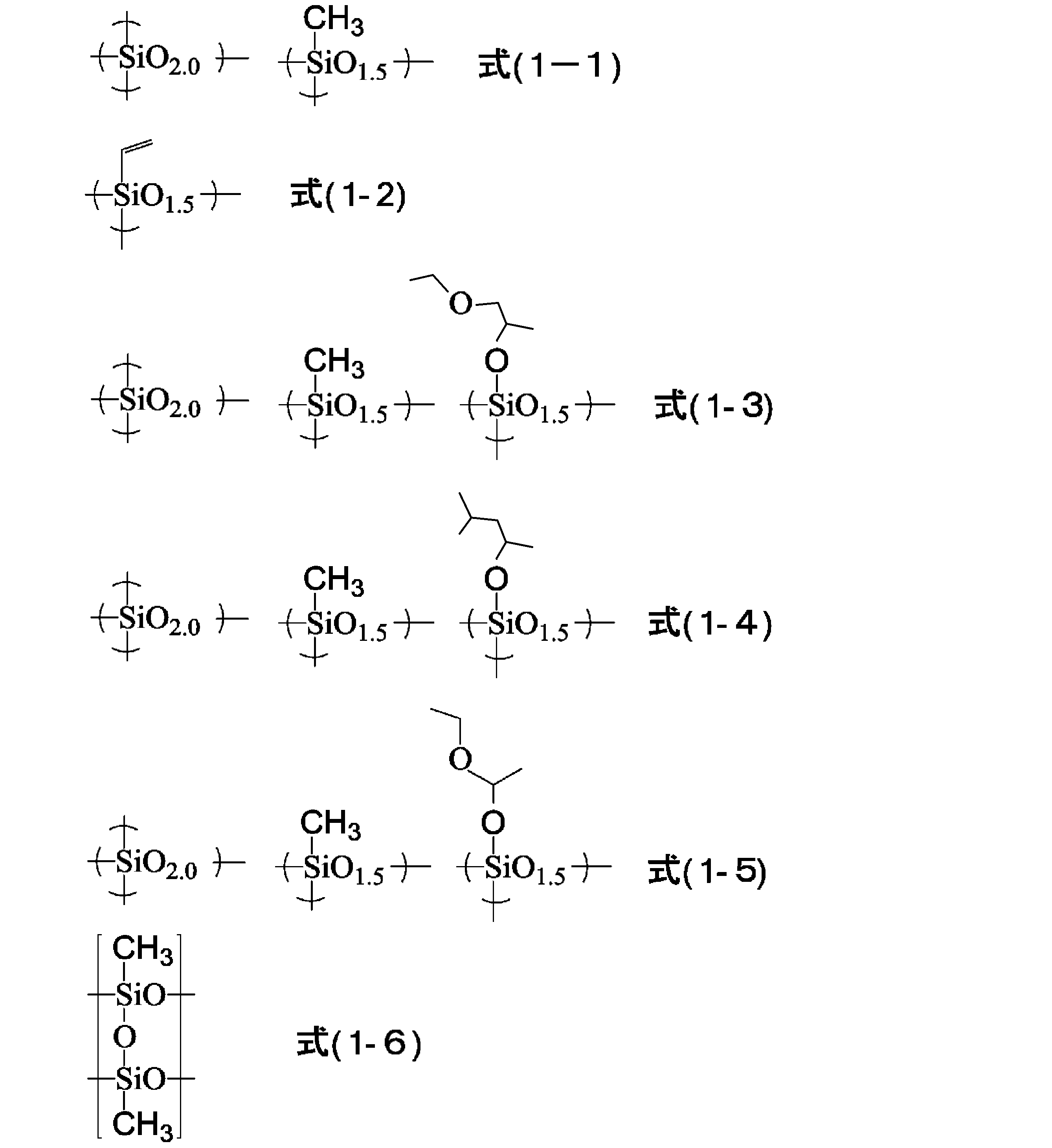
〔調製例1-6:ポリシロキサン含有組成物の調製〕
上記例1~例6のポリシロキサン、並びに硬化触媒、及び溶媒を下記表1に示す割合で混合した後、0.1μmのフッ素樹脂製のフィルタで濾過することによって、調製例1-6のポリシロキサン含有組成物を調製した。なお、下記表1中のポリマーの添加割合はポリマー溶液の添加量ではなく、ポリマー自体の添加量を示した。
上記例1~例6のポリシロキサン、並びに硬化触媒、及び溶媒を下記表1に示す割合で混合した後、0.1μmのフッ素樹脂製のフィルタで濾過することによって、調製例1-6のポリシロキサン含有組成物を調製した。なお、下記表1中のポリマーの添加割合はポリマー溶液の添加量ではなく、ポリマー自体の添加量を示した。
下記表1中、用いた略号の意味は、以下のとおりである。
MA:マレイン酸
IMIDTEOS:N-(3-トリエトキシプロピル)-4,5-ジヒドロイミダゾール
TPS-NO3:トリフェニルスルホニウム硝酸塩
PGMEA:プロピレングリコールモノメチルエーテルアセテート
PGEE:プロピレングリコールモノエチルエーテル
PGME:プロピレングリコールモノメチルエーテル
MIBC:メチルイソブチルカルビノール
DIW:純水
MA:マレイン酸
IMIDTEOS:N-(3-トリエトキシプロピル)-4,5-ジヒドロイミダゾール
TPS-NO3:トリフェニルスルホニウム硝酸塩
PGMEA:プロピレングリコールモノメチルエーテルアセテート
PGEE:プロピレングリコールモノエチルエーテル
PGME:プロピレングリコールモノメチルエーテル
MIBC:メチルイソブチルカルビノール
DIW:純水

調製例1~6で調製したポリシロキサン含有組成物を、スピナーを用いてシリコンウェハ上に塗布した。ホットプレート上で、表2の条件にてそれぞれ1分間加熱し、硬化膜(Si含有組成物膜)1~6を得た。得られた各硬化膜の膜厚をあわせて表2に示す。
その後、各硬化膜に対して、表3の条件及び装置等に関する下記条件にて、H2/N2エッチング又はH2/Heアッシングを実施した。
その後、各硬化膜に対して、表3の条件及び装置等に関する下記条件にて、H2/N2エッチング又はH2/Heアッシングを実施した。
上記エッチング処理又はアッシング処理を施した膜に対して、装置等に関する下記条件にて、Cl2ドライエッチング速度の測定を実施した(実施例1-1~実施例1-6:H2/N2エッチング処理膜に対するCl2ドライエッチングレート、実施例2-1~実施例2-6:H2/Heアッシング処理膜に対するCl2ドライエッチングレート)。
またH2/N2エッチング又はH2/Heアッシング未実施の膜(エッチング/アッシング未処理膜)ついても、同様にCl2ドライエッチング速度の測定を実施した(参考例1~参考例7:未処理膜に対するCl2ドライエッチングレート)。
得られた結果を表4に示す。また、エッチング/アッシング未処理膜のCl2ドライエッチングレートに対する、エッチング/アッシング処理膜のCl2ドライエッチングレートの低下率をあわせて表4に示す。
またH2/N2エッチング又はH2/Heアッシング未実施の膜(エッチング/アッシング未処理膜)ついても、同様にCl2ドライエッチング速度の測定を実施した(参考例1~参考例7:未処理膜に対するCl2ドライエッチングレート)。
得られた結果を表4に示す。また、エッチング/アッシング未処理膜のCl2ドライエッチングレートに対する、エッチング/アッシング処理膜のCl2ドライエッチングレートの低下率をあわせて表4に示す。
<水素ガス含有ガスによるエッチング/アッシングの条件>
東京エレクトロン(株)製 Telius SCCM
H2/N2エッチング:25℃、H2(150sccm)/N2(200sccm)
H2/Heアッシング:300℃、H2(500sccm)/He(6500sccm)
東京エレクトロン(株)製 Telius SCCM
H2/N2エッチング:25℃、H2(150sccm)/N2(200sccm)
H2/Heアッシング:300℃、H2(500sccm)/He(6500sccm)
<ドライエッチング速度の測定>
ドライエッチング速度の測定に用いたエッチャー及びエッチングガスは以下のものを用いた。
Lam Research社製 ドライエッチング装置 Lam2300:Cl2
ドライエッチング速度の測定に用いたエッチャー及びエッチングガスは以下のものを用いた。
Lam Research社製 ドライエッチング装置 Lam2300:Cl2


表4に示すように、水素ガス含有ガスによるエッチング/アッシング処理により、ハロゲン含有ガスのエッチングレートは5%以上低下し、ハロゲン含有ガスエッチング耐性が大幅に改善することが確認された。なお例5のポリシロキサンを用いた硬化膜5においては、H2/N2処理膜に比べてH2/He処理膜のエッチング耐性が向上したが、その他の硬化膜にはいずれもH2/N2処理膜のエッチング耐性がより向上した結果となった。
なお、シロキサン骨格に結合する有機基がヒドロキシ基に変性したと仮定した場合、変性後のポリマーのSi含有率とハロゲン含有ガスエッチングレートには一応の相関がみられた。従って、定かではないが、上記水素ガス含有ガスによるエッチング/アッシング処理により、シリコン含有膜(ポリシロキサン)において何らかの化学的/物理的構造変化が生じたことが、ハロゲン含有ガスのエッチング耐性が改善した理由の一つとして推定される。
Claims (7)
- シリコン含有膜のハロゲン含有ガスエッチング耐性を向上させる方法であって、
ハロゲン含有ガスエッチングの前に、シリコン含有膜を水素ガス含有ガスでエッチング又はアッシングする工程を含む、方法。 - 前記シリコン含有膜が、レジスト下層膜である、請求項1に記載のエッチング耐性を向上させる方法。
- 半導体基板上に、シリコン含有レジスト下層膜形成組成物からレジスト下層膜を形成する工程、
前記レジスト下層膜を水素ガス含有ガスでエッチング又はアッシングする工程、
水素ガス含有ガスでエッチング又はアッシングしたレジスト下層膜の上にレジスト膜を形成する工程、
光又は電子線の照射と現像によりレジストパターンを形成する工程、
形成されたレジストパターンにより該レジスト下層膜をエッチングする工程、及び
パターン化されたレジスト膜とパターン化されたレジスト下層膜により半導体基板を加工する工程を含む、
半導体装置の製造方法。 - 基板上にレジスト膜を形成する工程、
光又は電子線の照射と現像によりレジストパターンを形成する工程、
現像中又は現像後のパターンが形成されたレジスト膜上にシリコン含有薄膜形成組成物を塗布し、焼成して薄膜を形成する工程、
前記薄膜を水素ガス含有ガスでエッチング又はアッシングする工程、
パターン化されたレジスト膜をエッチングして除去し、パターンを反転する工程、
を含む、半導体装置の製造方法。 - ハロゲン含有ガスエッチング耐性が向上されたレジスト下層膜の製造方法であって、
前記下層膜を水素ガス含有ガスでエッチング又はアッシングする工程を含み、
前記下層膜がシリコン含有レジスト下層膜形成組成物の硬化物である、
製造方法。 - 前記シリコン含有レジスト下層膜形成組成物が、加水分解性シランの加水分解縮合物からなるポリシロキサン、該縮合物が有するシラノール基とアルコールとの反応生成物、該縮合物が有するシラノール基をアセタール基で保護して得られた変性ポリシロキサン、又は、該加水分解性シランの加水分解縮合物からなるポリシロキサンとアルコール及び酸との脱水反応物の少なくとも一種を含む、
請求項5に記載の製造方法。 - 前記ポリシロキサンが、下記式(1)で表される少なくとも1種の加水分解性シランを含む、加水分解性シランの加水分解縮合物である、請求項6に記載の製造方法。

Applications Claiming Priority (2)
| Application Number | Priority Date | Filing Date | Title |
|---|---|---|---|
| JP2018247753A JP2022037944A (ja) | 2018-12-28 | 2018-12-28 | 水素ガスを用いた前処理によるレジスト下層膜のエッチング耐性を向上する方法 |
| JP2018-247753 | 2018-12-28 |
Publications (1)
| Publication Number | Publication Date |
|---|---|
| WO2020138092A1 true WO2020138092A1 (ja) | 2020-07-02 |
Family
ID=71129338
Family Applications (1)
| Application Number | Title | Priority Date | Filing Date |
|---|---|---|---|
| PCT/JP2019/050644 Ceased WO2020138092A1 (ja) | 2018-12-28 | 2019-12-24 | 水素ガスを用いた前処理によるレジスト下層膜のエッチング耐性を向上する方法 |
Country Status (3)
| Country | Link |
|---|---|
| JP (1) | JP2022037944A (ja) |
| TW (1) | TW202040636A (ja) |
| WO (1) | WO2020138092A1 (ja) |
Cited By (8)
| Publication number | Priority date | Publication date | Assignee | Title |
|---|---|---|---|---|
| JPWO2022114132A1 (ja) * | 2020-11-27 | 2022-06-02 | ||
| JP2022132962A (ja) * | 2021-03-01 | 2022-09-13 | 日産化学株式会社 | レジスト下層膜形成組成物 |
| WO2022210944A1 (ja) * | 2021-03-31 | 2022-10-06 | 日産化学株式会社 | シリコン含有レジスト下層膜形成用組成物 |
| JP2022157637A (ja) * | 2021-03-31 | 2022-10-14 | 日産化学株式会社 | シリコン含有平坦化性パターン反転用被覆剤 |
| WO2023008507A1 (ja) * | 2021-07-29 | 2023-02-02 | 日産化学株式会社 | シリコン含有レジスト下層膜形成用組成物、及びシリコン含有レジスト下層膜 |
| WO2023037979A1 (ja) * | 2021-09-07 | 2023-03-16 | 日産化学株式会社 | シリコン含有レジスト下層膜形成用組成物、該組成物を用いた積層体、及び半導体素子の製造方法 |
| WO2023136250A1 (ja) * | 2022-01-12 | 2023-07-20 | 日産化学株式会社 | シリコン含有レジスト下層膜形成用組成物、及びシリコン含有レジスト下層膜 |
| KR102959398B1 (ko) | 2020-11-27 | 2026-05-04 | 닛산 가가쿠 가부시키가이샤 | 실리콘 함유 레지스트 하층막 형성용 조성물 |
Citations (8)
| Publication number | Priority date | Publication date | Assignee | Title |
|---|---|---|---|---|
| JPH07161689A (ja) * | 1993-12-03 | 1995-06-23 | Sony Corp | ドライエッチング方法 |
| JP2000031118A (ja) * | 1998-07-08 | 2000-01-28 | Toshiba Corp | パターン形成方法 |
| JP2000221699A (ja) * | 1999-02-04 | 2000-08-11 | Toshiba Corp | 膜の処理方法 |
| CN1414612A (zh) * | 2002-07-19 | 2003-04-30 | 上海华虹(集团)有限公司 | 抗反射膜SiON表面氢等离子体处理方法 |
| JP2004273940A (ja) * | 2003-03-11 | 2004-09-30 | Semiconductor Leading Edge Technologies Inc | パターン形成方法およびパターン形成装置 |
| JP2006024641A (ja) * | 2004-07-06 | 2006-01-26 | Renesas Technology Corp | 半導体装置およびその製造方法 |
| JP2013506313A (ja) * | 2009-09-29 | 2013-02-21 | 東京エレクトロン株式会社 | 基板上のシリコン含有反射防止コーティング層の再加工方法 |
| JP2014157301A (ja) * | 2013-02-18 | 2014-08-28 | Shin Etsu Chem Co Ltd | パターン形成方法 |
-
2018
- 2018-12-28 JP JP2018247753A patent/JP2022037944A/ja active Pending
-
2019
- 2019-12-24 WO PCT/JP2019/050644 patent/WO2020138092A1/ja not_active Ceased
- 2019-12-26 TW TW108147822A patent/TW202040636A/zh unknown
Patent Citations (8)
| Publication number | Priority date | Publication date | Assignee | Title |
|---|---|---|---|---|
| JPH07161689A (ja) * | 1993-12-03 | 1995-06-23 | Sony Corp | ドライエッチング方法 |
| JP2000031118A (ja) * | 1998-07-08 | 2000-01-28 | Toshiba Corp | パターン形成方法 |
| JP2000221699A (ja) * | 1999-02-04 | 2000-08-11 | Toshiba Corp | 膜の処理方法 |
| CN1414612A (zh) * | 2002-07-19 | 2003-04-30 | 上海华虹(集团)有限公司 | 抗反射膜SiON表面氢等离子体处理方法 |
| JP2004273940A (ja) * | 2003-03-11 | 2004-09-30 | Semiconductor Leading Edge Technologies Inc | パターン形成方法およびパターン形成装置 |
| JP2006024641A (ja) * | 2004-07-06 | 2006-01-26 | Renesas Technology Corp | 半導体装置およびその製造方法 |
| JP2013506313A (ja) * | 2009-09-29 | 2013-02-21 | 東京エレクトロン株式会社 | 基板上のシリコン含有反射防止コーティング層の再加工方法 |
| JP2014157301A (ja) * | 2013-02-18 | 2014-08-28 | Shin Etsu Chem Co Ltd | パターン形成方法 |
Cited By (13)
| Publication number | Priority date | Publication date | Assignee | Title |
|---|---|---|---|---|
| JPWO2022114132A1 (ja) * | 2020-11-27 | 2022-06-02 | ||
| WO2022114132A1 (ja) * | 2020-11-27 | 2022-06-02 | 日産化学株式会社 | シリコン含有レジスト下層膜形成用組成物 |
| JP7858545B2 (ja) | 2020-11-27 | 2026-05-14 | 日産化学株式会社 | シリコン含有レジスト下層膜形成用組成物 |
| KR102959398B1 (ko) | 2020-11-27 | 2026-05-04 | 닛산 가가쿠 가부시키가이샤 | 실리콘 함유 레지스트 하층막 형성용 조성물 |
| JP2022132962A (ja) * | 2021-03-01 | 2022-09-13 | 日産化学株式会社 | レジスト下層膜形成組成物 |
| JP7727258B2 (ja) | 2021-03-01 | 2025-08-21 | 日産化学株式会社 | レジスト下層膜形成組成物 |
| JP7659230B2 (ja) | 2021-03-31 | 2025-04-09 | 日産化学株式会社 | シリコン含有平坦化性パターン反転用被覆剤 |
| JP2022157637A (ja) * | 2021-03-31 | 2022-10-14 | 日産化学株式会社 | シリコン含有平坦化性パターン反転用被覆剤 |
| WO2022210944A1 (ja) * | 2021-03-31 | 2022-10-06 | 日産化学株式会社 | シリコン含有レジスト下層膜形成用組成物 |
| WO2023008507A1 (ja) * | 2021-07-29 | 2023-02-02 | 日産化学株式会社 | シリコン含有レジスト下層膜形成用組成物、及びシリコン含有レジスト下層膜 |
| WO2023037979A1 (ja) * | 2021-09-07 | 2023-03-16 | 日産化学株式会社 | シリコン含有レジスト下層膜形成用組成物、該組成物を用いた積層体、及び半導体素子の製造方法 |
| WO2023136250A1 (ja) * | 2022-01-12 | 2023-07-20 | 日産化学株式会社 | シリコン含有レジスト下層膜形成用組成物、及びシリコン含有レジスト下層膜 |
| JPWO2023136250A1 (ja) * | 2022-01-12 | 2023-07-20 |
Also Published As
| Publication number | Publication date |
|---|---|
| JP2022037944A (ja) | 2022-03-10 |
| TW202040636A (zh) | 2020-11-01 |
Similar Documents
| Publication | Publication Date | Title |
|---|---|---|
| JP5679129B2 (ja) | 窒素含有環を有するシリコン含有レジスト下層膜形成組成物 | |
| JP5862894B2 (ja) | 保護された脂肪族アルコールを含有する有機基を有するシリコン含有レジスト下層膜形成組成物 | |
| KR102426414B1 (ko) | Soc 패턴 상에서의 패턴반전을 위한 피복용 조성물 | |
| JP6788222B2 (ja) | 架橋反応性シリコン含有膜形成組成物 | |
| JP5590354B2 (ja) | アミック酸を含むシリコン含有レジスト下層膜形成組成物 | |
| WO2011033965A1 (ja) | スルホンアミド基を有するシリコン含有レジスト下層膜形成組成物 | |
| KR102830156B1 (ko) | 실리콘 함유 조성물을 이용한 반도체 기판의 평탄화방법 | |
| JP6694162B2 (ja) | ハロゲン含有カルボン酸アミド基を有する加水分解性シランを含むリソグラフィー用レジスト下層膜形成組成物 | |
| WO2016009965A1 (ja) | 脂肪族多環構造含有有機基を有するシリコン含有レジスト下層膜形成組成物 | |
| US12084592B2 (en) | Coating composition for pattern inversion | |
| JP7157392B2 (ja) | アルカリ性現像液可溶性シリコン含有レジスト下層膜形成組成物 | |
| JP2022037944A (ja) | 水素ガスを用いた前処理によるレジスト下層膜のエッチング耐性を向上する方法 | |
| WO2012102261A1 (ja) | ジケトン構造含有有機基を含むシリコン含有レジスト下層膜形成組成物 | |
| JP7143763B2 (ja) | シリコン含有パターン反転用被覆剤 | |
| JP7659230B2 (ja) | シリコン含有平坦化性パターン反転用被覆剤 | |
| WO2023136250A1 (ja) | シリコン含有レジスト下層膜形成用組成物、及びシリコン含有レジスト下層膜 |
Legal Events
| Date | Code | Title | Description |
|---|---|---|---|
| 121 | Ep: the epo has been informed by wipo that ep was designated in this application |
Ref document number: 19901992 Country of ref document: EP Kind code of ref document: A1 |
|
| NENP | Non-entry into the national phase |
Ref country code: DE |
|
| 122 | Ep: pct application non-entry in european phase |
Ref document number: 19901992 Country of ref document: EP Kind code of ref document: A1 |
|
| NENP | Non-entry into the national phase |
Ref country code: JP |