WO2020137658A1 - 光硬化性組成物、シール材、防水構造およびガスケットの製造方法 - Google Patents
光硬化性組成物、シール材、防水構造およびガスケットの製造方法 Download PDFInfo
- Publication number
- WO2020137658A1 WO2020137658A1 PCT/JP2019/049185 JP2019049185W WO2020137658A1 WO 2020137658 A1 WO2020137658 A1 WO 2020137658A1 JP 2019049185 W JP2019049185 W JP 2019049185W WO 2020137658 A1 WO2020137658 A1 WO 2020137658A1
- Authority
- WO
- WIPO (PCT)
- Prior art keywords
- styrene
- photocurable composition
- elastomer
- acid ester
- meth
- Prior art date
- Legal status (The legal status is an assumption and is not a legal conclusion. Google has not performed a legal analysis and makes no representation as to the accuracy of the status listed.)
- Ceased
Links
Classifications
-
- C—CHEMISTRY; METALLURGY
- C08—ORGANIC MACROMOLECULAR COMPOUNDS; THEIR PREPARATION OR CHEMICAL WORKING-UP; COMPOSITIONS BASED THEREON
- C08F—MACROMOLECULAR COMPOUNDS OBTAINED BY REACTIONS ONLY INVOLVING CARBON-TO-CARBON UNSATURATED BONDS
- C08F2/00—Processes of polymerisation
- C08F2/44—Polymerisation in the presence of compounding ingredients, e.g. plasticisers, dyestuffs, fillers
-
- C—CHEMISTRY; METALLURGY
- C08—ORGANIC MACROMOLECULAR COMPOUNDS; THEIR PREPARATION OR CHEMICAL WORKING-UP; COMPOSITIONS BASED THEREON
- C08F—MACROMOLECULAR COMPOUNDS OBTAINED BY REACTIONS ONLY INVOLVING CARBON-TO-CARBON UNSATURATED BONDS
- C08F2/00—Processes of polymerisation
- C08F2/46—Polymerisation initiated by wave energy or particle radiation
- C08F2/48—Polymerisation initiated by wave energy or particle radiation by ultraviolet or visible light
-
- C—CHEMISTRY; METALLURGY
- C08—ORGANIC MACROMOLECULAR COMPOUNDS; THEIR PREPARATION OR CHEMICAL WORKING-UP; COMPOSITIONS BASED THEREON
- C08F—MACROMOLECULAR COMPOUNDS OBTAINED BY REACTIONS ONLY INVOLVING CARBON-TO-CARBON UNSATURATED BONDS
- C08F287/00—Macromolecular compounds obtained by polymerising monomers on to block polymers
-
- C—CHEMISTRY; METALLURGY
- C09—DYES; PAINTS; POLISHES; NATURAL RESINS; ADHESIVES; COMPOSITIONS NOT OTHERWISE PROVIDED FOR; APPLICATIONS OF MATERIALS NOT OTHERWISE PROVIDED FOR
- C09K—MATERIALS FOR MISCELLANEOUS APPLICATIONS, NOT PROVIDED FOR ELSEWHERE
- C09K3/00—Materials not provided for elsewhere
- C09K3/10—Materials in mouldable or extrudable form for sealing or packing joints or covers
-
- F—MECHANICAL ENGINEERING; LIGHTING; HEATING; WEAPONS; BLASTING
- F16—ENGINEERING ELEMENTS AND UNITS; GENERAL MEASURES FOR PRODUCING AND MAINTAINING EFFECTIVE FUNCTIONING OF MACHINES OR INSTALLATIONS; THERMAL INSULATION IN GENERAL
- F16J—PISTONS; CYLINDERS; SEALINGS
- F16J15/00—Sealings
- F16J15/02—Sealings between relatively-stationary surfaces
- F16J15/14—Sealings between relatively-stationary surfaces by means of granular or plastic material, or fluid
Definitions
- the present invention relates to a method for producing a photocurable composition, a sealing material, a waterproof structure and a gasket.
- a sealant used for coating and protecting electronic elements and the like is known, for example, by applying a coating type liquid sealant composition to an electronic substrate and then curing the composition. Since this type of sealing material is in a liquid state before curing, it easily enters the gaps of the electronic elements and the like, and after curing, the electronic elements and the like mounted on the electronic substrate can be surely covered.
- Patent Document 1 Japanese Unexamined Patent Application Publication No. 2014-95041 discloses that an electronic substrate is cured by being irradiated with light and then covered with an electronic element.
- a liquid sealing material that protects the element from moisture and foreign matter is disclosed.
- This sealing material comprises a monofunctional alicyclic (meth)acrylic acid ester monomer, a monofunctional aliphatic (meth)acrylic acid ester monomer, a thermoplastic elastomer dissolved in these (meth)acrylic acid ester monomers, and photopolymerization.
- the ratio (H/F) of the tensile strength (H) to the adhesive strength (F) with the hardened stainless steel is 2 or more, and the elongation at break is 300% or more. It is configured.
- the conventional sealing material for example, when used as a gasket, had a problem in that the sealing property deteriorates due to long-term use, which is just another step in terms of waterproofness.
- the present invention aims to suppress deterioration of the sealing property due to long-term use.
- One aspect of the present invention that achieves the above object can be configured as a method for producing a photocurable composition, a sealing material, a waterproof structure, and a gasket described below.
- a photocurable composition according to an aspect of the present invention is a liquid photocurable composition containing a monofunctional aliphatic (meth)acrylic acid ester monomer, a monofunctional alicyclic (meth)acrylic acid ester monomer, and a styrene elastomer.
- the composition is characterized in that the cured product thereof is rich in flexibility and has a compression set of 50% or less.
- This sealing material has excellent compression performance even after long-term use because the compression set of the photocurable composition after curing is 50% or less.
- the photocurable composition according to one aspect of the present invention includes a high molecular weight styrene elastomer in which the styrene elastomer has a weight average molecular weight of 200,000 or more.
- This photocurable composition has a weight average molecular weight of 200,000 or more when the low molecular weight styrene elastomer having a weight average molecular weight of less than 200,000 is used.
- the compression set can be reduced, and the cured product maintains the sealing property even after long-term use.
- the photocurable composition contains a high molecular weight styrene-based elastomer, bleed-out of the plasticizer can be suppressed, and therefore a plasticizer having a large amount can be added to obtain a cured product having high flexibility.
- the styrene elastomer includes an epoxy-modified styrene elastomer.
- the compression set of the cured product obtained by curing is reduced as compared with the case where the epoxy-modified styrene-based elastomer is not included. It is possible to improve the sealing property by using the cured product for a long time.
- the photocurable composition contains an epoxy-modified styrene-based elastomer, so that tack can be reduced, and even if inorganic powder is added, compression set can be made difficult to deteriorate.
- the styrene elastomer includes a styrene elastomer having an unsaturated bond in a soft segment.
- This photocurable composition is cured as compared with the case where the styrene-based elastomer contains a styrene-based elastomer having an unsaturated bond in the soft segment and does not contain a styrene-based elastomer having an unsaturated bond in the soft segment.
- the compression set of the resulting cured product can be reduced, and the sealing property improves as the cured product is used for a long period of time.
- the photocurable composition can reduce tack by including a styrene-based elastomer having an unsaturated bond in the soft segment, and makes compression set difficult to worsen even when inorganic powder is added. be able to.
- the styrene-based elastomer includes a high-molecular-weight styrene-based elastomer having a weight average molecular weight of 200,000 or more and an epoxy-modified styrene-based elastomer.
- This photocurable composition can reduce the compression set of the cured product obtained by curing the styrene-based elastomer by including both elastomers, and maintains the sealing property even after long-term use. can do.
- the said photocurable composition can suppress the bleed-out of a plasticizer, a hardened
- the photocurable composition can make it difficult for compression set to deteriorate even when inorganic powder is added.
- the styrene elastomer is a high molecular weight styrene elastomer having a weight average molecular weight of 200,000 or more and a styrene elastomer having an unsaturated bond in a soft segment.
- the styrene-based elastomer contains the above-mentioned both elastomers, so that it is possible to reduce the compression set of the cured product obtained after curing and maintain the sealing property even after long-term use. can do.
- the said photocurable composition can suppress the bleed-out of a plasticizer, a hardened
- the mass ratio of the high molecular weight styrene elastomer and the epoxy-modified styrene elastomer is 1:1 to 1:20.
- This photocurable composition can be a cured product having a good balance of flexibility and low tackiness by adjusting the above proportion.
- the photocurable composition according to one aspect of the present invention further contains an inorganic powder.
- this photocurable composition further contains an inorganic powder, the thixotropy of the photocurable composition can be enhanced, and dripping during application of the photocurable composition can be suppressed.
- the photocurable composition has a high shape-maintaining property of the photocurable composition at the time of application by a dispenser, for example, and a cured product having a shape close to the applied shape can be obtained.
- the sealing material according to one aspect of the present invention is a cured product of the photocurable composition according to any one of the above aspects, and has a compression set of 50% or less. Since this sealing material is highly flexible and has a compression set of 50% or less, it has excellent sealing properties even after long-term use.
- the waterproof structure according to one aspect of the present invention is a case having an opening, a lid that closes the opening, and a photocurable resin according to any one of the aspects provided on at least one of the case and the lid. And a gasket which is made of a cured product of the composition and which is compressed and deformed by fitting the case and the lid to seal the opening in a liquid-tight manner.
- a gasket made of a cured product of any of the above-mentioned photocurable compositions formed in the case has excellent sealing properties. Therefore, according to the waterproof structure, a waterproof structure having improved waterproofness can be obtained.
- the method for manufacturing a gasket according to one aspect of the present invention includes a step of applying the photocurable composition according to any one of the above aspects to a sealing target, and applying an active energy ray to the applied photocurable composition. Irradiating.
- the photocurable composition is cured by irradiation with active energy rays. Therefore, according to the method for manufacturing a gasket, a gasket having a high sealing property can be easily manufactured.
- the photocurable composition of the present invention is rich in flexibility after curing and can maintain the sealing property after long-term use. Further, the sealing material and the waterproof structure using the photocurable composition of the present invention maintain the sealing property and waterproof property for long-term use. Furthermore, the gasket manufacturing method of the present invention can easily manufacture a gasket having a high sealing property.
- the photocurable composition of the present invention is a liquid photocurable composition containing a monofunctional aliphatic (meth)acrylic acid ester monomer, a monofunctional alicyclic (meth)acrylic acid ester monomer, and a styrene elastomer. And, the compression set after curing is 50% or less.
- the photocurable composition of the present invention is such that the cured product obtained after curing is rich in flexibility and has a compression set of 50% or less so that it has excellent sealing properties even after long-term use. You can
- compression set in this specification is measured by a method in which JIS K6262:2013 is partially changed, and a specific measurement method will be described later.
- the compression set of the photocurable composition after curing is 50% or less, preferably 30% or less, more preferably 20% or less, and further preferably 10% or less. More specifically, if the compression set after curing is 30% or less, it can be used in many applications as a sealing material, and if it is 20% or less, the reliability of the sealing property as a sealing material is improved. If it is 10% or less, the reliability of the sealing property is secured for a longer period of time as a sealing material.
- the “monofunctional aliphatic (meth)acrylic acid ester monomer” is meant to include a monofunctional aliphatic acrylic acid ester monomer and a monofunctional aliphatic methacrylic acid ester monomer.
- the “monofunctional aliphatic (meth)acrylic acid ester monomer” is meant to include a monofunctional alicyclic acrylic acid ester monomer and a monofunctional alicyclic methacrylic acid ester monomer.
- the monofunctional aliphatic (meth)acrylic acid ester monomer is a liquid composition and is a component for dissolving the styrene-based elastomer together with the monofunctional alicyclic (meth)acrylic acid ester monomer described below.
- monofunctional aliphatic (meth)acrylic acid ester monomers include aliphatic ether (meth)acrylics such as ethoxydiethylene glycol acrylate, 2-ethylhexyl diglycol acrylate, butoxyethyl acrylate, phenoxyethyl acrylate, and nonylphenol ethylene oxide-modified acrylate.
- aliphatic ether (meth)acrylics such as ethoxydiethylene glycol acrylate, 2-ethylhexyl diglycol acrylate, butoxyethyl acrylate, phenoxyethyl acrylate, and nonylphenol ethylene oxide-modified acrylate.
- acid ester monomers and aliphatic hydrocarbon (meth)acrylic acid ester monomers such as lauryl acrylate, stearyl acrylate, isostearyl acrylate, decyl acrylate, and isodecyl acrylate.
- the monofunctional alicyclic (meth)acrylic acid ester monomer is also a liquid composition, and is a component that dissolves the styrene elastomer together with the monofunctional aliphatic (meth)acrylic acid ester monomer.
- a monofunctional alicyclic (meth)acrylic acid ester monomer by incorporating a monofunctional alicyclic (meth)acrylic acid ester monomer, the adhesive force of the cured product (for example, the sealing material) after curing of the photocurable composition is increased, while curing the adherend. When the body is peeled off, the adhesive residue can be reduced. It also has the effect of making the cured body tougher and increasing the tensile strength. In addition, increasing the proportion of this component can improve the moisture resistance and transparency.
- monofunctional alicyclic (meth)acrylic acid ester monomer examples include isobornyl acrylate, cyclohexyl acrylate, dicyclopentanyl acrylate, 3,3,5-trimethylcyclohexyl acrylate, 4-tert-butylcyclohexyl acrylate, and the like. Are listed.
- the combined amount of the monofunctional alicyclic and monofunctional aliphatic (meth)acrylic acid ester monomers combined is preferably 40% by mass to 98% by mass in the photocurable composition.
- the mass ratio of the alicyclic (meth)acrylic acid ester monomer to the aliphatic (meth)acrylic acid ester monomer is preferably 3:2 to 1:4.
- the adhesive residue remains when the cured product of the photocurable composition is peeled off. May occur, and the adhesive strength and moisture resistance may be insufficient.
- the cured product is likely to be hard, and further, the adhesiveness may be increased more than necessary due to a change with time and peeling may be difficult.
- the mass ratio of the alicyclic (meth)acrylic acid ester monomer to the aliphatic (meth)acrylic acid ester monomer is in the range of 3:2 to 1:4, the elongation at break is particularly large and peeling occurs.
- An easily hardened body for example, a sealing material
- acrylic acid ester monomer for each of the monofunctional aliphatic (meth)acrylic acid ester monomer and the alicyclic (meth)acrylic acid ester monomer. This is because many acrylic acid ester monomers have excellent photocurability as compared with methacrylic acid ester monomers, can be cured with a relatively low integrated light amount, and have a tendency that the cured product becomes flexible.
- Styrenic elastomer The styrene elastomer is dissolved in the monofunctional aliphatic (meth)acrylic acid ester monomer and the monofunctional alicyclic (meth)acrylic acid ester monomer in the photocurable composition.
- the styrene-based elastomer enhances the mechanical strength of the cured product after the monofunctional aliphatic (meth)acrylic acid ester monomer and the monofunctional alicyclic (meth)acrylic acid ester monomer are cured, and lowers the moisture permeability. ..
- the styrene-based elastomer imparts rubber elasticity (flexibility) to a cured product (for example, a sealing material) together with a monofunctional aliphatic (meth)acrylic acid ester monomer and a monofunctional alicyclic (meth)acrylic acid ester monomer. It is the ingredient to do.
- Styrene-based elastomer is solid by itself, so it does not have adhesiveness at room temperature. However, the styrene-based elastomer is dissolved in a monofunctional aliphatic (meth)acrylic acid ester monomer and a monofunctional alicyclic (meth)acrylic acid ester monomer to give a photocurable composition and a cured product thereof (for example, a sealing material). ) Can be uniformly dispersed in
- the addition amount of the styrene-based elastomer is preferably 1 to 60% by mass, more preferably 2 to 45% by mass in the photocurable composition. If the content of the styrene elastomer is less than 1% by mass, the mechanical strength may be low. On the other hand, when it exceeds 60% by mass, the viscosity of the photocurable composition becomes high, which may make application difficult. When the content is 35% by mass or less, the fluidity is suitable and the application is easy.
- styrene elastomer examples include styrene-butadiene-styrene block copolymer (SBS), styrene-isoprene-styrene block copolymer (SIS), styrene-ethylene-butylene-styrene block copolymer (SEBS), Styrene-ethylene-propylene-styrene block copolymer (SEPS), styrene-isobutylene-styrene block copolymer (SIBS), styrene-ethylene-ethylene-propylene-styrene block copolymer (SEEPS), and modified products thereof.
- SBS styrene-butadiene-styrene block copolymer
- SIS styrene-isoprene-styrene block copolymer
- SEBS Styrene-ethylene-propylene-styrene block cop
- the styrene elastomer in the present invention preferably contains a high molecular weight styrene elastomer.
- Specific examples of the high-molecular-weight styrene-based elastomer are the same as those described above, and thus the above description is incorporated and the description thereof is omitted here.
- the compression set can be reduced as compared with the case of using the low-molecular-weight styrene-based elastomer having a weight average molecular weight of less than 200,000, and the cured product can be used for a long period of time.
- the sealing property is maintained.
- the bleed-out of the plasticizer can be suppressed by including the high molecular weight styrene-based elastomer, it is possible to obtain a cured product having a high flexibility by adding a large amount of the plasticizer.
- the weight average molecular weight of the high molecular weight styrene-based elastomer is preferably 200,000 or more, more preferably 250,000 or more, and further preferably 400,000 or more. There is no particular upper limit, but it is, for example, 1 million or less.
- the weight average molecular weight of the styrene-based elastomer is measured based on a calibration curve (calibration curve) measured by standard polystyrene using GPC method (Gel Permeation Chromatography; gel permeation chromatography). did.
- the “low molecular weight styrene elastomer” refers to a styrene elastomer having a weight average molecular weight of less than 200,000.
- the high molecular weight styrene elastomer in the present invention preferably has no unsaturated bond, and as an example, at least one of the polymer blocks containing a styrene unit and at least a polymer block containing a conjugated diene compound unit.
- a hydrogenated block copolymer obtained by hydrogenating a single block copolymer can be used. By not having an unsaturated bond, heat resistance and light resistance can be improved.
- hydrogenated block copolymer examples include styrene-hydrogenated butadiene-styrene block copolymer, styrene-hydrogenated isoprene-styrene block copolymer, styrene-hydrogenated butadiene/isoprene copolymer- Examples thereof include styrene block copolymers.
- the hydrogenated block copolymers may be used alone or in combination of two or more.
- the polystyrene block content is not particularly limited, but is preferably 10 to 70% by mass, and more preferably 20 to 65% by mass.
- the hydrogenation rate of the polybutadiene block is not particularly limited, but is preferably 50 mol% or more, more preferably 70 to 100 mol%.
- the hydrogenated product of the styrene-butadiene-styrene block copolymer is styrene-ethylene-butylene-styrene block copolymer (SEBS).
- the polystyrene block content is not particularly limited, but is preferably 10 to 70% by mass, and more preferably 10 to 40% by mass.
- the hydrogenation rate of the polyisoprene block is not particularly limited, but is preferably 50 mol% or more, more preferably 70 to 100 mol%.
- the hydrogenated product of the styrene-isoprene-styrene block copolymer is styrene-ethylene-propylene-styrene block copolymer (SEPS).
- the polystyrene block content is not particularly limited, but is preferably 10 to 70% by mass, and 20 to 40% by mass. Is more preferable.
- the hydrogenation rate of the butadiene/isoprene copolymer block is not particularly limited, but is preferably 50 mol% or more, more preferably 70 to 100 mol%.
- the hydrogenated product of the styrene-butadiene/isoprene copolymer-styrene block copolymer is styrene-ethylene-ethylene-propylene-styrene block copolymer (SEEPS).
- the mixing ratio is not particularly limited, but when it is composed of two kinds of butadiene and isoprene, the content of butadiene and isoprene is contained.
- the ratio [butadiene/isoprene] is preferably 10/90 to 90/10 and more preferably 30/70 to 70/30 in terms of molar ratio.
- the addition amount of the high molecular weight styrene elastomer is preferably 1 to 7% by mass, and more preferably 2 to 5% by mass in the photocurable composition. If the content of the styrene elastomer is less than 1% by mass, the mechanical strength may be low. On the other hand, if it exceeds 10% by mass, the viscosity of the photocurable composition tends to increase.
- the hydrogenated styrene-based elastomer a commercially available product may be used, or a known method, for example, anionic polymerization of a vinyl aromatic compound and a conjugated diene compound using a lithium initiator, and then known methods such as Raney nickel You may manufacture by the method of hydrogenating with the hydrogenation catalyst of.
- the styrene elastomer in the present invention preferably contains an epoxy-modified styrene elastomer.
- the weight average molecular weight of the styrene elastomer which is a polymer to be epoxidized for epoxy modification, is preferably 10,000 to 1,000,000, and particularly preferably 50,000 to 200,000.
- the styrene elastomer which is the polymer to be epoxidized according to the present invention, needs to be solid at the epoxidation reaction temperature.
- the solid state at the epoxidation reaction temperature means a state in which the shape is not substantially changed by stirring at the reaction temperature and is in the form of powder or particles.
- styrene-based elastomer is epoxidized and epoxy-modified by the method described in Japanese Patent No. 4116880, Japanese Patent No. 4881267, Japanese Patent No. 3649675, and Japanese Patent No. 3349772.
- a styrene elastomer can be obtained.
- the contents of the above-mentioned patent specifications are incorporated by reference with respect to the epoxy-modified styrenic elastomer of the present specification.
- the epoxy-modified styrenic elastomer used in the present invention can be produced by the method described below.
- the production process of epoxidation for epoxy modification comprises a first step of obtaining an epoxidized granular styrenic elastomer and a second step of washing the epoxidized granular styrenic elastomer with water, or neutralizing and washing with water.
- a method for producing an epoxidized granular styrenic elastomer which comprises a third step which is provided as necessary to remove a solvent for promoting an epoxidation reaction that may be used in the first step, In the step of, in the step of epoxidizing the granular styrenic elastomer in an aqueous medium in the presence of an epoxidizing agent such as a peracid or the epoxidizing agent and a solvent for promoting the epoxidation reaction to form an epoxidized granular styrenic elastomer. is there.
- an epoxidizing agent such as a peracid or the epoxidizing agent and a solvent for promoting the epoxidation reaction to form an epoxidized granular styrenic elastomer.
- water is used as the dispersion medium for the granular styrene elastomer.
- peracetic acid is preferably used alone or together with the organic solvent thereof, and it is preferable to use the phosphoric acid compound and further the organic solvent as the reaction accelerator.
- the organic solvent that is a solvent for peracetic acid may also serve as the organic solvent as the reaction accelerator.
- the second step includes washing or neutralization and washing steps, the polymer is separated by solid-liquid separation, and this polymer is supplied to the third step.
- the polymer obtained in the second step is dried while holding the granular outer shape.
- the particulate modified styrenic elastomer having the epoxidized shell-like surface layer is recovered.
- the phosphoric acid compound is preferably used during the epoxidation reaction.
- the “granular modified styrene-based elastomer having an epoxidized shell-like surface layer” obtained by the above production method is hereinafter also referred to as “epoxy-modified styrene-based elastomer”.
- the organic solvent preferably used as the reaction accelerator when carrying out the epoxidation reaction varies depending on the type of the polymer to be epoxidized and the reaction conditions of the epoxidation, but an organic solvent having a solubility parameter (SP) value of 10 or less is preferable.
- An organic solvent having a solubility parameter (SP) value of 10 or less has a function of permeating and transporting a peroxide, which is an epoxidizing agent, into a diene-based polymer or the like in a solid state and epoxidizing the inside.
- Preferred organic solvents used when carrying out the epoxidation reaction include linear or branched hydrocarbons such as hexane and octane, or alkyl-substituted derivatives thereof; alicyclic hydrocarbons such as cyclohexane and cycloheptane. Or alkyl-substituted derivatives thereof; aromatic hydrocarbons such as benzene, naphthalene, toluene, xylene or alkyl-substituted aromatic hydrocarbons; aliphatic carboxylic acid esters such as methyl acetate, ethyl acetate; chloroform, etc.
- organic solvents examples thereof include halogenated hydrocarbons and heterocyclic compounds such as tetrahydrofuran.
- the organic solvent Is preferably cyclohexane, ethyl acetate, chloroform, toluene, benzene, xylene, hexane, tetrahydrofuran or the like. Further, in the epoxidation reaction, one kind or a mixture of two or more kinds of these preferable organic solvents may be used.
- peroxide used as the epoxidizing agent examples include percarboxylic acid compounds such as performic acid, peracetic acid and perpropionic acid. These peroxides can also be epoxidized in a system using a peroxide containing water, which is derived from hydrogen peroxide. Among the above-mentioned peroxides, peracetic acid is preferable from the viewpoint of efficiently promoting the epoxidation reaction.
- the percarboxylic acid When using a percarboxylic acid as an epoxidizing agent, the percarboxylic acid is preferably dissolved in a solvent before use.
- the solvent that dissolves the percarboxylic acids include hydrocarbons such as hexane, organic acid esters such as ethyl acetate, and aromatic hydrocarbons such as toluene. These solvents, which affect the epoxidation reaction, penetrate into the interior of the styrene-based elastomer to be epoxidized and accelerate the epoxidation reaction, similarly to the above-mentioned reaction accelerator. Therefore, when using percarboxylic acids as an epoxidizing agent, it is desirable to use the above solvent.
- the organic solvent used as the solvent for the peroxide is an organic solvent that also functions as a reaction accelerator, the amount used needs to be determined in consideration of the amount used for the reaction accelerator. ..
- a lower carboxylic acid such as formic acid or acetic acid is reacted with hydrogen peroxide in advance to produce a percarboxylic acid, which is used as an epoxidizing agent.
- a method of performing the epoxidation reaction by adding the obtained percarboxylic acid to a reaction system composed of a solid styrene elastomer, an aqueous medium and a solvent for promoting the epoxidation reaction.
- a method of epoxidizing using hydrogen peroxide in the presence of a catalyst such as an osmium salt and tungstic acid, and a solvent As the solvent that can be used in the latter method, the same solvent as described above can be used.
- the phosphoric acid compounds preferably used include, for example, inorganic phosphoric acid and organic phosphoric acid and their salts, preferably acidic phosphoric acid ester or its salt.
- inorganic phosphoric acid hypophosphorous acid, metaphosphorous acid, orthophosphorous acid, metaphosphoric acid, orthophosphoric acid, pyrophosphorous acid, pyrophosphoric acid, tripolyphosphoric acid, tetrapolyphosphoric acid, hexametaphosphoric acid and their salt compounds Can be mentioned.
- Suitable acidic phosphates include, for example, monomethyl phosphate, monoisopropyl phosphate, monobutyl phosphate, monoamyl phosphate, mono-2-ethylhexyl phosphate, monononyl phosphate, monoisodecyl phosphate, monocetyl phosphate, phosphorus
- suitable acidic phosphates include, for example, monomethyl phosphate, monoisopropyl phosphate, monobutyl phosphate, monoamyl phosphate, mono-2-ethylhexyl phosphate, monononyl phosphate, monoisodecyl phosphate, monocetyl phosphate, phosphorus
- monomyristyl acid monophenyl phosphate and monobenzyl phosphate
- dialkyl phosphates such as dibutyl phosphate and di-2-hexyl phosphate
- dibutyl hydrogen phosphite examples include, for example
- phosphoric acid useful as a phosphoric acid compound is, for example, from industrial availability, pure phosphoric acid from hydrated phosphoric acid, that is, about 70% to about 100% phosphoric acid. , Preferably about 85% or more of phosphoric acid.
- the phosphoric acid compound various condensed forms of phosphoric acid equivalents, for example, polymerized partial anhydrides or esters of phosphoric acid, pyrophosphoric acid, tripolyphosphoric acid and the like are used. Among these, it is preferable to use sodium salt of tripolyphosphoric acid, phosphoric acid ester and salts thereof.
- the amount of these phosphoric acid compounds used is 0.005 to 1 part by weight, more preferably 0.01 to 0.5 part by weight, based on 100 parts by weight of the granular styrene elastomer.
- the oxirane oxygen concentration of the obtained epoxidized product is adjusted by changing the reaction molar ratio of the double bond amount of the styrene-based elastomer to be epoxidized and the epoxidizing agent. can do.
- the reaction molar ratio is preferably selected in the range of 1.0 to 3.0, particularly preferably in the range of 1.1 to 2.5.
- the oxirane oxygen concentration in the epoxy-modified styrene-based elastomer in the present invention is preferably 0.3 to 5.0% by weight based on the epoxy-modified styrene-based elastomer.
- the reaction temperature when epoxidizing the styrenic elastomer to be epoxidized depends on the type of styrenic elastomer to be epoxidized, the size of the surface area, the type of solvent, the type and amount of the epoxidizing agent, and the reaction time. Depending on the temperature, it is preferably 10 to 70°C. When the reaction temperature is lower than 10°C, the reaction rate is slow and not practical. On the other hand, if the reaction temperature exceeds 70° C., the self-decomposition of the peroxide becomes remarkable, which is not preferable.
- reaction temperature exceeds 70° C.
- a particularly preferable reaction temperature is in the range of 30 to 60°C.
- the pressure of the reaction system is usually atmospheric pressure, but may be slightly reduced pressure or slightly increased pressure.
- the photocurable composition of the present invention contains an epoxy-modified styrene-based elastomer, so that the compression set of the cured product obtained after curing can be reduced as compared with the case where the epoxy-modified styrene-based elastomer is not included, The sealing property of the cured product after long-term use is improved. Further, by including the epoxy-modified styrene-based elastomer, tack can be reduced, and even if inorganic powder is added, compression set can be made difficult to deteriorate.
- the styrene elastomer in the present invention preferably contains a styrene elastomer having an unsaturated bond in the soft segment.
- Specific examples of the styrene elastomer having an unsaturated bond in the soft segment include styrene-butadiene-styrene block copolymer (SBS), styrene-isoprene-styrene block copolymer (SIS), and styrene-butadiene/isoprene copolymer.
- SBS styrene-butadiene-styrene block copolymer
- SIS styrene-isoprene-styrene block copolymer
- An example is a polymer-styrene block copolymer.
- the photocurable composition of the present invention contains a styrene elastomer having an unsaturated bond in the soft segment, so that the compression set is greater than that in the case of using a styrene elastomer having no unsaturated bond in the soft segment. Can be reduced, and the cured product maintains the sealing property even after long-term use. In addition, by including the styrene-based elastomer having an unsaturated bond in the soft segment, tack can be reduced, and even if inorganic powder is added, compression set can be made difficult to deteriorate.
- the styrene elastomer having an unsaturated bond in the soft segment may partially have a saturated bond by hydrogenation as long as the unsaturated bond remains in the soft segment.
- the unit ratio of unsaturated bond to saturated bond in the soft segment is preferably 1:30 to 1:3, and is preferably 1:8 to 1:3. More preferable.
- the styrene elastomer of the present invention preferably contains both the above-mentioned high molecular weight styrene elastomer and epoxy-modified styrene elastomer. Since the styrene-based elastomer contains both of the above elastomers, the compression set of the cured product obtained by curing can be reduced, and the sealing property can be maintained even after long-term use.
- the bleed-out of the plasticizer can be suppressed, a highly flexible cured body can be obtained, and tack can be reduced. Furthermore, even if the inorganic powder is added, the compression set can be made less likely to deteriorate.
- the mass ratio of the high molecular weight styrene elastomer and the epoxy modified styrene elastomer is 1:1 to 1:20.
- the photocurable composition of the present invention by adjusting the above ratio, it is possible to enhance the shape retention of the photocurable composition at the time of coating with a dispenser by adding an inorganic powder, and, after curing, The compression set of the cured product can be reduced.
- the photocurable composition of the present invention contains a photoradical polymerization initiator. Further, the photocurable composition of the present invention may contain a thixotropic agent. Further, various additives can be appropriately blended within a range not departing from the spirit of the present invention. Examples thereof include plasticizers, silane coupling agents, polymerization inhibitors, defoamers, light stabilizers, antioxidants, antistatic agents, and fillers.
- the photo-radical polymerization initiator is a compound that causes a monofunctional aliphatic (meth)acrylic acid ester monomer and a monofunctional alicyclic (meth)acrylic acid ester monomer to undergo photoreaction to cure.
- the photocurable composition is applied to, for example, an electronic device, and then the monofunctional aliphatic (meth)acrylic acid ester monomer and the monofunctional alicyclic (meth)acrylic acid ester monomer are photocured to obtain an electronic device. It is possible to obtain a sealing material with improved adhesiveness.
- photoradical polymerization initiator examples include benzophenone-based, thioxanthone-based, acetophenone-based, acylphosphine-based, oxime ester-based, and alkylphenone-based photopolymerization initiators.
- the addition amount of the photo-radical polymerization initiator is preferably 0.1 to 10 parts by mass, preferably 1 to 8 parts by mass, based on 100 parts by mass of the total amount of all acrylic monomers including monofunctional and bifunctional or more. More preferable.
- the photocurable composition of the present invention has improved thixotropy by adding a thixotropic agent. By increasing the thixotropy, the shape retention of the applied photocurable composition is improved. Therefore, for example, when the photocurable composition is formed into a three-dimensional object by using a dispenser, the photocurable composition can be cured with the shape applied.
- the thixotropic agent examples include an inorganic thixotropic agent composed of an inorganic powder such as silica, aluminum oxide or titanium oxide; an organic thixotropic agent such as hydrogenated castor oil, amide wax or carboxymethyl cellulose. Agents and the like.
- an inorganic powder is preferable as the thixotropic agent, and silica is particularly preferable.
- the addition amount of silica is 2 to 10 parts by mass with respect to 100 parts by mass of the resin component.
- the "resin component” means a component containing a monofunctional aliphatic (meth)acrylic acid ester monomer, a monofunctional alicyclic (meth)acrylic acid ester monomer, a styrene elastomer, and a plasticizer as necessary. ..
- the inorganic powder which is a thixotropic agent, can increase the thixotropy of the photocurable composition, suppresses dripping during application of the photocurable composition, and improves the shape of the applied photocurable composition. Maintainability can be improved.
- plasticizer that is compatible with the soft segment of the styrene elastomer is preferable.
- the plasticizer include paraffin oil, olefin oil, naphthene oil, and ester plasticizer.
- ester plasticizer include phthalic acid ester, adipic acid ester, and trimellitic acid. Examples thereof include acid esters, polyesters, phosphoric acid esters, citric acid esters, epoxidized vegetable oils, sebacic acid esters, azelasic acid esters, maleic acid esters, and benzoic acid esters.
- the plasticizer is preferably 30% by mass or less in the resin component, and in some cases, the plasticizer may not be added. When the plasticizer is more than 30% by mass with respect to 100 parts by mass of the resin component, the plasticizer is more likely to bleed out from the cured product.
- the styrene thermoplastic elastomer contains a high molecular weight styrene elastomer
- the ratio of the high molecular weight styrene elastomer to the plasticizer is preferably 1:30 to 1:3. Further, it is more preferably 1:15 to 1:3.
- the styrene-based thermoplastic elastomer is an epoxy-modified styrene-based elastomer or a styrene-based elastomer having an unsaturated bond in the soft segment
- the epoxy-modified styrene-based elastomer or the styrene-based elastomer having an unsaturated bond in the soft segment a plasticizer
- the ratio is preferably from 1:3 to 1:0. Further, it is more preferably 1:1.5 to 1:0. However, a small amount of plasticizer may be contained.
- the sealing material of the present invention is a cured product of the above-mentioned photocurable composition and has a compression set of 50% or less. Since the sealing material of the present invention is rich in flexibility and has a compression set of 50% or less, it has excellent sealing properties even after long-term use.
- the sealing material is obtained by photocuring the monofunctional aliphatic (meth)acrylic acid ester monomer and the monofunctional alicyclic (meth)acrylic acid ester monomer in the above-mentioned photocurable composition.
- an electronic element provided on an electronic substrate or the like, or a sealant by applying a photocurable composition to a portion where metal is exposed to cover an adherend and then curing the photocurable composition by active energy ray irradiation.
- the active energy ray is an energy ray that directly activates a (meth)acryloyl group in a monofunctional aliphatic (meth)acrylic acid ester monomer and a monofunctional alicyclic (meth)acrylic acid ester monomer, and photoradical polymerization.
- an energy ray that generates radicals in the initiator include ultraviolet rays, visible rays, and electron rays, and ultraviolet rays are preferable.
- a high pressure mercury lamp or an ultraviolet LED can be used as the light source for irradiating the ultraviolet ray.
- the sealing material which is a cured product obtained after curing the photocurable composition of the present invention, has a hardness of 60 degrees in terms of A hardness according to JIS K6253-3:2012.
- the following is preferable.
- the A hardness of the cured product is preferably 40 degrees or less, more preferably 20 degrees or less, and further preferably 5 degrees or less. If it is 5 degrees or less, it can be used for a sealing material application where a very low load is required.
- the sealing material of the present invention is preferably a flexible rubber-like elastic body, and the storage elastic modulus E′ measured by a dynamic viscoelasticity measuring device is preferably in the range of 0.01 to 100 MPa.
- the storage elastic modulus E' is less than 0.01 MPa, the strength becomes small and the reworkability may be deteriorated.
- the pressure exceeds 100 MPa the stress for compressing the seal member increases, and when applied to, for example, a case having low rigidity, there is a possibility that a problem such as deformation of the case may occur.
- Such a sealing material has an adhesive force derived from a monofunctional aliphatic (meth)acrylic acid ester monomer and a monofunctional alicyclic (meth)acrylic acid ester monomer, and adheres to an adherend to prevent foreign matter and moisture from adhering. You can prevent intrusion.
- the waterproof structure of the present invention includes a case having an opening, a lid that closes the opening, and a cured body of the photocurable composition according to any one of the above, which is provided in at least one of the case and the lid. And a gasket for compressing and deforming by fitting the case and the lid to seal the opening in a liquid-tight manner. Since the gasket formed of the cured product of any one of the photocurable compositions formed in the case has excellent sealing properties, the waterproof structure of the present invention can provide a waterproof structure with improved waterproof property.
- the method for manufacturing a gasket of the present invention comprises a step of applying any of the above photocurable compositions to a sealing target, and a step of irradiating the applied photocurable composition with an active energy ray. Including. Since the photocurable composition of the present invention is cured by irradiation with the above-mentioned active energy rays, the gasket manufacturing method of the present invention can easily manufacture a gasket having a high sealing property.
- Sample 1 Lauryl acrylate (aliphatic acrylate ester monomer) and isobornyl acrylate (alicyclic acrylate ester monomer) were used as acrylic monomers, and 1,9-nonanediol diacrylate was used as styrene elastomer.
- the styrene elastomer shown in Table 2 was added to the above-mentioned acrylic monomer and stirred for 24 hours to dissolve the styrene elastomer in the acrylic monomer.
- the blending ratio at this time is 34.5 parts by mass of lauryl acrylate, 34.5 parts by mass of isobornyl acrylate, 1.0 part by mass of 1,9-nonanediol diacrylate, 18.0 parts by mass of styrene elastomer, and plastic.
- a paraffin oil (PW380, manufactured by Idemitsu Kosan Co., Ltd.) as an agent was adjusted to be 12.0 parts by mass. That is, 100 parts by mass of the "resin component" consisting of the acrylic monomer, the styrene elastomer and the plasticizer was prepared as described above.
- the photoradical polymerization initiator 2-hydroxy-2-methyl-propiophenone is added to the above resin component in a mass of 5.0 parts by mass. did.
- silica hydrophilic fumed silica having a specific surface area of about 200 m 2 /g, manufactured by Nippon Aerosil Co., Ltd., Aerosil 200
- Aerosil 200 which is an additive for imparting thixotropy
- the amount of 2 parts by mass was added to the mixture of the resin component and the initiator to obtain the photocurable composition of Sample 1.
- ultraviolet rays high pressure mercury lamp
- Samples 2-29 The styrene elastomer and the acrylic monomer of Sample 1 were changed to the types and blends (parts by mass) shown in Tables 2 to 6, and the addition amount of the paraffin oil as the plasticizer and the addition amount of silica as the additive were changed. Photocurable compositions of Samples 2 to 29 were prepared in the same manner as Sample 1 except that the photocurable compositions were changed. Further, the addition amount of the plasticizer was adjusted so that the resin component was 100 parts by mass. The photocurable compositions of Samples 2 to 29 were also irradiated with ultraviolet rays in the same manner as in Sample 1 to obtain sealing materials of Samples 2 to 29.
- Compression set (1) and compression set (2) For each sample of the example, a test piece was prepared under the following conditions, and the compression set was measured under a jig and conditions in accordance with JIS K6262:2013.
- a cured product formed by applying a photocurable composition to a thickness of about 1 mm is prepared.
- a test piece having a length of 10 mm, a width of 10 mm, and a thickness of 4 mm (initial thickness: t0) is manufactured (at this time, the cured products are stacked four sheets). Further, the test piece is compressed by 25% with a jig conforming to the JIS standard, placed in a thermostatic chamber, and left at an ambient temperature of 70° C. for 22 hours.
- a lubricant was not used when compressing the test piece with the jig, and a polyethylene terephthalate film with a silicone release layer (thickness 0.1 mm) was interposed between the jig and the test piece.
- the jig is taken out of the constant temperature bath, the compressed test piece is taken out of the jig, and then left in an atmosphere at room temperature (that is, 23 ⁇ 2° C.) for 30 minutes, and then the thickness (t) is measured.
- the thickness (t) after the test with respect to the initial thickness (t0) is calculated by the following formula.
- the above test was conducted three times for each sample, and the arithmetic mean thereof is shown in the columns of compression set (1) in Tables 2 to 6.
- the compression set is preferably as small as possible.
- the evaluation standard is that the compression set is 50% or less in the example, and the compression set is more than 50% in the comparative example.
- this test piece is compressed by 25% with a jig according to JIS K6262:2013, placed in a thermostatic chamber, and left at an ambient temperature of 70° C. for 22 hours.
- a polyethylene terephthalate film (thickness: 0.1 mm) having a silicone release layer formed was interposed on one side where the jig and the cured body were in contact with each other.
- the jig is taken out of the constant temperature bath, the compressed test piece is taken out of the jig, and is allowed to stand in a room temperature (that is, 23 ⁇ 2° C.) atmosphere for 30 minutes, and then the thickness (t) is measured.
- Rubber hardness Evaluation was performed using a type A durometer according to JIS K6253-3:2012.
- a method for preparing a measurement sample a cured product formed by applying a photocurable composition to a thickness of about 1 mm is prepared, and the cured product sealing material is a test piece having a length of 10 mm ⁇ a width of 10 mm ⁇ a thickness of 10 mm. Is prepared (at this time, 10 cured products are stacked).
- the photocurable composition is used and the sheet is produced with a thickness that can be cured by ultraviolet rays, the "number of layers" is outside the JIS standard conditions under the above test conditions.
- the evaluation criteria are that the A type hardness of 60 degrees or less is “OK”, 40 degrees or less is “preferable A hardness”, 20 degrees or less is “more preferable A hardness”, and 5 degrees or less is “most preferable A hardness”.
- the A type hardness of 60 degrees or less is “OK”
- 40 degrees or less is “preferable
- tack Sensory evaluation was performed by touching with fingers. It is preferable that there is no tack, but since there is no problem if it is used only by compressing, it is an example even if there is tack.
- the evaluation criteria described in the table are as follows. A: It is smooth without fingers. B: No finger touch. C: There is a slight tack. D: There is tack. E: There is a lot of tack.
- Shape retention of uncured photocurable composition A linear pattern having a width of 1 mm is formed on a polycarbonate plate using a dispenser. Then, the polycarbonate plate is tilted so that the coated surface is in the vertical direction and the linear pattern is in the horizontal direction, and this state is maintained for 2 minutes.
- the evaluation criteria are as follows. A: The linear pattern did not show slipping, and the shape was maintained. B: Although the linear pattern did not show slipping, the shape was slightly deformed. C: After 2 minutes, the linear pattern was flowing or it was largely slid off. It should be noted that all of the examples are irrespective of whether the shape maintainability is good or bad.
- ⁇ Waterproof test> For each photocurable composition, the following test pieces were prepared and tested in accordance with IPX7 defined in JIS C0920. Specifically, for a sample whose shape retention property is A or B, as a test piece, a polycarbonate plate having a thickness of 1 mm has a line width of about 2.0 mm, a thickness of about 1.4 mm, and an outer shape of 30 ⁇ 30 mm. As described above, the frame-shaped gasket was formed by applying the photocurable composition using a dispenser and then irradiating the composition with ultraviolet rays to cure the composition. Further, for a sample having a shape-retaining property of C, it is difficult to form it by a dispenser.
- a sheet-shaped cured body of a photocurable composition having a thickness of 1.4 mm is prepared, and a die is removed from this sheet.
- a frame-shaped gasket having a line width of 2.0 mm and a thickness of 1.4 mm and an outer shape of 30 ⁇ 30 mm was formed using this, and this was attached to a polycarbonate plate having a thickness of 1 mm. Subsequently, the gasket was compressed by 25% with a polycarbonate plate having a thickness of 1 mm, which was different from the above, and maintained at 70° C. for 22 hours.
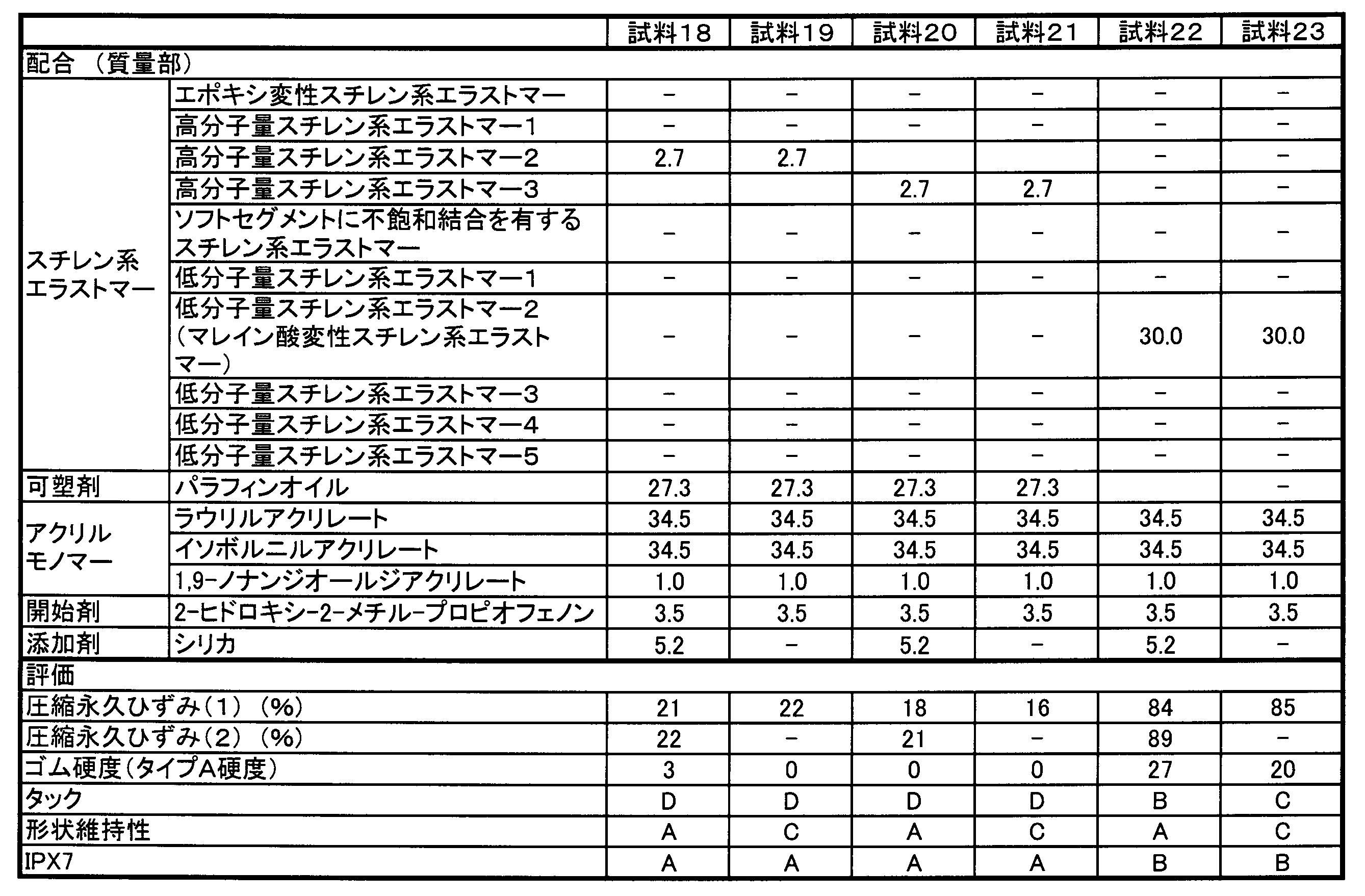
- Samples 9 and 10 using the low molecular weight styrene elastomer 1 having a weight average molecular weight of less than 200,000 as the styrene elastomer are silica as an additive.
- the samples 22 and 23 using the low molecular weight styrene elastomer 2 having a weight average molecular weight of less than 200,000 as the styrene elastomer are high at 84% and 85%, respectively, regardless of whether or not silica as an additive is compounded. ,
- the compression set is large.
- samples 24 to 29 using low molecular weight styrene elastomers 3 to 5 having a weight average molecular weight of less than 200,000 as styrene elastomers were 97% and 100%, respectively, with or without addition of silica as an additive. , 97%, 100%, 92%, 80% and high compression set.
- the compression set is small in all cases, being 10% or less.
- the sample 12 in which the high molecular weight styrene-based elastomer was used in combination with the low molecular weight styrene-based elastomer as the styrene-based elastomer had a small compression set of 45%. Further, the compression set (1) and the compression set (2) obtained by changing the test conditions were substantially the same value. From this, it was found that in the cured product of the photocurable composition of the present invention, even in the gasket shape, the value of the compression set measured according to JIS K6262:2013 was substantially the same.
- samples 1 and 13 using only the epoxy-modified styrene-based elastomer as the styrene-based elastomer were harder than the samples 9 and 10 using the low-molecular-weight styrene-based elastomer having a weight average molecular weight of less than 200,000 as the styrene-based elastomer.
- the compression set was significantly improved.
- Samples 16 and 17 using only the styrene elastomer having an unsaturated bond in the soft segment as the styrene elastomer have a low molecular weight of less than 200,000 as the styrene elastomer regardless of whether silica is added or not.
- the compression set of the cured product was significantly improved as compared with Samples 9 and 10 using the styrene elastomer.
Landscapes
- Chemical & Material Sciences (AREA)
- Organic Chemistry (AREA)
- Medicinal Chemistry (AREA)
- Health & Medical Sciences (AREA)
- Chemical Kinetics & Catalysis (AREA)
- Engineering & Computer Science (AREA)
- Polymers & Plastics (AREA)
- General Engineering & Computer Science (AREA)
- Materials Engineering (AREA)
- Mechanical Engineering (AREA)
- Sealing Material Composition (AREA)
- Compositions Of Macromolecular Compounds (AREA)
- Graft Or Block Polymers (AREA)
- Polymerisation Methods In General (AREA)
Abstract
塗布性に優れ、硬化後の柔軟性に富み、長期間の使用によるシール性を維持できる光硬化性組成物を提供すること。 単官能脂肪族(メタ)アクリル酸エステルモノマーと、単官能脂環式(メタ)アクリル酸エステルモノマーと、スチレン系エラストマーとを含む液状の光硬化性組成物であって、硬化後の圧縮永久ひずみが50%以下である光硬化性組成物。
Description
本発明は、光硬化性組成物、シール材、防水構造およびガスケットの製造方法に関する。
塗布型の液状のシール材組成物を電子基板等に塗布した後、硬化させることで、例えば、電子素子等の被覆、保護に用いるシール材が知られている。このタイプのシール材は、硬化前の状態が液状であるため、電子素子等の隙間に入り込み易く、硬化後には、電子基板に実装した電子素子等を確実に被覆することができる。
このような液状のシール材組成物として、例えば、特開2014-95041号公報(特許文献1)には、電子基板に塗布した後に光を照射することで硬化し、電子素子を覆うことで電子素子を水分や異物から保護する液状のシール材が開示されている。このシール材は、単官能脂環式(メタ)アクリル酸エステルモノマーと、単官能脂肪族(メタ)アクリル酸エステルモノマーと、これら(メタ)アクリル酸エステルモノマーに溶解した熱可塑性エラストマーと、光重合開始剤と、を主成分とし、硬化後のステンレスとの接着強さ(F)に対する引張強さ(H)の比(H/F)が2以上であり、切断時伸びが300%以上である構成とされている。
ところで、従来のシール材は、例えばガスケットとして用いた場合、長時間の使用によりシール性が低下し、防水性の点で今一歩であるという問題があった。
そこで本発明は、長期間の使用によるシール性の低下を抑制することを目的とする。
上記目的を達成する本発明の一態様は、以下に記載する光硬化性組成物、シール材、防水構造およびガスケットの製造方法として構成することができる。
本発明の一態様による光硬化性組成物は、単官能脂肪族(メタ)アクリル酸エステルモノマーと、単官能脂環式(メタ)アクリル酸エステルモノマーと、スチレン系エラストマーとを含む液状の光硬化性組成物であって、その硬化体は柔軟性に富み、圧縮永久ひずみが50%以下であることを特徴とする。このシール材は、光硬化性組成物の硬化後の圧縮永久ひずみが50%以下であることにより、長期間の使用であってもシール性に優れる。
また、前記本発明の一態様による光硬化性組成物は、前記スチレン系エラストマーが、重量平均分子量で20万以上である高分子量スチレン系エラストマーを含む。この光硬化性組成物は、前記スチレン系エラストマーが、重量平均分子量で20万以上の高分子量スチレン系エラストマーを含むことにより、重量平均分子量が20万未満の低分子量スチレン系エラストマーを用いた場合に比べて、圧縮永久ひずみを小さくすることができ、硬化体は長期間使用してもシール性が維持される。また、前記光硬化性組成物は、高分子量スチレン系エラストマーを含むことにより、可塑剤のブリードアウトを抑制できるため、可塑剤を多めに添加して柔軟性の高い硬化体を得ることができる。
また、前記本発明の一態様による光硬化性組成物は、前記スチレン系エラストマーが、エポキシ変性スチレン系エラストマーを含む。この光硬化性組成物は、前記スチレン系エラストマーが、エポキシ変性スチレン系エラストマーを含むことにより、エポキシ変性スチレン系エラストマーを含まない場合に比べ、硬化して得られる硬化体の圧縮永久ひずみを小さくすることができ、硬化体の長期間使用によりシール性が向上する。また、前記光硬化性組成物は、エポキシ変性スチレン系エラストマーを含むことにより、タックを低減することができ、無機粉体を添加しても圧縮永久ひずみが悪化し難くすることができる。
また、前記本発明の一態様による光硬化性組成物は、前記スチレン系エラストマーが、ソフトセグメントに不飽和結合を有するスチレン系エラストマーを含む。この光硬化性組成物は、前記スチレン系エラストマーが、ソフトセグメントに不飽和結合を有するスチレン系エラストマーを含むことにより、ソフトセグメントに不飽和結合を有するスチレン系エラストマーを含まない場合に比べ、硬化して得られる硬化体の圧縮永久ひずみを小さくすることができ、硬化体の長期間使用によりシール性が向上する。また、前記光硬化性組成物は、ソフトセグメントに不飽和結合を有するスチレン系エラストマーを含むことにより、タックを低減することができ、無機粉体を添加しても圧縮永久ひずみが悪化し難くすることができる。
また、前記本発明の一態様による光硬化性組成物は、前記スチレン系エラストマーが、重量平均分子量で20万以上である高分子量スチレン系エラストマーとエポキシ変性スチレン系エラストマーとを含む。この光硬化性組成物は、前記スチレン系エラストマーが、上記両エラストマーを含むことで、硬化して得られる硬化体の圧縮永久ひずみを小さくすることができ、長期間の使用によってもシール性を維持することができる。また、前記光硬化性組成物は、可塑剤のブリードアウトを抑制できることから柔軟性の高い硬化体を得ることができ、タックを低減することができる。またさらに、前記光硬化性組成物は、無機粉体を添加しても圧縮永久ひずみが悪化し難くすることができる。
さらにまた、前記本発明の一態様による光硬化性組成物は、前記スチレン系エラストマーが、重量平均分子量で20万以上である高分子量スチレン系エラストマーとソフトセグメントに不飽和結合を有するスチレン系エラストマーとを含む。この光硬化性組成物は、前記スチレン系エラストマーが、上記両エラストマーを含むことで、硬化後により得られる硬化体の圧縮永久ひずみを小さくすることができ、長期間の使用によってもシール性を維持することができる。また、前記光硬化性組成物は、可塑剤のブリードアウトを抑制できることから柔軟性の高い硬化体を得ることができ、タックを低減することができる。またさらに、前記光硬化性組成物は、無機粉体を添加しても圧縮永久ひずみが悪化し難くすることができる。
さらに、前記本発明の一態様による光硬化性組成物は、前記高分子量スチレン系エラストマーと前記エポキシ変性スチレン系エラストマーとの質量比が、1:1~1:20である。この光硬化性組成物は、上記割合とすることにより、特に柔軟性と低タック性のバランスのとれた硬化体とすることができる。
また、前記本発明の一態様による光硬化性組成物は、さらに、無機粉体を含む。この光硬化性組成物は、さらに無機粉体を含むことで、光硬化性組成物のチキソ性を高めることができ、光硬化性組成物の塗布時の液だれを抑制することができる。また、前記光硬化性組成物は、例えばディスペンサによる塗布時における光硬化性組成物の形状維持性が高く、塗布形状に近い硬化体を得ることができる。
また、本発明の一態様によるシール材は、上記何れかの一態様の光硬化性組成物の硬化体であって、圧縮永久ひずみが50%以下である。このシール材は、柔軟性に富み、圧縮永久ひずみが50%以下であることにより、長期間の使用であってもシール性に優れる。
また、本発明の一態様による防水構造は、開口を有するケースと、前記開口を閉塞する蓋体と、前記ケース又は前記蓋体の少なくとも何れかに設けられる上記何れかの一態様による光硬化性組成物の硬化体からなり、前記ケースと前記蓋体との嵌め合わせにより圧縮変形して前記開口を液密に封止するガスケットと、を備える。前記ケースに形成された上記何れかの光硬化性組成物の硬化体からなるガスケットは、シール性に優れる。このため、前記防水構造によれば、防水性が向上した防水構造が得られる。
また、本発明の一態様によるガスケットの製造方法は、上記何れかの一態様による光硬化性組成物をシール対象物に塗布する工程と、塗布された前記光硬化性組成物に活性エネルギー線を照射する工程と、を含む。前記光硬化性組成物は、活性エネルギー線の照射により硬化する。このため前記ガスケットの製造方法によれば、容易にシール性の高いガスケットを製造することができる。
本発明の光硬化性組成物は、硬化後の柔軟性に富み、長期間の使用によるシール性が維持できる。また、本発明の光硬化性組成物を用いたシール材および防水構造は、長期間使用によるシール性および防水性が維持される。さらに、本発明のガスケットの製造方法は、容易にシール性の高いガスケットを製造することができる。
〔光硬化性組成物〕
本発明について実施形態に基づき詳しく説明する。本発明の光硬化性組成物は、単官能脂肪族(メタ)アクリル酸エステルモノマーと、単官能脂環式(メタ)アクリル酸エステルモノマーと、スチレン系エラストマーとを含む液状の光硬化性組成物であって、硬化後の圧縮永久ひずみが50%以下である。
本発明について実施形態に基づき詳しく説明する。本発明の光硬化性組成物は、単官能脂肪族(メタ)アクリル酸エステルモノマーと、単官能脂環式(メタ)アクリル酸エステルモノマーと、スチレン系エラストマーとを含む液状の光硬化性組成物であって、硬化後の圧縮永久ひずみが50%以下である。
本発明の光硬化性組成物は、硬化後に得られる硬化体が柔軟性に富み、圧縮永久ひずみを50%以下にすることにより、長期間の使用であってもシール性に優れるものとすることができる。
ここで、本明細書における「圧縮永久ひずみ」は、JIS K6262:2013を部分的に変更した方法で測定され、具体的な測定方法については、後述する。
また、光硬化性組成物の硬化後における圧縮永久ひずみは、50%以下、好ましくは30%以下、より好ましくは20%以下、さらに好ましくは10%以下である。さらに詳細に説明すると、硬化後の圧縮永久ひずみが30%以下であれば、シール材として多くの用途に用いることができ、20%以下であれば、シール材としてのシール性の信頼性より向上させることができ、さらに、10%以下であれば、シール材として、より長期間に亘ってシール性の信頼性が担保される。
また、「単官能脂肪族(メタ)アクリル酸エステルモノマー」は、単官能脂肪族アクリル酸エステルモノマーおよび単官能脂肪族メタクリル酸エステルモノマーを含む意味である。同様に、「単官能脂肪族(メタ)アクリル酸エステルモノマー」は、単官能脂環式アクリル酸エステルモノマーおよび単官能脂環式メタクリル酸エステルモノマーを含む意味である。
次に、光硬化性組成物の含有成分について説明する。
単官能脂肪族(メタ)アクリル酸エステルモノマー:
単官能脂肪族(メタ)アクリル酸エステルモノマーは、液状組成物であり、後述の単官能脂環式(メタ)アクリル酸エステルモノマーと共にスチレン系エラストマーを溶解するための成分である。単官能脂肪族(メタ)アクリル酸エステルモノマーを配合することで、光硬化性組成物の硬化後に得られる硬化体の柔軟性を高め、切断時伸びを大きく向上させることができる。
単官能脂肪族(メタ)アクリル酸エステルモノマーは、液状組成物であり、後述の単官能脂環式(メタ)アクリル酸エステルモノマーと共にスチレン系エラストマーを溶解するための成分である。単官能脂肪族(メタ)アクリル酸エステルモノマーを配合することで、光硬化性組成物の硬化後に得られる硬化体の柔軟性を高め、切断時伸びを大きく向上させることができる。
単官能脂肪族(メタ)アクリル酸エステルモノマーとして具体的には、エトキシジエチレングリコールアクリレート、2-エチルヘキシルジグリコールアクリレート、ブトキシエチルアクリレート、フェノキシエチルアクリレート、ノニルフェノールエチレンオキシド変性アクリレートなどの脂肪族エーテル系(メタ)アクリル酸エステルモノマーや、ラウリルアクリレート、ステアリルアクリレート、イソステアリルアクリレート、デシルアクリレート、イソデシルアクリレートなどの脂肪族炭化水素系(メタ)アクリル酸エステルモノマーが挙げられる。
単官能脂環式(メタ)アクリル酸エステルモノマー:
単官能脂環式(メタ)アクリル酸エステルモノマーも、液状組成物であり、前記単官能脂肪族(メタ)アクリル酸エステルモノマーと共にスチレン系エラストマーを溶解する成分である。また、単官能脂環式(メタ)アクリル酸エステルモノマーを配合することで、光硬化性組成物の硬化後における硬化体(例えば、シール材)の接着力を高めつつ、被着物に対して硬化体を剥したときに糊残りを少なくすることができる。また、硬化体を強靭にして引張強さを高める効果がある。加えて、この成分の割合を多くすると防湿性と透明性を高めることができる。
単官能脂環式(メタ)アクリル酸エステルモノマーも、液状組成物であり、前記単官能脂肪族(メタ)アクリル酸エステルモノマーと共にスチレン系エラストマーを溶解する成分である。また、単官能脂環式(メタ)アクリル酸エステルモノマーを配合することで、光硬化性組成物の硬化後における硬化体(例えば、シール材)の接着力を高めつつ、被着物に対して硬化体を剥したときに糊残りを少なくすることができる。また、硬化体を強靭にして引張強さを高める効果がある。加えて、この成分の割合を多くすると防湿性と透明性を高めることができる。
単官能脂環式(メタ)アクリル酸エステルモノマーとして具体的には、イソボルニルアクリレート、シクロヘキシルアクリレート、ジシクロペンタニルアクリレート、3,3,5-トリメチルシクロヘキシルアクリレート、4-tert-ブチルシクロヘキシルアクリレート等が挙げられる。
前記単官能脂環式および単官能脂肪族(メタ)アクリル酸エステルモノマーを合わせた配合量は、光硬化性組成物中40質量%~98質量%であることが好ましい。そして、脂環式(メタ)アクリル酸エステルモノマーと、脂肪族(メタ)アクリル酸エステルモノマーの質量比は、3:2~1:4であることが好ましい。
単官能脂肪族(メタ)アクリル酸エステルモノマーが脂環式(メタ)アクリル酸エステルモノマーの4質量倍を超える場合には、光硬化性組成物の硬化後の硬化体を剥したときに糊残りが発生するおそれがあり、接着強さ、防湿性が不十分となるおそれがある。逆に3分の2未満の場合には、前記硬化体が硬くなりやすく、さらに経時変化で必要以上に接着性が増大し剥離が困難になるおそれがある。そして、脂環式(メタ)アクリル酸エステルモノマーと、脂肪族(メタ)アクリル酸エステルモノマーの質量比が3:2~1:4の範囲とすることにより、特に切断時伸びが大きく、剥離しやすい硬化体(例えば、シール材)を得ることができる。
単官能脂肪族(メタ)アクリル酸エステルモノマーおよび脂環式(メタ)アクリル酸エステルモノマーについて、それぞれアクリル酸エステルモノマーを用いることが好ましい。アクリル酸エステルモノマーは、メタクリル酸エステルモノマーと比較して、光硬化性に優れるものが多く、比較的低い積算光量で硬化できることに加えて、硬化物が柔軟になる傾向があるためである。
スチレン系エラストマー:
スチレン系エラストマーは、光硬化性組成物中では単官能脂肪族(メタ)アクリル酸エステルモノマーおよび単官能脂環式(メタ)アクリル酸エステルモノマーに溶解している。そして、スチレン系エラストマーは、単官能脂肪族(メタ)アクリル酸エステルモノマーおよび単官能脂環式(メタ)アクリル酸エステルモノマーが硬化した後の硬化体の機械的強度を高めるとともに透湿度を低くする。また、スチレン系エラストマーは、単官能脂肪族(メタ)アクリル酸エステルモノマーおよび単官能脂環式(メタ)アクリル酸エステルモノマーと共に、硬化体(例えば、シール材)にゴム弾性(柔軟性)を付与する成分である。
スチレン系エラストマーは、光硬化性組成物中では単官能脂肪族(メタ)アクリル酸エステルモノマーおよび単官能脂環式(メタ)アクリル酸エステルモノマーに溶解している。そして、スチレン系エラストマーは、単官能脂肪族(メタ)アクリル酸エステルモノマーおよび単官能脂環式(メタ)アクリル酸エステルモノマーが硬化した後の硬化体の機械的強度を高めるとともに透湿度を低くする。また、スチレン系エラストマーは、単官能脂肪族(メタ)アクリル酸エステルモノマーおよび単官能脂環式(メタ)アクリル酸エステルモノマーと共に、硬化体(例えば、シール材)にゴム弾性(柔軟性)を付与する成分である。
スチレン系エラストマーは、それ単独では固体のため、常温では接着性を有さない。しかしながらスチレン系エラストマーは、単官能脂肪族(メタ)アクリル酸エステルモノマーおよび単官能脂環式(メタ)アクリル酸エステルモノマーに溶解することで、光硬化性組成物およびその硬化体(例えば、シール材)中に均一に分散させることができる。
スチレン系エラストマーの添加量は、光硬化性組成物中1~60質量%であることが好ましく、2~45質量%であることがより好ましい。スチレン系エラストマーの配合が1質量%未満である場合には、機械的強度が低くなるおそれがある。一方で60質量%を超えると、光硬化性組成物の粘度が高くなり、塗布が困難になるおそれがある。35質量%以下であれば流動性が好適であり塗布し易い。
スチレン系エラストマーの具体例としては、スチレン-ブタジエン-スチレンブロック共重合体(SBS)、スチレン-イソプレン-スチレンブロック共重合体(SIS)、スチレン-エチレン-ブチレン-スチレンブロック共重合体(SEBS)、スチレン-エチレン-プロピレン-スチレンブロック共重合体(SEPS)、スチレン-イソブチレン-スチレンブロック共重合体(SIBS)、スチレン-エチレン-エチレン-プロピレン-スチレンブロック共重合体(SEEPS)、およびこれらの変性体が挙げられる。
<高分子スチレン系エラストマー>
本発明におけるスチレン系エラストマーは、高分子量スチレン系エラストマーを含むことが好ましい。高分子量スチレン系エラストマーの具体的例示は、上述と同じであるため、上記記載を援用し、ここでの記載は省略する。
本発明におけるスチレン系エラストマーは、高分子量スチレン系エラストマーを含むことが好ましい。高分子量スチレン系エラストマーの具体的例示は、上述と同じであるため、上記記載を援用し、ここでの記載は省略する。
高分子量スチレン系エラストマーを含むことにより、重量平均分子量が20万未満の低分子量スチレン系エラストマーを用いた場合に比べて、圧縮永久ひずみを小さくすることができ、硬化体は長期間使用してもシール性が維持される。また、高分子量スチレン系エラストマーを含むことにより、可塑剤のブリードアウトを抑制できるため、可塑剤を多めに添加して柔軟性の高い硬化体を得ることができる。
ここで、高分子量スチレン系エラストマーは、重量平均分子量で20万以上であることが好ましく、25万以上であることがより好ましく、さらに40万以上であることがさらに好ましい。上限は特にないが、例えば100万以下である。
本明細書において、重量平均分子量スチレン系エラストマーの重量平均分子量は、GPC法(Gel Permeation Chromatography;ゲル浸透クロマトグラフィー)を用い、かつ、標準ポリスチレンにより測定された校正曲線(検量線)を基に測定した。
なお、本明細書では、「低分子量スチレン系エラストマー」は、重量平均分子量が20万未満のスチレン系エラストマーを指す。
本発明における高分子量スチレン系エラストマーは、不飽和結合を有さないものが好ましく、その一例としてはスチレン単位を含有する重合体ブロックの少なくとも一つと、共役ジエン化合物単位を含有する重合体ブロックの少なくとも一つからなるブロック共重合体を水素添加して得られる水添ブロック共重合体を用いることができる。不飽和結合を有さないことで、耐熱性や耐光性を向上させることができる。
前記水添ブロック共重合体としては、具体的には、スチレン-水添ブタジエン-スチレンブロック共重合体、スチレン-水添イソプレン-スチレンブロック共重合体、スチレン-水添ブタジエン/イソプレン共重合体-スチレンブロック共重合体などが挙げられる。前記水添ブロック共重合体は、1種を単独で使用してもよいし、2種以上を併用してもよい。
スチレン-水添ブタジエン-スチレンブロック共重合体においては、ポリスチレンブロックの含有率に特に制限は無いが、10~70質量%であることが好ましく、20~65質量%であることがより好ましい。また、ポリブタジエンブロックの水素添加率に特に制限は無いが、50モル%以上であることが好ましく、70~100モル%であることがより好ましい。なお、スチレン-ブタジエン-スチレンブロック共重合体の水素添加物はスチレン-エチレン-ブチレン-スチレンブロック共重合体(SEBS)である。
スチレン-水添イソプレン-スチレンブロック共重合体においては、ポリスチレンブロックの含有率に特に制限は無いが、10~70質量%であることが好ましく、10~40質量%であることがより好ましい。また、ポリイソプレンブロックの水素添加率に特に制限は無いが、50モル%以上であることが好ましく、70~100モル%であることがより好ましい。なお、スチレン-イソプレン-スチレンブロック共重合体の水素添加物はスチレン-エチレン-プロピレン-スチレンブロック共重合体(SEPS)である。
スチレン-水添ブタジエン/イソプレン共重合体-スチレンブロック共重合体においては、ポリスチレンブロックの含有率に特に制限は無いが、10~70質量%であることが好ましく、20~40質量%であることがより好ましい。また、ブタジエン/イソプレン共重合体ブロックの水素添加率に特に制限は無いが、50モル%以上であることが好ましく、70~100モル%であることがより好ましい。なお、スチレン-ブタジエン/イソプレン共重合体-スチレンブロック共重合体の水素添加物はスチレン-エチレン-エチレン-プロピレン-スチレンブロック共重合体(SEEPS)である。
共役ジエン化合物単位が2種以上の共役ジエン化合物から構成される場合には、その混合割合に特に制限は無いが、ブタジエンとイソプレンの2種から構成される場合には、ブタジエンとイソプレンとの含有割合[ブタジエン/イソプレン]は、モル比で10/90~90/10であることが好ましく、30/70~70/30であることがより好ましい。
高分子量スチレン系エラストマーの添加量は、光硬化性組成物中1~7質量%であることが好ましく、2~5質量%であることがより好ましい。スチレン系エラストマーの配合が1質量%未満である場合には、機械的強度が低くなるおそれがある。一方で10質量%を超えると、光硬化性組成物の粘度が高まりやすい傾向がある。
上記水素添加されたスチレン系エラストマーとしては市販品を使用してもよいし、公知の方法、例えばリチウム開始剤を用いてビニル芳香族化合物と共役ジエン化合物とをアニオン重合した後、ラネーニッケルなどの公知の水素添加触媒によって水素添加する方法により製造しても良い。
<エポキシ変性スチレン系エラストマー>
本発明におけるスチレン系エラストマーはエポキシ変性スチレン系エラストマーを含むことが好ましい。
本発明におけるスチレン系エラストマーはエポキシ変性スチレン系エラストマーを含むことが好ましい。
エポキシ変性をするためのエポキシ化対象重合体であるスチレン系エラストマーの重量平均分子量は、好ましくは1万~100万、特に好ましくは5万~20万である。
本発明に係るエポキシ化対象重合体であるスチレン系エラストマーは、エポキシ化反応温度で固体状であることが必要である。ここで、エポキシ化反応温度で固体状であるとは、該反応温度で撹拌により実質的に形状が変化しないで粉末又は粒状等の形態を有する状態を呈している。
なお、本発明では、例えば、特許第4116880号明細書、特許第4881267号明細書、特許第3649675号明細書、特許第3349772号明細書に記載の方法により、スチレン系エラストマーをエポキシ化してエポキシ変性スチレン系エラストマーを得ることができる。上述の複数の特許明細書の内容は、本願明細書のエポキシ変性スチレン系エラストマーに関して援用するものとする。
本発明に使用するエポキシ変性スチレン系エラストマーは、以下に示す方法によって製造することができる。
エポキシ変性のためのエポキシ化の製造工程は、エポキシ化粒状スチレン系エラストマーを得る第一の工程と、該エポキシ化粒状スチレン系エラストマーの水洗、又は中和と水洗のための第二の工程と、第一の工程で使用されることのあるエポキシ化反応促進用溶剤の除去のための必要に応じて設けられる第三の工程とからなるエポキシ化粒状スチレン系エラストマーの製造方法であって、第一の工程では、水媒体中で粒状スチレン系エラストマーを、過酸等のエポキシ化剤又は該エポキシ化剤とエポキシ化反応促進用溶剤の存在下にエポキシ化してエポキシ化粒状スチレン系エラストマーとする工程である。
エポキシ変性のためのエポキシ化の製造工程は、エポキシ化粒状スチレン系エラストマーを得る第一の工程と、該エポキシ化粒状スチレン系エラストマーの水洗、又は中和と水洗のための第二の工程と、第一の工程で使用されることのあるエポキシ化反応促進用溶剤の除去のための必要に応じて設けられる第三の工程とからなるエポキシ化粒状スチレン系エラストマーの製造方法であって、第一の工程では、水媒体中で粒状スチレン系エラストマーを、過酸等のエポキシ化剤又は該エポキシ化剤とエポキシ化反応促進用溶剤の存在下にエポキシ化してエポキシ化粒状スチレン系エラストマーとする工程である。
第一の工程におけるエポキシ化反応工程では、粒状スチレン系エラストマーの分散媒として水が用いられる。また、エポキシ化剤としては好ましくは過酢酸が、単独で又はその有機溶剤と共に使用され、リン酸系化合物、更に反応促進剤として有機溶剤が使用されることが好ましい。なお、過酢酸の溶媒である有機溶剤が、反応促進剤としての有機溶剤を兼ねていてもよい。
第二の工程では、水洗又は中和と水洗工程を含み、固液分離によって重合体を分離し、この重合体を第三の工程へ供給する。
次いで、第三の工程では、第二の工程で得られた重合体の粒状外形を保持したまま乾燥させる。これにより、エポキシ化された殻状表面層を有する粒状変性スチレン系エラストマーが回収される。
エポキシ化粒状スチレン系エラストマーに殻状表面層を形成させるという観点から、リン酸系化合物は、エポキシ化反応の際に用いることが好ましい。
本明細書において、上記製造方法により得られた「エポキシ化された殻状表面層を有する粒状変性スチレン系エラストマー」は、以下「エポキシ変性スチレン系エラストマー」ともいう。
エポキシ化反応を行う際に反応促進剤として好ましく使用される有機溶剤は、エポキシ化対象重合体の種類、エポキシ化の反応条件によって異なるが、溶解性パラメータ(SP)値が10以下の有機溶剤が好ましい。溶解性パラメータ(SP)値が10以下の有機溶剤は、エポキシ化剤である過酸化物を固体状態であるジエン系重合体等の内部に浸透運搬し、内部までエポキシ化させる機能があり、また、エポキシ化対象重合体を溶解、膨潤させて、その内部まで浸透できる有機溶剤である。
エポキシ化反応を行う際に使用される好ましい有機溶剤としては、ヘキサン、オクタンなどの直鎖又は分岐鎖状炭化水素類、又はそれらのアルキル置換誘導体類;シクロヘキサン、シクロヘプタン等の脂環式炭化水素類、又はそれらのアルキル置換誘導体類;ベンゼン、ナフタレン、トルエン、キシレン等の芳香族炭化水素類又はアルキル置換芳香族炭化水素類;酢酸メチル、酢酸エチル等の脂肪族カルボン酸エステル類;クロロホルム等のハロゲン化炭化水素類、テトラヒドロフラン等の複素環式化合物が挙げられる。上記有機溶剤の内、エポキシ化剤としての過酸化物を溶解して使用できるという観点、および、エポキシ化対象重合体の溶解性およびその後の有機溶剤回収の容易性等の観点から、前記有機溶剤は、シクロヘキサン、酢酸エチル、クロロホルム、トルエン、ベンゼン、キシレン、ヘキサン、テトラヒドロフラン等が好ましい。また、エポキシ化反応は、これら好ましい有機溶剤の1種類又は2種類以上を混合して使用してもよい。
エポキシ化剤として使用される過酸化物としては、例えば、過蟻酸、過酢酸、過プロピオン酸等の過カルボン酸化合物が挙げられる。これらの過酸化物は、過酸化水素を用いて誘導された、水分を含む過酸化物を用いた系でもエポキシ化を行うことができる。上記過酸化物の中でも、エポキシ化反応を効率的に進行させる観点から、過酢酸が好ましい。
過カルボン酸類をエポキシ化剤として使用する場合には、好ましくは、過カルボン酸類を溶媒に溶解して使用する。過カルボン酸類を溶解させる溶媒としては、ヘキサン等の炭化水素類、酢酸エチル等の有機酸エステル類、トルエン等の芳香族炭化水素等が挙げられる。エポキシ化反応に及ぼすこれら溶媒は、上記の反応促進剤と同様に、エポキシ化対象スチレン系エラストマーの内部に浸透してエポキシ化反応を促進する。従って、過カルボン酸類をエポキシ化剤として使用する場合、上記溶媒を使用することが望ましい。但し、ここで、過酸化物の溶媒として使用される有機溶剤が、反応促進剤としても機能する有機溶剤の場合、その使用量は、前記反応促進剤の使用量を加味して決める必要がある。
過酸化水素又は過酸化水素を用いて誘導された過酸化物を用いる系では、予め蟻酸、酢酸などの低級カルボン酸と過酸化水素とを反応させて過カルボン酸を製造し、エポキシ化剤として得られた過カルボン酸を、固体状のスチレン系エラストマー、水媒体およびエポキシ化反応促進用溶剤からなる反応系に加え、エポキシ化反応を行う方法がある。また、オスミウムの塩、タングステン酸等の触媒および溶媒の存在下で、過酸化水素を使用してエポキシ化する方法もある。後者の方法に使用できる溶媒としては、上述したものと同じものを使用することができる。
上述したエポキシ化反応の際に、好ましく用いられるリン酸系化合物としては、例えば、無機リン酸および有機リン酸およびそれらの塩、好ましくは酸性リン酸エステルもしくはその塩が含まれる。無機リン酸としては、次亜リン酸、メタ亜リン酸、オルソ亜リン酸、メタリン酸、オルソリン酸、ピロ亜リン酸、ピロリン酸、トリポリリン酸、テトラポリリン酸、ヘキサメタリン酸およびそれらの塩化合物が挙げられる。適当な酸性リン酸エステルの例としては、例えば、リン酸モノメチル、リン酸モノイソプロピル、リン酸モノブチル、リン酸モノアミル、リン酸モノ2-エチルヘキシル、リン酸モノノニル、リン酸モノイソデシル、リン酸モノセチル、リン酸モノミリスチル、リン酸モノフェニルおよびリン酸モノベンジル、ジブチルフォスフェート、ジ-2-ヘキシルホスフェート等のジアルキルホスフェート類、ジブチルハイドロジェンホスファイト等が挙げられる。ここで、リン酸系化合物として有用なリン酸は、例えば、工業的な入手のし易さから、水和されたリン酸から純粋なリン酸、即ち、約70%~約100%のリン酸、好ましくは約85%以上のリン酸が挙げられる。また、リン酸系化合物として、種々の縮合された形態のリン酸等価物、例えばリン酸の重合部分無水物またはエステル、ピロリン酸、トリポリリン酸等が用いられる。これらの内、トリポリリン酸のナトリウム塩、リン酸エステルおよびその塩を用いることが好ましい。これらのリン酸系化合物の使用量は、粒状スチレン系エラストマー100重量部に対して、0.005~1重量部、より好ましくは0.01~0.5重量部である。
また、上述の製造方法によりエポキシ化する際に、得られるエポキシ化物のオキシラン酸素濃度は、エポキシ化対象スチレン系エラストマーの二重結合量とエポキシ化剤との反応モル比を変更することによって、調節することができる。上記反応モル比は、好ましくは1.0~3.0の範囲内で、特に好ましくは1.1~2.5の範囲内で選ばれる。本発明におけるエポキシ変性スチレン系エラストマー中のオキシラン酸素濃度は、エポキシ変性スチレン系エラストマーに対して、好ましくは0.3~5.0重量%である。
上述の製造方法に従って、エポキシ化対象スチレン系エラストマーをエポキシ化する際の反応温度は、エポキシ化対象スチレン系エラストマーの種類、表面積の大小、溶媒の種類、エポキシ化剤の種類・量、反応時間にもよるが、好ましくは、10~70℃である。反応温度が10℃未満の場合は、反応速度が遅く実用的でない。一方、反応温度が70℃を超えると、過酸化物の自己分解が著しくなり好ましくない。また、反応温度が70℃を超えると、エポキシ化対象スチレン系エラストマー表面の有機溶剤による溶解が進行し、ブロッキングを発生するため問題がある。上記事項を勘案すると、特に好ましい反応温度は、30~60℃の範囲である。
反応系の圧力は、通常、大気圧下であるが、やや減圧下でもよく、又やや加圧下であってもよい。
本発明の光硬化性組成物は、エポキシ変性スチレン系エラストマーを含むことにより、エポキシ変性スチレン系エラストマーを含まない場合に比べ、硬化後により得られる硬化体の圧縮永久ひずみを小さくすることができ、硬化体の長期間使用におけるシール性が向上する。また、エポキシ変性スチレン系エラストマーを含むことにより、タックを低減することができ、無機粉体を添加しても圧縮永久ひずみが悪化し難くすることができる。
<ソフトセグメントに不飽和結合を有するスチレン系エラストマー>
本発明におけるスチレン系エラストマーは、ソフトセグメントに不飽和結合を有するスチレン系エラストマーを含むことが好ましい。ソフトセグメントに不飽和結合を有するスチレン系エラストマーの具体例としては、スチレン-ブタジエン-スチレンブロック共重合体(SBS)、スチレン-イソプレン-スチレンブロック共重合体(SIS)、スチレン-ブタジエン/イソプレン共重合体-スチレンブロック共重合体を例示することができる。
本発明におけるスチレン系エラストマーは、ソフトセグメントに不飽和結合を有するスチレン系エラストマーを含むことが好ましい。ソフトセグメントに不飽和結合を有するスチレン系エラストマーの具体例としては、スチレン-ブタジエン-スチレンブロック共重合体(SBS)、スチレン-イソプレン-スチレンブロック共重合体(SIS)、スチレン-ブタジエン/イソプレン共重合体-スチレンブロック共重合体を例示することができる。
本発明の光硬化性組成物は、ソフトセグメントに不飽和結合を有するスチレン系エラストマーを含むことにより、ソフトセグメントに不飽和結合を有さないスチレン系エラストマーを用いた場合に比べて、圧縮永久ひずみを小さくすることができ、硬化体は長期間使用してもシール性が維持される。また、ソフトセグメントに不飽和結合を有するスチレン系エラストマーを含むことにより、タックを低減することができ、無機粉体を添加しても圧縮永久ひずみが悪化し難くすることができる。
前記ソフトセグメントに不飽和結合を有するスチレン系エラストマーは、ソフトセグメントに不飽和結合が残っていれば、一部水添により飽和結合を有していてもよい。また、圧縮永久ひずみを小さくする観点から、ソフトセグメントにおける、不飽和結合と飽和結合の単位比は、1:30~1:3であることが好ましく、1:8~1:3であることがより好ましい。
本発明のスチレン系エラストマーは、上述の高分子量スチレン系エラストマーとエポキシ変性スチレン系エラストマーの両エラストマーを含むことが好ましい。前記スチレン系エラストマーが、上記両エラストマーを含むことで、硬化して得られる硬化体の圧縮永久ひずみを小さくすることができ、長期間の使用によってもシール性を維持することができる。
また、可塑剤のブリードアウトを抑制できることから柔軟性の高い硬化体を得ることができ、タックを低減することができる。またさらに、無機粉体を添加しても圧縮永久ひずみが悪化し難くすることができる。
さらに、本発明の光硬化性組成物は、前記高分子量スチレン系エラストマーと前記エポキシ変性スチレン系エラストマーとの質量比が、1:1~1:20である。本発明の光硬化性組成物は、上記割合とすることにより、例えば無機粉体を添加してディスペンサによる塗布時における光硬化性組成物の形状維持性を高めることができ、かつ、硬化後の硬化体の圧縮永久ひずみを低くすることができる。
その他の成分:
本発明の光硬化性組成物は、光ラジカル重合開始剤を含む。さらに、本発明の光硬化性組成物は、チキソ性付与剤を含んでもよい。また、本発明の趣旨を逸脱しない範囲で各種添加剤を適宜配合することができる。例えば、可塑剤、シランカップリング剤や重合禁止剤、消泡剤、光安定剤、酸化防止剤、帯電防止剤、充填剤等が挙げられる。
本発明の光硬化性組成物は、光ラジカル重合開始剤を含む。さらに、本発明の光硬化性組成物は、チキソ性付与剤を含んでもよい。また、本発明の趣旨を逸脱しない範囲で各種添加剤を適宜配合することができる。例えば、可塑剤、シランカップリング剤や重合禁止剤、消泡剤、光安定剤、酸化防止剤、帯電防止剤、充填剤等が挙げられる。
<光ラジカル重合開始剤>
光ラジカル重合開始剤は、単官能脂肪族(メタ)アクリル酸エステルモノマーおよび単官能脂環式(メタ)アクリル酸エステルモノマーを光反応させて硬化させるものである。光硬化性組成物を、例えば電子素子上に塗布した後、単官能脂肪族(メタ)アクリル酸エステルモノマーおよび単官能脂環式(メタ)アクリル酸エステルモノマーを光硬化させることによって、電子素子に対する接着性を高めたシール材とすることができる。光ラジカル重合開始剤としては、ベンゾフェノン系、チオキサントン系、アセトフェノン系、アシルフォスフィン系、オキシムエステル系、アルキルフェノン系等の光重合開始剤を挙げることができる。光ラジカル重合開始剤の添加量は、単官能および2官能以上を含めた全てのアクリル系モノマーの合計量100質量部に対して、0.1~10質量部が好ましく、1~8質量部がより好ましい。
光ラジカル重合開始剤は、単官能脂肪族(メタ)アクリル酸エステルモノマーおよび単官能脂環式(メタ)アクリル酸エステルモノマーを光反応させて硬化させるものである。光硬化性組成物を、例えば電子素子上に塗布した後、単官能脂肪族(メタ)アクリル酸エステルモノマーおよび単官能脂環式(メタ)アクリル酸エステルモノマーを光硬化させることによって、電子素子に対する接着性を高めたシール材とすることができる。光ラジカル重合開始剤としては、ベンゾフェノン系、チオキサントン系、アセトフェノン系、アシルフォスフィン系、オキシムエステル系、アルキルフェノン系等の光重合開始剤を挙げることができる。光ラジカル重合開始剤の添加量は、単官能および2官能以上を含めた全てのアクリル系モノマーの合計量100質量部に対して、0.1~10質量部が好ましく、1~8質量部がより好ましい。
<チキソ性付与剤>
本発明の光硬化性組成物は、チキソ性付与剤を添加することにより、チキソ性が向上する。チキソ性を高めることにより、塗布した光硬化性組成物の形状維持性が向上する。従って、例えば、ディスペンサを用いて光硬化性組成物を立体物に形成させた場合に、光硬化性組成物塗布した形状のまま硬化させることができる。
本発明の光硬化性組成物は、チキソ性付与剤を添加することにより、チキソ性が向上する。チキソ性を高めることにより、塗布した光硬化性組成物の形状維持性が向上する。従って、例えば、ディスペンサを用いて光硬化性組成物を立体物に形成させた場合に、光硬化性組成物塗布した形状のまま硬化させることができる。
チキソ性付与剤の具体例としては、シリカ、酸化アルミニウム、酸化チタンなどの無機粉体からなる無機系のチキソ性付与剤;水添ヒマシ油、アマイドワックス、カルボキシメチルセルロースなどの有機系のチキソ性付与剤などが挙げられる。
本発明の光硬化性組成物では、チキソ性付与剤として、無機粉体が好ましく、特にシリカが好ましい。
チキソ性付与剤としてシリカを用いる場合、樹脂成分100質量部に対して、シリカの添加量は2~10質量部である。
ここで、「樹脂成分」は、単官能脂肪族(メタ)アクリル酸エステルモノマーと単官能脂環式(メタ)アクリル酸エステルモノマーとスチレン系エラストマー、必要に応じて可塑剤を含む成分を意味する。
チキソ性付与剤である無機粉体は、光硬化性組成物のチキソ性を高めることができ、光硬化性組成物の塗布時の液だれを抑制して、塗布した光硬化性組成物の形状維持性を向上させることができる。
<可塑剤>
可塑剤としては、スチレン系エラストマーのソフトセグメントと馴染むものが好ましいと推定される。そして、可塑剤の具体例としては、パラフィン系オイル、オレフィン系オイル、ナフテン系オイル、エステル系可塑剤が挙げられ、エステル系可塑剤の具体例としては、フタル酸エステル、アジピン酸エステル、トリメリット酸エステル、ポリエステル、リン酸エステル、クエン酸エステル、エポキシ化植物油、セバシン酸エステル、アゼラシン酸エステル、マレイン酸エステル、安息香酸エステルなどが挙げられる。
可塑剤としては、スチレン系エラストマーのソフトセグメントと馴染むものが好ましいと推定される。そして、可塑剤の具体例としては、パラフィン系オイル、オレフィン系オイル、ナフテン系オイル、エステル系可塑剤が挙げられ、エステル系可塑剤の具体例としては、フタル酸エステル、アジピン酸エステル、トリメリット酸エステル、ポリエステル、リン酸エステル、クエン酸エステル、エポキシ化植物油、セバシン酸エステル、アゼラシン酸エステル、マレイン酸エステル、安息香酸エステルなどが挙げられる。
可塑剤は、樹脂成分中30質量%以下であることが好ましく、場合よっては可塑剤が添加されていなくてもよい。可塑剤が、樹脂成分100質量部に対して、30質量%を超えると、可塑剤が硬化物からブリードアウトするおそれが高まる。また、前記可塑剤の添加量は、スチレン系熱可塑性エラストマーが高分子量スチレン系エラストマーを含むとき、高分子量スチレン系エラストマー:可塑剤の比は1:30~1:3が好ましい。また、1:15~1:3であることがより好ましい。一方、スチレン系熱可塑性エラストマーがエポキシ変性スチレン系エラストマーおよびソフトセグメントに不飽和結合を有するスチレン系エラストマーであるときは、エポキシ変性スチレン系エラストマーおよびソフトセグメントに不飽和結合を有するスチレン系エラストマー:可塑剤の比は1:3~1:0が好ましい。また、1:1.5~1:0であることがより好ましい。ただし、可塑剤は微量含まれていてもよい。
〔シール材〕
本発明のシール材は、上述の光硬化性組成物の硬化体であって、圧縮永久ひずみが50%以下である。本発明のシール材は、柔軟性に富み、圧縮永久ひずみが50%以下であることにより、長期間の使用であってもシール性に優れる。
本発明のシール材は、上述の光硬化性組成物の硬化体であって、圧縮永久ひずみが50%以下である。本発明のシール材は、柔軟性に富み、圧縮永久ひずみが50%以下であることにより、長期間の使用であってもシール性に優れる。
シール材は、上述の光硬化性組成物中の単官能脂肪族(メタ)アクリル酸エステルモノマーと単官能脂環式(メタ)アクリル酸エステルモノマーを光硬化させて得られるものである。例えば、電子基板等に設けた電子素子や、金属が露出した部分に光硬化性組成物を塗布して被着物を覆った後、活性エネルギー線照射により光硬化性組成物を硬化させてシール材とする。ここで、活性エネルギー線は、単官能脂肪族(メタ)アクリル酸エステルモノマーと単官能脂環式(メタ)アクリル酸エステルモノマーにおいて直接(メタ)アクリロイル基を活性化するエネルギー線、および光ラジカル重合開始剤においてラジカルを生成させるエネルギー線であれば特に制限されるものではない。このような活性エネルギー線としては、具体的に、紫外線、可視光線および電子線が挙げられるが、紫外線が好ましい。また、前記紫外線を照射する光源については、高圧水銀灯や紫外線LEDを用いることができる。
本発明の光硬化性組成物の硬化後に得られる硬化体であるシール材は、ゴム弾性を付与する観点から、前記硬化体の硬度は、JIS K6253-3:2012の規定によるA硬度で60度以下であることが好ましい。前記硬化体のA硬度が60度以下であると、硬化体に柔軟性を与えることができる。また、前記硬化体のA硬度は、40度以下が好ましく、20度以下がより好ましく、5度以下であればさらに好ましい。5度以下であれば、ごく低荷重が求められるシール材用途にも用いることができる。
また、本発明のシール材は、柔軟なゴム状弾性体であり、動的粘弾性測定装置で測定した貯蔵弾性率E’が0.01~100MPaの範囲であることが好ましい。貯蔵弾性率E’が0.01MPa未満の場合には、強度が小さくなり、リワーク性が悪化するおそれがある。一方、100MPaを超える場合には、シール部材を圧縮するための応力が大きくなり、例えば剛性の低いケースなどに適用すると、ケースが変形するなどの不具合が生じるおそれがある。
こうしたシール材は、単官能脂肪族(メタ)アクリル酸エステルモノマーと単官能脂環式(メタ)アクリル酸エステルモノマーに由来する接着力を備えており、被着物に密着して、異物や水分の侵入を防ぐことができる。
〔防水構造〕
また、本発明の防水構造は、開口を有するケースと、前記開口を閉塞する蓋体と、前記ケース又は前記蓋体の少なくとも何れかに設けられる上記何れか記載の光硬化性組成物の硬化体からなり、前記ケースと前記蓋体との嵌め合わせにより圧縮変形して前記開口を液密に封止するガスケットと、を備える。前記ケースに形成された上記何れかの光硬化性組成物の硬化体からなるガスケットは、シール性に優れるため、本発明の防水構造によれば、防水性が向上した防水構造が得られる。
また、本発明の防水構造は、開口を有するケースと、前記開口を閉塞する蓋体と、前記ケース又は前記蓋体の少なくとも何れかに設けられる上記何れか記載の光硬化性組成物の硬化体からなり、前記ケースと前記蓋体との嵌め合わせにより圧縮変形して前記開口を液密に封止するガスケットと、を備える。前記ケースに形成された上記何れかの光硬化性組成物の硬化体からなるガスケットは、シール性に優れるため、本発明の防水構造によれば、防水性が向上した防水構造が得られる。
〔ガスケットの製造方法〕
また、本発明のガスケットの製造方法は、上記何れかの光硬化性組成物をシール対象物に塗布する工程と、塗布された前記光硬化性組成物に活性エネルギー線を照射する工程と、を含む。本発明における光硬化性組成物は、上述の活性エネルギー線の照射により硬化することから、本発明のガスケットの製造方法によれば、容易にシール性の高いガスケットを製造することができる。
また、本発明のガスケットの製造方法は、上記何れかの光硬化性組成物をシール対象物に塗布する工程と、塗布された前記光硬化性組成物に活性エネルギー線を照射する工程と、を含む。本発明における光硬化性組成物は、上述の活性エネルギー線の照射により硬化することから、本発明のガスケットの製造方法によれば、容易にシール性の高いガスケットを製造することができる。
上記実施形態は本発明の例示であり、本発明の趣旨を逸脱しない範囲で、実施形態の変更または公知技術の付加や、組合せ等を行い得るものであり、それらの技術もまた本発明の範囲に含まれるものである。
次に実施例(比較例)に基づいて本発明をさらに詳しく説明する。次の試料1~試料18の光硬化性組成物およびその硬化体を作製した。
<試料の作製>
以下に示すように、試料を作製した。試料を作製するに当たり用いた原料を以下に示す。
以下に示すように、試料を作製した。試料を作製するに当たり用いた原料を以下に示す。

(注)
*1: GPC法を用いポリスチレン換算で求めた。
*2: JIS K6253-3:2012に準拠してタイプAデュロメータを用いてその硬度を測定した。
B: ブタジエンブロック
EEP: エチレン-エチレン-プロピレンブロック
EB: エチレン-ブチレンブロック
I: イソプレンブロック
EP: エチレン-プロピレンブロック
IB: イソブチレンブロック
*1: GPC法を用いポリスチレン換算で求めた。
*2: JIS K6253-3:2012に準拠してタイプAデュロメータを用いてその硬度を測定した。
B: ブタジエンブロック
EEP: エチレン-エチレン-プロピレンブロック
EB: エチレン-ブチレンブロック
I: イソプレンブロック
EP: エチレン-プロピレンブロック
IB: イソブチレンブロック
試料1:
アクリル系モノマーとして、ラウリルアクリレート(脂肪族アクリル酸エステルモノマー)とイソボルニルアクリレート(脂環式アクリル酸エステルモノマー)、さらに1,9-ノナンジオールジアクリレートを、一方、スチレン系エラストマーとして、表1に示すエポキシ変性スチレン系エラストマーである「エポフレンドAT501」を準備した。次に、上述のアクリル系モノマーに、表2に示すスチレン系エラストマーを添加して、24時間攪拌することにより、スチレン系エラストマーをアクリル系モノマーに溶解した。このときの配合割合は、ラウリルアクリレート34.5質量部、イソボルニルアクリレート34.5質量部、1,9-ノナンジオールジアクリレート1.0質量部、スチレン系エラストマー18.0質量部、および可塑剤であるパラフィン系オイル(PW380、出光興産株式会社製)12.0質量部になるように調整した。即ち、アクリル系モノマーとスチレン系エラストマーと可塑剤からなる「樹脂成分」を100質量部として、上述のように調製した。
アクリル系モノマーとして、ラウリルアクリレート(脂肪族アクリル酸エステルモノマー)とイソボルニルアクリレート(脂環式アクリル酸エステルモノマー)、さらに1,9-ノナンジオールジアクリレートを、一方、スチレン系エラストマーとして、表1に示すエポキシ変性スチレン系エラストマーである「エポフレンドAT501」を準備した。次に、上述のアクリル系モノマーに、表2に示すスチレン系エラストマーを添加して、24時間攪拌することにより、スチレン系エラストマーをアクリル系モノマーに溶解した。このときの配合割合は、ラウリルアクリレート34.5質量部、イソボルニルアクリレート34.5質量部、1,9-ノナンジオールジアクリレート1.0質量部、スチレン系エラストマー18.0質量部、および可塑剤であるパラフィン系オイル(PW380、出光興産株式会社製)12.0質量部になるように調整した。即ち、アクリル系モノマーとスチレン系エラストマーと可塑剤からなる「樹脂成分」を100質量部として、上述のように調製した。
次いで、アクリル系モノマー全質量を100質量部としたときに、光ラジカル重合開始剤である2-ヒドロキシ-2-メチル-プロピオフェノンが5.0質量部となる質量で、上記樹脂成分に添加した。
さらに、上記樹脂成分100質量部に対して、チキソ性を付与する添加剤であるシリカ(比表面積が約200m2/gの親水性フュームドシリカ、日本アエロジル株式会社製、アエロジル200)が5.2質量部となる質量分を、樹脂成分と開始剤の混合物に添加し、試料1の光硬化性組成物を得た。その後、照度250mW/cm2、積算光量5000mJ/cm2の条件で紫外線(高圧水銀灯)を照射して試料1の硬化体であるシール材を得た。
試料2~29:
試料1のスチレン系エラストマーとアクリル系モノマーを表2~6に記した種類と配合(質量部)に変更し、さらに、可塑剤であるパラフィンオイルの添加量と添加剤であるシリカの添加量を変更した以外は試料1と同様にして試料2~29の光硬化性組成物を作製した。また、樹脂成分が100質量部になるように、可塑剤の添加量を調整した。試料2~29の光硬化性組成物ついても試料1と同様に紫外線を照射して試料2~29のシール材を得た。
試料1のスチレン系エラストマーとアクリル系モノマーを表2~6に記した種類と配合(質量部)に変更し、さらに、可塑剤であるパラフィンオイルの添加量と添加剤であるシリカの添加量を変更した以外は試料1と同様にして試料2~29の光硬化性組成物を作製した。また、樹脂成分が100質量部になるように、可塑剤の添加量を調整した。試料2~29の光硬化性組成物ついても試料1と同様に紫外線を照射して試料2~29のシール材を得た。



<各種試験と評価>
圧縮永久ひずみ(1)および圧縮永久ひずみ(2):
実施例の各試料については、それぞれ以下に示す条件で試験片を作製してJIS K6262:2013に準拠する治具および条件で圧縮永久ひずみを測定した。
実施例の各試料については、それぞれ以下に示す条件で試験片を作製してJIS K6262:2013に準拠する治具および条件で圧縮永久ひずみを測定した。
(1)光硬化性組成物を厚さ約1mmになるように塗布して形成した硬化物を準備する。この硬化物を重ねて、縦10mm×横10mm×厚さ4mm(初期厚さ:t0)の試験片を作製する(このとき、硬化物は4枚重ねとなる)。さらに、上記試験片を上記JIS規格に準じる治具で25%圧縮し、恒温槽に入れて70℃の雰囲気温度で22時間放置する。なお、治具で試験片を圧縮する際には潤滑剤は用いず、治具と試験片の間にはシリコーン離型層付きのポリエチレンテレフタレートフィルム(厚み0.1mm)を介在させた。次いで、治具を恒温槽から取り出し、圧縮後の試験片を治具から取り出した後に、室温(即ち23±2℃)雰囲気下で30分間放置した後に厚さ(t)を測定する。初期厚さ(t0)に対する試験後の厚さ(t)について、以下に示す式により算出する。そして、各試料について上記試験を3回行い、その相加平均を表2~表6の圧縮永久ひずみ(1)の欄に記載した。
圧縮永久ひずみ(1)(CS(%))={(t0-t)/(0.25×t0)}×100
なお、圧縮永久ひずみは、小さい方が好ましい。
評価基準は、圧縮永久ひずみが50%以下を実施例、50%を超える場合を比較例とする。
圧縮永久ひずみ(1)(CS(%))={(t0-t)/(0.25×t0)}×100
なお、圧縮永久ひずみは、小さい方が好ましい。
評価基準は、圧縮永久ひずみが50%以下を実施例、50%を超える場合を比較例とする。
(2)形状維持性がAまたはBである試料については、以下の追加試験を行った。試験片として、厚み1mmのポリカーボネート板に線幅約2.0mm、厚み約1.4mm(初期厚さ:t0)で外形30×30mmの枠状になるように、ディスペンサを用いて光硬化性組成物を塗布し、次いで紫外線を照射して硬化することで、ポリカーボネート板上に枠状の硬化体が形成された試験片を作製した。このときディスペンサの吐出口としては開口径がφ1.9mmであるニードルを用いた。次いで、この試験片を前記JIS K6262:2013に準じる治具で25%圧縮し、恒温槽に入れて70℃の雰囲気温度で22時間放置する。このとき、治具と前記硬化体が接する一方側にはシリコーン離型層が形成されているポリエチレンテレフタレートフィルム(厚み0.1mm)を介在させた。次いで、治具を恒温槽から取り出し、圧縮後の試験片を治具から取り出した後に、室温(即ち23±2℃)雰囲気下で30分間放置した後に厚さ(t)を測定する。初期厚さ(t0)に対する試験後の厚さ(t)について、以下に示す式により算出する。そして、各試料について上記試験を3回行い、その相加平均を表2~表6の圧縮永久ひずみ(2)の欄に記載した。
圧縮永久ひずみ(2)(CS(%))={(t0-t)/(0.25×t0)}×100
圧縮永久ひずみ(2)(CS(%))={(t0-t)/(0.25×t0)}×100
ゴム硬度:
JIS K6253-3:2012に準拠して、タイプAデュロメータを用いて評価した。測定試料の作製方法は、光硬化性組成物を厚さ約1mmになるように塗布して形成した硬化物を準備し、前記硬化物シール材を縦10mm×横10mm×厚さ10mmの試験片を作製する(このとき、硬化物は10枚重ねとなる)。なお、光硬化性組成物を用いているため、紫外線硬化可能な厚みでシートを作製しているために、上記試験条件では「重ね枚数」が、上記JIS規格の条件外になっている。
評価基準は、Aタイプ硬度が60度以下を「可」とし、40度以下を「好ましいA硬度」とし、20度以下を「より好ましいA硬度」とし、5度以下を「最も好ましいA硬度」とした。
JIS K6253-3:2012に準拠して、タイプAデュロメータを用いて評価した。測定試料の作製方法は、光硬化性組成物を厚さ約1mmになるように塗布して形成した硬化物を準備し、前記硬化物シール材を縦10mm×横10mm×厚さ10mmの試験片を作製する(このとき、硬化物は10枚重ねとなる)。なお、光硬化性組成物を用いているため、紫外線硬化可能な厚みでシートを作製しているために、上記試験条件では「重ね枚数」が、上記JIS規格の条件外になっている。
評価基準は、Aタイプ硬度が60度以下を「可」とし、40度以下を「好ましいA硬度」とし、20度以下を「より好ましいA硬度」とし、5度以下を「最も好ましいA硬度」とした。
タック:
指触による官能評価を行った。タックがない方が好ましいが、単に圧縮して用いる用途であれば問題ないため、タックがあってもすべて実施例である。
表記載の評価基準は、次のとおりである。
A:指あたりがなく滑らかである。
B:指あたりがない。
C:微小のタックがある。
D:タックがある。
E:タックが多い。
指触による官能評価を行った。タックがない方が好ましいが、単に圧縮して用いる用途であれば問題ないため、タックがあってもすべて実施例である。
表記載の評価基準は、次のとおりである。
A:指あたりがなく滑らかである。
B:指あたりがない。
C:微小のタックがある。
D:タックがある。
E:タックが多い。
光硬化性組成物の未硬化時の形状維持性:
ディスペンサを用いてポリカーボネート板に幅1mmの線状パターンを形成する。次いで、塗布面が垂直方向、線状パターンが水平方向になるように、ポリカーボネート板を傾け、その状態を2分間維持する。
評価基準は、次のとおりである。
A:線状パターンにずり落ち等は見られず、形状も維持されている。
B:線状パターンにずり落ち等は見られなかったものの、やや形状が変形した。
C:2分後に線状パターンが流れていたか、または大きくずり落ちていた。
なお、形状維持性の善し悪しにかかわらず、全て実施例である。
ディスペンサを用いてポリカーボネート板に幅1mmの線状パターンを形成する。次いで、塗布面が垂直方向、線状パターンが水平方向になるように、ポリカーボネート板を傾け、その状態を2分間維持する。
評価基準は、次のとおりである。
A:線状パターンにずり落ち等は見られず、形状も維持されている。
B:線状パターンにずり落ち等は見られなかったものの、やや形状が変形した。
C:2分後に線状パターンが流れていたか、または大きくずり落ちていた。
なお、形状維持性の善し悪しにかかわらず、全て実施例である。
<防水性試験>
各光硬化性組成物について、次に示す試験片を作製して、JIS C0920に規定されているIPX7準拠の試験を行った。具体的には、形状維持性がAまたはBである試料については、試験片として、厚み1mmのポリカーボネート板に線幅約2.0mm、厚み約1.4mmで、外形30×30mmの枠状になるように、ディスペンサを用いて光硬化性組成物を塗布し、次いで紫外線を照射して硬化することで、枠状のガスケットを形成した。また、形状維持性がCである試料については、ディスペンサによる形成が難しいため、試験片として、厚みが1.4mmとなる光硬化性組成物のシート状硬化体を作製し、このシートから抜型を用いて線幅2.0mm、厚み1.4mmで、外形30×30mmの枠状のガスケットを形成して、これを厚み1mmのポリカーボネート板に貼着した。続いて、上記とは別の厚み1mmのポリカーボネート板で前記ガスケットを25%圧縮して70℃、22時間維持した。その後、枠状のガスケット内に水没管理シール(不可逆性)(アズワン株式会社製、MZ-R)を貼り付け、再度厚み1mmのポリカーボネート板で前記ガスケットを15%圧縮したものを各試料の試験片とした。そして、各試験片について、水深1mに浸漬して、30分保持した後に、目視にてパッキン内への浸水の有無を確認した。
A:浸水無し
B:浸水有り
各光硬化性組成物について、次に示す試験片を作製して、JIS C0920に規定されているIPX7準拠の試験を行った。具体的には、形状維持性がAまたはBである試料については、試験片として、厚み1mmのポリカーボネート板に線幅約2.0mm、厚み約1.4mmで、外形30×30mmの枠状になるように、ディスペンサを用いて光硬化性組成物を塗布し、次いで紫外線を照射して硬化することで、枠状のガスケットを形成した。また、形状維持性がCである試料については、ディスペンサによる形成が難しいため、試験片として、厚みが1.4mmとなる光硬化性組成物のシート状硬化体を作製し、このシートから抜型を用いて線幅2.0mm、厚み1.4mmで、外形30×30mmの枠状のガスケットを形成して、これを厚み1mmのポリカーボネート板に貼着した。続いて、上記とは別の厚み1mmのポリカーボネート板で前記ガスケットを25%圧縮して70℃、22時間維持した。その後、枠状のガスケット内に水没管理シール(不可逆性)(アズワン株式会社製、MZ-R)を貼り付け、再度厚み1mmのポリカーボネート板で前記ガスケットを15%圧縮したものを各試料の試験片とした。そして、各試験片について、水深1mに浸漬して、30分保持した後に、目視にてパッキン内への浸水の有無を確認した。
A:浸水無し
B:浸水有り
<試験結果の分析>
光硬化性組成物の硬化後における硬化体の圧縮永久ひずみに関し、スチレン系エラストマーとして重量平均分子量が20万未満の低分子量スチレン系エラストマー1を用いた試料9、10は、添加剤であるシリカを配合の有無にかかわらず、それぞれ80%、76%と高く、圧縮永久ひずみが大きい。また、スチレン系エラストマーとして重量平均分子量が20万未満の低分子量スチレン系エラストマー2を用いた試料22、23は、添加剤であるシリカを配合の有無にかかわらず、それぞれ84%、85%と高く、圧縮永久ひずみが大きい。さらに、スチレン系エラストマーとして重量平均分子量が20万未満の低分子量スチレン系エラストマー3~5を用いた試料24~29は、添加剤であるシリカを配合の有無にかかわらず、それぞれ97%、100%、97%、100%、92%、80%と高く、圧縮永久ひずみが大きい。これに対し、スチレン系エラストマーとして重量平均分子量が20万以上の高分子量スチレン系エラストマーを用いた試料2~8は、いずれも10%以下であり、圧縮永久ひずみが小さい。また、スチレン系エラストマーとして、低分子量スチレン系エラストマーを含んでいても高分子量スチレン系エラストマーを併用した試料12は、それぞれ45%と小さい圧縮永久ひずみとなることが分かった。また、試験条件を変更した圧縮永久ひずみ(1)と圧縮永久ひずみ(2)については、略同じ値となった。このことから、本発明の光硬化性組成物の硬化体においては、ガスケット形状であってもJIS K6262:2013に準拠して測定された圧縮永久ひずみの値と略同じであることがわかった。
また、スチレン系エラストマーとしてエポキシ変性スチレン系エラストマーのみを用いた試料1、13は、スチレン系エラストマーとして重量平均分子量が20万未満の低分子量スチレン系エラストマーを用いた試料9、10に比べ、硬化体の圧縮永久ひずみは大幅に改善された。また、スチレン系エラストマーとしてソフトセグメントに不飽和結合を有するスチレン系エラストマーのみを用いた試料16、17は、シリカの添加の有無にかかわらず、スチレン系エラストマーとして重量平均分子量が20万未満の低分子量スチレン系エラストマーを用いた試料9、10に比べ、硬化体の圧縮永久ひずみは大幅に改善された。
試料1~3、11、13~15の圧縮永久ひずみの結果から、スチレン系エラストマーとして、エポキシ変性スチレン系エラストマーが3.6質量部以上添加されていれば、やはり、試料9、10に比べ、圧縮永久ひずみは大幅に改善された。
試料4~6の圧縮永久ひずみの結果から、スチレン系エラストマーとして、重量平均分子量が20万以上の高分子量スチレン系エラストマーを用いる場合、シリカの添加量を低下させることで、圧縮永久ひずみを低下させることができることが分かった。
試料6~8の圧縮永久ひずみの結果から、スチレン系エラストマーとして、重量平均分子量が20万以上の高分子量スチレン系エラストマーを用いる場合、その添加量は、樹脂成分中1.0~7.0質量部の範囲内に、最も低い圧縮永久ひずみが存在する可能性があることが分かった。
試料1~3、13~15の評価結果から、スチレン系エラストマーとして、エポキシ変性スチレン系エラストマーの添加量を下げることで、A硬度が下がる傾向にある。一方、タックが大きくなる傾向があることも分かった。
試料1~4の圧縮永久ひずみの結果から、スチレン系エラストマーとして、高分子量スチレン系エラストマーとエポキシ変性スチレン系エラストマーとを併用することにより、併用しない場合に比べて圧縮永久ひずみは低下し、エポキシ変性スチレン系エラストマーが少ないほど低硬度になる。
Claims (10)
- 単官能脂肪族(メタ)アクリル酸エステルモノマーと、単官能脂環式(メタ)アクリル酸エステルモノマーと、スチレン系エラストマーとを含む液状の光硬化性組成物であって、
硬化後の圧縮永久ひずみが50%以下である光硬化性組成物。 - 前記スチレン系エラストマーが、重量平均分子量で20万以上である高分子量スチレン系エラストマーを含む
請求項1記載の光硬化性組成物。 - 前記スチレン系エラストマーが、エポキシ変性スチレン系エラストマーを含む
請求項1記載の光硬化性組成物。 - 前記スチレン系エラストマーが、ソフトセグメントに不飽和結合を有するスチレン系エラストマーを含む
請求項1記載の光硬化性組成物。 - 前記スチレン系エラストマーが、重量平均分子量で20万以上である高分子量スチレン系エラストマーとエポキシ変性スチレン系エラストマーとを含む
請求項1記載の光硬化性組成物。 - 前記高分子量スチレン系エラストマーと前記エポキシ変性スチレン系エラストマーとの質量比が、1:1~1:20である
請求項4記載の光硬化性組成物。 - さらに、無機粉体を含む
請求項1~請求項6何れか1項記載の光硬化性組成物。 - 請求項1~請求項7何れか1項記載の光硬化性組成物の硬化体であって、圧縮永久ひずみが50%以下であるシール材。
- 開口を有するケースと、
前記開口を閉塞する蓋体と、
前記ケース又は前記蓋体の少なくとも何れかに設けられる請求項1~請求項7何れか1項記載の光硬化性組成物の硬化体からなり、前記ケースと前記蓋体との嵌め合わせにより圧縮変形して前記開口を液密に封止するガスケットと、
を備える防水構造。 - 請求項1~請求項7何れか1項記載の光硬化性組成物を、シール対象物に塗布する工程と、
塗布された前記光硬化性組成物に活性エネルギー線を照射する工程と、
を含むガスケットの製造方法。
Priority Applications (2)
| Application Number | Priority Date | Filing Date | Title |
|---|---|---|---|
| CN201980085741.5A CN113227179B (zh) | 2018-12-26 | 2019-12-16 | 光固化性组合物、密封材料、防水构造以及垫片的制造方法 |
| JP2020522741A JP6807625B2 (ja) | 2018-12-26 | 2019-12-16 | 光硬化性組成物、シール材、防水構造およびガスケットの製造方法 |
Applications Claiming Priority (2)
| Application Number | Priority Date | Filing Date | Title |
|---|---|---|---|
| JP2018242675 | 2018-12-26 | ||
| JP2018-242675 | 2018-12-26 |
Publications (1)
| Publication Number | Publication Date |
|---|---|
| WO2020137658A1 true WO2020137658A1 (ja) | 2020-07-02 |
Family
ID=71129782
Family Applications (1)
| Application Number | Title | Priority Date | Filing Date |
|---|---|---|---|
| PCT/JP2019/049185 Ceased WO2020137658A1 (ja) | 2018-12-26 | 2019-12-16 | 光硬化性組成物、シール材、防水構造およびガスケットの製造方法 |
Country Status (4)
| Country | Link |
|---|---|
| JP (1) | JP6807625B2 (ja) |
| CN (1) | CN113227179B (ja) |
| TW (1) | TWI739232B (ja) |
| WO (1) | WO2020137658A1 (ja) |
Cited By (3)
| Publication number | Priority date | Publication date | Assignee | Title |
|---|---|---|---|---|
| JP2022174718A (ja) * | 2021-05-11 | 2022-11-24 | 協立化学産業株式会社 | 光硬化性組成物 |
| WO2023190719A1 (ja) * | 2022-03-31 | 2023-10-05 | 株式会社レゾナック | 樹脂組成物、硬化物、積層体、透明アンテナ、及び、画像表示装置 |
| WO2024257724A1 (ja) | 2023-06-13 | 2024-12-19 | 東亞合成株式会社 | シール材の製造方法及びシール材 |
Citations (4)
| Publication number | Priority date | Publication date | Assignee | Title |
|---|---|---|---|---|
| JP2014095041A (ja) * | 2012-11-09 | 2014-05-22 | Polymatech Co Ltd | 封止材および封止方法 |
| JP2017126595A (ja) * | 2016-01-12 | 2017-07-20 | ポリマテック・ジャパン株式会社 | 封止材および封止材組成物 |
| WO2018003257A1 (ja) * | 2016-06-30 | 2018-01-04 | 株式会社吉野工業所 | 液体ブロー成形による容器製造方法 |
| JP2018199796A (ja) * | 2017-05-29 | 2018-12-20 | 積水ポリマテック株式会社 | 封止材組成物および封止材 |
Family Cites Families (1)
| Publication number | Priority date | Publication date | Assignee | Title |
|---|---|---|---|---|
| KR20190026650A (ko) * | 2016-07-05 | 2019-03-13 | 세키수이 폴리머텍 가부시키가이샤 | 봉지재 조성물 및 봉지재 |
-
2019
- 2019-12-09 TW TW108144882A patent/TWI739232B/zh active
- 2019-12-16 WO PCT/JP2019/049185 patent/WO2020137658A1/ja not_active Ceased
- 2019-12-16 CN CN201980085741.5A patent/CN113227179B/zh active Active
- 2019-12-16 JP JP2020522741A patent/JP6807625B2/ja active Active
Patent Citations (4)
| Publication number | Priority date | Publication date | Assignee | Title |
|---|---|---|---|---|
| JP2014095041A (ja) * | 2012-11-09 | 2014-05-22 | Polymatech Co Ltd | 封止材および封止方法 |
| JP2017126595A (ja) * | 2016-01-12 | 2017-07-20 | ポリマテック・ジャパン株式会社 | 封止材および封止材組成物 |
| WO2018003257A1 (ja) * | 2016-06-30 | 2018-01-04 | 株式会社吉野工業所 | 液体ブロー成形による容器製造方法 |
| JP2018199796A (ja) * | 2017-05-29 | 2018-12-20 | 積水ポリマテック株式会社 | 封止材組成物および封止材 |
Cited By (5)
| Publication number | Priority date | Publication date | Assignee | Title |
|---|---|---|---|---|
| JP2022174718A (ja) * | 2021-05-11 | 2022-11-24 | 協立化学産業株式会社 | 光硬化性組成物 |
| JP7701735B2 (ja) | 2021-05-11 | 2025-07-02 | 協立化学産業株式会社 | 光硬化性組成物 |
| WO2023190719A1 (ja) * | 2022-03-31 | 2023-10-05 | 株式会社レゾナック | 樹脂組成物、硬化物、積層体、透明アンテナ、及び、画像表示装置 |
| WO2024257724A1 (ja) | 2023-06-13 | 2024-12-19 | 東亞合成株式会社 | シール材の製造方法及びシール材 |
| KR20260021645A (ko) | 2023-06-13 | 2026-02-13 | 도아고세이가부시키가이샤 | 시일재의 제조 방법 및 시일재 |
Also Published As
| Publication number | Publication date |
|---|---|
| JPWO2020137658A1 (ja) | 2021-02-18 |
| CN113227179A (zh) | 2021-08-06 |
| TW202035488A (zh) | 2020-10-01 |
| TWI739232B (zh) | 2021-09-11 |
| JP6807625B2 (ja) | 2021-01-06 |
| CN113227179B (zh) | 2022-10-18 |
Similar Documents
| Publication | Publication Date | Title |
|---|---|---|
| TWI750317B (zh) | 光硬化性樹脂組成物、有機el顯示元件用密封劑、有機el顯示元件、量子點裝置用密封劑及量子點裝置 | |
| CN104968690B (zh) | 光固化性弹性体组合物、密封材料、硬盘驱动器用垫片、硬盘驱动器和装置 | |
| JP5764687B1 (ja) | 有機電子デバイス素子封止用樹脂組成物、有機電子デバイス素子封止用樹脂シート、有機エレクトロルミネッセンス素子、及び画像表示装置 | |
| JP6807625B2 (ja) | 光硬化性組成物、シール材、防水構造およびガスケットの製造方法 | |
| TWI685507B (zh) | 改質液狀二烯系橡膠及含有該改質液狀二烯系橡膠之樹脂組成物 | |
| WO2019124252A1 (ja) | 硬化性樹脂組成物、それを用いた燃料電池およびシール方法 | |
| WO2014061267A1 (ja) | 光硬化性エラストマー組成物、シール材、及び装置 | |
| JP5675863B2 (ja) | 光硬化性エラストマー組成物、シール材、ハードディスクドライブ用ガスケットおよび装置 | |
| WO2015083608A1 (ja) | 変性液状ジエン系ゴム及びその製造方法 | |
| JP6653825B2 (ja) | 光硬化性樹脂組成物 | |
| JPWO2018008257A1 (ja) | 封止材組成物および封止材 | |
| CN114746457B (zh) | 光固化性组合物、固化体、使用固化体的垫片、防水结构以及垫片的制造方法 | |
| JP2018199796A (ja) | 封止材組成物および封止材 | |
| JP6892803B2 (ja) | 粘接着剤組成物 | |
| JP5952707B2 (ja) | 光硬化性エラストマー組成物、シール材、及び装置 | |
| US9982124B2 (en) | Photocurable elastomer composition, gasket for hard disk drive, and hard disk drive | |
| JP6654437B2 (ja) | 光硬化性防湿絶縁コート剤組成物 | |
| JP6148482B2 (ja) | 光硬化性エラストマー組成物、シール材、及び装置 | |
| JP5695101B2 (ja) | 光硬化性エラストマー組成物、ハードディスクドライブ用ガスケットおよびハードディスクドライブ | |
| JP2015160927A (ja) | 硬化性樹脂組成物 | |
| JP2017114024A (ja) | フレキソ印刷版原版 | |
| JP5675862B2 (ja) | 光硬化性エラストマー組成物、ハードディスクドライブ用ガスケットおよびハードディスクドライブ | |
| CN117440998A (zh) | (甲基)丙烯酸系粘接剂组合物、层叠体和轮胎 | |
| JP5695100B2 (ja) | 光硬化性エラストマー組成物、ハードディスクドライブ用ガスケットおよびハードディスクドライブ | |
| JP2016135832A (ja) | タッチパネル用粘着シート、タッチパネル用粘着フィルム、タッチパネル用積層体、静電容量式タッチパネル |
Legal Events
| Date | Code | Title | Description |
|---|---|---|---|
| ENP | Entry into the national phase |
Ref document number: 2020522741 Country of ref document: JP Kind code of ref document: A |
|
| 121 | Ep: the epo has been informed by wipo that ep was designated in this application |
Ref document number: 19901788 Country of ref document: EP Kind code of ref document: A1 |
|
| NENP | Non-entry into the national phase |
Ref country code: DE |
|
| 122 | Ep: pct application non-entry in european phase |
Ref document number: 19901788 Country of ref document: EP Kind code of ref document: A1 |