WO2020137441A1 - 熱処理炉の前処理条件の決定方法、熱処理炉の前処理方法、熱処理装置ならびに熱処理された半導体ウェーハの製造方法および製造装置 - Google Patents
熱処理炉の前処理条件の決定方法、熱処理炉の前処理方法、熱処理装置ならびに熱処理された半導体ウェーハの製造方法および製造装置 Download PDFInfo
- Publication number
- WO2020137441A1 WO2020137441A1 PCT/JP2019/047783 JP2019047783W WO2020137441A1 WO 2020137441 A1 WO2020137441 A1 WO 2020137441A1 JP 2019047783 W JP2019047783 W JP 2019047783W WO 2020137441 A1 WO2020137441 A1 WO 2020137441A1
- Authority
- WO
- WIPO (PCT)
- Prior art keywords
- heat treatment
- pretreatment
- treatment furnace
- target metal
- score
- Prior art date
- Legal status (The legal status is an assumption and is not a legal conclusion. Google has not performed a legal analysis and makes no representation as to the accuracy of the status listed.)
- Ceased
Links
Images



Classifications
-
- H—ELECTRICITY
- H10—SEMICONDUCTOR DEVICES; ELECTRIC SOLID-STATE DEVICES NOT OTHERWISE PROVIDED FOR
- H10P—GENERIC PROCESSES OR APPARATUS FOR THE MANUFACTURE OR TREATMENT OF DEVICES COVERED BY CLASS H10
- H10P72/00—Handling or holding of wafers, substrates or devices during manufacture or treatment thereof
- H10P72/04—Apparatus for manufacture or treatment
- H10P72/0431—Apparatus for thermal treatment
-
- H—ELECTRICITY
- H10—SEMICONDUCTOR DEVICES; ELECTRIC SOLID-STATE DEVICES NOT OTHERWISE PROVIDED FOR
- H10P—GENERIC PROCESSES OR APPARATUS FOR THE MANUFACTURE OR TREATMENT OF DEVICES COVERED BY CLASS H10
- H10P72/00—Handling or holding of wafers, substrates or devices during manufacture or treatment thereof
- H10P72/04—Apparatus for manufacture or treatment
- H10P72/0431—Apparatus for thermal treatment
- H10P72/0432—Apparatus for thermal treatment mainly by conduction
-
- C—CHEMISTRY; METALLURGY
- C23—COATING METALLIC MATERIAL; COATING MATERIAL WITH METALLIC MATERIAL; CHEMICAL SURFACE TREATMENT; DIFFUSION TREATMENT OF METALLIC MATERIAL; COATING BY VACUUM EVAPORATION, BY SPUTTERING, BY ION IMPLANTATION OR BY CHEMICAL VAPOUR DEPOSITION, IN GENERAL; INHIBITING CORROSION OF METALLIC MATERIAL OR INCRUSTATION IN GENERAL
- C23C—COATING METALLIC MATERIAL; COATING MATERIAL WITH METALLIC MATERIAL; SURFACE TREATMENT OF METALLIC MATERIAL BY DIFFUSION INTO THE SURFACE, BY CHEMICAL CONVERSION OR SUBSTITUTION; COATING BY VACUUM EVAPORATION, BY SPUTTERING, BY ION IMPLANTATION OR BY CHEMICAL VAPOUR DEPOSITION, IN GENERAL
- C23C16/00—Chemical coating by decomposition of gaseous compounds, without leaving reaction products of surface material in the coating, i.e. chemical vapour deposition [CVD] processes
- C23C16/44—Chemical coating by decomposition of gaseous compounds, without leaving reaction products of surface material in the coating, i.e. chemical vapour deposition [CVD] processes characterised by the method of coating
- C23C16/4401—Means for minimising impurities, e.g. dust, moisture or residual gas, in the reaction chamber
-
- H—ELECTRICITY
- H10—SEMICONDUCTOR DEVICES; ELECTRIC SOLID-STATE DEVICES NOT OTHERWISE PROVIDED FOR
- H10P—GENERIC PROCESSES OR APPARATUS FOR THE MANUFACTURE OR TREATMENT OF DEVICES COVERED BY CLASS H10
- H10P14/00—Formation of materials, e.g. in the shape of layers or pillars
- H10P14/60—Formation of materials, e.g. in the shape of layers or pillars of insulating materials
-
- H—ELECTRICITY
- H10—SEMICONDUCTOR DEVICES; ELECTRIC SOLID-STATE DEVICES NOT OTHERWISE PROVIDED FOR
- H10P—GENERIC PROCESSES OR APPARATUS FOR THE MANUFACTURE OR TREATMENT OF DEVICES COVERED BY CLASS H10
- H10P72/00—Handling or holding of wafers, substrates or devices during manufacture or treatment thereof
- H10P72/06—Apparatus for monitoring, sorting, marking, testing or measuring
- H10P72/0602—Temperature monitoring
-
- H—ELECTRICITY
- H10—SEMICONDUCTOR DEVICES; ELECTRIC SOLID-STATE DEVICES NOT OTHERWISE PROVIDED FOR
- H10P—GENERIC PROCESSES OR APPARATUS FOR THE MANUFACTURE OR TREATMENT OF DEVICES COVERED BY CLASS H10
- H10P95/00—Generic processes or apparatus for manufacture or treatments not covered by the other groups of this subclass
- H10P95/90—Thermal treatments, e.g. annealing or sintering
Definitions
- the present invention relates to a method for determining pretreatment conditions for a heat treatment furnace, a pretreatment method for a heat treatment furnace, a heat treatment apparatus, and a method and an apparatus for manufacturing a heat-treated semiconductor wafer.
- ⁇ Heat treatment furnace is widely used for arranging the heat treatment target in the furnace and performing various heat treatments.
- Examples of such a heat treatment furnace include an annealing furnace for annealing a semiconductor wafer and an epitaxial growth furnace for forming an epitaxial layer on the semiconductor wafer.
- JP-A-2002-25924 and JP-A-2003-224122 propose to pre-treat (air-burn) a heat treatment furnace under specific conditions (see claims of the above-mentioned publication). However, conventionally, many trials and errors have been repeated in order to determine such pretreatment conditions.
- One aspect of the present invention provides a method for efficiently determining pretreatment conditions for a heat treatment furnace.
- One aspect of the present invention is A method for determining pretreatment conditions for a heat treatment furnace, comprising: The pretreatment is to heat the inside of the heat treatment furnace while supplying gas, Setting multiple candidates for the combination of supply gas type and heating temperature, To each combination candidate, to give a score determined according to the type of the target metal identified as the removal target by the pretreatment, and, Using the given score as an index, from among the plurality of candidates, determining the combination of the type of supply gas and the heating temperature to be adopted as the pretreatment condition, A method of determining the pretreatment conditions of the heat treatment furnace, including (hereinafter, also simply referred to as “determination method”), Regarding
- Pretreatment conditions based on the score determined according to the type of metal identified as the removal target for each candidate of the combination of the type of the supply gas and the heating temperature, efficiently without repeating many trials and errors Pretreatment conditions can be determined.
- the score can be a score determined by thermodynamic equilibrium calculation based on the type of the target metal.
- thermodynamic equilibrium calculation may be a multi-component thermodynamic equilibrium calculation including the element of the target metal and the element contained in the candidate supply gas.
- thermodynamic equilibrium calculation above Equilibrium volatile gas partial pressure of the gas containing the target metal The total amount of the equilibrium substance of the target metal in the solid compound containing the target metal, Free energy .DELTA.G 0 Gibbs contamination reactions free energy .DELTA.G 0 Gibbs volatile reactions the target metal is involved, and the target metal is involved, Can be obtained, and the score can be determined using the obtained result as an index.
- the score is Points determined using the equilibrium volatile gas partial pressure of the gas containing the target metal as an index, Score determined using the total amount of the equilibrium substance of the target metal in the solid compound containing the target metal as an index, The score determined using the Gibbs free energy ⁇ G 0 of the volatile reaction involving the target metal as an index, and the score determined using the Gibbs free energy ⁇ G 0 of the pollution reaction involving the target metal as an index, Can be a multiplier of.
- One aspect of the present invention is Determining the pretreatment conditions of the heat treatment furnace by the above determination method, and Pretreating the heat treatment furnace under the pretreatment conditions determined above,
- a pretreatment method for a heat treatment furnace (hereinafter, also simply referred to as “pretreatment method”), Regarding
- One aspect of the present invention is Pretreating the heat treatment furnace by the pretreatment method, and Heat-treating the semiconductor wafer in the pretreated heat treatment furnace, And a method for manufacturing a heat-treated semiconductor wafer (hereinafter, also simply referred to as “manufacturing method”), Regarding
- One aspect of the present invention is A heat treatment apparatus, Heat treatment furnace, Heat treatment furnace control unit, A pretreatment condition determination unit that determines the pretreatment conditions for pretreating the heat treatment furnace, Including, The pretreatment is to heat the inside of the heat treatment furnace while supplying gas, The pretreatment condition determination unit, A candidate recording unit that records a plurality of candidates for the combination of the type of supply gas and the heating temperature, An analysis unit having a calculation information recording unit, a score calculation unit and a combination determination unit; Including, The calculation information recording unit records calculation information for calculating the score of the candidate recorded in the candidate recording unit, The calculation information is determined according to the type of the target metal specified as the removal target by the pretreatment, The score calculation unit calculates the score of the candidate recorded in the candidate recording unit from the calculation information, The combination determination unit, using the calculated score as an index, from the plurality of candidates, determines a combination of the type of the supply gas and the heating temperature to be used as the pretreatment condition of the heat treatment furnace, The heat treatment furnace control unit receives information on the combination
- the calculation information can be determined by thermodynamic equilibrium calculation based on the type of the target metal.
- thermodynamic equilibrium calculation may be a multi-component thermodynamic equilibrium calculation including the element of the target metal and the element contained in the candidate supply gas.
- the calculation information is the following information obtained by the thermodynamic equilibrium calculation: Equilibrium volatile gas partial pressure of the gas containing the target metal, The total amount of the equilibrium substance of the target metal in the solid compound containing the target metal, Free energy .DELTA.G 0 Gibbs contamination reactions free energy .DELTA.G 0 Gibbs volatile reactions the target metal is involved, and the target metal is involved, Can be included.
- the score is Points determined using the equilibrium volatile gas partial pressure of the gas containing the target metal as an index, Score determined using the total amount of the equilibrium substance of the target metal in the solid compound containing the target metal as an index, The score determined using the Gibbs free energy ⁇ G 0 of the volatile reaction involving the target metal as an index, and the score determined using the Gibbs free energy ⁇ G 0 of the pollution reaction involving the target metal as an index, Can be a multiplier of.
- the heat treatment apparatus may further include a correction unit that provides correction information to one or more of the calculation information recording unit, the score calculation unit, and the combination determination unit.
- One aspect of the present invention relates to an apparatus for producing a heat-treated semiconductor wafer, which includes the above-mentioned heat treatment apparatus.
- Pretreatment conditions can be efficiently determined.
- a pretreatment method for a heat treatment furnace including pretreating the heat treatment furnace under the pretreatment conditions thus determined, and a heat treatment furnace in which such pretreatment is performed.
- a method of manufacturing a heat-treated semiconductor wafer including heat-treating a semiconductor wafer therein can be provided.
- a heat treatment apparatus can be provided, and a heat treatment semiconductor wafer manufacturing apparatus including the heat treatment apparatus can also be provided.
- One embodiment of the present invention is a method for determining pretreatment conditions for a heat treatment furnace, wherein the pretreatment is heating the inside of the heat treatment furnace while supplying gas, and the type of the supply gas and the heating temperature are Setting a plurality of combination candidates, giving each combination candidate a score determined according to the type of the target metal identified as the removal target by the heat treatment, and a plurality of the candidates with the given score as an index
- the method for determining the pretreatment condition of the heat treatment furnace which includes determining the combination of the type of the supply gas and the heating temperature to be used as the pretreatment condition from among the candidates of 1.
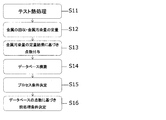
- FIG. 1 is a flowchart showing an example of a determination method according to one aspect of the present invention.
- FIG. 2 is a flowchart showing another example of the determination method according to one aspect of the present invention.
- the determination method will be described in more detail with reference to FIGS. 1 and 2 as appropriate.
- the heat treatment furnace in which the pretreatment conditions are determined by the above determination method can be a heat treatment furnace having a known structure that can be used for various heat treatments. Specific examples include an annealing furnace for annealing a semiconductor wafer, an epitaxial growth furnace for forming an epitaxial layer on the semiconductor wafer, and a heat treatment furnace for thermally oxidizing the semiconductor wafer. It is not limited to the above specific examples as long as it can be placed in a furnace and heat treated.
- the heat treatment furnace is provided with at least a heating means, and may be provided with a gas supply means for supplying a reactive gas, an inert gas or the like gas into the furnace, a gas discharge means for discharging the furnace gas, and the like.
- the pretreatment Before actually performing the heat treatment of the heat treatment target in the heat treatment furnace, the pretreatment is performed.
- This pretreatment means heating the inside of the heat treatment furnace while supplying gas while the object to be heat treated is not arranged.
- the gas supplied into the furnace for the pretreatment include one kind or a mixed gas of two or more kinds of inorganic gas such as oxygen gas, nitrogen gas, argon gas, hydrogen gas and organic gas.
- the organic gas include organic halogen compound gas such as organic chlorine compound gas.
- the heating temperature in the furnace during the pretreatment can be, for example, 700 to 1300°C.
- the heating temperature in the furnace means the set temperature of the heating means of the heat treatment furnace, the ambient temperature in the furnace, the surface temperature of the inner wall of the heat treatment furnace, and the surface temperature of any one or more members arranged in the furnace. It can be at least one temperature selected from the group consisting of:
- the removal efficiency of contaminated metals by pretreatment may differ depending on the type of contaminated metals to be removed even if pretreatment is performed under the same pretreatment conditions. Therefore, conventionally, in order to determine the pretreatment conditions that can efficiently reduce the target metal to be removed from the heat treatment furnace by the pretreatment, it was usual to repeat trial and error without any index.
- a plurality of candidates for the combination of the “type of supply gas” and the “heating temperature” are set. Then, a score is given to each of the plurality of candidates according to the type of the target metal specified as the removal target. This score can be determined, for example, so that a higher score is given as the removal efficiency of the target metal is estimated to be higher.
- the score can be determined experimentally in one aspect, and can be calculated in another aspect. A specific mode of giving points will be described later.
- the score thus given to each candidate is used as an index, and depending on the type of metal to be removed, a combination of the type of the supply gas and the heating temperature to be adopted as the pretreatment condition from a plurality of candidates is selected. decide.
- the metal to be removed can be determined in consideration of the use after the heat treatment of the heat treatment target to be heat-treated by the heat treatment furnace of the pretreatment target.
- the object to be heat-treated is a semiconductor wafer
- various metals for example, iron, copper, nickel, chromium, aluminum, sodium, etc.
- One type or two or more types can be specified as the removal target.
- test pretreatment A heat treatment furnace intentionally contaminated with a known amount of a target metal is subjected to test heat treatment (test pretreatment) under the condition of a combination of a certain candidate supply gas and heating temperature (S11 in FIG. 1). Part or all of the target metal remaining in the heat treatment furnace after this test pretreatment is recovered by a known method, and the amount of the recovered target metal is quantified (S12 in FIG. 1).
- the score can be determined such that the smaller the amount of the target metal recovered (that is, the higher the removal efficiency of the target metal), the higher the score is given to the candidate (S13 in FIG. 1).
- the points were assigned by a weighting function determined based on the amount of metal contamination of the heat-treated product heat-treated in the heat treatment furnace after the test pre-treatment or the actual pre-treatment, and the weighting function was obtained by experimentation It may be performed based on the value after weighting the value.
- the points may be assigned by using a simulation, an optimization calculation tool, or the like.
- the following method can also be mentioned as a method performed experimentally.
- the sample for example, a semiconductor wafer, a test piece cut from a semiconductor material such as a semiconductor wafer
- the sample is heat-treated under arbitrary heat treatment conditions.
- a part or all of the target metal adhering to the surface of the sample after the heat treatment and/or the target metal diffused in the surface layer portion of the sample or the like is collected and quantified by a known method.
- the quantification can be performed by, for example, ICP-MS (Inductively Coupled Plasma-Mass Spectrometry).
- the amount of metal contamination by the target metal is quantified by analyzing the sample after the test pretreatment by a known method.
- Examples of the analysis method include a ⁇ -PCD (Microwave Photoactivity Decay) method and a SPV (Surface Photovoltage) method.
- the small amount of the target metal quantified in the above sample can be said to mean that the sample was less contaminated by the heat treatment in the heat treatment furnace after the test pretreatment. In other words, it can be said that the removal efficiency of the target metal by the test pretreatment was high. Therefore, the score can be determined such that the smaller the amount of the target metal quantified for the sample (that is, the higher the removal efficiency of the target metal), the higher the score given to the candidate.
- the points may be assigned based on the value after the weighting process is performed as described above, or may be performed using a simulation, an optimization calculation tool, or the like.
- the test heat treatment may be performed in a heat treatment furnace that is actually pretreated, or may be performed, for example, in a heating furnace that is smaller in scale than the heat treatment furnace that is actually pretreated.
- a score to each candidate for each target metal, for example, to make a database (for example, to make a score table) (S14 in FIG. 1). If such a database is constructed, thereafter, if the process conditions such as the target metal to be removed are determined (S15 in FIG. 1), it is estimated that the removal efficiency of the metal is high (for example, the score is Candidates (high) can be selected from the database and determined as pretreatment conditions (feed gas and heating temperature) for actually pretreating the heat treatment furnace (S16 in FIG. 1). In this way, the pretreatment conditions of the heat treatment furnace can be determined without repeating many trials and errors.
- thermodynamic equilibrium calculation can be cited as a calculation method for performing the above-mentioned point assignment by calculation. That is, in one aspect, the above-mentioned score may be a score determined by thermodynamic equilibrium calculation based on the type of the target metal.
- the thermodynamic equilibrium calculation is a method of calculating an equilibrium composition that minimizes Gibbs free energy by an optimizing means, and the calculation method is known, and the calculation can be performed using known calculation software.
- the heat treatment furnace contains the element of the contaminating metal and the element which constitutes the supply gas.
- thermodynamic equilibrium calculation is a multi-element thermodynamic equilibrium calculation that includes the elements of the target metal specified as the removal target and the elements contained in the supply gas of the combination of candidates. Can be a calculation. Furthermore, in the multi-component thermodynamic equilibrium calculation, the constituent elements of the heat treatment target that are actually heat treated in the heat treatment furnace and the constituent elements of the members that actually exist in the heat treatment furnace during the heat treatment can also be taken into consideration. For example, when the heat treatment of the silicon wafer is performed in the heat treatment furnace after the pretreatment, silicon (Si), constituent elements of the surface coating film (eg, SiO 2 film) of the wafer supporting member, and the like are also metals to be removed.
- silicon (Si) silicon
- constituent elements of the surface coating film (eg, SiO 2 film) of the wafer supporting member, and the like are also metals to be removed.
- thermodynamic equilibrium calculation can be performed even if two or more kinds of metals are specified as removal targets.
- the pressure in the heat treatment furnace that is, the pressure in the system
- the pressure in the calculation software for the thermodynamic equilibrium calculation can be arbitrarily set, and can be set to, for example, more than 0 atm and 100 atm or less. In this way, various process conditions can be determined (S21 in FIG. 2), and thermodynamic equilibrium calculation can be performed.
- Reactions that may occur in the heat treatment furnace include a reaction in which the target metal attached to the heat treatment furnace is volatilized and a reaction in which the target metal contaminates the heat treatment furnace (that is, adheres to the heat treatment furnace). Even if the target metal is volatilized from the heat treatment furnace, if the contamination (adhesion) occurs, the efficiency of removing the target metal from the heat treatment furnace decreases. Therefore, in order to efficiently remove the target metal from the heat treatment furnace, it is preferable to consider both the volatilization model and the contamination model in the heat treatment furnace in the thermodynamic equilibrium calculation.
- the pretreatment condition is "the amount of volatiles of the target metal from the heat treatment furnace is large in the volatilization model, and the target metal adheres in the contamination model. It is preferable that the condition is “amount is small”. In other words, “the conditions are such that the vapor pressure of the gas containing the target metal is high, and the volatilization reaction of the gas containing the target metal is likely to occur. It can be said that it is a condition that is unlikely to occur. Therefore, in one aspect of the above determination method, in order to give a score, the equilibrium volatile gas partial pressure of the gas containing the target metal and the equilibrium substance amount of the target metal in the solid compound containing the target metal are calculated by thermodynamic equilibrium calculation.
- the equilibrium volatile gas partial pressure of the gas containing the target metal that is, the partial pressure of the volatile gas in the equilibrium state
- a criterion is set such that a higher score is given as the equilibrium volatile gas partial pressure of the gas containing the target metal calculated by the thermodynamic equilibrium calculation is increased (for example, the criterion as shown in Table 1 below is given).
- the score can be determined using the equilibrium volatile gas partial pressure of the gas containing the target metal as an index.
- the criterion is set so that a higher score is given as the total amount of the equilibrium substances of the target metal in the solid compound containing the target metal calculated by the thermodynamic equilibrium calculation is higher (as an example, the table 3), a score can be determined using the total amount of the equilibrium substances of the target metal in the solid compound containing the target metal as an index.
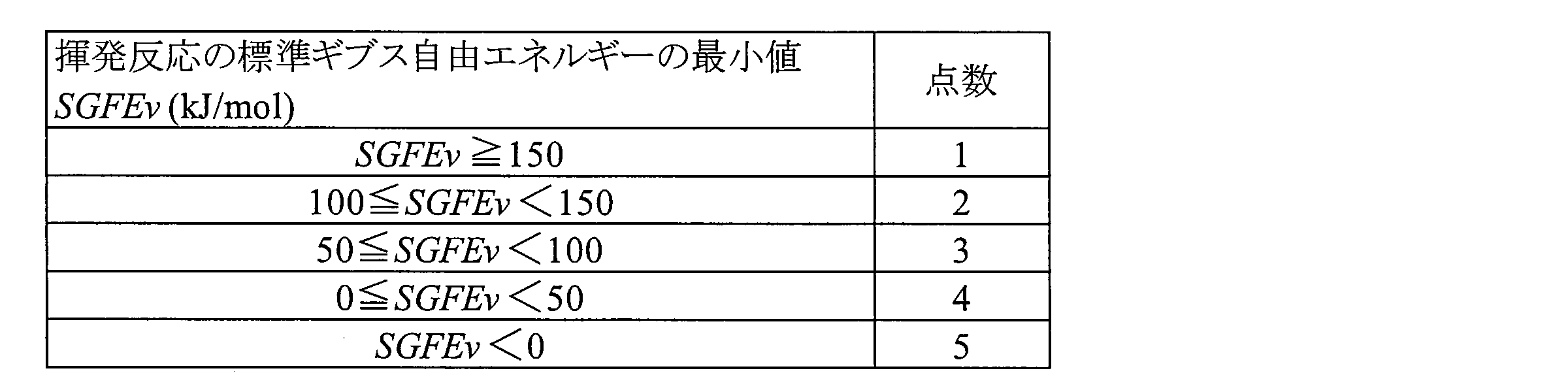
- the criterion is determined such that the smaller the Gibbs free energy ⁇ G 0 of the volatilization reaction involving the target metal calculated by the thermodynamic equilibrium calculation, the higher the score is given (as an example, Table 6 described later). It is possible to determine the score using the Gibbs free energy ⁇ G 0 of the volatile reaction involving the target metal as an index.
- .DELTA.G 0 free energy .DELTA.G 0 Gibbs among multiple volatile reaction minimal volatilization reactions
- the largest .DELTA.G 0 or more The average (eg arithmetic mean) of the Gibbs free energies of the volatilization reaction can be used as an index for determining the score
- the ⁇ G 0 of the minimum volatility reaction or the maximum ⁇ G 0 of the index can be used as the index for determining the score. It is preferable that ⁇ G 0 of the minimum volatilization reaction be used as an index for determining the score.
- a higher absolute value gives a higher score
- a negative value gives a lower absolute value a higher score.
- the target metal when the target metal may more contamination reactions involved, .DELTA.G 0 free energy .DELTA.G 0 Gibbs among multiple contamination reactions minimal contamination reactions, the largest .DELTA.G 0 or more
- the average (eg arithmetic mean) of the Gibbs free energies of the pollution reaction can be used as the index for determining the score, and the index ⁇ G 0 of the minimum pollution reaction or the index ⁇ G 0 of the maximum pollution reaction can be used as the index. It is preferable that ⁇ G 0 of the minimum contamination reaction be used as an index for determining the score.
- the equilibrium volatile gas partial pressure of the gas containing the target metal the total amount of the equilibrium substances of the target metal in the solid compound containing the target metal, the Gibbs free energy ⁇ G 0 of the volatile reaction involving the target metal, and Based on four points determined based on the four types of numerical values calculated by thermodynamic equilibrium calculation of Gibbs free energy ⁇ G 0 of the contamination reaction involving the target metal, in one aspect, as a multiplier of these points, Candidate scores (which can also be called total scores) can be calculated (S26, S27 in FIG. 2).
- the points are given in the heat treatment furnace after the test pretreatment or the actual pretreatment, as in the case where the points are experimentally given in advance.
- a weighting function may be determined based on the amount of metal contamination of the heat-treated product after the heat treatment, and the value obtained by performing the weighting process on the value calculated by the weighting function may be used.
- the points may be assigned by using a simulation, an optimization calculation tool, or the like.
- the preprocessing condition can be decided from candidates having a score of a predetermined score or more. Further, in one aspect, the candidate having the highest score among the plurality of candidates can be determined as the preprocessing condition. However, the candidates that are actually determined as the preprocessing conditions are not limited to the candidates with the highest score. For example, the pretreatment condition can be determined from the candidates whose scores are within a predetermined range in consideration of the cost of the supply gas, the ease of handling, and the like.
- Pretreatment method for heat treatment furnace One aspect of the present invention relates to a pretreatment method for a heat treatment furnace, comprising determining the pretreatment conditions for the heat treatment furnace by the above determination method, and pretreating the heat treatment furnace under the determined pretreatment conditions.
- FIG. 3 is a flowchart showing an example of a pretreatment method according to an aspect of the present invention.
- various process conditions such as the target metal, the constituent elements of the heat treatment target to be actually heat-treated in the heat treatment furnace, the constituent elements of the member actually existing in the heat treatment furnace during the heat treatment, etc. are determined, the details are explained above.
- Points can be given (S31, S32 in FIG. 3). The points thus given are output from, for example, analysis software (S33 in FIG. 3). From the output results, the combination of the supply gas and the heating temperature can be selected using the score as an index to determine the pretreatment condition (S34, S35 in FIG. 3). The selection here can be made automatically or manually. Then, the heat treatment furnace can be pretreated under the pretreatment conditions thus determined (S36 in FIG. 3).
- the type of feed gas determined by the above determination method is used, and the heat treatment furnace is pretreated at the determined heating temperature.
- the pretreatment is generally called “air baking” and is usually performed before the heat treatment target is placed in the heat treatment furnace and subjected to the heat treatment.
- air baking is usually performed before the heat treatment target is placed in the heat treatment furnace and subjected to the heat treatment.
- the pretreatment condition is generally called “air baking” and is usually performed before the heat treatment target is placed in the heat treatment furnace and subjected to the heat treatment.
- a part or all of the target metal specified as the removal target can be discharged to the outside of the heat treatment furnace.
- the pretreatment time may be determined according to the type of metal to be removed and the amount of metal contamination. For example, it may be about 1 minute to 20 hours, but the above range is an example and does not limit the present invention.
- One aspect of the present invention relates to a method for manufacturing a heat-treated semiconductor wafer, which comprises pre-treating a heat treatment furnace by the above-mentioned pre-treatment method and heat-treating the semiconductor wafer in the pre-treated heat treatment furnace.
- various semiconductor wafers such as a silicon wafer can be cited.
- a silicon single crystal wafer cut out from a silicon single crystal ingot grown by a known method polishing processing such as mirror polishing, and optionally introduced into a heat treatment furnace after one or more processing treatments such as chamfering processing.
- Heat treatment can be performed.
- Specific examples of the heat treatment include various heat treatments such as annealing, vapor phase growth, and thermal oxidation. These heat treatments can be performed by a known method.
- Examples of such a heat-treated semiconductor wafer include an annealed wafer obtained by forming a modified layer on a silicon single crystal wafer by annealing, an epitaxial wafer having an epitaxial layer on a silicon single crystal wafer, and a silicon single crystal having a thermal oxide film.
- Various silicon wafers such as wafers can be mentioned.
- One aspect of the present invention relates to a heat treatment apparatus including a heat treatment furnace, a heat treatment furnace control unit, and a pretreatment condition determination unit that determines a pretreatment condition for pretreating the heat treatment furnace.
- the pretreatment is to heat the inside of the heat treatment furnace while supplying a gas
- the pretreatment condition determination unit records a plurality of candidates for a combination of the type of the supply gas and the heating temperature.
- an analysis unit having a calculation information recording unit, a score calculation unit and a combination determination unit.
- the calculation information recording unit records calculation information for calculating the score of the candidate recorded in the candidate recording unit.
- the calculation information is determined according to the type of the target metal specified as the removal target by the pretreatment.
- the score calculation unit calculates the score of the candidate recorded in the candidate recording unit from the calculation information, the combination determination unit, using the calculated score as an index, from the plurality of candidates, the The combination of the type of supply gas and the heating temperature used as the pretreatment condition of the heat treatment furnace is determined.
- the heat treatment furnace control unit receives information on the combination of the type of the supply gas and the heating temperature determined by the combination determination unit from the combination determination unit, and causes the heat treatment furnace to perform pretreatment according to the received information.
- the pretreatment execution information is transmitted, the heat treatment furnace receives the pretreatment execution information, and performs the pretreatment according to the pretreatment execution information.
- the above heat treatment apparatus it is possible to determine the pretreatment conditions by the above determination method and perform the pretreatment of the heat treatment furnace under the determined pretreatment conditions.
- the details of the determination of the pretreatment conditions and the implementation of the pretreatment are as described above.
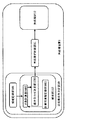
- FIG. 4 is a schematic diagram showing a configuration of an example of the heat treatment apparatus.
- the heat treatment apparatus 1 shown in FIG. 4 includes a pretreatment condition determination unit 10, a heat treatment furnace control unit 11, and a heat treatment furnace 12.
- the preprocessing condition determination unit 10 has a candidate recording unit 101 and an analysis unit 102.
- the candidate recording unit 101 a plurality of candidates for a combination of “type of supply gas” and “heating temperature” for pretreatment of the heat treatment furnace 12 are input and recorded. Further, the candidate recording unit 101 can also input and record the type of the target metal specified as the removal target by the pretreatment.
- Information used for calculating the score of each candidate in the score calculation unit 1002 is input and recorded in the calculation information recording unit 1001.
- the calculation information is determined according to the type of the target metal specified as the removal target by the pretreatment. The details of the decision are as described above.
- information stored in a database as described above for example, for each target metal, a score is displayed for each of a plurality of candidates for a combination of a gas type and a heating temperature).
- the generated score table can be recorded in the calculation information recording unit 1001.
- the calculation information recorded in the calculation information recording unit 1001 is determined by thermodynamic equilibrium calculation based on the type of the target metal specified as the removal target in the pretreatment. You can The details of this calculation are as described above.
- the score calculation unit 1002 calculates the score of each candidate recorded in the candidate recording unit 101 from the calculation information recorded in the calculation information recording unit 1001.
- the candidate information recorded in the candidate recording unit 101 is taken out by copying it to software for point calculation, and the calculation information recorded in the calculation information recording unit 1001 is taken out by copying it in the same software.
- the score of each candidate is calculated by a predetermined calculation method. The details of the calculation are as described above.
- the information for calculation is the following information obtained by thermodynamic equilibrium calculation: equilibrium volatile gas partial pressure of the gas containing the target metal specified as the removal target, equilibrium of the target metal in the solid compound containing the target metal.
- the total amount of substances, the Gibbs free energy ⁇ G 0 of the volatilization reaction involving the target metal, and the Gibbs free energy ⁇ G 0 of the pollution reaction involving the target metal can be included. Then, the score of each candidate is determined using the equilibrium volatile gas partial pressure of the gas containing the target metal as an index, and the total amount of the equilibrium substances of the target metal in the solid compound containing the target metal as an index. Score, the score determined using the Gibbs free energy ⁇ G 0 of the volatilization reaction involving the target metal as an index, and the score determined using the Gibbs free energy ⁇ G 0 of the pollution reaction involving the target metal as an index Can be a multiplier of.
- the combination determining unit 1003 uses the score of each candidate determined by the score calculating unit 1002 as an index, and selects from among the plurality of combinations of candidates recorded in the candidate recording unit 101, the pretreatment condition of the heat treatment furnace 12 to be supplied. Determine the combination of gas type and heating temperature. The details of this decision are as described above.
- the heat treatment apparatus 2 shown in FIG. 5 has the same configuration as the heat treatment apparatus 1 shown in FIG. 4 except that the analysis unit 102 includes a correction unit 1004.
- the correction unit 1004 can provide the correction information to one or more selected from the group consisting of the calculation information recording unit 1001, the score calculation unit 1002, and the combination determination unit 1003.
- the modification information is modified in the determination method for determining the calculation information in the calculation information recording unit 1001 based on the metal contamination amount of the heat-treated product heat-treated in the heat treatment furnace in which the pretreatment is actually performed. It may be correction information for doing.
- the metal contamination amount can be determined by a known method such as a method of quantifying the metal component recovered from the heat-treated product by ICP-MS or the like, a method of analyzing the heat-treated product by the ⁇ -PCD method, the SPV method, or the like.
- the correction information is for correcting the calculation formula for calculating the score in the score calculation unit 1002, based on the metal contamination amount of the heat-treated product that has been actually heat-treated in the heat-treatment furnace in which the pretreatment is performed. Can be information.
- the correction information can be information for correcting the determination criterion for determining the preprocessing condition in the combination determination unit 1003.
- the correction information may be provided to only one selected from the group consisting of the calculation information recording unit 1001, the score calculation unit 1002 and the combination determination unit 1003, may be provided to two, and may be provided to all three. May be done.
- the combination determination unit 1003 the kind of supply gas to be adopted as the pretreatment condition of the heat treatment furnace 12 from the plurality of candidates recorded in the candidate recording unit 101 using the score calculated by the score calculation unit 1002 as an index. And the heating temperature are determined.
- the heat treatment furnace control unit 11 receives the information of the combination of the supply gas and the heating temperature determined in this way from the combination determination unit 1003, and provides the pretreatment execution information for causing the heat treatment furnace 12 to perform the pretreatment according to the received information. Send.
- the heat treatment furnace 12 receives the above-mentioned pretreatment execution information and executes the pretreatment according to this signal.
- the details of the heat treatment furnace 12 are as described above for the heat treatment furnace for which the pretreatment conditions are determined. ..
- correction information is created based on the analysis result, and the correction unit 1004 You can enter.
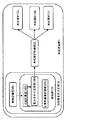
- the heat treatment apparatus 3 shown in FIG. 6 has the same configuration as the heat treatment furnace 1 shown in FIG. 4 except that a pretreatment signal from the heat treatment furnace control unit 11 is received by a plurality of heat treatment furnaces (12a, 12b, 12c). .. Although three heat treatment furnaces are shown in FIG. 6 as an example, the number of heat treatment furnaces that receive the pretreatment execution information from one heat treatment furnace control unit is not particularly limited.
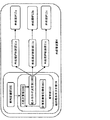
- the heat treatment apparatus 4 shown in FIG. 7 has the same configuration as the heat treatment furnace 1 shown in FIG. 4 except that the information determined by the combination determination unit 1003 is received by the plurality of heat treatment furnace control units (11a, 11b, 11c). Have. Although three heat treatment furnace control units are shown in FIG. 7 as an example, the number of heat treatment furnace control units that receive information from one combination determination unit is not particularly limited. Also, the same information may be transmitted from one combination determination unit to a plurality of heat treatment furnace control units, and different information may be transmitted to a plurality of heat treatment furnace control units in order to pretreat a plurality of heat treatment furnaces under different pretreatment conditions. You may send it.
- the heat treatment apparatus shown in FIG. 7 can be modified so that a pretreatment signal from one heat treatment furnace control unit is received by a plurality of heat treatment furnaces.
- the pretreatment condition determination unit 10 and the heat treatment furnace control unit 11 can be configured by one or more computers, and various operations of each unit can be executed by software installed in the computers. In addition, the transmission and reception of various information can be performed by wire communication or wireless communication.
- One aspect of the present invention relates to an apparatus for manufacturing a heat-treated semiconductor wafer, including the above-described heat processing apparatus.
- the manufacturing apparatus includes at least the heat treatment apparatus, and may optionally include one or more apparatuses for performing various types of processing on semiconductor wafers.
- Examples of such an apparatus include a polishing apparatus for performing polishing processing such as mirror polishing on a silicon single crystal wafer cut out from a silicon single crystal ingot, and a chamfering processing apparatus for chamfering.
- the types of candidate supply gases are oxygen (100% O 2 ), nitrogen (100% N 2 ), argon (100% Ar), hydrogen (100% H 2 ), hydrogen and oxygen.
- the mixed gas of hydrogen and oxygen (80% H 2 /20% O 2 ) is referred to as “80% H 2 /O 2 ”
- the mixed gas of Trans-1,2-dichloroethylene and oxygen (20% Trans-1,2-dichloroethylene/80% O 2 ) is referred to as “20% Trans1,2DCE/O 2 ”.
- the calculation result for the heating temperature of 1200° C. will be described as an example.
- thermodynamic equilibrium calculation software calculates the Gibbs free energy ⁇ G 0 of the volatile reaction in which the iron-containing volatile substance in the selected substance volatilizes. The calculation results are shown in Table 5.
- thermodynamic equilibrium calculation software calculates the Gibbs free energy ⁇ G 0 of the contamination reaction involving the iron-containing substance in the selected substances. The calculation results are shown in Table 8.
- the pretreatment is performed at a heating temperature (set temperature of the heating means) of 1300° C. and a furnace pressure of 1 atm while supplying the above mixed gas to the furnace and discharging the furnace gas from the exhaust port of the annealing furnace. It was carried out in.
- the silicon wafer was annealed in the annealing furnace after the pretreatment.
- the silicon wafer was annealed under the same annealing conditions in the pre-treatment annealing furnace.
- the surface of the silicon wafer annealed in the annealing furnace before the pretreatment and the surface of the silicon wafer annealed in the annealing furnace after the pretreatment were scanned with the same type of recovery solution (acid solution), and ICP-MS (inductively coupled plasma mass spectrometry) ), the quantitative analysis of iron in the recovered liquid after scanning was performed.
- the value obtained by dividing the quantitative value thus obtained by the area of the surface of the silicon wafer scanned with the recovery liquid was defined as the surface iron concentration of the silicon wafer. It can be said that the lower the surface iron concentration thus obtained is, the more the iron contamination of the silicon wafer from the annealing furnace is suppressed, and the less the iron contamination of the annealing furnace that has been annealed.
- the surface iron concentration of the silicon wafer annealed in the annealing furnace before the pretreatment was 5.0 ⁇ 10 10 atoms/cm 2
- the surface iron concentration of the silicon wafer annealed in the annealing furnace after the pretreatment was 3.0 ⁇ 10 9 atoms/cm 2 . From this result, it can be confirmed that the pretreatment under the pretreatment conditions determined as described above could reduce the iron contamination of the annealing furnace.
- the heating temperature set temperature of the heating means
- the supply gas is argon (100% Ar), and the same known amount as above is used.
- the pretreatment (air-baking) of the semiconductor wafer annealing furnace intentionally contaminated with iron was carried out in the same manner as above, and the silicon wafer was annealed in the annealing furnace after the pretreatment under the same annealing conditions.
- the surface iron concentration of the silicon wafer after this annealing was determined in the same manner as above, it was 2.0 ⁇ 10 10 atoms/cm 2 , and it was confirmed that the iron contamination of the annealing furnace could be reduced by the pretreatment.
- the pretreatment condition having a higher score in Table 11 given based on the calculation result by the thermodynamic equilibrium calculation can further reduce the iron contamination of the heat treatment furnace.
- One aspect of the present invention is useful in the technical field in which various heat treatments are performed, including the technical field of semiconductor wafers.
Landscapes
- Chemical & Material Sciences (AREA)
- General Chemical & Material Sciences (AREA)
- Chemical Kinetics & Catalysis (AREA)
- Engineering & Computer Science (AREA)
- Materials Engineering (AREA)
- Mechanical Engineering (AREA)
- Metallurgy (AREA)
- Organic Chemistry (AREA)
- Waste-Gas Treatment And Other Accessory Devices For Furnaces (AREA)
- Chemical Vapour Deposition (AREA)
- Investigating Or Analyzing Materials Using Thermal Means (AREA)
- Control Of Heat Treatment Processes (AREA)
Abstract
Description
熱処理炉の前処理条件の決定方法であって、
上記前処理は、上記熱処理炉の炉内をガスを供給しながら加熱することであり、
供給ガスの種類と加熱温度との組み合わせの候補を複数設定すること、
各組み合わせの候補に、上記前処理による除去対象として特定した対象金属の種類に応じて決定された点数を付与すること、および、
上記付与された点数を指標として、上記複数の候補の中から、前処理条件として採用する供給ガスの種類と加熱温度との組み合わせを決定すること、
を含む、熱処理炉の前処理条件の決定方法(以下、単に「決定方法」とも記載する。)、
に関する。
上記対象金属を含むガスの平衡揮発ガス分圧、
上記対象金属を含む固体化合物中の上記対象金属の平衡物質量の総和、
上記対象金属が関与する揮発反応のギブスの自由エネルギーΔG0、および
上記対象金属が関与する汚染反応のギブスの自由エネルギーΔG0、
を求め、求められた結果を指標として上記点数を決定することができる。
上記対象金属を含むガスの平衡揮発ガス分圧を指標として決定された点数、
上記対象金属を含む固体化合物中の上記対象金属の平衡物質量の総和を指標として決定された点数、
上記対象金属が関与する揮発反応のギブスの自由エネルギーΔG0を指標として決定された点数、および
上記対象金属が関与する汚染反応のギブスの自由エネルギーΔG0を指標として決定された点数、
の乗数であることができる。
上記決定方法により熱処理炉の前処理条件を決定すること、および、
上記決定された前処理条件下で熱処理炉を前処理すること、
を含む、熱処理炉の前処理方法(以下、単に「前処理方法」とも記載する。)、
に関する。
上記前処理方法により熱処理炉を前処理すること、および、
上記前処理された熱処理炉内で半導体ウェーハを熱処理すること、
を含む、熱処理された半導体ウェーハの製造方法(以下、単に「製造方法」とも記載する。)、
に関する。
熱処理装置であって、
熱処理炉と、
熱処理炉制御部と、
上記熱処理炉を前処理する前処理の条件を決定する前処理条件決定部と、
を含み、
上記前処理は、上記熱処理炉の炉内をガスを供給しながら加熱することであり、
上記前処理条件決定部は、
供給ガスの種類と加熱温度との組み合わせの候補を複数記録する候補記録部と、
計算用情報記録部、点数計算部および組み合わせ決定部を有する解析部と、
を含み、
上記計算用情報記録部は、上記候補記録部に記録された候補の点数を計算するための計算用情報を記録し、
上記計算用情報は、上記前処理による除去対象として特定された対象金属の種類に応じて決定され、
上記点数計算部は、上記計算用情報から上記候補記録部に記録された候補の点数を計算し、
上記組み合わせ決定部は、上記計算された点数を指標として、上記複数の候補の中から、上記熱処理炉の前処理条件として採用する供給ガスの種類と加熱温度との組み合わせを決定し、
上記熱処理炉制御部は、上記組み合わせ決定部で決定された供給ガスの種類と加熱温度との組み合わせの情報を上記組み合わせ決定部から受信し、受信した情報にしたがい上記熱処理炉に前処理を実行させる前処理実施情報を送信し、
上記熱処理炉は、上記前処理実施情報を受信し、この前処理実施情報にしたがい前処理を実施する、熱処理装置、
に関する。
上記対象金属を含むガスの平衡揮発ガス分圧、
上記対象金属を含む固体化合物中の上記対象金属の平衡物質量の総和、
上記対象金属が関与する揮発反応のギブスの自由エネルギーΔG0、および
上記対象金属が関与する汚染反応のギブスの自由エネルギーΔG0、
を含むことができる。
上記対象金属を含むガスの平衡揮発ガス分圧を指標として決定された点数、
上記対象金属を含む固体化合物中の上記対象金属の平衡物質量の総和を指標として決定された点数、
上記対象金属が関与する揮発反応のギブスの自由エネルギーΔG0を指標として決定された点数、および
上記対象金属が関与する汚染反応のギブスの自由エネルギーΔG0を指標として決定された点数、
の乗数であることができる。
本発明の一態様は、熱処理炉の前処理条件の決定方法であって、上記前処理は熱処理炉の炉内をガスを供給しながら加熱することであり、供給ガスの種類と加熱温度との組み合わせの候補を複数設定すること、各組み合わせの候補に上記熱処理による除去対象として特定した対象金属の種類に応じて決定された点数を付与すること、および、上記付与された点数を指標として上記複数の候補の中から前処理条件として採用する供給ガスの種類と加熱温度との組み合わせを決定することを含む熱処理炉の前処理条件の決定方法に関する。
上記決定方法により前処理条件が決定される熱処理炉は、各種熱処理のために使用可能な公知の構成の熱処理炉であることができる。具体例としては、半導体ウェーハをアニールするためのアニール炉、半導体ウェーハにエピタキシャル層を形成するためのエピタキシャル成長炉、半導体ウェーハを熱酸化するための熱処理炉等を挙げることができるが、熱処理対象物を炉内に配置して熱処理を行うことができるものであればよく、上記具体例に限定されない。熱処理炉は、少なくとも加熱手段を備え、炉内に反応性ガス、不活性ガス等のガスを供給するためのガス供給手段、炉内ガスを排出するためのガス排出手段等を備えることもできる。
熱処理炉において実際に熱処理対象物の熱処理を実施する前に、前処理が行われる。この前処理は、熱処理対象物が配置されていない状態で、熱処理炉の炉内をガスを供給しながら加熱することをいう。前処理のために炉内に供給されるガスとしては、酸素ガス、窒素ガス、アルゴンガス、水素ガス等の無機ガスおよび有機ガスの一種または二種以上の混合ガスを挙げることができる。有機ガスの一例としては、有機塩素化合物ガス等の有機ハロゲン化合物ガスを挙げることができる。また、前処理時の炉内の加熱温度は、例えば700~1300℃であることができる。ここで炉内の加熱温度とは、熱処理炉の加熱手段の設定温度、炉内の雰囲気温度、熱処理炉の内壁の表面温度および炉内に配置されているいずれか1つ以上の部材の表面温度からなる群から選ばれる少なくとも一種の温度であることができる。
熱処理炉の前処理のための「供給ガスの種類」と「加熱温度」との組み合わせの候補への点数の付与を実験的に行う方法としては、例えば下記の方法を挙げることができる。既知量の対象金属によって意図的に汚染させた熱処理炉を、ある候補の供給ガスと加熱温度の組み合わせの条件下でテスト熱処理(テスト前処理)する(図1中、S11)。このテスト前処理後の熱処理炉内に残留している対象金属の一部または全部を公知の方法によって回収し、回収された対象金属量を定量する(図1中、S12)。例えば、回収された対象金属量が少ないほど(即ち対象金属の除去効率が高いほど)、その候補に高い点数が付与されるように点数を決定することができる(図1中、S13)。または、点数の付与は、テスト前処理または実際に前処理が行われた後の熱処理炉内で熱処理された熱処理物の金属汚染量に基づき重み付け関数を定め、この重み付け関数によって実験により得られた値に重み付け処理を行った後の値に基づき行ってもよい。また、点数の付与は、シミュレーション、最適化計算ツール等を用いて行ってもよい。
また、実験的に行う方法としては、下記の方法を挙げることもできる。上記のようにテスト前処理が行われた後の熱処理炉内で、任意の熱処理条件下でサンプル(例えば半導体ウェーハ、半導体ウェーハ等の半導体材料から切り出されたテストピース等)の熱処理を行う。この熱処理後の上記サンプルの表面に付着している対象金属および/または上記サンプルの表層部等に拡散している対象金属の一部または全部を、公知の方法によって回収して定量する。定量は、例えばICP-MS(Inductively Coupled Plasma-Mass Spectrometry)等により行うことができる。または、テスト前処理後のサンプルを公知の方法によって分析することにより、対象金属による金属汚染量を定量する。分析方法としては、μ-PCD(Microwave Photoconductivity Decay)法、SPV(Surface Photovoltage)法等を挙げることができる。ここで上記サンプルについて定量された対象金属量が少ないことは、テスト前処理後の熱処理炉での熱処理によるサンプルの金属汚染が少なかったことを意味するということができる。換言すれば、テスト前処理による対象金属の除去効率が高かったことを意味するということができる。したがって、上記サンプルについて定量された対象金属量が少ないほど(即ち対象金属の除去効率が高いほど)、その候補に高い点数が付与されるように点数を決定することができる。または、点数の付与は、上記のように重み付け処理を行った後の値に基づき行ってもよく、シミュレーション、最適化計算ツール等を用いて行ってもよい。
上記テスト熱処理は、実際に前処理される熱処理炉で行ってもよく、または、例えば実際に前処理される熱処理炉よりも小スケールの加熱炉で行うこともできる。
こうして、対象金属毎に各候補に点数を付与し、例えばデータベース化しておくこと(例えば点数表の作成)ができる(図1中、S14)。そのようなデータベースが構築されれば、その後は、除去すべき対象金属等のプロセス条件が決定されれば(図1中、S15)、例えばその金属の除去効率が高いと見積もられる(例えば点数が高い)候補を、データベースから選択し、実際に熱処理炉を前処理する前処理条件(供給ガスおよび加熱温度)として決定することができる(図1中、S16)。こうして、多くの試行錯誤を繰り返すことなく、熱処理炉の前処理条件を決定することができる。
以上のように、供給ガスの種類と加熱温度との組み合わせの複数の候補のそれぞれについて、除去対象として特定した対象金属の種類に応じて点数が付与される。こうして付与された点数を指標として、実際に熱処理炉の前処理を行うために採用する前処理条件を決定することができる。決定基準に関しては、例えば、一態様では、点数が所定点数以上の候補の中から、前処理条件を決定することができる。また、一態様では、複数の候補の中で最も高い点数の候補を前処理条件として決定することができる。ただし、実際に前処理条件として決定する候補は、最も高い点数の候補に限定されない。例えば、点数が所定範囲内の候補の中から、供給ガスのコスト、取扱いの容易性等を考慮して前処理条件を決定することもできる。
本発明の一態様は、上記決定方法により熱処理炉の前処理条件を決定すること、および、上記決定された前処理条件下で熱処理炉を前処理することを含む熱処理炉の前処理方法に関する。
本発明の一態様は、上記前処理方法により熱処理炉を前処理すること、および、上記前処理された熱処理炉内で半導体ウェーハを熱処理することを含む、熱処理された半導体ウェーハの製造方法に関する。
本発明の一態様は、熱処理炉と、熱処理炉制御部と、上記熱処理炉を前処理する前処理の条件を決定する前処理条件決定部と、を含む熱処理装置に関する。上記前処理は、上記熱処理炉の炉内をガスを供給しながら加熱することであり、上記前処理条件決定部は、供給ガスの種類と加熱温度との組み合わせの候補を複数記録する候補記録部と、計算用情報記録部、点数計算部および組み合わせ決定部を有する解析部と、を含む。上記計算用情報記録部は、上記候補記録部に記録された候補の点数を計算するための計算用情報を記録する。上記計算用情報は、上記前処理による除去対象として特定された対象金属の種類に応じて決定される。上記点数計算部は、上記計算用情報から上記候補記録部に記録された候補の点数を計算し、上記組み合わせ決定部は、上記計算された点数を指標として、上記複数の候補の中から、上記熱処理炉の前処理条件として採用する供給ガスの種類と加熱温度との組み合わせを決する。上記熱処理炉制御部は、上記組み合わせ決定部で決定された供給ガスの種類と加熱温度との組み合わせの情報を上記組み合わせ決定部から受信し、受信した情報にしたがい上記熱処理炉に前処理を実行させる前処理実施情報を送信し、上記熱処理炉は、上記前処理実施情報を受信し、この前処理実施情報にしたがい前処理を実施する。
本発明の一態様は、上記熱処理装置を含む、熱処理された半導体ウェーハの製造装置に関する。
鉄を、除去対象の金属として特定した。
候補の供給ガスの種類は、酸素(100%O2)、窒素(100%N2)、アルゴン(100%Ar)、水素(100%H2)、水素と酸素との混合ガス(80%H2/20%O2)、および1,2-ジクロロエチレンと酸素との混合ガス(20%Trans-1,2-ジクロロエチレン/80%O2)とし、候補の加熱温度は、1100℃、1150℃、1200℃、1250℃、および1300℃とし、熱処理炉内の圧力として1atmを選択し、以下のように熱力学平衡計算を実施した。熱力学平衡計算は、熱力学平衡計算ソフトMALTを使用し、このソフトに付属するアルゴリズムにより実施した。以下の表では、水素と酸素との混合ガス(80%H2/20%O2)を「80%H2/O2」、Trans-1,2-ジクロロエチレンと酸素との混合ガス(20%Trans-1,2-ジクロロエチレン/80%O2)を「20%Trans1,2DCE/O2」と表記する。
以下では、加熱温度1200℃についての計算結果を例に説明する。
上記熱力学平衡計算ソフトに、加熱温度(1200℃)、圧力(1atm)を入力し、かつ、対象金属元素、候補の供給ガスを構成する元素、シリコン(Si)、および実際の熱処理時に熱処理炉内に配置される部材(ウェーハ支持部材)の表面に存在するシリコン酸化膜(SiO2)の構成元素により生成され得る物質をソフトのデータベースから選択して各物質の物質量を入力した。これらの情報が入力されると、上記熱力学平衡計算ソフトによる多元系熱力学平衡計算の計算結果から、鉄を含むガスの平衡揮発ガス分圧の総和Pが求められた。ここで求められたPを指標として、下記の判断基準表(表1)にしたがい、加熱温度1200℃と下記表2に示されている供給ガスとの組み合わせの候補について、鉄を含むガスの平衡揮発ガス分圧を指標とした点数を表2に示すように決定した。


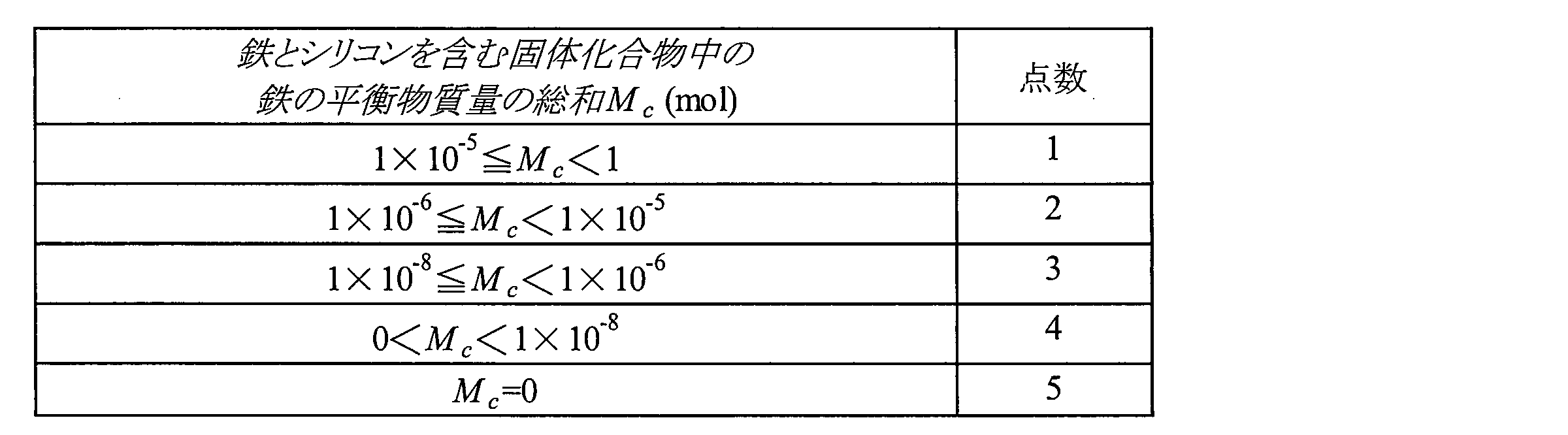
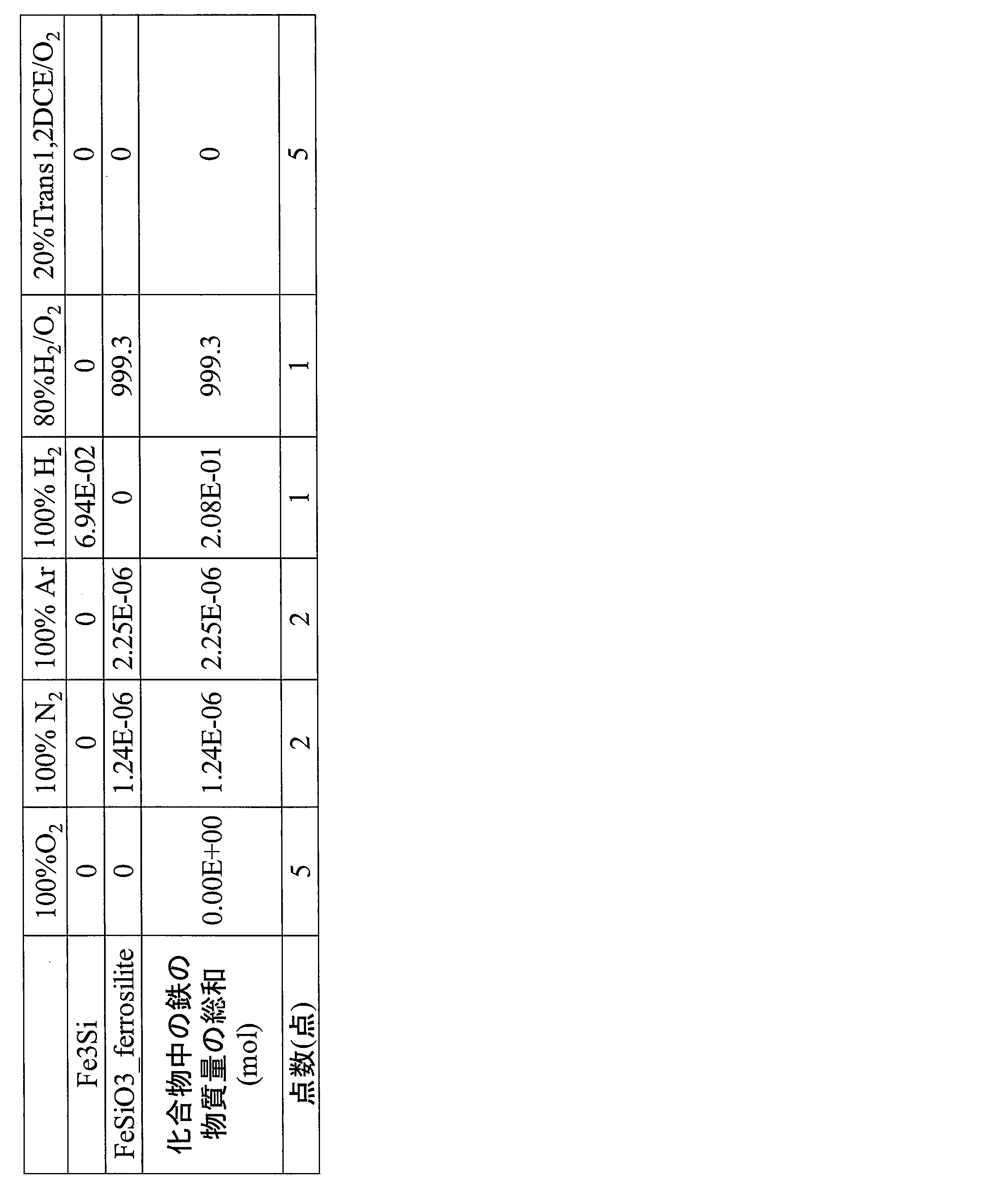
上記3.での入力により、上記熱力学平衡計算ソフトは、鉄とシリコンを含む固体物質中の鉄の平衡物質量を算出した。この算出結果から、鉄とシリコンを含む固体物質中の鉄の平衡物質量の総和Mcを求めた。ここで求められたMcを指標として、下記の判断基準表(表3)にしたがい、加熱温度1200℃と下記表4に示されている供給ガスとの組み合わせの候補について、鉄を含む固体化合物中の鉄の平衡物質量の総和を指標とした点数を表4に示すように決定した。
上記3.での入力により、上記熱力学平衡計算ソフトは、選択された物質の中の鉄を含む揮発性物質が揮発する揮発反応のギブスの自由エネルギーΔG0を算出した。算出結果を、表5に示す。


上記3.での入力により、上記熱力学平衡計算ソフトは、選択された物質の中の鉄を含む物質が関与する汚染反応のギブスの自由エネルギーΔG0を算出した。算出結果を、表8に示す。



加熱温度1200℃と各供給ガスとの組み合わせの候補について、上記3~6で決定された4種の点数の乗数を、各候補の点数として付与した。
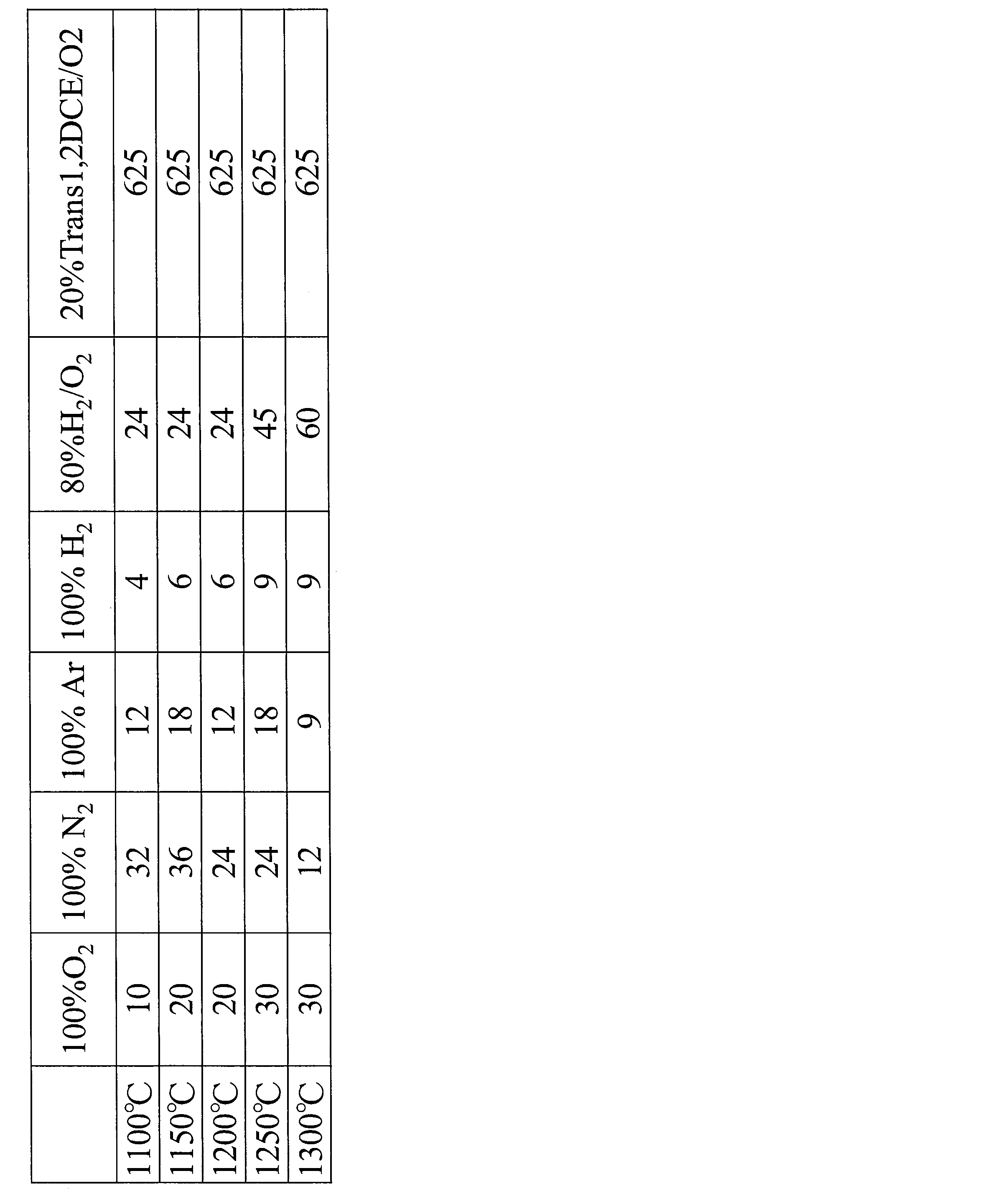
加熱温度1100℃、1150℃、1250℃および1300℃についても上記3~6と同様に多元系熱力学平衡計算を行い、算出結果に基づき上記3~6と同様に点数を決定した。こうして決定された4種の点数の乗数を、各候補の点数として付与した。
以上のように各候補に付与された点数の点数表が、下記表11である。
同じロットから取り出した3枚のシリコンウェーハに対し、それぞれ前処理前または下記前処理後にアニールを実施した。これら3枚のシリコンウェーハは、同じロットのシリコンウェーハであるため、熱処理前の鉄汚染レベルは同様と見做すことができる。
まず、上記表11に示す点数表から高点数の「加熱温度1300℃/Trans-1,2-ジクロロエチレンと酸素との混合ガス(20%Trans-1,2-ジクロロエチレン/80%O2)」の組み合わせを前処理条件として決定し、既知量の鉄で意図的に汚染した半導体ウェーハ用アニール炉の前処理(空焼き)を実施した。前処理は、加熱温度(加熱手段の設定温度)1300℃および炉内圧力1atmのアニール炉へ上記混合ガスを供給するとともにアニール炉の排気口から炉内ガスを排出しながら、前処理時間1時間で実施した。
上記前処理後のアニール炉においてシリコンウェーハのアニールを行った。前処理前のアニール炉でも同様のアニール条件でシリコンウェーハのアニールを行った。
前処理前のアニール炉でアニールされたシリコンウェーハおよび前処理後のアニール炉でアニールされたシリコンウェーハの表面を同種の回収液(酸溶液)で走査し、ICP-MS(誘導結合プラズマ質量分析計)によって走査後の回収液中の鉄の定量分析を行った。こうして得られた定量値を回収液が走査されたシリコンウェーハ表面の面積で除した値を、シリコンウェーハの表面鉄濃度とした。こうして求められた表面鉄濃度がより低いほど、アニール炉からのシリコンウェーハの鉄汚染が抑制されているということができ、アニールを実施したアニール炉の鉄汚染が少ないということもできる。前処理前のアニール炉でアニールされたシリコンウェーハの表面鉄濃度は5.0×10¹⁰atoms/cm2であったのに対し、前処理後のアニール炉でアニールされたシリコンウェーハの表面鉄濃度は3.0×109atoms/cm2であった。この結果から、上記のように決定された前処理条件下での前処理により、アニール炉の鉄汚染を低減できたことが確認できる。
また、上記決定された前処理条件とは異なる条件下での前処理として、加熱温度(加熱手段の設定温度)を1300℃、供給ガスをアルゴン(100%Ar)として、上記と同様の既知量の鉄で意図的に汚染した半導体ウェーハ用アニール炉の前処理(空焼き)を上記と同様に実施し、前処理後のアニール炉でシリコンウェーハを同様のアニール条件でアニールした。このアニール後のシリコンウェーハの表面鉄濃度を上記と同様に求めたところ、2.0×10¹⁰atoms/cm2であり、前処理によりアニール炉の鉄汚染を低減できたことが確認された。
更に、以上の結果から、熱力学平衡計算による計算結果に基づき付与された表11中の点数がより高い前処理条件により、熱処理炉の鉄汚染をより低減できることも確認された。
Claims (14)
- 熱処理炉の前処理条件の決定方法であって、
前記前処理は、前記熱処理炉の炉内をガスを供給しながら加熱することであり、
供給ガスの種類と加熱温度との組み合わせの候補を複数設定すること、
各組み合わせの候補に、前記前処理による除去対象として特定した対象金属の種類に応じて決定された点数を付与すること、および、
前記付与された点数を指標として、前記複数の候補の中から、前処理条件として採用する供給ガスの種類と加熱温度との組み合わせを決定すること、
を含む、熱処理炉の前処理条件の決定方法。 - 前記点数は、前記対象金属の種類に基づき熱力学平衡計算により決定された点数である、請求項1に記載の熱処理炉の前処理条件の決定方法。
- 前記熱力学平衡計算は、前記対象金属の元素と前記候補の供給ガスに含まれる元素を含む多元系熱力学平衡計算である、請求項2に記載の熱処理炉の前処理条件の決定方法。
- 前記熱力学平衡計算により、
前記対象金属を含むガスの平衡揮発ガス分圧、
前記対象金属を含む固体化合物中の前記対象金属の平衡物質量の総和、
前記対象金属が関与する揮発反応のギブスの自由エネルギーΔG0、および
前記対象金属が関与する汚染反応のギブスの自由エネルギーΔG0、
を求め、求められた結果を指標として前記点数を決定することを含む、請求項3に記載の熱処理炉の前処理条件の決定方法。 - 前記点数は、
前記対象金属を含むガスの平衡揮発ガス分圧を指標として決定された点数、
前記対象金属を含む固体化合物中の前記対象金属の平衡物質量の総和を指標として決定された点数、
前記対象金属が関与する揮発反応のギブスの自由エネルギーΔG0を指標として決定された点数、および
前記対象金属が関与する汚染反応のギブスの自由エネルギーΔG0を指標として決定された点数、
の乗数である、請求項4に記載の熱処理炉の前処理条件の決定方法。 - 請求項1~5のいずれか1項に記載の熱処理炉の前処理条件の決定方法により、熱処理炉の前処理条件を決定すること、および、
前記決定された前処理条件下で熱処理炉を前処理すること、
を含む、熱処理炉の前処理方法。 - 請求項6に記載の熱処理炉の前処理方法により熱処理炉を前処理すること、および、
前記前処理された熱処理炉内で半導体ウェーハを熱処理すること、
を含む、熱処理された半導体ウェーハの製造方法。 - 熱処理装置であって、
熱処理炉と、
熱処理炉制御部と、
前記熱処理炉を前処理する前処理の条件を決定する前処理条件決定部と、
を含み、
前記前処理は、前記熱処理炉の炉内をガスを供給しながら加熱することであり、
前記前処理条件決定部は、
供給ガスの種類と加熱温度との組み合わせの候補を複数記録する候補記録部と、
計算用情報記録部、点数計算部および組み合わせ決定部を有する解析部と、
を含み、
前記計算用情報記録部は、前記候補記録部に記録された各候補の点数を計算するための計算用情報を記録し、
前記計算用情報は、前記前処理による除去対象として特定された対象金属の種類に応じて決定され、
前記点数計算部は、前記計算用情報から前記候補記録部に記録された各候補の点数を計算し、
前記組み合わせ決定部は、前記計算された点数を指標として、前記複数の候補の中から、前記熱処理炉の前処理条件として採用する供給ガスの種類と加熱温度との組み合わせを決定し、
前記熱処理炉制御部は、前記組み合わせ決定部で決定された供給ガスの種類と加熱温度との組み合わせの情報を前記組み合わせ決定部から受信し、受信した情報にしたがい前記熱処理炉に前処理を実行させる前処理実施情報を送信し、
前記熱処理炉は、前記前処理実施情報を受信し、該前処理実施情報にしたがい前処理を実施する、熱処理装置。 - 前記計算用情報が、前記対象金属の種類に基づき熱力学平衡計算により決定される、請求項8に記載の熱処理装置。
- 前記熱力学平衡計算は、前記対象金属の元素と前記候補の供給ガスに含まれる元素を含む多元系熱力学平衡計算である、請求項9に記載の熱処理装置。
- 前記計算用情報は、前記熱力学平衡計算により求められる下記情報:
前記対象金属を含むガスの平衡揮発ガス分圧、
前記対象金属を含む固体化合物中の前記対象金属の平衡物質量の総和、
前記対象金属が関与する揮発反応のギブスの自由エネルギーΔG0、および
前記対象金属が関与する汚染反応のギブスの自由エネルギーΔG0、
を含む、請求項10に記載の熱処理装置。 - 前記点数は、
前記対象金属を含むガスの平衡揮発ガス分圧を指標として決定された点数、
前記対象金属を含む固体化合物中の前記対象金属の平衡物質量の総和を指標として決定された点数、
前記対象金属が関与する揮発反応のギブスの自由エネルギーΔG0を指標として決定された点数、および
前記対象金属が関与する汚染反応のギブスの自由エネルギーΔG0を指標として決定された点数、
の乗数である、請求項11に記載の熱処理装置。 - 前記計算用情報記録部、前記点数計算部および前記組み合わせ決定部の1つ以上に修正情報を提供する修正部を更に含む、請求項8~12のいずれか1項に記載の熱処理装置。
- 請求項8~13のいずれか1項に記載の熱処理装置を含む、熱処理された半導体ウェーハの製造装置。
Priority Applications (4)
| Application Number | Priority Date | Filing Date | Title |
|---|---|---|---|
| JP2020563018A JP7226454B2 (ja) | 2018-12-27 | 2019-12-06 | 熱処理炉の前処理条件の決定方法、熱処理炉の前処理方法、熱処理装置ならびに熱処理された半導体ウェーハの製造方法および製造装置 |
| CN201980086161.8A CN113196456B (zh) | 2018-12-27 | 2019-12-06 | 热处理炉的预处理条件的确定方法、热处理炉的预处理方法、热处理装置以及已进行热处理的半导体晶片的制造方法和制造装置 |
| US17/418,534 US12183600B2 (en) | 2018-12-27 | 2019-12-06 | Method of determination of pretreatment conditions of heat treatment furnace, method of pretreatment of heat treatment furnace, heat treatment device, and manufacturing method and manufacturing device of heat-treated semiconductor wafer |
| KR1020217022882A KR102601525B1 (ko) | 2018-12-27 | 2019-12-06 | 열처리로의 전처리 조건의 결정 방법, 열처리로의 전처리 방법, 열처리 장치 그리고 열처리된 반도체 웨이퍼의 제조 방법 및 제조 장치 |
Applications Claiming Priority (2)
| Application Number | Priority Date | Filing Date | Title |
|---|---|---|---|
| JP2018-245445 | 2018-12-27 | ||
| JP2018245445 | 2018-12-27 |
Publications (1)
| Publication Number | Publication Date |
|---|---|
| WO2020137441A1 true WO2020137441A1 (ja) | 2020-07-02 |
Family
ID=71129776
Family Applications (1)
| Application Number | Title | Priority Date | Filing Date |
|---|---|---|---|
| PCT/JP2019/047783 Ceased WO2020137441A1 (ja) | 2018-12-27 | 2019-12-06 | 熱処理炉の前処理条件の決定方法、熱処理炉の前処理方法、熱処理装置ならびに熱処理された半導体ウェーハの製造方法および製造装置 |
Country Status (6)
| Country | Link |
|---|---|
| US (1) | US12183600B2 (ja) |
| JP (1) | JP7226454B2 (ja) |
| KR (1) | KR102601525B1 (ja) |
| CN (1) | CN113196456B (ja) |
| TW (1) | TWI740285B (ja) |
| WO (1) | WO2020137441A1 (ja) |
Families Citing this family (1)
| Publication number | Priority date | Publication date | Assignee | Title |
|---|---|---|---|---|
| US11514762B2 (en) * | 2020-06-05 | 2022-11-29 | Hyosung TNS Inc. | Automated teller machine |
Citations (3)
| Publication number | Priority date | Publication date | Assignee | Title |
|---|---|---|---|---|
| JP2003224122A (ja) * | 2002-01-31 | 2003-08-08 | Shin Etsu Handotai Co Ltd | 熱処理炉の空焼き方法 |
| JP2004146486A (ja) * | 2002-10-23 | 2004-05-20 | Shin Etsu Handotai Co Ltd | 熱処理炉の空焼き方法 |
| JP2009130079A (ja) * | 2007-11-22 | 2009-06-11 | Covalent Materials Corp | 熱処理炉の空焼き方法 |
Family Cites Families (10)
| Publication number | Priority date | Publication date | Assignee | Title |
|---|---|---|---|---|
| JP2002025924A (ja) | 2000-07-06 | 2002-01-25 | Shin Etsu Handotai Co Ltd | 熱処理炉の空焼き方法 |
| JP4529261B2 (ja) | 2000-09-13 | 2010-08-25 | 東京エレクトロン株式会社 | 複合金属酸化物膜の除去方法、クリーニング方法及びエッチング方法 |
| JP2002252179A (ja) | 2001-02-22 | 2002-09-06 | Shin Etsu Handotai Co Ltd | 半導体基板熱処理用チューブの清浄化方法並びに金属汚染ゲッター基板及び再生金属汚染ゲッター基板 |
| US6991687B2 (en) * | 2001-07-27 | 2006-01-31 | Surface Combustion, Inc. | Vacuum carburizing with napthene hydrocarbons |
| GB0412105D0 (en) * | 2004-05-29 | 2004-06-30 | Warner Noel A | Recovery of steel from contaminated scrap |
| JP5049303B2 (ja) | 2008-03-17 | 2012-10-17 | 東京エレクトロン株式会社 | 熱処理装置、熱処理装置の温度調整方法、及び、プログラム |
| GB2483421B (en) * | 2009-06-24 | 2013-10-09 | Canon Anelva Corp | Vacuum heating/cooling apparatus and manufacturing method of magnetoresistance element |
| TW201135845A (en) * | 2009-10-09 | 2011-10-16 | Canon Anelva Corp | Acuum heating and cooling apparatus |
| JP6560550B2 (ja) | 2015-07-06 | 2019-08-14 | 株式会社Screenホールディングス | 熱処理方法および熱処理装置 |
| JP6477844B1 (ja) | 2017-11-29 | 2019-03-06 | 株式会社Sumco | エピタキシャルウェーハの製造方法及び気相成長装置の管理方法 |
-
2019
- 2019-11-27 TW TW108143127A patent/TWI740285B/zh active
- 2019-12-06 CN CN201980086161.8A patent/CN113196456B/zh active Active
- 2019-12-06 KR KR1020217022882A patent/KR102601525B1/ko active Active
- 2019-12-06 US US17/418,534 patent/US12183600B2/en active Active
- 2019-12-06 JP JP2020563018A patent/JP7226454B2/ja active Active
- 2019-12-06 WO PCT/JP2019/047783 patent/WO2020137441A1/ja not_active Ceased
Patent Citations (3)
| Publication number | Priority date | Publication date | Assignee | Title |
|---|---|---|---|---|
| JP2003224122A (ja) * | 2002-01-31 | 2003-08-08 | Shin Etsu Handotai Co Ltd | 熱処理炉の空焼き方法 |
| JP2004146486A (ja) * | 2002-10-23 | 2004-05-20 | Shin Etsu Handotai Co Ltd | 熱処理炉の空焼き方法 |
| JP2009130079A (ja) * | 2007-11-22 | 2009-06-11 | Covalent Materials Corp | 熱処理炉の空焼き方法 |
Also Published As
| Publication number | Publication date |
|---|---|
| TWI740285B (zh) | 2021-09-21 |
| CN113196456B (zh) | 2024-05-03 |
| US20220122855A1 (en) | 2022-04-21 |
| JPWO2020137441A1 (ja) | 2021-10-21 |
| KR102601525B1 (ko) | 2023-11-10 |
| TW202044407A (zh) | 2020-12-01 |
| US12183600B2 (en) | 2024-12-31 |
| JP7226454B2 (ja) | 2023-02-21 |
| KR20210100190A (ko) | 2021-08-13 |
| CN113196456A (zh) | 2021-07-30 |
Similar Documents
| Publication | Publication Date | Title |
|---|---|---|
| CN1760774A (zh) | 控制方法、温度控制方法、温度调节器 | |
| US11920257B2 (en) | Method of evaluating cleanliness, method of determining cleaning condition, and method of manufacturing silicon wafer | |
| JP2010219535A (ja) | 半導体加工用部品を処理する方法とこの方法によって形成される部品 | |
| JP2013118376A (ja) | 半導体加工用部品の処理方法およびそれにより形成された部品 | |
| JP2004012315A (ja) | 炭化ケイ素材または窒化ケイ素材の不純物濃度分布測定方法ならびにセラミックスの不純物濃度分布測定方法 | |
| CN114341392B (zh) | 真空渗碳处理方法和渗碳部件的制造方法 | |
| WO2020137441A1 (ja) | 熱処理炉の前処理条件の決定方法、熱処理炉の前処理方法、熱処理装置ならびに熱処理された半導体ウェーハの製造方法および製造装置 | |
| CN116469790A (zh) | 工艺参数的确定方法及半导体工艺设备 | |
| JP2020164994A (ja) | 鋼部材の窒化処理方法 | |
| KR20160134581A (ko) | 열처리 유닛들을 위한 교정 방법 | |
| CN110223927A (zh) | 硅晶片的金属污染分析方法 | |
| WO2010044329A1 (ja) | フッ化処理方法およびフッ化処理装置ならびにフッ化処理装置の使用方法 | |
| JP6477854B1 (ja) | 気相成長装置の汚染管理方法及びエピタキシャルウェーハの製造方法 | |
| US20210025017A1 (en) | Case hardened titanium parts and method for making the same | |
| JP6361482B2 (ja) | 気相成長装置の汚染管理方法、エピタキシャルシリコンウェーハの製造方法 | |
| JP5884187B2 (ja) | 炭素鋼の精錬方法 | |
| TW202317505A (zh) | 電漿處理用氣體、電漿處理方法及電漿處理裝置 | |
| JP2014070254A (ja) | 浸炭処理方法 | |
| JP2574317Y2 (ja) | 強制冷却機構付イオンプレーティング装置 | |
| JP2005120439A (ja) | 真空浸炭炉 | |
| JP2016004933A (ja) | 炭化珪素除去装置 | |
| JP2025500621A (ja) | 基板を処理するための方法 | |
| JP2016051860A (ja) | 半導体製造装置および半導体製造方法 | |
| Wei et al. | Intelligent heat treating: simulation of carburization process | |
| Dip et al. | Rapid isothermal batch processing |
Legal Events
| Date | Code | Title | Description |
|---|---|---|---|
| 121 | Ep: the epo has been informed by wipo that ep was designated in this application |
Ref document number: 19903871 Country of ref document: EP Kind code of ref document: A1 |
|
| ENP | Entry into the national phase |
Ref document number: 2020563018 Country of ref document: JP Kind code of ref document: A |
|
| NENP | Non-entry into the national phase |
Ref country code: DE |
|
| ENP | Entry into the national phase |
Ref document number: 20217022882 Country of ref document: KR Kind code of ref document: A |
|
| 122 | Ep: pct application non-entry in european phase |
Ref document number: 19903871 Country of ref document: EP Kind code of ref document: A1 |