WO2020129909A1 - 光学フィルタ、撮像装置および光学センサー - Google Patents
光学フィルタ、撮像装置および光学センサー Download PDFInfo
- Publication number
- WO2020129909A1 WO2020129909A1 PCT/JP2019/049223 JP2019049223W WO2020129909A1 WO 2020129909 A1 WO2020129909 A1 WO 2020129909A1 JP 2019049223 W JP2019049223 W JP 2019049223W WO 2020129909 A1 WO2020129909 A1 WO 2020129909A1
- Authority
- WO
- WIPO (PCT)
- Prior art keywords
- group
- dye
- carbon atoms
- wavelength
- optical filter
- Prior art date
- Legal status (The legal status is an assumption and is not a legal conclusion. Google has not performed a legal analysis and makes no representation as to the accuracy of the status listed.)
- Ceased
Links
- NRNFFDZCBYOZJY-UHFFFAOYSA-N C=C(C=C1)C=CC1=C Chemical compound C=C(C=C1)C=CC1=C NRNFFDZCBYOZJY-UHFFFAOYSA-N 0.000 description 1
Images





Classifications
-
- C—CHEMISTRY; METALLURGY
- C09—DYES; PAINTS; POLISHES; NATURAL RESINS; ADHESIVES; COMPOSITIONS NOT OTHERWISE PROVIDED FOR; APPLICATIONS OF MATERIALS NOT OTHERWISE PROVIDED FOR
- C09B—ORGANIC DYES OR CLOSELY-RELATED COMPOUNDS FOR PRODUCING DYES, e.g. PIGMENTS; MORDANTS; LAKES
- C09B23/00—Methine or polymethine dyes, e.g. cyanine dyes
- C09B23/02—Methine or polymethine dyes, e.g. cyanine dyes the polymethine chain containing an odd number of >CH- or >C[alkyl]- groups
- C09B23/04—Methine or polymethine dyes, e.g. cyanine dyes the polymethine chain containing an odd number of >CH- or >C[alkyl]- groups one >CH- group, e.g. cyanines, isocyanines, pseudocyanines
-
- C—CHEMISTRY; METALLURGY
- C09—DYES; PAINTS; POLISHES; NATURAL RESINS; ADHESIVES; COMPOSITIONS NOT OTHERWISE PROVIDED FOR; APPLICATIONS OF MATERIALS NOT OTHERWISE PROVIDED FOR
- C09B—ORGANIC DYES OR CLOSELY-RELATED COMPOUNDS FOR PRODUCING DYES, e.g. PIGMENTS; MORDANTS; LAKES
- C09B57/00—Other synthetic dyes of known constitution
-
- G—PHYSICS
- G02—OPTICS
- G02B—OPTICAL ELEMENTS, SYSTEMS OR APPARATUS
- G02B1/00—Optical elements characterised by the material of which they are made; Optical coatings for optical elements
- G02B1/10—Optical coatings produced by application to, or surface treatment of, optical elements
- G02B1/11—Anti-reflection coatings
- G02B1/113—Anti-reflection coatings using inorganic layer materials only
- G02B1/115—Multilayers
-
- G—PHYSICS
- G02—OPTICS
- G02B—OPTICAL ELEMENTS, SYSTEMS OR APPARATUS
- G02B5/00—Optical elements other than lenses
- G02B5/20—Filters
- G02B5/22—Absorbing filters
-
- H—ELECTRICITY
- H10—SEMICONDUCTOR DEVICES; ELECTRIC SOLID-STATE DEVICES NOT OTHERWISE PROVIDED FOR
- H10F—INORGANIC SEMICONDUCTOR DEVICES SENSITIVE TO INFRARED RADIATION, LIGHT, ELECTROMAGNETIC RADIATION OF SHORTER WAVELENGTH OR CORPUSCULAR RADIATION
- H10F39/00—Integrated devices, or assemblies of multiple devices, comprising at least one element covered by group H10F30/00, e.g. radiation detectors comprising photodiode arrays
- H10F39/10—Integrated devices
- H10F39/12—Image sensors
Definitions
- the present invention relates to an optical filter that transmits light in the visible wavelength range and blocks light in the near-infrared wavelength range, an imaging device and an optical sensor including the optical filter.
- An imaging device using a solid-state imaging device transmits light in the visible range (hereinafter also referred to as “visible light”) and transmits light in the near-infrared range (hereinafter, “near red”) in order to reproduce color tone well and obtain a clear image.
- An optical filter that blocks (external light) is used.
- the optical filter there is known an optical filter in which an absorption layer in which a near-infrared absorbing dye that absorbs near-infrared light which is required to be shielded is dispersed is formed on a transparent substrate.
- the absorption layer generally forms the outermost layer, or a dielectric multilayer film is formed on the surface of the absorption layer.
- the near-infrared absorbing dye contained in the absorbing layer in the optical filter having the above structure has insufficient durability.
- improvement in the hardness of the surface of the optical filter has been required.
- a near-infrared absorbing dye is used by using a specific borate together with the near-infrared absorbing dye in an optical filter for a plasma display or an optical semiconductor element.
- a technique for improving the durability, particularly heat resistance and moist heat resistance is described.
- the filter for plasma display of Patent Document 2 there is described a technique for obtaining an optical filter having excellent heat resistance, light resistance, weather resistance and the like by using a specific phthalocyanine dye as a near infrared ray absorbing dye.
- Patent Document 1 and Patent Document 2 describe a configuration in which the near-infrared absorbing dye having improved durability is contained in an adhesive or the like to form an adhesive layer, which is sandwiched between a pair of transparent base materials. Has been done.
- the adhesive layer containing the near-infrared absorbing dye is provided. Even in the configuration in which it is sandwiched between a pair of transparent base materials, it cannot be said that the durability, particularly the light resistance, is sufficient. Further, in the optical filter of Patent Document 2, although the durability of the near-infrared absorbing dye is improved, visible light transmittance is insufficient in any of the optical filters having the above configurations.
- the present invention is excellent in near-infrared light shielding properties while maintaining good visible light transparency, and is also excellent in near-infrared light shielding property durability, particularly light resistance and surface hardness characteristics.
- An object of the present invention is to provide an optical filter, and an imaging device and an optical sensor which are excellent in color reproducibility and durability using the optical filter.
- the optical filter according to one embodiment of the present invention includes a first glass substrate having an average transmittance of light having a wavelength of 400 to 600 nm of 80% or more and a second glass substrate having an average transmittance of light having a wavelength of 400 to 600 nm of 80% or more.
- the present invention also provides an imaging device and an optical sensor equipped with the optical filter of the present invention.
- optical filter while maintaining good transparency of visible light, while being excellent in shielding property of near-infrared light, durability of shielding property of near-infrared light, in particular, light resistance, surface hardness characteristics An excellent optical filter can be obtained. Further, according to the present invention, it is possible to provide an image pickup device and an optical sensor that use the optical filter and are excellent in color reproducibility and durability.
- UV ultraviolet light or ultraviolet light
- NIR near infrared light or near infrared light
- the refractive index means a refractive index for light having a wavelength of 589 nm.
- curable material refers to an uncured material before curing, which becomes a cured material by being cured by heating or light irradiation
- curable material means that the curable material is heated or exposed to light. A cured product obtained by curing with.
- the compound represented by the formula (I) is referred to as the compound (I).
- the dye composed of the compound (I) is also called a dye (I), and the same applies to other dyes.
- a compound represented by the formula (ACi) described later is referred to as a compound (ACi)
- a dye formed of the compound is also referred to as a dye (ACi).
- a group represented by the formula (1x) is also referred to as a group (1x), and a group represented by another formula is the same.
- a transmittance of, for example, 90% or more means that the transmittance does not fall below 90% in the entire wavelength range, and similarly, a transmittance of, for example, 1% or less, It means that the transmittance does not exceed 1% in the entire wavelength region.
- the average transmittance in a specific wavelength range is an arithmetic average of the transmittance of each wavelength in the wavelength range of 1 nm.
- “to” representing a numerical range includes the upper and lower limits.
- the optical filter of the embodiment of the present invention (hereinafter, also referred to as “main filter”) is a first glass substrate having an average transmittance of 80% or more for light having a wavelength of 400 to 600 nm, and an average of light having a wavelength of 400 to 600 nm.
- the average transmittance of light having a wavelength of 400 to 600 nm in the first glass base material and the second glass base material is referred to as “T Gave (400-600) ”.
- the near-infrared absorbing dye (A) in this filter is a squarylium dye, which satisfies all the following requirements (1-1) to (1-4) in the absorbance curve at a wavelength of 350 to 1200 nm measured by dissolving in dichloromethane. It is at least one selected from cyanine dyes and diimonium dyes. (1-1) Maximum absorption wavelength ⁇ max (A) DCM is in the wavelength range of 650 to 1200 nm.
- the absorbance curve at a wavelength of 350 to 1200 nm measured by dissolving the near-infrared absorbing dye (A) (hereinafter, also simply referred to as “dye (A)”) in the dichloromethane is the amount of addition of the dye (A).
- DCM near-infrared absorbing dye
- This filter has an absorption layer between the first glass base material and the second glass base material, and each of them has the above-mentioned optical characteristics or has the above-mentioned configuration, and thus has good visible light transmittance. While maintaining the above, it is excellent in the near-infrared light shielding property, and is also excellent in the near-infrared light shielding property in durability, particularly the light resistance and the surface hardness property.
- the absorption layer is provided between the first glass base material and the second glass base material, so that the dye (A) in the absorption layer is isolated from the atmosphere and is affected by oxygen.
- the dye (A) is less likely to be affected by the light irradiation, and thus the deterioration of the dye (A) due to the light irradiation is suppressed.
- the resin (B) contained in the absorption layer of the present filter has a high glass transition temperature (hereinafter, also referred to as “Tg”) unlike the resin functioning as an adhesive, and shields the near infrared light of the dye (A). Almost no deterioration of sex.
- the present filter has the glass base material (first glass base material and second glass base material) on both sides of the absorption layer, and thus has excellent surface hardness characteristics.
- the present filter specifically satisfies the following requirement (3-0) regarding surface hardness characteristics.
- the pencil hardness measured by the method specified in JIS K 5600-5-4 on the outermost surfaces of both main surfaces of the filter is 4H or more.
- the pencil hardness on the outermost surfaces of both main surfaces of the filter is more preferably 9H or more.
- this filter specifically satisfies all of the following requirements (3-1) to (3-7). Further, in addition to these, the following (3-8) and (3 It is more preferable to satisfy the requirement of 3-9).
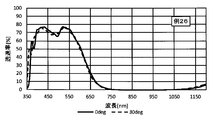
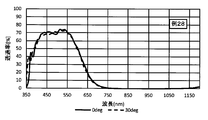
- the wavelength ⁇ 0 -T50 at which the transmittance is 50% in the spectral transmittance curve at an incident angle of 0 degree is in the wavelength region of 550 to 650 nm.
- the average transmittance T 0-ave (450-600) of light having a wavelength of 450 to 600 nm is 60% or more in the spectral transmittance curve at an incident angle of 0 degree.
- the average transmittance T 0-ave (700-1200) of light having a wavelength of 700 to 1200 nm is 5% or less in the spectral transmittance curve at an incident angle of 0 degree.
- the wavelength ⁇ 30-T50 at which the transmittance is 50% in the spectral transmittance curve at an incident angle of 30 degrees is in the wavelength region of 550 to 650 nm.
- the average transmittance T 30-ave(450-600) of light having a wavelength of 450 to 600 nm is 60% or more in the spectral transmittance curve at an incident angle of 30 degrees.
- the value obtained by subtracting ⁇ 30 -T50 from ⁇ 0-T50 is 0 nm or more and less than 10 nm.
- the value obtained by subtracting T 30 -ave (450-600) from T 0-ave (450-600) is 0% or more and less than 5%.
- the OD value (OD 0-940 ) for light having a wavelength of 940 nm at an incident angle of 0 degree is 3 or more.
- the OD value (OD 30-940 ) for light having a wavelength of 940 nm at an incident angle of 30 degrees is 3 or more.
- the filter may have an adhesive layer containing a photocurable material or a thermosetting material between at least one of the absorption layer and the first glass substrate and between the absorption layer and the second glass substrate. That is, the adhesive layer may be provided between the absorbing layer and the first glass substrate, between the absorbing layer and the second glass substrate, or both.
- the mode of the adhesive layer is appropriately selected according to the method for producing the absorption layer.
- a coating liquid obtained by dissolving the dye (A) and the resin (B) in a solvent (hereinafter, also referred to as “host solvent”) is used for the absorption layer on one main surface of the first or second glass substrate.
- a solvent hereinafter, also referred to as “host solvent”.
- an adhesive layer can be provided between the absorbing layer and the second or first glass substrate.
- the absorbing layer is prepared in the same manner as above on a releasable substrate different from the first or second glass substrate and is peeled off from the substrate, or when it is produced in a film form by extrusion molding.
- the adhesive layer is preferably provided both between the absorption layer and the first glass substrate and between the absorption layer and the second glass substrate.
- the absorption layer may have one layer or two or more layers in the filter. When two or more absorption layers are provided, each layer may have the same structure or different. When there are two or more absorption layers, it is preferable that both absorption layers are provided between the first glass substrate and the second glass substrate. Examples of the structure of the present filter having two absorption layers include, for example, a first absorption layer on a first glass substrate, a second absorption layer on a second glass substrate, and A configuration in which the first absorption layer and the second absorption layer are adhered by an adhesive layer can be mentioned.
- the filter may further have a dielectric multilayer film.
- a dielectric multilayer film for example, a NIR reflection layer that shields NIR complementarily to the absorption layer, a UV reflection layer that reflects UV, a NIR/UV reflection layer that reflects both NIR and UV, and visible light transmittance.
- An antireflection layer that suppresses loss can be mentioned, and an antireflection layer is preferable.
- the disposition position of the dielectric multilayer film is preferably between the first glass base material and the second glass base material. Further, from the viewpoint of further enhancing the durability of the NIR shielding property of the present filter, the dielectric multilayer film is more preferably provided between the absorption layer and the adhesive layer.
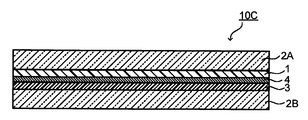
- FIG. 1 is a sectional view schematically showing a configuration example of an optical filter 10A in which an absorption layer 1 is sandwiched between a first glass base material 2A and a second glass base material 2B.
- both the first glass substrate 2A and the second glass substrate 2B have T Gave (400-600) of 80% or more, and the absorbing layer 11 is made of the dye (A) and the resin. It can be composed of a layer containing (B).
- FIG. 2 shows a configuration of an optical filter 10B configured in the same manner as the optical filter 10A, except that the optical filter 10A shown in FIG. 1 has an adhesive layer 3 between the absorption layer 1 and the second glass substrate 2B.
- the adhesive layer 3 is an adhesive layer containing a photocurable material or a thermosetting material.
- the adhesive layer 3 may be provided between the absorption layer 1 and the first glass substrate 2A instead of between the absorption layer 1 and the second glass substrate 2B. Further, the adhesive layer 3 may be both between the absorption layer 1 and the second glass base material 2B and between the absorption layer 1 and the first glass base material 2A.
- FIG. 3 is a structural example of the optical filter 10C shown in FIG. 2 except that the dielectric multilayer film 4 is provided between the absorption layer 1 and the adhesive layer 3 and the optical filter 10C has the same configuration as that of the optical filter 10B.
- the dielectric multilayer film 4 may be provided not on the position shown in FIG. 3 but on the main surface of the first glass substrate 2A opposite to the absorption layer 1 side. It may be between the material 2A and the absorbent layer 1 or between the adhesive layer 3 and the second glass base material 2B, and on the main surface of the second glass base material 2B opposite to the adhesive layer 3 side. It may be.
- an optical filter 10D (not shown) in which the dielectric multilayer film 4 is combined with the optical filter 10A is also included in this filter.
- the dielectric multilayer film 4 may be on the main surface of the first glass base material 2A opposite to the absorption layer 1 side, and may be between the first glass base material 2A and the absorption layer 1. Alternatively, it may be between the absorption layer 1 and the second glass base material 2B, or may be on the main surface of the second glass base material 2B opposite to the absorption layer 1 side.
- the number of dielectric multilayer films may be plural.
- the dielectric multilayer film 4 has a main surface opposite to the absorption layer 1 side of the first glass substrate 2A at the position shown in FIG. 3, that is, between the absorption layer 1 and the adhesive layer 3. , A main surface between the first glass substrate 2A and the absorbent layer 1, between the adhesive layer 3 and the second glass substrate 2B, and on the opposite side of the second glass substrate 2B from the adhesive layer 3 side. It may be provided at a plurality of locations selected from the above five locations.
- the dielectric multilayer film 4 has the main surface of the first glass substrate 2A opposite to the absorption layer 1 side and/or the second surface.
- the outermost surfaces of both main surfaces of the present filter can satisfy the pencil hardness of 4H or more according to the above (3-0).
- the outermost surfaces of both main surfaces of the optical filter are made of a glass base material in any case.
- the pencil hardness of 9H or more can be satisfied on the outermost surfaces of both main surfaces of the filter.
- the plurality of dielectric multilayer films may be a combination of an NIR reflection layer, a UV reflection layer, a NIR/UV reflection layer, and an antireflection layer, and have the same function. It may be a combination of a plurality of dielectric multilayer films.
- the optical filter 10D has a plurality of dielectric multilayer films, it may be a combination of a plurality of dielectric multilayer films having the same function or a combination of a plurality of dielectric multilayer films having different functions.
- the absorption layer the first glass base material, the second glass base material, the adhesive layer, and the dielectric multilayer film will be described.
- Both the first glass substrate and the second glass substrate used in the present filter have T Gave (400-600) of 80% or more.
- T Gave (400-600) the optical characteristics, materials, shapes, etc. of the first glass base material and the second glass base material will be described below. If the first glass substrate and the second glass substrate both have T Gave (400-600) of 80% or more, the properties and the like described below including T Gave (400-600) are the same. Or they may be different.
- fluorophosphate glass As the glass constituting the first glass substrate and the second glass substrate, fluorophosphate glass, absorptive glass containing copper ions in phosphate glass (near infrared absorption glass), soda lime Examples thereof include glass, borosilicate glass, non-alkali glass, and quartz glass.
- phosphate-based glass also includes silicophosphate glass in which a part of the glass skeleton is made of SiO 2 .
- alkali metal ions having a small ionic radius for example, Li ion and Na ion
- alkali ions having a larger ionic radius for example, at a temperature below the glass transition point by ion exchange.
- Li ions are Na ions or K ions
- Na ions are K ions.
- chemically strengthened glass may be used.
- the T Gave (400-600) of each of the first glass substrate and the second glass substrate is 80% or more, preferably 83% or more, and more preferably 85% or more.
- One of the first glass substrate and the second glass substrate is preferably a near-infrared absorbing glass substrate which satisfies the following requirements (2-1) and (2-2), and both Is more preferably a near-infrared absorbing glass substrate satisfying the requirements (2-1) and (2-2).
- the first glass base material and the second glass base material have the above-described configuration
- an optical filter having fewer components for example, the optical filter 10A shown in FIG. 1 or the optical filter shown in FIG.
- the configuration of the filter 10B it becomes possible to satisfy all the requirements of the optical characteristics of (3-1) to (3-7), particularly (3-1) to (3-9).
- the wavelength ⁇ GT50 at which the transmittance is 50% is in the wavelength region of 600 to 700 nm.
- the average transmittance T Gave (750-1000) of light having a wavelength of 750 to 1000 nm is 20% or less.
- ⁇ GT50 is more preferably in the wavelength region of 600 to 680 nm, further preferably in the wavelength region of 610 to 660 nm.
- T Gave (750-1000) is more preferably 15% or less, still more preferably 10% or less.
- the refractive indices of the first glass base material and the second glass base material are not particularly limited. Specifically, 1.50 to 1.60 are preferable, and 1.53 to 1.59 are more preferable.
- the shapes of the first glass base material and the second glass base material are not particularly limited, and may be a block shape, a plate shape, or a film shape.
- the thickness of each of the first glass base material and the second glass base material is, for example, preferably 0.03 to 5 mm, and more preferably 0.03 to 1.0 mm from the viewpoint of thinning. From the viewpoint of workability, it is preferably 0.05 to 0.09 mm.
- the thickness of the first glass substrate and the second glass substrate may be the same or different. From the viewpoint of thinning the present filter, the total thickness of the first glass substrate and the second glass substrate is preferably 0.06 to 2.0 mm, more preferably 0.10 to 0.18 mm.
- the absorption layer contains at least one dye (A) selected from a squarylium dye, a cyanine dye and a diimonium dye having the characteristics (1-1) to (1-4) and a resin (B).
- the absorbing layer is typically a layer in which the dye (A) is uniformly dissolved or dispersed in the resin (B).
- the absorbing layer may contain other NIR absorbing dyes in addition to the dye (A) as long as the effect of the present invention is not impaired. Further, the absorbing layer may contain a dye other than the NIR absorbing dye, particularly a UV absorbing dye, as long as the effect of the present invention is not impaired.
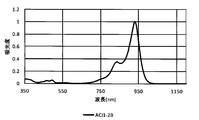
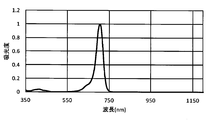
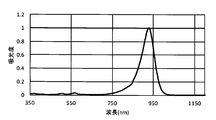
- the dye (A) has a maximum absorption wavelength ⁇ max (A) DCM in the wavelength range of 650 to 1200 nm in (1-1).
- the maximum absorption wavelength ⁇ max (A)DCM of the dye (A) is appropriately selected within the wavelength range of 650 to 1200 nm in consideration of the required characteristics of the filter and the constituent elements to be combined.
- the maximum absorption wavelength ⁇ max (A)DCM is preferably in the wavelength region of 800 to 1100 nm, for example.
- the dye (A) has an ABS 430(A)DCM /ABS ⁇ max(A)DCM of 0.06 or less in (1-2).
- the ABS 430(A)DCM /ABS ⁇ max(A)DCM of the dye (A) is preferably 0.05 or less, and more preferably 0.04 or less.
- the dye (A) has an ABS 550(A)DCM /ABS ⁇ max(A)DCM of 0.04 or less in (1-3).
- the ABS 550(A)DCM /ABS ⁇ max(A)DCM of the dye (A) is preferably 0.03 or less, more preferably 0.02 or less.
- the dye (A) has an ABS 630(A)DCM /ABS ⁇ max(A)DCM of 0.06 or less in (1-4).
- the ABS 630(A)DCM /ABS ⁇ max(A)DCM of the dye (A) is preferably 0.05 or less, and more preferably 0.04 or less.
- the dye (A) has large spectral absorption at the maximum absorption wavelength and has a sharp spectral characteristic with high visible light transmittance.
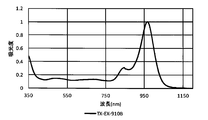
- the absorbance curve at a wavelength of 350 to 1200 nm measured by incorporating the dye (A) into the resin (B) shows that the added amount of the dye (A) is 1 at the maximum absorption wavelength ⁇ max (A) TR. That is, it is an absorbance curve when it is adjusted so that the light transmittance is 10%.
- the maximum absorption wavelength ⁇ max(A)TR is in the wavelength range of 650 to 1200 nm.
- (1′-2) Absorbance at maximum absorption wavelength ⁇ max (A)TR Abs ABS ⁇ max (A)TR ratio of absorbance ABS 430 (A)TR at wavelength 430 nm ABS 430 (A)TR /ABS ⁇ max (A)TR It is 0.30 or less.
- (1′-3) Absorbance at maximum absorption wavelength ⁇ max (A)TR Abs ABS ⁇ max (A)TR Absorbance ABS 550 (A)TR at wavelength 550 nm Ratio ABS 550 (A)TR /ABS ⁇ max (A)TR It is 0.20 or less.
- the absorptive property of the dye (A) in dichloromethane is maintained in the resin (B) when used in an optical filter. It can be maintained with good reproducibility.
- the dye (A) preferably further has the following properties (1′-5).
- the mass extinction coefficient when contained in the (1′-5) resin (B) is 200/(cm ⁇ mass %) or more.
- the “mass extinction coefficient” of a dye is the mass extinction coefficient calculated by the above method.
- the dye (A) has a mass extinction coefficient of 300/(cm ⁇ mass %) or more in (1′-5).
- the mass extinction coefficient is preferably 1000/(cm ⁇ mass %) or more.
- the dye (A) is at least one selected from squarylium dyes, cyanine dyes and diimonium dyes that satisfy the requirements (1-1) to (1-4).
- a cyanine dye and a squarylium dye are particularly preferable from the viewpoint of high visible light transmittance.
- the dye (A) satisfies the requirement of (4-1) below in the absorbance curve at a wavelength of 350 to 1200 nm measured by dissolving it in dichloromethane, and has a high shielding property on the long wavelength side of NIR and a visible light. Cyanine dyes and squarylium dyes, which have high transmittance in the range, are preferred.
- (4-1) Maximum absorption wavelength ⁇ max (A) DCM is in the wavelength region of 800 to 1100 nm.
- the dye (A) has a high shielding property on the short wavelength side of NIR, which satisfies the following requirement (5-1) in the absorbance curve at a wavelength of 350 to 1200 nm measured by dissolving it in dichloromethane. Squarylium dyes are also preferred.
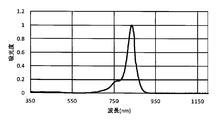
- (5-1) Maximum absorption wavelength ⁇ max (A) DCM is in the wavelength range of 650 to 750 nm.
- the cyanine dye that is the dye (A) and satisfies (4-1) is preferably a cyanine dye having the following molecular structure (4-2).
- (4-2) A cyanine dye represented by any of the following formulas (ACi) to (ACiii).
- R 101 to R 107 , R 121 to R 127 and R 141 are each independently a hydrogen atom, a halogen atom, a sulfo group, a hydroxy group, a cyano group, a nitro group, a carboxyl group, a phosphoric acid group, or —NR 112 R 113 group, -NHSO 2 R 114 group, -NHCOR 115 group, -SR 116 group, -SO 2 R 117 group, -OSO 2 R 118 group, alkyl group or alkoxy group having 1 to 20 carbon atoms, and 1 to carbon number And a halogen-substituted alkyl group having 12 carbon atoms, a cycloalkyl group having 3 to 14 carbon atoms, an aryl group having 6 to 14 carbon atoms, or a heterocyclic group having 3 to 14 members.
- R 102 to R 107 and R 122 to R 127 may be connected to each other to form a 5-membered ring, a 6-membered ring or a 7-membered ring.
- R 105 and R 106 are linked to each other to form an aromatic ring together with a part of the benzene ring of the skeleton (C ⁇ C) is preferable.
- R 125 and R 126 are linked to each other to form an aromatic ring together with a part (C ⁇ C) of the benzene ring of the skeleton is preferable.
- R 142 and R 143 may form a hydrogen atom or bond with each other to form an aromatic ring D having 6 members.
- R 145 and R 144 may be hydrogen atoms or may be bonded to each other to form an aromatic ring E having 6 members. However, both the aromatic ring D and the aromatic ring E are not formed.
- R 109 to R 111 , R 129 to R 131 , and R 146 to R 148 are each independently a hydrogen atom, an alkyl group having 1 to 6 carbon atoms, a —NR 112 R 113 group, or a cycloalkyl having 3 to 14 carbon atoms. It is an alkyl group or an aryl group having 6 to 14 carbon atoms.
- R 109 and R 111 , R 129 and R 131 , and R 146 and R 148 may combine with each other to form a 5- or 6-membered ring.
- the hydrogen atom bonded to the ring may be substituted with an alkyl group having 1 to 6 carbon atoms, and two of the ring-constituting atoms may be bridged with a methylene group.
- R 112 to R 118 each independently represent a hydrogen atom, an alkyl group or an alkoxy group having 1 to 20 carbon atoms, a halogen-substituted alkyl group having 1 to 12 carbon atoms, a cycloalkyl group having 3 to 14 carbon atoms, or a carbon number. It is an aryl group having 6 to 14 or a heterocyclic group having 3 to 14 members.
- X ⁇ represents a monovalent anion.
- the alkyl group and the alkyl group of the alkoxy group may be linear, and may include a branched structure or a saturated ring structure.
- the aryl group refers to a group bonded via a carbon atom constituting an aromatic ring of an aromatic compound, for example, a benzene ring, a naphthalene ring, a biphenyl, a furan ring, a thiophene ring, a pyrrole ring and the like.
- the halogen atom include a fluorine atom, a chlorine atom, a bromine atom and an iodine atom, and a fluorine atom and a chlorine atom are preferable.
- Examples of X ⁇ include I ⁇ , BF 4 ⁇ , PF 6 ⁇ , ClO 4 ⁇ , anions represented by the formulas (X1) and (X2), and the like, preferably BF 4 ⁇ , PF 6 ⁇ and anion ( X1).
- the dye (ACi) a compound represented by the following formula (ACi1) in which R 109 to R 111 in formula (ACi) are hydrogen atoms is preferable from the viewpoint of maintaining high visible transparency in the resin (B).
- R 101 to R 107 and X ⁇ in the formula (ACi1) are the same as those described in the formulas (ACi) to (ACiii) including the preferable embodiments.
- R 101 is preferably an alkyl group having a linear or branched structure and having 1 to 20 carbon atoms, and a linear or branched structure having 4 carbon atoms. More preferably, it is from 20 to 20 alkyl groups.
- R 102 to R 107 are each independently a hydrogen atom, a —NR 112 R 113 group, a —NHSO 2 R 114 group, a —NHCOR 115 group, an alkyl group or an alkoxy group having 1 to 20 carbon atoms, or a member having 3 members.
- a heterocyclic group having 14 to 14 is preferable, and a hydrogen atom, or an alkyl group having 1 to 20 carbon atoms or an alkoxy group is more preferable.
- R 112 to R 115 can be the same as those described in the above formulas (ACi) to (ACiii).
- Examples of the dye (ACii) include a compound represented by the following formula (ACii1), wherein R 129 and R 131 in the formula (ACii) are bonded to each other to form a 6-membered ring, and a compound represented by the formula (ACii2) represented by the following formula (ACii2).
- the compound in which R 129 and R 131 in () form a 5-membered ring is preferable from the viewpoint of maintaining high visible transparency in the transparent resin.
- R 121 to R 127 and X ⁇ in the formulas (ACii1) and (ACii2) are the same as those described in the above formulas (ACi) to (ACiii) including the preferable embodiments.
- R 130a is a hydrogen atom, a phenyl group, or a methyl group, preferably a phenyl group.
- R 130b is a hydrogen atom, a phenyl group, a methyl group or a diphenylamino group, preferably a phenyl group or a diphenylamino group.
- R 121 is preferably an alkyl group having a linear or branched structure and having 1 to 20 carbon atoms, and having 4 to 4 carbon atoms having a linear or branched structure. More preferably, it is 20 alkyl groups.
- R 122 to R 127 are each independently a hydrogen atom, a dimethylamino group, a —NHSO 2 R 114 group, a —NHCOR 115 group, an alkyl group or an alkoxy group having 1 to 20 carbon atoms, or a member having 3 to 14 members.
- a heterocyclic group is preferable, and a hydrogen atom or an alkyl group having 1 to 20 carbon atoms or an alkoxy group is more preferable.
- R 114 to R 115 can be the same as those described in the above formulas (ACi) to (ACiii).
- R 141 , R 146 to R 148 and X ⁇ in the formulas (ACiii1) and (ACiii2) are the same as those described in the above formulas (ACi) to (ACiii) and (ACiv) including the preferable embodiments.
- R 141 is preferably a linear or branched alkyl group having 1 to 20 carbon atoms from the viewpoint of solubility in a transparent resin or a host solvent, and further, from the viewpoint of easiness of synthesis, R 141 Alternatively, it is more preferably an alkyl group having a branched structure and having 1 to 3 carbon atoms.
- R 147 is preferably a hydrogen atom, a methyl group or a phenyl group, more preferably a hydrogen atom or a phenyl group.
- Each of R 146 and R 148 is a hydrogen atom, or R 146 and R 148 are bonded to each other to form a 5-membered ring or a 6-membered ring together with the main chain (methine chain) to which these are bonded.
- the hydrogen atom bonded to the ring may be substituted with an alkyl group having 1 to 6 carbon atoms, and two of the ring-constituting atoms may be bridged with a methylene group.
- R- 146 and R 148 are bonded to each other to form a 5-membered ring together with the main chain, or a structure represented by -(CH 2 ) 2 -described below or a 6-membered ring formed by -(CH 2 ) 3 -described below.
- the configuration shown is more preferred.
- the compounds represented by formula (ACi1), formula (ACii1), formula (ACii2), formula (ACiii1), and formula (ACiii2) are, respectively, more specifically, atoms or groups bonded to each skeleton.
- Tables 1 to 5 below.
- R 101 to R 107 are all the same on the left and right sides of the formula.
- R 121 to R 127 are the same on the left and right sides of the formula.
- R 141 is the same on the left and right sides of the formula.
- the alkyl group represented by —C n H 2n+1 (n is an integer of 3 or more) is a linear alkyl group
- —Ph is a phenyl group.
- Table 1 to Table 5 do not show X ⁇ , but in any compound, X ⁇ is BF 4 ⁇ , PF 6 ⁇ or anion X1.
- X ⁇ is BF 4 ⁇
- PF 6 ⁇ it is a dye
- ACi1-1P an anion
- X1-1X1 it is a dye (ACi1-1X1).
- Indicates The same applies to the other dyes shown in Tables 1 to 5.
- the dye (ACi1) includes dyes (ACi1-1B), dyes (ACi1-1P), dyes (ACi1-1X1), dyes (ACi1-2B), dyes (ACi1-2P), dyes (ACi1-). 14B), dyes (ACi1-15B) and the like are preferable.
- the dye (ACii1) is preferably the dye (ACii1-1B), the dye (ACii1-1P), the dye (ACii1-7B), the dye (ACii1-7P), and the like.
- the dye (ACii2) includes dyes (ACii2-1B), dyes (ACii2-1P), dyes (ACii2-2B), dyes (ACii2-2P), dyes (ACii2-11B), dyes (ACii2-). 11P), dye (ACii2-12B), dye (ACii2-12P) and the like are preferable.
- the dye (ACiii1) includes dyes (ACiii1-1B), dyes (ACiii1-1P), dyes (ACiii1-2B), dyes (ACiii1-2P), dyes (ACiii1-5B), dyes (ACiii1-).
- the dye (ACiii2) the dye (ACiii2-1B), the dye (ACiii2-1P), the dye (ACiii2-2B), the dye (ACiii2-2P), the dye (ACiii2-5B), and the dye (ACiii2-).
- the dye (ACi) and the dye (ACii) are described in J. Heterocyclic Chem. , 42 (2005), 959 can be manufactured by the method described.
- the dye (ACiii) can be produced by the method described in UKRAINSKII KHIMICHESKII ZHURNAL, 44(8), 838, (1978).
- the dye (ACi1-1B), the dye (ACi1-2B), and the dye (ACii2-2B) are commercially available products, S0772 (Compound name: 1-Butyl-2- [5-(1-butyl-1H-benzo[cd]indol-2-ylidene)-penta-1,3-dienyl]-benzo[cd]indotetrafluoroborate, S2437 (Compound name: 6-Butoxy-2-[ 5-(6-butoxy-1-butyl-1H-benzo[cd]indol-2-ylidene)-penta-1,3-dienyl]-1-butyl-benzo[cd]indodium tetrafluoroborate, and S2007 (compound name) : 1-Butyl-2-(2-[3-[2-(1-butyl-1H-benzo[cd]indol-2-ylidene)-ethylidene]2-diphenyla
- the squarylium dye that is the dye (A) and satisfies (4-1) is preferably a squarylium dye having the following molecular structure (4-3).
- (4-3) A squarylium dye represented by any of the following formulas (ASi) to (ASiii).
- R 161 is independently a branched alkyl group having 3 to 20 carbon atoms or a linear alkyl group having 13 to 20 carbon atoms. From the viewpoint of solubility in a transparent resin or a host solvent, R 161 is preferably a branched alkyl group having 8 to 20 carbon atoms, and more preferably a linear alkyl group having 16 to 20 carbon atoms. R 161 is more preferably a branched alkyl group having 8 to 20 carbon atoms from the viewpoint of maintaining high transmittance in the transparent resin.
- Y 3 is C—R 179 or N.
- R 162 to R 167 and R 171 to R 179 each independently represent a hydrogen atom, a halogen atom, a sulfo group, a hydroxy group, a cyano group, a nitro group, a carboxyl group, Phosphoric acid group, -NR 112 R 113 group, -NHSO 2 R 114 group, -NHCOR 115 group, -SR 116 group, -SO 2 R 117 group, -OSO 2 R 118 group, alkyl group having 1 to 20 carbon atoms Alternatively, it is an alkoxy group, a halogen-substituted alkyl group having 1 to 12 carbon atoms, a cycloalkyl group having 3 to 14 carbon atoms, an aryl group having 6 to 14 carbon atoms, or a heterocyclic group having 3 to 14 members.
- heterocyclic group having 3 to 14 members examples include a heterocyclic group containing at least one kind selected from N, O and S as a hetero atom.
- R 171 is preferably a linear alkyl group having 8 to 20 carbon atoms or a branched alkyl group having 8 to 20 carbon atoms from the viewpoint of solubility in a transparent resin or a host solvent.
- R 171 is more preferably a branched alkyl group having 16 to 20 carbon atoms from the viewpoint of maintaining high transmittance in the transparent resin.
- R 162 to R 167 and R 172 to R 178 are each independently preferably a hydrogen atom, an alkyl group or an alkoxy group having 1 to 20 carbon atoms, a —NHSO 2 R 114 group, or a —NHCOR 115 group, and a hydrogen atom, An alkoxy group having 1 to 20 carbon atoms and an —NHCOR 115 group are more preferable.
- R 179 is preferably a hydrogen atom, an alkyl group having 1 to 20 carbon atoms or an alkoxy group, and more preferably a hydrogen atom, an alkyl group having 1 to 8 carbon atoms or an alkoxy group.
- R 112 to R 118 each independently represent a hydrogen atom, an alkyl group or an alkoxy group having 1 to 20 carbon atoms, a halogen-substituted alkyl group having 1 to 12 carbon atoms, a cycloalkyl group having 3 to 14 carbon atoms, or a carbon number. It is an aryl group having 6 to 14 or a heterocyclic group having 3 to 14 members.
- the halogen atom include a fluorine atom, a chlorine atom, a bromine atom and an iodine atom, and a fluorine atom and a chlorine atom are preferable.
- R 112 to R 118 are each independently preferably an alkyl group or alkoxy group having 1 to 20 carbon atoms, and more preferably an alkyl group or alkoxy group having 3 to 16 carbon atoms.
- the alkyl group and the alkyl group of the alkoxy group may be linear, and may include a branched structure or a saturated ring structure.
- the aryl group refers to a group bonded via a carbon atom constituting an aromatic ring of an aromatic compound, for example, a benzene ring, a naphthalene ring, a biphenyl, a furan ring, a thiophene ring, a pyrrole ring and the like.
- the halogen atom include a fluorine atom, a chlorine atom, a bromine atom and an iodine atom, and a fluorine atom and a chlorine atom are preferable.
- R 11 to R 14 each independently have a substituent, and may be an alkyl group, an alkoxy group, or an aryl group which may have an unsaturated bond or an oxygen atom between carbon-carbon atoms.
- R 15 and R 16 each independently have a substituent, and are an aryl group, a carbon-carbon unsaturated bond, an oxygen atom, an alicyclic ring or an aromatic ring. It is an alkyl group or an alkoxy group which may be contained, or R 15 and R 16 are linked to each other to form a cyclohetero ring having 5 to 10 members with a nitrogen atom, and the cyclo hetero ring may have a substituent. Good.
- the dye (ASiii) has a squarylium skeleton in the center of the molecular structure, and one cyclopentadithiophene ring is bonded to each of the right and left sides of the squarylium skeleton.
- the cyclopentadithiophene ring is a structure in which the thiophene ring on the opposite side of the squarylium skeleton has a nitrogen-containing substituent, —NR 15 R 16 .
- the left and right R 11 to R 16 of the squarylium skeleton may be different, but the same is preferable from the viewpoint of easy synthesis.
- the substituent in R 11 to R 14 is a halogen atom, a hydroxyl group, a carboxy group, a sulfo group, a cyano group, an amino group, an N-substituted amino group, a nitro group, an alkoxycarbonyl group, a carbamoyl group, an N-substituted carbamoyl group, Examples thereof include an imide group and an alkoxy group having 1 to 10 carbon atoms.
- R 11 to R 14 are an aryl group or an araryl group
- the substituent is a group that replaces a hydrogen atom bonded to an aromatic ring or a hydrogen atom of an alkyl group contained in the aromatic ring, and in addition to the above-mentioned substituent, an aryl group including.
- R 11 to R 14 are alkyl groups or alkoxy groups
- the number of carbon atoms is preferably 1 to 20, more preferably 1 to 15, and further preferably 1 to 12.
- R 11 to R 14 are aryl groups
- the number of carbon atoms is preferably 6 to 20, more preferably 6 to 17, and even more preferably 6 to 14.
- R 11 to R 14 are araryl groups
- the number of carbon atoms is preferably 7 to 20, more preferably 7 to 18, and further preferably 7 to 15.
- R 11 to R 14 have a substituent the carbon number is the carbon number including the carbon number of the substituent.
- R 11 is preferably a hydrogen atom or an alkyl group having 1 to 12 carbon atoms, and particularly preferably a hydrogen atom.
- R 12 and R 13 are linear or branched having 1 to 20 carbon atoms, which may include an oxygen atom between carbon and carbon atoms, from the viewpoint of visible light transmittance, light resistance, and solubility in a solvent.
- a chain or cyclic alkyl group is preferred.
- the number of carbon atoms of the alkyl group is more preferably 1 to 12 in the case of a straight chain, more preferably 3 to 10 in the case of a branched chain, and more preferably 5 to 10 in the case of a cyclic form.
- R 12 and R 13 are more preferably a group selected from the groups 1a to 5a and the groups 1d to 10d, and particularly preferably the group 1a, the group 3a, or the group 5d.
- R 12 and R 13 are a phenyl group which may have 1 to 5 substituents or 1 to 7 substituents from the viewpoints of heat resistance, light resistance and longer absorption wavelength.
- a naphthyl group which may have or a cyclic alkyl group having 5 to 10 carbon atoms is preferable.
- the substituent which may substitute the hydrogen atom of the phenyl group and the naphthyl group is an alkyl group having 1 to 12 carbon atoms which may contain an unsaturated bond or an oxygen atom between carbon atoms, an alkoxy group, or an alkyl group.
- An amino group (the carbon number of the alkyl group is 1 to 12) can be mentioned.
- the phenyl group and naphthyl group are preferably unsubstituted or substituted with 1 to 3 hydrogen atoms, and the substituent is preferably a methyl group, a tert-butyl group, a dimethylamino group, a methoxy group or the like.
- phenyl group which may have 1 to 5 substituents include groups P1 to P9.
- naphthyl group which may have 1 to 7 substituents include groups N1 to N9.
- R 12 and R 13 are preferably a methyl group, a phenyl group, a naphthyl group, a toluyl group, a 3,5-di-tert-butylphenyl group, a cyclohexyl group, an isopropyl group, a 2-ethylhexyl group, and the like.
- a phenyl group, a cyclohexyl group and an isopropyl group are particularly preferable.
- R 14 is similar to R 12 and R 13 in terms of visible light transmittance and solubility in a solvent, and R 14 is a straight chain having 1 to 20 carbon atoms which may include an oxygen atom between carbon atoms.
- a branched or cyclic alkyl group is preferable.
- the number of carbon atoms of the alkyl group is more preferably 1 to 12 in the case of a straight chain, more preferably 3 to 10 in the case of a branched chain, and more preferably 5 to 10 in the case of a cyclic form.
- R 14 is more preferably, for example, a group selected from groups 1a to 5a and groups 1d to 10d, particularly preferably group 1d.
- R 14 is preferably a hydrogen atom or an alkyl group having 1 to 8 carbon atoms, and particularly preferably a hydrogen atom.
- R 15 and R 16 each independently have an aryl group, an alkyl group which may have an unsaturated bond between carbon-carbon atoms, an oxygen atom, an alicyclic ring or an aromatic ring, or an alkoxy group. It is a base. R 15 and R 16 may be linked to each other to form a cycloheterocycle having 5 to 10 members with a nitrogen atom, in which case the hydrogen atom bonded to the cycloheterocycle may be substituted with a substituent.
- R 15 and R 16 examples include the same substituents as those for R 11 to R 14 .
- R 15 and R 16 are araryl groups, the alkyl group they have may be further substituted with an aryl group.
- R 15 and R 16 may be a group having an aromatic ring or may be a group having no aromatic ring. When R 15 and R 16 have an aromatic ring, they are preferable in terms of heat resistance and lengthening of absorption wavelength. When R 15 and R 16 do not have an aromatic ring, they are preferable in terms of light resistance, ease of production, and solubility in a solvent.
- R 15 and R 16 are aryl groups, the same aryl groups as those exemplified for R 1 and R 2 can be exemplified.
- R 15 and R 16 are alkyl groups or alkoxy groups
- the number of carbon atoms is preferably 1 to 20, more preferably 1 to 12, and further preferably 1 to 10.
- R 15 and R 16 are the same as R 12 and R 13 in terms of visible light transmittance and solubility in a solvent, and have a carbon number of 3 to 20 that may contain an oxygen atom between carbon atoms.
- a linear, branched or cyclic alkyl group is preferred.
- the number of carbon atoms of the alkyl group is more preferably 3 to 12 in the case of a straight chain, more preferably 3 to 10 in the case of a branched chain, and more preferably 5 to 10 in the case of a cyclic.
- the carbon number is the carbon number including the carbon number of the substituent.
- R 15 and R 16 are more preferably a group selected from the groups 1a to 5a and the groups 1d to 10d, and particularly preferably the group 1d.
- R 15 and R 16 are linked to each other to form a cycloheterocycle with a nitrogen atom includes the same embodiments as R 5 and R 6 in Compound 2, and the preferred embodiments are also the same.
- R 11 to R 16 among R 11 to R 16 , 2 or more, more preferably 3 or more, and even more preferably all 4 selected from R 12 , R 13 , R 15 and R 16 are carbon-carbon atoms.
- a linear or branched alkyl group having 3 to 20 carbon atoms which may contain an oxygen atom is preferable. Thereby, the compound has excellent visible light transmittance and solubility in a solvent.
- Tables 6 and 7 More specific examples of the compound represented by the formula (ASi) include compounds in which the atom or group bonded to each skeleton is shown in Tables 6 and 7 below.
- Table 6 is a table in which 31 types of combinations of atoms or groups in R 161 to R 167 are numbered S-1 to S-31.
- all alkyl groups such as —C 4 H 9 are straight chain alkyl groups.
- Table 7 shows that in dyes (ASi-1) to dyes (ASi-496) classified into dyes (ASi), R 161 to R 167 on the right side and the left side of the squarylium ring are each S-1 to S-31. 3 is a table showing whether or not combinations are included.
- Dyes (ASi-1) to (ASi-31) shown in Table 7 are compounds having the same target structure in which the combination of R 161 to R 167 is the same on the left and right sides of the formula.
- the dye (ASi-32) to the dye (ASi-496) are compounds having asymmetric structures in which the combination of R 161 to R 167 is different on the left and right sides of the formula.
- the combination of R 161 to R 167 on the right side is S-1
- the combination of R 161 to R 167 on the left side is S-2 to S.
- dye (ASi) with S-1 on the right dye (ASi-32) with S-2 on the left
- dye (ASi-33) with S-3 on the left dye (ASi-33) with S-3 on the left
- S-4 on the left No. was dyed (ASi-34), and the dye numbers were increased by 1 in the order of the combination numbers of R 161 to R 167 .
- the dye (ASi-32) includes both a structure having S-1 on the right and S-2 on the left and a structure having S-2 on the right and S-1 on the left.
- the dyes (ASi), the dyes (ASi-1), the dyes (ASi-2), the dyes (ASi-3), the dyes (ASi-19), and the dyes (ASi-22) are symmetrical as the dyes (ASi).
- Dye (ASi-24), dye (ASi-25), dye (ASi-28), dye (ASi-31) and the like are preferable, and dye (ASi-1), dye (ASi-19), dye (ASi-) 22), dye (ASi-25), dye (ASi-31), and the like are more preferable.
- a dye (ASi-423) whose left-right combination is S-19 and any combination of S-24, S-25, and S-28 as a left-right asymmetric dye (ASi) a dye (ASi-423) whose left-right combination is S-19 and any combination of S-24, S-25, and S-28 as a left-right asymmetric dye (ASi)
- Dye (ASi-424), Dye (ASi-427), which is a combination of S-22 and S-31, Dye (ASi-460), S-24, and any combination of S-25 and S-28 The dye (ASi-469), the dye (ASi-472), and the like are preferable.
- dyes (ASii) include dyes (ASii), dyes (ASii-1) to dyes (ASii-8), dyes (ASii-10), dyes (ASii-15) to dyes (ASii-17) are preferable, and dyes (ASii-17) are preferable.
- ASii-8 dyes (ASii-15) to dyes (ASii-17), and the like are more preferable.
- the pigment (ASi) and the pigment (ASii) are described in, for example, European Journal of Medical Chemistry, 54 647, (2012), and further regarding the pigment (ASii), Org. Lett. No. 18, 5232 (2016), a compound to be introduced on both sides of a squarylium ring is produced, and the compound is, for example, a diagonal line of squaric acid by the method described in Organic Letters, 8, 111, (2006). It can be manufactured by introducing it in the above two places. Further, the asymmetric structure can be manufactured by the method described in Dyes and Pigments, 141, 457, (2017).
- the dye (ASiii) include compounds in which R 11 to R 16 are shown in Table 9 below. In all the compounds shown in Table 9, R 11 to R 16 are all the same on the left and right of the squarylium skeleton. In Table 9, the alkyl group represented by C n H 2n + 1 (n is an integer of 3 or more) indicates the linear alkyl group.
- the dyes (Asiii), the dyes (Asiii-3), the dyes (Asiii-8), the dyes (Asiii-10), the dyes (Asiii-13), and the dyes (Asiii-), from the viewpoint of maintaining high light resistance. 14) and the dye (ASiii-15) are preferred. Further, from the viewpoint of solubility in a solvent, a dye (ASiii-1), a dye (ASiii-2), a dye (ASiii-3), a dye (ASiii-5), a dye (ASiii-7), and a dye (ASiii).
- dye (ASiii-10), dye (ASii-12), dye (ASiii-13), and dye (ASiii-17) are preferred.
- the dye (ASiii-1), the dye (ASiii-5), the dye (ASiii-6), the dye (ASiii-9), and the dye (ASiii-16) are preferable.
- the dye (ASii) has four or more carbon-carbon double bonds from the central squarylium skeleton to the amino groups (-NR 15 R 16 ) at both ends, so that the ⁇ -conjugated structure becomes large, so that the near infrared region is increased. It has high absorption characteristics on the long wavelength side of light. Further, since it does not contain an extra benzene ring, it has a high blue transmittance on the short wavelength side of visible light, particularly visible light.
- the dye (ASiii) has a structure in which R 15 and R 16 do not have a structure in which an aromatic ring is directly bonded to the nitrogen atom, and when R 15 and R 16 are directly bonded to each other, an electron group is donated from the amino group to the cyclopentadithiophene ring.
- This is preferable in that the property is enhanced, the visible light transmittance on the short wavelength side is increased, and high absorption characteristics are exhibited for the near infrared light on the longer wavelength side.
- absorption characteristics having a maximum absorption wavelength ⁇ max of 800 to 1000 nm are obtained in an absorption spectrum of wavelength 400 to 1200 nm measured by dissolving in dichloromethane. Further, it is possible to obtain an absorption characteristic in which the maximum absorption wavelength ⁇ max is set to 850 to 980 nm by limiting the range.
- Such an absorption property is a property suitable as a photoelectric conversion material layer used for a transparent fingerprint sensor for near-infrared light, which requires an absorption maximum at 850 to 1050 nm, and a biological oxysensor, for example.
- the dye (ASiii) has, for example, 3,4-dihydroxy-3-cyclobutene-1,2-dione (squaric acid) and an amino group terminal capable of forming a structure represented by the formula (ASiii) by bonding with squaric acid. It can be produced by reacting it with a cyclopentadithiophene derivative.
- squaric acid 3,4-dihydroxy-3-cyclobutene-1,2-dione
- an amino group terminal capable of forming a structure represented by the formula (ASiii) by bonding with squaric acid. It can be produced by reacting it with a cyclopentadithiophene derivative.
- the dye (ASii) has a bilaterally symmetrical structure
- 2 equivalents of the cyclopentadithiophene derivative having a desired structure may be reacted within the above range with 1 equivalent of squaric acid.
- squarylium dye that is the dye (A) and satisfies (5-1)
- a squarylium dye having the following molecular structure (5-2) is preferable.
- the dyes (I) to (III) have high steepness in storage stability and light, as well as a steep slope of the absorption peak of ⁇ max (A)DCM on the visible light side in the above absorbance curve.
- R 24 and R 26 are each independently a hydrogen atom, a halogen atom, a hydroxyl group, an alkyl group or an alkoxy group having 1 to 6 carbon atoms, an acyloxy group having 1 to 10 carbon atoms, —NR 27 R 28 (R 27 and R 28 is each independently a hydrogen atom, an alkyl group having 1 to 20 carbon atoms, —C( ⁇ O)—R 29 (R 29 is a hydrogen atom or an optionally substituted carbon atom 1 To an alkyl group having 20 to 20 carbon atoms or an aryl group having 6 to 11 carbon atoms, or an arylaryl group having 7 to 18 carbon atoms, which may have a substituent and may have an oxygen atom between carbon atoms), NHR 30 or —SO 2 —R 30 (R 30 may have one or more hydrogen atoms each substituted with a halogen atom, a hydroxyl group, a carboxy group,
- R 21 and R 22 , R 22 and R 25 , and R 21 and R 23 are connected to each other to form a heterocycle A, a heterocycle B, and a heterocycle C each having 5 or 6 members with a nitrogen atom.
- R 21 and R 22 are a divalent group —Q— to which they are bonded, and are each a hydrogen atom having an alkyl group having 1 to 6 carbon atoms, an aryl group having 6 to 10 carbon atoms, or The alkylene group which may be substituted with an acyloxy group having 1 to 10 carbon atoms which may have a substituent, or an alkyleneoxy group is shown.
- R 22 and R 25 in the case where the heterocycle B is formed, and R 21 and R 23 in the case where the heterocycle C is formed are respectively a divalent group to which they are bonded, —X 1 —Y 1 — and — X 2 -Y 2 - as (side is X 1 and X 2 bonded to the nitrogen), a group X 1 and X 2 are represented by the following formula, respectively (1x) or (2x), Y 1 and Y 2 are each It is a group represented by any one selected from the following formulas (1y) to (5y).
- X 1 and X 2 are each a group represented by the following formula (2x)
- Y 1 and Y 2 may be a single bond, and in that case, an oxygen atom may be present between carbon atoms. ..
- Zs are each independently a hydrogen atom, a hydroxyl group, an alkyl group or an alkoxy group having 1 to 6 carbon atoms, or —NR 38 R 39 (R 38 and R 39 are each independently Represents a hydrogen atom or an alkyl group having 1 to 20 carbon atoms).
- R 31 to R 36 are each independently a hydrogen atom, an alkyl group having 1 to 6 carbon atoms or an aryl group having 6 to 10 carbon atoms, and R 37 is an alkyl group having 1 to 6 carbon atoms or an aryl group having 6 to 10 carbon atoms. Indicates an aryl group.
- R 27 , R 28 , R 29 , R 31 to R 37 , R 21 to R 23 when not forming a heterocycle, and R 25 are bonded to any other of these to form a 5-membered ring.
- a 6-membered ring may be formed.
- R 31 and R 36 , and R 31 and R 37 may be directly bonded.
- R 21 and R 22 each independently represent a hydrogen atom, an optionally substituted alkyl group having 1 to 6 carbon atoms or an allyl group, or a substituent. This represents an aryl group or araryl group having 6 to 11 carbon atoms which may be possessed.
- R 23 and R 25 each independently represent a hydrogen atom, a halogen atom, or an alkyl group or alkoxy group having 1 to 6 carbon atoms.
- Each ring Z is independently a 5-membered ring or 6-membered ring having 0 to 3 heteroatoms in the ring and optionally substituted.
- the carbon atoms or heteroatoms constituting R 1 and R 2 , R 2 and R 3 , and R 1 and ring Z are linked to each other to form a heterocycle A1, heterocycle B1 and heterocycle C1 together with a nitrogen atom.
- R 1 and R 2 each independently represent a hydrogen atom, a halogen atom, or an unsaturated bond between carbon atoms, a heteroatom, a saturated or unsaturated group, when not forming a heterocycle.
- R 3 and R 4 may each independently include a hydrogen atom, a halogen atom, or a hetero atom between carbon atoms.
- An alkyl group or an alkoxy group is shown.
- R 51 each independently represents a halogen atom or an alkyl group having 1 to 3 carbon atoms which may have a substituent
- R 52 to R 58 each independently represent a hydrogen atom, a halogen atom, or an optionally substituted alkyl group having 1 to 10 carbon atoms.
- R 52 and R 53 may be linked to each other to form a saturated or unsaturated hydrocarbon ring B2 having 5 to 15 carbon atoms, and the hydrogen atom of the hydrocarbon ring B2 is an alkyl group having 1 to 10 carbon atoms.
- a group may be substituted, R 54 and R 55 may be linked to each other to form a benzene ring A2, and the hydrogen atom of the benzene ring A2 may be substituted with an alkyl group having 1 to 10 carbon atoms.
- Examples of the compound (I) include compounds represented by any of the formulas (I-1) to (I-4).
- the dye (A) is preferably the compounds (I-1) to (I-3) from the viewpoint of increasing the visible light transmittance of the absorbing layer,
- the compound (I-1) is particularly preferable.
- X 1 is preferably a group (2x), and Y 1 is preferably a single bond or a group (1y).
- R 31 to R 36 a hydrogen atom or an alkyl group having 1 to 3 carbon atoms is preferable, and a hydrogen atom or a methyl group is more preferable.
- Specific examples of —Y 1 —X 1 — include divalent organic groups represented by formulas (11-1) to (12-3).
- R 21 is independently represented by the formula (from the viewpoint of solubility, heat resistance, and steepness of change near the boundary between the visible region and the near-infrared region in the spectral transmittance curve.
- the group represented by 4-1) or (4-2) is more preferable.
- R 71 to R 75 each independently represent a hydrogen atom, a halogen atom, or an alkyl group having 1 to 4 carbon atoms.
- R 24 is preferably —NR 27 R 28 .
- —NR 27 R 28 —NH—C( ⁇ O)—R 29 is preferable from the viewpoint of solubility in a host solvent or a transparent resin.
- a compound (I-11) in which R 24 is —NH—C( ⁇ O)—R 29 is represented by the formula (I-11).
- R 23 and R 26 in the compound (I-11) are preferably independently a hydrogen atom, a halogen atom, or an alkyl group or an alkoxy group having 1 to 6 carbon atoms, and more preferably a hydrogen atom.
- R 29 is an alkyl group having 1 to 20 carbon atoms which may have a substituent, an aryl group having 6 to 10 carbon atoms which may have a substituent, or An araryl group having 7 to 18 carbon atoms, which may have a substituent and optionally have an oxygen atom between carbon atoms, is preferable.
- a halogen atom such as a fluorine atom, a hydroxyl group, a carboxy group, a sulfo group, a cyano group, an alkyl group having 1 to 6 carbon atoms, a fluoroalkyl group having 1 to 6 carbon atoms, an alkoxy group having 1 to 6 carbon atoms And an acyloxy group having 1 to 6 carbon atoms.
- R 29 is a linear, branched, or cyclic alkyl group having 1 to 17 carbon atoms, optionally substituted by a fluorine atom, a fluoroalkyl group having 1 to 6 carbon atoms, and/or having 1 to 6 carbon atoms.
- a group and/or a group selected from an araryl group having a phenyl group which may be substituted with an alkoxy group having 1 to 6 carbon atoms is preferable.
- one or more hydrogen atoms may be independently substituted with a halogen atom, a hydroxyl group, a carboxy group, a sulfo group, or a cyano group, and an unsaturated bond between carbon atoms, an oxygen atom, a saturated or A group which is a hydrocarbon group having 5 to 25 carbon atoms and having at least one branch, which may contain an unsaturated ring structure, can also be preferably used.
- R 29 include groups represented by the following formulas (11a), (11b), (12a) to (12e), and (13a) to (13e).
- the compound (I-11) includes compounds shown in Table 10 below.
- the group (11-1) is shown as (11-1). The same applies to other groups.
- the groups are the same.
- each symbol has the same meaning on the left and right of the squarylium skeleton. The same applies to the squarylium dyes shown in the other tables below.
- R 24 is preferably —NH—SO 2 —R 30 from the viewpoint of increasing the transmittance of visible light, particularly the transmittance of light having a wavelength of 430 to 550 nm.
- a compound (I-1) in which R 24 is —NH—SO 2 —R 30 is represented by the formula (I-12).
- R 23 and R 26 in the compound (I-12) are preferably independently a hydrogen atom, a halogen atom, or an alkyl group or an alkoxy group having 1 to 6 carbon atoms, and more preferably a hydrogen atom.
- R 30 independently represents, in view of light resistance, an alkyl group or alkoxy group having 1 to 12 carbon atoms which may have a branch, or a carbon number having an unsaturated ring structure. Hydrocarbon groups of 6 to 16 are preferred. Examples of the unsaturated ring structure include benzene, toluene, xylene, furan and benzofuran. R 30 is more preferably independently an optionally branched alkyl group or alkoxy group having 1 to 12 carbon atoms. In each group represented by R 30 , some or all of hydrogen atoms may be replaced with halogen atoms, particularly fluorine atoms. In the case where the present filter includes a transparent substrate, the hydrogen atom is replaced with a fluorine atom to such an extent that the adhesion between the absorbing layer containing the dye (I-12) and the transparent substrate is not deteriorated.
- R 30 having an unsaturated ring structure include groups represented by the following formulas (P2), (P3), (P7), (P8), and (P10) to (P13).
- the compounds (I) to (III) can be produced by known methods.
- compound (I) can be produced, for example, by the method described in US Pat. No. 5,543,086.
- Compound (I-12) can be produced, for example, by the method described in US Patent Application Publication No. 2014/0061505 and International Publication No. 2014/088063.
- the compound (II) can be produced by the method described in WO 2017/135359.
- Examples of the diimonium dye that is the dye (A) include the dye (A) represented by the following formula (Aimo).
- X ⁇ represents an anion, and for example, Cl ⁇ , Br ⁇ , I ⁇ , F ⁇ , ClO 4 ⁇ , BF 4 ⁇ , PF 6 ⁇ , SbF 6 ⁇ , CF 3 SO 3 ⁇ , CH 3 C 6 H 4 SO 3 ⁇ , (R f SO 2 ) 2 N ⁇ , (R f SO 2 ) 3 C ⁇ and the like can be mentioned. Of these, (R f SO 2) 2 N -, (R f SO 2) 3 C - are preferred, (R f SO 2) 2 N - it is more preferable.
- R f is a fluoroalkyl group having 1 to 4 carbon atoms, preferably a fluoroalkyl group having 1 to 2 carbon atoms, and more preferably a fluoroalkyl group having 1 carbon atoms.
- the carbon number is within the above range, the durability such as heat resistance and moisture resistance and the solubility in the organic solvent described later are good.
- R f include perfluoroalkyl groups such as —CF 3 , —C 2 F 5 , —C 3 F 7 , and —C 4 F 9 , —C 2 F 4 H, and —C 3 F 6 H, —C 2 F 8 H and the like.
- the fluoroalkyl group is preferably a perfluoroalkyl group, and more preferably a trifluoromethyl group.
- R 81 to R 88 represent a hydrogen atom, an alkyl group, an aryl group, an alkenyl group, or an alkynyl group, and may be the same or different.
- R 89 to R 92 represent a hydrogen atom, a halogen atom, an amino group, a cyano group, a nitro group, a carboxyl group, an alkyl group, or an alkoxy group, and they may be the same or different.
- R 81 to R 88 include alkyl groups such as methyl group, ethyl group, n-propyl group, iso-propyl group, n-butyl group, s-butyl group, iso-butyl group, t- Examples thereof include a butyl group, an n-pentyl group, a t-pentyl group, an n-amyl group, an n-hexyl group, an n-octyl group and a t-octyl group.
- alkyl groups may have a substituent such as an alkoxycarbonyl group, a hydroxyl group, a sulfo group, a carboxyl group and a cyano group.
- R 81 to R 88 having a substituent include 2-hydroxyethyl group, 2-cyanoethyl group, 3-hydroxypropyl group, 3-cyanopropyl group, methoxyethyl group, ethoxyethyl group, butoxyethyl group. Groups and the like.
- aryl group examples include phenyl group, fluorophenyl group, chlorophenyl group, tolyl group, diethylaminophenyl group, naphthyl group, benzyl group, p-chlorobenzyl group, p-fluorobenzyl group, p-methylbenzyl group, 2- Examples thereof include a phenylmethyl group, a 2-phenylpropyl group, a 3-phenylpropyl group, an ⁇ -naphthylmethyl group and a ⁇ -naphthylethyl group. These aryl groups may have a substituent such as a hydroxyl group and a carboxy group.
- alkenyl group examples include a vinyl group, a propenyl group, a butenyl group, a pentenyl group, a hexenyl group, a heptenyl group and an octenyl group. These alkenyl groups may have a substituent such as a hydroxyl group and a carboxy group.
- alkynyl group examples include a propynyl group, a butynyl group, a 2-chlorobutynyl group, a pentynyl group and a hexynyl group. These alkynyl groups may have a substituent such as a hydroxyl group and a carboxy group.
- a linear or branched alkyl group having 4 to 6 carbon atoms is preferable.
- the carbon number is 4 or more, the solubility in the organic solvent is good, and when the carbon number is 6 or less, the heat resistance is improved. It is considered that the heat resistance is improved because the melting point of the diimonium dye is increased.
- R 89 to R 92 include hydrogen atom, fluorine atom, chlorine atom, bromine atom, diethylamino group, dimethylamino group, cyano group, nitro group, methyl group, ethyl group, propyl group, trifluoromethyl group, Examples thereof include a methoxy group, an ethoxy group and a propoxy group.
- Examples of commercially available diimonium dyes represented by the above formula (Aimo) include, for example, Kayasorb IRG-022, IRG-023, IRG-024, IRG-068, and IRG-068 manufactured by Nippon Kayaku Co., Ltd. 069, IRG-079, CIR-1081, CIR-1083, CIR-1085, CIR-RL (all of which are trade names) manufactured by Nippon Carlit Co., Ltd. may be mentioned.
- the diimmonium dye that is the dye (A) typically includes the dye (A) represented by the following formula (Dim01).
- the absorbing layer may contain one type of dye (A) alone, or may contain two or more types in combination.
- the maximum absorption wavelength ⁇ max (A) DCM of each dye (A) is different.
- the difference in maximum absorption wavelength ⁇ max (A)DCM between the two or more dyes (A) is preferably, for example, in the range of 50 to 300 nm, more preferably 50 to 200 nm.
- each compound does not necessarily have the property of the dye (A), and the mixture may have the property of the dye (A).
- a dye (A) having a maximum absorption wavelength on a relatively short wavelength side is a dye S, and a maximum absorption on a relatively long wavelength side.
- the maximum absorption wavelength ⁇ max (A)DCM of the dye S is preferably in the wavelength region of 650 to 750 nm, more preferably in the wavelength region of 680 to 730 nm.
- the maximum absorption wavelength ⁇ max (A)DCM of the dye M is preferably in the wavelength range of 800 to 1100 nm, more preferably in the wavelength range of 830 to 960 nm.
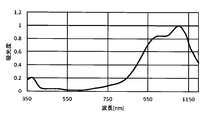
- the maximum absorption wavelength ⁇ max (A)DCM of the dye L is preferably in the wavelength region of 1100 to 1200 nm, more preferably in the wavelength region of 1100 to 1150 nm.
- the dye M corresponds to the dye (A) that satisfies the above (4-1).
- the dye S corresponds to the dye (A) satisfying the above (5-1).
- NIR absorbing dyes examples include croconium dyes, phthalocyanine dyes, naphthalocyanine dyes, dithiol metal complex dyes, polymethine dyes, phthalide dyes, naphthoquinone dyes, anthraquinone dyes, indophenol dyes, and diketopyrrolopyrrole dyes. ..
- UV absorbing dyes include oxazole dyes, merocyanine dyes, cyanine dyes, naphthalimide dyes, oxadiazole dyes, oxazine dyes, oxazolidine dyes, naphthalic acid dyes, styryl dyes, anthracene dyes, cyclic carbonyl dyes, and triazole dyes. Dyes. Among these, dyes such as oxazole dyes and merocyanine dyes are preferable. Further, the UV absorbing dye may be used alone in the absorbing layer, or may be used in combination of two or more kinds.
- the resin (B) has a Tg of 130° C. or higher. Tg is determined by DSC measurement (Differential Scanning Calorimetry). When the Tg of the resin (B) is 130° C. or higher, the absorption layer hardly deteriorates the light resistance of the dye (A), and the heat resistance of maintaining the optical characteristics of the dye (A) in high temperature use. Excellent in Further, in a preferred embodiment, deformation due to heat or stress is unlikely to occur, and the present filter has excellent adhesion to the first or second glass base material or the dielectric multilayer film.
- the Tg is preferably 140° C. or higher, more preferably 150° C. or higher. In the resin (B), there is no particular upper limit for Tg, but from the viewpoint of moldability, Tg is preferably 400° C. or lower.
- the resin (B) satisfies the requirements (1′-1) to (1′-5) in relation to the dye (A) satisfying the optical properties (1-1) to (1-4) in dichloromethane. Satisfactory resins are preferred.
- the resin (B) is, for example, an acrylic resin, an epoxy resin, an ene/thiol resin, a polycarbonate resin, a polyether resin, a polyarylate resin, a polysulfone resin, a polyethersulfone resin, or a polyresin, depending on the type of the dye (A).
- One or more selected from paraphenylene resin, polyarylene ether phosphine oxide resin, polyimide resin, polyamideimide resin, polyolefin resin, cycloolefin resin, polyester resin and the like are used.
- the resin (B) preferably contains the resin (B) having at least one bond selected from ester bond, carbonate bond and imide bond in the main chain.
- the resin (B) having these bonds in the main chain is advantageous in that it maintains a high visible transmittance when the dye (A) is mixed and is excellent in heat resistance of the resin itself.
- the resin (B) is preferably a polyimide resin, a polyester resin, a polycarbonate resin and a cycloolefin resin. These resins may be used alone or in combination of two or more.
- the dye (A) is a dye (ACi) to a dye (ACiii) or a dye (ASi) to a dye (ASiii)
- a polyimide resin, a polyester resin, a polycarbonate resin and a cycloolefin resin are particularly preferable.
- a commercially available product may be used as the resin (B).
- resin (B) As commercially available products, as polyester resin, OKP4HT, OKP4, B-OKP2, OKP-850 (all of which are manufactured by Osaka Gas Chemicals Co., Ltd., trade name), Byron (registered trademark) 103 (manufactured by Toyobo Co., Ltd.), Product name) and the like.
- LeXan registered trademark
- ML9103 manufactured by sabic, trade name
- EP5000 manufactured by Mitsubishi Gas Chemical Co., Inc., trade name
- SP3810 manufactured by Teijin Ltd., trade name
- SP1516 Teijin (share)
- trade name trade name
- TS2020 manufactured by Teijin Limited, trade name
- xylex registered trademark
- polyimide resin varnish Neoprim (registered trademark) C-3650 (trade name, manufactured by Mitsubishi Gas Chemical Co., Inc.), C-3G30 (trade name, manufactured by Mitsubishi Gas Chemical Co., Ltd.), C-3450 (Mitsubishi Gas Chemical Co., Ltd., trade name), JL-20 (New Nippon Rika, trade name), FPC-0220 (Mitsubishi Gas Chemical Co., Ltd. trade name) (these polyimide resins are silica May be included) and the like.
- the cycloolefin resin include ARTON (manufactured by JSR, trade name).
- the refractive index of the resin (B) is not particularly limited. Specifically, 1.45 to 1.70 is preferable, and 1.50 to 1.65 is more preferable.
- an adhesion promoter within a range that does not impair the effects of the present invention, an adhesion promoter, a color correction dye, a leveling agent, an antistatic agent, a heat stabilizer, a light stabilizer, an antioxidant, a dispersant, a flame retardant, You may have arbitrary components, such as a lubricant and a plasticizer.
- the absorbing layer is preferably composed only of the above-mentioned dye (A), other NIR absorbing dyes, UV dyes and the like, and resin (B).
- the content of the dye (A) in the absorption layer is appropriately set according to the design of the filter so that the effect of the filter can be exhibited.
- the content of the dye (A) in the absorption layer is 100 parts by mass of the resin (B) from the viewpoint of shielding near-infrared light, particularly near-infrared light in a long wavelength range while ensuring the transmittance of visible light. It is preferably 1 to 15 parts by mass, and more preferably 1 to 8 parts by mass from the viewpoint of solubility.
- the content of each dye is such that the total content of the entire dye (A) is within the above range and the resin ( B) 1 to 15 parts by mass is preferable with respect to 100 parts by mass, and 2 to 13 parts by mass is more preferable from the viewpoint of solubility.
- the thickness of the absorption layer is preferably 0.1 to 100 ⁇ m.
- the total thickness of each layer is preferably 0.1 to 100 ⁇ m. If the thickness is less than 0.1 ⁇ m, desired optical characteristics may not be sufficiently exhibited, and if the thickness exceeds 100 ⁇ m, the flatness of the layer may be deteriorated, and in-plane variations in absorptance may occur.
- the thickness of the absorption layer is more preferably 0.3 to 50 ⁇ m.
- the thickness of the absorption layer is more preferably 0.3 to 10 ⁇ m.
- the absorbing layer may be prepared by dissolving or dispersing, for example, a dye (A), a resin (B) or a raw material component of the resin (B), and each component to be blended in a host solvent to prepare a coating liquid. It can be formed by preparing it, coating it on a substrate, drying it, and curing it if necessary.
- the base material may be the first or second glass substrate included in the present filter, or may be a peelable base material used only when forming the absorption layer.
- the host solvent may be a dispersion medium that can be stably dispersed or a solvent that can be dissolved.
- the coating liquid may contain a surfactant for improving voids caused by minute bubbles, dents caused by adhesion of foreign substances, etc., and repellency during the drying process.
- a dip coating method, a cast coating method, a spin coating method, or the like can be used for coating the coating liquid.
- the coating liquid is applied onto the base material and then dried to form the absorbing layer. Further, when the coating liquid contains the raw material component of the resin (B), a curing treatment such as heat curing or photocuring is further performed.
- the absorption layer can be manufactured in a film shape by extrusion molding, and this film may be laminated on another member and integrated by thermocompression bonding or the like.
- this film may be attached to the first or second glass substrate of the present filter.
- the adhesive layer is an optional component.
- the adhesive layer is provided on at least one of the absorbing layer and the first glass base material and between the absorbing layer and the second glass base material, and these members are provided to each other. It has the function of bonding and integrating.
- the adhesive layer can be used without particular limitation as long as it is an adhesive layer containing a photocurable material or a thermosetting material.
- the adhesive layer is preferably transparent to light having a predetermined wavelength that should be transmitted by the filter, for example, light in a wavelength range that the solid-state imaging device receives as signal light.
- the adhesive layer is formed by using a thermosetting material or a photocurable material, and polymerizing and solidifying these curable materials by heating or irradiation with light such as ultraviolet rays.
- thermosetting materials thermosetting materials
- photocurable materials have high productivity because polymerization and solidification are completed in a short time.
- the photo-curable material is advantageous when a member having low heat resistance is included, because other members constituting the optical element are less likely to be affected by heat during curing.
- an ultraviolet curable material is preferable, and when an ultraviolet curable material is used, it is preferable to add a photopolymerization initiator.
- the light irradiation wavelength and the polymerization sensitivity for the ultraviolet curable material depend on the kind of the ultraviolet curable material or the kind of the photopolymerization initiator.
- irradiation light light in the wavelength range of 250 to 400 nm is used, and light near the i-line (365 nm) where the emission intensity of the HgXe discharge lamp is high is often used.
- thermosetting material for example, Epoxy Technology Inc. Epoxy-based EPO-TEK #301, #301-2, #310M-1, etc. of the company can be used.
- the photo-curable material include UV-curable materials such as mercaptoester-based NOA60 series manufactured by Norland-Products, epoxy-based AT3925M and 3727E manufactured by NTT Advance Technology Co., Ltd., acrylate-based #18165, and the like. #6205 etc., ene-thiol type OP-1020K, OP-1030K, OP-1045K etc. manufactured by Denki Kagaku Kogyo Co., Ltd., acrylate type ARONIX LCR-0631, LCR-0632 etc. manufactured by Toagosei Co., Ltd. Can be used.
- the adhesive layer is a layer containing a curable material obtained by curing a curable material that is cured by light and/or heat.
- the adhesive layer is, if necessary, within the range that does not impair the effects of the present invention, various additives including non-curable materials other than the curable material, for example, UV absorbers, absorbers such as NIR absorbers, polymerization initiators and A polymerization inhibitor may be included.
- the refractive index of the adhesive layer preferably has a small difference from the refractive indexes of the resin (B) contained in the first glass base material, the second glass base material, and the absorption layer.
- the refractive index of the adhesive layer is preferably 1.45 to 1.70, more preferably 1.5 to 1.65.
- the adhesive layer is preferably transparent to light of a predetermined wavelength that should be transmitted by the filter. Although it depends on the optical device in which the present filter is used, it is generally preferable that the filter has high transparency to at least visible light.
- the thickness of the adhesive layer is preferably 0.5 to 20 ⁇ m, more preferably 0.5 to 10 ⁇ m from the viewpoint of transparency, adhesive strength, productivity and the like.
- the adhesive layer is formed using an ultraviolet curable material
- the UV irradiation for curing the ultraviolet curable material be performed from the side opposite to the absorption layer.
- the optical filter 10B shown in FIG. 2 and the optical filter 10C shown in FIG. 3 it is preferable to irradiate UV from the second glass base material 2B side to cure the adhesive layer 3.
- the dielectric multilayer film is an optional constituent element.
- the dielectric multilayer film may be an antireflection layer or a reflection layer having a function of blocking light in a specific wavelength range.
- the dielectric multilayer film further has a function of protecting the absorption layer from the adhesive layer when it is provided between the absorption layer and the adhesive layer.
- the dielectric multilayer film is preferably an antireflection layer.
- the dielectric multilayer film when the first glass base material and the second glass base material are not near-infrared absorbing glass base materials, the dielectric multilayer film mutually functions as a reflection layer with the absorption layer, so that the present filter It may be a structure that imparts a higher NIR shielding property, or may be an antireflection layer.
- the antireflection layer is preferably one that effectively prevents reflection of visible light.
- the reflective layer include those having wavelength selectivity that transmits visible light and mainly reflects light having a wavelength other than the light-shielding region of the absorption layer.
- the reflective layer preferably has a reflective region that reflects near infrared light.
- the reflection area of the reflection layer may include a light-shielding area in the near infrared region of the absorption layer.
- the reflective layer is not limited to the above-mentioned characteristics, and may be appropriately designed to have a specification of further blocking light in a predetermined wavelength range, for example, near ultraviolet range.
- the dielectric multilayer film is configured by alternately laminating a low refractive index dielectric film (low refractive index film) and a high refractive index dielectric film (high refractive index film).
- the high refractive index film preferably has a refractive index of 1.6 or more, more preferably 2.2 to 2.5.
- Examples of the material of the high refractive index film include Ta 2 O 5 , TiO 2 , and Nb 2 O 5 . Of these, TiO 2 is preferable from the viewpoints of film formability, reproducibility in refractive index, stability, and the like.
- the low refractive index film preferably has a refractive index of less than 1.6, more preferably 1.45 or more and less than 1.55.
- the material of the low refractive index film include SiO 2 and SiO x N y . From the viewpoint of reproducibility in film formability, stability, economy, etc., SiO 2 is preferable.
- the total number of layers and film thickness of the dielectric multilayer film can be set according to the function required for the dielectric multilayer film.
- the dielectric multilayer film is an antireflection layer
- the antireflection function can be exhibited when the total number of laminated layers is about 5 to 15 layers.
- the thickness of the dielectric multilayer film is preferably 0.5 to 5 ⁇ m.
- the dielectric multilayer film is a reflective layer
- the total number of laminated dielectric multilayer films constituting the reflective layer is preferably 15 or more, more preferably 25 or more, and further preferably 30 or more.
- the total number of laminated layers is preferably 100 layers or less, more preferably 75 layers or less, and even more preferably 60 layers or less.
- the thickness of the dielectric multilayer film is preferably 2 to 10 ⁇ m.
- a vacuum film forming process such as a CVD method, a sputtering method or a vacuum vapor deposition method, or a wet film forming process such as a spray method or a dip method can be used.
- the present filter may include, as other components, components (layers) that give absorption by inorganic fine particles or the like that control the transmission and absorption of light in a specific wavelength range.
- the inorganic fine particles include ITO (Indium Tin Oxides), ATO (Antimony-doped Tin Oxides), cesium tungstate, and lanthanum boride. Since the ITO fine particles and the cesium tungstate fine particles have a high visible light transmittance and have a light absorptivity over a wide range of the infrared wavelength region exceeding 1200 nm, they can be used when the infrared light shielding property is required. ..
- This filter has an absorption layer between the first glass base material and the second glass base material, and each of them has the above-mentioned optical characteristics or has the above-mentioned configuration, and thus has good visible light transmittance. While maintaining the above, it is excellent in the near-infrared light shielding property, and is also excellent in the near-infrared light shielding property in durability, particularly the light resistance and the surface hardness property.
- the filter may further have an adhesive layer or a dielectric multilayer film.
- this filter specifically satisfies the above requirement (3-0).
- this filter preferably specifically satisfies all of the above requirements (3-1) to (3-7). Furthermore, in addition to these, in addition to (3-8) and (3 It is more preferable to satisfy the requirement of 3-9).
- ⁇ 0 -T50 is in the wavelength region of 550 to 650 nm. ⁇ 0-T50 is more preferably 580 to 630 nm.
- T 0-ave (450-600) is 60% or more.
- the T 0-ave(450-600) 0 is more preferably 65% or more.
- T 0-ave (700-1200) is 5% or less.
- the T 0-ave (700-1200) is more preferably 3% or less.
- ⁇ 30 -T50 is in the wavelength region of 550 to 650 nm.
- ⁇ 30-T50 is more preferably 580 to 630 nm.
- T 30-ave (450-600) is 60% or more.
- the T 30-ave (450-600) is more preferably 65% or more.
- the value obtained by subtracting ⁇ 30-T50 from ⁇ 0-T50 is 0 nm or more and less than 10 nm.
- the value obtained by subtracting ⁇ 30 -T50 from ⁇ 0-T50 is more preferably 0 nm or more and less than 6 nm.
- the value obtained by subtracting T 30 -ave (450-600) from T 0-ave (450-600) is 0% or more and less than 5%.
- the value obtained by subtracting T 30 -ave(450-600) from T 0-ave(450-600) is more preferably 0% or more and less than 3%.
- the OD value (OD 0-940 ) for light having a wavelength of 940 nm at an incident angle of 0 degree is 3 or more.
- the OD value (OD 0-940 ) is more preferably 3.5 or more.
- the OD value (OD 30-940 ) for light having a wavelength of 940 nm at an incident angle of 30 degrees is 3 or more.
- the OD value (OD 30-940 ) is more preferably 4 or more.
- the filter is useful as an optical filter for an image pickup device in a device having both an image pickup device such as a digital still camera and an optical component that uses laser light. Further, the present filter is useful for applications of optical sensors such as ambient light sensors.
- An imaging device using this filter includes a solid-state image sensor, an imaging lens, and this filter.
- the present filter can be used, for example, by being arranged between the image pickup lens and the solid-state image pickup element or directly attached to the solid-state image pickup element, the image pickup lens or the like of the image pickup apparatus via an adhesive layer.
- dye (A) The following dyes were used as the dye (A) for the examples. Cyanine dye; dye (ACi1-2B), dye (ACiii1-20B) Squarylium dye; dye (ASi-25), dye (ASii-5), dye (I-11-7) Diimonium pigment; pigment (Dim01)
- Dye (ACi1-2B) a commercially available product, Few Chemicals, product name S2437 was prepared.
- Dye (ACiii1-20B), dye (ASi-25), and dye (ASiii-5) were synthesized by the following method.
- the dye (I-11-7) was synthesized by the method described in Japanese Patent No. 6248945.
- the dye (Dim01) was synthesized by the method described in JP-A-2014-25016.
- TX-EX-910B (Nippon Shokubai Co., Ltd., phthalocyanine dye) was prepared as a dye for the comparative example.
- UH4150 An ultraviolet-visible spectrophotometer (UH4150, manufactured by Hitachi High-Technologies Corporation) was used to evaluate the optical properties of these dyes, and the following optical properties (spectral transmittance curve) were similarly evaluated. , UH4150 was used.
- Step 3> In a 300 ml round-bottomed flask, the intermediate A1-2 (4.8 g, 14 mmol) obtained in Step 2 and J. Heterocyclic Chem. , 42, 959, (2005), the cyanine intermediate A1-3 (3 g, 7 mmol) synthesized was added, dissolved in 170 ml of pyridine, and stirred at 150° C. for 3 h. Pyridine was removed while azeotropically distilling with toluene, and the obtained solid was washed with hexane.
- Step 1> Benzo[cd]indol-2(1H)-one (30 g, 177 mmol), potassium iodide (6 g, 36 mmol) and N,N-dimethyl-4-aminopyridine (3 g, 25 mmol) were placed in a 1 L eggplant flask, and sulfolane (3 g, 25 mmol) was added. 400 ml) and the mixture was stirred at 70° C. for 2 hours. 7-(Bromomethyl)pentadecane (81 g, 265 mmol) and potassium hydroxide (15 g, 265 mmol) were added to the above suspension, and the mixture was stirred at 70° C. for 25 h.
- Step 4> In a 500 mL three-necked flask, intermediate A2-3 (6.8 g, 17 mmol) obtained in Step 3 and triethylamine (3.3 g, 33 mmol), N,N-dimethyl-4-aminopyridine (0.06 g), dichloromethane (80 mL) ) was added and the mixture was stirred at 0°C. 2-Ethylhexyl chloroformate (4.1 g, 21 mmol) was diluted with dichloromethane (10 mL), slowly added dropwise to the reaction solution at 0° C., and then stirred at room temperature for 4 h.
- Step 5 The intermediate A2-4 (5.3 g, 9.4 mmol) obtained in step 4, epichlorohydrin (7.2 g, 75 mmol), chloroform 20 mL, and diethyl ether (10 mL) were placed in a 500 mL three-necked flask, and the mixture was heated at 90° C. After 2 hours of stirring, boron trifluoride-ethyl ether complex (14 g, 99 mmol) was diluted with chloroform (25 mL) and added dropwise, and the temperature was raised to 120° C. and stirring was continued for 15 hours. After the reaction was completed, the solvent was removed azeotropically with toluene twice.
- Step 6> The intermediate A2-5 (5.1 g, 7 mmol) obtained in Step 5 and 10 mL of hydrochloric acid were added to a 1 L eggplant flask, and the mixture was stirred and refluxed for 1 h. Then, 2 mL of an aqueous tetrafluoroboric acid solution was added, and the mixture was further refluxed and stirred for 1 hour. The reaction solution was returned to room temperature, water was added, and 6 mL of a tetrafluoroboric acid aqueous solution was added, followed by extraction work with dichloromethane, dehydration with magnesium sulfate, and removal of the solvent. A yellowish brown oily intermediate A2- 6 (3.7 g, 77% yield) was obtained.
- the diethyl ether mixed solution was cooled to 0° C., the tetrahydrofuran mixed solution was added dropwise, and the mixture was stirred at room temperature for 3 hours. After the completion of the reaction, water (55 mL) was added to the mixed solution, the mixture was extracted with ethyl acetate, the organic layer was washed with saturated brine, the solvent was removed, and column chromatography (hexane) was used to remove intermediate A3-11 ( 8.93 g, yield 66%) was obtained.
- Step b2> The intermediate A3-11 (8.09 g, 33 mmol) obtained in Step b1 was placed in a flask and dissolved in anhydrous diethyl ether (230 mL) under a nitrogen atmosphere. The solution was cooled to ⁇ 78° C., 1.6 M hexane solution of normal butyl lithium (20 mL, 32.0 mmol) was added dropwise, and the mixture was stirred for 1 hour. Subsequently, an anhydrous diethyl ether solution (120 mL) in which benzophenone (6.56 g, 36.0 mmol) was dissolved was added dropwise. The mixed solution was stirred overnight at room temperature.
- Step b4 The intermediate A3-13 (4.00 g, 12.1 mmol) obtained in Step b3 was placed in a flask and dissolved in anhydrous dimethylformamide (120 mL) under a nitrogen atmosphere. An anhydrous dimethylformamide solution (30 mL) in which N-bromosuccinimide (2.16 g, 12.1 mmol) was dissolved was added dropwise to the solution. The mixture was stirred overnight at room temperature. After the reaction was completed, it was poured into ice water and extracted with diisopropyl ether. The obtained organic layer was washed with saturated brine, the solvent was removed, and column chromatography (dichloromethane) gave Intermediate A3-14 (3.67 g, yield 74%).
- Step b5> The intermediate A3-14 (3.50 g, 8.55 mmol) obtained in step b4 and magnesium scrap (0.416 g, 17.1 mmol) were placed in a flask and dissolved in anhydrous tetrahydrofuran (20 ml) under a nitrogen atmosphere. .. The solution was refluxed for 3 hours and cooled to -40°C. N-chlorosuccinimide (1.03 g, 7.70 mmol) was dissolved in anhydrous toluene (20 ml) under a nitrogen atmosphere in a separate flask, and bis-(2-ethylhexyl)amine (1.86 g, 7.70 mmol) was added. , Stirred for 20 minutes.
- the above dyes were dissolved in dichloromethane, the light absorption spectrum at a wavelength of 350 to 1200 nm was measured, and the maximum absorption wavelength ⁇ max (A) DCM was determined from the absorbance curve. Further, from the absorbance curve in which the dye concentration in dichloromethane was adjusted so that the light transmittance at the maximum absorption wavelength ⁇ max (A)DCM was 10%, it was determined from ABS 430 (A)DCM /ABS ⁇ max (A)DCM. , ABS 550(A)DCM /ABS ⁇ max(A)DCM and ABS 630(A)DCM /ABS ⁇ max(A)DCM were determined.
- the absorbance curves of each dye are shown in FIGS.
- Table 12 shows the results of the light absorption characteristics obtained above. Table 12 also shows the correspondence between each dye and the drawing number of the absorbance curve.
- ABS ratio 1, ABS ratio 2 and ABS ratio 3 are ABS 430(A)DCM /ABS ⁇ max(A)DCM , ABS 550(A)DCM /ABS ⁇ max(A)DCM and ABS 630(A), respectively.
- DCM /ABS ⁇ max(A) DCM is shown.
- Glass base material A glass base material having a thickness of 0.21 mm made of CuO-containing fluorophosphate glass as a glass base material (manufactured by AGC, notation: CuO-containing fluorophosphate glass 1), a thickness made of CuO-containing fluorophosphate glass.
- a 0.8 mm glass base material manufactured by AGC, notation: CuO-containing fluorophosphate glass 2
- a borosilicate glass having a thickness of 0.2 mm manufactured by SCHOTT, trade name D263
- Resin layer (corresponding to absorption layer)
- the resin (B) used for the resin layer the following resins (B1) to (B4) were used.
- a resin layer having a film thickness of 1 ⁇ m and containing no dye (A) was formed and evaluated.
- Resin layers obtained by using the resins (B1) to (B4) are referred to as resin layers (B1) to (B4), respectively.
- Transparent Resin Substrate As a transparent resin substrate, a 0.08 mm-thick Teijin Pure Ace WRM5-80 (manufactured by Teijin Ltd., trade name, polycarbonate resin, Tg 215° C.) resin substrate was used.
- Dielectric Multilayer Film The dielectric multilayer film was an antireflection layer in which 13 layers of TiO 2 films and SiO 2 films were alternately laminated by a vapor deposition method.
- Examples 1 to 24 Production and evaluation of optical filter (1)
- Examples 1 to 18 optical filters having the same structure as the optical filter 10B shown in FIG. 2 were manufactured by the following method.
- Examples 19 to 24 comparative optical filters each having an absorption layer formed on the first glass substrate were manufactured.
- CuO-containing fluorophosphate glass 1 or D263 was used as the first glass substrate 2A and the second glass substrate 2B.
- Resins (B1) to (B4) were combined with a dye (ACi1-2B), a dye (ACiii1-20B), a dye (ASi-25), a dye (I-11-7), and a dye (Dim01) as the absorption layer 1.
- a dye ACi1-2B
- a dye ACiii1-20B
- a dye ASi-25
- a dye I-11-7
- a dye DI-11-7
- An absorption layer was used.
- the absorption layer 1 comprises a resin (B) and a dye on one main surface of the first glass substrate 2A such that the dye (A) is 6 parts by mass with respect to 100 parts by mass of the resin (B).
- an adhesive layer composition containing an ultraviolet curable material for forming the adhesive layer 3 was applied to the surface of the absorbent layer 1, and the second glass base material 2B was laminated thereon.
- the ultraviolet curable material OP-1030K manufactured by Denki Kagaku Kogyo Co., Ltd. or LCR-0631C manufactured by Toagosei Co., Ltd. was used. Further, ultraviolet rays were irradiated from the second glass substrate 2B side to cure the adhesive layer composition with ultraviolet rays to form an adhesive layer having a thickness of 2 ⁇ m.
- Pencil Hardness The pencil hardness of both major surfaces of the obtained optical filter was measured by the method specified in JIS K 5600-5-4. The results are shown in Table 15. For both main surfaces, the case of 4H or more was marked as "O", and the case of 9H or more was marked as "A”. The case where either one of them did not reach 4H was defined as "x”.
- the transmittance of the optical filter is measured, the ABS of the maximum absorption wavelength is calculated, and the percentage of ABS After after the light irradiation with respect to the ABS Before before the light irradiation ((ABS After /ABS Before )) ⁇ 100) was calculated.
- the results are shown in Table 15 as "% residual irradiation for 3 hours".
- Example 25 an optical filter having the same configuration as the optical filter 10B shown in FIG. 2 was manufactured by using the constituent members shown in Table 16 in the same manner as in Example 1. However, the parts by mass of the resin (B) of the dye (A) in the absorption layer and the film thickness of the absorption layer were as shown in Table 16.
- optical filters having the same configuration as the optical filter 10C shown in FIG. 3 were manufactured by the following method using the constituent members shown in Table 16.
- Examples 26 to 28 after forming the absorption layer on the first glass substrate in the same manner as in Example 1, the TiO 2 film and the SiO 2 film were alternately formed on the absorption layer by vapor deposition. A laminated antireflection layer was formed. The method of laminating the adhesive layer and the second glass substrate on the surface of the antireflection layer was performed in the same manner as in Example 1.
- two kinds of the dye (A) were used in the absorbing layer.
- the parts by mass of the respective dyes (A) relative to 100 parts by mass of the resin (B) and the film thickness of the absorption layer are as shown in Table 16.
- the optical filter of the present invention is excellent in near-infrared light shielding while maintaining good transmission of visible light, and has near-infrared light shielding durability, particularly light resistance and surface hardness. Excellent in characteristics. According to the present invention, it is possible to provide an image pickup apparatus using the optical filter and having excellent color reproducibility and durability.
- 10A, 10B, 10C Optical filter, 1... Absorption layer, 2A... First glass base material, 2B... Second glass base material, 3... Adhesive layer, 4... Dielectric multilayer film.
Landscapes
- Physics & Mathematics (AREA)
- Chemical & Material Sciences (AREA)
- General Physics & Mathematics (AREA)
- Optics & Photonics (AREA)
- Organic Chemistry (AREA)
- Inorganic Chemistry (AREA)
- Optical Filters (AREA)
- Surface Treatment Of Optical Elements (AREA)
- Compositions Of Macromolecular Compounds (AREA)
Abstract
波長400~600nmの光の平均透過率が80%以上の第1のガラス基材および第2のガラス基材と、第1のガラス基材と第2のガラス基材の間に設けられる吸収層と、を備える光学フィルタであって、前記吸収層が、特定の吸光特性を有する、スクアリリウム色素、シアニン色素およびジイモニウム色素から選ばれる少なくとも1種の近赤外線吸収色素(A)と、ガラス転移温度が130℃以上の透明樹脂とを含有する、光学フィルタ。
Description
本発明は、可視波長領域の光を透過し、近赤外波長領域の光を遮断する光学フィルタおよび該光学フィルタを備えた撮像装置および光学センサーに関する。
固体撮像素子を用いた撮像装置には、色調を良好に再現し鮮明な画像を得るため、可視域の光(以下「可視光」ともいう)を透過し近赤外域の光(以下「近赤外光」ともいう)を遮断する光学フィルタが用いられる。該光学フィルタにおいては、透明基板上に、樹脂中に遮蔽が求められる近赤外光を吸収する近赤外線吸収色素を分散した吸収層を形成した光学フィルタが知られている。
このような、光学フィルタにおいては、上記吸収層が最表層を構成しているか、あるいは、上記吸収層の表面に誘電体多層膜を形成した構成が一般的である。しかしながら、該構成の光学フィルタにおいて、吸収層が含有する近赤外線吸収色素は、耐久性が十分でない点が指摘されていた。さらに、吸収層やその表面に誘電体多層膜を形成した構成では光学フィルタの該表面における硬度の点でも改善が求められていた。
このような問題を解決するために、例えば、特許文献1には、プラズマディスプレー用または光半導体素子用の光学フィルタにおいて、近赤外線吸収色素とともに特定のホウ酸塩を用いることで、近赤外線吸収色素の耐久性、特に耐熱性および耐湿熱性を向上させる技術が記載されている。また、特許文献2のプラズマディスプレー用フィルタによれば、近赤外線吸収色素として特定のフタロシアニン色素を用いて、耐熱性、耐光性および耐候性等に優れる光学フィルタを得る技術が記載されている。
また、特許文献1および特許文献2には、耐久性を向上させた上記近赤外線吸収色素を接着剤等に含有させて接着剤層として、これを1対の透明基材で挟持した構成が記載されている。
しかしながら、特許文献1の光学フィルタにおいては、近赤外線吸収色素を含有する吸収層や該吸収層上の誘電体多層膜が最表面にある場合においても、近赤外線吸収色素を含有する接着剤層を1対の透明基材で挟持した構成においても、耐久性、特に耐光性が十分とは言えなかった。また、特許文献2の光学フィルタにおいては、近赤外線吸収色素の耐久性は改善されているものの、上記いずれの構成の光学フィルタにおいても可視光の透過性が十分でなかった。
本発明は、可視光の透過性を良好に維持しながら、近赤外光の遮蔽性に優れるとともに、近赤外光の遮蔽性の耐久性、特には耐光性と、表面の硬度特性に優れる光学フィルタ、および該光学フィルタを用いた色再現性および耐久性に優れる撮像装置および光学センサーの提供を目的とする。
本発明の一態様に係る光学フィルタは、波長400~600nmの光の平均透過率が80%以上の第1のガラス基材、波長400~600nmの光の平均透過率が80%以上の第2のガラス基材、および、前記第1のガラス基材と前記第2のガラス基材の間に設けられる吸収層、を備え、前記吸収層は、スクアリリウム色素、シアニン色素およびジイモニウム色素から選ばれる少なくとも1種の近赤外線吸収色素(A)とガラス転移温度が130℃以上の透明樹脂を含有し、前記近赤外線吸収色素(A)をジクロロメタンに溶解して測定される波長350~1200nmの吸光度曲線において下記特性(1-1)~(1-4)を満足する。
(1-1)最大吸収波長λmax(A)DCMが650~1200nmの波長領域にある。
(1-2)最大吸収波長λmax(A)DCMにおける吸光度ABSλmax(A)DCMに対する波長430nmにおける吸光度ABS430(A)DCMの比ABS430(A)DCM/ABSλmax(A)DCMが0.06以下である。
(1-3)最大吸収波長λmax(A)DCMにおける吸光度ABSλmax(A)DCMに対する波長550nmにおける吸光度ABS550(A)DCMの比ABS550(A)DCM/ABSλmax(A)DCMが0.04以下である。
(1-4)最大吸収波長λmax(A)DCMにおける吸光度ABSλmax(A)DCMに対する波長630nmにおける吸光度ABS630(A)DCMの比ABS630(A)DCM/ABSλmax(A)DCMが0.06以下である。
(1-1)最大吸収波長λmax(A)DCMが650~1200nmの波長領域にある。
(1-2)最大吸収波長λmax(A)DCMにおける吸光度ABSλmax(A)DCMに対する波長430nmにおける吸光度ABS430(A)DCMの比ABS430(A)DCM/ABSλmax(A)DCMが0.06以下である。
(1-3)最大吸収波長λmax(A)DCMにおける吸光度ABSλmax(A)DCMに対する波長550nmにおける吸光度ABS550(A)DCMの比ABS550(A)DCM/ABSλmax(A)DCMが0.04以下である。
(1-4)最大吸収波長λmax(A)DCMにおける吸光度ABSλmax(A)DCMに対する波長630nmにおける吸光度ABS630(A)DCMの比ABS630(A)DCM/ABSλmax(A)DCMが0.06以下である。
本発明はまた、本発明の光学フィルタを備えた撮像装置および光学センサーを提供する。
本発明によれば、可視光の透過性を良好に維持しながら、近赤外光の遮蔽性に優れるとともに、近赤外光の遮蔽性の耐久性、特には耐光性と、表面の硬度特性に優れる光学フィルタが得られる。さらに、本発明によれば、該光学フィルタを用いた色再現性および耐久性に優れる撮像装置および光学センサーを提供できる。
以下、本発明の実施の形態について説明する。
本明細書において、必要に応じて、紫外線または紫外域の光を「UV」、近赤外線または近赤外域の光を「NIR」と略記し、屈折率は、波長589nmの光に対する屈折率を意味する。本明細書において、「硬化性材料」とは、加熱や光照射により硬化して硬化材料となる、硬化前の未硬化の材料をいい、「硬化材料」とは硬化性材料が加熱や光照射により硬化して得られる硬化物をいう。
本明細書において、必要に応じて、紫外線または紫外域の光を「UV」、近赤外線または近赤外域の光を「NIR」と略記し、屈折率は、波長589nmの光に対する屈折率を意味する。本明細書において、「硬化性材料」とは、加熱や光照射により硬化して硬化材料となる、硬化前の未硬化の材料をいい、「硬化材料」とは硬化性材料が加熱や光照射により硬化して得られる硬化物をいう。
本明細書において、式(I)で示される化合物を化合物(I)という。他の式で表される化合物も同様である。化合物(I)からなる色素を色素(I)ともいい、他の色素についても同様である。例えば、後述の式(ACi)で示される化合物を化合物(ACi)といい、該化合物からなる色素を色素(ACi)ともいう。また、例えば、式(1x)で表される基を基(1x)とも記し、他の式で表される基も同様である。
本明細書において、特定の波長域について、透過率が例えば90%以上とは、その全波長領域において透過率が90%を下回らないことをいい、同様に透過率が例えば1%以下とは、その全波長領域において透過率が1%を超えないことをいう。特定の波長域における平均透過率は、該波長域の1nm毎の透過率の相加平均である。
本明細書において、数値範囲を表す「~」では、上下限を含む。
本明細書において、数値範囲を表す「~」では、上下限を含む。
<光学フィルタ>
本発明の実施形態の光学フィルタ(以下、「本フィルタ」ともいう)は、波長400~600nmの光の平均透過率が80%以上の第1のガラス基材、波長400~600nmの光の平均透過率が80%以上の第2のガラス基材、および、前記第1のガラス基材と前記第2のガラス基材の間に設けられる、下記特性を有する近赤外線吸収色素(A)とガラス転移温度が130℃以上の透明樹脂(以下、樹脂(B)ともいう。)を含有する吸収層を有する。以下、第1のガラス基材および第2のガラス基材における波長400~600nmの光の平均透過率を「TGave(400-600)」と示す。
本発明の実施形態の光学フィルタ(以下、「本フィルタ」ともいう)は、波長400~600nmの光の平均透過率が80%以上の第1のガラス基材、波長400~600nmの光の平均透過率が80%以上の第2のガラス基材、および、前記第1のガラス基材と前記第2のガラス基材の間に設けられる、下記特性を有する近赤外線吸収色素(A)とガラス転移温度が130℃以上の透明樹脂(以下、樹脂(B)ともいう。)を含有する吸収層を有する。以下、第1のガラス基材および第2のガラス基材における波長400~600nmの光の平均透過率を「TGave(400-600)」と示す。
本フィルタにおける近赤外線吸収色素(A)は、ジクロロメタンに溶解して測定される波長350~1200nmの吸光度曲線において下記(1-1)~(1-4)の要件を全て満足する、スクアリリウム色素、シアニン色素およびジイモニウム色素から選ばれる少なくとも1種である。
(1-1)最大吸収波長λmax(A)DCMが650~1200nmの波長領域にある。
(1-2)最大吸収波長λmax(A)DCMにおける吸光度ABSλmax(A)DCMに対する波長430nmにおける吸光度ABS430(A)DCMの比ABS430(A)DCM/ABSλmax(A)DCMが0.06以下である。
(1-3)最大吸収波長λmax(A)DCMにおける吸光度ABSλmax(A)DCMに対する波長550nmにおける吸光度ABS550(A)DCMの比ABS550(A)DCM/ABSλmax(A)DCMが0.04以下である。
(1-4)最大吸収波長λmax(A)DCMにおける吸光度ABSλmax(A)DCMに対する波長630nmにおける吸光度ABS630(A)DCMの比ABS630(A)DCM/ABSλmax(A)DCMが0.06以下である。
(1-1)最大吸収波長λmax(A)DCMが650~1200nmの波長領域にある。
(1-2)最大吸収波長λmax(A)DCMにおける吸光度ABSλmax(A)DCMに対する波長430nmにおける吸光度ABS430(A)DCMの比ABS430(A)DCM/ABSλmax(A)DCMが0.06以下である。
(1-3)最大吸収波長λmax(A)DCMにおける吸光度ABSλmax(A)DCMに対する波長550nmにおける吸光度ABS550(A)DCMの比ABS550(A)DCM/ABSλmax(A)DCMが0.04以下である。
(1-4)最大吸収波長λmax(A)DCMにおける吸光度ABSλmax(A)DCMに対する波長630nmにおける吸光度ABS630(A)DCMの比ABS630(A)DCM/ABSλmax(A)DCMが0.06以下である。
なお、近赤外吸収色素(A)(以下、単に「色素(A)」ともいう。)を、ジクロロメタンに溶解させて測定される波長350~1200nmの吸光度曲線は、色素(A)の添加量を、最大吸収波長λmax(A)DCMでの吸光度が1となるように、すなわち、光の透過率が10%になるように調整した際の吸光度曲線である。
本フィルタは、第1のガラス基材と第2のガラス基材の間に吸収層を有し、これらが、それぞれ上記光学特性を有するまたは上記構成を有することで、可視光の透過性を良好に維持しながら、近赤外光の遮蔽性に優れるとともに、近赤外光の遮蔽性の耐久性、特には耐光性と、表面の硬度特性に優れる。
具体的には、本フィルタは、吸収層が第1のガラス基材と第2のガラス基材の間に設けられることで、吸収層中の色素(A)が、大気から隔絶され酸素の影響を受けにくく、これにより光照射による色素(A)の劣化が抑制されている。さらに、本フィルタにおける吸収層が含有する樹脂(B)は、接着剤として機能する樹脂と異なりガラス転移温度(以下、「Tg」ともいう。)が高く、色素(A)の近赤外光遮蔽性を劣化させることが殆どない。さらに、本フィルタは、吸収層の両側にガラス基材(第1のガラス基材と第2のガラス基材)を有することで、表面の硬度特性に優れる。
本フィルタは、表面の硬度特性に関し、具体的には、下記(3-0)の要件を満足するのが好ましい。
(3-0)本フィルタの両主面の最表面において、JIS K 5600-5-4に規定された方法により測定される鉛筆硬度が、4H以上である。本フィルタの両主面の最表面において該鉛筆硬度は9H以上であるのがより好ましい。
(3-0)本フィルタの両主面の最表面において、JIS K 5600-5-4に規定された方法により測定される鉛筆硬度が、4H以上である。本フィルタの両主面の最表面において該鉛筆硬度は9H以上であるのがより好ましい。
本フィルタは、光学特性に関し、具体的には、下記(3-1)~(3-7)の要件をすべて満足することが好ましく、さらに、これらに加えて、下記(3-8)および(3-9)の要件を満足することがより好ましい。
(3-1)入射角0度の分光透過率曲線において透過率が50%となる波長λ0-T50が550~650nmの波長領域にある。
(3-2)入射角0度の分光透過率曲線において波長450~600nmの光の平均透過率T0-ave(450-600)が60%以上である。
(3-3)入射角0度の分光透過率曲線において波長700~1200nmの光の平均透過率T0-ave(700-1200)が5%以下である。
(3-4)入射角30度の分光透過率曲線において透過率が50%となる波長λ30-T50が550~650nmの波長領域にある。
(3-5)入射角30度の分光透過率曲線において波長450~600nmの光の平均透過率T30-ave(450-600)が60%以上である。
(3-6)λ0-T50からλ30-T50を引いた値が0nm以上10nm未満である。
(3-7)T0-ave(450-600)からT30-ave(450-600)を引いた値が0%以上5%未満である。
(3-2)入射角0度の分光透過率曲線において波長450~600nmの光の平均透過率T0-ave(450-600)が60%以上である。
(3-3)入射角0度の分光透過率曲線において波長700~1200nmの光の平均透過率T0-ave(700-1200)が5%以下である。
(3-4)入射角30度の分光透過率曲線において透過率が50%となる波長λ30-T50が550~650nmの波長領域にある。
(3-5)入射角30度の分光透過率曲線において波長450~600nmの光の平均透過率T30-ave(450-600)が60%以上である。
(3-6)λ0-T50からλ30-T50を引いた値が0nm以上10nm未満である。
(3-7)T0-ave(450-600)からT30-ave(450-600)を引いた値が0%以上5%未満である。
(3-8)入射角0度における波長940nmの光に対するOD値(OD0-940)が3以上である。
(3-9)入射角30度における波長940nmの光に対するOD値(OD30-940)が3以上である。
(3-9)入射角30度における波長940nmの光に対するOD値(OD30-940)が3以上である。
本フィルタは、吸収層と第1のガラス基材の間および吸収層と第2のガラス基材の間の少なくとも一方に光硬化材料または熱硬化材料を含む接着剤層を有してもよい。すなわち、接着剤層は、吸収層と第1のガラス基材の間および吸収層と第2のガラス基材の間のいずれか一方にあってもよく、両方にあってもよい。
本フィルタが接着剤層を有する場合、接着剤層の態様は吸収層の作製方法に応じて適宜選択される。例えば、吸収層を、色素(A)と樹脂(B)を溶媒(以下、「ホスト溶媒」ともいう)に溶解させた塗工液を第1または第2のガラス基材の一方の主面上に塗工し乾燥させ、さらに必要に応じて硬化させて形成する場合、接着剤層を、吸収層と第2または第1のガラス基材の間に設けることができる。
吸収層を第1または第2のガラス基材とは別の剥離性の基材上で上記同様に作製し該基材から剥離して用いる場合、または押出成形によりフィルム状に製造する場合には、接着剤層は、吸収層と第1のガラス基材の間および吸収層と第2のガラス基材の間の両方に設けることが好ましい。
吸収層は、本フィルタの中に1層有してもよく、2層以上有してもよい。吸収層を2層以上有する場合、各層は同じ構成であっても異なってもよい。吸収層を2層以上有する場合、いずれの吸収層も第1のガラス基材と第2のガラス基材の間に設けられるのが好ましい。吸収層を2層有する本フィルタの構成としては、例えば、第1のガラス基材上に第1の吸収層を有し、第2のガラス基材上に第2の吸収層を有し、第1の吸収層と第2の吸収層が接着剤層で接着された構成が挙げられる。
本フィルタは、さらに、誘電体多層膜を有してもよい。誘電体多層膜としては、例えば、吸収層と相補的にNIRを遮蔽するNIR反射層や、UVを反射するUV反射層、NIRとUVを共に反射するNIR・UV反射層、可視光の透過率損失を抑制する反射防止層が挙げられ、反射防止層が好ましい。誘電体多層膜の配設位置は、本フィルタの表面硬度を向上させる観点から、第1のガラス基材と第2のガラス基材の間が好ましい。また、本フィルタのNIR遮蔽性の耐久性をより高める観点から、誘電体多層膜は吸収層と接着剤層の間に設けられるのがより好ましい。
次に、図面を用いて本フィルタの構成例について説明する。図1は、第1のガラス基材2Aと第2のガラス基材2Bが吸収層1を挟持してなる光学フィルタ10Aの構成例を概略的に示す断面図である。光学フィルタ10Aにおいて、第1のガラス基材2Aと第2のガラス基材2Bは、ともにTGave(400-600)が80%以上の構成であり、吸収層11は、色素(A)と樹脂(B)とを含有する層で構成できる。
図2は、図1に示す光学フィルタ10Aにおいて、吸収層1と第2のガラス基材2Bの間に接着剤層3を有する以外は、光学フィルタ10Aと同様に構成される光学フィルタ10Bの構成例を概略的に示す断面図である。接着剤層3は、光硬化材料または熱硬化材料を含む接着剤層である。光学フィルタ10Bにおいて、接着剤層3は吸収層1と第2のガラス基材2Bの間に代わって、吸収層1と第1のガラス基材2Aの間にあってもよい。さらに、接着剤層3は吸収層1と第2のガラス基材2Bの間および吸収層1と第1のガラス基材2Aの間の両方にあってもよい。
図3は、図2に示す光学フィルタ10Bにおいて、吸収層1と接着剤層3の間に誘電体多層膜4を有する以外は、光学フィルタ10Bと同様に構成される光学フィルタ10Cの構成例を概略的に示す断面図である。光学フィルタ10Cにおいて、誘電体多層膜4は、図3に示される位置ではなく、第1のガラス基材2Aの吸収層1側と反対側の主面にあってもよく、第1のガラス基材2Aと吸収層1の間にあってもよく、接着剤層3と第2のガラス基材2Bの間にあってもよく、第2のガラス基材2Bの接着剤層3側と反対側の主面にあってもよい。
さらに、光学フィルタ10Aに、誘電体多層膜4を組み合わせた光学フィルタ10D(図示せず)も本フィルタに含まれる。光学フィルタ10Dにおいて、誘電体多層膜4は、第1のガラス基材2Aの吸収層1側と反対側の主面にあってもよく、第1のガラス基材2Aと吸収層1の間にあってもよく、吸収層1と第2のガラス基材2Bの間にあってもよく、第2のガラス基材2Bの吸収層1側と反対側の主面にあってもよい。
さらに、本フィルタが誘電体多層膜を有する場合、誘電体多層膜の数は複数あってもよい。例えば、光学フィルタ10Cにおいて、誘電体多層膜4は、図3に示される位置すなわち吸収層1と接着剤層3の間、第1のガラス基材2Aの吸収層1側と反対側の主面、第1のガラス基材2Aと吸収層1の間、接着剤層3と第2のガラス基材2Bの間、および第2のガラス基材2Bの接着剤層3側と反対側の主面の5箇所から選ばれる複数箇所に設けられてもよい。
なお、本フィルタが誘電体多層膜を有する場合、例えば、光学フィルタ10Cにおいて、誘電体多層膜4が第1のガラス基材2Aの吸収層1側と反対側の主面および/または第2のガラス基材2Bの接着剤層3側と反対側の主面に設けられる場合、本フィルタの主面の少なくとも一方の最表面は、誘電体多層膜4の主面で構成される。この場合であっても、本フィルタの両主面の最表面においては、上記(3-0)に係る鉛筆硬度の4H以上を満足できる。
また、本フィルタにおいて、図1~図3に示す光学フィルタ10A~10Cでは、いずれの場合も、光学フィルタの両主面の最表面がガラス基材で構成される。この場合、本フィルタの両主面の最表面においては、鉛筆硬度の9H以上を満足できる。
本フィルタが誘電体多層膜を複数有する場合、複数の誘電体多層膜は、NIR反射層、UV反射層、NIR・UV反射層、および反射防止層の組み合わせであってもよく、同じ機能を有する複数の誘電体多層膜の組み合わせであってもよい。光学フィルタ10Dが複数の誘電体多層膜を有する場合も、同じ機能を有する複数の誘電体多層膜の組み合わせであっても、機能の異なる複数の誘電体多層膜の組み合わせであってもよい。
以下、吸収層、第1のガラス基材、第2のガラス基材、接着剤層、および誘電体多層膜について説明する。
(第1のガラス基材、第2のガラス基材)
本フィルタに用いる第1のガラス基材および第2のガラス基材は、ともにTGave(400-600)が80%以上である。以下に、第1のガラス基材および第2のガラス基材の光学特性、材質、形状等を説明する。第1のガラス基材および第2のガラス基材は、ともにTGave(400-600)が80%以上であれば、TGave(400-600)を含む以下に説明する特性等は同じであっても異なってもよい。
本フィルタに用いる第1のガラス基材および第2のガラス基材は、ともにTGave(400-600)が80%以上である。以下に、第1のガラス基材および第2のガラス基材の光学特性、材質、形状等を説明する。第1のガラス基材および第2のガラス基材は、ともにTGave(400-600)が80%以上であれば、TGave(400-600)を含む以下に説明する特性等は同じであっても異なってもよい。
第1のガラス基材および第2のガラス基材を構成するガラスとしては、フツリン酸塩系ガラスやリン酸塩系ガラス等に銅イオンを含む吸収型のガラス(近赤外線吸収ガラス)、ソーダライムガラス、ホウケイ酸ガラス、無アルカリガラス、石英ガラス等が挙げられる。なお、「リン酸塩系ガラス」は、ガラスの骨格の一部がSiO2で構成されるケイリン酸塩ガラスも含む。
ガラスとしては、ガラス転移点以下の温度で、イオン交換により、ガラス板主面に存在するイオン半径が小さいアルカリ金属イオン(例えば、Liイオン、Naイオン)を、イオン半径のより大きいアルカリイオン(例えば、Liイオンに対してはNaイオンまたはKイオンであり、Naイオンに対してはKイオンである。)に交換して得られる化学強化ガラスを使用してもよい。
第1のガラス基材および第2のガラス基材のTGave(400-600)は、それぞれ80%以上であり、83%以上が好ましく、85%以上がより好ましい。
第1のガラス基材および第2のガラス基材は、いずれか一方が以下の(2-1)および(2-2)の要件を満足する近赤外線吸収ガラス基材であることが好ましく、両方が(2-1)および(2-2)の要件を満足する近赤外線吸収ガラス基材であることがより好ましい。
第1のガラス基材および第2のガラス基材が、上記構成を有することで、本フィルタにおいて、より少ない構成要素からなる光学フィルタ、例えば、図1に示す光学フィルタ10Aや図2に示す光学フィルタ10Bの構成で、上記(3-1)~(3-7)の、特には(3-1)~(3-9)の光学特性の要件をすべて満足することが可能となる。
(2-1)透過率が50%となる波長λGT50が600~700nmの波長領域にある。
(2-2)波長750~1000nmの光の平均透過率TGave(750-1000)が20%以下である。
(2-2)波長750~1000nmの光の平均透過率TGave(750-1000)が20%以下である。
上記(2-1)の要件について、λGT50は600~680nmの波長領域にあるのがより好ましく、610~660nmの波長領域にあるのがさらに好ましい。上記(2-2)の要件について、TGave(750-1000)は15%以下がより好ましく、10%以下がさらに好ましい。
第1のガラス基材および第2のガラス基材の屈折率は、特に制限されない。具体的には、1.50~1.60が好ましく、1.53~1.59がより好ましい。
第1のガラス基材および第2のガラス基材の形状は特に限定されず、ブロック状、板状、フィルム状でもよい。第1のガラス基材および第2のガラス基材の厚さは、それぞれについて、例えば、0.03~5mmが好ましく、薄型化の観点からは、0.03~1.0mmがより好ましい。加工性の観点から言えば、0.05~0.09mmが好ましい。第1のガラス基材および第2のガラス基材の厚さは同じであっても異なってもよい。本フィルタの薄型化の観点から第1のガラス基材および第2のガラス基材の合計の厚さは、0.06~2.0mmが好ましく、0.10~0.18mmがより好ましい。
(吸収層)
吸収層は、上記(1-1)~(1-4)の特性を有するスクアリリウム色素、シアニン色素およびジイモニウム色素から選ばれる少なくとも1種の色素(A)と樹脂(B)を含有する。吸収層は、典型的には、樹脂(B)中に色素(A)が均一に溶解または分散した層である。吸収層は、本発明の効果を損なわない範囲で色素(A)以外にその他のNIR吸収色素を含有してもよい。さらに、吸収層は、本発明の効果を損なわない範囲でNIR吸収色素以外の色素、特にはUV吸収色素を含有してもよい。
吸収層は、上記(1-1)~(1-4)の特性を有するスクアリリウム色素、シアニン色素およびジイモニウム色素から選ばれる少なくとも1種の色素(A)と樹脂(B)を含有する。吸収層は、典型的には、樹脂(B)中に色素(A)が均一に溶解または分散した層である。吸収層は、本発明の効果を損なわない範囲で色素(A)以外にその他のNIR吸収色素を含有してもよい。さらに、吸収層は、本発明の効果を損なわない範囲でNIR吸収色素以外の色素、特にはUV吸収色素を含有してもよい。
[色素(A)]
色素(A)は、(1-1)において、最大吸収波長λmax(A)DCMが650~1200nmの波長領域にある。色素(A)の最大吸収波長λmax(A)DCMは、本フィルタの要求特性および組み合わせる構成要素を勘案して、650~1200nmの波長領域内で適宜選択される。
色素(A)は、(1-1)において、最大吸収波長λmax(A)DCMが650~1200nmの波長領域にある。色素(A)の最大吸収波長λmax(A)DCMは、本フィルタの要求特性および組み合わせる構成要素を勘案して、650~1200nmの波長領域内で適宜選択される。
本フィルタにおいて、NIRのうちでも長波長側の高い遮蔽性が要求される場合には、最大吸収波長λmax(A)DCMは、例えば、800~1100nmの波長領域にあるのが好ましい。
色素(A)は、(1-2)において、ABS430(A)DCM/ABSλmax(A)DCMが0.06以下である。色素(A)のABS430(A)DCM/ABSλmax(A)DCMは、0.05以下が好ましく、0.04以下がより好ましい。
色素(A)は、(1-3)において、ABS550(A)DCM/ABSλmax(A)DCMが0.04以下である。色素(A)のABS550(A)DCM/ABSλmax(A)DCMは、0.03以下が好ましく、0.02以下がより好ましい。
色素(A)は、(1-4)において、ABS630(A)DCM/ABSλmax(A)DCMが0.06以下である。色素(A)のABS630(A)DCM/ABSλmax(A)DCMは、0.05以下が好ましく、0.04以下がより好ましい。
色素(A)は、上記(1-2)~(1-4)を満足することで、最大吸収波長での吸収が大きく、かつ可視光の透過率が高いシャープな分光特性を有すると言える。
なお、色素(A)を樹脂(B)に含有させて測定される波長350~1200nmの吸光度曲線においては、下記(1’-1)~(1’-4)を全て満足するのが好ましい。色素(A)を、樹脂(B)に含有させて測定される波長350~1200nmの吸光度曲線は、色素(A)の添加量を、最大吸収波長λmax(A)TRでの吸光度が1となるように、すなわち、光の透過率が10%になるように調整した際の吸光度曲線である。
(1’-1)最大吸収波長λmax(A)TRが650~1200nmの波長領域にある。
(1’-2)最大吸収波長λmax(A)TRにおける吸光度ABSλmax(A)TRに対する波長430nmにおける吸光度ABS430(A)TRの比ABS430(A)TR/ABSλmax(A)TRが0.30以下である。
(1’-3)最大吸収波長λmax(A)TRにおける吸光度ABSλmax(A)TRに対する波長550nmにおける吸光度ABS550(A)TRの比ABS550(A)TR/ABSλmax(A)TRが0.20以下である。
(1’-4)最大吸収波長λmax(A)TRにおける吸光度ABSλmax(A)TRに対する波長630nmにおける吸光度ABS630(A)DCMの比ABS630(A)TR/ABSλmax(A)TRが0.20以下である。
(1’-2)最大吸収波長λmax(A)TRにおける吸光度ABSλmax(A)TRに対する波長430nmにおける吸光度ABS430(A)TRの比ABS430(A)TR/ABSλmax(A)TRが0.30以下である。
(1’-3)最大吸収波長λmax(A)TRにおける吸光度ABSλmax(A)TRに対する波長550nmにおける吸光度ABS550(A)TRの比ABS550(A)TR/ABSλmax(A)TRが0.20以下である。
(1’-4)最大吸収波長λmax(A)TRにおける吸光度ABSλmax(A)TRに対する波長630nmにおける吸光度ABS630(A)DCMの比ABS630(A)TR/ABSλmax(A)TRが0.20以下である。
色素(A)が、(1’-1)~(1’-4)を満足することで、ジクロロメタン中の色素(A)の吸光特性を、光学フィルタで使用する際の樹脂(B)中で再現性よく維持できる。
色素(A)は、さらに以下の(1’-5)の特性を有することが好ましい。
(1’-5)樹脂(B)に含有させたときの質量吸光係数が200/(cm・質量%)以上である。
(1’-5)樹脂(B)に含有させたときの質量吸光係数が200/(cm・質量%)以上である。
なお、質量吸光係数は、波長350~1200nmの範囲における最大吸収波長での光の内部透過率T[%](=実測透過率[%]/(100-実測反射率[%])×100[%])を算出し、-log10(T/100)によって計算できる。以下、特に断りのない限り、色素の「質量吸光係数」は、上記方法により計算された質量吸光係数である。
色素(A)は、(1’-5)において、質量吸光係数が300/(cm・質量%)以上である。質量吸光係数は1000/(cm・質量%)以上が好ましい。
色素(A)は、(1-1)~(1-4)の要件を満たすスクアリリウム色素、シアニン色素およびジイモニウム色素から選ばれる少なくとも1種である。色素(A)としては、可視光高透過性の観点からシアニン色素およびスクアリリウム色素が特に好ましい。
色素(A)としては、ジクロロメタンに溶解して測定される波長350~1200nmの吸光度曲線において、以下の(4-1)の要件を満足する、NIRのうちでも長波長側に高い遮蔽性と可視域の高い透過率を有する、シアニン色素およびスクアリリウム色素が好ましい。
(4-1)最大吸収波長λmax(A)DCMが800~1100nmの波長領域にある。
色素(A)としては、ジクロロメタンに溶解して測定される波長350~1200nmの吸光度曲線において、以下の(5-1)の要件を満足する、NIRのうちでも短波長側に高い遮蔽性を有するスクアリリウム色素も好ましい。
(5-1)最大吸収波長λmax(A)DCMが650~750nmの波長領域にある。
(4-1)最大吸収波長λmax(A)DCMが800~1100nmの波長領域にある。
色素(A)としては、ジクロロメタンに溶解して測定される波長350~1200nmの吸光度曲線において、以下の(5-1)の要件を満足する、NIRのうちでも短波長側に高い遮蔽性を有するスクアリリウム色素も好ましい。
(5-1)最大吸収波長λmax(A)DCMが650~750nmの波長領域にある。
色素(A)であり、(4-1)を満足するシアニン色素としては、以下の(4-2)の分子構造を有するシアニン色素が好ましい。
(4-2)下記式(ACi)~(ACiii)のいずれかで表されるシアニン色素。
(4-2)下記式(ACi)~(ACiii)のいずれかで表されるシアニン色素。
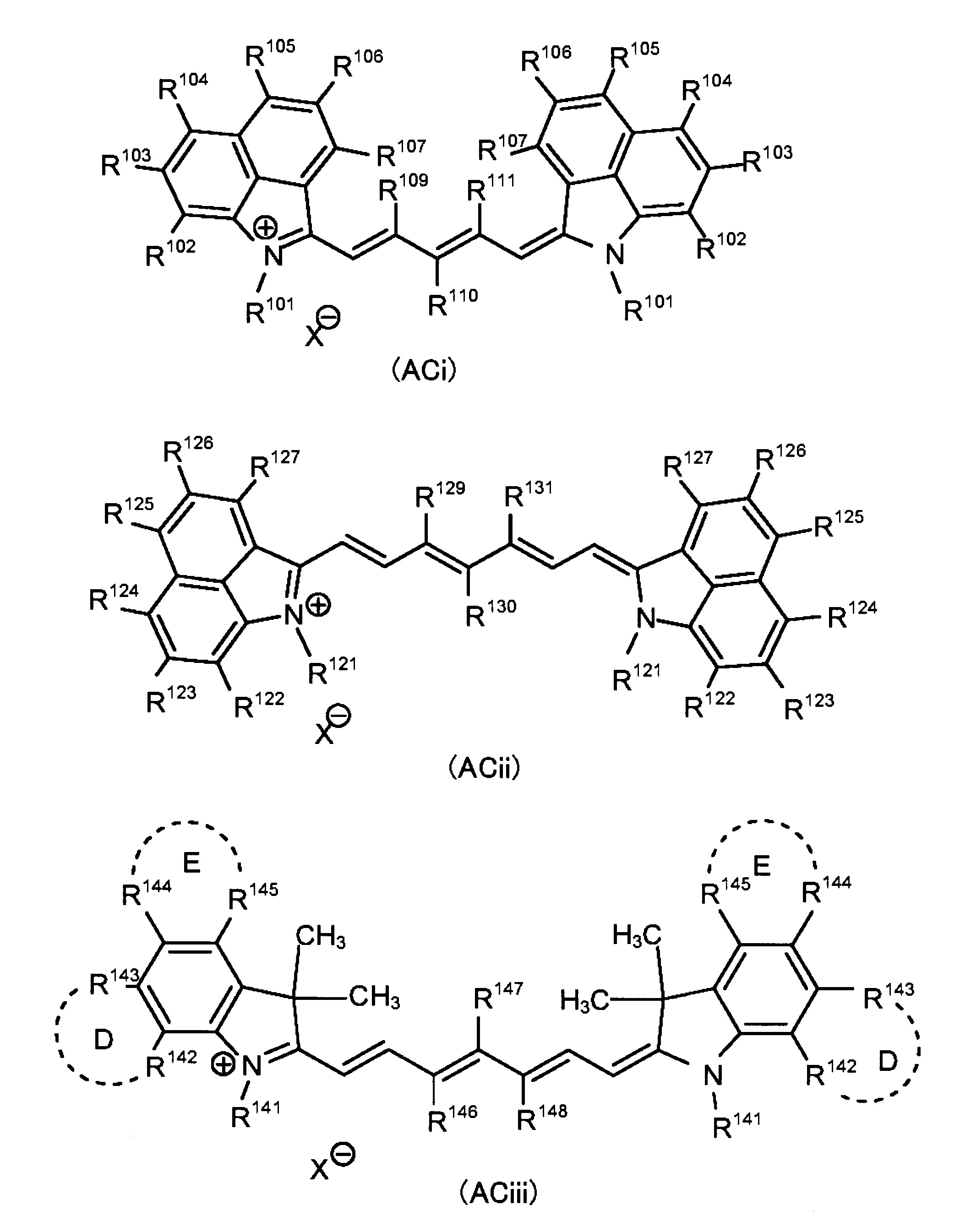
ただし、式(ACi)~(ACiii)中の記号は以下のとおりである。
なお、式(ACi)~(ACiii)において、左右の環構造が有する基について同じ符号を用いているが、これらは独立して、以下の基または原子である。すなわち、構造式の左右における同じ符号は同じ基または原子であってもよく、異なる基または原子であってもよい。
なお、式(ACi)~(ACiii)において、左右の環構造が有する基について同じ符号を用いているが、これらは独立して、以下の基または原子である。すなわち、構造式の左右における同じ符号は同じ基または原子であってもよく、異なる基または原子であってもよい。
R101~R107、R121~R127およびR141は、それぞれ独立して、水素原子、ハロゲン原子、スルホ基、ヒドロキシ基、シアノ基、ニトロ基、カルボキシル基、リン酸基、-NR112R113基、-NHSO2R114基、-NHCOR115基、-SR116基、-SO2R117基、-OSO2R118基、炭素数1~20のアルキル基またはアルコキシ基、炭素数1~12のハロゲン置換アルキル基、炭素数3~14のシクロアルキル基、炭素数6~14のアリール基、もしくは員数が3~14の複素環基である。
R102~R107およびR122~R127は隣り合う2つが互いに連結して5員環、6員環、または7員環を形成していてもよい。式(ACi)については、特に、R105およびR106が連結して、骨格のベンゼン環の一部(C=C)と共に芳香環を形成した構造が好ましい。また、式(ACii)については、特に、R125およびR126が連結して、骨格のベンゼン環の一部(C=C)と共に芳香環を形成した構造が好ましい。
R142とR143は水素原子または互いに結合して員数が6の芳香環Dを形成していてもよい。R145とR144は水素原子または互いに結合して員数が6の芳香環Eを形成していてもよい。ただし、芳香環Dと芳香環Eは両方が形成されることはない。
R109~R111、R129~R131、およびR146~R148はそれぞれ独立して、水素原子、炭素数1~6のアルキル基、-NR112R113基、炭素数3~14のシクロアルキル基、または炭素数6~14のアリール基である。
R109とR111、R129とR131、およびR146とR148は、互いに結合して5員環または6員環を形成してもよい。環を形成する場合、環に結合する水素原子は炭素数1~6のアルキル基に置換されていてもよく、環の構成原子の2つがメチレン基で架橋されていてもよい。
R112~R118は、それぞれ独立して、水素原子、炭素数1~20のアルキル基またはアルコキシ基、炭素数1~12のハロゲン置換アルキル基、炭素数3~14のシクロアルキル基、炭素数6~14のアリール基、もしくは員数が3~14の複素環基である。
X-は一価のアニオンを示す。
X-は一価のアニオンを示す。
上記において、アルキル基およびアルコキシ基のアルキル基は直鎖であってもよく、分岐構造や飽和環構造を含んでもよい。アリール基は芳香族化合物が有する芳香環、例えば、ベンゼン環、ナフタレン環、ビフェニル、フラン環、チオフェン環、ピロール環等を構成する炭素原子を介して結合する基をいう。ハロゲン原子としては、フッ素原子、塩素原子、臭素原子、ヨウ素原子等が挙げられ、フッ素原子および塩素原子が好ましい。
X-としては、I-、BF4
-、PF6
-、ClO4
-、式(X1)、(X2)で示されるアニオン等が挙げられ、好ましくは、BF4
-、PF6
-およびアニオン(X1)である。
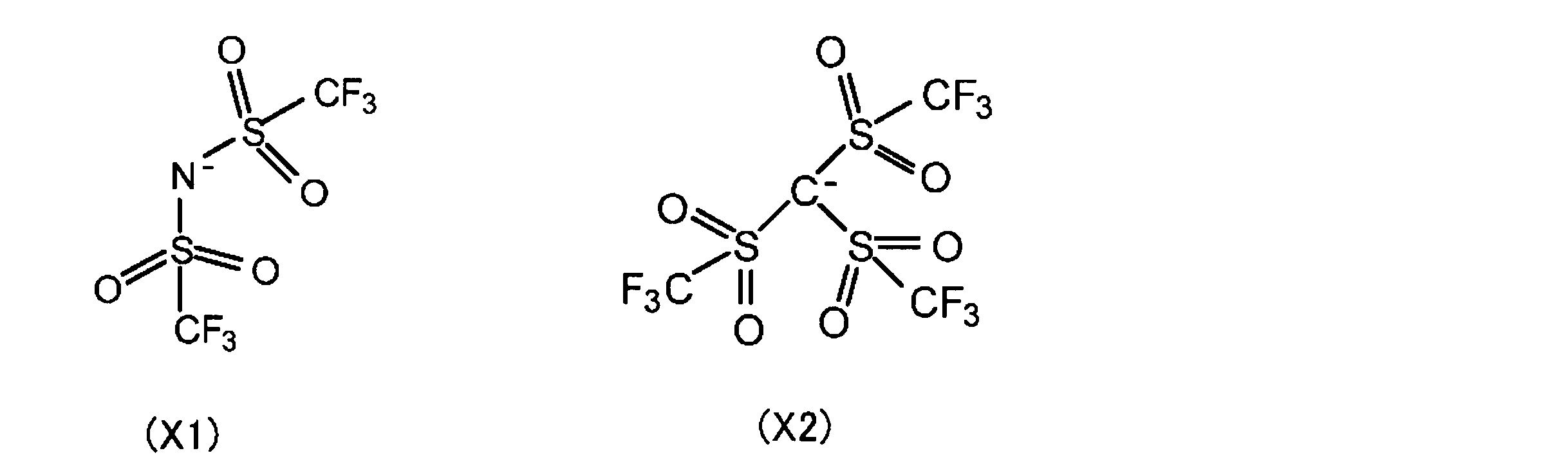
色素(ACi)としては、下式(ACi1)で示される、式(ACi)におけるR109~R111が水素原子の化合物が、樹脂(B)中での高い可視透過性維持の観点から好ましい。
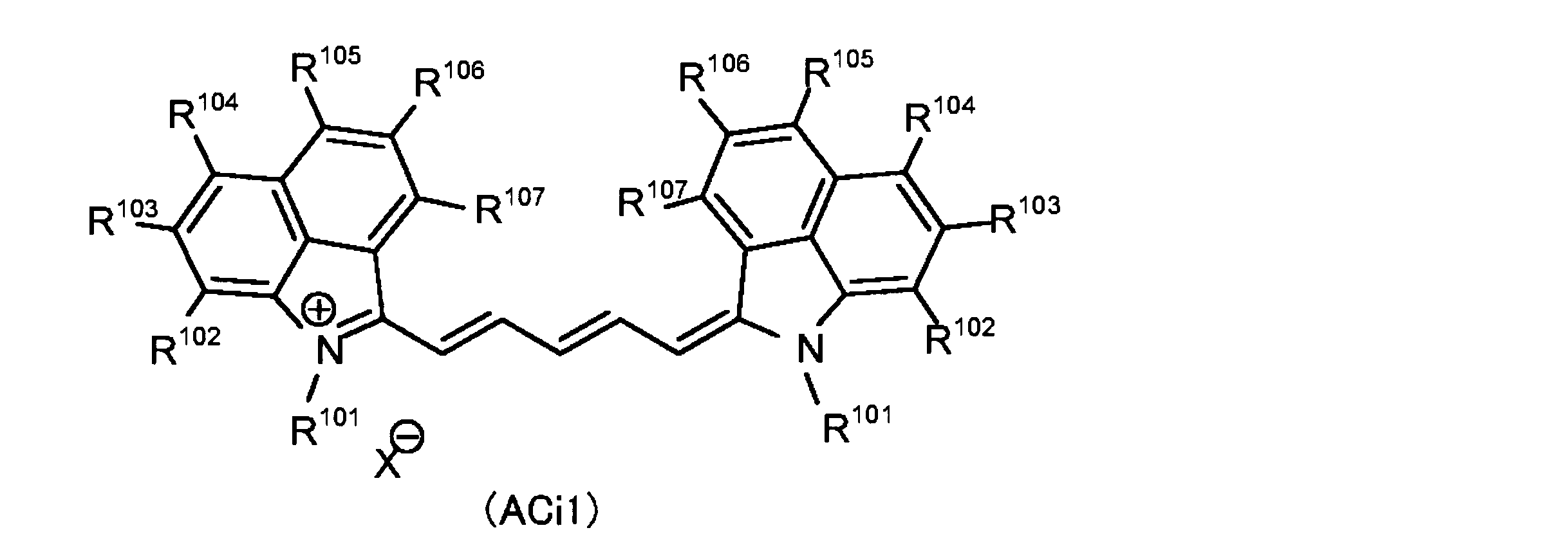
式(ACi1)におけるR101~R107およびX-は好ましい態様を含めて上記式(ACi)~(ACiii)において説明したのと同様である。R101としては、透明樹脂や、ホスト溶媒への溶解性の観点から、直鎖もしくは分岐構造を有する炭素数1~20のアルキル基であることが好ましく、直鎖もしくは分岐構造を有する炭素数4~20のアルキル基であることがより好ましい。R102~R107は、それぞれ独立して、水素原子、-NR112R113基、-NHSO2R114基、-NHCOR115基、炭素数1~20のアルキル基またはアルコキシ基、もしくは員数が3~14の複素環基が好ましく、水素原子、もしくは炭素数1~20のアルキル基またはアルコキシ基がより好ましい。この場合の、R112~R115は、上記式(ACi)~(ACiii)において説明したのと同様にできる。
色素(ACii)としては、下式(ACii1)で示される、式(ACii)におけるR129とR131が結合して6員環を形成した化合物、下式(ACii2)で示される、式(ACii)におけるR129とR131が結合して5員環を形成した化合物が、透明樹脂中での高い可視透過性維持の観点から好ましい。
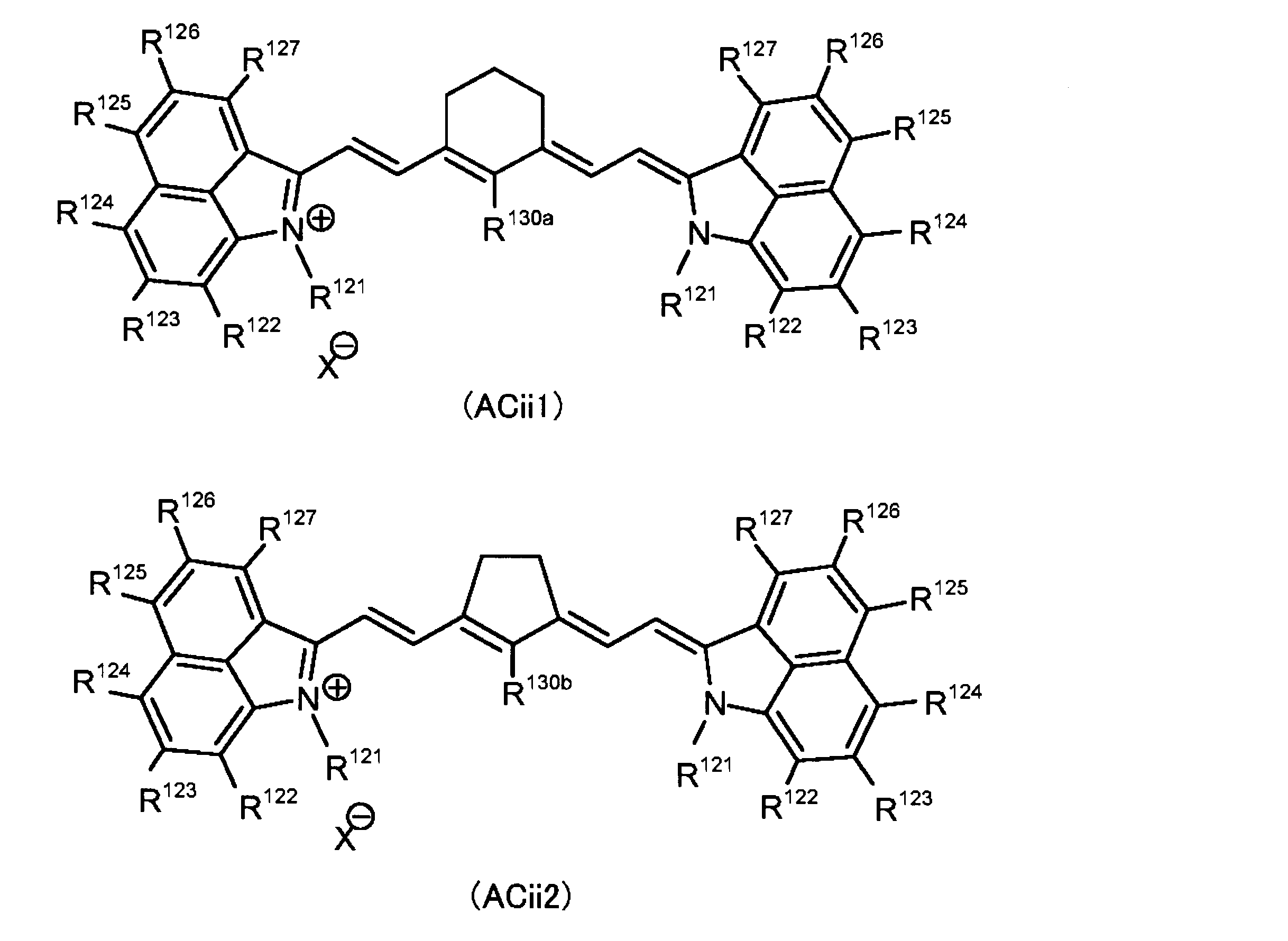
式(ACii1)、(ACii2)におけるR121~R127およびX-は好ましい態様を含めて上記式(ACi)~(ACiii)において説明したのと同様である。式(ACii1)において、R130aは、水素原子、フェニル基、メチル基であり、好ましくはフェニル基である。式(ACii2)において、R130bは、水素原子、フェニル基、メチル基、ジフェニルアミノ基であり、好ましくはフェニル基またはジフェニルアミノ基である。
R121としては、透明樹脂やホスト溶媒への溶解性の観点から、直鎖もしくは分岐構造を有する炭素数1~20のアルキル基であることが好ましく、直鎖もしくは分岐構造を有する炭素数4~20のアルキル基であることがより好ましい。R122~R127は、それぞれ独立して、水素原子、ジメチルアミノ基、-NHSO2R114基、-NHCOR115基、炭素数1~20のアルキル基またはアルコキシ基、もしくは員数が3~14の複素環基が好ましく、水素原子もしくは炭素数1~20のアルキル基またはアルコキシ基がより好ましい。この場合の、R114~R115は、上記式(ACi)~(ACiii)において説明したのと同様にできる。
色素(ACiii)として、具体的には、下式(ACiii1)で示される、式(ACiii)において芳香環Eのみを有する化合物、下式(ACiii2)で示される、式(ACiii)において芳香環Dのみを有する化合物が挙げられる。
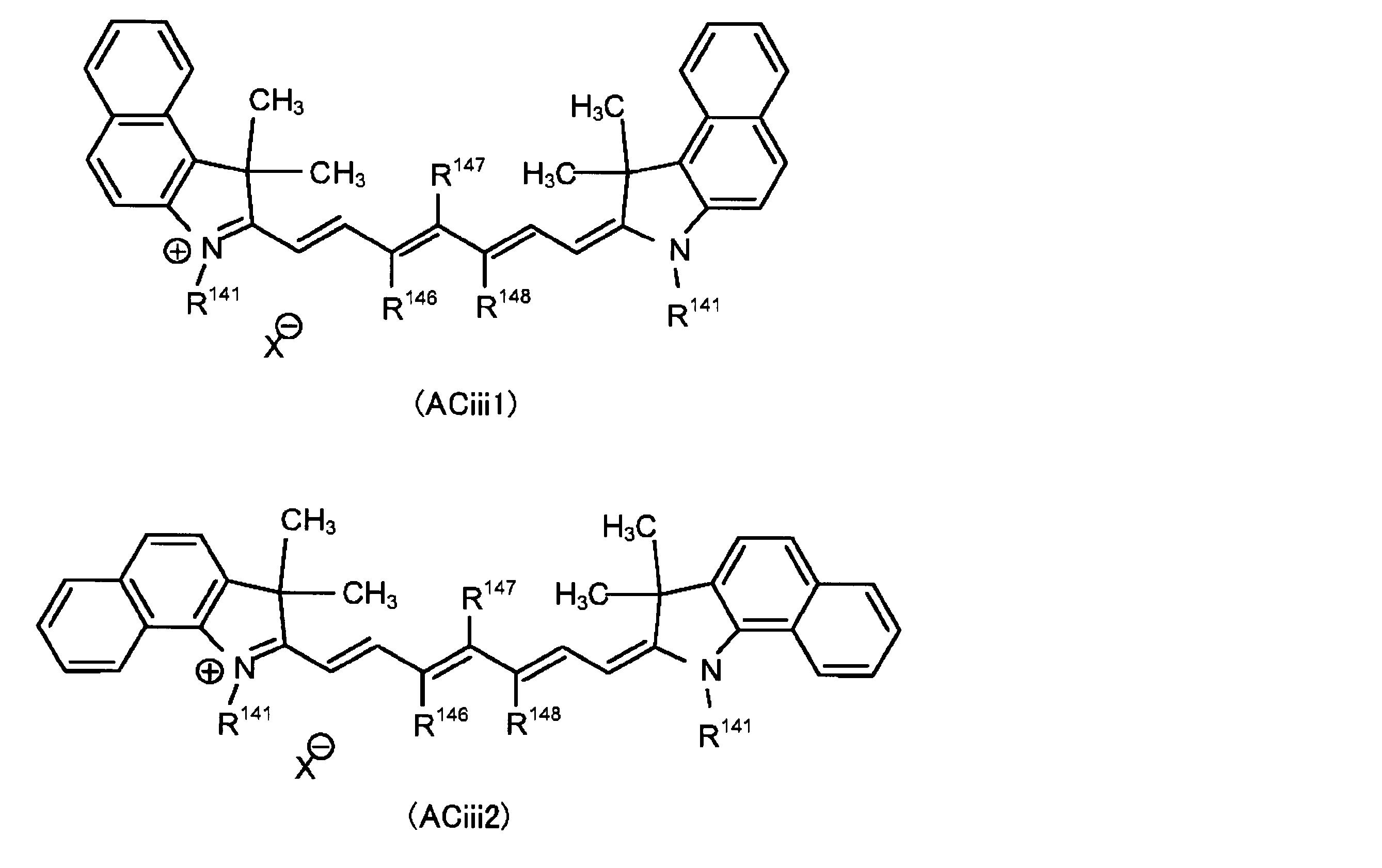
式(ACiii1)および(ACiii2)におけるR141、R146~R148およびX-は好ましい態様を含めて上記式(ACi)~(ACiii)、(ACiv)において説明したのと同様である。R141としては、透明樹脂やホスト溶媒への溶解性の観点から、直鎖もしくは分岐構造を有する炭素数1~20のアルキル基であることが好ましく、さらに、合成容易性の観点から、直鎖もしくは分岐構造を有する炭素数1~3のアルキル基であることがより好ましい。R147は、水素原子、メチル基、フェニル基が好ましく、水素原子またはフェニル基がより好ましい。
R146およびR148は、いずれも水素原子であるか、またはR146とR148が結合してこれらが結合する主鎖(メチン鎖)とともに5員環または6員環を形成しているのが好ましい。環を形成する場合、環に結合する水素原子は炭素数1~6のアルキル基に置換されていてもよく、環の構成原子の2つがメチレン基で架橋されていてもよい。R146とR148が結合して主鎖とともに5員環を形成した、後述の-(CH2)2-で示される構成または6員環を形成した、後述の-(CH2)3-で示される構成がより好ましい。
式(ACi1)、式(ACii1)、式(ACii2)、式(ACiii1)、および式(ACiii2)でそれぞれ示される化合物としては、より具体的には、それぞれ、各骨格に結合する原子または基が、以下の表1~5に示される化合物が挙げられる。表1に示す全ての化合物において、R101~R107は式の左右で全て同一である。表2、表3に示す全ての化合物において、R121~R127は式の左右で同一である。表4、表5に示す全ての化合物において、R141は式の左右で同一である。表1~5中、-CnH2n+1(nは3以上の整数)で示されるアルキル基は、直鎖のアルキル基を、-Phはフェニル基をそれぞれ示す。
表4、表5においてR146とR148が結合してメチン鎖の3個の炭素原子(C-C=C)とともに5員環を形成した場合のR146とR148を-(CH2)2-と示し、R146とR148が結合してメチン鎖の3個の炭素原子(C-C=C)とともに6員環を形成した場合のR146とR148を-(CH2)3-と示す。他の環や、環の水素原子が置換されている場合についても、上記記載に準じて記載する。
表1~表5には、X-を示さないが、いずれの化合物においてもX-はBF4
-、PF6
-またはアニオンX1である。色素(ACi1-1)においてX-が、BF4
-の場合を色素(ACi1-1B)、PF6
-の場合を色素(ACi1-1P)、アニオン(X1)の場合を色素(ACi1-1X1)と示す。表1~表5に示す他の色素においても同様である。
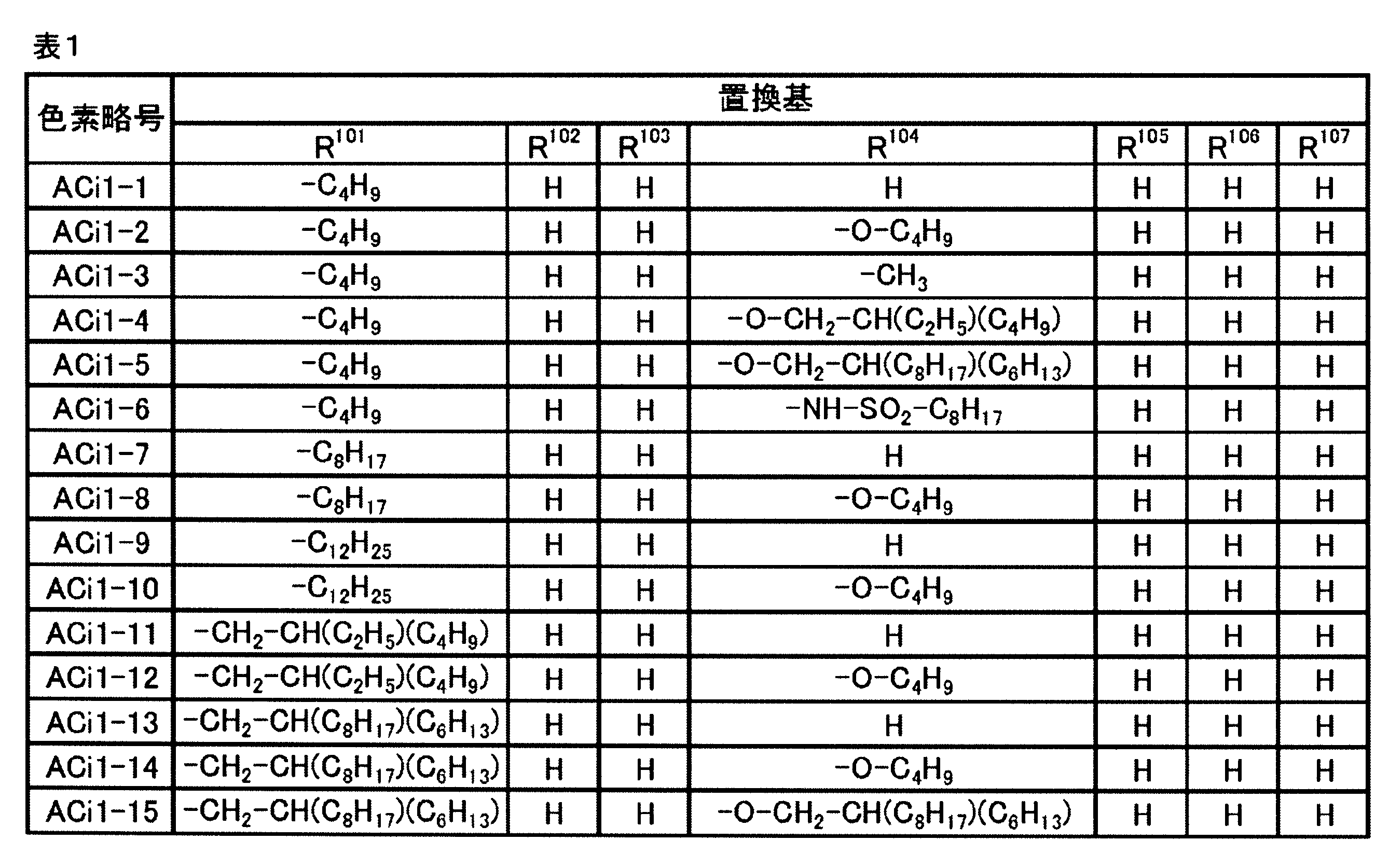
色素(ACi1)としては、これらの中でも、色素(ACi1-1B)、色素(ACi1-1P)、色素(ACi1-1X1)、色素(ACi1-2B)、色素(ACi1-2P)、色素(ACi1-14B)、色素(ACi1-15B)等が好ましい。

色素(ACii1)としては、これらの中でも、色素(ACii1-1B)、色素(ACii1-1P)、色素(ACii1-7B)、色素(ACii1-7P)等が好ましい。
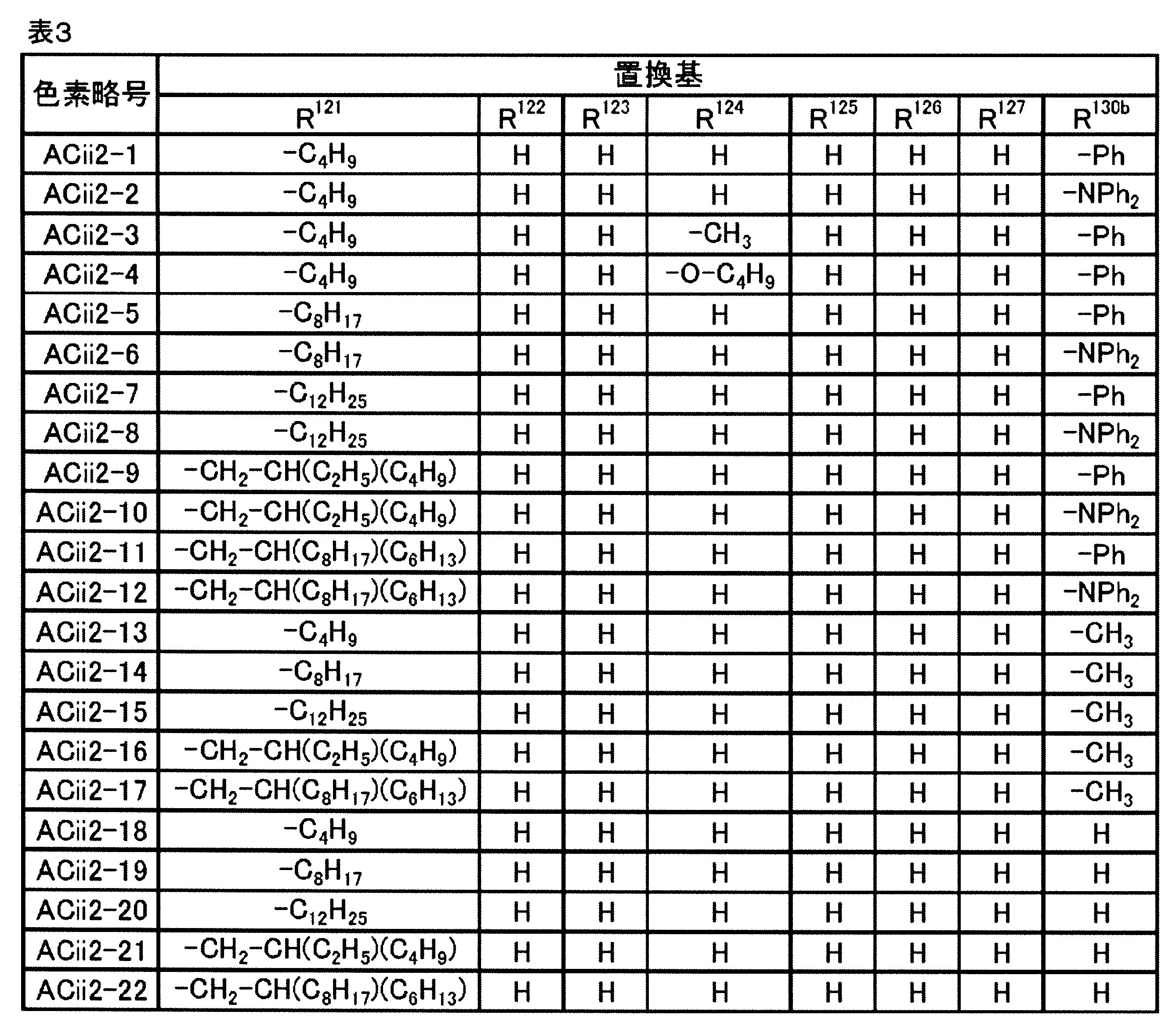
色素(ACii2)としては、これらの中でも、色素(ACii2-1B)、色素(ACii2-1P)、色素(ACii2-2B)、色素(ACii2-2P)、色素(ACii2-11B)、色素(ACii2-11P)、色素(ACii2-12B)、色素(ACii2-12P)等が好ましい。

色素(ACiii1)としては、これらの中でも、色素(ACiii1-1B)、色素(ACiii1-1P)、色素(ACiii1-2B)、色素(ACiii1-2P)、色素(ACiii1-5B)、色素(ACiii1-5P)、色素(ACiii1-7B)、色素(ACiii1-7P)、色素(ACiii1-10B)、色素(ACiii1-10P)、色素(ACiii1-12B)、色素(ACiii1-12P)、色素(ACiii1-15B)、色素(ACiii1-15P)、色素(ACiii1-17B)、色素(ACiii1-17P)、色素(ACiii1-20B)、色素(ACiii1-20P)、色素(ACiii1-22B)、色素(ACiii1-22P)、色素(ACiii1-25B)、色素(ACiii1-25P)等が好ましい。

色素(ACiii2)としては、これらの中でも、色素(ACiii2-1B)、色素(ACiii2-1P)、色素(ACiii2-2B)、色素(ACiii2-2P)、色素(ACiii2-5B)、色素(ACiii2-5P)、色素(ACiii2-7B)、色素(ACiii2-7P)、色素(ACiii2-10B)、色素(ACiii2-10P)、色素(ACiii2-12B)、色素(ACiii2-12P)、色素(ACiii2-15B)、色素(ACiii2-15P)、色素(ACiii2-17B)、色素(ACiii2-17P)、色素(ACiii2-20B)、色素(ACiii2-20P)、色素(ACiii2-22B)、色素(ACiii2-22P)、色素(ACiii2-25B)、色素(ACiii2-25P)等が好ましい。
なお、色素(ACi)および色素(ACii)は、例えば、J. Heterocyclic Chem. , 42(2005), 959に記載された方法で製造可能である。色素(ACiii)はUKRAINSKII KHIMICHESKII ZHURNAL, 44(8), 838, (1978)に記載された方法で製造可能である。
また、色素(ACi1-1B)、色素(ACi1-2B)、および色素(ACii2-2B)は、それぞれ、市販品であるFew Chemicals社製の商品名、S0772(化合物名:1-Butyl-2-[5-(1-butyl-1H-benzo[cd]indol-2-ylidene)-penta-1,3-dienyl]-benzo[cd]indolium tetrafluoroborate)、S2437(化合物名:6-Butoxy-2-[5-(6-butoxy-1-butyl-1H-benzo[cd]indol-2-ylidene)-penta-1,3-dienyl]-1-butyl-benzo[cd]indolium tetrafluoroborate)、およびS2007(化合物名:1-Butyl-2-(2-[3-[2-(1-butyl-1H-benzo[cd]indol-2-ylidene)-ethylidene]2-diphenylamino-cyclopent-1-enyl]vinyl)benzo[cd]indolium tetrafluoroborate)を使用できる。
色素(A)であり、(4-1)を満足するスクアリリウム色素としては、以下の(4-3)の分子構造を有するスクアリリウム色素が好ましい。
(4-3)下記式(ASi)~(ASiii)のいずれかで表されるスクアリリウム色素。
(4-3)下記式(ASi)~(ASiii)のいずれかで表されるスクアリリウム色素。

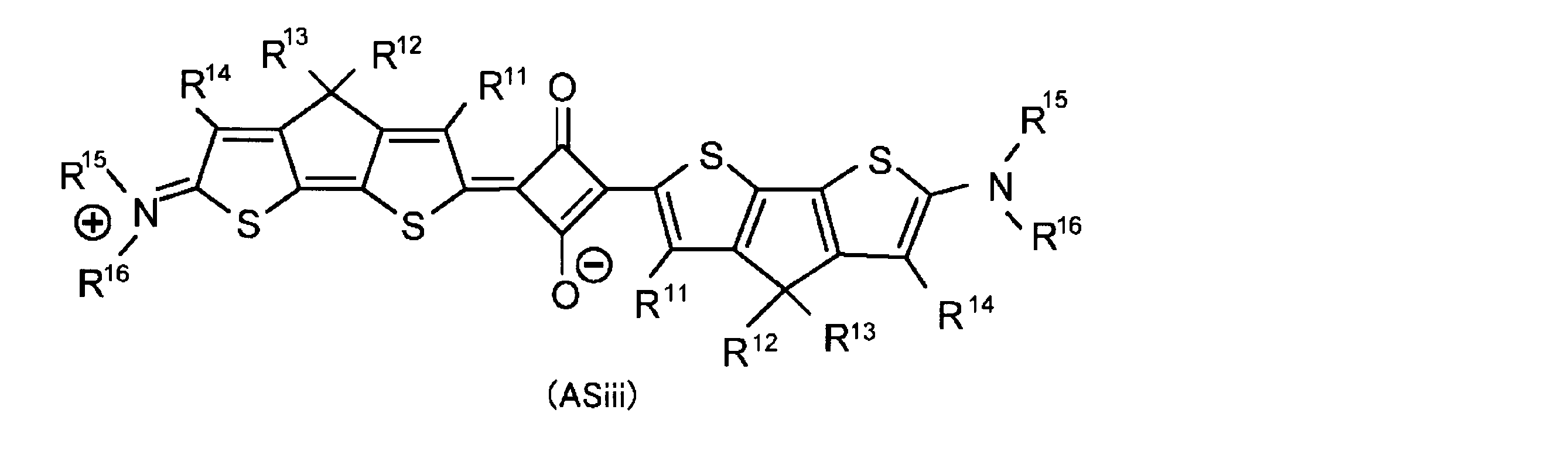
ただし、式(ASi)~(ASiii)中の記号は以下のとおりである。
なお、式(ASi)~(ASiii)において、スクアリリウム環の左右に結合する環構造が有する基について同じ符号を用いているが、これらは独立して、以下の基または原子である。すなわち、構造式の左右における同じ符号は同じ基または原子であってもよく、異なる基または原子であってもよい。
式(ASi)~(ASiii)は、それぞれ共鳴構造の1つを示すものであり、化合物(ASi)~(ASiii)にはそれぞれ他の共鳴構造も含まれる。
なお、式(ASi)~(ASiii)において、スクアリリウム環の左右に結合する環構造が有する基について同じ符号を用いているが、これらは独立して、以下の基または原子である。すなわち、構造式の左右における同じ符号は同じ基または原子であってもよく、異なる基または原子であってもよい。
式(ASi)~(ASiii)は、それぞれ共鳴構造の1つを示すものであり、化合物(ASi)~(ASiii)にはそれぞれ他の共鳴構造も含まれる。
式(ASi)中、R161は、それぞれ独立して、炭素数3~20の分岐アルキル基、炭素数13~20の直鎖アルキル基である。R161は、透明樹脂やホスト溶媒への溶解性の観点から、炭素数8~20の分岐アルキル基が好ましく、炭素数16~20の直鎖アルキル基がより好ましい。R161は、透明樹脂中での高透過率維持の観点から炭素数8~20の分岐アルキル基がより好ましい。
式(ASii)中、Y3はC-R179またはNである。
式(ASi)および式(ASii)中、R162~R167およびR171~R179は、それぞれ独立して、水素原子、ハロゲン原子、スルホ基、ヒドロキシ基、シアノ基、ニトロ基、カルボキシル基、リン酸基、-NR112R113基、-NHSO2R114基、-NHCOR115基、-SR116基、-SO2R117基、-OSO2R118基、炭素数1~20のアルキル基またはアルコキシ基、炭素数1~12のハロゲン置換アルキル基、炭素数3~14のシクロアルキル基、炭素数6~14のアリール基、もしくは員数が3~14の複素環基である。
式(ASi)および式(ASii)中、R162~R167およびR171~R179は、それぞれ独立して、水素原子、ハロゲン原子、スルホ基、ヒドロキシ基、シアノ基、ニトロ基、カルボキシル基、リン酸基、-NR112R113基、-NHSO2R114基、-NHCOR115基、-SR116基、-SO2R117基、-OSO2R118基、炭素数1~20のアルキル基またはアルコキシ基、炭素数1~12のハロゲン置換アルキル基、炭素数3~14のシクロアルキル基、炭素数6~14のアリール基、もしくは員数が3~14の複素環基である。
員数が3~14の複素環基としては、ヘテロ原子として、N、OおよびSから選ばれる少なくとも1種を含む複素環基が挙げられる。R171は、透明樹脂やホスト溶媒への溶解性の観点から、炭素数8~20の直鎖アルキル基および炭素数8~20の分岐アルキル基が好ましい。R171は、透明樹脂中での高透過率維持の観点から炭素数16~20の分岐アルキル基がより好ましい。R162~R167およびR172~R178は、それぞれ独立して、水素原子、炭素数1~20のアルキル基またはアルコキシ基、-NHSO2R114基、-NHCOR115基が好ましく、水素原子、炭素数1~20のアルコキシ基、-NHCOR115基がより好ましい。R179は、水素原子、炭素数1~20のアルキル基またはアルコキシ基が好ましく、水素原子、炭素数1~8のアルキル基またはアルコキシ基がより好ましい。
R112~R118は、それぞれ独立して、水素原子、炭素数1~20のアルキル基またはアルコキシ基、炭素数1~12のハロゲン置換アルキル基、炭素数3~14のシクロアルキル基、炭素数6~14のアリール基、もしくは員数が3~14の複素環基である。ハロゲン原子としては、フッ素原子、塩素原子、臭素原子、ヨウ素原子等が挙げられ、フッ素原子および塩素原子が好ましい。
R112~R118は、それぞれ独立して、炭素数1~20のアルキル基またはアルコキシ基が好ましく、炭素数3~16のアルキル基またはアルコキシ基がより好ましい。
上記式(ASi)および式(ASii)の説明において、特に断りのないアルキル基およびアルコキシ基のアルキル基は直鎖であってもよく、分岐構造や飽和環構造を含んでもよい。アリール基は芳香族化合物が有する芳香環、例えば、ベンゼン環、ナフタレン環、ビフェニル、フラン環、チオフェン環、ピロール環等を構成する炭素原子を介して結合する基をいう。ハロゲン原子としては、フッ素原子、塩素原子、臭素原子、ヨウ素原子等が挙げられ、フッ素原子および塩素原子が好ましい。
式(ASiii)中、R11~R14は、それぞれ独立して、置換基を有してもよく、炭素-炭素原子間に不飽和結合または酸素原子を含んでよいアルキル基、アルコキシ基、アリール基またはアルアリール基であり、R15およびR16は、それぞれ独立して、置換基を有してもよく、アリール基、炭素-炭素原子間に不飽和結合、酸素原子、脂環または芳香環を含んでよいアルキル基またはアルコキシ基であるか、または、R15およびR16が互いに連結して窒素原子とともに員数が5~10のシクロヘテロ環を形成し、前記シクロヘテロ環は置換基を有してもよい。
色素(ASiii)は、分子構造の中央にスクアリリウム骨格を有し、スクアリリウム骨格の左右に各1個のシクロペンタジチオフェン環が結合している。シクロペンタジチオフェン環は、スクアリリウム骨格とは反対側のチオフェン環が、窒素含有置換基である-NR15R16を有する構造である。スクアリリウム骨格の左右のR11~R16は、異なってもよいが、合成が容易な点から同じが好ましい。
R11~R14における置換基としては、ハロゲン原子、水酸基、カルボキシ基、スルホ基、シアノ基、アミノ基、N-置換アミノ基、ニトロ基、アルコキシカルボニル基、カルバモイル基、N-置換カルバモイル基、イミド基、炭素数1~10のアルコキシ基が挙げられる。R11~R14がアリール基またはアルアリール基の場合、置換基は、芳香環に結合する水素原子またはこれらが有するアルキル基の水素原子を置換する基であり、前記置換基の他にさらにアリール基を含む。
R11~R14がアルキル基またはアルコキシ基の場合、炭素数は1~20が好ましく、1~15がより好ましく、1~12がさらに好ましい。R11~R14がアリール基の場合、炭素数は6~20が好ましく、6~17がより好ましく、6~14がさらに好ましい。R11~R14がアルアリール基の場合、炭素数は7~20が好ましく、7~18がより好ましく、7~15がさらに好ましい。R11~R14が置換基を有する場合、炭素数は置換基の炭素数を含む炭素数である。
R11は、光安定性の観点から、水素原子または炭素数1~12のアルキル基が好ましく、水素原子が特に好ましい。
R12およびR13は、可視光透過性や、耐光性や、溶媒への溶解性の観点からは、炭素-炭素原子間に酸素原子を含んでよい炭素数1~20の直鎖状、分岐鎖状または環状のアルキル基が好ましい。アルキル基の炭素数は、直鎖状の場合、1~12がより好ましく、分岐鎖状の場合、3~10がより好ましく、環状の場合、5~10がより好ましい。R12およびR13は、基1a~基5a、および基1d~基10dから選ばれる基がさらに好ましく、基1a、基3a、または基5dが特に好ましい。
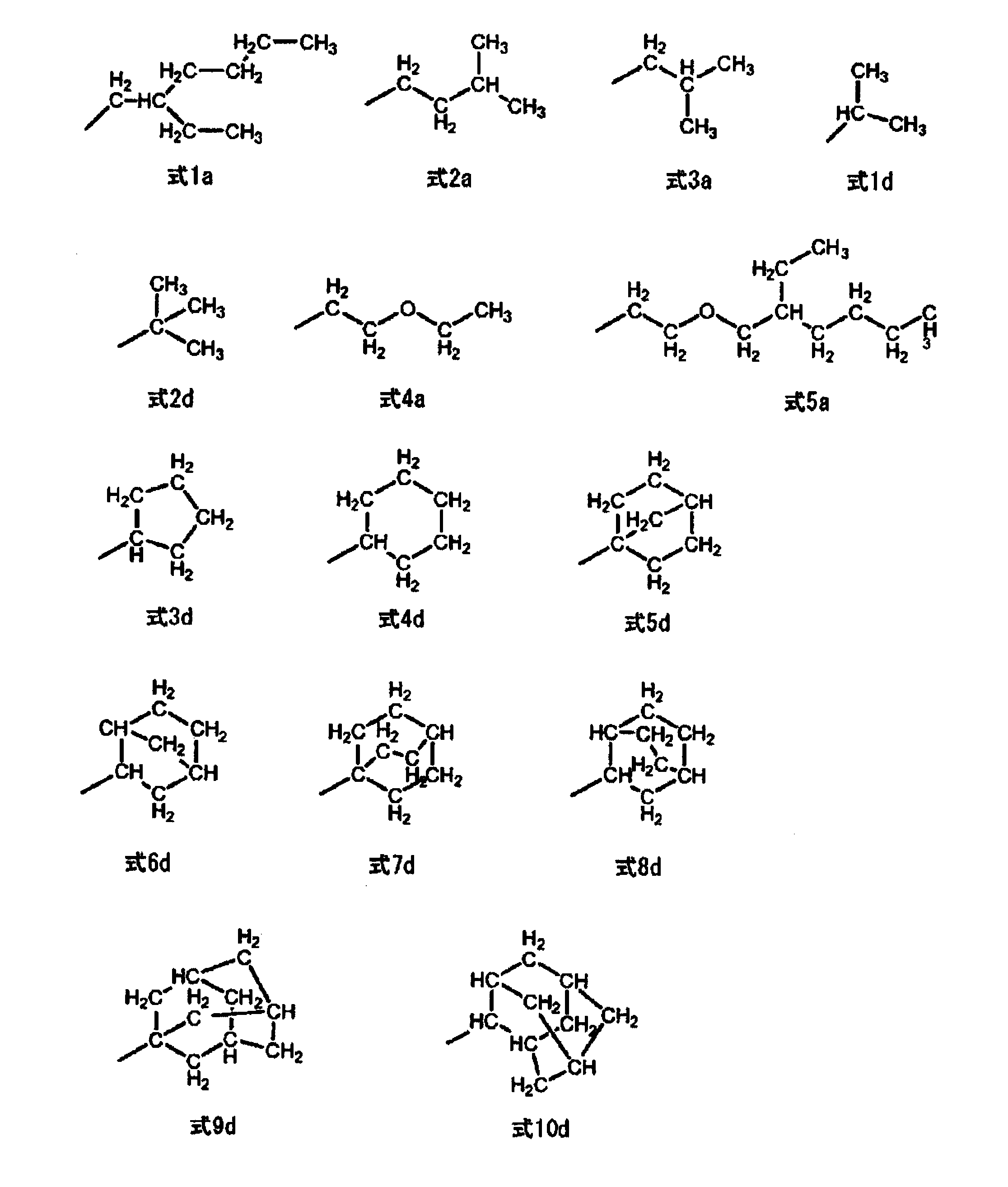
R12およびR13は、耐熱性や、耐光性や、吸収波長の長波長化の点からは、1~5個の置換基を有してもよいフェニル基または、1~7個の置換基を有してもよいナフチル基または、炭素数5~10の環状アルキル基が好ましい。フェニル基およびナフチル基の水素原子を置換してもよい置換基としては、炭素-炭素原子間に不飽和結合または酸素原子を含んでよい炭素数1~12のアルキル基、もしくはアルコキシ基、またはアルキルアミノ基(アルキル基の炭素数は1~12)が挙げられる。フェニル基およびナフチル基は、非置換または、水素原子が1~3個置換されているのが好ましく、置換基としては、メチル基、ターシャリーブチル基、ジメチルアミノ基、メトキシ基等が好ましい。
1~5個の置換基を有してもよいフェニル基として、具体的には、基P1~基P9が挙げられる。
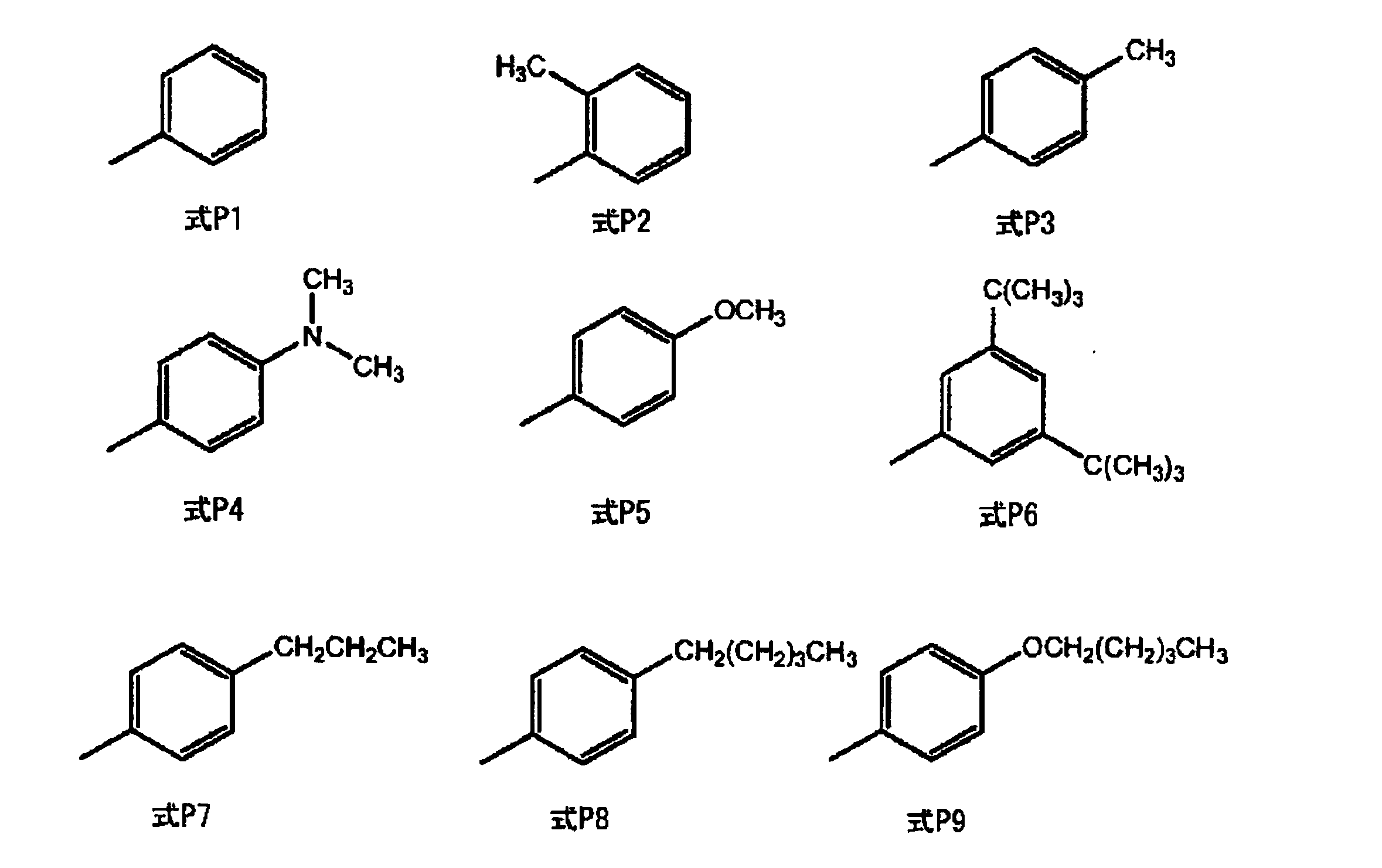
1~7個の置換基を有してもよいナフチル基として、具体的には、基N1~基N9が挙げられる。
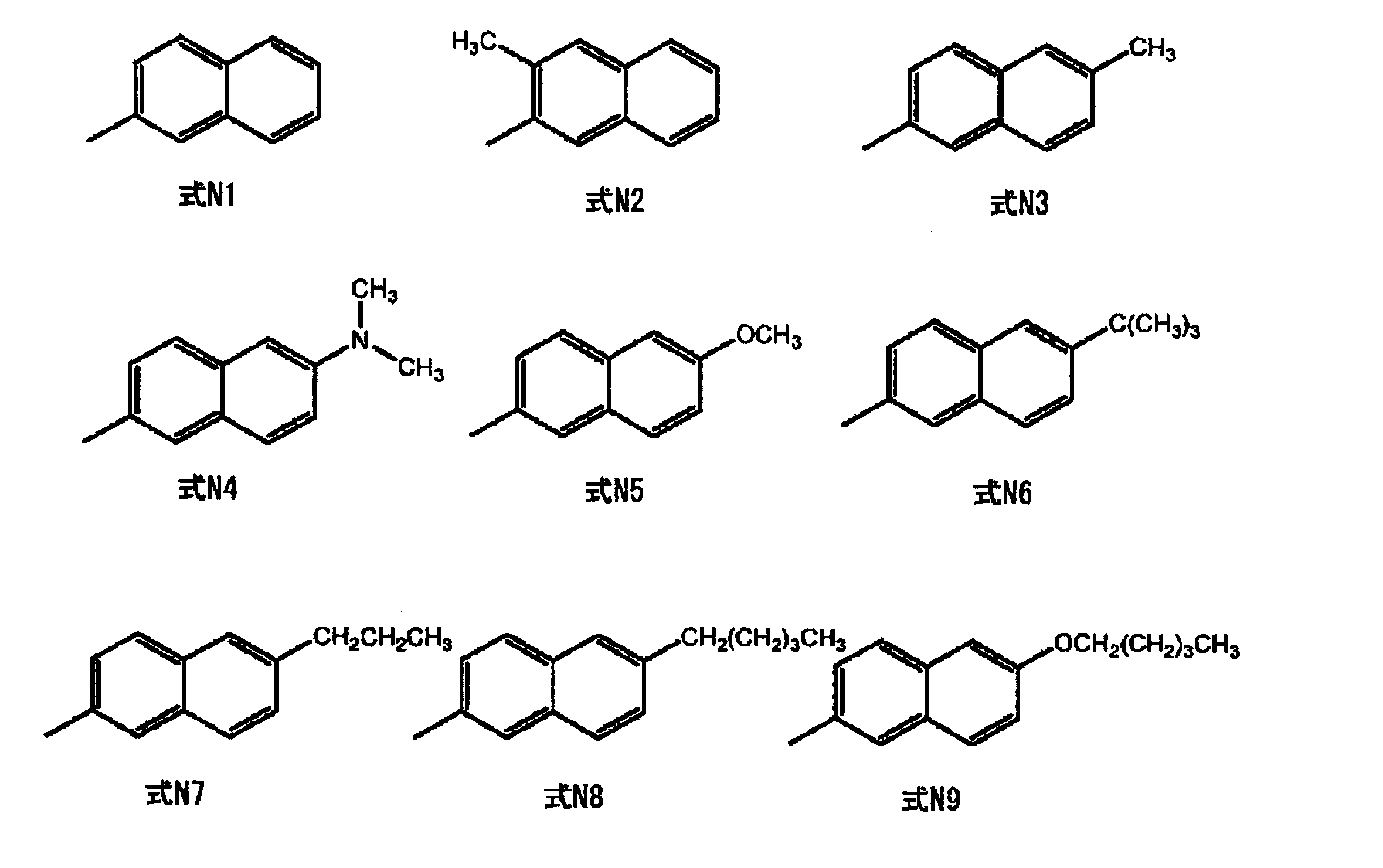
R12およびR13は、具体的には、メチル基、フェニル基、ナフチル基、トルイル基、3,5-ジ-ターシャリーブチルフェニル基、シクロヘキシル基、イソプロピル基、2-エチルヘキシル基等が好ましく、フェニル基、シクロヘキシル基、イソプロピル基が特に好ましい。
R14は、可視光透過性や、溶媒への溶解性の点からは、R12およびR13と同様に、炭素-炭素原子間に酸素原子を含んでよい炭素数1~20の直鎖状、分岐鎖状または環状のアルキル基が好ましい。アルキル基の炭素数は、直鎖状の場合、1~12がより好ましく、分岐鎖状の場合、3~10がより好ましく、環状の場合、5~10がより好ましい。R14は、例えば、基1a~基5a、基1d~基10dから選ばれる基がさらに好ましく、基1dが特に好ましい。
R14は、製造容易性の観点からは、水素原子または炭素数1~8のアルキル基が好ましく、水素原子が特に好ましい。
R15およびR16は、それぞれ独立して、置換基を有してもよく、アリール基、炭素-炭素原子間に不飽和結合、酸素原子、脂環または芳香環を含んでよいアルキル基またはアルコキシ基である。R15およびR16は、互いに連結して窒素原子とともに員数が5~10のシクロヘテロ環を形成してもよく、その場合、シクロヘテロ環に結合する水素原子は置換基で置換されていてもよい。
R15およびR16における置換基としては、R11~R14における置換基と同様の置換基が挙げられる。R15およびR16がアルアリール基の場合、これらが有するアルキル基はさらにアリール基で置換されていてもよい。
R15およびR16は、芳香環を有する基であってもよく、芳香環を有しない基であってもよい。R15およびR16が、芳香環を有する場合、耐熱性や、吸収波長の長波長化の点で好ましい。R15およびR16が、芳香環を有しない場合、耐光性や、製造容易性や、溶媒への溶解性の点で好ましい。
R15およびR16がアリール基の場合、アリール基としては、R1およびR2で挙げたものと同じものを例示できる。
R15およびR16が、アルキル基またはアルコキシ基の場合、炭素数は1~20が好ましく、1~12がより好ましく、1~10がさらに好ましい。R15およびR16は、可視光透過性や、溶媒への溶解性の点からは、R12およびR13と同様に、炭素-炭素原子間に酸素原子を含んでよい炭素数3~20の直鎖状、分岐鎖状または環状のアルキル基が好ましい。アルキル基の炭素数は、直鎖状の場合、3~12がより好ましく、分岐鎖状の場合、3~10がより好ましく、環状の場合、5~10がより好ましい。R15およびR16が置換基を有する場合、炭素数は置換基の炭素数を含む炭素数である。R15およびR16は、例えば、基1a~基5a、基1d~基10dから選ばれる基がさらに好ましく、基1dが特に好ましい。
R15およびR16が互いに連結して窒素原子とともにシクロヘテロ環を形成する態様は、化合物2のR5およびR6と同じ態様が挙げられ、好ましい態様も同じである。
色素(ASiii)において、R11~R16のうち、R12、R13、R15およびR16から選ばれる2以上、より好ましくは3以上、さらに好ましくは4つの全てが、炭素-炭素原子間に酸素原子を含んでよい炭素数3~20の直鎖状または分岐鎖状のアルキル基が好ましい。それにより、化合物は、可視光透過性や、溶媒への溶解性に優れる。
式(ASi)で示される化合物としては、より具体的には、各骨格に結合する原子または基が、以下の表6、7に示される化合物が挙げられる。なお、表6は、R161~R167における原子または基の31種類の組合せにS-1~S-31の番号を付した表である。表6中、-C4H9等のアルキル基は全て直鎖のアルキル基である。
表7は、色素(ASi)に分類される色素(ASi-1)~色素(ASi-496)において、スクアリリウム環の右側と左側のR161~R167がそれぞれS-1~S-31のいずれの組合せを有するかを示す表である。表7に示す色素(ASi-1)~色素(ASi-31)は、R161~R167の組合せが式の左右で同一の対象構造の化合物である。色素(ASi-32)~色素(ASi-496)は、R161~R167の組合せが式の左右で異なる非対象の構造の化合物である。
表7中の色素(ASi-32)~色素(ASi-61)は、右側のR161~R167の組合せがS-1であり、左側のR161~R167の組合せがS-2~S-31のいずれかである色素をまとめて示したものである。右がS-1である色素(ASi)において、左がS-2の場合を色素(ASi-32)、左がS-3の場合を色素(ASi-33)、左がS-4の場合を色素(ASi-34)というようにR161~R167の組合せ番号の順に、色素番号を1ずつ増やすように採番した。他の場合も同様である。なお、色素(ASi-32)は、右がS-1であり左がS-2である構造と、右がS-2であり左がS-1である構造の両方を含む。
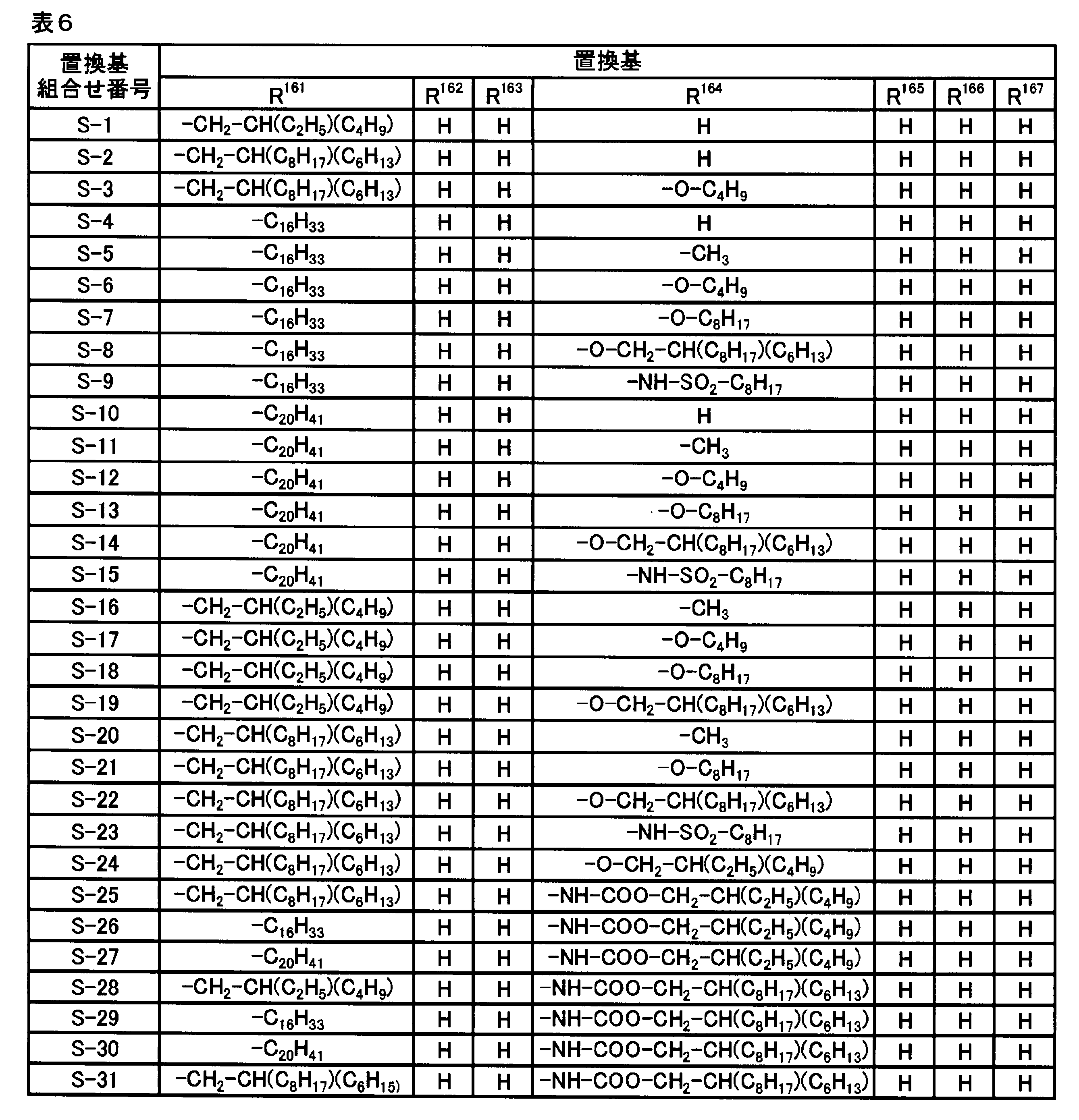
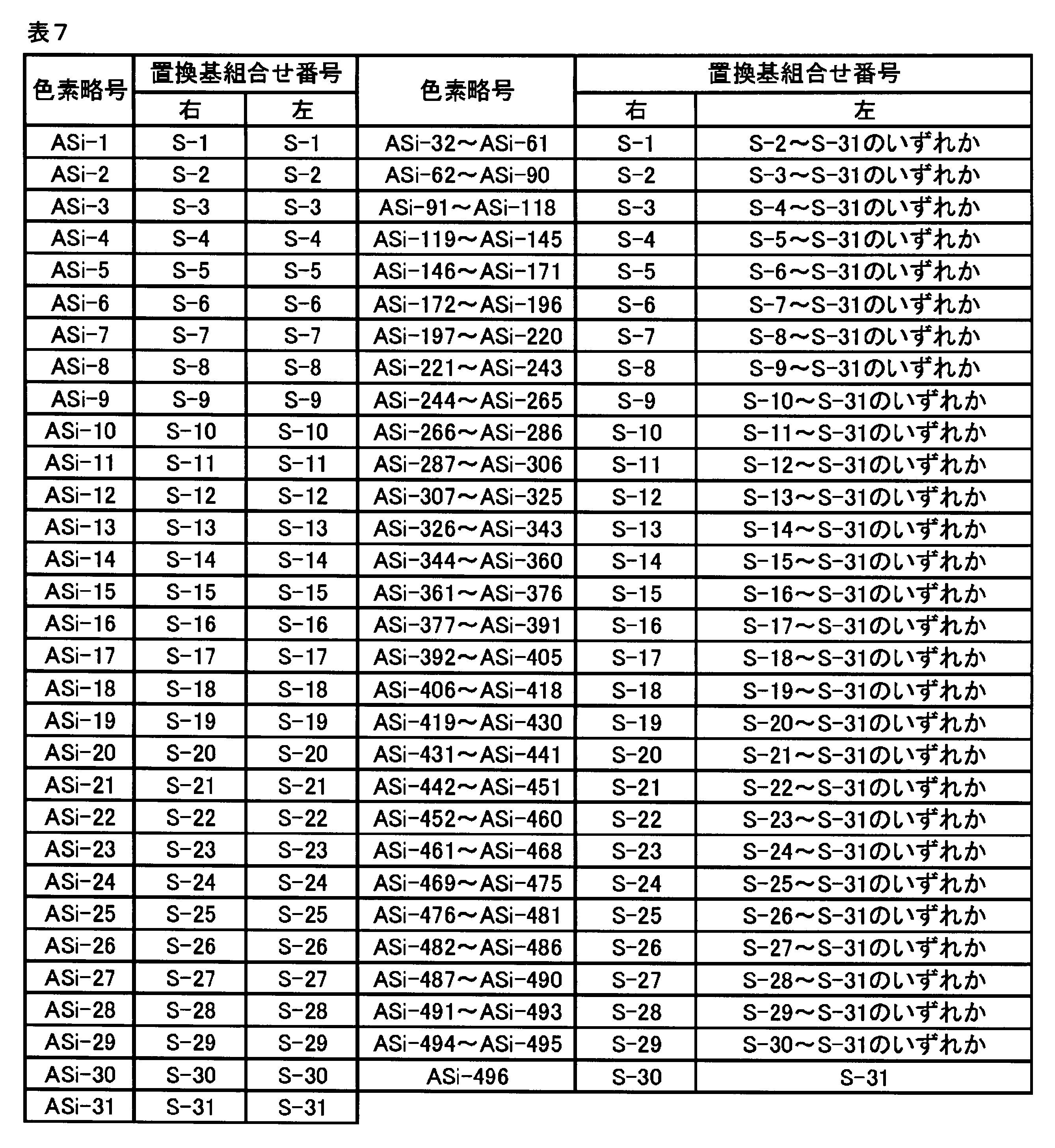
色素(ASi)の中でも、左右対称の色素(ASi)として、色素(ASi-1)、色素(ASi-2)、色素(ASi-3)、色素(ASi-19)、色素(ASi-22)、色素(ASi-24)、色素(ASi-25)、色素(ASi-28)、色素(ASi-31)等が好ましく、色素(ASi-1)、色素(ASi-19)、色素(ASi-22)、色素(ASi-25)、色素(ASi-31)等がより好ましい。
色素(ASi)の中でも、左右非対称の色素(ASi)として、左右の組合せがS-19と、S-24、S-25、およびS-28のいずれかの組合せである色素(ASi-423)、色素(ASi-424)、色素(ASi-427)S-22と、S-31の組合せである色素(ASi-460)、S-24と、S-25およびS-28のいずれかの組合せである色素(ASi-469)、色素(ASi-472)等が好ましい。
式(ASii)で示される化合物としては、より具体的には、各骨格に結合する原子または基が、以下の表8に示される化合物が挙げられる。表8に示す全ての化合物において、R171~R178およびY3は式の左右で同一である。表8中、-C4H9等のアルキル基は全て直鎖のアルキル基である。

色素(ASii)としては、これらの中でも、色素(ASii-1)~色素(ASii-8)、色素(ASii-10)、色素(ASii-15)~色素(ASii-17)等が好ましく、色素(ASii-8)、色素(ASii-15)~色素(ASii-17)等がより好ましい。
なお、色素(ASi)および色素(ASii)は、例えば、 European Journal of Medical Chemistry, 54 647, (2012)、さらに色素(ASii)については、Org. Lett. 18, 5232 (2016)に記載された方法でスクアリリウム環の両側に導入する化合物を製造し、該化合物を、例えば、Organic Letters, 8, 111, (2006)に記載された方法でスクアリン酸の対角線上の2箇所に導入することで製造可能である。また、非対称型の構造については、Dyes and Pigments, 141, 457,(2017)に記載の方法で製造可能である。
色素(ASiii)としては、より具体的には、R11~R16が、以下の表9に示される化合物が挙げられる。表9に示す全ての化合物において、R11~R16は、スクアリリウム骨格の左右で全て同一である。表9中、CnH2n+1(nは3以上の整数)で示されるアルキル基は、直鎖のアルキル基を示す。

色素(ASiii)のうちでも、耐光性を高く維持できる点からは、色素(ASiii-3)、色素(ASiii-8)、色素(ASiii-10)、色素(ASiii-13)、色素(ASiii-14)、色素(ASiii-15)が好ましい。また、溶媒への溶解性の点からは、色素(ASiii-1)、色素(ASiii-2)、色素(ASiii-3)、色素(ASiii-5)、色素(ASiii-7)、色素(ASiii-8)、色素(ASiii-10)、色素(ASiii-12)、色素(ASiii-13)、色素(ASiii-17)が好ましい。合成が容易な点からは、色素(ASiii-1)、色素(ASiii-5)、色素(ASiii-6)、色素(ASiii-9)、色素(ASiii-16)が好ましい。
色素(ASiii)は、中央のスクアリリウム骨格から両端のアミノ基(-NR15R16)まで炭素-炭素原子の二重結合が4つ以上あることにより、π共役構造が大きくなるので、近赤外光の長波長側に高い吸収特性を有する。また、余計なベンゼン環を含まないので、可視光、とくに可視光の中でも短波長側の青色透過率が高い。さらに、色素(ASiii)は、R15とR16が窒素原子に芳香環が直接結合するような構成ではない場合、R15とR16が直結するアミノ基からシクロペンタジチオフェン環への電子供与性が強くなり、短波長側の可視光透過率が高くなり、かつ、より長波長側の近赤外光に高い吸収特性を発現する点で好ましい。
色素(ASiii)によれば、例えば、ジクロロメタンに溶解して測定される波長400~1200nmの吸収スペクトルにおいて、最大吸収波長λmaxを800~1000nmとする吸収特性が得られる。また、範囲を限定して、最大吸収波長λmaxを850~980nmとする吸収特性も得られる。このような吸収特性は、例えば、850~1050nmに吸収極大が求められる近赤外光の透明指紋センサー、生体オキシセンサーに用いられる光電変換材料層として好適な特性である。
色素(ASiii)は、例えば、3,4-ジヒドロキシ-3-シクロブテン-1,2-ジオン(スクアリン酸)と、スクアリン酸と結合して式(ASiii)に示す構造を形成可能なアミノ基末端を有するシクロペンタジチオフェン誘導体とを反応させて製造できる。例えば、色素(ASiii)が左右対称の構造である場合、スクアリン酸1当量に対して上記範囲で所望の構造のシクロペンタジチオフェン誘導体2当量を反応させればよい。
色素(A)であり、(5-1)を満足するスクアリリウム色素としては、以下の(5-2)の分子構造を有するスクアリリウム色素が好ましい。
(5-2)下記式(I)~(III)のいずれかで表されるスクアリリウム色素。
(5-2)下記式(I)~(III)のいずれかで表されるスクアリリウム色素。
色素(I)~(III)は、上記吸光度曲線において、λmax(A)DCMの吸収ピークが可視光側で急峻な傾きを有するとともに、保存安定性および光に対する安定性が高いのが好ましい。

ただし、式(I)中の記号は以下のとおりである。
R24およびR26は、それぞれ独立して、水素原子、ハロゲン原子、水酸基、炭素数1~6のアルキル基もしくはアルコキシ基、炭素数1~10のアシルオキシ基、-NR27R28(R27およびR28は、それぞれ独立して、水素原子、炭素数1~20のアルキル基、-C(=O)-R29(R29は、水素原子、置換基を有していてもよい炭素数1~20のアルキル基もしくは炭素数6~11のアリール基または、置換基を有していてもよく、炭素原子間に酸素原子を有していてもよい炭素数7~18のアルアリール基)、-NHR30、または、-SO2-R30(R30は、それぞれ1つ以上の水素原子がハロゲン原子、水酸基、カルボキシ基、スルホ基、またはシアノ基で置換されていてもよく、炭素原子間に不飽和結合、酸素原子、飽和もしくは不飽和の環構造を含んでよい炭素数1~25の炭化水素基)を示す。)、または、下記式(S)で示される基(R41、R42は、独立して、水素原子、ハロゲン原子、または炭素数1~10のアルキル基もしくはアルコキシ基を示す。kは2または3である。)を示す。
R24およびR26は、それぞれ独立して、水素原子、ハロゲン原子、水酸基、炭素数1~6のアルキル基もしくはアルコキシ基、炭素数1~10のアシルオキシ基、-NR27R28(R27およびR28は、それぞれ独立して、水素原子、炭素数1~20のアルキル基、-C(=O)-R29(R29は、水素原子、置換基を有していてもよい炭素数1~20のアルキル基もしくは炭素数6~11のアリール基または、置換基を有していてもよく、炭素原子間に酸素原子を有していてもよい炭素数7~18のアルアリール基)、-NHR30、または、-SO2-R30(R30は、それぞれ1つ以上の水素原子がハロゲン原子、水酸基、カルボキシ基、スルホ基、またはシアノ基で置換されていてもよく、炭素原子間に不飽和結合、酸素原子、飽和もしくは不飽和の環構造を含んでよい炭素数1~25の炭化水素基)を示す。)、または、下記式(S)で示される基(R41、R42は、独立して、水素原子、ハロゲン原子、または炭素数1~10のアルキル基もしくはアルコキシ基を示す。kは2または3である。)を示す。
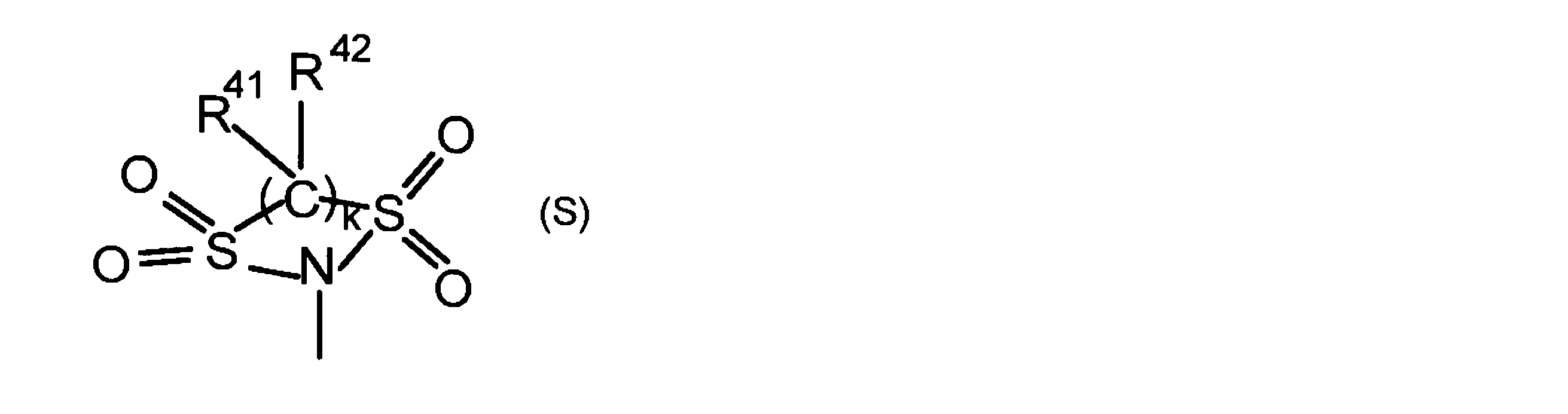
R21とR22、R22とR25、およびR21とR23は、互いに連結して窒素原子と共に員数が5または6のそれぞれ複素環A、複素環B、および複素環Cを形成してもよい。
複素環Aが形成される場合のR21とR22は、これらが結合した2価の基-Q-として、水素原子が炭素数1~6のアルキル基、炭素数6~10のアリール基または置換基を有していてもよい炭素数1~10のアシルオキシ基で置換されてもよいアルキレン基、またはアルキレンオキシ基を示す。
複素環Aが形成される場合のR21とR22は、これらが結合した2価の基-Q-として、水素原子が炭素数1~6のアルキル基、炭素数6~10のアリール基または置換基を有していてもよい炭素数1~10のアシルオキシ基で置換されてもよいアルキレン基、またはアルキレンオキシ基を示す。
複素環Bが形成される場合のR22とR25、および複素環Cが形成される場合のR21とR23は、これらが結合したそれぞれ2価の基-X1-Y1-および-X2-Y2-(窒素に結合する側がX1およびX2)として、X1およびX2がそれぞれ下記式(1x)または(2x)で示される基であり、Y1およびY2がそれぞれ下記式(1y)~(5y)から選ばれるいずれかで示される基である。X1およびX2が、それぞれ下記式(2x)で示される基の場合、Y1およびY2はそれぞれ単結合であってもよく、その場合、炭素原子間に酸素原子を有してもよい。
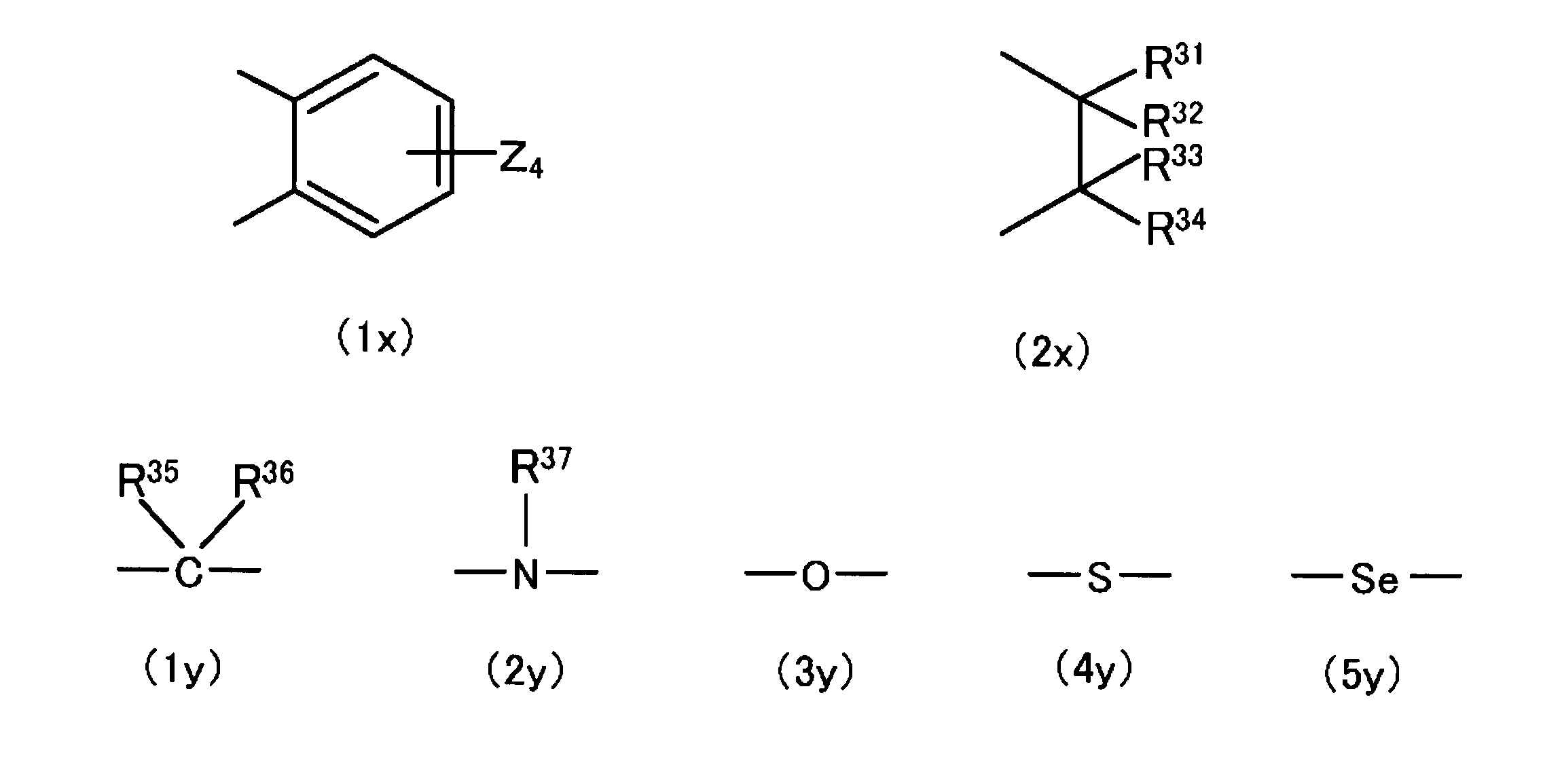
式(1x)中、4個のZは、それぞれ独立して水素原子、水酸基、炭素数1~6のアルキル基もしくはアルコキシ基、または-NR38R39(R38およびR39は、それぞれ独立して、水素原子または炭素数1~20のアルキル基を示す)を示す。R31~R36はそれぞれ独立して水素原子、炭素数1~6のアルキル基または炭素数6~10のアリール基を、R37は炭素数1~6のアルキル基または炭素数6~10のアリール基を示す。
R27、R28、R29、R31~R37、複素環を形成していない場合のR21~R23、およびR25は、これらのうちの他のいずれかと互いに結合して5員環または6員環を形成してもよい。R31とR36、R31とR37は直接結合してもよい。
複素環を形成していない場合の、R21およびR22は、それぞれ独立して、水素原子、置換基を有していてもよい炭素数1~6のアルキル基もしくはアリル基、または置換基を有していてもよい炭素数6~11のアリール基もしくはアルアリール基を示す。複素環を形成していない場合の、R23およびR25は、それぞれ独立して、水素原子、ハロゲン原子、または、炭素数1~6のアルキル基もしくはアルコキシ基を示す。
複素環を形成していない場合の、R21およびR22は、それぞれ独立して、水素原子、置換基を有していてもよい炭素数1~6のアルキル基もしくはアリル基、または置換基を有していてもよい炭素数6~11のアリール基もしくはアルアリール基を示す。複素環を形成していない場合の、R23およびR25は、それぞれ独立して、水素原子、ハロゲン原子、または、炭素数1~6のアルキル基もしくはアルコキシ基を示す。

ただし、式(II)中の記号は以下のとおりである。
環Zは、それぞれ独立して、ヘテロ原子を環中に0~3個有し、かつ置換されていてもよい、5員環または6員環であり、
R1とR2、R2とR3、およびR1と環Zを構成する炭素原子またはヘテロ原子は、互いに連結して窒素原子とともにそれぞれヘテロ環A1、ヘテロ環B1およびヘテロ環C1を形成していてもよく、ヘテロ環を形成していない場合、R1およびR2は、それぞれ独立して、水素原子、ハロゲン原子、または、炭素原子間に不飽和結合、ヘテロ原子、飽和もしくは不飽和の環構造を含んでよく、置換基を有してもよい炭化水素基を示し、R3およびR4は、それぞれ独立して、水素原子、ハロゲン原子、または炭素原子間にヘテロ原子を含んでもよいアルキル基もしくはアルコキシ基を示す。
環Zは、それぞれ独立して、ヘテロ原子を環中に0~3個有し、かつ置換されていてもよい、5員環または6員環であり、
R1とR2、R2とR3、およびR1と環Zを構成する炭素原子またはヘテロ原子は、互いに連結して窒素原子とともにそれぞれヘテロ環A1、ヘテロ環B1およびヘテロ環C1を形成していてもよく、ヘテロ環を形成していない場合、R1およびR2は、それぞれ独立して、水素原子、ハロゲン原子、または、炭素原子間に不飽和結合、ヘテロ原子、飽和もしくは不飽和の環構造を含んでよく、置換基を有してもよい炭化水素基を示し、R3およびR4は、それぞれ独立して、水素原子、ハロゲン原子、または炭素原子間にヘテロ原子を含んでもよいアルキル基もしくはアルコキシ基を示す。
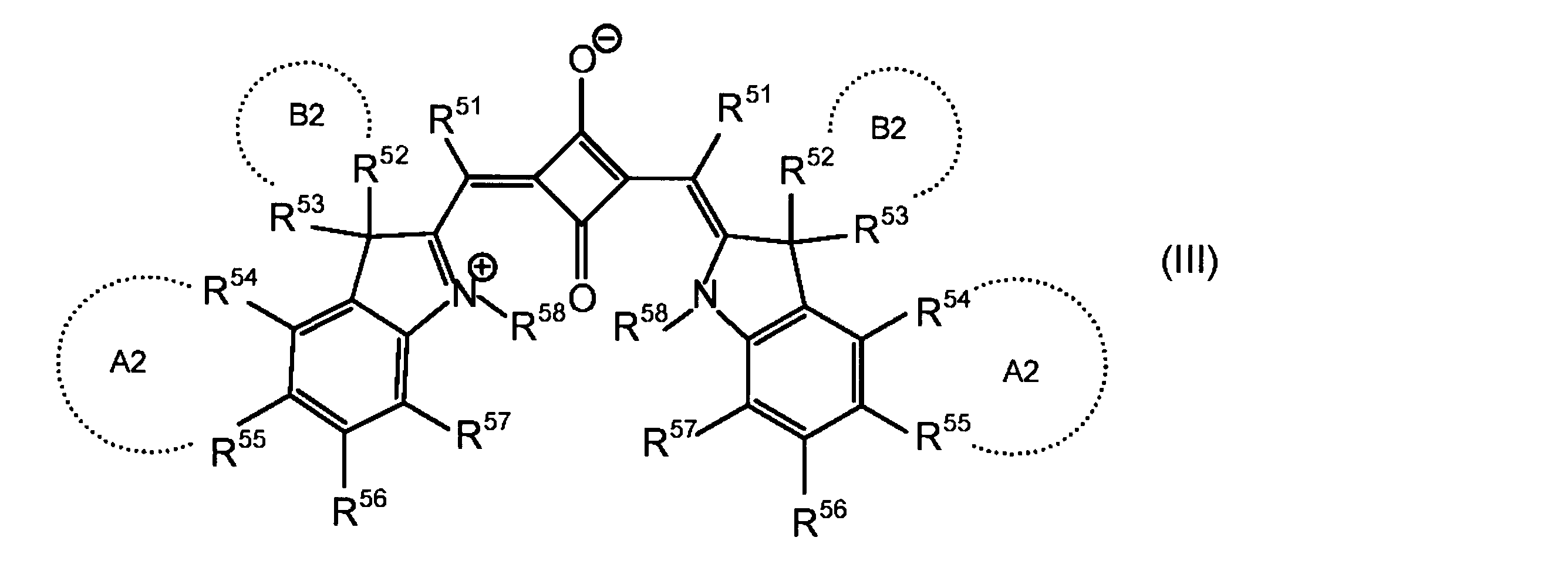
ただし、式(III)中の記号は以下のとおりである。
R51は、それぞれ独立にハロゲン原子、または、置換基を有してもよい炭素数1~3のアルキル基を示し、
R52~R58は、それぞれ独立に水素原子、ハロゲン原子、または、置換基を有してもよい炭素数1~10のアルキル基を示す。
R52とR53は、互いに連結して、炭素数5~15の飽和または不飽和の炭化水素環B2を形成していてもよく、炭化水素環B2の水素原子は炭素数1~10のアルキル基に置換されていてもよく、
R54とR55は、互いに連結してベンゼン環A2を形成していてもよく、ベンゼン環A2の水素原子は炭素数1~10のアルキル基に置換されていてもよい。
R51は、それぞれ独立にハロゲン原子、または、置換基を有してもよい炭素数1~3のアルキル基を示し、
R52~R58は、それぞれ独立に水素原子、ハロゲン原子、または、置換基を有してもよい炭素数1~10のアルキル基を示す。
R52とR53は、互いに連結して、炭素数5~15の飽和または不飽和の炭化水素環B2を形成していてもよく、炭化水素環B2の水素原子は炭素数1~10のアルキル基に置換されていてもよく、
R54とR55は、互いに連結してベンゼン環A2を形成していてもよく、ベンゼン環A2の水素原子は炭素数1~10のアルキル基に置換されていてもよい。
化合物(I)としては、例えば、式(I-1)~(I-4)のいずれかで示される化合物が挙げられる。
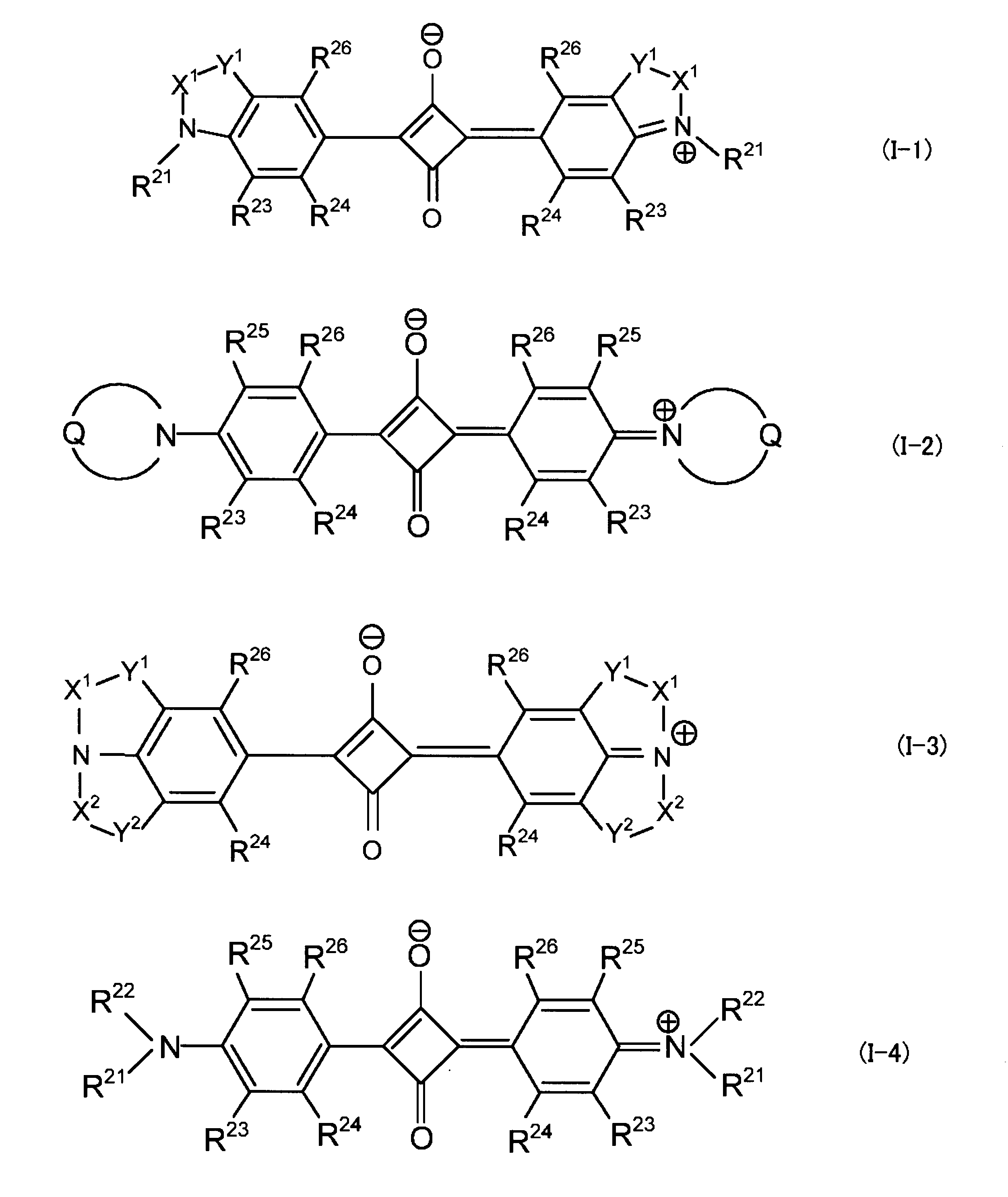
ただし、式(I-1)~式(I-4)中の記号は、式(I)における同記号の各規定と同じであり、好ましい態様も同様である。
化合物(I-1)~(I-4)のうちでも、色素(A)としては、吸収層の可視光透過率を高くできる観点から化合物(I-1)~(I-3)が好ましく、化合物(I-1)が特に好ましい。
化合物(I-1)において、X1としては、基(2x)が好ましく、Y1としては、単結合または基(1y)が好ましい。この場合、R31~R36としては、水素原子または炭素数1~3のアルキル基が好ましく、水素原子またはメチル基がより好ましい。なお、-Y1-X1-として、具体的には、式(11-1)~(12-3)で示される2価の有機基が挙げられる。
-C(CH3)2-CH(CH3)- …(11-1)
-C(CH3)2-CH2- …(11-2)
-C(CH3)2-CH(C2H5)- …(11-3)
-C(CH3)2-C(CH3)(nC3H7)- …(11-4)
-C(CH3)2-CH2-CH2- …(12-1)
-C(CH3)2-CH2-CH(CH3)- …(12-2)
-C(CH3)2-CH(CH3)-CH2- …(12-3)
-C(CH3)2-CH2- …(11-2)
-C(CH3)2-CH(C2H5)- …(11-3)
-C(CH3)2-C(CH3)(nC3H7)- …(11-4)
-C(CH3)2-CH2-CH2- …(12-1)
-C(CH3)2-CH2-CH(CH3)- …(12-2)
-C(CH3)2-CH(CH3)-CH2- …(12-3)
また、化合物(I-1)において、R21は、溶解性、耐熱性、さらに分光透過率曲線における可視域と近赤外域の境界付近の変化の急峻性の観点から、独立して、式(4-1)または(4-2)で示される基がより好ましい。
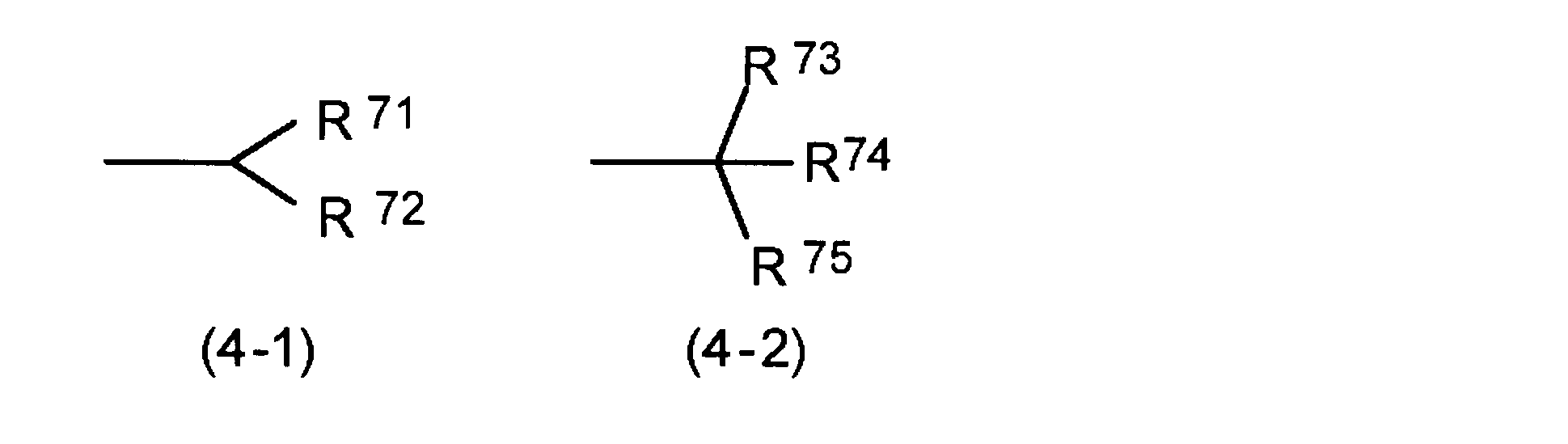
式(4-1)および式(4-2)中、R71~R75は、独立して、水素原子、ハロゲン原子、または炭素数1~4のアルキル基を示す。
化合物(I-1)において、R24は-NR27R28が好ましい。-NR27R28としては、ホスト溶媒や透明樹脂への溶解性の観点から、-NH-C(=O)-R29が好ましい。化合物(I-1)において、R24が-NH-C(=O)-R29の化合物を式(I-11)に示す。

化合物(I-11)における、R23およびR26は、独立して、水素原子、ハロゲン原子、または炭素数1~6のアルキル基もしくはアルコキシ基が好ましく、いずれも水素原子がより好ましい。
化合物(I-11)において、R29としては、置換基を有していてもよい炭素数1~20のアルキル基、置換基を有していてもよい炭素数6~10のアリール基、または置換基を有していてもよく、炭素原子間に酸素原子を有していてもよい炭素数7~18のアルアリール基が好ましい。置換基としては、フッ素原子等のハロゲン原子、水酸基、カルボキシ基、スルホ基、シアノ基、炭素数1~6のアルキル基、炭素数1~6のフロロアルキル基、炭素数1~6のアルコキシ基、炭素数1~6のアシルオキシ基等が挙げられる。
R29としては、フッ素原子で置換されてもよい直鎖状、分岐鎖状、環状の炭素数1~17のアルキル基、炭素数1~6のフロロアルキル基および/または炭素数1~6のアルコキシ基で置換されてもよいフェニル基、および炭素原子間に酸素原子を有していてもよい炭素数7~18の、末端に炭素数1~6のフッ素原子で置換されていてもよいアルキル基および/または、炭素数1~6のアルコキシ基で置換されてもよいフェニル基を有するアルアリール基から選ばれる基が好ましい。
R29としては、独立して1つ以上の水素原子がハロゲン原子、水酸基、カルボキシ基、スルホ基、またはシアノ基で置換されていてもよく、炭素原子間に不飽和結合、酸素原子、飽和もしくは不飽和の環構造を含んでよい、少なくとも1以上の分岐を有する炭素数5~25の炭化水素基である基も好ましく使用できる。このようなR29としては、例えば、下記式(11a)、(11b)、(12a)~(12e)、(13a)~(13e)で示される基が挙げられる。
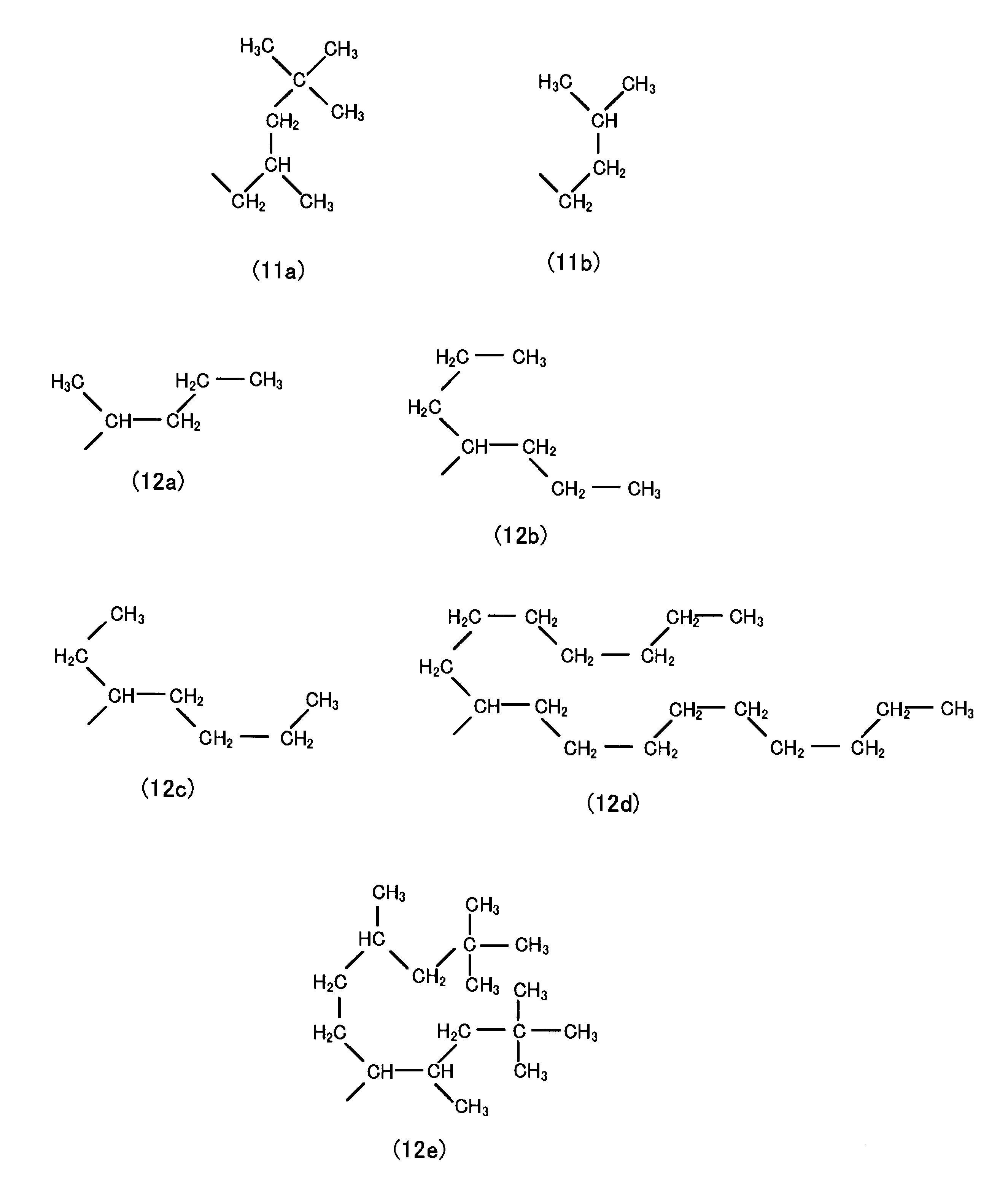

化合物(I-11)としては、より具体的に、以下の表10に示す化合物が挙げられる。なお、表10において、基(11-1)を(11-1)と示す。他の基についても同様である。以下の他の表においても基の表示は同様である。また、表10に示す化合物は、いずれもスクアリリウム骨格の左右において各記号の意味は同一である。以下の他の表に示すスクアリリウム色素においても同様である。
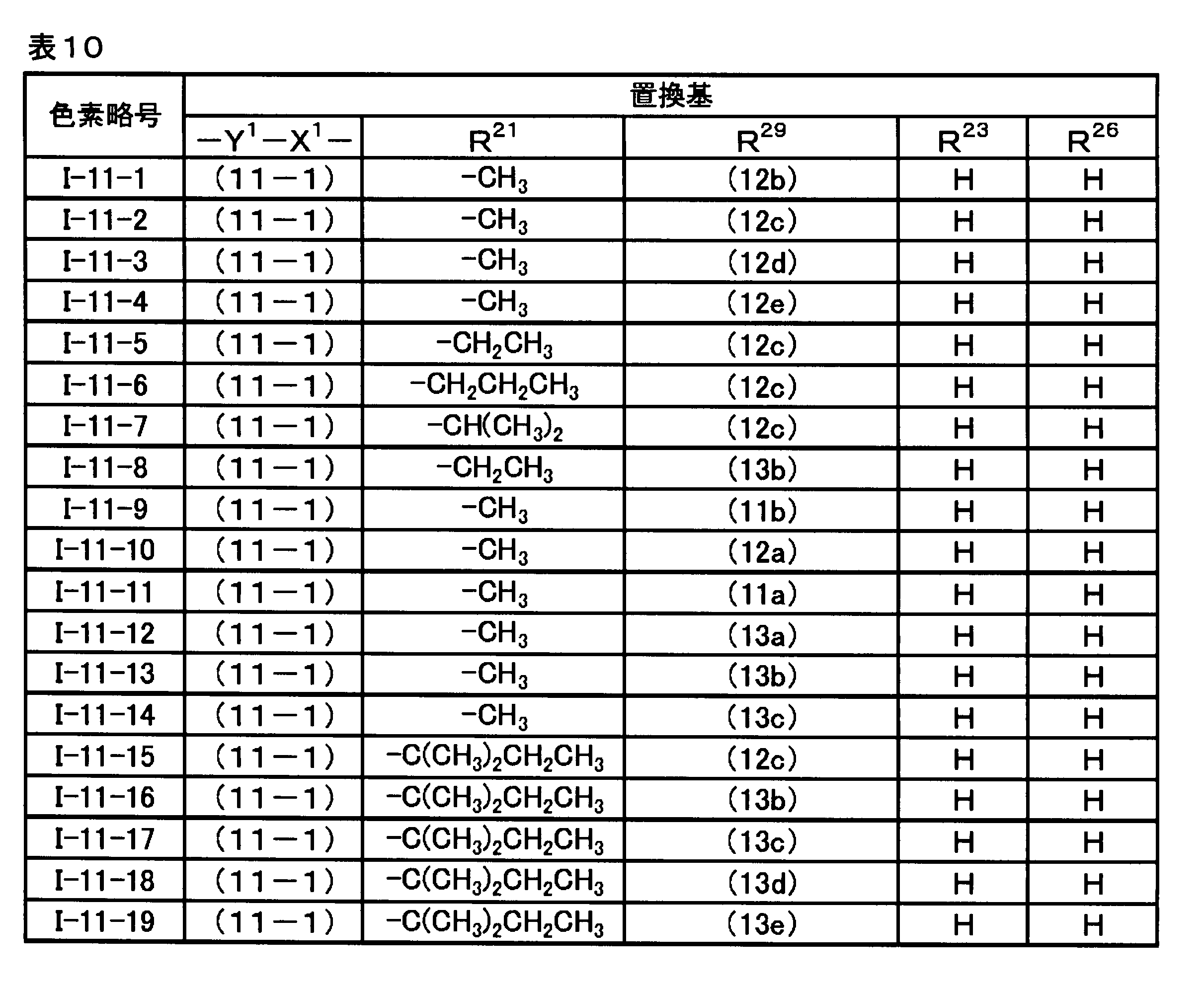
化合物(I-1)において、R24は、可視光の透過率、特に波長430~550nmの光の透過率を高める観点から、-NH-SO2-R30が好ましい。化合物(I-1)において、R24が-NH-SO2-R30の化合物を式(I-12)に示す。
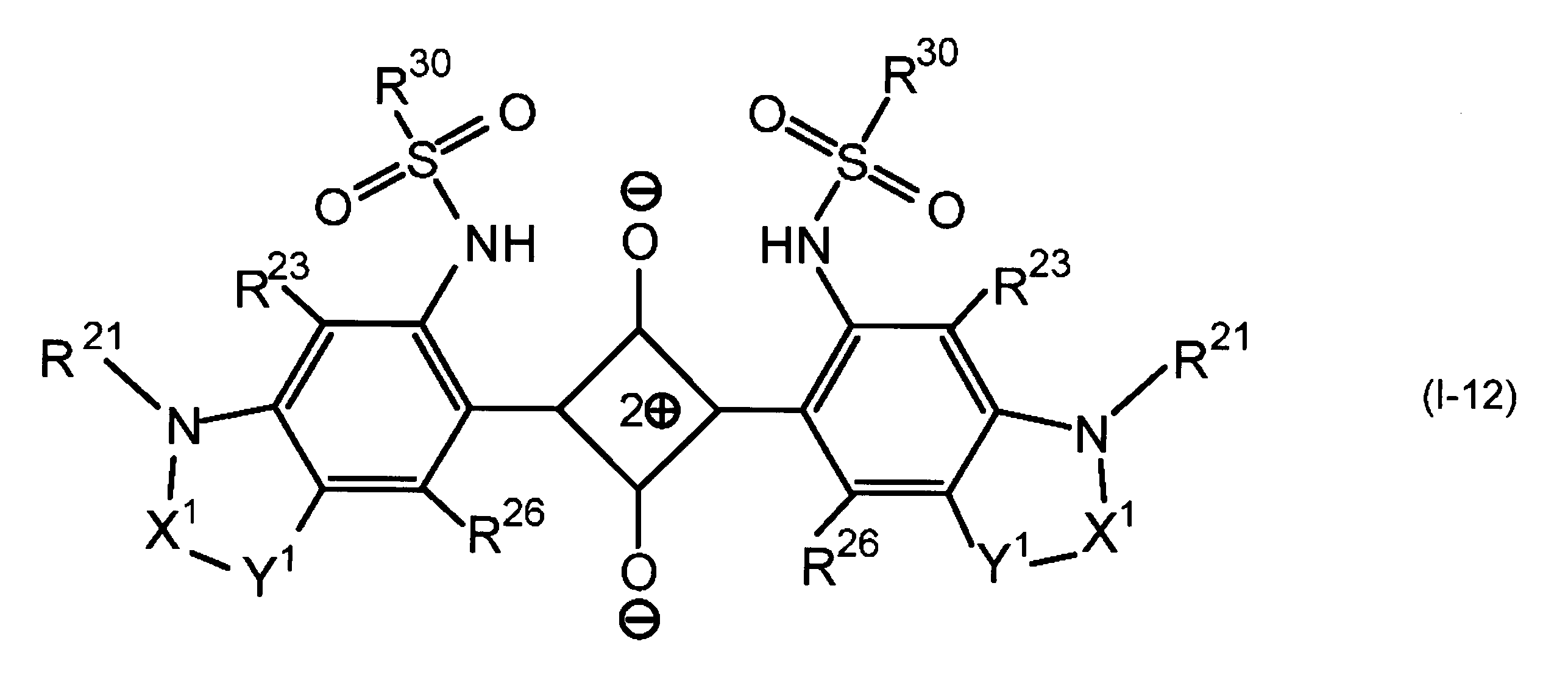
化合物(I-12)における、R23およびR26は、独立して、水素原子、ハロゲン原子、または炭素数1~6のアルキル基もしくはアルコキシ基が好ましく、いずれも水素原子がより好ましい。
化合物(I-12)において、R30は耐光性の点から、独立して、分岐を有してもよい炭素数1~12のアルキル基もしくはアルコキシ基、または不飽和の環構造を有する炭素数6~16の炭化水素基が好ましい。不飽和の環構造としては、ベンゼン、トルエン、キシレン、フラン、ベンゾフラン等が挙げられる。R30は、独立して、分岐を有してもよい炭素数1~12のアルキル基もしくはアルコキシ基がより好ましい。なお、R30を示す各基において、水素原子の一部または全部がハロゲン原子、特にはフッ素原子に置換されていてもよい。なお、本フィルタが透明基板を含む構成の場合、水素原子のフッ素原子へ置換は、色素(I-12)を含有する吸収層と透明基板との密着性が落ちない程度とする。
不飽和の環構造を有するR30として具体的には、下記式(P2)、(P3)、(P7)、(P8)、(P10)~(P13)で示される基が挙げられる。

化合物(I-12)としては、より具体的に、以下の表11に示す化合物が挙げられる。
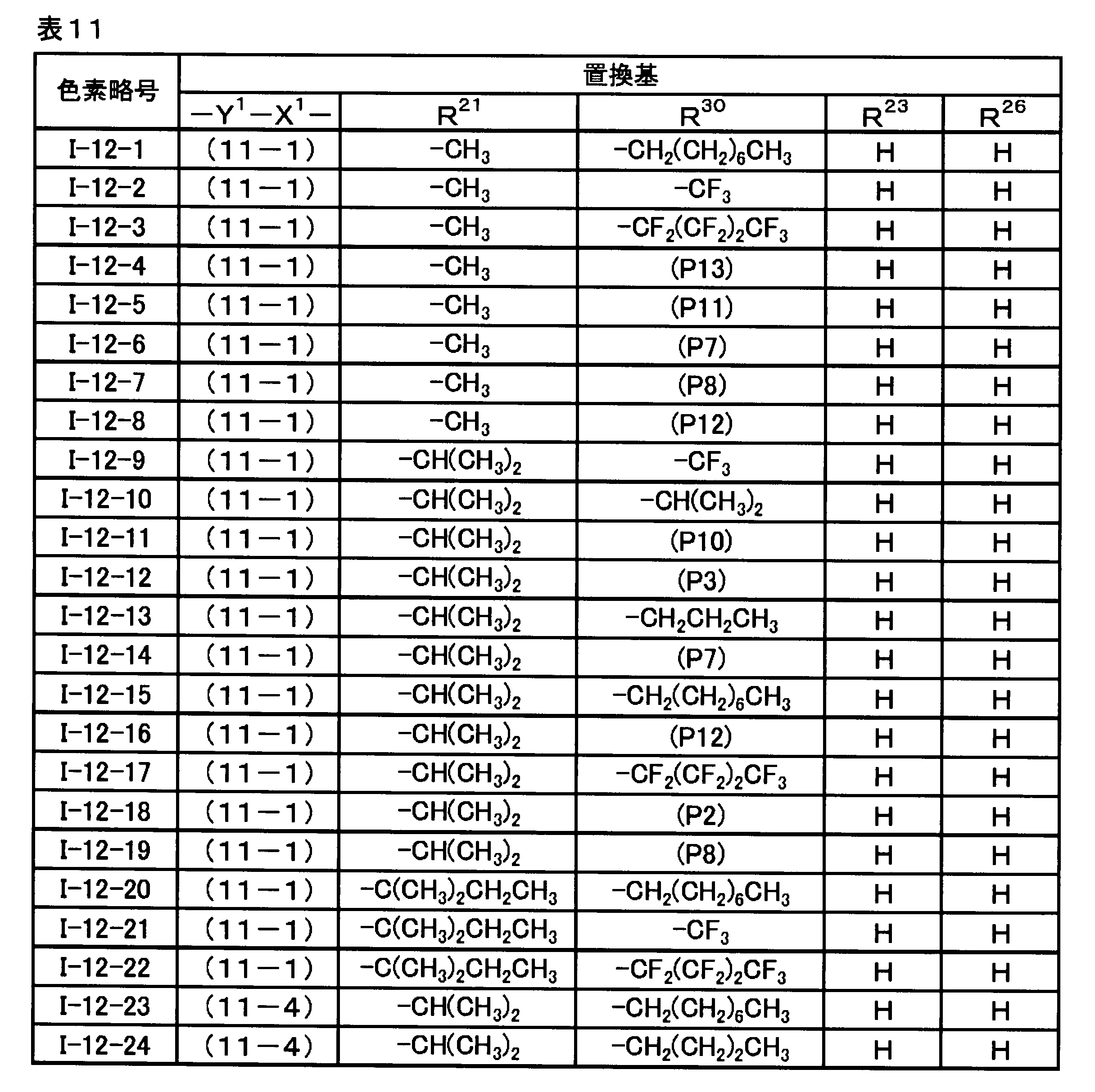
化合物(I)~(III)は、それぞれ公知の方法で、製造できる。化合物(I)について、化合物(I-11)は、例えば、米国特許第5,543,086号明細書に記載された方法で製造できる。化合物(I-12)は、例えば、米国特許出願公開第2014/0061505号明細書、国際公開第2014/088063号に記載された方法で製造可能である。化合物(II)については、国際公開第2017/135359号に記載された方法で製造可能である。
色素(A)であるジイモニウム色素として、下記式(Aimo)で示される色素(A)が挙げられる。

式(Aimo)中、X-は陰イオンを表し、例えば、Cl-、Br-、I-、F-、ClO4
-、BF4
-、PF6
-、SbF6
-、CF3SO3
-、CH3C6H4SO3
-、(RfSO2)2N-、(RfSO2)3C-等を挙げられる。これらのなかでも、(RfSO2)2N-、(RfSO2)3C-が好ましく、(RfSO2)2N-がより好ましい。
ここで、Rfは、炭素数1~4のフルオロアルキル基であり、炭素数1~2のフルオロアルキル基であることが好ましく、炭素数1のフルオロアルキル基であることがより好ましい。炭素数が上記範囲内であると、耐熱性、耐湿性等の耐久性、および後述する有機溶媒への溶解性が良好である。このようなRfとしては、例えば、-CF3、-C2F5、-C3F7、-C4F9等のパーフルオロアルキル基、-C2F4H、-C3F6H、-C2F8H等が挙げられる。
耐湿性の観点からは、上記フルオロアルキル基は、パーフルオロアルキル基であることが好ましく、トリフルオロメチル基であることがより好ましい。
式(Aimo)中、R81~R88は、水素原子、アルキル基、アリ-ル基、アルケニル基、またはアルキニル基を表わし、それぞれ同じであっても、異なっていてもよい。また、R89~R92は、水素原子、ハロゲン原子、アミノ基、シアノ基、ニトロ基、カルボキシル基、アルキル基、またはアルコキシ基を表わし、それぞれ同じであっても、異なっていてもよい。
R81~R88の具体例としては、アルキル基として、例えば、メチル基、エチル基、n-プロピル基、iso-プロピル基、n-ブチル基、s-ブチル基、iso-ブチル基、t-ブチル基、n-ペンチル基、t-ペンチル基、n-アミル基、n-ヘキシル基、n-オクチル基、t-オクチル基等が挙げられる。
これらのアルキル基は、アルコキシカルボニル基、ヒドロキシル基、スルホ基、カルボキシル基、シアノ基等の置換基を有していてもよい。置換基を有する場合のR81~R88の具体例としては、2-ヒドロキシエチル基、2-シアノエチル基、3-ヒドロキシプロピル基、3-シアノプロピル基、メトキシエチル基、エトキシエチル基、ブトキシエチル基等が挙げられる。
アリール基としては、例えば、フェニル基、フルオロフェニル基、クロロフェニル基、トリル基、ジエチルアミノフェニル基、ナフチル基、ベンジル基、p-クロロベンジル基、p-フロロベンジル基、p-メチルベンジル基、2-フェニルメチル基、2-フェニルプロピル基、3-フェニルプロピル基、α-ナフチルメチル基、β-ナフチルエチル基等が挙げられる。これらのアリール基は、ヒドロキシル基、カルボキシ基等の置換基を有し
てもよい。
てもよい。
アルケニル基としては、ビニル基、プロペニル基、ブテニル基、ペンテニル基、ヘキセニル基、ヘプテニル基、オクテニル基等が挙げられる。これらのアルケニル基は、ヒドロキシル基、カルボキシ基等の置換基を有してもよい。
アルキニル基としては、例えば、プロピニル基、ブチニル基、2-クロロブチニル基、ペンチニル基、ヘキシニル基等が挙げられる。これらのアルキニル基は、ヒドロキシル基、カルボキシ基等の置換基を有してもよい。
これらの中でも、炭素数4~6の直鎖状または分岐状のアルキル基が好ましい。炭素数4以上とすることにより、有機溶媒に対する溶解性が良好になり、炭素数6以下とすることにより耐熱性が向上する。耐熱性が向上する理由としては、このジイモニウム系色素の融点が上昇するからと考えられる。
R89~R92の具体例としては、水素原子、フッ素原子、塩素原子、臭素原子、ジエチルアミノ基、ジメチルアミノ基、シアノ基、ニトロ基、メチル基、エチル基、プロピル基、トリフルオロメチル基、メトキシ基、エトキシ基、プロポキシ基等が挙げられる。
上記式(Aimo)で表されるジイモニウム色素の市販品を例示すると、例えば、日本化薬(株)製のKayasorbIRG-022、同IRG-023、同IRG-024、同IRG-068、同IRG-069、同IRG-079、日本カーリット(株)製のCIR-1081、CIR-1083、CIR-1085、CIR-RL(以上、いずれも商品名)等が挙げられる。
色素(A)であるジイモニウム色素として、典型的には、下記式(Dim01)で示される色素(A)が挙げられる。

吸収層は、色素(A)の1種を単独で含有してもよく、2種以上を組み合わせて含有してもよい。2種以上を含有する場合、各色素(A)の最大吸収波長λmax(A)DCMが異なることが好ましい。2種以上の色素(A)における最大吸収波長λmax(A)DCMの差は、例えば、50~300nmの範囲が好ましく、50~200nmがより好ましい。なお、色素(A)が2種以上の化合物からなる場合は、個々の化合物が色素(A)の性質を必ずしも有する必要はなく、混合物として、色素(A)の性質を有すればよい。
色素(A)の好ましい2種以上の組み合わせとしては、例えば、色素(A)のうち比較的短波長側に最大吸収波長を有する色素(A)を色素Sとし、比較的長波長側に最大吸収波長を有する色素(A)を色素Lとし、色素Sと色素Lの最大吸収波長の間に最大吸収波長を有する色素(A)を色素Mとして、色素S、色素Mおよび色素Lから2種以上を選択して組み合わせるのが好ましい。
具体的には、色素Sと色素Mの組み合わせ、色素Sと色素Lの組み合わせ、色素Mと色素Lの組み合わせ、色素Sと色素Mと色素Lの組み合わせが挙げられる。なお、色素Sの最大吸収波長λmax(A)DCMは、650~750nmの波長領域にあるのが好ましく、680~730nmの波長領域にあるのがより好ましい。色素Mの最大吸収波長λmax(A)DCMは、800~1100nmの波長領域にあるのが好ましく、830~960nmの波長領域にあるのがより好ましい。色素Lの最大吸収波長λmax(A)DCMは、1100~1200nmの波長領域にあるのが好ましく、1100~1150nmの波長領域にあるのがより好ましい。
この場合、色素Mが上記(4-1)を満足する色素(A)に相当する。また、色素Sが上記(5-1)を満足する色素(A)に相当する。
その他のNIR吸収色素としては、例えば、クロコニウム色素、フタロシアニン色素、ナフタロシアニン色素、ジチオール金属錯体色素、ポリメチン色素、フタリド色素、ナフトキノン色素、アントラキノン色素、インドフェノール色素、およびジケトピロロピロール色素が挙げられる。
UV吸収色素は、具体例に、オキサゾール色素、メロシアニン色素、シアニン色素、ナフタルイミド色素、オキサジアゾール色素、オキサジン色素、オキサゾリジン色素、ナフタル酸色素、スチリル色素、アントラセン色素、環状カルボニル色素、トリアゾール色素等の色素が挙げられる。この中でも、オキサゾール色素、メロシアニン色素の色素が好ましい。また、UV吸収色素は、吸収層に1種を単独で用いてもよく、2種以上を併用してもよい。
[樹脂(B)]
樹脂(B)は、Tgが130℃以上である。Tgは、DSC測定(Differential Scanning Calorimetry)により求められる。樹脂(B)のTgが130℃以上であれば、吸収層は、色素(A)の耐光性を劣化させることが殆どなく、また、高温使用において色素(A)の光学特性を維持する耐熱性に優れる。さらに、好ましい態様において、熱や応力による変形が生じにくく、本フィルタにおいて、第1または第2のガラス基材や誘電体多層膜との密着性に優れる。Tgは、140℃以上が好ましく、150℃以上がより好ましい。樹脂(B)において、Tgの上限は特にないが、成形加工性等の観点から、Tgは400℃以下が好ましい。
樹脂(B)は、Tgが130℃以上である。Tgは、DSC測定(Differential Scanning Calorimetry)により求められる。樹脂(B)のTgが130℃以上であれば、吸収層は、色素(A)の耐光性を劣化させることが殆どなく、また、高温使用において色素(A)の光学特性を維持する耐熱性に優れる。さらに、好ましい態様において、熱や応力による変形が生じにくく、本フィルタにおいて、第1または第2のガラス基材や誘電体多層膜との密着性に優れる。Tgは、140℃以上が好ましく、150℃以上がより好ましい。樹脂(B)において、Tgの上限は特にないが、成形加工性等の観点から、Tgは400℃以下が好ましい。
樹脂(B)は、ジクロロメタン中で光学特性(1-1)~(1-4)を満足する色素(A)との関係において、(1’-1)から(1’-5)の要件を満足できる樹脂が好ましい。
樹脂(B)は、色素(A)の種類に応じて、例えば、アクリル樹脂、エポキシ樹脂、エン・チオール樹脂、ポリカーボネート樹脂、ポリエーテル樹脂、ポリアリレート樹脂、ポリサルホン樹脂、ポリエーテルサルホン樹脂、ポリパラフェニレン樹脂、ポリアリーレンエーテルフォスフィンオキシド樹脂、ポリイミド樹脂、ポリアミドイミド樹脂、ポリオレフィン樹脂、シクロオレフィン樹脂、およびポリエステル樹脂等から選ばれる1種以上が使用される。
樹脂(B)は、主鎖にエステル結合、カーボネート結合およびイミド結合から選ばれる少なくとも1種の結合を有する樹脂(B)を含むことが好ましい。主鎖にこれらの結合を有する樹脂(B)は、色素(A)を混ぜた際の可視高透過率の維持と樹脂自体の耐熱性が優れている点で優位である。
樹脂(B)は、これらのなかでも、ポリイミド樹脂、ポリエステル樹脂、ポリカーボネート樹脂およびシクロオレフィン樹脂が好ましい。これらの樹脂は1種を単独で使用してもよく、2種以上を混合して使用してもよい。色素(A)が色素(ACi)~色素(ACiii)、色素(ASi)~色素(ASiii)である場合、特に、ポリイミド樹脂、ポリエステル樹脂、ポリカーボネート樹脂およびシクロオレフィン樹脂が好ましい。
樹脂(B)としては、市販品を用いてもよい。市販品としては、ポリエステル樹脂として、OKP4HT、OKP4、B-OKP2、OKP-850(以上、いずれも大阪ガスケミカル(株)製、商品名)、バイロン(登録商標)103(東洋紡(株)製、商品名)等が挙げられる。
ポリカーボネート樹脂として、LeXan(登録商標)ML9103(sabic社製、商品名)、EP5000(三菱ガス化学(株)製、商品名)、SP3810(帝人(株)製、商品名)、SP1516(帝人(株)製、商品名)、TS2020(帝人(株)製、商品名)、xylex(登録商標)7507(sabic社製、商品名)等が挙げられる。
ポリイミド樹脂として、ポリイミド樹脂ワニスのネオプリム(登録商標)C-3650(三菱ガス化学(株)製、商品名)、同C-3G30(三菱ガス化学(株)製、商品名)、同C-3450(三菱ガス化学(株)製、商品名)、JL-20(新日本理化製、商品名)、FPC-0220(三菱ガス化学(株)製、商品名)(これらのポリイミド樹脂には、シリカが含まれていてもよい)等が挙げられる。シクロオレフィン樹脂として、ARTON(JSR社製、商品名)等が挙げられる。
樹脂(B)の屈折率は、特に制限されない。具体的には、1.45~1.70が好ましく、1.50~1.65がより好ましい。
吸収層は、さらに、本発明の効果を損なわない範囲で、密着性付与剤、色調補正色素、レベリング剤、帯電防止剤、熱安定剤、光安定剤、酸化防止剤、分散剤、難燃剤、滑剤、可塑剤等の任意成分を有してもよい。
吸収層は、可視光の高い透過性を維持する観点から、上記した色素(A)、その他のNIR吸収色素、UV色素等の色素と樹脂(B)のみで構成されるのが好ましい。
吸収層において色素(A)の含有量は、本フィルタの設計に応じて本フィルタの効果を発揮できるように適宜設定される。吸収層において色素(A)の含有量は、可視光の透過率を確保しつつ、近赤外光、特に、長波長域の近赤外光を遮光する観点から、樹脂(B)100質量部に対して1~15質量部が好ましく、溶解性の観点から1~8質量部がより好ましい。
色素(A)において、色素S、色素Mおよび色素Lから選ばれる2種以上を用いる場合、各色素の含有量は、色素(A)全体の合計含有量を上記範囲とした上で、樹脂(B)100質量部に対して1~15質量部が好ましく、溶解性の観点から2~13質量部がより好ましい。
本フィルタにおいて、吸収層の厚さは、0.1~100μmが好ましい。吸収層が複数層からなる場合、各層の合計の厚さは、0.1~100μmが好ましい。厚さが0.1μm未満では、所望の光学特性を十分に発現できないおそれがあり、厚さが100μm超では、層の平坦性が低下し、吸収率の面内バラツキが生じるおそれがある。吸収層の厚さは、0.3~50μmがより好ましい。また、反射層や、反射防止層等の他の機能層を備えた場合、その材質によっては、吸収層が厚すぎると割れ等が生ずるおそれがある。そのため、吸収層の厚さは、0.3~10μmがより好ましい。
吸収層は、例えば、色素(A)と、樹脂(B)または樹脂(B)の原料成分と、必要に応じて配合される各成分とを、ホスト溶媒に溶解または分散させて塗工液を調製し、これを基材に塗工し乾燥させ、さらに必要に応じて硬化させて形成できる。上記基材は、本フィルタに含まれる第1または第2のガラス基板でもよいし、吸収層を形成する際にのみ使用する剥離性の基材でもよい。また、ホスト溶媒は、安定に分散できる分散媒または溶解できる溶媒であればよい。
また、塗工液は、微小な泡によるボイド、異物等の付着による凹み、乾燥工程でのはじき等の改善のため界面活性剤を含んでもよい。さらに、塗工液の塗工には、例えば、浸漬コーティング法、キャストコーティング法、またはスピンコート法等を使用できる。上記塗工液を基材上に塗工後、乾燥させることにより吸収層が形成される。また、塗工液が樹脂(B)の原料成分を含有する場合、さらに熱硬化、光硬化等の硬化処理を行う。
また、吸収層は、押出成形によりフィルム状に製造可能でもあり、このフィルムを他の部材に積層し熱圧着等により一体化させてもよい。例えば、本フィルタにおける第1または第2のガラス基板上に、このフィルムを貼着してもよい。
(接着剤層)
本フィルタにおいて、接着剤層は任意の構成要素である。本フィルタが接着剤層を有する場合、接着剤層は、吸収層と第1のガラス基材の間および吸収層と第2のガラス基材の間の少なくとも一方に設けられ、これらの部材を互いに接着して一体化する機能を有する。接着剤層は光硬化材料または熱硬化材料を含む接着剤層であれば、特に制限なく使用できる。接着剤層は、本フィルタが透過すべき所定の波長の光、例えば、固体撮像素子が信号光として受光する波長域の光に対して透明であることが好ましい。
本フィルタにおいて、接着剤層は任意の構成要素である。本フィルタが接着剤層を有する場合、接着剤層は、吸収層と第1のガラス基材の間および吸収層と第2のガラス基材の間の少なくとも一方に設けられ、これらの部材を互いに接着して一体化する機能を有する。接着剤層は光硬化材料または熱硬化材料を含む接着剤層であれば、特に制限なく使用できる。接着剤層は、本フィルタが透過すべき所定の波長の光、例えば、固体撮像素子が信号光として受光する波長域の光に対して透明であることが好ましい。
接着剤層は、熱硬化性材料または光硬化性材料を用いて、加熱または紫外線等の光照射によりこれらの硬化性材料を重合固化して形成される。熱硬化性材料に比べて光硬化性材料は重合固化が短時間で完了し、生産性が高い。さらに、光硬化性材料は、硬化の際に光学素子を構成する他の部材が熱による影響を受けにくいため、耐熱性の低い部材を含む場合に有利である。
光硬化性材料としては紫外線硬化性材料が好ましく、紫外線硬化性材料を用いる場合は、光重合開始剤を添加することが好ましい。紫外線硬化性材料に対する、光照射波長や重合感度は、紫外線硬化性材料の種類、または、光重合開始剤の種類に依存する。紫外線硬化性材料を用いる場合、照射光としては、250~400nmの波長域の光が用いられ、HgXe放電ランプの発光強度が高いi線(365nm)近傍の光が多く用いられる。
熱硬化性材料としては、例えば、Epoxy Technology Inc.社のエポキシ系EPO-TEK#301、#301-2、#310M-1等が使用可能である。光硬化性材料としては、例えば、紫外線硬化性材料として、Norland-Products社のメルカプトエステル系NOA60シリーズやエヌ・ティ・ティ・アドバンステクノロジ(株)社のエポキシ系AT3925M、3727E、アクリレート系#18165、#6205等、電気化学工業(株)社製のエン-チオール系OP-1020K、OP-1030K、OP-1045K等、東亜合成(株)社製のアクリレート系のアロニックスLCR-0631、LCR-0632等が使用可能である。
接着剤層は、光および/または熱で硬化する硬化性材料が硬化した硬化材料を含む層である。接着剤層は必要に応じて、本発明の効果を損なわない範囲で、硬化材料以外に非硬化材料からなる各種添加剤、例えば、UV吸収剤、NIR吸収剤等の吸収剤、重合開始剤や重合禁止剤を含んでもよい。
接着剤層の屈折率は、第1のガラス基材、第2のガラス基材、および吸収層が含有する樹脂(B)の屈折率との差が少ないことが好ましい。接着剤層の屈折率は、具体的には、1.45~1.70が好ましく、1.5~1.65がより好ましい。
接着剤層は、好ましくは本フィルタが透過すべき所定の波長の光に対して透明である。本フィルタが用いられる光学装置によるが、一般的には少なくとも可視光に対して高透過性を示すとよい。また、接着剤層の厚さは、透明性、接着強度、生産性等の観点から0.5~20μmが好ましく、0.5~10μmがより好ましい。
なお、紫外線硬化性材料を用いて接着剤層を形成する場合、紫外線硬化性材料を硬化させるためのUVの照射は、吸収層とは反対側から行うのが好ましい。例えば、図2に示す光学フィルタ10Bや図3に示す光学フィルタ10Cにおいては、第2のガラス基材2B側からUVを照射して接着剤層3を硬化させるのが好ましい。
(誘電体多層膜)
本フィルタにおいて、誘電体多層膜は任意の構成要素である。誘電体多層膜は、反射防止層であってもよく、特定の波長域の光を遮蔽する機能を有する反射層であってもよい。誘電体多層膜は、吸収層と接着剤層の間に設けられる場合、接着剤層から吸収層を保護する機能をさらに有する。
本フィルタにおいて、誘電体多層膜は任意の構成要素である。誘電体多層膜は、反射防止層であってもよく、特定の波長域の光を遮蔽する機能を有する反射層であってもよい。誘電体多層膜は、吸収層と接着剤層の間に設けられる場合、接着剤層から吸収層を保護する機能をさらに有する。
本フィルタにおいて、第1または第2のガラス基材が近赤外線吸収ガラス基材、特には、(2-1)および(2-2)の要件を満足する近赤外線吸収ガラス基材である場合には、誘電体多層膜は、反射防止層であるのが好ましい。本フィルタにおいて、第1のガラス基材および第2のガラス基材が近赤外線吸収ガラス基材でない場合には、誘電体多層膜は、反射層として吸収層と相互に機能することで、本フィルタにより高いNIR遮蔽性を付与する構成であってもよく、反射防止層であってもよい。
反射防止層は、特に可視光の反射を効果的に防止するものが好ましい。反射層としては、例えば、可視光を透過し、吸収層の遮光域以外の波長の光を主に反射する波長選択性を有するものが挙げられる。反射層は、近赤外光を反射する反射領域を有することが好ましい。この場合、反射層の反射領域は、吸収層の近赤外域における遮光領域を含んでもよい。反射層は、上記特性に限らず、所定の波長域の光、例えば、近紫外域をさらに遮断する仕様に適宜設計してよい。
誘電体多層膜は、低屈折率の誘電体膜(低屈折率膜)と高屈折率の誘電体膜(高屈折率膜)とを交互に積層して構成される。高屈折率膜は、好ましくは、屈折率が1.6以上であり、より好ましくは2.2~2.5である。高屈折率膜の材料としては、例えばTa2O5、TiO2、Nb2O5が挙げられる。これらのうち、成膜性、屈折率等における再現性、安定性等の点から、TiO2が好ましい。
一方、低屈折率膜は、好ましくは、屈折率1.6未満であり、より好ましくは1.45以上1.55未満である。低屈折率膜の材料としては、例えばSiO2、SiOxNy等が挙げられる。成膜性における再現性、安定性、経済性等の点から、SiO2が好ましい。
誘電体多層膜の合計積層数や膜厚は誘電体多層膜に求められる機能に応じて設定できる。誘電体多層膜が、反射防止層の場合、合計積層数は5層~15層程度で反射防止の機能を発揮できる。また、反射防止層の場合、誘電体多層膜の膜厚は、0.5~5μmが好ましい。
誘電体多層膜が、反射層の場合、透過域と遮光域の境界波長領域で透過率が急峻に変化することが好ましい。この目的のためには、反射層を構成する誘電体多層膜の合計積層数は、15層以上が好ましく、25層以上がより好ましく、30層以上がさらに好ましい。ただし、合計積層数が多くなると、反り等が発生したり、膜厚が増加したりするため、合計積層数は100層以下が好ましく、75層以下がより好ましく、60層以下がより一層好ましい。また、誘電体多層膜の膜厚は、2~10μmが好ましい。
誘電体多層膜の形成には、例えば、CVD法、スパッタリング法、真空蒸着法等の真空成膜プロセスや、スプレー法、ディップ法等の湿式成膜プロセス等を使用できる。
本フィルタは、他の構成要素として、例えば、特定の波長域の光の透過と吸収を制御する無機微粒子等による吸収を与える構成要素(層)などを備えてもよい。無機微粒子の具体例としては、ITO(Indium Tin Oxides)、ATO(Antimony-doped Tin Oxides)、タングステン酸セシウム、ホウ化ランタン等が挙げられる。ITO微粒子、タングステン酸セシウム微粒子は、可視光の透過率が高く、かつ1200nmを超える赤外波長領域の広範囲に光吸収性を有するため、かかる赤外光の遮蔽性を必要とする場合に使用できる。
(光学フィルタの特性)
本フィルタは、第1のガラス基材と第2のガラス基材の間に吸収層を有し、これらが、それぞれ上記光学特性を有するまたは上記構成を有することで、可視光の透過性を良好に維持しながら、近赤外光の遮蔽性に優れるとともに、近赤外光の遮蔽性の耐久性、特には耐光性と、表面の硬度特性に優れる。本フィルタは、さらに、接着剤層または誘電体多層膜を有してもよい。
本フィルタは、第1のガラス基材と第2のガラス基材の間に吸収層を有し、これらが、それぞれ上記光学特性を有するまたは上記構成を有することで、可視光の透過性を良好に維持しながら、近赤外光の遮蔽性に優れるとともに、近赤外光の遮蔽性の耐久性、特には耐光性と、表面の硬度特性に優れる。本フィルタは、さらに、接着剤層または誘電体多層膜を有してもよい。
本フィルタは、表面の硬度特性に関し、具体的には、上記(3-0)の要件を満足するのが好ましい。本フィルタは、光学特性に関し、具体的には、上記(3-1)~(3-7)の要件をすべて満足することが好ましく、さらに、これらに加えて、上記(3-8)および(3-9)の要件を満足することがより好ましい。
(3-1)において、λ0-T50は550~650nmの波長領域にある。λ0-T50は、580~630nmがより好ましい。
(3-2)において、T0-ave(450-600)は60%以上である。T0-ave(450-600)0は、65%以上がより好ましい。
(3-3)において、T0-ave(700-1200)は5%以下である。T0-ave(700-1200)は、3%以下がより好ましい。
(3-4)において、λ30-T50は550~650nmの波長領域にある。λ30-T50は、580~630nmがより好ましい。
(3-5)において、T30-ave(450-600)は60%以上である。T30-ave(450-600)は、65%以上がより好ましい。
(3-6)において、λ0-T50からλ30-T50を引いた値が0nm以上10nm未満である。λ0-T50からλ30-T50を引いた値は、0nm以上6nm未満がより好ましい。
(3-7)T0-ave(450-600)からT30-ave(450-600)を引いた値が0%以上5%未満である。T0-ave(450-600)からT30-ave(450-600)を引いた値は0%以上3%未満がより好ましい。
(3-2)において、T0-ave(450-600)は60%以上である。T0-ave(450-600)0は、65%以上がより好ましい。
(3-3)において、T0-ave(700-1200)は5%以下である。T0-ave(700-1200)は、3%以下がより好ましい。
(3-4)において、λ30-T50は550~650nmの波長領域にある。λ30-T50は、580~630nmがより好ましい。
(3-5)において、T30-ave(450-600)は60%以上である。T30-ave(450-600)は、65%以上がより好ましい。
(3-6)において、λ0-T50からλ30-T50を引いた値が0nm以上10nm未満である。λ0-T50からλ30-T50を引いた値は、0nm以上6nm未満がより好ましい。
(3-7)T0-ave(450-600)からT30-ave(450-600)を引いた値が0%以上5%未満である。T0-ave(450-600)からT30-ave(450-600)を引いた値は0%以上3%未満がより好ましい。
(3-8)入射角0度における波長940nmの光に対するOD値(OD0-940)が3以上である。該OD値(OD0-940)は3.5以上がより好ましい。
(3-9)入射角30度における波長940nmの光に対するOD値(OD30-940)が3以上である。該OD値(OD30-940)は4以上がより好ましい。
(3-9)入射角30度における波長940nmの光に対するOD値(OD30-940)が3以上である。該OD値(OD30-940)は4以上がより好ましい。
本フィルタは、例えば、デジタルスチルカメラ等の撮像装置とレーザ光を用いる光学部品をともに有する機器において、撮像装置用の光学フィルタの用途に有用である。また、本フィルタは、環境光センサー等の光学センサーの用途に有用である。
本フィルタを用いた撮像装置は、固体撮像素子と、撮像レンズと、本フィルタとを備える。本フィルタは、例えば、撮像レンズと固体撮像素子との間に配置されたり、撮像装置の固体撮像素子、撮像レンズ等に粘着剤層を介して直接貼着されたりして使用できる。
次に、本発明を実施例によりさらに具体的に説明する。まず、光学フィルタの吸収層に用いる色素(A)の合成例および特性を説明する。次いで、光学フィルタの実施例について説明する。
(色素の合成および評価)
実施例用の色素(A)として、以下の色素を使用した。
シアニン色素;色素(ACi1-2B)、色素(ACiii1-20B)
スクアリリウム色素;色素(ASi-25)、色素(ASiii-5)、色素(I-11-7)
ジイモニウム色素;色素(Dim01)
実施例用の色素(A)として、以下の色素を使用した。
シアニン色素;色素(ACi1-2B)、色素(ACiii1-20B)
スクアリリウム色素;色素(ASi-25)、色素(ASiii-5)、色素(I-11-7)
ジイモニウム色素;色素(Dim01)
色素(ACi1-2B)については、市販品であるFew Chemicals社製の商品名S2437を準備した。色素(ACiii1-20B)、色素(ASi-25)、色素(ASiii-5)を以下の方法で合成した。色素(I-11-7)を日本国特許6248945号公報に記載の方法で合成した。色素(Dim01)を日本国特開2014-25016号公報に記載の方法で合成した。
また、比較例用の色素として、TX-EX-910B(日本触媒社製、フタロシアニン色素)を準備した。
なお、これらの色素の光学特性の評価には、紫外可視分光光度計((株)日立ハイテクノロジーズ社製、UH4150形)を用い、以下の光学特性(分光透過率曲線)の評価にも同様に、UH4150を用いた。
[合成例1]
以下に示す反応経路にしたがい、色素(ACiii1-20B)を合成した。
以下に示す反応経路にしたがい、色素(ACiii1-20B)を合成した。

<ステップ1>
1Lナスフラスコに2,3,3-Trimethyl-4,5-benzo-3H-indole(25g、120mmol)と2-ヨードプロパン(82g、450mmol)を加え、120℃で60h撹拌した。得られたピンク色の固体をテトラヒドロフラン溶液で洗浄し、固体状の中間体A1-1(35g、収率84%)を得た。
1Lナスフラスコに2,3,3-Trimethyl-4,5-benzo-3H-indole(25g、120mmol)と2-ヨードプロパン(82g、450mmol)を加え、120℃で60h撹拌した。得られたピンク色の固体をテトラヒドロフラン溶液で洗浄し、固体状の中間体A1-1(35g、収率84%)を得た。
<ステップ2>
1Lナスフラスコにステップ1で得られた中間体A1-1(25g、64mmol)とメタノール(100ml)、アセトン(100ml)を入れ、80℃で撹拌した。別に用意した500mlのナスフラスコにテトラフルオロホウ酸ナトリウム(10g、87mmol)、水(100ml)、アセトン(100ml)を入れ、溶解したテトラフルオロホウ酸ナトリウム溶液を中間体A1-1が入ったナスフラスコに注ぎいれ、80℃で14h撹拌した。その後、メタノール、アセトンの溶媒を除去し、ジクロロメタンで抽出を行った。カラムクロマトグラフィー(ジクロロメタン:メタノール=1000:40)にて単離し、溶媒除去し、ヘキサン洗浄後、白色固体の中間体A1-2(18g、収率83%)を得た。
1Lナスフラスコにステップ1で得られた中間体A1-1(25g、64mmol)とメタノール(100ml)、アセトン(100ml)を入れ、80℃で撹拌した。別に用意した500mlのナスフラスコにテトラフルオロホウ酸ナトリウム(10g、87mmol)、水(100ml)、アセトン(100ml)を入れ、溶解したテトラフルオロホウ酸ナトリウム溶液を中間体A1-1が入ったナスフラスコに注ぎいれ、80℃で14h撹拌した。その後、メタノール、アセトンの溶媒を除去し、ジクロロメタンで抽出を行った。カラムクロマトグラフィー(ジクロロメタン:メタノール=1000:40)にて単離し、溶媒除去し、ヘキサン洗浄後、白色固体の中間体A1-2(18g、収率83%)を得た。
<ステップ3>
300mlナスフラスコにステップ2で得られた中間体A1-2(4.8g、14mmol)とJ. Heterocyclic Chem., 42, 959, (2005)を参考に合成したシアニン中間体A1-3(3g、7mmol)を入れ、ピリジン170mlに溶解させ、150℃で3h撹拌させた。トルエンで共沸させながらピリジンを除去し、得られた固体をヘキサンで洗浄した。その後、カラムクロマトグラフィー(ジクロロメタン:メタノール=1000:20)にて単離し、溶媒除去し、ジクロロメタンに少量溶解させ、ヘキサンを用いて再沈作業を複数回行い、黒色の固体ACiii1-20B(2.6g、収率45%)を得た。
300mlナスフラスコにステップ2で得られた中間体A1-2(4.8g、14mmol)とJ. Heterocyclic Chem., 42, 959, (2005)を参考に合成したシアニン中間体A1-3(3g、7mmol)を入れ、ピリジン170mlに溶解させ、150℃で3h撹拌させた。トルエンで共沸させながらピリジンを除去し、得られた固体をヘキサンで洗浄した。その後、カラムクロマトグラフィー(ジクロロメタン:メタノール=1000:20)にて単離し、溶媒除去し、ジクロロメタンに少量溶解させ、ヘキサンを用いて再沈作業を複数回行い、黒色の固体ACiii1-20B(2.6g、収率45%)を得た。
[合成例2]
以下に示す反応経路にしたがい、色素(ASi-25)を合成した。
以下に示す反応経路にしたがい、色素(ASi-25)を合成した。
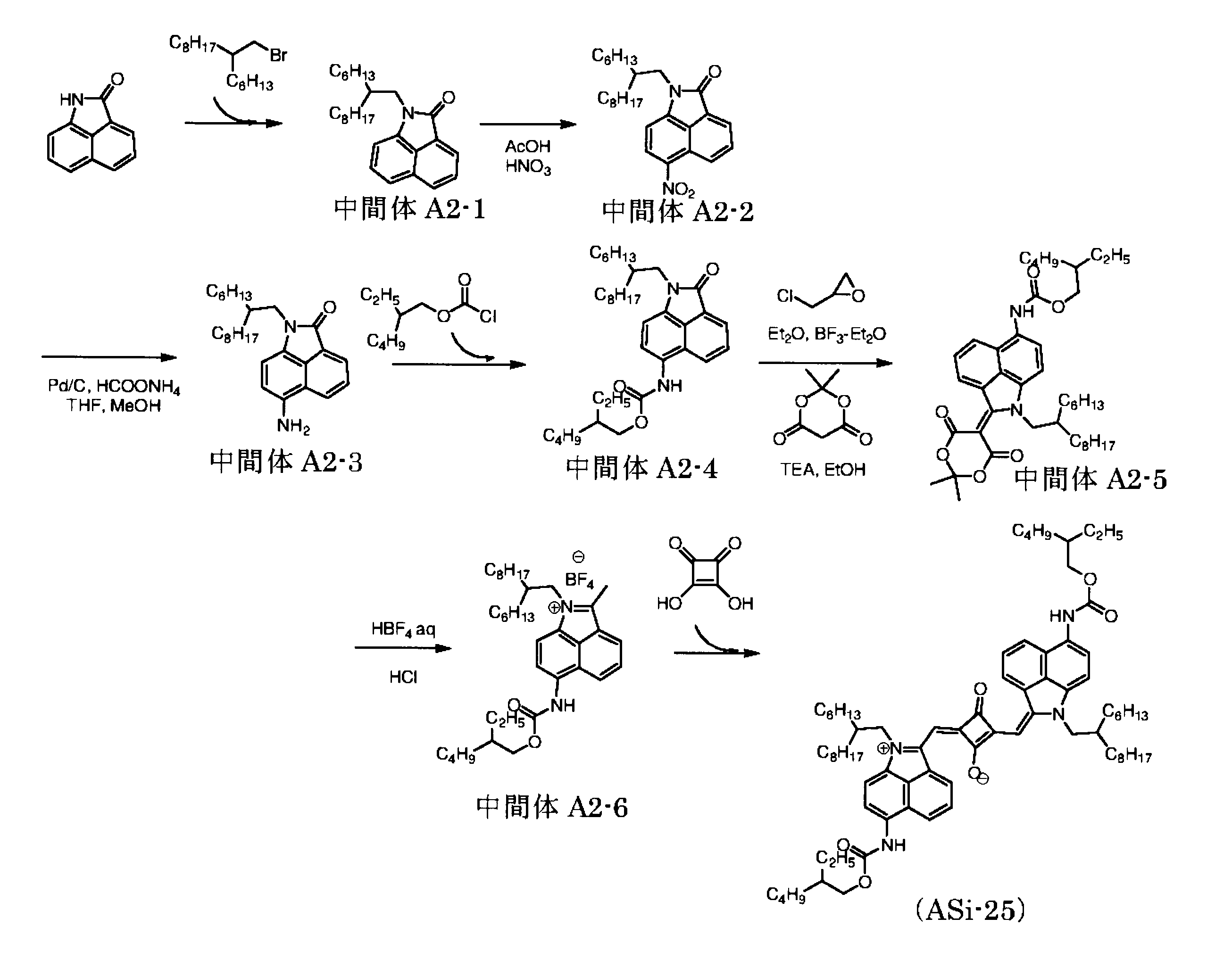
<ステップ1>
1LナスフラスコにBenzo[cd]indol-2(1H)-one(30g、177mmol)とヨウ化カリウム(6g、36mmol)、N,N-dimethyl-4-aminopyridine(3g、25mmol)を入れ、スルホラン(400ml)に溶解させて、70℃で2h撹拌させた。上記懸濁液に7-(ブロモメチル)ペンタデカン(81g、265mmol)、水酸化カリウム(15g、265mmol)を添加し、70℃で25h撹拌させた。反応終了後、ヘキサン:酢酸エチル=4:1を混合した有機溶媒で抽出作業を行い、溶媒を除去した後、カラムクロマトグラフィー(ヘキサン:酢酸エチル=10:1)にて黄色の油状物質の中間体A2-1(65g、収率94%)を単離した。
1LナスフラスコにBenzo[cd]indol-2(1H)-one(30g、177mmol)とヨウ化カリウム(6g、36mmol)、N,N-dimethyl-4-aminopyridine(3g、25mmol)を入れ、スルホラン(400ml)に溶解させて、70℃で2h撹拌させた。上記懸濁液に7-(ブロモメチル)ペンタデカン(81g、265mmol)、水酸化カリウム(15g、265mmol)を添加し、70℃で25h撹拌させた。反応終了後、ヘキサン:酢酸エチル=4:1を混合した有機溶媒で抽出作業を行い、溶媒を除去した後、カラムクロマトグラフィー(ヘキサン:酢酸エチル=10:1)にて黄色の油状物質の中間体A2-1(65g、収率94%)を単離した。
<ステップ2>
1Lナスフラスコにステップ1で得られた中間体A2-1(65g、165mmol)と酢酸(300ml)を入れ、撹拌し、そこに70%硝酸(20g)を滴下した後、60℃に昇温し、9h撹拌した。その後、反応液を酢酸エチルで抽出し、有機層を塩水で洗浄し、溶媒除去後、カラムクロマトグラフィー(ヘキサン:酢酸エチル=10:1)にて単離し、黄色い油状物の中間体A2-2(54g、収率75%)を得た。
1Lナスフラスコにステップ1で得られた中間体A2-1(65g、165mmol)と酢酸(300ml)を入れ、撹拌し、そこに70%硝酸(20g)を滴下した後、60℃に昇温し、9h撹拌した。その後、反応液を酢酸エチルで抽出し、有機層を塩水で洗浄し、溶媒除去後、カラムクロマトグラフィー(ヘキサン:酢酸エチル=10:1)にて単離し、黄色い油状物の中間体A2-2(54g、収率75%)を得た。
<ステップ3>
2Lナスフラスコにステップ2で得られた中間体A2-2(54g、123mmol)とテトラヒドロフラン(600ml)を入れ、0℃に冷却し、さらにパラジウム(10%)―活性炭素(12g)、メタノール(600ml)、ギ酸アンモニウム(120g)を追加し、室温で4h撹拌した。その後、反応液を濾過後、ジクロロメタンで抽出操作を実施し、カラムクロマトグラフィー(ヘキサン:酢酸エチル=8:2)にて単離し、オレンジ色の油状物質中間体A2-3(40g、収率79%)を得た。
2Lナスフラスコにステップ2で得られた中間体A2-2(54g、123mmol)とテトラヒドロフラン(600ml)を入れ、0℃に冷却し、さらにパラジウム(10%)―活性炭素(12g)、メタノール(600ml)、ギ酸アンモニウム(120g)を追加し、室温で4h撹拌した。その後、反応液を濾過後、ジクロロメタンで抽出操作を実施し、カラムクロマトグラフィー(ヘキサン:酢酸エチル=8:2)にて単離し、オレンジ色の油状物質中間体A2-3(40g、収率79%)を得た。
<ステップ4>
500mL三口フラスコにステップ3で得られた中間体A2-3(6.8g、17mmol)とトリエチルアミン(3.3g、33mmol)、N,N-dimethyl-4-aminopyridine(0.06g)、ジクロロメタン(80mL)を入れ、0℃で攪拌した。クロロギ酸2-エチルヘキシル(4.1g、21mmol)をジクロロメタン(10mL)に希釈させて、0℃の反応溶液にゆっくり滴下した後、室温で4h攪拌した。その後、水でクエンチし、5%の塩酸水溶液と炭酸水素ナトリウム水溶液で抽出作業を実施し、カラムクロマトグラフィー(ヘキサン:酢酸エチル=9:1)にて単離し、黄色の油状物質中間体A2-4(5.3g、収率58%)を得た。
500mL三口フラスコにステップ3で得られた中間体A2-3(6.8g、17mmol)とトリエチルアミン(3.3g、33mmol)、N,N-dimethyl-4-aminopyridine(0.06g)、ジクロロメタン(80mL)を入れ、0℃で攪拌した。クロロギ酸2-エチルヘキシル(4.1g、21mmol)をジクロロメタン(10mL)に希釈させて、0℃の反応溶液にゆっくり滴下した後、室温で4h攪拌した。その後、水でクエンチし、5%の塩酸水溶液と炭酸水素ナトリウム水溶液で抽出作業を実施し、カラムクロマトグラフィー(ヘキサン:酢酸エチル=9:1)にて単離し、黄色の油状物質中間体A2-4(5.3g、収率58%)を得た。
<ステップ5>
500mL三口フラスコにステップ4で得られた中間体A2-4(5.3g、9.4mmol)とエピクロロヒドリン(7.2g、75mmol)、クロロホルム20mL、ジエチルエーテル(10mL)を入れ、90℃で2h攪拌した後、ボロントリフルオリド・エチルエーテル錯体(14g、99mmol)をクロロホルム(25mL)で希釈し滴下後、120℃に昇温し、15h攪拌した。反応終了後、トルエンで共沸して溶媒除去作業を2回行った。溶媒除去した反応溶液に、エタノール(10mL)とメルドラム酸(2g、14mmol)を加え、室温で攪拌後、トリエチルアミン(5g、49mmol)を加え、室温で15h攪拌した。その後、トルエンで共沸して溶媒除去作業を行い、カラムクロマトグラフィー(ヘキサン:酢酸エチル=8:2)にて単離し、マゼンダ色の油状物質中間体A2-5(5.1g、収率78%)を得た。
500mL三口フラスコにステップ4で得られた中間体A2-4(5.3g、9.4mmol)とエピクロロヒドリン(7.2g、75mmol)、クロロホルム20mL、ジエチルエーテル(10mL)を入れ、90℃で2h攪拌した後、ボロントリフルオリド・エチルエーテル錯体(14g、99mmol)をクロロホルム(25mL)で希釈し滴下後、120℃に昇温し、15h攪拌した。反応終了後、トルエンで共沸して溶媒除去作業を2回行った。溶媒除去した反応溶液に、エタノール(10mL)とメルドラム酸(2g、14mmol)を加え、室温で攪拌後、トリエチルアミン(5g、49mmol)を加え、室温で15h攪拌した。その後、トルエンで共沸して溶媒除去作業を行い、カラムクロマトグラフィー(ヘキサン:酢酸エチル=8:2)にて単離し、マゼンダ色の油状物質中間体A2-5(5.1g、収率78%)を得た。
<ステップ6>
1Lナスフラスコにステップ5で得られた中間体A2-5(5.1g、7mmol)と塩酸10mLを加え、攪拌・還流を1h行った。そして、テトラフルオロホウ酸水溶液を2mL加え、さらに還流・攪拌を1h行った。反応溶液を室温に戻し、水を加え、テトラフルオロホウ酸水溶液を6mL加えた後、ジクロロメタンで抽出作業を行い、硫酸マグネシウムで脱水後、溶媒除去し、黄褐色の油状物質である中間体A2-6(3.7g、収率77%)を得た。
1Lナスフラスコにステップ5で得られた中間体A2-5(5.1g、7mmol)と塩酸10mLを加え、攪拌・還流を1h行った。そして、テトラフルオロホウ酸水溶液を2mL加え、さらに還流・攪拌を1h行った。反応溶液を室温に戻し、水を加え、テトラフルオロホウ酸水溶液を6mL加えた後、ジクロロメタンで抽出作業を行い、硫酸マグネシウムで脱水後、溶媒除去し、黄褐色の油状物質である中間体A2-6(3.7g、収率77%)を得た。
<ステップ7>
1Lナスフラスコにステップ6で得られた中間体A2-6(3.7g、5.7mmol)とスクアリン酸(0.34g、0.5mmol)とトルエン(300mL)、1-ブタノール(100mL)、キノリン(1g)を加え、130℃で2h攪拌した。その後、溶媒除去を実施し、カラムクロマトグラフィー(ジクロロメタン:酢酸エチル=9:1)にて単離し、ジクロロメタンで少量溶解し、酢酸エチルで再沈作業を行い、黒色の固体ASi-25(0.96g、収率27%)を得た。
1Lナスフラスコにステップ6で得られた中間体A2-6(3.7g、5.7mmol)とスクアリン酸(0.34g、0.5mmol)とトルエン(300mL)、1-ブタノール(100mL)、キノリン(1g)を加え、130℃で2h攪拌した。その後、溶媒除去を実施し、カラムクロマトグラフィー(ジクロロメタン:酢酸エチル=9:1)にて単離し、ジクロロメタンで少量溶解し、酢酸エチルで再沈作業を行い、黒色の固体ASi-25(0.96g、収率27%)を得た。
[合成例3]
以下に示す反応経路に従って色素(ASiii-5)を合成した。
以下に示す反応経路に従って色素(ASiii-5)を合成した。

<ステップb1>
フラスコに2-ブロモチオフェン(9.00g、55.2mmmol)、マグネシウム(4.03g、165mmol)を入れ、窒素雰囲気下で無水テトラヒドロフラン(55mL)に溶解した。前記混合溶液を80℃で1時間撹拌した。別フラスコに[1,3-ビス(ジフェニルホスフィノ)プロパン]ニッケル(II)ジクロリド(1.20g、2.21mmol)、2,3-ジブロモチオフェン(12.7g、52.5mmol)を入れ、無水ジエチルエーテル(110mL)に溶解した。前記ジエチルエーテル混合溶液を0℃に冷やし、前記テトラヒドロフラン混合溶液を滴下して、室温で3時間撹拌した。反応終了後、前記混合溶液に水(55mL)を加え、酢酸エチルで抽出して、有機層を飽和食塩水で洗い、溶媒を除去して、カラムクロマトグラフィー(ヘキサン)で中間体A3-11(8.93g、収率66%)を得た。
フラスコに2-ブロモチオフェン(9.00g、55.2mmmol)、マグネシウム(4.03g、165mmol)を入れ、窒素雰囲気下で無水テトラヒドロフラン(55mL)に溶解した。前記混合溶液を80℃で1時間撹拌した。別フラスコに[1,3-ビス(ジフェニルホスフィノ)プロパン]ニッケル(II)ジクロリド(1.20g、2.21mmol)、2,3-ジブロモチオフェン(12.7g、52.5mmol)を入れ、無水ジエチルエーテル(110mL)に溶解した。前記ジエチルエーテル混合溶液を0℃に冷やし、前記テトラヒドロフラン混合溶液を滴下して、室温で3時間撹拌した。反応終了後、前記混合溶液に水(55mL)を加え、酢酸エチルで抽出して、有機層を飽和食塩水で洗い、溶媒を除去して、カラムクロマトグラフィー(ヘキサン)で中間体A3-11(8.93g、収率66%)を得た。
<ステップb2>
フラスコにステップb1で得た中間体A3-11(8.09g、33mmol)を入れ、窒素雰囲気下で無水ジエチルエーテル(230mL)に溶解した。前記溶液を-78℃に冷やし、1.6Mのノルマルブチルリチウムのヘキサン溶液(20mL、32.0mmol)を滴下して、1時間撹拌した。続いてベンゾフェノン(6.56g、36.0mmol)を溶かした無水ジエチルエーテル溶液(120mL)を滴下した。前記混合溶液を室温で1昼夜撹拌した。反応終了後、飽和塩化アンモニウム水溶液(200mL)を加え、ジイソプロビルエーテルで抽出した。得られた有機層を飽和食塩水で洗い、溶媒を除去して、カラムクロマトグラフィー(ヘキサン:ジクロロメタン=1:1)で中間体A3-12(8.81g、収率77%)を得た。
フラスコにステップb1で得た中間体A3-11(8.09g、33mmol)を入れ、窒素雰囲気下で無水ジエチルエーテル(230mL)に溶解した。前記溶液を-78℃に冷やし、1.6Mのノルマルブチルリチウムのヘキサン溶液(20mL、32.0mmol)を滴下して、1時間撹拌した。続いてベンゾフェノン(6.56g、36.0mmol)を溶かした無水ジエチルエーテル溶液(120mL)を滴下した。前記混合溶液を室温で1昼夜撹拌した。反応終了後、飽和塩化アンモニウム水溶液(200mL)を加え、ジイソプロビルエーテルで抽出した。得られた有機層を飽和食塩水で洗い、溶媒を除去して、カラムクロマトグラフィー(ヘキサン:ジクロロメタン=1:1)で中間体A3-12(8.81g、収率77%)を得た。
<ステップb3>
フラスコにステップb2で得た中間体A3-12(4.94g、14.4mmol)、アンバーリスト15(2.30g)を入れ、窒素雰囲気下で無水トルエン(300mL)に溶解した。前記混合溶液を7時間還流撹拌した。反応終了後、濾過して濾液を得て、溶媒を除去し、カラムクロマトグラフィー(ヘキサン:ジクロロメタン=2:1)で中間体A3-13(4.29g、91%)を得た。
フラスコにステップb2で得た中間体A3-12(4.94g、14.4mmol)、アンバーリスト15(2.30g)を入れ、窒素雰囲気下で無水トルエン(300mL)に溶解した。前記混合溶液を7時間還流撹拌した。反応終了後、濾過して濾液を得て、溶媒を除去し、カラムクロマトグラフィー(ヘキサン:ジクロロメタン=2:1)で中間体A3-13(4.29g、91%)を得た。
<ステップb4>
フラスコにステップb3で得た中間体A3-13(4.00g、12.1mmol)を入れ、窒素雰囲気下で無水ジメチルホルムアミド(120mL)に溶解した。前記溶液に、N-ブロモスクシンイミド(2.16g、12.1mmol)を溶かした無水ジメチルホルムアミド溶液(30mL)を滴下した。前記混合液を室温で一昼夜撹拌した。反応終了後、氷水に注ぎ、ジイソプロピルエーテルで抽出した。得られた有機層を飽和食塩水で洗い、溶媒を除去した後、カラムクロマトグラフィー(ジクロロメタン)で中間体A3-14(3.67g、収率74%)を得た。
フラスコにステップb3で得た中間体A3-13(4.00g、12.1mmol)を入れ、窒素雰囲気下で無水ジメチルホルムアミド(120mL)に溶解した。前記溶液に、N-ブロモスクシンイミド(2.16g、12.1mmol)を溶かした無水ジメチルホルムアミド溶液(30mL)を滴下した。前記混合液を室温で一昼夜撹拌した。反応終了後、氷水に注ぎ、ジイソプロピルエーテルで抽出した。得られた有機層を飽和食塩水で洗い、溶媒を除去した後、カラムクロマトグラフィー(ジクロロメタン)で中間体A3-14(3.67g、収率74%)を得た。
<ステップb5>
フラスコにステップb4で得られた中間体A3-14(3.50g、8.55mmol)、削り状マグネシウム(0.416g、17.1mmol)を入れ、窒素雰囲気下で無水テトラヒドロフラン(20ml)に溶解した。上記溶液を3時間還流して、-40℃に冷やした。別フラスコにN-クロロスクシンイミド(1.03g、7.70mmol)を窒素雰囲気下で無水トルエン(20ml)に溶解し、ビス-(2-エチルヘキシル)アミン(1.86g、7.70mmol)を加えて、20分間撹拌した。
-40℃に冷やした混合溶液にオルトチタン酸テトライソプロピル(2.43g、8.55mmol)を滴下し、5分間撹拌した後、続いてN-クロロスクシンイミドとビス-(2-エチルヘキシル)アミンの混合溶液を滴下した。室温で3時間撹拌し、反応終了後、飽和炭酸カリウム水溶液(17ml)を加えた。続いて酢酸エチルで希釈して濾過して、得られた溶液を酢酸エチルで抽出した。得られた有機層を飽和食塩水で洗い、溶媒を除去して、カラムクロマトグラフィー(ヘキサン:トリエチルアミン=100:3)で中間体A3-15(1.34g、収率27.5%)を得た。
フラスコにステップb4で得られた中間体A3-14(3.50g、8.55mmol)、削り状マグネシウム(0.416g、17.1mmol)を入れ、窒素雰囲気下で無水テトラヒドロフラン(20ml)に溶解した。上記溶液を3時間還流して、-40℃に冷やした。別フラスコにN-クロロスクシンイミド(1.03g、7.70mmol)を窒素雰囲気下で無水トルエン(20ml)に溶解し、ビス-(2-エチルヘキシル)アミン(1.86g、7.70mmol)を加えて、20分間撹拌した。
-40℃に冷やした混合溶液にオルトチタン酸テトライソプロピル(2.43g、8.55mmol)を滴下し、5分間撹拌した後、続いてN-クロロスクシンイミドとビス-(2-エチルヘキシル)アミンの混合溶液を滴下した。室温で3時間撹拌し、反応終了後、飽和炭酸カリウム水溶液(17ml)を加えた。続いて酢酸エチルで希釈して濾過して、得られた溶液を酢酸エチルで抽出した。得られた有機層を飽和食塩水で洗い、溶媒を除去して、カラムクロマトグラフィー(ヘキサン:トリエチルアミン=100:3)で中間体A3-15(1.34g、収率27.5%)を得た。
<ステップb6>
フラスコにステップb5で得られた中間体A3-15(1.30g、2.28mmol)、3,4-ジヒドロキシ-3-シクロブテン-1,2-ジオン(0.130g、1.14mmol)を入れ、窒素雰囲気下でノルマルブタノール(6ml)とトルエン(6ml)の混合溶液に溶解した。3時間還流撹拌して、反応終了後、溶媒を除去して、カラムクロマトグラフィー(ジクロロメタン:メタノール:トリエチルアミン=100:1:3)で色素(ASiii-5)(0.445g、収率32%)を得た。
フラスコにステップb5で得られた中間体A3-15(1.30g、2.28mmol)、3,4-ジヒドロキシ-3-シクロブテン-1,2-ジオン(0.130g、1.14mmol)を入れ、窒素雰囲気下でノルマルブタノール(6ml)とトルエン(6ml)の混合溶液に溶解した。3時間還流撹拌して、反応終了後、溶媒を除去して、カラムクロマトグラフィー(ジクロロメタン:メタノール:トリエチルアミン=100:1:3)で色素(ASiii-5)(0.445g、収率32%)を得た。
上記各色素をジクロロメタンに溶解して波長350~1200nmの光吸収スペクトルを測定して吸光度曲線から、最大吸収波長λmax(A)DCMを求めた。さらに、ジクロロメタン中の色素濃度を、最大吸収波長λmax(A)DCMでの光の透過率が10%になるように調整した吸光度曲線から、ABS430(A)DCM/ABSλmax(A)DCM、ABS550(A)DCM/ABSλmax(A)DCMおよびABS630(A)DCM/ABSλmax(A)DCMを求めた。
各色素の吸光度曲線を図4~10に示す。また、上記で求めた吸光特性の結果を表12に示す。表12には、各色素と吸光度曲線の図面番号の対応を併せて示す。表中、ABS比1、ABS比2およびABS比3は、それぞれABS430(A)DCM/ABSλmax(A)DCM、ABS550(A)DCM/ABSλmax(A)DCMおよびABS630(A)DCM/ABSλmax(A)DCMを示す。

(光学フィルタの表面硬度)
以下に示す、ガラス基材、樹脂層、透明樹脂基材および誘電体多層膜を、表14に示す順に積層した積層体(1-1)~(1-9)の1層目の表面の鉛筆硬度をJIS K 5600-5-4に規定された方法により測定することで、光学フィルタの最表面における鉛筆強度を模擬的に試験した。表14の「-」はその層がないことを示す。
以下に示す、ガラス基材、樹脂層、透明樹脂基材および誘電体多層膜を、表14に示す順に積層した積層体(1-1)~(1-9)の1層目の表面の鉛筆硬度をJIS K 5600-5-4に規定された方法により測定することで、光学フィルタの最表面における鉛筆強度を模擬的に試験した。表14の「-」はその層がないことを示す。
(1)ガラス基材
ガラス基材としてCuO含有フツリン酸ガラスからなる厚さ0.21mmのガラス基材(AGC社製、表記:CuO含有フツリン酸ガラス1)、CuO含有フツリン酸ガラスからなる厚さ0.8mmのガラス基材または(AGC社製、表記:CuO含有フツリン酸ガラス2)、厚さ0.2mmのホウケイ酸ガラス(SCHOTT製、商品名D263)を用いた。各ガラス基材の光学特性を以下の表13に示す。
ガラス基材としてCuO含有フツリン酸ガラスからなる厚さ0.21mmのガラス基材(AGC社製、表記:CuO含有フツリン酸ガラス1)、CuO含有フツリン酸ガラスからなる厚さ0.8mmのガラス基材または(AGC社製、表記:CuO含有フツリン酸ガラス2)、厚さ0.2mmのホウケイ酸ガラス(SCHOTT製、商品名D263)を用いた。各ガラス基材の光学特性を以下の表13に示す。
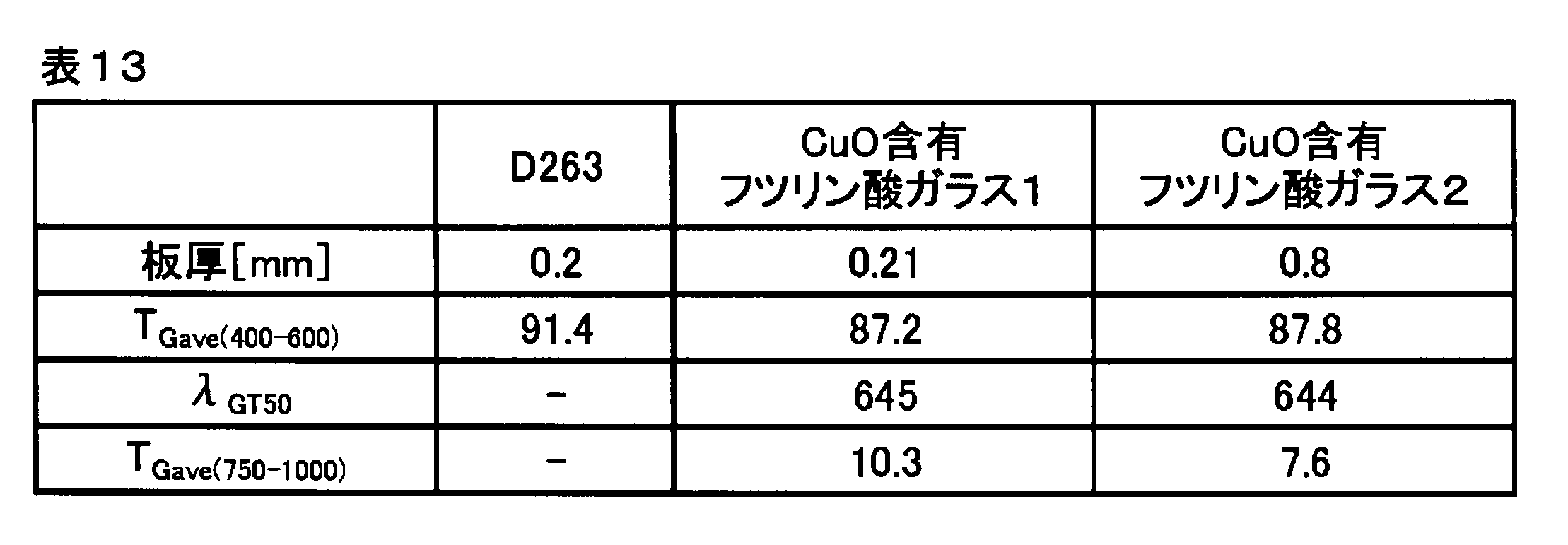
(2)樹脂層(吸収層の相当)
樹脂層に用いる樹脂(B)として、以下の樹脂(B1)~(B4)を用いた。なお、表面硬度試験においては、色素(A)を含有させない、膜厚1μmの樹脂層を形成して評価した。樹脂(B1)~(B4)を用いて得られた樹脂層をそれぞれ樹脂層(B1)~(B4)と示す。
樹脂層に用いる樹脂(B)として、以下の樹脂(B1)~(B4)を用いた。なお、表面硬度試験においては、色素(A)を含有させない、膜厚1μmの樹脂層を形成して評価した。樹脂(B1)~(B4)を用いて得られた樹脂層をそれぞれ樹脂層(B1)~(B4)と示す。
樹脂(B1);ネオプリム(登録商標)C-3G30(三菱ガス化学(株)製、商品名、ポリイミド樹脂ワニス、Tg:320℃)
樹脂(B2);OKP-850(大阪ガスケミカル(株)製、商品名、ポリエステル樹脂、Tg:151℃)
樹脂(B3);SP3810(帝人(株)製、商品名、ポリカーボネート樹脂、Tg:150℃)
樹脂(B4);ARTON(JSR社製、商品名、シクロオレフィン樹脂、Tg:151℃)
樹脂(B2);OKP-850(大阪ガスケミカル(株)製、商品名、ポリエステル樹脂、Tg:151℃)
樹脂(B3);SP3810(帝人(株)製、商品名、ポリカーボネート樹脂、Tg:150℃)
樹脂(B4);ARTON(JSR社製、商品名、シクロオレフィン樹脂、Tg:151℃)
(3)透明樹脂基材
透明樹脂基材として、厚さ0.08mmの帝人ピュアエースWRM5-80(帝人(株)製、商品名、ポリカーボネート樹脂、Tg215℃)樹脂基板を使用した。
(4)誘電体多層膜
誘電体多層膜は、蒸着法により、TiO2膜とSiO2膜を交互に13層積層した反射防止層とした。
透明樹脂基材として、厚さ0.08mmの帝人ピュアエースWRM5-80(帝人(株)製、商品名、ポリカーボネート樹脂、Tg215℃)樹脂基板を使用した。
(4)誘電体多層膜
誘電体多層膜は、蒸着法により、TiO2膜とSiO2膜を交互に13層積層した反射防止層とした。
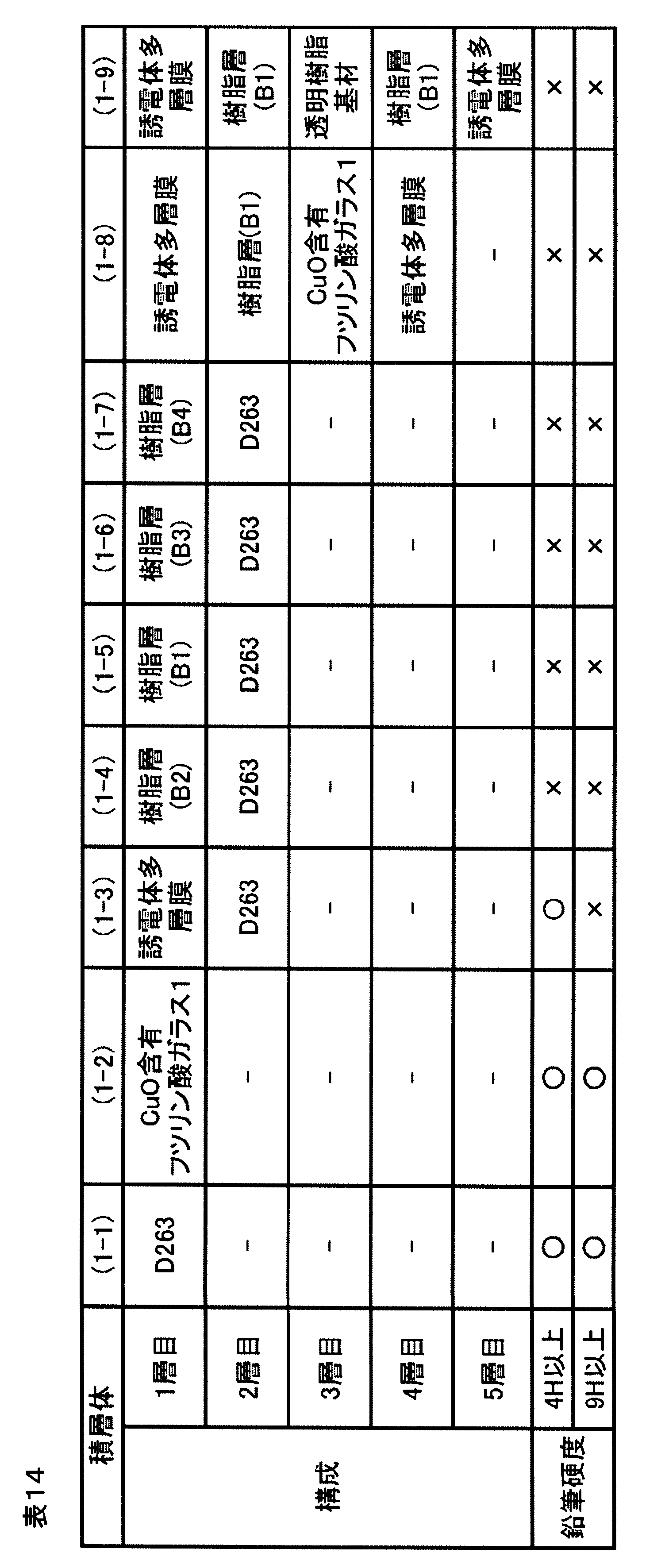
[例1~24;光学フィルタの製造・評価(1)]
(光学フィルタの製造)
例1~18(実施例)として図2に示す光学フィルタ10Bと同様の構成の光学フィルタを以下の方法で製造した。例19~24として、第1のガラス基材上に吸収層が形成された比較例の光学フィルタを製造した。
(光学フィルタの製造)
例1~18(実施例)として図2に示す光学フィルタ10Bと同様の構成の光学フィルタを以下の方法で製造した。例19~24として、第1のガラス基材上に吸収層が形成された比較例の光学フィルタを製造した。
各例において、第1のガラス基材2Aおよび第2のガラス基材2Bとして、表15で示すとおり、CuO含有フツリン酸ガラス1またはD263を用いた。
吸収層1として樹脂(B1)~(B4)に色素(ACi1-2B)、色素(ACiii1-20B)、色素(ASi-25)、色素(I-11-7)、色素(Dim01)を組み合わせた吸収層を用いた。
吸収層1は、第1のガラス基材2Aの一方の主面上に、樹脂(B)の100質量部に対して色素(A)が6質量部となるように、樹脂(B)と色素(A)をシクロヘキサノンに均一に溶解した塗工液を塗布し乾燥することで、膜厚1μmとして作製した。次いで、吸収層1の表面に接着剤層3を形成するための紫外線硬化性材料を含む接着剤層組成物を塗工し、その上に第2のガラス基材2Bを積層した。紫外線硬化性材料としては電気化学工業社製のOP-1030Kまたは東亜合成社製のLCR-0631Cを用いた。さらに、第2のガラス基材2B側から紫外線を照射して、接着剤層組成物を紫外線硬化させて、厚み2μmの接着剤層とした。
(評価)
(1)鉛筆硬度
得られた光学フィルタの両主面についてJIS K 5600-5-4に規定された方法により鉛筆硬度を測定した。結果を表15に示す。両主面とも4H以上の場合を「○」とした、9H以上の場合を「◎」とした。いずれか一方でも4Hに達しない場合を「×」とした。
(1)鉛筆硬度
得られた光学フィルタの両主面についてJIS K 5600-5-4に規定された方法により鉛筆硬度を測定した。結果を表15に示す。両主面とも4H以上の場合を「○」とした、9H以上の場合を「◎」とした。いずれか一方でも4Hに達しない場合を「×」とした。
(2)耐光試験
キセノンランプを用いたウェザーメーター試験機(SUGA試験機社製)を用いて、光学フィルタに光を照射する試験を行った。例1~18については、第2のガラス基材2B側から、例19~24については吸収層側から、300~2450nmの波長の光を882Wの光量で3時間の光照射を行った。光照射の前後で、光学フィルタの透過率を測定し、最大吸収波長のABSを算出して、光照射の前のABSBeforeに対する光照射後のABSAfterの百分率((ABSAfter/ABSBefore)×100)を求めた。結果を「3時間照射残存率%」として表15に示す。
キセノンランプを用いたウェザーメーター試験機(SUGA試験機社製)を用いて、光学フィルタに光を照射する試験を行った。例1~18については、第2のガラス基材2B側から、例19~24については吸収層側から、300~2450nmの波長の光を882Wの光量で3時間の光照射を行った。光照射の前後で、光学フィルタの透過率を測定し、最大吸収波長のABSを算出して、光照射の前のABSBeforeに対する光照射後のABSAfterの百分率((ABSAfter/ABSBefore)×100)を求めた。結果を「3時間照射残存率%」として表15に示す。
なお、例14~18においては、近赤外線吸収ガラス基材であるフツリン酸ガラス1を用いているため、測定結果は、近赤外線吸収ガラスの吸収により吸収層最大吸収波長領域が不明であるためABSの算出ができないため残存率の算出は行っていない。
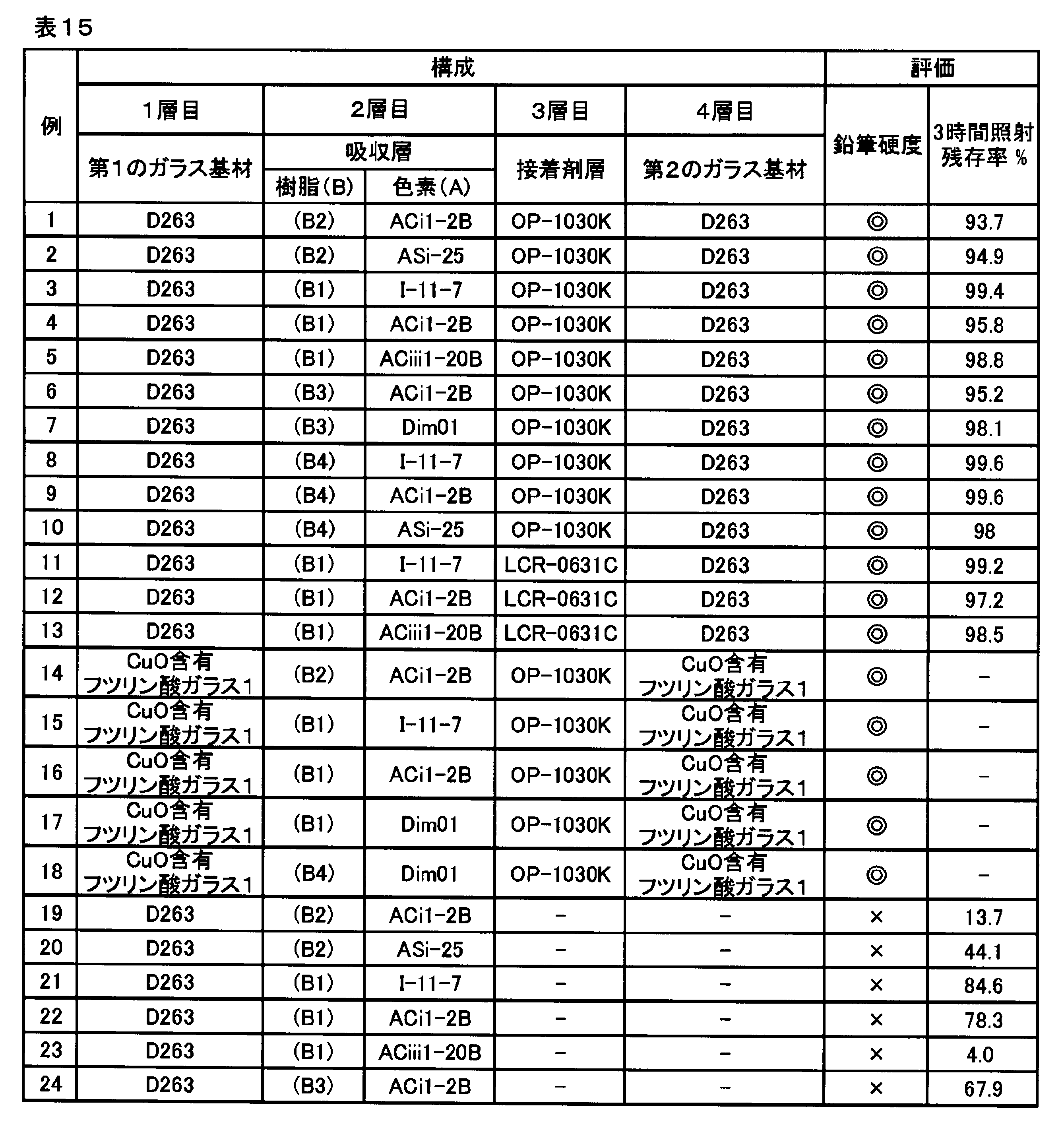
[例25~28;光学フィルタの製造・評価(2)]
(光学フィルタの製造)
例25については、図2に示す光学フィルタ10Bと同様の構成の光学フィルタを表16に示す構成部材を用いて、例1と同様の方法で製造した。ただし、吸収層における色素(A)の樹脂(B)の100質量部に対する質量部および吸収層の膜厚は表16に示すとおりとした。
(光学フィルタの製造)
例25については、図2に示す光学フィルタ10Bと同様の構成の光学フィルタを表16に示す構成部材を用いて、例1と同様の方法で製造した。ただし、吸収層における色素(A)の樹脂(B)の100質量部に対する質量部および吸収層の膜厚は表16に示すとおりとした。
例26~例28については、図3に示す光学フィルタ10Cと同様の構成の光学フィルタを表16に示す構成部材を用いて、以下の方法で製造した。
すなわち、例26~例28では、例1と同様にして第1のガラス基材上に吸収層を形成した後、吸収層上に、蒸着法により、TiO2膜とSiO2膜を交互に13層積層した反射防止層を成膜した。反射防止層の表面に接着剤層と第2のガラス基材を積層する方法は、例1と同様に行った。なお、例26~例28については吸収層に色素(A)の2種類を用いた。各色素(A)の樹脂(B)の100質量部に対する質量部および吸収層の膜厚は表16に示すとおりとした。
(評価)
得られた例25~例28の光学フィルタについて入射角0度と入射角30度の分光透過率曲線を求めた。各例における分光透過率曲線を図11~14に示す。表16に、該分光透過率曲線から得られた、(3-1)にかかるλ0-T50、(3-2)にかかるT0-ave(450-600)、(3-3)にかかるT0-ave(700-1200)、(3-4)にかかるλ30-T50、(3-5)にかかるT30-ave(450-600)、(3-6)にかかるλ0-T50-λ30-T50、(3-7)にかかるT0-ave(450-600)-T30-ave(450-600)、(3-8)にかかるOD値(OD0-940)(3-9)にかかるOD値(OD30-940)を求めた。結果を表16に示す。表16には、各光学フィルタと分光透過率曲線の図面番号の対応を併せて示す。
得られた例25~例28の光学フィルタについて入射角0度と入射角30度の分光透過率曲線を求めた。各例における分光透過率曲線を図11~14に示す。表16に、該分光透過率曲線から得られた、(3-1)にかかるλ0-T50、(3-2)にかかるT0-ave(450-600)、(3-3)にかかるT0-ave(700-1200)、(3-4)にかかるλ30-T50、(3-5)にかかるT30-ave(450-600)、(3-6)にかかるλ0-T50-λ30-T50、(3-7)にかかるT0-ave(450-600)-T30-ave(450-600)、(3-8)にかかるOD値(OD0-940)(3-9)にかかるOD値(OD30-940)を求めた。結果を表16に示す。表16には、各光学フィルタと分光透過率曲線の図面番号の対応を併せて示す。

本発明を詳細にまた特定の実施態様を参照して説明したが、本発明の精神と範囲を逸脱することなく様々な変更や修正を加えることができることは当業者にとって明らかである。本出願は2018年12月19日出願の日本特許出願(特願2018-237748)に基づくものであり、その内容はここに参照として取り込まれる。
本発明の光学フィルタは、可視光の透過性を良好に維持しながら、近赤外光の遮蔽性に優れるとともに、近赤外光の遮蔽性の耐久性、特には耐光性と、表面の硬度特性に優れる。本発明によれば、該光学フィルタを用いた色再現性および耐久性に優れる撮像装置を提供できる。
10A,10B,10C…光学フィルタ、1…吸収層、2A…第1のガラス基材、2B…第2のガラス基材、3…接着剤層、4…誘電体多層膜。
Claims (18)
- 波長400~600nmの光の平均透過率が80%以上の第1のガラス基材、
波長400~600nmの光の平均透過率が80%以上の第2のガラス基材、および、
前記第1のガラス基材と前記第2のガラス基材の間に設けられる吸収層、を備える光学フィルタであって、
前記吸収層は、スクアリリウム色素、シアニン色素およびジイモニウム色素から選ばれる少なくとも1種の近赤外線吸収色素(A)とガラス転移温度が130℃以上の透明樹脂を含有し、
前記近赤外線吸収色素(A)をジクロロメタンに溶解して測定される波長350~1200nmの吸光度曲線において下記特性(1-1)~(1-4)を満足する、光学フィルタ。
(1-1)最大吸収波長λmax(A)DCMが650~1200nmの波長領域にある。
(1-2)最大吸収波長λmax(A)DCMにおける吸光度ABSλmax(A)DCMに対する波長430nmにおける吸光度ABS430(A)DCMの比ABS430(A)DCM/ABSλmax(A)DCMが0.06以下である。
(1-3)最大吸収波長λmax(A)DCMにおける吸光度ABSλmax(A)DCMに対する波長550nmにおける吸光度ABS550(A)DCMの比ABS550(A)DCM/ABSλmax(A)DCMが0.04以下である。
(1-4)最大吸収波長λmax(A)DCMにおける吸光度ABSλmax(A)DCMに対する波長630nmにおける吸光度ABS630(A)DCMの比ABS630(A)DCM/ABSλmax(A)DCMが0.06以下である。 - さらに、前記吸収層と前記第1のガラス基材の間および前記吸収層と前記第2のガラス基材の間の少なくとも一方に光硬化材料または熱硬化材料を含む接着剤層を有する請求項1に記載の光学フィルタ。
- 前記接着剤層は光硬化材料を含む請求項2に記載の光学フィルタ。
- さらに、誘電体多層膜を有する請求項1~3のいずれか1項に記載の光学フィルタ。
- 前記誘電体多層膜を、前記第1のガラス基材と前記第2のガラス基材の間に有する請求項4に記載の光学フィルタ。
- さらに、前記吸収層と前記接着剤層の間に誘電体多層膜を有する請求項2または3に記載の光学フィルタ。
- 前記光学フィルタの両主面の最表面において、JIS K 5600-5-4に規定された方法により測定される鉛筆硬度が、4H以上である請求項1~6のいずれか1項に記載の光学フィルタ。
- 前記光学フィルタの両主面の最表面において、JIS K 5600-5-4に規定された方法により測定される鉛筆硬度が、9H以上である請求項1~7のいずれか1項に記載の光学フィルタ。
- 前記第1のガラス基材および前記第2のガラス基材の少なくとも一方は、下記特性(2-1)および(2-2)を満足する近赤外線吸収ガラス基材である請求項1~8のいずれか1項に記載の光学フィルタ。
(2-1)透過率が50%となる波長λGT50が600~700nmの波長領域にある。
(2-2)波長750~1000nmの光の平均透過率が20%以下である。 - 前記第1のガラス基材および前記第2のガラス基材の両方が、前記(2-1)および(2-2)を満足する近赤外線吸収ガラス基材である請求項9に記載の光学フィルタ。
- 前記近赤外線吸収色素(A)は、スクアリリウム色素およびシアニン色素から選ばれる1種以上を含む、請求項1~10のいずれか1項に記載の光学フィルタ。
- 前記透明樹脂は、ポリイミド樹脂、ポリエステル樹脂、ポリカーボネート樹脂およびシクロオレフィン樹脂から選ばれる1種以上を含む、請求項1~11のいずれか1項に記載の光学フィルタ。
- 前記光学フィルタは、下記特性(3-1)~(3-7)を満足する請求項1~12のいずれか1項に記載の光学フィルタ。
(3-1)入射角0度の分光透過率曲線において透過率が50%となる波長λ0-T50が550~650nmの波長領域にある。
(3-2)入射角0度の分光透過率曲線において波長450~600nmの光の平均透過率T0-ave(450-600)が60%以上である。
(3-3)入射角0度の分光透過率曲線において波長700~1200nmの光の平均透過率T0-ave(700-1200)が5%以下である。
(3-4)入射角30度の分光透過率曲線において透過率が50%となる波長λ30-T50が550~650nmの波長領域にある。
(3-5)入射角30度の分光透過率曲線において波長450~600nmの光の平均透過率T30-ave(450-600)が60%以上である。
(3-6)λ0-T50からλ30-T50を引いた値が0nm以上10nm未満である。
(3-7)T0-ave(450-600)からT30-ave(450-600)を引いた値が0%以上5%未満である。 - 前記光学フィルタは、さらに、下記特性(3-8)および(3-9)を満足する請求項13に記載の光学フィルタ。
(3-8)入射角0度における波長940nmの光に対するOD値が3以上である。
(3-9)入射角30度における波長940nmの光に対するOD値が3以上である。 - 前記近赤外線吸収色素(A)は下記特性(4-1)および(4-2)を満足する請求項1~14のいずれか1項に記載の光学フィルタ。
(4-1)前記最大吸収波長λmax(A)DCMが800~1100nmの波長領域にある。
(4-2)式(ACi)~(ACiii)のいずれかで表されるシアニン色素を含む。

R101~R107、R121~R127およびR141は、それぞれ独立して、水素原子、ハロゲン原子、スルホ基、ヒドロキシ基、シアノ基、ニトロ基、カルボキシル基、リン酸基、-NR112R113基、-NHSO2R114基、-NHCOR115基、-SR116基、-SO2R117基、-OSO2R118基、炭素数1~20のアルキル基またはアルコキシ基、炭素数1~12のハロゲン置換アルキル基、炭素数3~14のシクロアルキル基、炭素数6~14のアリール基、もしくは員数が3~14の複素環基である。R102~R107およびR122~R127は隣り合う2つが互いに連結して5員環、6員環、または7員環を形成していてもよい。
R142とR143は、それぞれ独立して、水素原子または互いに結合して員数が6の芳香環Dを形成していてもよい。R145とR144は、それぞれ独立して、水素原子または互いに結合して員数が6の芳香環Eを形成していてもよい。ただし、芳香環Dと芳香環Eは両方が形成されることはない。
R109~R111、R129~R131、およびR146~R148はそれぞれ独立して、水素原子、炭素数1~6のアルキル基、-NR112R113基、炭素数3~14のシクロアルキル基、または炭素数6~14のアリール基である。
R109とR111、R129とR131、およびR146とR148は、それぞれ独立して、互いに結合して5員環または6員環を形成してもよい。環を形成する場合、環に結合する水素原子は炭素数1~6のアルキル基に置換されていてもよく、環の構成原子の2つがメチレン基で架橋されていてもよい。
R112~R118は、それぞれ独立して、水素原子、炭素数1~20のアルキル基またはアルコキシ基、炭素数1~12のハロゲン置換アルキル基、炭素数3~14のシクロアルキル基、炭素数6~14のアリール基、もしくは員数が3~14の複素環基である。
X-は一価のアニオンを示す。 - 前記近赤外線吸収色素(A)は下記特性(4-1)および(4-3)を満足する請求項1~14のいずれか1項に記載の光学フィルタ。
(4-1)前記最大吸収波長λmax(A)DCMが800~1100nmの波長領域にある。
(4-3)下記式(ASi)~(ASiii)のいずれかで表されるスクアリリウム色素を含む。
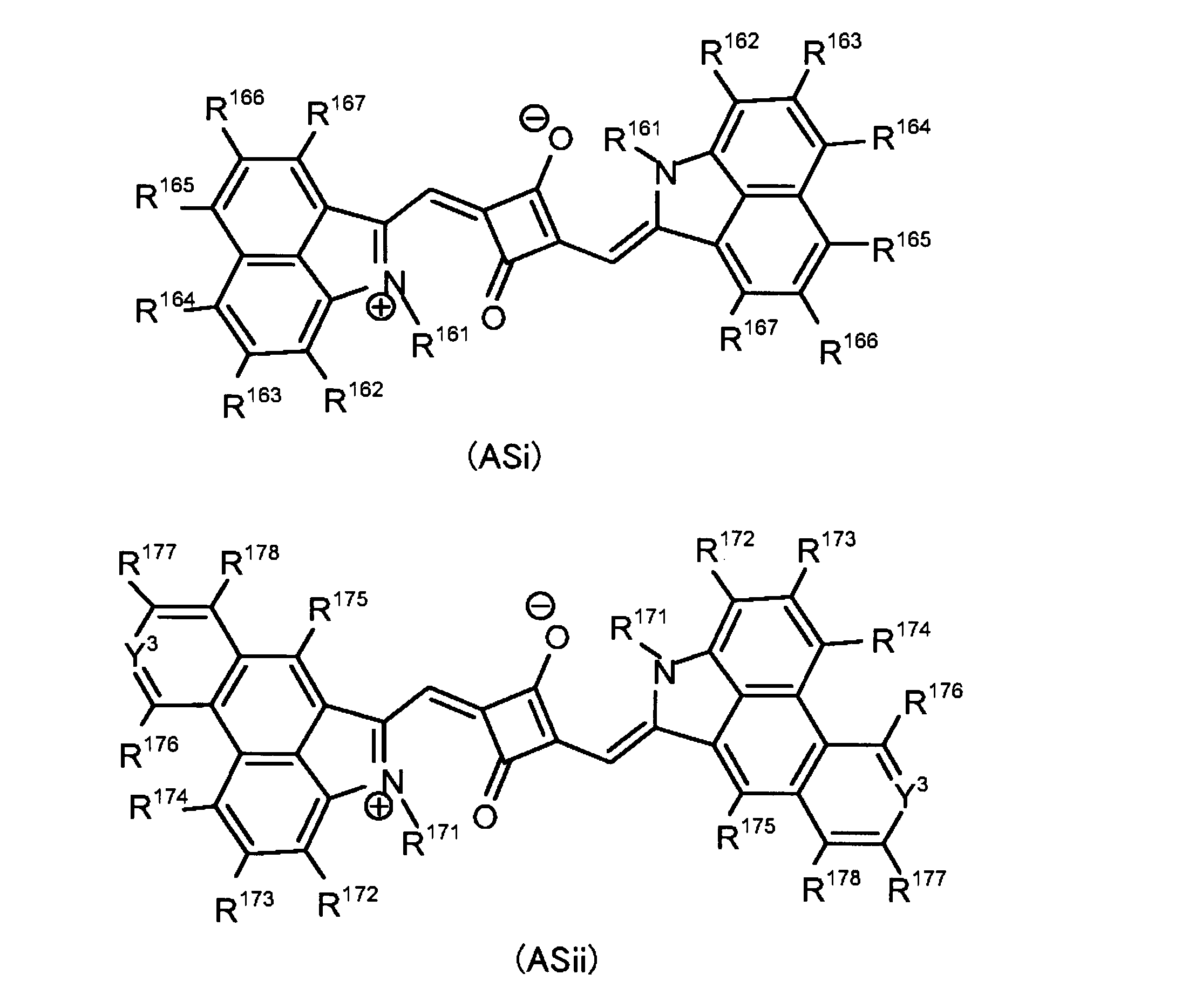
R161は、それぞれ独立して、炭素数3~20の分岐アルキル基、炭素数13~20の直鎖アルキル基である。
Y3は、それぞれ独立して、C-R179またはNである。
R162~R167およびR171~R179は、それぞれ独立して、水素原子、ハロゲン原子、スルホ基、ヒドロキシ基、シアノ基、ニトロ基、カルボキシル基、リン酸基、-NR112R113基、-NHSO2R114基、-NHCOR115基、-SR116基、-SO2R117基、-OSO2R118基、炭素数1~20のアルキル基またはアルコキシ基、炭素数1~12のハロゲン置換アルキル基、炭素数3~14のシクロアルキル基、炭素数6~14のアリール基、もしくは員数が3~14の複素環基である。
R112~R118は、それぞれ独立して、水素原子、炭素数1~20のアルキル基またはアルコキシ基、炭素数1~12のハロゲン置換アルキル基、炭素数3~14のシクロアルキル基、炭素数6~14のアリール基、もしくは員数が3~14の複素環基である。

- 請求項1~16のいずれか1項に記載の光学フィルタを備える撮像装置。
- 請求項1~16のいずれか1項に記載の光学フィルタを備える光学センサー。
Priority Applications (4)
| Application Number | Priority Date | Filing Date | Title |
|---|---|---|---|
| CN201980083389.1A CN113227844B (zh) | 2018-12-19 | 2019-12-16 | 滤光片、成像装置和光学传感器 |
| CN202211453794.8A CN115755260A (zh) | 2018-12-19 | 2019-12-16 | 滤光片、成像装置和光学传感器 |
| JP2020561417A JP7380591B2 (ja) | 2018-12-19 | 2019-12-16 | 光学フィルタ、撮像装置および光学センサー |
| JP2023185788A JP2024012425A (ja) | 2018-12-19 | 2023-10-30 | 光学フィルタ、撮像装置および光学センサー |
Applications Claiming Priority (2)
| Application Number | Priority Date | Filing Date | Title |
|---|---|---|---|
| JP2018237748 | 2018-12-19 | ||
| JP2018-237748 | 2018-12-19 |
Publications (1)
| Publication Number | Publication Date |
|---|---|
| WO2020129909A1 true WO2020129909A1 (ja) | 2020-06-25 |
Family
ID=71101794
Family Applications (1)
| Application Number | Title | Priority Date | Filing Date |
|---|---|---|---|
| PCT/JP2019/049223 Ceased WO2020129909A1 (ja) | 2018-12-19 | 2019-12-16 | 光学フィルタ、撮像装置および光学センサー |
Country Status (3)
| Country | Link |
|---|---|
| JP (2) | JP7380591B2 (ja) |
| CN (2) | CN115755260A (ja) |
| WO (1) | WO2020129909A1 (ja) |
Cited By (1)
| Publication number | Priority date | Publication date | Assignee | Title |
|---|---|---|---|---|
| TWI905648B (zh) * | 2023-01-30 | 2025-11-21 | 南韓商Lms股份有限公司 | 光學濾波器 |
Families Citing this family (3)
| Publication number | Priority date | Publication date | Assignee | Title |
|---|---|---|---|---|
| CN114181541A (zh) * | 2021-10-22 | 2022-03-15 | 浙江大学医学院附属第四医院 | 一种方酸菁染料及其制备方法与应用 |
| JP2023150544A (ja) * | 2022-03-31 | 2023-10-16 | Hoya株式会社 | 近赤外線カットフィルタ |
| CN118791940A (zh) * | 2024-09-12 | 2024-10-18 | 安徽领视光学科技有限公司 | 光学功能吸收溶液组合物、滤光片及其制备方法 |
Citations (4)
| Publication number | Priority date | Publication date | Assignee | Title |
|---|---|---|---|---|
| JP2011213969A (ja) * | 2009-04-14 | 2011-10-27 | Nippon Shokubai Co Ltd | 近赤外線吸収粘着剤組成物 |
| WO2014030628A1 (ja) * | 2012-08-23 | 2014-02-27 | 旭硝子株式会社 | 近赤外線カットフィルタおよび固体撮像装置 |
| WO2016186050A1 (ja) * | 2015-05-20 | 2016-11-24 | 富士フイルム株式会社 | 赤外線吸収組成物、赤外線カットフィルタ、積層体、パターン形成方法、および固体撮像素子 |
| JP2017090687A (ja) * | 2015-11-10 | 2017-05-25 | 旭硝子株式会社 | 近赤外線吸収型ガラスウェハおよび半導体ウェハ積層体 |
Family Cites Families (4)
| Publication number | Priority date | Publication date | Assignee | Title |
|---|---|---|---|---|
| JP2014025016A (ja) * | 2012-07-30 | 2014-02-06 | Japan Carlit Co Ltd | 近赤外線吸収樹脂組成物及び近赤外線吸収フィルム |
| KR101832114B1 (ko) * | 2015-12-01 | 2018-02-23 | 아사히 가라스 가부시키가이샤 | 광학 필터 및 촬상 장치 |
| CN109863432A (zh) * | 2016-11-14 | 2019-06-07 | 日本化药株式会社 | 用于红外线波长区域的染料系偏光板 |
| JP7353099B2 (ja) * | 2019-08-19 | 2023-09-29 | キヤノン電子株式会社 | 光源角度測定装置及び人工衛星 |
-
2019
- 2019-12-16 CN CN202211453794.8A patent/CN115755260A/zh active Pending
- 2019-12-16 CN CN201980083389.1A patent/CN113227844B/zh active Active
- 2019-12-16 WO PCT/JP2019/049223 patent/WO2020129909A1/ja not_active Ceased
- 2019-12-16 JP JP2020561417A patent/JP7380591B2/ja active Active
-
2023
- 2023-10-30 JP JP2023185788A patent/JP2024012425A/ja active Pending
Patent Citations (4)
| Publication number | Priority date | Publication date | Assignee | Title |
|---|---|---|---|---|
| JP2011213969A (ja) * | 2009-04-14 | 2011-10-27 | Nippon Shokubai Co Ltd | 近赤外線吸収粘着剤組成物 |
| WO2014030628A1 (ja) * | 2012-08-23 | 2014-02-27 | 旭硝子株式会社 | 近赤外線カットフィルタおよび固体撮像装置 |
| WO2016186050A1 (ja) * | 2015-05-20 | 2016-11-24 | 富士フイルム株式会社 | 赤外線吸収組成物、赤外線カットフィルタ、積層体、パターン形成方法、および固体撮像素子 |
| JP2017090687A (ja) * | 2015-11-10 | 2017-05-25 | 旭硝子株式会社 | 近赤外線吸収型ガラスウェハおよび半導体ウェハ積層体 |
Cited By (1)
| Publication number | Priority date | Publication date | Assignee | Title |
|---|---|---|---|---|
| TWI905648B (zh) * | 2023-01-30 | 2025-11-21 | 南韓商Lms股份有限公司 | 光學濾波器 |
Also Published As
| Publication number | Publication date |
|---|---|
| JP2024012425A (ja) | 2024-01-30 |
| JPWO2020129909A1 (ja) | 2021-11-04 |
| CN115755260A (zh) | 2023-03-07 |
| CN113227844B (zh) | 2022-12-06 |
| CN113227844A (zh) | 2021-08-06 |
| JP7380591B2 (ja) | 2023-11-15 |
Similar Documents
| Publication | Publication Date | Title |
|---|---|---|
| US12168730B2 (en) | Optical filter and imaging device | |
| JP6202230B1 (ja) | 光学フィルタおよび撮像装置 | |
| JP2024012425A (ja) | 光学フィルタ、撮像装置および光学センサー | |
| JP7342944B2 (ja) | 光学フィルタおよび撮像装置 | |
| JP7059729B2 (ja) | 光学フィルタ、近赤外線吸収色素および撮像装置 | |
| JPWO2014030628A1 (ja) | 近赤外線カットフィルタおよび固体撮像装置 | |
| JP2021006901A (ja) | 光学フィルターおよびその用途 | |
| JPWO2017030174A1 (ja) | 光学フィルタおよび撮像装置 | |
| JP7772129B2 (ja) | 光学フィルタ、撮像装置および光学センサー | |
| WO2019151348A1 (ja) | 光学フィルタおよび撮像装置 | |
| JP7310806B2 (ja) | 近赤外線吸収色素、光学フィルタおよび撮像装置 | |
| JPWO2020054786A1 (ja) | 光学フィルタおよび撮像装置 | |
| JP2019078816A (ja) | 光学フィルタおよび撮像装置 | |
| JPWO2007018065A1 (ja) | 近赤外線吸収材料およびその用途 | |
| WO2021095613A1 (ja) | 光学フィルタおよびこれを用いた指紋検出装置 | |
| JP7574852B2 (ja) | 光学フィルタ | |
| JP7415815B2 (ja) | 光学フィルタ | |
| JP7647757B2 (ja) | 光学フィルタ | |
| JP7552271B2 (ja) | 光学フィルタ | |
| KR102927438B1 (ko) | 코어-쉘 염료, 이를 포함하는 근적외선 흡수성 수지 조성물 및 근적외선 흡수 필름 | |
| JP2026015465A (ja) | 光学フィルタ |
Legal Events
| Date | Code | Title | Description |
|---|---|---|---|
| 121 | Ep: the epo has been informed by wipo that ep was designated in this application |
Ref document number: 19898794 Country of ref document: EP Kind code of ref document: A1 |
|
| ENP | Entry into the national phase |
Ref document number: 2020561417 Country of ref document: JP Kind code of ref document: A |
|
| NENP | Non-entry into the national phase |
Ref country code: DE |
|
| 122 | Ep: pct application non-entry in european phase |
Ref document number: 19898794 Country of ref document: EP Kind code of ref document: A1 |