WO2020129538A1 - 潤滑油組成物 - Google Patents
潤滑油組成物 Download PDFInfo
- Publication number
- WO2020129538A1 WO2020129538A1 PCT/JP2019/045771 JP2019045771W WO2020129538A1 WO 2020129538 A1 WO2020129538 A1 WO 2020129538A1 JP 2019045771 W JP2019045771 W JP 2019045771W WO 2020129538 A1 WO2020129538 A1 WO 2020129538A1
- Authority
- WO
- WIPO (PCT)
- Prior art keywords
- fullerene derivative
- group
- oil composition
- lubricating oil
- perfluoropolyether
- Prior art date
- Legal status (The legal status is an assumption and is not a legal conclusion. Google has not performed a legal analysis and makes no representation as to the accuracy of the status listed.)
- Ceased
Links
Classifications
-
- C—CHEMISTRY; METALLURGY
- C10—PETROLEUM, GAS OR COKE INDUSTRIES; TECHNICAL GASES CONTAINING CARBON MONOXIDE; FUELS; LUBRICANTS; PEAT
- C10M—LUBRICATING COMPOSITIONS; USE OF CHEMICAL SUBSTANCES EITHER ALONE OR AS LUBRICATING INGREDIENTS IN A LUBRICATING COMPOSITION
- C10M107/00—Lubricating compositions characterised by the base-material being a macromolecular compound
- C10M107/38—Lubricating compositions characterised by the base-material being a macromolecular compound containing halogen
-
- C—CHEMISTRY; METALLURGY
- C10—PETROLEUM, GAS OR COKE INDUSTRIES; TECHNICAL GASES CONTAINING CARBON MONOXIDE; FUELS; LUBRICANTS; PEAT
- C10M—LUBRICATING COMPOSITIONS; USE OF CHEMICAL SUBSTANCES EITHER ALONE OR AS LUBRICATING INGREDIENTS IN A LUBRICATING COMPOSITION
- C10M125/00—Lubricating compositions characterised by the additive being an inorganic material
- C10M125/02—Carbon; Graphite
-
- C—CHEMISTRY; METALLURGY
- C10—PETROLEUM, GAS OR COKE INDUSTRIES; TECHNICAL GASES CONTAINING CARBON MONOXIDE; FUELS; LUBRICANTS; PEAT
- C10M—LUBRICATING COMPOSITIONS; USE OF CHEMICAL SUBSTANCES EITHER ALONE OR AS LUBRICATING INGREDIENTS IN A LUBRICATING COMPOSITION
- C10M169/00—Lubricating compositions characterised by containing as components a mixture of at least two types of ingredient selected from base-materials, thickeners or additives, covered by the preceding groups, each of these compounds being essential
- C10M169/04—Mixtures of base-materials and additives
Definitions
- the present invention relates to a fluorine-based lubricating oil composition.
- lubricating oils used in automobiles, industrial machinery, etc. are sufficiently long-term even when used under high pressure, high speed, high load, and high temperature. Excellent lubrication performance that can guarantee the mechanical life is required. Under such circumstances, a fluorine-containing oil having excellent thermal stability, low volatility, chemical resistance, resin resistance and temperature-viscosity characteristics, particularly perfluoropolyether oil, is used as a base oil of a lubricating composition. , Is attracting attention.
- perfluoropolyether oil is less compatible with metals than synthetic oils such as ester oils and synthetic hydrocarbon oils, and under severe conditions, it is not possible to obtain an oil film sufficient for lubrication, It is inferior to general synthetic oils in terms of wear resistance and seizure resistance. Further, perfluoropolyether oil has poor compatibility with non-fluorine-based antiwear agents, extreme pressure agents, etc. that can be blended with most general synthetic oils, and has sufficient antiwear properties due to the addition of additives, It is difficult to obtain seizure resistance.
- Patent Document 1 discloses a lubricating composition containing fluorine oil and tricalcium phosphate. In the method of this document, it is necessary to add a large amount of tricalcium phosphate in order to improve the friction and wear characteristics, and there is a concern that lubrication performance may deteriorate due to aggregation of tricalcium phosphate.
- perfluoropolyether base oil is represented by the general formula RfRPO(OR') 2 (wherein Rf is a perfluoropolyether group, R is an alkylene group having 2 to 6 carbon atoms, and , R'is a hydrogen atom, an alkyl group having 1 to 6 carbon atoms, a cyclohexyl group, a vinyl group, a phenyl group, a tolyl group, a benzyl group, a phenylethyl group, or a halogen atom substituent thereof.
- RfRPO(OR') 2 wherein Rf is a perfluoropolyether group, R is an alkylene group having 2 to 6 carbon atoms, and , R'is a hydrogen atom, an alkyl group having 1 to 6 carbon atoms, a cyclohexyl group, a vinyl group, a phenyl group, a tolyl group, a benzyl group,
- the present inventors have been made in view of the above circumstances, and an object thereof is to provide a fluorine-based lubricating oil composition having sufficient wear resistance.
- the present invention includes the following [1] to [5] to solve the above problems.
- [1] A perfluoropolyether oil as a base oil, and a fullerene derivative having a group containing a perfluoropolyether chain, and 0.0001 to 0 of the fullerene derivative relative to 100 parts by mass of the base oil.
- [2] The lubricating oil composition according to [1] above, wherein the number of solid particles having a major axis of 1 ⁇ m or more per 10 ml is less than 1.
- FLN represents a fullerene skeleton
- a 1 and A 2 each independently represent a group containing a perfluoropolyether chain
- R 1 and R 2 each independently represent a hydrogen atom or a hydrocarbon having 24 or less carbon atoms.
- R 1 and R 2 are each independently an alkyl group or an aryl group having 24 or less carbon atoms.
- the lubricating oil composition obtained in the present embodiment contains a base oil composed of a perfluoropolyether oil and a fullerene derivative having a group containing a perfluoropolyether chain, and a fullerene derivative is added to 100 parts by mass of the base oil. Is 0.0001 to 0.2000 parts by mass.
- the perfluoropolyether oil according to the present embodiment is not particularly limited, and commonly known ones are preferably used.
- Rf 1 and Rf 2 are independently carbon atoms.
- F(CF 2 CF 2 CF 2 O) h C 2 F 5 (Here, h means an integer of 2 to 200.)
- the above-mentioned perfluoropolyether oil may be used alone, or two or more kinds selected from these may be mixed and used at an arbitrary ratio.
- the fullerene derivative according to the embodiment of the present invention has a group containing a perfluoropolyether chain.
- Examples of the fullerene skeleton in the fullerene derivative according to the embodiment of the present invention include C 60 , C 70 , C 76 , C 78 and higher fullerenes, which have high solubility in lubricating oil. From the standpoint, C 60 and C 70 are preferable, and C 60 is more preferable from the viewpoint that a highly pure product can be easily obtained industrially and that the lubricating oil is less colored.
- mixed fullerene which is a mixture of C 60 and other fullerenes, can be used in the step of synthesizing the fullerene derivative. When mixed fullerenes are used, the mass ratio of C 60 is preferably 50% or more of the whole.
- Portion of the perfluoropolyether chain group containing a perfluoropolyether chain having the fullerene derivative of the present invention, - is represented by (CF 2) x O- (wherein x is an integer of 1 to 5) It is preferable to have a structure. Furthermore, it is more preferable to have a partial structure represented by —(CF 2 CF 2 O) y (CF 2 O) z —. Here, y and z are integers of 1 to 50.
- the portion of the group containing the perfluoropolyether chain other than the perfluoropolyether chain is not particularly limited.
- Examples of the structure of the terminal portion of the group containing the perfluoropolyether chain include a perfluoroalkyl group such as a trifluoromethyl group and a perfluorobutyl group, an alkyl group such as a methyl group and a butyl group, a phenyl group and a naphthyl group, and the like.
- a structure containing an aryl group or an aralkyl group such as a benzyl group or a phenylpropyl group is preferable, a perfluoroalkyl group is more preferable, and a perfluorobutyl group is particularly preferable.
- the fullerene derivative has improved solubility in perfluoropolyether oil.
- the group containing the perfluoropolyether chain may be directly bonded to the fullerene skeleton, or may be bonded to the fullerene skeleton via a bonding structure.
- the junction structure is not particularly limited, but a junction structure containing an aryl group is preferable. It is more preferable that the group containing the perfluoropolyether chain is directly linked to the aryl group.
- Examples of the structure of the connecting portion of the group containing a perfluoropolyether chain with the aryl group include structures containing an ether bond or an ester bond, and among them, a structure containing an ether bond is preferable, and —OCH 2 — Structures containing are preferred.
- the fullerene derivative of the present invention has a structure of the following formula (1) or formula (2).
- FLN represents a fullerene skeleton
- a 1 and A 2 each independently represent a group containing a perfluoropolyether chain
- R 1 and R 2 each independently represent a hydrogen atom or a carbon atom having 24 or less carbon atoms.
- R 1 and R 2 independently of each other include a hydrogen atom, an alkyl group such as a methyl group or an ethyl group, an aryl group such as a phenyl group or a naphthyl group, a benzyl group or a phenylpropyl group. Examples thereof include an aralkyl group, of which an alkyl group or an aryl group is preferable, and a methyl group or a phenyl group is particularly preferable.
- Examples of A 1 and A 2 include, independently of each other, those represented by —OCH 2 (CF 2 O) m (CF 2 CF 2 O) n R 3 .
- examples of R 3 include an alkyl group having 1 to 5 carbon atoms and a perfluoroalkyl group. Among them, a perfluoroalkyl group is preferable, and a perfluorobutyl group is particularly preferable.
- m and n each independently represent an integer of 1 to 50.
- the fullerene derivative having the structure of the above formula (1) or formula (2) can be produced by the synthetic method described in WO2017/006812 or JP2017-14192A.
- the content of the fullerene derivative in the lubricating oil composition of the present embodiment is 0.0001 to 0.2000 parts by mass, preferably 0.0010 to 0.2000 parts by mass, relative to 100 parts by mass of the base oil. And more preferably 0.0010 to 0.1000 parts by mass.
- the fullerene derivative can be dissolved in the perfluoropolyether oil and a sufficient effect of improving abrasion resistance can be expected.
- the content of the fullerene derivative is within the above range, even under high-temperature and high-pressure use conditions, the production of solids due to decomposition or aggregation of the fullerene derivative is small, and excellent lubricating performance is maintained for a long time. can do.
- the effect of extending the lamella length of the lubricating oil composition can be expected sufficiently.
- the film forming property of the lubricating oil composition is improved, an oil film can be formed with a small amount of the lubricating oil composition, and the leakage preventing effect of the lubricating oil composition can be obtained.
- the longer the lamella length the more difficult it is for the oil film to break, and the higher the seizure resistance.
- the lubricating oil composition according to the present embodiment preferably has no or extremely few solid particles generated by the decomposition or aggregation of the fullerene derivative. That is, the number of solid particles having a major axis of 1 ⁇ m or more is preferably less than 1 per 10 ml of the lubricating oil composition, and more preferably less than 0.1.
- the confirmation can be performed by the method of Examples described later.
- the lubricating oil composition of the present embodiment may further contain additives other than the fullerene derivative in order to improve various properties.
- Such additives are not particularly limited, but include, for example, commercially available antioxidants, viscosity index improvers, detergent dispersants, corrosion inhibitors, oiliness improvers, rust preventive additives, defoamers, hydrolysis inhibitors. Etc. can be blended.
- the lubricating oil composition of the present invention can be obtained by mixing a base oil comprising a perfluoropolyether oil, a fullerene derivative, and optionally other components, using a conventional mixing method.
- the mixing method is not particularly limited, and a stirrer, an ultrasonic dispersion device, a homogenizer, a ball mill, a bead mill, or the like can be used.
- the lubricating oil composition obtained by mixing may contain solid substances such as precipitates of fullerene derivatives, insoluble substances derived from raw materials, and insoluble substances mixed in during the mixing process. Since the friction coefficient may increase due to the presence of these solids, a step for removing the solids may be provided after the mixing step.
- the lubricating oil composition of the present embodiment is characterized by gas resistance, low volatility, high temperature characteristics, and nonflammability.
- a ball having a diameter of 6 mm (SUJ2) and a disc having a diameter of 13 mm and a thickness of 5 mm (SUJ2) are used, and the wear scar diameter (mm) is measured and evaluated under the conditions of a load of 25 N, a rotation speed of 10 rpm, and a rotation speed of 1000 times. did.
- the smaller the wear scar diameter the better the wear characteristics (measurement of lamella length).
- the lamella length of the lubricating oil composition was measured by the du Nouy method (JIS K2241) using an automatic surface tension measuring device DY-300 (manufactured by Kyowa Interface Science Co., Ltd.).
- the crude product was placed in a thick stainless steel container (inner diameter 20 mm x depth 200 mm) having an inlet and an outlet, and the temperature inside the container was maintained at 60°C while the supercritical carbon dioxide delivery pump (JASCO Manufactured by PU2086-CO2) was used to send supercritical carbon dioxide to the container at a liquefied carbon dioxide conversion flow rate of 5 mL/min.
- the pressure in the container was changed within the range of 15 to 20 MPa, and 3.0 g of the black oily fullerene derivative A was extracted. From the NMR analysis results shown in the following formula, it was confirmed that the fullerene derivative A has the structure of the following formula (5).
- the reaction mixture cooled to room temperature was concentrated with a rotary evaporator, and after removing the reaction solvent as much as possible, it was dissolved in an appropriate amount of AK-225 and filtered to remove unreacted fullerene.
- the obtained solution was washed with pure water (50 mL) and dried with magnesium sulfate. After filtration, it was concentrated by a rotary evaporator to obtain a black oily crude product (2.0 g).
- the crude product was placed in a thick stainless steel container (inner diameter 20 mm x depth 200 mm) having an inlet and an outlet, and the temperature inside the container was maintained at 60°C while the supercritical carbon dioxide delivery pump (JASCO Manufactured by PU2086-CO2) was used to send supercritical carbon dioxide to the container at a liquefied carbon dioxide conversion flow rate of 5 mL/min.
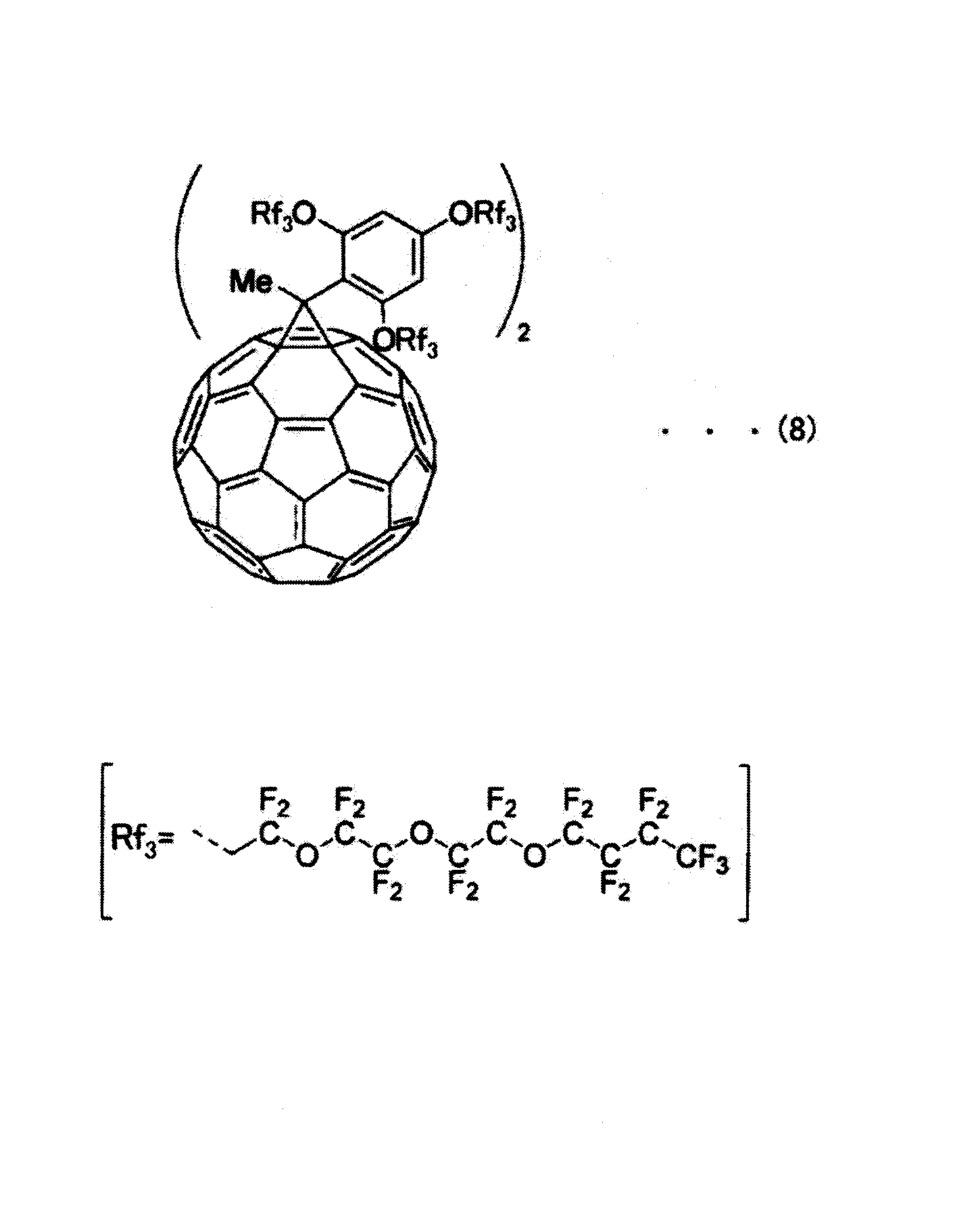
- the pressure in the container was changed within the range of 12 to 18 MPa, and 1.0 g of the black oily fullerene derivative B was extracted. From the NMR analysis results shown below, it was confirmed that the fullerene derivative B had a structure represented by the following formula (8).
- Perfluoropolyether oil As a perfluoropolyether oil, DEMNUM S-20 (F(CF 2 CF 2 CF 2 O) j CF 2 CF 3 , average molecular weight 2700) manufactured by Daikin Industries, Ltd., and NRA (BRAIERERTA J-25) (C 3 F 7 O[CF(CF 3 )CF 2 O] k C 2 F 5 , k is an integer of 2 to 100) is used.
- Example 1 0.001 g of the fullerene derivative A was added to 100 g of BRAAIERTA J-25 as a base oil, and the mixture was stirred at room temperature for 36 hours with a stirrer to dissolve the fullerene derivative A to obtain a lubricating oil composition.
- the content of the fullerene derivative in the obtained lubricating oil composition is 0.0010 parts by mass with respect to 100 parts by mass of the base oil.
- Evaluation of wear resistance of the lubricating oil composition and measurement of the lamella length and the number of solid particles having a major axis of 1 ⁇ m or more were carried out by the above-mentioned measuring method, and the results are summarized in Table 1.
- the content of the fullerene derivative was calculated from the amount of the fullerene derivative charged with respect to 100 parts by mass of the base oil.
- Examples 2-9, Comparative Examples 1-4 A lubricating oil composition was prepared in the same manner as in Example 1 except that the base oil, the fullerene derivative and the content thereof were excluded, and each measurement was performed. The base oil, the fullerene derivative, and the contents thereof were adjusted so as to obtain a lubricating oil composition having the composition shown in Table 1.
- the content of the fullerene derivative exceeds 0.5000 parts by mass, the wear scar diameter becomes large, or seizure occurs, making measurement impossible. It is considered that the reason is that the fullerene derivative was decomposed by pressure during the measurement process, and aggregated particles of fullerene were formed. Therefore, the content of the fullerene derivative is 0.0001 to 0.2000 parts by mass, preferably 0.0010 to 0.1000 parts by mass, based on 100 parts by mass of the base oil, and the fluorine-based lubricating oil composition is preferably used. I found that I could do it.
Landscapes
- Chemical & Material Sciences (AREA)
- Chemical Kinetics & Catalysis (AREA)
- General Chemical & Material Sciences (AREA)
- Oil, Petroleum & Natural Gas (AREA)
- Organic Chemistry (AREA)
- Inorganic Chemistry (AREA)
- Lubricants (AREA)
Abstract
基油としてのパーフルオロポリエーテル油と、パーフルオロポリエーテル鎖を含む基を有するフラーレン誘導体とを有し、前記基油100質量部に対して、前記フラーレン誘導体を0.0001~0.2000質量部を含有する潤滑油組成物。
Description
本発明は、フッ素系潤滑油組成物に関する。
近年、高速化、高効率化、高圧化及び小型化に伴い、自動車、工業機械等に使用される潤滑油には、高圧、高速、高荷重及び高温度下で使用しても長時間にわたって充分に機械寿命を保証できる優れた潤滑性能が要求されている。このような状況下において、優れた熱安定性、低揮発性、耐薬品性、耐樹脂性および温度粘度特性を有する含フッ素系オイル、特にパーフルオロポリエーテル油は、潤滑組成物の基油として、注目を集めている。しかしながら、パーフルオロポリエーテル油は、エステル油や、合成炭化水素油等の合成油と比べて、金属とのなじみが悪く、過酷な条件下では潤滑に十分な油膜を得ることができず、耐摩耗性、耐焼付き性について、一般的な合成油よりも劣っている。また、パーフルオロポリエーテル油は、大部分の一般的な合成油に配合可能な非フッ素系耐摩耗剤、極圧剤等との相溶性が悪く、添加剤の添加による十分な耐摩耗性、耐焼付性を得ることが困難である。
特許文献1には、フッ素油と、第三リン酸カルシウムを有する潤滑組成物が開示されている。この文献の方法では、摩擦摩耗特性を改善するために、大量の第三リン酸カルシウムを添加する必要があり、第三リン酸カルシウムの凝集により、潤滑性能の劣化が懸念される。
また、特許文献2において、「パーフルオロポリエーテル基油に、一般式RfRPO(OR')2(ここで、Rfはパーフルオロポリエーテル基であり、Rは炭素数2~6のアルキレン基であり、R'は水素原子、炭素数1~6のアルキル基、シクロヘキシル基、ビニル基、フェニル基、トリル基、ベンジル基、フェニルエチル基またはこれらのハロゲン原子置換基である)で表わされる含フッ素有機リン化合物を添加してなる潤滑油組成物」が開示されているが、潤滑特性を更なる改善が望まれる。
本発明者らは、以上の事情に鑑みてなされたものであり、十分な耐摩耗性を有するフッ素系潤滑油組成物を提供することを課題としている。
本発明は、上記課題を解決するため、以下の[1]~[5]を含む。
[1]基油としてのパーフルオロポリエーテル油と、パーフルオロポリエーテル鎖を含む基を有するフラーレン誘導体とを有し、前記基油100質量部に対して、前記フラーレン誘導体を0.0001~0.2000質量部を含有する潤滑油組成物。
[2]10mlあたりの長径1μm以上の固体粒子が1個未満である、前項[1]に記載の潤滑油組成物。
[3]前記フラーレン誘導体におけるパーフルオロポリエーテル鎖を含む基は、アリール基を有する接合構造を介して、フラーレン骨格に接合することを特徴とする前項[1]又は前項[2]に記載の潤滑油組成物。
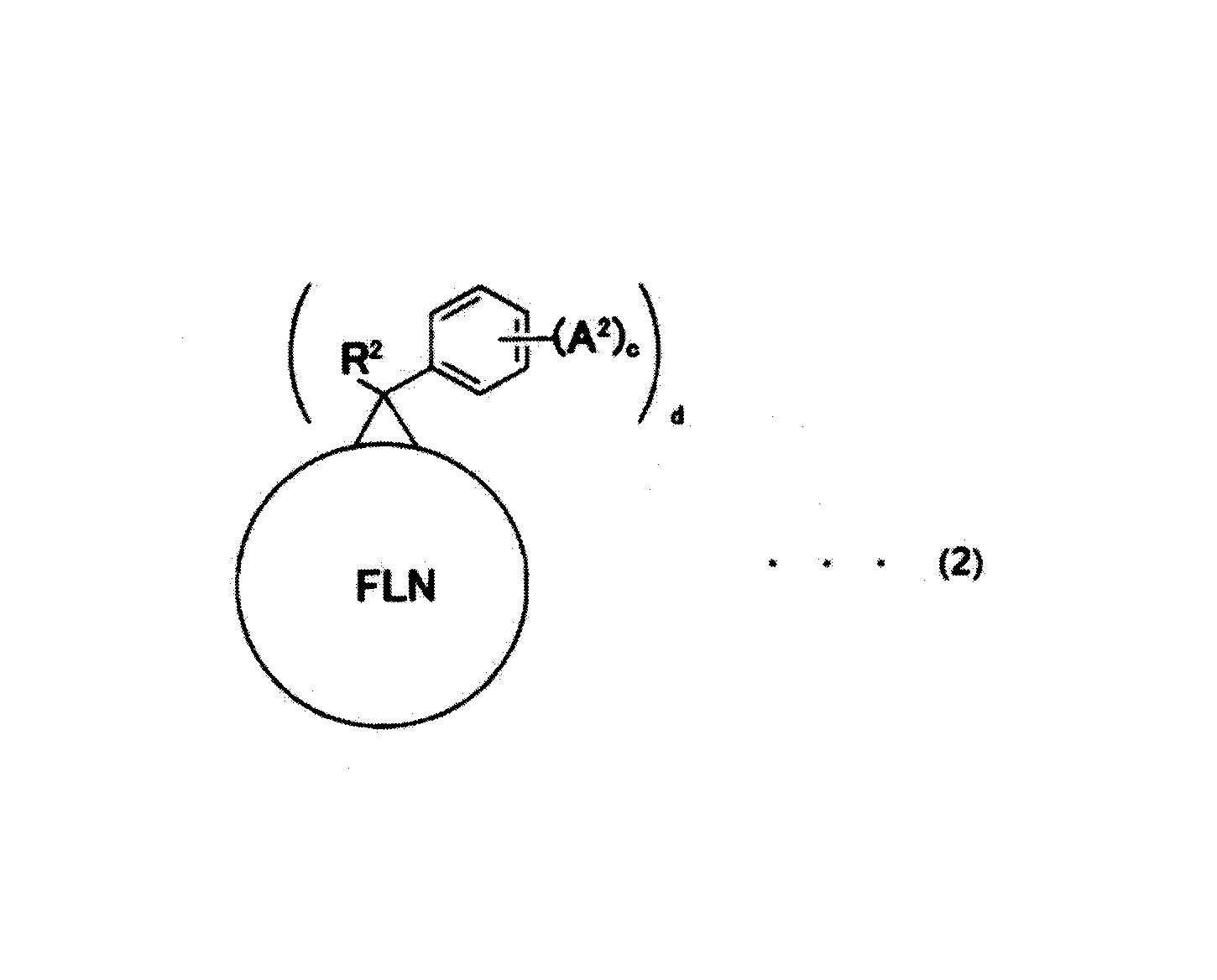
[4]前記フラーレン誘導体が、下記の式(1)または式(2)で表される構造を有する化合物から選択される少なくとも1種であることを特徴とする前項[1]~[3]のいずれかに記載の潤滑油組成物。
[1]基油としてのパーフルオロポリエーテル油と、パーフルオロポリエーテル鎖を含む基を有するフラーレン誘導体とを有し、前記基油100質量部に対して、前記フラーレン誘導体を0.0001~0.2000質量部を含有する潤滑油組成物。
[2]10mlあたりの長径1μm以上の固体粒子が1個未満である、前項[1]に記載の潤滑油組成物。
[3]前記フラーレン誘導体におけるパーフルオロポリエーテル鎖を含む基は、アリール基を有する接合構造を介して、フラーレン骨格に接合することを特徴とする前項[1]又は前項[2]に記載の潤滑油組成物。
[4]前記フラーレン誘導体が、下記の式(1)または式(2)で表される構造を有する化合物から選択される少なくとも1種であることを特徴とする前項[1]~[3]のいずれかに記載の潤滑油組成物。
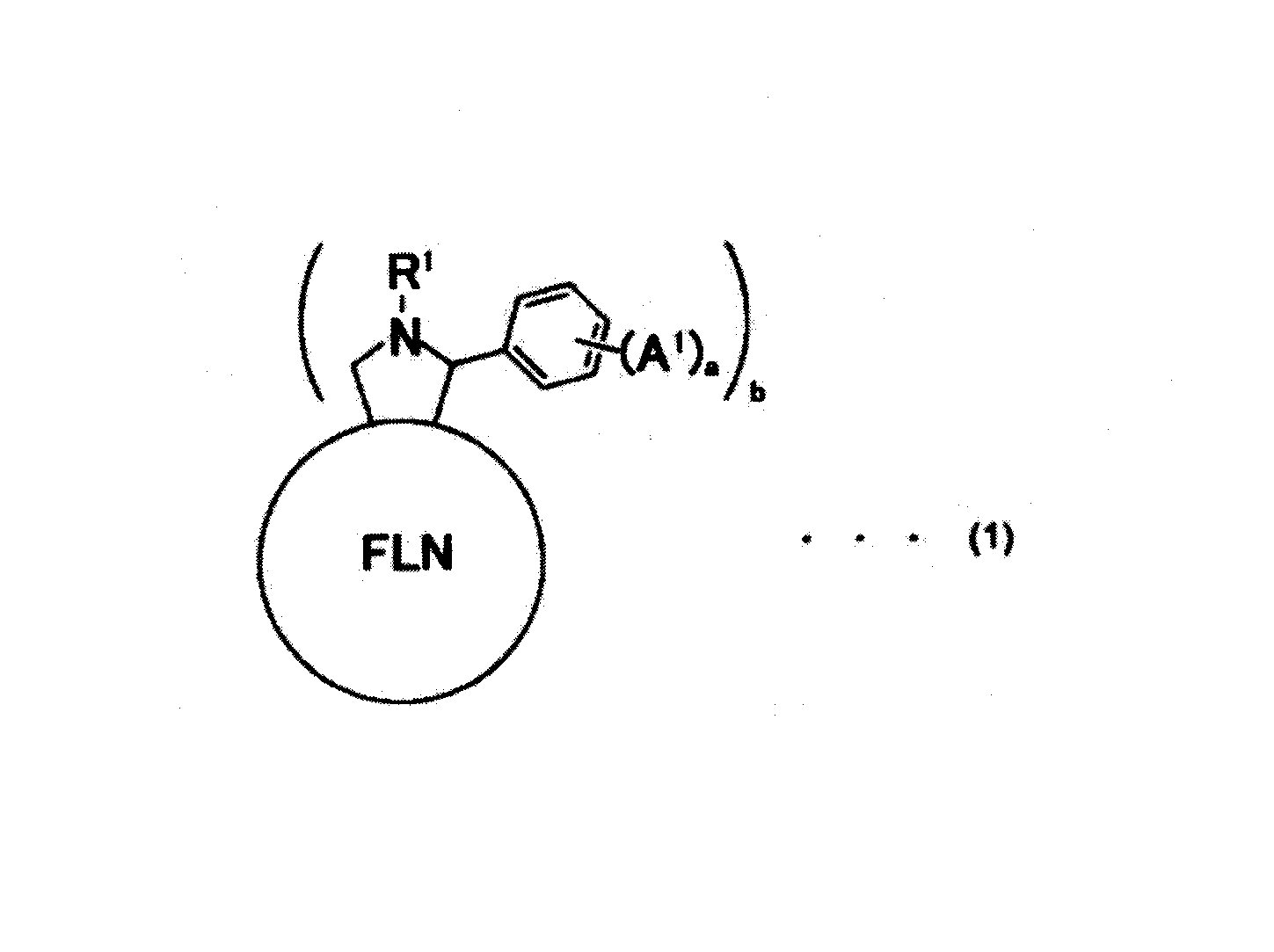
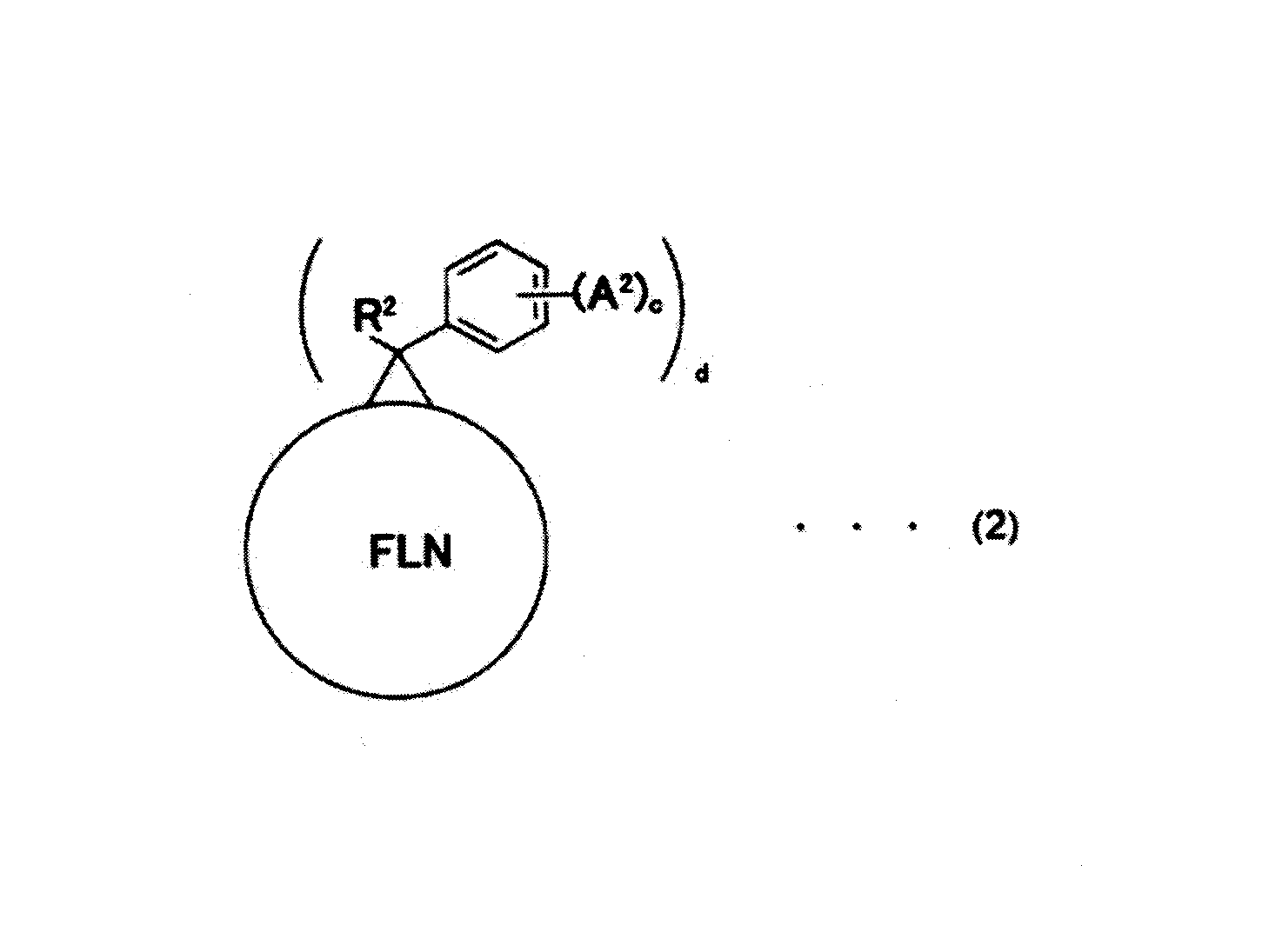
[5]前記R1及びR2は、お互い独立して、炭素数24以下のアルキル基又はアリール基である前項[4]に記載の潤滑油組成物。
本発明によれば、耐摩耗性が優れたフッ素系潤滑油組成物を提供することができる。
以下、本発明の一実施形態を挙げて、詳細に説明する。なお、本発明はその要旨を変更しない範囲で適宜変更して実施することが可能である。
本実施形態で得られる潤滑油組成物は、パーフルオロポリエーテル油からなる基油と、パーフルオロポリエーテル鎖を含む基を有するフラーレン誘導体を含有し、基油100質量部に対して、フラーレン誘導体の含有量は0.0001~0.2000質量部である。
本実施形態に係るパーフルオロポリエーテル油としては、特に限定されるものではなく、通常公知のものは好適に用いられる。例えば、下記の一般式(i)または(ii)の構造を有するものを用いることが可能である。
(i) Rf1-O(CF2O)e(C2F4O)f〔CF(CF3)CF2O〕g-Rf2(ここで、Rf1、Rf2は、それぞれ独立に炭素数1~5のパーフルオロアルキル基を表す。なお、e、f、gは0または正の整数であり、かつ、e+f+g=2~200である)
(ii) F(CF2CF2CF2O)hC2F5
(ここで、hは2~200の整数を意味する。)
上記のパーフルオロポリエーテル油は、一種類を単独で使用しても良く、またこれらの中から選ばれる2種以上のものを任意の割合で混合して使用してもよい。
(フラーレン誘導体)
本発明の実施形態に係るフラーレン誘導体は、パーフルオロポリエーテル鎖を含む基を有するものである。
(i) Rf1-O(CF2O)e(C2F4O)f〔CF(CF3)CF2O〕g-Rf2(ここで、Rf1、Rf2は、それぞれ独立に炭素数1~5のパーフルオロアルキル基を表す。なお、e、f、gは0または正の整数であり、かつ、e+f+g=2~200である)
(ii) F(CF2CF2CF2O)hC2F5
(ここで、hは2~200の整数を意味する。)
上記のパーフルオロポリエーテル油は、一種類を単独で使用しても良く、またこれらの中から選ばれる2種以上のものを任意の割合で混合して使用してもよい。
(フラーレン誘導体)
本発明の実施形態に係るフラーレン誘導体は、パーフルオロポリエーテル鎖を含む基を有するものである。
本発明の実施形態に係るフラーレン誘導体中のフラーレン骨格としては、例えば、C60、C70、C76、C78、さらに高次のフラーレンが挙げられるが、潤滑油への溶解性の高さの点から、C60及びC70が好ましく、純度の高いものを工業的に容易に得る点と、潤滑油への着色が少ない点から、C60がより好ましい。また、フラーレン誘導体のコストを低減するため、フラーレン誘導体の合成工程において、C60とその他のフラーレンとの混合物であるミックスフラーレンを用いることもできる。ミックスフラーレンを使用する場合、C60の質量割合が全体の50%以上であることが好ましい。
本発明のフラーレン誘導体が有するパーフルオロポリエーテル鎖を含む基のパーフルオロポリエーテル鎖の部分は、-(CF2)xO-(式中xは1~5の整数である)で表される構造を有することが好ましい。さらに、-(CF2CF2O)y(CF2O)z-で表される部分構造を有することがより好ましい。ここで、y及びzは1~50の整数である。前記パーフルオロポリエーテル鎖を含む基の、パーフルオロポリエーテル鎖以外の部分は特に限定されない。前記パーフルオロポリエーテル鎖を含む基の末端部の構造としては、トリフルオロメチル基やパーフルオロブチル基などのパーフルオロアルキル基、メチル基やブチル基などのアルキル基、フェニル基やナフチル基などのアリール基、またはベンジル基やフェニルプロピル基などのアラルキル基を含む構造が好ましく、その中でもパーフルオロアルキル基がより好ましく、パーフルオロブチル基が特に好ましい。前記構造を有すると、フラーレン誘導体は、パーフルオロポリエーテル油への溶解性が向上する。
なお、前記パーフルオロポリエーテル鎖を含む基は、直接的にフラーレン骨格に接合してもよく、接合構造を介して、フラーレン骨格に接合してもよい。接合構造について、特に限定されないが、アリール基を含む接合構造が好ましい。また、前記パーフルオロポリエーテル鎖を含む基は、直接的にアリール基と連結することがより好ましい。前記パーフルオロポリエーテル鎖を含む基のアリール基との連結部の構造としては、例えば、エーテル結合やエステル結合を含む構造が挙げられ、その中でもエーテル結合を含む構造が好ましく、特に-OCH2-を含む構造が好ましい。
本発明のフラーレン誘導体は、特に以下の式(1)または式(2)の構造を有するものが最も好ましい。
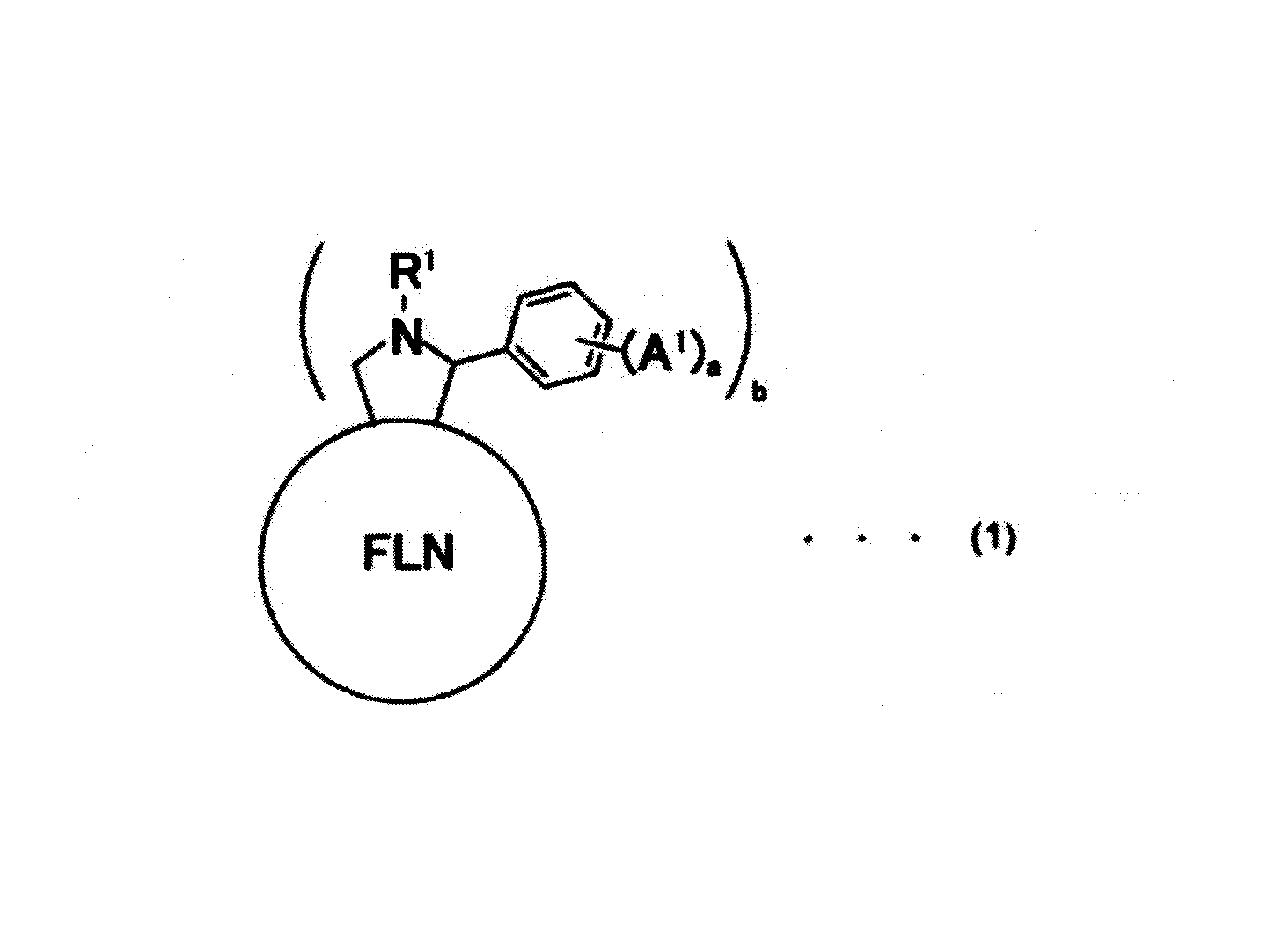

より具体的に、例えば、R1、R2としては、互いに独立に、水素原子、メチル基やエチル基などのアルキル基、フェニル基やナフチル基などのアリール基、ベンジル基やフェニルプロピル基などのアラルキル基が挙げられ、その中でもアルキル基またはアリール基であることが好ましく、メチル基またはフェニル基であることが特に好ましい。A1、A2としては、互いに独立に、-OCH2(CF2O)m(CF2CF2O)nR3で表されるものが挙げられる。ここで、R3としては、炭素数1~5のアルキル基、パーフルオロアルキル基が挙げられ、その中でもパーフルオロアルキル基であることが好ましく、パーフルオロブチル基であることが特に好ましい。なお、m、nはそれぞれ独立に1~50の整数を表す。本発明のフラーレン誘導体は上記の構造を有すれば、パーフルオロポリエーテル油への溶解性が高まる。
なお、上記式(1)または式(2)の構造を有するフラーレン誘導体は、WO2017/006812号公報または特開2017-14192号公報に記載の合成法により、作製することができる。
本実施形態の潤滑油組成物のフラーレン誘導体の含有量は、基油100質量部に対して、0.0001~0.2000質量部であり、好ましくは0.0010~0.2000質量部であり、より好ましくは0.0010~0.1000質量部である。フラーレン誘導体の含有量が上記範囲内であれば、フラーレン誘導体は、パーフルオロポリエーテル油に溶解でき、十分な耐摩耗性向上の効果が期待できる。また、フラーレン誘導体の含有量は上記の範囲内であれば、高温、高圧の使用条件下においても、フラーレン誘導体の分解または凝集による固体物の生成が少なく、長時間にわたって、優れた潤滑性能を維持することができる。
なお、フラーレン誘導体の含有量は上記範囲内であれば、潤滑油組成物のラメラ長を延長する効果も十分期待できる。ラメラ長が延長することで、潤滑油組成物の成膜性が向上され、少量の潤滑油組成物で油膜が出来、さらに潤滑油組成物の漏洩防止効果も得られる。また、ラメラ長が長いほど、油膜が切れにくくなり、耐焼付性が高まる。
本実施形態に係る潤滑油組成物は、フラーレン誘導体の分解又は凝集による生成した固体粒子がなく、又は極めて少ないことが好ましい。即ち、潤滑油組成物10mlあたり長径1μm以上の固体粒子が1個未満であることが好ましく、0.1個未満であることはより好ましい。確認は、後述する実施例の方法により行うことができる。
(添加剤)
本実施形態の潤滑油組成物に、諸特性を改善するために、フラーレン誘導体以外の添加剤を更なる配合することができる。このような添加剤としては、特に限定されないが、例えば、市販の酸化防止剤、粘度指数向上剤、清浄分散剤、腐食防止剤、油性向上剤、錆止め添加剤、消泡剤、加水分解抑制剤などを配合することができる。
(添加剤)
本実施形態の潤滑油組成物に、諸特性を改善するために、フラーレン誘導体以外の添加剤を更なる配合することができる。このような添加剤としては、特に限定されないが、例えば、市販の酸化防止剤、粘度指数向上剤、清浄分散剤、腐食防止剤、油性向上剤、錆止め添加剤、消泡剤、加水分解抑制剤などを配合することができる。
本発明の潤滑油組成物は、パーフルオロポリエーテル油からなる基油、フラーレン誘導体、及び場合によりその他の成分を、通常の混合方法を用いて混合することで得られることができる。混合方法としては、特に限定されなく、スターラー、超音波分散装置、ホモジナイザー、ボールミル、ビーズミルなどを用いることが可能である。また、場合により、混合することで得た潤滑油組成物中に、フラーレン誘導体の析出物、原料由来の不溶物および混合過程中で混入した不溶物等の固体物が存在する可能性がある。これらの固体物の存在により、摩擦係数が上昇する虞があるため、混合工程後、固体物を除去するための工程を設けでもよい。除去方法として、濾過による除去方法、遠心分離による除去方法、それら除去方法の組み合わせなどを挙げることができる。
(用途)
本実施形態の潤滑油組成物は、耐ガス性,低揮発性、高温特性、不燃性であることが特徴で、半導体真空ポンプ、高温ロール軸受、酸素ブロアー、電着塗装オーブン、フィルム延伸機 、ユルゲーター、複写機、レーザープリンター(LBP)、コーン製造機、クリーンルーム、真空機器、遠心分離機各種バルブ、航空機器、宇宙機器などの各種用途に使用することができる。
(用途)
本実施形態の潤滑油組成物は、耐ガス性,低揮発性、高温特性、不燃性であることが特徴で、半導体真空ポンプ、高温ロール軸受、酸素ブロアー、電着塗装オーブン、フィルム延伸機 、ユルゲーター、複写機、レーザープリンター(LBP)、コーン製造機、クリーンルーム、真空機器、遠心分離機各種バルブ、航空機器、宇宙機器などの各種用途に使用することができる。
以上、本発明の好ましい実施形態について述べたが、本発明は特定の実施の形態に限定されるものではなく、特許請求の範囲内に記載された本発明の要旨の範囲内において、種々の変形・変更が可能である。
以下、本発明の実施例について説明する。なお、本発明は以下の実施例のみに限定されるものではない。
(NMR分析)
1H-NMRは下記の条件にて測定した。
装置:日本電子製 JNM-EX270
試料調製:試料(約10mg~30mg)をCDCl3/ヘキサフルオロベンゼン混合溶媒(約0.5mL)に溶解させた後、直径5mmのNMR試料管に入れた。
測定温度:室温
基準物質:溶媒に添加されたテトラメチルシランのシグナルを基準とした。
(耐摩耗性の評価)
ボールオンディスクトライボメーター(Antonparr製)試験により、潤滑油組成物の耐摩耗性を評価した。ボールとして、径6mm(SUJ2)、ディスクとして、径13mm、厚さ5mm(SUJ2)をそれぞれ用い、荷重25N、回転速度10rpm、回転数1000回の条件で摩耗痕径(mm)を測定して評価した。本評価においては、摩耗痕径が小さいほど、摩耗特性に優れることを意味する
(ラメラ長の測定)
潤滑油組成物のラメラ長は、du Nouy法(JIS K2241)により,自動表面張力測定装置DY-300(協和界面科学株式会社製)を用いて、測定した。潤滑油組成物20gを専用のシャーレに入れ、下記の測定条件で、引き上げ張力(表面張力)のピークから液膜が切れるまでの長さ(ラメラ長)を測定した。
<測定条件>
白金リング直径:14.40mm
線材直径:0.4mm
白金リング引下げ速度:12mm/min
接液感度:3mN/m
ステージ下降速度:0.2mm/s
ステージ上昇速度:0.2mm/s
プリウェット下降速度:0.7mm/s
プリウェット上昇速度:0.7mm/s
プリウェット浸漬距離:2.5mm
プリウェット時間:1s
検体調整用容器(シャーレ):50mlガラス瓶
繰り返し測定数:n=10回の平均値を1セットとし、2セットの平均値を採用した。
(長径1μm以上の固体粒子数の測定)
潤滑油組成物を30℃で3日間放置後、潤滑油組成物10mlを0.1μmのメンブランフィルターで濾過し、この濾過面を走査型電子顕微鏡で観察し、長径1μm以上の固体粒子を数えた。この濾過~走査型電子顕微鏡観察までを10回繰り返し、固体粒子数の平均値を得た。
(フラーレン誘導体Aの合成)
フッ素化トリエチレングリコールモノブチルエーテル(化学式:CF3CF2CF2CF2(OCF2CF2)2OCF2CH2OH、Exfluor社製、13g、24mmol)、ピリジン(2.3g、29mmol)をジクロロメタン(120mL)に加え、得られた溶液にトリフルオロメタンスルホン酸無水物(8.2g、29mmol)のジクロロメタン(120mL)溶液を滴下した。室温で16時間攪拌した後、反応混合物を純水(100mL)と飽和炭酸ナトリウム水溶液(100mL)で一度ずつ洗浄した。得られた有機層を濾過した後、ロータリーエバポレーターで濃縮することで、下記の式(3)の構造を有する化合物1(15g、22mmol、収率92%)を淡黄色油状物質として得た。
(NMR分析)
1H-NMRは下記の条件にて測定した。
装置:日本電子製 JNM-EX270
試料調製:試料(約10mg~30mg)をCDCl3/ヘキサフルオロベンゼン混合溶媒(約0.5mL)に溶解させた後、直径5mmのNMR試料管に入れた。
測定温度:室温
基準物質:溶媒に添加されたテトラメチルシランのシグナルを基準とした。
(耐摩耗性の評価)
ボールオンディスクトライボメーター(Antonparr製)試験により、潤滑油組成物の耐摩耗性を評価した。ボールとして、径6mm(SUJ2)、ディスクとして、径13mm、厚さ5mm(SUJ2)をそれぞれ用い、荷重25N、回転速度10rpm、回転数1000回の条件で摩耗痕径(mm)を測定して評価した。本評価においては、摩耗痕径が小さいほど、摩耗特性に優れることを意味する
(ラメラ長の測定)
潤滑油組成物のラメラ長は、du Nouy法(JIS K2241)により,自動表面張力測定装置DY-300(協和界面科学株式会社製)を用いて、測定した。潤滑油組成物20gを専用のシャーレに入れ、下記の測定条件で、引き上げ張力(表面張力)のピークから液膜が切れるまでの長さ(ラメラ長)を測定した。
<測定条件>
白金リング直径:14.40mm
線材直径:0.4mm
白金リング引下げ速度:12mm/min
接液感度:3mN/m
ステージ下降速度:0.2mm/s
ステージ上昇速度:0.2mm/s
プリウェット下降速度:0.7mm/s
プリウェット上昇速度:0.7mm/s
プリウェット浸漬距離:2.5mm
プリウェット時間:1s
検体調整用容器(シャーレ):50mlガラス瓶
繰り返し測定数:n=10回の平均値を1セットとし、2セットの平均値を採用した。
(長径1μm以上の固体粒子数の測定)
潤滑油組成物を30℃で3日間放置後、潤滑油組成物10mlを0.1μmのメンブランフィルターで濾過し、この濾過面を走査型電子顕微鏡で観察し、長径1μm以上の固体粒子を数えた。この濾過~走査型電子顕微鏡観察までを10回繰り返し、固体粒子数の平均値を得た。
(フラーレン誘導体Aの合成)
フッ素化トリエチレングリコールモノブチルエーテル(化学式:CF3CF2CF2CF2(OCF2CF2)2OCF2CH2OH、Exfluor社製、13g、24mmol)、ピリジン(2.3g、29mmol)をジクロロメタン(120mL)に加え、得られた溶液にトリフルオロメタンスルホン酸無水物(8.2g、29mmol)のジクロロメタン(120mL)溶液を滴下した。室温で16時間攪拌した後、反応混合物を純水(100mL)と飽和炭酸ナトリウム水溶液(100mL)で一度ずつ洗浄した。得られた有機層を濾過した後、ロータリーエバポレーターで濃縮することで、下記の式(3)の構造を有する化合物1(15g、22mmol、収率92%)を淡黄色油状物質として得た。
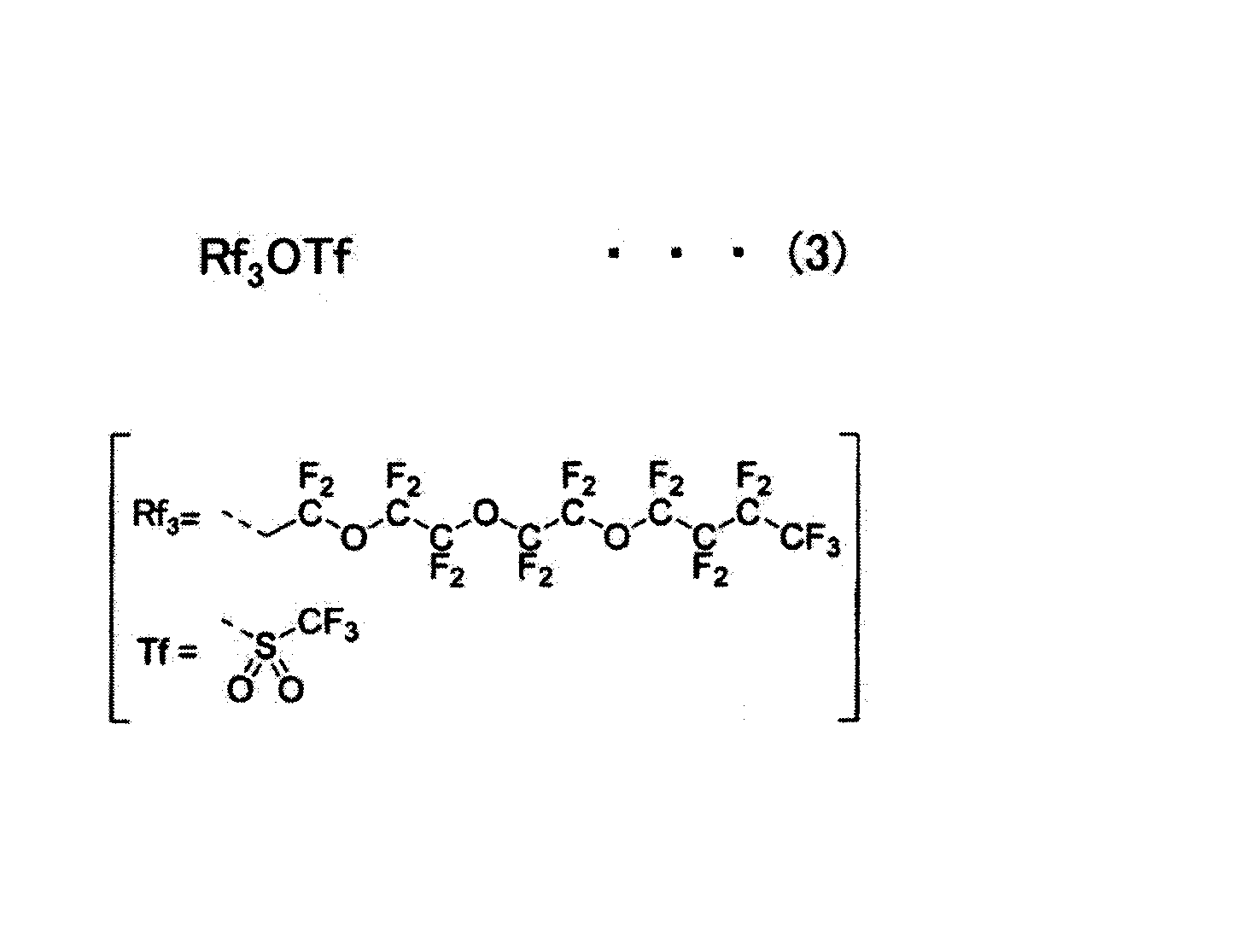

次に、入口および出口をもつ肉厚のステンレス容器(内径20mm×深さ200mm)に、粗生成物を入れ、容器内の温度を60℃に保ちながら、超臨界二酸化炭素送液ポンプ(日本分光製、PU2086-CO2)を用いて、超臨界二酸化炭素を液化二酸化炭素換算流量5mL/分を容器に送った。容器内の圧力を15~20MPaの範囲で変化させ、黒色油状のフラーレン誘導体Aを3.0g抽出した。下記の式に示したNMRの分析結果より、フラーレン誘導体Aは以下式(5)の構造を有することが確認された。
1H-NMR δ(ppm):2.79(brs、6H)、4.39(br、18H)、6.22(brs、4H)。

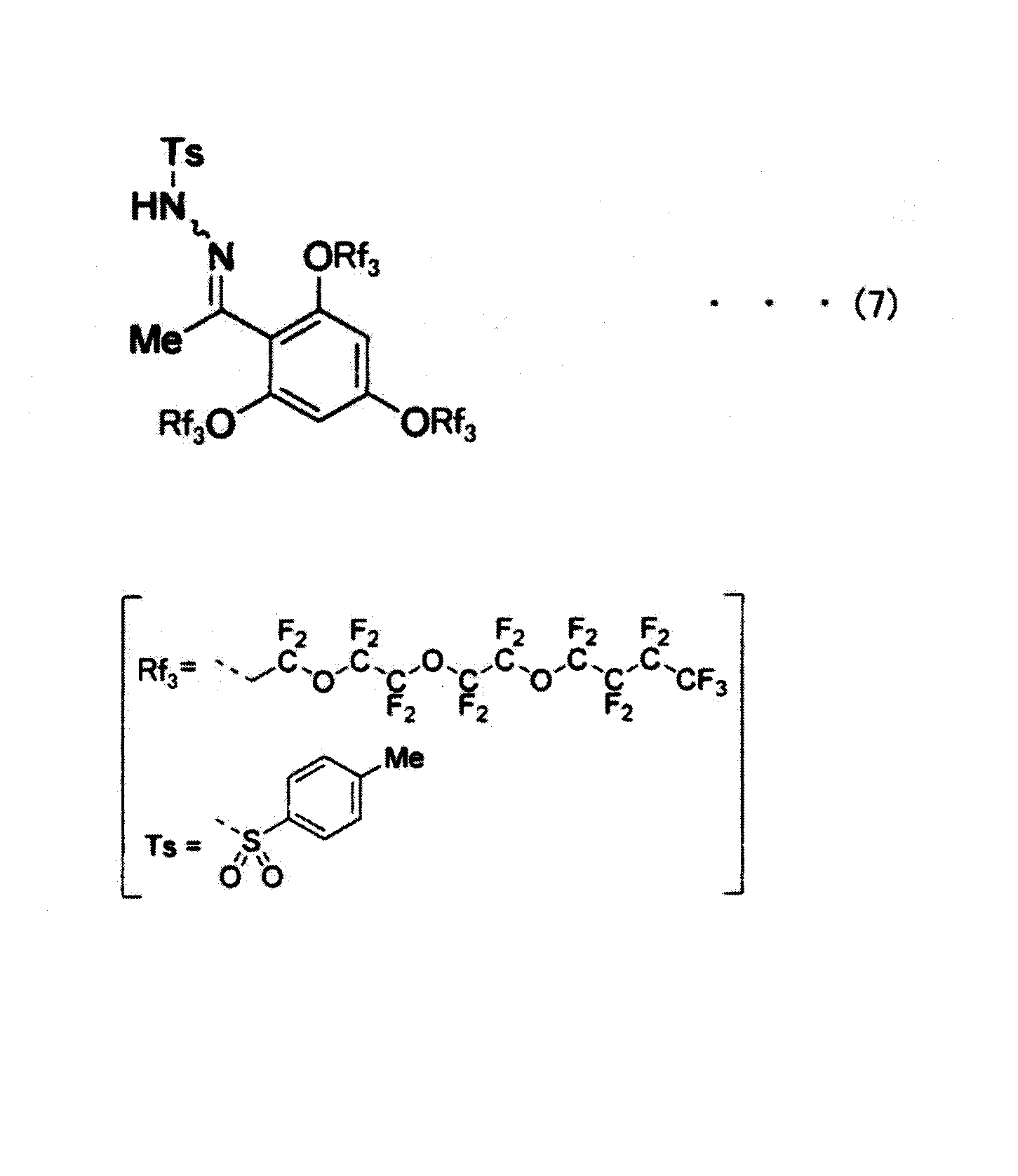
フラーレン誘導体Aの合成と同様に化合物1を作製した。得た化合物1(8.2g、12mmol)と、2',4',6'-トリヒドロキシアセトフェノン一水和物(0.57g、3.0mmol)とをN,N-ジメチルホルムアミド(80mL)に加え、得られた溶液に炭酸セシウム(5.9g、18mmol)を加えた。70℃で2時間攪拌した後、反応混合物を室温まで冷やし、ロータリーエバポレーターで濃縮した。得られた混合物を純水(30mL)とAK―225(30mL)を用いて分液し、さらに水層をAK―225(20mL)で二度抽出した。得られた有機層を水洗し、硫酸マグネシウムにより乾燥した。濾過した後、ロータリーエバポレーターで濃縮することで、赤褐色油状の粗生成物(4.7g)を得た。シリカゲルカラムクロマトグラフィー(展開溶媒:ヘキサン―酢酸エチル(9:1))で精製することで、下記の式(6)の構造を有する化合物3を黄褐色油状物質(3.7g、2.1mmol、収率69%)として得た。

次に、入口および出口をもつ肉厚のステンレス容器(内径20mm×深さ200mm)に、粗生成物を入れ、容器内の温度を60℃に保ちながら、超臨界二酸化炭素送液ポンプ(日本分光製、PU2086-CO2)を用いて、超臨界二酸化炭素を液化二酸化炭素換算流量5mL/分を容器に送った。容器内の圧力を12~18MPaの範囲で変化させ、黒色油状のフラーレン誘導体Bを1.0g抽出した。下記に示したNMRの分析結果より、フラーレン誘導体Bは下記式(8)の構造を有することが確認された。
1H-NMR δ(ppm):2.63(s、3H)、4.46(t、4H)、4.63(t、2H)、6.32(s、2H)。
パーフルオロポリエーテル油として、ダイキン工業(株)製 DEMNUM S-20(F(CF2CF2CF2O)jCF2CF3、平均分子量2700)、およびNOK(株)製:BRAAIERTA J-25(C3F7O〔CF(CF3)CF2O〕kC2F5、kは2~100の整数である)を用いる。
(実施例1)
基油としてBRAAIERTA J-25 100gに、フラーレン誘導体Aを0.001g添加し、室温でスターラーを用いて36時間撹拌して溶解し、潤滑油組成物を得た。得た潤滑油組成物のフラーレン誘導体の含有量は、基油100質量部に対して、0.0010質量部である。前記の測定方法で、潤滑油組成物の耐摩耗性評価、及びラメラ長と長径1μm以上の固体粒子数の測定を実施し、結果を表1に纏めた。なお、潤滑油組成物において、フラーレン誘導体の含有量は、基油100質量部に対して、フラーレン誘導体の仕込み量より算出した。
(実施例2~9、比較例1~4)
基油と、フラーレン誘導体と、その含有量を除き、実施例1と同様に潤滑油組成物を調製し、各測定を実施した。なお、基油と、フラーレン誘導体と、その含有量は、表1に記載の組成を有する潤滑油組成物となるようにそれぞれ調整した。

本出願は2018年12月21日に出願した日本国特許出願第2018-240098号に基づくものであり、その全内容は参照することによりここに組み込まれる。
Claims (5)
- 基油としてのパーフルオロポリエーテル油と、
パーフルオロポリエーテル鎖を含む基を有するフラーレン誘導体とを有し、
前記基油100質量部に対して、前記フラーレン誘導体を0.0001~0.2000質量部を含有する潤滑油組成物。 - 10mlあたりの長径1μm以上の固体粒子が1個未満である、請求項1に記載の潤滑油組成物。
- 前記フラーレン誘導体におけるパーフルオロポリエーテル鎖を含む基は、アリール基を有する接合構造を介して、フラーレン骨格に接合することを特徴とする請求項1又は2に記載の潤滑油組成物。
- 前記フラーレン誘導体が、下記の式(1)または式(2)で表される構造を有する化合物から選択される少なくとも1種であることを特徴とする請求項1~3のいずれかに記載の潤滑油組成物。

- 前記R1及びR2は、お互い独立して、炭素数24以下のアルキル基又はアリール基である請求項4に記載の潤滑油組成物。
Priority Applications (1)
| Application Number | Priority Date | Filing Date | Title |
|---|---|---|---|
| JP2020515058A JP6761918B1 (ja) | 2018-12-21 | 2019-11-22 | 潤滑油組成物 |
Applications Claiming Priority (2)
| Application Number | Priority Date | Filing Date | Title |
|---|---|---|---|
| JP2018-240098 | 2018-12-21 | ||
| JP2018240098 | 2018-12-21 |
Publications (1)
| Publication Number | Publication Date |
|---|---|
| WO2020129538A1 true WO2020129538A1 (ja) | 2020-06-25 |
Family
ID=71100543
Family Applications (1)
| Application Number | Title | Priority Date | Filing Date |
|---|---|---|---|
| PCT/JP2019/045771 Ceased WO2020129538A1 (ja) | 2018-12-21 | 2019-11-22 | 潤滑油組成物 |
Country Status (2)
| Country | Link |
|---|---|
| JP (1) | JP6761918B1 (ja) |
| WO (1) | WO2020129538A1 (ja) |
Citations (4)
| Publication number | Priority date | Publication date | Assignee | Title |
|---|---|---|---|---|
| JP2006131874A (ja) * | 2004-10-08 | 2006-05-25 | Matsushita Electric Ind Co Ltd | 潤滑剤および磁気記録媒体 |
| WO2015125940A1 (ja) * | 2014-02-21 | 2015-08-27 | 昭和電工株式会社 | フラーレン誘導体、フッ素樹脂組成物および潤滑剤 |
| WO2017006812A1 (ja) * | 2015-07-03 | 2017-01-12 | 昭和電工株式会社 | フラーレン誘導体および潤滑剤 |
| WO2018030412A1 (ja) * | 2016-08-10 | 2018-02-15 | 昭和電工株式会社 | フラーレン誘導体および潤滑剤 |
-
2019
- 2019-11-22 JP JP2020515058A patent/JP6761918B1/ja active Active
- 2019-11-22 WO PCT/JP2019/045771 patent/WO2020129538A1/ja not_active Ceased
Patent Citations (4)
| Publication number | Priority date | Publication date | Assignee | Title |
|---|---|---|---|---|
| JP2006131874A (ja) * | 2004-10-08 | 2006-05-25 | Matsushita Electric Ind Co Ltd | 潤滑剤および磁気記録媒体 |
| WO2015125940A1 (ja) * | 2014-02-21 | 2015-08-27 | 昭和電工株式会社 | フラーレン誘導体、フッ素樹脂組成物および潤滑剤 |
| WO2017006812A1 (ja) * | 2015-07-03 | 2017-01-12 | 昭和電工株式会社 | フラーレン誘導体および潤滑剤 |
| WO2018030412A1 (ja) * | 2016-08-10 | 2018-02-15 | 昭和電工株式会社 | フラーレン誘導体および潤滑剤 |
Also Published As
| Publication number | Publication date |
|---|---|
| JPWO2020129538A1 (ja) | 2021-02-15 |
| JP6761918B1 (ja) | 2020-09-30 |
Similar Documents
| Publication | Publication Date | Title |
|---|---|---|
| JP6152502B2 (ja) | フラーレン誘導体および潤滑剤 | |
| RU2737740C2 (ru) | Производное бензотриазола, способ его получения и применения | |
| CN104220485B (zh) | 具有二联苯或三联苯端基的(全)氟聚醚 | |
| TW200923071A (en) | Lubricating oil base oil and lubricating oil composition | |
| US20090318650A1 (en) | Novel fluorine-containing polymer and method of producing fluorine-containing polymer | |
| JP6826694B2 (ja) | グリース組成物 | |
| CN113710783B (zh) | 油剂添加剂及油剂组合物 | |
| JP6695480B2 (ja) | 化合物およびフラーレン誘導体の製造方法 | |
| CN111233664A (zh) | 一种全氟聚醚酯基衍生物及其制备方法和应用 | |
| JP2011093981A (ja) | パーフルオロポリエーテル化合物、およびこれを含有する潤滑剤 | |
| EP3233965A1 (en) | Water-based composition comprising a fluorinated polymer | |
| JP6761918B1 (ja) | 潤滑油組成物 | |
| WO2020184570A1 (ja) | 潤滑油用添加剤、潤滑油用添加剤組成物およびこれらを含有する潤滑油組成物 | |
| WO2011118414A1 (ja) | リン酸エステル化合物を含有する油類用添加剤 | |
| JP6204241B2 (ja) | 駆動系用潤滑油基油及び駆動系用潤滑油組成物 | |
| JP2006291206A (ja) | ルイス酸に耐性のフッ素化潤滑剤 | |
| JP6893443B2 (ja) | フラーレン誘導体および潤滑剤 | |
| US6326337B1 (en) | Perfluoropolyalkylether lubricant formulation with improved stability | |
| EP4067407A1 (en) | (per)fluoropolyether polymers and use thereof as lubricants | |
| CN119684358B (zh) | 一种亚磷酸酯酚类化合物及其制备方法和应用、复合润滑油及其制备方法和应用 | |
| WO2006030747A1 (ja) | ジオキソラン誘導体及びその製造方法 | |
| JP2022086415A (ja) | 化合物、及び組成物 | |
| CN118574917A (zh) | 聚烷氧基硅氧烷基础油作为润滑剂的用途 | |
| JP2016514762A (ja) | 変性水素系潤滑剤 | |
| USH1537H (en) | Perfluorinated polyether lubricant compositions |
Legal Events
| Date | Code | Title | Description |
|---|---|---|---|
| ENP | Entry into the national phase |
Ref document number: 2020515058 Country of ref document: JP Kind code of ref document: A |
|
| 121 | Ep: the epo has been informed by wipo that ep was designated in this application |
Ref document number: 19898428 Country of ref document: EP Kind code of ref document: A1 |
|
| NENP | Non-entry into the national phase |
Ref country code: DE |
|
| 122 | Ep: pct application non-entry in european phase |
Ref document number: 19898428 Country of ref document: EP Kind code of ref document: A1 |