WO2020121893A1 - 構造体の製造方法、カラーフィルタの製造方法、固体撮像素子の製造方法および画像表示装置の製造方法 - Google Patents
構造体の製造方法、カラーフィルタの製造方法、固体撮像素子の製造方法および画像表示装置の製造方法 Download PDFInfo
- Publication number
- WO2020121893A1 WO2020121893A1 PCT/JP2019/047217 JP2019047217W WO2020121893A1 WO 2020121893 A1 WO2020121893 A1 WO 2020121893A1 JP 2019047217 W JP2019047217 W JP 2019047217W WO 2020121893 A1 WO2020121893 A1 WO 2020121893A1
- Authority
- WO
- WIPO (PCT)
- Prior art keywords
- photosensitive composition
- manufacturing
- colored photosensitive
- mass
- pixels
- Prior art date
- Legal status (The legal status is an assumption and is not a legal conclusion. Google has not performed a legal analysis and makes no representation as to the accuracy of the status listed.)
- Ceased
Links
Images






Classifications
-
- G—PHYSICS
- G02—OPTICS
- G02B—OPTICAL ELEMENTS, SYSTEMS OR APPARATUS
- G02B5/00—Optical elements other than lenses
- G02B5/20—Filters
-
- G—PHYSICS
- G03—PHOTOGRAPHY; CINEMATOGRAPHY; ANALOGOUS TECHNIQUES USING WAVES OTHER THAN OPTICAL WAVES; ELECTROGRAPHY; HOLOGRAPHY
- G03F—PHOTOMECHANICAL PRODUCTION OF TEXTURED OR PATTERNED SURFACES, e.g. FOR PRINTING, FOR PROCESSING OF SEMICONDUCTOR DEVICES; MATERIALS THEREFOR; ORIGINALS THEREFOR; APPARATUS SPECIALLY ADAPTED THEREFOR
- G03F7/00—Photomechanical, e.g. photolithographic, production of textured or patterned surfaces, e.g. printing surfaces; Materials therefor, e.g. comprising photoresists; Apparatus specially adapted therefor
- G03F7/004—Photosensitive materials
-
- H—ELECTRICITY
- H10—SEMICONDUCTOR DEVICES; ELECTRIC SOLID-STATE DEVICES NOT OTHERWISE PROVIDED FOR
- H10F—INORGANIC SEMICONDUCTOR DEVICES SENSITIVE TO INFRARED RADIATION, LIGHT, ELECTROMAGNETIC RADIATION OF SHORTER WAVELENGTH OR CORPUSCULAR RADIATION
- H10F39/00—Integrated devices, or assemblies of multiple devices, comprising at least one element covered by group H10F30/00, e.g. radiation detectors comprising photodiode arrays
- H10F39/10—Integrated devices
- H10F39/12—Image sensors
Definitions
- the present invention relates to a method of manufacturing a structure in which a pixel area formed of a plurality of pixels of the same color is formed in a pattern. Further, the present invention relates to a method of manufacturing a color filter, a solid-state image sensor, and an image display device, including the method of manufacturing the above-mentioned structure.
- Color filters are used as key devices for displays and optical elements.
- the color filter is manufactured, for example, by forming a pattern by a photolithography method using a colored photosensitive composition.
- a radical polymerization type colored photosensitive composition is irradiated with exposure energy so as to form a pattern having a width of 5 ⁇ m or less in an atmosphere having an oxygen concentration of more than 21% by volume, and then an exposed portion is exposed. It is described that the pixel portion of the color filter is formed by developing.
- partition walls provided between pixels of each color of the color filter.
- Patent Document 2 on a semiconductor substrate on which a plurality of photoelectric conversion elements are arranged, a transparent flattening layer, a plurality of color filters arranged corresponding to the photoelectric conversion elements, and a photoelectric conversion element, respectively.
- a plurality of corresponding microlenses are laminated in this order, and a pixel partition wall having a refractive index lower than that of the resin of the color filter is formed on the transparent flattening layer side of the boundary between adjacent color filters.
- the solid-state imaging device wherein the color filter includes a color filter main body portion disposed on the transparent flattening layer and a convex lens portion formed on the color filter main body portion, and the height of the color filter main body portion is Describes an invention relating to a solid-state imaging device in which the height of the pixel partition is twice or more the height of the pixel partition, and the convex lens portion is formed in a convex lens shape with the convex surface facing the microlens.
- Paragraph No. 0006 of Patent Document 2 describes that the height of the color filter main body is made twice or more as high as the height of the pixel partition wall, so that light outside the transmission wavelength can be sufficiently absorbed and color separation can be improved. ing.
- a color filter has a plurality of pixels and has the same color for the purpose of improving a dynamic range and forming a phase difference detection pixel for sensitivity and autofocus of an imaging pixel. It is also considered to use a pixel region formed of a plurality of pixels arranged in a pattern (see FIGS. 3 and 4 of Patent Document 3).
- a structure in which a partition wall is provided between pixels of each color of the color filter is known as one mode of the color filter.
- adjacent pixels are pixels of different colors.
- adjacent pixels are pixels of different colors.
- the pixel size has become smaller. Therefore, when pixels are formed between the partition walls by a photolithography method using the colored photosensitive composition, it is becoming difficult to embed the pixels between the partition walls and expose the upper surfaces of the partition walls from the pixels. .. For example, the design of the mask used for exposure and the pattern forming process tend to be complicated. In Patent Document 2, since the height of the pixel is twice or more the height of the partition wall, the upper surface of the partition wall between the pixels is also covered with the pixel as shown in FIG.
- Patent Document 3 describes a color filter in which a plurality of adjacent pixels have the same color, and a pixel region formed of a plurality of pixels of the same color is arranged in a pattern. Has no detailed description about the manufacturing method of the color filter. Furthermore, there is no description or suggestion of forming pixels on a support provided with partition walls.
- Patent Document 1 there is no description or suggestion about forming a pixel on a support body provided with partition walls.
- an object of the present invention is to provide a novel manufacturing method for a structure in which a pixel region including a plurality of pixels of the same color is formed in a pattern.
- Another object of the present invention is to provide a method of manufacturing a color filter, a method of manufacturing a solid-state image sensor, and a method of manufacturing an image display device, including the method of manufacturing a structure described above.
- a colored photosensitive composition is applied onto a support having a plurality of regions partitioned by partition walls to form a colored photosensitive composition layer on the support including the regions partitioned by the partition walls.
- Process A step of patternwise exposing the colored photosensitive composition layer formed on the support through a mask having an opening capable of simultaneously exposing the colored photosensitive composition layer formed in the adjacent region;
- the colored photosensitive composition layer in the unexposed area was removed by development, and at the same time, a part of the colored photosensitive composition layer in the exposed area was also removed by development so that at least a part of the surface of the partition was exposed and partitioned by the partition.
- a method of manufacturing a structure including:. ⁇ 2> The method for manufacturing a structure according to ⁇ 1>, wherein a light shielding portion that shields at least a part of a position corresponding to the partition wall is provided in the opening of the mask. ⁇ 3> The method for producing a structure according to ⁇ 2>, wherein the width of the light shielding portion is 1.0 to 5.0 times the width of the partition wall.
- the colored photosensitive composition contains a radically polymerizable compound and a photoradical polymerization initiator, The structure of any one of ⁇ 1> to ⁇ 3>, wherein the colored photosensitive composition layer formed on the support is exposed in a pattern in an atmosphere having an oxygen concentration of more than 21% by volume.
- ⁇ 5> The method for producing a structure according to ⁇ 4>, wherein the oxygen concentration is 55% by volume or less.
- the colored photosensitive composition layer formed on a support is patternwise exposed under an exposure illuminance of 2500 to 50,000 W/m 2 , and the colored photosensitive composition layer of any one of ⁇ 1> to ⁇ 5> is described. Method of manufacturing structure.
- ⁇ 7> The method for producing a structure according to any one of ⁇ 1> to ⁇ 6>, wherein the partition walls have a height of 0.3 to 1.2 ⁇ m.
- ⁇ 8> The method for producing a structure according to any one of ⁇ 1> to ⁇ 7>, wherein the partition walls have a width of 0.05 to 0.2 ⁇ m.
- a method for producing a color filter including the method for producing the structure according to any one of ⁇ 1> to ⁇ 8>.
- ⁇ 10> A method for manufacturing a solid-state imaging device, including the method for manufacturing a structure according to any one of ⁇ 1> to ⁇ 8>.
- ⁇ 11> A method for manufacturing an image display device, including the method for manufacturing a structure according to any one of ⁇ 1> to ⁇ 8>.
- the present invention can provide a novel manufacturing method for a structure in which a pixel region including a plurality of pixels of the same color is formed in a pattern. Further, it is possible to provide a method for manufacturing a color filter, a method for manufacturing a solid-state image sensor, and a method for manufacturing an image display device, including the above-described method for manufacturing a structure.
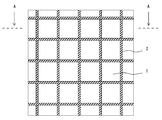
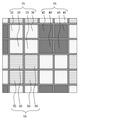
- FIG. 3 is a plan view of the support 1 as seen from directly above.
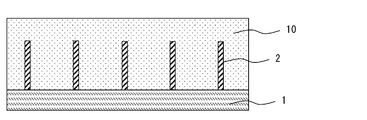
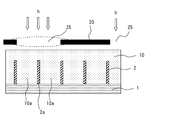
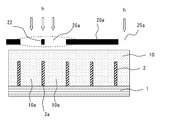
- FIG. 2 is a sectional view taken along the line AA of FIG. 1. It is a figure which shows the state which formed the colored photosensitive composition layer on the support body. It is a figure which shows one Embodiment of an exposure process. It is a figure which shows one Embodiment of a mask, Comprising: It is the top view seen from the direction just above the support body 1 of the part enclosed with the broken line of FIG. It is a figure which shows other embodiment of an exposure process. It is a figure which shows one Embodiment of the mask used in an exposure process, Comprising: It is the top view seen from the direction right above of the support body 1 of the part enclosed with the broken line of FIG.
- FIG. 9 is a sectional view taken along line AA of FIG. 8. It is a figure which shows one Embodiment of a structure. It is a cross-sectional view of the mask 1.
- FIG. 7 is a cross-sectional view of masks 2 to 6.
- a numerical range represented by using a symbol “to” means a range including numerical values before and after “to” as a lower limit value and an upper limit value, respectively.
- process includes not only an independent process but also a process that cannot be clearly distinguished from other processes as long as the intended action of the process can be achieved.
- notation that does not indicate substituted or unsubstituted is meant to include not only those having no substituent but also those having a substituent.
- alkyl group when simply described as “alkyl group”, this includes both an alkyl group having no substituent (unsubstituted alkyl group) and an alkyl group having a substituent (substituted alkyl group). Is the meaning.
- exposure means not only drawing using light but also drawing using particle beams such as electron beams and ion beams.
- the energy rays used for exposure include bright line spectra of mercury lamps, far ultraviolet rays (ArF, KrF, etc.) typified by excimer lasers, extreme ultraviolet rays (EUV light), active rays such as X-rays, and electron beams and A particle beam such as an ion beam may be used.
- (meth)acrylate means both “acrylate” and “methacrylate”, or either
- (meth)acrylic means both “acrylic” and “methacrylic”, or
- (Meth)acryloyl means both “acryloyl” and “methacryloyl”, or either.
- the concentration of the solid content in the composition is represented by the mass percentage of the other components excluding the solvent with respect to the total mass of the composition.
- the weight average molecular weight (Mw) and the number average molecular weight (Mn) are shown as polystyrene equivalent values according to gel permeation chromatography (GPC measurement), unless otherwise specified.
- the weight average molecular weight (Mw) and the number average molecular weight (Mn) are, for example, HLC-8220 (manufactured by Tosoh Corporation), and the columns are guard columns HZ-L, TSKgel Super HZM-M, TSKgel Super HZ4000, and TSKgel. It can be determined by using Super HZ3000 and TSKgel Super HZ2000 (manufactured by Tosoh Corporation).
- THF tetrahydrofuran
- UV ray ultraviolet ray
- the direction in which the layers are stacked on the support is referred to as "upper”, and the opposite direction is referred to as “lower”. It should be noted that such setting of the vertical direction is for convenience in the present specification, and in an actual aspect, the “up” direction in the present specification may be different from the vertical upward direction.
- the colored photosensitive composition layer in the unexposed area was removed by development, and at the same time, a part of the colored photosensitive composition layer in the exposed area was also removed by development so that at least a part of the surface of the partition was exposed and partitioned by the partition.
- Forming a pixel in the region, a plurality of pixels of the same color, and a step of forming a pixel region in which at least a part of the surface of the partition between the pixels is exposed from the pixel in a pattern It is characterized by including.
- the present invention it is possible to manufacture a structure including a plurality of pixels of the same color, and a pixel region in which at least a part of the surface of the partition wall between the pixels is exposed from the pixel is formed in a pattern. You can Further, in this structure, since at least a part of the surface of the partition wall between the individual pixels forming the pixel region is exposed from the pixel, the color separation ability and the light leakage to the adjacent pixel are effective. It can also be suppressed.
- the colored photosensitive composition layer formed in a plurality of adjacent regions is exposed using a mask having an opening capable of simultaneously exposing, and an unexposed portion of the colored photosensitive composition layer and Since a part of the colored photosensitive composition layer in the exposed portion is removed by development to form a pixel, individual pixels forming one pixel region can be formed at the same time, and the manufacturing process of the structure is simple. .. Further, even if the size of each pixel forming one pixel region becomes finer, the mask design and pattern forming process can be simplified. For example, as shown in FIGS. 8 and 10, when the pixel region 35 composed of four pixels 30 is formed in a pattern, the area for four pixels is defined as one exposure area and divided into four by development. This is for forming the pixel.
- the opening of the mask used in the method for manufacturing a structure of the present invention is provided with a light shielding portion that shields at least a part of the position corresponding to the partition wall.
- a means for developing and removing a part of the colored photosensitive composition layer in the exposed portion so that at least a part of the surface of the partition wall is exposed at the time of development for example, as a colored photosensitive composition, a radically polymerizable compound and light are used.
- the radical polymerization reaction of the colored photosensitive composition layer of the surface layer By deactivating the radical polymerization reaction of the colored photosensitive composition layer of the surface layer, the surface layer of the colored photosensitive composition layer of the exposed portion is easily developed and removed during development, so that at least a part of the surface of the partition wall is exposed.
- a part of the colored photosensitive composition layer in the exposed area can be removed by development together with the unexposed area.
- a method of exposing in an atmosphere where the oxygen concentration exceeds 21% by volume, a material in the composition is exposed to an oxygen environment examples thereof include a method of using a photoradical polymerization initiator having a high radical quenching property and a method of using a radically polymerizable compound having a small ethylenically unsaturated bond group valence.
- the colored photosensitive composition contains a radical polymerizable compound and a photoradical polymerization initiator, the colored photosensitive composition layer formed on a support,
- the pattern exposure may be performed in an atmosphere where the oxygen concentration exceeds 21% by volume.
- the radical polymerization reaction of the surface layer of the colored photosensitive composition layer is inhibited by oxygen and is easily deactivated, and the surface layer of the colored photosensitive composition layer is easily removed during development.
- the oxygen concentration is preferably 25% by volume or more, more preferably 30% by volume or more.
- the upper limit is preferably 55% by volume or less, more preferably 50% by volume or less, and more preferably 40% by volume from the viewpoints of the oxygen concentration controllability of the exposure apparatus, safety, and ease of control of polymerization deactivation. % Or less is more preferable.
- the exposure illuminance at the time of exposure is preferably 2500 to 50000 W/m 2 . When the exposure illuminance is within the above range, the radical polymerization reaction of the colored photosensitive composition layer on the surface layer can be more effectively deactivated.
- the upper limit is preferably 30000W / m 2 or less for the reason that deactivating effect of the radical polymerization reaction by oxygen inhibition is more remarkably obtained easily, more preferably at most 15000W / m 2.
- the lower limit is desirably 3000W / m 2 or more in terms of pixels forming, 5000 W / m 2 or more is more preferable.
- the exposure energy during exposure is preferably 1000 to 10000 J/m 2 .
- the upper limit is preferably 8000J / m 2 or less for the reason that deactivating effect of the radical polymerization reaction by oxygen inhibition is more remarkably obtained easily, and more preferably not more than 6000 J / m 2.
- the lower limit is desirably 2000J / m 2 or more from the viewpoint of adhesiveness, 3000 J / m 2 or more is more preferable.
- FIG. 1 is a plan view seen from directly above the support 1
- FIG. 2 is a sectional view taken along the line AA of FIG.
- reference numeral 1 is a support.
- the material of the support 1 is not particularly limited. It can be appropriately selected according to the application. For example, a glass substrate, a silicon substrate, etc. are mentioned, and a silicon substrate is preferable. Further, a charge coupled device (CCD), complementary metal oxide semiconductor (CMOS), transparent conductive film, etc. may be formed on the silicon substrate. Further, the silicon substrate may be provided with an undercoat layer for the purpose of improving the adhesion with the upper layer, preventing the diffusion of substances, or flattening the substrate surface.
- CCD charge coupled device
- CMOS complementary metal oxide semiconductor
- transparent conductive film etc.
- the silicon substrate may be provided with an undercoat layer for the purpose of improving the adhesion with the upper layer, preventing the diffusion of substances, or flattening the substrate surface.
- a partition 2 is provided on the support 1, and the surface of the support 1 is divided into a plurality of regions by the partition 2.
- the above-mentioned "region" is a space surrounded by partition walls on the support.
- the partition wall 2 may be provided directly on the support 1.
- partition walls may be provided on the undercoat layer.
- the shape of the region surrounded by the partition wall 2 on the support 1 (hereinafter, also referred to as the shape of the opening of the partition wall) is rectangular, but it may be a shape other than the rectangular shape. Good. For example, a circular shape, an elliptical shape, a pentagonal or higher polygonal shape, and the like can be given.
- the material of the partition wall 2 There is no particular limitation on the material of the partition wall 2. Examples thereof include organic materials such as siloxane resin and fluororesin, and inorganic particles such as silica particles.
- silica particles those in which a plurality of spherical silica particles are connected in a beaded shape are preferably used.
- the term “spherical” means that it may be substantially spherical and may be deformed within a range in which the effects of the present invention are exhibited. For example, it is meant to include a shape having irregularities on the surface and a flat shape having a major axis in a predetermined direction.
- a plurality of spherical silica particles are connected in a beaded shape means a structure in which a plurality of spherical silica particles are connected in a linear and/or branched form.
- a structure in which a plurality of spherical silica particles are connected to each other at a joint having a smaller outer diameter there may be mentioned a structure in which a plurality of spherical silica particles are connected to each other at a joint having a smaller outer diameter.
- the structure in which "a plurality of spherical silica particles are connected in a beaded shape” is not limited to a structure in which they are connected in a ring shape, but also a chain shape having an end. The structure is also included.
- the partition wall 2 may be made of a metal such as tungsten or aluminum. It may also be a laminate of a metal and a black matrix. In the case of a laminated body, the order of laminating the metal and the black matrix is not particularly limited.
- the height H1 of the partition wall 2 is preferably 0.3 to 1.2 ⁇ m.
- the lower limit is preferably 0.35 ⁇ m or more, and more preferably 0.4 ⁇ m or more.
- the upper limit is preferably 1.1 ⁇ m or less, more preferably 1.0 ⁇ m or less, and further preferably 0.8 ⁇ m or less.
- the width W1 of the partition wall 2 is preferably 0.05 to 0.2 ⁇ m.
- the lower limit is preferably 0.06 ⁇ m or more, more preferably 0.08 ⁇ m or more, and further preferably 0.10 ⁇ m or more.
- the upper limit is preferably 0.18 ⁇ m or less, more preferably 0.15 ⁇ m or less, and further preferably 0.12 ⁇ m or less.
- the ratio of the height H1 to the width W1 of the partition wall 2 is preferably 1.5 to 20.0.
- the lower limit is preferably 1.8 or more, more preferably 2.0 or more, and further preferably 4.0 or more.
- the upper limit is preferably 15.0 or less, more preferably 10.0 or less, and further preferably 8.0 or less.
- the pitch width P1 of the partition walls 2 is preferably 0.5 to 2.0 ⁇ m.
- the lower limit is preferably 0.6 ⁇ m or more, more preferably 0.7 ⁇ m or more, and further preferably 0.8 ⁇ m or more.
- the upper limit is preferably 1.8 ⁇ m or less, more preferably 1.4 ⁇ m or less, and further preferably 1.2 ⁇ m or less.
- the pitch width P1 of the partition walls 2 is the array pitch of adjacent partition walls. The smaller the pitch width P1, the smaller the pixel size.
- a protective layer may be provided on the surface of the partition wall 2.
- various inorganic materials and organic materials can be used.
- organic materials include acrylic resins, polystyrene resins, polyimide resins, organic SOG (Spin On Glass) resins, and the like.
- the protective layer can also be formed using a composition containing a compound having a group having an ethylenically unsaturated bond.
- the group having an ethylenically unsaturated bond include a vinyl group, a (meth)allyl group, a (meth)acryloyl group and a styryl group, and a (meth)allyl group and a (meth)acryloyl group are preferable.
- the compound having a group having an ethylenically unsaturated bond may be a monomer or a resin such as a polymer.
- the inorganic material include silicon dioxide.
- the protective layer can be formed using a conventionally known method.
- the composition containing the organic material can be applied and dried on the partition walls.
- an inorganic material constituting the protective layer is formed on the surface of the protective layer by a vapor deposition method such as chemical vapor deposition (CVD) or vacuum vapor deposition, or a method such as sputtering. It can be formed as a film.
- the partition wall 2 can be formed by using a conventionally known method.
- the partition wall 2 can be formed as follows. First, a partition material layer is formed on a support.
- the partition wall material layer can be formed, for example, by applying a composition containing inorganic particles such as silica particles on a support and then performing curing or the like to form a film, to form a partition wall material layer. Examples of such a composition include the compositions for forming an optical functional layer described in paragraph Nos. 0012 to 0133 of WO 2015/190374, the contents of which are incorporated herein.
- an inorganic material such as silicon dioxide can be formed on the support by a vapor deposition method such as chemical vapor deposition (CVD) or vacuum vapor deposition, or a method such as sputtering to form a partition material layer.
- a vapor deposition method such as chemical vapor deposition (CVD) or vacuum vapor deposition, or a method such as sputtering to form a partition material layer.
- CVD chemical vapor deposition
- vacuum vapor deposition or a method such as sputtering to form a partition material layer.
- a resist pattern is formed on the partition wall material layer using a mask having a pattern that conforms to the shape of the partition wall.
- the partition wall material layer is etched to form a pattern.
- the etching method include a dry etching method and a wet etching method. The etching by the dry etching method can be performed under the conditions described in paragraph numbers 0114 to 0120, 0129, and 0130 of JP-A
- the colored photosensitive composition is applied on the support 1 provided with a plurality of regions partitioned by the partition walls 2 and partitioned by the partition walls 2.
- the colored photosensitive composition layer 10 is formed on the support 1 including the inside of the region.
- a composition containing a radically polymerizable compound and a photoradical polymerization initiator is preferably used.
- the type of the colored photosensitive composition for example, for forming a pixel selected from red pixel, green pixel, blue pixel, yellow pixel, cyan color pixel, magenta color pixel, transparent pixel, infrared transmitting pixel and light shielding pixel
- the composition include a composition for forming a pixel selected from red pixels, green pixels and blue pixels. Details of the colored photosensitive composition will be described later. In the present specification, "coloring" in the colored photosensitive composition is a concept including "transparency".
- a known method can be used as a method for applying the colored photosensitive composition.
- a dropping method drop casting
- a slit coating method for example, a spray method; a roll coating method; a spin coating method (spin coating); a cast coating method; a slit and spin method; a pre-wet method (for example, JP 2009-145395A).
- Method described in the publication inkjet (for example, on-demand method, piezo method, thermal method), ejection-type printing such as nozzle jet, flexographic printing, screen printing, gravure printing, reverse offset printing, metal mask printing method, etc. Examples include various printing methods; transfer methods using dies and the like; nanoimprint methods.
- the method of applying the inkjet method is not particularly limited, and for example, the method shown in “Expanding and Usable Inkjets-Infinite Possibilities in Patents-, February 2005, Sumi Betechno Research” (especially from page 115) (See page 133), Japanese Patent Laid-Open No. 2003-262716, Japanese Patent Laid-Open No. 2003-185831, Japanese Patent Laid-Open No. 2003-261827, Japanese Patent Laid-Open No. 2012-126830, Japanese Patent Laid-Open No. 2006-169325, and the like. Can be mentioned. Further, as the method for applying the colored photosensitive composition, the methods described in International Publication No. 2017/030174 and International Publication No. 2017/018419 can be used, and the contents thereof are incorporated in the present specification.
- the colored photosensitive composition layer 10 formed on the support 1 may be dried (prebaked).
- the prebaking temperature is preferably 150°C or lower, more preferably 120°C or lower, and further preferably 110°C or lower.
- the lower limit may be, for example, 50° C. or higher, and may be 80° C. or higher.
- the prebake time is preferably 10 to 300 seconds, more preferably 40 to 250 seconds, and further preferably 80 to 220 seconds. Prebaking can be performed with a hot plate, an oven, or the like.
- the composition layer 10 is exposed (exposure step). That is, in this step, a plurality of pixels are exposed as one exposure area. For example, in FIGS. 4 and 5, four pixels at a position corresponding to the opening 25 of the mask 20 is the exposure area. Further, as shown in FIGS. 6 and 7, even when the light-shielding portion 22 is formed in a part of the opening 25a of the mask 20a, four pixels at a position corresponding to the opening 25a of the mask 20a. It corresponds to the exposure area.
- the number of the colored photosensitive composition layers 10a simultaneously exposed in one exposure area can be appropriately selected. For example, when the number of pixels constituting one pixel region is four, four adjacent colored photosensitive composition layers are simultaneously exposed. That is, the colored photosensitive composition layer 10a for four pixels is simultaneously exposed.
- FIG. 5 is an embodiment of a mask having openings capable of simultaneously exposing four colored photosensitive composition layers adjacent to each other, and a portion surrounded by a broken line including the openings 25 of the mask 20 shown in FIG.
- FIG. 3 is a plan view of the support 1 as viewed from directly above.
- the mask 20 has an opening 25 at a position corresponding to the colored photosensitive composition layer 10a in four adjacent areas partitioned by the partition 2 and the partition 2a between the colored photosensitive composition layers 10a. Has been formed.
- By using such a mask 20 it is possible to irradiate the colored photosensitive composition layer 10a formed in four adjacent regions with the light h so that the colored photosensitive composition layer 10a can be exposed.
- the opening 25a of the mask 20a is provided with a light-shielding portion 22 for shielding at least a part of the position corresponding to the partition wall 2a between the colored photosensitive composition layers 10a.
- the light shielding portion 22 may be made of the material forming the mask 20a. When such a mask is used, the colored photosensitive composition layer on the partition wall 2a can be more effectively developed and removed during development.
- the width of the light-shielding portion 22 is preferably 0.5 to 5.0 times the width of the partition wall, more preferably 1.0 to 4.0 times, and even more preferably 1.0 to 3.0 times.
- the light-shielding portion 22 has a transmittance of light having a wavelength used for exposure of preferably 1.0% or less, more preferably 0.5% or less, and further preferably 0.1% or less. ..
- FIG. 7 shows an embodiment of a mask having an opening through which four adjacent colored photosensitive composition layers can be exposed simultaneously, and the light-shielding part is provided in the opening
- FIG. FIG. 20 is a plan view of a portion surrounded by a broken line including an opening portion 25a of 20a as viewed from directly above the support body 1.
- the mask 20a is provided with a light shielding portion 22 at a position corresponding to the partition wall 2a between the colored photosensitive composition layers 10a.
- Radiation (light) that can be used during exposure includes g-line, h-line, i-line and the like. Further, light having a wavelength of 300 nm or less (preferably light having a wavelength of 180 to 300 nm) can also be used. Examples of light having a wavelength of 300 nm or less include KrF rays (wavelength 248 nm) and ArF rays (wavelength 193 nm), and KrF rays (wavelength 248 nm) are preferable. Also, a long-wave light source of 300 nm or more can be used. In addition, upon exposure, light may be continuously irradiated to perform exposure, or pulsed irradiation may be performed (pulse exposure).
- the exposure illuminance during exposure is preferably 2500 to 50000 W/m 2 .
- the upper limit is preferably 30000W / m 2 or less, more preferably 15000W / m 2.
- the lower limit is desirably 3000W / m 2 or more, 5000 W / m 2 or more is more preferable.
- the exposure energy during exposure is preferably 1000 to 10000 J/m 2 .
- the upper limit is preferably 8000J / m 2 or less, more preferably 6000 J / m 2.
- the lower limit is desirably 2000J / m 2 or more, 3000 J / m 2 or more is more preferable.
- the oxygen concentration at the time of exposure can be appropriately selected, and the exposure may be performed in the atmosphere (oxygen concentration is 20 to 21% by volume), or may be performed in an oxygen atmosphere having an oxygen concentration of less than 20% by volume.
- the exposure may be performed in an oxygen atmosphere in which the oxygen concentration exceeds 21% by volume.
- exposure is preferably performed in an oxygen atmosphere in which the oxygen concentration exceeds 21% by volume.
- the colored photosensitive composition layer is formed using a colored photosensitive composition containing a radically polymerizable compound and a photoradical polymerization initiator, the oxygen concentration is higher than 21% by volume in an oxygen atmosphere. It is preferable to expose with.
- the oxygen concentration is preferably 25% by volume or more, more preferably 30% by volume or more.
- the upper limit is preferably 55% by volume or less, more preferably 50% by volume or less, and more preferably 40% by volume from the viewpoints of the oxygen concentration controllability of the exposure apparatus, safety, and ease of control of polymerization deactivation. % Or less is more preferable.
- FIGS. 8 and 9 the colored photosensitive composition layer in the unexposed area is developed and removed, and at the same time, the colored photosensitive composition layer in the exposed area is exposed so that at least a part (preferably the upper surface) of the surface of the partition wall is exposed.
- a part of the functional composition layer is also removed by development to form the pixel 30 in the region partitioned by the partition wall, and thus the pixel 30 is composed of a plurality of pixels of the same color and the surface of the partition wall 2a between the pixels 30.
- a pixel region 35 in which at least a part of the pixel region is exposed from the pixel 30 is formed in a pattern.
- FIG. 8 is a plan view seen from directly above the support 1
- FIG. 9 is a sectional view taken along the line AA of FIG.
- Development removal of the colored photosensitive composition layer can be performed using a developer.
- the temperature of the developer is preferably 20 to 30° C., for example.
- the development time is preferably 20 to 180 seconds. Further, in order to improve the residue removability, the process of shaking off the developing solution every 60 seconds and further supplying a new developing solution may be repeated several times.
- the developing solution examples include organic solvents and alkaline developing solutions, and alkaline developing solutions are preferably used.
- the alkaline developer is preferably an alkaline aqueous solution (alkali developer) obtained by diluting an alkaline agent with pure water.
- alkaline agent examples include ammonia, ethylamine, diethylamine, dimethylethanolamine, diglycolamine, diethanolamine, hydroxyamine, ethylenediamine, tetramethylammonium hydroxide, tetraethylammonium hydroxide, tetrapropylammonium hydroxide, tetrabutylammonium hydroxide.
- Organic compounds such as, ethyltrimethylammonium hydroxide, benzyltrimethylammonium hydroxide, dimethylbis(2-hydroxyethyl)ammonium hydroxide, choline, pyrrole, piperidine, 1,8-diazabicyclo[5.4.0]-7-undecene
- alkaline compounds such as sodium hydroxide, potassium hydroxide, sodium carbonate, sodium hydrogen carbonate, sodium silicate, and sodium metasilicate.
- the alkaline agent a compound having a large molecular weight is preferable in terms of environment and safety.
- the concentration of the alkaline agent in the alkaline aqueous solution is preferably 0.001 to 10% by mass, more preferably 0.01 to 1% by mass.
- the developing solution may further contain a surfactant.
- the surfactant is preferably a nonionic surfactant.
- the developer may be once produced as a concentrated solution and diluted to a required concentration at the time of use, from the viewpoint of convenience of transportation and storage. Although the dilution ratio is not particularly limited, it can be set, for example, in the range of 1.5 to 100 times.
- the developing method a known method can be used. For example, dip development, paddle development, shower development, spray development, ultrasonic development, dip development and the like can be mentioned. Puddle development and spray development are preferable, and spray development is more preferable because it is easy to remove residues efficiently.
- the spray development is a method in which a developing solution, which is pressurized with a gas such as N 2 or air, is discharged from a nozzle, and the developing solution is spray-coated on a target to perform development. In the spray development, the spray-shaped developer discharged from the nozzle is piled up on the target and the target is developed by the spray pressure.
- a composite development method including a step of paddle development after liquid discharge by spray development may be used.
- the flow rate of the developer in spray development, the flow rate ratio of the developer and gas, the spray pressure, etc. can be adjusted as appropriate.
- the flow rate of the developing solution is preferably 30 to 500 mL/min, more preferably 50 to 400 mL/min, and further preferably 200 to 350 mL/min.
- the spray pressure is preferably 3 to 15 MPa, more preferably 5 to 12 MPa, even more preferably 7 to 9 MPa.
- the rinse is performed by supplying the rinse liquid to the developed support while rotating the developed support. It is also preferable to move the nozzle for discharging the rinse liquid from the central portion of the support to the peripheral portion of the support. At this time, when moving from the central portion of the support body of the nozzle to the peripheral edge portion, the movement speed of the nozzle may be gradually reduced. By performing the rinse in this manner, it is possible to suppress the in-plane variation of the rinse. Further, the same effect can be obtained by gradually decreasing the rotational speed of the support while moving the nozzle from the center of the support to the peripheral portion.
- the additional exposure process and the post-baking are post-development curing treatments for completing the curing of the composition layer.
- the heating temperature in the post-baking is preferably 100 to 240° C., more preferably 200 to 240° C.
- the post-baking can be carried out continuously or batchwise by using a heating means such as a hot plate, a convection oven (hot air circulating dryer), a high frequency heater or the like so that the above heating conditions are satisfied.
- the light used for the exposure is preferably light having a wavelength of 400 nm or less. Further, the additional exposure process may be performed by the method described in Korean Patent Laid-Open No. 10-2017-0122130.
- a pixel region 35 which is composed of a plurality of pixels of the same color and in which at least a part (preferably the upper surface) of the surface of the partition wall 2a between the pixels 30 is exposed from the pixel 30, is formed in a pattern.
- one pixel region 35 is composed of four pixels 30 in FIG. 8, the number of pixels forming one pixel region may be two or three. It may well be 5 or more.
- the individual pixels 30 forming one pixel area 35 are arranged side by side in the x direction and two in the y direction in FIG. 8, respectively.
- the arrangement method of the pixels is not particularly limited, and various arrangements can be adopted.
- one pixel area is composed of four pixels as an example
- four pixels are continuously arranged in the x direction to form one pixel area.
- four pixels may be continuously arranged in the y direction to form one pixel region.
- the height H1 of the partition wall 2 and the thickness (height) H2 of the pixel 30 are substantially the same, but the height H1 of the partition wall 2>the thickness (height) H2 of the pixel 30.
- the height H1 of the partition wall 2 may be smaller than the thickness (height) H2 of the pixel 30.
- the thickness (height) H2 of the pixel 30 is preferably 0.8 to 1.3 times, and preferably 0.9 to 1.2 times the height H1 of the partition wall 2 because the color mixture is easily suppressed. It is more preferable, and it is further preferable that the amount is 0.9 to 1.1 times.
- the upper surface of the pixel 30 is substantially flat in FIG. 9, unevenness may occur on the surface in some cases.
- FIG. 10 is a plan view of a structure in which pixel regions 35, 45, 55 of three colors are formed in a pattern.
- the pixels 30, 40 and 50 are pixels having different hues.
- the pixel 30 may be a green pixel
- the pixel 40 may be a red pixel
- the pixel 50 may be a blue pixel.
- the type and arrangement of pixels can be appropriately selected according to the application and purpose.
- the structure manufactured by the present invention can be preferably used for a color filter or the like. Further, the structure manufactured by the present invention can be used by incorporating it into a solid-state image sensor, an image display device, or the like. Examples of the image display device include a liquid crystal display device and an organic electroluminescence (organic EL) display device. Further, it can also be used by being incorporated in an image pickup device mounted on a digital still camera, a digital video camera, a surveillance camera, an in-vehicle camera or the like.
- the colored photosensitive composition used in the method for producing a structure of the present invention will be described.
- the colored photosensitive composition include a pixel-forming composition selected from red pixels, green pixels, blue pixels, yellow pixels, cyan color pixels, magenta color pixels, transparent pixels, infrared transmitting pixels, and light shielding pixels.
- a pixel forming composition selected from red, green, and blue pixels is preferable.
- the transmittance of light having a wavelength of 365 nm is 0.5% or more in at least one of the above-mentioned film thicknesses. Is preferable, 1.0% or more is more preferable, and 5.0% or more is further preferable.
- the colored photosensitive composition preferably contains a colorant.
- the colorant include chromatic colorants such as a red colorant, a green colorant, a blue colorant, a yellow colorant, a purple colorant and an orange colorant.
- the colorant may be a pigment or a dye. You may use together a pigment and a dye.
- the pigment may be either an inorganic pigment or an organic pigment. Further, as the pigment, a material in which a part of an inorganic pigment or an organic-inorganic pigment is replaced with an organic chromophore can also be used. By replacing the inorganic pigment or the organic-inorganic pigment with the organic chromophore, the hue design can be facilitated.
- the average primary particle diameter of the pigment is preferably 1 to 200 nm.
- the lower limit is preferably 5 nm or more, more preferably 10 nm or more.
- the upper limit is preferably 180 nm or less, more preferably 150 nm or less, and further preferably 100 nm or less.
- the primary particle diameter of the pigment can be determined from the image photograph obtained by observing the primary particle of the pigment with a transmission electron microscope. Specifically, the projected area of the primary particles of the pigment is obtained, and the equivalent circle diameter is calculated as the primary particle diameter of the pigment.
- the average primary particle diameter in the present invention is an arithmetic average value of the primary particle diameters of 400 primary particles of the pigment.
- the primary particles of the pigment are independent particles that do not aggregate.
- the colorant used in the present invention preferably contains a pigment.
- the content of the pigment in the colorant is preferably 50% by mass or more, more preferably 70% by mass or more, further preferably 80% by mass or more, and 90% by mass or more. Particularly preferred.
- Examples of the pigment include those shown below.
- a halogenated zinc phthalocyanine pigment having an average number of halogen atoms in one molecule of 10 to 14, an average number of bromine atoms of 8 to 12 and an average number of chlorine atoms of 2 to 5 can also be used. Specific examples thereof include the compounds described in WO 2015/118720. Further, as the green pigment, the compound described in Chinese Patent Application No. 106909027 specification, the phthalocyanine compound having a phosphate ester as a ligand described in International Publication No. 2012/102395, and the like can be used.
- an aluminum phthalocyanine compound having a phosphorus atom can be used as the blue pigment.
- Specific examples thereof include the compounds described in paragraph numbers 0022 to 0030 of JP2012-247591A and paragraph 0047 of JP2011-157478A.
- the pigments described in JP-A-2017-201003, the pigments described in JP-A-2017-197719, and paragraph numbers 0011 to 0062 and 0137 to JP-A-2017-171912 are disclosed.
- the pigments described, and the pigments described in paragraph Nos. 0010 to 0065 and 0142 to 0222 of JP-A-2017-171915 can also be used.
- JP-A-2018062644 can also be used as the yellow pigment. This compound can also be used as a pigment derivative.
- a red pigment As a red pigment, a diketopyrrolopyrrole compound in which at least one bromine atom is substituted in the structure described in JP-A-2017-201384, a diketopyrrolopyrrole compound described in paragraph Nos. 0016 to 0022 of Patent No. 6248838, It is also possible to use the diketopyrrolopyrrole compound described in WO 2012/102399, the diketopyrrolopyrrole compound described in WO 2012/117965, and the naphtholazo compound described in JP 2012-229344 A. it can.
- red pigment it is also possible to use a compound having a structure in which an aromatic ring group in which a group having an oxygen atom, a sulfur atom or a nitrogen atom bonded to the aromatic ring is introduced is bound to a diketopyrrolopyrrole skeleton. it can.
- a dye may be used as the colorant.
- the dye is not particularly limited, and known dyes can be used.
- pyrazoleazo, anilinoazo, triarylmethane, anthraquinone, anthrapyridone, benzylidene, oxonol, pyrazolotriazoleazo, pyridoneazo, cyanine, phenothiazine, pyrrolopyrazoleazomethine, xanthene examples thereof include phthalocyanine-based dyes, benzopyran-based dyes, indigo-based dyes, and pyrromethene-based dyes.
- the thiazole compound described in JP 2012-158649 A, the azo compound described in JP 2011-18449 A, and the azo compound described in JP 2011-145540 A can also be preferably used.
- the yellow dye quinophthalone compounds described in paragraphs 0011 to 0034 of JP-A-2013-054339, quinophthalone compounds described in paragraphs 0013 to 0058 of JP-A-2014-026228, and the like can be used.
- a dye multimer may be used as the colorant.
- the dye multimer is preferably a dye used by dissolving it in a solvent. Further, the dye multimer may form particles. When the dye multimer is particles, it is usually used in a state of being dispersed in a solvent.
- the dye multimer in the form of particles can be obtained, for example, by emulsion polymerization, and specific examples thereof include the compounds and production methods described in JP-A-2015-214682.
- the dye multimer has two or more dye structures in one molecule, and preferably has three or more dye structures. The upper limit is not particularly limited, but can be 100 or less.
- the plurality of dye structures contained in one molecule may be the same dye structure or different dye structures.
- the weight average molecular weight (Mw) of the dye multimer is preferably 2000 to 50,000.
- the lower limit is more preferably 3,000 or more, further preferably 6000 or more.
- the upper limit is more preferably 30,000 or less, further preferably 20,000 or less.
- Dye multimers are described in JP-A-2011-213925, JP-A-2013-041097, JP-A-2015-028144, JP-A-2015-030742, International Publication No. 2016/031442, and the like. Compounds can also be used.
- a condensed ring quinophthalone compound described in International Publication No. 2012/128233 and a colorant described in International Publication No. 2011/037195 can be used.
- the content of the colorant is preferably 10% by mass or more, more preferably 15% by mass or more, further preferably 20% by mass or more, particularly preferably 40% by mass or more based on the total solid content of the colored photosensitive composition. ..
- the upper limit is preferably 80% by mass or less, more preferably 75% by mass or less.
- the colored photosensitive composition may contain a pigment derivative.
- the pigment derivative include compounds having a structure in which a part of the chromophore is substituted with an acid group, a basic group or a phthalimidomethyl group.
- chromophore constituting the pigment derivative As the chromophore constituting the pigment derivative, quinoline skeleton, benzimidazolone skeleton, diketopyrrolopyrrole skeleton, azo skeleton, phthalocyanine skeleton, anthraquinone skeleton, quinacridone skeleton, dioxazine skeleton, perinone skeleton, perylene skeleton, thioindigo skeleton, iso Indoline skeleton, isoindolinone skeleton, quinophthalone skeleton, slene skeleton, metal complex-based skeleton, and the like, and quinoline skeleton, benzimidazolone skeleton, diketopyrrolopyrrole skeleton, azo skeleton, quinophthalone skeleton, isoindoline skeleton, and phthalocyanine skeleton
- the acid group contained in the pigment derivative is preferably a sulfo group or a carboxyl group, more preferably a sulfo group.
- the basic group contained in the pigment derivative is preferably an amino group, more preferably a tertiary amino group.
- a pigment derivative having excellent visible transparency may be contained as the pigment derivative.
- the maximum value of the molar extinction coefficient in the wavelength region of 400 ⁇ 700 nm of the transparent pigment derivative (.epsilon.max) is that it is preferable, 1000L ⁇ mol -1 ⁇ cm -1 or less is not more than 3000L ⁇ mol -1 ⁇ cm -1 Is more preferable, and 100 L ⁇ mol ⁇ 1 ⁇ cm ⁇ 1 or less is further preferable.
- the lower limit of ⁇ max is, for example, 1 L ⁇ mol ⁇ 1 ⁇ cm ⁇ 1 or more, and may be 10 L ⁇ mol ⁇ 1 ⁇ cm ⁇ 1 or more.
- pigment derivative examples include the compounds described in paragraphs Nos. 0162 to 0183 of JP 2011-252065 A, the compounds described in JP 2003-081972 A, and the compounds described in JP 5299151 A. Is mentioned.
- the content of the pigment derivative is preferably 1 to 30 parts by mass, more preferably 3 to 20 parts by mass with respect to 100 parts by mass of the pigment.
- the total content of the pigment derivative and the colorant is preferably 25% by mass or more, more preferably 30% by mass or more, and further preferably 40% by mass or more based on the total solid content of the colored photosensitive composition. ..
- the upper limit is preferably 70% by mass or less, more preferably 65% by mass or less.
- As the pigment derivative only one kind may be used, or two or more kinds may be used in combination.
- the colored photosensitive composition preferably contains a radically polymerizable compound.
- the radically polymerizable compound is preferably, for example, a compound having an ethylenically unsaturated bond group.
- Examples of the ethylenically unsaturated bond group include a vinyl group, a (meth)allyl group and a (meth)acryloyl group.
- the radically polymerizable compound may be in any chemical form such as a monomer, a prepolymer or an oligomer, but a monomer is preferable.
- the molecular weight of the radically polymerizable compound is preferably 100 to 3000.
- the upper limit is more preferably 2000 or less, still more preferably 1500 or less.
- the lower limit is more preferably 150 or more, further preferably 250 or more.
- the radically polymerizable compound is preferably a compound containing 3 or more ethylenically unsaturated bond groups, more preferably a compound containing 3 to 15 ethylenically unsaturated bond groups, and an ethylenically unsaturated bond group.
- a compound containing 3 to 6 is more preferable.
- the radically polymerizable compound is preferably a 3- to 15-functional (meth)acrylate compound, and more preferably a 3- to 6-functional (meth)acrylate compound.
- radically polymerizable compound examples include paragraph numbers 0095 to 0108 of JP 2009-288705 A, paragraph 0227 of JP 2013-029760 A, paragraphs 0254 to 0257 of JP 2008-292970 A, and Paragraph Nos. 0034 to 0038 of Japanese Patent Laid-Open No. 2013-253224, Paragraph Nos. 0477 of JP 2012-208494 A, JP 2017-048367 A, JP 6057891 A, JP 6031807 A, and JP 2017-194662 A.
- the compounds described in the publication are mentioned, the contents of which are incorporated herein.
- dipentaerythritol triacrylate (commercially available KAYARAD D-330; manufactured by Nippon Kayaku Co., Ltd.), dipentaerythritol tetraacrylate (commercially available KAYARAD D-320; Nippon Kayaku ( Ltd.), dipentaerythritol penta(meth)acrylate (commercially available KAYARAD D-310; manufactured by Nippon Kayaku Co., Ltd.), dipentaerythritol hexa(meth)acrylate (commercially available KAYARAD DPHA; NK ester A-DPH-12E manufactured by Yakuhin Co., Ltd.; manufactured by Shin-Nakamura Chemical Co., Ltd., and a structure in which these (meth)acryloyl groups are bonded via an ethylene glycol and/or propylene glycol residue.
- SR454 and SR499 commercially available from Sartomer Co.
- diglycerin EO ethylene oxide modified (meth)acrylate
- pentaerythritol tetraacrylate manufactured by Shin-Nakamura Chemical Co., Ltd., NK ester
- A-TMMT 1,6-hexanediol diacrylate
- RP-1040 Nippon Kayaku Co., Ltd.
- Aronix TO-2349 Toagosei Co., Ltd.
- NK oligo UA-7200 manufactured by Shin-Nakamura Chemical Co., Ltd.
- 8UH-1006, 8UH-1012 manufactured by Taisei Fine Chemical Co., Ltd.
- light acrylate POB-A0 manufactured by Kyoeisha Chemical Co., Ltd.
- trimethylolpropane tri(meth)acrylate trimethylolpropane propyleneoxy modified tri(meth)acrylate, trimethylolpropane ethyleneoxy modified tri(meth)acrylate, isocyanuric acid ethyleneoxy modified tri(meth)acrylate
- a trifunctional (meth)acrylate compound such as acrylate or pentaerythritol tri(meth)acrylate.
- Commercially available trifunctional (meth)acrylate compounds include Aronix M-309, M-310, M-321, M-350, M-360, M-313, M-315, M-306, M-305.
- M-303, M-452, M-450 manufactured by Toagosei Co., Ltd.
- a compound having an acid group can also be used.
- the radically polymerizable compound having an acid group By using the radically polymerizable compound having an acid group, the colored photosensitive composition layer in the unexposed area can be easily removed during development, and the development residue can be suppressed.
- the acid group include a carboxyl group, a sulfo group, a phosphoric acid group and the like, and a carboxyl group is preferable.
- Examples of commercially available radically polymerizable compounds having an acid group include Aronix M-305, M-510, M-520, and Aronix TO-2349 (manufactured by Toagosei Co., Ltd.).
- the acid value of the radically polymerizable compound having an acid group is preferably 0.1 to 40 mgKOH/g, more preferably 5 to 30 mgKOH/g.
- the acid value of the radically polymerizable compound is 0.1 mgKOH/g or more, the solubility in the developing solution is good, and when it is 40 mgKOH/g or less, it is advantageous in production and handling.
- the radically polymerizable compound is a compound having a caprolactone structure.
- the radically polymerizable compound having a caprolactone structure is commercially available from Nippon Kayaku Co., Ltd. as KAYARAD DPCA series, and examples thereof include DPCA-20, DPCA-30, DPCA-60, DPCA-120.
- a radically polymerizable compound having an alkyleneoxy group can also be used.
- the radical polymerizable compound having an alkyleneoxy group is preferably a radical polymerizable compound having an ethyleneoxy group and/or a propyleneoxy group, more preferably a radical polymerizable compound having an ethyleneoxy group, and having 4 to 20 ethyleneoxy groups.
- a tri- to hexa-functional (meth)acrylate compound having is more preferable.
- radically polymerizable compounds having an alkyleneoxy group examples include SR-494, which is a tetrafunctional (meth)acrylate having four ethyleneoxy groups manufactured by Sartomer, and trifunctional (meth) having three isobutyleneoxy groups. ) Acrylic KAYARAD TPA-330 and the like can be mentioned.
- a radically polymerizable compound having a fluorene skeleton can also be used.
- examples of commercially available radically polymerizable compounds having a fluorene skeleton include Ogsol EA-0200 and EA-0300 (manufactured by Osaka Gas Chemical Co., Ltd., a (meth)acrylate monomer having a fluorene skeleton).
- the radically polymerizable compound it is also preferable to use a compound that does not substantially contain an environmentally regulated substance such as toluene.
- an environmentally regulated substance such as toluene.
- Commercially available products of such compounds include KAYARAD DPHA LT, KAYARAD DPEA-12LT (manufactured by Nippon Kayaku Co., Ltd.) and the like.
- Examples of the radically polymerizable compound include urethane acrylates such as those described in JP-B-48-041708, JP-A-51-037193, JP-B-02-032293, and JP-B-02-016765.
- the urethane compounds having an ethylene oxide skeleton described in JP-B-58-049860, JP-B-56-017654, JP-B-62-039417 and JP-B-62-039418 are also suitable.
- the radical polymerizable compounds include UA-7200 (manufactured by Shin-Nakamura Chemical Co., Ltd.), DPHA-40H (manufactured by Nippon Kayaku Co., Ltd.), UA-306H, UA-306T, UA-306I, AH-600. , T-600, AI-600, LINC-202UA (manufactured by Kyoeisha Chemical Co., Ltd.) and the like may be used.
- the content of the radically polymerizable compound in the total solid content of the colored photosensitive composition is preferably 0.1 to 50 mass %.
- the lower limit is more preferably 0.5% by mass or more, still more preferably 1% by mass or more.
- the upper limit is more preferably 45% by mass or less, further preferably 40% by mass or less.
- the radically polymerizable compounds may be used alone or in combination of two or more.
- the colored photosensitive composition preferably contains a radical photopolymerization initiator.
- the photo radical polymerization initiator is not particularly limited and can be appropriately selected from known photo radical polymerization initiators. For example, compounds having photosensitivity to light rays in the ultraviolet region to the visible region are preferable.
- Examples of the photoradical polymerization initiator include halogenated hydrocarbon derivatives (for example, compounds having a triazine skeleton, compounds having an oxadiazole skeleton), acylphosphine compounds, hexaarylbiimidazole, oxime compounds, organic peroxides, thiols.
- halogenated hydrocarbon derivatives for example, compounds having a triazine skeleton, compounds having an oxadiazole skeleton
- acylphosphine compounds for example, compounds having a triazine skeleton, compounds having an oxadiazole skeleton
- acylphosphine compounds for example, compounds having a triazine skeleton, compounds having an oxadiazole skeleton
- acylphosphine compounds for example, compounds having a triazine skeleton, compounds having an oxadiazole skeleton
- acylphosphine compounds for example, compounds having a tri
- the photoradical polymerization initiator is a trihalomethyltriazine compound, a benzyldimethylketal compound, an ⁇ -hydroxyketone compound, an ⁇ -aminoketone compound, an acylphosphine compound, a phosphine oxide compound, a metallocene compound, an oxime compound, a triaryl, from the viewpoint of exposure sensitivity.
- Imidazole dimer onium compound, benzothiazole compound, benzophenone compound, acetophenone compound, cyclopentadiene-benzene-iron complex, halomethyloxadiazole compound and 3-aryl-substituted coumarin compound are preferable, and oxime compound and ⁇ -hydroxyketone are preferable.
- a compound selected from a compound, an ⁇ -aminoketone compound and an acylphosphine compound is more preferable, and an oxime compound is further preferable.
- Examples of the photo-radical polymerization initiator include the compounds described in paragraphs 0065 to 0111 of JP-A-2014-130173 and JP-A-6301489, the contents of which are incorporated herein.
- Examples of commercially available ⁇ -hydroxyketone compounds include IRGACURE-184, DAROCUR-1173, IRGACURE-500, IRGACURE-2959, and IRGACURE-127 (all manufactured by BASF).
- Examples of commercially available ⁇ -aminoketone compounds include IRGACURE-907, IRGACURE-369, IRGACURE-379, and IRGACURE-379EG (all manufactured by BASF).
- Examples of commercially available acylphosphine compounds include IRGACURE-819 and DAROCUR-TPO (all manufactured by BASF).
- Examples of the oxime compound include the compounds described in JP 2001-233842 A, the compounds described in JP 2000-080068 A, the compounds described in JP 2006-342166 A, the compounds described in J. C. S. Perkin II (1979, pp. 1653-1660), the compound described in J. C. S. Compounds described in Perkin II (1979, pp.156-162), Compounds described in Journal of Photopolymer Science and Technology (1995, pp.202-232), compounds described in Japanese Patent Laid-Open No.
- oxime compound examples include 3-benzoyloxyiminobutan-2-one, 3-acetoxyiminobutan-2-one, 3-propionyloxyiminobutan-2-one, 2-acetoxyiminopentan-3-one, 2-acetoxyimino-1-phenylpropan-1-one, 2-benzoyloxyimino-1-phenylpropan-1-one, 3-(4-toluenesulfonyloxy)iminobutan-2-one, and 2-ethoxycarbonyloxy Examples thereof include imino-1-phenylpropan-1-one.
- IRGACURE-OXE01 IRGACURE-OXE02, IRGACURE-OXE03, IRGACURE-OXE04 (all manufactured by BASF), TR-PBG-304 (manufactured by Changzhou Tengden Electronic New Materials Co., Ltd.), and Adekaopter N-1919.
- Photopolymerization initiator 2 described in JP 2012-014052, manufactured by ADEKA Corporation can be used.
- the oxime compound it is also preferable to use a compound having no coloring property or a compound having high transparency and being resistant to discoloration. Examples of commercially available products include ADEKA ARKUL'S NCI-730, NCI-831, NCI-930 (above, manufactured by ADEKA Corporation).
- an oxime compound having a fluorene ring can be used as the photoradical polymerization initiator.
- Specific examples of the oxime compound having a fluorene ring include the compounds described in JP-A-2014-137466.
- an oxime compound having a skeleton in which at least one benzene ring of the carbazole ring becomes a naphthalene ring can be used as the photoradical polymerization initiator.
- Specific examples of such oxime compounds include the compounds described in International Publication No. 2013/083505.
- an oxime compound having a fluorine atom can also be used as the photoradical polymerization initiator.
- Specific examples of the oxime compound having a fluorine atom include the compounds described in JP 2010-262028 A, the compounds 24, 36 to 40 described in JP-A-2014-500852, and JP 2013-164471 A. Compound (C-3) and the like.
- an oxime compound having a nitro group can be used as the photoradical polymerization initiator.
- the oxime compound having a nitro group is also preferably dimerized.
- Specific examples of the oxime compound having a nitro group include compounds described in paragraphs 0031 to 0047 of JP2013-114249A, paragraphs 0008 to 0012 and 0070 to 0079 of JP2014-137466A, The compounds described in paragraph Nos. 0007 to 0025 of Japanese Patent No. 4223071 are ADEKA ARKUL'S NCI-831 (manufactured by ADEKA Corporation).
- an oxime compound having a benzofuran skeleton can be used as the photoradical polymerization initiator.
- Specific examples thereof include OE-01 to OE-75 described in International Publication No. 2015/036910.
- the oxime compound is preferably a compound having a maximum absorption wavelength in the wavelength range of 350 to 500 nm, more preferably a compound having a maximum absorption wavelength in the wavelength range of 360 to 480 nm.
- the molar absorption coefficient of the oxime compound at a wavelength of 365 nm or a wavelength of 405 nm is preferably high, more preferably 1,000 to 300,000, further preferably 2,000 to 300,000, and more preferably 5,000 to 200,000. It is particularly preferable that The molar extinction coefficient of a compound can be measured using a known method. For example, it is preferable to measure with a spectrophotometer (Cary-5 spectrophotometer manufactured by Varian) using an ethyl acetate solvent at a concentration of 0.01 g/L.
- a spectrophotometer Cary-5 spectrophotometer manufactured by Varian
- a radical photopolymerization initiator having two or more functional groups may be used as the radical photopolymerization initiator.
- two or more radicals are generated from one molecule of the photo-radical polymerization initiator, so that good sensitivity can be obtained.
- the crystallinity is lowered and the solubility in a solvent or the like is improved, so that it is difficult to deposit over time, and the stability over time of the colored photosensitive composition is improved.
- You can Specific examples of the bifunctional or trifunctional or higher functional photoradical polymerization initiator include those disclosed in Japanese Patent Publication No. 2010-527339, Japanese Patent Publication No.
- the content of the photoradical polymerization initiator in the total solid content of the colored photosensitive composition is preferably 0.1 to 30% by mass.
- the lower limit is preferably 0.5% by mass or more, and more preferably 1% by mass or more.
- the upper limit is preferably 20% by mass or less, more preferably 15% by mass or less.
- the radical photopolymerization initiator may be used alone or in combination of two or more.
- the colored photosensitive composition preferably contains a resin.
- the resin is blended, for example, for the purpose of dispersing particles such as a pigment in the colored photosensitive composition and the use of a binder.
- the resin mainly used for dispersing particles such as pigments is also referred to as a dispersant.
- a dispersant such an application of the resin is an example, and the resin can be used for purposes other than such an application.
- the weight average molecular weight (Mw) of the resin is preferably 3000 to 2000000.
- the upper limit is more preferably 1,000,000 or less, further preferably 500000 or less.
- the lower limit is more preferably 4000 or more, still more preferably 5000 or more.
- the resin examples include (meth)acrylic resin, ene/thiol resin, polycarbonate resin, polyether resin, polyarylate resin, polysulfone resin, polyethersulfone resin, polyphenylene resin, polyarylene ether phosphine oxide resin, polyimide resin, polyamideimide resin. , Polyolefin resins, cyclic olefin resins, polyester resins, styrene resins and the like. One of these resins may be used alone, or two or more thereof may be mixed and used.
- a resin having an acid group as the resin.
- the developability of the colored photosensitive composition can be improved.
- the acid group include a carboxyl group, a phosphoric acid group, a sulfo group and a phenolic hydroxy group, and a carboxyl group is preferable.
- the resin having an acid group can be used as, for example, an alkali-soluble resin.
- the resin having an acid group preferably contains a repeating unit having an acid group in a side chain, and more preferably contains 5 to 70 mol% of a repeating unit having an acid group in a side chain in all repeating units of the resin.
- the upper limit of the content of the repeating unit having an acid group in its side chain is more preferably 50 mol% or less, and particularly preferably 30 mol% or less.
- the lower limit of the content of the repeating unit having an acid group in its side chain is more preferably 10 mol% or more, and particularly preferably 20 mol% or more.
- the resin having an acid group for example, a resin containing a repeating unit derived from an ether dimer described in paragraph Nos. 0313 to 0317 of JP2013-029760A can be used.
- JP-A No. 2012-208494 paragraph Nos. 0558 to 0571 (corresponding US Patent Application Publication No. 2012/0235099, paragraph Nos. 0685 to 0700), JP-A No. 2012-198408.
- the resin having an acid group a commercially available product can be used as the resin having an acid group.
- the acid value of the resin having an acid group is preferably 30 to 500 mgKOH/g.
- the lower limit is more preferably 50 mgKOH/g or more, further preferably 70 mgKOH/g or more.
- the upper limit is more preferably 400 mgKOH/g or less, further preferably 300 mgKOH/g or less, and particularly preferably 200 mgKOH/g or less.
- the weight average molecular weight (Mw) of the resin having an acid group is preferably 5,000 to 100,000.
- the number average molecular weight (Mn) of the resin having an acid group is preferably 1000 to 20000.
- the colored photosensitive composition may also contain a resin as a dispersant.
- the dispersant include an acidic dispersant (acidic resin) and a basic dispersant (basic resin).
- the acidic dispersant (acidic resin) represents a resin in which the amount of acid groups is larger than the amount of basic groups.
- the acidic dispersant (acidic resin) is preferably a resin in which the amount of acid groups accounts for 70 mol% or more when the total amount of acid groups and basic groups is 100 mol %, and the acid dispersant is substantially acid.
- a resin consisting of only a group is more preferable.
- the acid group contained in the acidic dispersant (acidic resin) is preferably a carboxyl group.
- the acid value of the acidic dispersant is preferably 40 to 105 mgKOH/g, more preferably 50 to 105 mgKOH/g, and further preferably 60 to 105 mgKOH/g.
- the basic dispersant represents a resin in which the amount of basic groups is larger than the amount of acid groups.
- the basic dispersant is preferably a resin in which the amount of basic groups exceeds 50 mol% when the total amount of acid groups and basic groups is 100 mol %.
- the basic group contained in the basic dispersant is preferably an amino group.
- the resin used as the dispersant preferably contains a repeating unit having an acid group.
- the resin used as the dispersant contains a repeating unit having an acid group, generation of a development residue can be further suppressed when forming a pattern by the photolithography method.
- the resin used as the dispersant is also preferably a graft resin.
- the graft resin include the resins described in JP-A 2012-255128, paragraphs 0025 to 0094, the contents of which are incorporated herein.
- the resin used as the dispersant is a polyimine dispersant containing a nitrogen atom in at least one of the main chain and the side chain.
- the polyimine-based dispersant has a main chain having a partial structure having a functional group of pKa14 or less and a side chain having 40 to 10,000 atoms, and has a basic nitrogen atom in at least one of the main chain and the side chain.
- the resin having is preferable.
- the basic nitrogen atom is not particularly limited as long as it is a nitrogen atom that exhibits basicity. Examples of the polyimine-based dispersant include the resins described in paragraph Nos. 0102 to 0166 of JP 2012-255128 A, the contents of which are incorporated herein.
- the resin used as the dispersant has a structure in which a plurality of polymer chains are bonded to the core part.
- a resin include dendrimers (including star polymers).
- specific examples of the dendrimer include polymer compounds C-1 to C-31 described in paragraph Nos. 0196 to 0209 of JP2013-043962A.
- the above-mentioned resin having an acid group (alkali-soluble resin) can be used as a dispersant.
- the resin used as the dispersant is also preferably a resin containing a repeating unit having an ethylenically unsaturated bond group in its side chain.
- the content of the repeating unit having an ethylenically unsaturated bond group in its side chain is preferably 10 mol% or more, more preferably 10 to 80 mol%, and more preferably 20 to 70 mol, based on all repeating units of the resin. % Is more preferable.
- the dispersant is also available as a commercial product, and specific examples thereof include the DISPERBYK series manufactured by BYK Chemie (for example, DISPERBYK-111 and 161, etc.), the Sols Perth series manufactured by Lubrizol Japan Co., Ltd. For example, Sols Perth 76500 etc.) and the like. Further, the pigment dispersant described in paragraph Nos. 0041 to 0130 of JP-A-2014-130338 can also be used, and the contents thereof are incorporated in the present specification.
- the resin described as the above dispersant can be used for purposes other than the dispersant. For example, it can be used as a binder.
- the content of the resin in the total solid content of the colored photosensitive composition is preferably 5 to 50% by mass.
- the lower limit is more preferably 10% by mass or more, further preferably 15% by mass or more.
- the upper limit is more preferably 40% by mass or less, further preferably 35% by mass or less, and particularly preferably 30% by mass or less.
- the content of the resin having an acid group in the total solid content of the colored photosensitive composition is preferably 5 to 50% by mass.
- the lower limit is more preferably 10% by mass or more, further preferably 15% by mass or more.
- the upper limit is more preferably 40% by mass or less, further preferably 35% by mass or less, and particularly preferably 30% by mass or less.
- the content of the resin having an acid group in the total amount of the resin is preferably 30% by mass or more, more preferably 50% by mass or more, further preferably 70% by mass or more, because excellent developability is easily obtained. 80 mass% or more is particularly preferable.
- the upper limit can be 100% by mass, 95% by mass, or 90% by mass or less.
- the total content of the radically polymerizable compound and the resin in the total solid content of the colored photosensitive composition is preferably 10 to 65 mass% from the viewpoint of curability, developability and film forming property.
- the lower limit is more preferably 15% by mass or more, further preferably 20% by mass or more, and particularly preferably 30% by mass or more.
- the upper limit is more preferably 60% by mass or less, further preferably 50% by mass or less, and particularly preferably 40% by mass or less. Further, it is preferable to contain the resin in an amount of 30 to 300 parts by mass with respect to 100 parts by mass of the polymerizable compound.
- the lower limit is more preferably 50 parts by mass or more, still more preferably 80 parts by mass or more.
- the upper limit is more preferably 250 parts by mass or less, and further preferably 200 parts by mass or less.
- the colored photosensitive composition may contain a compound having a cyclic ether group.
- the cyclic ether group include an epoxy group and an oxetanyl group.
- the compound having a cyclic ether group is preferably a compound having an epoxy group.
- the compound having an epoxy group include compounds having one or more epoxy groups in one molecule, and compounds having two or more epoxy groups are preferable. It is preferable to have 1 to 100 epoxy groups in one molecule.
- the upper limit of the epoxy groups may be, for example, 10 or less, or 5 or less.
- the lower limit of the epoxy group is more preferably 2 or more.
- the compound having an epoxy group may be a low molecular weight compound (for example, a molecular weight of less than 2000, further less than 1000), or a macromolecular compound (for example, a molecular weight of 1000 or more, and in the case of a polymer, a weight average molecular weight is 1000 or more).
- the weight average molecular weight of the compound having an epoxy group is preferably 200 to 100,000, more preferably 500 to 50,000.
- the upper limit of the weight average molecular weight is more preferably 10,000 or less, particularly preferably 5000 or less, and further preferably 3000 or less.
- Examples of commercially available compounds having a cyclic ether group include EHPE3150 (manufactured by Daicel Corporation), EPICLON N-695 (manufactured by DIC Corporation), Marproof G-0150M, G-0105SA, G-0130SP, G -0250SP, G-1005S, G-1005SA, G-1010S, G-2050M, G-01100, G-01758 (these are NOF Corporation's epoxy group-containing polymer).
- the content of the compound having a cyclic ether group in the total solid content of the colored photosensitive composition is preferably 0.1 to 20% by mass.
- the lower limit is, for example, more preferably 0.5% by mass or more, further preferably 1% by mass or more.
- the upper limit is, for example, more preferably 15% by mass or less and further preferably 10% by mass or less.
- the compound having a cyclic ether group may be only one kind or two or more kinds.
- the colored photosensitive composition may contain a silane coupling agent.
- the silane coupling agent means a silane compound having a hydrolyzable group and a functional group other than that.
- the hydrolyzable group means a substituent which is directly bonded to a silicon atom and can form a siloxane bond by at least one of a hydrolysis reaction and a condensation reaction.
- the hydrolyzable group include a halogen atom, an alkoxy group, an acyloxy group and the like, and an alkoxy group is preferable. That is, the silane coupling agent is preferably a compound having an alkoxysilyl group.
- Examples of functional groups other than hydrolyzable groups include vinyl group, (meth)allyl group, (meth)acryloyl group, mercapto group, epoxy group, oxetanyl group, amino group, ureido group, sulfide group, and isocyanate group. , A phenyl group and the like, and an amino group, a (meth)acryloyl group and an epoxy group are preferable.
- Specific examples of the silane coupling agent include the compounds described in JP-A 2009-288703, paragraphs 0018 to 0036, and the compounds described in JP-A 2009-242604, paragraphs 0056 to 0066. Are incorporated herein by reference.
- the content of the silane coupling agent in the total solid content of the colored photosensitive composition is preferably 0.1 to 5% by mass.
- the upper limit is preferably 3% by mass or less, more preferably 2% by mass or less.
- the lower limit is preferably 0.5% by mass or more, and more preferably 1% by mass or more.
- the silane coupling agent may be only one kind or two or more kinds.
- the colored photosensitive composition may contain a surfactant.
- a surfactant various surfactants such as a fluorine-based surfactant, a nonionic surfactant, a cationic surfactant, an anionic surfactant, and a silicon-based surfactant can be used.
- the surfactant include the surfactants described in paragraph numbers 0238 to 0245 of WO 2015/166779, the contents of which are incorporated herein.
- the surfactant is preferably a fluorinated surfactant.
- a fluorine-based surfactant in the colored photosensitive composition, liquid characteristics (particularly, fluidity) can be further improved, and liquid saving can be further improved. It is also possible to form a film having a small thickness unevenness.
- fluorinated surfactant examples include surfactants described in JP-A-2014-041318, paragraphs 0060 to 0064 (corresponding to WO 2014/017669, paragraphs 0060 to 0064), JP-A-2011-2011. Examples thereof include the surfactants described in paragraph Nos. 0117 to 0132 of Japanese Patent No. 132503, the contents of which are incorporated herein. Further, the fluorine-containing surfactants described in paragraph Nos. 0016 to 0037 of JP 2010-032698 A and the following compounds are also exemplified as the fluorine-based surfactant used in the present invention.
- the weight average molecular weight of the above compound is preferably 3,000 to 50,000, for example, 14,000. In the above compounds,% indicating the proportion of repeating units is mol %.
- the content of the surfactant in the total solid content of the colored photosensitive composition is preferably 0.001% by mass to 5.0% by mass, and more preferably 0.005% by mass to 3.0% by mass.
- the surfactant may be only one kind or two or more kinds.
- the colored photosensitive composition can contain an ultraviolet absorber.
- an ultraviolet absorber a conjugated diene compound, an aminodiene compound, a salicylate compound, a benzophenone compound, a benzotriazole compound, an acrylonitrile compound, a hydroxyphenyltriazine compound, an indole compound, a triazine compound or the like can be used.
- Such compounds include, for example, paragraph numbers 0038 to 0052 of JP 2009-217221 A, paragraphs 0052 to 0072 of JP 2012-208374 A, and paragraphs 0317 0334 of JP 2013-068814 A. Examples thereof include the compounds described in paragraph Nos.
- UV absorbers examples include UV-503 (manufactured by Daito Chemical Co., Ltd.).
- benzotriazole compound examples include MYUA series manufactured by Miyoshi Oil & Fats (Chemical Industry Daily, February 1, 2016).
- UV absorber compounds described in paragraph numbers 0049 to 0059 of Japanese Patent No. 6268967 can also be used.
- the content of the ultraviolet absorber in the total solid content of the colored photosensitive composition is preferably 0.01 to 10% by mass, more preferably 0.01 to 5% by mass.
- the ultraviolet absorber may be used alone or in combination of two or more.
- the colored photosensitive composition preferably contains an organic solvent.
- the organic solvent is not particularly limited as long as the solubility of each component and the coatability of the colored photosensitive composition are satisfied.
- the organic solvent include ester solvents, ketone solvents, alcohol solvents, amide solvents, ether solvents, hydrocarbon solvents and the like. For these details, mention may be made of the solvents mentioned in paragraph No. 0223 of WO 2015/166779, the contents of which are incorporated herein. Further, an ester solvent substituted with a cyclic alkyl group and a ketone solvent substituted with a cyclic alkyl group can also be preferably used.
- organic solvent examples include polyethylene glycol monomethyl ether, dichloromethane, methyl 3-ethoxypropionate, ethyl 3-ethoxypropionate, ethyl cellosolve acetate, ethyl lactate, diethylene glycol dimethyl ether, butyl acetate and methyl 3-methoxypropionate.
- the content of the organic solvent in the colored photosensitive composition is preferably 10 to 95% by mass, more preferably 20 to 90% by mass, and further preferably 30 to 90% by mass.
- the colored photosensitive composition may include a sensitizer, a curing accelerator, a filler, a thermal curing accelerator, a plasticizer and other auxiliaries (e.g., conductive particles, a filler, a defoaming agent, a hardener, if necessary). Flame retardant, leveling agent, peeling accelerator, perfume, surface tension adjusting agent, chain transfer agent, etc.) may be contained. Properties such as film physical properties can be adjusted by appropriately incorporating these components. These components are described, for example, in JP 2012-003225 A, paragraph No. 0183 and thereafter (corresponding U.S. Patent Application Publication No. 2013/0034812, paragraph No. 0237), and JP 2008-250074 A.
- the colored photosensitive composition may contain a latent antioxidant, if necessary.
- the latent antioxidant is a compound in which the site functioning as an antioxidant is protected by a protecting group, and the compound is heated at 100 to 250° C. or heated at 80 to 200° C. in the presence of an acid/base catalyst.
- Examples of the latent antioxidant include compounds described in International Publication No. 2014/021023, International Publication No. 2017/030005, and JP-A-2017-008219.
- Examples of commercially available latent antioxidants include ADEKA ARCRUZ GPA-5001 (manufactured by ADEKA).
- the color filter of the present invention includes the method for manufacturing the structure of the present invention described above.
- the color filter can be used in a solid-state imaging device such as CCD (charge coupled device) or CMOS (complementary metal oxide semiconductor), an image display device, or the like.
- the method for manufacturing the solid-state image sensor of the present invention includes the method for manufacturing the structure of the present invention described above.
- the structure of the solid-state image sensor is not particularly limited as long as it functions as a solid-state image sensor.
- the method of manufacturing the image display device of the present invention includes the method of manufacturing the structure of the present invention described above.
- Examples of the image display device include a liquid crystal display device and an organic electroluminescence display device.
- the image display device includes a liquid crystal display device and an organic electroluminescence display device.
- the liquid crystal display device is described, for example, in “Next-generation liquid crystal display technology (edited by Tatsuo Uchida, Industrial Research Institute Co., Ltd., published in 1994)”.
- the liquid crystal display device to which the present invention can be applied is not particularly limited, and for example, the present invention can be applied to various types of liquid crystal display devices described in the above-mentioned “next-generation liquid crystal display technology”.
- partition wall forming composition was spin-coated on a silicon wafer having a diameter of 8 inches (20.32 cm), heated at 100° C. for 2 minutes using a hot plate, and further heated at 230° C. for 2 minutes to form a film.
- a partition wall material layer having a thickness of 0.5 ⁇ m was formed.
- a positive photoresist (FFPS-0283, manufactured by FUJIFILM Electronic Materials Co., Ltd.) is spin-coated on the partition wall material layer and heated at 90° C. for 1 minute to form a photoresist layer having a thickness of 1.0 ⁇ m. did.
- a KrF scanner exposure device (FPA6300ES6a, manufactured by Canon Inc.) was used for exposure with an exposure energy of 16 J/cm 2 through a mask, and then heat treatment was performed at 100° C. for 1 minute.
- a developing solution (FHD-5, manufactured by FUJIFILM Electronic Materials Co., Ltd.) was developed for 1 minute and then heat-treated at 100° C. for 1 minute to form a mesh having a line width of 0.12 ⁇ m and a pitch width of 1 ⁇ m. Pattern was formed. Using this pattern as a photomask, patterning is performed by a dry etching method under the conditions described in paragraph Nos.
- the partition wall forming composition used was prepared by the following method. First, tetraethoxysilane (TEOS) was prepared as the silicon alkoxide (A), and trifluoropropyltrimethoxysilane (TFPTMS) was prepared as the fluoroalkyl group-containing silicon alkoxide (B). When the mass of the silicon alkoxide (A) is 1, the fluoroalkoxy group-containing silicon alkoxide (B) is weighed so that the ratio (mass ratio) is 0.6, and these are put into a separable flask. Mix to obtain a mixture.
- TEOS tetraethoxysilane
- TFPTMS trifluoropropyltrimethoxysilane
- Propylene glycol monomethyl ether (PGME) was added in an amount of 1.0 part by mass with respect to 1.0 part by mass of this mixture, and the mixture was stirred at a temperature of 30° C. for 15 minutes to prepare a first liquid. Separately from the first liquid, 1.0 part by mass of ion-exchanged water and 0.01 part by mass of formic acid are added to 1.0 part by mass of the mixture, and mixed. Then, the second liquid was prepared by stirring at a temperature of 30° C. for 15 minutes. Next, the prepared first liquid was kept at a temperature of 55° C. in a water bath, the second liquid was added to the first liquid, and the mixture was stirred for 60 minutes while keeping the temperature.
- PGME Propylene glycol monomethyl ether
- a solution F containing a hydrolyzate of the silicon alkoxide (A) and the fluoroalkyl group-containing silicon alkoxide (B) was obtained.
- the solid content concentration of this solution F was 10 mass% in terms of SiO 2 .
- 100 parts by mass of an aqueous dispersion containing 30% by mass of commercially available colloidal silica having an average diameter of 15 nm (manufactured by Nissan Kagaku Co., Ltd., trade name ST-30) was mixed with 0.1% of a 30% by mass aqueous solution of calcium nitrate.
- the mixed solution added by mass was heated in a stainless steel autoclave at 120° C. for 5 hours.
- a colloidal silica particle liquid G having a solid content concentration of 15 mass% was obtained. 30 parts by mass of the solution F and 70 parts by mass of the colloidal silica particle liquid G are mixed, further heated at 40° C. for 10 hours, and centrifuged at 1000 G for 10 minutes to remove a precipitate, thereby forming a spherical shape.
- the average particle diameter of silica (the equivalent circle diameter in the projected image of the spherical portion measured by a transmission electron microscope (TEM)) is 15 nm, and the average particle diameter of the colloidal silica particles measured by the dynamic light scattering method is 80 nm. Colloidal silica particle liquid P1 was obtained.
- the colloidal silica particle liquid obtained above was used to mix the components so that the compositions shown in the following table were obtained, to obtain a partition wall forming composition.
- filtration was performed using DFA4201NIEY (0.45 ⁇ m nylon filter) manufactured by Nippon Pall.
- the numerical values of the compounding amounts shown in the above table are parts by mass. Further, the compounding amount of the colloidal silica particle liquid is the amount of SiO 2 in the particle liquid. The numerical value of the compounding amount of the solvent is the total value of the solvent amounts contained in the colloidal silica particle liquid.
- the raw materials listed in the above table are as follows.
- the contents of the raw materials used for the colored photosensitive composition are as follows.
- -PG58 C.I. I. Pigment Green 58
- PY185 C.I. I. Pigment Yellow 185
- PR254 C.I. I. Pigment Red 254
- PY139 C.I. I. Pigment Yellow 139
- PB15:6 C.I. I. Pigment Blue 15:6 -PV23: C.I. I. Pigment Violet 23
- ⁇ Pigment derivative 1 Compound having the following structure
- -Dispersant 1 Resin having the following structure.
- the numerical value attached to the main chain is the molar ratio of repeating units, and the numerical value attached to the side chain is the number of repeating units.
- Mw 20000
- Epoxy group-containing compound 1 EHPE3150 (manufactured by Daicel Corporation, 1,2-epoxy-4-(2-oxiranyl)cyclohexane adduct of 2,2'-bis(hydroxymethyl)-1-butanol)
- the colored photosensitive composition described in the following table was spin-coated on the support having the partition walls prepared as described above, and heated at 100° C. for 2 minutes using a hot plate to give a film having a thickness of 0.6 ⁇ m.
- a colored photosensitive composition layer was formed.
- a reduction projection type stepper i-line stepper FPA5510iZs, manufactured by Canon Inc.
- paddle development was performed at 23° C. for 60 seconds using a 0.3 mass% tetramethylammonium hydroxide (TMAH) aqueous solution. Then, it rinsed with a spin shower and further washed with pure water.
- TMAH tetramethylammonium hydroxide
- Mask 1 a binary mask in which openings of 1.9 ⁇ m square are arranged in a Bayer pattern and which has openings 25 shown in FIGS. 5 and 11 (mask having openings of 4 pixels)
- the line width of the light shielding portion is 1.0 times the line width of the partition wall.
- the line width of the light shielding portion is 2.0 times the line width of the partition wall.
- the line width of the light shielding part is 3.0 times the line width of the partition wall.
- the line width of the light shielding portion is 3.5 times the line width of the partition wall.
- the line width of the light shielding portion is 5.0 times the line width of the partition wall.
- FIG. 11 is a sectional view of the mask 1 and FIG. 12 is a sectional view of the masks 2 to 6.
- the dimensions of the partition walls are also shown in FIGS.
- the partition wall pitch is 1.0 ⁇ m, and the area for two pixels is 2.0 ⁇ m. The overlapping was adjusted so that the edge of the opening of each mask was set to the center line on the partition wall.
- ⁇ Evaluation 2> The cross section of the obtained structure was observed using SEM (manufactured by Hitachi High-Technologies Corporation, S4800A) under a condition of a magnification of 30,000, and the height of the partition wall (H1 in FIG. 8) and this partition wall were observed. The absolute value ( ⁇ H) of the difference from the height of the adjacent pixel (H2 in FIG. 9) was obtained, and the maximum value of ⁇ H was obtained. The following criteria were evaluated. A: The maximum value of ⁇ H is 0.05 ⁇ m or less. B: The maximum value of ⁇ H exceeds 0.05 ⁇ m.
- a pixel region which is composed of a plurality of pixels of the same color and in which at least a part of the surface of the partition between the pixels is exposed from the pixel is formed in a pattern.
- a mask having an opening size of 1.9 ⁇ m was used, but the size of the opening of the mask does not need to be 1.9 ⁇ m because of the relationship between exposure illuminance, exposure energy, and oxygen concentration.
- the setting may be timely biased.
- the size of the opening of the mask may be 1.95 ⁇ m square or 1.85 ⁇ m square.
- the present invention shows a partition structure of a low refractive index material, it is also useful as a partition wall in which a metal (tungsten, aluminum, etc.) and a low refractive index material are laminated, or a metal partition wall.
- the colored photosensitive composition is composed of a plurality of pixels of the same color using a green colored photosensitive composition, a blue colored photosensitive composition or a red colored photosensitive composition, and a pixel At least a part of the surface of the partition wall between the adjacent pixel regions exposed from the pixel to produce a structure formed in a pattern, as a colored photosensitive composition, a colored photosensitive composition for yellow pixel formation, Colored photosensitive composition for forming cyan color pixels, colored photosensitive composition for forming magenta color pixels, colored photosensitive composition for forming transparent pixels, colored photosensitive composition for forming infrared transmitting pixels, light shielding
- the above-mentioned structure can also be manufactured by using the colored photosensitive composition for forming pixels.
- Support 2a Partition wall 10
- Colored photosensitive composition layer 20a Mask 22: Light-shielding part 25, 25a: Opening 30, 40, 50: Pixel 35, 45, 55: Pixel region
Landscapes
- Physics & Mathematics (AREA)
- General Physics & Mathematics (AREA)
- Optics & Photonics (AREA)
- Optical Filters (AREA)
- Devices For Indicating Variable Information By Combining Individual Elements (AREA)
- Solid State Image Pick-Up Elements (AREA)
- Materials For Photolithography (AREA)
Abstract
隔壁で区画された複数の領域が設けられた支持体上に着色感光性組成物を塗布して隔壁で区画された領域内を含む支持体上に着色感光性組成物層を形成する工程と、隣接する領域内に形成された着色感光性組成物層を同時に露光できる開口部を有するマスクを介して支持体上に形成された着色感光性組成物層をパターン状に露光する工程と、未露光部の着色感光性組成物層を現像除去すると共に、隔壁の表面の少なくとも一部が露出するように露光部の着色感光性組成物層の一部も現像除去して隔壁で区画された領域内に画素を形成し、同一色の複数の画素で構成され、かつ、画素同士の間の隔壁の表面の少なくとも一部が画素から露出した画素領域をパターン状に形成する工程と、を含む構造体の製造方法。この構造体の製造方法を含むカラーフィルタ、固体撮像素子および画像表示装置の製造方法。
Description
本発明は、同一色の複数の画素で構成された画素領域がパターン状に形成された構造体の製造方法に関する。また、前述の構造体の製造方法を含むカラーフィルタ、固体撮像素子および画像表示装置の製造方法に関する。
近年、デジタルカメラ、カメラ付き携帯電話等の普及から、電荷結合素子(CCD)イメージセンサなどの固体撮像素子の需要が大きく伸びている。ディスプレイや光学素子のキーデバイスとしてカラーフィルタが使用されている。カラーフィルタは、例えば、着色感光性組成物を用いてフォトリソグラフィ法でパターン形成して製造されている。例えば、特許文献1には、ラジカル重合型の着色感光性組成物に、酸素濃度が21体積%超の雰囲気下で、幅5μm以下のパターンとなるように露光エネルギーを照射した後、露光部分を現像してカラーフィルタの画素部を形成することが記載されている。
また、近年、カラーフィルタの各色の画素同士の間に隔壁を設けて用いることも検討されている。例えば、特許文献2には、複数の光電変換素子が配置された半導体基板上に、透明平坦化層と、光電変換素子それぞれに対応して配置された複数のカラーフィルタと、光電変換素子それぞれに対応して設けられた複数のマイクロレンズとがこの順に積層され、互いに隣接するカラーフィルタの境界の透明平坦化層側に、カラーフィルタの樹脂の屈折率よりも低い屈折率を有する画素隔壁が形成された固体撮像素子であって、カラーフィルタは、透明平坦化層上に配置されたカラーフィルタ本体部と、カラーフィルタ本体部上に形成された凸レンズ部とを備え、カラーフィルタ本体部の高さは、画素隔壁の高さの2倍以上高く、凸レンズ部は、マイクロレンズに凸面を向けた凸レンズ形状に形成されている固体撮像素子に関する発明が記載されている。特許文献2の段落番号0006には、カラーフィルタ本体部の高さを画素隔壁の高さの2倍以上高くしたため、透過波長外の光を十分に吸収でき、色分解性を向上できることが記載されている。
また、近年、カラーフィルタは、多ピクセルでありながらダイナミックレンジの向上や、撮像画素の感度とオートフォーカス用の位相差検出画素を形成する目的で、隣接する複数の画素を同一色とし、同一色の複数の画素で構成された画素領域をパターン状に配列して用いることも検討されている(特許文献3の図3、図4参照)。
カラーフィルタの一態様として、カラーフィルタの各色の画素同士の間に隔壁を設けた構造体が知られている。しかしながら、従来知られている画素間に隔壁を設けた構造体のカラーフィルタでは、隣接する画素をそれぞれ別の色の画素としている。また、特許文献3においても、隣接する画素はそれぞれ別の色の画素としている。
また、近年では、画素サイズの微細化が進んでいる。このため、着色感光性組成物を用いてフォトリソグラフィ法によって隔壁間に画素を形成するにあたり、隔壁間に画素を埋め込みかつ隔壁の上面を画素から露出するように形成することは困難になりつつある。例えば、露光に用いるマスクの設計やパターン形成プロセスが煩雑なものになりやすい。なお、特許文献2では、画素の高さを隔壁の高さの2倍以上としているため、図1などに示されているように画素間の隔壁の上面も画素で覆われている。
一方で、特許文献3には、隣接する複数の画素を同一色とし、同一色の複数の画素で構成された画素領域をパターン状に配列したカラーフィルタが記載されているが、特許文献4には、カラーフィルタの製造方法などに関する詳しい記載はない。更には隔壁が設けられた支持体上に画素を形成することに関する記載や示唆もない。
また、特許文献1にも、隔壁が設けられ支持体上に画素を形成することに関する記載や示唆もない。
よって、本発明の目的は、同一色の複数の画素で構成された画素領域がパターン状に形成された構造体に関する新規な製造方法を提供することを目的とする。また、本発明は、前述の構造体の製造方法を含むカラーフィルタの製造方法、固体撮像素子の製造方法および画像表示装置の製造方法を提供することを目的とする。
本発明は以下を提供する。
<1> 隔壁で区画された複数の領域が設けられた支持体上に着色感光性組成物を塗布して隔壁で区画された領域内を含む支持体上に着色感光性組成物層を形成する工程と、
隣接する領域内に形成された着色感光性組成物層を同時に露光できる開口部を有するマスクを介して支持体上に形成された着色感光性組成物層をパターン状に露光する工程と、
未露光部の着色感光性組成物層を現像除去すると共に、隔壁の表面の少なくとも一部が露出するように露光部の着色感光性組成物層の一部も現像除去して隔壁で区画された領域内に画素を形成し、同一色の複数の画素で構成され、かつ、画素同士の間の隔壁の表面の少なくとも一部が画素から露出した画素領域をパターン状に形成する工程と、
を含む構造体の製造方法。
<2> マスクの開口部には、隔壁に対応する位置の少なくとも一部を遮光する遮光部が設けられている、<1>に記載の構造体の製造方法。
<3> 遮光部の幅が隔壁の幅の1.0~5.0倍である、<2>に記載の構造体の製造方法。
<4> 着色感光性組成物はラジカル重合性化合物と光ラジカル重合開始剤とを含み、
支持体上に形成された着色感光性組成物層を、酸素濃度が21体積%を超える雰囲気下でパターン状に露光する、<1>~<3>のいずれか1つに記載の構造体の製造方法。
<5> 酸素濃度が55体積%以下である、<4>に記載の構造体の製造方法。
<6> 支持体上に形成された着色感光性組成物層を、露光照度2500~50000W/m2の条件でパターン状に露光する、<1>~<5>のいずれか1つに記載の構造体の製造方法。
<7> 隔壁の高さが0.3~1.2μmである、<1>~<6>のいずれか1つに記載の構造体の製造方法。
<8> 隔壁の幅が0.05~0.2μmである、<1>~<7>のいずれか1つに記載の構造体の製造方法。
<9> <1>~<8>のいずれか1つに記載の構造体の製造方法を含むカラーフィルタの製造方法。
<10> <1>~<8>のいずれか1つに記載の構造体の製造方法を含む固体撮像素子の製造方法。
<11> <1>~<8>のいずれか1つに記載の構造体の製造方法を含む画像表示装置の製造方法。
<1> 隔壁で区画された複数の領域が設けられた支持体上に着色感光性組成物を塗布して隔壁で区画された領域内を含む支持体上に着色感光性組成物層を形成する工程と、
隣接する領域内に形成された着色感光性組成物層を同時に露光できる開口部を有するマスクを介して支持体上に形成された着色感光性組成物層をパターン状に露光する工程と、
未露光部の着色感光性組成物層を現像除去すると共に、隔壁の表面の少なくとも一部が露出するように露光部の着色感光性組成物層の一部も現像除去して隔壁で区画された領域内に画素を形成し、同一色の複数の画素で構成され、かつ、画素同士の間の隔壁の表面の少なくとも一部が画素から露出した画素領域をパターン状に形成する工程と、
を含む構造体の製造方法。
<2> マスクの開口部には、隔壁に対応する位置の少なくとも一部を遮光する遮光部が設けられている、<1>に記載の構造体の製造方法。
<3> 遮光部の幅が隔壁の幅の1.0~5.0倍である、<2>に記載の構造体の製造方法。
<4> 着色感光性組成物はラジカル重合性化合物と光ラジカル重合開始剤とを含み、
支持体上に形成された着色感光性組成物層を、酸素濃度が21体積%を超える雰囲気下でパターン状に露光する、<1>~<3>のいずれか1つに記載の構造体の製造方法。
<5> 酸素濃度が55体積%以下である、<4>に記載の構造体の製造方法。
<6> 支持体上に形成された着色感光性組成物層を、露光照度2500~50000W/m2の条件でパターン状に露光する、<1>~<5>のいずれか1つに記載の構造体の製造方法。
<7> 隔壁の高さが0.3~1.2μmである、<1>~<6>のいずれか1つに記載の構造体の製造方法。
<8> 隔壁の幅が0.05~0.2μmである、<1>~<7>のいずれか1つに記載の構造体の製造方法。
<9> <1>~<8>のいずれか1つに記載の構造体の製造方法を含むカラーフィルタの製造方法。
<10> <1>~<8>のいずれか1つに記載の構造体の製造方法を含む固体撮像素子の製造方法。
<11> <1>~<8>のいずれか1つに記載の構造体の製造方法を含む画像表示装置の製造方法。
本発明は、同一色の複数の画素で構成された画素領域がパターン状に形成された構造体に関する新規な製造方法を提供することができる。また、前述の構造体の製造方法を含むカラーフィルタの製造方法、固体撮像素子の製造方法および画像表示装置の製造方法を提供することができる。
以下、本発明の主要な実施形態について説明する。しかしながら、本発明は、明示した実施形態に限られるものではない。
本明細書において「~」という記号を用いて表される数値範囲は、「~」の前後に記載される数値をそれぞれ下限値および上限値として含む範囲を意味する。
本明細書において「工程」との語は、独立した工程だけではなく、その工程の所期の作用が達成できる限りにおいて、他の工程と明確に区別できない工程も含む意味である。
本明細書における基(原子団)の表記について、置換および無置換を記していない表記は、置換基を有さないものと共に、置換基を有するものをも包含する意味である。例えば、単に「アルキル基」と記載した場合には、これは、置換基を有さないアルキル基(無置換アルキル基)、および、置換基を有するアルキル基(置換アルキル基)の両方を包含する意味である。
本明細書において「露光」とは、特に断らない限り、光を用いた描画のみならず、電子線、イオンビーム等の粒子線を用いた描画も含む意味である。また、露光に用いられるエネルギー線としては、水銀灯の輝線スペクトル、エキシマレーザーに代表される遠紫外線(ArF、KrFなど)、極紫外線(EUV光)およびX線などの活性光線、ならびに、電子線およびイオン線などの粒子線が挙げられる。
本明細書において、「(メタ)アクリレート」は、「アクリレート」および「メタクリレート」の両方、または、いずれかを意味し、「(メタ)アクリル」は、「アクリル」および「メタクリル」の両方、または、いずれかを意味し、「(メタ)アクリロイル」は、「アクリロイル」および「メタクリロイル」の両方、または、いずれかを意味する。
本明細書において、組成物中の固形分の濃度は、その組成物の総質量に対する、溶剤を除く他の成分の質量百分率によって表される。
本明細書において、重量平均分子量(Mw)および数平均分子量(Mn)は、特に述べない限り、ゲル浸透クロマトグラフィ(GPC測定)に従い、ポリスチレン換算値として示される。この重量平均分子量(Mw)および数平均分子量(Mn)は、例えば、HLC-8220(東ソー(株)製)を用い、カラムとしてガードカラムHZ-L、TSKgel Super HZM-M、TSKgel Super HZ4000、TSKgel Super HZ3000およびTSKgel Super HZ2000(東ソー(株)製)を用いることによって求めることができる。また、特に述べない限り、溶離液としてTHF(テトラヒドロフラン)を用いて測定したものとする。また、特に述べない限り、GPC測定における検出には、UV線(紫外線)の波長254nm検出器を使用したものとする。
本明細書において、特に断らない限り、支持体に対し層が積み重なっていく方向を「上」と称し、その反対方向を「下」と称する。なお、このような上下方向の設定は、本明細書中における便宜のためであり、実際の態様においては、本明細書における「上」方向は、鉛直上向きと異なることもありうる。
<構造体の製造方法>
本発明の構造体の製造方法は、
隔壁で区画された複数の領域が設けられた支持体上に着色感光性組成物を塗布して隔壁で区画された領域内を含む支持体上に着色感光性組成物層を形成する工程と、
隣接する領域内に形成された着色感光性組成物層を同時に露光できる開口部を有するマスクを介して支持体上に形成された着色感光性組成物層をパターン状に露光する工程と、
未露光部の着色感光性組成物層を現像除去すると共に、隔壁の表面の少なくとも一部が露出するように露光部の着色感光性組成物層の一部も現像除去して隔壁で区画された領域内に画素を形成し、同一色の複数の画素で構成され、かつ、画素同士の間の隔壁の表面の少なくとも一部が画素から露出した画素領域をパターン状に形成する工程と、
を含むことを特徴とする。
本発明の構造体の製造方法は、
隔壁で区画された複数の領域が設けられた支持体上に着色感光性組成物を塗布して隔壁で区画された領域内を含む支持体上に着色感光性組成物層を形成する工程と、
隣接する領域内に形成された着色感光性組成物層を同時に露光できる開口部を有するマスクを介して支持体上に形成された着色感光性組成物層をパターン状に露光する工程と、
未露光部の着色感光性組成物層を現像除去すると共に、隔壁の表面の少なくとも一部が露出するように露光部の着色感光性組成物層の一部も現像除去して隔壁で区画された領域内に画素を形成し、同一色の複数の画素で構成され、かつ、画素同士の間の隔壁の表面の少なくとも一部が画素から露出した画素領域をパターン状に形成する工程と、
を含むことを特徴とする。
本発明によれば、同一色の複数の画素で構成され、かつ、画素同士の間の隔壁の表面の少なくとも一部が画素から露出した画素領域がパターン状に形成された構造体を製造することができる。また、この構造体は、上記画素領域を構成する個々の画素同士の間の隔壁の表面の少なくとも一部が画素から露出しているので、色分離能と隣の画素への光の漏れを効果的に抑制することもできる。
また、本発明によれば、隣接する複数の領域内に形成された着色感光性組成物層を同時に露光できる開口部を有するマスクを用いて露光し、未露光部の着色感光性組成物層および露光部の着色感光性組成物層の一部を現像除去して画素を形成するので、一つの画素領域を構成する個々の画素を同時に形成することができ、構造体の製造プロセスが簡素である。更には、一つの画素領域を構成する個々の画素のサイズがより微細なものになっても、マスクの加工設計やパターン形成のプロセスを簡素なものにできる。例えば、図8、10に示すように、4個の画素30で構成された画素領域35をパターン状に形成する場合、4画素分のエリアを一つの露光エリアとし、現像により4分割して個々の画素を形成するためである。
本発明の構造体の製造方法で用いられるマスクの上記開口部には、隔壁に対応する位置の少なくとも一部を遮光する遮光部が設けられていることも好ましい。このようなマスクを用いることで、現像時において隔壁上の着色感光性組成物層をより効果的に現像除去しやすい。
現像時に隔壁の表面の少なくとも一部が露出するように露光部の着色感光性組成物層の一部を現像除去させるための手段としては、例えば、着色感光性組成物としてラジカル重合性化合物と光ラジカル重合開始剤とを含むものを用い、着色感光性組成物層の表層のラジカル重合反応が失活されるように露光する方法が挙げられる。表層の着色感光性組成物層のラジカル重合反応を失活させることで、現像時に露光部の着色感光性組成物層の表層が現像除去されやすくなり、隔壁の表面の少なくとも一部が露出するように露光部の着色感光性組成物層の一部を未露光部とともに現像除去することができる。
着色感光性組成物層の表層のラジカル重合反応が失活されるように露光を行う手段としては、酸素濃度が21体積%を超える雰囲気下で露光する方法、組成物中の素材を酸素の環境下でラジカルクエンチ性が高い光ラジカル重合開始剤を使用する方法、エチレン性不飽和結合基価の小さいラジカル重合性化合物を使用するなどの方法が挙げられる。
本発明の構造体の製造方法の好ましい一態様として、上記着色感光性組成物がラジカル重合性化合物と光ラジカル重合開始剤とを含み、支持体上に形成された上記着色感光性組成物層を、酸素濃度が21体積%を超える雰囲気下でパターン状に露光する態様が挙げられる。この態様によれば、着色感光性組成物層の表層のラジカル重合反応が、酸素によって阻害されて失活しやすく、着色感光性組成物層の表層が現像時に除去されやすい。上記酸素濃度は、25体積%以上であることが好ましく、30体積%以上であることがより好ましい。上限は、露光装置の酸素濃度制御能、安全性、重合失活のコントロールのし易さなどの観点から55体積%以下であることが好ましく、50体積%以下であることがより好ましく、40体積%以下であることが更に好ましい。また、露光時の露光照度は、2500~50000W/m2が好ましい。露光照度が上記範囲であれば、表層の着色感光性組成物層のラジカル重合反応をより効果的に失活させやすい。上限は、酸素阻害によるラジカル重合反応の失活効果がより顕著に得られやすいという理由から30000W/m2以下が好ましく、15000W/m2以下がより好ましい。下限は、画素形成性の観点から3000W/m2以上が好ましく、5000W/m2以上がより好ましい。また、露光時の露光エネルギーは、1000~10000J/m2が好ましい。上限は、酸素阻害によるラジカル重合反応の失活効果がより顕著に得られやすいという理由から8000J/m2以下が好ましく、6000J/m2以下がより好ましい。下限は、密着性の観点から2000J/m2以上が好ましく、3000J/m2以上がより好ましい。
以下、本発明の構造体の製造方法について図面を用いて更に詳しく説明する。
本発明の構造体の製造方法では、支持体として、表面に隔壁を有し、支持体の表面が隔壁によって複数の領域に区画されているものが用いられる。まず、隔壁を有する支持体について、図面を用いて説明する。図1は支持体1の真上方向からみた平面図であり、図2は図1のA-A線断面図である。
図1、2において、符号1は支持体である。支持体1の材料としては特に限定はない。用途に応じて適宜選択できる。例えば、ガラス基板、シリコン基板などが挙げられ、シリコン基板であることが好ましい。また、シリコン基板には、電荷結合素子(CCD)、相補型金属酸化膜半導体(CMOS)、透明導電膜などが形成されていてもよい。また、シリコン基板には、上部の層との密着性改良、物質の拡散防止或いは基板表面の平坦化のために下塗り層が設けられていてもよい。
図1、2に示されるように、支持体1上には隔壁2が設けられており、支持体1の表面が隔壁2によって複数の領域に区画されている。なお、前述の「領域」とは、支持体上の隔壁で囲まれた空間のことである。隔壁2は、支持体1上に直接接して設けられていてもよい。また、支持体1上に下塗り層が設けられている場合においては、下塗り層上に隔壁が設けられていてもよい。なお、図1、2では、支持体1上における隔壁2で囲まれた領域の形状(以下、隔壁の開口部の形状ともいう)は矩形状であるが、矩形状以外の形状であってもよい。例えば、円形状、楕円形状、5角形以上の多角形状等が挙げられる。
隔壁2の材質としては、特に限定はない。例えば、シロキサン樹脂、フッ素樹脂などの有機材料や、シリカ粒子などの無機粒子が挙げられる。シリカ粒子としては、複数個の球状シリカ粒子が数珠状に連結されているものが好ましく用いられる。なお、本明細書において「球状」とは、実質的に球形であれば良く、本発明の効果を奏する範囲で、変形していてもよい意味である。例えば、表面に凹凸を有する形状や、所定の方向に長軸を有する扁平形状も含む意味である。また、「複数個の球状シリカ粒子が数珠状に連結されている」とは、複数個の球状シリカ粒子同士が直鎖状および/または分岐した形で繋がった構造を意味する。例えば、複数個の球状シリカ粒子同士が、これよりも外径の小さい接合部で連結された構造が挙げられる。また、本発明において、「複数個の球状シリカ粒子が数珠状に連結されている」構造としては、リング状につながった形態をなしている構造のみならず、末端を有する鎖状の形態をなしている構造も含まれる。
また、隔壁2は、タングステン、アルミニウムなどの金属で構成されていてもよい。また、金属とブラックマトリックスとの積層体であってもよい。積層体の場合、金属とブラックマトリックスとの積層順序は特に限定はない。
隔壁2の高さH1は、0.3~1.2μmであることが好ましい。下限は、0.35μm以上であることが好ましく、0.4μm以上であることがより好ましい。上限は、1.1μm以下であることが好ましく、1.0μm以下であることがより好ましく、0.8μm以下であることが更に好ましい。
隔壁2の幅W1は、0.05~0.2μmが好ましい。下限は、0.06μm以上であることが好ましく、0.08μm以上であることがより好ましく、0.10μm以上であることが更に好ましい。上限は、0.18μm以下であることが好ましく、0.15μm以下であることがより好ましく、0.12μm以下であることが更に好ましい。
隔壁2の高さH1と幅W1の比(高さH1/幅W1)は、1.5~20.0であることが好ましい。下限は、1.8以上であることが好ましく、2.0以上であることがより好ましく、4.0以上であることが更に好ましい。上限は、15.0以下であることが好ましく、10.0以下であることがより好ましく、8.0以下であることが更に好ましい。
隔壁2のピッチ幅P1は、0.5~2.0μmであることが好ましい。下限は、0.6μm以上であることが好ましく、0.7μm以上であることがより好ましく、0.8μm以上であることが更に好ましい。上限は、1.8μm以下であることが好ましく、1.4μm以下であることがより好ましく、1.2μm以下であることが更に好ましい。なお、隔壁2のピッチ幅P1とは、隣合う隔壁の配列ピッチのことである。ピッチ幅P1が短くなるほど画素サイズが小さくなる。
隔壁2の表面には保護層が設けられていてもよい。保護層の材質としては、種々の無機材料や有機材料を用いることができる。例えば、有機材料としては、アクリル樹脂、ポリスチレン樹脂、ポリイミド樹脂、有機SOG(Spin On Glass)樹脂などが挙げられる。また、エチレン性不飽和結合を有する基を有する化合物を含む組成物を用いて保護層を形成することもできる。エチレン性不飽和結合を有する基としては、ビニル基、(メタ)アリル基、(メタ)アクリロイル基、スチリル基などが挙げられ、(メタ)アリル基、(メタ)アクリロイル基が好ましい。エチレン性不飽和結合を有する基を有する化合物は、モノマーであってもよく、ポリマーなどの樹脂であってもよい。無機材料としては、二酸化ケイ素などが挙げられる。
保護層は従来公知の方法を用いて形成できる。有機材料で構成された保護層を形成する場合は、例えば、有機材料を含む組成物を隔壁上に塗布および乾燥して形成することができる。無機材料で構成された保護層を形成する場合は、例えば、保護層を構成する無機材料を、化学蒸着(CVD)、真空蒸着などの蒸着法や、スパッタリングなどの方法で保護層の表面に製膜して形成することができる。
隔壁2は、従来公知の方法を用いて形成することができる。例えば、次のようにして隔壁2を形成することができる。まず、支持体上に隔壁材料層を形成する。隔壁材料層は、例えば、シリカ粒子などの無機粒子を含む組成物を支持体上に塗布した後、硬化などを行って製膜して隔壁材料層を形成することができる。このような組成物としては、国際公開第2015/190374号の段落番号0012~0133に記載された光学機能層形成用組成物などが挙げられ、この内容は本明細書に組み込まれる。また、支持体上に、二酸化ケイ素などの無機材料を、化学蒸着(CVD)、真空蒸着などの蒸着法や、スパッタリングなどの方法で製膜して隔壁材料層を形成することができる。次いで、隔壁の形状に沿ったパターンを有するマスクを使用して隔壁材料層上にレジストパターンを形成する。次いで、このレジストパターンをマスクとして、隔壁材料層をエッチングしてパターンを形成する。エッチング方法としては、ドライエッチング法及びウエットエッチング法が挙げられる。ドライエッチング法でのエッチングは、特開2016-014856号公報の段落番号0114~0120、0129、0130に記載された条件などで行うことができる。次いで、レジストパターンを隔壁材料層から剥離除去する。このようにして隔壁2を形成することができる。
(着色感光性組成物層を形成する工程)
本発明の構造体の製造方法では、図3に示すように、隔壁2で区画された複数の領域が設けられた支持体1上に着色感光性組成物を塗布して隔壁2で区画された領域内を含む支持体1上に着色感光性組成物層10を形成する。着色感光性組成物としては、ラジカル重合性化合物と、光ラジカル重合開始剤とを含むものが好ましく用いられる。着色感光性組成物の種類としては、例えば、赤色画素、緑色画素、青色画素、黄色画素、シアン色画素、マゼンタ色画素、透明画素、赤外透過用画素及び遮光画素から選ばれる画素形成用の組成物が挙げられ、赤色画素、緑色画素および青色画素から選ばれる画素形成用の組成物が好ましい。着色感光性組成物の詳細については後述する。なお、本明細書において、着色感光性組成物における「着色」には、「透明」を含む概念である。
本発明の構造体の製造方法では、図3に示すように、隔壁2で区画された複数の領域が設けられた支持体1上に着色感光性組成物を塗布して隔壁2で区画された領域内を含む支持体1上に着色感光性組成物層10を形成する。着色感光性組成物としては、ラジカル重合性化合物と、光ラジカル重合開始剤とを含むものが好ましく用いられる。着色感光性組成物の種類としては、例えば、赤色画素、緑色画素、青色画素、黄色画素、シアン色画素、マゼンタ色画素、透明画素、赤外透過用画素及び遮光画素から選ばれる画素形成用の組成物が挙げられ、赤色画素、緑色画素および青色画素から選ばれる画素形成用の組成物が好ましい。着色感光性組成物の詳細については後述する。なお、本明細書において、着色感光性組成物における「着色」には、「透明」を含む概念である。
着色感光性組成物の塗布方法としては、公知の方法を用いることができる。例えば、滴下法(ドロップキャスト);スリットコート法;スプレー法;ロールコート法;回転塗布法(スピンコーティング);流延塗布法;スリットアンドスピン法;プリウェット法(たとえば、特開2009-145395号公報に記載されている方法);インクジェット(例えばオンデマンド方式、ピエゾ方式、サーマル方式)、ノズルジェット等の吐出系印刷、フレキソ印刷、スクリーン印刷、グラビア印刷、反転オフセット印刷、メタルマスク印刷法などの各種印刷法;金型等を用いた転写法;ナノインプリント法などが挙げられる。インクジェットでの適用方法としては、特に限定されず、例えば「広がる・使えるインクジェット-特許に見る無限の可能性-、2005年2月発行、住ベテクノリサーチ」に示された方法(特に115ページ~133ページ)や、特開2003-262716号公報、特開2003-185831号公報、特開2003-261827号公報、特開2012-126830号公報、特開2006-169325号公報などに記載の方法が挙げられる。また、着色感光性組成物の塗布方法は、国際公開第2017/030174号、国際公開第2017/018419号に記載された方法を用いることもでき、これらの内容は本明細書に組み込まれる。
支持体1上に形成した着色感光性組成物層10は、乾燥(プリベーク)してもよい。プリベークを行う場合、プリベーク温度は、150℃以下が好ましく、120℃以下がより好ましく、110℃以下が更に好ましい。下限は、例えば、50℃以上とすることができ、80℃以上とすることもできる。プリベーク時間は、10~300秒が好ましく、40~250秒がより好ましく、80~220秒がさらに好ましい。プリベークは、ホットプレート、オーブン等で行うことができる。
(露光工程)
次に、図4に示すように、隣接する領域内に形成された着色感光性組成物層10aを同時に露光できる開口部25を有するマスク20を介して支持体1上に形成された着色感光性組成物層10を露光する(露光工程)。すなわち、この工程では、複数の画素分を一つの露光エリアとして露光する。例えば、図4、5においては、マスク20の開口部25に対応する位置の4画素分が露光エリアである。また、図6、7に示すように、マスク20aの開口部25aの一部に遮光部22が形成されている場合であっても、マスク20aの開口部25aに対応する位置の4画素分が露光エリアに該当する。
次に、図4に示すように、隣接する領域内に形成された着色感光性組成物層10aを同時に露光できる開口部25を有するマスク20を介して支持体1上に形成された着色感光性組成物層10を露光する(露光工程)。すなわち、この工程では、複数の画素分を一つの露光エリアとして露光する。例えば、図4、5においては、マスク20の開口部25に対応する位置の4画素分が露光エリアである。また、図6、7に示すように、マスク20aの開口部25aの一部に遮光部22が形成されている場合であっても、マスク20aの開口部25aに対応する位置の4画素分が露光エリアに該当する。
一つの露光エリアで同時に露光する着色感光性組成物層10aの数については適宜選択することができる。例えば、1つの画素領域を構成する画素の数が4個の場合は、隣接する4か所の着色感光性組成物層を同時に露光する。すなわち、4画素分の着色感光性組成物層10aを同時に露光する。
図5は、隣接する4か所の着色感光性組成物層を同時に露光できる開口部を有するマスクの一実施形態であって、図4に示すマスク20の開口部25を含む破線で囲った部分の支持体1の真上方向からみた平面図である。このマスク20は、隔壁2で区画された隣接する4つの領域内の着色感光性組成物層10aおよび、各着色感光性組成物層10a同士の間の隔壁2aに対応する位置に開口部25が形成されている。このようなマスク20を用いることにより、隣接する4か所の領域内に形成された着色感光性組成物層10aに光hを照射して露光することができる。
また、本発明では、図6に示すように、マスク20aとして、マスク20aの開口部25aに、着色感光性組成物層10a間の隔壁2aに対応する位置の少なくとも一部を遮光する遮光部22が設けられているものを用いてもよい。遮光部22はマスク20aを構成する材料で構成されていてもよい。このようなマスクを用いた場合においては、現像時において、隔壁2a上の着色感光性組成物層をより効果的に現像除去しやすい。遮光部22の幅は、隔壁の幅の0.5~5.0倍であることが好ましく、1.0~4.0倍がより好ましく、1.0~3.0倍が更に好ましい。遮光部22は、露光に用いられる波長の光の透過率が1.0%以下であることが好ましく、0.5%以下であることがより好ましく、0.1%以下であることが更に好ましい。
図7は、隣接する4か所の着色感光性組成物層を同時に露光できる開口部を有し、開口部に上記遮光部が設けられたマスクの一実施形態であって、図6に示すマスク20aの開口部25aを含む破線で囲った部分の支持体1の真上方向からみた平面図である。この、マスク20aは、各着色感光性組成物層10a同士の間の隔壁2aに対応する位置に遮光部22が設けられている。
露光に際して用いることができる放射線(光)としては、g線、h線、i線等が挙げられる。また、波長300nm以下の光(好ましくは波長180~300nmの光)を用いることもできる。波長300nm以下の光としては、KrF線(波長248nm)、ArF線(波長193nm)などが挙げられ、KrF線(波長248nm)が好ましい。また、300nm以上の長波な光源も利用できる。また、露光に際して、光を連続的に照射して露光してもよく、パルス的に照射して露光(パルス露光)してもよい。
露光時の露光照度(パルス露光の場合は露光時間内の平均値)は2500~50000W/m2が好ましい。上限は、30000W/m2以下が好ましく、15000W/m2以下がより好ましい。下限は、3000W/m2以上が好ましく、5000W/m2以上がより好ましい。
露光時の露光エネルギーは、1000~10000J/m2が好ましい。上限は、8000J/m2以下が好ましく、6000J/m2以下がより好ましい。下限は、2000J/m2以上が好ましく、3000J/m2以上がより好ましい。
露光時における酸素濃度については適宜選択することができ、大気下(酸素濃度が20~21体積%)で露光してもよく、酸素濃度が20体積%未満の酸素雰囲気下で露光してもよく、酸素濃度が21体積%を超える酸素雰囲気下で露光してもよい。本発明では、酸素濃度が21体積%を超える酸素雰囲気下で露光することが好ましい。なかでも、着色感光性組成物としてラジカル重合性化合物と光ラジカル重合開始剤とを含むものを用いて着色感光性組成物層を形成した場合においては、酸素濃度が21体積%を超える酸素雰囲気下で露光することが好ましい。酸素濃度の高い雰囲気下で露光することで、着色感光性組成物層の表層のラジカル重合反応が、酸素によって阻害されて失活しやすくなり、着色感光性組成物層の表層が現像時に未露光部とともに除去されやすい。上記酸素濃度は、25体積%以上であることが好ましく、30体積%以上であることがより好ましい。上限は、露光装置の酸素濃度制御能、安全性、重合失活のコントロールのし易さなどの観点から55体積%以下であることが好ましく、50体積%以下であることがより好ましく、40体積%以下であることが更に好ましい。
(画素領域をパターン状に形成する工程(現像工程))
次に、図8、9に示すように、未露光部の着色感光性組成物層を現像除去すると共に、隔壁の表面の少なくとも一部(好ましくは上面)が露出するように露光部の着色感光性組成物層の一部も現像除去して隔壁で区画された領域内に画素30を形成し、これにより同一色の複数の画素で構成され、かつ、画素30同士の間の隔壁2aの表面の少なくとも一部が画素30から露出した画素領域35をパターン状に形成する。図8は支持体1の真上方向からみた平面図であり、図9は、図8のA-A線断面図である。
次に、図8、9に示すように、未露光部の着色感光性組成物層を現像除去すると共に、隔壁の表面の少なくとも一部(好ましくは上面)が露出するように露光部の着色感光性組成物層の一部も現像除去して隔壁で区画された領域内に画素30を形成し、これにより同一色の複数の画素で構成され、かつ、画素30同士の間の隔壁2aの表面の少なくとも一部が画素30から露出した画素領域35をパターン状に形成する。図8は支持体1の真上方向からみた平面図であり、図9は、図8のA-A線断面図である。
着色感光性組成物層の現像除去は、現像液を用いて行うことができる。現像液の温度は、例えば、20~30℃が好ましい。現像時間は、20~180秒が好ましい。また、残渣除去性を向上するため、現像液を60秒ごとに振り切り、さらに新たに現像液を供給する工程を数回繰り返してもよい。
現像液は、有機溶剤、アルカリ現像液などが挙げられ、アルカリ現像液が好ましく用いられる。アルカリ現像液としては、アルカリ剤を純水で希釈したアルカリ性水溶液(アルカリ現像液)が好ましい。アルカリ剤としては、例えば、アンモニア、エチルアミン、ジエチルアミン、ジメチルエタノールアミン、ジグリコールアミン、ジエタノールアミン、ヒドロキシアミン、エチレンジアミン、テトラメチルアンモニウムヒドロキシド、テトラエチルアンモニウムヒドロキシド、テトラプロピルアンモニウムヒドロキシド、テトラブチルアンモニウムヒドロキシド、エチルトリメチルアンモニウムヒドロキシド、ベンジルトリメチルアンモニウムヒドロキシド、ジメチルビス(2-ヒドロキシエチル)アンモニウムヒドロキシド、コリン、ピロール、ピペリジン、1,8-ジアザビシクロ[5.4.0]-7-ウンデセンなどの有機アルカリ性化合物や、水酸化ナトリウム、水酸化カリウム、炭酸ナトリウム、炭酸水素ナトリウム、ケイ酸ナトリウム、メタケイ酸ナトリウムなどの無機アルカリ性化合物が挙げられる。アルカリ剤は、分子量が大きい化合物の方が環境面および安全面で好ましい。アルカリ性水溶液のアルカリ剤の濃度は、0.001~10質量%が好ましく、0.01~1質量%がより好ましい。また、現像液は、さらに界面活性剤を含有していてもよい。界面活性剤としては、ノニオン系界面活性剤が好ましい。現像液は、移送や保管の便宜などの観点より、一旦濃縮液として製造し、使用時に必要な濃度に希釈してもよい。希釈倍率は特に限定されないが、例えば1.5~100倍の範囲に設定することができる。
現像方法としては、公知の方法を利用できる。例えば、例えば浸漬現像、パドル現像、シャワー現像、スプレー現像、超音波現像、ディップ現像等が挙げられ、パドル現像およびスプレー現像が好ましく、残渣を効率よく除去しやすいという理由からスプレー現像がより好ましい。なお、スプレー現像とは、N2、空気などの気体などにより圧力を加えた現像液をノズルから吐出して、ターゲット上に現像液をスプレー塗布して現像を行う方法である。スプレー現像では、ノズルから吐出されたスプレー状の現像液がターゲット上に液盛りされるとともに、スプレー圧によってターゲットが現像される。スプレー現像で液出し後パドル現像の工程を含んだ複合の現像方法でも良い。
スプレー現像における現像液の流量、現像液と気体との流量比、スプレー圧などは適宜調整できる。例えば、現像液の流量としては、30~500mL/minであることが好ましく、50~400mL/minであることがより好ましく、200~350mL/minであることが更に好ましい。また、現像液と気体との流量比としては、例えば、現像液:気体=1:1.5~1:50であることが好ましく、1:2~1:30であることがより好ましく、1:2.5~1:20であることが更に好ましい。また、スプレー圧としては、3~15MPaが好ましく、5~12MPaがより好ましく、7~9MPaが更に好ましい。
現像後、純水で洗浄(リンス)することも好ましい。また、リンスは、現像後の支持体を回転させつつ、現像後の支持体へリンス液を供給して行うことが好ましい。また、リンス液を吐出させるノズルを支持体の中心部から支持体の周縁部に移動させて行うことも好ましい。この際、ノズルの支持体中心部から周縁部へ移動させるにあたり、ノズルの移動速度を徐々に低下させながら移動させてもよい。このようにしてリンスを行うことで、リンスの面内ばらつきを抑制できる。また、ノズルを支持体中心部から周縁部へ移動させつつ、支持体の回転速度を徐々に低下させても同様の効果が得られる。
現像後、乾燥を施した後に追加露光処理や加熱処理(ポストベーク)を行うことが好ましい。追加露光処理やポストベークは、組成物層の硬化を完全なものとするための現像後の硬化処理である。ポストベークにおける加熱温度は、例えば100~240℃が好ましく、200~240℃がより好ましい。ポストベークは、上記加熱条件になるようにホットプレートやコンベクションオーブン(熱風循環式乾燥機)、高周波加熱機等の加熱手段を用いて、連続式あるいはバッチ式で行うことができる。追加露光処理を行う場合、露光に用いられる光は、波長400nm以下の光であることが好ましい。また、追加露光処理は、韓国公開特許第10-2017-0122130号公報に記載された方法で行ってもよい。
このようにして、同一色の複数の画素で構成され、かつ、画素30同士の間の隔壁2aの表面の少なくとも一部(好ましくは上面)が画素30から露出した画素領域35をパターン状に形成することができる。なお、図8では、1つの画素領域35は、4個の画素30で構成されているが、1つの画素領域を構成する画素の数は2個であってもよく、3個であってもよく、5個以上であってもよい。また、図8では、1つの画素領域35を構成する個々の画素30は、図8のx方向に2個、y方向に2個ずつ並んで配列されているが、画素領域を構成する個々の画素の配列方式は特に限定されず、種々の配列を取ることができる。例えば、1つの画素領域を4個の画素で構成する場合を例に挙げると、図8に示す配列方式の他、x方向に画素を4個連続して配列させて1つの画素領域を形成してもよく、y方向に画素を4個連続して配列させて1つの画素領域を形成してもよい。
なお、図9では、隔壁2の高さH1と、画素30の厚さ(高さ)H2はほぼ同じであるが、隔壁2の高さH1>画素30の厚さ(高さ)H2であってもよく、隔壁2の高さH1<画素30の厚さ(高さ)H2であってもよい。混色を抑制しやすいという理由から画素30の厚さ(高さ)H2は隔壁2の高さH1の0.8~1.3倍であることが好ましく、0.9~1.2倍であることがより好ましく、0.9~1.1倍であることが更に好ましい。また、図9では画素30の上面がほぼ平坦であるが、表面の凹凸が発生している場合もある。
また、図10に示すような複数色の画素領域がパターン状に形成された構造体を形成する場合は、各色の画素ごと上記の各工程を繰り返して行うことで製造することができる。図10は、3色の画素領域35、45、55がそれぞれパターン状に形成された構造体の平面図である。画素30、40、50はそれぞれ異なる色相の画素である。例えば、画素30は緑色画素、画素40は赤色画素、画素50は青色画素とする態様が挙げられる。画素の種類や配置などは用途や目的に応じて適宜選択することができる。
本発明によって製造される構造体は、カラーフィルタなどに好ましく用いることができる。また、本発明によって製造される構造体を固体撮像素子や画像表示装置などに組み込んで用いることもできる。画像表示装置としては、液晶表示装置や有機エレクトロルミネッセンス(有機EL)表示装置などが挙げられる。また、デジタルスチルカメラ、デジタルビデオカメラ、監視カメラ、車載カメラなどに搭載される撮像デバイスなどに組み込んで用いることもできる。
<着色感光性組成物>
次に、本発明の構造体の製造方法に用いられる着色感光性組成物について説明する。着色感光性組成物は、赤色画素、緑色画素、青色画素、黄色画素、シアン色画素、マゼンタ色画素、透明画素、赤外透過用画素及び遮光画素から選ばれる画素形成用の組成物が挙げられ、赤色画素、緑色画素および青色画素から選ばれる画素形成用の組成物が好ましい。また、着色感光性組成物を用いて厚さ0.3~1.0μmの膜を形成した際に、前述の膜厚の少なくとも1つにおいて、波長365nmの光の透過率が0.5%以上であることが好ましく、1.0%以上であることがより好ましく、5.0%以上であることが更に好ましい。
次に、本発明の構造体の製造方法に用いられる着色感光性組成物について説明する。着色感光性組成物は、赤色画素、緑色画素、青色画素、黄色画素、シアン色画素、マゼンタ色画素、透明画素、赤外透過用画素及び遮光画素から選ばれる画素形成用の組成物が挙げられ、赤色画素、緑色画素および青色画素から選ばれる画素形成用の組成物が好ましい。また、着色感光性組成物を用いて厚さ0.3~1.0μmの膜を形成した際に、前述の膜厚の少なくとも1つにおいて、波長365nmの光の透過率が0.5%以上であることが好ましく、1.0%以上であることがより好ましく、5.0%以上であることが更に好ましい。
<<着色剤>>
着色感光性組成物は着色剤を含有することが好ましい。着色剤としては、赤色着色剤、緑色着色剤、青色着色剤、黄色着色剤、紫色着色剤、オレンジ色着色剤などの有彩色着色剤が挙げられる。着色剤は、顔料であってもよく、染料であってもよい。顔料と染料とを併用してもよい。また、顔料は、無機顔料、有機顔料のいずれでもよい。また、顔料には、無機顔料または有機-無機顔料の一部を有機発色団で置換した材料を用いることもできる。無機顔料や有機-無機顔料を有機発色団で置換することで、色相設計をしやすくできる。
着色感光性組成物は着色剤を含有することが好ましい。着色剤としては、赤色着色剤、緑色着色剤、青色着色剤、黄色着色剤、紫色着色剤、オレンジ色着色剤などの有彩色着色剤が挙げられる。着色剤は、顔料であってもよく、染料であってもよい。顔料と染料とを併用してもよい。また、顔料は、無機顔料、有機顔料のいずれでもよい。また、顔料には、無機顔料または有機-無機顔料の一部を有機発色団で置換した材料を用いることもできる。無機顔料や有機-無機顔料を有機発色団で置換することで、色相設計をしやすくできる。
顔料の平均一次粒子径は、1~200nmが好ましい。下限は5nm以上が好ましく、10nm以上がより好ましい。上限は、180nm以下が好ましく、150nm以下がより好ましく、100nm以下が更に好ましい。顔料の平均一次粒子径が上記範囲であれば、着色感光性組成物中における顔料の分散安定性が良好である。なお、本発明において、顔料の一次粒子径は、顔料の一次粒子を透過型電子顕微鏡により観察し、得られた画像写真から求めることができる。具体的には、顔料の一次粒子の投影面積を求め、それに対応する円相当直径を顔料の一次粒子径として算出する。また、本発明における平均一次粒子径は、400個の顔料の一次粒子についての一次粒子径の算術平均値とする。また、顔料の一次粒子とは、凝集のない独立した粒子をいう。
本発明で用いられる着色剤は、顔料を含むものであることが好ましい。着色剤中における顔料の含有量は、50質量%以上であることが好ましく、70質量%以上であることがより好ましく、80質量%以上であることが更に好ましく、90質量%以上であることが特に好ましい。顔料としては以下に示すものが挙げられる。
カラーインデックス(C.I.)Pigment Yellow 1,2,3,4,5,6,10,11,12,13,14,15,16,17,18,20,24,31,32,34,35,35:1,36,36:1,37,37:1,40,42,43,53,55,60,61,62,63,65,73,74,77,81,83,86,93,94,95,97,98,100,101,104,106,108,109,110,113,114,115,116,117,118,119,120,123,125,126,127,128,129,137,138,139,147,148,150,151,152,153,154,155,156,161,162,164,166,167,168,169,170,171,172,173,174,175,176,177,179,180,181,182,185,187,188,193,194,199,213,214,231,232(メチン系)等(以上、黄色顔料)、
C.I.Pigment Orange 2,5,13,16,17:1,31,34,36,38,43,46,48,49,51,52,55,59,60,61,62,64,71,73等(以上、オレンジ色顔料)、
C.I.Pigment Red 1,2,3,4,5,6,7,9,10,14,17,22,23,31,38,41,48:1,48:2,48:3,48:4,49,49:1,49:2,52:1,52:2,53:1,57:1,60:1,63:1,66,67,81:1,81:2,81:3,83,88,90,105,112,119,122,123,144,146,149,150,155,166,168,169,170,171,172,175,176,177,178,179,184,185,187,188,190,200,202,206,207,208,209,210,216,220,224,226,242,246,254,255,264,270,272,279,294(キサンテン系、Organo Ultramarine、Bluish Red)等(以上、赤色顔料)、
C.I.Pigment Green 7,10,36,37,58,59,62,63等(以上、緑色顔料)、
C.I.Pigment Violet 1,19,23,27,32,37,42,60(トリアリールメタン系),61(キサンテン系)等(以上、紫色顔料)、
C.I.Pigment Blue 1,2,15,15:1,15:2,15:3,15:4,15:6,16,22,29,60,64,66,79,80,87(モノアゾ系),88(メチン系)等(以上、青色顔料)。
C.I.Pigment Orange 2,5,13,16,17:1,31,34,36,38,43,46,48,49,51,52,55,59,60,61,62,64,71,73等(以上、オレンジ色顔料)、
C.I.Pigment Red 1,2,3,4,5,6,7,9,10,14,17,22,23,31,38,41,48:1,48:2,48:3,48:4,49,49:1,49:2,52:1,52:2,53:1,57:1,60:1,63:1,66,67,81:1,81:2,81:3,83,88,90,105,112,119,122,123,144,146,149,150,155,166,168,169,170,171,172,175,176,177,178,179,184,185,187,188,190,200,202,206,207,208,209,210,216,220,224,226,242,246,254,255,264,270,272,279,294(キサンテン系、Organo Ultramarine、Bluish Red)等(以上、赤色顔料)、
C.I.Pigment Green 7,10,36,37,58,59,62,63等(以上、緑色顔料)、
C.I.Pigment Violet 1,19,23,27,32,37,42,60(トリアリールメタン系),61(キサンテン系)等(以上、紫色顔料)、
C.I.Pigment Blue 1,2,15,15:1,15:2,15:3,15:4,15:6,16,22,29,60,64,66,79,80,87(モノアゾ系),88(メチン系)等(以上、青色顔料)。
また、緑色顔料として、1分子中のハロゲン原子数が平均10~14個であり、臭素原子数が平均8~12個であり、塩素原子数が平均2~5個であるハロゲン化亜鉛フタロシアニン顔料を用いることもできる。具体例としては、国際公開第2015/118720号に記載の化合物が挙げられる。また、緑色顔料として中国特許出願第106909027号明細書に記載の化合物、国際公開第2012/102395号に記載のリン酸エステルを配位子として有するフタロシアニン化合物などを用いることもできる。
また、青色顔料として、リン原子を有するアルミニウムフタロシアニン化合物を用いることもできる。具体例としては、特開2012-247591号公報の段落番号0022~0030、特開2011-157478号公報の段落番号0047に記載の化合物が挙げられる。
また、黄色顔料として、特開2017-201003号公報に記載されている顔料、特開2017-197719号公報に記載されている顔料、特開2017-171912号公報の段落番号0011~0062、0137~0276に記載されている顔料、特開2017-171913号公報の段落番号0010~0062、0138~0295に記載されている顔料、特開2017-171914号公報の段落番号0011~0062、0139~0190に記載されている顔料、特開2017-171915号公報の段落番号0010~0065、0142~0222に記載されている顔料を用いることもできる。
また、黄色顔料として、特開2018-062644号公報に記載の化合物を用いることもできる。この化合物は顔料誘導体としても使用可能である。
赤色顔料として、特開2017-201384号公報に記載の構造中に少なくとも1つ臭素原子が置換したジケトピロロピロール化合物、特許第6248838号の段落番号0016~0022に記載のジケトピロロピロール化合物、国際公開第2012/102399号に記載のジケトピロロピロール化合物、国際公開第2012/117965号に記載のジケトピロロピロール化合物、特開2012-229344号公報に記載のナフトールアゾ化合物などを用いることもできる。また、赤色顔料として、芳香族環に対して、酸素原子、硫黄原子または窒素原子が結合した基が導入された芳香族環基がジケトピロロピロール骨格に結合した構造を有する化合物を用いることもできる。
本発明において、着色剤には染料を用いることもできる。染料としては特に制限はなく、公知の染料が使用できる。例えば、ピラゾールアゾ系、アニリノアゾ系、トリアリールメタン系、アントラキノン系、アントラピリドン系、ベンジリデン系、オキソノール系、ピラゾロトリアゾールアゾ系、ピリドンアゾ系、シアニン系、フェノチアジン系、ピロロピラゾールアゾメチン系、キサンテン系、フタロシアニン系、ベンゾピラン系、インジゴ系、ピロメテン系等の染料が挙げられる。また、特開2012-158649号公報に記載のチアゾール化合物、特開2011-184493号公報に記載のアゾ化合物、特開2011-145540号公報に記載のアゾ化合物も好ましく用いることができる。また、黄色染料として、特開2013-054339号公報の段落番号0011~0034に記載のキノフタロン化合物、特開2014-026228号公報の段落番号0013~0058に記載のキノフタロン化合物などを用いることもできる。
本発明において、着色剤には色素多量体を用いることもできる。色素多量体は、溶剤に溶解して用いられる染料であることが好ましい。また、色素多量体は、粒子を形成していてもよい。色素多量体が粒子である場合は通常溶剤に分散した状態で用いられる。粒子状態の色素多量体は、例えば乳化重合によって得ることができ、特開2015-214682号公報に記載されている化合物および製造方法が具体例として挙げられる。色素多量体は、一分子中に、色素構造を2以上有するものであり、色素構造を3以上有することが好ましい。上限は、特に限定はないが、100以下とすることもできる。一分子中に有する複数の色素構造は、同一の色素構造であってもよく、異なる色素構造であってもよい。色素多量体の重量平均分子量(Mw)は、2000~50000が好ましい。下限は、3000以上がより好ましく、6000以上がさらに好ましい。上限は、30000以下がより好ましく、20000以下がさらに好ましい。色素多量体は、特開2011-213925号公報、特開2013-041097号公報、特開2015-028144号公報、特開2015-030742号公報、国際公開第2016/031442号等に記載されている化合物を用いることもできる。
また、着色剤として、国際公開第2012/128233号に記載されている縮環型キノフタロン化合物、国際公開第2011/037195号に記載されている着色剤を用いることもできる。
着色剤の含有量は、着色感光性組成物の全固形分中10質量%以上が好ましく、15質量%以上であることがより好ましく、20質量%以上が更に好ましく、40質量%以上が特に好ましい。上限は、80質量%以下が好ましく、75質量%以下がより好ましい。
<<顔料誘導体>>
着色感光性組成物は顔料誘導体を含有することができる。顔料誘導体としては、発色団の一部分を、酸基、塩基性基またはフタルイミドメチル基で置換した構造を有する化合物が挙げられる。顔料誘導体を構成する発色団としては、キノリン骨格、ベンゾイミダゾロン骨格、ジケトピロロピロール骨格、アゾ骨格、フタロシアニン骨格、アンスラキノン骨格、キナクリドン骨格、ジオキサジン骨格、ペリノン骨格、ペリレン骨格、チオインジゴ骨格、イソインドリン骨格、イソインドリノン骨格、キノフタロン骨格、スレン骨格、金属錯体系骨格等が挙げられ、キノリン骨格、ベンゾイミダゾロン骨格、ジケトピロロピロール骨格、アゾ骨格、キノフタロン骨格、イソインドリン骨格およびフタロシアニン骨格が好ましく、アゾ骨格およびベンゾイミダゾロン骨格がより好ましい。顔料誘導体が有する酸基としては、スルホ基、カルボキシル基が好ましく、スルホ基がより好ましい。顔料誘導体が有する塩基性基としては、アミノ基が好ましく、三級アミノ基がより好ましい。
着色感光性組成物は顔料誘導体を含有することができる。顔料誘導体としては、発色団の一部分を、酸基、塩基性基またはフタルイミドメチル基で置換した構造を有する化合物が挙げられる。顔料誘導体を構成する発色団としては、キノリン骨格、ベンゾイミダゾロン骨格、ジケトピロロピロール骨格、アゾ骨格、フタロシアニン骨格、アンスラキノン骨格、キナクリドン骨格、ジオキサジン骨格、ペリノン骨格、ペリレン骨格、チオインジゴ骨格、イソインドリン骨格、イソインドリノン骨格、キノフタロン骨格、スレン骨格、金属錯体系骨格等が挙げられ、キノリン骨格、ベンゾイミダゾロン骨格、ジケトピロロピロール骨格、アゾ骨格、キノフタロン骨格、イソインドリン骨格およびフタロシアニン骨格が好ましく、アゾ骨格およびベンゾイミダゾロン骨格がより好ましい。顔料誘導体が有する酸基としては、スルホ基、カルボキシル基が好ましく、スルホ基がより好ましい。顔料誘導体が有する塩基性基としては、アミノ基が好ましく、三級アミノ基がより好ましい。
本発明において、顔料誘導体として可視透明性に優れた顔料誘導体(以下、透明顔料誘導体ともいう)を含有することもできる。透明顔料誘導体の400~700nmの波長領域におけるモル吸光係数の最大値(εmax)は3000L・mol-1・cm-1以下であることが好ましく、1000L・mol-1・cm-1以下であることがより好ましく、100L・mol-1・cm-1以下であることがさらに好ましい。εmaxの下限は、例えば1L・mol-1・cm-1以上であり、10L・mol-1・cm-1以上でもよい。
顔料誘導体の具体例としては、特開2011-252065号公報の段落番号0162~0183に記載された化合物、特開2003-081972号公報に記載された化合物、特許第5299151号公報に記載された化合物が挙げられる。
顔料誘導体の含有量は、顔料100質量部に対して1~30質量部が好ましく、3~20質量部が更に好ましい。また、顔料誘導体と着色剤との合計の含有量は、着色感光性組成物の全固形分中25質量%以上であることが好ましく、30質量%以上がより好ましく、40質量%以上が更に好ましい。上限は、70質量%以下が好ましく、65質量%以下がより好ましい。顔料誘導体は、1種のみを用いてもよいし、2種以上を併用してもよい。
<<ラジカル重合性化合物>>
着色感光性組成物は、ラジカル重合性化合物を含有することが好ましい。ラジカル重合性化合物は、例えば、エチレン性不飽和結合基を有する化合物であることが好ましい。エチレン性不飽和結合基としては、ビニル基、(メタ)アリル基、(メタ)アクリロイル基などが挙げられる。
着色感光性組成物は、ラジカル重合性化合物を含有することが好ましい。ラジカル重合性化合物は、例えば、エチレン性不飽和結合基を有する化合物であることが好ましい。エチレン性不飽和結合基としては、ビニル基、(メタ)アリル基、(メタ)アクリロイル基などが挙げられる。
ラジカル重合性化合物としては、モノマー、プレポリマー、オリゴマーなどの化学的形態のいずれであってもよいが、モノマーが好ましい。ラジカル重合性化合物の分子量は、100~3000が好ましい。上限は、2000以下がより好ましく、1500以下が更に好ましい。下限は、150以上がより好ましく、250以上が更に好ましい。
ラジカル重合性化合物は、エチレン性不飽和結合基を3個以上含む化合物であることが好ましく、エチレン性不飽和結合基を3~15個含む化合物であることがより好ましく、エチレン性不飽和結合基を3~6個含む化合物であることが更に好ましい。また、ラジカル重合性化合物は、3~15官能の(メタ)アクリレート化合物であることが好ましく、3~6官能の(メタ)アクリレート化合物であることがより好ましい。ラジカル重合性化合物の具体例としては、特開2009-288705号公報の段落番号0095~0108、特開2013-029760号公報の段落0227、特開2008-292970号公報の段落番号0254~0257、特開2013-253224号公報の段落番号0034~0038、特開2012-208494号公報の段落番号0477、特開2017-048367号公報、特許第6057891号公報、特許第6031807号公報、特開2017-194662号公報に記載されている化合物が挙げられ、これらの内容は本明細書に組み込まれる。
ラジカル重合性化合物としては、ジペンタエリスリトールトリアクリレート(市販品としてはKAYARAD D-330;日本化薬(株)製)、ジペンタエリスリトールテトラアクリレート(市販品としてはKAYARAD D-320;日本化薬(株)製)、ジペンタエリスリトールペンタ(メタ)アクリレート(市販品としてはKAYARAD D-310;日本化薬(株)製)、ジペンタエリスリトールヘキサ(メタ)アクリレート(市販品としてはKAYARAD DPHA;日本化薬(株)製、NKエステルA-DPH-12E;新中村化学工業(株)製)、およびこれらの(メタ)アクリロイル基がエチレングリコールおよび/またはプロピレングリコール残基を介して結合している構造の化合物(例えば、サートマー社から市販されている、SR454、SR499)が好ましい。
また、ラジカル重合性化合物としては、ジグリセリンEO(エチレンオキシド)変性(メタ)アクリレート(市販品としてはM-460;東亞合成製)、ペンタエリスリトールテトラアクリレート(新中村化学工業(株)製、NKエステルA-TMMT)、1,6-ヘキサンジオールジアクリレート(日本化薬(株)製、KAYARAD HDDA)、RP-1040(日本化薬(株)製)、アロニックスTO-2349(東亞合成(株)製)、NKオリゴUA-7200(新中村化学工業(株)製)、8UH-1006、8UH-1012(大成ファインケミカル(株)製)、ライトアクリレートPOB-A0(共栄社化学(株)製)などを用いることもできる。
また、ラジカル重合性化合物として、トリメチロールプロパントリ(メタ)アクリレート、トリメチロールプロパンプロピレンオキシ変性トリ(メタ)アクリレート、トリメチロールプロパンエチレンオキシ変性トリ(メタ)アクリレート、イソシアヌル酸エチレンオキシ変性トリ(メタ)アクリレート、ペンタエリスリトールトリ(メタ)アクリレートなどの3官能の(メタ)アクリレート化合物を用いることも好ましい。3官能の(メタ)アクリレート化合物の市販品としては、アロニックスM-309、M-310、M-321、M-350、M-360、M-313、M-315、M-306、M-305、M-303、M-452、M-450(東亞合成(株)製)、NKエステル A9300、A-GLY-9E、A-GLY-20E、A-TMM-3、A-TMM-3L、A-TMM-3LM-N、A-TMPT、TMPT(新中村化学工業(株)製)、KAYARAD GPO-303、TMPTA、THE-330、TPA-330、PET-30(日本化薬(株)製)などが挙げられる。
ラジカル重合性化合物は、酸基を有する化合物を用いることもできる。酸基を有するラジカル重合性化合物を用いることで、現像時に未露光部の着色感光性組成物層が除去されやすく、現像残渣の発生を抑制できる。酸基としては、カルボキシル基、スルホ基、リン酸基等が挙げられ、カルボキシル基が好ましい。酸基を有するラジカル重合性化合物の市販品としては、アロニックスM-305、M-510、M-520、アロニックスTO-2349(東亞合成(株)製)等が挙げられる。酸基を有するラジカル重合性化合物の好ましい酸価としては、0.1~40mgKOH/gであり、より好ましくは5~30mgKOH/gである。ラジカル重合性化合物の酸価が0.1mgKOH/g以上であれば、現像液に対する溶解性が良好であり、40mgKOH/g以下であれば、製造や取扱い上、有利である。
ラジカル重合性化合物は、カプロラクトン構造を有する化合物であることも好ましい態様である。カプロラクトン構造を有するラジカル重合性化合物は、例えば、日本化薬(株)からKAYARAD DPCAシリーズとして市販されており、DPCA-20、DPCA-30、DPCA-60、DPCA-120等が挙げられる。
ラジカル重合性化合物は、アルキレンオキシ基を有するラジカル重合性化合物を用いることもできる。アルキレンオキシ基を有するラジカル重合性化合物は、エチレンオキシ基および/またはプロピレンオキシ基を有するラジカル重合性化合物が好ましく、エチレンオキシ基を有するラジカル重合性化合物がより好ましく、エチレンオキシ基を4~20個有する3~6官能(メタ)アクリレート化合物がさらに好ましい。アルキレンオキシ基を有するラジカル重合性化合物の市販品としては、例えばサートマー社製のエチレンオキシ基を4個有する4官能(メタ)アクリレートであるSR-494、イソブチレンオキシ基を3個有する3官能(メタ)アクリレートであるKAYARAD TPA-330などが挙げられる。
ラジカル重合性化合物は、フルオレン骨格を有するラジカル重合性化合物を用いることもできる。フルオレン骨格を有するラジカル重合性化合物の市販品としては、オグソールEA-0200、EA-0300(大阪ガスケミカル(株)製、フルオレン骨格を有する(メタ)アクリレートモノマー)などが挙げられる。
ラジカル重合性化合物としては、トルエンなどの環境規制物質を実質的に含まない化合物を用いることも好ましい。このような化合物の市販品としては、KAYARAD DPHA LT、KAYARAD DPEA-12 LT(日本化薬(株)製)などが挙げられる。
ラジカル重合性化合物としては、特公昭48-041708号公報、特開昭51-037193号公報、特公平02-032293号公報、特公平02-016765号公報に記載されているようなウレタンアクリレート類や、特公昭58-049860号公報、特公昭56-017654号公報、特公昭62-039417号公報、特公昭62-039418号公報に記載されたエチレンオキサイド系骨格を有するウレタン化合物も好適である。また、特開昭63-277653号公報、特開昭63-260909号公報、特開平01-105238号公報に記載された分子内にアミノ構造やスルフィド構造を有するラジカル重合性化合物を用いることも好ましい。また、ラジカル重合性化合物は、UA-7200(新中村化学工業(株)製)、DPHA-40H(日本化薬(株)製)、UA-306H、UA-306T、UA-306I、AH-600、T-600、AI-600、LINC-202UA(共栄社化学(株)製)などの市販品を用いることもできる。
着色感光性組成物の全固形分中におけるラジカル重合性化合物の含有量は0.1~50質量%であることが好ましい。下限は、0.5質量%以上がより好ましく、1質量%以上が更に好ましい。上限は、45質量%以下がより好ましく、40質量%以下が更に好ましい。ラジカル重合性化合物は、1種単独であってもよいし、2種以上を併用してもよい。
<<光ラジカル重合開始剤>>
着色感光性組成物は光ラジカル重合開始剤を含むことが好ましい。光ラジカル重合開始剤としては、特に制限はなく、公知の光ラジカル重合開始剤の中から適宜選択することができる。例えば、紫外線領域から可視領域の光線に対して感光性を有する化合物が好ましい。
着色感光性組成物は光ラジカル重合開始剤を含むことが好ましい。光ラジカル重合開始剤としては、特に制限はなく、公知の光ラジカル重合開始剤の中から適宜選択することができる。例えば、紫外線領域から可視領域の光線に対して感光性を有する化合物が好ましい。
光ラジカル重合開始剤としては、ハロゲン化炭化水素誘導体(例えば、トリアジン骨格を有する化合物、オキサジアゾール骨格を有する化合物など)、アシルホスフィン化合物、ヘキサアリールビイミダゾール、オキシム化合物、有機過酸化物、チオ化合物、ケトン化合物、芳香族オニウム塩、α-ヒドロキシケトン化合物、α-アミノケトン化合物などが挙げられる。光ラジカル重合開始剤は、露光感度の観点から、トリハロメチルトリアジン化合物、ベンジルジメチルケタール化合物、α-ヒドロキシケトン化合物、α-アミノケトン化合物、アシルホスフィン化合物、ホスフィンオキサイド化合物、メタロセン化合物、オキシム化合物、トリアリールイミダゾールダイマー、オニウム化合物、ベンゾチアゾール化合物、ベンゾフェノン化合物、アセトフェノン化合物、シクロペンタジエン-ベンゼン-鉄錯体、ハロメチルオキサジアゾール化合物および3-アリール置換クマリン化合物であることが好ましく、オキシム化合物、α-ヒドロキシケトン化合物、α-アミノケトン化合物、および、アシルホスフィン化合物から選ばれる化合物であることがより好ましく、オキシム化合物であることが更に好ましい。光ラジカル重合開始剤としては、特開2014-130173号公報の段落0065~0111、特許第6301489号公報に記載された化合物が挙げられ、この内容は本明細書に組み込まれる。
α-ヒドロキシケトン化合物の市販品としては、IRGACURE-184、DAROCUR-1173、IRGACURE-500、IRGACURE-2959、IRGACURE-127(以上、BASF社製)などが挙げられる。α-アミノケトン化合物の市販品としては、IRGACURE-907、IRGACURE-369、IRGACURE-379、及び、IRGACURE-379EG(以上、BASF社製)などが挙げられる。アシルホスフィン化合物の市販品としては、IRGACURE-819、DAROCUR-TPO(以上、BASF社製)などが挙げられる。
オキシム化合物としては、特開2001-233842号公報に記載の化合物、特開2000-080068号公報に記載の化合物、特開2006-342166号公報に記載の化合物、J.C.S.Perkin II(1979年、pp.1653-1660)に記載の化合物、J.C.S.Perkin II(1979年、pp.156-162)に記載の化合物、Journal of Photopolymer Science and Technology(1995年、pp.202-232)に記載の化合物、特開2000-066385号公報に記載の化合物、特開2000-080068号公報に記載の化合物、特表2004-534797号公報に記載の化合物、特開2006-342166号公報に記載の化合物、特開2017-019766号公報に記載の化合物、特許第6065596号公報に記載の化合物、国際公開第2015/152153号に記載の化合物、国際公開第2017/051680号に記載の化合物、特開2017-198865号公報に記載の化合物、国際公開第2017/164127号の段落番号0025~0038に記載の化合物などが挙げられる。オキシム化合物の具体例としては、3-ベンゾイルオキシイミノブタン-2-オン、3-アセトキシイミノブタン-2-オン、3-プロピオニルオキシイミノブタン-2-オン、2-アセトキシイミノペンタン-3-オン、2-アセトキシイミノ-1-フェニルプロパン-1-オン、2-ベンゾイルオキシイミノ-1-フェニルプロパン-1-オン、3-(4-トルエンスルホニルオキシ)イミノブタン-2-オン、及び2-エトキシカルボニルオキシイミノ-1-フェニルプロパン-1-オンなどが挙げられる。市販品としては、IRGACURE-OXE01、IRGACURE-OXE02、IRGACURE-OXE03、IRGACURE-OXE04(以上、BASF社製)、TR-PBG-304(常州強力電子新材料有限公司製)、アデカオプトマーN-1919((株)ADEKA製、特開2012-014052号公報に記載の光重合開始剤2)が挙げられる。また、オキシム化合物としては、着色性が無い化合物や、透明性が高く変色し難い化合物を用いることも好ましい。市販品としては、アデカアークルズNCI-730、NCI-831、NCI-930(以上、(株)ADEKA製)などが挙げられる。
本発明において、光ラジカル重合開始剤として、フルオレン環を有するオキシム化合物を用いることもできる。フルオレン環を有するオキシム化合物の具体例としては、特開2014-137466号公報に記載の化合物が挙げられる。
また、光ラジカル重合開始剤として、カルバゾール環の少なくとも1つのベンゼン環がナフタレン環となった骨格を有するオキシム化合物を用いることもできる。そのようなオキシム化合物の具体例としては、国際公開第2013/083505号に記載の化合物が挙げられる。
本発明において、光ラジカル重合開始剤として、フッ素原子を有するオキシム化合物を用いることもできる。フッ素原子を有するオキシム化合物の具体例としては、特開2010-262028号公報に記載の化合物、特表2014-500852号公報に記載の化合物24、36~40、特開2013-164471号公報に記載の化合物(C-3)などが挙げられる。
本発明において、光ラジカル重合開始剤として、ニトロ基を有するオキシム化合物を用いることができる。ニトロ基を有するオキシム化合物は、二量体とすることも好ましい。ニトロ基を有するオキシム化合物の具体例としては、特開2013-114249号公報の段落番号0031~0047、特開2014-137466号公報の段落番号0008~0012、0070~0079に記載されている化合物、特許4223071号公報の段落番号0007~0025に記載されている化合物、アデカアークルズNCI-831((株)ADEKA製)が挙げられる。
本発明において、光ラジカル重合開始剤として、ベンゾフラン骨格を有するオキシム化合物を用いることもできる。具体例としては、国際公開第2015/036910号に記載されるOE-01~OE-75が挙げられる。
本発明において好ましく使用されるオキシム化合物の具体例を以下に示すが、本発明はこれらに限定されるものではない。


オキシム化合物は、波長350~500nmの範囲に極大吸収波長を有する化合物が好ましく、波長360~480nmの範囲に極大吸収波長を有する化合物がより好ましい。また、オキシム化合物の波長365nm又は波長405nmにおけるモル吸光係数は、感度の観点から、高いことが好ましく、1000~300000であることがより好ましく、2000~300000であることが更に好ましく、5000~200000であることが特に好ましい。化合物のモル吸光係数は、公知の方法を用いて測定することができる。例えば、分光光度計(Varian社製Cary-5 spectrophotometer)にて、酢酸エチル溶媒を用い、0.01g/Lの濃度で測定することが好ましい。
光ラジカル重合開始剤として、2官能あるいは3官能以上の光ラジカル重合開始剤を用いてもよい。そのような光ラジカル重合開始剤を用いることにより、光ラジカル重合開始剤の1分子から2つ以上のラジカルが発生するため、良好な感度が得られる。また、非対称構造の化合物を用いた場合においては、結晶性が低下して溶剤などへの溶解性が向上して、経時で析出しにくくなり、着色感光性組成物の経時安定性を向上させることができる。2官能あるいは3官能以上の光ラジカル重合開始剤の具体例としては、特表2010-527339号公報、特表2011-524436号公報、国際公開第2015/004565号、特表2016-532675号公報の段落番号0412~0417、国際公開第2017/033680号の段落番号0039~0055に記載されているオキシム化合物の2量体、特表2013-522445号公報に記載されている化合物(E)および化合物(G)、国際公開第2016/034963号に記載されているCmpd1~7、特表2017-523465号公報の段落番号0007に記載されているオキシムエステル類光開始剤、特開2017-167399号公報の段落番号0020~0033に記載されている光開始剤、特開2017-151342号公報の段落番号0017~0026に記載されている光重合開始剤(A)などが挙げられる。
着色感光性組成物の全固形分中の光ラジカル重合開始剤の含有量は0.1~30質量%が好ましい。下限は、0.5質量%以上が好ましく、1質量%以上がより好ましい。上限は、20質量%以下が好ましく、15質量%以下がより好ましい。光ラジカル重合開始剤は1種のみを用いてもよく、2種以上を用いてもよい。
<<樹脂>>
着色感光性組成物は、樹脂を含有することが好ましい。樹脂は、例えば、顔料などの粒子を着色感光性組成物中で分散させる用途やバインダーの用途で配合される。なお、主に顔料などの粒子を分散させるために用いられる樹脂を分散剤ともいう。ただし、樹脂のこのような用途は一例であって、このような用途以外の目的で使用することもできる。
着色感光性組成物は、樹脂を含有することが好ましい。樹脂は、例えば、顔料などの粒子を着色感光性組成物中で分散させる用途やバインダーの用途で配合される。なお、主に顔料などの粒子を分散させるために用いられる樹脂を分散剤ともいう。ただし、樹脂のこのような用途は一例であって、このような用途以外の目的で使用することもできる。
樹脂の重量平均分子量(Mw)は、3000~2000000が好ましい。上限は、1000000以下がより好ましく、500000以下がさらに好ましい。下限は、4000以上がより好ましく、5000以上がさらに好ましい。
樹脂としては、(メタ)アクリル樹脂、エン・チオール樹脂、ポリカーボネート樹脂、ポリエーテル樹脂、ポリアリレート樹脂、ポリスルホン樹脂、ポリエーテルスルホン樹脂、ポリフェニレン樹脂、ポリアリーレンエーテルホスフィンオキシド樹脂、ポリイミド樹脂、ポリアミドイミド樹脂、ポリオレフィン樹脂、環状オレフィン樹脂、ポリエステル樹脂、スチレン樹脂などが挙げられる。これらの樹脂から1種を単独で使用してもよく、2種以上を混合して使用してもよい。また、特開2017-206689号公報の段落番号0041~0060に記載の樹脂、特開2018-010856号公報の段落番号0022~0071に記載の樹脂、特開2017-057265号公報に記載の樹脂、特開2017-032685号公報に記載の樹脂、特開2017-075248号公報に記載の樹脂、特開2017-066240号公報に記載の樹脂を用いることもできる。
本発明において、樹脂として酸基を有する樹脂を用いることが好ましい。この態様によれば、着色感光性組成物の現像性を向上させることができる。酸基としては、カルボキシル基、リン酸基、スルホ基、フェノール性ヒドロキシ基などが挙げられ、カルボキシル基が好ましい。酸基を有する樹脂は、例えば、アルカリ可溶性樹脂として用いることができる。
酸基を有する樹脂は、酸基を側鎖に有する繰り返し単位を含むことが好ましく、酸基を側鎖に有する繰り返し単位を樹脂の全繰り返し単位中5~70モル%含むことがより好ましい。酸基を側鎖に有する繰り返し単位の含有量の上限は、50モル%以下であることがさらに好ましく、30モル%以下であることが特に好ましい。酸基を側鎖に有する繰り返し単位の含有量の下限は、10モル%以上であることがさらに好ましく、20モル%以上であることが特に好ましい。
酸基を有する樹脂は、例えば、特開2013-029760号公報の段落番号0313~0317に記載されたエーテルダイマーに由来する繰り返し単位を含む樹脂を用いることもできる。
酸基を有する樹脂については、特開2012-208494号公報の段落番号0558~0571(対応する米国特許出願公開第2012/0235099号明細書の段落番号0685~0700)の記載、特開2012-198408号公報の段落番号0076~0099の記載を参酌でき、これらの内容は本明細書に組み込まれる。また、酸基を有する樹脂は市販品を用いることもできる。
酸基を有する樹脂の酸価は、30~500mgKOH/gが好ましい。下限は、50mgKOH/g以上がより好ましく、70mgKOH/g以上がさらに好ましい。上限は、400mgKOH/g以下がより好ましく、300mgKOH/g以下がさらに好ましく、200mgKOH/g以下が特に好ましい。酸基を有する樹脂の重量平均分子量(Mw)は、5000~100000が好ましい。また、酸基を有する樹脂の数平均分子量(Mn)は、1000~20000が好ましい。
着色感光性組成物は、分散剤としての樹脂を含むこともできる。分散剤としては、酸性分散剤(酸性樹脂)、塩基性分散剤(塩基性樹脂)が挙げられる。ここで、酸性分散剤(酸性樹脂)とは、酸基の量が塩基性基の量よりも多い樹脂を表す。酸性分散剤(酸性樹脂)は、酸基の量と塩基性基の量の合計量を100モル%としたときに、酸基の量が70モル%以上を占める樹脂が好ましく、実質的に酸基のみからなる樹脂がより好ましい。酸性分散剤(酸性樹脂)が有する酸基は、カルボキシル基が好ましい。酸性分散剤(酸性樹脂)の酸価は、40~105mgKOH/gが好ましく、50~105mgKOH/gがより好ましく、60~105mgKOH/gがさらに好ましい。また、塩基性分散剤(塩基性樹脂)とは、塩基性基の量が酸基の量よりも多い樹脂を表す。塩基性分散剤(塩基性樹脂)は、酸基の量と塩基性基の量の合計量を100モル%としたときに、塩基性基の量が50モル%を超える樹脂が好ましい。塩基性分散剤が有する塩基性基は、アミノ基であることが好ましい。
分散剤として用いる樹脂は、酸基を有する繰り返し単位を含むことが好ましい。分散剤として用いる樹脂が酸基を有する繰り返し単位を含むことにより、フォトリソグラフィ法によりパターン形成する際、現像残渣の発生をより抑制できる。
分散剤として用いる樹脂は、グラフト樹脂であることも好ましい。グラフト樹脂としては、特開2012-255128号公報の段落番号0025~0094に記載された樹脂が挙げられ、この内容は本明細書に組み込まれる。
分散剤として用いる樹脂は、主鎖及び側鎖の少なくとも一方に窒素原子を含むポリイミン系分散剤であることも好ましい。ポリイミン系分散剤としては、pKa14以下の官能基を有する部分構造を有する主鎖と、原子数40~10000の側鎖とを有し、かつ主鎖及び側鎖の少なくとも一方に塩基性窒素原子を有する樹脂が好ましい。塩基性窒素原子とは、塩基性を呈する窒素原子であれば特に制限はない。ポリイミン系分散剤としては、特開2012-255128号公報の段落番号0102~0166に記載された樹脂が挙げられ、この内容は本明細書に組み込まれる。
分散剤として用いる樹脂は、コア部に複数個のポリマー鎖が結合した構造の樹脂であることも好ましい。このような樹脂としては、例えばデンドリマー(星型ポリマーを含む)が挙げられる。また、デンドリマーの具体例としては、特開2013-043962号公報の段落番号0196~0209に記載された高分子化合物C-1~C-31などが挙げられる。
また、上述した酸基を有する樹脂(アルカリ可溶性樹脂)を分散剤として用いることもできる。
また、分散剤として用いる樹脂は、エチレン性不飽和結合基を側鎖に有する繰り返し単位を含む樹脂であることも好ましい。エチレン性不飽和結合基を側鎖に有する繰り返し単位の含有量は、樹脂の全繰り返し単位中10モル%以上であることが好ましく、10~80モル%であることがより好ましく、20~70モル%であることが更に好ましい。
分散剤は、市販品としても入手可能であり、そのような具体例としては、BYKChemie社製のDISPERBYKシリーズ(例えば、DISPERBYK-111、161など)、日本ルーブリゾール(株)製のソルスパースシリーズ(例えば、ソルスパース76500など)などが挙げられる。また、特開2014-130338号公報の段落番号0041~0130に記載された顔料分散剤を用いることもでき、この内容は本明細書に組み込まれる。なお、上記分散剤として説明した樹脂は、分散剤以外の用途で使用することもできる。例えば、バインダーとして用いることもできる。
着色感光性組成物が樹脂を含む場合、着色感光性組成物の全固形分中における樹脂の含有量は、5~50質量%が好ましい。下限は、10質量%以上がより好ましく、15質量%以上がさらに好ましい。上限は、40質量%以下がより好ましく、35質量%以下がさらに好ましく、30質量%以下が特に好ましい。また、着色感光性組成物の全固形分中における酸基を有する樹脂の含有量は、5~50質量%が好ましい。下限は、10質量%以上がより好ましく、15質量%以上がさらに好ましい。上限は、40質量%以下がより好ましく、35質量%以下がさらに好ましく、30質量%以下が特に好ましい。また、樹脂全量中における酸基を有する樹脂の含有量は、優れた現像性が得られやすいという理由から30質量%以上が好ましく、50質量%以上がより好ましく、70質量%以上が更に好ましく、80質量%以上が特に好ましい。上限は、100質量%とすることができ、95質量%とすることもでき、90質量%以下とすることもできる。
また、着色感光性組成物の全固形分中におけるラジカル重合性化合物と樹脂との合計の含有量は、硬化性、現像性および被膜形成性の観点から10~65質量%が好ましい。下限は、15質量%以上がより好ましく、20質量%以上がさらに好ましく、30質量%以上が特に好ましい。上限は、60質量%以下がより好ましく、50質量%以下がさらに好ましく、40質量%以下が特に好ましい。また、重合性化合物の100質量部に対して、樹脂を30~300質量部含有することが好ましい。下限は、50質量部以上がより好ましく、80質量部以上がさらに好ましい。上限は、250質量部以下がより好ましく、200質量部以下がさらに好ましい。
<<環状エーテル基を有する化合物>>
着色感光性組成物は、環状エーテル基を有する化合物を含有することができる。環状エーテル基としては、エポキシ基、オキセタニル基などが挙げられる。環状エーテル基を有する化合物は、エポキシ基を有する化合物であることが好ましい。エポキシ基を有する化合物としては、1分子内にエポキシ基を1つ以上有する化合物が挙げられ、エポキシ基を2つ以上有する化合物が好ましい。エポキシ基は、1分子内に1~100個有することが好ましい。エポキシ基の上限は、例えば、10個以下とすることもでき、5個以下とすることもできる。エポキシ基の下限は、2個以上がより好ましい。エポキシ基を有する化合物としては、特開2013-011869号公報の段落番号0034~0036、特開2014-043556号公報の段落番号0147~0156、特開2014-089408号公報の段落番号0085~0092に記載された化合物、特開2017-179172号公報に記載された化合物を用いることもできる。これらの内容は、本明細書に組み込まれる。
着色感光性組成物は、環状エーテル基を有する化合物を含有することができる。環状エーテル基としては、エポキシ基、オキセタニル基などが挙げられる。環状エーテル基を有する化合物は、エポキシ基を有する化合物であることが好ましい。エポキシ基を有する化合物としては、1分子内にエポキシ基を1つ以上有する化合物が挙げられ、エポキシ基を2つ以上有する化合物が好ましい。エポキシ基は、1分子内に1~100個有することが好ましい。エポキシ基の上限は、例えば、10個以下とすることもでき、5個以下とすることもできる。エポキシ基の下限は、2個以上がより好ましい。エポキシ基を有する化合物としては、特開2013-011869号公報の段落番号0034~0036、特開2014-043556号公報の段落番号0147~0156、特開2014-089408号公報の段落番号0085~0092に記載された化合物、特開2017-179172号公報に記載された化合物を用いることもできる。これらの内容は、本明細書に組み込まれる。
エポキシ基を有する化合物は、低分子化合物(例えば、分子量2000未満、さらには、分子量1000未満)でもよいし、高分子化合物(macromolecule)(例えば、分子量1000以上、ポリマーの場合は、重量平均分子量が1000以上)のいずれでもよい。エポキシ基を有する化合物の重量平均分子量は、200~100000が好ましく、500~50000がより好ましい。重量平均分子量の上限は、10000以下がさらに好ましく、5000以下が特に好ましく、3000以下が一層好ましい。
環状エーテル基を有する化合物の市販品としては、例えば、EHPE3150((株)ダイセル製)、EPICLON N-695(DIC(株)製)、マープルーフG-0150M、G-0105SA、G-0130SP、G-0250SP、G-1005S、G-1005SA、G-1010S、G-2050M、G-01100、G-01758(以上、日油(株)製、エポキシ基含有ポリマー)等が挙げられる。
着色感光性組成物が環状エーテル基を有する化合物を含有する場合、着色感光性組成物の全固形分中における環状エーテル基を有する化合物の含有量は、0.1~20質量%が好ましい。下限は、例えば0.5質量%以上がより好ましく、1質量%以上がさらに好ましい。上限は、例えば、15質量%以下がより好ましく、10質量%以下がさらに好ましい。環状エーテル基を有する化合物は1種のみでもよく、2種以上でもよい。
<<シランカップリング剤>>
着色感光性組成物は、シランカップリング剤を含有することができる。本発明において、シランカップリング剤は、加水分解性基とそれ以外の官能基とを有するシラン化合物を意味する。また、加水分解性基とは、ケイ素原子に直結し、加水分解反応及び縮合反応の少なくともいずれかによってシロキサン結合を生じ得る置換基をいう。加水分解性基としては、例えば、ハロゲン原子、アルコキシ基、アシルオキシ基などが挙げられ、アルコキシ基が好ましい。すなわち、シランカップリング剤は、アルコキシシリル基を有する化合物が好ましい。また、加水分解性基以外の官能基としては、例えば、ビニル基、(メタ)アリル基、(メタ)アクリロイル基、メルカプト基、エポキシ基、オキセタニル基、アミノ基、ウレイド基、スルフィド基、イソシアネート基、フェニル基などが挙げられ、アミノ基、(メタ)アクリロイル基およびエポキシ基が好ましい。シランカップリング剤の具体例としては、特開2009-288703号公報の段落番号0018~0036に記載の化合物、特開2009-242604号公報の段落番号0056~0066に記載の化合物が挙げられ、これらの内容は本明細書に組み込まれる。
着色感光性組成物は、シランカップリング剤を含有することができる。本発明において、シランカップリング剤は、加水分解性基とそれ以外の官能基とを有するシラン化合物を意味する。また、加水分解性基とは、ケイ素原子に直結し、加水分解反応及び縮合反応の少なくともいずれかによってシロキサン結合を生じ得る置換基をいう。加水分解性基としては、例えば、ハロゲン原子、アルコキシ基、アシルオキシ基などが挙げられ、アルコキシ基が好ましい。すなわち、シランカップリング剤は、アルコキシシリル基を有する化合物が好ましい。また、加水分解性基以外の官能基としては、例えば、ビニル基、(メタ)アリル基、(メタ)アクリロイル基、メルカプト基、エポキシ基、オキセタニル基、アミノ基、ウレイド基、スルフィド基、イソシアネート基、フェニル基などが挙げられ、アミノ基、(メタ)アクリロイル基およびエポキシ基が好ましい。シランカップリング剤の具体例としては、特開2009-288703号公報の段落番号0018~0036に記載の化合物、特開2009-242604号公報の段落番号0056~0066に記載の化合物が挙げられ、これらの内容は本明細書に組み込まれる。
着色感光性組成物の全固形分中におけるシランカップリング剤の含有量は、0.1~5質量%が好ましい。上限は、3質量%以下が好ましく、2質量%以下がより好ましい。下限は、0.5質量%以上が好ましく、1質量%以上がより好ましい。シランカップリング剤は、1種のみでもよく、2種以上でもよい。
<<界面活性剤>>
着色感光性組成物は、界面活性剤を含有することができる。界面活性剤としては、フッ素系界面活性剤、ノニオン系界面活性剤、カチオン系界面活性剤、アニオン系界面活性剤、シリコン系界面活性剤などの各種界面活性剤を使用することができる。界面活性剤については、国際公開第2015/166779号の段落番号0238~0245に記載された界面活性剤が挙げられ、この内容は本明細書に組み込まれる。
着色感光性組成物は、界面活性剤を含有することができる。界面活性剤としては、フッ素系界面活性剤、ノニオン系界面活性剤、カチオン系界面活性剤、アニオン系界面活性剤、シリコン系界面活性剤などの各種界面活性剤を使用することができる。界面活性剤については、国際公開第2015/166779号の段落番号0238~0245に記載された界面活性剤が挙げられ、この内容は本明細書に組み込まれる。
界面活性剤はフッ素系界面活性剤であることが好ましい。着色感光性組成物にフッ素系界面活性剤を含有させることで液特性(特に、流動性)がより向上し、省液性をより改善することができる。また、厚みムラの小さい膜を形成することもできる。
フッ素系界面活性剤としては、特開2014-041318号公報の段落番号0060~0064(対応する国際公開第2014/017669号の段落番号0060~0064)等に記載の界面活性剤、特開2011-132503号公報の段落番号0117~0132に記載の界面活性剤が挙げられ、これらの内容は本明細書に組み込まれる。また、特開2010-032698号公報の段落番号0016~0037に記載されたフッ素含有界面活性剤や、下記化合物も本発明で用いられるフッ素系界面活性剤として例示される。
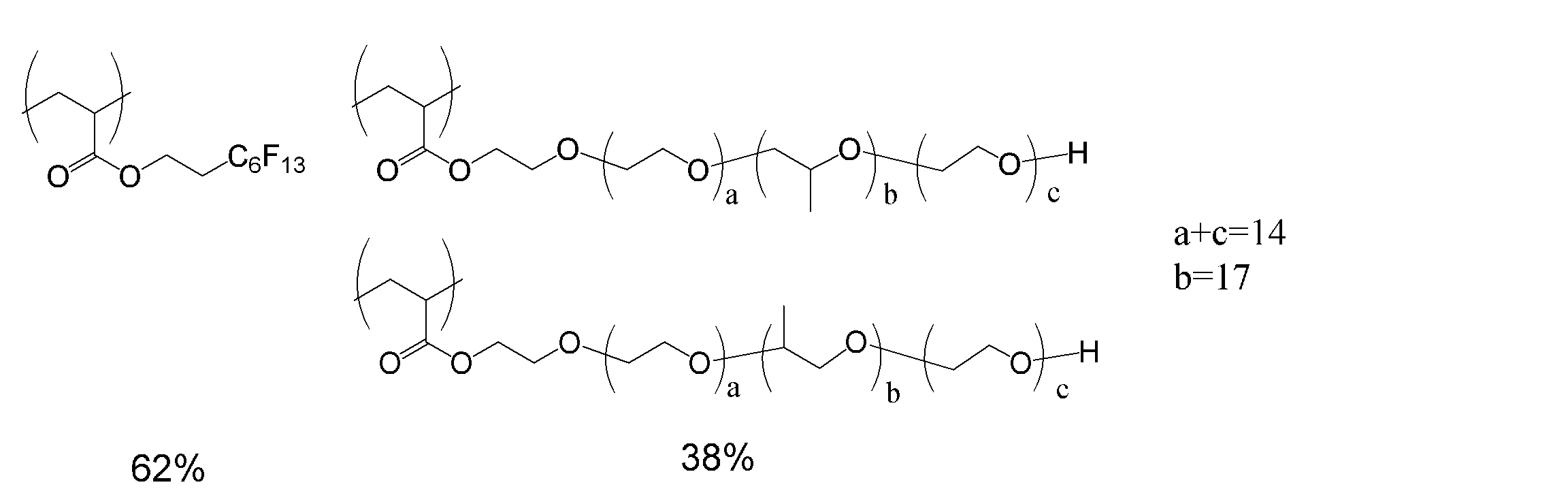
上記の化合物の重量平均分子量は、好ましくは3000~50000であり、例えば、14000である。上記の化合物中、繰り返し単位の割合を示す%はモル%である。
着色感光性組成物の全固形分中における界面活性剤の含有量は、0.001質量%~5.0質量%が好ましく、0.005~3.0質量%がより好ましい。界面活性剤は、1種のみでもよく、2種以上でもよい。
<<紫外線吸収剤>>
着色感光性組成物は、紫外線吸収剤を含有することができる。紫外線吸収剤は、共役ジエン化合物、アミノジエン化合物、サリシレート化合物、ベンゾフェノン化合物、ベンゾトリアゾール化合物、アクリロニトリル化合物、ヒドロキシフェニルトリアジン化合物、インドール化合物、トリアジン化合物などを用いることができる。このような化合物としては、特開2009-217221号公報の段落番号0038~0052、特開2012-208374号公報の段落番号0052~0072、特開2013-068814号公報の段落番号0317~0334、特開2016-162946号公報の段落番号0061~0080に記載された化合物が挙げられ、これらの内容は本明細書に組み込まれる。紫外線吸収剤の市販品としては、例えば、UV-503(大東化学(株)製)などが挙げられる。また、ベンゾトリアゾール化合物としては、ミヨシ油脂製のMYUAシリーズ(化学工業日報、2016年2月1日)が挙げられる。また、紫外線吸収剤は、特許第6268967号公報の段落番号0049~0059に記載された化合物を用いることもできる。
着色感光性組成物は、紫外線吸収剤を含有することができる。紫外線吸収剤は、共役ジエン化合物、アミノジエン化合物、サリシレート化合物、ベンゾフェノン化合物、ベンゾトリアゾール化合物、アクリロニトリル化合物、ヒドロキシフェニルトリアジン化合物、インドール化合物、トリアジン化合物などを用いることができる。このような化合物としては、特開2009-217221号公報の段落番号0038~0052、特開2012-208374号公報の段落番号0052~0072、特開2013-068814号公報の段落番号0317~0334、特開2016-162946号公報の段落番号0061~0080に記載された化合物が挙げられ、これらの内容は本明細書に組み込まれる。紫外線吸収剤の市販品としては、例えば、UV-503(大東化学(株)製)などが挙げられる。また、ベンゾトリアゾール化合物としては、ミヨシ油脂製のMYUAシリーズ(化学工業日報、2016年2月1日)が挙げられる。また、紫外線吸収剤は、特許第6268967号公報の段落番号0049~0059に記載された化合物を用いることもできる。
着色感光性組成物の全固形分中における紫外線吸収剤の含有量は、0.01~10質量%が好ましく、0.01~5質量%がより好ましい。本発明において、紫外線吸収剤は1種のみを用いてもよく、2種以上を用いてもよい。
<<有機溶剤>>
着色感光性組成物は、有機溶剤を含有することが好ましい。有機溶剤としては、各成分の溶解性や着色感光性組成物の塗布性を満足すれば基本的には特に制限はない。有機溶剤としては、エステル系溶剤、ケトン系溶剤、アルコール系溶剤、アミド系溶剤、エーテル系溶剤、炭化水素系溶剤などが挙げられる。これらの詳細については、国際公開第2015/166779号の段落番号0223に記載された溶剤が挙げられ、この内容は本明細書に組み込まれる。また、環状アルキル基が置換したエステル系溶剤、環状アルキル基が置換したケトン系溶剤も好ましく用いることもできる。有機溶剤の具体例としては、ポリエチレングリコールモノメチルエーテル、ジクロロメタン、3-エトキシプロピオン酸メチル、3-エトキシプロピオン酸エチル、エチルセロソルブアセテート、乳酸エチル、ジエチレングリコールジメチルエーテル、酢酸ブチル、3-メトキシプロピオン酸メチル、2-ヘプタノン、シクロヘキサノン、酢酸シクロヘキシル、シクロペンタノン、エチルカルビトールアセテート、ブチルカルビトールアセテート、プロピレングリコールモノメチルエーテル、プロピレングリコールモノメチルエーテルアセテート、3-メトキシ-N,N-ジメチルプロパンアミド、3-ブトキシ-N,N-ジメチルプロパンアミドなどが挙げられる。ただし有機溶剤としての芳香族炭化水素類(ベンゼン、トルエン、キシレン、エチルベンゼン等)は、環境面等の理由により低減したほうがよい場合がある(例えば、有機溶剤全量に対して、50質量ppm(parts per million)以下とすることもでき、10質量ppm以下とすることもでき、1質量ppm以下とすることもできる)。
着色感光性組成物は、有機溶剤を含有することが好ましい。有機溶剤としては、各成分の溶解性や着色感光性組成物の塗布性を満足すれば基本的には特に制限はない。有機溶剤としては、エステル系溶剤、ケトン系溶剤、アルコール系溶剤、アミド系溶剤、エーテル系溶剤、炭化水素系溶剤などが挙げられる。これらの詳細については、国際公開第2015/166779号の段落番号0223に記載された溶剤が挙げられ、この内容は本明細書に組み込まれる。また、環状アルキル基が置換したエステル系溶剤、環状アルキル基が置換したケトン系溶剤も好ましく用いることもできる。有機溶剤の具体例としては、ポリエチレングリコールモノメチルエーテル、ジクロロメタン、3-エトキシプロピオン酸メチル、3-エトキシプロピオン酸エチル、エチルセロソルブアセテート、乳酸エチル、ジエチレングリコールジメチルエーテル、酢酸ブチル、3-メトキシプロピオン酸メチル、2-ヘプタノン、シクロヘキサノン、酢酸シクロヘキシル、シクロペンタノン、エチルカルビトールアセテート、ブチルカルビトールアセテート、プロピレングリコールモノメチルエーテル、プロピレングリコールモノメチルエーテルアセテート、3-メトキシ-N,N-ジメチルプロパンアミド、3-ブトキシ-N,N-ジメチルプロパンアミドなどが挙げられる。ただし有機溶剤としての芳香族炭化水素類(ベンゼン、トルエン、キシレン、エチルベンゼン等)は、環境面等の理由により低減したほうがよい場合がある(例えば、有機溶剤全量に対して、50質量ppm(parts per million)以下とすることもでき、10質量ppm以下とすることもでき、1質量ppm以下とすることもできる)。
着色感光性組成物中における有機溶剤の含有量は、10~95質量%であることが好ましく、20~90質量%であることがより好ましく、30~90質量%であることが更に好ましい。
<<その他成分>>
着色感光性組成物は、必要に応じて、増感剤、硬化促進剤、フィラー、熱硬化促進剤、可塑剤及びその他の助剤類(例えば、導電性粒子、充填剤、消泡剤、難燃剤、レベリング剤、剥離促進剤、香料、表面張力調整剤、連鎖移動剤など)を含有してもよい。これらの成分を適宜含有させることにより、膜物性などの性質を調整することができる。これらの成分は、例えば、特開2012-003225号公報の段落番号0183以降(対応する米国特許出願公開第2013/0034812号明細書の段落番号0237)の記載、特開2008-250074号公報の段落番号0101~0104、0107~0109等の記載を参酌でき、これらの内容は本明細書に組み込まれる。また、着色感光性組成物は、必要に応じて、潜在酸化防止剤を含有してもよい。潜在酸化防止剤としては、酸化防止剤として機能する部位が保護基で保護された化合物であって、100~250℃で加熱するか、又は酸/塩基触媒存在下で80~200℃で加熱することにより保護基が脱離して酸化防止剤として機能する化合物が挙げられる。潜在酸化防止剤としては、国際公開第2014/021023号、国際公開第2017/030005号、特開2017-008219号公報に記載された化合物が挙げられる。潜在酸化防止剤の市販品としては、アデカアークルズGPA-5001((株)ADEKA製)等が挙げられる。
着色感光性組成物は、必要に応じて、増感剤、硬化促進剤、フィラー、熱硬化促進剤、可塑剤及びその他の助剤類(例えば、導電性粒子、充填剤、消泡剤、難燃剤、レベリング剤、剥離促進剤、香料、表面張力調整剤、連鎖移動剤など)を含有してもよい。これらの成分を適宜含有させることにより、膜物性などの性質を調整することができる。これらの成分は、例えば、特開2012-003225号公報の段落番号0183以降(対応する米国特許出願公開第2013/0034812号明細書の段落番号0237)の記載、特開2008-250074号公報の段落番号0101~0104、0107~0109等の記載を参酌でき、これらの内容は本明細書に組み込まれる。また、着色感光性組成物は、必要に応じて、潜在酸化防止剤を含有してもよい。潜在酸化防止剤としては、酸化防止剤として機能する部位が保護基で保護された化合物であって、100~250℃で加熱するか、又は酸/塩基触媒存在下で80~200℃で加熱することにより保護基が脱離して酸化防止剤として機能する化合物が挙げられる。潜在酸化防止剤としては、国際公開第2014/021023号、国際公開第2017/030005号、特開2017-008219号公報に記載された化合物が挙げられる。潜在酸化防止剤の市販品としては、アデカアークルズGPA-5001((株)ADEKA製)等が挙げられる。
<カラーフィルタの製造方法>
次に、本発明のカラーフィルタの製造方法について説明する。本発明のカラーフィルタは、上述した本発明の構造体の製造方法を含む。カラーフィルタは、CCD(電荷結合素子)やCMOS(相補型金属酸化膜半導体)などの固体撮像素子や画像表示装置などに用いることができる。
次に、本発明のカラーフィルタの製造方法について説明する。本発明のカラーフィルタは、上述した本発明の構造体の製造方法を含む。カラーフィルタは、CCD(電荷結合素子)やCMOS(相補型金属酸化膜半導体)などの固体撮像素子や画像表示装置などに用いることができる。
<固体撮像素子の製造方法>
本発明の固体撮像素子の製造方法は、上述した本発明の構造体の製造方法を含む。固体撮像素子の構成としては、固体撮像素子として機能する構成であれば特に限定はない。
本発明の固体撮像素子の製造方法は、上述した本発明の構造体の製造方法を含む。固体撮像素子の構成としては、固体撮像素子として機能する構成であれば特に限定はない。
<画像表示装置の製造方法>
本発明の画像表示装置の製造方法は、上述した本発明の構造体の製造方法を含む。画像表示装置としては、液晶表示装置や有機エレクトロルミネッセンス表示装置などが挙げられる。画像表示装置の定義や各画像表示装置の詳細については、例えば「電子ディスプレイデバイス(佐々木昭夫著、(株)工業調査会、1990年発行)」、「ディスプレイデバイス(伊吹順章著、産業図書(株)平成元年発行)」などに記載されている。また、液晶表示装置については、例えば「次世代液晶ディスプレイ技術(内田龍男編集、(株)工業調査会、1994年発行)」に記載されている。本発明が適用できる液晶表示装置に特に制限はなく、例えば、上記の「次世代液晶ディスプレイ技術」に記載されている色々な方式の液晶表示装置に適用できる。
本発明の画像表示装置の製造方法は、上述した本発明の構造体の製造方法を含む。画像表示装置としては、液晶表示装置や有機エレクトロルミネッセンス表示装置などが挙げられる。画像表示装置の定義や各画像表示装置の詳細については、例えば「電子ディスプレイデバイス(佐々木昭夫著、(株)工業調査会、1990年発行)」、「ディスプレイデバイス(伊吹順章著、産業図書(株)平成元年発行)」などに記載されている。また、液晶表示装置については、例えば「次世代液晶ディスプレイ技術(内田龍男編集、(株)工業調査会、1994年発行)」に記載されている。本発明が適用できる液晶表示装置に特に制限はなく、例えば、上記の「次世代液晶ディスプレイ技術」に記載されている色々な方式の液晶表示装置に適用できる。
以下に実施例を挙げて本発明をさらに具体的に説明する。以下の実施例に示す材料、使用量、割合、処理内容、処理手順等は、本発明の趣旨を逸脱しない限り、適宜、変更することができる。従って、本発明の範囲は以下に示す具体例に限定されるものではない。「部」、「%」は特に述べない限り、質量基準である。重量平均分子量および数平均分子量は、上記のとおり、GPC法により測定したポリスチレン換算値である。
<隔壁を有する支持体の製造>
直径8インチ(20.32cm)のシリコンウエハ上に、以下の隔壁形成用組成物をスピン塗布し、ホットプレートを用いて100℃で2分間加熱し、さらに230℃で2分間加熱して、膜厚0.5μmの隔壁材料層を形成した。上記隔壁材料層上に、ポジ型フォトレジスト(FFPS-0283、富士フイルムエレクトロニクスマテリアルズ(株)製)をスピン塗布し、90℃で1分間加熱して厚さ1.0μmのフォトレジスト層を形成した。次に、KrFスキャナー露光機(FPA6300ES6a、キヤノン(株)製)を用い、マスクを介して16J/cm2の露光エネルギーで露光したのち、100℃で1分間の加熱処理を実施した。その後、現像液(FHD-5、富士フイルムエレクトロニクスマテリアルズ社製)で1分間の現像処理後、100℃で1分間の加熱処理を実施して、線幅0.12μm、ピッチ幅1μmのメッシュ状のパターンを形成した。このパターンをフォトマスクとして用い、特開2016-014856号公報の段落番号0129~0130に記載された条件にてドライエッチング法でパターニングして、幅0.1μm、高さ0.5μmの隔壁を1μm間隔で格子状に形成し、図1、2に示す形状の隔壁を形成した(図2のW1=0.1μm、H1=0.5μm、P1=1μm)。シリコンウエハ上の隔壁の開口の寸法(シリコンウエハ上の隔壁で区切られた1画素分の領域)は、縦0.9μm×横0.9μmであった。隔壁の幅0.1μmと合わせて、本実施例は1.0μmピクセルサイズと定義される。
直径8インチ(20.32cm)のシリコンウエハ上に、以下の隔壁形成用組成物をスピン塗布し、ホットプレートを用いて100℃で2分間加熱し、さらに230℃で2分間加熱して、膜厚0.5μmの隔壁材料層を形成した。上記隔壁材料層上に、ポジ型フォトレジスト(FFPS-0283、富士フイルムエレクトロニクスマテリアルズ(株)製)をスピン塗布し、90℃で1分間加熱して厚さ1.0μmのフォトレジスト層を形成した。次に、KrFスキャナー露光機(FPA6300ES6a、キヤノン(株)製)を用い、マスクを介して16J/cm2の露光エネルギーで露光したのち、100℃で1分間の加熱処理を実施した。その後、現像液(FHD-5、富士フイルムエレクトロニクスマテリアルズ社製)で1分間の現像処理後、100℃で1分間の加熱処理を実施して、線幅0.12μm、ピッチ幅1μmのメッシュ状のパターンを形成した。このパターンをフォトマスクとして用い、特開2016-014856号公報の段落番号0129~0130に記載された条件にてドライエッチング法でパターニングして、幅0.1μm、高さ0.5μmの隔壁を1μm間隔で格子状に形成し、図1、2に示す形状の隔壁を形成した(図2のW1=0.1μm、H1=0.5μm、P1=1μm)。シリコンウエハ上の隔壁の開口の寸法(シリコンウエハ上の隔壁で区切られた1画素分の領域)は、縦0.9μm×横0.9μmであった。隔壁の幅0.1μmと合わせて、本実施例は1.0μmピクセルサイズと定義される。
[隔壁形成用組成物]
隔壁形成用組成物は以下の方法で調製したものを用いた。
先ず、ケイ素アルコキシド(A)としてテトラエトキシシラン(TEOS)を用意し、フルオロアルキル基含有のケイ素アルコキシド(B)としてトリフルオロプロピルトリメトキシシラン(TFPTMS)を用意した。ケイ素アルコキシド(A)の質量を1としたときのフルオロアルキル基含有のケイ素アルコキシド(B)の割合(質量比)が0.6になるように秤量し、これらをセパラブルフラスコ内に投入して混合し、混合物を得た。この混合物の1.0質量部に対して1.0質量部となる量のプロピレングリコールモノメチルエーテル(PGME)を添加し、30℃の温度で15分間撹拌することにより第1液を調製した。また、この第1液とは別に、上記の混合物の1.0質量部に対して1.0質量部となる量のイオン交換水と0.01質量部となる量のギ酸を添加し、混合して、30℃の温度で15分間撹拌することにより第2液を調製した。次に、上記調製した第1液を、ウォーターバスにて55℃の温度に保持してから、この第1液に上記第2液を添加し、上記温度を保持した状態で60分間撹拌した。これにより、上記ケイ素アルコキシド(A)と上記フルオロアルキル基含有のケイ素アルコキシド(B)との加水分解物を含む溶液Fを得た。この溶液Fの固形分濃度は、SiO2換算で10質量%であった。次に、市販の平均直径15nmのコロイダルシリカ(日産化学社製、商品名ST-30)が30質量%含まれる水分散液の100質量部に、30質量%濃度の硝酸カルシウム水溶液を0.1質量部加えた混合液を、ステンレス製オートクレーブ中で120℃5時間加熱した。この混合液に対し、限外濾過法を用い、溶媒をプロピレングリコールモノメチルエーテルに置換し、更にホモミキサ(プライミクス社製)を用いて回転速度14000rpmにて30分間撹拌し、更にプロピレングリコールモノメチルエーテルを添加して、固形分濃度15質量%のコロイダルシリカ粒子液Gを得た。上記溶液Fの30質量部と、上記コロイダルシリカ粒子液Gの70質量部を混合し、更に40℃で10時間加熱し、1000Gで10分間遠心分離を行って沈降物を除去することで、球状シリカの平均粒子径(透過型電子顕微鏡(TEM)によって測定した球状部分の投影像における円相当直径)が15nmで、動的光散乱法により測定されたコロイダルシリカ粒子の平均粒子径が80nmであるコロイダルシリカ粒子液P1を得た。
隔壁形成用組成物は以下の方法で調製したものを用いた。
先ず、ケイ素アルコキシド(A)としてテトラエトキシシラン(TEOS)を用意し、フルオロアルキル基含有のケイ素アルコキシド(B)としてトリフルオロプロピルトリメトキシシラン(TFPTMS)を用意した。ケイ素アルコキシド(A)の質量を1としたときのフルオロアルキル基含有のケイ素アルコキシド(B)の割合(質量比)が0.6になるように秤量し、これらをセパラブルフラスコ内に投入して混合し、混合物を得た。この混合物の1.0質量部に対して1.0質量部となる量のプロピレングリコールモノメチルエーテル(PGME)を添加し、30℃の温度で15分間撹拌することにより第1液を調製した。また、この第1液とは別に、上記の混合物の1.0質量部に対して1.0質量部となる量のイオン交換水と0.01質量部となる量のギ酸を添加し、混合して、30℃の温度で15分間撹拌することにより第2液を調製した。次に、上記調製した第1液を、ウォーターバスにて55℃の温度に保持してから、この第1液に上記第2液を添加し、上記温度を保持した状態で60分間撹拌した。これにより、上記ケイ素アルコキシド(A)と上記フルオロアルキル基含有のケイ素アルコキシド(B)との加水分解物を含む溶液Fを得た。この溶液Fの固形分濃度は、SiO2換算で10質量%であった。次に、市販の平均直径15nmのコロイダルシリカ(日産化学社製、商品名ST-30)が30質量%含まれる水分散液の100質量部に、30質量%濃度の硝酸カルシウム水溶液を0.1質量部加えた混合液を、ステンレス製オートクレーブ中で120℃5時間加熱した。この混合液に対し、限外濾過法を用い、溶媒をプロピレングリコールモノメチルエーテルに置換し、更にホモミキサ(プライミクス社製)を用いて回転速度14000rpmにて30分間撹拌し、更にプロピレングリコールモノメチルエーテルを添加して、固形分濃度15質量%のコロイダルシリカ粒子液Gを得た。上記溶液Fの30質量部と、上記コロイダルシリカ粒子液Gの70質量部を混合し、更に40℃で10時間加熱し、1000Gで10分間遠心分離を行って沈降物を除去することで、球状シリカの平均粒子径(透過型電子顕微鏡(TEM)によって測定した球状部分の投影像における円相当直径)が15nmで、動的光散乱法により測定されたコロイダルシリカ粒子の平均粒子径が80nmであるコロイダルシリカ粒子液P1を得た。
次に、上記で得られたコロイダルシリカ粒子液を用いて、以下の表に記載の組成となるように各成分を混合して隔壁形成用組成物を得た。なお、上記のコロイダルシリカ粒子液の調製後、及び隔壁形成用組成物の調製後それぞれについて、全て日本ポール製DFA4201NIEY(0.45μmナイロンフィルター)を用いてろ過を行った。

上記表に記載の配合量の数値は質量部である。また、コロイダルシリカ粒子液の配合量は粒子液中のSiO2分の量である。溶剤の配合量の数値は、コロイダルシリカ粒子液に含まれている溶剤量を合計した数値である。上記表に記載した原料は以下の通りである。
(コロイダルシリカ粒子液)
P1:上述したコロイダルシリカ粒子液P1
(界面活性剤)
F1:下記構造の化合物(Mw=14000、繰り返し単位の割合を示す%はモル%である)
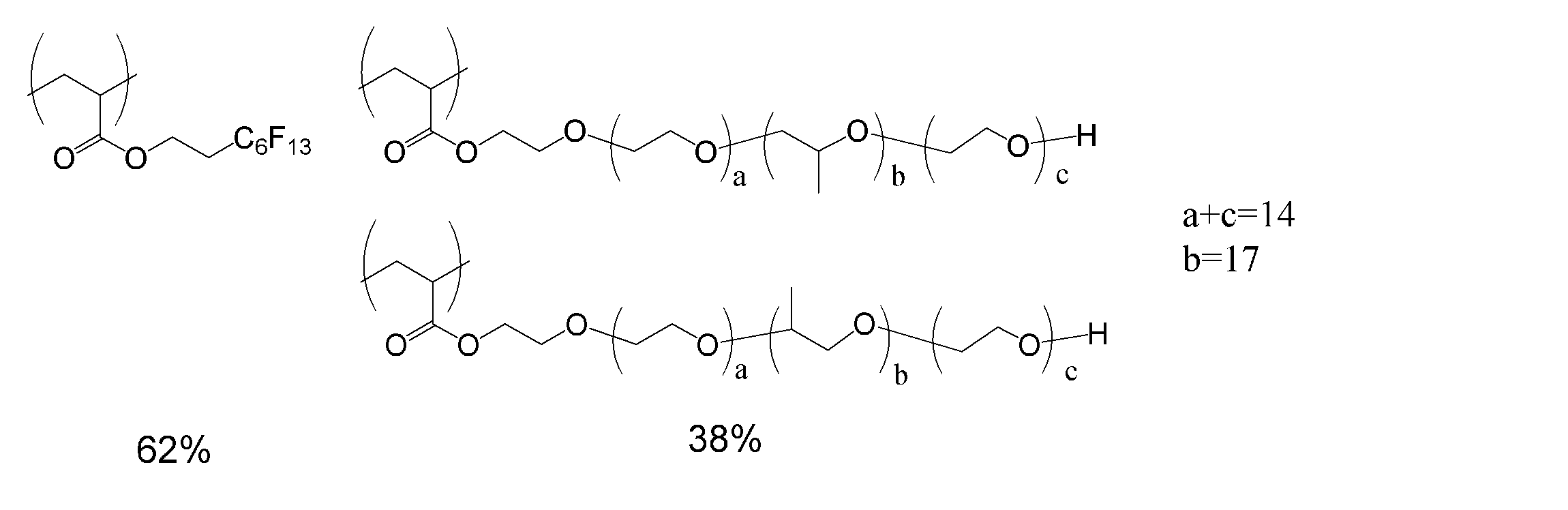
(溶剤)
PGME:プロピレングリコールモノメチルエーテル
PGMEA:プロピレングリコールモノメチルエーテルアセテート
LC-OH:エタノール、メタノールまたはそれらの混合物
W:水
P1:上述したコロイダルシリカ粒子液P1
(界面活性剤)
F1:下記構造の化合物(Mw=14000、繰り返し単位の割合を示す%はモル%である)
PGME:プロピレングリコールモノメチルエーテル
PGMEA:プロピレングリコールモノメチルエーテルアセテート
LC-OH:エタノール、メタノールまたはそれらの混合物
W:水
<着色感光性組成物の調製>
(緑色着色感光性組成物)
下記原料を、ビーズミル(ジルコニアビーズ0.1mm径)を用いて3時間混合および分散して、顔料分散液を調製した。その後、減圧機構付き高圧分散機NANO-3000-10(日本ビーイーイー(株)製)を用いて、圧力2000kg/cm3および流量500g/minの条件の下、分散処理を行なった。この分散処理を全10回まで繰り返して、顔料分散液G1を得た。
・PG58 ・・・8.5質量部
・PY185 ・・・2.9質量部
・顔料誘導体1 1.6質量部
・分散剤1 4.7質量部
・PGMEA(プロピレングリコールモノメチルエーテルアセテート) 82.3質量部
(緑色着色感光性組成物)
下記原料を、ビーズミル(ジルコニアビーズ0.1mm径)を用いて3時間混合および分散して、顔料分散液を調製した。その後、減圧機構付き高圧分散機NANO-3000-10(日本ビーイーイー(株)製)を用いて、圧力2000kg/cm3および流量500g/minの条件の下、分散処理を行なった。この分散処理を全10回まで繰り返して、顔料分散液G1を得た。
・PG58 ・・・8.5質量部
・PY185 ・・・2.9質量部
・顔料誘導体1 1.6質量部
・分散剤1 4.7質量部
・PGMEA(プロピレングリコールモノメチルエーテルアセテート) 82.3質量部
続いて、下記原料を混合した混合液を撹拌した後、孔径0.45μmのナイロン製フィルタ(日本ポール(株)製)でろ過して、緑色着色感光性組成物を得た。
・顔料分散液G1 ・・・69.0質量部
・樹脂1の40質量%PGMEA溶液 ・・・1.2質量部
・重合性モノマー1 ・・・1.1質量部
・光重合開始剤1 ・・・0.5質量部
・界面活性剤1の1質量%PGMEA溶液 ・・・4.2質量部
・紫外線吸収剤1 ・・・0.5質量部
・エポキシ基を有する化合物1 ・・・0.2質量部
・PGMEA ・・・23.3質量部
・顔料分散液G1 ・・・69.0質量部
・樹脂1の40質量%PGMEA溶液 ・・・1.2質量部
・重合性モノマー1 ・・・1.1質量部
・光重合開始剤1 ・・・0.5質量部
・界面活性剤1の1質量%PGMEA溶液 ・・・4.2質量部
・紫外線吸収剤1 ・・・0.5質量部
・エポキシ基を有する化合物1 ・・・0.2質量部
・PGMEA ・・・23.3質量部
(赤色着色感光性組成物)
下記原料を混合した混合液を、ビーズミル(ジルコニアビーズ0.1mm径)を用いて3時間混合および分散して、顔料分散液を調製した。その後、減圧機構付き高圧分散機NANO-3000-10(日本ビーイーイー(株)製)を用いて、圧力2000kg/cm3および流量500g/minの条件の下、分散処理を行なった。この分散処理を全10回まで繰り返して、顔料分散液R1を得た。
・PR254 10.5質量部
・PY139 0.9質量部
・顔料誘導体1 1.6質量部
・分散剤1 4.7質量部
・PGMEA 82.3質量部
下記原料を混合した混合液を、ビーズミル(ジルコニアビーズ0.1mm径)を用いて3時間混合および分散して、顔料分散液を調製した。その後、減圧機構付き高圧分散機NANO-3000-10(日本ビーイーイー(株)製)を用いて、圧力2000kg/cm3および流量500g/minの条件の下、分散処理を行なった。この分散処理を全10回まで繰り返して、顔料分散液R1を得た。
・PR254 10.5質量部
・PY139 0.9質量部
・顔料誘導体1 1.6質量部
・分散剤1 4.7質量部
・PGMEA 82.3質量部
続いて、下記原料を混合した混合液を撹拌した後、孔径0.45μmのナイロン製フィルタ(日本ポール(株)製)でろ過して、赤色着色感光性組成物を得た。
組成物の原料:
・顔料分散液R1 ・・・58.9質量部
・樹脂1の40質量%PGMEA溶液 ・・・2.0質量部
・重合性モノマー1 ・・・0.9質量部
・光重合開始剤1 ・・・0.5質量部
・界面活性剤1の1質量%PGMEA溶液 ・・・4.2質量部
・紫外線吸収剤1 ・・・0.1質量部
・エポキシ基を有する化合物1 ・・・0.1質量部
・PGMEA ・・・33.3質量部
組成物の原料:
・顔料分散液R1 ・・・58.9質量部
・樹脂1の40質量%PGMEA溶液 ・・・2.0質量部
・重合性モノマー1 ・・・0.9質量部
・光重合開始剤1 ・・・0.5質量部
・界面活性剤1の1質量%PGMEA溶液 ・・・4.2質量部
・紫外線吸収剤1 ・・・0.1質量部
・エポキシ基を有する化合物1 ・・・0.1質量部
・PGMEA ・・・33.3質量部
(青色着色感光性組成物)
下記原料を混合した混合液を、ビーズミル(ジルコニアビーズ0.1mm径)を用いて3時間混合および分散して、顔料分散液を調製した。その後、減圧機構付き高圧分散機NANO-3000-10(日本ビーイーイー(株)製)を用いて、圧力2000kg/cm3および流量500g/minの条件の下、分散処理を行なった。この分散処理を全10回まで繰り返して、顔料分散液B1を得た。
・PB15:6 9.6質量部
・PV23 2.4質量部
・顔料誘導体1 1.0質量部
・分散剤1 4.7質量部
・PGMEA 82.3質量部
下記原料を混合した混合液を、ビーズミル(ジルコニアビーズ0.1mm径)を用いて3時間混合および分散して、顔料分散液を調製した。その後、減圧機構付き高圧分散機NANO-3000-10(日本ビーイーイー(株)製)を用いて、圧力2000kg/cm3および流量500g/minの条件の下、分散処理を行なった。この分散処理を全10回まで繰り返して、顔料分散液B1を得た。
・PB15:6 9.6質量部
・PV23 2.4質量部
・顔料誘導体1 1.0質量部
・分散剤1 4.7質量部
・PGMEA 82.3質量部
続いて、下記原料を混合した混合液を撹拌した後、孔径0.45μmのナイロン製フィルタ(日本ポール(株)製)でろ過して、青色着色感光性組成物を得た。
・顔料分散液B1 ・・・54.1質量部
・樹脂1の40質量%PGMEA溶液 ・・・1.0質量部
・重合性モノマー1 ・・・0.9質量部
・光重合開始剤1 ・・・0.6質量部
・界面活性剤1の1質量%PGMEA溶液 ・・・4.2質量部
・紫外線吸収剤1 ・・・0.1質量部
・エポキシ基を有する化合物1 ・・・0.1質量部
・PGMEA ・・・39.0質量部
・顔料分散液B1 ・・・54.1質量部
・樹脂1の40質量%PGMEA溶液 ・・・1.0質量部
・重合性モノマー1 ・・・0.9質量部
・光重合開始剤1 ・・・0.6質量部
・界面活性剤1の1質量%PGMEA溶液 ・・・4.2質量部
・紫外線吸収剤1 ・・・0.1質量部
・エポキシ基を有する化合物1 ・・・0.1質量部
・PGMEA ・・・39.0質量部
着色感光性組成物に使用した原料の内容は以下の通りである。
・PG58 : C.I.Pigment Green 58
・PY185 : C.I.Pigment Yellow 185
・PR254 : C.I.Pigment Red 254
・PY139 : C.I.Pigment Yellow 139
・PB15:6 : C.I.Pigment Blue 15:6
・PV23 : C.I.Pigment Violet 23
・顔料誘導体1:下記構造の化合物
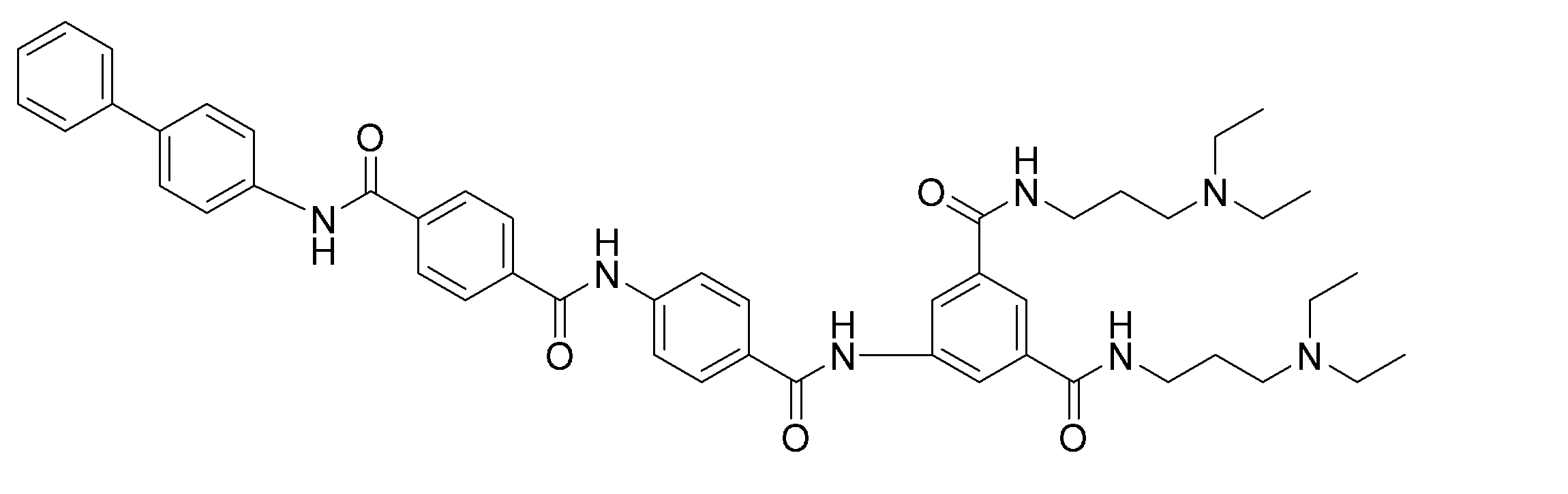
・分散剤1:下記構造の樹脂。主鎖に付記された数値は繰り返し単位のモル比であり、側鎖に付記された数値は繰り返し単位の数である。Mw=20000
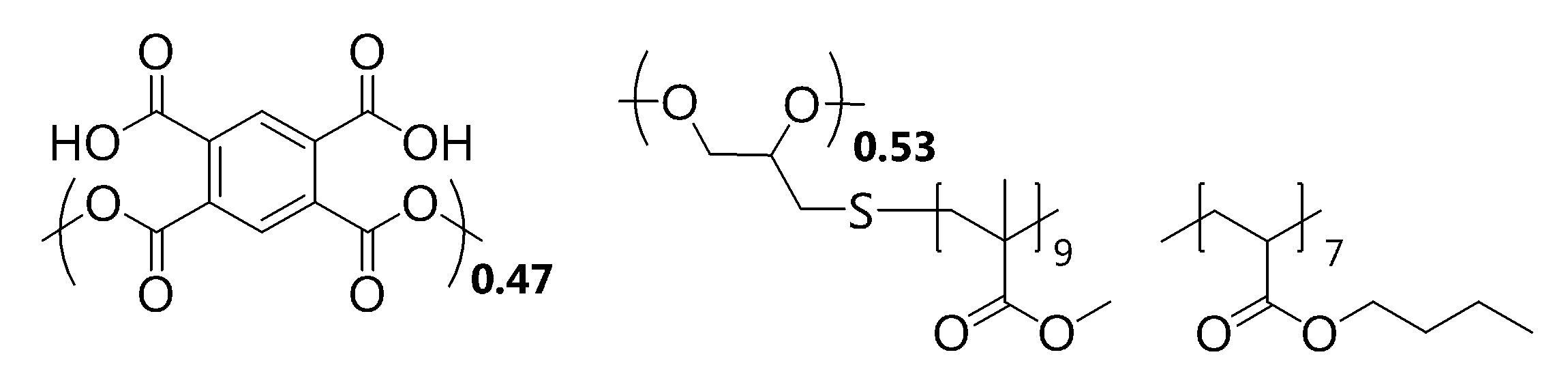
・PG58 : C.I.Pigment Green 58
・PY185 : C.I.Pigment Yellow 185
・PR254 : C.I.Pigment Red 254
・PY139 : C.I.Pigment Yellow 139
・PB15:6 : C.I.Pigment Blue 15:6
・PV23 : C.I.Pigment Violet 23
・顔料誘導体1:下記構造の化合物
・樹脂1:下記構造の樹脂。主鎖に付記された数値は、繰り返し単位のモル比である。Mw=60000

・重合性モノマー1:下記構造の化合物

・光重合開始剤1:下記構造の化合物

・界面活性剤1:下記構造の化合物(Mw=14000、繰り返し単位の割合を示す%はモル%である)

・紫外線吸収剤1:下記構造の化合物

・エポキシ基を有する化合物1:EHPE3150((株)ダイセル製、2,2’-ビス(ヒドロキシメチル)-1-ブタノールの1,2-エポキシ-4-(2-オキシラニル)シクロヘキサン付加物)
<構造体の製造>
上記のようにして用意した隔壁を有する支持体上に、下記表に記載の着色感光性組成物をスピン塗布し、ホットプレートを用いて100℃で2分間加熱して、膜厚0.6μmの着色感光性組成物層を形成した。次に、酸素濃度をコントロールできる縮小投影型ステッパー(i線ステッパーFPA5510iZs、キヤノン(株)製)を用い、以下に示す露光条件にて、以下に示すマスクを介して露光した。次に、水酸化テトラメチルアンモニウム(TMAH)0.3質量%水溶液を用い、23℃で60秒間パドル現像を行った。その後、スピンシャワーにてリンスを行い、更に純水にて水洗した。次いで、ホットプレートを用いて、200℃で5分間加熱してパターン形成して画素を形成し、構造体を製造した。
上記のようにして用意した隔壁を有する支持体上に、下記表に記載の着色感光性組成物をスピン塗布し、ホットプレートを用いて100℃で2分間加熱して、膜厚0.6μmの着色感光性組成物層を形成した。次に、酸素濃度をコントロールできる縮小投影型ステッパー(i線ステッパーFPA5510iZs、キヤノン(株)製)を用い、以下に示す露光条件にて、以下に示すマスクを介して露光した。次に、水酸化テトラメチルアンモニウム(TMAH)0.3質量%水溶液を用い、23℃で60秒間パドル現像を行った。その後、スピンシャワーにてリンスを行い、更に純水にて水洗した。次いで、ホットプレートを用いて、200℃で5分間加熱してパターン形成して画素を形成し、構造体を製造した。
(使用したマスク)
マスク1:1.9μm四方の開口部がベイヤー配列されたマスクであって、図5、11に示す開口部25を有するバイナリーマスク(4画素分の開口部を有するマスク)
マスク2:1.9μm四方の開口部がベイヤー配列されたマスク(4画素分の開口部を有するマスク)であって、開口部25aに図7、12に示す遮光部22(線幅(図12のW10)=0.10μm)が形成されたバイナリーマスク。遮光部の線幅は隔壁の線幅の1.0倍である。
マスク3:1.9μmμm四方の開口部がベイヤー配列されたマスク(4画素分の開口部を有するマスク)であって、開口部25aに図7、12に示す遮光部22(線幅(図12のW10)=0.20μm)が形成されたバイナリーマスク。遮光部の線幅は隔壁の線幅の2.0倍である。
マスク4:1.9μmμm四方の開口部がベイヤー配列されたマスク(4画素分の開口部を有するマスク)であって、開口部25aに図7、12に示す遮光部22(線幅(図12のW10)=0.30μm)が形成されたバイナリーマスク。遮光部の線幅は隔壁の線幅の3.0倍である。
マスク5:1.9μm四方の開口部がベイヤー配列されたマスク(4画素分の開口部を有するマスク)であって、開口部25aに図7、12に示す遮光部22(線幅(図12のW10)=0.35μm)が形成されたバイナリーマスク。遮光部の線幅は隔壁の線幅の3.5倍である。
マスク6:1.9μm四方の開口部がベイヤー配列されたマスク(4画素分の開口部を有するマスク)であって、開口部25aに図7、12に示す遮光部22(線幅(図12のW10)=0.50μm)が形成されたバイナリーマスク。遮光部の線幅は隔壁の線幅の5.0倍である。
マスク1:1.9μm四方の開口部がベイヤー配列されたマスクであって、図5、11に示す開口部25を有するバイナリーマスク(4画素分の開口部を有するマスク)
マスク2:1.9μm四方の開口部がベイヤー配列されたマスク(4画素分の開口部を有するマスク)であって、開口部25aに図7、12に示す遮光部22(線幅(図12のW10)=0.10μm)が形成されたバイナリーマスク。遮光部の線幅は隔壁の線幅の1.0倍である。
マスク3:1.9μmμm四方の開口部がベイヤー配列されたマスク(4画素分の開口部を有するマスク)であって、開口部25aに図7、12に示す遮光部22(線幅(図12のW10)=0.20μm)が形成されたバイナリーマスク。遮光部の線幅は隔壁の線幅の2.0倍である。
マスク4:1.9μmμm四方の開口部がベイヤー配列されたマスク(4画素分の開口部を有するマスク)であって、開口部25aに図7、12に示す遮光部22(線幅(図12のW10)=0.30μm)が形成されたバイナリーマスク。遮光部の線幅は隔壁の線幅の3.0倍である。
マスク5:1.9μm四方の開口部がベイヤー配列されたマスク(4画素分の開口部を有するマスク)であって、開口部25aに図7、12に示す遮光部22(線幅(図12のW10)=0.35μm)が形成されたバイナリーマスク。遮光部の線幅は隔壁の線幅の3.5倍である。
マスク6:1.9μm四方の開口部がベイヤー配列されたマスク(4画素分の開口部を有するマスク)であって、開口部25aに図7、12に示す遮光部22(線幅(図12のW10)=0.50μm)が形成されたバイナリーマスク。遮光部の線幅は隔壁の線幅の5.0倍である。
なお、図11は、マスク1の断面図であり、図12は、マスク2~6の断面図である。図11、12には隔壁の寸法を合わせて記す。隔壁のピッチは1.0μmであり、2画素分のエリアは2.0μmである。各マスクの開口部のエッジは、隔壁上の中心線に設定するように、重ね合わせの調整を行った。
(露光条件)
照明条件:NA/σ=0.57/0.50
露光照度:7500W/m2、10000W/m2、20000W/m2、30000W/m2、36000W/m2
露光エネルギー:100mJ/cm2、200mJ/cm2、400mJ/cm2、600mJ/cm2、800mJ/cm2、1000mJ/cm2
酸素濃度:22体積%、30体積%、40体積%、50体積%、55体積%
照明条件:NA/σ=0.57/0.50
露光照度:7500W/m2、10000W/m2、20000W/m2、30000W/m2、36000W/m2
露光エネルギー:100mJ/cm2、200mJ/cm2、400mJ/cm2、600mJ/cm2、800mJ/cm2、1000mJ/cm2
酸素濃度:22体積%、30体積%、40体積%、50体積%、55体積%
<評価1>
得られた構造体について、測長SEM(Critical Dimension-Scanning Electron Microscope)((株)日立ハイテクノロジーズ製、S9260A)を用いて倍率30000倍の条件で形成された画素の表面を観察した。観測エリアはウエハ中心部、ウエハのノッチ部分近傍の2カ所とした。以下の基準で評価した。
A:画素間の隔壁が画素から露出して個々の画素が隔壁によってしっかりと分離されており、隔壁上に残差がなく、隔壁内にボイドが発生しておらず目的の寸法の画素が形成されている。
B:画素間の隔壁が画素から露出して個々の画素が隔壁によってしっかりと分離されており、隔壁上に残差がなく、画素のコーナー部分(パターンの角部のエッジ)にわずかにボイドが発生している。実用上問題ないレベルである。
C:画素間の隔壁が画素から露出して個々の画素が隔壁によって分離されているが、隔壁上にわずかに残差がある。実用上問題ないレベルである。
D:隔壁上にも一部組成物の残りがある、あるいは画素と隔壁との間に隙間がある。
E:画素を形成できなかった。あるいは、隔壁が画素中に埋もれており、画素を分離できなかった。あるいは、隔壁間に形成された画素の厚みが薄すぎて、目的の寸法の画素を形成できなかった。
得られた構造体について、測長SEM(Critical Dimension-Scanning Electron Microscope)((株)日立ハイテクノロジーズ製、S9260A)を用いて倍率30000倍の条件で形成された画素の表面を観察した。観測エリアはウエハ中心部、ウエハのノッチ部分近傍の2カ所とした。以下の基準で評価した。
A:画素間の隔壁が画素から露出して個々の画素が隔壁によってしっかりと分離されており、隔壁上に残差がなく、隔壁内にボイドが発生しておらず目的の寸法の画素が形成されている。
B:画素間の隔壁が画素から露出して個々の画素が隔壁によってしっかりと分離されており、隔壁上に残差がなく、画素のコーナー部分(パターンの角部のエッジ)にわずかにボイドが発生している。実用上問題ないレベルである。
C:画素間の隔壁が画素から露出して個々の画素が隔壁によって分離されているが、隔壁上にわずかに残差がある。実用上問題ないレベルである。
D:隔壁上にも一部組成物の残りがある、あるいは画素と隔壁との間に隙間がある。
E:画素を形成できなかった。あるいは、隔壁が画素中に埋もれており、画素を分離できなかった。あるいは、隔壁間に形成された画素の厚みが薄すぎて、目的の寸法の画素を形成できなかった。
<評価2>
得られた構造体の断面について、SEM((株)日立ハイテクノロジーズ製、S4800A)を用いて倍率30000倍の条件で観察をして、隔壁の高さ(図8におけるH1)と、この隔壁に隣接する画素の高さ(図9におけるH2)との差の絶対値(ΔH)を求め、ΔHの最大値を求めた。以下の基準で評価した。
A:ΔHの最大値が0.05μm以下である。
B:ΔHの最大値が0.05μmを超える。
得られた構造体の断面について、SEM((株)日立ハイテクノロジーズ製、S4800A)を用いて倍率30000倍の条件で観察をして、隔壁の高さ(図8におけるH1)と、この隔壁に隣接する画素の高さ(図9におけるH2)との差の絶対値(ΔH)を求め、ΔHの最大値を求めた。以下の基準で評価した。
A:ΔHの最大値が0.05μm以下である。
B:ΔHの最大値が0.05μmを超える。
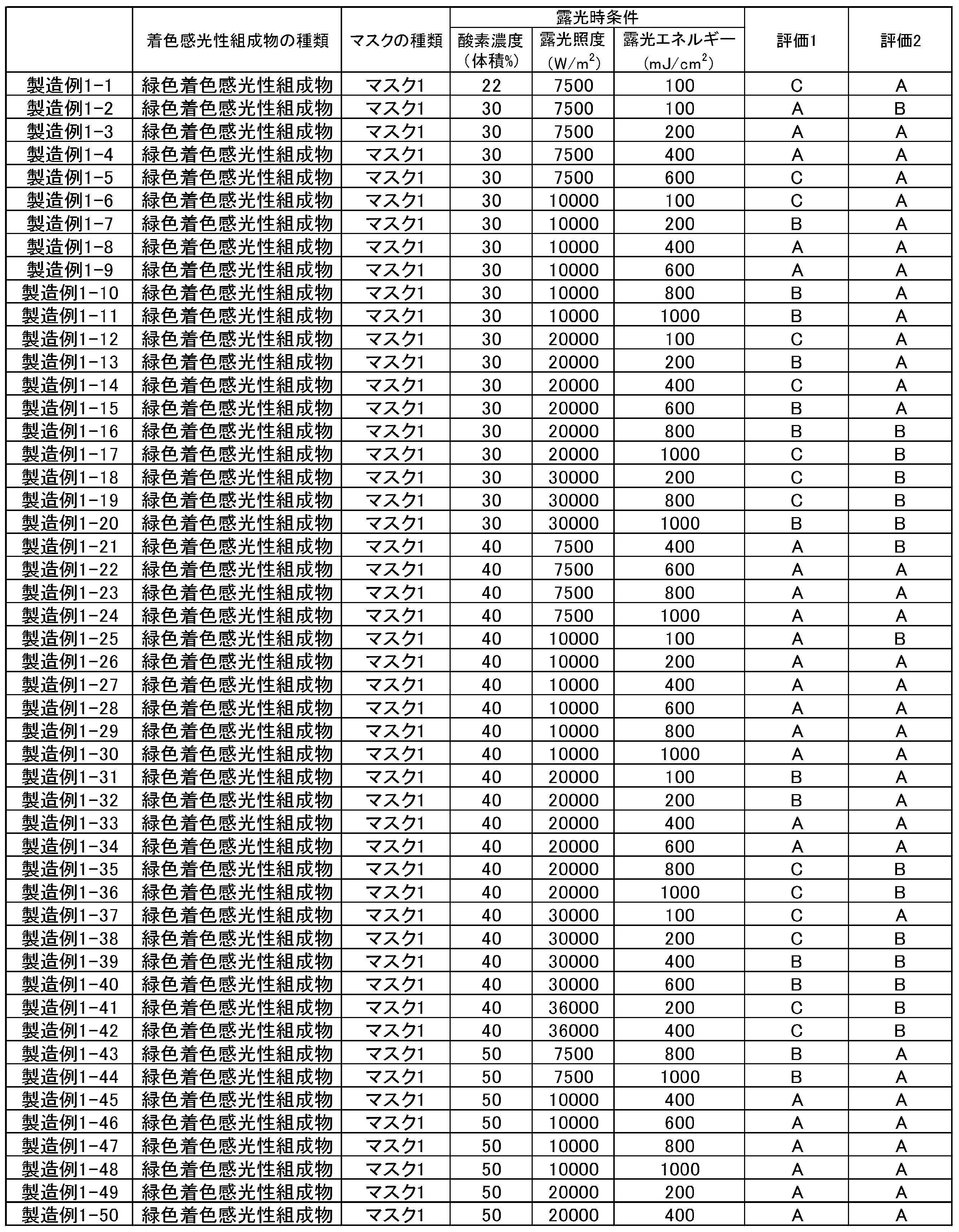
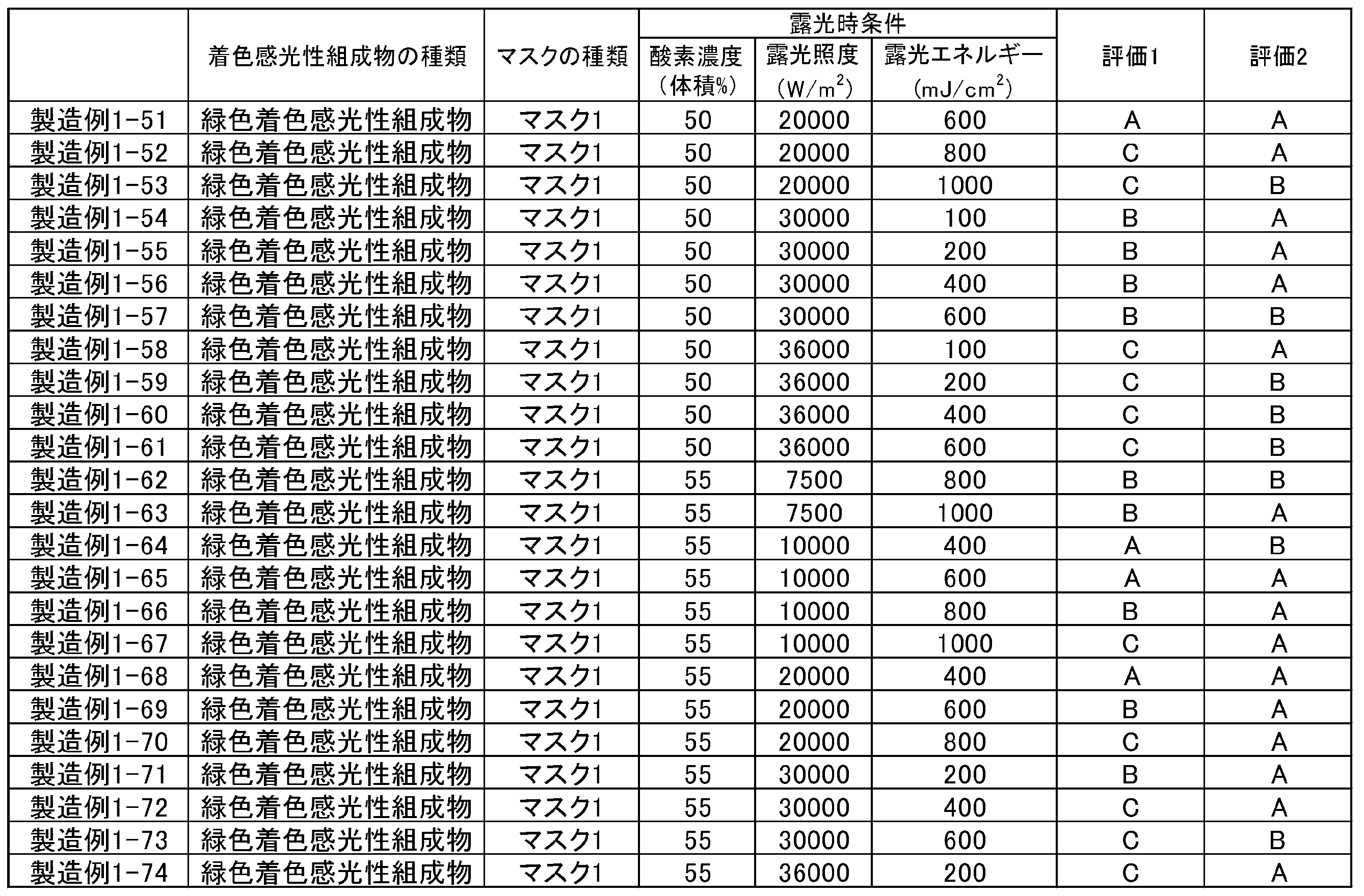


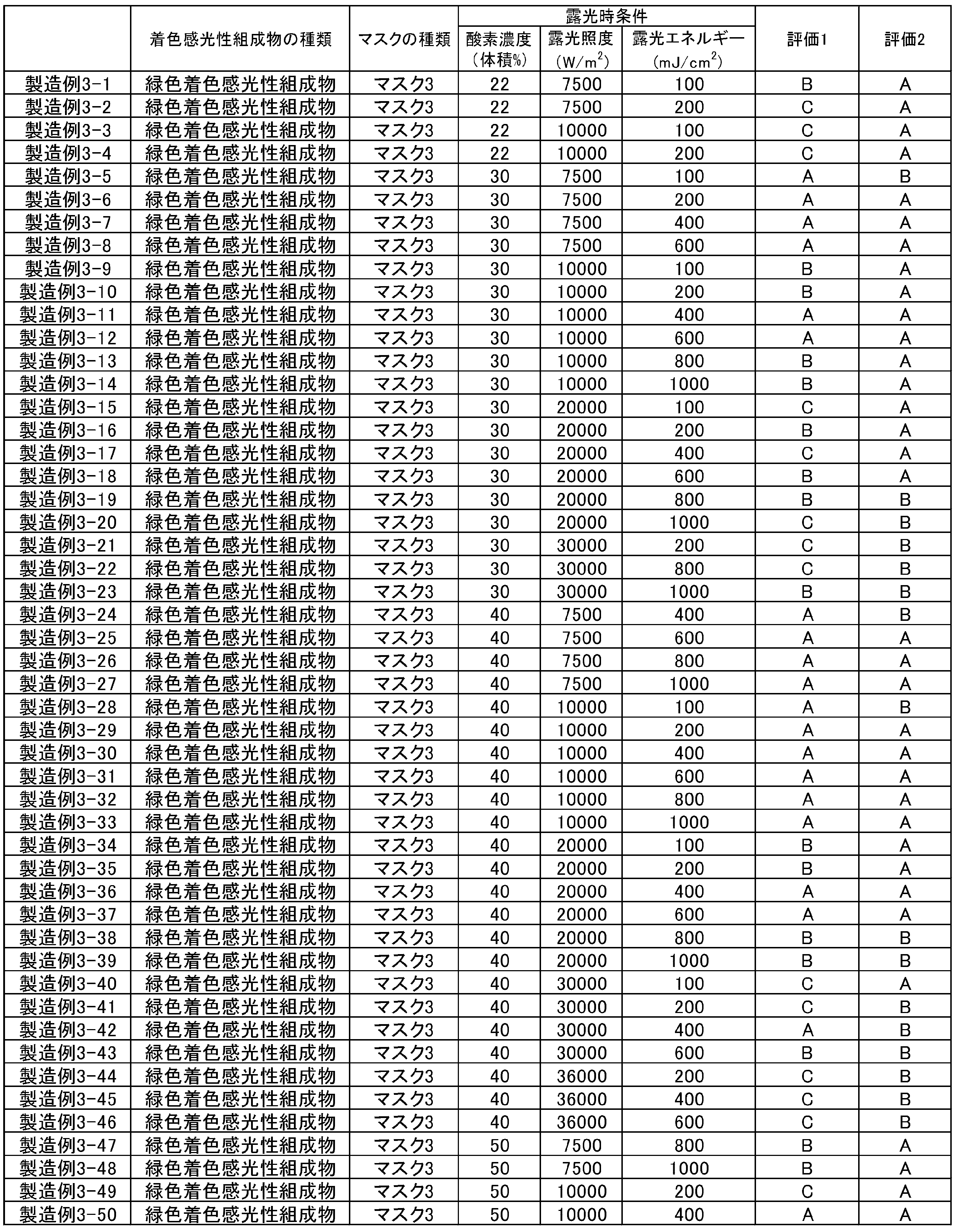
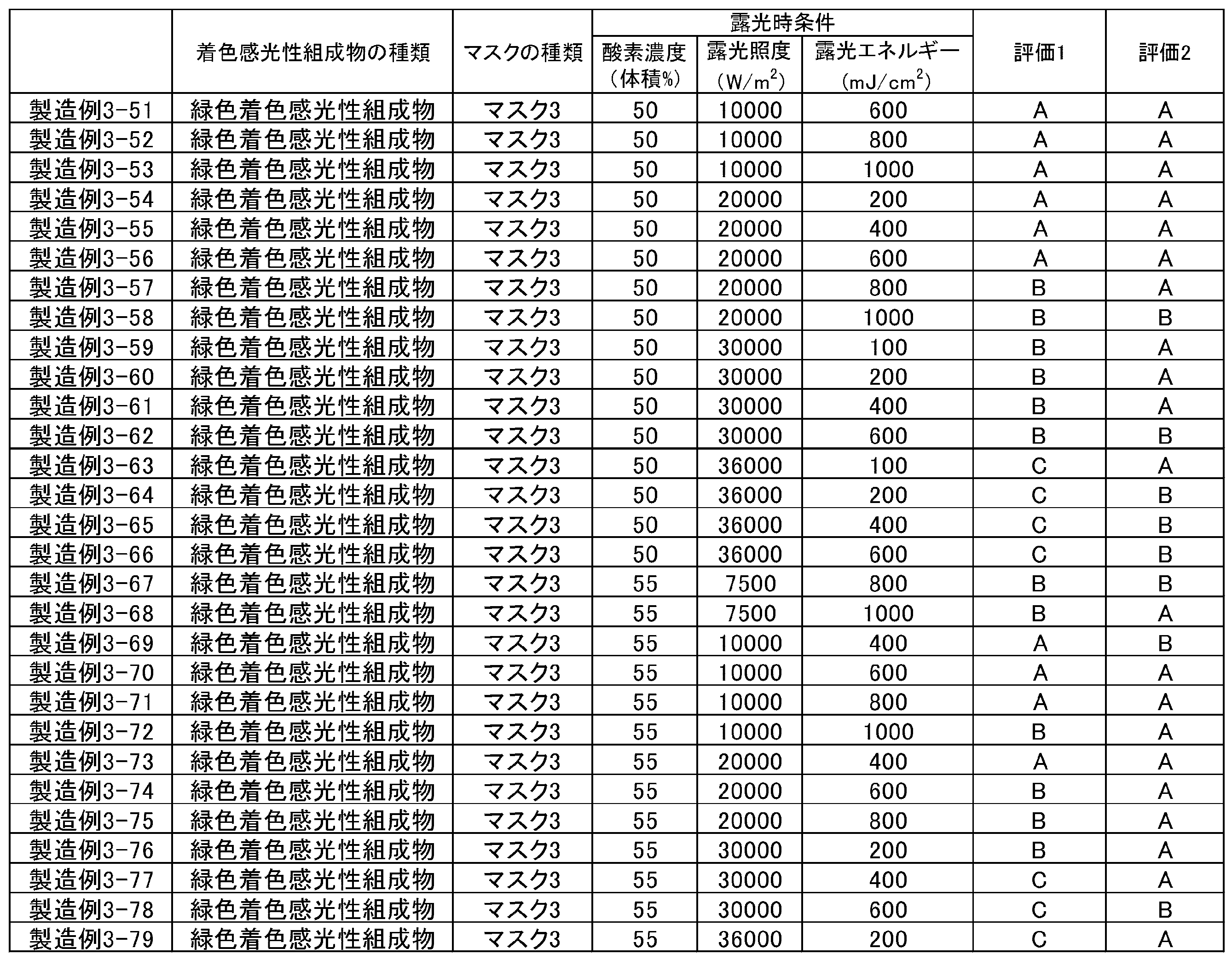
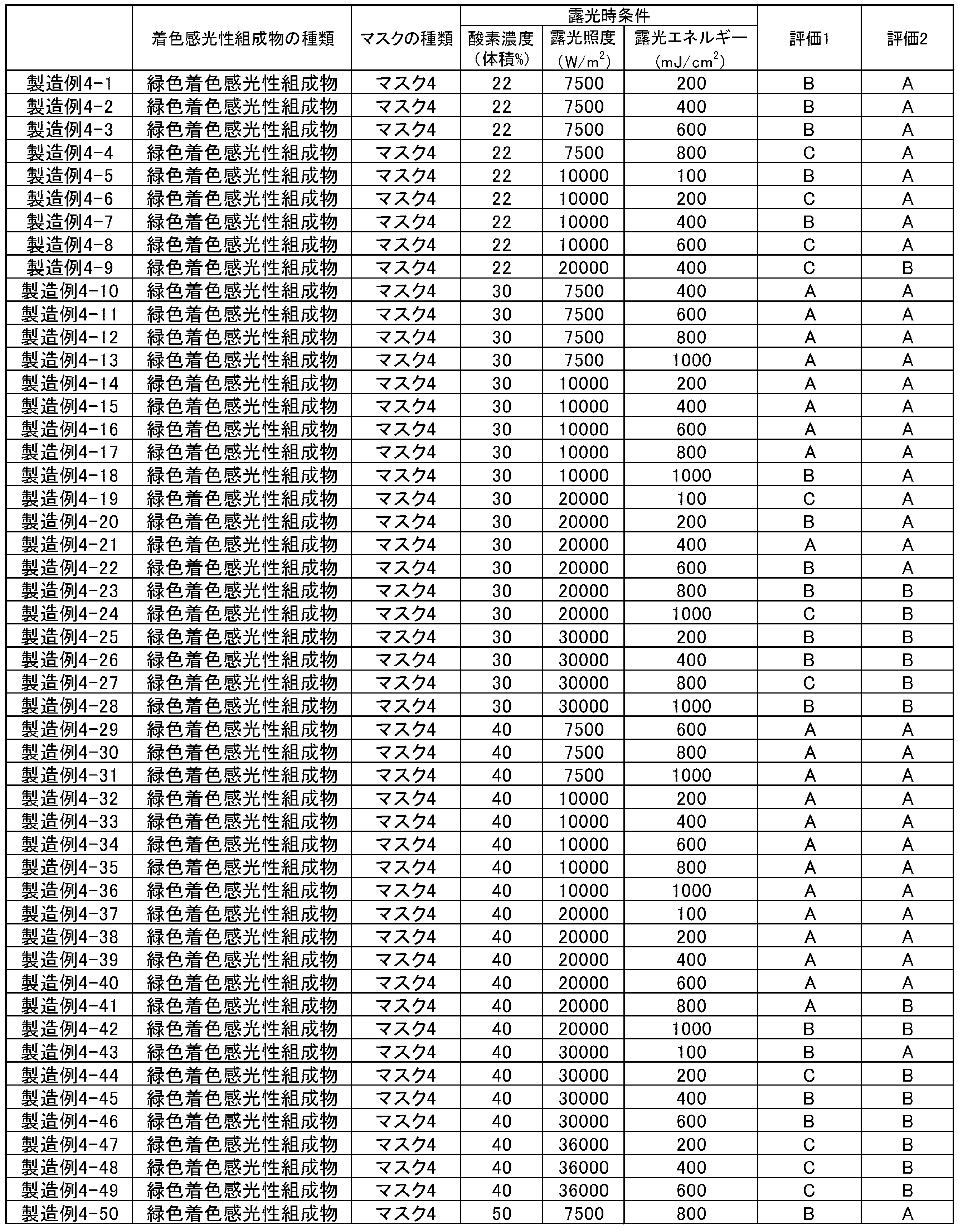

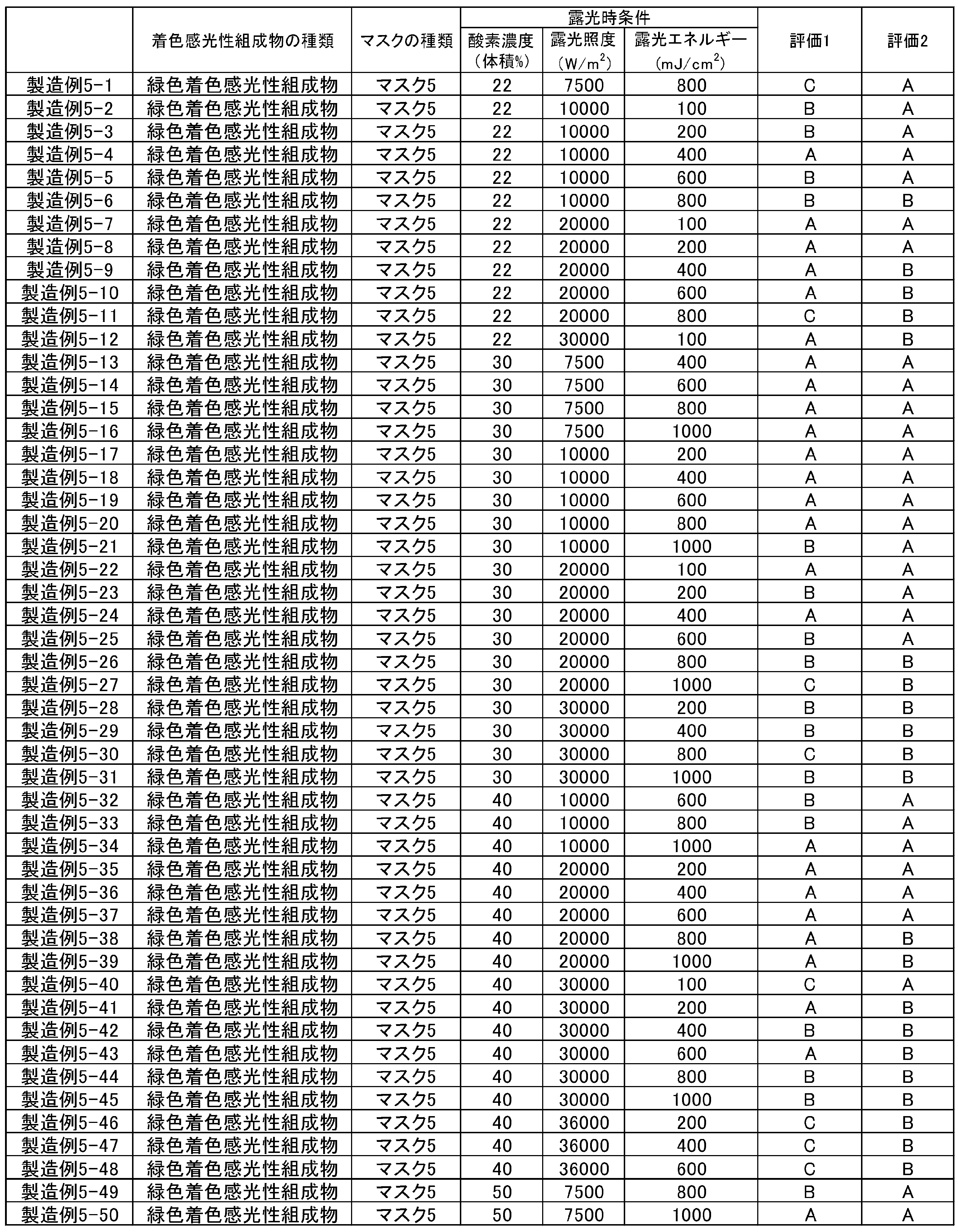

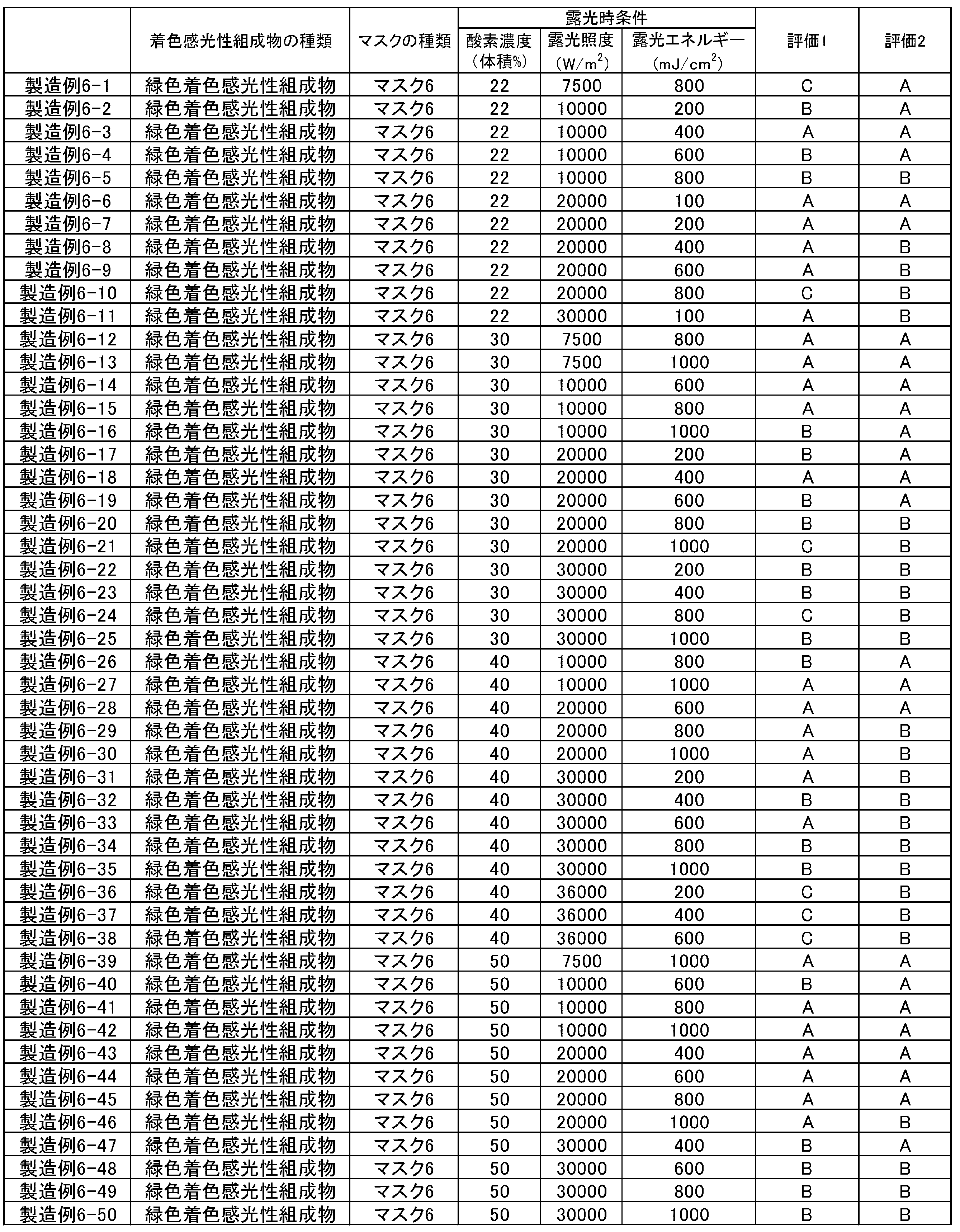
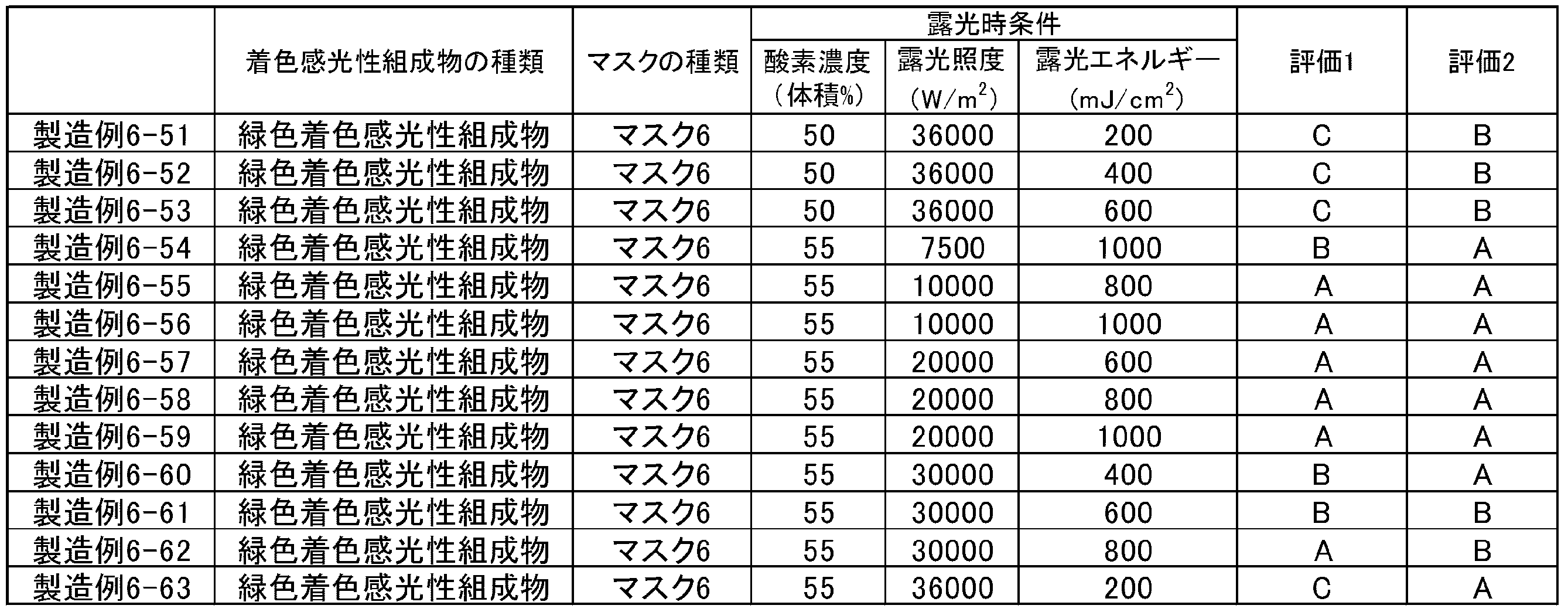

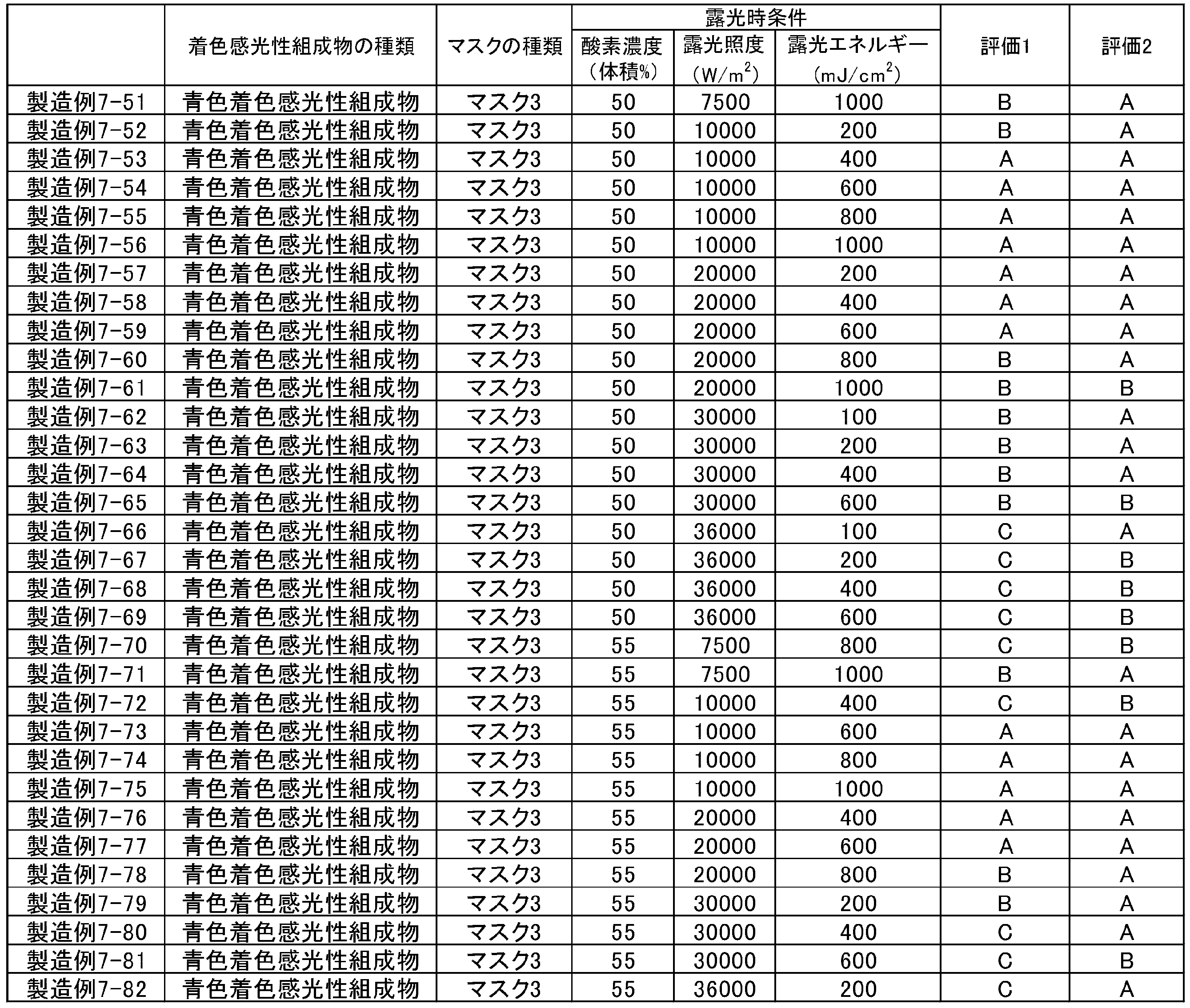
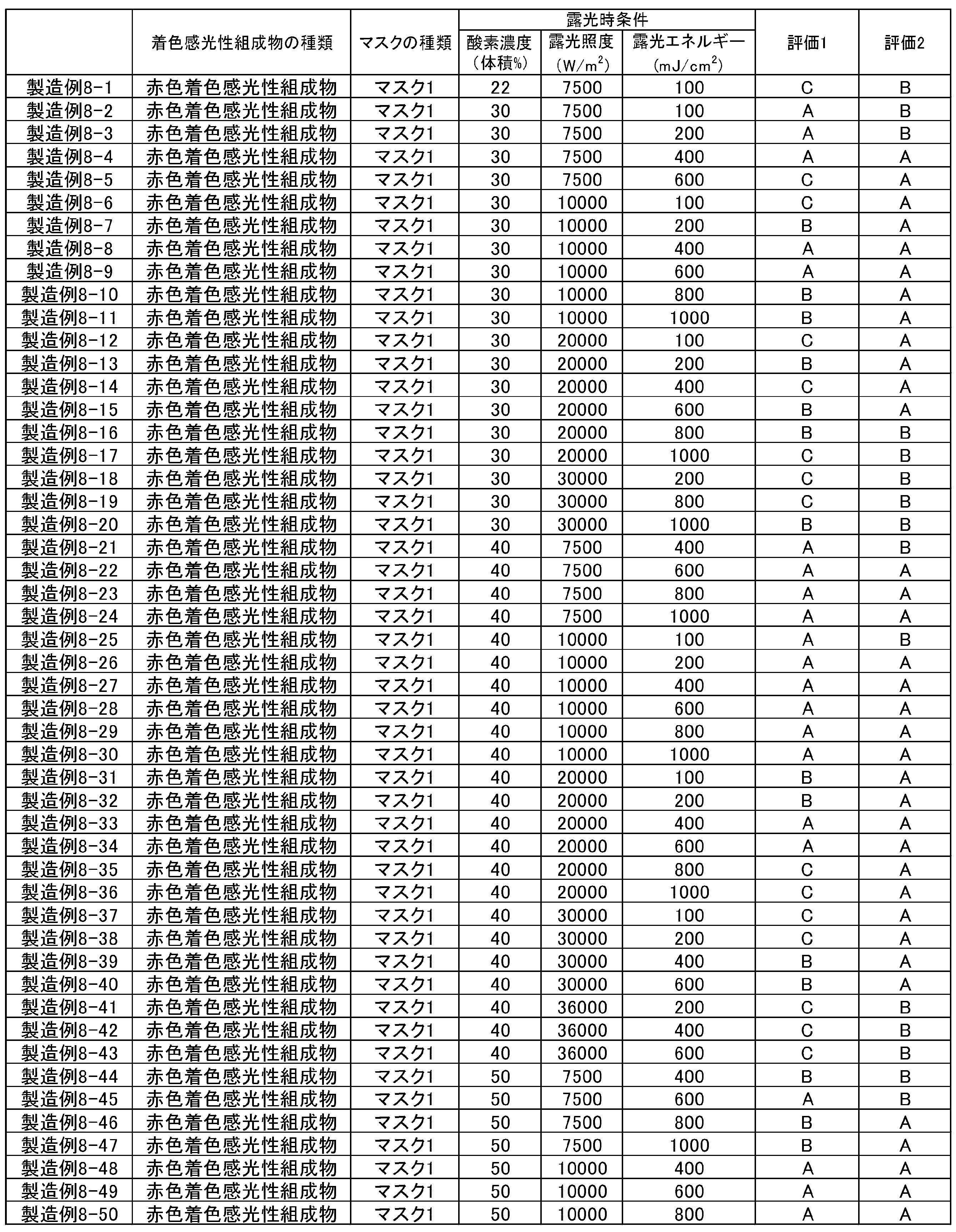

上記表に示すように、本発明によれば、同一色の複数の画素で構成され、かつ、画素同士の間の隔壁の表面の少なくとも一部が画素から露出した画素領域がパターン状に形成された構造体を形成することができた。
なお、各試験例では開口部のサイズが1.9μmであるマスクを用いたが、マスクの開口部のサイズは露光照度、露光エネルギー、酸素濃度の関係性から、1.9μmである必要はなく、適時バイアスを持たせた設定でもよい。例えばマスクの開口部のサイズを1.95μm四方とすることもでき、1.85μm四方とすることもできる。また、本発明では低屈折率材の隔壁構造を示したが、金属(タングステン、アルミニウムなど)と低屈折率材が積層された隔壁、金属隔壁にも有用である。
なお、各試験例では開口部のサイズが1.9μmであるマスクを用いたが、マスクの開口部のサイズは露光照度、露光エネルギー、酸素濃度の関係性から、1.9μmである必要はなく、適時バイアスを持たせた設定でもよい。例えばマスクの開口部のサイズを1.95μm四方とすることもでき、1.85μm四方とすることもできる。また、本発明では低屈折率材の隔壁構造を示したが、金属(タングステン、アルミニウムなど)と低屈折率材が積層された隔壁、金属隔壁にも有用である。
上記の実施例では、着色感光性組成物として、緑色着色感光性組成物、青色着色感光性組成物または赤色着色感光性組成物を使用して同一色の複数の画素で構成され、かつ、画素同士の間の隔壁の表面の少なくとも一部が画素から露出した画素領域がパターン状に形成された構造体を製造したが、着色感光性組成物として、黄色画素形成用の着色感光性組成物、シアン色画素形成用の着色感光性組成物、マゼンタ色画素形成用の着色感光性組成物、透明画素形成用の着色感光性組成物、赤外透過用画素形成用の着色感光性組成物、遮光画素形成用の着色感光性組成物を用いて上記構造体を製造することもできる。
1:支持体
2、2a:隔壁
10、10a:着色感光性組成物層
20、20a:マスク
22:遮光部
25、25a:開口部
30、40、50:画素
35、45、55:画素領域
2、2a:隔壁
10、10a:着色感光性組成物層
20、20a:マスク
22:遮光部
25、25a:開口部
30、40、50:画素
35、45、55:画素領域
Claims (11)
- 隔壁で区画された複数の領域が設けられた支持体上に着色感光性組成物を塗布して前記隔壁で区画された領域内を含む前記支持体上に着色感光性組成物層を形成する工程と、
隣接する前記領域内に形成された着色感光性組成物層を同時に露光できる開口部を有するマスクを介して前記支持体上に形成された着色感光性組成物層をパターン状に露光する工程と、
未露光部の着色感光性組成物層を現像除去すると共に、隔壁の表面の少なくとも一部が露出するように露光部の着色感光性組成物層の一部も現像除去して前記隔壁で区画された領域内に画素を形成し、同一色の複数の画素で構成され、かつ、前記画素同士の間の隔壁の表面の少なくとも一部が前記画素から露出した画素領域をパターン状に形成する工程と、
を含む構造体の製造方法。 - 前記マスクの前記開口部には、前記隔壁に対応する位置の少なくとも一部を遮光する遮光部が設けられている、請求項1に記載の構造体の製造方法。
- 前記遮光部の幅が前記隔壁の幅の1.0~5.0倍である、請求項2に記載の構造体の製造方法。
- 前記着色感光性組成物はラジカル重合性化合物と光ラジカル重合開始剤とを含み、
前記支持体上に形成された前記着色感光性組成物層を、酸素濃度が21体積%を超える雰囲気下でパターン状に露光する、請求項1~3のいずれか1項に記載の構造体の製造方法。 - 前記酸素濃度が55体積%以下である、請求項4に記載の構造体の製造方法。
- 前記支持体上に形成された前記着色感光性組成物層を、露光照度2500~50000W/m2の条件でパターン状に露光する、請求項1~5のいずれか1項に記載の構造体の製造方法。
- 前記隔壁の高さが0.3~1.2μmである、請求項1~6のいずれか1項に記載の構造体の製造方法。
- 前記隔壁の幅が0.05~0.2μmである、請求項1~7のいずれか1項に記載の構造体の製造方法。
- 請求項1~8のいずれか1項に記載の構造体の製造方法を含むカラーフィルタの製造方法。
- 請求項1~8のいずれか1項に記載の構造体の製造方法を含む固体撮像素子の製造方法。
- 請求項1~8のいずれか1項に記載の構造体の製造方法を含む画像表示装置の製造方法。
Priority Applications (1)
| Application Number | Priority Date | Filing Date | Title |
|---|---|---|---|
| JP2020559223A JP7190508B2 (ja) | 2018-12-12 | 2019-12-03 | 構造体の製造方法、カラーフィルタの製造方法、固体撮像素子の製造方法および画像表示装置の製造方法 |
Applications Claiming Priority (2)
| Application Number | Priority Date | Filing Date | Title |
|---|---|---|---|
| JP2018232645 | 2018-12-12 | ||
| JP2018-232645 | 2018-12-12 |
Publications (1)
| Publication Number | Publication Date |
|---|---|
| WO2020121893A1 true WO2020121893A1 (ja) | 2020-06-18 |
Family
ID=71075679
Family Applications (1)
| Application Number | Title | Priority Date | Filing Date |
|---|---|---|---|
| PCT/JP2019/047217 Ceased WO2020121893A1 (ja) | 2018-12-12 | 2019-12-03 | 構造体の製造方法、カラーフィルタの製造方法、固体撮像素子の製造方法および画像表示装置の製造方法 |
Country Status (3)
| Country | Link |
|---|---|
| JP (1) | JP7190508B2 (ja) |
| TW (1) | TWI846777B (ja) |
| WO (1) | WO2020121893A1 (ja) |
Citations (5)
| Publication number | Priority date | Publication date | Assignee | Title |
|---|---|---|---|---|
| JP2005203351A (ja) * | 2003-12-17 | 2005-07-28 | Semiconductor Energy Lab Co Ltd | 表示装置及びその作製方法 |
| JP2011096378A (ja) * | 2009-10-27 | 2011-05-12 | Canon Inc | 有機el表示装置 |
| JP2012227478A (ja) * | 2011-04-22 | 2012-11-15 | Panasonic Corp | 固体撮像装置 |
| JP2013101337A (ja) * | 2011-10-20 | 2013-05-23 | Mitsubishi Chemicals Corp | 着色樹脂組成物、カラーフィルタ、液晶表示装置及び有機el表示装置 |
| JP2015052753A (ja) * | 2013-09-09 | 2015-03-19 | 富士フイルム株式会社 | 樹脂硬化物の製造方法、これを用いた固体撮像素子および液晶表示装置の製造方法 |
Family Cites Families (1)
| Publication number | Priority date | Publication date | Assignee | Title |
|---|---|---|---|---|
| JP6843146B2 (ja) * | 2016-09-30 | 2021-03-17 | 富士フイルム株式会社 | 構造体、カラーフィルタ、固体撮像素子、画像表示装置、構造体の製造方法および有機物層形成用組成物 |
-
2019
- 2019-12-03 WO PCT/JP2019/047217 patent/WO2020121893A1/ja not_active Ceased
- 2019-12-03 JP JP2020559223A patent/JP7190508B2/ja active Active
- 2019-12-10 TW TW108145164A patent/TWI846777B/zh active
Patent Citations (5)
| Publication number | Priority date | Publication date | Assignee | Title |
|---|---|---|---|---|
| JP2005203351A (ja) * | 2003-12-17 | 2005-07-28 | Semiconductor Energy Lab Co Ltd | 表示装置及びその作製方法 |
| JP2011096378A (ja) * | 2009-10-27 | 2011-05-12 | Canon Inc | 有機el表示装置 |
| JP2012227478A (ja) * | 2011-04-22 | 2012-11-15 | Panasonic Corp | 固体撮像装置 |
| JP2013101337A (ja) * | 2011-10-20 | 2013-05-23 | Mitsubishi Chemicals Corp | 着色樹脂組成物、カラーフィルタ、液晶表示装置及び有機el表示装置 |
| JP2015052753A (ja) * | 2013-09-09 | 2015-03-19 | 富士フイルム株式会社 | 樹脂硬化物の製造方法、これを用いた固体撮像素子および液晶表示装置の製造方法 |
Also Published As
| Publication number | Publication date |
|---|---|
| JPWO2020121893A1 (ja) | 2021-10-28 |
| TWI846777B (zh) | 2024-07-01 |
| JP7190508B2 (ja) | 2022-12-15 |
| TW202028885A (zh) | 2020-08-01 |
Similar Documents
| Publication | Publication Date | Title |
|---|---|---|
| CN115427517B (zh) | 着色组合物、膜、滤光器、固体摄像元件及图像显示装置 | |
| JP7190504B2 (ja) | 構造体、固体撮像素子および画像表示装置 | |
| JP7408821B2 (ja) | 下層膜形成用組成物、カラーフィルタ、カラーフィルタの製造方法、固体撮像素子および画像表示装置 | |
| US20210130617A1 (en) | Coloring composition, film, color filter, method for manufacturing color filter, solid-state imaging element, and image display device | |
| TW201934670A (zh) | 組成物、膜、紅外線透射濾波器及固體攝像元件 | |
| WO2022168743A1 (ja) | 樹脂組成物、膜、光学フィルタ、固体撮像素子および画像表示装置 | |
| JP7095091B2 (ja) | 感光性組成物、膜、カラーフィルタ、固体撮像素子及び画像表示装置 | |
| TW202007697A (zh) | 組成物、膜、紅外線透射濾波器、結構體、光感測器及圖像顯示裝置 | |
| WO2023120343A1 (ja) | 着色組成物、膜、光学フィルタ、固体撮像素子、画像表示装置および化合物 | |
| JP7344379B2 (ja) | 樹脂組成物、膜、光学フィルタ、固体撮像素子および画像表示装置 | |
| TW202010758A (zh) | 硬化性組成物、硬化性組成物的製造方法、膜、濾色器、濾色器的製造方法、固體攝像元件及圖像顯示裝置 | |
| WO2020080218A1 (ja) | 着色組成物、膜、カラーフィルタ、カラーフィルタの製造方法、固体撮像素子及び画像表示装置 | |
| WO2020022248A1 (ja) | 硬化性組成物、膜、カラーフィルタ、カラーフィルタの製造方法、固体撮像素子および画像表示装置 | |
| KR102903359B1 (ko) | 수지 조성물, 막의 제조 방법, 광학 필터의 제조 방법, 고체 촬상 소자의 제조 방법 및 화상 표시 장치의 제조 방법 | |
| JP7371121B2 (ja) | 着色組成物、膜、光学フィルタ、固体撮像素子及び画像表示装置 | |
| JP7383146B2 (ja) | 感光性組成物、膜、カラーフィルタ、固体撮像素子及び画像表示装置 | |
| JP7190508B2 (ja) | 構造体の製造方法、カラーフィルタの製造方法、固体撮像素子の製造方法および画像表示装置の製造方法 | |
| WO2023145699A1 (ja) | 赤外線吸収組成物、膜、光学フィルタ、固体撮像素子、画像表示装置、赤外線センサおよびカメラモジュール | |
| WO2023022120A1 (ja) | 組成物、膜、光学フィルタ、光学センサ、画像表示装置および構造体 | |
| JP7284184B2 (ja) | 着色組成物、膜、カラーフィルタの製造方法、カラーフィルタ、固体撮像素子及び画像表示装置 | |
| JP7112592B2 (ja) | 樹脂組成物、膜、近赤外線カットフィルタ、近赤外線透過フィルタ、固体撮像素子、画像表示装置および赤外線センサ | |
| WO2023120387A1 (ja) | 樹脂組成物、膜、光学フィルタ、固体撮像素子および画像表示装置 | |
| WO2023085056A1 (ja) | 硬化性組成物、硬化物の製造方法、膜、光学素子、イメージセンサ、固体撮像素子、画像表示装置、及び、ラジカル重合開始剤 | |
| WO2023085072A1 (ja) | 着色硬化性組成物、硬化物の製造方法、膜、光学素子、イメージセンサ、固体撮像素子、画像表示装置、及び、ラジカル重合開始剤 | |
| WO2022230625A1 (ja) | 着色組成物、膜、光学フィルタ、固体撮像素子、画像表示装置および化合物 |
Legal Events
| Date | Code | Title | Description |
|---|---|---|---|
| 121 | Ep: the epo has been informed by wipo that ep was designated in this application |
Ref document number: 19894862 Country of ref document: EP Kind code of ref document: A1 |
|
| ENP | Entry into the national phase |
Ref document number: 2020559223 Country of ref document: JP Kind code of ref document: A |
|
| NENP | Non-entry into the national phase |
Ref country code: DE |
|
| 122 | Ep: pct application non-entry in european phase |
Ref document number: 19894862 Country of ref document: EP Kind code of ref document: A1 |