WO2020121889A1 - ガラス、化学強化ガラスおよびそれを含む電子機器 - Google Patents
ガラス、化学強化ガラスおよびそれを含む電子機器 Download PDFInfo
- Publication number
- WO2020121889A1 WO2020121889A1 PCT/JP2019/047190 JP2019047190W WO2020121889A1 WO 2020121889 A1 WO2020121889 A1 WO 2020121889A1 JP 2019047190 W JP2019047190 W JP 2019047190W WO 2020121889 A1 WO2020121889 A1 WO 2020121889A1
- Authority
- WO
- WIPO (PCT)
- Prior art keywords
- glass
- content
- less
- sio
- chemically strengthened
- Prior art date
- Legal status (The legal status is an assumption and is not a legal conclusion. Google has not performed a legal analysis and makes no representation as to the accuracy of the status listed.)
- Ceased
Links
Images


Classifications
-
- C—CHEMISTRY; METALLURGY
- C03—GLASS; MINERAL OR SLAG WOOL
- C03C—CHEMICAL COMPOSITION OF GLASSES, GLAZES OR VITREOUS ENAMELS; SURFACE TREATMENT OF GLASS; SURFACE TREATMENT OF FIBRES OR FILAMENTS MADE FROM GLASS, MINERALS OR SLAGS; JOINING GLASS TO GLASS OR OTHER MATERIALS
- C03C3/00—Glass compositions
- C03C3/04—Glass compositions containing silica
- C03C3/076—Glass compositions containing silica with 40% to 90% silica, by weight
- C03C3/097—Glass compositions containing silica with 40% to 90% silica, by weight containing phosphorus, niobium or tantalum
-
- C—CHEMISTRY; METALLURGY
- C03—GLASS; MINERAL OR SLAG WOOL
- C03C—CHEMICAL COMPOSITION OF GLASSES, GLAZES OR VITREOUS ENAMELS; SURFACE TREATMENT OF GLASS; SURFACE TREATMENT OF FIBRES OR FILAMENTS MADE FROM GLASS, MINERALS OR SLAGS; JOINING GLASS TO GLASS OR OTHER MATERIALS
- C03C21/00—Treatment of glass, not in the form of fibres or filaments, by diffusing ions or metals in the surface
- C03C21/001—Treatment of glass, not in the form of fibres or filaments, by diffusing ions or metals in the surface in liquid phase, e.g. molten salts, solutions
- C03C21/002—Treatment of glass, not in the form of fibres or filaments, by diffusing ions or metals in the surface in liquid phase, e.g. molten salts, solutions to perform ion-exchange between alkali ions
-
- C—CHEMISTRY; METALLURGY
- C03—GLASS; MINERAL OR SLAG WOOL
- C03C—CHEMICAL COMPOSITION OF GLASSES, GLAZES OR VITREOUS ENAMELS; SURFACE TREATMENT OF GLASS; SURFACE TREATMENT OF FIBRES OR FILAMENTS MADE FROM GLASS, MINERALS OR SLAGS; JOINING GLASS TO GLASS OR OTHER MATERIALS
- C03C3/00—Glass compositions
- C03C3/04—Glass compositions containing silica
- C03C3/076—Glass compositions containing silica with 40% to 90% silica, by weight
- C03C3/083—Glass compositions containing silica with 40% to 90% silica, by weight containing aluminium oxide or an iron compound
- C03C3/085—Glass compositions containing silica with 40% to 90% silica, by weight containing aluminium oxide or an iron compound containing an oxide of a divalent metal
-
- C—CHEMISTRY; METALLURGY
- C03—GLASS; MINERAL OR SLAG WOOL
- C03C—CHEMICAL COMPOSITION OF GLASSES, GLAZES OR VITREOUS ENAMELS; SURFACE TREATMENT OF GLASS; SURFACE TREATMENT OF FIBRES OR FILAMENTS MADE FROM GLASS, MINERALS OR SLAGS; JOINING GLASS TO GLASS OR OTHER MATERIALS
- C03C3/00—Glass compositions
- C03C3/04—Glass compositions containing silica
- C03C3/076—Glass compositions containing silica with 40% to 90% silica, by weight
- C03C3/083—Glass compositions containing silica with 40% to 90% silica, by weight containing aluminium oxide or an iron compound
- C03C3/085—Glass compositions containing silica with 40% to 90% silica, by weight containing aluminium oxide or an iron compound containing an oxide of a divalent metal
- C03C3/087—Glass compositions containing silica with 40% to 90% silica, by weight containing aluminium oxide or an iron compound containing an oxide of a divalent metal containing calcium oxide, e.g. common sheet or container glass
-
- C—CHEMISTRY; METALLURGY
- C03—GLASS; MINERAL OR SLAG WOOL
- C03C—CHEMICAL COMPOSITION OF GLASSES, GLAZES OR VITREOUS ENAMELS; SURFACE TREATMENT OF GLASS; SURFACE TREATMENT OF FIBRES OR FILAMENTS MADE FROM GLASS, MINERALS OR SLAGS; JOINING GLASS TO GLASS OR OTHER MATERIALS
- C03C3/00—Glass compositions
- C03C3/04—Glass compositions containing silica
- C03C3/076—Glass compositions containing silica with 40% to 90% silica, by weight
- C03C3/089—Glass compositions containing silica with 40% to 90% silica, by weight containing boron
- C03C3/091—Glass compositions containing silica with 40% to 90% silica, by weight containing boron containing aluminium
-
- C—CHEMISTRY; METALLURGY
- C03—GLASS; MINERAL OR SLAG WOOL
- C03C—CHEMICAL COMPOSITION OF GLASSES, GLAZES OR VITREOUS ENAMELS; SURFACE TREATMENT OF GLASS; SURFACE TREATMENT OF FIBRES OR FILAMENTS MADE FROM GLASS, MINERALS OR SLAGS; JOINING GLASS TO GLASS OR OTHER MATERIALS
- C03C3/00—Glass compositions
- C03C3/04—Glass compositions containing silica
- C03C3/076—Glass compositions containing silica with 40% to 90% silica, by weight
- C03C3/095—Glass compositions containing silica with 40% to 90% silica, by weight containing rare earths
-
- C—CHEMISTRY; METALLURGY
- C03—GLASS; MINERAL OR SLAG WOOL
- C03C—CHEMICAL COMPOSITION OF GLASSES, GLAZES OR VITREOUS ENAMELS; SURFACE TREATMENT OF GLASS; SURFACE TREATMENT OF FIBRES OR FILAMENTS MADE FROM GLASS, MINERALS OR SLAGS; JOINING GLASS TO GLASS OR OTHER MATERIALS
- C03C4/00—Compositions for glass with special properties
- C03C4/18—Compositions for glass with special properties for ion-sensitive glass
-
- H—ELECTRICITY
- H05—ELECTRIC TECHNIQUES NOT OTHERWISE PROVIDED FOR
- H05K—PRINTED CIRCUITS; CASINGS OR CONSTRUCTIONAL DETAILS OF ELECTRIC APPARATUS; MANUFACTURE OF ASSEMBLAGES OF ELECTRICAL COMPONENTS
- H05K5/00—Casings, cabinets or drawers for electric apparatus
- H05K5/02—Details
- H05K5/03—Covers
-
- C—CHEMISTRY; METALLURGY
- C03—GLASS; MINERAL OR SLAG WOOL
- C03C—CHEMICAL COMPOSITION OF GLASSES, GLAZES OR VITREOUS ENAMELS; SURFACE TREATMENT OF GLASS; SURFACE TREATMENT OF FIBRES OR FILAMENTS MADE FROM GLASS, MINERALS OR SLAGS; JOINING GLASS TO GLASS OR OTHER MATERIALS
- C03C2204/00—Glasses, glazes or enamels with special properties
Definitions
- the present invention relates to chemically strengthened glass.
- the chemically strengthened glass is a method of immersing the glass in a molten salt such as sodium nitrate to cause an ion exchange between an alkali ion contained in the glass and an alkali ion having a larger ionic radius contained in the molten salt, This is a glass in which a compressive stress layer is formed on the surface layer portion.
- a molten salt such as sodium nitrate
- Patent Document 1 discloses a method of obtaining a chemically strengthened glass having a high surface strength and a large compressive stress layer depth by performing a two-step chemical strengthening treatment on an aluminosilicate glass containing lithium. ..
- Chemically strengthened glass tends to have higher strength as the surface compressive stress value and the compressive stress layer depth increase.
- internal tensile stress is generated inside the glass according to the total amount of compressive stress. If the value of internal tensile stress (CT) exceeds a certain threshold value, the glass will crack more severely when it breaks. This threshold is also called the CT limit.
- Patent Document 2 discloses high-strength glass having high crack resistance.
- This high-strength glass contains a large amount of Al 2 O 3 and is manufactured by a special method called a containerless method. Further, the glass specifically described in Patent Document 2 cannot be chemically strengthened because it is a two-component glass composed of SiO 2 and Al 2 O 3 .
- An object of the present invention is to provide a glass having a high fracture toughness value and easy to manufacture. Another object of the present invention is to provide a chemically strengthened glass that has high strength but is resistant to severe crushing.
- the present inventors studied the CT limit for chemically strengthened glass and found that the higher the fracture toughness value, the higher the CT limit. Therefore, it was considered that a glass having excellent chemical strengthening properties and a large fracture toughness value could realize high strength by chemical strengthening while preventing severe crushing. Further, as a result of the study, they found that a high fracture toughness value can be realized without using a two-component glass composed of SiO 2 and Al 2 O 3, and arrived at the present invention.
- the present invention is a glass having a fracture toughness value of 0.85 MPa ⁇ m 1/2 or more, and in terms of oxide-based molar percentage, SiO 2 is 40% or more, Al 2 O 3 is 20% or more, and Li 2 is A glass containing 5% or more of O and 1 to 6% in total of one or more kinds selected from Y 2 O 3 , La 2 O 3 and Ga 2 O 3 .
- the content of SiO 2 is 40 to 60%
- Al 2 O 3 is 20 to 45%
- Li 2 O is 5 to 15%
- the content of SiO 2 is [SiO 2 ].
- Al 2 O 3 content is [Al 2 O 3 ]
- (2 ⁇ [Al 2 O 3 ]-X)/[SiO 2 ] is 0 or more and 1 or less.
- X represents the total content of oxides selected from Li 2 O, Na 2 O, K 2 O and P 2 O 5 as M1 (%) and the total content of MgO, CaO, SrO, ZnO and BaO as M2.
- the compressive stress value (CS 50 ) at a depth of 50 ⁇ m from the glass surface is 150 MPa or more, In terms of mole percentage based on oxide, SiO 2 40 to 60%, Al 2 O 3 20 to 45%, Li 2 O 5 to 15%, and one or more selected from Y 2 O 3 , La 2 O 3 and Ga 2 O 3 in total.
- a chemically strengthened glass containing 1 to 6% is provided.
- a cover glass including the above chemically strengthened glass is provided. Also, an electronic device including the cover glass is provided.
- a glass having a high fracture toughness value and easy to manufacture can be obtained. Further, it is possible to obtain a chemically strengthened glass which has high strength but is less likely to undergo severe crushing.
- FIG. 1 is a diagram showing the relationship between the internal tensile stress value (CT) after chemically strengthened glass and the crushing number for two types of glass.
- FIG. 2 is a plot of the relationship between the fracture toughness value and the ratio of the number of five-coordinated aluminums to the total number of aluminums obtained from NMR measurements for the glasses of Examples and Comparative Examples.
- the solid line in FIG. 3 is an example of the stress profile of the chemically strengthened glass of the present invention, and the dotted line is an example of the stress profile of the conventional chemically strengthened glass.
- FIG. 4 is an example of a stress profile of the chemically strengthened glass of the present invention.
- FIG. 5 is a figure which shows an example of the electronic device containing the chemically strengthened glass of this invention.
- stress profile refers to the value of compressive stress with the depth from the glass surface as a variable.
- compression stress layer depth is the depth at which the compressive stress value (CS) becomes zero.
- CT internal tensile stress value
- the stress profile in this specification is measured by a birefringence stress meter using a sample obtained by thinning a cross section of chemically strengthened glass.
- the birefringence index stress meter is a device for measuring the magnitude of retardation caused by stress using a polarization microscope and a liquid crystal compensator, and there is, for example, CRi's birefringence imaging system Abrio-IM.
- the compressive stress value at the surface of the glass plate may be measured using an optical waveguide surface stress meter (for example, FSM-6000 manufactured by Orihara Manufacturing Co., Ltd.).
- the stress value can be measured without performing processing such as thinning the glass sample.
- the optical waveguide surface stress meter cannot measure the stress unless the refractive index decreases from the surface toward the inside in principle. As a result, when the aluminosilicate glass containing lithium is chemically strengthened, there is a problem that the compressive stress inside the glass plate cannot be measured.
- the stress value inside the glass plate can be measured using a scattered light photoelastic stress meter (for example, Orihara SLP-1000).
- a scattered light photoelastic stress meter for example, Orihara SLP-1000
- the stress value can be measured without performing processing such as thinning the glass sample, regardless of the refractive index distribution inside the glass.
- the scattered light photoelastic stress meter is easily affected by surface scattered light, it is difficult to accurately measure the stress value near the glass surface.
- the CT limit is the maximum value of CT at which the number of fractures measured by the following procedure is 10 or less.
- test glass plate a plurality of test glass plates having a 15 mm square, a thickness of 0.5 mm or more and 1 mm or less, and a mirror-finished surface chemically strengthened under various conditions and having different CT values.
- the CT value in this case can be measured using a scattered light photoelastic stress meter.
- DOL compression stress layer depth
- the number of crushes may be 50. This is because if the number of crushed particles is too large, most of the fragments will pass through the sieve, making it difficult to accurately count the number of particles, and in fact, it will have little effect on the evaluation of the CT limit.
- the test was started from a Vickers indenter driving load of 3 kgf, and if the glass plate did not crack, the driving load was increased by 1 kgf and the test was repeated until the glass plate cracked. count.
- FIG. 1 is a diagram in which the CT value and the crushing number are plotted for glass A and glass B having different glass compositions.
- Glass A is plotted with open diamonds
- glass B is plotted with black circles. It can be seen from FIG. 1 that the glass having the same composition has a larger number of fractures as the CT increases. Further, it can be seen that when the number of crushes exceeds 10, the number of crushes rapidly increases due to an increase in CT.
- the CT value with 10 crushing numbers is read and used as the CT limit.
- the maximum value of the crushing number of 10 or less is set to 8 or more, preferably 9 or more.
- the crushing number at the point where the crushing number is larger than 10 may be 40 or less, and more preferably 20 or less.
- Table 1 shows the measurement results for glass A and glass B.
- the CT limit is 60 MPa from the CT value of 57 MPa where the crushing number was 8 and the CT value of 63 MPa where the crushing number was 13.
- the CT limit is 88 MPa from the CT value of 88 MPa where the crushing number was 8 and the CT value of 94 MPa where the crushing number was 40.
- chemically strengthened glass refers to glass after being subjected to chemical strengthening treatment
- glass for chemical strengthening refers to glass before being subjected to chemical strengthening treatment
- the “matrix composition of chemically strengthened glass” is the glass composition of chemically strengthened glass.
- the glass composition at a depth of 1/2 of the plate thickness t is the mother composition of the chemically strengthened glass, except when an extreme ion exchange treatment is performed.
- the glass composition is expressed in terms of mol percentage on an oxide basis, and mol% is simply expressed as “%”.
- substantially free of means that the content is not higher than the level of impurities contained in raw materials, that is, it is not intentionally contained. Specifically, it is less than 0.1 mol %, for example.
- the present glass has a fracture toughness value of 0.85 MPa ⁇ m 1/2 or more, In terms of oxide-based molar percentage, the content of SiO 2 is 40% or more, Al 2 O 3 is 20% or more, Li 2 O is 5% or more, and Y 2 O 3 , La 2 O 3 and Ga 2 O 3 are included. It may be a glass (first glass) containing 1 to 6% in total of one or more selected.
- the present glass contains 40 to 60% of SiO 2 , 20 to 45% of Al 2 O 3 and 5 to 15% of Li 2 O in terms of mole percentage on an oxide basis, and the content of (2 ⁇ [Al 2 It may be a glass (second glass) in which O 3 ]-X)/[SiO 2 ] is 0 or more and 1 or less.
- the plate thickness (t) thereof is, for example, 2 mm or less, preferably 1.5 mm or less, and more preferably 1 mm or less from the viewpoint of enhancing the effect of chemical strengthening. And more preferably 0.9 mm or less, particularly preferably 0.8 mm or less, and most preferably 0.7 mm or less.
- the plate thickness is, for example, 0.1 mm or more, preferably 0.2 mm or more, more preferably 0.4 mm or more, and further preferably 0.5 mm or more.
- the fracture toughness value of the present glass is preferably 0.85 MPa ⁇ m 1/2 or more. Since glass having a large fracture toughness value has a large CT limit, even if a large surface compressive stress layer is formed by chemical strengthening, severe crushing is unlikely to occur. Fracture toughness is more preferably 0.9 MPa ⁇ m 1/2 or more, more preferably 0.95 MPa ⁇ m 1/2 or more. The fracture toughness value is usually 2.0 MPa ⁇ m 1/2 or less, typically 1.5 MPa ⁇ m 1/2 or less.
- the fracture toughness value can be measured using, for example, the DCDC method (Acta metall. material. Vol. 43, pp. 3453-3458, 1995).
- the CT limit is preferably 75 MPa or higher, more preferably 78 MPa or higher, and even more preferably 80 MPa or higher.
- the CT limit of the present glass is usually 95 MPa or less.
- the present glass is lithium aluminosilicate glass. Specifically, it is a glass containing 40% or more of SiO 2 , 20% or more of Al 2 O 3 , and 5% or more of Li 2 O. Lithium aluminosilicate glass contains lithium ions, which are alkali ions with the smallest ionic radius, so chemical strengthening treatment with ion exchange using various molten salts can provide chemically strengthened glass having a favorable stress profile. ..
- (2 ⁇ [Al 2 O 3 ]-X)/[SiO 2 ] is preferably 0 or more and 1 or less.
- [SiO 2] is the content of SiO 2 by mol%
- a content of [Al 2 O 3] is Al 2 O 3 by similarly mol%.
- other components will be similarly displayed.
- X is the total content of oxides selected from Li 2 O, Na 2 O, K 2 O and P 2 O 5 ([Li 2 O]+[Na 2 O]+[K 2 O]+[P 2 O 5 ]) is M1 (%), and the total content of MgO, CaO, SrO, ZnO and BaO ([MgO]+[CaO]+[SrO]+[ZnO]+[BaO]) is M2(%).
- the value of (2 ⁇ [Al 2 O 3 ]-X)/[SiO 2 ] is preferably 0.2 or more and 0.8 or less.
- aluminum ions usually mainly have a four-coordinate structure in aluminosilicate glass.
- aluminum ions have a pentacoordinate structure, and a glass having a large amount of aluminum ions having a pentacoordinate structure has a high fracture toughness value.
- a pentacoordinated aluminum ion has a tetracoordinated structure when it receives a charge from another ion or the like.
- Divalent cations such as magnesium, calcium and strontium will donate two charges and transform the two aluminum ions into a tetracoordinated structure. Therefore, assuming that the total content of MgO, CaO, SrO, ZnO and BaO is M2, 2 ⁇ M2 aluminum ions will have a four-coordinate structure.
- the aluminum ion is likely to have a four-coordinated structure when there is a cation having a high valence other than silicon. Therefore, the above-mentioned X value represents the sum of the valences of so-called network modification cations that are not included in the glass network.
- P was treated in the same manner as monovalent cations. When P 2 O 5 and Al 2 O 3 are contained in the glass, an electron is donated to Al from the double bond between P ⁇ O, and both P and Al have the effect of 4-coordination. Because it is big.
- FIG. 2 is a graph plotting the relationship between the proportion of pentacoordinated aluminum obtained from NMR measurement and the fracture toughness value for the glasses of Examples and Comparative Examples described below.
- the ratio of the number of five-coordinated aluminum atoms to the total number of aluminum atoms in the glass is preferably 9% or more, more preferably 10% or more, even more preferably 12% or more, in order to increase the fracture toughness value.
- the proportion of five-coordinated aluminum numbers is usually 20% or less, typically 18% or less.
- the present inventors have also found that as the amount of Al 2 O 3 in the glass composition increases and the amount of Y 2 O 3 increases, the number of 4-coordinate aluminum atoms decreases and the proportion of 5-coordinate aluminum numbers increases. I found it.
- the glass of the present invention contains 40 to 60% of SiO 2 , Al 2 O 3 is 20 to 45%, Li 2 O 5 to 15%, 1 to 6% in total of one or more selected from Y 2 O 3 , La 2 O 3 and Ga 2 O 3 , It is preferable to contain.
- a preferable glass composition will be described.
- SiO 2 is a component that constitutes the skeleton of the glass network structure and is a component that enhances chemical durability.
- the content of SiO 2 is preferably 40% or more, more preferably 44% or more, still more preferably 48% or more.
- the content of SiO 2 is preferably 60% or less, more preferably 58% or less, further preferably 55% or less.
- Al 2 O 3 is an essential component of the present glass and is a component that contributes to strengthening the glass.
- the content of Al 2 O 3 is preferably 20% or more, more preferably 24% or more, still more preferably 28% or more in order to obtain sufficient strength.
- the content of Al 2 O 3 is preferably 45% or less, more preferably 40% or less, and further preferably 35% or less in order to improve the meltability.
- Li 2 O is an essential component of lithium aluminosilicate glass.
- the Li 2 O content is preferably 5% or more, more preferably 7% or more, still more preferably 8% or more in order to increase the compressive stress layer depth DOL due to chemical strengthening.
- the content of Li 2 O is preferably 15% or less, more preferably 13% or less, and further preferably. It is 12% or less.
- Y 2 O 3 , La 2 O 3 and Ga 2 O 3 are not essential, but it is preferable to contain one or more of them in order to enhance the solubility.
- the total content of Y 2 O 3 , La 2 O 3 and Ga 2 O 3 [Y 2 O 3 ]+[La 2 O 3 ]+[Ga 2 O 3 ] is preferably 1% or more, and 2% or more. More preferably, it is more preferably 3% or more.
- [Y 2 O 3 ]+[La 2 O 3 ] is more preferably 1% or more, further preferably 2% or more and 3% or more.
- [Y 2 O 3 ]+[La 2 O 3 ]+[Ga 2 O 3 ] is preferably 6% or less, more preferably 5.5% or less, still more preferably 5% or less, in order to maintain high strength.
- [Y 2 O 3 ]+[La 2 O 3 ] is more preferably 6% or less, still more preferably 5.5% or less and 5% or less.
- the present glass preferably contains Y 2 O 3 in order to enhance the solubility.
- the content of Y 2 O 3 is preferably 1% or more, more preferably 2% or more, still more preferably 3% or more.
- the content of Y 2 O 3 is preferably 6% or less, more preferably 5.5% or less, and further preferably 5% or less in order to increase the strength of the glass.
- Na 2 O is not essential, it is a component that forms a surface compressive stress layer by ion exchange using a molten salt containing potassium, and is a component that improves the meltability of glass.
- the content of Na 2 O is preferably 0.5% or more, more preferably 1% or more, still more preferably 1.5% or more. Further, the content of Na 2 O is preferably 10% or less, more preferably 8% or less, further preferably 6% or less.
- K 2 O is not essential, but may be contained in order to improve the meltability of the glass and suppress devitrification.
- the content of K 2 O is preferably 0.5% or more, more preferably 1% or more. Further, the content of K 2 O is preferably 5% or less, more preferably 3% or less, further preferably 1% or less in order to increase the compressive stress value due to ion exchange.
- Alkali metal oxides such as Li 2 O, Na 2 O, and K 2 O (may be collectively referred to as R 2 O) are components that lower the melting temperature of glass, and are 5% or more in total. It is preferable to contain.
- the total content of alkali metal oxides R 2 O is preferably 5% or more, more preferably 7% or more, still more preferably 8% or more.
- R 2 O is preferably 20% or less, more preferably 18% or less.
- a content of Li 2 O [Li 2 O] and the total content of alkali metal oxides the ratio of [R 2 O] [Li 2 O] / [R 2 O] is sufficient strength In order to obtain it, 0.8 or more is preferable and 0.85 or more is more preferable. [Li 2 O]/[R 2 O] is 1 or less, and 0.95 or less is more preferable for increasing the solubility.
- Alkaline earth metal oxides such as MgO, CaO, SrO, BaO, and ZnO are components that enhance the meltability of glass, but they tend to reduce the ion exchange performance.
- the total content of MgO, CaO, SrO, BaO and ZnO is preferably 15% or less, more preferably 10% or less, still more preferably 5% or less.
- MgO tends to enhance the effect of chemical strengthening by containing MgO.
- its content is preferably 0.1% or more, more preferably 0.5% or more. Further, it is preferably 10% or less, more preferably 8% or less, still more preferably 5% or less.
- CaO When CaO is contained, its content is preferably 0.5% or more, more preferably 1% or more. In order to improve the ion exchange performance, it is preferably 5% or less, more preferably 3% or less.
- the content is preferably 0.5% or more, more preferably 1% or more. In order to improve the ion exchange performance, it is preferably 5% or less, more preferably 3% or less.
- the content is preferably 0.5% or more, more preferably 1% or more. In order to improve the ion exchange performance, it is preferably 5% or less, more preferably 1% or less, and further preferably substantially not contained.
- ZnO is a component that improves the meltability of glass and may be included.
- its content is preferably 0.2% or more, more preferably 0.5% or more.
- the content of ZnO is preferably 5% or less, more preferably 3% or less.
- B 2 O 3 is not essential, but can be added for the purpose of improving the meltability during glass production. Further, in the case of chemically strengthened glass, the content of B 2 O 3 is preferably 0.5% or more, more preferably in order to improve the stability by reducing the slope of the stress profile near the surface of the chemically strengthened glass. It is 1% or more, more preferably 2% or more.
- B 2 O 3 is a component that easily causes stress relaxation after chemical strengthening, so in order to further increase the surface compressive stress of the chemically strengthened glass, it is preferably 10% or less, more preferably 8% or less, and further preferably It is 5% or less, most preferably 3% or less.
- P 2 O 5 may be contained in order to improve the ion exchange performance.
- the content is preferably 0.5% or more, more preferably 1% or more.
- the content of P 2 O 5 is preferably 10% or less, more preferably 5% or less, still more preferably 3% or less.
- TiO 2 tends to suppress scattering of fragments when the chemically strengthened glass is broken, and may be contained.
- the content is preferably 0.1% or more.
- the content of TiO 2 is preferably 5% or less, more preferably 3% or less, still more preferably 1% or less, and particularly preferably substantially not contained.
- ZrO 2 tends to increase the surface compressive stress of the chemically strengthened glass and may be included.
- its content is preferably 0.5% or more, more preferably 1% or more. Further, in order to suppress devitrification during melting, it is preferably 5% or less, more preferably 3% or less, still more preferably 2% or less.
- TiO 2 +ZrO 2 The total content of TiO 2 and ZrO 2 is preferably 5% or less, more preferably 3% or less.
- TiO 2 +ZrO 2 is preferably 0.5% or more, more preferably 1% or more.
- Nb 2 O 5 and Ta 2 O 5 may be contained in order to suppress crushing of the chemically strengthened glass.
- the total content is preferably 0.5% or more, more preferably 1% or more, further preferably 1.5% or more, particularly preferably 2% or more. Further, it is preferably 3% or less, more preferably 2% or less.
- a coloring component may be added within a range that does not hinder the achievement of desired chemical strengthening properties.
- the coloring component for example, Co 3 O 4, MnO 2 , Fe 2 O 3, NiO, CuO, Cr 2 O 3, V 2 O 5, Bi 2 O 3, SeO 2, CeO 2, Er 2 O 3, Nd 2 O 3 and the like. These may be used alone or in combination.
- the total content of coloring components is preferably 7% or less. Thereby, devitrification of the glass can be suppressed.
- the content of the coloring component is more preferably 5% or less, further preferably 3% or less, and particularly preferably 1% or less. When it is desired to increase the transparency of the glass, it is preferable that these components are not substantially contained.
- SO 3 As a refining agent at the time of melting the glass, SO 3 , chloride, fluoride or the like may be appropriately contained. It is preferable that As 2 O 3 is not substantially contained. When Sb 2 O 3 is contained, it is preferably 0.3% or less, more preferably 0.1% or less, and most preferably substantially not contained.
- the liquidus temperature of the present glass is preferably 1670°C or lower, more preferably 1650°C or lower. Since the liquidus temperature is low, it can be produced without using a special method such as a containerless method.
- the high temperature viscosity of this glass has a log ⁇ of 2 or less at 1650°C, for example.
- the softening point of the present glass is preferably 1000°C or lower, more preferably 950°C or lower. This is because the lower the softening point of the glass, the lower the heat treatment temperature when performing bending and the like, and the less energy consumption and the lesser the load on the equipment. A glass having a too low softening point tends to relax the stress introduced during the chemical strengthening treatment and tends to have a low strength. Therefore, the softening point is preferably 550° C. or higher. The temperature is more preferably 600°C or higher, still more preferably 650°C or higher.
- the softening point can be measured by the fiber stretching method described in JIS R3103-1:2001.
- This glass can be manufactured by a normal method. For example, raw materials for each component of glass are prepared and heated and melted in a glass melting furnace. Then, the glass is homogenized by a known method, shaped into a desired shape such as a glass plate, and gradually cooled.
- the molded glass is ground and polished as necessary to form a glass substrate.
- the glass substrate is cut into a predetermined shape and size or when the glass substrate is chamfered, the glass substrate is cut or chamfered before the chemical strengthening process described later, and then the chemical strengthening process is performed. Since a compressive stress layer is also formed on the end face, it is preferable.
- this glass has a high fracture toughness value and is hard to break, it is easy to manufacture, so it is useful as a structural member such as window glass. Further, since it has a large CT limit when chemically strengthened, it is excellent as a glass for chemical strengthening.
- the chemically strengthened glass of the present invention is plate-shaped
- its plate thickness (t) is, for example, 2 mm or less, preferably 1.5 mm or less, more preferably 1 mm or less, and further preferably 0.9 mm. Or less, particularly preferably 0.8 mm or less, and most preferably 0.7 mm or less.
- the plate thickness is, for example, 0.1 mm or more, preferably 0.2 mm or more, more preferably 0.4 mm or more, and further preferably 0.5 mm or more. ..
- the present chemically strengthened glass has a large compressive stress value (CS 50 ) at a depth of 50 ⁇ m from the glass surface.
- the CS 50 is preferably 200 MPa or higher, more preferably 220 MPa or higher, even more preferably 240 MPa or higher.
- the CS 50 is usually 150 MPa or less.
- the depth (DOL) at which the compressive stress value becomes 0 is preferably 100 ⁇ m or more.
- the DOL is more preferably 110 ⁇ m or more, further preferably 120 ⁇ m or more. If DOL is too large with respect to the plate thickness t, it causes an increase in CT, so t/4 or less is preferable, and t/5 or less is more preferable. Specifically, for example, when the plate thickness t is 0.8 mm, it is preferably 160 ⁇ m or less.
- the surface compressive stress (CS 0 ) of the present chemically strengthened glass is preferably 500 MPa or more, more preferably 600 MPa or more, even more preferably 700 MPa or more.
- CS 0 is preferably 1000 MPa or less, and more preferably 900 MPa or less in order to prevent chipping at the time of impact.
- the integral value of the compressive stress from the surface of the glass plate to the depth of 10 ⁇ m is SA [unit: MPa ⁇ m]
- the integral value of the compressive stress from the depth of 10 ⁇ m to the depth (DOL) at which the compressive stress becomes zero is SB.
- SB/(SA ⁇ t) is preferably 5.0 mm ⁇ 1 or more.
- SB/(SA ⁇ t) is 5.0 mm ⁇ 1 or more, the compressive stress in the portion relatively deep from the surface of the glass plate becomes large, so that the damage due to collision can be effectively prevented.
- SB/(SA ⁇ t) is more preferably 6.0 mm ⁇ 1 or more.
- SA is preferably 4000 MPa ⁇ m or less, more preferably 3500 MPa ⁇ m or less, still more preferably 3000 MPa ⁇ m or less.
- SA is preferably 1000 MPa ⁇ m or more, more preferably 1500 MPa ⁇ m or more, still more preferably 2000 MPa ⁇ m or more.
- SB is preferably 12000 MPa ⁇ m or more, more preferably 14000 MPa ⁇ m or more, still more preferably 16000 MPa ⁇ m or more. If the SB is too large, severe crushing will occur at the time of scratching, so the SB is preferably 22,000 MPa ⁇ m or less, more preferably 20000 MPa ⁇ m or less. Also, SB / (SA ⁇ t) is preferably 25.0 mm -1 or less, 20.0 mm -1 or less is more preferable.
- SA+SB which is a value obtained by integrating the compressive stress value in the depth direction from the glass surface to a depth at which the compressive stress value becomes 0, is preferably 15000 MPa ⁇ m or more, and 17000 MPa in order to increase the strength.
- -More preferably, it is equal to or more than ⁇ m.
- SA+SB is preferably smaller than the CT limit, and more specifically, 26000 MPa ⁇ m or less is more preferable, and 22000 MPa ⁇ m or less is more preferable.
- the surface compressive stress CS 0 may be measured using a surface stress meter utilizing photoelasticity (for example, FSM6000 manufactured by Orihara Manufacturing Co., Ltd.). However, when the Na content in the glass before chemical strengthening is low, it is difficult to measure with a surface stress meter.
- a surface stress meter utilizing photoelasticity for example, FSM6000 manufactured by Orihara Manufacturing Co., Ltd.
- a strip-shaped test piece of 10 mm ⁇ 50 mm is used, and four-point bending is performed under the conditions that the distance between the outer fulcrums of the support is 30 mm, the distance between the inner fulcrums is 10 mm, and the crosshead speed is 0.5 mm/min. It can be evaluated by conducting a test.
- the number of test pieces is, for example, 10.
- the 4-point bending strength of the chemically strengthened glass is preferably 500 MPa or more, more preferably 600 MPa or more, even more preferably 700 MPa or more.
- the 4-point bending strength of the present chemically strengthened glass is usually 1000 MPa or less, and typically 900 MPa or less.
- composition of the chemically strengthened glass is the same as that of the glass of the present invention in the central portion in the plate thickness direction. Further, except that the concentration of alkali metal ions differs due to the chemical strengthening treatment, it is basically the same as the glass of the present invention as a whole, and therefore the description thereof is omitted.
- the shape of the glass may be a shape other than a plate, depending on the product to which it is applied and the intended use. Further, the glass plate may have a edging shape having different outer peripheral thicknesses. Further, the form of the glass plate is not limited to this, and for example, the two main surfaces may not be parallel to each other, and one or both of the two main surfaces may be curved in whole or in part. More specifically, the glass plate may be, for example, a flat glass plate having no warp or a curved glass plate having a curved surface.
- the present chemically strengthened glass is obtained by chemically strengthening (ion-exchange treatment) the glass of the present invention (glass for chemical strengthening).
- the chemical strengthening treatment can be performed, for example, by immersing the glass plate in a molten salt such as potassium nitrate heated to 360 to 600° C. for 0.1 to 500 hours.
- a molten salt such as potassium nitrate heated to 360 to 600° C. for 0.1 to 500 hours.
- the heating temperature of the molten salt is preferably 375 to 500° C.
- the immersion time of the glass plate in the molten salt is preferably 0.3 to 200 hours.
- molten salts for chemical strengthening treatment examples include nitrates, sulfates, carbonates, chlorides and the like.
- nitrates include lithium nitrate, sodium nitrate, potassium nitrate, cesium nitrate, and silver nitrate.
- sulfate examples include lithium sulfate, sodium sulfate, potassium sulfate, cesium sulfate, silver sulfate and the like.
- the carbonate examples include lithium carbonate, sodium carbonate, potassium carbonate and the like.
- chlorides examples include lithium chloride, sodium chloride, potassium chloride, cesium chloride, and silver chloride.
- the treatment conditions of the chemical strengthening treatment are not particularly limited, and appropriate conditions may be selected in consideration of the composition (characteristics) of glass, the type of molten salt, and desired chemical strengthening characteristics. ..
- the chemical strengthening treatment may be performed only once, or the chemical strengthening treatment (multi-stage strengthening) may be performed multiple times under two or more different conditions.
- the chemical strengthening process is performed under the condition that the DOL is large and the CS is relatively small, and thereafter, the DOL is relatively small and the CS is large as the second-stage chemical strengthening process.
- the chemical strengthening treatment may be performed.
- the internal tensile stress area (St) can be suppressed while increasing the CS on the outermost surface of the chemically strengthened glass, and as a result, the internal tensile stress (CT) can be suppressed to a low level.
- the chemically tempered glass is particularly useful as a cover glass used for mobile electronic devices such as mobile phones, smartphones, personal digital assistants (PDAs), and tablet terminals. Furthermore, it is also useful as a cover glass for electronic devices such as televisions (TVs), personal computers (PCs), and touch panels that are not intended to be carried. Further, it is also useful as a building material such as a window glass, a table top, an interior of an automobile or an airplane, and a cover glass for them.
- this chemically strengthened glass can be bent or shaped before or after chemical strengthening to a shape other than a flat plate, it is also useful for applications such as housings having a curved shape.
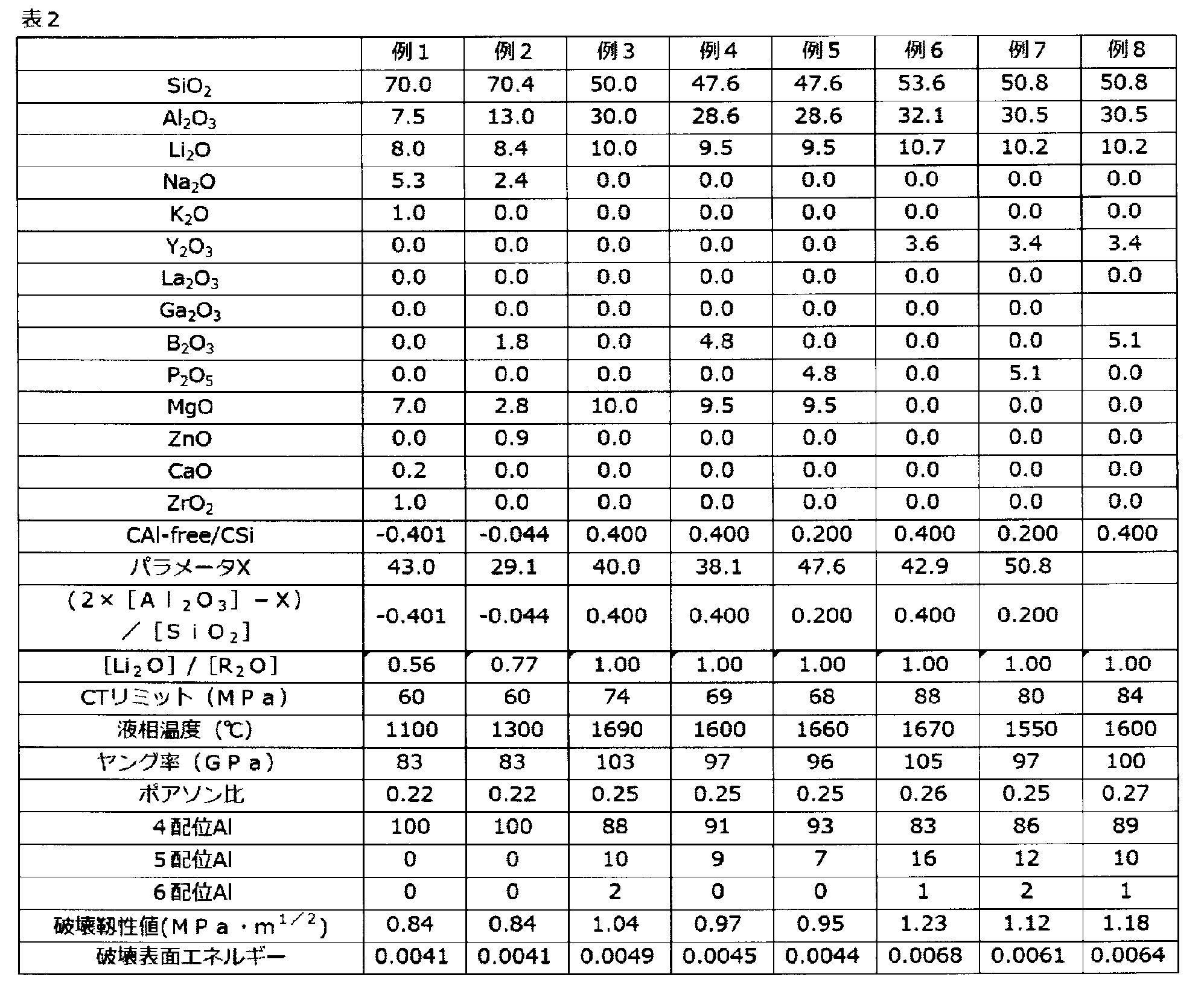
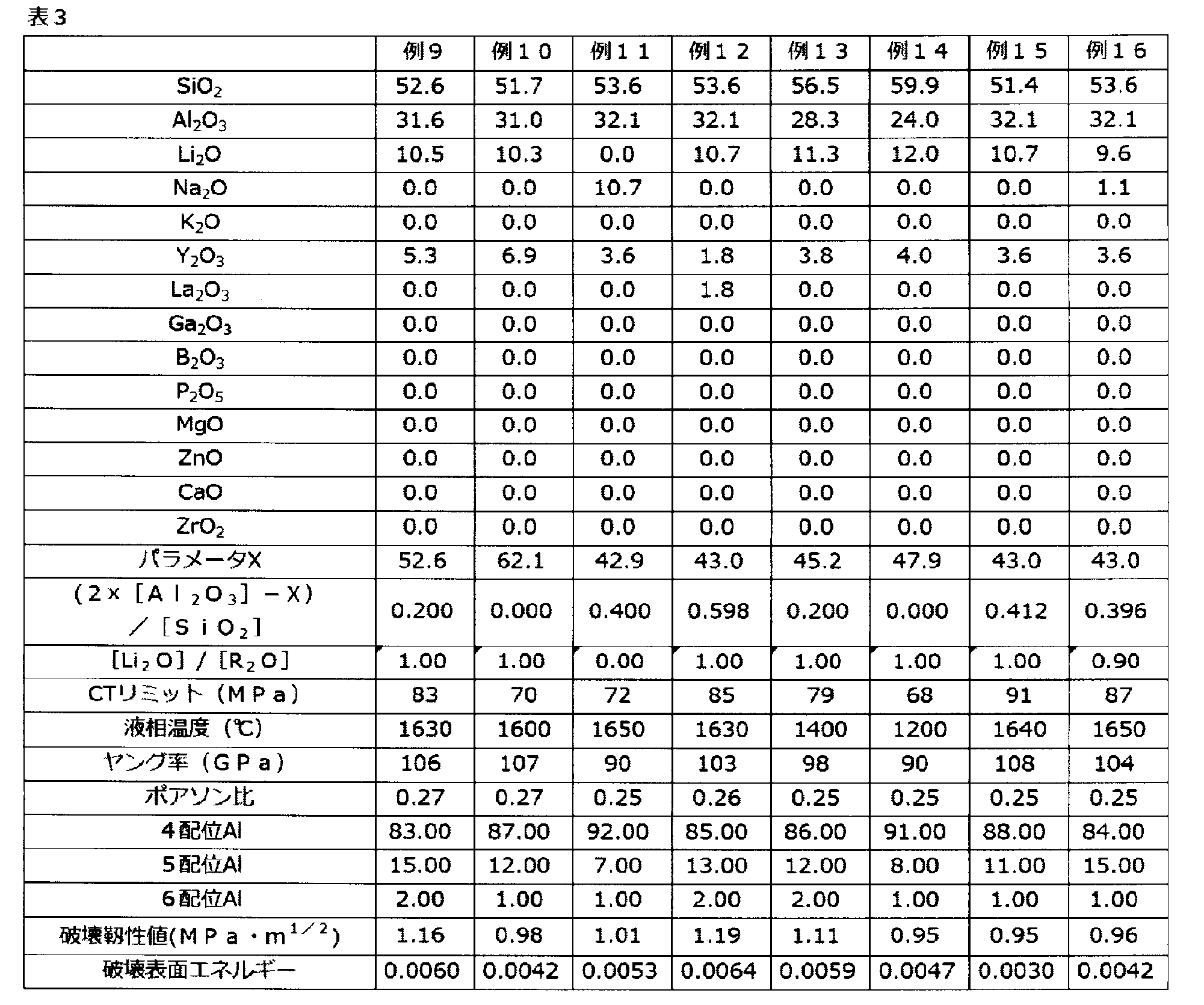
- FIG. 5 is an example of an electronic device including the chemically strengthened glass.
- the mobile terminal 10 shown in FIG. 5 has a cover glass 20 and a housing 30.
- the housing 30 has a side surface 31 and a bottom surface 32.
- the present chemically strengthened glass is used for both the cover glass 20 and the housing 30.
- Examples 6-9, 12-16 are examples of the first glass
- Examples 3-9, 12-16 are examples of the second glass
- Examples 1, 2, 10, 11 are comparative examples. Is.
- a blank column indicates that the measurement is not performed.
- Glass raw materials were prepared so as to have glass compositions shown in Tables 2 to 3 in terms of oxide-based mole percentages, and glass plates were prepared by melting and polishing.
- Example 2 is glass A described above and
- Example 6 is glass B.
- As the glass raw material general glass raw materials such as oxides, hydroxides and carbonates were appropriately selected and weighed so that the weight of glass was 900 g.
- the mixed glass raw materials were put into a platinum crucible, melted at 1700° C., and defoamed. The glass was cast on a carbon board to obtain a glass block, which was polished to obtain a plate glass having a plate thickness of 0.8 mm.
- Young's modulus, Poisson's ratio Young's modulus and Poisson's ratio were measured by an ultrasonic method.
- Al coordination number The ratio of the coordination number of aluminum atoms in the glass was analyzed by NMR.
- the NMR measurement conditions are shown below.
- Measuring device JEOL nuclear magnetic resonance apparatus ECZ900 Resonance frequency: 156.38MHz Rotation speed: 20 kHz Probe: 3.2 mm Solid flip angle: 30° Waiting time for pulse repetition: 1.5 sec
- the single pulse method was used for the measurement, and ⁇ -Al 2 O 3 was used as the secondary standard for chemical shift, and was set at 16.6 ppm.
- the measurement results were subjected to phase correction and baseline correction using NMR software Delta manufactured by JEOL Ltd., and then fitting using a Gaussian function to calculate the proportions of 4-coordination, 5-coordination, and 6-coordination. ..
- Phase correction and baseline correction are highly optional, but were properly processed by subtracting the spectrum of the empty cell containing no sample.
- Peak fitting is also highly arbitrary, but the 4-coordinate has a peak top at 80-45 ppm, the 5-coordinate has a peak top at 45-15 ppm, and the 6-coordinate has a peak top within each range of 15--5 ppm. Good fitting was obtained by setting the peak width appropriately (so that the ratio between coordination numbers was 1.5 times or less at the maximum).
- the fracture toughness value was measured by the DCDC method by preparing a sample of 6.5 mm ⁇ 6.5 mm ⁇ 65 mm. At that time, a 2 mm ⁇ through hole was formed in the surface of the sample of 65 mm ⁇ 6.5 mm for evaluation.
- CT limit The CT limit of the obtained plate glass was measured by the method described above. That is, plate glass was chemically strengthened under various conditions using NaNO 3 salt or KNO 3 salt, and the obtained chemically strengthened glass was subjected to CT using a scattered light photoelastic stress meter (SLP-1000 manufactured by Orihara Seisakusho). Then, the CT limit was evaluated by driving a Vickers indenter into chemically strengthened glass plates having different CT values and measuring the number of fractures.
- SLP-1000 scattered light photoelastic stress meter
- the fracture surface energy ⁇ was evaluated by the following formula.
- K IC is a fracture toughness value [unit: MPa ⁇ m 1/2 ]
- E is Young's modulus [unit: GPa]
- ⁇ is Poisson's ratio.
- the obtained chemically strengthened glass was processed into 0.3 mm x 20 mm x plate thickness, and the stress profile was measured using a birefringence index stress meter (birefringence imaging system Abrio-IM manufactured by CRi). Also, SA, SB, etc. were obtained.
- SA is the integral value of the compressive stress from the glass plate surface to a depth of 10 ⁇ m [unit: MPa ⁇ m]
- SB is the integral value of the compressive stress from the depth of 10 ⁇ m to the depth (DOL) at which the compressive stress becomes zero. [Unit: MPa ⁇ m].
- Example 31 The stress profiles of Examples 31 and 32 are shown in FIG. In FIG. 3, the dotted line is Example 31 and the solid line is Example 32. The stress profile of Example 38 is shown in FIG.
- Example 32 using the glass for chemical strengthening of the present invention not only the surface compressive stress and the four-point bending strength are large, but also the compressive stress at a depth of 50 ⁇ m is large. It can be seen that destruction is unlikely to occur.
- Example 31 reinforced with conventional glass for chemical strengthening has a high four-point bending strength, but since the compressive stress at a depth of 50 ⁇ m is small, bending fracture is unlikely to occur, but it is clear that fracture due to collision is likely to occur.
Landscapes
- Chemical & Material Sciences (AREA)
- Engineering & Computer Science (AREA)
- Life Sciences & Earth Sciences (AREA)
- Chemical Kinetics & Catalysis (AREA)
- General Chemical & Material Sciences (AREA)
- Geochemistry & Mineralogy (AREA)
- Materials Engineering (AREA)
- Organic Chemistry (AREA)
- Microelectronics & Electronic Packaging (AREA)
- Ceramic Engineering (AREA)
- Glass Compositions (AREA)
- Surface Treatment Of Glass (AREA)
Abstract
本発明は、破壊靱性値が高く、しかも製造しやすいガラスの提供、及び高い強度を有しながら、激しい破砕が生じにくい化学強化ガラスの提供を目的とする。本発明は、破壊靱性値が0.85MPa・m1/2以上であって、特定の組成を有するガラス、酸化物基準のモル百分率表示で、SiO2、Al2O3、Li2Oを特定量含有し、SiO2の含有量を[SiO2]、Al2O3の含有量を[Al2O3]、として(2×[Al2O3]-X)/[SiO2]が特定範囲であるガラス、及びガラス表面からの深さ50μmにおける圧縮応力値(CS50)が150MPa以上であり、特定の組成を有する化学強化ガラスに関する。
Description
本発明は、化学強化ガラスに関する。
携帯端末のカバーガラス等には、化学強化ガラスが用いられている。化学強化ガラスは、ガラスを硝酸ナトリウムなどの溶融塩に浸漬する等の方法で、ガラス中に含まれるアルカリイオンと、溶融塩に含まれるイオン半径がより大きいアルカリイオンとのイオン交換を生じさせ、それによって表層部分に圧縮応力層を形成したガラスである。
特許文献1には、リチウムを含有するアルミノシリケートガラスに2段階の化学強化処理を施すことで、表面の強度が高く、かつ圧縮応力層深さが大きい化学強化ガラスを得る方法が開示されている。
化学強化ガラスは、表面圧縮応力値や圧縮応力層深さが大きくなるほど強度が高くなる傾向がある。一方で、表面に圧縮応力層を形成すると、ガラス内部には圧縮応力の総量に応じて内部引張応力が発生する。内部引張応力の値(CT)がある閾値を超えると、ガラスが割れる際の割れ方が激しくなる。この閾値は、CTリミットとも呼ばれる。
特許文献2には、クラック耐性が高い高強度ガラスが開示されている。この高強度ガラスはAl2O3を多量に含有しており、無容器法とよばれる特殊な方法で製造される。また、特許文献2に具体的に記載されたガラスは、SiO2とAl2O3とからなる2成分ガラスなので化学強化できない。
本発明は、破壊靱性値が高く、しかも製造しやすいガラスの提供を目的とする。
また、高い強度を有しながら、激しい破砕が生じにくい化学強化ガラスの提供を目的とする。
また、高い強度を有しながら、激しい破砕が生じにくい化学強化ガラスの提供を目的とする。
本発明者らは、化学強化ガラス用のCTリミットについて研究し、破壊靱性値が大きいほどCTリミットが大きくなる傾向を見出した。そこで、化学強化特性に優れ、しかも破壊靱性値の大きいガラスであれば、激しい破砕を防止しつつ化学強化によって高強度が実現できると考えた。また検討の結果、SiO2とAl2O3とからなる2成分ガラスでなくても、高い破壊靱性値が実現できることを見出し、本発明に至った。
本発明は、破壊靱性値が0.85MPa・m1/2以上のガラスであって、酸化物基準のモル百分率表示で、SiO2を40%以上、Al2O3を20%以上、Li2Oを5%以上含有し、Y2O3、La2O3およびGa2O3から選ばれる1種以上を合計で1~6%含有するガラスを提供する。
また、酸化物基準のモル百分率表示で、SiO2を40~60%、Al2O3を20~45%、Li2Oを5~15%含有し、SiO2の含有量を[SiO2]、Al2O3の含有量を[Al2O3]、として(2×[Al2O3]-X)/[SiO2]が0以上1以下であるガラスを提供する。
ただしXはLi2O、Na2O、K2OおよびP2O5から選ばれる酸化物の含有量の合計をM1(%)MgO、CaO、SrO、ZnOおよびBaOの含有量の合計をM2(%)、Y2O3、La2O3およびGa2O3の含有量の合計をM3(%)、TiO2の含有量をM4(%)、V2O5、Ta2O5およびNb2O5の含有量の合計をM5(%)、WO3の含有量をM6(%)として、次の式で表される。
X=2×M1+2×M2+6×M3+4×M4+10×M5+6×M6
ただしXはLi2O、Na2O、K2OおよびP2O5から選ばれる酸化物の含有量の合計をM1(%)MgO、CaO、SrO、ZnOおよびBaOの含有量の合計をM2(%)、Y2O3、La2O3およびGa2O3の含有量の合計をM3(%)、TiO2の含有量をM4(%)、V2O5、Ta2O5およびNb2O5の含有量の合計をM5(%)、WO3の含有量をM6(%)として、次の式で表される。
X=2×M1+2×M2+6×M3+4×M4+10×M5+6×M6
本発明は、ガラス表面からの深さ50μmにおける圧縮応力値(CS50)が150MPa以上であり、
酸化物基準のモル百分率表示で、
SiO2を40~60%、Al2O3を20~45%、Li2Oを5~15%、Y2O3、La2O3およびGa2O3から選ばれる1種以上を合計で1~6%含有する化学強化ガラスを提供する。
酸化物基準のモル百分率表示で、
SiO2を40~60%、Al2O3を20~45%、Li2Oを5~15%、Y2O3、La2O3およびGa2O3から選ばれる1種以上を合計で1~6%含有する化学強化ガラスを提供する。
また、前記の化学強化ガラスを含むカバーガラスを提供する。
また、前記のカバーガラスを含む電子機器を提供する。
また、前記のカバーガラスを含む電子機器を提供する。
本発明によれば、破壊靱性値が高く、しかも製造しやすいガラスが得られる。また、高い強度を有しながら、激しい破砕が生じにくい化学強化ガラスが得られる。
本明細書において数値範囲を示す「~」とは、その前後に記載された数値を下限値及び上限値として含む意味で使用される。特段の定めがない限り、以下本明細書において「~」は、同様の意味で使用される。
本明細書において「応力プロファイル」はガラス表面からの深さを変数として圧縮応力値を表したものをいう。また、「圧縮応力層深さ(DOL)」は、圧縮応力値(CS)がゼロとなる深さである。「内部引張応力値(CT)」は、ガラスの板厚tの1/2の深さにおける引張応力値をいう。
本明細書における応力プロファイルは、化学強化したガラスの断面を薄片化した試料を用いて、複屈折率応力計で測定される。複屈折率応力計は、偏光顕微鏡と液晶コンペンセーター等を用いて応力で生じたレターデーションの大きさを測定する装置であり、たとえばCRi社製複屈折イメージングシステムAbrio-IMがある。
なお、ガラス板表層部分の圧縮応力値は、光導波表面応力計(たとえば、折原製作所製FSM-6000)を用いても測定できる場合がある。光導波表面応力計によれば、ガラス試料を薄片化する等の加工を施さずに応力値が測定できる。しかし、光導波表面応力計は、測定原理上、表面から内部に向かって屈折率が低くなる場合でなければ、応力を測定できない。結果的に、リチウムを含有するアルミノシリケートガラスを化学強化した場合には、ガラス板内部の圧縮応力を測定できない問題がある。
ガラス板内部の応力値は、散乱光光弾性応力計(たとえば折原製作所製SLP-1000)を用いて測定できる場合がある。散乱光光弾性応力計によれば、ガラス内部の屈折率分布と関わりなく、ガラス試料を薄片化する等の加工を施さずに応力値を測定できる。しかし、散乱光光弾性応力計は表面散乱光の影響を受けやすいので、ガラス表面付近の応力値を正確に測定することが困難である。
本明細書においてCTリミットは、以下の手順で測定される破砕数が10以下となるCTの最大値である。
試験用ガラス板としては、15mm角で厚さが0.5mm以上1mm以下であり、かつ表面を鏡面仕上げとしたものを種々の条件で化学強化処理し、CT値の異なる複数の試験用ガラス板を準備する。この場合のCT値は、散乱光光弾性応力計を用いて測定できる。
また圧縮応力層深さ(DOL)を見積もる。ガラス板の厚さに対してDOLが大きすぎると引張応力層のガラス組成が変化して、CTリミットが正しく評価できない恐れがあるので、以下の試験にはDOLが100μm以下のガラス板を用いることが望ましい。
ビッカース試験機を用いて、試験用ガラス板の中央部分に、先端の角度が90°のビッカース圧子を打ち込んでガラス板を破壊させ、破片の個数を破砕数とする。(ガラス板が二つに割れた場合の破砕数は2である。)非常に細かい破片が生じた場合は、1mmの篩を通過しなかった個数を数えて破砕数とする。
ただし、破砕数が50を超える場合には、破砕数を50としてよい。破砕数が多くなりすぎるとほとんどの破片が篩を通過してしまう等のために個数を正確に数えることが困難であるし、実際上、CTリミットの評価に及ぼす影響が少ないからである。また、ビッカース圧子の打ち込み荷重は3kgfから試験を開始し、ガラス板が割れなかった場合は、打ち込み荷重を1kgfずつ増やして、ガラス板が割れるまで試験を繰り返し、最初に割れた時の破砕数を数える。
試験用ガラス板のCT値に対して、破砕数をプロットし、破砕数が10となる点のCT値を読み取ってCTリミットとする。
図1は、ガラス組成が異なるガラスA、ガラスBについて、CT値と破砕数をプロットした図である。ガラスAについては白抜きの菱形でプロットし、ガラスBについては黒丸でプロットしている。図1から、同じ組成のガラスであれば、CTが大きくなるほど破砕数が増えることがわかる。また、破砕数が10を超えると、CTの増大によって、破砕数が急激に増大することがわかる。
破砕数が10以下のなるべく大きい値となるCT値と破砕数が10より大きくかつなるべく小さい値になるCT値とから、破砕数が10となるCT値を読み取ってCTリミットとする。このとき、破砕数が10以下のなるべく大きい値は8以上とし、9以上が好ましい。破砕数が10より大きい点の破砕数は40以下であればよく、20以下がより好ましい。
表1にガラスAおよびガラスBについての測定結果を示す。ガラスAについては、破砕数が8であったCT値57MPaと破砕数が13であったCT値63MPaとから、CTリミットは60MPaと求められる。ガラスBについては、破砕数が8であったCT値88MPaと、破砕数が40であったCT値94MPaとから、CTリミットは88MPaと求められる。

本明細書において、「化学強化ガラス」は、化学強化処理を施した後のガラスを指し、「化学強化用ガラス」は、化学強化処理を施す前のガラスを指す。
本明細書において、「化学強化ガラスの母組成」とは、化学強化用ガラスのガラス組成である。化学強化ガラスにおいては、極端なイオン交換処理がされた場合を除いて、板厚tの1/2の深さにおけるガラス組成は、化学強化ガラスの母組成である。
本明細書において、ガラス組成は、特に断らない限り酸化物基準のモル百分率表示で表し、モル%を単に「%」と表記する。
また、本明細書において「実質的に含有しない」とは、原材料等に含まれる不純物レベル以下である、つまり意図的に含有させたものではないことをいう。具体的には、たとえば0.1モル%未満である。
<ガラス>
まず、化学強化前のガラス(化学強化用ガラス)について説明する。
本ガラスは、破壊靱性値が0.85MPa・m1/2以上であって、
酸化物基準のモル百分率表示で、SiO2を40%以上、Al2O3を20%以上、Li2Oを5%以上含有し、Y2O3、La2O3およびGa2O3から選ばれる1種以上を合計で1~6%含有するガラス(第一のガラス)であってもよい。
本ガラスは、酸化物基準のモル百分率表示で、SiO2を40~60%、Al2O3を20~45%、Li2Oを5~15%含有し、後述の(2×[Al2O3]-X)/[SiO2]が0以上1以下であるガラス(第二のガラス)であってもよい。
まず、化学強化前のガラス(化学強化用ガラス)について説明する。
本ガラスは、破壊靱性値が0.85MPa・m1/2以上であって、
酸化物基準のモル百分率表示で、SiO2を40%以上、Al2O3を20%以上、Li2Oを5%以上含有し、Y2O3、La2O3およびGa2O3から選ばれる1種以上を合計で1~6%含有するガラス(第一のガラス)であってもよい。
本ガラスは、酸化物基準のモル百分率表示で、SiO2を40~60%、Al2O3を20~45%、Li2Oを5~15%含有し、後述の(2×[Al2O3]-X)/[SiO2]が0以上1以下であるガラス(第二のガラス)であってもよい。
本化学強化用ガラスが板状である場合、その板厚(t)は、化学強化の効果を高くする観点から、例えば2mm以下であり、好ましくは1.5mm以下であり、より好ましくは1mm以下であり、さらに好ましくは0.9mm以下であり、特に好ましくは0.8mm以下であり、最も好ましくは0.7mm以下である。また板厚は、十分な強度を得るために、例えば0.1mm以上であり、好ましくは0.2mm以上であり、より好ましくは0.4mm以上であり、さらに好ましくは0.5mm以上である。
本ガラスの破壊靱性値は0.85MPa・m1/2以上が好ましい。破壊靱性値が大きいガラスはCTリミットが大きいので、化学強化によって大きな表面圧縮応力層を形成しても、激しい破砕が生じにくい。破壊靱性値は、0.9MPa・m1/2以上がより好ましく、0.95MPa・m1/2以上がさらに好ましい。また、破壊靱性値は、通常2.0MPa・m1/2以下であり、典型的には1.5MPa・m1/2以下である。
破壊靱性値は、たとえばDCDC法(Acta metall.mater. Vol.43、pp.3453-3458、1995)を用いて測定できる。
また、前述のCTリミットは、75MPa以上が好ましく、78MPa以上がより好ましく、80MPa以上がさらに好ましい。本ガラスのCTリミットは通常は95MPa以下である。
本ガラスは、リチウムアルミノシリケートガラスである。具体的には、SiO2を40%以上、Al2O3を20%以上、Li2Oを5%以上含有するガラスである。リチウムアルミノシリケートガラスは、最もイオン半径の小さいアルカリイオンであるリチウムイオンを含有しているので、種々の溶融塩を用いてイオン交換する化学強化処理によって、好ましい応力プロファイルを有する化学強化ガラスが得られる。
本ガラスは、(2×[Al2O3]-X)/[SiO2]が0以上1以下であることが好ましい。ここで、[SiO2]はモル%表示によるSiO2の含有量、[Al2O3]は同じくモル%表示によるAl2O3の含有量である。以下では、他の成分についても同様に表示する。
Xは、Li2O、Na2O、K2OおよびP2O5から選ばれる酸化物の含有量の合計([Li2O]+[Na2O]+[K2O]+[P2O5])をM1(%)、MgO、CaO、SrO、ZnOおよびBaOの含有量の合計([MgO]+[CaO]+[SrO]+[ZnO]+[BaO])をM2(%)、Y2O3、La2O3、Ga2O3およびCr2O3の含有量の合計([Y2O3]+[La2O3]+[Ga2O3]+[Cr2O3])をM3(%)、TiO2の含有量([TiO2])をM4(%)、V2O5、Ta2O5およびNb2O5の含有量の合計([V2O5]+[Ta2O5]+[Nb2O5])をM5(%)、WO3の含有量([WO3])をM6(%)として、次の式で表される。
X=2×M1+2×M2+6×M3+4×M4+10×M5+6×M6
X=2×M1+2×M2+6×M3+4×M4+10×M5+6×M6
本発明者らは、(2×[Al2O3]-X)の値が、周囲のイオンからの電荷の影響を受けていないアルミニウムイオンの量の目安になると考えた。また、電荷の影響を受けていないアルミニウムイオンは5配位構造をとりやすいが、そのようなイオンが多くなりすぎるとガラス化が困難になる。そこで、(2×[Al2O3]-X)/[SiO2]の値が、0以上1以下の場合に破壊靱性値が大きくなると考えた。(2×[Al2O3]-X)/[SiO2]の値は好ましくは0.2以上0.8以下である。
その理由を以下に説明する。
アルミニウムイオンは、アルミノシリケートガラス中では通常、主として4配位構造となることが知られている。しかし、SiO2-Al2O3の2成分ガラス中では、アルミニウムイオンは5配位構造となり、また、5配位構造のアルミニウムイオンが多量に存在するガラスは、高い破壊靱性値が得られるとされている(Scientific Reports Vol.6 23620,2016)。5配位構造のアルミニウムイオンは、他のイオン等から電荷の供与を受けると、4配位構造をとると考えられる。
アルミニウムイオンは、アルミノシリケートガラス中では通常、主として4配位構造となることが知られている。しかし、SiO2-Al2O3の2成分ガラス中では、アルミニウムイオンは5配位構造となり、また、5配位構造のアルミニウムイオンが多量に存在するガラスは、高い破壊靱性値が得られるとされている(Scientific Reports Vol.6 23620,2016)。5配位構造のアルミニウムイオンは、他のイオン等から電荷の供与を受けると、4配位構造をとると考えられる。
そこで、本発明者らは以下のように考えた。
5配位構造のアルミニウムイオンが多量に存在するSiO2-Al2O3の2成分ガラスに、他の成分を添加する場合、例えばリチウム、ナトリウム、カリウムなどの1価カチオンは各々1個の電荷を供与して1個のアルミニウムイオンを5配位構造から4配位構造に変えるであろう。Li2O、Na2O、K2Oの含有量の合計がM1であれば、2×M1個分の1価カチオンによって、2×M1個分のアルミニウムイオンが4配位になるであろう。
5配位構造のアルミニウムイオンが多量に存在するSiO2-Al2O3の2成分ガラスに、他の成分を添加する場合、例えばリチウム、ナトリウム、カリウムなどの1価カチオンは各々1個の電荷を供与して1個のアルミニウムイオンを5配位構造から4配位構造に変えるであろう。Li2O、Na2O、K2Oの含有量の合計がM1であれば、2×M1個分の1価カチオンによって、2×M1個分のアルミニウムイオンが4配位になるであろう。
マグネシウム、カルシウム、ストロンチウム等の2価カチオンは2個の電荷を供与して2個のアルミニウムイオンを4配位構造に変えるであろう。そこでMgO、CaO、SrO、ZnOおよびBaOの含有量の合計をM2とすると、2×M2個分のアルミニウムイオンが4配位構造になるであろう。
3価~6価のカチオンについても同様に考えた。つまり、アルミニウムイオンは、ケイ素以外の価数が大きいカチオンがあると、4配位構造をとりやすくなるであろう。そこで、前述のX値はガラスネットワークに含まれない、いわゆる網目修飾カチオン(modifier cation)の価数の合計を表す。ただしPについては、1価のカチオンと同様に扱うこととした。P2O5とAl2O3がガラス中に含まれている場合には、P=O間の二重結合から電子がAlに供与されてPとAlの双方が4配位に代わる効果が大きいからである。
5配位アルミニウムの存在は核磁気共鳴(NMR)スペクトルで確認できる。本発明者らはNMRを用いてガラス中の5配位アルミニウムの量を測定し、5配位アルミニウムの割合が大きいほど破壊靭性値が大きくなる傾向を見出した。図2は、後述の実施例および比較例のガラスについて、NMR測定から得られる5配位アルミニウムの割合と破壊靱性値との関係をプロットした図である。
ガラス中の全アルミニウム数に対する5配位アルミニウム数の割合は、破壊靭性値を大きくするために9%以上が好ましく、10%以上がより好ましく、12%以上がさらに好ましい。5配位アルミニウム数の割合は、通常20%以下であり、典型的には18%以下である。
本発明者らはまた、ガラス組成中のAl2O3量が大きくなるほど、またY2O3量が大きくなるほど4配位アルミニウム数が減少して5配位アルミニウム数の割合が増大することを見出した。
本発明のガラスは
SiO2を40~60%、
Al2O3を20~45%、
Li2Oを5~15%、
Y2O3、La2O3およびGa2O3から選ばれる1種以上を合計で1~6%、
含有することが好ましい。
以下、好ましいガラス組成について説明する。
SiO2を40~60%、
Al2O3を20~45%、
Li2Oを5~15%、
Y2O3、La2O3およびGa2O3から選ばれる1種以上を合計で1~6%、
含有することが好ましい。
以下、好ましいガラス組成について説明する。
本ガラスにおいて、SiO2はガラスネットワーク構造の骨格を構成する成分であり、化学的耐久性を上げる成分である。十分な化学的耐久性を得るためには、SiO2の含有量は40%以上が好ましく、44%以上がより好ましく、48%以上がさらに好ましい。また、ガラスの強度を高くするためにSiO2の含有量は60%以下が好ましく、58%以下がより好ましく、55%以下がさらに好ましい。
Al2O3は本ガラスの必須成分であり、ガラスの高強度化に寄与する成分である。Al2O3の含有量は、十分な強度を得るために20%以上が好ましく、24%以上がより好ましく、28%以上がさらに好ましい。Al2O3の含有量は、溶融性を高くするために好ましくは45%以下、より好ましくは40%以下、さらに好ましくは35%以下である。
Li2Oは、リチウムアルミノシリケートガラスの必須成分である。Li2Oの含有量は、化学強化による圧縮応力層深さDOLを大きくするために、好ましくは5%以上、より好ましくは7%以上、さらに好ましくは8%以上である。
また、ガラスを製造する際または曲げ加工を行う際に、失透が生じることを抑制するためには、Li2Oの含有量は15%以下が好ましく、より好ましくは13%以下、さらに好ましくは12%以下である。
Y2O3、La2O3およびGa2O3はいずれも必須ではないが、溶解性を高めるために、いずれか1種以上を含有することが好ましい。Y2O3、La2O3およびGa2O3の含有量の合計[Y2O3]+[La2O3]+[Ga2O3]は1%以上が好ましく、2%以上がより好ましく、3%以上がさらに好ましい。[Y2O3]+[La2O3]が1%以上であることがより好ましく、2%以上、3%以上であることがさらに好ましい。
[Y2O3]+[La2O3]+[Ga2O3]は、高強度を保つために6%以下が好ましく、5.5%以下がより好ましく、5%以下がさらに好ましい。[Y2O3]+[La2O3]が6%以下であることがより好ましく、5.5%以下、5%以下であることがさらに好ましい。
本ガラスは溶解性を高めるためにY2O3を含有することが好ましい。Y2O3の含有量は好ましくは1%以上であり、2%以上がより好ましく、3%以上がさらに好ましい。
Y2O3の含有量は、ガラスの強度を高くするために6%以下が好ましく、5.5%以下がより好ましく、5%以下がさらに好ましい。
Y2O3の含有量は、ガラスの強度を高くするために6%以下が好ましく、5.5%以下がより好ましく、5%以下がさらに好ましい。
Na2Oは必須ではないが、カリウムを含有する溶融塩を利用したイオン交換により表面圧縮応力層を形成する成分であり、またガラスの溶融性を向上させる成分である。Na2Oの含有量は0.5%以上が好ましく、1%以上がより好ましく、1.5%以上がさらに好ましい。また、Na2Oの含有量は、好ましくは10%以下であり、より好ましくは8%以下、さらに好ましくは6%以下である。
K2Oは必須ではないが、ガラスの溶融性を向上し、失透を抑制するために含有してもよい。K2Oの含有量は、好ましくは0.5%以上、より好ましくは1%以上である。また、K2Oの含有量はイオン交換による圧縮応力値を大きくするために、好ましくは5%以下、より好ましくは3%以下、さらに好ましくは1%以下である。
Li2O、Na2OおよびK2O等のアルカリ金属酸化物(まとめてR2Oと記載することがある)は、いずれもガラスの溶解温度を低下させる成分であり、合計で5%以上含有することが好ましい。アルカリ金属酸化物の含有量の合計R2Oは、5%以上が好ましく、7%以上がより好ましく、8%以上がさらに好ましい。R2Oは、ガラスの強度を維持するために20%以下が好ましく、18%以下がより好ましい。
また、Li2Oの含有量である[Li2O]とアルカリ金属酸化物の総含有量である[R2O]との比[Li2O]/[R2O]は十分な強度を得るために0.8以上が好ましく、0.85以上がより好ましい。[Li2O]/[R2O]は1以下であり、溶解性を高くするためには0.95以下がより好ましい。
MgO、CaO、SrO、BaO、ZnO等のアルカリ土類金属酸化物は、いずれもガラスの溶融性を高める成分であるが、イオン交換性能を低下させる傾向がある。MgO、CaO、SrO、BaO、ZnOの含有量の合計(MgO+CaO+SrO+BaO+ZnO)は15%以下が好ましく、10%以下がより好ましく、5%以下がさらに好ましい。
アルカリ土類金属酸化物中では、MgOは、含有することで化学強化の効果を高くする傾向がある。MgOを含有する場合の含有量は0.1%以上が好ましく0.5%以上がより好ましい。また、10%以下が好ましく、8%以下がより好ましく、5%以下がさらに好ましい。
CaOを含有する場合の含有量は、好ましくは0.5%以上であり、より好ましくは1%以上である。イオン交換性能を高くするためには5%以下が好ましく、3%以下がより好ましい。
SrOを含有する場合の含有量は、好ましくは0.5%以上であり、より好ましくは1%以上である。イオン交換性能を高くするためには5%以下が好ましく、3%以下がより好ましい。
BaOを含有する場合の含有量は、好ましくは0.5%以上であり、より好ましくは1%以上である。イオン交換性能を高くするためには5%以下が好ましく、1%以下がより好ましく、実質的に含有しないことがさらに好ましい。
ZnOはガラスの溶融性を向上させる成分であり、含有してもよい。ZnOを含有する場合の含有量は、好ましくは0.2%以上であり、より好ましくは0.5%以上である。ガラスの耐候性を高くするためには、ZnOの含有量は5%以下が好ましく、3%以下がより好ましい。
B2O3は、必須ではないが、ガラス製造時の溶融性を向上させる等のために加えることができる。また化学強化ガラスしたときに、化学強化ガラス表面付近における応力プロファイルの傾きを小さくすることによって、安定性を高めるために、B2O3の含有量は好ましくは0.5%以上、より好ましくは1%以上、さらに好ましくは2%以上である。
B2O3は、化学強化後の応力緩和を生じやすくする成分なので、化学強化ガラスの表面圧縮応力をより高くするためには、10%以下が好ましく、より好ましくは8%以下、さらに好ましくは5%以下、最も好ましくは3%以下である。
P2O5は、イオン交換性能を向上させるために含有してもよい。P2O5を含有させる場合の含有量は、好ましくは0.5%以上であり、より好ましくは1%以上である。化学的耐久性を高くするためにはP2O5の含有量は10%以下が好ましく、5%以下がより好ましく、3%以下がさらに好ましい。
TiO2は、化学強化ガラスの破壊時に破片が飛散することを抑制する傾向があり、含有させてもよい。TiO2を含有させる場合の含有量は、好ましくは0.1%以上である。TiO2の含有量は、溶融時の失透を抑制するために5%以下が好ましく、3%以下がより好ましく、1%以下がさらに好ましく、実質的に含有しないことが特に好ましい。
ZrO2は、化学強化ガラスの表面圧縮応力を増大させる傾向があり、含有させてよい。ZrO2を含有させる場合の含有量は、好ましくは0.5%以上であり、より好ましくは1%以上である。また溶融時の失透を抑制するために5%以下が好ましく、3%以下がより好ましく、2%以下がさらに好ましい。
また、TiO2とZrO2の含有量の合計(TiO2+ZrO2)は、5%以下が好ましく、3%以下がより好ましい。(TiO2+ZrO2)は、0.5%以上が好ましく、1%以上がより好ましい。
Nb2O5、Ta2O5は、化学強化ガラスの破砕を抑制する等のために、含有させてもよい。これらの成分を含有させる場合の合計の含有量は、それぞれ好ましくは0.5%以上であり、より好ましくは1%以上、さらに好ましくは1.5%以上、特に好ましくは2%以上である。また3%以下が好ましく、2%以下がより好ましい。
ガラスを着色する場合は、所望の化学強化特性の達成を阻害しない範囲において着色成分を添加してもよい。着色成分としては、例えば、Co3O4、MnO2、Fe2O3、NiO、CuO、Cr2O3、V2O5、Bi2O3、SeO2、CeO2、Er2O3、Nd2O3が挙げられる。これらは単独で用いてもよく、組み合わせて用いてもよい。
着色成分の含有量は、合計で7%以下が好ましい。それによって、ガラスの失透を抑制できる。着色成分の含有量は、より好ましくは5%以下であり、さらに好ましくは3%以下であり、特に好ましくは1%以下である。ガラスの透明性を高くしたい場合は、これらの成分は実質的に含有しないことが好ましい。
また、ガラス溶融の際の清澄剤として、SO3、塩化物、フッ化物などを適宜含有してもよい。As2O3は実質的に含有しないことが好ましい。Sb2O3を含有する場合は、0.3%以下が好ましく、0.1%以下がより好ましく、実質的に含有しないことが最も好ましい。
本ガラスの液相温度は、1670℃以下が好ましく、1650℃以下がより好ましい。液相温度が低いことで、無容器法等の特殊な方法を用いずに製造できる。
本ガラスの高温粘性は、例えば1650℃におけるlogηが2以下である。
本ガラスの軟化点は1000℃以下が好ましく、950℃以下がより好ましい。ガラスの軟化点が低いほど、曲げ成形等を行う場合に熱処理温度が低くなり、消費エネルギーが小さくなるのに加え、設備の負荷も小さくなるからである。軟化点が低すぎるガラスは、化学強化処理の際に導入する応力が緩和しやすく低強度になりやすい傾向にあるので、軟化点は550℃以上が好ましい。より好ましくは600℃以上、さらに好ましくは650℃以上である。
軟化点はJIS R3103-1:2001に記載の繊維引き伸ばし法で測定できる。
本ガラスは、通常の方法で製造できる。例えば、ガラスの各成分の原料を調合し、ガラス溶融窯で加熱溶融する。その後、公知の方法によりガラスを均質化し、ガラス板等の所望の形状に成形し、徐冷する。
その後、成形したガラスを必要に応じて研削および研磨処理して、ガラス基板を形成する。なお、ガラス基板を所定の形状及びサイズに切断する場合又はガラス基板の面取り加工を行う場合、後述する化学強化処理を施す前に、ガラス基板の切断や面取り加工を行えば、その後の化学強化処理によって端面にも圧縮応力層が形成されることから、好ましい。
本ガラスは、破壊靱性値が大きく、割れにくいガラスでありながら、製造しやすいので窓ガラスなどの構造用部材として有用である。また、化学強化する場合のCTリミットが大きいので、化学強化用ガラスとして優れている。
<化学強化ガラス>
本発明の化学強化ガラスが板状である場合、その板厚(t)は、例えば2mm以下であり、好ましくは1.5mm以下であり、より好ましくは1mm以下であり、さらに好ましくは0.9mm以下であり、特に好ましくは0.8mm以下であり、最も好ましくは0.7mm以下である。また、充分な強度を得るために、板厚は、例えば0.1mm以上であり、好ましくは0.2mm以上であり、より好ましくは0.4mm以上であり、さらに好ましくは0.5mm以上である。
本発明の化学強化ガラスが板状である場合、その板厚(t)は、例えば2mm以下であり、好ましくは1.5mm以下であり、より好ましくは1mm以下であり、さらに好ましくは0.9mm以下であり、特に好ましくは0.8mm以下であり、最も好ましくは0.7mm以下である。また、充分な強度を得るために、板厚は、例えば0.1mm以上であり、好ましくは0.2mm以上であり、より好ましくは0.4mm以上であり、さらに好ましくは0.5mm以上である。
本化学強化ガラスは、ガラス表面からの深さ50μmにおける圧縮応力値(CS50)が大きい。CS50は、200MPa以上が好ましく、220MPa以上がより好ましく、240MPa以上がさらに好ましい。CS50は通常は150MPa以下である。
本化学強化ガラスにおいて、圧縮応力値が0となる深さ(DOL)は、100μm以上が好ましい。DOLは、110μm以上がより好ましく、120μm以上がさらに好ましい。DOLは板厚tに対して大きすぎるとCTの増加を招くのでt/4以下が好ましく、t/5以下がより好ましい。具体的には、例えば板厚tが0.8mmの場合は、160μm以下が好ましい。
本化学強化ガラスの表面圧縮応力(CS0)は500MPa以上が好ましく、600MPa以上がより好ましく、700MPa以上がさらに好ましい。CS0は、衝撃時のチッピングを防止するために1000MPa以下が好ましく、900MPa以下がより好ましい。
また、ガラス板表面から深さ10μmまでの圧縮応力の積分値をSA[単位:MPa・μm]、深さ10μmから圧縮応力がゼロになる深さ(DOL)までの圧縮応力の積分値をSB[単位:MPa・μm]としたとき、SB/(SA×t)が5.0mm-1以上であることが好ましい。SB/(SA×t)が5.0mm-1以上であれば、ガラス板表面から比較的深い部分の圧縮応力が大きくなるので、衝突による破壊を効果的に防止できる。SB/(SA×t)は、より好ましくは6.0mm-1以上である。
ここで、SAは4000MPa・μm以下が好ましく、3500MPa・μm以下がより好ましく、3000MPa・μm以下がさらに好ましい。曲げ破壊を防ぐために、SAは1000MPa・μm以上が好ましく、1500MPa・μm以上がより好ましく、2000MPa・μm以上がさらに好ましい。
また、SBは12000MPa・μm以上が好ましく、14000MPa・μm以上がより好ましく、16000MPa・μm以上がさらに好ましい。SBは、大きくなりすぎると加傷時に激しい破砕が生じるため、好ましくは22000MPa・μm以下、より好ましくは、20000MPa・μm以下である。また、SB/(SA×t)は25.0mm-1以下が好ましく、20.0mm-1以下がより好ましい。
本化学強化ガラスにおいて、ガラス表面から圧縮応力値が0となる深さまで、深さ方向に圧縮応力値を積分した値であるSA+SBは、強度を高くするために、15000MPa・μm以上が好ましく、17000MPa・μm以上がより好ましい。
SA+SBがCTリミットを超えると激しい破壊が生じやすい。そのため、SA+SBはCTリミットより小さいことが好ましく、より具体的には例えば26000MPa・μm以下が好ましく、22000MPa・μm以下がより好ましい。
表面圧縮応力CS0は、光弾性を利用した表面応力計(たとえば折原製作所製FSM6000)を用いて測定できる場合がある。しかし、化学強化前のガラス中のNa含有量が少ない場合等は、表面応力計による測定が困難である。
そのような場合に、曲げ強度を測定することで、表面圧縮応力の大きさを推定できる場合がある。表面圧縮応力が大きいほど、曲げ強度が大きくなる傾向があるからである。
曲げ強度は、たとえば、10mm×50mmの短冊状の試験片を用い、支持具の外部支点間距離が30mm、内部支点間距離が10mm、クロスヘッド速度が0.5mm/minの条件で4点曲げ試験を行うことで評価できる。試験片の個数は、たとえば10個とする。
本化学強化ガラスの4点曲げ強度は、500MPa以上が好ましく、600MPa以上がより好ましく、700MPa以上がさらに好ましい。本化学強化ガラスの4点曲げ強度は、普通、1000MPa以下であり、典型的には900MPa以下である。
本化学強化ガラスの組成は、板厚方向の中心部分においては本発明のガラスの組成と同じである。また、化学強化処理によってアルカリ金属イオンの濃度が異なっていることを除けば、全体として本発明のガラスと基本的に同じなので説明を省略する。
本ガラスの形状は、適用される製品や用途等に応じて、板状以外の形状でもよい。またガラス板は、外周の厚みが異なる縁取り形状などを有していてもよい。また、ガラス板の形態はこれに限定されず、例えば2つの主面は互いに平行でなくともよく、また、2つの主面の一方又は両方の全部又は一部が曲面であってもよい。より具体的には、ガラス板は、例えば、反りの無い平板状のガラス板であってもよく、また、湾曲した表面を有する曲面ガラス板であってもよい。
<化学強化ガラスの製造方法>
本化学強化ガラスは、本発明のガラス(化学強化用ガラス)を化学強化(イオン交換処理)して得られる。
本化学強化ガラスは、本発明のガラス(化学強化用ガラス)を化学強化(イオン交換処理)して得られる。
化学強化処理は、例えば、360~600℃に加熱された硝酸カリウム等の溶融塩中に、ガラス板を0.1~500時間浸漬することによって行える。なお、溶融塩の加熱温度としては、375~500℃が好ましく、また、溶融塩中へのガラス板の浸漬時間は、0.3~200時間が好ましい。
化学強化処理を行うための溶融塩としては、例えば、硝酸塩、硫酸塩、炭酸塩、塩化物などが挙げられる。このうち硝酸塩としては、例えば、硝酸リチウム、硝酸ナトリウム、硝酸カリウム、硝酸セシウム、硝酸銀などが挙げられる。硫酸塩としては、例えば、硫酸リチウム、硫酸ナトリウム、硫酸カリウム、硫酸セシウム、硫酸銀などが挙げられる。炭酸塩としては、例えば、炭酸リチウム、炭酸ナトリウム、炭酸カリウムなどが挙げられる。塩化物としては、例えば、塩化リチウム、塩化ナトリウム、塩化カリウム、塩化セシウム、塩化銀などが挙げられる。これらの溶融塩は単独で用いてもよいし、複数種を組み合わせて用いてもよい。
本発明において、化学強化処理の処理条件は、特に限定されず、ガラスの組成(特性)や溶融塩の種類、ならびに、所望の化学強化特性などを考慮して、適切な条件を選択すればよい。
また、本発明においては、化学強化処理を一回のみ行ってもよく、2以上の異なる条件で複数回の化学強化処理(多段強化)を行ってもよい。例えば、1段階目の化学強化処理として、DOLが大きくCSが比較的小さくなる条件で化学強化処理を行い、その後に、2段階目の化学強化処理として、DOLが比較的小さくCSが大きくなる条件で化学強化処理を行ってもよい。その場合、化学強化ガラスの最表面のCSを高めつつ、内部引張応力面積(St)を抑制でき、結果として内部引張応力(CT)を低めに抑えることができる。
<カバーガラス及び電子機器>
本化学強化ガラスは、携帯電話、スマートフォン、携帯情報端末(PDA)、タブレット端末等のモバイル電子機器に用いられるカバーガラスとして、特に有用である。さらに、携帯を目的としない、テレビ(TV)、パーソナルコンピュータ(PC)、タッチパネル等の電子機器のカバーガラスにも有用である。また、窓ガラス等の建築用資材、テーブルトップ、自動車や飛行機等の内装等やそれらのカバーガラスとしても有用である。
本化学強化ガラスは、携帯電話、スマートフォン、携帯情報端末(PDA)、タブレット端末等のモバイル電子機器に用いられるカバーガラスとして、特に有用である。さらに、携帯を目的としない、テレビ(TV)、パーソナルコンピュータ(PC)、タッチパネル等の電子機器のカバーガラスにも有用である。また、窓ガラス等の建築用資材、テーブルトップ、自動車や飛行機等の内装等やそれらのカバーガラスとしても有用である。
本化学強化ガラスは、化学強化の前または後に曲げ加工や成形をおこなって平板状以外の形状にできるので、曲面形状を有する筺体等の用途にも有用である。
図5は、本化学強化ガラスを含む電子機器の一例である。図5に示す携帯端末10は、カバーガラス20と筐体30とを有している。筐体30は側面31と底面32とを有している。本化学強化ガラスは、カバーガラス20にも筐体30にも用いられる。
以下、実施例を用いて本発明を説明するが、本発明はこれにより限定されるものではない。例6~9、12~16は、第一のガラスの実施例であり、例3~9、12~16は第二のガラスの実施例である、例1、2、10、11は比較例である。なお、表中の各測定結果について、空欄は未測定であることを表す。
(ガラスの作製)
表2~3に酸化物基準のモル百分率表示で記載したガラス組成となるように、ガラス原料を調合し、溶解、研磨加工ガラス板を作製した。例2は、前述のガラスAであり、例6はガラスBである。
ガラス原料としては、酸化物、水酸化物、炭酸塩等の一般的なガラス原料を適宜選択し、ガラスとして900gとなるように秤量した。
混合したガラス原料を白金坩堝に入れ、1700℃で溶融し、脱泡した。そのガラスをカーボンボード上に流して、ガラスブロックを得、研磨加工し、板厚0.8mm板状ガラスを得た。
表2~3に酸化物基準のモル百分率表示で記載したガラス組成となるように、ガラス原料を調合し、溶解、研磨加工ガラス板を作製した。例2は、前述のガラスAであり、例6はガラスBである。
ガラス原料としては、酸化物、水酸化物、炭酸塩等の一般的なガラス原料を適宜選択し、ガラスとして900gとなるように秤量した。
混合したガラス原料を白金坩堝に入れ、1700℃で溶融し、脱泡した。そのガラスをカーボンボード上に流して、ガラスブロックを得、研磨加工し、板厚0.8mm板状ガラスを得た。
(液相温度)
ガラスを砕いて白金容器に入れ、1000℃~1700℃の電気炉で17時間保持後に取出し、光学顕微鏡で結晶が存在するか観察した。
ガラスを砕いて白金容器に入れ、1000℃~1700℃の電気炉で17時間保持後に取出し、光学顕微鏡で結晶が存在するか観察した。
(ヤング率、ポアソン比)
ヤング率とポアソン比は、超音波法で測定した。
ヤング率とポアソン比は、超音波法で測定した。
(Alの配位数)
ガラス中のアルミニウム原子の配位数の割合をNMRで解析した。
NMR測定条件を以下に示す。
測定装置:日本電子社製核磁気共鳴装置ECZ900
共鳴周波数:156.38MHz
回転数:20kHz
プローブ:3.2mm固体用
フリップ角:30°
パルス繰り返しの待ち時間:1.5 sec
Single pulse法での測定を行い、ケミカルシフトの2次基準にはα-Al2O3を用い、16.6ppmとした。測定結果は、日本電子社製NMRソフトウェアDeltaを用いて位相補正、ベースライン補正を実施後、ガウス関数を用いてfittingを実施し、4配位、5配位、6配位の割合を算出した。位相補正、ベースライン補正は任意性が高くなるが、試料を含まない空セルのスペクトルを差し引くことで適切に処理した。ピークフィッティングも任意性が高いが、4配位は80~45ppmにピークトップ、5配位は45~15ppmにピークトップ、6配位は15~-5ppmの各範囲内にピークトップを設定し、ピーク幅を適切に設定(各配位数間で最大でも1.5倍以下の比率になるように)することで良好なfittingを得た。なお、27Al MAS NMRスペクトルよりAlの配位数を定量的に評価する場合は、高磁場(22.3T以上で)測定することが重要である。
ガラス中のアルミニウム原子の配位数の割合をNMRで解析した。
NMR測定条件を以下に示す。
測定装置:日本電子社製核磁気共鳴装置ECZ900
共鳴周波数:156.38MHz
回転数:20kHz
プローブ:3.2mm固体用
フリップ角:30°
パルス繰り返しの待ち時間:1.5 sec
Single pulse法での測定を行い、ケミカルシフトの2次基準にはα-Al2O3を用い、16.6ppmとした。測定結果は、日本電子社製NMRソフトウェアDeltaを用いて位相補正、ベースライン補正を実施後、ガウス関数を用いてfittingを実施し、4配位、5配位、6配位の割合を算出した。位相補正、ベースライン補正は任意性が高くなるが、試料を含まない空セルのスペクトルを差し引くことで適切に処理した。ピークフィッティングも任意性が高いが、4配位は80~45ppmにピークトップ、5配位は45~15ppmにピークトップ、6配位は15~-5ppmの各範囲内にピークトップを設定し、ピーク幅を適切に設定(各配位数間で最大でも1.5倍以下の比率になるように)することで良好なfittingを得た。なお、27Al MAS NMRスペクトルよりAlの配位数を定量的に評価する場合は、高磁場(22.3T以上で)測定することが重要である。
(破壊靱性値)
破壊靱性値は、6.5mm×6.5mm×65mmのサンプルを作製し、DCDC法で測定した。その際、サンプルの65mm×6.5mmの面に、2mmΦの貫通穴を開けて評価した。
破壊靱性値は、6.5mm×6.5mm×65mmのサンプルを作製し、DCDC法で測定した。その際、サンプルの65mm×6.5mmの面に、2mmΦの貫通穴を開けて評価した。
(CTリミット)
得られた板状ガラスについて、前述の方法でCTリミットを測定した。すなわち、板状ガラスを、NaNO3塩やKNO3塩を用いて種々の条件で化学強化し、得られた化学強化ガラスについて散乱光光弾性応力計(折原製作所製 SLP-1000)を用いてCTを測定した後、CT値の異なる化学強化ガラス板にビッカース圧子を打ち込んで破砕数を測定することによりCTリミットを評価した。
得られた板状ガラスについて、前述の方法でCTリミットを測定した。すなわち、板状ガラスを、NaNO3塩やKNO3塩を用いて種々の条件で化学強化し、得られた化学強化ガラスについて散乱光光弾性応力計(折原製作所製 SLP-1000)を用いてCTを測定した後、CT値の異なる化学強化ガラス板にビッカース圧子を打ち込んで破砕数を測定することによりCTリミットを評価した。
(パラメータX)
Xは、酸化物基準のモル百分率表示で、Li2O、Na2O、K2OおよびP2O5から選ばれる酸化物の含有量の合計をM1(%)MgO、CaO、SrO、ZnOおよびBaOの含有量の合計をM2(%)、Y2O3、La2O3およびGa2O3の含有量の合計をM3(%)、TiO2の含有量をM4(%)、V2O5、Ta2O5およびNb2O5の含有量の合計をM5(%)、WO3の含有量をM6(%)として、次の式により算出した。
X=2×M1+2×M2+6×M3+4×M4+10×M5+6×M6
Xは、酸化物基準のモル百分率表示で、Li2O、Na2O、K2OおよびP2O5から選ばれる酸化物の含有量の合計をM1(%)MgO、CaO、SrO、ZnOおよびBaOの含有量の合計をM2(%)、Y2O3、La2O3およびGa2O3の含有量の合計をM3(%)、TiO2の含有量をM4(%)、V2O5、Ta2O5およびNb2O5の含有量の合計をM5(%)、WO3の含有量をM6(%)として、次の式により算出した。
X=2×M1+2×M2+6×M3+4×M4+10×M5+6×M6
(破壊表面エネルギー)
破壊表面エネルギーγは、以下の式から評価した。ここで、KICは破壊靭性値[単位:MPa・m1/2]、Eはヤング率[単位:GPa]、νはポアソン比である。
破壊表面エネルギーγは、以下の式から評価した。ここで、KICは破壊靭性値[単位:MPa・m1/2]、Eはヤング率[単位:GPa]、νはポアソン比である。

(化学強化処理)
例1、6、7、8のガラスからなるガラス板を化学強化して、化学強化ガラス(例31~37)を得た。化学強化は表3の溶融塩1欄に示した塩を用いて処理条件1欄に示した条件でイオン交換した後、溶融塩2欄の塩を用いて処理条件2欄に示した条件でイオン交換した。
例1、6、7、8のガラスからなるガラス板を化学強化して、化学強化ガラス(例31~37)を得た。化学強化は表3の溶融塩1欄に示した塩を用いて処理条件1欄に示した条件でイオン交換した後、溶融塩2欄の塩を用いて処理条件2欄に示した条件でイオン交換した。
得られた化学強化ガラスを0.3mm×20mm×板厚に加工して、複屈折率応力計(CRi社製 複屈折イメージングシステムAbrio-IM)を用いて応力プロファイルを測定した。またSA、SB等を求めた。SAはガラス板表面から深さ10μmまでの圧縮応力の積分値[単位:MPa・μm]であり、SBは深さ10μmから圧縮応力がゼロになる深さ(DOL)までの圧縮応力の積分値[単位:MPa・μm]である。
例31、例32の応力プロファイルを図3に示す。図3において、点線は例31、実線は例32である。また例38の応力プロファイルを図4に示す。
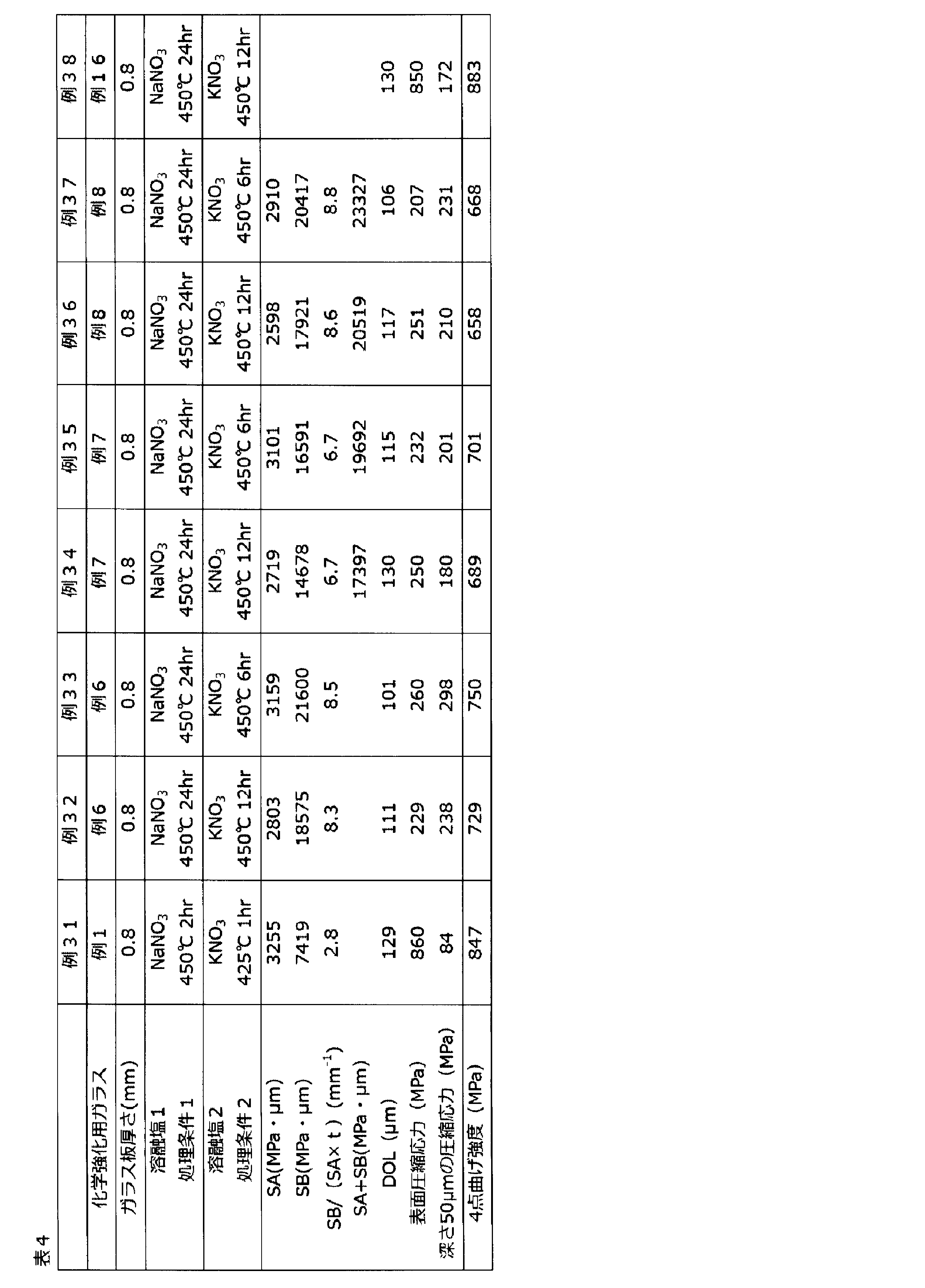
本発明の化学強化用ガラスを用いた例32等は、表面圧縮応力や4点曲げ強度が大きいだけでなく、深さ50μmにおける圧縮応力も大きいので、曲げ破壊が生じにくいだけでなく、衝突による破壊も生じにくいことがわかる。
従来の化学強化用ガラスを強化した例31は、4点曲げ強度が高いものの、深さ50μmにおける圧縮応力が小さいので、曲げ破壊は生じにくいが、衝突による破壊が生じやすいことがわかる。
本発明を特定の態様を参照して詳細に説明したが、本発明の精神と範囲を離れることなく様々な変更および修正が可能であることは、当業者にとって明らかである。なお、本出願は、2018年12月11日付けで出願された日本特許出願(特願2018-231777)に基づいており、その全体が引用により援用される。また、ここに引用されるすべての参照は全体として取り込まれる。
10 携帯端末
20 カバーガラス
30 筐体
31 側面
32 底面
20 カバーガラス
30 筐体
31 側面
32 底面
Claims (15)
- 破壊靱性値が0.85MPa・m1/2以上のガラスであって、
酸化物基準のモル百分率表示で、
SiO2を40%以上、Al2O3を20%以上、Li2Oを5%以上含有し、
Y2O3、La2O3およびGa2O3から選ばれる1種以上を合計で1~6%
含有するガラス。 - 酸化物基準のモル百分率表示で、SiO2を40~60%、Al2O3を20~45%、Li2Oを5~15%含有する、請求項1に記載のガラス。
- 酸化物基準のモル百分率表示で、
SiO2を40%~60%、Al2O3を20~45%、Li2Oを5~15%含有し、SiO2の含有量を[SiO2]、Al2O3の含有量を[Al2O3]とする場合、(2×[Al2O3]-X)/[SiO2]が0以上1以下である、ガラス。
ただしXはLi2O、Na2O、K2OおよびP2O5から選ばれる酸化物の含有量の合計をM1(%)MgO、CaO、SrO、ZnOおよびBaOの含有量の合計をM2(%)、Y2O3、La2O3およびGa2O3の含有量の合計をM3(%)、TiO2の含有量をM4(%)、V2O5、Ta2O5およびNb2O5の含有量の合計をM5(%)、WO3の含有量をM6(%)として、次の式で表される。
X=2×M1+2×M2+6×M3+4×M4+10×M5+6×M6 - ガラス中の全アルミニウム数に対する5配位アルミニウム数の割合が9%以上である、請求項1~3のいずれか1項に記載のガラス。
- 液相温度が1670℃以下である、請求項1~4のいずれか1項に記載のガラス。
- 酸化物基準のモル百分率表示によるLi2Oの含有量を[Li2O]、アルカリ金属酸化物の総含有量を[R2O]として、[Li2O]/[R2O]が0.8~1である、請求項1~5のいずれか1項に記載のガラス。
- 破砕数が10以下となる最大のCT値であるCTリミットが75MPa以上である、請求項1~6のいずれか1項に記載のガラス。
- ガラス表面からの深さ50μmにおける圧縮応力値であるCS50が150MPa以上であり、酸化物基準のモル百分率表示で、SiO2を40~60%、Al2O3を20~45%、Li2Oを5~15%、Y2O3、La2O3およびGa2O3から選ばれる1種以上を合計で1~6%含有する、化学強化ガラス。
- 前記CS50が200MPa以上であり、圧縮応力値が0となる深さであるDOLが100μm以上である、請求項8に記載の化学強化ガラス。
- ガラス表面から前記圧縮応力値が0となる深さまで、深さ方向に前記圧縮応力値を積分した値が75MPa以上である、請求項8または9に記載の化学強化ガラス。
- 請求項8~10のいずれか1項に記載の化学強化ガラスを含むカバーガラス。
- 請求項11に記載のカバーガラスを含む電子機器。
- 酸化物基準のモル百分率表示で、
SiO2を40~60%、Al2O3を20~45%、Li2Oを5~15%、Y2O3、La2O3およびGa2O3から選ばれる1種以上を合計で1~6%含有する化学強化用ガラスを化学強化して、
ガラス表面からの深さ50μmにおける圧縮応力値であるCS50が150MPa以上である化学強化ガラスを得る、化学強化ガラスの製造方法。 - 前記化学強化用ガラスは、
酸化物基準のモル百分率表示によるSiO2の含有量を[SiO2]、Al2O3の含有量を[Al2O3]、として
(2×[Al2O3]-X)/[SiO2]が0以上1以下である請求項13に記載の化学強化ガラスの製造方法。
ただしXはLi2O、Na2O、K2OおよびP2O5から選ばれる酸化物の含有量の合計をM1(%)MgO、CaO、SrO、ZnOおよびBaOの含有量の合計をM2(%)、Y2O3、La2O3およびGa2O3の含有量の合計をM3(%)、TiO2の含有量をM4(%)、V2O5、Ta2O5およびNb2O5の含有量の合計をM5(%)、WO3の含有量をM6(%)として、次の式で表される。
X=2×M1+2×M2+6×M3+4×M4+10×M5+6×M6 - 前記化学強化用ガラスは、
酸化物基準のモル百分率表示によるLi2Oの含有量を[Li2O]、アルカリ金属酸化物の総含有量を[R2O]として、[Li2O]/[R2O]が0.8~1である、請求項13または14に記載の化学強化ガラスの製造方法。
Priority Applications (4)
| Application Number | Priority Date | Filing Date | Title |
|---|---|---|---|
| CN202310363774.XA CN116332504A (zh) | 2018-12-11 | 2019-12-03 | 玻璃、化学强化玻璃和包含化学强化玻璃的电子设备 |
| JP2020559212A JP7310830B2 (ja) | 2018-12-11 | 2019-12-03 | ガラス、化学強化ガラスおよびそれを含む電子機器 |
| CN201980082523.6A CN113242841B (zh) | 2018-12-11 | 2019-12-03 | 玻璃、化学强化玻璃和包含化学强化玻璃的电子设备 |
| US17/341,462 US20210292226A1 (en) | 2018-12-11 | 2021-06-08 | Glass, chemically strengthened glass, and electronic device including same |
Applications Claiming Priority (2)
| Application Number | Priority Date | Filing Date | Title |
|---|---|---|---|
| JP2018231777 | 2018-12-11 | ||
| JP2018-231777 | 2018-12-11 |
Related Child Applications (1)
| Application Number | Title | Priority Date | Filing Date |
|---|---|---|---|
| US17/341,462 Continuation US20210292226A1 (en) | 2018-12-11 | 2021-06-08 | Glass, chemically strengthened glass, and electronic device including same |
Publications (1)
| Publication Number | Publication Date |
|---|---|
| WO2020121889A1 true WO2020121889A1 (ja) | 2020-06-18 |
Family
ID=71076027
Family Applications (1)
| Application Number | Title | Priority Date | Filing Date |
|---|---|---|---|
| PCT/JP2019/047190 Ceased WO2020121889A1 (ja) | 2018-12-11 | 2019-12-03 | ガラス、化学強化ガラスおよびそれを含む電子機器 |
Country Status (5)
| Country | Link |
|---|---|
| US (1) | US20210292226A1 (ja) |
| JP (1) | JP7310830B2 (ja) |
| CN (2) | CN116332504A (ja) |
| TW (1) | TWI820267B (ja) |
| WO (1) | WO2020121889A1 (ja) |
Cited By (4)
| Publication number | Priority date | Publication date | Assignee | Title |
|---|---|---|---|---|
| JP2019116417A (ja) * | 2017-12-26 | 2019-07-18 | 日本電気硝子株式会社 | カバーガラス |
| US20220064055A1 (en) * | 2020-08-26 | 2022-03-03 | Corning Incorporated | Tunable glass compositions having improved mechanical durability |
| WO2022115551A3 (en) * | 2020-11-30 | 2022-07-21 | Corning Incorporated | Ion exchangeable glasses having high fracture toughness |
| JP2023138592A (ja) * | 2020-10-30 | 2023-10-02 | 重慶▲シン▼景特種玻璃有限公司 | 変化幅の小さい引張応力領域を備える安全強化ガラス及びその製造方法 |
Families Citing this family (6)
| Publication number | Priority date | Publication date | Assignee | Title |
|---|---|---|---|---|
| CN115485249A (zh) * | 2020-04-30 | 2022-12-16 | Agc株式会社 | 玻璃、化学强化玻璃和电子设备 |
| WO2022066408A1 (en) * | 2020-09-25 | 2022-03-31 | Corning Incorporated | Stress profiles of glass-based articles having improved drop performance |
| CN116940538B (zh) * | 2021-02-26 | 2026-03-20 | Agc株式会社 | 化学强化玻璃的制造方法和化学强化玻璃 |
| JP2024540112A (ja) * | 2021-10-26 | 2024-10-31 | コーニング インコーポレイテッド | 破壊靱性が高いイオン交換可能なガラス |
| CN116143422B (zh) * | 2023-01-11 | 2025-04-04 | 华为技术有限公司 | 化学强化玻璃及其跌落失效高度的预测方法、显示屏、结构件和电子设备 |
| CN117865466B (zh) * | 2023-10-19 | 2025-11-25 | 重庆鑫景特种玻璃有限公司 | 高杨氏模量的锂铝硅基材玻璃及其化学强化玻璃 |
Citations (8)
| Publication number | Priority date | Publication date | Assignee | Title |
|---|---|---|---|---|
| JP2002356350A (ja) * | 2001-03-27 | 2002-12-13 | Hoya Corp | ガラスセラミックス、ガラスセラミックス基板、液晶パネル用対向基板および液晶パネル用防塵基板 |
| JP2004168578A (ja) * | 2002-11-19 | 2004-06-17 | Asahi Glass Co Ltd | 光増幅ガラスおよび光導波路 |
| JP2012020921A (ja) * | 2010-06-18 | 2012-02-02 | Asahi Glass Co Ltd | ディスプレイ装置用のガラスおよびガラス板 |
| WO2017126607A1 (ja) * | 2016-01-21 | 2017-07-27 | 旭硝子株式会社 | 化学強化ガラスおよび化学強化用ガラス |
| WO2018159386A1 (ja) * | 2017-02-28 | 2018-09-07 | 日本電気硝子株式会社 | アルミノケイ酸塩ガラス |
| WO2018199046A1 (ja) * | 2017-04-28 | 2018-11-01 | Agc株式会社 | 化学強化ガラスおよび化学強化用ガラス |
| WO2019009069A1 (ja) * | 2017-07-04 | 2019-01-10 | Agc株式会社 | ガラスボール |
| JP2019099460A (ja) * | 2017-11-29 | 2019-06-24 | コーニング インコーポレイテッド | イオン交換可能な混合アルカリアルミノケイ酸塩ガラス |
Family Cites Families (7)
| Publication number | Priority date | Publication date | Assignee | Title |
|---|---|---|---|---|
| JP3965228B2 (ja) * | 1997-08-12 | 2007-08-29 | Hoya株式会社 | 化学強化ガラス基板及びその製造方法 |
| TWI316928B (en) * | 2005-04-28 | 2009-11-11 | Ohara Kk | Optical glass |
| JP6123675B2 (ja) * | 2011-10-04 | 2017-05-10 | 旭硝子株式会社 | カバーガラス |
| WO2017090645A1 (ja) * | 2015-11-24 | 2017-06-01 | 旭硝子株式会社 | 光学ガラス |
| US11198639B2 (en) * | 2016-06-13 | 2021-12-14 | Corning Incorporated | Multicolored photosensitive glass-based parts and methods of manufacture |
| JP2018188335A (ja) * | 2017-05-08 | 2018-11-29 | Agc株式会社 | 折り曲げ可能なガラス板 |
| CN117069372A (zh) * | 2018-06-01 | 2023-11-17 | 日本电气硝子株式会社 | 强化玻璃以及强化用玻璃 |
-
2019
- 2019-12-03 JP JP2020559212A patent/JP7310830B2/ja active Active
- 2019-12-03 CN CN202310363774.XA patent/CN116332504A/zh not_active Withdrawn
- 2019-12-03 CN CN201980082523.6A patent/CN113242841B/zh active Active
- 2019-12-03 WO PCT/JP2019/047190 patent/WO2020121889A1/ja not_active Ceased
- 2019-12-09 TW TW108144846A patent/TWI820267B/zh active
-
2021
- 2021-06-08 US US17/341,462 patent/US20210292226A1/en active Pending
Patent Citations (8)
| Publication number | Priority date | Publication date | Assignee | Title |
|---|---|---|---|---|
| JP2002356350A (ja) * | 2001-03-27 | 2002-12-13 | Hoya Corp | ガラスセラミックス、ガラスセラミックス基板、液晶パネル用対向基板および液晶パネル用防塵基板 |
| JP2004168578A (ja) * | 2002-11-19 | 2004-06-17 | Asahi Glass Co Ltd | 光増幅ガラスおよび光導波路 |
| JP2012020921A (ja) * | 2010-06-18 | 2012-02-02 | Asahi Glass Co Ltd | ディスプレイ装置用のガラスおよびガラス板 |
| WO2017126607A1 (ja) * | 2016-01-21 | 2017-07-27 | 旭硝子株式会社 | 化学強化ガラスおよび化学強化用ガラス |
| WO2018159386A1 (ja) * | 2017-02-28 | 2018-09-07 | 日本電気硝子株式会社 | アルミノケイ酸塩ガラス |
| WO2018199046A1 (ja) * | 2017-04-28 | 2018-11-01 | Agc株式会社 | 化学強化ガラスおよび化学強化用ガラス |
| WO2019009069A1 (ja) * | 2017-07-04 | 2019-01-10 | Agc株式会社 | ガラスボール |
| JP2019099460A (ja) * | 2017-11-29 | 2019-06-24 | コーニング インコーポレイテッド | イオン交換可能な混合アルカリアルミノケイ酸塩ガラス |
Cited By (10)
| Publication number | Priority date | Publication date | Assignee | Title |
|---|---|---|---|---|
| JP2019116417A (ja) * | 2017-12-26 | 2019-07-18 | 日本電気硝子株式会社 | カバーガラス |
| JP7303482B2 (ja) | 2017-12-26 | 2023-07-05 | 日本電気硝子株式会社 | カバーガラス |
| JP2023118789A (ja) * | 2017-12-26 | 2023-08-25 | 日本電気硝子株式会社 | カバーガラス |
| JP7663107B2 (ja) | 2017-12-26 | 2025-04-16 | 日本電気硝子株式会社 | カバーガラス |
| US20220064055A1 (en) * | 2020-08-26 | 2022-03-03 | Corning Incorporated | Tunable glass compositions having improved mechanical durability |
| US11897808B2 (en) * | 2020-08-26 | 2024-02-13 | Corning Incorporated | Tunable glass compositions having improved mechanical durability |
| JP2023138592A (ja) * | 2020-10-30 | 2023-10-02 | 重慶▲シン▼景特種玻璃有限公司 | 変化幅の小さい引張応力領域を備える安全強化ガラス及びその製造方法 |
| JP7693237B2 (ja) | 2020-10-30 | 2025-06-17 | 重慶▲シン▼景特種玻璃有限公司 | 変化幅の小さい引張応力領域を備える安全強化ガラス及びその製造方法 |
| WO2022115551A3 (en) * | 2020-11-30 | 2022-07-21 | Corning Incorporated | Ion exchangeable glasses having high fracture toughness |
| CN116802161A (zh) * | 2020-11-30 | 2023-09-22 | 康宁股份有限公司 | 具有高断裂韧度的可离子交换玻璃 |
Also Published As
| Publication number | Publication date |
|---|---|
| CN116332504A (zh) | 2023-06-27 |
| TWI820267B (zh) | 2023-11-01 |
| JPWO2020121889A1 (ja) | 2021-10-28 |
| CN113242841B (zh) | 2023-05-02 |
| US20210292226A1 (en) | 2021-09-23 |
| TW202031614A (zh) | 2020-09-01 |
| JP7310830B2 (ja) | 2023-07-19 |
| CN113242841A (zh) | 2021-08-10 |
Similar Documents
| Publication | Publication Date | Title |
|---|---|---|
| JP7310830B2 (ja) | ガラス、化学強化ガラスおよびそれを含む電子機器 | |
| JP7260041B2 (ja) | 化学強化ガラス | |
| KR102292273B1 (ko) | 화학 강화 유리 및 화학 강화용 유리 | |
| CN110217983B (zh) | 化学强化玻璃以及化学强化玻璃的制造方法 | |
| KR20110138149A (ko) | 디스플레이 장치용 유리 및 유리판 | |
| US12415745B2 (en) | Glass, chemically tempered glass, and method for producing same | |
| US20230021473A1 (en) | Glass, chemically strengthened glass, and electronic device | |
| US20250361173A1 (en) | Glass ceramic, chemically strengthened glass ceramic, and method for testing glass ceramic | |
| JP2025159887A (ja) | ガラス材料、結晶化ガラス |
Legal Events
| Date | Code | Title | Description |
|---|---|---|---|
| 121 | Ep: the epo has been informed by wipo that ep was designated in this application |
Ref document number: 19894681 Country of ref document: EP Kind code of ref document: A1 |
|
| ENP | Entry into the national phase |
Ref document number: 2020559212 Country of ref document: JP Kind code of ref document: A |
|
| NENP | Non-entry into the national phase |
Ref country code: DE |
|
| 122 | Ep: pct application non-entry in european phase |
Ref document number: 19894681 Country of ref document: EP Kind code of ref document: A1 |