WO2020105561A1 - 液晶配向剤、液晶配向膜、及び液晶表示素子 - Google Patents
液晶配向剤、液晶配向膜、及び液晶表示素子Info
- Publication number
- WO2020105561A1 WO2020105561A1 PCT/JP2019/044925 JP2019044925W WO2020105561A1 WO 2020105561 A1 WO2020105561 A1 WO 2020105561A1 JP 2019044925 W JP2019044925 W JP 2019044925W WO 2020105561 A1 WO2020105561 A1 WO 2020105561A1
- Authority
- WO
- WIPO (PCT)
- Prior art keywords
- liquid crystal
- group
- hydrogen atom
- carbon atoms
- crystal alignment
- Prior art date
- Legal status (The legal status is an assumption and is not a legal conclusion. Google has not performed a legal analysis and makes no representation as to the accuracy of the status listed.)
- Ceased
Links
- 0 C*C(C)(C(C(C)(*)C1(C)**)*=C)C1(C)*=C* Chemical compound C*C(C)(C(C(C)(*)C1(C)**)*=C)C1(C)*=C* 0.000 description 7
- FFFUBPGCEPVETR-UHFFFAOYSA-N C1=CC2=C=C2C=C1 Chemical compound C1=CC2=C=C2C=C1 FFFUBPGCEPVETR-UHFFFAOYSA-N 0.000 description 1
- LBCZLAVMELJZIY-UHFFFAOYSA-N CC(C(C1(C)C(O2)=O)C(O3)=O)(C1C2=O)C3=O Chemical compound CC(C(C1(C)C(O2)=O)C(O3)=O)(C1C2=O)C3=O LBCZLAVMELJZIY-UHFFFAOYSA-N 0.000 description 1
- YGYCECQIOXZODZ-UHFFFAOYSA-N O=C(C(C1C2C(O3)=O)C2C3=O)OC1=O Chemical compound O=C(C(C1C2C(O3)=O)C2C3=O)OC1=O YGYCECQIOXZODZ-UHFFFAOYSA-N 0.000 description 1
- ILOCNLYUKFZVBP-UHFFFAOYSA-N O=C(C(CC12)C(C(C3)C(O4)=O)C1C3C4=O)OC2=O Chemical compound O=C(C(CC12)C(C(C3)C(O4)=O)C1C3C4=O)OC2=O ILOCNLYUKFZVBP-UHFFFAOYSA-N 0.000 description 1
- ANSXAPJVJOKRDJ-UHFFFAOYSA-N O=C(c(c1c2)cc(C(O3)=O)c2C3=O)OC1=O Chemical compound O=C(c(c1c2)cc(C(O3)=O)c2C3=O)OC1=O ANSXAPJVJOKRDJ-UHFFFAOYSA-N 0.000 description 1
- WKDNYTOXBCRNPV-UHFFFAOYSA-N O=C(c(c1c2)ccc2-c(cc2)cc(C(O3)=O)c2C3=O)OC1=O Chemical compound O=C(c(c1c2)ccc2-c(cc2)cc(C(O3)=O)c2C3=O)OC1=O WKDNYTOXBCRNPV-UHFFFAOYSA-N 0.000 description 1
- UHOVQNZJYSORNB-UHFFFAOYSA-N c1ccccc1 Chemical compound c1ccccc1 UHOVQNZJYSORNB-UHFFFAOYSA-N 0.000 description 1
Classifications
-
- C—CHEMISTRY; METALLURGY
- C09—DYES; PAINTS; POLISHES; NATURAL RESINS; ADHESIVES; COMPOSITIONS NOT OTHERWISE PROVIDED FOR; APPLICATIONS OF MATERIALS NOT OTHERWISE PROVIDED FOR
- C09K—MATERIALS FOR MISCELLANEOUS APPLICATIONS, NOT PROVIDED FOR ELSEWHERE
- C09K19/00—Liquid crystal materials
- C09K19/52—Liquid crystal materials characterised by components which are not liquid crystals, e.g. additives with special physical aspect: solvents, solid particles
- C09K19/54—Additives having no specific mesophase characterised by their chemical composition
- C09K19/56—Aligning agents
-
- C—CHEMISTRY; METALLURGY
- C08—ORGANIC MACROMOLECULAR COMPOUNDS; THEIR PREPARATION OR CHEMICAL WORKING-UP; COMPOSITIONS BASED THEREON
- C08G—MACROMOLECULAR COMPOUNDS OBTAINED OTHERWISE THAN BY REACTIONS ONLY INVOLVING UNSATURATED CARBON-TO-CARBON BONDS
- C08G73/00—Macromolecular compounds obtained by reactions forming a linkage containing nitrogen with or without oxygen or carbon in the main chain of the macromolecule, not provided for in groups C08G12/00 - C08G71/00
- C08G73/06—Polycondensates having nitrogen-containing heterocyclic rings in the main chain of the macromolecule
- C08G73/10—Polyimides; Polyester-imides; Polyamide-imides; Polyamide acids or similar polyimide precursors
-
- C—CHEMISTRY; METALLURGY
- C08—ORGANIC MACROMOLECULAR COMPOUNDS; THEIR PREPARATION OR CHEMICAL WORKING-UP; COMPOSITIONS BASED THEREON
- C08G—MACROMOLECULAR COMPOUNDS OBTAINED OTHERWISE THAN BY REACTIONS ONLY INVOLVING UNSATURATED CARBON-TO-CARBON BONDS
- C08G73/00—Macromolecular compounds obtained by reactions forming a linkage containing nitrogen with or without oxygen or carbon in the main chain of the macromolecule, not provided for in groups C08G12/00 - C08G71/00
- C08G73/06—Polycondensates having nitrogen-containing heterocyclic rings in the main chain of the macromolecule
- C08G73/10—Polyimides; Polyester-imides; Polyamide-imides; Polyamide acids or similar polyimide precursors
- C08G73/1039—Polyimides; Polyester-imides; Polyamide-imides; Polyamide acids or similar polyimide precursors comprising halogen-containing substituents
-
- C—CHEMISTRY; METALLURGY
- C08—ORGANIC MACROMOLECULAR COMPOUNDS; THEIR PREPARATION OR CHEMICAL WORKING-UP; COMPOSITIONS BASED THEREON
- C08G—MACROMOLECULAR COMPOUNDS OBTAINED OTHERWISE THAN BY REACTIONS ONLY INVOLVING UNSATURATED CARBON-TO-CARBON BONDS
- C08G73/00—Macromolecular compounds obtained by reactions forming a linkage containing nitrogen with or without oxygen or carbon in the main chain of the macromolecule, not provided for in groups C08G12/00 - C08G71/00
- C08G73/06—Polycondensates having nitrogen-containing heterocyclic rings in the main chain of the macromolecule
- C08G73/10—Polyimides; Polyester-imides; Polyamide-imides; Polyamide acids or similar polyimide precursors
- C08G73/1042—Copolyimides derived from at least two different tetracarboxylic compounds or two different diamino compounds
-
- G—PHYSICS
- G02—OPTICS
- G02F—OPTICAL DEVICES OR ARRANGEMENTS FOR THE CONTROL OF LIGHT BY MODIFICATION OF THE OPTICAL PROPERTIES OF THE MEDIA OF THE ELEMENTS INVOLVED THEREIN; NON-LINEAR OPTICS; FREQUENCY-CHANGING OF LIGHT; OPTICAL LOGIC ELEMENTS; OPTICAL ANALOGUE/DIGITAL CONVERTERS
- G02F1/00—Devices or arrangements for the control of the intensity, colour, phase, polarisation or direction of light arriving from an independent light source, e.g. switching, gating or modulating; Non-linear optics
- G02F1/01—Devices or arrangements for the control of the intensity, colour, phase, polarisation or direction of light arriving from an independent light source, e.g. switching, gating or modulating; Non-linear optics for the control of the intensity, phase, polarisation or colour
- G02F1/13—Devices or arrangements for the control of the intensity, colour, phase, polarisation or direction of light arriving from an independent light source, e.g. switching, gating or modulating; Non-linear optics for the control of the intensity, phase, polarisation or colour based on liquid crystals, e.g. single liquid crystal display cells
- G02F1/133—Constructional arrangements; Operation of liquid crystal cells; Circuit arrangements
- G02F1/1333—Constructional arrangements; Manufacturing methods
- G02F1/1337—Surface-induced orientation of the liquid crystal molecules, e.g. by alignment layers
-
- G—PHYSICS
- G02—OPTICS
- G02F—OPTICAL DEVICES OR ARRANGEMENTS FOR THE CONTROL OF LIGHT BY MODIFICATION OF THE OPTICAL PROPERTIES OF THE MEDIA OF THE ELEMENTS INVOLVED THEREIN; NON-LINEAR OPTICS; FREQUENCY-CHANGING OF LIGHT; OPTICAL LOGIC ELEMENTS; OPTICAL ANALOGUE/DIGITAL CONVERTERS
- G02F1/00—Devices or arrangements for the control of the intensity, colour, phase, polarisation or direction of light arriving from an independent light source, e.g. switching, gating or modulating; Non-linear optics
- G02F1/01—Devices or arrangements for the control of the intensity, colour, phase, polarisation or direction of light arriving from an independent light source, e.g. switching, gating or modulating; Non-linear optics for the control of the intensity, phase, polarisation or colour
- G02F1/13—Devices or arrangements for the control of the intensity, colour, phase, polarisation or direction of light arriving from an independent light source, e.g. switching, gating or modulating; Non-linear optics for the control of the intensity, phase, polarisation or colour based on liquid crystals, e.g. single liquid crystal display cells
- G02F1/133—Constructional arrangements; Operation of liquid crystal cells; Circuit arrangements
- G02F1/1333—Constructional arrangements; Manufacturing methods
- G02F1/1337—Surface-induced orientation of the liquid crystal molecules, e.g. by alignment layers
- G02F1/133711—Surface-induced orientation of the liquid crystal molecules, e.g. by alignment layers by organic films, e.g. polymeric films
- G02F1/133723—Polyimide, polyamide-imide
-
- G—PHYSICS
- G02—OPTICS
- G02F—OPTICAL DEVICES OR ARRANGEMENTS FOR THE CONTROL OF LIGHT BY MODIFICATION OF THE OPTICAL PROPERTIES OF THE MEDIA OF THE ELEMENTS INVOLVED THEREIN; NON-LINEAR OPTICS; FREQUENCY-CHANGING OF LIGHT; OPTICAL LOGIC ELEMENTS; OPTICAL ANALOGUE/DIGITAL CONVERTERS
- G02F1/00—Devices or arrangements for the control of the intensity, colour, phase, polarisation or direction of light arriving from an independent light source, e.g. switching, gating or modulating; Non-linear optics
- G02F1/01—Devices or arrangements for the control of the intensity, colour, phase, polarisation or direction of light arriving from an independent light source, e.g. switching, gating or modulating; Non-linear optics for the control of the intensity, phase, polarisation or colour
- G02F1/13—Devices or arrangements for the control of the intensity, colour, phase, polarisation or direction of light arriving from an independent light source, e.g. switching, gating or modulating; Non-linear optics for the control of the intensity, phase, polarisation or colour based on liquid crystals, e.g. single liquid crystal display cells
- G02F1/133—Constructional arrangements; Operation of liquid crystal cells; Circuit arrangements
- G02F1/1333—Constructional arrangements; Manufacturing methods
- G02F1/1343—Electrodes
- G02F1/134309—Electrodes characterised by their geometrical arrangement
- G02F1/134363—Electrodes characterised by their geometrical arrangement for applying an electric field parallel to the substrate, i.e. in-plane switching [IPS]
Definitions
- the present invention relates to a liquid crystal aligning agent, a liquid crystal aligning film obtained by the liquid crystal aligning agent, and a liquid crystal display device including the obtained liquid crystal aligning film.
- a liquid crystal display element used for a liquid crystal television, a liquid crystal display, or the like is usually provided with a liquid crystal alignment film for controlling the alignment state of liquid crystals.
- the most widely used liquid crystal alignment film in the industry is to coat the surface of a film made of polyamic acid and / or polyimide imidized on the electrode substrate with a cloth such as cotton, nylon or polyester. It is produced by rubbing in the direction, so-called rubbing treatment.
- the rubbing treatment is an industrially useful method that is simple and excellent in productivity.
- due to the high performance, high definition, and large size of liquid crystal display elements scratches on the surface of the alignment film generated by rubbing treatment, dust generation, the influence of mechanical force and static electricity, Various problems such as non-uniformity have become clear.
- a photo-alignment method which imparts liquid crystal alignment ability by irradiating polarized radiation.
- a method utilizing a photo-isomerization reaction, a method utilizing a photo-crosslinking reaction, a method utilizing a photo-decomposition reaction, etc. have been proposed (see Non-Patent Document 1).
- Patent Document 1 proposes to use a polyimide film having an alicyclic structure such as a cyclobutane ring in its main chain for a photo-alignment method.
- the photo-alignment method as described above is a rubbing-less alignment treatment method, and can be produced by a simple manufacturing process industrially.
- rubbing is performed in the liquid crystal display element of the IPS drive system or the FFS (fringe field switching) drive system. Since it can be expected to improve the contrast and viewing angle characteristics of a liquid crystal display device as compared with a liquid crystal alignment film obtained by a treatment method, it is attracting attention as a promising liquid crystal alignment treatment method.
- the liquid crystal alignment film used for the liquid crystal display element of the IPS drive system or the FFS drive system is required to suppress afterimages due to long-term AC drive, in addition to basic properties such as excellent liquid crystal alignment and electrical properties.
- the liquid crystal alignment film obtained by the photo-alignment method has a problem that the anisotropy with respect to the alignment direction of the polymer film is smaller than that obtained by rubbing. When the anisotropy is small, a sufficient liquid crystal orientation cannot be obtained, and when a liquid crystal display device is formed, problems such as an afterimage occur.
- Patent Document 2 as a method of enhancing the anisotropy of the liquid crystal alignment film obtained by the photo-alignment method, a low molecular weight component generated by cutting the main chain of the polyimide by the light irradiation after the light irradiation is generated. Proposed to be removed.
- an object of the present invention is to expand the range of the light irradiation amount (hereinafter, also referred to as an optimum irradiation amount margin) where good alignment control ability can be obtained, and to bring about a wide irradiation amount margin.
- Another object of the present invention is to provide a liquid crystal aligning agent capable of obtaining stable and stable liquid crystal aligning ability even in the case of a large panel. That is, an object of the present invention is to provide a liquid crystal aligning agent which has a wide range of light irradiation amount in which alignment control ability is stably generated and which can efficiently obtain a high quality liquid crystal aligning film.
- a liquid crystal aligning agent comprising a polyimide which is an imidized product of a polyimide precursor obtained by a polymerization reaction of a tetracarboxylic acid component containing a carboxylic dianhydride and a diamine component.
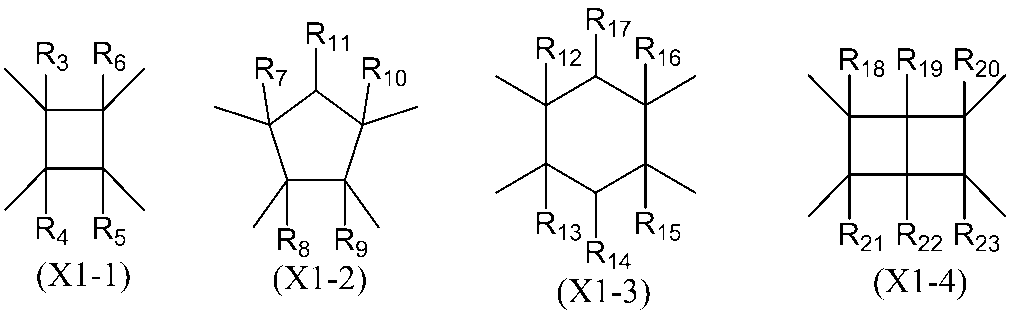
- X 1 is a structure represented by any of the following formulas (X1-1) to (X1-4).
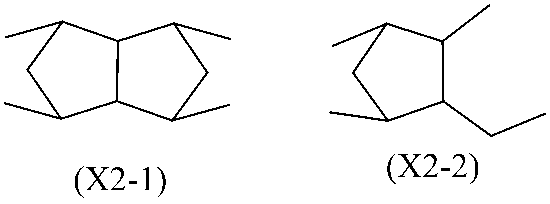
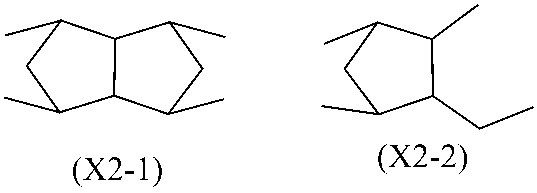
- X 2 is a structure represented by the following formula (X2-1) or (X2-2).
- X 3 is an aromatic ring having 4 bonds.
- R 3 to R 6 each independently contain a hydrogen atom, a halogen atom, an alkyl group having 1 to 6 carbon atoms, an alkenyl group having 2 to 6 carbon atoms, an alkynyl group having 2 to 6 carbon atoms, or a fluorine atom.
- R 3 to R 6 each independently contain a hydrogen atom, a halogen atom, an alkyl group having 1 to 6 carbon atoms, an alkenyl group having 2 to 6 carbon atoms, an alkynyl group having 2 to 6 carbon atoms, or a fluorine atom.
- R 7 to R 23 are each independently a hydrogen atom, a halogen atom, an alkyl group having 1 to 6 carbon atoms, an alkenyl group having 2 to 6 carbon atoms, an alkynyl group having 2 to 6 carbon atoms, or a carbon atom containing a fluorine atom. It is a monovalent organic group of the numbers 1 to 6 or a phenyl group.
- the liquid crystal aligning agent of the present invention it is possible to expand the light irradiation amount margin that brings about excellent photo-alignment treatment, which has been difficult in the past, and to obtain a liquid crystal aligning film having good afterimage characteristics. Therefore, the liquid crystal alignment film obtained from the liquid crystal aligning agent of the present invention has a high yield in liquid crystal panel production, and can reduce the afterimage caused by AC drive generated in the liquid crystal display device of the IPS drive system or the FFS drive system. A liquid crystal display device of an IPS drive system or an FFS drive system having excellent afterimage characteristics can be obtained.
- the liquid crystal aligning agent of the present invention is, as described above, a polyimide which is an imidized product of a polyimide precursor obtained from a tetracarboxylic acid component derivative having a tetracarboxylic acid having a specific structure or a derivative thereof and a diamine component (hereinafter, a specific weight (Also referred to as coalescence).
- the specific polymer used in the present invention is a polyimide which is an imidized product of a polyimide precursor having a specific structure.
- the polyimide precursor is not particularly limited as long as it is a polyimide precursor that forms an imide ring by heating polyamic acid, polyamic acid ester, or the like, or by chemical imidization with a catalyst. From the viewpoint of easy progress of heating or chemical imidization, the polyimide precursor is more preferably a polyamic acid or a polyamic acid ester.
- the imidization ratio of the polyimide is not particularly limited, but is preferably 10 to 100%, more preferably 50 to 100%, further preferably 50 to 80%.
- each component as a raw material forming the specific polymer will be described.
- the tetracarboxylic acid component used in the polymerization of the specific polymer of the present invention is not only a tetracarboxylic acid dianhydride, but also a derivative thereof, tetracarboxylic acid, tetracarboxylic acid dihalide, tetracarboxylic acid dialkyl ester or tetracarboxylic acid.
- a dialkyl ester dihalide can also be used.
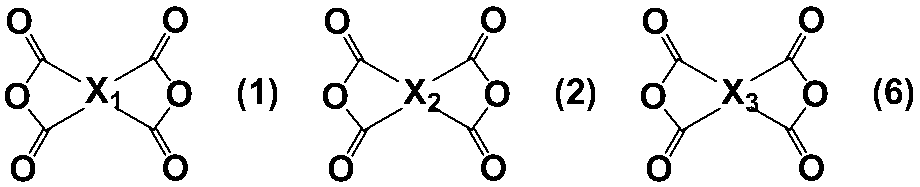
- the tetracarboxylic acid component used for the polymerization of the specific polymer of the present invention includes a tetracarboxylic acid dianhydride represented by the following formula (1) or a derivative thereof and a tetracarboxylic acid dianhydride represented by the following formula (2). It contains an anhydride or a derivative thereof and an aromatic tetracarboxylic dianhydride or a derivative thereof represented by the following formula (6).
- X 1 is a structure represented by any of the following formulas (X1-1) to (X1-4).
- R 3 to R 6 each independently contain a hydrogen atom, a halogen atom, an alkyl group having 1 to 6 carbon atoms, an alkenyl group having 2 to 6 carbon atoms, an alkynyl group having 2 to 6 carbon atoms, or a fluorine atom.
- R 7 to R 23 each independently contain a hydrogen atom, a halogen atom, an alkyl group having 1 to 6 carbon atoms, an alkenyl group having 2 to 6 carbon atoms, an alkynyl group having 2 to 6 carbon atoms, or a fluorine atom.
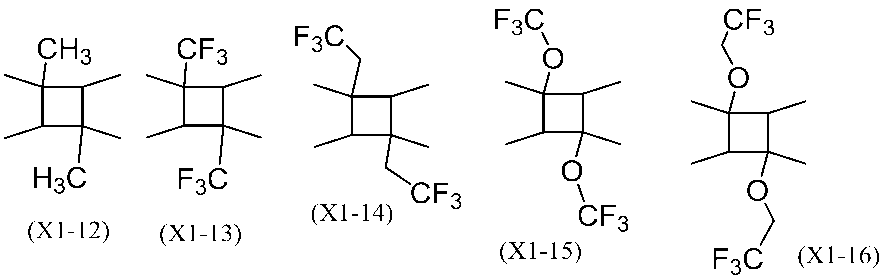
- X 1 is preferably at least one selected from the structures represented by any of the following formulas (X1-12) to (X1-16). X1-12) is particularly preferable.
- the content ratio of the tetracarboxylic acid dianhydride represented by the above formula (1) or its derivative is preferably 50 to 98 mol%, more preferably 60 to 93 mol% with respect to the tetracarboxylic acid component to be reacted with the diamine component. It is preferably 65 to 87 mol%, and further preferably.
- X 2 is the structure of the following formula (X2-1) or (X2-2).
- Formula (X2-1) is preferable for X 2 in order to suppress an afterimage due to long-term AC driving.
- the content ratio of the tetracarboxylic acid dianhydride represented by the above formula (2) or its derivative is preferably 1 to 30 mol% and more preferably 5 to 25% with respect to 1 mol of all tetracarboxylic acid components. It is preferably 10 to 20%, and further preferably.
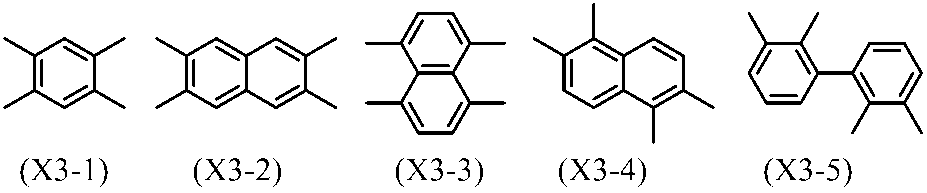
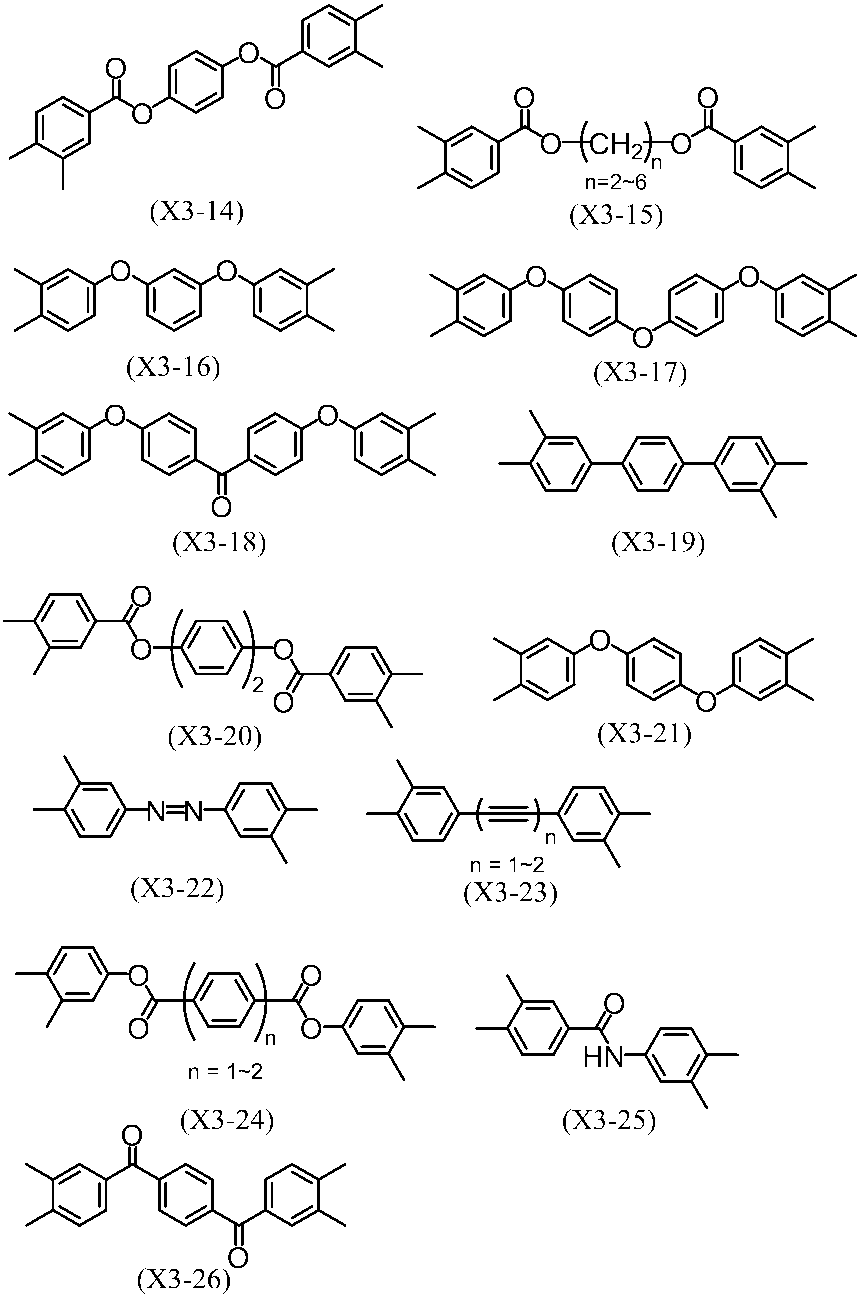
- X 3 is a tetravalent organic group, has an aromatic ring having four bonds, preferably at least one benzene ring or naphthalene ring, and has four bonds on the benzene ring or naphthalene ring. It is a ring.
- Specific examples include the structures of any of the following formulas (X3-1) to (X3-26).
- X3 is preferably any of (X3-1), (X3-5) to (X3-11), and (X3-14) to (X3-26). More preferably, a structure in which n in (X3-1), (X3-7), (X3-8) is 1 to 4, (X3-9) to (X3-10), or (X3-14) to (X3-26) is preferable.
- the content ratio of the aromatic tetracarboxylic acid dianhydride represented by the above formula (6) or its derivative is preferably 1 to 20 mol% with respect to 1 mol of the tetracarboxylic acid component, and 2 to 15 mol% Is more preferable, and 3 to 15 mol% is even more preferable.
- the tetracarboxylic acid component used in the polymerization of the specific polymer of the present invention is a tetracarboxylic acid dianhydride represented by the following formula (7) or the tetracarboxylic acid dianhydride represented by the following formula (7) in addition to the above formulas (1), (2) and (6). It may contain a derivative.
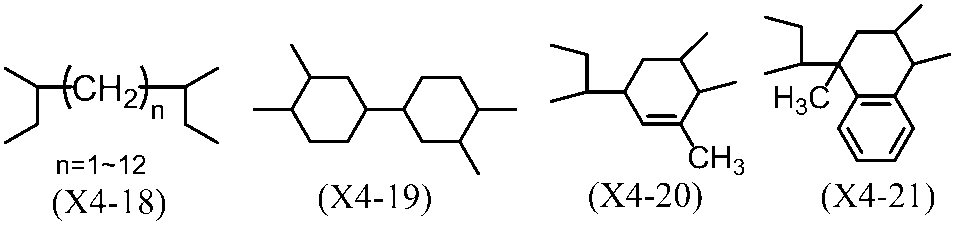
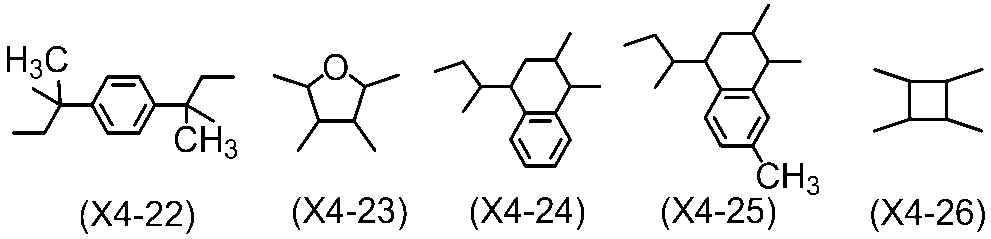
- X 4 is a tetravalent organic group other than X 1 to X 3 , but the structure thereof is not particularly limited. Specific examples include the following formulas (X4-1) to (X4-26) and tetravalent groups derived from ethylenediaminetetraacetic acid dianhydride.
- X4 includes (X4-8) to (X4-12), (X4-17) to (X4-19), and (X4-24) to (X4-26). ..
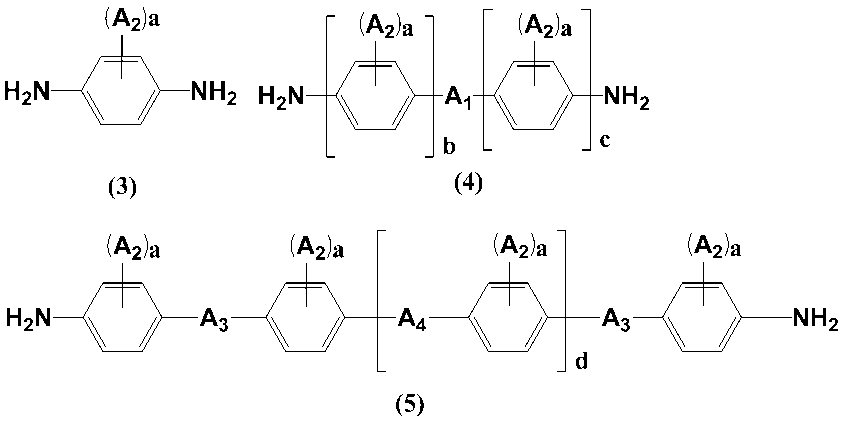
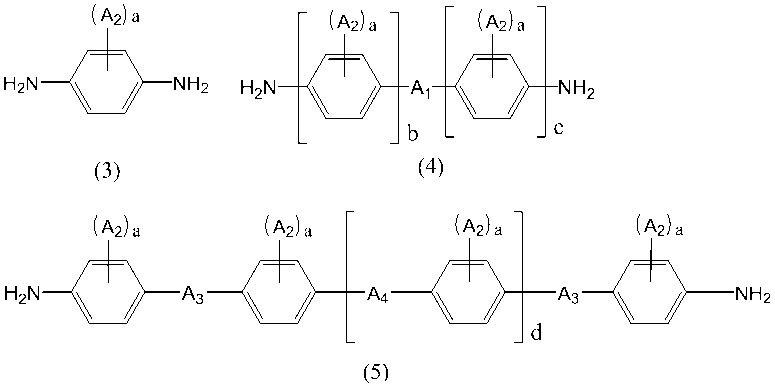
- the diamine component used for producing the specific polymer of the present invention is not particularly limited as long as it is a known diamine. From the viewpoint of suppressing the afterimage due to long-term AC driving, it is preferable to contain at least one diamine selected from the following formula (3), the following formula (4) and the following formula (5).
- a 1 and A 4 are each independently a single bond, —CO—O—, —OCO—, —NRCO— (R is a hydrogen atom or a methyl group. , -NRCOO- (R represents a hydrogen atom or a methyl group), -CONR- (R represents a hydrogen atom or a methyl group), -COS-, -NR 1 -CO-NR 2- ( R 1 and R 2 each independently represent a hydrogen atom or a methyl group), a divalent chain hydrocarbon group having 2 to 20 carbon atoms, or —CH 2 of the divalent chain hydrocarbon group.
- R represents a hydrogen atom or a methyl group
- -NRCOO- represents a hydrogen atom or a methyl group
- - CONR- represents a hydrogen atom or a methyl group
- -COS- -NR 1 -CO-NR 2-
- R 1 and R 2 each independently represent a hydrogen atom or a methyl group
- It represents a group (h1) substituted with a group selected from —NR— (R represents a methyl group), pyrrolidine, piperidine and piperazine.
- some or all of the hydrogen atoms contained in the chain hydrocarbon group of A 1 and A 4 and the group (h1) may be an alkyl group having 1 to 3 carbon atoms such as a methyl group, a fluorine atom, a chlorine atom, or the like. You may substitute with a halogen atom.
- a 2 is a hydrogen atom, a halogen atom, a hydroxyl group, an amino group, a thiol group, a nitro group, a phosphoric acid group, or a monovalent organic group having 1 to 20 carbon atoms.
- a 3 is a divalent chain hydrocarbon group having 1 to 20 carbon atoms, or —CH 2 — of the divalent chain hydrocarbon group is —O—, —CO—, —CO—O—, -NRCO- (R represents a hydrogen atom or a methyl group), -NRCOO- (R represents a hydrogen atom or a methyl group), -CONR- (R represents a hydrogen atom or a methyl group), -COS.
- R 1 and R 2 each independently represent a hydrogen atom or a methyl group), -NR- (R represents a methyl group), pyrrolidine, piperidine, It represents a group (h2) substituted with a group selected from piperazine.
- a part or all of the hydrogen atoms contained in the chain hydrocarbon group of A 3 and the group (h2) are substituted with an alkyl group having 1 to 3 carbon atoms such as a methyl group, a halogen atom such as a fluorine atom or a chlorine atom.
- a is an integer of 1 to 4, and when a is 2 or more, the structures of A 2 may be the same or different.
- b and c are integers of 1 or 2.
- d is an integer of 0 or 1.
- Examples of the divalent chain hydrocarbon group having 1 to 20 carbon atoms include methanediyl group, ethanediyl group, n-propanediyl group, i-propanediyl group, n-butanediyl group, i-butanediyl group, sec- Examples thereof include alkanediyl groups such as butanediyl group and t-butanediyl group; alkenediyl groups such as ethenediyl group, propenediyl group and butenediyl group; alkynediyl groups such as ethynediyl group, propyndiyl group and butynediyl group.
- the monovalent organic group having 1 to 20 carbon atoms in A 2 is, for example, a divalent chain hydrocarbon group having 1 to 20 carbon atoms in A 3 , a group (h2), or a group having 1 to 20 carbon atoms.
- a part or all of the hydrogen atoms of the divalent chain hydrocarbon group and the group (h2) are substituted with an alkyl group having 1 to 3 carbon atoms such as a methyl group, or a halogen atom such as a fluorine atom or a chlorine atom.
- Examples of the group include a group obtained by adding one hydrogen atom to the group exemplified above.
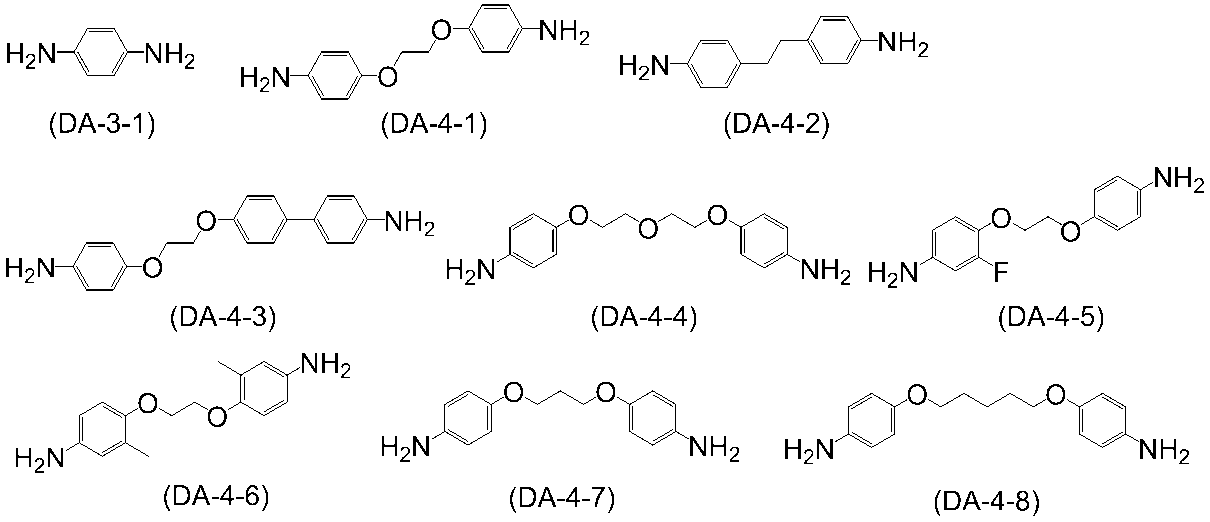
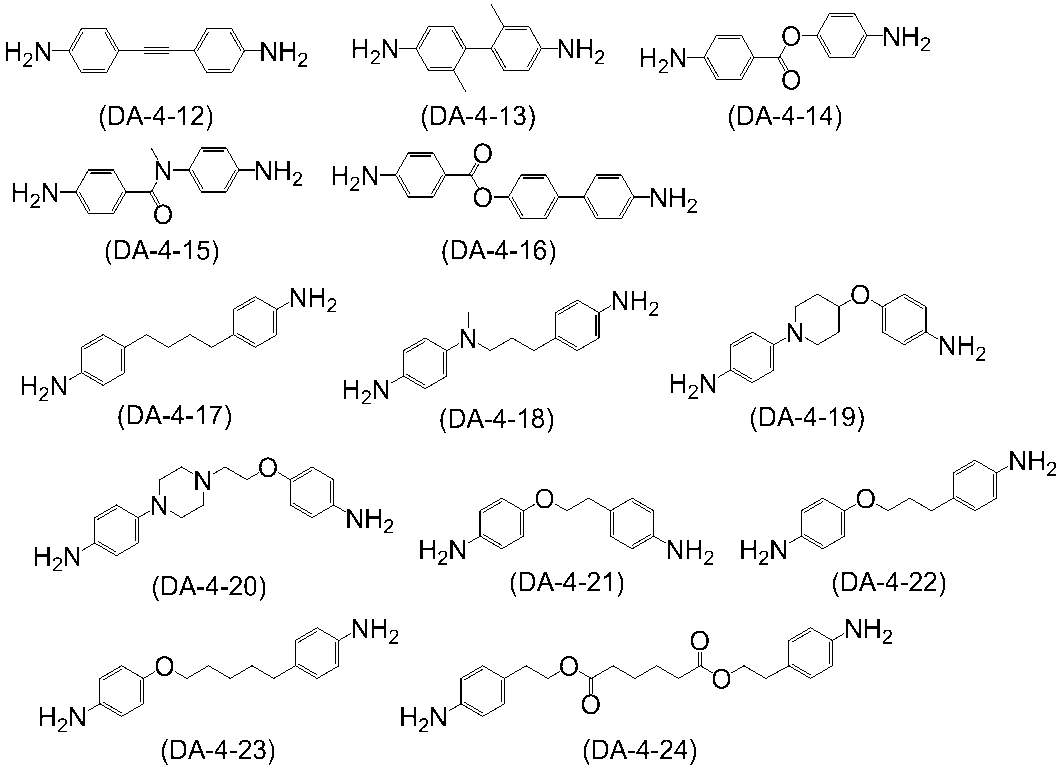
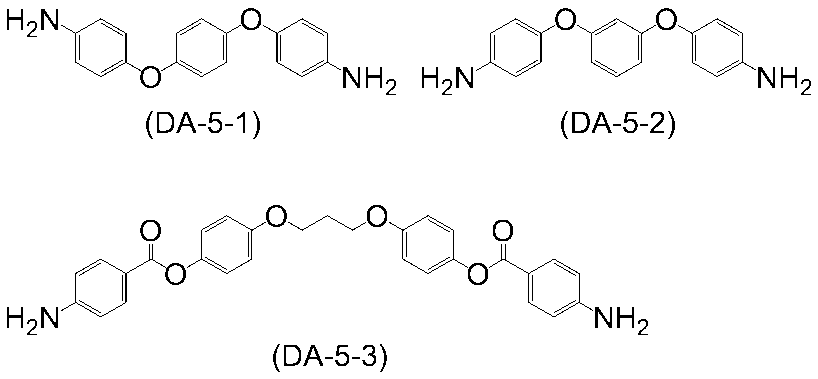
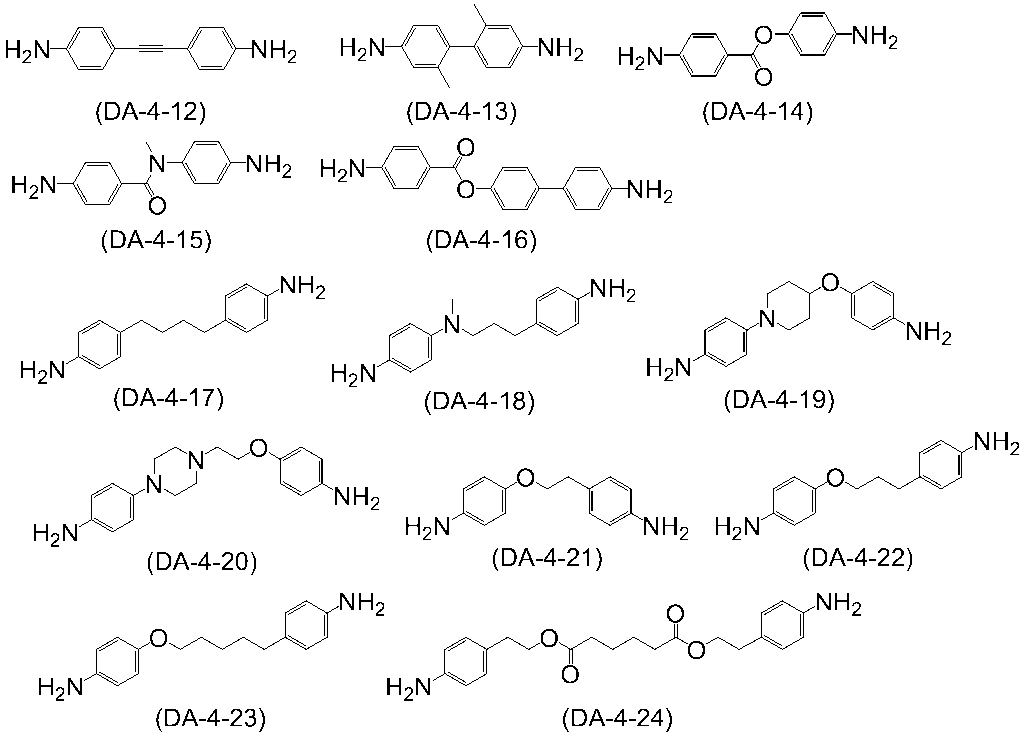
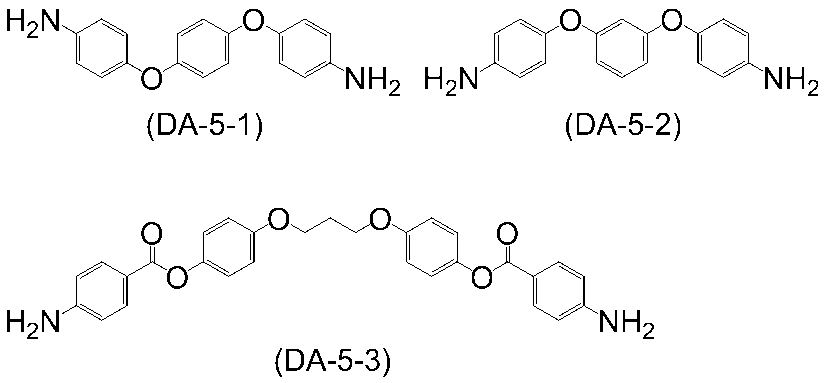
- formulas (3) and (4) are represented by the following formulas (DA-3-1), (DA-4-1) to (DA-4-24), (DA-5-1) to (DA-5-3) are preferable. Among them, (DA-3-1), (DA-4-1) to (DA-4-11), (DA-4-13) to (DA-4-24), (DA-5-1) To (DA-5-2) are more preferable.
- the content of the diamine represented by the above formula (3), formula (4) or formula (5) is preferably 50 to 100 mol%, and 70 mol% to 100 mol% with respect to 1 mol of the diamine component. Is more preferable.
- the diamine used for producing the specific polymer of the present invention preferably contains a diamine represented by the following formula (8).
- Y 6 is a divalent organic group containing a structure represented by the following formula (9).
- a 6's each independently represent a hydrogen atom, an alkyl group having 1 to 5 carbon atoms, an alkenyl group having 2 to 5 carbon atoms, or an alkynyl group having 2 to 5 carbon atoms.
- a 6 is preferably a hydrogen atom or a methyl group.
- D is a t-butoxycarbonyl group.
- divalent organic group having a structure represented by the above formula (9) examples include the following formula (J-1) or formula (J-2).
- * 1 represents a bond to NH-A 6
- Q 5 is a single bond,-(CH 2 ) n- (n is an integer of 1 to 20) Yes) or — (CH 2 ) n — and any —CH 2 — are not adjacent to each other —O—, —COO—, —OCO—, —NR—, —NRCO—, —CONR—, — NRCONR-, -NRCOO-, and -OCOO- are substituted groups, and R represents a hydrogen atom or a monovalent organic group.
- Q 6 and Q 7 each independently represent a group having —H, —NHD, —N (D) 2 , —NHD, or a group having —N (D) 2 .
- Q 8 represents a group having —NHD, —N (D) 2 , —NHD, or a group having —N (D) 2 .
- D represents a t-butoxycarbonyl group.
- at least one of Q 5 , Q 6 and Q 7 has a t-butoxycarbonyl group (Boc) in the group. More preferred are divalent organic groups represented by the following formulas (J-1-a) to (J-1-d) or (J-2-1).
- the diamine used for the polymerization of the specific polymer of the present invention may contain a diamine represented by the following formula (10) in addition to the above formulas (3) to (5) and (8).
- each A 8 is independently a hydrogen atom, an alkyl group having 1 to 5 carbon atoms, an alkenyl group having 2 to 5 carbon atoms, or an alkynyl group having 2 to 5 carbon atoms. From the viewpoint of liquid crystal alignment, A 8 is preferably a hydrogen atom or a methyl group.
- Y 8 is a divalent organic group, and examples thereof include a group represented by any of the formulas (Y-1) to (Y-167) described in the pamphlet of WO2018 / 117239.
- the polyimide precursor polyamic acid ester, polyamic acid and polyimide used in the present invention can be synthesized by a known method as described in, for example, International Publication WO 2013/157586.
- the liquid crystal aligning agent of the present invention has a form of a solution in which a polymer component such as a specific polymer is dissolved in an organic solvent.
- the weight average molecular weight of the specific polymer is preferably 2,000 to 500,000, more preferably 5,000 to 300,000, and further preferably 10,000 to 100,000.
- the number average molecular weight is preferably 1,000 to 250,000, more preferably 2,500 to 150,000, and further preferably 5,000 to 50,000.
- the liquid crystal aligning agent of the present invention is a composition containing the above-mentioned specific polymer and an organic solvent, and may contain two or more specific polymers having different structures. Further, the liquid crystal aligning agent of the present invention may contain a polymer other than the specific polymer (hereinafter, also referred to as a second polymer) and various additives.
- the ratio of the specific polymer to all the polymer components is preferably 5% by mass or more, and examples thereof include 5 to 95% by mass.
- the second polymer examples include polyamic acid, polyimide, polyamic acid ester, polyester, polyamide, polyurea, polyorganosiloxane, cellulose derivative, polyacetal, polystyrene or its derivative, poly (styrene-phenylmaleimide) derivative, and poly (meth).
- An acrylate etc. can be mentioned.
- a polyamic acid obtained from a tetracarboxylic dianhydride component and a diamine component (hereinafter, also referred to as a second polyamic acid) is preferable as the second polymer.
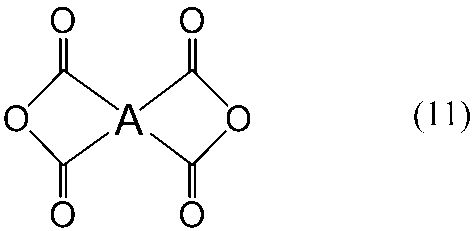
- Examples of the tetracarboxylic acid component for obtaining the second polyamic acid include a tetracarboxylic dianhydride represented by the following formula (11). Two or more kinds of the tetracarboxylic dianhydride may be used.
- A is a tetravalent organic group, preferably a C4-30 tetravalent organic group.
- the tetracarboxylic dianhydride component for obtaining the second polyamic acid may be one type of tetracarboxylic dianhydride, or may be a combination of two or more types of tetracarboxylic dianhydride. ..
- the diamine component for obtaining the second polyamic acid can be appropriately determined according to the purpose, and for example, a diamine represented by the following formula (12) can be used.
- Y 9 represents a divalent organic group.
- a 9's each independently represent a hydrogen atom, an alkyl group having 1 to 5 carbon atoms, an alkenyl group having 2 to 5 carbon atoms, or an alkyl group having 2 to 5 carbon atoms.
- An alkynyl group is preferably a hydrogen atom or a methyl group.
- Y 9 is preferably a divalent organic group having a tertiary nitrogen atom or a divalent organic group having —NH—CO—NH— in the molecule.
- Specific examples of formula (12) in the case where Y 9 is a divalent organic group having a tertiary nitrogen atom include diamines having a pyrrole structure described in International Publication WO2017 / 126627, preferably the following formula (pr): The diamine represented by
- R 1 represents a hydrogen atom, hydrogen, a fluorine atom, a cyano group, a hydroxy group, or a methyl group.
- Each R 2 independently represents a single bond or a group “* 1-R 3 —Ph- * 2”, and R 3 is a single bond, —O—, —COO—, —OCO—, — (CH 2 ) l
- R 3 is a single bond, —O—, —COO—, —OCO—, — (CH 2 ) l
- * 1 represents the formula (pr ) Represents a site to be bonded to the benzene ring
- * 2 represents a site to be bonded to the amino group in the formula (pr).
- Ph represents a phenylene group
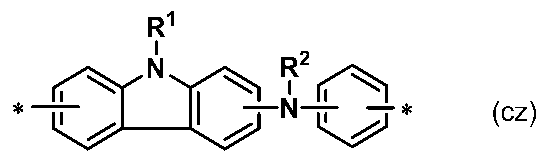
- R 1 and R 2 each independently represent a hydrogen atom or a methyl group, R 3 represents a single bond or a group “* 1-R 4 —Ph- * 2”, R 4 represents a single bond, —O—, -COO -, - OCO -, - (CH 2) l -, - O (CH 2) m O -, - CONH-, and represents a divalent organic group selected from -NHCO- (l, m is 1 Represents an integer of 5 to 5), * 1 represents a site bonded to a benzene ring in formula (pn), * 2 represents a site bonded to an amino group in formula (pn), and Ph represents a phenylene group. .N represents 1 to 3), A diamine having a carbazole structure described in International Publication WO2018 / 110354, preferably a diamine having a structure represented by the following formula (cz).
- X is a biphenyl ring or a fluorene ring
- Y is a benzene ring, a biphenyl ring, or a group selected from -phenyl-Z-phenyl-
- Z is -O-, -NH-, -CH 2 -,-.
- Y 9 is a divalent organic group having —NH—CO—NH— in the molecule
- specific examples of the above formula (12) include the above formula (4), in which A 1 is —NH—CO— NH-, a group in which at least one of -CH 2- of a chain hydrocarbon group having 2 to 20 carbon atoms is replaced with -NH-CO-NH-, or a chain hydrocarbon group having 2 to 20 carbon atoms At least one of —CH 2 — of the group is substituted with —NH—CO—NH—, and at least one of the other —CH 2 — is —O—, —CO—, —CO—O—, —NRCO— (R represents a hydrogen atom or a methyl group), -NRCOO- (R represents a hydrogen atom or a methyl group), -CONR- (R represents a hydrogen atom or a methyl group), -COS-,-.
- Examples thereof include diamine in the case of a group substituted with
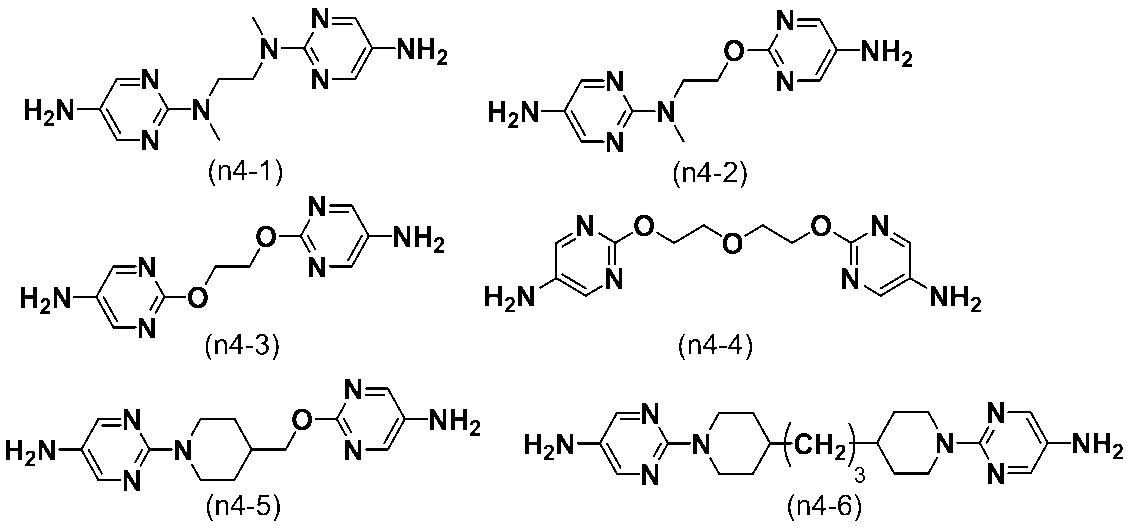
- diamines represented by the above formulas (w1) to (w2) include diamines represented by the following formulas (n3-1) to (n3-7) and the following formulas (n4-1) to (n4).
- Examples include diamines represented by -6).
- a diamine compound having a carboxyl group (COOH group) or a hydroxyl group (OH group) can be used.
- 2,4-diaminophenol, 3,5-diaminophenol, 3,5-diaminobenzyl alcohol, 2,4-diaminobenzyl alcohol, 4,6-diaminoresorcinol, 2,4-diaminobenzoic acid Mention may be made of 2,5-diaminobenzoic acid or 3,5-diaminobenzoic acid. Of these, 2,4-diaminobenzoic acid, 2,5-diaminobenzoic acid and 3,5-diaminobenzoic acid are preferable.
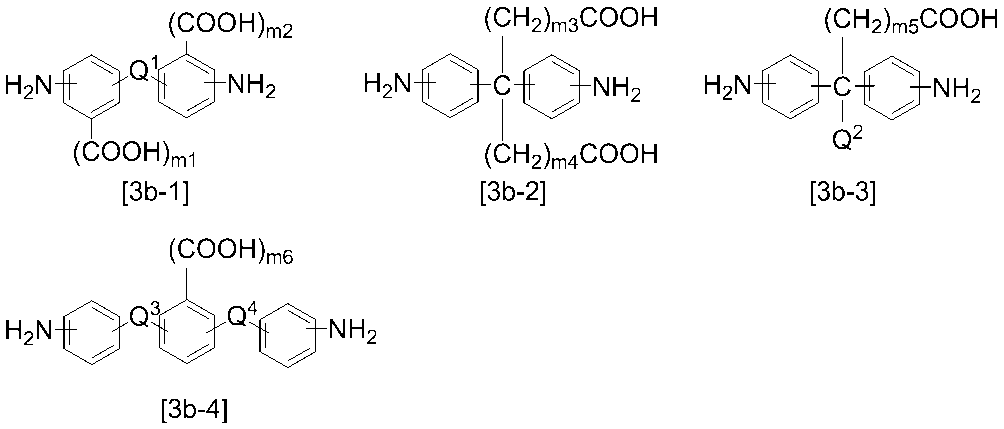
- diamine compounds represented by the following formulas [3b-1] to [3b-4] and diamine compounds in which these amino groups are secondary amino groups can also be used.
- Q 1 is a single bond, —CH 2 —, —C 2 H 4 —, —C (CH 3 ) 2 —, —CF 2 —, —C (CF 3 ) 2 —, —O—, —CO—, —NH—, —N (CH 3 ) —, —CONH—, —NHCO—, —CH 2 O—, —OCH 2 —, —COO—, —OCO—, —CON ( CH 3 )-or N (CH 3 ) CO-, m 1 and m 2 each independently represent an integer of 0 to 4, and m 1 + m 2 represent an integer of 1 to 4, and are represented by the formula [ 3b-2], m 3 and m 4 each independently represent an integer of 1 to 5, and in the formula [3b-3], Q 2 represents a linear or branched alkylene group having 1 to 5 carbon atoms.
- M 5 represents an integer of 1 to 5
- Q 3 and Q 4 are each independently a single bond, —CH 2 —, —C 2 H 4 —, —C (CH 3 ) 2 —, —CF 2 —, —C (CF 3 ) 2 —, —O—, —CO—, —NH—, —N (CH 3 ) —, —CONH—, —NHCO—, —CH 2 O -, - OCH 2 -, - COO -, - OCO -, - CON (CH 3) - or N (CH 3) CO- indicates, m 6 is an integer of 1-4).
- the diamine component for obtaining the second polyamic acid the diamine used in the specific polymer or a known diamine can be used in addition to the above, but the present invention is not limited thereto.
- the diamine component for obtaining the second polyamic acid may be one type of diamine, or may be a combination of two or more types of diamine.
- the molecular weight of the second polymer contained in the liquid crystal aligning agent of the present invention is not particularly limited as long as a uniform and defect-free coating film can be formed on the substrate, and its preferable weight average molecular weight and number average molecular weight are specified. It is the same as in the case of the polymer.
- a dielectric or conductive substance for the purpose of changing the electrical properties such as the dielectric constant and conductivity of the liquid crystal alignment film, and improving the adhesion between the liquid crystal alignment film and the substrate.
- crosslinkable compound examples include an epoxy group, an isocyanate group, an oxetane group, a cyclocarbonate group, a blocked isocyanate group, a crosslinkable compound having a substituent such as a hydroxyl group or an alkoxyl group, and a crosslinkable compound having a polymerizable unsaturated group. It is preferable to add at least one compound selected from the group consisting of: In addition, it is preferable that two or more of these substituents and polymerizable unsaturated bonds are contained in the crosslinkable compound from the viewpoint of enhancing crosslinkability.
- crosslinkable compound examples include compounds having an epoxy group or an isocyanate group described in paragraphs [0169] to [0190] of WO 2011/132775, a compound having an oxetane group, a hydroxyl group, an alkoxyl group or a lower group.
- crosslinkable compound More preferable specific examples of the crosslinkable compound include those represented by the following formulas (CL-1) to (CL-13), Takenate B-830, and B-882 (all of which are manufactured by Mitsui Chemicals, Inc.). ..
- the content of the crosslinkable compound is preferably 0.1 to 100 parts by mass with respect to 100 parts by mass of all the polymer components contained in the liquid crystal aligning agent, and from the viewpoint of enhancing the alignment of the liquid crystal, it is more preferable.
- the amount is preferably 0.1 to 50 parts by mass, more preferably 1 to 50 parts by mass.
- silane coupling agent 3-aminopropyltrimethoxysilane, 3-aminopropyltriethoxysilane, 3-aminopropyldiethoxymethylsilane, 2-aminopropyltrimethoxysilane, 2-aminopropyltriethoxysilane, N -(2-aminoethyl) -3-aminopropyltrimethoxysilane, N- (2-aminoethyl) -3-aminopropylmethyldimethoxysilane, 3-ureidopropyltrimethoxysilane, 3-ureidopropyltriethoxysilane, N -Ethoxycarbonyl-3-aminopropyltrimethoxysilane, N-ethoxycarbonyl-3-aminopropyltriethoxysilane, N-triethoxysilylpropyltriethylenetriamine, N-trimethoxysilylpropyltriethylenetriamine
- the amount is preferably 0.1 to 30 parts by mass with respect to 100 parts by mass of all the polymer components contained in the liquid crystal aligning agent. , And more preferably 1 to 20 parts by mass.
- the concentration of the polymer containing the specific polymer in the liquid crystal aligning agent of the present invention can be appropriately changed by setting the thickness of the coating film to be formed. Above all, it is preferably 1% by mass or more from the viewpoint of forming a uniform and defect-free coating film, and is preferably 10% by mass or less from the viewpoint of storage stability of the solution. A particularly preferable polymer concentration is 2 to 8% by mass.
- the organic solvent contained in the liquid crystal aligning agent of the present invention is not particularly limited as long as the polymer component is uniformly dissolved therein.
- Specific examples thereof include N, N-dimethylformamide, N, N-diethylformamide, N, N-dimethylacetamide, N-methyl-2-pyrrolidone, N-ethyl-2-pyrrolidone, N-methylcaprolactam, Examples thereof include 2-pyrrolidone, N-vinyl-2-pyrrolidone, dimethyl sulfoxide, dimethyl sulfone, ⁇ -butyrolactone, 1,3-dimethyl-imidazolidinone and 3-methoxy-N, N-dimethylpropanamide. You may use these 1 type or in mixture of 2 or more types. Further, even if the solvent alone cannot dissolve the polymer component uniformly, it may be mixed with the above organic solvent as long as the polymer does not precipitate.
- the liquid crystal aligning agent of the present invention may contain, in addition to the organic solvent for dissolving the polymer component, a solvent for improving coating film uniformity when the liquid crystal aligning agent is applied to the substrate.
- a solvent a solvent having a surface tension lower than that of the above organic solvent is generally used. Specific examples thereof include ethyl cellosolve, butyl cellosolve, ethyl carbitol, butyl carbitol, ethyl carbitol acetate, ethylene glycol, 1-methoxy-2-propanol, 1-ethoxy-2-propanol, 1-butoxy-2-propanol.
- 1-phenoxy-2-propanol propylene glycol monoacetate, propylene glycol diacetate, propylene glycol-1-monomethyl ether-2-acetate, propylene glycol-1-monoethyl ether-2-acetate, butyl cellosolve acetate, dipropylene glycol , 2- (2-ethoxypropoxy) propanol, lactate methyl ester, lactate ethyl ester, lactate n-propyl ester, lactate n-butyl ester, lactate isoamyl ester, diacetone alcohol, diisobutyl ketone, dipropylene glycol monomethyl ether, diisobutylcarbi And the like. Two or more of these solvents may be used in combination. Two or more of these solvents may be used in combination. Two or more of these solvents may be used in combination. Two or more of these solvents may be used in combination. Two or more of these solvents may be used in combination. Two or more of
- the method for producing a liquid crystal alignment film using the liquid crystal alignment agent of the present invention includes a step of applying the liquid crystal alignment agent (step (A)) and a step of baking the coating film obtained in the step (A) ( Step (B)), a step of irradiating the film obtained in step (B) with polarized ultraviolet light (step (C)), the film obtained in step (C) is 100 ° C. or higher, and It is characterized in that the step (step (D)) of firing at a temperature higher than that of B) is sequentially performed.
- the substrate to which the liquid crystal aligning agent used in the present invention is applied is not particularly limited as long as it is a highly transparent substrate, and a glass substrate, a silicon nitride substrate, or a plastic substrate such as an acrylic substrate or a polycarbonate substrate may be used. it can. At that time, it is preferable to use a substrate on which an ITO electrode or the like for driving the liquid crystal is formed, from the viewpoint of simplifying the process. Further, in the reflection type liquid crystal display element, an opaque material such as a silicon wafer can be used if only one substrate is used, and in this case, a material that reflects light such as aluminum can be used for the electrode.
- the method for applying the liquid crystal aligning agent is not particularly limited, but industrially, a method such as screen printing, offset printing, flexo printing, or inkjet method is generally used. Other coating methods include a dip method, a roll coater method, a slit coater method, a spinner method or a spray method, and these may be used depending on the purpose.
- the step (B) is a step of baking the liquid crystal aligning agent applied on the substrate to form a film.
- the solvent is evaporated or the amic acid or amic acid ester in the polymer is heated by a heating means such as a hot plate, a heat circulation type oven or an IR (infrared) type oven. Imidization can be performed.
- the drying and firing steps after applying the liquid crystal aligning agent of the present invention can be performed at any temperature and time and may be performed a plurality of times.
- the temperature for removing the organic solvent of the liquid crystal aligning agent can be, for example, in the range of 40 to 150 ° C.
- the firing time is not particularly limited, but examples thereof include 1 to 10 minutes or 1 to 5 minutes.
- a step of baking at a temperature range of 190 to 250 ° C. or 200 to 240 ° C. can be performed after the step of removing the organic solvent. ..
- the firing time is not particularly limited, but may be 5 to 40 minutes, or 5 to 30 minutes.
- Step (C) is a step of irradiating the film obtained in step (B) with polarized ultraviolet light.
- the ultraviolet rays ultraviolet rays having a wavelength of 200 to 400 nm are preferably used, and among them, ultraviolet rays having a wavelength of 200 to 300 nm are more preferable.
- the substrate coated with the liquid crystal alignment film may be irradiated with ultraviolet rays while being heated at 50 to 250 ° C.
- the irradiation dose of the above radiation is preferably 1 to 10,000 mJ / cm 2 . Among them, 100 to 5,000 mJ / cm 2 is preferable.
- the liquid crystal alignment film thus produced can stably align liquid crystal molecules in a certain direction.
- the extinction ratio of linearly polarized ultraviolet light is preferably 10: 1 or more, more preferably 20: 1 or more.
- Step (D) is a step of firing the film obtained in step (C) at a temperature of 100 ° C. or higher and a temperature higher than that of step (B).
- the firing temperature is not particularly limited as long as it is 100 ° C. or higher and higher than the firing temperature in the step (B), but is preferably 150 to 300 ° C., more preferably 150 to 250 ° C., further preferably 200 to 250 ° C. ..
- the firing time is preferably 5 to 120 minutes, more preferably 5 to 60 minutes, and further preferably 5 to 30 minutes. If the thickness of the liquid crystal alignment film after firing is too thin, the reliability of the liquid crystal display element may decrease, so that the thickness is preferably 5 to 300 nm, more preferably 10 to 200 nm.
- the obtained liquid crystal alignment film can be subjected to a contact treatment using water or a solvent.
- the solvent used in the above contact treatment is not particularly limited as long as it is a solvent that dissolves the decomposition product generated from the liquid crystal alignment film by irradiation with ultraviolet rays.
- Specific examples include water, methanol, ethanol, 2-propanol, acetone, methyl ethyl ketone, 1-methoxy-2-propanol, 1-methoxy-2-propanol acetate, butyl cellosolve, ethyl lactate, methyl lactate, diacetone alcohol, 3- Examples thereof include methyl methoxypropionate, ethyl 3-ethoxypropionate, propyl acetate, butyl acetate or cyclohexyl acetate.
- water, 2-propanol, 1-methoxy-2-propanol or ethyl lactate is preferable from the viewpoint of versatility and solvent safety. More preferred is water, 1-methoxy-2-propanol or ethyl lactate.
- the solvent may be one kind or a combination of two or more kinds.
- immersion treatment or spray treatment also referred to as spray treatment
- the treatment time in these treatments is preferably 10 seconds to 1 hour from the viewpoint of efficiently dissolving the decomposition product generated from the liquid crystal alignment film by ultraviolet rays. Above all, it is preferable to perform the immersion treatment for 1 to 30 minutes.
- the solvent used in the contact treatment may be heated at room temperature or heated, but is preferably 10 to 80 ° C. Above all, 20 to 50 ° C. is preferable.
- ultrasonic treatment may be performed as necessary.
- rinsing also referred to as rinsing
- a low boiling point solvent such as water, methanol, ethanol, 2-propanol, acetone or methyl ethyl ketone
- baking either one of rinsing and baking may be performed, or both may be performed.
- the firing temperature is preferably 150 to 300 ° C. Of these, 180 to 250 ° C. is preferable. More preferably, it is 200 to 230 ° C.
- the firing time is preferably 10 seconds to 30 minutes. Of these, 1 to 10 minutes is preferable.
- the liquid crystal alignment film of the present invention is suitable as a liquid crystal alignment film of a lateral electric field type liquid crystal display device such as an IPS system or an FFS system, and particularly useful as a liquid crystal alignment film of an FFS system liquid crystal display device.
- the liquid crystal display device is obtained by obtaining a substrate with a liquid crystal alignment film obtained from the liquid crystal aligning agent of the present invention, producing a liquid crystal cell by a known method, and using the liquid crystal cell.
- a liquid crystal display element having a passive matrix structure will be described as an example.
- a liquid crystal display element having an active matrix structure in which a switching element such as a TFT (Thin Film Transistor) is provided in each pixel portion that constitutes image display may be used.
- TFT Thin Film Transistor
- a transparent glass substrate is prepared, a common electrode is provided on one substrate, and a segment electrode is provided on the other substrate.
- These electrodes can be, for example, ITO electrodes and are patterned so that a desired image can be displayed.
- an insulating film is provided on each substrate so as to cover the common electrodes and the segment electrodes.
- the insulating film can be, for example, a SiO 2 —TiO 2 film formed by a sol-gel method.
- a liquid crystal alignment film is formed on each substrate, one substrate is overlaid with the other substrate so that their liquid crystal alignment film surfaces face each other, and the periphery is bonded with a sealant.
- a spacer is usually mixed in the sealant in order to control the substrate gap, and spacers for controlling the substrate gap are also scattered on the in-plane portion where the sealant is not provided.
- An opening that can be filled with liquid crystal from the outside is provided in part of the sealant.
- a liquid crystal material is injected into the space surrounded by the two substrates and the sealing agent through the opening provided in the sealing agent, and then the opening is sealed with an adhesive.
- a vacuum injection method may be used, or a method utilizing a capillary phenomenon in the atmosphere may be used.
- the liquid crystal material either a positive type liquid crystal material or a negative type liquid crystal material may be used.
- a polarizing plate is installed. Specifically, a pair of polarizing plates are attached to the surfaces of the two substrates opposite to the liquid crystal layer.
- the manufacturing method of the present invention it is possible to suppress the afterimage caused by the long-term AC driving that occurs in the liquid crystal display element of the IPS driving method or the FFS driving method, and the brightness generated by the residual low molecular weight compound is generated. It is possible to obtain a liquid crystal alignment film which is free from problems such as points and which can be manufactured by a smaller number of steps than conventional ones.
- CA-X-1 a compound represented by the following formula (CA-X-1) (Compound C)
- c-1 compound represented by the following formula (c-1) (other additives)
- LS-4668 3-glycidoxypropyltriethoxysilane (compound represented by the following (s-1))
- NMP N-methyl-2-pyrrolidone
- GBL ⁇ -butyrolactone
- BCS butyl cellosolve
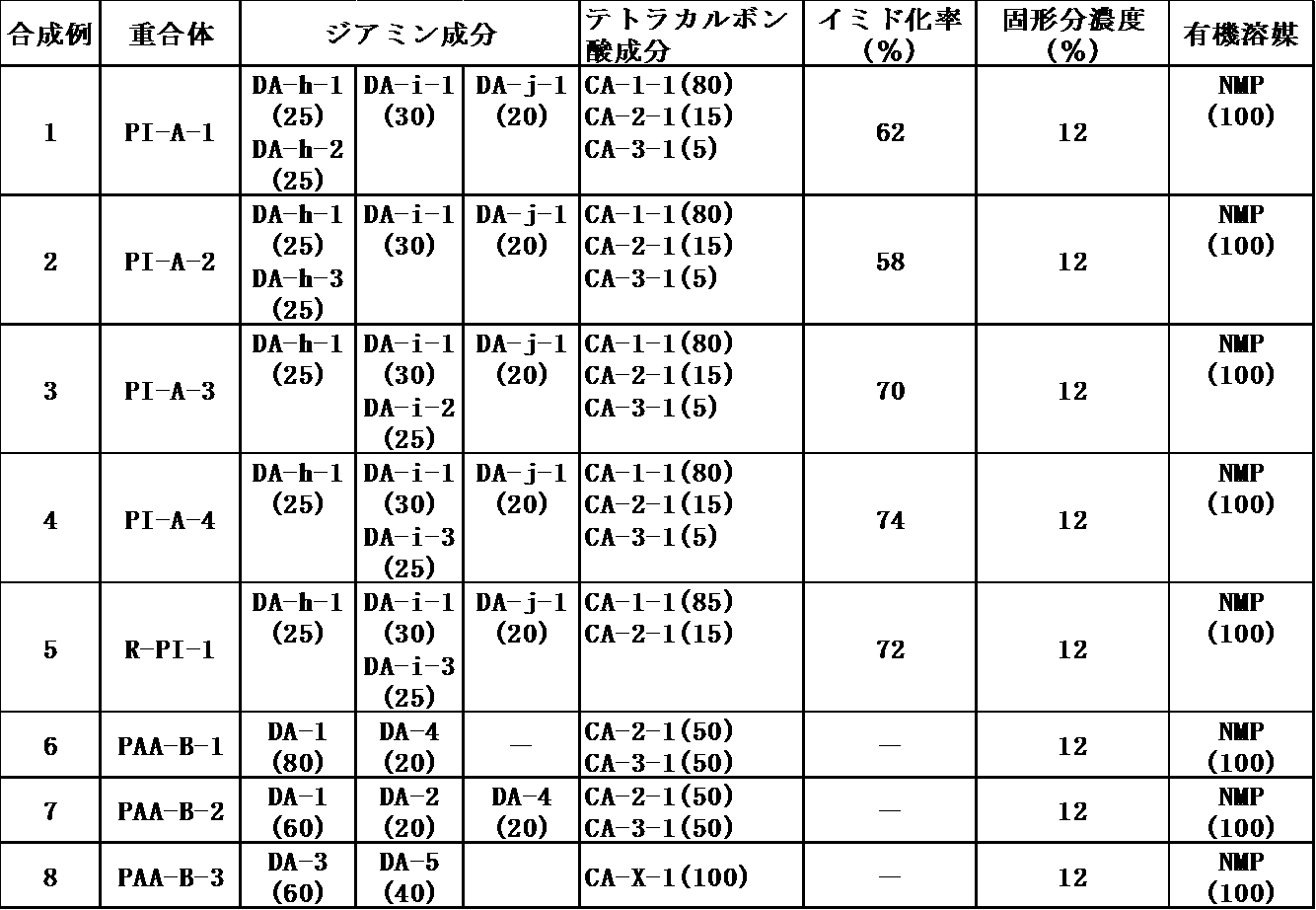
- the imidization ratio is determined by using a proton derived from a structure that does not change before and after imidization as a reference proton, and the integrated peak value of this proton and the proton peak derived from the NH group of amic acid that appears near 9.5 ppm to 10.0 ppm. It calculated
- Imidization rate (%) (1- ⁇ ⁇ x / y) ⁇ 100
- x is the proton peak integrated value derived from the NH group of amic acid
- y is the peak integrated value of the reference proton
- ⁇ is the NH of the amic acid in the case of polyamic acid (imidization ratio is 0%). It is the ratio of the number of reference protons to one base proton.
- the values in parentheses represent the compounding ratio (mol part) of each compound to 100 mol parts of the total amount of the tetracarboxylic acid components used in the synthesis for the tetracarboxylic acid component, and for the diamine acid component, The compounding ratio (mol part) of each compound to 100 mol parts of the total amount of diamine components used in the synthesis is shown.
- the organic solvent the compounding ratio (parts by mass) of each organic solvent to the total amount of 100 parts by mass of the organic solvent used in the synthesis is shown.
- a solvent composition ratio of NMP: GBL: BCS 50: 30: 20 (mass ratio), and a liquid crystal aligning agent (1) having a polymer solid content concentration of 6 mass% were obtained (see Table 2 below). No abnormalities such as turbidity and precipitation were observed in this liquid crystal aligning agent, and it was confirmed that the liquid crystal aligning agent was a uniform solution.
- the numerical values in parentheses are the blending ratio of each polymer component or compound (C) with respect to the polymer and the compound (C) with respect to 100 parts by mass in total of the polymer components used for the preparation of the liquid crystal aligning agent ( Mass part).
- the organic solvent the compounding ratio (parts by mass) of each organic solvent to 100 parts by mass of the total amount of the organic solvent used for preparing the liquid crystal aligning agent is shown.
- a liquid crystal cell having the configuration of the FFS mode liquid crystal display element is manufactured.
- a substrate with electrodes was prepared.
- the substrate is a glass substrate having a size of 30 mm ⁇ 50 mm and a thickness of 0.7 mm.
- a SiN (silicon nitride) film formed by the CVD method is formed as a second layer on the counter electrode of the first layer.
- the film thickness of the second-layer SiN film is 500 nm and functions as an interlayer insulating film.
- a comb-teeth-shaped pixel electrode formed by patterning an ITO film as a third layer is arranged on the second-layer SiN film to form two pixels of a first pixel and a second pixel. ing.
- the size of each pixel is 10 mm in length and about 5 mm in width.
- the first-layer counter electrode and the third-layer pixel electrode are electrically insulated by the action of the second-layer SiN film.
- the pixel electrode of the third layer has a comb-tooth shape formed by arranging a plurality of "dogleg” -shaped electrode elements whose central portion is bent at an internal angle of 160 °.
- the width of each electrode element in the lateral direction is 3 ⁇ m, and the distance between the electrode elements is 6 ⁇ m.
- the pixel electrode that forms each pixel is configured by arranging a plurality of curved "dogleg" -shaped electrode elements in the central portion, so the shape of each pixel is not rectangular, but is similar to that of the electrode element. It has a shape that resembles a bold "dogleg" bent at a part.
- Each pixel is divided into upper and lower parts with a central bent portion as a boundary, and has a first region on the upper side and a second region on the lower side of the bent portion.
- a liquid crystal aligning agent was applied to the above-mentioned substrate with electrodes and a glass substrate having a columnar spacer having a height of 4 ⁇ m and having an ITO film formed on the back surface by spin coating. After drying on a hot plate at 80 ° C for 2 minutes, this coating film surface was irradiated with linearly polarized ultraviolet light of wavelength 254 nm with an extinction ratio of 26: 1 through a polarizing plate, and then a hot air circulation oven at 230 ° C. And was baked for 30 minutes to obtain a substrate with a liquid crystal alignment film having a film thickness of 100 nm.
- the liquid crystal alignment film formed on the electrode-attached substrate is a liquid crystal alignment film formed on the second glass substrate by performing alignment processing so that the direction that equally divides the interior angle of the pixel bend portion and the liquid crystal alignment direction are orthogonal to each other.
- the obtained two substrates with a liquid crystal alignment film are set as one set, the sealant is printed on the substrate with the liquid crystal injection port left, and the other substrate is bonded so that the liquid crystal alignment film surfaces face each other. It was Then, the sealant was cured to prepare an empty cell having a cell gap of 4 ⁇ m.
- Liquid crystal MLC-3019 (manufactured by Merck & Co., Inc.) was injected into the empty cell by a reduced pressure injection method, and the injection port was sealed to obtain an FFS type liquid crystal display element. Then, the obtained liquid crystal display element was heated at 120 ° C. for 1 hour and left at 23 ° C. overnight, and then used for evaluation. ..
- a liquid crystal display element is installed between two polarizing plates arranged so that their polarization axes are orthogonal to each other, a backlight is turned on, and the liquid crystal is adjusted so that the transmitted light intensity in the first region of the pixel is minimized.
- the cell arrangement angle was adjusted, and then the rotation angle (hereinafter referred to as ⁇ ac ) required when the liquid crystal cell was rotated so that the transmitted light intensity in the second region of the pixel was minimized was obtained.
- ⁇ ac the rotation angle required when the liquid crystal cell was rotated so that the transmitted light intensity in the second region of the pixel was minimized was obtained.
- E max and E min are 300 mJ / cm 2 or more.
- Good The difference between E max and E min is 200 mJ / cm 2 or more and less than 300 mJ / cm 2 .
- Poor The difference between E max and E min is less than 200 mJ / cm 2 .
- the liquid crystal alignment films obtained from the liquid crystal alignment agents (1) to (7) used in Examples 1 to 7 of the present invention were irradiated with light of 150 to 350 mJ / cm 2 or 150 to 450 mJ / cm 2 .
- ⁇ ac was less than 0.15 °
- good afterimage characteristics were exhibited.
- the liquid crystal aligning agents (R1) and (R2) used in Comparative Examples 1 and 2 have a good afterimage of ⁇ ac of less than 0.15 ° when irradiated with a light irradiation amount of 150 to 250 mJ / cm 2.
- the liquid crystal aligning agent of the present invention makes it possible to expand the light irradiation amount margin and obtain a liquid crystal aligning film having good afterimage characteristics. Therefore, the liquid crystal alignment film obtained from the liquid crystal aligning agent of the present invention has a high yield in liquid crystal panel production, and can reduce the afterimage caused by AC drive generated in the liquid crystal display device of the IPS drive system or the FFS drive system. A liquid crystal display device of an IPS drive system or an FFS drive system having excellent afterimage characteristics can be obtained.
- the liquid crystal aligning agent of the present invention is useful for forming a liquid crystal aligning film in a wide variety of liquid crystal display devices such as an IPS driving system and an FFS driving system.
- liquid crystal display devices such as an IPS driving system and an FFS driving system.
- the entire contents of the specification, claims, drawings, and abstract of Japanese Patent Application No. 2018-216789 filed on Nov. 19, 2018 are cited herein as disclosure of the specification of the present invention. , Take in.
Landscapes
- Physics & Mathematics (AREA)
- Chemical & Material Sciences (AREA)
- Nonlinear Science (AREA)
- Crystallography & Structural Chemistry (AREA)
- Organic Chemistry (AREA)
- Mathematical Physics (AREA)
- General Physics & Mathematics (AREA)
- Optics & Photonics (AREA)
- Polymers & Plastics (AREA)
- Chemical Kinetics & Catalysis (AREA)
- Medicinal Chemistry (AREA)
- Health & Medical Sciences (AREA)
- Spectroscopy & Molecular Physics (AREA)
- Geometry (AREA)
- Engineering & Computer Science (AREA)
- Materials Engineering (AREA)
- Liquid Crystal (AREA)
- Macromolecular Compounds Obtained By Forming Nitrogen-Containing Linkages In General (AREA)
Abstract
Description
現在、工業的に最も普及している液晶配向膜は、電極基板上に形成されたポリアミック酸及び/又はこれをイミド化したポリイミドからなる膜の表面を、綿、ナイロン、ポリエステル等の布で一方向に擦る、いわゆるラビング処理を行うことで作製されている。
ラビング処理は、簡便で生産性に優れた工業的に有用な方法である。しかし、液晶表示素子の高性能化、高精細化、大型化に伴い、ラビング処理で発生する配向膜の表面の傷、発塵、機械的な力や静電気による影響、更には、配向処理面内の不均一性などの種々の問題が明らかとなっている。
上記のような光配向法は、ラビングレス配向処理方法として、工業的にも簡便な製造プロセスで生産できるだけでなく、IPS駆動方式やFFS(フリンジフィールドスイッチング)駆動方式の液晶表示素子においては、ラビング処理法で得られる液晶配向膜に比べて、液晶表示素子のコントラストや視野角特性の向上が期待できるため、有望な液晶配向処理方法として注目されている。
しかしながら、光配向法により得られる液晶配向膜は、ラビングによるものに比べて、高分子膜の配向方向に対する異方性が小さいという問題がある。異方性が小さいと充分な液晶配向性が得られず、液晶表示素子とした場合に、残像などの問題が発生する。これに対して、特許文献2では、光配向法により得られる液晶配向膜の異方性を高める方法として、光照射後に、光照射によって前記ポリイミドの主鎖が切断されて生成した低分子量成分を除去することが提案されている。
そして、特に、寸法の大きなパネルを光配向法により処理する場合には、光照射量を均一に制御した光配向照射を行うことが困難になり、結果的に安定な光配向法による配向処理が困難になることを知見した。
下記式(1)で表されるテトラカルボン酸二無水物若しくはその誘導体と下記式(2)で表されるテトラカルボン酸二無水物若しくはその誘導体と下記式(6)で表される芳香族テトラカルボン酸二無水物とを含有するテトラカルボン酸成分と、ジアミン成分と、の重合反応により得られるポリイミド前駆体のイミド化物であるポリイミドを含有することを特徴とする液晶配向剤。
本発明に用いられる特定重合体は、特定構造を有するポリイミド前駆体のイミド化物であるポリイミドである。ポリイミド前駆体としては、ポリアミック酸、ポリアミック酸エステルなどの加熱、又は触媒による化学イミド化によって、イミド環を形成するポリイミド前駆体であれば、特に限定されない。加熱、又は化学イミド化が進行しやすいという観点から、ポリイミド前駆体としては、ポリアミック酸、又はポリアミック酸エステルがより好ましい。
ポリイミドのイミド化率は、特に限定されないが、10~100%が好ましく、50~100%がより好ましく、50~80%が更に好ましい。
以下、上記特定重合体をなす原料となる各成分について説明する。
本発明の特定重合体の重合に用いられるテトラカルボン酸成分は、テトラカルボン酸二無水物だけでなく、その誘導体である、テトラカルボン酸、テトラカルボン酸ジハライド、テトラカルボン酸ジアルキルエステル又はテトラカルボン酸ジアルキルエステルジハライド用いることもできる。






本発明の特定重合体の製造に用いられるジアミン成分は、公知のジアミンであれば特に限定されない。長期交流駆動による残像の抑制の観点から、下記式(3)、下記式(4)及び下記式(5)から選ばれる少なくとも1種類のジアミンを含有することが好ましい。


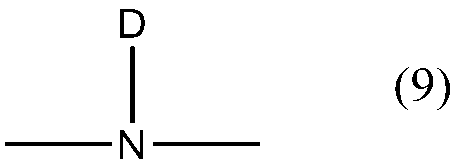

Q6、Q7はそれぞれ独立して-H、-NHD、-N(D)2、-NHDを有する基、又は-N(D)2を有する基を表す。Q8は-NHD、-N(D)2、-NHDを有する基、又は-N(D)2を有する基を表す。Dはt-ブトキシカルボニル基を表す。但し、Q5、Q6及びQ7の少なくとも一つは基中に、t-ブトキシカルボニル基(Boc)を有する。より好ましくは、下記式(J-1-a)~(J-1-d)、又は(J-2-1)で表される2価の有機基である。


Y8は2価の有機基であり、WO2018/117239号パンフレットに記載の式(Y-1)~(Y-167)のいずれかで表される基等が挙げられる。
本発明に用いられるポリイミド前駆体であるポリアミック酸エステル、ポリアミック酸及びポリイミドは、例えば、国際公開公報WO2013/157586に記載されるような公知の方法で合成できる。
本発明の液晶配向剤は、特定重合体などの重合体成分が有機溶媒中に溶解された溶液の形態を有する。特定重合体の分子量は、重量平均分子量で2,000~500,000が好ましく、より好ましくは5,000~300,000であり、更に好ましくは、10,000~100,000である。また、数平均分子量は、好ましくは、1,000~250,000であり、より好ましくは、2,500~150,000であり、更に好ましくは、5,000~50,000である。
特に、テトラカルボン酸二無水物成分とジアミン成分とから得られるポリアミック酸(以下、第2のポリアミック酸とも言う)は第2の重合体として好ましい。


国際公開公報WO2018/062197に記載のピロール構造を有するジアミン、好ましくは下式(pn)で表される構造を有するジアミン。

国際公開公報WO2018/110354に記載のカルバゾール構造を有するジアミン、好ましくは下式(cz)で表される構造を有するジアミン。
国際公開公報WO2015/046374の段落[0173]~[0188]に記載の窒素含有複素環を有するジアミンや特開2016-218149号公報の段落[0050]に記載の窒素含有構造を有するジアミン、下記式(BP)で表されるジアミン。



なお、これらの置換基や、重合性不飽和結合は、架橋性化合物中に2個以上有することが架橋性を高める観点から好ましい。架橋性化合物の具体例としては、国際公開公報2011/132751号の段落[0169]~[0190]に記載のエポキシ基又はイソシアネート基を有する化合物、オキセタン基を有する化合物、ヒドロキシル基、アルコキシル基又は低級アルコキシアルキル基を有するアミノ樹脂、ヒドロキシル基又はアルコキシル基を有するベンゼン又はフェノール性化合物、国際公開公報2012/014898号の段落[0103]~[0112]に記載のシクロカーボネート基を有する化合物、国際公開公報2015/072554号に記載のヒドロキシアルキルアミド基を有する化合物、国際公開公報2015/141598に記載のブロックイソシアネート基を有する化合物などが挙げられる。

本発明の液晶配向剤を用いた液晶配向膜の製造方法は、上記のように、液晶配向剤を塗布する工程(工程(A))、工程(A)で得られる塗膜を焼成する工程(工程(B))、工程(B)で得られた膜に偏光された紫外線を照射する工程(工程(C))、工程(C)で得られた膜を、100℃以上、且つ、工程(B)よりも高い温度で焼成する工程(工程(D))を順次行うことを特徴とする。
本発明に用いられる液晶配向剤を塗布する基板としては、透明性の高い基板であれば特に限定されず、ガラス基板、窒化珪素基板とともに、アクリル基板、ポリカーボネート基板などのプラスチック基板等を用いることもできる。その際、液晶を駆動させるためのITO電極などが形成された基板を用いると、プロセスの簡素化の点から好ましい。また、反射型の液晶表示素子では、片側の基板のみにならばシリコンウエハーなどの不透明な物でも使用でき、この場合の電極にはアルミニウムなどの光を反射する材料も使用できる。
液晶配向剤の塗布方法は、特に限定されないが、工業的には、スクリーン印刷、オフセット印刷、フレキソ印刷又はインクジェット法などで行う方法が一般的である。その他の塗布方法としては、ディップ法、ロールコータ法、スリットコータ法、スピンナー法又はスプレー法などがあり、目的に応じてこれらを用いてもよい。
工程(B)は、基板上に塗布した液晶配向剤を焼成し、膜を形成する工程である。液晶配向剤を基板上に塗布した後は、ホットプレート、熱循環型オーブン又はIR(赤外線)型オーブンなどの加熱手段により、溶媒を蒸発させたり、重合体中のアミック酸又はアミック酸エステルの熱イミド化を行うことができる。本発明の液晶配向剤を塗布した後の乾燥、焼成工程は、任意の温度と時間を選択することができ、複数回行ってもよい。液晶配向剤の有機溶媒を除去する温度としては、例えば40~150℃の範囲で行うことができる。プロセスを短縮する観点で、40~120℃で行ってもよい。焼成時間としては特に限定されないが、1~10分又は、1~5分の焼成時間が挙げられる。重合体中のアミック酸又はアミック酸エステルの熱イミド化を行う場合には、上記有機溶媒を除去する工程の後、例えば190~250℃、又は200~240℃の温度範囲で焼成する工程ができる。焼成時間としては特に限定されないが、5~40分、又は、5~30分の焼成時間が挙げられる。
工程(C)は、工程(B)で得られた膜に偏光された紫外線を照射する工程である。紫外線としては、200~400nmの波長を有する紫外線を用いることが好ましく、なかでも、好ましくは200~300nmの波長を有する紫外線がより好ましい。液晶配向性を改善するために、液晶配向膜が塗膜された基板を50~250℃で加熱しながら、紫外線を照射してもよい。また、上記放射線の照射量は、1~10,000mJ/cm2が好ましい。なかでも、100~5,000mJ/cm2が好ましい。このようにして作製した液晶配向膜は、液晶分子を一定の方向に安定して配向させることができる。
偏光された紫外線の消光比が高いほど、より高い異方性が付与できるため、好ましい。具体的には、直線に偏光された紫外線の消光比は、10:1以上が好ましく、20:1以上がより好ましい。
工程(D)は、工程(C)で得られた膜を、100℃以上、且つ、工程(B)よりも高い温度で焼成する工程である。焼成温度は、100℃以上、且つ、工程(B)での焼成温度よりも高ければ、特に限定されないが、150~300℃が好ましく、150~250℃がより好ましく、200~250℃が更に好ましい。焼成時間は、5~120分が好ましく、より好ましくは5~60分、更に好ましくは、5~30分である。
焼成後の液晶配向膜の厚みは、薄すぎると液晶表示素子の信頼性が低下する場合があるので、5~300nmが好ましく、10~200nmがより好ましい。
上記接触処理に使用する溶媒としては、紫外線の照射によって液晶配向膜から生成した分解物を溶解する溶媒であれば、特に限定されるものではない。具体例としては、水、メタノール、エタノール、2-プロパノール、アセトン、メチルエチルケトン、1-メトキシ-2-プロパノール、1-メトキシ-2-プロパノールアセテート、ブチルセロソルブ、乳酸エチル、乳酸メチル、ジアセトンアルコール、3-メトキシプロピオン酸メチル、3-エトキシプロピオン酸エチル、酢酸プロピル、酢酸ブチル又は酢酸シクロヘキシルなどが挙げられる。なかでも、汎用性や溶媒の安全性の点から、水、2-プロパノール、1-メトキシ-2-プロパノール又は乳酸エチルが好ましい。より好ましいのは、水、1-メトキシ-2-プロパノール又は乳酸エチルである。溶媒は、1種類でも、2種類以上組み合わせてもよい。
液晶セルの作製方法の一例として、パッシブマトリクス構造の液晶表示素子を例にとり説明する。なお、画像表示を構成する各画素部分にTFT(Thin Film Transistor)などのスイッチング素子が設けられたアクティブマトリクス構造の液晶表示素子であってもよい。
次に、各基板の上に液晶配向膜を形成し、一方の基板に他方の基板を互いの液晶配向膜面が対向するようにして重ね合わせ、周辺をシール剤で接着する。シール剤には、基板間隙を制御するために、通常、スペーサーを混入しておき、また、シール剤を設けない面内部分にも、基板間隙制御用のスペーサーを散布しておくことが好ましい。シール剤の一部には、外部から液晶を充填可能な開口部を設けておく。次いで、シール剤に設けた開口部を通じて、2枚の基板とシール剤で包囲された空間内に液晶材料を注入し、その後、この開口部を接着剤で封止する。注入には、真空注入法を用いてもよいし、大気中で毛細管現象を利用した方法を用いてもよい。液晶材料は、ポジ型液晶材料やネガ型液晶材料のいずれを用いてもよい。次に、偏光板の設置を行う。具体的には、2枚の基板の液晶層とは反対側の面に一対の偏光板を貼り付ける。
(ジアミン)
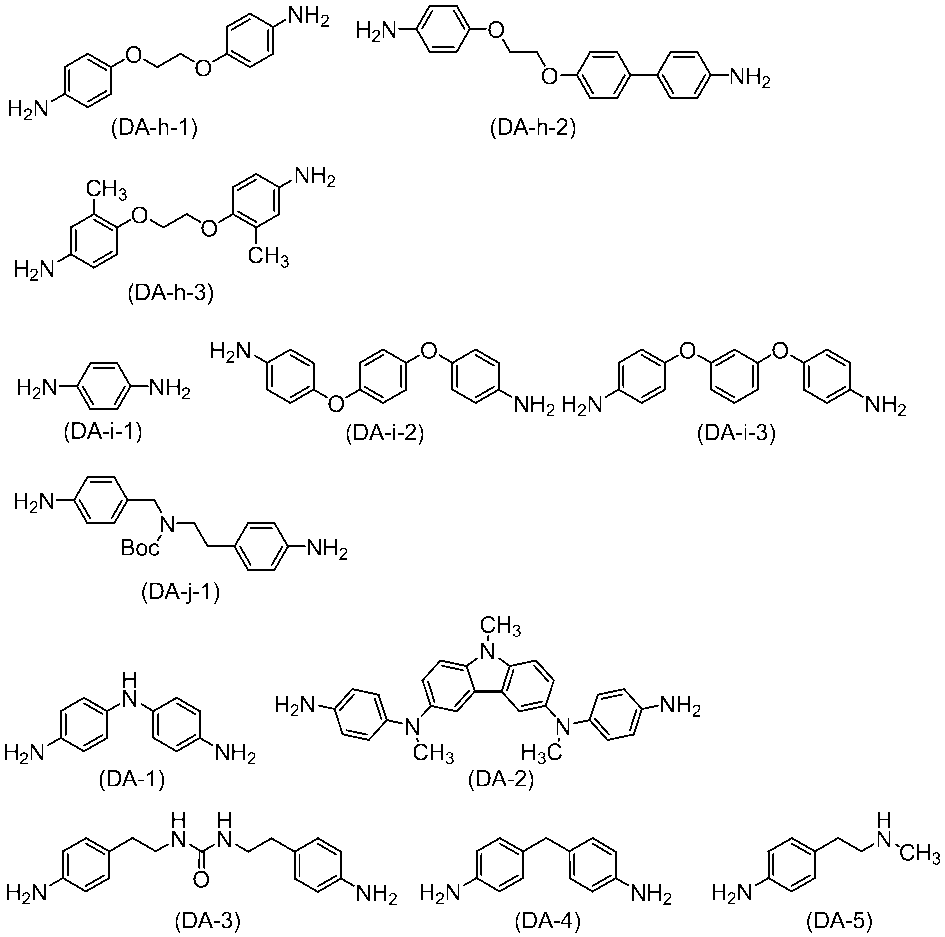
CA-X-1:下記式(CA-X-1)で表される化合物

c-1:下記式(c-1)で表される化合物
(その他の添加剤)
LS-4668:3-グリシドキシプロピルトリエトキシシラン(下記(s-1)で表される化合物)

NMP:N-メチル-2-ピロリドン、 GBL:γ-ブチロラクトン、
BCS:ブチルセロソルブ、
ポリイミド粉末20mgをNMRサンプル管(NMRサンプリングチューブスタンダード,φ5(草野科学社製))に入れ、重水素化ジメチルスルホキシド(DMSO-d6,0.05%TMS(テトラメチルシラン)混合品)0.53mlを添加し、超音波をかけて完全に溶解させた。この溶液をNMR測定機(JNW-ECA500、日本電子データム社製)を使用して500MHzのプロトンNMRを測定した。イミド化率は、イミド化前後で変化しない構造に由来するプロトンを基準プロトンとして決め、このプロトンのピーク積算値と、9.5ppm~10.0ppm付近に現れるアミド酸のNH基に由来するプロトンピーク積算値とを用いて以下の式によって求めた。
イミド化率(%)=(1-α・x/y)×100
上記式において、xはアミド酸のNH基由来のプロトンピーク積算値であり、yは基準プロトンのピーク積算値であり、αはポリアミド酸(イミド化率が0%)の場合におけるアミド酸のNH基プロトン1個に対する基準プロトンの個数割合である。
<合成例1>
撹拌装置付き及び窒素導入管付きの四つ口フラスコに、DA-h-1を3.62g(14.8mmol)、DA-h-2を4.75g(14.8mmol)、DA-i-1を1.92g(17.8mmol)、及びDA-j-1を4.05g(11.9mmol)を秤取し、NMPを固形分濃度が12質量%になるように加えて、窒素を送りながら撹拌し溶解させた。得られた溶液を撹拌しながらCA-1-1を10.1g(45.2mmol)、CA-2-1を2.12g(8.5mmol)、及びCA-3-1を0.83g(2.8mmol)添加し、更に固形分濃度が15質量%になるようにNMPを加えた。次いで、40℃で24時間撹拌してポリアミック酸溶液を得た。
下記表1に示す、ジアミン成分、テトラカルボン酸成分、及び有機溶媒を使用し、それぞれ、合成例1と同様の手順で実施することにより、下記表1に示すポリイミド(PI-A-2)~(PI-A-4)、(R-PI-1)及びポリアミック酸(PAA-B-1)~(PAA-B-3)の溶液を得た。尚、ポリアミック酸(PAA-B-1)~(PAA-B-3)についてはLS-4668をポリアミック酸固形分に対して1質量%となるように添加した。
<実施例1>
合成例1で得られたポリイミド(PI-A-1)の溶液を、NMP及びBCSにより希釈し、室温で攪拌した。次いで、この得られた溶液を孔径0.5μmのフィルターでろ過することにより、溶媒組成比(NMP:BCS=80:20(質量比))、重合体固形分濃度が6質量%となる液晶配向剤(1)を得た(下記の表2参照)。この液晶配向剤に、濁りや析出などの異常は見られず、均一な溶液であることが確認された。
下記表2に示す、それぞれの重合体を使用した以外は、実施例1と同様に実施することにより、液晶配向剤(2)~(4)及び(R1)を得た。
合成例2で得られたポリイミド(PI-A-2)の溶液及び合成例6で得られたポリアミック酸(PAA-B-1)の溶液を用いて、NMP、GBL、及びBCSにより希釈し、更に化合物(c-1)を全ての重合体100質量部に対して3質量部となるように添加し室温で攪拌した。次いで、得られた溶液を孔径0.5μmのフィルターでろ過することにより、重合体の成分比率が(PI-A-2):(PAA-B-1)=40:60(固形分換算質量比)、溶媒組成比がNMP:GBL:BCS=50:30:20(質量比)、重合体固形分濃度が6質量%となる液晶配向剤(1)を得た(下記の表2参照)。この液晶配向剤に、濁りや析出などの異常は見られず、均一な溶液であることが確認された。

FFSモード液晶表示素子の構成を備えた液晶セルを作製する。
始めに、電極付きの基板を準備した。基板は、30mm×50mmの大きさで、厚さが0.7mmのガラス基板である。基板上には第1層目として対向電極を構成する、ベタ状のパターンを備えたITO電極が形成されている。第1層目の対向電極の上には第2層目として、CVD法により成膜されたSiN(窒化珪素)膜が形成されている。第2層目のSiN膜の膜厚は500nmであり、層間絶縁膜として機能する。第2層目のSiN膜の上には、第3層目としてITO膜をパターニングして形成された櫛歯状の画素電極が配置され、第1画素及び第2画素の2つの画素を形成している。各画素のサイズは、縦10mmで横約5mmである。このとき、第1層目の対向電極と第3層目の画素電極とは、第2層目のSiN膜の作用により電気的に絶縁されている。
・照射量マージンの評価
上記で得られた液晶表示素子を60℃の恒温環境下、周波数60Hzで±5Vの交流電圧を120時間印加した。その後、液晶表示素子の画素電極と対向電極との間をショートさせた状態にし、そのまま室温に一日放置した。
上記の処理を行った液晶表示素子について、電圧無印加状態における、画素の第1領域の液晶の配向方向と第2領域の液晶の配向方向とのずれを角度として算出した。
具体的には、偏光軸が直交するように配置された2枚の偏光板の間に液晶表示素子を設置し、バックライトを点灯させ、画素の第1領域の透過光強度が最も小さくなるように液晶セルの配置角度を調整し、次に画素の第2領域の透過光強度が最も小さくなるように液晶セルを回転させたときに要する回転角度(以下、Δacと称する)を求めた。
このΔacが0.15°未満となる最も低い光照射量Emin(mJ/cm2)と、最も高い光照射量Emax(mJ/cm2)を用いて、以下の3段階の指標で評価を行った。評価結果を下記の表3に示す。
良:EmaxとEminとの差が、200mJ/cm2以上、300mJ/cm2未満である。
不良:EmaxとEminとの差が、200mJ/cm2未満である。

なお、2018年11月19日に出願された日本特許出願2018-216789号の明細書、特許請求の範囲、図面、及び要約書の全内容をここに引用し、本発明の明細書の開示として、取り入れるものである。
Claims (15)
- 下記式(1)で表されるテトラカルボン酸二無水物若しくはその誘導体と下記式(2)で表されるテトラカルボン酸二無水物若しくはその誘導体と下記式(6)で表される芳香族テトラカルボン酸二無水物とを含有するテトラカルボン酸成分と、ジアミン成分と、の重合反応により得られるポリイミド前駆体のイミド化物であるポリイミドを含有することを特徴とする液晶配向剤。


- 前記ポリイミドのイミド化率が10~100%である請求項1に記載の液晶配向剤。
- 前記テトラカルボン酸成分が、前記式(2)で表されるテトラカルボン酸二無水物又はその誘導体を、前記テトラカルボン酸成分に対して1~30モル%含有する請求項1又は2に記載の液晶配向剤。
- 前記テトラカルボン酸成分が、前記式(6)で表されるテトラカルボン酸二無水物又はその誘導体を、前記テトラカルボン酸成分に対して1~20モル%含有する請求項1又は2に記載の液晶配向剤。
- 前記式(1)において、X1が、下記式(X1-12)~(X1-16)のいずれかで表される構造から選ばれる少なくとも1種である請求項1~4に記載の液晶配向剤。
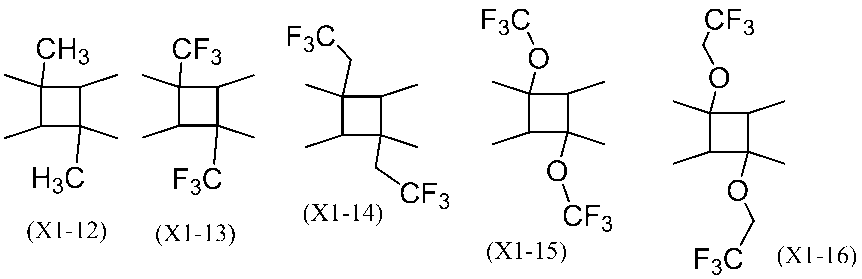
- 前記式(1)におけるX1が、前記式(X1-12)~(X1-16)のいずれかで表される構造から選ばれる少なくとも1種である請求項1~4に記載の液晶配向剤。
- 前記式(2)において、X2が前記式(X2-1)で表される構造である請求項1~6に記載の液晶配向剤。
- 前記ジアミン成分が、下記式(3)、下記式(4)及び下記式(5)のいずれかで表される構造から選ばれる少なくとも1種のジアミンを含有する請求項1~7に記載の液晶配向剤。
- 前記ジアミン成分が、下記式(DA-3-1)、(DA-4-1)~(DA-4-24)、(DA-5-1)~(DA-5-3)よりなる群から選ばれる少なくとも1種のジアミンを含有する請求項1~8に記載の液晶配向剤。


- 下記(A)、(B)、(C)、及び(D)の工程を有する液晶配向膜の製造方法。
工程(A):請求項1~9のいずれかに記載の液晶配向剤を塗布する工程
工程(B):工程(A)で得られる塗膜を焼成する工程
工程(C):工程(B)で得られた膜に偏光された紫外線を照射する工程
工程(D):工程(C)で得られた膜を、100℃以上、且つ、工程(B)よりも高い温度で焼成する工程。 - 前記工程(B)において、50℃~150℃で焼成する請求項10に記載の液晶配向膜の製造方法。
- 前記工程(D)において、膜を150~300℃で焼成する請求項10又は11に記載の液晶配向膜の製造方法。
- 請求項1~9のいずれかに記載の液晶配向剤を用いて得られる液晶配向膜。
- 請求項13に記載の液晶配向膜を具備する液晶表示素子。
- 横電界で液晶を駆動する請求項14に記載の液晶表示素子。
Priority Applications (3)
| Application Number | Priority Date | Filing Date | Title |
|---|---|---|---|
| CN201980076518.4A CN113168052B (zh) | 2018-11-19 | 2019-11-15 | 液晶取向剂、液晶取向膜、及液晶表示元件 |
| JP2020558354A JP7414006B2 (ja) | 2018-11-19 | 2019-11-15 | 液晶配向剤、液晶配向膜、及び液晶表示素子 |
| KR1020217008817A KR102775262B1 (ko) | 2018-11-19 | 2019-11-15 | 액정 배향제, 액정 배향막, 및 액정 표시 소자 |
Applications Claiming Priority (2)
| Application Number | Priority Date | Filing Date | Title |
|---|---|---|---|
| JP2018216789 | 2018-11-19 | ||
| JP2018-216789 | 2018-11-19 |
Publications (1)
| Publication Number | Publication Date |
|---|---|
| WO2020105561A1 true WO2020105561A1 (ja) | 2020-05-28 |
Family
ID=70773182
Family Applications (1)
| Application Number | Title | Priority Date | Filing Date |
|---|---|---|---|
| PCT/JP2019/044925 Ceased WO2020105561A1 (ja) | 2018-11-19 | 2019-11-15 | 液晶配向剤、液晶配向膜、及び液晶表示素子 |
Country Status (5)
| Country | Link |
|---|---|
| JP (1) | JP7414006B2 (ja) |
| KR (1) | KR102775262B1 (ja) |
| CN (1) | CN113168052B (ja) |
| TW (1) | TWI816939B (ja) |
| WO (1) | WO2020105561A1 (ja) |
Cited By (1)
| Publication number | Priority date | Publication date | Assignee | Title |
|---|---|---|---|---|
| WO2024122359A1 (ja) * | 2022-12-09 | 2024-06-13 | 日産化学株式会社 | 液晶配向剤、液晶配向膜及び液晶表示素子 |
Families Citing this family (3)
| Publication number | Priority date | Publication date | Assignee | Title |
|---|---|---|---|---|
| KR20230153396A (ko) * | 2021-03-09 | 2023-11-06 | 닛산 가가쿠 가부시키가이샤 | 액정 배향제, 액정 배향막 및 액정 표시 소자 |
| CN116042235A (zh) * | 2023-01-31 | 2023-05-02 | 长沙道尔顿电子材料有限公司 | 液晶取向剂、液晶取向膜及液晶表示元件和液晶取向膜的制备方法 |
| CN117567741B (zh) * | 2024-01-11 | 2024-04-19 | 武汉柔显科技股份有限公司 | 聚酰胺酸及其制备方法、液晶取向剂、取向膜及显示装置 |
Citations (3)
| Publication number | Priority date | Publication date | Assignee | Title |
|---|---|---|---|---|
| JP2017145346A (ja) * | 2016-02-18 | 2017-08-24 | Jnc株式会社 | ジアミン、ポリアミック酸またはその誘導体、液晶配向剤、液晶配向膜および液晶表示素子 |
| WO2018062353A1 (ja) * | 2016-09-29 | 2018-04-05 | 日産化学工業株式会社 | 液晶配向剤、液晶配向膜、及び液晶表示素子 |
| WO2018159733A1 (ja) * | 2017-03-02 | 2018-09-07 | 日産化学株式会社 | 液晶配向剤、液晶配向膜及び液晶表示素子 |
Family Cites Families (6)
| Publication number | Priority date | Publication date | Assignee | Title |
|---|---|---|---|---|
| JP3893659B2 (ja) | 1996-03-05 | 2007-03-14 | 日産化学工業株式会社 | 液晶配向処理方法 |
| JP5654228B2 (ja) | 2009-11-13 | 2015-01-14 | 株式会社ジャパンディスプレイ | 液晶表示装置及び液晶表示装置の製造方法 |
| JP6252752B2 (ja) | 2013-04-09 | 2017-12-27 | Jsr株式会社 | 液晶配向剤 |
| WO2014189104A1 (ja) * | 2013-05-22 | 2014-11-27 | 日産化学工業株式会社 | 液晶配向剤、液晶配向膜およびそれを用いた液晶表示素子 |
| WO2016125870A1 (ja) * | 2015-02-06 | 2016-08-11 | 日産化学工業株式会社 | 液晶配向剤、液晶表示素子及び液晶表示素子の製造方法 |
| CN108604028A (zh) | 2015-11-30 | 2018-09-28 | 日产化学工业株式会社 | 液晶取向剂、液晶取向膜和液晶表示元件 |
-
2019
- 2019-11-15 WO PCT/JP2019/044925 patent/WO2020105561A1/ja not_active Ceased
- 2019-11-15 JP JP2020558354A patent/JP7414006B2/ja active Active
- 2019-11-15 KR KR1020217008817A patent/KR102775262B1/ko active Active
- 2019-11-15 CN CN201980076518.4A patent/CN113168052B/zh active Active
- 2019-11-18 TW TW108141741A patent/TWI816939B/zh active
Patent Citations (3)
| Publication number | Priority date | Publication date | Assignee | Title |
|---|---|---|---|---|
| JP2017145346A (ja) * | 2016-02-18 | 2017-08-24 | Jnc株式会社 | ジアミン、ポリアミック酸またはその誘導体、液晶配向剤、液晶配向膜および液晶表示素子 |
| WO2018062353A1 (ja) * | 2016-09-29 | 2018-04-05 | 日産化学工業株式会社 | 液晶配向剤、液晶配向膜、及び液晶表示素子 |
| WO2018159733A1 (ja) * | 2017-03-02 | 2018-09-07 | 日産化学株式会社 | 液晶配向剤、液晶配向膜及び液晶表示素子 |
Cited By (1)
| Publication number | Priority date | Publication date | Assignee | Title |
|---|---|---|---|---|
| WO2024122359A1 (ja) * | 2022-12-09 | 2024-06-13 | 日産化学株式会社 | 液晶配向剤、液晶配向膜及び液晶表示素子 |
Also Published As
| Publication number | Publication date |
|---|---|
| CN113168052A (zh) | 2021-07-23 |
| TW202035519A (zh) | 2020-10-01 |
| JPWO2020105561A1 (ja) | 2021-10-07 |
| KR102775262B1 (ko) | 2025-02-28 |
| CN113168052B (zh) | 2025-04-15 |
| TWI816939B (zh) | 2023-10-01 |
| KR20210092194A (ko) | 2021-07-23 |
| JP7414006B2 (ja) | 2024-01-16 |
Similar Documents
| Publication | Publication Date | Title |
|---|---|---|
| JP7700975B2 (ja) | 液晶配向剤、液晶配向膜及びそれを用いた液晶表示素子 | |
| JP7414006B2 (ja) | 液晶配向剤、液晶配向膜、及び液晶表示素子 | |
| WO2014084364A1 (ja) | 液晶配向膜の製造方法、液晶配向膜、及び液晶表示素子 | |
| JP7643446B2 (ja) | 液晶配向剤、液晶配向膜、及び液晶表示素子 | |
| CN115968453B (zh) | 液晶取向剂、液晶取向膜以及液晶显示元件 | |
| WO2018117239A1 (ja) | 液晶配向膜の製造方法、液晶配向膜、及び液晶表示素子 | |
| JP7768219B2 (ja) | 液晶配向剤、液晶配向膜及び液晶表示素子 | |
| JP7800532B2 (ja) | 液晶配向剤、液晶配向膜及び液晶表示素子 | |
| WO2020218331A1 (ja) | 液晶配向剤、液晶配向膜及びそれを用いた液晶表示素子 | |
| WO2020166623A1 (ja) | 液晶配向剤、液晶配向膜及びそれを用いた液晶表示素子 | |
| JP7428138B2 (ja) | 液晶配向剤、液晶配向膜及び液晶表示素子 | |
| WO2020158819A1 (ja) | 液晶配向剤、液晶配向膜及び液晶表示素子 | |
| JP7694561B2 (ja) | 新規ジアミン、重合体、液晶配向剤、液晶配向膜、及びそれを用いた液晶表示素子 | |
| WO2026009864A1 (ja) | 液晶配向剤、液晶配向膜、及び液晶表示素子 |
Legal Events
| Date | Code | Title | Description |
|---|---|---|---|
| 121 | Ep: the epo has been informed by wipo that ep was designated in this application |
Ref document number: 19886499 Country of ref document: EP Kind code of ref document: A1 |
|
| ENP | Entry into the national phase |
Ref document number: 2020558354 Country of ref document: JP Kind code of ref document: A |
|
| ENP | Entry into the national phase |
Ref document number: 20217008817 Country of ref document: KR Kind code of ref document: A |
|
| NENP | Non-entry into the national phase |
Ref country code: DE |
|
| 122 | Ep: pct application non-entry in european phase |
Ref document number: 19886499 Country of ref document: EP Kind code of ref document: A1 |
|
| WWG | Wipo information: grant in national office |
Ref document number: 201980076518.4 Country of ref document: CN |