WO2020100725A1 - 含フッ素エーテル組成物、コーティング液、物品およびその製造方法 - Google Patents
含フッ素エーテル組成物、コーティング液、物品およびその製造方法 Download PDFInfo
- Publication number
- WO2020100725A1 WO2020100725A1 PCT/JP2019/043751 JP2019043751W WO2020100725A1 WO 2020100725 A1 WO2020100725 A1 WO 2020100725A1 JP 2019043751 W JP2019043751 W JP 2019043751W WO 2020100725 A1 WO2020100725 A1 WO 2020100725A1
- Authority
- WO
- WIPO (PCT)
- Prior art keywords
- group
- fluorine
- containing ether
- compound
- fluorinated
- Prior art date
- Legal status (The legal status is an assumption and is not a legal conclusion. Google has not performed a legal analysis and makes no representation as to the accuracy of the status listed.)
- Ceased
Links
Classifications
-
- B—PERFORMING OPERATIONS; TRANSPORTING
- B05—SPRAYING OR ATOMISING IN GENERAL; APPLYING FLUENT MATERIALS TO SURFACES, IN GENERAL
- B05D—PROCESSES FOR APPLYING FLUENT MATERIALS TO SURFACES, IN GENERAL
- B05D7/00—Processes, other than flocking, specially adapted for applying liquids or other fluent materials to particular surfaces or for applying particular liquids or other fluent materials
- B05D7/24—Processes, other than flocking, specially adapted for applying liquids or other fluent materials to particular surfaces or for applying particular liquids or other fluent materials for applying particular liquids or other fluent materials
-
- B—PERFORMING OPERATIONS; TRANSPORTING
- B32—LAYERED PRODUCTS
- B32B—LAYERED PRODUCTS, i.e. PRODUCTS BUILT-UP OF STRATA OF FLAT OR NON-FLAT, e.g. CELLULAR OR HONEYCOMB, FORM
- B32B27/00—Layered products comprising a layer of synthetic resin
- B32B27/30—Layered products comprising a layer of synthetic resin comprising vinyl (co)polymers; comprising acrylic (co)polymers
-
- C—CHEMISTRY; METALLURGY
- C08—ORGANIC MACROMOLECULAR COMPOUNDS; THEIR PREPARATION OR CHEMICAL WORKING-UP; COMPOSITIONS BASED THEREON
- C08G—MACROMOLECULAR COMPOUNDS OBTAINED OTHERWISE THAN BY REACTIONS ONLY INVOLVING UNSATURATED CARBON-TO-CARBON BONDS
- C08G65/00—Macromolecular compounds obtained by reactions forming an ether link in the main chain of the macromolecule
- C08G65/02—Macromolecular compounds obtained by reactions forming an ether link in the main chain of the macromolecule from cyclic ethers by opening of the heterocyclic ring
- C08G65/32—Polymers modified by chemical after-treatment
- C08G65/329—Polymers modified by chemical after-treatment with organic compounds
- C08G65/336—Polymers modified by chemical after-treatment with organic compounds containing silicon
-
- C—CHEMISTRY; METALLURGY
- C08—ORGANIC MACROMOLECULAR COMPOUNDS; THEIR PREPARATION OR CHEMICAL WORKING-UP; COMPOSITIONS BASED THEREON
- C08G—MACROMOLECULAR COMPOUNDS OBTAINED OTHERWISE THAN BY REACTIONS ONLY INVOLVING UNSATURATED CARBON-TO-CARBON BONDS
- C08G77/00—Macromolecular compounds obtained by reactions forming a linkage containing silicon with or without sulfur, nitrogen, oxygen or carbon in the main chain of the macromolecule
- C08G77/42—Block-or graft-polymers containing polysiloxane sequences
- C08G77/46—Block-or graft-polymers containing polysiloxane sequences containing polyether sequences
-
- C—CHEMISTRY; METALLURGY
- C08—ORGANIC MACROMOLECULAR COMPOUNDS; THEIR PREPARATION OR CHEMICAL WORKING-UP; COMPOSITIONS BASED THEREON
- C08K—Use of inorganic or non-macromolecular organic substances as compounding ingredients
- C08K5/00—Use of organic ingredients
- C08K5/54—Silicon-containing compounds
- C08K5/541—Silicon-containing compounds containing oxygen
- C08K5/5425—Silicon-containing compounds containing oxygen containing at least one C=C bond
-
- C—CHEMISTRY; METALLURGY
- C08—ORGANIC MACROMOLECULAR COMPOUNDS; THEIR PREPARATION OR CHEMICAL WORKING-UP; COMPOSITIONS BASED THEREON
- C08K—Use of inorganic or non-macromolecular organic substances as compounding ingredients
- C08K5/00—Use of organic ingredients
- C08K5/54—Silicon-containing compounds
- C08K5/541—Silicon-containing compounds containing oxygen
- C08K5/5435—Silicon-containing compounds containing oxygen containing oxygen in a ring
-
- C—CHEMISTRY; METALLURGY
- C08—ORGANIC MACROMOLECULAR COMPOUNDS; THEIR PREPARATION OR CHEMICAL WORKING-UP; COMPOSITIONS BASED THEREON
- C08K—Use of inorganic or non-macromolecular organic substances as compounding ingredients
- C08K5/00—Use of organic ingredients
- C08K5/54—Silicon-containing compounds
- C08K5/548—Silicon-containing compounds containing sulfur
-
- C—CHEMISTRY; METALLURGY
- C08—ORGANIC MACROMOLECULAR COMPOUNDS; THEIR PREPARATION OR CHEMICAL WORKING-UP; COMPOSITIONS BASED THEREON
- C08L—COMPOSITIONS OF MACROMOLECULAR COMPOUNDS
- C08L71/00—Compositions of polyethers obtained by reactions forming an ether link in the main chain; Compositions of derivatives of such polymers
- C08L71/02—Polyalkylene oxides
-
- C—CHEMISTRY; METALLURGY
- C09—DYES; PAINTS; POLISHES; NATURAL RESINS; ADHESIVES; COMPOSITIONS NOT OTHERWISE PROVIDED FOR; APPLICATIONS OF MATERIALS NOT OTHERWISE PROVIDED FOR
- C09D—COATING COMPOSITIONS, e.g. PAINTS, VARNISHES OR LACQUERS; FILLING PASTES; CHEMICAL PAINT OR INK REMOVERS; INKS; CORRECTING FLUIDS; WOODSTAINS; PASTES OR SOLIDS FOR COLOURING OR PRINTING; USE OF MATERIALS THEREFOR
- C09D171/00—Coating compositions based on polyethers obtained by reactions forming an ether link in the main chain; Coating compositions based on derivatives of such polymers
- C09D171/02—Polyalkylene oxides
-
- C—CHEMISTRY; METALLURGY
- C09—DYES; PAINTS; POLISHES; NATURAL RESINS; ADHESIVES; COMPOSITIONS NOT OTHERWISE PROVIDED FOR; APPLICATIONS OF MATERIALS NOT OTHERWISE PROVIDED FOR
- C09D—COATING COMPOSITIONS, e.g. PAINTS, VARNISHES OR LACQUERS; FILLING PASTES; CHEMICAL PAINT OR INK REMOVERS; INKS; CORRECTING FLUIDS; WOODSTAINS; PASTES OR SOLIDS FOR COLOURING OR PRINTING; USE OF MATERIALS THEREFOR
- C09D7/00—Features of coating compositions, not provided for in group C09D5/00; Processes for incorporating ingredients in coating compositions
- C09D7/20—Diluents or solvents
-
- C—CHEMISTRY; METALLURGY
- C09—DYES; PAINTS; POLISHES; NATURAL RESINS; ADHESIVES; COMPOSITIONS NOT OTHERWISE PROVIDED FOR; APPLICATIONS OF MATERIALS NOT OTHERWISE PROVIDED FOR
- C09D—COATING COMPOSITIONS, e.g. PAINTS, VARNISHES OR LACQUERS; FILLING PASTES; CHEMICAL PAINT OR INK REMOVERS; INKS; CORRECTING FLUIDS; WOODSTAINS; PASTES OR SOLIDS FOR COLOURING OR PRINTING; USE OF MATERIALS THEREFOR
- C09D7/00—Features of coating compositions, not provided for in group C09D5/00; Processes for incorporating ingredients in coating compositions
- C09D7/40—Additives
- C09D7/60—Additives non-macromolecular
- C09D7/63—Additives non-macromolecular organic
-
- C—CHEMISTRY; METALLURGY
- C09—DYES; PAINTS; POLISHES; NATURAL RESINS; ADHESIVES; COMPOSITIONS NOT OTHERWISE PROVIDED FOR; APPLICATIONS OF MATERIALS NOT OTHERWISE PROVIDED FOR
- C09K—MATERIALS FOR MISCELLANEOUS APPLICATIONS, NOT PROVIDED FOR ELSEWHERE
- C09K3/00—Materials not provided for elsewhere
- C09K3/18—Materials not provided for elsewhere for application to surfaces to minimize adherence of ice, mist or water thereto; Thawing or antifreeze materials for application to surfaces
Definitions
- the present invention relates to a fluorine-containing ether composition, a coating liquid, an article and a method for producing the same.
- a fluorine-containing silane compound can provide excellent water and oil repellency, antifouling property, etc. when used for the surface treatment of a base material.
- a surface layer obtained from a composition for surface treatment containing a fluorine-containing silane compound is applied as a so-called functional thin film to various base materials such as glass, plastics, fibers and building materials.
- Patent Document 1 discloses a surface treatment agent containing a specific perfluoro (poly) ether-modified amidosilane compound and an amine compound having a hydrolyzable silyl group (composition for surface treatment). Technology is described.
- the present invention has been made from the above viewpoint, and can impart excellent water and oil repellency to the surface of a base material and form a surface layer having excellent durability such as abrasion resistance of water and oil repellency.
- Another object of the present invention is to provide a fluorine-containing ether composition having excellent storage stability and a coating liquid containing the fluorine-containing ether composition.
- Another object of the present invention is to provide an article having a surface layer formed from the fluorine-containing ether composition and a method for producing the article.
- the present invention provides a fluorine-containing ether composition, a coating liquid, an article and a method for producing the same having the following constitutions.
- a fluorine-containing ether compound having a poly (oxyfluoroalkylene) chain and a group in which a hydrolyzable group and / or a hydroxyl group is bonded to a silicon atom, It has at least one reactive group selected from the group consisting of an epoxy group, an acryloxy group, a mercapto group and a thiourea group, and a group in which a hydrolyzable group and / or a hydroxyl group is bonded to a silicon atom, and contains a fluorine atom.
- the fluorinated organic solvent is at least one selected from the group consisting of fluorinated alkanes, fluorinated alkenes, fluorinated aromatic compounds, fluorinated alkyl ethers, fluorinated alkylamines and fluorinated alcohols [5 ] The coating liquid described in. [7] An article having a surface layer formed from the fluorine-containing ether composition according to any one of [1] to [3] on the surface of a substrate. [8] The article according to [7], wherein at least a part of the surface of the base material is made of an organic material or a metal.
- a method for producing an article which comprises forming a surface layer formed from the fluorine-containing ether composition according to any one of [1] to [3] on the surface of the substrate by a dry coating method.
- the coating liquid according to any one of [4] to [6] is applied to the surface of a base material and dried to form a surface layer formed from the fluorine-containing ether composition on the surface of the base material.
- a method of manufacturing an article including: forming.
- the fluorine-containing ether composition of the present invention and the coating liquid containing the fluorine-containing ether composition excellent water / oil repellency can be imparted to the surface of the base material, and durability such as abrasion resistance of water / oil repellency is provided. It can form a surface layer with excellent properties and has excellent storage stability.
- the article of the present invention has an excellent water and oil repellency by having the surface layer formed from the fluorine-containing ether composition of the present invention, and the water and oil repellency is excellent in abrasion resistance, and in long-term use. The water and oil repellency does not easily deteriorate.
- the compound or group represented by the formula is also expressed as a compound or group with the number of the formula, and for example, the compound represented by the formula (1) is also expressed as the compound (1). ..
- the fluorine-containing ether composition of the present invention is a fluorine-containing ether having a poly (oxyfluoroalkylene) chain and a group in which a hydrolyzable group and / or a hydroxyl group is bonded to a silicon atom.
- An ether compound (hereinafter, also referred to as "fluorine-containing ether compound (A)"), at least one reactive group selected from the group consisting of an epoxy group, an acryloxy group, a mercapto group and a thiourea group, and a silicon atom.
- a silane compound having a decomposable group and / or a group to which a hydroxyl group is bonded and containing no fluorine atom hereinafter, also referred to as “silane compound (B)”).
- the silanol group (Si—OH) can be formed by the hydrolysis reaction of the hydrolyzable group.
- the hydrolyzable group is a group that is decomposed by water.
- the fluorine-containing ether compound (A) and the silane compound (B) react and cure to form a cured product.
- a surface layer made of a cured product of the composition is formed on the base material.
- the reactive silyl group contained in the fluorine-containing ether compound (A) and the silane compound (B) has a hydrolyzable group that is bonded to a silicon atom
- the composition is hydrolyzed.
- a silanol group is formed by a decomposition reaction, and the silanol group undergoes a condensation reaction between molecules to form a Si—O—Si bond, thereby curing.
- the reactive silyl group of the fluorine-containing ether compound (A) and the silane compound (B) has a hydroxyl group bonded to a silicon atom, that is, when it has a silanol group
- the silanol group undergoes an intermolecular condensation reaction to form Si—O. -Curing by forming a Si bond.
- the substrate has a silanol group on the surface like a glass substrate or has a polar group on the surface like a metal or ceramic substrate, these groups and a fluorine-containing group are used.
- a silanol group generated from the ether compound (A) or the silane compound (B) reacts with each other to form a Si-O-Si bond or a metal-O-Si bond.
- the silane compound (B) has a reactive group at the time of curing the composition, for example, when the substrate is made of an organic material such as a resin or an elastomer, a part or all of the reactive group is an organic group of the substrate. Chemically bonds to the material surface.
- the reactive group contained in the silane compound (B) is one of those groups when the substrate is a substrate having a metal such as copper, gold or silver on at least a part of its surface. Some or all chemically bond to the metal surface.
- the poly (oxyfluoroalkylene) chain of the fluorinated ether compound (A) does not participate in each of the above reactions and is present in the surface layer of the surface layer, so that the water and oil repellency is To be demonstrated.
- a surface layer which can impart excellent water and oil repellency to the surface of the substrate and has excellent durability such as abrasion resistance of water and oil repellency can be formed.
- the hydrolysis-condensation reaction by the reactive silyl group of the fluorine-containing ether compound (A) and the silane compound (B) may be such as taking in water in the air during storage of the present composition. It is known to gradually progress.
- the silane compound (B) having the above-mentioned specific reactive group can suppress the progress of the hydrolysis-condensation reaction without impairing the performance of the above-mentioned surface layer, and storage in the present composition Both stability and performance of the surface layer were achieved.
- the fluorinated ether compound (A) is a compound having a poly (oxyfluoroalkylene) chain and a reactive silyl group.
- fluorinated ether compound (A) examples include compounds represented by the following formula (S3).
- A is a perfluoroalkyl group having 1 to 20 carbon atoms or -Q 10 [-SiL m R 3-m ] p2 .
- X 1 is a fluoroalkylene group having at least one fluorine atom, In (X 1 O) d , d is an integer of 2 or more, and each —X 1 O— unit may be the same or different.
- Q is a (1 + p) -valent linking group.
- Q 10 is a (1 + p2) -valent linking group.
- p and p2 are each independently an integer of 1 to 10.
- L is a hydrolyzable group or a hydroxyl group.
- R is a hydrogen atom or a monovalent hydrocarbon group.
- m is an integer of 1 to 3.
- A is a perfluoroalkyl group having 1 to 20 carbon atoms
- the number of carbon atoms in the perfluoroalkyl group is preferably 1 to 10, more preferably 1 to 6 and particularly preferably 1 to 3 from the viewpoint of excellent abrasion resistance.
- the perfluoroalkyl group may be linear or branched. A specific example of the case where A is -Q 10 -SiL m R 3-m will be described later.
- A examples include CF 3 ⁇ , CF 3 CF 2 ⁇ , CF 3 CF 2 CF 2 ⁇ , CF 3 CF 2 CF 2 ⁇ , CF 3 CF 2 CF 2 CF 2 ⁇ , CF 3 CF 2 CF 2 CF 2 ⁇ , CF 3 CF. 2 CF 2 CF 2 CF 2 — and CF 3 CF (CF 3 ) — are included.
- CF 3 —, CF 3 CF 2 —, and CF 3 CF 2 CF 2 — are preferable from the viewpoint of sufficiently imparting the initial water / oil repellency and stain removability to the surface layer.
- Q and Q 10 are divalent linking groups
- examples thereof include divalent linking groups represented by the following formulas (2-1) to (2-6).
- Si bonds to the right side. -R f7 CX 2 O (CH 2 ) 3 -... (2-1), -R f7 CX 2 OCH 2 CH (CH 3 ) -... (2-2), -R f7 C ( O) NHC k H 2k -... (2-3), -R f7 (CH 2 ) 2 -...
- R f7 represents a perfluoroalkylene group having 1 to 20 carbon atoms
- X represents a hydrogen atom or a fluorine atom
- k represents an integer of 1 or more.
- Q is a divalent linking group.
- Q is, for example, a hydrocarbon group, and an ester bond, an ether bond, an amide bond, a urethane bond, a phenylene group, a sulfide bond, a divalent amino group is present at the terminal or between carbon atoms and carbon atoms.
- a silalkylene structure, a silarylene structure, or a siloxane structure (including a cyclic siloxane structure), and the hydrogen atom of the hydrocarbon group may be substituted with a fluorine atom.
- the hydrogen atom of the hydrocarbon group may be substituted with a hydroxyl group, but the number of hydroxyl groups to be substituted is preferably 1 to 5.
- the hydrocarbon group may be linear or branched.
- the number of carbon atoms in Q is preferably 1-20, more preferably 1-10.
- Q 10 is a divalent linking group.
- Q 10 is, for example, a hydrocarbon group, and an ester bond, an ether bond, an amide bond, a urethane bond, a phenylene group, a sulfide bond, a divalent amino group is present at the terminal or between the carbon atoms and the carbon atom. It may have a group, a silalkylene structure, a silarylene structure, or a siloxane structure (including a cyclic siloxane structure), and the hydrogen atom of the hydrocarbon group may be substituted with a fluorine atom.
- the hydrogen atom of the hydrocarbon group may be substituted with a hydroxyl group, but the number of hydroxyl groups to be substituted is preferably 1 to 5.
- the hydrocarbon group may be linear or branched.
- the number of carbon atoms in Q 10 is preferably 1-20, more preferably 1-10.
- Each of p and p2 is an integer of 1 or more, and an integer of 2 to 4 is preferable, 2 or 3 is more preferable, and 3 is particularly preferable, from the viewpoint that the abrasion resistance of the surface layer is more excellent.
- L is a hydrolyzable group or hydroxyl group.
- the hydrolyzable group for L include an alkoxy group, an allyloxy group, a halogen atom, an acyl group, an isocyanate group (—NCO), and an amino group.
- the alkoxy group an alkoxy group having 1 to 4 carbon atoms is preferable.
- the acyl group an acyl group having 1 to 6 carbon atoms is preferable.
- the halogen atom is preferably a chlorine atom.
- L is preferably an alkoxy group having 1 to 4 carbon atoms or a halogen atom from the viewpoint of easy industrial production.
- an alkoxy group having 1 to 4 carbon atoms is preferable from the viewpoint of less outgas at the time of application and excellent storage stability of the compound (S3), and when long-term storage stability of the compound (S3) is required.
- the ethoxy group is particularly preferable, and the methoxy group is particularly preferable when the reaction time after coating is short.
- R is a hydrogen atom or a monovalent hydrocarbon group.
- the monovalent hydrocarbon group include an alkyl group, a cycloalkyl group, an alkenyl group and an allyl group.
- a monovalent hydrocarbon group is preferable, and a monovalent saturated hydrocarbon group is particularly preferable.
- the monovalent saturated hydrocarbon group preferably has 1 to 6 carbon atoms, more preferably 1 to 3 carbon atoms, and particularly preferably 1 to 2 carbon atoms.
- an alkyl group having 1 to 6 carbon atoms is preferable, an alkyl group having 1 to 3 carbon atoms is more preferable, and an alkyl group having 1 to 2 carbon atoms is particularly preferable, from the viewpoint of easy synthesis.
- M is an integer of 1 to 3, preferably 2 or 3, and particularly preferably 3.
- the presence of a plurality of L in the molecule makes the bond to the surface of the base material or the silane compound (B) stronger.
- m is 2 or more, a plurality of L existing in one molecule may be the same as or different from each other. From the viewpoint of easy availability of raw materials and easy production, it is preferable that they are the same.
- Examples of the reactive silyl group (-SiL m R 3-m ) include -Si (OCH 3 ) 3 , -SiCH 3 (OCH 3 ) 2 , -Si (OCH 2 CH 3 ) 3 , -SiCl 3 , -Si ( OCOCH 3 ) 3 and —Si (NCO) 3 are preferable. From the viewpoint of easy handling in industrial production, —Si (OCH 3 ) 3 is particularly preferable.
- (X 1 O) d is composed of d units of units represented by (X 1 O) (hereinafter, also referred to as “unit 1”).
- X 1 is a fluoroalkylene group having one or more fluorine atoms.
- the fluoroalkylene group preferably has 1 to 6 carbon atoms.
- the fluoroalkylene group may be linear or branched, but linear is preferable from the viewpoint of more excellent effect of the present invention.
- the number of fluorine atoms of the fluoroalkylene group is 1 or more, and 2 to 10 are preferable, and 2 to 4 are particularly preferable, from the viewpoint of more excellent abrasion resistance and water and oil repellency of the surface layer.
- the fluoroalkylene group may be a perfluoroalkylene group in which all hydrogen atoms in the fluoroalkylene group are replaced with fluorine atoms.
- unit 1 examples include -CHFO-, -CF 2 CHFO-, -CHFCF 2 O-, -CF 2 CH 2 O-, -CH 2 CF 2 O-, -CF 2 CF 2 CHFO-, -CHFCF.
- the repeating number d of the unit 1 contained in (X 1 O) d is preferably an integer of 2 to 200, more preferably an integer of 5 to 150, still more preferably an integer of 5 to 100, particularly preferably an integer of 10 to 50. ..
- (X 1 O) d may include only one type of unit 1 or two or more types of unit 1.
- the two or more units 1 include, for example, two or more units 1 having different carbon numbers, two or more units 1 having different side chains even if the number of carbons is the same, and the number of carbons. Even if they are the same, two or more units 1 having different numbers of fluorine atoms can be mentioned.
- Each m1 of two or more units 1 may be the same or different.
- (CF 2 O) and the ratio of the relative (CF 2 O) (CF 2 CF 2 O) when it has a (CF 2 CF 2 O) is preferably 0.1 to 10, more preferably from 0.2 to 5 , 0.2 to 2 is more preferable, 0.2 to 1.5 is particularly preferable, and 0.2 to 0.85 is most preferable.
- the bonding order of the two or more types of units 1 is not limited, and they may be arranged randomly, alternately, or in blocks.
- silane compound (S3) the following compounds are preferable because they are industrially easy to manufacture, easy to handle, and can sufficiently impart initial water / oil repellency and stain removability to the surface layer.
- a 1 is CF 3 ⁇ , CF 3 CF 2 ⁇ , CF 3 CF 2 OCF 2 CF 2 CF 2 CF 2 ⁇ , CF 3 OCF 2 CF 2 ⁇ , CF 3 OCF 2 CF 2 OCF 2 CF 2 ⁇ , or CF 3 CF 2 OCF 2 CF 2 OCF 2 CF 2 —.
- n is an integer of 2 or more.
- SiL m R 3-m is the same as above.
- n and m are each independently an integer of 1 or more, and the total of n and m is 2 or more.
- n and m are each independently an integer of 1 or more, and the total of n and m is 2 or more.
- PFPE represents CF 3 CF 2 O (CF 2 CF 2 O) n (CF 2 O) m CF 2 CH 2 —.
- n and m are each independently an integer of 1 or more, and the total of n and m is 2 or more.
- n and m are each independently an integer of 1 or more, and the sum of n and m is 2 or more.
- n and m are each independently an integer of 1 or more, and the total of n and m is 2 or more.
- n and m are each independently an integer of 1 or more, and the total of n and m is 2 or more.
- n is an integer of 2 or more. In the formula, n is an integer of 1 or more.
- n is an integer of 2 or more
- m is an integer of 1 to 10
- Me is a methyl group.
- the compounds (1-1Ha), (1-1Fa), (1-3a), (1-4a) and (1-5a) can be produced, for example, by the method described in International Publication No. 2013/121984. it can.
- fluorinated ether compound (A) examples include those described in the following documents.
- the fluorine-containing ether compound (A) contained in the composition may be one kind or two or more kinds.
- silane compound (B) The silane compound (B) is reactive with at least one reactive group selected from the group consisting of an epoxy group, an acryloxy group, a mercapto group and a thiourea group (hereinafter, also referred to as "reactive group (B)").
- a silane compound having a silyl group and containing no fluorine atom is reactive with at least one reactive group selected from the group consisting of an epoxy group, an acryloxy group, a mercapto group and a thiourea group.
- the number of silicon atoms in the silane compound (B) is preferably 1 to 3, more preferably 1 to 2, and particularly preferably 1 from the viewpoint of excellent reactivity with the fluorinated ether compound (A).
- the molecular weight of the silane compound (B) is preferably 100 to 300, more preferably 140 to 280, from the viewpoint of excellent compatibility with a liquid medium.
- the number of reactive groups (B) contained in the silane compound (B) is preferably 1 to 2 per silicon atom, and preferably one. When it has a plurality of reactive groups (B), the types thereof may be the same or different.
- the base material is a base material having a hard coat layer on at least a part of its surface
- the reactive group (B) contained in the silane compound (B) provides durability such as abrasion resistance of the obtained surface layer. From the viewpoint of compatibility of storage stability of the present composition, an epoxy group or an acryloxy group is preferable, and an epoxy group is particularly preferable.
- the reactive group (B) is preferably a mercapto group or a thiourea group, and particularly preferably a mercapto group.
- the number of hydrolyzable groups contained in the silane compound (B) is preferably 1 to 3 per silicon atom, and is preferably 2 or 3.
- the silane compound (B) may have a non-reactive organic group bonded to a silicon atom, in addition to the reactive group (B) and the hydrolyzable group.
- the silane compound (B) is preferably a compound represented by the following formula (S1).
- R 11 d SiL 11 e R 12 4- de ... (S1) the symbols in the formula (S1) are as follows.
- R 11 group having epoxy group, acryloxy group, mercapto group or thiourea group
- R 12 monovalent saturated hydrocarbon group or aryl group
- L 11 hydrolyzable group or hydroxyl group d: 1 or 2 e: integer of 1 to 3 d + e: integer of 2 to 4
- R 11 , R 12 and L 11 may be the same or different.
- R 11 is preferably a group having an epoxy group, an acryloxy group, a mercapto group or a thiourea group, and a linking group that links these groups with a silicon atom.
- the carbon number of R 11 is preferably 2-10, more preferably 2-9.
- the preferred carbon number of R 11 depends on the reactive group.
- R 11 is a group having an epoxy group
- R 11 is preferably a combination of a glycidyloxy group or an epoxycyclohexyl group and a divalent organic group.
- the divalent organic group is a group that bonds a glycidyloxy group or an epoxycyclohexyl group to a silicon atom, preferably an alkylene group having 1 to 6 carbon atoms, and particularly preferably an ethylene group or a propylene group.
- R 11 is a group having an acryloxy group or a mercapto group
- an alkylene group having 1 to 10 carbon atoms is preferable, and an ethylene group or a propylene group is particularly preferable, as a linking group that bonds the silicon atom with the acryloxy group or mercapto group.
- R 112 is an alkylene group having 1 to 10 carbon atoms, preferably an alkylene group having 1 to 5 carbon atoms.
- R 111 is a hydrocarbon group having 1 to 10 carbon atoms (straight chain, branched or cyclic, saturated aliphatic hydrocarbon group and aromatic hydrocarbon group), or R 12 4-de L 11 e Si —R 113 — (R 113 is an alkylene group having 1 to 10 carbon atoms, preferably an alkylene group having 1 to 5 carbon atoms) is preferable.
- L 11 is a hydrolyzable group or a hydroxyl group.
- L 11 include an alkoxy group, a halogen atom, an acyl group, an isocyanate group (—NCO), an amino group and the like.
- the alkoxy group an alkoxy group having 1 to 5 carbon atoms is preferable.
- the halogen atom is preferably a chlorine atom.
- L 11 is preferably an alkoxy group having 1 to 4 carbon atoms, and particularly preferably a methoxy group or an ethoxy group.
- R 12 is a monovalent saturated hydrocarbon group or an aryl group.
- the monovalent saturated hydrocarbon group may be linear, and may have a branched or cyclic structure.
- the carbon number of R 12 is preferably 1 to 6, and more preferably 1 to 4.
- As the aryl group an aryl group having 6 to 10 carbon atoms is preferable, and a phenyl group is particularly preferable.
- R 12 is more preferably a methyl group or an ethyl group, and particularly preferably a methyl group.
- the compound (S1) having R 12 is preferable from the viewpoint of water resistance.
- the compound (S1) are as follows.
- the compound (S1) having an epoxy group 2- (3,4-epoxycyclohexyl) ethyltrimethoxysilane, 3-glycidoxypropyltrimethoxysilane, 3-glycidoxypropyltriethoxysilane, 3-glycidoxy Examples thereof include propylmethyldimethoxysilane and 3-glycidoxypropylmethyldiethoxysilane.
- Examples of the compound (S1) having an acryloxy group include 3-acryloxypropylmethyldimethoxysilane, 3-acryloxypropyltrimethoxysilane, 3-acryloxypropylmethyldiethoxysilane, 3-acryloxypropyltriethoxysilane and the like. ..
- Examples of the compound (S1) having a mercapto group include 3-mercaptopropyltrimethoxysilane, 3-mercaptopropylmethyldimethoxysilane, 3-mercaptopropyltriethoxysilane, and 3-mercaptopropylethyldiethoxysilane.
- Examples of the compound having a thiourea group (S1) include the following compounds, and commercially available products include X-12-1016M (product name), X-12-1111 (product name) and X- manufactured by Shin-Etsu Chemical Co., Ltd. 12-1116 (product name), X-12-1117 (product name) and the like.
- composition of this composition The composition preferably contains the silane compound (B) in an amount of 0.01 to 500 parts by mass with respect to 100 parts by mass of the fluorine-containing ether compound (A).
- the content of the silane compound (B) is at least the above lower limit, the surface layer obtained has excellent durability such as abrasion resistance.
- the content of the silane compound (B) is at most the above upper limit value, the obtained composition has excellent storage stability.
- the ratio of the silane compound (B) to 100 parts by mass of the fluorine-containing ether compound (A) is more preferably 30 to 300 parts by mass. 50 to 300 parts by mass is more preferable.
- the ratio of the silane compound (B) to 100 parts by mass of the fluorine-containing ether compound (A) is 0.1. It is more preferably to 300 parts by mass, still more preferably 1 to 100 parts by mass.
- the fluorinated ether compound (A) is contained in a state in which a part of the reactive silyl group of the compound is hydrolyzed, and in which a silanol group produced in the hydrolytic reaction is partially condensed. May be.
- silane compound (B) silanol groups generated from the fluorine-containing ether compound (A) and the silane compound (B) may be contained in a partially cocondensed state.
- the total content of the fluorine-containing ether compound (A) and the silane compound (B) in the composition is preferably 50 to 100% by mass, more preferably 70 to 100% by mass, and even more preferably 90 to 100% by mass.
- the composition may contain optional components within a range that does not impair the effects of the present invention.
- the optional component include a surfactant, an acid catalyst or a basic catalyst that accelerates the hydrolysis and condensation reaction of the fluorinated ether compound (A) and the silane compound (B), the fluorinated ether compound (A) and the silane compound.
- Known additives such as silane compounds other than (B) may be mentioned.
- the acid catalyst include hydrochloric acid, nitric acid, acetic acid, sulfuric acid, phosphoric acid, sulfonic acid, methanesulfonic acid, p-toluenesulfonic acid and the like.
- the basic catalyst include sodium hydroxide, potassium hydroxide, ammonia and the like.
- the optional component may include impurities such as by-products generated in the manufacturing process of the fluorine-containing ether compound (A) and the silane compound (B).
- the content of the optional component is preferably 30% by mass or less, more preferably 10% by mass or less, further preferably 1% by mass or less, particularly preferably 0.5% by mass or less, based on the total amount of the composition.
- the coating liquid of the present invention contains the present composition and a liquid medium.
- the coating liquid may be a liquid at room temperature, and may be a solution or a dispersion.
- the content of the present composition in the present coating liquid is preferably 0.001 to 40% by mass, more preferably 0.001 to 20% by mass, still more preferably 0.001 to 10% by mass, based on the present coating liquid. 0.01 to 1% by mass is particularly preferable.
- the liquid medium preferably contains a fluorine-containing organic solvent.
- the liquid medium may further contain a non-fluorine organic solvent.
- the liquid medium may be one kind of compound or a mixture of two or more kinds.
- Fluorine-containing organic solvents include fluorinated alkanes, fluorinated alkenes, fluorinated aromatic compounds, fluorinated alkyl ethers, fluorinated alkylamines, fluorinated alcohols and the like.
- fluorinated alkane a compound having 4 to 8 carbon atoms is preferable.
- examples of commercially available products include C 6 F 13 H (AC-2000: product name, manufactured by AGC), C 6 F 13 C 2 H 5 (AC-6000: product name, manufactured by AGC), C 2 F 5 CHFCHFCF 3 (Vertrel XF: product name, manufactured by DuPont), and the like.
- 1,1,1,3,3-pentafluorobutane, 1,1,1,2,2,3,4,5,5,5-decafluoropentane, 1,1,2,2,3,3 3,4-heptafluorocyclopentane, 1,1,1,2,2,3,3,4,4-nonafluorohexane and the like can also be used.
- fluorinated aromatic compound examples include hexafluorobenzene, trifluoromethylbenzene, perfluorotoluene, ortho-bis (trifluoromethyl) benzene, meta-bis (trifluoromethyl) benzene, para-bis (trifluoromethyl) benzene. Etc.
- the fluorinated alkyl ether is preferably a compound having 4 to 12 carbon atoms.
- Examples of commercially available products include CF 3 CH 2 OCF 2 CF 2 H (AE-3000: product name, manufactured by AGC), C 4 F 9 OCH 3 (Novec 7100: product name, manufactured by 3M), C 4 F 9 OC 2 H 5 (Novec 7200: product name, manufactured by 3M Company), C 6 F 13 OCH 3 (Novec 7300: product name, manufactured by 3M Company), perfluoro (2-butyltetrahydrofuran) (Galden PEPE SV80; product name, Solvay Company) , Galden PEPE SV110; product name, SOLVAY company, Galden PEPE SV135; product name, SOLVAY company) and the like.
- fluorinated alkylamines examples include perfluorotripropylamine, perfluorotributylamine, perfluorotripentylamine and the like.
- fluorinated alcohol examples include 2,2,3,3-tetrafluoropropanol, 2,2,2-trifluoroethanol, hexafluoroisopropanol and the like.
- the fluorinated organic solvent is preferably a fluorinated alkane, a fluorinated aromatic compound or a fluorinated alkyl ether, and particularly preferably a fluorinated alkyl ether, from the viewpoint of the solubility of the fluorinated ether compound (A).
- the content ratio of the fluorinated organic solvent is preferably 50% by mass or more with respect to the total amount of the liquid medium, from the viewpoint of excellent solubility of the fluorinated ether compound (A).
- the non-fluorine organic solvent is preferably a compound consisting only of hydrogen atoms and carbon atoms, and a compound consisting only of hydrogen atoms, carbon atoms and oxygen atoms, hydrocarbon-based organic solvents, alcohol-based organic solvents, ketone-based organic solvents, ethers
- organic solvents include ester organic solvents and chlorine solvents.
- Hexane, heptane, cyclohexane, petroleum benzine, toluene, xylene and the like are preferable as the hydrocarbon-based organic solvent.
- alcohol organic solvent methanol, ethanol, propanol, isopropanol and the like are preferable.
- ketone-based organic solvent acetone, methyl ethyl ketone, methyl isobutyl ketone, etc. are preferable.
- ether organic solvent diethyl ether, tetrahydrofuran, tetraethylene glycol dimethyl ether and the like are preferable.
- ester organic solvent ethyl acetate, butyl acetate and the like are preferable.
- Chlorine-based solvents include 1,1-dichloroethane, 1,2-dichloroethane, 1,1,2-trichloroethane, 1,1,1,2-tetrachloroethane, 1,1,2,2-tetrachloroethane, pentachloroethane , 1,1-dichloroethylene, (Z) -1,2-dichloroethylene, (E) -1,2-dichloroethylene, trichloroethylene, tetrachloroethylene, chloroform, carbon tetrachloride, dichloromethane and the like are preferable.
- a ketone organic solvent is particularly preferable from the viewpoint of solubility of the fluorine-containing ether compound (A).
- the liquid medium at least one selected from a fluorinated alkane, a fluorinated aromatic compound, and a fluorinated alkyl ether, and hydrogen, from the viewpoint of increasing the solubility of the fluorinated ether compound (A) and economically advantageous. It is preferable to include a compound consisting of only atoms and carbon atoms, and at least one selected from the group consisting of compounds consisting of hydrogen atoms, carbon atoms and oxygen atoms.
- the liquid medium is selected from the group consisting of a fluorinated alkane which is a fluorine-containing organic solvent, a fluorinated aromatic compound, a fluorinated alkyl ether, a hydrogen atom which is a non-fluorine organic solvent, and a compound consisting of only carbon atoms and oxygen atoms. It is preferable that the total amount of at least one organic solvent is 60% by mass or more of the total amount of the liquid medium in order to improve the solubility of the fluorine-containing ether compound (A).
- the coating liquid preferably contains the liquid medium in an amount of 60 to 99.999% by mass, more preferably 80 to 99.999% by mass, and further preferably 90 to 99.999% by mass, based on the total amount of the coating liquid. More preferably, it is particularly preferable to contain 99 to 99.99% by mass.
- the liquid medium include C 6 F 13 C 2 H 5 (AC-6000: product name, manufactured by AGC), CF 3 CH 2 OCF 2 CF 2 H (AE-3000: product name, manufactured by AGC).
- C 4 F 9 OCH 3 (Novec 7100: product name, manufactured by 3M Company), C 4 F 9 OC 2 H 5 (Novec 7200: product name, manufactured by 3M Company), C 6 F 13 OCH 3 (Novec 7300: product name, 3M) Manufactured by K.K.), and these may be used alone, or a mixture thereof may be used. Examples of the mixture include the following combinations by product name.
- the ratio of AE-3000 to the total amount of AC-6000 and AE-3000 is preferably 0.05 to 99.9% by mass.
- the ratio of AE-3000 to the total amount of AC-6000, AE-3000 and Novec7100 is preferably 0.05% by mass to 0.15% by mass.
- Novec 7100 is preferably 95 to 99.5% by mass.
- the ratio of AE-3000 to the total amount of AC-6000, AE-3000, and Novec7200 is preferably 0.05 to 0.30% by mass, and Novec7200 The ratio is preferably 95 to 99.5% by mass.
- the ratio of AE-3000 to the total amount of AC-6000, AE-3000, and Novec7300 is preferably 0.05 to 0.30% by mass, and Novec7300 The ratio is preferably 95 to 99.5% by mass.
- the ratio of AE-3000 to the total amount of AE-3000 and isopropanol is preferably 50 to 95% by mass.
- the ratio of AC-6000 to the total amount of AC-6000 and isopropanol is preferably 50 to 95% by mass.
- the article of the present invention (hereinafter, also referred to as “the article”) has a surface layer formed from the composition on the surface of a substrate.
- the thickness of the surface layer is preferably 0.1 to 100 nm, particularly preferably 0.1 to 50 nm.
- the thickness of the surface layer is calculated from the vibration period of the interference pattern by obtaining the interference pattern of the reflected X-ray by the X-ray reflectance method using an X-ray diffractometer for thin film analysis (RIGAKU, ATX-G). it can.
- the base material includes base materials that are required to have water and oil repellency.
- Examples of the material of the base material include metals, organic materials, glass, sapphire, ceramics, stones, and composite materials thereof.
- the base material may be composed of a single material as a whole, or may be a laminate of layers made of different materials. Further, the surface of the base material may have a region having a plurality of regions made of different materials in the same plane.
- Glass may be chemically strengthened.
- soda lime glass alkali aluminosilicate glass, borosilicate glass, alkali-free glass, crystal glass, quartz glass is preferable, chemically strengthened soda lime glass, chemically strengthened alkali aluminosilicate glass, and chemically strengthened.
- Borosilicate glass is particularly preferred.
- metals and alloys that are solid at room temperature can be mentioned without particular limitation.
- the metal include chromium, iron, aluminum, copper, nickel, zinc, tin, carbon steel, lead, titanium, gold, silver and alloys thereof.
- the alloy include stainless steel such as SUS304, SUS316, SUS303, SUS317, and SUS403, brass (brass), bronze, white copper, brass, red copper, nickel silver, duralumin, and solder.
- the metal surface on which the primer layer is formed include nickel / chromium plating, nickel plating, chrome plating, and zinc plating.
- organic material means a material containing 10% by mass or more of an organic material with respect to the entire material.
- the organic material may be composed of only an organic material, or may be an organic-inorganic composite material containing an organic material in the above range and in which the organic material and the inorganic material are mixed.
- the organic material contains at least one selected from resins and elastomers, for example.
- the resin include polyester resins such as polyethylene terephthalate (PET) and polybutylene terephthalate; polyolefin resins such as polyethylene (PE) and polypropylene (PP); ethylene vinyl acetate copolymer (EVA); vinyl acetate resin; Norbornene resin; acrylic resin such as polyacrylate and polymethylmethacrylate (PMMA); urethane resin; polyarylate resin; acrylic urethane resin; vinyl chloride resin; vinylidene chloride resin; fluorine resin; polycarbonate resin (PC); polyvinyl butyral resin; polyvinyl Alcohol resin (PVA); polymethacrylimide resin; polystyrene resin; ABS resin; MS (methyl methacrylate / styrene) resin; epoxy resin and the like.
- polyester resins such as polyethylene terephthalate (PET) and polybutylene terephthalate
- polyolefin resins such as polyethylene (PE) and polypropylene (PP
- the elastomer includes thermosetting elastomers and thermoplastic elastomers.
- thermosetting elastomer include isobutylene rubber, isoprene rubber, butadiene rubber, styrene / butadiene rubber (SBR), ethylene / propylene rubber (EPDM rubber), silicone rubber, urethane rubber, and fluororubber.
- thermoplastic elastomer include styrene type, olefin type, vinyl chloride type, polyester type, polyurethane type and nylon type.
- the surface of the base material having the surface layer in the present article preferably includes a surface made of an organic material or a metal.
- a surface made of an organic material or a metal there is no particular limitation as long as at least a part of the surface is a base material containing a metal and / or an organic material.
- the base material may be entirely made of metal or organic material, or may be partially made of metal or organic material. Further, all of the surfaces may be made of the same metal or organic material, or may be made of different metals or organic materials.
- the base material When the base material is made of an organic material, it may be a laminated body in which a plurality of layers made of different organic materials (hereinafter, “organic material layer”) are laminated.
- organic material layer included in the surface layer of these laminates include a hard coat layer provided to increase the hardness of the surface of the base material.
- the organic material forming the hard coat layer include acrylic urethane resin, melamine resin, urethane resin, acrylic resin, and silicon silane compound.
- the shape of the base material is not particularly limited, and examples thereof include a plate shape, a film (thin film) shape, a rod shape, and a cylindrical shape.
- the base material may be a flat plate, or may have a shape in which a part or all of the main surface has a curvature. Further, the surface shape may be smooth or may have irregularities.
- an activation treatment for modifying the surface of the base material may be applied to the state where the reactive group is present on the surface.
- a dry or wet treatment which is usually used for activating the substrate surface can be applied without particular limitation.
- a process of irradiating the surface with active energy rays such as ultraviolet rays, electron beams, and X-rays, corona treatment, plasma treatment, flame treatment, itro treatment (Combustion Chemical VaporDeposition developed by ITRO Co., Ltd.), etc. are used. be able to.
- the wet treatment include a treatment of bringing the surface into contact with an acid or alkali solution.
- the activation treatment preferably used is corona treatment or plasma treatment, and it is preferable to combine the corona treatment or plasma treatment with the wet alkali treatment.
- Corona treatment is a treatment to generate a polar group on the surface of a substrate to roughen it.
- a known method can be adopted and, for example, a method of using a corona treatment machine to discharge in atmospheric air and the like can be mentioned.
- the plasma treatment is not particularly limited, but includes RF plasma treatment in vacuum, microwave plasma treatment, microwave ECR plasma treatment, atmospheric pressure plasma treatment, corona treatment, etc., gas treatment containing fluorine, ion treatment Ion implantation treatment using a source, treatment using PBII method, flame treatment exposed to thermal plasma, itro treatment, etc. are also included.
- RF plasma treatment in vacuum, microwave plasma treatment, and atmospheric pressure plasma treatment are preferable.
- a base film such as a SiO 2 film may be formed on the surface of the base material.
- the base material is appropriately selected according to the application of the present article.
- the method for forming the surface layer on the surface of the substrate using the present composition may be a dry coating method or a wet coating method.
- the composition of the present invention can be used as it is to form a cured surface layer of the composition on the surface of a substrate.
- Examples of dry coating methods include vacuum deposition, CVD, and sputtering.
- the vacuum vapor deposition method can be preferably used from the viewpoint of suppressing the decomposition of each compound in the present composition and the simplicity of the apparatus.
- the vacuum vapor deposition method can be subdivided into a resistance heating method, an electron beam heating method, a high frequency induction heating method, a reactive vapor deposition method, a molecular beam epitaxy method, a hot wall vapor deposition method, an ion plating method, a cluster ion beam method and the like. Any method can be applied.
- the resistance heating method can be preferably used from the viewpoint of suppressing the decomposition of each compound in the present composition and the simplicity of the apparatus.
- the vacuum vapor deposition device is not particularly limited, and a known device can be used.
- the film forming conditions in the case of using the vacuum evaporation method differ depending on the type of the vacuum evaporation method to be applied, but in the case of the resistance heating method, the vacuum degree before the evaporation is preferably 1 ⁇ 10 ⁇ 2 Pa or less, and 1 ⁇ 10 ⁇ 3 Pa The following are particularly preferred.
- the heating temperature of the vapor deposition source is not particularly limited as long as the vapor deposition source (the present composition) has a sufficient vapor pressure. Specifically, 30 to 400 ° C. is preferable, and 50 to 300 ° C. is particularly preferable.
- the heating temperature is above the lower limit of the above range, the film formation rate will be good. If it is at most the upper limit of the above range, the desired water / oil repellency, stain removability, etc. can be imparted to the surface of the substrate without decomposition of each compound in the composition.
- the substrate temperature is preferably in the range from room temperature (20 to 25 ° C.) to the heat resistant temperature of the substrate. When the base material temperature is equal to or lower than the above heat resistant temperature, the film forming rate becomes good.
- the upper limit of the substrate temperature is more preferably the heat resistant temperature of -50 ° C or lower.
- the adhesion of the present composition to the surface of the substrate is 30 to 120 mg / m 2 as the amount of the fluorine-containing ether compound (A) attached in order to make the thickness of the obtained surface layer the above preferable thickness. It is preferable to do so.
- Fluorine-containing ether compound adhesion amount of (A) is more preferably 35 ⁇ 80mg / m 2, particularly preferably 35 ⁇ 70mg / m 2.
- the reaction between the compounds in the fluorine-containing ether compound (A) and the silane compound (B) in the composition described above during curing and the reaction between the compound and the surface of the substrate are the same as those in the above film formation.
- the temperature of the base material is adjusted as described above to proceed substantially at the same time. It should be noted that a strong bond is formed in the surface layer by optionally performing a post-treatment described below.
- the coating liquid is applied to the surface of the base material by spin coating, wipe coating, spray coating, squeegee coating, dip coating, die coating, inkjet, flow coating, roll coating.
- a coating method, a casting method, a Langmuir-Blodgett method, a gravure coating method and the like can be mentioned.
- the coating liquid can be applied in the same manner as the coating amount of the fluorine-containing ether compound (A), including the coating amount in the case of the above dry coating method and the preferred embodiment.
- the coating liquid After applying the coating liquid, dry the coating liquid on the coating film formed on the base material.
- the liquid medium is removed by the drying, and the composition is cured.
- the reaction temperature is preferably in the range of 10 ° C. to the heat resistant temperature of the base material, and more preferably in the range of 20 ° C. to the heat resistant temperature of the base material.
- reaction during curing of the fluorine-containing ether compound (A) and the silane compound (B) in the present composition that is, the reaction between the compounds and the reaction between the compound and the surface of the substrate are as described above. .. Further, similarly to the dry coating method, a stronger bond is formed in the surface layer by optionally performing the following post-treatment.
- the post-treatment is an optional treatment performed mainly on the surface layer formed on the surface of the substrate by the dry coating method or the wet coating method in order to improve the durability of the surface layer against friction.
- the operation includes heating, humidification, light irradiation and the like.
- the hydrolysis-condensation reaction thereof is promoted, and a sufficiently cured surface layer is obtained.
- compounds in the surface layer which are not chemically bonded to other compounds or the base material may be removed as necessary.
- Specific methods include, for example, a method of pouring a solvent, for example, a liquid medium over the surface layer, and a method of wiping with a cloth soaked with the solvent, for example, a liquid medium.
- Examples 1 to 11, 15, 16 and 21 to 28 are coating solutions of Examples, and Examples 12 to 14, 29 and 30 are coating solutions of Comparative Examples.
- silane compound (B) and silane compound (Bcf) for comparative example the compounds with the following product names manufactured by Shin-Etsu Chemical Co., Ltd. were used.
- Silane compound (B) KBM-403; 3-glycidoxypropylmethoxysilane KBM-303; 2- (3,4-epoxycyclohexyl) ethyltrimethoxysilane KBM-803; 3-mercaptopropyltrimethoxysilane KBM-5103; 3-acryloxypropyl Trimethoxysilane (silane compound (Bcf)) KBM-903; 3-aminopropyltrimethoxysilane
- Liquid medium The compounds with the following product names were used as the liquid medium. AE-3000; CF 3 CH 2 OCF 2 CF 2 H (manufactured by AGC) Novec7200; C 4 F 9 OC 2 H 5 (3M Corp.) AC-6000; C 6 F 13 C 2 H 5 (manufactured by AGC)
- Example 1 The compound A1 was dissolved in AE-3000 to obtain a solution having a concentration of the compound A1 of 0.10% by mass.
- Coating solution 1 was prepared by adding KBM-403 to the solution in an amount of 100 parts by mass relative to 100 parts by mass of compound A1.
- Table 1 shows the composition (parts by mass) of the fluorine-containing ether composition in the obtained coating liquid 1 and the composition (mass%) of the coating liquid 1.
- Examples 2 to 16 and 21 to 30 In the same manner as in Example 1, the silane compound (B) or the silane compound (Bcf) shown in Table 1 was added to the solution prepared by dissolving the compound A1 in the liquid medium shown in Table 1 at a ratio shown in Table 1 to give an example. Coating solutions 2-16 and 21-30 of 2-16 and 21-30 were prepared. Tables 1 and 2 show the composition (parts by mass) of the fluorine-containing ether composition and the composition (mass%) of the coating solution in each of the obtained coating solutions.
- Abrasion resistance of surface layer (1) Formation of Surface Layer on Substrate A PMMA substrate (60 ⁇ 60 mm, thickness 1 mm) having a hard coat layer made of an acrylic urethane resin having a thickness of 15 ⁇ m on both principal surfaces was washed with ion-exchanged water and subjected to corona treatment. The corona treatment was performed at a speed of 2.0 m / min, in a state where the electrodes were electrically floated so that the distance between the electrodes and the main surface of the substrate was 1 mm, which was subjected to corona discharge with an output of 0.1 kw. By passing the substrate twice (1 reciprocation).
- the coating solution 1 obtained in Example 1 was applied onto one principal surface of the corona-treated substrate by a spray method (adhesion amount of the fluorine-containing ether compound (A); 70 mg / m 2 ), and hot air at 80 ° C. After heating and drying for 120 minutes in a circulation oven, the substrate was left at 23 ° C. and 50 RH% for 12 hours to obtain a substrate 1 with a surface layer having a surface layer with a thickness of 12 nm. Similarly, the coating liquids 2 to 16 and 21 to 30 of Examples 2 to 16 and 21 to 30 were used to obtain substrates 2 to 16 and 21 to 30 with a surface layer.
- a fluorine-containing ether composition which can impart excellent water and oil repellency and can form a surface layer excellent in durability such as abrasion resistance of water and oil repellency, and which is also excellent in storage stability, and A coating liquid containing the fluorinated ether composition can be produced.
- the article of the present invention has an excellent water and oil repellency by having the surface layer formed from the fluorine-containing ether composition of the present invention, and the water and oil repellency is excellent in abrasion resistance, and in long-term use. The water and oil repellency does not easily deteriorate.
- Examples of the article include articles for transportation equipment, articles for precision instruments, articles for optical instruments, articles for construction, and articles for electronic instruments.
- the article for transportation equipment include exterior members, interior members, glass (for example, windshield, side glass and rear glass), mirrors, and tire wheels in trains, automobiles, ships, aircrafts, and the like.
- the precision instrument article there is a window material in a photographing instrument.
- a lens is mentioned as a specific example of the article for optical devices.
- Specific examples of the building article include windows, floor materials, wall materials, and door materials.
- Specific examples of the electronic device article include a display glass in a communication terminal or an image display device, a display protective film, an antireflection film, a fingerprint sensor, and a touch panel.
- More specific examples of use include display input devices such as touch panels; surface protection coats of transparent glass or transparent plastic members, antifouling coats for kitchens; water repellent and moisture proofing of electronic devices, heat exchangers, batteries, etc. Coat, antifouling coat, antifouling coat for toiletries; coat for members that require liquid repellency while conducting; water repellent / waterproof / sliding coat for heat exchangers; low-friction coat for vibration sifter, cylinder interior, etc. Is mentioned.
- the front protective plate of the display the antireflection plate, the polarizing plate, the antiglare plate, or those whose surface is subjected to the antireflection film treatment, the touch panel sheet of the device such as the mobile phone and the personal digital assistant, the touch panel display, etc.
Landscapes
- Chemical & Material Sciences (AREA)
- Organic Chemistry (AREA)
- Chemical Kinetics & Catalysis (AREA)
- Engineering & Computer Science (AREA)
- Polymers & Plastics (AREA)
- Medicinal Chemistry (AREA)
- Health & Medical Sciences (AREA)
- Wood Science & Technology (AREA)
- Life Sciences & Earth Sciences (AREA)
- Materials Engineering (AREA)
- Combustion & Propulsion (AREA)
- General Chemical & Material Sciences (AREA)
- Laminated Bodies (AREA)
- Compositions Of Macromolecular Compounds (AREA)
- Polyethers (AREA)
- Paints Or Removers (AREA)
- Application Of Or Painting With Fluid Materials (AREA)
- Materials Applied To Surfaces To Minimize Adherence Of Mist Or Water (AREA)
Abstract
基材の表面に優れた撥水撥油性を付与でき、かつ撥水撥油性の耐摩耗性等の耐久性に優れる表面層を形成できるとともに、保存安定性に優れる含フッ素エーテル組成物および該含フッ素エーテル組成物を含むコーティング液、さらに、該含フッ素エーテル組成物または該コーティング液を用いて形成された表面層を有する物品およびその製造方法を提供する。 ポリ(オキシフルオロアルキレン)鎖とケイ素原子に加水分解性基および/または水酸基が結合した基とを有する含フッ素エーテル化合物と、エポキシ基、アクリロキシ基、メルカプト基およびチオウレア基からなる群から選ばれる少なくとも1種の反応性基と、ケイ素原子に加水分解性基および/または水酸基が結合した基とを有し、フッ素原子を含まないシラン化合物と、を含有する含フッ素エーテル組成物。
Description
本発明は、含フッ素エーテル組成物、コーティング液、物品およびその製造方法に関する。
含フッ素シラン化合物は、基材の表面処理に用いると、優れた撥水撥油性、防汚性などを提供し得ることが知られている。含フッ素シラン化合物を含む表面処理用の組成物から得られる表面層は、いわゆる機能性薄膜として、例えばガラス、プラスチック、繊維、建築資材など種々多様な基材に施されている。
このような含フッ素シラン化合物を含む組成物においては、該組成物の保存安定性と得られる表面層における基材との密着性の両立が困難な場合があった。この問題を解決するために、例えば、特許文献1には、特定のパーフルオロ(ポリ)エーテル変性アミドシラン化合物と加水分解性シリル基を有するアミン化合物を含む表面処理剤(表面処理用の組成物)の技術が記載されている。
しかしながら、特許文献1の方法では、表面処理用の組成物から得られる表面層は基材との密着性を有しているものの、組成物の保存安定性は必ずしも十分とは言い難かった。
本発明は、上記観点からなされたものであって、基材の表面に優れた撥水撥油性を付与でき、かつ撥水撥油性の耐摩耗性等の耐久性に優れる表面層を形成できるとともに、保存安定性に優れる含フッ素エーテル組成物および該含フッ素エーテル組成物を含むコーティング液の提供を目的とする。本発明はさらに、該含フッ素エーテル組成物から形成された表面層を有する物品およびその製造方法の提供を目的とする。
本発明は、以下の構成を有する含フッ素エーテル組成物、コーティング液、物品およびその製造方法を提供する。
[1] ポリ(オキシフルオロアルキレン)鎖とケイ素原子に加水分解性基および/または水酸基が結合した基とを有する含フッ素エーテル化合物と、
エポキシ基、アクリロキシ基、メルカプト基およびチオウレア基からなる群から選ばれる少なくとも1種の反応性基と、ケイ素原子に加水分解性基および/または水酸基が結合した基とを有し、フッ素原子を含まないシラン化合物と、
を含有する含フッ素エーテル組成物。
[2] 前記含フッ素エーテル化合物の100質量部に対して、前記シラン化合物を0.01~500質量部の割合で含有する[1]に記載の含フッ素エーテル組成物。
[3] 前記反応性基が、エポキシ基である[1]または[2]に記載の含フッ素エーテル組成物。
[4] 前記[1]~[3]のいずれかに記載の含フッ素エーテル組成物と、液状媒体とを含有するコーティング液。
[5] 前記液状媒体が、含フッ素有機溶媒を含む[4]に記載のコーティング液。
[6] 前記含フッ素有機溶媒が、フッ素化アルカン、フッ素化アルケン、フッ素化芳香族化合物、フッ素化アルキルエーテル、フッ素化アルキルアミンおよびフッ素化アルコールからなる群から選ばれる少なくとも1種である[5]に記載のコーティング液。
[7] 前記[1]~[3]のいずれかに記載の含フッ素エーテル組成物から形成された表面層を基材の表面に有する物品。
[8] 前記基材の表面の少なくとも一部が、有機材料または金属からなる[7]に記載の物品。
[9] ドライコーティング法により[1]~[3]のいずれかに記載の含フッ素エーテル組成物から形成された表面層を前記基材の表面に形成することを含む物品の製造方法。
[10] 前記[4]~[6]のいずれかに記載のコーティング液を基材の表面に塗布し、乾燥させて、前記含フッ素エーテル組成物から形成された表面層を前記基材の表面に形成することを含む物品の製造方法。
[1] ポリ(オキシフルオロアルキレン)鎖とケイ素原子に加水分解性基および/または水酸基が結合した基とを有する含フッ素エーテル化合物と、
エポキシ基、アクリロキシ基、メルカプト基およびチオウレア基からなる群から選ばれる少なくとも1種の反応性基と、ケイ素原子に加水分解性基および/または水酸基が結合した基とを有し、フッ素原子を含まないシラン化合物と、
を含有する含フッ素エーテル組成物。
[2] 前記含フッ素エーテル化合物の100質量部に対して、前記シラン化合物を0.01~500質量部の割合で含有する[1]に記載の含フッ素エーテル組成物。
[3] 前記反応性基が、エポキシ基である[1]または[2]に記載の含フッ素エーテル組成物。
[4] 前記[1]~[3]のいずれかに記載の含フッ素エーテル組成物と、液状媒体とを含有するコーティング液。
[5] 前記液状媒体が、含フッ素有機溶媒を含む[4]に記載のコーティング液。
[6] 前記含フッ素有機溶媒が、フッ素化アルカン、フッ素化アルケン、フッ素化芳香族化合物、フッ素化アルキルエーテル、フッ素化アルキルアミンおよびフッ素化アルコールからなる群から選ばれる少なくとも1種である[5]に記載のコーティング液。
[7] 前記[1]~[3]のいずれかに記載の含フッ素エーテル組成物から形成された表面層を基材の表面に有する物品。
[8] 前記基材の表面の少なくとも一部が、有機材料または金属からなる[7]に記載の物品。
[9] ドライコーティング法により[1]~[3]のいずれかに記載の含フッ素エーテル組成物から形成された表面層を前記基材の表面に形成することを含む物品の製造方法。
[10] 前記[4]~[6]のいずれかに記載のコーティング液を基材の表面に塗布し、乾燥させて、前記含フッ素エーテル組成物から形成された表面層を前記基材の表面に形成することを含む物品の製造方法。
本発明の含フッ素エーテル組成物および該含フッ素エーテル組成物を含むコーティング液によれば、基材の表面に優れた撥水撥油性を付与でき、かつ撥水撥油性の耐摩耗性等の耐久性に優れる表面層を形成できるとともに、保存安定性に優れる。
本発明の物品は、本発明の含フッ素エーテル組成物から形成された表面層を有することで、優れた撥水撥油性を有し、該撥水撥油性は耐摩擦性に優れ、長期使用においても撥水撥油性が低下しにくい。
本発明の物品の製造方法によれば、基材の表面に優れた撥水撥油性を付与できるとともに、該撥水撥油性は耐摩擦性に優れ、長期使用においても撥水撥油性が低下しにくい表面層を有する物品を製造できる。
本発明の物品は、本発明の含フッ素エーテル組成物から形成された表面層を有することで、優れた撥水撥油性を有し、該撥水撥油性は耐摩擦性に優れ、長期使用においても撥水撥油性が低下しにくい。
本発明の物品の製造方法によれば、基材の表面に優れた撥水撥油性を付与できるとともに、該撥水撥油性は耐摩擦性に優れ、長期使用においても撥水撥油性が低下しにくい表面層を有する物品を製造できる。
以下に、本発明の実施の形態を説明する。なお、本発明は下記説明に限定して解釈されるものではない。
本明細書において、式で表される化合物または基は、その式の番号を付した化合物または基としても表記し、例えば式(1)で表される化合物は、化合物(1)とも表記する。
[含フッ素エーテル組成物]
本発明の含フッ素エーテル組成物(以下、「本組成物」とも記す。)は、ポリ(オキシフルオロアルキレン)鎖とケイ素原子に加水分解性基および/または水酸基が結合した基とを有する含フッ素エーテル化合物(以下、「含フッ素エーテル化合物(A)」とも記す。)と、エポキシ基、アクリロキシ基、メルカプト基およびチオウレア基からなる群から選ばれる少なくとも1種の反応性基と、ケイ素原子に加水分解性基および/または水酸基が結合した基とを有し、フッ素原子を含まないシラン化合物(以下、「シラン化合物(B)」とも記す。)と、を含有する。
本発明の含フッ素エーテル組成物(以下、「本組成物」とも記す。)は、ポリ(オキシフルオロアルキレン)鎖とケイ素原子に加水分解性基および/または水酸基が結合した基とを有する含フッ素エーテル化合物(以下、「含フッ素エーテル化合物(A)」とも記す。)と、エポキシ基、アクリロキシ基、メルカプト基およびチオウレア基からなる群から選ばれる少なくとも1種の反応性基と、ケイ素原子に加水分解性基および/または水酸基が結合した基とを有し、フッ素原子を含まないシラン化合物(以下、「シラン化合物(B)」とも記す。)と、を含有する。
含フッ素エーテル化合物(A)およびシラン化合物(B)が有するケイ素原子に加水分解性基および/または水酸基が結合した基(以下、「反応性シリル基」ともいう。)が、ケイ素原子に結合する加水分解性基を有する場合、該加水分解性基が加水分解反応することによってシラノール基(Si-OH)を形成し得る。加水分解性基とは、水により分解する基である。
本組成物においては、含フッ素エーテル化合物(A)およびシラン化合物(B)が反応し硬化して硬化物を形成する。本組成物の硬化を基材の表面で行うことで本組成物の硬化物からなる表面層が基材上に形成される。本組成物は、具体的には、含フッ素エーテル化合物(A)およびシラン化合物(B)が有する反応性シリル基がケイ素原子に結合する加水分解性基を有する場合、該加水分解性基が加水分解反応することによってシラノール基を形成し、該シラノール基が分子間で縮合反応してSi-O-Si結合を形成することで硬化する。含フッ素エーテル化合物(A)およびシラン化合物(B)が有する反応性シリル基がケイ素原子に結合する水酸基を有する、すなわちシラノール基を有する場合、該シラノール基が分子間で縮合反応してSi-O-Si結合を形成することで硬化する。
このような硬化に際して、例えば、基材がガラス基材のように表面にシラノール基を有する場合や金属またはセラミック基材のように表面に極性基を有する場合には、これらの基と、含フッ素エーテル化合物(A)またはシラン化合物(B)から生成したシラノール基が反応してSi-O-Si結合や金属-O-Si結合が形成される。また、本組成物の硬化の際に、シラン化合物(B)が有する反応性基は、例えば、基材が樹脂、エラストマー等の有機材料からなる場合、その一部または全部が、基材の有機材料表面に化学結合する。本組成物の硬化の際に、シラン化合物(B)が有する反応性基は、例えば、基材が表面の少なくとも一部に銅、金、銀等の金属を有する基材である場合、その一部または全部が、金属表面に化学結合する。本組成物を用いれば、このようにして、基材の種類を問わず、得られる表面層は基材に十分に密着される。
さらに、本組成物の硬化に際して、含フッ素エーテル化合物(A)が有するポリ(オキシフルオロアルキレン)鎖は、上記各反応には関与せず、表面層の表層に存在するため、撥水撥油性が発揮される。本組成物においては、このようにして、基材の表面に優れた撥水撥油性を付与でき、かつ撥水撥油性の耐摩耗性等の耐久性に優れる表面層を形成できる。
ここで、本組成物において、含フッ素エーテル化合物(A)およびシラン化合物(B)が有する反応性シリル基による加水分解縮合反応は、本組成物の保存中に空気中の水分を取込む等して徐々に進行することが知られている。本発明においては、上記特定の反応性基を有するシラン化合物(B)であれば、上記表面層の性能を損なうことなく、加水分解縮合反応の進行を抑えられることを見出し、本組成物における保存安定性と上記表面層の性能との両立を達成した。
以下に、本組成物の含有成分をそれぞれ説明する。
(含フッ素エーテル化合物(A))
含フッ素エーテル化合物(A)はポリ(オキシフルオロアルキレン)鎖と反応性シリル基とを有する化合物である。
(含フッ素エーテル化合物(A))
含フッ素エーテル化合物(A)はポリ(オキシフルオロアルキレン)鎖と反応性シリル基とを有する化合物である。
含フッ素エーテル化合物(A)として、具体的には、下記式(S3)で示される化合物が挙げられる。
[A-O-(X1O)d-]Q[-SiLmR3-m]p (S3)
式(S3)中の記号は以下のとおりである。
Aは、炭素数1~20のペルフルオロアルキル基または-Q10[-SiLmR3-m]p2である。
X1は、1個以上のフッ素原子を有するフルオロアルキレン基であり、
(X1O)dにおいて、dは2以上の整数であり、各-X1O-単位は、同一でも異なっていてもよい。
Qは、(1+p)価の連結基である。
Q10は、(1+p2)価の連結基である。
pおよびp2は、それぞれ独立して1~10の整数である。
Lは、加水分解性基または水酸基である。
Rは、水素原子または1価の炭化水素基である。
mは、1~3の整数である。
式(S3)中の記号は以下のとおりである。
Aは、炭素数1~20のペルフルオロアルキル基または-Q10[-SiLmR3-m]p2である。
X1は、1個以上のフッ素原子を有するフルオロアルキレン基であり、
(X1O)dにおいて、dは2以上の整数であり、各-X1O-単位は、同一でも異なっていてもよい。
Qは、(1+p)価の連結基である。
Q10は、(1+p2)価の連結基である。
pおよびp2は、それぞれ独立して1~10の整数である。
Lは、加水分解性基または水酸基である。
Rは、水素原子または1価の炭化水素基である。
mは、1~3の整数である。
Aが炭素数1~20のペルフルオロアルキル基である場合、ペルフルオロアルキル基中の炭素数は、耐摩擦性に優れる点から、1~10が好ましく、1~6がより好ましく、1~3が特に好ましい。ペルフルオロアルキル基は、直鎖状であっても分岐状であってもよい。Aが-Q10-SiLmR3-mの場合の具体例は後述する。
Aの具体例としては、CF3-、CF3CF2-、CF3CF2CF2-、CF3CF2CF2CF2-、CF3CF2CF2CF2CF2-、CF3CF2CF2CF2CF2CF2-、CF3CF(CF3)-が挙げられる。
Aとしては、表面層に初期の撥水撥油性、汚れ除去性を十分に付与する点からは、CF3-、CF3CF2-、CF3CF2CF2-が好ましい。
QおよびQ10が2価の連結基の場合、例えば、下式(2-1)~(2-6)で表される2価の連結基が挙げられる。なお、式(2-1)~(2-6)においては、右側にSiが結合する。
-Rf7CX2O(CH2)3- …(2-1)、
-Rf7CX2OCH2CH(CH3)- …(2-2)、
-Rf7C(=O)NHCkH2k- …(2-3)、
-Rf7(CH2)2- …(2-4)、
-Rf7(CH2)3- …(2-5)、
-Rf7 …(2-6)
ただし、式(2-1)~(2-6)中、Rf7は炭素数1~20のペルフルオロアルキレン基、Xは水素原子またはフッ素原子、kは1以上の整数をそれぞれ示す。
-Rf7CX2O(CH2)3- …(2-1)、
-Rf7CX2OCH2CH(CH3)- …(2-2)、
-Rf7C(=O)NHCkH2k- …(2-3)、
-Rf7(CH2)2- …(2-4)、
-Rf7(CH2)3- …(2-5)、
-Rf7 …(2-6)
ただし、式(2-1)~(2-6)中、Rf7は炭素数1~20のペルフルオロアルキレン基、Xは水素原子またはフッ素原子、kは1以上の整数をそれぞれ示す。
pが1の場合、Qは2価の連結基である。
pが2以上の場合、Qは、例えば、炭化水素基であり、末端または炭素原子-炭素原子間に、エステル結合、エーテル結合、アミド結合、ウレタン結合、フェニレン基、スルフィド結合、2価アミノ基、シルアルキレン構造、シルアリーレン構造、シロキサン構造(環状シロキサン構造を含む)を有してもよく、炭化水素基の水素原子がフッ素原子に置換されていてもよい。炭化水素基の水素原子が水酸基に置換されていてもよいが、置換する水酸基の個数は1~5個が好ましい。炭化水素基は直鎖状であっても分岐状であってもよい。Qにおける炭素原子数は1~20が好ましく、1~10がより好ましい。
pが2以上の場合、Qは、例えば、炭化水素基であり、末端または炭素原子-炭素原子間に、エステル結合、エーテル結合、アミド結合、ウレタン結合、フェニレン基、スルフィド結合、2価アミノ基、シルアルキレン構造、シルアリーレン構造、シロキサン構造(環状シロキサン構造を含む)を有してもよく、炭化水素基の水素原子がフッ素原子に置換されていてもよい。炭化水素基の水素原子が水酸基に置換されていてもよいが、置換する水酸基の個数は1~5個が好ましい。炭化水素基は直鎖状であっても分岐状であってもよい。Qにおける炭素原子数は1~20が好ましく、1~10がより好ましい。
p2が1の場合、Q10は2価の連結基である。
p2が2以上の場合、Q10は、例えば、炭化水素基であり、末端または炭素原子-炭素原子間に、エステル結合、エーテル結合、アミド結合、ウレタン結合、フェニレン基、スルフィド結合、2価アミノ基、シルアルキレン構造、シルアリーレン構造、シロキサン構造(環状シロキサン構造を含む)を有してもよく、炭化水素基の水素原子がフッ素原子に置換されていてもよい。炭化水素基の水素原子が水酸基に置換されていてもよいが、置換する水酸基の個数は1~5個が好ましい。炭化水素基は直鎖状であっても分岐状であってもよい。Q10における炭素原子数は1~20が好ましく、1~10がより好ましい。
p2が2以上の場合、Q10は、例えば、炭化水素基であり、末端または炭素原子-炭素原子間に、エステル結合、エーテル結合、アミド結合、ウレタン結合、フェニレン基、スルフィド結合、2価アミノ基、シルアルキレン構造、シルアリーレン構造、シロキサン構造(環状シロキサン構造を含む)を有してもよく、炭化水素基の水素原子がフッ素原子に置換されていてもよい。炭化水素基の水素原子が水酸基に置換されていてもよいが、置換する水酸基の個数は1~5個が好ましい。炭化水素基は直鎖状であっても分岐状であってもよい。Q10における炭素原子数は1~20が好ましく、1~10がより好ましい。
pおよびp2は、1以上の整数であり、表面層の耐摩擦性がより優れる点から、2~4の整数が好ましく、2または3がより好ましく、3が特に好ましい。
Lは、加水分解性基または水酸基である。Lにおける加水分解性基の具体例としては、アルコキシ基、アリロキシ基、ハロゲン原子、アシル基、イソシアナート基(-NCO)、アミノ基等が挙げられる。アルコキシ基としては、炭素数1~4のアルコキシ基が好ましい。アシル基としては、炭素数1~6のアシル基が好ましい。ハロゲン原子としては、塩素原子が好ましい。
Lとしては、工業的な製造が容易な点から、炭素数1~4のアルコキシ基またはハロゲン原子が好ましい。Lとしては、塗布時のアウトガスが少なく、化合物(S3)の保存安定性に優れる点から、炭素数1~4のアルコキシ基が好ましく、化合物(S3)の長期の保存安定性が必要な場合にはエトキシ基が特に好ましく、塗布後の反応時間を短時間とする場合にはメトキシ基が特に好ましい。
Rは、水素原子または1価の炭化水素基である。1価の炭化水素基としては、アルキル基、シクロアルキル基、アルケニル基、アリル基等が挙げられる。Rとしては、1価の炭化水素基が好ましく、1価の飽和炭化水素基が特に好ましい。1価の飽和炭化水素基の炭素数は、1~6が好ましく、1~3がより好ましく、1~2が特に好ましい。Rとしては、合成が簡便である点から、炭素数が1~6のアルキル基が好ましく、炭素数が1~3のアルキル基がより好ましく、炭素数が1~2のアルキル基が特に好ましい。
mは、1~3の整数であり、2または3が好ましく、3が特に好ましい。分子中にLが複数存在することによって、基材の表面またはシラン化合物(B)との結合がより強固になる。mが2以上である場合、1分子中に存在する複数のLは互いに同じであってもよく、異なっていてもよい。原料の入手容易性や製造容易性の点からは、互いに同じであることが好ましい。
反応性シリル基(-SiLmR3-m)としては、-Si(OCH3)3、-SiCH3(OCH3)2、-Si(OCH2CH3)3、-SiCl3、-Si(OCOCH3)3、-Si(NCO)3が好ましい。工業的な製造における取扱いやすさの点から、-Si(OCH3)3が特に好ましい。
(X1O)dは、(X1O)で表される単位(以下、「単位1」とも記す。)がd個結合してなる。
X1は、1個以上のフッ素原子を有するフルオロアルキレン基である。フルオロアルキレン基の炭素数は1~6が好ましい。
フルオロアルキレン基は、直鎖状であっても分岐鎖状であってもよいが、本発明の効果がより優れる点から、直鎖状が好ましい。
X1は、1個以上のフッ素原子を有するフルオロアルキレン基である。フルオロアルキレン基の炭素数は1~6が好ましい。
フルオロアルキレン基は、直鎖状であっても分岐鎖状であってもよいが、本発明の効果がより優れる点から、直鎖状が好ましい。
フルオロアルキレン基のフッ素原子数は、1個以上であり、表面層の耐摩擦性および撥水撥油性がより優れる点から、2~10個が好ましく、2~4個が特に好ましい。
フルオロアルキレン基は、フルオロアルキレン基中のすべての水素原子がフッ素原子に置換されたペルフルオロアルキレン基であってもよい。
フルオロアルキレン基は、フルオロアルキレン基中のすべての水素原子がフッ素原子に置換されたペルフルオロアルキレン基であってもよい。
単位1の具体例としては、-CHFO-、-CF2CHFO-、-CHFCF2O-、-CF2CH2O-、-CH2CF2O-、-CF2CF2CHFO-、-CHFCF2CF2O-、-CF2CF2CH2O-、-CH2CF2CF2O-、-CF2CF2CF2CH2O-、-CH2CF2CF2CF2O-、-CF2CF2CF2CF2CH2-O、-CH2CF2CF2CF2CF2O-、-CF2CF2CF2CF2CF2CH2O-、-CH2CF2CF2CF2CF2CF2O-、-CF2O-、-CF2CF2O-、-CF2CF2CF2O-、-CF(CF3)CF2O-、-CF2CF2CF2CF2O-、-CF(CF3)CF2CF2O-、-CF2CF2CF2CF2CF2O-、-CF2CF2CF2CF2CF2CF2O-が挙げられる。
(X1O)dに含まれる単位1の繰り返し数dは2~200の整数が好ましく、5~150の整数がより好ましく、5~100の整数がさらに好ましく、10~50の整数が特に好ましい。
(X1O)dは、1種のみの単位1を含んでいても2種以上の単位1を含んでいてもよい。2種以上の単位1としては、例えば、炭素数の異なる2種以上の単位1、炭素数が同じであっても側鎖の有無や側鎖の種類が異なる2種以上の単位1、炭素数が同じであってもフッ素原子の数が異なる2種以上の単位1が挙げられる。2種以上の単位1のそれぞれのm1は同一であっても異なっていてもよい。例えば(CF2O)と(CF2CF2O)を有する場合に(CF2O)に対する(CF2CF2O)の比率は0.1~10が好ましく、0.2~5がより好ましく、0.2~2がさらに好ましく、0.2~1.5が特に好ましく、0.2~0.85が最も好ましい。なお、2種以上の単位1の結合順序は限定されず、ランダム、交互、ブロックに配置されてもよい。
シラン化合物(S3)の具体例としては、工業的に製造しやすく、取扱いやすく、表面層に初期の撥水撥油性、汚れ除去性を十分に付与できる点から、下記の化合物が好ましい。
A1-O-(CF2CF2O-CF2CF2CF2CF2O)n-CF2CF2OCF2CF2CF2CH2O(CH2)3-SiLmR3-m …(1-1Ha)、
A1-O-(CF2CF2O-CF2CF2CF2CF2O)n-CF2CF2OCF2CF2CF2CF2O(CH2)3-SiLmR3-m …(1-1Fa)、
A1-O-(CF2CF2O-CF2CF2CF2CF2O)n-CF2CF2OCF2CF2CF2C(=O)NH(CH2)3-SiLmR3-m …(1-3a)、
A1-O-(CF2CF2O-CF2CF2CF2CF2O)n-CF2CF2OCF2CF2CF2(CH2)2-SiLmR3-m …(1-4a)、
A1-O-(CF2CF2O-CF2CF2CF2CF2O)n-CF2CF2OCF2CF2CF2(CH2)3-SiLmR3-m …(1-5a)。
ただし、A1は、CF3-、CF3CF2-、CF3CF2OCF2CF2CF2CF2-、CF3OCF2CF2-、CF3OCF2CF2OCF2CF2-またはCF3CF2OCF2CF2OCF2CF2-である。nは2以上の整数である。SiLmR3-mは、上記と同様である。
A1-O-(CF2CF2O-CF2CF2CF2CF2O)n-CF2CF2OCF2CF2CF2CF2O(CH2)3-SiLmR3-m …(1-1Fa)、
A1-O-(CF2CF2O-CF2CF2CF2CF2O)n-CF2CF2OCF2CF2CF2C(=O)NH(CH2)3-SiLmR3-m …(1-3a)、
A1-O-(CF2CF2O-CF2CF2CF2CF2O)n-CF2CF2OCF2CF2CF2(CH2)2-SiLmR3-m …(1-4a)、
A1-O-(CF2CF2O-CF2CF2CF2CF2O)n-CF2CF2OCF2CF2CF2(CH2)3-SiLmR3-m …(1-5a)。
ただし、A1は、CF3-、CF3CF2-、CF3CF2OCF2CF2CF2CF2-、CF3OCF2CF2-、CF3OCF2CF2OCF2CF2-またはCF3CF2OCF2CF2OCF2CF2-である。nは2以上の整数である。SiLmR3-mは、上記と同様である。



CF3O(CF2CF2O)n(CF2O)mCF2CONHCH2C[CH2CH2CH2Si(OCH3)3]3
式中nおよびmはそれぞれ独立に1以上の整数であり、nおよびmの合計は2以上である。
式中nおよびmはそれぞれ独立に1以上の整数であり、nおよびmの合計は2以上である。
CF3O(CF2CF2OCF2CF2CF2CF2O)nCF2CF2OCF2CF2CF2-C(=O)N[CH2CH2CH2Si(OCH3)3]2
式中nは1以上の整数である。
式中nは1以上の整数である。
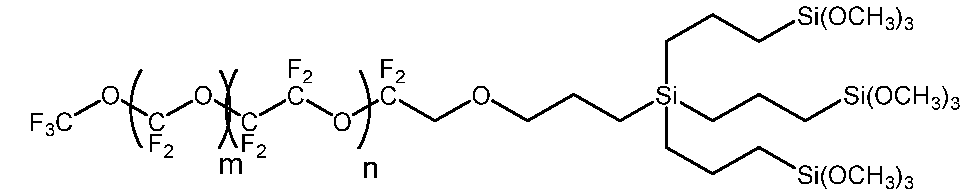
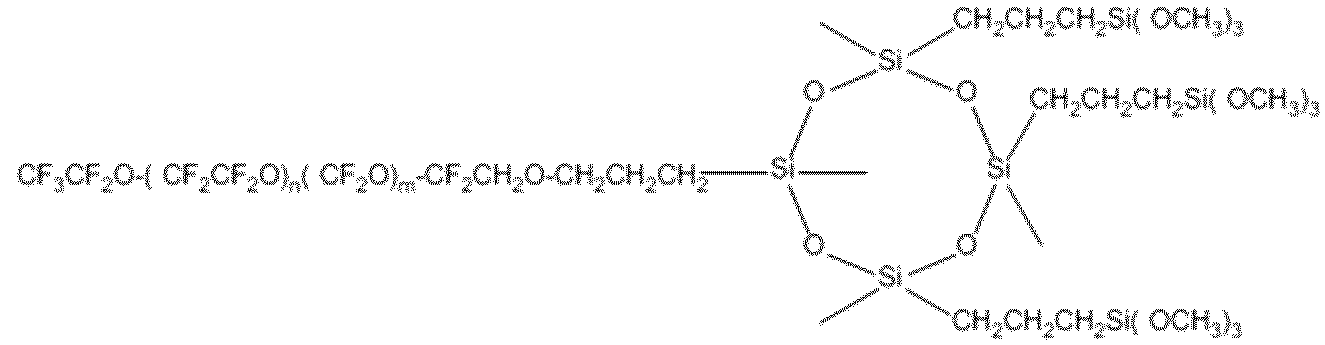



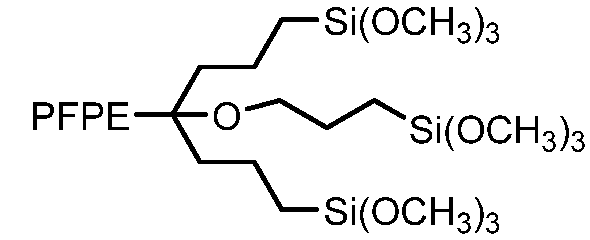
化合物(1-1Ha)、(1-1Fa)、(1-3a)、(1-4a)、(1-5a)は、例えば、国際公開2013/121984号に記載された方法で製造することができる。
含フッ素エーテル化合物(A)の具体例としては、例えば、下記の文献に記載のものも挙げられる。
特開平11-029585号公報および特開2000-327772号公報に記載のパーフルオロポリエーテル変性アミノシラン、特許第2874715号公報に記載のケイ素含有有機含フッ素ポリマー、特開2000-144097号公報に記載の有機ケイ素化合物、特表2002-506887号公報に記載のフッ素化シロキサン、特表2008-534696号公報に記載の有機シリコーン化合物、特許第4138936号公報に記載のフッ素化変性水素含有重合体、米国特許出願公開第2010/0129672号明細書および国際公開第2014/126064号に記載の化合物、国際公開第2011/060047号、国際公開第2011/059430号および特開2014-070163号公報に記載のオルガノシリコン化合物、国際公開第2012/064649号に記載の含フッ素オルガノシラン化合物、特開2012-72272号公報に記載のフルオロオキシアルキレン基含有ポリマー、国際公開第2013/042732号、国際公開第2013/121984号、国際公開第2013/121985号、国際公開第2013/121986号、国際公開第2014/163004号、特開2014-080473号公報、国際公開第2015/087902号、国際公開第2017/038830号、国際公開第2017/038832号、国際公開第2017/187775号、国際公開第2018/143433号、国際公開第2018/216630号、国際公開第2019/039186、国際公開第2019/039341号、国際公開第2019/044479号、国際公開第2019/049753号および特開2019-044158号に記載の含フッ素エーテル化合物、特開2014-218639号公報に記載のパーフルオロ(ポリ)エーテル基含有シラン化合物、国際公開第2018/169002号に記載のパーフルオロ(ポリ)エーテル基含有シラン化合物、国際公開第2019/151442号に記載のフルオロ(ポリ)エーテル基含有シラン化合物、国際公開第2019/151445号に記載の(ポリ)エーテル基含有シラン化合物、国際公開第2019/098230号に記載のパーフルオロポリエーテル基含有化合物、特開2015-199906号公報、特開2016-204656号公報、特開2016-210854号公報および特開2016-222859号公報に記載のフルオロポリエーテル基含有ポリマー変性シラン、国際公開第2019/039083号および国際公開第2019/049754号に記載の含フッ素化合物。
特開平11-029585号公報および特開2000-327772号公報に記載のパーフルオロポリエーテル変性アミノシラン、特許第2874715号公報に記載のケイ素含有有機含フッ素ポリマー、特開2000-144097号公報に記載の有機ケイ素化合物、特表2002-506887号公報に記載のフッ素化シロキサン、特表2008-534696号公報に記載の有機シリコーン化合物、特許第4138936号公報に記載のフッ素化変性水素含有重合体、米国特許出願公開第2010/0129672号明細書および国際公開第2014/126064号に記載の化合物、国際公開第2011/060047号、国際公開第2011/059430号および特開2014-070163号公報に記載のオルガノシリコン化合物、国際公開第2012/064649号に記載の含フッ素オルガノシラン化合物、特開2012-72272号公報に記載のフルオロオキシアルキレン基含有ポリマー、国際公開第2013/042732号、国際公開第2013/121984号、国際公開第2013/121985号、国際公開第2013/121986号、国際公開第2014/163004号、特開2014-080473号公報、国際公開第2015/087902号、国際公開第2017/038830号、国際公開第2017/038832号、国際公開第2017/187775号、国際公開第2018/143433号、国際公開第2018/216630号、国際公開第2019/039186、国際公開第2019/039341号、国際公開第2019/044479号、国際公開第2019/049753号および特開2019-044158号に記載の含フッ素エーテル化合物、特開2014-218639号公報に記載のパーフルオロ(ポリ)エーテル基含有シラン化合物、国際公開第2018/169002号に記載のパーフルオロ(ポリ)エーテル基含有シラン化合物、国際公開第2019/151442号に記載のフルオロ(ポリ)エーテル基含有シラン化合物、国際公開第2019/151445号に記載の(ポリ)エーテル基含有シラン化合物、国際公開第2019/098230号に記載のパーフルオロポリエーテル基含有化合物、特開2015-199906号公報、特開2016-204656号公報、特開2016-210854号公報および特開2016-222859号公報に記載のフルオロポリエーテル基含有ポリマー変性シラン、国際公開第2019/039083号および国際公開第2019/049754号に記載の含フッ素化合物。
含フッ素エーテル化合物(A)の市販品としては、信越化学工業社製のKY-100シリーズ(KY-178、KY-185、KY-195、KY-1900等)、AGC社製のAfluid(登録商標)S550、ダイキン工業社製のオプツール(登録商標)DSX、オプツール(登録商標)AES、オプツール(登録商標)UF503、オプツール(登録商標)UD509等が挙げられる。なお、本組成物が含有する含フッ素エーテル化合物(A)は1種でも2種以上でもよい。
(シラン化合物(B))
シラン化合物(B)は、エポキシ基、アクリロキシ基、メルカプト基およびチオウレア基からなる群から選ばれる少なくとも1種の反応性基(以下、「反応性基(B)」ともいう。)と、反応性シリル基とを有し、フッ素原子を含まないシラン化合物である。
シラン化合物(B)は、エポキシ基、アクリロキシ基、メルカプト基およびチオウレア基からなる群から選ばれる少なくとも1種の反応性基(以下、「反応性基(B)」ともいう。)と、反応性シリル基とを有し、フッ素原子を含まないシラン化合物である。
シラン化合物(B)における、ケイ素原子の数は、含フッ素エーテル化合物(A)との反応性に優れる観点から、1~3が好ましく、1~2がより好ましく、1が特に好ましい。シラン化合物(B)の分子量は液状媒体への相溶性に優れる点から、100~300が好ましく、140~280がより好ましい。
シラン化合物(B)が有する反応性基(B)の数は、ケイ素原子1個当たり1~2個が好ましく、1個が好ましい。複数の反応性基(B)を有する場合、その種類は同じであっても異なってもよい。シラン化合物(B)が有する反応性基(B)は、基材が表面の少なくとも一部にハードコート層を有する基材である場合には、得られる表面層の耐摩耗性等の耐久性と本組成物の保存安定性の両立の観点からエポキシ基またはアクリロキシ基が好ましく、エポキシ基が特に好ましい。基材が表面の少なくとも一部に銅、金、銀等の金属を有する基材である場合には、得られる表面層の耐摩耗性等の耐久性と本組成物の保存安定性の両立の観点から、反応性基(B)は、メルカプト基またはチオウレア基が好ましく、メルカプト基が特に好ましい。
シラン化合物(B)が有する加水分解性基の数はケイ素原子1個当たり1~3個が好ましく、2または3個が好ましい。シラン化合物(B)は、反応性基(B)および加水分解性基以外に、ケイ素原子に結合する非反応性の有機基を有していてもよい。
シラン化合物(B)として、好ましくは、下記式(S1)で表される化合物が挙げられる。
R11
dSiL11
eR12
4-d-e …(S1)
ただし、式(S1)中の記号は以下のとおりである。
R11:エポキシ基、アクリロキシ基、メルカプト基またはチオウレア基を有する基
R12:1価の飽和炭化水素基またはアリール基
L11:加水分解性基または水酸基
d:1または2
e:1~3の整数
d+e:2~4の整数
R11、R12、L11が複数存在する場合には、それぞれ同一であっても異なってもよい。
ただし、式(S1)中の記号は以下のとおりである。
R11:エポキシ基、アクリロキシ基、メルカプト基またはチオウレア基を有する基
R12:1価の飽和炭化水素基またはアリール基
L11:加水分解性基または水酸基
d:1または2
e:1~3の整数
d+e:2~4の整数
R11、R12、L11が複数存在する場合には、それぞれ同一であっても異なってもよい。
R11は、エポキシ基、アクリロキシ基、メルカプト基またはチオウレア基と、これらの基とケイ素原子を連結する連結基とを有する基であることが好ましい。
R11の炭素数は2~10が好ましく、2~9がより好ましい。なお、R11の好ましい炭素数は反応性基により異なる。
R11がエポキシ基を有する基の場合、R11はグリシジルオキシ基またはエポキシシクロヘキシル基と2価有機基の組み合わせが好ましい。2価有機基は、グリシジルオキシ基またはエポキシシクロヘキシル基とケイ素原子を結合する基であり、炭素数1~6のアルキレン基が好ましく、エチレン基、プロピレン基が特に好ましい。
R11が、アクリロキシ基またはメルカプト基を有する基の場合、アクリロキシ基またはメルカプト基とケイ素原子を結合する連結基として、炭素数1~10のアルキレン基が好ましく、エチレン基、プロピレン基が特に好ましい。
R11が、チオウレア基を有する基の場合、R11としてはR111-HNC(=S)NH-R112-が好ましい。R112は炭素数1~10のアルキレン基であり、炭素数1~5のアルキレン基が好ましい。R111は炭素数1~10の炭化水素基(直鎖状、分岐状または環状の、飽和脂肪族炭化水素基と、芳香族炭化水素基)、またはR12
4-d-eL11
eSi-R113-(R113は炭素数1~10のアルキレン基であり、炭素数1~5のアルキレン基が好ましい。)が好ましい。
L11は、加水分解性基または水酸基である。L11として、具体的には、アルコキシ基、ハロゲン原子、アシル基、イソシアナート基(-NCO)、アミノ基等が挙げられる。アルコキシ基としては、炭素数1~5のアルコキシ基が好ましい。ハロゲン原子としては、塩素原子が好ましい。これらのなかでも、L11としては、炭素数1~4のアルコキシ基が好ましく、メトキシ基、エトキシ基が特に好ましい。
R12は1価の飽和炭化水素基またはアリール基である。1価の飽和炭化水素基は、直鎖であってもよく、分岐、環構造を含んでいてもよい。R12の炭素数は1~6が好ましく、1~4がより好ましい。アリール基としては、炭素数6~10のアリール基が好ましく、フェニル基が特に好ましい。R12は、メチル基またはエチル基であることがより好ましく、メチル基が特に好ましい。化合物(S1)は、R12を有すると、耐水性の観点から好ましい。
化合物(S1)の具体例は以下のとおりである。
エポキシ基を有する化合物(S1)として、2-(3,4-エポキシシクロヘキシル)エチルトリメトキシシラン、3-グリシドキシプロピルトリメトキシシラン、3-グリシドキシプロピルトリエトキシシラン、3-グリシドキシプロピルメチルジメトキシシラン、3-グリシドキシプロピルメチルジエトキシシラン等が挙げられる。
エポキシ基を有する化合物(S1)として、2-(3,4-エポキシシクロヘキシル)エチルトリメトキシシラン、3-グリシドキシプロピルトリメトキシシラン、3-グリシドキシプロピルトリエトキシシラン、3-グリシドキシプロピルメチルジメトキシシラン、3-グリシドキシプロピルメチルジエトキシシラン等が挙げられる。
アクリロキシ基を有する化合物(S1)として、3-アクリロキシプロピルメチルジメトキシシラン、3-アクリロキシプロピルトリメトキシシラン、3-アクリロキシプロピルメチルジエトキシシラン、3-アクリロキシプロピルトリエトキシシラン等が挙げられる。
メルカプト基を有する化合物(S1)として、3-メルカプトプロピルトリメトキシシラン、3-メルカプトプロピルメチルジメトキシシラン、3-メルカプトプロピルトリエトキシシラン、3-メルカプトプロピルエチルジエトキシシラン等が挙げられる。
チオウレア基を有する化合物(S1)として、以下の化合物等が挙げられ、市販品としては信越化学工業社製のX-12-1016M(製品名)、X-12-1111(製品名)、X-12-1116(製品名)、X-12-1117(製品名)等が挙げられる。

(本組成物の組成)
本組成物は、含フッ素エーテル化合物(A)の100質量部に対して、シラン化合物(B)を0.01~500質量部の割合で含有することが好ましい。シラン化合物(B)の含有量が、上記の下限値以上であれば得られる表面層の耐摩耗性等の耐久性に優れる。シラン化合物(B)の含有量が、上記の上限値以下であれば得られる本組成物は保存安定性に優れる。基材が表面の少なくとも一部にハードコート層を有する基材である場合には、含フッ素エーテル化合物(A)の100質量部に対するシラン化合物(B)の割合は30~300質量部がより好ましく、50~300質量部がさらに好ましい。基材が表面の少なくとも一部に銅、金、銀等の金属を有する基材である場合には、含フッ素エーテル化合物(A)の100質量部に対するシラン化合物(B)の割合は0.1~300質量部がより好ましく、1~100質量部がさらに好ましい。
本組成物は、含フッ素エーテル化合物(A)の100質量部に対して、シラン化合物(B)を0.01~500質量部の割合で含有することが好ましい。シラン化合物(B)の含有量が、上記の下限値以上であれば得られる表面層の耐摩耗性等の耐久性に優れる。シラン化合物(B)の含有量が、上記の上限値以下であれば得られる本組成物は保存安定性に優れる。基材が表面の少なくとも一部にハードコート層を有する基材である場合には、含フッ素エーテル化合物(A)の100質量部に対するシラン化合物(B)の割合は30~300質量部がより好ましく、50~300質量部がさらに好ましい。基材が表面の少なくとも一部に銅、金、銀等の金属を有する基材である場合には、含フッ素エーテル化合物(A)の100質量部に対するシラン化合物(B)の割合は0.1~300質量部がより好ましく、1~100質量部がさらに好ましい。
本組成物において含フッ素エーテル化合物(A)は、該化合物が有する反応性シリル基の一部が加水分解反応した状態、さらに加水分解反応で生成したシラノール基が部分的に縮合した状態で含まれていてもよい。シラン化合物(B)も同様である。さらに、含フッ素エーテル化合物(A)およびシラン化合物(B)からそれぞれ生成したシラノール基が部分的に共縮合物した状態で含まれていてもよい。
本組成物における、含フッ素エーテル化合物(A)とシラン化合物(B)の合計含有量は、50~100質量%が好ましく、70~100質量%がより好ましく、90~100質量%がさらに好ましい。
本組成物は本発明の効果を損なわない範囲で任意成分を含有できる。任意成分としては、例えば、界面活性剤、含フッ素エーテル化合物(A)とシラン化合物(B)の加水分解と縮合反応を促進する酸触媒や塩基性触媒、含フッ素エーテル化合物(A)とシラン化合物(B)以外のシラン化合物等の公知の添加剤が挙げられる。酸触媒としては、塩酸、硝酸、酢酸、硫酸、燐酸、スルホン酸、メタンスルホン酸、p-トルエンスルホン酸等が挙げられる。塩基性触媒としては、水酸化ナトリウム、水酸化カリウム、アンモニア等が挙げられる。
任意成分は、含フッ素エーテル化合物(A)およびシラン化合物(B)の製造工程で生成した副生成物等の不純物を含んでもよい。任意成分の含有量は本組成物全量に対して30質量%以下が好ましく、10質量%以下がより好ましく、1質量%以下がより好ましく、0.5質量%以下が特に好ましい。
[コーティング液]
本発明のコーティング液(以下、「本コーティング液」とも記す。)は、本組成物と液状媒体とを含む。本コーティング液は、室温で液状であればよく、溶液であっても分散液であってもよい。
本発明のコーティング液(以下、「本コーティング液」とも記す。)は、本組成物と液状媒体とを含む。本コーティング液は、室温で液状であればよく、溶液であっても分散液であってもよい。
本コーティング液における本組成物の含有量は、本コーティング液のうち、0.001~40質量%が好ましく、0.001~20質量%がより好ましく、0.001~10質量%がさらに好ましく、0.01~1質量%が特に好ましい。
(液状媒体)
液状媒体としては、含フッ素有機溶媒を含むことが好ましい。液状媒体として、さらに非フッ素有機溶媒を含んでもよい。また、液状媒体は1種の化合物であってもよいし、2種以上の混合物であってもよい。
液状媒体としては、含フッ素有機溶媒を含むことが好ましい。液状媒体として、さらに非フッ素有機溶媒を含んでもよい。また、液状媒体は1種の化合物であってもよいし、2種以上の混合物であってもよい。
含フッ素有機溶媒としては、フッ素化アルカン、フッ素化アルケン、フッ素化芳香族化合物、フッ素化アルキルエーテル、フッ素化アルキルアミン、フッ素化アルコール等が挙げられる。
フッ素化アルカンとしては、炭素数4~8の化合物が好ましい。市販品としては、例えば、C6F13H(AC-2000:製品名、AGC社製)、C6F13C2H5(AC-6000:製品名、AGC社製)、C2F5CHFCHFCF3(バートレルXF:製品名、デュポン社製)等が挙げられる。また、1,1,1,3,3-ペンタフルオロブタン、1,1,1,2,2,3,4,5,5,5-デカフルオロペンタン、1,1,2,2,3,3,4-ヘプタフルオロシクロペンタン、1,1,1,2,2,3,3,4,4-ノナフルオロヘキサン等も使用できる。
フッ素化アルケンとしては、(E)-1-クロロ-3,3,3-トリフルオロ-1-プロペン、(Z)-1-クロロ-3,3,3-トリフルオロ-1-プロペン、1,1-ジクロロ-2,3,3,3-テトラフルオロ-1-プロペン、(E)-1-クロロ-2,3,3,3-テトラフルオロ-1-プロペン、(Z)-1-クロロ-2,3,3,3-テトラフルオロ-1-プロペン、(Z)-1,1,1,4,4,4-ヘキサフルオロ-2-ブテン、(E)-1,1,1,4,4,4-ヘキサフルオロ-2-ブテン、下式で記載されるアルキルペルフルオロアルケニルエーテル(式中、R3は、CH3、C2H5またはこれらの混合物のいずれかとすることができ、y1およびy2は、独立に、0、1、2または3であり、y1+y2=0、1、2または3である。)等が挙げられる。
CF3(CF2)y1CF=CFCF(OR3)(CF2)y2CF3、
CF3(CF2)y1C(OR3)=CFCF2(CF2)y2CF3、
CF3CF=CFCF(OR3)(CF2)y1(CF2)y2CF3、
CF3(CF2)y1CF=C(OR3)CF2(CF2)y2CF。
CF3(CF2)y1C(OR3)=CFCF2(CF2)y2CF3、
CF3CF=CFCF(OR3)(CF2)y1(CF2)y2CF3、
CF3(CF2)y1CF=C(OR3)CF2(CF2)y2CF。
フッ素化芳香族化合物としては、例えばヘキサフルオロベンゼン、トリフルオロメチルベンゼン、ペルフルオロトルエン、オルト-ビス(トリフルオロメチル)ベンゼン、メタ-ビス(トリフルオロメチル)ベンゼン、パラ-ビス(トリフルオロメチル)ベンゼン等が挙げられる。
フッ素化アルキルエーテルとしては、炭素数4~12の化合物が好ましい。市販品としては、例えば、CF3CH2OCF2CF2H(AE-3000:製品名、AGC社製)、C4F9OCH3(Novec7100:製品名、3M社製)、C4F9OC2H5(Novec7200:製品名、3M社製)、C6F13OCH3(Novec7300:製品名、3M社製)、パーフルオロ(2-ブチルテトラヒドロフラン)(Galden PEPE SV80;製品名、SOLVAY社、Galden PEPE SV110;製品名、SOLVAY社、Galden PEPE SV135;製品名、SOLVAY社)等が挙げられる。
フッ素化アルキルアミンとしては、例えばペルフルオロトリプロピルアミン、ペルフルオロトリブチルアミン、パーフルオロトリペンチルアミン等が挙げられる。
フッ素化アルコールとしては、例えば2,2,3,3-テトラフルオロプロパノール、2,2,2-トリフルオロエタノール、ヘキサフルオロイソプロパノール等が挙げられる。
含フッ素有機溶媒としては、含フッ素エーテル化合物(A)の溶解性の点で、フッ素化アルカン、フッ素化芳香族化合物、フッ素化アルキルエーテルが好ましく、フッ素化アルキルエーテルが特に好ましい。含フッ素有機溶媒の含有割合は、含フッ素エーテル化合物(A)の溶解性に優れる点から、液状媒体の全量に対して50質量%以上が好ましい。
非フッ素有機溶媒としては、水素原子および炭素原子のみからなる化合物と、水素原子、炭素原子および酸素原子のみからなる化合物が好ましく、炭化水素系有機溶媒、アルコール系有機溶媒、ケトン系有機溶媒、エーテル系有機溶媒、エステル系有機溶媒、塩素系溶媒が挙げられる。
炭化水素系有機溶媒としては、ヘキサン、へプタン、シクロヘキサン、石油ベンジン、トルエン、キシレン等が好ましい。
アルコール系有機溶媒としては、メタノール、エタノール、プロパノール、イソプロパノール等が好ましい。
ケトン系有機溶媒としては、アセトン、メチルエチルケトン、メチルイソブチルケトン等が好ましい。
エーテル系有機溶媒としては、ジエチルエーテル、テトラヒドロフラン、テトラエチレングリコールジメチルエーテル等が好ましい。
エステル系有機溶媒としては、酢酸エチル、酢酸ブチル等が好ましい。
エステル系有機溶媒としては、酢酸エチル、酢酸ブチル等が好ましい。
塩素系溶媒としては、1,1-ジクロロエタン、1,2-ジクロロエタン、1,1,2-トリクロロエタン、1,1,1,2-テトラクロロエタン、1,1,2,2-テトラクロロエタン、ペンタクロロエタン、1,1-ジクロロエチレン、(Z)-1,2-ジクロロエチレン、(E)-1,2-ジクロロエチレン、トリクロロエチレン、テトラクロロエチレン、クロロホルム、四塩化炭素、ジクロロメタン等が好ましい。
非フッ素有機溶媒としては、含フッ素エーテル化合物(A)の溶解性の点で、ケトン系有機溶媒が特に好ましい。
非フッ素有機溶媒としては、含フッ素エーテル化合物(A)の溶解性の点で、ケトン系有機溶媒が特に好ましい。
液状媒体としては、含フッ素エーテル化合物(A)の溶解性を高めるとともに経済的に有利な点から、フッ素化アルカン、フッ素化芳香族化合物、フッ素化アルキルエーテルから選択される少なくとも1種と、水素原子および炭素原子のみからなる化合物、ならびに、水素原子、炭素原子および酸素原子のみからなる化合物からなる群から選択される少なくとも1種とを含むことが好ましい。
液状媒体としては、含フッ素有機溶媒であるフッ素化アルカン、フッ素化芳香族化合物、フッ素化アルキルエーテル、非フッ素有機溶媒である水素原子、炭素原子および酸素原子のみからなる化合物からなる群から選択される少なくとも1種の有機溶媒を、合計で液状媒体全体の60質量%以上含むことが、含フッ素エーテル化合物(A)の溶解性を高める点で好ましい。
コーティング液は、液状媒体を、コーティング液全量に対して、60~99.999質量%含むことが好ましく、80~99.999質量%含むことがより好ましく、90~99.999質量%含むことがさらに好ましく、99~99.99質量%含むことが特に好ましい。液状媒体として具体的には、C6F13C2H5(AC-6000:製品名、AGC社製)、CF3CH2OCF2CF2H(AE-3000:製品名、AGC社製)、C4F9OCH3(Novec7100:製品名、3M社製)、C4F9OC2H5(Novec7200:製品名、3M社製)、C6F13OCH3(Novec7300:製品名、3M社製)が挙げられ、これらを単独で使用してもよいし、これらの混合物を使用してもよい。混合物としては、例えば、製品名で以下の組み合わせが挙げられる。
AC-6000とAE-3000の組み合わせ、AC-6000とNovec7100の組み合わせ、AC-6000とNovec7200の組み合わせ、AC-6000とNovec7300の組み合わせ、AE-3000とNovec7100の組み合わせ、AE-3000とNovec7200の組み合わせ、AE-3000とNovec7300の組み合わせ、AC-6000とAE-3000とNovec7100の組み合わせ、AC-6000とAE-3000とNovec7200の組み合わせ、AC-6000とAE-3000とNovec7300の組み合わせ、Novec7100とNovec7200の組み合わせ、Novec7100とNovec7300の組み合わせ、Novec7200とNovec7300の組み合わせ、AE-3000とイソプロパノールの組み合わせ、AC-6000とイソプロパノールの組み合わせ、AE-3000とイソプロパノールの組み合わせ、など、任意の組み合わせが可能である。
AC-6000とAE-3000を組合せて用いる場合には、AC-6000とAE-3000の合計量に対するAE-3000の割合は、0.05~99.9質量%が好ましい。
AC-6000とAE-3000とNovec7100を組合せて用いる場合には、AC-6000とAE-3000とNovec7100の合計量に対するAE-3000の割合は、0.05質量%~0.15質量%が好ましく、Novec7100の割合は、95~99.5質量%が好ましい。
AC-6000とAE-3000とNovec7200を組合せて用いる場合には、AC-6000とAE-3000とNovec7200の合計量に対するAE-3000の割合は、0.05~0.30質量%が好ましく、Novec7200の割合は、95~99.5質量%が好ましい。
AC-6000とAE-3000とNovec7300を組合せて用いる場合には、AC-6000とAE-3000とNovec7300の合計量に対するAE-3000の割合は、0.05~0.30質量%が好ましく、Novec7300の割合は、95~99.5質量%が好ましい。
AE-3000とイソプロパノールを組合せて用いる場合には、AE-3000とイソプロパノールの合計量に対するAE-3000の割合は、50~95質量%が好ましい。
AC-6000とイソプロパノールを組合せて用いる場合には、AC-6000とイソプロパノールの合計量に対するAC-6000の割合は、50~95質量%が好ましい。
[物品]
本発明の物品(以下、「本物品」とも記す。)は、本組成物から形成された表面層を基材の表面に有する。
本発明の物品(以下、「本物品」とも記す。)は、本組成物から形成された表面層を基材の表面に有する。
表面層の厚さは、0.1~100nmが好ましく、0.1~50nmが特に好ましい。表面層の厚さが前記範囲の下限値以上であれば、表面処理による効果が充分に得られやすい。表面層の厚さが上記範囲の上限値以下であれば、利用効率が高い。表面層の厚さは、薄膜解析用X線回折計(RIGAKU社製、ATX-G)を用いて、X線反射率法によって反射X線の干渉パターンを得て、干渉パターンの振動周期から算出できる。
基材としては、撥水撥油性の付与が求められている基材が挙げられる。基材の材料としては、金属、有機材料、ガラス、サファイア、セラミック、石またはこれらの複合材料が挙げられる。基材は、例えば、全体が単一の材料からなる構成であってよく、異なる材料からなる層との積層体であってもよい。また、基材の表面が、同一面内において、複数の異なる材料からなる領域を有する構成であってもよい。
ガラスは化学強化されていてもよい。ガラスとしては、ソーダライムガラス、アルカリアルミノケイ酸塩ガラス、ホウ珪酸ガラス、無アルカリガラス、クリスタルガラス、石英ガラスが好ましく、化学強化したソーダライムガラス、化学強化したアルカリアルミノケイ酸塩ガラス、および化学強化したホウ珪酸ガラスが特に好ましい。
金属としては、室温で固体の金属、合金等が、特に制限なく挙げられる。該金属として具体的には、クロム、鉄、アルミニウム、銅、ニッケル、亜鉛、スズ、炭素鋼、鉛、チタン、金、銀および、これらの合金等が挙げられる。合金としては、SUS304、SUS316、SUS303、SUS317、SUS403等のステンレス鋼、真鍮(黄銅)、青銅、白銅、丹銅、赤銅、洋銀、ジュラルミン、はんだ等が挙げられる。また、プライマー層が形成される金属表面として、ニッケル・クロムメッキ、ニッケルメッキ、クロムメッキ、亜鉛メッキ等の表面が挙げられる。
本明細書において有機材料とは、材料全体に対して10質量%以上の有機物を含有する材料をいう。有機材料は、例えば、有機物のみで構成されてもよく、上記範囲で有機物を含有し該有機物と無機物が混在する有機無機複合材料であってもよい。有機材料は、例えば、樹脂およびエラストマーから選ばれる少なくとも1種を含有する。
樹脂として、具体的には、ポリエチレンテレフタレート(PET)、ポリブチレンテレフタレート等のポリエステル樹脂;ポリエチレン(PE)、ポリプロピレン(PP)等のポリオレフィン樹脂;エチレン酢酸ビニル共重合体(EVA);酢酸ビニル樹脂;ノルボルネン樹脂;ポリアクリレート、ポリメチルメタクリレート(PMMA)等のアクリル樹脂;ウレタン樹脂;ポリアリレート樹脂;アクリルウレタン樹脂;塩化ビニル樹脂;塩化ビニリデン樹脂;フッ素樹脂;ポリカーボネート樹脂(PC);ポリビニルブチラール樹脂;ポリビニルアルコール樹脂(PVA);ポリメタクリルイミド樹脂;ポリスチレン樹脂;ABS樹脂;MS(メチルメタクリレート・スチレン)樹脂;エポキシ樹脂等が挙げられる。
エラストマーとしては熱硬化性エラストマーおよび熱可塑性エラストマーが挙げられる。熱硬化性エラストマーは具体的には、イソブチレンゴム、イソプレンゴム、ブタジエンゴム、スチレン・ブタジエンゴム(SBR)、エチレン・プロピレンゴム(EPDMゴム)、シリコーンゴム、ウレタンゴム、フッ素ゴム等が挙げられる。熱可塑性エラストマーは具体的には、スチレン系、オレフィン系、塩化ビニル系、ポリエステル系、ポリウレタン系、ナイロン系等があげられる。
本物品において表面層を有する基材の表面は、有機材料または金属からなる表面を含むことが好ましい。この場合、表面の少なくとも一部が金属および/または有機材料を含む基材であれば特に制限されない。基材は表面の全部が金属または有機材料からなってもよく、一部が金属または有機材料からなってもよい。また、表面の全部が同じ金属または有機材料からなってもよく、異なる金属または有機材料からなってもよい。
基材が有機材料からなる場合、異なる有機材料からなる層(以下、「有機材料層」)が複数積層された積層体であってもよい。これらの積層体が表層に有する有機材料層としては、基材表面の硬度を高めるために設けられるハードコート層等が挙げられる。ハードコート層を構成する有機材料としては、アクリルウレタン樹脂、メラミン樹脂、ウレタン樹脂 アクリル樹脂シリコン系シラン化合物等が挙げられる。
基材の形状は、特に限定されず、板状、フィルム(薄膜)状、棒状、筒状等が挙げられる。基材が板状である場合、平板であってもよく、主面の一部または全部が曲率を有する形状であってもよい。また、表面形状は平滑であってもよく、凹凸があってもよい。
本組成物が含有する化合物が硬化に際して基材表面により結合しやすくするために、該表面に反応性基が存在する状態に、基材の表面を改質する活性化処理を施してもよい。
本発明において、基材表面の活性化処理は、通常、基材表面を活性化処理するのに用いられる乾式または湿式の処理が特に制限なく適用可能である。乾式処理としては、紫外線、電子線、X線などの活性エネルギー線を表面に照射する処理、コロナ処理、プラズマ処理、火炎処理、イトロ処理(ITRO株式会社が開発したCombustion Chemical Vapor Deposition)等を用いることができる。湿式処理としては、表面を酸ないしアルカリ溶液に接触させる処理を例示できる。本発明において、好ましく用いられる活性化処理は、コロナ処理またはプラズマ処理であり、コロナ処理またはプラズマ処理と、湿式のアルカリ処理とを組み合わせることが好ましい。
コロナ処理は、基材表面に極性基を生成させて粗面化する処理のことである。コロナ処理としては、公知の方法を採用することができ、例えば、コロナ処理機を用いて、常圧空気中で放電する方式等が挙げられる。
プラズマ処理は、特に限定されるものではないが、真空中でのRFプラズマ処理、マイクロ波プラズマ処理、マイクロ波ECRプラズマ処理、大気圧プラズマ処理、コロナ処理などがあり、フッ素を含むガス処理、イオン源を使ったイオン打ち込み処理、PBII法を使った処理、熱プラズマに暴露する火炎処理、イトロ処理なども含める。これらの中でも真空中でのRFプラズマ処理、マイクロ波プラズマ処理、大気圧プラズマ処理が好ましい。
基材の表面にはSiO2膜等の下地膜が形成されていてもよい。基材は本物品の用途に応じて適宜選択される。
[物品の製造方法]
本物品の製造方法において、本組成物を用いて基材の表面に表面層を形成する方法は、ドライコーティング法であってもウェットコーティング法であってもよい。
本物品の製造方法において、本組成物を用いて基材の表面に表面層を形成する方法は、ドライコーティング法であってもウェットコーティング法であってもよい。
(ドライコーティング法)
ドライコーティング法においては、本組成物をそのまま用いて、基材の表面に本組成物が硬化した表面層を形成できる。
ドライコーティング法においては、本組成物をそのまま用いて、基材の表面に本組成物が硬化した表面層を形成できる。
ドライコーティング法としては、真空蒸着、CVD、スパッタリング等の手法が挙げられる。本組成物中の各化合物の分解を抑える点、および装置の簡便さの点から、真空蒸着法が好適に利用できる。真空蒸着法は、抵抗加熱法、電子ビーム加熱法、高周波誘導加熱法、反応性蒸着、分子線エピタキシー法、ホットウォール蒸着法、イオンプレーティング法、クラスターイオンビーム法等に細分することができるが、いずれの方法も適用できる。本組成物中の各化合物の分解を抑制する点、および装置の簡便さの点から、抵抗加熱法が好適に利用できる。真空蒸着装置は特に制限なく、公知の装置が利用できる。
真空蒸着法を用いる場合の成膜条件は、適用する真空蒸着法の種類によって異なるが、抵抗加熱法の場合、蒸着前真空度は1×10⁻²Pa以下が好ましく、1×10⁻³Pa以下が特に好ましい。蒸着源の加熱温度は、蒸着源(本組成物)が十分な蒸気圧を有する温度であれば特に制限はない。具体的には30~400℃が好ましく、50~300℃が特に好ましい。
加熱温度が上記範囲の下限値以上であれば、成膜速度が良好になる。上記範囲の上限値以下であれば、本組成物中の各化合物の分解が生じることなく、基材の表面に所期の撥水撥油性、汚れ除去性等を付与できる。真空蒸着時、基材温度は室温(20~25℃)から基材の耐熱温度までの範囲であることが好ましい。基材温度が上記耐熱温度以下であれば、成膜速度が良好になる。基材温度の上限値は上記耐熱温度-50℃以下がより好ましい。
ドライコーティング法に際して、基材表面への本組成物の付着は、得られる表面層の厚みを上記好ましい厚みとするために、含フッ素エーテル化合物(A)の付着量として30~120mg/m2となるように行うことが好ましい。含フッ素エーテル化合物(A)の付着量は、35~80mg/m2がより好ましく、35~70mg/m2が特に好ましい。
ドライコーティング法に際して、上に説明した本組成物中の含フッ素エーテル化合物(A)およびシラン化合物(B)における硬化時の化合物同士の反応および化合物と基材表面との反応は、上記成膜の際に基材温度を上記のとおり調整することにより略同時に進行する。なお、任意に後述の後処理を行うことにより、表面層により強固な結合が形成される。
(ウェットコーティング法)
ウェットコーティング法により表面層を形成する場合、本コーティング液を基材の表面に塗布し、乾燥させて、本組成物が硬化した表面層を形成する方法が好ましい。
ウェットコーティング法により表面層を形成する場合、本コーティング液を基材の表面に塗布し、乾燥させて、本組成物が硬化した表面層を形成する方法が好ましい。
ウェットコーティング法において本コーティング液を基材の表面に塗布する方法としては、スピンコート法、ワイプコート法、スプレーコート法、スキージーコート法、ディップコート法、ダイコート法、インクジェット法、フローコート法、ロールコート法、キャスト法、ラングミュア・ブロジェット法、グラビアコート法等が挙げられる。
コーティング液の塗布は、含フッ素エーテル化合物(A)の塗布量として、上記ドライコーティング法の場合の付着量と、好ましい態様を含めて同様にできる。
コーティング液の塗布後、基材上に形成された塗膜上のコーティング液の乾燥を行う。該乾燥により液状媒体を除去するとともに、本組成物を硬化させる。具体的には塗膜状のコーティング液を、所定の反応温度で所定の時間放置することで、含フッ素エーテル化合物(A)およびシラン化合物(B)を反応させると同時に液状媒体を除去する。反応温度は、10℃から基材の耐熱温度までの範囲が好ましく、20℃から基材の耐熱温度までの範囲がより好ましい。
なお、本組成物中の含フッ素エーテル化合物(A)およびシラン化合物(B)における硬化時の反応、すなわち、化合物同士の反応および化合物と基材表面との反応は、上に説明したとおりである。また、ドライコーティング法と同様に、任意に以下の後処理を行うことにより、表面層により強固な結合が形成される。
(後処理)
後処理は、上記ドライコーティング法やウェットコーティング法により基材表面に形成された表面層に対して、主として該表面層の摩擦に対する耐久性を向上させるために行う任意の処理である。
後処理は、上記ドライコーティング法やウェットコーティング法により基材表面に形成された表面層に対して、主として該表面層の摩擦に対する耐久性を向上させるために行う任意の処理である。
該操作としては、加熱、加湿、光照射等が挙げられる。これにより、例えば、表面層中に含フッ素エーテル化合物(A)やシラン化合物(B)に由来する未反応の加水分解性シリル基、または加水分解後のシラノール基等が存在していた場合に、それらの加水分解縮合反応が促進され、充分に硬化した表面層が得られる。
また、表面層形成後、表面層中の化合物であって他の化合物や基材と化学結合していない化合物は、必要に応じて除去してもよい。具体的な方法としては、例えば、表面層に溶剤、例えば液状媒体をかけ流す方法や、溶剤、例えば液状媒体をしみ込ませた布でふき取る方法が挙げられる。
以下に実施例を用いて本発明をさらに詳しく説明するが、本発明はこれら実施例に限定されるものではない。例1~11、15、16および21~28が実施例のコーティング液であり、例12~14、29および30が比較例のコーティング液である。
例1~16および21~30のコーティング液調製において、以下の化合物を用いた。
<含フッ素エーテル化合物(A)>
化合物A1:国際公開2013/121984号に記載の方法で、以下の化合物を製造した。
CF3-O-(CF2CF2O-CF2CF2CF2CF2O)n-CF2CF2OCF2CF2CF2C(=O)NH(CH2)3-Si(OCH3)3 (n=14)
化合物A2:特開2014-218639の合成例15に記載の方法で、以下の化合物を製造した。
CF3-O-(CF2CF2O)15(CF2O)16CF2CH2OCH2CH2CH2Si[(CH2CH2CH2Si(OCH3)3]3
化合物A3:特開2016-204656の実施例1に記載の方法で、以下の化合物を製造した。
<含フッ素エーテル化合物(A)>
化合物A1:国際公開2013/121984号に記載の方法で、以下の化合物を製造した。
CF3-O-(CF2CF2O-CF2CF2CF2CF2O)n-CF2CF2OCF2CF2CF2C(=O)NH(CH2)3-Si(OCH3)3 (n=14)
化合物A2:特開2014-218639の合成例15に記載の方法で、以下の化合物を製造した。
CF3-O-(CF2CF2O)15(CF2O)16CF2CH2OCH2CH2CH2Si[(CH2CH2CH2Si(OCH3)3]3
化合物A3:特開2016-204656の実施例1に記載の方法で、以下の化合物を製造した。
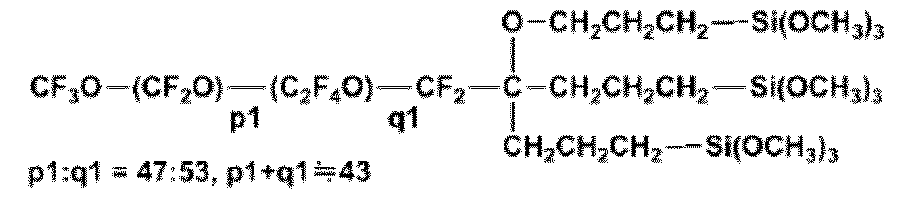
<シラン化合物(B)および比較例用のシラン化合物(Bcf)>
シラン化合物(B)および比較例用のシラン化合物(Bcf)として、信越化学工業社製の以下の製品名の化合物を使用した。
シラン化合物(B)および比較例用のシラン化合物(Bcf)として、信越化学工業社製の以下の製品名の化合物を使用した。
(シラン化合物(B))
KBM-403;3-グリシドキシプロピルメトキシシラン
KBM-303;2-(3,4-エポキシシクロヘキシル)エチルトリメトキシシラン
KBM-803;3-メルカプトプロピルトリメトキシシラン
KBM-5103;3-アクリロキシプロピルトリメトキシシラン
(シラン化合物(Bcf))
KBM-903;3-アミノプロピルトリメトキシシラン
KBM-403;3-グリシドキシプロピルメトキシシラン
KBM-303;2-(3,4-エポキシシクロヘキシル)エチルトリメトキシシラン
KBM-803;3-メルカプトプロピルトリメトキシシラン
KBM-5103;3-アクリロキシプロピルトリメトキシシラン
(シラン化合物(Bcf))
KBM-903;3-アミノプロピルトリメトキシシラン
<液状媒体>
液状媒体として以下の製品名の化合物を用いた。
AE-3000;CF3CH2OCF2CF2H(AGC社製)
Novec7200;C4F9OC2H5(3M社製)
AC-6000;C6F13C2H5(AGC社製)
液状媒体として以下の製品名の化合物を用いた。
AE-3000;CF3CH2OCF2CF2H(AGC社製)
Novec7200;C4F9OC2H5(3M社製)
AC-6000;C6F13C2H5(AGC社製)
[例1]
化合物A1をAE-3000に溶解させて、化合物A1の濃度が0.10質量%の溶液を得た。該溶液に、KBM-403を化合物A1の100質量部に対して100質量部となるように添加して、コーティング液1を調製した。得られたコーティング液1中の含フッ素エーテル組成物の組成(質量部)および、コーティング液1の組成(質量%)を表1に示す。
化合物A1をAE-3000に溶解させて、化合物A1の濃度が0.10質量%の溶液を得た。該溶液に、KBM-403を化合物A1の100質量部に対して100質量部となるように添加して、コーティング液1を調製した。得られたコーティング液1中の含フッ素エーテル組成物の組成(質量部)および、コーティング液1の組成(質量%)を表1に示す。
[例2~16および21~30]
例1と同様にして、化合物A1を表1に示す液状媒体に溶解させた溶液に、表1に示すシラン化合物(B)またはシラン化合物(Bcf)を表1に示す割合で添加して、例2~16および21~30のコーティング液2~16および21~30を調製した。得られた各コーティング液中の含フッ素エーテル組成物の組成(質量部)および、コーティング液の組成(質量%)を表1および2に示す。
例1と同様にして、化合物A1を表1に示す液状媒体に溶解させた溶液に、表1に示すシラン化合物(B)またはシラン化合物(Bcf)を表1に示す割合で添加して、例2~16および21~30のコーティング液2~16および21~30を調製した。得られた各コーティング液中の含フッ素エーテル組成物の組成(質量部)および、コーティング液の組成(質量%)を表1および2に示す。
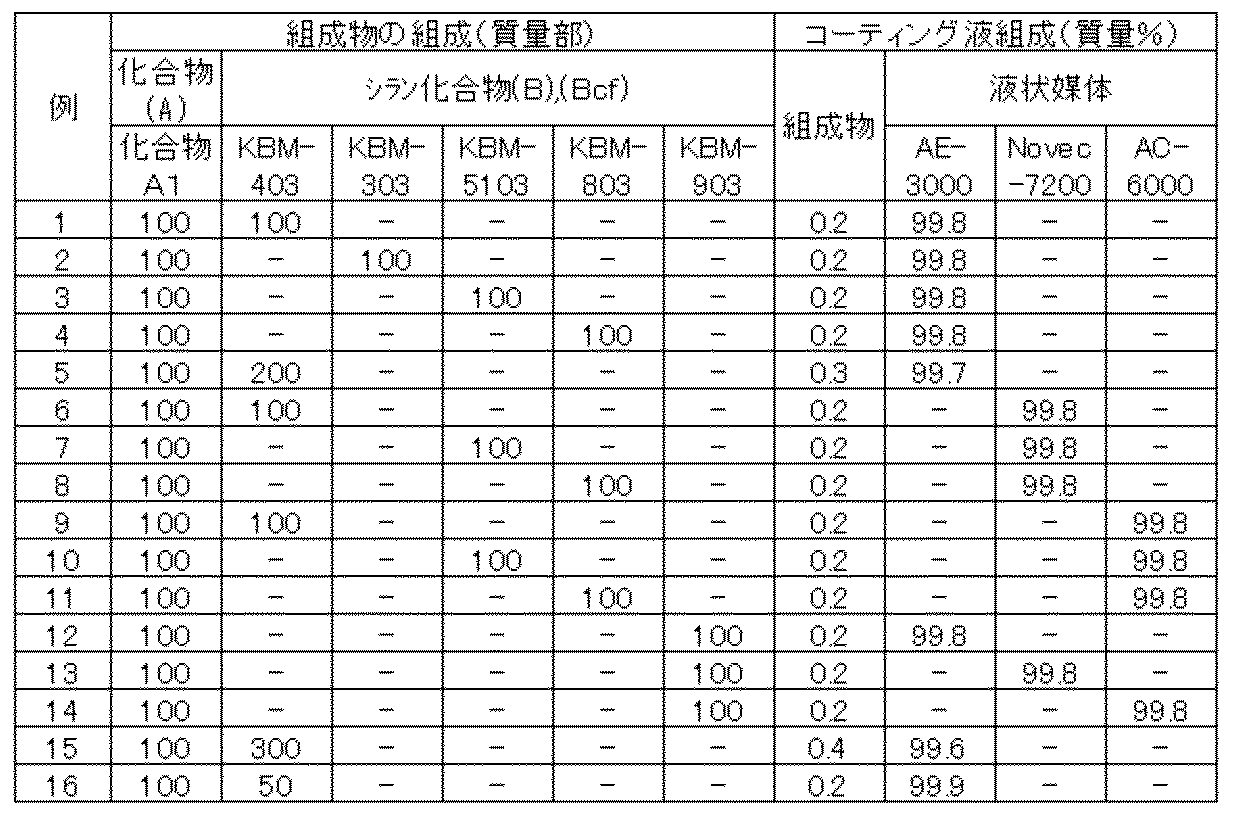

<評価>
例1~16および21~30で得たコーティング液の保存安定性およびこれを用いて基材上に形成された表面層の耐摩耗性を以下のとおり評価した。
例1~16および21~30で得たコーティング液の保存安定性およびこれを用いて基材上に形成された表面層の耐摩耗性を以下のとおり評価した。
(保存安定性)
例1~16および21~30で得たコーティング液1~16および21~30の各20mLを、それぞれ30mLのガラス製容器に入れて、外観を以下の基準で評価し、初期の外観とした。その後、該容器に入れたコーティング液を、23℃、湿度50%の恒温恒湿槽に入れて貯蔵し、3時間後、1日後、2日後、7日後に同様に以下の基準で評価した。結果を表2に示す。
例1~16および21~30で得たコーティング液1~16および21~30の各20mLを、それぞれ30mLのガラス製容器に入れて、外観を以下の基準で評価し、初期の外観とした。その後、該容器に入れたコーティング液を、23℃、湿度50%の恒温恒湿槽に入れて貯蔵し、3時間後、1日後、2日後、7日後に同様に以下の基準で評価した。結果を表2に示す。
[評価基準]
○(良);透明である。
△(可);僅かに白濁している。
×(不可);白濁の程度が大きい。
○(良);透明である。
△(可);僅かに白濁している。
×(不可);白濁の程度が大きい。
(表面層の耐摩耗性)
(1)基板上への表面層の形成
両主面に15μm厚のアクリルウレタン樹脂からなるハードコート層を有するPMMA基板(60×60mm、厚み1mm)をイオン交換水で洗浄し、コロナ処理した。コロナ処理は、0.1kwの出力でコロナ放電させた、両電極の間を、電極と基板の主面との距離がそれぞれ1mmとなるように電気的に浮かせる状態で、速度2.0m/分で2回(1往復)基板を通過させることにより行った。
(1)基板上への表面層の形成
両主面に15μm厚のアクリルウレタン樹脂からなるハードコート層を有するPMMA基板(60×60mm、厚み1mm)をイオン交換水で洗浄し、コロナ処理した。コロナ処理は、0.1kwの出力でコロナ放電させた、両電極の間を、電極と基板の主面との距離がそれぞれ1mmとなるように電気的に浮かせる状態で、速度2.0m/分で2回(1往復)基板を通過させることにより行った。
上記コロナ処理された基板の一方の主面上に例1で得られたコーティング液1をスプレー法により塗布(含フッ素エーテル化合物(A)の付着量;70mg/m2)し、80℃の熱風循環オーブン中で120分間加熱乾燥した後、23℃、50RH%で12時間放置し、厚み12nmの表面層を有する表面層付き基板1を得た。同様にして、例2~16および21~30のコーティング液2~16および21~30をそれぞれ用いて、表面層付き基板2~16および21~30を得た。
(2)初期水接触角の測定
上記で得た表面層付き基板1~14について、表面層表面に置いた、約2μLの蒸留水の接触角を、接触角測定装置DM-500(協和界面科学社製)を用いて測定した。表面層表面における異なる5箇所で測定を行い、その平均値を算出し、初期の水接触角とした。接触角の算出には2θ法を用いた。水接触角が100°以上であれば、実使用に十分な撥水性を有するといえる。
上記で得た表面層付き基板1~14について、表面層表面に置いた、約2μLの蒸留水の接触角を、接触角測定装置DM-500(協和界面科学社製)を用いて測定した。表面層表面における異なる5箇所で測定を行い、その平均値を算出し、初期の水接触角とした。接触角の算出には2θ法を用いた。水接触角が100°以上であれば、実使用に十分な撥水性を有するといえる。
(3)耐摩耗性評価
上記で得た表面層付き基板1~14の表面層を、JIS L 0849:2013(ISO 105-X12:2001)に準拠して往復式平面摩耗試験機(大栄精機社製、PA-300A)を用い、金巾(30号)を荷重:1kg/cm2、速度60rpm、振幅40mmで往復摩耗し、25000回後に、上記と同様の方法で水接触角を測定した。結果を表3および4に示す。
上記で得た表面層付き基板1~14の表面層を、JIS L 0849:2013(ISO 105-X12:2001)に準拠して往復式平面摩耗試験機(大栄精機社製、PA-300A)を用い、金巾(30号)を荷重:1kg/cm2、速度60rpm、振幅40mmで往復摩耗し、25000回後に、上記と同様の方法で水接触角を測定した。結果を表3および4に示す。


表3および4に記載の測定結果から、実施例である例1~11、15、16および21~28で得た表面層付き基板の表面層については、優れた撥水性を有し、組成物の保存安定性に優れることが分かる。また、実施例のうち例1~4では、シラン化合物(B)として反応性基(B)がエポキシ基であるKBM-403またはKBM-303を用いた例1または2の耐摩耗性が、例3および4の耐摩耗性よりも優れることが分かる。同様のことが、例21~24および25~28でも確認できる。
本発明によれば、優れた撥水撥油性を付与でき、かつ撥水撥油性の耐摩耗性等の耐久性に優れる表面層を形成できるとともに、保存安定性に優れる含フッ素エーテル組成物および該含フッ素エーテル組成物を含むコーティング液が製造できる。本発明の物品は、本発明の含フッ素エーテル組成物から形成された表面層を有することで、優れた撥水撥油性を有し、該撥水撥油性は耐摩擦性に優れ、長期使用においても撥水撥油性が低下しにくい。該物品としては、例えば、輸送機器用物品、精密機器用物品、光学機器用物品、建築用物品または電子機器用物品が挙げられる。
輸送機器用物品の具体例としては、電車、自動車、船舶および航空機等における、外装部材、内装部材、ガラス(例えば、フロントガラス、サイドガラスおよびリアガラス)、ミラー、タイヤホイールが挙げられる。精密機器用物品の具体例としては、撮影機器における窓材が挙げられる。光学機器用物品の具体例としては、レンズが挙げられる。建築用物品の具体例としては、窓、床材、壁材、ドア材が挙げられる。電子機器用物品の具体例は、通信用端末または画像表示装置におけるディスプレイ用ガラス、ディスプレイ用保護フィルム、反射防止フィルム、指紋センサー、タッチパネルが挙げられる。
より具体的な使用例としては、タッチパネル等の表示入力装置;透明なガラス製または透明なプラスチック製部材の表面保護コート、キッチン用防汚コート;電子機器、熱交換器、電池等の撥水防湿コートや防汚コート、トイレタリー用防汚コート;導通しながら撥液が必要な部材へのコート;熱交換器の撥水・防水・滑水コート;振動ふるいやシリンダ内部等の表面低摩擦コート等が挙げられる。
さらに、ディスプレイの前面保護板、反射防止板、偏光板、アンチグレア板、あるいはそれらの表面に反射防止膜処理を施したもの、携帯電話、携帯情報端末等の機器のタッチパネルシートやタッチパネルディスプレイ等人の指あるいは手のひらで画面上の操作を行う表示入力装置を有する各種機器、トイレ、風呂、洗面所、キッチン等の水周りの装飾建材、配線板用防水コーティング熱交換器の撥水・防水コート、太陽電池の撥水コート、プリント配線板の防水・撥水コート、電子機器筐体や電子部品用の防水・撥水コート、送電線の絶縁性向上コート、各種フィルタの防水・撥水コート、電波吸収材や吸音材の防水性コート、風呂、厨房機器、トイレタリー用防汚コート、熱交換器の撥水・防水・滑水コート、振動ふるいやシリンダ内部等の表面低摩擦コート、機械部品、真空機器部品、ベアリング部品、自動車部品、工具等の表面保護コートが挙げられる。
なお、2018年11月13日に出願された日本特許出願2018-213001号の明細書、特許請求の範囲、図面および要約書の全内容をここに引用し、本発明の明細書の開示として、取り入れるものである。
輸送機器用物品の具体例としては、電車、自動車、船舶および航空機等における、外装部材、内装部材、ガラス(例えば、フロントガラス、サイドガラスおよびリアガラス)、ミラー、タイヤホイールが挙げられる。精密機器用物品の具体例としては、撮影機器における窓材が挙げられる。光学機器用物品の具体例としては、レンズが挙げられる。建築用物品の具体例としては、窓、床材、壁材、ドア材が挙げられる。電子機器用物品の具体例は、通信用端末または画像表示装置におけるディスプレイ用ガラス、ディスプレイ用保護フィルム、反射防止フィルム、指紋センサー、タッチパネルが挙げられる。
より具体的な使用例としては、タッチパネル等の表示入力装置;透明なガラス製または透明なプラスチック製部材の表面保護コート、キッチン用防汚コート;電子機器、熱交換器、電池等の撥水防湿コートや防汚コート、トイレタリー用防汚コート;導通しながら撥液が必要な部材へのコート;熱交換器の撥水・防水・滑水コート;振動ふるいやシリンダ内部等の表面低摩擦コート等が挙げられる。
さらに、ディスプレイの前面保護板、反射防止板、偏光板、アンチグレア板、あるいはそれらの表面に反射防止膜処理を施したもの、携帯電話、携帯情報端末等の機器のタッチパネルシートやタッチパネルディスプレイ等人の指あるいは手のひらで画面上の操作を行う表示入力装置を有する各種機器、トイレ、風呂、洗面所、キッチン等の水周りの装飾建材、配線板用防水コーティング熱交換器の撥水・防水コート、太陽電池の撥水コート、プリント配線板の防水・撥水コート、電子機器筐体や電子部品用の防水・撥水コート、送電線の絶縁性向上コート、各種フィルタの防水・撥水コート、電波吸収材や吸音材の防水性コート、風呂、厨房機器、トイレタリー用防汚コート、熱交換器の撥水・防水・滑水コート、振動ふるいやシリンダ内部等の表面低摩擦コート、機械部品、真空機器部品、ベアリング部品、自動車部品、工具等の表面保護コートが挙げられる。
なお、2018年11月13日に出願された日本特許出願2018-213001号の明細書、特許請求の範囲、図面および要約書の全内容をここに引用し、本発明の明細書の開示として、取り入れるものである。
Claims (10)
- ポリ(オキシフルオロアルキレン)鎖とケイ素原子に加水分解性基および/または水酸基が結合した基とを有する含フッ素エーテル化合物と、
エポキシ基、アクリロキシ基、メルカプト基およびチオウレア基からなる群から選ばれる少なくとも1種の反応性基と、ケイ素原子に加水分解性基および/または水酸基が結合した基とを有し、フッ素原子を含まないシラン化合物と、
を含有する含フッ素エーテル組成物。 - 前記含フッ素エーテル化合物の100質量部に対して、前記シラン化合物を0.01~500質量部の割合で含有する請求項1に記載の含フッ素エーテル組成物。
- 前記反応性基が、エポキシ基である請求項1または2に記載の含フッ素エーテル組成物。
- 請求項1~3のいずれか1項に記載の含フッ素エーテル組成物と、液状媒体とを含有するコーティング液。
- 前記液状媒体が、含フッ素有機溶媒を含む請求項4に記載のコーティング液。
- 前記含フッ素有機溶媒が、フッ素化アルカン、フッ素化アルケン、フッ素化芳香族化合物、フッ素化アルキルエーテル、フッ素化アルキルアミンおよびフッ素化アルコールからなる群から選ばれる少なくとも1種である請求項5に記載のコーティング液。
- 請求項1~3のいずれか1項に記載の含フッ素エーテル組成物から形成された表面層を基材の表面に有する物品。
- 前記基材の表面の少なくとも一部が、有機材料または金属からなる請求項7に記載の物品。
- ドライコーティング法により請求項1~3のいずれか1項に記載の含フッ素エーテル組成物から形成された表面層を前記基材の表面に形成することを含む物品の製造方法。
- 請求項4~6のいずれか1項に記載のコーティング液を基材の表面に塗布し、乾燥させて、前記含フッ素エーテル組成物から形成された表面層を前記基材の表面に形成することを含む物品の製造方法。
Applications Claiming Priority (2)
| Application Number | Priority Date | Filing Date | Title |
|---|---|---|---|
| JP2018-213001 | 2018-11-13 | ||
| JP2018213001A JP2022017617A (ja) | 2018-11-13 | 2018-11-13 | 含フッ素エーテル組成物、コーティング液、物品およびその製造方法 |
Publications (1)
| Publication Number | Publication Date |
|---|---|
| WO2020100725A1 true WO2020100725A1 (ja) | 2020-05-22 |
Family
ID=70730437
Family Applications (1)
| Application Number | Title | Priority Date | Filing Date |
|---|---|---|---|
| PCT/JP2019/043751 Ceased WO2020100725A1 (ja) | 2018-11-13 | 2019-11-07 | 含フッ素エーテル組成物、コーティング液、物品およびその製造方法 |
Country Status (2)
| Country | Link |
|---|---|
| JP (1) | JP2022017617A (ja) |
| WO (1) | WO2020100725A1 (ja) |
Cited By (4)
| Publication number | Priority date | Publication date | Assignee | Title |
|---|---|---|---|---|
| TWI779734B (zh) * | 2021-07-22 | 2022-10-01 | 國立勤益科技大學 | 具疏油/疏水之扇葉 |
| WO2022209489A1 (ja) * | 2021-03-30 | 2022-10-06 | Agc株式会社 | 積層体及びその製造方法 |
| WO2023234361A1 (ja) * | 2022-06-03 | 2023-12-07 | ダイキン工業株式会社 | 組成物および物品 |
| CN117801621A (zh) * | 2023-10-13 | 2024-04-02 | 北京环丁环保大数据研究院 | 一种疏水层用组合物、具有疏水层的制品及制备方法 |
Families Citing this family (1)
| Publication number | Priority date | Publication date | Assignee | Title |
|---|---|---|---|---|
| CN118359801B (zh) * | 2024-06-19 | 2024-10-11 | 东华大学 | 一种全氟聚醚接枝改性化合物及其制备方法和应用 |
Citations (9)
| Publication number | Priority date | Publication date | Assignee | Title |
|---|---|---|---|---|
| WO1998049218A1 (en) * | 1997-04-30 | 1998-11-05 | Daikin Industries, Ltd. | Fluoropolymer, process for preparing the same, and use thereof |
| JP2004045971A (ja) * | 2002-07-15 | 2004-02-12 | Fuji Photo Film Co Ltd | 反射防止膜、反射防止フィルムおよび画像表示装置 |
| JP2004145283A (ja) * | 2002-08-29 | 2004-05-20 | Shin Etsu Chem Co Ltd | 防汚性表面層を有するレンズ |
| JP2004331704A (ja) * | 2003-04-30 | 2004-11-25 | Shin Etsu Chem Co Ltd | プライマー組成物 |
| JP2005508420A (ja) * | 2001-11-08 | 2005-03-31 | スリーエム イノベイティブ プロパティズ カンパニー | フルオロケミカルポリエーテルシラン重縮合物を含むコーティング組成物、およびそれらの使用 |
| JP2010503020A (ja) * | 2006-08-28 | 2010-01-28 | スリーエム イノベイティブ プロパティズ カンパニー | 反射防止物品 |
| WO2013121984A1 (ja) * | 2012-02-17 | 2013-08-22 | 旭硝子株式会社 | 含フッ素エーテル化合物、含フッ素エーテル組成物およびコーティング液、ならびに表面処理層を有する基材およびその製造方法 |
| JP2017228238A (ja) * | 2016-06-24 | 2017-12-28 | 大日本印刷株式会社 | タッチパネル、多層フィルム、及び多層フィルムの製造方法 |
| JP2018135516A (ja) * | 2017-02-22 | 2018-08-30 | 住友化学株式会社 | 組成物 |
-
2018
- 2018-11-13 JP JP2018213001A patent/JP2022017617A/ja active Pending
-
2019
- 2019-11-07 WO PCT/JP2019/043751 patent/WO2020100725A1/ja not_active Ceased
Patent Citations (9)
| Publication number | Priority date | Publication date | Assignee | Title |
|---|---|---|---|---|
| WO1998049218A1 (en) * | 1997-04-30 | 1998-11-05 | Daikin Industries, Ltd. | Fluoropolymer, process for preparing the same, and use thereof |
| JP2005508420A (ja) * | 2001-11-08 | 2005-03-31 | スリーエム イノベイティブ プロパティズ カンパニー | フルオロケミカルポリエーテルシラン重縮合物を含むコーティング組成物、およびそれらの使用 |
| JP2004045971A (ja) * | 2002-07-15 | 2004-02-12 | Fuji Photo Film Co Ltd | 反射防止膜、反射防止フィルムおよび画像表示装置 |
| JP2004145283A (ja) * | 2002-08-29 | 2004-05-20 | Shin Etsu Chem Co Ltd | 防汚性表面層を有するレンズ |
| JP2004331704A (ja) * | 2003-04-30 | 2004-11-25 | Shin Etsu Chem Co Ltd | プライマー組成物 |
| JP2010503020A (ja) * | 2006-08-28 | 2010-01-28 | スリーエム イノベイティブ プロパティズ カンパニー | 反射防止物品 |
| WO2013121984A1 (ja) * | 2012-02-17 | 2013-08-22 | 旭硝子株式会社 | 含フッ素エーテル化合物、含フッ素エーテル組成物およびコーティング液、ならびに表面処理層を有する基材およびその製造方法 |
| JP2017228238A (ja) * | 2016-06-24 | 2017-12-28 | 大日本印刷株式会社 | タッチパネル、多層フィルム、及び多層フィルムの製造方法 |
| JP2018135516A (ja) * | 2017-02-22 | 2018-08-30 | 住友化学株式会社 | 組成物 |
Cited By (6)
| Publication number | Priority date | Publication date | Assignee | Title |
|---|---|---|---|---|
| WO2022209489A1 (ja) * | 2021-03-30 | 2022-10-06 | Agc株式会社 | 積層体及びその製造方法 |
| TWI779734B (zh) * | 2021-07-22 | 2022-10-01 | 國立勤益科技大學 | 具疏油/疏水之扇葉 |
| WO2023234361A1 (ja) * | 2022-06-03 | 2023-12-07 | ダイキン工業株式会社 | 組成物および物品 |
| JP7397367B1 (ja) | 2022-06-03 | 2023-12-13 | ダイキン工業株式会社 | 組成物および物品 |
| JP2023180262A (ja) * | 2022-06-03 | 2023-12-21 | ダイキン工業株式会社 | 組成物および物品 |
| CN117801621A (zh) * | 2023-10-13 | 2024-04-02 | 北京环丁环保大数据研究院 | 一种疏水层用组合物、具有疏水层的制品及制备方法 |
Also Published As
| Publication number | Publication date |
|---|---|
| JP2022017617A (ja) | 2022-01-26 |
Similar Documents
| Publication | Publication Date | Title |
|---|---|---|
| CN101501046B (zh) | 全氟聚醚硅烷及其用途 | |
| US11208529B2 (en) | Fluorinated ether compound, fluorinated ether composition, coating liquid, article and its production method | |
| WO2019039186A1 (ja) | 含フッ素エーテル化合物、含フッ素エーテル組成物、コーティング液、物品およびその製造方法 | |
| WO2019039226A1 (ja) | 含フッ素エーテル化合物、含フッ素エーテル組成物、コーティング液、物品およびその製造方法 | |
| CN112789325B (zh) | 含氟醚组合物、涂布液、物品及其制造方法 | |
| US20250026958A1 (en) | Compound, composition, surface treatment agent, method of producing article, and article | |
| JP2022017617A (ja) | 含フッ素エーテル組成物、コーティング液、物品およびその製造方法 | |
| KR102869124B1 (ko) | 함불소 에테르 조성물, 코팅액, 물품 및 그 제조 방법 | |
| JP2010503020A (ja) | 反射防止物品 | |
| US20200056079A1 (en) | Antifouling article and method for producing antifouling article | |
| WO2019208503A1 (ja) | 含フッ素エーテル化合物、それを含む組成物、コーティング液及び物品 | |
| US11440304B2 (en) | Laminate and its production method | |
| US20210269592A1 (en) | Fluorinated compound, fluorinated compound-containing composition, coating liquid, article, and method of producing the same | |
| JP7159336B2 (ja) | ハードコート層付高分子基板 | |
| JPWO2019240093A1 (ja) | 防汚性物品およびその製造方法 | |
| TW202136052A (zh) | 積層體及積層體之製造方法 | |
| WO2020080167A1 (ja) | 含フッ素エーテル化合物および物品 | |
| WO2019035297A1 (ja) | 組成物および物品 | |
| JP7512897B2 (ja) | 蒸着材料、下地層付き基材の製造方法、撥水撥油層付き基材の製造方法 | |
| WO2022209489A1 (ja) | 積層体及びその製造方法 | |
| KR102776228B1 (ko) | 코팅용 수지 조성물 및 코팅필름 | |
| WO2021117687A1 (ja) | 含フッ素エーテル化合物、組成物および撥水撥油層付き物品 | |
| US20230257528A1 (en) | Surface treating composition | |
| WO2026048771A1 (ja) | 化合物、表面処理剤、物品、及び、物品の製造方法 | |
| KR20250085724A (ko) | 표면 처리제, 물품 및 물품의 제조 방법 |
Legal Events
| Date | Code | Title | Description |
|---|---|---|---|
| 121 | Ep: the epo has been informed by wipo that ep was designated in this application |
Ref document number: 19885318 Country of ref document: EP Kind code of ref document: A1 |
|
| NENP | Non-entry into the national phase |
Ref country code: DE |
|
| 122 | Ep: pct application non-entry in european phase |
Ref document number: 19885318 Country of ref document: EP Kind code of ref document: A1 |
|
| NENP | Non-entry into the national phase |
Ref country code: JP |