WO2020088062A1 - 一种确定污水处理好氧反硝化菌最适保存温度的方法 - Google Patents
一种确定污水处理好氧反硝化菌最适保存温度的方法 Download PDFInfo
- Publication number
- WO2020088062A1 WO2020088062A1 PCT/CN2019/102713 CN2019102713W WO2020088062A1 WO 2020088062 A1 WO2020088062 A1 WO 2020088062A1 CN 2019102713 W CN2019102713 W CN 2019102713W WO 2020088062 A1 WO2020088062 A1 WO 2020088062A1
- Authority
- WO
- WIPO (PCT)
- Prior art keywords
- denitrifying bacteria
- aerobic denitrifying
- aerobic
- storage temperature
- bacteria
- Prior art date
- Legal status (The legal status is an assumption and is not a legal conclusion. Google has not performed a legal analysis and makes no representation as to the accuracy of the status listed.)
- Ceased
Links
Classifications
-
- G—PHYSICS
- G01—MEASURING; TESTING
- G01N—INVESTIGATING OR ANALYSING MATERIALS BY DETERMINING THEIR CHEMICAL OR PHYSICAL PROPERTIES
- G01N33/00—Investigating or analysing materials by specific methods not covered by groups G01N1/00 - G01N31/00
- G01N33/18—Water
- G01N33/186—Water using one or more living organisms, e.g. a fish
- G01N33/1866—Water using one or more living organisms, e.g. a fish using microorganisms
-
- C—CHEMISTRY; METALLURGY
- C02—TREATMENT OF WATER, WASTE WATER, SEWAGE, OR SLUDGE
- C02F—TREATMENT OF WATER, WASTE WATER, SEWAGE, OR SLUDGE
- C02F3/00—Biological treatment of water, waste water, or sewage
- C02F3/02—Aerobic processes
- C02F3/12—Activated sludge processes
- C02F3/1205—Particular type of activated sludge processes
-
- C—CHEMISTRY; METALLURGY
- C02—TREATMENT OF WATER, WASTE WATER, SEWAGE, OR SLUDGE
- C02F—TREATMENT OF WATER, WASTE WATER, SEWAGE, OR SLUDGE
- C02F3/00—Biological treatment of water, waste water, or sewage
- C02F3/30—Aerobic and anaerobic processes
- C02F3/302—Nitrification and denitrification treatment
- C02F3/303—Nitrification and denitrification treatment characterised by the nitrification
-
- C—CHEMISTRY; METALLURGY
- C02—TREATMENT OF WATER, WASTE WATER, SEWAGE, OR SLUDGE
- C02F—TREATMENT OF WATER, WASTE WATER, SEWAGE, OR SLUDGE
- C02F3/00—Biological treatment of water, waste water, or sewage
- C02F3/34—Biological treatment of water, waste water, or sewage characterised by the microorganisms used
- C02F3/348—Biological treatment of water, waste water, or sewage characterised by the microorganisms used characterised by the way or the form in which the microorganisms are added or dosed
-
- C—CHEMISTRY; METALLURGY
- C12—BIOCHEMISTRY; BEER; SPIRITS; WINE; VINEGAR; MICROBIOLOGY; ENZYMOLOGY; MUTATION OR GENETIC ENGINEERING
- C12Q—MEASURING OR TESTING PROCESSES INVOLVING ENZYMES, NUCLEIC ACIDS OR MICROORGANISMS; COMPOSITIONS OR TEST PAPERS THEREFOR; PROCESSES OF PREPARING SUCH COMPOSITIONS; CONDITION-RESPONSIVE CONTROL IN MICROBIOLOGICAL OR ENZYMOLOGICAL PROCESSES
- C12Q1/00—Measuring or testing processes involving enzymes, nucleic acids or microorganisms; Compositions therefor; Processes of preparing such compositions
- C12Q1/02—Measuring or testing processes involving enzymes, nucleic acids or microorganisms; Compositions therefor; Processes of preparing such compositions involving viable microorganisms
- C12Q1/04—Determining presence or kind of microorganism; Use of selective media for testing antibiotics or bacteriocides; Compositions containing a chemical indicator therefor
-
- G—PHYSICS
- G01—MEASURING; TESTING
- G01N—INVESTIGATING OR ANALYSING MATERIALS BY DETERMINING THEIR CHEMICAL OR PHYSICAL PROPERTIES
- G01N15/00—Investigating characteristics of particles; Investigating permeability, pore-volume or surface-area of porous materials
- G01N15/10—Investigating individual particles
- G01N15/14—Optical investigation techniques, e.g. flow cytometry
- G01N15/1404—Handling flow, e.g. hydrodynamic focusing
-
- C—CHEMISTRY; METALLURGY
- C02—TREATMENT OF WATER, WASTE WATER, SEWAGE, OR SLUDGE
- C02F—TREATMENT OF WATER, WASTE WATER, SEWAGE, OR SLUDGE
- C02F2101/00—Nature of the contaminant
- C02F2101/10—Inorganic compounds
- C02F2101/16—Nitrogen compounds, e.g. ammonia
-
- G—PHYSICS
- G01—MEASURING; TESTING
- G01N—INVESTIGATING OR ANALYSING MATERIALS BY DETERMINING THEIR CHEMICAL OR PHYSICAL PROPERTIES
- G01N15/00—Investigating characteristics of particles; Investigating permeability, pore-volume or surface-area of porous materials
- G01N15/10—Investigating individual particles
- G01N15/14—Optical investigation techniques, e.g. flow cytometry
- G01N15/1456—Optical investigation techniques, e.g. flow cytometry without spatial resolution of the texture or inner structure of the particle, e.g. processing of pulse signals
- G01N15/1459—Optical investigation techniques, e.g. flow cytometry without spatial resolution of the texture or inner structure of the particle, e.g. processing of pulse signals the analysis being performed on a sample stream
-
- G—PHYSICS
- G01—MEASURING; TESTING
- G01N—INVESTIGATING OR ANALYSING MATERIALS BY DETERMINING THEIR CHEMICAL OR PHYSICAL PROPERTIES
- G01N15/00—Investigating characteristics of particles; Investigating permeability, pore-volume or surface-area of porous materials
- G01N15/10—Investigating individual particles
- G01N2015/1006—Investigating individual particles for cytology
Definitions
- the invention relates to a method for determining the optimum storage temperature of aerobic denitrifying bacteria for sewage treatment, which belongs to the technical field of environmental engineering.
- Aerobic denitrification means that under aerobic conditions, aerobic denitrifying bacteria pass through periplasmic nitrate reductase (perplasmic nitrate reductases), the process of converting higher concentrations of nitrate nitrogen into nitrogen in the aerobic tank. No additional carbon source is required for this process, only the polyurethane filler enriched with aerobic denitrifying bacteria needs to be added to the aerobic tank. Through the catalytic action of periplasmic nitrate reductase, the total nitrogen in the sewage treatment plant can be stably achieved. Emission and energy saving operation.
- periplasmic nitrate reductase perplasmic nitrate reductases
- Aerobic denitrification bacteria have good denitrification ability, so they are generally attached to polyurethane suspension fillers to prevent them from being discharged with aerobic tank effluent. If the cultured mature aerobic denitrification bacteria are enriched It is difficult to apply polyurethane suspension filler to the total nitrogen standard, and the sewage treatment plant with limited land can not only effectively shorten the discharge time of the total nitrogen in the wastewater treatment plant, but also effectively save carbon source materials. Temperature is an important parameter that affects the activity of microorganisms.
- Determining the temperature most suitable for the preservation of aerobic denitrifying bacteria helps to simplify the process of microbial activity recovery of aerobic denitrifying bacteria, shorten the start-up time of aerobic denitrifying bacteria engineering application, and then Realize the effect of energy saving and consumption reduction.
- the total nitrogen of the sewage treatment plant can be discharged in a short time, and the effect of energy saving and consumption reduction can be achieved.
- the invention is based on flow cytometry to characterize the cell activity state of aerobic denitrifying bacteria stored under different temperature conditions, and characterizes the flow cytometry through the aerobic denitrifying bacteria activity recovery effect and the cell activity state after microbial activity recovery The results were verified, and finally a method based on flow cytometry to determine the optimal storage temperature for aerobic denitrifying bacteria was established to provide technical support for the stable discharge of total nitrogen in the wastewater treatment plant and the energy-saving and consumption-reducing operation.
- the first object of the present invention is to provide a method for determining the optimal storage temperature of aerobic denitrifying bacteria.
- the method is to determine the cell activity state of aerobic denitrifying bacteria stored at different temperatures by flow cytometry.
- the storage temperature close to the aerobic denitrifying bacteria's cell activity state during the pilot operation is determined as the optimal storage temperature;
- the aerobic denitrifying bacteria cell activity state measurement includes living cells, early apoptosis cells, late apoptosis Determination of the content of cells and dead cells.
- the method for confirming the optimal temperature using flow cytometry includes:
- the buffer solution includes phosphate buffer solution.
- the buffer solution includes (8 ⁇ 28)% v / v sodium dihydrogen phosphate and (72 ⁇ 92)% v / v disodium hydrogen phosphate.
- the pH of the buffer is 7.3 ⁇ 7.6.
- the dilution volume ratio of the buffer solution to aerobic denitrifying bacteria is 4-10: 1.
- the filtering is to use a pore size of 6 ⁇ 15 ⁇ m nylon membrane.
- the centrifugal speed is 5000 ⁇ 10000 rpm / min.
- the sample supernatant and 10x The mixing volume ratio of Annexin V Binding Buffer is 1: 2 ⁇ 4.
- the flow cytometer determines the cell viability status of each sample solution in the control FITC Add 0.5 ⁇ l PI stain to Annexin V group, add 0.5 to control PI group ⁇ l FITC Annexin V, 0.5 ⁇ l FITC Annexin V and 0.5 ⁇ l PI, mix and incubate in the dark at room temperature, and then test on the flow cytometer.
- the incubation is 10-20 min.
- the second object of the present invention is to provide a method for quickly starting aerobic denitrifying bacteria, which is to determine the optimal storage temperature by using the above method, and place the mature aerobic denitrifying bacteria in storage at the optimal storage temperature After being preserved in the substrate, the aerobic denitrifying bacteria project can be started after the activity is restored.
- the COD concentration of the storage matrix is 100-150 mg / L
- the NH 4 + -N concentration is 27.5-38.5 mg / L
- the NO 3 -- N concentration is 4.5-8.0 mg / L.
- the activity recovery is to inoculate aerobic denitrifying bacteria polyurethane suspension filler in a bioreactor
- the effective volume of the bioreactor is 8.0 ⁇ 20.0 L
- control reactor DO is 4-5 mg / L
- HRT is 4-8 h
- the filling ratio of polyurethane suspension filler is 30-40%.
- the third object of the present invention is to provide a sewage treatment method, which is to quickly start the aerobic denitrifying bacteria project using the above method.
- the present invention uses flow cytometry to characterize the ratio of live cells, early apoptotic cells, late apoptotic cells and dead cells in aerobic denitrifying bacteria, and analyzes the correlation with the characteristic indexes of the aerobic denitrifying bacteria activity recovery process
- a method for determining the optimal storage temperature for aerobic denitrifying bacteria based on flow cytometry was established. With this method, the step of aerobic denitrifying bacteria activity recovery can be omitted, which can effectively help the sewage treatment plant preparing for the efficient removal of nitrate nitrogen and total nitrogen using aerobic denitrification technology to achieve energy saving and consumption reduction, and reduce operating costs.
- the removal rates of nitrogen and total nitrogen can reach more than 90% and 88%, respectively, and can effectively shorten the start-up time of aerobic denitrification bacteria engineering application, and maintain a long-term stable operation of the aerobic denitrification process, with high feasibility.
- Figure 1 shows the nitrate removal rate of aerobic denitrifying bacteria after activity recovery
- Figure 2 shows the total nitrogen removal rate of aerobic denitrifying bacteria after activity recovery.
- Example 1 Determination of optimum storage temperature of aerobic denitrifying bacteria
- the storage temperature of aerobic denitrifying bacteria is set to -20 °C, 4 °C and 20 °C.
- About 180 aerobic denitrifying polyurethane suspension fillers in the pilot plant (processing scale of 100 t / d) were taken out, and an average of three aliquots were placed in 1000 ml serum bottles containing 600 ml of storage medium.
- the storage medium is Sewage treatment plant anoxic tank effluent (ie aerobic tank influent, COD concentration is 100-150 mg / L, NH 4 + -N concentration is 27.5-38.5 mg / L, NO 3 -- N concentration is 4.5-8.0 mg / L. Place the serum bottles (three parallel samples at each storage temperature) at -20 ° C, 4 ° C and 20 ° C, respectively, and store them in a shaded place.
- Aerobic denitrifying bacteria stored at -20 ° C, 4 ° C and 20 ° C have been stored for more than 60 After d, it is used to determine the cell status of aerobic denitrifying bacteria.
- the specific steps are as follows:
- Control FITC Add 0.5 ⁇ l PI stain to Annexin V group, add 0.5 to control PI group ⁇ l FITC Annexin V, 0.5 ⁇ l FITC Annexin V and 0.5 ⁇ l PI, mix and incubate at room temperature in the dark 15 min, and then tested on the flow cytometer.
- the test results are shown in Table 1.
- the proportion of aerobic denitrifying bacteria living cells in the pilot plant is relatively high, indicating that the pilot plant system has a good aerobic denitrification effect.
- the content of live cells stored in -20 °C for the determination of aerobic denitrifying bacteria is the lowest, indicating that -20 °C is not suitable for the storage of aerobic denitrifying bacteria.
- the ratio of live cells of aerobic denitrifying bacteria stored at 4 °C is 57.7%, and the ratio of late apoptotic cells and dead cells is about 29.0%. The higher ratio of late apoptotic cells and dead cells indicates that 4 °C is not suitable for aerobic. Preservation of denitrifying bacteria.
- the proportion of aerobic denitrifying bacteria live cells reaches 66.0%, which is only 25.4% lower than the proportion of aerobic denitrifying bacteria live cells in the pilot plant, and the proportion of dead cells is about 14.5% at 20 °C It is the temperature with the lowest proportion of dead cells. Therefore, it was preliminarily determined that 20 ° C was the optimum temperature for the preservation of aerobic denitrifying bacteria.
- the activity of aerobic denitrifying bacteria preserved is restored: the aerobic denitrifying bacteria polyurethane suspension fillers from different serum bottles are taken and inoculated into the bioreactor (effective volume 10.0 L) to activate the aerobic denitrifying bacteria restore. Aerobic denitrifying bacteria stored at -20 °C, 4 °C and 20 °C were placed in R1, R2 and R3, respectively. Control reactor DO is 4-5 mg / L, HRT is 6 h, and the filling ratio of polyurethane suspension filler is 35%.
- the characteristics of aerobic denitrifying bacteria in R1, R2 and R3 are shown in Table 2.
- the removal rates of nitrate nitrogen and total nitrogen in R1 and R2 are lower than the nitrate nitrogen removal rate and total nitrogen removal rate of the aerobic denitrification bacteria before storage, only the nitrate nitrogen removal rate and total nitrogen removal rate of the aerobic denitrification bacteria stored at 20 °C are consistent with those before storage .
- the denitrification rate and simultaneous nitrification denitrification rate of aerobic denitrification bacteria at different storage temperatures are lower than before storage.
- the denitrification rate of aerobic denitrification bacteria in R2 and the aerobic denitrification bacteria in R3 The denitrification rate and the simultaneous nitrification and denitrification rate are closer to those before storage, but the denitrification rate and the simultaneous nitrification and denitrification rate of the aerobic denitrifying bacteria stored in R1 are relatively low.
- the denitrification rate and simultaneous nitrification and denitrification rate of aerobic denitrification bacteria are 6.0 mg / (m 2 • h) and 1.5 mg / (m 2 • h), respectively.
- the time of the same denitrification rate and simultaneous nitrification and denitrification rate were 21 and 30 days, respectively.
- the time required for the aerobic denitrification bacteria in R1 to reach the same denitrification rate and the simultaneous nitrification and denitrification rate was 18 and 25 days, respectively.
- the nitrification rate and the simultaneous nitrification and denitrification rates take 15 and 20 days, respectively.
- the aerobic denitrification bacteria in R3 need the same denitrification rate and the simultaneous nitrification and denitrification rates take 11 and 18 days, respectively. It shows that the aerobic denitrifying bacteria after the activity recovery have good denitrification effect, and the aerobic denitrifying bacteria film stored at 20 °C has the shortest recovery time of microbial activity, which is more suitable for storing aerobic denitrifying bacteria temperature.
- the aerobic denitrifying bacteria can remove pollutants:
- the proportion of aerobic denitrifying bacteria living cells (80.3% ⁇ 4.2%) was the highest in R3, and the proportion of late apoptotic cells (7.5% ⁇ 0.3%) and the proportion of dead cells (6.7% ⁇ 0.1%) were the lowest, indicating that 20 °C
- the aerobic denitrifying bacteria have the highest cell activity under storage conditions, which is more suitable as a condition for storing aerobic denitrifying bacteria.
- the denitrification rate and simultaneous nitrification denitrification rate of aerobic denitrification bacteria and the ratio of aerobic denitrification bacteria live cells have a high correlation (as shown in Table 4), the correlation coefficients are 0.9088 And 0.9507, indicating that it is highly feasible to use the ratio of aerobic denitrifying bacteria living cells as a method to evaluate the activity of aerobic denitrifying bacteria.
- the proportion of live cells of aerobic denitrifying bacteria was the highest under the storage condition of 20 °C, which was consistent with the results of the proportion of live cells of aerobic denitrifying bacteria in R3 after the activity was restored.
- 20 °C is the optimal temperature for the preservation of aerobic denitrifying bacteria.
- Flow cytometry can be used as the basis for determining the optimal temperature for aerobic denitrifying bacteria. Flow cytometry is easy to operate, the data is quick and easy to obtain, and it is accurate and reliable. It can also omit the aerobic denitrifying bacteria activity recovery process, which is of great significance for the preservation and activity recovery of aerobic denitrifying bacteria.
- the storage temperature of aerobic denitrifying bacteria is set to -20 °C, 4 °C and 20 °C.
- About 180 aerobic denitrifying polyurethane suspension fillers in the pilot plant (processing scale of 100 t / d) were taken out, and an average of three aliquots were placed in 1000 ml serum bottles containing 600 ml of storage medium.
- the storage medium is Sewage treatment plant anoxic tank effluent (ie aerobic tank influent, COD concentration is 100-150 mg / L, NH 4 + -N concentration is 27.5-38.5 mg / L, NO 3 -- N concentration is 4.5-8.0 mg / L. Place the serum bottles (three parallel samples at each storage temperature) at -20 ° C, 4 ° C and 20 ° C, respectively, and store them in a shaded place.
- Aerobic denitrifying bacteria stored at -20 ° C, 4 ° C and 20 ° C have been stored for more than 60 After d, it is used to determine the cell status of aerobic denitrifying bacteria.
- the specific steps are as follows:
- Control FITC Add 0.5 ⁇ l PI stain to Annexin V group, add 0.5 to control PI group ⁇ l FITC Annexin V, 0.5 ⁇ l FITC Annexin V and 0.5 ⁇ l PI, mix and incubate at room temperature in the dark 15 min, and then tested on the flow cytometer.
Landscapes
- Life Sciences & Earth Sciences (AREA)
- Chemical & Material Sciences (AREA)
- Microbiology (AREA)
- Organic Chemistry (AREA)
- Health & Medical Sciences (AREA)
- Engineering & Computer Science (AREA)
- Environmental & Geological Engineering (AREA)
- Water Supply & Treatment (AREA)
- Analytical Chemistry (AREA)
- Biochemistry (AREA)
- General Health & Medical Sciences (AREA)
- Immunology (AREA)
- Biodiversity & Conservation Biology (AREA)
- Hydrology & Water Resources (AREA)
- Physics & Mathematics (AREA)
- General Physics & Mathematics (AREA)
- Pathology (AREA)
- Wood Science & Technology (AREA)
- Proteomics, Peptides & Aminoacids (AREA)
- Zoology (AREA)
- Dispersion Chemistry (AREA)
- Molecular Biology (AREA)
- Biophysics (AREA)
- Biotechnology (AREA)
- Toxicology (AREA)
- Bioinformatics & Cheminformatics (AREA)
- General Engineering & Computer Science (AREA)
- Genetics & Genomics (AREA)
- Food Science & Technology (AREA)
- Medicinal Chemistry (AREA)
- Purification Treatments By Anaerobic Or Anaerobic And Aerobic Bacteria Or Animals (AREA)
- Apparatus Associated With Microorganisms And Enzymes (AREA)
Abstract
一种确定污水处理好氧反硝化菌最适保存温度的方法,属于环境工程技术领域。确定污水处理好氧反硝化菌最适保存温度的方法利用流式细胞术测定不同温度保存的好氧反硝化菌的细胞活性状态,将其中细胞活性状态最接近好氧反硝化菌中试运行时的细胞活性状态的保存温度确定为最适保存温度,测试数据经活性恢复后细胞活性状态和性能效果验证可靠。可以省略好氧反硝化菌活性恢复的步骤,有效帮助准备采用好氧反硝化技术进行硝态氮和总氮高效去除的污水处理厂实现节能降耗,降低运行成本,其中硝态氮和总氮的去除率分别可达90%和88%以上,同时可以有效缩短好氧反硝化菌工程化应用的启动时间,维持好氧反硝化工艺长期稳定运行,具有很高的工业可行性。
Description
本发明涉及一种确定污水处理好氧反硝化菌最适保存温度的方法,属于环境工程技术领域。
总氮的稳定高效去除一直是污水处理厂运行的重点和难点,随着污水处理排放标准的日益提高,研发和推广应用适宜的脱氮技术尤为重要。由于污水处理厂用地的限制,向缺氧池投加碳源成为大多数污水处理厂提升总氮去除效能的方法,采用这一方法不仅会会显著增加污水处理的成本,同时也会造成污水中缓慢降解有机物和污泥内碳源的浪费。因此,基于节地目标和零外加碳源的污水脱氮技术被日益重视。好氧反硝化是指在好氧条件下,好氧反硝化菌通过周质硝酸盐还原酶(perplasmic
nitrate reductases),将好氧池中较高浓度的硝态氮转化为氮气的过程。此工艺无需额外投加碳源,只需要将富集了好氧反硝化菌的聚氨酯填料投加至好氧池,通过周质硝酸盐还原酶的催化作用,实现污水处理厂总氮的稳定达标排放和节能降耗运行。
好氧反硝化菌因具有良好的反硝化能力,一般使其附着在聚氨酯类悬浮填料上生长,以防止其随好氧池出水而排出,如果将培养成熟的富集了好氧反硝化菌的聚氨酯悬浮填料进行保存,应用于总氮达标存在难度,用地有限的污水处理厂,不仅可以有效缩短污水处理厂总氮达标排放的时间,同时可以有效节省碳源类物质资源。温度是影响微生物活性的重要参数,确定最适于好氧反硝化菌保存的温度,有助于简化好氧反硝化菌的微生物活性恢复过程,缩短好氧反硝化菌工程化应用启动时间,进而实现节能降耗效果。目前,尚未有针对好氧反硝化菌活性保存和活性恢复的研究,使好氧反硝化菌的工程化应用受到影响。
发明内容
为了简化好氧反硝化菌微生物活性的恢复过程,使污水处理厂总氮可以短时间达标排放,同时实现节能降耗的效果。本发明基于流式细胞术对不同温度条件下保存的好氧反硝化菌的细胞活性状态进行表征,通过好氧反硝化菌活性恢复效果和微生物活性恢复后细胞活性状态,对流式细胞术的表征结果进行验证,最终建立基于流式细胞术的确定好氧反硝化菌最适保存温度的方法,为污水处理厂总氮稳定达标排放和节能降耗运行提供技术支撑。
本发明的第一个目的是提供一种确定好氧反硝化菌最适保存温度的方法,所述方法是利用流式细胞术测定不同温度保存的好氧反硝化菌的细胞活性状态,将最接近好氧反硝化菌在中试运行中的细胞活性状态时的保存温度确定为最适保存温度;所述好氧反硝化菌细胞活性状态的测定包括活细胞、凋亡早期细胞、凋亡晚期细胞和死细胞的含量测定。
在本发明的一种实施方式中,所述利用流式细胞术确认最适温度的方法包括:
(1)好氧反硝化菌测试样液的制备:用缓冲液稀释好氧反硝化菌样品,混合均匀后过滤取沉淀,离心,留用上清液,使用预冷缓冲液吹洗细胞,重复离心和清洗两次,再取上清液作为样品,使用适量10x
Annexin V Binding Buffer混匀制得;
(2)置于流式细胞仪测定各样液的细胞活性状态。
在本发明的一种实施方式中,所述缓冲液包括磷酸盐缓冲液。
在本发明的一种实施方式中,所述缓冲液包括(8~28)%v/v磷酸二氢钠和(72~92)%v/v磷酸氢二钠。
在本发明的一种实施方式中,所述缓冲液的pH为7.3~7.6。
在本发明的一种实施方式中,所述缓冲液与好氧反硝化菌的稀释体积比为4~10:1。
在本发明的一种实施方式中,所述过滤是利用孔径6~15
μm的尼龙膜。
在本发明的一种实施方式中,所述离心速度为5000~10000
rpm/min。
在本发明的一种实施方式中,所述样品清液与10x
Annexin V Binding Buffer的混合体积比例为1:2~4。
在本发明的一种实施方式中,所述流式细胞仪测定各样液的细胞活性状态是在对照FITC
Annexin V组加入0.5μl PI染色剂,对照PI组加入0.5
μl FITC Annexin V,检测组加入0.5μl FITC Annexin V和0.5
μl PI,混匀后室温下避光孵育,之后于流式细胞仪上机检测。
在本发明的一种实施方式中,所述孵育为10~20
min。
本发明的第二个目的是提供一种快速启动好氧反硝化菌的方法,是利用上述方法确定最适保存温度,在最适保存温度下,将培养成熟的好氧反硝化菌置于保存基质中进行保存,活性恢复后即可启动好氧反硝化菌工程。
在本发明的一种实施方式中,所述保存基质的COD浓度为100-150
mg/L, NH
4
+-N浓度为27.5-38.5 mg/L,NO
3
--N浓度为4.5-8.0
mg/L。
在本发明的一种实施方式中,所述活性恢复是将好氧反硝化菌的聚氨酯悬浮填料接种于生物反应器中,所述生物反应器有效容积8.0~20.0
L,控制反应器DO为4-5
mg/L,HRT为4-8
h,聚氨酯悬浮填料填充比为30-40%。
本发明的第三个目的是提供一种污水处理的方法,是利用上述方法快速启动好氧反硝化菌工程。
本发明的有益效果:
本发明通过流式细胞术对好氧反硝化菌中活细胞,凋亡早期细胞,凋亡晚期细胞和死细胞比例进行表征,并与好氧反硝化菌活性恢复过程的特征指标进行关联性分析,建立了基于流式细胞术的确定好氧反硝化菌最适保存温度的方法。运用此方法,可以省略好氧反硝化菌活性恢复的步骤,有效帮助准备采用好氧反硝化技术进行硝态氮和总氮高效去除的污水处理厂实现节能降耗,降低运行成本,其中硝态氮和总氮的去除率分别可达90%和88%以上,同时可以有效缩短好氧反硝化菌工程化应用的启动时间,维持好氧反硝化工艺长期稳定运行,具有很高的可行性。
图1为活性恢复后的好氧反硝化菌的硝态氮去除率;
图2为活性恢复后的好氧反硝化菌的总氮去除率。
具体实施方式
为了能够更清楚地理解本发明的技术内容,特举以下实施例详细说明,其目的仅在于更好理解本发明的内容而非限制本发明的保护范围。
实施例1好氧反硝化菌最适保存温度测定
好氧反硝化菌的保存:
好氧反硝化菌的保存温度设置为-20℃,4℃和20℃。将中试反应装置(处理规模100
t/d)中好氧反硝化菌聚氨酯悬浮填料约180个取出,平均三等份分别置于装有600
ml保存基质的1000
ml血清瓶中,保存基质为污水处理厂缺氧池出水(即好氧池进水,COD浓度为100-150
mg/L, NH
4
+-N浓度为27.5-38.5 mg/L,NO
3
--N浓度为4.5-8.0
mg/L。将血清瓶(每个保存温度下设置3个平行样)分别置于-20℃,4℃和20℃,静止遮光保存。
流式细胞术测试好氧反硝化菌微生物细胞状态:
于-20℃,4℃和20℃保存的好氧反硝化菌在保存超过60
d后,用于测定好氧反硝化菌细胞状态,具体步骤如下:
(1)取好氧反硝化菌聚氨酯悬浮填料约20个(体积约200-300
ml),用pH为7.5的磷酸盐缓冲液稀释至1
L,采用超声波破碎仪(超声能量密度90
kJ/g),使聚氨酯悬浮填料中的好氧反硝化菌释放到磷酸盐缓冲液中并保证其均匀分布;
(2)用10
μm孔径的尼龙膜过滤絮体样品,并于8000
rpm/min 离心5
min;
(3)取沉淀置于50
ml离心管中,样品于8000
rpm/min 离心5
min;
(4)用移液枪吸取离心后的样品上清液,留下约0.1
ml样品,使用预冷磷酸盐缓冲液(pH为7.8)吹洗细胞,重复离心和清洗两次;
(5)离心后的样品用移液枪吸取上清液,留下约0.1
ml样品,使用0.3
ml 10x Annexin V Binding Buffer混匀;
(6)对照FITC
Annexin V组加入0.5μl PI染色剂,对照PI组加入0.5
μl FITC Annexin V,检测组加入0.5μl FITC Annexin V和0.5
μl PI,混匀后室温下避光孵育15
min,之后于流式细胞仪上机检测。
测试结果如表1所示,中试反应装置中好氧反硝化菌活细胞比例较高,表明中试系统好氧反硝化效果良好。保存于-20℃的用于测定好氧反硝化菌的活细胞含量最低,表明-20℃不适于好氧反硝化菌的保存。保存于4℃的好氧反硝化菌其活细胞比例为57.7%,凋亡晚期细胞和死细胞比例约为29.0%,较高的凋亡晚期细胞和死细胞比例表明4℃亦不适于好氧反硝化菌的保存。保存温度为20℃时,好氧反硝化菌活细胞比例达到66.0%,仅比中试反应装置中好氧反硝化菌活细胞比例低25.4%,同时其死细胞比例约为14.5%,20℃是死细胞比例最低的温度。因此,初步确定20℃为保存好氧反硝化菌的最适温度。
表1保存后好氧反硝化菌微生物细胞状态(%)
| 好氧反硝化菌 | 活细胞 | 凋亡早期细胞 | 凋亡晚期细胞 | 死细胞 |
| 中试运行系统 | 88.5±4.9 | 4.7±0.1 | 3.3±0.1 | 3.5±0.1 |
| 保存于-20℃ | 45.5±2.2 | 12.5±0.8 | 9.9±0.5 | 32.1±1.7 |
| 保存于4℃ | 57.7±3.0 | 13.3±0.8 | 12.5±0.7 | 16.5±0.5 |
| 保存于20℃ | 66.0±3.5 | 12.5±0.7 | 7.0±0.3 | 14.5±0.4 |
实施例2好氧反硝化菌最适保存温度的验证
保存的好氧反硝化菌的活性恢复:取源于不同血清瓶的好氧反硝化菌聚氨酯悬浮填料,接种于生物反应器(有效容积10.0
L)中,用以对好氧反硝化菌进行活性恢复。于-20℃,4℃和20℃保存的好氧反硝化菌分别置于R1,R2和R3中。控制反应器DO为4-5
mg/L,HRT为6
h,聚氨酯悬浮填料填充比为35%。
活性恢复后好氧反硝化菌特性:
经过30
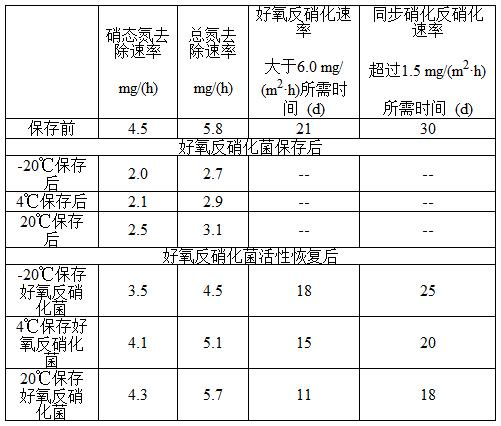
d的活性恢复后,R1,R2和R3中的好氧反硝化菌特性如表2所示,在好氧反硝化菌活性恢复后,R1和R2中的硝态氮去除速率和总氮去除速率均低于保存之前的好氧反硝化菌的硝态氮去除速率和总氮去除速率,只有保存在20℃的好氧反硝化菌硝态氮去除速率和总氮去除速率与保存之前的较为一致。不同保存温度下好氧反硝化菌的反硝化速率和同步硝化反硝化速率均低于保存之前,经过活性恢复后,R2中好氧反硝化菌的反硝化速率和R3中好氧反硝化菌的反硝化速率和同步硝化反硝化速率较接近保存之前,但R1中保存的好氧反硝化菌的反硝化速率和同步硝化反硝化速率均相对较低。
通常好氧反硝化菌的反硝化速率和同步硝化反硝化速率分别为6.0
mg/(m
2•h)和1.5
mg/(m
2•h),中试运行系统驯化的好氧反硝化菌达到相同反硝化速率和同步硝化反硝化速率的时间分别为21和30
d。将保存的好氧反硝化菌进行活性恢复后,R1中好氧反硝化菌达到相同反硝化速率和同步硝化反硝化速率的时间分别需要18和25
d,R2中好氧反硝化菌达到相同反硝化速率和同步硝化反硝化速率的时间分别需要15和20
d,R3中好氧反硝化菌达到相同反硝化速率和同步硝化反硝化速率的时间分别需要11和18
d。说明经活性恢复后的好氧反硝化菌均具有较好的脱氮效果,其中保存于20℃条件的好氧反硝化菌膜具有最短的微生物活性恢复时间,是较为适宜保存好氧反硝化菌的温度。
表2
保存和活性恢复后好氧反硝化菌的特性
活性恢复后好氧反硝化菌对污染物的去除效能:
经过活性恢复过程后,不同保存温度下的好氧反硝化菌对硝态氮和总氮的去除率均逐渐升高(图1和图2),其对硝态氮和总氮的去除率分别超过90%和88%。在活性恢复的第18
d,R3中的好氧反硝化菌对硝态氮和总氮的去除效果最好,并一直呈现硝态氮和总氮去除率稳定升高的趋势,此结果也同表2中R3内好氧反硝化菌最快恢复较高的反硝化速率和同步硝化反硝化速率相对应,说明20℃的条件较为适宜保存好氧反硝化菌,在实际应用中具有很高的可行性。
活性恢复后好氧反硝化菌特性与细胞状态相关性
在好氧反硝化菌活性恢复30
d后,采用流式细胞术对好氧反硝化菌细胞状态进行分析,结果如表3所示。不同保存温度下的好氧反硝化菌中活细胞含量与中试运行系统中好氧反硝化菌中活细胞含量基本接近,说明经过活性恢复后,好氧反硝化菌均可发挥稳定的硝态氮和总氮去除效果。其中R3内好氧反硝化菌活细胞比例(80.3%±4.2%)最高,且凋亡晚期细胞比例(7.5%±0.3%)和死细胞比例(6.7%±0.1%)最低,说明20℃的保存条件下好氧反硝化菌细胞活性最高,较为适宜作为保存好氧反硝化菌的条件。
表3
活性恢复后(30
d)好氧反硝化菌细胞活性状态(%)
| 好氧反硝化菌 | 活细胞 | 凋亡早期细胞 | 凋亡晚期细胞 | 死细胞 |
| 中试运行系统 | 87.0±4.5 | 4.5±0.1 | 3.6±0.1 | 4.9±0.2 |
| 保存于-20℃ | 78.0±4.3 | 6.0±0.1 | 7.1±0.1 | 8.9±0.3 |
| 保存于4℃ | 78.5±4.3 | 6.0±0.1 | 7.5±0.3 | 9.0±0.3 |
| 保存于20℃ | 80.3±4.2 | 5.5±0.1 | 7.5±0.3 | 6.7±0.1 |
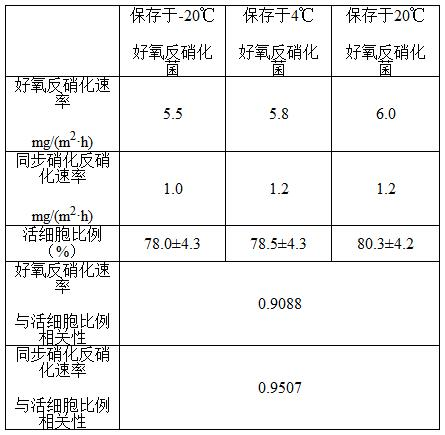
依据Correl相关性分析发现,好氧反硝化菌的反硝化速率和同步硝化反硝化速率和好氧反硝化菌活细胞比例具有较高的相关性(如表4所示),相关系数分别为0.9088和0.9507,表明利用好氧反硝化菌活细胞比例作为评价好氧反硝化菌活性的方法具有较高可行性。同时,由于保存的好氧反硝化菌中,20℃的保存条件下好氧反硝化菌活细胞比例最高,与活性恢复后R3中好氧反硝化菌活细胞比例结果相吻合。
表4
活性恢复后(30
d)好氧反硝化菌特性与细胞活性状态关联性
因此,确定20℃是保存好氧反硝化菌的最适温度,利用流式细胞术可以作为确定好氧反硝化菌最适保存温度的依据。流式细胞术操作简便,数据快速易得且准确可靠,亦可省略好氧反硝化菌活性恢复过程,对于好氧反硝化菌的保存与活性恢复意义重大。
对比例1
好氧反硝化菌的保存:
好氧反硝化菌的保存温度设置为-20℃,4℃和20℃。将中试反应装置(处理规模100
t/d)中好氧反硝化菌聚氨酯悬浮填料约180个取出,平均三等份分别置于装有600
ml保存基质的1000
ml血清瓶中,保存基质为污水处理厂缺氧池出水(即好氧池进水,COD浓度为100-150
mg/L, NH
4
+-N浓度为27.5-38.5 mg/L,NO
3
--N浓度为4.5-8.0
mg/L。将血清瓶(每个保存温度下设置3个平行样)分别置于-20℃,4℃和20℃,静止遮光保存。
流式细胞术测试好氧反硝化菌微生物细胞状态:
于-20℃,4℃和20℃保存的好氧反硝化菌在保存超过60
d后,用于测定好氧反硝化菌细胞状态,具体步骤如下:
(1)取好氧反硝化菌聚氨酯悬浮填料约20个(体积约200-300
ml),分别用pH为7.2和7.8的磷酸盐缓冲液稀释至1
L,采用超声波破碎仪(超声能量密度90
kJ/g),使聚氨酯悬浮填料中的好氧反硝化菌释放到磷酸盐缓冲液中并保证其均匀分布;
(2)用10
μm孔径的尼龙膜过滤絮体样品,并于8000
rpm/min 离心5
min;
(3)取沉淀置于50
ml离心管中,样品于8000
rpm/min 离心5
min;
(4)用移液枪吸取离心后的样品上清液,留下约0.1
ml样品,使用预冷磷酸盐缓冲液(pH为7.8)吹洗细胞,重复离心和清洗两次;
(5)离心后的样品用移液枪吸取上清液,留下约0.1
ml样品,使用0.3
ml 10x Annexin V Binding Buffer混匀;
(6)对照FITC
Annexin V组加入0.5μl PI染色剂,对照PI组加入0.5
μl FITC Annexin V,检测组加入0.5μl FITC Annexin V和0.5
μl PI,混匀后室温下避光孵育15
min,之后于流式细胞仪上机检测。
细胞状态测试结果如表5和表6所示。
表5
保存的好氧反硝化菌细胞活性状态(pH为7.2的磷酸盐缓冲液)
| 好氧反硝化菌 | 活细胞 | 凋亡早期细胞 | 凋亡晚期细胞 | 死细胞 |
| 中试运行系统 | 88.5±4.9 | 4.7±0.1 | 3.3±0.1 | 3.5±0.1 |
| 保存于-20℃ | 52.5±3.1 | 6.3±0.5 | 11.7±0.8 | 29.5±1.4 |
| 保存于4℃ | 57.0±3.0 | 3.2±0.2 | 13.8±0.8 | 26.0±1.3 |
| 保存于20℃ | 59.7±3.1 | 3.1±0.2 | 17.9±1.0 | 19.3±1.0 |
由表5结果发现,保存于20℃的好氧反硝化菌活细胞比例最高,但是三种温度下的好氧反硝化菌,其活细胞含量较为接近,且凋亡晚期细胞和死细胞的总含量亦较为接近,因此当pH为7.2时,流式细胞分析结果的显著性较差,不适合作为确定好氧反硝化菌最适保存温度的适宜pH。
表6
保存的好氧反硝化菌细胞活性状态(pH为7.8的磷酸盐缓冲液)
| 好氧反硝化菌 | 活细胞 | 凋亡早期细胞 | 凋亡晚期细胞 | 死细胞 |
| 中试运行系统 | 88.5±4.9 | 4.7±0.1 | 3.3±0.1 | 3.5±0.1 |
| 保存于-20℃ | 49.2±2.7 | 0.5±0.1 | 21.5±1.7 | 27.6±1.9 |
| 保存于4℃ | 47.9±2.5 | 0.2±0.1 | 22.9±1.8 | 29.0±2.3 |
| 保存于20℃ | 48.9±2.5 | 0.3±0.1 | 21.8±1.9 | 29.0±2.1 |
由表6结果发现,保存于三种温度下的好氧反硝化菌不仅活细胞含量较为接近,且凋亡晚期细胞和死细胞的含量亦较为接近,同时,基于凋亡早期细胞检测的结果偏低,表明当pH为7.8时,流式细胞分析结果无法有效确定好氧反硝化菌的最适保存温度。
虽然本发明已以较佳实施例公开如上,但其并非用以限定本发明,任何熟悉此技术的人,在不脱离本发明的精神和范围内,都可做各种的改动与修饰,因此本发明的保护范围应该以权利要求书所界定的为准。
Claims (12)
- 一种确定好氧反硝化菌最适保存温度的方法,其特征在于,所述方法是利用流式细胞术测定不同温度保存的好氧反硝化菌的细胞活性状态,将最接近好氧反硝化菌在中试运行中的细胞活性状态的保存温度确定为最适保存温度;所述好氧反硝化菌细胞活性状态的测定包括活细胞、凋亡早期细胞、凋亡晚期细胞和死细胞的含量测定;所述利用流式细胞术确认最适温度的方法包括:(1)好氧反硝化菌测试样液的制备:用缓冲液稀释好氧反硝化菌样品,混合均匀后过滤取沉淀,离心,留用上清液,使用预冷缓冲液吹洗细胞,重复离心和清洗两次,再取上清液作为样品,使用适量10x Annexin V Binding Buffer混匀制得;其中,所述缓冲液的pH为7.3~7.6;所述过滤是利用孔径6~15 μm的尼龙膜进行过滤;(2)置于流式细胞仪测定各样液的细胞活性状态。
- 一种确定好氧反硝化菌最适保存温度的方法,其特征在于,所述方法是利用流式细胞术测定不同温度保存的好氧反硝化菌的细胞活性状态,将最接近好氧反硝化菌在中试运行中的细胞活性状态的保存温度确定为最适保存温度;所述好氧反硝化菌细胞活性状态的测定包括活细胞、凋亡早期细胞、凋亡晚期细胞和死细胞的含量测定。
- 根据权利要求2所述的方法,其特征在于,所述利用流式细胞术确认最适温度的方法包括:(1)好氧反硝化菌测试样液的制备:用缓冲液稀释好氧反硝化菌样品,混合均匀后过滤取沉淀,离心,留用上清液,使用预冷缓冲液吹洗细胞,重复离心和清洗两次,再取上清液作为样品,使用适量10x Annexin V Binding Buffer混匀制得;(2)置于流式细胞仪测定各样液的细胞活性状态。
- 根据权利要求3所述的方法,其特征在于,所述缓冲液的pH为7.3~7.6。
- 根据权利要求3所述的方法,其特征在于,所述缓冲液包括磷酸盐缓冲液。
- 根据权利要求3所述的方法,其特征在于,所述缓冲液包括(8~28)% v/v磷酸二氢钠和(72~92)% v/v磷酸氢二钠。
- 根据权利要求3所述的方法,其特征在于,所述缓冲液与好氧反硝化菌的稀释体积比为4~10:1。
- 根据权利要求3所述的方法,其特征在于,所述过滤是利用孔径6~15 μm的尼龙膜。
- 根据权利要求5~7任一所述的方法,其特征在于,所述过滤是利用孔径6~15 μm的尼龙膜。
- 一种快速启动好氧反硝化菌的方法,其特征在于,是利用权利要求1~7任一所述方法确定最适保存温度,在最适保存温度下,将培养成熟的好氧反硝化菌置于保存基质中进行保存,活性恢复后即可启动好氧反硝化菌工程。
- 根据权利要求10所述的方法,其特征在于,所述保存基质的COD浓度为100~150 mg/L, NH 4 +-N浓度为27.5~38.5 mg/L,NO 3 --N浓度为4.5~8.0 mg/L。
- 一种污水处理的方法,其特征在于,是利用权利要求10或11所述方法快速启动好氧反硝化菌工程。
Priority Applications (1)
| Application Number | Priority Date | Filing Date | Title |
|---|---|---|---|
| US16/869,670 US20200262727A1 (en) | 2018-10-30 | 2020-05-08 | Method for determining optimal preservation temperature of aerobic denitrifiers in wastewater treatment for total nitrogen removal |
Applications Claiming Priority (2)
| Application Number | Priority Date | Filing Date | Title |
|---|---|---|---|
| CN201811277233.0 | 2018-10-30 | ||
| CN201811277233.0A CN111006991B (zh) | 2018-10-30 | 2018-10-30 | 一种确定污水处理好氧反硝化菌最适保存温度的方法 |
Related Child Applications (1)
| Application Number | Title | Priority Date | Filing Date |
|---|---|---|---|
| US16/869,670 Continuation US20200262727A1 (en) | 2018-10-30 | 2020-05-08 | Method for determining optimal preservation temperature of aerobic denitrifiers in wastewater treatment for total nitrogen removal |
Publications (1)
| Publication Number | Publication Date |
|---|---|
| WO2020088062A1 true WO2020088062A1 (zh) | 2020-05-07 |
Family
ID=70111557
Family Applications (1)
| Application Number | Title | Priority Date | Filing Date |
|---|---|---|---|
| PCT/CN2019/102713 Ceased WO2020088062A1 (zh) | 2018-10-30 | 2019-08-27 | 一种确定污水处理好氧反硝化菌最适保存温度的方法 |
Country Status (3)
| Country | Link |
|---|---|
| US (1) | US20200262727A1 (zh) |
| CN (1) | CN111006991B (zh) |
| WO (1) | WO2020088062A1 (zh) |
Families Citing this family (1)
| Publication number | Priority date | Publication date | Assignee | Title |
|---|---|---|---|---|
| CN116354506B (zh) * | 2023-03-21 | 2024-01-19 | 北京工业大学 | 一种通过高浓度群体感应抑制剂胁迫实现异养硝化-好氧反硝化高效脱氮的方法 |
Citations (5)
| Publication number | Priority date | Publication date | Assignee | Title |
|---|---|---|---|---|
| JP2007189952A (ja) * | 2006-01-19 | 2007-08-02 | Fuji Electric Systems Co Ltd | 硝化細菌固定化膜の保存液 |
| CN102050521A (zh) * | 2009-10-27 | 2011-05-11 | 中国石油化工股份有限公司 | 同步硝化反硝化处理含氨污水方法 |
| CN102967545A (zh) * | 2012-11-06 | 2013-03-13 | 清华大学 | 一种检测活性细菌含量的方法 |
| CN104531595A (zh) * | 2015-01-20 | 2015-04-22 | 重庆大学 | 一种快速筛选分离异养硝化-好氧反硝化细菌的方法 |
| CN108585195A (zh) * | 2018-03-14 | 2018-09-28 | 重庆理工大学 | 基于固相反硝化和异养硝化-好氧反硝化的低温低碳氨氮废水处理装置及方法 |
Family Cites Families (5)
| Publication number | Priority date | Publication date | Assignee | Title |
|---|---|---|---|---|
| IL106047A0 (en) * | 1993-05-27 | 1993-10-20 | Ecoscience Corp | Method for storing fungal cultures and conidia |
| JP2979383B2 (ja) * | 1996-04-11 | 1999-11-15 | 株式会社日本水処理技研 | 菌類の即時判別方法 |
| CN1286725A (zh) * | 1997-11-26 | 2001-03-07 | 环球保藏技术股份有限公司 | 敏感性生物样品的玻化保质法 |
| DE19900135A1 (de) * | 1998-01-07 | 1999-08-05 | Univ Rockefeller | Verfahren zur Bestimmung der Temperatur einer einzelnen Zelle in einer Zellprobe oder Gewebebiopsie sowie Verfahren zu dessen Verwendung |
| CN104920339B (zh) * | 2015-06-04 | 2017-11-03 | 天津大学 | 利用生物相容性颗粒保存细胞的方法 |
-
2018
- 2018-10-30 CN CN201811277233.0A patent/CN111006991B/zh active Active
-
2019
- 2019-08-27 WO PCT/CN2019/102713 patent/WO2020088062A1/zh not_active Ceased
-
2020
- 2020-05-08 US US16/869,670 patent/US20200262727A1/en not_active Abandoned
Patent Citations (5)
| Publication number | Priority date | Publication date | Assignee | Title |
|---|---|---|---|---|
| JP2007189952A (ja) * | 2006-01-19 | 2007-08-02 | Fuji Electric Systems Co Ltd | 硝化細菌固定化膜の保存液 |
| CN102050521A (zh) * | 2009-10-27 | 2011-05-11 | 中国石油化工股份有限公司 | 同步硝化反硝化处理含氨污水方法 |
| CN102967545A (zh) * | 2012-11-06 | 2013-03-13 | 清华大学 | 一种检测活性细菌含量的方法 |
| CN104531595A (zh) * | 2015-01-20 | 2015-04-22 | 重庆大学 | 一种快速筛选分离异养硝化-好氧反硝化细菌的方法 |
| CN108585195A (zh) * | 2018-03-14 | 2018-09-28 | 重庆理工大学 | 基于固相反硝化和异养硝化-好氧反硝化的低温低碳氨氮废水处理装置及方法 |
Also Published As
| Publication number | Publication date |
|---|---|
| US20200262727A1 (en) | 2020-08-20 |
| CN111006991B (zh) | 2021-06-25 |
| CN111006991A (zh) | 2020-04-14 |
Similar Documents
| Publication | Publication Date | Title |
|---|---|---|
| CN111003813B (zh) | 一种确定硫自养反硝化菌生物膜最适保存温度的方法 | |
| CN107162214B (zh) | 一种复合微生物耦合微米零价铁脱氮除磷的污水处理方法 | |
| CN113403234B (zh) | 一株海洋自絮凝菌与其驱动发展的适盐氮同化微生物组及构建方法与应用 | |
| WO2011079827A1 (zh) | 极端嗜盐菌、及复合嗜盐菌菌剂和应用 | |
| Li et al. | Study of extracellular polymeric substances in the biofilms of a suspended biofilter for nitric oxide removal | |
| WO2024174615A1 (zh) | 一种筛选好氧反硝化真菌及其修复低碳氮比水体的方法 | |
| CN117342704A (zh) | 一种基于菌藻共生的同步脱氮除氟方法 | |
| US20200140301A1 (en) | Method for determining optimal preservation temperature of biofilm in wastewater treatment | |
| CN114437933A (zh) | 一种异养硝化-好氧反硝化复合菌强化sbr脱氮性能的方法 | |
| CN114410618A (zh) | 一种固定化微生物载体的制备方法及其产品和应用 | |
| Li et al. | Effects of aeration coupled with microbial fuel cell on nitrogen removal and electricity production for biogas slurry | |
| CN105039225B (zh) | 一种好氧反硝化菌及其应用 | |
| CN102061275A (zh) | 一株施氏假单胞菌及其在水体除磷中的应用 | |
| US20200262727A1 (en) | Method for determining optimal preservation temperature of aerobic denitrifiers in wastewater treatment for total nitrogen removal | |
| CN116809018B (zh) | 一种污泥生物炭的制备方法及应用 | |
| CN106947711A (zh) | 一种高适用性硝化菌剂的制备方法 | |
| CN110963569A (zh) | 一种用于染色废水厌氧颗粒污泥快速培养方法及应用 | |
| CN110902843B (zh) | 一种确定污水处理厌氧氨氧化生物膜最适保存温度的方法 | |
| CN117699969A (zh) | 利用红假单胞菌耦合陶瓷膜mbr处理啤酒厂废水的方法 | |
| CN110607342B (zh) | 一种确定产氢产乙酸菌最适保存温度的方法 | |
| CN110894101B (zh) | 一种确定污水处理硝化反硝化生物膜最适保存温度的方法 | |
| CN120058130B (zh) | 一种低能耗脱氮复合菌群在活性污泥体系中的应用 | |
| CN112678947B (zh) | 一种确定厌氧颗粒污泥最适保存温度的方法 | |
| CN110835157B (zh) | 一种确定好氧颗粒污泥最适保存温度的方法 | |
| CN114314861B (zh) | 一种水体脱氮方法 |
Legal Events
| Date | Code | Title | Description |
|---|---|---|---|
| 121 | Ep: the epo has been informed by wipo that ep was designated in this application |
Ref document number: 19878221 Country of ref document: EP Kind code of ref document: A1 |
|
| NENP | Non-entry into the national phase |
Ref country code: DE |
|
| 122 | Ep: pct application non-entry in european phase |
Ref document number: 19878221 Country of ref document: EP Kind code of ref document: A1 |