WO2020075439A1 - 吸収性物品 - Google Patents
吸収性物品 Download PDFInfo
- Publication number
- WO2020075439A1 WO2020075439A1 PCT/JP2019/035878 JP2019035878W WO2020075439A1 WO 2020075439 A1 WO2020075439 A1 WO 2020075439A1 JP 2019035878 W JP2019035878 W JP 2019035878W WO 2020075439 A1 WO2020075439 A1 WO 2020075439A1
- Authority
- WO
- WIPO (PCT)
- Prior art keywords
- hydrophobic
- region
- sheet
- functional material
- hydrophobic portion
- Prior art date
- Legal status (The legal status is an assumption and is not a legal conclusion. Google has not performed a legal analysis and makes no representation as to the accuracy of the status listed.)
- Ceased
Links
Images



Classifications
-
- A—HUMAN NECESSITIES
- A61—MEDICAL OR VETERINARY SCIENCE; HYGIENE
- A61F—FILTERS IMPLANTABLE INTO BLOOD VESSELS; PROSTHESES; DEVICES PROVIDING PATENCY TO, OR PREVENTING COLLAPSING OF, TUBULAR STRUCTURES OF THE BODY, e.g. STENTS; ORTHOPAEDIC, NURSING OR CONTRACEPTIVE DEVICES; FOMENTATION; TREATMENT OR PROTECTION OF EYES OR EARS; BANDAGES, DRESSINGS OR ABSORBENT PADS; FIRST-AID KITS
- A61F13/00—Bandages or dressings; Absorbent pads
- A61F13/15—Absorbent pads, e.g. sanitary towels, swabs or tampons for external or internal application to the body; Supporting or fastening means therefor; Tampon applicators
-
- A—HUMAN NECESSITIES
- A61—MEDICAL OR VETERINARY SCIENCE; HYGIENE
- A61F—FILTERS IMPLANTABLE INTO BLOOD VESSELS; PROSTHESES; DEVICES PROVIDING PATENCY TO, OR PREVENTING COLLAPSING OF, TUBULAR STRUCTURES OF THE BODY, e.g. STENTS; ORTHOPAEDIC, NURSING OR CONTRACEPTIVE DEVICES; FOMENTATION; TREATMENT OR PROTECTION OF EYES OR EARS; BANDAGES, DRESSINGS OR ABSORBENT PADS; FIRST-AID KITS
- A61F13/00—Bandages or dressings; Absorbent pads
- A61F13/15—Absorbent pads, e.g. sanitary towels, swabs or tampons for external or internal application to the body; Supporting or fastening means therefor; Tampon applicators
- A61F13/45—Absorbent pads, e.g. sanitary towels, swabs or tampons for external or internal application to the body; Supporting or fastening means therefor; Tampon applicators characterised by the shape
- A61F13/47—Sanitary towels, incontinence pads or napkins
- A61F13/472—Sanitary towels, incontinence pads or napkins specially adapted for female use
-
- A—HUMAN NECESSITIES
- A61—MEDICAL OR VETERINARY SCIENCE; HYGIENE
- A61F—FILTERS IMPLANTABLE INTO BLOOD VESSELS; PROSTHESES; DEVICES PROVIDING PATENCY TO, OR PREVENTING COLLAPSING OF, TUBULAR STRUCTURES OF THE BODY, e.g. STENTS; ORTHOPAEDIC, NURSING OR CONTRACEPTIVE DEVICES; FOMENTATION; TREATMENT OR PROTECTION OF EYES OR EARS; BANDAGES, DRESSINGS OR ABSORBENT PADS; FIRST-AID KITS
- A61F13/00—Bandages or dressings; Absorbent pads
- A61F13/15—Absorbent pads, e.g. sanitary towels, swabs or tampons for external or internal application to the body; Supporting or fastening means therefor; Tampon applicators
- A61F13/51—Absorbent pads, e.g. sanitary towels, swabs or tampons for external or internal application to the body; Supporting or fastening means therefor; Tampon applicators characterised by the outer layers of the pads
-
- A—HUMAN NECESSITIES
- A61—MEDICAL OR VETERINARY SCIENCE; HYGIENE
- A61F—FILTERS IMPLANTABLE INTO BLOOD VESSELS; PROSTHESES; DEVICES PROVIDING PATENCY TO, OR PREVENTING COLLAPSING OF, TUBULAR STRUCTURES OF THE BODY, e.g. STENTS; ORTHOPAEDIC, NURSING OR CONTRACEPTIVE DEVICES; FOMENTATION; TREATMENT OR PROTECTION OF EYES OR EARS; BANDAGES, DRESSINGS OR ABSORBENT PADS; FIRST-AID KITS
- A61F13/00—Bandages or dressings; Absorbent pads
- A61F13/15—Absorbent pads, e.g. sanitary towels, swabs or tampons for external or internal application to the body; Supporting or fastening means therefor; Tampon applicators
- A61F13/51—Absorbent pads, e.g. sanitary towels, swabs or tampons for external or internal application to the body; Supporting or fastening means therefor; Tampon applicators characterised by the outer layers of the pads
- A61F13/511—Topsheet, i.e. the permeable cover or layer facing the skin
-
- A—HUMAN NECESSITIES
- A61—MEDICAL OR VETERINARY SCIENCE; HYGIENE
- A61F—FILTERS IMPLANTABLE INTO BLOOD VESSELS; PROSTHESES; DEVICES PROVIDING PATENCY TO, OR PREVENTING COLLAPSING OF, TUBULAR STRUCTURES OF THE BODY, e.g. STENTS; ORTHOPAEDIC, NURSING OR CONTRACEPTIVE DEVICES; FOMENTATION; TREATMENT OR PROTECTION OF EYES OR EARS; BANDAGES, DRESSINGS OR ABSORBENT PADS; FIRST-AID KITS
- A61F13/00—Bandages or dressings; Absorbent pads
- A61F13/15—Absorbent pads, e.g. sanitary towels, swabs or tampons for external or internal application to the body; Supporting or fastening means therefor; Tampon applicators
- A61F13/53—Absorbent pads, e.g. sanitary towels, swabs or tampons for external or internal application to the body; Supporting or fastening means therefor; Tampon applicators characterised by the absorbing medium
- A61F13/531—Absorbent pads, e.g. sanitary towels, swabs or tampons for external or internal application to the body; Supporting or fastening means therefor; Tampon applicators characterised by the absorbing medium having a homogeneous composition through the thickness of the pad
- A61F13/532—Absorbent pads, e.g. sanitary towels, swabs or tampons for external or internal application to the body; Supporting or fastening means therefor; Tampon applicators characterised by the absorbing medium having a homogeneous composition through the thickness of the pad inhomogeneous in the plane of the pad
- A61F13/533—Absorbent pads, e.g. sanitary towels, swabs or tampons for external or internal application to the body; Supporting or fastening means therefor; Tampon applicators characterised by the absorbing medium having a homogeneous composition through the thickness of the pad inhomogeneous in the plane of the pad having discontinuous areas of compression
Definitions
- the present invention relates to absorbent articles.
- Patent Document 1 discloses an absorbent core including a super absorbent polymer, a cover sheet disposed on the skin side and a non-skin side of the absorbent core, and a cover sheet containing a fragrance as a functional material. It has been known. Since the fragrance is placed on the skin surface side of the superabsorbent polymer that is the source of the odor, before the odor caused by the superabsorbent polymer reaches the wearer, the fragrance reaches the wearer first, The odor can be suppressed.
- the fragrance contained in the cover sheet on the non-skin surface side is arranged between the absorbent core and the back sheet, and is easily absorbed by the absorbent core before reaching the top sheet. Therefore, the fragrance contained in the cover sheet on the non-skin surface side has not been able to sufficiently exert the effect as a functional material.
- the fragrance contained in the cover sheet on the skin side is disposed between the absorbent core and the top sheet, and easily passes through the top sheet and reaches the wearer. Therefore, the fragrance contained in the cover sheet on the skin side could exert the effect as a functional material.
- an absorbent article having a functional material disposed between the topsheet and the absorbent core which can improve the duration of the effect of the functional material, is desired.
- the absorbent article according to one aspect is arranged in the front-rear direction, the width direction orthogonal to the front-rear direction, and the thickness direction, the absorption core, and the skin surface side of the absorption core, and faces the wearer's skin. And a functional material disposed between the topsheet and the absorbent core in the thickness direction.
- the absorbent article has a hydrophobic portion having hydrophobicity arranged between the topsheet and the absorbent core.
- the functional material is arranged in both an overlapping region that overlaps the hydrophobic part in the thickness direction and a non-overlapping region that does not overlap the hydrophobic part in the thickness direction.
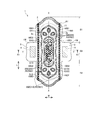
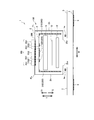
- FIG. 1 is a schematic plan view (No. 1) of the sanitary napkin 1 viewed from the skin surface side.
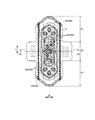
- FIG. 2 is a schematic plan view of the napkin 1 viewed from the non-skin surface side.
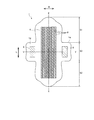
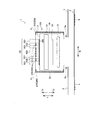
- FIG. 3 is a schematic cross-sectional view (No. 1) of the napkin 1 taken along the line A1-A1 in FIG.
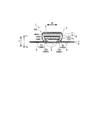
- FIG. 4 is a diagram illustrating an end portion in the width direction W of the schematic cross-sectional view shown in FIG.
- FIG. 5 is a schematic plan view (No. 2) of the napkin 1 viewed from the skin surface side.
- FIG. 6 is a schematic schematic cross-sectional view (No. 2) of the napkin 1 taken along the line A1-A1 in FIG.
- FIG. 7 is a schematic plan view (No.
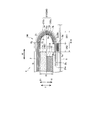
- FIG. 8 is a schematic cross-sectional view of the napkin 1 shown by the arrow A2-A2 in FIG.
- FIG. 9 is a schematic plan view (No. 2) of the napkin 1 according to the modification viewed from the skin surface side.
- FIG. 10 is an enlarged schematic plan view seen from the side (skin surface side or non-skin surface side) to which the hydrophobic portion is applied.
- the absorbent article according to one aspect is arranged in the front-rear direction, the width direction orthogonal to the front-rear direction, and the thickness direction, the absorption core, and the skin surface side of the absorption core, and faces the wearer's skin. And a functional material disposed between the topsheet and the absorbent core in the thickness direction.
- the absorbent article has a hydrophobic portion having hydrophobicity arranged between the topsheet and the absorbent core.
- the functional material is arranged in both an overlapping region that overlaps the hydrophobic part in the thickness direction and a non-overlapping region that does not overlap the hydrophobic part in the thickness direction.
- the duration of the effect of the functional material can be improved.
- the functional material may be arranged on the skin surface side of the hydrophobic portion in the overlapping region.
- the functional material in the overlapping area is restricted from moving to the non-skin surface side by the hydrophobic part. Therefore, the proportion of the functional material that moves to the non-skin surface side decreases, and the proportion of the functional material that moves to the skin surface side increases. Therefore, the functional material in the overlapping region starts volatilization as soon as the wearer wears the absorbent article, as compared with the functional material in the non-overlapping region, so that the wearer can quickly feel the effect of the functional material. It will be easier.
- the functional material in the non-overlapping region has a smaller proportion of the functional material that moves to the skin side than the functional material in the overlapping region. To do. Therefore, the time for which the functional material exerts its effect is different between the overlapping region and the non-overlapping region, so that the duration of the effect of the functional material can be improved.
- the excrement When the effect is obtained by contacting the functional material with excrement (menstrual blood, urine, etc.), in the overlapping area, the excrement is less likely to diffuse to the non-skin side than the hydrophobic part, and the excrement is It becomes easy to contact the functional material in the overlapping region. Therefore, the ratio of the functional material in the overlapping area contacting the excrement is higher than that in the functional material in the non-overlapping area, and the effect of the functional material is easily exhibited. On the other hand, in the non-overlap region, since the excrement easily diffuses to the non-skin surface side, the ratio of the functional material in the non-overlap region contacting the excrement is lower than that in the functional material in the overlap region.
- the functional material that exerts the effect is likely to remain, and even when the excrement absorbed by the absorbent core returns to the skin surface side, the effect is exerted on the excrement. be able to. Therefore, the time for which the functional material exerts its effect is different between the overlapping region and the non-overlapping region, so that the duration of the effect of the functional material can be improved.
- the functional material may be arranged on the non-skin surface side of the hydrophobic portion in the overlapping region.
- the hydrophobic material restricts the movement of the functional material in the overlapping area to the skin surface side. Therefore, it takes time for the functional material in the overlapping region to pass through the hydrophobic portion, and for the functional material in the overlapping region to take effect as compared with the functional material in the overlapping region.
- movement of the functional material in the non-overlapping region is not limited by the hydrophobic portion, and it is easier to move to the skin surface side than the functional material in the overlapping region. Therefore, the effect of the functional material in the non-overlap region is exhibited first, and the effect of the functional material in the overlap region is exhibited with a delay. Therefore, the time for which the functional material exerts its effect is different between the overlapping region and the non-overlapping region, so that the duration of the effect of the functional material can be improved.
- the functional material in the non-overlapping region is likely to come into contact with the excrement and exert the effect of the functional material.
- the excrement in the non-overlap region diffuses on the non-skin surface side of the hydrophobic portion and reaches the functional material in the overlap region.
- the functional material in the overlapping region exhibits its effect later than the functional material in the non-overlapping region. Therefore, the time for which the functional material exerts its effect is different between the overlapping region and the non-overlapping region, so that the duration of the effect of the functional material can be improved.
- the functional material may be volatile.
- the functional material may be an antibacterial agent or a deodorant.
- the hydrophobic portion may be provided on the non-skin surface side of the top sheet.
- the hydrophobic portion does not directly contact the wearer's skin, and thus it is possible to suppress deterioration of the wearer's touch.
- the excrement reaching the member inside the top sheet is diffused, it is possible to suppress the exudation to the skin side of the top sheet in the area overlapping the hydrophobic portion. Therefore, it is possible to improve the duration of the effect of the functional material while suppressing deterioration of the wearer's touch due to exudation of excrement.
- the absorbent article may have an intermediate sheet arranged between the top sheet and the absorbent core.
- the hydrophobic portion may be provided on the skin surface side of the intermediate sheet.
- the absorbent article may have an intermediate sheet arranged between the top sheet and the absorbent core.
- the hydrophobic portion may be provided on the non-skin surface side of the intermediate sheet. Since the excrement excreted on the top sheet can be quickly absorbed up to the second sheet, the duration of the effect of the functional material can be improved while suppressing the deterioration of the wearer's touch due to the excrement.
- the absorbent article has a pair of wings that extend outward of the outer edge of the absorbent core in the width direction in the width direction and are foldable when the absorbent article is used. You may have.
- the absorbent article may have a central region, in the plan view of the absorbent article, of the region sandwiched between the pair of wings, in which the absorbent core is disposed.
- the central region may have a hydrophobic region in which the hydrophobic portion is arranged and a non-hydrophobic region in which the hydrophobic portion is not arranged.
- the non-hydrophobic region may overlap with a straight line along the front-rear direction at any place of the central region.
- the central region in which the absorbent core is arranged is generally the region facing the excretory opening (eg, vaginal opening).
- the non-hydrophobic region overlaps the straight line along the front-rear direction, and thus excrement reaches the non-hydrophobic region by diffusing in the front-rear direction.
- the hydrophobic portion since the hydrophobic portion is not arranged, excrement easily reaches the absorbent core. Therefore, in the central region, in the hydrophobic region, the expression of the effect of the functional material is controlled by the hydrophobic portion, while in the non-hydrophobic region, excrement can be quickly absorbed by the absorbent core.
- the absorbent article may have a hydrophobic area in which the ink constituting the hydrophobic part is arranged by printing.
- the hydrophobic region may be composed of a halftone dot region in which a plurality of halftone dots formed of the ink are arranged, and a non-halftone dot region which is a gap region between the plurality of halftone dots.
- the ratio of the halftone dot region to the hydrophobic region may be larger than the ratio of the non-halftone dot region to the hydrophobic region.
- the absorbent article may have a hydrophobic area in which the ink constituting the hydrophobic part is arranged by printing.
- the hydrophobic region may be composed of a halftone dot region in which a plurality of halftone dots formed of the ink are arranged, and a non-halftone dot region which is a gap region between the plurality of halftone dots.
- the ratio of the halftone dot region to the hydrophobic region may be equal to or less than the ratio of the non-halftone dot region to the hydrophobic region.
- the functional material may be volatile.
- the absorbent article has a front side region, a rear side region, a central region arranged between the front side region and the rear side region, the top sheet and the absorbent core are squeezed in the thickness direction. It may have a pair of compressed parts.
- the pair of pressing parts may extend in the front-rear direction in the central region.
- the hydrophobic section may be arranged between the pair of compressed sections.
- the skin side of the absorbent article approaches the wearer's skin, and the volatilized functional material easily reaches the wearer's skin immediately.
- the wearer can quickly feel the effect of the functional material.
- the excrement that passes through the hydrophobic portion and reaches the absorption core is reduced, but the excrement that does not pass through the hydrophobic portion moves in the width direction, Reach the compression section. Since the excrement is drawn up to the absorbent core at the compression unit, the absorbability of the excrement can be maintained.
- the maximum thickness of the portion overlapping with the hydrophobic portion is greater than that of the hydrophobic portion. It may be thinner than the maximum thickness of the outer portion in the width direction.
- the top sheet easily comes into contact with the wearer's skin, and excrements that move outward in the width direction than the hydrophobic portion are removed. It becomes easy to absorb.
- the hydrophobic part may be provided by printing. This makes it possible to easily provide the hydrophobic part, which can suppress an increase in production cost.
- hydrophobic means a property which is difficult to be compatible with water or hard to retain water, for example, a contact angle with ion-exchanged water is about 80 ° to 100 °.
- the contact angle with ion-exchanged water can be measured by the method described in "Measurement of initial contact angle" in JP-A-2005-324010.
- FIG. 1 is a schematic plan view (No. 1) of the sanitary napkin 1 (hereinafter referred to as “napkin”) viewed from the skin side.
- FIG. 2 is a schematic plan view of the napkin 1 viewed from the non-skin surface side.
- FIG. 3 is a schematic cross-sectional view (No. 1) of the napkin 1 taken along the line A1-A1 in FIG.
- FIG. 4 is a diagram illustrating an end portion in the width direction W of the schematic cross-sectional view shown in FIG.
- FIG. 5 is a schematic plan view (No. 2) of the napkin 1 viewed from the skin surface side.
- the functional region R3 in which the functional material is arranged (coated) is explicitly shown by diagonal lines.
- FIG. 5 the functional region R3 in which the functional material is arranged (coated) is explicitly shown by diagonal lines.
- FIG. 6 is a schematic schematic cross-sectional view (No. 2) of the napkin 1 taken along the line A1-A1 in FIG. It should be noted that although the wing adhesive portion 9 is shown in FIGS. 1 and 5, the wing adhesive portion 9 is arranged on the non-skin surface side T2 of the back sheet 4. In FIGS. 3, 4, and 6, the dimensions in each direction are not necessarily accurate. Further, for convenience, in FIGS. 4 and 6, the adhesive HMA excluding the main body joint portion 5a is omitted.
- the napkin 1 has a front-rear direction L and a width direction W orthogonal to the front-rear direction.
- the front-back direction L is defined by a direction extending to the front side of the body and the rear side of the body.
- the front-rear direction L is a direction that extends in the front-rear direction in the deployed napkin 1.
- the napkin 1 has a thickness direction T orthogonal to both the front-rear direction L and the width direction W.
- the side that contacts the wearer's lower abdomen is called the “front side”, and the side that contacts the wearer's buttocks is called the “rear side”.
- the side in contact with the wearer's skin is referred to as “skin surface side” T1
- the opposite side is referred to as "non-skin surface”.
- Side ”T2 The line XX in the figure is the center line in the width direction W.
- the napkin 1 has a central area S3, a front area S1 and a rear area S2.
- the central area S3 is an area in which the pair of wings 1W are arranged. Therefore, the central region S3 is a region where the wings 1W for fastening the napkin 1 to the worn article are provided. Further, the central area S3 may have an excretory opening contact portion that comes into contact with the excretory opening (eg, vaginal opening) of the wearer.
- the central region S3 When the napkin 1 is attached to a wearing article (for example, underwear), the central region S3 may be located in the crotch portion of the wearing article. Therefore, the central region is a region which is arranged between the wearer's inseam, that is, between the wearer's both legs (thighs).
- the front area S1 is located on the front side of the central area S3.
- the rear area S2 is located rearward of the central area S3.
- Napkin 1 has a pair of wings 1W.
- the pair of wings 1W extends outside the outer edge 10E of the absorbent body 10 (absorbent core) in the width direction W in the width direction. Therefore, it extends from the central portion in the front-rear direction L to both outer sides in the width direction W. Further, the pair of wings 1W can be folded back when the napkin 1 is used.
- the outer edge is the outer end in the width direction W
- the inner edge is the inner end in the width direction W.
- the napkin 1 has a top sheet 2, a second sheet 3, an absorber 10, a back sheet 4, and a side sheet 5.
- a top sheet 2, a second sheet 3, an absorber 10, side sheets 5 and a back sheet 4 are laminated in the thickness direction T.
- the top sheet 2, the second sheet 3, the absorber 10, the back sheet 4, and the side sheet 5 are joined and fixed by a joining portion.
- An adhesive HMA such as a hot melt adhesive can be used as the joining portion.
- the adhesive is applied in an arbitrary application pattern over the skin surface side T1 and the non-skin surface side T2 of each member, and can be selected from application patterns such as an ⁇ pattern, a spiral pattern, and a stripe pattern. .
- Other members for example, a sonic seal may be used as the joining portion.
- the top sheet 2 is arranged on the skin surface side T1 of the absorber 10 and faces the wearer's skin.
- the top sheet 2 may be a “skin side sheet”, most of which is in contact with the wearer's skin in the worn state.
- the topsheet 2 may be made of any sheet-shaped material having a liquid-permeable structure such as a non-woven fabric, a woven fabric, a perforated plastic sheet, and a mesh sheet.
- a non-woven fabric either natural fibers or chemical fibers can be used.
- the nonwoven fabric used as the top sheet 2 is preferably an air-through nonwoven fabric or a spunbond nonwoven fabric.
- the top sheet 2 may be a hydrophobic thermoplastic synthetic resin film.
- it may be a sheet member of polyethylene (PE) or polypropylene (PP).
- the top sheet 2 has a plurality of substantially circular through holes penetrating in the thickness direction T.
- the second sheet 3 is an “intermediate sheet” arranged between the top sheet 2 and the absorbent body 10.
- the second sheet 3 is a liquid-permeable sheet member, and examples thereof include an air-through nonwoven fabric and a spunbond nonwoven fabric.
- the top sheet 2 and the second sheet 3 are wound together so that the absorbent body 10 wraps the end portion in the width direction W in the integrated state where they are adhered by the adhesive HMA.
- the top sheet 2 is joined and fixed on the non-skin surface side of the absorber 10 with an adhesive HMA at the absorber joining portion 10a.
- An absorbent main body 100 in which the top sheet 2, the second sheet 3, and the absorber 10 are integrated is configured.
- the adhesive HMA for joining and fixing each member it is not necessary to apply the adhesive to the entire region.
- the absorbent main body 100 can be formed from a pair of main body joint portions 5a described later.
- the flexibility on the outer side in the width direction W can be secured, and the touch can be improved.
- the main body joining portion 5a joins the absorbent main body 100 and the non-skin side sheet.
- the non-skin surface side of the absorbent main body 100 and the skin surface side surface of the side sheet 5 are joined at the body joining portion 5a using an adhesive such as hot melt.
- the main body joint portion 5a has a continuous shape along the front-rear direction L.
- the main body joint portions 5a are arranged at both ends in the width direction W, at positions symmetrical with respect to the center line XX of the napkin 1 in the width direction W.
- the side sheet 5 is described as a non-skin side sheet, but the back sheet 4 may be a non-skin side sheet, or the combination of the back sheet 4 and the side sheet 5 may be a non-skin side sheet. Good. Further, another sheet member different from the back sheet 4 and the side sheet 5 may be arranged and joined to the end portion of the top sheet 2 including the front end 2he in the width direction W.
- the outermost edge of the top sheet 2 in the width direction W is the skin side end 2e.
- a straight line extending from the skin side end 2e along the width direction W may pass through the center 10c of the absorbent body 10.
- the top sheet 2 has a pair of first folded-back portions 2h in which side edges on both sides in the width direction W are folded back to the non-skin surface side T2.
- the skin side end 2e is also the outermost end in the width direction W of the first folded portion 2h.
- the pair of first folded portions 2h are joined to the side sheet 5 by the body joining portion 5a.
- the widthwise ends 2he of the pair of first folded portions 2h are located inside the widthwise direction W with respect to the outer edge 5e of the main body joining portion 5a. As a result, the front end 2he (edge) of the top sheet 2 (first folded portion 2h) is not exposed. Therefore, since the tip end 2he of the top sheet 2 does not contact the wearer's skin, it is possible to suppress deterioration of the touch.
- a portion of the top sheet 2 outside the absorber 10 in the width direction W and on the skin surface side T1 from the skin side end 2e in the thickness direction T is a skin surface portion 2s.
- the portion of the top sheet 2 outside the absorber 10 and on the non-skin surface side T2 from the skin side end 2e in the thickness direction T is the non-skin surface portion 2u.
- the first folded-back portion 2h is a portion from the folding start point (folding start point) FL, which is the starting point at which the first folded-back portion 2h is folded back, to the tip 2he.
- the folding start point FL extends in the front-rear direction L.
- a region from the center of the top sheet 2 in the width direction W to the folding start point FL is a non-folded region N in which the top sheet 2 is not folded.
- the tip 2he of the top sheet 2 in the width direction W is the tip of the end of the first folded portion 2h that extends inward in the width W. Therefore, the front end 2he of the top sheet 2 in the width direction W is an inner edge of the end of the folded back portion of the top sheet 2 that extends inward in the width direction W.
- the outermost edge in the width direction W of the second seat 3 is the intermediate side edge 3e.
- a straight line extending from the middle side end 3e in the width direction W may pass through the skin side end 2e or the center 10c of the absorbent body 10.
- the second sheet 3 may have a pair of second folded-back portions 3h in which side ends on both sides in the width direction W are folded back to the non-skin surface side T2.
- the intermediate side end 3e is also the outermost end in the width direction W of the second folded portion 3h.
- the top sheet 2 and the second sheet 3 in the front-rear direction L may have substantially the same length. Further, in the state where the top sheet 2 and the second sheet 3 are respectively developed from the state of the absorbent main body 100, the length in the width direction W of the second sheet 3 may be shorter than that of the top sheet 2.
- the widthwise tips 3he of the pair of second folded portions 3h may be arranged outside the absorbent body 10 in the widthwise direction W.
- the tip 3he of the second folded portion 3h does not contact the absorbent body 10
- the excrement absorbed by the absorbent body 10 does not diffuse from the tip 3he of the second folded portion 3h into the second sheet 3, It is possible to suppress the diffusion of the absorber 10 to the outside in the width direction W. This can reduce the exudation of excrement on the outer side in the width direction of the absorber.
- the tip 3he of the second folded portion 3h may overlap with a part of the main body joining portion 5a in the thickness direction T.
- the tip 3he of the second folded portion 3h may be located on the inner side in the width direction W with respect to the outer edge 5e on the outer side of the main body joining portion 5a.
- a portion outside the absorber 10 in the width direction W and in the thickness direction T from the skin side end 2e to the skin surface side T1 is an intermediate skin surface portion 3s.
- a portion of the second sheet 3 outside the absorber 10 and on the non-skin surface side T2 from the skin side end 2e in the thickness direction T is a non-skin surface portion 2u.
- the second folded-back portion 3h is a portion extending from the folding start point FL extending in the width direction W to the tip 3he.
- the back sheet 4 is a liquid-impermeable sheet member, and a polyethylene (PE) resin film or the like can be exemplified.
- the back sheet 4 has a plane size larger than that of the absorber 10 and covers the entire plane of the absorber 10.
- the side sheet 5 is a hydrophobic sheet member, and examples thereof include an air-through nonwoven fabric and a spunbond nonwoven fabric.
- the backsheet 4 and the sidesheet 5 are located closer to the non-skin surface side T2 than the integrated topsheet 2, second sheet 3 and absorber 10.
- the second sheet 3 is described as the non-skin side sheet.
- the non-skin side sheet is a sheet arranged on the non-skin side of the absorber 10.
- the wing 1W is formed by the backsheet 4 and the sidesheet 5 extending outward from both sides of the topsheet 2 in the width direction W.
- the napkin 1 may not have the wings 1W.
- the non-skin side surface of the napkin 1 may be provided with a central adhesive portion 8 to which an adhesive is applied.
- the central adhesive portion 8 includes ten rectangular central adhesive portions 8 having long sides in the front-rear direction L, which are arranged at intervals in the width direction W. , And the arrangement are not limited to this.
- the central adhesive portion 8 is attached to the skin side surface of a wearing article such as underwear when the napkin 1 is used, so that the napkin 1 is fixed to the underwear or the like.
- a wing adhesive portion 9 is provided on the non-skin side surface (non-skin surface side T2 of the backsheet 4) in the thickness direction T of each wing 1W.
- the wing adhesive section 9 the rectangular wing adhesive section 9 having long sides in the front-rear direction L is arranged in FIG. 2, but the shape, number, and arrangement of the wing adhesive sections 9 are not limited to this.
- the napkin 1 is used, the wing 1W is bent to the non-skin side, and the wing adhesive portion 9 is attached to the non-skin side surface such as underwear. As a result, the wing 1W is fixed to underwear or the like.
- the absorber 10 is a member that absorbs excrement and holds it inside.
- the absorbent body 10 has an absorbent core 11, an absorbent polymer sheet 12, and a cover sheet 13.
- the absorbent core 11 is arranged on the skin surface side T1
- the absorbent polymer sheet 12 is arranged on the non-skin surface side T2.
- the length of the absorbent core 11 in the width direction W may be longer than the length of the absorbent polymer sheet 12 in the width direction W.
- the length of the absorbent core 11 in the front-rear direction L may be longer than the length of the absorbent polymer sheet 12 in the front-rear direction L.
- the absorbent core 11 is composed of an aggregate of liquid absorbent fibers molded into a predetermined shape.
- the liquid absorbent fibers of the aggregate include pulp fibers and cellulosic absorbent fibers.
- the cover sheet 13 is arranged on the non-skin side of the aggregate.
- the cover sheet 13 is a liquid-permeable sheet member, and examples thereof include an air-through nonwoven fabric and a spunbond nonwoven fabric.
- the absorbent core 11 is fixed to the cover sheet 13 with an adhesive such as hot melt. It is preferable that the cover sheet 13 has substantially the same length as the front-rear direction L of the absorbent core 11 and substantially the same length as the width W of the absorbent core 11.
- the absorbent core 11 is formed in a substantially hourglass shape in plan view.
- the absorbent core 11 has a shape having a constriction at the center in the front-rear direction L.
- the shape of the absorbent core 11 is not limited to this.
- a liquid-permeable tissue sheet or the like need not be arranged on the skin side surface of the absorbent core 11.
- the liquid-absorbent fibers of the aggregate may be in contact with the second sheet 3.
- the liquid easily diffuses in the plane direction. Therefore, by not disposing the liquid permeable sheet on the skin side surface of the absorbent core 11, the liquid can be absorbed at the crotch region that abuts the ostium of the wearer's vagina. It is possible to reduce the risk that the excrement will spread on the skin side surface of the absorbent core 11 and leak out from the outside in the width direction W of the napkin 1.
- the absorbent polymer sheet 12 is a sheet-shaped member in which a liquid-absorbent granular material such as a high-absorbency polymer 121 (so-called SAP) is sandwiched between a liquid-permeable sheet 122 such as a tissue from the skin side surface and the non-skin side surface, respectively.
- a liquid-absorbent granular material such as a high-absorbency polymer 121 (so-called SAP) is sandwiched between a liquid-permeable sheet 122 such as a tissue from the skin side surface and the non-skin side surface, respectively.
- the outer side of the absorbent main body 100 in the width direction W with respect to the pair of main body joint portions 5a is not fixed to the side seats 5. Therefore, even when the wing 1W is fixed to the worn article, it can be brought into contact with the wearer's body in the worn state. As a result, the wearer can easily follow the movements of the wing 1W, that is, the napkin 1 to the wearing article, while allowing the absorbent main body 100 to follow the movements of the wearer's crotch and thigh, and thus improve the wearability of the napkin 1. Can be made.
- a hydrophobic resin sheet may be used as the top sheet 2 in order to reduce the risk that excrement may reach the end portion of the absorbent main body 100 in the width direction W.
- the hydrophobic resin sheet prevents the excrement from diffusing in a plane and drops the excrement from the plurality of through holes provided in the top sheet 2 toward the absorber 10 in the thickness direction T.
- the absorber 10 can be easily moved in the thickness direction T. As a result, the excrement can be more quickly retained in the absorber 10.
- the napkin 1 has a hydrophobic portion 200 having hydrophobicity.
- the material forming the hydrophobic portion 200 include hydrophobic and / or water-insoluble materials, and examples thereof include hydrophobic ink and oil agents.
- the hydrophobic portion 200 can be provided by being applied to the member forming the napkin 1.
- the hydrophobic part 200 may be provided (disposed) by printing. Accordingly, the hydrophobic portion 200 can be easily provided, and thus it is possible to suppress an increase in production cost due to the provision of the hydrophobic portion 200.
- the method of printing the hydrophobic portion 200 may be flexographic printing or gravure printing.
- a colored material for example, hydrophobic ink
- the hydrophobic portion 200 may be colored.
- the material forming the hydrophobic part 200 may be a material that cures when irradiated with ultraviolet rays (UV).
- UV ultraviolet rays
- the hydrophobic part 200 When the hydrophobic part 200 is provided on the skin surface or the non-skin surface of the member forming the napkin 1, the hydrophobic part 200 may be present on the skin surface or the non-skin surface of the member, It may exist on the skin surface side (inside) or the non-skin surface side (inside) of the member forming the napkin 1 by impregnating the inside of the member forming the napkin 1.
- the hydrophobic portion 200 is arranged on the non-skin surface side T2 of the second sheet 3.
- the hydrophobic portion 200 is arranged on the skin surface side T1. You may
- the hydrophobic part 200 has an outer hydrophobic part 210 and a central hydrophobic part 220.
- the outer hydrophobic portion 210 is provided outside the outer edge 10E of the absorbent body 10 in the width direction W in the width direction W.
- the central hydrophobic portion 220 is provided on the inner side in the width direction W than the outer edge 10E in the width direction W of the absorber 10 (absorbent core 11).
- the central hydrophobic portion 220 is arranged between the topsheet 2 and the absorbent core 11.
- the central hydrophobic portion 220 is arranged on the skin surface side T1 of the second sheet 3.
- a region in which the hydrophobic portion 200 is not arranged is a non-hydrophobic region R1
- a region in which the hydrophobic portion 200 is arranged is a hydrophobic region R2.
- the region in which the outer hydrophobic portion 210 is arranged is the outer hydrophobic region R21
- the region in which the central hydrophobic portion 220 is arranged is the central hydrophobic region R22.
- the napkin 1 has a functional material arranged between the topsheet 2 and the absorbent core 11 in the thickness direction T.
- the functional material may be one that produces an effect by volatilization of the functional material.
- such functional materials include volatile substances such as cooling sensation agents and fragrances.
- the cooling sensation agent may be, for example, one that acts on the receptor activation channel (TRPM8) in the nerve of the skin.
- cooling agents include menthol (eg, 1-menthol) and its derivatives (eg, menthyl lactate), methyl salicylate, camphor, cucumber extract, essential oils derived from plants (eg, mint, eucalyptus, nutmeg), etc. Is mentioned.
- the cooling sensation agent may be one that lowers the ambient temperature by heat of vaporization.
- examples of such cooling sensation agents include alcohols such as methanol and ethanol. These 1 type can be used individually or in combination of 2 or more types.
- fragrance those commonly used in absorbent articles can be used, and highly volatile ones having a boiling point of about 250 ° C. or less, or medium volatile substances having a boiling point of about 250 to about 300 ° C. are preferable. Used. Further, from the viewpoint of maintaining the effect for a long time, it is preferable to use a substance having a plurality of boiling points as a fragrance.
- the functional material may be one that is effective when contacted with excrement (menstrual blood, urine, etc.).
- excrement menstrual blood, urine, etc.
- an antibacterial agent having an antibacterial effect a deodorant having a deodorizing effect, etc. may be mentioned.
- the deodorant may be volatile.
- Antibacterial agents include hydroxamic acid derivatives such as piroctone olamine (also known as piroctone ethanolamine), pyromidic acid, pipemidic acid, pyridonecarboxylic acid derivatives such as sinoxacin, and quaternary ammonium compounds such as benzalkonium cetyl phosphate. These 1 type can be used individually or in combination of 2 or more types.
- deodorant known materials can be used, and examples thereof include activated carbon, zeolite, silica gel, alumina, porous glass, and the like, and one of these may be used alone or in combination of two or more. it can.
- the functional unit 300 is arranged along the front-rear direction L.
- the functional part 300 may be arranged up to the front edge of the napkin 1 and may be arranged up to the rear edge of the napkin 1.
- the functional unit 300 may be continuously arranged from the front end edge to the rear end edge of the napkin 1 in order to enhance the cooling sensation effect.
- a region where the functional portion 300 made of a functional material is arranged is a functional region R3.
- the functional material is arranged in both the overlapping region R32 overlapping the hydrophobic part 200 in the thickness direction T and the non-overlapping region R31 not overlapping the hydrophobic part 200 in the thickness direction T.
- the duration of the effect of the functional material can be improved.
- the absorbent body 10 When a force is applied to the absorbent body 10 in the thickness direction T, for example, when the wearer's body pressure is applied to the thickness direction T of the napkin 1 while the wearer is sitting, etc.
- the following configuration may be provided so that the absorbent body 10 is not crushed and the excrement retained in the absorbent body 10 does not leak to the outside in the width direction W of the napkin 1.
- YY in FIG. 1 is a wing center YY in the front-rear direction L of the wing 1W, and includes a side edge 11e of the absorbent body 10 and a skin side edge 2e of the first folded portion 2h in the width direction W. Is the part with the longest distance. Since the length of the absorbent core 11 in the width direction W is longer than the length of the absorbent polymer sheet 12 in the width direction W, the side edge of the absorbent body 10 means the side end of the absorbent core 11 in the width direction W. It is the edge 11e.
- the outer outer edge 5e of the pair of main body joint portions 5a in the width direction W is arranged outside the side end edge 11e of the absorbent core 11 in the width direction W.
- the second sheet 3 having the second folded portion 3h covers the entire side surface of the end of the absorbent core 11.
- the side portion of the absorbent core 11 means a side portion of the absorbent core 11 in the width direction W
- the second sheet 3 covers the entire side surface of the end portion of the absorbent core 11 in the width direction W.
- the second sheet 3 may cover the side surface of the end portion of the absorbent core 11 in the front-rear direction L.
- the length of the absorbent polymer sheet 12 in the width direction W may be shorter than the length of the absorbent core 11 in the width direction W. This can further reduce the risk of excrement leaking to the outside in the width direction W of the napkin 1.
- the highly absorbent polymer 121 is sandwiched between the liquid permeable sheets 122 such as tissues like the absorbent polymer sheet 12, the liquid permeable sheet 122 may cause the excrement to diffuse to the outside in the width direction W. is there.
- the absorbent core 11 is provided in the width direction W of the absorbent polymer sheet 12. Since the absorbent core 11 can absorb the excrement that has reached the outside, it is possible to reduce the risk that the excrement leaks to the outside in the width direction W of the napkin 1.
- the length of the absorbent polymer sheet 12 in the width direction W is shorter than the length of the absorbent core 11 in the width direction W, it is possible to easily reduce the state in which excrement is present on the skin side surface of the napkin 1. .
- the absorbent polymer sheet having the super absorbent polymer more than the absorbent core 11 having the liquid absorbent fiber is provided. It is often the case that they have accumulated more excrement.
- the excrement retained in the absorbent polymer sheet 12 may move to the skin side surface.
- the absorbent core 11 having a width in the width direction W larger than that of the absorbent polymer sheet 12 is provided on the skin side, the excrement moved from the absorbent polymer sheet 12 to the skin surface side T1 is absorbed by the absorbent core 11. Can be absorbed to make it difficult to reach the skin side surface of the top sheet 2. This makes it easier to reduce the state in which excrement is present on the surface of the top sheet 2, and thus to reduce the discomfort felt by the wearer on the skin such as stickiness.
- the napkin 1 may have a compressed portion E in which at least the topsheet 2 and the absorbent core 11 are compressed in the thickness direction T.
- the compressed portion E is a compressed portion obtained by compressing the top sheet 2, the second sheet 3, and the absorbent core 11 in the thickness direction T.
- the density of the fibers in each member is higher than that in the non-compressed portion. Therefore, the excrement reaching the squeezing section E is easily moved in the thickness direction T by the capillary phenomenon.
- the compression unit E may include a pair of inner compression units E1 and a pair of outer compression units E2.
- the pair of inner pressing portions E1 extend in the front-rear direction L in the central region S3.
- the pair of inner squeezing portions E1 extend inward in the width direction W on the front side.
- the pair of inner pressing portions E1 are connected in the front side region S1.
- the pair of inner squeezing portions E1 extend inward in the width direction W on the rear side.
- the pair of inner squeezing portions E1 are connected in the rear side area S2. Therefore, in the present embodiment, the inner squeezed portion E1 is annular in a plan view of the napkin 1.
- the pair of outer squeezing portions E2 are arranged outside the pair of inner squeezing portions E1 in the width direction W. In the central region S3, it extends in the front-rear direction L. In a plan view of the napkin 1, the pair of outer compression portions E2 extend inward in the width direction W on the front side. The pair of outer pressing parts E2 are connected in the front side region S1. Similarly, the pair of outer squeezing portions E2 extend inward in the width direction W on the rear side. The pair of outer compression parts E2 are connected in the rear side region S2. Therefore, in the present embodiment, the outer squeezed portion E2 is annular in a plan view of the napkin 1. Further, in a plan view of the napkin 1, the pair of outer compression portions E2 surrounds the periphery of the inner compression portion E1.
- the outer edge 5e of the main body joint portion 5a may be located on the inner side in the width direction W than the skin side end 2e.
- the amount by which the absorbent main body 100 (the first folded-back portion 2h) moves flexibly increases, and the contact with the wearer's skin also improves.
- the distance D51 from the skin side end 2e to the outer edge 5e of the main body joint portion 5a is equal to the outer edge 5e of the main body joint portion 5a to the outer edge 10E of the absorber 10 (in FIG. 4, the outer edge 11E of the absorbent core 11). ) May be longer than the distance D52.
- the absorptive main body 100 can be made to follow the movement of a wearer's body easily. That is, in the absorbent main body 100, by making the soft region wider, the absorbent main body 100 becomes flexible and easy to move, and the contact with the wearer's skin is also improved.
- the outer edge 10E of the absorber 10 may be located inward of the outer edge 5e of the main body joint portion 5a in the width direction W.
- the wearer's thighs touch the first folded-back portion 2h and are then pushed inward in the width direction by the wearer's thighs.
- the distance D10 from the skin side end 2e to the outer edge 10E of the absorbent body 10 may be longer than the distance D51. As a result, the distance to hit the absorber 10 becomes long, and the cushioning property becomes high, so that it is possible to suppress deterioration of the feel of the wearer.
- the outer edge 10E of the absorbent body 10 has a maximum front edge 10E1, a maximum rear edge 10E2, and a maximum center edge 10E3.
- the maximum front edge 10E1 is an edge positioned at the maximum width in the front area S1.
- the rear maximum edge 10E2 is an edge located at the maximum width in the rear area S2.
- the central maximum edge 10E3 is an edge located at the maximum width in the central area S3.
- the distance D13 from the skin side edge 2e to the central maximum edge 10E3 is more than the distance D11 from the skin side edge 2e to the front maximum edge 10E1 and the distance D12 from the skin side edge 2e to the rear maximum edge 10E2. Is also long. As a result, by increasing the distance D13, it is possible to enhance the cushioning property in the central region S3 that receives the most force from the thighs of the wearer, and suppress deterioration of the wearer's touch.
- hydrophobic portion 200 Next, the hydrophobic portion 200 will be described with reference to FIGS. 1 to 6.
- the hydrophobic portion 200 is provided on the non-skin surface side T2 of the second sheet 3.
- the outer hydrophobic part 210 will be mainly described. As shown in FIGS. 4 and 6, the outer hydrophobic portion 210 is provided on the non-skin surface side T2 of the second sheet 3. As a result, the outer hydrophobic portion 210 restricts the diffusion of the excrement up to the top sheet 2, so that the exudate can be prevented from seeping out from the skin surface side T1 of the top sheet 2 that comes into contact with the wearer's skin. It is possible to suppress deterioration of the feel of the wearer due to exudation of excrement.
- the excrement diffused on the top sheet 2 outside the outer edge 10E of the absorbent body 10 in the width direction W can be easily drawn into the skin surface side T1 of the second sheet 3, the excrement is worn by the wearer. It is possible to suppress the deterioration of the touch.
- the first outer hydrophobic portion 210s provided on the intermediate skin surface portion 3s is provided on the skin surface side T1 rather than the skin side end 2e.
- at least a part of the outer hydrophobic portion 210 may be provided on the skin surface side T1 rather than the skin side end 2e.
- the second outer hydrophobic portion 210u provided on the intermediate non-skin surface portion 3u is provided closer to the non-skin surface side T2 than the skin side end 2e. At least a part of the outer hydrophobic portion 210 may be provided on the non-skin surface side T2 rather than the skin side end 2e. As a result, it is possible to prevent the excrement absorbed by the absorber 10 from oozing out to the non-skin surface side where the wearer's skin (thighs) is easily touched. It is possible to suppress deterioration of the feel of the wearer due to exudation of excrement.
- one of the first outer hydrophobic portion 210s and the second outer hydrophobic portion 210u may extend more inward in the width direction W than the other outer hydrophobic portion 210. Accordingly, by extending the one outer hydrophobic portion 210 to the inner side in the width direction W, the area where the outer hydrophobic portions 210 overlap with each other in the thickness direction T is reduced while reducing the area where the excrement exudes. It is possible to prevent the wearer from getting higher and to prevent the wearer from feeling worse.
- the outer hydrophobic portion 210 is provided across the intermediate skin surface portion 3s and the intermediate non-skin surface portion 3u. As a result, even if the second folded-back portion 3h contacts the absorber 10 via the first folded-back portion 2h pushed inward in the width direction by the wearer's thighs, the excrement absorbed by the absorbent body 10 is It is possible to prevent the excrement from diffusing outside the second sheet 3 in the width direction by being blocked by the first outer hydrophobic portion 210s, and to reduce the exudation of the excrement.
- the outer hydrophobic portion 210 is continuously provided on the sheet (the second sheet 3 in the embodiment) in the cross section along the width direction W and the thickness direction T of the napkin 1.
- the non-folded region N is continuous from the folding start point FL to the tip 3he of the second folded portion 3h. Therefore, in a plan view from the skin surface side T1 of the napkin 1, the rigidity of the region where the first outer hydrophobic portion 210s and the second outer hydrophobic portion 210u overlap in the thickness direction T (hydrophobic portion overlapping region) becomes high.
- the first folded-back portion 2h easily maintains the shape of the outer end portion in the width direction W of the absorbent main body 100 even when a force is applied to the inner side in the width direction by the thighs of the wearer, It becomes easier to maintain the cushioning property.
- the first outer hydrophobic portion 210s extends more inward in the width direction W than the second outer hydrophobic portion 210u.
- the second outer hydrophobic portion 210u may extend inward in the width direction W with respect to the first outer hydrophobic portion 210s. In this case, by reducing the outer hydrophobic portion 210 close to the crotch of the wearer, it is possible to prevent the rigidity of the skin surface side T1 from increasing, and to prevent the wearer from feeling worse.
- the inner edge of the first outer hydrophobic portion 210s in the width direction W has the second outer hydrophobic portion 210u. Is located on the inner side in the width direction W than the inner edge in the width direction W of.
- the portion where the outer hydrophobic portion 210 is provided has higher rigidity than the portion where the outer hydrophobic portion 210 is not provided, the width direction depending on the thigh of the wearer.
- the outer end of the absorbent main body 100 in the width direction W easily breaks toward the skin surface side T1 starting from the inner edge of the second outer hydrophobic part 210u.
- the second outer hydrophobic portion 210u is provided up to the tip 3he of the second sheet 3, the second sheet 3 easily breaks from the inner edge (tip 3he) of the second outer hydrophobic portion 210u.
- the outer end portion of the absorbent main body 100 is likely to be broken from the inner edge of the first outer hydrophobic portion 210s as a starting point while maintaining the shape.
- first outer hydrophobic portion 210s extends inward in the width direction W from the folding start point FL.
- first outer hydrophobic portion 210s may be provided on the inner side in the width direction W from the folding start point FL at which the first folded portion 2h is folded back.
- the outer hydrophobic portion 210 when the outer hydrophobic portion 210 is colored, a region (hydrophobic area) where the first outer hydrophobic portion 210s and the second outer hydrophobic portion 210u overlap each other in the thickness direction T in a plan view from the skin surface side T1 of the napkin 1.
- the color of the outer hydrophobic portion 210 of the partial overlapping area) is the color of the outer hydrophobic portion 210 of the area (hydrophobic portion non-overlapping area) where the first outer hydrophobic portion 210s and the second outer hydrophobic portion 210u do not overlap in the thickness direction T.
- the topsheets 2 are not joined to each other outside the outer edge 10E of the absorbent body 10 in the width direction W.
- the joined portion of the topsheet 2 has a high rigidity and is difficult to bend along the wearer's skin. Therefore, by not joining the topsheets 2 to each other, the rigidity of the topsheet 2 is not increased and the feel of the wearer can be improved.
- the second sheets 3 are not joined to each other outside the outer edge 10E of the absorbent body 10 in the width direction W. This can improve the feel of the wearer without increasing the rigidity of the second seat 3.
- the maximum thickness of a portion inside the widthwise direction W with respect to the outer edge 10E of the absorber 10 (specifically, a portion where the hydrophobic portion 200 is not provided) is It may be thicker than the maximum thickness of the portion overlapping the outer hydrophobic portion 210.
- the thickness of the second sheet 3 is increased to bring the top sheet 2 closer to the skin of the wearer and easily absorb excrement. To do.
- heat may be applied to a region where the maximum thickness is desired to be expanded, whereby the fibers of the sheet may be expanded by the heat to increase the bulk of a part of the region.
- heat may be applied to the sheet from the side where the hydrophobic portion 200 is provided.
- the fibers in the region overlapping the hydrophobic part 200 are protected by the hydrophobic part 200 and the expansion of the fibers is suppressed. Therefore, the bulk of the fibers in the region where the hydrophobic portion 200 is not provided can be increased, while the bulk of the fibers in the region where the hydrophobic portion 200 is provided can be maintained.
- the sheet thickness can be measured, for example, by the following method.
- napkin 1 is enclosed in a package, use the sample taken out of the package and left in that state for 12 hours in an atmosphere of 20 ° C ⁇ 2 ° C and relative humidity of 60% ⁇ 5% RH.
- a dial gauge PEACOCK manufactured by Ozaki Seisakusho Co., Ltd. is used as a measuring device.
- a probe with a diameter of 10 mm is used.
- the measuring device is adjusted so that the measurement pressure on the test piece is 3 g / cm 2 .
- 10 samples are measured, and the average value is taken as the sheet thickness.
- the sample is separated from the absorber 10 by using a cold spray or the like for the sheet (top sheet 2, second sheet 3, etc.) provided (coated) with the hydrophobic portion 200.
- the sheet thickness is measured at a portion that is not touched when separating.
- a measurement device capable of measuring the area of the hydrophobic part 200 may be separately prepared for measurement.
- the central hydrophobic part 220 will be mainly described.
- the functional material (functional part 300) is arranged closer to the non-skin surface side T2 than the central hydrophobic part 220.
- the central hydrophobic portion 220 restricts the movement of the functional material in the overlapping region R32 to the skin surface side. Therefore, it takes time for the functional material of the overlapping region R32 to pass through the central hydrophobic portion 220, and for the functional material to exhibit the effect of the functional material as compared with the functional material of the overlapping region R32.
- the movement of the functional material in the non-overlapping region R31 is not limited by the central hydrophobic portion 220, and it is easier to move to the skin surface side than the functional material in the overlapping region R32. Therefore, the effect of the functional material in the non-overlapping region R31 is exhibited first, and the effect of the functional material in the overlapping region R32 is exhibited with a delay. Therefore, the time when the functional material exerts its effect is deviated between the overlapping region R32 and the non-overlapping region R31, and thus the duration of the effect of the functional material can be improved.
- the functional material in the non-overlapping region R31 is likely to come into contact with the excrement to exert the effect of the functional material.
- the excrement in the non-overlap region R31 diffuses on the non-skin surface side of the central hydrophobic portion 220 and reaches the functional material in the overlap region R32.
- the functional material in the overlapping region R32 exhibits its effect later than the functional material in the non-overlapping region R31. Therefore, the time when the functional material exerts its effect is deviated between the overlapping region R32 and the non-overlapping region R31, and thus the duration of the effect of the functional material can be improved.
- the central hydrophobic portion 220 is provided on the non-skin surface side T2 of the second seat 3.
- the duration of the effect of the functional material is improved while suppressing deterioration of the wearer's touch due to excrement. it can.
- the napkin 1 has a central region CR in which the absorbent core 11 is arranged among the regions sandwiched between the pair of wings 1W.
- the central region CR has a hydrophobic region R2 (central hydrophobic region R22) and a non-hydrophobic region R1.
- the non-hydrophobic region R1 may overlap with the straight line along the front-rear direction L at any place of the central region CR. Therefore, in the plan view of the napkin 1, in the central region CR, the central hydrophobic region R22 does not cover the entire surface of the central region CR, but there is also a non-hydrophobic region R1 in which the central hydrophobic region R22 is not provided.
- the straight line along the front-rear direction L has a central hydrophobic region R22 and a non-hydrophobic region R1 in the vicinity of the center in the width direction (a region in which the floral pattern of the non-hydrophobic region R1 is floated by the central hydrophobic region R22). overlapping.
- the straight line along the front-rear direction L overlaps only with the non-hydrophobic region R1 on the outer side in the width direction with respect to the inner compressed portion E1, because the central hydrophobic region R22 is not arranged.
- the central region CR in which the absorbent core 11 is arranged is generally a region facing the excretory opening (eg, vaginal opening).
- the non-hydrophobic region R1 overlaps with a straight line along the front-rear direction L, and thus excrement reaches the non-hydrophobic region R1 by diffusing in the front-rear direction L.
- the central hydrophobic portion 220 since the central hydrophobic portion 220 is not arranged, excrement easily reaches the absorbent core 11.
- the central hydrophobic region R22 controls the expression of the effect of the functional material by the central hydrophobic portion 220, while the non-hydrophobic region R1 allows the excrement to be quickly absorbed by the absorbent core 11. .
- the non-hydrophobic region R1 has an annular region on the inner side in the front-rear direction L and the width direction W with respect to the inner compressed portion E1 in a plan view of the napkin 1.
- the central hydrophobic portion 220 may be arranged between the pair of inner pressing portions E1.
- the napkin 1 easily breaks along the pair of inner squeezed portions E1, and the napkin 1 easily fits on the wearer's skin.
- the functional material has volatility because the napkin 1 is along the wearer's skin, the skin side of the napkin 1 approaches the wearer's skin, and the volatilized functional material immediately reaches the wearer's skin. Easier to do. The wearer can quickly feel the effect of the functional material.
- the excrement that passes through the central hydrophobic portion 220 and reaches the absorbent core 11 is reduced, but the excrement that does not pass through the central hydrophobic portion 220 is , Move in the width direction W, and reach the inner pressing portion E1. Since the excrement is drawn up to the absorbent core 11 at the inner compression section E1, the excrement absorbability can be maintained.
- the maximum thickness of the portion overlapping the central hydrophobic portion 220 is smaller than the maximum thickness of the outer portion of the central hydrophobic portion 220 in the width direction W.
- the maximum thickness of the second sheet 3 that overlaps the central hydrophobic region R22 may be smaller than the maximum thickness of the second sheet 3 that overlaps the non-hydrophobic region R1. Since the central hydrophobic portion 220 has hydrophobicity, the air permeability is likely to be deteriorated. Therefore, the air permeability can be maintained by moving the central hydrophobic portion 220 away from the wearer's skin.
- a squeezing section E may be provided between the central hydrophobic section 220 and the outer hydrophobic section 210 in the width direction W.
- the central hydrophobic portion 220 is provided, compared with the case where the central hydrophobic portion 220 is not provided, the excrement passing through the central hydrophobic portion 220 and reaching the absorbent body is reduced, but the central hydrophobic portion 220 is provided.
- the excrement that has not passed through moves in the width direction W and reaches the compression unit E. Since the excrement is drawn up to the absorbent core 11 in the squeezing section E, the excrement absorbability can be maintained.
- an inner compressed portion E1 and an outer compressed portion E2 are provided between the central hydrophobic portion 220 and the outer hydrophobic portion 210.
- the outer hydrophobic portion 210 surrounds the inner compressed portion E1 on the outer side in the front-rear direction L and the width direction W. Therefore, even if the excrement exceeds the inner compressed portion E1 and diffuses outward in the width direction W, the excrement is drawn up to the absorbent core 11 in the outer compressed portion E2, and therefore the excrement absorbability can be maintained.
- FIG. 7 is a schematic plan view (No. 1) of the napkin 1 according to the modification, viewed from the skin surface side.
- FIG. 8 is a schematic cross-sectional view of the napkin 1 shown by the arrow A2-A2 in FIG.
- FIG. 9 is a schematic plan view (No. 2) of the napkin 1 according to the modification viewed from the skin surface side.
- FIG. 10 is an enlarged schematic plan view seen from the side (skin surface side or non-skin surface side) to which the hydrophobic portion is applied.
- FIG. 10A is an enlarged schematic plan view (No.
- FIG. 10B is an enlarged schematic plan view (No. 2) viewed from the side (skin surface side or non-skin surface side) to which the hydrophobic portion is applied.
- the description similar to that of the above-described embodiment will be omitted as appropriate.
- the functional unit 300 may be arranged up to the front end edge of the absorber 10. Further, the functional part 300 may be arranged up to the rear end edge of the absorber 10. That is, the functional unit 300 does not have to be arranged outside the absorber 10 in the front-rear direction L.
- the functional material is such that the effect can be obtained by contacting the excrement, only the region where the absorbent body 10 is arranged, which is a region in which the excrement is likely to reach in the plan view of the napkin 1. By arranging at, the function of the functional material can be efficiently exhibited.
- the hydrophobic portion 200 is provided on the non-skin surface side T2 of the second sheet 3. Therefore, the outer hydrophobic portion 210 is provided on the skin side of the second sheet 3 (intermediate sheet). Since the outer hydrophobic portion 210 restricts the diffusion of excrement to the top sheet 2, the exudate can be suppressed from exuding from the skin surface side T1 of the top sheet 2 that comes into contact with the wearer's skin, and the excrement can be suppressed. It is possible to suppress deterioration of the wearer's touch due to seepage.
- the central hydrophobic portion 220 is provided on the skin surface side of the second seat 3. As a result, even if the excrement that reaches the inside of the second sheet 3 diffuses in the second sheet 3, it is possible to prevent the excrement from bleeding to the skin side of the second sheet 3 in the region overlapping the central hydrophobic portion 220. Therefore, it is possible to improve the duration of the effect of the functional material while suppressing deterioration of the wearer's touch due to exudation of excrement.
- the functional unit 300 is provided on the skin side T1 of the second seat 3. Therefore, in the overlapping region R32, the functional material (functional part 300) is arranged closer to the skin surface side T1 than the central hydrophobic part 220. As a result, when the effect is obtained by volatilizing the functional material, the central hydrophobic portion 220 restricts the movement of the functional material in the overlapping region R32 to the non-skin surface side T2. Therefore, the proportion of the functional material that moves to the non-skin surface side T2 decreases, and the proportion of the functional material that moves to the skin surface side T1 increases.
- the functional material in the overlapping region R32 starts to volatilize as soon as the wearer wears the absorbent article, as compared with the functional material in the non-overlapping region R31, so that the wearer quickly obtains the effect of the functional material. It becomes easier to feel.
- the functional material in the non-overlapping region R31 has a smaller proportion of the functional material that moves to the skin surface side than the functional material in the overlapping region R32, and thus is delayed from the functional material in the overlapping region R32. Be effective. Therefore, the time when the functional material exerts its effect is deviated between the overlapping region R32 and the non-overlapping region R31, and thus the duration of the effect of the functional material can be improved.
- the excrement When the effect is obtained by contacting the functional material with excrement (menstrual blood, urine, etc.), in the overlapping region R32, the excrement is less likely to diffuse to the non-skin surface side T2 than the central hydrophobic portion 220.
- the excrement easily contacts the functional material in the overlapping region R32. Therefore, the ratio of the functional material in the overlapping region R32 contacting the excrement is higher than that in the non-overlapping region R31, and the effect of the functional material is easily exhibited.
- the ratio of the functional material in the non-overlapping region R31 contacting the excrement is higher than that in the functional material in the overlapping region R32. Get lower. Therefore, in the non-overlapping region R31, the functional material that exerts the effect is likely to remain, and even when the excrement absorbed by the absorbent core 11 returns to the skin surface side T1, the effect is exerted on the excrement. Can be demonstrated. Therefore, the time when the functional material exerts its effect is deviated between the overlapping region R32 and the non-overlapping region R31, and thus the duration of the effect of the functional material can be improved.
- the hydrophobic portion 200 and the functional material (functional portion 300) are provided on the same sheet member (second sheet 3 in the embodiment), so that the overlapping region R32 and the non-overlapping region R31 are provided.
- the time when the functional material exerts its effect may be more easily deviated.
- the hydrophobic portion 200 may be provided on the non-skin surface side of the top sheet 2.
- the outer hydrophobic portion 210 may be provided on the non-skin surface side T2 of the top sheet 2.
- the outer hydrophobic portion 210 restricts the diffusion of the excrement up to the skin surface side T1 of the topsheet 2, so that the excrement exudes from the skin surface side T1 of the topsheet 2 that comes into contact with the wearer's skin. It is possible to suppress the exudation, and it is possible to suppress the deterioration of the feel of the wearer due to the exudation of excrement.
- the outer hydrophobic portion 210 since the outer hydrophobic portion 210 is not provided on the skin surface side T1 of the top sheet 2, the touch of the top sheet 2 is not impaired and the wearer's touch can be prevented from deteriorating.
- the outer hydrophobic portion 210 is provided on the non-skin surface side T2 of the top sheet 2.
- the hydrophobic portion 200 when the hydrophobic portion 200 is provided by applying a liquid material, the hydrophobic portion 200 may be provided inside the top sheet 2 and the hydrophobic portion 200 may be provided on the non-skin surface side T2 in the first folded portion 2h. is there.
- the main body joining portion 5a comes into contact with the hydrophobic portion 200, and the main body joining portion 5a at the abutting portion cannot exert the adhesive performance, and the absorbent main body 100 (top sheet 2) and the non-skin side sheet (side sheet).
- the joint strength with 5) may decrease.
- the main body joint portion 5a may be arranged at a position where it does not contact the outer hydrophobic portion 210. As a result, it is possible to suppress a decrease in the bonding strength between the top sheet 2 and the side sheet 5, and it is possible to prevent the excrement from seeping out between the top sheet 2 and the side sheet 5.
- the main body joint portion 5a may be arranged at a position that does not overlap the outer hydrophobic portion 210 in the thickness direction T.
- the central hydrophobic portion 220 is provided on the non-skin surface side T2 of the top sheet 2.
- the central hydrophobic portion 220 does not directly contact the wearer's skin, and thus it is possible to suppress deterioration of the feel of the wearer.
- the excrement reaching the members inside the top sheet 2 the second sheet 3, the absorber 10, etc.
- the skin surface side T1 of the top sheet 2 is reached. Exudation of excrement can be suppressed. Therefore, it is possible to improve the duration of the effect of the functional material while suppressing deterioration of the wearer's touch due to exudation of excrement.
- the hydrophobic part 200 and the functional material (functional part 300) may be arranged so as to be sandwiched in the thickness direction T by the top sheet 2 and the second sheet 3, for example. That is, the hydrophobic portion 200 (or the functional portion 300) is provided on the non-skin surface side T2 of the top sheet 2, and the functional portion 300 (or the hydrophobic portion 200) is provided on the skin surface side T1 of the second sheet 3 facing the top sheet 2. It may be provided. Alternatively, the hydrophobic portion 200 and the functional material (functional portion 300) may be provided on the same surface (skin surface side T1 or non-skin surface side T2) of the same sheet member.
- the functional portion 300 may be further provided on the skin surface side of the second sheet 3.
- the hydrophobic portion 200 and the functional portion 300 are arranged adjacent to each other, the effect of limiting the movement of the functional material by the hydrophobic portion 200 is enhanced, and the functionality of the overlapping region R32 and the non-overlapping region R31 is increased. The time when the material exerts its effect can be more easily deviated.
- the hydrophobic area R2 when the ink forming the hydrophobic portion 200 is arranged by printing, the hydrophobic area R2 may be composed of a non-dot area R24 and a dot area R25.
- the non-halftone dot area R24 is an area of a gap between a plurality of halftone dots 250 made of ink.
- the halftone dot area R25 is an area in which a plurality of halftone dots 250 are arranged.
- the ratio of the halftone dot area R25 to the central hydrophobic area R22 is determined by the ratio of the non-halftone dot area R24 to the central hydrophobic area R22 (non-halftone dot area). It may be larger than the area of the dot region R24 / the area of the central hydrophobic region R22). For example, when flexographic printing is used, the ratio of the halftone dot area R25 to the central hydrophobic area R22 may be greater than 50% and 100% or less. The ratio of the non-halftone dot region R24 to the central hydrophobic region R22 may be 0% or more and 50% or less.
- the proportion of the ink forming the central hydrophobic portion 220 in the central hydrophobic region R22 increases, so that it becomes difficult for the functional material to pass through the central hydrophobic portion 220, and the effect of the functional material can be easily controlled. Therefore, the time in which the functional material exerts its effect is easily deviated between the overlapping region R32 and the non-overlapping region R31, and the duration of the effect of the functional material can be improved.
- the ratio of the halftone dot region R25 to the central hydrophobic region R22 may be equal to or less than the ratio of the non-halftone dot region R24 to the hydrophobic region.
- the ratio of the halftone dot area R25 to the central hydrophobic area R22 may be 0% or more and 50% or less.
- the ratio of the non-halftone dot region R24 to the central hydrophobic region R22 may be greater than 50% and 100% or less.
- the ratio of the non-halftone dot area R24 / halftone dot area R25 to the central hydrophobic area R22 is calculated by measuring the area of the non-halftone dot area R24 / halftone dot area R25 per unit area of the central hydrophobic area R22. be able to.
- the density per unit area of the plurality of halftone dots 250 in the central hydrophobic part 220 is outside. It may be smaller than the density per unit area of the plurality of halftone dots 250 in the hydrophobic portion 210.
- the central hydrophobic portion 220 since the density of the plurality of halftone dots 250 is low, the excrement absorbed by the absorbent body 10 does not easily return to the skin surface side T1 liquid while securing the water absorption of the excrement.
- the density of the plurality of halftone dots can be increased to further suppress the exudation of the excrement absorbed by the absorbent body 10 and prevent the wearer from feeling worse.
- the density per unit area of the plurality of halftone dots 250 in the outer hydrophobic portion 210 may be smaller than the density per unit area of the plurality of halftone dots 250 in the central hydrophobic portion 220.
- the rigidity does not become too high even if the outer hydrophobic portion 210 is provided, and a portion outside the outer edge 10E of the absorbent body 10 in the width direction W is provided. It is possible to suppress the difficulty of bending along the wearer's skin. It is possible to suppress deterioration of the feel of the wearer.
- the excrement absorbed by the absorbent body 10 becomes difficult to return to the skin surface side, and deterioration of the wearer's touch due to the exudation of the excrement absorbed by the absorbent body 10 is suppressed. it can.
- the density of the halftone dots 250 can be calculated by measuring the number of halftone dots per unit area.
- the hydrophobic thermoplastic synthetic resin film is used as the top sheet 2, but it is not limited to this.
- a hydrophilic sheet member such as nonwoven fabric may be used. Even when the hydrophilic sheet member is used as the top sheet 2, the through hole is provided so that absorption of excrement into the absorbent body 10 can be easily induced.
- the first folded portion 2h is sandwiched between the absorber 10 and the non-skin side sheet (side sheet 5), but the present invention is not limited to this.
- the tip 2he of the first folded portion 2h may be arranged outside the outer edge 10E of the absorbent body 10 in the width direction W.
- the absorber 10 may be bonded to the non-skin side sheet (side sheet 5).
- the tip 3he of the second folded portion 3h overlaps with a part of the main body joining portion 5a in the thickness direction T, but it is not limited to this.
- the tip 3he of the second folded-back portion 3h does not have to overlap a part of the main body joining portion 5a in the thickness direction T.
- the tip 3he of the second folded portion 3h may be located outside the outer edge 5e of the main body joining portion 5a in the width direction W. Since the second sheet 3 does not overlap the main body joint portion 5a, the rigidity of the main body joint portion 5a and the integrated top sheet 2, second sheet 3 and absorber 10 at the end portions in the width direction W can be further reduced. it can. As a result, in the worn state, the topsheet 2, the second sheet 3, and the absorber 10 which are integrated with each other can be easily fitted to the body of the wearer while the napkin 1 is fixed to the wearable article. The property is improved.
- the pair of main body joint portions 5a has a continuous shape along the front-rear direction L of the napkin 1 and is provided at positions symmetrical with respect to the center line XX of the napkin 1 in the width direction W. It is not limited to this.
- the main body joint portion 5a may be provided intermittently, or may be provided at a position asymmetric with respect to the center line XX.
- the absorbent body 10 in which the absorbent core 11 and the absorbent polymer sheet 12 are stacked in the thickness direction T is used, but the present invention is not limited to this.
- the absorbent body 10 only the absorbent core 11 or only the absorbent polymer sheet 12 may be used.
- the absorbent core 11 may have an absorbent polymer.
- the second seat 3 is the intermediate seat, but it is not limited to this.
- the absorber 10 may have a core wrap sheet that sandwiches the absorbent core 11 in the thickness direction T.
- the sheet arranged on the skin surface side T1 of the absorbent core 11 may be the intermediate sheet.
- the second sheet 3 can be replaced with a core wrap sheet.
- the napkin 1 may have a second sheet 3 and a core wrap sheet.
- the sheet provided with the hydrophobic portion 200 (the outer hydrophobic portion 210 and / or the central hydrophobic portion 220) is at least one of the top sheet 2, the second sheet 3, and the core wrap sheet.
- the hydrophobic portion 200 may be provided on a plurality of sheets or a single sheet.
- the hydrophobic part 200 may be provided only on one of the skin surface side T1 and the non-skin surface side T2 of the sheet on which the hydrophobic part 200 is provided, and may be provided on both the skin surface side T1 and the non-skin surface side T2. May be provided.
- the sheet provided with the functional unit 300 is at least one of the top sheet 2, the second sheet 3, and the core wrap sheet.
- the hydrophobic portion 200 may be provided on a plurality of sheets or a single sheet.
- the functional part 300 may be provided only on one of the skin surface side T1 and the non-skin surface side T2 of the sheet on which the functional part 300 is provided, and may be provided on both the skin surface side T1 and the non-skin surface side T2. May be provided.
- the functional unit 300 when the effect is obtained by contacting the functional material with the excrement (for example, an antibacterial agent or a deodorant), for example, the functional unit 300 includes the non-skin surface side T2 of the absorbent core 11 and the cover. It may be provided on either the skin surface side T1 of the sheet 13 or the non-skin surface side T2 of the cover sheet 13.
- the excrement for example, an antibacterial agent or a deodorant
- the functional material is provided inside the outer edge 10E of the absorbent body 10 in the width direction W, but the present invention is not limited to this.
- the functional material (functional portion 300) may be provided inside the outer edge 10E of the absorber 10 in the width direction W. In this case, the functional material does not have to overlap the outer hydrophobic portion 210 in the thickness direction T.
- the functional material may be arranged in both the region that overlaps the outer hydrophobic portion 210 in the thickness direction T and the region that does not overlap the outer hydrophobic portion 210 in the thickness direction T.
- the outer hydrophobic portion 210 is provided, but it is not limited to this.
- the outer hydrophobic portion 210 may not be provided.
- the top sheet 2 has the first folded-back portion 2h, it does not have to have the first folded-back portion 2h. That is, the top sheet 2 does not have to be folded back.
- the napkin 1 has been described as an example, but it should be noted that the napkin 1 may be replaced with an absorbent article as long as it is an absorbent article.
Landscapes
- Health & Medical Sciences (AREA)
- Epidemiology (AREA)
- Engineering & Computer Science (AREA)
- Biomedical Technology (AREA)
- Heart & Thoracic Surgery (AREA)
- Vascular Medicine (AREA)
- Life Sciences & Earth Sciences (AREA)
- Animal Behavior & Ethology (AREA)
- General Health & Medical Sciences (AREA)
- Public Health (AREA)
- Veterinary Medicine (AREA)
- Absorbent Articles And Supports Therefor (AREA)
Applications Claiming Priority (2)
| Application Number | Priority Date | Filing Date | Title |
|---|---|---|---|
| JP2018192357A JP7236242B2 (ja) | 2018-10-11 | 2018-10-11 | 吸収性物品 |
| JP2018-192357 | 2018-10-11 |
Publications (1)
| Publication Number | Publication Date |
|---|---|
| WO2020075439A1 true WO2020075439A1 (ja) | 2020-04-16 |
Family
ID=70164691
Family Applications (1)
| Application Number | Title | Priority Date | Filing Date |
|---|---|---|---|
| PCT/JP2019/035878 Ceased WO2020075439A1 (ja) | 2018-10-11 | 2019-09-12 | 吸収性物品 |
Country Status (3)
| Country | Link |
|---|---|
| JP (1) | JP7236242B2 (enExample) |
| MY (1) | MY197908A (enExample) |
| WO (1) | WO2020075439A1 (enExample) |
Cited By (1)
| Publication number | Priority date | Publication date | Assignee | Title |
|---|---|---|---|---|
| CN116672169A (zh) * | 2020-05-29 | 2023-09-01 | 尤妮佳股份有限公司 | 吸收性制品 |
Families Citing this family (2)
| Publication number | Priority date | Publication date | Assignee | Title |
|---|---|---|---|---|
| JP7114670B2 (ja) * | 2020-10-20 | 2022-08-08 | 花王株式会社 | 吸収性物品 |
| JP7558048B2 (ja) * | 2020-12-08 | 2024-09-30 | 株式会社リブドゥコーポレーション | 吸収性物品 |
Citations (3)
| Publication number | Priority date | Publication date | Assignee | Title |
|---|---|---|---|---|
| JP2013208320A (ja) * | 2012-03-30 | 2013-10-10 | Unicharm Corp | 吸収性物品 |
| JP2016067749A (ja) * | 2014-09-30 | 2016-05-09 | ユニ・チャーム株式会社 | 吸収性物品 |
| JP2017006505A (ja) * | 2015-06-25 | 2017-01-12 | ユニ・チャーム株式会社 | 吸収性物品、及びその製造方法 |
Family Cites Families (2)
| Publication number | Priority date | Publication date | Assignee | Title |
|---|---|---|---|---|
| JP6256749B2 (ja) | 2013-12-06 | 2018-01-10 | 大王製紙株式会社 | 吸収性物品の伸縮構造、及び吸収性物品 |
| JP6548155B2 (ja) | 2015-03-30 | 2019-07-24 | 大王製紙株式会社 | 吸収性物品 |
-
2018
- 2018-10-11 JP JP2018192357A patent/JP7236242B2/ja active Active
-
2019
- 2019-09-12 WO PCT/JP2019/035878 patent/WO2020075439A1/ja not_active Ceased
- 2019-09-27 MY MYPI2019005691A patent/MY197908A/en unknown
Patent Citations (3)
| Publication number | Priority date | Publication date | Assignee | Title |
|---|---|---|---|---|
| JP2013208320A (ja) * | 2012-03-30 | 2013-10-10 | Unicharm Corp | 吸収性物品 |
| JP2016067749A (ja) * | 2014-09-30 | 2016-05-09 | ユニ・チャーム株式会社 | 吸収性物品 |
| JP2017006505A (ja) * | 2015-06-25 | 2017-01-12 | ユニ・チャーム株式会社 | 吸収性物品、及びその製造方法 |
Cited By (1)
| Publication number | Priority date | Publication date | Assignee | Title |
|---|---|---|---|---|
| CN116672169A (zh) * | 2020-05-29 | 2023-09-01 | 尤妮佳股份有限公司 | 吸收性制品 |
Also Published As
| Publication number | Publication date |
|---|---|
| JP2020058635A (ja) | 2020-04-16 |
| JP7236242B2 (ja) | 2023-03-09 |
| MY197908A (en) | 2023-07-24 |
Similar Documents
| Publication | Publication Date | Title |
|---|---|---|
| BE1025887B1 (nl) | Absorberend voorwerp met vier kanalen | |
| TWI225784B (en) | Absorbent article | |
| CN102378612B (zh) | 吸收性物品 | |
| EP2415437B1 (en) | Absorbent article | |
| US20020120247A1 (en) | Hygienic absorbent article | |
| WO2006104024A1 (ja) | 吸収性物品 | |
| KR20160052599A (ko) | 흡수성 물품 | |
| KR20020077282A (ko) | 동적 착용감이 좋은 복합 생리대 | |
| EP1151735B1 (en) | Absorbent core for use in a sanitary absorbent article and method for manufacturing | |
| WO2020075439A1 (ja) | 吸収性物品 | |
| WO2022071516A1 (ja) | パンツ型吸収性物品 | |
| JP2004358099A (ja) | 吸収性物品 | |
| WO2021205751A1 (ja) | パンツ型吸収性物品 | |
| JP6761238B2 (ja) | 吸収性物品 | |
| JP7291022B2 (ja) | 吸収性物品 | |
| JP7315375B2 (ja) | 吸収性物品 | |
| JP2019084141A (ja) | 吸収性物品 | |
| JP3238739U (ja) | 吸収性物品 | |
| JP7170489B2 (ja) | 吸収性物品 | |
| TW201929804A (zh) | 吸收性物品 | |
| JP2022048325A (ja) | 尿取りパッドを併用するテープ止めタイプおむつ | |
| WO2021241555A1 (ja) | 吸収性物品 | |
| JP3236182U (ja) | 吸収性物品 | |
| JP6946600B2 (ja) | 吸収性補助パッド及びその使用方法 | |
| JP3236362U (ja) | 吸収性物品 |
Legal Events
| Date | Code | Title | Description |
|---|---|---|---|
| 121 | Ep: the epo has been informed by wipo that ep was designated in this application |
Ref document number: 19870359 Country of ref document: EP Kind code of ref document: A1 |
|
| NENP | Non-entry into the national phase |
Ref country code: DE |
|
| 122 | Ep: pct application non-entry in european phase |
Ref document number: 19870359 Country of ref document: EP Kind code of ref document: A1 |