WO2020059408A1 - ノック判定装置及びノック制御装置 - Google Patents
ノック判定装置及びノック制御装置 Download PDFInfo
- Publication number
- WO2020059408A1 WO2020059408A1 PCT/JP2019/032832 JP2019032832W WO2020059408A1 WO 2020059408 A1 WO2020059408 A1 WO 2020059408A1 JP 2019032832 W JP2019032832 W JP 2019032832W WO 2020059408 A1 WO2020059408 A1 WO 2020059408A1
- Authority
- WO
- WIPO (PCT)
- Prior art keywords
- knock
- point
- determination
- intensity
- time
- Prior art date
- Legal status (The legal status is an assumption and is not a legal conclusion. Google has not performed a legal analysis and makes no representation as to the accuracy of the status listed.)
- Ceased
Links
Images




Classifications
-
- F—MECHANICAL ENGINEERING; LIGHTING; HEATING; WEAPONS; BLASTING
- F02—COMBUSTION ENGINES; HOT-GAS OR COMBUSTION-PRODUCT ENGINE PLANTS
- F02D—CONTROLLING COMBUSTION ENGINES
- F02D45/00—Electrical control not provided for in groups F02D41/00 - F02D43/00
-
- G—PHYSICS
- G01—MEASURING; TESTING
- G01H—MEASUREMENT OF MECHANICAL VIBRATIONS OR ULTRASONIC, SONIC OR INFRASONIC WAVES
- G01H17/00—Measuring mechanical vibrations or ultrasonic, sonic or infrasonic waves, not provided for in the other groups of this subclass
Definitions
- the present disclosure relates to a knock determination device that performs knock determination for determining occurrence of knock in an internal combustion engine, and a knock control device that performs knock control for suppressing occurrence of knock based on the knock determination.
- knock determination is performed as follows. First, vibration generated in the internal combustion engine is detected. Next, the detection signal is separated into a plurality of knock frequency components and a plurality of other noise frequency components by a plurality of bandpass filters. Next, a knock waveform is obtained by integrating only the knock frequency components among them.
- the knock waveform is compared with an ideal knock waveform. Then, the knock intensity is corrected according to the degree of deviation of the knock waveform from the ideal knock waveform. A knock determination is made based on the corrected knock intensity. Knock control is performed based on the knock determination.
- the processing load is large in performing the knock determination.
- the present disclosure has been made in view of the above circumstances, and has as its object to reduce the processing load in performing knock determination.
- the knock determination device includes a detection unit that detects vibration generated in the internal combustion engine, and performs a knock determination that determines the occurrence of knock based on a detection result by the detection unit.
- the knock determination device includes a specification unit, a calculation unit, and a determination unit.
- the identification unit is a waveform obtained based on the detection result, wherein the intensity is a vibration waveform representing a time change of the intensity with the intensity of the vibration or an absolute value of the intensity of the vibration as the intensity. From the absolute value waveform representing the time change of the second point, among the plurality of maximum points where the intensity is maximum, the second point which is the maximum point where the intensity is maximum within a predetermined period, and the second point which is the maximum point within the predetermined period.
- the calculation unit calculates a predetermined feature using at least the three maximum points.
- the determination unit performs the knock determination based on the feature amount.
- the present disclosure has been made by finding the following points.
- the shape of the vibration waveform has a predetermined difference between a case where the vibration is caused by knocking and a case where the vibration is caused by knocking. Therefore, knock determination can be performed based on the shape of the vibration waveform.
- the shape of the vibration waveform can be estimated on the basis of the feature amount. Therefore, knock determination can be performed based on the feature amount.
- the processing described in Patent Literature 1 becomes unnecessary. Specifically, first, it becomes unnecessary to separate the detection signal into a plurality of knock frequency components and a plurality of noise frequency components by using a plurality of bandpass filters. Further, a process of integrating a plurality of knock frequency components separated by the process becomes unnecessary. Further, a process of comparing the knock waveform obtained by the process with an ideal knock waveform and correcting the knock intensity based on the comparison becomes unnecessary. Therefore, according to the present disclosure, it is possible to reduce the processing load in performing the knock determination.
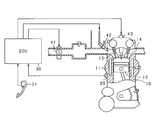
- FIG. 1 is a schematic diagram showing the internal combustion engine of the first embodiment
- FIG. 2 is a flowchart showing control by the knock control device
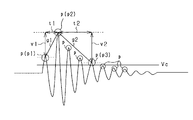
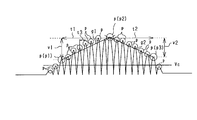
- FIG. 3 is a graph showing a vibration waveform obtained based on the detection signal
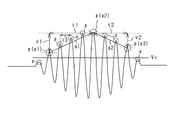
- FIG. 4 is a graph showing another vibration waveform different from FIG.
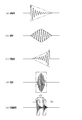
- FIG. 5 is a graph showing a shape pattern of a vibration waveform
- FIG. 6 is a flowchart showing the shape determination of the vibration waveform
- FIG. 7 is a graph showing the distribution of the shape pattern determined from the first time and the second time
- FIG. 8 is a flowchart showing the shape determination in the second embodiment
- FIG. 9 is a graph showing the distribution of the shape pattern determined from the increase rate and the attenuation rate
- FIG. 10 is a graph showing a relationship between a tilt ratio and a knock component in the third embodiment.
- FIG. 11 is a flowchart showing the shape determination.
- FIG. 12 is a graph showing an absolute value waveform in another embodiment
- FIG. 13 is a graph showing an absolute value waveform different from that of FIG.
- FIG. 1 is a schematic diagram showing an internal combustion engine 10 of the present embodiment.
- the internal combustion engine 10 has an engine block 11, a piston 12, an intake valve 13, an exhaust valve 14, and the like.
- an accelerator pedal sensor 21, a knock sensor 29, an ECU 30, an electronic throttle 41, an injector 42, an ignition coil 43, and the like are provided.
- the ECU 30 inputs a request (acceleration request) from the driver via the accelerator pedal sensor 21. Based on the input, the air amount, the fuel amount, the ignition timing and the like are controlled. Specifically, the ECU 30 controls the air amount by controlling the electronic throttle 41, controls the fuel amount by controlling the injector 42, and controls the ignition timing by controlling the ignition coil 43.
- the knock sensor 29 detects vibration generated in the internal combustion engine 10.
- the ECU 30 receives a detection signal from the knock sensor 29 during a gate open period in which the gate is open.
- knock sensor 29 corresponds to a “detection unit” according to the present disclosure.
- each one gate open period corresponds to a “predetermined period” in the present disclosure.
- FIG. 2 is a flowchart showing knock determination by ECU 30 and knock control based on the knock determination.
- the ECU 30 includes a digital conversion unit 31 that performs AD conversion (S100), a filter unit 32 that performs BPF processing (S200), a specification unit 33 that specifies three points (S300), and a calculation that performs feature amount calculation (S400). It has a unit 34, a shape determination unit 35 that performs shape determination (S500), a knock determination unit 36 that performs knock determination (S600), and a control unit 37 that performs knock control (S700).
- the knock sensor 29, the digital conversion unit 31, the filter unit 32, the identification unit 33, the calculation unit 34, the shape determination unit 35, and the knock determination unit 36 constitute a knock determination device (29, 31 to 36).
- the knock determination device (29, 31 to 36) and the control unit 37 constitute a knock control device (29, 31 to 37).
- the shape determining unit 35 and the knock determining unit 36 are collectively referred to as “determining units 35 and 36”.
- the ECU 30 first converts (A / D converts) the detection signal received from the knock sensor 29 from an analog signal to a digital signal by the digital conversion unit 31 (S100).
- the filter unit 32 filters the detection signal using only one type of bandpass filter (S200).
- the specifying unit 33 specifies three points, a first point p1, a second point p2, and a third point p3, which will be described later (S300).
- the calculation unit 34 calculates the characteristic amount of the vibration waveform (S400).
- the shape determination unit 35 performs a shape determination for determining a shape pattern to which the vibration waveform belongs (S500).
- knock determination is performed by knock determination section 36 to determine the occurrence of knock (S600).
- knock control for suppressing knock is performed by the control unit 37 (S700).
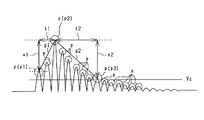
- FIGS. 3 and 4 are graphs showing examples of vibration waveforms after performing the BPF process (S200).
- the horizontal axis indicates time
- the vertical axis indicates the intensity of vibration (detected voltage value). That is, the vibration waveform indicates a temporal change of the vibration intensity.
- the strength of the vibration here is defined such that the strength in one direction (when the detected voltage value is positive) is positive, and the strength in the opposite direction (when the detected voltage value is negative) is negative. I have.
- a plurality of points at which the intensity of the vibration waveform becomes maximum are each referred to as a “maximum point p”.
- the maximum point p that first exceeds the predetermined value Vc within each gate open period is referred to as a “first point p1”.
- the maximum point p at which the intensity is maximum within each gate open period is referred to as a “second point p2”.
- the point that last exceeds the predetermined value Vc within each gate open period is referred to as “third point p3”.
- first time t1 The time from the first point p1 to the second point p2 is referred to as “first time t1”.
- second time t2 The time from the second point p2 to the third point p3 is referred to as “second time t2”.
- peak interval t3 the time from one of the two maximum points p adjacent to each other among the plurality of maximum points p having the intensity exceeding the predetermined value Vc within each gate open period to one other.
- the calculation unit 34 calculates a first time t1, a second time t2, and a peak interval t3 as feature amounts (S400).
- FIG. 5 is a graph showing each shape pattern of the vibration waveform. More specifically, FIG. 5A shows an attenuated shape pattern in which the intensity rapidly increases and then gradually attenuates.
- FIG. 5A shows an attenuated shape pattern in which the intensity rapidly increases and then gradually attenuates.
- FIG. 5B shows a diamond-shaped pattern in which the intensity gradually increases and then gradually decreases.
- the vibration waveform belongs to a rhombic shape pattern, the possibility of vibration due to knocking is moderate. While the shape of the latter half part becomes a vibration waveform similar to the knock waveform (damping type), the vibration (noise) due to the piston slap gradually converges after the vibration gradually strengthens. This is because vibration (noise) may occur due to vibration.
- FIG. 5 (c) shows an increasing shape pattern in which the intensity gradually increases and then rapidly attenuates.
- the vibration waveform belongs to the increasing shape pattern, it is unlikely that the vibration is caused by knocking. This is because a vibration portion has a shape portion similar to the knock waveform (attenuation type) and has a small vibration waveform. That is, it is exactly the opposite of the knock waveform in which the vibration suddenly occurs and then gradually attenuates as the piston descends.
- FIG. 5D shows a rectangular shape pattern in which the intensity sharply increases and then rapidly attenuates.
- the vibration waveform belongs to a rectangular shape pattern, it is unlikely that the vibration is a vibration due to knocking. This is because the rectangular shape pattern rapidly attenuates, and there are few shapes similar to the knock waveform (attenuation type) as a whole.
- the vibration (noise) generated in a pulse is instantaneously settled after the vibration starts instantaneously, it is highly possible that the vibration waveform is the pulse-shaped vibration (noise).
- FIG. 5E shows a shape pattern of a double attenuation type in which two attenuation types are arranged.
- the vibration waveform belongs to the shape pattern of the double attenuation type, it is unlikely that the vibration is caused by knocking. This is because the shape pattern of the double attenuation type repeats the increase and decrease of the intensity twice, so that there are few shape portions similar to the knock waveform (attenuation type) as a whole.
- the knock waveform gradually attenuates as the piston descends, it does not occur twice in a short period of time.
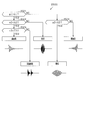
- FIG. 6 is a flowchart showing details of the shape determination (S500) by the shape determination unit 35.
- First it is determined whether the first time t1 is smaller than a predetermined first threshold T1 (S511). When it is larger than the first threshold value T1 (S511: NO), it is determined whether the second time t2 is larger than a predetermined second threshold value T2 (S514). When it is smaller than the second threshold value T2 (S514: NO), it is determined that the vibration waveform belongs to the increasing shape pattern, and the shape determination (S500) ends. On the other hand, when the second time t2 is greater than the second threshold value T2 (S514: YES), it is determined that the vibration waveform belongs to the rhombic shape pattern, and the shape determination (S500) is completed.
- the second time t2 is larger than the second threshold T2 (S512: YES)
- the second threshold T2 S512: YES
- T3 a predetermined interval threshold T3
- Knock determination section 36 performs knock determination (S600) based on the result of shape determination (S500) by shape determination section 35. More specifically, the more the vibration waveform is determined to be a shape pattern closer to the knock waveform in the shape determination (S500), the larger the correction term is set, and the more the shape pattern is determined to be different from the knock waveform. , The correction term is set smaller.
- knock determining section 36 determines that knock has occurred, and sets the correction term to “1”. To ".”
- the knock determining unit 36 determines that the possibility that knock has occurred is medium, and sets the correction term to “ 0.5 ".
- the knock determining unit 36 determines that the possibility of knocking is low. , The correction term is set to “0.1”.
- the knock determination unit 36 determines that no knock has occurred. Then, the correction term is set to “0”.
- the control unit 37 performs knock control (S700). Specifically, the ignition angle, which is the crank angle for igniting the internal combustion engine 10, is retarded from a predetermined ignition reference angle by a predetermined ignition retard amount.
- the ignition retard amount is a value obtained by multiplying a predetermined basic ignition retard amount by a correction term.
- ignition retard control when the correction term changes from “0” to “1”, the ignition angle is retarded by increasing the ignition retard amount.
- ignition retard control when the correction term changes from “1” to “0”, the ignition angle is advanced and returns to the ignition reference angle by reducing the ignition retard amount.
- the control for advancing the ignition angle in this manner is referred to as “advance angle return control”, and the ignition retard amount reduced by the advance angle return control is referred to as “advance angle return amount”. Excessive ignition retard control can be suppressed by performing the advance return control.
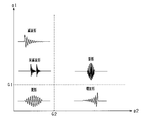
- FIG. 7 is a graph showing a distribution of a shape pattern to which a vibration waveform is determined to belong from the first time t1 and the second time t2.
- the first time t1 is larger than the first threshold value T1 (upper) and the second time t2 is larger than the second time t2 (right) (upper right)
- the vibration waveform belongs to the rhombic shape pattern.
- the first time t1 is larger than the first threshold T1 (upper) and the second time t2 is smaller than the second threshold T2 (left) (upper left)
- the vibration waveform belongs to the increasing shape pattern. Is determined.
- the vibration waveform has an attenuation type or a double attenuation type. It is determined that it belongs to the shape pattern.
- the first time t1 is smaller than the first threshold T1 (lower) and the second time t2 is smaller than the second threshold T2 (left) (lower left)
- the vibration waveform belongs to a rectangular shape pattern. Is done.
- the feature amount (t1 to t3) is calculated using the above three points (p1 to p3), the shape pattern to which the vibration waveform belongs is determined based on the feature amount, and knock determination and knock control are performed based on the shape pattern. Therefore, the processing as described in Patent Document 1 becomes unnecessary. Therefore, in performing knock determination and knock control, the processing load can be reduced.
- the first maximum point p whose intensity exceeds the predetermined value Vc for the first time in each gate open period is set as the first point p1.
- the time t1 becomes as long as possible.
- the maximum value p at which the intensity finally exceeds the predetermined value Vc within each gate open period is set as the third point p3, and thus the second calculation is performed in the feature value calculation (S400).
- the time t2 also becomes as long as possible. Therefore, the shape of the vibration waveform can be captured as wide as possible. This makes it easier to grasp the entire shape of the vibration waveform. Therefore, the knock determination (S600) and the knock control (S700), which are performed based on the vibration waveform, can be easily performed with high accuracy.
- the vibration waveform may be of an attenuated type (high possibility of knocking).
- the knock determination (S600) it is easier to largely determine the possibility that knock has occurred, and in knock control (S700), it is easier to increase the ignition retard amount.
- it is easy to determine the possibility of occurrence of knock by a simple process whereby it is easy to perform knock determination (S600) and knock control (S700) by a simple process.
- the vibration waveform may be of an attenuated type (high possibility of knocking).
- the knock determination (S600) it is easier to largely determine the possibility that knock has occurred, and in knock control (S700), it is easier to increase the ignition retard amount.
- it is easy to determine the possibility of occurrence of knock by a simple process whereby it is easy to perform knock determination (S600) and knock control (S700) by a simple process.
- the vibration waveform has the shape of a double attenuation type (the possibility of noise is large). It is likely to belong to the pattern. Therefore, in the knock determination (S600), the possibility that knock has occurred is easily determined to be low, and in the knock control (S700), the ignition retard amount is easily reduced. As described above, it is easy to determine the possibility of occurrence of knock by a simple process, whereby it is easy to perform knock determination (S600) and knock control (S700) by a simple process.
- the ignition retard amount is determined based on the characteristic amount (t1 to t3), the ignition retard amount can be adjusted according to the possibility of knock occurrence.
- the advance angle return amount is determined based on the feature amount (t1 to t3), the advance angle return amount can be adjusted according to the possibility of knocking.
- a value obtained by subtracting the intensity at the first point p1 from the intensity at the second point p2 is referred to as an increase amount v1.
- a value (v1 / t1) obtained by dividing the increase amount v1 by the first time t1 is defined as an increase rate g1.
- a value obtained by subtracting the intensity at the third point p3 from the intensity at the second point p2 is defined as an attenuation amount v2.
- a value (v2 / t2) obtained by dividing the attenuation amount v2 by the second time t2 is defined as an attenuation rate g2.
- the calculation unit 34 calculates an increase rate g1 and an attenuation rate g2 as a feature amount in addition to the peak interval t3.
- FIG. 8 is a flowchart showing the shape determination (S500) by the shape determination unit 35 of the present embodiment.
- the increase rate g1 is larger than a predetermined increase threshold G1 (S521).
- the increase threshold G1 S521: NO
- it is larger than the attenuation threshold value G2 S524: NO
- the attenuation rate g2 is smaller than the attenuation threshold G2 (S522: YES)
- the knock determination (S500) ends.
- FIG. 9 is a graph summarizing the distribution of shape patterns determined from the increase rate g1 and the attenuation rate g2.
- the increase rate g1 is larger than the increase threshold G1 (upper) and the attenuation rate g2 is larger than the attenuation threshold G2 (right) (upper right)
- the vibration waveform belongs to the rectangular shape pattern.
- the increase rate g1 is larger than the increase threshold value G1 (upper) and the attenuation rate g2 is smaller than the attenuation threshold value G2 (left) (upper left)
- the vibration waveform belongs to the attenuation type or the double attenuation type shape pattern. Is determined.
- the shape of the front portion of the vibration waveform is captured using the increase amount v1 in addition to the first time t1. Therefore, the shape of the front portion of the vibration waveform can be more easily captured.
- the attenuation rate g2 is used, the shape of the rear part of the vibration waveform is captured using the attenuation amount v2 in addition to the second time t2. Therefore, the shape of the rear part of the vibration waveform can be more easily captured.
- the vibration waveform may belong to the damping type (high knock possibility) shape pattern.
- the knock determination (S600) the possibility that knock has occurred is easily determined to be high
- the knock control (S700) the ignition retard amount is easily increased. As described above, it is easy to determine the possibility of occurrence of knock by a simple process, whereby it is easy to perform knock determination (S600) and knock control (S700) by a simple process.
- the vibration waveform may belong to the damping type (high knock possibility) shape pattern.
- the knock determination (S600) the possibility that knock has occurred is easily determined to be high
- the knock control (S700) the ignition retard amount is easily increased. As described above, it is easy to determine the possibility of occurrence of knock by a simple process, whereby it is easy to perform knock determination (S600) and knock control (S700) by a simple process.
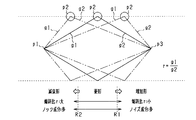
- FIG. 10 is a graph for explaining the concept of shape determination (S500) and knock determination (S600) in the present embodiment.
- the calculation unit 34 calculates, as a feature amount, the slope ratio r, which is a value obtained by dividing the increase rate g1 by the attenuation rate g2, in addition to the peak interval t3 (S400).
- the determination units 35 and 36 determine that the greater the slope ratio r, the more the waveform component (knock component) closer to the knock waveform, and the smaller the slope ratio r, the more the waveform component (noise component) far from the knock waveform. I do. The details are as shown below.
- FIG. 11 is a flowchart showing the shape determination (S500) by the shape determination unit 35 of the present embodiment.
- S531 it is determined whether any of the peak intervals t3 is greater than the interval threshold T3 (S531). If any one of the peak intervals t3 is larger than the interval threshold T3 (S531: YES), it is determined that the vibration waveform belongs to the bi-attenuated shape pattern, and the shape determination (S500) ends.
- any of the peak intervals t3 is smaller than the interval threshold T3 (S531: NO)
- the second point p2 when the second point p2 is not the head of the array, whether the second point p2 and the third point p3 are the same maximum point p, that is, the second point p2 having the maximum intensity is determined to have the predetermined intensity It is determined whether or not the end of the sequence at the maximum point p exceeding the value Vc (S533). If the second point p2 is at the end of the sequence (S533: YES), it is determined that the vibration waveform belongs to the increasing shape pattern, and the shape determination (S500) ends.
- the condition that the slope ratio r is larger than the predetermined lower slope ratio threshold R1 and smaller than the predetermined upper slope ratio threshold R2. It is determined whether or not the condition is satisfied (S534). If the inclination ratio r satisfies the condition (S534: YES), it is determined that the vibration waveform belongs to the rhombic shape pattern, and the shape determination (S500) is completed.
- the inclination ratio r does not satisfy the condition (S534: NO)
- the slope ratio r is larger than the upper slope ratio threshold R2 (S535: YES)
- the shape determination (S500) ends.
- the slope ratio r is smaller than the upper slope ratio threshold R2 (S535: NO)
- the result at S534 is smaller than the lower slope ratio threshold R1, and the vibration waveform has an increasing shape pattern. And the shape determination (S500) ends.
- the vibration waveform in the shape determination (S500), when the inclination ratio r shown in FIG. 10 is larger than the inclination ratio threshold value R2, the vibration waveform can belong to an attenuation type (high knock possibility) shape pattern. High in nature. Therefore, in the knock determination (S600), the possibility that knock has occurred is easily determined to be high, and in the knock control (S700), the ignition retard amount is easily increased. As described above, it is easy to determine the possibility of occurrence of knock by a simple process, whereby it is easy to perform knock determination (S600) and knock control (S700) by a simple process.
- This embodiment can be implemented with the following modifications.
- the first point p1 to the third point p3 can be specified from the absolute value waveform indicating the time change of the intensity, with the intensity being the absolute value of the voltage value). That is, in this case, in the absolute value waveform, the maximum point at which the intensity first exceeds the predetermined value Vc is the first point p1, the maximum point at which the intensity is the maximum is the second point p2, and the intensity is finally the predetermined value Vc.
- the maximum point exceeding Vc is the third point p3.
- the shape of the vibration waveform since the shape of the vibration waveform is grasped not only on the plus side but also on the minus side of the strength of the vibration waveform, the shape of the vibration waveform can be grasped more accurately. At this time, instead of determining the shape pattern to which the vibration waveform belongs, it is also possible to determine the shape pattern to which the absolute value waveform belongs.
- the BPF process (S200) by the filter unit 32 may be omitted to perform the process.
- the three-point specification (S300) three points are specified from a part of the gate open period, that is, the part of the period is set to a “predetermined period” in the present disclosure. It can also be implemented.
- the first point p1 may be changed to any one of the other maximum points p existing before the second point p2, and the embodiment may be performed.
- the third point p3 may be changed to any one of the maximum points p existing after the second point p2, and the present invention may be implemented.
- knock determination unit 36 can be implemented as follows. When the shape determining unit 35 determines that the vibration waveform belongs to the attenuation type shape pattern, the knock determining unit 36 determines that knock has occurred, and sets the correction term to “1”. On the other hand, when the shape determining unit 35 determines that the vibration waveform belongs to a shape pattern other than the damping type, the knock determining unit 36 determines that no knock has occurred, and sets the correction term to “0”. I do.
- the shape determination unit 35 may be omitted, and the knock determination unit 36 may directly perform knock determination based on the feature amount.
- the second embodiment can be implemented as follows. When the increase rate g1 is greater than a predetermined upper threshold, knock determination section 36 determines that knock has occurred, and sets the correction term to "1". When the increase rate g1 is smaller than the above upper threshold value and larger than the predetermined lower threshold value, it is determined that the possibility that knock has occurred is moderate, and the correction term is set to “0”. .5 ". If the increase rate g1 is smaller than the lower threshold value, it is determined that the possibility that knock has occurred is low, and the correction term is set to “0.1”.
- the timing for driving the intake valve 13 is changed to lower the effective compression ratio, thereby performing control to suppress knock.
Landscapes
- Engineering & Computer Science (AREA)
- Chemical & Material Sciences (AREA)
- Combustion & Propulsion (AREA)
- Mechanical Engineering (AREA)
- General Engineering & Computer Science (AREA)
- Physics & Mathematics (AREA)
- General Physics & Mathematics (AREA)
- Combined Controls Of Internal Combustion Engines (AREA)
- Measurement Of Mechanical Vibrations Or Ultrasonic Waves (AREA)
- Measuring Fluid Pressure (AREA)
- Electrical Control Of Ignition Timing (AREA)
Priority Applications (1)
| Application Number | Priority Date | Filing Date | Title |
|---|---|---|---|
| MYPI2021001243A MY206049A (en) | 2018-09-19 | 2019-08-22 | Knock determination device and knock control device |
Applications Claiming Priority (2)
| Application Number | Priority Date | Filing Date | Title |
|---|---|---|---|
| JP2018-175429 | 2018-09-19 | ||
| JP2018175429A JP7081420B2 (ja) | 2018-09-19 | 2018-09-19 | ノック判定装置及びノック制御装置 |
Publications (1)
| Publication Number | Publication Date |
|---|---|
| WO2020059408A1 true WO2020059408A1 (ja) | 2020-03-26 |
Family
ID=69887243
Family Applications (1)
| Application Number | Title | Priority Date | Filing Date |
|---|---|---|---|
| PCT/JP2019/032832 Ceased WO2020059408A1 (ja) | 2018-09-19 | 2019-08-22 | ノック判定装置及びノック制御装置 |
Country Status (3)
| Country | Link |
|---|---|
| JP (1) | JP7081420B2 (https=) |
| MY (1) | MY206049A (https=) |
| WO (1) | WO2020059408A1 (https=) |
Families Citing this family (2)
| Publication number | Priority date | Publication date | Assignee | Title |
|---|---|---|---|---|
| JP7452089B2 (ja) | 2020-02-26 | 2024-03-19 | 株式会社デンソー | ノック判定装置及びノック制御装置 |
| JP7770211B2 (ja) * | 2022-02-25 | 2025-11-14 | 三菱重工エンジン&ターボチャージャ株式会社 | エンジンのノッキング判定装置および方法 |
Citations (5)
| Publication number | Priority date | Publication date | Assignee | Title |
|---|---|---|---|---|
| JP2001227400A (ja) * | 2000-02-15 | 2001-08-24 | Denso Corp | 内燃機関用ノック制御装置 |
| JP2002364448A (ja) * | 2001-05-31 | 2002-12-18 | Fujitsu Ten Ltd | 内燃機関のノッキング制御装置 |
| JP2004317207A (ja) * | 2003-04-14 | 2004-11-11 | Denso Corp | ノッキング検出装置 |
| JP2004353531A (ja) * | 2003-05-28 | 2004-12-16 | Denso Corp | 内燃機関のノック制御装置 |
| JP2006336604A (ja) * | 2005-06-06 | 2006-12-14 | Denso Corp | 内燃機関のノッキング制御装置 |
Family Cites Families (5)
| Publication number | Priority date | Publication date | Assignee | Title |
|---|---|---|---|---|
| JP4096584B2 (ja) * | 2002-03-14 | 2008-06-04 | トヨタ自動車株式会社 | 内燃機関のノック自動検出装置 |
| JP4390104B2 (ja) * | 2004-04-16 | 2009-12-24 | 株式会社デンソー | 内燃機関のノック判定装置 |
| JP4397346B2 (ja) * | 2005-04-26 | 2010-01-13 | トヨタ自動車株式会社 | 内燃機関のノッキング判定装置 |
| JP2009013939A (ja) * | 2007-07-06 | 2009-01-22 | Denso Corp | 内燃機関のノック判定装置 |
| JP6541586B2 (ja) * | 2016-01-22 | 2019-07-10 | 三菱重工業株式会社 | ノッキング検出方法、点火時期制御方法および内燃機関の制御システム |
-
2018
- 2018-09-19 JP JP2018175429A patent/JP7081420B2/ja active Active
-
2019
- 2019-08-22 WO PCT/JP2019/032832 patent/WO2020059408A1/ja not_active Ceased
- 2019-08-22 MY MYPI2021001243A patent/MY206049A/en unknown
Patent Citations (5)
| Publication number | Priority date | Publication date | Assignee | Title |
|---|---|---|---|---|
| JP2001227400A (ja) * | 2000-02-15 | 2001-08-24 | Denso Corp | 内燃機関用ノック制御装置 |
| JP2002364448A (ja) * | 2001-05-31 | 2002-12-18 | Fujitsu Ten Ltd | 内燃機関のノッキング制御装置 |
| JP2004317207A (ja) * | 2003-04-14 | 2004-11-11 | Denso Corp | ノッキング検出装置 |
| JP2004353531A (ja) * | 2003-05-28 | 2004-12-16 | Denso Corp | 内燃機関のノック制御装置 |
| JP2006336604A (ja) * | 2005-06-06 | 2006-12-14 | Denso Corp | 内燃機関のノッキング制御装置 |
Also Published As
| Publication number | Publication date |
|---|---|
| JP7081420B2 (ja) | 2022-06-07 |
| JP2020045827A (ja) | 2020-03-26 |
| MY206049A (en) | 2024-11-27 |
Similar Documents
| Publication | Publication Date | Title |
|---|---|---|
| US9816446B2 (en) | Knock determination apparatus for internal combustion engine | |
| JP5546595B2 (ja) | 内燃機関のノック制御装置 | |
| US8949006B2 (en) | Knock control apparatus for internal combustion engine | |
| JP5832130B2 (ja) | 内燃機関の制御装置 | |
| JP5641960B2 (ja) | 内燃機関の制御装置 | |
| CN101356356B (zh) | 内燃机的爆震判定设备及爆震判定方法 | |
| US8694229B2 (en) | Knock control apparatus for internal combustion engine | |
| WO2020059408A1 (ja) | ノック判定装置及びノック制御装置 | |
| WO2020059409A1 (ja) | ノック制御装置 | |
| JP5502176B2 (ja) | 内燃機関の制御装置 | |
| US9164012B2 (en) | Internal combustion engine knock controlling apparatus | |
| US10648411B2 (en) | Controller and control method for internal combustion engine | |
| CN103256166A (zh) | 内燃机的爆震控制装置 | |
| US20130192343A1 (en) | Knock detection device of internal combustion engine | |
| JP4799646B2 (ja) | 内燃機関の異常着火制御装置 | |
| JP4877276B2 (ja) | 内燃機関の点火時期制御装置 | |
| EP4113075B1 (en) | Knocking determination device and knocking control device | |
| JP7199470B2 (ja) | 内燃機関の制御装置 |
Legal Events
| Date | Code | Title | Description |
|---|---|---|---|
| 121 | Ep: the epo has been informed by wipo that ep was designated in this application |
Ref document number: 19862191 Country of ref document: EP Kind code of ref document: A1 |
|
| NENP | Non-entry into the national phase |
Ref country code: DE |
|
| 122 | Ep: pct application non-entry in european phase |
Ref document number: 19862191 Country of ref document: EP Kind code of ref document: A1 |