WO2020054472A1 - スクアリリウム化合物、発光性組成物及び発光性フィルム - Google Patents
スクアリリウム化合物、発光性組成物及び発光性フィルム Download PDFInfo
- Publication number
- WO2020054472A1 WO2020054472A1 PCT/JP2019/034329 JP2019034329W WO2020054472A1 WO 2020054472 A1 WO2020054472 A1 WO 2020054472A1 JP 2019034329 W JP2019034329 W JP 2019034329W WO 2020054472 A1 WO2020054472 A1 WO 2020054472A1
- Authority
- WO
- WIPO (PCT)
- Prior art keywords
- group
- ring
- independently represent
- general formula
- compound
- Prior art date
- Legal status (The legal status is an assumption and is not a legal conclusion. Google has not performed a legal analysis and makes no representation as to the accuracy of the status listed.)
- Ceased
Links
- 0 C*(c1c(*)cccc1)c(cccc1)c1O* Chemical compound C*(c1c(*)cccc1)c(cccc1)c1O* 0.000 description 3
Classifications
-
- C—CHEMISTRY; METALLURGY
- C07—ORGANIC CHEMISTRY
- C07C—ACYCLIC OR CARBOCYCLIC COMPOUNDS
- C07C215/00—Compounds containing amino and hydroxy groups bound to the same carbon skeleton
- C07C215/74—Compounds containing amino and hydroxy groups bound to the same carbon skeleton having hydroxy groups and amino groups bound to carbon atoms of six-membered aromatic rings of the same carbon skeleton
- C07C215/76—Compounds containing amino and hydroxy groups bound to the same carbon skeleton having hydroxy groups and amino groups bound to carbon atoms of six-membered aromatic rings of the same carbon skeleton of the same non-condensed six-membered aromatic ring
- C07C215/82—Compounds containing amino and hydroxy groups bound to the same carbon skeleton having hydroxy groups and amino groups bound to carbon atoms of six-membered aromatic rings of the same carbon skeleton of the same non-condensed six-membered aromatic ring having the nitrogen atom of at least one of the amino groups further bound to a carbon atom of another six-membered aromatic ring
-
- C—CHEMISTRY; METALLURGY
- C07—ORGANIC CHEMISTRY
- C07C—ACYCLIC OR CARBOCYCLIC COMPOUNDS
- C07C211/00—Compounds containing amino groups bound to a carbon skeleton
- C07C211/43—Compounds containing amino groups bound to a carbon skeleton having amino groups bound to carbon atoms of six-membered aromatic rings of the carbon skeleton
- C07C211/54—Compounds containing amino groups bound to a carbon skeleton having amino groups bound to carbon atoms of six-membered aromatic rings of the carbon skeleton having amino groups bound to two or three six-membered aromatic rings
-
- C—CHEMISTRY; METALLURGY
- C07—ORGANIC CHEMISTRY
- C07C—ACYCLIC OR CARBOCYCLIC COMPOUNDS
- C07C215/00—Compounds containing amino and hydroxy groups bound to the same carbon skeleton
- C07C215/74—Compounds containing amino and hydroxy groups bound to the same carbon skeleton having hydroxy groups and amino groups bound to carbon atoms of six-membered aromatic rings of the same carbon skeleton
- C07C215/84—Compounds containing amino and hydroxy groups bound to the same carbon skeleton having hydroxy groups and amino groups bound to carbon atoms of six-membered aromatic rings of the same carbon skeleton having amino groups bound to carbon atoms of six-membered aromatic rings being part of condensed ring systems
- C07C215/86—Compounds containing amino and hydroxy groups bound to the same carbon skeleton having hydroxy groups and amino groups bound to carbon atoms of six-membered aromatic rings of the same carbon skeleton having amino groups bound to carbon atoms of six-membered aromatic rings being part of condensed ring systems being formed by two rings
-
- C—CHEMISTRY; METALLURGY
- C07—ORGANIC CHEMISTRY
- C07C—ACYCLIC OR CARBOCYCLIC COMPOUNDS
- C07C215/00—Compounds containing amino and hydroxy groups bound to the same carbon skeleton
- C07C215/74—Compounds containing amino and hydroxy groups bound to the same carbon skeleton having hydroxy groups and amino groups bound to carbon atoms of six-membered aromatic rings of the same carbon skeleton
- C07C215/84—Compounds containing amino and hydroxy groups bound to the same carbon skeleton having hydroxy groups and amino groups bound to carbon atoms of six-membered aromatic rings of the same carbon skeleton having amino groups bound to carbon atoms of six-membered aromatic rings being part of condensed ring systems
- C07C215/88—Compounds containing amino and hydroxy groups bound to the same carbon skeleton having hydroxy groups and amino groups bound to carbon atoms of six-membered aromatic rings of the same carbon skeleton having amino groups bound to carbon atoms of six-membered aromatic rings being part of condensed ring systems being formed by at least three rings
-
- C—CHEMISTRY; METALLURGY
- C07—ORGANIC CHEMISTRY
- C07D—HETEROCYCLIC COMPOUNDS
- C07D239/00—Heterocyclic compounds containing 1,3-diazine or hydrogenated 1,3-diazine rings
- C07D239/70—Heterocyclic compounds containing 1,3-diazine or hydrogenated 1,3-diazine rings condensed with carbocyclic rings or ring systems
-
- C—CHEMISTRY; METALLURGY
- C08—ORGANIC MACROMOLECULAR COMPOUNDS; THEIR PREPARATION OR CHEMICAL WORKING-UP; COMPOSITIONS BASED THEREON
- C08K—Use of inorganic or non-macromolecular organic substances as compounding ingredients
- C08K5/00—Use of organic ingredients
- C08K5/16—Nitrogen-containing compounds
- C08K5/17—Amines; Quaternary ammonium compounds
- C08K5/18—Amines; Quaternary ammonium compounds with aromatically bound amino groups
-
- C—CHEMISTRY; METALLURGY
- C08—ORGANIC MACROMOLECULAR COMPOUNDS; THEIR PREPARATION OR CHEMICAL WORKING-UP; COMPOSITIONS BASED THEREON
- C08L—COMPOSITIONS OF MACROMOLECULAR COMPOUNDS
- C08L101/00—Compositions of unspecified macromolecular compounds
-
- C—CHEMISTRY; METALLURGY
- C09—DYES; PAINTS; POLISHES; NATURAL RESINS; ADHESIVES; COMPOSITIONS NOT OTHERWISE PROVIDED FOR; APPLICATIONS OF MATERIALS NOT OTHERWISE PROVIDED FOR
- C09K—MATERIALS FOR MISCELLANEOUS APPLICATIONS, NOT PROVIDED FOR ELSEWHERE
- C09K11/00—Luminescent materials, e.g. electroluminescent or chemiluminescent
- C09K11/06—Luminescent materials, e.g. electroluminescent or chemiluminescent containing organic luminescent materials
-
- C—CHEMISTRY; METALLURGY
- C07—ORGANIC CHEMISTRY
- C07C—ACYCLIC OR CARBOCYCLIC COMPOUNDS
- C07C2601/00—Systems containing only non-condensed rings
- C07C2601/04—Systems containing only non-condensed rings with a four-membered ring
-
- C—CHEMISTRY; METALLURGY
- C07—ORGANIC CHEMISTRY
- C07C—ACYCLIC OR CARBOCYCLIC COMPOUNDS
- C07C2601/00—Systems containing only non-condensed rings
- C07C2601/12—Systems containing only non-condensed rings with a six-membered ring
- C07C2601/14—The ring being saturated
-
- C—CHEMISTRY; METALLURGY
- C07—ORGANIC CHEMISTRY
- C07C—ACYCLIC OR CARBOCYCLIC COMPOUNDS
- C07C2601/00—Systems containing only non-condensed rings
- C07C2601/12—Systems containing only non-condensed rings with a six-membered ring
- C07C2601/16—Systems containing only non-condensed rings with a six-membered ring the ring being unsaturated
-
- C—CHEMISTRY; METALLURGY
- C07—ORGANIC CHEMISTRY
- C07C—ACYCLIC OR CARBOCYCLIC COMPOUNDS
- C07C2603/00—Systems containing at least three condensed rings
- C07C2603/02—Ortho- or ortho- and peri-condensed systems
- C07C2603/04—Ortho- or ortho- and peri-condensed systems containing three rings
- C07C2603/22—Ortho- or ortho- and peri-condensed systems containing three rings containing only six-membered rings
- C07C2603/24—Anthracenes; Hydrogenated anthracenes
-
- C—CHEMISTRY; METALLURGY
- C09—DYES; PAINTS; POLISHES; NATURAL RESINS; ADHESIVES; COMPOSITIONS NOT OTHERWISE PROVIDED FOR; APPLICATIONS OF MATERIALS NOT OTHERWISE PROVIDED FOR
- C09K—MATERIALS FOR MISCELLANEOUS APPLICATIONS, NOT PROVIDED FOR ELSEWHERE
- C09K2211/00—Chemical nature of organic luminescent or tenebrescent compounds
- C09K2211/10—Non-macromolecular compounds
- C09K2211/1003—Carbocyclic compounds
- C09K2211/1007—Non-condensed systems
-
- Y—GENERAL TAGGING OF NEW TECHNOLOGICAL DEVELOPMENTS; GENERAL TAGGING OF CROSS-SECTIONAL TECHNOLOGIES SPANNING OVER SEVERAL SECTIONS OF THE IPC; TECHNICAL SUBJECTS COVERED BY FORMER USPC CROSS-REFERENCE ART COLLECTIONS [XRACs] AND DIGESTS
- Y02—TECHNOLOGIES OR APPLICATIONS FOR MITIGATION OR ADAPTATION AGAINST CLIMATE CHANGE
- Y02E—REDUCTION OF GREENHOUSE GAS [GHG] EMISSIONS, RELATED TO ENERGY GENERATION, TRANSMISSION OR DISTRIBUTION
- Y02E10/00—Energy generation through renewable energy sources
- Y02E10/50—Photovoltaic [PV] energy
- Y02E10/549—Organic PV cells
Definitions
- the present invention relates to a novel squarylium compound, a luminescent composition and a luminescent film. More specifically, the present invention relates to a novel squarylium compound capable of emitting near-infrared light having high luminous efficiency and excellent light resistance, a luminescent composition containing the squarylium compound, and a luminescent film. .
- near-infrared light-emitting materials have received a great deal of attention from the viewpoint of application to infrared cameras, living body imaging, living body sensing, infrared communication, and the like.
- a pulse oximeter which is one of living body sensing, uses near-infrared light to calculate oxygen saturation in blood. It is also being studied as a sensitizer for organic solar cells.
- ⁇ ⁇ Emission wavelengths suitable for various applications vary, but when used for living body sensing, a material having a high luminance in a wavelength range of 650 to 900 nm called a "window of a living body" and easily passing through a living body is preferably used. When light is externally excited, a material having a high molar extinction coefficient and excellent light resistance is required.
- Non-Patent Document 1 describes squarylium compounds R-1 and R-2 having the following structure.
- Non-Patent Document 1 describes that the squarylium compound emits fluorescence in a near-infrared region in a solution.
- the inventor evaluated the squarylium compound described in Non-Patent Document 1 in a solid film the luminous efficiency and light resistance were not sufficiently satisfactory.
- the present invention has been made in view of the above-mentioned problems and circumstances, and a problem to be solved is that infrared light having high luminous efficiency, especially a decrease in luminous efficiency in a solid film, and excellent light resistance is obtained. It is an object of the present invention to provide a novel squarylium compound which can emit light. Another object of the present invention is to provide a luminescent composition and a luminescent film containing the squarylium compound.
- the present inventor has studied the causes of the above-mentioned problems in order to solve the above-mentioned problems.As a result, by using a squarylium compound having a specific structure having a substituent at the ortho-position of the arylamine, the luminous efficiency is high, and in particular, a solid film A novel squarylium compound capable of emitting near-infrared light with a small decrease in luminous efficiency and excellent light fastness has been found, and the present invention has been accomplished.
- a squarylium compound having a structure represented by the following general formula (1) is solved by the following means. 1.
- Ring A and ring B each independently represent an aromatic hydrocarbon ring which may have a substituent.
- R 1 represents an alkyl group, a cycloalkyl group, an aromatic hydrocarbon group or a halogen atom.
- R 2 and R 3 each independently represent an alkyl group or a cycloalkyl group.
- R represents a substituent.
- R 1 and R or two Rs may combine with each other to form a ring.
- R 4 and R 5 each independently represent a hydroxy group or an amino group.
- n1 and n2 each independently represent an integer of 0 to 4.
- Ring A and ring B each independently represent an aromatic hydrocarbon ring which may have a substituent.
- R 1 and R 6 each independently represent an alkyl group, a cycloalkyl group, an aromatic hydrocarbon group or a halogen atom.
- R 2 and R 3 each independently represent an alkyl group or a cycloalkyl group.
- R represents a substituent.
- R 1 and R, R 6 and R or two Rs may be bonded to each other to form a ring.
- R 4 and R 5 each independently represent a hydroxy group or an amino group.
- n1 and n2 each independently represent an integer of 0 to 4.
- Ring B represents an aromatic hydrocarbon ring which may have a substituent.
- R 1 and R 6 each independently represent an alkyl group, a cycloalkyl group, an aromatic hydrocarbon group or a halogen atom.
- R 2 and R 3 each independently represent an alkyl group or a cycloalkyl group.
- R represents a substituent.
- R 1 and R, R 6 and R or two Rs may be bonded to each other to form a ring.
- R 5 represents a hydroxy group or an amino group.
- n1 and n2 each independently represent an integer of 0 to 4.
- R 1 and R 6 each independently represent an alkyl group, a cycloalkyl group, an aromatic hydrocarbon group or a halogen atom.
- R 2 and R 3 each independently represent an alkyl group or a cycloalkyl group.
- R represents a substituent.
- R 1 and R, R 6 and R or two Rs may be bonded to each other to form a ring.
- n1 and n2 each independently represent an integer of 0 to 4.
- a luminescent composition comprising the squarylium compound according to any one of items 1 to 4.
- a luminescent film comprising the squarylium compound according to any one of the above items 1 to 4.
- a novel squarylium compound which has a high luminous efficiency, in particular, a decrease in luminous efficiency in a solid film is small, and can emit near-infrared light having excellent light resistance. Can be. Further, a luminescent composition and a luminescent film containing the squarylium compound can be provided.
- the squarylium compound has a structure comprising a squaric acid skeleton exhibiting strong electron acceptor properties and an amino group exhibiting squarylium donor properties, and exhibits a sharp absorption / emission peak and a high molar extinction coefficient in the red to near infrared region.
- the representative squarylium compound R-3 and the optical properties ( ⁇ max PL : maximum emission wavelength, ⁇ f : emission quantum yield, molar extinction coefficient (log ⁇ )) are shown below.
- the squarylium compound has a high ⁇ planarity and a zwitterionic structure in which cations and anions coexist in the same molecule, it is easy to aggregate.
- a high light emission quantum yield is exhibited in a solution, but the light emission quantum yield is reduced by aggregation in a solid film.
- the squarylium compound of the present invention has at least one substituent at the ortho position of the arylamine, so that the arylamine and the squaric acid skeleton are twisted, and the ⁇ planarity of the molecule is reduced. Therefore, the interaction between the squarylium compounds and the interaction with the dispersant are suppressed. As a result, quenching due to aggregation is unlikely to occur even in the film, and it is considered that light emission does not decrease.
- the emission quantum yield was improved by the aromatic hydrocarbon ring substituted with an amino group having a strong electron-donating property. This is because the squarylium compound has a structure consisting of a squaric acid skeleton that exhibits electron acceptor properties and an amino group that exhibits electron donor properties. It is presumed that this is likely to occur.
- the squarylium compound of the present invention has the effect of being superior in light resistance to the conventional squarylium compound. Since the compound of the present invention has little heat deactivation from the excited state, decomposition by heat is suppressed, and since aggregation is suppressed, decomposition due to aggregation is suppressed. This is presumed to be because the reaction between them is suppressed and the absorption spectrum is not broadened as in the case of aggregates, so that light in a wider wavelength range is not absorbed.
- the squarylium compound of the present invention has a structure represented by the general formula (1).
- This feature is a technical feature common to or corresponding to each of the following embodiments (forms).
- the compound having the structure represented by the general formula (1) is a compound having the structure represented by the general formula (2) Is preferred.
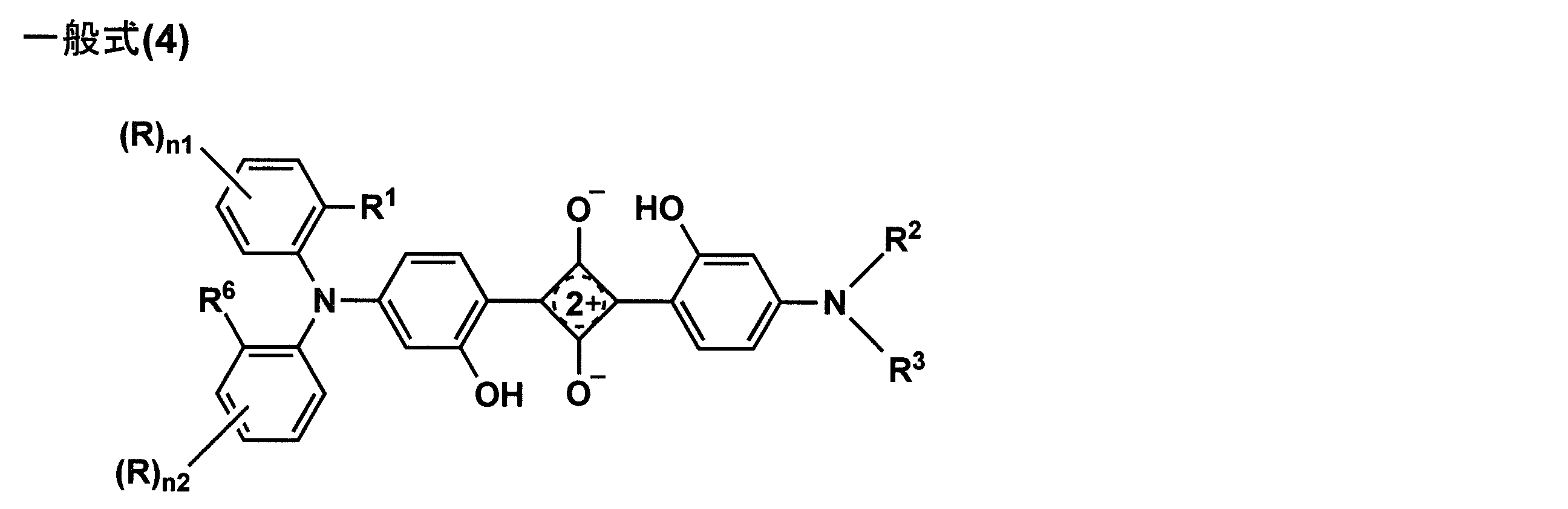
- the compound having a structure represented by the general formula (1) is preferably a compound having a structure represented by the general formula (3). Further, the compound having a structure represented by the general formula (1) is preferably a compound having a structure represented by the general formula (4).
- a luminescent composition or a luminescent film containing the squarylium compound of the present invention is preferred.
- ⁇ Squarylium compound ⁇ [Squarylium compounds having structures represented by general formulas (1) to (4)]
- the squarylium compound of the present invention receives excitation energy from the outside, transitions to a singlet excited state, and then emits fluorescence when returning to the ground state. Further, since this compound shows a high molar extinction coefficient, it is excellent in light emission by photoexcitation and light emission by Forster type energy transfer. Further, it was found that the light resistance was excellent.
- the squarylium compound of the present invention emits near-infrared light. Specifically, the maximum emission wavelength in the fluorescence spectrum is in the range of 650 to 1000 nm.
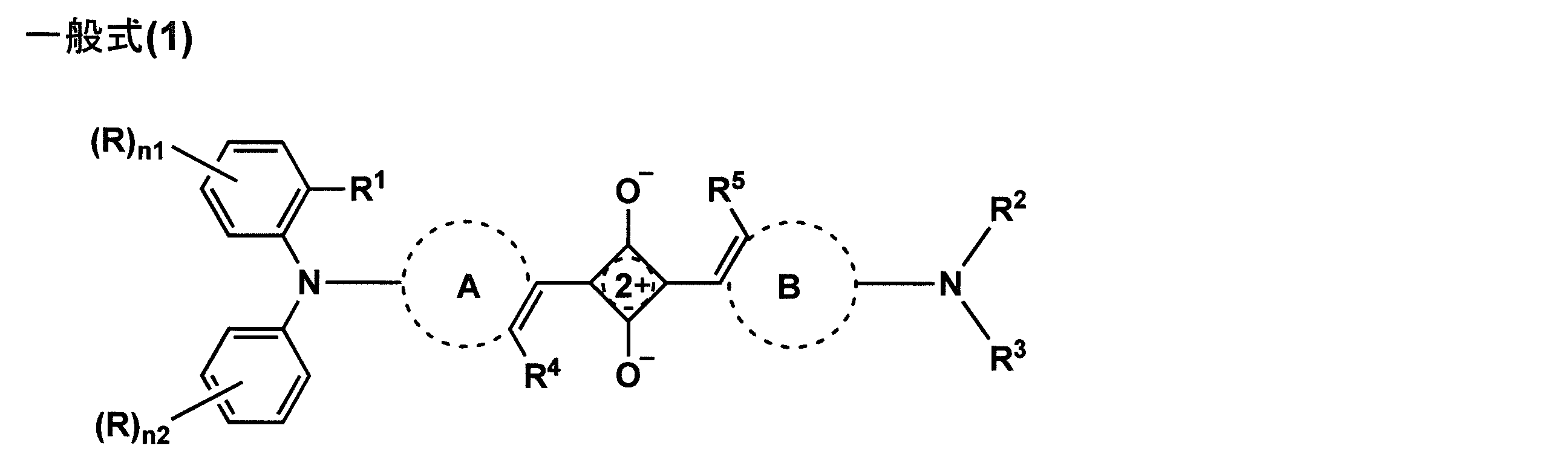
- the squarylium compound of the present invention has a structure represented by the following general formula (1).
- Ring A and ring B each independently represent an aromatic hydrocarbon ring which may have a substituent.
- R 1 represents an alkyl group, a cycloalkyl group, an aromatic hydrocarbon group or a halogen atom.
- R 2 and R 3 each independently represent an alkyl group or a cycloalkyl group.
- R represents a substituent.
- R 1 and R or two Rs may combine with each other to form a ring.
- R 4 and R 5 each independently represent a hydroxy group or an amino group.
- n1 and n2 each independently represent an integer of 0 to 4.
- the aromatic hydrocarbon ring represented by ring A and ring B is a substituted or unsubstituted aromatic group having 6 to 18 carbon atoms. It is a hydrocarbon ring, and examples thereof include a phenyl group, a naphthyl group, an anthryl group, a fluorenyl group, a phenanthryl group, and a biphenylyl group. Preferably, a phenyl group, a naphthyl group, an anthryl group and the like can be mentioned.
- the alkyl group represented by R 1 is a substituted or unsubstituted alkyl group having 1 to 10 carbon atoms, such as methyl, ethyl, propyl, isopropyl, butyl, isobutyl, pentyl, Examples include a hexyl group, an octyl group, and a dodecyl group.
- Examples of the cycloalkyl group represented by R 1 include a cyclopentyl group and a cyclohexyl group.
- the aromatic hydrocarbon group represented by R 1 is a substituted or unsubstituted aromatic hydrocarbon group having 6 to 18 carbon atoms, such as an aromatic hydrocarbon group (phenyl, naphthyl, anthryl, fluorenyl) Group, phenanthryl group, biphenylyl group, etc.).
- an aromatic hydrocarbon group phenyl, naphthyl, anthryl, fluorenyl
- phenanthryl group phenanthryl group
- biphenylyl group etc.
- a phenyl group and a naphthyl group can be exemplified.
- Examples of the halogen atom represented by R 1 include a fluorine atom, a chlorine atom, and a bromine atom.
- examples of the substituent which the ring A and the ring B may have and the substituent represented by R include an alkyl group (for example, a methyl group, an ethyl group, a propyl group, an isopropyl group, a tert group).
- the number of substituents in the general formula (1) is not particularly limited. When there are two or more substituents, those substituents may be the same or different from each other. Adjacent substituents may be bonded to each other to form a cyclic structure. For example, R 1 and R, R 2 and R 3 , two Rs, R 5 and R 2 or R 5 and R 3 may combine with each other to form a ring.
- the cyclic structure formed by adjacent substituents may be an aromatic ring or an aliphatic ring, or may contain a hetero atom, and the cyclic structure may be a fused ring of two or more rings. You may.
- the hetero atom is preferably selected from the group consisting of a nitrogen atom, an oxygen atom and a sulfur atom.
- Examples of the formed cyclic structure include a benzene ring, a naphthalene ring, a pyridine ring, a pyridazine ring, a pyrimidine ring, a pyrazine ring, a pyrrole ring, an imidazole ring, a pyrazole ring, a triazole ring, an imidazoline ring, an oxazole ring, an isoxazole ring, and a thiazole.
- Ring isothiazole ring, cyclohexadiene ring, cyclohexene ring, cyclopentaene ring, cycloheptatriene ring, cycloheptadiene ring, cycloheptaene ring, carbazole ring, dibenzofuran ring and the like.
- R 2 and R 3 each independently represent an alkyl group or a cycloalkyl group.
- the alkyl group include a methyl group, an ethyl group, a propyl group, an isopropyl group, a tert-butyl group, a pentyl group, a hexyl group, an octyl group, a dodecyl group, a tridecyl group, a tetradecyl group, and a pentadecyl group.
- the cycloalkyl group include a cyclopentyl group and a cyclohexyl group. Examples of the case where R 2 and R 3 are bonded to each other to form a ring include, for example, a piperidine ring and a morpholine ring. R 2 and R 3 may be further substituted by the substituents described above.
- R 4 and R 5 each independently represent a hydroxy group or an amino group.
- the amino group is a substituted or unsubstituted amino group, but is preferably an unsubstituted amino group.
- n1 and n2 each independently represent an integer of 0 to 4, and 0 or 1 is preferable.
- the squarylium compound represented by the general formula (1) is preferably a compound having a structure represented by the following general formula (2).
- Ring A and ring B each independently represent an aromatic hydrocarbon ring which may have a substituent.
- R 1 and R 6 each independently represent an alkyl group, a cycloalkyl group, an aromatic hydrocarbon group or a halogen atom.
- R 2 and R 3 each independently represent an alkyl group or a cycloalkyl group.
- R represents a substituent.
- R 1 and R, R 6 and R or two Rs may be bonded to each other to form a ring.
- R 4 and R 5 each independently represent a hydroxy group or an amino group.
- n1 and n2 each independently represent an integer of 0 to 4.
- ring A and ring B represent an aromatic hydrocarbon ring which may have a substituent, as in the general formula (1).
- R 1 and R 6 each independently represent an alkyl group, a cycloalkyl group, an aromatic hydrocarbon group or a halogen atom, similarly to R 1 in the general formula (1).
- R represents a substituent as in the general formula (1), and R 1 and R, R 6 and R, or two Rs may be bonded to each other to form a ring.
- R 4 and R 5 represent a hydroxy group or an amino group as in the general formula (1).
- n1 and n2 each independently represent an integer of 0 to 4, and 0 or 1 is preferable.
- the compound represented by the general formula (1) is a compound having a structure represented by the following general formula (3).
- Ring B represents an aromatic hydrocarbon ring which may have a substituent.
- R 1 and R 6 each independently represent an alkyl group, a cycloalkyl group, an aromatic hydrocarbon group or a halogen atom.
- R 2 and R 3 each independently represent an alkyl group or a cycloalkyl group.
- R represents a substituent.
- R 1 and R, R 6 and R or two Rs may be bonded to each other to form a ring.
- R 5 represents a hydroxy group or an amino group.
- n1 and n2 each independently represent an integer of 0 to 4.
- the rings B, R 1 , R 6 , R 2 , R 3 , R 5 , R, n1 and n2 are the same as the rings B, R 1 , R 6 , R 2 , It has the same meaning as R 3 , R 5 , R, n1 and n2. Further, it is preferable that the compound represented by the general formula (1) is a compound having a structure represented by the following general formula (4).
- R 1 and R 6 each independently represent an alkyl group, a cycloalkyl group, an aromatic hydrocarbon group or a halogen atom.
- R 2 and R 3 each independently represent an alkyl group or a cycloalkyl group.
- R represents a substituent.
- R 1 and R, R 6 and R or two Rs may be bonded to each other to form a ring.
- n1 and n2 each independently represent an integer of 0 to 4.
- R 1, R 6, R 2, R 3, R, R 1 is n1 and n2 in Formula (2), R 6, R 2, R 3, R, n1 and n2 synonymous It is. Examples of the squarylium compound having the structure represented by the general formulas (1), (2), (3) and (4) of the present invention are shown below, but the present invention is not limited thereto.
- the squarylium compound of the present invention can be prepared, for example, by the method described in Chemistry of Materials, vol. 23, p. 4789 (2011), The Journal of Physical Chemistry, vol. 91, p. 5184 (1987), or a method described in these publications. It can be synthesized by referring to the method described in the reference described in the literature. As an example, a synthesis example of Exemplified Compound D-12 is shown below.
- the emission color of the squarylium compound of the present invention can be confirmed by the following method.
- the squarylium compound of the present invention is adjusted to 10 ⁇ 6 M in a toluene solution, and the fluorescence spectrum of this sample is measured at room temperature (300 K).
- a spectrofluorometer F7000, manufactured by Hitachi High-Technos Corporation
- the maximum emission wavelength is in the range of 650 to 1000 nm, it is determined to be a near-infrared color.
- the luminescent composition of the present invention is characterized by containing the squarylium compound of the present invention.
- the luminescent composition of the present invention is preferably used as a composition obtained by adding a dispersant to a squarylium compound for the purpose of film formation stability or the like, or a composition obtained by further adding a solvent thereto.
- the luminescent film of the present invention is characterized by containing the squarylium compound of the present invention. Specifically, it can be produced by forming the luminescent composition of the present invention into a film.
- dispersant examples include (meth) acrylate resins, polyester resins, polyamide resins, polyimide resins, polystyrene resins, polyepoxy resins, polyester resins, amino resins, fluorine resins, phenol resins, and polyurethanes.
- Resin polyethylene resin, polypropylene resin, polyvinyl chloride resin, polyvinyl alcohol resin, polyether resin, polyether ketone resin, polyphenylene sulfide resin, polycarbonate resin, aramid resin, etc. Is a polystyrene resin, a polyethylene resin, a polypropylene resin, a polyvinyl chloride resin, or the like. These copolymers are also preferred.
- the (meth) acrylate-based resin is synthesized by homopolymerizing or copolymerizing various methacrylate-based monomers or acrylate-based monomers, and changing the monomer species and the monomer composition ratio to obtain a desired (meth) acrylate.
- a system resin can be obtained.
- Examples of the monomer component forming the (meth) acrylate resin used in the present invention include (meth) acrylic acid, methyl (meth) acrylate, ethyl (meth) acrylate, propyl (meth) acrylate, and butyl (meth) acrylate.
- a polystyrene resin is a homopolymer of a styrene monomer, or a random copolymer, a block copolymer, or a graft copolymer obtained by copolymerizing a monomer having another unsaturated double bond copolymerizable with the styrene monomer. No. Further, a blend or a polymer alloy in which another polymer is blended with such a polymer is also included.
- styrene monomer examples include nuclear alkyl substitution such as styrene, ⁇ -methylstyrene, ⁇ -ethylstyrene, ⁇ -methylstyrene-p-methylstyrene, o-methylstyrene, m-methylstyrene and p-methylstyrene.
- nuclear halogenated styrenes such as styrene, o-chlorostyrene, m-chlorostyrene, p-chlorostyrene, p-bromostyrene, dichlorostyrene, dibromostyrene, trichlorostyrene, and tribromostyrene. Styrene and ⁇ -methylstyrene are preferred.
- Resins used in the present invention by homopolymerizing or copolymerizing these are, for example, copolymer resins such as benzyl methacrylate / ethyl acrylate or butyl acrylate, and copolymer resins such as methyl methacrylate / 2-ethylhexyl methacrylate.
- Examples thereof include copolymers, and copolymer resins such as 2-ethylhexyl methacrylate / 2-hydroxyethyl methacrylate.
- squarylium compound of the present invention when used as a light emitting material of an organic EL device, a known host compound can be used as a dispersant. Specific examples thereof include compounds described in the following documents, but the present invention is not limited thereto.
- JP-A-2002-105445 JP-A-2002-343568, JP-A-2002-141173, JP-A-2002-352957, JP-A-2002-203683, JP-A-2002-363227, JP-A-2002-231453, and JP-A-2002-231453.
- a preferable lower limit is 0.001 part by mass and a preferable upper limit is 50 parts by mass based on 100 parts by mass of the dispersant.
- a more preferable lower limit of the content of the luminescent material is 0.01 part by mass, a more preferable upper limit is 10 parts by mass, a further preferable lower limit is 0.05 parts by mass, a further preferable upper limit is 8 parts by mass, and a particularly preferable lower limit is 0.1 part by mass.
- the parts by weight, particularly preferred upper limit is 5 parts by weight.
- Emission quantum yield is expressed as the ratio of the number of absorbed photons to the number of emitted photons. If all of the excited molecules return to the ground state by fluorescence, the emission quantum yield becomes 1, but in reality it does not become 1 due to nonradiative deactivation.
- Non-radiative deactivation is a transition that returns to the ground state without emitting fluorescence.
- the energy of the electronic state is converted to vibrational energy and finally converted to thermal energy. Internal transformation and energy transfer to transfer energy to other molecules.
- the squarylium compound has at least one substituent at the ortho-position of the arylamine in order to suppress radiationless deactivation.
- This substituent reduces the ⁇ -plane of the molecule and can suppress aggregation between the molecules. As a result, quenching due to aggregation is reduced, and it is assumed that light emission is improved.
- the film produced under the same conditions as the measurement of the luminescence quantum yield was covered with glass and the decrease in absorption intensity at the maximum absorption wavelength from the sample after exposure to sunlight for one week and the unexposed sample was calculated as the residual ratio. And evaluated according to the following criteria.
- the absorption intensity at the maximum absorption wavelength was measured using a spectrophotometer (U-3300, manufactured by Hitachi High-Technos Corporation).
- Residual rate (%) (exposed sample maximum absorption wavelength intensity / unexposed sample maximum absorption wavelength intensity) ⁇ 100 ⁇ : Residual rate of 90% or more ⁇ : Residual rate of 80% or more to less than 90% ⁇ : Residual rate of less than 80% For practical use, a residual rate of 90% or more is preferable. Table I shows the results.
- the exemplified compounds D-1, D-3, D-5, D-6, D-7, D-10, D-12, D-17, D-21 and D-26 which are the squarylium compounds of the present invention.
- the above-mentioned spectrofluorometer F7000, manufactured by Hitachi High-Technos Corporation was used.
- Table I shows that the squarylium compound of the present invention has high luminous efficiency and excellent light resistance.
- the squarylium compound of the present invention has high luminous efficiency, and in particular, has a small decrease in luminous efficiency in a solid film, and can emit near-infrared light having excellent light resistance. It can be used for infrared cameras, living body imaging, living body sensing, infrared communication, and the like.
Landscapes
- Chemical & Material Sciences (AREA)
- Organic Chemistry (AREA)
- Engineering & Computer Science (AREA)
- Materials Engineering (AREA)
- Health & Medical Sciences (AREA)
- Chemical Kinetics & Catalysis (AREA)
- Medicinal Chemistry (AREA)
- Polymers & Plastics (AREA)
- Organic Low-Molecular-Weight Compounds And Preparation Thereof (AREA)
- Electroluminescent Light Sources (AREA)
Abstract
本発明の課題は、発光効率が高く、特に固体膜中での発光効率の低下が少なく、かつ、耐光性の優れた近赤外光を発光することのできる新規なスクアリリウム化合物を提供することである。また、当該スクアリリウム化合物を含有する発光性組成物及び発光性フィルムを提供することである。 本発明のスクアリリウム化合物は、下記一般式(1)で表される構造を有することを特徴とする。
Description
本発明は、新規なスクアリリウム化合物、発光性組成物及び発光性フィルムに関する。より詳しくは、本発明は、発光効率が高く、かつ、耐光性の優れた近赤外光を発光することのできる新規なスクアリリウム化合物、当該スクアリリウム化合物を含有する発光性組成物及び発光性フィルムに関する。
近年、近赤外発光材料は、赤外線カメラ、生体イメージング、生体センシング及び赤外線通信などへの利用の観点から大きく注目を集めている。例えば、生体センシングの一つであるパルスオキシメーターは、血中の酸素飽和度を算出するのに近赤外光を用いている。また、有機太陽電池の増感剤として研究されている。こうした近赤外光の利用分野拡大に伴い、近赤外発光材料に求められる性能、特に発光性や耐光性、耐薬品性等の堅牢性に関して、要求は厳しくなっている。
用途により適した発光波長は様々だが、生体センシングに使用する場合、波長650~900nmの「生体の窓」と呼ばれる生体を透過しやすい波長帯に高い輝度を持つ材料が好ましく用いられる。外部から光励起する際はモル吸光係数が高く、耐光性の優れた材料が求められている。
しかし、近赤外領域の光を発光する化合物は設計や合成が難しいため、あまり開発が進められてこなかった。当該化合物の例としては、非特許文献1に下記構造を有するスクアリリウム化合物R-1及びR-2が記載されている。
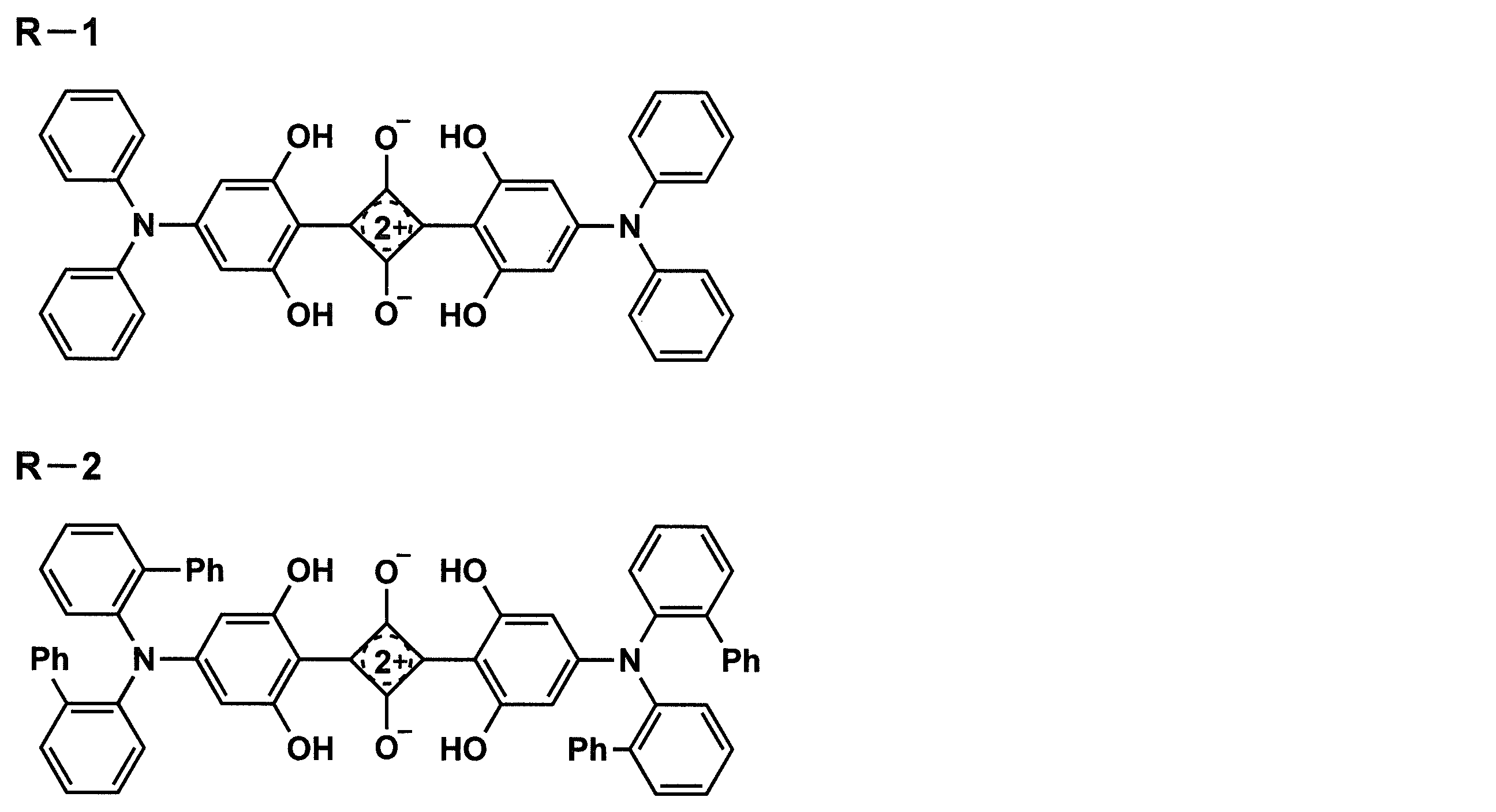
非特許文献1には上記スクアリリウム化合物が溶液中において近赤外領域で蛍光を発光することが記載されている。しかしながら、本発明者が非特許文献1に記載の上記スクアリリウム化合物を固体膜中で評価したところ、発光効率と耐光性は十分に満足しうるものではなかった。
S.Wang,et al.,Chem.Mater,2011,23,4789-4798.
本発明は、上記問題・状況に鑑みてなされたものであり、その解決課題は、発光効率が高く、特に固体膜中での発光効率の低下が少なく、かつ、耐光性の優れた赤外光を発光することのできる新規なスクアリリウム化合物を提供することである。また、当該スクアリリウム化合物を含有する発光性組成物及び発光性フィルムを提供することである。
本発明者は、上記課題を解決すべく、上記問題の原因等について検討した結果、アリールアミンのオルト位に置換基を有する特定構造のスクアリリウム化合物を用いることで、発光効率が高く、特に固体膜中での発光効率の低下が少なく、かつ、耐光性の優れた近赤外光を発光することのできる新規なスクアリリウム化合物を見いだし、本発明に至った。
すなわち、本発明に係る上記課題は、以下の手段により解決される。
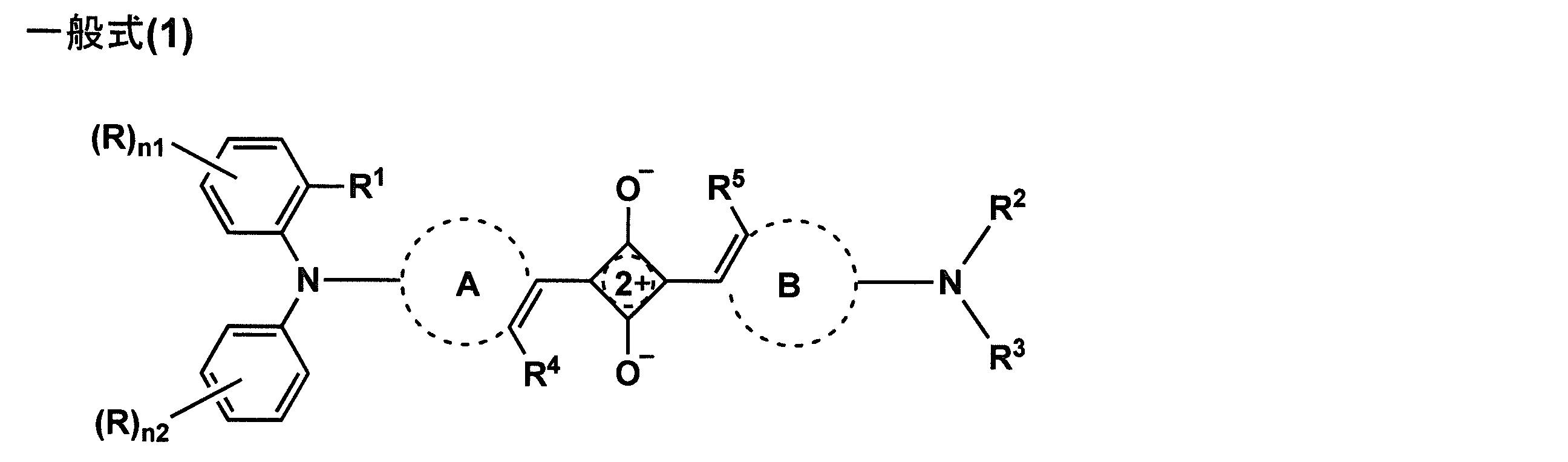
1.下記一般式(1)で表される構造を有することを特徴とするスクアリリウム化合物。
1.下記一般式(1)で表される構造を有することを特徴とするスクアリリウム化合物。
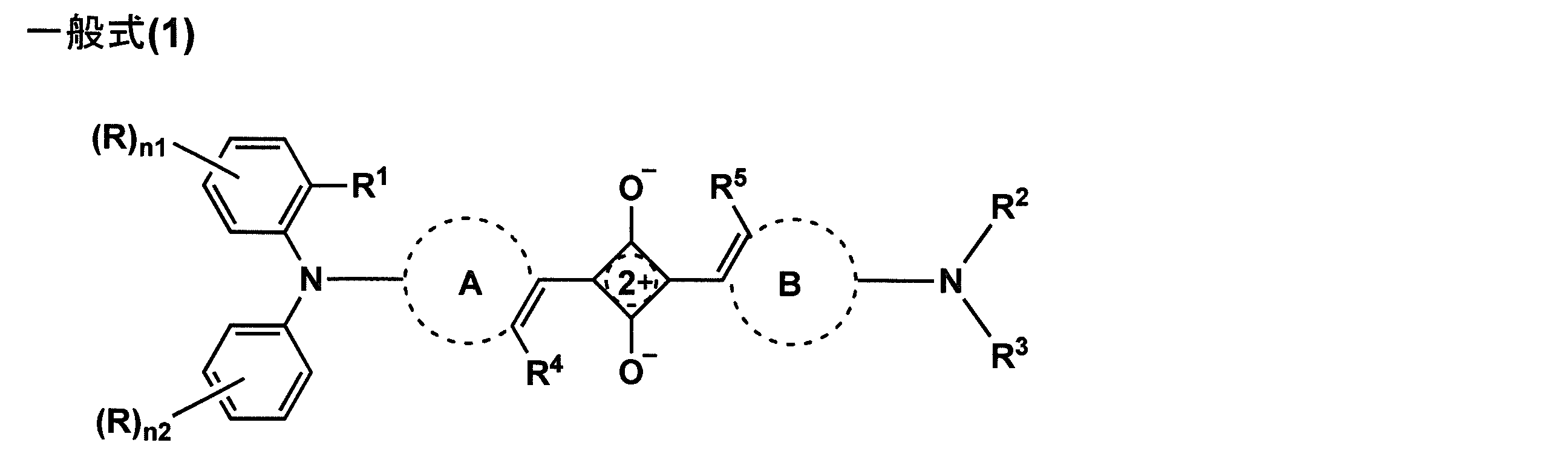
[一般式(1)において、
環A及び環Bは、それぞれ独立に、置換基を有していてもよい芳香族炭化水素環を表す。R1は、アルキル基、シクロアルキル基、芳香族炭化水素基又はハロゲン原子を表す。
R2及びR3は、それぞれ独立に、アルキル基又はシクロアルキル基を表す。
Rは、置換基を表す。
R1とR、又は二つのRが、互いに結合して環を形成しても良い。
R4及びR5は、それぞれ独立に、ヒドロキシ基又はアミノ基を表す。
n1及びn2は、それぞれ独立に、0~4の整数を表す。]
環A及び環Bは、それぞれ独立に、置換基を有していてもよい芳香族炭化水素環を表す。R1は、アルキル基、シクロアルキル基、芳香族炭化水素基又はハロゲン原子を表す。
R2及びR3は、それぞれ独立に、アルキル基又はシクロアルキル基を表す。
Rは、置換基を表す。
R1とR、又は二つのRが、互いに結合して環を形成しても良い。
R4及びR5は、それぞれ独立に、ヒドロキシ基又はアミノ基を表す。
n1及びn2は、それぞれ独立に、0~4の整数を表す。]
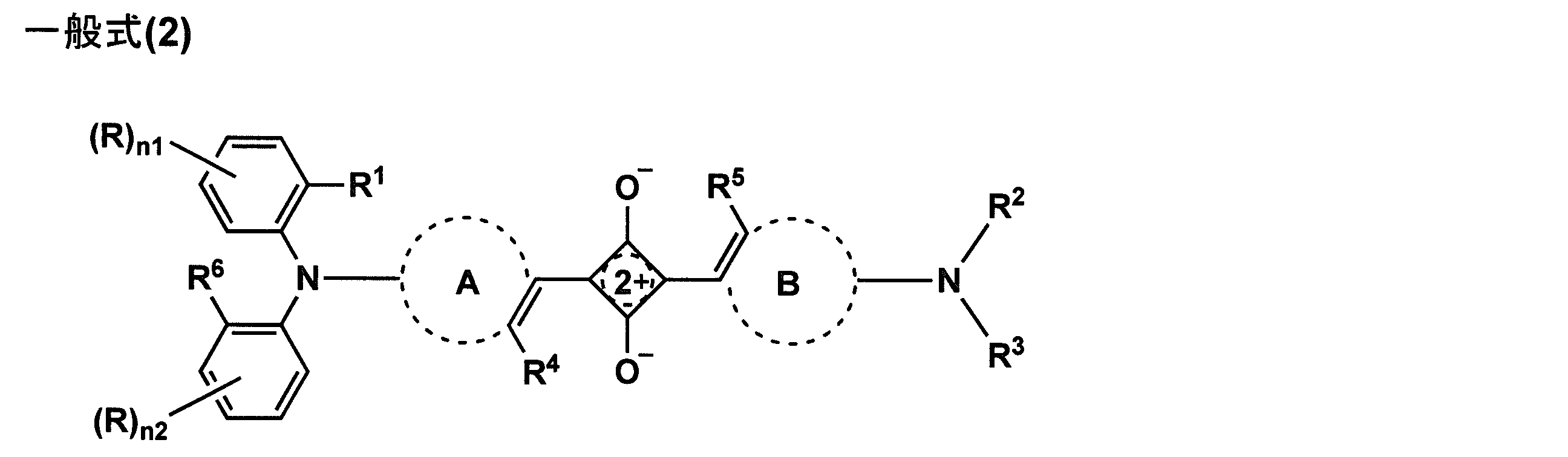
2.前記一般式(1)で表される構造を有する化合物が、下記一般式(2)で表される構造を有する化合物であることを特徴とする第1項に記載のスクアリリウム化合物。

[一般式(2)において、
環A及び環Bは、それぞれ独立に、置換基を有していてもよい芳香族炭化水素環を表す。R1及びR6は、それぞれ独立に、アルキル基、シクロアルキル基、芳香族炭化水素基又はハロゲン原子を表す。
R2及びR3は、それぞれ独立に、アルキル基又はシクロアルキル基を表す。
Rは、置換基を表す。
R1とR、R6とR又は二つのRが互いに結合して環を形成しても良い。
R4及びR5は、それぞれ独立に、ヒドロキシ基又はアミノ基を表す。
n1及びn2は、それぞれ独立に、0~4の整数を表す。]
環A及び環Bは、それぞれ独立に、置換基を有していてもよい芳香族炭化水素環を表す。R1及びR6は、それぞれ独立に、アルキル基、シクロアルキル基、芳香族炭化水素基又はハロゲン原子を表す。
R2及びR3は、それぞれ独立に、アルキル基又はシクロアルキル基を表す。
Rは、置換基を表す。
R1とR、R6とR又は二つのRが互いに結合して環を形成しても良い。
R4及びR5は、それぞれ独立に、ヒドロキシ基又はアミノ基を表す。
n1及びn2は、それぞれ独立に、0~4の整数を表す。]
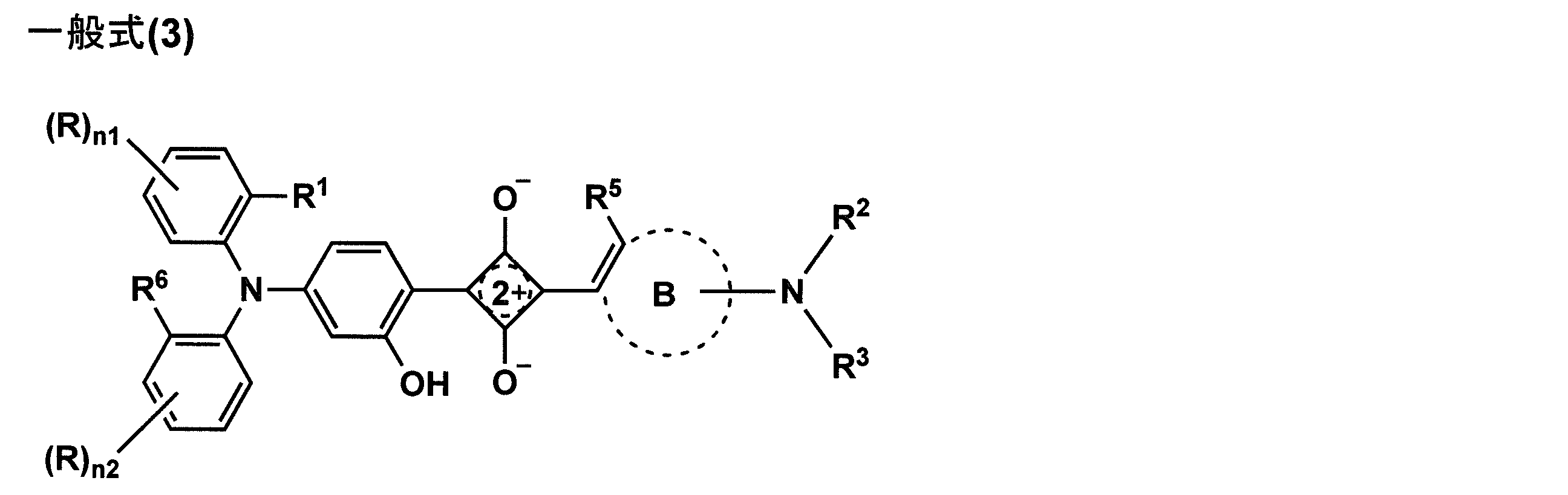
3.前記一般式(1)で表される構造を有する化合物が、下記一般式(3)で表される構造を有する化合物であることを特徴とする第1項に記載のスクアリリウム化合物。
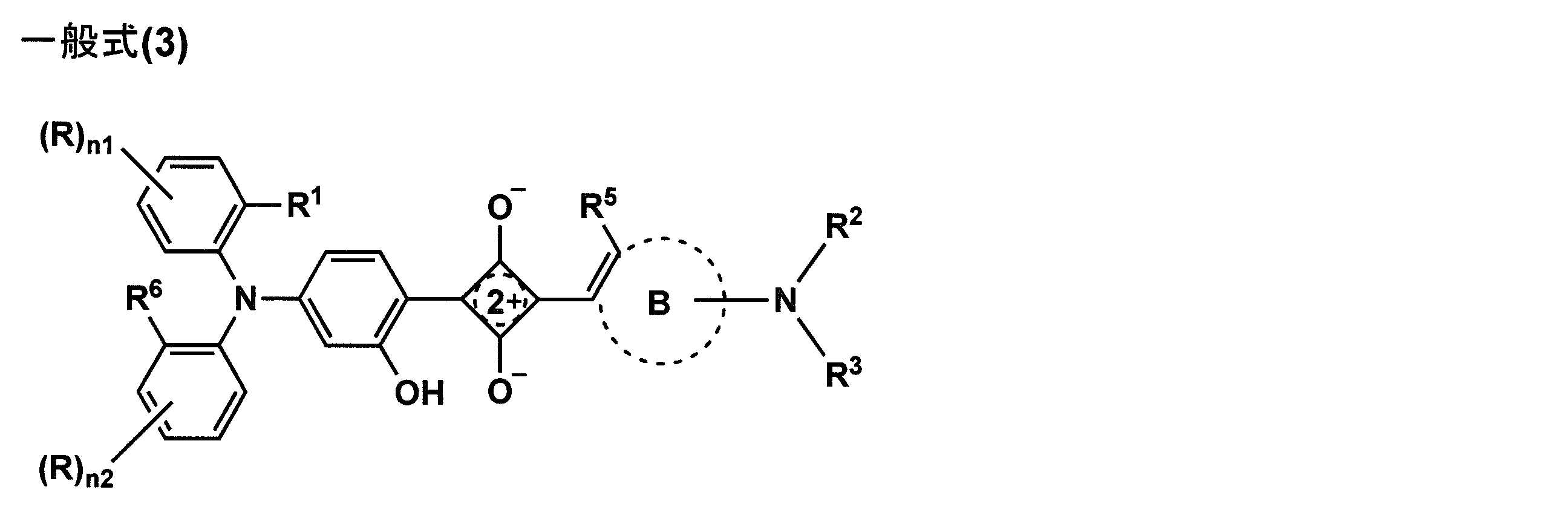
[一般式(3)において、
環Bは、置換基を有していてもよい芳香族炭化水素環を表す。
R1及びR6は、それぞれ独立に、アルキル基、シクロアルキル基、芳香族炭化水素基又はハロゲン原子を表す。
R2及びR3は、それぞれ独立に、アルキル基又はシクロアルキル基を表す。
Rは、置換基を表す。
R1とR、R6とR又は二つのRが互いに結合して環を形成しても良い。
R5は、ヒドロキシ基又はアミノ基を表す。
n1及びn2は、それぞれ独立に、0~4の整数を表す。]
環Bは、置換基を有していてもよい芳香族炭化水素環を表す。
R1及びR6は、それぞれ独立に、アルキル基、シクロアルキル基、芳香族炭化水素基又はハロゲン原子を表す。
R2及びR3は、それぞれ独立に、アルキル基又はシクロアルキル基を表す。
Rは、置換基を表す。
R1とR、R6とR又は二つのRが互いに結合して環を形成しても良い。
R5は、ヒドロキシ基又はアミノ基を表す。
n1及びn2は、それぞれ独立に、0~4の整数を表す。]
4.前記一般式(1)で表される構造を有する化合物が、下記一般式(4)で表される構造を有する化合物であることを特徴とする第1項に記載のスクアリリウム化合物。
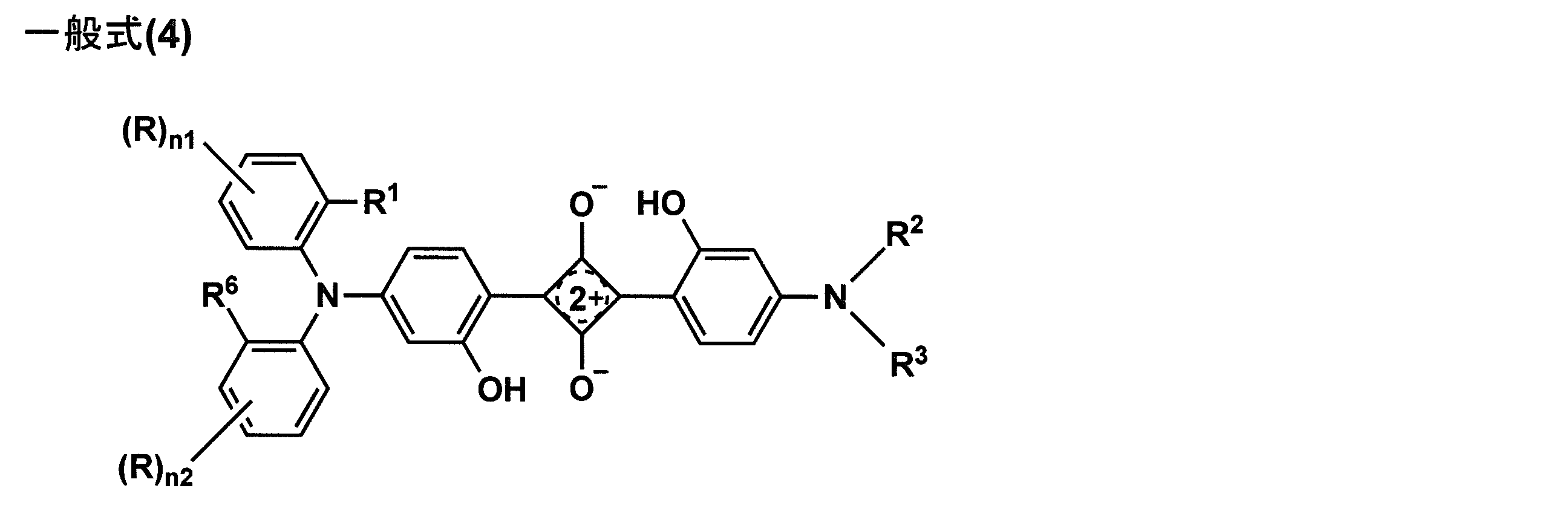
[一般式(4)において、
R1及びR6は、それぞれ独立に、アルキル基、シクロアルキル基、芳香族炭化水素基又はハロゲン原子を表す。
R2及びR3は、それぞれ独立に、アルキル基又はシクロアルキル基を表す。
Rは、置換基を表す。
R1とR、R6とR又は二つのRが互いに結合して環を形成しても良い。
n1及びn2は、それぞれ独立に、0~4の整数を表す。]
R1及びR6は、それぞれ独立に、アルキル基、シクロアルキル基、芳香族炭化水素基又はハロゲン原子を表す。
R2及びR3は、それぞれ独立に、アルキル基又はシクロアルキル基を表す。
Rは、置換基を表す。
R1とR、R6とR又は二つのRが互いに結合して環を形成しても良い。
n1及びn2は、それぞれ独立に、0~4の整数を表す。]
5.第1項から第4項までのいずれか一項に記載のスクアリリウム化合物を含有することを特徴とする発光性組成物。
6.第1項から第4項までのいずれか一項に記載のスクアリリウム化合物を含有することを特徴とする発光性フィルム。
本発明の上記手段により、発光効率が高く、特に固体膜中での発光効率の低下が少なく、かつ、耐光性の優れた近赤外光を発光することのできる新規なスクアリリウム化合物を提供することができる。また、当該スクアリリウム化合物を含有する発光性組成物及び発光性フィルムを提供することができる。
本発明の効果の発現機構又は作用機構については、明確にはなっていないが、以下のように推察している。
スクアリリウム化合物は、強い電子アクセプター性を示すスクアリン酸骨格とスクアリリウムドナー性を示すアミノ基からなる構造をしており、赤~近赤外領域にシャープな吸収・発光ピークと高いモル吸光係数を示す。以下に代表的なスクアリリウム化合物R-3と光学物性(λmax PL:極大発光波長、Φf:発光量子収率、モル吸光係数(logε))を示した。
スクアリリウム化合物は、強い電子アクセプター性を示すスクアリン酸骨格とスクアリリウムドナー性を示すアミノ基からなる構造をしており、赤~近赤外領域にシャープな吸収・発光ピークと高いモル吸光係数を示す。以下に代表的なスクアリリウム化合物R-3と光学物性(λmax PL:極大発光波長、Φf:発光量子収率、モル吸光係数(logε))を示した。

しかしながら、上記スクアリリウム化合物は高いπ平面性と同一分子内でカチオンとアニオンが共存した双性イオン構造であるため凝集しやすい。その結果、発光材料として見たとき、溶液中では高い発光量子収率を示すものの、固体膜中では凝集し発光量子収率が低下することが知られていた。
これに対し、本発明のスクアリリウム化合物は、アリールアミンのオルト位に少なくとも一つの置換基があるため、アリールアミンとスクアリン酸骨格が捩じれ、分子のπ平面性が低下する。そのため、スクアリリウム化合物同士の相互作用や分散剤との相互作用が抑えられる。その結果、膜中においても凝集起因の消光が生じにくく、発光性が低下しないと考えられる。
さらに電子供与性の強いアミノ基が置換した芳香族炭化水素環によって、発光量子収率が向上することが分った。これは、スクアリリウム化合物が、電子アクセプター性を示すスクアリン酸骨格と電子ドナー性を示すアミノ基からなる構造を持っているため、電子供与性の強いドナーを用いると、分子内電荷移動遷移に基づく発光が起こりやすくなるためだと推測される。
また、本発明のスクアリリウム化合物は従来のスクアリリウム化合物よりも耐光性に優れるという効果を有する。本発明の化合物は励起状態からの熱失活が少ないため、熱による分解が抑えられたこと、及び凝集が抑制されるので凝集起因の分解が抑制されるため、例えば、分子が近づくことによる分子間の反応が抑制されることや、凝集体のように吸収スペクトルがブロードになり、より多くの波長域の光を吸収してしまうことがないためであると推察される。
本発明のスクアリリウム化合物は、前記一般式(1)で表される構造を有することを特徴とする。この特徴は、下記各実施態様(形態)に共通する又は対応する技術的特徴である。
本発明の実施態様としては、本発明の効果発現の観点から、前記一般式(1)で表される構造を有する化合物が、前記一般式(2)で表される構造を有する化合物であることが好ましい。
本発明の実施態様としては、本発明の効果発現の観点から、前記一般式(1)で表される構造を有する化合物が、前記一般式(2)で表される構造を有する化合物であることが好ましい。
また、前記一般式(1)で表される構造を有する化合物が、前記一般式(3)で表される構造を有する化合物であることが好ましい。
さらに、前記一般式(1)で表される構造を有する化合物が、前記一般式(4)で表される構造を有する化合物であることが好ましい。
本発明のスクアリリウム化合物を含有した発光性組成物又は発光性フィルムであることが好ましい。
さらに、前記一般式(1)で表される構造を有する化合物が、前記一般式(4)で表される構造を有する化合物であることが好ましい。
本発明のスクアリリウム化合物を含有した発光性組成物又は発光性フィルムであることが好ましい。
以下、本発明とその構成要素、及び本発明を実施するための形態・態様について詳細な説明をする。なお、本願において、「~」は、その前後に記載される数値を下限値及び上限値として含む意味で使用する。
以下、本発明のスクアリリウム化合物、発光性組成物、発光性フィルムについて説明するが、本発明はこれらに限定されない。
《スクアリリウム化合物》
[一般式(1)~(4)で表される構造を有するスクアリリウム化合物]
本発明のスクアリリウム化合物は、外部から励起エネルギーを受け取って一重項励起状態に遷移し、その後基底状態に戻るときに蛍光を放射する。またこの化合物は、高いモル吸光係数を示すため、光励起による発光や、フェルスター型エネルギー移動による発光に優れている。さらに耐光性に優れていることが分った。
本発明のスクアリリウム化合物の発光色は、近赤外光色である。具体的には、蛍光スペクトルにおける極大発光波長が、650~1000nmの範囲にある。
《スクアリリウム化合物》
[一般式(1)~(4)で表される構造を有するスクアリリウム化合物]
本発明のスクアリリウム化合物は、外部から励起エネルギーを受け取って一重項励起状態に遷移し、その後基底状態に戻るときに蛍光を放射する。またこの化合物は、高いモル吸光係数を示すため、光励起による発光や、フェルスター型エネルギー移動による発光に優れている。さらに耐光性に優れていることが分った。
本発明のスクアリリウム化合物の発光色は、近赤外光色である。具体的には、蛍光スペクトルにおける極大発光波長が、650~1000nmの範囲にある。
本発明のスクアリリウム化合物は、下記一般式(1)で表される構造を有する。
[一般式(1)において、
環A及び環Bは、それぞれ独立に、置換基を有していてもよい芳香族炭化水素環を表す。R1は、アルキル基、シクロアルキル基、芳香族炭化水素基又はハロゲン原子を表す。
R2及びR3は、それぞれ独立に、アルキル基又はシクロアルキル基を表す。
Rは、置換基を表す。
R1とR、又は二つのRが、互いに結合して環を形成しても良い。
R4及びR5は、それぞれ独立に、ヒドロキシ基又はアミノ基を表す。
n1及びn2は、それぞれ独立に、0~4の整数を表す。]
環A及び環Bは、それぞれ独立に、置換基を有していてもよい芳香族炭化水素環を表す。R1は、アルキル基、シクロアルキル基、芳香族炭化水素基又はハロゲン原子を表す。
R2及びR3は、それぞれ独立に、アルキル基又はシクロアルキル基を表す。
Rは、置換基を表す。
R1とR、又は二つのRが、互いに結合して環を形成しても良い。
R4及びR5は、それぞれ独立に、ヒドロキシ基又はアミノ基を表す。
n1及びn2は、それぞれ独立に、0~4の整数を表す。]
環Aと環Bで表される芳香族炭化水素環(芳香族炭化水素環基、芳香族炭素環基、アリール基等ともいう。)は、炭素数6~18の置換又は無置換の芳香族炭化水素環であり、例えば、フェニル基、ナフチル基、アントリル基、フルオレニル基、フェナントリル基、ビフェニリル基等を挙げることができる。好ましくは、フェニル基、ナフチル基、アントリル基等を挙げることができる。
R1で表されるアルキル基としては、炭素数1~10の置換又は無置換のアルキル基であり、例えば、メチル基、エチル基、プロピル基、イソプロピル基、ブチル基、イソブチル基、ペンチル基、ヘキシル基、オクチル基、ドデシル基等が挙げられる。
R1で表されるシクロアルキル基としては、例えば、シクロペンチル基、シクロヘキシル基等が挙げられる。
R1で表されるシクロアルキル基としては、例えば、シクロペンチル基、シクロヘキシル基等が挙げられる。
R1で表される芳香族炭化水素基としては、炭素数6~18の置換又は無置換の芳香族炭化水素基であり、例えば芳香族炭化水素基(フェニル基、ナフチル基、アントリル基、フルオレニル基、フェナントリル基、ビフェニリル基等)が挙げられる。好ましくは、フェニル基、ナフチル基を挙げることができる。
R1で表されるハロゲン原子としては、例えば、フッ素原子、塩素原子、臭素原子等を挙げることができる。
一般式(1)における、環A及び環Bが有しても良い置換基、及びRで表される置換基としては、アルキル基(例えば、メチル基、エチル基、プロピル基、イソプロピル基、tert-ブチル基、ペンチル基、ヘキシル基、オクチル基、ドデシル基、トリデシル基、テトラデシル基、ペンタデシル基等)、シクロアルキル基(例えば、シクロペンチル基、シクロヘキシル基等)、アルケニル基(例えば、ビニル基、アリル基等)、アルキニル基(例えば、エチニル基、プロパルギル基等)、芳香族炭化水素基(例えば、フェニル基、p-クロロフェニル基、メシチル基、トリル基、キシリル基、ナフチル基、アントリル基、アズレニル基、アセナフテニル基、フルオレニル基、フェナントリル基、インデニル基、ピレニル基、ビフェニリル基等)、芳香族複素環基(例えば、ピリジル基、ピリミジニル基、フリル基、ピロリル基、イミダゾリル基、ベンゾイミダゾリル基、ピラゾリル基、ピラジニル基、トリアゾリル基(例えば、1,2,4-トリアゾール-1-イル基、1,2,3-トリアゾール-1-イル基等)、ピラゾロトリアゾリル基、オキサゾリル基、ベンゾオキサゾリル基、チアゾリル基、イソオキサゾリル基、イソチアゾリル基、フラザニル基、チエニル基、キノリル基、ベンゾフリル基、ジベンゾフリル基、ベンゾチエニル基、ジベンゾチエニル基、インドリル基、カルバゾリル基、カルボリニル基、ジアザカルバゾリル基(前記カルボリニル基のカルボリン環を構成する炭素原子の一つが窒素原子で置き換わったものを示す)、キノキサリニル基、ピリダジニル基、トリアジニル基、キナゾリニル基、フタラジニル基等)、複素環基(例えば、ピロリジル基、イミダゾリジル基、モルホリル基、オキサゾリジル基等)、アルコキシ基(例えば、メトキシ基、エトキシ基、プロピルオキシ基、ペンチルオキシ基、ヘキシルオキシ基、オクチルオキシ基、ドデシルオキシ基等)、シクロアルコキシ基(例えば、シクロペンチルオキシ基、シクロヘキシルオキシ基等)、アリールオキシ基(例えば、フェノキシ基、ナフチルオキシ基等)、アルキルチオ基(例えば、メチルチオ基、エチルチオ基、プロピルチオ基、ペンチルチオ基、ヘキシルチオ基、オクチルチオ基、ドデシルチオ基等)、シクロアルキルチオ基(例えば、シクロペンチルチオ基、シクロヘキシルチオ基等)、アリールチオ基(例えば、フェニルチオ基、ナフチルチオ基等)、アルコキシカルボニル基(例えば、メチルオキシカルボニル基、エチルオキシカルボニル基、ブチルオキシカルボニル基、オクチルオキシカルボニル基、ドデシルオキシカルボニル基等)、アリールオキシカルボニル基(例えば、フェニルオキシカルボニル基、ナフチルオキシカルボニル基等)、スルファモイル基(例えば、アミノスルホニル基、メチルアミノスルホニル基、ジメチルアミノスルホニル基、ブチルアミノスルホニル基、ヘキシルアミノスルホニル基、シクロヘキシルアミノスルホニル基、オクチルアミノスルホニル基、ドデシルアミノスルホニル基、フェニルアミノスルホニル基、ナフチルアミノスルホニル基、2-ピリジルアミノスルホニル基等)、アシル基(例えば、アセチル基、エチルカルボニル基、プロピルカルボニル基、ペンチルカルボニル基、シクロヘキシルカルボニル基、オクチルカルボニル基、2-エチルヘキシルカルボニル基、ドデシルカルボニル基、フェニルカルボニル基、ナフチルカルボニル基、ピリジルカルボニル基等)、アシルオキシ基(例えば、アセチルオキシ基、エチルカルボニルオキシ基、ブチルカルボニルオキシ基、オクチルカルボニルオキシ基、ドデシルカルボニルオキシ基、フェニルカルボニルオキシ基等)、アミド基(例えば、メチルカルボニルアミノ基、エチルカルボニルアミノ基、ジメチルカルボニルアミノ基、プロピルカルボニルアミノ基、ペンチルカルボニルアミノ基、シクロヘキシルカルボニルアミノ基、2-エチルヘキシルカルボニルアミノ基、オクチルカルボニルアミノ基、ドデシルカルボニルアミノ基、フェニルカルボニルアミノ基、ナフチルカルボニルアミノ基等)、カルバモイル基(例えば、アミノカルボニル基、メチルアミノカルボニル基、ジメチルアミノカルボニル基、プロピルアミノカルボニル基、ペンチルアミノカルボニル基、シクロヘキシルアミノカルボニル基、オクチルアミノカルボニル基、2-エチルヘキシルアミノカルボニル基、ドデシルアミノカルボニル基、フェニルアミノカルボニル基、ナフチルアミノカルボニル基、2-ピリジルアミノカルボニル基等)、ウレイド基(例えば、メチルウレイド基、エチルウレイド基、ペンチルウレイド基、シクロヘキシルウレイド基、オクチルウレイド基、ドデシルウレイド基、フェニルウレイド基ナフチルウレイド基、2-ピリジルアミノウレイド基等)、スルフィニル基(例えば、メチルスルフィニル基、エチルスルフィニル基、ブチルスルフィニル基、シクロヘキシルスルフィニル基、2-エチルヘキシルスルフィニル基、ドデシルスルフィニル基、フェニルスルフィニル基、ナフチルスルフィニル基、2-ピリジルスルフィニル基等)、アルキルスルホニル基(例えば、メチルスルホニル基、エチルスルホニル基、ブチルスルホニル基、シクロヘキシルスルホニル基、2-エチルヘキシルスルホニル基、ドデシルスルホニル基等)、アリールスルホニル基又はヘテロアリールスルホニル基(例えば、フェニルスルホニル基、ナフチルスルホニル基、2-ピリジルスルホニル基等)、アミノ基(例えば、アミノ基、エチルアミノ基、ジメチルアミノ基、ジフェニルアミノ基、ジイソプロピルアミノ基、ジタートブチル基、シクロヘキシルアミノ基、ブチルアミノ基、シクロペンチルアミノ基、2-エチルヘキシルアミノ基、ドデシルアミノ基、アニリノ基、ナフチルアミノ基、2-ピリジルアミノ基等)、ハロゲン原子(例えば、フッ素原子、塩素原子、臭素原子等)、フッ化炭化水素基(例えば、フルオロメチル基、トリフルオロメチル基、ペンタフルオロエチル基、ペンタフルオロフェニル基等)、シアノ基、ニトロ基、ヒドロキシ基、メルカプト基、シリル基(例えば、トリメチルシリル基、トリイソプロピルシリル基、トリフェニルシリル基、フェニルジエチルシリル基等)、ホスホノ基等が挙げられる。好ましくは、アルキル基、芳香族炭化水素基、アミノ基、ヒドロキシ基、シリル基が挙げられる。
また、これらの置換基は、上記の置換基によってさらに置換されていてもよい。
また、これらの置換基は、上記の置換基によってさらに置換されていてもよい。
一般式(1)における置換基の数は、特に制限されない。置換基が二つ以上ある場合、それらの置換基は、互いに同一であっても異なっていても良い。隣接する置換基同士はそれぞれ互いに結合して環状構造を形成していてもよい。例えば、R1とR、R2とR3、二つのR、R5とR2又はR5とR3が、互いに結合して環を形成しても良い。
隣接する置換基同士が形成する環状構造は、芳香環であっても脂肪環であってもよく、またヘテロ原子を含むものであってもよく、さらに環状構造は2環以上の縮合環であってもよい。ここでいうヘテロ原子としては、窒素原子、酸素原子及び硫黄原子からなる群より選択されるものであることが好ましい。形成される環状構造の例として、ベンゼン環、ナフタレン環、ピリジン環、ピリダジン環、ピリミジン環、ピラジン環、ピロール環、イミダゾール環、ピラゾール環、トリアゾール環、イミダゾリン環、オキサゾール環、イソオキサゾール環、チアゾール環、イソチアゾール環、シクロヘキサジエン環、シクロヘキセン環、シクロペンタエン環、シクロヘプタトリエン環、シクロヘプタジエン環、シクロヘプタエン環、カルバゾール環、ジベンゾフラン環等を挙げることができる。
R2及びR3は、それぞれ独立に、アルキル基又はシクロアルキル基を表す。アルキル基としては、例えば、メチル基、エチル基、プロピル基、イソプロピル基、tert-ブチル基、ペンチル基、ヘキシル基、オクチル基、ドデシル基、トリデシル基、テトラデシル基、ペンタデシル基等が挙げられる。シクロアルキル基としては、例えば、シクロペンチル基、シクロヘキシル基等が挙げられる。R2及びR3が互いに結合して環を形成する場合の例としては、例えば、ピペリジン環、モルホリン環が挙げられる。R2及びR3は、前述した置換基によってさらに置換されていてもよい。
R4及びR5は、それぞれ独立に、ヒドロキシ基又はアミノ基を表す。アミノ基は、置換又は無置換のアミノ基であるが、好ましくは無置換のアミノ基である。
n1及びn2は、それぞれ独立に、0~4の整数を表し、0又は1が好ましい。
n1及びn2は、それぞれ独立に、0~4の整数を表し、0又は1が好ましい。
上記一般式(1)で表されるスクアリリウム化合物が、下記一般式(2)で表される構造を有する化合物であることが好ましい。

[一般式(2)において、
環A及び環Bは、それぞれ独立に、置換基を有していてもよい芳香族炭化水素環を表す。R1及びR6は、それぞれ独立に、アルキル基、シクロアルキル基、芳香族炭化水素基又はハロゲン原子を表す。
R2及びR3は、それぞれ独立に、アルキル基又はシクロアルキル基を表す。
Rは、置換基を表す。
R1とR、R6とR又は二つのRが互いに結合して環を形成しても良い。
R4及びR5は、それぞれ独立に、ヒドロキシ基又はアミノ基を表す。
n1及びn2は、それぞれ独立に、0~4の整数を表す。]
環A及び環Bは、それぞれ独立に、置換基を有していてもよい芳香族炭化水素環を表す。R1及びR6は、それぞれ独立に、アルキル基、シクロアルキル基、芳香族炭化水素基又はハロゲン原子を表す。
R2及びR3は、それぞれ独立に、アルキル基又はシクロアルキル基を表す。
Rは、置換基を表す。
R1とR、R6とR又は二つのRが互いに結合して環を形成しても良い。
R4及びR5は、それぞれ独立に、ヒドロキシ基又はアミノ基を表す。
n1及びn2は、それぞれ独立に、0~4の整数を表す。]
一般式(2)中、環Aと環Bは、一般式(1)と同様に、置換基を有していてもよい芳香族炭化水素環を表す。
R1とR6は、一般式(1)のR1と同様に、各々独立にアルキル基、シクロアルキル基、芳香族炭化水素基又はハロゲン原子を表す。
Rは一般式(1)と同様に、置換基を表し、R1とR、R6とR又は二つのRが互いに結合して環を形成しても良い。R4とR5は、一般式(1)と同様に、ヒドロキシ基又はアミノ基を表す。
n1及びn2は、それぞれ独立に、0~4の整数を表し、0又は1が好ましい。
また、上記一般式(1)で表される化合物が、下記一般式(3)で表される構造を有する化合物であることが好ましい。
R1とR6は、一般式(1)のR1と同様に、各々独立にアルキル基、シクロアルキル基、芳香族炭化水素基又はハロゲン原子を表す。
Rは一般式(1)と同様に、置換基を表し、R1とR、R6とR又は二つのRが互いに結合して環を形成しても良い。R4とR5は、一般式(1)と同様に、ヒドロキシ基又はアミノ基を表す。
n1及びn2は、それぞれ独立に、0~4の整数を表し、0又は1が好ましい。
また、上記一般式(1)で表される化合物が、下記一般式(3)で表される構造を有する化合物であることが好ましい。
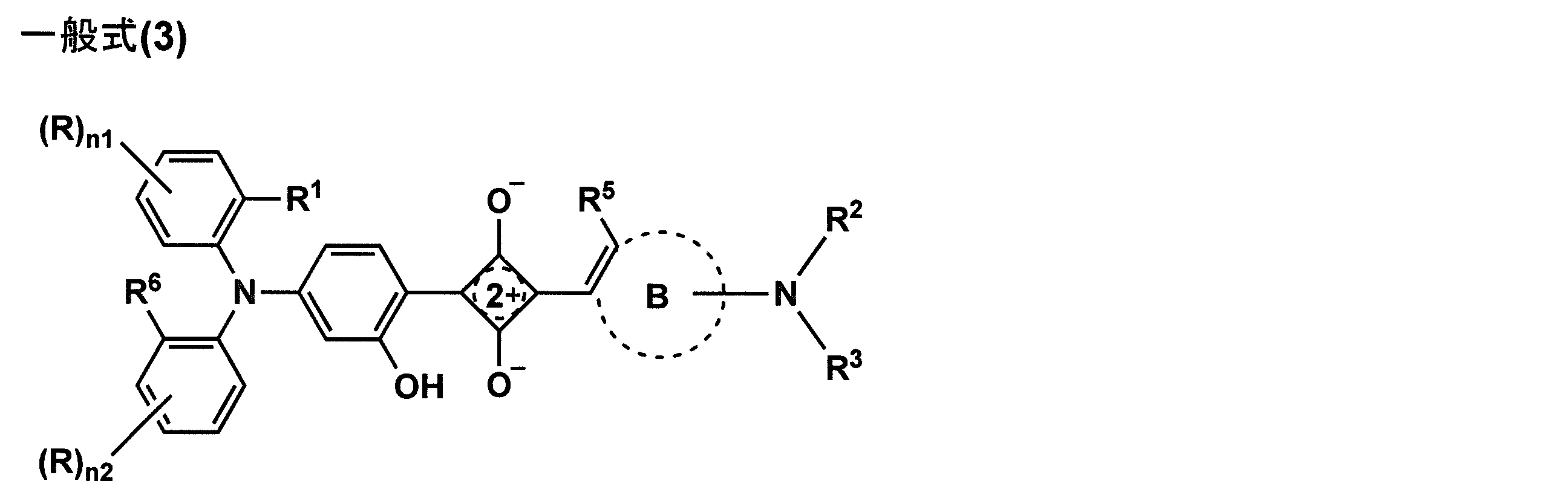
[一般式(3)において、
環Bは、置換基を有していてもよい芳香族炭化水素環を表す。
R1及びR6は、それぞれ独立に、アルキル基、シクロアルキル基、芳香族炭化水素基又はハロゲン原子を表す。
R2及びR3は、それぞれ独立に、アルキル基又はシクロアルキル基を表す。
Rは、置換基を表す。
R1とR、R6とR又は二つのRが互いに結合して環を形成しても良い。
R5は、ヒドロキシ基又はアミノ基を表す。
n1及びn2は、それぞれ独立に、0~4の整数を表す。]
環Bは、置換基を有していてもよい芳香族炭化水素環を表す。
R1及びR6は、それぞれ独立に、アルキル基、シクロアルキル基、芳香族炭化水素基又はハロゲン原子を表す。
R2及びR3は、それぞれ独立に、アルキル基又はシクロアルキル基を表す。
Rは、置換基を表す。
R1とR、R6とR又は二つのRが互いに結合して環を形成しても良い。
R5は、ヒドロキシ基又はアミノ基を表す。
n1及びn2は、それぞれ独立に、0~4の整数を表す。]
一般式(3)において、環B、R1、R6、R2、R3、R5、R、n1及びn2は、一般式(2)における環B、R1、R6、R2、R3、R5、R、n1及びn2と同義である。
また、上記一般式(1)で表される化合物が、下記一般式(4)で表される構造を有する化合物であることが好ましい。
また、上記一般式(1)で表される化合物が、下記一般式(4)で表される構造を有する化合物であることが好ましい。
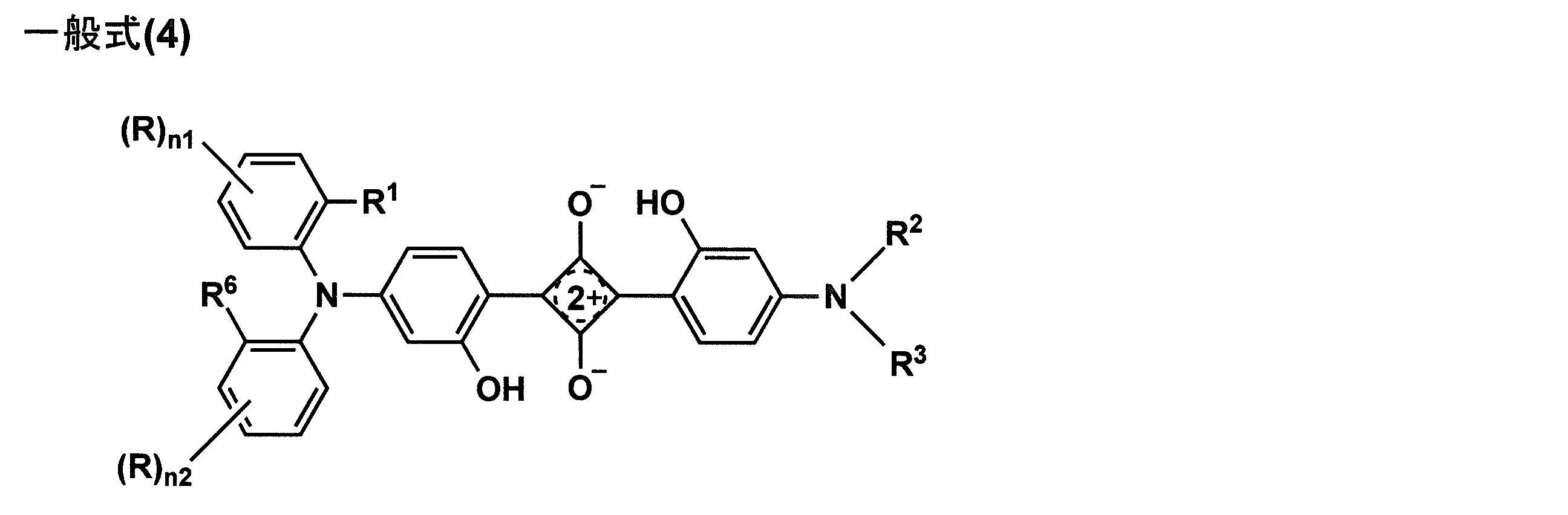
[一般式(4)において、
R1及びR6は、それぞれ独立に、アルキル基、シクロアルキル基、芳香族炭化水素基又はハロゲン原子を表す。
R2及びR3は、それぞれ独立に、アルキル基又はシクロアルキル基を表す。
Rは、置換基を表す。
R1とR、R6とR又は二つのRが互いに結合して環を形成しても良い。
n1及びn2は、それぞれ独立に、0~4の整数を表す。]
一般式(4)において、R1、R6、R2、R3、R、n1及びn2は一般式(2)におけるR1、R6、R2、R3、R、n1及びn2と同義である。
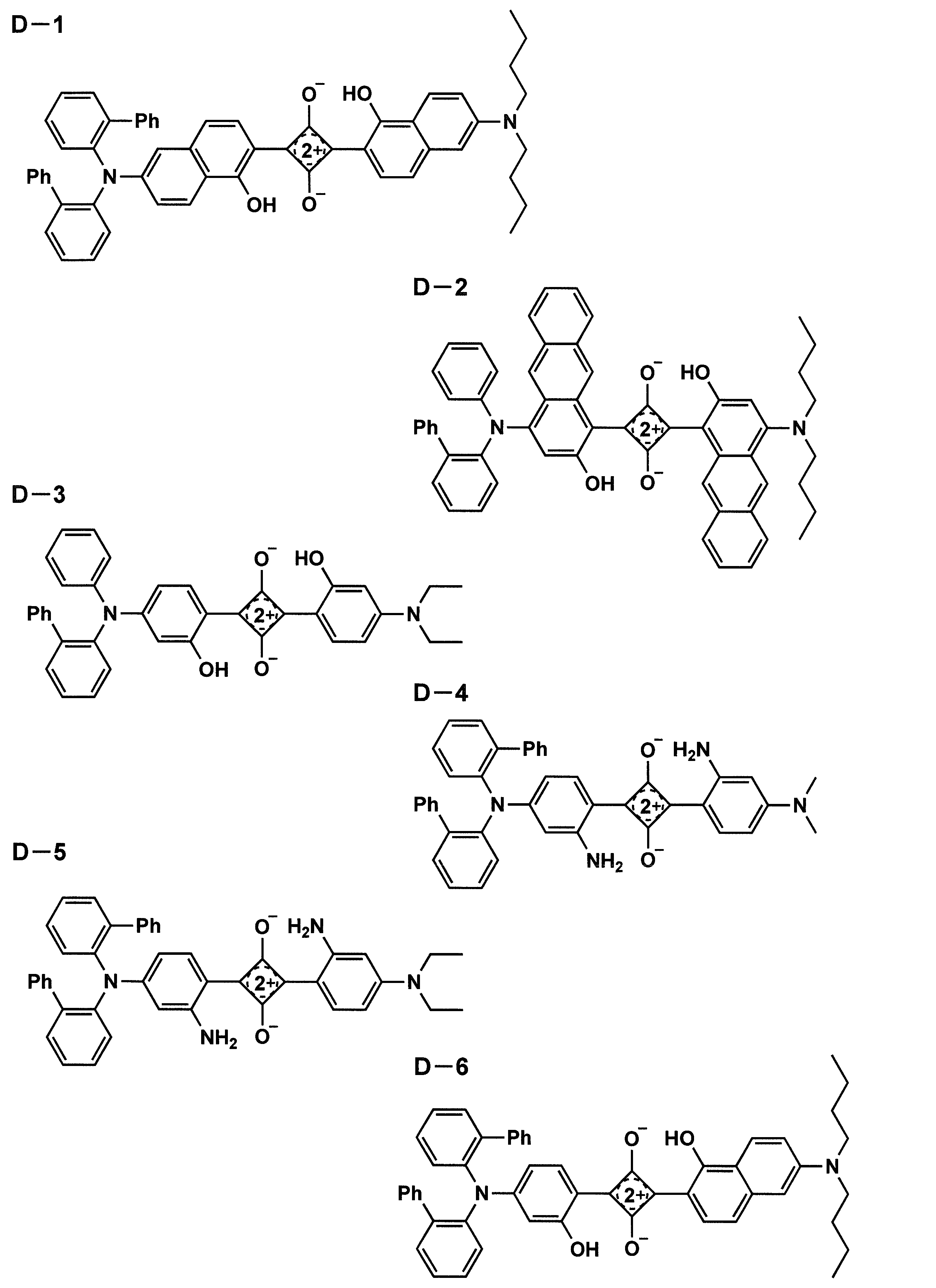
以下に本発明の一般式(1)、(2)、(3)及び(4)で表される構造を有するスクアリリウム化合物の例を挙げるが、本発明はこれに限定されない。
R1及びR6は、それぞれ独立に、アルキル基、シクロアルキル基、芳香族炭化水素基又はハロゲン原子を表す。
R2及びR3は、それぞれ独立に、アルキル基又はシクロアルキル基を表す。
Rは、置換基を表す。
R1とR、R6とR又は二つのRが互いに結合して環を形成しても良い。
n1及びn2は、それぞれ独立に、0~4の整数を表す。]
一般式(4)において、R1、R6、R2、R3、R、n1及びn2は一般式(2)におけるR1、R6、R2、R3、R、n1及びn2と同義である。
以下に本発明の一般式(1)、(2)、(3)及び(4)で表される構造を有するスクアリリウム化合物の例を挙げるが、本発明はこれに限定されない。
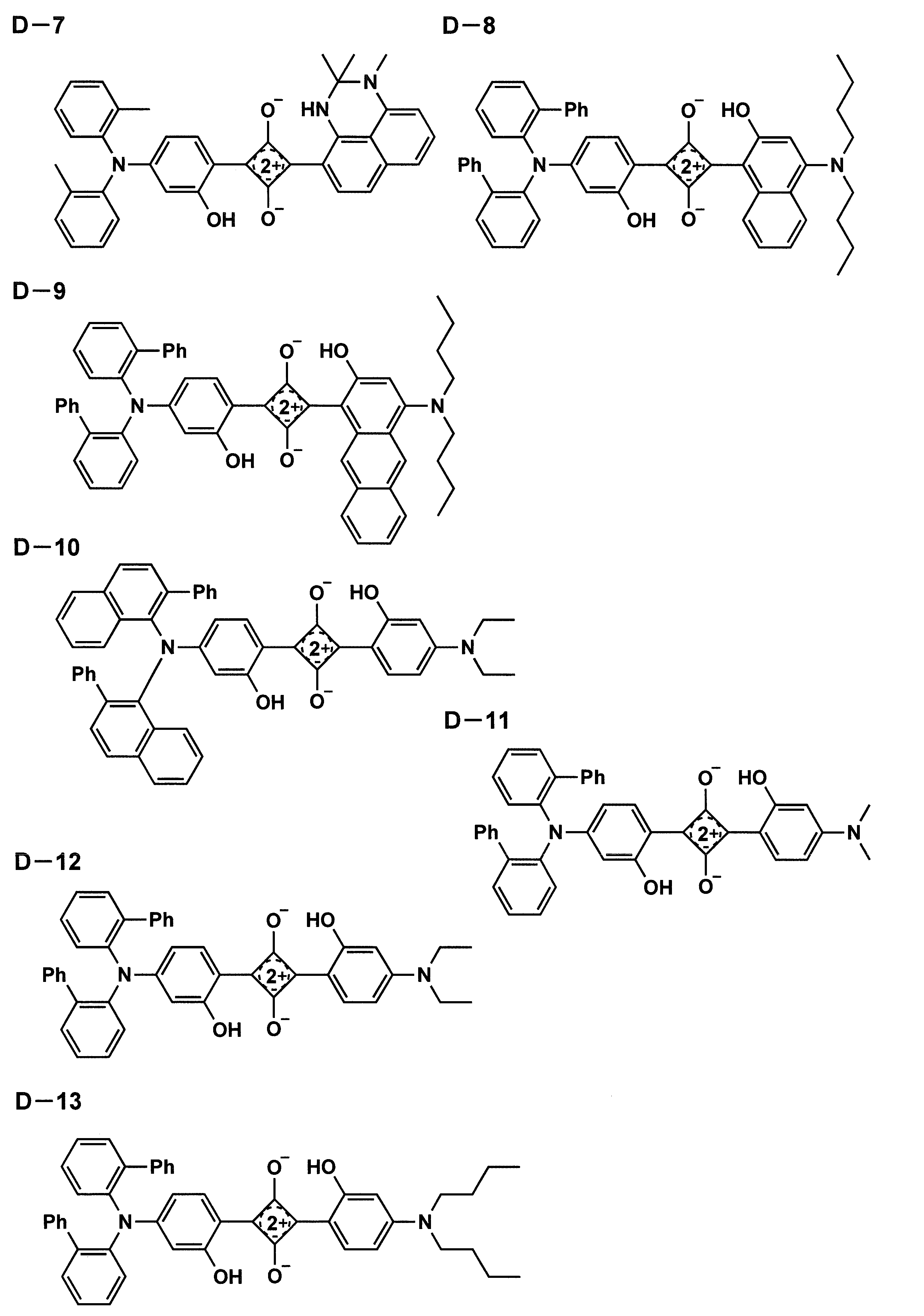
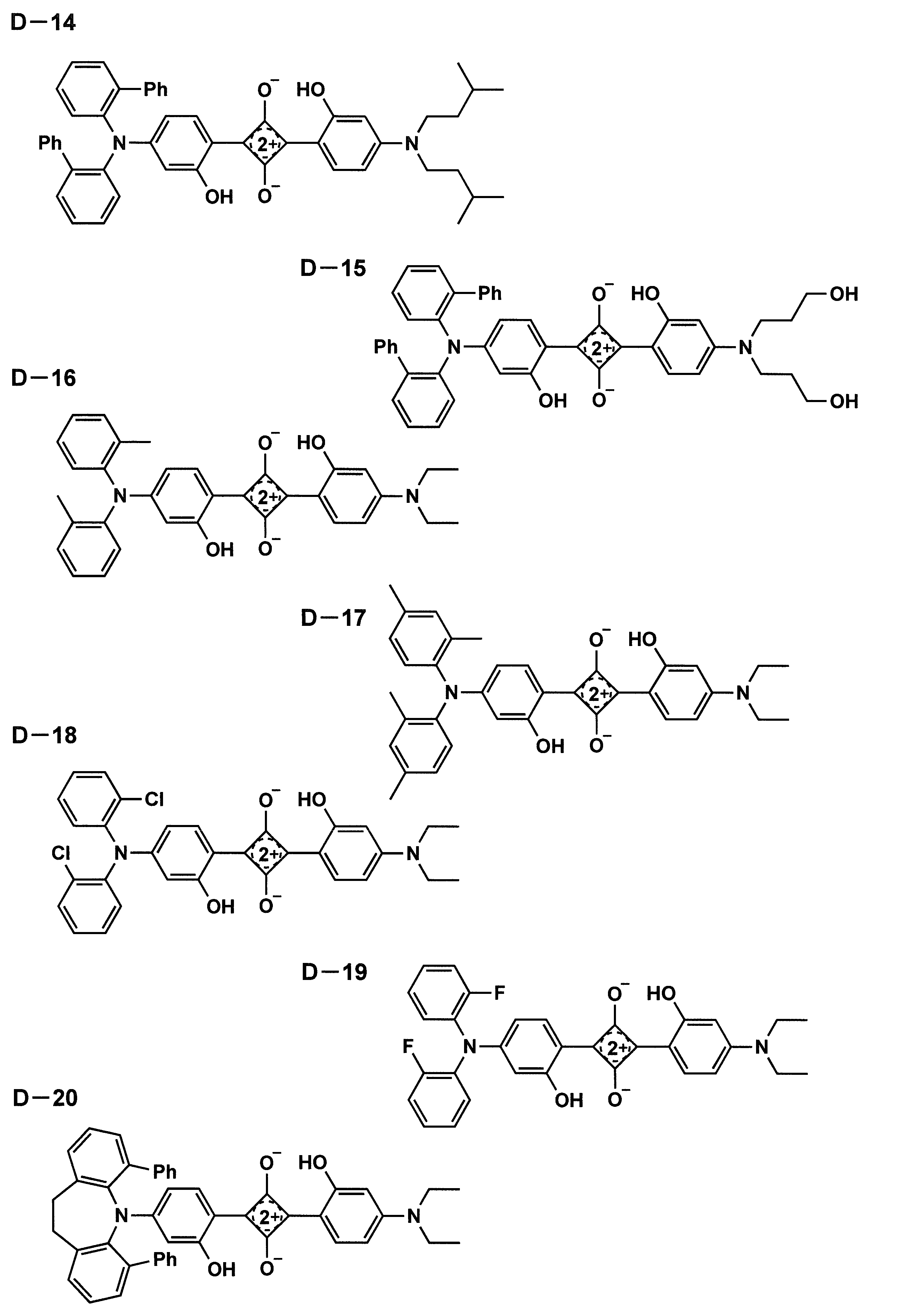
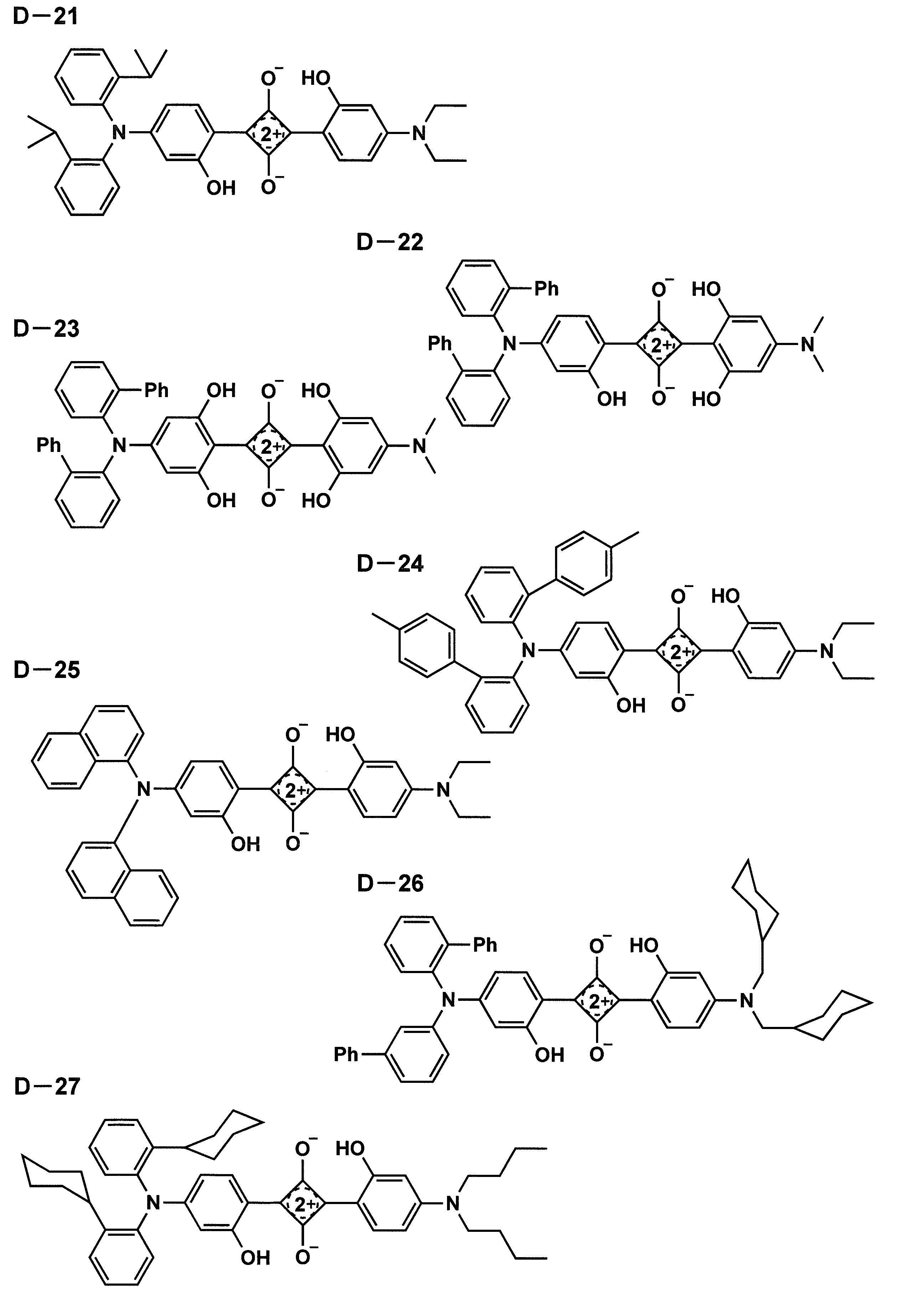
〈合成方法〉
本発明の上記スクアリリウム化合物は、例えば、Chemistry of Materials,第23巻、4789ページ(2011年)、The Journal of Physical Chemistry,第91巻、5184ページ(1987年)に記載の方法、又は、これらの文献に記載の参照文献に記載の方法を参照することにより合成することができる。一例として、以下に例示化合物D-12の合成例を示す。
本発明の上記スクアリリウム化合物は、例えば、Chemistry of Materials,第23巻、4789ページ(2011年)、The Journal of Physical Chemistry,第91巻、5184ページ(1987年)に記載の方法、又は、これらの文献に記載の参照文献に記載の方法を参照することにより合成することができる。一例として、以下に例示化合物D-12の合成例を示す。
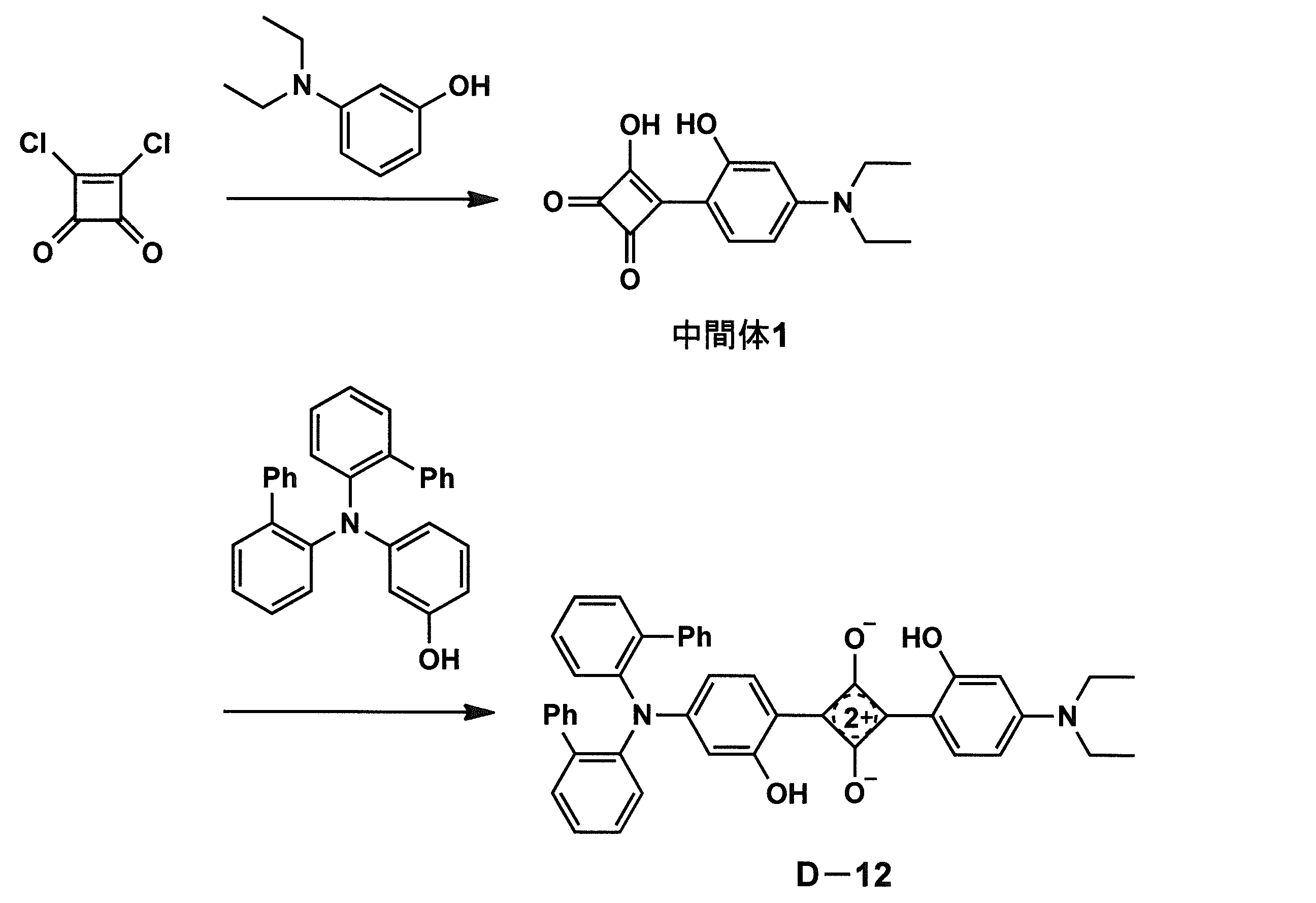
酢酸(250mL)と水(250mL)の混合溶液中に1,2-ジクロロ-1-シクロブテン-3,4-ジオン(25.0g、0.17mol)及びN,N-ジエチル-3-アミノフェノール(24.6g、0.15mol)を加え、加熱還流させながら2時間撹拌した。生成物をカラムクロマトグラフィーで精製し、中間体1を10.5g得た。次に中間体1(2.59g、9.91mol)と3-(ジ([1,1′-ビフェニル]-2-イル)アミノ)フェノール(4.10g、9.91mol)をトルエン(80mL)とノルマルブタノール(40mL)の混合溶液中溶かし、加熱還流させながら24時間撹拌した。生成物をカラムクロマトグラフィーで精製し、目的の例示化合物(D-12)を1.20g得た。
(蛍光スペクトルの測定)
本発明のスクアリリウム化合物の発光色は、以下の方法で確認することができる。
本発明のスクアリリウム化合物をトルエン溶液中で10-6Mに調整し、常温(300K)でこの試料の蛍光スペクトルを測定する。発光スペクトルの測定には、分光蛍光光度計 (日立ハイテクノス社製、F7000)を用いる。そして、極大発光波長(発光強度
が最大となる波長;「発光ピーク波長」ともいう)が650~1000nmの範囲内にあるとき、近赤外色と判断する。
本発明のスクアリリウム化合物の発光色は、以下の方法で確認することができる。
本発明のスクアリリウム化合物をトルエン溶液中で10-6Mに調整し、常温(300K)でこの試料の蛍光スペクトルを測定する。発光スペクトルの測定には、分光蛍光光度計 (日立ハイテクノス社製、F7000)を用いる。そして、極大発光波長(発光強度
が最大となる波長;「発光ピーク波長」ともいう)が650~1000nmの範囲内にあるとき、近赤外色と判断する。
《発光性組成物及び発光性フィルム》
本発明の発光性組成物は、本発明のスクアリリウム化合物を含有することを特徴とする。本発明の発光性組成物は、スクアリリウム化合物に、製膜安定性等のために分散剤を加えた組成物、又はこれにさらに溶媒を加えた組成物として用いられることが好ましい。さらに、本発明の発光性フィルムは、本発明のスクアリリウム化合物を含有することを特徴とする。具体的には本発明の発光性組成物をフィルム状に形成することにより作製することができる。
本発明の発光性組成物は、本発明のスクアリリウム化合物を含有することを特徴とする。本発明の発光性組成物は、スクアリリウム化合物に、製膜安定性等のために分散剤を加えた組成物、又はこれにさらに溶媒を加えた組成物として用いられることが好ましい。さらに、本発明の発光性フィルムは、本発明のスクアリリウム化合物を含有することを特徴とする。具体的には本発明の発光性組成物をフィルム状に形成することにより作製することができる。
分散剤としては、(メタ)アクリレート系樹脂、ポリエステル系樹脂、ポリアミド系樹脂、ポリイミド系樹脂、ポリスチレン系樹脂、ポリエポキシ系樹脂、ポリエステル系樹脂、アミノ系樹脂、フッ素系樹脂、フェノール系樹脂、ポリウレタン系樹脂、ポリエチレン系樹脂、ポリプロピレン系樹脂、ポリ塩化ビニル系樹脂、ポリビニルアルコール系樹脂、ポリエーテル系樹脂、ポリエーテルケトン系樹脂、ポリフェニレンスルフィド樹脂、ポリカーボネート系樹脂、アラミド樹脂等が挙げられるが、好ましくはポリスチレン系樹脂、ポリエチレン系樹脂、ポリプロピレン系樹脂、ポリ塩化ビニル系樹脂等である。また、これらの共重合体も同様に好ましい。
(メタ)アクリレート系樹脂とは、種々のメタクリレート系モノマー、又はアクリレート系モノマーを単独重合、又は共重合することにより合成され、モノマー種及びモノマー組成比を種々変えることによって、望みの(メタ)アクリレート系樹脂を得ることができる。また本発明においては、(メタ)アクリレート系モノマーと一緒に(メタ)アクリレート系モノマー以外の不飽和二重結合を有する共重合可能なモノマーとともに共重合しても使用可能であり、さらに本発明においては、ポリ(メタ)アクリレート系樹脂と一緒に他の複数の樹脂を混合しても使用可能である。
本発明において用いられる(メタ)アクリレート系樹脂を形成するモノマー成分としては、例えば、(メタ)アクリル酸、メチル(メタ)アクリレート、エチル(メタ)アクリレート、プロピル(メタ)アクリレート、ブチル(メタ)アクリレート、イソプロピル(メタ)アクリレート、イソブチル(メタ)アクリレート、t-ブチル(メタ)アクリレート、ステアリル(メタ)アクリレート、2-ヒドロキシエチル(メタ)アクリレート、アセトアセトキシエチル(メタ)アクリレート、ジメチルアミノエチル(メタ)アクリレート、2-ヒドロキシプロピル(メタ)アクリレート、ジ(エチレングリコール)エチルエーテル(メタ)アクリレート、エチレングリコールメチルエーテル(メタ)アクリレート、イソボニル(メタ)アクリレート、塩化エチルトリメチルアンモニウム(メタ)アクリレート、トリフルオロエチル(メタ)アクリレート、オクタフルオロペンチル(メタ)アクリレート、2-アセトアミドメチル(メタ)アクリレート、2-メトキシエチル(メタ)アクリレート、2-ジメチルアミノエチル(メタ)アクリレート、3-トリメトキシシランプロピル(メタ)アクリレート、ベンジル(メタ)アクリレート、トリデシル(メタ)アクリレート、4-ヒドロキシブチル(メタ)アクリレート、テトラヒドロフルフリル(メタ)アクリレート、ドデシル(メタ)アクリレート、オクタデシル(メタ)アクリレート、2-ジエチルアミノエチル(メタ)アクリレート、2-エチルヘキシル(メタ)アクリレート、シクロヘキシル(メタ)アクリレート、フェニル(メタ)アクリレート、グリシジル(メタ)アクリレート等が挙げられるが、好ましくは(メタ)アクリル酸、メチル(メタ)アクリレート、エチル(メタ)アクリレート、プロピル(メタ)アクリレート、ブチル(メタ)アクリレート、ステアリル(メタ)アクリレート、2-ヒドロキシエチル(メタ)アクリレート、アセトアセトキシエチル(メタ)アクリレート、ベンジル(メタ)アクリレート、トリデシル(メタ)アクリレート、ドデシル(メタ)アクリレート、2-エチルヘキシル(メタ)アクリレートである。
ポリスチレン系樹脂とは、スチレンモノマーの単独重合物、又はスチレンモノマーと共重合可能な他の不飽和二重結合を有するモノマーを共重合したランダム共重合体、ブロック共重合体、グラフト共重合体が挙げられる。さらに、かかるポリマーに他のポリマーを配合したブレンド物やポリマーアロイも含まれる。前記スチレンモノマーの例としては、スチレン、α-メチルスチレン、α-エチルスチレン、α-メチルスチレン-p-メチルスチレン、o-メチルスチレン、m-メチルスチレン、p-メチルスチレン、等の核アルキル置換スチレン、o-クロルスチレン、m-クロルスチレン、p-クロルスチレン、p-ブロモスチレン、ジクロルスチレン、ジブロモスチレン、トリクロルスチレン、トリブロモスチレン等の核ハロゲン化スチレン等が挙げられるが、この中でスチレン、α-メチルスチレンが好ましい。
これらを単独重合又は共重合することによって本発明で用いられる樹脂は、例えば、ベンジルメタクリレート/エチルアクリレート、又はブチルアクリレート等の共重合体樹脂、またメチルメタクリレート/2-エチルヘキシルメタクリレート等の共重合体樹脂、またメチルメタクリレート/メタクリル酸/ステアリルメタクリレート/アセトアセトキシエチルメタクリレートの共重合体樹脂、またスチレン/アセトアセトキシエチルメタクリレート/ステアリルメタクリレートの共重合体樹脂、また、スチレン/2-ヒドロキシエチルメタクリレート/ステアリルメタクリレートの共重合体、さらには、2-エチルヘキシルメタクリレート/2-ヒドロキシエチルメタクリレート等の共重合体樹脂等が例として挙げられる。
また、本発明のスクアリリウム化合物を有機EL素子の発光材料として使用する場合、分散剤として公知のホスト化合物を用いることができる。その具体例としては、以下の文献に記載の化合物等が挙げられるが、本発明はこれらに限定されない。特開2001-257076号公報、同2002-308855号公報、同2001-313179号公報、同2002-319491号公報、同2001-357977号公報、同2002-334786号公報、同2002-8860号公報、同2002-334787号公報、同2002-15871号公報、同2002-334788号公報、同2002-43056号公報、同2002-334789号公報、同2002-75645号公報、同2002-338579号公報、同2002-105445号公報、同2002-343568号公報、同2002-141173号公報、同2002-352957号公報、同2002-203683号公報、同2002-363227号公報、同2002-231453号公報、同2003-3165号公報、同2002-234888号公報、同2003-27048号公報、同2002-255934号公報、同2002-260861号公報、同2002-280183号公報、同2002-299060号公報、同2002-302516号公報、同2002-305083号公報、同2002-305084号公報、同2002-308837号公報、米国特許出願公開第2003/0175553号、米国特許出願公開第2006/0280965号、米国特許出願公開第2005/0112407号、米国特許出願公開第2009/0017330号、米国特許出願公開第2009/0030202号、米国特許出願公開第2005/0238919号、国際公開第2001/039234号、国際公開第2009/021126号、国際公開第2008/056746号、国際公開第2004/093207号、国際公開第2005/089025号、国際公開第2007/063796号、国際公開第2007/063754号、国際公開第2004/107822号、国際公開第2005/030900号、国際公開第2006/114966号、国際公開第2009/086028号、国際公開第2009/003898号、国際公開第2012/023947号、特開2008-074939号公報、特開2007-254297号公報、欧州特許第2034538号明細書、国際公開第2011/055933号、国際公開第2012/035853号、特開2015-38941号公報等である。
本発明の発光性組成物及び発光性フィルムにおける発光材料の含有量は、上記分散剤100質量部に対する好ましい下限が0.001質量部、好ましい上限が50質量部である。上記発光材料の含有量がこの範囲内であると、高い透明性を有し、かつ、光線が照射されることにより高い輝度の画像を表示することができる。上記発光材料の含有量のより好ましい下限は0.01質量部、より好ましい上限は10質量部、更に好ましい下限は0.05質量部、更に好ましい上限は8質量部、特に好ましい下限は0.1質量部、特に好ましい上限は5質量部である。
[発光量子収率]
発光量子収率は、吸収された光子数と放出された光子数の割合で表される。励起された分子の全てが蛍光によって基底状態に戻れば、発光量子収率は1となるが、実際は無輻射失活によって1とはならない。
発光量子収率は、吸収された光子数と放出された光子数の割合で表される。励起された分子の全てが蛍光によって基底状態に戻れば、発光量子収率は1となるが、実際は無輻射失活によって1とはならない。
無輻射失活とは、蛍光を発しないで基底状態に戻る遷移で、項間交差による三重項状態への緩和の他、電子状態のエネルギーが振動エネルギーなどに転化して最終的に熱エネルギーになる内部転換や、他の分子にエネルギーを移すエネルギー移動などがある。
励起状態にある分子の蛍光遷移と無輻射遷移の速度定数をそれぞれKfとKnrとおくと、発光量子収率Φ(%)は、
Φ(%)=(Kf/(Kf+Knr))×100
で表される。
したがって、発光量子収率を向上させるためには、励起状態にある分子の無輻射失活を抑えることが必要である。
Φ(%)=(Kf/(Kf+Knr))×100
で表される。
したがって、発光量子収率を向上させるためには、励起状態にある分子の無輻射失活を抑えることが必要である。
本発明においては、無輻射失活を抑えるために、スクアリリウム化合物のアリールアミンのオルト位に少なくとも一つの置換基を有する。この置換基により分子のπ平面性が低下し、分子間の凝集が抑えることができる。その結果、凝集に起因する消光が小さくなり、発光性が向上すると推察される。
以下、実施例を挙げて本発明を具体的に説明するが、本発明はこれらに限定されるものではない。なお、実施例において「部」又は「%」の表示を用いるが、特に断りがない限り「質量部」又は「質量%」を表す。
〔実施例1〕
比較例で用いた化合物を以下に示す。
〔実施例1〕
比較例で用いた化合物を以下に示す。
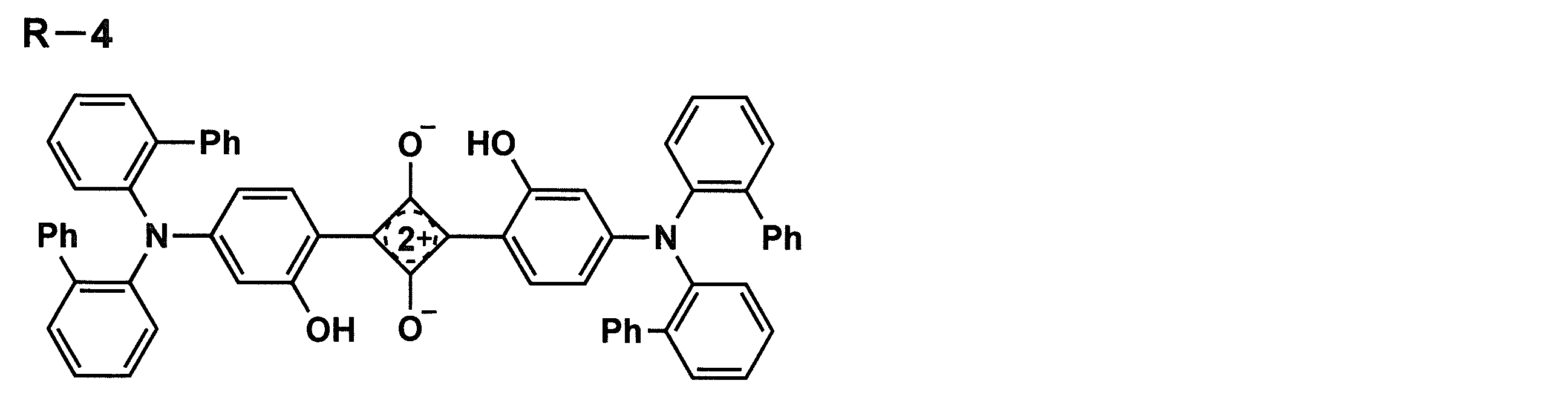
<量子収率の測定>
本発明のスクアリリウム化合物D-1、D-3、D-5、D-6、D-7、D-10、D-12、D-17、D-21及びD-26、比較用化合物R-1及びR-4の各々について、溶液中及び膜中での発光量子収率を、それぞれ以下の方法で測定した。
本発明のスクアリリウム化合物D-1、D-3、D-5、D-6、D-7、D-10、D-12、D-17、D-21及びD-26、比較用化合物R-1及びR-4の各々について、溶液中及び膜中での発光量子収率を、それぞれ以下の方法で測定した。
(1)溶液中での発光量子収率の評価
本発明のスクアリリウム化合物又は比較用化合物を、10-6Mになるようにトルエン中に溶解させた。得られた溶液の発光量子収率を、絶対PL量子収率測定装置(浜松ホトニクス社製:C11347)を用いて測定した。
本発明のスクアリリウム化合物又は比較用化合物を、10-6Mになるようにトルエン中に溶解させた。得られた溶液の発光量子収率を、絶対PL量子収率測定装置(浜松ホトニクス社製:C11347)を用いて測定した。
(2)膜中での発光量子収率の評価
CBP(4,4′-N,N′-ジカルバゾールビフェニル)と本発明のスクアリリウム化合物又は比較用化合物とを、クロロホルム中にそれぞれの比率が99.5質量%、0.5質量%となるように溶解させた。得られた溶液を、石英基板上に500rpm、30秒の条件下スピンコート法により塗布して薄膜を形成した後、50℃にて30分間乾燥させた。得られた薄膜の絶対PL量子収率を、絶対PL量子収率測定装置(浜松ホトニクス社製:C11347)を用いて測定し、膜中での発光量子収率とした。表Iでは、溶液中のD-1の発光量子収率を100とする相対値で示した。
CBP(4,4′-N,N′-ジカルバゾールビフェニル)と本発明のスクアリリウム化合物又は比較用化合物とを、クロロホルム中にそれぞれの比率が99.5質量%、0.5質量%となるように溶解させた。得られた溶液を、石英基板上に500rpm、30秒の条件下スピンコート法により塗布して薄膜を形成した後、50℃にて30分間乾燥させた。得られた薄膜の絶対PL量子収率を、絶対PL量子収率測定装置(浜松ホトニクス社製:C11347)を用いて測定し、膜中での発光量子収率とした。表Iでは、溶液中のD-1の発光量子収率を100とする相対値で示した。
(耐光性)
発光量子収率の測定と同条件で作製した膜を、ガラスで覆い、太陽光の下に1週間曝露した後のサンプルと未曝露サンプルからの極大吸収波長における吸収強度の低下を残存率で算出し、以下の基準で評価した。なお、極大吸収波長における吸収強度の測定は、分光光度計(日立ハイテクノス社製、U-3300)用いた。
発光量子収率の測定と同条件で作製した膜を、ガラスで覆い、太陽光の下に1週間曝露した後のサンプルと未曝露サンプルからの極大吸収波長における吸収強度の低下を残存率で算出し、以下の基準で評価した。なお、極大吸収波長における吸収強度の測定は、分光光度計(日立ハイテクノス社製、U-3300)用いた。
残存率(%)=(曝露試料極大吸収波長強度/未曝露試料極大吸収波長強度)×100
〇: 残存率が90%以上
△: 残存率が80%以上~90%未満
×: 残存率が80%未満
実用上は、残存率90%以上が好ましい。
以上の結果を表Iに示す。
〇: 残存率が90%以上
△: 残存率が80%以上~90%未満
×: 残存率が80%未満
実用上は、残存率90%以上が好ましい。
以上の結果を表Iに示す。
なお、本発明のスクアリリウム化合物である例示化合物D-1、D-3、D-5、D-6、D-7、D-10、D-12、D-17、D-21及びD-26はトルエン中700~850nmの近赤外領域に極大発光波長を有することを確認した。測定は、前述した分光蛍光光度計(日立ハイテクノス社製、F7000)を用いた。

表Iより、本発明のスクアリリウム化合物は、発光効率が高く、かつ、耐光性が優れていることが分る。
本発明のスクアリリウム化合物は、発光効率が高く、特に固体膜中での発光効率の低下が少なく、かつ、耐光性の優れた近赤外光を発光することができる。赤外線カメラ、生体イメージング、生体センシング及び赤外線通信などへ利用することができる。
Claims (6)
- 下記一般式(1)で表される構造を有することを特徴とするスクアリリウム化合物。
環A及び環Bは、それぞれ独立に、置換基を有していてもよい芳香族炭化水素環を表す。R1は、アルキル基、シクロアルキル基、芳香族炭化水素基又はハロゲン原子を表す。
R2及びR3は、それぞれ独立に、アルキル基又はシクロアルキル基を表す。
Rは、置換基を表す。
R1とR、又は二つのRが、互いに結合して環を形成しても良い。
R4及びR5は、それぞれ独立に、ヒドロキシ基又はアミノ基を表す。
n1及びn2は、それぞれ独立に、0~4の整数を表す。] - 前記一般式(1)で表される構造を有する化合物が、下記一般式(2)で表される構造を有する化合物であることを特徴とする請求項1に記載のスクアリリウム化合物。
環A及び環Bは、それぞれ独立に、置換基を有していてもよい芳香族炭化水素環を表す。R1及びR6は、それぞれ独立に、アルキル基、シクロアルキル基、芳香族炭化水素基又はハロゲン原子を表す。
R2及びR3は、それぞれ独立に、アルキル基又はシクロアルキル基を表す。
Rは、置換基を表す。
R1とR、R6とR又は二つのRが互いに結合して環を形成しても良い。
R4及びR5は、それぞれ独立に、ヒドロキシ基又はアミノ基を表す。
n1及びn2は、それぞれ独立に、0~4の整数を表す。] - 前記一般式(1)で表される構造を有する化合物が、下記一般式(3)で表される構造を有する化合物であることを特徴とする請求項1に記載のスクアリリウム化合物。
環Bは、置換基を有していてもよい芳香族炭化水素環を表す。
R1及びR6は、それぞれ独立に、アルキル基、シクロアルキル基、芳香族炭化水素基又はハロゲン原子を表す。
R2及びR3は、それぞれ独立に、アルキル基又はシクロアルキル基を表す。
Rは、置換基を表す。
R1とR、R6とR又は二つのRが互いに結合して環を形成しても良い。
R5は、ヒドロキシ基又はアミノ基を表す。
n1及びn2は、それぞれ独立に、0~4の整数を表す。] - 前記一般式(1)で表される構造を有する化合物が、下記一般式(4)で表される構造を有する化合物であることを特徴とする請求項1に記載のスクアリリウム化合物。
R1及びR6は、それぞれ独立に、アルキル基、シクロアルキル基、芳香族炭化水素基又はハロゲン原子を表す。
R2及びR3は、それぞれ独立に、アルキル基又はシクロアルキル基を表す。
Rは、置換基を表す。
R1とR、R6とR又は二つのRが互いに結合して環を形成しても良い。
n1及びn2は、それぞれ独立に、0~4の整数を表す。] - 請求項1から請求項4までのいずれか一項に記載のスクアリリウム化合物を含有することを特徴とする発光性組成物。
- 請求項1から請求項4までのいずれか一項に記載のスクアリリウム化合物を含有することを特徴とする発光性フィルム。
Priority Applications (2)
| Application Number | Priority Date | Filing Date | Title |
|---|---|---|---|
| JP2020545922A JP7255599B2 (ja) | 2018-09-14 | 2019-09-02 | スクアリリウム化合物、発光性組成物及び発光性フィルム |
| US17/275,912 US11261374B2 (en) | 2018-09-14 | 2019-09-02 | Squarylium compound, light-emitting composition, and light-emitting film |
Applications Claiming Priority (2)
| Application Number | Priority Date | Filing Date | Title |
|---|---|---|---|
| JP2018172404 | 2018-09-14 | ||
| JP2018-172404 | 2018-09-14 |
Publications (1)
| Publication Number | Publication Date |
|---|---|
| WO2020054472A1 true WO2020054472A1 (ja) | 2020-03-19 |
Family
ID=69778390
Family Applications (1)
| Application Number | Title | Priority Date | Filing Date |
|---|---|---|---|
| PCT/JP2019/034329 Ceased WO2020054472A1 (ja) | 2018-09-14 | 2019-09-02 | スクアリリウム化合物、発光性組成物及び発光性フィルム |
Country Status (3)
| Country | Link |
|---|---|
| US (1) | US11261374B2 (ja) |
| JP (1) | JP7255599B2 (ja) |
| WO (1) | WO2020054472A1 (ja) |
Citations (4)
| Publication number | Priority date | Publication date | Assignee | Title |
|---|---|---|---|---|
| JPH01146846A (ja) * | 1987-12-04 | 1989-06-08 | Fuji Xerox Co Ltd | 新規なスクアリリウム化合物及びその製造方法 |
| JP2014169284A (ja) * | 2013-02-07 | 2014-09-18 | Yamagata Univ | 非対称スクアリリウム誘導体、それよりなるドナー材料及びそれを用いた有機薄膜太陽電池 |
| WO2018043185A1 (ja) * | 2016-08-29 | 2018-03-08 | 富士フイルム株式会社 | 組成物、膜、近赤外線カットフィルタ、パターン形成方法、積層体、固体撮像素子、画像表示装置、カメラモジュールおよび赤外線センサ |
| WO2018207776A1 (ja) * | 2017-05-08 | 2018-11-15 | コニカミノルタ株式会社 | 有機エレクトロルミネッセンス素子、表示装置、照明装置 |
Family Cites Families (4)
| Publication number | Priority date | Publication date | Assignee | Title |
|---|---|---|---|---|
| JPH0727245B2 (ja) * | 1986-11-25 | 1995-03-29 | 富士ゼロックス株式会社 | 電子写真感光体 |
| US5169987A (en) * | 1987-12-04 | 1992-12-08 | Fuji Xerox Co., Ltd. | Squarlylium compound |
| US5230975A (en) * | 1991-11-04 | 1993-07-27 | Xerox Corporation | Photoconductive imaging members with unsymmetrical alkylalkoxy squaraine compositions |
| EP2673321A2 (en) * | 2011-02-09 | 2013-12-18 | Stephen R. Forrest | Organic photosensitive devices comprising aryl squaraines and methods of making the same |
-
2019
- 2019-09-02 US US17/275,912 patent/US11261374B2/en active Active
- 2019-09-02 JP JP2020545922A patent/JP7255599B2/ja active Active
- 2019-09-02 WO PCT/JP2019/034329 patent/WO2020054472A1/ja not_active Ceased
Patent Citations (4)
| Publication number | Priority date | Publication date | Assignee | Title |
|---|---|---|---|---|
| JPH01146846A (ja) * | 1987-12-04 | 1989-06-08 | Fuji Xerox Co Ltd | 新規なスクアリリウム化合物及びその製造方法 |
| JP2014169284A (ja) * | 2013-02-07 | 2014-09-18 | Yamagata Univ | 非対称スクアリリウム誘導体、それよりなるドナー材料及びそれを用いた有機薄膜太陽電池 |
| WO2018043185A1 (ja) * | 2016-08-29 | 2018-03-08 | 富士フイルム株式会社 | 組成物、膜、近赤外線カットフィルタ、パターン形成方法、積層体、固体撮像素子、画像表示装置、カメラモジュールおよび赤外線センサ |
| WO2018207776A1 (ja) * | 2017-05-08 | 2018-11-15 | コニカミノルタ株式会社 | 有機エレクトロルミネッセンス素子、表示装置、照明装置 |
Non-Patent Citations (1)
| Title |
|---|
| WANG, SIYI ET AL.: "N,N-diarylanilinosquaraines and their application to organic photovoltaics", CHEMISTRY OF MATERIALS, vol. 23, 2011, pages 4789 - 4798, XP002691608, DOI: 10.1021/cm2020803 * |
Also Published As
| Publication number | Publication date |
|---|---|
| JP7255599B2 (ja) | 2023-04-11 |
| US20210261858A1 (en) | 2021-08-26 |
| US11261374B2 (en) | 2022-03-01 |
| JPWO2020054472A1 (ja) | 2021-09-16 |
Similar Documents
| Publication | Publication Date | Title |
|---|---|---|
| JP5741636B2 (ja) | 有機エレクトロルミネッセンス素子、表示装置及び照明装置 | |
| JP5590166B2 (ja) | 有機エレクトロルミネッセンス素子、表示装置及び照明装置 | |
| JP5332614B2 (ja) | 有機エレクトロルミネッセンス素子、照明装置及び表示装置 | |
| WO2020054627A1 (ja) | スクアリリウム化合物、発光性組成物及び発光性フィルム | |
| JP5561272B2 (ja) | 有機エレクトロルミネッセンス素子 | |
| WO2013168534A1 (ja) | 有機エレクトロルミネッセンス素子、有機エレクトロルミネッセンス素子の製造方法、表示装置および照明装置 | |
| JP5765271B2 (ja) | 有機エレクトロルミネッセンス素子、表示装置および照明装置 | |
| JP2007165377A (ja) | 有機エレクトロルミネッセンス素子、表示装置及び照明装置 | |
| WO2020054472A1 (ja) | スクアリリウム化合物、発光性組成物及び発光性フィルム | |
| WO2020075761A1 (ja) | イミド誘導体、それを含有する発光性組成物、発光性薄膜及び発光性粒子 | |
| JP4821095B2 (ja) | ピラゾロン色素 | |
| JP6052326B2 (ja) | 有機エレクトロルミネッセンス素子、表示装置及び照明装置 | |
| JP2008081582A (ja) | 有機エレクトロルミネッセンス素子材料、有機エレクトロルミネッセンス素子、表示装置及び照明装置 | |
| JP5272374B2 (ja) | モノメチン化合物の製造方法及びモノメチン化合物 | |
| JP6112166B2 (ja) | 有機エレクトロルミネッセンス素子、表示装置及び照明装置 | |
| WO2013031346A1 (ja) | 有機エレクトロルミネッセンス素子ならびに表示装置および照明装置 |
Legal Events
| Date | Code | Title | Description |
|---|---|---|---|
| 121 | Ep: the epo has been informed by wipo that ep was designated in this application |
Ref document number: 19858751 Country of ref document: EP Kind code of ref document: A1 |
|
| ENP | Entry into the national phase |
Ref document number: 2020545922 Country of ref document: JP Kind code of ref document: A |
|
| NENP | Non-entry into the national phase |
Ref country code: DE |
|
| 122 | Ep: pct application non-entry in european phase |
Ref document number: 19858751 Country of ref document: EP Kind code of ref document: A1 |