WO2020050169A1 - 粘着剤組成物、粘着シート、及び接合体 - Google Patents
粘着剤組成物、粘着シート、及び接合体 Download PDFInfo
- Publication number
- WO2020050169A1 WO2020050169A1 PCT/JP2019/034143 JP2019034143W WO2020050169A1 WO 2020050169 A1 WO2020050169 A1 WO 2020050169A1 JP 2019034143 W JP2019034143 W JP 2019034143W WO 2020050169 A1 WO2020050169 A1 WO 2020050169A1
- Authority
- WO
- WIPO (PCT)
- Prior art keywords
- pressure
- sensitive adhesive
- mass
- polymer
- adhesive layer
- Prior art date
- Legal status (The legal status is an assumption and is not a legal conclusion. Google has not performed a legal analysis and makes no representation as to the accuracy of the status listed.)
- Ceased
Links
Images


Classifications
-
- C—CHEMISTRY; METALLURGY
- C09—DYES; PAINTS; POLISHES; NATURAL RESINS; ADHESIVES; COMPOSITIONS NOT OTHERWISE PROVIDED FOR; APPLICATIONS OF MATERIALS NOT OTHERWISE PROVIDED FOR
- C09J—ADHESIVES; NON-MECHANICAL ASPECTS OF ADHESIVE PROCESSES IN GENERAL; ADHESIVE PROCESSES NOT PROVIDED FOR ELSEWHERE; USE OF MATERIALS AS ADHESIVES
- C09J133/00—Adhesives based on homopolymers or copolymers of compounds having one or more unsaturated aliphatic radicals, each having only one carbon-to-carbon double bond, and at least one being terminated by only one carboxyl radical, or of salts, anhydrides, esters, amides, imides, or nitriles thereof; Adhesives based on derivatives of such polymers
- C09J133/04—Homopolymers or copolymers of esters
- C09J133/06—Homopolymers or copolymers of esters of esters containing only carbon, hydrogen and oxygen, the oxygen atom being present only as part of the carboxyl radical
- C09J133/062—Copolymers with monomers not covered by C09J133/06
- C09J133/064—Copolymers with monomers not covered by C09J133/06 containing anhydride, COOH or COOM groups, with M being metal or onium-cation
-
- C—CHEMISTRY; METALLURGY
- C09—DYES; PAINTS; POLISHES; NATURAL RESINS; ADHESIVES; COMPOSITIONS NOT OTHERWISE PROVIDED FOR; APPLICATIONS OF MATERIALS NOT OTHERWISE PROVIDED FOR
- C09J—ADHESIVES; NON-MECHANICAL ASPECTS OF ADHESIVE PROCESSES IN GENERAL; ADHESIVE PROCESSES NOT PROVIDED FOR ELSEWHERE; USE OF MATERIALS AS ADHESIVES
- C09J11/00—Features of adhesives not provided for in group C09J9/00, e.g. additives
- C09J11/02—Non-macromolecular additives
- C09J11/06—Non-macromolecular additives organic
-
- C—CHEMISTRY; METALLURGY
- C09—DYES; PAINTS; POLISHES; NATURAL RESINS; ADHESIVES; COMPOSITIONS NOT OTHERWISE PROVIDED FOR; APPLICATIONS OF MATERIALS NOT OTHERWISE PROVIDED FOR
- C09J—ADHESIVES; NON-MECHANICAL ASPECTS OF ADHESIVE PROCESSES IN GENERAL; ADHESIVE PROCESSES NOT PROVIDED FOR ELSEWHERE; USE OF MATERIALS AS ADHESIVES
- C09J133/00—Adhesives based on homopolymers or copolymers of compounds having one or more unsaturated aliphatic radicals, each having only one carbon-to-carbon double bond, and at least one being terminated by only one carboxyl radical, or of salts, anhydrides, esters, amides, imides, or nitriles thereof; Adhesives based on derivatives of such polymers
- C09J133/04—Homopolymers or copolymers of esters
-
- C—CHEMISTRY; METALLURGY
- C09—DYES; PAINTS; POLISHES; NATURAL RESINS; ADHESIVES; COMPOSITIONS NOT OTHERWISE PROVIDED FOR; APPLICATIONS OF MATERIALS NOT OTHERWISE PROVIDED FOR
- C09J—ADHESIVES; NON-MECHANICAL ASPECTS OF ADHESIVE PROCESSES IN GENERAL; ADHESIVE PROCESSES NOT PROVIDED FOR ELSEWHERE; USE OF MATERIALS AS ADHESIVES
- C09J133/00—Adhesives based on homopolymers or copolymers of compounds having one or more unsaturated aliphatic radicals, each having only one carbon-to-carbon double bond, and at least one being terminated by only one carboxyl radical, or of salts, anhydrides, esters, amides, imides, or nitriles thereof; Adhesives based on derivatives of such polymers
- C09J133/04—Homopolymers or copolymers of esters
- C09J133/06—Homopolymers or copolymers of esters of esters containing only carbon, hydrogen and oxygen, the oxygen atom being present only as part of the carboxyl radical
- C09J133/062—Copolymers with monomers not covered by C09J133/06
- C09J133/066—Copolymers with monomers not covered by C09J133/06 containing -OH groups
-
- C—CHEMISTRY; METALLURGY
- C09—DYES; PAINTS; POLISHES; NATURAL RESINS; ADHESIVES; COMPOSITIONS NOT OTHERWISE PROVIDED FOR; APPLICATIONS OF MATERIALS NOT OTHERWISE PROVIDED FOR
- C09J—ADHESIVES; NON-MECHANICAL ASPECTS OF ADHESIVE PROCESSES IN GENERAL; ADHESIVE PROCESSES NOT PROVIDED FOR ELSEWHERE; USE OF MATERIALS AS ADHESIVES
- C09J133/00—Adhesives based on homopolymers or copolymers of compounds having one or more unsaturated aliphatic radicals, each having only one carbon-to-carbon double bond, and at least one being terminated by only one carboxyl radical, or of salts, anhydrides, esters, amides, imides, or nitriles thereof; Adhesives based on derivatives of such polymers
- C09J133/04—Homopolymers or copolymers of esters
- C09J133/14—Homopolymers or copolymers of esters of esters containing halogen, nitrogen, sulfur or oxygen atoms in addition to the carboxy oxygen
-
- C—CHEMISTRY; METALLURGY
- C09—DYES; PAINTS; POLISHES; NATURAL RESINS; ADHESIVES; COMPOSITIONS NOT OTHERWISE PROVIDED FOR; APPLICATIONS OF MATERIALS NOT OTHERWISE PROVIDED FOR
- C09J—ADHESIVES; NON-MECHANICAL ASPECTS OF ADHESIVE PROCESSES IN GENERAL; ADHESIVE PROCESSES NOT PROVIDED FOR ELSEWHERE; USE OF MATERIALS AS ADHESIVES
- C09J201/00—Adhesives based on unspecified macromolecular compounds
-
- C—CHEMISTRY; METALLURGY
- C09—DYES; PAINTS; POLISHES; NATURAL RESINS; ADHESIVES; COMPOSITIONS NOT OTHERWISE PROVIDED FOR; APPLICATIONS OF MATERIALS NOT OTHERWISE PROVIDED FOR
- C09J—ADHESIVES; NON-MECHANICAL ASPECTS OF ADHESIVE PROCESSES IN GENERAL; ADHESIVE PROCESSES NOT PROVIDED FOR ELSEWHERE; USE OF MATERIALS AS ADHESIVES
- C09J7/00—Adhesives in the form of films or foils
- C09J7/30—Adhesives in the form of films or foils characterised by the adhesive composition
-
- C—CHEMISTRY; METALLURGY
- C09—DYES; PAINTS; POLISHES; NATURAL RESINS; ADHESIVES; COMPOSITIONS NOT OTHERWISE PROVIDED FOR; APPLICATIONS OF MATERIALS NOT OTHERWISE PROVIDED FOR
- C09J—ADHESIVES; NON-MECHANICAL ASPECTS OF ADHESIVE PROCESSES IN GENERAL; ADHESIVE PROCESSES NOT PROVIDED FOR ELSEWHERE; USE OF MATERIALS AS ADHESIVES
- C09J2433/00—Presence of (meth)acrylic polymer
Definitions
- the present invention relates to a pressure-sensitive adhesive composition, a pressure-sensitive adhesive sheet including a pressure-sensitive adhesive layer formed from the pressure-sensitive adhesive composition, and a bonded body of the pressure-sensitive adhesive sheet and an adherend.
- a double-sided pressure-sensitive adhesive sheet having a certain adhesive force and a certain releasability may be used for joining members in an electronic component manufacturing process or the like.
- Patent Documents 1 to 3 As a double-sided pressure-sensitive adhesive sheet realizing the above-mentioned adhesive strength and peelability, a pressure-sensitive adhesive sheet which is peeled off by applying a voltage to the pressure-sensitive adhesive layer using an ionic liquid composed of a cation and an anion as a component forming the pressure-sensitive adhesive composition (Electrically peelable pressure-sensitive adhesive sheets) are known (Patent Documents 1 to 3).
- Application of a voltage causes cations of the ionic liquid to move on the cathode side to cause reduction, and anions of the ionic liquid to move on the anode side to cause oxidation. It is considered that the adhesive strength of the resin is weakened and the film is easily peeled off.
- JP 2010-037354 A Japanese Patent No. 6097112 Japanese Patent No. 4,139,851
- the electro-peelable pressure-sensitive adhesive sheet can strongly bond the members when no voltage is applied, and can be peeled off with a small force when a voltage is applied. Therefore, it is preferable that the rate of decrease in the adhesive force due to voltage application is large in the electrically peelable pressure-sensitive adhesive sheet.
- a low humidity environment such as in winter, for example, there has been a problem that the rate of decrease in adhesive strength due to voltage application is small.
- the present invention has been completed in view of the above, and includes a pressure-sensitive adhesive composition and a pressure-sensitive adhesive layer formed from the pressure-sensitive adhesive composition, the adhesion of which is sufficiently reduced by application of a voltage even in a low humidity environment. It is intended to provide an adhesive sheet.
- the rate of decrease in adhesive strength due to voltage application in a low humidity environment decreases because the moisture content of the pressure-sensitive adhesive layer decreases in a low humidity environment, and the cation and anion of the ionic liquid are reduced. Is difficult to move.
- the relative permittivity of components other than the ionic liquid in the pressure-sensitive adhesive layer has a correlation with the rate of decrease in adhesive force due to voltage application. By increasing the relative permittivity, the rate of decrease in adhesive force due to voltage application Can be increased.
- the ionic conductivity of the pressure-sensitive adhesive layer and the capacitance per unit area of the interface between the pressure-sensitive adhesive layer and the adherend have a correlation with the rate of decrease in adhesive force due to voltage application, and the ionic conductivity and It has been found that by increasing the capacitance per unit area of the interface between the pressure-sensitive adhesive layer and the adherend, the rate of decrease in adhesive force due to voltage application can be increased.
- One pressure-sensitive adhesive composition of the present invention completed based on the first finding is a pressure-sensitive adhesive composition containing a polymer and an ionic liquid, and among components contained in the pressure-sensitive adhesive composition, other than the ionic liquid
- a pressure-sensitive adhesive layer at a frequency of 100 Hz after the pressure-sensitive adhesive layer is formed by forming a pressure-sensitive adhesive layer from the composition consisting of the following components, and left under an environment of 22 ° C. and 20% RH for 3 days. It is.
- Another pressure-sensitive adhesive composition of the present invention completed on the basis of the second finding is a pressure-sensitive adhesive composition containing a polymer and an ionic liquid, and forms a pressure-sensitive adhesive layer with the pressure-sensitive adhesive composition according to JIS. H4000: A5052P H2014 in 2014 attached to an aluminum plate made of H32 and left for 7 days in an environment of 22 ° C. and 15% RH, the capacitance per unit area of the interface between the pressure-sensitive adhesive layer and the aluminum plate is 0. 9 ⁇ F / cm 2 or more, and the ionic conductivity of the pressure-sensitive adhesive layer is 10 ⁇ S / m or more.
- a pressure-sensitive adhesive layer is formed from the pressure-sensitive adhesive composition, and is adhered to an aluminum plate made of A5052P H32 according to JIS H4000: 2014.
- the capacitance per unit area of the interface between the pressure-sensitive adhesive layer and the aluminum plate after standing for days may be 1.2 ⁇ F / cm 2 or more, and the ionic conductivity of the pressure-sensitive adhesive layer may be 20 ⁇ S / m or more.
- the pressure-sensitive adhesive composition may further include an ionic solid.
- the polymer may include an ionic polymer.
- the polymer is at least one selected from the group consisting of a polyester polymer, a urethane polymer, and an acrylic polymer having a carboxyl group, an alkoxy group, a hydroxyl group and / or an amide bond.
- a polyester polymer e.g., polyethylene glycol dimethacrylate copolymer
- a urethane polymer e.g., polystyrene-styrenethacrylate
- acrylic polymer having a carboxyl group, an alkoxy group, a hydroxyl group and / or an amide bond.
- One type may be included.
- another pressure-sensitive adhesive composition of the present invention contains a polymer and an ionic liquid, and the ionic liquid is 0.5 to 30 parts by mass and the ionic solid is 0.5 to 10 parts by mass with respect to 100 parts by mass of the polymer.
- Another adhesive composition of the present invention contains a polymer and an ionic liquid, and contains 0.5 to 30 parts by mass of the ionic liquid based on 100 parts by mass of the polymer. And 0.05 to 2 parts by mass.
- Another pressure-sensitive adhesive composition of the present invention is a pressure-sensitive adhesive composition containing 100 parts by mass of an acrylic polymer and 0.5 to 30 parts by mass of an ionic liquid, wherein all monomer components constituting the acrylic polymer are The ratio of the polar group-containing monomer is 0.1 to 35% by mass.
- the pressure-sensitive adhesive composition is for electric stripping.
- the pressure-sensitive adhesive sheet of the present invention includes a pressure-sensitive adhesive layer formed from the pressure-sensitive adhesive composition of the present invention.
- the joined body of the present invention includes an adherend having a metal adhered surface and the pressure-sensitive adhesive sheet of the present invention, and the pressure-sensitive adhesive layer of the pressure-sensitive adhesive sheet of the present invention is joined to the metal adhered surface.
- the pressure-sensitive adhesive composition of the present invention has a sufficiently low adhesive strength even under a low humidity environment by application of a voltage.
- FIG. 3 is a top view of a composite sample for measuring capacitance and ionic conductivity.
- FIG. 4 is an equivalent circuit diagram of a composite sample for measuring capacitance and ionic conductivity.
- Each of the pressure-sensitive adhesive compositions of the first and second embodiments of the present invention contains a polymer and an ionic liquid.
- a pressure-sensitive adhesive layer is formed by a composition composed of components other than the ionic liquid among the components included in the pressure-sensitive adhesive composition of the first embodiment, and the pressure-sensitive adhesive layer is placed in an environment of 22 ° C. and 20% RH for 3 days. After standing, the relative permittivity of the pressure-sensitive adhesive layer at a frequency of 100 Hz is 5 or more. Further, a pressure-sensitive adhesive layer was formed from the pressure-sensitive adhesive composition of the second embodiment, attached to an aluminum plate made of A5052P H32 in JIS H4000: 2014, and left for 7 days in an environment of 22 ° C.
- the capacitance per unit area at the interface between the pressure-sensitive adhesive layer and the aluminum plate is 0.9 ⁇ F / cm 2 or more, and the ion conductivity of the pressure-sensitive adhesive layer is 10 ⁇ S / m or more.
- These pressure-sensitive adhesive compositions have a property that the adhesive force is reduced by application of a voltage, and are suitable as pressure-sensitive adhesive compositions for electric stripping.
- the above first and second embodiments are not exclusive, and if there is a pressure-sensitive adhesive composition corresponding to any of the first and second embodiments, an adhesive composition corresponding to only one of them There are also agent compositions. If the pressure-sensitive adhesive composition falls under any one of the first and second embodiments, the effects of the present invention can be obtained. Hereinafter, these pressure-sensitive adhesive compositions will be described.
- the first and second embodiments of the present invention may be collectively referred to as “the present embodiment”.
- the adhesive force when no voltage is applied may be referred to as “initial adhesive force”.
- a composition composed of components other than the ionic liquid among the components contained in the pressure-sensitive adhesive composition may be referred to as “non-ionic liquid-containing pressure-sensitive adhesive composition”.
- the pressure-sensitive adhesive layer formed by the non-ionic liquid-containing pressure-sensitive adhesive composition may be referred to as “non-ionic liquid-containing pressure-sensitive adhesive layer”.
- electro-peeling property the property that the adhesive force is reduced by applying a voltage
- excellent in electro-peeling property the fact that the rate of decrease in the adhesive force by applying a voltage is large.
- the pressure-sensitive adhesive composition of the present embodiment contains a polymer.
- the polymer is not particularly limited as long as it is a general organic polymer compound, and is, for example, a polymer or partial polymer of a monomer.
- the monomer may be a single monomer or a mixture of two or more monomers.
- the partially polymerized product means a polymer in which at least a part of the monomer or the monomer mixture is partially polymerized.
- the polymer in the present embodiment is usually used as an adhesive, and is not particularly limited as long as it has tackiness.
- examples thereof include an acrylic polymer, a rubber polymer, a vinylalkyl ether polymer, a silicone polymer, and a polyester polymer.
- the polymers can be used alone or in combination of two or more. To increase the relative permittivity of components other than the ionic liquid of the obtained pressure-sensitive adhesive layer, and also to increase the ionic conductivity and the capacitance per unit area of the bonding interface of the obtained pressure-sensitive adhesive layer, and to improve the electrical peelability.
- the polymer has a large relative dielectric constant.
- the polymer in the present embodiment particularly includes a polyester-based polymer, a urethane-based polymer, and a carboxyl group, an alkoxy group, a hydroxyl group, and / or an amide bond. It is preferable to include at least one selected from the group consisting of acrylic polymers.
- polyester-based polymers and urethane-based polymers have easily polarizable hydroxyl groups at the terminals
- acrylic polymers having carboxyl groups, alkoxy groups, hydroxyl groups and / or amide bonds include carboxyl groups, alkoxy groups, hydroxyl groups and Since the amide bond is easily polarized, a polymer having a relatively large relative dielectric constant can be obtained by using these polymers.
- the total content of the polyester polymer and the acrylic polymer having a carboxyl group, an alkoxy group, a hydroxyl group and / or an amide bond in the polymer of the present embodiment is preferably 60% by mass or more, and 80% by mass or more. More preferably, it is the above.
- the polymer in the present embodiment is preferably an acrylic polymer. That is, the pressure-sensitive adhesive composition of the present embodiment is preferably an acrylic pressure-sensitive adhesive composition containing an acrylic polymer as a polymer.
- the acrylic polymer preferably contains a monomer unit derived from an alkyl (meth) acrylate having an alkyl group having 1 to 14 carbon atoms (the following formula (1)). Such a monomer unit is suitable for obtaining a large initial adhesive force. Furthermore, the relative permittivity of components other than the ionic liquid of the pressure-sensitive adhesive layer is increased, and the ionic conductivity and the capacitance per unit area of the bonding interface of the obtained pressure-sensitive adhesive layer are increased, thereby improving the electrical peelability.
- the alkyl group Rb preferably has a small carbon number, particularly preferably 8 or less, more preferably 4 or less.
- R a in the formula (1) is a hydrogen atom or a methyl group
- R b is an alkyl group having 1 to 14 carbon atoms.
- alkyl (meth) acrylate having an alkyl group having 1 to 14 carbon atoms examples include methyl (meth) acrylate, ethyl (meth) acrylate, propyl (meth) acrylate, isopropyl (meth) acrylate, and n-butyl ( (Meth) acrylate, sec-butyl (meth) acrylate, 1,3-dimethylbutyl acrylate, pentyl (meth) acrylate, isopentyl (meth) acrylate, hexyl (meth) acrylate, 2-ethylbutyl (meth) acrylate, heptyl (meth) A) acrylate, n-octyl (meth) acrylate, isooctyl (meth) acrylate, 2-ethylhexyl (meth) acrylate, n-nonyl (meth) acrylate, isononyl (
- alkyl (meth) acrylate having an alkyl group having 1 to 14 carbon atoms can be used alone or in combination of two or more.
- the ratio of the alkyl (meth) acrylate having an alkyl group having 1 to 14 carbon atoms to all the monomer components (100% by mass) constituting the acrylic polymer is not particularly limited, but is preferably 70% by mass or more, more preferably. Is 80% by mass or more, more preferably 85% by mass or more. When the proportion of the acrylic polymer is 70% by mass or more, it is easy to obtain a large initial adhesive force.
- the acrylic polymer in addition to a monomer unit derived from an alkyl (meth) acrylate having an alkyl group having 1 to 14 carbon atoms, it is used for the purpose of improving cohesion, heat resistance, crosslinkability, and the like. It is preferable to include a monomer unit derived from a copolymerizable polar group-containing monomer.
- the monomer unit can provide a crosslinking point and is suitable for obtaining a large initial adhesive force.
- the relative permittivity of components other than the ionic liquid of the pressure-sensitive adhesive layer is increased, and the ionic conductivity of the obtained pressure-sensitive adhesive layer and the capacitance per unit area of the bonding interface are increased, thereby improving the electrical peelability. From the viewpoint as well, it is preferable to include a monomer unit derived from a polar group-containing monomer.
- Examples of the polar group-containing monomer include a carboxyl group-containing monomer, an alkoxy group-containing monomer, a hydroxyl group-containing monomer, a cyano group-containing monomer, a vinyl group-containing monomer, an aromatic vinyl monomer, an amide group-containing monomer, an imide group-containing monomer, and amino.
- Examples include a group-containing monomer, an epoxy group-containing monomer, a vinyl ether monomer, N-acryloylmorpholine, a sulfo group-containing monomer, a phosphoric acid group-containing monomer, and an acid anhydride group-containing monomer.
- a carboxyl group-containing monomer, an alkoxy group-containing monomer, a hydroxyl group-containing monomer, and an amide group-containing monomer are preferable from the viewpoint of excellent cohesiveness, and a carboxyl group-containing monomer is particularly preferable.
- Carboxyl group-containing monomers are particularly suitable for obtaining a large initial adhesive strength.
- the polar group-containing monomers can be used alone or in combination of two or more.
- carboxyl group-containing monomer examples include acrylic acid, methacrylic acid, carboxyethyl (meth) acrylate, carboxypentyl (meth) acrylate, itaconic acid, maleic acid, fumaric acid, crotonic acid, and isocrotonic acid.
- acrylic acid is preferred.
- the carboxyl group-containing monomers can be used alone or in combination of two or more.
- alkoxy group-containing monomer examples include a methoxy group-containing monomer and an ethoxy group-containing monomer.
- methoxy group-containing monomer examples include 2-methoxyethyl acrylate.
- hydroxyl group-containing monomer examples include 2-hydroxyethyl (meth) acrylate, 2-hydroxypropyl (meth) acrylate, 4-hydroxybutyl (meth) acrylate, 6-hydroxyhexyl (meth) acrylate, and 8-hydroxyoctyl ( (Meth) acrylate, 10-hydroxydecyl (meth) acrylate, 12-hydroxylauryl (meth) acrylate, (4-hydroxymethylcyclohexyl) methyl (meth) acrylate, N-methylol (meth) acrylamide, vinyl alcohol, allyl alcohol , 2-hydroxyethyl vinyl ether, 4-hydroxybutyl vinyl ether, and diethylene glycol monovinyl ether. Particularly, 2-hydroxyethyl (meth) acrylate and 4-hydroxybutyl (meth) acrylate are preferable.
- the hydroxyl group-containing monomers can be used alone or in combination of two or more.
- amide group-containing monomer examples include acrylamide, methacrylamide, N-vinylpyrrolidone, N, N-dimethylacrylamide, N, N-dimethylmethacrylamide, N, N-diethylacrylamide, N, N-diethylmethacrylamide, N , N'-methylenebisacrylamide, N, N-dimethylaminopropylacrylamide, N, N-dimethylaminopropylmethacrylamide, diacetoneacrylamide and the like.
- the amide group-containing monomers can be used alone or in combination of two or more.
- Examples of the cyano group-containing monomer include acrylonitrile and methacrylonitrile.
- vinyl group-containing monomer examples include vinyl esters such as vinyl acetate, vinyl propionate, and vinyl laurate, with vinyl acetate being particularly preferred.
- aromatic vinyl monomer examples include styrene, chlorostyrene, chloromethylstyrene, ⁇ -methylstyrene, and other substituted styrenes.
- Examples of the imide group-containing monomer include cyclohexylmaleimide, isopropylmaleimide, N-cyclohexylmaleimide, and itaconimide.
- amino group-containing monomer examples include, for example, aminoethyl (meth) acrylate, N, N-dimethylaminoethyl (meth) acrylate, and N, N-dimethylaminopropyl (meth) acrylate.
- Examples of the epoxy group-containing monomer include glycidyl (meth) acrylate, methyl glycidyl (meth) acrylate, and allyl glycidyl ether.
- vinyl ether monomer examples include methyl vinyl ether, ethyl vinyl ether, and isobutyl vinyl ether.
- the ratio of the polar group-containing monomer to all the monomer components (100% by mass) constituting the acrylic polymer is preferably from 0.1% by mass to 35% by mass.
- the upper limit of the proportion of the polar group-containing monomer is more preferably 25% by mass, further preferably 20% by mass, and the lower limit is more preferably 0.5% by mass, and still more preferably 1% by mass. And particularly preferably 2% by mass.
- the proportion of the polar group-containing monomer is 30% by mass or less, it becomes easy to prevent the pressure-sensitive adhesive layer from being excessively adhered to the adherend and heavy peeling.
- the content is 2% by mass or more and 20% by mass or less, it is easy to achieve both releasability from the adherend and adhesion between the pressure-sensitive adhesive layer and another layer.
- a polyfunctional monomer may be contained in order to introduce a crosslinked structure into the acrylic polymer to easily obtain a necessary cohesive force.
- polyfunctional monomer examples include ethylene glycol di (meth) acrylate, diethylene glycol di (meth) acrylate, tetraethylene glycol di (meth) acrylate, neopentyl glycol di (meth) acrylate, and 1,6-hexanediol di ( Examples thereof include (meth) acrylate, trimethylolpropane tri (meth) acrylate, pentaerythritol tri (meth) acrylate, dipentaerythritol hexa (meth) acrylate, divinylbenzene, and N, N'-methylenebisacrylamide.
- the polyfunctional monomers can be used alone or in combination of two or more.
- the content of the polyfunctional monomer with respect to all monomer components (100% by mass) constituting the acrylic polymer is preferably from 0.1% by mass to 15% by mass.
- the upper limit of the content of the polyfunctional monomer is more preferably 10% by mass, and the lower limit is more preferably 3% by mass.
- the content of the polyfunctional monomer is 0.1% by mass or more, the flexibility and adhesion of the pressure-sensitive adhesive layer are easily improved, which is preferable.
- the content of the polyfunctional monomer is 15% by mass or less, the cohesive force does not become too high, and it becomes easy to obtain appropriate adhesiveness.
- the polyester-based polymer is typically a polycarboxylic acid such as dicarboxylic acid or a derivative thereof (hereinafter also referred to as “polycarboxylic acid monomer”), a polyhydric alcohol such as a diol or a derivative thereof (hereinafter “polyhydric alcohol monomer”). ”) Is a polymer having a condensed structure.
- the polyvalent carboxylic acid monomer is not particularly limited, but includes, for example, adipic acid, azelaic acid, dimer acid, sebacic acid, 1,4-cyclohexanedicarboxylic acid, 1,3-cyclohexanedicarboxylic acid, 1,2-cyclohexanedicarboxylic acid, 4-methyl-1,2-cyclohexanedicarboxylic acid, dodecenyl succinic anhydride, fumaric acid, succinic acid, dodecane diacid, hexahydrophthalic anhydride, tetrahydrophthalic anhydride, etc., maleic acid, maleic anhydride, itaconic acid, citraconic acid , And derivatives thereof.
- the polycarboxylic acid monomers can be used alone or in combination of two or more.
- the polyhydric alcohol monomer is not particularly restricted but includes, for example, ethylene glycol, 1,2-propylene glycol, 1,3-propanediol, 2-methyl-1,3-propanediol, 1,2-butane Diols, 1,3-butanediol, 1,4-butanediol, 1,5-pentaneddiol, 1,6-hexanediol, 3-methyl-1,5-pentanediol, neopentyl glycol, diethylene glycol, diethylene glycol Propylene glycol, 2,2,4-trimethyl-1,5-pentanediol, 2-ethyl-2-butylpropanediol, 1,9-nonanediol, 2-methyloctanediol, 1,10-decanediol, and these And the like can be used.
- the polyhydric alcohol monomers can be used alone or in combination of two or more.
- the polymer of the present embodiment may include an ionic polymer.
- An ionic polymer is a polymer having an ionic functional group.
- the dielectric constant of the polymer is increased, and the electrical stripping property is improved.
- the content of the ionic polymer is preferably 0.05 part by mass or more and 2 parts by mass or less based on 100 parts by mass of the polymer.
- the polymer can be obtained by (co) polymerizing a monomer component.
- the polymerization method is not particularly limited, and examples thereof include solution polymerization, emulsion polymerization, bulk polymerization, suspension polymerization, and photopolymerization (active energy ray polymerization). Particularly, a solution polymerization method is preferable from the viewpoint of cost and productivity.
- the polymer is copolymerized, it may be any of a random copolymer, a block copolymer, an alternating copolymer, a graft copolymer and the like.
- the solution polymerization method is not particularly limited, and examples thereof include a method of dissolving a monomer component, a polymerization initiator, and the like in a solvent, heating and polymerizing to obtain a polymer solution containing a polymer.
- Various general solvents can be used as the solvent used in the solution polymerization method.
- a solvent polymerization solvent
- examples of such a solvent include aromatic hydrocarbons such as toluene, benzene, and xylene; esters such as ethyl acetate and n-butyl acetate; and n-hexane and n-heptane.
- the solvents can be used alone or in combination of two or more.
- the amount of the solvent used is not particularly limited, but is preferably from 10 parts by mass to 1,000 parts by mass based on all the monomer components (100 parts by mass) constituting the polymer.
- the upper limit of the amount of the solvent used is more preferably 500 parts by mass, and the lower limit is more preferably 50 parts by mass.
- the polymerization initiator used in the solution polymerization method is not particularly limited, and examples thereof include a peroxide-based polymerization initiator and an azo-based polymerization initiator.
- the peroxide-based polymerization initiator is not particularly limited, and examples thereof include peroxycarbonate, ketone peroxide, peroxyketal, hydroperoxide, dialkyl peroxide, diacyl peroxide, and peroxyester.
- the azo polymerization initiator is not particularly limited, but includes 2,2'-azobisisobutyronitrile, 2,2'-azobis-2-methylbutyronitrile, 2,2'-azobis (2,4- Dimethylvaleronitrile), 2,2'-azobis (2-methylpropionic acid) dimethyl, 2,2'-azobis (4-methoxy-2,4-dimethylvaleronitrile), 1,1'-azobis (cyclohexane-1) -Carbonitrile), 2,2'-azobis (2,4,4-trimethylpentane), 4,4'-azobis-4-cyanovaleric acid, 2,2'-azobis (2-amidinopropane) dihydrochloride, 2,2'-azobis [2- (5-methyl-2-imidazolin-2-yl) propane] dihydrochloride, 2,2'-azobis (2-methylpropionamidi) ) Disulfate, 2,2'-azobis (N, N'-dimethyleneisobutylamidine) hydro
- the amount of the polymerization initiator used is not particularly limited, but is preferably 0.01 part by mass or more and 5 parts by mass or less based on all monomer components (100 parts by mass) constituting the polymer.
- the upper limit of the use amount of the polymerization initiator is more preferably 3 parts by mass, and the lower limit is more preferably 0.05 parts by mass.
- the heating temperature at the time of polymerization by heating in the solution polymerization method is not particularly limited, but is, for example, 50 ° C. or more and 80 ° C. or less.
- the heating time is not particularly limited, but is, for example, 1 hour or more and 24 hours or less.
- the weight average molecular weight of the polymer is not particularly limited, but is preferably from 100,000 to 5,000,000.
- the upper limit of the weight average molecular weight is more preferably 4,000,000, further preferably 3,000,000, and the lower limit is more preferably 200,000, further preferably 300,000.
- the weight average molecular weight is 100,000 or more, the cohesive force is reduced, and the problem that adhesive residue remains on the surface of the adherend after peeling off the pressure-sensitive adhesive layer can be effectively suppressed.
- the weight average molecular weight is 5,000,000 or less, it is possible to effectively suppress the problem that the wettability of the surface of the adherend after peeling the pressure-sensitive adhesive layer becomes insufficient.
- the weight average molecular weight is obtained by measurement by gel permeation chromatography (GPC), and more specifically, for example, as a GPC measuring device, trade name “HLC-8220GPC” (manufactured by Tosoh Corporation) Can be measured under the following conditions, and can be calculated by a standard polystyrene conversion value.
- GPC gel permeation chromatography
- the glass transition temperature (Tg) of the polymer is not particularly limited, but is preferably 0 ° C. or lower, because it can suppress a decrease in initial adhesive strength, more preferably ⁇ 10 ° C. or lower, and still more preferably ⁇ 20 ° C. or lower. It is. Further, it is particularly preferable that the temperature is ⁇ 40 ° C. or lower, since the rate of decrease in adhesive force due to voltage application becomes particularly large, and most preferably ⁇ 50 ° C. or lower.
- the above formula (Y) is a calculation formula in the case where the polymer is composed of n kinds of monomer components of monomer 1, monomer 2,..., Monomer n.
- the glass transition temperature when a homopolymer is formed means the glass transition temperature of a homopolymer of the monomer, and only a certain monomer (sometimes referred to as “monomer X”) is formed as a monomer component. It means the glass transition temperature (Tg) of the polymer. Specifically, numerical values are listed in "Polymer Handbook” (3rd edition, John Wiley & Sons, Inc., 1989). The glass transition temperature (Tg) of a homopolymer not described in the literature refers to, for example, a value obtained by the following measurement method.
- a reactor equipped with a thermometer, a stirrer, a nitrogen inlet tube and a reflux condenser was charged with 100 parts by mass of monomer X, 0.2 parts by mass of 2,2'-azobisisobutyronitrile, and 200 parts by mass of ethyl acetate as a polymerization solvent.
- a mass part is charged and stirred for 1 hour while introducing nitrogen gas.
- the temperature is raised to 63 ° C. and the reaction is performed for 10 hours.
- the mixture is cooled to room temperature to obtain a homopolymer solution having a solid content of 33% by mass.
- the homopolymer solution is cast on a release liner and dried to prepare a test sample (sheet-like homopolymer) having a thickness of about 2 mm. Then, about 1-2 mg of this test sample was weighed into an aluminum open cell, and a nitrogen atmosphere of 50 ml / min was measured using a temperature-modulated DSC (trade name “Q-2000” manufactured by TIA Instruments Inc.). Under the heating rate of 5 ° C./min, the reversing heat flow (specific heat component) behavior of the homopolymer is obtained.
- the obtained reversing heat flow has a low temperature side base line and a high temperature side base line, and a straight line equidistant in the vertical axis direction, and a stepwise change in glass transition.
- the temperature at the point where the curves intersect with each other is defined as the glass transition temperature (Tg) when the homopolymer is used.
- the content of the polymer in the pressure-sensitive adhesive composition of the present embodiment is preferably from 50% by weight to 99.9% by weight based on the total amount of the pressure-sensitive adhesive composition (100% by weight), and the upper limit is more preferably 99.9% by weight. It is 5% by mass, more preferably 99% by mass, and the lower limit is more preferably 60% by mass, further preferably 70% by mass.
- the ionic liquid in the present embodiment is not particularly limited as long as it is composed of a pair of anion and cation and is a molten salt (normal temperature molten salt) which is liquid at 25 ° C. Examples of anions and cations are given below. Of the ionic substances obtained by combining these, those that are liquid at 25 ° C. are ionic liquids, and those that are solid at 25 ° C. are not ionic liquids and will be described later. Is an ionic solid.
- the anions of the ionic liquid include, for example, (FSO 2 ) 2 N ⁇ , (CF 3 SO 2 ) 2 N ⁇ , (CF 3 CF 2 SO 2 ) 2 N ⁇ , (CF 3 SO 2 ) 3 C ⁇ , Br ⁇ , AlCl 4 ⁇ , Al 2 Cl 7 ⁇ , NO 3 ⁇ , BF 4 ⁇ , PF 6 ⁇ , CH 3 COO ⁇ , CF 3 COO ⁇ , CF 3 CF 2 CF 2 COO ⁇ , CF 3 SO 3 ⁇ , CF 3 (CF 2 ) 3 SO 3 ⁇ , AsF 6 ⁇ , SbF 6 ⁇ , and F (HF) n ⁇ .
- examples of the anion include sulfonylimide compounds such as (FSO 2 ) 2 N ⁇ [bis (fluorosulfonyl) imide anion] and (CF 3 SO 2 ) 2 N ⁇ [bis (trifluoromethanesulfonyl) imide anion].
- Anions are preferred because they are chemically stable and are suitable for improving the electrical stripping property.
- the cations in the ionic liquid are preferably nitrogen-containing onium, sulfur-containing onium, and phosphorus-containing onium cations because they are chemically stable and suitable for improving electrical stripping properties, and are preferably imidazolium-based and ammonium-based onium cations. , Pyrrolidinium-based, and pyridinium-based cations are more preferred.
- imidazolium-based cation examples include 1-methylimidazolium cation, 1-ethyl-3-methylimidazolium cation, 1-propyl-3-methylimidazolium cation, 1-butyl-3-methylimidazolium cation, -Pentyl-3-methylimidazolium cation, 1-hexyl-3-methylimidazolium cation, 1-heptyl-3-methylimidazolium cation, 1-octyl-3-methylimidazolium cation, 1-nonyl-3- Methyl imidazolium cation, 1-undecyl-3-methyl imidazolium cation, 1-dodecyl-3-methyl imidazolium cation, 1-tridecyl-3-methyl imidazolium cation, 1-tetradecyl-3-methyl imidazolium cation, 1 -Penta Sil-3-methylimidazolium cation
- Examples of the pyridinium-based cation include 1-butylpyridinium cation, 1-hexylpyridinium cation, 1-butyl-3-methylpyridinium cation, 1-butyl-4-methylpyridinium cation, and 1-octyl-4-methylpyridinium cation And the like.
- Examples of the pyrrolidinium cation include a 1-ethyl-1-methylpyrrolidinium cation and a 1-butyl-1-methylpyrrolidinium cation.
- ammonium-based cation examples include a tetraethylammonium cation, a tetrabutylammonium cation, a methyltrioctylammonium cation, a tetradecitrihexylammonium cation, a glycidyltrimethylammonium cation, and a trimethylaminoethylacrylate cation.
- the ionic liquid it is preferable to select a cation having a molecular weight of 160 or less as a constituent cation from the viewpoint of increasing the rate of decrease in adhesive force when voltage is applied, and the above-mentioned (FSO 2 ) 2 N ⁇ [bis ( An ionic liquid containing [fluorosulfonyl) imide anion] or (CF 3 SO 2 ) 2 N ⁇ [bis (trifluoromethanesulfonyl) imide anion] and a cation having a molecular weight of 160 or less is particularly preferable.
- Examples of the cation having a molecular weight of 160 or less include 1-methylimidazolium cation, 1-ethyl-3-methylimidazolium cation, 1-propyl-3-methylimidazolium cation, 1-butyl-3-methylimidazolium cation, 1-pentyl-3-methylimidazolium cation, 1-butylpyridinium cation, 1-hexylpyridinium cation, 1-butyl-3-methylpyridinium cation, 1-butyl-4-methylpyridinium cation, 1-ethyl-1-methyl
- Examples include a pyrrolidinium cation, a 1-butyl-1-methylpyrrolidinium cation, a tetraethylammonium cation, a glycidyltrimethylammonium cation, and a trimethylaminoethylacrylate cation.
- R 1 in the formula (2-A) represents a hydrocarbon group having 4 to 10 carbon atoms (preferably a hydrocarbon group having 4 to 8 carbon atoms, more preferably a hydrocarbon group having 4 to 6 carbon atoms);
- R 2 and R 3 may be the same or different and each may be a hydrogen atom or a hydrocarbon group having 1 to 12 carbon atoms (preferably a hydrocarbon group having 1 to 8 carbon atoms, more preferably a hydrocarbon group having 2 to 2 carbon atoms).
- To 6 hydrocarbon groups more preferably a hydrocarbon group having 2 to 4 carbon atoms), and may contain a hetero atom. However, when a nitrogen atom forms a double bond with an adjacent carbon atom, R 3 is not present.
- R 4 in the formula (2-B) represents a hydrocarbon group having 2 to 10 carbon atoms (preferably a hydrocarbon group having 2 to 8 carbon atoms, more preferably a hydrocarbon group having 2 to 6 carbon atoms);
- R 5 , R 6 and R 7 may be the same or different and each may be a hydrogen atom or a hydrocarbon group having 1 to 12 carbon atoms (preferably a hydrocarbon group having 1 to 8 carbon atoms, more preferably Represents a hydrocarbon group having 2 to 6 carbon atoms, more preferably a hydrocarbon group having 2 to 4 carbon atoms, and may contain a hetero atom.
- R 8 in the formula (2-C) represents a hydrocarbon group having 2 to 10 carbon atoms (preferably a hydrocarbon group having 2 to 8 carbon atoms, more preferably a hydrocarbon group having 2 to 6 carbon atoms);
- R 9 , R 10 , and R 11 may be the same or different and may be a hydrogen atom or a hydrocarbon group having 1 to 16 carbon atoms (preferably a hydrocarbon group having 1 to 10 carbon atoms, more preferably Represents a hydrocarbon group having 1 to 8 carbon atoms) and may contain a hetero atom.
- X in the formula (2-D) represents a nitrogen, sulfur, or phosphorus atom
- R 12 , R 13 , R 14 , and R 15 are the same or different and each have a hydrocarbon group of 1 to 16 carbon atoms ( Preferably a hydrocarbon group having 1 to 14 carbon atoms, more preferably a hydrocarbon group having 1 to 10 carbon atoms, further preferably a hydrocarbon group having 1 to 8 carbon atoms, particularly preferably a hydrocarbon group having 1 to 6 carbon atoms. ), And may include a hetero atom.
- R 12 is absent.
- the molecular weight of the cation in the ionic liquid is, for example, 500 or less, preferably 400 or less, more preferably 300 or less, further preferably 250 or less, particularly preferably 200 or less, and most preferably 160 or less. Also, it is usually 50 or more. It is considered that the cation in the ionic liquid moves to the cathode side when a voltage is applied in the pressure-sensitive adhesive layer, and has a property of being biased near the interface between the pressure-sensitive adhesive layer and the adherend. In the present invention, for this reason, the adhesive force during the application of a voltage is reduced with respect to the initial adhesive force, resulting in electrical peelability.
- a cation having a small molecular weight, such as a molecular weight of 500 or less, is suitable in that the movement of the cation to the cathode side in the pressure-sensitive adhesive layer becomes easier, and the rate of decrease in the adhesive force when a voltage is applied is suitable.
- ionic liquids include, for example, "Elexel AS-110", “Elexel MP-442”, “Elexel IL-210", “Elexel MP-471”, “Elexel MP-471” manufactured by Daiichi Kogyo Seiyaku Co., Ltd. 456, "Elexel AS-804", "HMI-FSI” manufactured by Mitsubishi Materials Corporation, "CIL-312” and “CIL-313” manufactured by Nippon Carlit Co., Ltd.
- the ionic conductivity of the ionic liquid is preferably from 0.1 mS / cm to 10 mS / cm.
- the upper limit of the ionic conductivity is more preferably 5 mS / cm, further preferably 3 mS / cm, and the lower limit is more preferably 0.3 mS / cm, and still more preferably 0.5 mS / cm.
- the ionic conductivity can be measured by, for example, an AC impedance method using a 1260 frequency response analyzer manufactured by Solartron.
- the content (blending amount) of the ionic liquid in the pressure-sensitive adhesive composition of the present embodiment is preferably 0.5 parts by mass or more with respect to 100 parts by mass of the polymer, from the viewpoint of reducing the adhesive force during voltage application. , 30 parts by mass or less is preferable from the viewpoint of increasing the initial adhesive strength. From the same viewpoint, the amount is more preferably 20 parts by mass or less, further preferably 15 parts by mass or less, particularly preferably 10 parts by mass or less, and most preferably 5 parts by mass or less. Further, it is more preferably at least 0.6 part by mass, further preferably at least 0.8 part by mass, particularly preferably at least 1.0 part by mass, and at least 1.5 parts by mass. Is most preferred.
- the pressure-sensitive adhesive composition of the present embodiment may contain one or two components other than the polymer and the ionic liquid (hereinafter, may be referred to as “other components”) as long as the effects of the present invention are not impaired. More than one species can be contained.
- other components that can be contained in the pressure-sensitive adhesive composition of the present embodiment will be described.
- the pressure-sensitive adhesive composition of the present embodiment may contain an ionic additive for the purpose of controlling the relative dielectric constant, ionic conductivity, and capacitance.
- an ionic additive for example, an ionic solid can be used.
- Ionic solids are ionic substances that are solid at 25 ° C.
- the ionic solid is not particularly limited.
- a solid ionic substance can be used among the ionic substances obtained by combining an anion and a cation exemplified in the description of the ionic liquid described above.
- the content of the ionic solid is preferably at least 0.5 part by mass, more preferably at least 1 part by mass, and preferably at least 10 parts by mass, based on 100 parts by mass of the polymer. Or less, more preferably 5 parts by mass or less, even more preferably 2.5 parts by mass or less.
- the pressure-sensitive adhesive composition of the present embodiment may contain a crosslinking agent as needed for the purpose of improving creep property and shearing property by crosslinking a polymer.
- a crosslinking agent include isocyanate crosslinking agents, epoxy crosslinking agents, melamine crosslinking agents, peroxide crosslinking agents, urea crosslinking agents, metal alkoxide crosslinking agents, metal chelate crosslinking agents, and metal salt crosslinking agents.
- Crosslinking agents, oxazoline crosslinking agents, aziridine crosslinking agents, and amine crosslinking agents are exemplified.
- Examples of the isocyanate-based cross-linking agent include toluene diisocyanate, methylene bisphenyl isocyanate, and the like.
- Examples of the epoxy crosslinking agent include N, N, N ′, N′-tetraglycidyl-m-xylenediamine, diglycidylaniline, 1,3-bis (N, N-diglycidylaminomethyl) cyclohexane, 6-hexanediol diglycidyl ether and the like.
- the content is preferably 0.1 part by mass or more, more preferably 0.7 part by mass or more, and preferably 50 parts by mass or less, and more preferably 10 parts by mass with respect to 100 parts by mass of the polymer. Is more preferably not more than 3 parts by mass.
- the crosslinking agent can be used alone or in combination of two or more.
- the pressure-sensitive adhesive composition of the present embodiment may contain polyethylene glycol or tetraethylene glycol dimethyl ether, if necessary, for the purpose of assisting the movement of the ionic liquid when applying a voltage.
- polyethylene glycol or tetraethylene glycol dimethyl ether those having a number average molecular weight of 100 to 6000 can be used.
- the content is preferably at least 0.1 part by mass, more preferably at least 0.5 part by mass, still more preferably at least 1 part by mass, based on 100 parts by mass of the polymer. It is preferably at most 20 parts by mass, more preferably at most 20 parts by mass, even more preferably at most 15 parts by mass.
- the pressure-sensitive adhesive composition of the present embodiment may contain a conductive filler as needed for the purpose of imparting conductivity to the pressure-sensitive adhesive composition.
- the conductive filler is not particularly limited, and a commonly known or commonly used conductive filler can be used. For example, graphite, carbon black, carbon fiber, metal powder such as silver or copper can be used. .
- the content is preferably from 0.1 part by mass to 200 parts by mass with respect to 100 parts by mass of the polymer.
- the pressure-sensitive adhesive composition of the present embodiment may contain a corrosion inhibitor as needed for the purpose of suppressing corrosion of the metal adherend.
- the corrosion inhibitor is not particularly limited, and a generally known or commonly used corrosion inhibitor can be used.
- a carbodiimide compound, an adsorption inhibitor, a chelate-forming metal deactivator, and the like can be used.
- carbodiimide compound examples include 1- [3- (dimethylamino) propyl] -3-ethylcarbodiimide, 1-ethyl-3- (3-dimethylaminopropyl) carbodiimide, N, N′-dicyclohexylcarbodiimide, N, N '-Diisopropylcarbodiimide, 1-ethyl-3-tert-butylcarbodiimide, N-cyclohexyl-N'-(2-morpholinoethyl) carbodiimide, N, N'-di-tert-butylcarbodiimide, 1,3-bis (p -Tolyl) carbodiimide, and polycarbodiimide resins using these as monomers.
- carbodiimide compounds can be used alone or in combination of two or more.
- the content is preferably 0.01 part by mass or more and 10 parts by mass or less based on 100 parts by mass of the polymer.
- the adsorption-type inhibitor include an alkylamine, a carboxylate, a carboxylic acid derivative, and an alkyl phosphate.
- the adsorption inhibitors can be used alone or in combination of two or more.
- the pressure-sensitive adhesive composition of this embodiment contains an alkylamine as an adsorption inhibitor, the content is preferably from 0.01 to 20 parts by mass based on 100 parts by mass of the polymer.
- the content is preferably 0.01 part by mass or more and 10 parts by mass or less based on 100 parts by mass of the polymer.
- the carboxylic acid derivative is contained in the pressure-sensitive adhesive composition of the present embodiment as an adsorption-type inhibitor, the content is preferably 0.01 part by mass or more and 10 parts by mass or less based on 100 parts by mass of the polymer.
- the pressure-sensitive adhesive composition of the present embodiment contains an alkyl phosphate as an adsorption-type inhibitor, the content is preferably 0.01 part by mass or more and 10 parts by mass or less based on 100 parts by mass of the polymer.
- the chelate-forming metal deactivator for example, a compound containing a triazole group or a compound containing a benzotriazole group can be used. These are preferable because they have a high effect of inactivating the surface of a metal such as aluminum and do not easily affect the adhesiveness even when contained in a tacky component.
- the chelate-forming metal deactivators can be used alone or in combination of two or more.
- the content of the chelate-forming metal deactivator in the pressure-sensitive adhesive composition of the present embodiment is preferably 0.01 part by mass or more and 20 parts by mass or less based on 100 parts by mass of the polymer.
- the total content (blending amount) of the corrosion inhibitor is preferably from 0.01 part by mass to 30 parts by mass with respect to 100 parts by mass of the polymer.
- the pressure-sensitive adhesive composition of the present embodiment further includes a filler, a plasticizer, an antioxidant, an antioxidant, a pigment (dye), a flame retardant, a solvent, a surfactant (leveling agent), a rust inhibitor, and an adhesive.
- Various additives such as an application resin and an antistatic agent may be contained.
- the total content of these components is not particularly limited as long as the effects of the present invention are exhibited, but is preferably 0.01 to 20 parts by mass, more preferably 10 parts by mass or less, based on 100 parts by mass of the polymer. And more preferably 5 parts by mass or less.
- the filler examples include silica, iron oxide, zinc oxide, aluminum oxide, titanium oxide, barium oxide, magnesium oxide, calcium carbonate, magnesium carbonate, zinc carbonate, pyrite clay, kaolin clay, and calcined clay.
- plasticizer known and commonly used plasticizers used for general resin compositions and the like can be used.
- plasticizer include oils such as paraffin oil and process oil, liquid polyisoprene, liquid polybutadiene, and liquid ethylene-propylene rubber.
- DOP dioctyl phthalate
- DBP dibutyl phthalate
- DINA diisononyl adipate
- isodecyl succinate and the like can be used.
- the anti-aging agent include hindered phenol compounds, aliphatic and aromatic hindered amine compounds, and the like.
- antioxidant examples include butylhydroxytoluene (BHT) and butylhydroxyanisole (BHA).
- pigments include, for example, inorganic pigments such as titanium dioxide, zinc oxide, ultramarine blue, red iron oxide, lithopone, lead, cadmium, iron, cobalt, aluminum, hydrochloride, and sulfate; azo pigments; and organic pigments such as copper phthalocyanine pigments. Is mentioned.
- examples of the rust preventive include zinc phosphate, tannic acid derivatives, phosphates, basic sulfonates, and various rust preventive pigments.
- adhesion-imparting agent examples include a titanium coupling agent and a zirconium coupling agent.
- Examples of the antistatic agent generally include quaternary ammonium salts, hydrophilic compounds such as polyglycolic acid and ethylene oxide derivatives.
- examples of the tackifying resin include a rosin-based tackifying resin, a terpene-based tackifying resin, a phenol-based tackifying resin, a hydrocarbon-based tackifying resin, a ketone-based tackifying resin, a polyamide-based tackifying resin, and an epoxy-based tackifying resin. And a tackifying resin.
- the tackifier resins can be used alone or in combination of two or more.
- the pressure-sensitive adhesive composition of the first embodiment comprises a pressure-sensitive adhesive layer (ionic liquid) composed of a composition (ionic liquid-free pressure-sensitive adhesive composition) composed of components other than the ionic liquid among the components contained in the pressure-sensitive adhesive composition.
- ionic liquid a composition
- ionic liquid-free pressure-sensitive adhesive composition a composition
- Non-containing pressure-sensitive adhesive layer and after leaving the pressure-sensitive adhesive layer in an environment of 22 ° C. and 20% RH for 3 days, the pressure-sensitive adhesive layer has a relative dielectric constant of 5 or more at a frequency of 100 Hz.
- the above-mentioned relative permittivity refers to the relative permittivity measured as follows. First, an ionic liquid-free pressure-sensitive adhesive having a thickness of 30 ⁇ m was applied by uniformly applying the ionic liquid-free pressure-sensitive adhesive composition on the release surface of a separator whose surface was subjected to a release treatment, and drying by heating at 130 ° C. for 3 minutes. Get the layers. Next, the obtained ionic liquid-free pressure-sensitive adhesive layer is allowed to stand under an environment of 22 ° C. and 20% RH for 3 days. Then, the relative permittivity is measured under the following conditions.
- Measurement conditions of relative permittivity Measurement method: volumetric method (apparatus: using Agilent Technologies 4294A Precision Impedance Analyzer) Electrode configuration: 12.1 mm ⁇ , 0.5 mm thick aluminum plate Counter electrode: 60 ⁇ m thick aluminum foil Measurement environment: 23 ⁇ 1 ° C., 52 ⁇ 1% RH
- the relative dielectric constant of the ionic liquid-free pressure-sensitive adhesive layer has a correlation with the mobility of the ionic liquid in the pressure-sensitive adhesive layer formed by the pressure-sensitive adhesive composition containing the ionic liquid.
- the pressure-sensitive adhesive composition according to the first embodiment has a relative dielectric constant of 5 at a frequency of 100 Hz after leaving the ionic liquid-free pressure-sensitive adhesive layer in an environment of 22 ° C. and 20% RH for 3 days. As described above, even in a low humidity environment, it is possible to form an adhesive whose adhesive strength is sufficiently reduced by applying a voltage.
- the relative dielectric constant of the ionic liquid-free pressure-sensitive adhesive layer is controlled, for example, by appropriately adjusting the type of the polymer component in the pressure-sensitive adhesive composition and the type and content of the ionic additive within the above-described preferable range. Can be.
- the pressure-sensitive adhesive composition of the second embodiment forms a pressure-sensitive adhesive layer from the pressure-sensitive adhesive composition, and is attached to an aluminum plate made of A5052P H32 in JIS H4000: 2014 under an environment of 22 ° C. and 15% RH. After standing for 7 days, the capacitance per unit area of the interface between the adhesive layer and the aluminum plate is 0.9 ⁇ F / cm 2 or more, and the ionic conductivity of the adhesive layer is 10 ⁇ S / m or more.
- the ionic conductivity of the pressure-sensitive adhesive layer has a correlation with the ease of movement of the ionic liquid in the pressure-sensitive adhesive layer. The higher the ionic conductivity, the easier the ionic liquid moves.
- the capacitance per unit area of the interface between the pressure-sensitive adhesive layer and the adherend has a correlation with the easiness of the presence of the ionic liquid at the interface between the pressure-sensitive adhesive layer and the adherend. A large amount of ionic liquid is likely to exist at the interface between the layer and the adherend.
- the pressure-sensitive adhesive composition of the second embodiment forms a pressure-sensitive adhesive layer from the pressure-sensitive adhesive composition, and is attached to an aluminum plate made of A5052P H32 in JIS H4000: 2014 under an environment of 22 ° C. and 15% RH.
- the capacitance per unit area of the interface between the adhesive layer and the aluminum plate is 0.9 ⁇ F / cm 2 or more, and the ionic conductivity of the adhesive layer is 10 ⁇ S / m or more.
- the capacitance per unit area is 1.2 ⁇ F / cm 2 or more
- the ionic conductivity of the pressure-sensitive adhesive layer is 20 ⁇ S / m or more.
- the above-mentioned ionic conductivity and capacitance are, for example, by appropriately adjusting the components of the polymer in the pressure-sensitive adhesive composition, the type and content of the ionic liquid, and the type and content of the ionic additive within the above-described suitable range. , Can be controlled.
- ionic conductivity and capacitance refer to the ionic conductivity and capacitance measured as described below.
- the pressure-sensitive adhesive composition is uniformly applied to the aluminum-deposited surface side of an aluminum-deposited PET film 100 (trade name “Metal Me TS” manufactured by Toray Industries, Ltd.). In this case, in order to bring the electrode into contact with the aluminum vapor-deposited surface, a part to which the pressure-sensitive adhesive composition is not applied is partially provided.
- the adhesive layer 200 is formed by heating and drying at 130 ° C. for 3 minutes to obtain an adhesive sheet sample. Thereafter, the adhesive surface of the obtained adhesive sheet sample is attached to an aluminum plate 300 (A5052P H32 (JIS H4000: 2014)) to obtain a joined body sample 400 having a shape as shown in FIGS.
- FIG. 5 is a side view
- FIG. 6 is a top view.
- an LCR meter for example, IM3533 manufactured by Hioki Electric Co., Ltd.
- an alternating voltage of 0.5 V is applied between the aluminum plate 300 and the aluminum-deposited surface of the aluminum-deposited PET film 100 using an LCR meter, and the frequency is changed from 0.5 Hz to 200 kHz to obtain a cole-col plot. .
- the bulk of the pressure-sensitive adhesive layer 200 is regarded as a parallel circuit of a resistance component R adh and a capacitance component C adh
- the interface of the pressure-sensitive adhesive layer 200 is regarded as a parallel circuit of a resistance component R p and a capacitance component C dl.
- the equivalent circuit of the conjugate sample is set as shown in FIG. 7, and the obtained cole-col plot is fitted by the following equation (A). Note that the resistance component R0 is a wiring resistance.
- ⁇ is an angular frequency
- the capacitance per unit area of the interface between the adhesive layer 200 and the aluminum plate 300 can be obtained.
- the ionic conductivity ⁇ of the pressure-sensitive adhesive layer can be determined by using the following expression (B) using the bulk resistance component Radh of the pressure-sensitive adhesive layer 200 determined by the expression (A).
- l is the thickness of the pressure-sensitive adhesive layer
- A is the area of the pressure-sensitive adhesive surface of the pressure-sensitive adhesive layer 200.
- the adhesive force of the pressure-sensitive adhesive composition of the present embodiment can be evaluated by various methods.
- the adhesive force can be evaluated by a 180 ° peel test described in Examples.
- the pressure-sensitive adhesive composition of this embodiment forms a pressure-sensitive adhesive sheet as described in the Examples section, and preferably has an initial adhesive force of 1.0 N / cm or more measured by performing a 180 ° peel test. , 1.5 N / cm or more, more preferably 2.0 N / cm or more, particularly preferably 2.5 N / cm or more, and preferably 3.0 N / cm or more. Most preferred.
- the initial adhesive strength is 1.0 N / cm or more, the adhesion to the adherend is sufficient, and the adherend is less likely to peel or shift.
- the pressure-sensitive adhesive composition of this embodiment forms a pressure-sensitive adhesive sheet as described in the Examples section, is left under a predetermined temperature and humidity environment for a predetermined period, and a voltage of 10 V is applied for 30 seconds. It is preferable that the adhesive strength measured by a 180 ° peel test while applying a voltage of 10 V later is sufficiently smaller than the initial adhesive strength. That is, the adhesive force decrease rate determined by the following formula (C) from the adhesive force measured by the above method (in the following formula (C), simply referred to as “adhesive force during voltage application”) and the initial adhesive force. Is preferably at least 60%, more preferably at least 70%, even more preferably at least 80%.
- the above-mentioned predetermined temperature, humidity and period are preferably 22 ° C. and 20% RH for 3 days, more preferably 22 ° C. and 15% RH for 7 days.
- Adhesive strength reduction rate (%) ⁇ 1 ⁇ (adhesive strength during application of voltage / initial adhesive strength) ⁇ ⁇ 100 (C)
- the applied voltage and the voltage application time at the time of electric peeling are not limited to the above, and are not particularly limited as long as the pressure-sensitive adhesive sheet can be peeled. These preferred ranges are described below.
- the applied voltage is preferably 1 V or more, more preferably 3 V or more, and even more preferably 6 V or more. Further, the voltage is preferably 100 V or less, more preferably 50 V or less, further preferably 30 V or less, and particularly preferably 15 V or less.
- the voltage application time is preferably 60 seconds or less, more preferably 40 seconds or less, further preferably 20 seconds or less, and particularly preferably 10 seconds or less. In such a case, workability is excellent. The shorter the application time, the better, but usually it is 1 second or more.
- the pressure-sensitive adhesive composition of the present invention is not particularly limited, it is produced by appropriately stirring and mixing a polymer, an ionic liquid, an additive, and a crosslinking agent, polyethylene glycol, a conductive filler, and the like to be blended as necessary. can do.
- the pressure-sensitive adhesive sheet of the present embodiment is not particularly limited as long as it has at least one pressure-sensitive adhesive layer (hereinafter also referred to as an “electropeelable pressure-sensitive adhesive layer”) formed from the pressure-sensitive adhesive composition of the present embodiment.
- the pressure-sensitive adhesive sheet of the present embodiment may have a pressure-sensitive adhesive layer that does not contain an ionic liquid (hereinafter, may be referred to as “other pressure-sensitive adhesive layer”) other than the electrodeposition type pressure-sensitive adhesive layer.
- the pressure-sensitive adhesive sheet of the present embodiment may have a base material, a conductive layer, a conductive base material, an intermediate layer, an undercoat layer, and the like.
- the pressure-sensitive adhesive sheet of the present embodiment may be, for example, in a form wound in a roll or in a sheet form.
- the term “adhesive sheet” includes the meaning of “adhesive tape”. That is, the adhesive sheet of the present embodiment may be an adhesive tape having a tape-like form.
- the pressure-sensitive adhesive sheet of the present embodiment may be a double-sided pressure-sensitive adhesive sheet having no base material and consisting only of an electro-peelable pressure-sensitive adhesive layer.
- the pressure-sensitive adhesive sheet of the present embodiment may be a double-sided pressure-sensitive adhesive sheet having a base material and both sides of the base material being a pressure-sensitive adhesive layer (an electro-peelable pressure-sensitive adhesive layer or another pressure-sensitive adhesive layer).
- the pressure-sensitive adhesive sheet of the present embodiment may be a single-sided pressure-sensitive adhesive sheet having a base material, and only one surface of the base material is a pressure-sensitive adhesive layer (an electrically-peelable pressure-sensitive adhesive layer or another pressure-sensitive adhesive layer).
- the pressure-sensitive adhesive sheet of the present embodiment may have a separator (release liner) for protecting the surface of the pressure-sensitive adhesive layer, but the separator is not included in the pressure-sensitive adhesive sheet of the present embodiment. .
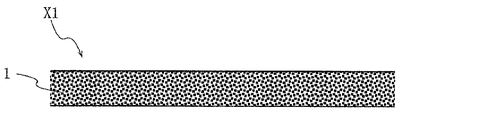
- the structure of the pressure-sensitive adhesive sheet of the present embodiment is not particularly limited, but preferably includes a pressure-sensitive adhesive sheet X1 shown in FIG. 1, a pressure-sensitive adhesive sheet X2 having a laminated structure in FIG. 2, and a pressure-sensitive adhesive sheet X3 having a laminated structure in FIG.
- the pressure-sensitive adhesive sheet X1 is a substrate-less double-sided pressure-sensitive adhesive sheet composed of only the electrically peelable pressure-sensitive adhesive layer 1.
- the pressure-sensitive adhesive sheet X ⁇ b> 2 is a double-sided pressure-sensitive adhesive sheet with a substrate having a layer configuration of the pressure-sensitive adhesive layer 2, the current-carrying base material 5 (the base material 3 and the conductive layer 4), and the electrically-peelable pressure-sensitive adhesive layer 1.
- the pressure-sensitive adhesive sheet X3 includes a pressure-sensitive adhesive layer 2, a current-carrying base material 5 (base material 3 and a conductive layer 4), an electrically-peelable pressure-sensitive adhesive layer 1, a current-carrying substrate 5 (base material 3 and a conductive layer 4), and a pressure-sensitive adhesive. It is a double-sided pressure-sensitive adhesive sheet with a substrate having the layer configuration of Layer 2.
- the base material 3 for conducting electricity of the adhesive sheets X2 and X3 is not essential, and may be only the conductive layer 4. Further, in the pressure-sensitive adhesive sheet X2 of FIG. 2, a single-sided pressure-sensitive adhesive sheet without the pressure-sensitive adhesive layer 2 may be used.
- the substrate 3 is not particularly limited, but may be a paper-based substrate such as paper, a fiber-based substrate such as cloth or nonwoven fabric, various plastics (a polyolefin resin such as polyethylene or polypropylene, a polyester resin such as polyethylene terephthalate, Plastic-based substrates such as films and sheets of acrylic resins such as methyl methacrylate, etc., and laminates thereof.
- the substrate may have a single-layer form or a multi-layer form.
- the base material may be subjected to various treatments such as a back surface treatment, an antistatic treatment, and a primer treatment as needed.
- the conductive layer 4 is not particularly limited as long as it is a layer having conductivity, but a metal (for example, aluminum, magnesium, copper, iron, tin, gold, etc.) foil, a metal plate (for example, aluminum, magnesium, copper, iron) , Tin, silver, etc.), a conductive polymer, or the like, or a metal-deposited film provided on the substrate 3.
- a metal for example, aluminum, magnesium, copper, iron, tin, gold, etc.
- a metal plate for example, aluminum, magnesium, copper, iron
- Tin silver, etc.
- the current-carrying substrate 5 is not particularly limited as long as it is a substrate having a conductive layer (current-carrying), and examples thereof include a substrate having a metal layer formed on the surface of the substrate.
- a material in which a metal layer is formed on a surface of a material by a method such as a plating method, a chemical vapor deposition method, and a sputtering method may be used.
- the metal layer include the metals, metal plates, and conductive polymers exemplified above.
- the adherends on both sides are preferably adherends having a metal adherend surface.
- the adherend on the side of the electrically-peelable pressure-sensitive adhesive layer 1 is an adherend having a metal-applied surface.
- Examples of the metal-coated surface include surfaces having conductivity, for example, a surface composed of a metal containing aluminum, copper, iron, magnesium, tin, gold, silver, lead, or the like as a main component. Is preferred.
- Examples of the adherend having a metal adhered surface include a sheet, a component, and a plate made of a metal mainly containing aluminum, copper, iron, magnesium, tin, gold, silver, lead, and the like.
- the adherend other than the adherend having a metal adherend surface is not particularly limited, and examples thereof include fiber sheets such as paper, cloth, and nonwoven fabric, and films and sheets of various plastics.
- the thickness of the electrically peelable pressure-sensitive adhesive layer 1 is preferably 1 ⁇ m or more and 1000 ⁇ m or less from the viewpoint of initial adhesive strength.
- the upper limit of the thickness of the electrodeposition type pressure-sensitive adhesive layer 1 is more preferably 500 ⁇ m, further preferably 100 ⁇ m, particularly preferably 30 ⁇ m, and the lower limit is more preferably 3 ⁇ m, and still more preferably 5 ⁇ m. And particularly preferably 8 ⁇ m.
- the pressure-sensitive adhesive sheet is a substrate-less double-sided pressure-sensitive adhesive sheet (pressure-sensitive adhesive sheet X1 shown in FIG. 1) composed of only one pressure-sensitive adhesive layer, the thickness of the pressure-sensitive adhesive sheet is determined by the thickness of the pressure-sensitive adhesive sheet. Becomes
- the thickness of the pressure-sensitive adhesive layer 2 is preferably 1 ⁇ m or more and 2000 ⁇ m or less from the viewpoint of adhesive strength.
- the upper limit of the thickness of the pressure-sensitive adhesive layer 2 is more preferably 1000 ⁇ m, further preferably 500 ⁇ m, particularly preferably 100 ⁇ m, and the lower limit is more preferably 3 ⁇ m, further preferably 5 ⁇ m, and particularly preferably. Is 8 ⁇ m.
- the thickness of the base material 3 is preferably 10 ⁇ m or more and 1000 ⁇ m or less.
- the upper limit of the thickness is more preferably 500 ⁇ m, further preferably 300 ⁇ m, and particularly preferably 100 ⁇ m, and the lower limit is more preferably 12 ⁇ m, and still more preferably 25 ⁇ m.
- the thickness of the conductive layer 4 is preferably 0.001 ⁇ m or more and 1000 ⁇ m or less.
- the upper limit of the thickness is more preferably 500 ⁇ m, still more preferably 300 ⁇ m, still more preferably 50 ⁇ m, and still more preferably 10 ⁇ m, and the lower limit is more preferably 0.01 ⁇ m, more preferably 0.1 ⁇ m. It is 03 ⁇ m, more preferably 0.05 ⁇ m.
- the thickness of the current-carrying substrate 5 is preferably 10 ⁇ m or more and 1000 ⁇ m or less.
- the upper limit of the thickness is more preferably 500 ⁇ m, further preferably 300 ⁇ m, and particularly preferably 100 ⁇ m, and the lower limit is more preferably 12 ⁇ m, and still more preferably 25 ⁇ m.
- the surfaces of the electrically peelable pressure-sensitive adhesive layer and the other pressure-sensitive adhesive layer of the pressure-sensitive adhesive sheet of the present embodiment may be protected by a separator (release liner).
- the separator is not particularly limited, but a release liner in which the surface of a substrate (liner substrate) such as paper or plastic film is silicone-treated, or the surface of a substrate (liner substrate) such as paper or plastic film is polyolefin-based A release liner laminated with a resin may, for example, be mentioned.
- the thickness of the separator is not particularly limited, but is preferably 10 ⁇ m or more and 100 ⁇ m or less.
- the thickness of the pressure-sensitive adhesive sheet of the present embodiment is preferably 20 ⁇ m or more and 3000 ⁇ m or less.
- the upper limit of the thickness is more preferably 1000 ⁇ m, still more preferably 300 ⁇ m, and particularly preferably 200 ⁇ m, and the lower limit is more preferably 30 ⁇ m, and still more preferably 50 ⁇ m.
- the thickness of the adhesive sheet is preferably 50 ⁇ m or more and 2000 ⁇ m or less.
- the upper limit of the thickness is more preferably 1000 ⁇ m, and still more preferably 200 ⁇ m, and the lower limit is more preferably 80 ⁇ m, and still more preferably 100 ⁇ m.
- the thickness of the adhesive sheet is preferably 100 ⁇ m or more and 3000 ⁇ m or less.
- the upper limit of the thickness is more preferably 1000 ⁇ m, and still more preferably 300 ⁇ m, and the lower limit is more preferably 150 ⁇ m, and still more preferably 200 ⁇ m.
- the other pressure-sensitive adhesive layer includes a method in which a solution obtained by dissolving a pressure-sensitive adhesive composition containing no ionic liquid and additives in a solvent, if necessary, is coated on a separator, and dried and / or cured.
- the solvent and the separator can use the thing mentioned above.
- a conventional coater for example, gravure roll coater, reverse roll coater, kiss roll coater, dip roll coater, bar coater, knife coater, spray roll coater, etc.
- a conventional coater for example, gravure roll coater, reverse roll coater, kiss roll coater, dip roll coater, bar coater, knife coater, spray roll coater, etc.
- an electric peeling type pressure-sensitive adhesive layer, and other pressure-sensitive adhesive layers can be produced, and as appropriate, a base material, a conductive layer, a current-carrying substrate, an electric peeling type pressure-sensitive adhesive layer, and other pressure-sensitive adhesive layers.
- the pressure-sensitive adhesive sheet of the present embodiment can be manufactured.
- the peeling of the pressure-sensitive adhesive sheet of this embodiment from the adherend can be performed by applying a voltage to the pressure-sensitive adhesive layer to generate a potential difference in the thickness direction of the pressure-sensitive adhesive layer.
- a voltage for example, when both surfaces of the pressure-sensitive adhesive sheet X1 are adherends each having a metal-adhered surface, electricity can be applied to both metal-adhered surfaces, and the pressure-sensitive adhesive layer can be peeled off by applying a voltage to the adhesive layer.
- the electrically peelable pressure-sensitive adhesive layer side of the pressure-sensitive adhesive sheet X2 is an adherend having a metal adhered surface
- a current is applied to the conductive adherend and the conductive layer 4
- a voltage is applied to the electrically peelable pressure-sensitive adhesive layer.
- the pressure-sensitive adhesive sheet X3 it can be peeled off by applying a current to the conductive layers 4 on both sides and applying a voltage to the electrically peelable pressure-sensitive adhesive layer.
- the energization is preferably performed by connecting a terminal to one end and the other end of the pressure-sensitive adhesive sheet so that a voltage is applied to the entire electrically peelable pressure-sensitive adhesive layer.
- the one end and the other end may be a part of the adherend having the metal adhered surface.
- a voltage may be applied after water is added to the interface between the metal-coated surface and the electrically peelable pressure-sensitive adhesive layer.
- the adhesive sheet of the present embodiment is used for fixing a secondary battery (for example, a lithium ion battery pack) used in a mobile terminal such as a smartphone, a mobile phone, a notebook computer, a video camera, and a digital camera to a housing. It is suitable for.
- a secondary battery for example, a lithium ion battery pack
- Examples of the rigid member to be joined by the adhesive sheet of the present embodiment include a silicon substrate for a semiconductor wafer, a sapphire substrate for an LED, a SiC substrate and a metal base substrate, a TFT substrate for a display, and a color filter substrate. And a base substrate for an organic EL panel.
- Examples of the fragile member to be bonded by the double-sided adhesive sheet include a semiconductor substrate such as a compound semiconductor substrate, a silicon substrate for MEMS devices, a passive matrix substrate, a surface cover glass for a smartphone, and a touch panel sensor attached to the cover glass.
- OGS One Glass Solution
- substrate an organic substrate and an organic-inorganic hybrid substrate containing silsesquioxane as a main component
- a flexible glass substrate for a flexible display and a graphene sheet.
- the joined body of the present embodiment has a laminated structure including an adherend having a metal adhered surface and an adhesive sheet having an electrically peelable adhesive layer joined to the metal adhered surface.
- adherend having a metal-applied surface include, for example, those composed of a metal containing aluminum, copper, iron, magnesium, tin, gold, silver, lead, or the like as a main component. Is preferred.
- Examples of the bonded body of the present embodiment include a pressure-sensitive adhesive sheet X1 and a bonded body including an adherend having a metal-applied surface on both surfaces of the electro-peelable pressure-sensitive adhesive layer 1; A bonded body comprising an adherend having a metal adhered surface on the side of the peelable pressure-sensitive adhesive layer 1 and an adherend on the side of the pressure-sensitive adhesive layer 2, a pressure-sensitive adhesive sheet X3 having adherends on both surfaces of the pressure-sensitive adhesive layer 2 And the like.
- AIBN 2,2′-azobisisobutyronitrile
- n-butyl acrylate (BA): 67 parts by mass, methyl methacrylate (MMA): 33 parts by mass, and ethyl acetate: 150 parts by mass as a polymerization solvent are charged into a separable flask, and nitrogen gas is introduced. While stirring for 1 hour. After removing oxygen in the polymerization system in this manner, 0.2 parts by mass of 2,2′-azobisisobutyronitrile (AIBN) as a polymerization initiator was added, and the temperature was raised to 63 ° C. for 6 hours. Reacted. Thereafter, ethyl acetate was added to obtain an acrylic polymer 4 solution having a solid content concentration of 40% by mass.
- AIBN 2,2′-azobisisobutyronitrile
- AIBN 2,2′-azobisisobutyronitrile
- Byron UR-V8700 a urethane-modified polyester resin, trade name “Byron UR-V8700”, manufactured by Toyobo Co., Ltd.
- Byron BX1001 polyester resin, trade name “Byron BX1001”, manufactured by Toyobo Co., Ltd.
- Somalex 530 anionic polyacrylamide polymer (ionic polymer ), Trade name "Somarex 530", manufactured by Somar Corporation (ionic liquid) AS-110: Cation: 1-ethyl-3-methylimidazolium cation, anion: bis (fluorosulfonyl) imide anion, trade name “ELEXCEL AS-110”, manufactured by Daiichi Kogyo Seiyaku Co., Ltd.
- crosslinking agent V-05 Polycarbodiimide resin, trade name "Carbodilite V-05", manufactured by Nisshinbo Chemical Co., Ltd.
- EMI-nitrate 1-ethyl-3-methylimidazolium nitrate, manufactured by Tokyo Chemical Industry Co., Ltd.
- Zn-nitrate zinc nitrate hexahydrate, manufactured by Wako Pure Chemical Industries, Ltd.
- BTC-5B barium titanate 27776: Carbon black
- ⁇ Measurement of relative dielectric constant of ionic liquid-free pressure-sensitive adhesive layer An ionic liquid-free adhesive obtained by stirring and mixing materials in the same manner as in Examples 1-1 to 1-8 and Comparative examples 1-1 to 1-5 except that no ionic liquid was added.
- the composition was applied on a release-treated surface of a polyethylene terephthalate separator (trade name “MRF38”, manufactured by Mitsubishi Plastics, Inc.), the surface of which was subjected to a release treatment, using an applicator so as to have a uniform thickness. Next, heating and drying were performed at 130 ° C. for 3 minutes to obtain a 30 ⁇ m-thick ionic liquid-free pressure-sensitive adhesive layer.
- the relative permittivity of the pressure-sensitive adhesive layer at a frequency of 100 kHz is determined according to JIS K 6911 as follows. It was measured under the conditions. (Measurement condition) Measurement method: volumetric method (apparatus: using Agilent Technologies 4294A Precision Impedance Analyzer) Electrode configuration: 12.1 mm ⁇ , 0.5 mm thick aluminum plate Counter electrode: 3 oz copper plate Measurement environment: 23 ⁇ 1 ° C., 52 ⁇ 1% RH
- the obtained electrically peelable pressure-sensitive adhesive layer (pressure-sensitive adhesive sheet) was formed into a sheet having a size of 10 mm ⁇ 80 mm, and a film having a metal layer as a substrate (trade name “BR1075”, Toray Film Processing Co., Ltd.) ) Co., Ltd., 25 ⁇ m thick, size 10 mm ⁇ 100 mm) metal layer surface was bonded to obtain a single-sided pressure-sensitive adhesive sheet with a substrate.
- the separator of the single-sided pressure-sensitive adhesive sheet with the base material was peeled off, and an aluminum plate (A5052P H32 (JIS H4000: 2014)) was adhered to the peeled surface so that one end of the pressure-sensitive adhesive sheet protruded about 2 mm from the adherend, Pressed back and forth with a 2 kg roller once, and allowed to stand for 30 minutes in an environment of 23 ° C., from the stainless steel plate 6 / electrically peelable pressure-sensitive adhesive layer (pressure-sensitive adhesive sheet) 1 ′ / film with metal layer (substrate for conducting electricity) 5 ′.
- FIG. 4 shows an outline of the joined body.
- the film was peeled by a peeling tester (trade name “Yang angle peeling tester YSP”, manufactured by Asahi Seiko Co., Ltd.) in the arrow method in FIG. 4, and a 180 ° peel test (tensile speed: 300 mm / min, (The peeling temperature was 23 ° C.). Table 1 shows the measurement results.
- AIBN 2,2′-azobisisobutyronitrile
- AIBN 2,2′-azobisisobutyronitrile
- AIBN 2,2′-azobisisobutyronitrile
- Irgamet 30 N, N-bis (2-ethylhexyl) -1,2,4-triazol-1-ylmethanamine, trade name “Irgamet 30”, manufactured by BASF IrgacorDSSG: disodium sebacate, trade name “IrgametDSSG”, BASF AminO: imidazoline derivative, trade name "Amin O”, PEG400: polyethylene glycol, trade name "PEG400", trade name "PEG400", Tokyo Chemical Industry Co., Ltd. Coronate L: isocyanate compound, trade name "Coronate L", manufactured by Tosoh Corporation
- ⁇ Measurement of ionic conductivity and capacitance per unit area of adhesive layer Using the pressure-sensitive adhesive composition of each example, a measurement sample (composite sample) was prepared as follows, and the capacitance at the adhesive interface and the ionic conductivity of the pressure-sensitive adhesive layer were determined by the following methods. Table 2 shows the results.
- the pressure-sensitive adhesive composition was uniformly applied to the aluminum-deposited surface side of an aluminum-deposited PET film 100 (trade name “Metal Me TS” manufactured by Toray Film Processing Co., Ltd.). At this time, in order to bring the electrode into contact with the aluminum-deposited surface, a part to which the adhesive composition was not applied was partially provided. Then, the adhesive layer 200 was formed by heating and drying at 130 ° C. for 3 minutes to obtain an adhesive sheet sample. Thereafter, the adhesive surface of the obtained adhesive sheet sample was attached to an aluminum plate 300 (A5052P H32 (JIS H4000: 2014)) to obtain a joined body sample 400 having a shape as shown in FIGS. FIG. 5 is a side view, and FIG. 6 is a top view.
- the bulk of the pressure-sensitive adhesive layer 200 is regarded as a parallel circuit of a resistance component R adh and a capacitance component C adh
- the interface of the pressure-sensitive adhesive layer 200 is regarded as a parallel circuit of a resistance component R p and a capacitance component C dl.
- the equivalent circuit of the conjugate sample was set as shown in FIG. 7, and the obtained cole-col plot was fitted by the following equation (A). Note that the resistance component R0 is a wiring resistance.
- ⁇ is an angular frequency
- the capacitance per unit area of the interface between the adhesive layer 200 and the aluminum plate 300 was determined by dividing the obtained C dl by the area A of the adhesive surface of the adhesive layer 200.
- the ionic conductivity ⁇ of the pressure-sensitive adhesive layer was determined using the following equation (B) using the bulk resistance component Radh of the pressure-sensitive adhesive layer 200 determined from the equation (A).
- l is the thickness of the pressure-sensitive adhesive layer
- A is the area of the pressure-sensitive adhesive surface of the pressure-sensitive adhesive layer 200.
- Example 2 The pressure-sensitive adhesive composition of each example was prepared in the same manner as in Example 1 except that the pressure-sensitive adhesive layer was formed on the aluminum-deposited surface using an aluminum-deposited PET film (trade name “Metal Me TS” manufactured by Toray Film Processing Co., Ltd.) as a substrate.
- the initial adhesive strength was measured in the same manner as in Examples 1 to 1-8 and Comparative Examples 1-1 to 1-5. Table 2 shows the measurement results.
- Adhesive force during voltage application after storage for 3 days in an environment of 22 ° C. and 20% RH After pressing back and forth with a 2 kg roller for one round, left for 3 days in an environment of 22 ° C. and 20% RH, and before the peel, the minus pole of the DC current machine was placed at the positions ⁇ and ⁇ in FIG. And a positive electrode were attached, and a voltage was applied at a voltage of 10 V for 30 seconds. While applying the voltage as it was, the adhesive force during the application of the voltage was measured in the same manner as in the initial adhesive force measurement except that the peeling was performed. It measured and evaluated the electrical peelability by the following criteria. Table 2 shows the measurement results. :: Adhesion reduction rate is 60% or more. X: The adhesive strength reduction rate is less than 60%.
- a pressure-sensitive adhesive layer was formed from the pressure-sensitive adhesive composition, attached to an aluminum plate made of A5052P H32 according to JIS H4000: 2014, and allowed to stand at 22 ° C. and 15% RH for 7 days.
- a pressure-sensitive adhesive layer was formed from the pressure-sensitive adhesive composition, attached to an aluminum plate made of A5052P H32 according to JIS H4000: 2014, and allowed to stand at 22 ° C. and 15% RH for 7 days.
- the pressure-sensitive adhesive compositions of Examples 3-1 to 3-5 in which the capacitance per unit area of the interface of the aluminum plate is 0.9 ⁇ F / cm 2 or more and the ionic conductivity of the pressure-sensitive adhesive layer is 10 ⁇ S / m or more, In each case, the rate of decrease in the adhesive force due to the application of the voltage was large.
- Adhesive sheet 1 Electric release type adhesive layer 2 Adhesive layer 3 Base material 4 Conductive layer 5 Conductive base material 100 Aluminum evaporated PET film 200 Adhesive layer 300 Aluminum plate 400 Joint sample
Landscapes
- Chemical & Material Sciences (AREA)
- Organic Chemistry (AREA)
- Adhesives Or Adhesive Processes (AREA)
- Adhesive Tapes (AREA)
- Organic Insulating Materials (AREA)
Priority Applications (5)
| Application Number | Priority Date | Filing Date | Title |
|---|---|---|---|
| US17/272,958 US12104100B2 (en) | 2018-09-03 | 2019-08-30 | Adhesive composition, adhesive sheet, and adhered body |
| CN201980057389.4A CN112639045B (zh) | 2018-09-03 | 2019-08-30 | 粘合剂组合物、粘合片和接合体 |
| CN202310680383.0A CN116536005A (zh) | 2018-09-03 | 2019-08-30 | 粘合剂组合物、粘合片和接合体 |
| KR1020217006251A KR102803368B1 (ko) | 2018-09-03 | 2019-08-30 | 점착제 조성물, 점착 시트 및 접합체 |
| EP19857048.3A EP3848434A4 (en) | 2018-09-03 | 2019-08-30 | ADHESIVE COMPOSITION, ADHESIVE SHEET AND BONDED BODY |
Applications Claiming Priority (6)
| Application Number | Priority Date | Filing Date | Title |
|---|---|---|---|
| JP2018164545 | 2018-09-03 | ||
| JP2018-164545 | 2018-09-03 | ||
| JP2019065065 | 2019-03-28 | ||
| JP2019-065065 | 2019-03-28 | ||
| JP2019157325A JP7651255B2 (ja) | 2018-09-03 | 2019-08-29 | 粘着剤組成物、粘着シート、及び接合体 |
| JP2019-157325 | 2019-08-29 |
Publications (1)
| Publication Number | Publication Date |
|---|---|
| WO2020050169A1 true WO2020050169A1 (ja) | 2020-03-12 |
Family
ID=69722315
Family Applications (1)
| Application Number | Title | Priority Date | Filing Date |
|---|---|---|---|
| PCT/JP2019/034143 Ceased WO2020050169A1 (ja) | 2018-09-03 | 2019-08-30 | 粘着剤組成物、粘着シート、及び接合体 |
Country Status (4)
| Country | Link |
|---|---|
| JP (2) | JP2025061947A (https=) |
| CN (1) | CN116536005A (https=) |
| TW (2) | TWI867744B (https=) |
| WO (1) | WO2020050169A1 (https=) |
Cited By (8)
| Publication number | Priority date | Publication date | Assignee | Title |
|---|---|---|---|---|
| WO2021200054A1 (ja) * | 2020-03-30 | 2021-10-07 | 日東電工株式会社 | 粘着剤組成物、粘着シート、及び接合体 |
| WO2021202527A1 (en) * | 2020-03-30 | 2021-10-07 | Nitto Denko Corporation | Electrically peelable composition for high temperature exposure |
| WO2022163593A1 (ja) * | 2021-01-29 | 2022-08-04 | 日東電工株式会社 | 電気剥離用粘着剤組成物、粘着シート、及び接合体 |
| US20230118005A1 (en) * | 2020-06-22 | 2023-04-20 | Henkel Ag & Co. Kgaa | Electrochemically debondable adhesive composition |
| CN116194542A (zh) * | 2020-09-28 | 2023-05-30 | 琳得科株式会社 | 电剥离性粘合剂组合物、电剥离性粘合片及电剥离性粘合片的使用方法 |
| WO2023152912A1 (ja) * | 2022-02-10 | 2023-08-17 | ビッグテクノス株式会社 | 電気剥離性粘着剤組成物、電気剥離性粘着製品及びその利用 |
| CN116964109A (zh) * | 2021-02-26 | 2023-10-27 | 汉高股份有限及两合公司 | 单组分(1k)可固化粘合剂组合物 |
| US12584047B2 (en) | 2022-02-10 | 2026-03-24 | Vigteqnos Co., Ltd. | Electrically peelable adhesive composition, electrically peelable adhesive product, and utilization thereof |
Families Citing this family (1)
| Publication number | Priority date | Publication date | Assignee | Title |
|---|---|---|---|---|
| CA2980595C (en) * | 2015-04-09 | 2020-09-22 | Gen-Probe Incorporated | Sample testing systems and methods with automated cleaning |
Citations (17)
| Publication number | Priority date | Publication date | Assignee | Title |
|---|---|---|---|---|
| WO2007018239A1 (ja) * | 2005-08-09 | 2007-02-15 | The Yokohama Rubber Co., Ltd. | 通電剥離用組成物およびそれを用いた接着剤、通電剥離性多層接着剤 |
| WO2009041445A1 (ja) * | 2007-09-25 | 2009-04-02 | Three Bond Co., Ltd. | 嫌気硬化性組成物 |
| JP2009251281A (ja) * | 2008-04-07 | 2009-10-29 | Soken Chem & Eng Co Ltd | 偏光板用粘着剤組成物およびその製造方法 |
| JP2010037355A (ja) * | 2008-07-31 | 2010-02-18 | Big Technos Kk | 電気剥離性粘着剤組成物、電気剥離性粘着製品及びその剥離方法 |
| JP2010037354A (ja) | 2008-07-31 | 2010-02-18 | Big Technos Kk | 電気剥離性粘着剤組成物、電気剥離性粘着製品及びその剥離方法 |
| JP2013221067A (ja) * | 2012-04-16 | 2013-10-28 | Nitto Denko Corp | 粘着剤組成物、粘着剤層、粘着剤層付偏光フィルムおよび画像形成装置 |
| JP2014148598A (ja) * | 2013-01-31 | 2014-08-21 | Nippon Carbide Ind Co Inc | 粘着剤組成物及び光学部材表面保護フィルム |
| JP2016509094A (ja) * | 2013-01-08 | 2016-03-24 | ドンウ ファインケム カンパニー リミテッド | 粘着剤組成物 |
| JP6097112B2 (ja) | 2013-03-27 | 2017-03-15 | リンテック株式会社 | 電気剥離性粘着シート、及び電気剥離性粘着シートの使用方法 |
| WO2017064918A1 (ja) * | 2015-10-16 | 2017-04-20 | 日東電工株式会社 | 電気剥離用粘着剤組成物、粘着シート、及び接合体 |
| JP2017095590A (ja) * | 2015-11-24 | 2017-06-01 | 日東電工株式会社 | 被着体の接合・分離方法 |
| JP2017098369A (ja) * | 2015-11-20 | 2017-06-01 | 三井・デュポンポリケミカル株式会社 | ダイシングフィルム基材用樹脂組成物、ダイシングフィルム基材およびダイシングフィルム |
| US20170183551A1 (en) * | 2015-12-24 | 2017-06-29 | Nan Ya Plastics Corporation | Polyurethane adhesive and use of the same |
| JP2018164545A (ja) | 2017-03-28 | 2018-10-25 | 株式会社大都技研 | 遊技台 |
| JP2018172629A (ja) * | 2017-03-31 | 2018-11-08 | 東洋インキScホールディングス株式会社 | 導電性粘着剤、粘着性コネクタ、および粘着性端子部材 |
| JP2019065065A (ja) | 2017-09-28 | 2019-04-25 | 株式会社ネオス | ポリロタキサン化合物 |
| JP2019157325A (ja) | 2018-03-07 | 2019-09-19 | 株式会社メディカサトウ | 腕装着具、腕装着具付き衣類 |
Family Cites Families (9)
| Publication number | Priority date | Publication date | Assignee | Title |
|---|---|---|---|---|
| JP4453977B2 (ja) * | 2004-07-16 | 2010-04-21 | 日東電工株式会社 | 粘着剤組成物、粘着シート類及び表面保護フィルム |
| JP6181958B2 (ja) * | 2013-03-28 | 2017-08-16 | 日東電工株式会社 | 帯電防止性粘着シート、及び、光学フィルム |
| JP6235346B2 (ja) * | 2014-01-06 | 2017-11-22 | 積水化学工業株式会社 | 粘着剤組成物、粘着テープ及び積層体 |
| JP6526951B2 (ja) * | 2014-08-29 | 2019-06-05 | スリーエム イノベイティブ プロパティズ カンパニー | 光学的に透明な接着剤及び光学積層体 |
| JP2016084438A (ja) * | 2014-10-28 | 2016-05-19 | Dic株式会社 | 粘着フィルム、情報表示装置及び携帯電子端末 |
| CN107001888B (zh) * | 2014-12-25 | 2020-01-21 | 三菱化学株式会社 | 粘合剂组合物、粘合剂、粘合片材、两面粘合片材、透明电极用粘合剂、触摸面板及图像显示装置 |
| JP2017014305A (ja) * | 2015-06-26 | 2017-01-19 | 日立化成株式会社 | 画像表示装置用粘着剤及びその製造方法、画像表示装置用粘着シート、並びに、画像表示装置 |
| WO2017047548A1 (ja) * | 2015-09-14 | 2017-03-23 | リンテック株式会社 | 粘着剤組成物及び粘着シート |
| KR102477734B1 (ko) * | 2017-03-03 | 2022-12-14 | 닛토덴코 가부시키가이샤 | 전기 박리용 점착제 조성물, 점착 시트, 및 접합체 |
-
2019
- 2019-08-30 WO PCT/JP2019/034143 patent/WO2020050169A1/ja not_active Ceased
- 2019-08-30 CN CN202310680383.0A patent/CN116536005A/zh active Pending
- 2019-09-03 TW TW112135085A patent/TWI867744B/zh active
- 2019-09-03 TW TW108131635A patent/TWI819084B/zh active
-
2025
- 2025-01-29 JP JP2025013191A patent/JP2025061947A/ja active Pending
- 2025-01-29 JP JP2025013192A patent/JP2025061948A/ja active Pending
Patent Citations (18)
| Publication number | Priority date | Publication date | Assignee | Title |
|---|---|---|---|---|
| WO2007018239A1 (ja) * | 2005-08-09 | 2007-02-15 | The Yokohama Rubber Co., Ltd. | 通電剥離用組成物およびそれを用いた接着剤、通電剥離性多層接着剤 |
| JP4139851B2 (ja) | 2005-08-09 | 2008-08-27 | 横浜ゴム株式会社 | 通電剥離用組成物を用いた接着剤、通電剥離性多層接着剤 |
| WO2009041445A1 (ja) * | 2007-09-25 | 2009-04-02 | Three Bond Co., Ltd. | 嫌気硬化性組成物 |
| JP2009251281A (ja) * | 2008-04-07 | 2009-10-29 | Soken Chem & Eng Co Ltd | 偏光板用粘着剤組成物およびその製造方法 |
| JP2010037355A (ja) * | 2008-07-31 | 2010-02-18 | Big Technos Kk | 電気剥離性粘着剤組成物、電気剥離性粘着製品及びその剥離方法 |
| JP2010037354A (ja) | 2008-07-31 | 2010-02-18 | Big Technos Kk | 電気剥離性粘着剤組成物、電気剥離性粘着製品及びその剥離方法 |
| JP2013221067A (ja) * | 2012-04-16 | 2013-10-28 | Nitto Denko Corp | 粘着剤組成物、粘着剤層、粘着剤層付偏光フィルムおよび画像形成装置 |
| JP2016509094A (ja) * | 2013-01-08 | 2016-03-24 | ドンウ ファインケム カンパニー リミテッド | 粘着剤組成物 |
| JP2014148598A (ja) * | 2013-01-31 | 2014-08-21 | Nippon Carbide Ind Co Inc | 粘着剤組成物及び光学部材表面保護フィルム |
| JP6097112B2 (ja) | 2013-03-27 | 2017-03-15 | リンテック株式会社 | 電気剥離性粘着シート、及び電気剥離性粘着シートの使用方法 |
| WO2017064918A1 (ja) * | 2015-10-16 | 2017-04-20 | 日東電工株式会社 | 電気剥離用粘着剤組成物、粘着シート、及び接合体 |
| JP2017098369A (ja) * | 2015-11-20 | 2017-06-01 | 三井・デュポンポリケミカル株式会社 | ダイシングフィルム基材用樹脂組成物、ダイシングフィルム基材およびダイシングフィルム |
| JP2017095590A (ja) * | 2015-11-24 | 2017-06-01 | 日東電工株式会社 | 被着体の接合・分離方法 |
| US20170183551A1 (en) * | 2015-12-24 | 2017-06-29 | Nan Ya Plastics Corporation | Polyurethane adhesive and use of the same |
| JP2018164545A (ja) | 2017-03-28 | 2018-10-25 | 株式会社大都技研 | 遊技台 |
| JP2018172629A (ja) * | 2017-03-31 | 2018-11-08 | 東洋インキScホールディングス株式会社 | 導電性粘着剤、粘着性コネクタ、および粘着性端子部材 |
| JP2019065065A (ja) | 2017-09-28 | 2019-04-25 | 株式会社ネオス | ポリロタキサン化合物 |
| JP2019157325A (ja) | 2018-03-07 | 2019-09-19 | 株式会社メディカサトウ | 腕装着具、腕装着具付き衣類 |
Non-Patent Citations (1)
| Title |
|---|
| "Polymer Handbook", 1989, JOHN WILEY & SONS, INC |
Cited By (16)
| Publication number | Priority date | Publication date | Assignee | Title |
|---|---|---|---|---|
| WO2021202527A1 (en) * | 2020-03-30 | 2021-10-07 | Nitto Denko Corporation | Electrically peelable composition for high temperature exposure |
| JP2021161389A (ja) * | 2020-03-30 | 2021-10-11 | 日東電工株式会社 | 粘着剤組成物、粘着シート、及び接合体 |
| CN115335421A (zh) * | 2020-03-30 | 2022-11-11 | 日东电工株式会社 | 用于高温暴露的可电剥离的组合物 |
| CN115335486A (zh) * | 2020-03-30 | 2022-11-11 | 日东电工株式会社 | 粘合剂组合物、粘合片及接合体 |
| WO2021200054A1 (ja) * | 2020-03-30 | 2021-10-07 | 日東電工株式会社 | 粘着剤組成物、粘着シート、及び接合体 |
| JP7744146B2 (ja) | 2020-03-30 | 2025-09-25 | 日東電工株式会社 | 粘着剤組成物、粘着シート、及び接合体 |
| US20230118005A1 (en) * | 2020-06-22 | 2023-04-20 | Henkel Ag & Co. Kgaa | Electrochemically debondable adhesive composition |
| CN116194542A (zh) * | 2020-09-28 | 2023-05-30 | 琳得科株式会社 | 电剥离性粘合剂组合物、电剥离性粘合片及电剥离性粘合片的使用方法 |
| WO2022163593A1 (ja) * | 2021-01-29 | 2022-08-04 | 日東電工株式会社 | 電気剥離用粘着剤組成物、粘着シート、及び接合体 |
| CN116964109A (zh) * | 2021-02-26 | 2023-10-27 | 汉高股份有限及两合公司 | 单组分(1k)可固化粘合剂组合物 |
| WO2023152912A1 (ja) * | 2022-02-10 | 2023-08-17 | ビッグテクノス株式会社 | 電気剥離性粘着剤組成物、電気剥離性粘着製品及びその利用 |
| US20240376350A1 (en) * | 2022-02-10 | 2024-11-14 | Vigteqnos Co., Ltd. | Electrically peelable adhesive composition, electrically peelable adhesive product, and utilization thereof |
| JP7602293B2 (ja) | 2022-02-10 | 2024-12-18 | ビッグテクノス株式会社 | 電気剥離性粘着剤組成物、電気剥離性粘着製品及びその利用 |
| EP4365255A4 (en) * | 2022-02-10 | 2025-04-16 | Vigteqnos Co., Ltd. | Electrically peelable adhesive composition, electrically peelable adhesive product, and use of same |
| JPWO2023152912A1 (https=) * | 2022-02-10 | 2023-08-17 | ||
| US12584047B2 (en) | 2022-02-10 | 2026-03-24 | Vigteqnos Co., Ltd. | Electrically peelable adhesive composition, electrically peelable adhesive product, and utilization thereof |
Also Published As
| Publication number | Publication date |
|---|---|
| JP2025061948A (ja) | 2025-04-11 |
| TW202402995A (zh) | 2024-01-16 |
| TW202020086A (zh) | 2020-06-01 |
| TWI819084B (zh) | 2023-10-21 |
| JP2025061947A (ja) | 2025-04-11 |
| TWI867744B (zh) | 2024-12-21 |
| CN116536005A (zh) | 2023-08-04 |
Similar Documents
| Publication | Publication Date | Title |
|---|---|---|
| JP7651255B2 (ja) | 粘着剤組成物、粘着シート、及び接合体 | |
| JP7136567B2 (ja) | 電気剥離用粘着剤組成物、粘着シート、及び接合体 | |
| WO2020050169A1 (ja) | 粘着剤組成物、粘着シート、及び接合体 | |
| US20230159799A1 (en) | Adhesive composition, adhesive sheet, and joined body | |
| JP7803863B2 (ja) | 電気剥離型粘着シート、及び接合体 | |
| EP3858932A1 (en) | Adherend separation method and joining method | |
| US20220112410A1 (en) | Separation and bonding method for adherend | |
| JP2021161389A (ja) | 粘着剤組成物、粘着シート、及び接合体 | |
| WO2022163593A1 (ja) | 電気剥離用粘着剤組成物、粘着シート、及び接合体 | |
| KR20250101924A (ko) | 전기 박리형 점착 시트, 및 접합체 | |
| WO2022210055A1 (ja) | 粘着シート、接合体、及び接合体の分離方法 | |
| JP2025103669A (ja) | 電気剥離型粘着シート、及び接合体 | |
| JP2025104275A (ja) | 電気剥離型粘着シート、及び接合体 | |
| WO2025239391A1 (ja) | 電気剥離用粘着剤組成物、電気剥離型粘着シート、及び接合体 | |
| WO2025239393A1 (ja) | 電気剥離用粘着剤組成物、電気剥離型粘着シート、及び接合体 |
Legal Events
| Date | Code | Title | Description |
|---|---|---|---|
| 121 | Ep: the epo has been informed by wipo that ep was designated in this application |
Ref document number: 19857048 Country of ref document: EP Kind code of ref document: A1 |
|
| NENP | Non-entry into the national phase |
Ref country code: DE |
|
| ENP | Entry into the national phase |
Ref document number: 2019857048 Country of ref document: EP Effective date: 20210406 |