WO2020045407A1 - 繊維用撥水撥油剤及び繊維製品 - Google Patents
繊維用撥水撥油剤及び繊維製品 Download PDFInfo
- Publication number
- WO2020045407A1 WO2020045407A1 PCT/JP2019/033468 JP2019033468W WO2020045407A1 WO 2020045407 A1 WO2020045407 A1 WO 2020045407A1 JP 2019033468 W JP2019033468 W JP 2019033468W WO 2020045407 A1 WO2020045407 A1 WO 2020045407A1
- Authority
- WO
- WIPO (PCT)
- Prior art keywords
- water
- polymer
- oil repellent
- group
- fibers
- Prior art date
- Legal status (The legal status is an assumption and is not a legal conclusion. Google has not performed a legal analysis and makes no representation as to the accuracy of the status listed.)
- Ceased
Links
Classifications
-
- C—CHEMISTRY; METALLURGY
- C08—ORGANIC MACROMOLECULAR COMPOUNDS; THEIR PREPARATION OR CHEMICAL WORKING-UP; COMPOSITIONS BASED THEREON
- C08F—MACROMOLECULAR COMPOUNDS OBTAINED BY REACTIONS ONLY INVOLVING CARBON-TO-CARBON UNSATURATED BONDS
- C08F255/00—Macromolecular compounds obtained by polymerising monomers on to polymers of hydrocarbons as defined in group C08F10/00
- C08F255/02—Macromolecular compounds obtained by polymerising monomers on to polymers of hydrocarbons as defined in group C08F10/00 on to polymers of olefins having two or three carbon atoms
- C08F255/026—Macromolecular compounds obtained by polymerising monomers on to polymers of hydrocarbons as defined in group C08F10/00 on to polymers of olefins having two or three carbon atoms on to ethylene-vinylester copolymers
-
- C—CHEMISTRY; METALLURGY
- C08—ORGANIC MACROMOLECULAR COMPOUNDS; THEIR PREPARATION OR CHEMICAL WORKING-UP; COMPOSITIONS BASED THEREON
- C08F—MACROMOLECULAR COMPOUNDS OBTAINED BY REACTIONS ONLY INVOLVING CARBON-TO-CARBON UNSATURATED BONDS
- C08F220/00—Copolymers of compounds having one or more unsaturated aliphatic radicals, each having only one carbon-to-carbon double bond, and only one being terminated by only one carboxyl radical or a salt, anhydride ester, amide, imide or nitrile thereof
- C08F220/02—Monocarboxylic acids having less than ten carbon atoms; Derivatives thereof
- C08F220/10—Esters
- C08F220/12—Esters of monohydric alcohols or phenols
- C08F220/16—Esters of monohydric alcohols or phenols of phenols or of alcohols containing two or more carbon atoms
- C08F220/18—Esters of monohydric alcohols or phenols of phenols or of alcohols containing two or more carbon atoms with acrylic or methacrylic acids
- C08F220/1818—C13or longer chain (meth)acrylate, e.g. stearyl (meth)acrylate
-
- C—CHEMISTRY; METALLURGY
- C08—ORGANIC MACROMOLECULAR COMPOUNDS; THEIR PREPARATION OR CHEMICAL WORKING-UP; COMPOSITIONS BASED THEREON
- C08F—MACROMOLECULAR COMPOUNDS OBTAINED BY REACTIONS ONLY INVOLVING CARBON-TO-CARBON UNSATURATED BONDS
- C08F220/00—Copolymers of compounds having one or more unsaturated aliphatic radicals, each having only one carbon-to-carbon double bond, and only one being terminated by only one carboxyl radical or a salt, anhydride ester, amide, imide or nitrile thereof
- C08F220/02—Monocarboxylic acids having less than ten carbon atoms; Derivatives thereof
- C08F220/10—Esters
- C08F220/20—Esters of polyhydric alcohols or phenols, e.g. 2-hydroxyethyl (meth)acrylate or glycerol mono-(meth)acrylate
-
- C—CHEMISTRY; METALLURGY
- C08—ORGANIC MACROMOLECULAR COMPOUNDS; THEIR PREPARATION OR CHEMICAL WORKING-UP; COMPOSITIONS BASED THEREON
- C08F—MACROMOLECULAR COMPOUNDS OBTAINED BY REACTIONS ONLY INVOLVING CARBON-TO-CARBON UNSATURATED BONDS
- C08F265/00—Macromolecular compounds obtained by polymerising monomers on to polymers of unsaturated monocarboxylic acids or derivatives thereof as defined in group C08F20/00
- C08F265/04—Macromolecular compounds obtained by polymerising monomers on to polymers of unsaturated monocarboxylic acids or derivatives thereof as defined in group C08F20/00 on to polymers of esters
- C08F265/06—Polymerisation of acrylate or methacrylate esters on to polymers thereof
-
- C—CHEMISTRY; METALLURGY
- C08—ORGANIC MACROMOLECULAR COMPOUNDS; THEIR PREPARATION OR CHEMICAL WORKING-UP; COMPOSITIONS BASED THEREON
- C08F—MACROMOLECULAR COMPOUNDS OBTAINED BY REACTIONS ONLY INVOLVING CARBON-TO-CARBON UNSATURATED BONDS
- C08F293/00—Macromolecular compounds obtained by polymerisation on to a macromolecule having groups capable of inducing the formation of new polymer chains bound exclusively at one or both ends of the starting macromolecule
- C08F293/005—Macromolecular compounds obtained by polymerisation on to a macromolecule having groups capable of inducing the formation of new polymer chains bound exclusively at one or both ends of the starting macromolecule using free radical "living" or "controlled" polymerisation, e.g. using a complexing agent
-
- C—CHEMISTRY; METALLURGY
- C09—DYES; PAINTS; POLISHES; NATURAL RESINS; ADHESIVES; COMPOSITIONS NOT OTHERWISE PROVIDED FOR; APPLICATIONS OF MATERIALS NOT OTHERWISE PROVIDED FOR
- C09K—MATERIALS FOR MISCELLANEOUS APPLICATIONS, NOT PROVIDED FOR ELSEWHERE
- C09K3/00—Materials not provided for elsewhere
- C09K3/18—Materials not provided for elsewhere for application to surfaces to minimize adherence of ice, mist or water thereto; Thawing or antifreeze materials for application to surfaces
-
- D—TEXTILES; PAPER
- D01—NATURAL OR MAN-MADE THREADS OR FIBRES; SPINNING
- D01F—CHEMICAL FEATURES IN THE MANUFACTURE OF ARTIFICIAL FILAMENTS, THREADS, FIBRES, BRISTLES OR RIBBONS; APPARATUS SPECIALLY ADAPTED FOR THE MANUFACTURE OF CARBON FILAMENTS
- D01F11/00—Chemical after-treatment of artificial filaments or the like during manufacture
- D01F11/04—Chemical after-treatment of artificial filaments or the like during manufacture of synthetic polymers
- D01F11/08—Chemical after-treatment of artificial filaments or the like during manufacture of synthetic polymers of macromolecular compounds obtained otherwise than by reactions only involving carbon-to-carbon unsaturated bonds
-
- D—TEXTILES; PAPER
- D06—TREATMENT OF TEXTILES OR THE LIKE; LAUNDERING; FLEXIBLE MATERIALS NOT OTHERWISE PROVIDED FOR
- D06M—TREATMENT, NOT PROVIDED FOR ELSEWHERE IN CLASS D06, OF FIBRES, THREADS, YARNS, FABRICS, FEATHERS OR FIBROUS GOODS MADE FROM SUCH MATERIALS
- D06M15/00—Treating fibres, threads, yarns, fabrics, or fibrous goods made from such materials, with macromolecular compounds; Such treatment combined with mechanical treatment
- D06M15/19—Treating fibres, threads, yarns, fabrics, or fibrous goods made from such materials, with macromolecular compounds; Such treatment combined with mechanical treatment with synthetic macromolecular compounds
- D06M15/21—Macromolecular compounds obtained by reactions only involving carbon-to-carbon unsaturated bonds
- D06M15/263—Macromolecular compounds obtained by reactions only involving carbon-to-carbon unsaturated bonds of unsaturated carboxylic acids; Salts or esters thereof
-
- C—CHEMISTRY; METALLURGY
- C08—ORGANIC MACROMOLECULAR COMPOUNDS; THEIR PREPARATION OR CHEMICAL WORKING-UP; COMPOSITIONS BASED THEREON
- C08F—MACROMOLECULAR COMPOUNDS OBTAINED BY REACTIONS ONLY INVOLVING CARBON-TO-CARBON UNSATURATED BONDS
- C08F2438/00—Living radical polymerisation
- C08F2438/01—Atom Transfer Radical Polymerization [ATRP] or reverse ATRP
-
- D—TEXTILES; PAPER
- D06—TREATMENT OF TEXTILES OR THE LIKE; LAUNDERING; FLEXIBLE MATERIALS NOT OTHERWISE PROVIDED FOR
- D06M—TREATMENT, NOT PROVIDED FOR ELSEWHERE IN CLASS D06, OF FIBRES, THREADS, YARNS, FABRICS, FEATHERS OR FIBROUS GOODS MADE FROM SUCH MATERIALS
- D06M2200/00—Functionality of the treatment composition and/or properties imparted to the textile material
- D06M2200/10—Repellency against liquids
- D06M2200/11—Oleophobic properties
-
- D—TEXTILES; PAPER
- D06—TREATMENT OF TEXTILES OR THE LIKE; LAUNDERING; FLEXIBLE MATERIALS NOT OTHERWISE PROVIDED FOR
- D06M—TREATMENT, NOT PROVIDED FOR ELSEWHERE IN CLASS D06, OF FIBRES, THREADS, YARNS, FABRICS, FEATHERS OR FIBROUS GOODS MADE FROM SUCH MATERIALS
- D06M2200/00—Functionality of the treatment composition and/or properties imparted to the textile material
- D06M2200/10—Repellency against liquids
- D06M2200/12—Hydrophobic properties
-
- D—TEXTILES; PAPER
- D10—INDEXING SCHEME ASSOCIATED WITH SUBLASSES OF SECTION D, RELATING TO TEXTILES
- D10B—INDEXING SCHEME ASSOCIATED WITH SUBLASSES OF SECTION D, RELATING TO TEXTILES
- D10B2331/00—Fibres made from polymers obtained otherwise than by reactions only involving carbon-to-carbon unsaturated bonds, e.g. polycondensation products
- D10B2331/04—Fibres made from polymers obtained otherwise than by reactions only involving carbon-to-carbon unsaturated bonds, e.g. polycondensation products polyesters, e.g. polyethylene terephthalate [PET]
-
- D—TEXTILES; PAPER
- D10—INDEXING SCHEME ASSOCIATED WITH SUBLASSES OF SECTION D, RELATING TO TEXTILES
- D10B—INDEXING SCHEME ASSOCIATED WITH SUBLASSES OF SECTION D, RELATING TO TEXTILES
- D10B2401/00—Physical properties
- D10B2401/02—Moisture-responsive characteristics
- D10B2401/021—Moisture-responsive characteristics hydrophobic
Definitions
- the present disclosure relates to a water and oil repellent for textiles and textiles.
- An object of the present disclosure is to provide a novel water / oil repellent for textiles and textile products.
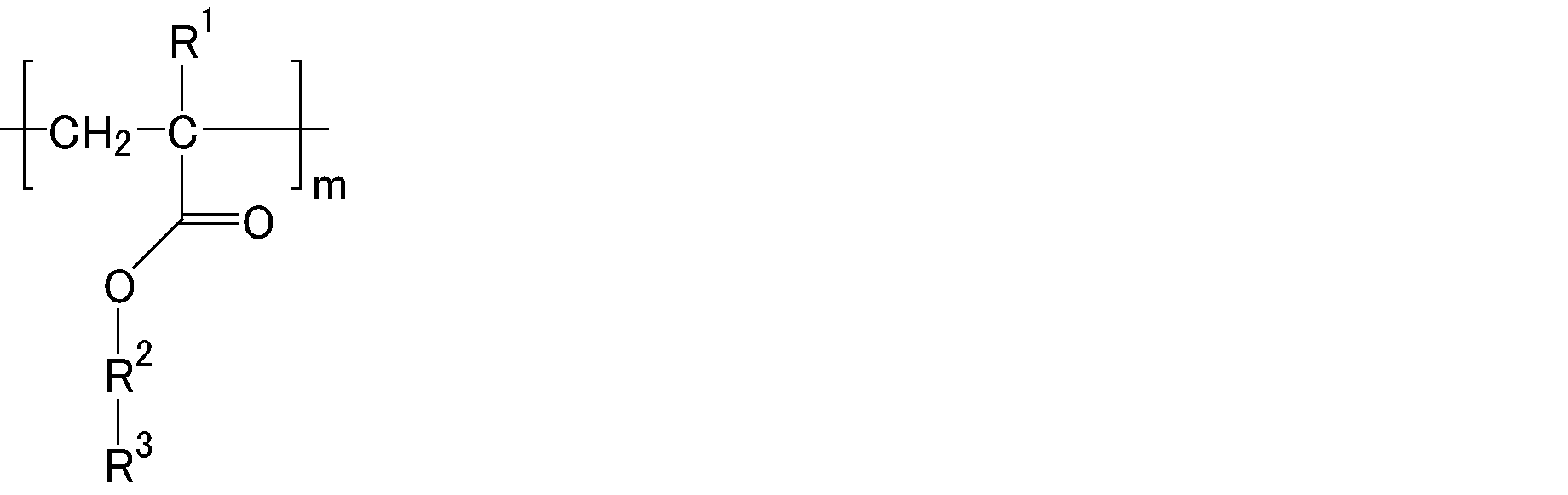
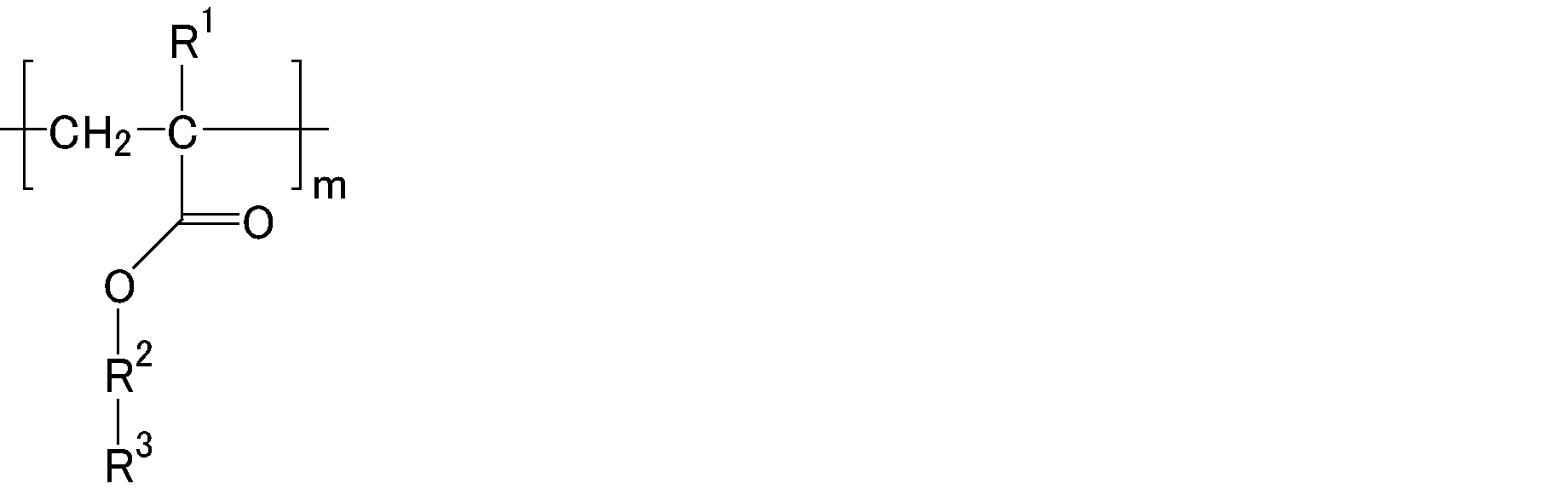
- R 1 is H or CH 3 ;
- R 2 is a divalent organic group;
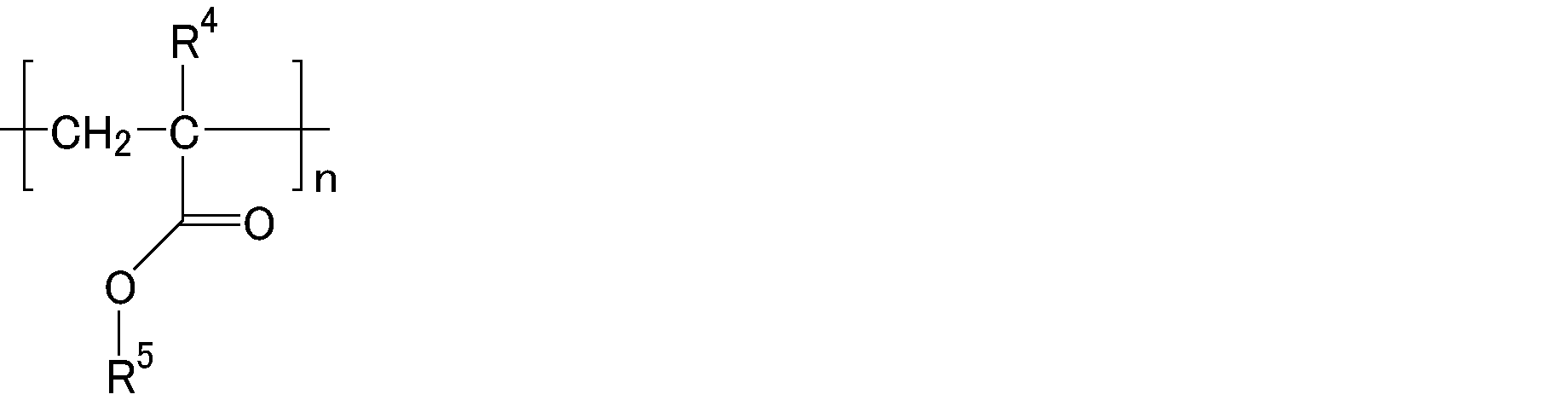
- R 3 is a compound represented by the following formula (2):
- R 4 is H or CH 3 ;
- R 5 is a monovalent hydrocarbon group having 16 to 40 carbon atoms;
- n is an integer of 10 to 1000);
- the number average molecular weight of the bottle brush polymer measured by gel permeation chromatography is 5,000 to 2,000,000.
- the molecular weight distribution of the bottle brush polymer measured by gel permeation chromatography is 1.0 to 5.0.
- the total amount of halogen atoms in the bottle brush polymer is preferably 0.01 to 30% by mass.
- the total amount of bromine, chlorine and iodine atoms in the bottle brush polymer is preferably 0.01 to 30% by mass.
- R 5 is a monovalent hydrocarbon group having 16 to 24 carbon atoms.
- the bottlebrush polymer does not contain fluorine atoms.
- the present disclosure also relates to a fiber product including a fiber coated with the above-mentioned water / oil repellent for fibers.
- a novel water / oil repellent for fibers and a fiber product can be provided.
- R 1 is H or CH 3 ;
- R 2 is a divalent organic group;
- R 3 is a compound represented by the following formula (2):
- R 4 is H or CH 3 ;
- R 5 is a monovalent hydrocarbon group having 16 to 40 carbon atoms;
- n is an integer of 10 to 1000);
- the present inventors have found for the first time that a bottle brush polymer having the above structure has excellent water / oil repellency, and further found that the bottle brush polymer is particularly suitable as a water / oil repellent for fibers, and The inventors have completed the disclosed water / oil repellent for fibers (hereinafter, also referred to as the water / oil repellent of the present disclosure).
- the bottle brush polymer constituting the water and oil repellent of the present disclosure has the following formula (1): Indicated by
- R 1 is H or CH 3 .
- R 1 is preferable.
- R 2 is a divalent organic group.
- the above divalent organic group means a divalent group containing one or more carbon atoms or a divalent group formed by removing two hydrogen atoms from an organic compound.
- the organic group as R 2 may have an oxygen atom, a nitrogen atom, a sulfur atom, a halogen atom, or the like at a site other than the terminal.
- the carbon number of the organic group is preferably 1 or more, more preferably 2 or more, still more preferably 3 or more, and preferably 20 or less, and preferably 15 or less. More preferably, it is even more preferably 10 or less.
- R 6 is an alkylene group having 1 to 3 carbon atoms.
- alkylene group examples include, -CH 2 -, - CH 2 CH 2 -, - CH 2 CH 2 CH 2 -, - CH (CH 3) -, - CH (CH 3) CH 2 -, - C ( CH 3 ) 2 —.
- —C (CH 3 ) 2 — is preferred.
- p is an integer of 1 to 10.
- p is preferably an integer of 1 to 5, more preferably an integer of 1 to 4.
- R 3 is the following formula (2): Is a polymer chain having a structure represented by
- R 4 is H or CH 3 .
- R 5 is a monovalent hydrocarbon group having 16 to 40 carbon atoms.
- the hydrocarbon group preferably has 16 to 30 carbon atoms, more preferably 16 to 24 carbon atoms, further preferably 16 to 22 carbon atoms, and particularly preferably 18 to 22 carbon atoms.
- R 5 a linear or branched alkyl group having a carbon number in the above-mentioned range is preferable, and a stearyl group, an eicosyl group, and a behenyl group are particularly preferable.
- n is an integer of 10 to 1000. n is preferably an integer of 10 to 500, more preferably an integer of 20 to 200, and further preferably an integer of 20 to 100.
- m is an integer of 10 to 5000. m is more preferably an integer of 20 to 1,000, more preferably an integer of 30 to 500, and further preferably an integer of 40 to 300.
- R 3 may further include a polymerized unit based on a curable functional group-containing monomer.
- the curable functional group-containing monomer include 2-hydroxyethyl vinyl ether, 3-hydroxypropyl vinyl ether, 2-hydroxypropyl vinyl ether, 2-hydroxy-2-methylpropyl vinyl ether, 4-hydroxybutyl vinyl ether, Hydroxyl-containing vinyl ethers such as -hydroxy-2-methylbutyl vinyl ether, 5-hydroxypentyl vinyl ether and 6-hydroxyhexyl vinyl ether; hydroxyl-containing allyls such as 2-hydroxyethyl allyl ether, 4-hydroxybutyl allyl ether and glycerol monoallyl ether Ethers; hydroxyalkyl esters of (meth) acrylic acid such as 2-hydroxyethyl acrylate (HEA) and 2-hydroxyethyl methacrylate; It is below.
- hydroxyalkyl esters of (meth) acrylic acid are preferred, and 2-hydroxyethyl acrylate (HEA) is particularly preferred.
- HOA 2-hydroxyethyl acrylate
- order of the repeating units and the curable functional group-containing based on the monomer polymerized units in the structure represented by the formula (2) in R 3 is not particularly limited.
- the bottle brush polymer preferably has an aspect ratio of 0.004 to 200.
- the aspect ratio is more preferably from 0.08 to 15, and even more preferably from 0.2 to 5.
- the aspect ratio means the value of m / 2n in the formula (1), and can be determined from the charged amount of the monomer corresponding to each polymer chain.
- the above-mentioned bottlebrush polymer preferably has a number average molecular weight of 5,000 to 2,000,000 as measured by gel permeation chromatography (GPC).
- the number average molecular weight is more preferably from 10,000 to 1,000,000, and still more preferably from 30,000 to 500,000.
- the bottlebrush polymer preferably has a molecular weight distribution measured by gel permeation chromatography (GPC) of 1.0 to 5.0.
- the molecular weight distribution is more preferably from 1.0 to 3.0, and even more preferably from 1.0 to 2.5.
- the molecular weight distribution means the ratio of weight average molecular weight (Mw) to number average molecular weight (Mn), Mw / Mn.
- the total amount of halogen atoms in the bottle brush polymer is preferably 0.01 to 30% by mass.
- the total amount of the halogen atoms is more preferably from 0.02 to 15% by mass, and even more preferably from 0.05 to 5% by mass.
- Examples of the halogen atom include a bromine atom, a chlorine atom, and an iodine atom.
- the total amount of the halogen atoms is preferably the total amount of halogen atoms (not free) bonded to the molecular chain of the bottle brush polymer.
- the total amount of the halogen atoms can be measured by elemental analysis (combustion method).
- the total amount of bromine, chlorine and iodine atoms in the bottle brush polymer is preferably 0.01 to 30% by mass.
- the total amount of the above bromine, chlorine and iodine atoms is more preferably 0.02 to 15% by mass, and further preferably 0.05 to 5% by mass.
- the total amount of the above-mentioned bromine, chlorine and iodine atoms is preferably the total amount of the bromine, chlorine and iodine atoms bonded (not released) to the molecular chain of the above-mentioned bottlebrush polymer.
- the total amount of the above bromine, chlorine and iodine atoms can be measured by elemental analysis (combustion method).
- the bottle brush polymer does not contain a fluorine atom.
- the bottle brush polymer is excellent in water and oil repellency even if it does not contain a fluorine atom.
- the bottlebrush structure of the bottlebrush polymer can be analyzed according to a known analysis method for the polymerbrush structure.
- Many methods for analyzing a polymer brush structure are known.
- Macromolecules, Vol. 39, 4983, 2006 and Macromolecules, Vol. 45, 9243, 2012 report that the structure of a bottle brush polymer can be observed by a direct observation method using AFM.
- Macromolecules, Vol. 39, 4983, 2006 report that a branched polymer can be analyzed by the GPC-MALS method, and that the behavior differs from that of a linear polymer.
- Masashi Inoue "Rheology of Soft Matter: Precise Analysis by Flow Optics", Production and Technology, Production Technology Promotion Association, 2014, Vol.
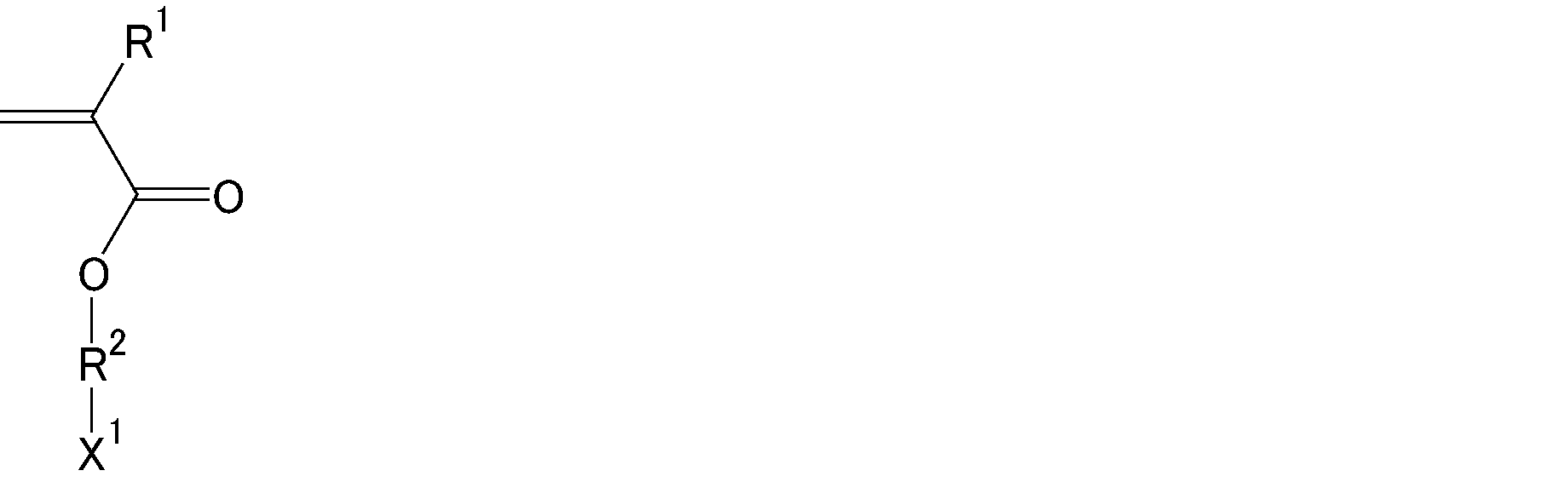
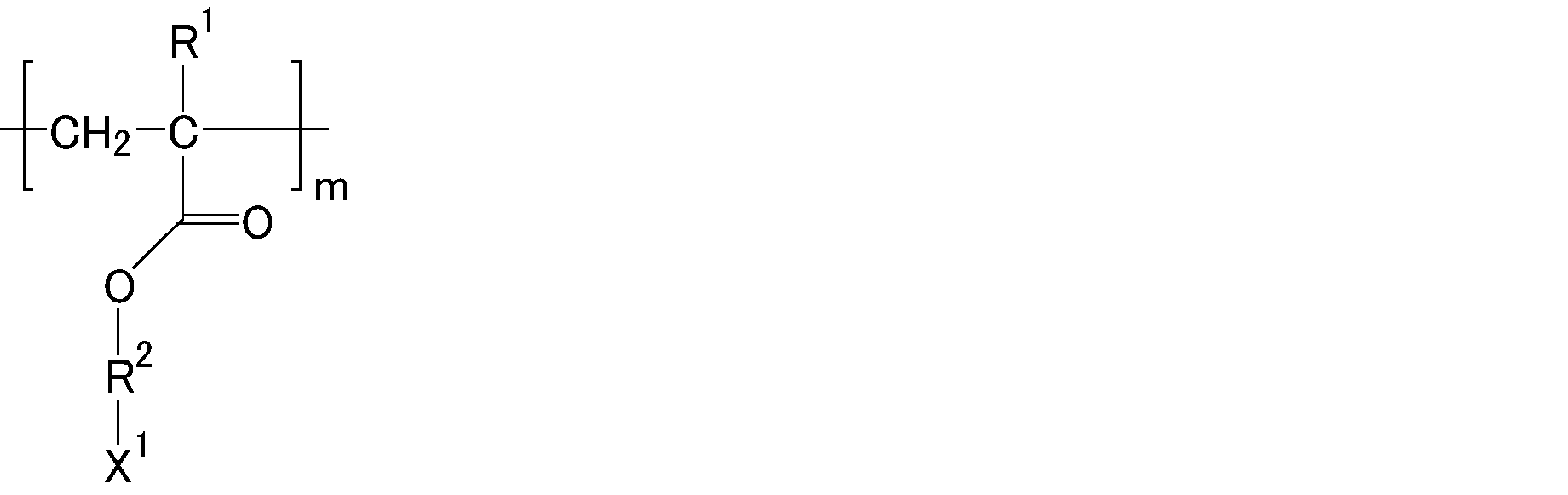
- the bottle brush polymer has, for example, the following formula (3): (Wherein R 1 and R 2 are as described for formula (1); X 1 is a halogen atom) to polymerize a monomer represented by the following formula (4): (Where R 1 , R 2 and m are as described for formula (1); X 1 is as described for formula (3)) to obtain a precursor polymer represented by formula (1-1): as well as, Starting from X 1 of the precursor polymer, the following formula (5): (Wherein, R 4 and R 5 are as described for Formula (2)) by polymerizing a monomer represented by Formula (2) to obtain a bottle brush polymer having a structure represented by Formula (1) above (1) It can be suitably manufactured by the manufacturing method including -2).
- X 1 is a halogen atom.
- the halogen atom include a bromine atom, a chlorine atom, and an iodine atom, and among them, a bromine atom is preferable.
- the polymerization in the step (1-1) can be carried out, for example, by a known polymerization method such as radical polymerization or living radical polymerization.
- the polymerization conditions may employ the conditions usually employed in the polymerization of a (meth) acrylate monomer.
- the polymerization in the step (1-2) can be carried out, for example, using an atom transfer radical polymerization initiator system.
- an atom transfer radical polymerization initiator system the precursor polymer represented by the above formula (4), (a-1) a transition metal complex of Group 8 of the periodic table of short period type, and if necessary, (a-2) It is preferred that the amine and the amine constitute a composite polymerization initiator.
- (A-1) is a transition metal complex having a short-period-type periodic table group 8 element as a central metal, and one or more such transition metal complexes can be used in combination.
- Examples of the element of Group 8 of the periodic table of the central metal include Fe, Co, Ni, Ru, Rh, Pd, and Pt. Of these, Fe and Ru are preferable, and Ru is particularly preferable.
- the ligand which forms a complex by coordinating monodentate or polydentate to these central metals is not particularly limited. Examples thereof include chain hydrocarbon ligands (ethylene, 2-butene, allyl, 2-methylallyl, etc.). Olefins, allenes, etc.), hydrocarbon ligands containing a hydrocarbon ring (cyclopentadienyl, pentamethylcyclopentadienyl, indenyl, fluorenyl, cyclooctadiene, norbornadiene, etc.), coordination containing a phosphorus atom Ligands (triarylphosphines such as triphenylphosphine and trinaphthylphosphine, trialkylphosphines such as tri-n-butylphosphine, triarylphosphites such as triphenylphosphite), and ligands containing nitrogen atoms (nitrogen, bipyridine) , Phenanthroline, etc
- transition metal complex of (a-1) those represented by the formula (11) are preferable.
- L 1 represents a hydrocarbon ligand containing a hydrocarbon ring, and may have a substituent.
- L 2 is the same.
- a ligand which may be different and forms a complex by coordinating to a metal i represents an integer of 0 to 2
- j represents an integer of 0 to 5.
- the transition metal element of Group 8 of the periodic table represented by M is as described above.
- the ligand represented by L 1 is not particularly limited as long as it is a hydrocarbon ligand containing a hydrocarbon ring that can be coordinated or bonded to the above metal complex in a monodentate or polydentate manner.
- the child may have a substituent. Examples include benzene, cyclobutadiene, cyclopentadienyl, cyclohexadiene, cycloheptadiene, cycloheptatriene, cycloheptatrienyl, cyclooctadiene, cyclooctatetraene, norbornadiene, and the like.
- a hydrocarbon ring having a 5-membered ring is preferable, and examples thereof include cyclopentadienyl, indenyl, and fluorenyl.
- hydrocarbon ligands various substituents, for example, alkyl group, alkenyl group, alkynyl group, alkoxy group, alkoxycarbonyl group, acyl group, acyloxy group, carboxyl group, hydroxyl group, amino group, amide group, It may have an imino group, a nitro group, a cyano group, a silyl group, a thioester group, a thioketone group, a thioether group, a halogen atom (chlorine, bromine, iodine, etc.) and the like.
- Examples of the hydrocarbon ligand having a substituent include pentamethylcyclopentadienyl, trimethylsilylcyclopentadienyl, and the like.
- the ligand represented by L 2, and coordinated with monodentate or polydentate the central metal is not particularly limited as long as a ligand to form a complex, hydrocarbons coordination comprising a hydrocarbon ring Same as above except for the child.
- Specific examples of L 2 include a hydrogen atom, a halogen atom, e.g., chlorine atom, bromine atom, an iodine atom. These ligands may be the same or different.
- i is an integer of 0 to 2, preferably an integer of 1 to 2, and more preferably 1.
- j is an integer of 0 to 5, preferably 2 to 5, and more preferably 3 to 5.
- transition metal complex (a-1) examples include chlorocyclopentadienyl bis (triphenylphosphine) ruthenium, chloropentamethylcyclopentadienylbis (triphenylphosphine) ruthenium, chloroindenylbis (triphenyl) Phosphine) ruthenium, chloropentamethylcyclopentadienyl tricyclohexylphosphine ruthenium, dichlorotris (triphenylphosphine) ruthenium, dichlorotris (tributylphosphine) ruthenium, dihydridotetrakis (triphenylphosphine) ruthenium, iododicarbonylcyclopentadienyl Iron, dibromobis (triphenylphosphine) iron, and the like.
- the amine (a-2) is used as an activator that acts on (a-1) to promote radical polymerization.
- Such amines can be used alone or in combination of two or more.
- Examples of the amine (a-2) include aliphatic primary amines (methylamine, ethylamine, propylamine, isopropylamine, butylamine, etc.) and aliphatic secondary amines (dimethylamine, diethylamine, dipropylamine, diisopropylamine).
- aliphatic tertiary amines trimethylamine, triethylamine, tripropylamine, triisopropylamine, tributylamine, etc.
- aliphatic polyamines N, N, N ', N'-tetramethylethylenediamine, N, N, N ', N ", N" -pentamethyldiethylenetriamine, 1,1,4,7,10,10-hexamethyltriethylenetetraamine, etc.
- aromatic primary amines aniline, toluidine, etc.
- Aromatic secondary amines such as diphenylamine
- aromatic tertiary It can be cited Min triphenylamine, etc.
- the ratio (a-1) / precursor polymer (molar ratio) of (a-1) and the precursor polymer represented by the above formula (4) is preferably 0.01 to 10, More preferably, it is 0.05 to 5. Within this range, a polymer having a narrow molecular weight distribution can be obtained at a high polymerization rate.
- the ratio (a-1) / (a-2) (molar ratio) between (a-1) and (a-2) is preferably from 0.01 to 10, more preferably from 0.05 to 5. Within this range, a polymer having a narrow molecular weight distribution can be obtained at a high polymerization rate.
- a copper complex can be employed in the atom transfer radical polymerization initiator system in the step (1-1) and the step (1-2).
- the copper complex a monovalent copper complex or a divalent copper complex is preferable. Specific examples include cupric bromide, cuprous bromide, cuprous chloride, cupric chloride, cuprous iodide, and cupric iodide. When these copper complexes are used, an amine ligand is added to enhance the catalytic activity.
- a polydentate amine is preferred because of its high catalytic activity.
- Examples of the polydentate amine used as the ligand are shown below, but are not limited thereto.
- Activators ⁇ Regenerated ⁇ by ⁇ Electron ⁇ Transfer: ARGET capable of allowing the polymerization reaction to proceed to a maximum.
- reducing agents that can be used in ARGET, but are not limited thereto.
- Organic acid compounds such as citric acid, oxalic acid, ascorbic acid, ascorbate, and ascorbate are exemplified.
- the solid reducing agent may be added as it is, or may be added after being dissolved in a solvent. These reducing agents may be used alone or in combination of two or more. Further, the reducing agent may be directly added to the reaction system or may be generated in the reaction system. The latter includes electrolytic reduction. In electrolytic reduction, it is known that electrons generated at the cathode immediately or after once solvated have a reducing action. That is, a reducing agent generated by electrolysis can be used.
- the polymerization method is not particularly limited, and bulk polymerization, solution polymerization, suspension polymerization, emulsion polymerization, bulk-suspension polymerization and the like can be applied.
- aromatic hydrocarbons benzene, toluene, ethylbenzene, xylene, etc.
- alicyclic hydrocarbons cyclohexane, etc.
- aliphatic hydrocarbons hexane, octane, etc.
- ketones Acetone, methyl ethyl ketone, cyclohexanone, etc.
- ethers [dioxane (1,4-dioxane, etc.), tetrahydrofuran, etc.] esters (ethyl acetate, etc.), amides (N, N-dimethylformamide, etc.), sulfoxides (dimethyl sulfoxide) Etc.), alcohols (methanol, ethanol, etc.) and the like can be used.
- toluene, ethylbenzene, benzene, N, N-dimethylformamide, 1,4-dioxane, tetrahydrofuran and the like are preferable.
- Such solvents can be used alone or in combination of two or more.
- the above polymerization can be carried out under normal pressure or under pressure.
- the polymerization temperature can be selected from a wide range of about 0 to 200 ° C., preferably 50 to 200 ° C., more preferably 60 to 160 ° C., depending on the type of polymerization method, composition of the composite polymerization initiator, polymerization rate, and the like. And more preferably 80 to 140 ° C.
- the polymerization may be performed under an atmosphere of an inert gas such as nitrogen or argon, for example, under a flow of an inert gas.
- a radical generating means such as heat, light, or radiation is applied.
- the mixture may be diluted with a solvent and precipitated in a poor solvent, or may be separated and purified by removing volatile components such as a monomer and a solvent.
- the water and oil repellent of the present disclosure may include, together with the bottle brush polymer, a polymer having a structure represented by the above formula (2) (one not bonded to the molecular chain of the bottle brush polymer). Further, the water / oil repellent of the present disclosure may include, together with the bottle brush polymer, a polymer having a polymerized unit based on a curable functional group-containing monomer (one that is not bonded to the molecular chain of the bottle brush polymer). Good.
- the water / oil repellent of the present disclosure preferably further contains a curing agent.
- the curing agent is a compound that reacts with and reacts with the curable functional group of the bottle brush polymer, and is typically a compound such as an isocyanate, an amino resin, an acid anhydride, a polyepoxy compound, and an isocyanate group-containing silane compound. Used. Of these, isocyanates are preferred.
- isocyanates include, for example, 2,4-tolylene diisocyanate, diphenylmethane-4,4′-diisocyanate, xylylene diisocyanate, isophorone diisocyanate, lysine methyl ester diisocyanate, methylcyclohexyl diisocyanate, trimethylhexamethylene diisocyanate, hexamethylene Diisocyanate, n-pentane-1,4-diisocyanate, their trimers, their adducts, burettes and isocyanurates, their polymers having two or more isocyanate groups, and further blocked Examples include isocyanates, but are not limited thereto. Of these, isocyanurate is preferred.
- amino resins include, for example, urea resins, melamine resins, benzoguanamine resins, glycoluril resins, methylolated melamine resins obtained by converting melamine to methylol, and methylolated melamine obtained from alcohols such as methanol, ethanol, and butanol.
- examples include, but are not limited to, etherified alkyl etherified melamine resins.
- acid anhydrides include, but are not limited to, phthalic anhydride, pyromellitic anhydride, melitic anhydride and the like.
- polyepoxy compound or the silane compound containing an isocyanate group those described in, for example, JP-A-2-232250 and JP-A-2-232251 can be used.
- a preferred example is, for example, And the like.
- the amount of the curing agent is preferably 0.1 to 5 equivalents, more preferably 0.3 to 0.7 equivalents, per equivalent of the curable functional group in the bottle brush polymer.
- the composition contains a bottle brush polymer having a polymerized unit based on a curable functional group-containing monomer and a curing agent, the composition can be cured usually at 0 to 200 ° C. for several minutes to about 10 days.
- the water- and oil-repellent agent of the present disclosure preferably has a static contact angle with water measured by a method described below of 100 degrees or more, more preferably 102 degrees or more, and the upper limit is not particularly limited. May be 115 degrees or less.
- the water and oil repellent of the present disclosure preferably has a static contact angle with respect to diiodomethane of 55 ° or more, more preferably 56 ° or more, and the upper limit is not particularly limited, as measured by the method described below. May be 65 degrees or less.
- the water and oil repellent of the present disclosure preferably has a static contact angle with respect to n-hexadecane of at least 20 degrees, more preferably at least 23 degrees, and the upper limit is particularly limited, as measured by the method described below. Although not provided, it may be 55 degrees or less.
- the static contact angle is measured by the following method (1) or (2).
- the static contact angle with respect to water is preferably such that at least one of the values measured by the methods (1) and (2) is within the above-mentioned range, and both the values measured by the methods (1) and (2) are within the above-mentioned range. More preferably, it is within.
- the falling angle of water measured by the method described below is preferably 20 degrees or less, more preferably 17 degrees or less, and may be 4 degrees or more.
- the falling angle of n-hexadecane measured by the method described below is preferably 15 degrees or less, more preferably 12 degrees or less, and may be 4 degrees or more. .
- the falling angle is measured by the following method. 20 ⁇ L of water or 5 ⁇ L of n-hexadecane was dropped onto a coating film obtained by spin-coating a chloroform solution having a solid concentration of 1.0% of a bottle brush polymer on a PET substrate, and the substrate was cooled at 2 ° per second. The angle at which the droplet starts to fall down at an inclination speed is measured as the falling angle.
- the water and oil repellent of the present disclosure is a water and oil repellent for fibers. By treating the surface of the fiber with the water and oil repellent of the present disclosure, the fiber can be given excellent water and oil repellency.
- Fibers that can be treated with the water and oil repellents of the present disclosure include natural animal and plant fibers such as cotton, hemp, wool, and silk; synthetic fibers such as polyamide, polyester, polyvinyl alcohol, polyacrylonitrile, polyvinyl chloride, and polypropylene; And semi-synthetic fibers such as acetate; chemical fibers such as viscose rayon and rheocell; inorganic fibers such as glass fiber, carbon fiber and asbestos fiber; mixed fibers thereof; woven fabric, knitted fabric and non-woven fabric of these fibers. Of these, animal and plant natural fibers, synthetic fibers, semi-synthetic fibers, and woven, knitted and nonwoven fabrics thereof are preferred.
- the fibers may be cloths and carpets in the form of clothing.
- the water and oil repellents of the present disclosure are preferably used for textiles for clothing and interior decoration.
- the method for treating fibers with the water- and oil-repellent agent of the present disclosure is not particularly limited.
- a solution or dispersion obtained by dissolving or dispersing the water- and oil-repellent agent in a solvent may be coated by a dip coating method or the like.
- a method of attaching to the surface of the fiber, drying, and heat-treating may be used.
- the solvent is not limited as long as it can dissolve or disperse the water- and oil-repellent, and is preferably an organic solvent, for example, pentane, hexane, heptane, octane, cyclohexane, decahydronaphthalene, n-decane, isododecane,
- Non-aromatic hydrocarbon solvents such as tridecane; aromatic hydrocarbon solvents such as benzene, toluene, xylene, tetralin, veratrol, diethylbenzene, methylnaphthalene, nitrobenzene, o-nitrotoluene, mesitylene, indene, diphenylsulfide; acetone, methyl ethyl ketone, methyl Ketone solvents such as isobutyl ketone, acetophenone, propiophenone, diisobutyl ketone, and isophorone;
- the present disclosure also relates to a textile comprising fibers coated with the water and oil repellents of the present disclosure described above. Since the fiber product of the present disclosure includes fibers coated with the water / oil repellent of the present disclosure, the fiber product has excellent water / oil repellency.
- Fibers that can be used in the fiber product of the present disclosure include the above-described fibers that can be treated with the water / oil repellent of the present disclosure.
- the form of the fiber product of the present disclosure is not particularly limited, and examples thereof include a woven fabric, a knitted fabric, and a nonwoven fabric of the above fibers.
- the textile product of the present disclosure may be manufactured by treating a raw material fiber with the water / oil repellent of the present disclosure, and then forming a desired form such as a woven fabric. Thereafter, it may be manufactured by treating with the water / oil repellent of the present disclosure.
- the textile products of the present disclosure are preferably textiles for clothing and interior decoration.
- the polymer was obtained by dropping the polymerization solution into a large amount of methanol and performing precipitation purification.
- GPC measurement using chloroform as an eluent revealed a bimodal peak, and the peaks were Mn : 224,000, PDI: 1.59 and Mn : 23,000, PDI: 1. 29. Further, when an elemental analysis was performed on this polymer, 0.15 wt% of bromine atoms was detected.
- the polymer was obtained by dropping the polymerization solution into a large amount of methanol and performing precipitation purification. GPC measurement using chloroform as an eluent revealed a bimodal peak, and the peaks were Mn: 98,000, PDI: 2.05 and Mn: 6,000, PDI: 1.39. there were. Further, when the polymer was subjected to elemental analysis, 0.46 wt% of bromine atoms was detected.
- the polymer was obtained by dropping the polymerization solution into a large amount of methanol and performing precipitation purification. GPC measurement using chloroform as an eluent revealed bimodal peaks, and the peaks were Mn: 307,000, PDI: 1.98 and Mn: 13,000, PDI: 1.49. there were. Further, when the polymer was subjected to elemental analysis, 0.19 wt% of bromine atoms was detected.
- the polymer was obtained by dropping the polymerization solution into a large amount of methanol and performing precipitation purification.
- GPC measurement using chloroform as an eluent revealed bimodal peaks, each of which had Mn : 215,000, PDI: 1.68 and Mn : 21,000, PDI: 1. 29.
- the polymer (1) to (6) and (9) obtained in the above synthesis example were mixed with the chloroform solution having a solid concentration of 1.0% and the polymer (9) with a chloroform solution having a solid concentration of 1.0%.
- a solution prepared by adding 0.3 equivalent of Joule N-3300 (manufactured by Sumika Covestrourethane Co., Ltd.) to the HEA unit was spin-coated on a PET substrate, and 2 ⁇ L of water or n was coated on the coating film. -Hexadecane was dropped, and the contact angle was measured one second after the deposition. Table 2 shows the results. “ ⁇ 10” indicates that the droplets spread on the coating film and the contact angle becomes less than 10 °.
Landscapes
- Chemical & Material Sciences (AREA)
- Organic Chemistry (AREA)
- Chemical Kinetics & Catalysis (AREA)
- Engineering & Computer Science (AREA)
- Health & Medical Sciences (AREA)
- Polymers & Plastics (AREA)
- Medicinal Chemistry (AREA)
- Materials Engineering (AREA)
- Textile Engineering (AREA)
- Combustion & Propulsion (AREA)
- General Chemical & Material Sciences (AREA)
- Addition Polymer Or Copolymer, Post-Treatments, Or Chemical Modifications (AREA)
- Treatments For Attaching Organic Compounds To Fibrous Goods (AREA)
Abstract
Description

-(CH2)p-O-C(=O)-R6- (a)
(式中、R6は炭素数1~3のアルキレン基;pは1~10の整数)
で示される基であることが好ましい。
本開示は、下記式(1):


-(CH2)p-O-C(=O)-R6- (a)
(式中、R6は炭素数1~3のアルキレン基;pは1~10の整数)
で示される基であることが好ましい。この場合、式(1)においては、R6がR3と結合する。

上記炭化水素基の炭素数は、16~30であることが好ましく、16~24であることがより好ましく、16~22であることが更に好ましく、18~22であることが特に好ましい。
上記アスペクト比は、式(1)におけるm/2nの値を意味し、各ポリマー鎖に対応するモノマーの仕込み量から求めることができる。
上記分子量分布は、重量平均分子量(Mw)と数平均分子量(Mn)の比、Mw/Mnを意味する。
上記ハロゲン原子としては、例えば、臭素原子、塩素原子、ヨウ素原子が挙げられる。
上記ハロゲン原子の合計量は、上記ボトルブラシポリマーの分子鎖に結合する(遊離していない)ハロゲン原子の合計量であることが好ましい。
上記ハロゲン原子の合計量は、元素分析(燃焼法)により測定することができる。
上記臭素原子、塩素原子及びヨウ素原子の合計量は、上記ボトルブラシポリマーの分子鎖に結合する(遊離していない)臭素原子、塩素原子及びヨウ素原子の合計量であることが好ましい。
上記臭素原子、塩素原子及びヨウ素原子の合計量は、元素分析(燃焼法)により測定することができる。
ポリマーブラシ構造の解析方法については、多くの方法が知られており、例えば、Macromolecules,Vol.39,4983,2006及びMacromolecules,Vol.45,9243,2012には、AFMによる直接観察方法により、ボトルブラシポリマーの構造が観察できることが報告されている。
また、Macromolecules,Vol.39,4983,2006には、GPC-MALS法で枝ポリマーの解析が可能であり、直鎖のポリマーと挙動が異なることが報告されている。
また、井上正志,「ソフトマターのレオロジー:流動光学による精密解析」,生産と技術,一般社団法人生産技術振興協会,2014年,第66巻,第1号,p.68-70、及び、井上正志,「2-3-6.分岐ポリマー」,ディビジョンレポート13,[online],公益社団法人日本化学会,[平成30年8月1日検索],<URL:https://division.csj.jp/div-report/13/1320306.pdf>には、流動光学的手法による粘弾性の解析から構造が解析可能であり、セグメント毎に分離解析ができることが報告されている。
上記前駆体ポリマーのX1を起点に、下記式(5):

重合条件は、(メタ)アクリレートモノマーの重合において通常採用される条件を採用してよい。
上記原子移動ラジカル重合開始剤系においては、上記式(4)で示される前駆体ポリマーと、(a-1)短周期型周期表8族の遷移金属錯体と、必要により、(a-2)アミンとによって複合系重合開始剤を構成することが好ましい。
(式中、Mは短周期型周期表8族の遷移金属元素を示し、L1は炭化水素環を含む炭化水素配位子を示し、置換基を有していてもよい。L2は同一又は異なっていてもよい、金属に配位して錯体を形成する配位子を示す。iは0~2の整数、jは0~5の整数を示す。)

(1)ボトルブラシポリマーの固形分濃度0.1%のクロロホルム溶液をPET基板上にスピンコートして得られた塗膜上に、2μLの水又はジヨードメタンを滴下し、着滴30秒後の接触角を測定する。
(2)ボトルブラシポリマーの固形分濃度1.0%のクロロホルム溶液をPET基板上にスピンコートして得られた塗膜上に、2μLの水又はヘキサデカンを滴下し、着滴1秒後の接触角を測定する。
水に対する静的接触角は、方法(1)及び(2)による測定値の少なくとも一方が上述の範囲内にあることが好ましく、方法(1)及び(2)による測定値の両方が上述の範囲内にあることがより好ましい。
ボトルブラシポリマーの固形分濃度1.0%のクロロホルム溶液をPET基板上にスピンコートして得られた塗膜上に、20μLの水、又は5μLのn-ヘキサデカンを滴下し、基板を毎秒2°の速度で傾斜させて液滴が転落し始める角度を転落角として測定する。
上記繊維は、衣料品形態の布及びカーペットであってもよい。
上記溶媒としては、水も好ましい。
アルゴン置換した反応容器内に、トルエン34.4mL、メタクリル酸2-(2-ブロモイソブチリルオキシ)エチル(BIEMA)5.58g、2,2’-アゾビス(イソブチロニトリル)32.8mgを加えて、60℃で24時間反応させ、幹ポリマーPBIEMAを得た。クロロホルムを溶離液としたGPC測定を行ったところ、このポリマーの数平均分子量(Mn)は32,000、分子量分布(PDI)は2.15であった。
アルゴン置換した反応容器内に、トルエン185mL、Ru(Ind)Cl(PPh3)2・CH2Cl2(クロロインデニルビストリフェニルホスフィンルテニウム(II)(CH2Cl2))43.1mg、n-トリブチルアミン(520mMトルエン溶液)1.92mL、メタクリル酸ステアリル(StMA)10.2g、合成例1で得たPBIEMA279mg、1,4-ジオキサン0.5mLを加えて80℃で168時間反応させた。サンプリングし、重合率を測定したところ73%であった。重合溶液を多量のメタノールに滴下し、沈殿精製することでポリマーを得た。クロロホルムを溶離液としたGPC測定を行ったところ、二峰性のピークが確認され、それぞれのピークはMn:132,000、PDI:1.24及びMn:14,000、PDI:1.33であった。また、このポリマーの元素分析を行ったところ、0.24wt%の臭素原子が検出された。
アルゴン置換した反応容器内に、トルエン166mL、Ru(Ind)Cl(PPh3)2・CH2Cl243.1mg、n-トリブチルアミン(520mMトルエン溶液)1.92mL、メタクリル酸ステアリル(StMA)27.1g、合成例1で得たPBIEMA279mg、1,4-ジオキサン0.5mLを加えて80℃で30時間反応させた。サンプリングし、重合率を測定したところ83%であった。重合溶液を多量のメタノールに滴下し、沈殿精製することでポリマーを得た。クロロホルムを溶離液としたGPC測定を行ったところ、二峰性のピークが確認され、それぞれのピークはMn:224,000、PDI:1.59及びMn:23,000、PDI:1.29であった。また、このポリマーの元素分析を行ったところ、0.15wt%の臭素原子が検出された。
アルゴン置換した反応容器内に、トルエン17.5mL、Ru(Ind)Cl(PPh3)2 17.2mg、n-トリブチルアミン(470mMトルエン溶液)0.43mL,アクリル酸ステアリル(StA)1.95g、合成例1で得たPBIEMA55.8mgを加えて80℃で312時間反応させた。サンプリングし、重合率を測定したところ83%であった。重合溶液を多量のメタノールに滴下し、沈殿精製することでポリマーを得た。クロロホルムを溶離液としたGPC測定を行ったところ、二峰性のピークが確認され、それぞれのピークはMn:98,000、PDI:2.05及びMn:6,000、PDI:1.39であった。また、このポリマーの元素分析を行ったところ、0.46wt%の臭素原子が検出された。
アルゴン置換した反応容器内に、トルエン14.1mL、Ru(Ind)Cl(PPh3)2 17.2mg、n-トリブチルアミン(470mMトルエン溶液)0.43mL,アクリル酸ステアリル(StA)5.19g、合成例1で得たPBIEMA55.8mgを加えて80℃で150時間反応させた。サンプリングし、重合率を測定したところ83%であった。重合溶液を多量のメタノールに滴下し、沈殿精製することでポリマーを得た。クロロホルムを溶離液としたGPC測定を行ったところ、二峰性のピークが確認され、それぞれのピークはMn:307,000、PDI:1.98及びMn:13,000、PDI:1.49であった。また、このポリマーの元素分析を行ったところ、0.19wt%の臭素原子が検出された。
アルゴン置換した反応容器内に、トルエン17.4mL、Ru(Ind)Cl(PPh3)2・CH2Cl24.31mg、n-トリブチルアミン(430mMトルエン溶液)0.23mL、メタクリル酸テトラデシル(TdMA)2.26g、合成例1で得たPBIEMA27.9mg、1,4-ジオキサン0.05mLを加えて80℃で30時間反応させた。サンプリングし、重合率を測定したところ76%であった。重合溶液を多量のメタノールに滴下し、沈殿精製することでポリマーを得た。クロロホルムを溶離液としたGPC測定を行ったところ、二峰性のピークが確認され、それぞれのピークはMn:215,000、PDI:1.68及びMn:21,000、PDI:1.29であった。
アルゴン置換した反応容器内に、トルエン24.4mL、Ru(Ind)Cl(PPh3)2・CH2Cl260.3mg、n-トリブチルアミン(490mMトルエン溶液)1.43mL、メタクリル酸ステアリル(StMA)35.5g、2-クロロ-2-フェニル酢酸メチル(MCPA)(520mMトルエン溶液)2.02mL1,4-ジオキサン1mLを加えて80℃で35.5時間反応させた。サンプリングし、重合率を測定したところ88%であった。重合溶液を多量のメタノールに滴下し、沈殿精製することでポリマーを得た。テトラヒドロフラン(THF)を溶離液としたGPC測定を行ったところ、Mn:30,000、PDI:1.37であった。
アルゴン置換した反応容器内に、トルエン18.4mL、Ru(Ind)Cl(PPh3)2・CH2Cl24.31mg、n-トリブチルアミン(520mMトルエン溶液)0.19mL、メタクリル酸ステアリル(StMA)1.02g、2-ブロモイソ酪酸メチル(MBIB)(550mMトルエン溶液)0.18mL、1,4-ジオキサン0.05mLを加えて80℃で72時間反応させた。サンプリングし、重合率を測定したところ74%であった。重合溶液を多量のメタノールに滴下し、沈殿精製することでポリマーを得た。クロロホルムを溶離液としたGPC測定を行ったところ、Mn:9,100、PDI:1.17であった。
アルゴン置換した反応容器内に、トルエン16.4mL、Ru(Ind)Cl(PPh3)2・CH2Cl24.31mg、n-トリブチルアミン(520mMトルエン溶液)0.19mL、メタクリル酸ステアリル(StMA)2.71g、2-ブロモイソ酪酸メチル(MBIB)(550mMトルエン溶液)0.18mL、1,4-ジオキサン0.05mLを加えて80℃で28時間反応させた。サンプリングし、重合率を測定したところ83%であった。重合溶液を多量のメタノールに滴下し、沈殿精製することでポリマーを得た。クロロホルムを溶離液としたGPC測定を行ったところ、Mn:18,000、PDI:1.17であった。
(ポリマー(9):StA/HEAボトルブラシ 仕込みPBIEMA:StA:HEA=1:76:4)
アルゴン置換した反応容器内に、トルエン14.5mL、Ru(Ind)Cl(PPh3)2 17.2mg、n-トリブチルアミン(470mMトルエン溶液)0.43mL,アクリル酸ステアリル(StA)4.93g、アクリル酸-2-ヒドロキシエチル(HEA)92.8mg、合成例1で得たPBIEMA55.8mgを加えて80℃で72時間反応させた。サンプリングし、重合率を測定したところ80%であった。重合溶液を多量のメタノールに滴下し、沈殿精製することでポリマーを得た。クロロホルムを溶離液としたGPC測定を行ったところ、二峰性のピークが確認され、それぞれのピークはMn:360,000、PDI:1.85及びMn:12,000、PDI:1.76であった。また、このポリマーの元素分析を行ったところ、0.21wt%の臭素原子が検出された。
上記合成例で得られたポリマー(1)、(2)、(7)及び(8)の固形分濃度0.1%のクロロホルム溶液をPET基板上にスピンコートして得られた塗膜上に、2μLの水ないしジヨードメタンを滴下し、着滴30秒後の接触角を測定した。結果を表1に示す。


上記合成例で得られたポリマー(1)~(6)、(9)の固形分濃度1.0%のクロロホルム溶液およびポリマー(9)の固形分濃度1.0%のクロロホルム溶液にスミジュールN-3300をHEAユニットに対して0.3当量加えて調製した溶液をPET基板上にスピンコートして得られた塗膜上に、20μLの水、又は5μLのn-ヘキサデカンを滴下し、基板を毎秒2°の速度で傾斜させて液滴が転落し始める角度を転落角として測定した。結果を表3に示す。「>85」は基板を85°傾けても液滴が転落しないことを示す。

上記合成例で得られたポリマー(1)~(6)、(9)の固形分濃度1.5%のトルエン溶液およびポリマー(9)の固形分濃度1.5%のトルエン溶液にスミジュールN-3300をHEAユニットに対して0.3当量加えて調製した溶液を処理浴とし、ナイロン製布をこの試験溶液に浸してからマングルに通し、170℃で3分間熱処理した試験布で撥水性を評価した。JIS-L-1092(AATCC-22)のスプレー法に準じて処理布の撥水性を評価し、表4に示される撥水性No.によって撥水性を表した。点数が大きいほど撥水性が良好なことを示す。結果を表5に示す。


Claims (9)
- 下記式(1):

- ゲル浸透クロマトグラフィー(GPC)により測定される前記ボトルブラシポリマーの数平均分子量が5,000~2,000,000である請求項1記載の繊維用撥水撥油剤。
- ゲル浸透クロマトグラフィー(GPC)により測定される前記ボトルブラシポリマーの分子量分布が1.0~5.0である請求項1又は2記載の繊維用撥水撥油剤。
- 前記ボトルブラシポリマー中のハロゲン原子の合計量が0.01~30質量%である請求項1~3のいずれかに記載の繊維用撥水撥油剤。
- 前記ボトルブラシポリマー中の臭素原子、塩素原子及びヨウ素原子の合計量が0.01~30質量%である請求項1~4のいずれかに記載の繊維用撥水撥油剤。
- R5が炭素数16~24の1価の炭化水素基である請求項1~5のいずれかに記載の繊維用撥水撥油剤。
- R2が、下記式(a):
-(CH2)p-O-C(=O)-R6- (a)
(式中、R6は炭素数1~3のアルキレン基;pは1~10の整数)
で示される基である請求項1~6のいずれかに記載の繊維用撥水撥油剤。 - 前記ボトルブラシポリマーがフッ素原子を含まない請求項1~7のいずれかに記載の繊維用撥水撥油剤。
- 請求項1~8のいずれかに記載の繊維用撥水撥油剤で被覆された繊維を含む繊維製品。
Priority Applications (6)
| Application Number | Priority Date | Filing Date | Title |
|---|---|---|---|
| JP2020539481A JP7058021B2 (ja) | 2018-08-28 | 2019-08-27 | 繊維用撥水撥油剤及び繊維製品 |
| KR1020217004386A KR102444556B1 (ko) | 2018-08-28 | 2019-08-27 | 섬유용 발수 발유제 및 섬유 제품 |
| CN201980054687.8A CN112585315B (zh) | 2018-08-28 | 2019-08-27 | 纤维用防水防油剂和纤维制品 |
| EP19854817.4A EP3825456B1 (en) | 2018-08-28 | 2019-08-27 | Water repellent oil repellent agent for fibers and fiber product |
| ES19854817T ES2973348T3 (es) | 2018-08-28 | 2019-08-27 | Agentes repelentes del agua y de aceites para fibras y productos de fibra |
| US17/269,608 US12168707B2 (en) | 2018-08-28 | 2019-08-27 | Water repellent oil repellent agent for fibers and fiber product |
Applications Claiming Priority (2)
| Application Number | Priority Date | Filing Date | Title |
|---|---|---|---|
| JP2018159265 | 2018-08-28 | ||
| JP2018-159265 | 2018-08-28 |
Publications (1)
| Publication Number | Publication Date |
|---|---|
| WO2020045407A1 true WO2020045407A1 (ja) | 2020-03-05 |
Family
ID=69645162
Family Applications (1)
| Application Number | Title | Priority Date | Filing Date |
|---|---|---|---|
| PCT/JP2019/033468 Ceased WO2020045407A1 (ja) | 2018-08-28 | 2019-08-27 | 繊維用撥水撥油剤及び繊維製品 |
Country Status (8)
| Country | Link |
|---|---|
| US (1) | US12168707B2 (ja) |
| EP (1) | EP3825456B1 (ja) |
| JP (1) | JP7058021B2 (ja) |
| KR (1) | KR102444556B1 (ja) |
| CN (1) | CN112585315B (ja) |
| ES (1) | ES2973348T3 (ja) |
| TW (1) | TWI747034B (ja) |
| WO (1) | WO2020045407A1 (ja) |
Cited By (2)
| Publication number | Priority date | Publication date | Assignee | Title |
|---|---|---|---|---|
| WO2022220198A1 (ja) | 2021-04-15 | 2022-10-20 | Agc株式会社 | 撥液剤組成物、基材の処理方法及び物品 |
| WO2025205748A1 (ja) * | 2024-03-27 | 2025-10-02 | 東レ株式会社 | 導電性多孔質基材、ガス拡散電極基材、電気化学装置および乗物 |
Families Citing this family (1)
| Publication number | Priority date | Publication date | Assignee | Title |
|---|---|---|---|---|
| CN117512819B (zh) * | 2023-11-29 | 2024-06-28 | 山东大学 | 一种含石墨化碳质填料的高性能碳基纤维制备方法 |
Citations (11)
| Publication number | Priority date | Publication date | Assignee | Title |
|---|---|---|---|---|
| JPS6245719B2 (ja) | 1980-04-30 | 1987-09-28 | Shin Kobe Electric Machinery | |
| JPH02232251A (ja) | 1989-03-03 | 1990-09-14 | Kansai Paint Co Ltd | 樹脂組成物、硬化性組成物及び塗料組成物 |
| JPH02232250A (ja) | 1989-03-03 | 1990-09-14 | Kansai Paint Co Ltd | 樹脂組成物、硬化性組成物及び塗料組成物 |
| JP2001158811A (ja) * | 1999-12-02 | 2001-06-12 | Daikin Ind Ltd | グラフト共重合体およびそれを用いた溶液型撥水撥油剤組成物 |
| US20020155771A1 (en) * | 1998-03-24 | 2002-10-24 | Nano-Tex, Llc | Modified textile and other materials and methods for their preparation |
| US20040110893A1 (en) * | 2002-08-09 | 2004-06-10 | Krzysztof Matyjaszewski | Polymers, supersoft elastomers and methods for preparing the same |
| JP2012092346A (ja) * | 2011-12-05 | 2012-05-17 | Daikin Industries Ltd | グラフト共重合体および溶液型撥水撥油剤組成物 |
| WO2015047196A1 (en) * | 2013-09-26 | 2015-04-02 | Agency For Science, Technology And Research | Polymers for making superhydrophobic surfaces |
| JP2015067709A (ja) * | 2013-09-27 | 2015-04-13 | ダイキン工業株式会社 | (メタ)アクリレート系グラフトポリマー及びその製造方法 |
| WO2015163383A1 (ja) * | 2014-04-25 | 2015-10-29 | 国立研究開発法人産業技術総合研究所 | 表面改質方法、表面改質材料及び重合液 |
| US20180215849A1 (en) * | 2017-01-27 | 2018-08-02 | Agency For Science, Technology And Research | Segment copolymer for making icephobic coatings |
Family Cites Families (10)
| Publication number | Priority date | Publication date | Assignee | Title |
|---|---|---|---|---|
| JP2000282016A (ja) * | 1999-01-29 | 2000-10-10 | Asahi Glass Co Ltd | 撥水撥油剤組成物 |
| JP2000290329A (ja) * | 1999-04-12 | 2000-10-17 | Daikin Ind Ltd | グラフトポリマー、その製法およびそれを用いた撥水撥油剤組成物 |
| US20080221224A1 (en) * | 2007-03-06 | 2008-09-11 | Sheiko Sergei S | Unimolecular tweezers |
| EP2579904A4 (en) * | 2010-06-09 | 2015-12-02 | Semprus Biosciences Corp | NON-CROPPED ANTIMICROBIAL ANTITHROMBOGENIC GRAFT COMPOSITIONS |
| CA2921952C (en) * | 2013-08-21 | 2022-12-13 | Children's National Medical Center | Dissolvable on-command implant |
| JP5880668B2 (ja) * | 2013-11-22 | 2016-03-09 | ダイキン工業株式会社 | 水系表面処理剤 |
| US20160108577A1 (en) * | 2014-10-17 | 2016-04-21 | Barley & Britches, Inc. | Water-repellent fabrics |
| JP2016102272A (ja) * | 2014-11-28 | 2016-06-02 | 星光Pmc株式会社 | 繊維処理用撥油剤、その製造方法および繊維 |
| JP6829553B2 (ja) * | 2016-05-27 | 2021-02-10 | 日華化学株式会社 | 撥水性繊維製品の製造方法 |
| JP6245719B1 (ja) | 2017-03-24 | 2017-12-13 | 大日精化工業株式会社 | ポリマーの製造方法 |
-
2019
- 2019-08-27 EP EP19854817.4A patent/EP3825456B1/en active Active
- 2019-08-27 JP JP2020539481A patent/JP7058021B2/ja active Active
- 2019-08-27 KR KR1020217004386A patent/KR102444556B1/ko active Active
- 2019-08-27 WO PCT/JP2019/033468 patent/WO2020045407A1/ja not_active Ceased
- 2019-08-27 ES ES19854817T patent/ES2973348T3/es active Active
- 2019-08-27 CN CN201980054687.8A patent/CN112585315B/zh active Active
- 2019-08-27 US US17/269,608 patent/US12168707B2/en active Active
- 2019-08-28 TW TW108130833A patent/TWI747034B/zh active
Patent Citations (11)
| Publication number | Priority date | Publication date | Assignee | Title |
|---|---|---|---|---|
| JPS6245719B2 (ja) | 1980-04-30 | 1987-09-28 | Shin Kobe Electric Machinery | |
| JPH02232251A (ja) | 1989-03-03 | 1990-09-14 | Kansai Paint Co Ltd | 樹脂組成物、硬化性組成物及び塗料組成物 |
| JPH02232250A (ja) | 1989-03-03 | 1990-09-14 | Kansai Paint Co Ltd | 樹脂組成物、硬化性組成物及び塗料組成物 |
| US20020155771A1 (en) * | 1998-03-24 | 2002-10-24 | Nano-Tex, Llc | Modified textile and other materials and methods for their preparation |
| JP2001158811A (ja) * | 1999-12-02 | 2001-06-12 | Daikin Ind Ltd | グラフト共重合体およびそれを用いた溶液型撥水撥油剤組成物 |
| US20040110893A1 (en) * | 2002-08-09 | 2004-06-10 | Krzysztof Matyjaszewski | Polymers, supersoft elastomers and methods for preparing the same |
| JP2012092346A (ja) * | 2011-12-05 | 2012-05-17 | Daikin Industries Ltd | グラフト共重合体および溶液型撥水撥油剤組成物 |
| WO2015047196A1 (en) * | 2013-09-26 | 2015-04-02 | Agency For Science, Technology And Research | Polymers for making superhydrophobic surfaces |
| JP2015067709A (ja) * | 2013-09-27 | 2015-04-13 | ダイキン工業株式会社 | (メタ)アクリレート系グラフトポリマー及びその製造方法 |
| WO2015163383A1 (ja) * | 2014-04-25 | 2015-10-29 | 国立研究開発法人産業技術総合研究所 | 表面改質方法、表面改質材料及び重合液 |
| US20180215849A1 (en) * | 2017-01-27 | 2018-08-02 | Agency For Science, Technology And Research | Segment copolymer for making icephobic coatings |
Non-Patent Citations (5)
| Title |
|---|
| MACROMOLECULES, vol. 39, 2006, pages 4983 |
| MACROMOLECULES, vol. 45, 2012, pages 9243 |
| See also references of EP3825456A4 |
| TADASHI INOUE: "Division Report", vol. 13, 1 August 2018, THE CHEMICAL SOCIETY OF JAPAN, article "2-3-6. Branched Polymer" |
| TADASHI INOUE: "Manufacturing & Technology", vol. 66, 2014, ASSOCIATION FOR THE ADVANCEMENT OF MANUFACTURING AND TECHNOLOGY, article "Rheology of Soft Matters: Detailed Analysis with Rheo-optical Methods", pages: 68 - 70 |
Cited By (2)
| Publication number | Priority date | Publication date | Assignee | Title |
|---|---|---|---|---|
| WO2022220198A1 (ja) | 2021-04-15 | 2022-10-20 | Agc株式会社 | 撥液剤組成物、基材の処理方法及び物品 |
| WO2025205748A1 (ja) * | 2024-03-27 | 2025-10-02 | 東レ株式会社 | 導電性多孔質基材、ガス拡散電極基材、電気化学装置および乗物 |
Also Published As
| Publication number | Publication date |
|---|---|
| EP3825456A4 (en) | 2022-07-13 |
| US12168707B2 (en) | 2024-12-17 |
| JP7058021B2 (ja) | 2022-04-21 |
| CN112585315B (zh) | 2023-08-11 |
| ES2973348T3 (es) | 2024-06-19 |
| JPWO2020045407A1 (ja) | 2021-08-10 |
| TWI747034B (zh) | 2021-11-21 |
| EP3825456B1 (en) | 2023-12-27 |
| US20210317246A1 (en) | 2021-10-14 |
| EP3825456A1 (en) | 2021-05-26 |
| CN112585315A (zh) | 2021-03-30 |
| KR20210032448A (ko) | 2021-03-24 |
| TW202019991A (zh) | 2020-06-01 |
| KR102444556B1 (ko) | 2022-09-20 |
Similar Documents
| Publication | Publication Date | Title |
|---|---|---|
| JP7058021B2 (ja) | 繊維用撥水撥油剤及び繊維製品 | |
| JP7456932B2 (ja) | 非フッ素ブロック共重合体 | |
| CN110590987B (zh) | 一种氟硅共聚丙烯酸树脂及其制备方法与应用 | |
| JP2004352976A (ja) | 含フッ素重合体を含んでなる表面処理剤 | |
| TW200948831A (en) | Copolymer and method for producing the same | |
| JP2018506657A5 (ja) | ||
| JP2016065033A (ja) | 多官能ニトリルオキシド化合物 | |
| JP2010513612A5 (ja) | ||
| Hu et al. | Synthesis and characterization of poly (vinylidene fluoride‐co‐chlorotrifluoroethylene)‐grafted‐poly (acrylonitrile) via single electron transfer–living radical polymerization process | |
| EP4324860A1 (en) | Liquid-repellent agent composition, method for treating substrate, and article | |
| KR100580412B1 (ko) | 알파-메틸스티렌 이합체 유도체 | |
| JP2007314778A (ja) | 膜形成用組成物、該組成物を用いて形成した絶縁膜及び電子デバイス | |
| WO2025031414A1 (zh) | 处理剂及纤维织物或涂料 | |
| KR100995090B1 (ko) | 아세틸렌 가스를 이용한 트리플 본딩 기반의 마이크로포어 폴리머 네트워크의 합성방법 | |
| CN118994455B (zh) | 一种基于自由基重排反应的聚合方法及其聚合物 | |
| KR20180113542A (ko) | 고분지 고분자 및 금속 미립자를 포함하는 무전해 도금 하지제 | |
| EP1772469A2 (en) | Polymer and film forming composition | |
| JP3456265B2 (ja) | 熱硬化性樹脂の製造方法 | |
| CN113322680A (zh) | 一种短氟链织物整理剂及其制备方法和应用 | |
| JPS6160112B2 (ja) | ||
| US4090998A (en) | Cross-linked water-swellable indene-maleic anhydride interpolymers | |
| US3586643A (en) | Fluorine containing poly-n-vinyl carboxylic acid amides,processes for their preparation and their use as textile finishing agents | |
| Choi et al. | Synthesis and novel cyclopolymerization of bis (2-carbomethoxyallyl) methylamine by group-transfer polymerization | |
| KR101459727B1 (ko) | 폴리아크릴산계 블록 공중합체와 이의 제조방법 및 이를 포함하는 자기마모형 도료 조성물 | |
| CN121949671A (zh) | 一种氟硅聚合物、氟硅处理剂及纤维织物 |
Legal Events
| Date | Code | Title | Description |
|---|---|---|---|
| 121 | Ep: the epo has been informed by wipo that ep was designated in this application |
Ref document number: 19854817 Country of ref document: EP Kind code of ref document: A1 |
|
| ENP | Entry into the national phase |
Ref document number: 2020539481 Country of ref document: JP Kind code of ref document: A |
|
| ENP | Entry into the national phase |
Ref document number: 20217004386 Country of ref document: KR Kind code of ref document: A |
|
| ENP | Entry into the national phase |
Ref document number: 2019854817 Country of ref document: EP Effective date: 20210218 |
|
| NENP | Non-entry into the national phase |
Ref country code: DE |