WO2020032085A1 - 洗浄油組成物、その製造方法、および水切り洗浄方法 - Google Patents
洗浄油組成物、その製造方法、および水切り洗浄方法 Download PDFInfo
- Publication number
- WO2020032085A1 WO2020032085A1 PCT/JP2019/031061 JP2019031061W WO2020032085A1 WO 2020032085 A1 WO2020032085 A1 WO 2020032085A1 JP 2019031061 W JP2019031061 W JP 2019031061W WO 2020032085 A1 WO2020032085 A1 WO 2020032085A1
- Authority
- WO
- WIPO (PCT)
- Prior art keywords
- component
- mass
- composition
- cleaning
- aliphatic monocarboxylic
- Prior art date
- Legal status (The legal status is an assumption and is not a legal conclusion. Google has not performed a legal analysis and makes no representation as to the accuracy of the status listed.)
- Ceased
Links
Classifications
-
- B—PERFORMING OPERATIONS; TRANSPORTING
- B08—CLEANING
- B08B—CLEANING IN GENERAL; PREVENTION OF FOULING IN GENERAL
- B08B3/00—Cleaning by methods involving the use or presence of liquid or steam
- B08B3/04—Cleaning involving contact with liquid
- B08B3/08—Cleaning involving contact with liquid the liquid having chemical or dissolving effect
-
- C—CHEMISTRY; METALLURGY
- C10—PETROLEUM, GAS OR COKE INDUSTRIES; TECHNICAL GASES CONTAINING CARBON MONOXIDE; FUELS; LUBRICANTS; PEAT
- C10M—LUBRICATING COMPOSITIONS; USE OF CHEMICAL SUBSTANCES EITHER ALONE OR AS LUBRICATING INGREDIENTS IN A LUBRICATING COMPOSITION
- C10M105/00—Lubricating compositions characterised by the base-material being a non-macromolecular organic compound
- C10M105/02—Well-defined hydrocarbons
-
- C—CHEMISTRY; METALLURGY
- C10—PETROLEUM, GAS OR COKE INDUSTRIES; TECHNICAL GASES CONTAINING CARBON MONOXIDE; FUELS; LUBRICANTS; PEAT
- C10M—LUBRICATING COMPOSITIONS; USE OF CHEMICAL SUBSTANCES EITHER ALONE OR AS LUBRICATING INGREDIENTS IN A LUBRICATING COMPOSITION
- C10M105/00—Lubricating compositions characterised by the base-material being a non-macromolecular organic compound
- C10M105/08—Lubricating compositions characterised by the base-material being a non-macromolecular organic compound containing oxygen
- C10M105/22—Carboxylic acids or their salts
- C10M105/24—Carboxylic acids or their salts having only one carboxyl group bound to an acyclic carbon atom, cycloaliphatic carbon atom or hydrogen
-
- C—CHEMISTRY; METALLURGY
- C10—PETROLEUM, GAS OR COKE INDUSTRIES; TECHNICAL GASES CONTAINING CARBON MONOXIDE; FUELS; LUBRICANTS; PEAT
- C10M—LUBRICATING COMPOSITIONS; USE OF CHEMICAL SUBSTANCES EITHER ALONE OR AS LUBRICATING INGREDIENTS IN A LUBRICATING COMPOSITION
- C10M105/00—Lubricating compositions characterised by the base-material being a non-macromolecular organic compound
- C10M105/56—Lubricating compositions characterised by the base-material being a non-macromolecular organic compound containing nitrogen
- C10M105/58—Amines, e.g. polyalkylene polyamines, quaternary amines
-
- C—CHEMISTRY; METALLURGY
- C11—ANIMAL OR VEGETABLE OILS, FATS, FATTY SUBSTANCES OR WAXES; FATTY ACIDS THEREFROM; DETERGENTS; CANDLES
- C11D—DETERGENT COMPOSITIONS; USE OF SINGLE SUBSTANCES AS DETERGENTS; SOAP OR SOAP-MAKING; RESIN SOAPS; RECOVERY OF GLYCEROL
- C11D1/00—Detergent compositions based essentially on surface-active compounds; Use of these compounds as a detergent
- C11D1/02—Anionic compounds
- C11D1/04—Carboxylic acids or salts thereof
-
- C—CHEMISTRY; METALLURGY
- C11—ANIMAL OR VEGETABLE OILS, FATS, FATTY SUBSTANCES OR WAXES; FATTY ACIDS THEREFROM; DETERGENTS; CANDLES
- C11D—DETERGENT COMPOSITIONS; USE OF SINGLE SUBSTANCES AS DETERGENTS; SOAP OR SOAP-MAKING; RESIN SOAPS; RECOVERY OF GLYCEROL
- C11D3/00—Other compounding ingredients of detergent compositions covered in group C11D1/00
- C11D3/16—Organic compounds
- C11D3/18—Hydrocarbons
-
- C—CHEMISTRY; METALLURGY
- C11—ANIMAL OR VEGETABLE OILS, FATS, FATTY SUBSTANCES OR WAXES; FATTY ACIDS THEREFROM; DETERGENTS; CANDLES
- C11D—DETERGENT COMPOSITIONS; USE OF SINGLE SUBSTANCES AS DETERGENTS; SOAP OR SOAP-MAKING; RESIN SOAPS; RECOVERY OF GLYCEROL
- C11D3/00—Other compounding ingredients of detergent compositions covered in group C11D1/00
- C11D3/16—Organic compounds
- C11D3/26—Organic compounds containing nitrogen
-
- C—CHEMISTRY; METALLURGY
- C11—ANIMAL OR VEGETABLE OILS, FATS, FATTY SUBSTANCES OR WAXES; FATTY ACIDS THEREFROM; DETERGENTS; CANDLES
- C11D—DETERGENT COMPOSITIONS; USE OF SINGLE SUBSTANCES AS DETERGENTS; SOAP OR SOAP-MAKING; RESIN SOAPS; RECOVERY OF GLYCEROL
- C11D3/00—Other compounding ingredients of detergent compositions covered in group C11D1/00
- C11D3/43—Solvents
-
- C—CHEMISTRY; METALLURGY
- C11—ANIMAL OR VEGETABLE OILS, FATS, FATTY SUBSTANCES OR WAXES; FATTY ACIDS THEREFROM; DETERGENTS; CANDLES
- C11D—DETERGENT COMPOSITIONS; USE OF SINGLE SUBSTANCES AS DETERGENTS; SOAP OR SOAP-MAKING; RESIN SOAPS; RECOVERY OF GLYCEROL
- C11D7/00—Compositions of detergents based essentially on non-surface-active compounds
- C11D7/22—Organic compounds
- C11D7/24—Hydrocarbons
-
- C—CHEMISTRY; METALLURGY
- C11—ANIMAL OR VEGETABLE OILS, FATS, FATTY SUBSTANCES OR WAXES; FATTY ACIDS THEREFROM; DETERGENTS; CANDLES
- C11D—DETERGENT COMPOSITIONS; USE OF SINGLE SUBSTANCES AS DETERGENTS; SOAP OR SOAP-MAKING; RESIN SOAPS; RECOVERY OF GLYCEROL
- C11D7/00—Compositions of detergents based essentially on non-surface-active compounds
- C11D7/22—Organic compounds
- C11D7/26—Organic compounds containing oxygen
-
- C—CHEMISTRY; METALLURGY
- C11—ANIMAL OR VEGETABLE OILS, FATS, FATTY SUBSTANCES OR WAXES; FATTY ACIDS THEREFROM; DETERGENTS; CANDLES
- C11D—DETERGENT COMPOSITIONS; USE OF SINGLE SUBSTANCES AS DETERGENTS; SOAP OR SOAP-MAKING; RESIN SOAPS; RECOVERY OF GLYCEROL
- C11D7/00—Compositions of detergents based essentially on non-surface-active compounds
- C11D7/22—Organic compounds
- C11D7/32—Organic compounds containing nitrogen
-
- C—CHEMISTRY; METALLURGY
- C11—ANIMAL OR VEGETABLE OILS, FATS, FATTY SUBSTANCES OR WAXES; FATTY ACIDS THEREFROM; DETERGENTS; CANDLES
- C11D—DETERGENT COMPOSITIONS; USE OF SINGLE SUBSTANCES AS DETERGENTS; SOAP OR SOAP-MAKING; RESIN SOAPS; RECOVERY OF GLYCEROL
- C11D7/00—Compositions of detergents based essentially on non-surface-active compounds
- C11D7/50—Solvents
Definitions
- the present invention relates to a cleaning oil composition, a method for producing the same, and a method for draining and cleaning.
- Processing oil for example, cutting oil, polishing oil, press oil, extraction oil, heat treatment oil, rust prevention oil, lubrication oil, processing oil, grease, wax
- Can be Processing oils are classified into oil-based and water-based processing oils. Among them, water-based processing oils are widely used mainly for cutting, polishing, and the like that require high cooling performance. After processing, the water-based processing oil adheres to the surface of the processing material. Aqueous processing oil adhering to the surface causes denaturation, rust, discoloration, and the like. Therefore, usually, after processing, the processing material is washed and the aqueous processing oil adhering to the material surface is removed.
- an aqueous cleaning agent For cleaning of the cleaning object to which the aqueous processing oil is adhered, an aqueous cleaning agent, a semi-aqueous cleaning agent in which a water-soluble solvent is mixed with an aqueous cleaning agent, an alcohol-based cleaning agent such as isopropanol, and a glycol ether, depending on the application, are usually used.
- Cleaning agents such as a system cleaning agent, a halogen system cleaning agent, and a hydrocarbon cleaning agent obtained by mixing a surfactant with a hydrocarbon solvent are used.
- Halogen-based cleaning agents have a high dissolving power for oil, are nonflammable, are recyclable, and have excellent cleaning properties.
- Patent Document 1 contains a primary amine salt of a carboxylic acid and a hydrogen-containing chlorinated fluorinated propane as a draining agent that can remove water from a substrate surface and simultaneously separate water, and has a high working efficiency.
- a solvent composition for draining is disclosed.
- a draining agent using a halogen-based solvent may have an adverse effect on cost and human health.
- awareness of environmental issues and safety has been increasing more and more, and the use regulations and emission standards of halogenated solvents are becoming stricter.
- Patent Literature 2 discloses a draining detergent composition containing a saturated aliphatic hydrocarbon, an anionic surfactant such as a succinic acid ester salt, and a nonionic surfactant. , W / O microemulsions or solubilized W / O emulsions to remove water and dirt containing water adhering to objects to be cleaned.
- Patent Literature 3 discloses a drainer containing a hydrocarbon solvent and an alkanolamine salt of a fatty acid. According to the draining agent of the document, draining can be performed quickly and with improved work efficiency.
- Patent Literature 4 discloses a method of stably repetitively using a method of regenerating a rinse agent of a hydrocarbon-based drainage agent containing a carboxylic acid amine salt as a method capable of replacing the conventional halogen-based solvent drainage agent. A method has been proposed.
- the cleaning agent that forms an emulsion as described in Patent Literature 2 has poor separability. Therefore, a cleaning agent remaining on the surface of the object to be cleaned and a surfactant incorporated in the cleaning agent are generally removed by a rinsing step after cleaning. It is necessary and the processing is complicated.
- the hydrocarbon-based detergent containing a carboxylic acid amine salt as disclosed in Patent Literature 3 and Patent Literature 4 has a problem in that a precipitate or a precipitate is formed in a low-temperature environment, and the water displacement property is likely to be reduced. Further, when the content of an oxygen atom-containing monoamine such as alkanolamine is large as in Patent Document 3, the separability may decrease.
- the present inventors have conducted intensive studies in order to solve the above-mentioned problems, and as a result, by combining a branched aliphatic monocarboxylic acid and a linear aliphatic monocarboxylic acid at a specific ratio together with a monoamine, the above-mentioned problems have been solved.
- the inventors have found that it is possible to solve the problem, and have completed the present invention.
- the present invention is as follows. [1] The following components: (A) a branched aliphatic monocarboxylic acid, (B) a linear aliphatic monocarboxylic acid, (C) an oxygen atom-free monoamine, and (D) a hydrocarbon solvent.
- the cleaning oil composition wherein a molar ratio [B / A] of the component (B) to the component (A) is 1.4 or less.
- a method for producing a cleaning oil composition The following ingredients: (A) a branched aliphatic monocarboxylic acid, (B) a linear aliphatic monocarboxylic acid, (C) mixing an oxygen atom-free monoamine, and (D) a hydrocarbon solvent, The method, wherein the molar ratio [B / A] of the component (B) to the component (A) is 1.4 or less. [3] The composition according to [1] or the method according to [2], wherein the component (A) is a branched aliphatic monocarboxylic acid having 6 to 12 carbon atoms.
- the component (D) is an isoparaffinic solvent having a 100% by volume distillation temperature in the range of 165 to 270 ° C. in an atmospheric distillation test based on JIS K2254: 1998. 9] The method according to any one of [2] to [9].
- the composition according to any one of [1] and [3] to [11], wherein the composition is used for cleaning an object to be cleaned having moisture adhered to the surface, and the object to be cleaned is a metal material.
- a method for draining and cleaning an object to be cleaned having moisture adhered to the surface wherein the composition according to any one of [1] and [3] to [12], or [2] to [11].
- a cleaning oil composition having excellent separability and low-temperature stability is provided.
- the cleaning oil composition comprises the following components: (A) a branched aliphatic monocarboxylic acid, (B) a linear aliphatic monocarboxylic acid, (C) an oxygen atom-free monoamine, and (D) a hydrocarbon solvent. And the molar ratio [B / A] of the component (B) to the component (A) is 1.4 or less.
- hydrocarbon-based cleaning oil compositions containing a carboxylic acid amine salt have been proposed (for example, Patent Documents 3 and 4), but in these compositions, only an amine salt using a straight-chain fatty acid as the carboxylic acid amine salt is used.
- additives such as a surfactant compounded in the composition and solidification of the composition occur, and there is a problem that the water displacement property is liable to decrease. .
- the present inventors have found that by adding (A) a branched aliphatic monocarboxylic acid, a cleaning oil composition having excellent low-temperature stability can be obtained, and further, (A) a branched aliphatic monocarboxylic acid and (B) ) It has been found that a cleaning oil composition having excellent separability can be obtained by setting the blending ratio with the linear aliphatic monocarboxylic acid to a specific ratio.
- the composition of this embodiment suppresses precipitation, turbidity, and solidification even in a low-temperature environment (for example, an extremely cold region where the temperature can be ⁇ 5 ° C. or ⁇ 10 ° C.), and can be used in an extremely cold region.
- low-temperature stability means that no precipitation or cloudiness is observed when left for a certain period of time in a low-temperature environment. Specifically, it means that no precipitation or cloudiness is observed when the cleaning oil composition is left in a low-temperature environment at a temperature of ⁇ 5 ° C. for 5 days.
- the cleaning oil composition is stable at a temperature between -5 ° C and 60 ° C. For example, when the cleaning oil composition of the present embodiment is left at ⁇ 5 ° C. for a certain period of time (eg, 5 days or 7 days, no precipitation or cloudiness is observed.
- the cleaning oil composition has a temperature of ⁇ 10 ° C.).
- the cleaning oil composition of the present embodiment is stable at a temperature of not less than 60 ° C. and not more than 60 ° C.
- the cleaning oil composition of the present embodiment is kept under a low temperature environment (eg, ⁇ 5 ° C. or ⁇ 10 ° C.) for a certain period (eg, 7, 5, or 30 days). No precipitation or white turbidity is observed when left for a while.
- “separability” means the ability to separate the cleaning oil composition in a short time even when mixed with water. For example, it means that a water layer and an oil layer can be separated within 6 minutes (preferably within 5 minutes, more preferably within 4 minutes) after mixing and stirring the washing oil composition and water at room temperature.
- the cleaning oil composition of the present embodiment has water displacement properties and can be used as a drainage agent. Further, as described above, the cleaning oil composition of the present embodiment is excellent in separability. Therefore, the composition of this embodiment is suitably used for cleaning an object to be cleaned (for example, a metal material) having moisture adhered to the surface.
- the cleaning oil composition is adsorbed on the surface of the object to be cleaned, whereby water is removed from the object to be cleaned (water displacement property). ).
- the removed water is separated from the cleaning oil composition, which is an oily component (separability), and reattachment to the object to be cleaned is suppressed.
- water displacement means a performance capable of removing water or a component containing water (for example, an aqueous processing oil) attached to the surface of an object to be cleaned.
- the cleaning oil composition of the present embodiment may optionally contain another compound produced by at least part of the blended components being denatured or reacted, and such a form is also the cleaning oil of the present invention. It shall be included in the composition.
- at least one of (A) a branched aliphatic monocarboxylic acid and (B) a linear aliphatic monocarboxylic acid reacts with (C) an oxygen atom-free monoamine to form a carboxylic acid.
- Acid amine salts may be formed.
- the composition of the present embodiment comprises (a) a monoamine salt of a branched aliphatic monocarboxylic acid produced by reacting (A) a branched aliphatic monocarboxylic acid with (C) a monoamine containing no oxygen atom; It may contain at least one of (B) a monoamine salt of a linear aliphatic monocarboxylic acid produced by reacting (B) a linear aliphatic monocarboxylic acid with (C) an oxygen atom-free monoamine.
- a form in which at least a part of (A) the branched aliphatic monocarboxylic acid, (B) the linear aliphatic monocarboxylic acid, and (C) the oxygen-free monoamine reacts to form a carboxylic acid amine salt is also included. It is intended to be included in the compositions of the present invention. Hereinafter, each component will be described in detail.
- the branched aliphatic monocarboxylic acid is not particularly limited, but is preferably a branched aliphatic monocarboxylic acid having 6 to 12 carbon atoms from the viewpoint of imparting water substitution.
- Examples of the branched aliphatic monocarboxylic acid having 6 to 12 carbon atoms include isohexanoic acid, 2-ethyl-1-butanoic acid, 2-methyl-1-pentanoic acid, 2-ethylhexanoic acid and 2-n-propyl- 1-pentanoic acid, trimethylhexanoic acid, neodecanoic acid, 2-ethyl-2,3,3-trimethylbutanoic acid, 2-isopropyl-2,3-dimethylbutanoic acid, 2,2,3,3-tetramethylpentanoic acid , 2,2,3,4-tetramethylpentanoic acid, and 2,2,4,4-tetramethylpentanoic acid, isododecanoic acid and the like.
- branched fatty acids having 7 to 11 carbon atoms are preferable, and branched fatty acids having 8 to 10 carbon atoms (eg, trimethylhexanoic acid, neodecanoic acid) are more preferable from the viewpoint of water displacement and separability.
- branched fatty acids having 9 carbon atoms are particularly trimethylhexanoic acid.
- the linear aliphatic monocarboxylic acid is not particularly limited, but is preferably a linear aliphatic monocarboxylic acid having 6 to 10 carbon atoms from the viewpoint of low-temperature stability.
- Examples of the linear aliphatic monocarboxylic acid having 6 to 10 carbon atoms include n-hexanoic acid, n-heptanoic acid, n-octanoic acid, n-nonanoic acid, and n-decanoic acid.
- linear aliphatic monocarboxylic acids having 7 to 9 carbon atoms are preferable, and linear aliphatic monocarboxylic acids having 8 carbon atoms (n-octanoic acid) are preferred. Is more preferred.
- the carbon number is 6 or more, the volatility does not become too high, and the odor is suppressed.
- the number of carbon atoms is 10 or less, a composition having excellent low-temperature stability, crystallization is suppressed, and good handleability is obtained.
- the cleaning oil composition of the present embodiment contains a monoamine containing no oxygen atom.
- a monoamine containing no oxygen atom By containing a monoamine containing no oxygen atom, it is excellent in water displacement property and separability.
- an oxygen atom-containing monoamine such as an alkanolamine is contained, the separability may decrease. Therefore, from the viewpoint of separability, the cleaning oil composition of the present embodiment has a total content of the oxygen atom-containing monoamine of preferably 1% by mass or less, more preferably 0% by mass, based on the total mass of the composition. (It does not contain an oxygen atom-containing monoamine).
- any of an aliphatic monoamine and an aromatic monoamine can be used, but an aliphatic monoamine having 6 to 10 carbon atoms is preferable from the viewpoint of water substitution.
- the aliphatic monoamine having 6 to 10 carbon atoms include linear aliphatic monoamines such as n-hexylamine, n-heptylamine, n-octylamine, n-nonylamine, and n-decylamine; 2-aminooctane; And branched aliphatic monoamines such as -ethylhexylamine and 1,5-dimethylhexylamine.
- straight-chain aliphatic monoamines having 6 to 10 carbon atoms are preferable, straight-chain aliphatic monoamines having 7 to 9 carbon atoms are more preferable in terms of water substitution, and straight-chain aliphatic monoamines having 8 carbons are excellent in water substitution.
- Aliphatic monoamines (n-octylamine) are more preferred.
- the hydrocarbon solvent is not particularly limited, and a solvent containing at least one selected from aliphatic hydrocarbons, alicyclic hydrocarbons, and aromatic hydrocarbons as a main component can be used.
- the “main component” specifically means that the solvent occupies, for example, 80% by mass or more, preferably 95% by mass or more, particularly 99% by mass or more with respect to the hydrocarbon solvent.
- aliphatic hydrocarbon a saturated aliphatic hydrocarbon is preferable.
- Examples of the alicyclic hydrocarbon include cyclopentane, cyclohexane, 4-methyl-1-isopropylcyclohexane (p-menthane), cyclooctane, decalin and the like. These may be used alone or in combination of two or more.
- Examples of the aromatic hydrocarbon include ethylbenzene, diethylbenzene, isopropylbenzene, 1-pentylbenzene, and the like. These may be used alone or in combination of two or more.
- saturated aliphatic hydrocarbons having 5 to 20 carbon atoms preferably isoparaffinic hydrocarbons
- saturated aliphatic hydrocarbons having 7 to 15 carbon atoms preferably isoparaffinic hydrocarbons
- an isoparaffinic solvent mainly containing a saturated aliphatic hydrocarbon having 10 to 12 carbon atoms preferably, isoparaffinic hydrocarbon
- hydrocarbon solvent in terms of safety (flash point) during handling and drying property, a 100% by volume distillation temperature in a normal pressure distillation test in accordance with JIS K2254: 1998 is in a range of 165 to 270 ° C. Is preferred.
- the content of the halogen-based solvent is preferably 1% by mass or less based on the total mass of the composition, from the viewpoint of health (safety) and cost to the human body, and 0.1% by mass.
- the content is more preferably not more than 0.01% by mass, more preferably not more than 0.01% by mass, and particularly preferably substantially 0% by mass (that is, containing no halogen-based solvent).
- halogen-based solvent examples include chlorine-based solvents such as methylene chloride, trichloroethylene and tetrachloroethylene, chlorinated fluorinated hydrocarbon-based solvents, fluorine-based solvents such as hydrofluoroolefin (HFO), and bromine-based solvents such as brominated n-propyl. And the like.
- the cleaning oil composition may further contain other additives such as an antioxidant, a preservative, and a rust preventive as long as the effects of the present invention are not impaired.
- the antioxidant include 2,6-di-tert-butyl-p-cresol (BHT), thymol, pyrocatechin and the like. These may be used alone or in combination of two or more.
- the content of the antioxidant is preferably 1% by mass or less, more preferably 0.5% by mass or less, and preferably 0.3% by mass or less based on the total mass of the composition. More preferred.
- the preservative include benzotriazoles, benzothiazoles and the like. These may be used alone or in combination of two or more.
- the content of the preservative is preferably 1% by mass or less, more preferably 0.5% by mass or less, and further preferably 0.3% by mass or less, based on the total mass of the composition.
- the rust inhibitor include fatty acid ester rust inhibitors such as pentaerythritol monoester and sorbitan monooleate, amine rust inhibitors such as amines and amine salts, aromatic carboxylic acids, alkenyl succinic acids, naphthenate salts and the like.
- Carboxylic acid-based rust inhibitors organic sulfonic acid-based rust inhibitors such as petroleum sulfonates, organic phosphate ester-based rust inhibitors, paraffin oxide-based rust inhibitors, and the like. These may be used alone or in combination of two or more.
- the content of the rust inhibitor is preferably 1% by mass or less, more preferably 0.5% by mass or less, and preferably 0.3% by mass or less based on the total mass of the composition. More preferred.
- the amount of the component (A) in the composition of the present embodiment is not particularly limited, but is preferably 0.01% by mass or more and 2% by mass or less, more preferably 0.1% by mass or less based on the total mass of the composition. % To 1.5% by mass, more preferably 0.3% to 1.2% by mass.
- the amount of the component (B) in the composition of the present embodiment is not particularly limited, but is preferably 0.01% by mass or more and 1% by mass or less, more preferably 0.05% by mass, based on the total mass of the composition. % To 0.8% by mass, more preferably 0.1% to 0.6% by mass. As the amount of component (B) increases, the low-temperature stability tends to decrease.
- the amount of component (C) in the composition of the present embodiment is not particularly limited, but is preferably 0.1% by mass or more and 2% by mass or less, more preferably 0.2% by mass, based on the total mass of the composition. % To 1.5% by mass, more preferably 0.3% to 1.2% by mass. If the amount of the component (C) is too small, it is difficult to form an amine salt with the component (A) or the component (B), and the water displaceability tends to decrease. If it is not less than the lower limit, the water displacement property is excellent.
- the amount of the component (D) in the composition of the present embodiment is not particularly limited, but is preferably 70% by mass or more and 99.9% by mass or less based on the total mass of the composition in terms of separability. It is preferably in the range of 80% by mass to 99.5% by mass, and more preferably in the range of 90% by mass to 99% by mass.
- the total content of the components (A), (B), and (C) in the composition of the present embodiment is preferably 0.01% by mass or more and 10% by mass with respect to the total mass of the composition. %, More preferably 0.1 to 7% by mass, and still more preferably 0.5 to 3% by mass. When the content is 0.01% by mass or more, excellent water displacement property is obtained. On the other hand, when the content is 10% by mass or less, the formation of an emulsion is suppressed in the draining and washing step, and excellent separation properties can be exhibited.
- the molar ratio [B / A] of (B) the linear aliphatic monocarboxylic acid to the (A) branched aliphatic monocarboxylic acid is 1.4 or less.
- the molar ratio [B / A] of the component (B) to the component (A) is preferably 1 or less, more preferably 0.9 or less, and still more preferably from the viewpoint of improving low-temperature stability. 0.7 or less.
- the molar ratio [B / A] of the component (B) to the component (A) is preferably 0.1 or more, more preferably 0.2 or more, and still more preferably, from the viewpoint of improving the separability. Is 0.3 or more.
- the molar ratio [B / A] of the component (B) to the component (A) is preferably 0.1 or more and 1.4 or less, more preferably 0.1 or more and 1 or less, and 0.2 or more and 0.9 or less. The following is more preferable, and more preferably 0.3 or more and 0.7 or less.
- the blending of (A) the branched aliphatic monocarboxylic acid and (B) the linear aliphatic monocarboxylic acid with (C) the oxygen-free monoamine is not particularly limited. From the viewpoint of improving the separability, the total molar ratio [(B + A) / C] of (A) the branched aliphatic monocarboxylic acid and (B) the linear aliphatic monocarboxylic acid to (C) the oxygen-free monoamine is determined. , Preferably 0.1 or more and 3 or less, more preferably 0.5 or more and 2 or less, even more preferably 1.2 or more and 1.4 or less.
- the total of the contents of the component (A), the component (B), the component (C), and the component (D) in the composition of the present embodiment is preferably 80 mass with respect to the total mass of the composition. %, More preferably 90% by mass or more, and still more preferably 100% by mass.
- the composition of one embodiment has, for example, the following composition, based on the total weight of the composition.
- A 0.01% by mass or less and 10% by mass or less of branched aliphatic monocarboxylic acid
- B 0.01% by mass or more and 10% by mass or less of linear aliphatic monocarboxylic acid
- C Oxygen atom-free monoamine 0.1
- D Hydrocarbon solvent 70% to 99% by mass
- E Other additives 0% to 10% by mass
- the method for producing the cleaning oil composition of the present embodiment comprises the following components: (A) a branched aliphatic monocarboxylic acid, (B) a linear aliphatic monocarboxylic acid, (C) an oxygen atom-free monoamine, and (D) A method comprising mixing a hydrocarbon solvent, wherein the molar ratio [B / A] of the component (B) to the component (A) is 1.4 or less.
- component (E) may be mixed as necessary.
- component (A), the component (B), the component (C), the component (C), the component (D), and the component (E) are those described in the above “1. Is the same as The above components (A), (B), and (C), (D) and, if necessary, component (E) may be mixed by any method, and the order of mixing and the method thereof are limited. Not done.
- the composition produced by the production method of this embodiment includes (i) a branched (a) produced by reacting (A) a branched aliphatic monocarboxylic acid with (C) a monoamine containing no oxygen atom.
- a monoamine salt of an aliphatic monocarboxylic acid (ii) a linear aliphatic monocarboxylic acid (b) produced by reacting (B) a linear aliphatic monocarboxylic acid with (C) a monoamine containing no oxygen atom (Iii) a branched aliphatic monocarboxylic acid that does not form a carboxylic acid amine salt, (iv) a linear aliphatic monocarboxylic acid that does not form a (iv) carboxylic acid amine salt, and And / or (v) an oxygen atom-free monoamine that does not form a carboxylic acid amine salt.
- the cleaning method of the present embodiment is a method of draining and cleaning an object to be cleaned having moisture adhered to the surface, and includes cleaning the object to be cleaned using the above-described cleaning oil composition (cleaning step).
- the method of cleaning the object to be cleaned using the cleaning oil composition is not particularly limited. For example, by bringing the cleaning oil composition of the present embodiment into contact with the object to be cleaned having moisture adhered to the surface, the water is removed from the object to be cleaned.
- the contact of the cleaning oil composition can be performed, for example, by dipping, showering, spraying, or the like. In the case of dipping, if necessary, ultrasonic waves, stirring, air bubbling, rocking the object to be cleaned, and the like are performed. This can enhance the cleaning effect. These can be used alone or in combination of a plurality of methods in consideration of required cleanliness and required time.
- the object to be cleaned having moisture adhered to the surface is immersed in the cleaning oil composition, it penetrates between the surface of the object to be cleaned and the water and is adsorbed on the surface of the object to be cleaned, and the water is removed from the surface of the object to be cleaned. It is peeled off and removed.
- the removed water is separated without dissolving in the cleaning oil composition, collects to form droplets, and is quickly collected below the cleaning tank by utilizing the specific gravity difference with the cleaning oil composition, Form an aqueous phase. After washing the object to be washed, the lower aqueous phase containing water can be easily removed.
- the time of the cleaning step is appropriately set according to the required degree of cleanliness, the type of the object to be cleaned, the moisture component attached to the surface, and the type of the processing liquid.
- the temperature of the cleaning oil composition at the time of performing the cleaning step is, for example, preferably from 0 to 60 ° C. (preferably 15 to 40 ° C., more preferably 20 to 30 ° C.) in terms of detergency and prevention of volatilization.
- the cleaning oil composition of the present embodiment has water-replaceability and is excellent in separability, so that water adhering to the surface of the object to be cleaned is quickly removed and separated from the oil phase such as the cleaning oil composition. . Therefore, the cleaning oil composition of the present embodiment can be used for a separate cleaning process without performing a regeneration process after the cleaning process, and is excellent in work efficiency of the cleaning process.
- the object to be cleaned may be dried as it is after draining the liquid.
- the component (A), the component (B), and the component (C), and the reaction product of the component (A) or the component (B) with the component (C) include the component (C) It has excellent solubility in D), so that it does not easily adhere to the surface of the object to be cleaned after draining. Therefore, the object to be cleaned can be dried as it is without performing a rinsing step after draining to obtain a finished product, or a separate process can be performed.
- the drying method is not particularly limited, and a drying method used in a conventional cleaning method such as hot air drying, suction drying, rotary drying, vacuum drying, and vacuum vapor drying can be used.
- a rinsing step of dipping the drained object in a rinsing liquid may be performed.
- the rinsing liquid the same hydrocarbon solvent as the (D) hydrocarbon solvent used in the cleaning oil composition can be used, or a hydrocarbon having a lower boiling point than the (D) hydrocarbon solvent can be used.
- the rinsing step may be performed once or may be performed two or more times. By performing the rinsing step, it is possible to remove the cleaning oil composition remaining on the surface of the object to be cleaned and the components blended in the cleaning oil composition.
- a rinsing step is preferably performed.
- the object to be cleaned is usually drained and dried.
- the object to be cleaned is not particularly limited, and examples thereof include metal materials, glass, ceramics, and resins. Among them, a metal material is preferable in that an excellent cleaning effect can be obtained.
- Specific examples of the object to be cleaned of the metal material include metal jigs and tools; metal products (for example, quenched steel); cold-rolled steel plates and their processed products, hot-rolled steel plates, galvanized steel plates, and the like.
- Iron products such as processed products and forged products; stainless steel products; aluminum products such as plate-like products and die-cast products mainly made of aluminum; heat-resistant alloys such as titanium and molybdenum-containing steel; products using difficult-to-process materials; Can be
- the water removed from the surface of the object to be cleaned in the method of the present embodiment is not particularly limited as long as it is an aqueous component.
- water water-based processing oil (eg, cutting oil, polishing oil, press oil, rolling oil, rust prevention) Oil, heat-treated oil, washing oil).
- room temperature usually indicates from about 10 ° C to about 35 ° C. % Indicates mass percent unless otherwise specified.
- Test piece 1 GA material (galvanized steel sheet; length 60 mm x width 80 mm x 0.8 mm thickness)
- Specimen 2 SPCC-SD (cold rolled steel sheet polished with 240th abrasive cloth; length 60 mm x width 80 mm x 0.8 mm thickness)
- the following cutting oil dilution 1 or cutting oil dilution 2 was used as the cutting oil dilution.
- Cutting oil diluent 1 Alpha cool CS (water-soluble cutting oil, emulsion type, manufactured by Idemitsu Kosan Co., Ltd.) at a 5% concentration in water.
- Cutting oil diluent 2 Alpha cool ML (Idemitsu Kosan, water-soluble) 5% strength water diluent of cutting oil and solvable type (Evaluation criteria for each test) Based on the measurement results of the time required for water replacement, evaluation was made according to the following criteria. Evaluation A: Time required for water replacement is 5 seconds or less Evaluation B: Time required for water replacement exceeds 5 seconds (Comprehensive evaluation) In the six tests using water, cutting fluid diluent 1 and cutting fluid diluent 2 in test pieces 1 and 2, based on the above evaluation criteria (evaluation A and evaluation B), comprehensive evaluation was performed as follows. . Good (O): All of the six tests are rated A. Poor (X): At least one of the six tests is rated B.
- Cutting oil diluent 2 Alpha cool ML (Idemitsu Kosan, water-soluble) 5% strength water diluent of cutting oil and solvable type (Evaluation criteria for each test) After vigorously stirring up and down for 5 seconds, the mixture was allowed to stand, and the time until the aqueous layer and the oil layer separated (oil layer return time) was measured and evaluated according to the following criteria. Evaluation A: Oil layer return time is 2 minutes or less, and no oil turbidity is observed in the oil layer. Evaluation B: Oil layer return time is more than 2 minutes and 6 minutes or less, and no oil turbidity is observed.
- Component (A) 1. Branched C10 fatty acid: neodecanoic acid Branched C9 fatty acid: trimethylhexanoic acid Component (B) Linear C8 fatty acid: n-octanoic acid3. Component (C) 3. Linear C8 amine: n-octylamine Component (D) Isoparaffin solvent: Isoparaffinic hydrocarbon (contains isoundecane as a main component; 100% by volume distillation temperature is 173 to 178 ° C. in a normal pressure distillation test based on JIS K2254: 1998) 5. Other alkanolamines: N-methyldiethanolamine
- the cleaning oil composition of the example in which (A) the branched aliphatic monocarboxylic acid and (B) the linear aliphatic monocarboxylic acid are combined in a specific ratio has excellent water displacement property. It has been confirmed that the composition exhibits good low-temperature stability in a low-temperature environment of -5 ° C. while having a separation property from the above. Further, it was confirmed that the cleaning oil compositions of Examples 2 to 16 having a molar ratio [B / A] of 0.9 or less exhibited good low-temperature stability even in a low-temperature environment of ⁇ 10 ° C.
- the molar ratio [(B + A) / C] of the total of (A) the branched aliphatic monocarboxylic acid and (B) the linear aliphatic monocarboxylic acid to (C) the oxygen-free monoamine is 1.2 or more and 1 or more.
- Example 8 which was not more than 0.4, it was confirmed that the separability was further improved.
- the cleaning oil composition of the present invention is suitably used for cleaning an object to be cleaned having moisture or water-based processing oil adhered to the surface.
Landscapes
- Chemical & Material Sciences (AREA)
- Oil, Petroleum & Natural Gas (AREA)
- Chemical Kinetics & Catalysis (AREA)
- Organic Chemistry (AREA)
- Engineering & Computer Science (AREA)
- Life Sciences & Earth Sciences (AREA)
- Wood Science & Technology (AREA)
- General Chemical & Material Sciences (AREA)
- Health & Medical Sciences (AREA)
- Emergency Medicine (AREA)
- Detergent Compositions (AREA)
- Cleaning And De-Greasing Of Metallic Materials By Chemical Methods (AREA)
- Cleaning By Liquid Or Steam (AREA)
Abstract
分離性および低温安定性に優れる洗浄油組成物が求められている。 以下の成分: (A)分岐脂肪族モノカルボン酸、 (B)直鎖脂肪族モノカルボン酸、 (C)酸素原子非含有モノアミン、および (D)炭化水素系溶剤 を含み、 前記成分(A)に対する前記成分(B)のモル比[B/A]が、1.4以下である、洗浄油組成物。
Description
本発明は、洗浄油組成物、その製造方法、および水切り洗浄方法に関する。
切削、圧延、引抜き、プレス、鍛造などの金属加工には加工油(例えば切削油、研磨油、プレス油、引抜き油、熱処理油、防錆油、潤滑油、加工油、グリース、ワックス)が用いられる。加工油には油系と水系があり、中でも水系加工油は高い冷却性能が求められる切削や研磨加工等を中心に広く用いられている。加工後、加工材料の表面には水系加工油が付着している。表面に付着した水系加工油は変性、錆、および変色などの原因となるため、通常、加工後には加工材料が洗浄され、材料表面に付着した水系加工油が除去される。
水系加工油が付着した被洗浄物の洗浄には、通常、用途に応じて、水系洗浄剤、水系洗浄剤に水溶性溶剤を配合した準水系洗浄剤、イソプロパノールなどのアルコール系洗浄剤、グリコールエーテル系洗浄剤、ハロゲン系洗浄剤、炭化水素系溶剤に界面活性剤を配合した炭化水素系洗浄剤等の洗浄剤が使用されている。
ハロゲン系洗浄剤は、油分溶解力が強く、不燃性であり、再生利用可能であり、洗浄性に優れる。例えば、特許文献1には、基材表面から水を除去すると同時に水を分離でき、作業効率が良好な水切り剤として、カルボン酸の第1級アミン塩と含水素塩素化フッ素化プロパンを含有する水切り用溶剤組成物が開示されている。しかしこのようなハロゲン系溶剤を用いた水切り剤は、コスト面および人体への健康への影響が懸念される。近年、環境問題や安全に対する意識はますます高まっており、ハロゲン系溶剤の使用規制や排出基準は厳しくなる方向にある。
ハロゲン系洗浄剤は、油分溶解力が強く、不燃性であり、再生利用可能であり、洗浄性に優れる。例えば、特許文献1には、基材表面から水を除去すると同時に水を分離でき、作業効率が良好な水切り剤として、カルボン酸の第1級アミン塩と含水素塩素化フッ素化プロパンを含有する水切り用溶剤組成物が開示されている。しかしこのようなハロゲン系溶剤を用いた水切り剤は、コスト面および人体への健康への影響が懸念される。近年、環境問題や安全に対する意識はますます高まっており、ハロゲン系溶剤の使用規制や排出基準は厳しくなる方向にある。
このような背景のもと、炭化水素系洗浄剤は、優れた洗浄性能を有し、環境への負荷が小さいことから、ハロゲン系溶剤を代替し得る洗浄剤として注目され、開発研究が行われている。
例えば、特許文献2には、飽和脂肪族炭化水素、コハク酸エステル塩のようなアニオン性界面活性剤、非イオン性活性剤を含有する水切り洗浄剤組成物が開示されており、水切り洗浄工程において、W/Oマイクロエマルションまたは可溶化型W/Oエマルションを形成することにより、被洗浄物に付着した水分や水分を含む汚れを除去する方法を記載する。
例えば、特許文献2には、飽和脂肪族炭化水素、コハク酸エステル塩のようなアニオン性界面活性剤、非イオン性活性剤を含有する水切り洗浄剤組成物が開示されており、水切り洗浄工程において、W/Oマイクロエマルションまたは可溶化型W/Oエマルションを形成することにより、被洗浄物に付着した水分や水分を含む汚れを除去する方法を記載する。
また、特許文献3には、炭化水素系溶剤と脂肪酸のアルカノールアミン塩とを含有する水切り剤を開示する。同文献の水切り剤によれば迅速かつ作業効率が向上した水切りが可能となるとしている。
また、特許文献4には、安定的に繰り返し使用でき、従来のハロゲン系溶剤の水切り剤からの代替を可能とする方法として、カルボン酸アミン塩を含有する炭化水素系水切り剤のリンス剤の再生方法が提案されている。
また、特許文献4には、安定的に繰り返し使用でき、従来のハロゲン系溶剤の水切り剤からの代替を可能とする方法として、カルボン酸アミン塩を含有する炭化水素系水切り剤のリンス剤の再生方法が提案されている。
特許文献2のようなエマルションを形成させる洗浄剤は分離性が悪いため、通常、洗浄後のリンス工程により被洗浄物の表面に残存する洗浄剤や洗浄剤に配合される界面活性剤を除去する必要があり、処理が煩雑である。
特許文献3や特許文献4のようなカルボン酸アミン塩を含有する炭化水素系洗浄剤は低温環境において沈殿物や析出物が生成して水置換性が低下しやすいという問題がある。
また、特許文献3のようにアルカノールアミンなどの酸素原子含有モノアミンの含有量が多いと、分離性が低下する場合がある。
特許文献3や特許文献4のようなカルボン酸アミン塩を含有する炭化水素系洗浄剤は低温環境において沈殿物や析出物が生成して水置換性が低下しやすいという問題がある。
また、特許文献3のようにアルカノールアミンなどの酸素原子含有モノアミンの含有量が多いと、分離性が低下する場合がある。
分離性および低温安定性に優れる洗浄油組成物が求められている。
本発明者らは、前記課題を解決すべく鋭意検討を重ねた結果、分岐脂肪族モノカルボン酸と直鎖脂肪族モノカルボン酸とを特定比率で組み合わせてモノアミンとともに配合することにより、上記課題を解決しうることが可能であることを見出し、本発明を完成するに至った。
本発明は以下の通りである。
[1] 以下の成分:
(A)分岐脂肪族モノカルボン酸、
(B)直鎖脂肪族モノカルボン酸、
(C)酸素原子非含有モノアミン、および
(D)炭化水素系溶剤
を含み、
前記成分(A)に対する前記成分(B)のモル比[B/A]が、1.4以下である、洗浄油組成物。
[2] 洗浄油組成物の製造方法であって、
以下の成分:
(A)分岐脂肪族モノカルボン酸、
(B)直鎖脂肪族モノカルボン酸、
(C)酸素原子非含有モノアミン、および
(D)炭化水素系溶剤
を混合することを含み、
前記成分(A)に対する前記成分(B)のモル比[B/A]が、1.4以下である、方法。
[3] 前記成分(A)は、炭素数6~12の分岐脂肪族モノカルボン酸である、[1]に記載の組成物または[2]に記載の方法。
[4] 前記成分(B)は、炭素数6~10の直鎖脂肪族モノカルボン酸である、[1]もしくは[3]に記載の組成物、または、[2]もしくは[3]に記載の方法。
[5] 前記成分(C)は、炭素数6~10の脂肪族モノアミンである、[1]、[3]、および[4]のいずれかに記載の組成物、または、[2]~[4]のいずれかに記載の方法。
[6] 前記成分(A)に対する前記成分(B)のモル比[B/A]が、0.1以上1.4以下である、[1]および[3]~[5]のいずれかに記載の組成物、または、[2]~[5]のいずれかに記載の方法。
[7] 前記成分(C)に対する前記成分(A)および前記成分(B)の合計のモル比[(B+A)/C]が、0.1以上3以下である、[1]および[3]~[6]のいずれかに記載の組成物、または、[2]~[6]のいずれかに記載の方法。
[8] 前記成分(A)、前記成分(B)、前記成分(C)、および前記成分(D)の含有量の合計が、前記組成物の総質量に対して80質量%以上である、[1]および[3]~[7]のいずれかに記載の組成物、または、[2]~[7]のいずれかに記載の方法。
[9] ハロゲン系溶剤の含有量が前記組成物の総質量に対して1質量%以下である、[1]および[3]~[8]のいずれかに記載の組成物、または、[2]~[8]のいずれかに記載の方法。
[10] 前記成分(D)はJIS K2254:1998に準拠した常圧法蒸留試験において100容量%留出温度が165~270℃の範囲のイソパラフィン系溶剤である、[1]および[3]~[9]のいずれかに記載の組成物、または、[2]~[9]のいずれかに記載の方法。
[11] 前記組成物の総質量に対して
前記成分(A) 0.01質量%以上10質量%以下
前記成分(B) 0.01質量%以上10質量%以下
前記成分(C) 0.1質量%以上10質量%以下、および
前記成分(D) 70質量%以上99質量%以下
を含む、[1]および[3]~[10]のいずれかに記載の組成物、または、[2]~[10]のいずれかに記載の方法。
[12] 前記組成物は、表面に水分が付着した被洗浄物の洗浄に用いられ、前記被洗浄物は金属材料である、[1]および[3]~[11]のいずれかに記載の組成物、または、[2]~[11]のいずれかに記載の方法。
[13] 表面に水分が付着した被洗浄物を水切り洗浄する方法であって、[1]および[3]~[12]のいずれかに記載の組成物、または、[2]~[11]のいずれかに記載の方法を用いて製造される組成物を用いて前記被洗浄物を洗浄することを含む、方法。
[1] 以下の成分:
(A)分岐脂肪族モノカルボン酸、
(B)直鎖脂肪族モノカルボン酸、
(C)酸素原子非含有モノアミン、および
(D)炭化水素系溶剤
を含み、
前記成分(A)に対する前記成分(B)のモル比[B/A]が、1.4以下である、洗浄油組成物。
[2] 洗浄油組成物の製造方法であって、
以下の成分:
(A)分岐脂肪族モノカルボン酸、
(B)直鎖脂肪族モノカルボン酸、
(C)酸素原子非含有モノアミン、および
(D)炭化水素系溶剤
を混合することを含み、
前記成分(A)に対する前記成分(B)のモル比[B/A]が、1.4以下である、方法。
[3] 前記成分(A)は、炭素数6~12の分岐脂肪族モノカルボン酸である、[1]に記載の組成物または[2]に記載の方法。
[4] 前記成分(B)は、炭素数6~10の直鎖脂肪族モノカルボン酸である、[1]もしくは[3]に記載の組成物、または、[2]もしくは[3]に記載の方法。
[5] 前記成分(C)は、炭素数6~10の脂肪族モノアミンである、[1]、[3]、および[4]のいずれかに記載の組成物、または、[2]~[4]のいずれかに記載の方法。
[6] 前記成分(A)に対する前記成分(B)のモル比[B/A]が、0.1以上1.4以下である、[1]および[3]~[5]のいずれかに記載の組成物、または、[2]~[5]のいずれかに記載の方法。
[7] 前記成分(C)に対する前記成分(A)および前記成分(B)の合計のモル比[(B+A)/C]が、0.1以上3以下である、[1]および[3]~[6]のいずれかに記載の組成物、または、[2]~[6]のいずれかに記載の方法。
[8] 前記成分(A)、前記成分(B)、前記成分(C)、および前記成分(D)の含有量の合計が、前記組成物の総質量に対して80質量%以上である、[1]および[3]~[7]のいずれかに記載の組成物、または、[2]~[7]のいずれかに記載の方法。
[9] ハロゲン系溶剤の含有量が前記組成物の総質量に対して1質量%以下である、[1]および[3]~[8]のいずれかに記載の組成物、または、[2]~[8]のいずれかに記載の方法。
[10] 前記成分(D)はJIS K2254:1998に準拠した常圧法蒸留試験において100容量%留出温度が165~270℃の範囲のイソパラフィン系溶剤である、[1]および[3]~[9]のいずれかに記載の組成物、または、[2]~[9]のいずれかに記載の方法。
[11] 前記組成物の総質量に対して
前記成分(A) 0.01質量%以上10質量%以下
前記成分(B) 0.01質量%以上10質量%以下
前記成分(C) 0.1質量%以上10質量%以下、および
前記成分(D) 70質量%以上99質量%以下
を含む、[1]および[3]~[10]のいずれかに記載の組成物、または、[2]~[10]のいずれかに記載の方法。
[12] 前記組成物は、表面に水分が付着した被洗浄物の洗浄に用いられ、前記被洗浄物は金属材料である、[1]および[3]~[11]のいずれかに記載の組成物、または、[2]~[11]のいずれかに記載の方法。
[13] 表面に水分が付着した被洗浄物を水切り洗浄する方法であって、[1]および[3]~[12]のいずれかに記載の組成物、または、[2]~[11]のいずれかに記載の方法を用いて製造される組成物を用いて前記被洗浄物を洗浄することを含む、方法。
分離性および低温安定性に優れる洗浄油組成物が提供される。
以下、本発明の実施形態について詳細に説明する。なお、本発明は、以下の実施の形態に限定されるものではなく、その要旨を逸脱しない範囲において任意に変更して実施することができる。
本明細書に記載された数値範囲の上限値および下限値は任意に組み合わせることができる。例えば、「A~B」および「C~D」が記載されている場合、「A~D」および「C~B」の範囲も本発明に範囲に含まれる。また、本明細書に記載された数値範囲「下限値~上限値」は下限値以上、上限値以下であることを意味する。
本明細書に記載された数値範囲の上限値および下限値は任意に組み合わせることができる。例えば、「A~B」および「C~D」が記載されている場合、「A~D」および「C~B」の範囲も本発明に範囲に含まれる。また、本明細書に記載された数値範囲「下限値~上限値」は下限値以上、上限値以下であることを意味する。
1.洗浄油組成物
本発明の一形態は洗浄油組成物に関する。該洗浄油組成物は、以下の成分:(A)分岐脂肪族モノカルボン酸、(B)直鎖脂肪族モノカルボン酸、(C)酸素原子非含有モノアミン、および(D)炭化水素系溶剤を含み、前記成分(A)に対する前記成分(B)のモル比[B/A]が、1.4以下である。
本発明の一形態は洗浄油組成物に関する。該洗浄油組成物は、以下の成分:(A)分岐脂肪族モノカルボン酸、(B)直鎖脂肪族モノカルボン酸、(C)酸素原子非含有モノアミン、および(D)炭化水素系溶剤を含み、前記成分(A)に対する前記成分(B)のモル比[B/A]が、1.4以下である。
従来よりカルボン酸アミン塩を配合した炭化水素系洗浄油組成物が提案されているが(例えば特許文献3~4)、これらの組成物ではカルボン酸アミン塩として直鎖脂肪酸を用いたアミン塩のみが配合されており、低温環境下において、組成物に配合された界面活性剤などの添加剤の析出や沈殿や、組成物の固化が生じて、水置換性が低下しやすいという問題があった。
本発明者らは、(A)分岐脂肪族モノカルボン酸を配合することにより低温安定性に優れる洗浄油組成物が得られることを見出し、さらに、(A)分岐脂肪族モノカルボン酸と(B)直鎖脂肪族モノカルボン酸との配合を特定比率とすることにより、優れた分離性を有する洗浄油組成物が得られることを見出した。
本形態の組成物は、低温環境下(例えば-5℃または-10℃となりうる極寒地)においても沈殿、白濁、固化が抑制され、極寒地においても使用可能である。
本形態の組成物は、低温環境下(例えば-5℃または-10℃となりうる極寒地)においても沈殿、白濁、固化が抑制され、極寒地においても使用可能である。
本件明細書において「低温安定性」とは、低温環境において一定時間放置した場合に沈殿や白濁が観察されないことを意味する。具体的には、洗浄油組成物を温度-5℃の低温環境下において5日間放置した場合に沈殿や白濁が観察されないことをいう。一実施形態において、洗浄油組成物は、-5℃以上60℃以下の温度において安定である。例えば、本形態の洗浄油組成物は、-5℃において一定期間(例えば5日間、または、7日間放置した場合に沈殿や白濁が観察されない。好ましい形態において、洗浄油組成物は、-10℃以上60℃以下の温度において安定である。例えば、本形態の洗浄油組成物は、一定期間(例えば7日間、5日間、または30日間)、低温環境下(例えば-5℃または-10℃)で放置した場合に沈殿や白濁が観察されない。
本件明細書において「分離性」とは、洗浄油組成物を水分と混合しても短時間で分離できる性能を意味する。例えば、洗浄油組成物と水とを室温で混合して撹拌した後に6分以内(好ましくは5分以内、より好ましくは4分以内)に水層と油層とに分離できることをいう。
本件明細書において「分離性」とは、洗浄油組成物を水分と混合しても短時間で分離できる性能を意味する。例えば、洗浄油組成物と水とを室温で混合して撹拌した後に6分以内(好ましくは5分以内、より好ましくは4分以内)に水層と油層とに分離できることをいう。
本形態の洗浄油組成物は、水置換性を有しており、水切り剤として使用することができる。また、上記の通り、本形態の洗浄油組成物は分離性に優れる。したがって、本形態の組成物は、表面に水分が付着した被洗浄物(例えば金属材料)の洗浄に好適に用いられる。表面に水分が付着した被洗浄物を本形態の洗浄油組成物で洗浄すると、被洗浄物の表面に洗浄油組成物が吸着することにより、被洗浄物から水分が除去される(水置換性)。除去された水分は、油性成分である洗浄油組成物から分離され(分離性)、被洗浄物への再付着が抑制される。
本件明細書において「水置換性」とは、被洗浄物表面に付着した水分または水分を含む成分(例えば水系加工油)を除去できる性能を意味する。
本件明細書において「水置換性」とは、被洗浄物表面に付着した水分または水分を含む成分(例えば水系加工油)を除去できる性能を意味する。
本形態の洗浄油組成物は、場合によって、配合された成分の少なくとも一部が変性または反応等することで生じる別の化合物を含有していてもよく、このような形態も本発明の洗浄油組成物に包含されるものとする。例えば、本形態の洗浄油組成物において、(A)分岐脂肪族モノカルボン酸および(B)直鎖脂肪族モノカルボン酸の少なくとも一方と(C)酸素原子非含有モノアミンとは反応して、カルボン酸アミン塩を形成し得る。したがって、本形態の組成物は、(A)分岐脂肪族モノカルボン酸と(C)酸素原子非含有モノアミンとが反応することにより生成される(a)分岐脂肪族モノカルボン酸のモノアミン塩と、(B)直鎖脂肪族モノカルボン酸と(C)酸素原子非含有モノアミンとが反応することにより生成される(b)直鎖脂肪族モノカルボン酸のモノアミン塩との少なくとも一方を含み得る。このような(A)分岐脂肪族モノカルボン酸、(B)直鎖脂肪族モノカルボン酸、および(C)酸素原子非含有モノアミンの少なくとも一部が反応してカルボン酸アミン塩を形成した形態も本発明の組成物に包含されるものとする。
以下、各成分について詳細に説明する。
以下、各成分について詳細に説明する。
[成分(A):分岐脂肪族モノカルボン酸]
分岐脂肪族モノカルボン酸としては、特に制限されないが、水置換性を付与する観点で炭素数6~12の分岐脂肪族モノカルボン酸が好ましい。
炭素数6~12の分岐脂肪族モノカルボン酸としては、例えば、イソヘキサン酸、2-エチル-1-ブタン酸、2-メチル-1-ペンタン酸、2-エチルヘキサン酸、2-n-プロピル-1-ペンタン酸、トリメチルヘキサン酸、ネオデカン酸、2-エチル-2,3,3-トリメチルブタン酸、2-イソプロピル-2,3-ジメチルブタン酸、2,2,3,3-テトラメチルペンタン酸、2,2,3,4-テトラメチルペンタン酸、および2,2,4,4-テトラメチルペンタン酸、イソドデカン酸等が挙げられる。中でも、水置換性や分離性の観点で炭素数7~11の分岐脂肪酸(例えばトリメチルヘキサン酸、ネオデカン酸)が好ましく、炭素数8~10の分岐脂肪酸(例えばトリメチルヘキサン酸、ネオデカン酸)がより好ましく、最も好ましくは炭素数9の分岐脂肪酸(特に、トリメチルヘキサン酸)である。
分岐脂肪族モノカルボン酸としては、特に制限されないが、水置換性を付与する観点で炭素数6~12の分岐脂肪族モノカルボン酸が好ましい。
炭素数6~12の分岐脂肪族モノカルボン酸としては、例えば、イソヘキサン酸、2-エチル-1-ブタン酸、2-メチル-1-ペンタン酸、2-エチルヘキサン酸、2-n-プロピル-1-ペンタン酸、トリメチルヘキサン酸、ネオデカン酸、2-エチル-2,3,3-トリメチルブタン酸、2-イソプロピル-2,3-ジメチルブタン酸、2,2,3,3-テトラメチルペンタン酸、2,2,3,4-テトラメチルペンタン酸、および2,2,4,4-テトラメチルペンタン酸、イソドデカン酸等が挙げられる。中でも、水置換性や分離性の観点で炭素数7~11の分岐脂肪酸(例えばトリメチルヘキサン酸、ネオデカン酸)が好ましく、炭素数8~10の分岐脂肪酸(例えばトリメチルヘキサン酸、ネオデカン酸)がより好ましく、最も好ましくは炭素数9の分岐脂肪酸(特に、トリメチルヘキサン酸)である。
[成分(B):直鎖脂肪族モノカルボン酸]
直鎖脂肪族モノカルボン酸としては、特に制限されないが、低温安定性の点で炭素数6~10の直鎖脂肪族モノカルボン酸が好ましい。
炭素数6~10の直鎖脂肪族モノカルボン酸としては、例えば、n-ヘキサン酸、n-ヘプタン酸、n-オクタン酸、n-ノナン酸、n-デカン酸等が挙げられる。中でも、炭素数7~9の直鎖脂肪族モノカルボン酸(n-ヘプタン酸、n-オクタン酸、n-ノナン酸)が好ましく、炭素数8の直鎖脂肪族モノカルボン酸(n-オクタン酸)がより好ましい。炭素数が6以上であれば、揮発性が高くなりすぎず、臭気が抑制される。一方、炭素数が10以下であれば、低温安定性に優れ、結晶化が抑制され、取り扱い性が良好な組成物が得られる。
直鎖脂肪族モノカルボン酸としては、特に制限されないが、低温安定性の点で炭素数6~10の直鎖脂肪族モノカルボン酸が好ましい。
炭素数6~10の直鎖脂肪族モノカルボン酸としては、例えば、n-ヘキサン酸、n-ヘプタン酸、n-オクタン酸、n-ノナン酸、n-デカン酸等が挙げられる。中でも、炭素数7~9の直鎖脂肪族モノカルボン酸(n-ヘプタン酸、n-オクタン酸、n-ノナン酸)が好ましく、炭素数8の直鎖脂肪族モノカルボン酸(n-オクタン酸)がより好ましい。炭素数が6以上であれば、揮発性が高くなりすぎず、臭気が抑制される。一方、炭素数が10以下であれば、低温安定性に優れ、結晶化が抑制され、取り扱い性が良好な組成物が得られる。
[成分(C):酸素原子非含有モノアミン]
本形態の洗浄油組成物は酸素原子非含有モノアミンを含む。酸素原子非含有モノアミンを含むことにより、水置換性および分離性に優れる。アルカノールアミンなどの酸素原子含有モノアミンを含有する場合には、分離性が低下する場合がある。したがって、分離性の点から本形態の洗浄油組成物は、酸素原子含有モノアミンの含有量の合計が、組成物の総質量に対して、1質量%以下が好ましく、0質量%である(すなわち酸素原子含有モノアミンを含まない)ことが好ましい。
本形態の洗浄油組成物は酸素原子非含有モノアミンを含む。酸素原子非含有モノアミンを含むことにより、水置換性および分離性に優れる。アルカノールアミンなどの酸素原子含有モノアミンを含有する場合には、分離性が低下する場合がある。したがって、分離性の点から本形態の洗浄油組成物は、酸素原子含有モノアミンの含有量の合計が、組成物の総質量に対して、1質量%以下が好ましく、0質量%である(すなわち酸素原子含有モノアミンを含まない)ことが好ましい。
酸素原子非含有モノアミンとしては、脂肪族モノアミン、芳香族モノアミンのいずれも使用可能であるが、水置換性の点から、炭素数6~10の脂肪族モノアミンが好ましい。
炭素数6~10の脂肪族モノアミンとしては、例えば、n-ヘキシルアミン、n-ヘプチルアミン、n-オクチルアミン、n-ノニルアミン、n-デシルアミン等の直鎖脂肪族モノアミン、2-アミノオクタン、2-エチルヘキシルアミン、1,5-ジメチルヘキシルアミン等の分岐脂肪族モノアミン等が挙げられる。中でも、炭素数6~10の直鎖脂肪族モノアミンが好ましく、水置換性の点で炭素数7~9の直鎖脂肪族モノアミンがより好ましく、水置換性に優れる点で炭素数8の直鎖脂肪族モノアミン(n-オクチルアミン)がさらに好ましい。
炭素数6~10の脂肪族モノアミンとしては、例えば、n-ヘキシルアミン、n-ヘプチルアミン、n-オクチルアミン、n-ノニルアミン、n-デシルアミン等の直鎖脂肪族モノアミン、2-アミノオクタン、2-エチルヘキシルアミン、1,5-ジメチルヘキシルアミン等の分岐脂肪族モノアミン等が挙げられる。中でも、炭素数6~10の直鎖脂肪族モノアミンが好ましく、水置換性の点で炭素数7~9の直鎖脂肪族モノアミンがより好ましく、水置換性に優れる点で炭素数8の直鎖脂肪族モノアミン(n-オクチルアミン)がさらに好ましい。
[成分(D):炭化水素系溶剤]
炭化水素系溶剤としては、特に制限はなく、脂肪族炭化水素、脂環式炭化水素、および芳香族炭化水素から選択される少なくとも1種を主成分として含有する溶剤が使用できる。本明細書において「主成分」とは、具体的には、炭化水素系溶剤に対し、例えば80質量%以上、好ましくは95質量%以上、特に99質量%以上を占めることをいうものとする。
炭化水素系溶剤としては、特に制限はなく、脂肪族炭化水素、脂環式炭化水素、および芳香族炭化水素から選択される少なくとも1種を主成分として含有する溶剤が使用できる。本明細書において「主成分」とは、具体的には、炭化水素系溶剤に対し、例えば80質量%以上、好ましくは95質量%以上、特に99質量%以上を占めることをいうものとする。
脂肪族炭化水素としては、飽和脂肪族炭化水素が好ましく、例えば、n-ヘプタン、n-オクタン、n-ノナン、n-デカン、n-ウンデカン、n-ドデカン、n-トリデカン、n-テトラデカン、n-ペンタデカン等のn-パラフィン系炭化水素;イソヘプタン、イソオクタン、イソノナン、イソデカン、イソウンデカン、イソドデカン、イソトリデカン、イソテトラデカン、イソペンタデカン等のイソパラフィン系炭化水素を使用することができる。これらは、単独で用いてもよく、2種以上を組み合わせて用いてもよい。
脂環式炭化水素としては、例えば、シクロペンタン、シクロヘキサン、4-メチル-1-イソプロピルシクロヘキサン(p-メンタン)、シクロオクタン、デカリン等が挙げられる。これらは、単独で用いてもよく、2種以上を組み合わせて用いてもよい。
芳香族炭化水素としては、例えば、エチルベンゼン、ジエチルベンゼン、イソプロピルベンゼン、1-ペンチルベンゼン等が挙げられる。これらは、単独で用いてもよく、2種以上を組み合わせて用いてもよい。
これらの中でも、好ましくは炭素数5~20の飽和脂肪族炭化水素(好ましくはイソパラフィン系炭化水素)、より好ましくは炭素数7~15の飽和脂肪族炭化水素(好ましくはイソパラフィン系炭化水素)、さらに好ましくは炭素数10~12の飽和脂肪族炭化水素(好ましくはイソパラフィン系炭化水素)を主成分とするイソパラフィン系溶剤が望ましい。
脂環式炭化水素としては、例えば、シクロペンタン、シクロヘキサン、4-メチル-1-イソプロピルシクロヘキサン(p-メンタン)、シクロオクタン、デカリン等が挙げられる。これらは、単独で用いてもよく、2種以上を組み合わせて用いてもよい。
芳香族炭化水素としては、例えば、エチルベンゼン、ジエチルベンゼン、イソプロピルベンゼン、1-ペンチルベンゼン等が挙げられる。これらは、単独で用いてもよく、2種以上を組み合わせて用いてもよい。
これらの中でも、好ましくは炭素数5~20の飽和脂肪族炭化水素(好ましくはイソパラフィン系炭化水素)、より好ましくは炭素数7~15の飽和脂肪族炭化水素(好ましくはイソパラフィン系炭化水素)、さらに好ましくは炭素数10~12の飽和脂肪族炭化水素(好ましくはイソパラフィン系炭化水素)を主成分とするイソパラフィン系溶剤が望ましい。
また、炭化水素系溶剤としては、取り扱い時の安全性(引火点)及び乾燥性の点で、JIS K2254:1998に準拠した常圧法蒸留試験において100容量%留出温度が165~270℃の範囲のイソパラフィン系溶剤が好ましい。
本形態の組成物は、人体への健康面(安全性)およびコスト面から、ハロゲン系溶剤の含有量が、組成物の総質量に対して1質量%以下であることが好ましく、0.1質量%以下であることがより好ましく、0.01質量%以下であることがさらに好ましく、特に好ましくは実質的に0質量%である(すなわちハロゲン系溶剤を含まない)。ハロゲン系溶剤としては例えば、塩化メチレン、トリクロロエチレン、テトラクロロエチレン等の塩素系溶剤、塩素化フッ素化炭化水素系溶剤、ハイドロフルオロオレフィン(HFO)等のフッ素系溶剤、臭素化n-プロビル等の臭素系溶剤などが挙げられる。
[成分(E)その他の添加剤]
洗浄油組成物は、本発明の効果を損なわない範囲で、酸化防止剤、防腐剤、防錆剤等のその他の添加剤をさらに含有してもよい。
酸化防止剤としては、例えば、2,6-ジ-tert-ブチル-p-クレゾール(BHT)、チモール、ピロカテキン等が挙げられる。これらは、1種単独でまたは2種以上を組み合わせて用いてもよい。酸化防止剤の含有量は、組成物の総質量に対して、1質量%以下であることが好ましく、0.5質量%以下であることがより好ましく、0.3質量%以下であることが更に好ましい。
防腐剤としては、例えば、ベンゾトリアゾール類、ベンゾチアゾール類等が挙げられる。これらは、1種単独でまたは2種以上を組み合わせて用いてもよい。防腐剤の含有量は、組成物の総質量に対して、1質量%以下であることが好ましく、0.5質量%以下であることがより好ましく、0.3質量%以下であることが更に好ましい。
防錆剤としては、例えば、ペンタエリスリトールモノエステル、ソルビタンモノオレート等の脂肪酸エステル系防錆剤、アミン、アミン塩等のアミン系防錆剤、芳香族カルボン酸、アルケニルコハク酸、ナフテン酸塩等のカルボン酸系防錆剤、石油スルホネート等の有機スルホン酸系防錆剤、有機リン酸エステル系防錆剤、酸化パラフィン系防錆剤等が挙げられる。これらは、1種単独でまたは2種以上を組み合わせて用いてもよい。防錆剤の含有量は、組成物の総質量に対して、1質量%以下であることが好ましく、0.5質量%以下であることがより好ましく、0.3質量%以下であることが更に好ましい。
洗浄油組成物は、本発明の効果を損なわない範囲で、酸化防止剤、防腐剤、防錆剤等のその他の添加剤をさらに含有してもよい。
酸化防止剤としては、例えば、2,6-ジ-tert-ブチル-p-クレゾール(BHT)、チモール、ピロカテキン等が挙げられる。これらは、1種単独でまたは2種以上を組み合わせて用いてもよい。酸化防止剤の含有量は、組成物の総質量に対して、1質量%以下であることが好ましく、0.5質量%以下であることがより好ましく、0.3質量%以下であることが更に好ましい。
防腐剤としては、例えば、ベンゾトリアゾール類、ベンゾチアゾール類等が挙げられる。これらは、1種単独でまたは2種以上を組み合わせて用いてもよい。防腐剤の含有量は、組成物の総質量に対して、1質量%以下であることが好ましく、0.5質量%以下であることがより好ましく、0.3質量%以下であることが更に好ましい。
防錆剤としては、例えば、ペンタエリスリトールモノエステル、ソルビタンモノオレート等の脂肪酸エステル系防錆剤、アミン、アミン塩等のアミン系防錆剤、芳香族カルボン酸、アルケニルコハク酸、ナフテン酸塩等のカルボン酸系防錆剤、石油スルホネート等の有機スルホン酸系防錆剤、有機リン酸エステル系防錆剤、酸化パラフィン系防錆剤等が挙げられる。これらは、1種単独でまたは2種以上を組み合わせて用いてもよい。防錆剤の含有量は、組成物の総質量に対して、1質量%以下であることが好ましく、0.5質量%以下であることがより好ましく、0.3質量%以下であることが更に好ましい。
[組成]
本形態の組成物における上記成分(A)の配合量は、特に制限されないが、組成物の全質量に対して、好ましくは0.01質量%以上2質量%以下、より好ましくは0.1質量%以上1.5質量%以下、さらに好ましくは0.3質量%以上1.2質量%以下の範囲である。
本形態の組成物における上記成分(B)の配合量は、特に制限されないが、組成物の全質量に対して、好ましくは0.01質量%以上1質量%以下、より好ましくは0.05質量%以上0.8質量%以下、さらに好ましくは0.1質量%以上0.6質量%以下の範囲である。成分(B)の配合量が多いほど低温安定性が低下する傾向がある。上限以下であれば低温安定性に優れる。
本形態の組成物における上記成分(C)の配合量は、特に制限されないが、組成物の全質量に対して、好ましくは0.1質量%以上2質量%以下、より好ましくは0.2質量%以上1.5質量%以下、さらに好ましくは0.3質量%以上1.2質量%以下の範囲である。成分(C)の配合量が少なすぎると成分(A)や成分(B)とアミン塩を形成しにくくなり、水置換性が低下する傾向がある。下限以上であれば水置換性に優れる。
本形態の組成物における上記成分(D)の配合量は、特に制限されないが、分離性の点で、組成物の全質量に対して、好ましくは70質量%以上99.9質量%以下、より好ましくは80質量%以上99.5質量%以下、さらに好ましくは90質量%以上99質量%以下の範囲である。
本形態の組成物における前記成分(A)、前記成分(B)、および前記成分(C)の含有量の合計は、組成物の全質量に対して、好ましくは0.01質量%以上10質量%以下であり、より好ましくは0.1質量%以上7質量%以下であり、さらに好ましくは0.5質量%以上3質量%以下である。0.01質量%以上であると、水置換性に優れる。一方、10質量%以下であると、水切り洗浄工程においてエマルションの形成が抑制され、優れた分離性を発揮し得る。
本形態の組成物における上記成分(A)の配合量は、特に制限されないが、組成物の全質量に対して、好ましくは0.01質量%以上2質量%以下、より好ましくは0.1質量%以上1.5質量%以下、さらに好ましくは0.3質量%以上1.2質量%以下の範囲である。
本形態の組成物における上記成分(B)の配合量は、特に制限されないが、組成物の全質量に対して、好ましくは0.01質量%以上1質量%以下、より好ましくは0.05質量%以上0.8質量%以下、さらに好ましくは0.1質量%以上0.6質量%以下の範囲である。成分(B)の配合量が多いほど低温安定性が低下する傾向がある。上限以下であれば低温安定性に優れる。
本形態の組成物における上記成分(C)の配合量は、特に制限されないが、組成物の全質量に対して、好ましくは0.1質量%以上2質量%以下、より好ましくは0.2質量%以上1.5質量%以下、さらに好ましくは0.3質量%以上1.2質量%以下の範囲である。成分(C)の配合量が少なすぎると成分(A)や成分(B)とアミン塩を形成しにくくなり、水置換性が低下する傾向がある。下限以上であれば水置換性に優れる。
本形態の組成物における上記成分(D)の配合量は、特に制限されないが、分離性の点で、組成物の全質量に対して、好ましくは70質量%以上99.9質量%以下、より好ましくは80質量%以上99.5質量%以下、さらに好ましくは90質量%以上99質量%以下の範囲である。
本形態の組成物における前記成分(A)、前記成分(B)、および前記成分(C)の含有量の合計は、組成物の全質量に対して、好ましくは0.01質量%以上10質量%以下であり、より好ましくは0.1質量%以上7質量%以下であり、さらに好ましくは0.5質量%以上3質量%以下である。0.01質量%以上であると、水置換性に優れる。一方、10質量%以下であると、水切り洗浄工程においてエマルションの形成が抑制され、優れた分離性を発揮し得る。
本形態の組成物において、(A)分岐脂肪族モノカルボン酸に対する(B)直鎖脂肪族モノカルボン酸のモル比[B/A]は、1.4以下である。成分(A)に対する成分(B)のモル比[B/A]が1.4を超える場合には、十分な低温安定性が得られない場合がある。当該成分(A)に対する成分(B)のモル比[B/A]は、低温安定性の向上の点から、好ましくは1以下であり、より好ましくは、0.9以下であり、さらに好ましくは0.7以下である。また、当該成分(A)に対する成分(B)のモル比[B/A]は、分離性向上の点から、好ましくは0.1以上であり、より好ましくは0.2以上であり、さらに好ましくは0.3以上である。例えば、当該成分(A)に対する成分(B)のモル比[B/A]は、0.1以上1.4以下が好ましく、0.1以上1以下がより好ましく、0.2以上0.9以下がさらに好ましく、0.3以上0.7以下がさらに好ましい。
また、(A)分岐脂肪族モノカルボン酸および(B)直鎖脂肪族モノカルボン酸と(C)酸素原子非含有モノアミンとの配合は特に制限されない。分離性の向上の点から、(C)酸素原子非含有モノアミンに対する(A)分岐脂肪族モノカルボン酸および(B)直鎖脂肪族モノカルボン酸の合計のモル比[(B+A)/C]が、0.1以上3以下であることが好ましく、0.5以上2以下であることがより好ましく、1.2以上1.4以下であることがさらに好ましい。
本形態の組成物における前記成分(A)、前記成分(B)、前記成分(C)、および前記成分(D)の含有量の合計が、組成物の全質量に対して、好ましくは80質量%以上、より好ましくは90質量%以上、さらに好ましくは100質量%である。
一実施形態の組成物は例えば組成物の総質量に対して以下の組成を有する。
(A)分岐脂肪族モノカルボン酸 0.01質量%以上10質量%以下
(B)直鎖脂肪族モノカルボン酸 0.01質量%以上10質量%以下
(C)酸素原子非含有モノアミン 0.1質量%以上10質量%以下
(D)炭化水素系溶剤 70質量%以上99質量%以下
(E)その他の添加剤 0質量%以上10質量%以下
(A)分岐脂肪族モノカルボン酸 0.01質量%以上10質量%以下
(B)直鎖脂肪族モノカルボン酸 0.01質量%以上10質量%以下
(C)酸素原子非含有モノアミン 0.1質量%以上10質量%以下
(D)炭化水素系溶剤 70質量%以上99質量%以下
(E)その他の添加剤 0質量%以上10質量%以下
2.洗浄油組成物の製造方法
本発明の一形態は洗浄油組成物の製造方法を提供する。
本形態の洗浄油組成物の製造方法は、以下の成分:(A)分岐脂肪族モノカルボン酸、(B)直鎖脂肪族モノカルボン酸、(C)酸素原子非含有モノアミン、および(D)炭化水素系溶剤を混合することを含み、前記成分(A)に対する前記成分(B)のモル比[B/A]が、1.4以下である、方法である。
成分(A)、成分(B)、成分(C)、および成分(D)に加えて、必要に応じて、成分(E)を混合してもよい。
成分(A)、成分(B)、成分(C)、成分(C)、成分(D)、および成分(E)についての具体的態様は、上記「1.洗浄油組成物」において記載したものと同様である。
上述の成分(A)、成分(B)、および成分(C)、成分(D)および必要に応じて成分(E)は、いかなる方法で混合されてもよく、配合の順序およびその手法は限定されない。
本発明の一形態は洗浄油組成物の製造方法を提供する。
本形態の洗浄油組成物の製造方法は、以下の成分:(A)分岐脂肪族モノカルボン酸、(B)直鎖脂肪族モノカルボン酸、(C)酸素原子非含有モノアミン、および(D)炭化水素系溶剤を混合することを含み、前記成分(A)に対する前記成分(B)のモル比[B/A]が、1.4以下である、方法である。
成分(A)、成分(B)、成分(C)、および成分(D)に加えて、必要に応じて、成分(E)を混合してもよい。
成分(A)、成分(B)、成分(C)、成分(C)、成分(D)、および成分(E)についての具体的態様は、上記「1.洗浄油組成物」において記載したものと同様である。
上述の成分(A)、成分(B)、および成分(C)、成分(D)および必要に応じて成分(E)は、いかなる方法で混合されてもよく、配合の順序およびその手法は限定されない。
上述の通り、成分(A)および成分(B)の少なくとも一方と成分(C)とは、混合して製造された組成物において、カルボン酸アミン塩を形成し得る。したがって、本形態の製造方法により製造される組成物には、(i)(A)分岐脂肪族モノカルボン酸と(C)酸素原子非含有モノアミンとが反応することにより生成される(a)分岐脂肪族モノカルボン酸のモノアミン塩、(ii)(B)直鎖脂肪族モノカルボン酸と(C)酸素原子非含有モノアミンとが反応することにより生成される(b)直鎖脂肪族モノカルボン酸のモノアミン塩、(iii)カルボン酸アミン塩を形成していない(A)分岐脂肪族モノカルボン酸、(iv)カルボン酸アミン塩を形成していない(B)直鎖脂肪族モノカルボン酸、および/または(v)カルボン酸アミン塩を形成していない(C)酸素原子非含有モノアミンが含まれ得る。
3.洗浄方法 本発明の一形態は洗浄油組成物を用いた洗浄方法を提供する。
本形態の洗浄方法は、表面に水分が付着した被洗浄物を水切り洗浄する方法であって、上述した洗浄油組成物を用いて前記被洗浄物を洗浄すること(洗浄工程)を含む。
本形態の洗浄方法は、表面に水分が付着した被洗浄物を水切り洗浄する方法であって、上述した洗浄油組成物を用いて前記被洗浄物を洗浄すること(洗浄工程)を含む。
洗浄油組成物を用いて被洗浄物を洗浄する方法は特に限定されない。例えば、本形態の洗浄油組成物を、表面に水分が付着した被洗浄物に接触させることで水分が被洗浄物から除去される。 洗浄油組成物の接触は、例えば、浸漬、シャワー、スプレーなどにより行うことができ、浸漬する場合には、必要に応じて、超音波、撹拌、エアバブリング、被洗浄物の揺動等を行うことにより洗浄効果を高めることができる。これらは、要求される清浄度や所要時間等を考慮して、単独もしくは複数の方式を組み合わせて使用することができる。
例えば、表面に水分が付着した被洗浄物を洗浄油組成物に浸漬すると、被洗浄物の表面と水分との間に入り込んで被洗浄物の表面に吸着し、水分は被洗浄物の表面から剥離されて除去される。除去された水分は、洗浄油組成物に溶解することなく分離され、集合して液滴を形成し、洗浄油組成物との比重差を利用して、速やかに洗浄槽の下方に収集され、水相を形成する。被洗浄物の洗浄後には下方の水分を含有する水相を容易に取り除くことができる。
洗浄工程の時間は、要求される清浄度、被洗浄物の種類、表面に付着した水分成分、加工液の種類に応じて適宜設定される。
洗浄工程を行う際の洗浄油組成物の温度は、例えば、0~60℃(好ましくは15~40℃、より好ましくは20~30℃)が洗浄性および揮発の防止の点で望ましい。
洗浄工程を行う際の洗浄油組成物の温度は、例えば、0~60℃(好ましくは15~40℃、より好ましくは20~30℃)が洗浄性および揮発の防止の点で望ましい。
本形態の洗浄油組成物は、水置換性を有し、しかも分離性に優れるため、被洗浄物の表面に付着した水分が迅速に除去され、洗浄油組成物などの油相から分離される。したがって、本形態の洗浄油組成物は、洗浄工程後に、再生工程を経ずとも、別途の洗浄処理に用いることが可能であり、洗浄処理の作業効率に優れる。
洗浄工程後、被洗浄物は液切り後そのまま乾燥されてもよい。本形態の洗浄油組成物において、上記成分(A)、成分(B)、および成分(C)、ならびに成分(A)または成分(B)と成分(C)との反応生成物は、成分(D)への溶解性に優れるため、液切り後の被洗浄物の表面へ付着しにくい。したがって、被洗浄物を液切り後リンス工程を行うことなくそのまま乾燥し、完成品としたり、または、別途の処理を行うことが可能である。
乾燥方法は特に限定されず、温風乾燥、吸引乾燥、回転乾燥、真空乾燥、真空ベーパー乾燥などの従来の洗浄方法において使用される乾燥方法を使用することができる。
乾燥方法は特に限定されず、温風乾燥、吸引乾燥、回転乾燥、真空乾燥、真空ベーパー乾燥などの従来の洗浄方法において使用される乾燥方法を使用することができる。
洗浄工程後、液切りした被洗浄物をリンス液に浸漬するリンス工程を行ってもよい。リンス液としては、洗浄油組成物に使用する(D)炭化水素系溶剤と同一の炭化水素系溶剤を用いるか、または、(D)炭化水素系溶剤より低沸点の炭化水素を用いることができる。リンス工程は、1回でもよく、または2回以上行なってもよい。リンス工程を行なうことにより、被洗浄物の表面に残存する洗浄油組成物や洗浄油組成物に配合される成分を除去することができる。洗浄油組成物が成分(A)~(C)以外に界面活性剤を含有する場合や被洗浄物の表面に残留する微量の界面活性剤が問題となる場合は、リンス工程を行うことが好ましい。リンス工程後には通常、被洗浄物は液切りされ、乾燥される。
被洗浄物は特に限定されず、金属材料、ガラス、セラミックス、樹脂等が挙げられる。中でも、優れた洗浄効果が得られる点で金属材料が好ましい。金属材料の被洗浄物の具体例としては、金属製の治工具;金属の加工品(例えば、焼入れされた鋼);冷延鋼板及びこれらの加工物、熱延鋼板、亜鉛メッキ鋼板及びこれらの加工物、鍛造物等の鉄製品;ステンレス鋼製品;アルミニウムを主体とする板状品、ダイカスト品等のアルミニウム製品;チタン、モリブデン含有鋼等の耐熱合金、難加工材を用いた製品等が挙げられる。
本形態の方法において被洗浄物の表面から除去される水分は水性成分であれば特に制限されず、例えば、水、水系加工油(例えば、切削油、研磨油、プレス油、圧延油、防錆油、熱処理油、洗浄油)由来の水分が挙げられる。
以下、本発明について実施例を参照して詳述するが、本発明の技術的範囲はこれに限定されるものではない。本明細書において「室温」は通常約10℃から約35℃を示す。%は特記しない限り質量パーセントを示す。
[実施例1~12、比較例1~4]
下記の表1に示すように、イソパラフィン溶剤(成分D)に下記表1に示す各成分を配合して、実施例および比較例の洗浄油組成物を調製した。
下記の表1に示すように、イソパラフィン溶剤(成分D)に下記表1に示す各成分を配合して、実施例および比較例の洗浄油組成物を調製した。
[評価]
調製した洗浄油組成物を試験油として用いて、以下の評価を行った。結果を表1に示す。
(1)水置換性
清浄な試験片を水または切削油剤の希釈液に浸漬し、引き上げた。これにより試験片表面に水膜が付着する。この試験片を試験油の入ったビーカーに入れ、試験片表面の水膜が切れて水滴へと凝集するまでの時間を水置換に要する時間として計測した。
試験片としては、以下の試験片1または試験片2を用いた。
試験片1:GA材(亜鉛メッキ鋼板;縦60mm×横80mm×0.8mm厚)
試験片2:SPCC-SD(240番手の研磨布で研磨した冷延鋼板;縦60mm×横80mm×0.8mm厚)
水としては市水を用いた。切削油剤の希釈液としては、以下の切削油剤希釈液1または切削油剤希釈液2を用いた。
切削油剤希釈液1:アルファクールCS(出光興産(株)製水溶性切削油剤、エマルションタイプ)の5%濃度の水希釈液
切削油剤希釈液2:アルファクールML(出光興産(株)製水溶性切削油剤、ソルブルタイプ)の5%濃度の水希釈液
(各試験の評価基準)
水置換に要する時間の計測結果に基づき、以下の基準で評価した。
評価A:水置換に要する時間が5秒以下である
評価B:水置換に要する時間が5秒を超える
(総合評価)
試験片1および試験片2における水、切削油剤希釈液1、および切削油剤希釈液2を用いた6つの試験において、上記評価基準(評価Aおよび評価B)に基づいて、以下の通り総合評価した。
良好(○):6つの試験の評価がいずれも評価Aである
不良(×):6つの試験の評価の少なくとも一つが評価Bである
調製した洗浄油組成物を試験油として用いて、以下の評価を行った。結果を表1に示す。
(1)水置換性
清浄な試験片を水または切削油剤の希釈液に浸漬し、引き上げた。これにより試験片表面に水膜が付着する。この試験片を試験油の入ったビーカーに入れ、試験片表面の水膜が切れて水滴へと凝集するまでの時間を水置換に要する時間として計測した。
試験片としては、以下の試験片1または試験片2を用いた。
試験片1:GA材(亜鉛メッキ鋼板;縦60mm×横80mm×0.8mm厚)
試験片2:SPCC-SD(240番手の研磨布で研磨した冷延鋼板;縦60mm×横80mm×0.8mm厚)
水としては市水を用いた。切削油剤の希釈液としては、以下の切削油剤希釈液1または切削油剤希釈液2を用いた。
切削油剤希釈液1:アルファクールCS(出光興産(株)製水溶性切削油剤、エマルションタイプ)の5%濃度の水希釈液
切削油剤希釈液2:アルファクールML(出光興産(株)製水溶性切削油剤、ソルブルタイプ)の5%濃度の水希釈液
(各試験の評価基準)
水置換に要する時間の計測結果に基づき、以下の基準で評価した。
評価A:水置換に要する時間が5秒以下である
評価B:水置換に要する時間が5秒を超える
(総合評価)
試験片1および試験片2における水、切削油剤希釈液1、および切削油剤希釈液2を用いた6つの試験において、上記評価基準(評価Aおよび評価B)に基づいて、以下の通り総合評価した。
良好(○):6つの試験の評価がいずれも評価Aである
不良(×):6つの試験の評価の少なくとも一つが評価Bである
(2)分離性
100mLのシリンダーに、水または切削油剤の希釈液を50mL入れ、その後試験油を50mL静かに入れた。水としては市水を用いた。切削油剤の希釈液としては、以下の切削油剤希釈液1または切削油剤希釈液2を用いた。
切削油剤希釈液1:アルファクールCS(出光興産(株)製水溶性切削油剤、エマルションタイプ)の5%濃度の水希釈液
切削油剤希釈液2:アルファクールML(出光興産(株)製水溶性切削油剤、ソルブルタイプ)の5%濃度の水希釈液
(各試験の評価基準)
5秒間上下に強攪拌した後、静置し、水層と油層とが分離するまでの時間(油層戻り時間)を計測し、以下の基準で評価した。
評価A:油層戻り時間が2分以下であり、かつ、油層に白濁が見られない
評価B:油層戻り時間が2分を超え6分以下であり、かつ、油層に白濁が見られない
評価C:油層戻り時間が6分を超える、かつ/または、油層に白濁が見られる
(総合評価)
水、切削油剤希釈液1、および切削油剤希釈液2を用いた3つの試験において、上記各試験の評価基準(評価A、評価B、および評価C)に基づいて、以下の通り総合評価した。
非常に良好(◎):3つの試験の評価がいずれも評価Aである
良好(○):3つの試験の評価のいずれも評価Aまたは評価Bであり、少なくとも一つが評価Bである
不良(×):3つの試験の評価の少なくとも一つが評価Cである
100mLのシリンダーに、水または切削油剤の希釈液を50mL入れ、その後試験油を50mL静かに入れた。水としては市水を用いた。切削油剤の希釈液としては、以下の切削油剤希釈液1または切削油剤希釈液2を用いた。
切削油剤希釈液1:アルファクールCS(出光興産(株)製水溶性切削油剤、エマルションタイプ)の5%濃度の水希釈液
切削油剤希釈液2:アルファクールML(出光興産(株)製水溶性切削油剤、ソルブルタイプ)の5%濃度の水希釈液
(各試験の評価基準)
5秒間上下に強攪拌した後、静置し、水層と油層とが分離するまでの時間(油層戻り時間)を計測し、以下の基準で評価した。
評価A:油層戻り時間が2分以下であり、かつ、油層に白濁が見られない
評価B:油層戻り時間が2分を超え6分以下であり、かつ、油層に白濁が見られない
評価C:油層戻り時間が6分を超える、かつ/または、油層に白濁が見られる
(総合評価)
水、切削油剤希釈液1、および切削油剤希釈液2を用いた3つの試験において、上記各試験の評価基準(評価A、評価B、および評価C)に基づいて、以下の通り総合評価した。
非常に良好(◎):3つの試験の評価がいずれも評価Aである
良好(○):3つの試験の評価のいずれも評価Aまたは評価Bであり、少なくとも一つが評価Bである
不良(×):3つの試験の評価の少なくとも一つが評価Cである
(3)低温安定性
100mLの試験ビンに試験油を100mL入れ、-5℃で5日間(条件A)または-10℃で7日間(条件B)放置した。外観を観察し、沈殿の有無を判定した。沈殿のないものを良好と判断し、以下の基準で評価した。
非常に良好(◎):条件Aおよび条件Bの両方において良好(沈殿なし)である
良好(○):条件Aにおいて良好(沈殿なし)であり、条件Bにおいて沈殿が見られる
不良(×):条件Aおよび条件Bの両方において沈殿が見られる
100mLの試験ビンに試験油を100mL入れ、-5℃で5日間(条件A)または-10℃で7日間(条件B)放置した。外観を観察し、沈殿の有無を判定した。沈殿のないものを良好と判断し、以下の基準で評価した。
非常に良好(◎):条件Aおよび条件Bの両方において良好(沈殿なし)である
良好(○):条件Aにおいて良好(沈殿なし)であり、条件Bにおいて沈殿が見られる
不良(×):条件Aおよび条件Bの両方において沈殿が見られる

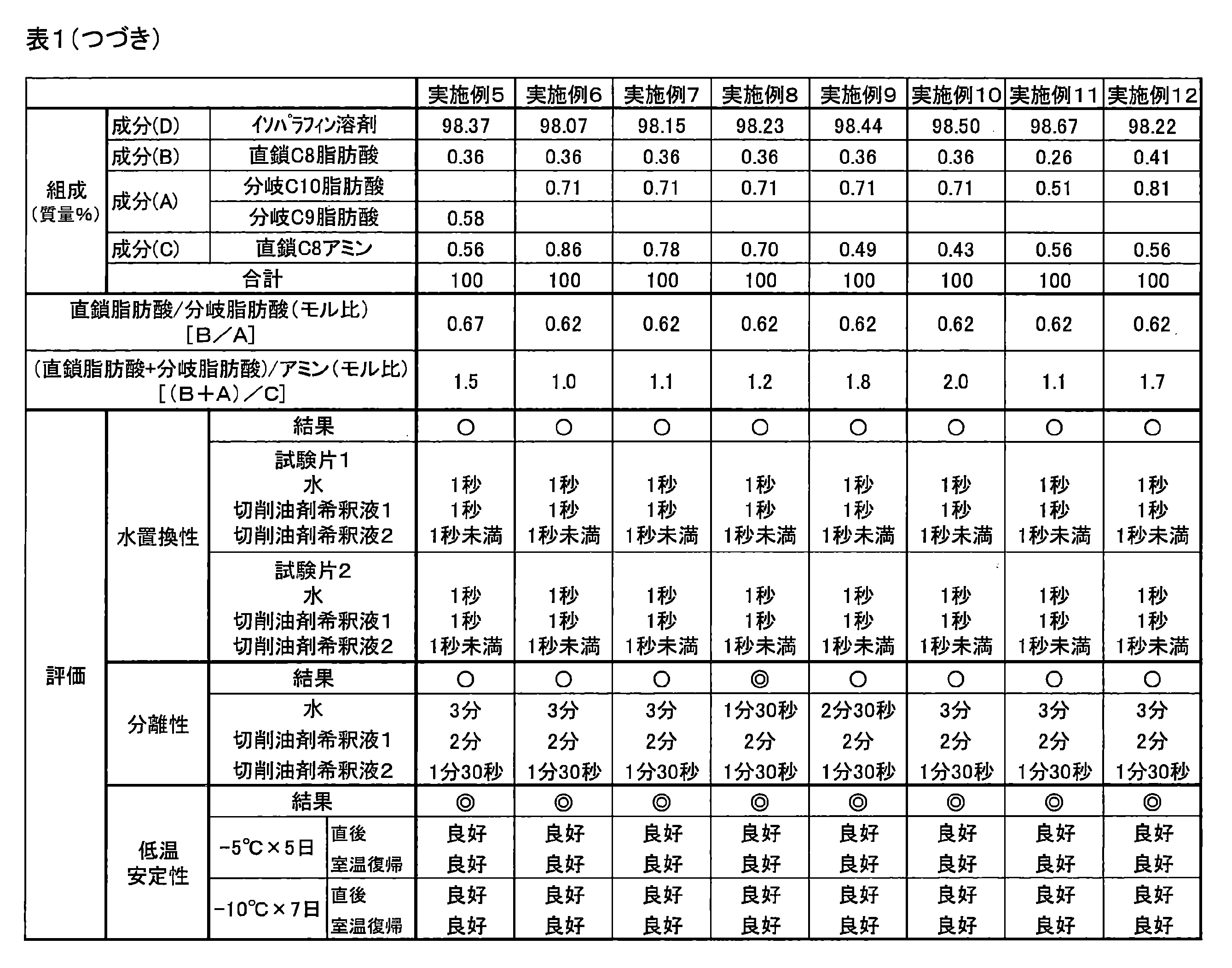
表1で使用した成分は、以下のとおりである。
1.成分(A)
分岐C10脂肪酸:ネオデカン酸
分岐C9脂肪酸:トリメチルヘキサン酸
2.成分(B)
直鎖C8脂肪酸:n-オクタン酸
3.成分(C)
直鎖C8アミン:n-オクチルアミン
4.成分(D)
イソパラフィン溶剤:イソパラフィン系炭化水素(イソウンデカンを主成分として含む;JIS K2254:1998に準拠した常圧法蒸留試験において100容量%留出温度が173~178℃である)
5.その他
アルカノールアミン:N-メチルジエタノールアミン
1.成分(A)
分岐C10脂肪酸:ネオデカン酸
分岐C9脂肪酸:トリメチルヘキサン酸
2.成分(B)
直鎖C8脂肪酸:n-オクタン酸
3.成分(C)
直鎖C8アミン:n-オクチルアミン
4.成分(D)
イソパラフィン溶剤:イソパラフィン系炭化水素(イソウンデカンを主成分として含む;JIS K2254:1998に準拠した常圧法蒸留試験において100容量%留出温度が173~178℃である)
5.その他
アルカノールアミン:N-メチルジエタノールアミン
表1に示すように、(A)分岐脂肪族モノカルボン酸および(B)直鎖脂肪族モノカルボン酸を特定比率で組み合わせて配合された実施例の洗浄油組成物は、優れた水置換性と分離性を有しながら、-5℃の低温環境下において良好な低温安定性を示すことが確認された。
さらに、モル比[B/A]が0.9以下の実施例2~16の洗浄油組成物は、-10℃の低温環境下においても良好な低温安定性を示すことが確認された。
特に、(C)酸素原子非含有モノアミンに対する(A)分岐脂肪族モノカルボン酸および(B)直鎖脂肪族モノカルボン酸の合計のモル比[(B+A)/C]が、1.2以上1.4以下である、実施例8では、分離性が一層向上することが確認された。
さらに、モル比[B/A]が0.9以下の実施例2~16の洗浄油組成物は、-10℃の低温環境下においても良好な低温安定性を示すことが確認された。
特に、(C)酸素原子非含有モノアミンに対する(A)分岐脂肪族モノカルボン酸および(B)直鎖脂肪族モノカルボン酸の合計のモル比[(B+A)/C]が、1.2以上1.4以下である、実施例8では、分離性が一層向上することが確認された。
これに対し、(A)分岐脂肪族モノカルボン酸を含まない比較例1および(A)分岐脂肪族モノカルボン酸および(B)直鎖脂肪族モノカルボン酸のモル比率[B/A]が1.4を超える比較例2は低温安定性が悪かった。
また、(B)直鎖脂肪族モノカルボン酸を含まない比較例3、(C)酸素原子非含有モノアミンを含まない比較例4、(C)酸素原子非含有モノアミンではなくアルカノールアミンを含む比較例5では十分な分離性が達成されなかった。
また、(B)直鎖脂肪族モノカルボン酸を含まない比較例3、(C)酸素原子非含有モノアミンを含まない比較例4、(C)酸素原子非含有モノアミンではなくアルカノールアミンを含む比較例5では十分な分離性が達成されなかった。
本発明の範囲は以上の説明に拘束されることはなく、上記例示以外についても、本発明の趣旨を損なわない範囲で適宜変更し実施し得る。なお、本明細書に記載した全ての文献及び刊行物は、その目的にかかわらず参照によりその全体を本明細書に組み込むものとする。また、本明細書は、本願の優先権主張の基礎となる日本国特許出願である特願2018-150678号(2018年8月9日出願)の特許請求の範囲、明細書の開示内容を包含する。
本発明の洗浄油組成物は、表面に水分または水系加工油が付着した被洗浄物の洗浄に好適に用いられる。
Claims (13)
- 以下の成分:
(A)分岐脂肪族モノカルボン酸、
(B)直鎖脂肪族モノカルボン酸、
(C)酸素原子非含有モノアミン、および
(D)炭化水素系溶剤、
を含み、
前記成分(A)に対する前記成分(B)のモル比[B/A]が、1.4以下である、洗浄油組成物。 - 前記成分(A)は、炭素数6~12の分岐脂肪族モノカルボン酸である、請求項1に記載の組成物。
- 前記成分(B)は、炭素数6~10の直鎖脂肪族モノカルボン酸である、請求項1または2に記載の組成物。
- 前記成分(C)は、炭素数6~10の脂肪族モノアミンである、請求項1~3のいずれか一項に記載の組成物。
- 前記成分(A)に対する前記成分(B)のモル比[B/A]が、0.1以上1.4以下である、請求項1~4のいずれか一項に記載の組成物。
- 前記成分(C)に対する前記成分(A)および前記成分(B)の合計のモル比[(B+A)/C]が、0.1以上3以下である、請求項1~5のいずれか一項に記載の組成物。
- 前記成分(A)、前記成分(B)、前記成分(C)、および前記成分(D)の含有量の合計が、前記組成物の総質量に対して80質量%以上である、請求項1~6のいずれか一項に記載の組成物。
- ハロゲン系溶剤の含有量が前記組成物の総質量に対して1質量%以下である、請求項1~7のいずれか一項に記載の組成物。
- 前記成分(D)はJIS K2254:1998に準拠した常圧法蒸留試験において100容量%留出温度が165~270℃の範囲のイソパラフィン系溶剤である、請求項1~8のいずれか一項に記載の組成物。
- 前記組成物の総質量に対して
前記成分(A) 0.01質量%以上10質量%以下
前記成分(B) 0.01質量%以上10質量%以下
前記成分(C) 0.1質量%以上10質量%以下、および
前記成分(D) 70質量%以上99質量%以下
を含む、請求項1~9のいずれか一項に記載の組成物。 - 表面に水分が付着した被洗浄物の洗浄に用いられる、請求項1~10のいずれか一項に記載の組成物であって、前記被洗浄物は金属材料である、組成物。
- 洗浄油組成物の製造方法であって、
以下の成分:
(A)分岐脂肪族モノカルボン酸、
(B)直鎖脂肪族モノカルボン酸、
(C)酸素原子非含有モノアミン、および
(D)炭化水素系溶剤
を混合することを含み、
前記成分(A)に対する前記成分(B)のモル比[B/A]が、1.4以下である、方法。 - 表面に水分が付着した被洗浄物を水切り洗浄する方法であって、請求項1~10のいずれか一項に記載の組成物を用いて前記被洗浄物を洗浄することを含む、方法。
Priority Applications (1)
| Application Number | Priority Date | Filing Date | Title |
|---|---|---|---|
| CN201980052185.1A CN112513231B (zh) | 2018-08-09 | 2019-08-07 | 清洗油组合物、其制造方法、以及除水清洗方法 |
Applications Claiming Priority (2)
| Application Number | Priority Date | Filing Date | Title |
|---|---|---|---|
| JP2018-150678 | 2018-08-09 | ||
| JP2018150678A JP7132023B2 (ja) | 2018-08-09 | 2018-08-09 | 洗浄油組成物、その製造方法、および水切り洗浄方法 |
Publications (1)
| Publication Number | Publication Date |
|---|---|
| WO2020032085A1 true WO2020032085A1 (ja) | 2020-02-13 |
Family
ID=69414886
Family Applications (1)
| Application Number | Title | Priority Date | Filing Date |
|---|---|---|---|
| PCT/JP2019/031061 Ceased WO2020032085A1 (ja) | 2018-08-09 | 2019-08-07 | 洗浄油組成物、その製造方法、および水切り洗浄方法 |
Country Status (3)
| Country | Link |
|---|---|
| JP (1) | JP7132023B2 (ja) |
| CN (1) | CN112513231B (ja) |
| WO (1) | WO2020032085A1 (ja) |
Citations (5)
| Publication number | Priority date | Publication date | Assignee | Title |
|---|---|---|---|---|
| JPH0680995A (ja) * | 1992-08-31 | 1994-03-22 | Asahi Chem Ind Co Ltd | 低残渣洗浄剤 |
| JPH07284605A (ja) * | 1994-04-15 | 1995-10-31 | Asahi Chem Ind Co Ltd | 水切り溶剤組成物 |
| JPH1015302A (ja) * | 1996-07-02 | 1998-01-20 | Toshiba Corp | 水切り用組成物 |
| JP2010037271A (ja) * | 2008-08-05 | 2010-02-18 | Mandom Corp | 透明ジェル状髭剃り用組成物。 |
| JP2010209246A (ja) * | 2009-03-11 | 2010-09-24 | Idemitsu Kosan Co Ltd | 金属加工油剤 |
Family Cites Families (2)
| Publication number | Priority date | Publication date | Assignee | Title |
|---|---|---|---|---|
| JP5827782B2 (ja) * | 2009-05-08 | 2015-12-02 | 出光興産株式会社 | 生分解性潤滑油組成物 |
| US20150147802A1 (en) * | 2012-05-28 | 2015-05-28 | Kao Corporation | Cleaning agent composition for medical-instrument cleaner |
-
2018
- 2018-08-09 JP JP2018150678A patent/JP7132023B2/ja active Active
-
2019
- 2019-08-07 CN CN201980052185.1A patent/CN112513231B/zh active Active
- 2019-08-07 WO PCT/JP2019/031061 patent/WO2020032085A1/ja not_active Ceased
Patent Citations (5)
| Publication number | Priority date | Publication date | Assignee | Title |
|---|---|---|---|---|
| JPH0680995A (ja) * | 1992-08-31 | 1994-03-22 | Asahi Chem Ind Co Ltd | 低残渣洗浄剤 |
| JPH07284605A (ja) * | 1994-04-15 | 1995-10-31 | Asahi Chem Ind Co Ltd | 水切り溶剤組成物 |
| JPH1015302A (ja) * | 1996-07-02 | 1998-01-20 | Toshiba Corp | 水切り用組成物 |
| JP2010037271A (ja) * | 2008-08-05 | 2010-02-18 | Mandom Corp | 透明ジェル状髭剃り用組成物。 |
| JP2010209246A (ja) * | 2009-03-11 | 2010-09-24 | Idemitsu Kosan Co Ltd | 金属加工油剤 |
Also Published As
| Publication number | Publication date |
|---|---|
| JP2020026451A (ja) | 2020-02-20 |
| JP7132023B2 (ja) | 2022-09-06 |
| CN112513231B (zh) | 2022-11-22 |
| CN112513231A (zh) | 2021-03-16 |
Similar Documents
| Publication | Publication Date | Title |
|---|---|---|
| CN108315748B (zh) | 一种金属清洗剂及其制备方法 | |
| JP6426900B2 (ja) | 洗浄組成物及び方法 | |
| JP6226144B2 (ja) | 洗浄剤組成物原液、洗浄剤組成物および洗浄方法 | |
| CN111705323A (zh) | 一种不锈钢环保清洗剂及清洗不锈钢零件的方法 | |
| JPS588799A (ja) | 金属加工油剤 | |
| JPH04232288A (ja) | 環境上安全な清掃方法 | |
| CN106893642A (zh) | 一种水基清洗剂及其用途 | |
| CN110760861A (zh) | 一种铜清洗剂及其制备方法 | |
| JP7132023B2 (ja) | 洗浄油組成物、その製造方法、および水切り洗浄方法 | |
| JP2009079083A (ja) | 遊離砥粒ワイヤソー用水溶性加工油剤 | |
| TW201736587A (zh) | 水溶性金屬加工油組成物、金屬加工液及金屬加工方法 | |
| JP3160854B2 (ja) | 粒子除去用洗浄剤組成物、その製造方法及びそれを用いる洗浄方法 | |
| JPH0680995A (ja) | 低残渣洗浄剤 | |
| CN113980716B (zh) | 金属加工油剂组合物和金属加工方法 | |
| WO2013099891A1 (ja) | 水性洗浄剤 | |
| JP2003049197A (ja) | 洗浄除去剤及び洗浄方法 | |
| JP5021186B2 (ja) | 金属部品類の加工・洗浄方法 | |
| JP6098473B2 (ja) | カーボネート系洗浄剤 | |
| CN101993796B (zh) | 洗涤剂组合物和使用其的洗涤方法 | |
| JP4114052B2 (ja) | 水系洗浄剤組成物 | |
| JPH09314459A (ja) | 水性ラップ液組成物 | |
| US20170130173A1 (en) | Method for removing rust from a surface | |
| JP7123045B2 (ja) | W/o型エマルション洗浄剤組成物、w/o型エマルション洗浄剤組成物を使用する洗浄方法、およびw/o型エマルション洗浄剤組成物の製造方法 | |
| JP2008214510A (ja) | 金属用水溶性加工油剤 | |
| JP2969421B2 (ja) | 鉄系金属用洗浄剤組成物 |
Legal Events
| Date | Code | Title | Description |
|---|---|---|---|
| 121 | Ep: the epo has been informed by wipo that ep was designated in this application |
Ref document number: 19846095 Country of ref document: EP Kind code of ref document: A1 |
|
| NENP | Non-entry into the national phase |
Ref country code: DE |
|
| 122 | Ep: pct application non-entry in european phase |
Ref document number: 19846095 Country of ref document: EP Kind code of ref document: A1 |