WO2020032038A1 - モノアミンオキシダーゼbイメージングプローブ - Google Patents
モノアミンオキシダーゼbイメージングプローブ Download PDFInfo
- Publication number
- WO2020032038A1 WO2020032038A1 PCT/JP2019/030936 JP2019030936W WO2020032038A1 WO 2020032038 A1 WO2020032038 A1 WO 2020032038A1 JP 2019030936 W JP2019030936 W JP 2019030936W WO 2020032038 A1 WO2020032038 A1 WO 2020032038A1
- Authority
- WO
- WIPO (PCT)
- Prior art keywords
- compound
- formula
- group
- pharmaceutically acceptable
- solvate
- Prior art date
- Legal status (The legal status is an assumption and is not a legal conclusion. Google has not performed a legal analysis and makes no representation as to the accuracy of the status listed.)
- Ceased
Links
- 0 *C[C@@](*)COc(cc1)cc(cc2)c1nc2-c1cnc(*)cc1 Chemical compound *C[C@@](*)COc(cc1)cc(cc2)c1nc2-c1cnc(*)cc1 0.000 description 3
- FGSCHDKSNYRGOP-SNVBAGLBSA-N Clc1ccc(cc(cc2)OC[C@H]3OC3)c2n1 Chemical compound Clc1ccc(cc(cc2)OC[C@H]3OC3)c2n1 FGSCHDKSNYRGOP-SNVBAGLBSA-N 0.000 description 1
Images

Classifications
-
- C—CHEMISTRY; METALLURGY
- C07—ORGANIC CHEMISTRY
- C07B—GENERAL METHODS OF ORGANIC CHEMISTRY; APPARATUS THEREFOR
- C07B59/00—Introduction of isotopes of elements into organic compounds ; Labelled organic compounds per se
- C07B59/002—Heterocyclic compounds
-
- A—HUMAN NECESSITIES
- A61—MEDICAL OR VETERINARY SCIENCE; HYGIENE
- A61K—PREPARATIONS FOR MEDICAL, DENTAL OR TOILETRY PURPOSES
- A61K51/00—Preparations containing radioactive substances for use in therapy or testing in vivo
- A61K51/02—Preparations containing radioactive substances for use in therapy or testing in vivo characterised by the carrier, i.e. characterised by the agent or material covalently linked or complexing the radioactive nucleus
- A61K51/04—Organic compounds
- A61K51/041—Heterocyclic compounds
- A61K51/044—Heterocyclic compounds having nitrogen as a ring hetero atom, e.g. guanethidine, rifamycins
- A61K51/0455—Heterocyclic compounds having nitrogen as a ring hetero atom, e.g. guanethidine, rifamycins having six-membered rings with one nitrogen as the only ring hetero atom
-
- A—HUMAN NECESSITIES
- A61—MEDICAL OR VETERINARY SCIENCE; HYGIENE
- A61P—SPECIFIC THERAPEUTIC ACTIVITY OF CHEMICAL COMPOUNDS OR MEDICINAL PREPARATIONS
- A61P21/00—Drugs for disorders of the muscular or neuromuscular system
- A61P21/02—Muscle relaxants, e.g. for tetanus or cramps
-
- A—HUMAN NECESSITIES
- A61—MEDICAL OR VETERINARY SCIENCE; HYGIENE
- A61P—SPECIFIC THERAPEUTIC ACTIVITY OF CHEMICAL COMPOUNDS OR MEDICINAL PREPARATIONS
- A61P25/00—Drugs for disorders of the nervous system
-
- A—HUMAN NECESSITIES
- A61—MEDICAL OR VETERINARY SCIENCE; HYGIENE
- A61P—SPECIFIC THERAPEUTIC ACTIVITY OF CHEMICAL COMPOUNDS OR MEDICINAL PREPARATIONS
- A61P25/00—Drugs for disorders of the nervous system
- A61P25/08—Antiepileptics; Anticonvulsants
-
- A—HUMAN NECESSITIES
- A61—MEDICAL OR VETERINARY SCIENCE; HYGIENE
- A61P—SPECIFIC THERAPEUTIC ACTIVITY OF CHEMICAL COMPOUNDS OR MEDICINAL PREPARATIONS
- A61P25/00—Drugs for disorders of the nervous system
- A61P25/14—Drugs for disorders of the nervous system for treating abnormal movements, e.g. chorea, dyskinesia
-
- A—HUMAN NECESSITIES
- A61—MEDICAL OR VETERINARY SCIENCE; HYGIENE
- A61P—SPECIFIC THERAPEUTIC ACTIVITY OF CHEMICAL COMPOUNDS OR MEDICINAL PREPARATIONS
- A61P25/00—Drugs for disorders of the nervous system
- A61P25/14—Drugs for disorders of the nervous system for treating abnormal movements, e.g. chorea, dyskinesia
- A61P25/16—Anti-Parkinson drugs
-
- A—HUMAN NECESSITIES
- A61—MEDICAL OR VETERINARY SCIENCE; HYGIENE
- A61P—SPECIFIC THERAPEUTIC ACTIVITY OF CHEMICAL COMPOUNDS OR MEDICINAL PREPARATIONS
- A61P25/00—Drugs for disorders of the nervous system
- A61P25/18—Antipsychotics, i.e. neuroleptics; Drugs for mania or schizophrenia
-
- A—HUMAN NECESSITIES
- A61—MEDICAL OR VETERINARY SCIENCE; HYGIENE
- A61P—SPECIFIC THERAPEUTIC ACTIVITY OF CHEMICAL COMPOUNDS OR MEDICINAL PREPARATIONS
- A61P25/00—Drugs for disorders of the nervous system
- A61P25/24—Antidepressants
-
- A—HUMAN NECESSITIES
- A61—MEDICAL OR VETERINARY SCIENCE; HYGIENE
- A61P—SPECIFIC THERAPEUTIC ACTIVITY OF CHEMICAL COMPOUNDS OR MEDICINAL PREPARATIONS
- A61P25/00—Drugs for disorders of the nervous system
- A61P25/28—Drugs for disorders of the nervous system for treating neurodegenerative disorders of the central nervous system, e.g. nootropic agents, cognition enhancers, drugs for treating Alzheimer's disease or other forms of dementia
-
- A—HUMAN NECESSITIES
- A61—MEDICAL OR VETERINARY SCIENCE; HYGIENE
- A61P—SPECIFIC THERAPEUTIC ACTIVITY OF CHEMICAL COMPOUNDS OR MEDICINAL PREPARATIONS
- A61P43/00—Drugs for specific purposes, not provided for in groups A61P1/00-A61P41/00
-
- C—CHEMISTRY; METALLURGY
- C07—ORGANIC CHEMISTRY
- C07B—GENERAL METHODS OF ORGANIC CHEMISTRY; APPARATUS THEREFOR
- C07B59/00—Introduction of isotopes of elements into organic compounds ; Labelled organic compounds per se
-
- C—CHEMISTRY; METALLURGY
- C07—ORGANIC CHEMISTRY
- C07D—HETEROCYCLIC COMPOUNDS
- C07D401/00—Heterocyclic compounds containing two or more hetero rings, having nitrogen atoms as the only ring hetero atoms, at least one ring being a six-membered ring with only one nitrogen atom
- C07D401/02—Heterocyclic compounds containing two or more hetero rings, having nitrogen atoms as the only ring hetero atoms, at least one ring being a six-membered ring with only one nitrogen atom containing two hetero rings
- C07D401/04—Heterocyclic compounds containing two or more hetero rings, having nitrogen atoms as the only ring hetero atoms, at least one ring being a six-membered ring with only one nitrogen atom containing two hetero rings directly linked by a ring-member-to-ring-member bond
-
- C—CHEMISTRY; METALLURGY
- C07—ORGANIC CHEMISTRY
- C07B—GENERAL METHODS OF ORGANIC CHEMISTRY; APPARATUS THEREFOR
- C07B2200/00—Indexing scheme relating to specific properties of organic compounds
- C07B2200/05—Isotopically modified compounds, e.g. labelled
Definitions
- the present invention relates to a monoamine oxidase B imaging probe which enables differential diagnosis of a wide range of neurological diseases. Specifically, the present invention relates to a pyridine-substituted quinoline compound derivative, a pharmaceutical composition for diagnostic imaging containing the labeled compound, and a diagnostic imaging method using the labeled compound.
- a method of detecting proteins accumulated in the brain specific to each disease is considered to be useful, and amyloid PET probes and tau PET probes have been put to practical use.
- the method for detecting a protein specific to this disease for example, Parkinson's disease (and dementia with Lewy bodies) requires a probe for detecting alpha-synuclein, but an alpha-synuclein probe has not yet been developed.
- TDP-43 has been identified as a pathogenic protein in amyotrophic lateral sclerosis (ALS), but a probe that detects TDP-43 has not been developed at present (Non-Patent Document 1).
- Monoamine oxidase B (MAO-B) is found mainly in non-neuronal cells in the brain, such as astrocytes and radial glial cells, and monoamine oxidase B levels are age-dependent in both humans and mice, and It is known to increase in connection with neurological diseases (Non-Patent Documents 2 and 3).
- Non-Patent Document 4 various neurological diseases such as cerebrovascular disorder, traumatic brain injury, and epilepsy increase astrocytes (Non-Patent Document 4), and monoamine oxidase B is contained in astrocytes. It is known to be expressed (Non-Patent Document 5). Therefore, a probe that specifically or selectively binds to monoamine oxidase B is expected to be capable of diagnosing a wide variety of neurological diseases and clarifying the pathological condition through quantification of astrocytes. You.
- THK5351 as the tau PET probe developed by the present inventors includes frontotemporal lobe degeneration such as Alzheimer's disease, progressive supranuclear palsy, cortical basal ganglia degeneration, semantic dementia and progressive non-fluent aphasia.
- frontotemporal lobe degeneration such as Alzheimer's disease, progressive supranuclear palsy, cortical basal ganglia degeneration, semantic dementia and progressive non-fluent aphasia.
- Disease-related accumulation patterns in various neurodegenerative diseases was observed in the basal ganglia where no tau pathological images existed, and high accumulation was observed in semantic dementia where tau lesions are considered not to appear, indicating that binding to a target different from tau protein was observed.
- Non-Patent Document 6 Detailed analysis revealed that the THK5351 also has a high binding affinity for monoamine oxidase B (Patent Document 3).
- the THK5351 also has a binding property to monoamine oxidase B, it has a binding property to tau, and thus non-selectively binds to monoamine oxidase B. Therefore, in order to quantify astrocytes, it is necessary to develop a probe that excludes the binding to tau and exhibits specific binding to monoamine oxidase B.
- An object of the present invention is to provide a compound having high specificity and selectivity for monoamine oxidase B, that is, capable of imaging monoamine oxidase B with good sensitivity without binding to misfolded proteins such as tau. And Accordingly, an object of the present invention is to provide a monoamine oxidase B imaging probe that enables diagnosis of a wide range of neurological diseases related to monoamine oxidase B and enables quantification of astrocytes.
- the present inventors have conducted intensive studies in view of the above problems, and as a result, the compound represented by formula (I) (including (I ′)) has high specificity and selectivity for monoamine oxidase B, was found to be a compound that does not bind to the misfolded protein of Example 1, can image monoamine oxidase B with good sensitivity, and has high brain localization. Further, they have also found that the compound represented by the formula (II) (including (II ′)) can be used as a precursor of the compound represented by the formula (I). As a result, the present inventors have completed the present invention.
- A is the formula: A cyclic group represented by Ring A is unsubstituted or optionally substituted with one or more R 5 , wherein each R 5 is independently a C1-C6 alkyl group, or a C3-C6 cycloalkyl group; R 1 groups are C1-C6 alkyl groups or C3-C6 cycloalkyl groups; Z is the formula: Is a group represented by Where: R 2 is a halogen atom, R 3 is a hydroxy group, Each R 6 is independently a C1-C6 alkyl group, or a C3-C6 cycloalkyl group; o is an integer of 0 to 1, p is an integer of 0 to 1, q is an integer from 0 to 2; R 4 is each independently a C1-C6 alkyl group or a C3-C6 cycloalky
- Ring A has the formula: Any cyclic group represented by: R 1 is a C1-C3 alkyl group; Z is the formula: Is a group represented by Where: R 2 and R 3 are as defined in item [1]; R 4 and R 5 are each independently a C1-C3 alkyl group; m is an integer from 0 to 1; and n is an integer of 0 to 1, Item 7.
- R 1 is a C1-C3 alkyl group
- Z is the formula: Is a group represented by Where: R 2 and R 3 are as defined in item [1]; R 4 and R 5 are each independently a C1-C3 alkyl group; m is an integer from 0 to 1; and n is an integer of 0 to 1, Item 7.
- the compound according to item [1], or a pharmaceutically acceptable salt or solvate thereof is a pharmaceutically acceptable salt or solvate thereof.
- Formula (I ′) [Where, A, R 1 , R 2 and R 3 are as defined in item [1]] Or a pharmaceutically acceptable salt or solvate thereof.
- Item [4] Formula (I-1), (I-2) or (I-3): Where: R 1 is a C1-C3 alkyl group, R 2 is a fluorine atom, and R 3 is a hydroxy group, The compound according to any one of Items [1] to [3], or a pharmaceutically acceptable salt or solvate thereof.
- Item [4-2] The compound according to any one of Items [1] to [3], wherein R 1 is a methyl group or an ethyl group, or a pharmaceutically acceptable salt or solvate thereof. .
- Item [4-3] The compound according to any one of Items [1] to [3], wherein R 1 is a methyl group, or a pharmaceutically acceptable salt or solvate thereof.
- Item [5] The following compound: The compound according to item [1], or a pharmaceutically acceptable salt or solvate selected from the group consisting of:
- Item [6] The compound according to any one of Items [1] to [5], which is labeled with any one of a radionuclide and a positron-emitting nuclide, or a pharmaceutically acceptable salt or solvate. .
- the positron emitting nuclide is 11 C, 13 N, 15 O, 18 F, 34 mCl, 76 Br, 45 Ti, 48 V, 60 Cu, 61 Cu, 62 Cu, 64 Cu, 66 Ga, 89 Zr. , 94m Tc and 124 I, or a pharmaceutically acceptable salt or solvate thereof according to item [6].
- Item [7-2] The compound of Item [6], wherein the positron-emitting nuclide is 11 C or 18 F, or a pharmaceutically acceptable salt or solvate thereof.
- Item [8] The compound according to any one of Items [1] to [7], wherein R 2 is 18 F, or a pharmaceutically acceptable salt or solvate thereof.
- Item [9] The following compound: The compound according to any one of items [6] to [8], or a pharmaceutically acceptable salt or solvate thereof, selected from the group consisting of:
- Item [10] The compound according to any one of Items [1] to [9] (for example, Items [6] to [9]), or a pharmaceutically acceptable salt or solvate thereof, and a pharmaceutical.
- a pharmaceutical composition for diagnostic imaging of a monoamine oxidase B-related neurological disease comprising a carrier that is acceptable to a patient.
- Item [10-2] The pharmaceutical composition for image diagnosis according to Item [10], which is used for identification and diagnosis of a monoamine oxidase B-related neurological disease.
- Item [11] The compound according to any one of Items [1] to [9] (for example, Items [6] to [9]) or a pharmaceutically acceptable salt or solvate thereof is essential.
- a kit for imaging diagnosis of a monoamine oxidase B-related neurological disease comprising as an element.
- Monoamine oxidase B-related neurological diseases include Alzheimer's disease, Parkinson's disease, progressive supranuclear palsy, basal ganglia degeneration, multiple system atrophy, amyotrophic lateral sclerosis (ALS), frontotemporal Item [1] which is one or more diseases selected from the group consisting of lobe degeneration, Huntington's disease, Alexander's disease, cerebrovascular disorder, traumatic brain injury, central nervous system infection, epilepsy, schizophrenia, major depression, etc.
- Item [12-2] A monoamine containing the compound according to any one of Items [1] to [5] or a pharmaceutically acceptable salt or solvate thereof, and a pharmaceutically acceptable carrier.
- Monoamine oxidase B-related neurological diseases include Alzheimer's disease, Parkinson's disease, progressive supranuclear palsy, basal ganglia degeneration, multiple system atrophy, amyotrophic lateral sclerosis (ALS), frontal Temporal lobe degeneration, Huntington's disease, Alexander's disease, cerebrovascular disease, traumatic brain injury, central nervous system infection, epilepsy, schizophrenia, one or more diseases selected from the group consisting of major depression, The pharmaceutical composition according to item [12-2].
- Item [13] The compound according to any one of Items [1] to [9] (for example, Items [6] to [9]) or a pharmaceutically acceptable salt or solvate thereof is administered to a subject.
- a method for diagnosing a monoamine oxidase B-related neurological disorder in a subject comprising: Item [13-2]
- the compound according to any one of Items [1] to [9] (for example, Items [6] to [9]) or a pharmaceutically acceptable salt or solvate thereof is used.
- An image diagnostic method comprising detecting or staining monoamine oxidase B in a sample by staining the sample with the reagent.
- Items [1] to [9] for example, any of items [6] to [9]) for producing a diagnostic imaging pharmaceutical composition or kit for detecting or staining monoamine oxidase B Or a pharmaceutically acceptable salt or solvate thereof.
- R 2 is a methanesulfonyloxy (mesyloxy; Ms—O—) group, a trifluoromethanesulfonyloxy (Tf—O—) group, or a p-toluenesulfonyloxy (Ts—O—) group;
- Step (ii) A compound of the formula (VIII) is converted to a compound of the formula (IX): [Where, R 2 is as defined in item [14], and R 3 is OTBS] And reacting with a compound of the formula (II ′): [Where, R 2 is as defined in item [14], and R 3 is OTBS] To obtain a compound of the formula Step (iii) The compound of formula (II ′) is reacted with trifluoroacetic acid to deprotect the OTBS group, and then reacted with 3,4-dihydro-2H-pyran to convert R 3 to an OTHP group.
- Step (iv) Deprotecting the OTHP group of R 3 in the compound obtained in Step (iii) to convert R 3 to a hydroxy group;
- Step (v) The leaving group of R 2 in the compound obtained in the step (iv) is reacted with a fluorinating agent to convert R 2 to a fluorine atom, to obtain a compound of the formula (I ′): [Wherein, A and R 1 are as defined in the above item [1]]
- a method for producing, comprising producing a compound represented by the formula:
- a compound having high specificity and selectivity for monoamine oxidase B, and a precursor thereof are provided.
- the compounds of the present invention have high brain localization and low or no bone accumulation. Therefore, using the compound of the present invention, a monoamine oxidase B imaging probe capable of diagnosing a neurological disease related to monoamine oxidase B or quantifying astrocytes can be obtained.
- FIG. 1 shows a compound ((S)-[ 18 F] THK-5470) according to the present invention and a control compound ((S)-[ 18 F] THK-5174 or (S)-[ 18 F] THK- 5351) is a drawing showing an in vitro autoradiographic image of a human autopsy brain and MAO-B, A ⁇ , and tau immunity (IHC; immunohistochemistry) staining in adjacent sections. Arrows indicate binding to tau.
- FIG. 1 shows a compound ((S)-[ 18 F] THK-5470) according to the present invention and a control compound ((S)-[ 18 F] THK-5174 or (S)-[ 18 F] THK- 5351) is a drawing showing an in vitro autoradiographic image of a human autopsy brain and MAO-B, A ⁇ , and tau immunity (IHC; immunohistochemistry) staining in adjacent sections. Arrows indicate binding to tau.
- FIG. 1 shows a compound ((S)-[ 18 F] THK-5470) according
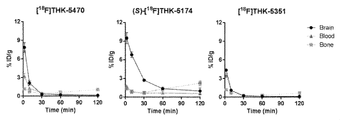
- FIG. 2 shows a compound ((S)-[ 18 F] THK-5470) according to the present invention and a control compound ((S)-[ 18 F] THK-5174 or (S)-[ 18 F] THK- 5351) is a drawing showing the dynamic evaluation based on the accumulation distribution in the brain, blood, or bone of a normal mouse using 5351).
- the compound of the present invention is a compound represented by formula (I) (including formula (I ′), formula (I-1), formula (I-2) and formula (I-3)) described below, or It is a salt or solvate thereof.
- formula (I) including formula (I ′), formula (I-1), formula (I-2) and formula (I-3)
- the terms “the compound of the present invention” and “the compound of the present invention” include the compound of the formula (I) and salts and solvates thereof, unless otherwise specified. .
- C1-C6 alkyl group refers to a linear or branched alkyl group having 1 to 6 carbon atoms, and specifically includes, for example, a methyl group, an ethyl group, a propyl group, and an isopropyl group.
- butyl group isobutyl group, sec-butyl group, tert-butyl group, pentyl group, isopentyl group, neopentyl group, 1,1-dimethylpropyl group, 1-methylbutyl group, 2-methylbutyl group, 3-methylbutyl group, 1,2-dimethylpropyl, hexyl, isohexyl, 1-methylpentyl, 2-methylpentyl, 3-methylpentyl, 1,1-dimethylbutyl, 1,2-dimethylbutyl, 2, 2-dimethylbutyl, 1,3-dimethylbutyl, 2,3-dimethylbutyl, 3,3-dimethylbutyl, 1-ethylbutyl 2-ethylbutyl group, 1,2,2-trimethyl propyl group, a 1-ethyl-2-methylpropyl group.
- the C1-C6 alkyl group is preferably a C1-C4 alkyl group, more preferably a C1-C3 alkyl group.
- Methyl or ethyl groups are even more preferred, and methyl groups are particularly preferred.
- C3-C6 cycloalkyl group means a cyclic alkyl group having 3 to 6 carbon atoms. Specifically, for example, a cyclopropyl group, a cyclobutyl group, a cyclopentyl group, and a cyclohexyl group are No.
- halogen means fluorine, chlorine, bromine, or iodine. Fluorine and chlorine are preferred, with fluorine being particularly preferred.
- monoamine oxidase means an enzyme that promotes metabolic oxidation of monoamines that are neurotransmitters (eg, dopamine, tyramine, noradrenaline, serotonin, and adrenaline).
- monoamine oxidases include monoamine oxidase A (abbreviated as “MAO-A”) and monoamine oxidase B (abbreviated as “MAO-B”).
- Astrocytes containing “monoamine oxidase B (MAO-B)” are involved in various neurological changes, and are therefore involved in the pathology of neurological diseases.
- monoamine oxidase B is prominent in caudate nucleus (caudate), putamen (putamen), frontal cortex (frontal cortex), and substantia nigra (substantia nigra). Elevated levels are seen (Tong et al., 017. Brain; 140.2460-2474). In addition, for multiple system atrophy (MSA), a marked increase in monoamine oxidase B levels was observed in putamen and in the substantia nigra (Tong et al., 2017). .Brain; 140.2460-2474).
- astrocytes are increased in various diseases such as traumatic brain injury, cerebrovascular disorder, central nervous system infection, and epilepsy.
- astrocyte abnormalities have been pointed out in psychiatric disorders such as schizophrenia and major depression, and quantification of astrocytes makes it possible to ascertain the condition of these diseases.
- neurological disorder refers to damage to a specific group of nerve cells (for example, nerve cells related to cognitive functions and cells related to motor functions) among nerve cells in the brain and spinal cord. Dysfunction that causes dysfunction. Specifically, Alzheimer's disease, Parkinson's disease, progressive supranuclear palsy, cortical basal ganglia degeneration, multiple system atrophy, amyotrophic lateral sclerosis, frontotemporal lobar degeneration, Huntington's disease, Alexander disease, This includes, but is not limited to, cerebrovascular disease, traumatic brain injury, central nervous system infection, epilepsy, schizophrenia, major depression.
- the present invention provides a compound of formula (I) that exhibits high specificity and selectivity for monoamine oxidase B:
- A is the formula: A cyclic group represented by Ring A is unsubstituted or optionally substituted with one or more R 5 , wherein each R 5 is independently a C1-C6 alkyl group, or a C3-C6 cycloalkyl group; R 1 groups are C1-C6 alkyl groups or C3-C6 cycloalkyl groups;
- Z is the formula: Is a group represented by Where: R 2 is a halogen atom, R 3 is a hydroxy group, Each R 6 is independently a C1-C6 alkyl group, or a C3-C6 cycloalkyl group; o is an integer of 0 to 1, p is an integer of 0 to 1, q is an integer from 0
- each bond means a bond to quinoline or a bond to R 1 as shown in the following formula.
- the ring A may be unsubstituted or optionally substituted with one or more R 5 groups, and each R 5 group is independently a C1-C6 alkyl group or a C3-C6 cycloalkyl group. It is.
- A preferably has the formula: Any cyclic group represented by
- ring A is either unsubstituted or substituted by one or more appropriately (e.g., 1 to 3, preferably 1) may be substituted with a substituent R 5 in.
- each substituent R 5 is independently a C1-C6 alkyl group or a C3-C6 cycloalkyl group.
- each substituent R 5 is independently a C1-C6 alkyl group, for example a C1-C3 alkyl group.
- the substituent R 5 is absent and Ring A is unsubstituted.
- the R 1 group is a C1-C6 alkyl group or a C3-C6 cycloalkyl group, preferably a C1-C6 alkyl group, and more preferably a C1-C3 alkyl group.
- a C1-C2 alkyl group is more preferable, and methyl is particularly preferable.
- the Z group has the formula: Is a group represented by Where: R 2 is a halogen atom, R 3 is a hydroxy group, R 6 is each independently a C1-C6 alkyl group or a C3-C6 cycloalkyl group; o is an integer of 0 to 1, p is an integer of 0 to 1, q is an integer of 0 to 2.
- each R 6 group is independently a C1-C6 alkyl group.
- the R 6 group is preferably a C1-C3 alkyl group.
- the group Z is such that when q is 0 and o is an integer of 0, p is an integer of 1 or o is an integer of 1 In this case, p is preferably an integer of 0.
- the Z group is represented by the formula: Wherein R 2 and R 3 are as defined in formula (I) above, Is preferably a group represented by The Z group has the formula: Wherein R 2 and R 3 are as defined in formula (I) above, Is more preferably a group represented by
- the symbol “*” in the formula refers to a chiral center of an asymmetric carbon, which means that it is an S-form.
- R 4 is absent or each independently is a C1-C6 alkyl group or a C3-C6 cycloalkyl group.
- each substituent R 5 is independently a C1-C6 alkyl group, for example a C1-C3 alkyl group.
- o is an integer from 0 to 1, preferably o is 0.
- p is an integer from 0 to 1, preferably p is 1.
- q is an integer from 0 to 2, preferably q is 0.
- m represents the number of R 5 substituents on the pyridine ring is an integer of 0 to 3, preferably, m is 0 to 1; and more preferably In the formula, m is an integer of 0.
- n represents the number of R 4 substituents on the quinoline ring and is an integer from 0 to 5, preferably n is an integer from 0 to 1, more preferably In the formula, n is an integer of 0.
- a group has the formula: Any cyclic group represented by: R 1 is a C1-C3 alkyl group;
- the Z group has the formula: A group represented by; Where: R 2 is a halogen atom, R 3 is a hydroxy group, R 4 and R 5 are each independently a C1-C3 alkyl group; m is an integer from 0 to 1; and n is an integer of 0 to 1, Compounds or pharmaceutically acceptable salts or solvates thereof.
- formula (I-1), (I-2) or (I-3) where: R 1 is a C1-C3 alkyl group, R 2 is a fluorine atom, and R 3 is a hydroxy group, Or a pharmaceutically acceptable salt or solvate thereof.
- specific compounds include the following compounds: Or a pharmaceutically acceptable salt or solvate, but is not limited thereto.
- preferred specific compounds include the following compounds: Or a pharmaceutically acceptable salt or solvate selected from the group consisting of:
- particularly preferred specific compounds include the following compounds: Or a pharmaceutically acceptable salt or solvate.
- the compound of formula (I) as the compound of the present invention has the following requirements necessary to be useful as a probe for imaging monoamine oxidase (MAO-B), which is useful in vivo.
- MAO-B monoamine oxidase
- Enzymes other than MAO-B (especially MAO-A) hardly bind to receptors.
- Probes administered intravenously to a living body must quickly penetrate the blood and brain barriers and enter the brain. 5.
- Probes transferred into the brain bind to MAO-B. 6. Probes that do not bind to MAO-B should be washed out of the brain relatively quickly.
- the compound of the formula (I) of the present invention is suitable for diagnostic imaging of binding to monoamine oxidase B, particularly diagnostic imaging using PET.
- neurological disorders associated with increased monoamine oxidase B eg Alzheimer's disease, Parkinson's disease, progressive supranuclear palsy, basal ganglia degeneration, multiple system atrophy, muscle Accurate in the early stages of atrophic lateral sclerosis, frontotemporal lobar degeneration, Huntington's disease, Alexander disease, cerebrovascular disease, traumatic brain injury, central nervous system infection, epilepsy, schizophrenia, major depression, etc.
- Discovery, diagnosis, effective treatment and prevention are possible.
- A is the formula: [Where, Ring A and R 5 are as defined in formula (I) above]
- R 1 is as defined in formula (I) above
- Z is the formula: [Where, R 2 is a halogen atom or a leaving group; R 3 is a hydroxy group or a hydroxy protecting group, Provided that when R 2 is a halogen atom, R 3 is not a hydroxy group; R 6 , o, p and q are as defined in the above formula (1)]
- a group represented by; R 4 , m and n are as defined in the above formula (1). " Or a pharmaceutically acceptable salt or solvate thereof.
- the term "leaving group” refers to a functional group that functions as a leaving group in a nucleophilic substitution reaction of a fluorine anion, such as a p-toluenesulfonyloxy group (OTs) or a methanesulfonyloxy group (OMs), a chloromethanesulfonyloxy group, a trifluoromethanesulfonyloxy group, and the like, but are not limited thereto.
- a fluorine anion such as a p-toluenesulfonyloxy group (OTs) or a methanesulfonyloxy group (OMs), a chloromethanesulfonyloxy group, a trifluoromethanesulfonyloxy group, and the like, but are not limited thereto.
- hydroxy protecting group refers to a protecting group for a hydroxy group that exhibits resistance to a nucleophilic substitution reaction of a fluorine anion and that can be removed under acidic or alkaline conditions.
- (2-THP) group methoxymethyl group, 2-methoxyethoxymethyl group, ethoxyethyl group, acetyl group, pivaloyl group and the like, but are not limited to us.
- R 3 is a hydroxy protecting group
- R 2 is a methanesulfonyloxy (mesyloxy; Ms—O—) group, a trifluoromethanesulfonyloxy (Tf—O—) group. , P-toluenesulfonyloxy (Ts-O-) group, and preferably p-toluenesulfonyloxy (Ts-O-) group.
- R 3 is a 2-tetrahydropyranyl (THP) group or a t-butyldimethylsilyl (TBS) group, preferably Is a 2-tetrahydropyranyl (THP) group.
- the compound of formula (II) can be used as a synthetic precursor of the compound of formula (I).
- Methods for converting a compound of formula (II) to a compound of formula (I) are well known to those skilled in the art, and can easily provide a compound of formula (I).
- Salts of the compound of the present invention are also included in the present invention.
- the salt comprises a compound represented by the formula (I) provided by the present invention (including the compound represented by the formula (I ′), the formula (I-1), the formula (I-2), or the formula (I-3)).
- the compound of the above formula (I) when the compound of the above formula (I) has a basic group derived from, for example, an amino group, a pyridyl group, etc. in the molecule, the compound is treated with an acid. Can be converted to the corresponding salt.
- the “pharmaceutically acceptable salt” includes an acid addition salt and a base addition salt.
- the acid addition salt includes, for example, hydrochloride, hydrofluoride, hydrobromide, hydrogen iodide Hydrohalides such as acid salts; inorganic salts such as nitrates, perchlorates, sulfates, phosphates and carbonates; lower alkyls such as methanesulfonate, trifluoromethanesulfonate and ethanesulfonate Sulfonates; aryl sulfonates such as benzene sulfonate and p-toluene sulfonate; organic acid salts such as fumarate, succinate, citrate, tartrate, oxalate, maleate; And acid addition salts which are organic acid salts such as amino acids such as glutamate and aspartate.
- inorganic salts such as nitrates, perchlorates, sulfates, phosphates and carbonates
- lower alkyls such as methanesulfonate
- the compound or precursor of the present invention has an acidic group in the structural formula
- the base addition salt has, for example, a carboxyl group or the like
- the compound or the precursor has a carboxyl group or the like
- the compound is converted to a base with a base.
- Treatment can also convert to the corresponding pharmaceutically acceptable salt.
- the base addition salt include, for example, alkali metal salts such as sodium and potassium, alkaline earth metal salts such as calcium and magnesium, ammonium salts, and organic base salts such as organic bases such as guanidine, triethylamine and dicyclohexylamine. Examples include salts with certain base addition salts.
- the compound of the present invention may exist as any hydrate or solvate of the free compound or a salt thereof.
- functional groups such as amino, thiol, carboxyl and hydroxy groups, if desired, may be any of those commonly used in preparative organic chemistry. It may be protected with conventional protecting groups. Protected amino, thiol, carboxyl, and hydroxy groups are converted to free amino, thiol, carboxyl, and hydroxy groups under mild conditions without breaking the molecular backbone or causing other unwanted side reactions. You can do it.
- the purpose of inserting the protecting group is to protect the functional group from undesired reactions with the reactants under the conditions used to effect the desired chemical transformation.
- the need and choice of protecting groups for a particular reaction are known to those skilled in the art, and the nature of the functional group to be protected (hydroxy, amino, etc.), the structure of the molecule of which the substituent is a part And stability, and reaction conditions.
- protective groups include tetrahydropyranyloxy (OTHP), methoxymethyl, acetyloxy (OAc).
- OTHP tetrahydropyranyloxy
- OAc acetyloxy
- the protecting group is eliminated under acidic conditions.
- the compound of the present invention can be used as a probe without labeling.
- the compound of the present invention may be brought into contact with a biopsy sample to examine the presence or absence of a stained portion.
- labeled compounds of the invention may include fluorescent materials, affinity materials, enzyme substrates, radionuclides, and the like.
- a probe labeled with a radionuclide is used for diagnostic imaging of neurological diseases related to monoamine oxidase B (MAO-B).
- the compounds of the present invention can be labeled with various radionuclides by methods well known in the art.
- 3 H, 14 C, 35 S, 131 I, etc. are radionuclides that have been used before and are often used in vitro.
- the general requirements for an imaging diagnostic probe and its detection means are that imaging diagnosis can be performed in vivo, little damage to the patient (especially non-invasive), high detection sensitivity, and half-life are appropriate. (The appropriate time for preparing the labeled probe and the time for diagnosis). Therefore, recently, positron emission tomography (PET) using gamma rays showing high detection sensitivity and material permeability or computed tomography with gamma-ray emitting nuclides (SPECT) has been used.
- PET positron emission tomography
- SPECT computed tomography with gamma-ray emitting nuclides
- PET is preferable because two ⁇ -rays emitted from positron-emitting nuclides in opposite directions are detected by a coincidence method using a pair of detectors, so that information excellent in resolving power and quantitativeness can be obtained.
- the compounds of the invention can be labeled with gamma-emitting nuclides such as 99m Tc, 111 In, 67 Ga, 201 Tl, 123 I, 133 Xe. 99m Tc and 123 I are commonly used for SPECT.
- the compounds of the present invention can be labeled with a positron emitting nuclide such as I.
- positron-emitting nuclides 11 C, 13 N, 15 O, and 18 F are preferable, 18 F and 11 C are more preferable, and 18 F is more preferable in terms of appropriate half-life and ease of labeling. Particularly preferred.
- the labeling position of the compound of the present invention with a radionuclide such as a positron-emitting nuclide or a gamma-ray-emitting nuclide may be any position, but a preferable labeling position is an alkyl group / quinoline ring in the compound. (Including the phenyl ring).
- a radionuclide such as a positron-emitting nuclide or a gamma-ray-emitting nuclide
- a preferable labeling position is an alkyl group / quinoline ring in the compound. (Including the phenyl ring).
- Such labeled compounds of the present invention are also encompassed by the present invention.
- any group in the side chain may be labeled with 18 F, or a hydrogen on the ring may be replaced with 18 F.
- hydrogen contained in any of the alkyl substituents may be substituted with 18 F.
- radionuclide used in the compounds according to the invention is produced by a device called a cyclotron or a generator. Those skilled in the art can select a production method and an apparatus according to the produced nuclide. The nuclide thus produced can be used to label a compound of the present invention.
- Methods for producing labeled compounds labeled with these radionuclides are well known in the art. Representative methods include chemical synthesis, isotope exchange, and biosynthesis.
- the chemical synthesis method has been widely used, and is essentially the same as the ordinary chemical synthesis method except that a radioactive starting material is used.
- Various nuclides are introduced into the compound by this method.
- the isotope exchange method is a method in which 3 H, 35 S, 125 I, etc. in a compound having a simple structure are transferred into a compound having a complicated structure to obtain a compound having a complicated structure labeled with these nuclides. .
- the biosynthesis method is a method in which a compound labeled with 14 C, 35 S or the like is given to cells such as a microorganism to obtain a metabolite into which these nuclides have been introduced.
- a compound labeled with 14 C, 35 S or the like is given to cells such as a microorganism to obtain a metabolite into which these nuclides have been introduced.
- 18 F a chemical form of a fluorine anion that can be produced in large quantities at a high specific activity by a cyclotron is often used for labeling synthesis, and a salt of an 18 F anion with enhanced nucleophilicity is used as a labeling agent.
- the compound of the present invention labeled with 18 F can be obtained.
- the nucleophilic substitution reaction is preferably performed in an organic solvent, and more preferably in an anhydrous highly polar solvent (eg, DMSO, acetonitrile, DMF, etc.).
- the reaction temperature is not particularly limited, but may be, for example, from room temperature to a heating condition. For example, a high temperature near the boiling point of the reaction solvent used is preferable.
- the reaction time can be from several minutes to several days, and can be achieved, for example, from several minutes to several hours.
- the desired 18 F-labeled compound can be obtained by removing the protecting group of the hydroxyl group in the obtained product under acidic or alkaline conditions.
- the compound of the present invention labeled with 18 F- may be obtained by contacting a solution containing the labeled precursor compound of the present invention with an ion exchange resin carrying 18 F-.
- a label can be introduced at a desired position by designing a synthesis scheme according to the purpose in the same manner as in ordinary synthesis. Such designs are well-known to those skilled in the art.
- a desired nuclide is obtained from a (ultra) compact cyclotron installed in a facility such as a hospital.
- a desired compound is also possible to label a desired compound at a predetermined position by the above-mentioned method and immediately use it for diagnosis, test and the like.
- a desired nuclide can be introduced into a desired position of the compound of the present invention and labeled.
- specific examples of the labeled compound include the following compounds: Or a pharmaceutically acceptable salt or solvate thereof.
- the administration of the labeled compound of the present invention to a subject may be local or systemic.
- the administration route includes intradermal, intraperitoneal, intravenous, arterial, or spinal fluid injection or infusion, and can be selected depending on the type of disease, nuclide used, compound used, target condition, and factors of the examination site.
- the examination site can be examined by means such as PET or SPECT. These means can be appropriately selected depending on factors such as the type of disease, nuclide used, compound used, condition of the subject, and test site.
- the dose of the compound of the present invention labeled with a radionuclide varies depending on the type of disease, nuclide used, compound used, age of the subject, physical condition, sex, extent of the disease, test site, and the like. In particular, it is necessary to pay close attention to the exposure dose of the target.
- the radioactivity of the compounds of the present invention labeled with a positron emitting nuclide such as 11 C, 13 N, 15 O, 18 F is usually from 3.7 to 3.7 gigabecquerels, preferably from 18 megabecquerels to It is in the range of 740 megabecquerels.
- the compound of the present invention or a salt or solvate thereof includes a method for diagnosing a MAO-B-related neurological disease described below, a diagnostic composition, a diagnostic kit, use for producing these compositions and kits, Also suitable for other uses. Since the compound of the present invention has a property of being excellently transported into the brain and a property that does not bind to MAO-B is rapidly eliminated (washed out) from the brain, the positron nuclide, preferably 18 F The compound labeled with is suitable as a probe for imaging MAO-B in the brain with high sensitivity by PET. In addition, it is extremely low or hardly accumulated in bone, and is suitable for administration to the human body.
- the present invention provides a composition for diagnostic imaging of MAO-B-related neurological disease, comprising the compound of the present invention.
- the compositions of the present invention comprise a compound of the present invention and a pharmaceutically acceptable carrier.
- the compound of the invention in the composition is labeled.
- radionuclides are used for in vivo diagnostic imaging (particularly, positron-emitting nuclides such as 11 C, 13 N, 15 O, and 18 F for PET). Is desirable.
- the form of the composition of the present invention is preferably in a form capable of injection or infusion for the purpose.
- pharmaceutically acceptable carriers are preferably liquids, and aqueous solvents such as potassium phosphate buffer, physiological saline, Ringer's solution, distilled water, or polyethylene glycol, vegetable oils, ethanol, glycerin, dimethyl
- aqueous solvents such as, but not limited to, sulfoxide, propylene glycol, and the like.
- the mixing ratio of the carrier and the compound of the present invention can be appropriately selected depending on the application site, detection means and the like, but is usually 100,000 to 1 to 2: 1, preferably 10,000 to 1 to 10: It is a ratio of 1.
- composition of the present invention may further contain a known antibacterial agent (eg, an antibiotic), a local anesthetic (eg, procaine hydrochloride), a buffer (eg, Tris-HCl buffer, Hepes buffer, etc.), an osmotic pressure adjusting agent (eg, For example, glucose, sorbitol, sodium chloride, etc.) may be contained.
- a known antibacterial agent eg, an antibiotic
- a local anesthetic eg, procaine hydrochloride
- a buffer eg, Tris-HCl buffer, Hepes buffer, etc.
- an osmotic pressure adjusting agent eg, For example, glucose, sorbitol, sodium chloride, etc.
- the present invention further provides a diagnostic kit for MAO-B-related neurological diseases, comprising the compound of the present invention as an essential component.
- the kit comprises the labeling compound of the present invention or its labeling precursor, a solvent for dissolving it, a reagent or its solution used in labeling synthesis, a buffer, an osmotic pressure regulator, an antibacterial agent, a local anesthetic, a dissolution aid.
- Each component, such as an agent and a radiolysis preventive agent is separately or several together and put together in a container.
- the compounds of the present invention may be unlabeled or labeled.
- the kit When unlabeled, the kit contains the labeled precursor of the present invention, and the labeled precursor of the present invention can be labeled and synthesized before use by the usual method using the labeled precursor as described above. it can.
- the compound of the present invention may be provided as a solid such as a lyophilized powder, or may be provided by dissolving in a suitable solvent.
- the solvent may be the same as the carrier used in the composition of the present invention described above.
- each component such as a buffer, an osmotic pressure regulator, an antibacterial agent, and a local anesthetic may be the same as that used in the above-mentioned composition of the present invention.
- the container can be appropriately selected from various ones, but may be formed into a shape suitable for the operation of introducing the label into the compound of the present invention, and may be made of a light-shielding material depending on the properties of the compound, or may be used for patients. It may be in the form of a vial or a syringe for convenient administration of the drug.
- the kit may appropriately include containers and instruments used in label synthesis, for example, vials, syringes, three-way cocks, injection needles, solid-phase extraction cartridges, sterile filters, and the like.
- instruments necessary for diagnosis for example, a syringe, an infusion set, or instruments used for a PET device or a SPECT device may be appropriately included.
- instructions are attached to the kit.
- the compound of the present invention specifically binds to MAO-B
- the compound of the present invention can be left unlabeled or labeled and contacted with a sample sample in vitro to obtain MAO-B in the sample. It can also be used for B detection, quantification, and the like.
- the compound of the present invention may be used for MAO-B staining of a microscope specimen, colorimetric quantification of MAO-B in a sample, or quantification of MAO-B using a scintillation counter. Preparation of a microscope specimen and staining with the compound of the present invention can be performed by a conventional method known to those skilled in the art.
- the compounds of the present invention have high specificity for MAO-B. Therefore, the compound of the present invention is useful for, for example, studying MAO-B accumulation diseases or diagnosing the disease before or after birth.
- MAO-B-related neurological diseases for example, Alzheimer's disease
- brain MAO-B It is considered useful as a dye for B. Staining of a specimen, for example, a brain section, using the compound of the present invention can be performed by a usual method known to those skilled in the art.
- the present invention provides a composition for staining MAO-B in a sample containing a compound of the present invention or a pharmaceutically acceptable salt or solvate thereof, and a compound of the present invention or a pharmaceutically acceptable salt or solvate thereof.
- the present invention relates to a kit for staining MAO-B in a sample, which contains a solvate as an essential component.
- the present invention relates to a method for staining MAO-B in a sample, which comprises using the compound of the present invention or a pharmaceutically acceptable salt or solvate thereof.
- a sample suitable for these stainings is a brain section.
- Such a composition is not particularly limited, but is preferably a liquid formulation, particularly preferably an injection formulation.
- a liquid formulation particularly preferably an injection formulation.
- Such an injectable formulation can be injected directly into the brain, or, as shown in the Examples, the compounds of the present invention have a high blood / brain barrier permeability, so that the composition can be formulated for intravenous injection or infusion. It can also be administered.
- Preparation of such liquid formulations can be performed by methods known in the art.
- the compound of the present invention is dissolved in a suitable carrier, water for injection, physiological saline, Ringer's solution and the like, sterilized with a filter or the like, and then filled in a suitable container such as a vial or ampoule.
- Suspensions can be prepared, for example, by sterilizing the compound of the invention, for example by exposure to ethylene oxide, and then suspending it in a sterile liquid carrier.
- an injection can be prepared by adding a solubilizing agent to the quinoline derivative of the present invention.
- a nonionic surfactant, a cationic surfactant, an amphoteric surfactant or the like used in the technical field can be used.
- polysorbate 80 polyethylene glycol, ethanol or propylene glycol is preferable, and polysorbate 80 is more preferable.
- the dose of the compound of the present invention to a human subject in the above-mentioned therapeutic methods, prophylactic methods, and uses depends on the patient's condition, sex, age, weight, and the like. 0.1 mg to 1 g, preferably 1 mg to 100 mg, more preferably 5 mg to 50 mg per day. Treatment may be performed at such dosages over a period of time, and the dosage may be increased or decreased depending on the results.
- the compound of the present invention or a pharmaceutically acceptable salt or solvate thereof can be used as a diagnostic probe for MAO-B-related neurological diseases, preferably as an imaging diagnostic probe labeled with a radionuclide.
- a kit is provided that includes a hydrate, a labeling agent, and, optionally, instructions for performing the labeling.
- the labeling agent is a radionuclide or a positron emitting nucleus.
- the radionuclide is a gamma-emitting nuclide.
- the positron emission nuclei include 11 C, 13 N, 15 O, 18 F, 35 mCl, 76 Br, 45 Ti, 48 V, 60 Cu, 61 Cu, 62 Cu, 64 Cu, 66 Ga, 89 Zr, 94 m. It is selected from the group consisting of Tc and 124I .
- the positron emitting nucleus is 11 C or 18 F.
- a labeling agent is an agent in which the labeled nuclide has the appropriate chemical form to label the compound and is known to those skilled in the art.
- the compound of the present invention (the compound represented by the formula (I ′)) can be obtained via the compound represented by the following formula (IV) or the formula (V).
- Step (i) A compound represented by the formula (V) is obtained by subjecting the compound represented by the formula (III) to a Mitsunobu reaction using (R)-(+)-glycidol in the presence of triphenylphosphine and an azide reagent. .
- the reaction is usually performed in the presence of a solvent.
- the solvent used in the reaction may be any solvent that does not affect the reaction, and examples thereof include halogenated hydrocarbons (eg, dichloroethane), ethers (eg, THF), and aromatic hydrocarbons (eg, toluene). ), Water, or a mixed solvent of two or more thereof. There are no particular restrictions on the reaction conditions of the Mitsunobu reaction.
- (R)-(+)-glycidol is generally used in a proportion of 1 mol to excess mol, for example, 1 mol to 1.5 mol, per 1 mol of the compound represented by the formula (III).
- the reaction proceeds at a temperature of, for example, -78 ° C to 100 ° C, preferably 0 ° C to 50 ° C.
- the reaction time is usually in the range of 0.1 hour to several days, for example, 1 to 24 hours.
- the compound represented by the formula (IV) can be isolated by performing post-treatment operations (for example, chromatographic purification and recrystallization) on the reaction mixture.
- Step (ii) The compound represented by the formula (iv) is reacted with a fluorinating reagent and a reducing agent to obtain a compound represented by the formula (V).
- the reaction is usually performed in the presence of a solvent.
- the solvent used in the reaction may be any solvent that does not affect the reaction, and includes ethers (for example, THF), aromatic hydrocarbons (for example, chlorobenzene), or a mixed solvent of two or more thereof. No. Examples of the combination of fluoride reagent and reducing reagent, for example KHF 2 and Bu 4 N ⁇ H 2 F 3 - combination of thereof.
- the reaction 1 mol of the compound represented by the formula (IV), KHF 2 and Bu 4 N ⁇ H 2 F 3 - using a 1 mole to 5 moles, at a ratio of for example 1.5 to 3 mol Can be
- the reaction proceeds, for example, at -78 ° C to the reflux temperature of the reaction solvent (eg, 120 ° C), preferably room temperature to 120 ° C.
- the reaction time is generally in the range of 0.1 to 24 hours, for example, 1 to 12 hours.
- the compound represented by the formula (V) can be isolated by performing post-treatment operations (for example, chromatographic purification and recrystallization) on the reaction mixture.
- Step (iii) A compound represented by the formula (V) is subjected to a Suzuki coupling reaction with a boron reagent represented by the formula (VI) or the formula (VII) in the presence of a palladium catalyst and a base to give a compound represented by the formula (I ′). ) Is obtained.
- the reaction is usually performed in the presence of a solvent.
- the solvent used in the reaction may be any solvent that does not affect the reaction, and examples thereof include halogenated hydrocarbons (eg, 1,2-dimethoxyethane), ethers (eg, THF), and aromatic hydrocarbons.
- reaction conditions are not particularly limited as long as they are reaction conditions of the Suzuki coupling reaction.
- a palladium catalyst for example, bis (triphenylphosphine) palladium (II) dichloride
- a base for example, sodium carbonate
- the compound represented by the formula (VI) or the formula (VII) is usually used in an amount of 1 mol to excess mol, for example, 1 mol to 1.5 mol, per 1 mol of the compound represented by the formula (V).
- the palladium catalyst is used in a catalytic amount (for example, 10 -1 to 10 -3 mol), and the base is usually used in a proportion of 1 mol to 5 mol, for example, 1.5 to 3 mol.
- the reaction proceeds at, for example, room temperature to the reflux temperature of the reaction solvent (eg, 90 ° C.), preferably room temperature to 100 ° C.
- the reaction time is generally in the range of 0.1 to 24 hours, for example, 1 to 12 hours.
- the compound represented by the compound (II ′) can be isolated by performing post-treatment operations (for example, chromatographic purification and recrystallization) on the reaction mixture.
- the compound of the present invention (the compound represented by the formula (I ′)) can be obtained via the compound represented by the following formula (II).
- Step (i) A compound represented by the formula (III) is subjected to a Suzuki coupling reaction using a boron reagent represented by the formula (VI) or the formula (VII) in the presence of a palladium catalyst and a base to give a compound represented by the formula (VIII) Is obtained.
- the reaction is usually performed in the presence of a solvent.
- the solvent used in the reaction may be any solvent that does not affect the reaction, and examples thereof include halogenated hydrocarbons (eg, 1,2-dimethoxyethane), ethers (eg, THF), and aromatic hydrocarbons. (Eg, toluene), aliphatic hydrocarbons (eg, hexane), and the like, or a mixed solvent of two or more thereof.
- Examples of the boron reagent represented by the formula (VI) or the formula (VII) include compounds in which A and R 1 are as defined in the above formula (I). The compound shown by these is mentioned.
- the reaction conditions are not particularly limited as long as they are reaction conditions of the Suzuki coupling reaction.
- a palladium catalyst for example, bis (triphenylphosphine) palladium (II) dichloride
- a base for example, sodium carbonate
- the palladium catalyst is used in a catalytic amount (for example, 10 -1 to 10 -3 mol), and the base is usually used in a proportion of 1 mol to 5 mol, for example, 1.5 to 3 mol.
- the reaction proceeds at, for example, room temperature to the reflux temperature of the reaction solvent (eg, 90 ° C.), preferably room temperature to 100 ° C.
- the reaction time is generally in the range of 0.1 to 24 hours, for example, 1 to 12 hours.
- the compound represented by the formula (VIII) can be isolated by performing post-treatment operations (for example, chromatographic purification and recrystallization) on the reaction mixture.
- Step (ii) The compound represented by the formula (VIII) is subjected to a Mitsunobu reaction using a compound represented by the formula (ix) in the presence of a triphenylphosphine and an azide reagent to give the compound represented by the formula (II ′). obtain.
- the reaction is usually performed in the presence of a solvent.
- the solvent used in the reaction may be any solvent that does not affect the reaction, and examples thereof include halogenated hydrocarbons (eg, dichloroethane), ethers (eg, THF), and aromatic hydrocarbons (eg, toluene). ), Water, or a mixed solvent of two or more thereof. There are no particular restrictions on the reaction conditions of the Mitsunobu reaction.
- the compound represented by the formula (ix) is generally used in a proportion of 1 mol to an excess molar amount, for example, 1 mol to 1.5 mol, per 1 mol of the compound represented by the formula (VIII).
- the reaction proceeds at a temperature of, for example, -78 ° C to 100 ° C, preferably 0 ° C to 50 ° C.
- the reaction time is usually in the range of 0.1 hour to several days, for example, 1 to 24 hours.
- the compound represented by the formula (II ′) can be isolated by performing post-treatment operations (for example, chromatography and recrystallization) on the reaction mixture.
- Step (iii) The compound of formula (II ′) is reacted with 3,4-dihydro-2H-pyran to obtain a compound of formula (II ′′) in which R 3 has been converted to an OTHP group.
- the reaction is usually performed in the presence of a solvent.
- the solvent used in the reaction may be any solvent that does not affect the reaction, and examples thereof include halogenated hydrocarbons (eg, chloroform), ethers (eg, THF), and aromatic hydrocarbons (eg, toluene). ) Or a mixed solvent of two or more thereof.
- the reaction may be performed in the presence of an acid (eg, trifluoroacetic acid).
- 3,4-dihydro-2H-pyran is generally used in a proportion of 1 mol to 100 mol, for example, 5 to 20 mol, per 1 mol of the compound represented by the formula (II ′).
- the reaction proceeds, for example, at -78 ° C to 100 ° C, preferably 0 ° C to room temperature.
- the reaction time is usually in the range of 1 hour to several days, for example, 1 to 24 hours.
- the compound represented by the formula (II ′′) can be isolated by performing post-treatment operations (for example, chromatography and recrystallization) on the reaction mixture.
- Step (iv) The compound represented by the formula (II ′′) is obtained by reacting the compound represented by the formula (II ′′) with water in the presence of an acid.
- the reaction is usually performed in the presence of a solvent.
- the solvent used in the reaction may be any solvent that does not affect the reaction and is miscible with water, such as an ether solvent (eg, THF), a ketone (eg, acetone), or a mixture thereof.
- a mixed solvent of two or more types can be used.
- the acid include trifluoroacetic acid and paratoluenesulfonic acid.
- a large molar amount of water is used based on 1 mol of the compound represented by the formula (II '').
- the reaction 1 mol of the compound represented by the formula (II ''), a catalytic amount to an excess molar amount, used in a proportion of, for example, 10 -1 to 10 2 moles.
- the reaction proceeds, for example, at room temperature to 100 ° C, preferably at room temperature to 80 ° C.
- the reaction time is usually in the range of 1 to 24 hours, for example, 1 to 12 hours.
- the compound represented by the formula (II ′ ′′) can be isolated by performing post-treatment operations (for example, chromatography and recrystallization) on the reaction mixture.
- Step (v) The compound represented by the formula (II ′ ′′) is reacted with a fluorinating reagent to obtain a compound represented by the formula (I ′) in which R 2 has been converted to a fluorine atom.
- the reaction is usually performed in the presence of a solvent.
- the solvent used in the reaction may be any solvent that does not affect the reaction, for example, halogenated hydrocarbons (eg, dichloroethane), ethers (eg, diethyl ether), nitriles (eg, acetonitrile), or Examples thereof include a mixed solvent of two or more of them.
- fluorinating reagent examples include tetrabutylammonium fluoride (TBAF), hydrofluoric acid (HF), and cesium fluoride (CsF).
- TBAF tetrabutylammonium fluoride
- HF hydrofluoric acid
- CsF cesium fluoride
- a fluorinating reagent is generally used in a proportion of 1 to 10 mol, for example, 1 to 5 mol, per 1 mol of the compound represented by the formula (II ′ ′′).
- the reaction proceeds at, for example, 0 ° C. to 100 ° C., preferably 0 ° C. to room temperature.
- the reaction time is usually in the range of 1 hour to several days, for example, 1 to 24 hours.
- the compound represented by the formula (I ′) can be isolated by performing post-treatment operations (for example, chromatography and recrystallization) on the reaction mixture.
- Step 1 Preparation of Compound 2
- Compound 1 500 mg, 2.78 mmol
- (R)-(+) glycidol 184 ⁇ L, 2.78 mmol
- suspension of triphenylphosphine 860 mg, 3.34 mmol
- dichloromethane 3 mL
- To the solution was added dropwise a toluene solution of diethyl azocarboxylate (1.5 mL, 3.34 mmol) over 10 minutes under ice cooling and stirring, and the resulting mixture was stirred for 1 hour under ice cooling and at room temperature for 24 hours.
- reaction mixture was purified by flash chromatography (silica gel, elution solvent: ethyl acetate / n-hexane 16/64 ⁇ 37/53), the solvent was distilled off under reduced pressure, and a white solid compound 2 (crude product) was obtained. 457.7 mg).
- Step 2 Preparation of Compound 3 A mixture of Compound 2 (436 mg), KHF 2 (216 mg, 2.77 mmol), Bu 4 NH 2 F 3 ⁇ (1.85 mmol), and chlorobenzene (1 mL) was added at 120 ° C. Stir for 7 hours. After completion of the reaction, an aqueous potassium carbonate solution was added to the reaction mixture under ice-cooling to make it alkaline, and the reaction mixture was extracted with ethyl acetate. The organic layer was washed with water, dried over magnesium sulfate, filtered, and the filtrate was distilled off under reduced pressure.
- Step 3 Preparation of Compound THK-5470 To a solution of compound 3 (202 mg, 0.79 mmol) and compound 4 (208 mg, 0.95 mmol) in 1,2-dimethoxyethane (1.7 mL) was added sodium carbonate (251 mg, 2.0 mg). 37 mmol), water (0.75 mL) and bis (triphenylphosphine) palladium (II) dichloride (5.6 mg, 0.008 mmol) were added, and the reaction mixture was heated to reflux at 90 ° C. for 5 hours. The reaction mixture was allowed to cool to room temperature, water was added, and the mixture was extracted with ethyl acetate.
- Step 1 Preparation of Compound 9
- Compound 1 (1.12 g, 6.24 mmol), Compound 4 (1.64 mg, 7.49 mmol), sodium carbonate (1.32 g, 12.5 mmol), bis (triphenylphosphine) palladium (II)
- Dichloride (42.5 mg, 0.006 mmol) was added to a mixed solution of water, ethanol, and 1,2-dimethoxyethane (20 mL), and the mixture was heated to reflux at 90 ° C. for 2 hours.
- the reaction mixture was allowed to cool to room temperature, water was added, and the mixture was extracted with ethyl acetate.
- the extract was dried over magnesium sulfate, filtered, and the filtrate was distilled off under reduced pressure.
- Step 2 Preparation of compound 11 A suspension of compound 9 (57 mg, 0.24 mmol), compound 10 (86.5 mg, 0.24 mmol), triphenylphosphine (75.5 mg, 0.29 mmol) in dichloromethane (3 mL) To the mixture was added dropwise a solution of diethyl azocarboxylate (133 ⁇ L, 0.29 mmol) in toluene over 10 minutes while stirring on ice, and the mixture was stirred for 1 hour under ice cooling and for 24 hours at room temperature.
- diethyl azocarboxylate 133 ⁇ L, 0.29 mmol
- reaction solution was purified by flash chromatography (elution solvent: ethyl acetate / methanol 100/0 ⁇ 93/7), the solvent was distilled off under reduced pressure, and Compound 11 (108.8 mg, 0.18 mmol, 78) as a white solid was removed. %).
- MALDI MS m / z 579 [M] +.
- Steps 3 and 4 Preparation of Compound THK-5475
- chloroform 1.5 mL
- trifluoroacetic acid 1 mL
- water 0.25 mL
- the mixture was stirred at room temperature for 24 hours.
- An appropriate amount of ice water was added to the reaction mixture, the pH was adjusted to 8 with an aqueous potassium carbonate solution, and the mixture was extracted with ethyl acetate.
- the extract was dried over magnesium sulfate and then purified by flash chromatography (elution solvent: ethyl acetate).
- reaction solution was washed with a potassium acetate solution (4 M, 0.25 mL) and distilled water (7.0 mL). After dilution and loading onto a Sep-Pak tC18 cartridge (Waters), washing the cartridge with distilled water (5.0 mL), the crude product was eluted with acetonitrile.
- the radioactive peak was collected, diluted with 15 mL of distilled water, and passed through a Sep-Pak Plus Short tC18 cartridge. It was washed with 10 mL of distilled water and eluted with 1.5 mL of ethanol. This solution was used in in-vitro autoradiography experiments. In the biodistribution experiment, polysorbate 80 was added to the ethanol solution, and the ethanol was distilled off with an evaporator. Then, the radioactive residue in the flask containing [ 18 F] THK-5470 was dissolved in physiological saline, and the injection solution was used. did.
- Test example 1 Binding Affinity for Monoamine Oxidase B (MAO-B) and Monoamine Oxidase A (MAO-A) MAO-B (M7441) was purchased from Sigma Aldrich (St. Louis, MO). MAO-B membrane fraction (0.5 ⁇ g) and 0.1-10,000 nM [ 3 H] THK-5351 (1 ⁇ M) as unlabeled test compound were mixed (200 ⁇ L), and the mixture was reacted at room temperature for 2 hours. I let it.
- the reaction solution was transferred to a MultiScreen HTS 96-well 0.65 ⁇ m filtration plate (Millipore, Billerica, Mass.), B / F separation was carried out by MultiScreen HTS Vacuum Manifold, and Dulbecco's PBS was washed 0.1% with Dulbecco's PBS.
- the filter was incubated with 2 mL of Scintillation fluid (Emulsifier-Safe; Perkin Elmer, Boston, Mass.), And then a beta counter (measured using a LS6500 liquid scintillation counter, Beckman Counter, CA using a Beckman Counter).
- IC 50 values were calculated using Graph Pad Prism Version 7 (GraphPad Software, San Diego, CA).
- MAO-A (M7316) was purchased from Sigma Aldrich (St. Louis, MO).
- the MAO-B membrane fraction (0.5 ⁇ g) and 0.1 to 10,000 nM [ 18 F] Fluoroethyl harmine (10 ⁇ Ci / mL, 2 nM) as unlabeled test compounds were mixed (200 ⁇ L), and the mixture was allowed to stand at room temperature. The reaction was performed for 1 hour.
- the reaction solution was transferred to a MultiScreen HTS 96-well 0.65 ⁇ m filtration plate (Millipore, Billerica, Mass.), B / F separation was carried out by MultiScreen HTS Vacuum Manifold, and Dulbecco's PBS was washed 0.1% with Dulbecco's PBS.
- the radioactivity contained in the filter was measured using a gamma counter (AccFLEX ⁇ 7000, ALOKA).
- the IC 50 value was calculated in the same manner as for MAO-B.
- the binding affinity for tau contained in AD brain was measured using Alzheimer's disease brain (Braak stage VI) and [ 3 H] MK-6240 (Merck) as a labeled ligand.
- the IC 50 value was calculated in the same manner as for MAO-B.
- the results of the competitive binding test for MAO-B, MAO-A and tau are shown in Table 1 below.
- the control compound, THK-5351 showed high binding to MAO-B, but also bound to tau.
- the compounds of the present invention THK-5470, THK-5471, THK-5472, THK-5473, and THK-5474 all had low binding to MAO-A and tau.
- these compounds of the present invention show high binding to MAO-B.
- THK-5470, compounds THK-5471 and THK-5474 all have significantly high binding to MAO-B. Indicated.
- Test example 2 In vivo autoradiography for human brain examination Normal 12-year-old brain examination (male 55 years old) and Alzheimer's disease area brain examination (77-year-old male, neurofibrillary tangle change stage is Braak stage VI). After that, phosphate-buffered saline (PBS) was added, and wetting was performed for 30 minutes for 30 minutes. The cells were pre-incubated for 30 minutes with PBS containing 1% bovine serum albumin (BSA). PBS (370 kBq / mL) containing 1% BSA of the 18 F-labeled compound was dropped on the section, and reacted at room temperature for 30 minutes.
- PBS phosphate-buffered saline
- the reaction was carried out in the same manner as described above in the presence of the MAO-B selective inhibitor lazebemide (10 ⁇ M). Thereafter, the section was washed by immersing it twice in PBS containing 1% BSA for 5 minutes and further in PBS for 5 minutes. After the sections were dried at room temperature, they were exposed to an imaging plate (GE Healthcare, BAS-MS2025), and an image (spatial resolution 25 ⁇ m ⁇ 25 ⁇ m) was obtained with a FLA-9500 Imaging Analyzer Plate (GE Healthcare).
- Adjacent sections were immunostained using MAO-B (Singma Aldrich), AT8 tau (Innogenetics), and 6F / 3D 6-amyloid (DAKO) antibody to compare with the tracer binding distribution.
- MAO-B Shima Aldrich
- AT8 tau Innogenetics
- 6F / 3D 6-amyloid (DAKO) antibody As comparative compounds, (S)-[ 18 F] THK-5174 (WO2017 / 103257A1) and (S)-[ 18 F] THK-5351 having the following structural formulas were similarly carried out.
- THK-5470 shown in the present specification
- THK-5351 and THK-5174 having structures similar to THK-5470 as a comparative compound
- lazebamide are shown below. These THK-5351 and THK-5174 are described in WO2017 / 103257 A1.
- Comparative compound (S)-[ 18 F] THK-5351 showed high accumulation in frontal lobe sections of Alzheimer's disease (AD), and reduced binding was observed in the presence of the MAO-B selective inhibitor lazabemide. A residual accumulation was observed, and its distribution was consistent with that of tau immunostaining (arrow). That is, it was found that [ 18 F] THK-5351 bound to both MAO-B and tau.
- the comparative compound (S)-[ 18 F] THK-5174 had a high non-specific binding to white matter myelin fibers (middle of FIG. 1), and no specific binding to MAO-B was observed. .
- the compound of the present invention (S)-[ 18 F] THK5470 showed higher accumulation in the frontal lobe sections of AD as compared to the frontal lobe section as a control. Since this binding was completely replaced by lazabemid, it was determined to be selective and specific binding to MAO-B.
- the above results indicate that the compound [ 18 F] THK-5470 of the present invention selectively and specifically binds to MAO-B, which indicates that the compound [ 18 F] THK-5470 has excellent properties as a MAO-B PET probe. It was found to have.
- Test example 3 In normal mice, compound of the present invention, [18 F] Pharmacokinetics evaluation invention compounds of THK-5470 [18 F] THK -5470, and the comparative compound (S) - [18 F] THK-5174 or [18 F] saline containing a is 18 F-labeled compound -5351 to (740KBq), performs administration by tail vein injection to male ICR strain mice (6 weeks old), 2 minutes, 10 minutes, 30 minutes, 60 minutes, After 120 minutes, the cervical vertebra was dislocated under isoflurane anesthesia, and each organ including the brain was excised, and the weight and radioactivity of each organ were measured with a gamma counter (AccuFLEX y7000, manufactured by ALOKA). The radioactivity accumulation was evaluated using the ratio of radioactivity per unit weight of tissue to total administered radioactivity (% injected dose / g tissue;% ID / g) as an index. The test was performed with 4 animals per group.
- FIG. 2 shows the results of the biodistribution (brain, blood, bone) in normal mice.
- the compound of the present invention [ 18 F] THK-5470, showed a high brain transferability of 7.9% ID / g 2 minutes after administration, and disappearance was rapid thereafter.
- the uptake of the comparative compound (S)-[ 18 F] THK-5174 into the brain 2 minutes after administration was as high as 9.5% ID / g, but the elimination was slow thereafter.
- the compound of the present invention [ 18 F] THK-5470, had a 2 min / 30 min ratio, a 2 min / 60 min ratio, and a 2 min / 120 min ratio of 25, 39, and 57, respectively, and a comparative compound [ 18 F] THK-5351. was better. Further, similarly to the comparative compound [ 18 F] THK-5351, defluorination to bone was not confirmed. Based on the above results, the compound [ 18 F] THK-5470 of the present invention showed excellent pharmacokinetics as a MAO-B PET tracer.
- the compounds of the present invention have high specificity and selectivity for monoamine oxidase B (MAO-B), and are therefore extremely useful in diagnosing a wide range of MAO-B-related neurological disorders and quantifying astrocytes, and , MAO-B imaging probe and MAO-B image diagnostic method.
- MAO-B monoamine oxidase B
Landscapes
- Health & Medical Sciences (AREA)
- Chemical & Material Sciences (AREA)
- Organic Chemistry (AREA)
- Life Sciences & Earth Sciences (AREA)
- Engineering & Computer Science (AREA)
- Bioinformatics & Cheminformatics (AREA)
- Animal Behavior & Ethology (AREA)
- General Health & Medical Sciences (AREA)
- Public Health (AREA)
- Veterinary Medicine (AREA)
- Medicinal Chemistry (AREA)
- Pharmacology & Pharmacy (AREA)
- Neurology (AREA)
- Neurosurgery (AREA)
- Nuclear Medicine, Radiotherapy & Molecular Imaging (AREA)
- General Chemical & Material Sciences (AREA)
- Chemical Kinetics & Catalysis (AREA)
- Biomedical Technology (AREA)
- Psychiatry (AREA)
- Pain & Pain Management (AREA)
- Physics & Mathematics (AREA)
- Proteomics, Peptides & Aminoacids (AREA)
- Optics & Photonics (AREA)
- Epidemiology (AREA)
- Psychology (AREA)
- Hospice & Palliative Care (AREA)
- Orthopedic Medicine & Surgery (AREA)
- Physical Education & Sports Medicine (AREA)
- Medicines Containing Antibodies Or Antigens For Use As Internal Diagnostic Agents (AREA)
- Plural Heterocyclic Compounds (AREA)
- Organic Low-Molecular-Weight Compounds And Preparation Thereof (AREA)
Priority Applications (2)
| Application Number | Priority Date | Filing Date | Title |
|---|---|---|---|
| EP19846498.4A EP3835293B1 (en) | 2018-08-07 | 2019-08-06 | Monoamine oxidase b imaging probe |
| US17/265,988 US12522579B2 (en) | 2018-08-07 | 2019-08-06 | Monoamine oxidase B imaging probe |
Applications Claiming Priority (2)
| Application Number | Priority Date | Filing Date | Title |
|---|---|---|---|
| JP2018148863A JP7284490B2 (ja) | 2018-08-07 | 2018-08-07 | モノアミンオキシダーゼbイメージングプローブ |
| JP2018-148863 | 2018-08-07 |
Publications (1)
| Publication Number | Publication Date |
|---|---|
| WO2020032038A1 true WO2020032038A1 (ja) | 2020-02-13 |
Family
ID=69414845
Family Applications (1)
| Application Number | Title | Priority Date | Filing Date |
|---|---|---|---|
| PCT/JP2019/030936 Ceased WO2020032038A1 (ja) | 2018-08-07 | 2019-08-06 | モノアミンオキシダーゼbイメージングプローブ |
Country Status (4)
| Country | Link |
|---|---|
| US (1) | US12522579B2 (https=) |
| EP (1) | EP3835293B1 (https=) |
| JP (1) | JP7284490B2 (https=) |
| WO (1) | WO2020032038A1 (https=) |
Families Citing this family (1)
| Publication number | Priority date | Publication date | Assignee | Title |
|---|---|---|---|---|
| KR20260006897A (ko) * | 2024-07-05 | 2026-01-13 | 한국과학기술연구원 | 신규한 mao-b 억제제 및 이의 용도 |
Citations (4)
| Publication number | Priority date | Publication date | Assignee | Title |
|---|---|---|---|---|
| WO2012057312A1 (ja) | 2010-10-29 | 2012-05-03 | クリノ株式会社 | タウイメージングプローブ |
| JP2012521988A (ja) * | 2009-03-23 | 2012-09-20 | シーメンス メディカル ソリューションズ ユーエスエー インコーポレイテッド | 神経学的障害を検知するためのイメージング剤 |
| WO2015060365A1 (ja) | 2013-10-22 | 2015-04-30 | クリノ株式会社 | タウイメージングプローブ |
| WO2017103257A1 (en) | 2015-12-18 | 2017-06-22 | Clino Limited | Monoamine oxidase b binders for use in the treatment and the diagnostic of alzheimer disease |
-
2018
- 2018-08-07 JP JP2018148863A patent/JP7284490B2/ja active Active
-
2019
- 2019-08-06 US US17/265,988 patent/US12522579B2/en active Active
- 2019-08-06 EP EP19846498.4A patent/EP3835293B1/en active Active
- 2019-08-06 WO PCT/JP2019/030936 patent/WO2020032038A1/ja not_active Ceased
Patent Citations (4)
| Publication number | Priority date | Publication date | Assignee | Title |
|---|---|---|---|---|
| JP2012521988A (ja) * | 2009-03-23 | 2012-09-20 | シーメンス メディカル ソリューションズ ユーエスエー インコーポレイテッド | 神経学的障害を検知するためのイメージング剤 |
| WO2012057312A1 (ja) | 2010-10-29 | 2012-05-03 | クリノ株式会社 | タウイメージングプローブ |
| WO2015060365A1 (ja) | 2013-10-22 | 2015-04-30 | クリノ株式会社 | タウイメージングプローブ |
| WO2017103257A1 (en) | 2015-12-18 | 2017-06-22 | Clino Limited | Monoamine oxidase b binders for use in the treatment and the diagnostic of alzheimer disease |
Non-Patent Citations (9)
| Title |
|---|
| BLOM E ET AL.: "Synthesis and In vitro evaluation of F-β-carboline alkaloids as PET ligands", JOURNAL OF LABELLED COMPOUNDS AND RADIOPHARMACEUTICALS, vol. 51, 2008, pages 27 - 282, XP002528623, DOI: 10.1002/jlcr.1519 |
| EKBLOM ET AL., GLIA, vol. 8, 1993, pages 122 - 132 |
| GULYAS ET AL., NEUROCHEM INT, vol. 58, no. 1, 2011, pages 60 - 68 |
| HARADA R ET AL.: "FTHK-5351: A Novel PET Radiotracer for Imaging Neurofibrillary Pathology in Alzheimer Disease", JOURNAL OF NUCLEAR MEDICINE, vol. 57, no. 2, 2016, pages 208 - 214 |
| MATHIS ET AL., SEMIN NUCL MED., vol. 47, no. 5, 2017, pages 553 - 575 |
| OKAMURA ET AL., CLIN TRANSL IMAGING, vol. 8, 2018, pages 122 - 132 |
| PEKNY ET AL., ACTA NEUROPATHOL, vol. 131, 2016, pages 323 - 345 |
| TONG ET AL., BRAIN, vol. 140, no. 9, 2017, pages 2460 - 2474 |
| TONG ET AL., J CEREB BLOOD FLOW METAB., vol. 33, no. 6, 2013, pages 863 - 871 |
Also Published As
| Publication number | Publication date |
|---|---|
| JP7284490B2 (ja) | 2023-05-31 |
| US12522579B2 (en) | 2026-01-13 |
| US20210230139A1 (en) | 2021-07-29 |
| EP3835293B1 (en) | 2024-12-04 |
| EP3835293A1 (en) | 2021-06-16 |
| EP3835293A4 (en) | 2022-04-20 |
| JP2020023455A (ja) | 2020-02-13 |
Similar Documents
| Publication | Publication Date | Title |
|---|---|---|
| JP5272110B2 (ja) | 新規アミロイド親和性化合物 | |
| CN102271716A (zh) | 由甲苯磺酸酯前体合成18f-放射性标记的苯乙烯基吡啶及其稳定的药物组合物 | |
| HUE030172T2 (en) | Tau imaging probe | |
| EP2218464A1 (en) | Compounds for non-invasive measurement of aggregates of amyloid peptides | |
| WO2015060365A1 (ja) | タウイメージングプローブ | |
| JP2023525081A (ja) | 診断のための新規化合物 | |
| US20080219922A1 (en) | Alzheimer's Disease Imaging Agents | |
| AU2008363871A1 (en) | Fluorinated benzothiazole derivatives, preparation method thereof and imaging agent for diagnosing Altzheimer's disease using the same | |
| JP5322180B2 (ja) | フッ素およびヒドロキシ基で置換されたアルコキシ基を有するpetプローブ | |
| JP2012511526A (ja) | アミロイドベータを検出するためのベンゾチアゾールアミド | |
| JP5964840B2 (ja) | 中枢神経系の疾患を画像化、診断及び/又は治療するために使用する化合物 | |
| US20120189547A1 (en) | [18f] labelled analogues of flumazenil as in vivo imaging agents | |
| JP7284490B2 (ja) | モノアミンオキシダーゼbイメージングプローブ | |
| KR101906873B1 (ko) | F-18 표지된 아밀로이드 베타 리간드의 제조 방법 | |
| JP2012523388A (ja) | プリン作動性p2x7受容体結合剤を用いた中枢神経系のイメージング | |
| WO2012176587A1 (ja) | 新規アミロイド親和性化合物 | |
| JP6609868B2 (ja) | 放射性ハロゲン標識ピリド[1,2−a]ベンゾイミダゾール誘導体化合物 | |
| US20140348748A1 (en) | Beta-amyloid imaging agents, methods of manufacture, and methods of use thereof | |
| US20260027242A1 (en) | Pet radioligands for imaging glutaminyl cyclase activity | |
| JP2021102593A (ja) | タウを画像化する新規化合物 | |
| WO2025142589A1 (ja) | 化合物またはその塩もしくは溶媒和物、それらの利用およびそれらの製造方法 | |
| JP2014516343A (ja) | 中枢神経系の疾患のイメージング、診断及び/又は治療に使用のための化合物 | |
| HK1193815B (en) | Compound having affinity for amyloid | |
| HK1195053A (en) | Compounds for use in imaging, diagnosing and/or treatment of diseases of the central nervous system | |
| JP2008056573A (ja) | 診断用薬剤 |
Legal Events
| Date | Code | Title | Description |
|---|---|---|---|
| 121 | Ep: the epo has been informed by wipo that ep was designated in this application |
Ref document number: 19846498 Country of ref document: EP Kind code of ref document: A1 |
|
| NENP | Non-entry into the national phase |
Ref country code: DE |
|
| ENP | Entry into the national phase |
Ref document number: 2019846498 Country of ref document: EP Effective date: 20210309 |
|
| WWG | Wipo information: grant in national office |
Ref document number: 17265988 Country of ref document: US |