WO2020022246A1 - 液晶組成物および液晶調光素子 - Google Patents
液晶組成物および液晶調光素子 Download PDFInfo
- Publication number
- WO2020022246A1 WO2020022246A1 PCT/JP2019/028594 JP2019028594W WO2020022246A1 WO 2020022246 A1 WO2020022246 A1 WO 2020022246A1 JP 2019028594 W JP2019028594 W JP 2019028594W WO 2020022246 A1 WO2020022246 A1 WO 2020022246A1
- Authority
- WO
- WIPO (PCT)
- Prior art keywords
- carbons
- liquid crystal
- hydrogen
- formula
- replaced
- Prior art date
- Legal status (The legal status is an assumption and is not a legal conclusion. Google has not performed a legal analysis and makes no representation as to the accuracy of the status listed.)
- Ceased
Links
- 0 CCC(C)(*)C1CC*CC1 Chemical compound CCC(C)(*)C1CC*CC1 0.000 description 4
- DYMKGQRODFWYQX-UHFFFAOYSA-N COC(C(N)=C)=O Chemical compound COC(C(N)=C)=O DYMKGQRODFWYQX-UHFFFAOYSA-N 0.000 description 1
Classifications
-
- C—CHEMISTRY; METALLURGY
- C09—DYES; PAINTS; POLISHES; NATURAL RESINS; ADHESIVES; COMPOSITIONS NOT OTHERWISE PROVIDED FOR; APPLICATIONS OF MATERIALS NOT OTHERWISE PROVIDED FOR
- C09K—MATERIALS FOR MISCELLANEOUS APPLICATIONS, NOT PROVIDED FOR ELSEWHERE
- C09K19/00—Liquid crystal materials
- C09K19/04—Liquid crystal materials characterised by the chemical structure of the liquid crystal components, e.g. by a specific unit
- C09K19/06—Non-steroidal liquid crystal compounds
- C09K19/08—Non-steroidal liquid crystal compounds containing at least two non-condensed rings
- C09K19/10—Non-steroidal liquid crystal compounds containing at least two non-condensed rings containing at least two benzene rings
- C09K19/12—Non-steroidal liquid crystal compounds containing at least two non-condensed rings containing at least two benzene rings at least two benzene rings directly linked, e.g. biphenyls
-
- C—CHEMISTRY; METALLURGY
- C09—DYES; PAINTS; POLISHES; NATURAL RESINS; ADHESIVES; COMPOSITIONS NOT OTHERWISE PROVIDED FOR; APPLICATIONS OF MATERIALS NOT OTHERWISE PROVIDED FOR
- C09K—MATERIALS FOR MISCELLANEOUS APPLICATIONS, NOT PROVIDED FOR ELSEWHERE
- C09K19/00—Liquid crystal materials
- C09K19/04—Liquid crystal materials characterised by the chemical structure of the liquid crystal components, e.g. by a specific unit
- C09K19/06—Non-steroidal liquid crystal compounds
- C09K19/08—Non-steroidal liquid crystal compounds containing at least two non-condensed rings
- C09K19/10—Non-steroidal liquid crystal compounds containing at least two non-condensed rings containing at least two benzene rings
- C09K19/14—Non-steroidal liquid crystal compounds containing at least two non-condensed rings containing at least two benzene rings linked by a carbon chain
-
- C—CHEMISTRY; METALLURGY
- C09—DYES; PAINTS; POLISHES; NATURAL RESINS; ADHESIVES; COMPOSITIONS NOT OTHERWISE PROVIDED FOR; APPLICATIONS OF MATERIALS NOT OTHERWISE PROVIDED FOR
- C09K—MATERIALS FOR MISCELLANEOUS APPLICATIONS, NOT PROVIDED FOR ELSEWHERE
- C09K19/00—Liquid crystal materials
- C09K19/04—Liquid crystal materials characterised by the chemical structure of the liquid crystal components, e.g. by a specific unit
- C09K19/06—Non-steroidal liquid crystal compounds
- C09K19/08—Non-steroidal liquid crystal compounds containing at least two non-condensed rings
- C09K19/10—Non-steroidal liquid crystal compounds containing at least two non-condensed rings containing at least two benzene rings
- C09K19/14—Non-steroidal liquid crystal compounds containing at least two non-condensed rings containing at least two benzene rings linked by a carbon chain
- C09K19/16—Non-steroidal liquid crystal compounds containing at least two non-condensed rings containing at least two benzene rings linked by a carbon chain the chain containing carbon-to-carbon double bonds, e.g. stilbenes
-
- C—CHEMISTRY; METALLURGY
- C09—DYES; PAINTS; POLISHES; NATURAL RESINS; ADHESIVES; COMPOSITIONS NOT OTHERWISE PROVIDED FOR; APPLICATIONS OF MATERIALS NOT OTHERWISE PROVIDED FOR
- C09K—MATERIALS FOR MISCELLANEOUS APPLICATIONS, NOT PROVIDED FOR ELSEWHERE
- C09K19/00—Liquid crystal materials
- C09K19/04—Liquid crystal materials characterised by the chemical structure of the liquid crystal components, e.g. by a specific unit
- C09K19/06—Non-steroidal liquid crystal compounds
- C09K19/08—Non-steroidal liquid crystal compounds containing at least two non-condensed rings
- C09K19/10—Non-steroidal liquid crystal compounds containing at least two non-condensed rings containing at least two benzene rings
- C09K19/14—Non-steroidal liquid crystal compounds containing at least two non-condensed rings containing at least two benzene rings linked by a carbon chain
- C09K19/18—Non-steroidal liquid crystal compounds containing at least two non-condensed rings containing at least two benzene rings linked by a carbon chain the chain containing carbon-to-carbon triple bonds, e.g. tolans
-
- C—CHEMISTRY; METALLURGY
- C09—DYES; PAINTS; POLISHES; NATURAL RESINS; ADHESIVES; COMPOSITIONS NOT OTHERWISE PROVIDED FOR; APPLICATIONS OF MATERIALS NOT OTHERWISE PROVIDED FOR
- C09K—MATERIALS FOR MISCELLANEOUS APPLICATIONS, NOT PROVIDED FOR ELSEWHERE
- C09K19/00—Liquid crystal materials
- C09K19/04—Liquid crystal materials characterised by the chemical structure of the liquid crystal components, e.g. by a specific unit
- C09K19/06—Non-steroidal liquid crystal compounds
- C09K19/08—Non-steroidal liquid crystal compounds containing at least two non-condensed rings
- C09K19/10—Non-steroidal liquid crystal compounds containing at least two non-condensed rings containing at least two benzene rings
- C09K19/20—Non-steroidal liquid crystal compounds containing at least two non-condensed rings containing at least two benzene rings linked by a chain containing carbon and oxygen atoms as chain links, e.g. esters or ethers
-
- C—CHEMISTRY; METALLURGY
- C09—DYES; PAINTS; POLISHES; NATURAL RESINS; ADHESIVES; COMPOSITIONS NOT OTHERWISE PROVIDED FOR; APPLICATIONS OF MATERIALS NOT OTHERWISE PROVIDED FOR
- C09K—MATERIALS FOR MISCELLANEOUS APPLICATIONS, NOT PROVIDED FOR ELSEWHERE
- C09K19/00—Liquid crystal materials
- C09K19/04—Liquid crystal materials characterised by the chemical structure of the liquid crystal components, e.g. by a specific unit
- C09K19/06—Non-steroidal liquid crystal compounds
- C09K19/08—Non-steroidal liquid crystal compounds containing at least two non-condensed rings
- C09K19/30—Non-steroidal liquid crystal compounds containing at least two non-condensed rings containing saturated or unsaturated non-aromatic rings, e.g. cyclohexane rings
-
- C—CHEMISTRY; METALLURGY
- C09—DYES; PAINTS; POLISHES; NATURAL RESINS; ADHESIVES; COMPOSITIONS NOT OTHERWISE PROVIDED FOR; APPLICATIONS OF MATERIALS NOT OTHERWISE PROVIDED FOR
- C09K—MATERIALS FOR MISCELLANEOUS APPLICATIONS, NOT PROVIDED FOR ELSEWHERE
- C09K19/00—Liquid crystal materials
- C09K19/04—Liquid crystal materials characterised by the chemical structure of the liquid crystal components, e.g. by a specific unit
- C09K19/06—Non-steroidal liquid crystal compounds
- C09K19/32—Non-steroidal liquid crystal compounds containing condensed ring systems, i.e. fused, bridged or spiro ring systems
-
- C—CHEMISTRY; METALLURGY
- C09—DYES; PAINTS; POLISHES; NATURAL RESINS; ADHESIVES; COMPOSITIONS NOT OTHERWISE PROVIDED FOR; APPLICATIONS OF MATERIALS NOT OTHERWISE PROVIDED FOR
- C09K—MATERIALS FOR MISCELLANEOUS APPLICATIONS, NOT PROVIDED FOR ELSEWHERE
- C09K19/00—Liquid crystal materials
- C09K19/04—Liquid crystal materials characterised by the chemical structure of the liquid crystal components, e.g. by a specific unit
- C09K19/06—Non-steroidal liquid crystal compounds
- C09K19/34—Non-steroidal liquid crystal compounds containing at least one heterocyclic ring
-
- C—CHEMISTRY; METALLURGY
- C09—DYES; PAINTS; POLISHES; NATURAL RESINS; ADHESIVES; COMPOSITIONS NOT OTHERWISE PROVIDED FOR; APPLICATIONS OF MATERIALS NOT OTHERWISE PROVIDED FOR
- C09K—MATERIALS FOR MISCELLANEOUS APPLICATIONS, NOT PROVIDED FOR ELSEWHERE
- C09K19/00—Liquid crystal materials
- C09K19/04—Liquid crystal materials characterised by the chemical structure of the liquid crystal components, e.g. by a specific unit
- C09K19/38—Polymers
-
- C—CHEMISTRY; METALLURGY
- C09—DYES; PAINTS; POLISHES; NATURAL RESINS; ADHESIVES; COMPOSITIONS NOT OTHERWISE PROVIDED FOR; APPLICATIONS OF MATERIALS NOT OTHERWISE PROVIDED FOR
- C09K—MATERIALS FOR MISCELLANEOUS APPLICATIONS, NOT PROVIDED FOR ELSEWHERE
- C09K19/00—Liquid crystal materials
- C09K19/52—Liquid crystal materials characterised by components which are not liquid crystals, e.g. additives with special physical aspect: solvents, solid particles
- C09K19/54—Additives having no specific mesophase characterised by their chemical composition
-
- G—PHYSICS
- G02—OPTICS
- G02F—OPTICAL DEVICES OR ARRANGEMENTS FOR THE CONTROL OF LIGHT BY MODIFICATION OF THE OPTICAL PROPERTIES OF THE MEDIA OF THE ELEMENTS INVOLVED THEREIN; NON-LINEAR OPTICS; FREQUENCY-CHANGING OF LIGHT; OPTICAL LOGIC ELEMENTS; OPTICAL ANALOGUE/DIGITAL CONVERTERS
- G02F1/00—Devices or arrangements for the control of the intensity, colour, phase, polarisation or direction of light arriving from an independent light source, e.g. switching, gating or modulating; Non-linear optics
- G02F1/01—Devices or arrangements for the control of the intensity, colour, phase, polarisation or direction of light arriving from an independent light source, e.g. switching, gating or modulating; Non-linear optics for the control of the intensity, phase, polarisation or colour
- G02F1/13—Devices or arrangements for the control of the intensity, colour, phase, polarisation or direction of light arriving from an independent light source, e.g. switching, gating or modulating; Non-linear optics for the control of the intensity, phase, polarisation or colour based on liquid crystals, e.g. single liquid crystal display cells
Definitions
- the present invention relates to a liquid crystal composition. Specifically, the present invention relates to a liquid crystal composition for a liquid crystal light control device and a liquid crystal light control device in which a polymerizable compound and a non-polymerizable nematic liquid crystal compound are combined.
- the liquid crystal light control device is a light control device using light scattering.
- This liquid crystal light control device is used for building materials such as window glass and room partitions, and in-vehicle components.
- a soft substrate such as a plastic film is used in addition to a hard substrate such as a glass substrate.
- the arrangement of liquid crystal molecules changes by adjusting the applied voltage. Since the light transmitted through the liquid crystal composition can be controlled by this method, the liquid crystal light control device is widely used in displays, optical shutters, light control windows (Patent Document 1), smart windows (Patent Document 2), and the like. Have been.
- liquid crystal light control device is a polymer dispersion type liquid crystal light control device of a light scattering mode.
- the liquid crystal composition is dispersed in the polymer like droplets.
- This type of liquid crystal light control device has the following features. ⁇ Easy device fabrication. ⁇ Since the film thickness can be easily controlled over a wide area, a device having a large screen can be manufactured. -Since no polarizing plate is required, bright display is possible. Wide viewing angle due to light scattering.
- the polymer-dispersed liquid crystal light control device has such excellent properties, it is expected to be used as a light control glass, a projection display, and a large area display.
- a polymer network type liquid crystal light control device is another example.
- a liquid crystal composition is present in a three-dimensional network of a polymer.
- the liquid crystal composition differs from the polymer dispersion type in that the liquid crystal composition is continuous in a three-dimensional network.
- the polymer network type liquid crystal light control device has the same characteristics as the polymer dispersion type liquid crystal light control device.
- liquid crystal light control device in which a polymer network type and a polymer dispersion type are mixed.
- a liquid crystal composition having appropriate characteristics is used for a liquid crystal light control device. By improving the characteristics of the liquid crystal composition, a liquid crystal light control device having good characteristics can be obtained.
- Table 1 summarizes the relationship between the characteristics of the liquid crystal composition and the characteristics of the liquid crystal light control device.
- the characteristics of the liquid crystal composition will be further described based on the characteristics of the liquid crystal light control device.
- the temperature range of the nematic phase is related to the temperature range in which the liquid crystal light control device can be used.
- the preferred upper limit temperature of the nematic phase is about 90 ° C. or more, and the preferred lower limit temperature of the nematic phase is about ⁇ 20 ° C. or less.
- the viscosity of the liquid crystal composition is related to the response time of the liquid crystal light control device. A short response time is preferred for controlling the light transmittance. Accordingly, the liquid crystal composition preferably has a low viscosity, and particularly preferably has a low viscosity at a low temperature.
- the optical anisotropy of the liquid crystal composition is related to the haze ratio of the liquid crystal light control device.
- the haze ratio is the ratio of diffused light to total transmitted light. In order to block light, it is preferable to increase the haze ratio of the liquid crystal light control device. To achieve such a large haze ratio, a liquid crystal composition having a large optical anisotropy is desirable.
- the dielectric anisotropy of the liquid crystal composition contributes to the threshold voltage and power consumption of the liquid crystal light control device.
- the large dielectric anisotropy of the liquid crystal composition contributes to a low threshold voltage and low power consumption in the liquid crystal light control device.
- the specific resistance of the liquid crystal composition contributes to the voltage holding ratio of the liquid crystal light control device.
- a liquid crystal composition having a large specific resistance can increase the voltage holding ratio in the initial stage of the liquid crystal light control device and after long use.
- Light and heat stability and weather resistance of the liquid crystal composition are related to the life of the liquid crystal light control device. When the stability and weather resistance are good, the life of the liquid crystal light control device can be extended.
- the liquid crystal light control device has a normal mode and a reverse mode. In the normal mode, it is opaque when no voltage is applied and becomes transparent when a voltage is applied. In the reverse mode, it is transparent when no voltage is applied and becomes opaque when voltage is applied.
- a composition having a positive dielectric anisotropy is used for a device having a normal mode.
- a composition having a negative dielectric anisotropy is used for a device having a reverse mode. Normal mode devices are widely used.
- a reverse mode element that becomes transparent when the element fails has been studied for applications such as automobile windows.
- JP-A-06-273725 International Publication No. 2011-96386 JP-A-63-278035 JP-A-01-198725 JP-A-07-104262 JP 07-175045 A
- An object of the present invention is to prevent the occurrence of defects at the time of manufacturing a liquid crystal light control device.
- it is an object to provide a liquid crystal light control device for a reverse mode and a polymerizable composition suitable for the device.
- Means for solving the problem are as follows. [1] A polymerizable composition containing at least one compound selected from the compounds represented by formula (1) as a first component and a liquid crystal composition as a second component.
- R 14 is alkyl having 2 to 12 carbons, R 15 is independently hydrogen or methyl, and n is independently an integer of 2 to 12.
- R 14 is alkyl having 2 to 12 carbons, R 15 is independently hydrogen or methyl, and n is independently an integer of 2 to 12.
- [2] The polymerizable composition according to [1], wherein the proportion of the first component is in the range of 1% by weight to 80% by weight based on the weight of the polymerizable composition.
- [3] The polymerizable composition according to [1] or [2], wherein the liquid crystal composition as the second component contains a compound represented by the general formula (2).
- R 1 and R 2 are independently alkyl having 1 to 12 carbons, alkoxy having 1 to 12 carbons, alkenyl having 2 to 12 carbons, or alkenyloxy having 2 to 12 carbons.
- Ring A and ring C are each independently an alkyl having 1 to 12 carbons in which at least one hydrogen is replaced by fluorine, or an alkenyl having 2 to 12 carbons in which at least one hydrogen is replaced by fluorine; 1,4-cyclohexylene, 1,4-cyclohexenylene, tetrahydropyran-2,5-diyl, 1,4-phenylene, 1,4-phenylene in which at least one hydrogen is replaced by fluorine or chlorine, naphthalene- 2,6-diyl, naphthalene-2,6-diyl wherein at least one hydrogen is replaced by fluorine or chlorine, chroman-2, 6-diyl or chroman-2,6-diyl wherein at least one hydrogen has been replaced
- R 1 and R 2 are independently alkyl having 1 to 12 carbons, alkoxy having 1 to 12 carbons, alkenyl having 2 to 12 carbons, It is alkenyloxy having 2 to 12 carbons, alkyl having 1 to 12 carbons in which at least one hydrogen is replaced by fluorine, or alkenyl in which at least one hydrogen is replaced by fluorine.
- the polymerizable composition according to any one of [3] to [5], wherein the liquid crystal composition as the second component further contains a compound represented by the general formula (3).
- R 3 and R 4 are each independently an alkyl having 1 to 12 carbons, an alkoxy having 1 to 12 carbons, an alkenyl having 2 to 12 carbons, and at least one hydrogen is replaced by fluorine.
- Rings D and E are each independently 1,4-cyclohexylene, 1,4 -Phenylene, 2-fluoro-1,4-phenylene or 2,5-difluoro-1,4-phenylene;
- c is 1, 2, or 3.
- R 3 and R 4 are independently alkyl having 1 to 12 carbons, alkoxy having 1 to 12 carbons, alkenyl having 2 to 12 carbons, (C1 to C12 alkyl in which at least one hydrogen is replaced by fluorine or chlorine, or C2 to C12 alkenyl in which at least one hydrogen is replaced by fluorine or chlorine.)
- [8] The polymerizable composition according to [6] or [7], wherein the proportion of the compound represented by the formula (3) is in the range of 80% by weight to 10% by weight based on the weight of the liquid crystal composition. .
- M 4 and M 5 are independently hydrogen or methyl;
- Z 5 is alkylene having 20 to 80 carbon atoms.
- at least one hydrogen atom has 1 to 5 carbon atoms.
- 20 alkyl, fluorine, and at least one —CH 2 — is —O—, —CO—, —COO—, —OCO—, —NH—, or —N (R 5 ) —
- At least one -CH 2- may be replaced by -O-, -CO-, -COO-, or -OCO-.
- M 6 is hydrogen or methyl; Z 6 is a single bond or an alkylene having 1 to 5 carbon atoms, in which at least one hydrogen may be replaced by fluorine. At least one —CH 2 — may be replaced by —O—, —CO—, —COO—, or —OCO—; R 6 is alkyl having 1 to 40 carbons, wherein at least One hydrogen may be replaced by fluorine, at least one —CH 2 — may be replaced by —O—, —CO—, —COO—, or —OCO—, and at least one —CH 2 — 2 - excludes saturated aliphatic compounds carbocyclic, saturated aliphatic compounds heterocyclic, carbocyclic unsaturated aliphatic compounds, or heterocyclic unsaturated aliphatic compounds, two hydrogens from Wherein the divalent group has 5 to 35 carbon atoms, and at least one hydrogen may be replaced by an alkyl having 1 to 12 carbons; In this alkyl
- Ring F, Ring G, Ring I, Ring J, Ring K, and Ring L are independently 1,4-cyclohexylene, , 4-phenylene, 1,4-cyclohexenylene, pyridine-2,5-diyl, 1,3-dioxane-2,5-diyl, naphthalene-2,6-diyl or fluorene-2,7-diyl
- at least one hydrogen is fluorine, chlorine, cyano, hydroxy, formyl, trifluoroacetyl, difluoromethyl, trifluoromethyl, methyl, alkoxy having 1 to 5 carbons, alkoxycarbonyl having 1 to 5 carbons,
- Z 7 , Z 9 , Z 11 , Z 12 , and Z 16 are each independently a single bond, —O—, —COO—, —OCO—, Or -O A OO-;
- Z 8, Z 10, Z 13, and Z 15 are independently 1,4-cyclohexylene,
- the total amount of the polymerizable compound including the compound represented by the formula (1) ranges from 1% by weight to 50% by weight, and the ratio of the liquid crystal composition is 50% by weight.
- a liquid crystal light control device that switches between a transparent state and a scattering state, using the polymerizable composition according to any one of [1] to [14].
- the polymerizable composition of the present invention does not precipitate during storage, the storage stability is high, and it is possible to prevent the occurrence of device failure at the time of producing a liquid crystal light control device. Further, according to the polymerizable composition of the present invention, a liquid crystal light control device that operates even when the drive voltage is low can be manufactured.
- the polymerizable composition of the present invention when no voltage is applied has a high transparency, and the composition of the present invention when a voltage is applied has a high haze. Therefore, the polymerizable composition is suitable for a dimming device for a reverse mode.
- Liquid crystal compound is a non-polymerizable compound having a liquid crystal phase such as a nematic phase or a smectic phase, and has no liquid crystal phase, but is intended to adjust properties such as temperature range, viscosity and dielectric anisotropy of the nematic phase. Is a general term for non-polymerizable compounds added to the composition. This compound has a six-membered ring such as 1,4-cyclohexylene and 1,4-phenylene, and has a rod-like molecular structure.
- Polymerizable compound is a compound added for the purpose of forming a polymer in the composition. Liquid crystal compounds having alkenyl are not polymerizable in that sense.
- the “liquid crystal composition” is prepared by mixing a plurality of liquid crystal compounds, and has a nematic phase. Additives such as an optically active compound, an antioxidant, an ultraviolet absorber, a dye, an antifoaming agent, and a polar compound are added to the liquid crystal composition as needed.
- the ratio of the liquid crystal compound is represented by a weight percentage (% by weight) based on the liquid crystal composition containing no additive, even when the additive is added.
- the proportion of the additive is represented by a weight percentage (% by weight) based on the liquid crystal composition containing no additive. That is, the ratio of the liquid crystal compound or the additive is calculated based on the total weight of the liquid crystal compound.
- Polymerizable composition is a mixture of a polymerizable compound and a liquid crystal composition. Additives such as a polymerization initiator, a polymerization inhibitor, and a polar compound are added to the polymerizable compound as needed.
- the ratio of the polymerizable compound or the liquid crystal composition is represented by a weight percentage (% by weight) based on the polymerizable composition containing no additive, even when the additive is added.
- the ratio of additives such as a polymerization initiator, a polymerization inhibitor, and a polar compound is represented by a weight percentage (% by weight) based on the polymerizable compound.
- the “liquid crystal composite” includes a polymer formed by polymerization of the composition and a liquid crystal composition.
- Liquid crystal light control device is a general term for a liquid crystal panel and a liquid crystal module including a liquid crystal composite and used for light control.
- the “maximum temperature of the nematic phase” may be abbreviated as “maximum temperature”.
- the “minimum temperature of the nematic phase” may be abbreviated as “minimum temperature”.
- “High specific resistance” means that the liquid crystal composition has a large specific resistance in an initial stage, and has a large specific resistance after being used for a long time.
- “High voltage holding ratio” means that the device has a large voltage holding ratio not only at room temperature but also near the upper limit temperature in the initial stage, and a large voltage not only at room temperature but also at a temperature close to the upper limit temperature after prolonged use. It means having a retention rate.
- the characteristics of the liquid crystal composition and the device may be examined by a time-dependent change test.
- the expression “increase the dielectric anisotropy” means that when the liquid crystal composition has a positive dielectric anisotropy, the value increases to a positive value, and the dielectric anisotropy is negative. In the case of a liquid crystal composition, it means that the value increases negatively.
- 2-fluoro-1,4-phenylene means the following two divalent groups.
- fluorine may be leftward (L) or rightward (R).
- L leftward
- R rightward
- This rule also applies to left-right asymmetric divalent groups, such as tetrahydropyran-2,5-diyl, generated by removing two hydrogens from a ring.
- divalent linking groups such as carbonyloxy (—COO— or —OCO—).
- the alkyl of the liquid crystal compound is linear or branched and does not include cyclic alkyl.
- linear alkyl is more preferable than branched alkyl.
- terminal groups such as alkoxy and alkenyl.
- trans is preferable to cis for increasing the maximum temperature.
- the polymerizable composition contains at least one compound selected from the compounds represented by the formula (1) as a first component and a liquid crystal composition as a second component.
- a polymerizable composition has no component separation even when it is stored at room temperature or at a low temperature for a long time. Accordingly, the polymerizable composition can be used for producing a light control device without performing additional operations such as heating the polymerizable composition to make the components uniform.
- Use of the polymerizable composition of the present invention can reduce troubles in producing a light control device.
- the compound represented by the formula (1) which is the first component, will be described.
- the compound represented by the formula (1) is a polymerizable compound.
- R 14 is alkyl having 2 to 12 carbons
- R 15 is independently H (hydrogen) or methyl
- n is independently an integer of 2 to 12.
- R 14 is preferably an alkyl having 3 to 12 carbons, and particularly preferably an alkyl having 5 to 12 carbons, in order to prevent separation of components.
- the compound of the formula (1) has a mesogen.
- Mesogen is a rigid part that exhibits liquid crystallinity. Therefore, the liquid crystallinity can be maintained even when the compound of the formula (1) is added to the liquid crystal composition as the second component by several percent or more.
- the polymerizable composition in a liquid crystal state is aligned in the same direction by the action of the alignment layer. This orientation is maintained after polymerization. Therefore, the light control device manufactured using the polymerizable composition of the present invention has high transparency.
- liquid crystal composition which is the second component, will be described.
- Liquid crystal compositions are classified into liquid crystal compositions A and B from the viewpoint of liquid crystal compounds.
- the liquid crystal composition A is composed of only a liquid crystal compound selected from the formulas (2) and (3).
- the liquid crystal compounds of the formulas (2) and (3) are non-polymerizable nematic liquid crystal compounds, and when used in combination with a polymerizable compound such as the formula (1), storage such as no precipitation of crystals during storage is performed. It can provide a liquid crystal composition with high stability, has a low driving voltage, has high transparency when no voltage is applied, and has high haze when a voltage is applied.
- a composition is provided.
- the liquid crystal composition A may contain additives, but does not contain other liquid crystal compounds.
- the liquid crystal composition B contains, in addition to the liquid crystal compound selected from the formulas (2) and (3), other liquid crystal compounds, if necessary, together with additives.
- the “other liquid crystal compound” is a liquid crystal compound different from the formulas (2) and (3). Such a compound is mixed with the liquid crystal composition for the purpose of further adjusting the characteristics.
- the liquid crystal composition A has a smaller number of components than the liquid crystal composition B. In order to reduce the cost, the liquid crystal composition A is more preferable than the liquid crystal composition B. On the other hand, in order to adjust the characteristics, the liquid crystal composition B is more preferable than the liquid crystal composition A.
- Table 2 summarizes the characteristics of the liquid crystal compound.
- L means large or high
- M means medium
- S means small or low.
- the symbols L, M, and S are classifications based on qualitative comparison between liquid crystal compounds, and the symbol 0 (zero) means extremely small.
- the properties of the liquid crystal compound directly affect the properties of the liquid crystal composition.
- the liquid crystal compound represented by the formula (2) will be described.
- R 1 and R 2 are independently alkyl having 1 to 12 carbons, alkoxy having 1 to 12 carbons, alkenyl having 2 to 12 carbons, or alkenyloxy having 2 to 12 carbons, Or an alkyl having 1 to 12 carbons in which at least one hydrogen is replaced by fluorine, an alkenyl having 2 to 12 carbons in which at least one hydrogen is replaced by fluorine; 1,4-cyclohexylene, 1,4-cyclohexenylene, tetrahydropyran-2,5-diyl, 1,4-phenylene, 1,4-phenylene in which at least one hydrogen is replaced by fluorine or chlorine, naphthalene-2 , 6-Diyl, naphthalene-2,6-diyl wherein at least one hydrogen is replaced by fluorine or chlorine, Chroman-2,6 -Diyl, or chroman-2,6-diyl in which at least one hydrogen has been replaced by fluorine or chlorine;
- Preferred alkyls are methyl, ethyl, propyl, butyl, pentyl, hexyl, heptyl, or octyl. More preferred alkyl is methyl, ethyl, propyl, butyl, or pentyl for decreasing the minimum temperature.
- Preferred alkoxy is methoxy, ethoxy, propoxy, butoxy, pentyloxy, hexyloxy, or heptyloxy. More preferred alkoxy is methoxy or ethoxy for decreasing the minimum temperature.
- Preferred alkenyls are vinyl, 1-propenyl, 2-propenyl, 1-butenyl, 2-butenyl, 3-butenyl, 1-pentenyl, 2-pentenyl, 3-pentenyl, 4-pentenyl, 1-hexenyl, 2-hexenyl, 3-hexenyl, 4-hexenyl, or 5-hexenyl. More preferred alkenyl is vinyl, 1-propenyl, 3-butenyl, or 3-pentenyl for decreasing the minimum temperature.
- Trans is preferable in the alkenyl such as 1-propenyl, 1-butenyl, 1-pentenyl, 1-hexenyl, 3-pentenyl and 3-hexenyl for decreasing the minimum temperature.
- Cis is preferred in alkenyl such as 2-butenyl, 2-pentenyl and 2-hexenyl.
- Preferred alkenyloxy is vinyloxy, allyloxy, 3-butenyloxy, 3-pentenyloxy, or 4-pentenyloxy. More preferred alkenyloxy is allyloxy or 3-butenyloxy for decreasing the minimum temperature.
- alkyl in which at least one hydrogen is replaced by fluorine are fluoromethyl, 2-fluoroethyl, 3-fluoropropyl, 4-fluorobutyl, 5-fluoropentyl, 6-fluorohexyl, 7-fluoroheptyl, or 8-fluorooctyl. Further preferred examples are 2-fluoroethyl, 3-fluoropropyl, 4-fluorobutyl, or 5-fluoropentyl for increasing the dielectric anisotropy.
- alkenyl wherein at least one hydrogen is replaced by fluorine are 2,2-difluorovinyl, 3,3-difluoro-2-propenyl, 4,4-difluoro-3-butenyl, 5,5-difluoro-4 -Pentenyl, or 6,6-difluoro-5-hexenyl. Further preferred examples are 2,2-difluorovinyl and 4,4-difluoro-3-butenyl for decreasing the minimum temperature.
- preferred R 1 or R 2 is alkyl having 1 to 12 carbons for increasing the stability to light or heat, and alkoxy having 1 to 12 carbons for increasing the dielectric anisotropy. It is.
- Preferred ring A or ring C is 1,4-cyclohexylene for decreasing the minimum temperature or increasing the maximum temperature, and 1,4-phenylene for decreasing the minimum temperature.
- Desirable ring B is 2,3-difluoro-1,4-phenylene for decreasing the minimum temperature, 2-chloro-3-fluoro-1,4-phenylene for decreasing the optical anisotropy, 7,8-difluorochroman-2,6-diyl for increasing the rate anisotropy.
- A is 1, 2, or 3; b is 0 or 1; the sum of a and b is 3 or less. Desirable a is 1 for decreasing the minimum temperature, and 2 or 3 for increasing the maximum temperature. Desirable b is 0 for increasing the dielectric anisotropy, and 1 for decreasing the minimum temperature.
- Preferred compounds (2) are compound (2-1) to compound (2-33).
- R 1 and R 2 are the same as in the formula (2).
- At least one of compound (2) is compound (2-1), compound (2-2), compound (2-3), compound (2-4), compound (2-6), compound It is preferably (2-7), compound (2-8) or compound (2-10).
- At least two of the second components are compound (2-1) and compound (2-6), compound (2-1) and compound (2-10), compound (2-3) and compound (2-6), The compound (2-3) and the compound (2-10), the compound (2-4) and the compound (2-6), or the combination of the compound (2-4) and the compound (2-10) are preferable.
- alkyl, alkoxy, alkenyl, alkyl in which at least one hydrogen is replaced by fluorine, and alkenyl in which at least one hydrogen is replaced by fluorine are the same as those of the compound represented by the above formula (2).
- the alkyl and alkenyl substituted by chlorine are preferably those obtained by substituting fluorine for chlorine.
- Desirable ring D or ring E is 1,4-cyclohexylene for increasing the maximum temperature, and 1,4-phenylene for decreasing the minimum temperature.
- Desirable Z 3 is a single bond for increasing the stability to light and heat.
- Desirable c is 1 for decreasing the minimum temperature, and 2 or 3 for increasing the maximum temperature.
- Preferred compound (3) is compound (3-1) to compound (3-22).
- R 3 and R 4 are the same as those in the formula (3).
- At least one of the second components is a compound (3-1), a compound (3-3), a compound (3-5), a compound (3-6), a compound (3-8), or a compound (3-8).
- (3-9) is preferable.
- At least two of the second components are compound (3-1) and compound (3-5), compound (3-1) and compound (3-6), compound (3-1) and compound (3-8), compound (3-1) and compound (3-9), compound (3-3) and compound (3-5), compound (3-3) and compound (3-6), compound (3-3) and compound ( 3-8) or a combination of compound (3-3) and compound (3-9).
- a preferred combination of the second component in the liquid crystal composition is a single use of the liquid crystal compound of the formula (2) or a combination of both the liquid crystal compound of the formula (2) and the liquid crystal compound of the formula (3). .
- the ratio of the first component is preferably in the range of 1% by weight to 80% by weight, and the haze ratio of the light control device when a voltage is applied. Is more preferably in the range of 1% to 50% by weight, and particularly preferably in the range of 2% to 20% by weight.
- the liquid crystal composition preferably ranges from 99% by weight to 20% by weight based on the weight of the polymerizable composition. In order to improve the haze ratio when a voltage is applied to the dimming device, the liquid crystal composition preferably ranges from 99% by weight to 50% by weight. %, More preferably from 98% to 80% by weight.
- the ratio of the liquid crystal compound of the formula (2) is in the range of 10% by weight to 100% by weight based on the weight of the liquid crystal composition, and is not less than 20% by weight to reduce the driving voltage of the device. Is preferably 90% by weight or less to increase the temperature or to lower the minimum temperature. A more desirable ratio is in the range of 30% to 85% by weight, and a particularly desirable ratio is in the range of 40% to 80% by weight.
- the proportion of the liquid crystal compound of the formula (3) is in the range of 0% to 90% by weight based on the weight of the liquid crystal composition, and is not less than 10% by weight to increase the maximum temperature or decrease the minimum temperature. In order to reduce the driving voltage of the device, the content is preferably 80% by weight or less. A more desirable ratio is in the range of 15% to 70% by weight, and a particularly desirable ratio is in the range of 20% to 60% by weight.
- the liquid crystal composition B further contains another liquid crystal compound in addition to the compounds (2) and (3).
- the other liquid crystal compounds known compounds can be used without particular limitation.
- a known discotic liquid crystal or the like can be used.
- the content of the other liquid crystal compound in the polymerizable composition corresponds to the difference obtained by subtracting the total amount of the compounds (1) to (3), but is preferably in the range of 10% by weight or less.
- polymerizable compounds other than the polymerizable compound of the formula (1) may be added to the polymerizable composition of the present invention.
- compound (4), compound (5), compound (6), compound (7), or compound (8) can be suitably used because the haze ratio of the device increases and the driving voltage decreases.
- a plurality of these polymerizable compounds may be selected and used in combination.
- Compound (4) is represented by formula (4).
- M 4 and M 5 are independently hydrogen or methyl;
- Z 5 is alkylene having 20 to 86 carbon atoms, in which at least one hydrogen atom has 1 to 5 carbon atoms.
- Compound (4) is a di (meth) acrylate, there are also tri (meth) acrylate or tetra (meth) acrylate, depending substituent Z 5.
- Z 5 is an alkylene or the like, and the polymer easily forms a network structure. When the molecular chains of the Z 5 is short, since the crosslinked part of the polymer is close, mesh decreases. When the molecular chains of the Z 5 is long, separated crosslinking sites of the polymer, the degree of freedom of molecular motion is improved, the driving voltage decreases.
- a polymerizable compound different from compound (4) may be used in combination.
- the compound (4) is volatile, its oligomer may be used.
- the polymer surrounding the droplets becomes harder or the network becomes denser by crosslinking.
- preferred M 4 or M 5 is hydrogen for increasing the reactivity.
- Desirable Z 5 is alkylene having 2 to 60 carbons for low voltage driving, in which at least one hydrogen may be replaced by alkyl having 1 to 20 carbons, and at least one — CH 2 — may be replaced by —O—, —COO—, or —OCO—.
- Z 5 is a branched alkylene in which at least one hydrogen is replaced by alkyl for low voltage driving. It is preferred to prevent steric hindrance when the two hydrogens of the alkylene are replaced by alkyl.
- two alkyls are sufficiently separated, or one of the alkyls is an alkyl having 1 to 5 carbon atoms. The same applies when at least three hydrogens are replaced by alkyl.
- n is an integer of 1 to 10
- m is an integer of 2 to 20
- R 7 and R 9 are each independently alkyl having 1 to 5 carbons
- R 8 and R 10 are each independently alkyl having 5 to 20 carbons.
- at least one —CH 2 — may be replaced with —O—, —CO—, —COO—, or —OCO—
- Z 7 is alkylene having 10 to 30 carbon atoms.
- At least one —CH 2 — may be replaced by —O—, —CO—, —COO—, or —OCO—, and in the formula (4-4), p is an integer of 3 to 10, Q is hydrogen or methyl; R 11 in the formula (4-5) is a structure in which a residue other than R 11 in the formula (4-5) is bonded via —O—; And R 12 is hydrogen (H) or methyl.
- R 7 and R 9 are ethyl
- R 8 and R 10 are independently —CH 2 OCOC 9 H 19 , —CH 2 OCOC 10 H 21 , —CH 2 OC 8 H 17 , or —CH 2 OC 11 H 23 .
- Compound (5) is represented by formula (5).
- M 6 is hydrogen or methyl; Z 6 is a single bond or an alkylene having 1 to 5 carbon atoms, in which at least one hydrogen may be replaced by fluorine. At least one —CH 2 — may be replaced by —O—, —CO—, —COO—, or —OCO—; R 6 is alkyl having 1 to 40 carbons, wherein at least One hydrogen may be replaced by fluorine, at least one —CH 2 — may be replaced by —O—, —CO—, —COO—, or —OCO—, and at least one —CH 2 — 2 - excludes saturated aliphatic compounds carbocyclic, saturated aliphatic compounds heterocyclic, carbocyclic unsaturated aliphatic compounds, or heterocyclic unsaturated aliphatic compounds, two hydrogens from Wherein the divalent group has 5 to 35 carbon atoms, and at least one hydrogen may be replaced by an alkyl having 1 to 12 carbons; In this alkyl
- R 6 has a cyclic structure
- the affinity with the liquid crystal composition is improved.
- R 6 is alkylene
- the polymer tends to form a network structure.
- the degree of freedom of molecular motion is improved by the alkylene, the driving voltage is reduced.
- a polymerizable compound different from compound (5) may be used in combination.
- compound (5) is volatile, its oligomer may be used.
- preferred M 6 is hydrogen for increasing the reactivity.
- Desirable Z 6 is a single bond or alkylene having 1 to 5 carbon atoms, in which at least one —CH 2 — is replaced by —O—, —CO—, —COO—, or —OCO—. You may.
- R 6 is alkyl having 1 to 40 carbons (alkyl includes cycloalkyl).
- at least one hydrogen may be replaced by fluorine, and at least one —CH 2 — May be replaced by —O—, —CO—, —COO—, or —OCO—, but is more preferably alkyl having 5 to 30 carbon atoms.
- More preferred R 6 is branched alkyl having 5 to 30 carbon atoms. Specific examples of the compound (5) are shown below.
- R 11 is alkyl having 5 to 20 carbon atoms, and in this alkyl, at least one —CH 2 — is —O—, —CO—, -COO- or -OCO-, wherein R 12 and R 13 are independently alkyl having 3 to 10 carbons, wherein at least one -CH 2 -is -O —, —CO—, —COO—, or —OCO—.
- Compounds (6), (7) and (8) are compounds represented by formulas (6), (7) and (8), respectively, and the polymerizable composition was selected from these groups It may further comprise a compound.
- Ring F, Ring G, Ring I, Ring J, Ring K, and Ring L are independently 1,4-cyclohexylene, , 4-phenylene, 1,4-cyclohexenylene, pyridine-2,5-diyl, 1,3-dioxane-2,5-diyl, naphthalene-2,6-diyl or fluorene-2,7-diyl
- at least one hydrogen is fluorine, chlorine, cyano, hydroxy, formyl, trifluoroacetyl, difluoromethyl, trifluoromethyl, methyl, alkoxy having 1 to 5 carbons, alkoxycarbonyl having 1 to 5 carbons,
- Z 7 , Z 9 , Z 11 , Z 12 , and Z 16 are each independently a single bond, —O—, —COO—, —OCO—, Or -O A OO-;
- Z 8, Z 10, Z 13, and Z 15 are independently 1,4-cyclohexylene,
- Liquid crystal compounds have mesogens (rigid sites that exhibit liquid crystallinity), and these compounds also have mesogens. Therefore, these compounds are aligned in the same direction by the action of the alignment layer together with the liquid crystal compound. This orientation is maintained after polymerization.
- the liquid crystal composite obtained by polymerization has high transparency.
- a polymerizable compound different from the compound (6), the compound (7), and the compound (8) may be used in combination.
- preferred rings are 1,4-cyclohexylene, 1,4-phenylene, 2-fluoro-1,4-phenylene, 2-methyl-1 , 4-phenylene, 2-methoxy-1,4-phenylene, or 2-trifluoromethyl-1,4-phenylene. More preferred rings are 1,4-cyclohexylene or 1,4-phenylene.
- preferred Z 8 , Z 10 , Z 13 or Z 15 is a single bond, —OCH 2 —, —CH 2 O—, —COO—, —OCO—, —CH 2 CH 2 —, —CH 2 CH 2 COO—, or —OCOCH 2 CH 2 —.
- M 7 is hydrogen or methyl
- d is an integer of 1 to 20
- D is preferably an integer from 3 to 12 to increase compatibility with the composition.
- M 10 , M 11 , and M 12 are each independently hydrogen or methyl, and i, k, and m are each independently 1 to 20 It is an integer.
- the polymerizable compound represented by the formula (4) to the formula (8) is added to the total amount of the polymerizable compound of the formula (1) and the formulas (4) to (8).
- the content is preferably 100% by weight or less, preferably 50% by weight or less.
- the total amount of the polymerizable compound including the compound represented by the formula (1) is in the range of 1% by weight to 50% by weight, and the ratio of the liquid crystal composition is in the range of 50% by weight to 99% by weight. Preferably it is in the range of weight%.
- the case where the polymerizable compound of the formula (4) to the formula (8) is included is also included in the above total amount.
- ⁇ ⁇ ⁇ A more desirable ratio of the total amount of the polymerizable compound is in the range of 1% by weight to 40% by weight based on the weight of the polymerizable composition. A particularly desirable ratio is in the range from 2% to 20% by weight.
- a more desirable ratio of the liquid crystal composition is in the range of 60% by weight to 99% by weight based on the weight of the polymerizable composition.
- a particularly desirable ratio is in the range from 80% to 98% by weight.
- the polymerizable composition of the present invention can be suitably used mainly for a light control device for a reverse mode.
- a substrate on which a vertical alignment film made of polyimide or the like is formed is used.
- a vertical alignment agent is added to the polymerizable composition.
- An organic compound having a polar group is used as a vertical alignment agent.
- the polar group refers to an atom having a high electronegativity and hydrogen bonded thereto, such as —OH, —COOH, —SH, —NH 2 ,> NH, and> N—.
- a known vertical alignment agent can be used as the vertical alignment agent.
- a compound having a (meth) acrylic group represented by the formula (9) in order to prevent deterioration of the device characteristics over time.
- the amount of the vertical alignment agent is desirably 10% by weight or less, preferably 1 to 5% by weight, based on the weight of the polymerizable composition.
- R 5 is alkyl having 1 to 12 carbons, alkoxy having 1 to 12 carbons, alkyl having 1 to 12 carbons in which at least one hydrogen is replaced by fluorine or chlorine, or at least one hydrogen Is alkoxy having 1 to 12 carbon atoms replaced with fluorine or chlorine
- ring M and ring L are each independently 1,4-cyclohexylene or 1,4-phenylene
- Z 20 is a single bond
- Z 21 is a single bond or ethylene
- one hydrogen of ethylene may be replaced by a group containing (meth) acrylic or 2-hydroxymethylacrylic
- p is 1, 2, or 3.
- R 51 is an alkyl having 1 to 12 carbons, an alkoxy having 1 to 12 carbons, or a carbon having 1 to 12 carbons in which at least one hydrogen is replaced by fluorine.
- Z 211 represents a single bond, a linear alkylene having 1 to 6 carbons, or —O (CH 2 ) n — And n is 2 to 6.
- R 51 is an alkyl having 1 to 12 carbons, an alkoxy having 1 to 12 carbons, or a carbon having 1 to 12 carbons in which at least one hydrogen is replaced by fluorine.
- the polymerizable composition is prepared from the compound thus obtained by a known method. For example, the component compounds are mixed and dissolved together by heating.
- Additives include optically active compounds, antioxidants, ultraviolet absorbers, dyes, defoamers, polymerization initiators, polymerization inhibitors and the like.
- An optically active compound is added to the polymerizable composition for the purpose of inducing a helical structure of liquid crystal molecules to give a twist angle. Examples of such a compound are compound (10-1) to compound (10-6).
- the preferable ratio of the optically active compound is 5% by weight or less based on the weight of the polymerizable composition. A more desirable ratio is in the range of 0.01% to 2% by weight.
- R 20 is H (hydrogen) or alkyl having 1 to 10 carbons.
- the antioxidant is polymerized to prevent a decrease in resistivity due to heating in the atmosphere or to maintain a large voltage holding ratio not only at room temperature but also at a temperature close to the upper limit temperature after using the device for a long time.
- Preferred examples of the antioxidant include compound (11) wherein n is an integer of 1 to 9.
- n 1, 3, 5, 7, or 9. More preferred n is 7. Since the compound (11) in which n is 7 has low volatility, it is effective to maintain a large voltage holding ratio not only at room temperature but also at a temperature close to the upper limit temperature after using the device for a long time.
- a preferable ratio of the antioxidant is 50 ppm or more, based on the weight of the polymerizable composition, and 600 ppm or less so as not to lower the upper limit temperature or increase the lower limit temperature, in order to obtain the effect. .
- a more desirable ratio is in the range of 100 ppm to 300 ppm.
- the ultraviolet absorber examples include a benzophenone derivative, a benzoate derivative, and a triazole derivative.
- Light stabilizers such as sterically hindered amines are also preferred.
- a preferable ratio in these absorbents and stabilizers is 50 ppm or more with respect to the weight of the polymerizable composition in order to obtain the effect, so as not to lower the upper limit temperature or to increase the lower limit temperature. It is 10000 ppm or less. A more desirable ratio is in the range of 100 ppm to 10000 ppm.
- a dichroic dye such as an azo dye or an anthraquinone dye is added to the polymerizable composition in order to make the device compatible with a device of the GH (guest host) mode.
- a desirable ratio of the dye is in the range of 0.01% by weight to 10% by weight based on the weight of the polymerizable composition.
- an antifoaming agent such as dimethyl silicone oil and methylphenyl silicone oil is added to the polymerizable composition.
- a desirable ratio of the defoaming agent is 1 ppm or more based on the weight of the polymerizable composition for obtaining the effect, and 1000 ppm or less for preventing display failure.
- a more desirable ratio is in the range of 1 ppm to 500 ppm.
- the polymerizable compound is polymerized by ultraviolet irradiation.
- the polymerization is preferably performed in the presence of a polymerization initiator such as a photopolymerization initiator.
- a polymerization initiator such as a photopolymerization initiator.
- Suitable conditions for the polymerization and the appropriate type and amount of initiator are known to those skilled in the art and are described in the literature.
- Irgacure 651 registered trademark; BASF
- Irgacure 184 registered trademark; BASF
- Darocur 1173 registered trademark; BASF
- a polymerization inhibitor may be added when storing the polymerizable composition.
- examples of polymerization inhibitors include hydroquinone, hydroquinone derivatives such as methylhydroquinone, 4-tert-butylcatechol, 4-methoxyphenol, phenothiazine and the like.
- the liquid crystal composite is obtained by polymerizing the polymerizable compound in the polymerizable composition.
- the polymerizable compound to be polymerized includes the polymerizable compounds represented by the formulas (4) to (8) in addition to the polymerizable compound represented by the formula (1).
- the produced polymer undergoes phase separation with the liquid crystal composition to give a liquid crystal composite.
- This liquid crystal composite is suitable for a reverse mode dimming element which is transparent when no voltage is applied and becomes opaque when voltage is applied. If the difference between the ne of the liquid crystal composition and the refractive index of the polymer is increased, the haze of the liquid crystal light control device is increased.
- the transparency of the liquid crystal light control device is improved. Since the no of the liquid crystal composition does not depend much on the type of the liquid crystal composition, it is preferable to increase haze by increasing ne, that is, by increasing the optical anisotropy ( ⁇ n) of the liquid crystal composition.
- ⁇ n is preferably 0.16 or more, more preferably 0.18 or more.
- the method for preparing the liquid crystal composite from the polymerizable composition is as follows. First, the polymerizable composition of the present invention is sandwiched between a pair of substrates. Next, the polymerizable compound in the polymerizable composition is polymerized by heat or light. Specifically, first, the polymerizable composition is sandwiched between a pair of transparent substrates having at least one transparent electrode by a vacuum injection method or a liquid crystal dropping method.
- the temperature of the substrate at this time is not particularly limited as long as the liquid crystal is in a temperature range in which the liquid crystal takes a nematic phase or an isotropic state. However, if the temperature is 150 ° C.
- the temperature is preferably 150 ° C. or lower.
- the temperature of the substrate is higher than the upper limit temperature indicating a nematic phase.
- the polymerizable compound is polymerized by irradiating it with heat or ultraviolet light to obtain a liquid crystal composite.
- the polymer undergoes phase separation from the polymerizable composition by polymerization.
- a light control layer is formed between the substrates.
- ultraviolet rays for initiation of polymerization from the viewpoint of controlling the conditions of the process.
- This light control layer is classified into a polymer dispersion type, a polymer network type, and a mixed type of both.
- Preferred meshes are from 0.2 to 2 ⁇ m, more preferably from 0.2 to 1 ⁇ m, particularly preferably from 0.3 to 0.7 ⁇ m.
- the liquid crystal composition is dispersed like droplets in the polymer. Each of the droplets is independent and not continuous.
- the polymer network type dimming device the polymer has a three-dimensional network structure, and the liquid crystal composition is continuous, though surrounded by the network. ⁇ ⁇ ⁇ ⁇ In these devices, in order to increase the haze and lower the driving voltage, it is preferable that the ratio of the liquid crystal composition based on the liquid crystal composite is large. On the other hand, in order to improve the adhesion between the substrates of the element and increase the mechanical strength, it is preferable that the proportion of the polymer is large. For the purpose of increasing the response speed, it is preferable that the proportion of the polymer is large.
- a preferable ratio of the liquid crystal composition is in a range of 50% by weight to 99% by weight based on the weight of the liquid crystal composite. A more desirable ratio is in the range from 60% to 99% by weight. A particularly desirable ratio is in the range from 80% to 98% by weight. A desirable ratio of the polymer is 1% to 50% by weight based on the weight of the liquid crystal composite. A more desirable ratio is in the range of 1% to 40% by weight. A particularly desirable ratio is in the range from 2% to 20% by weight.
- the substrate is a material that is not easily deformed such as a glass plate, a quartz plate, and an acrylic plate.
- a flexible transparent plastic film such as an acrylic film or a polycarbonate film.
- one of the substrates may be an opaque material such as a silicone resin.
- This substrate has a transparent electrode thereon.
- An alignment film or the like may be provided on the transparent electrode. Examples of transparent electrodes are tin-doped indium oxide (ITO) and conductive polymers.
- the alignment film on the substrate a thin film such as polyimide or polyvinyl alcohol is suitable.
- the polyimide alignment film can be obtained by applying a polyimide resin composition on a transparent substrate, thermally curing the resin at a temperature of 180 ° C. or higher, and rubbing with a cotton cloth or a rayon cloth as needed.
- the pair of substrates are opposed to each other such that the transparent electrode layer is on the inside.
- a spacer may be inserted to make the thickness between the substrates uniform. Examples of spacers are glass particles, plastic particles, alumina particles, photo spacers and the like.
- the preferred thickness of the light control layer is 2 to 50 ⁇ m, more preferably 5 to 20 ⁇ m.
- a general-purpose sealing material can be used.
- An example of the sealing material is an epoxy-based thermosetting composition.
- UV irradiation is preferred for the polymerization of the polymerizable compound.
- the ultraviolet irradiation lamp include a metal halide lamp, a high-pressure mercury lamp, an ultra-high-pressure mercury lamp, and an LED lamp.
- the wavelength of the ultraviolet light is preferably in the absorption wavelength region of the photopolymerization initiator. Avoid the absorption wavelength region of the liquid crystal composition.
- a preferred wavelength is 330 nm or more.
- a more preferred wavelength is 350 nm or more.
- the reaction may be carried out at around room temperature or by heating.
- a light absorbing layer, a diffuse reflection plate, and the like can be arranged on the back surface of the device as necessary.
- Functions such as specular reflection, diffuse reflection, retroreflection, and hologram reflection can also be added.
- ⁇ ⁇ In the present invention, it can be used as a switching element by using a feature that it is transparent when no voltage is applied and opaque (light scattering state) when a voltage is applied.
- Such an element has a function as a light control film or a light control glass.
- the element When the element is in the form of a film, it can be laminated to an existing window or sandwiched between a pair of glass plates to form a laminated glass.
- Such an element is used for a window installed on an outer wall or a partition between a meeting room and a corridor. That is, there are applications such as electronic blinds, dimming windows, and smart windows.
- the function as an optical switch can be used for a liquid crystal shutter or the like.
- the present invention also includes a mixture obtained by mixing at least two of the polymerizable compositions of the examples.
- the synthesized polymerizable compound was identified by NMR analysis or the like.
- the characteristics of the polymerizable compound, the polymerizable composition, and the light control device were measured by the following methods.
- ⁇ NMR analysis> For the measurement, DRX-500 manufactured by Bruker Biospin was used. In the 1 H-NMR measurement, the sample was dissolved in a deuterated solvent such as CDCl 3, and the measurement was performed at room temperature under the conditions of 500 MHz and 16 accumulations. Tetramethylsilane was used as an internal standard. The 19 F-NMR measurement was carried out using CFCl 3 as an internal standard, with a total of 24 accumulations.
- s means singlet
- d means doublet
- t means triplet
- q means quartet
- quin means quintet
- sex means sextet
- m means multiplet
- br means broad.
- ⁇ DSC measurement> The measurement was performed using a differential scanning calorimeter (Diamond DSC manufactured by Perkin Elmer). The transition temperature was indicated by writing the temperature in degrees Celsius between the notations indicating the phases.
- C is a crystal layer
- N is a nematic phase
- S is a smectic phase
- I is an isotropic liquid.
- the description of the phase in parentheses indicates a monotropic liquid crystal phase.
- a sample was prepared in an acetone solution (0.1% by weight), and 1 ⁇ L thereof was injected into the sample vaporization chamber.
- the recorder is a Chromatopac Model CR5A manufactured by Shimadzu Corporation or its equivalent.
- the obtained gas chromatogram showed the peak retention time and the peak area corresponding to the component compounds.
- a solvent for diluting the sample chloroform, hexane, or the like may be used.
- the following capillary column may be used to separate the component compounds.
- HP-1 manufactured by Agilent Technologies Inc. length 30 m, inner diameter 0.32 mm, film thickness 0.25 ⁇ m
- Rtx-1 manufactured by Restek Corporation length 30 m, inner diameter 0.32 mm, film thickness 0.25 ⁇ m
- BP-1 length 30 m, inner diameter 0.32 mm, film thickness 0.25 ⁇ m
- a capillary column CBP1-M50-025 length 50 m, inner diameter 0.25 mm, film thickness 0.25 ⁇ m
- Shimadzu Corporation may be used.
- the ratio of the liquid crystal compound contained in the polymerizable composition may be calculated by the following method.
- the mixture of the liquid crystal compounds is analyzed by gas chromatography (FID).
- the peak area ratio in the gas chromatogram corresponds to the ratio of the liquid crystal compound.
- the correction coefficient of each liquid crystal compound may be regarded as 1. Therefore, the ratio (% by weight) of the liquid crystal compound can be calculated from the peak area ratio.
- Measurement sample When measuring the properties of the polymerizable composition and the light control device, the polymerizable composition was used as a sample as it was.
- a 365-nm UV-LED unit manufactured by Toshiba Lightex Corporation was used at an exposure amount of 1 J / cm 2 . At this time, the light intensity was 1.3 mW / cm 2 (365 nm).
- Phase transition temperature (° C., measured by DSC); C 34.1 N 43.2 I ⁇ Physical property measurement> Physical properties were measured by the following methods. Many of these methods are described in the JEITA standard (JEITA ED-2521B) established by the Japan Electronics and Information Technology Industries Association (JEITA), or modified methods thereof. Met. (1) Maximum temperature of nematic phase (NI; ° C.): A sample was placed on a hot plate of a melting point apparatus equipped with a polarizing microscope, and the hot plate was heated at a rate of 1 ° C./min. The temperature when a part of the sample changed from a nematic phase to an isotropic liquid was measured. The maximum temperature of the nematic phase may be abbreviated as “maximum temperature”.
- T C Minimum temperature of nematic phase
- a sample having a nematic phase is placed in a glass bottle and placed in a freezer at 0 ° C., ⁇ 10 ° C., ⁇ 20 ° C., ⁇ 30 ° C., and ⁇ 40 ° C. for 10 days. After storage, the liquid crystal phase was observed. For example, when the sample remained in a nematic phase at ⁇ 20 ° C. and changed to a crystalline or smectic phase at ⁇ 30 ° C., T C was described as ⁇ 20 ° C.
- the lower limit temperature of the nematic phase may be abbreviated as “minimum temperature”.
- Viscosity Bulk viscosity; ⁇ ; measured at 20 ° C .; mPa ⁇ s
- An E-type viscometer manufactured by Tokyo Keiki Co., Ltd. was used for the measurement.
- Optical anisotropy reffractive index anisotropy; ⁇ n; measured at 25 ° C.
- Measurement was performed using light having a wavelength of 589 nm with an Abbe refractometer having a polarizing plate attached to an eyepiece. After rubbing the surface of the main prism in one direction, a sample was dropped on the main prism. The refractive index n // was measured when the direction of polarized light was parallel to the direction of rubbing.
- the refractive index n ⁇ was measured when the direction of polarized light was perpendicular to the direction of rubbing.
- Dielectric anisotropy ( ⁇ ; measured at 25 ° C.): The value of the dielectric anisotropy was calculated from the equation: ⁇ ⁇ // ⁇ ⁇ .
- the dielectric constant ( ⁇ // and ⁇ ) was measured as follows.
- VA cell PIA-8540-01X (a polyamic acid solution, manufactured by JNC) was spin-coated at 2000 rpm on Eagle (registered trademark) XG glass cut into 4 cm x 3 cm. The solvent was removed by heating at 80 ° C. for 1 minute, and baked at 230 ° C. for 15 minutes to prepare a polyimide alignment film. At this time, the thickness of the obtained polyimide alignment film was 105 nm. Next, spacers having a diameter of 3.5 ⁇ m were sprayed on the alignment film surface of the substrate, and a spacer coated with a sealing material was bonded to a non-sprayed substrate. At this time, the alignment film surface was set inside the cell. Thereafter, the sealing material was cured by heating at 170 ° C. for 1.5 hours to obtain a VA cell.
- PIA-8540-01X a polyamic acid solution, manufactured by JNC
- the solvent was removed by heating at 80 ° C. for 1 minute, and baked at 230 ° C. for
- ⁇ ⁇ Cell without alignment film A method similar to that of the VA cell was prepared except for the preparation of the alignment film.
- liquid crystal composition examples include: The liquid crystal compounds of the components were represented by symbols based on the definitions in Table 3.
- Table 3 the configuration for 1,4-cyclohexylene is trans.
- the number in parentheses after the symbolized compound indicates the chemical formula to which the compound belongs.
- the symbol (-) means other liquid crystal compounds.
- the ratio (percentage) of the liquid crystal compound is a percentage by weight (% by weight) based on the weight of the liquid crystal composition containing no additive.
- Example 1 Preparation of Liquid Crystal Light Control Device Irgacure 651 was added as a photopolymerization initiator in a ratio of 0.3% by weight to a liquid crystal composition (M21) having negative dielectric anisotropy.
- the polymerizable composition 1 was prepared by mixing 94% by weight of the obtained liquid crystal composition and 6% by weight of the compound (1-1).
- Polymerizable composition 1 was injected into a VA cell. The temperature during the injection was 100 ° C. The cell was allowed to stand at room temperature for 3 minutes and then exposed to light, whereby a light control device 1 was obtained.
- the film was transparent when no voltage was applied, became opaque when a voltage of 45 V was applied, and the maximum haze ratio was obtained.
- the haze ratio measured when no voltage was applied and when 45 V was applied was 1.5 and 52.0%.
- Example 2 to 9 Any of the liquid crystal compositions (M21) to (M25) to which a photopolymerization initiator is added, the compound (1-1), the polymerizable compounds (4-1-1), (4-2-1), and ( 5-6), and polymerizable compositions 2 to 9 were prepared. Using these polymerizable compositions, dimming elements 2 to 9 were produced in the same procedure as in Example 1. The measurement results of the haze ratio are shown in the table. Since the relationship between the haze ratio and the voltage varies depending on the material, the maximum haze ratio and the voltage at which it is obtained are described. In all the polymerizable compositions, Irgacure 651 was used as a photopolymerization initiator at a ratio of 0.3% by weight based on the liquid crystal composition.
- Example 10 to 15 Any of the liquid crystal compositions (M21) to (M25) to which a photopolymerization initiator is added, the compound (1-2), and the polymerizable compound (5-6) are mixed, and the polymerizable composition 10 is mixed.
- dimming devices 10 to 15 were produced in the same procedure as in Example 1.
- the measurement results of the haze ratio are shown in the table. Since the relationship between the haze ratio and the voltage varies depending on the material, the maximum haze ratio and the voltage at which it is obtained are described.
- Irgacure 651 was used as a photopolymerization initiator at a ratio of 0.3% by weight based on the liquid crystal composition.
- a polymerizable composition R1 was prepared in the same manner as in Example 1, except that the compound (6-1-1) was used instead of the compound (1-1). Further, in the same manner as in Example 1, a light control element R1 was obtained. It was transparent when no voltage was applied and opaque when a voltage of 60 V was applied. As a result of measuring the haze ratio of the device when no voltage was applied and when 60 V was applied, it was 2.0 and 51.1%.
- a polymerizable composition R2 was prepared in the same manner as in Example 1, except that the compound (6-1-2) was used instead of the compound (1-1). Further, in the same manner as in Example 1, a light control element R2 was obtained. It was transparent when no voltage was applied and opaque when a voltage of 60 V was applied. The haze ratio of the device when no voltage was applied and when 60 V was applied was measured, and as a result, it was 6.0 and 36.9%.
- a polymerizable composition R3 was prepared in the same manner as in Example 1, except that the compound (4-1-1) was used instead of the compound (1-1). Further, in the same manner as in Example 1, a light control element R3 was obtained. It was transparent when no voltage was applied and opaque when a voltage of 60 V was applied. As a result of measuring the haze ratio of the device when no voltage was applied and when 60 V was applied, it was 3.5 and 48.7%.
- Example 16 Irgacure 651 was added as a photopolymerization initiator to the liquid crystal composition (M21) having a negative dielectric anisotropy at a ratio of 0.3% by weight. When the total is 100% by weight, 91% by weight of the liquid crystal composition (M21), 6% by weight of the compound (1-1), and 3% by weight of the compound (9-1-1) are mixed. A polymerizable composition 16 was prepared. This polymerizable composition 16 was injected into a cell without an alignment film. The temperature during the injection was 100 ° C.
- Examples 17 to 20 When the total is 100% by weight, one of the liquid crystal compositions (M22) to (M25) to which 91% by weight of a photopolymerization initiator is added, 6% by weight of the compound (1-1), 3% by weight of the compound (9-1-1) was mixed to prepare polymerizable compositions 17 to 20.
- the light modulating device of the present invention has a low haze ratio when no voltage is applied and exhibits high transparency.
- the dimming devices of Comparative Examples 2 and 3 have a high haze ratio when no voltage is applied.
- the light control device using the polymerizable composition of the present invention exhibits a high haze ratio when a voltage is applied, and has excellent characteristics suitable for a reverse mode light control device.
- a comparison between the Examples and Comparative Examples 1 and 2 shows that the composition of the present invention does not precipitate even during storage at low temperature, and has excellent handling characteristics.
- Example 21 to 29 Light modulating elements 21 to 29 were produced in the same manner as in Examples 1 to 9. However, an LED was used as an exposure light source instead of the ultrahigh pressure mercury lamp, and the amount of Irgacure 651 with respect to the liquid crystal composition was changed to 0.4% by weight.
- the liquid crystal light control device manufactured using the polymerizable composition of the present invention has high transparency when no voltage is applied and large haze ratio characteristics when a voltage is applied. Further, since the polymerizable composition of the present invention does not cause precipitation or the like during storage, it is possible to prevent the occurrence of problems during the production of the device. Therefore, it can be practically used as a material for applications such as light control windows and smart windows.
Landscapes
- Chemical & Material Sciences (AREA)
- Crystallography & Structural Chemistry (AREA)
- Engineering & Computer Science (AREA)
- Materials Engineering (AREA)
- Organic Chemistry (AREA)
- Physics & Mathematics (AREA)
- Nonlinear Science (AREA)
- General Physics & Mathematics (AREA)
- Optics & Photonics (AREA)
- Liquid Crystal Substances (AREA)
- Liquid Crystal (AREA)
Abstract
[課題]保管時に結晶の析出がない、保存安定性の高い重合性組成物を提供する。また、低い駆動電圧を持ち、電圧無印加時の高い透明性および電圧印加時の高い曇り度を持つ、リバースモード用の調光素子および該素子に適した重合性組成物を提供する。 [解決手段]第一成分として式(1)で表される化合物から選択された少なくとも1つの化合物、第二成分として液晶組成物、を含有する重合性組成物。 (式(1)において、R14は炭素数2から12のアルキルであり、R15は独立して水素またはメチルであり、nは独立して2から12の整数である。)
Description
本発明は液晶組成物に関する。詳しくは、重合性化合物と非重合性ネマチック液晶化合物とを組み合わせた、液晶調光素子用途の液晶組成物および液晶調光素子に関する。
液晶調光素子は、光散乱を利用した調光素子である。この液晶調光素子は窓ガラスや部屋の仕切りのような建築材料、車載部品などに使われる。これらの素子には、ガラス基板のような硬質基板に加えて、プラスチックフィルムのような軟質基板が使われる。これらの基板に挟持された液晶組成物では、印加する電圧を調節することによって、液晶分子の配列が変わる。この方法によって、液晶組成物を透過する光を制御することができるので、液晶調光素子は、ディスプレイ、光シャッター、調光窓(特許文献1)、スマートウィンドウ(特許文献2)などに幅広く使用されている。
液晶調光素子の一例は、光散乱モードの高分子分散型の液晶調光素子である。液晶組成物は、液滴のように重合体中に分散している。この型の液晶調光素子は次の特徴を有している。
・素子の作製が容易である。
・広い面積に渡って膜厚制御が容易であるので、大きな画面の素子を作製することが可能である。
・偏光板を必要としないので、明るい表示が可能である。光散乱を利用するので視野角が広い。
・素子の作製が容易である。
・広い面積に渡って膜厚制御が容易であるので、大きな画面の素子を作製することが可能である。
・偏光板を必要としないので、明るい表示が可能である。光散乱を利用するので視野角が広い。
高分子分散型の液晶調光素子は、このような優れた性質を持っているので、調光ガラス、投射型ディスプレイ、大面積ディスプレイなどの用途が期待されている。
別の一例は、ポリマーネットワーク型の液晶調光素子である。この型の液晶調光素子では、重合体の三次元ネットワーク中に液晶組成物が存在する。液晶組成物は三次元ネットワーク内で連続している点で、高分子分散型とは異なる。ポリマーネットワーク型の液晶調光素子も、高分子分散型の液晶調光素子と同様な特徴を有している。
さらに、ポリマーネットワーク型と高分子分散型とが混在した液晶調光素子も存在する。
液晶調光素子には適切な特性を有する液晶組成物が用いられる。液晶組成物の特性を向上させることによって、良好な特性を有する液晶調光素子を得ることができる。
液晶組成物の特性と液晶調光素子の特性との関連を下記の表1にまとめる。
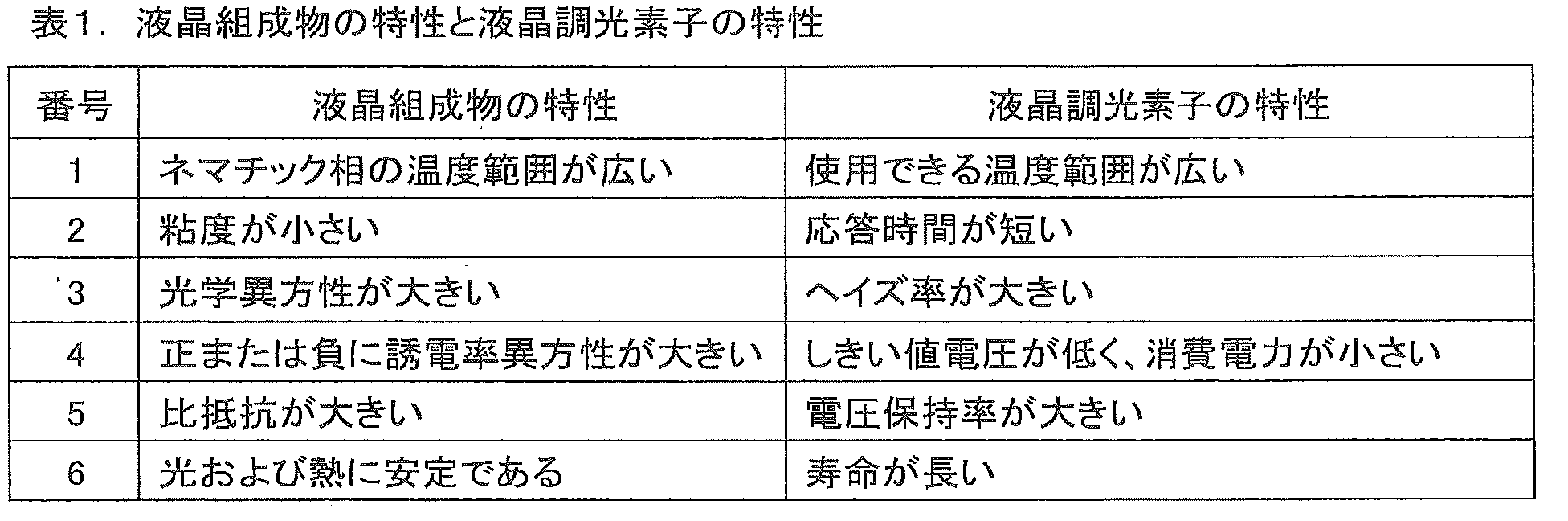
ネマチック相の温度範囲は、液晶調光素子が使用できる温度範囲に関連する。ネマチック相の好ましい上限温度は約90℃以上であり、そしてネマチック相の好ましい下限温度は約-20℃以下である。
液晶組成物の粘度は、液晶調光素子の応答時間に関連する。光の透過率を制御するためには短い応答時間が好ましい。したがって、液晶組成物は粘度が低いことが好ましく、特に、低温で粘度が低いことが望ましい。
液晶組成物の光学異方性は、液晶調光素子のヘイズ率に関連する。ヘイズ率は全透過光に対する拡散光の割合である。光を遮断するために、液晶調光素子のヘイズ率を、大きくすることが好ましい。このような大きなヘイズ率を達成するには、大きな光学異方性を有する液晶組成物が望ましい。
液晶組成物における誘電率異方性は、液晶調光素子のしきい値電圧や消費電力に寄与する。液晶組成物の大きな誘電率異方性は、液晶調光素子における低いしきい値電圧や小さな消費電力に寄与する。
液晶組成物の比抵抗は、液晶調光素子の電圧保持率に寄与する。比抵抗の大きい液晶組成物は、液晶調光素子の初期段階および長時間使用後の電圧保持率を大きくできる。
液晶組成物の光や熱に対する安定性や耐候性は、液晶調光素子の寿命に関連する。この安定性や耐候性が良好であるとき、液晶調光素子の寿命を長くできる。
液晶調光素子および液晶組成物には、以上のような特性が望まれている。
液晶調光素子には、ノーマルモードとリバースモードがある。ノーマルモードでは電圧無印加時に不透明であり、電圧印加時に透明になる。リバースモードでは電圧無印加時に透明であり、電圧印加時に不透明になる。ノーマルモードを有する素子には正の誘電率異方性を有する組成物が用いられる。リバースモードを有する素子には負の誘電率異方性を有する組成物が用いられる。ノーマルモードの素子が広く用いられている。一方では、素子が故障したときには透明になるリバースモードの素子が自動車の窓などの用途に検討されている。
本発明の課題は、液晶調光素子作製時の不具合発生を防ぐことである。特に、リバースモード用の液晶調光素子および該素子に適した重合性組成物を提供することを課題とする。
課題を解決する手段は、以下のとおりである。
[1] 第一成分として式(1)で表される化合物から選択された少なくとも1つの化合物、第二成分として液晶組成物、を含有する重合性組成物。
[1] 第一成分として式(1)で表される化合物から選択された少なくとも1つの化合物、第二成分として液晶組成物、を含有する重合性組成物。

[2] 重合性組成物の重量に基づいて、第一成分の割合が1重量%から80重量%の範囲である、[1]に記載の重合性組成物。
[3] 第二成分である液晶組成物が、一般式(2)で表される化合物を含有する、[1]または[2]に記載の重合性組成物。

[4] 式(2)で表される化合物が、式(2-1)から式(2-33)で表される化合物の群から選択された少なくとも1つの化合物である、[3]に記載の重合性組成物。
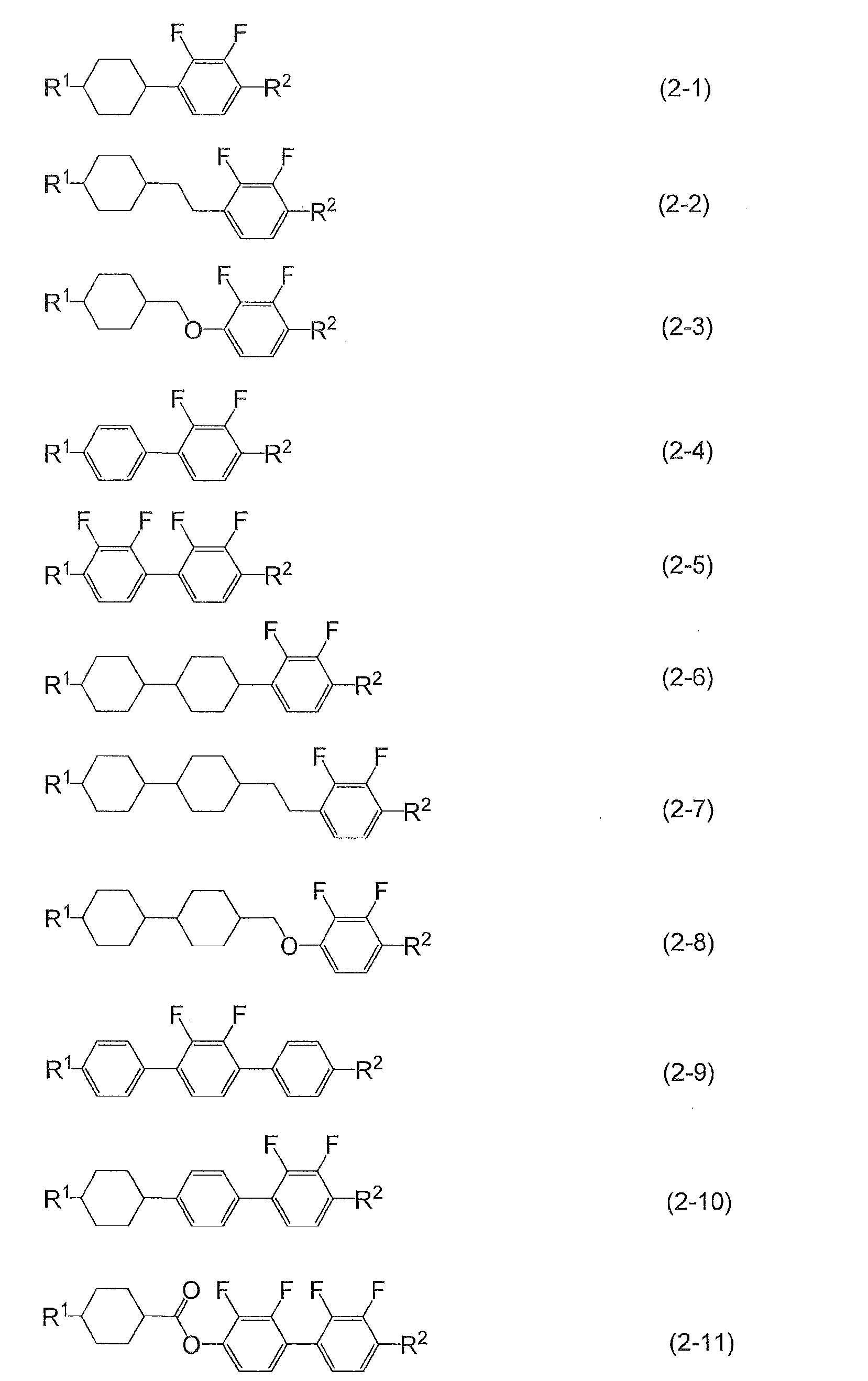
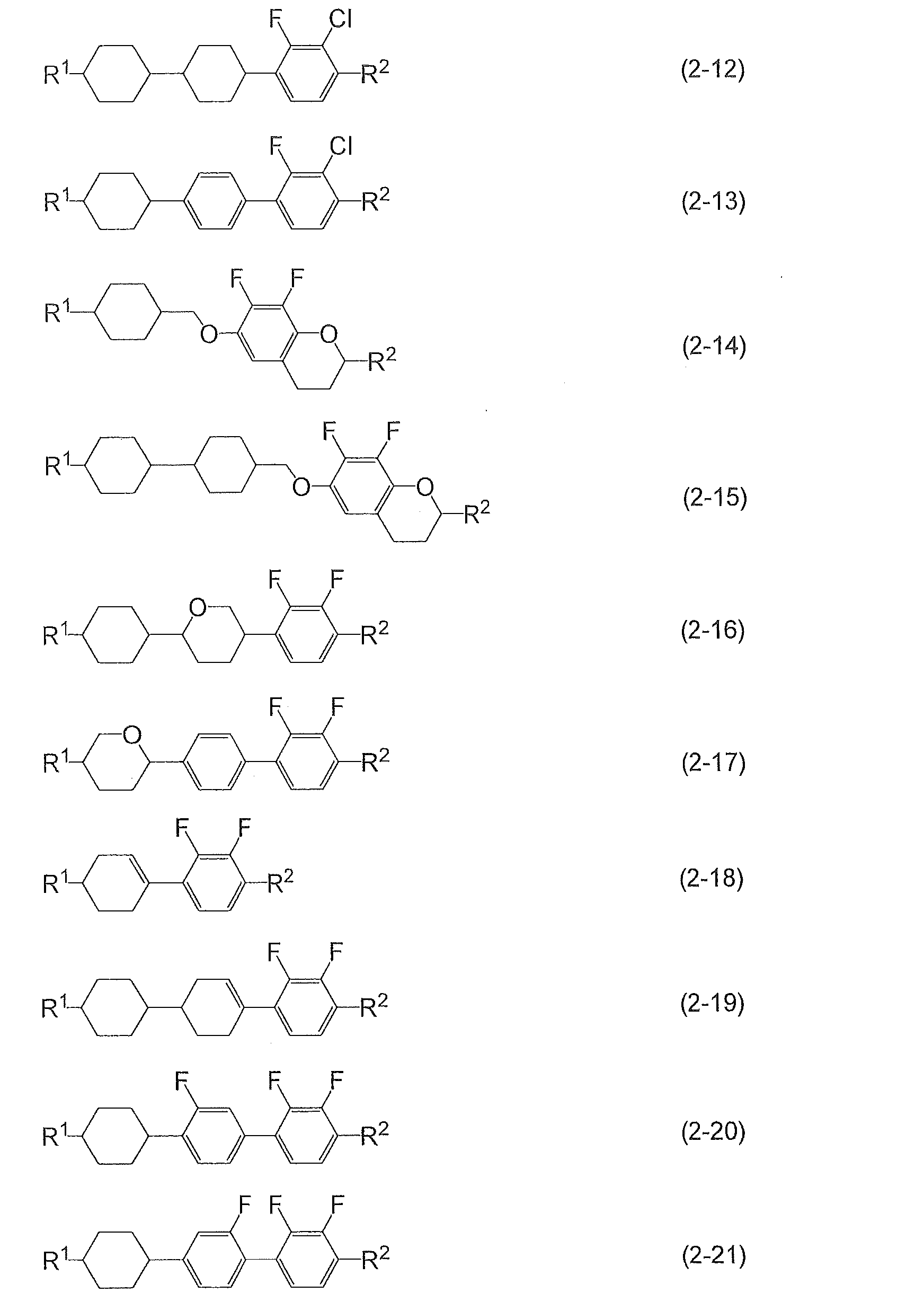
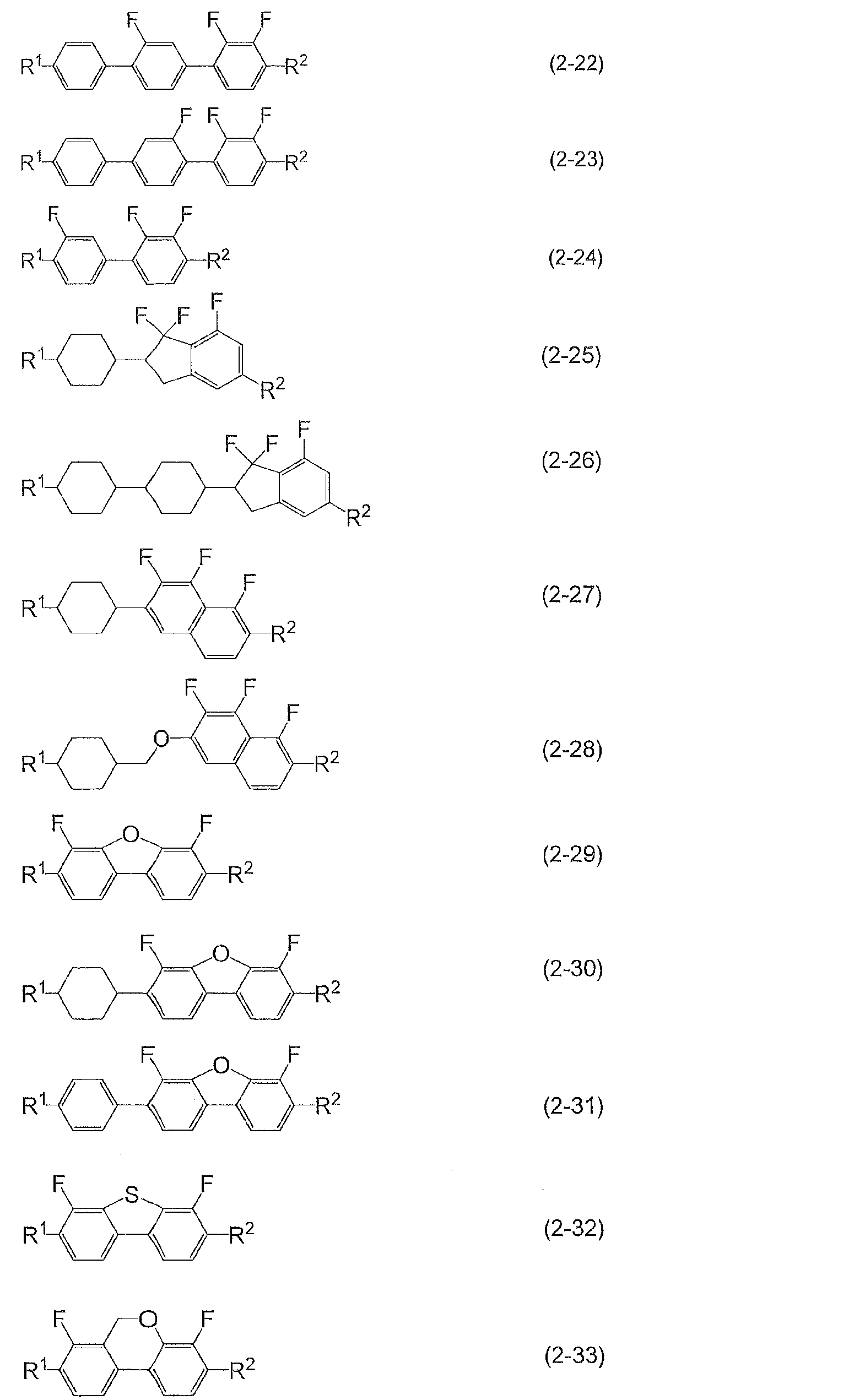
[5] 液晶組成物の重量に基づいて、式(2)で表される化合物の割合が、20重量%から90重量%の範囲である、[3]に記載の重合性組成物。
[6] 第二成分である液晶組成物が、一般式(3)で表される化合物をさらに含有する、[3]から[5]のいずれか1項に記載の重合性組成物。

[7] 式(3)で表される化合物が、式(3-1)から式(3-22)で表される化合物の群から選択された少なくとも1つである、[6]に記載の重合性組成物。
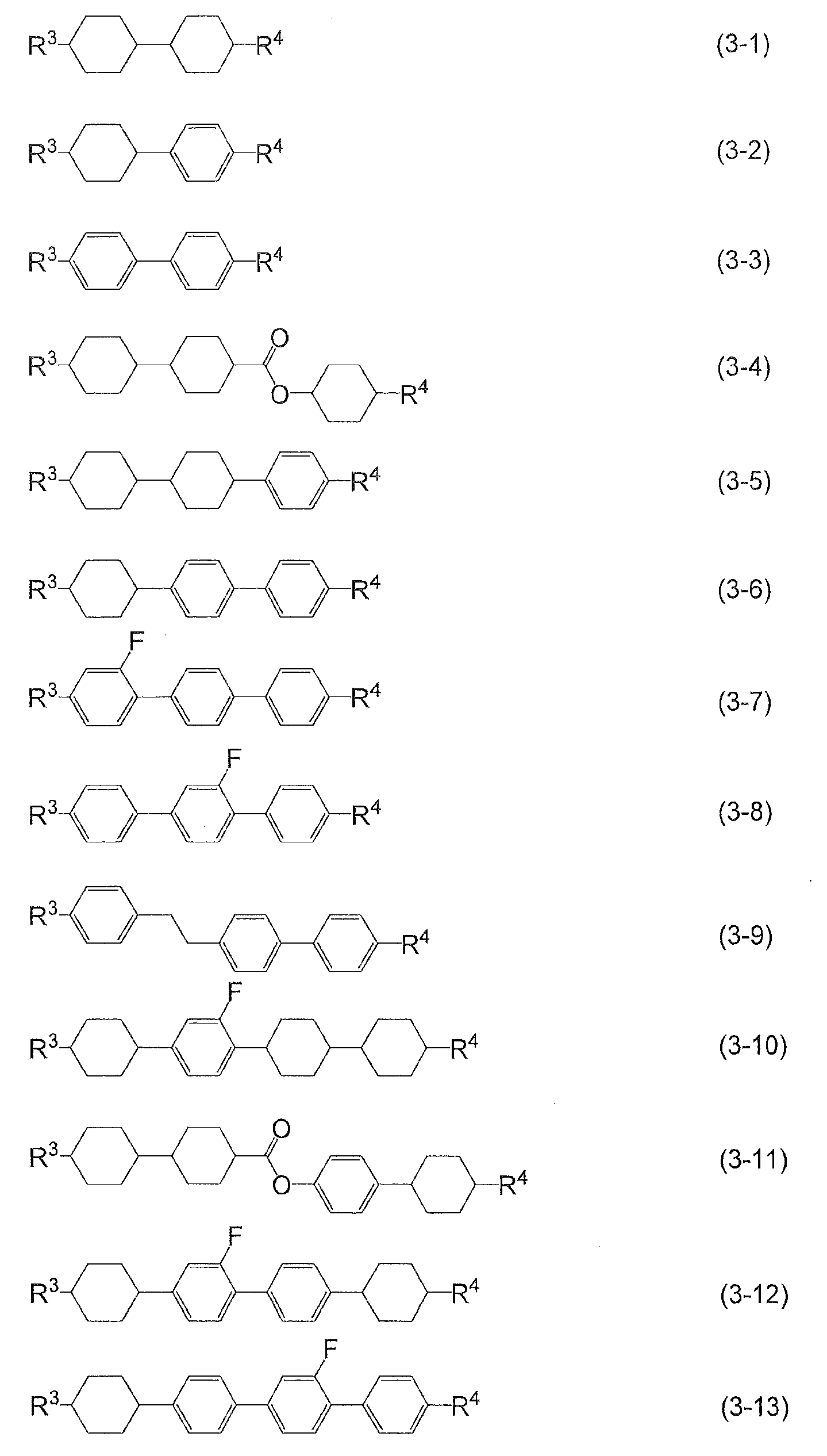
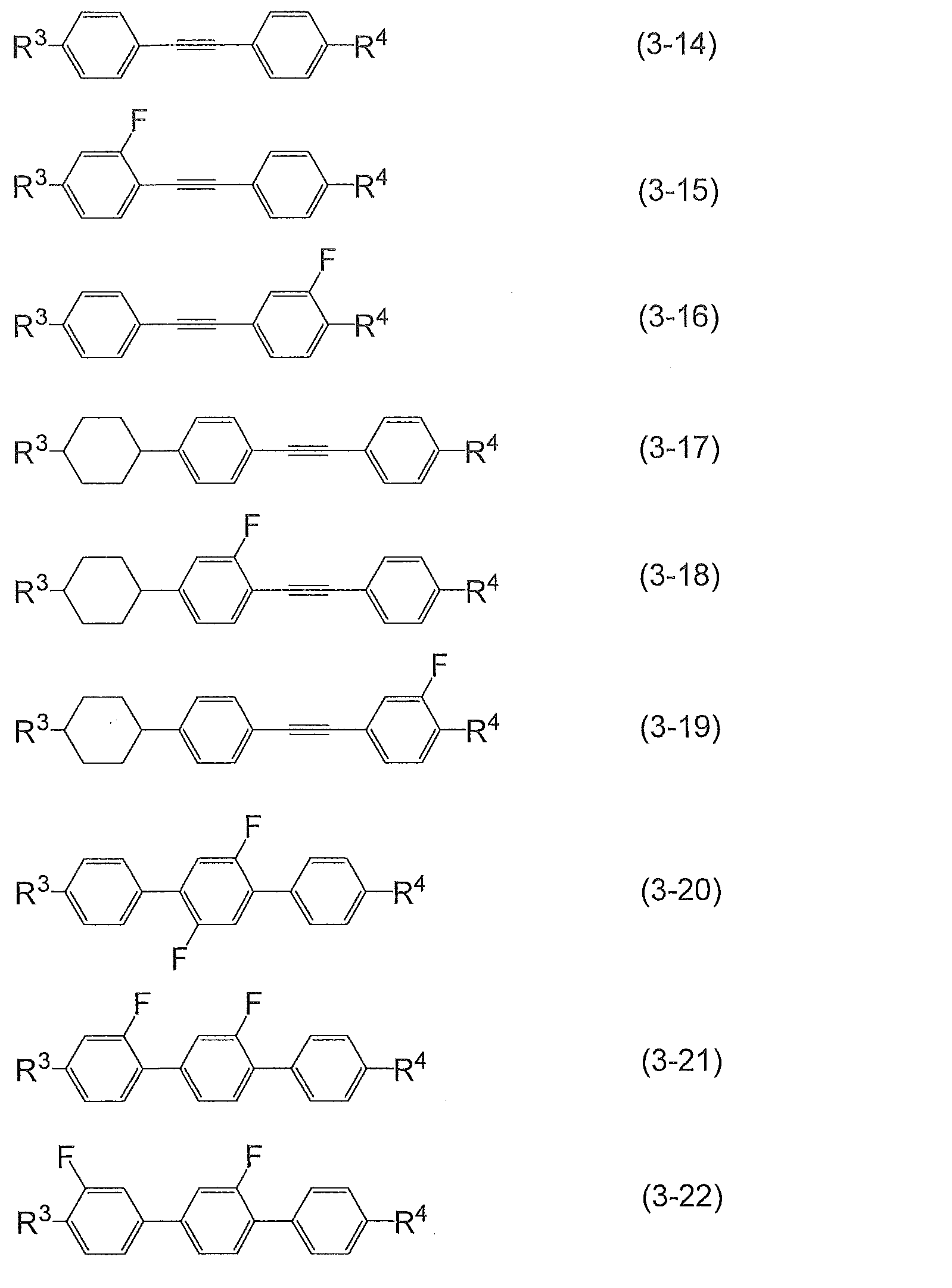
[8] 液晶組成物の重量に基づいて、式(3)で表される化合物の割合が80重量%から10重量%の範囲である、[6]または[7]に記載の重合性組成物。
[9] 式(4)で表される化合物をさらに含む、[1]から[8]のいずれか1項に記載の重合性組成物。
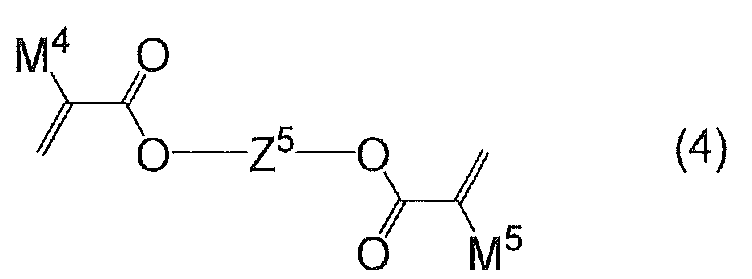
[10] 式(5)で表される化合物をさらに含む、[1]から[9]のいずれか1項に記載の重合性組成物。

[11] 式(5)で表される化合物が、R6が炭素数1から40のアルキルであり、このアルキルにおいて、少なくとも1つの水素は、フッ素で置き換えられてもよく、少なくとも1つの-CH2-は、-O-、-CO-、-COO-、または-OCO-で置き換えられてもよい、[10]に記載の重合性組成物。
[12] 式(6)、式(7)、および式(8)で表される化合物の群から選択された化合物をさらに含む、[1]から[11]のいずれか1項に記載の重合性組成物。
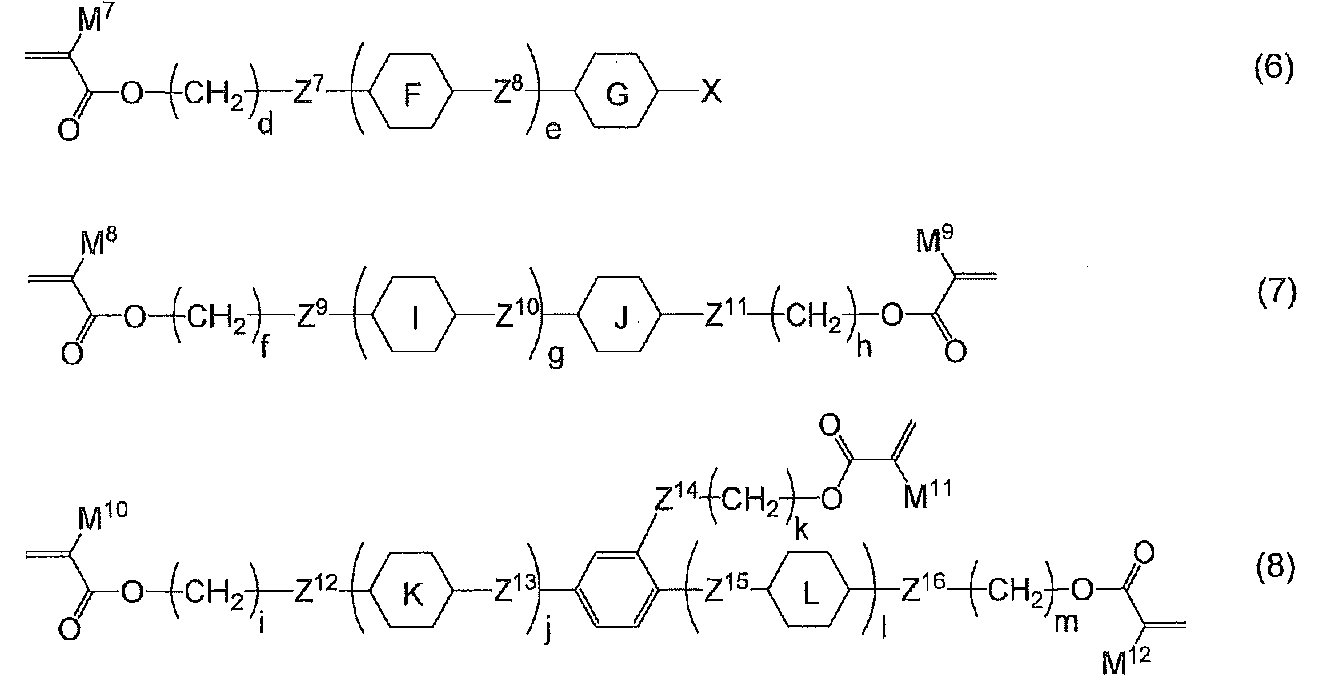
[13] 重合性組成物の重量に基づいて、式(1)で表される化合物を含む重合性化合物総量が1重量%から50重量%の範囲であり、液晶組成物の割合が50重量%から99重量%の範囲である、[1]から[12]のいずれか1項に記載の重合性組成物。
[14] さらに添加物として光重合開始剤を含有する、[1]から[13]のいずれか1項に記載の重合性組成物。
[15] [1]から[14]のいずれか1項に記載の重合性組成物を用いた、透明および散乱状態をスイッチングする液晶調光素子。
本発明の重合性組成物は、保管時に析出しないため、保存安定性が高く、液晶調光素子作製時における素子の不具合発生を防ぐことができる。また、本発明の重合性組成物によれば、駆動電圧が低くても作動する液晶調光素子を作製できる。電圧無印加時の本発明の重合性組成物は透明性が高く、かつ、電圧印加時の本発明の組成物は曇り度が高いため、リバースモード用の調光素子に適する。
「液晶化合物」は、ネマチック相、スメクチック相などの液晶相を有する非重合性化合物および液晶相を有しないが、ネマチック相の温度範囲、粘度、誘電率異方性のような特性を調節する目的で組成物に添加される非重合性化合物の総称である。この化合物は、例えば1,4-シクロヘキシレンや1,4-フェニレンのような六員環を有し、その分子構造は棒状(rod like)である。「重合性化合物」は、組成物中に重合体を生成させる目的で添加される化合物である。アルケニルを有する液晶化合物は、その意味では重合性ではない。
「液晶組成物」は、複数の液晶化合物を混合することによって調製され、ネマチック相を有する。この液晶組成物に、光学活性化合物、酸化防止剤、紫外線吸収剤、色素、消泡剤、極性化合物のような添加物が必要に応じて添加される。液晶化合物の割合は、添加物を添加した場合であっても、添加物を含まない液晶組成物に基づいた重量百分率(重量%)で表される。添加物の割合は、添加物を含まない液晶組成物に基づいた重量百分率(重量%)で表される。すなわち、液晶化合物や添加物の割合は、液晶化合物の全重量に基づいて算出される。
「重合性組成物」は、重合性化合物と液晶組成物との混合物である。重合性化合物には、重合開始剤、重合禁止剤、極性化合物のような添加物が必要に応じて添加される。重合性化合物や液晶組成物の割合は、添加物を添加した場合であっても、添加物を含まない重合性組成物に基づいた重量百分率(重量%)で表される。重合開始剤、重合禁止剤、極性化合物のような添加物の割合は、重合性化合物に基づいた重量百分率(重量%)で表される。「液晶複合体」は、組成物の重合によって生成した重合体と液晶組成物を含む。「液晶調光素子」は、液晶複合体を含み、調光に用いられる液晶パネルおよび液晶モジュールの総称である。
「ネマチック相の上限温度」を「上限温度」と略すことがある。「ネマチック相の下限温度」を「下限温度」と略すことがある。「比抵抗が大きい」は、液晶組成物が初期段階において大きな比抵抗を有し、そして長時間使用したあと、大きな比抵抗を有することを意味する。「電圧保持率が大きい」は、素子が初期段階において室温だけでなく上限温度に近い温度でも大きな電圧保持率を有し、そして長時間使用したあと室温だけでなく上限温度に近い温度でも大きな電圧保持率を有することを意味する。液晶組成物や素子の特性が経時変化試験によって検討されることがある。「誘電率異方性を上げる」の表現は、誘電率異方性が正である液晶組成物のときは、その値が正に増加することを意味し、誘電率異方性が負である液晶組成物のときは、その値が負に増加することを意味する。
2-フルオロ-1,4-フェニレンは、下記の2つの二価基を意味する。化学式において、フッ素は左向き(L)であってもよいし、右向き(R)であってもよい。このルールは、テトラヒドロピラン-2,5-ジイルのような、環から2つの水素を除くことによって生成した、左右非対称な二価基にも適用される。このルールは、カルボニルオキシ(-COO-または-OCO-)のような二価の結合基にも適用される。
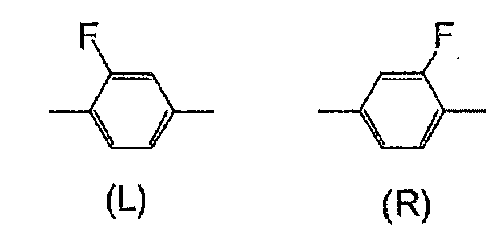
重合性組成物は、第一成分として式(1)で表される化合物から選択された少なくとも1つの化合物、第二成分として、液晶組成物を含有する。このような重合性組成物は、それを室温または低温で長時間保管した場合にも、成分の分離が無い。従って、重合性組成物を加熱して成分を均一化するなどの追加操作をすること無く、調光素子の作製に使用することができる。本発明の重合性組成物を使用することで、調光素子を製造する際のトラブルを少なくすることができる。
第一に第一成分である式(1)で表される化合物に関して説明する。式(1)で表される化合物は、重合性化合物である。

重合性組成物を、室温または低温で長時間保管した場合、成分の分離を防ぐためには、R14として炭素数3から12のアルキルが好ましく、炭素数5から12のアルキルが特に好ましい。
式(1)の化合物はメソゲンを有する。メソゲンとは、液晶性を発現するような剛直な部位である。そのため、式(1)の化合物を第二成分である液晶組成物に数%以上添加しても、液晶性が維持できる。液晶状態の重合性組成物は、配向層の作用によって同一方向に配向する。この配向は、重合後も維持される。従って、本発明の重合性組成物を用いて作製した調光素子は、高い透明性を有する。
第二に、第二成分である、液晶組成物に関して説明する。液晶組成物は、液晶化合物の観点から、液晶組成物Aと液晶組成物Bに分類される。
液晶組成物Aは、式(2)および式(3)から選択された液晶化合物のみからなる。式(2)および(3)の液晶化合物は、非重合性ネマチック液晶化合物であり、式(1)などの重合性化合物と組み合わせて使用することで、保管時に結晶の析出がない等の、保存安定性の高い液晶組成物を提供するができ、低い駆動電圧を持ち、電圧無印加時の高い透明性および電圧印加時の高い曇り度を持つ、リバースモード用の液晶調光素子用途の重合性組成物が提供される。液晶組成物Aは、添加物を含有してもよいが、その他の液晶化合物を含有しない。
液晶組成物Bは、式(2)および式(3)から選択された液晶化合物の他に、さらにその他の液晶化合物を、必要に応じて添加物などとともに含有する。「その他の液晶化合物」は、式(2)および式(3)とは異なる液晶化合物である。このような化合物は、特性をさらに調整する目的で液晶組成物に混合される。液晶組成物Aは液晶組成物Bに比較して成分の数が少ない。コストを下げるためには、液晶組成物Aは液晶組成物Bよりも好ましい。一方、特性を調整するためには、液晶組成物Bは液晶組成物Aよりも好ましい。
液晶化合物の特性を表2にまとめる。表2の記号において、Lは大きいまたは高い、Mは中程度の、Sは小さいまたは低い、を意味する。記号L、M、Sは、液晶化合物のあいだの定性的な比較に基づいた分類であり、記号0(ゼロ)は、極めて小さいことを意味する。液晶化合物の特性は、液晶組成物の特性に直接的に影響を及ぼす。


なお、テトラヒドロピラン-2,5-ジイルは、
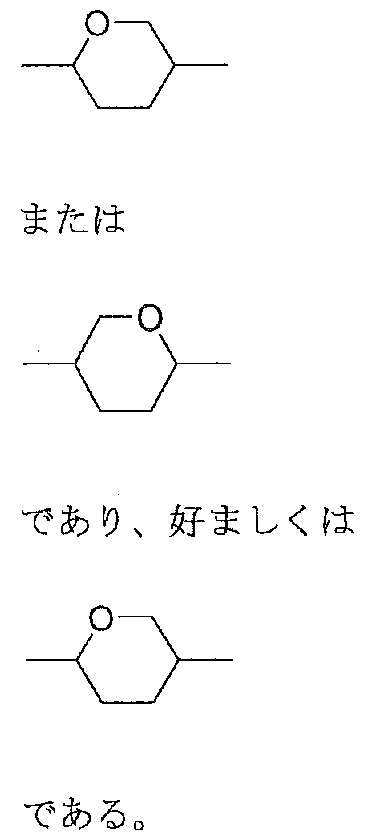
好ましいアルコキシは、メトキシ、エトキシ、プロポキシ、ブトキシ、ペンチルオキシ、ヘキシルオキシ、またはヘプチルオキシである。さらに好ましいアルコキシは、下限温度を下げるためにメトキシまたはエトキシである。
好ましいアルケニルは、ビニル、1-プロペニル、2-プロペニル、1-ブテニル、2-ブテニル、3-ブテニル、1-ペンテニル、2-ペンテニル、3-ペンテニル、4-ペンテニル、1-ヘキセニル、2-ヘキセニル、3-ヘキセニル、4-ヘキセニル、または5-ヘキセニルである。さらに好ましいアルケニルは、下限温度を下げるために、ビニル、1-プロペニル、3-ブテニル、または3-ペンテニルである。これらのアルケニルにおける-CH=CH-の好ましい立体配置は、二重結合の位置に依存する。下限温度を下げるためなどから1-プロペニル、1-ブテニル、1-ペンテニル、1-ヘキセニル、3-ペンテニル、3-ヘキセニルのようなアルケニルにおいてはトランスが好ましい。2-ブテニル、2-ペンテニル、2-ヘキセニルのようなアルケニルにおいてはシスが好ましい。
好ましいアルケニルオキシは、ビニルオキシ、アリルオキシ、3-ブテニルオキシ、3-ペンテニルオキシ、または4-ペンテニルオキシである。さらに好ましいアルケニルオキシは、下限温度を下げるために、アリルオキシまたは3-ブテニルオキシである。
少なくとも1つの水素がフッ素で置き換えられたアルキルの好ましい例は、フルオロメチル、2-フルオロエチル、3-フルオロプロピル、4-フルオロブチル、5-フルオロペンチル、6-フルオロヘキシル、7-フルオロヘプチル、または8-フルオロオクチルである。さらに好ましい例は、誘電率異方性を上げるために2-フルオロエチル、3-フルオロプロピル、4-フルオロブチル、または5-フルオロペンチルである。
少なくとも1つの水素がフッ素で置き換えられたアルケニルの好ましい例は、2,2-ジフルオロビニル、3,3-ジフルオロ-2-プロペニル、4,4-ジフルオロ-3-ブテニル、5,5-ジフルオロ-4-ペンテニル、または6,6-ジフルオロ-5-ヘキセニルである。さらに好ましい例は、下限温度を下げるために2,2-ジフルオロビニルまたは4,4-ジフルオロ-3-ブテニルである。
式(2)において、好ましいR1またはR2は、光や熱に対する安定性を上げるために炭素数1から12のアルキルであり、誘電率異方性を上げるために炭素数1から12のアルコキシである。
好ましい環Aまたは環Cは、下限温度を下げるために、または上限温度を上げるために、1,4-シクロヘキシレンであり、下限温度を下げるために1,4-フェニレンである。
好ましい環Bは、下限温度を下げるために2,3-ジフルオロ-1,4-フェニレンであり、光学異方性を下げるために2-クロロ-3-フルオロ-1,4-フェニレンであり、誘電率異方性を上げるために7,8-ジフルオロクロマン-2,6-ジイルである。
Z17およびZ18は独立して、単結合、-CH2-CH2-、-CH=CH-(エチレン)、-C≡C-、カルボニルオキシ、またはメチレンオキシである。好ましいZ17またはZ18は下限温度を下げるために単結合またはエチレンであり、誘電率異方性を上げるためにメチレンオキシである。
aは、1、2、または3であり;bは、0または1であり;aおよびbの和は3以下である。好ましいaは下限温度を下げるために1であり、上限温度を上げるために2または3である。好ましいbは誘電率異方性を上げるために0であり、下限温度を下げるために1である。
好ましい化合物(2)は、化合物(2-1)から化合物(2-33)である。
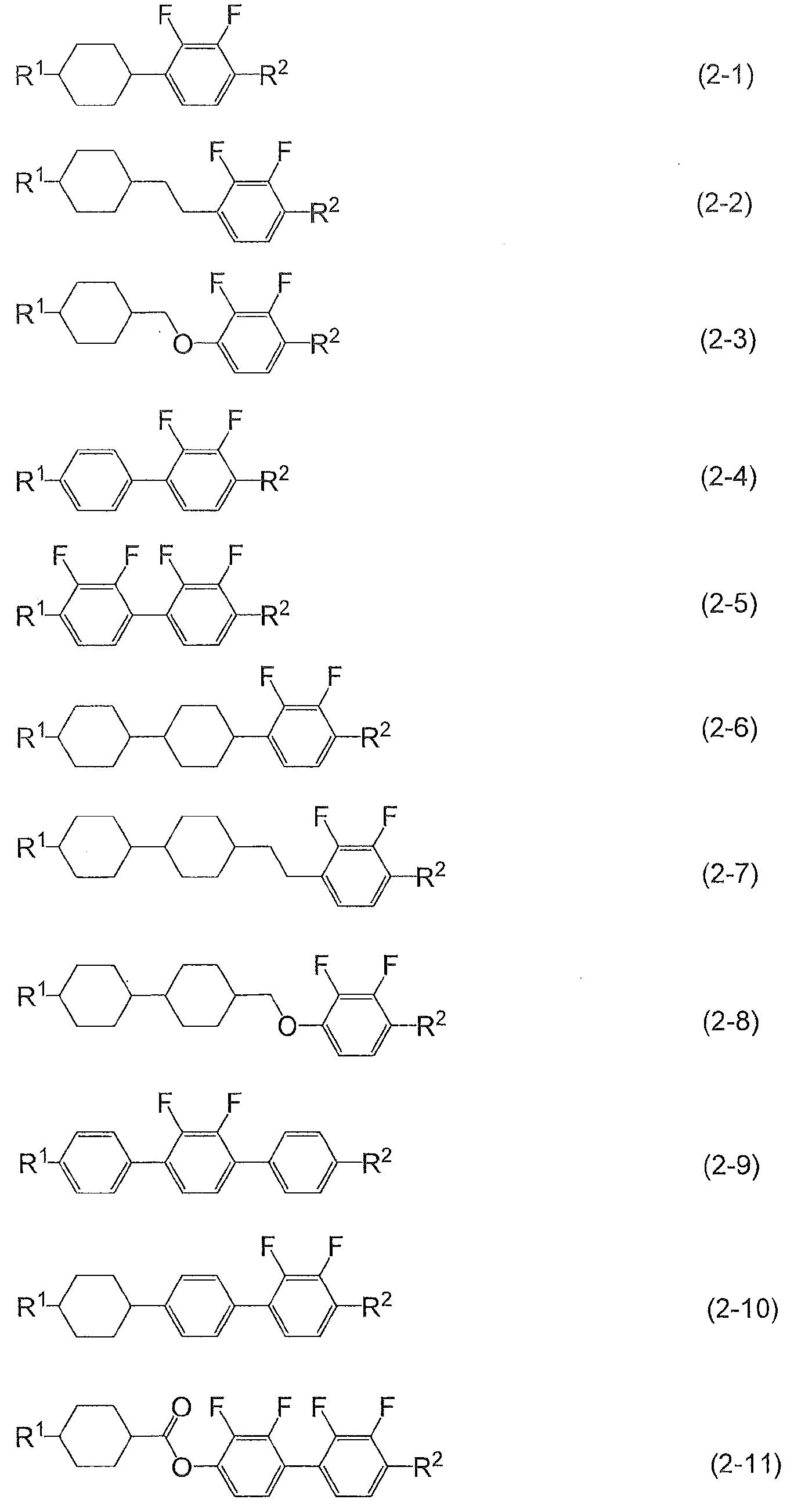
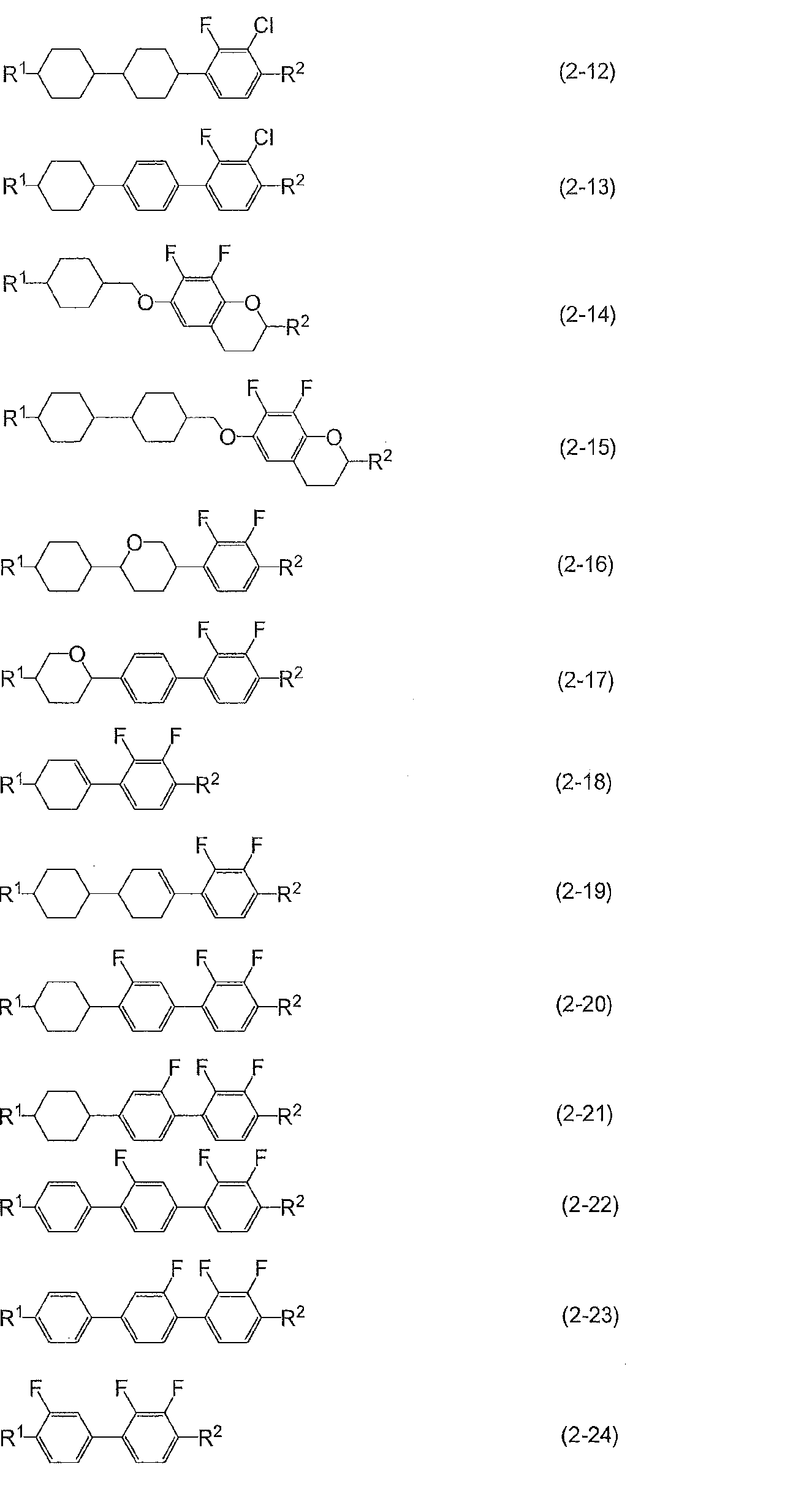
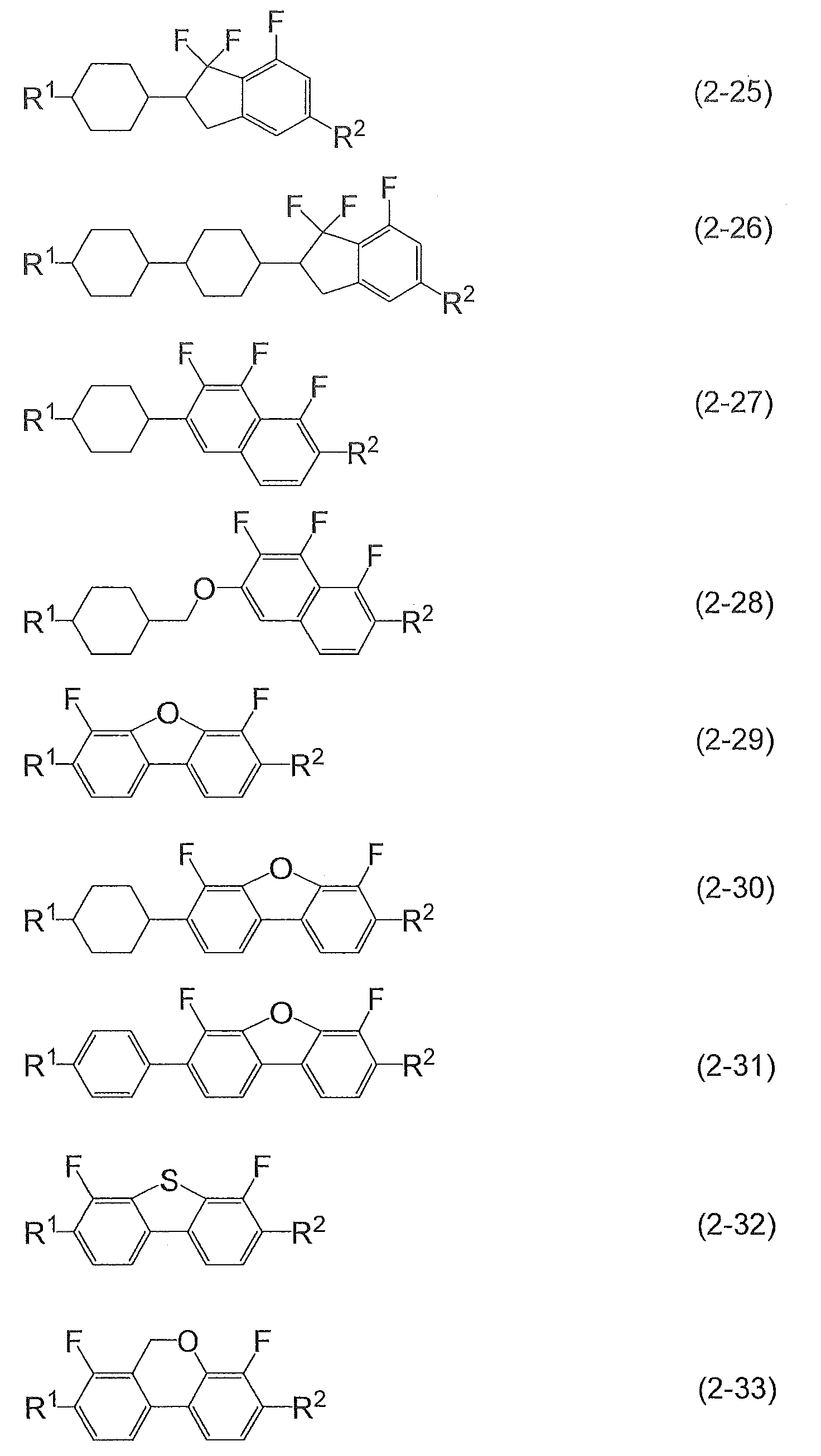
これらの化合物において、化合物(2)の少なくとも1つが、化合物(2-1)、化合物(2-2)、化合物(2-3)、化合物(2-4)、化合物(2-6)、化合物(2-7)、化合物(2-8)、または化合物(2-10)であることが好ましい。 第二成分の少なくとも2つが、化合物(2-1)および化合物(2-6)、化合物(2-1)および化合物(2-10)、化合物(2-3)および化合物(2-6)、化合物(2-3)および化合物(2-10)、化合物(2-4)および化合物(2-6)、または化合物(2-4)および化合物(2-10)の組み合わせであることが好ましい。
式(3)で表される化合物は以下の通りである。

好ましいR3またはR4は、上限温度を上げるために、または下限温度を下げるために炭素数2から12のアルケニルであり、光や熱に対する安定性を上げるために炭素数1から12のアルキルである。
好ましいアルキル、アルコキシ、アルケニル、少なくとも1つの水素がフッ素で置き換えられたアルキル、少なくとも1つの水素がフッ素で置き換えられたアルケニルの好ましい例は、前記式(2)で表される化合物と同様である。また、塩素で置き換えられたアルキルおよびアルケニルは、フッ素を塩素に置換したものが好ましい例となる。
好ましい環Dまたは環Eは、上限温度を上げるために1,4-シクロヘキシレンであり、下限温度を下げるために1,4-フェニレンである。
好ましいZ3は、光や熱に対する安定性を上げるために単結合である。
好ましいcは、下限温度を下げるために1であり、上限温度を上げるために2または3である。
好ましい化合物(3)は、化合物(3-1)から化合物(3-22)である。
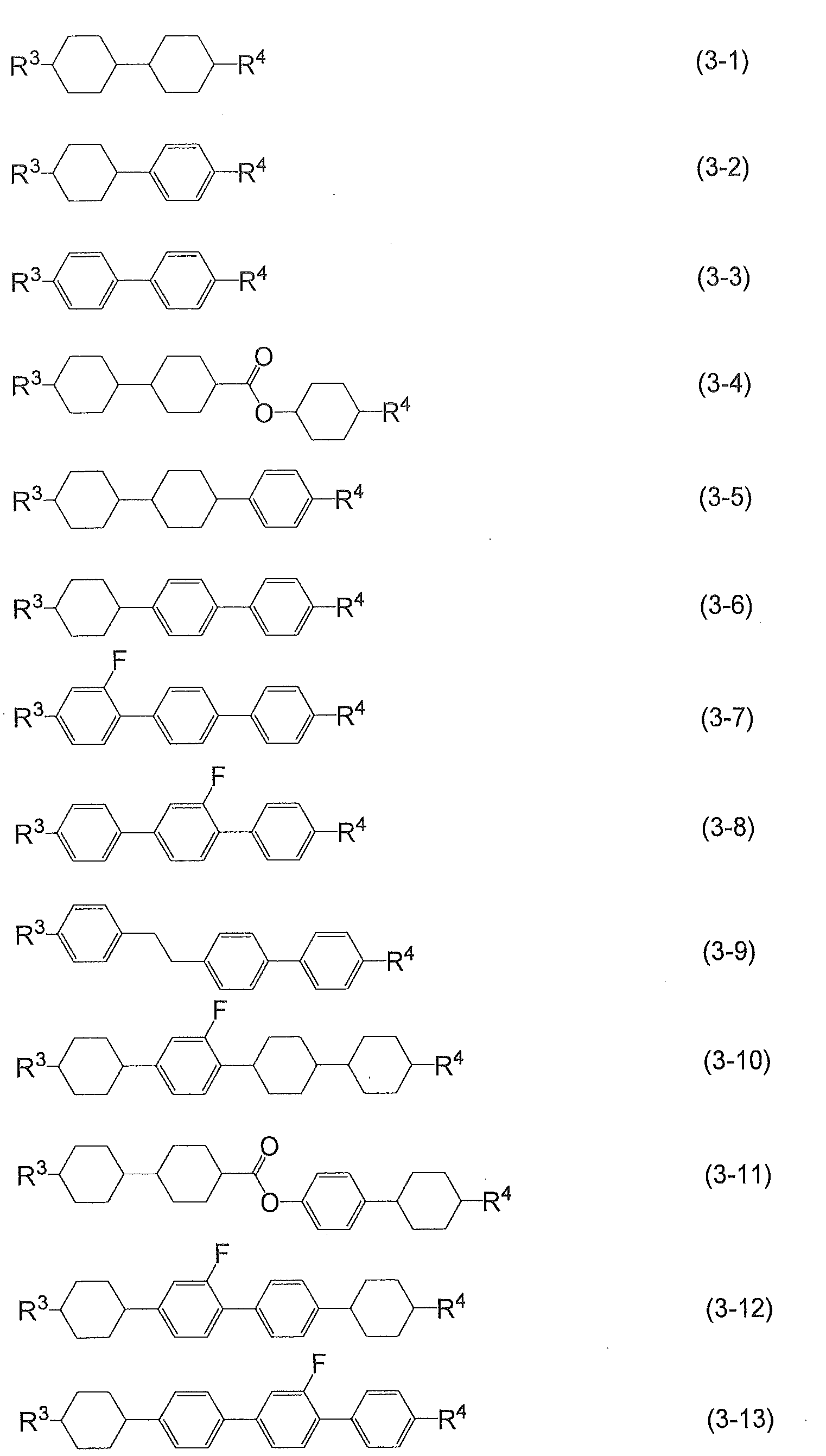
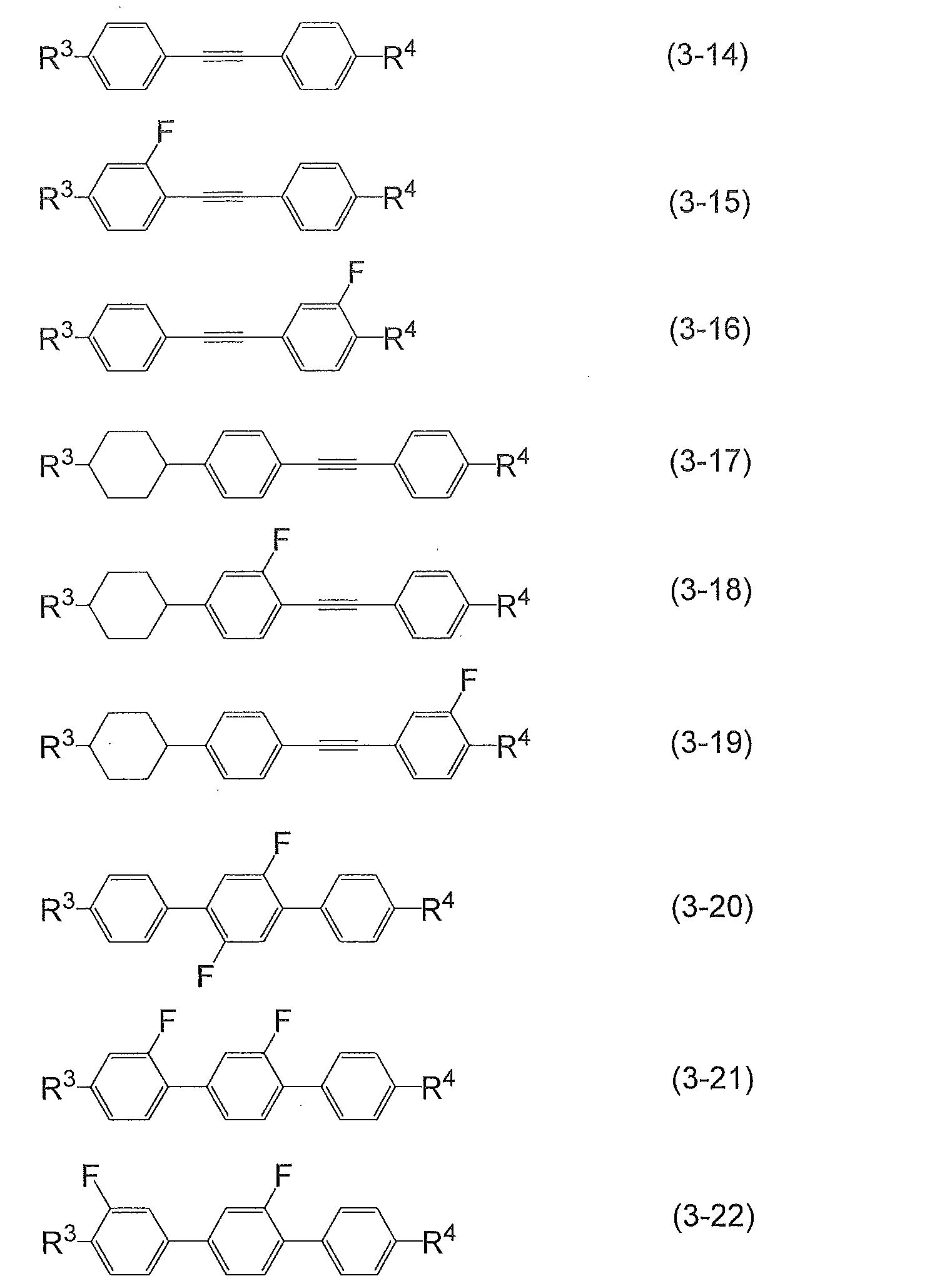
これらの化合物において、第二成分の少なくとも1つが、化合物(3-1)、化合物(3-3)、化合物(3-5)、化合物(3-6)、化合物(3-8)、または化合物(3-9)であることが好ましい。第二成分の少なくとも2つが化合物(3-1)および化合物(3-5)、化合物(3-1)および化合物(3-6)、化合物(3-1)および化合物(3-8)、化合物(3-1)および化合物(3-9)、化合物(3-3)および化合物(3-5)、化合物(3-3)および化合物(3-6)、化合物(3-3)および化合物(3-8)、または化合物(3-3)および化合物(3-9)の組み合わせであることが好ましい。
液晶組成物における第二成分の好ましい組み合わせは、式(2)の液晶化合物単独使用であるか、さらに、式(2)の液晶化合物と式(3)の液晶化合物を両方とも使用することである。
重合性組成物の重量に基づいて、式(1)の化合物である第一成分の割合は、1重量%から80重量%の範囲であることが好ましく、調光素子の電圧印加時のヘイズ率を向上させるために、1重量%から50重量%の範囲であることがさらに好ましく、2重量%から20重量%の範囲であることが特に好ましい。 重合性組成物の重量に基づいて、液晶組成物は99重量%から20重量%の範囲であることが好ましく、調光素子の電圧印加時のヘイズ率を向上させるために、99重量%から50重量%の範囲であることがさらに好ましく、98重量%から80重量%の範囲であることが特に好ましい。
式(2)の液晶化合物の割合は、液晶組成物の重量に基づいて、10重量%から100重量%の範囲にあり、素子の駆動電圧を低下させるために20重量%以上であり、上限温度を上げるために、または下限温度を下げるために90重量%以下であることが好ましい。さらに好ましい割合は30重量%から85重量%の範囲であり、特に好ましい割合は40重量%から80重量%の範囲である。 式(3)の液晶化合物の割合は、液晶組成物の重量に基づいて、0重量%から90重量%の範囲にあり、上限温度を上げるために、または下限温度を下げるために10重量%以上であり、素子の駆動電圧を低下させるために80重量%以下であることが好ましい。さらに好ましい割合は15重量%から70重量%の範囲であり、特に好ましい割合は20重量%から60重量%の範囲である。
液晶組成物Bは、上記化合物(2)および(3)と共に、さらに他の液晶化合物を含む。他の液晶化合物としては、公知のものを特に制限なく使用できる。たとえば公知のディスコチック液晶などが挙げられる。重合性組成物中の、他の液晶化合物の含有量は、前記化合物(1)~(3)の総量を引いた差分に相当するが、好ましくは10重量%以下の範囲にある。
本発明の重合性組成物には、式(1)の重合性化合物以外のその他の公知の重合性化合物を添加してもよい。このとき、素子のヘイズ率の増大および駆動電圧の低下のため、化合物(4)、化合物(5)、化合物(6)、化合物(7)、または化合物(8)を好適に使用できる。これらの重合性化合物は、複数を選択して併用してもよい。
第三に、化合物(4)~(8)について説明する。
化合物(4)は式(4)で表される。
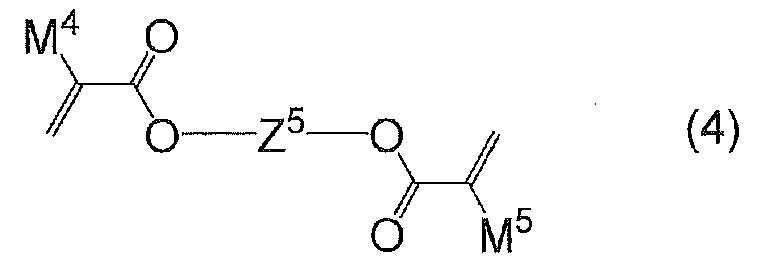
化合物(4)はジ(メタ)アクリレートであるが、Z5の置換基によってはトリ(メタ)アクリレート、またはテトラ(メタ)アクリレートもある。Z5はアルキレンなどで、重合体は網目構造を形成しやすい。Z5の分子鎖が短いとき、重合体の架橋部位が近接するので、網目が小さくなる。Z5の分子鎖が長いとき、重合体の架橋部位が離れ、分子運動の自由度が向上するので、駆動電圧が下がる。Z5が分岐状であるとき、自由度がさらに向上するので、駆動電圧がさらに下がる。この効果を向上させるために、化合物(4)とは異なる重合性化合物を併用してもよい。化合物(4)が揮発性である場合は、そのオリゴマーを用いてもよい。化合物(4)において、重合性基が多い場合は、架橋によって液滴を囲む重合体が固くなるか、または網目が密になる。
式(4)において、好ましいM4またはM5は、反応性を上げるために水素である。
好ましいZ5は、低電圧駆動のために、炭素数2から60のアルキレンであり、このアルキレンにおいて、少なくとも1つの水素は、炭素数1から20のアルキルで置き換えられてもよく、少なくとも1つの-CH2-は、-O-、-COO-、または-OCO-で置き換えられてもよい。
さらに好ましいZ5は、低電圧駆動のために、少なくとも1つの水素がアルキルで置き換えられた分岐状アルキレンである。アルキレンの2つの水素がアルキルで置き換えられたとき、立体障害を防ぐことが好ましい。例えば、2つのアルキルを充分に離す、またはアルキルの一方には炭素数1から5のアルキルを用いる。少なくとも3つの水素がアルキルで置き換えられたときも同様である。
化合物(4)の具体例を以下に示す。
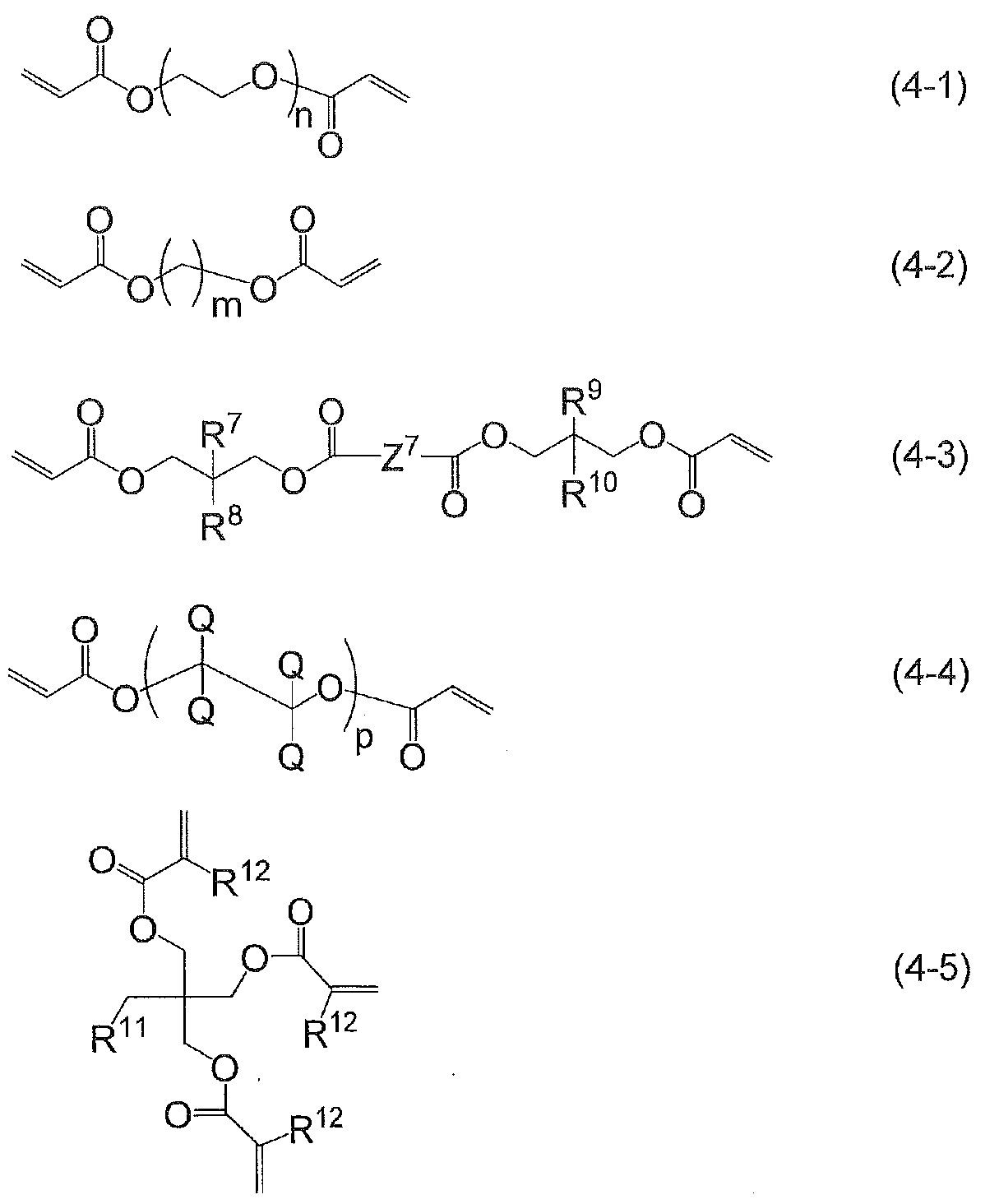
式(4-2)において、mは2から20の整数であり、
式(4-3)において、R7およびR9は独立して、炭素数1から5のアルキルであり、R8およびR10は独立して、炭素数5から20のアルキルであり、このアルキルにおいて、少なくとも1つの-CH2-は、-O-、-CO-、-COO-、または-OCO-で置き換えられてもよく、Z7は炭素数10から30のアルキレンであり、このアルキレンにおいて、少なくとも1つの-CH2-は、-O-、-CO-、-COO-、または-OCO-で置き換えられてもよく、 式(4-4)においてpは3から10の整数であり、Qは、水素またはメチルであり、 式(4-5)においてR11はOH、(メタ)アクロイル、または式(4-5)のR11以外の残基が-O-を介して結合した構造であり、R12は水素(H)またはメチルである。
化合物(4-3)の具体例を以下に示す。

化合物(5)は、式(5)で表される。

化合物(5)はアクリレート誘導体またはメタクリレート誘導体である。R6が環状構造を有するとき、液晶組成物との親和性が向上する。R6がアルキレンであるとき、重合体は網目構造を形成しやすい。この重合体では、アルキレンによって分子運動の自由度が向上するので、駆動電圧が下がる。この効果をさらに向上させるために、化合物(5)とは異なる重合性化合物を併用してもよい。化合物(5)が揮発性である場合は、そのオリゴマーを用いてもよい。
式(5)において、好ましいM6は、反応性を上げるために水素である。
好ましいZ6は、単結合または炭素数1から5のアルキレンであり、このアルキレンにおいて、少なくとも1つの-CH2-は、-O-、-CO-、-COO-、または-OCO-で置き換えられてもよい。
好ましいR6は、炭素数1から40のアルキル(アルキルには、シクロアルキルを含む)であり、このアルキルにおいて、少なくとも1つの水素は、フッ素で置き換えられてもよく、少なくとも1つの-CH2-は、-O-、-CO-、-COO-、または-OCO-で置き換えられてもよいが、より好ましくは、炭素数5から30のアルキルである。さらに好ましいR6は、炭素数5から30の分岐状アルキルである。 化合物(5)の具体例を以下に示す。

化合物(6)、(7)および(8)はそれぞれ、式(6)、式(7)、および式(8)で表される化合物であり、重合性組成物はこれらの群から選択された化合物をさらに含んでもよい。
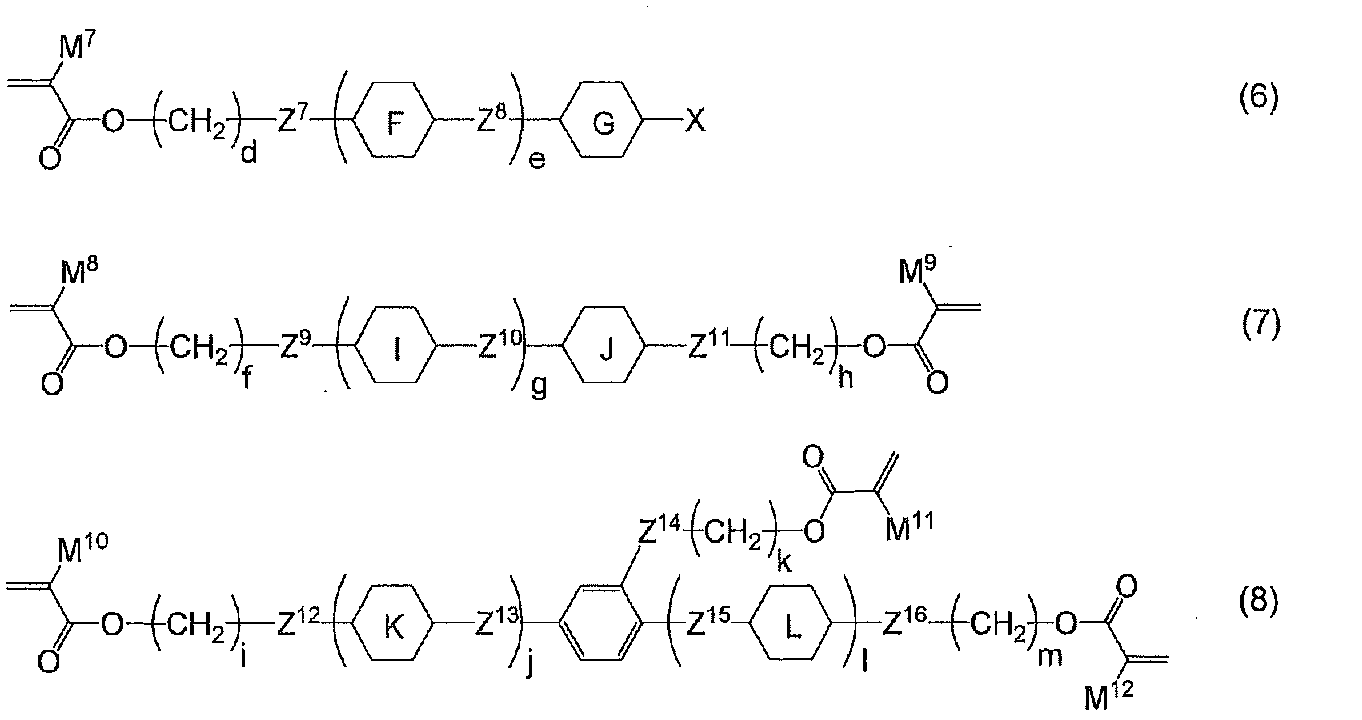
化合物(6)、化合物(7)、および化合物(8)は、少なくとも1つのアクリロイルオキシ(-OCO-CH=CH2)またはメタクリロイルオキシ(-OCO-(CH3)C=CH2)を有する。液晶化合物は、メソゲン(液晶性を発現するような剛直な部位)を有するが、これらの化合物もメソゲンを有する。そのため、これらの化合物は、液晶化合物とともに配向層の作用によって同一方向に配向する。この配向は、重合後も維持される。重合して得られた液晶複合体は、高い透明性を有する。その他の特性を向上させるために、化合物(6)、化合物(7)、および化合物(8)とは異なる重合性化合物を併用してもよい。
式(6)、式(7)、および式(8)において、好ましい環は、1,4-シクロへキシレン、1,4-フェニレン、2-フルオロ-1,4-フェニレン、2-メチル-1,4-フェニレン、2-メトキシ-1,4-フェニレン、または2-トリフルオロメチル-1,4-フェニレンである。さらに好ましい環は、1,4-シクロへキシレンまたは1,4-フェニレンである。
式(6)および式(7)において、好ましいZ8、Z10、Z13、またはZ15は、単結合、-OCH2-、-CH2O-、-COO-、-OCO-、-CH2CH2-、-CH2CH2COO-、または-OCOCH2CH2-である。
化合物(6)の具体例を以下に示す。
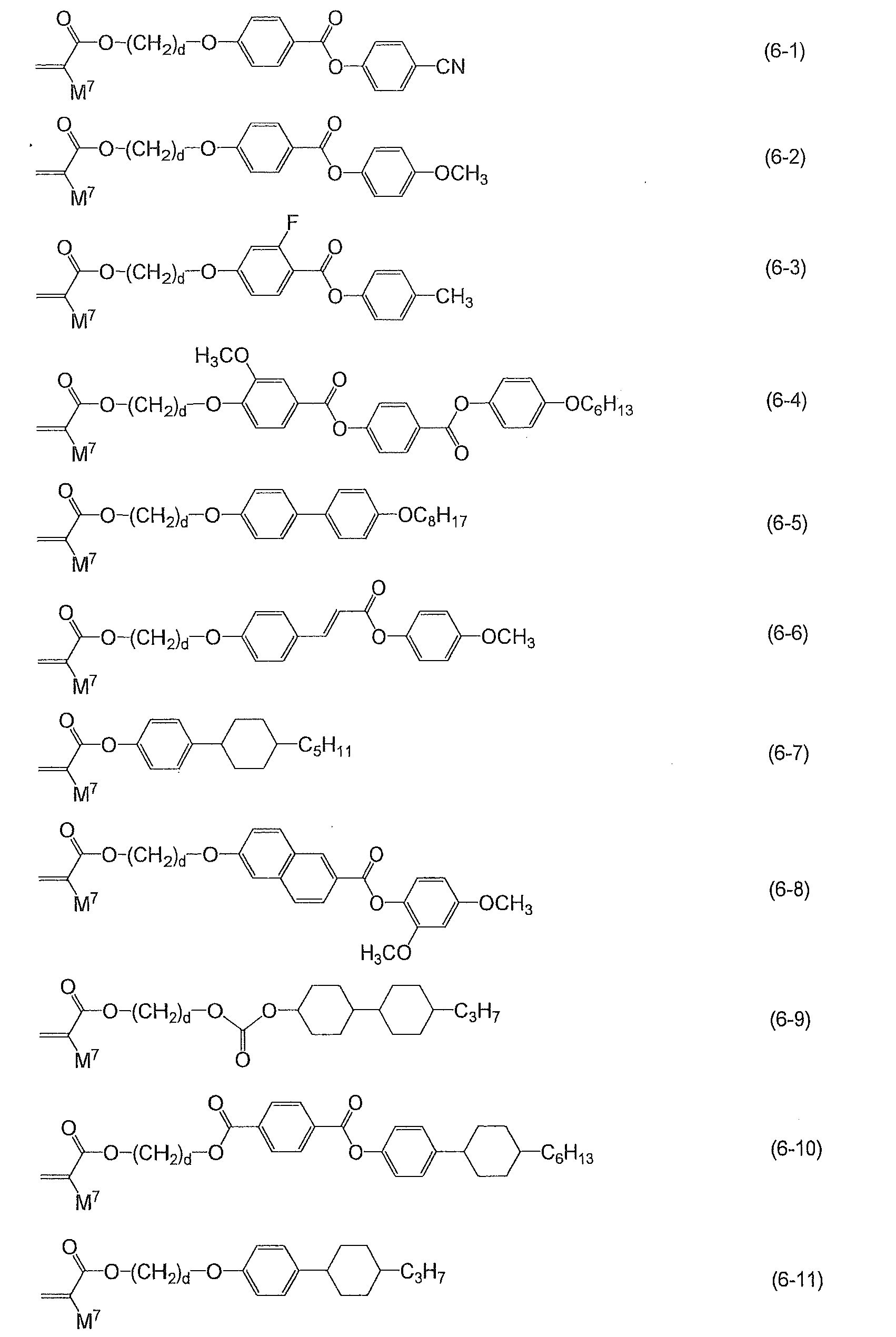
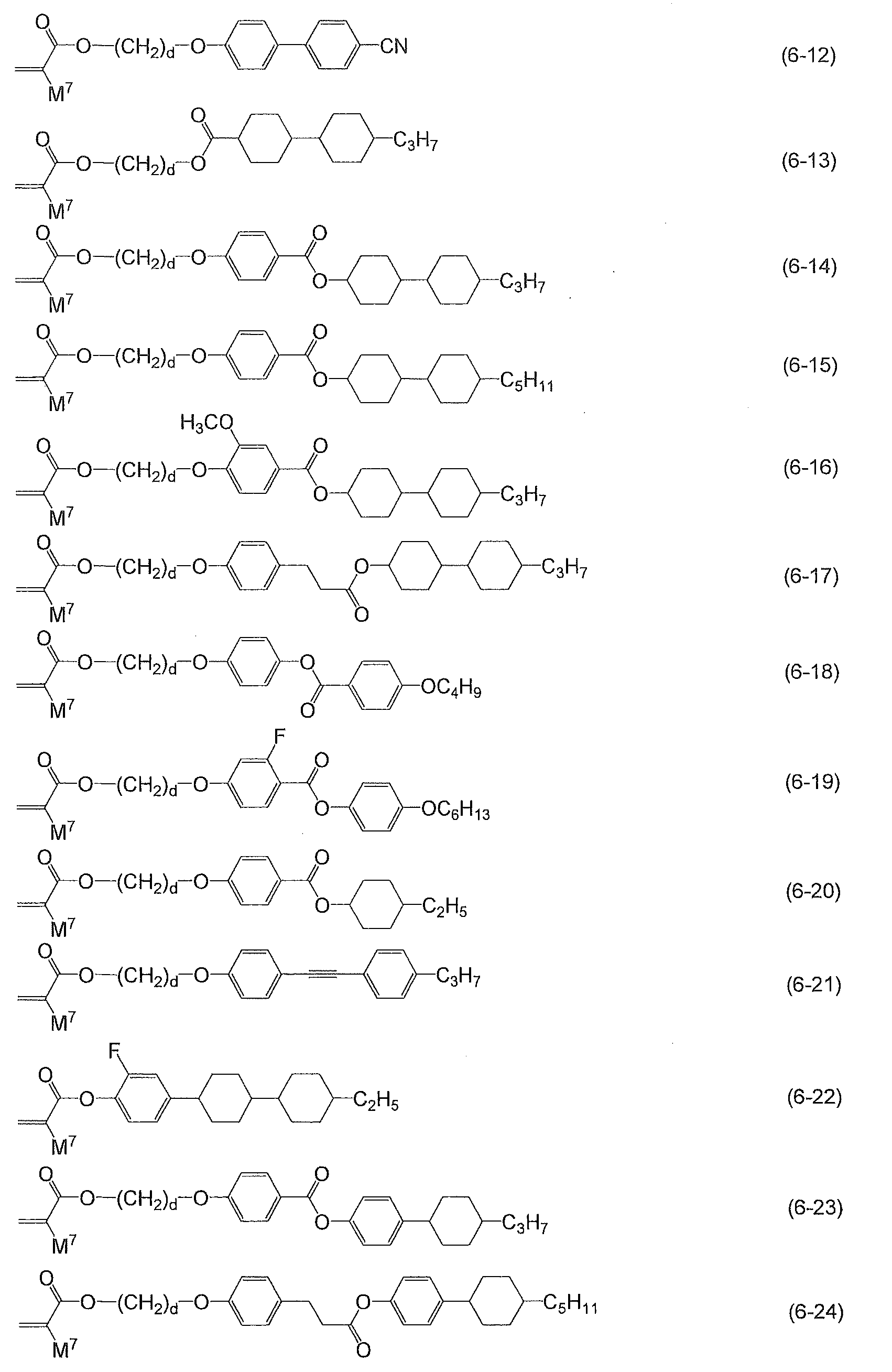
化合物(7)の具体例を以下に示す。
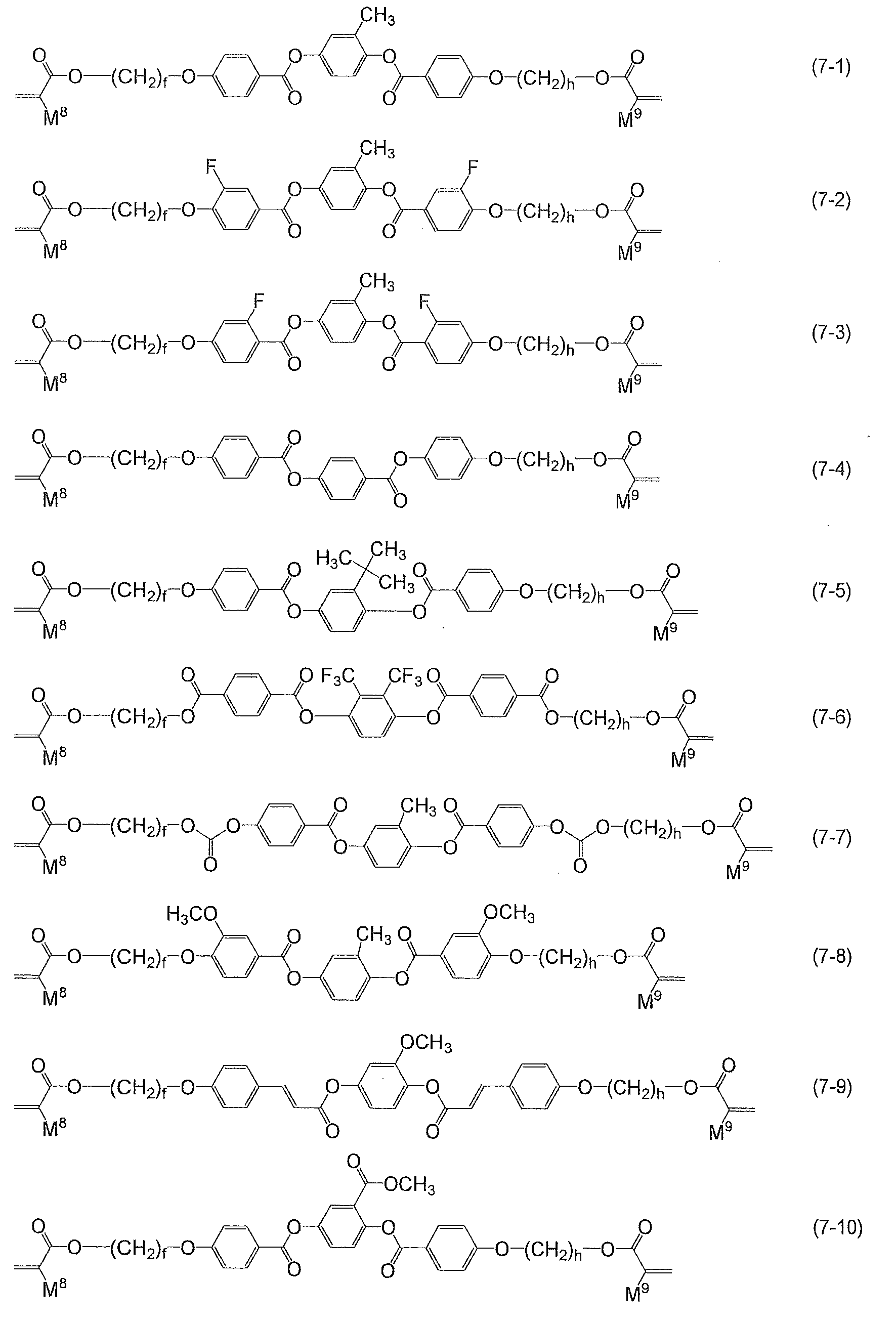
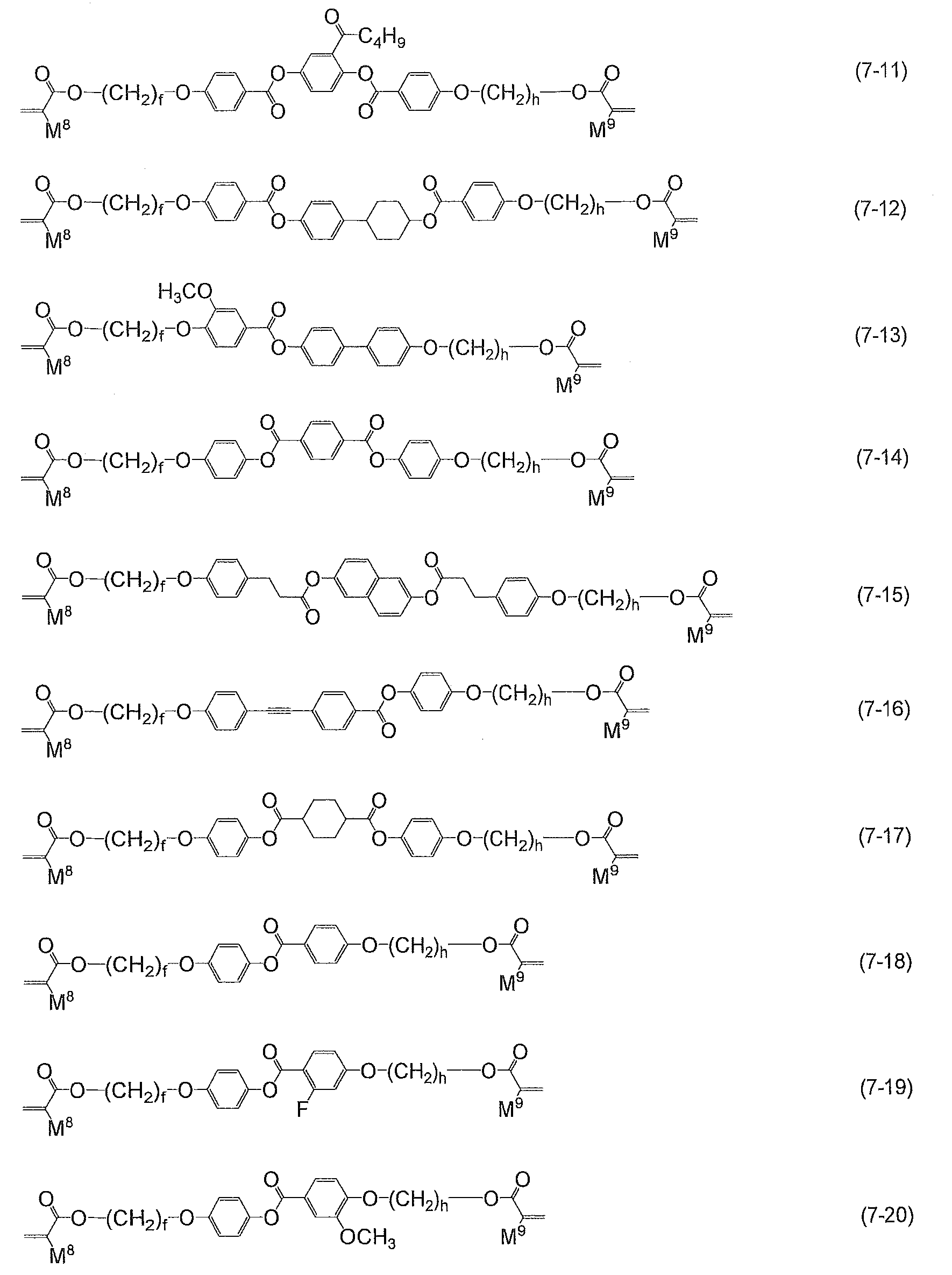
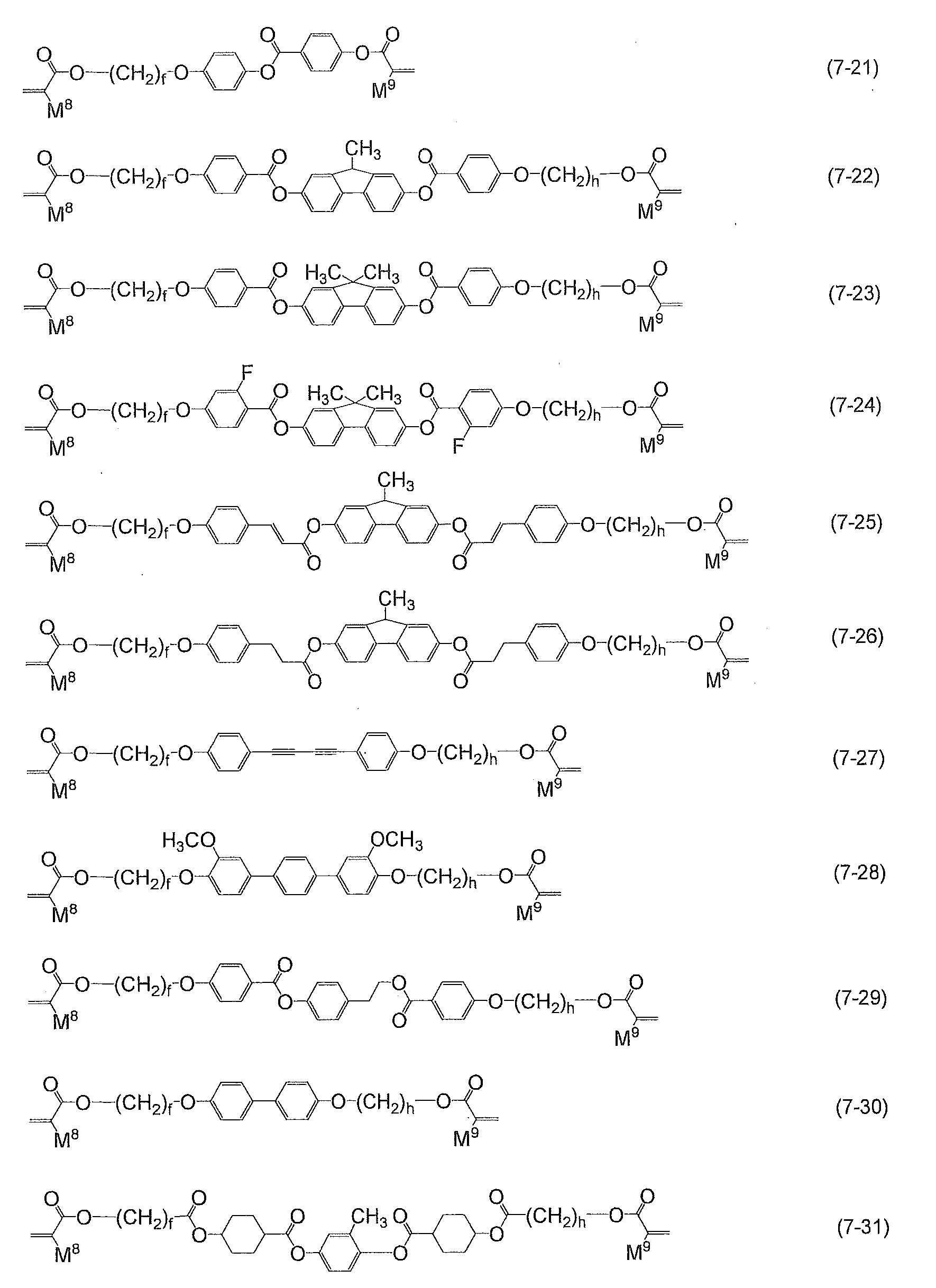
化合物(8)の具体例を以下に示す。

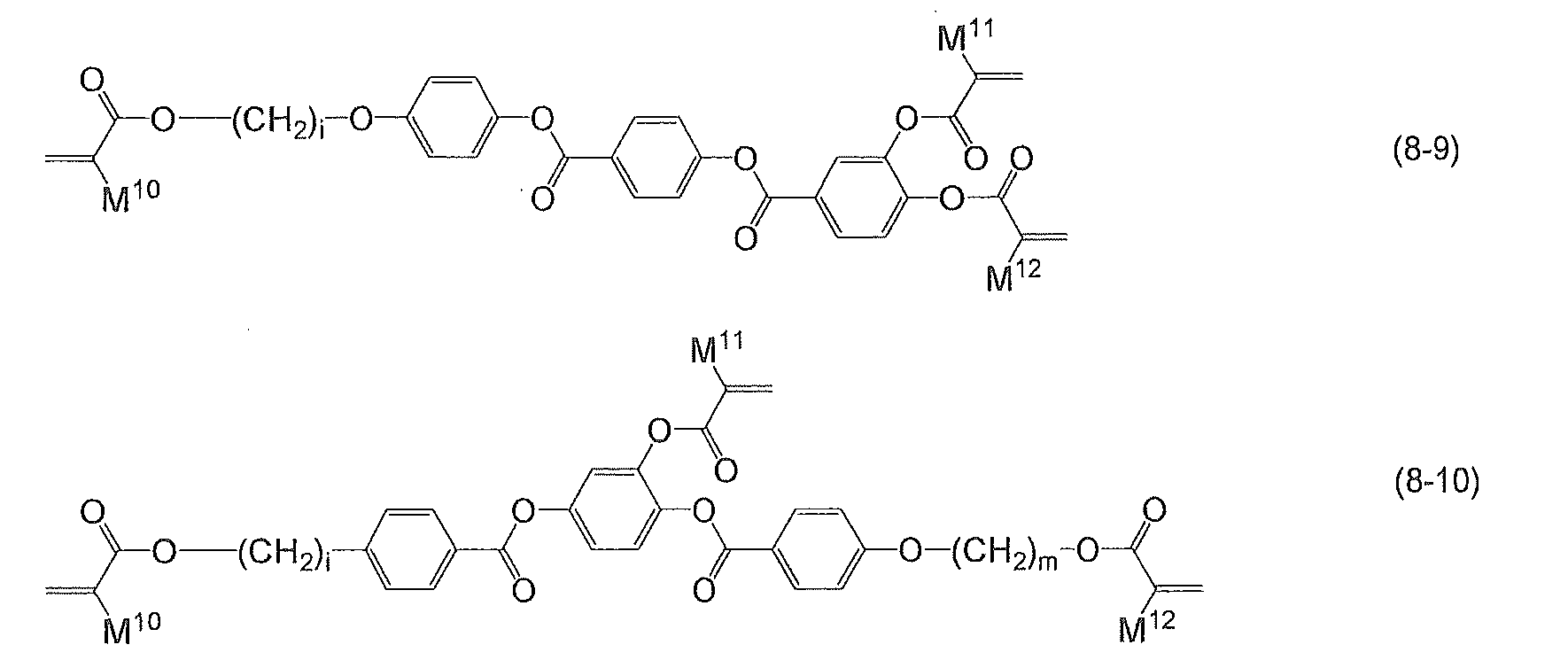
本発明の効果を発現するためには、式(4)から式(8)で表される重合性化合物は、式(1)および式(4)~式(8)の重合性化合物の総量に対して、100重量%以下、好ましくは50重量%以下の範囲で含まれていることが好ましい。 重合性組成物の重量に基づいて、式(1)で表される化合物を含む重合性化合物の総量が1重量%から50重量%の範囲であり、液晶組成物の割合が50重量%から99重量%の範囲にあることが好ましい。さらに式(4)から式(8)の重合性化合物を含む場合も、上記総量に含まれる。 重合性化合物の総量のさらに好ましい割合は、重合性組成物の重量に基づいて、1重量%から40重量%の範囲である。特に好ましい割合は、2重量%から20重量%の範囲である。
液晶組成物のさらに好ましい割合は、重合性組成物の重量に基づいて、60重量%から99重量%の範囲である。特に好ましい割合は、80重量%から98重量%の範囲である。
第四に、垂直配向剤に関して記載する。
本発明の重合性組成物は、主にリバースモード用の調光素子に好適に使用することができる。液晶組成物を垂直配向とするため、ポリイミドなどを材料とする垂直配向膜が製膜された基板が使用される。
一方、液晶組成物を垂直配向とするため、重合性組成物に垂直配向剤を添加することも行われている。極性基をもつ有機化合物が、垂直配向剤として用いられる。ここで極性基とは、-OH、-COOH、-SH、-NH2、>NH、>N-のような、電気陰性度の高い原子とそれに結合した水素を示す。垂直配向剤を添加すると、垂直配向膜を省略できるため、調光素子作製のコスト低減に好適である。
垂直配向剤としては、公知の垂直配向剤を使用することができる。このとき式(9)で表される(メタ)アクリル基を有する化合物を使用することが、素子特性の経時劣化を防ぐために好ましい。安定な垂直配向を発現させるために、垂直配向剤の量は、重合性組成物の重量に対して、10重量%以下、好ましくは1~5量%の範囲で含まれていることが望ましい。

式(9)で表される化合物の具体例を示す。
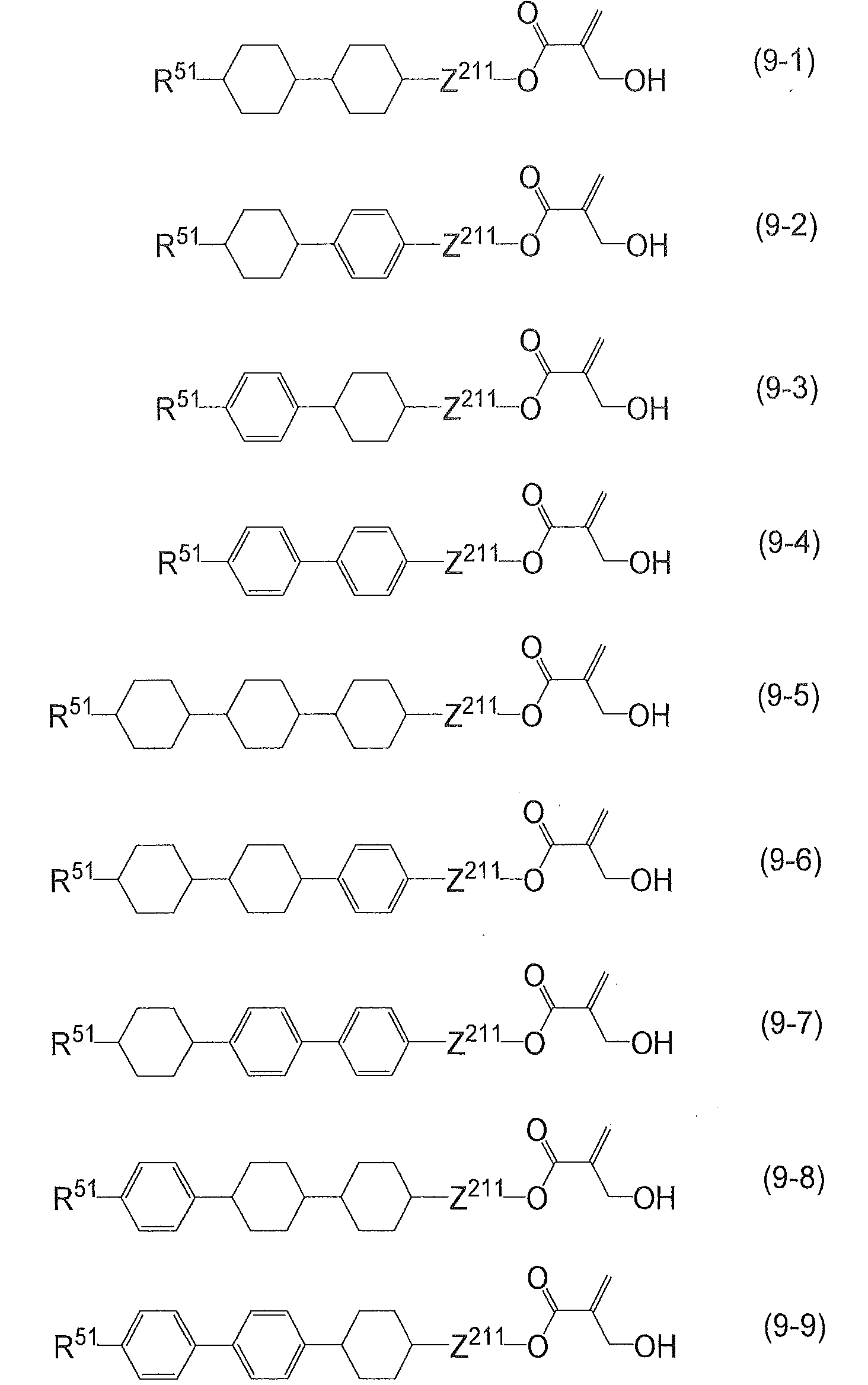
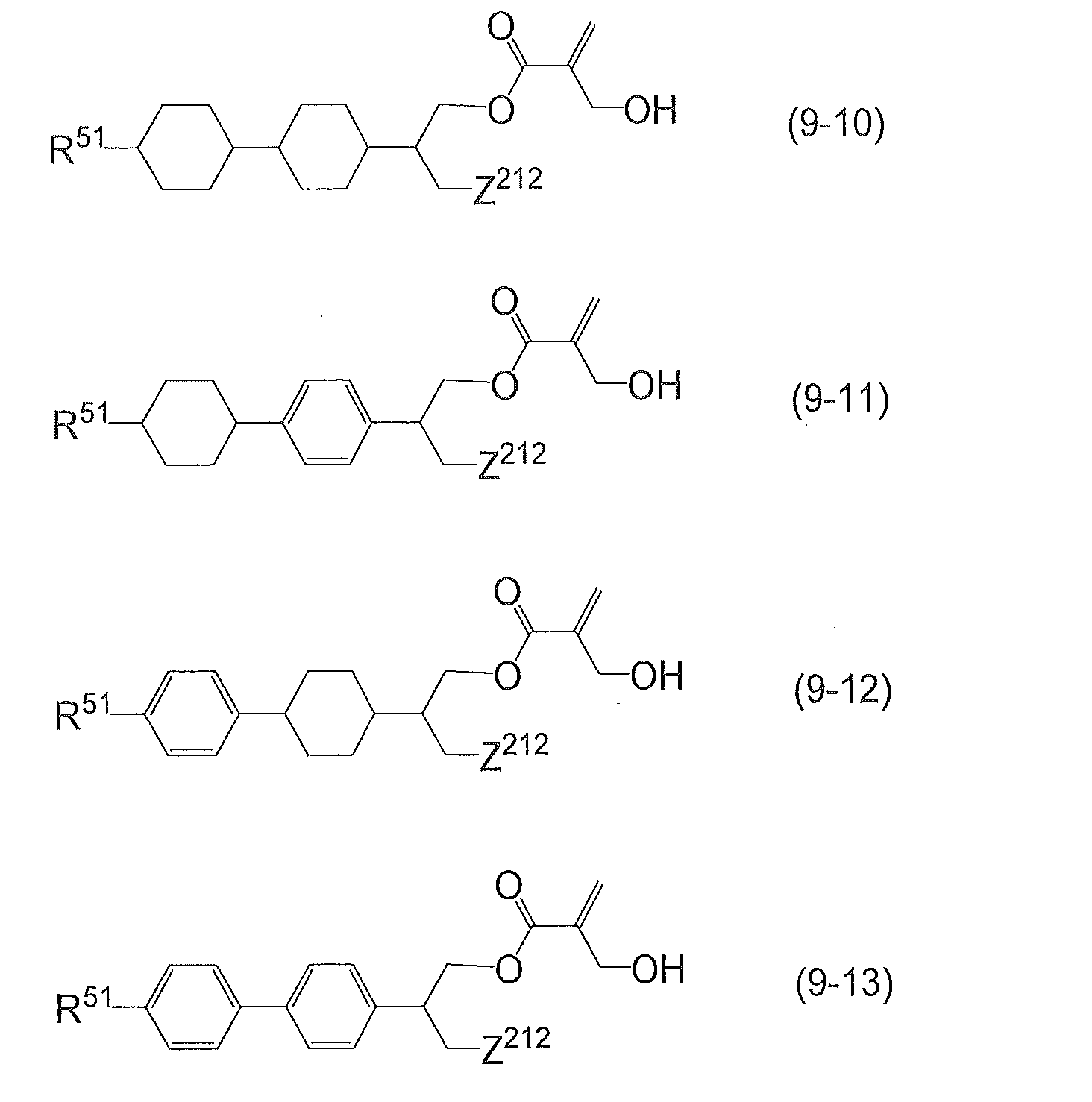
第五に化合物の合成法を説明する。これらの化合物は既知の方法によって合成できる。合成法を例示する。たとえば、化合物(1)は、特表平2-503441号公報などに記載された方法で合成可能である。化合物(2)は、特開昭59-176221号公報などに記載された方法で合成可能である。酸化防止剤は市販されている。後述する式(11)のnが1である酸化防止剤の化合物は、たとえばアルドリッチ(Sigma-Aldrich Corporation)から入手できる。nが7である化合物(11)などは、米国特許3660505号明細書に記載された方法によって合成可能である。重合性化合物は市販されているか、または既知の方法で合成可能である。
合成法を記載しなかった化合物は、オーガニック・シンセシス(Organic Syntheses, John Wiley & Sons, Inc.)、オーガニック・リアクションズ(Organic Reactions, John Wiley & Sons, Inc.)、コンプリヘンシブ・オーガニック・シンセシス(Comprehensive Organic Synthesis, Pergamon Press)、新実験化学講座(丸善)などの成書に記載された方法によって合成できる。重合性組成物は、このようにして得た化合物から公知の方法によって調製される。例えば、成分化合物を混合し、そして加熱によって互いに溶解させる。
第六に添加物を説明する。添加物は、光学活性化合物、酸化防止剤、紫外線吸収剤、色素、消泡剤、重合開始剤、重合禁止剤などである。液晶分子のらせん構造を誘起してねじれ角を与える目的で光学活性化合物が重合性組成物に添加される。このような化合物の例は、化合物(10-1)から化合物(10-6)である。光学活性化合物の好ましい割合は、重合性組成物の重量に対して5重量%以下である。さらに好ましい割合は0.01重量%から2重量%の範囲である。
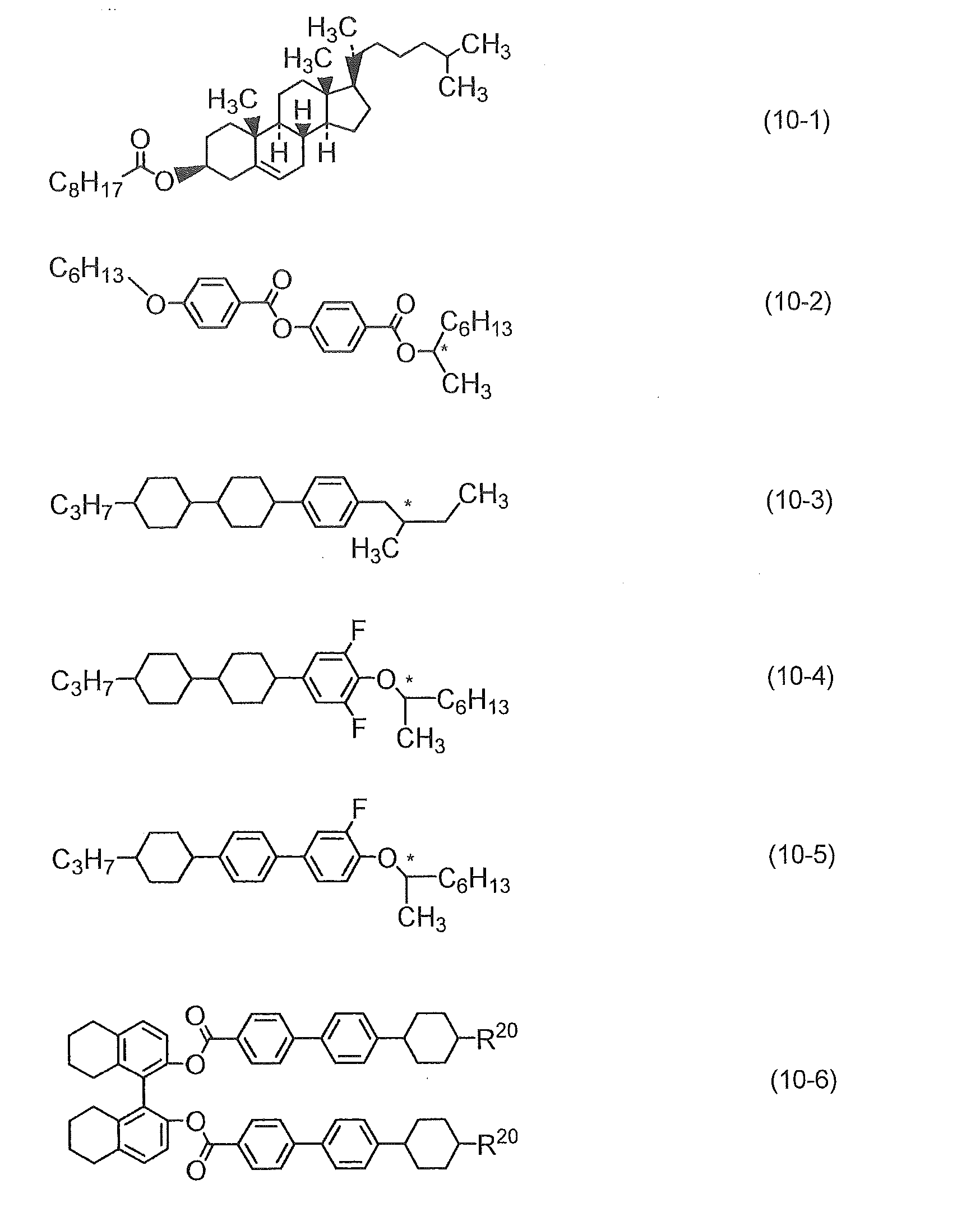
大気中での加熱による比抵抗の低下を防止するために、または素子を長時間使用したあと、室温だけではなく上限温度に近い温度でも大きな電圧保持率を維持するために、酸化防止剤が重合性組成物に添加される。酸化防止剤の好ましい例は、nが1から9の整数である化合物(11)などである。

紫外線吸収剤の好ましい例は、ベンゾフェノン誘導体、ベンゾエート誘導体、トリアゾール誘導体などである。立体障害のあるアミンのような光安定剤もまた好ましい。これらの吸収剤や安定剤における好ましい割合は、その効果を得るために、重合性組成物の重量に対して、50ppm以上であり、上限温度を下げないように、または下限温度を上げないために10000ppm以下である。さらに好ましい割合は100ppmから10000ppmの範囲である。
GH(guest host)モードの素子に適合させるために、アゾ系色素、アントラキノン系色素などのような二色性色素(dichroic dye)が重合性組成物に添加される。色素の好ましい割合は、重合性組成物の重量に対して、0.01重量%から10重量%の範囲である。泡立ちを防ぐために、ジメチルシリコーンオイル、メチルフェニルシリコーンオイルなどの消泡剤が重合性組成物に添加される。消泡剤の好ましい割合は、その効果を得るために重合性組成物の重量に対して、1ppm以上であり、表示不良を防ぐために1000ppm以下である。さらに好ましい割合は、1ppmから500ppmの範囲である。
重合性化合物は紫外線照射によって重合する。効率の観点から、光重合開始剤などの重合開始剤存在下で重合させることが好ましい。重合のための適切な条件や、開始剤の適切なタイプおよび量は、当業者には既知であり、文献に記載されている。例えば光重合開始剤であるIrgacure651(登録商標;BASF)、Irgacure184(登録商標;BASF)、またはDarocur1173(登録商標;BASF)がラジカル重合に対して適切である。
重合性化合物の重合を防ぐため、重合性組成物を保管する際、重合禁止剤を添加してもよい。重合禁止剤の例は、ヒドロキノン、メチルヒドロキノンのようなヒドロキノン誘導体、4-t-ブチルカテコール、4-メトキシフェノール、フェノチアジンなどである。
最後に、液晶複合体の構成を説明する。液晶複合体は重合性組成物中の重合性化合物の重合によって得られる。なお、重合される重合性化合物には、式(1)で表される重合性化合物以外に式(4)~(8)で表される重合性化合物も含まれる。生成した重合体は、液晶組成物と相分離を起こし、液晶複合体を与える。この液晶複合体は、電圧無印加時に透明であり、電圧印加時に不透明となるリバースモードの調光素子に適している。液晶組成物のneと重合体の屈折率との差を大きくすれば、液晶調光素子のHazeが大きくなる。液晶組成物のnoと重合体の屈折率との差を小さくすれば、液晶調光素子の透明性が改善する。液晶組成物のnoは、液晶組成物の種類にあまり依存しないため、neを大きくする、すなわち液晶組成物の光学異方性(Δn)を大きくすることにより、Hazeを大きくすることが好ましい。Δnは0.16以上が好ましく、0.18以上がより好ましい。
重合性組成物から液晶複合体を調製する方法は、次のとおりである。まず、一対の基板の間に本発明の重合性組成物を挟持する。次に、熱または光によって重合性組成物中の重合性化合物を重合させる。具体的には、まず、少なくとも一方が透明電極を有する一対の透明基板の間に、重合性組成物を真空注入法または液晶滴下法によって狭持させる。このときの基板の温度は、液晶がネマチック相または等方状態をとる温度範囲であれば、特に制限は無い。しかしながら温度が150℃以上であると、重合性基が反応するなどにより、重合性組成物の品質が劣化するため、150℃以下であることが好ましい。またより短時間で目的の配向を得るためには、基板を、ネマチック相を示す上限温度より高い温度にすることが好ましい。次に、熱または紫外線を照射することによって重合性化合物を重合させて、液晶複合体が得られる。重合によって重合性組成物から重合体が相分離する。これによって基板の間に調光層が形成される。このとき工程の条件管理の観点から、紫外線を重合開始に用いることが好ましい。
この調光層は、高分子分散型、ポリマーネットワーク型、両者の混在型に分類される。ネットワーク構造における網目は小さい方が好ましい。好ましい網目は、0.2から2μmであり、さらに好ましくは0.2から1μmであり、特に好ましくは0.3から0.7μmである。
高分子分散型の調光素子では、重合体中で液晶組成物が液滴のように分散している。液滴の各々は独立しており、連続していない。一方、ポリマーネットワーク型の調光素子では、重合体は三次元の網目構造を有し、液晶組成物はこの網目に囲まれてはいるが、連続している。 これらの素子において、Hazeを増し、駆動電圧を下げるためには、液晶複合体に基づいた液晶組成物の割合は大きい方が好ましい。一方、素子の基板どうしの密着性を向上し機械的強度を増すためには、重合体の割合は大きい方が好ましい。応答速度を上げる目的においても、重合体の割合は大きい方が好ましい。
液晶組成物の好ましい割合は、液晶複合体の重量に基づいて、50重量%から99重量%の範囲である。さらに好ましい割合は、60重量%から99重量%の範囲である。特に好ましい割合は、80重量%から98重量%の範囲である。重合体の好ましい割合は、液晶複合体の重量に基づいて、1重量%から50重量%である。さらに好ましい割合は、1重量%から40重量%の範囲である。特に好ましい割合は、2重量%から20重量%の範囲である。
基板の一例は、ガラス板、石英板、アクリル板のような変形しにくい材質である。他の例は、アクリルフィルム、ポリカーボネートフィルムのような可撓性の透明プラスチックフィルムである。用途に応じて基板の一方はシリコン樹脂などの不透明な材料でもよい。この基板は、その上に透明電極を有する。透明電極の上に配向膜などを有してもよい。透明電極の例は、酸化インジウムスズ(tin-doped indium oxide、ITO)や導電性ポリマーである。
基板上の配向膜は、ポリイミドやポリビニルアルコールのような薄膜が適している。例えば、ポリイミド配向膜は、ポリイミド樹脂組成物を透明基板上に塗布し、180℃以上の温度で熱硬化させ、必要に応じて綿布やレーヨン布でラビング処理することによって得ることができる。
一対の基板は、透明電極層が内側となるように対向させる。基板間の厚さを均一にするためにスペーサーを入れてもよい。スペーサーの例は、ガラス粒子、プラスチック粒子、アルミナ粒子、フォトスペーサーなどである。調光層の好ましい厚さは2~50μmであり、さらに好ましくは5~20μmである。一対の基板を張り合わせるには、汎用のシール材を用いることができる。シール材の例は、エポキシ系熱硬化性組成物である。
重合性化合物の重合には、紫外線照射が好ましい。紫外線照射ランプの例は、メタルハライドランプ、高圧水銀ランプ、超高圧水銀ランプ、LEDランプなどである。光重合開始剤を用いるとき、紫外線の波長は、光重合開始剤の吸収波長領域であることが好ましい。液晶組成物の吸収波長領域は避ける。好ましい波長は330nm以上である。さらに好ましい波長は、350nm以上である。反応は室温付近で行ってもよいし、または加熱して行ってもよい。
このような調光素子は、必要に応じて、素子の裏面に光吸収層、拡散反射板などを配置することができる。鏡面反射、拡散反射、再帰性反射、ホログラム反射等の機能を付加することもできる。
本発明では電圧無印加時に透明であり、電圧印加時に不透明(光散乱状態)という特徴を使用して、スイッチング素子として使用することができる。
このような素子は、調光フィルムや調光ガラスとしての機能を有する。素子がフィルム状である場合は、既存の窓へ張り付けるか、または、一対のガラス板で挟み、合わせガラスにすることができる。このような素子は、外壁に設置された窓や会議室と廊下との仕切りに使われる。すなわち、電子ブラインド、調光窓、スマートウィンドウなどの用途がある。さらに、光スイッチとしての機能を液晶シャッターなどに利用できる。
実施例によって本発明の具体例をさらに詳しく説明する。本発明はこれらの実施例によっては制限されない。本発明は、実施例の重合性組成物の少なくとも2つを混合した混合物をも含む。合成した重合性化合物は、NMR分析などによって同定した。重合性化合物、重合性組成物および調光素子の特性は、下記の方法によって測定した。
<NMR分析>
測定には、ブルカーバイオスピン社製のDRX-500を用いた。1H-NMRの測定では、試料をCDCl3などの重水素化溶媒に溶解させ、測定は、室温で、500MHz、積算回数16回の条件で行った。テトラメチルシランを内部標準として用いた。19F-NMRの測定では、CFCl3を内部標準として用い、積算回数24回で行った。核磁気共鳴スペクトルの説明において、sはシングレット、dはダブレット、tはトリプレット、qはカルテット、quinはクインテット、sexはセクステット、mはマルチプレット、brはブロードを意味する。
測定には、ブルカーバイオスピン社製のDRX-500を用いた。1H-NMRの測定では、試料をCDCl3などの重水素化溶媒に溶解させ、測定は、室温で、500MHz、積算回数16回の条件で行った。テトラメチルシランを内部標準として用いた。19F-NMRの測定では、CFCl3を内部標準として用い、積算回数24回で行った。核磁気共鳴スペクトルの説明において、sはシングレット、dはダブレット、tはトリプレット、qはカルテット、quinはクインテット、sexはセクステット、mはマルチプレット、brはブロードを意味する。
<DSC測定>
示差走査熱量計(Perkin Elmer社のDiamond DSC)を用い、測定した。転移温度は、相を示す表記の間に、摂氏温度を記載することで表記した。相を示す表記において、Cは結晶層、Nはネマチック相、Sはスメクチック相、Iは等方性液体である。相を示す表記において、括弧付の相の記載はモノトロピックの液晶相を示す。
示差走査熱量計(Perkin Elmer社のDiamond DSC)を用い、測定した。転移温度は、相を示す表記の間に、摂氏温度を記載することで表記した。相を示す表記において、Cは結晶層、Nはネマチック相、Sはスメクチック相、Iは等方性液体である。相を示す表記において、括弧付の相の記載はモノトロピックの液晶相を示す。
ガスクロマト分析:測定には島津製作所製のGC-14B型ガスクロマトグラフを用いた。キャリアーガスはヘリウム(2mL/分)である。試料気化室を280℃に、検出器(FID)を300℃に設定した。成分化合物の分離には、Agilent Technologies Inc.製のキャピラリカラムDB-1(長さ30m、内径0.32mm、膜厚0.25μm;固定液相はジメチルポリシロキサン;無極性)を用いた。このカラムは、200℃で2分間保持したあと、5℃/分の割合で280℃まで昇温した。試料はアセトン溶液(0.1重量%)に調製したあと、その1μLを試料気化室に注入した。記録計は島津製作所製のC-R5A型Chromatopac、またはその同等品である。得られたガスクロマトグラムは、成分化合物に対応するピークの保持時間およびピークの面積を示した。
試料を希釈するための溶媒は、クロロホルム、ヘキサンなどを用いてもよい。成分化合物を分離するために、次のキャピラリカラムを用いてもよい。Agilent Technologies Inc.製のHP-1(長さ30m、内径0.32mm、膜厚0.25μm)、Restek Corporation製のRtx-1(長さ30m、内径0.32mm、膜厚0.25μm)、SGE International Pty. Ltd製のBP-1(長さ30m、内径0.32mm、膜厚0.25μm)。化合物ピークの重なりを防ぐ目的で島津製作所製のキャピラリカラムCBP1-M50-025(長さ50m、内径0.25mm、膜厚0.25μm)を用いてもよい。
重合性組成物に含有される液晶化合物の割合は、次のような方法で算出してよい。液晶化合物の混合物をガスクロマトグラフィー(FID)で分析する。ガスクロマトグラムにおけるピークの面積比は液晶化合物の割合に相当する。上に記載したキャピラリカラムを用いたときは、各々の液晶化合物の補正係数を1とみなしてよい。したがって、液晶化合物の割合(重量%)は、ピークの面積比から算出することができる。
測定試料:重合性組成物および調光素子の特性を測定するときは、重合性組成物をそのまま試料として用いた。化合物の特性を測定するときは、この化合物(15重量%)を母液晶(85重量%)に混合することによって測定用の試料を調製した。測定によって得られた値から外挿法によって化合物の特性値を算出した。(外挿値)={(試料の測定値)-0.85×(母液晶の測定値)}/0.15。この割合でスメクチック相(または結晶)が25℃で析出するときは、化合物と母液晶の割合を10重量%:90重量%、5重量%:95重量%、1重量%:99重量%の順に変更した。この外挿法によって化合物に関する上限温度、光学異方性、粘度、および誘電率異方性の値を求めた。
<露光条件>
本実施例において、特に言及のない限り、露光は、室温で、250Wの超高圧水銀ランプ(ウシオ電機社製、マルチライト-250)を用い、露光量1J/cm2で実施した。このとき光の強度は、17mW/cm2(365nm)であった。またLEDで露光した場合は、UV-LEDユニット(東芝ライテックス社製)365nmタイプを用い、露光量1J/cm2で実施した。このとき光の強度は、1.3mW/cm2(365nm)であった。
<露光条件>
本実施例において、特に言及のない限り、露光は、室温で、250Wの超高圧水銀ランプ(ウシオ電機社製、マルチライト-250)を用い、露光量1J/cm2で実施した。このとき光の強度は、17mW/cm2(365nm)であった。またLEDで露光した場合は、UV-LEDユニット(東芝ライテックス社製)365nmタイプを用い、露光量1J/cm2で実施した。このとき光の強度は、1.3mW/cm2(365nm)であった。
<重合性化合物>
式(1)で表される重合性化合物として、以下の(1-1)および(1-2)を使用した。化合物は特開2009-184974号公報に記載された方法と同様に合成した。
式(1)で表される重合性化合物として、以下の(1-1)および(1-2)を使用した。化合物は特開2009-184974号公報に記載された方法と同様に合成した。
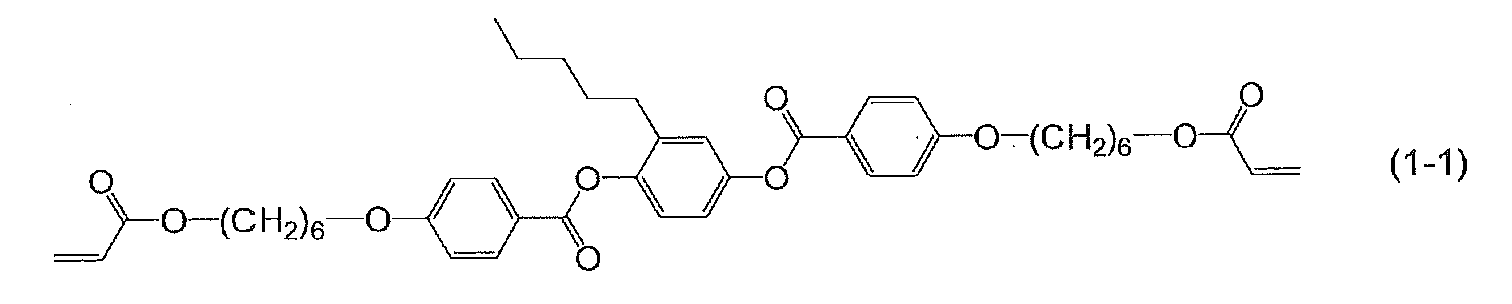
相転移温度(℃、DSCで測定);C 11.6 N 38.6 I
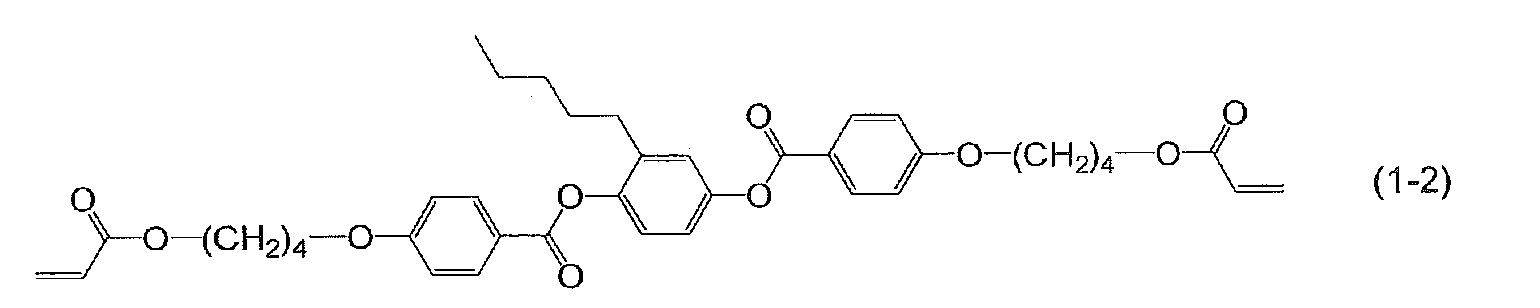
相転移温度(℃、DSCで測定);C 34.1 N 43.2 I
<物性測定>
それぞれ下記の方法で物性を計測した。これらの多くは、社団法人電子情報技術産業協会(Japan Electronics and Information Technology Industries Association;JEITAという)で審議制定されるJEITA規格(JEITA・ED-2521B)に記載された方法、またはこれを修飾した方法であった。
(1)ネマチック相の上限温度(NI;℃):偏光顕微鏡を備えた融点測定装置のホットプレートに試料を置き、1℃/分の速度でホットプレートを加熱した。試料の一部がネマチック相から等方性液体に変化したときの温度を測定した。ネマチック相の上限温度を「上限温度」と略すことがある。
(2)ネマチック相の下限温度(TC;℃):ネマチック相を有する試料をガラス瓶に入れ、0℃、-10℃、-20℃、-30℃、および-40℃のフリーザー中に10日間保管したあと、液晶相を観察した。例えば、試料が-20℃ではネマチック相のままであり、-30℃では結晶またはスメクチック相に変化したとき、TCを<-20℃と記載した。ネマチック相の下限温度を「下限温度」と略すことがある。
(3)粘度(バルク粘度;η;20℃で測定;mPa・s):測定には東京計器株式会社製のE型回転粘度計を用いた。
(4)光学異方性(屈折率異方性;Δn;25℃で測定):測定は、波長589nmの光を用い、接眼鏡に偏光板を取り付けたアッベ屈折計によって行った。主プリズムの表面を一方向にラビングしたあと、試料を主プリズムに滴下した。屈折率n//は偏光の方向がラビングの方向と平行であるときに測定した。屈折率n⊥は偏光の方向がラビングの方向と垂直であるときに測定した。光学異方性の値は、Δn=n//-n⊥、の式から計算した。
(5)誘電率異方性(Δε;25℃で測定):誘電率異方性の値は、Δε=ε//-ε⊥、の式から計算した。誘電率(ε//およびε⊥)は次のように測定した。
1)誘電率(ε//)の測定:よく洗浄したガラス基板にオクタデシルトリエトキシシラン(0.16mL)のエタノール(20mL)溶液を塗布した。ガラス基板をスピンナーで回転させたあと、150℃で1時間加熱した。2枚のガラス基板の間隔(セルギャップ)が4μmであるVA素子に試料を入れ、この素子を紫外線で硬化する接着剤で密閉した。この素子にサイン波(0.5V、1kHz)を印加し、2秒後に液晶分子の長軸方向における誘電率(ε//)を測定した。
2)誘電率(ε⊥)の測定:よく洗浄したガラス基板にポリイミド溶液を塗布した。このガラス基板を焼成した後、得られた配向膜にラビング処理をした。2枚のガラス基板の間隔(セルギャップ)が9μmであり、ツイスト角が80度であるTN素子に試料を注入した。この素子にサイン波(0.5V、1kHz)を印加し、2秒後に液晶分子の短軸方向における誘電率(ε⊥)を測定した。
(6)ヘイズ率(%):ヘイズ率の測定には、ヘイズメーターNDH5000(日本電色工業株式会社製)を使用した。
(6)ヘイズ率(%):ヘイズ率の測定には、ヘイズメーターNDH5000(日本電色工業株式会社製)を使用した。
<調光素子作製のためのセル>
測定には以下のセル2種類を使用した。VAセル;4cm×3cmにカットしたEagle(登録商標)XGガラスに、PIA-8540-01X(ポリアミック酸溶液、JNC製)を2000rpmでスピンコートした。80℃で1分加熱することで溶剤を除去し、230℃で15分間焼成し、ポリイミド配向膜を作製した。このとき得られたポリイミド配向膜の膜厚は105nmであった。ついでこの基板の配向膜面上に、直径3.5μmのスペーサーを散布し、シール材を塗布したスペーサーを散布していない基板と張り合わせた。このとき、配向膜面はセルの内側になるようにした。その後、170℃で1.5時間、シール材を加熱硬化し、VAセルを得た。
測定には以下のセル2種類を使用した。VAセル;4cm×3cmにカットしたEagle(登録商標)XGガラスに、PIA-8540-01X(ポリアミック酸溶液、JNC製)を2000rpmでスピンコートした。80℃で1分加熱することで溶剤を除去し、230℃で15分間焼成し、ポリイミド配向膜を作製した。このとき得られたポリイミド配向膜の膜厚は105nmであった。ついでこの基板の配向膜面上に、直径3.5μmのスペーサーを散布し、シール材を塗布したスペーサーを散布していない基板と張り合わせた。このとき、配向膜面はセルの内側になるようにした。その後、170℃で1.5時間、シール材を加熱硬化し、VAセルを得た。
配向膜なしセル;配向膜の作製を除き、VAセルと同様な方法作製した。
液晶組成物の例を以下に示す。成分の液晶化合物は、表3の定義に基づいて記号によって表した。表3において、1,4-シクロヘキシレンに関する立体配置はトランスである。記号化された化合物の後にあるかっこ内の番号は化合物が属する化学式を表す。(-)の記号はその他の液晶化合物を意味する。液晶化合物の割合(百分率)は、添加物を含まない液晶組成物の重量に基づいた重量百分率(重量%)である。最後に、重合性組成物の特性値をまとめた。

2-HHB(2F,3F)-O2 (2-6-1) 3%
3-HHB(2F,3F)-O2 (2-6-2) 5%
5-HHB(2F,3F)-O2 (2-6-3) 5%
3-HH2B(2F,3F)-O2 (2-7) 9%
2-HH1OB(2F,3F)-O2 (2-8-1) 16%
3-HH1OB(2F,3F)-O2 (2-8-2) 16%
3-HDhB(2F,3F)-O2 (2-16) 9%
3-HB(2F)B(2F,3F)-O2 (2-20) 7%
5-HB-O2 (3-2-1) 10%
3-HHB-1 (3-5-1) 8%
3-HHB-O1 (3-5-2) 6%
3-HBB-2 (3-6) 6%
NI=142.0℃;Tc<-20℃;Δn=0.111;Δε=-5.7;η=64.9mPa・s.
[液晶組成物(M22)]
3-HB(2F,3F)-O2 (2-1-1) 7%
5-HB(2F,3F)-O2 (2-1-2) 7%
3-HHB(2F,3F)-O2 (2-6-2) 5%
5-HHB(2F,3F)-O2 (2-6-3) 5%
V-HHB(2F,3F)-O1 (2-6-4) 2%
V-HHB(2F,3F)-O2 (2-6-5) 8%
V-HHB(2F,3F)-O4 (2-6-6) 8%
3-HH2B(2F,3F)-O2 (2-7) 7%
2-HBB(2F,3F)-O2 (2-10-1) 3%
3-HBB(2F,3F)-O2 (2-10-2) 6%
3-HH-4 (3-1) 10%
3-HB-O2 (3-2-2) 10%
5-HB-O2 (3-2-1) 10%
3-HHB-1 (3-5-1) 3%
3-HHB-3 (3-5-3) 4%
3-HHB-O1 (3-5-2) 3%
3-HBB-2 (3-6) 2%
NI=102.0℃;Tc<-40℃;Δn=0.101;Δε=-3.3;η=25.8mPa・s.
[液晶組成物(M23)]
2-BB(2F,3F)-O2 (2-4-1) 8%
3-BB(2F,3F)-O2 (2-4-2) 13%
5-BB(2F,3F)-O2 (2-4-3) 12%
2-HBB(2F,3F)-O2 (2-10-1) 3%
3-HBB(2F,3F)-O2 (2-10-2) 8%
4-HBB(2F,3F)-O2 (2-10-3) 4%
5-B(F)BB-2 (3-7-1) 14%
5-B(F)BB-3 (3-7-2) 14%
3-HBTB-2 (3-17-1) 8%
3-HBTB-3 (3-17-2) 8%
3-HBTB-4 (3-17-3) 8%
NI=100.0℃;Tc<-20℃;Δn=0.219;Δε=-2.5;η=42.2mPa・s.
[液晶組成物(M24)]
2-BB(2F,3F)-O2 (2-4-1) 7%
3-BB(2F,3F)-O2 (2-4-2) 13%
5-BB(2F,3F)-O2 (2-4-3) 10%
2-HBB(2F,3F)-O2 (2-10-1) 3%
3-HBB(2F,3F)-O2 (2-10-2) 8%
4-HBB(2F,3F)-O2 (2-10-3) 4%
5-HBB(2F,3F)-O2 (2-10-4) 5%
3-dhBB(2F,3F)-O2 (2-17) 8%
1-BB-3 (3-3) 4%
3-HBB-2 (3-6) 8%
5-B(F)BB-2 (3-7-1) 13%
5-B(F)BB-3 (3-7-2) 13%
3-BB(2F,5F)B-3 (3-20) 4%
NI=93.0℃;Tc<-20℃;Δn=0.203;Δε=-3.3;η=44.5mPa・s.
[液晶組成物(M25)]
3-H1OB(2F,3F)-O2 (2-3) 5%
3-BB(2F,3F)-O2 (2-4-2) 12%
5-BB(2F,3F)-O2 (2-4-3) 12%
2-HH1OB(2F,3F)-O2 (2-8-1) 4%
3-HH1OB(2F,3F)-O2 (2-8-1) 5%
2-HBB(2F,3F)-O2 (2-10-1) 3%
3-HBB(2F,3F)-O2 (2-10-2) 9%
4-HBB(2F,3F)-O2 (2-10-3) 4%
5-HBB(2F,3F)-O2 (2-10-4) 9%
3-HDhB(2F,3F)-O2 (2-16) 7%
3-dhBB(2F,3F)-O2 (2-17) 10%
2-HH-3 (3-1) 10%
5-B(F)BB-2 (3-7) 10%
NI=89.0℃;Tc<-20℃;Δn=0.152;Δε=-5.7;η=41.8mPa・s.
実施例において使用するその他の重合性化合物(4-1-1)から(9-1-1)を以下に示す。
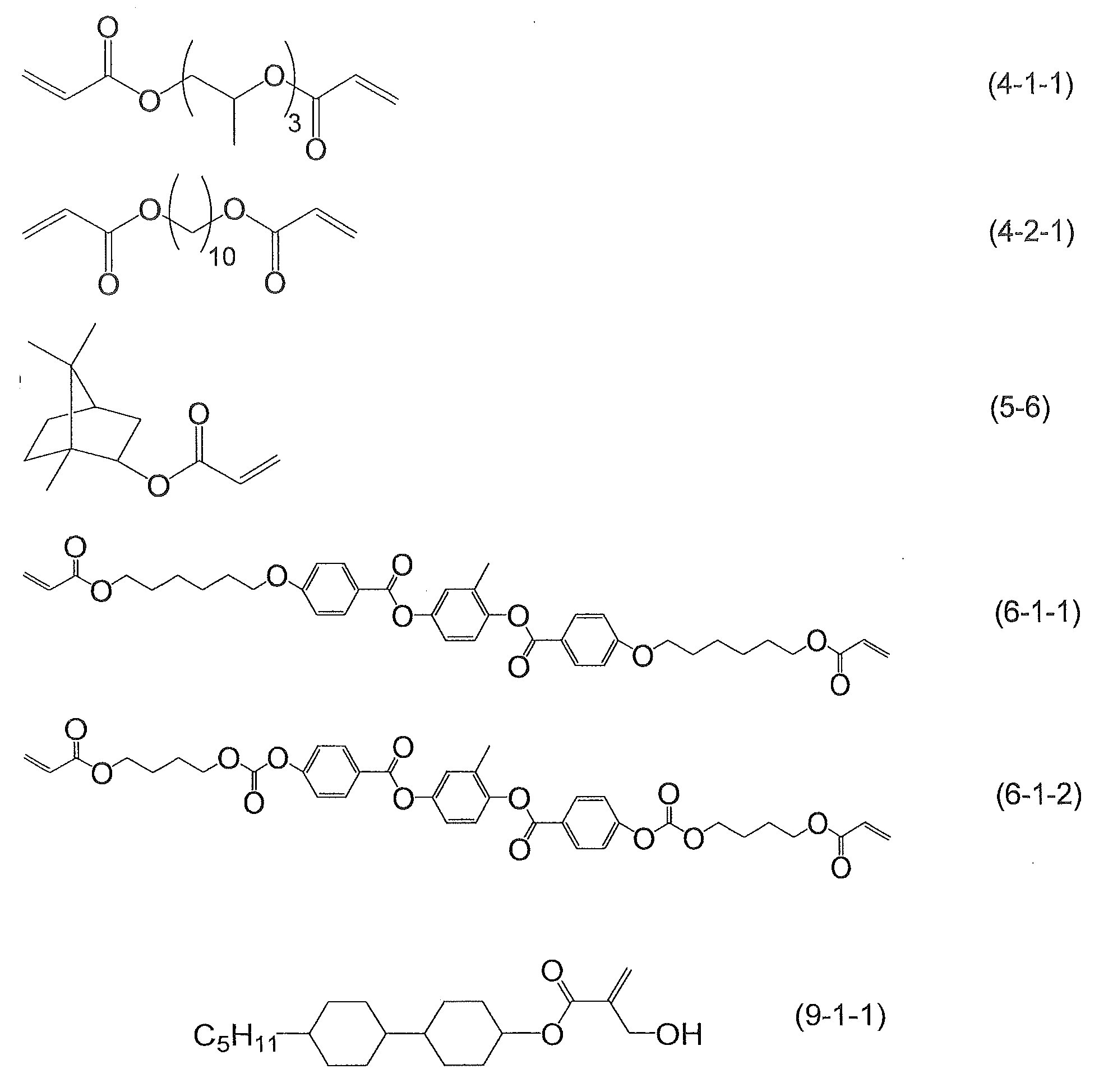
液晶調光素子の作製
負の誘電率異方性を有する液晶組成物(M21)に、光重合開始剤としてIrgacure651を0.3重量%の割合で添加した。得られた液晶組成物94重量%と、6重量%の化合物(1-1)とを混合し、重合性組成物1を調製した。重合性組成物1をVAセルへ注入した。注入時の温度は100℃であった。このセルを室温で3分間静置し、その後露光することで、調光素子1を得た。電圧無印加時には透明であり、45Vの電圧印加時には不透明となり、最大のヘイズ率が得られた。電圧無印加時および45V印加時のヘイズ率を測定した結果、1.5および52.0%であった。
この組成物1を25℃で480時間保管したところ、沈殿などは生じず、均一な状態を保っていた。
[実施例2~9]
光重合開始剤を添加した液晶組成物(M21)から(M25)のいずれかと、化合物(1-1)と、重合性化合物(4-1-1)、(4-2-1)、および(5-6)のいずれかとを混合し、重合性組成物2から9を調製した。これらの重合性組成物を使用し、実施例1と同様の手順で、調光素子2から9を作製した。ヘイズ率の測定結果を表に示す。ヘイズ率と電圧との関係は材料により差があるので、最大のヘイズ率とそれが得られる電圧とを記載した。また全ての重合性組成物で、光重合開始剤として、Irgacure651を液晶組成物に対して0.3重量%の割合で使用した。
[実施例2~9]
光重合開始剤を添加した液晶組成物(M21)から(M25)のいずれかと、化合物(1-1)と、重合性化合物(4-1-1)、(4-2-1)、および(5-6)のいずれかとを混合し、重合性組成物2から9を調製した。これらの重合性組成物を使用し、実施例1と同様の手順で、調光素子2から9を作製した。ヘイズ率の測定結果を表に示す。ヘイズ率と電圧との関係は材料により差があるので、最大のヘイズ率とそれが得られる電圧とを記載した。また全ての重合性組成物で、光重合開始剤として、Irgacure651を液晶組成物に対して0.3重量%の割合で使用した。
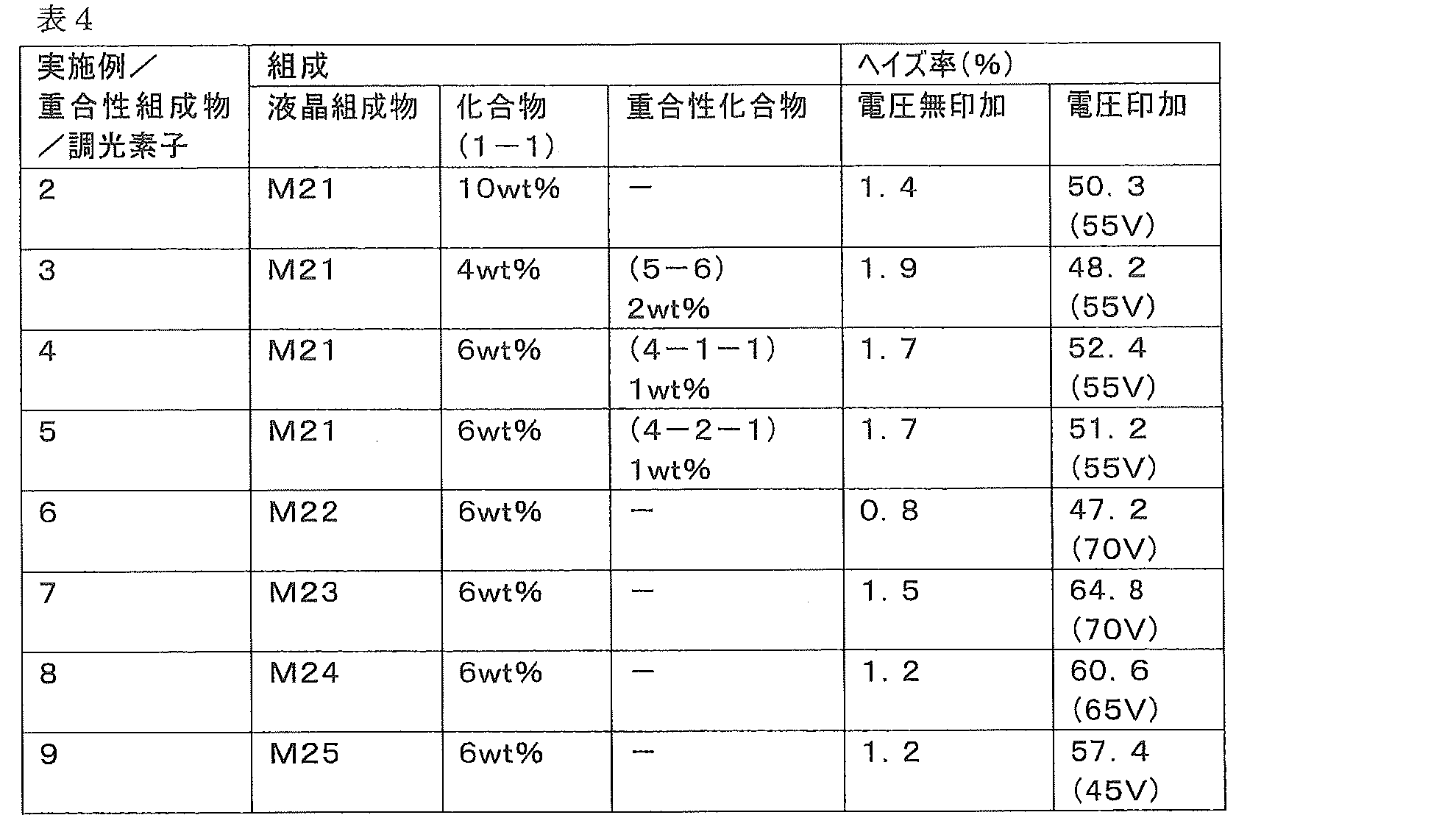
[実施例10~15]
光重合開始剤を添加した液晶組成物(M21)から液晶組成物(M25)のいずれかと、化合物(1-2)と、重合性化合物(5-6)とを混合し、重合性組成物10から15を調製した。これらの重合性組成物を使用し、実施例1と同様の手順で、調光素子10から15を作製した。ヘイズ率の測定結果を表に示す。ヘイズ率と電圧との関係は材料により差があるので、最大のヘイズ率とそれが得られる電圧とを記載した。また全ての重合性組成物で、光重合開始剤として、Irgacure651を液晶組成物に対して0.3重量%の割合で使用した。
光重合開始剤を添加した液晶組成物(M21)から液晶組成物(M25)のいずれかと、化合物(1-2)と、重合性化合物(5-6)とを混合し、重合性組成物10から15を調製した。これらの重合性組成物を使用し、実施例1と同様の手順で、調光素子10から15を作製した。ヘイズ率の測定結果を表に示す。ヘイズ率と電圧との関係は材料により差があるので、最大のヘイズ率とそれが得られる電圧とを記載した。また全ての重合性組成物で、光重合開始剤として、Irgacure651を液晶組成物に対して0.3重量%の割合で使用した。

[比較例1]
化合物(1-1)の代わりに、化合物(6-1-1)を用いて、実施例1と同様に、重合性組成物R1を調製した。さらに実施例1と同様にして、調光素子R1を得た。電圧無印加時には透明であり、60Vの電圧印加時には不透明となった。この素子の電圧無印加時および60V印加時のヘイズ率を測定した結果、2.0および51.1%であった。
この重合性組成物R1を25℃で5時間保管したところ、沈殿が生じた。
[比較例2]
化合物(1-1)の代わりに、化合物(6-1-2)を用いて、実施例1と同様に、重合性組成物R2を調製した。さらに実施例1と同様にして、調光素子R2を得た。電圧無印加時には透明であり、60Vの電圧印加時には不透明となった。この素子の電圧無印加時および60V印加時のヘイズ率を測定した結果、6.0および36.9%であった。
[比較例2]
化合物(1-1)の代わりに、化合物(6-1-2)を用いて、実施例1と同様に、重合性組成物R2を調製した。さらに実施例1と同様にして、調光素子R2を得た。電圧無印加時には透明であり、60Vの電圧印加時には不透明となった。この素子の電圧無印加時および60V印加時のヘイズ率を測定した結果、6.0および36.9%であった。
この組成物R2を25℃で5時間保管したところ、沈殿が生じた。
[比較例3]
化合物(1-1)の代わりに、化合物(4-1-1)を用いて、実施例1と同様に、重合性組成物R3を調製した。さらに実施例1と同様にして、調光素子R3を得た。電圧無印加時には透明であり、60Vの電圧印加時には不透明となった。この素子の電圧無印加時および60V印加時のヘイズ率を測定した結果、3.5および48.7%であった。
化合物(1-1)の代わりに、化合物(4-1-1)を用いて、実施例1と同様に、重合性組成物R3を調製した。さらに実施例1と同様にして、調光素子R3を得た。電圧無印加時には透明であり、60Vの電圧印加時には不透明となった。この素子の電圧無印加時および60V印加時のヘイズ率を測定した結果、3.5および48.7%であった。
この組成物R3を25℃で480時間保管したところ、沈殿などは生じず、均一な状態を保っていた。
[実施例16]
負の誘電率異方性を有する液晶組成物(M21)に、光重合開始剤としてIrgacure651を0.3重量%の割合で添加した。合計を100重量%としたときに、91重量%の液晶組成物(M21)と、6重量%の化合物(1-1)と、3重量%の化合物(9-1-1)とを混合し、重合性組成物16を調製した。この重合性組成物16を配向膜なしセルへ注入した。注入時の温度は100℃であった。このセルを室温で3分間静置し、その後露光することで、調光素子16を得た。電圧無印加時および45V印加時のヘイズ率を測定した結果、1.4および48.8%であった。
この組成物16を25℃で480時間保管したところ、沈殿などは生じず、均一な状態を保っていた。
[実施例17~20]
合計を100重量%としたときに、91重量%の光重合開始剤を添加した液晶組成物(M22)から液晶組成物(M25)のいずれかと、6重量%の化合物(1-1)と、3重量%の化合物(9-1-1)とを混合し、重合性組成物17から20を調製した。さらにこれらの組成物を使用し、実施例16と同様の手順で調光素子17から20を作製した。ヘイズ率の測定結果を表に示す。ヘイズ率と電圧との関係は材料により差があるので、最大のヘイズ率とそれが得られる電圧とを記載した。また全ての重合性組成物で、光重合開始剤として、Irgacure651を液晶組成物に対して0.4重量%の割合で使用した。
[実施例16]
負の誘電率異方性を有する液晶組成物(M21)に、光重合開始剤としてIrgacure651を0.3重量%の割合で添加した。合計を100重量%としたときに、91重量%の液晶組成物(M21)と、6重量%の化合物(1-1)と、3重量%の化合物(9-1-1)とを混合し、重合性組成物16を調製した。この重合性組成物16を配向膜なしセルへ注入した。注入時の温度は100℃であった。このセルを室温で3分間静置し、その後露光することで、調光素子16を得た。電圧無印加時および45V印加時のヘイズ率を測定した結果、1.4および48.8%であった。
この組成物16を25℃で480時間保管したところ、沈殿などは生じず、均一な状態を保っていた。
[実施例17~20]
合計を100重量%としたときに、91重量%の光重合開始剤を添加した液晶組成物(M22)から液晶組成物(M25)のいずれかと、6重量%の化合物(1-1)と、3重量%の化合物(9-1-1)とを混合し、重合性組成物17から20を調製した。さらにこれらの組成物を使用し、実施例16と同様の手順で調光素子17から20を作製した。ヘイズ率の測定結果を表に示す。ヘイズ率と電圧との関係は材料により差があるので、最大のヘイズ率とそれが得られる電圧とを記載した。また全ての重合性組成物で、光重合開始剤として、Irgacure651を液晶組成物に対して0.4重量%の割合で使用した。
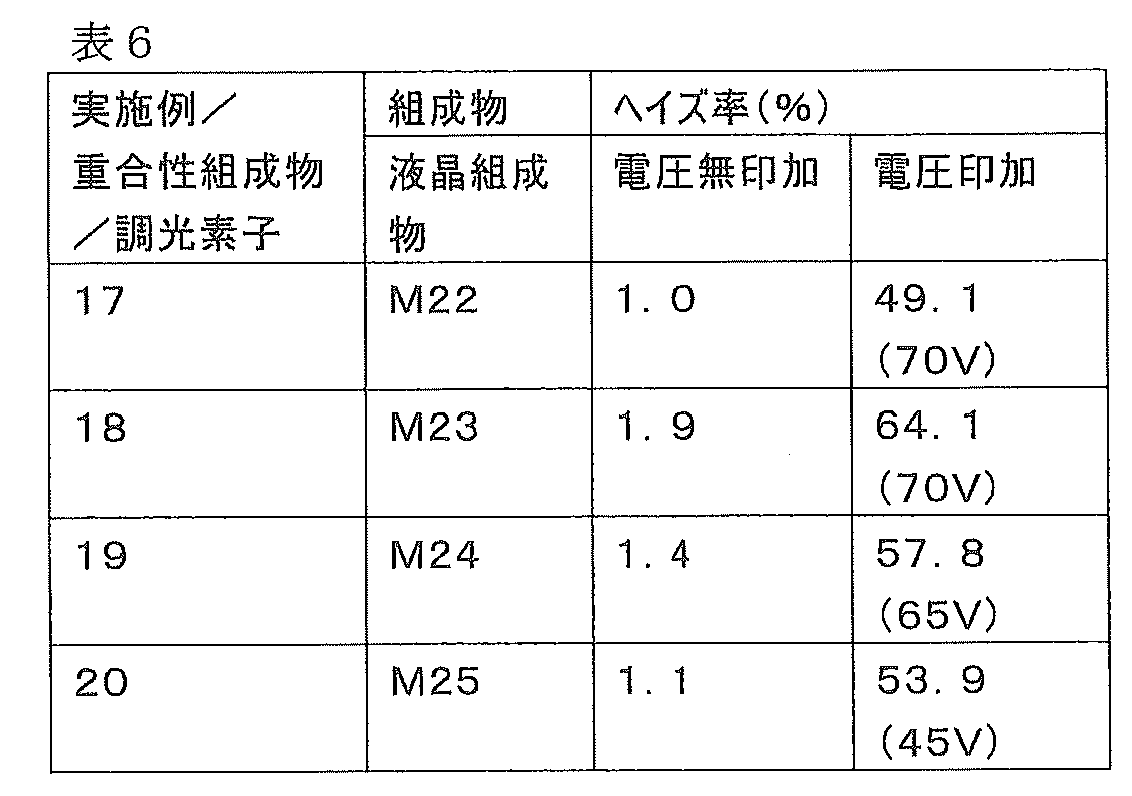
表4から表6の結果より、本発明の調光素子は、電圧無印加時のヘイズ率が低く、高い透明性を示すことが分かる。一方で、比較例2および3の調光素子は、電圧無印加時のヘイズ率が高い。また、本発明の重合性組成物を用いた調光素子は、電圧印加時に高いヘイズ率を発現し、リバースモードの調光素子に適した優れた特性を有することが分かる。さらに、実施例と比較例1および2との比較により、本発明組成物は、低温保管時にも沈殿が発生せず、取扱いに優れた特長を有することが分かる。
[実施例21~29]
実施例1から9と準じた方法で、調光素子21から29を作製した。ただし、超高圧水銀ランプの代わりにLEDを露光光源に使用し、かつ、液晶組成物に対するIrgacure651の量を0.4重量%に変更した。
[実施例21~29]
実施例1から9と準じた方法で、調光素子21から29を作製した。ただし、超高圧水銀ランプの代わりにLEDを露光光源に使用し、かつ、液晶組成物に対するIrgacure651の量を0.4重量%に変更した。

本発明の重合性組成物を用いて作製した液晶調光素子は、電圧無印加時の高い透明性や電圧印加時の大きなヘイズ率特性を有する。さらに本発明の重合性組成物は、保管時に沈殿等の発生が無いため、素子作製時の不具合発生を防ぐことができる。このため、調光窓、スマートウィンドウなどの用途向け材料として、実用的に用いることができる。
Claims (15)
- 第一成分として式(1)で表される化合物から選択された少なくとも1つの化合物、第二成分として液晶組成物、を含有する重合性組成物。

- 重合性組成物の重量に基づいて、第一成分の割合が1重量%から80重量%の範囲である、請求項1に記載の重合性組成物。
- 第二成分である液晶組成物が、式(2)で表される化合物を含有する、請求項1または2に記載の重合性組成物。

- 式(2)で表される化合物が、式(2-1)から式(2-33)で表される化合物の群から選択された少なくとも1つの化合物である、請求項3に記載の重合性組成物。
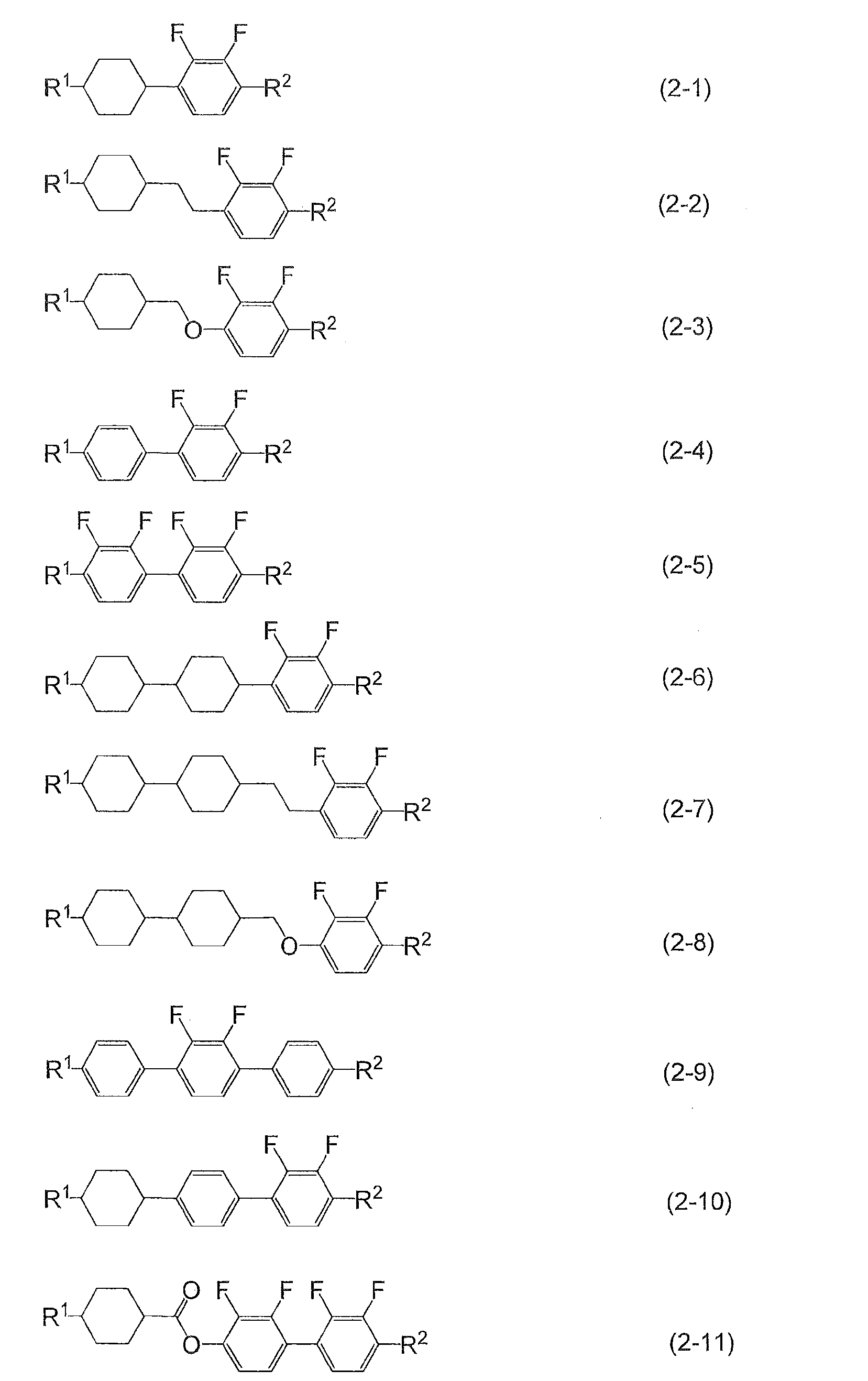

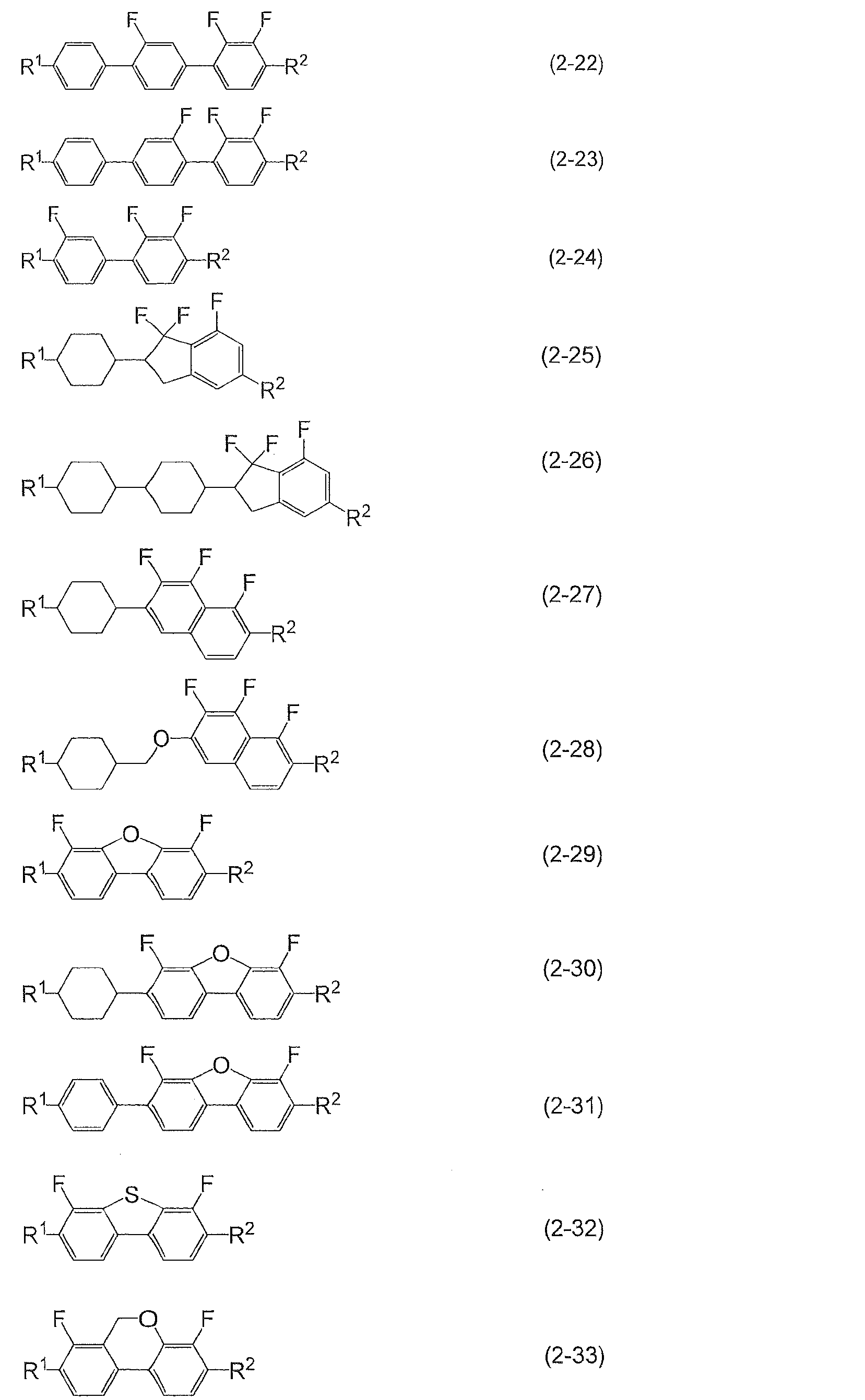
- 液晶組成物の重量に基づいて、式(2)で表される化合物の割合が、20重量%から90重量%の範囲である、請求項3に記載の重合性組成物。
- 第二成分である液晶組成物が、一般式(3)で表される化合物をさらに含有する、請求項3から5のいずれか1項に記載の重合性組成物。

- 式(3)で表される化合物が、式(3-1)から式(3-22)で表される化合物の群から選択された少なくとも1つである、請求項6に記載の重合性組成物。

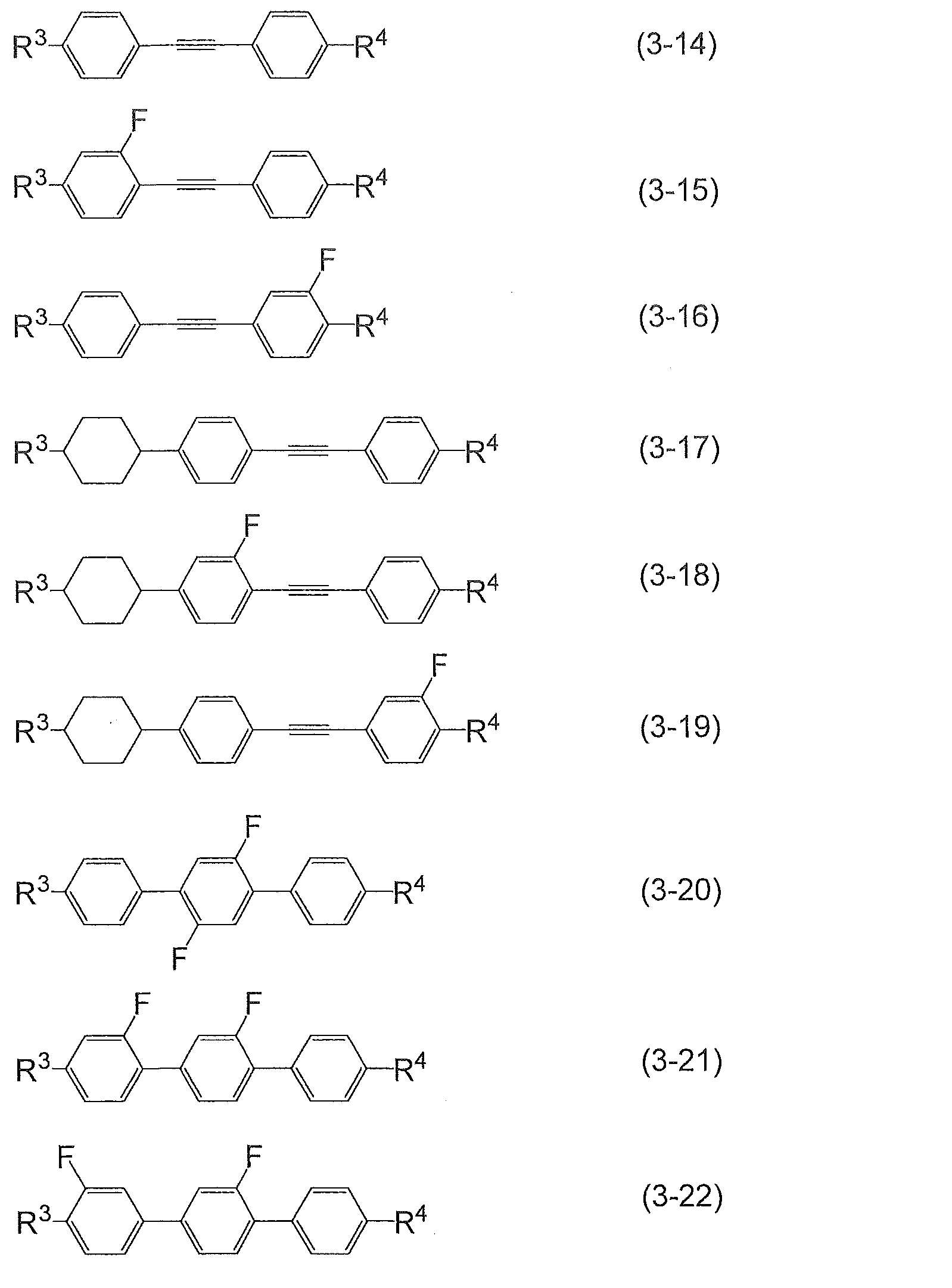
- 液晶組成物の重量に基づいて、式(3)で表される化合物の割合が80重量%から10重量%の範囲である、請求項6または7に記載の重合性組成物。
- 式(4)で表される化合物をさらに含む、請求項1から8のいずれか1項に記載の重合性組成物。
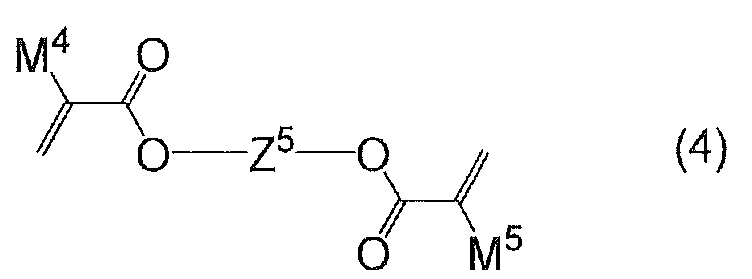
- 式(5)で表される化合物をさらに含む、請求項1から9のいずれか1項に記載の重合性組成物。

- 式(5)で表される化合物が、R6が炭素数1から40のアルキルであり、このアルキルにおいて、少なくとも1つの水素は、フッ素で置き換えられてもよく、少なくとも1つの-CH2-は、-O-、-CO-、-COO-、または-OCO-で置き換えられてもよい、請求項10に記載の重合性組成物。
- 式(6)、式(7)、および式(8)で表される化合物の群から選択された化合物をさらに含む、請求項1から11のいずれか1項に記載の重合性組成物。

- 重合性組成物の重量に基づいて、式(1)で表される化合物を含む重合性化合物の総量が1重量%から50重量%の範囲であり、液晶組成物の割合が50重量%から99重量%の範囲である、請求項1から12のいずれか1項に記載の重合性組成物。
- さらに添加物として光重合開始剤を含有する、請求項1から13のいずれか1項に記載の重合性組成物。
- 請求項1から14のいずれか1項に記載の重合性組成物を用いた、透明および散乱状態をスイッチングする液晶調光素子。
Priority Applications (1)
| Application Number | Priority Date | Filing Date | Title |
|---|---|---|---|
| JP2020532374A JP7334736B2 (ja) | 2018-07-27 | 2019-07-22 | 液晶組成物および液晶調光素子 |
Applications Claiming Priority (2)
| Application Number | Priority Date | Filing Date | Title |
|---|---|---|---|
| JP2018-141672 | 2018-07-27 | ||
| JP2018141672 | 2018-07-27 |
Publications (1)
| Publication Number | Publication Date |
|---|---|
| WO2020022246A1 true WO2020022246A1 (ja) | 2020-01-30 |
Family
ID=69181645
Family Applications (1)
| Application Number | Title | Priority Date | Filing Date |
|---|---|---|---|
| PCT/JP2019/028594 Ceased WO2020022246A1 (ja) | 2018-07-27 | 2019-07-22 | 液晶組成物および液晶調光素子 |
Country Status (3)
| Country | Link |
|---|---|
| JP (1) | JP7334736B2 (ja) |
| TW (1) | TW202014507A (ja) |
| WO (1) | WO2020022246A1 (ja) |
Citations (2)
| Publication number | Priority date | Publication date | Assignee | Title |
|---|---|---|---|---|
| WO2009104468A1 (ja) * | 2008-02-22 | 2009-08-27 | 株式会社Adeka | 重合性化合物を含有する液晶組成物及び該液晶組成物を用いた液晶表示素子 |
| JP2010248467A (ja) * | 2008-12-10 | 2010-11-04 | Chisso Corp | 重合性液晶組成物およびホモジニアス配向液晶フィルム |
Family Cites Families (5)
| Publication number | Priority date | Publication date | Assignee | Title |
|---|---|---|---|---|
| JP2009184974A (ja) * | 2008-02-06 | 2009-08-20 | Fujifilm Corp | (メタ)アクリレート化合物、液晶組成物、光学異方性膜、及び光学異方性膜の製造方法 |
| JP2009186785A (ja) * | 2008-02-06 | 2009-08-20 | Fujifilm Corp | 重合性液晶組成物、光学異方性膜、光学部材、及び液晶表示素子 |
| JP2009286976A (ja) * | 2008-05-30 | 2009-12-10 | Fujifilm Corp | 重合性液晶組成物、光学異方性膜、光学部材、及び液晶表示素子 |
| JP5419474B2 (ja) * | 2009-01-14 | 2014-02-19 | 富士フイルム株式会社 | 重合性液晶組成物、光学異方性膜、光学部材、及び液晶表示素子 |
| JP2014219659A (ja) * | 2013-04-11 | 2014-11-20 | Jnc株式会社 | 剥離防止剤を含有した重合性液晶組成物を用いたフィルム |
-
2019
- 2019-07-22 WO PCT/JP2019/028594 patent/WO2020022246A1/ja not_active Ceased
- 2019-07-22 JP JP2020532374A patent/JP7334736B2/ja active Active
- 2019-07-25 TW TW108126386A patent/TW202014507A/zh unknown
Patent Citations (2)
| Publication number | Priority date | Publication date | Assignee | Title |
|---|---|---|---|---|
| WO2009104468A1 (ja) * | 2008-02-22 | 2009-08-27 | 株式会社Adeka | 重合性化合物を含有する液晶組成物及び該液晶組成物を用いた液晶表示素子 |
| JP2010248467A (ja) * | 2008-12-10 | 2010-11-04 | Chisso Corp | 重合性液晶組成物およびホモジニアス配向液晶フィルム |
Also Published As
| Publication number | Publication date |
|---|---|
| TW202014507A (zh) | 2020-04-16 |
| JP7334736B2 (ja) | 2023-08-29 |
| JPWO2020022246A1 (ja) | 2021-08-05 |
Similar Documents
| Publication | Publication Date | Title |
|---|---|---|
| JP7036029B2 (ja) | 液晶複合体および液晶調光素子 | |
| US10982146B2 (en) | Liquid crystal composition, liquid crystal element, and use of liquid crystal composition in liquid crystal element | |
| JPWO2015079797A1 (ja) | 液晶組成物および液晶表示素子 | |
| JP6702299B2 (ja) | 液晶組成物および液晶表示素子 | |
| JP2015199900A (ja) | 液晶組成物および液晶表示素子 | |
| JP6973404B2 (ja) | 調光用液晶組成物および液晶調光素子 | |
| JP2017036382A (ja) | 液晶組成物および液晶表示素子 | |
| KR20200001474A (ko) | 액정 조성물 및 액정 표시 소자 | |
| TWI646176B (zh) | 液晶顯示元件及液晶組成物 | |
| JP7077951B2 (ja) | 調光用液晶組成物および液晶調光素子 | |
| WO2018097093A1 (ja) | 配向膜を有しない液晶表示素子の製造方法 | |
| US9359553B2 (en) | Liquid crystal composition and liquid crystal display device | |
| JPWO2020095511A1 (ja) | 液晶調光素子 | |
| KR20160130980A (ko) | 액정 표시 소자 및 액정 조성물 | |
| JPWO2019026621A1 (ja) | 液晶複合体および液晶調光素子 | |
| JP2018123296A (ja) | 液晶組成物および液晶表示素子 | |
| US20210071079A1 (en) | Liquid crystal display element and liquid crystal composition | |
| JP6702090B2 (ja) | 液晶組成物および液晶表示素子 | |
| CN110383155B (zh) | 液晶显示元件及液晶组合物与其用途、以及化合物的用途 | |
| JP7404779B2 (ja) | 液晶組成物および液晶調光素子 | |
| JPWO2020090173A1 (ja) | 液晶複合体および液晶調光素子 | |
| JPWO2020158211A1 (ja) | 液晶複合体、液晶調光素子および調光窓 | |
| JPWO2020158038A1 (ja) | 液晶複合体および液晶調光素子 | |
| JP2020070430A (ja) | 液晶組成物および液晶表示素子 | |
| JP7334736B2 (ja) | 液晶組成物および液晶調光素子 |
Legal Events
| Date | Code | Title | Description |
|---|---|---|---|
| 121 | Ep: the epo has been informed by wipo that ep was designated in this application |
Ref document number: 19840509 Country of ref document: EP Kind code of ref document: A1 |
|
| ENP | Entry into the national phase |
Ref document number: 2020532374 Country of ref document: JP Kind code of ref document: A |
|
| NENP | Non-entry into the national phase |
Ref country code: DE |
|
| 122 | Ep: pct application non-entry in european phase |
Ref document number: 19840509 Country of ref document: EP Kind code of ref document: A1 |