WO2020021958A1 - アクリル樹脂及びその製造方法、樹脂組成物セット、蓄熱材並びに物品 - Google Patents
アクリル樹脂及びその製造方法、樹脂組成物セット、蓄熱材並びに物品 Download PDFInfo
- Publication number
- WO2020021958A1 WO2020021958A1 PCT/JP2019/025728 JP2019025728W WO2020021958A1 WO 2020021958 A1 WO2020021958 A1 WO 2020021958A1 JP 2019025728 W JP2019025728 W JP 2019025728W WO 2020021958 A1 WO2020021958 A1 WO 2020021958A1
- Authority
- WO
- WIPO (PCT)
- Prior art keywords
- acrylic resin
- group
- liquid
- heat storage
- monomer
- Prior art date
- Legal status (The legal status is an assumption and is not a legal conclusion. Google has not performed a legal analysis and makes no representation as to the accuracy of the status listed.)
- Ceased
Links
Images
Classifications
-
- C—CHEMISTRY; METALLURGY
- C09—DYES; PAINTS; POLISHES; NATURAL RESINS; ADHESIVES; COMPOSITIONS NOT OTHERWISE PROVIDED FOR; APPLICATIONS OF MATERIALS NOT OTHERWISE PROVIDED FOR
- C09K—MATERIALS FOR MISCELLANEOUS APPLICATIONS, NOT PROVIDED FOR ELSEWHERE
- C09K5/00—Heat-transfer, heat-exchange or heat-storage materials, e.g. refrigerants; Materials for the production of heat or cold by chemical reactions other than by combustion
- C09K5/02—Materials undergoing a change of physical state when used
- C09K5/06—Materials undergoing a change of physical state when used the change of state being from liquid to solid or vice versa
- C09K5/063—Materials absorbing or liberating heat during crystallisation; Heat storage materials
-
- C—CHEMISTRY; METALLURGY
- C08—ORGANIC MACROMOLECULAR COMPOUNDS; THEIR PREPARATION OR CHEMICAL WORKING-UP; COMPOSITIONS BASED THEREON
- C08F—MACROMOLECULAR COMPOUNDS OBTAINED BY REACTIONS ONLY INVOLVING CARBON-TO-CARBON UNSATURATED BONDS
- C08F220/00—Copolymers of compounds having one or more unsaturated aliphatic radicals, each having only one carbon-to-carbon double bond, and only one being terminated by only one carboxyl radical or a salt, anhydride ester, amide, imide or nitrile thereof
- C08F220/02—Monocarboxylic acids having less than ten carbon atoms; Derivatives thereof
- C08F220/10—Esters
- C08F220/12—Esters of monohydric alcohols or phenols
- C08F220/16—Esters of monohydric alcohols or phenols of phenols or of alcohols containing two or more carbon atoms
- C08F220/18—Esters of monohydric alcohols or phenols of phenols or of alcohols containing two or more carbon atoms with acrylic or methacrylic acids
-
- C—CHEMISTRY; METALLURGY
- C08—ORGANIC MACROMOLECULAR COMPOUNDS; THEIR PREPARATION OR CHEMICAL WORKING-UP; COMPOSITIONS BASED THEREON
- C08F—MACROMOLECULAR COMPOUNDS OBTAINED BY REACTIONS ONLY INVOLVING CARBON-TO-CARBON UNSATURATED BONDS
- C08F220/00—Copolymers of compounds having one or more unsaturated aliphatic radicals, each having only one carbon-to-carbon double bond, and only one being terminated by only one carboxyl radical or a salt, anhydride ester, amide, imide or nitrile thereof
- C08F220/02—Monocarboxylic acids having less than ten carbon atoms; Derivatives thereof
- C08F220/10—Esters
- C08F220/12—Esters of monohydric alcohols or phenols
- C08F220/16—Esters of monohydric alcohols or phenols of phenols or of alcohols containing two or more carbon atoms
- C08F220/18—Esters of monohydric alcohols or phenols of phenols or of alcohols containing two or more carbon atoms with acrylic or methacrylic acids
- C08F220/1804—C4-(meth)acrylate, e.g. butyl (meth)acrylate, isobutyl (meth)acrylate or tert-butyl (meth)acrylate
-
- C—CHEMISTRY; METALLURGY
- C08—ORGANIC MACROMOLECULAR COMPOUNDS; THEIR PREPARATION OR CHEMICAL WORKING-UP; COMPOSITIONS BASED THEREON
- C08F—MACROMOLECULAR COMPOUNDS OBTAINED BY REACTIONS ONLY INVOLVING CARBON-TO-CARBON UNSATURATED BONDS
- C08F220/00—Copolymers of compounds having one or more unsaturated aliphatic radicals, each having only one carbon-to-carbon double bond, and only one being terminated by only one carboxyl radical or a salt, anhydride ester, amide, imide or nitrile thereof
- C08F220/02—Monocarboxylic acids having less than ten carbon atoms; Derivatives thereof
- C08F220/10—Esters
- C08F220/12—Esters of monohydric alcohols or phenols
- C08F220/16—Esters of monohydric alcohols or phenols of phenols or of alcohols containing two or more carbon atoms
- C08F220/18—Esters of monohydric alcohols or phenols of phenols or of alcohols containing two or more carbon atoms with acrylic or methacrylic acids
- C08F220/1812—C12-(meth)acrylate, e.g. lauryl (meth)acrylate
-
- C—CHEMISTRY; METALLURGY
- C08—ORGANIC MACROMOLECULAR COMPOUNDS; THEIR PREPARATION OR CHEMICAL WORKING-UP; COMPOSITIONS BASED THEREON
- C08F—MACROMOLECULAR COMPOUNDS OBTAINED BY REACTIONS ONLY INVOLVING CARBON-TO-CARBON UNSATURATED BONDS
- C08F220/00—Copolymers of compounds having one or more unsaturated aliphatic radicals, each having only one carbon-to-carbon double bond, and only one being terminated by only one carboxyl radical or a salt, anhydride ester, amide, imide or nitrile thereof
- C08F220/02—Monocarboxylic acids having less than ten carbon atoms; Derivatives thereof
- C08F220/10—Esters
- C08F220/12—Esters of monohydric alcohols or phenols
- C08F220/16—Esters of monohydric alcohols or phenols of phenols or of alcohols containing two or more carbon atoms
- C08F220/18—Esters of monohydric alcohols or phenols of phenols or of alcohols containing two or more carbon atoms with acrylic or methacrylic acids
- C08F220/1818—C13or longer chain (meth)acrylate, e.g. stearyl (meth)acrylate
-
- C—CHEMISTRY; METALLURGY
- C08—ORGANIC MACROMOLECULAR COMPOUNDS; THEIR PREPARATION OR CHEMICAL WORKING-UP; COMPOSITIONS BASED THEREON
- C08F—MACROMOLECULAR COMPOUNDS OBTAINED BY REACTIONS ONLY INVOLVING CARBON-TO-CARBON UNSATURATED BONDS
- C08F220/00—Copolymers of compounds having one or more unsaturated aliphatic radicals, each having only one carbon-to-carbon double bond, and only one being terminated by only one carboxyl radical or a salt, anhydride ester, amide, imide or nitrile thereof
- C08F220/02—Monocarboxylic acids having less than ten carbon atoms; Derivatives thereof
- C08F220/10—Esters
- C08F220/20—Esters of polyhydric alcohols or phenols, e.g. 2-hydroxyethyl (meth)acrylate or glycerol mono-(meth)acrylate
-
- C—CHEMISTRY; METALLURGY
- C08—ORGANIC MACROMOLECULAR COMPOUNDS; THEIR PREPARATION OR CHEMICAL WORKING-UP; COMPOSITIONS BASED THEREON
- C08F—MACROMOLECULAR COMPOUNDS OBTAINED BY REACTIONS ONLY INVOLVING CARBON-TO-CARBON UNSATURATED BONDS
- C08F220/00—Copolymers of compounds having one or more unsaturated aliphatic radicals, each having only one carbon-to-carbon double bond, and only one being terminated by only one carboxyl radical or a salt, anhydride ester, amide, imide or nitrile thereof
- C08F220/02—Monocarboxylic acids having less than ten carbon atoms; Derivatives thereof
- C08F220/10—Esters
- C08F220/34—Esters containing nitrogen, e.g. N,N-dimethylaminoethyl (meth)acrylate
- C08F220/36—Esters containing nitrogen, e.g. N,N-dimethylaminoethyl (meth)acrylate containing oxygen in addition to the carboxy oxygen, e.g. 2-N-morpholinoethyl (meth)acrylate or 2-isocyanatoethyl (meth)acrylate
-
- C—CHEMISTRY; METALLURGY
- C08—ORGANIC MACROMOLECULAR COMPOUNDS; THEIR PREPARATION OR CHEMICAL WORKING-UP; COMPOSITIONS BASED THEREON
- C08F—MACROMOLECULAR COMPOUNDS OBTAINED BY REACTIONS ONLY INVOLVING CARBON-TO-CARBON UNSATURATED BONDS
- C08F222/00—Copolymers of compounds having one or more unsaturated aliphatic radicals, each having only one carbon-to-carbon double bond, and at least one being terminated by a carboxyl radical and containing at least one other carboxyl radical in the molecule; Salts, anhydrides, esters, amides, imides, or nitriles thereof
- C08F222/10—Esters
-
- C—CHEMISTRY; METALLURGY
- C08—ORGANIC MACROMOLECULAR COMPOUNDS; THEIR PREPARATION OR CHEMICAL WORKING-UP; COMPOSITIONS BASED THEREON
- C08F—MACROMOLECULAR COMPOUNDS OBTAINED BY REACTIONS ONLY INVOLVING CARBON-TO-CARBON UNSATURATED BONDS
- C08F290/00—Macromolecular compounds obtained by polymerising monomers on to polymers modified by introduction of aliphatic unsaturated end or side groups
- C08F290/08—Macromolecular compounds obtained by polymerising monomers on to polymers modified by introduction of aliphatic unsaturated end or side groups on to polymers modified by introduction of unsaturated side groups
- C08F290/12—Polymers provided for in subclasses C08C or C08F
- C08F290/126—Polymers of unsaturated carboxylic acids or derivatives thereof
-
- C—CHEMISTRY; METALLURGY
- C08—ORGANIC MACROMOLECULAR COMPOUNDS; THEIR PREPARATION OR CHEMICAL WORKING-UP; COMPOSITIONS BASED THEREON
- C08F—MACROMOLECULAR COMPOUNDS OBTAINED BY REACTIONS ONLY INVOLVING CARBON-TO-CARBON UNSATURATED BONDS
- C08F8/00—Chemical modification by after-treatment
- C08F8/30—Introducing nitrogen atoms or nitrogen-containing groups
-
- C—CHEMISTRY; METALLURGY
- C08—ORGANIC MACROMOLECULAR COMPOUNDS; THEIR PREPARATION OR CHEMICAL WORKING-UP; COMPOSITIONS BASED THEREON
- C08G—MACROMOLECULAR COMPOUNDS OBTAINED OTHERWISE THAN BY REACTIONS ONLY INVOLVING UNSATURATED CARBON-TO-CARBON BONDS
- C08G18/00—Polymeric products of isocyanates or isothiocyanates
- C08G18/06—Polymeric products of isocyanates or isothiocyanates with compounds having active hydrogen
- C08G18/28—Polymeric products of isocyanates or isothiocyanates with compounds having active hydrogen characterised by the compounds used containing active hydrogen
- C08G18/40—High-molecular-weight compounds
- C08G18/62—Polymers of compounds having carbon-to-carbon double bonds
- C08G18/6216—Polymers of alpha-beta ethylenically unsaturated carboxylic acids or of derivatives thereof
- C08G18/622—Polymers of esters of alpha-beta ethylenically unsaturated carboxylic acids
- C08G18/6225—Polymers of esters of acrylic or methacrylic acid
-
- C—CHEMISTRY; METALLURGY
- C08—ORGANIC MACROMOLECULAR COMPOUNDS; THEIR PREPARATION OR CHEMICAL WORKING-UP; COMPOSITIONS BASED THEREON
- C08G—MACROMOLECULAR COMPOUNDS OBTAINED OTHERWISE THAN BY REACTIONS ONLY INVOLVING UNSATURATED CARBON-TO-CARBON BONDS
- C08G18/00—Polymeric products of isocyanates or isothiocyanates
- C08G18/06—Polymeric products of isocyanates or isothiocyanates with compounds having active hydrogen
- C08G18/28—Polymeric products of isocyanates or isothiocyanates with compounds having active hydrogen characterised by the compounds used containing active hydrogen
- C08G18/40—High-molecular-weight compounds
- C08G18/62—Polymers of compounds having carbon-to-carbon double bonds
- C08G18/6216—Polymers of alpha-beta ethylenically unsaturated carboxylic acids or of derivatives thereof
- C08G18/622—Polymers of esters of alpha-beta ethylenically unsaturated carboxylic acids
- C08G18/6225—Polymers of esters of acrylic or methacrylic acid
- C08G18/6229—Polymers of hydroxy groups containing esters of acrylic or methacrylic acid with aliphatic polyalcohols
-
- C—CHEMISTRY; METALLURGY
- C08—ORGANIC MACROMOLECULAR COMPOUNDS; THEIR PREPARATION OR CHEMICAL WORKING-UP; COMPOSITIONS BASED THEREON
- C08G—MACROMOLECULAR COMPOUNDS OBTAINED OTHERWISE THAN BY REACTIONS ONLY INVOLVING UNSATURATED CARBON-TO-CARBON BONDS
- C08G18/00—Polymeric products of isocyanates or isothiocyanates
- C08G18/06—Polymeric products of isocyanates or isothiocyanates with compounds having active hydrogen
- C08G18/28—Polymeric products of isocyanates or isothiocyanates with compounds having active hydrogen characterised by the compounds used containing active hydrogen
- C08G18/40—High-molecular-weight compounds
- C08G18/62—Polymers of compounds having carbon-to-carbon double bonds
- C08G18/6283—Polymers of nitrogen containing compounds having carbon-to-carbon double bonds
-
- C—CHEMISTRY; METALLURGY
- C08—ORGANIC MACROMOLECULAR COMPOUNDS; THEIR PREPARATION OR CHEMICAL WORKING-UP; COMPOSITIONS BASED THEREON
- C08G—MACROMOLECULAR COMPOUNDS OBTAINED OTHERWISE THAN BY REACTIONS ONLY INVOLVING UNSATURATED CARBON-TO-CARBON BONDS
- C08G18/00—Polymeric products of isocyanates or isothiocyanates
- C08G18/06—Polymeric products of isocyanates or isothiocyanates with compounds having active hydrogen
- C08G18/70—Polymeric products of isocyanates or isothiocyanates with compounds having active hydrogen characterised by the isocyanates or isothiocyanates used
- C08G18/81—Unsaturated isocyanates or isothiocyanates
- C08G18/8108—Unsaturated isocyanates or isothiocyanates having only one isocyanate or isothiocyanate group
-
- C—CHEMISTRY; METALLURGY
- C08—ORGANIC MACROMOLECULAR COMPOUNDS; THEIR PREPARATION OR CHEMICAL WORKING-UP; COMPOSITIONS BASED THEREON
- C08K—Use of inorganic or non-macromolecular organic substances as compounding ingredients
- C08K5/00—Use of organic ingredients
- C08K5/04—Oxygen-containing compounds
- C08K5/14—Peroxides
-
- C—CHEMISTRY; METALLURGY
- C09—DYES; PAINTS; POLISHES; NATURAL RESINS; ADHESIVES; COMPOSITIONS NOT OTHERWISE PROVIDED FOR; APPLICATIONS OF MATERIALS NOT OTHERWISE PROVIDED FOR
- C09D—COATING COMPOSITIONS, e.g. PAINTS, VARNISHES OR LACQUERS; FILLING PASTES; CHEMICAL PAINT OR INK REMOVERS; INKS; CORRECTING FLUIDS; WOODSTAINS; PASTES OR SOLIDS FOR COLOURING OR PRINTING; USE OF MATERIALS THEREFOR
- C09D4/00—Coating compositions, e.g. paints, varnishes or lacquers, based on organic non-macromolecular compounds having at least one polymerisable carbon-to-carbon unsaturated bond ; Coating compositions, based on monomers of macromolecular compounds of groups C09D183/00 - C09D183/16
- C09D4/06—Organic non-macromolecular compounds having at least one polymerisable carbon-to-carbon unsaturated bond in combination with a macromolecular compound other than an unsaturated polymer of groups C09D159/00 - C09D187/00
-
- C—CHEMISTRY; METALLURGY
- C09—DYES; PAINTS; POLISHES; NATURAL RESINS; ADHESIVES; COMPOSITIONS NOT OTHERWISE PROVIDED FOR; APPLICATIONS OF MATERIALS NOT OTHERWISE PROVIDED FOR
- C09K—MATERIALS FOR MISCELLANEOUS APPLICATIONS, NOT PROVIDED FOR ELSEWHERE
- C09K5/00—Heat-transfer, heat-exchange or heat-storage materials, e.g. refrigerants; Materials for the production of heat or cold by chemical reactions other than by combustion
- C09K5/02—Materials undergoing a change of physical state when used
- C09K5/06—Materials undergoing a change of physical state when used the change of state being from liquid to solid or vice versa
-
- Y—GENERAL TAGGING OF NEW TECHNOLOGICAL DEVELOPMENTS; GENERAL TAGGING OF CROSS-SECTIONAL TECHNOLOGIES SPANNING OVER SEVERAL SECTIONS OF THE IPC; TECHNICAL SUBJECTS COVERED BY FORMER USPC CROSS-REFERENCE ART COLLECTIONS [XRACs] AND DIGESTS
- Y02—TECHNOLOGIES OR APPLICATIONS FOR MITIGATION OR ADAPTATION AGAINST CLIMATE CHANGE
- Y02E—REDUCTION OF GREENHOUSE GAS [GHG] EMISSIONS, RELATED TO ENERGY GENERATION, TRANSMISSION OR DISTRIBUTION
- Y02E60/00—Enabling technologies; Technologies with a potential or indirect contribution to GHG emissions mitigation
- Y02E60/14—Thermal energy storage
Definitions
- the present invention relates to an acrylic resin and a method for producing the same, a resin composition set, a heat storage material, and an article.
- the heat storage material is a material that can take out the stored energy as heat as needed. This heat storage material is used for applications such as air conditioning equipment, floor heating equipment, refrigerators, electronic components such as IC chips, interior and exterior materials for automobiles, automobile parts such as canisters, and heat insulation containers.
- latent heat storage utilizing a phase change of a substance is widely used in terms of the amount of heat.
- Water-ice is well known as a latent heat storage material.
- Water-ice is a substance having a large amount of heat, but its phase change temperature is limited to 0 ° C. in the atmosphere, so that its application range is also limited. Therefore, paraffin is used as a latent heat storage material having a phase change temperature higher than 0 ° C. and 100 ° C. or less.
- paraffin becomes liquid when it undergoes a phase change by heating, and there is a risk of ignition and ignition. Therefore, in order to use paraffin as a heat storage material, it is necessary to prevent the paraffin from leaking from the heat storage material, for example, by storing the paraffin in a closed container such as a bag, which limits the application field.
- Patent Document 1 discloses a method using a gelling agent.
- the gel produced by this method can maintain a gel-like molded body even after the paraffin phase change.
- this method when used as a heat storage material, there is a possibility that liquid leakage, volatilization of the heat storage material, and the like may occur.
- Patent Document 2 discloses a method using a hydrogenated conjugated diene copolymer.
- the shape can be maintained near the melting or solidification temperature of the hydrocarbon compound.
- phase separation occurs due to low compatibility, and liquid leakage of the hydrocarbon compound occurs.
- Patent Document 3 discloses a method of microencapsulating a heat storage material.
- the handleability is good irrespective of the phase change, but there is a concern that the heat storage material may seep out of the capsule in a high temperature range.
- the present inventors have conducted intensive studies and found that an acrylic resin containing a specific structural unit is suitably used for a heat storage material, and a two-pack resin composition that is preferably used for the heat storage material by the acrylic resin. It was found that an object set could be obtained. That is, the present inventors have found that a heat storage material obtained from a resin composition set containing an acrylic resin containing a specific structural unit has an excellent heat storage amount, and have completed the present invention.
- the present invention provides the following [1] to [11] in some aspects.
- An acrylic resin including a first structural unit represented by the following formula (1) and a second structural unit represented by the following formula (2).
- R 1 represents a hydrogen atom or a methyl group
- R 2 represents an alkyl group having 12 to 30 carbon atoms.
- R 3 and R 5 each independently represent a hydrogen atom or a methyl group
- R 4 represents a divalent organic group.
- the acrylic resin according to [1] wherein the content of the first structural unit is 60 parts by mass or more based on 100 parts by mass of all the structural units constituting the acrylic resin.
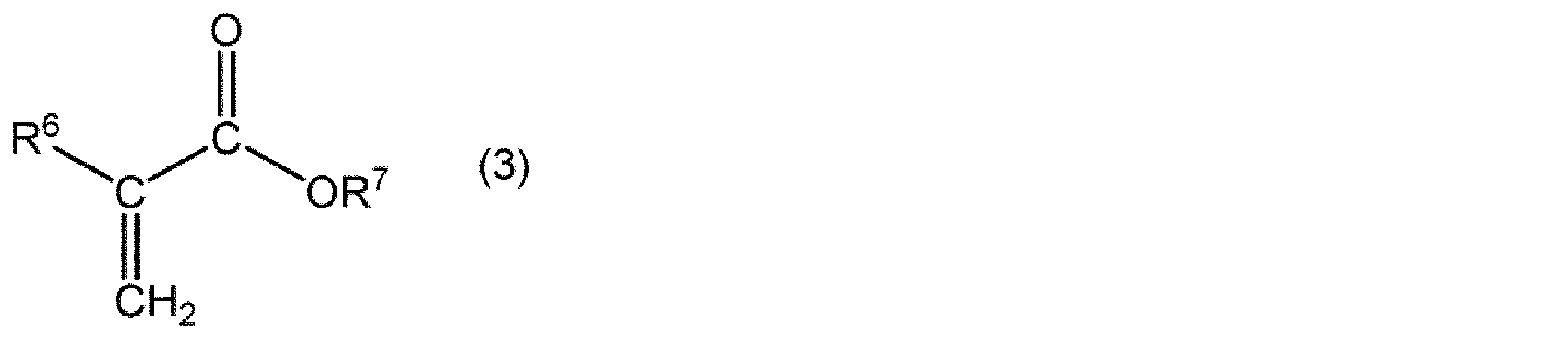
- a monomer component containing a first monomer represented by the following formula (3) and a second monomer copolymerizable with the first monomer and having a reactive group A is polymerized, A step of obtaining an acrylic resin intermediate having a reactive group A, an acrylic resin intermediate, and a monomer component including a third monomer having a reactive group B capable of reacting with the reactive group A of the acrylic resin intermediate; And a step of reacting the acrylic resin.
- R 6 represents a hydrogen atom or a methyl group
- R 7 represents an alkyl group having 12 to 30 carbon atoms.
- R 8 represents a hydrogen atom or a methyl group
- R 9 represents an alkyl group having 12 to 30 carbon atoms.
- a heat storage material comprising a cured product of a mixture of the first liquid and the second liquid in the resin composition set according to any one of [7] to [9].
- An article comprising: a heat source; and the heat storage material according to [10], which is provided to be in thermal contact with the heat source.
- the resin composition set according to one aspect of the present invention has excellent reactivity when the two components are mixed, and the resin composition can be prepared within a short time of 1 hour, preferably 30 minutes, and more preferably 10 minutes. A cured product of the composition can be obtained. Further, according to another aspect of the present invention, a heat storage material having an excellent heat storage amount can be provided.
- (meth) acrylate means “acrylate” and the corresponding “methacrylate”
- (meth) acryloyl means “acryloyl” and the corresponding “methacryloyl”.
- the weight average molecular weight (Mw) and the number average molecular weight (Mn) are values measured by gel permeation chromatography (GPC) under the following conditions and determined using polystyrene as a standard substance.
- GPC gel permeation chromatography
- the acrylic resin according to one embodiment includes a first structural unit and a second structural unit shown below.
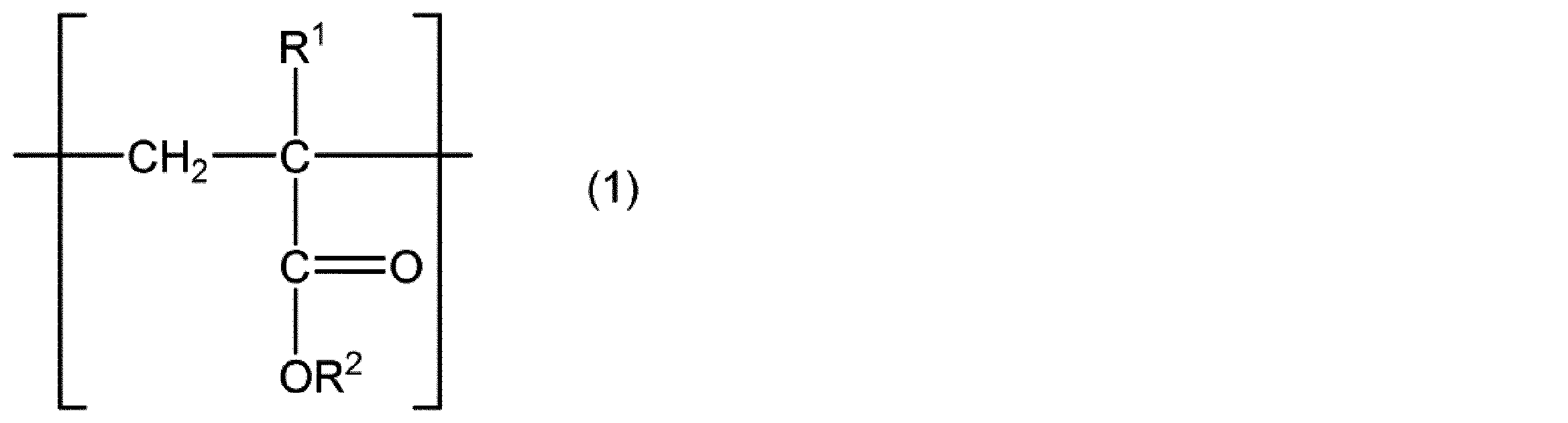
- the first structural unit is represented by the following formula (1).
- R 1 represents a hydrogen atom or a methyl group
- R 2 represents an alkyl group having 12 to 30 carbon atoms.
- the alkyl group represented by R 2 may be linear or branched.
- the carbon number of the alkyl group represented by R 2 is preferably 12 to 28, more preferably 12 to 24, still more preferably 12 to 22, and particularly preferably 12 to 18.
- Examples of the alkyl group represented by R 2 include a dodecyl group (lauryl group), a tetradecyl group, a hexadecyl group (cetyl group), an octadecyl group (stearyl group), a docosyl group (behenyl group), a tetracosyl group, a hexacosyl group, An octacosyl group;
- the alkyl group represented by R 2 is preferably at least one selected from the group consisting of a dodecyl group (lauryl group), a tetradecyl group, a hexadecyl group (cetyl group), and an octadecyl group (ste
- the first structural unit is, in other words, a structural unit derived from an alkyl (meth) acrylate having a linear or branched alkyl group having 12 to 30 carbon atoms at the terminal of the ester group.
- the content of the first structural unit is preferably at least 60 parts by mass, based on 100 parts by mass of all structural units constituting the acrylic resin, from the viewpoint of obtaining a sufficient amount of heat storage when the heat storage material is formed.
- it is 70 parts by mass or more, more preferably 80 parts by mass or more, for example, 98 parts by mass or less.
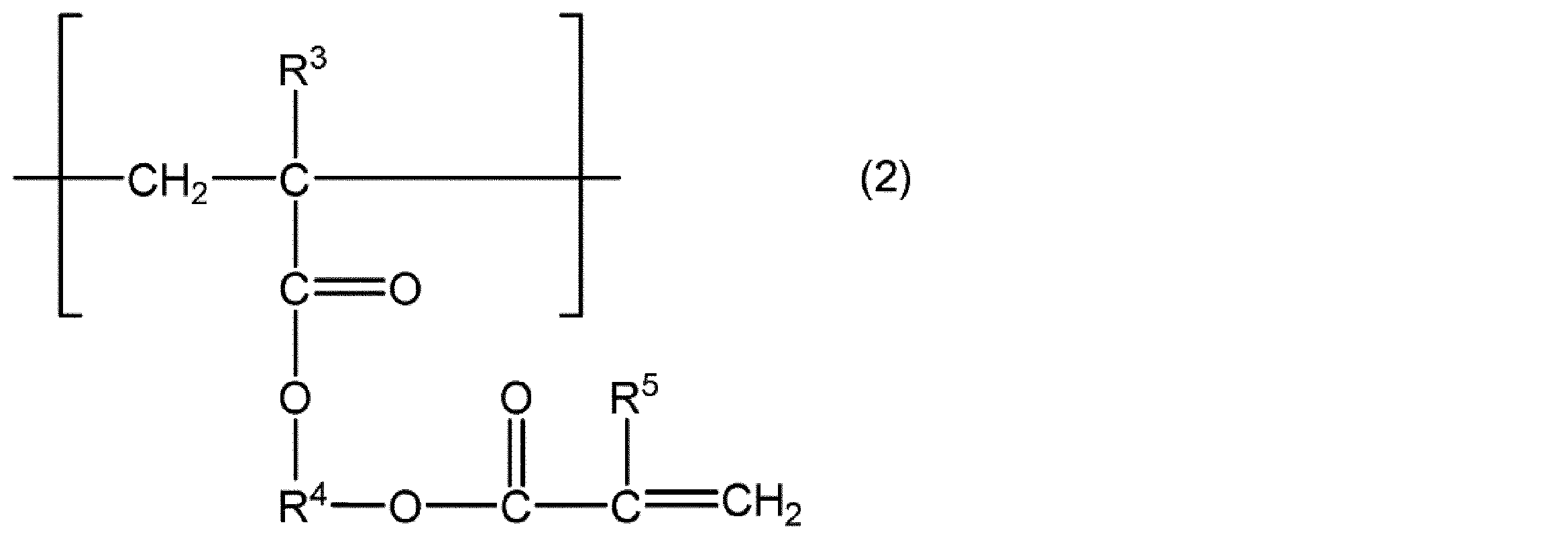
- the second structural unit is represented by the following formula (2).
- R 3 and R 5 each independently represent a hydrogen atom or a methyl group
- R 4 represents a divalent organic group.
- the divalent organic group represented by R 4 is not particularly limited, and may be a group that is incidentally generated when a (meth) acryloyl group included in the second structural unit is introduced.
- the divalent organic group can take various groups depending on the type of the reactive group A of the second monomer described later and the type of the reactive group B of the third monomer described later.
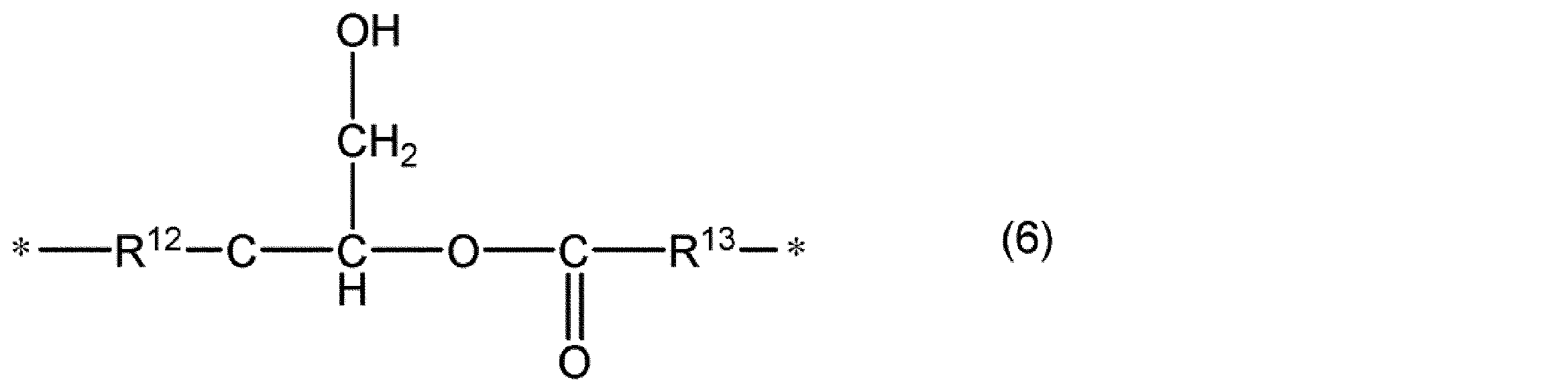
- the second organic group may be, for example, a group represented by any of the following formulas (5) to (8).
- R 10 and R 11 each independently represent a divalent hydrocarbon group, and * represents a bond (the same applies hereinafter).
- R 12 and R 13 each independently represent a divalent hydrocarbon group.
- R 14 and R 15 each independently represent a divalent hydrocarbon group.
- R 16 and R 17 each independently represent a divalent hydrocarbon group.
- the divalent hydrocarbon group represented by R 10 to R 17 may be an alkylene group or a cycloalkylene group. When the divalent hydrocarbon group is an alkylene group, the alkylene group may be linear or branched.
- the carbon number of the divalent hydrocarbon group represented by R 10 to R 17 may be, for example, 1 to 10, 1 to 8, 1 to 6, 1 to 4, or 1 to 2.
- the second structural unit is a structural unit having a (meth) acryloyl group.
- the (meth) acryloyl groups in the second structural unit can react with each other by free radicals, thereby curing the acrylic resin.
- the content of the second structural unit is preferably 25 parts by mass or less, based on 100 parts by mass of all structural units constituting the acrylic resin, from the viewpoint of obtaining a sufficient heat storage amount when the heat storage material is formed. It is preferably at most 20 parts by mass, more preferably at most 16 parts by mass, particularly preferably at most 13 parts by mass, for example, at least 2 parts by mass.
- the acrylic resin may further include other structural units, if necessary, in addition to the first structural unit and the second structural unit.
- Other structural units include, for example, an alkyl group having less than 12 carbon atoms (1 to 11 carbon atoms) such as methyl (meth) acrylate, ethyl (meth) acrylate, propyl (meth) acrylate, and butyl (meth) acrylate as an ester group.
- the acrylic resin includes a first structural unit, a second structural unit, and, if necessary, an alkyl (meth) acrylate having an alkyl group having 1 to 11 carbon atoms at an end of an ester group, and a cyclic compound. It contains only a structural unit (structural unit ⁇ ) derived from at least one type of monomer selected from the group consisting of cycloalkyl (meth) acrylates having a hydrocarbon group at the terminal of the ester group.
- the acrylic resin contains structural units other than the first structural unit, the second structural unit, and the structural unit ⁇ (for example, structural units derived from a (meth) acrylic monomer having a siloxane skeleton). do not do.
- the acrylic resin may contain only the first structural unit and the second structural unit, and in another embodiment, only the first structural unit, the second structural unit and the structural unit ⁇ May be contained.
- the acrylic resin may be any of a random copolymer, a block copolymer, and a graft copolymer.
- the weight average molecular weight of the acrylic resin is such that when the acrylic resin becomes liquid at room temperature (25 ° C.) and is used in a resin composition set described below, the viscosity of the first liquid and / or the second liquid is reduced. From the viewpoint of reducing and facilitating mixing, it is preferably 100,000 or less, more preferably 70,000 or less, and further preferably 40,000 or less. In this case, the weight average molecular weight of the acrylic resin may be, for example, 5000 or more.
- the weight average molecular weight of the acrylic resin may be 200,000 or more, 250,000 or more, or 300,000 or more from the viewpoint of excellent strength of the heat storage material.
- the weight average molecular weight of the acrylic resin may be 2,000,000 or less, 15,000,000 or less, or 1,000,000 or less from the viewpoint of easy handling of the acrylic resin.
- a monomer X described later is used in combination. Thereby, the shape of the first liquid and / or the second liquid at room temperature (25 ° C.) can be made liquid.
- the above-described method for producing an acrylic resin includes, in one embodiment, a monomer component containing a first monomer and a second monomer that is copolymerizable with the first monomer and has a reactive group A (hereinafter, referred to as a monomer component).
- a monomer component containing a first monomer and a second monomer that is copolymerizable with the first monomer and has a reactive group A
- Polymerizing the “monomer component A”) to obtain an acrylic resin intermediate having a reactive group A, and reacting the acrylic resin intermediate with the reactive group A of the acrylic resin intermediate.
- Reacting with a monomer component including a third monomer having a group B hereinafter, also referred to as “monomer component B”).
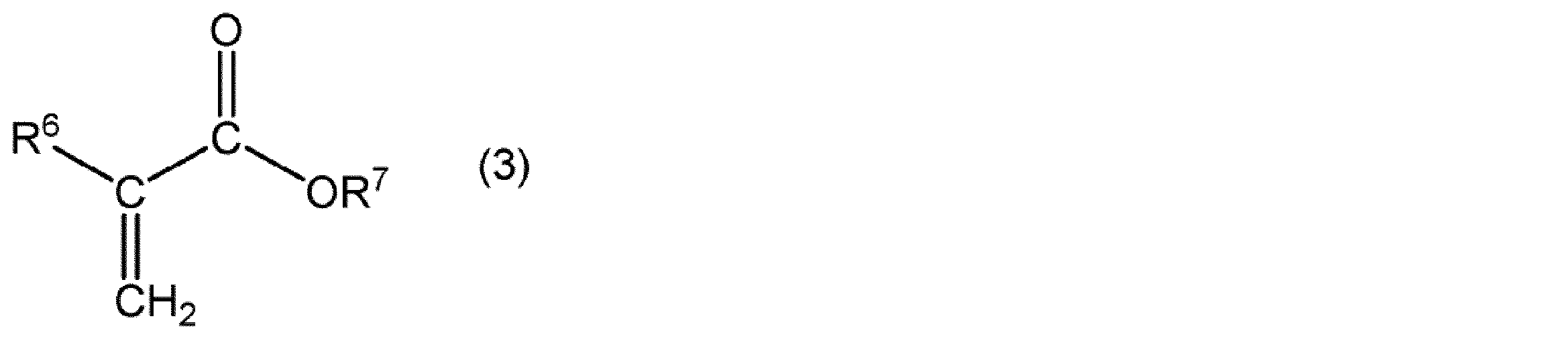
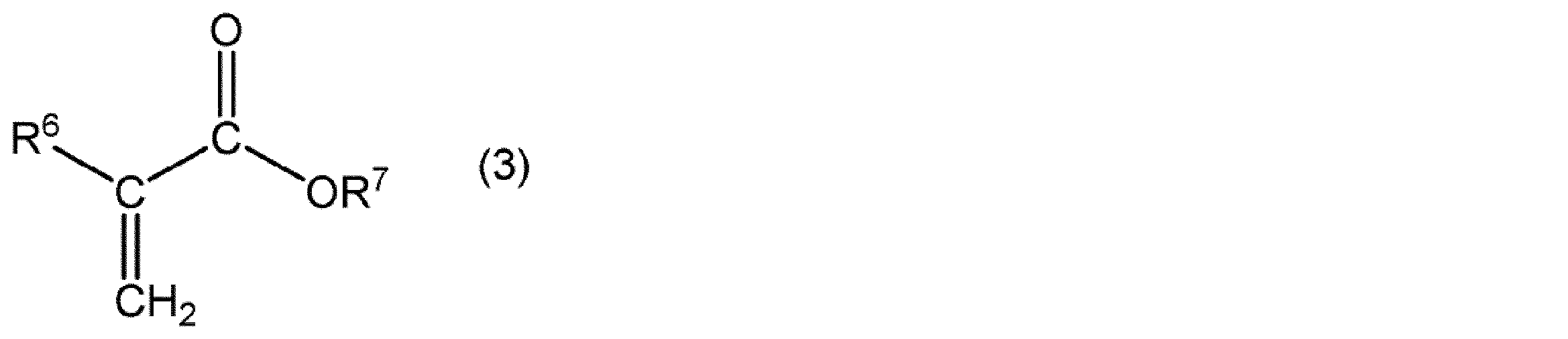
- the first monomer is preferably represented by the following formula (3).
- R 6 represents a hydrogen atom or a methyl group
- R 7 represents an alkyl group having 12 to 30 carbon atoms.
- the alkyl group represented by R 7 may be linear or branched.
- the alkyl group represented by R 7 preferably has 12 to 28 carbon atoms, more preferably 12 to 24 carbon atoms, still more preferably 12 to 22 carbon atoms, and particularly preferably 12 to 18 carbon atoms.
- the first monomer is an alkyl (meth) acrylate having a linear or branched alkyl group having 12 to 30 carbon atoms at the terminal of the ester group.
- the first monomer include dodecyl (meth) acrylate (lauryl (meth) acrylate), tetradecyl (meth) acrylate, hexadecyl (meth) acrylate (cetyl (meth) acrylate), octadecyl (meth) acrylate (stearyl (meth) acrylate).
- the first monomer is preferably dodecyl (meth) acrylate (lauryl (meth) acrylate), tetradecyl acrylate, hexadecyl (meth) acrylate (cetyl (meth) acrylate), and octadecyl (meth) acrylate (stearyl (meth) acrylate) Acrylate).
- the content of the first monomer is 100 parts by mass of the total amount of the monomer components (the total amount of the monomer components A and B; the same applies hereinafter) from the viewpoint of obtaining a sufficient amount of heat storage when the heat storage material is formed.
- it is preferably at least 60 parts by mass, more preferably at least 70 parts by mass, even more preferably at least 80 parts by mass, for example, at most 98 parts by mass.
- the second monomer is a monomer that is copolymerizable with the first monomer and has a reactive group A (reactive monomer).
- the second monomer has a (meth) acryloyl group so as to be copolymerizable with the first monomer. That is, the second monomer is preferably a monomer having a reactive group A and a (meth) acryloyl group (a (meth) acrylic monomer having a reactive group A).
- the reactive group A in the second monomer is a group that can react with the third monomer described later, and is, for example, at least one group selected from the group consisting of a hydroxyl group, an amino group, and an epoxy group. That is, the second monomer is, for example, a hydroxyl group-containing (meth) acrylic monomer, an amino group-containing (meth) acrylic monomer, or an epoxy group-containing (meth) acrylic monomer.
- hydroxyl group-containing (meth) acrylic monomer examples include 2-hydroxyethyl (meth) acrylate, 3-hydroxypropyl (meth) acrylate, 4-hydroxybutyl (meth) acrylate, 6-hydroxyhexyl (meth) acrylate, and 8 Hydroxyalkyl (meth) acrylates such as -hydroxyoctyl (meth) acrylate, 10-hydroxydecyl (meth) acrylate and 12-hydroxylauryl (meth) acrylate; and (4-hydroxymethylcyclohexyl) methyl (meth) acrylate Hydroxyalkylcycloalkane (meth) acrylate and the like.
- amino group-containing (meth) acrylic monomer examples include N, N-dimethylaminoethyl (meth) acrylate, N, N-diethylaminoethyl (meth) acrylate, N, N-dimethylaminopropyl (meth) acrylate, N-diethylaminopropyl (meth) acrylate and the like can be mentioned.
- epoxy group-containing (meth) acrylic monomer examples include glycidyl (meth) acrylate, glycidyl ⁇ -ethyl (meth) acrylate, glycidyl ⁇ -n-propyl (meth) acrylate, ⁇ -n-butyl (meth) acrylate Glycidyl acrylate, 3,4-epoxybutyl (meth) acrylate, 4,5-epoxypentyl (meth) acrylate, 6,7-epoxyheptyl (meth) acrylate, ⁇ -ethyl (meth) acryl 6,7-epoxyheptyl acid, -3-methyl-3,4-epoxybutyl (meth) acrylate, 4-methyl-4,5-epoxypentyl (meth) acrylate, -5 (meth) acrylic acid -Methyl-5,6-epoxyhexyl, ⁇ -methylglycidyl (meth)
- the content of the second monomer is preferably 25 parts by mass or less, more preferably 20 parts by mass, based on 100 parts by mass of the total amount of the monomer components, from the viewpoint of obtaining a sufficient amount of heat storage when the heat storage material is formed.
- it is more preferably 16 parts by mass or less, particularly preferably 13 parts by mass or less, for example, 2 parts by mass or more.
- An acrylic resin intermediate is obtained by polymerizing the monomer component A containing the first monomer and the second monomer.
- the acrylic resin intermediate has a structural unit derived from the first monomer and a structural unit derived from the second monomer.
- the acrylic resin intermediate also has a reactive group A derived from the second monomer.
- the monomer component A may further contain other monomers, if necessary, in addition to the first monomer and the second monomer.
- Other monomers include, for example, an alkyl group having less than 12 carbon atoms (1 to 11 carbon atoms) such as methyl (meth) acrylate, ethyl (meth) acrylate, propyl (meth) acrylate, and butyl (meth) acrylate as an ester group.
- Other monomers are used alone or in combination of two or more.
- the acrylic resin intermediate includes, in addition to the structural unit derived from the first monomer and the structural unit derived from the second monomer, a structural unit derived from the other monomer. Have.
- the method of polymerizing the monomer component A can be appropriately selected from known polymerization methods such as various radical polymerizations, and may be, for example, a suspension polymerization method, a solution polymerization method, a bulk polymerization method, or the like.
- a suspension polymerization method when the weight average molecular weight of the acrylic resin is increased (for example, to 200,000 or more), a suspension polymerization method is preferably used, and when the weight average molecular weight of the acrylic resin is reduced (for example, to 100,000 or less).
- a solution polymerization method is used.
- a monomer component as a raw material a polymerization initiator, a chain transfer agent optionally added, water and a suspending agent are mixed to prepare a dispersion.
- the suspending agent examples include water-soluble polymers such as polyvinyl alcohol, methylcellulose and polyacrylamide, and poorly soluble inorganic substances such as calcium phosphate and magnesium pyrophosphate.
- a water-soluble polymer such as polyvinyl alcohol is preferably used.
- the amount of the suspending agent is preferably 0.005 to 1 part by mass, more preferably 0.01 to 0.07 part by mass, and further preferably 0.1 to 100 parts by mass based on 100 parts by mass of the total amount of the monomer component as the raw material. It is from 0.01 to 0.03 parts by mass.
- a molecular weight modifier such as a mercaptan compound, thioglycol, carbon tetrachloride, ⁇ -methylstyrene dimer and the like may be further added.
- the polymerization temperature is preferably from 0 to 200 ° C, more preferably from 40 to 120 ° C, and still more preferably from 60 to 100 ° C.
- examples of the solvent used include aromatic solvents such as toluene and xylene, ketone solvents such as methyl ethyl ketone and methyl isobutyl ketone, ester solvents such as ethyl acetate and butyl acetate, and carbon tetrachloride. And alcohol solvents such as 2-propanol and 2-butanol.
- the solid content concentration in the solution at the start of the solution polymerization is preferably 30 to 80% by mass, more preferably 40 to 70% by mass, and still more preferably 50 to 60% by mass from the viewpoint of the polymerizability of the obtained acrylic resin.
- the polymerization temperature is preferably from 0 to 200 ° C, more preferably from 40 to 120 ° C, and still more preferably from 60 to 100 ° C.
- the polymerization initiator used in each polymerization method can be used without any particular limitation as long as it is a radical polymerization initiator.
- examples of the radical polymerization initiator include benzoyl peroxide, lauroyl peroxide, di-t-butylperoxyhexahydroterephthalate, t-butylperoxy-2-ethylhexanoate, and 1,1-t-butylperoxy.
- Organic peroxides such as -3,3,5-trimethylcyclohexane, t-butylperoxyisopropyl carbonate, azobisisobutyronitrile, azobis-4-methoxy-2,4-dimethylvaleronitrile, azobiscyclohexanone-1- Examples include azo compounds such as carbonitrile and azodibenzoyl.
- the amount of the polymerization initiator is preferably 0.01 parts by mass or more, more preferably 0.05 parts by mass or more, and still more preferably 100 parts by mass of the total amount of the monomer components, from the viewpoint of sufficiently polymerizing the monomer. 0.1 parts by mass or more.
- the compounding amount of the polymerization initiator is such that the molecular weight of the acrylic resin is in a suitable range, the decomposition product is suppressed, and a suitable adhesive strength is obtained when used as a heat storage material.
- the amount is preferably 10 parts by mass or less, more preferably 5 parts by mass or less, and still more preferably 3 parts by mass or less with respect to parts by mass.
- the step of reacting the acrylic resin intermediate with the monomer component B may be a step of reacting the acrylic resin intermediate with a third monomer by an addition reaction.
- the addition reaction may be performed, for example, by heating a mixture of the acrylic resin intermediate and the monomer component B.
- the reaction temperature at this time may be 50 ° C. or higher, and may be 120 ° C. or lower.
- the third monomer contained in the monomer component B is a monomer that can react with the acrylic resin intermediate, and has a reactive group B that can react with the reactive group A in the acrylic resin intermediate.
- the third monomer is a monomer having a reactive group B and a (meth) acryloyl group (a (meth) acrylic monomer having a reactive group B).
- the (meth) acryloyl group in the second structural unit described above is derived from the (meth) acryloyl group in the third monomer.
- the reactive group B in the third monomer is a group capable of reacting with the acrylic resin intermediate, and more specifically, a group capable of reacting with the reactive group A in the acrylic resin intermediate.
- the reactive group B in the third monomer is, for example, at least one group selected from the group consisting of an isocyanate group and a carboxyl group. That is, the third monomer is, for example, an isocyanate group-containing (meth) acrylic monomer or a carboxyl group-containing (meth) acrylic monomer.
- ⁇ As the isocyanate group-containing (meth) acrylic monomer for example, 2-isocyanatoethyl methacrylate, 2-acryloyloxyethyl isocyanate and the like can be mentioned.
- Examples of the (meth) acrylic monomer containing a carboxyl group include (meth) acrylic acid, carboxyethyl (meth) acrylate, and carboxypentyl (meth) acrylate.
- the content of the third monomer is preferably 20 parts by mass or less, more preferably 15 parts by mass, based on 100 parts by mass of the total amount of the monomer components, from the viewpoint of obtaining a sufficient amount of heat storage when the heat storage material is formed.
- it is more preferably at most 10 parts by mass, particularly preferably at most 5 parts by mass, for example, at least 0.1 part by mass.
- a catalyst may be added from the viewpoint of accelerating the addition reaction of the third monomer to the acrylic resin intermediate.
- the catalyst may be an organic phosphorus catalyst such as triphenylphosphine, a tertiary amine catalyst, a quaternary ammonium salt catalyst, or a tin catalyst such as dibutyltin dilaurate.
- the acrylic resin described above can be used as a raw material for a two-pack type resin composition set.
- the resin composition set according to one embodiment is a resin composition set (two-pack type resin composition set) including a first liquid containing an oxidizing agent and a second liquid containing a reducing agent. At least one of the first liquid and the second liquid contains the above-mentioned acrylic resin.
- the oxidizing agent and the reducing agent react to generate free radicals, and the mixture containing the acrylic resin cures (including a crosslinking reaction).
- the resin composition set according to the present embodiment by mixing the first liquid and the second liquid, a cured product of the mixture of the first liquid and the second liquid can be obtained immediately. That is, the resin composition set according to the present embodiment can cure the mixture containing the acrylic resin at a high speed.
- the first liquid contains an acrylic resin and an oxidizing agent, from the viewpoint of having excellent affinity when mixing the first liquid and the second liquid, increasing the degree of mixing, and suppressing variation in characteristics.
- the second liquid contains an acrylic resin and a reducing agent.
- the first liquid contains an acrylic resin and an oxidizing agent
- the second liquid contains a reducing agent (does not contain an acrylic resin).
- the first liquid contains an oxidizing agent (does not contain an acrylic resin)
- the second liquid contains an acrylic resin and a reducing agent.
- the content of the acrylic resin is preferably 30 parts by mass or more, more preferably 30 parts by mass or more, based on 100 parts by mass of the first liquid and the second liquid, from the viewpoint of obtaining a sufficient amount of heat storage when the heat storage material is formed. It is at least 40 parts by mass, more preferably at least 60 parts by mass, particularly preferably at least 80 parts by mass.
- the content of the acrylic resin may be 99.5 parts by mass or less, 99.0 parts by mass or less, or 98.0 parts by mass or less based on 100 parts by mass of the total of the first liquid and the second liquid.
- the oxidizing agent contained in the first liquid has a role as a polymerization initiator (radical polymerization initiator).
- the oxidizing agent may be, for example, an organic peroxide or an azo compound.
- the organic peroxide may be, for example, hydroperoxide, peroxydicarbonate, peroxyester, peroxyketal, dialkyl peroxide, diacyl peroxide and the like.
- the azo compound may be AIBN (2,2'-azobisisobutyronitrile), V-65 (azobisdimethylvaleronitrile) or the like.
- the oxidizing agent can be used alone or in combination of two or more.
- hydroperoxide examples include diisopropylbenzene hydroperoxide and cumene hydroperoxide.
- peroxydicarbonate examples include di-n-propylperoxydicarbonate, diisopropylperoxydicarbonate, bis (4-t-butylcyclohexyl) peroxydicarbonate, di-2-ethoxymethoxyperoxydicarbonate, (2-ethylhexylperoxy) dicarbonate, dimethoxybutylperoxydicarbonate, di (3-methyl-3-methoxybutylperoxy) dicarbonate and the like can be mentioned.
- peroxy esters examples include cumyl peroxy neodecanoate, 1,1,3,3-tetramethylbutyl peroxy neodecanoate, 1-cyclohexyl-1-methylethyl peroxy neodecanoate, t -Hexylperoxy neodecanoate, t-butylperoxypivalate, 1,1,3,3-tetramethylbutylperoxy-2-ethylhexanonate, 2,5-dimethyl-2,5-di ( 2-ethylhexanoylperoxy) hexane, 1-cyclohexyl-1-methylethylperoxy-2-ethylhexanonate, t-hexylperoxy-2-ethylhexanonate, t-butylperoxy-2 -Ethylhexanonate, t-butylperoxyisobutyrate, 1,1-bis (t-butylperoxy
- peroxyketal examples include 1,1-bis (t-hexylperoxy) -3,3,5-trimethylcyclohexane, 1,1-bis (t-hexylperoxy) cyclohexane, 1,1- Bis (t-butylperoxy) -3,3,5-trimethylcyclohexane, 1,1-bis (t-butylperoxy) cyclododecane, 2,2-bis (t-butylperoxy) decane, etc. No.
- dialkyl peroxide examples include ⁇ , ⁇ ′-bis (t-butylperoxy) diisopropylbenzene, dicumyl peroxide, 2,5-dimethyl-2,5-di (t-butylperoxy) hexane, t- Butyl cumyl peroxide and the like.
- diacyl peroxide examples include isobutyl peroxide, 2,4-dichlorobenzoyl peroxide, 3,5,5-trimethylhexanoyl peroxide, octanoyl peroxide, lauroyl peroxide, stearoyl peroxide, and succinic peroxide. Benzoyl peroxytoluene, benzoyl peroxide and the like.
- the oxidizing agent is preferably a peroxide, more preferably a hydroperoxide, and still more preferably cumene hydroperoxide, from the viewpoint of storage stability.
- the content of the oxidizing agent in the first liquid may be 0.5 parts by mass or more, 1 part by mass or more, or 2 parts by mass or more with respect to 100 parts by mass of the first liquid, and 20 parts by mass or less and 10 parts by mass. Parts or less, or 5 parts by mass or less.
- the content of the oxidizing agent in the first liquid may be 0.1 parts by mass or more, 0.5 parts by mass or more, or 1 part by mass or more with respect to 100 parts by mass of the first liquid and the second liquid. It may be 10 parts by mass or less, 5 parts by mass or less, or 3 parts by mass or less.
- the reducing agent contained in the second liquid may be, for example, a tertiary amine, a thiourea derivative, a transition metal salt, or the like.
- a tertiary amine include triethylamine, tripropylamine, tributylamine, N, N-dimethylparatoluidine and the like.
- the thiourea derivative include 2-mercaptobenzimidazole, methylthiourea, dibutylthiourea, tetramethylthiourea, and ethylenethiourea.
- the transition metal salt include cobalt naphthenate, copper naphthenate, and vanadyl acetylacetonate.
- One reducing agent may be used alone, or two or more reducing agents may be used in combination.
- the reducing agent is preferably a thiourea derivative or a transition metal salt from the viewpoint of excellent curing speed.
- the thiourea derivative may be, for example, ethylene thiourea.
- the transition metal salt is preferably vanadyl acetylacetonate.
- the content of the reducing agent in the second liquid may be 0.1 parts by mass or more, 0.3 parts by mass or more, or 0.5 parts by mass or more with respect to 100 parts by mass of the second liquid, and may be 10 parts by mass or more. Hereinafter, it may be 5 parts by mass or less, or 3 parts by mass or less.
- the content of the reducing agent in the second liquid is 0.05 parts by weight or more, 0.1 parts by weight or more, or 0.3 parts by weight or more based on 100 parts by weight of the total amount of the first liquid and the second liquid. And may be 5 parts by mass or less, 3 parts by mass or less, or 1 part by mass or less.
- the resin composition set may include other components other than the acrylic resin, the oxidizing agent and the reducing agent.
- Other components may be contained in one or both of the first liquid and the second liquid, and may be contained in a third liquid different from the first liquid and the second liquid.
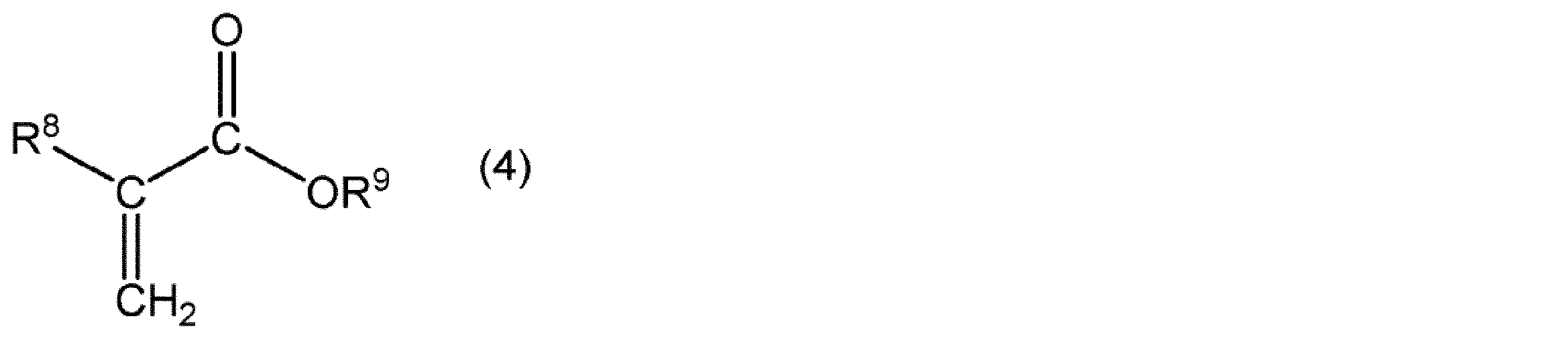
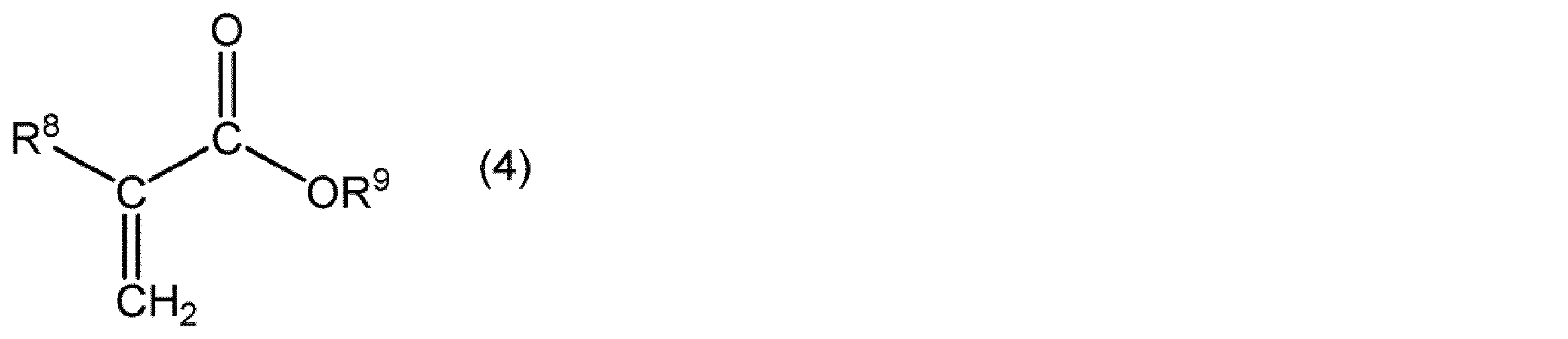
- the other component may be a monomer (monomer X) represented by the following formula (4).
- R 8 represents a hydrogen atom or a methyl group
- R 9 represents an alkyl group having 12 to 30 carbon atoms.
- the alkyl group represented by R 9 may be linear or branched.
- the carbon number of the alkyl group represented by R 9 is preferably 12 to 28, more preferably 12 to 24, still more preferably 12 to 22, particularly preferably 12 to 18, and most preferably 12 to 14.
- the monomer X is, in other words, an alkyl (meth) acrylate having a linear or branched alkyl group having 12 to 30 carbon atoms at the terminal of the ester group.
- the first monomer include dodecyl (meth) acrylate (lauryl (meth) acrylate), tetradecyl (meth) acrylate, hexadecyl (meth) acrylate (cetyl (meth) acrylate), octadecyl (meth) acrylate (stearyl (meth) acrylate).
- the content of the monomer X is preferably 20 parts by mass or more, more preferably 20 parts by mass or more, based on 100 parts by mass of the first liquid and the second liquid, from the viewpoint of obtaining a sufficient amount of heat storage when the heat storage material is formed. It is 30 parts by mass or more, more preferably 40 parts by mass or more, for example, may be 60 parts by mass or less.
- Other components include curing accelerators, hydrocarbon compounds, antioxidants, coloring agents, fatty acids, fatty acid esters, aliphatic ketones, aliphatic aldehydes, aliphatic alcohols, aliphatic ethers, fillers, crystal nucleating agents, and heat stabilizers. , A heat conductive material, a plasticizer, a foaming agent, a flame retardant, a vibration damping agent, and the like. These other components are used alone or in combination of two or more. Other components may be contained in one or both of the first liquid and the second liquid.
- the first liquid and / or the second liquid are preferably liquid at room temperature (25 ° C), and may be liquid at a temperature of 20 ° C or higher.
- the viscosity of the first liquid and / or the second liquid at 60 ° C. is preferably 100 Pa ⁇ s or less, more preferably 50 Pa ⁇ s or less, further preferably 20 Pa ⁇ s or less, particularly from the viewpoint of excellent fluidity and handling properties. Preferably it is 10 Pa ⁇ s or less. From the same viewpoint, the viscosity of the first liquid and / or the second liquid at the melting point of the acrylic resin + 20 ° C.
- the viscosity at 60 ° C. of the first liquid and / or the second liquid or the viscosity at the melting point of the acrylic resin + 20 ° C. may be, for example, 0.5 Pa ⁇ s or more.
- the viscosity of the first liquid and / or the second liquid means a value measured based on JIS Z 8803, and specifically, is measured by an E-type viscometer (PE-80L, manufactured by Toki Sangyo Co., Ltd.). Means the measured value.
- the calibration of the viscometer can be performed based on JIS Z 8809-JS14000.
- the melting point of the acrylic resin means a value measured by the method described in Examples.
- the mixture can be cured by mixing the first liquid and the second liquid.
- the cured product of this mixture is suitably used as a heat storage material. That is, a mixture of the first liquid and the second liquid is suitable as a resin composition for a heat storage material.
- the heat storage material includes a cured product of the mixture of the first liquid and the second liquid described above.
- the heat storage material is, for example, a heat storage capsule in which a latent heat storage material such as that used in a conventional heat storage material is included. It does not have to be included, and even in this case, an excellent heat storage amount can be obtained.
- the heat storage material (cured product of the mixture of the first liquid and the second liquid) can be used in various fields.
- Heat storage materials include, for example, air-conditioning equipment (improving the efficiency of air-conditioning equipment) in automobiles, buildings, public facilities, underground malls, etc., pipes in factories (heat storage of pipes), automobile engines (heat insulation around the engines), and electronic components. (Prevention of temperature rise of electronic parts), used for fibers of underwear.
- the heat storage material can store heat of the heat source by being arranged so as to be in thermal contact with a heat source that generates heat in each use. That is, one embodiment of the present invention is an article including a heat source and a heat storage material (a cured product of a mixture of the first liquid and the second liquid) provided to be in thermal contact with the heat source.
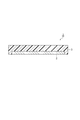
- FIG. 1 is a schematic sectional view showing an embodiment of an article provided with a heat storage material.
- the article 1 includes a heat source 2 and a heat storage material 3 provided to be in thermal contact with the heat source 2.
- the heat storage material 3 may be disposed so as to be in thermal contact with at least a part of the heat source 2, and a part of the heat source 2 may be exposed as shown in FIG. You may arrange
- the heat storage material 3 is in thermal contact with the heat source 2
- the heat source 2 and the heat storage material 3 may be in direct contact with each other, and another member (for example, having a thermal conductivity between the heat source 2 and the heat storage material 3). May be arranged.
- the heat storage material 3 when the heat storage material 3 is used together with an air conditioner (or a part thereof), a pipe, or an automobile engine as the heat source 2, the heat storage material 3 is in thermal contact with these heat sources 2, so that the heat source 2 The heat generated from the heat storage material 2 is stored in the heat storage material 3, and the heat source 2 is easily maintained at a certain temperature or higher (heat is maintained).
- the heat storage material 3 When the heat storage material 3 is used as a fiber for underwear, the heat storage material 3 stores heat generated from the human body as the heat source 2, so that the user can feel warmth for a long time.
- the heat generated in the electronic component can be stored by being arranged so as to be in thermal contact with the electronic component.
- the heat stored in the heat storage material can be gradually released, and the heat generated in the electronic components can be rapidly discharged to the outside. It can be suppressed from being released (locally high temperature near the electronic component).
- the heat storage material 3 may be disposed in the heat source 2 after forming a cured product of the mixture of the first liquid and the second liquid into a sheet (film).
- the sheet-like cured product is obtained by molding while mixing the first liquid and the second liquid of the resin composition set. That is, in one embodiment, the method of manufacturing the heat storage material 3 includes a step of forming the sheet into a sheet while mixing the first liquid and the second liquid of the resin composition set (forming step).
- the molding in the molding step may be injection molding, compression molding or transfer molding. In this case, the heat storage material 3 does not require a casing, and the heat storage material 3 alone can be attached to an object to be mounted, wound, or mounted in various states.
- the cured product of the above-described mixture of the first liquid and the second liquid can be used for purposes other than heat storage materials.
- the cured product is suitably used for forming, for example, a water-repellent material, an anti-frost material, a refractive index adjusting material, a lubricant, an adsorbent, a thermosetting stress relieving material, or a low dielectric material.
- the water repellent material, the frost preventive material, the refractive index adjusting material, the lubricant, the adsorbent, the thermosetting stress relieving material, and the low dielectric material may each include, for example, the above-described cured product.
- the acrylic resins B to E were synthesized in the same manner as in the synthesis example of the acrylic resin A, except that the monomer components were changed to the monomer components shown in Table 1.
- Table 1 also shows the weight average molecular weight (Mw) and melting point of each of the obtained acrylic resins.
- the melting point of the acrylic resin was measured as follows. Using a differential scanning calorimeter (Perkin Elmer, model number DSC8500), the temperature was raised to 100 ° C. at 20 ° C./min, kept at 100 ° C. for 3 minutes, and then lowered to ⁇ 30 ° C. at a rate of 10 ° C./min. The temperature was lowered, then kept at ⁇ 30 ° C. for 3 minutes, and then heated again to 100 ° C. at a rate of 10 ° C./min to measure the thermal behavior of the acrylic resin and calculate the melting peak as the melting point of the acrylic resin. .
- lauryl acrylate is manufactured by Osaka Organic Chemical Industry Co., Ltd.
- tetradecyl acrylate is manufactured by Tokyo Chemical Industry Co., Ltd.
- butyl acrylate is manufactured by Wako Pure Chemical Industries, Ltd.
- cetyl acrylate and stearyl acrylate are manufactured by NOF Corporation.
- 2-hydroxyethyl acrylate Nippon Shokubai Co., Ltd. was used, and for 2-isocyanatoethyl methacrylate, Showa Denko KK was used.
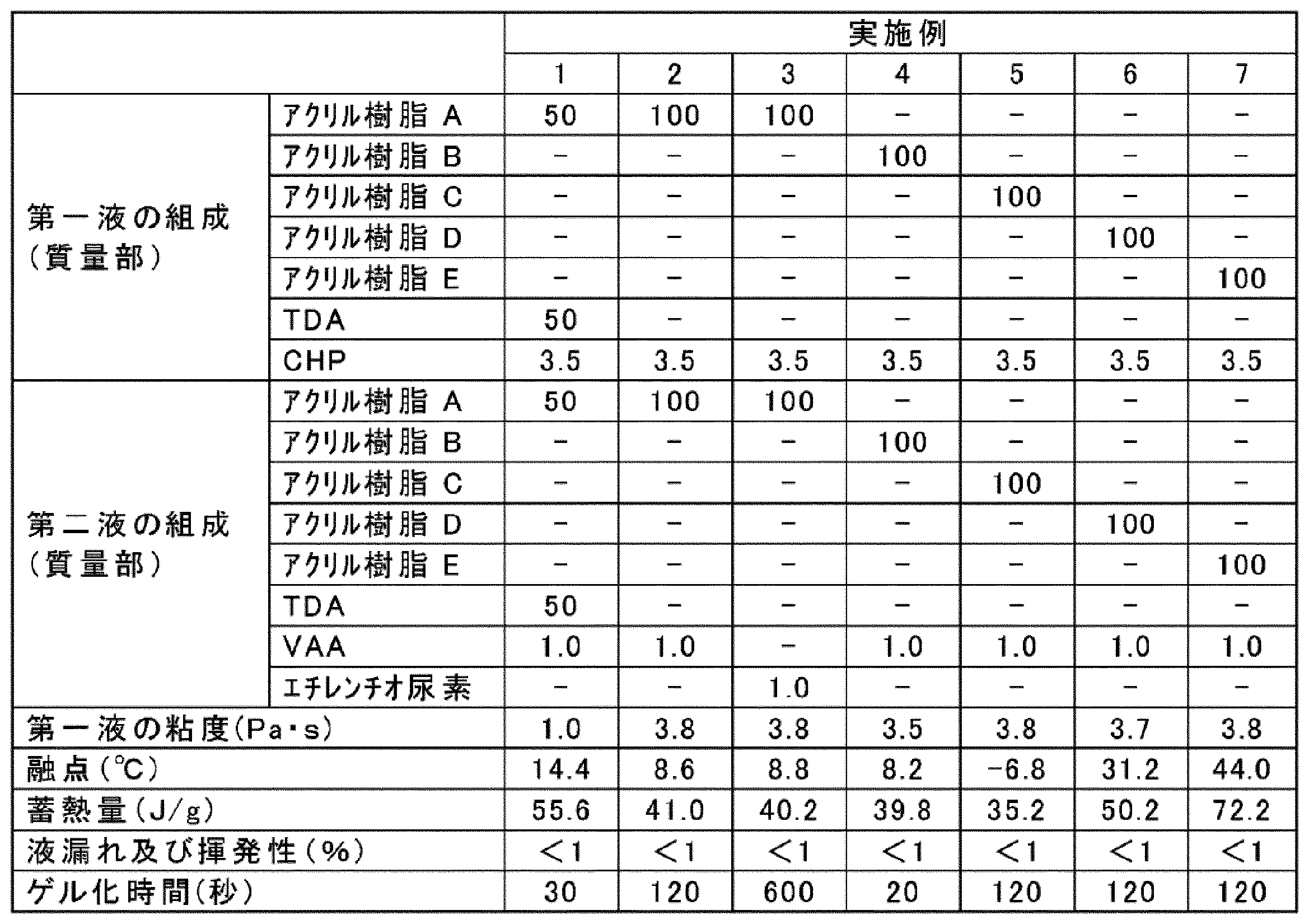
- Example 1 A first liquid was obtained by mixing 50 g of acrylic resin A, 50 g of tetradecyl acrylate, and 3.5 g of cumene hydroxyperoxide. In addition, 50 g of acrylic resin A, 50 g of tetradecyl acrylate, and 1.0 g of vanadyl acetylacetonate were mixed to obtain a second liquid. The viscosity of the first liquid at 60 ° C. was measured based on JIS Z 8803 using an E-type viscometer (PE-80L, manufactured by Toki Sangyo Co., Ltd.). Table 2 shows the results.
- a 10 cm ⁇ 10 cm ⁇ 1 mm formwork (SUS plate) is set as a spacer on a polyethylene terephthalate (PET) film, and the first and second liquids are mixed therein with a mixing nozzle (manufactured by Tomita Engineering Co., Ltd.).
- the mixture was filled while mixing using a PET film, covered with another PET film, and cured for 24 hours. After curing, the PET film and the mold were removed to obtain a sheet-like heat storage material having a thickness of 1 mm.
- Example 2 (Examples 2 to 7) Except that the compositions of the first liquid and the second liquid were changed as shown in Table 2, the viscosity measurement of the first liquid and the production of the heat storage material were performed in the same manner as in Example 1. Table 2 shows the results.
- Each heat storage material produced in the example was measured using a differential scanning calorimeter (manufactured by PerkinElmer, model number DSC8500), and the melting point and the heat storage amount were calculated. Specifically, the temperature is raised to 100 ° C. at a rate of 20 ° C./min, maintained at 100 ° C. for 3 minutes, and then lowered at a rate of 10 ° C./min to ⁇ 30 ° C. The temperature was raised again to 100 ° C. at a rate of 10 ° C./min, and the thermal behavior was measured. The melting peak was set as the melting point of the heat storage material, and the area was set as the heat storage amount. Table 2 shows the results. When the heat storage amount is 30 J / g or more, it can be said that the heat storage amount is excellent.
- TDA is tetradecyl acrylate (manufactured by Tokyo Chemical Industry Co., Ltd.)
- CHP cumene hydroxy peroxide
- VAA vanadyl acetylacetonate
- the heat storage material of the embodiment can be obtained by quickly curing the first liquid and the second liquid, has an excellent heat storage amount, and can suppress liquid leakage and volatilization. Further, since the heat storage material of the embodiment is obtained by mixing and curing the liquid first liquid and the second liquid, it is advantageous in that it can be applied to a member having a complicated shape.
Landscapes
- Chemical & Material Sciences (AREA)
- Organic Chemistry (AREA)
- Chemical Kinetics & Catalysis (AREA)
- Medicinal Chemistry (AREA)
- Polymers & Plastics (AREA)
- Health & Medical Sciences (AREA)
- Engineering & Computer Science (AREA)
- Materials Engineering (AREA)
- Physics & Mathematics (AREA)
- Combustion & Propulsion (AREA)
- Thermal Sciences (AREA)
- Life Sciences & Earth Sciences (AREA)
- Wood Science & Technology (AREA)
- General Chemical & Material Sciences (AREA)
- Addition Polymer Or Copolymer, Post-Treatments, Or Chemical Modifications (AREA)
- Compositions Of Macromolecular Compounds (AREA)
- Polyurethanes Or Polyureas (AREA)
- Macromonomer-Based Addition Polymer (AREA)
Abstract
Description


[2] 第1の構造単位の含有量が、アクリル樹脂を構成する全構造単位100質量部に対して60質量部以上である、[1]に記載のアクリル樹脂。
[3] 第2の構造単位の含有量が、アクリル樹脂を構成する全構造単位100質量部に対して25質量部以下である、[1]又は[2]に記載のアクリル樹脂。
[5] 反応性基Aがヒドロキシル基である、[4]に記載の製造方法。
[6] 反応性基Bがイソシアネート基である、[4]又は[5]に記載の製造方法。
[8] 第一液及び第二液の少なくとも一方が、下記式(4)で表されるモノマーを更に含有する、[7]に記載の樹脂組成物セット。
[9] 蓄熱材の形成に用いられる、[7]又は[8]に記載の樹脂組成物セット。
[10] [7]~[9]のいずれかに記載の樹脂組成物セットにおける、第一液及び第二液の混合物の硬化物を含む、蓄熱材。
[11] 熱源と、熱源と熱的に接触するように設けられた、[10]に記載の蓄熱材と、を備える、物品。
・測定機器:HLC-8320GPC(製品名、東ソー(株)製)
・分析カラム:TSKgel SuperMultipore HZ-H(3本連結)(製品名、東ソー(株)製)
・ガードカラム:TSKguardcolumn SuperMP(HZ)-H(製品名、東ソー(株)製)
・溶離液:THF
・測定温度:25℃




以下のとおり、公知の溶液重合方法により、実施例1~7で用いたアクリル樹脂A~Eを合成した。
撹拌機、温度計、窒素ガス導入管、排出管及び加熱ジャケットから構成された500mLフラスコを反応器とし、モノマーとしてテトラデシルアクリレート80g、ブチルアクリレート10g、2-ヒドロキシエチルアクリレート10g、溶媒として2-プロパノール81.8gを混合し、反応器に加え、室温下(25℃)、撹拌回転数250回/分で撹拌し、1時間、窒素を100mL/分で流した。
その後、30分かけて70℃に昇温し、昇温完了後、アゾビスイソブチロニトリル0.28gをメチルエチルケトン2mLに溶解した溶液を反応器に添加し、反応を開始させた。その後、反応器内温度70℃で撹拌し、5時間反応させた。その後、アゾビスイソブチロニトリル0.05gをメチルエチルケトン2mLに溶解した溶液を反応器に添加し、15分かけて90℃まで昇温し、更に2時間反応させた。その後、溶媒を除去、乾燥し、アクリル樹脂A中間体を得た。次に、300mLナス型フラスコを反応器とし、アクリル樹脂A中間体100g、2-イソシアナトエチルメタクリレート1.5g、ジラウリン酸ジブチルスズ0.005gを混合し、75℃で1時間、撹拌回転数400rpmで撹拌しアクリル樹脂Aを得た。アクリル樹脂Aの重量平均分子量(Mw)は、26000であった。
示差走査熱量測定計(パーキンエルマー社製、型番DSC8500)を用いて、20℃/分で100℃まで昇温し、100℃で3分間保持した後、10℃/分の速度で-30℃まで降温し、次いで-30℃で3分間保持した後、10℃/分の速度で100℃まで再び昇温することによって、アクリル樹脂の熱挙動を測定し、融解ピークをアクリル樹脂の融点として算出した。

(実施例1)
アクリル樹脂A 50g、テトラデシルアクリレート50g、クメンヒドロキシパーオキサイド3.5gを混合し、第一液を得た。また、アクリル樹脂A 50g、テトラデシルアクリレート50g、バナジルアセチルアセトナート1.0gを混合し、第二液を得た。この第一液の60℃における粘度を、E型粘度計(東機産業(株)製、PE-80L)を用いて、JIS Z 8803に基づいて測定した。結果を表2に示す。
次に、ポリエチレンテレフタレート(PET)フィルムの上に10cm×10cm×1mmの型枠(SUS板)をスペーサとして設置し、その中に第一液及び第二液をミキシングノズル(トミタエンジニアリング株式会社製)を用いて混合しながら充填し、別のPETフィルムを被せ、24時間養生した。養生後、PETフィルム及び型枠を除去し厚さ1mmのシート状の蓄熱材を得た。
第一液と第二液の組成を表2に示すとおりに変更した以外は、実施例1と同様の方法で第一液の粘度測定及び蓄熱材の作製を実施した。結果を表2に示す。
実施例で作製した各蓄熱材を、示差走査熱量測定計(パーキンエルマー社製、型番DSC8500)を用いて測定し、融点と蓄熱量を算出した。具体的には、20℃/分で100℃まで昇温し、100℃で3分間保持した後、10℃/分の速度で-30℃まで降温し、次いで-30℃で3分間保持した後、10℃/分の速度で100℃まで再び昇温して熱挙動を測定した。融解ピークを蓄熱材の融点とし、面積を蓄熱量とした。結果を表2に示す。なお、蓄熱量が30J/g以上であれば、蓄熱量に優れているといえる。
実施例で作製した各蓄熱材を、80℃の温度にて大気雰囲気下で1000時間静置前後の重量変化を測定し、重量減少率(%)を測定した。結果を表2に示す。
実施例で作製した第一液、第二液それぞれ1gを直径4cmアルミカップに充填し、このアルミカップを竹串で撹拌しながら、ゲル化するまでの時間を測定した。結果を表2に示す。
Claims (11)
- 下記式(1)で表される第1の構造単位と、下記式(2)で表される第2の構造単位とを含むアクリル樹脂。


- 前記第1の構造単位の含有量が、前記アクリル樹脂を構成する全構造単位100質量部に対して60質量部以上である、請求項1に記載のアクリル樹脂。
- 前記第2の構造単位の含有量が、前記アクリル樹脂を構成する全構造単位100質量部に対して25質量部以下である、請求項1又は2に記載のアクリル樹脂。
- 下記式(3)で表される第1のモノマーと、前記第1のモノマーと共重合可能であり、反応性基Aを有する第2のモノマーと、を含むモノマー成分を重合させて、前記反応性基Aを有するアクリル樹脂中間体を得る工程と、
前記アクリル樹脂中間体と、前記アクリル樹脂中間体の反応性基Aと反応し得る反応性基Bを有する第3のモノマーを含むモノマー成分と、を反応させる工程と、を備える、アクリル樹脂の製造方法。
- 前記反応性基Aがヒドロキシル基である、請求項4に記載の製造方法。
- 前記反応性基Bがイソシアネート基である、請求項4又は5に記載の製造方法。
- 酸化剤を含有する第一液と、還元剤を含有する第二液とを備え、
前記第一液及び前記第二液の少なくとも一方は、請求項1~3のいずれか一項に記載のアクリル樹脂を含有する、樹脂組成物セット。 - 前記第一液及び前記第二液の少なくとも一方が、下記式(4)で表されるモノマーを更に含有する、請求項7に記載の樹脂組成物セット。
- 蓄熱材の形成に用いられる、請求項7又は8に記載の樹脂組成物セット。
- 請求項7~9のいずれか一項に記載の樹脂組成物セットにおける、前記第一液及び前記第二液の混合物の硬化物を含む、蓄熱材。
- 熱源と、
前記熱源と熱的に接触するように設けられた、請求項10に記載の蓄熱材と、を備える、物品。
Priority Applications (4)
| Application Number | Priority Date | Filing Date | Title |
|---|---|---|---|
| US17/261,877 US11965048B2 (en) | 2018-07-25 | 2019-06-27 | Acrylic resin, producing method thereof, resin composition set, heat storage material, and article |
| KR1020207037882A KR102682996B1 (ko) | 2018-07-25 | 2019-06-27 | 아크릴 수지와 그 제조 방법, 수지 조성물 세트, 축열재 및 물품 |
| JP2020532239A JP7396276B2 (ja) | 2018-07-25 | 2019-06-27 | アクリル樹脂及びその製造方法、樹脂組成物セット、蓄熱材並びに物品 |
| CN201980047943.0A CN112437779B (zh) | 2018-07-25 | 2019-06-27 | 丙烯酸树脂用于储热材料的用途、树脂组合物套组用于储热材料的用途、储热材料以及物品 |
Applications Claiming Priority (2)
| Application Number | Priority Date | Filing Date | Title |
|---|---|---|---|
| JP2018139571 | 2018-07-25 | ||
| JP2018-139571 | 2018-07-25 |
Publications (1)
| Publication Number | Publication Date |
|---|---|
| WO2020021958A1 true WO2020021958A1 (ja) | 2020-01-30 |
Family
ID=69181007
Family Applications (1)
| Application Number | Title | Priority Date | Filing Date |
|---|---|---|---|
| PCT/JP2019/025728 Ceased WO2020021958A1 (ja) | 2018-07-25 | 2019-06-27 | アクリル樹脂及びその製造方法、樹脂組成物セット、蓄熱材並びに物品 |
Country Status (6)
| Country | Link |
|---|---|
| US (1) | US11965048B2 (ja) |
| JP (1) | JP7396276B2 (ja) |
| KR (1) | KR102682996B1 (ja) |
| CN (1) | CN112437779B (ja) |
| TW (1) | TWI856965B (ja) |
| WO (1) | WO2020021958A1 (ja) |
Cited By (2)
| Publication number | Priority date | Publication date | Assignee | Title |
|---|---|---|---|---|
| JP2023059307A (ja) * | 2021-10-15 | 2023-04-27 | 株式会社日本触媒 | 硬化性樹脂組成物 |
| WO2024106434A1 (ja) * | 2022-11-15 | 2024-05-23 | 大阪有機化学工業株式会社 | 硬化性樹脂組成物、硬化物、及び、ギャップフィラー |
Families Citing this family (1)
| Publication number | Priority date | Publication date | Assignee | Title |
|---|---|---|---|---|
| US12454623B2 (en) * | 2022-11-11 | 2025-10-28 | Samsung Electronics Co., Ltd. | Matting agent-free matte metallic steel sheet for home appliance and refrigerators including the same |
Citations (7)
| Publication number | Priority date | Publication date | Assignee | Title |
|---|---|---|---|---|
| JPH04252214A (ja) * | 1990-12-26 | 1992-09-08 | Akira Matsumoto | (メタ)アクリロイル基を側鎖に有するビニル重合体 |
| JP2004137301A (ja) * | 2002-10-15 | 2004-05-13 | Mitsubishi Paper Mills Ltd | 蓄熱材及びその製造方法 |
| JP2009046638A (ja) * | 2007-08-22 | 2009-03-05 | Kao Corp | 蓄熱材 |
| JP2010024283A (ja) * | 2008-07-16 | 2010-02-04 | Arakawa Chem Ind Co Ltd | 耐指紋性向上剤、活性エネルギー線硬化型樹脂およびこれらを用いた活性エネルギー線硬化型ハードコート剤 |
| JP2011032365A (ja) * | 2009-07-31 | 2011-02-17 | Natoko Kk | 活性エネルギー線硬化性組成物 |
| JP2012219180A (ja) * | 2011-04-08 | 2012-11-12 | Three M Innovative Properties Co | 画像表示装置の製造方法 |
| JP2017122174A (ja) * | 2016-01-07 | 2017-07-13 | 日立化成株式会社 | 液状硬化性樹脂組成物、画像表示用装置及び画像表示用装置の製造方法 |
Family Cites Families (11)
| Publication number | Priority date | Publication date | Assignee | Title |
|---|---|---|---|---|
| US5274063A (en) * | 1990-12-26 | 1993-12-28 | Kyoeisha Chemical Co., Ltd. | Vinyl polymer having (meth)acryloyl groups on the side chains and method for preparing same |
| WO1997012918A1 (en) * | 1995-10-06 | 1997-04-10 | Nippon Shokubai Co., Ltd. | (meth)acrylic syrup, process for preparing the same, and process for preparing molding material containing (meth)acrylic syrup |
| JP2000109787A (ja) | 1998-10-06 | 2000-04-18 | Hope Seiyaku Kk | パラフィン類用のゲル化剤及びゲル化方法 |
| CN100471926C (zh) * | 2002-03-12 | 2009-03-25 | 出光兴产株式会社 | 蓄热材料及其组合物以及其用途 |
| JP2005023229A (ja) | 2003-07-03 | 2005-01-27 | Mitsubishi Paper Mills Ltd | 蓄熱性樹脂組成物 |
| JP2005068197A (ja) * | 2003-08-27 | 2005-03-17 | Sumika Plastech Co Ltd | 蓄熱材およびその製造方法 |
| JP4711699B2 (ja) * | 2004-03-09 | 2011-06-29 | エスケー化研株式会社 | 制振性積層体 |
| EP2364773A1 (de) * | 2010-03-12 | 2011-09-14 | Follmann & Co. Gesellschaft für Chemie-Werkstoffe und -Verfahrenstechnik mbH & Co. KG | Verbesserte Mikrokapseln und ihre Herstellung |
| KR101411682B1 (ko) * | 2010-11-10 | 2014-06-26 | 주식회사 엘지화학 | 다층 필름 및 이를 포함하는 광전지 모듈 |
| JP2014095023A (ja) | 2012-11-08 | 2014-05-22 | Jsr Corp | 蓄熱材用組成物及び蓄熱材 |
| JP2016161657A (ja) * | 2015-02-27 | 2016-09-05 | コニカミノルタ株式会社 | 太陽光反射用フィルムミラー、太陽光反射用フィルムミラーの製造方法及び太陽熱発電用反射装置 |
-
2019
- 2019-06-27 CN CN201980047943.0A patent/CN112437779B/zh active Active
- 2019-06-27 WO PCT/JP2019/025728 patent/WO2020021958A1/ja not_active Ceased
- 2019-06-27 JP JP2020532239A patent/JP7396276B2/ja active Active
- 2019-06-27 KR KR1020207037882A patent/KR102682996B1/ko active Active
- 2019-06-27 US US17/261,877 patent/US11965048B2/en active Active
- 2019-07-10 TW TW108124268A patent/TWI856965B/zh active
Patent Citations (7)
| Publication number | Priority date | Publication date | Assignee | Title |
|---|---|---|---|---|
| JPH04252214A (ja) * | 1990-12-26 | 1992-09-08 | Akira Matsumoto | (メタ)アクリロイル基を側鎖に有するビニル重合体 |
| JP2004137301A (ja) * | 2002-10-15 | 2004-05-13 | Mitsubishi Paper Mills Ltd | 蓄熱材及びその製造方法 |
| JP2009046638A (ja) * | 2007-08-22 | 2009-03-05 | Kao Corp | 蓄熱材 |
| JP2010024283A (ja) * | 2008-07-16 | 2010-02-04 | Arakawa Chem Ind Co Ltd | 耐指紋性向上剤、活性エネルギー線硬化型樹脂およびこれらを用いた活性エネルギー線硬化型ハードコート剤 |
| JP2011032365A (ja) * | 2009-07-31 | 2011-02-17 | Natoko Kk | 活性エネルギー線硬化性組成物 |
| JP2012219180A (ja) * | 2011-04-08 | 2012-11-12 | Three M Innovative Properties Co | 画像表示装置の製造方法 |
| JP2017122174A (ja) * | 2016-01-07 | 2017-07-13 | 日立化成株式会社 | 液状硬化性樹脂組成物、画像表示用装置及び画像表示用装置の製造方法 |
Cited By (2)
| Publication number | Priority date | Publication date | Assignee | Title |
|---|---|---|---|---|
| JP2023059307A (ja) * | 2021-10-15 | 2023-04-27 | 株式会社日本触媒 | 硬化性樹脂組成物 |
| WO2024106434A1 (ja) * | 2022-11-15 | 2024-05-23 | 大阪有機化学工業株式会社 | 硬化性樹脂組成物、硬化物、及び、ギャップフィラー |
Also Published As
| Publication number | Publication date |
|---|---|
| KR20210038438A (ko) | 2021-04-07 |
| KR102682996B1 (ko) | 2024-07-08 |
| JP7396276B2 (ja) | 2023-12-12 |
| TWI856965B (zh) | 2024-10-01 |
| US11965048B2 (en) | 2024-04-23 |
| TW202016160A (zh) | 2020-05-01 |
| US20210301059A1 (en) | 2021-09-30 |
| JPWO2020021958A1 (ja) | 2021-08-05 |
| CN112437779B (zh) | 2024-01-02 |
| CN112437779A (zh) | 2021-03-02 |
Similar Documents
| Publication | Publication Date | Title |
|---|---|---|
| KR102543290B1 (ko) | 수지 조성물, 축열재 및 물품 | |
| JP7396276B2 (ja) | アクリル樹脂及びその製造方法、樹脂組成物セット、蓄熱材並びに物品 | |
| JP2008074969A (ja) | 接着剤組成物 | |
| KR20080027831A (ko) | 폴리에스테르 수지 조성물 | |
| JP3637794B2 (ja) | メタクリル酸メチル系重合体ビーズの製造方法 | |
| JP5330633B2 (ja) | 樹脂組成物、及びそれを用いた光学部材とその製造方法 | |
| JP7363787B2 (ja) | 樹脂組成物、蓄熱材、及び物品 | |
| US10975265B2 (en) | Radical-curable adhesive composition and adhesive | |
| JP2006131867A (ja) | 樹脂組成物、及びそれを用いた光学部材とその製造方法 | |
| JP3633327B2 (ja) | メタクリル酸メチル系重合体ビーズの製造法 | |
| JP7351300B2 (ja) | 樹脂組成物、蓄熱材、及び物品 | |
| JP2001049149A (ja) | 塗料用ワニスの製造方法 | |
| JP2003192721A (ja) | 高粘弾性樹脂用のアクリルシロップ組成物、そのシロップを用いる高粘弾性成形体及びその用途、高粘弾性アクリルシートの製造方法 | |
| CN111344374B (zh) | 自由基固化型粘接组合物、粘接剂 | |
| JP6521478B2 (ja) | 反応性基を有する含フッ素2ブロック共重合体及び反応性基を有する含フッ素2ブロック共重合体の製造方法 | |
| WO2017073142A1 (ja) | 硬化性樹脂組成物、硬化物、接着剤 | |
| JP2023092512A (ja) | エポキシ樹脂組成物、硬化物、接着剤、成形材料及び繊維強化プラスチック | |
| JP2024144318A (ja) | エポキシ樹脂組成物、硬化物、制振材 | |
| WO2021161993A1 (ja) | 硬化性組成物及びそれを用いた硬化物 |
Legal Events
| Date | Code | Title | Description |
|---|---|---|---|
| 121 | Ep: the epo has been informed by wipo that ep was designated in this application |
Ref document number: 19841070 Country of ref document: EP Kind code of ref document: A1 |
|
| ENP | Entry into the national phase |
Ref document number: 2020532239 Country of ref document: JP Kind code of ref document: A |
|
| ENP | Entry into the national phase |
Ref document number: 20207037882 Country of ref document: KR Kind code of ref document: A |
|
| NENP | Non-entry into the national phase |
Ref country code: DE |
|
| 122 | Ep: pct application non-entry in european phase |
Ref document number: 19841070 Country of ref document: EP Kind code of ref document: A1 |