WO2020021684A1 - 組成物、シート及び蓄熱材 - Google Patents
組成物、シート及び蓄熱材 Download PDFInfo
- Publication number
- WO2020021684A1 WO2020021684A1 PCT/JP2018/028134 JP2018028134W WO2020021684A1 WO 2020021684 A1 WO2020021684 A1 WO 2020021684A1 JP 2018028134 W JP2018028134 W JP 2018028134W WO 2020021684 A1 WO2020021684 A1 WO 2020021684A1
- Authority
- WO
- WIPO (PCT)
- Prior art keywords
- heat storage
- composition
- component
- heat
- mass
- Prior art date
- Legal status (The legal status is an assumption and is not a legal conclusion. Google has not performed a legal analysis and makes no representation as to the accuracy of the status listed.)
- Ceased
Links
Images

Classifications
-
- C—CHEMISTRY; METALLURGY
- C09—DYES; PAINTS; POLISHES; NATURAL RESINS; ADHESIVES; COMPOSITIONS NOT OTHERWISE PROVIDED FOR; APPLICATIONS OF MATERIALS NOT OTHERWISE PROVIDED FOR
- C09K—MATERIALS FOR MISCELLANEOUS APPLICATIONS, NOT PROVIDED FOR ELSEWHERE
- C09K5/00—Heat-transfer, heat-exchange or heat-storage materials, e.g. refrigerants; Materials for the production of heat or cold by chemical reactions other than by combustion
- C09K5/02—Materials undergoing a change of physical state when used
- C09K5/06—Materials undergoing a change of physical state when used the change of state being from liquid to solid or vice versa
-
- F—MECHANICAL ENGINEERING; LIGHTING; HEATING; WEAPONS; BLASTING
- F28—HEAT EXCHANGE IN GENERAL
- F28D—HEAT-EXCHANGE APPARATUS, NOT PROVIDED FOR IN ANOTHER SUBCLASS, IN WHICH THE HEAT-EXCHANGE MEDIA DO NOT COME INTO DIRECT CONTACT
- F28D20/00—Heat storage plants or apparatus in general; Regenerative heat-exchange apparatus not covered by groups F28D17/00 or F28D19/00
- F28D20/02—Heat storage plants or apparatus in general; Regenerative heat-exchange apparatus not covered by groups F28D17/00 or F28D19/00 using latent heat
-
- Y—GENERAL TAGGING OF NEW TECHNOLOGICAL DEVELOPMENTS; GENERAL TAGGING OF CROSS-SECTIONAL TECHNOLOGIES SPANNING OVER SEVERAL SECTIONS OF THE IPC; TECHNICAL SUBJECTS COVERED BY FORMER USPC CROSS-REFERENCE ART COLLECTIONS [XRACs] AND DIGESTS
- Y02—TECHNOLOGIES OR APPLICATIONS FOR MITIGATION OR ADAPTATION AGAINST CLIMATE CHANGE
- Y02E—REDUCTION OF GREENHOUSE GAS [GHG] EMISSIONS, RELATED TO ENERGY GENERATION, TRANSMISSION OR DISTRIBUTION
- Y02E60/00—Enabling technologies; Technologies with a potential or indirect contribution to GHG emissions mitigation
- Y02E60/14—Thermal energy storage
Definitions
- the present invention relates to a composition, a sheet, and a heat storage material.
- the heat storage material for example, a material that stores or dissipates heat using a phase transition of a substance can be used.
- a heat storage material for example, a material using a heat storage component such as a saturated hydrocarbon, an organic acid, or an organic acid ester is known. These have excellent heat storage properties due to reversible phase transition. However, these heat storage materials are in a liquid state on the high-temperature side of the phase transition, and the heat storage components may bleed out. Therefore, some leaching prevention measures must be taken. Therefore, a composition using a polymer as a binder or a composition using a gelling agent has been proposed.
- heat storage materials containing these heat storage components are effective in applications such as floor cooling and heating that require sustained heat radiation, but due to low heat conductivity, heat exchange with heat storage members is difficult. However, it has not been able to exhibit a sufficient effect in applications such as heat pipes, which require rapidity of heat treatment. Therefore, to date, studies on increasing the thermal conductivity of the heat storage material have been advanced.
- Patent Document 1 discloses that a composition containing high thermal conductive fibers having an aspect ratio of 10 to 1500 is used as a heat storage material, and typical examples of the high thermal conductive fibers include metal fibers and carbon fibers. Have been.
- metal fibers are particularly preferable among them, and copper fibers and aluminum fibers are also used in Examples.
- Patent Literature 1 the density of metal fibers as used in Patent Literature 1 is large, and if added in a large amount to the heat storage material, the heat storage capacity per mass is significantly reduced, so that only a small amount can be added. That is, since the heat conductivity and the heat storage capacity of the heat storage material are in a trade-off relationship with each other, it is difficult to improve the heat conductivity while suppressing a decrease in the heat storage capacity.
- the present invention has been made in view of such circumstances, and an object of the present invention is to provide a composition having improved thermal conductivity and suppressed reduction in heat storage capacity. Further, another object of the present invention is to provide a sheet and a heat storage material in which oozing is suppressed.
- the present inventors have focused on a carbon material having a smaller density than metal fibers and studied that graphite contributes to an improvement in thermal conductivity. Furthermore, among graphite, expanded graphite is another type of graphite. The inventors have found that the thermal conductivity can be greatly improved as compared with graphite, and that a reduction in heat storage capacity can be suppressed, and the present invention has been completed.
- the present invention is a composition containing a heat storage component and expanded graphite.
- the heat storage component may be a saturated hydrocarbon.
- the heat storage component may be an organic acid ester.
- the heat storage component may be an acrylic resin.
- the composition may further contain a copolymer of ethylene and an olefin having 3 or more carbon atoms.
- the olefin may have from 3 to 8 carbon atoms.
- the composition may further contain at least one polyolefin selected from the group consisting of polyethylene and polypropylene.
- the content of the expanded graphite may be 15% by mass or more based on the total amount of the composition.
- the present invention is a sheet provided with a heat storage layer containing the above composition.
- the thermal conductivity of the heat storage layer may be 0.5 W / mK or more.
- the present invention is a heat storage material containing the above composition.
- the present invention is an article including a heat source and the above-described composition provided so as to be in thermal contact with the heat source.
- the present invention it is possible to provide a composition having improved thermal conductivity and suppressed reduction in heat storage capacity. Further, according to one embodiment of the present invention, it is possible to provide a sheet and a heat storage material in which oozing is suppressed.
- FIG. 3 is a schematic cross-sectional view showing one embodiment of a sheet. It is a schematic cross section showing one embodiment of an article provided with a heat storage material.
- (meth) acrylate means “acrylate” and the corresponding “methacrylate”
- (meth) acryloyl means “acryloyl” and the corresponding “methacryloyl”.
- composition according to one embodiment contains a heat storage component (hereinafter, also referred to as “component (A)”) and expanded graphite (hereinafter, also referred to as “component (B)”).
- component (A) heat storage component
- component (B) expanded graphite
- the (A) component is a component having a heat storage property, for example, a component having a property of absorbing ambient heat and storing heat when a phase transition from a solid state to a liquid state is made.
- the component (A) may be, for example, a compound having a melting point of 0 to 100 ° C. Such a compound undergoes a phase transition when the temperature changes from a temperature lower than the melting point to a temperature higher than the melting point in an environment of 0 to 100 ° C. which is a practical temperature range as a heat storage material. Therefore, the component (A) has heat storage properties in the temperature range that is a practical range as a heat storage material. It can be said that the component (A) is a compound having a high heat storage capacity.
- the component (A) may be a saturated hydrocarbon in one embodiment.
- the saturated hydrocarbon is preferably a chain-like saturated hydrocarbon.
- “chain” means linear or branched.
- the saturated hydrocarbon is preferably straight-chain.
- the carbon number of the saturated hydrocarbon may be, for example, 10 or more, 12 or more, or 14 or more, and may be 60 or less, 50 or less, 40 or less, 30 or less, 20 or less, or 16 or less.
- saturated hydrocarbon examples include n-tetradecane (C14 (carbon number, the same applies hereinafter), 6 ° C. (melting point, the same applies hereinafter)), n-pentadecane (C15, 9 ° C.), and n-hexadecane (C16, 18).
- n-heptadecane C17, 21 ° C
- n-octadecane C18, 28 ° C
- n-nanodecane C19, 32 ° C
- n-eicosan C20, 37 ° C
- n-hemicosan C21, 41
- n-docosan C22, 46 ° C
- n-trichosane C23, 47 ° C
- n-tetracosane C24, 50 ° C
- n-pentacosane C25, 54 ° C
- n-hexacosan C26, 56) ° C
- n-heptacosan C27, 60 ° C
- n-octacosan C28, 65 ° C
- n-nonacosan C29, 66 ° C
- n-triacontan C30, 67 ° C
- the melting point of the saturated hydrocarbon is determined by melting (endotherm) of a thermogram obtained by heating at a heating rate of 10 ° C./min using a differential scanning calorimeter (for example, “8500” manufactured by PerkinElmer Co., Ltd.). The temperature at the point where the tangent to the maximum slope of the peak intersects the baseline.
- the saturated hydrocarbon may be a petroleum wax mainly containing a linear saturated hydrocarbon.
- Petroleum wax is a purified product separated from the vacuum distillation components of the feedstock oil or natural gas.
- Specific examples of petroleum wax include Paraffin @ Wax (48-69 ° C. (melting point, the same applies hereinafter)), HNP (64-77 ° C.), SP (60-74 ° C.), EMW manufactured by Nippon Seiro Co., Ltd. (49 ° C.). These saturated hydrocarbons may be used alone or in combination of two or more.
- the component (A) may be an organic acid ester.
- the organic acid ester may be linear or branched.
- the organic acid ester is preferably a fatty acid ester.
- the fatty acid ester may be an ester of a fatty acid and an aliphatic alcohol.
- the aliphatic alcohol may be, for example, a monohydric to trihydric alcohol, and is preferably a monohydric alcohol.
- the fatty acid ester may be a partial ester in which a part of the hydroxyl group of the polyhydric alcohol is esterified, and all the hydroxyl groups of the polyhydric alcohol are esterified. It may be a complete ester.
- the organic acid ester is an ester of a fatty acid and an aliphatic alcohol
- the fatty acid may have 12 or more, 14 or more, or 16 or more, and may have 22 or less, 20 or less, or 18 or less.
- the carbon number of the aliphatic alcohol may be 1 or more, and may be 22 or less, 15 or less, 10 or less, 5 or less, or 2 or less.
- Organic acid esters are methyl laurate (C12 / C1 (carbon number of fatty acid / carbon number of aliphatic alcohol, the same applies hereinafter), 5 ° C.
- the component (A) may be an acrylic resin.
- the acrylic resin is preferably a polymer obtained by polymerizing a monomer component containing a first monomer and a second monomer.
- the first monomer is preferably represented by the following formula (1).
- R 1 represents a hydrogen atom or a methyl group
- R 2 represents an alkyl group having 12 to 30 carbon atoms.
- the alkyl group represented by R 2 may be linear or branched.
- the carbon number of the alkyl group represented by R 2 is preferably 12 to 28, more preferably 12 to 26, still more preferably 12 to 24, and particularly preferably 12 to 22.
- the first monomer is an alkyl (meth) acrylate having a linear or branched alkyl group having 12 to 30 carbon atoms at the terminal of the ester group.
- the first monomer include dodecyl (meth) acrylate (lauryl (meth) acrylate), tridecyl (meth) acrylate, tetradecyl (meth) acrylate, pentadecyl (meth) acrylate, hexadecyl (meth) acrylate, and heptadecyl (meth) ) Acrylate, octadecyl (meth) acrylate (stearyl (meth) acrylate), nonadecyl (meth) acrylate, eicosyl (meth) acrylate, henycosyl (meth) acrylate, docosyl (meth) acrylate (behenyl (meth) acrylate), tetracosy
- the content of the first monomer is preferably 60 parts by mass or more, more preferably 70 parts by mass, based on 100 parts by mass of the monomer component, from the viewpoint of obtaining a sufficient amount of heat storage when the heat storage material is formed. And more preferably 80 parts by mass or more, for example, 98 parts by mass or less.
- the second monomer is a monomer that is copolymerizable with the first monomer and has a reactive group (reactive monomer).
- the second monomer contains a group having an ethylenically unsaturated bond (ethylenically unsaturated group) so as to be copolymerizable with the first monomer.
- the ethylenically unsaturated group include a (meth) acryloyl group, a vinyl group, an allyl group and the like.
- the second monomer is preferably a monomer having a reactive group and a (meth) acryloyl group (a (meth) acrylic monomer having a reactive group).
- the reactive group in the second monomer is a group that can react with a curing agent described later, and is, for example, at least one group selected from the group consisting of a carboxyl group, a hydroxyl group, an isocyanate group, an amino group, and an epoxy group. is there. That is, the second monomer is, for example, a carboxyl group-containing monomer, a hydroxyl group-containing monomer, an isocyanate group-containing monomer, an amino group-containing monomer, or an epoxy group-containing monomer.
- the epoxy group-containing monomer may be, for example, glycidyl (meth) acrylate.
- the content of the second monomer may be 25 parts by mass or less, preferably 20 parts by mass or less, more preferably 15 parts by mass or less, still more preferably 13 parts by mass or less, based on 100 parts by mass of the monomer component. Especially preferably, it is 10 parts by mass or less.
- the content of the second monomer may be 2 parts by mass or more based on 100 parts by mass of the monomer component.
- the monomer component may further contain other monomers as necessary in addition to the first monomer and the second monomer.
- Other monomers include, for example, an alkyl group having less than 12 carbon atoms (1 to 11 carbon atoms) such as methyl (meth) acrylate, ethyl (meth) acrylate, propyl (meth) acrylate, and butyl (meth) acrylate as an ester group.
- Other monomers are used alone or in combination of two or more.
- the acrylic resin can be obtained by a known polymerization method such as various radical polymerizations using the above-mentioned monomer components.
- the polymerization method may be, for example, a suspension polymerization method, a solution polymerization method, a bulk polymerization method, or the like.
- the content of the component (A) is preferably 40% by mass or more, more preferably 45% by mass or more, and still more preferably 50% by mass or more, based on the total amount of the composition, from the viewpoint of further improving the heat storage effect. is there.
- the content of the component (A) may be 90% by mass or less, 80% by mass or less, 70% by mass or less, or 60% by mass or less.
- Expanded graphite (component (B)) is graphite expanded by inserting an intercalating substance between graphite layers. Since the bond between the graphite layers is a weak bond due to van der Waals force, various compounds can intercalate. When the intercalated material is removed by heating, the graphite expands, producing expanded graphite. Although the density of the expanded graphite decreases due to expansion, the high thermal conductivity, which is a characteristic feature of graphite, is maintained. Therefore, in the expanded graphite, an excellent effect can be expected as an additive for increasing the thermal conductivity.
- the expanded graphite can be added to the composition in a relatively large amount, which is effective for increasing the thermal conductivity of the composition. Also, since the bulk density of the expanded graphite is low, the volume ratio per mass of the composition can be increased. In this case, the larger the particle size of the expanded graphite, the higher the probability of contact between the expanded graphite and the high thermal conductivity of the composition can be achieved with a small amount of addition.
- Expanded graphite also includes so-called “expanded graphite pulverized powder” obtained by pulverizing graphite after being expanded.
- the expanded graphite pulverized powder is a powder obtained by rolling the expanded graphite obtained by the above-described method into a sheet, producing an expanded graphite sheet, and then pulverizing the sheet.
- the shape of the expanded graphite may be a particle such as a flat particle.
- the particulate expanded graphite may be expanded graphite having an aspect ratio of less than 20.
- the aspect ratio is a ratio (maximum length) of the maximum length of the expanded graphite, calculated from a scanning electron micrograph of the expanded graphite, to the minimum length of the expanded graphite in a direction perpendicular to the direction having the maximum length. Length / minimum length).
- the average particle size of the expanded graphite is preferably 100 ⁇ m or more, more preferably 120 ⁇ m or more, and further preferably 150 ⁇ m or more, from the viewpoint of increasing the contact probability between the expanded graphites and further increasing the thermal conductivity. .
- the average particle size of the expanded graphite is preferably 2,000 ⁇ m or less, more preferably 1,000 ⁇ m or less, and still more preferably 500 ⁇ m or less, from the viewpoint of improving dispersibility and stabilizing characteristics.
- the average particle size of the expanded graphite can be measured by a scanning electron microscope (SEM).
- the content of the component (B) is preferably 5% by mass or more, 10% by mass or more, 15% by mass or more, and 17% by mass or more based on the total amount of the composition. Or 20% by mass or more.
- the content of the component (B) is preferably 50% by mass or less, more preferably 40% by mass or less, and still more preferably 30% by mass, based on the total amount of the composition, from the viewpoint of further suppressing a decrease in heat storage capacity. % Or less.
- the composition may further contain a copolymer of ethylene and an olefin having 3 or more carbon atoms (hereinafter, also referred to as “component (C)”).
- component (C) a copolymer of ethylene and an olefin having 3 or more carbon atoms
- component (C) When the component (A) is a saturated hydrocarbon or an organic acid ester, the component (C) has a role as a binder.
- the component (C) By using the component (C), bleeding of liquid from the composition can be suppressed even in a region higher than the melting point of the component (A), and a sheet prepared using the composition (details will be described later) Handleability can be improved.
- a composition capable of maintaining its shape even at a temperature equal to or higher than the melting point of the acrylic resin can be provided by adding a cross-linking functional group to the component (C).
- the cross-linking functional group can react with the reactive group of the acrylic resin.
- the crosslinkable functional group is not particularly limited as long as it is a crosslinkable functional group, and may be at least one selected from a vinyl group, a (meth) acryloyl group, a glycidyl group, and an allyl group.
- the olefin constituting the component (C) has 3 or more carbon atoms. From the viewpoint of easy availability and excellent affinity with the component (A), the number is more preferably 3 to 10, and still more preferably 3 to 8. When the olefin has 4 or more carbon atoms, the olefin may be linear or branched.
- the component (C) may be composed of an olefin having more than 8 carbon atoms as long as there is no problem with the affinity for the component (A).
- component (C) a copolymer of ethylene and propylene (C3 (carbon number, the same applies hereinafter)), a copolymer of ethylene and butene (C4), a copolymer of ethylene and pentene (C5), A copolymer of ethylene and hexene (C6), a copolymer of ethylene and heptene (C7), a copolymer of ethylene and octene (C8), a copolymer of ethylene and nonene (C9), And a copolymer with decene (C10).
- the component (C) is used alone or in combination of two or more.
- the content of the component (C) may be 3% by mass or more, 5% by mass or more, or 7% by mass or more, and 35% by mass or less, 30% by mass or less, or 25% by mass or less based on the total amount of the composition. It may be.
- the composition comprises at least one polyolefin selected from the group consisting of polyethylene (ethylene homopolymer) and polypropylene (propylene homopolymer) (hereinafter, referred to as “component (D)”). "). Since the component (D) can form a physical mutual network structure with the component (A) and / or the component (C), the fluidity of the composition at a high temperature is suppressed, and the composition is formed into a sheet. In such a case, it is possible to easily maintain the shape in the case where it is performed.
- the melting point of the component (D) may be, for example, 100 ° C. or higher.
- the component (D) may be a linear polymer or a branched polymer, or may be a polymer modified by various methods.
- the content of the component (D) may be 5% by mass or more, 7% by mass or more, or 10% by mass or more, and is 20% by mass or less, 18% by mass or less, or 15% by mass or less based on the total amount of the composition. It may be.
- the composition may contain a gelling agent (hereinafter also referred to as “component (E)”) in order to further suppress bleeding of the liquid.
- component (E) include at least one metal carboxylate and a carboxylic acid.
- the addition of the component (E) can further enhance the effect of suppressing fluidity.
- the carboxylic acid metal salt is a salt of a carboxylic acid and a metal capable of forming a salt with the carboxylic acid.
- the carboxylic acid is not particularly limited, but from the viewpoint of compatibility with the component (A), is preferably a carboxylic acid having 5 or more carbon atoms, more preferably 7 or more carbon atoms, and still more preferably 10 or more carbon atoms. .
- Such carboxylic acids include, for example, lauric acid, myristic acid, palmitic acid, stearic acid, isostearic acid, docosahexaenoic acid, behenic acid, undecylenic acid, oleic acid, erucic acid, linoleic acid, arachidonic acid, linolenic acid, sabienoic acid And so on.
- the carboxylic acids are used alone or in combination of two or more.
- the metal may be, for example, aluminum.
- the metal carboxylate may specifically be aluminum stearate, aluminum laurate, aluminum oleate, aluminum behenate, aluminum palmitate, aluminum 2-ethylhexanoate, or the like.
- the metal carboxylate may be used alone or in combination of two or more.
- the content of the component (E) may be 3% by mass or more, 10% by mass or less, 8% by mass or less, or 6% by mass or less based on the total amount of the composition.
- the composition may further contain other components other than the above-mentioned components.
- Other components include graphite other than expanded graphite, carbon materials such as carbon fibers, metal fibers, glass, inorganic components such as talc, light absorbers for suppressing light degradation, and antioxidants for preventing oxidation.
- Can be The content of the other components is preferably 10% by mass or less based on the total amount of the composition, from the viewpoint of further suppressing a decrease in the heat storage capacity.
- the composition may further contain a curing agent from the viewpoint of suppressing liquid leakage and volatilization of the heat storage material and improving heat resistance.
- the curing agent is a curing agent that can react with a reactive group contained in the second monomer (acrylic resin).
- the curing agent include an isocyanate-based curing agent, a phenol-based curing agent, an amine-based curing agent, an imidazole-based curing agent, an acid anhydride-based curing agent, and a carboxylic acid-based curing agent. These curing agents are used alone or in combination of two or more.
- the content of the curing agent may be 0.01% by mass or more, and may be 10% by mass or less, 5% by mass or less, or 1% by mass or less based on the total amount of the composition.
- a sheet-shaped member can be manufactured using the above-described composition. That is, another embodiment of the present invention is a sheet including a heat storage layer containing the above-described composition.
- FIG. 1 is a schematic sectional view showing a sheet according to one embodiment.
- the sheet 1 includes, in one embodiment, a heat storage layer containing a heat storage component and expanded graphite.
- the sheet 1 may be a sheet including only the heat storage layer, and may be, for example, a sheet in which the heat storage layer and a metal layer including a metal such as aluminum or copper are stacked.
- the thickness of the heat storage layer may be, for example, 1 mm or more, 2 mm or more, or 5 mm or more, and may be 30 mm or less, 20 mm or less, or 10 mm or less.
- the thickness of the metal layer may be, for example, 10 ⁇ m or more and 100 ⁇ m or less.
- the sheet 1 is obtained, for example, by the following method. That is, the heat storage component ((A) component), the expanded graphite ((B) component), and other components as necessary are mixed to obtain a mixture. Thereafter, the mixture is pressed while being heated and pressed by a press and heat press or the like, whereby the sheet 1 can be obtained.
- the heat storage layer has a high thermal conductivity because it is formed from the composition described above.
- the thermal conductivity of the heat storage layer may be preferably 0.5 W / mK or more, 0.6 W / mK or more, 0.65 W / mK or more, 0.8 W / mK or more, or 0.9 W / mK or more.
- the thermal conductivity of the heat storage layer is measured by measuring the sheet 1 using a thermal conductivity meter (for example, “QTM-500” manufactured by Kyoto Electronics Industry Co., Ltd.).
- the heat storage layer has a high heat storage capacity (heat of fusion).
- the heat of fusion of the heat storage layer may preferably be 90 J / g or more, 95 J / g or more, or 100 J / g or more.
- the heat of fusion of the heat storage layer was determined by using a differential scanning calorimeter (for example, “8500” manufactured by PerkinElmer Co., Ltd.) by melting (endothermic) a thermogram obtained by heating at a heating rate of 10 ° C./min. It is calculated from the peak area.
- composition and the sheet 1 using the composition can be preferably used as a heat storage material because heat can be stored or dissipated using phase transition. That is, another embodiment of the present invention is a heat storage material including the above-described composition.
- the heat storage material (composition, sheet) of the present embodiment can be used in various fields.
- Heat storage materials include, for example, air-conditioning equipment (improving the efficiency of air-conditioning equipment) in automobiles, buildings, public facilities, underground malls, etc., pipes in factories (heat storage of pipes), automobile engines (heat insulation around the engines), and electronic components. (Prevention of temperature rise of electronic parts), fiber for underwear (maintaining proper temperature), etc. Since the heat storage material does not cause bleeding due to the increase in the fluidity of the heat storage component even at a temperature higher than the melting point of the heat storage component and can suppress the flow of the heat storage material itself, the heat storage material is stuck or wound around the object to be attached. And can be mounted in various states.
- the heat storage material can store heat of the heat source by being arranged so as to be in thermal contact with a heat source that generates heat in each use. That is, one embodiment of the present invention is an article including a heat source and a heat storage material (the above-described composition) provided to be in thermal contact with the heat source.
- FIG. 2 is a schematic cross-sectional view showing one embodiment of an article provided with a heat storage material.
- the article 2 includes a heat source 3 and a heat storage material 4 provided so as to be in thermal contact with the heat source 3.
- the heat storage material 4 may be arranged so as to be in thermal contact with at least a part of the heat source 3, and a part of the heat source 3 may be exposed as shown in FIG. You may arrange
- the heat storage material 4 when the heat storage material 4 is used together with an air conditioner (or parts thereof), pipes, or an automobile engine as the heat source 3, the heat storage material 4 is in thermal contact with these heat sources 3, and thus the heat source The heat generated from the heat storage material 3 is stored in the heat storage material 4, and the heat source 3 is easily maintained at a temperature equal to or higher than a certain value (heat is maintained).
- the heat storage material 4 When the heat storage material 4 is used as a fiber for underwear, the heat storage material 4 stores heat generated from the human body as the heat source 3, so that the user can feel warmth for a long time.
- the heat generated in the electronic component can be stored by being arranged so as to be in thermal contact with the electronic component.
- the heat storage material is arranged so as to be in further thermal contact with the heat radiating member, the heat stored in the heat storage material can be gradually released, and the heat generated in the electronic components can be rapidly discharged to the outside. It can be suppressed from being released (locally high temperature near the electronic component).
- the article 2 may be formed by arranging the above-described sheet on the heat source 3.
- the composition described above can be used for other purposes than heat storage materials.
- the composition is suitably used, for example, for forming a water repellent material, a frost preventive material, a refractive index adjusting material, a lubricant, an adsorbent, a thermosetting stress relieving material or a low dielectric material.
- the water repellent material, the frost preventive material, the refractive index adjusting material, the lubricant, the adsorbent, the thermosetting stress relieving material, and the low dielectric material may each include, for example, the composition described above.
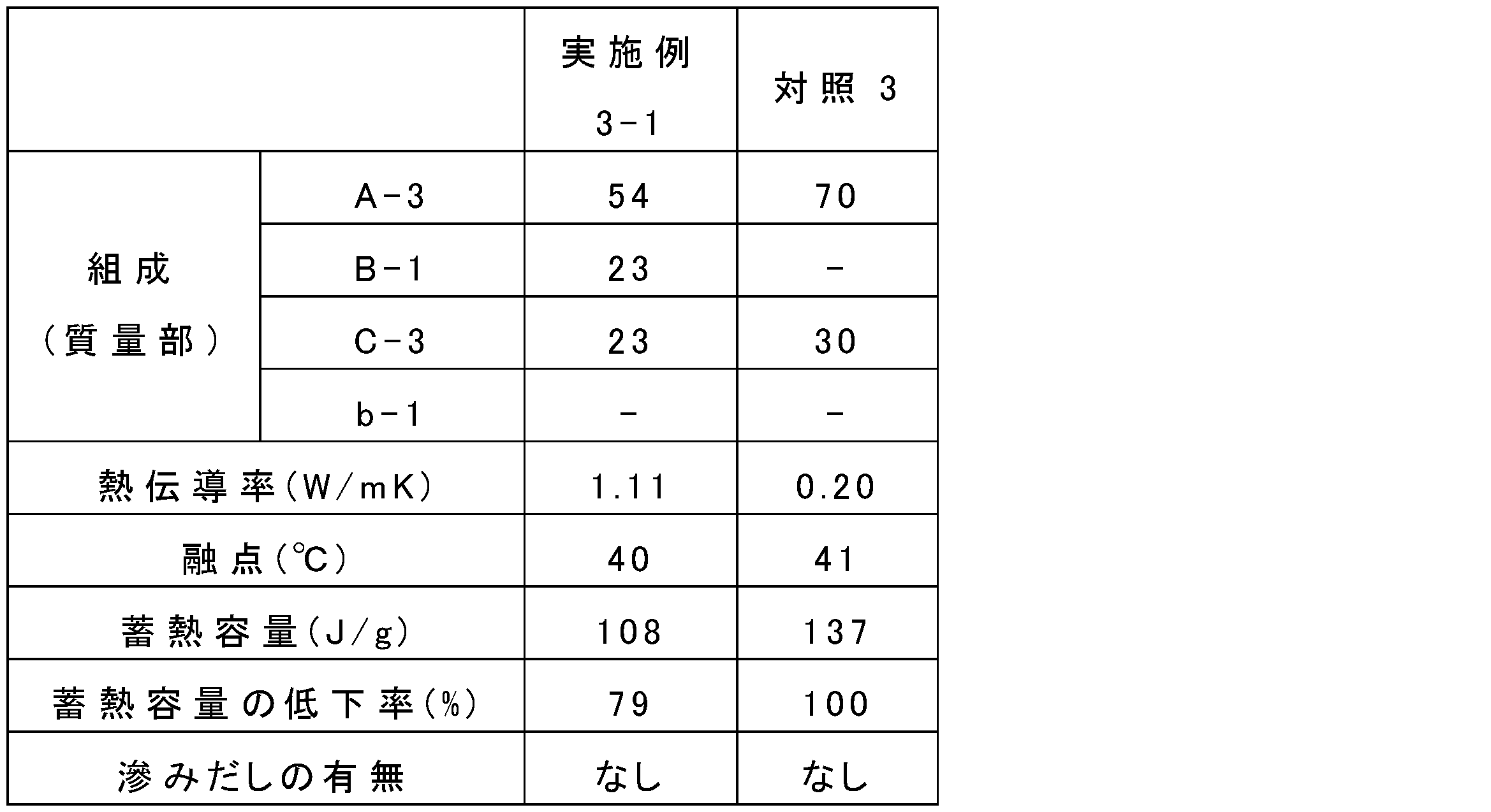
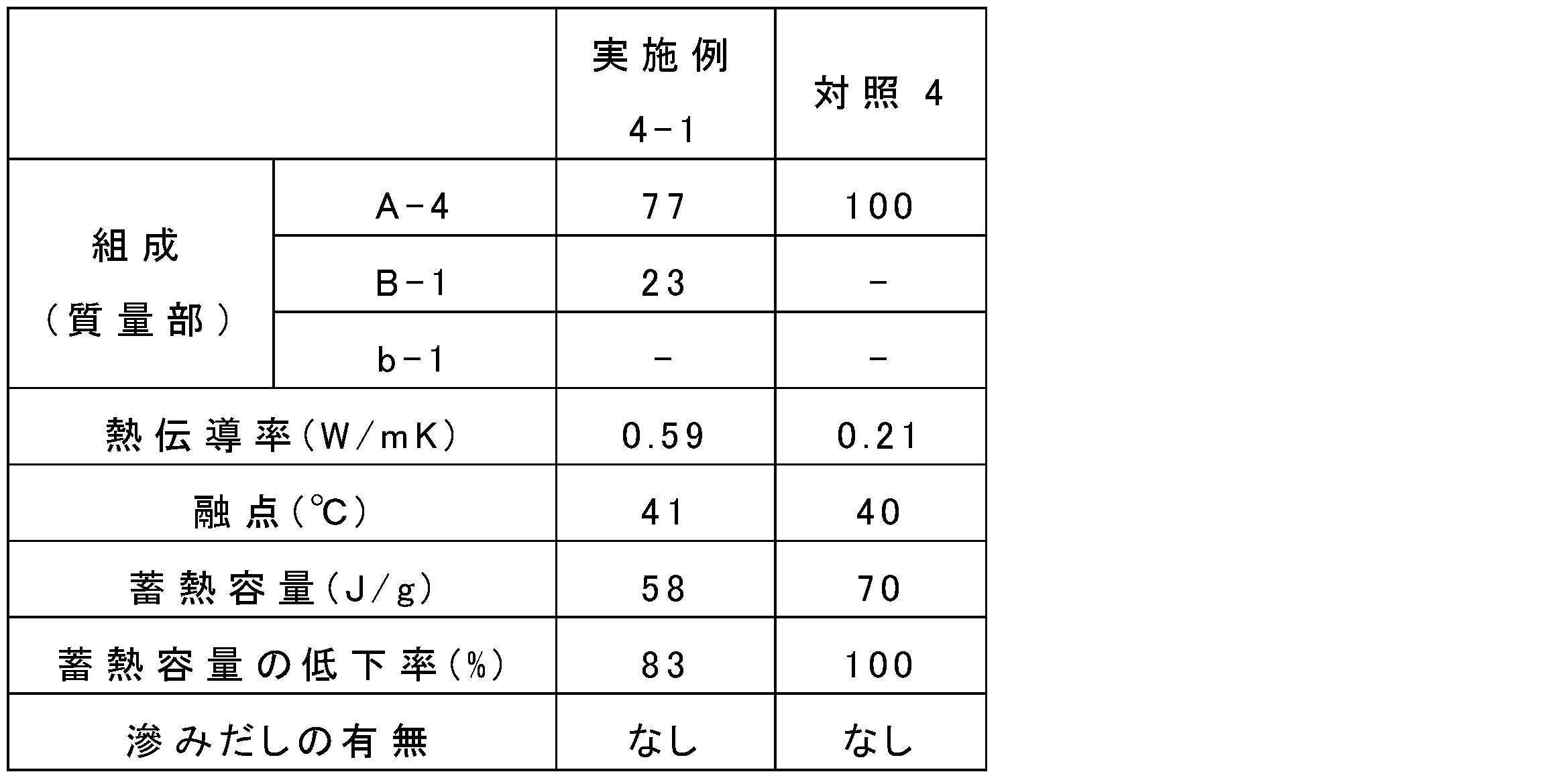
- compositions having the compositions shown in Tables 1 to 4 were prepared using the following components.
- a copolymer of ethylene and an olefin having 3 or more carbon atoms is added and mixed as needed while the heat storage component is heated to a temperature equal to or higher than the melting point. did.
- a predetermined amount of expanded graphite and other components were added thereto, and the mixture was kneaded with a twin-screw kneader (kneading temperature was adjusted to be equal to or higher than the melting point of the used material) to obtain a composition.
- the obtained composition was pressed by a pressurized heat press (press temperature: adjusted at or above the melting point of each material, pressurized pressure: 1 MPa) to produce a 170 mm ⁇ 60 mm ⁇ 1 mm sheet.
- an acrylic resin was synthesized by a known suspension polymerization method using a predetermined amount of the following monomer.
- Acrylic resin, expanded graphite and other components are mixed and kneaded by a pressurized heat press (upper plate 80 ° C / lower plate 40 ° C, pressurized pressure 140 kPa), and further pressurized and heated press (upper and lower hot plates 80 ° C, pressurized).
- the sheet was pressed at a pressure of 1 MPa to produce a sheet of 170 mm ⁇ 60 mm ⁇ 1 mm.
- A-1 Paraffin wax (manufactured by Nippon Seiro Co., Ltd., product name “HNP-9”, melting point: 76 ° C.)
- A-2 n-hexadecane (manufactured by Tokyo Chemical Industry Co., Ltd., melting point 18 ° C.)
- A-3 Methyl stearate (manufactured by Tokyo Chemical Industry Co., Ltd., melting point 40 ° C.)
- B-1 Expanded graphite ground powder (manufactured by Dainen Sangyo Co., Ltd., average particle size: 175 to 250 ⁇ m)
- B-2 Expanded graphite (“EC100”, manufactured by Ito Graphite Industry Co., Ltd., average particle
- the thermal conductivity in the sheet surface was measured using QTM-500 (manufactured by Kyoto Electronics Industry Co., Ltd.) and using PD-11N as a probe.
Landscapes
- Engineering & Computer Science (AREA)
- Chemical & Material Sciences (AREA)
- Physics & Mathematics (AREA)
- Thermal Sciences (AREA)
- Chemical Kinetics & Catalysis (AREA)
- Combustion & Propulsion (AREA)
- Materials Engineering (AREA)
- Organic Chemistry (AREA)
- Mechanical Engineering (AREA)
- General Engineering & Computer Science (AREA)
- Compositions Of Macromolecular Compounds (AREA)
Abstract
本発明は、一態様において、蓄熱性成分及び膨張化黒鉛を含有する組成物を提供する。
Description
本発明は、組成物、シート及び蓄熱材に関する。
従来、自動車、建築物、地下街等における空調設備、自動車のエンジン、電子部品などには、熱エネルギーを一時的に貯蓄しておき随時その熱エネルギーを取り出すために蓄熱材が備えられている。
蓄熱材としては、例えば物質の相転移を利用して蓄熱又は放熱するものが挙げられる。このような蓄熱材として、例えば、飽和炭化水素、有機酸、有機酸エステル等の蓄熱性成分を用いたものが知られている。これらは、可逆的に相転移をすることにより、優れた蓄熱性を有する。しかし、これらの蓄熱材は相転移の高温側では液体状態であり、蓄熱性成分が滲みだす可能性があるため、何らかの滲みだし防止策を施さなければならない。そのため、バインダーとしてポリマーを用いた組成又はゲル化剤を用いた組成が提案されている。
一方で、これらの蓄熱性成分を含む蓄熱材は、放熱の持続性が要求される床冷暖房等の用途では有効ではあるが、熱伝導率の低さに起因して、蓄熱部材との熱交換の迅速性が要求されるヒートパイプ等の用途では十分な効果を発揮できていない。そのため、今日まで蓄熱材の高熱伝導化に関する検討が進められてきている。
特許文献1には、アスペクト比10~1500の高熱伝導繊維を含有させて成る組成物を蓄熱材として使用することが開示されており、高熱伝導繊維の代表例として金属繊維とカーボン繊維とが挙げられている。特許文献1では、この中で特に金属繊維が好ましいとされ、実施例においても銅繊維及びアルミニウム繊維が用いられている。
しかし、特許文献1で用いられるような金属繊維の密度は大きく、蓄熱材に多量に添加すると質量当たりの蓄熱容量が大幅に低下してしまうため、少量しか添加することができない。つまり、蓄熱材の熱伝導率と蓄熱容量とは互いにトレードオフの関係にあるため、蓄熱容量の低下を抑えつつ熱伝導率を向上させることは困難である。
本発明は、このような実情に鑑みてなされたものであり、熱伝導性が向上された上に蓄熱容量の低下が抑制された組成物を提供することを目的とする。また、本発明の他の目的は、滲みだしが抑制されたシート及び蓄熱材を提供することである。
本発明者らは、金属繊維に比べて密度が小さい炭素材料に着目して検討したところ、黒鉛が熱伝導率の向上に寄与すること、更には、黒鉛の中でも、膨張化黒鉛が、他の黒鉛に比べて、熱伝導率を大きく向上させられる上に、蓄熱容量の低下を抑制できることを見出し、本発明を完成させるに至った。
本発明は、一態様において、蓄熱性成分及び膨張化黒鉛を含有する組成物である。
この組成物において、蓄熱性成分は、飽和炭化水素であってよい。蓄熱性成分は、有機酸エステルであってもよい。蓄熱性成分は、アクリル樹脂であってもよい。
組成物は、エチレンと炭素数が3以上のオレフィンとの共重合体を更に含有してもよい。オレフィンの炭素数は、3~8であってもよい。この場合、組成物は、ポリエチレン及びポリプロピレンからなる群より選ばれる少なくとも1種のポリオレフィンを更に含有してもよい。
膨張化黒鉛の含有量は、組成物全量基準で15質量%以上であってよい。
本発明は、他の一態様において、上記の組成物を含有する蓄熱層を備えるシートである。このシートにおいて、蓄熱層の熱伝導率が0.5W/mK以上であってよい。
本発明は、他の一態様において、上記の組成物を含む蓄熱材である。
本発明は、他の一態様において、熱源と、熱源と熱的に接触するように設けられた上記の組成物と、を備える物品である。
本発明の一態様によれば、熱伝導性が向上された上に蓄熱容量の低下が抑制された組成物を提供することができる。また、本発明の一態様によれば、滲みだしが抑制されたシート及び蓄熱材を提供することができる。
以下、図面を適宜参照しながら、本発明の実施形態について詳細に説明する。なお、本発明は、以下の実施形態に限定されない。
本明細書における「(メタ)アクリレート」とは、「アクリレート」及びそれに対応する「メタクリレート」を、「(メタ)アクリロイル」とは、「アクリロイル」及びそれに対応する「メタクリロイル」を意味する。
一実施形態に係る組成物は、蓄熱性成分(以下、「(A)成分」ともいう)及び膨張化黒鉛(以下、「(B)成分」ともいう)を含有する。
(A)成分は、蓄熱性を有する成分であり、例えば、固体状から液体状に相転移する際に周囲の熱を吸熱して蓄熱する性質を有する成分である。(A)成分は、例えば、融点が0~100℃である化合物であってよい。このような化合物は、蓄熱材として実用的な温度範囲である0~100℃の環境下において、融点よりも低い温度から融点以上の温度に変化する際に相転移する。したがって、(A)成分は、蓄熱材としての実用範囲である当該温度範囲において蓄熱性を有している。(A)成分は、高い蓄熱容量を有する化合物ともいえる。
(A)成分は、一実施形態において、飽和炭化水素であってよい。飽和炭化水素は、好ましくは鎖状の飽和炭化水素である。本明細書において、「鎖状」は、直鎖状又は分岐状を意味する。飽和炭化水素は、好ましくは直鎖状である。飽和炭化水素の炭素数は、例えば、10以上、12以上、又は14以上であってよく、60以下、50以下、40以下、30以下、20以下、又は16以下であってよい。
飽和炭化水素は、具体的には、n-テトラデカン(C14(炭素数、以下同様)、6℃(融点、以下同様))、n-ペンタデカン(C15、9℃)、n-ヘキサデカン(C16、18℃)、n-ヘプタデカン(C17、21℃)、n-オクタデカン(C18、28℃)、n-ナノデカン(C19、32℃)、n-エイコサン(C20、37℃)、n-ヘンイコサン(C21、41℃)、n-ドコサン(C22、46℃)、n-トリコサン(C23、47℃)、n-テトラコサン(C24、50℃)、n-ペンタコサン(C25、54℃)、n-ヘキサコサン(C26、56℃)、n-ヘプタコサン(C27、60℃)、n-オクタコサン(C28、65℃)、n-ノナコサン(C29、66℃)、n-トリアコンタン(C30、67℃)、n-テトラコンタン(C40、81℃)、n-ペンタコンタン(C50、91℃)、n-ヘキサコンタン(C60、98℃)等であってよい。飽和炭化水素の融点は、示差走査熱量計(例えば、(株)パーキンエルマー製「8500」)を用いて、昇温速度10℃/分で加熱したときに得られたサーモグラムの融解(吸熱)ピークの最大傾斜の接線がベースラインと交わる点の温度である。
飽和炭化水素は、直鎖状の飽和炭化水素を主成分とする石油ワックスであってもよい。石油ワックスは、原料である石油又は天然ガスの減圧蒸留成分からの分離精製品である。石油ワックスの具体的な例としては、日本精蝋(株)製のParaffin Wax(48~69℃(融点、以下同様))、HNP(64~77℃)、SP(60~74℃)、EMW(49℃)等が挙げられる。これらの飽和炭化水素は、1種単独で又は2種以上を組み合わせて用いられてよい。
(A)成分は、一実施形態において、有機酸エステルであってもよい。有機酸エステルは、直鎖状であっても分岐状であってもよい。有機酸エステルは、好ましくは脂肪酸エステルである。脂肪酸エステルは、脂肪酸と脂肪族アルコールとのエステルであってよい。脂肪族アルコールは、例えば1~3価のアルコールであってよく、好ましくは1価のアルコールである。脂肪族アルコールが2価以上の多価アルコールである場合、脂肪酸エステルは、多価アルコールの水酸基の一部がエステル化された部分エステルであってよく、多価アルコールの水酸基の全部がエステル化された完全エステルであってもよい。
有機酸エステルが脂肪酸と脂肪族アルコールとのエステルである場合、脂肪酸の炭素数は、12以上、14以上、又は16以上であってよく、22以下、20以下、又は18以下であってよい。脂肪族アルコールの炭素数は、1以上であってよく、22以下、15以下、10以下、5以下、又は2以下であってよい。有機酸エステルは、ラウリン酸メチル(C12/C1(脂肪酸の炭素数/脂肪族アルコールの炭素数、以下同様)、5℃(融点、以下同様))、ミリスチン酸エチル(C14/C2、10℃)、パルミチン酸エチル(C16/C2、20℃)、パルミチン酸ブチル(C16/C4、33℃)、ステアリン酸メチル(C18/C1、40℃)、ステアリン酸エチル(C18/C2、34℃)、ステアリン酸ブチル(C18/C4、22℃)、アラキジン酸メチル(C20/C1、48℃)、ベヘン酸メチル(C22/C1、52℃)、モノミリスチン酸グリセロール(C14/C3、44~48℃)等であってよい。これらの有機酸エステルは、1種単独で又は2種以上を組み合わせて用いられてよい。
(A)成分は、一実施形態において、アクリル樹脂であってもよい。アクリル樹脂は、好ましくは、第1のモノマー及び第2のモノマーを含むモノマー成分を重合させてなる重合体である。
第1のモノマーは、好ましくは、下記式(1)で表される。
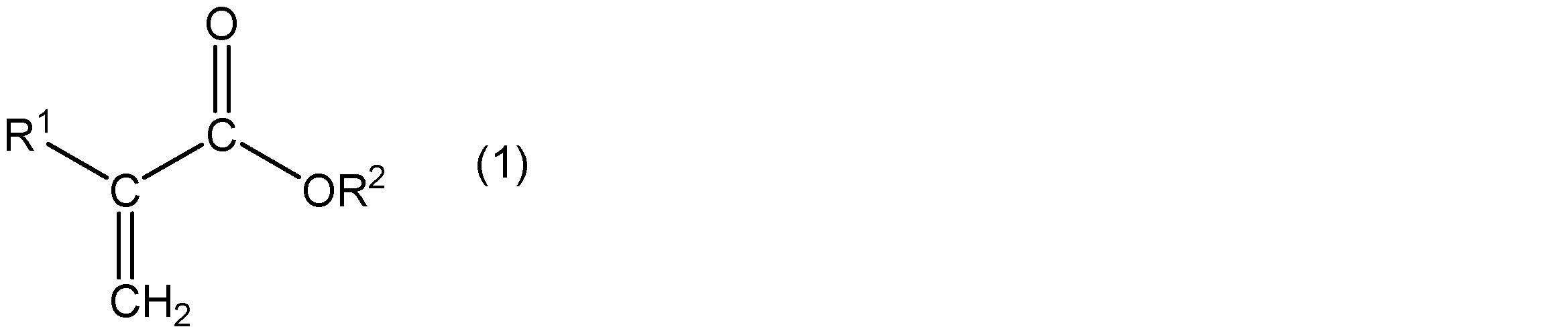
式中、R1は水素原子又はメチル基を表し、R2は炭素数12~30のアルキル基を表す。
R2で表されるアルキル基は、直鎖状であっても分岐状であってもよい。R2で表されるアルキル基の炭素数は、好ましくは12~28、より好ましくは12~26、更に好ましくは12~24、特に好ましくは12~22である。
第1のモノマーは、言い換えれば、炭素数12~30の直鎖状又は分岐状のアルキル基をエステル基の末端に有するアルキル(メタ)アクリレートである。第1のモノマーとしては、例えば、ドデシル(メタ)アクリレート(ラウリル(メタ)アクリレート)、トリデシル(メタ)アクリレート、テトラデシル(メタ)アクリレート、ペンタデシル(メタ)アクリレート、ヘキサデシル(メタ)アクリレート)、ヘプタデシル(メタ)アクリレート、オクタデシル(メタ)アクリレート(ステアリル(メタ)アクリレート)、ノナデシル(メタ)アクリレート、エイコシル(メタ)アクリレート、ヘンイコシル(メタ)アクリレート、ドコシル(メタ)アクリレート(ベヘニル(メタ)アクリレート)、テトラコシル(メタ)アクリレート、ヘキサコシル(メタ)アクリレート、オクタコシル(メタ)アクリレート等が挙げられる。これらの第1のモノマーは、1種単独で又は2種以上を組み合わせて用いられる。
第1のモノマーの含有量は、蓄熱材を形成した際に充分な蓄熱量が得られる観点から、モノマー成分100質量部に対して、好ましくは60質量部以上であり、より好ましくは70質量部以上であり、更に好ましくは80質量部以上であり、例えば98質量部以下であってよい。
第2のモノマーは、第1のモノマーと共重合可能であり、反応性基を有するモノマー(反応性モノマー)である。第2のモノマーは、第1のモノマーと共重合可能なように、エチレン性不飽和結合を有する基(エチレン性不飽和基)を含んでいる。エチレン性不飽和基としては、例えば、(メタ)アクリロイル基、ビニル基、アリル基等が挙げられる。第2のモノマーは、好ましくは、反応性基及び(メタ)アクリロイル基を有するモノマー(反応性基を有する(メタ)アクリルモノマー)である。
第2のモノマーにおける反応性基は、後述する硬化剤と反応し得る基であり、例えば、カルボキシル基、ヒドロキシル基、イソシアネート基、アミノ基及びエポキシ基からなる群より選ばれる少なくとも1種の基である。すなわち、第2のモノマーは、例えば、カルボキシル基含有モノマー、ヒドロキシル基含有モノマー、イソシアネート基含有モノマー、アミノ基含有モノマー又はエポキシ基含有モノマーである。エポキシ基含有モノマーは、例えばグリシジル(メタ)アクリレートであってよい。
第2のモノマーの含有量は、モノマー成分100質量部に対して、25質量部以下であってよく、好ましくは20質量部以下、より好ましくは15質量部以下、更に好ましくは13質量部以下、特に好ましくは10質量部以下である。第2のモノマーの含有量は、モノマー成分100質量部に対して、2質量部以上であってよい。
モノマー成分は、第1のモノマー及び第2のモノマーに加えて、必要に応じてその他のモノマーを更に含有することができる。その他のモノマーは、例えば、メチル(メタ)アクリレート、エチル(メタ)アクリレート、プロピル(メタ)アクリレート、ブチル(メタ)アクリレート等の炭素数12未満(炭素数1~11)のアルキル基をエステル基の末端に有するアルキル(メタ)アクリレート;イソボロニル(メタ)アクリレート、ジシクロペンタニル(メタ)アクリレート等の環状炭化水素基をエステル基の末端に有するシクロアルキル(メタ)アクリレート;などが挙げられる。その他のモノマーは、1種単独で又は2種以上を組み合わせて用いられる。
アクリル樹脂は、上記のモノマー成分を用いて各種ラジカル重合等の公知の重合方法によって得ることができる。重合方法は、例えば、懸濁重合法、溶液重合法、塊状重合法等であってよい。
(A)成分の含有量は、蓄熱作用に更に優れる観点から、組成物全量基準で、好ましくは40質量%以上であり、より好ましくは45質量%以上であり、更に好ましくは50質量%以上である。(A)成分の含有量は、90質量%以下、80質量%以下、70質量%以下、又は60質量%以下であってよい。
膨張化黒鉛((B)成分)は、黒鉛層間にインターカレート物質を挿入して膨張化させた黒鉛である。黒鉛層間の結合はファンデルワールス力による弱い結合であるため、様々な化合物がインターカレートすることができる。インターカレートされた物質を加熱により除去するとき、黒鉛は膨張し、膨張化黒鉛が生成される。膨張により膨張化黒鉛の密度は小さくなるが、黒鉛本来の特徴である高熱伝導性は保持されているため、膨張化黒鉛においては、高熱伝導化のための添加剤として優れた効果が期待できる。
膨張化黒鉛の密度は小さいため、膨張化黒鉛は組成物に比較的多量に添加することができ、組成物の高熱伝導化に有効である。また、膨張化黒鉛のかさ密度は低いため、組成物の質量当たりの体積比率を大きくすることもできる。この場合、膨張化黒鉛の粒径が大きい程膨張化黒鉛同士の接触確率が高くなり、少量の添加量で組成物の高熱伝導化を達成できる。
膨張化黒鉛には、黒鉛を膨張化させた後に粉砕した、いわゆる「膨張化黒鉛粉砕粉」も含まれる。膨張化黒鉛粉砕粉は、上述した方法により得られた膨張化黒鉛を圧延してシート化し、膨張化黒鉛シート作製した後、このシートを粉砕することにより得られる粉末である。
膨張化黒鉛の形状は、扁平粒子状等の粒子状であってよい。粒子状の膨張化黒鉛は、アスペクト比が20未満である膨張化黒鉛であってよい。アスペクト比は、膨張化黒鉛の走査型電子顕微鏡写真から算出される、膨張化黒鉛の最大長さと、当該最大長さを有する方向に垂直な方向における膨張化黒鉛の最小長さとの比(最大長さ/最小長さ)として定義される。
膨張化黒鉛の平均粒径は、膨張化黒鉛同士の接触確率を高めて熱伝導率を更に高める観点から、好ましくは100μm以上であり、より好ましくは120μm以上であり、更に好ましくは150μm以上である。膨張化黒鉛の平均粒径は、分散性を向上させ、特性を安定化させる観点から、好ましくは2000μm以下であり、より好ましくは1000μm以下であり、更に好ましくは500μm以下である。膨張化黒鉛の平均粒径は、走査型電子顕微鏡(SEM)により測定することができる。
(B)成分の含有量は、組成物の熱伝導率を更に向上させる観点から、組成物全量基準で、好ましくは、5質量%以上、10質量%以上、15質量%以上、17質量%以上、又は20質量%以上である。(B)成分の含有量は、蓄熱容量の低下を更に抑制する観点から、組成物全量基準で、好ましくは50質量%以下であり、より好ましくは40質量%以下であり、更に好ましくは30質量%以下である。
組成物は、エチレンと炭素数が3以上のオレフィンとの共重合体(以下、「(C)成分」ともいう)を更に含有してよい。(A)成分が飽和炭化水素又は有機酸エステルである場合、(C)成分はバインダーとしての役割を有する。(C)成分を用いることにより、(A)成分の融点以上の領域においても、組成物からの液体の滲みだしを抑制することができ、組成物を用いて作製したシート(詳細は後述する)のハンドリング性を高めることができる。
(A)成分がアクリル樹脂である場合、(C)成分に架橋官能基を付与することにより、アクリル樹脂の融点以上でも形状保持が可能な組成物を提供することができる。架橋官能基は、アクリル樹脂が有する反応性基と反応し得る。架橋官能基は、架橋性を有する官能基であれば特に限定されず、ビニル基、(メタ)アクリロイル基、グリシジル基、及びアリル基から選ばれる少なくとも1種であってよい。
(C)成分を構成するオレフィンの炭素数は、3以上である。入手が容易であって(A)成分との親和性にも優れる観点から、より好ましくは3~10であり、更に好ましくは3~8である。オレフィンの炭素数が4以上である場合、オレフィンは、直鎖状であっても分岐状であってもよい。(C)成分は、(A)成分との親和性に問題がない限り、炭素数が8を超えるオレフィンから構成されていてもよい。(C)成分としては、エチレンとプロピレン(C3(炭素数、以下同様))との共重合体、エチレンとブテン(C4)との共重合体、エチレンとペンテン(C5)との共重合体、エチレンとヘキセン(C6)との共重合体、エチレンとヘプテン(C7)との共重合体、エチレンとオクテン(C8)との共重合体、エチレンとノネン(C9)との共重合体、エチレンとデセン(C10)との共重合体等が挙げられる。(C)成分は、1種単独で又は2種以上を組み合わせて用いられる。
(C)成分の含有量は、組成物全量基準で、3質量%以上、5質量%以上、又は7質量%以上であってよく、35質量%以下、30質量%以下、又は25質量%以下であってよい。
組成物が(C)成分を含有する場合、組成物は、ポリエチレン(エチレン単独重合体)及びポリプロピレン(プロピレン単独重合体)からなる群より選ばれる少なくとも1種のポリオレフィン(以下、「(D)成分」ともいう)を更に含有してもよい。(D)成分は、(A)成分及び/又は(C)成分と物理的な相互網目構造体を形成し得るため、組成物の高温での流動性を抑制し、組成物をシート状に成形した場合の形状を維持しやすくすることができる。(D)成分の融点は、例えば100℃以上であってよい。(D)成分は、直鎖状の重合体でも分岐を有する重合体であってもよく、種々の方法により変性した重合体であってもよい。
(D)成分の含有量は、組成物全量基準で、5質量%以上、7質量%以上、又は10質量%以上であってよく、20質量%以下、18質量%以下、又は15質量%以下であってよい。
組成物は、液体の滲みだしを更に抑制するためにゲル化剤(以下、「(E)成分」ともいう)を含有してもよい。(E)成分としては、カルボン酸金属塩及びカルボン酸からなる少なくとも1種が挙げられ、(E)成分を添加することにより流動性抑制の効果を更に高めることができる。
カルボン酸金属塩は、カルボン酸と、カルボン酸と塩を形成できる金属との塩である。カルボン酸は、特に限定されないが、(A)成分との相性の観点から、好ましくは炭素数が5以上、より好ましくは炭素数が7以上、更に好ましくは炭素数が10以上のカルボン酸である。このようなカルボン酸は、例えば、ラウリン酸、ミリスチン酸、パルミチン酸、ステアリン酸、イソステアリン酸、ドコサヘキサエン酸、ベヘニン酸、ウンデシレン酸、オレイン酸、エルカ酸、リノール酸、アラキドン酸、リノレン酸、サビエン酸等であってよい。カルボン酸は、これらを単独で又は2種以上を組み合せて用いられる。
金属は、例えばアルミニウムであってよい。カルボン酸金属塩は、具体的には、ステアリン酸アルミニウム、ラウリン酸アルミニウム、オレイン酸アルミニウム、ベヘニン酸アルミニウム、パルミチン酸アルミニウム、2-エチルヘキサン酸アルミニウム等であってよい。カルボン酸金属塩は、これらを単独で又は2種以上を組み合せて用いられる。
(E)成分の含有量は、組成物全量基準で、3質量%以上であってよく、10質量%以下、8質量%以下、又は6質量%以下であってよい。
組成物は、上述した成分以外のその他の成分を更に含有してもよい。その他の成分としては、膨張化黒鉛以外の黒鉛、炭素繊維等の炭素材料、金属繊維、ガラス、タルク等の無機成分、光劣化を抑制する光吸収剤、酸化を防止する酸化防止剤などが挙げられる。その他の成分の含有量は、蓄熱容量の低下を更に抑制する観点から、組成物全量基準で、好ましくは10質量%以下である。
組成物は、(A)成分としてアクリル樹脂を使用した場合、蓄熱材の液漏れ及び揮発を抑制し、耐熱性を向上させる観点から、硬化剤を更に含有してもよい。硬化剤は、第2のモノマー(アクリル樹脂)に含まれる反応性基と反応し得る硬化剤である。硬化剤としては、例えば、イソシアネート系硬化剤、フェノール系硬化剤、アミン系硬化剤、イミダゾール系硬化剤、酸無水物系硬化剤、カルボン酸系硬化剤等が挙げられる。これらの硬化剤は、1種単独で又は2種以上を組み合わせて用いられる。硬化剤の含有量は、組成物全量基準で、0.01質量%以上であってよく、また、10質量%以下、5質量%以下、又は1質量%以下であってよい。
上述した組成物を用いて、シート状の部材を作製することができる。すなわち、本発明の他の一実施形態は、上述した組成物を含有する蓄熱層を備えるシートである。
図1は、一実施形態に係るシートを示す模式断面図である。シート1は、一実施形態において、蓄熱性成分及び膨張化黒鉛を含有する蓄熱層を含む。シート1は、蓄熱層のみからなるシートであってよく、例えば、蓄熱層と、アルニウム、銅等の金属からなる金属層とが積層されたシートであってもよい。
蓄熱層の厚さは、例えば、1mm以上、2mm以上、又は5mm以上であってよく、30mm以下、20mm以下、又は10mm以下であってよい。シート1が金属層を備える場合、金属層の厚さは、例えば、10μm以上であってよく、100μm以下であってよい。
シート1は、例えば以下の方法により得られる。すなわち、蓄熱性成分((A)成分)、膨張化黒鉛((B)成分)、及び必要に応じてその他の成分を混合し、混合物を得る。その後、当該混合物を加圧加熱プレス等によって加熱及び加圧しながらプレスすることにより、シート1を得ることができる。
蓄熱層は、上述した組成物から形成されているため高い熱伝導率を有している。蓄熱層の熱伝導率は、好ましくは、0.5W/mK以上、0.6W/mK以上、0.65W/mK以上、0.8W/mK以上、又は0.9W/mK以上であってよい。蓄熱層の熱伝導率は、熱伝導率計(例えば、京都電子工業(株)製「QTM-500」)を用いてシート1を測定することによって測定される。
蓄熱層は、高い蓄熱容量(融解熱)を有している。蓄熱層の融解熱は、好ましくは、90J/g以上、95J/g以上、又は100J/g以上であってよい。蓄熱層の融解熱は、示差走査熱量計(例えば、(株)パーキンエルマー製「8500」)を用いて、昇温速度10℃/分で加熱したときに得られたサーモグラムの融解(吸熱)ピークの面積から算出される。
組成物及びそれを用いたシート1は、相転移を利用して蓄熱又は放熱することが可能であるため、蓄熱材として好適に用いられる。つまり、本発明の他の一実施形態は、上述した組成物を備える蓄熱材である。
本実施形態の蓄熱材(組成物、シート)は様々な分野に活用されうる。蓄熱材は、例えば、自動車、建築物、公共施設、地下街等における空調設備(空調設備の効率向上)、工場等における配管(配管の蓄熱)、自動車のエンジン(当該エンジン周囲の保温)、電子部品(電子部品の昇温防止)、下着の繊維(適温維持)などに用いられる。この蓄熱材は、蓄熱性成分の融点以上でも蓄熱性成分の流動性の上昇に伴う滲みだしが発生せず、蓄熱材自体の流動も抑制できるため、取り付ける対象物に貼り付けられたり、巻き付けられたり、様々な状態で取り付けられることが可能である。
これらの各用途において、蓄熱材は、各用途で熱を発生させる熱源に対して熱的に接触するように配置されることにより、当該熱源の熱を蓄えることができる。つまり、本発明の一実施形態は、熱源と、熱源と熱的に接触するように設けられた蓄熱材(上述した組成物)と、を備える物品である。
図2は、蓄熱材を備える物品の一実施形態を示す模式断面図である。図2に示すように、物品2は、熱源3と、熱源3と熱的に接触するように設けられた蓄熱材4と、を備える。蓄熱材4は、熱源3の少なくとも一部に熱的に接触するように配置されていればよく、図2に示すように熱源3の一部が露出していてもよいし、熱源3の表面全体が覆われるように配置されてもよい。蓄熱材4が熱源3に熱的に接触していれば、熱源3と蓄熱材4とは直接接していてもよく、熱源3と蓄熱材4との間に他の部材(例えば熱伝導性を有する部材)が配置されてもよい。
例えば、蓄熱材4が、熱源3としての空調設備(又はその部品)、配管、又は自動車のエンジンと共に用いられる場合、蓄熱材4がこれらの熱源3と熱的に接触していることにより、熱源3から生じた熱を蓄熱材4が蓄え、熱源3が一定以上の温度に保たれやすくなる(保温される)。蓄熱材4が下着の繊維として使用される場合、熱源3としての人体から生じた熱を蓄熱材4が蓄えるため、長時間に亘り温かさを感じることができる。
例えば、蓄熱材4が、熱源3としての電子部品と共に用いられる場合、電子部品と熱的に接触するように配置されることにより、電子部品で生じた熱を蓄えることができる。この場合、例えば、蓄熱材を放熱部材と熱的に更に接触するように配置すれば、蓄熱材に蓄えられた熱を徐々に放出することができ、電子部品で生じた熱が急激に外部に放出される(電子部品近傍が局所的に高温になる)ことを抑制できる。物品2は、上述したシートを熱源3に配置することにより形成されてもよい。
他の一実施形態においては、上述した組成物は、蓄熱材用途以外にも用いることができる。組成物は、例えば、撥水材、防霜材、屈折率調整材、潤滑材、吸着材、熱硬化応力緩和材又は低誘電材の形成に好適に用いられる。撥水材、防霜材、屈折率調整材、潤滑材、吸着材、熱硬化応力緩和材及び低誘電材は、それぞれ、例えば上述した組成物を含んでいてよい。
本発明を実施例に基づいて具体的に説明するが、本発明はこれらの実施例に限定されるものではない。
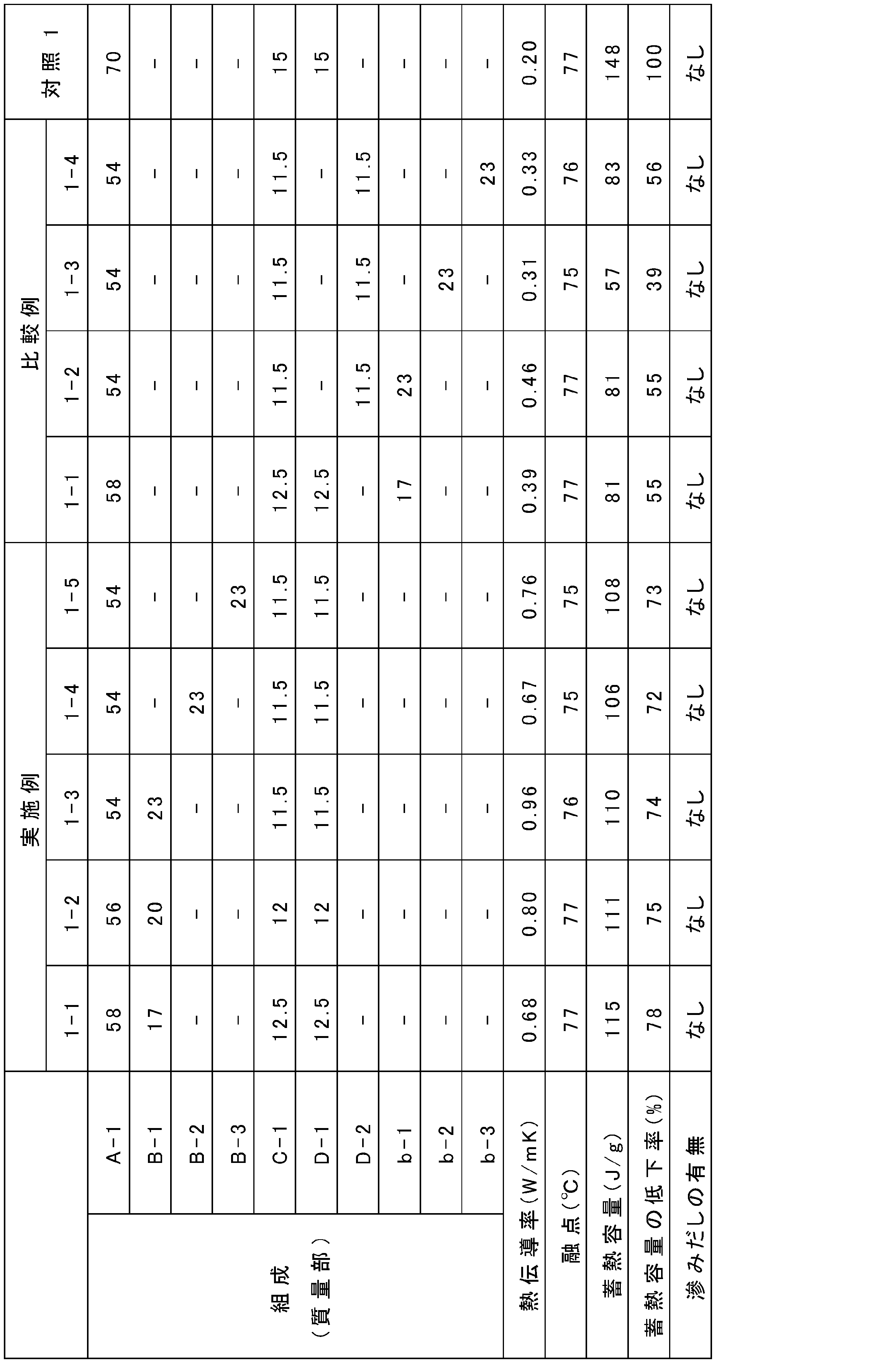
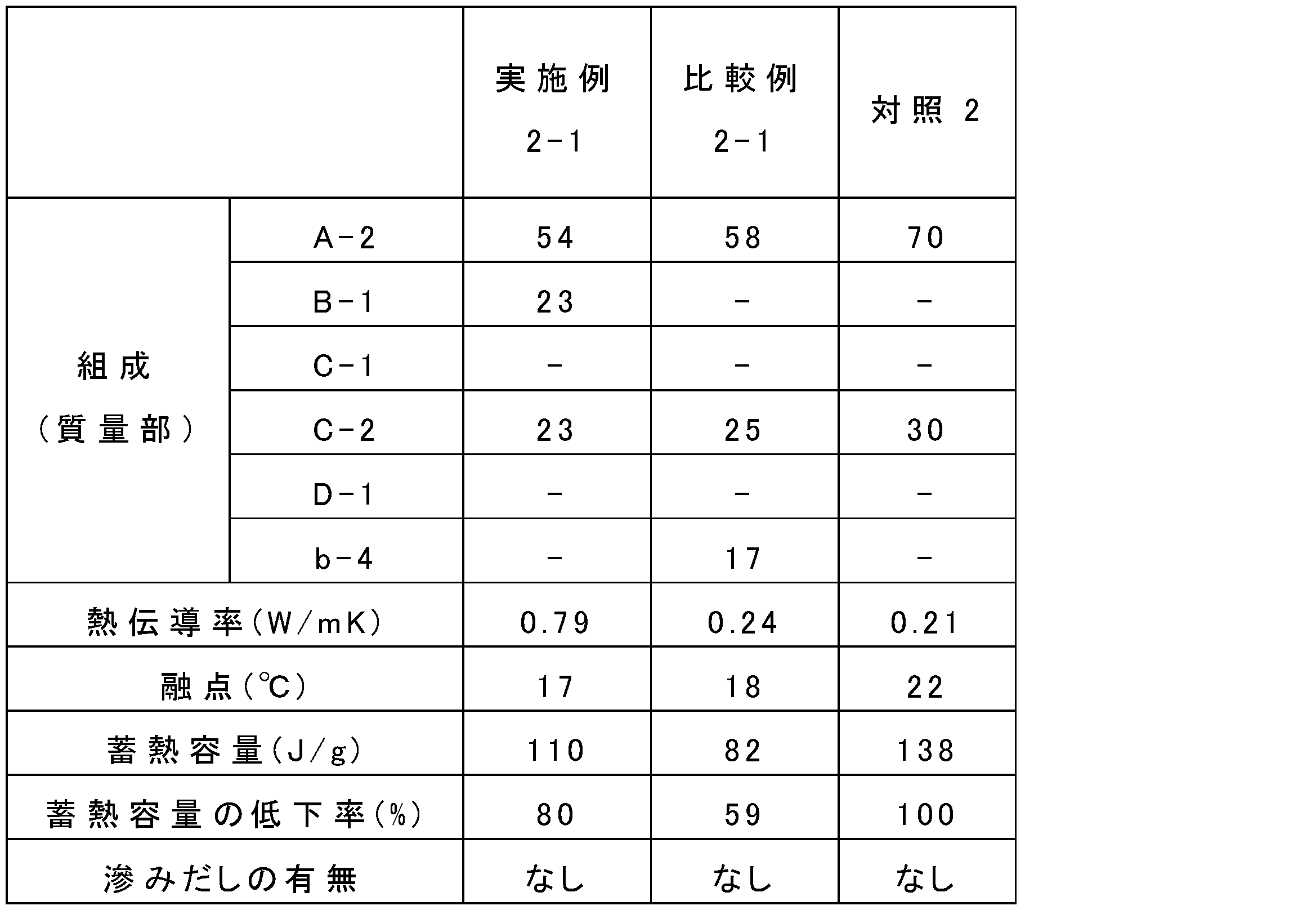
実施例及び比較例においては、以下に示す各成分を用いて表1~4に示す組成の組成物を作製した。
蓄熱性成分として飽和炭化水素又は有機酸エステル用いた例では、蓄熱性成分を融点以上に加温した状態で、必要に応じてエチレンと炭素数が3以上のオレフィンとの共重合体を加え混合した。その中に所定量の膨張化黒鉛及び他の成分を添加して、二軸混練機で混練(混練温度は用いた材料の融点以上で調整)することにより組成物を得た。得られた組成物を加圧加熱プレスによりプレスして(プレス温度:各材料の融点以上で調整、加圧圧力:1MPa)、170mm×60mm×1mmのシートを作製した。
蓄熱性成分としてアクリル樹脂を用いた例では、下記に示すモノマーを所定量用いて、公知の懸濁重合方法によりアクリル樹脂を合成した。アクリル樹脂と、膨張黒鉛及びその他の成分とを加圧加熱プレス(上板80℃/下板40℃、加圧圧力140kPa)により混合混練し、更に加圧加熱プレス(上下熱板80℃、加圧圧力1MPa)によりプレスして、170mm×60mm×1mmのシートを作製した。
(蓄熱性成分)
A-1:パラフィンワックス(日本精蝋(株)製、製品名「HNP-9」、融点76℃)
A-2:n-ヘキサデカン(東京化成工業(株)製、融点18℃)
A-3:ステアリン酸メチル(東京化成工業(株)製、融点40℃)
A-4:ステアリルアクリレート/ブチルアクリレート/グリシジルメタクリレート=80/15/5(質量比)の共重合ポリマー(重量平均分子量:60万)
(膨張化黒鉛)
B-1:膨張化黒鉛粉砕粉((株)ダイネン産業製、平均粒径175~250μm)
B-2:膨張化黒鉛(伊藤黒鉛工業(株)製、「EC100」、平均粒径170~230μm)
B-3:膨張化黒鉛(伊藤黒鉛工業(株)、製品名「EC10」、平均粒径150~250μm)
(エチレンと炭素数が3以上のオレフィンとの共重合体)
C-1:エチレンとプロピレンとの共重合体(住友化学(株)製、製品名「エスプレン SPO V0141」)
C-2:エチレンとオクテンとの共重合体(ダウ・ケミカル日本(株)製、製品名「ENGAGE8150」)
C-3:エチレンとオクテンとの共重合体(ダウ・ケミカル日本(株)製、製品名「ENGAGE8003」)
(ポリプロピレン)
D-1:ポリプロピレン(住友化学(株)製、製品名「ノーブレンAU891E2」)
D-2:ポリプロピレン(住友化学(株)製、製品名「ノーブレンW101」)
(比較用黒鉛)
b-1:鱗片状黒鉛(伊藤黒鉛工業(株)製、製品名「W-32」、粒度+32メッシュ 75%以上)
b-2:人造黒鉛(伊藤黒鉛工業(株)製、製品名「AGB-特20」、粒度60~20メッシュ 70%以上)
b-3:人造黒鉛(伊藤黒鉛工業(株)製、製品名「AGB-055、粒度0.5~5mm 85%以上)
b-4:微粉黒鉛(昭和電工(株)製、微粉径7μm以下(フィルター通過))
A-1:パラフィンワックス(日本精蝋(株)製、製品名「HNP-9」、融点76℃)
A-2:n-ヘキサデカン(東京化成工業(株)製、融点18℃)
A-3:ステアリン酸メチル(東京化成工業(株)製、融点40℃)
A-4:ステアリルアクリレート/ブチルアクリレート/グリシジルメタクリレート=80/15/5(質量比)の共重合ポリマー(重量平均分子量:60万)
(膨張化黒鉛)
B-1:膨張化黒鉛粉砕粉((株)ダイネン産業製、平均粒径175~250μm)
B-2:膨張化黒鉛(伊藤黒鉛工業(株)製、「EC100」、平均粒径170~230μm)
B-3:膨張化黒鉛(伊藤黒鉛工業(株)、製品名「EC10」、平均粒径150~250μm)
(エチレンと炭素数が3以上のオレフィンとの共重合体)
C-1:エチレンとプロピレンとの共重合体(住友化学(株)製、製品名「エスプレン SPO V0141」)
C-2:エチレンとオクテンとの共重合体(ダウ・ケミカル日本(株)製、製品名「ENGAGE8150」)
C-3:エチレンとオクテンとの共重合体(ダウ・ケミカル日本(株)製、製品名「ENGAGE8003」)
(ポリプロピレン)
D-1:ポリプロピレン(住友化学(株)製、製品名「ノーブレンAU891E2」)
D-2:ポリプロピレン(住友化学(株)製、製品名「ノーブレンW101」)
(比較用黒鉛)
b-1:鱗片状黒鉛(伊藤黒鉛工業(株)製、製品名「W-32」、粒度+32メッシュ 75%以上)
b-2:人造黒鉛(伊藤黒鉛工業(株)製、製品名「AGB-特20」、粒度60~20メッシュ 70%以上)
b-3:人造黒鉛(伊藤黒鉛工業(株)製、製品名「AGB-055、粒度0.5~5mm 85%以上)
b-4:微粉黒鉛(昭和電工(株)製、微粉径7μm以下(フィルター通過))
(熱伝導率の測定)
QTM-500(京都電子工業(株)製)を用い、また、プローブとしてPD-11Nを用いて、シート面内の熱伝導率を測定した。
QTM-500(京都電子工業(株)製)を用い、また、プローブとしてPD-11Nを用いて、シート面内の熱伝導率を測定した。
(融点、融解熱の測定)
DSC-8500((株)パーキンエルマー製)を用いて、10℃/分の昇温過程における融解のピーク温度から融点を求め、その面積から蓄熱容量(融解熱)を算出した。膨張化黒鉛及び比較用黒鉛をいずれも含有しないシートを対照として、対照であるシートの蓄熱容量を100%としたときの、各実施例及び比較例の蓄熱容量の割合を求め、蓄熱容量の低下率とした。
DSC-8500((株)パーキンエルマー製)を用いて、10℃/分の昇温過程における融解のピーク温度から融点を求め、その面積から蓄熱容量(融解熱)を算出した。膨張化黒鉛及び比較用黒鉛をいずれも含有しないシートを対照として、対照であるシートの蓄熱容量を100%としたときの、各実施例及び比較例の蓄熱容量の割合を求め、蓄熱容量の低下率とした。
(滲みだしの評価)
各樹脂部材の融点付近において、液体の滲みだしの有無を目視及び触感で判断した。
各樹脂部材の融点付近において、液体の滲みだしの有無を目視及び触感で判断した。
1…シート、2…物品、3…熱源、4…蓄熱材。
Claims (12)
- 蓄熱性成分及び膨張化黒鉛を含有する組成物。
- 前記蓄熱性成分が飽和炭化水素である、請求項1に記載の組成物。
- 前記蓄熱性成分が有機酸エステルである、請求項1に記載の組成物。
- 前記蓄熱性成分がアクリル樹脂である、請求項1に記載の組成物。
- エチレンと炭素数が3以上のオレフィンとの共重合体を更に含有する、請求項1~4のいずれか一項に記載の組成物。
- 前記オレフィンの炭素数が3~8である、請求項5に記載の組成物。
- ポリエチレン及びポリプロピレンからなる群より選ばれる少なくとも1種のポリオレフィンを更に含有する、請求項5又は6に記載の組成物。
- 前記膨張化黒鉛の含有量が、組成物全量基準で15質量%以上である、請求項1~7のいずれか一項に記載の組成物。
- 請求項1~8のいずれか一項に記載の組成物を含有する蓄熱層を備えるシート。
- 前記蓄熱層の熱伝導率が0.5W/mK以上である、請求項9に記載のシート。
- 請求項1~8のいずれか一項に記載の組成物を含む蓄熱材。
- 熱源と、
前記熱源と熱的に接触するように設けられた、請求項1~8のいずれか一項に記載の組成物と、を備える、物品。
Priority Applications (2)
| Application Number | Priority Date | Filing Date | Title |
|---|---|---|---|
| PCT/JP2018/028134 WO2020021684A1 (ja) | 2018-07-26 | 2018-07-26 | 組成物、シート及び蓄熱材 |
| JP2020532096A JP7298615B2 (ja) | 2018-07-26 | 2018-07-26 | 組成物、シート及び蓄熱材 |
Applications Claiming Priority (1)
| Application Number | Priority Date | Filing Date | Title |
|---|---|---|---|
| PCT/JP2018/028134 WO2020021684A1 (ja) | 2018-07-26 | 2018-07-26 | 組成物、シート及び蓄熱材 |
Publications (1)
| Publication Number | Publication Date |
|---|---|
| WO2020021684A1 true WO2020021684A1 (ja) | 2020-01-30 |
Family
ID=69180908
Family Applications (1)
| Application Number | Title | Priority Date | Filing Date |
|---|---|---|---|
| PCT/JP2018/028134 Ceased WO2020021684A1 (ja) | 2018-07-26 | 2018-07-26 | 組成物、シート及び蓄熱材 |
Country Status (2)
| Country | Link |
|---|---|
| JP (1) | JP7298615B2 (ja) |
| WO (1) | WO2020021684A1 (ja) |
Cited By (3)
| Publication number | Priority date | Publication date | Assignee | Title |
|---|---|---|---|---|
| JP2021190442A (ja) * | 2020-05-25 | 2021-12-13 | 古河電気工業株式会社 | 電気機器用筐体 |
| US20220364802A1 (en) * | 2021-05-14 | 2022-11-17 | Raytheon Technologies Corporation | Heat Exchanger Tube Support |
| US11859910B2 (en) | 2021-05-14 | 2024-01-02 | Rtx Corporation | Heat exchanger tube support |
Citations (13)
| Publication number | Priority date | Publication date | Assignee | Title |
|---|---|---|---|---|
| JP2004026971A (ja) * | 2002-06-25 | 2004-01-29 | Idemitsu Kosan Co Ltd | 架橋蓄熱材料 |
| JP2004149796A (ja) * | 2002-10-28 | 2004-05-27 | Sgl Carbon Ag | 蓄熱材のための混合物 |
| JP2006328143A (ja) * | 2005-05-24 | 2006-12-07 | Hitachi Chem Co Ltd | 蓄熱材及びその製造方法 |
| WO2011078340A1 (ja) * | 2009-12-25 | 2011-06-30 | Jsr株式会社 | 蓄熱材用組成物及び蓄熱材 |
| JP2013006944A (ja) * | 2011-06-23 | 2013-01-10 | Jsr Corp | 蓄熱材用組成物、蓄熱材及び蓄熱用装置 |
| JP2013241499A (ja) * | 2012-05-18 | 2013-12-05 | Kuraray Co Ltd | 蓄熱材用組成物及び蓄熱材 |
| JP2014095023A (ja) * | 2012-11-08 | 2014-05-22 | Jsr Corp | 蓄熱材用組成物及び蓄熱材 |
| JP2014095011A (ja) * | 2012-11-08 | 2014-05-22 | Jsr Corp | 蓄熱材用組成物及び蓄熱材 |
| JP2014122320A (ja) * | 2012-11-26 | 2014-07-03 | Jsr Corp | 蓄熱材 |
| CN104178091A (zh) * | 2014-07-09 | 2014-12-03 | 镇江新梦溪能源科技有限公司 | 一种相变储热材料及其制备方法 |
| WO2015141866A1 (ja) * | 2014-03-20 | 2015-09-24 | 住友化学株式会社 | 蓄熱材組成物 |
| WO2018066130A1 (ja) * | 2016-10-07 | 2018-04-12 | 日立化成株式会社 | 樹脂部材及びそれを用いたシート、並びに蓄熱材及びそれを用いた熱制御シート |
| WO2018066131A1 (ja) * | 2016-10-07 | 2018-04-12 | 日立化成株式会社 | 樹脂部材及びそれを用いたシート、並びに蓄熱材及びそれを用いた熱制御シート |
Family Cites Families (1)
| Publication number | Priority date | Publication date | Assignee | Title |
|---|---|---|---|---|
| JPH10101947A (ja) * | 1996-09-30 | 1998-04-21 | Shin Etsu Polymer Co Ltd | 低抵抗導電性樹脂組成物およびその製造方法 |
-
2018
- 2018-07-26 JP JP2020532096A patent/JP7298615B2/ja active Active
- 2018-07-26 WO PCT/JP2018/028134 patent/WO2020021684A1/ja not_active Ceased
Patent Citations (13)
| Publication number | Priority date | Publication date | Assignee | Title |
|---|---|---|---|---|
| JP2004026971A (ja) * | 2002-06-25 | 2004-01-29 | Idemitsu Kosan Co Ltd | 架橋蓄熱材料 |
| JP2004149796A (ja) * | 2002-10-28 | 2004-05-27 | Sgl Carbon Ag | 蓄熱材のための混合物 |
| JP2006328143A (ja) * | 2005-05-24 | 2006-12-07 | Hitachi Chem Co Ltd | 蓄熱材及びその製造方法 |
| WO2011078340A1 (ja) * | 2009-12-25 | 2011-06-30 | Jsr株式会社 | 蓄熱材用組成物及び蓄熱材 |
| JP2013006944A (ja) * | 2011-06-23 | 2013-01-10 | Jsr Corp | 蓄熱材用組成物、蓄熱材及び蓄熱用装置 |
| JP2013241499A (ja) * | 2012-05-18 | 2013-12-05 | Kuraray Co Ltd | 蓄熱材用組成物及び蓄熱材 |
| JP2014095023A (ja) * | 2012-11-08 | 2014-05-22 | Jsr Corp | 蓄熱材用組成物及び蓄熱材 |
| JP2014095011A (ja) * | 2012-11-08 | 2014-05-22 | Jsr Corp | 蓄熱材用組成物及び蓄熱材 |
| JP2014122320A (ja) * | 2012-11-26 | 2014-07-03 | Jsr Corp | 蓄熱材 |
| WO2015141866A1 (ja) * | 2014-03-20 | 2015-09-24 | 住友化学株式会社 | 蓄熱材組成物 |
| CN104178091A (zh) * | 2014-07-09 | 2014-12-03 | 镇江新梦溪能源科技有限公司 | 一种相变储热材料及其制备方法 |
| WO2018066130A1 (ja) * | 2016-10-07 | 2018-04-12 | 日立化成株式会社 | 樹脂部材及びそれを用いたシート、並びに蓄熱材及びそれを用いた熱制御シート |
| WO2018066131A1 (ja) * | 2016-10-07 | 2018-04-12 | 日立化成株式会社 | 樹脂部材及びそれを用いたシート、並びに蓄熱材及びそれを用いた熱制御シート |
Non-Patent Citations (1)
| Title |
|---|
| "Rise tonicity graphite", ITO GRAPHITE INDUSTRY CO., LTD., 9 August 2018 (2018-08-09), XP055679710, Retrieved from the Internet <URL:http://www.graphite.co.jp/0201_products06.html> * |
Cited By (5)
| Publication number | Priority date | Publication date | Assignee | Title |
|---|---|---|---|---|
| JP2021190442A (ja) * | 2020-05-25 | 2021-12-13 | 古河電気工業株式会社 | 電気機器用筐体 |
| JP7717444B2 (ja) | 2020-05-25 | 2025-08-04 | 古河電気工業株式会社 | 電気機器用筐体 |
| US20220364802A1 (en) * | 2021-05-14 | 2022-11-17 | Raytheon Technologies Corporation | Heat Exchanger Tube Support |
| US11859910B2 (en) | 2021-05-14 | 2024-01-02 | Rtx Corporation | Heat exchanger tube support |
| US11892250B2 (en) * | 2021-05-14 | 2024-02-06 | Rtx Corporation | Heat exchanger tube support |
Also Published As
| Publication number | Publication date |
|---|---|
| JP7298615B2 (ja) | 2023-06-27 |
| JPWO2020021684A1 (ja) | 2021-08-02 |
Similar Documents
| Publication | Publication Date | Title |
|---|---|---|
| Zhang et al. | Thermal and electrical conductivity enhancement of graphite nanoplatelets on form-stable polyethylene glycol/polymethyl methacrylate composite phase change materials | |
| Yu et al. | Bio-based PCM/carbon nanomaterials composites with enhanced thermal conductivity | |
| Jeon et al. | High thermal performance composite PCMs loading xGnP for application to building using radiant floor heating system | |
| Kang et al. | Energy efficient Bio-based PCM with silica fume composites to apply in concrete for energy saving in buildings | |
| JP7298615B2 (ja) | 組成物、シート及び蓄熱材 | |
| JP6263042B2 (ja) | 基油拡散防止性能を有する熱伝導性グリース | |
| CN107216858B (zh) | 一种导热相变储能界面组合物制备方法 | |
| WO2019193677A1 (ja) | 樹脂部材、樹脂部材の製造方法及び蓄熱体 | |
| JP2020189914A (ja) | 組成物、シート及び物品 | |
| CN114381237A (zh) | 一种储热复合材料及其制备方法 | |
| JP6750683B2 (ja) | 樹脂部材及びそれを用いたシート、並びに蓄熱材及びそれを用いた熱制御シート | |
| JP7124833B2 (ja) | 樹脂部材、シート、蓄熱材、及び樹脂部材の製造方法 | |
| JP2008170098A (ja) | 床暖房構造体 | |
| WO2018066131A1 (ja) | 樹脂部材及びそれを用いたシート、並びに蓄熱材及びそれを用いた熱制御シート | |
| US11441022B2 (en) | Resin member and sheet using same, method for producing resin member, and heat storage material and heat control sheet using same | |
| JP7076980B2 (ja) | 蓄熱性熱伝導性粒子および樹脂組成物 | |
| JP2010215739A (ja) | 蓄熱体 | |
| Abdelrazeq | Heat absorbers based on recycled polyethylene and paraffin wax for energy storage | |
| JP2024129730A (ja) | 熱伝導性グリース組成物 | |
| KR20240155308A (ko) | 열전도성 그리스 조성물 | |
| WO2024190746A1 (ja) | 熱伝導性グリース組成物 | |
| CN118290999A (zh) | 一种涂料及其制备方法、涂层、电子器件 |
Legal Events
| Date | Code | Title | Description |
|---|---|---|---|
| 121 | Ep: the epo has been informed by wipo that ep was designated in this application |
Ref document number: 18927478 Country of ref document: EP Kind code of ref document: A1 |
|
| ENP | Entry into the national phase |
Ref document number: 2020532096 Country of ref document: JP Kind code of ref document: A |
|
| NENP | Non-entry into the national phase |
Ref country code: DE |
|
| 122 | Ep: pct application non-entry in european phase |
Ref document number: 18927478 Country of ref document: EP Kind code of ref document: A1 |