WO2020011220A1 - 杂芳基类衍生物、其制备方法及其在医药上的应用 - Google Patents
杂芳基类衍生物、其制备方法及其在医药上的应用 Download PDFInfo
- Publication number
- WO2020011220A1 WO2020011220A1 PCT/CN2019/095523 CN2019095523W WO2020011220A1 WO 2020011220 A1 WO2020011220 A1 WO 2020011220A1 CN 2019095523 W CN2019095523 W CN 2019095523W WO 2020011220 A1 WO2020011220 A1 WO 2020011220A1
- Authority
- WO
- WIPO (PCT)
- Prior art keywords
- general formula
- cancer
- compound
- alkyl
- compound represented
- Prior art date
- Legal status (The legal status is an assumption and is not a legal conclusion. Google has not performed a legal analysis and makes no representation as to the accuracy of the status listed.)
- Ceased
Links
- PCWSEYDKZNIQFF-UHFFFAOYSA-N Cc1ccc(-c(nc(N(C(C2CC2)=O)C(C2CC2)=O)nc2)c2-c(cc2)cc3c2ncnc3C)[o]1 Chemical compound Cc1ccc(-c(nc(N(C(C2CC2)=O)C(C2CC2)=O)nc2)c2-c(cc2)cc3c2ncnc3C)[o]1 PCWSEYDKZNIQFF-UHFFFAOYSA-N 0.000 description 1
- DSJGDICZDWUNHY-UHFFFAOYSA-N Cc1ncnc(c(Cl)c2)c1cc2-c1c(-c2ccc[o]2)nc(N(C(C2CC2)=O)C(C2CC2)=O)nc1 Chemical compound Cc1ncnc(c(Cl)c2)c1cc2-c1c(-c2ccc[o]2)nc(N(C(C2CC2)=O)C(C2CC2)=O)nc1 DSJGDICZDWUNHY-UHFFFAOYSA-N 0.000 description 1
- NBDXFOLTTNLKRB-UHFFFAOYSA-N Cc1ncnc(cc2)c1cc2-c1c(-c(cc2)ccc2F)nc(N(C(C2CC2)=O)C(C2CC2)=O)nc1 Chemical compound Cc1ncnc(cc2)c1cc2-c1c(-c(cc2)ccc2F)nc(N(C(C2CC2)=O)C(C2CC2)=O)nc1 NBDXFOLTTNLKRB-UHFFFAOYSA-N 0.000 description 1
- VIXHVSSSTOYARG-UHFFFAOYSA-N Cc1ncnc(cc2)c1cc2-c1c(-c2ccc[o]2)nc(N(C(C2CC2)=O)C(C2CC2)=O)nc1 Chemical compound Cc1ncnc(cc2)c1cc2-c1c(-c2ccc[o]2)nc(N(C(C2CC2)=O)C(C2CC2)=O)nc1 VIXHVSSSTOYARG-UHFFFAOYSA-N 0.000 description 1
- SENXHFMVUUWVQT-UHFFFAOYSA-N Cc1ncnc(cc2)c1cc2-c1c(-c2ccc[o]2)nc(N(C(C2CC2)=O)C(C2CC2)=O)nn1 Chemical compound Cc1ncnc(cc2)c1cc2-c1c(-c2ccc[o]2)nc(N(C(C2CC2)=O)C(C2CC2)=O)nn1 SENXHFMVUUWVQT-UHFFFAOYSA-N 0.000 description 1
Classifications
-
- A—HUMAN NECESSITIES
- A61—MEDICAL OR VETERINARY SCIENCE; HYGIENE
- A61K—PREPARATIONS FOR MEDICAL, DENTAL OR TOILETRY PURPOSES
- A61K31/00—Medicinal preparations containing organic active ingredients
- A61K31/33—Heterocyclic compounds
- A61K31/395—Heterocyclic compounds having nitrogen as a ring hetero atom, e.g. guanethidine or rifamycins
- A61K31/495—Heterocyclic compounds having nitrogen as a ring hetero atom, e.g. guanethidine or rifamycins having six-membered rings with two or more nitrogen atoms as the only ring heteroatoms, e.g. piperazine or tetrazines
- A61K31/505—Pyrimidines; Hydrogenated pyrimidines, e.g. trimethoprim
- A61K31/506—Pyrimidines; Hydrogenated pyrimidines, e.g. trimethoprim not condensed and containing further heterocyclic rings
-
- A—HUMAN NECESSITIES
- A61—MEDICAL OR VETERINARY SCIENCE; HYGIENE
- A61K—PREPARATIONS FOR MEDICAL, DENTAL OR TOILETRY PURPOSES
- A61K31/00—Medicinal preparations containing organic active ingredients
- A61K31/33—Heterocyclic compounds
- A61K31/395—Heterocyclic compounds having nitrogen as a ring hetero atom, e.g. guanethidine or rifamycins
- A61K31/495—Heterocyclic compounds having nitrogen as a ring hetero atom, e.g. guanethidine or rifamycins having six-membered rings with two or more nitrogen atoms as the only ring heteroatoms, e.g. piperazine or tetrazines
- A61K31/505—Pyrimidines; Hydrogenated pyrimidines, e.g. trimethoprim
- A61K31/517—Pyrimidines; Hydrogenated pyrimidines, e.g. trimethoprim ortho- or peri-condensed with carbocyclic ring systems, e.g. quinazoline, perimidine
-
- A—HUMAN NECESSITIES
- A61—MEDICAL OR VETERINARY SCIENCE; HYGIENE
- A61K—PREPARATIONS FOR MEDICAL, DENTAL OR TOILETRY PURPOSES
- A61K31/00—Medicinal preparations containing organic active ingredients
- A61K31/33—Heterocyclic compounds
- A61K31/395—Heterocyclic compounds having nitrogen as a ring hetero atom, e.g. guanethidine or rifamycins
- A61K31/53—Heterocyclic compounds having nitrogen as a ring hetero atom, e.g. guanethidine or rifamycins having six-membered rings with three nitrogens as the only ring hetero atoms, e.g. chlorazanil, melamine
-
- A—HUMAN NECESSITIES
- A61—MEDICAL OR VETERINARY SCIENCE; HYGIENE
- A61P—SPECIFIC THERAPEUTIC ACTIVITY OF CHEMICAL COMPOUNDS OR MEDICINAL PREPARATIONS
- A61P25/00—Drugs for disorders of the nervous system
-
- A—HUMAN NECESSITIES
- A61—MEDICAL OR VETERINARY SCIENCE; HYGIENE
- A61P—SPECIFIC THERAPEUTIC ACTIVITY OF CHEMICAL COMPOUNDS OR MEDICINAL PREPARATIONS
- A61P25/00—Drugs for disorders of the nervous system
- A61P25/14—Drugs for disorders of the nervous system for treating abnormal movements, e.g. chorea, dyskinesia
-
- A—HUMAN NECESSITIES
- A61—MEDICAL OR VETERINARY SCIENCE; HYGIENE
- A61P—SPECIFIC THERAPEUTIC ACTIVITY OF CHEMICAL COMPOUNDS OR MEDICINAL PREPARATIONS
- A61P25/00—Drugs for disorders of the nervous system
- A61P25/24—Antidepressants
-
- A—HUMAN NECESSITIES
- A61—MEDICAL OR VETERINARY SCIENCE; HYGIENE
- A61P—SPECIFIC THERAPEUTIC ACTIVITY OF CHEMICAL COMPOUNDS OR MEDICINAL PREPARATIONS
- A61P25/00—Drugs for disorders of the nervous system
- A61P25/30—Drugs for disorders of the nervous system for treating abuse or dependence
-
- A—HUMAN NECESSITIES
- A61—MEDICAL OR VETERINARY SCIENCE; HYGIENE
- A61P—SPECIFIC THERAPEUTIC ACTIVITY OF CHEMICAL COMPOUNDS OR MEDICINAL PREPARATIONS
- A61P35/00—Antineoplastic agents
-
- C—CHEMISTRY; METALLURGY
- C07—ORGANIC CHEMISTRY
- C07D—HETEROCYCLIC COMPOUNDS
- C07D239/00—Heterocyclic compounds containing 1,3-diazine or hydrogenated 1,3-diazine rings
- C07D239/70—Heterocyclic compounds containing 1,3-diazine or hydrogenated 1,3-diazine rings condensed with carbocyclic rings or ring systems
- C07D239/72—Quinazolines; Hydrogenated quinazolines
-
- C—CHEMISTRY; METALLURGY
- C07—ORGANIC CHEMISTRY
- C07D—HETEROCYCLIC COMPOUNDS
- C07D253/00—Heterocyclic compounds containing six-membered rings having three nitrogen atoms as the only ring hetero atoms, not provided for by group C07D251/00
- C07D253/02—Heterocyclic compounds containing six-membered rings having three nitrogen atoms as the only ring hetero atoms, not provided for by group C07D251/00 not condensed with other rings
- C07D253/06—1,2,4-Triazines
-
- C—CHEMISTRY; METALLURGY
- C07—ORGANIC CHEMISTRY
- C07D—HETEROCYCLIC COMPOUNDS
- C07D401/00—Heterocyclic compounds containing two or more hetero rings, having nitrogen atoms as the only ring hetero atoms, at least one ring being a six-membered ring with only one nitrogen atom
- C07D401/14—Heterocyclic compounds containing two or more hetero rings, having nitrogen atoms as the only ring hetero atoms, at least one ring being a six-membered ring with only one nitrogen atom containing three or more hetero rings
-
- C—CHEMISTRY; METALLURGY
- C07—ORGANIC CHEMISTRY
- C07D—HETEROCYCLIC COMPOUNDS
- C07D403/00—Heterocyclic compounds containing two or more hetero rings, having nitrogen atoms as the only ring hetero atoms, not provided for by group C07D401/00
- C07D403/02—Heterocyclic compounds containing two or more hetero rings, having nitrogen atoms as the only ring hetero atoms, not provided for by group C07D401/00 containing two hetero rings
- C07D403/04—Heterocyclic compounds containing two or more hetero rings, having nitrogen atoms as the only ring hetero atoms, not provided for by group C07D401/00 containing two hetero rings directly linked by a ring-member-to-ring-member bond
-
- C—CHEMISTRY; METALLURGY
- C07—ORGANIC CHEMISTRY
- C07D—HETEROCYCLIC COMPOUNDS
- C07D403/00—Heterocyclic compounds containing two or more hetero rings, having nitrogen atoms as the only ring hetero atoms, not provided for by group C07D401/00
- C07D403/14—Heterocyclic compounds containing two or more hetero rings, having nitrogen atoms as the only ring hetero atoms, not provided for by group C07D401/00 containing three or more hetero rings
-
- C—CHEMISTRY; METALLURGY
- C07—ORGANIC CHEMISTRY
- C07D—HETEROCYCLIC COMPOUNDS
- C07D405/00—Heterocyclic compounds containing both one or more hetero rings having oxygen atoms as the only ring hetero atoms, and one or more rings having nitrogen as the only ring hetero atom
- C07D405/14—Heterocyclic compounds containing both one or more hetero rings having oxygen atoms as the only ring hetero atoms, and one or more rings having nitrogen as the only ring hetero atom containing three or more hetero rings
-
- C—CHEMISTRY; METALLURGY
- C07—ORGANIC CHEMISTRY
- C07D—HETEROCYCLIC COMPOUNDS
- C07D487/00—Heterocyclic compounds containing nitrogen atoms as the only ring hetero atoms in the condensed system, not provided for by groups C07D451/00 - C07D477/00
- C07D487/02—Heterocyclic compounds containing nitrogen atoms as the only ring hetero atoms in the condensed system, not provided for by groups C07D451/00 - C07D477/00 in which the condensed system contains two hetero rings
- C07D487/04—Ortho-condensed systems
Definitions
- the invention belongs to the field of medicine, and relates to a heteroaryl derivative represented by the general formula (I), a preparation method thereof, a pharmaceutical composition containing the derivative, and a therapeutic agent thereof, particularly as an A 2a receptor and Use of an A 2b receptor antagonist and use in the manufacture of a medicament for the treatment of a condition or disorder ameliorated by inhibition of the A 2a receptor and / or the A 2b receptor.
- a heteroaryl derivative represented by the general formula (I) a preparation method thereof, a pharmaceutical composition containing the derivative, and a therapeutic agent thereof, particularly as an A 2a receptor and Use of an A 2b receptor antagonist and use in the manufacture of a medicament for the treatment of a condition or disorder ameliorated by inhibition of the A 2a receptor and / or the A 2b receptor.
- Adenosine is a naturally occurring purine nucleoside and is an endogenous regulator of many physiological functions. It plays an important role in the regulation of the cardiovascular system, central nervous system, respiratory system, kidney, fat and platelets.
- adenosine is an important molecule in the interaction between tumors and immunity. Targeting the adenosine pathway can effectively inhibit tumor progression and metastasis through multiple mechanisms.
- the hypoxic tumor microenvironment provides a strong selection pressure for tumor cells, thereby increasing their aggressiveness.
- the lack of oxygen supply leads to a lack of nutrition, forcing tumor cells and immune cells to compete for the necessary nutrients.
- tumor cells may inhibit the proliferation and effector functions of lymphocytes, thereby evading immune surveillance, continuing to survive, and spreading to other organs.
- Adenosine by G protein-coupled receptor family are known to have at least four subtypes of adenosine receptors, classified as A 1, A 2a, A 2b and A 3. Among them, A 1 and A 3 receptors inhibit the activity of the enzyme adenylate cyclase, and A 2a and A 2b receptors stimulate the activity of the enzyme, thereby regulating the level of cyclic AMP in cells. Through these receptors, adenosine is widely regulated Physiological function.
- a 2a receptor (A 2a R) is widely distributed in the body, mainly expressed in the striatum in the central nervous system, and also expressed in peripheral, heart, liver, lung, kidney and other tissues.
- a 2b receptor (A 2b R) is also widely expressed in various tissues, but the expression level is low, and the affinity to adenosine is much lower than that of A 2a receptor. Therefore, people began to study A 2b receptor. less.
- a 2a receptors can play an important role in immune regulation during ischemic hypoxia, inflammation, trauma, transplantation and many other pathological processes, which may be related to A 2a receptors in T cells and B cells.
- Monocyte macrophages, neutrophils and other immune cells have higher expression levels.
- the activation of A 2a receptors can promote immune tolerance in the body, which is closely involved in the formation of tumor cells' immune escape or immunosuppression, creating favorable conditions for the development of tumors. Lokshin and colleagues (Cancer Res.
- a 2a R activation on natural killer cells can inhibit the killing of tumor cells by natural killer cells by increasing cAMP and activating PKA.
- Other studies have shown that activation of A 2a receptors can promote the proliferation of tumor cells such as melanoma A375 cells, fibroblasts NIH3T3 cells, and pheochromocytoma PC12 cells. The effect may be related to the activation of A 2a receptors on T cells.
- T cell activation and proliferation are related to tumor cell adhesion and cytotoxic effects on tumor cells;
- a 2a receptor knockout mice can enhance the anti-tumor immune effect of CD8 + T cells and significantly inhibit tumor proliferation .
- a 2a receptor antagonists can be used in the treatment of tumors.
- Deepak Mittal et al. Found that A 2b receptors are overexpressed in a variety of tumors and are associated with poor prognosis in triple-negative breast cancer, multiple myeloma, and acute myeloid leukemia; overexpression of A 2b receptors promotes Proliferation and migration of tumor cells;
- a 2b receptor inhibitors combined with chemotherapeutic drugs or immune checkpoint inhibitors can significantly reduce tumor metastasis in mouse triple negative breast cancer models; knockout mice or human colon cancer cells
- the A 2b receptor in the line significantly reduced colon cancer metastasis and cell tumorigenicity.
- Both A 2a receptor and A 2b receptor can suppress the immune effect. Therefore, it is necessary to further study the mutual regulation mechanism between the two, such as whether the inhibition of A 2a receptor will increase the effect of adenosine on A 2b receptor. Sensitivity. The study of A 2a receptor and A 2b receptor dual inhibitors has also become a direction worth exploring.
- adenosine A 1 receptor is in tissue ischemia / hypoxia, in the central, circulatory, digestive system, and skeletal muscle, when cells are in a hypoxic and hypoxic stress environment, extracellular adenosine accumulates through activation The A 1 receptor on the cell membrane activates the corresponding protective mechanism, thereby increasing the cell's tolerance to hypoxia and hypoxia.
- a 1 receptor Located on the immune cells in a hypoxic environment A 1 receptor can promote the cellular immune response.
- the A 1 receptor can also reduce free fatty acids and triglycerides and participate in regulating blood sugar.
- Adenosine A 3 receptor (as described by Gessi S et al., Pharmacol. Ther.
- a 3 Continuous blockade of the receptor may increase the likelihood of complications caused by any pre-existing or developing ischemic heart disease, such as angina pectoris or heart failure.
- the present invention thus provides a novel structure of a strong inhibitory activity of adenosine A 2a receptor antagonists, and compounds having such a structure for the adenosine A 2b receptor also has good inhibition by the adenosine A 1 It has a weak inhibitory effect on adenosine and adenosine A 3 receptor, and is a novel structure selective adenosine A 2a receptor and / or A 2b receptor antagonist.
- the object of the present invention is to provide a compound represented by the general formula (I):
- Ring A is selected from cycloalkyl, heterocyclyl, aryl and heteroaryl;
- W is selected from CH and N;
- G 1 , G 2 and G 3 are the same or different and are each independently selected from N and CR 4 ;
- R a is selected from alkyl, haloalkyl, deuterated alkyl, hydroxyalkyl, cycloalkyl, cycloalkylalkyl, heterocyclyl, -C (O) R 5 , -C (S) R 5 , aromatic And heteroaryl;
- R 1 is selected from the group consisting of a hydrogen atom, halogen, alkyl, alkoxy, haloalkyl, deuterated alkyl, hydroxy, hydroxyalkyl, cyano, amino, nitro, cycloalkyl, heterocyclyl, aryl, and hetero Aryl, wherein said alkyl, alkoxy, cycloalkyl, heterocyclyl, aryl and heteroaryl are each independently optionally selected from halogen, alkyl, alkoxy, haloalkyl, hydroxy, Substituted by one or more of hydroxyalkyl, cyano, amino, nitro, cycloalkyl, heterocyclyl, aryl, and heteroaryl;
- R 2 is the same or different, and each is independently selected from a hydrogen atom, halogen, alkyl, alkoxy, haloalkyl, deuterated alkyl, hydroxy, hydroxyalkyl, cyano, amino, nitro, cycloalkyl, Heterocyclyl, aryl and heteroaryl;
- R 3 is selected from the group consisting of a hydrogen atom, halogen, alkyl, alkoxy, haloalkyl, deuterated alkyl, hydroxy, hydroxyalkyl, cyano, amino, nitro, cycloalkyl, heterocyclyl, aryl, and hetero Aryl, wherein said alkyl, alkoxy, cycloalkyl, heterocyclyl, aryl and heteroaryl are each independently optionally selected from halogen, alkyl, alkoxy, haloalkyl, hydroxy, Substituted by one or more of hydroxyalkyl, cyano, amino, nitro, cycloalkyl, heterocyclyl, aryl, and heteroaryl;
- R 4 is selected from the group consisting of a hydrogen atom, halogen, alkyl, alkoxy, haloalkyl, deuterated alkyl, hydroxy, hydroxyalkyl, cyano, amino, nitro, cycloalkyl, heterocyclyl, aryl, and hetero Aryl;
- R 5 is selected from a hydrogen atom, an alkyl group, a haloalkyl group, a deuterated alkyl group, a hydroxyalkyl group, an amino group, a cycloalkyl group, a heterocyclic group, an aryl group, and a heteroaryl group;
- n 0, 1, 2 or 3.
- the compound represented by the general formula (I) is a compound represented by the general formula (II):
- Ring A, W, G 1, R a, R 1, R 2, R 3 and n are as in formula (I) as defined above.
- the compound represented by the general formula (I) is a compound represented by the general formula (II-1):
- Ring A, W, R a, R 1, R 2, R 3 and n are as in formula (I) as defined above.
- the compound represented by the general formula (I) is a compound represented by the general formula (III) or the general formula (IV):
- Ring A, R a, R 1, R 2, R 3 and n are as in formula (I) as defined above.
- Typical compounds of the invention include, but are not limited to:
- Another aspect of the present invention relates to a compound represented by the general formula (IE):
- R a is -C (O) R 5 ;
- Rings A, W, G 1 to G 3 , R 1 to R 3 , R 5 and n are as defined in the general formula (I).
- Typical compounds of the general formula (IE) of the present invention include, but are not limited to:
- Another aspect of the present invention relates to a method for preparing a compound represented by general formula (I), the method comprising:
- a compound of the general formula (IA) and a compound of the general formula (IB) undergo a coupling reaction to obtain a compound of the general formula (I),
- X is halogen
- R a is selected from the group consisting of alkyl, haloalkyl, deuterated alkyl, hydroxyalkyl, cycloalkyl, cycloalkylalkyl, heterocyclyl, aryl, and heteroaryl;
- Rings A, W, G 1 to G 3 , R 1 to R 3 and n are as defined in the general formula (I).
- Another aspect of the present invention relates to a method for preparing a compound represented by general formula (I), the method comprising:
- a compound of the general formula (IC) reacts with a compound of the general formula (ID) to obtain a compound of the general formula (I),
- R a is -C (O) R 5 ;
- Rings A, W, G 1 to G 3 , R 1 to R 3 , R 5 and n are as defined in the general formula (I).
- Another aspect of the present invention relates to a method for preparing a compound represented by general formula (IE), the method comprising:
- a compound of the general formula (IC) reacts with a compound of the general formula (ID) to obtain a compound of the general formula (IE),
- R a is -C (O) R 5 , and R 5 is as defined in the general formula (I);
- Rings A, W, G 1 to G 3 , R 1 to R 3 and n are as defined in the general formula (IE).
- Another aspect of the present invention relates to a method for preparing a compound represented by general formula (I), the method comprising:
- a compound of general formula (IE) is stripped of one R a to obtain a compound of general formula (I),
- R a is -C (O) R 5 ;
- R 5 is selected from alkyl and cycloalkyl;
- Rings A, W, G 1 to G 3 , R 1 to R 3 and n are as defined in the general formula (I).
- Another aspect of the present invention relates to a method for preparing a compound represented by general formula (II), the method comprising:
- X is halogen
- R a is selected from alkyl, haloalkyl, deuterated alkyl, hydroxyalkyl, cycloalkyl, cycloalkylalkyl, heterocyclyl, aryl, and heteroaryl;
- Rings A, W, G 1 , R 1 to R 3 and n are as defined in the general formula (II).
- Another aspect of the present invention relates to a method for preparing a compound represented by general formula (II), the method comprising:
- a compound of the general formula (IIC) reacts with a compound of the general formula (ID) to obtain a compound of the general formula (I),
- R a is -C (O) R 5 ;
- Rings A, W, G 1 , R 1 to R 3 , R 5 and n are as defined in the general formula (II).
- Another aspect of the present invention relates to a compound represented by the general formula (IIE):
- R a is -C (O) R 5 ;
- Rings A, W, G, R 1 to R 3 , R 5 and n are as defined in the general formula (II).
- Another aspect of the present invention relates to a method for preparing a compound represented by general formula (IIE), the method comprising:
- a compound of the general formula (IIC) reacts with a compound of the general formula (ID) to obtain a compound of the general formula (IIE),
- R a is -C (O) R 5 ;
- Rings A, W, G 1 , R 1 to R 3 , R 5 and n are as defined in the general formula (IIE).
- Another aspect of the present invention relates to a method for preparing a compound represented by general formula (II), the method comprising:
- a compound of general formula (IIE) is stripped of one R a to obtain a compound of general formula (II),
- R a is -C (O) R 5 ;
- R 5 is selected from alkyl and cycloalkyl;
- Rings A, W, G 1 , R 1 to R 3 and n are as defined in the general formula (II).
- Another aspect of the present invention relates to a pharmaceutical composition containing a therapeutically effective amount of a compound represented by the general formula (I) of the present invention or a tautomer, meso, racemic Isomers, enantiomers, diastereomers, or mixtures thereof, or a pharmaceutically acceptable salt thereof, and one or more pharmaceutically acceptable carriers, diluents, or excipients.
- a compound represented by the general formula (I) of the present invention or a tautomer, meso, racemic Isomers, enantiomers, diastereomers, or mixtures thereof, or a pharmaceutically acceptable salt thereof and one or more pharmaceutically acceptable carriers, diluents, or excipients.
- the present invention further relates to a compound represented by the general formula (I) or a tautomer, a racemate, a racemate, an enantiomer, a diastereomer or a mixture thereof, or A pharmaceutically acceptable salt, or a pharmaceutical composition comprising the same, for use in the manufacture of a medicament for the treatment of a condition or disorder that is improved by inhibition of the A 2a receptor and / or the A 2b receptor.
- a compound represented by the general formula (I) or a tautomer, a racemate, a racemate, an enantiomer, a diastereomer or a mixture thereof, or A pharmaceutically acceptable salt, or a pharmaceutical composition comprising the same for use in the manufacture of a medicament for the treatment of a condition or disorder that is improved by inhibition of the A 2a receptor and / or the A 2b receptor.
- the condition or disorder ameliorated by inhibition of the A 2a receptor and / or A 2b receptor is selected from cancer, depression, cognitive disorders, neurodegenerative disorders (Parkinson's disease, Huntington's disease, Alzheimer's disease or amyotrophic lateral sclerosis, etc.), attention-related disorders, extrapyramid syndrome, abnormal movement disorders, cirrhosis, liver fibrosis, fatty liver, skin fibrosis, sleep disorders, stroke, brain damage , Neuroinflammation and addictive behavior; preferably cancer, the cancer is selected from melanoma, brain tumor (glioma with malignant astroglial and oligodendroglioma component, etc.), esophageal cancer , Gastric cancer, liver cancer, pancreatic cancer, colorectal cancer (colon cancer, rectal cancer, etc.), lung cancer (non-small cell lung cancer, small cell lung cancer, primary or metastatic squamous cell carcinoma, etc.), kidney cancer, breast cancer, ovarian cancer
- the present invention further relates to a compound represented by the general formula (I) or a tautomer, a racemate, a racemate, an enantiomer, a diastereomer or a mixture thereof, or A pharmaceutically acceptable salt, or a pharmaceutical composition comprising the same, in the preparation of a cancer, depression, cognitive function disorder, neurodegenerative disorder (Parkinson's disease, Huntington's disease, Alzheimer's disease, or amyotrophic lateral cord Sclerosis, etc.), attention-related disorders, extrapyramid syndrome, abnormal dyskinesia, cirrhosis, liver fibrosis, fatty liver, skin fibrosis, sleep disorders, stroke, brain injury, neuroinflammation and addictive behavior, preferably cancer drugs Use.
- the present invention further relates to a compound represented by the general formula (I) or a tautomer, a racemate, a racemate, an enantiomer, a diastereomer or a mixture thereof, or Use of a pharmaceutically acceptable salt, or a pharmaceutical composition comprising the same, in the manufacture of a medicament for the treatment of cancer, wherein the cancer is selected from the group consisting of melanoma, brain tumor (having malignant astrocytes and oligodendroglioma) Glioma, etc.), esophageal cancer, gastric cancer, liver cancer, pancreatic cancer, colorectal cancer (colon cancer, rectal cancer, etc.), lung cancer (non-small cell lung cancer, small cell lung cancer, primary or metastatic squamous cancer Etc.), kidney cancer, breast cancer, ovarian cancer, prostate cancer, skin cancer, neuroblastoma, sarcoma, osteochondroma, osteoma, osteosarcoma, seminoma
- the present invention further relates to a compound represented by the general formula (I) or a tautomer, a racemate, a racemate, an enantiomer, a diastereomer or a mixture thereof, or Use of a pharmaceutically acceptable salt, or a pharmaceutical composition comprising the same, in the manufacture of a medicament for treating lung cancer, preferably non-small cell lung cancer.
- the present invention further relates to a compound represented by the general formula (I) or a tautomer, a racemate, a racemate, an enantiomer, a diastereomer or a mixture thereof, or Use of a pharmaceutically acceptable salt, or a pharmaceutical composition comprising the same, in the manufacture of a medicament for inhibiting the A 2a receptor and / or the A 2b receptor.
- the present invention also relates to a method for inhibiting A 2a receptor and / or A 2b receptor, which comprises administering a therapeutically effective amount of a compound represented by the general formula (I) or a tautomer
- a compound represented by the general formula (I) or a tautomer The form of a racemate, a racemate, an enantiomer, a diastereomer or a mixture thereof, or a pharmaceutically acceptable salt thereof, or a pharmaceutical composition comprising the same.
- the present invention also relates to a method for treating a condition or disorder ameliorated by inhibition of the A 2a receptor and / or A 2b receptor, which comprises administering to a desired patient a therapeutically effective amount of a compound represented by the general formula (I) or Its tautomers, mesomers, racemates, enantiomers, diastereomers or mixtures thereof, or pharmaceutically acceptable salts thereof, or pharmaceutical compositions containing them.
- the present invention relates to the treatment of cancer, depression, cognitive function disorders, neurodegenerative disorders (Parkinson's disease, Huntington's disease, Alzheimer's disease or amyotrophic lateral sclerosis, etc.), attention-related disorders, Extrapyramid syndrome, abnormal dyskinesia, cirrhosis, liver fibrosis, fatty liver, skin fibrosis, sleep disorders, stroke, brain injury, neuroinflammation and addictive behavior, preferably methods of cancer, which include administering the treatment to a patient in need thereof The amount of the compound represented by the general formula (I) or a tautomer, a racemate, a racemate, an enantiomer, a diastereomer or a mixture thereof, or a pharmacologically Use a salt, or a pharmaceutical composition containing it.
- neurodegenerative disorders Parkinson's disease, Huntington's disease, Alzheimer's disease or amyotrophic lateral sclerosis, etc.
- attention-related disorders Extrapyramid syndrome
- the present invention further relates to a method for treating cancer, which comprises administering to a desired patient a therapeutically effective amount of a compound represented by the general formula (I) or a tautomer, a meso, a racemate, an enantiomer thereof.
- the present invention further relates to a compound represented by the general formula (I) or a tautomer, a racemate, a racemate, an enantiomer, a diastereomer, or a mixture thereof. , Or a pharmaceutically acceptable salt thereof, or a pharmaceutical composition containing the same, which is used as a medicament.
- the present invention also relates to a compound represented by the general formula (I) or a tautomer, a racemate, a racemate, an enantiomer, a diastereomer or a mixture thereof, or A pharmaceutically acceptable salt, or a pharmaceutical composition comprising the same, for use as an A 2a receptor and / or an A 2b receptor antagonist.
- the present invention also relates to a compound represented by general formula (I) or a tautomer, a racemate, a racemate, an enantiomer, a diastereomer or a mixture thereof, or A pharmaceutically acceptable salt, or a pharmaceutical composition comprising the same, for use in treating a condition or disorder that is ameliorated by inhibition of the A 2a receptor and / or the A 2b receptor.
- a compound represented by general formula (I) or a tautomer, a racemate, a racemate, an enantiomer, a diastereomer or a mixture thereof, or A pharmaceutically acceptable salt, or a pharmaceutical composition comprising the same for use in treating a condition or disorder that is ameliorated by inhibition of the A 2a receptor and / or the A 2b receptor.
- the present invention also relates to a compound represented by the general formula (I) or a tautomer, a racemate, a racemate, an enantiomer, a diastereomer or a mixture thereof, or A pharmaceutically acceptable salt, or a pharmaceutical composition comprising the same, for use in treating cancer, depression, a cognitive disorder, a neurodegenerative disorder (Parkinson's disease, Huntington's disease, Alzheimer's disease, or muscular atrophy Lateral sclerosis, etc.), attention-related disorders, extrapyramidal syndrome, abnormal dyskinesia, cirrhosis, liver fibrosis, fatty liver, skin fibrosis, sleep disorders, stroke, brain injury, neuroinflammation and addictive behavior, preferably cancer .
- a neurodegenerative disorder Huntinson's disease, Huntington's disease, Alzheimer's disease, or muscular atrophy Lateral sclerosis, etc.
- attention-related disorders extrapyramidal syndrome
- abnormal dyskinesia cirrhosis
- the present invention further relates to a compound represented by the general formula (I) or a tautomer, a racemate, a racemate, an enantiomer, a diastereomer or a mixture thereof, or A pharmaceutically acceptable salt, or a pharmaceutical composition comprising the same, for use in treating cancer, wherein the cancer is selected from the group consisting of melanoma, brain tumor (a nerve with malignant astroglial and oligodendroglioma components Glioma, etc.), esophageal cancer, gastric cancer, liver cancer, pancreatic cancer, colorectal cancer (colon cancer, rectal cancer, etc.), lung cancer (non-small cell lung cancer, small cell lung cancer, primary or metastatic squamous carcinoma, etc.), Kidney cancer, breast cancer, ovarian cancer, prostate cancer, skin cancer, neuroblastoma, sarcoma, osteochondroma, osteoma, osteosarcoma, seminoma, testicular tumor,
- the active ingredient-containing pharmaceutical composition may be in a form suitable for oral administration, such as tablets, dragees, lozenges, water or oil suspensions, dispersible powders or granules, emulsions, hard or soft capsules, or syrups or Tincture.
- Oral compositions may be prepared according to any method known in the art for preparing pharmaceutical compositions, and such compositions may contain one or more ingredients selected from the group consisting of sweeteners, flavoring agents, colorants and preservatives, To provide pleasing and delicious medicinal preparations. Tablets contain the active ingredients and non-toxic pharmaceutically acceptable excipients suitable for the preparation of tablets for mixing.
- Aqueous suspensions contain the active substance and excipients suitable for the preparation of the aqueous suspension for mixing.
- the aqueous suspension may also contain one or more preservatives such as ethyl paraben or n-propyl paraben, one or more colorants, one or more flavoring agents, and one or more sweeteners. Flavor.
- Oil suspensions can be formulated by suspending the active ingredient in a vegetable oil.
- the oil suspension may contain a thickener.
- the sweeteners and flavoring agents described above can be added to provide a palatable formulation.
- Dispersible powders and granules suitable for use in the preparation of aqueous suspensions can be provided with active ingredients and dispersing or wetting agents, suspending agents or one or more preservatives for mixing by adding water. Suitable dispersing or wetting agents and suspending agents can exemplify the above examples. Other excipients such as sweeteners, flavors and colorants can also be added. These compositions are preserved by the addition of an antioxidant such as ascorbic acid.
- the pharmaceutical composition of the present invention may also be in the form of an oil-in-water emulsion.
- the pharmaceutical composition may be in the form of a sterile injectable aqueous solution.
- acceptable vehicles or solvents that may be employed are water, Ringer's solution and isotonic sodium chloride solution.
- the sterile injectable preparation may be a sterile injectable oil-in-water microemulsion in which the active ingredient is dissolved in the oil phase.
- the active ingredient is dissolved in a mixture of soybean oil and lecithin.
- the oil solution is then added to a mixture of water and glycerol to form a microemulsion. Injections or microemulsions can be injected into the patient's bloodstream by local, large injections.
- solutions and microemulsions are preferably administered in a manner that maintains a constant circulating concentration of a compound of the invention.
- continuous intravenous drug delivery devices can be used.
- An example of such a device is the Deltec CADD-PLUS.TM. 5400 intravenous pump.
- the pharmaceutical composition may be in the form of a sterile injectable water or oily suspension for intramuscular and subcutaneous administration.
- This suspension may be formulated according to the known art using those suitable dispersing or wetting agents and suspending agents which have been mentioned above.
- the sterile injectable preparation may also be a sterile injectable solution or suspension prepared in a parenterally acceptable non-toxic diluent or solvent.
- a sterile fixed oil can be conveniently used as a solvent or suspension medium.
- the compounds of the invention may be administered in the form of suppositories for rectal administration.
- These pharmaceutical compositions can be prepared by mixing the drug with a suitable non-irritating excipient that is solid at ordinary temperatures but liquid in the rectum and therefore will dissolve in the rectum to release the drug.
- suitable non-irritating excipient include cocoa butter, glycerin gelatin, hydrogenated vegetable oils, polyethylene glycols of various molecular weights, and mixtures of fatty acid esters of polyethylene glycols.
- the dosage of a drug depends on many factors, including but not limited to the following: the activity of the specific compound used, the age of the patient, the weight of the patient, the patient's health, and the patient's behavior , The patient's diet, the time of administration, the mode of administration, the rate of excretion, the combination of drugs, etc .;
- the best treatment methods such as the mode of treatment, the daily dosage of the general compound (I) or the pharmaceutically acceptable salt The type can be verified according to the traditional treatment plan.
- alkyl refers to a saturated aliphatic hydrocarbon group, which is a straight or branched chain group containing 1 to 20 carbon atoms, preferably an alkyl group containing 1 to 12 carbon atoms, and more preferably 1 to 6 Carbon atom alkyl.
- Non-limiting examples include methyl, ethyl, n-propyl, isopropyl, n-butyl, isobutyl, tert-butyl, sec-butyl, n-pentyl, 1,1-dimethylpropyl, 1 2,2-dimethylpropyl, 2,2-dimethylpropyl, 1-ethylpropyl, 2-methylbutyl, 3-methylbutyl, n-hexyl, 1-ethyl-2- Methylpropyl, 1,1,2-trimethylpropyl, 1,1-dimethylbutyl, 1,2-dimethylbutyl, 2,2-dimethylbutyl, 1,3 -Dimethylbutyl, 2-ethylbutyl, 2-methylpentyl, 3-methylpentyl, 4-methylpentyl, 2,3-dimethylbutyl, n-heptyl, 2 -Methylhexyl, 3-methylhexyl, 4-methylhex
- lower alkyl groups containing 1 to 6 carbon atoms include methyl, ethyl, n-propyl, isopropyl, n-butyl, isobutyl, tert-butyl, sec-butyl Methyl, n-pentyl, 1,1-dimethylpropyl, 1,2-dimethylpropyl, 2,2-dimethylpropyl, 1-ethylpropyl, 2-methylbutyl, 3-methylbutyl, n-hexyl, 1-ethyl-2-methylpropyl, 1,1,2-trimethylpropyl, 1,1-dimethylbutyl, 1,2-dimethyl Butylbutyl, 2,2-dimethylbutyl, 1,3-dimethylbutyl, 2-ethylbutyl, 2-methylpentyl, 3-methylpentyl, 4-methylpentyl Group, 2,3-dimethylbutyl and the like.
- the alkyl group may be substituted or unsubstituted, and when substituted, the substituent may be substituted at any available point of attachment, and the substituent is preferably independently optionally selected from H atom, D atom, halogen, alkane Group, alkoxy group, haloalkyl group, hydroxy group, hydroxyalkyl group, cyano group, amino group, nitro group, cycloalkyl group, heterocyclic group, aryl group, and heteroaryl group.
- alkoxy refers to -O- (alkyl) and -O- (unsubstituted cycloalkyl), wherein alkyl is as defined above.
- alkoxy include: methoxy, ethoxy, propoxy, butoxy, cyclopropoxy, cyclobutoxy, cyclopentyloxy, cyclohexyloxy.
- the alkoxy group may be optionally substituted or unsubstituted. When substituted, the substituent is preferably one or more of the following groups independently selected from the group consisting of an H atom, a D atom, a halogen, an alkyl group, and an alkoxy group. , Haloalkyl, hydroxy, hydroxyalkyl, cyano, amino, nitro, cycloalkyl, heterocyclyl, aryl, heteroaryl.
- cycloalkyl refers to a saturated or partially unsaturated monocyclic or polycyclic cyclic hydrocarbon substituent.
- the cycloalkyl ring contains 3 to 20 carbon atoms, preferably 3 to 12 carbon atoms, preferably 3 to 10 carbon atoms.
- the carbon atom more preferably contains 3 to 6 carbon atoms.
- Non-limiting examples of monocyclic cycloalkyl include cyclopropyl, cyclobutyl, cyclopentyl, cyclopentenyl, cyclohexyl, cyclohexenyl, cyclohexadienyl, cycloheptyl, cycloheptatriene Groups, cyclooctyl groups, and the like; polycyclic cycloalkyl groups include spiro, fused, and bridged cycloalkyl.
- a cycloalkyl group may be substituted or unsubstituted. When substituted, the substituent may be substituted at any available point of attachment.
- the substituent is preferably independently optionally selected from a hydrogen atom, halogen, alkyl, Substituted by one or more of alkoxy, haloalkyl, hydroxy, hydroxyalkyl, cyano, amino, nitro, cycloalkyl, heterocyclyl, aryl, heteroaryl.
- heterocyclyl refers to a saturated or partially unsaturated monocyclic or polycyclic cyclic hydrocarbon substituent that contains 3 to 20 ring atoms, one or more of which are selected from nitrogen, oxygen, or S (O) A heteroatom of m (where m is an integer from 0 to 2), excluding the ring portion of -OO-, -OS-, or -SS-, and the remaining ring atoms are carbon.
- m is an integer from 0 to 2
- m is an integer from 0 to 2
- a heteroatom of m excluding the ring portion of -OO-, -OS-, or -SS-, and the remaining ring atoms are carbon.
- Non-limiting examples of monocyclic heterocyclyl include pyrrolidinyl, tetrahydropyranyl, 1, 2.3.6-tetrahydropyridyl, piperidinyl, piperazinyl, morpholinyl, thiomorpholinyl, Homopiperazinyl and the like.
- Polycyclic heterocyclic groups include spiro, fused and bridged heterocyclic groups.
- the heterocyclic ring may be fused to an aryl, heteroaryl or cycloalkyl ring, wherein the ring connected to the parent structure is a heterocyclic group, and non-limiting examples include:
- the heterocyclic group may be substituted or unsubstituted, and when substituted, the substituent may be substituted at any available point of attachment, and the substituent is preferably independently optionally selected from a hydrogen atom, a halogen, an alkyl group, Substituted by one or more of alkoxy, haloalkyl, hydroxy, hydroxyalkyl, cyano, amino, nitro, cycloalkyl, heterocyclyl, aryl, heteroaryl.
- aryl refers to a 6 to 14 membered full-carbon monocyclic or fused polycyclic (i.e., a ring sharing adjacent pairs of carbon atoms) group, which is a polycyclic (i.e., Ring) groups of adjacent pairs of carbon atoms are preferably 6 to 10 members, such as phenyl and naphthyl.
- the aryl ring may be fused to a heteroaryl, heterocyclic or cycloalkyl ring, wherein the ring connected to the parent structure is an aryl ring, and non-limiting examples thereof include:
- the aryl group may be substituted or unsubstituted, and when substituted, the substituent may be substituted at any available point of attachment, and the substituent is preferably independently optionally selected from a hydrogen atom, a halogen, an alkyl group, an alkane It is substituted with one or more substituents of oxy, haloalkyl, hydroxy, hydroxyalkyl, cyano, amino, nitro, cycloalkyl, heterocyclyl, aryl, and heteroaryl.
- heteroaryl refers to a heteroaromatic system containing 1 to 4 heteroatoms, 5 to 14 ring atoms, wherein the heteroatoms are selected from oxygen, sulfur, and nitrogen.
- Heteroaryl is preferably 5- to 10-membered, more preferably 5- or 6-membered, such as furyl, thienyl, pyridyl, pyrrolyl, N-alkylpyrrolyl, pyrimidinyl, pyrazinyl, pyridazinyl, Imidazolyl, pyrazolyl, triazolyl, tetrazolyl, triazinyl, quinoline, quinazoline and the like.
- the heteroaryl ring may be fused to an aryl, heterocyclic or cycloalkyl ring, wherein the ring connected to the parent structure is a heteroaryl ring, and non-limiting examples thereof include:
- Heteroaryl may be substituted or unsubstituted, and when substituted, the substituent may be substituted at any available point of attachment, and the substituent is preferably independently independently selected from a hydrogen atom, halogen, alkyl, Substituted by one or more of alkoxy, haloalkyl, hydroxy, hydroxyalkyl, cyano, amino, nitro, cycloalkyl, heterocyclyl, aryl, heteroaryl.
- haloalkyl refers to an alkyl group substituted with one or more halogens, wherein alkyl is as defined above.
- cycloalkylalkyl refers to an alkyl group substituted with one or more cycloalkyl groups, preferably with a cycloalkyl group, wherein alkyl is as defined above.
- deuterated alkyl refers to an alkyl group substituted with one or more deuterium atoms, wherein alkyl is as defined above.
- hydroxy refers to the -OH group.
- hydroxyalkyl refers to an alkyl group substituted with a hydroxy group, wherein alkyl is as defined above.
- halogen refers to fluorine, chlorine, bromine or iodine.
- hydroxy refers to the -OH group.
- amino means -NH 2.
- cyano refers to -CN.
- nitro refers to -NO 2.
- carboxylate refers to -C (O) O (alkyl) or -C (O) O (cycloalkyl), wherein alkyl and cycloalkyl are as defined above.
- the invention also includes compounds of formula (I) in various deuterated forms. Each available hydrogen atom attached to a carbon atom can be independently replaced by a deuterium atom. Those skilled in the art can refer to the related literature to synthesize compounds of formula (I) in deuterated form. Commercially available deuterated starting materials can be used in the preparation of deuterated forms of compounds of formula (I), or they can be synthesized using conventional techniques using deuterated reagents, including, but not limited to, deuterated borane, trideuterated Borane tetrahydrofuran solution, lithium aluminum deuteride, deuterated iodoethane, and deuterated iodomethane.
- heterocyclic group optionally substituted with alkyl group means that the alkyl group may but need not exist, and this description includes the case where the heterocyclic group is substituted with an alkyl group and the case where the heterocyclic group is not substituted with an alkyl group .
- Substituted refers to one or more hydrogen atoms in a group, preferably up to 5 and more preferably 1 to 3 hydrogen atoms independently of one another by a corresponding number of substituents. It goes without saying that the substituents are only at their possible chemical positions, and those skilled in the art can determine (by experiment or theory) possible or impossible substitutions without undue effort. For example, an amino or hydroxyl group with free hydrogen may be unstable when combined with a carbon atom having an unsaturated (eg, olefinic) bond.
- “Pharmaceutical composition” means a mixture containing one or more of the compounds described herein or a physiological / pharmaceutically acceptable salt or prodrug thereof with other chemical components, and other components such as physiological / pharmaceutically acceptable carriers And excipients.
- the purpose of the pharmaceutical composition is to promote the administration to the organism, which is beneficial to the absorption of the active ingredient and then exerts the biological activity.
- “Pharmaceutically acceptable salt” refers to a salt of a compound of the present invention. Such salts are safe and effective when used in mammals, and have due biological activity.
- the present invention adopts the following technical solutions:
- a method for preparing a pharmaceutically acceptable salt includes the following steps:
- a compound of the general formula (IA) and a compound of the general formula (IB) undergo a coupling reaction in the presence of a catalyst under basic conditions to obtain a compound of the general formula (I);
- X is halogen
- R a is selected from alkyl, haloalkyl, deuterated alkyl, hydroxyalkyl, cycloalkyl, cycloalkylalkyl, heterocyclyl, aryl, and heteroaryl;
- Rings A, W, G 1 to G 3 , R 1 to R 3 and n are as defined in the general formula (I).
- the reagents for providing basic conditions include organic bases and inorganic bases.
- the organic bases include, but are not limited to, triethylamine, N, N-diisopropylethylamine, n-butyllithium, and lithium diisopropylamino , Bistrimethylsilyl lithium lithium, potassium acetate, potassium acetate, sodium tert-butoxide, potassium tert-butoxide and sodium n-butoxide
- the inorganic bases include, but are not limited to, sodium bicarbonate, potassium bicarbonate, hydrogenated Sodium, potassium phosphate, sodium carbonate, potassium carbonate, potassium acetate, cesium carbonate, sodium hydroxide and lithium hydroxide; potassium carbonate is preferred;
- the catalyst includes, but is not limited to, palladium / carbon, tetra-triphenylphosphine palladium, palladium dichloride, palladium acetate, bis (dibenzylideneacetone) palladium, and chlorine (2-dicyclohexylphosphino-2 ' , 4 ', 6'-triisopropyl-1,1'-biphenyl) [2- (2'-amino-1,1'-biphenyl)] palladium, [1,1'-bis (di Phenylphosphino) ferrocene] palladium dichloride, 1,1'-bis (dibenzylphosphine) dichlorodipentylpalladium or tris (dibenzylideneacetone) dipalladium, preferably [1,1 '-Bis (diphenylphosphino) ferrocene] palladium dichloride;
- the above reaction is preferably performed in a solvent.
- the solvents used include, but are not limited to, acetic acid, methanol, ethanol, n-butanol, toluene, tetrahydrofuran, dichloromethane, petroleum ether, ethyl acetate, n-hexane, dimethylsulfoxide, 1 , 4-dioxane, ethylene glycol dimethyl ether, water or N, N-dimethylformamide and mixtures thereof.
- a method for preparing a pharmaceutically acceptable salt includes the following steps:
- R a is -C (O) R 5 ;
- Rings A, W, G 1 to G 3 , R 1 to R 3 , R 5 and n are as defined in the general formula (I).
- the reagents for providing basic conditions include organic bases and inorganic bases.
- the organic bases include, but are not limited to, triethylamine, N, N-diisopropylethylamine, n-butyllithium, and lithium diisopropylamino , Lithium bistrimethylsilylamine, potassium acetate, potassium acetate, sodium tert-butoxide, potassium tert-butoxide and sodium n-butoxide
- the inorganic bases include, but are not limited to, sodium bicarbonate, potassium bicarbonate, hydrogenation Sodium, potassium phosphate, sodium carbonate, potassium carbonate, potassium acetate, cesium carbonate, sodium hydroxide and lithium hydroxide; preferably N, N-diisopropylethylamine;
- the above reaction is preferably performed in a solvent.
- the solvents used include, but are not limited to, acetic acid, methanol, ethanol, n-butanol, toluene, tetrahydrofuran, dichloromethane, petroleum ether, ethyl acetate, n-hexane, dimethylsulfoxide, 1 , 4-dioxane, ethylene glycol dimethyl ether, water or N, N-dimethylformamide and mixtures thereof.
- a method for preparing a pharmaceutically acceptable salt includes the following steps:
- a compound of general formula (IE) is stripped of one R a under basic conditions (preferably sodium bicarbonate) to obtain a compound of general formula (I),
- R a is -C (O) R 5 ;
- R 5 is selected from alkyl and cycloalkyl;
- Rings A, W, G 1 to G 3 , R 1 to R 3 and n are as defined in the general formula (I).
- the reagents for providing basic conditions include organic bases and inorganic bases.
- the organic bases include, but are not limited to, triethylamine, N, N-diisopropylethylamine, n-butyllithium, and lithium diisopropylamino , Lithium bistrimethylsilylamine, potassium acetate, potassium acetate, sodium tert-butoxide, potassium tert-butoxide and sodium n-butoxide
- the inorganic bases include, but are not limited to, sodium bicarbonate, potassium bicarbonate, hydrogenation Sodium, potassium phosphate, sodium carbonate, potassium carbonate, potassium acetate, cesium carbonate, sodium hydroxide and lithium hydroxide;
- the above reaction is preferably performed in a solvent.
- the solvents used include, but are not limited to, acetic acid, methanol, ethanol, n-butanol, toluene, tetrahydrofuran, dichloromethane, petroleum ether, ethyl acetate, n-hexane, dimethylsulfoxide, 1 , 4-dioxane, ethylene glycol dimethyl ether, water or N, N-dimethylformamide and mixtures thereof.
- a method for preparing a pharmaceutically acceptable salt includes the following steps:
- a compound of the general formula (IIA) and a compound of the general formula (IB) undergo a coupling reaction in the presence of a catalyst under basic conditions to obtain a compound of the general formula (II),
- X is halogen
- R a is selected from alkyl, haloalkyl, deuterated alkyl, hydroxyalkyl, cycloalkyl, heterocyclyl, cycloalkylalkyl, aryl, and heteroaryl;
- Rings A, W, G 1 , R 1 to R 3 and n are as defined in the general formula (II).
- the reagents for providing basic conditions include organic bases and inorganic bases.
- the organic bases include, but are not limited to, triethylamine, N, N-diisopropylethylamine, n-butyllithium, and lithium diisopropylamino , Lithium bistrimethylsilylamine, potassium acetate, potassium acetate, sodium tert-butoxide, potassium tert-butoxide and sodium n-butoxide
- the inorganic bases include, but are not limited to, sodium bicarbonate, potassium bicarbonate, hydrogenation Sodium, potassium phosphate, sodium carbonate, potassium carbonate, potassium acetate, cesium carbonate, sodium hydroxide and lithium hydroxide; potassium carbonate is preferred;
- the catalyst includes, but is not limited to, palladium / carbon, tetra-triphenylphosphine palladium, palladium dichloride, palladium acetate, bis (dibenzylideneacetone) palladium, and chlorine (2-dicyclohexylphosphino-2 ' , 4 ', 6'-triisopropyl-1,1'-biphenyl) [2- (2'-amino-1,1'-biphenyl)] palladium, [1,1'-bis (di Phenylphosphino) ferrocene] palladium dichloride, 1,1'-bis (dibenzylphosphine) dichlorodipentylpalladium or tris (dibenzylideneacetone) dipalladium, preferably [1,1 '-Bis (diphenylphosphino) ferrocene] palladium dichloride;
- the above reaction is preferably performed in a solvent.
- the solvents used include, but are not limited to, acetic acid, methanol, ethanol, n-butanol, toluene, tetrahydrofuran, dichloromethane, petroleum ether, ethyl acetate, n-hexane, dimethylsulfoxide, 1 , 4-dioxane, ethylene glycol dimethyl ether, water or N, N-dimethylformamide and mixtures thereof.
- a method for preparing a pharmaceutically acceptable salt includes the following steps:
- a compound of the general formula (IIC) and a compound of the general formula (ID) react under basic conditions to obtain a compound of the general formula (II),
- R a is -C (O) R 5 ;
- Rings A, W, G 1 , R 1 to R 3 , R 5 and n are as defined in the general formula (II).
- the reagents for providing basic conditions include organic bases and inorganic bases.
- the organic bases include, but are not limited to, triethylamine, N, N-diisopropylethylamine, n-butyllithium, and lithium diisopropylamino , Lithium bistrimethylsilylamine, potassium acetate, potassium acetate, sodium tert-butoxide, potassium tert-butoxide and sodium n-butoxide
- the inorganic bases include, but are not limited to, sodium bicarbonate, potassium bicarbonate, hydrogenation Sodium, potassium phosphate, sodium carbonate, potassium carbonate, potassium acetate, cesium carbonate, sodium hydroxide and lithium hydroxide; preferably N, N-diisopropylethylamine;
- the above reaction is preferably performed in a solvent.
- the solvents used include, but are not limited to, acetic acid, methanol, ethanol, n-butanol, toluene, tetrahydrofuran, dichloromethane, petroleum ether, ethyl acetate, n-hexane, dimethylsulfoxide, 1 , 4-dioxane, ethylene glycol dimethyl ether, water or N, N-dimethylformamide and mixtures thereof.
- a method for preparing a pharmaceutically acceptable salt includes the following steps:
- a compound of the general formula (IIC) and a compound of the general formula (ID) react under basic conditions (preferably triethylamine or N, N-diisopropylethylamine) to obtain a compound of the general formula (IIE),
- a compound of the general formula (IIE) is stripped of one R a under basic conditions (preferably sodium bicarbonate) to obtain a compound of the general formula (II),
- R a is -C (O) R 5 ;
- R 5 is selected from alkyl and cycloalkyl;
- Rings A, W, G 1 , R 1 to R 3 and n are as defined in the general formula (II).
- the reagents for providing basic conditions include organic bases and inorganic bases.
- the organic bases include, but are not limited to, triethylamine, N, N-diisopropylethylamine, n-butyllithium, and lithium diisopropylamino , Lithium bistrimethylsilylamine, potassium acetate, potassium acetate, sodium tert-butoxide, potassium tert-butoxide and sodium n-butoxide
- the inorganic bases include, but are not limited to, sodium bicarbonate, potassium bicarbonate, hydrogenation Sodium, potassium phosphate, sodium carbonate, potassium carbonate, potassium acetate, cesium carbonate, sodium hydroxide and lithium hydroxide; preferably sodium bicarbonate;
- the above reaction is preferably performed in a solvent.
- the solvents used include, but are not limited to, acetic acid, methanol, ethanol, n-butanol, toluene, tetrahydrofuran, dichloromethane, petroleum ether, ethyl acetate, n-hexane, dimethylsulfoxide, 1 , 4-dioxane, ethylene glycol dimethyl ether, water or N, N-dimethylformamide and mixtures thereof.
- a method for preparing a pharmaceutically acceptable salt includes the following steps:
- X is halogen
- a compound of the general formula (IIC ') and a compound of the general formula (ID') react under basic conditions (preferably N, N-dimethylformamide) to obtain a compound of the general formula (II),
- R a is selected from -C (O) R 5 and -C (S) R 5 ;
- R 5 is selected from alkyl and cycloalkyl;
- Rings A, W, G 1 , R 1 to R 3 and n are as defined in the general formula (II).
- the structure of the compound is determined by nuclear magnetic resonance (NMR) or / and mass spectrometry (MS).
- NMR shift ( ⁇ ) is given in units of 10 -6 (ppm).
- the NMR measurement was performed using Bruker AVANCE-400 nuclear magnetic analyzer.
- the measurement solvents were deuterated dimethyl sulfoxide (DMSO-d 6 ), deuterated chloroform (CDCl 3 ), and deuterated methanol (CD 3 OD).
- the internal standard was 4 Methylsilane (TMS).
- MS was measured using a FINNIGAN LCQAd (ESI) mass spectrometer (manufacturer: Thermo, model: Finnigan LCQ advantage MAX).
- HPLC High performance liquid chromatography
- Chiral HPLC analysis was performed using an Agilent 1260DAD high performance liquid chromatograph.
- HPLC was prepared using Waters 2767, Waters 2767-SQ Detecor2, Shimadzu LC-20AP, and Gilson-281 preparative chromatography.
- CombiFlash rapid preparation instrument uses Combiflash Rf200 (TELEDYNE ISCO).
- the thin-layer chromatography silica gel plate uses Yantai Huanghai HSGF254 or Qingdao GF254 silica gel plate.
- the thin-layer chromatography (TLC) silica gel plate uses a size of 0.15mm to 0.2mm, and the thin-layer chromatography purification product uses a size of 0.4mm. ⁇ 0.5mm.
- Silica gel column chromatography generally uses Yantai Huanghai silica gel 200-300 mesh silica gel as the carrier.
- the average inhibition rate of the kinase and the IC 50 value were measured using a NovoStar microplate reader (BMG, Germany).
- the known starting materials of the present invention can be synthesized by or in accordance with methods known in the art, or can be purchased from ABCR GmbH & Co. KG, Acros Organics, Aldrich Chemical Company, Shaoyuan Technology (Shanghai) Co., Ltd. Chemical Technology (Accela ChemBio Inc), Darui Chemical and other companies.
- reaction can be performed under an argon atmosphere or a nitrogen atmosphere.
- An argon or nitrogen atmosphere means that a reaction flask is connected to an argon or nitrogen balloon with a volume of about 1 L.
- the hydrogen atmosphere means that a reaction balloon is connected to a hydrogen gas balloon with a volume of about 1 L.
- Pressurized hydrogenation reaction uses Parr 3916EKX type hydrogenation instrument and clear blue QL-500 type hydrogen generator or HC2-SS type hydrogenation instrument.
- the hydrogenation reaction is usually evacuated and charged with hydrogen, and the operation is repeated 3 times.
- the solution means an aqueous solution.
- reaction temperature is room temperature, which is 20 ° C to 30 ° C.
- the monitoring of the reaction progress in the examples uses thin layer chromatography (TLC), a developing agent used in the reaction, a column chromatography eluent system for purifying compounds, and a thin layer chromatography developing system including: A: Dichloromethane / methanol system, B: n-hexane / ethyl acetate system, the volume ratio of the solvent is adjusted according to the polarity of the compound, and it can also be adjusted by adding a small amount of basic or acidic reagents such as triethylamine and acetic acid.
- TLC thin layer chromatography
- A Dichloromethane / methanol system
- B n-hexane / ethyl acetate system
- the volume ratio of the solvent is adjusted according to the polarity of the compound, and it can also be adjusted by adding a small amount of basic or acidic reagents such as triethylamine and acetic acid.
- 6-bromo-8-chloro-4-methylquinazoline 7b (0.6 g, 2.33 mmol), 4,4,4 ', 4', 5,5,5 ', 5'-octamethyl-2 , 2'-bis (1,3,2-dioxorane) (1.19 g, 4.68 mmol), [1,1'-bis (diphenylphosphino) ferrocene] palladium dichloride (255 mg, 349 ⁇ mol), potassium carbonate (457 mg, 4.66 mmol) was dissolved in 60 mL of ethylene glycol dimethyl ether, heated to 90 ° C., and stirred for 2 hours. The reaction was stopped, cooled to room temperature, and concentrated under reduced pressure. The residue was purified with a CombiFlash rapid prep with eluent system A to give the title product 7c (700 mg), yield: 98.63%.
- the first step raw material 7a was replaced with compound 10b to obtain the target product 10c (1.78 g).
- the raw material 7b in the second step was replaced with compound 10c to obtain the target product 10d (2.0 g).
- the raw material 1c in the third step was replaced with the compound 10d to obtain the target product 10e (40 mg).
- the first raw material 1f was replaced with compound 10f to obtain the target product 10 (75 mg).
- the raw material 1c in the third step was replaced with compound 7c to obtain the target product 11a (45 mg).
- the raw material 1e in the fourth step was replaced with compound 11a to obtain the target product 11b (130 mg).
- Example 4 Using the synthetic route of Example 4, the first starting compound 4a was replaced with 4- (methylfuran-2-yl) -2- (methanesulfonyl) pyrimidine 19a to obtain the title product 19 (30 mg).
- Example 3 Using the synthetic route of Example 3, the raw material compound 3a was replaced with 3- (methylsulfonyl) -5-phenyl-1,2,4-triazine (using the well-known method "Bioorganic and medicinal chemistry letters", 2002, 12 (16), prepared from 2137-2140 "), replacing the starting compound cyclopropylamine with cyclopropylmethylamine (Shanghai Adamas Co., Ltd.) to obtain the title compound 20 (159.3 mg).
- the first step starting material 5a was replaced with compound 24a to obtain the target product 24b (1.315 g).
- the first raw material 3a was replaced with compound 24c to obtain the target product 24d (377 mg).
- the raw material 3b in the second step was replaced with the compound 24d to obtain the target product 24e (472 mg).
- the raw material 3c in the third step was replaced with the compound 24e to obtain the target product 24 (10 mg).
- the third step of the raw material cyclopropylamine was replaced with the raw material cyclopropylmethylamine to obtain the target product 26a (3.554g).
- the raw material 24d in the fourth step was replaced with the raw material 26a to obtain the target product 26b (4.565 g).
- the first step starting material 24e was replaced with the starting material 26b to obtain the target product 26 (65 mg).
- Test Example 1 the compounds of the present invention for the adenosine A 2a receptor (adenosine A 2a receptor, A 2a R) cAMP signaling pathway, A 2b adenosine receptor (adenosine A 2b receptor, A 2b R) cAMP signaling pathway, adenosine a 1 receptor (adenosine a 1 receptor, a 1 R) cAMP signaling pathway and a 3 adenosine receptor (adenosine a 3 receptor, a 3 R) cAMP signaling pathway inhibitory activity of.
- the following method is used to assay the compounds of the present invention for the adenosine A 2a receptor (adenosine A 2a receptor, A 2a R) cAMP signaling pathway, adenosine A 2b receptor cAMP signal pathways, adenosine A 1 receptors and cAMP signal pathways glands Inhibitory activity of glycoside A 3 receptor cAMP signaling pathway.
- the experimental method is briefly described as follows:
- CHO-K1 / A 2a R cells were cultured in DMEM / F12 medium containing 10% fetal bovine serum and 800 ⁇ g / ml bleomycin.
- DMEM / F12 medium containing 10% fetal bovine serum and 800 ⁇ g / ml bleomycin.
- cell separation experiments using buffer cells were digested with balanced salt buffer containing 20mM HEPES and 0.1% bovine serum albumin cells were resuspended and counted, cell density was adjusted to 106 cells / ml. Add 5 ⁇ l of cell suspension to each well in a 384-well plate, 2.5 ⁇ l of 4 ⁇ prepared with a balanced salt buffer containing 20 mM HEPES, 0.1% bovine serum albumin, 54 ⁇ M Rolipram, and 2.7 U / ml adenosine deaminase.
- test compounds were incubated for 30 minutes at room temperature. Add 2.5 ⁇ l of ethyl carbazole at 4 ⁇ concentration in a balanced salt buffer containing 20 mM HEPES, 0.1% bovine serum albumin, 54 ⁇ M rolipram and 2.7 U / ml adenosine deaminase in each well, and incubate at room temperature. 30 minutes. The final compound concentration was: 10,000, 2000, 400, 80, 16, 3.2, 0.64, 0.128, 0.0256, 0.00512, 0.001024 nM, and the final ethylcarbazole concentration was 20 nM. Intracellular cAMP concentration was measured using the cAMP Dynamic 2 kit.
- CHO-K1 / A 2b R was cultured in DMEM / F12 medium containing 10% fetal bovine serum and 1 mg / ml G418.
- DMEM / F12 medium containing 10% fetal bovine serum and 1 mg / ml G418.
- cell separation experiments using buffer cells were digested with balanced salt buffer containing 20mM HEPES and 0.1% bovine serum albumin cells were resuspended and counted, cell density was adjusted to 106 cells / ml. Add 5 ⁇ l of cell suspension to each well in a 384-well plate, 2.5 ⁇ l of 4 ⁇ prepared with a balanced salt buffer containing 20 mM HEPES, 0.1% bovine serum albumin, 54 ⁇ M Rolipram, and 2.7 U / ml adenosine deaminase.
- Concentrations of the test compounds were incubated for 30 minutes at room temperature. Add 2.5 ⁇ l of 4 ⁇ concentration of ethylcarbazole (Torcis, 4 ⁇ concentration) in a balanced salt buffer containing 20 mM HEPES, 0.1% bovine serum albumin, 54 ⁇ M rolipram, and 2.7 U / ml adenosine deaminase to each well. 1691/10), incubate at room temperature for 30 minutes. The final compound concentrations were: 100,000, 10,000, 1000, 100, 10, 1, 0.1 and 0 nM, and the final ethylcarbazole concentration was 1 ⁇ M. Intracellular cAMP concentration was measured using the cAMP Dynamic 2 kit.
- the HTRF signal value was read using a PHERAstar multifunctional microplate reader.
- the IC 50 values of the inhibitory activities of the compounds were calculated using Graphpad Prism software, see Table 2.
- CHO-K1 / A 1 R was cultured in DMEM / F12 medium containing 10% fetal bovine serum and 1 mg / ml G418. During the experiment, the cells were digested with cell isolation buffer, and then the cells were resuspended and counted with a balanced salt buffer containing 20 mM HEPES and 0.1% bovine serum albumin to adjust the cell density to 5 ⁇ 10 5 cells / ml.
- Amyl adenosine incubated for 30 minutes at room temperature.
- the final compound concentrations were: 100,000, 10000, 1000, 100, 10, 1, 0.1, and 0 nM, the final concentration of forskolin was 10 ⁇ M, and the final concentration of CPA was 10 nM.
- Intracellular cAMP concentration was measured using the cAMP Dynamic 2 kit. Dilute cAMP-d2 and anti-cAMP-Eu-cryptic compound with cAMP lysis buffer at a ratio of 1: 4. Add 12.5 ⁇ l of diluted cAMP-d2 to each well, and then add 12.5 ⁇ l of diluted anti-cAMP-Eu-cryptic compound, and incubate for 1 hour at room temperature in the dark. The HTRF signal value was read using a PHERAstar multifunctional microplate reader. Compound inhibition activity IC 50 values in Table 1 or Table 2 calculated using Graphpad Prism software.
- CHO-K1 / A 3 R was cultured in DMEM / F12 medium containing 10% fetal bovine serum and 10 ⁇ g / ml puromycin. During the experiment, the cells were digested with cell isolation buffer, and the cells were resuspended and counted with a balanced salt buffer containing 20 mM HEPES and 0.1% bovine serum albumin to adjust the cell density to 5 ⁇ 10 5 / ml.
- cAMP Dynamic 2 kit Dilute cAMP-d2 and anti-cAMP-Eu-cryptic compound with cAMP lysis buffer at a ratio of 1: 4. Add 12.5 ⁇ l of diluted cAMP-d2 to each well, and then add 12.5 ⁇ l of diluted anti-cAMP-Eu-cryptic compound, and incubate for 1 hour at room temperature in the dark. The HTRF signal value was read using a PHERAstar multifunctional microplate reader. Compound inhibition activity IC 50 values in Table 1 or Table 2 calculated using Graphpad Prism software.
- Table 1 Compound of the present invention the cAMP signaling pathway inhibition activity IC 50 values of the adenosine A 2a receptor (adenosine A 2a receptor, A 2a R).
- Table IC 50 values of the active compound 2 of the invention inhibit the adenosine A 2b receptor (adenosine A 2b receptor, A 2b R) cAMP signaling pathway.
Landscapes
- Chemical & Material Sciences (AREA)
- Organic Chemistry (AREA)
- Health & Medical Sciences (AREA)
- Public Health (AREA)
- Veterinary Medicine (AREA)
- General Health & Medical Sciences (AREA)
- Animal Behavior & Ethology (AREA)
- Life Sciences & Earth Sciences (AREA)
- Pharmacology & Pharmacy (AREA)
- Medicinal Chemistry (AREA)
- Nuclear Medicine, Radiotherapy & Molecular Imaging (AREA)
- General Chemical & Material Sciences (AREA)
- Chemical Kinetics & Catalysis (AREA)
- Bioinformatics & Cheminformatics (AREA)
- Neurology (AREA)
- Biomedical Technology (AREA)
- Neurosurgery (AREA)
- Engineering & Computer Science (AREA)
- Epidemiology (AREA)
- Psychiatry (AREA)
- Addiction (AREA)
- Pain & Pain Management (AREA)
- Psychology (AREA)
- Pharmaceuticals Containing Other Organic And Inorganic Compounds (AREA)
Abstract
通式(I)所示的杂芳基类衍生物、其制备方法及含有该衍生物的药物组合物以及其作为治疗剂,特别是作为A 2a受体和/或A 2b受体拮抗剂的用途和在制备用于治疗通过对A 2a受体和/或A 2b受体的抑制而改善的病况或病症的药物中的用途,其中通式(I)的各取代基与说明书中的定义相同。
Description
本发明属于医药领域,涉及一种通式(I)所示的杂芳基类衍生物、其制备方法及含有该衍生物的药物组合物以及其作为治疗剂,特别是作为A
2a受体和/或A
2b受体拮抗剂的用途和在制备用于治疗通过对A
2a受体和/或A
2b受体的抑制而改善的病况或病症的药物中的用途。
腺苷是天然存在的嘌呤核苷,是许多生理功能的内源性调节剂。在心血管系统、中枢神经、呼吸系统、肾脏、脂肪和血小板的功能调节中发挥重要作用。
在肿瘤研究中发现,腺苷是肿瘤与免疫相互作用中的重要分子,靶向腺苷通路可通过多重机制有效地抑制肿瘤进展和转移。低氧的肿瘤微环境为肿瘤细胞提供了一个强大的选择压力,从而增加它们的侵袭性。氧供的缺乏导致营养的缺乏,迫使肿瘤细胞和免疫细胞竞争必需的营养物质。在此过程中,肿瘤细胞可能会抑制淋巴细胞的增殖和效应功能,从而逃避免疫监视,继续生存,并可播散至其他器官。
腺苷的作用由G蛋白偶联受体家族介导,目前已知至少有四种亚型的腺苷受体,分类为A
1、A
2a、A
2b和A
3。其中A
1和A
3受体抑制酶腺苷酸环化酶的活性,而A
2a和A
2b受体刺激该酶的活性,由此调节细胞中环AMP水平,通过这些受体,腺苷调节广泛的生理功能。
A
2a受体(A
2aR)在机体分布较为广泛,在中枢神经系统主要表达于纹状体,在外周、心、肝、肺、肾等组织也均有表达。A
2b受体(A
2bR)也广泛表达于各种组织中,但是表达量均较低,与腺苷的亲和力也远低于A
2a受体,因此最开始人们对A
2b受体的研究较少。
近来研究表明,在缺血低氧、炎症、创伤、移植等诸多病理过程中,腺苷A
2a受体的激活可以发挥重要的免疫调节作用,这可能与A
2a受体在T细胞、B细胞、单核巨噬细胞、中性粒细胞等多种免疫细胞上表达水平较高有关。此外,A
2a受体的活化可以促使机体产生免疫耐受,密切参与了肿瘤细胞“免疫逃逸”或“免疫抑制”的形成,为肿瘤的发生发展创造了有利条件。Lokshin及其同事(Cancer Res.2006Aug1;66(15):7758-65)证实自然杀伤细胞上的A
2aR活化可以通过升高cAMP和激活PKA,从而抑制自然杀伤细胞对肿瘤细胞的杀伤。还有研究表明,激活A
2a受体可以促进黑色素瘤A375细胞、成纤维瘤NIH3T3细胞及嗜铬细胞瘤 PC12细胞等肿瘤细胞的增殖,其作用可能与T细胞上A
2a受体的活化可以抑制T细胞活化、增殖、与肿瘤细胞的黏附及对肿瘤细胞产生细胞毒性作用相关;而A
2a受体基因敲除的小鼠则可以加强CD8
+T细胞抗肿瘤的免疫作用,显著抑制肿瘤的增殖。因此,A
2a受体拮抗剂可用于肿瘤的治疗。此外,Deepak Mittal等人研究发现,A
2b受体在多种肿瘤中过度表达,且与三阴性乳腺癌、多发性骨髓瘤和急性髓性白血病的不良预后相关;A
2b受体的过表达促进了肿瘤细胞的增殖和迁移;A
2b受体抑制剂与化疗药物或免疫检查点抑制剂联用可以显著降低小鼠三阴性乳腺癌模型中的肿瘤转移;敲除小鼠体内或人结肠癌细胞系中的A
2b受体显著降低结肠癌的转移和细胞的成瘤性。这些结果均表明,抑制A
2b受体可抑制肿瘤的转移,因此A
2b受体也有望成为治疗肿瘤的一个理想靶点(Cancer Res.2016 Aug 1;76(15):4372-82)。
A
2a受体和A
2b受体都有抑制免疫的作用,因此需要深入研究这两者之间的相互调节机制,比如当抑制A
2a受体时,是否会增加腺苷对A
2b受体的敏感性。研究A
2a受体和A
2b受体双抑制剂也成为一个值得探索的方向。
尽管对多种腺苷受体亚型均具有显著生物学活性的化合物可具有治疗作用,但它们可导致不想要的副作用。例如腺苷A
1受体在组织缺血/缺氧时,在中枢、循环、消化系统和骨骼肌中,细胞在处于缺氧和低氧的应激环境时,胞外聚集的腺苷通过激活胞膜上的A
1受体启动相应的保护机制,从而增加细胞对缺氧低氧的耐受。位于免疫细胞上的A
1受体在低氧环境中能促进细胞免疫应答。另外,A
1受体还能降低游离脂肪酸和甘油三酯,参与调节血糖。因此,A
1受体的持续阻断可能会引起机体组织中各种不良反应的发生(Chinese Pharmacological Bulletin,2008,24(5),573-576)。如有文献报道,在动物模型上,阻断A
1受体将会产生焦虑、觉醒等不良反应(Basic & Clinical Pharmacology & Toxicology,2011,109(3),203-7)。腺苷A
3受体(如Gessi S等人,Pharmacol.Ther.117(1),2008,123-140所述)在心肌缺血期间释放的腺苷在心脏中发挥强力的保护作用,A
3受体的持续阻断可能增加由任何预先存在的或正在发展的缺血性心脏病引起的并发症的可能性,所述缺血性心脏病诸如心绞痛或心衰。
目前,虽然已有许多化合物被开发为A
2a受体的拮抗剂用于治疗很多疾病,如WO2007116106、WO2009080197、WO2011159302、WO2011095625、WO2014101373、WO2015031221中所述。但仍有低溶解性、光敏性、低活性、低选择性和生物利用率较低等问题存在。
因此本发明提供一种新型结构的强抑制活性的腺苷A
2a受体拮抗剂,同时具有此类结构的化合物对腺苷A
2b受体也具有较好的抑制作用,对腺苷A
1受体和腺苷A
3受体的抑制作用弱,是一种新型结构的选择性的腺苷A
2a受体和/或A
2b受体拮抗剂。
发明内容
本发明的目的在于提供一种通式(I)所示的化合物:

或其互变异构体、内消旋体、外消旋体、对映异构体、非对映异构体、或其混合物形式或其可药用的盐,
其中:
环A选自环烷基、杂环基、芳基和杂芳基;
W选自CH和N;
G
1、G
2和G
3相同或不同,且各自独立地选自N和CR
4;
R
a选自烷基、卤代烷基、氘代烷基、羟烷基、环烷基、环烷基烷基、杂环基、-C(O)R
5、-C(S)R
5、芳基和杂芳基;
R
1选自氢原子、卤素、烷基、烷氧基、卤代烷基、氘代烷基、羟基、羟烷基、氰基、氨基、硝基、环烷基、杂环基、芳基和杂芳基,其中所述的烷基、烷氧基、环烷基、杂环基、芳基和杂芳基各自独立地任选被选自卤素、烷基、烷氧基、卤代烷基、羟基、羟烷基、氰基、氨基、硝基、环烷基、杂环基、芳基和杂芳基中的一个或多个取代基所取代;
R
2相同或不同,且各自独立地选自氢原子、卤素、烷基、烷氧基、卤代烷基、氘代烷基、羟基、羟烷基、氰基、氨基、硝基、环烷基、杂环基、芳基和杂芳基;
R
3选自氢原子、卤素、烷基、烷氧基、卤代烷基、氘代烷基、羟基、羟烷基、氰基、氨基、硝基、环烷基、杂环基、芳基和杂芳基,其中所述的烷基、烷氧基、环烷基、杂环基、芳基和杂芳基各自独立地任选被选自卤素、烷基、烷氧基、卤代烷基、羟基、羟烷基、氰基、氨基、硝基、环烷基、杂环基、芳基和杂芳基中的一个或多个取代基所取代;
R
4选自氢原子、卤素、烷基、烷氧基、卤代烷基、氘代烷基、羟基、羟烷基、氰基、氨基、硝基、环烷基、杂环基、芳基和杂芳基;
R
5选自氢原子、烷基、卤代烷基、氘代烷基、羟烷基、氨基、环烷基、杂环基、芳基和杂芳基;并且
n为0、1、2或3。
在本发明一个优选的实施方案中,所述的通式(I)所示的化合物为通式(II)所示的化合物:

或其互变异构体、内消旋体、外消旋体、对映异构体、非对映异构体、或其混合物形式或其可药用的盐,
其中
环A、W、G
1、R
a、R
1、R
2、R
3和n如通式(I)中所定义。
在本发明一个优选的实施方案中,所述的通式(I)所示的化合物为通式(II-1)所示的化合物:

或其互变异构体、内消旋体、外消旋体、对映异构体、非对映异构体、或其混合物形式或其可药用的盐,
其中
环A、W、R
a、R
1、R
2、R
3和n如通式(I)中所定义。
在本发明一个优选的实施方案中,所述的通式(I)所示的化合物为通式(III)或通式(IV)所示的化合物:

或其互变异构体、内消旋体、外消旋体、对映异构体、非对映异构体、或其混合物形式或其可药用的盐,
其中环A、R
a、R
1、R
2、R
3和n如通式(I)中所定义。
在本发明一个优选的实施方案中,所述的通式(I)所示的化合物,其中所述 的环A选自芳基和杂芳基,优选选自苯基、吡啶基、噻吩基和呋喃基;更优选选自苯基和呋喃基。
在本发明一个优选的实施方案中,所述的通式(I)所示的化合物,其中所述的R
a选自环烷基、环烷基烷基、-C(S)R
5和-C(O)R
5;R
5选自烷基和环烷基;R
a优选选自环烷基和-C(O)R
5,更优选R
a选自C
3-8环烷基和-C(O)-C
3-8环烷基;
在本发明一个优选的实施方案中,所述的通式(I)所示的化合物,其中所述的R
1选自氢原子、烷基或卤素;优选选自氢原子和卤素。
在本发明一个优选的实施方案中,所述的通式(I)所示的化合物,其中所述的R
2选自氢原子、卤素和烷基;优选选自氢原子、F和C
1-6烷基。
在本发明一个优选的实施方案中,所述的通式(I)所示的化合物,其中所述的R
3为烷基;优选为C
1-6烷基;更优选为甲基。
本发明的典型化合物包括但不限于:


或其互变异构体、内消旋体、外消旋体、对映异构体、非对映异构体、或其混合物形式或其可药用的盐。
本发明的另一方面涉及一种通式(IE)所示的化合物:

或其互变异构体、内消旋体、外消旋体、对映异构体、非对映异构体、或其混合物形式或其可药用的盐,其为制备通式(I)的中间体,
其中:
R
a为-C(O)R
5;
环A、W、G
1~G
3、R
1~R
3、R
5和n如通式(I)中所定义。
本发明通式(IE)的典型化合物包括但不限于:


或其互变异构体、内消旋体、外消旋体、对映异构体、非对映异构体、或其混合物形式或其可药用的盐。
本发明的另一方面涉及一种制备通式(I)所示的化合物的方法,该方法包括:

通式(IA)化合物和通式(IB)化合物发生偶联反应,得到通式(I)化合物,
其中:
X为卤素;
M为

R
a选自烷基、卤代烷基、氘代烷基、羟烷基、环烷基、环烷基烷基、杂环基、 芳基和杂芳基;
环A、W、G
1~G
3、R
1~R
3和n如通式(I)中所定义。
本发明的另一方面涉及一种制备通式(I)所示的化合物的方法,该方法包括:

通式(IC)化合物和通式(ID)化合物发生反应,得到通式(I)化合物,
其中:
R
a为-C(O)R
5;
环A、W、G
1~G
3、R
1~R
3、R
5和n如通式(I)中所定义。
本发明的另一方面涉及一种制备通式(IE)所示的化合物的方法,该方法包括:

通式(IC)化合物和通式(ID)化合物发生反应,得到通式(IE)化合物,
其中:
R
a为-C(O)R
5,R
5如通式(I)中所定义;
环A、W、G
1~G
3、R
1~R
3和n如通式(IE)中所定义。
本发明的另一方面涉及一种制备通式(I)所示的化合物的方法,该方法包括:

通式(IE)化合物脱去一个R
a,得到通式(I)化合物,
其中:
R
a为-C(O)R
5;R
5选自烷基和环烷基;
环A、W、G
1~G
3、R
1~R
3和n如通式(I)中所定义。
本发明的另一方面涉及一种制备通式(II)所示的化合物的方法,该方法包括:

通式(IIA)化合物和通式(IB)化合物发生偶联反应,得到通式(II)化合物,
其中:
X为卤素;
M为

R
a选自烷基、卤代烷基、氘代烷基、羟烷基、环烷基、环烷基烷基、杂环基、芳基和杂芳基;
环A、W、G
1、R
1~R
3和n如通式(II)中所定义。
本发明的另一方面涉及一种制备通式(II)所示的化合物的方法,该方法包括:

通式(IIC)化合物和通式(ID)化合物发生反应,得到通式(I)化合物,
其中:
R
a为-C(O)R
5;
环A、W、G
1、R
1~R
3、R
5和n如通式(II)中所定义。
本发明的另一方面涉及一种通式(IIE)所示的化合物:

其中:
R
a为-C(O)R
5;
环A、W、G、R
1~R
3、R
5和n如通式(II)中所定义。
本发明的另一方面涉及一种制备通式(IIE)所示的化合物的方法,该方法包括:

通式(IIC)化合物和通式(ID)化合物发生反应,得到通式(IIE)化合物,
其中:
R
a为-C(O)R
5;
环A、W、G
1、R
1~R
3、R
5和n如通式(IIE)中所定义。
本发明的另一方面涉及一种制备通式(II)所示的化合物的方法,该方法包括:

通式(IIE)化合物脱去一个R
a,得到通式(II)化合物,
其中:
R
a为-C(O)R
5;R
5选自烷基和环烷基;
环A、W、G
1、R
1~R
3和n如通式(II)中所定义。
本发明的另一方面涉及一种药物组合物,所述药物组合物含有治疗有效量的本发明通式(I)所示的化合物或其互变异构体、内消旋体、外消旋体、对映异构体、非对映异构体或其混合物形式,或其可药用盐,以及一种或多种药学上可接受的载体、稀释剂或赋形剂。
本发明进一步涉及通式(I)所示的化合物或其互变异构体、内消旋体、外消旋体、对映异构体、非对映异构体或其混合物形式,或其可药用盐,或包含其的药物组合物在制备用于治疗通过对A
2a受体和/或A
2b受体抑制而改善的病况或病症的药物中的用途。
在本发明文中,通过对A
2a受体和/或A
2b受体抑制而改善的病况或病症选自癌 症、抑郁、认知功能病症、神经退行性病症(帕金森氏病、亨廷顿氏病、阿尔茨海默氏病或肌萎缩性侧索硬化等)、注意力相关病症、锥体外症候群、异常运动障碍、肝硬化、肝纤维化、脂肪肝、皮肤纤维化、睡眠障碍、中风、脑损伤、神经炎症和成瘾行为;优选为癌症,所述癌症选自黑色素瘤、脑瘤(具有恶性的星形神经胶质和少突神经胶质细胞瘤成分的神经胶质瘤等)、食管癌、胃癌、肝癌、胰腺癌、结肠直肠癌(结肠癌、直肠癌等)、肺癌(非小细胞肺癌、小细胞肺癌、原发或转移性鳞状癌等)、肾癌、乳腺癌、卵巢癌、前列腺癌、皮肤癌、神经母细胞瘤、肉瘤、骨软骨瘤、骨瘤、骨肉瘤、精原细胞瘤、睾丸肿瘤、子宫癌(子宫颈癌、子宫内膜癌等)、头颈肿瘤(上颌骨癌、喉癌、咽癌、舌癌、口内癌等)、多发性骨髓瘤、恶性淋巴瘤(网状细胞肉瘤、淋巴肉瘤、霍奇金淋巴瘤等)、真性红细胞增多症、白血病(急性粒细胞白血病、慢性粒细胞白血病、急性淋巴细胞白血病、慢性淋巴细胞白血病等)、甲状腺肿瘤、输尿管肿瘤、膀胱肿瘤、胆囊癌、胆管癌、绒毛膜上皮癌和儿科肿瘤(尤因家族性肉瘤、维尔姆斯肉瘤、横纹肌肉瘤、血管肉瘤、胚胎睾丸癌、成神经细胞瘤、视网膜母细胞瘤、肝胚细胞瘤、肾母细胞瘤等)等;更优选为肺癌。
本发明进一步涉及通式(I)所示的化合物或其互变异构体、内消旋体、外消旋体、对映异构体、非对映异构体或其混合物形式,或其可药用盐,或包含其的药物组合物在制备治疗癌症、抑郁、认知功能病症、神经退行性病症(帕金森氏病、亨廷顿氏病、阿尔茨海默氏病或肌萎缩性侧索硬化等)、注意力相关病症、锥体外症候群、异常运动障碍、肝硬化、肝纤维化、脂肪肝、皮肤纤维化、睡眠障碍、中风、脑损伤、神经炎症和成瘾行为,优选癌症的药物中的用途。
本发明进一步涉及通式(I)所示的化合物或其互变异构体、内消旋体、外消旋体、对映异构体、非对映异构体或其混合物形式,或其可药用盐,或包含其的药物组合物在制备治疗癌症的药物中的用途,其中所述癌症选自黑色素瘤、脑瘤(具有恶性的星形神经胶质和少突神经胶质细胞瘤成分的神经胶质瘤等)、食管癌、胃癌、肝癌、胰腺癌、结肠直肠癌(结肠癌、直肠癌等)、肺癌(非小细胞肺癌、小细胞肺癌、原发或转移性鳞状癌等)、肾癌、乳腺癌、卵巢癌、前列腺癌、皮肤癌、神经母细胞瘤、肉瘤、骨软骨瘤、骨瘤、骨肉瘤、精原细胞瘤、睾丸肿瘤、子宫癌(子宫颈癌、子宫内膜癌等)、头颈肿瘤(上颌骨癌、喉癌、咽癌、舌癌、口内癌等)、多发性骨髓瘤、恶性淋巴瘤(网状细胞肉瘤、淋巴肉瘤、霍奇金淋巴瘤等)、真性红细胞增多症、白血病(急性粒细胞白血病、慢性粒细胞白血病、急性淋巴细胞白血病、慢性淋巴细胞白血病等)、甲状腺肿瘤、输尿管肿瘤、膀胱肿瘤、胆囊癌、胆管癌、绒毛膜上皮癌和儿科肿瘤(尤因家族性肉瘤、维尔姆斯肉瘤、横纹肌肉瘤、血管肉瘤、胚胎睾丸癌、成神经细胞瘤、视网膜母细胞瘤、肝胚细胞瘤、肾母细胞瘤等)等。
本发明进一步涉及通式(I)所示的化合物或其互变异构体、内消旋体、外消 旋体、对映异构体、非对映异构体或其混合物形式,或其可药用盐,或包含其的药物组合物在制备治疗肺癌,优选非小细胞肺癌的药物中的用途。
本发明进一步涉及通式(I)所示的化合物或其互变异构体、内消旋体、外消旋体、对映异构体、非对映异构体或其混合物形式,或其可药用盐,或包含其的药物组合物在制备用于抑制A
2a受体和/或A
2b受体的药物中的用途。
本发明还涉及一种抑制A
2a受体和/或A
2b受体的方法,其包括给予所需患者治疗有效量的通式(I)所示的化合物或其互变异构体、内消旋体、外消旋体、对映异构体、非对映异构体或其混合物形式,或其可药用盐,或包含其的药物组合物。
本发明还涉及一种治疗通过对A
2a受体和/或A
2b受体抑制而改善的病况或病症的方法,其包括给予所需患者治疗有效量的通式(I)所示的化合物或其互变异构体、内消旋体、外消旋体、对映异构体、非对映异构体或其混合物形式,或其可药用盐,或包含其的药物组合物。
本发明涉及一种治疗癌症、抑郁、认知功能病症、神经退行性病症(帕金森氏病、亨廷顿氏病、阿尔茨海默氏病或肌萎缩性侧索硬化等)、注意力相关病症、锥体外症候群、异常运动障碍、肝硬化、肝纤维化、脂肪肝、皮肤纤维化、睡眠障碍、中风、脑损伤、神经炎症和成瘾行为,优选癌症的方法,其包括给予所需患者治疗有效量的通式(I)所示的化合物或其互变异构体、内消旋体、外消旋体、对映异构体、非对映异构体或其混合物形式,或其可药用盐,或包含其的药物组合物。
本发明进一步涉及一种治疗癌症的方法,其包括给予所需患者治疗有效量的通式(I)所示的化合物或其互变异构体、内消旋体、外消旋体、对映异构体、非对映异构体或其混合物形式,或其可药用盐,或包含其的药物组合物,其中所述癌症选自黑色素瘤、脑瘤(具有恶性的星形神经胶质和少突神经胶质细胞瘤成分的神经胶质瘤等)、食管癌、胃癌、肝癌、胰腺癌、结肠直肠癌(结肠癌、直肠癌等)、肺癌(非小细胞肺癌、小细胞肺癌、原发或转移性鳞状癌等)、肾癌、乳腺癌、卵巢癌、前列腺癌、皮肤癌、神经母细胞瘤、肉瘤、骨软骨瘤、骨瘤、骨肉瘤、精原细胞瘤、睾丸肿瘤、子宫癌(子宫颈癌、子宫内膜癌等)、头颈肿瘤(上颌骨癌、喉癌、咽癌、舌癌、口内癌等)、多发性骨髓瘤、恶性淋巴瘤(网状细胞肉瘤、淋巴肉瘤、霍奇金淋巴瘤等)、真性红细胞增多症、白血病(急性粒细胞白血病、慢性粒细胞白血病、急性淋巴细胞白血病、慢性淋巴细胞白血病等)、甲状腺肿瘤、输尿管肿瘤、膀胱肿瘤、胆囊癌、胆管癌、绒毛膜上皮癌和儿科肿瘤(尤因家族性肉瘤、维尔姆斯肉瘤、横纹肌肉瘤、血管肉瘤、胚胎睾丸癌、成神经细胞瘤、视网膜母细胞瘤、肝胚细胞瘤、肾母细胞瘤等)等。
本发明进一步涉及一种通式(I)所示的化合物或其互变异构体、内消旋体、外消旋体、对映异构体、非对映异构体、或其混合物形式、或其可药用盐或包含其的药物组合物,其用作药物。
本发明还涉及通式(I)所示的化合物或其互变异构体、内消旋体、外消旋体、对映异构体、非对映异构体或其混合物形式,或其可药用盐,或包含其的药物组合物,其用作A
2a受体和/或A
2b受体拮抗剂。
本发明还涉及通式(I)所示的化合物或其互变异构体、内消旋体、外消旋体、对映异构体、非对映异构体或其混合物形式,或其可药用盐,或包含其的药物组合物,其用于治疗通过对A
2a受体和/或A
2b受体抑制而改善的病况或病症。
本发明还涉及通式(I)所示的化合物或其互变异构体、内消旋体、外消旋体、对映异构体、非对映异构体或其混合物形式,或其可药用盐,或包含其的药物组合物,其用于治疗癌症、抑郁、认知功能病症、神经退行性病症(帕金森氏病、亨廷顿氏病、阿尔茨海默氏病或肌萎缩性侧索硬化等)、注意力相关病症、锥体外症候群、异常运动障碍、肝硬化、肝纤维化、脂肪肝、皮肤纤维化、睡眠障碍、中风、脑损伤、神经炎症和成瘾行为,优选癌症。
本发明进一步涉及通式(I)所示的化合物或其互变异构体、内消旋体、外消旋体、对映异构体、非对映异构体或其混合物形式,或其可药用盐,或包含其的药物组合物,其用于治疗癌症,其中所述癌症选自黑色素瘤、脑瘤(具有恶性的星形神经胶质和少突神经胶质细胞瘤成分的神经胶质瘤等)、食管癌、胃癌、肝癌、胰腺癌、结肠直肠癌(结肠癌、直肠癌等)、肺癌(非小细胞肺癌、小细胞肺癌、原发或转移性鳞状癌等)、肾癌、乳腺癌、卵巢癌、前列腺癌、皮肤癌、神经母细胞瘤、肉瘤、骨软骨瘤、骨瘤、骨肉瘤、精原细胞瘤、睾丸肿瘤、子宫癌(子宫颈癌、子宫内膜癌等)、头颈肿瘤(上颌骨癌、喉癌、咽癌、舌癌、口内癌等)、多发性骨髓瘤、恶性淋巴瘤(网状细胞肉瘤、淋巴肉瘤、霍奇金淋巴瘤等)、真性红细胞增多症、白血病(急性粒细胞白血病、慢性粒细胞白血病、急性淋巴细胞白血病、慢性淋巴细胞白血病等)、甲状腺肿瘤、输尿管肿瘤、膀胱肿瘤、胆囊癌、胆管癌、绒毛膜上皮癌和儿科肿瘤(尤因家族性肉瘤、维尔姆斯肉瘤、横纹肌肉瘤、血管肉瘤、胚胎睾丸癌、成神经细胞瘤、视网膜母细胞瘤、肝胚细胞瘤、肾母细胞瘤等)等。
含活性成分的药物组合物可以是适用于口服的形式,例如片剂、糖锭剂、锭剂、水或油混悬液、可分散粉末或颗粒、乳液、硬或软胶囊,或糖浆剂或酏剂。可按照本领域任何已知制备药用组合物的方法制备口服组合物,此类组合物可含有一种或多种选自以下的成分:甜味剂、矫味剂、着色剂和防腐剂,以提供悦目和可口的药用制剂。片剂含有活性成分和用于混合的适宜制备片剂的无毒的可药用的赋形剂。
水悬浮液含有活性物质和用于混合的适宜制备水悬浮液的赋形剂。水混悬液也可以含有一种或多种防腐剂例如尼泊金乙酯或尼泊金正丙酯、一种或多种着色剂、一种或多种矫味剂和一种或多种甜味剂。
油混悬液可通过使活性成分悬浮于植物油中配制而成。油悬浮液可含有增稠剂。可加入上述的甜味剂和矫味剂,以提供可口的制剂。
通过加入水可使适用于制备水混悬液的可分散粉末和颗粒提供活性成分和用于混合的分散剂或湿润剂、悬浮剂或一种或多种防腐剂。适宜的分散剂或湿润剂和悬浮剂可说明上述的例子。也可加入其他赋形剂例如甜味剂、矫味剂和着色剂。通过加入抗氧化剂例如抗坏血酸保存这些组合物。
本发明的药物组合物也可以是水包油乳剂的形式。
药物组合物可以是无菌注射水溶液形式。可以使用的可接受的溶媒或溶剂有水、林格氏液和等渗氯化钠溶液。无菌注射制剂可以是其中活性成分溶于油相的无菌注射水包油微乳。例如将活性成分溶于大豆油和卵磷脂的混合物中。然后将油溶液加入水和甘油的混合物中处理形成微乳。可通过局部大量注射,将注射液或微乳注入患者的血流中。或者,最好按可保持本发明化合物恒定循环浓度的方式给予溶液和微乳。为保持这种恒定浓度,可使用连续静脉内递药装置。这种装置的实例是Deltec CADD-PLUS.TM.5400型静脉注射泵。
药物组合物可以是用于肌内和皮下给药的无菌注射水或油混悬液的形式。可按已知技术,用上述那些适宜的分散剂或湿润剂和悬浮剂配制该混悬液。无菌注射制剂也可以是在肠胃外可接受的无毒稀释剂或溶剂中制备的无菌注射溶液或混悬液。此外,可方便地用无菌固定油作为溶剂或悬浮介质。
可按用于直肠给药的栓剂形式给予本发明化合物。可通过将药物与在普通温度下为固体但在直肠中为液体,因而在直肠中会溶化而释放药物的适宜的无刺激性赋形剂混合来制备这些药物组合物。此类物质包括可可脂、甘油明胶、氢化植物油、各种分子量的聚乙二醇和聚乙二醇的脂肪酸酯的混合物。
如本领域技术人员所熟知的,药物的给药剂量依赖于多种因素,包括但并非限定于以下因素:所用具体化合物的活性、患者的年龄、患者的体重、患者的健康状况、患者的行为、患者的饮食、给药时间、给药方式、排泄的速率、药物的组合等;另外,最佳的治疗方式如治疗的模式、通式化合物(I)的日用量或可药用的盐的种类可以根据传统的治疗方案来验证。
发明的详细说明
除非有相反陈述,在说明书和权利要求书中使用的术语具有下述含义。
术语“烷基”指饱和脂肪族烃基团,其为包含1至20个碳原子的直链或支链基团,优选含有1至12个碳原子的烷基,更优选为含有1至6个碳原子的烷基。非限制性实例包括甲基、乙基、正丙基、异丙基、正丁基、异丁基、叔丁基、仲丁基、正戊基、1,1-二甲基丙基、1,2-二甲基丙基、2,2-二甲基丙基、1-乙基丙基、2-甲基丁基、3-甲基丁基、正己基、1-乙基-2-甲基丙基、1,1,2-三甲基丙基、1,1-二甲基丁基、1,2-二甲基丁基、2,2-二甲基丁基、1,3-二甲基丁基、2-乙基丁基、2-甲基戊基、3-甲基戊基、4-甲基戊基、2,3-二甲基丁基、正庚基、2-甲基己基、3-甲基己基、4-甲基己基、5-甲基己基、2,3-二甲基戊基、2,4-二甲基戊基、2,2-二甲基戊基、 3,3-二甲基戊基、2-乙基戊基、3-乙基戊基、正辛基、2,3-二甲基己基、2,4-二甲基己基、2,5-二甲基己基、2,2-二甲基己基、3,3-二甲基己基、4,4-二甲基己基、2-乙基己基、3-乙基己基、4-乙基己基、2-甲基-2-乙基戊基、2-甲基-3-乙基戊基、正壬基、2-甲基-2-乙基己基、2-甲基-3-乙基己基、2,2-二乙基戊基、正癸基、3,3-二乙基己基、2,2-二乙基己基,及其各种支链异构体等。更优选的是含有1至6个碳原子的低级烷基,非限制性实施例包括甲基、乙基、正丙基、异丙基、正丁基、异丁基、叔丁基、仲丁基、正戊基、1,1-二甲基丙基、1,2-二甲基丙基、2,2-二甲基丙基、1-乙基丙基、2-甲基丁基、3-甲基丁基、正己基、1-乙基-2-甲基丙基、1,1,2-三甲基丙基、1,1-二甲基丁基、1,2-二甲基丁基、2,2-二甲基丁基、1,3-二甲基丁基、2-乙基丁基、2-甲基戊基、3-甲基戊基、4-甲基戊基、2,3-二甲基丁基等。烷基可以是取代的或非取代的,当被取代时,取代基可以在任何可使用的连接点上被取代,所述取代基优选独立地任选选自H原子、D原子、卤素、烷基、烷氧基、卤代烷基、羟基、羟烷基、氰基、氨基、硝基、环烷基、杂环基、芳基、杂芳基中的一个或多个取代基所取代。
术语“烷氧基”指-O-(烷基)和-O-(非取代的环烷基),其中烷基的定义如上所述。烷氧基的非限制性实例包括:甲氧基、乙氧基、丙氧基、丁氧基、环丙氧基、环丁氧基、环戊氧基、环己氧基。烷氧基可以是任选取代的或非取代的,当被取代时,取代基优选为一个或多个以下基团,其独立地选自H原子、D原子、卤素、烷基、烷氧基、卤代烷基、羟基、羟烷基、氰基、氨基、硝基、环烷基、杂环基、芳基、杂芳基中的一个或多个取代基所取代。
术语“环烷基”指饱和或部分不饱和单环或多环环状烃取代基,环烷基环包含3至20个碳原子,优选包含3至12个碳原子,优选包含3至10个碳原子,更优选包含3至6个碳原子。单环环烷基的非限制性实例包括环丙基、环丁基、环戊基、环戊烯基、环己基、环己烯基、环己二烯基、环庚基、环庚三烯基、环辛基等;多环环烷基包括螺环、稠环和桥环的环烷基。环烷基可以是取代的或非取代的,当被取代时,取代基可以在任何可使用的连接点上被取代,所述取代基优选独立地任选选自氢原子、卤素、烷基、烷氧基、卤代烷基、羟基、羟烷基、氰基、氨基、硝基、环烷基、杂环基、芳基、杂芳基中的一个或多个取代基所取代。
术语“杂环基”指饱和或部分不饱和单环或多环环状烃取代基,其包含3至20个环原子,其中一个或多个环原子为选自氮、氧或S(O)
m(其中m是整数0至2)的杂原子,但不包括-O-O-、-O-S-或-S-S-的环部分,其余环原子为碳。优选包含3至12个环原子,其中1~4个是杂原子;更优选包含3至10个环原子,其中1-4是杂原子;更优选包含5至6个环原子;其中1-3个是杂原子。单环杂环基的非限制性实例包括吡咯烷基、四氢吡喃基、1,2.3.6-四氢吡啶基、哌啶基、哌嗪基、吗啉基、硫代吗啉基、高哌嗪基等。多环杂环基包括螺环、稠环和桥环的杂环基。
所述杂环基环可以稠合于芳基、杂芳基或环烷基环上,其中与母体结构连接 在一起的环为杂环基,其非限制性实例包括:

杂环基可以是取代的或非取代的,当被取代时,取代基可以在任何可使用的连接点上被取代,所述取代基优选独立地任选选自氢原子、卤素、烷基、烷氧基、卤代烷基、羟基、羟烷基、氰基、氨基、硝基、环烷基、杂环基、芳基、杂芳基中的一个或多个取代基所取代。
术语“芳基”指6至14元全碳单环或稠合多环(也就是共享毗邻碳原子对的环)基团,其为具有共轭的π电子体系的多环(即其带有相邻对碳原子的环)基团,优选为6至10元,例如苯基和萘基。所述芳基环可以稠合于杂芳基、杂环基或环烷基环上,其中与母体结构连接在一起的环为芳基环,其非限制性实例包括:

芳基可以是取代的或非取代的,当被取代时,取代基可以在任何可使用的连接点上被取代,所述取代基优选独立地任选选自氢原子、卤素、烷基、烷氧基、卤代烷基、羟基、羟烷基、氰基、氨基、硝基、环烷基、杂环基、芳基、杂芳基中的一个或多个取代基所取代。
术语“杂芳基”指包含1至4个杂原子、5至14个环原子的杂芳族体系,其中杂原子选自氧、硫和氮。杂芳基优选为5至10元,更优选为5元或6元,例如呋喃基、噻吩基、吡啶基、吡咯基、N-烷基吡咯基、嘧啶基、吡嗪基、哒嗪基、咪唑基、吡唑基、三唑基、四唑基、三嗪基、喹啉、喹唑啉等。所述杂芳基环可以稠合于芳基、杂环基或环烷基环上,其中与母体结构连接在一起的环为杂芳基环,其非限制性实例包括:


杂芳基可以是取代的或非取代的,当被取代时,取代基可以在任何可使用的连接点上被取代,所述取代基优选独立地任选选自氢原子、卤素、烷基、烷氧基、卤代烷基、羟基、羟烷基、氰基、氨基、硝基、环烷基、杂环基、芳基、杂芳基中的一个或多个取代基所取代。
术语“卤代烷基”指烷基被一个或多个卤素取代,其中烷基如上所定义。
术语“环烷基烷基”指烷基被一个或多个环烷基取代,优选被一个环烷基取代,其中烷基如上所定义。
术语“氘代烷基”指烷基被一个或多个氘原子取代,其中烷基如上所定义。
术语“羟基”指-OH基团。
术语“羟烷基”指被羟基取代的烷基,其中烷基如上所定义。
术语“卤素”指氟、氯、溴或碘。
术语“羟基”指-OH基团。
术语“氨基”指-NH
2。
术语“氰基”指-CN。
术语“硝基”指-NO
2。
术语“羰基”指C=O。
术语“羧基”指-C(O)OH。
术语“羧酸酯基”指-C(O)O(烷基)或-C(O)O(环烷基),其中烷基、环烷基如上所定义。
本发明还包括各种氘化形式的式(I)化合物。与碳原子连接的各个可用的氢原子可独立地被氘原子替换。本领域技术人员能够参考相关文献合成氘化形式的式(I)化合物。在制备氘代形式的式(I)化合物时可使用市售的氘代起始物质,或它们可使用常规技术采用氘代试剂合成,氘代试剂包括但不限于氘代硼烷、三氘代硼烷四氢呋喃溶液、氘代氢化锂铝、氘代碘乙烷和氘代碘甲烷等。
“任选”或“任选地”意味着随后所描述的事件或环境可以但不必发生,该说明包括该事件或环境发生或不发生地场合。例如,“任选被烷基取代的杂环基团”意味着烷基可以但不必须存在,该说明包括杂环基团被烷基取代的情形和杂环基团不被烷基取代的情形。
“取代的”指基团中的一个或多个氢原子,优选为最多5个,更优选为1~3个氢原子彼此独立地被相应数目的取代基取代。不言而喻,取代基仅处在它们的可能的化学位置,本领域技术人员能够在不付出过多努力的情况下确定(通过实验或理论)可能或不可能的取代。例如,具有游离氢的氨基或羟基与具有不饱和(如烯属)键的碳原子结合时可能是不稳定的。
“药物组合物”表示含有一种或多种本文所述化合物或其生理学上/可药用的盐或前体药物与其他化学组分的混合物,以及其他组分例如生理学/可药用的载体和赋形剂。药物组合物的目的是促进对生物体的给药,利于活性成分的吸收进而发挥生物活性。
“可药用盐”是指本发明化合物的盐,这类盐用于哺乳动物体内时具有安全性和有效性,且具有应有的生物活性。
本发明化合物的合成方法
为了完成本发明的目的,本发明采用如下技术方案:
方案一
本发明通式(I)所示的化合物或其互变异构体、内消旋体、外消旋体、对映异构体、非对映异构体、或其混合物形式,或其可药用的盐的制备方法,包括以下步骤:

通式(IA)化合物和通式(IB)化合物在催化剂存在下在碱性条件下,发生偶联反应得到通式(I)化合物;
其中:
X为卤素;
M为

R
a选自烷基、卤代烷基、氘代烷基、羟烷基、环烷基、环烷基烷基、杂环基、芳基和杂芳基;
环A、W、G
1~G
3、R
1~R
3和n如通式(I)中所定义。
提供碱性条件的试剂包括有机碱和无机碱类,所述的有机碱类包括但不限于三乙胺、N,N-二异丙基乙胺、正丁基锂、二异丙基氨基锂、双三甲基硅基胺基锂、 醋酸钾、乙酸钾、叔丁醇钠、叔丁醇钾和正丁醇钠,所述的无机碱类包括但不限于碳酸氢钠、碳酸氢钾、氢化钠、磷酸钾、碳酸钠、碳酸钾、醋酸钾、碳酸铯、氢氧化钠和氢氧化锂;优选碳酸钾;
所述的催化剂包括但不限于钯/碳、四-三苯基膦钯、二氯化钯、醋酸钯、双(二亚芐基丙酮)钯、氯(2-二环己基膦基-2',4',6'-三异丙基-1,1'-联苯基)[2-(2'-氨基-1,1'-联苯)]钯、[1,1'-双(二苯基膦基)二茂铁]二氯化钯、1,1’-双(二苄基磷)二氯二戊铁钯或三(二亚苄基丙酮)二钯,优选为[1,1'-双(二苯基膦基)二茂铁]二氯化钯;
上述反应优选在溶剂中进行,所用溶剂包括但不限于:醋酸、甲醇、乙醇、正丁醇、甲苯、四氢呋喃、二氯甲烷、石油醚、乙酸乙酯、正己烷、二甲基亚砜、1,4-二氧六环、乙二醇二甲醚、水或N,N-二甲基甲酰胺及其混合物。
方案二
本发明通式(I)所示的化合物或其互变异构体、内消旋体、外消旋体、对映异构体、非对映异构体、或其混合物形式,或其可药用的盐的制备方法,包括以下步骤:

通式(IC)化合物和通式(ID)化合物在碱性条件下,反应得到通式(I)化合物;
其中:
R
a为-C(O)R
5;
环A、W、G
1~G
3、R
1~R
3、R
5和n如通式(I)中所定义。
提供碱性条件的试剂包括有机碱和无机碱类,所述的有机碱类包括但不限于三乙胺、N,N-二异丙基乙胺、正丁基锂、二异丙基氨基锂、双三甲基硅基胺基锂、醋酸钾、乙酸钾、叔丁醇钠、叔丁醇钾和正丁醇钠,所述的无机碱类包括但不限于碳酸氢钠、碳酸氢钾、氢化钠、磷酸钾、碳酸钠、碳酸钾、醋酸钾、碳酸铯、氢氧化钠和氢氧化锂;优选N,N-二异丙基乙胺;
上述反应优选在溶剂中进行,所用溶剂包括但不限于:醋酸、甲醇、乙醇、正丁醇、甲苯、四氢呋喃、二氯甲烷、石油醚、乙酸乙酯、正己烷、二甲基亚砜、1,4-二氧六环、乙二醇二甲醚、水或N,N-二甲基甲酰胺及其混合物。
方案三
本发明通式(I)所示的化合物或其互变异构体、内消旋体、外消旋体、对映异构体、非对映异构体、或其混合物形式,或其可药用的盐的制备方法,包括以下步骤:

通式(IC)化合物和通式(ID)化合物在碱性条件下(优选三乙胺或N,N-二异丙基乙胺),反应得到通式(IE)化合物;
通式(IE)化合物在碱性条件下(优选碳酸氢钠)脱去一个R
a,得到通式(I)化合物,
其中:
R
a为-C(O)R
5;R
5选自烷基和环烷基;
环A、W、G
1~G
3、R
1~R
3和n如通式(I)中所定义。
提供碱性条件的试剂包括有机碱和无机碱类,所述的有机碱类包括但不限于三乙胺、N,N-二异丙基乙胺、正丁基锂、二异丙基氨基锂、双三甲基硅基胺基锂、醋酸钾、乙酸钾、叔丁醇钠、叔丁醇钾和正丁醇钠,所述的无机碱类包括但不限于碳酸氢钠、碳酸氢钾、氢化钠、磷酸钾、碳酸钠、碳酸钾、醋酸钾、碳酸铯、氢氧化钠和氢氧化锂;
上述反应优选在溶剂中进行,所用溶剂包括但不限于:醋酸、甲醇、乙醇、正丁醇、甲苯、四氢呋喃、二氯甲烷、石油醚、乙酸乙酯、正己烷、二甲基亚砜、1,4-二氧六环、乙二醇二甲醚、水或N,N-二甲基甲酰胺及其混合物。
方案四
本发明通式(II)所示的化合物或其互变异构体、内消旋体、外消旋体、对映异构体、非对映异构体、或其混合物形式,或其可药用的盐的制备方法,包括以下步骤:

通式(IIA)化合物和通式(IB)化合物在碱性条件下在催化剂存在下发生偶联反应,得到通式(II)化合物,
其中:
X为卤素;
M为

R
a选自烷基、卤代烷基、氘代烷基、羟烷基、环烷基、杂环基、环烷基烷基、芳基和杂芳基;
环A、W、G
1、R
1~R
3和n如通式(II)中所定义。
提供碱性条件的试剂包括有机碱和无机碱类,所述的有机碱类包括但不限于三乙胺、N,N-二异丙基乙胺、正丁基锂、二异丙基氨基锂、双三甲基硅基胺基锂、醋酸钾、乙酸钾、叔丁醇钠、叔丁醇钾和正丁醇钠,所述的无机碱类包括但不限于碳酸氢钠、碳酸氢钾、氢化钠、磷酸钾、碳酸钠、碳酸钾、醋酸钾、碳酸铯、氢氧化钠和氢氧化锂;优选碳酸钾;
所述的催化剂包括但不限于钯/碳、四-三苯基膦钯、二氯化钯、醋酸钯、双(二亚芐基丙酮)钯、氯(2-二环己基膦基-2',4',6'-三异丙基-1,1'-联苯基)[2-(2'-氨基-1,1'-联苯)]钯、[1,1'-双(二苯基膦基)二茂铁]二氯化钯、1,1’-双(二苄基磷)二氯二戊铁钯或三(二亚苄基丙酮)二钯,优选为[1,1'-双(二苯基膦基)二茂铁]二氯化钯;
上述反应优选在溶剂中进行,所用溶剂包括但不限于:醋酸、甲醇、乙醇、正丁醇、甲苯、四氢呋喃、二氯甲烷、石油醚、乙酸乙酯、正己烷、二甲基亚砜、1,4-二氧六环、乙二醇二甲醚、水或N,N-二甲基甲酰胺及其混合物。
方案五
本发明通式(II)所示的化合物或其互变异构体、内消旋体、外消旋体、对映异构体、非对映异构体、或其混合物形式,或其可药用的盐的制备方法,包括以下步骤:

通式(IIC)化合物和通式(ID)化合物在碱性条件下发生反应,得到通式(II)化合物,
其中:
R
a为-C(O)R
5;
环A、W、G
1、R
1~R
3、R
5和n如通式(II)中所定义。
提供碱性条件的试剂包括有机碱和无机碱类,所述的有机碱类包括但不限于三乙胺、N,N-二异丙基乙胺、正丁基锂、二异丙基氨基锂、双三甲基硅基胺基锂、醋酸钾、乙酸钾、叔丁醇钠、叔丁醇钾和正丁醇钠,所述的无机碱类包括但不限于碳酸氢钠、碳酸氢钾、氢化钠、磷酸钾、碳酸钠、碳酸钾、醋酸钾、碳酸铯、氢氧化钠和氢氧化锂;优选N,N-二异丙基乙胺;
上述反应优选在溶剂中进行,所用溶剂包括但不限于:醋酸、甲醇、乙醇、正丁醇、甲苯、四氢呋喃、二氯甲烷、石油醚、乙酸乙酯、正己烷、二甲基亚砜、1,4-二氧六环、乙二醇二甲醚、水或N,N-二甲基甲酰胺及其混合物。
方案六
本发明通式(II)所示的化合物或其互变异构体、内消旋体、外消旋体、对映异构体、非对映异构体、或其混合物形式,或其可药用的盐的制备方法,包括以下步骤:


通式(IIC)化合物和通式(ID)化合物在碱性条件下(优选三乙胺或N,N-二异丙基乙胺)发生反应,得到通式(IIE)化合物,
通式(IIE)化合物在碱性条件下(优选碳酸氢钠)脱去一个R
a,得到通式(II)化合物,
其中:
R
a为-C(O)R
5;R
5选自烷基和环烷基;
环A、W、G
1、R
1~R
3和n如通式(II)中所定义。
提供碱性条件的试剂包括有机碱和无机碱类,所述的有机碱类包括但不限于三乙胺、N,N-二异丙基乙胺、正丁基锂、二异丙基氨基锂、双三甲基硅基胺基锂、醋酸钾、乙酸钾、叔丁醇钠、叔丁醇钾和正丁醇钠,所述的无机碱类包括但不限于碳酸氢钠、碳酸氢钾、氢化钠、磷酸钾、碳酸钠、碳酸钾、醋酸钾、碳酸铯、氢氧化钠和氢氧化锂;优选碳酸氢钠;
上述反应优选在溶剂中进行,所用溶剂包括但不限于:醋酸、甲醇、乙醇、正丁醇、甲苯、四氢呋喃、二氯甲烷、石油醚、乙酸乙酯、正己烷、二甲基亚砜、1,4-二氧六环、乙二醇二甲醚、水或N,N-二甲基甲酰胺及其混合物。
方案七
本发明通式(II)所示的化合物或其互变异构体、内消旋体、外消旋体、对映异构体、非对映异构体、或其混合物形式,或其可药用的盐的制备方法,包括以下步骤:


通式(IIA)化合物和通式(IB’)化合物在碱性条件(优选碳酸钾)下在催化剂(优选[1,1'-双(二苯基膦基)二茂铁]二氯化钯)存在下发生偶联反应,得到通式(IIC’)化合物,
其中:
X为卤素;
M为

通式(IIC’)化合物和通式(ID’)化合物在碱性条件下(优选N,N-二甲基甲酰胺)发生反应,得到通式(II)化合物,
其中:
R
a选自-C(O)R
5和-C(S)R
5;R
5选自烷基和环烷基;
环A、W、G
1、R
1~R
3和n如通式(II)中所定义。
碱性条件和催化剂的选择可参考其他技术方案。
以下结合实施例用于进一步描述本发明,但这些实施例并非限制着本发明的范围。
实施例
化合物的结构是通过核磁共振(NMR)或/和质谱(MS)来确定的。NMR位移(δ)以10
-6(ppm)的单位给出。NMR的测定是用Bruker AVANCE-400核磁仪,测定溶剂为氘代二甲基亚砜(DMSO-d
6)、氘代氯仿(CDCl
3)、氘代甲醇(CD
3OD),内标为四甲基硅烷(TMS)。
MS的测定用FINNIGAN LCQAd(ESI)质谱仪(生产商:Thermo,型号:Finnigan LCQ advantage MAX)。
高效液相色谱法(HPLC)分析使用Agilent HPLC 1200DAD、Agilent HPLC1200VWD和Waters HPLC e2695-2489高压液相色谱仪。
手性HPLC分析测定使用Agilent 1260DAD高效液相色谱仪。
高效液相制备使用Waters 2767、Waters 2767-SQ Detecor2、Shimadzu LC-20AP和Gilson-281制备型色谱仪。
手性制备使用Shimadzu LC-20AP制备型色谱仪。
CombiFlash快速制备仪使用Combiflash Rf200(TELEDYNE ISCO)。
薄层层析硅胶板使用烟台黄海HSGF254或青岛GF254硅胶板,薄层色谱法(TLC)使用的硅胶板采用的规格是0.15mm~0.2mm,薄层层析分离纯化产品采用的规格是0.4mm~0.5mm。
硅胶柱色谱法一般使用烟台黄海硅胶200~300目硅胶为载体。
激酶平均抑制率及IC
50值的测定用NovoStar酶标仪(德国BMG公司)。
本发明的已知的起始原料可以采用或按照本领域已知的方法来合成,或可购买自ABCR GmbH & Co.KG,Acros Organics,Aldrich Chemical Company,韶远科技(上海)有限公司化学科技(Accela ChemBio Inc)、达瑞化学品等公司。
实施例中无特殊说明,反应能够均在氩气氛或氮气氛下进行。
氩气氛或氮气氛是指反应瓶连接一个约1L容积的氩气或氮气气球。
氢气氛是指反应瓶连接一个约1L容积的氢气气球。
加压氢化反应使用Parr 3916EKX型氢化仪和清蓝QL-500型氢气发生器或HC2-SS型氢化仪。
氢化反应通常抽真空,充入氢气,反复操作3次。
微波反应使用CEM Discover-S 908860型微波反应器。
实施例中无特殊说明,溶液是指水溶液。
实施例中无特殊说明,反应的温度为室温,为20℃~30℃。
实施例中的反应进程的监测采用薄层色谱法(TLC),反应所使用的展开剂,纯化化合物采用的柱层析的洗脱剂的体系和薄层色谱法的展开剂体系包括:A:二氯甲烷/甲醇体系,B:正己烷/乙酸乙酯体系,溶剂的体积比根据化合物的极性不同而进行调节,也可以加入少量的三乙胺和醋酸等碱性或酸性试剂进行调节。
实施例1
N-(4-(呋喃-2-基)-5-(4-甲基喹唑啉-6-基)嘧啶-2-基)环丙基甲酰胺1


第一步
6-溴-4-甲基喹唑啉1b
将1-(2-氨基-5-溴苯基)乙-1-酮1a(1g,4.67mmol,采用公知的方法“Journal of Medicinal Chemistry,2015,58(14),5522-5537”制备而得),原甲酸三乙酯(1.04g,7.01mmol)和乙酸铵(540.15mg,7.01mmol)加入反应瓶中,110℃下,搅拌2小时。停止反应,冷却至室温,反应液用CombiFlash快速制备仪以洗脱剂体系B纯化,得标题产物1b(500mg),产率:47.98%。
MS m/z(ESI):223.1[M+1]。
第二步
4-甲基-6-(4,4,5,5-四甲基-1,3,2-二氧硼杂环戊烷-2-基)喹唑啉1c
在氩气氛下,依次加入化合物1b(360mg,1.61mmol)、4,4,4',4',5,5,5',5'-八甲基-2,2'-二(1,3,2-二氧硼杂环戊烷)(409.82mg,1.61mmol)、[1,1'-双(二苯基膦基)二茂铁]二氯化钯(236.17mg,322.77μmol)和乙酸钾(475.16mg,4.84mmol)溶解于20mL二甲醚溶液中,加热至80℃,搅拌4小时。停止反应,冷却至室温,过滤,滤液减压浓缩,残余物用CombiFlash快速制备仪以洗脱剂体系B纯化,得到标题产物1c(330mg),产率:75.7%。
MS m/z(ESI):271.1[M+1]。
第三步
4-(呋喃-2-基)-5-(4-甲基喹唑啉-6-基)嘧啶-2-胺1e
在氩气氛下,依次加入5-溴-4-(呋喃-2-基)嘧啶-2-胺1d(200mg,833.14μmol,采用专利申请公开的方法“EP1439175A1”制备而得)、化合物1c(271mg,1.00mmol)、[1,1'-双(二苯基膦基)二茂铁]二氯化钯(61mg,83.37μmol)和碳酸钾(346mg,2.50mmol)溶解于10mL 1,4-二氧六环和水(V/V=4:1)的混合溶液中,加热至90℃,搅拌2小时。停止反应,冷却至室温,减压浓缩,残余物用CombiFlash快速制备仪以洗脱剂体系A纯化,得到标题产物1e(97.3mg),产率:38.5%。
MS m/z(ESI):304.1[M+1]。
第四步
N-(环丙甲酰基)-N-(4-(呋喃-2-基)-5-(4-甲基喹唑啉-6-基)嘧啶-2-基)环丙基甲酰胺
1f
将化合物1e(50mg,164.8438μmol)溶于5mL二氯甲烷中,加入三乙胺(50mg,494.1200μmol),冷却到0℃,滴加环丙基甲酰氯(52mg,497.4425μmol)的二氯甲烷溶液1mL,加毕搅拌0.5小时。加水,少量饱和碳酸氢钠,用二氯甲烷萃取(20mL×3),合并有机相,无水硫酸钠干燥,减压浓缩,残余物用CombiFlash快速制备仪以洗脱剂体系A纯化,得到标题产物1f(97.3mg),产率:73.16%。
MS m/z(ESI):440.2[M+1]。
第五步
N-(4-(呋喃-2-基)-5-(4-甲基喹唑啉-6-基)嘧啶-2-基)环丙基甲酰胺1
将化合物1f(53mg,120.6012μmol)溶于5mL甲醇中,加入碳酸氢钠(31mg,369.0186μmol),搅拌反应3小时,过滤,加20mL乙酸乙酯,依次用水(10mL),氯化钠溶液(10mL)洗涤,无水硫酸钠干燥,减压浓缩,残余物用CombiFlash快速制备仪以洗脱剂体系A纯化,得到标题产物1(32mg),产率:71.44%。
MS m/z(ESI):372.2[M+1]。
1H NMR(400MHz,DMSO-d
6)δ11.04(s,1H),9.16(s,1H),8.70(s,1H),8.36(s,1H),7.99-8.02(m,1H),7.86-7.89(m,1H),7.70(s,1H),6.75(m,1H),6.55(m,1H),2.92(s,3H),2.22(m,1H),0.85-0.87(m,4H)。
实施例2
N-(5-(4-甲基喹唑啉-6-基)-4-苯基嘧啶-2-基)环丙基甲酰胺2

第一步
5-(4-甲基喹唑啉-6-基)-4-苯基嘧啶-2-胺2b
将5-溴-4-苯基嘧啶-2-胺2a(1g,3.99mmol,采用专利申请“WO2014125426A1”公开的方法制备而得),化合物1c(1.1g,4.07mmol)、[1,1'-双(二苯基膦基)二茂铁]二氯化钯(439mg,599μmol)和碳酸钾(1.1g,8.04mmol)溶解于70mL 1,4-二氧六环和水(V/V=4:1)的混合溶液中,加热至90℃,搅拌2小时。停止反应,冷却至室温,减压浓缩,残余物用CombiFlash快速制备仪以洗脱剂体系A纯化,得到标题产物2b(400mg),产率:30.9%。
第二步
N-(5-(4-甲基喹唑啉-6-基)-4-苯基嘧啶-2-基)环丙基甲酰胺2
在氩气氛下,将化合物2b(0.15g,478mmol),和N,N-二异丙基乙胺(185mg,1.43mmol)溶于二氯甲烷(20mL)中,加入环丙基甲酰氯(75mg,718μmol),反应15分钟,停止反应,往反应中加入30mL水,分液,水相用二氯甲烷(3×30mL)萃取,后用饱和氯化钠溶液(100mL)洗涤,无水硫酸钠干燥,旋干,用波层色谱法,分离得纯品溶于得到标题产物2(15mg),产率:8.2%。
MS m/z(ESI):381.6[M+1]。
1H NMR(400MHz,CDCl
3)δ9.19(s,1H),8.73(s,1H),8.62(s,1H),7.96-7.93(t,2H),7.61-7.59(d,1H),7.43-7.36(m,3H),7.29-7.27(d,2H),2.85(s,3H),2.11(s,1H),1.26-1.23(m,2H),1.01-0.97(m,2H)。
实施例3
N-环丙基-5-(4-甲基喹唑啉-6-基)-4-苯基嘧啶-2-胺3

第一步
N-环丙基-4-苯基嘧啶-2-胺3b
将2-(甲磺酰基)-4-苯基嘧啶3a(1.1g,4.6954mmol,采用专利申请公开的方法“US2003/060626A1”制备而得)溶于20mL 1,4-二氧六环中,加入环丙胺(804mg,14.0820mmol,975.7282uL),用封管在80℃搅拌3小时。冷却,减压浓缩,残余物用CombiFlash快速制备仪以洗脱剂体系A纯化,得到标题产物3b(890mg),产率:89.72%。
MS m/z(ESI):212.1[M+1]。
第二步
5-溴-N-环丙基-4-苯基嘧啶-2-胺3c
将化合物3b(840mg,3.9761mmol)溶于10mL N,N-二甲基甲酰胺中,分批加入NBS(708mg,3.9779mmol),搅拌反应30分钟。加水,用乙酸乙酯萃取三次(50mL×3),合并有机相,依次用水(20mL×3),氯化钠溶液(20mL)洗涤,无水硫酸钠干燥,减压浓缩,残余物用CombiFlash快速制备仪以洗脱剂体系A纯化,得到标题产物3c(730mg),产率:63.27%。
MS m/z(ESI):290.1[M+1]。
第三步
N-环丙基-5-(4-甲基喹唑啉-6-基)-4-苯基嘧啶-2-胺3
在氩气氛下,依次加入化合物3c(100mg,344.6398μmol),化合物1c(93mg,344.2738μmol),[1,1'-双(二苯基膦基)二茂铁]二氯化钯(25mg,34.1665μmol)和碳酸钾(143mg,1.0362mmol)溶解于12mL 1,4-二氧六环和水(V/V=5:1)的混合溶液中,加热至80℃,搅拌2小时。停止反应,冷却至室温,减压浓缩,残余物用CombiFlash快速制备仪以洗脱剂体系A纯化,得到标题产物3(12mg),产率:9.85%。
MS m/z(ESI):354.2[M+1]。
1H NMR(400MHz,CD
3OD)δ91.04(s,1H),8.52(s,1H),8.10(s,1H),8.82-8.84(m,1H),7.72-7.75(m,1H),7.40-7.42(m,2H),7.32-7.38(m,1H),7.28-7.30(m,2H),2.84(m,1H),2.85(s,3H),0.84-0.86(m,2H),0.63(m,2H)。
实施例4
N-环丙基-4-(呋喃-2-基)-5-(4-甲基喹唑啉-6-基)嘧啶-2-胺4

第一步
N-环丙基-4-(呋喃-2-基)嘧啶-2-胺4b
将4-(呋喃-2-基)-2-(甲磺酰基)嘧啶4a(0.3g,1.33mmol,采用专利申请公开的方法“CN105237518A”制备而得)溶于20mL 1,4-二氧六环中,加入环丙胺(229mg,4.01mmol),用封管在80℃搅拌3小时。冷却,减压浓缩,残余物用CombiFlash快速制备仪以洗脱剂体系A纯化,得到标题产物4b(120mg),产率:44.5%。
MS m/z(ESI):202.6[M+1]。
第二步
5-溴-N-环丙基-4-(呋喃-2-基)嘧啶-2-胺4c
将化合物4b(120mg,0.596mmol)溶于10mL N,N-二甲基甲酰胺中,分批加入N-溴代丁二酰亚胺(116mg,0.656mmol),搅拌反应30分钟。加水,用乙酸乙酯萃取三次(50mL×3),合并有机相,依次用水(20mL×3),氯化钠溶液(20mL)洗涤,无水硫酸钠干燥,减压浓缩,残余物用CombiFlash快速制备仪以洗脱剂体系A纯化,得到标题产物4c(100mg),产率:59.8%。
MS m/z(ESI):279.6[M+1]。
第三步
N-环丙基-4-(呋喃-2-基)-5-(4-甲基喹唑啉-6-基)嘧啶-2-胺4
在氩气氛下,依次加入化合物4c(100mg,357μmol),化合物1c(106mg,392μmol),[1,1'-双(二苯基膦基)二茂铁]二氯化钯(39mg,53.5μmol)和碳酸钾(98mg,713.9μmol)溶解于12mL 1,4-二氧六环和水(V/V=5:1)的混合溶液中,加热至80℃,搅拌2小时。停止反应,冷却至室温,减压浓缩,残余物用CombiFlash快速制备仪以洗脱剂体系A纯化,得到标题产物4(6mg),产率:4.89%。
MS m/z(ESI):343.6[M+1]。
1H NMR(400MHz,CD
3OD)δ9.22(s,1H),8.36(s,1H),8.05-8.02(t,2H),7.79-7.77(d,1H),7.36(s,1H),6.53(brs,1H),6.36(s,1H),5.72(s,1H),2.95(s,3H),2.91(s,1H),0.93-0.88(m,2H),0.64(m,2H)。
实施例5
N-(4-(4-氟苯基)-5-(4-甲基喹唑啉-6-基)嘧啶-2-基)环丙基甲酰胺5

第一步
4-(4-氟苯基)嘧啶-2-胺5c
氩气氛下,依次加入化合物5a(5.0g,38.59mmol,采用专利申请公开的方法“WO2009/158011A1”制备而得),化合物5b(6.5g,46.45mmol,采用公知的方法“Organic Letters,2011,13(13),3312-3315”制备而得),[1,1’-双(二苯基膦基)二茂铁]二氯化钯(2.83g,3.86mmol),碳酸钾(7.99g,57.89mmol)溶解于120mL 1,4-二氧六环和水(V/V=5:1)的混合溶液中,加热至90℃,搅拌2小时。停止反应,冷却至室温,减压浓缩,残余物用CombiFlash快速制备仪以洗脱剂体系A纯化,得到标题产物5c(6.5g),产率:89.01%。
MS m/z(ESI):190.1[M+1]。
第二步
5-溴-4-(4-氟苯基)嘧啶-2-胺5d
将化合物5c(5.85g,30.92mmol)溶于50mL N,N-二甲基甲酰胺中,分批加入N-溴代丁二酰亚胺(6.60g,37.08mmol),搅拌反应1小时。加水,用乙酸乙酯萃取三次(100mL×3),合并有机相,水洗三次(50mL×3),饱和氯化钠溶液洗涤一次(50mL),无水硫酸钠干燥,减压浓缩,残余物用CombiFlash快速制备仪以洗脱剂体系A纯化,得到标题产物5d(6.5g),产率:78.41%。
MS m/z(ESI):228.1.0[M+1]。
第三步
4-(4-氟苯基)-5-(4-甲基喹唑啉-6-基)嘧啶-2-胺5e
在氩气氛下,依次加入化合物5d(1.5g,5.59mmol),化合物1c(1.66g,6.16mmol),[1,1’-双(二苯基膦基)二茂铁]二氯化钯(410mg,0.56mmmol),碳酸钾(2.32g,16.79mmol)溶解于75mL 1,4-二氧六环和水(V/V=5:1)的混合溶液中,加热至90℃,搅拌2小时。停止反应,冷却至室温,减压浓缩,残余物用CombiFlash快速制备仪以洗脱剂体系A纯化,得到标题产物5e(982mg),产率:52.99%。
MS m/z(ESI):332.2[M+1]。
第四步
N-(环丙甲酰基)-N-(4-(4-氟苯基)-5-(4-甲基喹唑啉-6-基)嘧啶-2-基)环丙基甲酰胺5f
将化合物5e(150mg,452.55μmol)溶于10mL二氯甲烷中,加入N,N-二异丙基乙胺(177mg,1.37mmol),冷却到0℃,滴加环丙基甲酰氯(119mg,1.14mmol),加毕,搅拌2小时。加水,少量饱和碳酸氢钠溶液,用二氯甲烷萃取三次(20mL×3),合并有机相,无水硫酸钠干燥,减压浓缩,残余物用CombiFlash快速制备仪以洗脱剂体系A纯化,得到标题产物5f(80mg),产率:37.81%。
MS m/z(ESI):468.2[M+1]。
第五步
N-(4-(4-氟苯基)-5-(4-甲基喹唑啉-6-基)嘧啶-2-基)环丙基甲酰胺5
将化合物5f(80mg,171.12μmol)溶于甲醇(5mL)中,加入碳酸氢钠(44mg,523.81μmol),搅拌3小时。加入水,二氯甲烷萃取三次,合并有机相,食氯化钠溶液洗涤,硫酸钠干燥,过滤,减压浓缩,残余物用CombiFlash快速制备仪以洗脱剂体系A纯化,得到标题产物5(23mg),产率:33.65%。
MS m/z(ESI):400.2[M+1]。
1H NMR(400MHz,DMSO-d
6)δ11.13(s,1H),9.13(s,1H),8.88(s,1H),8.35(s,1H),7.86(d,1H),7.64(d,1H),7.61(t,2H),7.17(t,2H),2.89(s,3H),2.19(brs,1H),0.86(brs,4H)。
实施例6
N-(4-(5-甲基呋喃-2-基)-5-(4-甲基喹唑啉-6-基)嘧啶-2-基)环丙基甲酰胺6

第一步
4-(5-甲基呋喃-2-基)嘧啶-2-胺6c
在氩气氛下,依次加入4-氯嘧啶-2-胺6a(5g,38.5959mmol,南京药石科技股份有限公司),4,4,5,5-四甲基-2-(5-甲基呋喃-2-基)-1,3,2-二氧硼杂环戊烷6b(8.833g,42.4539mmol,上海毕得医药科技有限公司),[1,1'-双(二苯基膦基)二茂铁]二氯化钯(1.412g,1.9297mmol),碳酸钾(10.652g,77.1884mmol)溶解于120mL 1,4-二氧六环和水(V/V=5:1)的混合溶液中,加热至90℃,搅拌2小时。停止反应,冷却至室温,减压浓缩,残余物用CombiFlash快速制备仪以洗脱剂体系A纯化,得到标题产物6c(6.2g),产率:91.69%。
MS m/z(ESI):176.1[M+1]。
第二步
5-溴-4-(5-甲基呋喃-2-基)嘧啶-2-胺6d
将化合物6c(6.2g,35.3908mmol)溶于50mL N,N-二甲基甲酰胺中,分批加入N-溴代丁二酰亚胺(6.299g,35.3908mmol),搅拌反应1小时。加水,用乙酸乙酯萃取三次(100mL×3),合并有机相,水洗三次(50mL×3),氯化钠溶液一次(50mL),无水硫酸钠干燥,减压浓缩,残余物用CombiFlash快速制备仪以洗脱剂体系A纯化,得到标题产物6d(4.4g),产率:48.93%。
MS m/z(ESI):254.0[M+1]。
第三步
4-(5-甲基呋喃-2-基)-5-(4-甲基喹唑啉-6-基)嘧啶-2-胺6e
在氩气氛下,依次加入化合物6d(200mg,787.1444μmol),化合物1c(234mg,866.2368μmol),[1,1'-双(二苯基膦基)二茂铁]二氯化钯(58mg,79.2664μmol),碳酸钾(326mg,2.3623mmol)溶解于24mL 1,4-二氧六环和水(V/V=5:1)的混合溶液中,加热至90℃,搅拌2小时。停止反应,冷却至室温,减压浓缩,残余物用CombiFlash快速制备仪以洗脱剂体系A纯化,得到标题产物6e(138mg),产率:55.24%。
MS m/z(ESI):318.2[M+1]。
第四步
N-(环丙甲酰基)-N-(4-(5-甲基呋喃-2-基)-5-(4-甲基喹唑啉-6-基)嘧啶-2-基)环丙基甲酰胺6f
将化合物6e(50mg,157.5577μmol)溶于10mL二氯甲烷中,加入三乙胺(50mg,478.3087μmol),冷却到0℃,滴加环丙基甲酰氯(48mg,474.3552μmol)的二氯甲烷溶液1mL,加毕搅拌0.5小时。加水,少量饱和碳酸氢钠,用二氯甲烷萃取三次(20mL×3),合并有机相,无水硫酸钠干燥,减压浓缩,残余物用CombiFlash快速制备仪以洗脱剂体系A纯化,得到标题产物6f(35mg),产率:48.98%。
MS m/z(ESI):454.2[M+1]。
第五步
N-(4-(5-甲基呋喃-2-基)-5-(4-甲基喹唑啉-6-基)嘧啶-2-基)环丙基甲酰胺6
将化合物6f(35mg,77.1789μmol)溶于5mL甲醇中,加入碳酸氢钠(20mg,238.0765μmol),搅拌反应3小时,过滤,加20mL乙酸乙酯,用水洗一次(10mL),氯化钠溶液一次(10mL),无水硫酸钠干燥,减压浓缩,残余物用CombiFlash快速制备仪以洗脱剂体系A纯化,得到标题产物6(10mg),产率:33.61%。
MS m/z(ESI):386.2[M+1]。
1H NMR(400MHz,CDCl
3)δ9.28(s,1H),8.53(s,1H),8.51(br,1H),8.10-8.14(m,2H),7.87-7.88(m,1H),6.54-6.55(m,1H),6.02-6.03(m,1H),3.02(s,3H),2.48(m,1H),2.07(s,3H),1.26-1.28(m,2H),1.00-1.03(m,2H)。
实施例7
5-(8-氯-4-甲基喹唑啉-6-基)-N-环丙基-4-苯基嘧啶-2-胺7

第一步
6-溴-8-氯-4-甲基喹唑啉7b
将1-(2-氨基-5-溴-3-氯苯基)乙烷-1-酮7a(2.3g,9.25mmol,采用专利申请“WO2009144554”公开的方法制备而得)与乙酸铵(4.3g,55.52mmol)溶于原甲酸三乙酯(60mL)中,加热至130℃,搅拌反应16小时。反应液减压浓缩,残余物用300mL乙酸乙酯溶解后再用50mL饱和氯化钠溶液洗涤,无水硫酸钠干燥,过滤,滤液减压浓缩,用CombiFlash快速制备仪以洗脱剂体系B纯化所得残余物,得到标题化合物7b(600mg),产率:25.2%
MS m/z(ESI):256.5[M+1]。
第二步
8-氯-4-甲基-6-(4,4,5,5-四甲基-1,3,2-二氧硼杂环戊烷-2-基)喹唑啉7c
将6-溴-8-氯-4-甲基喹唑啉7b(0.6g,2.33mmol),4,4,4',4',5,5,5',5'-八甲基-2,2'-二(1,3,2-二氧硼杂环戊烷)(1.19g,4.68mmol),[1,1'-双(二苯基膦基)二茂铁]二氯化钯(255mg,349μmol),碳酸钾(457mg,4.66mmol)溶解于60mL乙二醇二甲醚中,加热至90℃,搅拌2小时。停止反应,冷却至室温,减压浓缩,残余物用CombiFlash快速制备仪以洗脱剂体系A纯化,得到标题产物7c(700mg),产率:98.63%。
第三步
5-(8-氯-4-甲基喹唑啉-6-基)-N-环丙基-4-苯基嘧啶-2-胺7
在氩气氛下,依次加入7c(105mg,344μmol),化合物3c(100mg,344μmol),[1,1'-双(二苯基膦基)二茂铁]二氯化钯(37.8mg,51.7μmol)和碳酸钾(95.1mg,689.3mmol)溶解于12mL 1,4-二氧六环和水(V/V=5:1)的混合溶液中,加热至80℃,搅拌2小时。停止反应,冷却至室温,减压浓缩,残余物用CombiFlash快速制备仪以 洗脱剂体系A纯化,得到标题产物7(18mg),产率:13.46%。
MS m/z(ESI):387.6[M+1]。
1H NMR(400MHz,CD
3OD)δ9.26(s,1H),8.50(s,1H),7.75-7.73(d,2H),7.39-7.35(m,3H),7.31-7.29(d,2H),5.61(s,1H),2.94-2.90(m,1H),2.85(s,3H),0.94-0.87(m,2H),0.66-0.63(m,2H)。
实施例8
N-(4-(4-氟苯基)-5-(4-甲基喹唑啉-6-基)嘧啶-2-基)乙酰胺8

第一步
N-乙酰基-N-(4-(4-氟苯基)-5-(4-甲基喹唑啉-6-基)嘧啶-2-基)乙酰胺8a
将化合物5e(100mg,301.8μmol)溶于二氯甲烷(5mL)中,分别加入N,N-二异丙基乙胺(118mg,913.01μmol)和乙酰氯(72mg,917.22μmol),搅拌2小时。加入饱和碳酸氢钠溶液,二氯甲烷萃取三次,合并有机相,氯化钠溶液洗涤,硫酸钠干燥,过滤,减压浓缩,残余物用CombiFlash快速制备仪以洗脱剂体系A纯化,得到标题产物8a(75mg),产率:59.82%。
MS m/z(ESI):416.2[M+1]。
第二步
N-(4-(4-氟苯基)-5-(4-甲基喹唑啉-6-基)嘧啶-2基)乙酰胺8
将化合物8a(75mg,180.54μmol)溶于甲醇(5mL)中,分别加入碳酸氢钠(62mg,738.09μmol),搅拌2小时。加入水,二氯甲烷萃取三次,合并有机相,食氯化钠溶液洗涤,硫酸钠干燥,过滤,减压浓缩,残余物用CombiFlash快速制备仪以洗脱剂体系A纯化,得到标题产物7(50mg),产率:74.17%。
MS m/z(ESI):374.1[M+1]。
1H NMR(400MHz,DMSO-d
6)δ10.80(s,1H),9.12(s,1H),8.88(s,1H),8.35(s,1H), 7.86(d,1H),7.62(d,1H),7.48(t,2H),7.17(t,2H),2.89(s,3H),2.28(s,3H)。
实施例9
N-(5-(呋喃-2-基)-6-(4-甲基喹唑啉-6-基)-1,2,4-三嗪-3-基)环丙基甲酰胺9

第一步
6-溴-5-(呋喃-2-基)-1,2,4-三嗪-3-胺9b
将6-溴-1,2,4-三嗪-3-胺9a(11g,62.8620mmol,采用专利申请公开的方法“US2016/0251361A1”制备而得)溶于160mL三氟乙酸和二氯甲烷(V/V=1:1)的混合溶液中,加入呋喃(4.707g,69.1455mmol,4.9968mL),搅拌反应17小时,用饱和碳酸钠溶液调pH大于7,加入100mL氢氧化钾(10.6g,188.9294mmol)和铁氰化钾(62.09g,188.5858mmol)的水溶液,常温搅拌17小时。用二氯甲烷萃取三次(200mL×3),无水硫酸钠干燥,减压浓缩,得到标题产物9b(1.26g),产率:8.31%。
第二步
5-(呋喃-2-基)-6-(4-甲基喹唑啉-6-基)-1,2,4-三嗪-3-胺9c
在氩气氛下,依次加入化合物9b(1.2g,4.9783mmol),化合物1c(1.345g,4.9790mmol),[1,1'-双(二苯基膦基)二茂铁]二氯化钯(365mg,498.8315umol),碳酸钾(2.061g,14.9348mmol)溶解于120mL 1,4-二氧六环和水(V/V=5:1)的混合溶液中,加热到90℃搅拌3小时。停止反应,冷却至室温,减压浓缩,残余物用CombiFlash快速制备仪以洗脱剂体系A纯化,得到标题产物9c(800mg),产率:52.81%。
MS m/z(ESI):305.1[M+1]。
第三步
N-(环丙甲酰基)-N-(5-(呋喃-2-基)-6-(4-甲基喹唑啉-6-基)-1,2,4-三嗪-3-基)环丙基甲
酰胺9d
将化合物9c(200mg,657.2332umol)溶于30mL二氯甲烷中,加入三乙胺(200mg,1.9765mmol),冷却到0℃,滴加环丙基甲酰氯(206mg,1.9706mmol)的二氯甲烷溶液1mL,加毕,搅拌0.5小时。加水,用二氯甲烷萃取(30mL×3),合并有机相,无水硫酸钠干燥,减压浓缩,残余物用CombiFlash快速制备仪以洗脱剂体系A纯化,得到标题产物9d(210mg),产率:72.54%。
第四步
N-(5-(呋喃-2-基)-6-(4-甲基喹唑啉-6-基)-1,2,4-三嗪-3-基)环丙基甲酰胺9
将化合物9d(210mg,476.7816umol)溶于30mL甲醇中,加入碳酸氢钠(80mg,952.3061umol),搅拌反应3小时,过滤,加50mL乙酸乙酯,用水洗涤(10mL),氯化钠溶液洗涤(10mL),无水硫酸钠干燥,减压浓缩,残余物用CombiFlash快速制备仪以洗脱剂体系A纯化,得到标题产物9(105mg),产率:59.14%。
MS m/z(ESI):373.1[M+1]。
1H NMR(400MHz,DMSO-d
6)δ11.53(s,1H),9.17(s,1H),8.53(m,1H),8.06-8.11(m,2H),7.85(m,1H),6.81(m,1H),6.61(m,1H),2.88(s,3H),2.17-2.22(m,1H),0.88-0.90(m,4H)。
实施例10
N-(5-(4,8-二甲基喹唑啉-6-基)-4-(呋喃-2-基)嘧啶-2-基)环丙基甲酰胺10

第一步
1-(2-氨基-5-溴-3-甲基苯基)乙基-1-酮10b
在氩气氛下,将2-氨基-5-溴-3-甲基苯腈10a(2g,9.47mmol,采用公知的方法“WO2008156757”制备而得)溶解于100mL四氢呋喃中,在-10℃下滴加甲基溴化镁(2M,23.69mL),搅拌反应17小时。加10%盐酸溶液,搅拌1小时,反应液用乙酸乙酯萃取(100mL×3),合并有机相,用饱和氯化钠溶液洗涤(80mL),无水硫酸钠干燥,过滤,滤液减压浓缩,残余物用CombiFlash快速制备仪以洗脱剂体系B 纯化,得到标题产物10b(1.85g)。
MS m/z(ESI):229.1[M+1]。
第二步
6-溴-4,8-二甲基喹唑啉10c
采用实施例7的合成路线,将第一步原料7a替换成化合物10b,制得目标产物10c(1.78g)。
MS m/z(ESI):237.0[M+1]。
第三步
4,8-二甲基-6-(4,4,5,5-四甲基-1,3,2-二氧硼杂环戊烷-2-基)喹唑啉10d
采用实施例7的合成路线,将第二步原料7b替换成化合物10c,制得目标产物10d(2.0g)。
MS m/z(ESI):285.0[M+1]。
第四步
5-(4,8-二甲基喹唑啉-6-基)-4-(呋喃-2-基)嘧啶-2-胺10e
采用实施例1的合成路线,将第三步原料1c替换成化合物10d,制得目标产物10e(40mg)。
第五步
N-(环丙酰基)-N-(5-(4,8-二甲基喹唑啉-6-基)-4-(呋喃-2-基)嘧啶-2-基)环丙基甲酰胺10f
采用实施例1的合成路线,将第四步原料1e替换成化合物10e,制得目标产物10f(181mg)。
第六步
N-(5-(4,8-二甲基喹唑啉-6-基)-4-(呋喃-2-基)嘧啶-2-基)环丙基甲酰胺10
采用实施例1的合成路线,将第一步原料1f替换成化合物10f,制得目标产物10(75mg)。
MS m/z(ESI):386.2[M+1]。
1H NMR(400MHz,DMSO-d
6):11.03(s,1H),9.18(s,1H),8.67(s,1H),8.16(s,1H),7.78(s,1H),7.71(s,1H),6.71(d,1H),6.56(s,1H),2.90(s,3H),2.68(s,3H),2.23-2.26(m,1H),0.85-0.87(m,4H)。
实施例11
N-(5-(8-氯-4-甲基喹唑啉-6-基)-4-(呋喃-2-基)嘧啶-2-基)环丙基甲酰胺11


第一步
5-(8-氯-4-甲基喹唑啉-6-基)-4-(呋喃-2-基)嘧啶-2-胺11a
采用实施例1的合成路线,将第三步原料1c替换成化合物7c,制得目标产物11a(45mg)。
第二步
N-(5-(8-氯-4-甲基喹唑啉-6-基)-4-(呋喃-2-基)嘧啶2-基)-N-(环丙基甲酰基)环丙基甲酰胺11b
采用实施例1的合成路线,将第四步原料1e替换成化合物11a,制得目标产物11b(130mg)。
第三步
N-(5-(8-氯-4-甲基喹唑啉-6-基)-4-(呋喃-2-基)嘧啶-2-基)环丙基甲酰胺11
采用实施例1的合成路线,将第五步原料1f替换成化合物11b,制得目标产物11(15mg)。
MS m/z(ESI):405.9[M+1]
1H NMR(400MHz,DMSO-d
6):11.04(s,1H),9.26(s,1H),8.70(s,1H),8.34(d,1H),8.16(d,1H),7.71(s,1H),6.85(d,1H),6.58(dd,1H),2.93(s,3H),2.22-2.23(m,1H),0.84-0.86(m,4H)。
实施例12
N-(4-(呋喃-2-基)-5-(4-甲基喹唑啉-6-基)嘧啶-2-基)环丙硫代甲酰胺12

第一步
环丙基硫代甲酰胺12b
将环丙酰胺12a(1g,11.75mmol,韶远科技(上海)有限公司),劳森试剂(4.753g,11.75mmol,上海阿达玛斯有限公司),碳酸钠(1.245g,11.74mmol)加入100mL四氢呋喃中,80℃搅拌5小时。冷却,减压浓缩,再加入水和乙醚,分液,乙醚 层用水洗,饱和氯化钠溶液洗,无水硫酸钠干燥,过滤,滤液减压浓缩得标题化合物12b(720mg),产率:60.6%。
第二步
5-溴-2-氯-4-(呋喃-2-基)嘧啶12e
在氩气氛下,依次加入5-溴-2,4-二氯嘧啶12c(2g,8.77mmol,韶远科技(上海)有限公司),2-呋喃硼酸12d(884mg,7.9mmol),[1,1'-双(二苯基膦基)二茂铁]二氯化钯(642mg,877.4umol),碳酸钾(3.634g,26.33mmol)溶解于120mL 1,4-二氧六环和水(V/V=5:1)的混合溶液中,加热到90℃搅拌17小时。停止反应,冷却至室温,减压浓缩,残余物用CombiFlash快速制备仪以洗脱剂体系B纯化,得到标题产物12e(1.2g),产率:52.7%。
第三步
6-(2-氯-4-(呋喃-2-基)嘧啶-5-基)-4-甲基喹唑啉12f
采用实施例1的合成路线,将第三步原料化合物1d替换为化合物12e,制得标题产物12f(1.2g)。
第四步
N-(4-(呋喃-2-基)-5-(4-甲基喹唑啉-6-基)嘧啶-2-基)环丙硫代甲酰胺12
将化合物12b(156mg,1.54mmol)加入2mL N,N-二甲基甲酰胺中,加入钠氢(82mg,2.05mmol),搅拌30分钟,再加入化合物12f(330mg,1.02mmol),继续搅拌2小时。加入,用乙酸乙酯萃取(30mL×3),合并有机相,水洗(30mL×3),饱和氯化钠溶液洗(30mL),无水硫酸钠干燥,减压浓缩,残余物用CombiFlash快速制备仪以洗脱剂体系A纯化,得到标题产物12(48mg),产率:12.1%。
MS m/z(ESI):387.9[M+1]。
1H NMR(400MHz,DMSO-d
6)δ12.40(s,1H),9.15(s,1H),8.82(s,1H),8.38-8.39(m,1H),7.99-8.01(m,1H),7.91-7.93(m,1H),7.68-7.69(m,1H),6.90-6.91(m,1H),6.57-6.58(m,1H),2.91(s,3H),2.90-2.91(m,1H),1.18-1.20(m,2H),1.04-1.06(m,2H)。
实施例13
N-(6-(8-氯-4-甲基喹唑啉-6-基)-5-(呋喃-2-基)-1,2,4-三嗪-3-基)环丙基甲酰胺13

采用实施例9的合成路线,将第二步原料化合物1c替换为化合物7c,制得标题产物13(35mg)。
MS m/z(ESI):406.9[M+1]。
1H NMR(400MHz,DMSO-d
6)δ11.55(s,1H),9.27(s,1H),8.52(s,1H),8.35-8.36(m, 1H),7.85-7.86(m,1H),6.92-6.93(m,1H),6.62-6.63(m,1H),2.90(s,3H),2.14-2.16(m,1H),0.88-0.89(m,4H)。
实施例14
N-(5-(8-氯-4-甲基喹唑啉-6-基)-4-(5-甲基呋喃-2-基)嘧啶-2-基)环丙基甲酰胺14

采用实施例6的合成路线,将第三步原料化合物1c替换为化合物7c,制得标题产物14(30mg)。
MS m/z(ESI):419.5[M+1].
1H NMR(400MHz,DMSO-d
6)δ10.96(s,1H),9.22(s,1H),8.62(s,1H),8.31(s,1H),8.14(s,1H),6.60(s,1H),6.17(s,1H),2.91(s,3H),2.16-2.20(m,1H),2.04(s,3H),0.82(t,4H)。
实施例15
N-(环丙甲基)-5-(呋喃-2-基)-6-(4-甲基喹唑啉-6-基)-1,2,4-三嗪-3-胺15

第一步
3-(甲基亚磺酰基)-1,2,4-三嗪15b
将3-(甲硫基)-1,2,4-三嗪15a(3.000g,23.591mmol,上海毕得医药科技有限公司)和3-氯过氧化苯甲酸(8.835g,51.198mmol,上海沃凯化学试剂有限公司)溶于200mL二氯甲烷中,搅拌反应2小时,用饱和碳酸钠溶液调节pH大于7,用二氯甲烷和甲醇(V/V=5:1)的混合溶液萃取三次(200mL×5),无水硫酸钠干燥,减压浓缩,得到标题产物15b(2.158g,产率:63.89%)。
第二步
N-(环丙甲基)-1,2,4-三嗪-3-胺15c
将化合物15b(2.158g,15.073mmol)和环丙基甲胺(2.144g,30.146mmol,上海阿达玛斯有限公司)溶于50mL 1,4-二氧六环中,搅拌反应1小时,减压浓缩,残余物用CombiFlash快速制备仪以洗脱剂体系A纯化,得到标题产物15c(821mg,产率:36.27%)。
MS m/z(ESI):151.4[M+1]。
第三步
6-溴-N-(环丙甲基)-1,2,4-三嗪-3-胺15d
将化合物15c(821mg,5.467mmol)溶于50mL乙腈和水(V/V=2:3)的混合溶液中,加入N-溴代丁二酰亚胺(1.022g,5.742mmol),搅拌反应17小时。减压浓缩,残余物用CombiFlash快速制备仪以洗脱剂体系A纯化,得到标题产物15d(1.1g,产率:87.84%)。
MS m/z(ESI):229.1[M+1]。
第四步
6-溴-N-(环丙甲基)-5-(呋喃-2-基)-4,5-二氢-1,2,4-三嗪-3-胺15e
将化合物15d(810mg,3.536mmol)和呋喃(265mg,3.893mmol,韶远科技(上海)有限公司科技(上海)有限公司)溶于30mL二氯甲烷和三氟乙酸(V/V=1:1)的混合溶液中,搅拌反应4小时,用饱和碳酸钠溶液调节pH大于7,用二氯甲烷萃取三次(50mL×3),减压浓缩,残余物用CombiFlash快速制备仪以洗脱剂体系A纯化,得到标题产物15e(510mg,产率:48.54%)。
MS m/z(ESI):297.1[M+1]。
第五步
6-溴-N-(环丙甲基)-5-(呋喃-2-基)-1,2,4-三嗪-3-胺15f
将化合物15e(510mg,1.716mmol)和2,3-二氯-5,6-二氰基-1,4-苯醌(585mg,2.577mmol,上海阿达玛斯有限公司)溶于20mL二氯甲烷中,搅拌反应17小时,用饱和碳酸钠溶液调节pH大于7,用二氯甲烷萃取三次(50mL×3),减压浓缩,残余物用CombiFlash快速制备仪以洗脱剂体系A纯化,得到标题产物15f(151mg,产率:29.81%)。
MS m/z(ESI):295.0[M+1]。
第六步
N-(环丙甲基)-5-(呋喃-2-基)-6-(4-甲基喹唑啉-6-基)-1,2,4-三嗪-3-胺15
采用实施例3合成路线,将原料化合物3c替换为化合物15f,制得标题化合物15(124.7mg,产率:71.31%)。
MS m/z(ESI):359.1[M+1]
1H NMR(400MHz,DMSO-d
6):δ9.16(s,1H),8.40(s,1H),8.07-8.02(m,3H), 7.80-7.79(m,1H),6.81(brs,1H),6.60-6.59(m,1H),3.36-3.34(m,2H),2.89(s,3H),1.19-1.14(m,1H),0.50-0.46(m,2H),0.33-0.29(m,2H)。
实施例16
N-(6-(4-甲基喹唑啉-6-基)-5-苯基-1,2,4-三嗪-3-基)-环丙基甲酰胺16

采用实施例1的合成路线,将第三步原料化合物1d替换为6-溴-5-苯基-1,2,4-三嗪-2-胺(采用公知的方法“Journal of Medicinal Chemistry,2012,55(5),1898-1903”制备而得),制得标题化合物16(35mg),产率:45.8%。
MS m/z(ESI):383.1[M+1]
1H NMR(400MHz,DMSO-d
6):δ11.61(brs,1H),9.15(s,1H),8.43(s,1H),7.96(t,1H),7.46-7.54(m,3H),7.36-7.40(m,2H),2.77(s,3H),2.19-2.22(m,1H),0.91(d,4H)。
实施例17
N-(6-(4,8-二甲基喹唑啉-6-基)-5-(呋喃-2-基)-1,2,4-三嗪-3-基)环丙基甲酰胺17

采用实施例9的合成路线,将第二步原料化合物1c替换为化合物10d,制得标题产物17(10mg)。
MS m/z(ESI):387.1[M+1]。
1H NMR(400MHz,DMSO-d
6)δ11.52(s,1H),9.20(s,1H),8.33(s,1H),8.00-8.01(m,1H),7.86-7.87(m,1H),6.78-6.79(m,1H),6.60-6.61(m,1H),2.85(s,3H),2.70(s,3H),2.15-2.18(m,1H),0.88-0.90(m,4H).
实施例18
5-(8-氯-4-甲基喹唑啉-6-基)-N-甲基-4-苯基嘧啶-2-胺18

采用实施例3合成路线,将原料化合物3b替换为N-甲基-4-苯基嘧啶-2-胺(采 用公知的方法“Journal of Organic Chemistry,2016,81(13),5538-5546”制备而得),将原料化合物1c替换为7c,制得标题化合物18(136.9mg)。
MS m/z(ESI):362.1[M+1]
1H NMR(400MHz,DMSO-d
6):δ9.17(s,1H),8.59(s,1H),8.06(s,1H),7.73(s,1H),7.51(s,1H),7.38-7.30(m,5H),2.92-2.91(m,3H),2.81(s,3H)。
实施例19
N-环丙基-4-(5-甲基呋喃-2-基)-5-(4-甲基喹唑啉-6-基)嘧啶-2-胺19

采用实施例4的合成路线,将第一步原料化合物4a替换为4-(甲基呋喃-2-基)-2-(甲磺酰基)嘧啶19a,制得标题产物19(30mg)。
MS m/z(ESI):357.6[M+1].
1H NMR(400MHz,CDCl
3)δ9.21(s,1H),8.31(s,1H),8.02(t,2H),7.80(d,1H),6.33(s,1H),5.94(s,1H),5.54(s,1H),2.95(s,3H),2.87-2.91(m,1H),2.17(s,3H),0.90(t,2H),0.64(t,2H)。
实施例20
N-(环丙甲基)-6-(4-甲基喹唑啉-6-基)-5-苯基-1,2,4-三嗪-3-胺20

采用实施例3合成路线,将原料化合物3a替换为3-(甲基磺酰基)-5-苯基-1,2,4-三嗪(采用公知的方法“Bioorganic and medicinal chemistry letters,2002,12(16),2137-2140”制备而得),将原料化合物环丙胺替换为环丙基甲胺(上海阿达玛斯有限公司),制得标题化合物20(159.3mg)。
MS m/z(ESI):369.2[M+1]
1H NMR(400MHz,DMSO-d
6):δ9.10(s,1H),8.22(s,1H),7.92-7.87(m,2H),7.46-7.34(m,6H),3.37-3.35(m,2H),2.72(s,3H),1.23-1.19(m,1H),0.50-0.47(m,2H),0.32-0.29(m,2H)。
实施例21
N-甲基-6-(4-甲基喹唑啉-6-基)-5-苯基-1,2,4-三嗪-3-胺21

采用实施例3合成路线,将原料化合物3a替换为3-(甲基磺酰基)-5-苯基-1,2,4-三嗪(采用公知的方法“Bioorganic and medicinal chemistry letters,2002,12(16),2137-2140”制备而得),将原料化合物环丙胺替换为甲胺四氢呋喃溶液(上海阿达玛斯有限公司),制得标题化合物21(74.8mg)。
MS m/z(ESI):329.2[M+1]
1H NMR(400MHz,DMSO-d
6):δ9.10(s,1H),8.21(s,1H),7.92-7.87(m,3H),7.47-7.43(m,3H),7.38-7.34(m,2H),3.05-2.97(m,3H),2.71(s,3H)。
实施例22
N-(4-(4-氟苯基)-5-(4-甲基喹唑啉-6-基)-1,2,4-三嗪-2-基)丙酰胺22

采用实施例8的合成路线,将第一步原料化合物乙酰氯替换为化合物丙酰氯,制得标题化合物22(34mg)。
MS m/z(ESI):388.2[M+1]
1H NMR(400MHz,DMSO-d
6):δ10.77(s,1H),9.13(s,1H),8.88(s,1H),8.35(s,1H),7.86(d,1H),7.61(d,1H),7.48(d,2H),7.17(t,1H),2.89(s,3H),2.58(q,2H),1.09(t,3H)。
实施例23
N-(5-(呋喃-2-基)-6-(4-甲基喹唑啉-6-基)-1,2,4-三嗪-3-基)环丁基甲酰胺

采用实施例9的合成路线,将第三步环丙甲酰氯替换为环丁基甲酰氯,制得标题产物23(75mg)。
MS m/z(ESI):386.9[M+1]。
1H NMR(400MHz,DMSO-d
6)δ11.08(s,1H),9.18(s,1H),8.53-8.54(m,1H),8.06-8.13(m,2H),7.86(m,1H),6.82-6.83(m,1H),6.61-6.62(m,1H),3.58-3.62(m,1H),2.88(s,3H),2.16-2.28(m,4H),1.93-1.96(m,1H),1.80-1.84(m,1H)。
实施例24
5-(8-氯-4-甲基喹唑啉-6-基)-N-环丙基-4-(4-氟苯基)嘧啶-2-胺24

第一步
4-(4-氟苯基)-2-(甲硫基)嘧啶24b
采用实施例5的合成路线,将第一步原料5a替换成化合物24a,制得目标产物24b(1.315g)。
第二步
4-(4-氟苯基)-2-(甲基磺酰基)嘧啶24c
将化合物24b(1.315g,5.97mmol)溶解于50mL二氯甲烷中,加入间氯过氧苯甲酸(2.061g,11.94mmol),搅拌反应3小时。反应液用饱和碳酸氢钠溶液(100mL×2)洗涤,无水硫酸钠干燥,过滤,滤液减压浓缩,残余物用CombiFlash快速制备仪以洗脱剂体系B纯化,制得目标产物24c(1.115g,收率74.03%)。
第三步
N-环丙基-4-(4-氟苯基)嘧啶-2-胺24d
采用实施例3的合成路线,将第一步原料3a替换成化合物24c,制得目标产物24d(377mg)。
第四步
5-溴-N-环丙基-4-(4-氟苯基)嘧啶-2-胺24e
采用实施例3的合成路线,将第二步原料3b替换成化合物24d,制得目标产物24e(472mg)。
第五步
5-(8-氯-4-甲基喹唑啉-6-基)-N-环丙基-4-(4-氟苯基)嘧啶-2-胺24
采用实施例7的合成路线,将第三步原料3c替换成化合物24e,制得目标产物24(10mg)。
MS m/z(ESI):406.1[M+1]。
1H NMR(400MHz,DMSO-d
6):9.16(s,1H),8.57(s,1H),8.09(s,1H),7.79(s,1H),7.74(s,1H),7.39(s,2H),7.13(t,2H),2.82(s,4H),0.69-0.70(m,2H),0.52-0.53(m,2H)。
实施例25
N-环丙基-4-(4-氟苯基)-5-(4-甲基喹唑啉-6-基)嘧啶-2-胺25

采用实施例24的合成路线,将第五步原料7c替换成化合物1c,制得目标产物25(45mg)。
MS m/z(ESI):372.1[M+1]。
1H NMR(400MHz,DMSO-d
6):9.06(s,1H),8.54(s,1H),8.16(s,1H),7.78(d,1H),7.74(s,1H),7.51(d,1H),7.36(s,2H),7.11(t,2H),2.82-2.83(m,4H),0.67-0.72(m,2H),0.50-0.54(m,2H)。
实施例26
N-(环丙甲基)-5-(4-甲基喹唑啉-6-基)-4-苯基嘧啶-2-胺26


第一步
N-(环丙甲基)-4-(4-氟苯基)嘧啶-2-胺26a
采用实施例24的合成路线,将第三步原料环丙胺替换成原料环丙甲胺,制得目标产物26a(3.554g)。
第二步
5-溴-N-(环丙甲基)-4-(4-氟苯基)嘧啶-2-胺26b
采用实施例24的合成路线,将第四步原料24d替换成原料26a,制得目标产物26b(4.565g)。
第三步
N-(环丙甲基)-5-(4-甲基喹唑啉-6-基)-4-苯基嘧啶-2-胺26
采用实施例25的合成路线,将第一步原料24e替换成原料26b,制得目标产物26(65mg)。
MS m/z(ESI):368.2[M+1]。
1H NMR(400MHz,DMSO-d
6):9.06(s,1H),8.54(s,1H),8.11(s,1H),7.76(d,1H),7.63(s,1H),7.53(d,1H),7.26-7.35(m,5H),3.26(t,2H),2.81(s,3H),1.13-1.14(m,1H),0.42-0.47(m,2H),0.25-0.28(m,2H)。
测试例:
生物学评价
测试例1、本发明化合物对腺苷A
2a受体(adenosine A
2a receptor,A
2aR)cAMP信号通路,腺苷A
2b受体(adenosine A
2b receptor,A
2bR)cAMP信号通路,腺苷A
1受体(adenosine A
1receptor,A
1R)cAMP信号通路和腺苷A
3受体(adenosine A
3receptor,A
3R)cAMP信号通路抑制活性的测定。
以下方法用来测定本发明化合物对腺苷A
2a受体(adenosine A
2a receptor,A
2a R)cAMP信号通路,腺苷A
2b受体cAMP信号通路,腺苷A
1受体cAMP信号通路和腺苷A
3受体cAMP信号通路的抑制活性。实验方法简述如下:
一、实验材料及仪器
1.CHO-K1/A
2aR细胞(NM_000675.5)或CHO-K1/A
2bR细胞(NM_000676.2)或CHO-K1/A
1R细胞(NM_000674.2)或CHO-K1/A
3R细胞(NM_000677.3)
2.胎牛血清(Gibco,10099-141)
3.博来霉素(Thermo,R25001)或G418(ENZO,ALX-380-013-G005)或嘌呤霉素(Thermo,A11138-03)
4.DMEM/F12培养基(GE,SH30023.01)
5.细胞分离缓冲液(Thermo Fisher,13151014)
6.HEPES(Gibco,15630-080)
7.牛血清白蛋白(MP Biomedicals,219989725)
8.咯利普兰(sigma,R6520-10MG)
9.腺苷脱氨酶(sigma,10102105001)
10.毛喉素(sigma,F6886)
11. 2Cl-IB-MECA(Tocris,1104/10)
12.N6-环戊基腺苷(Tocris,1702/50)
13.平衡盐缓冲液(Thermo,14025-092)
14.cAMP动态2试剂盒(cAMP dynamic 2kit)(Cisbio,62AM4PEB)
15. 384孔板(Corning,4514)或(Nunc,267462#)
16.乙基咔唑(Tocris,1691/10)
17.PHERAstar多功能酶标仪(BMG,Labtech)
二、实验步骤
2.1腺苷A
2a受体
CHO-K1/A
2aR细胞用含有10%胎牛血清和800μg/ml博来霉素的DMEM/F12培养基进行培养。实验时使用细胞分离缓冲液消化细胞,用含有20mM HEPES和0.1%牛血清白蛋白的平衡盐缓冲液重悬细胞并计数,将细胞密度调整为10
6个/ml。在384孔板中每孔加入5μl细胞悬液,2.5μl用含有20mM HEPES,0.1%牛血清白蛋白,54μM咯利普兰和2.7U/ml腺苷脱氨酶的平衡盐缓冲液配制的4×浓度的受试化合物,室温孵育30分钟。每孔再加入2.5μl用含有20mM HEPES,0.1%牛血清白蛋白,54μM咯利普兰和2.7U/ml腺苷脱氨酶的平衡盐缓冲液配制的4×浓度的乙基咔唑,室温孵育30分钟。化合物终浓度是:10000,2000,400,80,16,3.2,0.64,0.128,0.0256,0.00512,0.001024nM,乙基咔唑终浓度是20nM。细胞内cAMP浓度使用cAMP动态2试剂盒检测。用cAMP裂解缓冲液按1:4的比例分别稀释cAMP-d2和抗cAMP-Eu-穴状化合物(Anti-cAMP-Eu-Cryptate)。每孔加入5μl稀释后的cAMP-d2,再加入5μl稀释后的抗cAMP-Eu-穴状化合物,室温避光孵育1小时。采用PHERAstar多功能酶标仪读取HTRF信号值。用Graphpad Prism软件计算化合物抑制活性的IC
50值,见表1。
2.2腺苷A
2b受体
CHO-K1/A
2bR用含有10%胎牛血清和1mg/ml G418的DMEM/F12培养基进行培养。实验时使用细胞分离缓冲液消化细胞,用含有20mM HEPES和0.1%牛血清白蛋白的平衡盐缓冲液重悬细胞并计数,将细胞密度调整为10
6个/ml。在384孔板中每孔加入5μl细胞悬液,2.5μl用含有20mM HEPES,0.1%牛血清白蛋白,54μM咯利普兰和2.7U/ml腺苷脱氨酶的平衡盐缓冲液配制的4×浓度的受试化合 物,室温孵育30分钟。每孔再加入2.5μl用含有20mM HEPES,0.1%牛血清白蛋白,54μM咯利普兰和2.7U/ml腺苷脱氨酶的平衡盐缓冲液配制的4×浓度的乙基咔唑(Torcis,1691/10),室温孵育30分钟。化合物终浓度是:100000,10000,1000,100,10,1,0.1和0nM,乙基咔唑终浓度是1μM。细胞内cAMP浓度使用cAMP动态2试剂盒检测。用cAMP裂解缓冲液按1:4的比例分别稀释cAMP-d2和抗cAMP-Eu-穴状化合物。每孔加入5μl稀释后的cAMP-d2,再加入5μl稀释后的抗cAMP-Eu-穴状化合物,室温避光孵育1小时。采用PHERAstar多功能酶标仪读取HTRF信号值。用Graphpad Prism软件计算化合物抑制活性的IC
50值,见表2。
2.3腺苷A
1受体
CHO-K1/A
1R用含有10%胎牛血清和1mg/mlG418的DMEM/F12培养基进行培养。实验时使用细胞分离缓冲液消化细胞,然后用含有20mM HEPES和0.1%牛血清白蛋白的平衡盐缓冲液重悬细胞并计数,将细胞密度调整为5×10
5个/ml。在384孔板中每孔加入12.5μl细胞悬液,6.25μl用含有20mM HEPES,0.1%牛血清白蛋白,54μM咯利普兰和2.7U/ml腺苷脱氨酶的平衡盐缓冲液配制的4×浓度的受试化合物,室温孵育30分钟。每孔再加入6.25μl用含有20mM HEPES,0.1%牛血清白蛋白,54μM咯利普兰和2.7U/ml腺苷脱氨酶的平衡盐缓冲液配制的4×浓度的毛喉素和N6-环戊基腺苷,室温孵育30分钟。化合物终浓度是:100000,10000,1000,100,10,1,0.1和0nM,毛喉素的终浓度是10μM,CPA的终浓度是10nM。细胞内cAMP浓度使用cAMP动态2试剂盒检测。用cAMP裂解缓冲液按照1:4的比例分别稀释cAMP-d2和抗cAMP-Eu-穴状化合物。每孔加入12.5μl稀释后的cAMP-d2,再加入12.5μl稀释后的抗cAMP-Eu-穴状化合物,室温避光孵育1小时。采用PHERAstar多功能酶标仪读取HTRF信号值。用Graphpad Prism软件计算化合物抑制活性的IC
50值,见表1或表2。
2.4腺苷A
3受体
CHO-K1/A
3R用含有10%胎牛血清和10μg/ml嘌呤霉素的DMEM/F12培养基进行培养。实验时使用细胞分离缓冲液消化细胞,用含有20mM HEPES和0.1%牛血清白蛋白的平衡盐缓冲液重悬细胞并计数,将细胞密度调整为5×10
5/ml。在384孔板中每孔加入12.5μl细胞悬液,6.25μl用含有20mM HEPES,0.1%牛血清白蛋白,54μM咯利普兰和2.7U/ml腺苷脱氨酶的平衡盐缓冲液配制的4×浓度的受试化合物,室温孵育30分钟。每孔再加入6.25μl用含有20mM HEPES,0.1%牛血清白蛋白,54μM咯利普兰和2.7U/ml腺苷脱氨酶的平衡盐缓冲液配制的4×浓度的毛喉素和2Cl-IB-MECA,室温孵育30分钟。化合物终浓度是:100000,10000,1000,100,10,1,0.1和0nM,毛喉素的终浓度是10μM,2Cl-IB-MECA的终浓度是5nM。细胞内cAMP浓度使用cAMP动态2试剂盒检测。用cAMP裂解缓冲液按照1:4的比例分别稀释cAMP-d2和抗cAMP-Eu-穴状化合物。每孔加入12.5μl稀释后的cAMP-d2,再加入12.5μl稀释后的抗cAMP-Eu-穴状化合物,室温避光孵 育1小时。采用PHERAstar多功能酶标仪读取HTRF信号值。用Graphpad Prism软件计算化合物抑制活性的IC
50值,见表1或表2。
表1本发明化合物对腺苷A
2a受体(adenosine A
2a receptor,A
2aR)cAMP信号通路抑制活性的IC
50值。

表2本发明化合物对腺苷A
2b受体(adenosine A
2b receptor,A
2bR)cAMP信号通路抑制活性的IC
50值。


-:表示没有测试。
结论:从表1和表2中数据可以看出,本发明化合物对腺苷A
2a受体和腺苷A
2b受体均具有较好的抑制活性,对腺苷A
1受体和腺苷A
3受体抑制活性作用较弱,说明本发明化合物对腺苷A
2a受体和腺苷A
2b受体具有选择性抑制作用。
Claims (20)
- 一种通式(I)所示的化合物:
 或其互变异构体、内消旋体、外消旋体、对映异构体、非对映异构体、或其混合物形式或其可药用的盐,其中:环A选自环烷基、杂环基、芳基和杂芳基;W选自CH和N;G 1、G 2和G 3相同或不同,且各自独立地选自N和CR 4;R a选自烷基、卤代烷基、氘代烷基、羟烷基、环烷基、环烷基烷基、杂环基、-C(O)R 5、-C(S)R 5、芳基和杂芳基;R 1选自氢原子、卤素、烷基、烷氧基、卤代烷基、氘代烷基、羟基、羟烷基、氰基、氨基、硝基、环烷基、杂环基、芳基和杂芳基,其中所述的烷基、烷氧基、环烷基、杂环基、芳基和杂芳基各自独立地任选被选自卤素、烷基、烷氧基、卤代烷基、羟基、羟烷基、氰基、氨基、硝基、环烷基、杂环基、芳基和杂芳基中的一个或多个取代基所取代;R 2相同或不同,且各自独立地选自氢原子、卤素、烷基、烷氧基、卤代烷基、氘代烷基、羟基、羟烷基、氰基、氨基、硝基、环烷基、杂环基、芳基和杂芳基;R 3选自氢原子、卤素、烷基、烷氧基、卤代烷基、氘代烷基、羟基、羟烷基、氰基、氨基、硝基、环烷基、杂环基、芳基和杂芳基,其中所述的烷基、烷氧基、环烷基、杂环基、芳基和杂芳基各自独立地任选被选自卤素、烷基、烷氧基、卤代烷基、羟基、羟烷基、氰基、氨基、硝基、环烷基、杂环基、芳基和杂芳基中的一个或多个取代基所取代;R 4选自氢原子、卤素、烷基、烷氧基、卤代烷基、氘代烷基、羟基、羟烷基、氰基、氨基、硝基、环烷基、杂环基、芳基和杂芳基;R 5选自氢原子、烷基、卤代烷基、氘代烷基、羟烷基、氨基、环烷基、杂环基、芳基和杂芳基;并且n为0、1、2或3。
 - 根据权利要求1所述的通式(I)所示的化合物,其为通式(II)所示的化合物:
 或其互变异构体、内消旋体、外消旋体、对映异构体、非对映异构体、或其混合物形式或其可药用的盐,其中环A、W、G 1、R a、R 1、R 2、R 3和n如权利要求1中所定义。
 - 根据权利要求1或2所述的通式(I)所示的化合物,其为通式(II-1)所示的化合物:
 或其互变异构体、内消旋体、外消旋体、对映异构体、非对映异构体、或其混合物形式或其可药用的盐,其中环A、W、R a、R 1、R 2、R 3和n如权利要求1中所定义。
 - 根据权利要求1~3中任一项所述的通式(I)所示的化合物,其为通式(III)或通式(IV)所示的化合物:或其互变异构体、内消旋体、外消旋体、对映异构体、非对映异构体、或其混合物形式或其可药用的盐,
 其中环A、R a、R 1、R 2、R 3和n如权利要求1中所定义。
 - 根据权利要求1~4中任一项所述的通式(I)所示的化合物,其中所述的环A选自芳基和杂芳基,优选选自苯基、吡啶基、噻吩基和呋喃基;更优选选自苯基和呋喃基。
- 根据权利要求1~5中任一项所述的通式(I)所示的化合物,其中所述的R a选自环烷基、环烷基烷基、-C(S)R 5和-C(O)R 5,优选选自环烷基和-C(O)R 5;R 5选自烷基和环烷基。
- 根据权利要求1~6中任一项所述的通式(I)所示的化合物,其中所述的R 1选自氢原子、烷基和卤素;优选选自氢原子和卤素。
- 根据权利要求1~7中任一项所述的通式(I)所示的化合物,其中所述的R 2选自氢原子、卤素和烷基。
- 根据权利要求1~8中任一项所述的通式(I)所示的化合物,其中所述的R 3为烷基。
- 根据权利要求1~9中任一项所述的通式(I)所示的化合物,其选自:


- 一种通式(IE)所示的化合物:
 或其互变异构体、内消旋体、外消旋体、对映异构体、非对映异构体、或其混合物形式或其可药用的盐,其中:R a为-C(O)R 5;环A、W、G 1~G 3、R 1~R 3、R 5和n如权利要求1中所定义。
 - 根据权利要求11所述的通式(IE)所示的化合物,其选自:

- 一种制备根据权利要求1所述的通式(I)所示的化合物的方法,该方法包括:
 通式(IA)化合物和通式(IB)化合物发生偶联反应,得到通式(I)化合物,其中:X为卤素;M为
 R a选自烷基、卤代烷基、氘代烷基、羟烷基、环烷基、环烷基烷基、杂环基、芳基和杂芳基;环A、W、G 1~G 3、R 1~R 3和n如权利要求1中所定义。
 - 一种制备根据权利要求1所述的通式(I)所示的化合物的方法,该方法包 括:
 通式(IC)化合物和通式(ID)化合物发生反应,得到通式(I)化合物,其中:R a为-C(O)R 5;环A、W、G 1~G 3、R 1~R 3、R 5和n如权利要求1中所定义。
 - 一种制备根据权利要求1所述的通式(I)所示的化合物的方法,该方法包括:
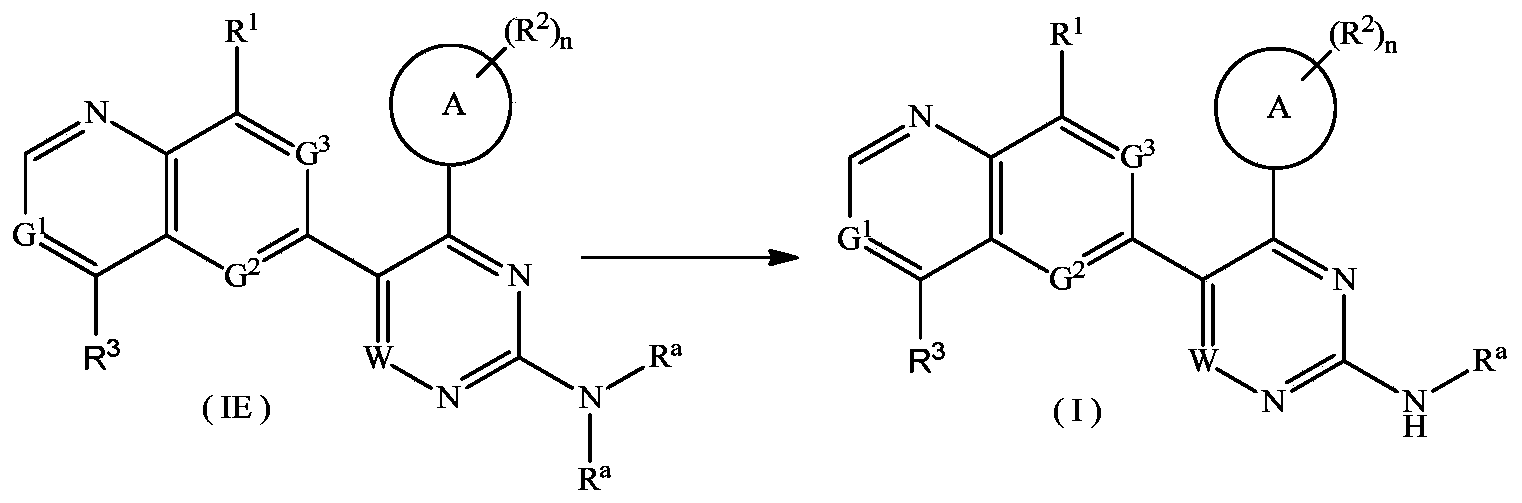 通式(IE)化合物脱去一个R a,得到通式(I)化合物,其中:R a为-C(O)R 5;R 5选自烷基和环烷基;环A、W、G 1~G 3、R 1~R 3和n如权利要求1中所定义。
 - 一种药物组合物,所述药物组合物含有治疗有效量的根据权利要求1~10中任一项所述的通式(I)所示的化合物或其互变异构体、内消旋体、外消旋体、对映异构体、非对映异构体、或其混合物形式或其可药用的盐,以及一种或多种药学上可接受的载体、稀释剂或赋形剂。
- 根据权利要求1~10中任一项所述的通式(I)所示的化合物或其互变异构体、内消旋体、外消旋体、对映异构体、非对映异构体、或其混合物形式、或其可药用的盐或根据权利要求16所述的药物组合物在制备用于治疗通过对A 2a受体和/或A 2b受体抑制而改善的病况或病症的药物中的用途。
- 根据权利要求1~10中任一项所述的通式(I)所示的化合物或其互变异构体、 内消旋体、外消旋体、对映异构体、非对映异构体、或其混合物形式、或其可药用的盐或根据权利要求16所述的药物组合物在制备用于抑制A 2a受体和/或A 2b受体的药物中的用途。
- 根据权利要求17所述的用途,其中所述的病况或病症选自癌症、抑郁、认知功能病症、神经退行性病症、注意力相关病症、锥体外症候群、异常运动障碍、肝硬化、肝纤维化、脂肪肝、皮肤纤维化、睡眠障碍、中风、脑损伤、神经炎症和成瘾行为;优选为癌症。
- 根据权利要求19所述的用途,其中所述的癌症选自黑色素瘤、脑瘤、食管癌、胃癌、肝癌、胰腺癌、结肠直肠癌、肺癌、肾癌、乳腺癌、卵巢癌、前列腺癌、皮肤癌、神经母细胞瘤、肉瘤、骨软骨瘤、骨瘤、骨肉瘤、精原细胞瘤、睾丸肿瘤、子宫癌、头颈肿瘤、多发性骨髓瘤、恶性淋巴瘤、真性红细胞增多症、白血病、甲状腺肿瘤、输尿管肿瘤、膀胱癌、胆囊癌、胆管癌、绒毛膜上皮癌和儿科肿瘤;优选为肺癌。
Priority Applications (1)
| Application Number | Priority Date | Filing Date | Title |
|---|---|---|---|
| CN201980004504.1A CN111094254B (zh) | 2018-07-12 | 2019-07-11 | 杂芳基类衍生物、其制备方法及其在医药上的应用 |
Applications Claiming Priority (2)
| Application Number | Priority Date | Filing Date | Title |
|---|---|---|---|
| CN201810764515.7 | 2018-07-12 | ||
| CN201810764515 | 2018-07-12 |
Publications (1)
| Publication Number | Publication Date |
|---|---|
| WO2020011220A1 true WO2020011220A1 (zh) | 2020-01-16 |
Family
ID=69143193
Family Applications (1)
| Application Number | Title | Priority Date | Filing Date |
|---|---|---|---|
| PCT/CN2019/095523 Ceased WO2020011220A1 (zh) | 2018-07-12 | 2019-07-11 | 杂芳基类衍生物、其制备方法及其在医药上的应用 |
Country Status (3)
| Country | Link |
|---|---|
| CN (1) | CN111094254B (zh) |
| TW (1) | TW202019886A (zh) |
| WO (1) | WO2020011220A1 (zh) |
Cited By (2)
| Publication number | Priority date | Publication date | Assignee | Title |
|---|---|---|---|---|
| WO2023144559A1 (en) | 2022-01-28 | 2023-08-03 | AdoRx Therapeutics Limited | Antagonist of adenosine receptors |
| WO2024193699A1 (zh) * | 2023-03-23 | 2024-09-26 | 成都赜灵生物医药科技有限公司 | 三嗪类化合物及其用途 |
Families Citing this family (2)
| Publication number | Priority date | Publication date | Assignee | Title |
|---|---|---|---|---|
| CN110655509B (zh) * | 2018-06-29 | 2023-01-24 | 江苏恒瑞医药股份有限公司 | 2-胺基嘧啶类衍生物、其制备方法及其在医药上的应用 |
| CN110684020B (zh) * | 2018-07-05 | 2023-01-20 | 江苏恒瑞医药股份有限公司 | 2-胺基嘧啶类衍生物、其制备方法及其在医药上的应用 |
Citations (5)
| Publication number | Priority date | Publication date | Assignee | Title |
|---|---|---|---|---|
| CN1575290A (zh) * | 2001-10-22 | 2005-02-02 | 卫材株式会社 | 嘧啶化合物以及含有该化合物的药物组合物 |
| CN102822150A (zh) * | 2010-02-05 | 2012-12-12 | 赫普泰雅治疗有限公司 | 1,2,4-三嗪-4-胺衍生物 |
| WO2018130184A1 (zh) * | 2017-01-13 | 2018-07-19 | 江苏恒瑞医药股份有限公司 | 1,2,4-三嗪-3-胺类衍生物、其制备方法及其在医药上的应用 |
| WO2019018584A1 (en) * | 2017-07-18 | 2019-01-24 | GiraFpharma LLC | HETEROCYCLIC COMPOUNDS AS ADENOSINE ANTAGONISTS |
| WO2019062803A1 (zh) * | 2017-09-28 | 2019-04-04 | 基石药业 | 作为a2a受体抑制剂的并环类衍生物 |
Family Cites Families (1)
| Publication number | Priority date | Publication date | Assignee | Title |
|---|---|---|---|---|
| EP3253390B1 (en) * | 2015-02-06 | 2022-04-13 | Merck Sharp & Dohme Corp. | Aminoquinazoline compounds as a2a antagonist |
-
2019
- 2019-07-11 WO PCT/CN2019/095523 patent/WO2020011220A1/zh not_active Ceased
- 2019-07-11 CN CN201980004504.1A patent/CN111094254B/zh active Active
- 2019-07-12 TW TW108124702A patent/TW202019886A/zh unknown
Patent Citations (5)
| Publication number | Priority date | Publication date | Assignee | Title |
|---|---|---|---|---|
| CN1575290A (zh) * | 2001-10-22 | 2005-02-02 | 卫材株式会社 | 嘧啶化合物以及含有该化合物的药物组合物 |
| CN102822150A (zh) * | 2010-02-05 | 2012-12-12 | 赫普泰雅治疗有限公司 | 1,2,4-三嗪-4-胺衍生物 |
| WO2018130184A1 (zh) * | 2017-01-13 | 2018-07-19 | 江苏恒瑞医药股份有限公司 | 1,2,4-三嗪-3-胺类衍生物、其制备方法及其在医药上的应用 |
| WO2019018584A1 (en) * | 2017-07-18 | 2019-01-24 | GiraFpharma LLC | HETEROCYCLIC COMPOUNDS AS ADENOSINE ANTAGONISTS |
| WO2019062803A1 (zh) * | 2017-09-28 | 2019-04-04 | 基石药业 | 作为a2a受体抑制剂的并环类衍生物 |
Cited By (2)
| Publication number | Priority date | Publication date | Assignee | Title |
|---|---|---|---|---|
| WO2023144559A1 (en) | 2022-01-28 | 2023-08-03 | AdoRx Therapeutics Limited | Antagonist of adenosine receptors |
| WO2024193699A1 (zh) * | 2023-03-23 | 2024-09-26 | 成都赜灵生物医药科技有限公司 | 三嗪类化合物及其用途 |
Also Published As
| Publication number | Publication date |
|---|---|
| CN111094254A (zh) | 2020-05-01 |
| TW202019886A (zh) | 2020-06-01 |
| CN111094254B (zh) | 2022-07-26 |
Similar Documents
| Publication | Publication Date | Title |
|---|---|---|
| CN109963854B (zh) | 杂芳基并[4,3-c]嘧啶-5-胺类衍生物、其制备方法及其在医药上的应用 | |
| TWI662026B (zh) | 吡啶酮類衍生物、其製備方法及其在醫藥上的應用 | |
| CN109535161B (zh) | 三唑并嘧啶类衍生物、其制备方法及其在医药上的应用 | |
| CN108884061B (zh) | 1,2,4-三嗪-3-胺类衍生物、其制备方法及其在医药上的应用 | |
| WO2023016484A1 (zh) | 磺酰胺衍生物、其制备方法及其在医药上的应用 | |
| CN107428742A (zh) | 苯并呋喃类衍生物、其制备方法及其在医药上的应用 | |
| CN111094254B (zh) | 杂芳基类衍生物、其制备方法及其在医药上的应用 | |
| CN110072865B (zh) | 吡咯并芳杂环类化合物及其制备方法和医药用途 | |
| WO2016169421A1 (zh) | 咪唑并异吲哚类衍生物、其制备方法及其在医药上的应用 | |
| TWI701251B (zh) | 吡唑并[1,5-a][1,3,5]三-2-胺類衍生物、其製備方法及其在醫藥上的應用 | |
| WO2022166974A1 (zh) | 吡啶并嘧啶酮类衍生物及其制备方法和用途 | |
| TW202102505A (zh) | 吡咯并雜環類衍生物、其製備方法及其在醫藥上的應用 | |
| WO2022247920A1 (zh) | 喹啉胺类化合物、其制备方法及其在医药上的应用 | |
| CN116438174B (zh) | 化合物及其作为mif抑制剂的用途 | |
| CN110156656A (zh) | 五元杂芳环衍生物、其制备方法、药物组合物及应用 | |
| TW201835079A (zh) | 6-吡唑-[1,2,4]三唑並[4,3-α]吡啶-3-醯胺類衍生物、其製備方法及其在醫藥上的應用 | |
| CN112996783B (zh) | 2-氨基嘧啶类衍生物、其制备方法及其在医药上的应用 | |
| WO2022166810A1 (zh) | 稠合的氮杂三环类衍生物、其制备方法及其在医药上的应用 | |
| CN108467386B (zh) | 稠杂芳基取代的1,2,4-三嗪-3-胺类衍生物、其制备方法及其在医药上的应用 | |
| CN109485595B (zh) | 亲水性基团取代的吲哚甲酰胺类衍生物、其制备方法及其在医药上的应用 | |
| CN113912608B (zh) | 嘧啶并嘧啶酮类衍生物、其制备方法及其在医药上的应用 | |
| WO2022022630A1 (zh) | 氧杂氮杂螺环类衍生物、其制备方法及其在医药上的应用 | |
| CN110684020B (zh) | 2-胺基嘧啶类衍生物、其制备方法及其在医药上的应用 | |
| CN110655509B (zh) | 2-胺基嘧啶类衍生物、其制备方法及其在医药上的应用 | |
| CN115835863B (zh) | 氧杂氮杂双环类衍生物、其制备方法及其在医药上的应用 |
Legal Events
| Date | Code | Title | Description |
|---|---|---|---|
| 121 | Ep: the epo has been informed by wipo that ep was designated in this application |
Ref document number: 19833768 Country of ref document: EP Kind code of ref document: A1 |
|
| NENP | Non-entry into the national phase |
Ref country code: DE |
|
| 122 | Ep: pct application non-entry in european phase |
Ref document number: 19833768 Country of ref document: EP Kind code of ref document: A1 |