WO2020004440A1 - ポリイミド樹脂組成物及びその成形体 - Google Patents
ポリイミド樹脂組成物及びその成形体 Download PDFInfo
- Publication number
- WO2020004440A1 WO2020004440A1 PCT/JP2019/025308 JP2019025308W WO2020004440A1 WO 2020004440 A1 WO2020004440 A1 WO 2020004440A1 JP 2019025308 W JP2019025308 W JP 2019025308W WO 2020004440 A1 WO2020004440 A1 WO 2020004440A1
- Authority
- WO
- WIPO (PCT)
- Prior art keywords
- polyimide resin
- resin composition
- carbon atoms
- group
- mass
- Prior art date
- Legal status (The legal status is an assumption and is not a legal conclusion. Google has not performed a legal analysis and makes no representation as to the accuracy of the status listed.)
- Ceased
Links
- 0 CC(C)*N(C(*1(C(N2C(C)C)=O)C2=O)=O)C1=O Chemical compound CC(C)*N(C(*1(C(N2C(C)C)=O)C2=O)=O)C1=O 0.000 description 1
Classifications
-
- C—CHEMISTRY; METALLURGY
- C08—ORGANIC MACROMOLECULAR COMPOUNDS; THEIR PREPARATION OR CHEMICAL WORKING-UP; COMPOSITIONS BASED THEREON
- C08K—Use of inorganic or non-macromolecular organic substances as compounding ingredients
- C08K5/00—Use of organic ingredients
- C08K5/49—Phosphorus-containing compounds
- C08K5/5399—Phosphorus bound to nitrogen
-
- C—CHEMISTRY; METALLURGY
- C08—ORGANIC MACROMOLECULAR COMPOUNDS; THEIR PREPARATION OR CHEMICAL WORKING-UP; COMPOSITIONS BASED THEREON
- C08L—COMPOSITIONS OF MACROMOLECULAR COMPOUNDS
- C08L79/00—Compositions of macromolecular compounds obtained by reactions forming in the main chain of the macromolecule a linkage containing nitrogen with or without oxygen or carbon only, not provided for in groups C08L61/00 - C08L77/00
- C08L79/04—Polycondensates having nitrogen-containing heterocyclic rings in the main chain; Polyhydrazides; Polyamide acids or similar polyimide precursors
- C08L79/08—Polyimides; Polyester-imides; Polyamide-imides; Polyamide acids or similar polyimide precursors
Definitions
- the present invention relates to a polyimide resin composition and a molded product thereof.
- Polyimide resins are used in a wide range of fields because they have high heat resistance, high strength, and high solvent resistance due to rigidity of molecular chains, resonance stabilization, and strong chemical bonding.
- a polyimide resin having crystallinity can further improve its heat resistance, strength, and chemical resistance, it is expected to be used as a metal substitute material.
- the conventional polyimide resin has high heat resistance, it does not have a melting point at a temperature lower than the decomposition temperature and does not exhibit thermoplasticity.
- thermoplastic polyimide resins having thermoplasticity have been reported.
- Thermoplastic polyimide resin has excellent moldability in addition to the inherent heat resistance of the polyimide resin, so harsh environments that could not be applied with conventional thermoplastic resins such as polyamide resin or polyphenylene sulfide resin Application to moldings used below is also possible.
- Aurum (registered trademark) and the like are known as thermoplastic polyimide resins.
- this resin has a plurality of flexible ether bonds and meta structures in the structure, it is a rigid wholly aromatic polyimide, but has a melting point below the decomposition temperature, but since its melting point is still high, In molding, a high temperature exceeding 400 ° C. is required, and there is a problem in equipment restrictions and handling properties.
- thermoplastic resin flame-retardant As a method of making a thermoplastic resin flame-retardant, a method of adding a flame retardant such as a chlorine compound, a bromine compound, or antimony trioxide to the thermoplastic resin is used.
- a flame retardant such as a chlorine compound, a bromine compound, or antimony trioxide
- Patent Document 1 also discloses a phosphazene-based compound as a flame retardant that can be added to a thermoplastic polyimide resin.
- the phosphazene-based compound when a large amount of the phosphazene-based compound is added to the thermoplastic resin, the phosphazene-based compound is easily eluted (bleed-out) on the surface of the molded body when the obtained molded body is exposed to a high temperature, and the flame-retardant performance is reduced. There is a possibility that a decrease, a decrease in adhesion to another molded body or a material, or the like may occur.
- a resin used in a severe environment such as a thermoplastic polyimide resin
- a phosphazene-based compound-containing resin composition having high thermal stability (heat resistance) and not causing bleed-out even when exposed to high temperatures Is required.
- the present invention has been made in view of the above circumstances, and provides a phosphazene-based compound-containing polyimide resin composition having excellent moldability, high thermal stability, and no bleed-out, and a molded article thereof. As an issue.
- the present inventor has found that the above problem can be solved by adding a phosphazene-based compound having a specific structure to a thermoplastic polyimide resin, and has completed the present invention.
- the present invention provides the following polyimide resin composition and a molded article thereof.
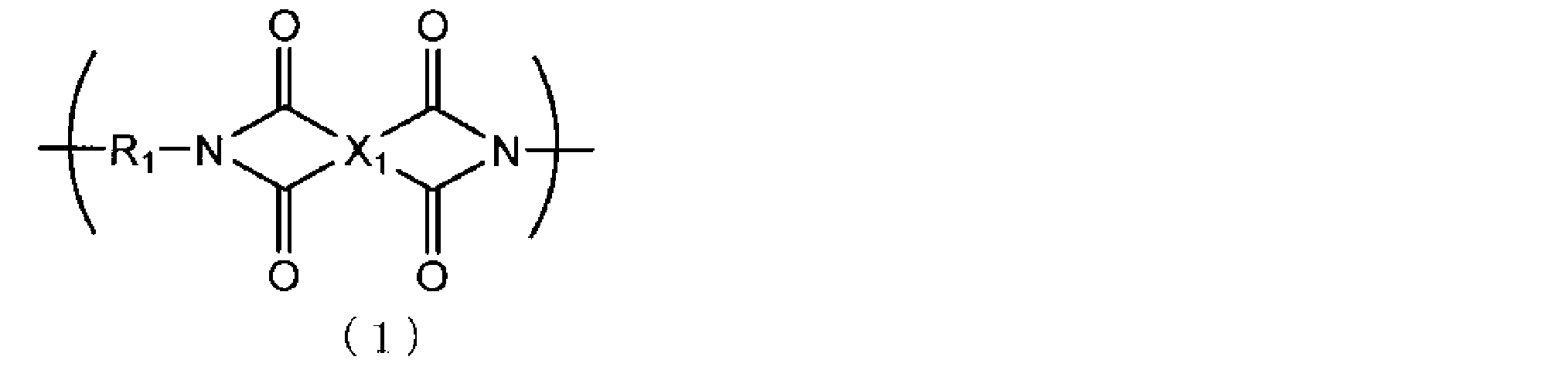
- thermoplastic polyimide resin (A) is a polymer having one or more structural units represented by the following general formulas (1) to (3). .
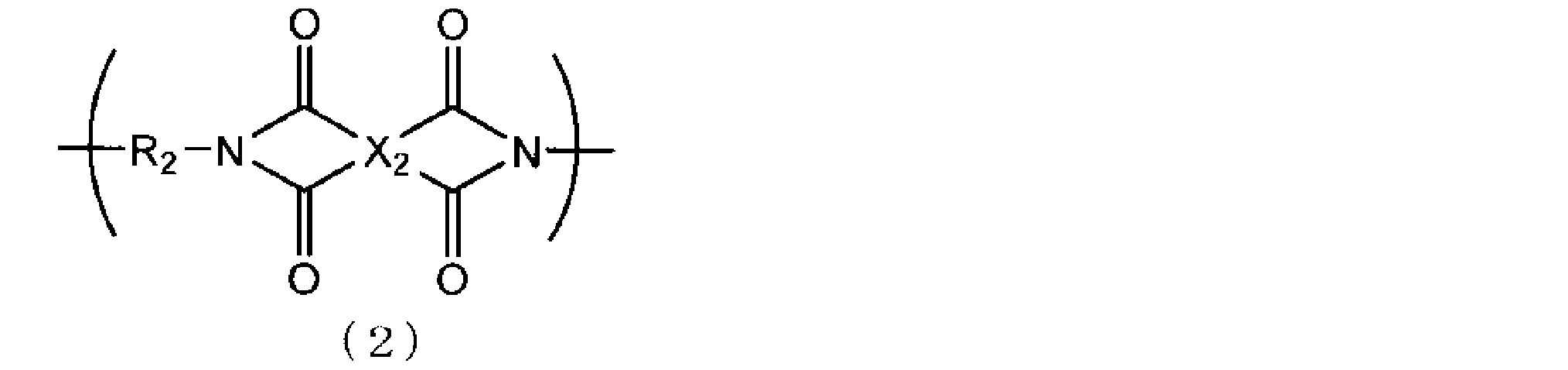
- R 2 is a divalent chain aliphatic group having 5 to 20 carbon atoms.
- X 2 is a tetravalent group having 6 to 22 carbon atoms containing at least one aromatic ring.
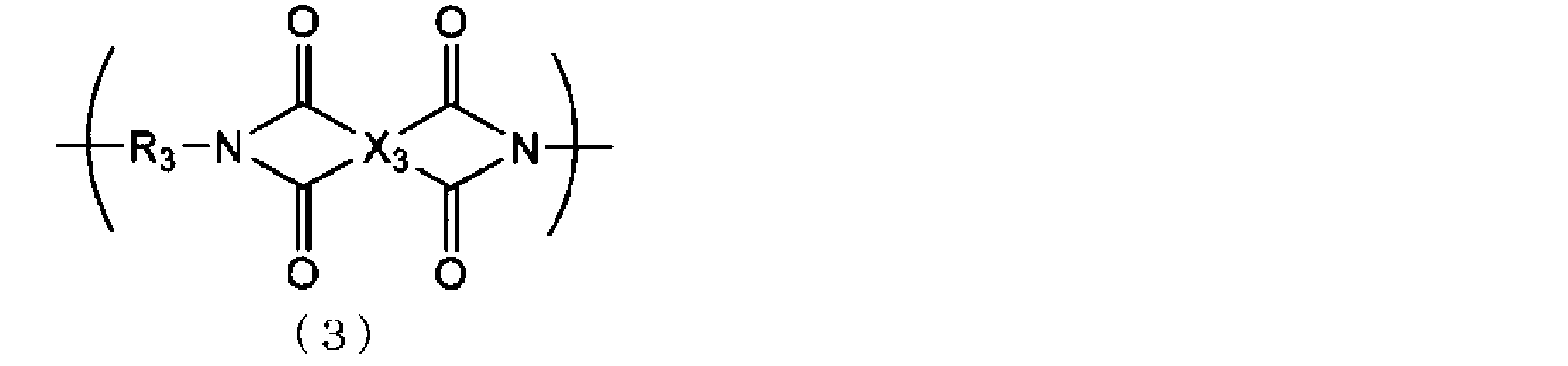
- R 3 is a divalent group having 6 to 22 carbon atoms containing at least one aromatic ring.
- X 3 is a tetravalent group having 6 to 22 carbon atoms containing at least one aromatic ring. is there.
- Item 3 The item in Item 2, wherein the total content ratio of the structural units represented by the general formulas (1) to (3) to all structural units constituting the thermoplastic polyimide resin (A) is 50 to 100 mol%. Polyimide resin composition.
- thermoplastic polyimide resin (A) has a glass transition temperature of 170 ° C. or higher.
- Item 6 The polyimide resin composition according to any one of Items 1 to 5, wherein the content of the thermoplastic polyimide resin (A) is 50 to 99% by mass based on 100% by mass of the total amount of the polyimide resin composition. object.
- Item 7 The polyimide resin composition according to any one of Items 1 to 6, wherein the content of the phosphazene compound (B) is 1 to 50% by mass based on 100% by mass of the total amount of the polyimide resin composition. .
- ⁇ Item 8 ⁇ A molded article produced using the polyimide resin composition according to any one of Items 1 to 7.
- ⁇ Item 10 ⁇ A method for producing a molded article, comprising a step of thermoforming the polyimide resin composition according to any one of Items 1 to 7 at 300 to 400 ° C.
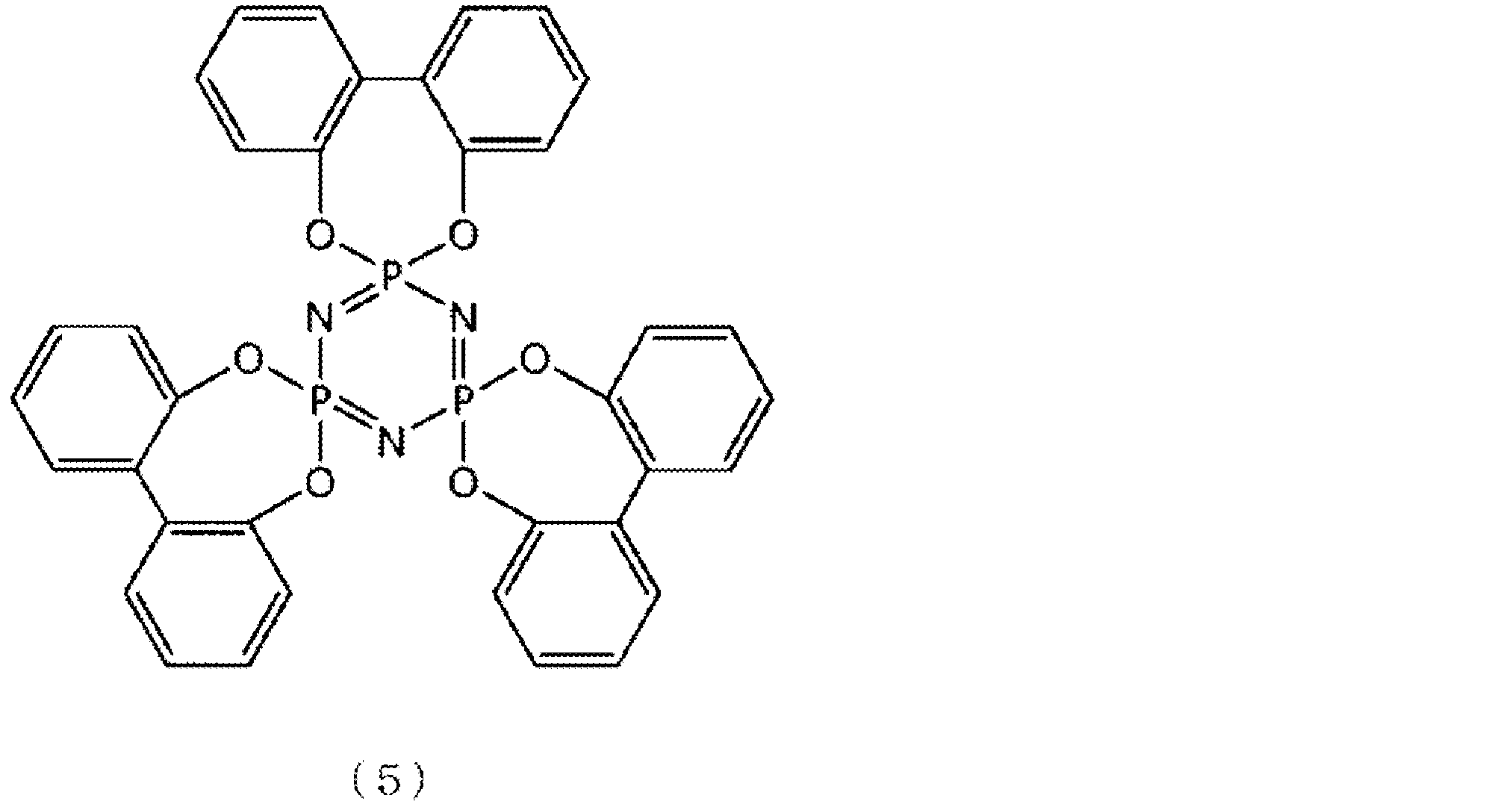
- the polyimide resin composition of the present invention has a compound represented by the formula (5) as a flame retardant, it has excellent moldability and high thermal stability (heat resistance). When a molded article is produced, elution of the compound to the surface can be suppressed even when exposed to high temperatures.
- the polyimide resin composition of the present invention is characterized by containing a thermoplastic polyimide resin (A) and a phosphazene-based compound (B), and may further contain other additives as necessary.
- Thermoplastic polyimide resin (A) is a resin that can be melt-molded by heating, and is a polymer having an imide ring structure in a repeating unit (structural unit) ( Any known polymer (polymer) can be widely used.
- the resin (A) include polymers having one or more structural units represented by general formulas (1) to (3).
- the total content of the structural units represented by the general formulas (1) to (3) with respect to all the structural units constituting the resin (A) is usually 50 to 100 mol%, preferably 75 to 100 mol%. %, More preferably 80 to 100 mol%, still more preferably 85 to 100 mol%, and particularly preferably 95 to 100 mol%.
- Examples of the structural unit that the resin (A) can contain in addition to the structural units represented by the general formulas (1) to (3) include, for example, a structural unit represented by a general formula (4) described later. Can be mentioned.
- the resin (A) a polymer having a structural unit represented by the general formula (1) and a structural unit represented by the general formula (2), or a structural unit represented by the general formula (1), It is preferable that the polymer has a structural unit represented by the formula (2) and a structural unit represented by the general formula (3).
- the structural unit represented by the general formula (1) and the general formula (2) are preferably from 40 to 70 mol%, more preferably from 40 to 60 mol%.
- the half-crystallization time of the polyimide resin is 60 seconds or less, and since the crystallization speed is high, it is possible to sufficiently crystallize the polyimide resin even in a general injection molding cycle. Become.
- the content ratio of the structural unit represented by the general formula (1) to the total of the structural unit represented by the general formula (2) and the structural unit represented by the general formula (2) is preferably 40 to 70 mol%. , More preferably 40 to 60 mol%.
- the content ratio of the structural unit represented by the general formula (3) to the total of the structural unit represented by the general formula (1) and the structural unit represented by the general formula (2) is preferably 25 mol%. From the viewpoint of maintaining the crystallinity, it is more preferably at most 20 mol%, further preferably at most 15 mol%.
- the lower limit is not particularly limited and may be more than 0 mol%, and is preferably 5 mol% or more, more preferably 10 mol% or more from the viewpoint of improving heat resistance.
- R 1 is a divalent group having 6 to 22 (preferably 8 to 17) carbon atoms containing at least one alicyclic hydrocarbon structure.
- the alicyclic hydrocarbon structure means a ring derived from an alicyclic hydrocarbon compound.
- the alicyclic hydrocarbon compound may be saturated or unsaturated, and may be monocyclic or polycyclic.
- Examples of the alicyclic hydrocarbon structure include a cycloalkane ring such as a cyclohexane ring; a cycloalkene ring such as cyclohexene; a bicycloalkane ring such as a norbornane ring; a bicycloalkene ring such as norbornene; Among these, a cycloalkane ring is preferred, a cycloalkane ring having 4 to 7 carbon atoms is more preferred, and a cyclohexane ring is still more preferred.
- R 1 contains at least one, preferably 1 to 3 alicyclic hydrocarbon structures.
- R 1 is preferably a divalent group represented by formula (R1-1) or (R1-2).
- n 11 and m 12 are each independently an integer of 0 to 2, preferably 0 or 1.
- m 13 to m 15 are each independently an integer of 0 to 2, preferably Is 0 or 1.
- R 1 is particularly preferably a divalent group represented by the general formula (R1-3).
- the positional relationship between the two methylene groups with respect to the cyclohexane ring may be cis or trans, and the ratio of cis to trans is not limited. It may be a value.
- X 1 is a tetravalent group having 6 to 22 carbon atoms (preferably having 6 to 18 carbon atoms) containing at least one aromatic ring.
- the aromatic ring may be a single ring or a condensed ring.
- Examples of the aromatic ring include, but are not limited to, a benzene ring, a naphthalene ring, an anthracene ring, and a tetracene ring. Among these, a benzene ring and a naphthalene ring are preferred, and a benzene ring is more preferred.
- X 1 contains at least one aromatic ring, and preferably contains 1 to 3 aromatic rings.
- X 1 is preferably a tetravalent group represented by any of formulas (X1-1) to (X1-4).
- R 11 to R 18 are each independently an alkyl group having 1 to 4 carbon atoms.
- P 11 to p 13 are each independently an integer of 0 to 2, preferably 0.
- P 14 to p 16 and p 18 are each independently an integer of 0 to 3, and preferably 0.
- p 17 is an integer of 0 to 4, preferably 0.
- L 11 to L 13 are each independently a single bond, an ether group, a carbonyl group or an alkylene group having 1 to 4 carbon atoms.
- L 12 , L 13 , R 16 to R 18 and p 16 to p 18 in the general formula (X1-4) are selected to be within the range, and are tetravalent groups represented by the general formula (X1-4) Is selected so that the number of carbon atoms is in the range of 6 to 22.
- X 1 is particularly preferably a tetravalent group represented by formula (X1-5) or (X1-6).
- R 2 is a divalent chain aliphatic group having 5 to 20 carbon atoms.
- X 2 is a tetravalent group having 6 to 22 carbon atoms containing at least one aromatic ring.
- R 2 is a divalent chain aliphatic group having 5 to 20 carbon atoms (preferably 5 to 16 carbon atoms, more preferably 5 to 12 carbon atoms).
- the chain aliphatic group means a group derived from a chain aliphatic compound.
- the chain aliphatic compound may be saturated or unsaturated, linear or branched, and may contain a hetero atom such as an oxygen atom.
- R 2 is preferably an alkylene group having 5 to 20 carbon atoms, more preferably an alkylene group having 5 to 16 carbon atoms, further preferably an alkylene group having 5 to 12 carbon atoms, and particularly preferably an alkylene group having 5 to 12 carbon atoms. It is an alkylene group of the number 6 to 10.
- the alkylene group may be a linear alkylene group or a branched alkylene group, and is preferably a linear alkylene group.
- R 2 is particularly preferably a hexamethylene group.
- R 2 is a divalent linear aliphatic group having 5 to 20 carbon atoms (preferably 5 to 16 carbon atoms, more preferably 5 to 12 carbon atoms) including an ether group.
- a divalent group represented by formula (R2-1) or (R2-2) is preferable.
- M 23 to m 25 are each independently an integer of 1 to 18, preferably an integer of 1 to 14, more preferably an integer of 1 to 10, and further preferably 2 to It is an integer of 4.
- R 2 in the general formula (R2-1) is a divalent chain aliphatic group having 5 to 20 carbon atoms (preferably 5 to 16 carbon atoms, more preferably 5 to 12 carbon atoms), R 2 in the general formula (R2-1) m 21 and m 22 are such that the divalent group represented by the general formula (R2-1) has a carbon number of 5 to 20 (preferably 5 to 16 carbon atoms, more preferably 5 to 12 carbon atoms). Selected to enter. That is, m 21 + m 22 is 5 to 20 (preferably 5 to 16, more preferably 5 to 12). Similarly, m 23 to m 25 in the general formula (R2-2) are such that the divalent group represented by the general formula (R2-2) has 5 to 20 carbon atoms (preferably 5 to 16 carbon atoms). Preferably, the number of carbon atoms is selected to be in the range of 5 to 12). That is, m 23 + m 24 + m 25 is 5 to 20 (preferably 5 to 16, and more preferably 5 to 12).
- X 2 is defined in the same manner as X 1 in the general formula (1). Preferred aspects of X 2 is the same as X 1.
- R 3 is a divalent group having 6 to 22 carbon atoms containing at least one aromatic ring.
- X 3 is a tetravalent group having 6 to 22 carbon atoms containing at least one aromatic ring. is there.
- R 3 is a divalent group having 6 to 22 (preferably 6 to 18) carbon atoms containing at least one aromatic ring.
- the aromatic ring may be a single ring or a condensed ring.
- Examples of the aromatic ring include, but are not limited to, a benzene ring, a naphthalene ring, an anthracene ring, and a tetracene ring. Among these, a benzene ring and a naphthalene ring are preferred, and a benzene ring is more preferred.
- R 3 contains at least one aromatic ring, and preferably contains 1 to 3 aromatic rings.
- a monovalent or divalent electron withdrawing group may be bonded to the aromatic ring.
- the monovalent electron-withdrawing group include a nitro group, a cyano group, a p-toluenesulfonyl group, a halogen, a halogenated alkyl group, a phenyl group and an acyl group.
- the divalent electron-withdrawing group include a fluorinated alkylene group (eg, —C (CF 3 ) 2 —, — (CF 2 ) p — (where p is an integer of 1 to 10).
- p is an integer of 1 to 10
- Other than the halogenated alkylene group there may be mentioned -C-, -SO 2- , -SO-, -CONH-, -COO- and the like.
- R 3 is preferably a divalent group represented by formula (R3-1) or (R3-2).
- m 31 and m 32 are each independently an integer of 0 to 2, preferably 0 or 1.
- m 33 and m 34 are each independently an integer of 0 to 2, It is preferably 0 or 1.
- R 31 to R 33 are each independently an alkyl group having 1 to 4 carbon atoms, an alkenyl group having 2 to 4 carbon atoms, or an alkynyl group having 2 to 4 carbon atoms.
- 31 to p 33 are an integer of 0 to 4, and preferably 0.
- L 31 is a single bond, an ether group, a carbonyl group or an alkylene group having 1 to 4 carbon atoms.
- R 3 is a divalent group having at least one aromatic ring and having 6 to 22 carbon atoms
- m 31 , m 32 , R 31 and p 31 in the general formula (R3-1) represent the general formula
- the divalent group represented by (R3-1) is selected so that the carbon number of the divalent group falls within the range of 6 to 22.
- L 31 , m 33 , m 34 , R 32 , R 33 , p 32 and p 33 in the general formula (R3-2) represent a carbon of a divalent group represented by the general formula (R3-2). The number is chosen to be in the range 12-22.
- X 3 is defined in the same manner as X 1 in the general formula (1). Preferred aspects of X 3 is the same as X 1.
- Examples of the structural unit that the resin (A) can contain in addition to the structural units represented by the general formulas (1) to (3) include a structural unit represented by the general formula (4). Can be.
- R 4 is a divalent group containing —SO 2 — or —Si (R x ) (R y ) O—, and R x and R y are each independently a chain having 1 to 3 carbon atoms.
- X 4 is a tetravalent group having 6 to 22 carbon atoms containing at least one aromatic ring.
- X 4 is defined in the same manner as X 1 in the general formula (1). Preferred aspects of X 4 is the same as X 1.
- the resin (A) may be either an amorphous or crystalline thermoplastic polyimide resin, and is preferably a crystalline thermoplastic polyimide resin from the viewpoint of moldability.
- the melting point of the resin (A) is preferably 390 ° C or lower, more preferably 360 ° C or lower, and further preferably 330 ° C or lower, from the viewpoint of heat resistance and moldability.
- the lower limit of the melting point is preferably 200 ° C. or higher, more preferably 250 ° C. or higher, and further preferably 270 ° C. or higher.
- the glass transition temperature (Tg) is preferably 170 ° C. or higher, more preferably 200 ° C. or higher, and further preferably 230 ° C. or higher, from the viewpoint of heat resistance.
- the melting point and the glass transition temperature (Tg) were measured using a differential scanning calorimeter (DSC) at a heating rate of 10 ° C./min. The temperature can be measured by lowering the temperature at 10 ° C./min, cooling to 20 ° C., allowing the mixture to stand for 1 minute, and then heating again at a rate of 10 ° C./min.
- the MFR value of the resin (A) is preferably 0.1 g / 10 min or more, and preferably 1 g / min, measured at 350 ° C. under a load of 2.16 kg. More preferably, it is 10 minutes or more.
- the MFR value measured under the conditions of 350 ° C. and a load of 2.16 kg is preferably 100 g / 10 min or less, more preferably 50 g / 10 min or less, and more preferably 10 g / 10 min or less. Is more preferable.
- the MFR value can be used as an index of the molecular weight of the resin (A).
- the MFR value of the resin (A) can be measured according to JIS K7210.
- the shape of the resin (A) is not particularly limited as long as it can be melt-kneaded, and any of a powder, a granule, and a pellet can be used.
- the content of the resin (A) in the polyimide resin composition is usually 50 to 99% by mass, preferably 60 to 97% by mass, more preferably 70 to 97% by mass based on 100% by mass of the total amount of the polyimide resin composition. 95% by mass.
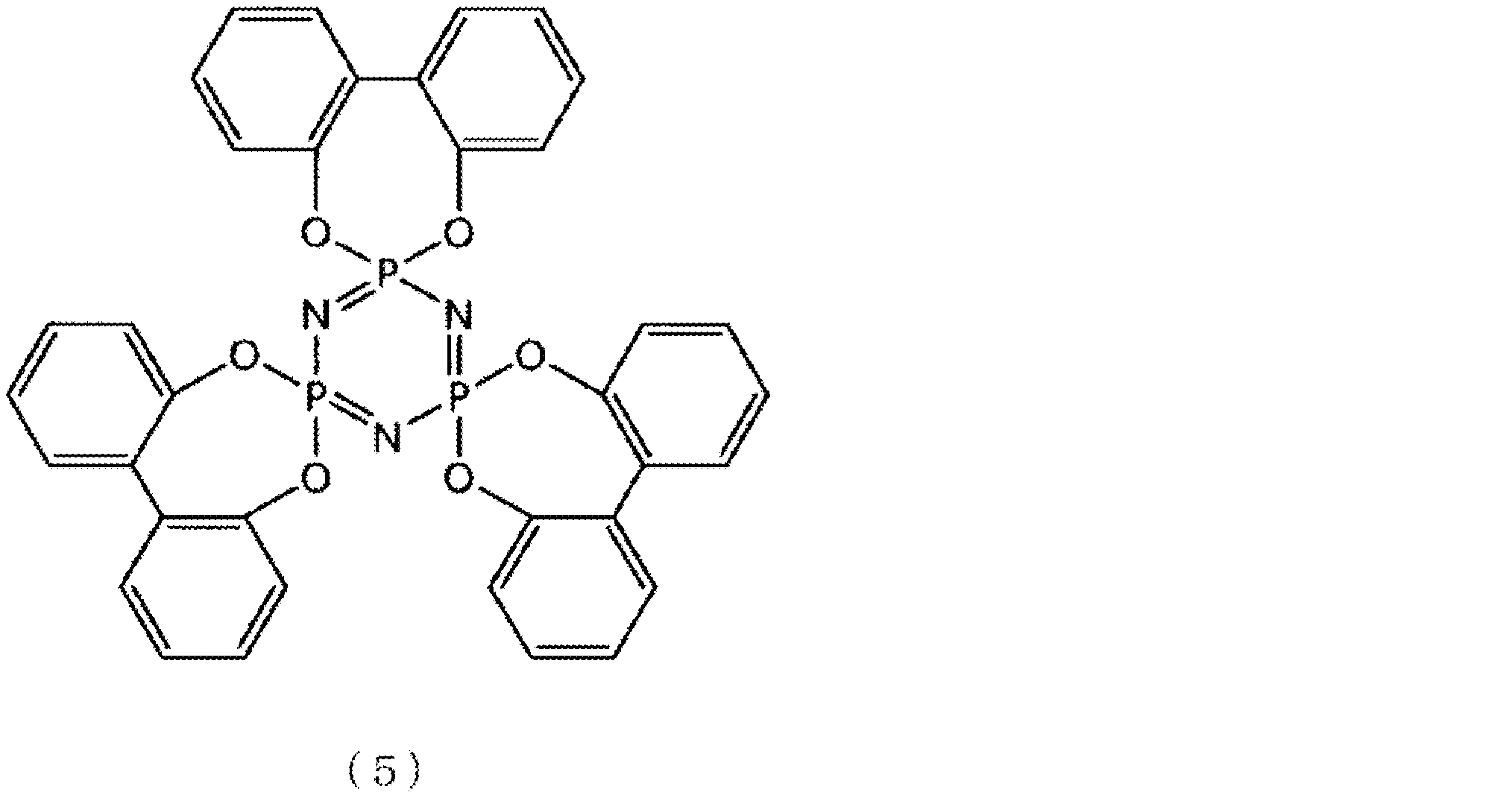
- the phosphazene compound (B) is a compound represented by the following formula (5).
- the polyimide resin composition of the present invention is characterized in that the composition contains a compound represented by the formula (5). Since the above compound does not elute even when added to the thermoplastic polyimide resin composition, the flame retardant effect can be maintained. Therefore, the compound represented by the formula (5) can be suitably used as a flame retardant for a thermoplastic polyimide resin composition.
- the compound represented by the formula (5) has been reported to be used as a silver halide photographic light-sensitive material (JP-A-2002-169243), a flame retardant for polyester (US Pat. No. 3,865,783) and the like. Is a substance.
- the compound represented by the formula (5) can be produced by a known production method.
- the compound represented by the formula (5) can be produced by the method described in US Pat. No. 3,356,695.
- the hexachlorocyclotriphosphazene represented by the formula (6) can be produced by a known method, that is, a production method based on a reaction between phosphorus pentachloride and ammonium chloride. Also, commercially available products can be used.
- the compound represented by the formula (5) can be obtained, for example, by reacting hexachlorocyclotriphosphazene (6) with 2,2′-biphenol (7) in a solvent such as monochlorobenzene.
- the 2,2'-biphenol (7) is preferably used in an amount of about 3 mol per 1 mol of hexachlorocyclotriphosphazene (6).
- the reaction temperature is preferably about 20 to 140 ° C., and the reaction time is preferably about 0.5 to 20 hours.
- the shape of the phosphazene-based compound (B) is not particularly limited as long as it can be melt-kneaded, and any of a powder, a granule, and a pellet can be used.
- the polyimide resin composition of the present invention only needs to contain the compound represented by the formula (5).
- the compounding amount of the compound represented by the formula (5) in the polyimide resin composition of the present invention is preferably about 1 to 50 parts by mass, more preferably 3 to 40 parts by mass, per 100 parts by mass of the polyimide resin. Parts, more preferably about 5 to 30 parts by mass.
- the polyimide resin composition of the present invention includes an embodiment in which a mixture represented by the following formula (8) containing the compound represented by the formula (5) is blended.
- the mixture represented by the formula (8) is, for example, 50 to 90% by mass of a compound in which n is 3 in the formula (8) (compound represented by the formula (5)) in 100% by mass of the mixture.
- the compound in which n is 4 is 5 to 40% by mass
- the compound in which n is 5 is 0 to 30% by mass
- the compound in which n is 6 to 15 is used. It is preferable to contain 0 to 20% by mass.
- the mixture represented by the formula (8) is replaced with the compound represented by the formula (8)
- the mixture represented by the formula (5) is preferably about 1 to 50 parts by weight, more preferably about 1 to 50 parts by weight, based on 100 parts by weight of the polyimide resin.
- the compounding amount may be about 3 to 40 parts by mass, and more preferably about 5 to 30 parts by mass.
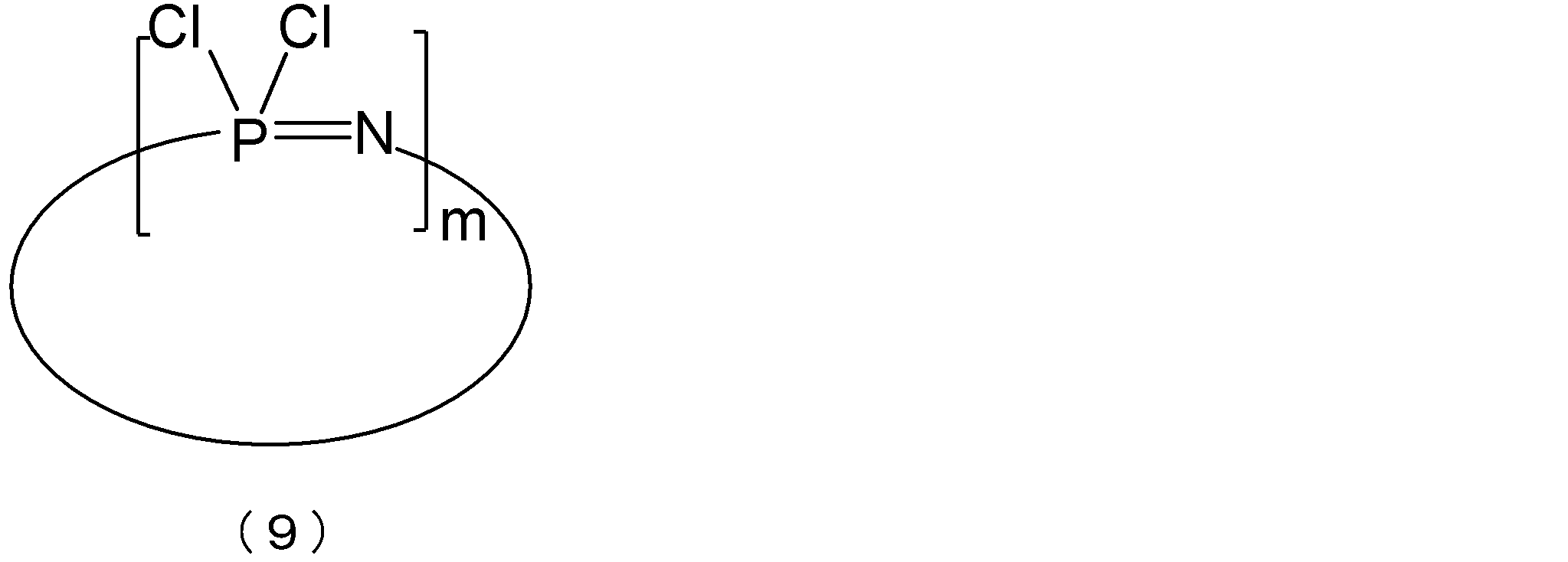
- the mixture represented by the formula (8) is obtained by mixing the mixture represented by the formula (9) with 2,2′- instead of using hexachlorocyclotriphosphazene in the method for producing the compound represented by the formula (5). It can be produced by reacting biphenol with a base.
- the mixture represented by the formula (9) can be produced by a known method.
- JP-A-57-87427, JP-B-58-19604, JP-B-61-1363, or JP-A-61-1363 can be produced according to the method described in JP-B-62-20124 and the like.
- the content of the phosphazene-based compound (B) in the polyimide resin composition is usually 1 to 50% by mass, preferably 3 to 40% by mass, more preferably 100% by mass based on the total amount of the polyimide resin composition. 5 to 30% by mass.
- the polyimide resin composition of the present invention can contain another compounding material (C) from the viewpoint of imparting desired performance to the resin (A).
- Other compounding materials (C) include a dripping inhibitor, a fibrous reinforcing material, a plate-like reinforcing material, a solid lubricant, a flame retardant other than the phosphazene compound (B), a coloring agent, an antioxidant, and an ultraviolet absorber.
- PTFE polytetrafluoroethylene
- FEP tetrafluoroethylene-hexafluoropropylene copolymer
- PFA tetrafluoroethylene-perfluoroalkylvinyl ether copolymer
- ETFE tetrafluoroethylene-ethylene copolymer Coalesced
- CFE poly (trifluorochloroethylene)
- PVdF polyvinylidene
- fibrous reinforcing materials aramid fiber, polyphenylene benzoxazole (PBO) fiber, glass fiber, carbon fiber, alumina fiber, boron fiber, silicon carbide fiber, potassium titanate fiber, wollastonite fiber, aluminum borate fiber, boric acid Magnesium fiber, zonotolite fiber, zinc oxide fiber, basic magnesium sulfate fiber, and the like.
- the plate-like reinforcing material include mica, mica, sericite, illite, talc, kaolinite, montmorillonite, boehmite, smectite, vermiculite, titanium dioxide, potassium titanate, lithium potassium titanate, and boehmite.
- polyolefin resins such as polytetrafluoroethylene (PTFE), low-density polyethylene, linear low-density polyethylene, medium-density polyethylene, high-density polyethylene, ultrahigh-molecular-weight polyethylene, graphite, molybdenum disulfide, and tungsten disulfide , Boron nitride and the like.
- a flame retardant other than the phosphazene-based compound (B) phosphate ester, condensed phosphate ester, inorganic phosphorus-based flame retardant, halogen-based flame retardant, silicone-based flame retardant, metal oxide-based flame retardant, metal hydroxide-based flame retardant Flame retardants, organic metal salt-based flame retardants, nitrogen-based flame retardants, boron compound-based flame retardants, and the like.
- the coloring agent include pigments such as carbon black and titanium oxide, and dyes.
- the antioxidant include a phenol antioxidant, a sulfur antioxidant, a phosphorus antioxidant, a copper antioxidant, and an amine antioxidant.
- UV absorber examples include a benzophenone-based UV absorber, a benzotriazole-based UV absorber, a triazine-based UV absorber, and a thyristylate-based UV absorber.
- conductive agent examples include a carbon-based conductive agent, a metal-based conductive agent, a metal oxide-based conductive agent, and a surfactant. One or more of these may be added to the polyimide resin composition of the present invention.
- the compounding amount is such that the effect of the other compounding material (C) is exhibited, and the molding processability and heat resistance of the resin (A) have From the viewpoint of maintaining the property, the total amount is preferably 0.01 to 40% by mass, more preferably 0.1 to 30% by mass, and still more preferably 1 to 30% by mass in the total amount of 100% by mass of the polyimide resin composition. 20% by mass.
- the compounding amount of other compounding materials (C) means the total content of other compounding materials used for the polyimide resin composition.
- the polyimide resin composition of the present invention comprises mixing and heating (particularly, melting) the thermoplastic polyimide resin (A), the phosphazene-based compound (B), and if necessary, other components of the compounding material (C). Kneading).
- a known melt-kneading device such as a twin-screw extruder can be used for the melt-kneading.
- a method in which each component is preliminarily mixed by a mixer a tumbler, a Henschel mixer or the like
- melt-kneaded by a melt-kneading apparatus and pelletized by a pelletizing means (a pelletizer or the like)
- a pelletizing means a pelletizer or the like
- a method of preparing a masterbatch of a desired component, mixing other components as necessary, and melt-kneading with a melt-kneading apparatus to form pellets a method of supplying each component to a melt-kneading apparatus to form pellets; Can be manufactured.
- the processing temperature in the melt kneading is not particularly limited as long as the thermoplastic resin can be melted. Usually, the cylinder temperature of the melt-kneading apparatus used for melt-kneading is adjusted to this range. Thus, the resin composition used in the present invention, which exhibits the desired effects, is produced.
- the molded article of the present invention contains the polyimide resin composition containing the various components described above. Since the resin (A) is a resin that can be melt-molded by heating, a molded article (molded article) can be produced by thermoforming the polyimide resin composition of the present invention containing the resin (A). As the thermoforming method, any method may be used as long as it is a molding method that goes through a heat melting step. Examples of the thermoforming method include injection molding, insert molding, compression molding, extrusion molding, blow molding, and inflation molding.
- the method for producing a molded article of the present invention preferably includes a step of thermoforming the polyimide resin composition of the present invention at 300 to 400 ° C.
- Examples of the shape of the molded article of the present invention include various shapes such as a film, a fiber, a round bar, a square bar, a sphere, a pipe, and a tube. Further, a molding method obtained by combining the above-described molding methods can be adopted.
- the use of the molded article of the present invention is not particularly limited, and it can be applied particularly to any use requiring heat resistance and flame retardancy.
- Usable applications include, for example, automotive parts such as washers, needle bearings, seal rings, gears, ABS parts, clutch rings; various bearings such as automotive bearings, copier bearings; copiers, printers, facsimiles, and the like.
- Fusing belts or intermediate transfer belts for various electrophotographic image forming apparatuses such as multifunction devices; surface mounting electronic members; condenser gaskets; optical connectors; flexible substrates; copper-clad laminates; multilayer printed wiring boards; Can be
- thermoplastic polyimide resin and phosphazene-based compound used in Examples and Comparative Examples are specifically as follows.
- Thermoplastic polyimide resin (Thermoplastic polyimide resin) Thermoplastic polyimide resin (A-1): melting point 319 ° C., glass transition temperature 178 ° C., MFR value 3.2 g / 10 min, manufactured by Mitsubishi Gas Chemical Company, Inc., trade name “Serprim TO65S”
- the melting point and glass transition temperature of the thermoplastic polyimide resin were determined by using a differential calorimeter (trade name: "DSC7000X", manufactured by Hitachi High-Tech Science Co., Ltd.), placing 10 mg of the sample in an aluminum cell for measurement, and flowing nitrogen gas at 100 ml / min. Under the conditions, the temperature was raised from room temperature to 360 ° C. at a rate of 10 ° C./min, the sample was cooled to 20 ° C. at a rate of 10 ° C./min, held for 1 minute, and then heated again at a rate of 10 ° C. The temperature was raised to 360 ° C./min and measured.
- thermoplastic polyimide resin was measured at 350 ° C. for 5 minutes, under a load of 2.16 kg according to JIS K7210.
- thermoplastic polyimide resin and the phosphazene-based compound were melt-kneaded in a mixing ratio shown in Table 1 using a twin-screw extruder to produce pellets.
- the cylinder temperature of the twin-screw extruder was 350 ° C.
- ⁇ ⁇ ⁇ ⁇ UL pellets (length: 127 mm, width: 12.7 mm, thickness: 1.6 mm) were formed from the obtained pellets by an injection molding machine, and used as evaluation samples. The molding was performed at a cylinder temperature of the injection molding machine of 350 ° C. and a mold temperature of 170 ° C.
- Dissolution degree [%] A / B ⁇ 100
- A (Massed body before wiping with acetone)-(Massed body after wiping with acetone)
- B (Molded body mass before wiping with acetone)
- Mass reduction rate [%] C / D ⁇ 100
- C (sample mass at 350 ° C.)
- D (mass of sample at 150 ° C.)
- the resin composition of the present invention and the molded product thereof are excellent in thermal stability. This effect is not limited to the polyimide resin, and is similarly observed in other thermoplastic resin compositions.
Landscapes
- Chemical & Material Sciences (AREA)
- Health & Medical Sciences (AREA)
- Chemical Kinetics & Catalysis (AREA)
- Medicinal Chemistry (AREA)
- Polymers & Plastics (AREA)
- Organic Chemistry (AREA)
- Compositions Of Macromolecular Compounds (AREA)
Abstract
成形加工性に優れ、熱安定性が高く、ブリードアウトが生じない、ホスファゼン系化合物含有ポリイミド樹脂組成物、及びその成形体を提供すること。 熱可塑性ポリイミド樹脂(A)と、ホスファゼン系化合物(B)とを含有し、前記ホスファゼン系化合物(B)が下記式(5)で表される化合物である、ポリイミド樹脂組成物。
Description
本発明は、ポリイミド樹脂組成物及びその成形体に関する。
ポリイミド樹脂は、分子鎖の剛直性、共鳴安定化、及び強い化学結合によって、高耐熱性、高強度、及び高耐溶剤性を有することから、幅広い分野で利用されている。また、結晶性を有しているポリイミド樹脂は、その耐熱性、強度、及び耐薬品性を更に向上させることができることから、金属代替材料としての利用が期待されている。しかし、従来のポリイミド樹脂は、高耐熱性である反面、分解温度より低い温度には融点を有しておらず、熱可塑性を示さない。
近年、熱可塑性を有するポリイミド樹脂が報告されている。熱可塑性ポリイミド樹脂はポリイミド樹脂が本来有している耐熱性に加え、成形性にも優れるため、従来使用されているポリアミド樹脂、又はポリフェニレンサルファイド樹脂等の熱可塑性樹脂では適用できなかった過酷な環境下で使用される成形体への適用も可能である。熱可塑性ポリイミド樹脂としては、Aurum(登録商標)等が知られている。この樹脂は、構造中に柔軟なエーテル結合とメタ構造とを複数有することで、剛直な全芳香族ポリイミドでありながら、分解温度より低い温度に融点を有するが、その融点は未だ高いことから、成形の際には400℃を超える高温を必要とし、装置上の制約及びハンドリング性に問題がある。
そこで、成形が容易で、耐熱性に優れる熱可塑性ポリイミド樹脂が提案されている(例えば、特許文献1)。特許文献1には、ポリマー主鎖に脂肪族構造を導入することで、耐熱性に優れる熱可塑性ポリイミド樹脂が得られることが記載されている。しかしながら、特許文献1に記載されているポリイミド樹脂では、全芳香族ポリイミド樹脂のような高い難燃性が発現しないという問題があった。
熱可塑性樹脂を難燃化する方法としては、熱可塑性樹脂中に塩素系化合物、臭素系化合物、又は三酸化アンチモンなどの難燃剤を添加する方法が用いられている。しかし、これらは環境保護の観点、及び毒性の面等からも好ましくないと言われていることから、難燃化手法の改善が求められている。
そこで、塩素、臭素等のハロゲン、及び金属酸化物を含有しない代替の難燃剤として、リン系難燃剤を用いて難燃化を行うことが検討されている。リン系難燃剤として、従来、赤リン、リン酸エステル、又は縮合リン酸エステル等が使用されている。しかし、赤リンには、加水分解性の問題、及び、腐食性のリン酸が発生することによる金型腐食の問題等がある。リン酸エステル及び縮合リン酸エステルは、比較的リン含有率が低く、耐加水分解性も劣る。それに対し、ホスファゼン系化合物はリン含有率が高く、耐熱性及び耐加水分解性が比較的良好であることから注目されている。前記特許文献1にも、熱可塑性ポリイミド樹脂に添加可能な難燃化剤として、ホスファゼン系化合物が記載されている。
一方で、熱可塑性樹脂にホスファゼン系化合物を多量に添加した場合、得られた成形体が高温に曝されると、成形体表面にホスファゼン系化合物が溶出(ブリードアウト)し易く、難燃性能の低下、別の成形体又は材料との接着性の低下等が起こるおそれがある。特に、熱可塑性ポリイミド樹脂のように過酷な環境下で使用される樹脂としては、熱安定性(耐熱性)が高く、高温に曝されてもブリードアウトが生じない、ホスファゼン系化合物含有樹脂組成物の成形体が求められている。
本発明は、上記事情を鑑みてなされたものであり、成形加工性に優れ、熱安定性が高く、ブリードアウトが生じない、ホスファゼン系化合物含有ポリイミド樹脂組成物、及びその成形体を提供することを課題とする。
本発明者は、鋭意検討を重ねた結果、熱可塑性ポリイミド樹脂中に特定構造のホスファゼン系化合物を添加することで、上記課題を解決することを見出し、本発明を完成するに至った。
すなわち、本発明は以下のポリイミド樹脂組成物、及びその成形体を提供する。
項1 熱可塑性ポリイミド樹脂(A)と、ホスファゼン系化合物(B)とを含有し、前記ホスファゼン系化合物(B)が下記式(5)で表される化合物である、ポリイミド樹脂組成物。
項2 前記熱可塑性ポリイミド樹脂(A)が、下記一般式(1)~(3)で表される構造単位を1種又は2種以上有する重合体である、項1に記載のポリイミド樹脂組成物。
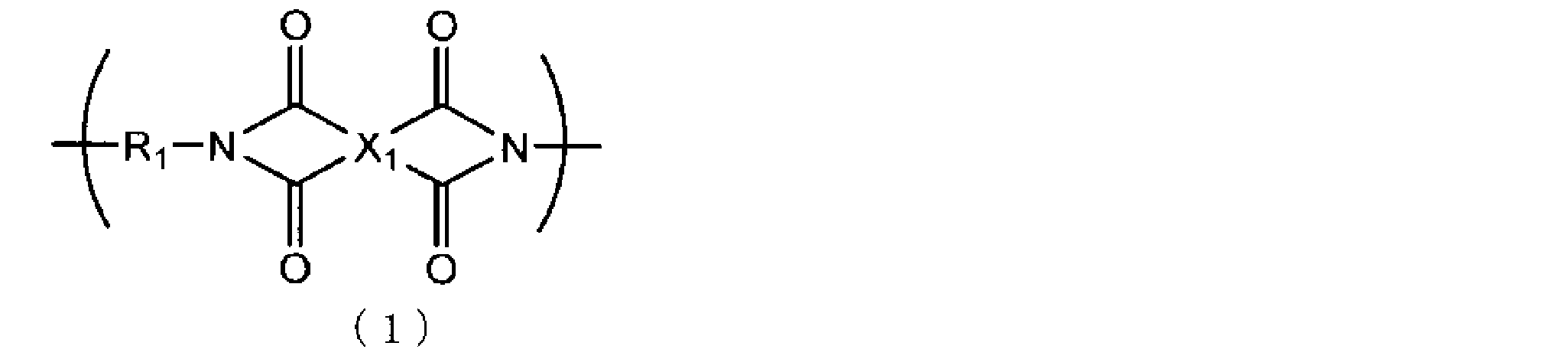
(式中、R1は、少なくとも1つの脂環式炭化水素構造を含む炭素数6~22の2価の基である。X1は、少なくとも1つの芳香環を含む炭素数6~30の4価の基である。)

(式中、R2は、炭素数5~20の2価の鎖状脂肪族基である。X2は、少なくとも1つの芳香環を含む炭素数6~22の4価の基である。)

(式中、R3は、少なくとも1つの芳香環を含む炭素数6~22の2価の基である。X3は、少なくとも1つの芳香環を含む炭素数6~22の4価の基である。)
項3 前記熱可塑性ポリイミド樹脂(A)を構成する全構造単位に対する一般式(1)~(3)で表される構造単位の合計の含有比が50~100モル%である、項2に記載のポリイミド樹脂組成物。
項4 前記熱可塑性ポリイミド樹脂(A)のガラス転移温度が170℃以上である、項1~項3のいずれか一項に記載のポリイミド樹脂組成物。
項5 前記熱可塑性ポリイミド樹脂(A)の融点が390℃以下である、項1~項4のいずれか一項に記載のポリイミド樹脂組成物。
項6 前記熱可塑性ポリイミド樹脂(A)の含有量が、ポリイミド樹脂組成物全量100質量%に対して50~99質量%である、項1~項5のいずれか一項に記載のポリイミド樹脂組成物。
項7 前記ホスファゼン系化合物(B)の含有量が、ポリイミド樹脂組成物全量100質量%に対して1~50質量%である、項1~項6のいずれか一項に記載のポリイミド樹脂組成物。
項8 項1~項7のいずれか一項に記載のポリイミド樹脂組成物を用いて作製された成形体。
項9 フィルム状である、項8に記載の成形体。
項10 項1~項7のいずれか一項に記載のポリイミド樹脂組成物を300~400℃で熱成形する工程を有する、成形体の製造方法。
本発明のポリイミド樹脂組成物は、難燃剤として式(5)で表される化合物を有していることから、成形性に優れるとともに、熱安定性(耐熱性)が高く、該樹脂組成物で成形体を作製した場合に、高温に曝されても表面への該化合物の溶出を抑制することができる。
以下、本発明を実施した好ましい形態の一例について説明する。ただし、以下の実施形態は単なる例示である。本発明は、以下の実施形態に何ら限定されない。
<ポリイミド樹脂組成物>
本発明のポリイミド樹脂組成物は、熱可塑性ポリイミド樹脂(A)と、ホスファゼン系化合物(B)とを含有することを特徴とし、必要に応じてその他の添加剤をさらに含有することができる。
本発明のポリイミド樹脂組成物は、熱可塑性ポリイミド樹脂(A)と、ホスファゼン系化合物(B)とを含有することを特徴とし、必要に応じてその他の添加剤をさらに含有することができる。
本発明のポリイミド樹脂組成物の各構成成分等について以下説明する。
(熱可塑性ポリイミド樹脂(A))
熱可塑性ポリイミド樹脂(A)(以下「樹脂(A)」と略記することがある)は、加熱により溶融成形可能な樹脂であって、繰り返し単位(構造単位)にイミド環構造を有する高分子(重合体)である公知のものを広く使用することができる。樹脂(A)として、例えば一般式(1)~(3)で表される構造単位を1種又は2種以上有する重合体を挙げることができる。
熱可塑性ポリイミド樹脂(A)(以下「樹脂(A)」と略記することがある)は、加熱により溶融成形可能な樹脂であって、繰り返し単位(構造単位)にイミド環構造を有する高分子(重合体)である公知のものを広く使用することができる。樹脂(A)として、例えば一般式(1)~(3)で表される構造単位を1種又は2種以上有する重合体を挙げることができる。
樹脂(A)を構成する全構造単位に対する、一般式(1)~(3)で表される構造単位の合計の含有比は、通常、50~100モル%であり、好ましくは75~100モル%であり、より好ましくは80~100モル%であり、更に好ましくは85~100モル%であり、特に好ましくは95~100モル%である。
樹脂(A)が、一般式(1)~(3)で表される構造体単位以外に含有することができる構造単位としては、例えば、後述する一般式(4)で表される構造単位を挙げることができる。
樹脂(A)としては、一般式(1)で表される構造単位及び一般式(2)で表される構造単位を有する重合体、又は、一般式(1)で表される構造単位、一般式(2)で表される構造単位及び一般式(3)で表される構造単位を有する重合体であることが好ましい。
樹脂(A)が一般式(1)で表される構造単位及び一般式(2)で表される構造単位を有する重合体である場合、一般式(1)で表される構造単位と一般式(2)で表される構造単位との合計に対する一般式(1)で表される構造単位の含有比は、好ましくは40~70モル%であり、より好ましくは40~60モル%である。含有比を前記範囲とすることでポリイミド樹脂の半結晶化時間が60秒以下となり、結晶化速度が速いことから、一般的な射出成形サイクルにおいてもポリイミド樹脂を十分に結晶化させることが可能となる。
樹脂(A)が一般式(1)で表される構造単位、一般式(2)で表される構造単位及び一般式(3)で表される構造単位を有する重合体である場合、一般式(1)で表される構造単位と一般式(2)で表される構造単位との合計に対する一般式(1)で表される構造単位の含有比は、好ましくは40~70モル%であり、より好ましくは40~60モル%である。含有比を前記範囲とすることでポリイミド樹脂の半結晶化時間が60秒以下となり、結晶化速度が速いことから、一般的な射出成形サイクルにおいてもポリイミド樹脂を十分に結晶化させることが可能となる。また、一般式(1)で表される構造単位と一般式(2)で表される構造単位との合計に対する一般式(3)で表される構造単位の含有比は、好ましくは25モル%以下であり、結晶性を維持する観点から、より好ましくは20モル%以下、さらに好ましくは15モル%以下である。一方で、下限は特に限定されず、0モル%を超えていればよく、耐熱性の向上という観点からは、好ましくは5モル%以上、より好ましくは10モル%以上である。
以下に、一般式(1)で表される構造単位について詳述する。

(式中、R1は、少なくとも1つの脂環式炭化水素構造を含む炭素数6~22の2価の基である。X1は、少なくとも1つの芳香環を含む炭素数6~30の4価の基である。)
R1は、少なくとも1つの脂環式炭化水素構造を含む炭素数6~22(好ましくは炭素数8~17)の2価の基である。ここで、脂環式炭化水素構造は、脂環式炭化水素化合物から誘導される環を意味する。該脂環式炭化水素化合物は、飽和であっても不飽和であってもよく、単環であっても多環であってもよい。
脂環式炭化水素構造としては、シクロヘキサン環等のシクロアルカン環;シクロヘキセン等のシクロアルケン環;ノルボルナン環等のビシクロアルカン環;ノルボルネン等のビシクロアルケン環;等が例示される。これらの中でも、好ましくはシクロアルカン環であり、より好ましくは炭素数4~7のシクロアルカン環であり、更に好ましくはシクロヘキサン環である。
R1は、脂環式炭化水素構造を少なくとも1つ含み、好ましくは1~3個含む。
R1は、好ましくは一般式(R1-1)又は(R1-2)で表される2価の基である。

(式中、m11及びm12は、それぞれ独立に、0~2の整数であり、好ましくは0又は1でる。m13~m15は、それぞれ独立に、0~2の整数であり、好ましくは0又は1である。)
R1は、特に好ましくは一般式(R1-3)で表される2価の基である。なお、一般式(R1-3)で表される2価の基において、2つのメチレン基のシクロヘキサン環に対する位置関係はシスであってもトランスであってもよく、またシスとトランスの比は如何なる値でもよい。

X1は、少なくとも1つの芳香環を含む炭素数6~22(好ましくは炭素数6~18)の4価の基である。前記芳香環は単環でも縮合環でもよい。前記芳香環として、ベンゼン環、ナフタレン環、アントラセン環、テトラセン環等が例示されるが、これらに限定されるわけではない。これらの中でも、好ましくはベンゼン環及びナフタレン環であり、より好ましくはベンゼン環である。
X1は、芳香環を少なくとも1つ含み、好ましくは1~3個含む。
X1は、好ましくは一般式(X1-1)~(X1-4)のいずれかで表される4価の基である。
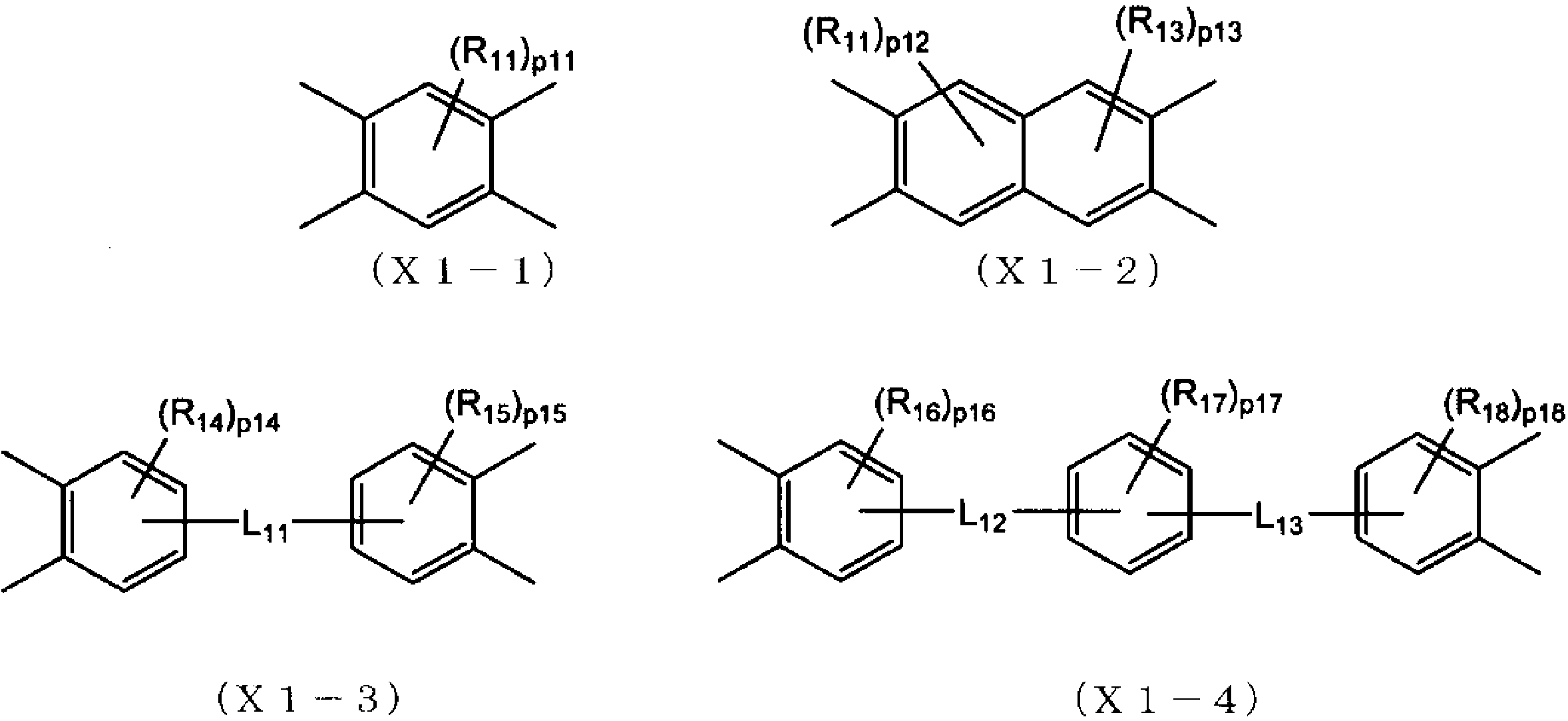
(式中、R11~R18は、それぞれ独立に、炭素数1~4のアルキル基である。p11~p13は、それぞれ独立に、0~2の整数であり、好ましくは0である。p14~p16及びp18は、それぞれ独立に、0~3の整数であり、好ましくは0である。p17は0~4の整数であり、好ましくは0である。L11~L13は、それぞれ独立に、単結合、エーテル基、カルボニル基又は炭素数1~4のアルキレン基である。)
なお、X1は、少なくとも1つの芳香環を含む炭素数6~22の4価の基であるので、一般式(X1-2)におけるR12、R13、p12及びp13は、一般式(X1-2)で表される4価の基の炭素数が6~22の範囲に入るように選択される。同様に、一般式(X1-3)におけるL11、R14、R15、p14及びp15は、一般式(X1-3)で表される4価の基の炭素数が6~22の範囲に入るように選択され、一般式(X1-4)におけるL12、L13、R16~R18及びp16~p18 は、一般式(X1-4)で表される4価の基の炭素数が6~22の範囲に入るように選択される。
X1は、特に好ましくは一般式(X1-5)又は(X1-6)で表される4価の基である。

以下に、一般式(2)で表される構造単位について詳述する。

(式中、R2は、炭素数5~20の2価の鎖状脂肪族基である。X2は、少なくとも1つの芳香環を含む炭素数6~22の4価の基である。)
R2は、炭素数5~20(好ましくは炭素数5~16、より好ましくは炭素数5~12)の2価の鎖状脂肪族基である。ここで、鎖状脂肪族基は、鎖状脂肪族化合物から誘導される基を意味する。該鎖状脂肪族化合物は、飽和であっても不飽和であってもよく、直鎖状であっても分岐状であってもよく、酸素原子等のヘテロ原子を含んでいてもよい。
R2は、好ましくは炭素数5~20のアルキレン基であり、より好ましくは炭素数5~16のアルキレン基であり、更に好ましくは炭素数5~12のアルキレン基であり、なかでも好ましくは炭素数6~10のアルキレン基である。前記アルキレン基は、直鎖状アルキレン基であっても分岐鎖状アルキレン基であってもよく、好ましくは直鎖状アルキレン基である。
R2は、特に好ましくはヘキサメチレン基である。
また、R2の別の好適な様態として、エーテル基を含む炭素数5~20(好ましくは炭素数5~16、より好ましくは炭素数5~12)の2価の鎖状脂肪族基が挙げられる。その中でも、好ましくは一般式(R2-1)又は(R2-2)で表される2価の基である。

(式中、m21及びm22は、それぞれ独立に、1~19の整数であり、好ましくは1~15の整数であり、より好ましくは1~11の整数であり、更に好ましくは2~6の整数である。m23~m25は、それぞれ独立に、1~18の整数であり、好ましくは1~14の整数であり、より好ましくは1~10の整数であり、更に好ましくは2~4の整数である。)
なお、R2は、炭素数5~20(好ましくは炭素数5~16、より好ましくは炭素数5~12)の2価の鎖状脂肪族基であるので、一般式(R2-1)におけるm21及びm22は、一般式(R2-1)で表される2価の基の炭素数が5~20(好ましくは炭素数5~16、より好ましくは炭素数5~12)の範囲に入るように選択される。すなわち、m21+m22は5~20(好ましくは5~16、より好ましくは5~12)である。同様に、一般式(R2-2)におけるm23~m25は、一般式(R2-2)で表される2価の基の炭素数が5~20(好ましくは炭素数5~16、より好ましくは炭素数5~12)の範囲に入るように選択される。すなわち、m23+m24+m25は5~20(好ましくは5~16、より好ましくは5~12)である。
X2は、一般式(1)におけるX1と同様に定義される。X2の好ましい様態もX1と同様である。
以下に、一般式(3)で表される構造単位について詳述する。

(式中、R3は、少なくとも1つの芳香環を含む炭素数6~22の2価の基である。X3は、少なくとも1つの芳香環を含む炭素数6~22の4価の基である。)
R3は、少なくとも1つの芳香環を含む炭素数6~22(好ましくは炭素数6~18)の2価の基である。前記芳香環は単環でも縮合環でもよい。前記芳香環として、ベンゼン環、ナフタレン環、アントラセン環、テトラセン環等が例示されるが、これらに限定されるわけではない。これらの中でも、好ましくはベンゼン環及びナフタレン環であり、より好ましくはベンゼン環である。
R3は、芳香環を少なくとも1つ含み、好ましくは1~3個含む。
また、前記芳香環には1価もしくは2価の電子求引性基が結合していてもよい。1価の電子求引性基としては、ニトロ基、シアノ基、p-トルエンスルホニル基、ハロゲン、ハロゲン化アルキル基、フェニル基、アシル基などが挙げられる。2価の電子求引性基としては、フッ化アルキレン基(例えば-C(CF3)2-、-(CF2)p-(ここで、pは1~10の整数である))のようなハロゲン化アルキレン基のほかに、-C-、-SO2-、-SO-、-CONH-、-COO-などが挙げられる。
R3は、好ましくは一般式(R3-1)又は(R3-2)で表される2価の基である。
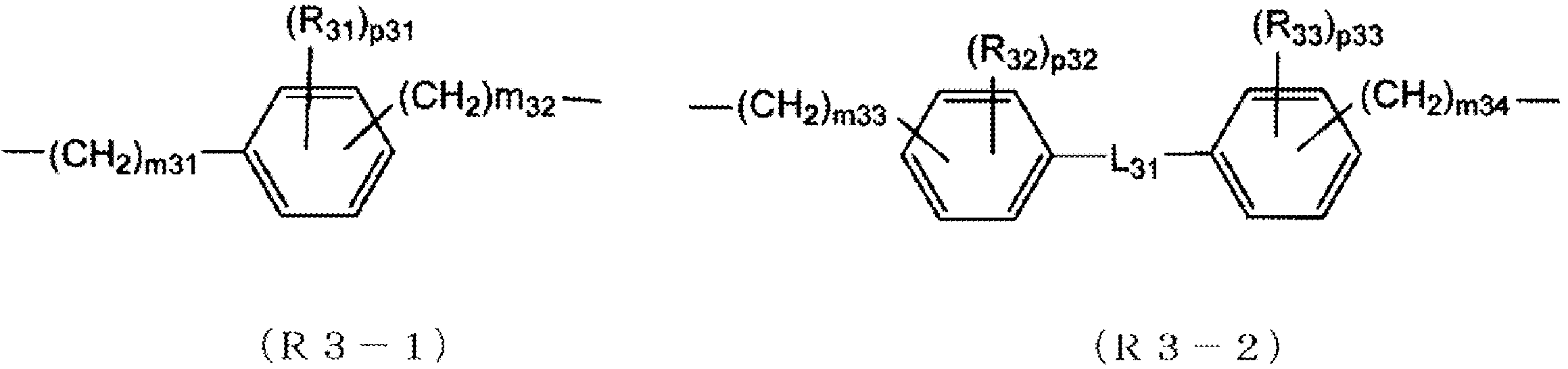
(式中、m31及びm32は、それぞれ独立に、0~2の整数であり、好ましくは0又は1である。m33及びm34は、それぞれ独立に、0~2の整数であり、好ましくは0又は1である。R31~R33は、それぞれ独立に、炭素数1~4のアルキル基、炭素数2~4のアルケニル基、又は炭素数2~4のアルキニル基である。p31~p33は0~4の整数であり、好ましくは0である。L31は、単結合、エーテル基、カルボニル基又は炭素数1~4のアルキレン基である。)
なお、R3は、少なくとも1つの芳香環を含む炭素数6~22の2価の基であるので、一般式(R3-1)におけるm31、m32、R31及びp31は、一般式(R3-1)で表される2価の基の炭素数が6~22の範囲に入るように選択される。
同様に、一般式(R3-2)におけるL31、m33、m34、R32、R33、p32及びp33は、一般式(R3-2)で表される2価の基の炭素数が12~22の範囲に入るように選択される。
X3は、一般式(1)におけるX1と同様に定義される。X3の好ましい様態もX1と同様である。
樹脂(A)が、一般式(1)~(3)で表される構造体単位以外に含有することができる構造単位としては、例えば、一般式(4)で表される構造単位を挙げることができる。
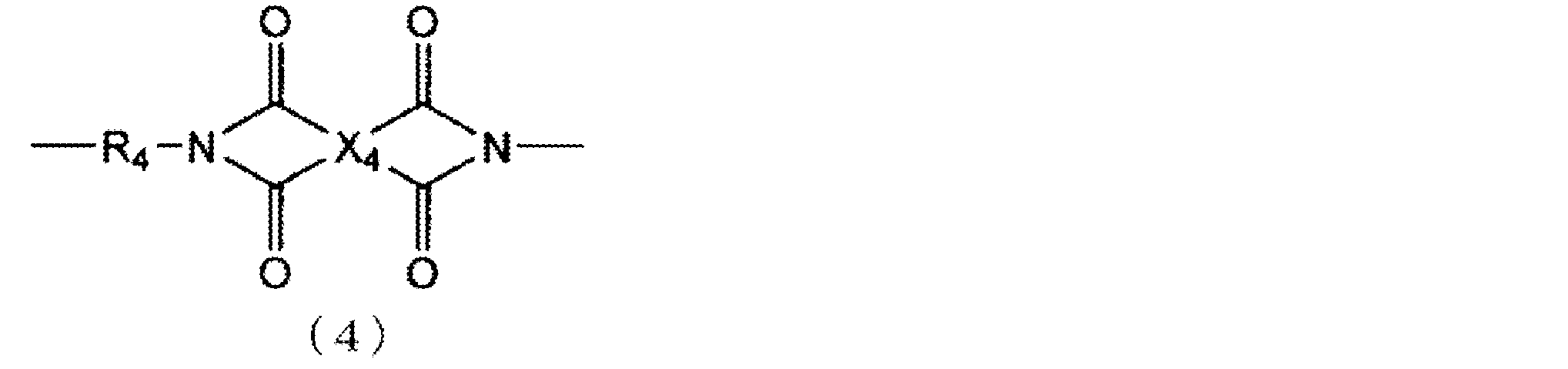
(式中、R4は-SO2-又は-Si(Rx)(Ry)O-を含む2価の基であり、Rx及びRyはそれぞれ独立に、炭素数1~3の鎖状脂肪族基又はフェニル基を表す。X4は少なくとも1つの芳香環を含む炭素数6~22の4価の基である。)
X4は、一般式(1)におけるX1と同様に定義される。X4の好ましい様態もX1と同様である。
樹脂(A)は、非晶性、又は結晶性のどちらの熱可塑性ポリイミド樹脂でもよく、成形性の観点から、結晶性の熱可塑性ポリイミド樹脂であることが好ましい。
樹脂(A)の融点は、耐熱性及び成形性の観点から、390℃以下であることが好ましく、360℃以下であることより好ましく、330℃以下であることが更に好ましい。融点の下限は、200℃以上であることが好ましく、250℃以上であることが好ましく、270℃以上であることが更に好ましい。また、ガラス転移温度(Tg)は、耐熱性の観点から、170℃以上であることが好ましく、200℃以上であることがより好ましく、230℃以上であることが更に好ましい。前記融点及びガラス転移温度(Tg)は、示差走査熱量計(DSC)を用いて、昇温速度10℃/分で、試料を予測される融点以上の温度まで加熱し、次に試料を降温速度10℃/分で降温し、20℃まで冷却し、そのまま1分間放置した後、再び昇温速度10℃/分で加熱昇温することにより測定することができる。
樹脂(A)のMFR値は、得られる樹脂組成物の成形性の観点から、350℃、荷重2.16kgの条件で測定したMFR値が0.1g/10min以上であることが好ましく、1g/10min以上であることがより好ましい。一方、耐熱性の観点から、350℃、荷重2.16kgの条件で測定したMFR値が100g/10min以下であることが好ましく、50g/10min以下であることがより好ましく、10g/10min以下であることが更に好ましい。また、分子量と溶融粘度とは相関することから、上記MFR値は、樹脂(A)の分子量の指標とすることができる。樹脂(A)のMFR値は、JIS K7210に準拠して測定することができる。
樹脂(A)の形状は、溶融混練が可能であれば特に制限はなく、粉末状、顆粒状、ペレット状のいずれも使用することができる。
ポリイミド樹脂組成物における樹脂(A)の含有量は、ポリイミド樹脂組成物全量100質量%に対して、通常50~99質量%であり、好ましくは60~97質量%であり、更に好ましくは70~95質量%である。
(ホスファゼン系化合物(B))
ホスファゼン系化合物(B)は、下記式(5)で表される化合物である。本発明のポリイミド樹脂組成物は、組成物内に式(5)で表される化合物を含有することを特徴とする。上記化合物は熱可塑性ポリイミド樹脂組成物に添加しても溶出しないため、難燃効果を維持することができる。よって、式(5)で表される化合物は、熱可塑性ポリイミド樹脂組成物用の難燃剤として好適に使用することができる。
ホスファゼン系化合物(B)は、下記式(5)で表される化合物である。本発明のポリイミド樹脂組成物は、組成物内に式(5)で表される化合物を含有することを特徴とする。上記化合物は熱可塑性ポリイミド樹脂組成物に添加しても溶出しないため、難燃効果を維持することができる。よって、式(5)で表される化合物は、熱可塑性ポリイミド樹脂組成物用の難燃剤として好適に使用することができる。

式(5)で表される化合物は、ハロゲン化銀写真感光材料(特開2002-169243号公報)、ポリエステル用の難燃剤(米国特許3865783号公報)等としての使用が報告されている公知の物質である。
式(5)で表される化合物は、公知の製造方法を用いて製造することができる。例えば、次の反応式-1に示されるように、米国特許3356769号公報に記載の方法等により、式(5)で表される化合物を製造することができる。
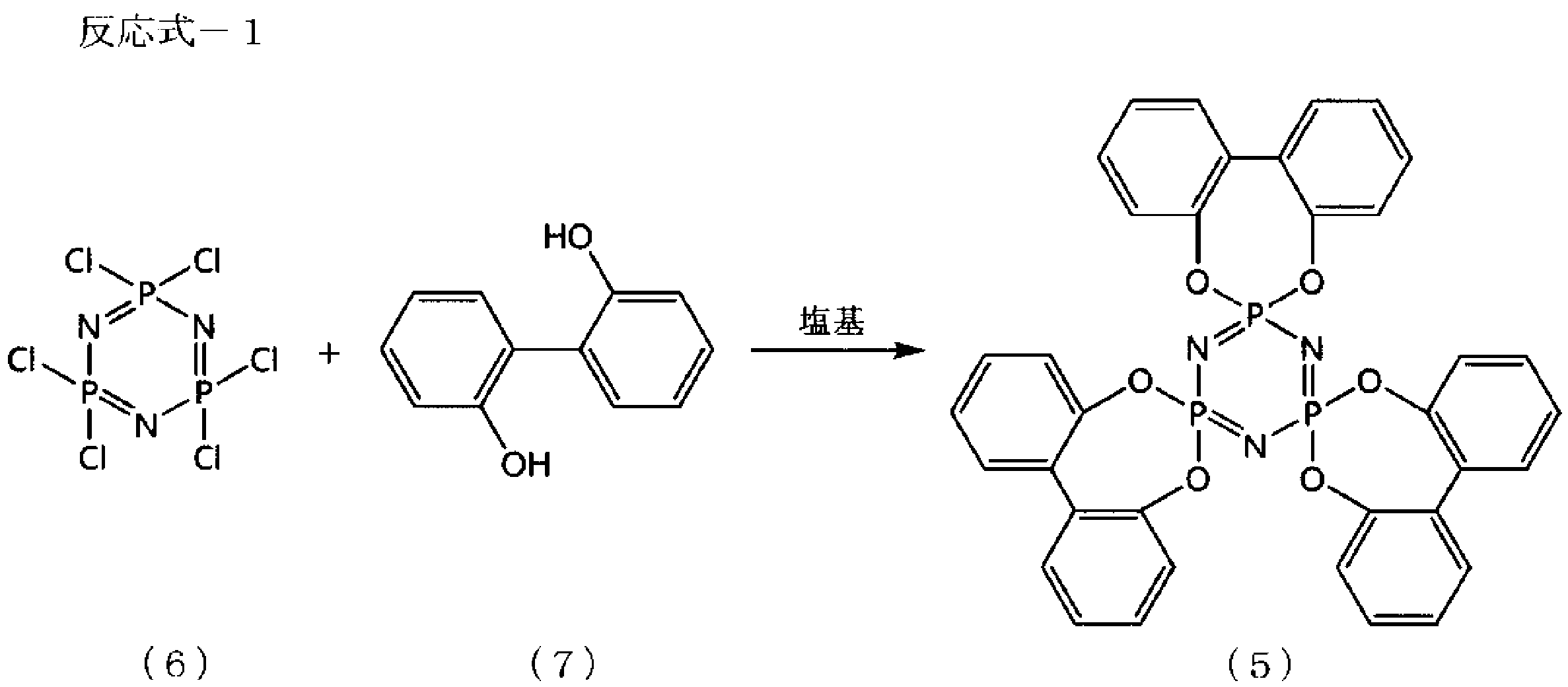
式(6)で表されるヘキサクロロシクロトリホスファゼンは、公知の方法、すなわち五塩化リンと塩化アンモニウムとの反応に基づく製造方法により製造することができる。また、市販のものを用いることもできる。
反応式-1中の塩基として、アルカリ金属塩、アミン化合物等が挙げられ、水酸化リチウム、水酸化ナトリウム、水酸化カリウム、炭酸リチウム、炭酸ナトリウム、炭酸カリウム等のアルカリ金属塩が好ましい。
式(5)で表される化合物は、例えば、ヘキサクロロシクロトリホスファゼン(6)と2,2’-ビフェノール(7)とを、モノクロロベンゼン等の溶媒中において反応させることにより得ることができる。2,2’-ビフェノール(7)は、ヘキサクロロシクロトリホスファゼン(6)1molに対して3mol程度使用することが好ましい。反応温度は、20~140℃程度が好ましく、反応時間は0.5~20時間程度が好ましい。
ホスファゼン系化合物(B)の形状は、溶融混練が可能であれば特に制限はなく、粉末状、顆粒状、ペレット状のいずれも使用することができる。
本発明のポリイミド樹脂組成物には、式(5)で表される化合物が含まれていればよい。
本発明のポリイミド樹脂組成物における、式(5)で表される化合物の配合量は、ポリイミド樹脂100質量部に対して、好ましくは1~50質量部程度であり、より好ましくは3~40質量部程度であり、更に好ましくは5~30質量部程度である。
本発明のポリイミド樹脂組成物は、式(5)で表される化合物を含む、下記式(8)で表される混合物が配合される態様を包含する。
式(8)で表される混合物は当該混合物100質量%中に、例えば、式(8)においてnが3である化合物(式(5)で表される化合物)を50~90質量%、式(8)においてnが4である化合物を5~40質量%、式(8)においてnが5である化合物を0~30質量%、及び式(8)においてnが6~15である化合物を0~20質量%含んでいることが好ましい。
本発明のポリイミド樹脂組成物に、式(5)で表される化合物を式(8)で表される混合物の形態で配合する場合は、式(8)で表される混合物を、式(8)で表される混合物中のnが3である化合物(式(5)で表される化合物)が、ポリイミド樹脂100質量部に対して、好ましくは1~50質量部程度であり、より好ましくは3~40質量部程度であり、更に好ましくは5~30質量部程度となるように配合すればよい。
式(8)で表される混合物は、上記式(5)で表される化合物の製造方法においてヘキサクロロシクロトリホスファゼンを使用する替わりに、式(9)で表される混合物と2,2’-ビフェノールとを塩基存在下で反応させることで製造することができる。なお、式(9)で表される混合物は、式(9)においてmが3である化合物(式(6)で表される化合物)を50~90質量%、式(9)においてmが4である化合物を5~40質量%、式(9)においてm=5である化合物を0~30質量%、及び式(9)においてmが6~15である化合物を0~20質量%含むことが好ましい。式(9)で表される混合物は、公知の方法により製造することができ、例えば、特開昭57-87427号公報、特公昭58-19604号公報、特公昭61-1363号公報、又は特公昭62-20124号公報等に記載の方法に従って製造することができる。

ポリイミド樹脂組成物におけるホスファゼン系化合物(B)の含有量は、ポリイミド樹脂組成物全量100質量%に対して、通常1~50質量%であり、好ましくは3~40質量%であり、更に好ましくは5~30質量%である。
(その他の配合材(C))
本発明のポリイミド樹脂組成物は、樹脂(A)に所望する性能を付与する観点から、その他の配合材(C)を含有することができる。その他の配合材(C)としては、ドリッピング防止剤、繊維状補強材、板状補強材、固体潤滑剤、ホスファゼン系化合物(B)以外の難燃剤、着色剤、酸化防止剤、紫外線吸収剤、導電剤、難燃助剤、結晶核剤、可塑剤、離形剤、帯電防止剤、着色防止剤、ゲル化防止剤等が挙げられる。
本発明のポリイミド樹脂組成物は、樹脂(A)に所望する性能を付与する観点から、その他の配合材(C)を含有することができる。その他の配合材(C)としては、ドリッピング防止剤、繊維状補強材、板状補強材、固体潤滑剤、ホスファゼン系化合物(B)以外の難燃剤、着色剤、酸化防止剤、紫外線吸収剤、導電剤、難燃助剤、結晶核剤、可塑剤、離形剤、帯電防止剤、着色防止剤、ゲル化防止剤等が挙げられる。
ドリッピング防止剤として、ポリテトラフルオロエチレン(PTFE)、テトラフルオロエチレン-ヘキサフルオロプロピレン共重合体(FEP)、テトラフルオロエチレン-パーフルオロアルキルビニルエーテル共重合体(PFA)、テトラフルオロエチレン-エチレン共重合体(ETFE)、ポリ(トリフルオロクロロエチレン)(CTFE)、ポリフルオロビニリデン(PVdF)、無機充填材等が挙げられる。繊維状補強材として、アラミド繊維、ポリフェニレンベンズオキサゾール(PBO)繊維、ガラス繊維、炭素繊維、アルミナ繊維、ボロン繊維、炭化ケイ素繊維、チタン酸カリウム繊維、ワラストナイト繊維、ホウ酸アルミニウム繊維、ホウ酸マグネシウム繊維、ゾノトライト繊維、酸化亜鉛繊維、塩基性硫酸マグネシウム繊維等が挙げられる。板状補強材として、雲母、マイカ、セリサイト、イライト、タルク、カオリナイト、モンモリナイト、ベーマイト、スメクタイト、バーミキュライト、二酸化チタン、チタン酸カリウム、チタン酸リチウムカリウム及びベーマイト等が挙げられる。固体潤滑剤として、ポリテトラフルオロエチレン(PTFE)、低密度ポリエチレン、直鎖状低密度ポリエチレン、中密度ポリエチレン、高密度ポリエチレン、超高分子量ポリエチレン等のポリオレフィン樹脂、グラファイト、二硫化モリブテン、二硫化タングステン、窒化ホウ素等が挙げられる。ホスファゼン系化合物(B)以外の難燃剤として、リン酸エステル、縮合リン酸エステル、無機リン系難燃剤、ハロゲン系難燃剤、シリコーン系難燃剤、金属酸化物系難燃剤、金属水酸化物系難燃剤、有機金属塩系難燃剤、窒素系難燃剤、ホウ素化合物系難燃剤等が挙げられる。着色剤として、カーボンブラック、酸化チタン等の顔料、及び染料等が挙げられる。酸化防止剤として、フェノール系酸化防止剤、硫黄系酸化防止剤、リン系酸化防止剤、銅系酸化防止剤、アミン系酸化防止剤等が挙げられる。紫外線吸収剤として、ベンゾフェノン系紫外線吸収剤、ベンゾトリアゾール系紫外線吸収剤、トリアジン系紫外線吸収剤、サイリシレート系紫外線吸収剤等が挙げられる。導電剤として、炭素系導電剤、金属系導電剤、金属酸化物系導電剤、界面活性剤等が挙げられる。本発明のポリイミド樹脂組成物には、これらを1種又は2種以上配合してもよい。
本発明のポリイミド樹脂組成物が上記その他の配合材(C)を含む場合、その配合量は、その他の配合材(C)の効果を発現させ、かつ樹脂(A)が有する成形加工性及び耐熱性を維持する観点から、ポリイミド樹脂組成物の合計量100質量%中に、好ましくは0.01~40質量%であり、より好ましくは0.1~30質量%であり、さらに好ましくは1~20質量%である。なお、「その他の配合材(C)の配合量」とは、ポリイミド樹脂組成物に用いられるその他の配合材の合計含有量を意味する。
(樹脂組成物の製造方法)
本発明のポリイミド樹脂組成物は、熱可塑性ポリイミド樹脂(A)と、ホスファゼン系化合物(B)と、必要に応じて、その他の配合材(C)の成分とを、混合及び加熱(特に、溶融混練)することによって製造することができる。
本発明のポリイミド樹脂組成物は、熱可塑性ポリイミド樹脂(A)と、ホスファゼン系化合物(B)と、必要に応じて、その他の配合材(C)の成分とを、混合及び加熱(特に、溶融混練)することによって製造することができる。
溶融混練には、例えば、二軸押出機等の公知の溶融混練装置を使用することができる。具体的には、(1)混合機(タンブラー、ヘンシェルミキサー等)で各成分を予備混合して、溶融混練装置で溶融混練し、ペレット化手段(ペレタイザー等)でペレット化する方法;(2)所望する成分のマスターバッチを調製し、必要により他の成分を混合し、溶融混練装置で溶融混練してペレット化する方法;(3)各成分を溶融混練装置に供給してペレット化する方法等により製造することができる。
溶融混練における加工温度は、熱可塑性樹脂が溶融し得る温度であれば特に限定はない。通常、溶融混練に用いる溶融混練装置のシリンダー温度をこの範囲に調整する。かくして、所望の効果を発揮する本発明に用いる樹脂組成物が製造される。
<成形体>
本発明の成形体は、前述の各種成分を含有するポリイミド樹脂組成物を含む。樹脂(A)が加熱により溶融成形可能な樹脂であることから、樹脂(A)を含有する本発明のポリイミド樹脂組成物を熱成形することにより成形体(成形品)を製造することができる。熱成形方法は、熱溶融工程を経る成形方法であればいずれの方法を用いてもよい。熱成形方法として、射出成形、インサート成形、圧縮成形、押出成形、ブロー成形、インフレーション成形等が挙げられる。
本発明の成形体は、前述の各種成分を含有するポリイミド樹脂組成物を含む。樹脂(A)が加熱により溶融成形可能な樹脂であることから、樹脂(A)を含有する本発明のポリイミド樹脂組成物を熱成形することにより成形体(成形品)を製造することができる。熱成形方法は、熱溶融工程を経る成形方法であればいずれの方法を用いてもよい。熱成形方法として、射出成形、インサート成形、圧縮成形、押出成形、ブロー成形、インフレーション成形等が挙げられる。
本発明の成形体の製造方法は、本発明のポリイミド樹脂組成物を300~400℃で熱成形する工程を有することが好ましい。
本発明の成形体の形状としては、フィルム、繊維、丸棒、角棒、球状、パイプ、チューブ等の各種形状が挙げられる。また、上記の成形方法を組み合わせた成形方法を採用することができる。
本発明の成形体の用途は特に限定はなく、特に耐熱性と難燃性とを要するあらゆる用途で適用することができる。使用可能な用途として、例えば、ワッシャー、ニードルベアリング、シールリング、ギア、ABSパーツ、クラッチリング等の自動車用部材;自動車用軸受、複写機用軸受等の各種軸受;複写機、プリンタ、ファクシミリ及びこれらの複合装置等の各種電子写真式画像形成装置用の定着ベルト又は中間転写ベルト;表面実装用電子部材;コンデンサー用ガスケット;光コネクタ;フレキシブル基板;銅張積層版;多層プリント配線板;等が挙げられる。
以下、本発明について、具体的な実施例に基づいて、さらに詳細に説明する。本発明は、以下の実施例に何ら限定されるものではなく、その要旨を変更しない範囲において適宜変更して実施することが可能である。
なお、実施例及び比較例で使用する熱可塑性ポリイミド樹脂及びホスファゼン系化合物は具体的には次の通りである。
(熱可塑性ポリイミド樹脂)
熱可塑性ポリイミド樹脂(A-1):融点 319℃、ガラス転移温度 178℃、MFR値 3.2g/10min、三菱瓦斯化学株式会社製、商品名「サープリムTO65S」
熱可塑性ポリイミド樹脂(A-1):融点 319℃、ガラス転移温度 178℃、MFR値 3.2g/10min、三菱瓦斯化学株式会社製、商品名「サープリムTO65S」
熱可塑性ポリイミド樹脂の融点及びガラス転移温度は、示差熱量測定装置(日立ハイテクサイエンス株式会社製、商品名「DSC7000X」)を用いて、試料10mgを測定用アルミセルに中に入れ、窒素気流100ml/min条件下、室温から360℃まで昇温速度10℃/minで昇温し、次に試料を降温速度10℃/minで20℃まで冷却し、そのまま1分間保持した後、再び昇温速度10℃/minで360℃まで昇温して測定した。
熱可塑性ポリイミド樹脂のMFR値は、JIS K7210に準じ、350℃、5分滞留、荷重2.16kgの条件下で測定した。
(ホスファゼン系化合物)
ホスファゼン系化合物として、下記製造例1により製造した化合物(B-1)、及び市販の化合物(B-2)(和光純薬工業株式会社製)を使用した。
ホスファゼン系化合物として、下記製造例1により製造した化合物(B-1)、及び市販の化合物(B-2)(和光純薬工業株式会社製)を使用した。

(ヘキサクロロシクロトリホスファゼンの製造)
還流冷却装置を取り付けた1Lフラスコに、モノクロロベンゼン500ml、五塩化リン873.6g及び塩化アンモニウム224.3gを入れ、5時間還流させた。還流終了後、加熱を止め、濾過し、蒸留することで、ヘキサクロロシクロトリホスファゼン483gを得て、以下の製造例で用いた。
還流冷却装置を取り付けた1Lフラスコに、モノクロロベンゼン500ml、五塩化リン873.6g及び塩化アンモニウム224.3gを入れ、5時間還流させた。還流終了後、加熱を止め、濾過し、蒸留することで、ヘキサクロロシクロトリホスファゼン483gを得て、以下の製造例で用いた。
(製造例1:化合物(B-1)の製造)
ディーンスターク装置を取り付けた5Lフラスコに、2,2’-ビフェノール(491.1g,2.6mol)とシクロヘキサクロロトリホスファゼンを26.8質量%含むモノクロロベンゼン溶液(1064.7g,2.5mol)と48%水酸化ナトリウム水溶液(441.6g,5.3mol)とモノクロロベンゼン(2.3L)とを入れ、窒素ガスを流し、12時間加熱還流させた。還流終了後、加熱を止め、残った反応混合物に脱イオン水(1.2L)を加え、2時間撹拌した。反応器内に析出している結晶を分取し、脱イオン水及びメタノールで洗浄し、乾燥させることで、白色固体を得た(413.88g)。
ディーンスターク装置を取り付けた5Lフラスコに、2,2’-ビフェノール(491.1g,2.6mol)とシクロヘキサクロロトリホスファゼンを26.8質量%含むモノクロロベンゼン溶液(1064.7g,2.5mol)と48%水酸化ナトリウム水溶液(441.6g,5.3mol)とモノクロロベンゼン(2.3L)とを入れ、窒素ガスを流し、12時間加熱還流させた。還流終了後、加熱を止め、残った反応混合物に脱イオン水(1.2L)を加え、2時間撹拌した。反応器内に析出している結晶を分取し、脱イオン水及びメタノールで洗浄し、乾燥させることで、白色固体を得た(413.88g)。
実施例1及び2、並びに比較例1及び2
表1に示す配合割合で、熱可塑性ポリイミド樹脂及びホスファゼン系化合物を二軸押出機にて溶融混練し、それぞれペレットを製造した。なお、二軸押出機のシリンダー温度は350℃であった。
表1に示す配合割合で、熱可塑性ポリイミド樹脂及びホスファゼン系化合物を二軸押出機にて溶融混練し、それぞれペレットを製造した。なお、二軸押出機のシリンダー温度は350℃であった。
得られたペレットを射出成形機にてUL試験片(長さ127mm、幅12.7mm 厚さ1.6mm)を成形し、評価サンプルとした。なお、射出成形機のシリンダー温度は350℃であり、金型温度は170℃で成形を行った。
評価方法
(混練及び成形性)
二軸押出機の溶融混練及び射出成形を問題なくでき、評価サンプルを作製できたものを「作製できた」と評価した。二軸押出機の溶融混練において、混練開始直後にストランドの引き取りができず、ダイス周辺で激しく発泡して押出不能となり、評価サンプルを作製できなかったものを「作製できなかった」と評価した。結果を表1に示した。
(混練及び成形性)
二軸押出機の溶融混練及び射出成形を問題なくでき、評価サンプルを作製できたものを「作製できた」と評価した。二軸押出機の溶融混練において、混練開始直後にストランドの引き取りができず、ダイス周辺で激しく発泡して押出不能となり、評価サンプルを作製できなかったものを「作製できなかった」と評価した。結果を表1に示した。
(難燃性)
得られたUL試験片を用いてUL-94の試験法に準じて評価し、結果を表1に示した。
得られたUL試験片を用いてUL-94の試験法に準じて評価し、結果を表1に示した。
(溶出度)
得られたUL試験片(成形体)を120℃で600時間、空気中のオーブンにおいて加熱した。加熱後の成形体の質量を測り、アセトンのついキムワイプ(登録商標)で成形体表面に付着した溶出分をふき取り、成形体表面を十分乾燥させた後、再度、成形体の質量を測定し、以下の式から溶出度を算出した。その結果を表1に示した。
得られたUL試験片(成形体)を120℃で600時間、空気中のオーブンにおいて加熱した。加熱後の成形体の質量を測り、アセトンのついキムワイプ(登録商標)で成形体表面に付着した溶出分をふき取り、成形体表面を十分乾燥させた後、再度、成形体の質量を測定し、以下の式から溶出度を算出した。その結果を表1に示した。
溶出度[%] = A/B × 100
A=(アセトンでふき取る前の成形体質量)-(アセトンでふき取った後の成形体質量)
B=(アセトンでふき取る前の成形体質量)
A=(アセトンでふき取る前の成形体質量)-(アセトンでふき取った後の成形体質量)
B=(アセトンでふき取る前の成形体質量)
(質量減少率)
実施例及び比較例に使用した原料、並びに実施例1及び比較例1において得られたペレット各10mgを、示差熱重量同時測定装置(SII株式会社製、商品名「TG/DTA6300」)を用いて、窒素気流200ml/min条件下、室温から500℃まで昇温速度10℃/minで昇温したときの質量変化を測定し、以下の式から質量減少率を算出した。その結果を表2に示した。
実施例及び比較例に使用した原料、並びに実施例1及び比較例1において得られたペレット各10mgを、示差熱重量同時測定装置(SII株式会社製、商品名「TG/DTA6300」)を用いて、窒素気流200ml/min条件下、室温から500℃まで昇温速度10℃/minで昇温したときの質量変化を測定し、以下の式から質量減少率を算出した。その結果を表2に示した。
質量減少率[%] = C/D × 100
C=(350℃のサンプル質量)-(150℃のサンプル質量)
D=(150℃のサンプル質量)
C=(350℃のサンプル質量)-(150℃のサンプル質量)
D=(150℃のサンプル質量)


質量減少率の測定の結果から、本発明の樹脂組成物及びその成型体は熱安定性に優れることがわかる。この効果は、ポリイミド樹脂に止まらず、その他熱可塑性樹脂組成物においても同様に認められるものである。
Claims (10)
- 熱可塑性ポリイミド樹脂(A)と、ホスファゼン系化合物(B)とを含有し、前記ホスファゼン系化合物(B)が下記式(5)で表される化合物である、ポリイミド樹脂組成物。
- 前記熱可塑性ポリイミド樹脂(A)が、下記一般式(1)~(3)で表される構造単位を1種又は2種以上有する重合体である、請求項1に記載のポリイミド樹脂組成物。
- 前記熱可塑性ポリイミド樹脂(A)を構成する全構造単位に対する一般式(1)~(3)で表される構造単位の合計の含有比が50~100モル%である、請求項2に記載のポリイミド樹脂組成物。
- 前記熱可塑性ポリイミド樹脂(A)のガラス転移温度が170℃以上である、請求項1~3のいずれか一項に記載のポリイミド樹脂組成物。
- 前記熱可塑性ポリイミド樹脂(A)の融点が390℃以下である、請求項1~4のいずれか一項に記載のポリイミド樹脂組成物。
- 前記熱可塑性ポリイミド樹脂(A)の含有量が、ポリイミド樹脂組成物全量100質量%に対して50~99質量%である、請求項1~5のいずれか一項に記載のポリイミド樹脂組成物。
- 前記ホスファゼン系化合物(B)の含有量が、ポリイミド樹脂組成物全量100質量%に対して1~50質量%である、請求項1~6のいずれか一項に記載のポリイミド樹脂組成物。
- 請求項1~7のいずれか一項に記載のポリイミド樹脂組成物を用いて作製された成形体。
- フィルム状である、請求項8に記載の成形体。
- 請求項1~7のいずれか一項に記載のポリイミド樹脂組成物を300~400℃で熱成形する工程を有する、成形体の製造方法。
Priority Applications (1)
| Application Number | Priority Date | Filing Date | Title |
|---|---|---|---|
| JP2020527564A JPWO2020004440A1 (ja) | 2018-06-27 | 2019-06-26 | ポリイミド樹脂組成物及びその成形体 |
Applications Claiming Priority (4)
| Application Number | Priority Date | Filing Date | Title |
|---|---|---|---|
| JP2018121962 | 2018-06-27 | ||
| JP2018-121962 | 2018-06-27 | ||
| JP2019-028070 | 2019-02-20 | ||
| JP2019028070 | 2019-02-20 |
Publications (1)
| Publication Number | Publication Date |
|---|---|
| WO2020004440A1 true WO2020004440A1 (ja) | 2020-01-02 |
Family
ID=68986527
Family Applications (1)
| Application Number | Title | Priority Date | Filing Date |
|---|---|---|---|
| PCT/JP2019/025308 Ceased WO2020004440A1 (ja) | 2018-06-27 | 2019-06-26 | ポリイミド樹脂組成物及びその成形体 |
Country Status (3)
| Country | Link |
|---|---|
| JP (1) | JPWO2020004440A1 (ja) |
| TW (1) | TW202006043A (ja) |
| WO (1) | WO2020004440A1 (ja) |
Cited By (2)
| Publication number | Priority date | Publication date | Assignee | Title |
|---|---|---|---|---|
| JP2021113249A (ja) * | 2020-01-16 | 2021-08-05 | 株式会社伏見製薬所 | 難燃性樹脂組成物 |
| EP4202013A4 (en) * | 2020-07-22 | 2024-11-13 | Fushimi Pharmaceutical Co., Ltd. | Cyclic phosphazene compound having oxaphosphorin ring-containing structure |
Citations (8)
| Publication number | Priority date | Publication date | Assignee | Title |
|---|---|---|---|---|
| US3356769A (en) * | 1964-07-13 | 1967-12-05 | American Cyanamid Co | Phosphonitrilic halide derivatives and adducts thereof |
| US3865783A (en) * | 1972-05-18 | 1975-02-11 | Akzona Inc | Flame-retardant polyester |
| JPS5137149A (ja) * | 1974-09-26 | 1976-03-29 | Kuraray Co | Nannenseihorikaaboneetososeibutsu |
| GB2304716A (en) * | 1995-09-04 | 1997-03-26 | Minnesota Mining & Mfg | Flame-retarded epoxy systems; spirocyclic phosphazenes |
| JP2002169243A (ja) * | 2000-11-30 | 2002-06-14 | Konica Corp | ハロゲン化銀写真感光材料及びハロゲン化銀写真感光材料の処理方法 |
| JP2011502196A (ja) * | 2007-11-02 | 2011-01-20 | ダウ グローバル テクノロジーズ インコーポレイティド | 置換ホスファゼン化合物および有機ポリマー用難燃剤としてのその使用 |
| JP2011074209A (ja) * | 2009-09-30 | 2011-04-14 | Jsr Corp | ポリイミド系材料、ポリイミド系樹脂組成物、フィルム及びその製造方法 |
| CN103896985A (zh) * | 2013-05-06 | 2014-07-02 | 深圳市华力兴工程塑料有限公司 | 六氯环三磷腈的合成方法与合成装置,以及三联苯基环磷腈的制备方法 |
-
2019
- 2019-06-26 WO PCT/JP2019/025308 patent/WO2020004440A1/ja not_active Ceased
- 2019-06-26 JP JP2020527564A patent/JPWO2020004440A1/ja active Pending
- 2019-06-27 TW TW108122627A patent/TW202006043A/zh unknown
Patent Citations (8)
| Publication number | Priority date | Publication date | Assignee | Title |
|---|---|---|---|---|
| US3356769A (en) * | 1964-07-13 | 1967-12-05 | American Cyanamid Co | Phosphonitrilic halide derivatives and adducts thereof |
| US3865783A (en) * | 1972-05-18 | 1975-02-11 | Akzona Inc | Flame-retardant polyester |
| JPS5137149A (ja) * | 1974-09-26 | 1976-03-29 | Kuraray Co | Nannenseihorikaaboneetososeibutsu |
| GB2304716A (en) * | 1995-09-04 | 1997-03-26 | Minnesota Mining & Mfg | Flame-retarded epoxy systems; spirocyclic phosphazenes |
| JP2002169243A (ja) * | 2000-11-30 | 2002-06-14 | Konica Corp | ハロゲン化銀写真感光材料及びハロゲン化銀写真感光材料の処理方法 |
| JP2011502196A (ja) * | 2007-11-02 | 2011-01-20 | ダウ グローバル テクノロジーズ インコーポレイティド | 置換ホスファゼン化合物および有機ポリマー用難燃剤としてのその使用 |
| JP2011074209A (ja) * | 2009-09-30 | 2011-04-14 | Jsr Corp | ポリイミド系材料、ポリイミド系樹脂組成物、フィルム及びその製造方法 |
| CN103896985A (zh) * | 2013-05-06 | 2014-07-02 | 深圳市华力兴工程塑料有限公司 | 六氯环三磷腈的合成方法与合成装置,以及三联苯基环磷腈的制备方法 |
Cited By (4)
| Publication number | Priority date | Publication date | Assignee | Title |
|---|---|---|---|---|
| JP2021113249A (ja) * | 2020-01-16 | 2021-08-05 | 株式会社伏見製薬所 | 難燃性樹脂組成物 |
| JP7557119B2 (ja) | 2020-01-16 | 2024-09-27 | 株式会社伏見製薬所 | 難燃性樹脂組成物 |
| EP4202013A4 (en) * | 2020-07-22 | 2024-11-13 | Fushimi Pharmaceutical Co., Ltd. | Cyclic phosphazene compound having oxaphosphorin ring-containing structure |
| US12503480B2 (en) | 2020-07-22 | 2025-12-23 | Fushimi Pharmaceutical Co., Ltd. | Cyclic phosphazene compound having oxaphosphorin ring-containing structure |
Also Published As
| Publication number | Publication date |
|---|---|
| JPWO2020004440A1 (ja) | 2021-07-08 |
| TW202006043A (zh) | 2020-02-01 |
Similar Documents
| Publication | Publication Date | Title |
|---|---|---|
| TWI601761B (zh) | 聚醯亞胺樹脂 | |
| CN104046001B (zh) | 阻燃性聚酰胺树脂组合物及使用其的模制品 | |
| US12466935B2 (en) | Flame-retardant polyimide shaping material and shaped body | |
| CN114790330A (zh) | 一种阻燃性聚酰胺玻纤组合物及其制备方法 | |
| TWI794491B (zh) | 聚醯亞胺樹脂組成物 | |
| JP7347415B2 (ja) | 樹脂成形体 | |
| JPWO2020004440A1 (ja) | ポリイミド樹脂組成物及びその成形体 | |
| CN110305408A (zh) | 自成β晶的膨胀型阻燃聚丙烯复合材料及其制备方法 | |
| TWI826656B (zh) | 阻燃性聚醯亞胺成形材料及成形體 | |
| CN114641534B (zh) | 树脂组合物和电子电气设备部件 | |
| JP5554185B2 (ja) | 難燃性樹脂組成物 | |
| JP7819693B2 (ja) | 熱可塑性ポリイミド樹脂組成物及び成形品 | |
| TW202006044A (zh) | 滲出抑制劑、樹脂用阻燃劑、樹脂組成物、及其成形體 | |
| WO2025225251A1 (ja) | 樹脂組成物、ペレット、および、成形体 | |
| JP2025168246A (ja) | 樹脂組成物、ペレット、および、成形体 | |
| WO2025225252A1 (ja) | 樹脂組成物、ペレット、および、成形体 | |
| JP2024146771A (ja) | 樹脂組成物、成形体 |
Legal Events
| Date | Code | Title | Description |
|---|---|---|---|
| 121 | Ep: the epo has been informed by wipo that ep was designated in this application |
Ref document number: 19825782 Country of ref document: EP Kind code of ref document: A1 |
|
| ENP | Entry into the national phase |
Ref document number: 2020527564 Country of ref document: JP Kind code of ref document: A |
|
| NENP | Non-entry into the national phase |
Ref country code: DE |
|
| 122 | Ep: pct application non-entry in european phase |
Ref document number: 19825782 Country of ref document: EP Kind code of ref document: A1 |