WO2019189448A1 - ワックス異性化油 - Google Patents
ワックス異性化油 Download PDFInfo
- Publication number
- WO2019189448A1 WO2019189448A1 PCT/JP2019/013333 JP2019013333W WO2019189448A1 WO 2019189448 A1 WO2019189448 A1 WO 2019189448A1 JP 2019013333 W JP2019013333 W JP 2019013333W WO 2019189448 A1 WO2019189448 A1 WO 2019189448A1
- Authority
- WO
- WIPO (PCT)
- Prior art keywords
- wax
- isomerized oil
- oil
- wax isomerized
- group
- Prior art date
- Legal status (The legal status is an assumption and is not a legal conclusion. Google has not performed a legal analysis and makes no representation as to the accuracy of the status listed.)
- Ceased
Links
- 0 Cc1ccc(CCI2=C(*)C3=CC=CC4=I3I[C@]2(*2)*2I(c2ccc(*)cc2C)=C4*)c(C)c1 Chemical compound Cc1ccc(CCI2=C(*)C3=CC=CC4=I3I[C@]2(*2)*2I(c2ccc(*)cc2C)=C4*)c(C)c1 0.000 description 2
Images


Classifications
-
- C—CHEMISTRY; METALLURGY
- C10—PETROLEUM, GAS OR COKE INDUSTRIES; TECHNICAL GASES CONTAINING CARBON MONOXIDE; FUELS; LUBRICANTS; PEAT
- C10M—LUBRICATING COMPOSITIONS; USE OF CHEMICAL SUBSTANCES EITHER ALONE OR AS LUBRICATING INGREDIENTS IN A LUBRICATING COMPOSITION
- C10M143/00—Lubricating compositions characterised by the additive being a macromolecular hydrocarbon or such hydrocarbon modified by oxidation
- C10M143/02—Polyethylene
-
- C—CHEMISTRY; METALLURGY
- C10—PETROLEUM, GAS OR COKE INDUSTRIES; TECHNICAL GASES CONTAINING CARBON MONOXIDE; FUELS; LUBRICANTS; PEAT
- C10G—CRACKING HYDROCARBON OILS; PRODUCTION OF LIQUID HYDROCARBON MIXTURES, e.g. BY DESTRUCTIVE HYDROGENATION, OLIGOMERISATION, POLYMERISATION; RECOVERY OF HYDROCARBON OILS FROM OIL-SHALE, OIL-SAND, OR GASES; REFINING MIXTURES MAINLY CONSISTING OF HYDROCARBONS; REFORMING OF NAPHTHA; MINERAL WAXES
- C10G45/00—Refining of hydrocarbon oils using hydrogen or hydrogen-generating compounds
- C10G45/58—Refining of hydrocarbon oils using hydrogen or hydrogen-generating compounds to change the structural skeleton of some of the hydrocarbon content without cracking the other hydrocarbons present, e.g. lowering pour point; Selective hydrocracking of normal paraffins
- C10G45/60—Refining of hydrocarbon oils using hydrogen or hydrogen-generating compounds to change the structural skeleton of some of the hydrocarbon content without cracking the other hydrocarbons present, e.g. lowering pour point; Selective hydrocracking of normal paraffins characterised by the catalyst used
- C10G45/64—Refining of hydrocarbon oils using hydrogen or hydrogen-generating compounds to change the structural skeleton of some of the hydrocarbon content without cracking the other hydrocarbons present, e.g. lowering pour point; Selective hydrocracking of normal paraffins characterised by the catalyst used containing crystalline alumino-silicates, e.g. molecular sieves
-
- C—CHEMISTRY; METALLURGY
- C10—PETROLEUM, GAS OR COKE INDUSTRIES; TECHNICAL GASES CONTAINING CARBON MONOXIDE; FUELS; LUBRICANTS; PEAT
- C10M—LUBRICATING COMPOSITIONS; USE OF CHEMICAL SUBSTANCES EITHER ALONE OR AS LUBRICATING INGREDIENTS IN A LUBRICATING COMPOSITION
- C10M107/00—Lubricating compositions characterised by the base-material being a macromolecular compound
- C10M107/02—Hydrocarbon polymers; Hydrocarbon polymers modified by oxidation
-
- C—CHEMISTRY; METALLURGY
- C10—PETROLEUM, GAS OR COKE INDUSTRIES; TECHNICAL GASES CONTAINING CARBON MONOXIDE; FUELS; LUBRICANTS; PEAT
- C10G—CRACKING HYDROCARBON OILS; PRODUCTION OF LIQUID HYDROCARBON MIXTURES, e.g. BY DESTRUCTIVE HYDROGENATION, OLIGOMERISATION, POLYMERISATION; RECOVERY OF HYDROCARBON OILS FROM OIL-SHALE, OIL-SAND, OR GASES; REFINING MIXTURES MAINLY CONSISTING OF HYDROCARBONS; REFORMING OF NAPHTHA; MINERAL WAXES
- C10G45/00—Refining of hydrocarbon oils using hydrogen or hydrogen-generating compounds
- C10G45/58—Refining of hydrocarbon oils using hydrogen or hydrogen-generating compounds to change the structural skeleton of some of the hydrocarbon content without cracking the other hydrocarbons present, e.g. lowering pour point; Selective hydrocracking of normal paraffins
-
- C—CHEMISTRY; METALLURGY
- C10—PETROLEUM, GAS OR COKE INDUSTRIES; TECHNICAL GASES CONTAINING CARBON MONOXIDE; FUELS; LUBRICANTS; PEAT
- C10M—LUBRICATING COMPOSITIONS; USE OF CHEMICAL SUBSTANCES EITHER ALONE OR AS LUBRICATING INGREDIENTS IN A LUBRICATING COMPOSITION
- C10M101/00—Lubricating compositions characterised by the base-material being a mineral or fatty oil
- C10M101/02—Petroleum fractions
-
- C—CHEMISTRY; METALLURGY
- C10—PETROLEUM, GAS OR COKE INDUSTRIES; TECHNICAL GASES CONTAINING CARBON MONOXIDE; FUELS; LUBRICANTS; PEAT
- C10M—LUBRICATING COMPOSITIONS; USE OF CHEMICAL SUBSTANCES EITHER ALONE OR AS LUBRICATING INGREDIENTS IN A LUBRICATING COMPOSITION
- C10M101/00—Lubricating compositions characterised by the base-material being a mineral or fatty oil
- C10M101/02—Petroleum fractions
- C10M101/025—Petroleum fractions waxes
-
- C—CHEMISTRY; METALLURGY
- C10—PETROLEUM, GAS OR COKE INDUSTRIES; TECHNICAL GASES CONTAINING CARBON MONOXIDE; FUELS; LUBRICANTS; PEAT
- C10M—LUBRICATING COMPOSITIONS; USE OF CHEMICAL SUBSTANCES EITHER ALONE OR AS LUBRICATING INGREDIENTS IN A LUBRICATING COMPOSITION
- C10M169/00—Lubricating compositions characterised by containing as components a mixture of at least two types of ingredient selected from base-materials, thickeners or additives, covered by the preceding groups, each of these compounds being essential
- C10M169/04—Mixtures of base-materials and additives
- C10M169/041—Mixtures of base-materials and additives the additives being macromolecular compounds only
-
- C—CHEMISTRY; METALLURGY
- C10—PETROLEUM, GAS OR COKE INDUSTRIES; TECHNICAL GASES CONTAINING CARBON MONOXIDE; FUELS; LUBRICANTS; PEAT
- C10G—CRACKING HYDROCARBON OILS; PRODUCTION OF LIQUID HYDROCARBON MIXTURES, e.g. BY DESTRUCTIVE HYDROGENATION, OLIGOMERISATION, POLYMERISATION; RECOVERY OF HYDROCARBON OILS FROM OIL-SHALE, OIL-SAND, OR GASES; REFINING MIXTURES MAINLY CONSISTING OF HYDROCARBONS; REFORMING OF NAPHTHA; MINERAL WAXES
- C10G2300/00—Aspects relating to hydrocarbon processing covered by groups C10G1/00 - C10G99/00
- C10G2300/20—Characteristics of the feedstock or the products
- C10G2300/30—Physical properties of feedstocks or products
- C10G2300/302—Viscosity
-
- C—CHEMISTRY; METALLURGY
- C10—PETROLEUM, GAS OR COKE INDUSTRIES; TECHNICAL GASES CONTAINING CARBON MONOXIDE; FUELS; LUBRICANTS; PEAT
- C10G—CRACKING HYDROCARBON OILS; PRODUCTION OF LIQUID HYDROCARBON MIXTURES, e.g. BY DESTRUCTIVE HYDROGENATION, OLIGOMERISATION, POLYMERISATION; RECOVERY OF HYDROCARBON OILS FROM OIL-SHALE, OIL-SAND, OR GASES; REFINING MIXTURES MAINLY CONSISTING OF HYDROCARBONS; REFORMING OF NAPHTHA; MINERAL WAXES
- C10G2300/00—Aspects relating to hydrocarbon processing covered by groups C10G1/00 - C10G99/00
- C10G2300/20—Characteristics of the feedstock or the products
- C10G2300/30—Physical properties of feedstocks or products
- C10G2300/304—Pour point, cloud point, cold flow properties
-
- C—CHEMISTRY; METALLURGY
- C10—PETROLEUM, GAS OR COKE INDUSTRIES; TECHNICAL GASES CONTAINING CARBON MONOXIDE; FUELS; LUBRICANTS; PEAT
- C10G—CRACKING HYDROCARBON OILS; PRODUCTION OF LIQUID HYDROCARBON MIXTURES, e.g. BY DESTRUCTIVE HYDROGENATION, OLIGOMERISATION, POLYMERISATION; RECOVERY OF HYDROCARBON OILS FROM OIL-SHALE, OIL-SAND, OR GASES; REFINING MIXTURES MAINLY CONSISTING OF HYDROCARBONS; REFORMING OF NAPHTHA; MINERAL WAXES
- C10G2300/00—Aspects relating to hydrocarbon processing covered by groups C10G1/00 - C10G99/00
- C10G2300/20—Characteristics of the feedstock or the products
- C10G2300/30—Physical properties of feedstocks or products
- C10G2300/308—Gravity, density, e.g. API
-
- C—CHEMISTRY; METALLURGY
- C10—PETROLEUM, GAS OR COKE INDUSTRIES; TECHNICAL GASES CONTAINING CARBON MONOXIDE; FUELS; LUBRICANTS; PEAT
- C10G—CRACKING HYDROCARBON OILS; PRODUCTION OF LIQUID HYDROCARBON MIXTURES, e.g. BY DESTRUCTIVE HYDROGENATION, OLIGOMERISATION, POLYMERISATION; RECOVERY OF HYDROCARBON OILS FROM OIL-SHALE, OIL-SAND, OR GASES; REFINING MIXTURES MAINLY CONSISTING OF HYDROCARBONS; REFORMING OF NAPHTHA; MINERAL WAXES
- C10G2300/00—Aspects relating to hydrocarbon processing covered by groups C10G1/00 - C10G99/00
- C10G2300/40—Characteristics of the process deviating from typical ways of processing
- C10G2300/4006—Temperature
-
- C—CHEMISTRY; METALLURGY
- C10—PETROLEUM, GAS OR COKE INDUSTRIES; TECHNICAL GASES CONTAINING CARBON MONOXIDE; FUELS; LUBRICANTS; PEAT
- C10G—CRACKING HYDROCARBON OILS; PRODUCTION OF LIQUID HYDROCARBON MIXTURES, e.g. BY DESTRUCTIVE HYDROGENATION, OLIGOMERISATION, POLYMERISATION; RECOVERY OF HYDROCARBON OILS FROM OIL-SHALE, OIL-SAND, OR GASES; REFINING MIXTURES MAINLY CONSISTING OF HYDROCARBONS; REFORMING OF NAPHTHA; MINERAL WAXES
- C10G2300/00—Aspects relating to hydrocarbon processing covered by groups C10G1/00 - C10G99/00
- C10G2300/40—Characteristics of the process deviating from typical ways of processing
- C10G2300/4012—Pressure
-
- C—CHEMISTRY; METALLURGY
- C10—PETROLEUM, GAS OR COKE INDUSTRIES; TECHNICAL GASES CONTAINING CARBON MONOXIDE; FUELS; LUBRICANTS; PEAT
- C10G—CRACKING HYDROCARBON OILS; PRODUCTION OF LIQUID HYDROCARBON MIXTURES, e.g. BY DESTRUCTIVE HYDROGENATION, OLIGOMERISATION, POLYMERISATION; RECOVERY OF HYDROCARBON OILS FROM OIL-SHALE, OIL-SAND, OR GASES; REFINING MIXTURES MAINLY CONSISTING OF HYDROCARBONS; REFORMING OF NAPHTHA; MINERAL WAXES
- C10G2300/00—Aspects relating to hydrocarbon processing covered by groups C10G1/00 - C10G99/00
- C10G2300/40—Characteristics of the process deviating from typical ways of processing
- C10G2300/4018—Spatial velocity, e.g. LHSV, WHSV
-
- C—CHEMISTRY; METALLURGY
- C10—PETROLEUM, GAS OR COKE INDUSTRIES; TECHNICAL GASES CONTAINING CARBON MONOXIDE; FUELS; LUBRICANTS; PEAT
- C10M—LUBRICATING COMPOSITIONS; USE OF CHEMICAL SUBSTANCES EITHER ALONE OR AS LUBRICATING INGREDIENTS IN A LUBRICATING COMPOSITION
- C10M2203/00—Organic non-macromolecular hydrocarbon compounds and hydrocarbon fractions as ingredients in lubricant compositions
- C10M2203/003—Organic non-macromolecular hydrocarbon compounds and hydrocarbon fractions as ingredients in lubricant compositions used as base material
-
- C—CHEMISTRY; METALLURGY
- C10—PETROLEUM, GAS OR COKE INDUSTRIES; TECHNICAL GASES CONTAINING CARBON MONOXIDE; FUELS; LUBRICANTS; PEAT
- C10M—LUBRICATING COMPOSITIONS; USE OF CHEMICAL SUBSTANCES EITHER ALONE OR AS LUBRICATING INGREDIENTS IN A LUBRICATING COMPOSITION
- C10M2203/00—Organic non-macromolecular hydrocarbon compounds and hydrocarbon fractions as ingredients in lubricant compositions
- C10M2203/10—Petroleum or coal fractions, e.g. tars, solvents, bitumen
- C10M2203/102—Aliphatic fractions
- C10M2203/1025—Aliphatic fractions used as base material
-
- C—CHEMISTRY; METALLURGY
- C10—PETROLEUM, GAS OR COKE INDUSTRIES; TECHNICAL GASES CONTAINING CARBON MONOXIDE; FUELS; LUBRICANTS; PEAT
- C10M—LUBRICATING COMPOSITIONS; USE OF CHEMICAL SUBSTANCES EITHER ALONE OR AS LUBRICATING INGREDIENTS IN A LUBRICATING COMPOSITION
- C10M2205/00—Organic macromolecular hydrocarbon compounds or fractions, whether or not modified by oxidation as ingredients in lubricant compositions
- C10M2205/14—Synthetic waxes, e.g. polythene waxes
-
- C—CHEMISTRY; METALLURGY
- C10—PETROLEUM, GAS OR COKE INDUSTRIES; TECHNICAL GASES CONTAINING CARBON MONOXIDE; FUELS; LUBRICANTS; PEAT
- C10M—LUBRICATING COMPOSITIONS; USE OF CHEMICAL SUBSTANCES EITHER ALONE OR AS LUBRICATING INGREDIENTS IN A LUBRICATING COMPOSITION
- C10M2205/00—Organic macromolecular hydrocarbon compounds or fractions, whether or not modified by oxidation as ingredients in lubricant compositions
- C10M2205/16—Paraffin waxes; Petrolatum, e.g. slack wax
-
- C—CHEMISTRY; METALLURGY
- C10—PETROLEUM, GAS OR COKE INDUSTRIES; TECHNICAL GASES CONTAINING CARBON MONOXIDE; FUELS; LUBRICANTS; PEAT
- C10M—LUBRICATING COMPOSITIONS; USE OF CHEMICAL SUBSTANCES EITHER ALONE OR AS LUBRICATING INGREDIENTS IN A LUBRICATING COMPOSITION
- C10M2205/00—Organic macromolecular hydrocarbon compounds or fractions, whether or not modified by oxidation as ingredients in lubricant compositions
- C10M2205/17—Fisher Tropsch reaction products
- C10M2205/173—Fisher Tropsch reaction products used as base material
-
- C—CHEMISTRY; METALLURGY
- C10—PETROLEUM, GAS OR COKE INDUSTRIES; TECHNICAL GASES CONTAINING CARBON MONOXIDE; FUELS; LUBRICANTS; PEAT
- C10N—INDEXING SCHEME ASSOCIATED WITH SUBCLASS C10M RELATING TO LUBRICATING COMPOSITIONS
- C10N2020/00—Specified physical or chemical properties or characteristics, i.e. function, of component of lubricating compositions
- C10N2020/01—Physico-chemical properties
- C10N2020/02—Viscosity; Viscosity index
-
- C—CHEMISTRY; METALLURGY
- C10—PETROLEUM, GAS OR COKE INDUSTRIES; TECHNICAL GASES CONTAINING CARBON MONOXIDE; FUELS; LUBRICANTS; PEAT
- C10N—INDEXING SCHEME ASSOCIATED WITH SUBCLASS C10M RELATING TO LUBRICATING COMPOSITIONS
- C10N2020/00—Specified physical or chemical properties or characteristics, i.e. function, of component of lubricating compositions
- C10N2020/01—Physico-chemical properties
- C10N2020/04—Molecular weight; Molecular weight distribution
-
- C—CHEMISTRY; METALLURGY
- C10—PETROLEUM, GAS OR COKE INDUSTRIES; TECHNICAL GASES CONTAINING CARBON MONOXIDE; FUELS; LUBRICANTS; PEAT
- C10N—INDEXING SCHEME ASSOCIATED WITH SUBCLASS C10M RELATING TO LUBRICATING COMPOSITIONS
- C10N2030/00—Specified physical or chemical properties which is improved by the additive characterising the lubricating composition, e.g. multifunctional additives
- C10N2030/02—Pour-point; Viscosity index
-
- C—CHEMISTRY; METALLURGY
- C10—PETROLEUM, GAS OR COKE INDUSTRIES; TECHNICAL GASES CONTAINING CARBON MONOXIDE; FUELS; LUBRICANTS; PEAT
- C10N—INDEXING SCHEME ASSOCIATED WITH SUBCLASS C10M RELATING TO LUBRICATING COMPOSITIONS
- C10N2030/00—Specified physical or chemical properties which is improved by the additive characterising the lubricating composition, e.g. multifunctional additives
- C10N2030/06—Oiliness; Film-strength; Anti-wear; Resistance to extreme pressure
Definitions
- the present invention relates to wax isomerized oil.
- wax isomerized oils as well as mineral base oils as lubricating base oils.
- the wax that is a raw material of the wax isomerized oil includes natural wax such as petroleum slack wax obtained by solvent dewaxing of hydrocarbon oil, or one produced by Fischer Tropsch synthesis using synthesis gas (FT wax), etc. Examples include synthetic waxes.
- FT wax Fischer Tropsch synthesis using synthesis gas
- the raw wax is hydrotreated, the hydrotreated wax is isomerized, and a predetermined fraction is recovered and recovered by fractionation of the isomerate.
- a method is known in which dewaxing of the obtained fraction is performed in this order (see, for example, Patent Document 1).
- an object of the present invention is to provide a wax isomerized oil having a low traction coefficient and excellent viscosity-temperature characteristics.
- the present invention relates to a wax isomerized oil having an even number of hydrocarbon compound content determined from a chromatogram obtained by mass spectrometry, which is greater than 50% by mass based on the total amount of wax isomerized oil. provide.
- the content of the hydrocarbon compound having an even number of carbon atoms may be 70% by mass or more based on the total amount of wax isomerized oil.
- the wax isomerized oil may be an isomerized oil of ethylene polymer wax.
- the wax isomerized oil may be an isomerized oil of an ethylene polymer wax that has not been hydrocracked.
- the wax isomerized oil may be an isomerized oil obtained by hydroisomerizing an ethylene polymer wax at a temperature of 315 ° C. or higher and 350 ° C. or lower, and the ethylene polymer wax may be 325 ° C. or higher and 335 ° C. or lower. It may be an isomerized oil obtained by hydroisomerization at a temperature.
- a wax isomerized oil having excellent viscosity-temperature characteristics and a low traction coefficient is provided.
- FIG. 2 is a chromatogram obtained by conducting electrolytic desorption mass spectrometry on the wax isomerized oil obtained in Example 1-1.
- FIG. FIG. 2 is a chromatogram obtained by performing electrolytic desorption mass spectrometry on the wax isomerized oil obtained in Example 1-2.
- FIG. FIG. 3 is a chromatogram obtained by conducting electrolytic desorption mass spectrometry on the wax isomerized oil obtained in Example 1-3.
- FIG. FIG. 3 is a chromatogram obtained by carrying out electrolytic desorption mass spectrometry on the wax isomerized oil obtained in Comparative Example 1-1.
- FIG. FIG. 3 is a chromatogram obtained by conducting electrolytic desorption mass spectrometry on the wax isomerized oil obtained in Comparative Example 1-2.
- FIG. 2 is a chromatogram obtained by carrying out electrolytic desorption mass spectrometry on the wax isomerized oil obtained in Example 2-1.
- FIG. 3 is a chromatogram obtained by performing electrolytic desorption mass spectrometry on the wax isomerized oil obtained in Example 2-2.
- FIG. 3 is a chromatogram obtained by performing electrolytic desorption mass spectrometry on the wax isomerized oil obtained in Example 2-3.
- FIG. FIG. 5 is a chromatogram obtained by carrying out electrolytic desorption mass spectrometry on the wax isomerized oil obtained in Comparative Example 2-1.
- FIG. 6 is a chromatogram obtained by carrying out electrolytic desorption mass spectrometry on the wax isomerized oil obtained in Comparative Example 2-2.
- the wax isomerized oil according to the present embodiment is a wax having a hydrocarbon compound content having an even number of carbon atoms determined from chromatograms obtained by various mass spectrometry represented by, for example, electrolytic desorption mass spectrometry. More than 50% by mass based on the total amount of isomerized oil.
- the wax isomerized oil according to this embodiment includes, for example, a step of preparing an ethylene polymer wax that has not been subjected to hydrocracking treatment, and isomerization dewaxing of the ethylene polymer wax to wax isomerized oil. It can manufacture by the method provided with the process of obtaining. That is, the wax isomerized oil according to the present embodiment can also be referred to as an isomerized oil of an ethylene polymer wax that has not been hydrocracked.
- the present inventors speculate that the reason why the wax isomerized oil according to this embodiment is excellent in viscosity-temperature characteristics and exhibits a low traction coefficient is due to the specificity of its carbon number distribution.
- the raw material wax such as wax obtained by FT synthesis is usually a hydrocarbon compound having an even number of carbon atoms (hydrocarbon compound having 2n carbon atoms; n is 1 or more) The same applies hereinafter) and a hydrocarbon compound having an odd number of carbon atoms (a hydrocarbon compound having 2n + 1 carbon atoms), and the ratio of the two is substantially the same.
- the raw material wax in the present embodiment is an ethylene polymer wax that has been subjected to a hydrocracking treatment as necessary, and most of the wax is a hydrocarbon compound having an even number of carbon atoms (carbonized carbon number 2n). Hydrogen compound).
- the ethylene polymer wax is subjected to isomerization and dewaxing, the molecular structure is changed by isomerization (eg, production of isoparaffin having 2n-1 carbon atoms, for example, following cleavage and isomerization of normal paraffin having 2n carbon atoms).
- the obtained wax isomerized oil is a mixture of hydrocarbon compounds having an even number of carbon numbers or hydrocarbon compounds having an odd number of carbon numbers, but has a unique carbon number distribution in which one ratio is large. Show.
- the wax isomerized oil according to the present embodiment is superior in viscosity-temperature characteristics and exhibits a low traction coefficient as compared with the conventional wax isomerized oil having the same viscosity. This is thought to be due to the specificity.
- ethylene polymer wax examples include ethylene oligomer wax obtained by oligomerizing ethylene.
- oligomer means a polymer having a number average molecular weight (Mn) of 5000 or less.
- Mn of the ethylene oligomer is preferably 3000 or less, more preferably 1000 or less.
- the lower limit value of Mn of the ethylene oligomer is not particularly limited, but is preferably 200 or more, more preferably 250 or more, and still more preferably 300 or more.
- Mw / Mn indicating the degree of molecular weight distribution (dispersion degree) is, for example, preferably 1.0 to 5.0, more preferably 1.1 to 3.0.
- the Mn of the ethylene oligomer is 3000 or less, in order to obtain a base oil having a target viscosity using the oligomer as a raw material, it is not necessary to tighten the isomerization conditions such as raising the reaction temperature, and the desired base oil. Can be obtained efficiently. It is also possible to prevent an increase in traction coefficient due to excessive isomerization. On the other hand, if the Mn of the ethylene oligomer is 200 or more, a base oil having a target viscosity can be obtained efficiently.
- the oligomer Mn and Mw can be determined as polystyrene equivalents based on a calibration curve prepared from standard polystyrene using a GPC device, for example.
- the ethylene polymer wax used as the raw material wax usually contains a linear hydrocarbon compound.
- the content of the linear hydrocarbon compound in the ethylene polymer wax is not particularly limited, but is preferably 40% by mass or more, more preferably 50% by mass or more, and still more preferably, based on the total amount of the ethylene polymer wax. 60% by mass or more.
- the content of the hydrocarbon compound having an even number of carbon atoms is preferably 80% by mass or more, more preferably 90% by mass, based on the total amount of the ethylene polymer wax. From the viewpoint of more effectively improving the viscosity-temperature characteristics and traction coefficient of the wax isomerized oil obtained as described above, it is more preferable that the hydrocarbon compound having an odd number of carbon atoms is substantially not contained.
- the content of the linear hydrocarbon compound was determined by performing gas chromatography analysis on the ethylene polymer wax under the following conditions, and measuring and calculating the proportion of the linear hydrocarbon compound in the total amount of the ethylene polymer wax. Mean value.
- a mixed sample of normal paraffin having 5 to 50 carbon atoms is used as a standard sample, and the above ratios are the sum of the peak area values corresponding to normal paraffin relative to the total peak area values of the chromatogram. Calculated as a percentage.
- the hydrocarbon compound having the highest boiling point (the longest distillation time) is normal paraffin. Therefore, when calculating the carbon number, the standard sample was measured.
- the normal paraffin and the non-normal paraffin having the same carbon number are distinguished from each other.
- the content of the hydrocarbon compound having an even number of carbon atoms is determined by analyzing the ethylene polymer wax by electrolytic desorption mass spectrometry under the following conditions. From the mass number of the obtained chromatogram, the ethylene polymer wax is obtained. It means a value obtained by calculating the proportion of hydrocarbon compounds having an even number of carbon atoms in the total amount.
- Emitter current 6.4 mA / min
- Spectrum recording interval 0.4 sec Measurement mass range: m / z 35-1600
- the method for producing the ethylene polymer wax is not particularly limited, and for example, it can be obtained by polymerizing (oligomerizing) ethylene in the presence of an ethylene polymerization catalyst.
- a method of introducing ethylene into a reaction apparatus filled with a catalyst can be mentioned.
- the method for introducing ethylene into the reactor is not particularly limited.
- a solvent may be used in the polymerization reaction.
- the solvent include aliphatic hydrocarbon solvents such as butane, pentane, hexane, heptane, octane, cyclohexane, methylcyclohexane, and decalin; and aromatic hydrocarbon solvents such as tetralin, benzene, toluene, and xylene. Solution polymerization, slurry polymerization, etc. can be performed by dissolving the catalyst in these solvents.
- the reaction temperature in the polymerization reaction is not particularly limited, but from the viewpoint of catalyst efficiency, for example, preferably ⁇ 50 ° C. to 100 ° C., more preferably ⁇ 30 ° C. to 90 ° C., still more preferably ⁇ 20 ° C. to 80 ° C., particularly Preferably it is -10 ° C to 70 ° C, very preferably -5 ° C to 60 ° C, most preferably 0 ° C to 50 ° C. If the reaction temperature is ⁇ 50 ° C. or higher, precipitation of the polymer produced while maintaining the catalytic activity can be suppressed, and if it is 100 ° C. or lower, decomposition of the catalyst can be suppressed.
- the reaction pressure is not particularly limited, but is preferably 100 kPa to 5 MPa, for example.
- the reaction time is not particularly limited, for example, it is preferably 1 minute to 24 hours, more preferably 5 minutes to 20 hours, still more preferably 10 minutes to 19 hours, and particularly preferably 20 minutes to 18 hours.
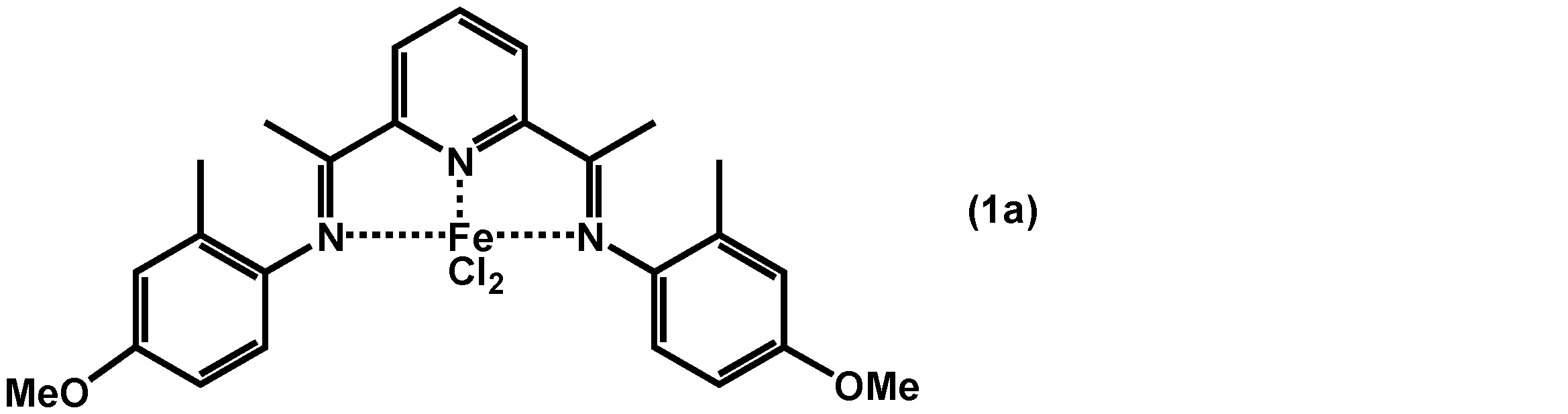
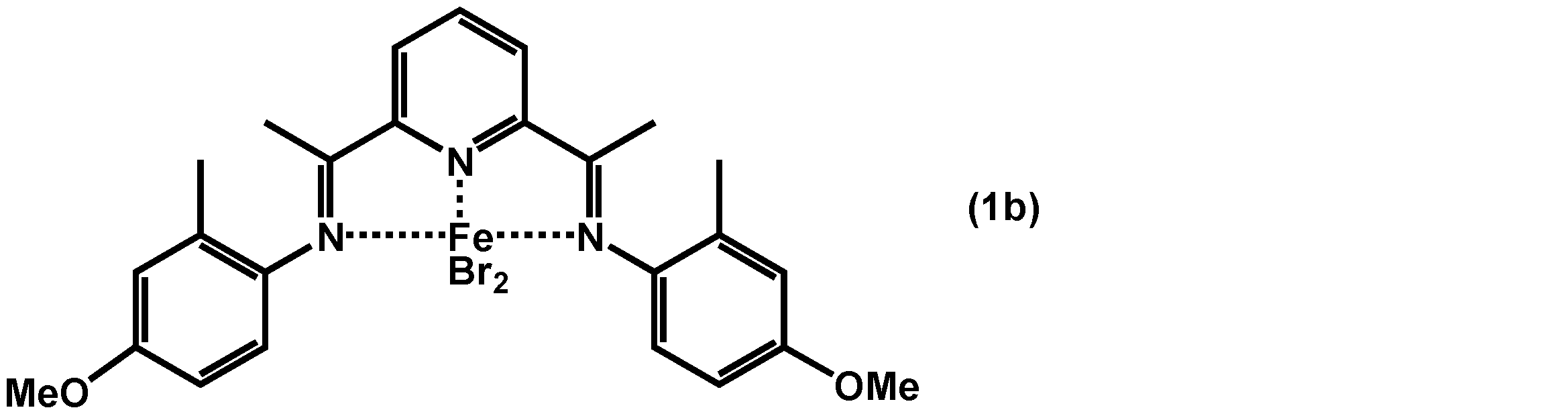
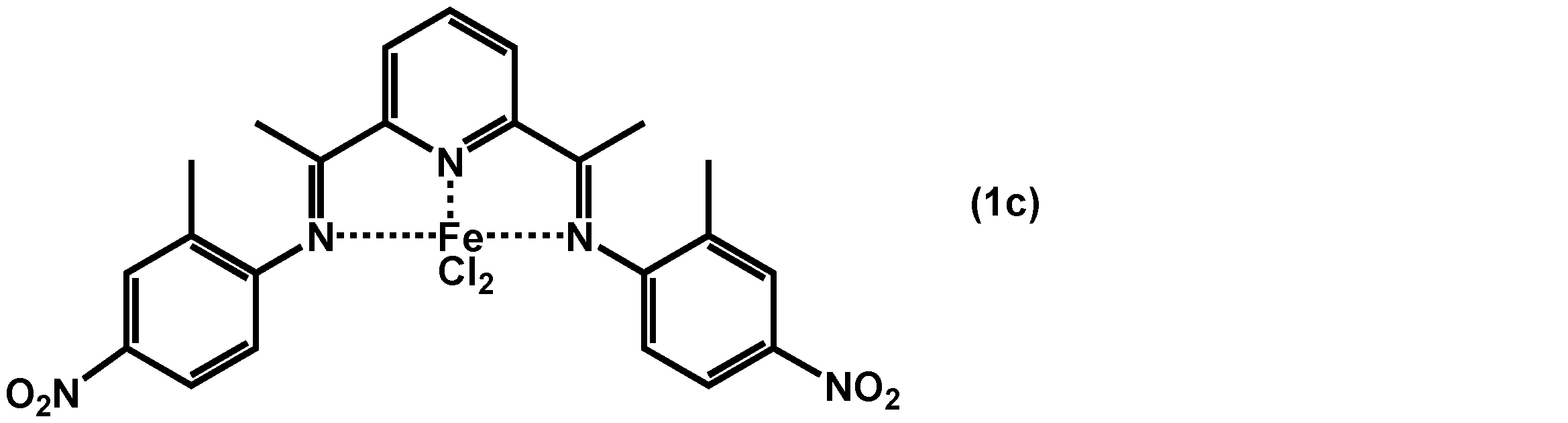
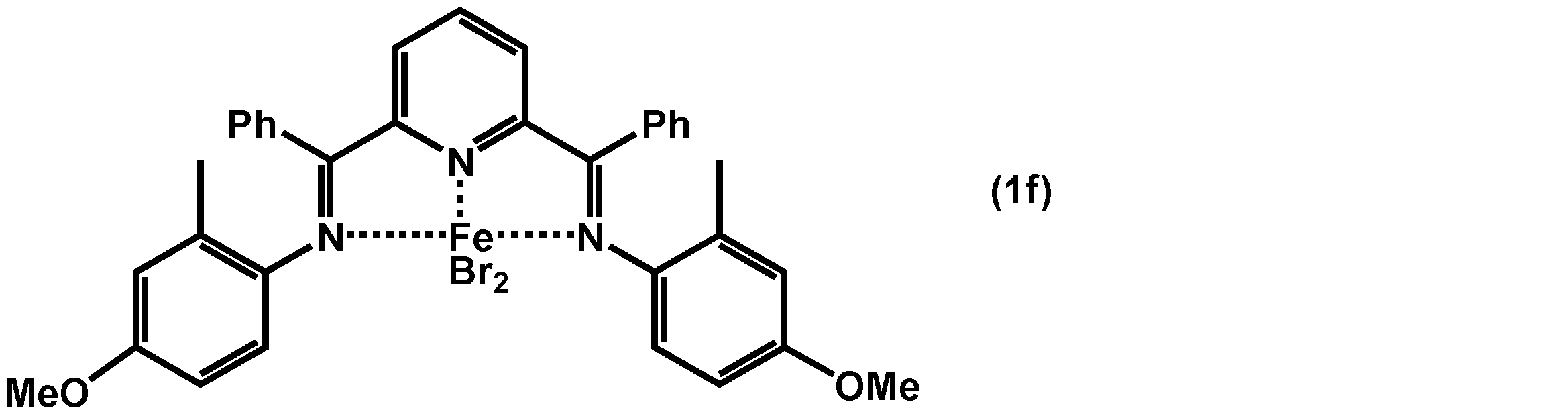
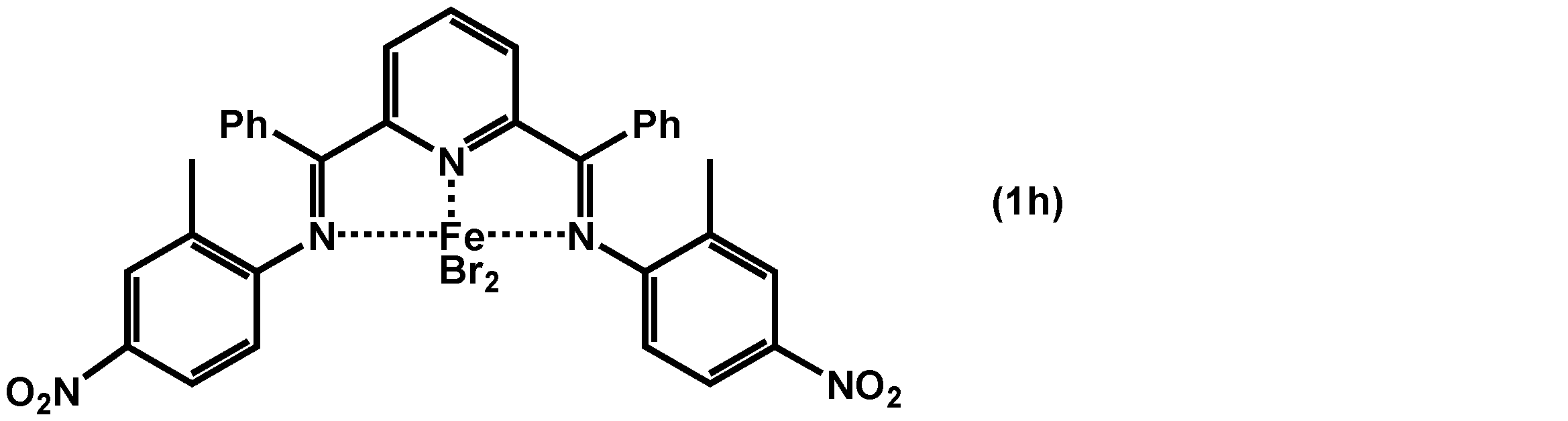
- the ethylene polymerization catalyst is not particularly limited, and examples thereof include a catalyst containing an iron compound represented by the following general formula (1).
- R represents a hydrocarbyl group having 1 to 6 carbon atoms or an aromatic group having 6 to 12 carbon atoms, and a plurality of R in the same molecule may be the same or different.
- R ′ represents a radical having an oxygen atom and / or a nitrogen atom, and a plurality of R ′ in the same molecule may be the same or different.
- Y represents a chlorine atom or a bromine atom.
- hydrocarbyl group having 1 to 6 carbon atoms examples include an alkyl group having 1 to 6 carbon atoms and an alkenyl group having 2 to 6 carbon atoms.
- the hydrocarbyl group may be linear, branched or cyclic. Further, the hydrocarbyl group may be a monovalent group in which a linear or branched hydrocarbyl group and a cyclic hydrocarbyl group are bonded.
- alkyl group having 1 to 6 carbon atoms examples include linear alkyl groups having 1 to 6 carbon atoms such as methyl group, ethyl group, n-propyl group, n-butyl group, n-pentyl group, and n-hexyl group; -Propyl group, iso-butyl group, sec-butyl group, tert-butyl group, branched pentyl group (including all structural isomers), branched hexyl group (including all structural isomers), etc.
- Examples thereof include branched alkyl groups having 3 to 6 carbon atoms; cyclic alkyl groups having 1 to 6 carbon atoms such as cyclopropyl group, cyclobutyl group, cyclopentyl group and cyclohexyl group.
- alkenyl group having 2 to 6 carbon atoms examples include linear alkenyl groups having 2 to 6 carbon atoms such as ethenyl group (vinyl group), n-propenyl group, n-butenyl group, n-pentenyl group, and n-hexenyl group; Carbon such as iso-propenyl, iso-butenyl, sec-butenyl, tert-butenyl, branched pentenyl (including all structural isomers), branched hexenyl (including all structural isomers), etc.
- linear alkenyl groups having 2 to 6 carbon atoms such as ethenyl group (vinyl group), n-propenyl group, n-butenyl group, n-pentenyl group, and n-hexenyl group; Carbon such as iso-propenyl, iso-butenyl, sec-butenyl, tert-butenyl
- a branched alkenyl group having 2 to 6 carbon atoms a cyclic alkenyl group having 2 to 6 carbon atoms such as a cyclopropenyl group, a cyclobutenyl group, a cyclopentenyl group, a cyclopentadienyl group, a cyclohexenyl group, and a cyclohexadienyl group.
- aromatic group having 6 to 12 carbon atoms examples include phenyl group, toluyl group, xylyl group, naphthyl group and the like.
- a plurality of R and R ′ in the same molecule may be the same or different, but may be the same from the viewpoint of simplifying the synthesis of the compound.
- the free radical having an oxygen atom and / or a nitrogen atom may be a free radical having 0 to 6 carbon atoms having an oxygen atom and / or a nitrogen atom.
- iron compounds include compounds represented by the following formulas (1a) to (1h). These iron compounds can be used individually by 1 type or in combination of 2 or more types.
- the compound constituting the ligand (hereinafter sometimes referred to as diimine compound) is, for example, dehydrated and condensed with dibenzoylpyridine and aniline compound in the presence of an acid. Can be obtained.
- a preferred embodiment of the method for producing the diimine compound includes a first step in which 2,6-dibenzoylpyridine, an aniline compound, and an acid are dissolved in a solvent, and dehydration condensation is performed under reflux with the solvent heated, and a reaction mixture after the first step.
- an organoaluminum compound can be used as the acid used in the first step.
- organoaluminum compounds include trimethylaluminum, triethylaluminum, tripropylaluminum, triisopropylaluminum, tributylaluminum, triisobutylaluminum, trihexylaluminum, trioctylaluminum, diethylaluminum chloride, ethylaluminum dichloride, ethylaluminum sesquichloride, methylaluminoxane. Etc.
- a protonic acid can be used in addition to the organoaluminum compound.
- Protic acid is used as an acid catalyst for donating protons.
- the proton acid used is not particularly limited, but is preferably an organic acid. Examples of such a protonic acid include acetic acid, trifluoroacetic acid, methanesulfonic acid, trifluoromethanesulfonic acid, paratoluenesulfonic acid, and the like.
- the addition amount of the protonic acid is not particularly limited, and may be a catalytic amount.
- examples of the solvent used in the first step include hydrocarbon solvents and alcohol solvents.
- examples of the hydrocarbon solvent include hexane, heptane, octane, benzene, toluene, xylene, cyclohexane, methylcyclohexane, and the like.
- examples of the alcohol solvent include methanol, ethanol, isopropyl alcohol, and the like.
- reaction conditions in the first step can be appropriately selected according to the types and amounts of the raw material compound, acid and solvent.
- the separation / purification treatment in the second step is not particularly limited, and examples thereof include silica gel column chromatography, recrystallization method and the like.
- the above-described organoaluminum compound is used as the acid, it is preferable to purify after mixing the reaction solution with a basic aqueous solution to decompose and remove aluminum.
- the method for mixing the diimine compound and iron is not particularly limited.
- the method for taking out the complex from the mixture of the diimine compound and iron is not particularly limited, for example, (A) a method of distilling off the solvent when a solvent is used in the mixture and filtering off the solid, (B) a method of filtering the precipitate formed from the mixture, (C) a method of purifying the precipitate by adding a poor solvent to the mixture and filtering it off; (D) a method of taking out the solventless mixture as it is, Etc. Thereafter, a washing treatment using a solvent capable of dissolving the diimine compound, a washing treatment using a solvent capable of dissolving the metal, a recrystallization treatment using an appropriate solvent, and the like may be performed.
- iron salt examples include iron chloride (II), iron chloride (III), iron bromide (II), iron bromide (III), acetylacetone iron (II), acetylacetone iron (III), iron acetate (II) ), Iron (III) acetate, and the like. You may use what has ligands, such as a solvent and water, in these salts. Among these, a salt of iron (II) is preferable, and iron (II) chloride is more preferable.
- the solvent for bringing the diimine compound and iron into contact is not particularly limited, and any of a nonpolar solvent and a polar solvent can be used.
- Nonpolar solvents include hydrocarbon solvents such as hexane, heptane, octane, benzene, toluene, xylene, cyclohexane, and methylcyclohexane.
- Examples of the polar solvent include polar protic solvents such as alcohol solvents, polar aprotic solvents such as tetrahydrofuran, and the like.
- the alcohol solvent include methanol, ethanol, isopropyl alcohol, and the like.
- a hydrocarbon solvent that does not substantially affect the ethylene polymerization reaction.
- the mixing ratio of the diimine compound and iron when they are brought into contact with each other is not particularly limited.
- the diimine compound / iron ratio is preferably a molar ratio of 0.2 / 1 to 5/1, more preferably 0.3 / 1 to 3/1, still more preferably 0.5 / 1 to 2/1. Particularly preferred is 1/1.
- Both of the two imine sites in the diimine compound are preferably E-forms, but any diimine compound that is an E-form may contain a diimine compound containing a Z-form. Since the diimine compound containing Z form is difficult to form a complex with a metal, it can be easily removed by a purification step such as solvent washing after forming a complex in the system.
- the ethylene polymerization catalyst containing the iron compound represented by the general formula (1) may further contain an organoaluminum compound in order to allow the polymerization reaction to proceed more efficiently.
- organoaluminum compound include trimethylaluminum and methylaluminoxane.
- the content ratio of the iron compound represented by the general formula (1) and the organoaluminum compound is the molar ratio when the number of moles of the iron compound is G and the number of moles of aluminum atoms of the organoaluminum compound is H.
- G: H 1: 10 to 1: 1000, more preferably 1:10 to 1: 800, still more preferably 1:20 to 1: 600, and particularly preferably 1:20 to 1: 500. . If it is in the said range, cost increase can be suppressed, expressing sufficient polymerization activity.
- methylaluminoxane When methylaluminoxane is used as the organoaluminum compound, a commercially available product diluted with a solvent can be used as methylaluminoxane, and a product obtained by partially hydrolyzing trimethylaluminum in a solvent can also be used. Moreover, in the partial hydrolysis of trimethylaluminum, a modified methylaluminoxane obtained by co-hydrolysis by coexisting trialkylaluminum other than trimethylaluminum such as triisobutylaluminum can also be used. Furthermore, when unreacted trialkylaluminum remains during the partial hydrolysis, the unreacted trialkylaluminum may be removed by distillation under reduced pressure. Alternatively, modified methylaluminoxane obtained by modifying methylaluminoxane with an active proton compound such as phenol or a derivative thereof may be used.
- the content ratio of trimethylaluminum and methylaluminoxane in the ethylene polymerization catalyst is H 1 in terms of the number of moles of trimethylaluminum, and the number of moles of aluminum atoms in the methylaluminoxane.
- the ethylene polymerization catalyst containing the iron compound represented by the general formula (1) may further contain a boron compound as an optional component.
- the boron compound has a function as a promoter for further improving the catalytic activity of the iron compound represented by the above formula (1) in the ethylene polymerization reaction.
- the boron compound examples include aryl boron compounds such as trispentafluorophenylborane.
- a boron compound having an anionic species can be used.
- examples thereof include aryl borates such as tetrakis pentafluorophenyl borate and tetrakis (3,5-trifluoromethylphenyl) borate.
- aryl borate examples include lithium tetrakispentafluorophenylborate, sodium tetrakispentafluorophenylborate, N, N-dimethylanilinium tetrakispentafluorophenylborate, trityltetrakispentafluorophenylborate, lithium tetrakis (3,5-tri Fluoromethylphenyl) borate, sodium tetrakis (3,5-trifluoromethylphenyl) borate, N, N-dimethylanilinium tetrakis (3,5-trifluoromethylphenyl) borate, trityltetrakis (3,5-trifluoromethyl) Phenyl) borate and the like.
- N, N-dimethylanilinium tetrakispentafluorophenylborate, trityltetrakispentafluorophenylborate, N, N-dimethylanilinium tetrakis (3,5-trifluoromethylphenyl) borate or trityltetrakis (3,5 -Trifluoromethylphenyl) borate is preferred.
- These boron compounds can be used alone or in combination of two or more.
- the content ratio of the organoaluminum compound and the boron compound is the molar ratio when the mole number of the organoaluminum compound is H and the mole number of the boron compound is J.
- H: J 1000: 1 to 1: 1, more preferably 800: 1 to 2: 1, and even more preferably 600: 1 to 10: 1. If it is in the said range, cost increase can be suppressed, expressing sufficient catalyst efficiency.
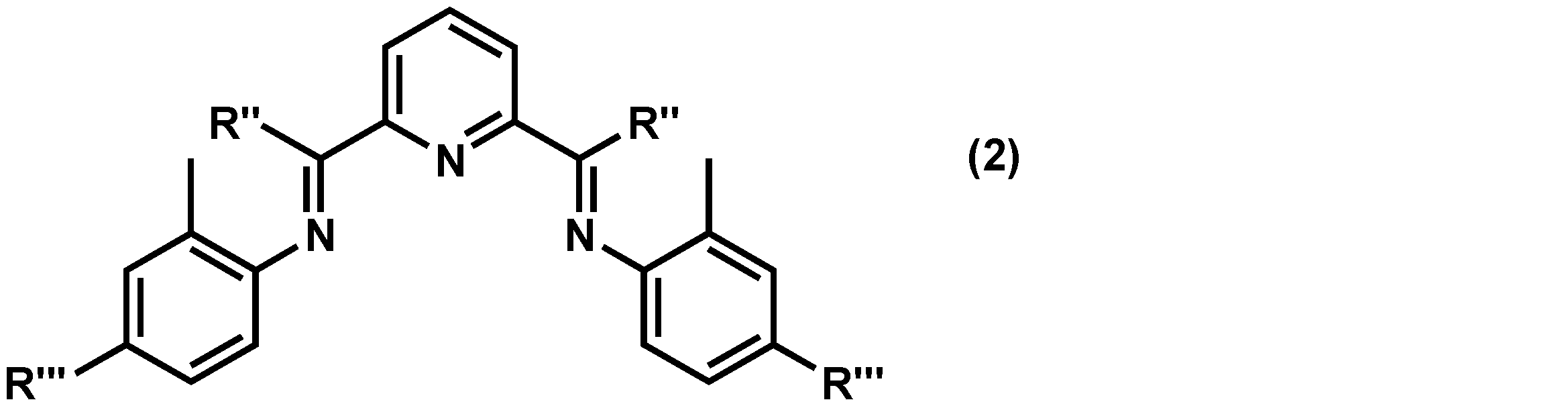
- the ethylene polymerization catalyst containing the iron compound represented by the above formula (1) is a compound further represented by the following general formula (2) from the viewpoint of securing sufficient catalyst efficiency by suppressing the deactivation of the catalyst. (Hereinafter also referred to as a ligand).
- R ′′ represents a hydrocarbyl group having 1 to 6 carbon atoms or an aromatic group having 6 to 12 carbon atoms, and a plurality of R ′′ in the same molecule may be the same or different.
- hydrocarbyl group having 1 to 6 carbon atoms examples include an alkyl group having 1 to 6 carbon atoms and an alkenyl group having 2 to 6 carbon atoms.
- the hydrocarbyl group may be linear, branched or cyclic. Further, the hydrocarbyl group may be a monovalent group in which a linear or branched hydrocarbyl group and a cyclic hydrocarbyl group are bonded.
- alkyl group having 1 to 6 carbon atoms examples include linear alkyl groups having 1 to 6 carbon atoms such as methyl group, ethyl group, n-propyl group, n-butyl group, n-pentyl group, and n-hexyl group; -Propyl group, iso-butyl group, sec-butyl group, tert-butyl group, branched pentyl group (including all structural isomers), branched hexyl group (including all structural isomers), etc.
- Examples thereof include branched alkyl groups having 3 to 6 carbon atoms; cyclic alkyl groups having 1 to 6 carbon atoms such as cyclopropyl group, cyclobutyl group, cyclopentyl group and cyclohexyl group.
- alkenyl group having 2 to 6 carbon atoms examples include linear alkenyl groups having 2 to 6 carbon atoms such as ethenyl group (vinyl group), n-propenyl group, n-butenyl group, n-pentenyl group, and n-hexenyl group; Carbon such as iso-propenyl, iso-butenyl, sec-butenyl, tert-butenyl, branched pentenyl (including all structural isomers), branched hexenyl (including all structural isomers), etc.
- linear alkenyl groups having 2 to 6 carbon atoms such as ethenyl group (vinyl group), n-propenyl group, n-butenyl group, n-pentenyl group, and n-hexenyl group; Carbon such as iso-propenyl, iso-butenyl, sec-butenyl, tert-butenyl
- a branched alkenyl group having 2 to 6 carbon atoms a cyclic alkenyl group having 2 to 6 carbon atoms such as a cyclopropenyl group, a cyclobutenyl group, a cyclopentenyl group, a cyclopentadienyl group, a cyclohexenyl group, and a cyclohexadienyl group.
- aromatic group having 6 to 12 carbon atoms examples include phenyl group, toluyl group, xylyl group, naphthyl group and the like.
- a plurality of R ′′ and R ′′ ′′ in the same molecule may be the same or different, but may be the same from the viewpoint of simplifying the synthesis of the compound.
- the free radical having an oxygen atom and / or a nitrogen atom may be a free radical having 0 to 6 carbon atoms having an oxygen atom and / or a nitrogen atom.
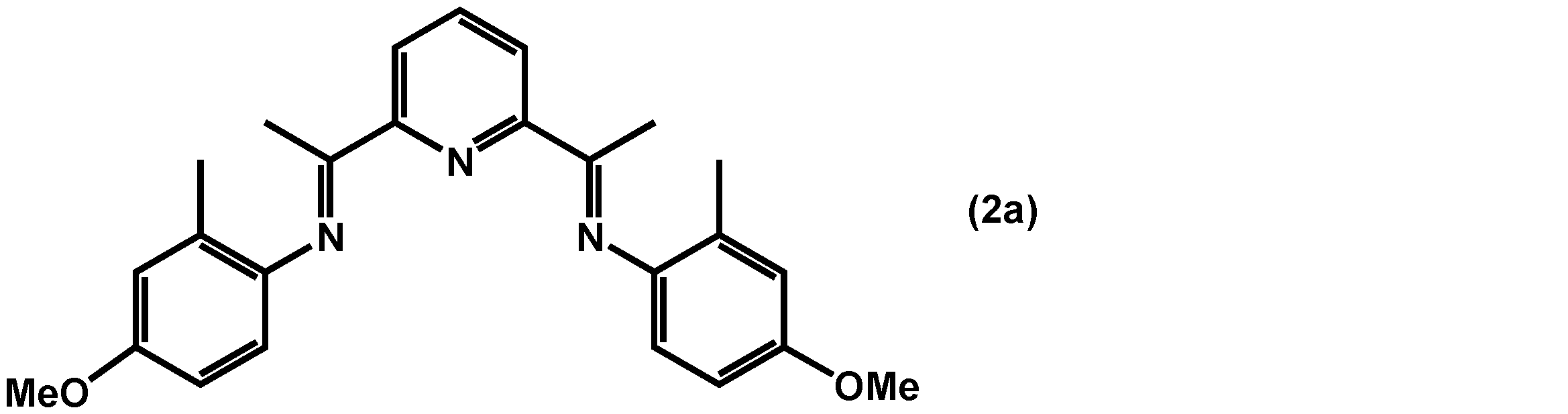
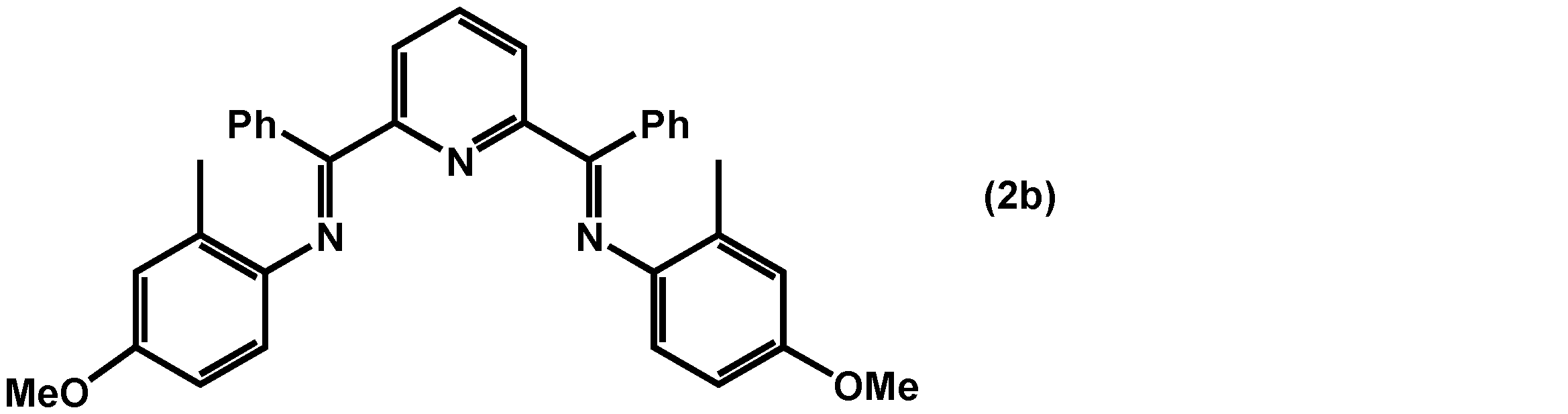
- ligands include compounds represented by the following formulas (2a) to (2d). These ligands can be used alone or in combination of two or more.
- R in the general formula (1) and the general formula ( The R ′′ in 2) and R ′ in the general formula (1) and R ′ ′′ in the general formula (2) may be the same or different, but the iron represented by the general formula (1) From the viewpoint of maintaining the same performance as the compound, it is preferably the same.
- the content ratio of the iron compound and the ligand is not particularly limited.
- the molar ratio of the ligand / iron compound is preferably 1/100 to 100/1, more preferably 1/20 to 50/1, still more preferably 1/10 to 10/1, and particularly preferably 1/5. To 5/1, very preferably 1/3 to 3/1. If the ratio of the ligand / iron compound is 1/100 or more, the catalyst efficiency can be further increased by suppressing the deactivation of the catalyst. If the ratio is 100/1 or less, the effect of adding the ligand is exhibited. Cost can be reduced.
- an ethylene polymerization catalyst contains the iron compound and organoaluminum compound which are represented by the general formula (1) mentioned above, general formula (1)
- the iron compound and the organoaluminum compound represented by the general formula (1) when the boron compound and the ligand described above are further included, all these components may be brought into contact with each other. And may be contacted in any order.
- Method of contacting an iron compound represented by general formula (1) after mixing the solution (G) After mixing a solution containing an iron compound represented by general formula (1) and a solution containing a boron compound
- a method of adding and mixing a solution containing an organoaluminum compound and then contacting the ligand (H) After mixing a solution containing an iron compound represented by the general formula (1) and a solution containing a boron compound, the ligand is added.
- organoaluminum compound A solution containing an iron compound represented by the general formula (1) and a solution containing an organoaluminum compound are mixed, and then containing a boron compound Method of adding and mixing the solution and then contacting the ligand (J) The solution containing the iron compound represented by the general formula (1) and the solution containing the organoaluminum compound are mixed, and then the ligand is contained.
- Method of contacting a boron compound After mixing a solution containing an organoaluminum compound and a solution containing a ligand, a solution containing a boron compound is added and mixed, and then the general formula (1) Method of contacting the iron compound represented (S) Method of adding and mixing the solution containing the organoaluminum compound after contacting the boron compound with the solution containing the iron compound represented by the general formula (1) (T) Examples include a method in which a boron compound is brought into contact with a solution containing an iron compound represented by the general formula (1), then a solution containing trimethylaluminum is added and mixed, and methylaluminoxane is brought into contact.
- the above-mentioned ethylene polymer wax is used as a raw material, and the raw material is subjected to hydrocracking treatment as necessary, followed by isomerization and dewaxing to obtain wax isomerized oil.
- the hydrocracking treatment is optional, and it is also possible to obtain wax isomerized oil using ethylene polymer wax as a raw material and isomerization and dewaxing without performing hydrocracking treatment.
- the hydrocracking process is a process in which the above-described ethylene polymer wax can be hydrocracked with a hydrocracking catalyst to obtain a cracked product.
- the hydrocracking catalyst include a catalyst containing a Group 6 metal, a Group 8-10 metal, and a mixture thereof. Preferred metals include nickel, tungsten, molybdenum, cobalt, and mixtures thereof.
- the hydrocracking catalyst can be used in a form in which these metals are supported on a refractory metal oxide support, and the metal is usually present as an oxide or sulfide on the support. When a metal mixture is used, the metal may be present as a bulk metal catalyst in which the amount of metal is 30% by mass or more based on the total amount of the catalyst.
- the metal oxide carrier examples include oxides such as silica, alumina, silica-alumina, and titania. Among these, alumina is preferable. Preferred alumina is ⁇ -type or ⁇ -type porous alumina.
- the amount of the metal supported is preferably in the range of 0.5 to 35% by mass based on the total amount of the catalyst. Further, when a mixture of Group 9-10 metal and Group 6 metal is used, either Group 9 or Group 10 metal is present in an amount of 0.1 to 5% by mass, based on the total amount of the catalyst, The Group 6 metal is preferably present in an amount of 5 to 30% by mass. Metal loading may be measured by atomic absorption spectroscopy, inductively coupled plasma emission spectroscopy, or other methods specified by ASTM for individual metals.
- the acidity of the metal oxide support can be controlled by adding additives, controlling the properties of the metal oxide support (for example, controlling the amount of silica incorporated in the silica-alumina support), and the like.
- additives include halogens, particularly fluorine, phosphorus, boron, yttria, alkali metals, alkaline earth metals, rare earth oxides, and magnesia.
- Cocatalysts such as halogen generally increase the acidity of the metal oxide support, but weakly basic additives such as yttria or magnesia tend to weaken the acidity of such support.
- the treatment temperature is preferably 150 to 450 ° C., more preferably 200 to 400 ° C.
- the hydrogen partial pressure is preferably 1400 to 20000 kPa, and more preferably 2800 to 14000 kPa.
- speed (LHSV) is preferably 0.1 ⁇ 10 hr -1, more preferably 0.1 ⁇ 5 hr -1
- a hydrogen / oil ratio is preferably 50 ⁇ 1780 m 3 / m 3, more preferably 89 to 890 m 3 / m 3 .
- said conditions are an example and it is preferable to select hydrocracking process conditions suitably according to differences in a raw material, a catalyst, an apparatus, etc.
- Isomerization dewaxing refers to dewaxing a raw material by hydroisomerization by contacting an ethylene polymer wax with a hydroisomerization catalyst in the presence of hydrogen (molecular hydrogen).
- the hydroisomerization here includes not only the isomerization of normal paraffin to isoparaffin but also the conversion of olefin to paraffin by hydrogenation.
- the hydroisomerization catalyst may contain either crystalline or amorphous material.
- the crystalline material include molecular sieves having a 10- or 12-membered ring passage mainly composed of aluminosilicate (zeolite) or silicoaluminophosphate (SAPO).
- zeolite include ZSM-22, ZSM-23, ZSM-35, ZSM-48, ZSM-57, ferrierite, ITQ-13, MCM-68, MCM-71 and the like.
- An example of an aluminophosphate is ECR-42.
- molecular sieves include zeolite beta and MCM-68.
- the molecular sieve is preferably in the hydrogen form.
- examples of the amorphous material for the hydroisomerization catalyst include alumina doped with a group 3 metal, fluorinated alumina, silica-alumina, and fluorinated silica-alumina.
- Preferred embodiments of the hydroisomerization catalyst include those equipped with bifunctional, ie, metal hydrogenation components that are at least one Group 6 metal, at least one Group 8-10 metal, or mixtures thereof. It is done. Preferred metals are group 9-10 noble metals such as Pt, Pd or mixtures thereof. The mounting amount of these metals is preferably 0.1 to 30% by mass based on the total amount of the catalyst. Examples of the catalyst preparation and metal mounting method include an ion exchange method and an impregnation method using a decomposable metal salt.
- binder materials include silica, alumina, silica-alumina, binary combinations of silica and other metal oxides such as titania, magnesia, tria, zirconia, silica-alumina-tria, silica-alumina-magnesia, etc.
- Inorganic oxides such as a combination of three components of oxides such as
- the amount of the molecular sieve in the hydroisomerization catalyst is preferably 10 to 100% by mass, more preferably 35 to 100% by mass, based on the total amount of the catalyst.
- the hydroisomerization catalyst is formed by a method such as spray drying or extrusion.
- the hydroisomerization catalyst can be used in a sulfided or non-sulfided form, and a sulfided form is preferred.
- the temperature is preferably 250 to 400 ° C., more preferably 275 to 360 ° C., further preferably 315 to 350 ° C., particularly preferably 325 to 335 ° C.
- the hydrogen partial pressure is preferably 791 to 20786kPa (100 ⁇ 3000psig), more preferably 1480 ⁇ 17339kPa (200 ⁇ 2500psig)
- liquid hourly space velocity is preferably 0.1 ⁇ 10 hr -1, more preferably 0.1 ⁇ 5 hr -1, a hydrogen /
- the oil ratio is preferably 45 to 1780 m 3 / m 3 (250 to 10,000 scf / B), more preferably 89 to 890 m 3 / m 3 (500 to 5000 scf / B).
- said conditions are an example and it is preferable to select hydroisomerization conditions suitably according to the difference in a raw material, a catalyst, an apparatus, etc. and desired base oil property.
- the production method according to this embodiment may include a step of fractionating the wax (raw material distillation step) before subjecting the ethylene polymer wax to the isomerization dewaxing described above.
- the boiling range of the fraction in the raw material distillation step can be adjusted as appropriate.
- a fraction having a boiling range of 250 to 500 ° C. can be fractionated.
- the boiling range of each fraction can be set as follows.
- 70 Pale a fraction having a boiling point range of 300 to 460 ° C.
- SAE10 a fraction having a boiling point range of 360 to 500 ° C.
- VG6 a fraction having a boiling point range of 250 to 440 ° C.
- the boiling point range of 250 to 500 ° C. means the initial boiling point and Indicates that the end point is in the range of 250-500 ° C.
- the distillation conditions in the raw material distillation step are not particularly limited as long as the objective fraction can be fractionated from the ethylene polymer wax.
- the raw material distillation step may be a step of fractional distillation by vacuum distillation, or may be a step of fractional distillation combining atmospheric distillation (or distillation under pressure) and vacuum distillation.
- the ethylene polymer wax may be fractionated as a single fraction, or may be fractionated as a plurality of fractions depending on the viscosity grade.
- the wax isomerized oil obtained by isomerizing the ethylene polymer wax to isoparaffin may be subjected to hydrorefining if desired, and fractionated into a fraction having a desired viscosity grade. Also good.
- hydrorefining for example, olefins in wax isomerized oil are hydrogenated, and the oxidation stability and hue of the lubricating oil are improved.
- the hydrorefining can be performed using, for example, a hydrotreating catalyst.
- the hydrorefining catalyst is preferably a metal oxide carrier on which a Group 6 metal, a Group 8-10 metal or a mixture thereof is supported.
- Preferred metals include noble metals, especially platinum, palladium and mixtures thereof. If a mixture of metals is used, it may be present as a bulk metal catalyst where the amount of metal is 30% by weight or more based on the catalyst.
- the metal content of the catalyst is preferably 20% by mass or less for non-noble metals and 1% by mass or less for noble metals.
- the metal oxide support may be either amorphous or crystalline oxide. Specific examples include low acid oxides such as silica, alumina, silica-alumina or titania, with alumina being preferred. From the viewpoint of saturation of the aromatic compound, it is preferable to use a hydrorefining catalyst in which a metal having a relatively strong hydrogenation function is supported on a porous support.
- a mesoporous material belonging to the M41S class or a series of catalysts can be exemplified.
- the M41S series catalyst is a mesoporous material having a high silica content, and specific examples include MCM-41, MCM-48, and MCM-50.
- Such a hydrotreating catalyst has a pore size of 15 to 100 mm, and MCM-41 is particularly preferred.
- MCM-41 is an inorganic porous non-layered phase having a hexagonal arrangement of uniformly sized pores.
- the physical structure of the MCM-41 is like a bundle of straws where the opening of the straw (cell diameter of the pores) is in the range of 15-100 angstroms.
- MCM-48 has cubic symmetry and MCM-50 has a layered structure.
- MCM-41 can be made with pore openings of different sizes in the mesoporous range.
- the mesoporous material may have a metal hydrogenation component that is at least one of Group 8, Group 9 or Group 10 metal, and the metal hydrogenation component is preferably a noble metal, particularly a Group 10 noble metal, Pt , Pd or mixtures thereof are most preferred.
- the temperature is preferably 150-350 ° C., more preferably 180-250 ° C.
- the total pressure is preferably 2859-20786 kPa (about 400-3000 psig)
- the liquid space velocity is preferably 0. 0.1 to 5 hr ⁇ 1 , more preferably 0.5 to 3 hr ⁇ 1
- the hydrogen / oil ratio is preferably 44.5 to 1780 m 3 / m 3 (250 to 10,000 scf / B).
- said conditions are an example and it is preferable to select hydrotreating conditions suitably according to the difference in a raw material or a processing apparatus.
- the distillation conditions are not particularly limited. For example, atmospheric distillation (or under pressure) for distilling a light fraction from the wax isomerized oil. And distillation under reduced pressure to fractionate a desired fraction from the bottom oil of atmospheric distillation.
- a plurality of lubricating oil fractions are obtained by setting a plurality of cut points and distilling the bottom oil obtained by atmospheric distillation (or distillation under pressure) of the wax isomerized oil under reduced pressure.
- the kinematic viscosity at 100 ° C.
- the boiling point range at normal pressure is A method of recovering a fraction at 330 to 410 ° C .; in order to obtain a lubricating base oil corresponding to SAE-10 suitable as a lubricating base oil for engine oils satisfying API Group III standards, a kinematic viscosity at 100 ° C. 4
- Examples thereof include a method of recovering a fraction having a boiling point range of 330 ° C. or lower with 2 / s as a target value.
- the wax isomerized oil according to this embodiment is superior in viscosity-temperature characteristics and exhibits a low traction coefficient as compared with a conventional wax isomerized oil having the same viscosity.
- the viscosity grade of the wax isomerized oil according to the present embodiment is not particularly limited, but the kinematic viscosity at 100 ° C. is preferably 1.5 mm 2 / s or more, more preferably 1.8 mm 2 / s or more, further Preferably it is 2.0 mm ⁇ 2 > / s or more.
- the upper limit value of the kinematic viscosity at 100 ° C. is not particularly limited, but is preferably 20 mm 2 / s or less, more preferably 15 mm 2 / s or less, still more preferably 10 mm 2 / s or less, particularly preferably 4 mm 2 / s. It is as follows.
- wax isomerized oil having a kinematic viscosity at 100 ° C. in the following range can be fractionated by distillation or the like and used.
- the traction coefficient of wax isomerized oil is as follows: steel balls and steel disks are used as test pieces, the load is 20 N, the test oil temperature is 25 ° C., the peripheral speed is 0.52 m / s, and the slip rate is 3%. Measured.
- the wax isomerized oil according to this embodiment can reduce the traction coefficient.
- the traction coefficient of the wax isomerized oil according to the present embodiment can be appropriately selected according to the viscosity grade.
- the traction coefficient of the wax isomerized oil (I) is preferably 0.0023 or less, More preferably, it is 0.0020 or less.
- the traction coefficient of the wax isomerized oil (II) is preferably 0.0026 or less, more preferably 0.0023 or less, and still more preferably 0.0021 or less.
- the traction coefficient of the wax isomerized oil (III) is preferably 0.0025 or less, more preferably 0.0023 or less. If the traction coefficient is within the above numerical range, low friction can be secured, which is preferable from the viewpoint of energy saving.
- the lower limit value of the traction coefficient is not particularly limited, but may be, for example, 0.001 or more.
- the viscosity index of the wax isomerized oil according to this embodiment can be appropriately selected according to the viscosity grade.
- the viscosity index of the isomerized oil (I) is preferably 130 to 150.
- the viscosity index of the isomerized oil (II) is preferably 135 to 160.
- the viscosity index of the isomerized oil (III) is preferably 145 to 180. If the viscosity index is within the above range, excellent viscosity-temperature characteristics can be secured, which is preferable from the viewpoint of energy saving.
- the viscosity index referred to in the present invention means a viscosity index measured according to JIS K 2283-1993.
- the density ( ⁇ 15 , unit: g / cm 3 ) at 15 ° C. of the wax isomerized oil according to this embodiment can be appropriately selected according to the viscosity grade.
- the isomerization [rho 15 oil (I) is preferably 0.82 g / cm 3 or less, more preferably 0.81 g / cm 3 or less, more preferably 0.80 g / cm 3 or less, particularly preferably 0 0.79 g / cm 3 or less.
- the density at 15 ° C. is within the above range, it has excellent viscosity-temperature characteristics and thermal / oxidative stability, as well as volatilization-preventing properties and low-temperature viscosity characteristics, and when additives are added to wax isomerized oil. The effect of the additive can be sufficiently ensured.
- the density at 15 ° C. means a density measured at 15 ° C. in accordance with JIS K 2249-1995.
- the pour point of the wax isomerized oil according to this embodiment can be appropriately selected according to the viscosity grade.
- the pour point of the isomerized oil (I) is preferably ⁇ 10 ° C. or lower, more preferably ⁇ 20 ° C. or lower, and further preferably ⁇ 30 ° C. or lower.
- the pour point of the isomerized oil (II) is preferably ⁇ 10 ° C. or lower, more preferably ⁇ 15 ° C. or lower, and further preferably ⁇ 20 ° C. or lower.
- the pour point of the isomerized oil (III) is preferably ⁇ 10 ° C. or lower, more preferably ⁇ 15 ° C. or lower.
- the pour point of the isomerized oil is within the above numerical range, the low temperature fluidity of the lubricating oil using the isomerized oil can be sufficiently secured, which is preferable from the viewpoint of energy saving.
- the pour point as used in the field of this invention means the pour point measured based on JISK2269-1987.
- the cloud point of the wax isomerized oil depends on its viscosity grade, for example, the cloud point of the wax isomerized oil (I) is preferably ⁇ 15 ° C. or lower, more preferably ⁇ 17. 5 ° C. or lower.
- the cloud point of the wax isomerized oil (II) is preferably ⁇ 10 ° C. or lower, more preferably ⁇ 12.5 ° C. or lower.
- the cloud point of the wax isomerized oil (III) is preferably ⁇ 10 ° C. or lower.
- the cloud point of the wax isomerized oil is within the above numerical range, the low temperature fluidity of the lubricating oil using the wax isomerized oil can be sufficiently secured, which is preferable from the viewpoint of energy saving.
- the cloud point as used in the field of this invention means the cloud point measured based on "4. Cloud point test method" of JISK2269-1987.
- the carbon number distribution of the hydrocarbon compound contained in the wax isomerized oil can be appropriately selected according to the viscosity grade.
- the carbon number distribution in the wax isomerized oil (I) is preferably 10 to 40, more preferably 15 to 35.
- the carbon number distribution in the wax isomerized oil (II) is preferably 12 to 45, more preferably 15 to 40.
- the carbon number distribution in the wax isomerized oil (III) is preferably 15 to 55, more preferably 18 to 50.
- the average carbon number of the hydrocarbon compound contained in the wax isomerized oil can be appropriately selected according to the viscosity grade.
- the average carbon number in the wax isomerized oil (I) is preferably 15 to 25, more preferably 18 to 22.
- the average carbon number in the wax isomerized oil (II) is preferably 15 to 35, more preferably 20 to 30.
- the average carbon number in the wax isomerized oil (III) is preferably 20 to 40, more preferably 25 to 35.
- the wax isomerized oil according to the present embodiment is obtained by isomerizing and dewaxing an ethylene polymer wax as described above, and the ethylene polymer wax is mostly composed of an even number of carbon atoms. It is a hydrocarbon compound having a number. Accordingly, the wax isomerized oil has an uneven content balance between the hydrocarbon compound having an even number of carbon atoms and the hydrocarbon compound having an odd number of carbon atoms. That is, in the constitution of the hydrocarbon compound contained in the wax isomerized oil, the specific content of the hydrocarbon compound having an even number of carbon atoms needs to be larger than 50% by mass based on the total amount of the wax isomerized oil. And preferably 60% by mass or more, more preferably 70% by mass or more, still more preferably 80% by mass or more, and particularly preferably 85% by mass or more.
- FIG. 1 is an FD-MS chromatogram of the isomerized oil obtained in Example 1-1. For example, a peak near MS338 (C 24 H 50 ) is C24, and a peak near MS310 (C 22 H 46 ) is shown. Is C22. The peak near MS 324 (C 23 H 48 ) is C23. These adjacent ionic strengths are added to obtain the content of each carbon number, and the average number of carbons is obtained by dividing these by the total amount. The carbon number distribution is determined from the beginning and end of the chromatogram.
- the content of the hydrocarbon compound having an even number of carbon atoms is analyzed by mass spectrometry for wax isomerized oil, and the ratio of the hydrocarbon compound having an even number of carbon atoms in the total amount of wax isomerized oil is measured. -Means the calculated value.
- the wax isomerized oil according to this embodiment is excellent in energy saving, and can be preferably used as a lubricating base oil for various applications.
- the use of the wax isomerized oil according to the present embodiment specifically includes internal combustion engines such as gasoline engines for passenger cars, gasoline engines for motorcycles, diesel engines, gas engines, gas heat pump engines, marine engines, and power generation engines.
- Lubricating oil lubricating oil for internal combustion engines
- automatic transmissions manual transmissions
- continuously variable transmissions lubricating oils used for drive transmission devices
- Hydraulic oil compressor oil, turbine oil, industrial gear oil, refrigeration oil, heat medium oil, heat carrier oil, gas holder seal oil, bearing oil, paper machine oil, machine tool used in hydraulic equipment for construction machinery
- oil sliding guide surface oil, electrical insulating oil, cutting oil, press oil, rolling oil, and heat treatment oil.
- the wax isomerized oil according to the present embodiment may be used alone as the lubricating base oil, and the wax isomerized oil according to the present embodiment is used as one or two of the other base oils. You may use together with a seed or more.
- the ratio of the wax isomerized oil which concerns on this embodiment in those mixed base oils is 30 mass% or more Is more preferable, it is more preferable that it is 50 mass% or more, and it is still more preferable that it is 70 mass% or more.
- the other base oil used in combination with the wax isomerized oil according to this embodiment is not particularly limited, and examples of the mineral oil base oil include mineral oils classified into Group I to Group III of the API classification. It is done.
- Synthetic base oils include poly ⁇ -olefins or hydrides thereof, isobutene oligomers or hydrides thereof, isoparaffins, alkylbenzenes, alkylnaphthalenes, diesters (ditridecyl glutarate, di-2-ethylhexyl adipate, diisodecyl adipate, ditridec Decyl adipate, di-2-ethylhexyl sebacate, etc.), polyol ester (trimethylolpropane caprylate, trimethylolpropane pelargonate, pentaerythritol 2-ethylhexanoate, pentaerythritol pelargonate, etc.), polyoxyalkylene glycol, dialkyl Examples thereof include diphenyl ether and polyphenyl ether, and among them, poly ⁇ -olefin is preferable.
- an ⁇ -olefin oligomer or co-oligomer (1-octene oligomer, decene oligomer, ethylene-propylene co-oligomer, etc.) having 2 to 32 carbon atoms, preferably 6 to 16 carbon atoms, and those Of the hydrides.
- the production method of poly ⁇ -olefin is not particularly limited.
- Friedel-Crafts catalyst containing a complex of aluminum trichloride or boron trifluoride with water, alcohol (ethanol, propanol, butanol, etc.), carboxylic acid or ester is not particularly limited.
- a method of polymerizing ⁇ -olefin in the presence of a polymerization catalyst such as
- various additives can be blended in the wax isomerized oil according to the present embodiment or a mixed base oil of the wax isomerized oil and other base oil as necessary.
- Such an additive is not particularly limited, and any additive conventionally used in the field of lubricating oils can be blended.
- Specific examples of such lubricating oil additives include antioxidants, ashless dispersants, metallic detergents, extreme pressure agents, antiwear agents, viscosity index improvers, pour point depressants, friction modifiers, oiliness agents. , Corrosion inhibitors, rust inhibitors, demulsifiers, metal deactivators, seal swelling agents, antifoaming agents, colorants and the like. These additives may be used individually by 1 type, and may be used in combination of 2 or more type.
- Example 1-1 Under a nitrogen stream, an iron compound (50 mg) represented by the formula (1a) and a ligand (19 mg) represented by the formula (2a) were introduced into a 500 mL eggplant flask, and dry toluene (200 mL) was added. A hexane solution of methylaluminoxane (3.64 M solution, 11 mL) was added to this toluene solution to prepare a solution (A). Under a nitrogen stream, dry toluene (8 L) and methylaluminoxane hexane solution (3.64 M solution, 2.8 mL) were introduced into a 20 L autoclave equipped with an electromagnetic induction stirrer that had been sufficiently dried at 110 ° C.
- the temperature was adjusted to 30 ° C.
- the solution (A) was introduced into the autoclave to prepare an ethylene polymerization catalyst.
- the content ratio of methylaluminoxane in the obtained ethylene polymerization catalyst was 500 equivalents relative to the number of moles of iron compound.
- 1 MPa of ethylene was continuously introduced at 30 ° C. After 9 hours, the introduction of ethylene was stopped, unreacted ethylene was removed, and ethanol (100 mL) was added to inactivate the ethylene polymerization catalyst.
- the WAX1 obtained above was separated by distillation to obtain a fraction having a boiling range of 350 to 450 ° C.
- the obtained fraction was subjected to a reaction temperature of 330 ° C., a hydrogen partial pressure of 5 MPa, and a liquid space velocity of 1.0 hr ⁇ 1 using a zeolite hydroisomerization catalyst adjusted to a noble metal content of 0.1 to 5% by mass.
- Hydroisomerization was performed under the conditions as described above to obtain wax isomerized oil.
- the wax isomerized oil obtained was distilled under reduced pressure to obtain a wax isomerized oil equivalent to 70 Pale. Properties of the obtained wax isomerized oil are shown in Table 2.
- FIG. 1 shows a chromatogram obtained by carrying out electrolytic desorption mass spectrometry on the obtained wax isomerized oil.
- Example 1-2 Wax isomerized oil was obtained in the same manner as in Example 1-1 except that the reaction temperature during hydroisomerization was changed to 340 ° C. Properties of the obtained wax isomerized oil are shown in Table 2. Further, FIG. 2 shows a chromatogram obtained by carrying out electrolytic desorption mass spectrometry on the obtained wax isomerized oil.
- Example 1-3 A wax isomerized oil was obtained in the same manner as in Example 1-1, except that the reaction temperature during hydroisomerization was changed to 320 ° C. The properties of the obtained wax isomerized oil were as good as those of the wax isomerized oil obtained in Example 1-1 and Example 1-2.
- FIG. 3 shows a chromatogram obtained by performing electrolytic desorption mass spectrometry on the obtained wax isomerized oil.
- FT wax (WAX2) having a paraffin content of 93% by mass and having a carbon number distribution of 18 to 60 was used as a raw material wax.
- Conducted electrolytic desorption mass spectrometry for the results obtained by gas chromatography analysis on the normal paraffin content of WAX2 and the content of hydrocarbon compounds having an even number of carbon atoms (even carbon number content) The results obtained by doing this are shown in Table 1.
- wax isomerized oil was obtained in the same manner as in Example 1-1. Properties of the obtained wax isomerized oil are shown in Table 2. Further, FIG. 4 shows a chromatogram obtained by carrying out electrolytic desorption mass spectrometry on the obtained wax isomerized oil.
- Comparative Example 1-2 A wax isomerized oil was obtained by the same method as in Comparative Example 1-1 except that the reaction temperature during hydroisomerization was changed to 340 ° C. Properties of the obtained wax isomerized oil are shown in Table 2. Further, FIG. 5 shows a chromatogram obtained by carrying out electrolytic desorption mass spectrometry on the obtained wax isomerized oil.
- Example 1-4 WAX1 was separated by distillation to obtain a fraction having a boiling range of 350 to 450 ° C. The obtained fraction was hydrocracked in the presence of a hydrocracking catalyst under the conditions of a reaction temperature of 350 ° C., a hydrogen partial pressure of 5 MPa, and a liquid space velocity of 1.0 hr ⁇ 1 to obtain a cracked product.
- the obtained decomposition product was subjected to a reaction temperature of 330 ° C., a hydrogen partial pressure of 5 MPa, a liquid space velocity of 1 using a zeolite hydroisomerization catalyst adjusted to a noble metal content of 0.1 to 5% by mass. Hydroisomerization was performed under the condition of 0.0 hr ⁇ 1 to obtain wax isomerized oil. Subsequently, the wax isomerized oil obtained was distilled under reduced pressure to obtain a wax isomerized oil equivalent to 70 Pale. Properties of the obtained wax isomerized oil are shown in Table 2.
- Wax isomerized oil was obtained in the same manner as in Example 1-4 using WAX2. Properties of the obtained wax isomerized oil are shown in Table 2.
- Example 2-1 WAX1 was separated by distillation, a fraction having a boiling range of 420 to 500 ° C. was used, and a wax isomerized oil equivalent to SAE10 was obtained by vacuum distillation of the obtained wax isomerized oil. Except for this, a wax isomerized oil was obtained in the same manner as in Example 1-1.
- Table 3 shows the properties of the wax isomerized oil obtained in Example 2-1.
- FIG. 6 shows a chromatogram obtained by carrying out electrolytic desorption mass spectrometry on the obtained wax isomerized oil.
- Example 2-2 A wax isomerized oil was obtained in the same manner as in Example 2-1, except that the reaction temperature during hydroisomerization was changed to 340 ° C. Properties of the obtained wax isomerized oil are shown in Table 3. Further, FIG. 7 shows a chromatogram obtained by carrying out electrolytic desorption mass spectrometry on the obtained wax isomerized oil.
- Example 2-3 A wax isomerized oil was obtained by the same method as in Example 2-1, except that the reaction temperature during hydroisomerization was changed to 320 ° C. The properties of the obtained wax isomerate oil were as good as those of the wax isomerate oil obtained in Example 2-1 and Example 2-2.
- FIG. 8 shows a chromatogram obtained by performing electrolytic desorption mass spectrometry on the obtained wax isomerized oil.
- Comparative Example 2-1 a wax isomerized oil was obtained in the same manner as in Example 2-1, except that WAX2 was used.
- Table 3 shows the properties of the wax isomerized oil obtained in Comparative Example 2-1.
- FIG. 9 shows a chromatogram obtained by performing electrolytic desorption mass spectrometry on the obtained wax isomerized oil.
- Comparative Example 2-2 A wax isomerized oil was obtained in the same manner as in Comparative Example 2-1, except that the reaction temperature during hydroisomerization was changed to 340 ° C.
- Table 3 shows the properties of the wax isomerized oil obtained in Comparative Example 2-2.
- FIG. 10 shows a chromatogram obtained by carrying out electrolytic desorption mass spectrometry for the obtained wax isomerized oil.
- Example 2-4 a wax isomerized oil was obtained in the same manner as in Example 1-4, except that a fraction corresponding to SAE10 was obtained by vacuum distillation of the wax isomerized oil. Table 3 shows the properties of the wax isomerized oil obtained in Example 2-4.
- Example 3-1 In Example 3-1, WAX1 was separated by distillation, a fraction having a boiling range of 300 to 440 ° C. was used, and the wax isomerized oil obtained was distilled under reduced pressure to obtain a wax isomerized oil equivalent to VG6. A wax isomerized oil was obtained in the same manner as in Example 1-1 except that it was obtained. Table 4 shows the properties of the wax isomerized oil obtained in Example 3-1.
- Comparative Example 3-1 In Comparative Example 3-1, a wax isomerized oil was obtained in the same manner as in Example 3-1, except that WAX2 was used. Table 4 shows the properties of the wax isomerized oil obtained in Comparative Example 3-1.
- Example 3-2 a wax isomerized oil was obtained in the same manner as in Example 1-4, except that a fraction having a boiling point of 300 to 440 ° C. of WAX1 was used as a raw material. Table 4 shows the properties of the wax isomerized oil obtained in Example 3-2.
- the wax isomerized oil according to the present invention was excellent in viscosity-temperature characteristics and exhibited a low traction coefficient.
- the comparative example using FT wax as a raw material instead of ethylene polymer wax has inferior viscosity-temperature characteristics and a high traction coefficient compared to the equivalent viscosity grade wax isomerized oil according to the present invention. It was.
Landscapes
- Chemical & Material Sciences (AREA)
- Oil, Petroleum & Natural Gas (AREA)
- Chemical Kinetics & Catalysis (AREA)
- General Chemical & Material Sciences (AREA)
- Organic Chemistry (AREA)
- Crystallography & Structural Chemistry (AREA)
- Engineering & Computer Science (AREA)
- Lubricants (AREA)
- Production Of Liquid Hydrocarbon Mixture For Refining Petroleum (AREA)
- Addition Polymer Or Copolymer, Post-Treatments, Or Chemical Modifications (AREA)
Abstract
Description
(ガスクロマトグラフィー条件)
カラム:液相無極性カラム(長さ:25mm、内径:0.3mmφ、液相膜厚:0.1μm)
昇温条件:50~400℃(昇温速度:10℃/分)
キャリアガス:ヘリウム(線速度:40cm/分)
スプリット比:90/l
試料注入量:0.5μL(二硫化炭素で20倍に希釈した試料の注入量)
検出器:水素炎イオン化型検出器(FID)
(電解脱離質量分析条件)
装置:JEOL JMS-T300GC
イオン化法:FD(Field Desorption)
イオン源温度:室温
対向電極電圧:-10kV
エミッタ電流:6.4mA/min
スペクトル記録間隔:0.4sec
測定質量範囲:m/z 35~1600




(i)ジイミン化合物を溶解させた溶液に鉄の塩(以下、単に「塩」ということもある)を添加、混合する方法、
(ii)ジイミン化合物と塩とを、溶媒を用いずに物理的に混合する方法、
などが挙げられる。
(a)混合物に溶媒を使用した場合には溶媒を留去し、固形物をろ別する方法、
(b)混合物から生じた沈殿をろ別する方法、
(c)混合物に貧溶媒を加えて沈殿を精製させ、ろ別する方法、
(d)無溶媒混合物をそのまま取り出す方法、
などが挙げられる。この後、ジイミン化合物を溶解可能な溶媒による洗浄処理、金属を溶解可能な溶剤による洗浄処理、適当な溶媒を用いた再結晶処理等を施してもよい。


(A)一般式(1)で表される鉄化合物を含む溶液とホウ素化合物を含む溶液とを混合した後、有機アルミニウム化合物を接触させる方法
(B)一般式(1)で表される鉄化合物を含む溶液と有機アルミニウム化合物を含む溶液とを混合した後、ホウ素化合物を接触させる方法
(C)ホウ素化合物を含む溶液と有機アルミニウム化合物を含む溶液とを混合した後、一般式(1)で表される鉄化合物を接触させる方法
(D)一般式(1)で表される鉄化合物を含む溶液とリガンドを含む溶液とを混合した後、有機アルミニウム化合物を接触させる方法
(E)一般式(1)で表される鉄化合物を含む溶液と有機アルミニウム化合物を含む溶液とを混合した後、リガンドを接触させる方法
(F)有機アルミニウム化合物を含む溶液とリガンドを含む溶液とを混合した後、一般式(1)で表される鉄化合物を接触させる方法
(G)一般式(1)で表される鉄化合物を含む溶液とホウ素化合物を含む溶液とを混合した後、有機アルミニウム化合物を含む溶液を添加、混合し、その後リガンドを接触させる方法
(H)一般式(1)で表される鉄化合物を含む溶液とホウ素化合物を含む溶液とを混合した後、リガンドを含む溶液を添加、混合し、その後有機アルミニウム化合物を接触させる方法
(I)一般式(1)で表される鉄化合物を含む溶液と有機アルミニウム化合物を含む溶液とを混合した後、ホウ素化合物を含む溶液を添加、混合し、その後リガンドを接触させる方法
(J)一般式(1)で表される鉄化合物を含む溶液と有機アルミニウム化合物を含む溶液とを混合した後、リガンドを含む溶液を添加、混合し、その後ホウ素化合物を接触させる方法
(K)一般式(1)で表される鉄化合物を含む溶液とリガンドを含む溶液とを混合した後、有機アルミニウム化合物を含む溶液を添加、混合し、その後ホウ素化合物を接触させる方法
(L)一般式(1)で表される鉄化合物を含む溶液とリガンドを含む溶液とを混合した後、ホウ素化合物を含む溶液を添加、混合し、その後有機アルミニウム化合物を接触させる方法
(M)ホウ素化合物を含む溶液と有機アルミニウム化合物を含む溶液とを混合した後、一般式(1)で表される鉄化合物を含む溶液を添加、混合し、その後リガンドを接触させる方法
(N)ホウ素化合物を含む溶液と有機アルミニウム化合物を含む溶液とを混合した後、リガンドを含む溶液を添加、混合し、その後一般式(1)で表される鉄化合物を接触させる方法
(O)ホウ素化合物を含む溶液とリガンドを含む溶液とを混合した後、一般式(1)で表される鉄化合物を含む溶液を添加、混合し、その後有機アルミニウム化合物を接触させる方法
(P)ホウ素化合物を含む溶液とリガンドを含む溶液とを混合した後、有機アルミニウム化合物を含む溶液を添加、混合し、その後一般式(1)で表される鉄化合物を接触させる方法
(Q)有機アルミニウム化合物を含む溶液とリガンドを含む溶液とを混合した後、一般式(1)で表される鉄化合物を含む溶液を添加、混合し、その後ホウ素化合物を接触させる方法
(R)有機アルミニウム化合物を含む溶液とリガンドを含む溶液とを混合した後、ホウ素化合物を含む溶液を添加、混合し、その後一般式(1)で表される鉄化合物を接触させる方法
(S)一般式(1)で表される鉄化合物を含む溶液にホウ素化合物を接触させた後、有機アルミニウム化合物を含む溶液を添加、混合する方法
(T)一般式(1)で表される鉄化合物を含む溶液にホウ素化合物を接触させた後、トリメチルアルミニウムを含む溶液を添加、混合し、メチルアルミノキサンを接触させる方法
などが挙げられる。
70Pale:沸点範囲が300~460℃の留分
SAE10:沸点範囲が360~500℃の留分
VG6:250~440℃の留分
なお、例えば沸点範囲が250~500℃とは、初留点及び終点が250~500℃の範囲内にあることを示す。
(I)100℃における動粘度が1.5mm2/s以上2.3mm2/s未満、より好ましくは1.8mm~2.1mm2/sのワックス異性化油
(II)100℃における動粘度が2.3mm2/s以上3.0mm2/s未満、より好ましくは2.4~2.8mm2/sのワックス異性化油
(III)100℃における動粘度が3.0~20mm2/s、より好ましくは3.2~11mm2/s、更に好ましくは3.5~5mm2/s、特に好ましくは3.6~4mm2/sのワックス異性化油
高温GPC装置(ポリマーラボラトリーズ社製、商品名:PL-20)にカラム(ポリマーラボラトリーズ社製、商品名:PL gel 10μm MIXED-B LS)を2本連結し、示差屈折率検出器とした。試料5mgにオルトジクロロベンゼン溶媒5mlを加え、140℃で約1時間加熱撹拌した。このように溶解した試料を流速1ml/分、カラムオーブンの温度を140℃に設定して、測定を行った。分子量の換算は、標準ポリスチレンから作成した検量線に基づいて行い、ポリスチレン換算分子量を求めた。
得られたオリゴマーの重量を、仕込んだ触媒のモル数で割ることにより、触媒効率を算出した。
窒素気流下で、500mLナスフラスコに、式(1a)で表される鉄化合物(50mg)及び式(2a)で表されるリガンド(19mg)を導入し、乾燥トルエン(200mL)を加えた。このトルエン溶液にメチルアルミノキサンのヘキサン溶液(3.64M溶液、11mL)を加えて溶液(A)を作製した。
あらかじめ減圧下、110℃で十分に乾燥した電磁誘導撹拌機付きの20Lオートクレーブに、窒素気流下で、乾燥トルエン(8L)及びメチルアルミノキサンのヘキサン溶液(3.64M溶液、2.8mL)を導入し、温度を30℃に調整した。
上記オートクレーブに、溶液(A)を導入し、エチレン重合触媒を作製した。得られたエチレン重合触媒におけるメチルアルミノキサンの含有割合は、鉄化合物のモル数に対して500当量であった。
溶液(A)を導入したオートクレーブに、30℃で1MPaのエチレンを連続的に導入した。9時間後にエチレンの導入を止め、未反応のエチレンを除去し、エタノール(100mL)を加えてエチレン重合触媒を不活性化した。オートクレーブを開放し、内容物を20Lナスフラスコに移して、溶媒を減圧留去することで、半固形物のエチレンオリゴマーワックス(WAX1)を得た。触媒効率(C.E.)は60824kg Olig/Fe molであった。また、得られたWAX1のMnは490、Mwは890であり、Mw/Mnは1.8であった。得られたWAX1の直鎖炭化水素化合物の含有量について、下記の条件でガスクロマトグラフィー分析によって得られた結果、及び偶数個の炭素数を有する炭化水素化合物の含有量(偶数炭素数含有量)について、下記の条件で電解脱離質量分析法によって得られた結果を表1に示す。
[ガスクロマトグラフィー条件]
カラム:液相無極性カラム(長さ:25mm、内径:0.3mmφ、液相膜厚:0.1μm)
昇温条件:50~400℃(昇温速度:10℃/分)
キャリアガス:ヘリウム(線速度:40cm/分)
スプリット比:90/l
試料注入量:0.5μL(二硫化炭素で20倍に希釈した試料の注入量)
検出器:水素炎イオン化型検出器(FID)
[電解脱離質量分析条件]
異性化油をトルエンにて20倍程度に希釈し、エミッタに塗布し、電流を流してイオン化して質量を分析した。
(分析条件)
装置:JEOL JMS-T300GC
イオン化法:FD(Field Desorption)
イオン源温度:室温
対向電極電圧:-10kV
エミッタ電流:6.4mA/min
スペクトル記録間隔:0.4sec
測定質量範囲:m/z 35~1600
水素化異性化の際の反応温度を340℃に変更した以外は、実施例1-1と同様の方法によりワックス異性化油を得た。得られたワックス異性化油の性状を表2に示す。また、得られたワックス異性化油について、電解脱離質量分析法を実施することによって得られたクロマトグラムを図2に示す。
水素化異性化の際の反応温度を320℃に変更した以外は、実施例1-1と同様の方法によりワックス異性化油を得た。得られたワックス異性化油の性状は、実施例1-1及び実施例1-2で得られたワックス異性化油と同様に良好であった。得られたワックス異性化油について、電解脱離質量分析法を実施することによって得られたクロマトグラムを図3に示す。
パラフィン含量が93質量%であり、18から60までの炭素数分布を有するFTワックス(WAX2)を原料ワックスとして用いた。WAX2のノルマルパラフィンの含有量について、ガスクロマトグラフィー分析によって得られた結果、及び偶数個の炭素数を有する炭化水素化合物の含有量(偶数炭素数含有量)について、電解脱離質量分析法を実施することによって得られた結果を表1に示す。
水素化異性化の際の反応温度を340℃に変更した以外は、比較例1-1と同様の方法によりワックス異性化油を得た。得られたワックス異性化油の性状を表2に示す。また、得られたワックス異性化油について、電解脱離質量分析法を実施することによって得られたクロマトグラムを図5に示す。
水素化異性化の際の反応温度を320℃に変更した以外は、比較例1-1と同様の方法によりワックス異性化油の製造を試みたが、生成物が白濁してしまうことを確認した。これは、明らかに異性化反応が正常に進行せず、ワックス異性化油が得られなかったことを示している。
WAX1を蒸留により分離し、沸点範囲350~450℃留分を得た。得られた留分を、水素化分解触媒の存在下、反応温度350℃、水素分圧5MPa、液空間速度1.0hr-1の条件で水素化分解を行い、分解生成物を得た。水素化分解触媒としては、アモルファス系シリカ・アルミナ担体(シリカ:アルミナ=20:80(質量比))にニッケル3質量%及びモリブデン15質量%が担持された触媒を硫化した状態で用いた。続いて、得られた分解生成物を、貴金属含有量0.1~5質量%に調整されたゼオライト系水素化異性化触媒を用いて、反応温度330℃、水素分圧5MPa、液空間速度1.0hr-1の条件で水素化異性化し、ワックス異性化油を得た。続いて、得られたワックス異性化油を減圧蒸留することにより、70Pale相当のワックス異性化油を得た。得られたワックス異性化油の性状を表2に示す。
上記WAX2を用いて実施例1-4と同様の方法によりワックス異性化油を得た。得られたワックス異性化油の性状を表2に示す。


実施例2-1では、WAX1を蒸留により分離し、沸点範囲420~500℃留分を用いたこと、及び、得られたワックス異性化油の減圧蒸留においてSAE10相当のワックス異性化油を得たこと以外は実施例1-1と同様の方法によりワックス異性化油を得た。実施例2-1で得られたワックス異性化油の性状を表3に示す。また、得られたワックス異性化油について、電解脱離質量分析法を実施することによって得られたクロマトグラムを図6に示す。
水素化異性化の際の反応温度を340℃に変更した以外は、実施例2-1と同様の方法によりワックス異性化油を得た。得られたワックス異性化油の性状を表3に示す。また、得られたワックス異性化油について、電解脱離質量分析法を実施することによって得られたクロマトグラムを図7に示す。
水素化異性化の際の反応温度を320℃に変更した以外は、実施例2-1と同様の方法によりワックス異性化油を得た。得られたワックス異性化油の性状は、実施例2-1および実施例2-2で得られたワックス異性化油と同様に良好であった。得られたワックス異性化油について、電解脱離質量分析法を実施することによって得られたクロマトグラムを図8に示す。
比較例2-1では、WAX2を用いたこと以外は実施例2-1と同様の方法によりワックス異性化油を得た。比較例2-1で得られたワックス異性化油の性状を表3に示す。また、得られたワックス異性化油について、電解脱離質量分析法を実施することによって得られたクロマトグラムを図9に示す。
水素化異性化の際の反応温度を340℃に変更した以外は、比較例2-1と同様の方法によりワックス異性化油を得た。比較例2-2で得られたワックス異性化油の性状を表3に示す。また、得られたワックス異性化油について、電解脱離質量分析法を実施することによって得られたクロマトグラムを図10に示す。
水素化異性化の際の反応温度を320℃に変更した以外は、比較例2-1と同様の方法によりワックス異性化油の製造を試みたが、生成物が白濁してしまうことを確認した。これは、明らかに異性化反応が正常に進行せず、ワックス異性化油が得られなかったことを示している。
実施例2-4では、ワックス異性化油の減圧蒸留においてSAE10相当の留分を得たこと以外は、実施例1-4と同様の方法によりワックス異性化油を得た。実施例2-4で得られたワックス異性化油の性状を表3に示す。
上記WAX2を用いて、実施例2-4と同様の方法によりワックス異性化油を得た。得られたワックス異性化油の性状を表3に示す。

実施例3-1では、WAX1を蒸留により分離し、沸点範囲300~440℃留分を用いたこと、及び得られたワックス異性化油を減圧蒸留することにより、VG6相当のワックス異性化油を得たこと以外は実施例1-1と同様の方法によりワックス異性化油を得た。実施例3-1で得られたワックス異性化油の性状を表4に示す。
比較例3-1では、WAX2を用いたこと以外は実施例3-1と同様の方法によりワックス異性化油を得た。比較例3-1で得られたワックス異性化油の性状を表4に示す。
実施例3-2では、原料としてWAX1の沸点範囲300~440℃留分を用いたこと以外は、実施例1-4と同様の方法によりワックス異性化油を得た。実施例3-2で得られたワックス異性化油の性状を表4に示す。
上記WAX2を用いて、実施例3-2と同様の方法によりワックス異性化油を得た。得られたワックス異性化油の性状を表4に示す。

Claims (6)
- 質量分析法により得られるクロマトグラムから求められる、偶数個の炭素数を有する炭化水素化合物の含有量が、ワックス異性化油全量基準で、50質量%より大きい、ワックス異性化油。
- 前記含有量が、ワックス異性化油全量基準で、70質量%以上である、請求項1に記載のワックス異性化油。
- エチレン重合体ワックスの異性化油である、請求項1又は2に記載のワックス異性化油。
- 水素化分解処理が行われていないエチレン重合体ワックスの異性化油である、請求項1から3のいずれか一項に記載のワックス異性化油。
- エチレン重合体ワックスを315℃以上350℃以下の温度で水素化異性化させて得られた異性化油である、請求項1から4のいずれか一項に記載のワックス異性化油。
- エチレン重合体ワックスを325℃以上335℃以下の温度で水素化異性化させて得られた異性化油である、請求項1から5のいずれか一項に記載のワックス異性化油。
Priority Applications (3)
| Application Number | Priority Date | Filing Date | Title |
|---|---|---|---|
| KR1020207029417A KR102628686B1 (ko) | 2018-03-27 | 2019-03-27 | 왁스 이성화유 |
| JP2020509243A JP7213868B2 (ja) | 2018-03-27 | 2019-03-27 | ワックス異性化油 |
| US16/982,653 US11193082B2 (en) | 2018-03-27 | 2019-03-27 | Wax isomerized oil |
Applications Claiming Priority (2)
| Application Number | Priority Date | Filing Date | Title |
|---|---|---|---|
| JP2018059577 | 2018-03-27 | ||
| JP2018-059577 | 2018-03-27 |
Publications (1)
| Publication Number | Publication Date |
|---|---|
| WO2019189448A1 true WO2019189448A1 (ja) | 2019-10-03 |
Family
ID=68062019
Family Applications (2)
| Application Number | Title | Priority Date | Filing Date |
|---|---|---|---|
| PCT/JP2019/013331 Ceased WO2019189446A1 (ja) | 2018-03-27 | 2019-03-27 | ワックス異性化油及びその製造方法 |
| PCT/JP2019/013333 Ceased WO2019189448A1 (ja) | 2018-03-27 | 2019-03-27 | ワックス異性化油 |
Family Applications Before (1)
| Application Number | Title | Priority Date | Filing Date |
|---|---|---|---|
| PCT/JP2019/013331 Ceased WO2019189446A1 (ja) | 2018-03-27 | 2019-03-27 | ワックス異性化油及びその製造方法 |
Country Status (4)
| Country | Link |
|---|---|
| US (1) | US11193082B2 (ja) |
| JP (2) | JP7213868B2 (ja) |
| KR (1) | KR102628686B1 (ja) |
| WO (2) | WO2019189446A1 (ja) |
Citations (3)
| Publication number | Priority date | Publication date | Assignee | Title |
|---|---|---|---|---|
| JP2005506411A (ja) * | 2001-10-17 | 2005-03-03 | シェブロン ユー.エス.エー. インコーポレイテッド | ワックス質供給原料を低ヘーズ重質基油に転化する方法 |
| JP2005232284A (ja) * | 2004-02-19 | 2005-09-02 | Japan Energy Corp | オレフィン含有ワックス状原料油の異性化方法および潤滑油基油の製造方法 |
| JP2008534772A (ja) * | 2005-04-05 | 2008-08-28 | エクソンモービル リサーチ アンド エンジニアリング カンパニー | ワックス結晶調整剤としてのパラフィン質水素異性化油 |
Family Cites Families (16)
| Publication number | Priority date | Publication date | Assignee | Title |
|---|---|---|---|---|
| CA2004494A1 (en) * | 1988-12-29 | 1990-06-29 | Alexis A. Oswald | Multistep process for the manufacture of novel polyolefin lubricants from sulfur containing thermally cracked petroleum residua |
| US4995962A (en) * | 1989-12-29 | 1991-02-26 | Mobil Oil Corporation | Wax hydroisomerization process |
| JP3023178B2 (ja) * | 1994-11-29 | 2000-03-21 | 久光製薬株式会社 | 2−アミノチアゾール誘導体およびその塩類からなる抗菌剤または殺菌剤 |
| WO1999040332A1 (de) | 1998-02-03 | 1999-08-12 | Fischerwerke Artur Fischer Gmbh & Co. Kg | Verbinder |
| US6059955A (en) | 1998-02-13 | 2000-05-09 | Exxon Research And Engineering Co. | Low viscosity lube basestock |
| US7198710B2 (en) * | 2003-03-10 | 2007-04-03 | Chevron U.S.A. Inc. | Isomerization/dehazing process for base oils from Fischer-Tropsch wax |
| US20040256286A1 (en) * | 2003-06-19 | 2004-12-23 | Miller Stephen J. | Fuels and lubricants using layered bed catalysts in hydrotreating waxy feeds, including Fischer-Tropsch wax |
| US7282134B2 (en) * | 2003-12-23 | 2007-10-16 | Chevron Usa, Inc. | Process for manufacturing lubricating base oil with high monocycloparaffins and low multicycloparaffins |
| US7763161B2 (en) * | 2003-12-23 | 2010-07-27 | Chevron U.S.A. Inc. | Process for making lubricating base oils with high ratio of monocycloparaffins to multicycloparaffins |
| US7252753B2 (en) * | 2004-12-01 | 2007-08-07 | Chevron U.S.A. Inc. | Dielectric fluids and processes for making same |
| US20070232503A1 (en) * | 2006-03-31 | 2007-10-04 | Haigh Heather M | Soot control for diesel engine lubricants |
| US7425524B2 (en) * | 2006-04-07 | 2008-09-16 | Chevron U.S.A. Inc. | Gear lubricant with a base oil having a low traction coefficient |
| US20080073248A1 (en) * | 2006-09-26 | 2008-03-27 | Chevron U.S.A. Inc. | Heat transfer oil with high auto ignition temperature |
| US20090088352A1 (en) | 2007-09-27 | 2009-04-02 | Chevron U.S.A. Inc. | Tractor hydraulic fluid compositions and preparation thereof |
| US8480880B2 (en) | 2011-01-18 | 2013-07-09 | Chevron U.S.A. Inc. | Process for making high viscosity index lubricating base oils |
| FI126203B (fi) * | 2011-07-06 | 2016-08-15 | Upm Kymmene Corp | Menetelmä hiilivetykomponenttien valmistamiseksi |
-
2019
- 2019-03-27 JP JP2020509243A patent/JP7213868B2/ja active Active
- 2019-03-27 KR KR1020207029417A patent/KR102628686B1/ko active Active
- 2019-03-27 JP JP2020509242A patent/JPWO2019189446A1/ja active Pending
- 2019-03-27 US US16/982,653 patent/US11193082B2/en active Active
- 2019-03-27 WO PCT/JP2019/013331 patent/WO2019189446A1/ja not_active Ceased
- 2019-03-27 WO PCT/JP2019/013333 patent/WO2019189448A1/ja not_active Ceased
Patent Citations (3)
| Publication number | Priority date | Publication date | Assignee | Title |
|---|---|---|---|---|
| JP2005506411A (ja) * | 2001-10-17 | 2005-03-03 | シェブロン ユー.エス.エー. インコーポレイテッド | ワックス質供給原料を低ヘーズ重質基油に転化する方法 |
| JP2005232284A (ja) * | 2004-02-19 | 2005-09-02 | Japan Energy Corp | オレフィン含有ワックス状原料油の異性化方法および潤滑油基油の製造方法 |
| JP2008534772A (ja) * | 2005-04-05 | 2008-08-28 | エクソンモービル リサーチ アンド エンジニアリング カンパニー | ワックス結晶調整剤としてのパラフィン質水素異性化油 |
Also Published As
| Publication number | Publication date |
|---|---|
| KR102628686B1 (ko) | 2024-01-25 |
| US11193082B2 (en) | 2021-12-07 |
| US20210024849A1 (en) | 2021-01-28 |
| JPWO2019189446A1 (ja) | 2021-03-11 |
| KR20200135402A (ko) | 2020-12-02 |
| JP7213868B2 (ja) | 2023-01-27 |
| JPWO2019189448A1 (ja) | 2021-03-11 |
| WO2019189446A1 (ja) | 2019-10-03 |
Similar Documents
| Publication | Publication Date | Title |
|---|---|---|
| RU2198203C2 (ru) | Изопарафиновые масляные базовые композиции (варианты) | |
| CN101978035B (zh) | 润滑油基油及其制造方法以及润滑油组合物 | |
| RU2518082C2 (ru) | Масло низкой вязкости из олигомеров, способ его получения и содержащая его композиция | |
| JP5800449B2 (ja) | 潤滑油基油及びその製造方法並びに潤滑油組成物 | |
| CN101484552B (zh) | 制造基础油的方法 | |
| WO2010041591A1 (ja) | 潤滑油基油及びその製造方法、潤滑油組成物 | |
| WO2007011462A1 (en) | Lubricants from mixed alpha-olefin feeds | |
| JP5806797B2 (ja) | 潤滑油基油及びその製造方法、潤滑油組成物 | |
| JP5806795B2 (ja) | 潤滑油基油及びその製造方法、潤滑油組成物 | |
| KR102694756B1 (ko) | 왁스 이성화유의 제조 방법 | |
| WO2019187831A1 (ja) | ワックス異性化油の製造方法 | |
| JP5552139B2 (ja) | 潤滑油基油、潤滑油組成物及び潤滑油基油の製造方法 | |
| JP7232258B2 (ja) | 潤滑油基油の製造方法 | |
| CN114450262B (zh) | 制备聚α-烯烃的方法及其分析方法和装置 | |
| JP7213868B2 (ja) | ワックス異性化油 | |
| JP2015127427A (ja) | 潤滑油基油及びその製造方法、潤滑油組成物 | |
| JP2014205860A (ja) | 潤滑油基油及びその製造方法、潤滑油組成物 | |
| RU2781374C1 (ru) | Способ получения основ синтетических полиолефиновых масел | |
| JP2014205859A (ja) | 潤滑油基油及びその製造方法、潤滑油組成物 | |
| JP2014198857A (ja) | 潤滑油基油及びその製造方法並びに潤滑油組成物 | |
| JP2014198856A (ja) | 潤滑油基油及びその製造方法並びに潤滑油組成物 |
Legal Events
| Date | Code | Title | Description |
|---|---|---|---|
| 121 | Ep: the epo has been informed by wipo that ep was designated in this application |
Ref document number: 19775334 Country of ref document: EP Kind code of ref document: A1 |
|
| ENP | Entry into the national phase |
Ref document number: 2020509243 Country of ref document: JP Kind code of ref document: A |
|
| NENP | Non-entry into the national phase |
Ref country code: DE |
|
| ENP | Entry into the national phase |
Ref document number: 20207029417 Country of ref document: KR Kind code of ref document: A |
|
| 122 | Ep: pct application non-entry in european phase |
Ref document number: 19775334 Country of ref document: EP Kind code of ref document: A1 |