WO2019181784A1 - 光応答性アゾ化合物、光応答性組成物、光応答性高分子化合物、接着剤、光応答体、および光応答性高分子化合物の製造方法 - Google Patents
光応答性アゾ化合物、光応答性組成物、光応答性高分子化合物、接着剤、光応答体、および光応答性高分子化合物の製造方法 Download PDFInfo
- Publication number
- WO2019181784A1 WO2019181784A1 PCT/JP2019/010828 JP2019010828W WO2019181784A1 WO 2019181784 A1 WO2019181784 A1 WO 2019181784A1 JP 2019010828 W JP2019010828 W JP 2019010828W WO 2019181784 A1 WO2019181784 A1 WO 2019181784A1
- Authority
- WO
- WIPO (PCT)
- Prior art keywords
- photoresponsive
- azo
- irradiation
- polymer compound
- compound
- Prior art date
- Legal status (The legal status is an assumption and is not a legal conclusion. Google has not performed a legal analysis and makes no representation as to the accuracy of the status listed.)
- Ceased
Links
- WVNOWEXDHWZSMR-HNENSFHCSA-N CC(C(OOc(cc1)ccc1/N=N\c(cc1)cc(C)c1O)=O)=C Chemical compound CC(C(OOc(cc1)ccc1/N=N\c(cc1)cc(C)c1O)=O)=C WVNOWEXDHWZSMR-HNENSFHCSA-N 0.000 description 1
- YSXMNICLRMTYJT-PFONDFGASA-N Cc(cc(cc1)/N=N\c(cc2)ccc2O)c1O Chemical compound Cc(cc(cc1)/N=N\c(cc2)ccc2O)c1O YSXMNICLRMTYJT-PFONDFGASA-N 0.000 description 1
- CWUPTSZBMXKCHS-KTMFPKCZSA-N Cc1cc(/N=N\c(cc2)ccc2OCCCCCCCCO)ccc1OCCCCCCCCO Chemical compound Cc1cc(/N=N\c(cc2)ccc2OCCCCCCCCO)ccc1OCCCCCCCCO CWUPTSZBMXKCHS-KTMFPKCZSA-N 0.000 description 1
Images







Classifications
-
- C—CHEMISTRY; METALLURGY
- C07—ORGANIC CHEMISTRY
- C07C—ACYCLIC OR CARBOCYCLIC COMPOUNDS
- C07C245/00—Compounds containing chains of at least two nitrogen atoms with at least one nitrogen-to-nitrogen multiple bond
- C07C245/02—Azo compounds, i.e. compounds having the free valencies of —N=N— groups attached to different atoms, e.g. diazohydroxides
- C07C245/06—Azo compounds, i.e. compounds having the free valencies of —N=N— groups attached to different atoms, e.g. diazohydroxides with nitrogen atoms of azo groups bound to carbon atoms of six-membered aromatic rings
- C07C245/08—Azo compounds, i.e. compounds having the free valencies of —N=N— groups attached to different atoms, e.g. diazohydroxides with nitrogen atoms of azo groups bound to carbon atoms of six-membered aromatic rings with the two nitrogen atoms of azo groups bound to carbon atoms of six-membered aromatic rings, e.g. azobenzene
-
- C—CHEMISTRY; METALLURGY
- C08—ORGANIC MACROMOLECULAR COMPOUNDS; THEIR PREPARATION OR CHEMICAL WORKING-UP; COMPOSITIONS BASED THEREON
- C08F—MACROMOLECULAR COMPOUNDS OBTAINED BY REACTIONS ONLY INVOLVING CARBON-TO-CARBON UNSATURATED BONDS
- C08F20/00—Homopolymers and copolymers of compounds having one or more unsaturated aliphatic radicals, each having only one carbon-to-carbon double bond, and only one being terminated by only one carboxyl radical or a salt, anhydride, ester, amide, imide or nitrile thereof
- C08F20/02—Monocarboxylic acids having less than ten carbon atoms, Derivatives thereof
- C08F20/10—Esters
- C08F20/34—Esters containing nitrogen, e.g. N,N-dimethylaminoethyl (meth)acrylate
- C08F20/36—Esters containing nitrogen, e.g. N,N-dimethylaminoethyl (meth)acrylate containing oxygen in addition to the carboxy oxygen, e.g. 2-N-morpholinoethyl (meth)acrylate or 2-isocyanatoethyl (meth)acrylate
-
- C—CHEMISTRY; METALLURGY
- C09—DYES; PAINTS; POLISHES; NATURAL RESINS; ADHESIVES; COMPOSITIONS NOT OTHERWISE PROVIDED FOR; APPLICATIONS OF MATERIALS NOT OTHERWISE PROVIDED FOR
- C09J—ADHESIVES; NON-MECHANICAL ASPECTS OF ADHESIVE PROCESSES IN GENERAL; ADHESIVE PROCESSES NOT PROVIDED FOR ELSEWHERE; USE OF MATERIALS AS ADHESIVES
- C09J133/00—Adhesives based on homopolymers or copolymers of compounds having one or more unsaturated aliphatic radicals, each having only one carbon-to-carbon double bond, and at least one being terminated by only one carboxyl radical, or of salts, anhydrides, esters, amides, imides, or nitriles thereof; Adhesives based on derivatives of such polymers
- C09J133/04—Homopolymers or copolymers of esters
- C09J133/14—Homopolymers or copolymers of esters of esters containing halogen, nitrogen, sulfur or oxygen atoms in addition to the carboxy oxygen
Definitions
- the present application relates to a photoresponsive azo compound, a photoresponsive composition containing the photoresponsive azo compound as an active ingredient, and a photoresponsive polymer compound obtained by polymerizing the photoresponsive azo compound.
- Photochromic compounds such as azobenzene and spirooxazine are known as materials that respond to light irradiation.
- Patent Document 1, Patent Document 2, and Non-Patent Document 1 to Non-Patent Document 4 describe azobenzene derivatives that change between a solid and a liquid by light. Prior to the advent of this photoresponsive azobenzene derivative, photosensitive materials that were discarded after use were known, but there was no material that changed between solid and liquid by light.
- Non-Patent Document 5 a polymer compound that changes between a solid and a liquid by light and changes in glass transition temperature (Tg) or melting point by light has been reported (see Non-Patent Document 5 and Non-Patent Document 6).
- Tg glass transition temperature
- Non-Patent Document 7 a polymer material comprising a polymer of a mixture of a liquid crystalline main monomer and an azobenzene derivative monomer and deformed by light has been reported (see Non-Patent Document 7).
- the inventor of the present application has studied the above prior art and recognized that the following problems (a) to (e) exist.
- the photoresponsiveness of the material is improved by lowering the glass transition temperature (Tg) of the polymer compound.
- Tg glass transition temperature
- a polymer compound having a low Tg is soft. For this reason, the hardness of a material using a polymer compound having a low Tg as a matrix is impaired. It is desirable to develop a material that has both high light response and mechanical strength.
- An azobenzene derivative is a low molecular molecular compound and generally takes a solid crystalline state.
- a low molecular weight crystalline compound is brittle and inferior in mechanical strength as compared with a polymer compound.
- this crystalline compound is dispersed in a polymer compound, there are problems such as the elution of this crystalline compound and the characteristics of the dispersed crystal compound are hardly reflected in the properties of the polymer compound. For this reason, it is more desirable to copolymerize this crystalline compound.
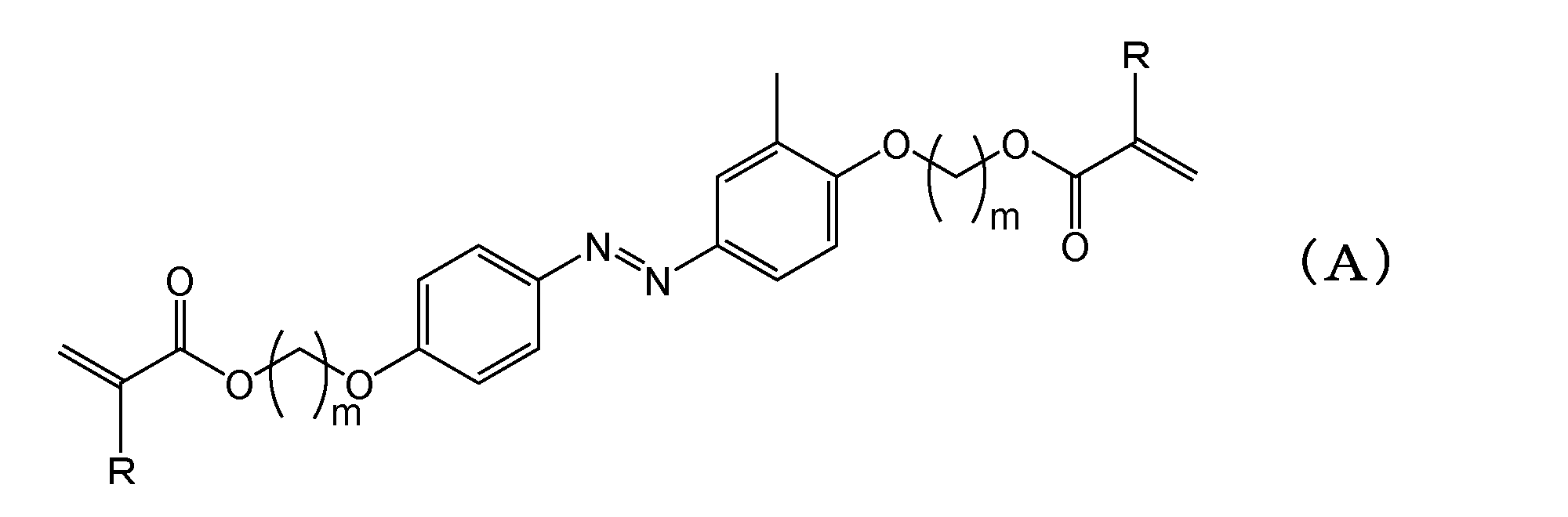
- the inventors of the present application show that the azo compound represented by the following formula (A) exhibits photoresponsiveness such as melting by light irradiation, and the following formula ( It has been found that the polymer compound containing the azo compound-based repeating unit represented by B) exhibits photoresponsiveness such as Tg changing or deformation by light irradiation.
- the invention of the present application has been completed based on the above knowledge and the like, and the following invention is provided in the present application.
- m is an integer of 1 to 18, and R is hydrogen or a methyl group.
- a photoresponsive composition comprising the photoresponsive azo compound according to ⁇ 1>.
- m is an integer of 1 to 18, and R is hydrogen or a methyl group.
- n is an integer of 4 to 17
- ⁇ 5> An adhesive containing the photoresponsive polymer compound according to ⁇ 3> or ⁇ 4> as an active ingredient, and having an adhesive force that changes by light irradiation.
- ⁇ 6> A photoresponsive body containing the photoresponsive polymer compound according to ⁇ 3> or ⁇ 4> as an active ingredient and reversibly deforming in response to light irradiation.
- ⁇ 7> The photoresponsive body according to ⁇ 6>, which is deformed by one irradiation of ultraviolet light or visible light and returns to its original shape by the other irradiation.
- ⁇ 8> The photoresponsive body according to ⁇ 6> or ⁇ 7>, which has a film shape, a sheet shape, or a plate shape, and is curved or bent by light irradiation.
- a method for producing a photoresponsive polymer compound wherein a monomer containing an azo compound represented by the following formula (A) is polymerized.
- m is an integer of 1 to 18, and R is hydrogen or a methyl group.
- ⁇ 10> The method for producing a photoresponsive polymer compound according to ⁇ 9>, wherein the monomer further includes one or more of an acrylic monomer having an azobenzene structure, a diacrylic monomer, a vinyl monomer, and a divinyl monomer.
- the monomer further includes at least one selected from alkyl glyceryl itaconate, acrylic ester, and diacrylic ester.
- the photoresponsive azo compound of the present application has photoresponsiveness such as being soluble by light irradiation.
- the photoresponsive polymer compound of the present application has photoresponsiveness such that Tg is changed or deformed by light irradiation.
- FIG. 3 is a photograph showing a photo phase transition (photo liquefaction) of an azo compound (M-azo) of Example 3-1.
- A) is a photograph before ultraviolet light irradiation.
- B) is a photograph after irradiation with ultraviolet light for several seconds.
- 4 is a photomicrograph showing the photo phase transition of the azo compound (M-azo) of Example 3-2.
- A) and (c) are photographs before ultraviolet light irradiation.
- (B) and (d) are photographs after ultraviolet light irradiation.
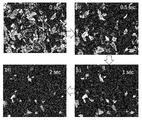
- 3 is a photograph showing the change over time in the optical phase transition of the azo compound (M-azo) of Example 3-2.
- A) is a photograph before ultraviolet light irradiation (0 sec).
- (B) is a photograph 0.5 seconds after irradiation.
- (C) is a photograph 1 second after irradiation.
- (D) is a photograph 2 seconds after irradiation.
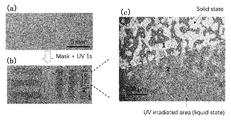
- 4 is a photomicrograph of the azo compound (M-azo) of Example 3-4 patterned by irradiating with ultraviolet light.
- (A) is a photograph before irradiation.
- (B) is a photograph after irradiation.
- (C) is an enlarged photograph of part of (b).
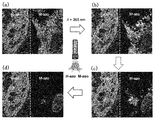
- Example 3-5 a photograph when the azo compound (M-azo) of the example and the azo compound (H-azo) of the comparative example are irradiated with ultraviolet light.
- (A) is a photograph before irradiation.
- (B) is a photograph 6 seconds after the start of irradiation.
- (C) is a photograph 25 seconds after the start of irradiation.
- (D) is a photograph 40 seconds after the start of irradiation.
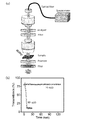
- (A) is a schematic diagram showing an experimental apparatus used for measurement of the optical phase transition speed in Example 3-6.
- (B) is a graph showing the measurement results of the optical phase transition rates of the azo compound (M-azo) of the example and the azo compound (H-azo) of the comparative example.
- Example 3-7 (a) monomer for polymer compound (DGI), (b) azo compound (M-azo) of Example, and (c) azo compound (H-azo) of Comparative Example
- DSC differential scanning calorimetry
- A) is an image in which the sample is placed along the axial direction of A.
- B is an image in which the sample is placed in the direction of about 45 ° with respect to the A axis.
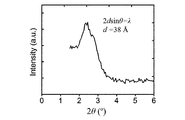
- FIG. 5 is a graph showing a light absorption spectrum of the polymer film of Example 2.
- A is a spectrum change before and after irradiation of ultraviolet light for 4 seconds.
- B shows the change in spectrum after irradiation with ultraviolet light and before irradiation with visible light and after irradiation for 2 seconds.
- (A) is a photograph of the initial state.
- (B) is a photograph after ultraviolet light irradiation.
- C is a photograph after irradiation with visible light.
- D is a photograph after ultraviolet light irradiation.
- FIG. 1 The graph which shows the light intensity dependence of the bending
- FIG. The photograph which shows an example of the bending behavior by the light of the polymer film of Example 2.
- FIG. (A) is a photograph before bending.
- (B) is a photograph after bending.
- the photoresponsive azo compound of the embodiment of the present invention is represented by the following formula (A).
- m is an integer of 1 to 18, and R is hydrogen or a methyl group.
- the photoresponsive azo compound of the present embodiment is characterized by having a vinyl structure at both ends and an azobenzene structure in the middle, and a methyl group at the 3 position of one benzene of the azobenzene structure.
- Comparative Example azo compound having the same chemical structure as the azo compound of the present embodiment except that it does not have a methyl group at the 3-position of one benzene of the azobenzene structure as seen in Examples 3-5 and the like described later Has no photoresponsiveness.
- the azo compound of the present embodiment exhibits photoresponsiveness such as melting by irradiation with ultraviolet light.
- the photoresponsive azo compound of the present embodiment exhibits various photoresponsive properties such as the following (1) and (2), as described in Examples described later. (1) It melts (liquefies) when irradiated with ultraviolet light. (2) The color is changed by photoisomerization by ultraviolet light irradiation. The determination as to whether or not the azo compound of the present embodiment has dissolved is that birefringence (optical anisotropy) disappears by observation with a polarizing microscope, changes in shape into droplets by observation of powder morphology, or This can be done depending on the presence or absence of fluidity when touched.
- birefringence optical anisotropy
- the photoresponsive azo compound of the present embodiment may be used alone as a composition, but within a range not significantly impairing the photoresponsiveness (for example, 50% by mass or less, preferably 20% by mass or less, more preferably 10%). (In the range of mass% or less), it can also be used as a composition containing other compounds.
- other compounds include, but are not limited to, other azo compounds having photoresponsiveness (for example, azobenzene and derivatives thereof), compounds having no photoresponsiveness (for example, DGI, comparison described below)
- examples include azo compounds and liquid crystal compounds such as cyanobiphenyl derivatives, and photoresponsive compounds other than azo compounds (spiropyran, spirooxazine, diarylethene, and fulgide).
- the photoresponsive polymer compound of this embodiment is obtained by polymerizing the azo compound of this embodiment as a monomer, and includes a repeating unit represented by the following formula (B).
- m is an integer of 1 to 18, and R is hydrogen or a methyl group.
- the photoresponsive polymer compound of this embodiment may be obtained using a monomer copolymerizable with the azo compound of this embodiment together with the azo compound of this embodiment.
- copolymerizable monomers include, but are not limited to, acrylic monomers having an azobenzene structure, diacrylic monomers, vinyl monomers, divinyl monomers, and other alkene monomers.
- alkene monomers include, but are not limited to, alkyl glyceryl itaconate, acrylic esters, and diacrylic esters.
- the polymerization initiator for polymerizing these monomers is not limited, and examples thereof include 1,1′-azobis- (cyclohexane-1-carbonitrile) and 1,1′-azobis- (isobutyro). Nitrile) and the like, peroxides such as benzoyl peroxide and lauroyl peroxide, acylphosphine oxide polymerization initiators, and alkylphenone polymerization initiators. These can be used alone or in combination of two or more.
- the amount of the polymerization initiator used is usually 0.05 to 5% by mass, preferably 0.1 to 1% by mass, based on the total amount of the azo compound monomer and other monomers.
- the chemical structure of the photoresponsive polymer compound of this embodiment is difficult to express as a general formula, but when the azo compound monomer of this embodiment and an alkylglyceryl itaconate monomer are copolymerized, for example, It is thought that it has a polymer chemical structure as shown in the chemical formula. (Wherein, i, j, k, and l are positive integers, m is an integer of 1 to 18, n is an integer of 4 to 17, and R is hydrogen or a methyl group.)
- the photoresponsive polymer compound of the present embodiment and the film formed therefrom exhibit various photoresponsiveness as described in the following (1) to (4), as described in Examples below.
- Tg is decreased by ultraviolet light irradiation, and then Tg is increased by visible light irradiation.
- the light absorption spectrum is changed by ultraviolet light irradiation and subsequent visible light irradiation.
- the absorption of light in the wavelength range of about 330 to 430 nm is significantly reduced by irradiation with ultraviolet light, and is increased by subsequent visible light irradiation, and is almost restored.
- a film molded from the photoresponsive polymer compound of the present embodiment is bent by ultraviolet light irradiation and recovered to an almost flat shape by subsequent visible light irradiation.
- the bending of the film formed from the photoresponsive polymer compound of the present embodiment by ultraviolet light irradiation increases in speed when the light intensity is high.
- the photoresponsive polymer compound of the present embodiment may be used alone as a photoresponsive composition, but does not greatly impair the photoresponsiveness (for example, 60% by mass or less, preferably 50% by mass or less, more It is preferably 30% by mass or less, and can also be used as a photoresponsive composition containing other polymers and various additives.
- examples of other polymers include, but are not limited to, acrylic polymers, silicone polymers, and urethane polymers.
- Additives include, but are not limited to, fillers, reinforcing agents, and functional additives.
- the adhesive of the embodiment of the present invention contains the photoresponsive polymer compound of the present embodiment as an active ingredient, and the adhesive force is changed by light irradiation. That is, the change in the adhesive strength of the adhesive is due to the presence of the photoresponsive polymer compound of the present embodiment.
- the photoresponsive body of the embodiment of the present invention contains the photoresponsive polymer compound of the present embodiment as an active ingredient and reversibly deforms in response to light irradiation. That is, the deformation of the photoresponsive body is caused by the presence of the photoresponsive polymer compound of the present embodiment.
- This photoresponsive body may be deformed by one irradiation of ultraviolet light or visible light, and may return to its original shape by the other irradiation.
- the photoresponsive body is in the form of a film, a sheet, or a plate, and may be bent or bent by light irradiation.
- Example 1-1 Synthesis of Example Intermediate 1a, 4,4′-Dihydroxy-3-methylazobenzene
- Example Intermediate 1a was synthesized according to the synthesis scheme shown in the following chemical reaction formula.
- the mixture was stirred at room temperature for 22 hours.
- the solution was acidified with 2.4N hydrochloric acid while cooling, the precipitated brown precipitate was filtered, the solid washed with water and then dried.
- Comparative Example 1-1 Synthesis of Comparative Example Intermediate 1b, 4,4′-Dihydroxy-azobenzene
- Comparative Example Intermediate 1b was obtained in the same manner as in Example 1-1 using phenol instead of o-cresol used in the synthesis of 1a (see the following chemical reaction formula).
- 4,4′-Dihydroxy-3-methylazobenzene (1a) (1.14 g, 5.0 mmol) was placed in a reaction vessel, and potassium carbonate (1.73 g, 12.5 mmol), potassium iodide (83.0 mg, 0.8 mmol). 5 mmol), and anhydrous acetone (18 mL) were added. The mixture was cooled to 0 ° C., 4-chlorobutylbenzoate (2.05 mL, 11.0 mmol) was added dropwise at 0 ° C., and the mixture was heated to reflux for 24 hours in an 85 ° C. oil bath. After 24 hours, further anhydrous acetone (10 mL) was added and refluxing was continued for 16 hours.
- 4-chlorobutylbenzoate (2. (05 mL, 11.0 mmol)
- the same method as in Example 1-2-1, except that 8-bromo-1-octanol (3.14 g, 15 mmol) was used instead of 3-bromo-1-propanol used in the synthesis of 2a (m 3) above.
- Gave yellow powder 2a (m 8).
- Itaconic anhydride (50.0 g) and 1-dodecanol (80.0 g) were stirred at 110 ° C. for 50 minutes. After cooling to room temperature, 100 mL of hexane was added with vigorous stirring to precipitate a white solid. The solid was filtered and recrystallized twice with ethanol to obtain an intermediate dodecyl itaconate.
- Dodecyl itaconate (5.0 g) was dissolved in 5 mL of toluene, glycidol (3.75 g) and pyridinium p-toluenesulfonate (10 ⁇ g) as a catalyst were added, and the mixture was stirred at 100 ° C. for 5 hours.
- Example 2 Synthesis of polymer compound and production of film thereof
- DGI 22 mg
- polymerization initiator 1,1′-azobis- (cyclohexane-1-carbonitrile) 0.3 mg
- 20 ⁇ L of toluene was added thereto.
- This mixture was poured into a liquid crystal cell (parallel alignment, cell thickness: 5 ⁇ m or 10 ⁇ m, area: 2 cm ⁇ 2 cm, KSRP-50 / A107P1NSS manufactured by EHC).
- the cell was heated on a hot plate under a nitrogen atmosphere at 60 ° C.
- Example 3-1 Experiment of optical phase transition (photo-liquefaction) of M-azo]
- M-azo fine powder particle size: about 2 mm
- ultraviolet light wavelength: 365 nm, intensity: 125 mW / cm 2
- the photographs before and after the light irradiation are shown in FIG.
- FIG. 2 shows photographs of the M-azo thin film before and after irradiation with ultraviolet light.
- Ultraviolet light with an intensity of 100 mW / cm 2 was irradiated for 10 seconds.
- 2A and 2C show before light irradiation
- FIGS. 2B and 2D show after light irradiation for 10 seconds, respectively.
- 2 (a) and 2 (b) were taken with a polarizing microscope under crossed Nicols.
- 2C and 2D were taken with an optical microscope. Since birefringence was confirmed in FIG. 2A and there was optical anisotropy, it was confirmed that M-azo in FIG. 2A was not a liquid.
- FIG. 2B a dark image was observed in the entire visual field, and it was confirmed that birefringence disappeared.
- FIG. 2D liquefaction of the sample was confirmed.
- FIG. 3 shows a photograph of the change with time of the M-azo thin film during irradiation with ultraviolet light, observed with a polarizing microscope under crossed Nicols. As the irradiation time elapses, the black area increases, indicating a phase transition to the isotropic phase.
- Example 3-4 Patterning experiment using M-azo
- a metal mask was placed on a glass substrate coated with M-azo and irradiated with ultraviolet light for 1 second, a pattern was formed (FIGS. 4A and 4B).
- “1” indicates a solid portion and “2” indicates a liquid portion.
- Example 3-5 Comparison between M-azo and H-azo] Place H-azo and M-azo side by side on a slide glass, and simultaneously irradiate both with ultraviolet light (wavelength: 365 nm, intensity: 80 mW / cm 2 ).
- a photograph taken in Fig. 5 is shown in FIG. 5 (a) shows before irradiation, FIG. 5 (b) shows 6 seconds after the start of irradiation, FIG. 5 (c) shows 25 seconds after the start of irradiation, and FIG. 5 (d) shows 40 seconds after the start of irradiation. ing.
- the irradiation time elapses, only M-azo changes, indicating that the phase transition to the isotropic phase is caused by light.
- Example 3-6 Measurement of speed of optical phase transition
- the speed of the optical phase transition of M-azo and H-azo was measured by combining a polarizing microscope and a spectrophotometer.
- FIG. 6A is a schematic diagram of the experimental apparatus, and the transmittance of 650 nm of the lowermost backlight illumination (white light) was monitored with a spectrometer. Irradiation light was applied from an obliquely upward direction of the sample. When the two polarizing plates (Polarizer and Analyzer) are crossed Nicols and are transferred to the isotropic phase, the transmittance decreases.
- FIG. 6B shows the measurement results of M-azo and H-azo. The transmittance of M-azo decreased about 10 seconds after the start of light irradiation, whereas the transmittance of H-azo did not change.
- Example 3-7 DSC measurement
- DGI, M-azo, and H-azo were analyzed by differential scanning calorimetry (DSC) under dark conditions where the temperature rising rate and temperature falling rate were 2 ° C./min.
- 7A shows the DGI
- FIG. 7B shows the M-azo
- FIG. 7C shows the H-azo DSC curve.
- FIG. 7A a phase transition from a crystal to a liquid was observed at 63 ° C. during heating, and a phase transition from a liquid to a crystal was observed at 28 ° C. during cooling.
- FIG. 7B a phase transition from a crystal to a liquid was observed at 65 ° C. during heating, and a phase transition from a liquid to a crystal was observed at 29 ° C. during cooling.
- FIG. 7C a phase transition from a crystal to a liquid was observed at 73 ° C. during heating, and a phase transition from a liquid to a crystal was observed at 65 to 67 ° C. during cooling.
- Example 4-1 Physical Property XRD Measurement of Polymer Film
- the XRD profile at room temperature was measured for the polymer film produced in Example 2 (see FIG. 8).
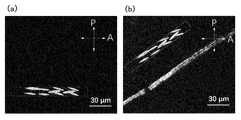
- FIG. 9A is a polarization microscope in which the sample is placed along the axial direction of A, but is dark.
- FIG. 9B a bright image was observed with a polarizing microscope in which the sample was placed in a direction of about 45 ° with respect to the axis A.
- the ellipse picture in Fig.9 (a) and FIG.9 (b) is a schematic diagram of molecular orientation.
- Example 4-3 DSC measurement before and after UV irradiation of polymer film
- the DSC profile at the time of a heating before and behind ultraviolet light irradiation was measured. The result is shown in FIG.
- the Tg decreased from about 20 ° C. to 9 ° C. before and after irradiation with ultraviolet light.
- Example 4-4 Measurement of absorption spectrum of polymer film
- the absorption spectrum at the time of ultraviolet light or visible light irradiation was measured.
- the result is shown in FIG.
- FIG. 11A shows changes in the light absorption spectrum of the polymer film before irradiation (0 sec) and after irradiation for 4 seconds (4 sec) with ultraviolet light (wavelength: 365 nm).
- FIG. 11B shows changes in the light absorption spectrum of the polymer film after irradiation with ultraviolet light, before irradiation with visible light (wavelength: 465 nm) (0 sec) and after irradiation with 2 seconds (2 sec).
- the absorption spectrum in the wavelength range of 330 to 430 nm was significantly changed by the ultraviolet light irradiation and the visible light irradiation. For this reason, it is assumed that the polymer film of Example 2 is used as an irradiation history sensor for ultraviolet light or visible light.
- Example 4-5 Investigation of bending behavior of polymer film by light
- Change in shape when ultraviolet light (wavelength: 365 nm, intensity: 11 mW / cm 2 ) and visible light (wavelength: 465 nm, intensity: 30 mW / cm 2 ) are alternately applied to the polymer film produced in Example 2 I investigated.
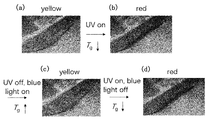
- the photograph at that time is shown in FIG. 12A shows the initial state
- FIG. 12B shows the state after irradiation with ultraviolet light
- FIG. 12C shows the state after irradiation with visible light
- FIG. 12D shows the state after irradiation with ultraviolet light.
- FIG. 12 (b) the right lower end side was bent upward by ultraviolet light irradiation and changed to a reddish color.
- the upward bending returned to the initial flat shape and further changed to the initial yellow color by irradiation with visible light.
- the polymer film of Example 2 showing such behavior is assumed to be used not only as the above-described irradiation history sensor of ultraviolet light and visible light but also as a light-responsive actuator.
- Example 4-6 Measurement of light intensity dependency of bending behavior of polymer film by light
- the bending speed was measured when the light intensity of ultraviolet light (wavelength: 365 nm) applied to the polymer film produced in Example 2 was changed. The result is shown in FIG. It was found that the bending speed of the polymer film increases with increasing light intensity.
- FIG. 14 the photograph of an example of the bending behavior by the light of the polymer film of Example 2 is shown.
- FIG. 14A is a photograph before bending
- FIG. 14B is a photograph after bending.
- the azo compound of the present application and the composition containing this azo compound as an active ingredient are dissolved by light irradiation, use as an optical modeling material, a light irradiation history sensor or the like is assumed.
- the polymer compound of the present application undergoes reversible changes in Tg and reversal of bending-flattening due to ultraviolet light irradiation and visible light irradiation. It is assumed to be used as a light responder such as an actuator.
Landscapes
- Chemical & Material Sciences (AREA)
- Organic Chemistry (AREA)
- Health & Medical Sciences (AREA)
- Chemical Kinetics & Catalysis (AREA)
- Medicinal Chemistry (AREA)
- Polymers & Plastics (AREA)
- Addition Polymer Or Copolymer, Post-Treatments, Or Chemical Modifications (AREA)
- Organic Low-Molecular-Weight Compounds And Preparation Thereof (AREA)
- Adhesives Or Adhesive Processes (AREA)
Abstract
光応答性の化合物、組成物、および高分子化合物を提供する。光応答性高分子化合物は、下記式(B)で表されるアゾ化合物系繰り返し単位を含む。(式(B)中、mは1~18の整数、Rは水素またはメチル基。)
Description
本願は、光応答性アゾ化合物、この光応答性アゾ化合物を有効成分とする光応答性組成物、およびこの光応答アゾ化合物を重合させて得られる光応答性高分子化合物などに関する。
光の照射に応答する材料として、アゾベンゼンやスピロオキサジン等のフォトクロミック化合物などが知られている。例えば、特許文献1、特許文献2、および非特許文献1~非特許文献4には、光で固体と液体の間を変化するアゾベンゼン誘導体が記載されている。この光応答性アゾベンゼン誘導体の出現前には、使用後に廃棄される感光性材料が知られていたものの、光で固体と液体の間を変化する材料はなかった。
このため、光応答性アゾベンゼン誘導体は、学術的に注目を集めるとともに、新しいコンセプトを持つ工業材料としての応用展開が期待されている。また、光で固体と液体の間を変化するとともに、光でガラス転移温度(Tg)または融点が変化する高分子化合物も報告されている(非特許文献5および非特許文献6参照)。また、液晶性の主剤のモノマーと、アゾベンゼン誘導体のモノマーとの混合物の重合体からなり、光で変形する高分子材料も近年報告されている(非特許文献7参照)。
Chem. Commun. 47, 1770-1772 (2011).
Adv. Mater., 24, 2353 (2012).
Chem. Eur. J. 19, 17391-17397 (2013).
J. Photopolym. Sci. Tech. 29, 149-157 (2016).
Nat. Chem. 9, 145-151 (2017).
The Journal of Adhesion, 93, 823-830 (2017).
Nat. Mater. 8, 677-682 (2009).
本願発明者は、上述のような従来技術について検討し、次の(a)~(e)の問題点が存在することを認識した。
(a)アゾベンゼンおよびスピロオキサジン等のフォトクロミック化合物を含む材料の光応答性は、マトリックスである高分子化合物の粘度に依存する。この高分子化合物のガラス転移温度(Tg)を低くすることによって材料の光応答性が向上する。その一方で、Tgが低い高分子化合物は柔らかい。このため、Tgが低い高分子化合物をマトリックスとする材料は、硬さが損なわれる。高い光応答性と機械的強度を両立した材料の開発が望ましい。
(b)光照射によって固体が液化する化合物は知られている。この化合物を液化させるためには強度40~100mW/cm2の光を30分間照射する必要がある。この化合物は光応答性が低く、光応答性が向上した材料の出現が望まれる。
(a)アゾベンゼンおよびスピロオキサジン等のフォトクロミック化合物を含む材料の光応答性は、マトリックスである高分子化合物の粘度に依存する。この高分子化合物のガラス転移温度(Tg)を低くすることによって材料の光応答性が向上する。その一方で、Tgが低い高分子化合物は柔らかい。このため、Tgが低い高分子化合物をマトリックスとする材料は、硬さが損なわれる。高い光応答性と機械的強度を両立した材料の開発が望ましい。
(b)光照射によって固体が液化する化合物は知られている。この化合物を液化させるためには強度40~100mW/cm2の光を30分間照射する必要がある。この化合物は光応答性が低く、光応答性が向上した材料の出現が望まれる。
(c)アゾベンゼン誘導体は、低分子の分子性化合物であり、固体で結晶状態を取ることが一般的である。しかし、低分子量の結晶化合物は、高分子化合物と比較すると脆く機械的強度に劣る。材料として使用するためには、高分子化合物にこの結晶化合物を分散させる、またはこの結晶化合物を共重合させることが望ましい。高分子化合物にこの結晶化合物を分散させた場合、この結晶化合物が溶出する、および分散された結晶化合物の特性が高分子化合物の性質に反映されにくい等の問題がある。このため、この結晶化合物を共重合させることがより望ましい。しかし、重合可能置換基を持ち、かつ光で溶ける結晶化合物については報告がない。
(d)これまで、光応答性高分子化合物の製造にアゾベンゼンを含むモノマーが使用されてきた。しかし、光応答性高分子化合物の製造に使用でき、光照射によって溶けるモノマーの報告がなかった。
(e)これまでの光応答性液晶アクチュエーターでは、特定のモノマー(アゾベンゼン、および液晶性モノマーの両方)が用いられてきた。しかし、液晶性モノマーは合成が困難で、かつ高価である。
本願は、上述のような従来技術、およびこの従来技術に対する本願発明者の前記認識を背景としたものであり、光応答性の化合物および組成物を提供することを課題とする。また、本願は、光応答性の高分子化合物を提供することを課題とする。
(e)これまでの光応答性液晶アクチュエーターでは、特定のモノマー(アゾベンゼン、および液晶性モノマーの両方)が用いられてきた。しかし、液晶性モノマーは合成が困難で、かつ高価である。
本願は、上述のような従来技術、およびこの従来技術に対する本願発明者の前記認識を背景としたものであり、光応答性の化合物および組成物を提供することを課題とする。また、本願は、光応答性の高分子化合物を提供することを課題とする。
本願発明者らは、上記の課題を解決すべく鋭意検討を重ねた結果、下記式(A)で表されるアゾ化合物は、光照射により溶けるなどの光応答性を示すこと、および下記式(B)で表されるアゾ化合物系繰り返し単位を含む高分子化合物は、光照射によりTgが変化したり、変形したりするなどの光応答性を示すことなどを知見した。本願の発明は、前記知見などに基づいて完成したものであり、本願では、以下のような発明が提供される。
<1>下記式(A)で表される光応答性アゾ化合物。

(式(A)中、mは1~18の整数、Rは水素またはメチル基。)
<2><1>に記載の光応答性アゾ化合物を含む光応答性組成物。
<2><1>に記載の光応答性アゾ化合物を含む光応答性組成物。
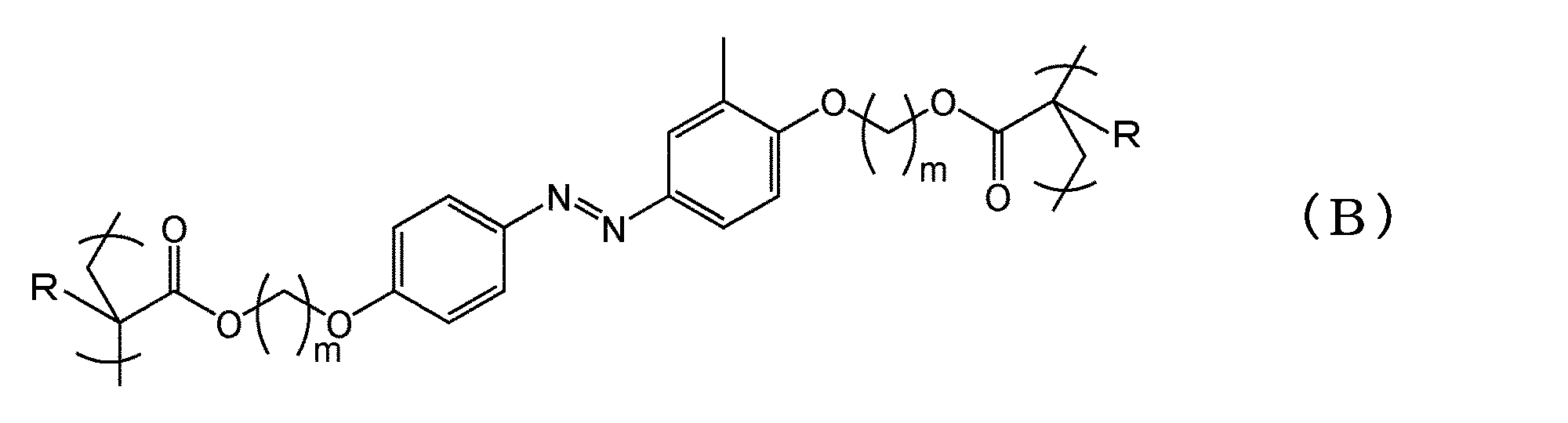
<3>下記式(B)で表されるアゾ化合物系繰り返し単位を含む光応答性高分子化合物。
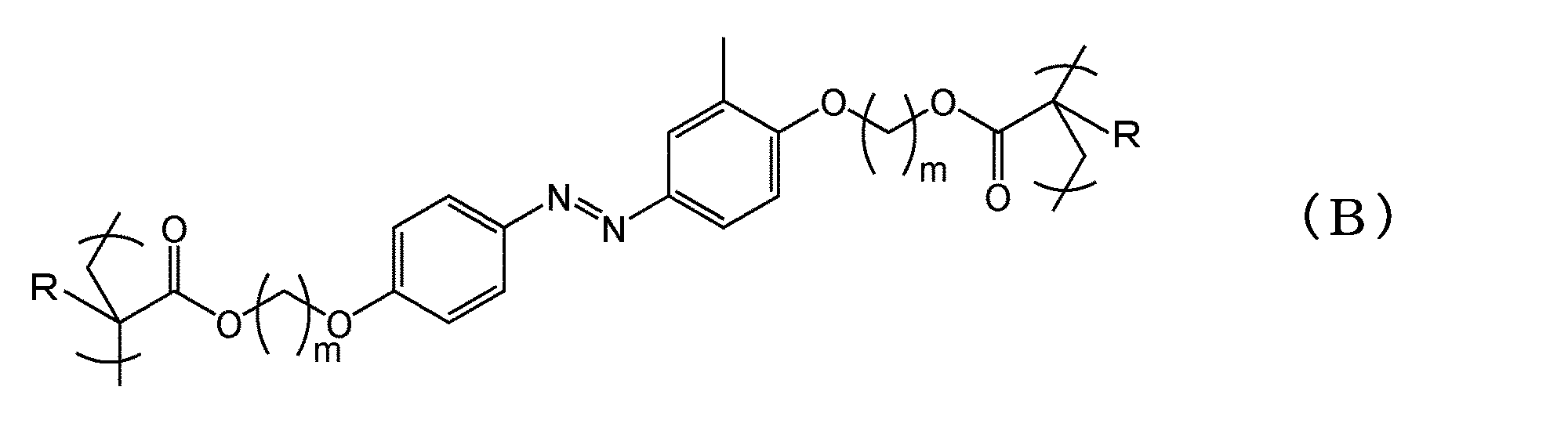
(式(B)中、mは1~18の整数、Rは水素またはメチル基。)
<4>下記式(C)で表されるアルキルグリセリルイタコナート系繰り返し単位をさらに含む<3>に記載の光応答性高分子化合物。

(式(C)中、nは4~17の整数。)
<5><3>または<4>に記載の光応答性高分子化合物を有効成分として含有し、光照射により粘着力が変化する接着剤。
<6><3>または<4>に記載の光応答性高分子化合物を有効成分として含有し、光照射に応答して可逆的に変形する光応答体。
<7>紫外光または可視光の一方の照射により変形し、他方の照射により元の形状に戻る<6>に記載の光応答体。
<8>フィルム状、シート状、または板状であり、光の照射により湾曲または屈曲する<6>または<7>に記載の光応答体。
<6><3>または<4>に記載の光応答性高分子化合物を有効成分として含有し、光照射に応答して可逆的に変形する光応答体。
<7>紫外光または可視光の一方の照射により変形し、他方の照射により元の形状に戻る<6>に記載の光応答体。
<8>フィルム状、シート状、または板状であり、光の照射により湾曲または屈曲する<6>または<7>に記載の光応答体。
<9>下記式(A)で表されるアゾ化合物を含むモノマーを重合する光応答性高分子化合物の製造方法。
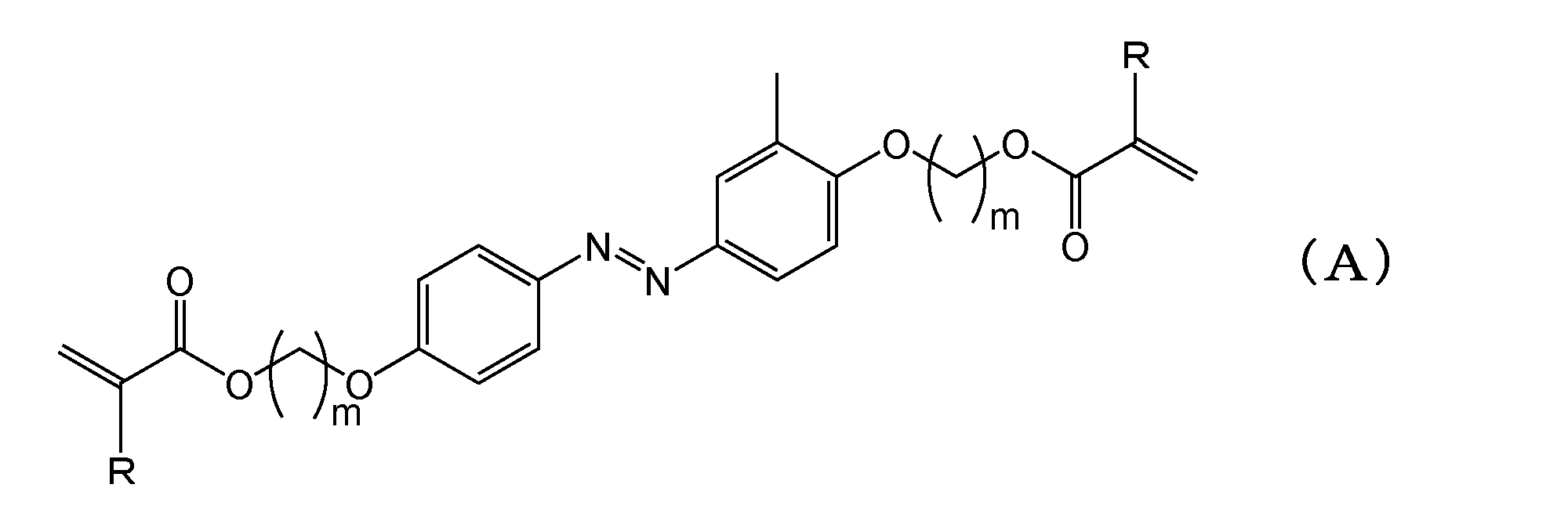
(式(A)中、mは1~18の整数、Rは水素またはメチル基。)
<10>前記モノマーが、アゾベンゼン構造を有するアクリル系モノマー、ジアクリル系モノマー、ビニル系モノマー、およびジビニル系モノマーの1種以上をさらに含む<9>に記載の光応答性高分子化合物の製造方法。
<11>前記モノマーが、アルキルグリセリルイタコナート、アクリル系エステル、ジアクリル系エステルから選択される1種以上をさらに含む<9>に記載の光応答性高分子化合物の製造方法。
<11>前記モノマーが、アルキルグリセリルイタコナート、アクリル系エステル、ジアクリル系エステルから選択される1種以上をさらに含む<9>に記載の光応答性高分子化合物の製造方法。
本願の光応答性アゾ化合物は、光照射により可溶性を示すなどの光応答性を有する。また、本願の光応答性高分子化合物は、光照射によりTgが変化したり、変形したりするなどの光応答性を有する。
本願発明を実施するための形態について、以下、具体例を挙げて説明する。本願発明の趣旨を逸脱しない限り、本願発明は以下の内容に限定されるものではなく、適宜変更して実施することができる。なお、本明細書において数値範囲を示す「~」は、その前後に記載される数値を下限値および上限値として含む意味として使用される。
<光応答性アゾ化合物>
本願発明の実施形態の光応答性アゾ化合物は、下記式(A)で表される。

(式(A)中、mは1~18の整数、Rは水素またはメチル基。)
本願発明の実施形態の光応答性アゾ化合物は、下記式(A)で表される。
本実施形態の光応答性アゾ化合物は、両端にビニル構造と、中間にアゾベンゼン構造とを有するとともに、このアゾベンゼン構造の一方のベンゼンの3の位置にメチル基を有することを特徴としている。後述の実施例3-5などに見られるように、アゾベンゼン構造の一方のベンゼンの3の位置にメチル基を有しないこと以外は、本実施形態のアゾ化合物と同じ化学構造を有する比較例アゾ化合物は、光応答性を全く有しない。これに対し、本実施形態のアゾ化合物は、紫外光照射により溶けるなどの光応答性を示す。
本実施形態の光応答性アゾ化合物は、後述の実施例に記載されているように、次の(1)および(2)のような各種の光応答性を示す。
(1)紫外光照射により溶ける(液化する)。
(2)紫外光照射により光異性化して色が変化する。
なお、本実施形態のアゾ化合物が溶けたかどうかの判定は、偏光顕微鏡観察によって複屈折(光学的な異方性)が消失すること、粉末の形態観察により液滴状に形状変化すること、または触れたときの流動性の有無により行うことができる。
(1)紫外光照射により溶ける(液化する)。
(2)紫外光照射により光異性化して色が変化する。
なお、本実施形態のアゾ化合物が溶けたかどうかの判定は、偏光顕微鏡観察によって複屈折(光学的な異方性)が消失すること、粉末の形態観察により液滴状に形状変化すること、または触れたときの流動性の有無により行うことができる。
本実施形態の光応答性アゾ化合物は、単独で組成物として用いてもよいが、光応答性を大きく損なわない範囲で(例えば、50質量%以下、好ましくは20質量%以下、より好ましくは10質量%以下の範囲で)、他の化合物を含む組成物として用いることもできる。そのような他の化合物としては、限定するものではないが、光応答性を有する他のアゾ化合物(例えば、アゾベンゼンおよびそれらの誘導体)、光応答性を有しない化合物(例えば、DGI、後述の比較例アゾ化合物、およびシアノビフェニル誘導体などの液晶化合物)、ならびにアゾ化合物以外の光応答性化合物(スピロピラン、スピロオキサジン、ジアリールエテン、およびフルギド)などが挙げられる。
<光応答性高分子化合物>
本実施形態の光応答性高分子化合物は、モノマーとしての本実施形態のアゾ化合物を重合して得られ、下記式(B)で示される繰り返し単位を含む。

(式(B)中、mは1~18の整数、Rは水素またはメチル基。)
本実施形態の光応答性高分子化合物は、モノマーとしての本実施形態のアゾ化合物を重合して得られ、下記式(B)で示される繰り返し単位を含む。
本実施形態の光応答性高分子化合物は、本実施形態のアゾ化合物とともに、本実施形態のアゾ化合物と共重合可能なモノマーを用いて得てもよい。このような共重合可能なモノマーとしては、限定するものではないが、アゾベンゼン構造を有するアクリル系モノマー、ジアクリル系モノマー、ビニル系モノマー、ジビニル系モノマー、およびその他のアルケン系モノマーなどが挙げられる。その他のアルケン系モノマーとしては、限定するものではないが、アルキルグリセリルイタコナート、アクリル系エステル、およびジアクリル系エステルなどが挙げられる。
これらのモノマーを重合する際の重合開始剤としては、限定するものではないが、例えば、1,1′-アゾビス-(シクロヘキサン-1-カルボニトリル)および1,1′-アゾビス-(イソブチロニトリル)等のアゾ系重合開始剤、ベンゾイルパーオキサイド、ラウロイルパーオキサイド等の過酸化物、アシルフォスフィンオキサイド系重合開始剤、ならびにアルキルフェノン系重合開始剤などが挙げられる。これらは、単独であるいは2種以上を組み合わせて用いることができる。上記重合開始剤の使用量は、上記アゾ化合物モノマーとその他のモノマーとの全量に対し、通常、0.05~5質量%、好ましくは0.1~1質量%である。
本実施形態の光応答性高分子化合物の化学構造は、一般式として表すことが困難であるが、本実施形態のアゾ化合物モノマーと、アルキルグリセリルイタコナートモノマーを共重合した場合には、例えば次の化学式に示すような高分子化学構造を持つものと考えられる。

(式中、i、j、k、およびlは正の整数、mは1~18の整数、nは4~17の整数、Rは水素またはメチル基。)
本実施形態の光応答性高分子化合物およびこれから成形されたフィルムは、後述の実施例に記載されているように、次の(1)~(4)のような各種の光応答性を示す。
(1)本実施形態の光応答性高分子化合物は、紫外光照射によりTgが低下し、その後、可視光照射によりTgが上昇する。
(2)本実施形態の光応答性高分子化合物は、紫外光照射およびその後の可視光照射により光吸収スペクトルが変化する。特に波長330~430nm程度の範囲の光の吸収が、紫外光照射により大きく低下し、その後の可視光照射により上昇しほぼ元通りに回復する。
(3)本実施形態の光応答性高分子化合物から成形されたフィルムは、紫外光照射により屈曲し、その後の可視光照射によりほぼ元の平面形状に回復する。
(4)本実施形態の光応答性高分子化合物から成形されたフィルムの紫外光照射による屈曲は、光強度が高いと速度が高くなる。
(1)本実施形態の光応答性高分子化合物は、紫外光照射によりTgが低下し、その後、可視光照射によりTgが上昇する。
(2)本実施形態の光応答性高分子化合物は、紫外光照射およびその後の可視光照射により光吸収スペクトルが変化する。特に波長330~430nm程度の範囲の光の吸収が、紫外光照射により大きく低下し、その後の可視光照射により上昇しほぼ元通りに回復する。
(3)本実施形態の光応答性高分子化合物から成形されたフィルムは、紫外光照射により屈曲し、その後の可視光照射によりほぼ元の平面形状に回復する。
(4)本実施形態の光応答性高分子化合物から成形されたフィルムの紫外光照射による屈曲は、光強度が高いと速度が高くなる。
本実施形態の光応答性高分子化合物は、単独で光応答性組成物として用いてもよいが、光応答性を大きく損なわない範囲(例えば、60質量%以下、好ましくは50質量%以下、より好ましくは30質量%以下)で、他の高分子や各種添加剤を含む光応答性組成物として用いることもできる。他の高分子としては、限定するものではないが、アクリル系高分子、シリコーン系高分子、およびウレタン系高分子などが挙げられる。添加剤としては、限定するものではないが、充填剤、補強剤、および機能性添加剤などが挙げられる。
本発明の実施形態の接着剤は、本実施形態の光応答性高分子化合物を有効成分として含有し、光照射により粘着力が変化する。つまり、この接着剤の粘着力の変化は、本実施形態の光応答性高分子化合物の存在に起因している。また、本発明の実施形態の光応答体は、本実施形態の光応答性高分子化合物を有効成分として含有し、光照射に応答して可逆的に変形する。つまり、この光応答体の変形は、本実施形態の光応答性高分子化合物の存在に起因している。この光応答体は、紫外光または可視光の一方の照射により変形し、他方の照射により元の形状に戻ってもよい。また、この光応答体は、フィルム状、シート状、または板状であり、光の照射により湾曲または屈曲してもよい。
以下に実施例と比較例を挙げて本発明をさらに具体的に説明するが、本発明の趣旨を逸脱しない限り適宜変更することができる。したがって、本発明の範囲は以下に示す具体例により限定的に解釈されるべきものではない。
実験に用いた試薬および装置
合成と特性評価に用いた試薬と溶媒は、市販のものをそのまま使用した。また、カラムクロマトグラフィーは、関東化学株式会社製シリカゲル60を使用した。NMR(核磁気共鳴)スペクトルは、Bruker社製Avance400型または500型NMR装置を用いた。合成した化合物の熱挙動を、暗条件において、示差走査熱量分析(DSC)(SIIナノテクノロジー社製DSC6100)により解析した。なお、測定は昇温速度および降温速度を2℃/minとして行った。合成した化合物の光学特性は、オリンパス製BX51偏光顕微鏡とLinkam製温度可変ステージ(1033L)を用いて分子配向を観察した。
合成と特性評価に用いた試薬と溶媒は、市販のものをそのまま使用した。また、カラムクロマトグラフィーは、関東化学株式会社製シリカゲル60を使用した。NMR(核磁気共鳴)スペクトルは、Bruker社製Avance400型または500型NMR装置を用いた。合成した化合物の熱挙動を、暗条件において、示差走査熱量分析(DSC)(SIIナノテクノロジー社製DSC6100)により解析した。なお、測定は昇温速度および降温速度を2℃/minとして行った。合成した化合物の光学特性は、オリンパス製BX51偏光顕微鏡とLinkam製温度可変ステージ(1033L)を用いて分子配向を観察した。
化合物の紫外光または可視光照射時の吸収スペクトルの変化は、日本分光製V-670吸光光度計を用いて観測した。光照射は、朝日分光製高圧水銀灯(REX-250)に光学フィルターを組み合わせて任意の波長の光を取り出した。化合物のXRDスペクトルは、リガク製SmartLab(CuKα(λ=1.5418Å))を用いた。化合物のFT-IRスペクトルは、パーキンエルマー製Spectrum2000を用い、370~4000cm-1の範囲を測定した。
アゾ化合物の合成
下記化学反応式に示される合成スキームに従って、実施例と比較例のアゾ化合物を合成した。それぞれの合成については下記に示す。
下記化学反応式に示される合成スキームに従って、実施例と比較例のアゾ化合物を合成した。それぞれの合成については下記に示す。
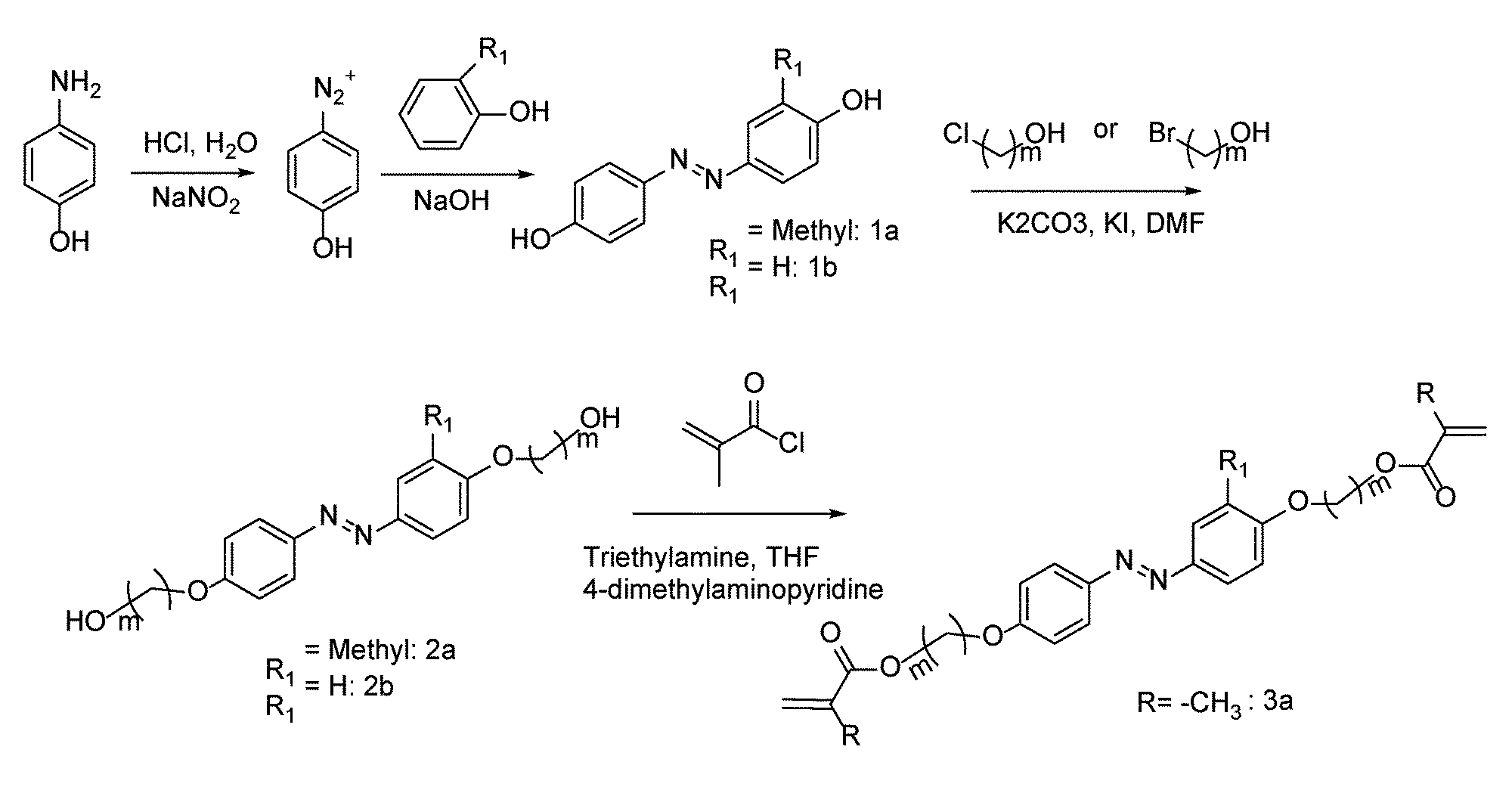
〔実施例1-1:実施例中間体1a、4,4'-Dihydroxy-3-methylazobenzeneの合成〕
下記化学反応式に示される合成スキームに従って、実施例中間体1aを合成した。
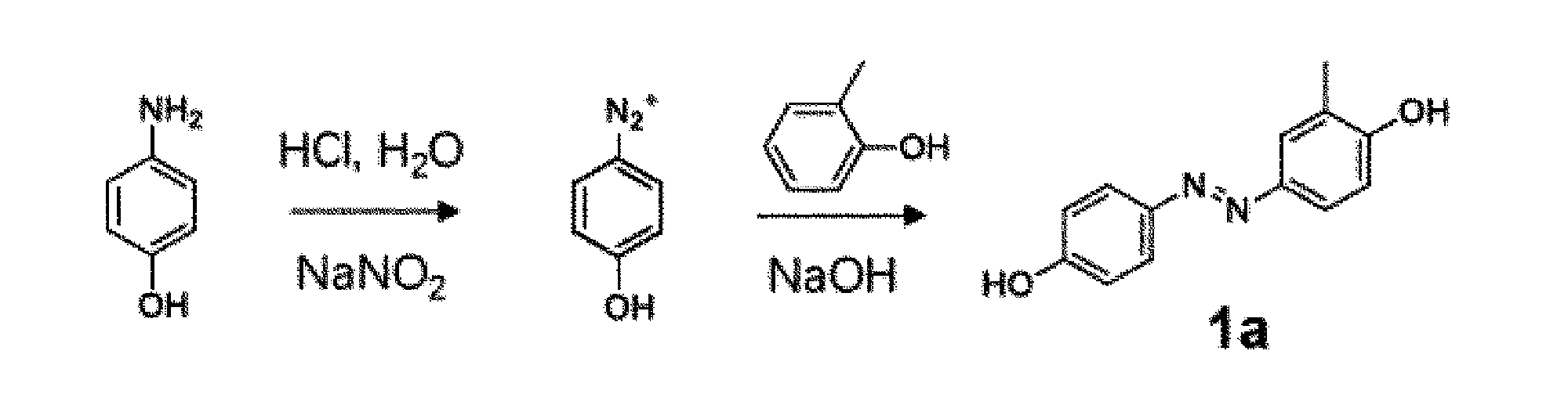
下記化学反応式に示される合成スキームに従って、実施例中間体1aを合成した。
4-アミノフェノール(4.36g、40mmol)に2.4N塩酸50mLを加えた後、-3℃で冷却撹拌しながら、亜硝酸ナトリウム(3.32g、48mmol)を蒸留水4mLに溶解した溶液を滴下し、0℃で30分撹拌を続けた。この溶液を、o-クレゾール(4.32g、40mmol)と20%水酸化ナトリウム水溶液16mLの混合溶液中に-3℃で滴下したところ黄色沈殿が生じた。
この混合物を室温で22時間撹拌した。溶液を冷却しながら2.4N塩酸で酸性にし、析出した褐色の沈殿を濾過し、固形物を水で洗浄し、その後乾燥した。得られた黒色固体を、酢酸エチル:ヘキサン=1:2の混合液を展開溶媒とするシリカゲルカラムクロマトグラフィーにより精製し、アセトンとヘキサンの混合溶媒により再結晶することにより黄色固体1aを得た。
1H NMR (400MHz, DMSO-d6) δ 10.08 (s, 1H), 10.04 (s, 1H), 7.70 (d-d, J1=6.8Hz, J2=1.9 Hz, 2H), 7.60 (d, J=2.0Hz, 1H), 7.55 (d-d, J1=8.4Hz, J2=2.4Hz, 1H), 6.92 (d, J=8.4Hz, 1H), 6.90 (d-d, J1=6.8Hz, J2=1.9Hz, 2H), 2.20 (s, 3H)
13C NMR (125MHz, DMSO-d6) δ 160.1, 158.4, 145.5, 145.3, 125.1, 124.3, 122.6, 116.0, 115.1, 16.2
13C NMR (125MHz, DMSO-d6) δ 160.1, 158.4, 145.5, 145.3, 125.1, 124.3, 122.6, 116.0, 115.1, 16.2
〔比較例1-1:比較例中間体1b、4,4'-Dihydroxy-azobenzeneの合成〕
上記1aの合成で用いたo-クレゾールの代わりにフェノールを用い、実施例1-1と同様の方法により比較例中間体1bを得た(下記化学反応式参照)。
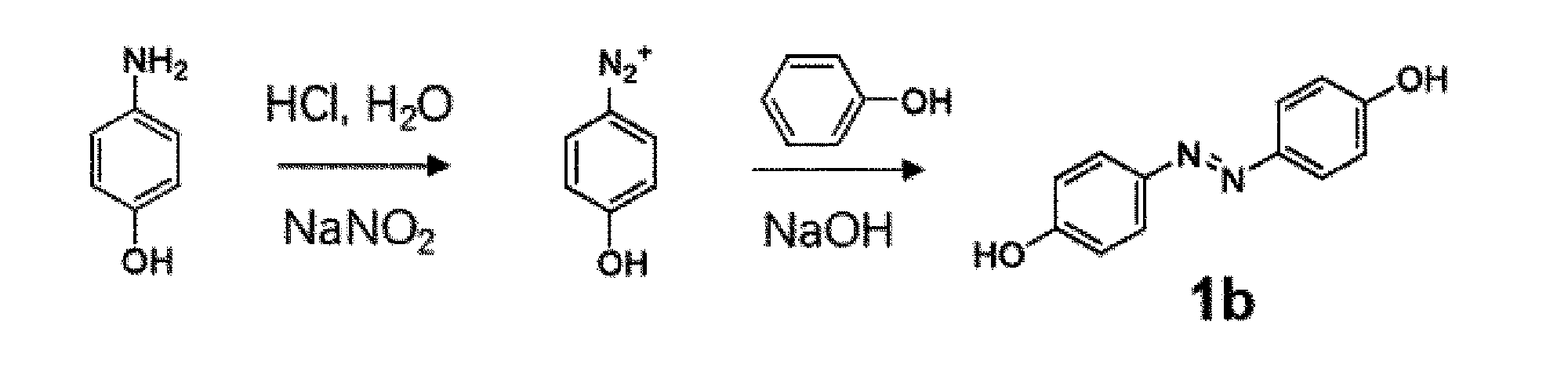
上記1aの合成で用いたo-クレゾールの代わりにフェノールを用い、実施例1-1と同様の方法により比較例中間体1bを得た(下記化学反応式参照)。
1H NMR (400MHz, DMSO-d6) δ 10.12 (s, 2H) 7.72 (d-d, J1=3.08 Hz, J2=2.08 Hz, 2H), 7.70 (d-d, J1=2.16 Hz, J2=3.04 Hz, 2H), 6.92 (d-d, J1=3.12 Hz, J2=2.08 Hz, 2H), 6.89 (d-d, J1=2.12 Hz, J2=3.12 Hz, 2H)
13C NMR (100MHz, DMSO-d6) δ 159.98, 145.25, 124.14, 115.78
13C NMR (100MHz, DMSO-d6) δ 159.98, 145.25, 124.14, 115.78
〔実施例1-2-1:実施例中間体2a(m=3)の合成〕 下記化学反応式に示される合成スキームに従って、実施例中間体2a(m=3)を合成した。
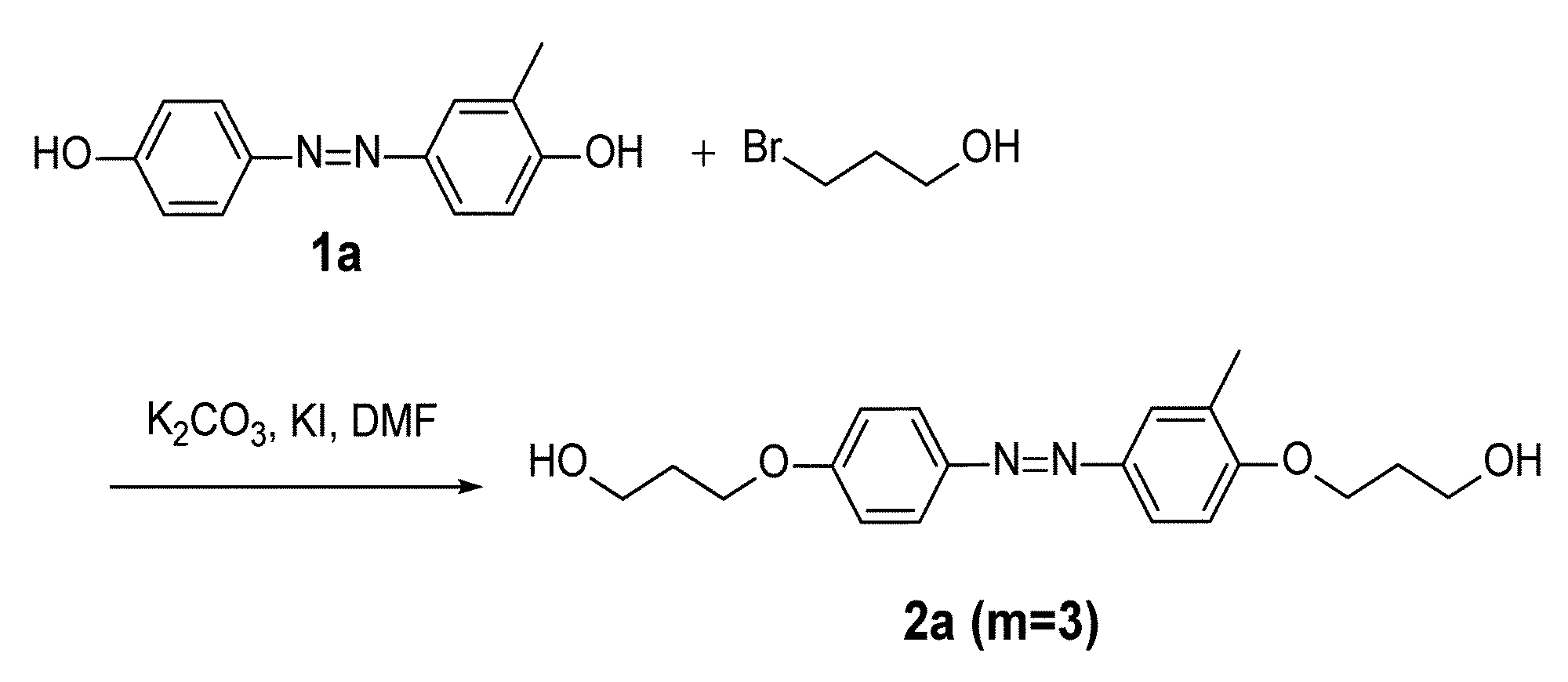
4,4'-Dihydroxy-3-methylazobenzene(1a)(1.03g、4.5mmol)、3-ブロモ-1-プロパノール(2.08g、15mmol)、炭酸カリウム(1.87g、13.5mmol)、およびヨウ化カリウム(44.8mg、0.27mmol)に15mLのN,N-ジメチルホルムアミド(DMF)を加えた。この混合物を120℃で48時間撹拌し、その後、水を加え生成物を析出させた。沈殿を濾過し、エタノールで再結晶を行うことにより黄色粉末2a(m=3)を得た(収率23.2%)。
1H NMR (500MHz, CDCl3) δ 7.86 (d, J=9.0, 2H), 7.73-7.76 (m, 2H), 7.01 (d, J=9.0, 2H), 6.94 (d, J=8.4, 1H), 4.19-4.23 (m, 4H), 3.88-3.92 (m, 4H), 2.29 (s, 3H), 2.09-2.13 (m, 4H) 13C NMR (125MHz, CDCl3) δ 160.75, 159.11, 147.24, 146.68, 127.36, 124.30, 123.69, 123.42, 114.71, 110.64, 65.89, 65.82, 60.38, 60.17, 32.11, 32.02, 16.43
〔実施例1-2-2:実施例中間体2a(m=4)の合成〕 下記化学反応式に示される合成スキームに従って、実施例中間体2a(m=4)を合成した。

4,4'-Dihydroxy-3-methylazobenzene(1a)(1.14g、5.0mmol)を反応容器に入れ、炭酸カリウム(1.73g、12.5mmol)、ヨウ化カリウム(83.0mg、0.5mmol)、および無水アセトン(18mL)を加えた。混合物を0℃に冷却し、4-クロロブチルベンゾエート(2.05mL、11.0mmol)を0℃で滴下した後、85℃の油浴で24時間加熱還流した。24時間後、さらに無水アセトン(10mL)を加え、16時間還流を続けた。
アセトンを蒸発させた後、エタノール:水=1:1の混合液(25mL)に溶解したKOH(65.0mmol)を添加し、110℃の油浴の還流下で2時間けん化を行った。30mLのEtOAcで反応混合物を3回抽出し、集めた有機相を無水硫酸マグネシウムで乾燥させ濾過した。粗生成物をカラムクロマトグラフィー(シリカゲル100~200μM、酢酸エチル:ヘキサン=1:4の混合液→100%酢酸エチル)で精製して、黄色固体2a(m=4)を得た(350.0mg、収率19%)。
1H NMR (500MHz, CDCl3) δ 7.86 (d, J=9.0, 2H), 7.76-7.72 (m, 2H), 6.99 (d, J=9.0, 2H), 6.92 (d, J=9.3, 1H), 4.13-4.07 (m, 4H), 3.80-3.73 (m, 4H), 2.31 (s, 3H), 1.99-1.90 (m, 4H), 1.85-1.76 (m, 4H)
13C NMR (125MHz, CDCl3) δ 160.83, 159.23, 147.19, 146.59, 127.48, 124.25, 123.62, 123.36, 114.69, 110.62, 68.06, 68.02, 62.61, 62.57, 29.54, 29.44, 25.83, 25.78, 16.37
13C NMR (125MHz, CDCl3) δ 160.83, 159.23, 147.19, 146.59, 127.48, 124.25, 123.62, 123.36, 114.69, 110.62, 68.06, 68.02, 62.61, 62.57, 29.54, 29.44, 25.83, 25.78, 16.37
〔実施例1-2-3:実施例中間体2a(m=5)の合成〕 上記2a(m=4)の合成で用いた4-クロロペンチルアセテートの代わりに4-クロロブチルベンゾエート(2.05mL、11.0mmol)を用い、実施例1-2-2と同様の方法により黄色固体2a(m=5)を得た(324.0mg、収率16%)(下記化学反応式参照)。

1H NMR (500MHz, CDCl3) δ 7.86 (d, J=9.0, 2H), 7.76-7.72 (m, 2H), 6.99 (d, J=9.1, 2H), 6.91 (d, J=9.4, 1H), 4.09-4.04 (m, 4H), 3.73-3.69 (m, 4H), 2.30 (s, 3H), 1.93-1.84 (m, 4H), 1.72-1.54 (m, 12H)
13C NMR (125MHz, CDCl3) δ 160.97, 159.35, 147.12, 146.52, 127.52, 124.23, 123.57, 123.35, 114.67, 110.58, 68.12, 68.07, 62.85, 62.82, 32.45, 29.69, 29.08, 29.02, 22.46, 22.38, 16.36
13C NMR (125MHz, CDCl3) δ 160.97, 159.35, 147.12, 146.52, 127.52, 124.23, 123.57, 123.35, 114.67, 110.58, 68.12, 68.07, 62.85, 62.82, 32.45, 29.69, 29.08, 29.02, 22.46, 22.38, 16.36
〔実施例1-2-4:実施例中間体2a(m=6)の合成〕
下記化学反応式に示される合成スキームに従って、実施例中間体2a(m=6)を合成した。
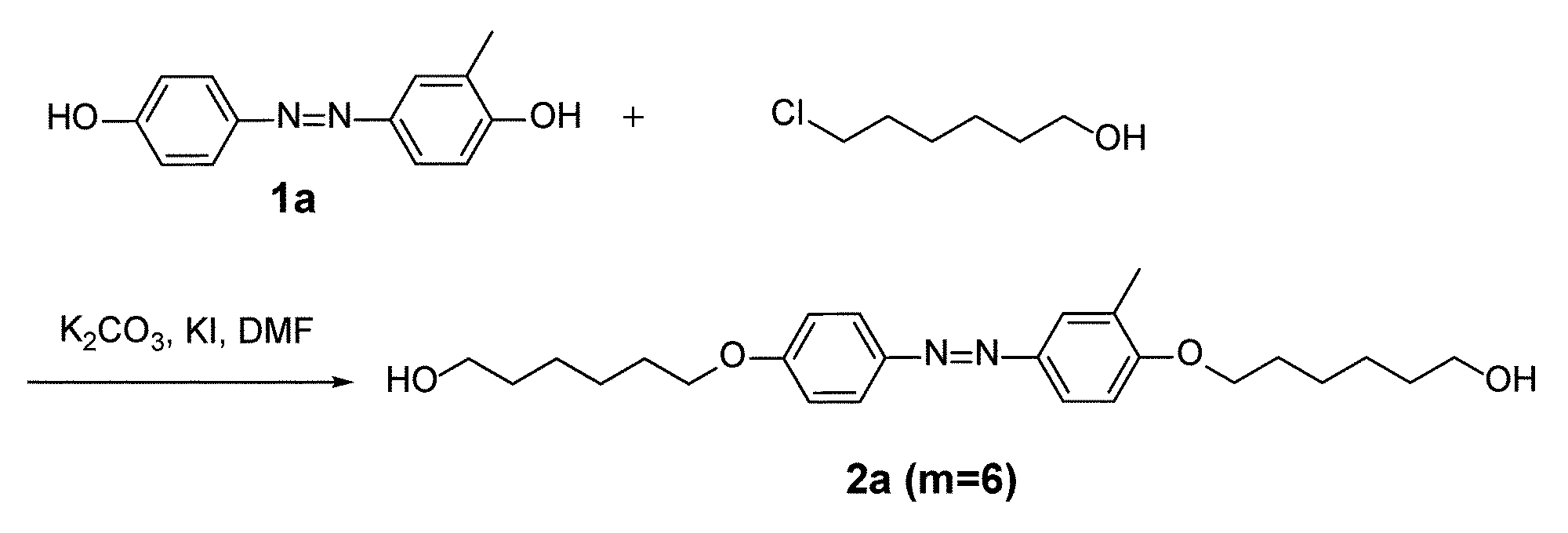
4,4'-Dihydroxy-3-methylazobenzene (1a)(2.28g、10mmol)、炭酸カリウム(4.14g、30mmol)、およびヨウ化カリウム(0.01g、0.06mmol)を40mLのDMFに溶解した。6-クロロ-1-ヘキサノール(3.0g、22mmol)をDMF10mLに溶解した溶液をこれに滴下した。この混合物を120℃で70時間撹拌し、その後、水を加え生成物を析出させた。沈殿を濾過し、エタノールで再結晶を行うことにより黄色粉末2a(m=6)を得た(収率51.2%)。
1H NMR (400MHz, CDCl3) δ 7.88 (d, J1=6.9 Hz, J2=2.0 Hz, 2H), 7.76 (d, J=2.4Hz, 1H), 7.75 (d, J=2.7Hz, 1H), 7.01 (d-d, J1=6.9Hz, J2=1.9Hz, 2H), 6.92 (d, J=9.4Hz, 1H), 4.08 (d-d, J1=11.32Hz, J2=6.32Hz, 4H), 3.71 (t, J1=12.52Hz, J2=6.16Hz, 4H), 2.31 (s, 3H), 1.82-1.92 (m, 4H), 1.46-1.68 (m, 12H)
13C NMR (100MHz, CDCl3) δ 161.39, 159.79, 147.44, 146.83, 127.90, 124.62, 123.85, 115.05, 110.93, 68.54, 68.48, 63.33, 33.11, 29.65, 29.61, 26.39, 26.29, 25.96, 16.80
13C NMR (100MHz, CDCl3) δ 161.39, 159.79, 147.44, 146.83, 127.90, 124.62, 123.85, 115.05, 110.93, 68.54, 68.48, 63.33, 33.11, 29.65, 29.61, 26.39, 26.29, 25.96, 16.80
〔実施例1-2-5:実施例中間体2a(m=8)の合成〕
上記2a(m=3)の合成で用いた3-ブロモ-1-プロパノールの代わりに8-ブロモ-1-オクタノール(3.14g、15mmol)を用い、実施例1-2-1と同様の方法により黄色粉末2a(m=8)を得た。さらに、ゲルパーミエーションクロマトグラフィによりクロロホルム溶媒でろ液を精製し、黄色粉末2a(m=8)を得た(収率75.6%)(下記化学反応式参照)。
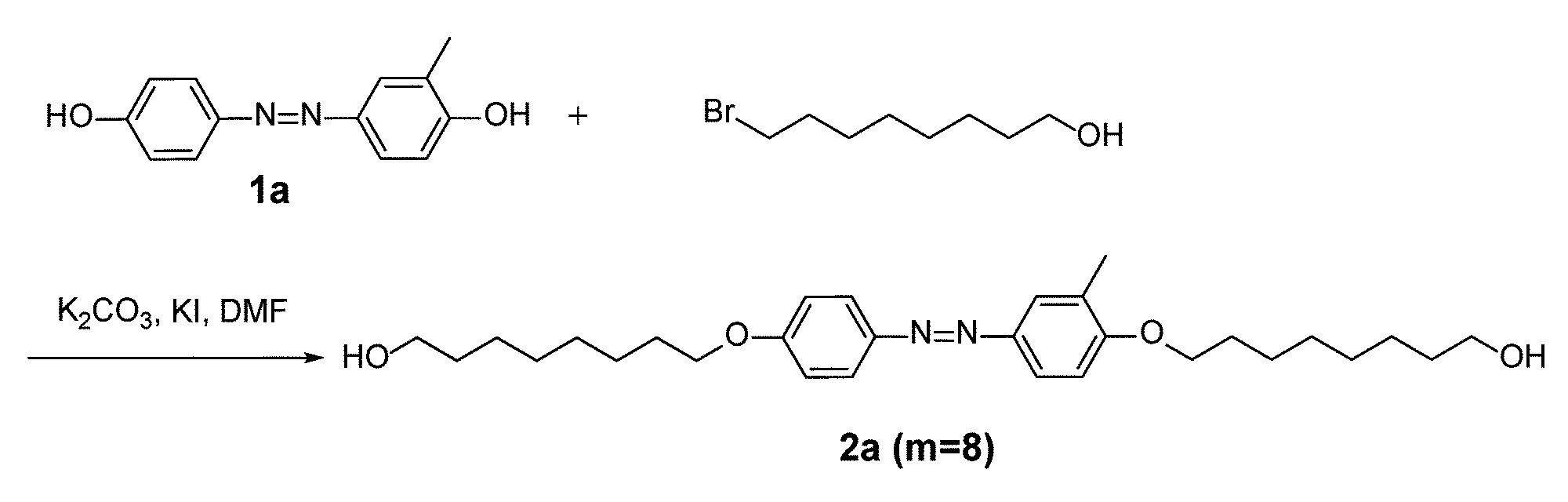
上記2a(m=3)の合成で用いた3-ブロモ-1-プロパノールの代わりに8-ブロモ-1-オクタノール(3.14g、15mmol)を用い、実施例1-2-1と同様の方法により黄色粉末2a(m=8)を得た。さらに、ゲルパーミエーションクロマトグラフィによりクロロホルム溶媒でろ液を精製し、黄色粉末2a(m=8)を得た(収率75.6%)(下記化学反応式参照)。
1H NMR (500MHz, CDCl3) δ 7.85 (d, J=8.9, 2H), 7.72-7.74 (m, 2H), 6.98 (d, J=9.0, 2H), 6.90 (d, J=9.4, 1H), 4.01-4.06 (m, 4H), 3.63-3.67 (m, 4H), 2.29 (s, 3H), 1.78-1.86 (m, 4H), 1.54-1.59 (m, 4H), 1.44-1.51 (m, 4H), 1.28-1.40 (m, 20H)
13C NMR (125MHz, CDCl3) δ 161.06, 159.45, 147.07, 146.46, 127.51, 124.22, 123.54, 123.36, 114.68, 110.59, 68.29, 68.25, 62.99, 32.77, 29.34, 29.26, 29.21, 26.07, 25.97, 25.70, 16.37
13C NMR (125MHz, CDCl3) δ 161.06, 159.45, 147.07, 146.46, 127.51, 124.22, 123.54, 123.36, 114.68, 110.59, 68.29, 68.25, 62.99, 32.77, 29.34, 29.26, 29.21, 26.07, 25.97, 25.70, 16.37
〔実施例1-2-6:実施例中間体2a(m=11)の合成〕
上記2a(m=3)の合成で用いた3-ブロモ-1-プロパノールの代わりに11-ブロモ-1-ウンデカノール(3.01g、12mmol)を用い、撹拌時間を24時間に変更して、実施例1-2-1と同様の方法により黄色粉末2a(m=11)を得た(下記化学反応式参照)。

上記2a(m=3)の合成で用いた3-ブロモ-1-プロパノールの代わりに11-ブロモ-1-ウンデカノール(3.01g、12mmol)を用い、撹拌時間を24時間に変更して、実施例1-2-1と同様の方法により黄色粉末2a(m=11)を得た(下記化学反応式参照)。
1H NMR (500MHz, CDCl3) δ 7.85 (d, J=9.0, 2H), 7.71-7.74 (m, 2H), 6.98 (d, J=9.0, 2H), 6.90 (d, J=9.4, 1H), 4.01-4.06 (m, 4H), 3.64 (t, J=6.7, 4H), 2.29 (s, 3H), 1.79-1.87 (m, 4H), 1.57-1.61 (m, 4H), 1.46-1.52 (m, 4H), 1.35-1.42 (m, 32H)
13C NMR (125MHz, CDCl3) δ 161.08, 159.47, 147.06, 146.46, 127.53, 124.21, 123.53, 123.36, 114.69, 110.59, 68.34, 68.28, 63.07, 32.82, 29.58, 29.53, 29.50, 29.43, 29.36, 29.27, 29.23, 26.11, 26.02, 25.76, 16.38
13C NMR (125MHz, CDCl3) δ 161.08, 159.47, 147.06, 146.46, 127.53, 124.21, 123.53, 123.36, 114.69, 110.59, 68.34, 68.28, 63.07, 32.82, 29.58, 29.53, 29.50, 29.43, 29.36, 29.27, 29.23, 26.11, 26.02, 25.76, 16.38
〔実施例1-2-7:実施例中間体2a(m=12)の合成〕
上記2a(m=3)の合成で用いた3-ブロモ-1-プロパノールの代わりに12-ブロモ-1-ドデカノール(3.18g、12mmol)を用い、撹拌時間を22時間に変更して、実施例1-2-1と同様の方法により黄色粉末2a(m=12)を得た(下記化学反応式参照)。
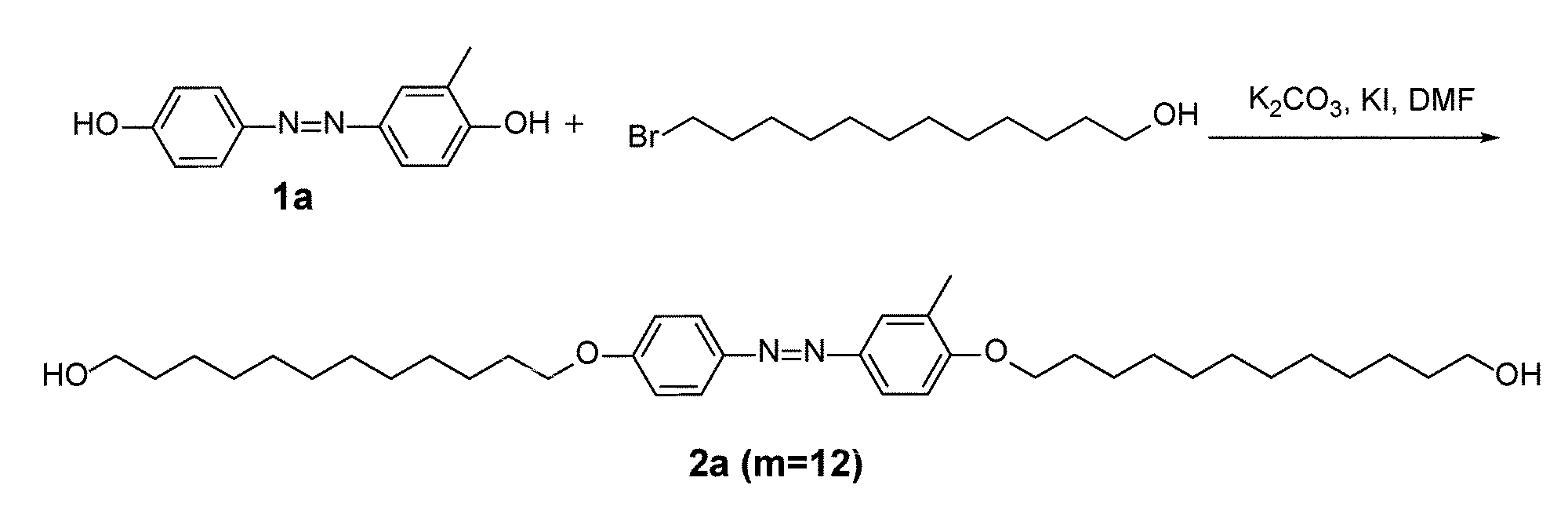
上記2a(m=3)の合成で用いた3-ブロモ-1-プロパノールの代わりに12-ブロモ-1-ドデカノール(3.18g、12mmol)を用い、撹拌時間を22時間に変更して、実施例1-2-1と同様の方法により黄色粉末2a(m=12)を得た(下記化学反応式参照)。
1H NMR (500MHz, CDCl3) δ 7.85 (d, J=9.0, 2H), 7.71-7.74 (m, 2H), 6.98 (d, J=9.0, 2H), 6.90 (d, J=9.4, 1H), 4.01-4.06 (m, 4H), 3.64 (t, J=6.6, 4H), 2.29 (s, 3H), 1.78-1.86 (m, 4H), 1.54-1.59 (m, 4H), 1.44-1.52 (m, 4H), 1.26-1.40 (m, 36 H)
13C NMR (125MHz, CDCl3) δ 161.08, 159.48, 147.06, 146.46, 127.54, 124.22, 123.52, 123.37, 114.69, 110.59, 68.35, 68.29, 63.09, 32.83, 29.60, 29.56, 29.44, 29.37, 29.27, 29.23, 26.11, 26.03, 25.76, 16.38
13C NMR (125MHz, CDCl3) δ 161.08, 159.48, 147.06, 146.46, 127.54, 124.22, 123.52, 123.37, 114.69, 110.59, 68.35, 68.29, 63.09, 32.83, 29.60, 29.56, 29.44, 29.37, 29.27, 29.23, 26.11, 26.03, 25.76, 16.38
〔実施例1-2-8:実施例中間体2a(m=16)の合成〕
上記2a(m=3)の合成で用いた3-ブロモ-1-プロパノールの代わりに16-ブロモ-1-ヘキサデカノール(0.48g、1.5mmol)を用い、4,4'-Dihydroxy-3-methylazobenzene(1a)、炭酸カリウム、およびヨウ化カリウムの使用量を、それぞれ0.16g(0.7mmol)、0.69g(5mmol)、および33mg(0.20mmol)に変更し、さらに撹拌時間を72時間に変更して、実施例1-2-1と同様の方法により黄色粉末2a(m=16)を得た(収率73.1%)(下記化学反応式参照)。

上記2a(m=3)の合成で用いた3-ブロモ-1-プロパノールの代わりに16-ブロモ-1-ヘキサデカノール(0.48g、1.5mmol)を用い、4,4'-Dihydroxy-3-methylazobenzene(1a)、炭酸カリウム、およびヨウ化カリウムの使用量を、それぞれ0.16g(0.7mmol)、0.69g(5mmol)、および33mg(0.20mmol)に変更し、さらに撹拌時間を72時間に変更して、実施例1-2-1と同様の方法により黄色粉末2a(m=16)を得た(収率73.1%)(下記化学反応式参照)。
1H NMR (500MHz, CDCl3) δ 7.85 (d, J=8.9, 2H), 7.71-7.74 (m, 2H), 6.98 (d, J=9.0, 2H), 6.90 (d, J=9.3, 1H), 4.01-4.06 (m, 4H), 3.64 (t, J=6.7, 4H), 2.29 (s, 3H), 1.78-1.86 (m, 4H), 1.54-1.59 (m, 4H), 1.44-1.52 (m, 4H), 1.26-1.40 (m, 36H) 13C NMR (100MHz, CDCl3) δ 161.04, 159.45, 146.99, 146.37, 127.51, 124.19, 123. 45, 123.38, 114. 64, 110.51, 68.31, 68.25, 63.10, 32. 81, 29.66, 29.60, 29.44, 29.39, 29.25, 29.22, 26.11, 26.02, 25.74, 16.41
〔実施例1-3-1:実施例アゾ化合物3a(m=3)の合成〕
下記化学反応式に示される合成スキームに従って、実施例アゾ化合物3a(m=3)を合成した。

下記化学反応式に示される合成スキームに従って、実施例アゾ化合物3a(m=3)を合成した。
上記2a(m=3)(4.30g、10mmol)、トリエチルアミン(2.02g、20mmol)、および4-ジメチルアミノピリジン(0.28g)を脱水テトラヒドロフラン(THF)に溶解し0℃に冷却しながら、メタクリロイルクロリド(35mmol)とTHF(30mL)の混合溶液を加えた。反応は薄層クロマトグラフィーで追跡し、2a(m=3)が消費されたことを確認した後、水を加えた。混合溶液をクロロホルムで抽出し、有機相を集め、無水硫酸マグネシウムで乾燥した。濾過後、溶媒を留去し得られた黄色固体を、酢酸エチル:ヘキサン=1:10の混合液を展開溶媒とするシリカゲルカラムクロマトグラフィーにより2回精製することにより3a(m=3)を得た(収率62.0%)。
1H NMR (400MHz, CDCl3) δ 7.85-7.88 (d, J=9.04, 2H), 7.73-7.75 (m, 2H), 7.02 (d, J=9.04, 2H), 6.92 (d, J=9.28, 1H), 6.12 (s, 2H), 5.57 (s, 2H), 4.35-4.41 (m, 4H), 4.13-4.17 (m, 4H), 2.29 (s, 3H), 2.18-2.27 (m, 4H) 1.95 (s, 6H)
13C NMR (100MHz, CDCl3) δ 167.41, 160.67, 159.02, 147.19, 146.62, 136.28, 127.59, 125.63, 124.29, 123.58, 123.45, 114.65, 110.49, 64.73, 64. 62, 61. 50, 61.44, 28.74, 28.65, 18.36, 16.39
13C NMR (100MHz, CDCl3) δ 167.41, 160.67, 159.02, 147.19, 146.62, 136.28, 127.59, 125.63, 124.29, 123.58, 123.45, 114.65, 110.49, 64.73, 64. 62, 61. 50, 61.44, 28.74, 28.65, 18.36, 16.39
〔実施例1-3-2:実施例アゾ化合物3a(m=4)の合成〕
下記化学反応式に示される合成スキームに従って、実施例アゾ化合物3a(m=4)を合成した。

下記化学反応式に示される合成スキームに従って、実施例アゾ化合物3a(m=4)を合成した。
上記2a(m=4)(307.0mg、0.82mmol)をTHF(15mL)に溶解し、トリエチルアミン(250μL、1.80mmol)およびN,N-ジメチル-4-アミノピリジン(DMAP)(9.9mg、0.082mmol、10mol%)を加えた。混合物を0℃に冷却し、メタクリロイルクロリド(280μL、2.87mmol)を0℃で滴下した。反応物を0℃で6時間撹拌し、さらに一晩撹拌しながら室温に温めた。16時間後、反応物を0℃に冷却し、水(約3mL)を滴下してクエンチした。
Na2CO3(30mL)を加え、混合物を30mLのクロロホルムで3回抽出した。集めた有機相を無水硫酸マグネシウムで乾燥し、濾過し、そして真空中で濃縮した。カラムクロマトグラフィー(シリカゲル40~60μM、酢酸エチル:ヘキサン=1:12の混合液→酢酸エチル:ヘキサン=1:4の混合液)による精製により、オレンジ色の結晶性固体3a(m=4)を得た(143.0mg、収率34.3%)。
1H NMR (500MHz, CDCl3) δ 7.86 (d, J=9.0, 2H), 7.76-7.72 (m, 2H), 6.99 (d, J=9.0, 2H), 6.90 (d, J=9.3, 1H), 6.12 (br. s, 2H), 5.57 (br. s, 2H), 4.29-4.23 (m, 4H), 4.13-4.07 (m, 4H), 2.30 (s, 3H), 1.99-1.92 (m, 14H)
13C NMR (125MHz, CDCl3) δ 167.44, 160.83, 159.18, 147.18, 146.58, 136.43, 127.51, 125.33, 124.25, 123.62, 123.35, 114.65, 110.52, 67.61, 67.57, 64.32, 64.27, 26.03, 25.95, 25.55, 25.44, 18.29, 16.35
13C NMR (125MHz, CDCl3) δ 167.44, 160.83, 159.18, 147.18, 146.58, 136.43, 127.51, 125.33, 124.25, 123.62, 123.35, 114.65, 110.52, 67.61, 67.57, 64.32, 64.27, 26.03, 25.95, 25.55, 25.44, 18.29, 16.35
〔実施例1-3-3:実施例アゾ化合物3a(m=5)の合成〕
上記3a(m=4)の合成で用いた2a(m=4)の代わりに2a(m=5)(324.0mg、0.81mmol)を用い、実施例1-3-2と同様の方法によりオレンジ色の結晶性固体3a(m=5)を得た(80.0mg、収率14.9%)(下記化学反応式参照)。

上記3a(m=4)の合成で用いた2a(m=4)の代わりに2a(m=5)(324.0mg、0.81mmol)を用い、実施例1-3-2と同様の方法によりオレンジ色の結晶性固体3a(m=5)を得た(80.0mg、収率14.9%)(下記化学反応式参照)。
1H NMR (500MHz, CDCl3) δ 7.86 (d, J=8.9, 2H), 7.76-7.71 (m, 2H), 6.98 (d, J=9.0, 2H), 6.90 (d, J=9.4, 1H), 6.12 (br. s, 2H), 5.57 (br. s, 2H), 4.24-4.18 (m, 4H), 4.09-4.04 (m, 4H), 2.29 (s, 3H), 1.96 (s, 6H), 1.94-1.84 (m, 4H), 1.84-1.75 (m, 4H), 1.70-1.57 (m, 4H)
13C NMR (125MHz, CDCl3) δ 167.49, 160.93, 159.30, 147.13, 146.53, 136.50, 127.50, 125.23, 124.23, 123.57, 123.35, 114.66, 110.54, 67.95, 67.89, 64.49, 28.91, 28.86, 28.40, 22.74, 22.65, 18.30, 16.32
13C NMR (125MHz, CDCl3) δ 167.49, 160.93, 159.30, 147.13, 146.53, 136.50, 127.50, 125.23, 124.23, 123.57, 123.35, 114.66, 110.54, 67.95, 67.89, 64.49, 28.91, 28.86, 28.40, 22.74, 22.65, 18.30, 16.32
〔実施例1-3-4:実施例アゾ化合物3a(m=6)の合成〕
上記3a(m=3)の合成で用いた2a(m=3)の代わりに2a(m=6)(324.0mg、0.81mmol)を用い、トリエチルアミンの使用量を2.02g(20mmol)に変更して、実施例1-3-1と同様の方法により黄色固体3a(m=6)を得た(以下「M-azo」と記載することがある)(収率52.2%)(下記化学反応式参照)。

上記3a(m=3)の合成で用いた2a(m=3)の代わりに2a(m=6)(324.0mg、0.81mmol)を用い、トリエチルアミンの使用量を2.02g(20mmol)に変更して、実施例1-3-1と同様の方法により黄色固体3a(m=6)を得た(以下「M-azo」と記載することがある)(収率52.2%)(下記化学反応式参照)。
1H NMR (500MHz, CDCl3) δ 7.86-7.88 (d, J=9.0, 2H), 7.74-7.76 (m, 2H), 7.00 (d, J=9.0, 2H), 6.92 (d, J=9.4, 1H), 6.12 (s, 2H), 5.57 (s, 2H), 4.17-4.21 (m, 4H), 4.04-4.08 (m, 4H), 2.30 (s, 3H), 1.96 (s, 6H), 1.84-1.87 (m, 4H), 1.73-1.76 (m, 4H), 1.52-1.62 (8H)
13C NMR (125MHz, CDCl3) δ 167.54, 161.01, 147.13, 146.53, 136.56, 127.53, 125.18, 124.24, 123.58, 123.36, 114.68, 110.59, 68.12, 68.08, 64.64, 29.19, 29.14, 28.60, 25.83, 25.77, 18.32, 16.37
13C NMR (125MHz, CDCl3) δ 167.54, 161.01, 147.13, 146.53, 136.56, 127.53, 125.18, 124.24, 123.58, 123.36, 114.68, 110.59, 68.12, 68.08, 64.64, 29.19, 29.14, 28.60, 25.83, 25.77, 18.32, 16.37
〔比較例1-3:比較例アゾ化合物3b(m=6)の合成〕
2a(m=6)の代わりに下記の2b(m=6)を用いた以外は、実施例1-3-4のM-azoの合成と同様にして、比較例アゾ化合物(以下「H-azo」と記載することがある)を得た(下記化学反応式参照)。比較例中間体2bの合成反応に関しては、下記文献Aを参照した。
文献A:S. Muhammed, O. Jesper, T. Helena, S. Kent, K. Mikhail, Liquid Crystals, 2005, 32, 901-908.
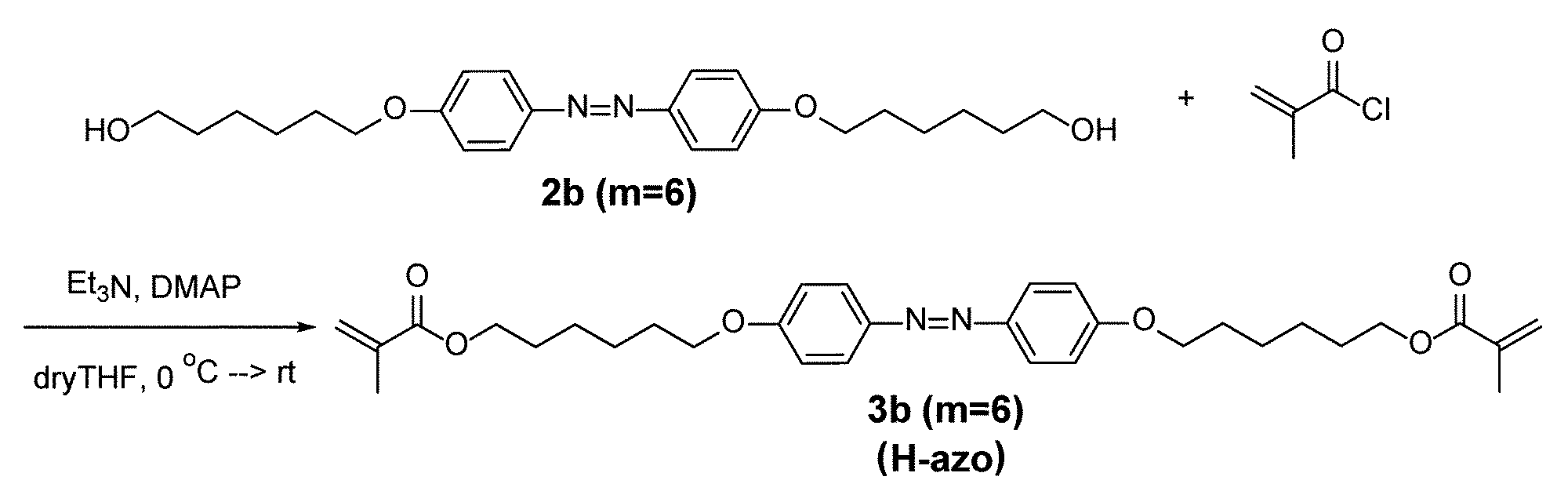
2a(m=6)の代わりに下記の2b(m=6)を用いた以外は、実施例1-3-4のM-azoの合成と同様にして、比較例アゾ化合物(以下「H-azo」と記載することがある)を得た(下記化学反応式参照)。比較例中間体2bの合成反応に関しては、下記文献Aを参照した。
文献A:S. Muhammed, O. Jesper, T. Helena, S. Kent, K. Mikhail, Liquid Crystals, 2005, 32, 901-908.
1H NMR (400MHz, CDCl3) δ 7.84-7.87 (m, 4H), 6.97-6.99 (m, 4H), 6.12 (m, 2H), 5.55 (m, 2H), 4.15-4.18 (m, 4H), 4.02-4.06 (m, 4H), 1.48-1.96 (m, 22H)
13C NMR (100MHz, CDCl3) δ 161.09, 146.98, 136.51, 125.28, 124.32, 114.65, 102.13, 68.10, 64.66, 29.12, 28.58, 25.83, 25.76, 18.36
13C NMR (100MHz, CDCl3) δ 161.09, 146.98, 136.51, 125.28, 124.32, 114.65, 102.13, 68.10, 64.66, 29.12, 28.58, 25.83, 25.76, 18.36
〔実施例1-3-5:実施例アゾ化合物3a(m=8)の合成〕
下記化学反応式に示される合成スキームに従って、実施例アゾ化合物3a(m=8)を合成した。
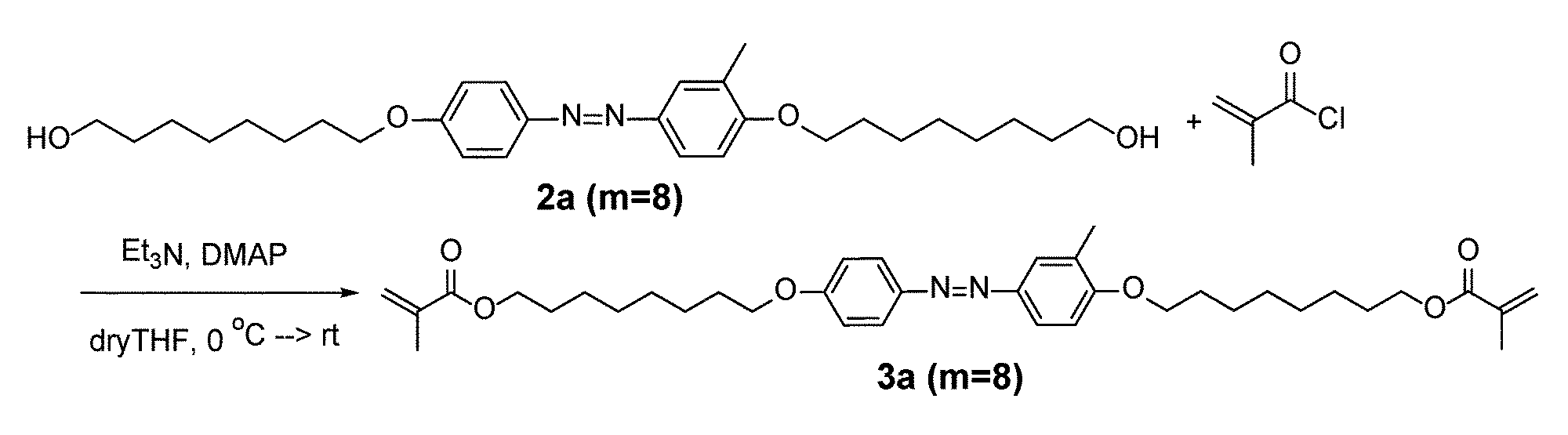
下記化学反応式に示される合成スキームに従って、実施例アゾ化合物3a(m=8)を合成した。
上記2a(m=8)(0.97g、2mmol)と4-ジメチルアミノピリジン(0.59g、4.8mmol)を20mLの脱水THFに溶解し、トリエチルアミン(0.49g、4.8mmol)を添加した後、溶液を0℃に冷却した。そこに、メタクリロイルクロリド(0.63g、6mmol)の脱水THF(20mL)溶液をゆっくりと滴下した。滴下終了後、10分間0℃で撹拌し、その後、室温で24時間撹拌した。反応後、溶媒を減圧留去し、残渣に塩化メチレンおよび0.1N塩酸を加え分液した後、有機相を無水硫酸マグネシウムで乾燥した。硫酸マグネシウムをろ別後、溶媒を減圧留去した。酢酸エチル:ヘキサン=1:12の混合液を用いて、得られた残渣をシリカゲルカラムクロマトグラフィーにより精製し3a(m=8)を得た(収率8.1%)。
1H NMR (500MHz, CDCl3) δ 7.85 (d, J=9.0, 2H), 7.72-7.74 (m, 2H), 6.98 (d, J=9.0, 2H), 6.90 (d, J=9.4, 1H), 6.10 (bs, 2H), 5.54 (bs, 2H), 4.15 (t, J=6.7, 4H), 4.01-4.06 (m, 4H), 2.29 (s, 3H), 1.94 (s, 6H), 1.80-1.85 (m, 4H), 1.66-1.70 (m, 4H), 1.46-1.53 (m, 4H), 1.37-1.43 (m, 20H)
13C NMR (125MHz, CDCl3) δ 167.56, 161.06, 159.44, 147.10, 146.50, 136.60, 127.53, 125.12, 124.23, 123.55, 123.37, 114.69, 110.60, 68.27, 68.23, 64.78, 29.26, 29.21, 28.64, 26.07, 25.95, 18.32, 16.37
13C NMR (125MHz, CDCl3) δ 167.56, 161.06, 159.44, 147.10, 146.50, 136.60, 127.53, 125.12, 124.23, 123.55, 123.37, 114.69, 110.60, 68.27, 68.23, 64.78, 29.26, 29.21, 28.64, 26.07, 25.95, 18.32, 16.37
〔実施例1-3-6:実施例アゾ化合物3a(m=11)の合成〕
上記3a(m=8)の合成で用いた2a(m=8)の代わりに2a(m=11)(1.14g、2 mmol)を用い、室温での攪拌を3時間に変更して、実施例1-3-5と同様の方法により3a(m=11)を得た(収率17.8%)(下記化学反応式参照)。

上記3a(m=8)の合成で用いた2a(m=8)の代わりに2a(m=11)(1.14g、2 mmol)を用い、室温での攪拌を3時間に変更して、実施例1-3-5と同様の方法により3a(m=11)を得た(収率17.8%)(下記化学反応式参照)。
1H NMR (500MHz, CDCl3) δ 7.76 (d, J=9.0, 2H), 7.62-7.65 (m, 2H), 6.87 (d, J=9.0, 2H), 6.78 (d, J=9.4, 1H), 6.00 (bs, 2H), 5.43 (bs, 2H), 4.04 (t, J=6.7, 4H), 3.87-3.92 (m, 4H), 2.19 (s, 3H), 1.84 (s, 6H), 1.66-1.74 (m, 4H), 1.54-1.59 (m, 4H), 1.17-1.38 (m, 28H)
13C NMR (125MHz, CDCl3) δ 166.38, 160.01, 158.37, 146.00, 145.40, 135.53, 126.35, 123.98, 123.16, 122.51, 122.32, 113.58, 109.48, 67.22, 67.18, 63.72, 28.78, 28.44, 28.33, 28.20, 27.59, 25.07, 24.98, 24.94, 17.25, 15.31
13C NMR (125MHz, CDCl3) δ 166.38, 160.01, 158.37, 146.00, 145.40, 135.53, 126.35, 123.98, 123.16, 122.51, 122.32, 113.58, 109.48, 67.22, 67.18, 63.72, 28.78, 28.44, 28.33, 28.20, 27.59, 25.07, 24.98, 24.94, 17.25, 15.31
〔実施例1-3-7:実施例アゾ化合物3a(m=12)の合成〕
下記化学反応式に示される合成スキームに従って、実施例アゾ化合物3a(m=8)を合成した。

下記化学反応式に示される合成スキームに従って、実施例アゾ化合物3a(m=8)を合成した。
上記2a(m=12)(0.60g、1mmol)を20mLの脱水THFに溶解し、トリエチルアミン(0.23g、2.4mmol)を添加した後、溶液を0℃に冷却した。そこに、メタクリロイルクロリド(0.25g、2.4mmol)の脱水THF(10mL)溶液をゆっくりと滴下した。滴下終了後、10分間0℃で撹拌し、その後、室温で24時間撹拌した。反応後、溶媒を減圧留去し、残渣に塩化メチレンおよび0.1N塩酸を加えて分液した後、有機相を無水硫酸マグネシウムで乾燥した。硫酸マグネシウムをろ別後、溶媒を減圧留去した。酢酸エチル:ヘキサン=1:12の混合液を用いて、得られた残渣をシリカゲルカラムクロマトグラフィーにより精製し、3a(m=12)を得た(収率38.6%)。
1H NMR (500MHz, CDCl3) δ 7.85 (d, J=9.1, 2H), 7.62-7.65 (m, 2H), 6.98 (d, J=9.0, 2H), 6.90 (d, J=9.5, 1H), 6.10 (bs, 2H), 5.54 (bs, 2H), 4.14 (t, J= 6.7, 4H), 4.01-4.06 (m, 4H), 2.29 (s, 3H), 1.94 (s, 6H), 1.78-1.86 (m, 4H), 1.64-1.70 (m, 4H), 1.44-1.52 (m, 4H), 1.26-1.40 (m, 28H)
13C NMR (125MHz, CDCl3) δ 167.55, 161.08, 159.47, 147.08, 146.48, 136.62, 127.52, 125.07, 124.22, 123.54, 123.36, 114.69. 110.59, 68.34, 68.29, 64.84, 29.55, 29.52, 29.39, 29.26, 28.65, 26.13, 26.04, 26.00, 18.32, 16.37
13C NMR (125MHz, CDCl3) δ 167.55, 161.08, 159.47, 147.08, 146.48, 136.62, 127.52, 125.07, 124.22, 123.54, 123.36, 114.69. 110.59, 68.34, 68.29, 64.84, 29.55, 29.52, 29.39, 29.26, 28.65, 26.13, 26.04, 26.00, 18.32, 16.37
〔実施例1-3-8:実施例アゾ化合物3a(m=16)の合成〕
上記3a(m=4)の合成で用いた2a(m=4)の代わりに2a(m=16)(4.30g、10mmol)を用い、トリエチルアミンの使用量を2.02g(20mmol)に変更して、実施例1-3-2と同様の方法により3a(m=16)を得た(収率8.1%)(下記化学反応式参照)。
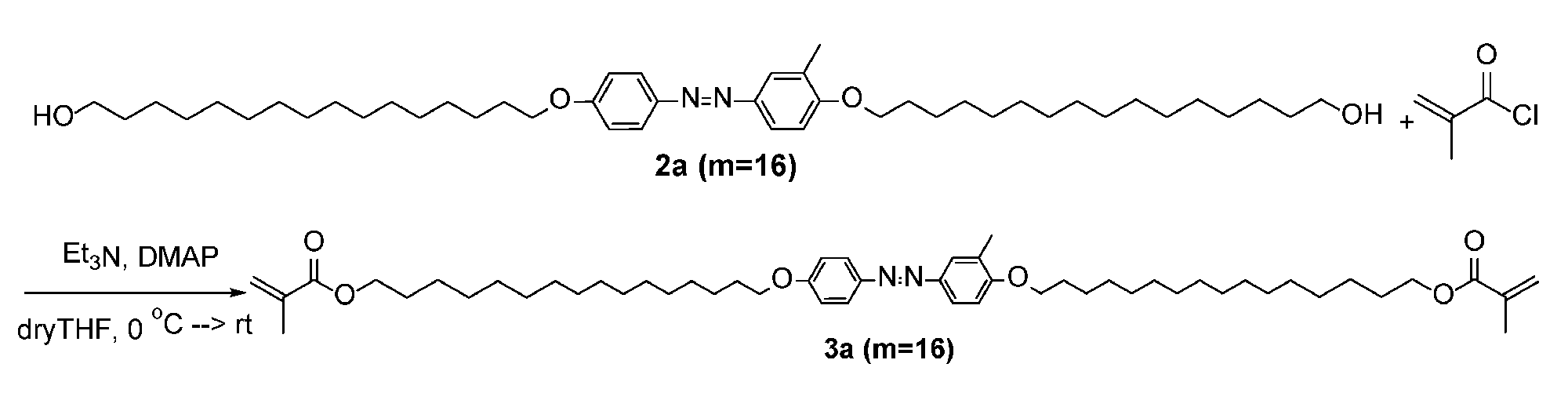
上記3a(m=4)の合成で用いた2a(m=4)の代わりに2a(m=16)(4.30g、10mmol)を用い、トリエチルアミンの使用量を2.02g(20mmol)に変更して、実施例1-3-2と同様の方法により3a(m=16)を得た(収率8.1%)(下記化学反応式参照)。
1H NMR (500MHz, CDCl3) δ 7.85 (d, J=9.0, 2H), 7.72-7.73 (m, 2H), 6.99 (d, J=9.0, 2H), 6.90 (d, J=9.3, 1H), 6.09 (s, 2H), 5.54 (s, 2H), 4.14 (t, J=6.74, 4H), 4.01-4.04 (m, 4H), 2.29 (s, 3H), 1.94 (s, 6H), 1.78-1.86 (m, 4H), 1.63-1.69 (m, 4H), 1.26-1.54 (m, 48H)
13C NMR (125MHz, CDCl3) δ 169.39, 167.57, 147.07, 144.96, 143.21, 135.31, 128.68, 125.06, 124.21, 123.54, 123.35, 114.70, 110.61, 68.37, 64.86, 29.67, 29.59, 29.53, 29.40, 29.27,28.65, 26.14, 26.05, 26.00,18.32,16.37
13C NMR (125MHz, CDCl3) δ 169.39, 167.57, 147.07, 144.96, 143.21, 135.31, 128.68, 125.06, 124.21, 123.54, 123.35, 114.70, 110.61, 68.37, 64.86, 29.67, 29.59, 29.53, 29.40, 29.27,28.65, 26.14, 26.05, 26.00,18.32,16.37
〔参考例1:高分子化合物用モノマーDGIの合成〕
イタコン酸1-(2,3-ジヒドロキシプロピル)4-ドデシル(DGI)は、下記文献Bおよび文献Cに従って合成した(下記化学反応式参照)。
文献B:K. Naitoh, Y. Ishii, K. Tsujii, J. Phys. Chem. 1991, 95, 7915-7918.
文献C:K. Tsujii, M. Hayakawa, T. Onda, T. Tanaka, Macromolecules 1997, 30.
イタコン酸1-(2,3-ジヒドロキシプロピル)4-ドデシル(DGI)は、下記文献Bおよび文献Cに従って合成した(下記化学反応式参照)。
文献B:K. Naitoh, Y. Ishii, K. Tsujii, J. Phys. Chem. 1991, 95, 7915-7918.
文献C:K. Tsujii, M. Hayakawa, T. Onda, T. Tanaka, Macromolecules 1997, 30.

イタコン酸無水物(50.0g)と、1-ドデカノール(80.0g)を110℃で50分撹拌した。室温に冷却後、激しく撹拌しながらヘキサン100mLを加え、白色固体を沈殿させた。固体を濾過し、エタノールで2回再結晶することにより、中間体であるイタコン酸ドデシルを得た。イタコン酸ドデシル(5.0g)を5mLのトルエンに溶解し、グリシドール(3.75g)および触媒であるピリジニウムp-トルエンスルホナート(10μg)を加え、100℃で5時間撹拌した。冷却後溶媒を留去し、得られた粗生成物を、酢酸エチル:ヘキサン=6:4の混合液を展開溶媒とするシリカゲルカラムクロマトグラフィーにより精製し、その後アセトン:ヘキサン=1:1の混合溶媒で再結晶することによりDGIを得た。
1H NMR (400MHz, DMSO-d6) δ 6.24(s, 1H), 5.83 (s, 1H), 4.93 (d, J=5.16Hz, 1H), 4.66 (t, J1=11.24Hz, J2=5.64Hz, 1H), 4.12 (d-d, J1=11.12Hz, J2=4.32Hz, 1H), 3.95-4.02 (m, 3H), 3.67 (m, 1H), 3.36 (m, 2H), 1.54 (m, 2H), 1.25 (m, 18H), 0.86 (t, 3H)
13C NMR (100MHz, DMSO-d6) δ 171.16, 166.53, 134.88, 129.53, 70.09, 67.04, 65.09, 63.39, 37.98, 32. 17, 29.91, 29.88, 29.83, 29.80, 29.58, 29.49, 28.92, 26.16, 22.97, 14.82
13C NMR (100MHz, DMSO-d6) δ 171.16, 166.53, 134.88, 129.53, 70.09, 67.04, 65.09, 63.39, 37.98, 32. 17, 29.91, 29.88, 29.83, 29.80, 29.58, 29.49, 28.92, 26.16, 22.97, 14.82
〔実施例2:高分子化合物の合成とそのフィルムの作製〕
DGI(22mg)、M-azo(7mg)、および重合開始剤1,1′-アゾビス-(シクロヘキサン-1-カルボニトリル)(0.3mg)をバイアル瓶に入れ、70℃に加熱して溶融した。粘度を下げるために、そこに20μLのトルエンを加えた。この混合物を液晶セル(並行配向、セル厚:5μmまたは10μm、面積:2cm×2cm、E.H.C社製KSRP-50/A107P1NSS)に流し入れた。このセルを窒素雰囲気下で、60℃で1時間、次いで125℃で24時間、ホットプレート上で加熱した。上記操作は、波長500nm以下の光をカットした照明下にて行った。加熱後、室温に放冷し、液晶セルを構成するガラスからフィルムを取り外して使用した。
DGI(22mg)、M-azo(7mg)、および重合開始剤1,1′-アゾビス-(シクロヘキサン-1-カルボニトリル)(0.3mg)をバイアル瓶に入れ、70℃に加熱して溶融した。粘度を下げるために、そこに20μLのトルエンを加えた。この混合物を液晶セル(並行配向、セル厚:5μmまたは10μm、面積:2cm×2cm、E.H.C社製KSRP-50/A107P1NSS)に流し入れた。このセルを窒素雰囲気下で、60℃で1時間、次いで125℃で24時間、ホットプレート上で加熱した。上記操作は、波長500nm以下の光をカットした照明下にて行った。加熱後、室温に放冷し、液晶セルを構成するガラスからフィルムを取り外して使用した。
〔実施例3-1:M-azoの光相転移(光液化)実験〕
M-azoの微粉末(粒径約2mm)に、紫外光(波長:365nm、強度:125mW/cm2)を照射したところ、6秒後に液化、および光異性化に伴う黄色から橙色への色変化を観測した。光照射前後の写真を図1に示す。
M-azoの微粉末(粒径約2mm)に、紫外光(波長:365nm、強度:125mW/cm2)を照射したところ、6秒後に液化、および光異性化に伴う黄色から橙色への色変化を観測した。光照射前後の写真を図1に示す。
〔実施例3-2:M-azoの光相転移観察〕
紫外光照射前後のM-azoの薄膜の写真を図2に示す。強度100mW/cm2の紫外光を10秒間照射した。図2(a)および図2(c)が光照射前を、図2(b)および図2(d)が10秒間の光照射後をそれぞれ示している。図2(a)および図2(b)は、偏光顕微鏡で、クロスニコル下で撮影した。図2(c)および図2(d)は、光学顕微鏡で撮影した。図2(a)で複屈折が確認され、光学的に異方性があることから、図2(a)のM-azoは液体ではないことが確認された。一方、図2(b)では視野全体において暗い像が観察され、複屈折が消失していることが確認された。さらに、図2(d)では、試料の液状化が確認された。
紫外光照射前後のM-azoの薄膜の写真を図2に示す。強度100mW/cm2の紫外光を10秒間照射した。図2(a)および図2(c)が光照射前を、図2(b)および図2(d)が10秒間の光照射後をそれぞれ示している。図2(a)および図2(b)は、偏光顕微鏡で、クロスニコル下で撮影した。図2(c)および図2(d)は、光学顕微鏡で撮影した。図2(a)で複屈折が確認され、光学的に異方性があることから、図2(a)のM-azoは液体ではないことが確認された。一方、図2(b)では視野全体において暗い像が観察され、複屈折が消失していることが確認された。さらに、図2(d)では、試料の液状化が確認された。
〔実施例3-3:光相転移の経時変化観察〕
紫外光照射時のM-azo薄膜の時間経過に伴う変化を、偏光顕微鏡で、クロスニコル下で観察した写真を図3に示す。照射時間が経過するにつれて、黒い領域が増大し、等方相へ相転移したことを示している。
紫外光照射時のM-azo薄膜の時間経過に伴う変化を、偏光顕微鏡で、クロスニコル下で観察した写真を図3に示す。照射時間が経過するにつれて、黒い領域が増大し、等方相へ相転移したことを示している。
〔実施例3-4:M-azoを用いたパターニング実験〕
M-azoを塗布したガラス基板にメタルマスクを載せ、紫外光照射を1秒行ったところ、パターンが形成された(図4(a)および図4(b))。光照射を受けた部分が液化し、固体と液体のパターンが形成された(図4(c))。なお、図中の「1」は固形状部を、「2」は液状部をそれぞれ示す。
M-azoを塗布したガラス基板にメタルマスクを載せ、紫外光照射を1秒行ったところ、パターンが形成された(図4(a)および図4(b))。光照射を受けた部分が液化し、固体と液体のパターンが形成された(図4(c))。なお、図中の「1」は固形状部を、「2」は液状部をそれぞれ示す。
〔実施例3-5:M-azoとH-azoの比較〕
スライドガラス上に、H-azoとM-azoを並べて置き、双方に同時に紫外光(波長:365nm、強度:80mW/cm2)を照射し、時間経過に伴う変化を偏光顕微鏡で、クロスニコル下で撮影した写真を図5に示す。図5(a)は照射前、図5(b)は照射開始から6秒後、図5(c)は照射開始から25秒後、図5(d)は照射開始から40秒後をそれぞれ示している。照射時間が経過するにつれて、M-azoのみ変化が生じ光によって等方相へ相転移していることを示している。
スライドガラス上に、H-azoとM-azoを並べて置き、双方に同時に紫外光(波長:365nm、強度:80mW/cm2)を照射し、時間経過に伴う変化を偏光顕微鏡で、クロスニコル下で撮影した写真を図5に示す。図5(a)は照射前、図5(b)は照射開始から6秒後、図5(c)は照射開始から25秒後、図5(d)は照射開始から40秒後をそれぞれ示している。照射時間が経過するにつれて、M-azoのみ変化が生じ光によって等方相へ相転移していることを示している。
〔実施例3-6:光相転移の速度の測定〕
偏光顕微鏡と分光光度計を組み合わることにより、M-azoとH-azoの光相転移の速度を測定した。図6(a)は、実験装置の模式図であり、最下部のバックライト照明(白色光)の650nmの透過率を分光器(Spectrometer)でモニターした。照射光はサンプルの斜め上方向から照射した。2枚の偏光板(PolarizerおよびAnalyzer)はクロスニコルにすることにより、等方相へ転移すると、透過率が低下する。図6(b)は、M-azoおよびH-azoのそれぞれの測定結果を示す。M-azoは光照射開始後10秒程度で透過率が低下した一方、H-azoは透過率に変化はなかった。
偏光顕微鏡と分光光度計を組み合わることにより、M-azoとH-azoの光相転移の速度を測定した。図6(a)は、実験装置の模式図であり、最下部のバックライト照明(白色光)の650nmの透過率を分光器(Spectrometer)でモニターした。照射光はサンプルの斜め上方向から照射した。2枚の偏光板(PolarizerおよびAnalyzer)はクロスニコルにすることにより、等方相へ転移すると、透過率が低下する。図6(b)は、M-azoおよびH-azoのそれぞれの測定結果を示す。M-azoは光照射開始後10秒程度で透過率が低下した一方、H-azoは透過率に変化はなかった。
〔実施例3-7:DSC測定〕
昇温速度および降温速度が2℃/minの暗条件において、DGI、M-azo、およびH-azoを、示差走査熱量分析(DSC)により解析した。図7(a)にDGI、図7(b)にM-azo、図7(c)にH-azoのDSC曲線をそれぞれ示す。図7(a)では、加熱時に63℃において結晶から液体への相転移、冷却時に28℃において液体から結晶への相転移が観測された。図7(b)では、加熱時に65℃において結晶から液体への相転移、冷却時に29℃において液体から結晶への相転移が観測された。図7(C)では、加熱時に73℃において結晶から液体への相転移、冷却時に65~67℃において液体から結晶への相転移が観測された。
昇温速度および降温速度が2℃/minの暗条件において、DGI、M-azo、およびH-azoを、示差走査熱量分析(DSC)により解析した。図7(a)にDGI、図7(b)にM-azo、図7(c)にH-azoのDSC曲線をそれぞれ示す。図7(a)では、加熱時に63℃において結晶から液体への相転移、冷却時に28℃において液体から結晶への相転移が観測された。図7(b)では、加熱時に65℃において結晶から液体への相転移、冷却時に29℃において液体から結晶への相転移が観測された。図7(C)では、加熱時に73℃において結晶から液体への相転移、冷却時に65~67℃において液体から結晶への相転移が観測された。
〔実施例4-1:高分子フィルムの物性XRD測定〕
実施例2で作製した高分子フィルムについて、室温におけるXRDプロファイルを測定した(図8参照)。回折強度のピーク(2θ=2.3°)は、約38Åに相当する。
実施例2で作製した高分子フィルムについて、室温におけるXRDプロファイルを測定した(図8参照)。回折強度のピーク(2θ=2.3°)は、約38Åに相当する。
〔実施例4-2:高分子フィルムの断面の偏光顕微鏡観察〕
実施例2で作製した高分子フィルムの断面サンプルを偏光顕微鏡で、クロスニコル下で観察した写真を図9に示す。図9(a)は、サンプルをAの軸方向に沿って置いた偏光顕微鏡であるが暗い。一方、図9(b)は、サンプルをAの軸に対して約45°方向に置いた偏光顕微鏡で、明るい像が観察された。なお、図9(a)と図9(b)中の楕円形の絵は分子配向の模式図である。
実施例2で作製した高分子フィルムの断面サンプルを偏光顕微鏡で、クロスニコル下で観察した写真を図9に示す。図9(a)は、サンプルをAの軸方向に沿って置いた偏光顕微鏡であるが暗い。一方、図9(b)は、サンプルをAの軸に対して約45°方向に置いた偏光顕微鏡で、明るい像が観察された。なお、図9(a)と図9(b)中の楕円形の絵は分子配向の模式図である。
〔実施例4-3:高分子フィルムの紫外光照射前後のDSC測定〕
実施例2で作製した高分子フィルムについて、紫外光照射前後で加熱時におけるDSCプロファイルを測定した。その結果を図10に示す。紫外光照射前後で、Tgが約20℃から9℃に低下した。Tgが変化すると、粘着力や接着力が変化するため、この高分子フィルムは、光照射により粘着力が変化する粘着剤や接着剤として利用することが想定される。
実施例2で作製した高分子フィルムについて、紫外光照射前後で加熱時におけるDSCプロファイルを測定した。その結果を図10に示す。紫外光照射前後で、Tgが約20℃から9℃に低下した。Tgが変化すると、粘着力や接着力が変化するため、この高分子フィルムは、光照射により粘着力が変化する粘着剤や接着剤として利用することが想定される。
〔実施例4-4:高分子フィルムの吸収スペクトル測定〕
実施例2で作製した高分子フィルムについて、紫外光または可視光照射時の吸収スペクトルを測定した。その結果を図11に示す。図11(a)は、紫外光(波長:365nm)の照射前(0sec)と4秒照射後(4sec)における高分子フィルムの光吸収スペクトル変化を示す。図11(b)は、紫外光を照射した後、可視光(波長:465nm)の照射前(0sec)と2秒照射後(2sec)における高分子フィルムの光吸収スペクトル変化を示す。実施例2の高分子フィルムは、紫外光照射と可視光照射により、波長が330~430nmの範囲の吸収スペクトルが大きく変化した。このため、実施例2の高分子フィルムは、紫外光や可視光の照射履歴センサなどとして利用することが想定される。
実施例2で作製した高分子フィルムについて、紫外光または可視光照射時の吸収スペクトルを測定した。その結果を図11に示す。図11(a)は、紫外光(波長:365nm)の照射前(0sec)と4秒照射後(4sec)における高分子フィルムの光吸収スペクトル変化を示す。図11(b)は、紫外光を照射した後、可視光(波長:465nm)の照射前(0sec)と2秒照射後(2sec)における高分子フィルムの光吸収スペクトル変化を示す。実施例2の高分子フィルムは、紫外光照射と可視光照射により、波長が330~430nmの範囲の吸収スペクトルが大きく変化した。このため、実施例2の高分子フィルムは、紫外光や可視光の照射履歴センサなどとして利用することが想定される。
〔実施例4-5:高分子フィルムの光による屈曲挙動などの調査〕
実施例2で作製した高分子フィルムに、紫外光(波長:365nm、強度:11mW/cm2)と可視光(波長:465nm、強度:30mW/cm2)を交互に照射した際の形状変化などを調べた。その際の写真を図12に示す。図12(a)は初期状態を、図12(b)は紫外光照射後を、図12(c)は可視光照射後を、図12(d)は紫外光照射後をそれぞれ示している。図12(b)に示すように、紫外光照射により右下端部側が上方に屈曲するとともに、赤味がかった色に変化した。図12(b)に示すように、さらに可視光照射により、この上方への屈曲が初期の平坦状に戻るとともに、初期の黄色に変化した。このような挙動を示す実施例2の高分子フィルムは、上記した紫外光や可視光の照射履歴センサだけでなく、光応答アクチュエーターなどとしても利用することが想定される。
実施例2で作製した高分子フィルムに、紫外光(波長:365nm、強度:11mW/cm2)と可視光(波長:465nm、強度:30mW/cm2)を交互に照射した際の形状変化などを調べた。その際の写真を図12に示す。図12(a)は初期状態を、図12(b)は紫外光照射後を、図12(c)は可視光照射後を、図12(d)は紫外光照射後をそれぞれ示している。図12(b)に示すように、紫外光照射により右下端部側が上方に屈曲するとともに、赤味がかった色に変化した。図12(b)に示すように、さらに可視光照射により、この上方への屈曲が初期の平坦状に戻るとともに、初期の黄色に変化した。このような挙動を示す実施例2の高分子フィルムは、上記した紫外光や可視光の照射履歴センサだけでなく、光応答アクチュエーターなどとしても利用することが想定される。
〔実施例4-6:高分子フィルムの光による屈曲挙動の光強度依存性測定〕
実施例2で作製した高分子フィルムに照射する紫外光(波長:365nm)の光強度を変化させた際の屈曲速度を測定した。その結果を図13に示す。光強度の増加とともに高分子フィルムの屈曲速度は増大することが分かった。なお、図14に、実施例2の高分子フィルムの光による屈曲挙動の一例の写真を示す。図14(a)は屈曲前の写真で、図14(b)は屈曲後の写真である。
実施例2で作製した高分子フィルムに照射する紫外光(波長:365nm)の光強度を変化させた際の屈曲速度を測定した。その結果を図13に示す。光強度の増加とともに高分子フィルムの屈曲速度は増大することが分かった。なお、図14に、実施例2の高分子フィルムの光による屈曲挙動の一例の写真を示す。図14(a)は屈曲前の写真で、図14(b)は屈曲後の写真である。
本願のアゾ化合物およびこのアゾ化合物を有効成分とする組成物は、光照射により溶けるので、光造形用材料、光照射履歴センサなどとしての利用が想定される。また、本願の高分子化合物は、紫外光照射と可視光照射により、Tgが可逆的に変化したり、屈曲化-平坦化が可逆的に生起したりするので、光剥離性接着剤、光応答アクチュエーター等の光応答体などとして利用することが想定される。
Claims (11)
- 下記式(A)で表される光応答性アゾ化合物。

- 請求項1に記載の光応答性アゾ化合物を含む光応答性組成物。
- 下記式(B)で表されるアゾ化合物系繰り返し単位を含む光応答性高分子化合物。
- 下記式(C)で表されるアルキルグリセリルイタコナート系繰り返し単位をさらに含む請求項3に記載の光応答性高分子化合物。

- 請求項3または4に記載の光応答性高分子化合物を有効成分として含有し、光照射により粘着力が変化する接着剤。
- 請求項3または4に記載の光応答性高分子化合物を有効成分として含有し、光照射に応答して可逆的に変形する光応答体。
- 紫外光または可視光の一方の照射により変形し、他方の照射により元の形状に戻る請求項6に記載の光応答体。
- フィルム状、シート状、または板状であり、光の照射により湾曲または屈曲する請求項6または7に記載の光応答体。
- 下記式(A)で表されるアゾ化合物を含むモノマーを重合する光応答性高分子化合物の製造方法。
- 前記モノマーが、アゾベンゼン構造を有するアクリル系モノマー、ジアクリル系モノマー、ビニル系モノマー、およびジビニル系モノマーの1種以上をさらに含む請求項9に記載の光応答性高分子化合物の製造方法。
- 前記モノマーが、アルキルグリセリルイタコナート、アクリル系エステル、ジアクリル系エステルから選択される1種以上をさらに含む請求項9に記載の光応答性高分子化合物の製造方法。
Priority Applications (1)
| Application Number | Priority Date | Filing Date | Title |
|---|---|---|---|
| JP2020507752A JP6938063B2 (ja) | 2018-03-19 | 2019-03-15 | 光応答性アゾ化合物、光応答性組成物、光応答性高分子化合物、接着剤、光応答体、および光応答性高分子化合物の製造方法 |
Applications Claiming Priority (2)
| Application Number | Priority Date | Filing Date | Title |
|---|---|---|---|
| JP2018-051306 | 2018-03-19 | ||
| JP2018051306 | 2018-03-19 |
Publications (1)
| Publication Number | Publication Date |
|---|---|
| WO2019181784A1 true WO2019181784A1 (ja) | 2019-09-26 |
Family
ID=67987319
Family Applications (1)
| Application Number | Title | Priority Date | Filing Date |
|---|---|---|---|
| PCT/JP2019/010828 Ceased WO2019181784A1 (ja) | 2018-03-19 | 2019-03-15 | 光応答性アゾ化合物、光応答性組成物、光応答性高分子化合物、接着剤、光応答体、および光応答性高分子化合物の製造方法 |
Country Status (2)
| Country | Link |
|---|---|
| JP (1) | JP6938063B2 (ja) |
| WO (1) | WO2019181784A1 (ja) |
Cited By (9)
| Publication number | Priority date | Publication date | Assignee | Title |
|---|---|---|---|---|
| CN110724251A (zh) * | 2019-10-14 | 2020-01-24 | 华中科技大学 | 光响应聚合物凝胶因子、光响应凝胶及其制备方法 |
| CN111607331A (zh) * | 2020-06-08 | 2020-09-01 | 中国科学技术大学 | 一种基于偶氮苯化合物光致固液转变的粘合剂 |
| WO2020213641A1 (ja) * | 2019-04-19 | 2020-10-22 | 国立研究開発法人産業技術総合研究所 | 光応答性ポリビニルエーテル化合物および光可逆接着剤 |
| CN112048279A (zh) * | 2020-09-11 | 2020-12-08 | 为远材料科技(辽宁)有限责任公司 | 光释放胶及其制备方法和石墨烯的转移方法 |
| CN112321872A (zh) * | 2020-10-29 | 2021-02-05 | 合肥乐凯科技产业有限公司 | 一种彩色光学膜及其制备方法 |
| DE102019135555A1 (de) * | 2019-12-20 | 2021-06-24 | Westfälische Wilhelms-Universität Münster | Reversibel, optisch schaltbare Klebstoffe auf Basis von Arylazo-3,5-dimethylisoxazol-Derivaten |
| CN113024408A (zh) * | 2021-03-09 | 2021-06-25 | 中国科学技术大学 | 一种偶氮苯化合物和用于硅片切割的板-胶一体化的粘合剂及应用 |
| CN113149860A (zh) * | 2021-04-01 | 2021-07-23 | 桂林理工大学 | 一种可固液转变的含peg链偶氮苯的制备方法 |
| CN114479083A (zh) * | 2022-01-07 | 2022-05-13 | 中国科学院兰州化学物理研究所 | 一种光致固-液相转变材料及其制备方法和应用 |
Citations (2)
| Publication number | Priority date | Publication date | Assignee | Title |
|---|---|---|---|---|
| WO2013081155A1 (ja) * | 2011-12-01 | 2013-06-06 | 独立行政法人産業技術総合研究所 | 感光性アゾベンゼン誘導体 |
| CN109467643A (zh) * | 2018-09-29 | 2019-03-15 | 苏州市新广益电子有限公司 | 一种用于fpc行业的lcp胶膜及其制备方法 |
-
2019
- 2019-03-15 JP JP2020507752A patent/JP6938063B2/ja active Active
- 2019-03-15 WO PCT/JP2019/010828 patent/WO2019181784A1/ja not_active Ceased
Patent Citations (2)
| Publication number | Priority date | Publication date | Assignee | Title |
|---|---|---|---|---|
| WO2013081155A1 (ja) * | 2011-12-01 | 2013-06-06 | 独立行政法人産業技術総合研究所 | 感光性アゾベンゼン誘導体 |
| CN109467643A (zh) * | 2018-09-29 | 2019-03-15 | 苏州市新广益电子有限公司 | 一种用于fpc行业的lcp胶膜及其制备方法 |
Non-Patent Citations (2)
| Title |
|---|
| GUELEBART, ANNE HELENE ET AL.: "Making waves in a photoactive polymer film", NATURE, vol. 546, no. 7660, 29 June 2017 (2017-06-29), pages 632 - 636, XP055638112 * |
| WANG, HUI ET AL.: "Preparation, photoisomerization, and microfabrication with two-photon polymerization of crosslinked azo-polymers", JOURNAL OF APPLIED POLYMER SCIENCE, vol. 130, no. 4, 13 June 2013 (2013-06-13), pages 2947 - 2956, XP055638106 * |
Cited By (13)
| Publication number | Priority date | Publication date | Assignee | Title |
|---|---|---|---|---|
| WO2020213641A1 (ja) * | 2019-04-19 | 2020-10-22 | 国立研究開発法人産業技術総合研究所 | 光応答性ポリビニルエーテル化合物および光可逆接着剤 |
| CN110724251A (zh) * | 2019-10-14 | 2020-01-24 | 华中科技大学 | 光响应聚合物凝胶因子、光响应凝胶及其制备方法 |
| DE102019135555A1 (de) * | 2019-12-20 | 2021-06-24 | Westfälische Wilhelms-Universität Münster | Reversibel, optisch schaltbare Klebstoffe auf Basis von Arylazo-3,5-dimethylisoxazol-Derivaten |
| DE102019135555B4 (de) | 2019-12-20 | 2022-10-06 | Westfälische Wilhelms-Universität Münster | Klebstoffe, deren Verwendung und Verfahren zum Aneinanderfügen von Werkstücken auf Basis reversibel, optisch schaltbarer Arylazo-3,5-dimethylisoxazol-Derivate |
| CN111607331A (zh) * | 2020-06-08 | 2020-09-01 | 中国科学技术大学 | 一种基于偶氮苯化合物光致固液转变的粘合剂 |
| CN112048279A (zh) * | 2020-09-11 | 2020-12-08 | 为远材料科技(辽宁)有限责任公司 | 光释放胶及其制备方法和石墨烯的转移方法 |
| CN112321872B (zh) * | 2020-10-29 | 2022-04-15 | 合肥乐凯科技产业有限公司 | 一种彩色光学膜及其制备方法 |
| CN112321872A (zh) * | 2020-10-29 | 2021-02-05 | 合肥乐凯科技产业有限公司 | 一种彩色光学膜及其制备方法 |
| CN113024408A (zh) * | 2021-03-09 | 2021-06-25 | 中国科学技术大学 | 一种偶氮苯化合物和用于硅片切割的板-胶一体化的粘合剂及应用 |
| CN113149860A (zh) * | 2021-04-01 | 2021-07-23 | 桂林理工大学 | 一种可固液转变的含peg链偶氮苯的制备方法 |
| CN113149860B (zh) * | 2021-04-01 | 2023-07-07 | 桂林理工大学 | 一种可固液转变的含peg链偶氮苯的制备方法 |
| CN114479083A (zh) * | 2022-01-07 | 2022-05-13 | 中国科学院兰州化学物理研究所 | 一种光致固-液相转变材料及其制备方法和应用 |
| CN114479083B (zh) * | 2022-01-07 | 2023-02-03 | 中国科学院兰州化学物理研究所 | 一种光致固-液相转变材料及其制备方法和应用 |
Also Published As
| Publication number | Publication date |
|---|---|
| JP6938063B2 (ja) | 2021-09-22 |
| JPWO2019181784A1 (ja) | 2021-02-04 |
Similar Documents
| Publication | Publication Date | Title |
|---|---|---|
| JP6938063B2 (ja) | 光応答性アゾ化合物、光応答性組成物、光応答性高分子化合物、接着剤、光応答体、および光応答性高分子化合物の製造方法 | |
| CN102863967B (zh) | 光反应性液晶取向剂,以及液晶取向元件及其制造方法 | |
| KR101411896B1 (ko) | 중합성 화합물 및 중합성 조성물 | |
| JP2020201497A (ja) | 化合物、光学フィルム及び光学フィルムの製造方法 | |
| JP5168976B2 (ja) | ビフェニル及びテルフェニル化合物、該化合物を含有する重合性液晶組成物 | |
| TWI488846B (zh) | Polymerizable liquid crystal compounds and polymerizable liquid crystal compositions and alignment films | |
| JP5103981B2 (ja) | 5、6及び7環を有する重合性化合物、該化合物を含有する重合性液晶組成物 | |
| CN109608564B (zh) | 一种具有微相分离结构的含偶氮苯基侧链型液晶聚合物及其制备方法 | |
| KR20120140685A (ko) | 메소겐 함유 화합물 | |
| JP2008179654A (ja) | 重合性化合物及び重合性組成物 | |
| JPWO2010038591A1 (ja) | 重合性キラル化合物、重合性液晶組成物、液晶性高分子及び光学異方体 | |
| TW200907030A (en) | Polymerizable liquid crystal compound, liquid crystal composition and polymer | |
| JP2003315553A (ja) | 光学補償シートおよび重合性化合物 | |
| JPH10182556A (ja) | 化合物及びそれから液晶ポリマーを製造する方法及びその使用 | |
| TW201235451A (en) | Polymerizable compound, polymerizable liquid crystal composition, polymer and alignment film | |
| JPWO2017170701A1 (ja) | 重合性組成物、硬化物及びディスプレイ用光学フィルム並びに硬化物を製造する方法 | |
| JP2012136641A (ja) | 重合性キラル化合物、重合性液晶組成物、液晶性高分子及び光学異方体 | |
| JP2000327924A (ja) | 液晶ポリマー組成物、位相差板および楕円偏光板 | |
| TWI534134B (zh) | 聚合性化合物 | |
| JP2011020981A (ja) | 重合性化合物及び当該化合物の製造中間体 | |
| JP7012392B2 (ja) | 光応答性高分子化合物、接着剤、光応答体、および光応答性高分子化合物の製造方法 | |
| JP4818047B2 (ja) | 重合性組成物 | |
| CN107924092A (zh) | 液晶取向膜制造用组合物、使用该组合物的液晶取向膜及其制造方法、以及具有液晶取向膜的液晶表示元件及其制造方法 | |
| JP2001233837A (ja) | 化合物およびこれを用いる組成物並びに光学フイルム | |
| JP2786920B2 (ja) | 新規の強誘電性液晶ポリマー,それらの製造方法と電気光学的部品への使用 |
Legal Events
| Date | Code | Title | Description |
|---|---|---|---|
| 121 | Ep: the epo has been informed by wipo that ep was designated in this application |
Ref document number: 19771148 Country of ref document: EP Kind code of ref document: A1 |
|
| ENP | Entry into the national phase |
Ref document number: 2020507752 Country of ref document: JP Kind code of ref document: A |
|
| NENP | Non-entry into the national phase |
Ref country code: DE |
|
| 122 | Ep: pct application non-entry in european phase |
Ref document number: 19771148 Country of ref document: EP Kind code of ref document: A1 |