WO2019176167A1 - 吸収性物品 - Google Patents
吸収性物品 Download PDFInfo
- Publication number
- WO2019176167A1 WO2019176167A1 PCT/JP2018/042023 JP2018042023W WO2019176167A1 WO 2019176167 A1 WO2019176167 A1 WO 2019176167A1 JP 2018042023 W JP2018042023 W JP 2018042023W WO 2019176167 A1 WO2019176167 A1 WO 2019176167A1
- Authority
- WO
- WIPO (PCT)
- Prior art keywords
- nonwoven fabric
- flexible nonwoven
- absorbent article
- surface side
- fiber
- Prior art date
- Legal status (The legal status is an assumption and is not a legal conclusion. Google has not performed a legal analysis and makes no representation as to the accuracy of the status listed.)
- Ceased
Links
Images

Classifications
-
- D—TEXTILES; PAPER
- D04—BRAIDING; LACE-MAKING; KNITTING; TRIMMINGS; NON-WOVEN FABRICS
- D04H—MAKING TEXTILE FABRICS, e.g. FROM FIBRES OR FILAMENTARY MATERIAL; FABRICS MADE BY SUCH PROCESSES OR APPARATUS, e.g. FELTS, NON-WOVEN FABRICS; COTTON-WOOL; WADDING ; NON-WOVEN FABRICS FROM STAPLE FIBRES, FILAMENTS OR YARNS, BONDED WITH AT LEAST ONE WEB-LIKE MATERIAL DURING THEIR CONSOLIDATION
- D04H3/00—Non-woven fabrics formed wholly or mainly of yarns or like filamentary material of substantial length
- D04H3/08—Non-woven fabrics formed wholly or mainly of yarns or like filamentary material of substantial length characterised by the method of strengthening or consolidating
- D04H3/16—Non-woven fabrics formed wholly or mainly of yarns or like filamentary material of substantial length characterised by the method of strengthening or consolidating with bonds between thermoplastic filaments produced in association with filament formation, e.g. immediately following extrusion
-
- A—HUMAN NECESSITIES
- A61—MEDICAL OR VETERINARY SCIENCE; HYGIENE
- A61F—FILTERS IMPLANTABLE INTO BLOOD VESSELS; PROSTHESES; DEVICES PROVIDING PATENCY TO, OR PREVENTING COLLAPSING OF, TUBULAR STRUCTURES OF THE BODY, e.g. STENTS; ORTHOPAEDIC, NURSING OR CONTRACEPTIVE DEVICES; FOMENTATION; TREATMENT OR PROTECTION OF EYES OR EARS; BANDAGES, DRESSINGS OR ABSORBENT PADS; FIRST-AID KITS
- A61F13/00—Bandages or dressings; Absorbent pads
- A61F13/15—Absorbent pads, e.g. sanitary towels, swabs or tampons for external or internal application to the body; Supporting or fastening means therefor; Tampon applicators
- A61F13/51—Absorbent pads, e.g. sanitary towels, swabs or tampons for external or internal application to the body; Supporting or fastening means therefor; Tampon applicators characterised by the outer layers of the pads
- A61F13/511—Topsheet, i.e. the permeable cover or layer facing the skin
-
- A—HUMAN NECESSITIES
- A61—MEDICAL OR VETERINARY SCIENCE; HYGIENE
- A61F—FILTERS IMPLANTABLE INTO BLOOD VESSELS; PROSTHESES; DEVICES PROVIDING PATENCY TO, OR PREVENTING COLLAPSING OF, TUBULAR STRUCTURES OF THE BODY, e.g. STENTS; ORTHOPAEDIC, NURSING OR CONTRACEPTIVE DEVICES; FOMENTATION; TREATMENT OR PROTECTION OF EYES OR EARS; BANDAGES, DRESSINGS OR ABSORBENT PADS; FIRST-AID KITS
- A61F13/00—Bandages or dressings; Absorbent pads
- A61F13/15—Absorbent pads, e.g. sanitary towels, swabs or tampons for external or internal application to the body; Supporting or fastening means therefor; Tampon applicators
- A61F13/51—Absorbent pads, e.g. sanitary towels, swabs or tampons for external or internal application to the body; Supporting or fastening means therefor; Tampon applicators characterised by the outer layers of the pads
- A61F13/514—Backsheet, i.e. the impermeable cover or layer furthest from the skin
Definitions
- the present invention relates to an absorbent article including disposable diapers, sanitary napkins and the like.
- absorbent articles using fiber non-woven sheets are known.
- at least the surface layer is composed of composite short fibers having a fiber diameter of 10 to 15 ⁇ m, the friction coefficient MIU is 0.25 or less, and the reflectance per unit weight is 1.2% or more.
- An absorbent article using a nonwoven fabric is disclosed.
- the absorbent article according to the invention disclosed in Patent Document 1 is formed of a nonwoven fabric containing composite short fibers having a fiber diameter of 10 to 15 ⁇ m and whose surface layers are heat-sealed to each other. Since the coefficient MIU is 0.25 or less, excellent texture such as softness and touch are excellent. In addition, since the non-woven fabric has a reflectance of 1.2% or more, the degree of voiding between the fibers of the non-woven fabric is comparatively low, so that the degree of exudation and removal of the adhesive or the like can be suppressed.
- the nonwoven fabric is formed from composite short fibers
- the number of heat fusion portions between the fibers is relatively large, and the separation distance between the heat fusion portions becomes small.
- it is difficult to deform and bend, and the drapeability may be reduced.
- the porosity between fibers is relatively low, the portion that becomes the air passage through which air passes is reduced, resulting in poor air permeability.
- a defibration process by a card machine for defibrating the composite short fibers is required, so that the manufacturing cost is increased and the productivity is low compared to the case of using continuous fibers. .
- An object of the present invention is to provide an absorbent article using a flexible nonwoven fabric that has a good touch and has an appropriate air permeability.
- the present invention includes an inner surface side sheet positioned on the skin facing surface side, an outer surface side sheet positioned on the non-skin facing surface side, and an absorber interposed in the inner and outer surface side sheets.
- the present invention relates to an absorbent article.
- At least one of the inner and outer sheets is formed of a flexible nonwoven fabric, and the flexible nonwoven fabric is mainly composed of polyethylene fibers having a fiber diameter of 14 to 22 ⁇ m.
- the coefficient of variation MMD / MIU * 100 (%) of the friction coefficient according to the KES method is 2 to 6%.
- the flexible nonwoven fabric is a spun melt nonwoven fabric.
- the bending stiffness value B of the flexible nonwoven fabric by the KES method is 0.003 to 0.01 N ⁇ m 2 / m ⁇ 10 ⁇ -4, the KES method
- the compression recovery rate RC due to is 15 to 50%.
- the flexible nonwoven fabric has a mass of 10 to 30 g / m 2 and an apparent density under a load of 49.03 hPa of 0.12 to 0.2 g / cm. 3 .
- the flexible nonwoven fabric has a friction coefficient MIU of at least 0.25.
- the constituent fibers of the flexible nonwoven fabric are bonded to each other via a plurality of fusion portions, and the fusion bonding to the area of the flexible nonwoven fabric is performed.
- the total area ratio of the portion is 5 to 25%.
- the absorbent article according to the present invention at least one of the inner and outer surface side sheets is formed of a flexible nonwoven fabric, and the flexible nonwoven fabric is mainly composed of polyethylene fibers having a fiber diameter of 14 to 22 ⁇ m. Since the coefficient of variation MMD / MIU * 100 (%) of the coefficient of friction by the KES method is 2 to 6%, it has excellent flexibility and is soft and smooth to the wearer and / or the wearer of the absorbent article It is possible to suppress the stuffiness in the absorbent article with good air permeability and good tactile sensation.
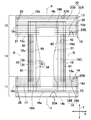
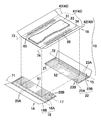
- the perspective view of the disposable diaper in an example of the embodiment of the absorptive article concerning the present invention The partial rupture expansion
- each elastic body to be described later is naturally gathered on the member to which each elastic body is attached due to the contracting force in the lateral direction X and the longitudinal direction Y against the contracting force. It is in a state of being stretched to such an extent that it appears to be substantially lost visually.
- a disposable diaper 10 which is an example of a disposable absorbent article according to the present invention includes a longitudinal direction Y and a transverse direction X intersecting the longitudinal direction Y, a thickness direction Z, a skin facing surface, and vice versa.
- the absorbent article in addition to the disposable diaper and sanitary napkin, absorbs various well-known body fluids including a panty liner and a urine absorbing pad, for example, excrement such as menstrual blood and feces and urine. Includes articles for holding.
- the diaper 10 extends in the longitudinal direction Y between the front waist panel 14 that forms the front waist region 11, the rear waist panel 15 that forms the rear waist region 12, and the front and rear waist panels 14 and 15, thereby forming the crotch region 13. And an absorption panel 16.
- the front waist panel 14 and the rear waist panel 15 are formed in the same shape and size, for example.
- the absorption panel 16 has a front end 19A located on the skin facing surface side of the front waist region 11, a rear end 19B located on the skin facing surface of the rear waist region 12, and an intermediate located between the front and rear end portions 19A and 19B. Part 19C.
- the front and rear end portions 19A and 19B of the absorbent panel 16 are respectively positioned and fixed on the skin facing surface side of the front and rear waist regions 11 and 12, but the front and rear end portions 19A and 19B are front and rear waist regions. You may fix the absorption panel 16 to the outer surface of the front-and-back waist panels 14 and 15 so that it may be located in the 11 and 12 non-skin opposing surface.
- Both side edges of the front waist region 11 and both side edges of the rear waist region 12 are joined to each other by a plurality of seams 25 that are spaced apart in the longitudinal direction Y, and the waist opening 26 and the pair of leg openings 27 are joined together. It is defined.
- the seam 25 can be formed by bonding means using various adhesives such as a hot melt adhesive, various known bonding means using welding means such as heat seal and sonic, or a combination thereof.
- the front waist panel 14 includes an inner end edge (inner end edge of the front waist region) 14a that forms a part of the front leg opening, and an outer end edge (outer end edge of the front waist region) 14b that forms the front waist opening. , Having a horizontally long rectangular shape defined by both side edges 14c and 14d (both side edges of the front waist region) extending in the longitudinal direction Y between the inner and outer end edges 14a and 14b.
- the front waist panel 14 has a liquid-impervious inner layer sheet 17 positioned on the skin facing surface side and a liquid-impervious outer layer sheet 18 positioned on the non-skin facing surface side.
- the outer layer sheet 18 has a main portion 18A joined to the inner layer sheet 17 and a bent portion 18B extending outward in the longitudinal direction Y from the outer edge of the inner layer sheet 17.
- the bent portion 18B has a longitudinal direction Y along a bent line 71 extending in the lateral direction X so as to cover the front end portion 19A of the absorbent panel 16 in a state where it is disposed on the skin facing surface side of the front waist panel 14.
- the inner layer sheet 17 and the front end 19A are fixed to the skin facing surface side.
- a plurality of strand-like or string-like front waist elastic bodies 20 are fixed between the inner layer sheet 17 and the main portion 18A of the outer layer sheet 18 so as to be contractible in the lateral direction X.
- the rear waist panel 15 includes an inner end edge (inner end edge of the rear waist region) 15a that forms a part of the rear leg opening, and an outer end edge (outer end edge of the rear waist region) 15b that forms the rear waist opening. And both side edges (both side edges of the rear waist region) 15c, 15d extending in the longitudinal direction Y between the inner and outer end edges 15a, 15b.
- the rear waist panel 15 has a liquid-impermeable inner layer sheet 21 located on the skin facing surface side and a liquid-impermeable outer layer sheet 22 located on the non-skin facing surface side.
- the outer layer sheet 22 includes a main portion 22A joined to the inner layer sheet 21 and a bent portion 22B extending outward in the longitudinal direction Y from the outer edge of the inner layer sheet 21.
- the bent portion 22B is longitudinally extended along a bent line 72 extending in the lateral direction X so as to cover the rear end portion 19B of the absorbent panel 16 on the skin facing surface side of the rear waist panel 15.
- the inner layer sheet 21 and the rear end portion 19B are fixed to the skin facing surface side by being bent inwardly of Y.
- a plurality of strand-like or string-like rear waist elastic bodies 23 are fixed so as to be contractible in the lateral direction X.
- the front waist elastic body 20 includes a plurality of front upper waist elastic bodies 20A extending in the lateral direction X along the outer end edge 14b, and a front lower waist positioned between the front upper waist elastic body 20A and the inner end edge 14a. And an elastic body 20B.
- the rear waist elastic body 23 includes a plurality of rear upper waist elastic bodies 23A extending in the lateral direction X along the outer end edge 15b, and a rear lower waist positioned between the rear upper waist elastic body 23A and the inner end edge 15a. And an elastic body 23B.
- the front lower waist elastic body 20B is positioned so as to overlap with both sides of the front end 19A of the absorbent panel 16 and the diaper 10 in plan view, and the rear lower waist elastic body 23B is on both sides of the rear end 19B of the absorbent panel 16 And are positioned so as to overlap each other in plan view.
- the front and rear lower waist elastic bodies 20B and 23B are cut and removed at the center portions of the front and rear end portions 19A and 19B of the absorbent panel 16, respectively, and are made inelastic. Inelastic regions 51 and 52 where the contraction force of 23B does not act are defined.
- the front and rear upper and lower waist elastic bodies 20A, 20B, 23A and 23B are elastic in the form of a plurality of yarns, strings and strands extending in the transverse direction X with a space in the longitudinal direction Y.
- the plurality of elastic bodies 20A, 20B, 23A, 23B is, for example, 1.5 to 3.0 times, preferably 2.2 to 2.7 times between the inner and outer layer sheets 17, 18, 21, and 22. Attached in an extended state.
- the expansion ratio of 1.0 is the degree of expansion when the length (natural length) of each elastic body in the non-expanded state is 1, and for example, the expansion ratio is 1.5. Double means that the length of each elastic body in the non-stretched state is increased by 0.5.
- each elastic body in addition to natural rubber, various known synthetic rubbers such as styrene rubber, urethane rubber, ester rubber, polyurethane, and polyethylene can be used without limitation.
- the fineness of each elastic body is not particularly limited, but is 200 to 1100 dtex, preferably 300 to 1000 dtex. When the fineness is 200 dtex or less, there is a possibility that the required stretchability cannot be exhibited in a state where the shape and size of the gathers are controlled by the pitch between the elastic bodies 20 and 23. When the fineness of each elastic body is 1100 dtex or more, each elastic body can be easily seen through from the outside through the outer layer sheets 18 and 22 located on the non-skin facing surface side of the diaper 10. There is a risk that the skin is transparent.
- the spacing (pitch) between the elastic bodies 20 and 23 can be adjusted as appropriate in order to control the size including the cross-sectional shape and length of the gathers formed on the inner and outer layer sheets 17, 18, 21 and 22.
- the thickness is, for example, 2.0 to 12.0 mm, preferably 4.0 to 10.0 mm.
- the pitch in this specification means the separation distance between the centers of the elastic bodies adjacent to each other in the longitudinal direction Y.
- the inner and outer layer sheets 17, 18, 21, and 22 are joined to each other via an adhesive that is continuously or partially applied to the entire circumference of each elastic body interposed therebetween. Yes. Therefore, it can be said that the pitch between the elastic bodies is the separation dimension (pitch) of the joining line that joins the inner and outer layer sheets 17, 18, 21, and 22 together.
- the inner and outer layer sheets 17, 18, 21, 22 are fixed to each other only by the adhesive applied to the entire circumference of each elastic body 20, 23, so that any one of the inner and outer layer sheets 17, 18, 21, 22 is Combined with the later-described flexible nonwoven fabric, the stretchable sheet composed of the inner layer sheets 17, 18, 21, 22 and the front and rear waist elastic bodies 20, 23 becomes relatively flexible.
- a sheet having elastic stretchability may be disposed on the waist opening side of the front and rear waist panels 14 and 15 in addition to or in place of the front and rear upper waist elastic bodies 20A and 23A. In such a case, compared with the case where it has a thread-like elastic material, it fits gently on a wearer's skin.
- the absorbent panel 16 has a vertical rectangular shape defined by front and rear end edges 16a and 16b and both side edges 16c and 16d, and the front and rear end portions 19A and 19B are hot-melted on the skin facing surfaces of the front and rear waist panels 14 and 15, respectively. They are joined to each other via a front and rear joining area (not shown) formed by applying an adhesive.
- a front and rear joining area (not shown) formed by applying an adhesive.
- various known shapes such as an ⁇ shape, a spiral shape, and a wave shape can be adopted in addition to a plurality of line shapes extending in the longitudinal direction Y.
- the absorbent panel 16 has a hydrophilic / liquid-permeable inner surface sheet (body side liner) 31 located on the skin facing surface side, an absorber 33, and the non-skin facing of the absorber 33.
- Hydrophobic covering sheet 40 located on the surface side, and a hydrophobic or liquid-impervious plastic that is positioned between the absorbent body 33 and the covering sheet 40 and has a size that covers at least the bottom surface of the absorbent body 33 And a leak-proof film 34 formed from the film.
- the absorbent body 33 includes a liquid absorbent core 35 and a core wrap sheet 36 that covers the entire liquid absorbent core 35.
- the liquid-absorbent core 35 has a semi-rigid panel shape shaped into a required shape, and extends toward the longitudinal center line P between the front and rear end edges extending in the lateral direction X and the front and rear end edges (lateral direction X And both side edges extending in a convex manner.
- the liquid absorbent core 35 is formed of a mixture of fluffed wood pulp and super absorbent polymer particles (SAP).
- the covering sheet 40 is located on both sides of the main body 41 where the leak-proof film 34 is disposed and the outer side of the lateral direction X with respect to the folding lines 73 and 74 extending in the vertical direction Y along both side edges of the leak-proof film 34.
- the both side portions 42 are bent along the folding lines 73 and 74 toward the longitudinal center line P and overlapped with the main portion 41.
- a plurality of string-like or strand-like leg elastic bodies 65 extending in the longitudinal direction Y are attached between the side portions 42 and the leak-proof film 34 so as to be contracted in an extended state.
- the leg elastic body 65 may be made of an elastic material having a fineness of 470 to 740 dtex and stretched and fixed 1.7 to 2.3 times from a contracted or relaxed state.
- a leg elastic region 61 in which a leg elastic body 65 is disposed is formed at the leg opening edge of the diaper 10, and the leg opening edge fits the wearer's thigh by the contracting action of the leg elastic region 61. It is possible to effectively suppress the side leakage of excrement.
- the diaper 10 at least one sheet of the inner surface side sheet positioned on the skin facing surface side of the absorbent body 33 and the outer surface side sheet positioned on the non-skin facing surface side of the absorbent body 33 is formed of a flexible nonwoven fabric.
- the “inner surface side sheet” means a sheet located on the skin facing surface side of the absorbent body 33, and includes the body side liner 31 in the present embodiment.
- seat when a 2nd sheet
- the “outer surface side sheet” is a sheet positioned on the non-skin facing surface side of the absorbent body 33, and in this embodiment, in addition to the covering sheet 40 of the absorbent panel 16, the front and rear waist panels 14, 15.
- the inner and outer layer sheets 17, 18, 21, 22 are formed.
- the inner and outer layer sheets 17, 18, 21, 22 constituting the front / rear waist panels 14, 15 are provided with a plurality of front / rear waist elastic bodies 20, 23 extending in the lateral direction X.
- the transverse direction X is the machine direction MD (the flow direction of the line during the production of the nonwoven fabric) of the sheet that becomes the base material of the inner and outer layer sheets 17, 18, 21, 22 and the longitudinal direction Y is Crossing direction CD.
- the absorbent panel 16 a plurality of leg elastic bodies 65 extending in the vertical direction Y are disposed, and the sheets 31, 34, and 40 constituting the vertical direction Y constitute the sheets so that the manufacture is easy.
- the machine direction MD and the lateral direction X of the sheet serving as the base material are cross directions CD.
- the flexible nonwoven fabric is a fiber nonwoven fabric containing a thermoplastic synthetic resin.
- a spunmelt fiber nonwoven fabric particularly a spunbond fiber nonwoven fabric, and an SMS (spunbond / meltblown / spunbond) fiber nonwoven fabric are suitable. used.
- the continuous fibers constituting these nonwoven fabrics polyolefin-based thermoplastic fibers including polypropylene (PP) and polyethylene (PE), which are various known synthetic fibers, are preferably used.
- PP polypropylene
- PE polyethylene
- a spunbond fiber nonwoven fabric mainly containing polyethylene fibers is used as the flexible nonwoven fabric.
- the flexible non-woven fabric is formed from a spun-melt non-woven fabric made of continuous fibers, so that the free ends of the fibers do not touch the wearer's skin directly unlike air-laid non-woven fabrics containing short fibers.
- the wearer's fingertip touches the free end of the fiber does not hit the fingerprint, and since it is a continuous fiber and has a high degree of freedom, it touches as if clinging to the fingerprint of the finger and is soft and good touch Can be given.
- a fiber defibrating step is not required, the number of manufacturing steps is small, and the manufacturing cost can be suppressed.
- the flexible nonwoven fabric has no fuzz on the sheet surface, is smooth and soft compared to other synthetic fibers composed of short fibers. Can give a soft touch. Moreover, the spunbond fiber nonwoven fabric is easier to control the fiber orientation than other fiber nonwoven fabrics. Therefore, for example, when a staple (short fiber) non-woven fabric is used as the inner and outer layer sheets 17, 18, 21, and 22 with the front and rear waist elastic bodies 20 and 23 interposed therebetween, the sheet tension is excellent although it is excellent in flexibility and extensibility. Whereas the strength is inferior, by using the spunbond fiber nonwoven fabric, it is possible to obtain a well-balanced composite stretchable sheet having desired sheet tensile strength and elongation.
- the “smooth, soft and soft tactile sensation” of the flexible non-woven fabric is not only the tactile sensation by the wearer wearing the diaper 10 but also the mother who assists the wearer when the wearer is an infant or the like. Includes tactile sensation by a wearer such as
- the wear assistant determines the flexibility and good touch of the diaper 10 based on the tactile sensation when a part of the inner and outer surface side sheets of the diaper 10 touches the fingertip. Specifically, when touching the flexible nonwoven fabric forming the inner and outer surface side sheets of the diaper 10 to the wearing assistant, the feeling that the fibers cling to the fingerprints of the fingers is given. It can be recognized that the diaper 10 is excellent in flexibility and touch.
- the flexible nonwoven fabric is a fiber nonwoven fabric mainly containing polyethylene fibers, and the content of polyethylene fibers in the entire sheet is 70 to 100% by mass. Since the polyethylene fiber is softer than other thermoplastic resin fibers such as polypropylene fiber and PET (polyethylene terephthalate) fiber, the polyethylene fiber content is at least 70% by mass. Compared to a conventional nonwoven fabric of 70% by mass or less, it is excellent in flexibility. Further, since the polyethylene fiber has a relatively large fiber diameter, the fiber gap is relatively large and the air permeability is excellent. Therefore, by using a flexible nonwoven fabric as the inner and outer surface side sheets of the diaper 10, it is possible to gently fit the wearer's skin and to suppress the stuffiness inside the diaper 10.
- the continuous fibers When the flexible nonwoven fabric is formed from a spunbond nonwoven fabric using continuous polyethylene fibers, the continuous fibers have a plurality of fused portions that are thermally fused to each other by a heat treatment using a calendar embossing method.
- each constituent fiber In the fusion part, each constituent fiber is heat-sealed and the fiber shape is not maintained, and a part is formed into a film, and the rigidity is higher than that of the non-fusion part of each constituent fiber.
- the total area ratio of the fused portion relative to the area of the flexible nonwoven fabric is related to the texture and sheet strength of the flexible nonwoven fabric. From this viewpoint, the total area ratio of the fused portion is preferably 5 to 25%. When the total area ratio is 5% or less, the sheet strength is low, and there is a possibility that part of the absorbent wearing article may be torn while the total area ratio is 25% or more, There exists a possibility that a flexible nonwoven fabric may become hard on the whole and may impair a texture.
- a continuous fiber nonwoven fabric made of a thermoplastic resin which is usually used in this kind of field, has no fluff and excellent smoothness because there is no free end of the fiber, but generally has a hard texture and lacks flexibility. Some improvement can be made by appropriately changing the design of the heat treatment conditions and the like at the time of production, but a nonwoven fabric having sufficient softness, smoothness and air permeability could not be obtained.
- a flexible nonwoven fabric made of a spun melt nonwoven fabric having a predetermined range of fiber diameters and a coefficient of friction coefficient according to the KES method as the inner and outer surface side sheets of the diaper 10, It has been found that it has excellent smoothness and gives a wearer and a wear assistant a smooth, soft and soft touch.
- “Smoothness”, “soft and soft tactile sensation” and “good breathability” can be cited as examples of the superiority of using a flexible nonwoven fabric as the inner and outer surface side sheets of the diaper 10.
- the superiority of can be confirmed by the surface characteristics, bending characteristics, fiber density, fiber diameter, specific volume, compression characteristics, etc. of the flexible nonwoven fabric.
- the mass of the flexible nonwoven fabric is, for example, 10 to 30 g / m 2 , preferably 12 to 25 g / m 2 , and the thickness dimension under a slight load (0.49 hPa) is 0.10 to 0.60 mm. It is.
- the mass of the flexible nonwoven fabric is less than 10 g / m 2 , it is difficult to obtain sufficient tensile strength although it is excellent in flexibility.
- the mass of the flexible nonwoven fabric exceeds 30 g / m 2 , a relatively high tensile strength can be obtained, but sufficient flexibility cannot be obtained, and air permeability may be reduced. .
- the apparent density of the flexible nonwoven fabric under a load of 0.49 hPa ( ⁇ 0.5 gf / cm 2 ) is 0.02 to 0.1 g / cm 3 , preferably 0.04 to 0.08 g / cm 3 , 49.
- the apparent density under a load of 03 hPa is 0.1 to 0.2 g / cm 3 , preferably 0.12 to 0.18 g / cm 3 .
- the specific volume of the flexible nonwoven fabric under a load of 49.03 hPa ( ⁇ 50 gf / cm 2 ) is within a predetermined range, and when the fiber is compressed by being pressed by the fingertip, the flexible nonwoven fabric is easily crushed and has a relatively low repulsion property. For this reason, the density is increased, the contact area between the fingertip and the fiber is relatively large, and the fiber is easy to cling to the fingertip, giving a soft touch.
- the mass of the flexible nonwoven fabric was measured based on the JISL1096 method.
- the specific volume of the flexible nonwoven fabric was calculated by dividing the mass of the nonwoven fabric by its thickness.
- the average fiber diameter of the constituent fibers (mainly polyethylene fibers) of the flexible nonwoven fabric is 14 to 22 ⁇ m. Since the fiber diameter of the flexible nonwoven fabric is relatively large, the number of fibers per unit area is relatively small, and the fiber density is kept low, so that a large number of fiber gaps are formed, and it can be said that the air permeability is good.
- the flexural rigidity value B of the flexible nonwoven fabric based on the KES method is, for example, 0.003 to 0.01 N ⁇ m 2 / m ⁇ 10 ⁇ ⁇ 4.
- the flexural rigidity value B of the flexible nonwoven fabric is less than 0.003 N ⁇ m 2 / m ⁇ 10 ⁇ ⁇ 4, the tensile strength of the flexible nonwoven fabric is low and the diaper 10 is partially broken during wearing. There is a fear. If it exceeds 0.01 N ⁇ m 2 / m ⁇ 10 ⁇ ⁇ 4, the seat rigidity becomes high and it becomes difficult to adapt to the wearer's body shape, and the fit to the body may be reduced.
- the bending stiffness value B is 0.01 N ⁇ m 2 / m ⁇ 10 ⁇ ⁇ 4 or less
- the fiber is easily bent, the contact distance between the fiber and the fingertip touching the fiber is increased, and the friction coefficient MIU is increased. Get higher.
- the coefficient of variation MMD / MIU * 100 (%) of the friction coefficient becomes 2 to 6%, so that the variation becomes small and smooth. That is, it can be said that a smooth tactile sensation can be realized by increasing the number of fibers clinging to the fingerprint of the fingertip.
- the compression work WC based on the KES method of the flexible nonwoven fabric is 0.14 to 0.2 N ⁇ m / m 2 , and the compression recovery rate RC is 15 to 50%. Since both the compression work WC and the compression recovery rate RC are relatively low values, it can be said that the flexible nonwoven fabric is easily compressed by an external force and has a low shape restoring property after compression.
- the inner layer sheets 17 and 21 are formed of a flexible nonwoven fabric and a plurality of small gathers are formed on the surfaces of the inner layer sheets 17 and 21 by the contracting action of the front and rear waist elastic bodies 20 and 23, the skin of the wearer The gathers are easily compressed when they come into contact with the skin, and since the shape reconstructability after compression is low, the force of repulsion to the skin is low. The formation can be suppressed.
- the flexible nonwoven fabric is mainly composed of flexible polyethylene fibers and the compression recovery rate RC is less than 50%, the fibers are crushed when the wearer's fingertip touches the surface of the sheet, and the fiber density And the number of fibers that come into contact with the finger increases, giving a soft and soft touch.
- a flexible nonwoven fabric is a fiber web formed by thermally fusing continuous fibers mainly composed of polyethylene fibers to each other, and since there are no free ends of the fibers on the surface, there is less fuzzing and the sheet surface is smooth and smooth. It can be said that it has In addition, since polyethylene fibers are more flexible than polypropylene fibers, the surface is superior in flexibility, and when the wearer's body moves due to deformation even under a slight load, it softly follows and fits the movement. can do.
- the surface of the flexible nonwoven fabric has a friction coefficient MIU of 0.15 to 0.40, preferably 0.25 to 0.35, and an average deviation MMD of the friction coefficient of 0.008 to 0.01. Since the friction coefficient MIU exceeds 0.15, the frictional resistance is relatively high, and when the wearer touches the sheet surface, a smooth tactile feeling that clings to the skin can be given.
- the coefficient of variation MMD / MIU * 100 (%) of the friction coefficient is 2.0 to 6.0%.
- the compression recovery rate RC is less than 50%, the fiber is crushed and the fiber density is increased even under a slight load when the wearer's fingertip touches, and the amount of fiber in contact with the fingertip increases. As a result, the friction coefficient MIU increases.
- the coefficient of variation MMD / MIU * 100 (%) of the friction coefficient is within a relatively small predetermined value range, the variation in the friction coefficient is reduced and the overall smoothness is good.
- the number of fibers that come into contact with the fingerprint of the assistant's fingertip is relatively large, and a smooth, soft and soft tactile sensation can be provided.
- the range of the predetermined value of the bending characteristic and the surface characteristic in the flexible nonwoven fabric is satisfied in either the machine direction MD at the time of manufacturing the nonwoven fabric or the cross direction CD, and preferably in the machine direction MD or at the time of manufacturing the nonwoven fabric. And in the cross direction CD.
- the frictional resistance in the machine direction MD of the nonwoven fabric is a predetermined value. It is preferable to be within the range.
- the front and rear waist panels 14 and 15 are stretched in the waistline direction when an infant having a swelled body shape wears a diaper.
- the inner layer sheets 17 and 21 can be worn smoothly without being caught on the body.
- the coefficient of variation of the friction coefficient in the cross direction CD (longitudinal direction Y of the diaper as a product) of the nonwoven fabric forming the inner layer sheets 17 and 21 is relatively small, the diaper 10 passed through both legs of a wearer such as an infant.
- the inner sheet made of a flexible non-woven fabric and the skin of a soft infant compared to an adult can be worn smoothly without being stimulated.
- the wearer's fingertip touches the outer sheet on the non-skin facing surface side of the waist area of the diaper formed from a flexible nonwoven fabric
- the wearer's fingertips are random regardless of the longitudinal direction Y and the lateral direction X. Since the fingertip moves on the sheet surface in the plane direction, the bending characteristic and the surface characteristic in either direction X or Y may be within a predetermined range.
- the flexible nonwoven fabric according to this embodiment has a fiber diameter, a fiber density, and a specific volume within a predetermined range, so that the number of fibers is relatively small and the air permeability is excellent.
- the sheet surface irregularities are easily crushed by the fact that it is mainly formed of flexible polyethylene fibers, and the friction coefficient is high. Since the coefficient distribution is small, the wearer and the wearer can be given a smooth and soft tactile feel that clings to the skin.
- Table 1 evaluates the properties and performance of a plurality of flexible non-woven fabrics under various conditions for comparison with non-woven fabrics conventionally used in this type of field.
- the flexible nonwoven fabrics of Examples 1 to 5 are formed of a spunbond nonwoven fabric containing 100% by mass of polyethylene fibers as continuous fibers
- the nonwoven fabric of Comparative Example 1 is formed of a spunbond nonwoven fabric containing 100% by mass of polypropylene fibers as continuous fibers. ing.
- the flexible nonwoven fabrics of Examples 1 to 5 and the nonwoven fabrics of Comparative Examples 1 and 2 were subjected to a calender-type heat treatment with a hot embossing roll in the manufacturing process.
- Example 1 As the flexible nonwoven fabric of Example 1, a spunbond nonwoven fabric composed of polyethylene fibers having a mass of 20.40 g / m 2 and an average fiber diameter of 14.83 ⁇ m was used.
- Example 2 As the flexible nonwoven fabric of Example 2, a spunbond nonwoven fabric composed of polyethylene fibers having a mass of 18.98 g / m 2 and an average fiber diameter of 16.89 ⁇ m was used.
- Example 3 As the flexible nonwoven fabric of Example 3, a spunbond nonwoven fabric composed of polyethylene fibers having a mass of 20.84 g / m 2 and an average fiber diameter of 20.28 ⁇ m was used.
- Example 4 As the flexible nonwoven fabric of Example 4, a spunbond nonwoven fabric having a mass of 25.12 g / m 2 and an average fiber diameter of 16.77 ⁇ m was used.
- Example 5 As the flexible nonwoven fabric of Example 5, a spunbond nonwoven fabric composed of polyethylene fibers having a mass of 15.14 g / m 2 and an average fiber diameter of 16.77 ⁇ m was used.
- Comparative Example 1 As the nonwoven fabric of Comparative Example 1, a spunbonded nonwoven fabric composed of polypropylene fibers having a mass of 20.37 g / m 2 and an average fiber diameter of 12.19 ⁇ m was used.
- ⁇ Comparative example 2> As the nonwoven fabric of Comparative Example 2, a spunbonded nonwoven fabric composed of a composite fiber having a mass of 15.08 g / m 2 and an average fiber diameter of 17.35 ⁇ m was used. The composite fiber was a continuous fiber, and a core-sheath type composite fiber having a core part made of polypropylene and a sheath part made of polyethylene was used.
- Comparative Example 3 As the nonwoven fabric of Comparative Example 4, an air-through nonwoven fabric having a mass of 23.52 g / m 2 and composed of a composite fiber having an average fiber diameter of 16.64 ⁇ m was used. As the composite fiber, a core-sheath type composite fiber having a fiber length of 51 mm and having a core part made of polyethylene terephthalate (PET) and a sheath part made of polyethylene was used.
- PET polyethylene terephthalate
- a known optical microscope for example, VHC-100 Digital Microscope Lens VH-Z450 manufactured by KEYENCE
- each numerical value was calculated with the average friction coefficient in the moving section as MIU and the standard deviation of the friction coefficient at that time as MMD. The same measurement was performed five times for each sample, and the average was used as the MIU and MMD values of each sample.
- ⁇ Thickness dimensions T0, Tm and compression specific measurement method> A KES-FB3-AUTO-A compression tester manufactured by Kato Tech Co., Ltd. was used to measure the thickness dimension of each nonwoven fabric. First, each non-woven fabric was cut into a size of 100 mm * 100 mm to be a sample, and the center of the sample was gently sandwiched between the upper and lower disks, and each sample under a compression area (disk area) of 2.0 cm 2 and a load of 0.49 hPa The thickness dimension T0 is measured. Next, the measurement sample was compressed at a pressurization rate of 0.02 mm / second until the load was 49.03 hPa, and the thickness dimension Tm under the load of 49.03 hPa was measured.
- RC (%) WC2 / WC * 100
- each nonwoven fabric was cut into a circle having a diameter of 100 mm and cut into a sample.
- a breathability tester for example, a breathability tester manufactured by Kato Tech Co., Ltd .: KES-F8-APL
- the standard breathing rate was set to 2 cm / s, and the breathing resistance value of the sample was measured. This measurement was performed 5 times, and the average value was taken as the airflow resistance value of each nonwoven fabric. It can be said that air permeability is so bad that a ventilation resistance value is high.
- Example 1 which is a flexible nonwoven fabric composed of polyethylene fibers having a fiber diameter of 14.83 ⁇ m
- Comparative Example 1 which is a nonwoven fabric composed of polypropylene fibers having a fiber diameter of 12.19 ⁇ m
- the MIU of Example 1 is 0.335
- the MIU of Comparative Example 1 is 0.238
- the coefficient of friction variation MMD / MIU * 100 (%) of Example 1 is 2.57.
- the coefficient of variation MMD / MIU * 100 (%) of the friction coefficient of Comparative Example 1 was 3.28%. Therefore, the friction coefficient MIU is relatively high because the flexible nonwoven fabric is made of a relatively flexible polyethylene fiber.
- the coefficient of variation MMD / MIU * 100 (%) of the friction coefficient is low. It can be said that the variation of the friction coefficient becomes small and the sheet surface is smooth. Thereby, when the wear assistant moves the fingertip in the planar direction with respect to the surface of the flexible nonwoven fabric, the amount of fibers that come into contact with the fingerprint is relatively increased, and a smooth tactile sensation can be provided.
- Example 1 and the comparative example 1 with which the mass of a nonwoven fabric is substantially the same are contrasted, while the ventilation resistance value of Example 1 is 0.0324, the ventilation resistance value of the comparative example 1 is 0.0356.
- the flexible nonwoven fabric of Example 1 is superior to the nonwoven fabric of Comparative Example 1 in air permeability. This is because the fiber diameter of the polyethylene fiber constituting the flexible nonwoven fabric of Example 1 is larger than the fiber diameter of the polypropylene fiber constituting the nonwoven fabric of Comparative Example 1, so that a large number of voids are formed between the fibers and the air permeability is increased.
- Disposable diapers (absorbent articles) 17 Inner layer sheet (flexible nonwoven fabric) 18 Outer layer sheet (flexible nonwoven fabric) 21 Inner layer sheet (flexible nonwoven fabric) 22 Outer layer sheet (flexible nonwoven fabric) 31 Body side liner (flexible nonwoven fabric) 40 Cover sheet (flexible nonwoven fabric)
Landscapes
- Health & Medical Sciences (AREA)
- Engineering & Computer Science (AREA)
- Animal Behavior & Ethology (AREA)
- Epidemiology (AREA)
- Biomedical Technology (AREA)
- Heart & Thoracic Surgery (AREA)
- Vascular Medicine (AREA)
- Life Sciences & Earth Sciences (AREA)
- General Health & Medical Sciences (AREA)
- Public Health (AREA)
- Veterinary Medicine (AREA)
- Dermatology (AREA)
- Textile Engineering (AREA)
- Absorbent Articles And Supports Therefor (AREA)
- Orthopedics, Nursing, And Contraception (AREA)
Priority Applications (3)
| Application Number | Priority Date | Filing Date | Title |
|---|---|---|---|
| EP18909316.4A EP3747416B1 (en) | 2018-03-14 | 2018-11-13 | Absorbent article |
| CN201880087856.3A CN111655210A (zh) | 2018-03-14 | 2018-11-13 | 吸收性物品 |
| BR112020018426-8A BR112020018426B1 (pt) | 2018-03-14 | 2018-11-13 | Artigo absorvente |
Applications Claiming Priority (2)
| Application Number | Priority Date | Filing Date | Title |
|---|---|---|---|
| JP2018047118A JP7591861B2 (ja) | 2018-03-14 | 2018-03-14 | 吸収性物品 |
| JP2018-047118 | 2018-03-14 |
Publications (1)
| Publication Number | Publication Date |
|---|---|
| WO2019176167A1 true WO2019176167A1 (ja) | 2019-09-19 |
Family
ID=67908270
Family Applications (1)
| Application Number | Title | Priority Date | Filing Date |
|---|---|---|---|
| PCT/JP2018/042023 Ceased WO2019176167A1 (ja) | 2018-03-14 | 2018-11-13 | 吸収性物品 |
Country Status (5)
| Country | Link |
|---|---|
| EP (1) | EP3747416B1 (enExample) |
| JP (1) | JP7591861B2 (enExample) |
| CN (1) | CN111655210A (enExample) |
| BR (1) | BR112020018426B1 (enExample) |
| WO (1) | WO2019176167A1 (enExample) |
Families Citing this family (2)
| Publication number | Priority date | Publication date | Assignee | Title |
|---|---|---|---|---|
| JP7643166B2 (ja) * | 2020-06-23 | 2025-03-11 | 王子ホールディングス株式会社 | おむつ |
| CN115154054B (zh) * | 2022-07-07 | 2023-07-04 | 瑞光(上海)电气设备有限公司 | 一种短裤型吸收性物品 |
Citations (5)
| Publication number | Priority date | Publication date | Assignee | Title |
|---|---|---|---|---|
| JPH11293554A (ja) | 1998-04-09 | 1999-10-26 | Kao Corp | 不織布及びそれを用いた吸収性物品 |
| JP2015091353A (ja) * | 2014-12-24 | 2015-05-14 | 大王製紙株式会社 | 使い捨ておむつ |
| JP2016059673A (ja) * | 2014-09-19 | 2016-04-25 | 株式会社日本吸収体技術研究所 | 吸収体物品及びスキンコンタクトシート |
| WO2016103961A1 (ja) * | 2014-12-26 | 2016-06-30 | ユニ・チャーム株式会社 | 吸収性物品 |
| JP2017104197A (ja) * | 2015-12-08 | 2017-06-15 | 花王株式会社 | パンツ型吸収性物品 |
Family Cites Families (11)
| Publication number | Priority date | Publication date | Assignee | Title |
|---|---|---|---|---|
| MX2011001163A (es) * | 2008-08-04 | 2011-03-21 | Procter & Gamble | Articulo absorbente con componente de barrera. |
| KR20120028551A (ko) * | 2010-09-15 | 2012-03-23 | 도레이첨단소재 주식회사 | 드레이프 특성이 향상된 장섬유 스펀본드 부직포 및 그 제조 방법 |
| JP5888495B2 (ja) * | 2012-01-11 | 2016-03-22 | 東洋紡株式会社 | 柔軟性および耐摩耗性に優れた長繊維不織布およびその用途 |
| JP5698200B2 (ja) * | 2012-09-28 | 2015-04-08 | 大王製紙株式会社 | 使い捨ておむつ |
| JP6259261B2 (ja) * | 2013-11-08 | 2018-01-10 | 日本製紙クレシア株式会社 | 吸収性物品 |
| JP6192841B2 (ja) * | 2013-12-03 | 2017-09-06 | エスセーアー・ハイジーン・プロダクツ・アーベー | 捕捉層を有する吸収性物品 |
| JP6029026B2 (ja) * | 2014-03-12 | 2016-11-24 | 大王製紙株式会社 | パンツタイプ使い捨ておむつ |
| JP6560015B2 (ja) * | 2014-05-30 | 2019-08-14 | 花王株式会社 | 使い捨ておむつ |
| JP5984156B2 (ja) * | 2014-11-19 | 2016-09-06 | 大王製紙株式会社 | 吸収性物品の製造方法及び吸収性物品 |
| BR112017020650B1 (pt) * | 2015-03-27 | 2022-07-19 | Daio Paper Corporation | Estrutura extensível para artigo absorvente e fralda descartável |
| CN204655299U (zh) * | 2015-04-20 | 2015-09-23 | 上海丰格无纺布有限公司 | 一种用于拉拉裤的表层面料 |
-
2018
- 2018-03-14 JP JP2018047118A patent/JP7591861B2/ja active Active
- 2018-11-13 EP EP18909316.4A patent/EP3747416B1/en active Active
- 2018-11-13 BR BR112020018426-8A patent/BR112020018426B1/pt active IP Right Grant
- 2018-11-13 WO PCT/JP2018/042023 patent/WO2019176167A1/ja not_active Ceased
- 2018-11-13 CN CN201880087856.3A patent/CN111655210A/zh active Pending
Patent Citations (5)
| Publication number | Priority date | Publication date | Assignee | Title |
|---|---|---|---|---|
| JPH11293554A (ja) | 1998-04-09 | 1999-10-26 | Kao Corp | 不織布及びそれを用いた吸収性物品 |
| JP2016059673A (ja) * | 2014-09-19 | 2016-04-25 | 株式会社日本吸収体技術研究所 | 吸収体物品及びスキンコンタクトシート |
| JP2015091353A (ja) * | 2014-12-24 | 2015-05-14 | 大王製紙株式会社 | 使い捨ておむつ |
| WO2016103961A1 (ja) * | 2014-12-26 | 2016-06-30 | ユニ・チャーム株式会社 | 吸収性物品 |
| JP2017104197A (ja) * | 2015-12-08 | 2017-06-15 | 花王株式会社 | パンツ型吸収性物品 |
Non-Patent Citations (1)
| Title |
|---|
| See also references of EP3747416A4 |
Also Published As
| Publication number | Publication date |
|---|---|
| EP3747416B1 (en) | 2025-07-16 |
| EP3747416A1 (en) | 2020-12-09 |
| BR112020018426B1 (pt) | 2023-11-07 |
| BR112020018426A2 (pt) | 2020-12-29 |
| JP2019154869A (ja) | 2019-09-19 |
| JP7591861B2 (ja) | 2024-11-29 |
| EP3747416C0 (en) | 2025-07-16 |
| EP3747416A4 (en) | 2021-04-14 |
| CN111655210A (zh) | 2020-09-11 |
Similar Documents
| Publication | Publication Date | Title |
|---|---|---|
| JP5592168B2 (ja) | 使い捨て着用物品 | |
| EP2589360B1 (en) | Absorbent product | |
| JP5871507B2 (ja) | 使い捨て着用物品 | |
| JP5674345B2 (ja) | 使い捨ての着用物品 | |
| KR20170131423A (ko) | 흡수성 물품의 신축 구조, 및 팬티 타입 일회용 기저귀 | |
| JP5529524B2 (ja) | 起毛不織布及びその製造方法 | |
| JP2004000465A (ja) | 吸収性物品 | |
| WO2015198639A1 (ja) | 吸収性物品 | |
| JP2019010348A (ja) | 吸収性物品 | |
| US20190000693A1 (en) | Absorbent article and method for manufacturing absorbent article | |
| JP4827889B2 (ja) | 紙おむつ | |
| JP7591861B2 (ja) | 吸収性物品 | |
| JP7207690B2 (ja) | パンツ型の着用物品 | |
| JP5057556B2 (ja) | パンツ型おむつ | |
| JP7048401B2 (ja) | 吸収性物品 | |
| JP2022079734A (ja) | 吸収性物品 | |
| EP3674076B1 (en) | Elastic sheet for absorbent article and absorbent article comprising same | |
| CN112004507B (zh) | 吸收性物品 | |
| JP2023019810A (ja) | 吸収性物品用不織布及びこれを備える吸収性物品 | |
| JP3253031U (ja) | 吸収性物品 | |
| RU2345746C2 (ru) | Поглощающее изделие, содержащее эластичный ламинат | |
| JP2007321287A (ja) | 伸縮性不織布 | |
| JP2021186212A (ja) | 吸収体及び吸収性物品 | |
| JP2022006518A (ja) | 吸収性物品 | |
| JP2021186210A (ja) | 吸収体及び吸収性物品 |
Legal Events
| Date | Code | Title | Description |
|---|---|---|---|
| 121 | Ep: the epo has been informed by wipo that ep was designated in this application |
Ref document number: 18909316 Country of ref document: EP Kind code of ref document: A1 |
|
| ENP | Entry into the national phase |
Ref document number: 2018909316 Country of ref document: EP Effective date: 20200904 |
|
| NENP | Non-entry into the national phase |
Ref country code: DE |
|
| REG | Reference to national code |
Ref country code: BR Ref legal event code: B01A Ref document number: 112020018426 Country of ref document: BR |
|
| ENP | Entry into the national phase |
Ref document number: 112020018426 Country of ref document: BR Kind code of ref document: A2 Effective date: 20200910 |
|
| WWG | Wipo information: grant in national office |
Ref document number: 2018909316 Country of ref document: EP |