WO2019167464A1 - ポリアセタール共重合体およびその重合方法 - Google Patents
ポリアセタール共重合体およびその重合方法 Download PDFInfo
- Publication number
- WO2019167464A1 WO2019167464A1 PCT/JP2019/001529 JP2019001529W WO2019167464A1 WO 2019167464 A1 WO2019167464 A1 WO 2019167464A1 JP 2019001529 W JP2019001529 W JP 2019001529W WO 2019167464 A1 WO2019167464 A1 WO 2019167464A1
- Authority
- WO
- WIPO (PCT)
- Prior art keywords
- polyacetal copolymer
- acid
- compound
- polymerization
- epoxy groups
- Prior art date
- Legal status (The legal status is an assumption and is not a legal conclusion. Google has not performed a legal analysis and makes no representation as to the accuracy of the status listed.)
- Ceased
Links
Classifications
-
- C—CHEMISTRY; METALLURGY
- C08—ORGANIC MACROMOLECULAR COMPOUNDS; THEIR PREPARATION OR CHEMICAL WORKING-UP; COMPOSITIONS BASED THEREON
- C08G—MACROMOLECULAR COMPOUNDS OBTAINED OTHERWISE THAN BY REACTIONS ONLY INVOLVING UNSATURATED CARBON-TO-CARBON BONDS
- C08G2/00—Addition polymers of aldehydes or cyclic oligomers thereof or of ketones; Addition copolymers thereof with less than 50 molar percent of other substances
- C08G2/18—Copolymerisation of aldehydes or ketones
- C08G2/22—Copolymerisation of aldehydes or ketones with epoxy compounds
-
- C—CHEMISTRY; METALLURGY
- C08—ORGANIC MACROMOLECULAR COMPOUNDS; THEIR PREPARATION OR CHEMICAL WORKING-UP; COMPOSITIONS BASED THEREON
- C08G—MACROMOLECULAR COMPOUNDS OBTAINED OTHERWISE THAN BY REACTIONS ONLY INVOLVING UNSATURATED CARBON-TO-CARBON BONDS
- C08G2/00—Addition polymers of aldehydes or cyclic oligomers thereof or of ketones; Addition copolymers thereof with less than 50 molar percent of other substances
- C08G2/18—Copolymerisation of aldehydes or ketones
- C08G2/24—Copolymerisation of aldehydes or ketones with acetals
Definitions
- the present invention relates to a polyacetal copolymer having high rigidity, excellent creep characteristics and sliding characteristics, and further generating very little formaldehyde, and a polymerization method thereof.
- Polyacetal resin has excellent properties in mechanical properties, thermal properties, electrical properties, slidability, moldability, etc., mainly as structural materials and mechanical parts, such as electrical equipment, automotive parts, precision machinery. Widely used for parts. However, with the expansion of the field where polyacetal resins are used, the required characteristics tend to become more sophisticated, complex and specialized. As such required characteristics, further improvement is required for improving rigidity and suppressing generation of formaldehyde while maintaining the excellent slidability, appearance and the like inherent in polyacetal resin.
- Polyacetal copolymers are known to improve rigidity by reducing the amount of comonomer without substantially impairing slidability and appearance, but the comonomer weight reduction technique reduces toughness. In addition to this, problems such as a decrease in the thermal stability of the polymer have occurred, and it has not always been possible to meet the requirements. Although attempts have been made to improve the rigidity by introducing a branched structure, depending on the type of comonomer, when a cationic polymerization catalyst, particularly a protonic acid is used as the polymerization catalyst, the start of polymerization may be delayed, causing sudden explosive polymerization. There was also a problem in terms of production stability.
- Patent Document 1 a copolymer obtained by copolymerizing trioxane and a compound having two or more glycidyl ether groups in one molecule has been proposed (Patent Document 1).
- Patent Document 1 a compound having a plurality of epoxy groups represented by glycidyl ether groups and ether oxygens as functional groups is used for polymerization, there remains a problem in polymerization stability.
- protonic acid is used as the polymerization catalyst, polymerization does not occur at low catalyst amounts. Increasing the catalyst amount causes a phenomenon in which a sudden and intense polymerization reaction occurs after an irregular induction period, making polymerization control difficult. ing.
- An object of the present invention is to provide a polyacetal copolymer excellent in production stability and thermal stability such as the amount of formaldehyde generated while maintaining the level of rigidity, creep characteristics and sliding characteristics by introducing a branched structure as described above. It is to provide a polymerization method.
- the object of the present invention has been achieved by the following.
- a cationic polymerization catalyst comprising trioxane, a cyclic acetal compound having an oxyalkylene group having 2 or more carbon atoms in the ring, and a polyepoxy compound having two or more epoxy groups in one molecule and consisting of hydrocarbons other than the epoxy group
- P represents an integer of 0 to 20. 5.
- a polyacetal copolymer and a polymerization method that are excellent in thermal stability such as production stability and the amount of formaldehyde generated while maintaining the levels of rigidity, creep properties, and sliding properties. .
- the polyacetal copolymer of the present invention comprises trioxane, a cyclic acetal compound having an oxyalkylene group having 2 or more carbon atoms in the ring, and a polyepoxy comprising two or more epoxy groups in one molecule and a hydrocarbon other than the epoxy group. It is a polyacetal copolymer obtained by copolymerizing a compound.
- the trioxane used in the present invention is a cyclic trimer of formaldehyde, which is generally obtained by reacting an aqueous formaldehyde solution in the presence of an acidic catalyst, and is used after being purified by a method such as distillation. .
- cyclic acetal compound having an oxyethylene group having 2 or more carbon atoms in the ring (hereinafter also referred to as component (A))
- component (A) ⁇ Cyclic acetal compound having an oxyethylene group having 2 or more carbon atoms in the ring
- component (A) ⁇ Cyclic acetal compound having an oxyethylene group having 2 or more carbon atoms in the ring
- the cyclic acetal compound having an oxyethylene group having 2 or more carbon atoms in the ring of the present invention is a compound generally used as a comonomer in the production of a polyacetal copolymer, specifically, 1,3-dioxolane, 1,3,6-trioxocane, 1,4-butanediol formal and the like.
- the component (A) is preferably used in an amount of 0.01 to 20 parts by mass, more preferably 0.05 to 5 parts by mass with respect to 100 parts by mass of trioxane. .
- the component (B) used in the present invention is a polyepoxy compound having two or more epoxy groups in one molecule and composed of hydrocarbons other than the epoxy groups.
- the glycidyl ether group of the present invention refers to a group having the following structure. * Represents a binding site with another structure.
- 1,3-butadiene diepoxide (below B-5), 1,4-pentadiene diepoxide, 1,5-hexadiene diepoxide (below B-4), 1,6-peptadiene diepoxide, 1,7-octadiene diepoxide (B-3 below), 1,8-nonadiene diepoxide, 1,9-decadiene diepoxide (B-2 below), 1,10-undecadiene diepoxide, 1, And 11-dodecadiepoxide (B-1 below).
- Formula 1 Formula 2 P represents an integer of 0 to 20
- n represents an integer of 0 to 10
- m represents an integer of 1 to 10.
- the component (B) is preferably used in a range of 0.01 to 5 parts by mass, more preferably 0.03 to 1 part by mass with respect to 100 parts by mass of trioxane. .
- the polymerization method of the polyacetal copolymer of the present invention includes trioxane, a cyclic acetal compound having an oxyalkylene group having 2 or more carbon atoms in the ring, and a hydrocarbon other than the epoxy group having two or more epoxy groups in one molecule.
- the polyepoxy compound is copolymerized in the presence of a cationic polymerization catalyst.
- ⁇ Cationic polymerization catalyst As the cationic polymerization catalyst, a known polymerization catalyst can be used in cationic copolymerization using trioxane as a main monomer. Typically, Lewis acid and proton acid can be mentioned. In particular, a protonic acid is preferable.
- Examples of the protonic acid include perfluoroalkanesulfonic acid, heteropolyacid, and isopolyacid.
- Specific examples of perfluoroalkanesulfonic acid include trifluoromethanesulfonic acid, pentafluoroethanesulfonic acid, heptafluoropropanesulfonic acid, nonafluorobutanesulfonic acid, undecafluoropentanesulfonic acid, tridecafluorohexanesulfonic acid, pentadecafluoro Examples include heptane sulfonic acid and heptadecafluorooctane sulfonic acid.
- Heteropolyacid is a polyacid produced by dehydration condensation of dissimilar oxygen acids, and a mononuclear or dinuclear nucleus formed by condensation of condensed acid groups sharing a oxygen atom with a specific dissimilar element at the center. Has complex ions.
- the isopolyacid is also referred to as an isopolyacid, a homonuclear condensed acid, or a homopolyacid, and refers to a high molecular weight inorganic oxygen acid comprising a condensate of inorganic oxygen acids having a single V-valent or VI-valent metal. .
- heteropolyacids include phosphomolybdic acid, phosphotungstic acid, phosphomolybdotungstic acid, phosphomolybdovanadic acid, phosphomolybdotungstovanadic acid, phosphotungstovanadic acid, silicotungstic acid, silicomolybdic acid, and cimomolybdo Examples include tungstic acid and silicoribed tungsten tovanadate.
- the heteropolyacid is preferably selected from silicomolybdic acid, silicotungstic acid, phosphomolybdic acid, and phosphotungstic acid.
- isopolyacids include isopolytungstic acid exemplified by paratungstic acid, metatungstic acid, etc., isopolymolybdic acid exemplified by paramolybdic acid, metamolybdic acid, etc., metapolyvanadate acid, isopolyvanadate acid Etc. Of these, isopolytungstic acid is preferable from the viewpoint of polymerization activity.
- Lewis acid examples include halides of boron, tin, titanium, phosphorus, arsenic and antimony. Specifically, boron trifluoride, tin tetrachloride, titanium tetrachloride, phosphorus pentafluoride, phosphorus pentachloride. , Antimony pentafluoride and complex compounds or salts thereof.
- the amount of the polymerization catalyst is not particularly limited, but is preferably from 0.1 ppm to 50 ppm, more preferably from 0.1 ppm to 30 ppm, based on the total of all monomers. Especially preferably, it is 0.1 ppm or more and 10 ppm or less.
- the terminal group amount can be adjusted by using a component for adjusting the molecular weight in addition to the above components.
- the component for adjusting the molecular weight include chain transfer agents that do not form unstable terminals, that is, compounds having an alkoxy group such as methylal, monomethoxymethylal, and dimethoxymethylal.
- the polymerization method of the polyacetal copolymer of the present invention is not particularly limited.
- the polymerization apparatus is not particularly limited, and a known apparatus is used, and any method such as a batch system or a continuous system is possible.
- the polymerization temperature is preferably maintained at 65 ° C. or higher and 135 ° C. or lower.
- the cationic polymerization catalyst is preferably diluted with an inert solvent that does not adversely affect the polymerization.
- Deactivation of the polymerization catalyst after polymerization can be performed by a conventionally known method.
- a basic reaction product or an aqueous solution thereof may be added to the product reaction product discharged from the polymerization machine and the reaction product in the polymerization machine.
- the basic compound for neutralizing and deactivating the polymerization catalyst is not particularly limited. After polymerization and deactivation, if necessary, washing, separation and recovery of unreacted monomers, drying and the like are performed by a conventionally known method.
- the polyacetal copolymer obtained as described above preferably has a weight average molecular weight of 10,000 to 500,000, particularly preferably 20,000 to 150,000.
- the amount of hemiformal detected by 1 H-NMR is preferably 0 to 4 mol / kg, particularly preferably 0 to 2 mmol / kg.
- impurities in the total amount of monomer and comonomer used for polymerization, particularly water be 20 ppm or less, particularly preferably 10 ppm or less.
- polyacetal copolymer of the present invention may be added to general additives for thermoplastic resins, for example, coloring agents such as dyes and pigments, lubricants, nucleating agents, mold release agents, antistatic agents, interfaces as necessary.
- coloring agents such as dyes and pigments
- lubricants such as talc, talc, kaolin, kaolin, kaolin, kaolin, kaolin, kaolin, kaolin, kaolin, kaolin, kaolin, kaolin, kaolin, kaolin, colophony, colophony, colophony, colophony, colophony, colophony, colophony, colophony, colophony, colophony, colophony, colophony, colophony, colophony, colophony, colophony, colophony, colophony, colophony, colophony, colophony, colophony, colophon,
- the catalyst solution (heteropolyacid is a solution of methyl formate, trifluoromethanesulfonic acid, boron trifluoride dibutyl etherate is cyclohexane) was added so that the catalyst concentration (relative to the total monomers) shown in Table 1 was reached.
- Examples 1 to 8 it was revealed that a polyacetal copolymer was obtained with a low catalyst amount and a high yield, and was a polyacetal copolymer having a small amount of formaldehyde and excellent in thermal stability.
- Comparative Examples 1, 3 and 5 no polymerization reaction was observed at low catalyst amounts.
- Comparative Examples 2 and 4 although a polymerization reaction occurred under a high catalyst amount condition, it became an extremely intense explosive reaction immediately after clouding, and difficulty in controlling the reaction was observed.
- the yield of the obtained polyacetal copolymer was lower than that in Examples, and the amount of formaldehyde generated was also high.
- Comparative Example 6 as compared with Example 8, the yield was slightly low, and the amount of formaldehyde generated was high.
Landscapes
- Chemical & Material Sciences (AREA)
- Health & Medical Sciences (AREA)
- Chemical Kinetics & Catalysis (AREA)
- Medicinal Chemistry (AREA)
- Polymers & Plastics (AREA)
- Organic Chemistry (AREA)
- Polyoxymethylene Polymers And Polymers With Carbon-To-Carbon Bonds (AREA)
Abstract
本発明の目的は、剛性、クリープ特性、摺動特性のレベルを維持しながらも、生産安定性、ホルムアルデヒドの発生量等の熱安定性に優れたポリアセタール共重合体および重合方法を提供することである。 トリオキサン、炭素数2以上のオキシアルキレン基を環内に有する環状アセタール化合物および1分子中にエポキシ基を2個以上有しエポキシ基以外は炭化水素からなるポリエポキシ化合物、とを共重合させたポリアセタール共重合体、およびトリオキサン、炭素数2以上のオキシアルキレン基を環内に有する環状アセタール化合物および1分子中にエポキシ基を2個以上有しエポキシ基以外は炭化水素からなるポリエポキシ化合物、とをカチオン重合触媒の存在下、共重合させるポリアセタール共重合体の重合方法、によって達成された。
Description
本発明は、剛性が高く、クリープ特性、摺動特性に優れ、さらにはホルムアルデヒドの発生量が極めて少ないポリアセタール共重合体およびその重合方法に関する。
ポリアセタール樹脂は、機械的特性、熱的特性、電気的特性、摺動性、成形性等において、優れた特性を持っており、主に構造材料や機構部品等として電気機器、自動車部品、精密機械部品等に広く使用されている。しかし、ポリアセタール樹脂が利用される分野の拡大に伴い、要求特性は益々高度化、複合化、特殊化する傾向にある。そのような要求特性として、ポリアセタール樹脂が本来有する優れた摺動性、外観等を維持したまま、剛性改良、ホルムアルデヒドの発生抑制に対し一層の向上が要求される。
これに対し、単に剛性を向上させるだけの目的であれば、ポリアセタール樹脂に繊維状フィラー等を充填する方法が一般的であるが、この方法では、繊維状フィラー等の充填による成形品の外観不良や摺動特性の低下等の問題、更には靱性低下の問題がある。
また、ポリアセタール共重合体では、コモノマー量を減少させることにより、摺動性や外観を実質的に損なうことなく剛性を向上させることが知られているが、コモノマー減量の手法においては、靱性が低下するのみならずポリマーの熱安定性も低下する等の問題が生じ、必ずしも要求に応え得るものではなかった。
分岐構造導入による剛性向上も試みられているが、コモノマーの種類によっては、カチオン重合触媒、特にプロトン酸を重合触媒とする場合に、重合開始が遅れ、突然爆発的に重合が起こってしまうことがあり、生産安定性の面からも課題があった。
分岐構造導入による剛性向上も試みられているが、コモノマーの種類によっては、カチオン重合触媒、特にプロトン酸を重合触媒とする場合に、重合開始が遅れ、突然爆発的に重合が起こってしまうことがあり、生産安定性の面からも課題があった。
例えば、ポリアセタール共重合体に関して、トリオキサンと、1分子中にグリシジルエーテル基を2個以上有する化合物とを共重合させた共重合体が提案されている(特許文献1)。しかし、グリシジルエーテル基に代表されるエポキシ基とエーテル酸素を官能基として複数個有する化合物を重合に使用する場合、重合安定性に課題が残っている。特にプロトン酸を重合触媒に使用した場合、低触媒量では重合が起こらず、触媒量を上げると、不定期な誘導期ののち、突然激しい重合反応が起こる現象が発生し、重合制御を難しくしている。
ポリアセタール共重合体において、ホルムアルデヒドの発生を抑制することは、継続的な課題であるが、その要求は年々厳しさを増している。
本発明の目的は、上記の如き分岐構造導入により剛性、クリープ特性、摺動特性のレベルを維持しながらも、生産安定性、ホルムアルデヒドの発生量等の熱安定性に優れたポリアセタール共重合体および重合方法を提供することにある。
本発明の目的は、下記によって達成された。
1. トリオキサン、炭素数2以上のオキシアルキレン基を環内に有する環状アセタール化合物および1分子中にエポキシ基を2個以上有しエポキシ基以外は炭化水素からなるポリエポキシ化合物、とを共重合させたポリアセタール共重合体。
2. 前記ポリエポキシ化合物が、下記式で表されるポリエポキシ化合物である前記1記載のポリアセタール共重合体。

Pは0~20の整数を表す。
3. トリオキサン、炭素数2以上のオキシアルキレン基を環内に有する環状アセタール化合物および1分子中にエポキシ基を2個以上有しエポキシ基以外は炭化水素からなるポリエポキシ化合物、とをカチオン重合触媒の存在下、共重合させるポリアセタール共重合体の重合方法。
4. 前記ポリエポキシ化合物が、下記式で表されるポリエポキシ化合物である前記3記載のポリアセタール共重合体の重合方法。

Pは0~20の整数を表す。
5. 前記カチオン重合触媒が、プロトン酸である前記3または4記載のポリアセタール共重合体の重合方法。
1. トリオキサン、炭素数2以上のオキシアルキレン基を環内に有する環状アセタール化合物および1分子中にエポキシ基を2個以上有しエポキシ基以外は炭化水素からなるポリエポキシ化合物、とを共重合させたポリアセタール共重合体。
2. 前記ポリエポキシ化合物が、下記式で表されるポリエポキシ化合物である前記1記載のポリアセタール共重合体。
3. トリオキサン、炭素数2以上のオキシアルキレン基を環内に有する環状アセタール化合物および1分子中にエポキシ基を2個以上有しエポキシ基以外は炭化水素からなるポリエポキシ化合物、とをカチオン重合触媒の存在下、共重合させるポリアセタール共重合体の重合方法。
4. 前記ポリエポキシ化合物が、下記式で表されるポリエポキシ化合物である前記3記載のポリアセタール共重合体の重合方法。
5. 前記カチオン重合触媒が、プロトン酸である前記3または4記載のポリアセタール共重合体の重合方法。
本発明によると、剛性、クリープ特性、摺動特性のレベルを維持しながらも、生産安定性、ホルムアルデヒドの発生量等の熱安定性に優れたポリアセタール共重合体および重合方法を提供することができる。
以下、本発明の具体的な実施形態について、詳細に説明するが、本発明は、以下の実施形態に何ら限定されるものではなく、本発明の目的の範囲内において、適宜変更を加えて実施することができる。
<ポリアセタール共重合体>
本発明のポリアセタール共重合体は、トリオキサン、炭素数2以上のオキシアルキレン基を環内に有する環状アセタール化合物および1分子中にエポキシ基を2個以上有しエポキシ基以外は炭化水素からなるポリエポキシ化合物とを共重合させたポリアセタール共重合体であることを特徴とする。
本発明のポリアセタール共重合体は、トリオキサン、炭素数2以上のオキシアルキレン基を環内に有する環状アセタール化合物および1分子中にエポキシ基を2個以上有しエポキシ基以外は炭化水素からなるポリエポキシ化合物とを共重合させたポリアセタール共重合体であることを特徴とする。
≪トリオキサン≫
本発明において用いられるトリオキサンとは、ホルムアルデヒドの環状三量体であり、一般的には酸性触媒の存在下でホルムアルデヒド水溶液を反応させることによって得られ、これを蒸留等の方法で精製して用いられる。
本発明において用いられるトリオキサンとは、ホルムアルデヒドの環状三量体であり、一般的には酸性触媒の存在下でホルムアルデヒド水溶液を反応させることによって得られ、これを蒸留等の方法で精製して用いられる。
≪炭素数2以上のオキシエチレン基を環内に有する環状アセタール化合物(以下、(A)成分ともいう)≫
本発明の炭素数2以上のオキシエチレン基を環内に有する環状アセタール化合物とは、ポリアセタール共重合体の製造においてコモノマーとして一般に使用される化合物である、具体的には、1、3-ジオキソラン、1、3、6-トリオキソカン、1、4-ブタンジオールホルマール等が挙げられる。
本発明の炭素数2以上のオキシエチレン基を環内に有する環状アセタール化合物とは、ポリアセタール共重合体の製造においてコモノマーとして一般に使用される化合物である、具体的には、1、3-ジオキソラン、1、3、6-トリオキソカン、1、4-ブタンジオールホルマール等が挙げられる。
本発明において、(A)成分は、トリオキサン100質量部に対して0.01~20質量部の範囲となるように使用するのが好ましく、さらに好ましくは0.05~5質量部の範囲である。
≪1分子中にエポキシ基を2個以上有しエポキシ基以外は炭化水素からなるポリエポキシ化合物(以下、(B)成分ともいう)≫
本発明で使用する(B)成分は、1分子中にエポキシ基を2個以上有しエポキシ基以外は炭化水素からなるポリエポキシ化合物であることを特徴とする。
本発明で使用する(B)成分は、1分子中にエポキシ基を2個以上有しエポキシ基以外は炭化水素からなるポリエポキシ化合物であることを特徴とする。
一般に分子内にエポキシ基を導入する場合、エピクロルヒドリンを原材料としてグリシジルエーテル基の構造で導入されることが多いが、本発明のエポキシ基は、グリシジルエーテル基由来ではないエポキシ基を有することを特徴とする。
本発明のグリシジルエーテル基とは、下記の構造の基をいう。*は他の構造との結合部位を表す。

本発明のグリシジルエーテル基とは、下記の構造の基をいう。*は他の構造との結合部位を表す。
ジグリシジルエーテル基のみに由来のエポキシ基を有するエポキシ化合物をコモノマーとすることが周知技術として知られているが、本発明では、グリシジルエーテル基が存在しない方が、ポリアセタール共重合体の強度を維持しながら、ホルムアルデヒドの発生量を抑えられることを見出したものである。
具体的には、1、3-ブタジエンジエポキシド(下記B-5)、1、4-ペンタジエンジエポキシド、1、5-ヘキサジエンジエポキシド(下記B-4)、1、6-ペプタジエンジエポキシド、1、7-オクタジエンジエポキシド(下記B-3)、1、8-ノナジエンジエポキシド、1、9-デカジエンジエポキシド(下記B-2)、1、10-ウンデカジエンジエポキシド、1、11-ドデカジエポキシド(下記B-1)等を挙げることができる。
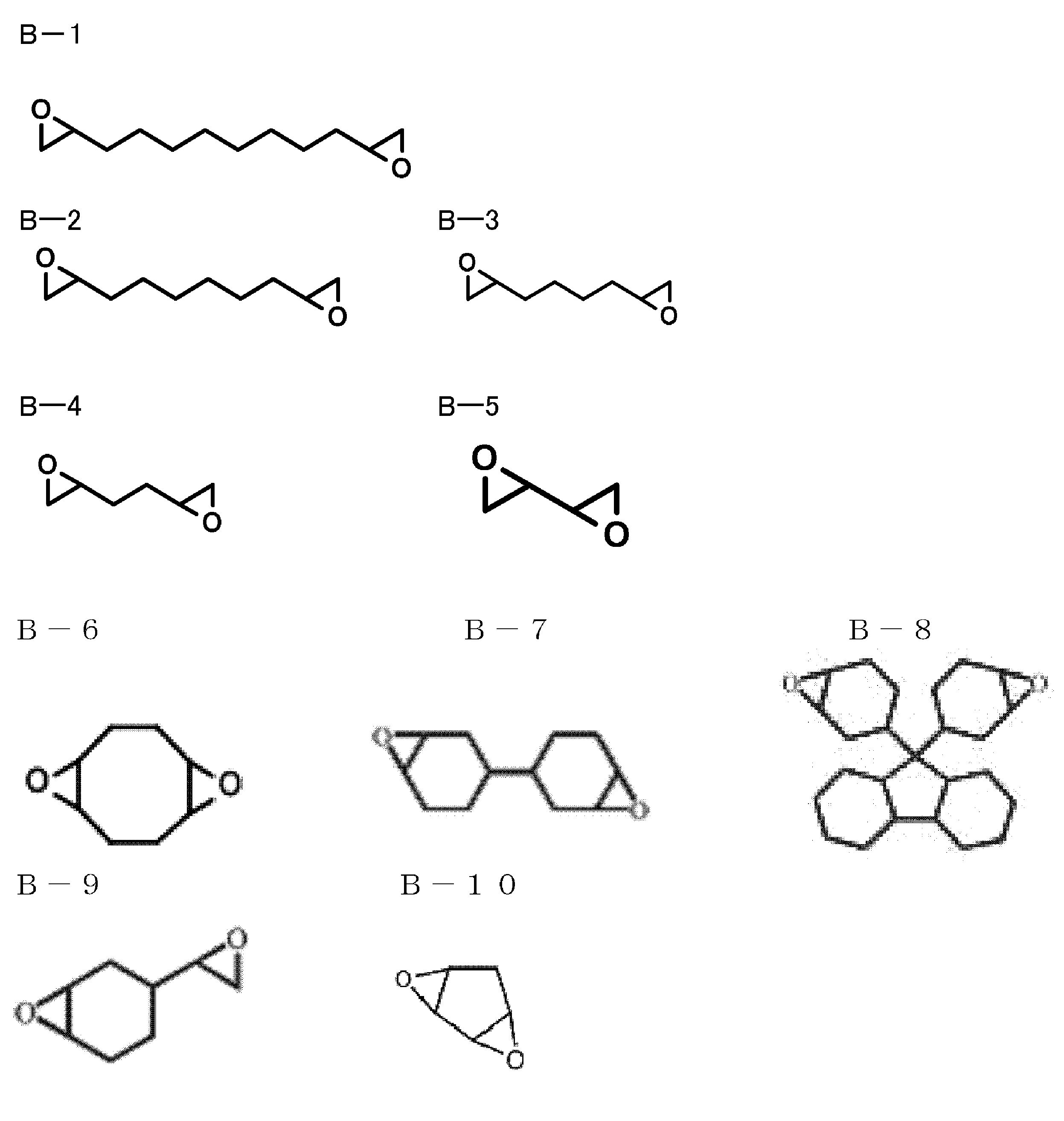
式1

式2

Pは、0~20の整数、nは、0~10の整数、mは、1~10の整数を表す。
本発明において、(B)成分は、トリオキサン100質量部に対して0.01~5質量部の範囲となるように使用するのが好ましく、さらに好ましくは0.03~1質量部の範囲である。
<ポリアセタール共重合体の重合方法>
本発明のポリアセタール共重合体の重合方法は、トリオキサン、炭素数2以上のオキシアルキレン基を環内に有する環状アセタール化合物および1分子中にエポキシ基を2個以上有しエポキシ基以外は炭化水素からなるポリエポキシ化合物とを、カチオン重合触媒の存在下、共重合させることを特徴とする。
本発明のポリアセタール共重合体の重合方法は、トリオキサン、炭素数2以上のオキシアルキレン基を環内に有する環状アセタール化合物および1分子中にエポキシ基を2個以上有しエポキシ基以外は炭化水素からなるポリエポキシ化合物とを、カチオン重合触媒の存在下、共重合させることを特徴とする。
<カチオン重合触媒>
カチオン重合触媒としては、トリオキサンを主モノマーとするカチオン共重合において公知の重合触媒が使用できる。代表的には、ルイス酸、プロトン酸が挙げられる。特に、プロトン酸であることが好ましい。
カチオン重合触媒としては、トリオキサンを主モノマーとするカチオン共重合において公知の重合触媒が使用できる。代表的には、ルイス酸、プロトン酸が挙げられる。特に、プロトン酸であることが好ましい。
≪プロトン酸≫
プロトン酸としては、パーフルオロアルカンスルホン酸、ヘテロポリ酸、イソポリ酸等が挙げられる。
パーフルオロアルカンスルホン酸の具体例として、トリフルオロメタンスルホン酸、ペンタフルオロエタンスルホン酸、ヘプタフルオロプロパンスルホン酸、ノナフルオロブタンスルホン酸、ウンデカフルオロペンタンスルホン酸、トリデカフルオロヘキサンスルホン酸、ペンタデカフルオロへプタンスルホン酸、ヘプタデカフルオロオクタンスルホン酸が挙げられる。
プロトン酸としては、パーフルオロアルカンスルホン酸、ヘテロポリ酸、イソポリ酸等が挙げられる。
パーフルオロアルカンスルホン酸の具体例として、トリフルオロメタンスルホン酸、ペンタフルオロエタンスルホン酸、ヘプタフルオロプロパンスルホン酸、ノナフルオロブタンスルホン酸、ウンデカフルオロペンタンスルホン酸、トリデカフルオロヘキサンスルホン酸、ペンタデカフルオロへプタンスルホン酸、ヘプタデカフルオロオクタンスルホン酸が挙げられる。
ヘテロポリ酸とは、異種の酸素酸が脱水縮合して生成するポリ酸をいい、中心に特定の異種元素が存在し、酸素原子を共有して縮合酸基が縮合してできる単核又は複核の錯イオンを有する。イソポリ酸とは、イソ多重酸、同核縮合酸、同種多重酸とも称され、V価又はVI価の単一種類の金属を有する無機酸素酸の縮合体から成る高分子量の無機酸素酸をいう。
ヘテロポリ酸の具体例として、リンモリブデン酸、リンタングステン酸、リンモリブドタングステン酸、リンモリブドバナジン酸、リンモリブドタングストバナジン酸、リンタングストバナジン酸、ケイタングステン酸、ケイモリブデン酸、ケイモリブドタングステン酸、ケイモリブドタングステントバナジン酸等が挙げられる。特に、重合活性の観点から、ヘテロポリ酸は、ケイモリブデン酸、ケイタングステン酸、リンモリブデン酸、リンタングステン酸から選択されることが好ましい。
イソポリ酸の具体例として、パラタングステン酸、メタタングステン酸等に例示されるイソポリタングステン酸、パラモリブデン酸、メタモリブデン酸等に例示されるイソポリモリブデン酸、メタポリバナジウム酸、イソポリバナジウム酸等が挙げられる。中でも、重合活性の観点から、イソポリタングステン酸であることが好ましい。
≪ルイス酸≫
ルイス酸としては、例えば、ホウ素、スズ、チタン、リン、ヒ素及びアンチモンのハロゲン化物が挙げられ、具体的には三フッ化ホウ素、四塩化スズ、四塩化チタン、五フッ化リン、五塩化リン、五フッ化アンチモン及びその錯化合物又は塩が挙げられる。
ルイス酸としては、例えば、ホウ素、スズ、チタン、リン、ヒ素及びアンチモンのハロゲン化物が挙げられ、具体的には三フッ化ホウ素、四塩化スズ、四塩化チタン、五フッ化リン、五塩化リン、五フッ化アンチモン及びその錯化合物又は塩が挙げられる。
重合触媒の量は特に限定されるものでないが、全モノマーの合計に対して0.1ppm以上50ppm以下であることが好ましく、0.1ppm以上30ppm以下であることがより好ましい。特に好ましくは0.1ppm以上10ppm以下である。
本発明のポリアセタール共重合体の製造においては、上記成分の他に分子量を調整する成分を併用し、末端基量を調整することができる。分子量を調整する成分としては、不安定末端を形成することのない連鎖移動剤、即ち、メチラール、モノメトキシメチラール、ジメトキシメチラール等のアルコキシ基を有する化合物が例示される。
本発明のポリアセタール共重合体の重合方法は、特に限定されるものではない。製造するにあたり、重合装置も特に限定されるものではなく、公知の装置が使用され、バッチ式、連続式等、いずれの方法も可能である。また、重合温度は65℃以上135℃以下に保つことが好ましい。
カチオン重合触媒は、重合に悪影響のない不活性な溶剤で希釈して使用することが好ましい。
重合後の重合触媒の失活は従来公知の方法で行うことができる。例えば、重合反応後、重合機より排出される生成反応物、重合機中の反応生成物に塩基性化合物又はその水溶液等を加えて行うこともできる。
重合触媒を中和し失活するための塩基性化合物は、特に限定されるものでない。重合及び失活の後、必要に応じて更に、洗浄、未反応モノマーの分離回収、乾燥等を従来公知の方法にて行う。
上記のようにして得られるポリアセタール共重合体は、その重量平均分子量が10000~500000であることが好ましく、特に好ましくは20000~150000である。また、末端基については、 1H-NMRにより検出されるヘミホルマール量が0~4mol/kgであることが好ましく、特に好ましくは0~2mmol/kgである。
ヘミホルマール末端基量を上記範囲に制御するためには、重合に供するモノマー、コモノマー総量中の不純物、特に水分を20ppm以下にするのが好ましく、特に好ましくは10ppm以下である。
更に、本発明のポリアセタール共重合体には、必要に応じて、熱可塑性樹脂に対する一般的な添加剤、例えば染料、顔料等の着色剤、滑剤、核剤、離型剤、帯電防止剤、界面活性剤、或いは、有機高分子材料、無機または有機の繊維状、粉体状、板状の充填剤等を1種または2種以上添加することができる。
以下、実施例によって本発明を具体的に説明するが、本発明はこれら実施例に限定されるものではない。
<重合反応>
熱媒を通すことのできるジャケットと撹拌羽根を有する密閉オートクレーブ中に300gのトリオキサンを入れ、さらに(A)成分として1、3-ジオキソラン(DO)を、(B)成分として表1に示す化合物を、それぞれ表1に示した質量部の割合になるように添加した。これら内容物を撹拌し、ジャケットに80℃の温水を通して内部温度を約80℃に保った後、触媒溶液(ヘテロポリ酸はギ酸メチルの溶液、トリフルオロメタンスルホン酸、三フッ化ホウ素ジブチルエーテラートはシクロヘキサンの溶液)を表1に示す触媒濃度(対全モノマー)になる様に加えて重合を開始した。
<重合反応>
熱媒を通すことのできるジャケットと撹拌羽根を有する密閉オートクレーブ中に300gのトリオキサンを入れ、さらに(A)成分として1、3-ジオキソラン(DO)を、(B)成分として表1に示す化合物を、それぞれ表1に示した質量部の割合になるように添加した。これら内容物を撹拌し、ジャケットに80℃の温水を通して内部温度を約80℃に保った後、触媒溶液(ヘテロポリ酸はギ酸メチルの溶液、トリフルオロメタンスルホン酸、三フッ化ホウ素ジブチルエーテラートはシクロヘキサンの溶液)を表1に示す触媒濃度(対全モノマー)になる様に加えて重合を開始した。
5分後にこのオートクレーブへトリエチルアミン0.1%を含む水300gを加えて反応を停止し、内容物を取り出して200メッシュ以下に粉砕し、アセトン洗浄及び乾燥後、ポリアセタール共重合体収率(添加全モノマーに対して得られた共重合体の割合(%))を算出した。この結果を表1に示した。
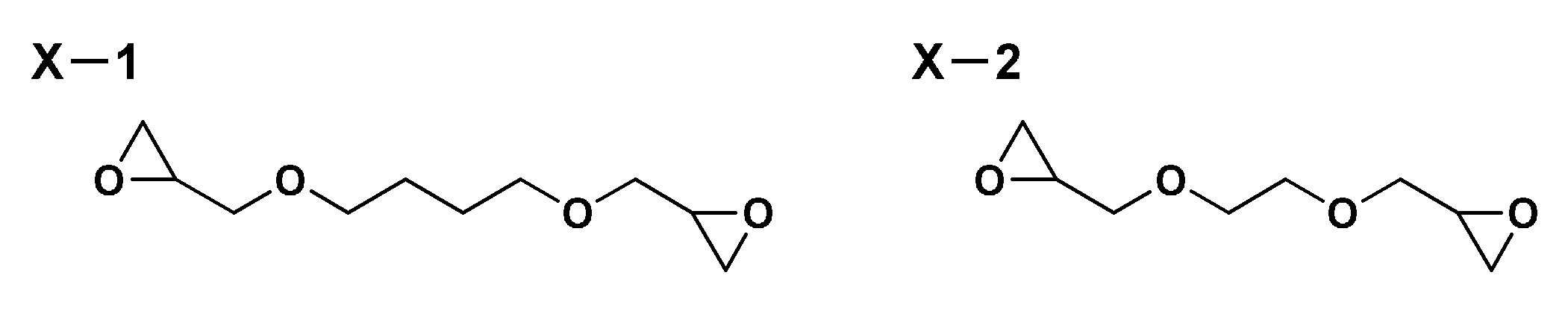
比較として下記ジグリシジル化合物(グリシジルエーテル基が2個のもの)を本発明の(B)成分に替えて使用したポリアセタール共重合体を重合し、比較のポリアセタール共重合体を得た。
上記の方法で得たポリアセタール共重合体100質量部に、安定剤としてペンタエリスリチル-テトラキス〔3-(3、5 -ジ-tert-ブチル-4-ヒドロキシフェニル)プロピオネート〕を0.3質量部、およびメラミン0.15質量部を添加し、小型2軸押出機にて210℃で溶融混練し、ペレット状のポリアセタール樹脂組成物を得た。
このペレットを使用し下記の評価を行った。
このペレットを使用し下記の評価を行った。
<熱安定性>
[溶融体からのホルムアルデヒド発生量]
5gのペレットを正確に秤量し、金属製容器中に200℃で5分間保持した後、容器内の雰囲気を蒸留水中に吸収させる。この水溶液のホルムアルデヒド量をJISK0102、29.(ホルムアルデヒドの項)に従って定量し、ペレットから発生するホルムアルデヒドガス量(ppm)を算出した。結果を表1に示す。
[溶融体からのホルムアルデヒド発生量]
5gのペレットを正確に秤量し、金属製容器中に200℃で5分間保持した後、容器内の雰囲気を蒸留水中に吸収させる。この水溶液のホルムアルデヒド量をJISK0102、29.(ホルムアルデヒドの項)に従って定量し、ペレットから発生するホルムアルデヒドガス量(ppm)を算出した。結果を表1に示す。
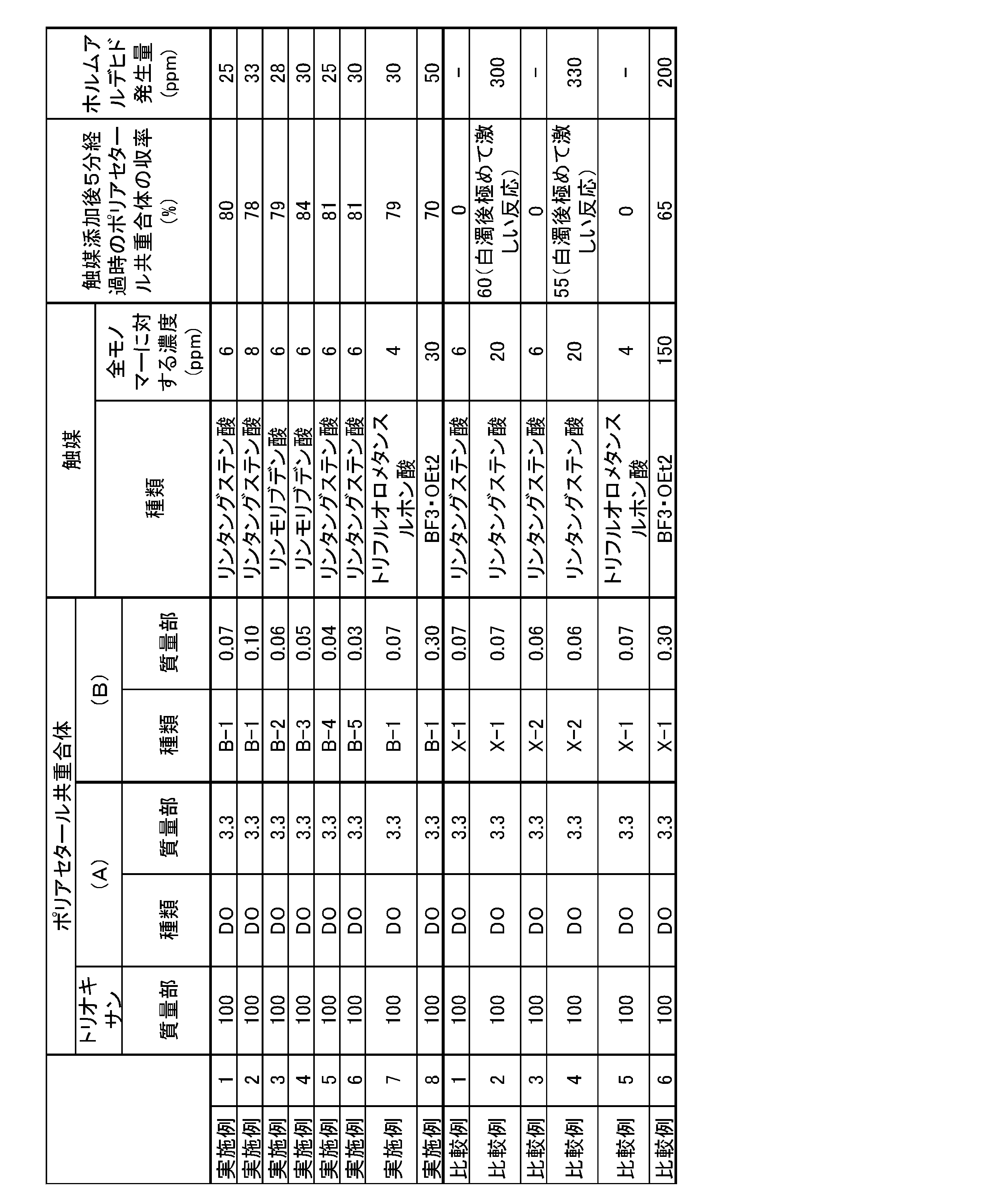
実施例1~8において、低触媒量で、高収率でポリアセタール共重合体が得られ、ホルムアルデヒドの発生量の少ない熱安定性に優れたポリアセタール共重合体であることが明らかになった。比較例1、3および5では、低触媒量では、重合反応は観測されなかった。
比較例2および4では、高触媒量条件で重合反応は起こったものの、白濁直後から極めて激しい爆発的反応となり、反応制御に困難性が観測された。
比較例2および4では、高触媒量条件で重合反応は起こったものの、白濁直後から極めて激しい爆発的反応となり、反応制御に困難性が観測された。
また得られたポリアセタール共重合体の収率は実施例と比較して低く、そのホルムアルデヒド発生量も高い値であった。比較例6においても実施例8と比較して、収率はやや低く、ホルムアルデヒド発生量は高い値となった。
表1の結果から明らかなように、本発明によると、生産安定性、ホルムアルデヒドの発生量等の熱安定性に優れたポリアセタール共重合体および重合方法を提供することができる。
Claims (5)
- トリオキサン、炭素数2以上のオキシアルキレン基を環内に有する環状アセタール化合物および1分子中にエポキシ基を2個以上有しエポキシ基以外は炭化水素からなるポリエポキシ化合物、とを共重合させたポリアセタール共重合体。
- 前記ポリエポキシ化合物が、下記式で表されるポリエポキシ化合物である請求項1記載のポリアセタール共重合体。

- トリオキサン、炭素数2以上のオキシアルキレン基を環内に有する環状アセタール化合物および1分子中にエポキシ基を2個以上有しエポキシ基以外は炭化水素からなるポリエポキシ化合物、とをカチオン重合触媒の存在下、共重合させるポリアセタール共重合体の重合方法。
- 前記ポリエポキシ化合物が、下記式で表されるポリエポキシ化合物である請求項3記載のポリアセタール共重合体の重合方法。

- 前記カチオン重合触媒が、プロトン酸である請求項3または4記載のポリアセタール共重合体の重合方法。
Priority Applications (2)
| Application Number | Priority Date | Filing Date | Title |
|---|---|---|---|
| MYPI2020003742A MY201456A (en) | 2018-02-28 | 2019-01-18 | Polyacetal copolymer and method for polymerizing same |
| CN201980009417.5A CN111630079B (zh) | 2018-02-28 | 2019-01-18 | 聚缩醛共聚物及其聚合方法 |
Applications Claiming Priority (2)
| Application Number | Priority Date | Filing Date | Title |
|---|---|---|---|
| JP2018-034562 | 2018-02-28 | ||
| JP2018034562A JP7061479B2 (ja) | 2018-02-28 | 2018-02-28 | ポリアセタール共重合体およびその重合方法 |
Publications (1)
| Publication Number | Publication Date |
|---|---|
| WO2019167464A1 true WO2019167464A1 (ja) | 2019-09-06 |
Family
ID=67805714
Family Applications (1)
| Application Number | Title | Priority Date | Filing Date |
|---|---|---|---|
| PCT/JP2019/001529 Ceased WO2019167464A1 (ja) | 2018-02-28 | 2019-01-18 | ポリアセタール共重合体およびその重合方法 |
Country Status (4)
| Country | Link |
|---|---|
| JP (1) | JP7061479B2 (ja) |
| CN (1) | CN111630079B (ja) |
| MY (1) | MY201456A (ja) |
| WO (1) | WO2019167464A1 (ja) |
Families Citing this family (1)
| Publication number | Priority date | Publication date | Assignee | Title |
|---|---|---|---|---|
| CN115707723B (zh) * | 2021-08-20 | 2025-06-17 | 华南理工大学 | 一种主链缩醛官能化共聚物的制备方法 |
Citations (5)
| Publication number | Priority date | Publication date | Assignee | Title |
|---|---|---|---|---|
| JPS4419263Y1 (ja) * | 1964-12-23 | 1969-08-18 | ||
| JPH02113010A (ja) * | 1988-09-12 | 1990-04-25 | Hoechst Celanese Corp | エラストマー性アセタールポリマー |
| JP2000319342A (ja) * | 1999-05-13 | 2000-11-21 | Polyplastics Co | ポリオキシメチレン共重合体及びその製造方法 |
| JP2005232404A (ja) * | 2004-02-23 | 2005-09-02 | Mitsubishi Gas Chem Co Inc | ポリアセタール樹脂組成物 |
| JP2010059356A (ja) * | 2008-09-05 | 2010-03-18 | Mitsubishi Gas Chemical Co Inc | 分岐・架橋ポリアセタール共重合体 |
Family Cites Families (3)
| Publication number | Priority date | Publication date | Assignee | Title |
|---|---|---|---|---|
| JPS4419263B1 (ja) * | 1965-05-26 | 1969-08-21 | ||
| US4937312A (en) * | 1989-12-11 | 1990-06-26 | Hoechst Celanese Corp. | Process for producing elastomeric acetal polymers |
| JP5225529B2 (ja) * | 2001-07-12 | 2013-07-03 | ポリプラスチックス株式会社 | ポリアセタール共重合体の製造方法 |
-
2018
- 2018-02-28 JP JP2018034562A patent/JP7061479B2/ja active Active
-
2019
- 2019-01-18 CN CN201980009417.5A patent/CN111630079B/zh active Active
- 2019-01-18 WO PCT/JP2019/001529 patent/WO2019167464A1/ja not_active Ceased
- 2019-01-18 MY MYPI2020003742A patent/MY201456A/en unknown
Patent Citations (5)
| Publication number | Priority date | Publication date | Assignee | Title |
|---|---|---|---|---|
| JPS4419263Y1 (ja) * | 1964-12-23 | 1969-08-18 | ||
| JPH02113010A (ja) * | 1988-09-12 | 1990-04-25 | Hoechst Celanese Corp | エラストマー性アセタールポリマー |
| JP2000319342A (ja) * | 1999-05-13 | 2000-11-21 | Polyplastics Co | ポリオキシメチレン共重合体及びその製造方法 |
| JP2005232404A (ja) * | 2004-02-23 | 2005-09-02 | Mitsubishi Gas Chem Co Inc | ポリアセタール樹脂組成物 |
| JP2010059356A (ja) * | 2008-09-05 | 2010-03-18 | Mitsubishi Gas Chemical Co Inc | 分岐・架橋ポリアセタール共重合体 |
Also Published As
| Publication number | Publication date |
|---|---|
| CN111630079B (zh) | 2023-07-14 |
| MY201456A (en) | 2024-02-23 |
| CN111630079A (zh) | 2020-09-04 |
| JP7061479B2 (ja) | 2022-04-28 |
| JP2019147905A (ja) | 2019-09-05 |
Similar Documents
| Publication | Publication Date | Title |
|---|---|---|
| CN112752779B (zh) | 聚缩醛树脂组合物和聚缩醛树脂组合物的制造方法 | |
| JP7061479B2 (ja) | ポリアセタール共重合体およびその重合方法 | |
| CN112714774B (zh) | 聚缩醛树脂组合物和聚缩醛树脂组合物的制造方法 | |
| WO2016125357A1 (ja) | ポリアセタール樹脂組成物 | |
| CN116635441B (zh) | 聚缩醛共聚物及其制造方法 | |
| JP7129284B2 (ja) | ポリアセタール共重合体およびその製造方法 | |
| CN107207832A (zh) | 聚缩醛树脂组合物的制造方法 | |
| CN112469779B (zh) | 聚缩醛树脂组合物 | |
| JP7141329B2 (ja) | ポリアセタール共重合体およびその製造方法 | |
| CN113677725B (zh) | 聚缩醛共聚物和其制造方法 | |
| JP2023132432A (ja) | ポリアセタール共重合体およびその重合方法 | |
| CN113677726B (zh) | 聚缩醛树脂组合物和聚缩醛树脂组合物的制造方法 | |
| JP2001163944A (ja) | ポリアセタール共重合体及びその製造方法 | |
| JP3933925B2 (ja) | 変性ポリアセタール樹脂及びその製造方法 | |
| JP2002356603A (ja) | ポリアセタール樹脂組成物 |
Legal Events
| Date | Code | Title | Description |
|---|---|---|---|
| 121 | Ep: the epo has been informed by wipo that ep was designated in this application |
Ref document number: 19760388 Country of ref document: EP Kind code of ref document: A1 |
|
| NENP | Non-entry into the national phase |
Ref country code: DE |
|
| 122 | Ep: pct application non-entry in european phase |
Ref document number: 19760388 Country of ref document: EP Kind code of ref document: A1 |