WO2019131106A1 - 吸収性物品 - Google Patents
吸収性物品 Download PDFInfo
- Publication number
- WO2019131106A1 WO2019131106A1 PCT/JP2018/045471 JP2018045471W WO2019131106A1 WO 2019131106 A1 WO2019131106 A1 WO 2019131106A1 JP 2018045471 W JP2018045471 W JP 2018045471W WO 2019131106 A1 WO2019131106 A1 WO 2019131106A1
- Authority
- WO
- WIPO (PCT)
- Prior art keywords
- back sheet
- absorbent article
- tape member
- absorber
- fixing portion
- Prior art date
- Legal status (The legal status is an assumption and is not a legal conclusion. Google has not performed a legal analysis and makes no representation as to the accuracy of the status listed.)
- Ceased
Links
Images


Classifications
-
- A—HUMAN NECESSITIES
- A61—MEDICAL OR VETERINARY SCIENCE; HYGIENE
- A61F—FILTERS IMPLANTABLE INTO BLOOD VESSELS; PROSTHESES; DEVICES PROVIDING PATENCY TO, OR PREVENTING COLLAPSING OF, TUBULAR STRUCTURES OF THE BODY, e.g. STENTS; ORTHOPAEDIC, NURSING OR CONTRACEPTIVE DEVICES; FOMENTATION; TREATMENT OR PROTECTION OF EYES OR EARS; BANDAGES, DRESSINGS OR ABSORBENT PADS; FIRST-AID KITS
- A61F13/00—Bandages or dressings; Absorbent pads
- A61F13/15—Absorbent pads, e.g. sanitary towels, swabs or tampons for external or internal application to the body; Supporting or fastening means therefor; Tampon applicators
- A61F13/51—Absorbent pads, e.g. sanitary towels, swabs or tampons for external or internal application to the body; Supporting or fastening means therefor; Tampon applicators characterised by the outer layers of the pads
- A61F13/514—Backsheet, i.e. the impermeable cover or layer furthest from the skin
-
- A—HUMAN NECESSITIES
- A61—MEDICAL OR VETERINARY SCIENCE; HYGIENE
- A61F—FILTERS IMPLANTABLE INTO BLOOD VESSELS; PROSTHESES; DEVICES PROVIDING PATENCY TO, OR PREVENTING COLLAPSING OF, TUBULAR STRUCTURES OF THE BODY, e.g. STENTS; ORTHOPAEDIC, NURSING OR CONTRACEPTIVE DEVICES; FOMENTATION; TREATMENT OR PROTECTION OF EYES OR EARS; BANDAGES, DRESSINGS OR ABSORBENT PADS; FIRST-AID KITS
- A61F13/00—Bandages or dressings; Absorbent pads
- A61F13/15—Absorbent pads, e.g. sanitary towels, swabs or tampons for external or internal application to the body; Supporting or fastening means therefor; Tampon applicators
- A61F13/53—Absorbent pads, e.g. sanitary towels, swabs or tampons for external or internal application to the body; Supporting or fastening means therefor; Tampon applicators characterised by the absorbing medium
- A61F13/539—Absorbent pads, e.g. sanitary towels, swabs or tampons for external or internal application to the body; Supporting or fastening means therefor; Tampon applicators characterised by the absorbing medium characterised by the connection of the absorbent layers with each other or with the outer layers
-
- A—HUMAN NECESSITIES
- A61—MEDICAL OR VETERINARY SCIENCE; HYGIENE
- A61F—FILTERS IMPLANTABLE INTO BLOOD VESSELS; PROSTHESES; DEVICES PROVIDING PATENCY TO, OR PREVENTING COLLAPSING OF, TUBULAR STRUCTURES OF THE BODY, e.g. STENTS; ORTHOPAEDIC, NURSING OR CONTRACEPTIVE DEVICES; FOMENTATION; TREATMENT OR PROTECTION OF EYES OR EARS; BANDAGES, DRESSINGS OR ABSORBENT PADS; FIRST-AID KITS
- A61F13/00—Bandages or dressings; Absorbent pads
- A61F13/15—Absorbent pads, e.g. sanitary towels, swabs or tampons for external or internal application to the body; Supporting or fastening means therefor; Tampon applicators
- A61F13/551—Packaging before or after use
Definitions
- the present invention relates to an absorbent article provided with a tape member for post-treatment.
- Absorbent articles such as sanitary napkins, panty liners, adult incontinence pads or fecal pads are attached to the inside of the worn articles worn by the wearer when in use.
- an absorbent article attached to the inside of a wearing article has an adhesive portion for preventing displacement of the absorbent article relative to the wearing article. This adhesive part is provided in the surface on the opposite side to the skin surface side (side facing the wearer's skin) of the absorbent article.
- Patent Document 1 discloses an absorbent article such as a disposable diaper or a sanitary napkin provided with a fastening tape for post-treatment.
- the fastening tape comprises a base fixed to the back sheet (back sheet) and an extensible extension connected to the base.
- the width of the fastening tape that is, the width in the direction orthogonal to the stretching direction becomes narrow (neck-in).
- the width of the fastening tape becomes narrow, when trying to fix the absorbent article in a rolled state, the fastening power of the fastening tape may be reduced, and the absorbent article may not be fixed in a firmly rolled state.
- an absorbent article having a post-treatment tape that can maintain the absorbent article in a tightly rolled condition such as a sanitary napkin, panty liner, adult incontinence pad or fecal pad, is desired.
- the absorbent article has a back and forth direction, a width direction orthogonal to the front and back direction, a back sheet directed to the side opposite to the wearer's skin, and a tape member for post-treatment.
- the tape member is configured to be able to extend outside the outer edge of the absorbent article.
- the tape member has a fixed portion fixed to the back sheet and a non-fixed portion not fixed to the back sheet.
- the tensile force required to stretch the back sheet by 5% in at least a portion of the periphery of the fixed portion is greater than the tensile force required to stretch the length of the non-fixed portion of the tape member by 5%. Low.
- FIG. 1 is a plan view of the absorbent article according to the first embodiment viewed from the skin surface side.
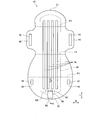
- FIG. 2 is a plan view of the absorbent article according to the first embodiment as viewed from the non-skin surface side.
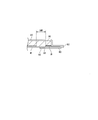
- FIG. 3 is a partial cross-sectional view of the absorbent article taken along the line AA of FIG.
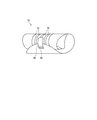
- FIG. 4 is a perspective view of the absorbent article in a state of being wound in the front-rear direction.
- FIG. 5 is a partial cross-sectional view of the absorbent article showing a state in which the post-processing tape member is pulled.
- the absorbent article has a back and forth direction, a width direction orthogonal to the front and back direction, a back sheet directed to the side opposite to the wearer's skin, and a tape member for post-treatment.
- the tape member is configured to be able to extend outside the outer edge of the absorbent article.
- the tape member has a fixed portion fixed to the back sheet and a non-fixed portion not fixed to the back sheet.
- the tensile force required to stretch the back sheet by 5% in at least a portion of the periphery of the fixed portion is greater than the tensile force required to stretch the length of the non-fixed portion of the tape member by 5%. Low.
- the back sheet in at least a part of the periphery of the fixing portion is easier to stretch than the non-fixed portion of the tape member. Therefore, when the non-fixed portion of the tape member is pulled, the back sheet around the fixed portion of the tape member extends before the tape member extends. Thereby, the tape member can be extended outside the outer edge of the absorbent article. Therefore, when the tape member is pulled, necking in of the tape member is suppressed, and the shape of the tape member is maintained as much as possible. As a result, the area of the non-fixed portion of the tape member attached to the non-skin surface of the rolled absorbent article can be secured, so that the absorbent article can be easily maintained in a firmly rounded state.
- the breaking strength of the back sheet around the fixing portion is higher than the breaking strength of the tape member.
- the absorbent article has an absorber on the skin surface side of the back sheet, the back sheet is joined to the absorber, and the fixing part is the absorption in the thickness direction.
- the back sheet is provided in an area overlapping with the body, and the back sheet has a weak bonding area weakening the bonding strength with the absorber at least in the area overlapping with the fixing portion.
- the weak bonding area is provided at least in the area overlapping the fixing portion, when the tape member is pulled, the bonding between the back sheet and the absorber is released in the area overlapping the fixing portion. As a result, the pulling force of the tape member is likely to be applied to the back sheet, so the back sheet can be further stretched.
- the bonding strength between the back sheet and the absorber in the area overlapping the fixing portion is lower than the bonding strength between the tape member and the back sheet at the fixing portion.
- the absorbent article has an absorber on the skin surface side of the back sheet, the back sheet is joined to the absorber, and the fixing part is the absorption in the thickness direction.
- the back sheet is provided in an area overlapping with the body, and at least an area overlapping with the fixing portion of the back sheet is not joined to the absorber.
- the maximum breaking elongation of the back sheet around the fixing portion is 300% or more.
- At least a part of the area around the fixing portion of the back sheet is stretched.
- the absorbent article has an adhesive portion provided on the non-skin side of the back sheet, and the stretched area of the back sheet does not overlap with the adhesive portion.
- the strength of the stretched area is lower than the strength of the non-stretched area.
- the stretched area is fixed to the wearing article such as the underwear by the adhesive part, when the absorbent article is removed, a load is applied to the stretched area. Due to this load, when the stretched area of the back sheet breaks, there is a possibility that the body fluid absorbed by the absorbent leaks from the broken place.
- the stretched area of the back sheet does not overlap with the adhesive part, when the absorbent article is removed from the worn article, the possibility that the stretched area of the back sheet is broken can be suppressed.
- the tape member is disposed so as not to protrude from the absorbent article when viewed in the thickness direction in the non-stretched state.
- the tape member does not directly hit the wearer's skin during wearing of the absorbent article, it is possible to suppress discomfort in wearing.
- the absorbent article may be an absorbent article such as a sanitary napkin, panty liner, breast milk pad, adult incontinence pad, fecal pad or sweat sheet.
- the absorbent article may be an article attached to and used on the inside of a wearing article such as a user's underwear.
- FIG. 1 is a plan view of an absorbent article according to an embodiment viewed from the skin surface side.
- FIG. 2 is a plan view of the absorbent article according to the embodiment as viewed from the non-skin surface side.
- FIG. 3 is a partial cross-sectional view of the absorbent article taken along the line AA of FIG.
- FIG. 4 is a perspective view of the absorbent article in a state of being wound in the front-rear direction.
- FIG. 5 is a partial cross-sectional view of the absorbent article showing a state in which the post-processing tape member is pulled, and shows a portion corresponding to the portion shown in FIG.
- the "skin surface side” corresponds to the side facing the skin of the wearer during use.
- the “non-skin side” corresponds to the side that is turned against the skin of the wearer during use.
- the absorbent article 10 has a longitudinal direction L and a width direction W.
- the front-rear direction L is a direction extending from the front side (ventral side) to the rear side (back side) of the wearer, or a direction extending from the rear side to the front side of the wearer.
- the width direction W is a direction orthogonal to the front-rear direction L.
- the absorbent article 10 includes a top sheet 20 facing the wearer's skin, a back sheet 22 directed to the side opposite to the wearer's skin, and an absorbent body 30 between the top sheet 20 and the back sheet 22. It has a main part which contains.
- the top sheet 20 faces the wearer's skin during use.
- the backsheet 22 is directed away from the wearer's skin during use.
- the absorbent body 30 extends in the front-rear direction L of the absorbent article.
- the absorbent body 30 may include an absorbent core composed of an absorbent material capable of absorbing water, and a core wrap that wraps the absorbent core.
- the core wrap can be composed of, for example, a tissue.
- the surface sheet 20 may be composed of a liquid-permeable sheet.
- the back sheet 22 may include a liquid impermeable sheet.
- the back sheet 22 may include, for example, a stretchable liquid impermeable film such as a synthetic resin film.
- the back sheet 22 is joined to the absorber 30, more specifically to the core wrap, at least in the joining region R.
- the absorbent article 10 may have wings 40 and hip flaps 50.
- the wing 40 is folded back to the non-skin side of the crotch portion of the worn article during use.
- the hip flap 50 is a portion that bulges in the width direction W behind the wing 40.
- the hip flap 50 is a portion that bulges outward beyond the outer edge of the absorber 30 in the width direction W.
- Absorbent article 10 has excretory opening opposite area S1 which counters a wearer's excretory opening (for example, vaginal opening) during use.
- the discharge port facing area S1 corresponds to a crotch of the wearer, that is, an area disposed between the legs of the wearer and in which the absorber 30 is present.
- the excretion opening facing area S1 is between the wings 40 and corresponds to an area where the absorber 30 is present.
- the absorbent article 10 has adhesive portions 42, 52, 70 provided on the non-skin surface side of the back sheet 22.
- the adhesive portions 42, 52, 70 are regions provided with an adhesive for stopping the absorbent article 10 on the wearing article.
- the adhesive unit includes a main unit adhesive unit 70, a wing adhesive unit 42, and a flap adhesive unit 52.
- the adhesive article 42, 52, 70 provided on the non-skin surface side of the back sheet 22 can fix the absorbent article to the wearer's clothing such as a short.
- the post-processing tape member 60 can be attached to the adhesive portions 42, 52, 70. Therefore, the adhesive portions 42, 52, 70 can be used in two ways, one for fixing the clothes and the other for fixing the post-processing tape member.
- the main-body adhesive unit 70 is provided in a region overlapping the absorber 30 in the thickness direction of the absorbent article. It is preferable that the main body adhesive portion 70 extends continuously or intermittently to the rear of the absorbent article 10 at least from the discharge port facing area S1.
- the main body adhesive portion 70 extends in the front-rear direction L, and a plurality of main body adhesive portions 70 may be provided at intervals in the width direction W.
- the wing adhesion section 42 is provided on the wing 40.
- the wing 40 is folded back to the worn article of the wearer during use, and attached to the non-skin side of the worn article by the wing adhesive 42.
- the flap adhesive portion 52 is provided on the hip flap 50.
- Absorbent article 10 may have a pair of pressing parts (not shown) which compressed at least absorber 30 in the thickness direction.
- the pressing portion may be recessed from the skin surface side to the non-skin surface side.
- a pair of pressing parts may be provided on both sides across the center of the absorbent article 10 in the width direction W.
- Each pressing portion may extend in the front-rear direction L.
- the absorbent article 10 may have at least two fold lines extending along the width direction W.
- the absorbent article 10 has three fold lines F1 to F3. These folding lines F1 to F3 are lines for folding the absorbent article at the time of packaging the absorbent article.
- the absorbent article 10 further has a tape member 60 disposed on the non-skin side of the back sheet 22 inside the outer edge of the absorbent article 10. It is preferable that the tape member 60 does not protrude from the absorbent article 10 when viewed from the skin surface side. Thereby, since the tape member 60 does not hit the wearer's skin directly during wearing of the absorbent article 10, it is possible to suppress discomfort in wearing.
- the tape member 60 has a fixed portion 62 fixed to the back surface sheet 22 and a non-fixed portion 64 not fixed to the back surface sheet 22.
- the tape member 60 is permanently attached to the back sheet 22 by the fixing portion 62.
- the surface of the non-fixed portion 64 of the tape member 60 does not have a fastening means such as an adhesive material, and may be configured to be able to be lifted from the back sheet 22.
- the non-fixed portion 64 of the tape member 60 may be temporarily fixed to the back sheet 22.
- Temporary fixing to the back sheet 22 can be removed by a relatively weak force.
- the temporary fixing may be configured, for example, by a portion of the adhesive continuously extended from the adhesive constituting the fixing portion 62 of the tape member 60. In this case, the adhesive constituting the temporary fixing may be thinner as it is separated from the fixing portion 62.
- the tape member 60 is configured to be able to extend outside the outer edge of the absorbent article 10.
- the tape member 60 is preferably extended outward from the outer edge of the absorbent article 10 by stretching the back sheet 22 (see also FIG. 5). More specifically, the tape member 60 extends outward beyond the rear edge E2 of the absorbent article by stretching the area of the back sheet 22 around the fixing portion 62 of the tape member 60.
- the tape member 60 can be extended outside the outer edge of the absorbent article 10 (see FIG. 4).
- the non-fixed portion 64 of the tape member 60 is configured to be attachable to the back sheet 22.
- the configuration in which the non-fixed portion 64 is fixed to the back sheet 22 may be an adhesive portion of the main body portion or a fixing means such as an adhesive provided on the tape member 60 or a hook member.
- the fixing portion 62 of the tape member 60 may be configured to be attachable to the back sheet 22.
- the configuration in which the fixing portion 62 is fixed to the back sheet 22 may be an adhesive portion of the back sheet 22 or may be a fixing means such as an adhesive provided on the tape member 60 or a hook member.
- the top sheet may be constituted by an air through non-woven fabric (PE / PET) having a basis weight of 30 g / m 2 .
- a second sheet may be provided between the top sheet and the absorbent core.
- the second sheet may be made of the same material as the top sheet.
- a surface sheet may not be arrange
- the side sheet may be constituted by an SMS nonwoven fabric (PP) having a basis weight of 13 g / m 2 .
- the absorbent material of the absorbent core may be composed of softwood kraft pulp and a superabsorbent polymer.
- the ratio of the weight of superabsorbent polymer to the weight of the whole absorbent material may be 10%.
- the basis weight of the absorbent core in the area including the excretion port facing area S1 may be higher than the basis weight of the surrounding absorbent core.
- the basis weight of the absorbent core in the area including the excretion port facing area S1 may be 950 g / m 2
- the basis weight of the surrounding absorbent core may be 300 g / m 2 .
- the back sheet may be constituted by a polyethylene film (non-air-permeable type) with a basis weight of 23.5 g / m 2 .
- the absorbent article may have a pressing portion in which the top sheet and the absorbent core are pressed in the thickness direction.
- the main body adhesive portion may be made of a rubber-based hot melt adhesive.
- the basis weight of the adhesive part of the main body may be 27 g / m 2 .
- the length in the width direction of each main-body adhesive portion may be 5 mm, and the length in the front-rear direction of each main-body adhesive portion may be 320 mm.
- the length of the absorbent article in the front-rear direction may be 420 mm, and the length of the absorbent article in the width direction may be 200 mm.
- the tape member for post-treatment may be composed of a polyethylene film having a basis weight of 35 g / m 2 .
- the longitudinal length of the tape member may be 45 mm, and the lateral length of the tape member may be 25 mm.
- the tape member may be fixed to the main body by a rubber-based hot melt adhesive with a weight of 100 g / m 2 .
- the adhesive may be applied in the range of 21 mm wide and 5 mm long.
- Printing may be applied to the surface on the back sheet side of the tape member. The printing may use a pink urethane ink.
- the tensile force required to stretch the back sheet 22 by 5% in at least a part of the periphery of the fastening portion 62 of the tape member 60 stretches 5% of the length of the non-securing portion 64 of the tape member 60. Less than the tensile force required to As a result, the back sheet 22 in at least a part of the periphery of the fixed portion 62 is easier to stretch than the non-fixed portion 64 of the tape member 60. Therefore, when the non-fixed portion 64 of the tape member 60 is pulled, the back sheet 22 around the fixed portion 62 of the tape member 60 extends before the tape member 60 extends. Thereby, the tape member 60 can be extended outside the outer edge of the absorbent article 10.
- the tape member 60 is harder to stretch than the back sheet 22, neck-in of the tape member 60 is suppressed, and the shape of the tape member 60 is maintained as much as possible to the original shape. As a result, the area of the non-fixed portion 64 of the tape member 60 to be attached to the non-skin surface of the absorbent article 10 that has been rolled up can be secured, so the absorbent article 10 is maintained in a firmly rounded state. Easy to do.
- the fixing portion 62 of the tape member 60 may be provided in a region overlapping with the absorber 30 in the thickness direction.
- the back surface sheet 22 has a weakly bonded region which weakens the bonding force with the absorber 30 at least in the region NR overlapping the fixing portion 62.
- the weak junction region is defined by a region having a smaller bonding force than the region around it.
- the weak junction region is preferably provided on the front side of the region overlapping the fixing portion 62, more preferably outside the width direction of the region overlapping the fixing portion 62.
- the bonding strength between the back sheet 22 and the absorber 30 in the area overlapping the fixing portion 62 of the tape member 60 is preferably lower than the bonding strength between the tape member 60 and the back sheet 22 at the fixing portion 62.
- At least the region NR overlapping the fixing portion 62 may not be bonded to the absorber 30.
- the non-bonded area of the back sheet 22 not bonded to the absorbent body 30 and the absorbent body 30 is preferably provided on the front side of the area overlapping the fixing part 62, more preferably outside the width direction of the area overlapping the fixing part 62 There is. Since at least a region overlapping the fixing portion 62 of the back sheet 22 is not joined to the absorber 30, a force for pulling the tape member 60 is easily applied to the back sheet 22, and the back sheet 22 can be stretched more.
- the breaking strength of the back sheet 22 around the fixing portion 62 of the tape member 60 is preferably higher than the breaking strength of the tape member 60. More preferably, the breaking strength of the back sheet 22 at a portion adjacent to the fixing portion 62 of the tape member 60 is higher than the breaking strength of the tape member 60. Thereby, even if the tape member 60 is pulled strongly, the back sheet 22 is unlikely to be broken. By suppressing the breakage of the back sheet 22, it is possible to suppress the leakage of the body fluid absorbed by the absorbent 30 at the time of disposal of the absorbent article 10.
- the maximum breaking elongation of the back sheet 22 around the fixing portion of the tape member 60 is preferably 300% or more. More preferably, the maximum breaking elongation of the back sheet 22 at a portion adjacent to the fixing portion 62 of the tape member 60 is 300% or more. Thereby, since the back surface sheet 22 around the fixing portion 62 is sufficiently extended, an excessive force is not applied to the post-processing tape member 60, and neck-in of the tape member 60 can be suppressed.
- a partial region around the fixing portion 62 of the back sheet 22 be stretched. More preferably, the area of the back sheet 22 surrounding the fixing portion 62 is stretched. Stretching can be formed, for example, by sandwiching the back sheet 22 with a pair of gears during manufacture of the absorbent article 10. By stretching the back sheet 22, the area around the fixing portion 62 of the back sheet 22 can be more easily stretched.
- the stretched area of the back sheet 22 does not overlap with the adhesive portions 42, 52, 70. More preferably, the stretched region of the back sheet 22 may overlap with the above-described weakly bonded region or non-bonded region.
- the strength of the stretched area is lower than the strength of the non-stretched area.
- the stretched area is fixed to the worn article such as the underwear by the adhesive portions 42, 52, 70, when the absorbent article 10 is removed, a load is applied to the stretched area.
- the stretched area of the back sheet 22 breaks due to this load, there is a possibility that the body fluid absorbed by the absorber 30 may leak from the broken place.
- the stretched area of the back sheet 22 since the stretched area of the back sheet 22 does not overlap the adhesive portions 42, 52, 70, the stretched area of the back sheet 22 may break when the absorbent article is removed from the worn article. Can be suppressed.
- the main body adhesive unit 70 be provided on an imaginary line in which the tape member 60 is extended in the front-rear direction L. Accordingly, when the tape member 60 is pulled in the front-rear direction L with respect to the absorbent article that has been rolled in the front-rear direction, the tape member 60 can be easily aligned with the position of the main adhesive portion 70. Therefore, the user can easily attach the tape member 60 to the main body adhesive portion 70.
- a sample having a length of 40 mm and a width of 25 mm is cut out from the back sheet 22 and the tape member 60 of the absorbent article 10.
- the length corresponds to the direction in which the tape member 60 is pulled, which is the length in the front-rear direction L in the illustrated embodiment.
- the width corresponds to the width in the direction orthogonal to the length, and in the illustrated embodiment, the length in the width direction W.
- the sample is cut out so as to include a portion adjacent to the fixing portion 62 of the tape member 60.
- both ends of the cut sample in the lengthwise direction are pinched by a pair of chucks of a tensile tester.
- the chuck of the tensile tester sandwiches both ends in the lengthwise direction of the sample by 10 mm. That is, the distance between the pair of chucks is 20 mm.
- the tape member 60 it is noted that only the non-fixed portion 64 of the tape member 60 is positioned between the pair of chucks.
- the distance between the pair of chucks of the tensile tester is increased at a speed of 1000 mm / min until the sample breaks.
- the tensile force on the chucks is measured when the sample length increases by 5%, ie when the distance between the chucks is 21 mm.
- This tensile force is the tensile force necessary to stretch the tape member 60 and the back sheet 22 by 5%.
- the tensile force applied to the chuck is measured. This tensile force is the breaking strength of the tape member 60 and the back sheet 22.
- the maximum breaking elongation of the backsheet is defined by the elongation of the sample when the sample (backsheet) breaks. Note that an elongation of 0% means that the sample is not stretched, and an elongation of 100% means that the sample is twice as long.
- the back sheet 22 stretches without the tape member 60 stretching.
- the tape member 60 may extend slightly with the backsheet 22.
- the tape member 60 is provided on the rear side of the main body adhesive portion 70.
- the tape member 60 may be provided on the front side of the main body adhesive portion 70. In this case, the tape member 60 is pulled forward of the front end edge E1 of the absorbent article. Thus, the tape member 60 can fasten the absorbent article rolled back from the rear side to the front side.
- the tape member 60 may be located outside the main body adhesive portion 70 in the width direction W.
- An absorbent article can be provided having a post-treatment tape that can maintain the absorbent article in a tightly rolled condition.
Landscapes
- Health & Medical Sciences (AREA)
- Vascular Medicine (AREA)
- Epidemiology (AREA)
- Engineering & Computer Science (AREA)
- Biomedical Technology (AREA)
- Heart & Thoracic Surgery (AREA)
- Life Sciences & Earth Sciences (AREA)
- Animal Behavior & Ethology (AREA)
- General Health & Medical Sciences (AREA)
- Public Health (AREA)
- Veterinary Medicine (AREA)
- Dermatology (AREA)
- Absorbent Articles And Supports Therefor (AREA)
Priority Applications (1)
| Application Number | Priority Date | Filing Date | Title |
|---|---|---|---|
| TW107146714A TW201936138A (zh) | 2017-12-27 | 2018-12-24 | 吸收性物品 |
Applications Claiming Priority (2)
| Application Number | Priority Date | Filing Date | Title |
|---|---|---|---|
| JP2017-252491 | 2017-12-27 | ||
| JP2017252491A JP7083640B2 (ja) | 2017-12-27 | 2017-12-27 | 吸収性物品 |
Publications (1)
| Publication Number | Publication Date |
|---|---|
| WO2019131106A1 true WO2019131106A1 (ja) | 2019-07-04 |
Family
ID=67067100
Family Applications (1)
| Application Number | Title | Priority Date | Filing Date |
|---|---|---|---|
| PCT/JP2018/045471 Ceased WO2019131106A1 (ja) | 2017-12-27 | 2018-12-11 | 吸収性物品 |
Country Status (3)
| Country | Link |
|---|---|
| JP (1) | JP7083640B2 (enExample) |
| TW (1) | TW201936138A (enExample) |
| WO (1) | WO2019131106A1 (enExample) |
Citations (5)
| Publication number | Priority date | Publication date | Assignee | Title |
|---|---|---|---|---|
| JPH09253125A (ja) * | 1996-03-22 | 1997-09-30 | Kao Corp | 使い捨ておむつ |
| JPH11276522A (ja) * | 1998-01-29 | 1999-10-12 | Oji Paper Co Ltd | 使い捨ておむつ廃棄用テープ |
| JP2001046436A (ja) * | 1999-05-31 | 2001-02-20 | Oji Paper Co Ltd | パンツ型使いすておむつ |
| JP2009119078A (ja) * | 2007-11-15 | 2009-06-04 | Uni Charm Corp | 使い捨ておむつ |
| JP2014121409A (ja) * | 2012-12-20 | 2014-07-03 | 3M Innovative Properties Co | 廃棄用の留め具を有する使い捨て吸収性物品 |
-
2017
- 2017-12-27 JP JP2017252491A patent/JP7083640B2/ja active Active
-
2018
- 2018-12-11 WO PCT/JP2018/045471 patent/WO2019131106A1/ja not_active Ceased
- 2018-12-24 TW TW107146714A patent/TW201936138A/zh unknown
Patent Citations (5)
| Publication number | Priority date | Publication date | Assignee | Title |
|---|---|---|---|---|
| JPH09253125A (ja) * | 1996-03-22 | 1997-09-30 | Kao Corp | 使い捨ておむつ |
| JPH11276522A (ja) * | 1998-01-29 | 1999-10-12 | Oji Paper Co Ltd | 使い捨ておむつ廃棄用テープ |
| JP2001046436A (ja) * | 1999-05-31 | 2001-02-20 | Oji Paper Co Ltd | パンツ型使いすておむつ |
| JP2009119078A (ja) * | 2007-11-15 | 2009-06-04 | Uni Charm Corp | 使い捨ておむつ |
| JP2014121409A (ja) * | 2012-12-20 | 2014-07-03 | 3M Innovative Properties Co | 廃棄用の留め具を有する使い捨て吸収性物品 |
Also Published As
| Publication number | Publication date |
|---|---|
| JP7083640B2 (ja) | 2022-06-13 |
| TW201936138A (zh) | 2019-09-16 |
| JP2019115582A (ja) | 2019-07-18 |
Similar Documents
| Publication | Publication Date | Title |
|---|---|---|
| KR100530946B1 (ko) | 일회용 체액 흡수성 착용물품 | |
| JP7212458B2 (ja) | パンツ型使い捨ておむつ | |
| ES2893774T3 (es) | Pañal de incontinencia desechable | |
| WO2019130510A1 (ja) | 吸収性物品 | |
| JP4950025B2 (ja) | 使い捨て着用物品 | |
| JP2016013199A (ja) | 吸収性物品 | |
| WO2014192981A1 (ja) | 吸収性物品 | |
| JP5612853B2 (ja) | 吸収性物品 | |
| JP2019115586A (ja) | 吸収性物品 | |
| JP6415318B2 (ja) | 開放型の使い捨て着用物品 | |
| JP7174532B2 (ja) | 吸収性物品 | |
| JP6255203B2 (ja) | 吸収性物品 | |
| JP7083640B2 (ja) | 吸収性物品 | |
| JP3211442U (ja) | パンツ型の着用物品 | |
| JP7083638B2 (ja) | 吸収性物品 | |
| JP3237902U (ja) | 吸収性物品 | |
| JP2019205545A (ja) | 使い捨てパンツ型おむつ | |
| JP2022034436A (ja) | パンツ型使い捨ておむつ | |
| JP3729695B2 (ja) | 吸収性物品 | |
| JP7083639B2 (ja) | 吸収性物品 | |
| JP2019177294A (ja) | 使い捨ておむつ | |
| JP2023119347A (ja) | パンツ型使い捨てオムツ | |
| TW201831156A (zh) | 吸收性物品 | |
| JP6692341B2 (ja) | 吸収性物品包装体 | |
| WO2019131184A1 (ja) | 吸収性物品 |
Legal Events
| Date | Code | Title | Description |
|---|---|---|---|
| 121 | Ep: the epo has been informed by wipo that ep was designated in this application |
Ref document number: 18897683 Country of ref document: EP Kind code of ref document: A1 |
|
| NENP | Non-entry into the national phase |
Ref country code: DE |
|
| 122 | Ep: pct application non-entry in european phase |
Ref document number: 18897683 Country of ref document: EP Kind code of ref document: A1 |