WO2019065520A1 - 警報装置、および警報方法 - Google Patents
警報装置、および警報方法 Download PDFInfo
- Publication number
- WO2019065520A1 WO2019065520A1 PCT/JP2018/035122 JP2018035122W WO2019065520A1 WO 2019065520 A1 WO2019065520 A1 WO 2019065520A1 JP 2018035122 W JP2018035122 W JP 2018035122W WO 2019065520 A1 WO2019065520 A1 WO 2019065520A1
- Authority
- WO
- WIPO (PCT)
- Prior art keywords
- sound
- alarm
- signal
- sound wave
- alarm device
- Prior art date
- Legal status (The legal status is an assumption and is not a legal conclusion. Google has not performed a legal analysis and makes no representation as to the accuracy of the status listed.)
- Ceased
Links
Images







Classifications
-
- B—PERFORMING OPERATIONS; TRANSPORTING
- B60—VEHICLES IN GENERAL
- B60Q—ARRANGEMENT OF SIGNALLING OR LIGHTING DEVICES, THE MOUNTING OR SUPPORTING THEREOF OR CIRCUITS THEREFOR, FOR VEHICLES IN GENERAL
- B60Q5/00—Arrangement or adaptation of acoustic signal devices
- B60Q5/005—Arrangement or adaptation of acoustic signal devices automatically actuated
- B60Q5/008—Arrangement or adaptation of acoustic signal devices automatically actuated for signaling silent vehicles, e.g. for warning that a hybrid or electric vehicle is approaching
-
- G—PHYSICS
- G10—MUSICAL INSTRUMENTS; ACOUSTICS
- G10K—SOUND-PRODUCING DEVICES; METHODS OR DEVICES FOR PROTECTING AGAINST, OR FOR DAMPING, NOISE OR OTHER ACOUSTIC WAVES IN GENERAL; ACOUSTICS NOT OTHERWISE PROVIDED FOR
- G10K15/00—Acoustics not otherwise provided for
- G10K15/02—Synthesis of acoustic waves
-
- B—PERFORMING OPERATIONS; TRANSPORTING
- B60—VEHICLES IN GENERAL
- B60W—CONJOINT CONTROL OF VEHICLE SUB-UNITS OF DIFFERENT TYPE OR DIFFERENT FUNCTION; CONTROL SYSTEMS SPECIALLY ADAPTED FOR HYBRID VEHICLES; ROAD VEHICLE DRIVE CONTROL SYSTEMS FOR PURPOSES NOT RELATED TO THE CONTROL OF A PARTICULAR SUB-UNIT
- B60W50/00—Details of control systems for road vehicle drive control not related to the control of a particular sub-unit, e.g. process diagnostic or vehicle driver interfaces
- B60W50/08—Interaction between the driver and the control system
- B60W50/14—Means for informing the driver, warning the driver or prompting a driver intervention
-
- B—PERFORMING OPERATIONS; TRANSPORTING
- B60—VEHICLES IN GENERAL
- B60Q—ARRANGEMENT OF SIGNALLING OR LIGHTING DEVICES, THE MOUNTING OR SUPPORTING THEREOF OR CIRCUITS THEREFOR, FOR VEHICLES IN GENERAL
- B60Q5/00—Arrangement or adaptation of acoustic signal devices
- B60Q5/005—Arrangement or adaptation of acoustic signal devices automatically actuated
-
- B—PERFORMING OPERATIONS; TRANSPORTING
- B60—VEHICLES IN GENERAL
- B60W—CONJOINT CONTROL OF VEHICLE SUB-UNITS OF DIFFERENT TYPE OR DIFFERENT FUNCTION; CONTROL SYSTEMS SPECIALLY ADAPTED FOR HYBRID VEHICLES; ROAD VEHICLE DRIVE CONTROL SYSTEMS FOR PURPOSES NOT RELATED TO THE CONTROL OF A PARTICULAR SUB-UNIT
- B60W50/00—Details of control systems for road vehicle drive control not related to the control of a particular sub-unit, e.g. process diagnostic or vehicle driver interfaces
- B60W50/08—Interaction between the driver and the control system
- B60W50/14—Means for informing the driver, warning the driver or prompting a driver intervention
- B60W2050/143—Alarm means
-
- H—ELECTRICITY
- H04—ELECTRIC COMMUNICATION TECHNIQUE
- H04R—LOUDSPEAKERS, MICROPHONES, GRAMOPHONE PICK-UPS OR LIKE ACOUSTIC ELECTROMECHANICAL TRANSDUCERS; ELECTRIC HEARING AIDS; PUBLIC ADDRESS SYSTEMS
- H04R17/00—Piezoelectric transducers; Electrostrictive transducers
-
- H—ELECTRICITY
- H04—ELECTRIC COMMUNICATION TECHNIQUE
- H04R—LOUDSPEAKERS, MICROPHONES, GRAMOPHONE PICK-UPS OR LIKE ACOUSTIC ELECTROMECHANICAL TRANSDUCERS; ELECTRIC HEARING AIDS; PUBLIC ADDRESS SYSTEMS
- H04R2217/00—Details of magnetostrictive, piezoelectric, or electrostrictive transducers covered by H04R15/00 or H04R17/00 but not provided for in any of their subgroups
- H04R2217/03—Parametric transducers where sound is generated or captured by the acoustic demodulation of amplitude modulated ultrasonic waves
-
- H—ELECTRICITY
- H04—ELECTRIC COMMUNICATION TECHNIQUE
- H04R—LOUDSPEAKERS, MICROPHONES, GRAMOPHONE PICK-UPS OR LIKE ACOUSTIC ELECTROMECHANICAL TRANSDUCERS; ELECTRIC HEARING AIDS; PUBLIC ADDRESS SYSTEMS
- H04R2499/00—Aspects covered by H04R or H04S not otherwise provided for in their subgroups
- H04R2499/10—General applications
- H04R2499/13—Acoustic transducers and sound field adaptation in vehicles
Definitions
- the present disclosure relates to an alarm device mounted on a vehicle and outputting an alarm sound to pedestrians and the like in the vicinity, and an alarm method.
- Patent Document 1 as the above alarm device, the engine sound of the vehicle is generated in a pseudo manner, and the engine sound is output as the alarm sound to the surroundings, whereby the vehicle approaches the person such as a pedestrian. Technologies have been proposed to make it easier to notice.
- Patent No. 5704022 gazette
- One aspect of the present disclosure is to provide a technology that makes it easy for a surrounding person to notice an alarm sound in an alarm device that is mounted on a vehicle and that outputs an alarm sound to the surrounding person.
- An alarm device includes a signal generation unit and an alarm sound output unit.
- the signal generation unit is configured to generate a sound wave signal of a frequency that is difficult to be masked by the environmental sound by modulating a sound wave signal for outputting an ultrasonic wave.
- the alarm sound output unit is configured to output an alarm sound based on the sound wave signal.
- the alarm sound by the audible sound generated by modulating the ultrasonic wave is output, it is possible to output the alarm sound whose directivity is stronger than the ordinary audible sound.
- the sound pressure of the alarm sound can be made higher, so that the alarm sound can be made less likely to be masked by the environmental sound. Therefore, it is possible to make it easy for the person around the vehicle to notice the alarm sound.
- the alarm device 1 shown in FIG. 1 is mounted on a vehicle such as a passenger car, for example, and outputs an alarm sound indicating the approach of the vehicle to a target person located in a target area.
- the target person represents a person who is the target of the alarm.
- a general pedestrian, a rider of a bicycle, or the like corresponds to the target person.
- the alarm device 1 includes a processing unit 10 and an ultrasonic wave output unit 20 as shown in FIG.
- the alarm device 1 may include an object detection unit 31 and a vehicle speed detection unit 32.
- the object detection unit 31 is configured as a well-known radar, camera or the like, acquires information such as a distance measurement point or a captured image of a target such as a target person or another vehicle by detection or imaging, and acquires the acquired information Send to 10
- the vehicle speed detection unit 32 detects the vehicle speed V of the vehicle on which the alarm device 1 is mounted, and sends information on the vehicle speed V to the processing unit 10.
- the ultrasound output unit 20 includes one or more ultrasound amplifiers 21 and a plurality of ultrasound speakers 22.
- the ultrasonic amplifier 21 amplifies the waveform of the signal generated by the processing unit 10 so as to have a preset amplification factor, and outputs the amplified signal from the ultrasonic speaker 22.
- the ultrasonic amplifiers 21 may be provided for a plurality of ultrasonic speakers 22 as shown in FIG. 1, but may be provided for each ultrasonic speaker 22. Moreover, the ultrasonic speaker 22 does not need to be plural and may be one.
- the ultrasonic speaker 22 is an ultrasonic generator that generates air vibration at a frequency (for example, 20 kHz or higher) higher than the human audible band, and is configured as a piezoelectric speaker suitable for ultrasonic wave reproduction, for example.
- Piezoelectric speakers include ceramic speakers, piezo speakers, and the like.
- the ultrasonic speaker 22 is disposed, for example, on the front of the vehicle 100 and outputs sound waves toward the front, for example, as the traveling direction of the vehicle 100.
- the sound waves transmitted by the ultrasonic speaker 22 constitute a sound field area 51.
- the sound field area 51 indicates an area which is, for example, -6 dB or more with respect to the sound pressure at the center of the direction in which the sound wave is output by the ultrasonic speaker 22, ie, the sound pressure at the sound axis.
- the alarm device 1 is set so that the target person 50 in the sound field area 51 can recognize the alarm sound emitted from the ultrasonic speaker 22.
- the alarm device 1 realizes a configuration for providing the target person 50 in the sound field area 51 with an alarm sound that is difficult to be masked by the environmental sound by outputting a specific sound wave from the ultrasonic speaker 22.
- the non-transitional tangible recording medium has a meaning excluding the electromagnetic wave in the recording medium.
- the number of microcomputers constituting the processing unit 10 may be one or more.
- the processing unit 10 of the alarm device 1 includes a target recognition unit 16, an operation determination unit 17, and a signal generation unit 18 as a configuration of functions realized by the CPU 11 executing a program.
- the method for realizing these elements constituting the processing unit 10 is not limited to software, and part or all of the elements may be realized using one or more hardware.
- the electronic circuit may be realized by a digital circuit including many logic circuits, an analog circuit, or a combination thereof.
- the function of the target recognition unit 16 recognizes the position and the type of the target based on the information obtained by the object detection unit 31.
- a known technique such as a technique for specifying the type of an object from a plurality of distance measurement points or a technique for specifying a type of an object in a captured image from a captured image can be used.
- the ultrasonic sound output unit 20 is used to emit an alarm sound. Control the ultrasonic wave output unit 20.
- the pattern sound is generated by modulating the ultrasonic wave to a lower frequency, and is output from the ultrasonic output unit 20 as a sound having directivity.
- the reason that the function of the signal generation unit 18 generates directional sound is to limit the reach of the sound wave to the area that is dangerous to the subject, and it is difficult for the sound wave to spread to the area that is not dangerous. That is, the sound wave reaches a range that can be reached by the sound having the characteristic that the sound pressure rises sharply as it approaches the sound axis.
- the waveform of an ultrasonic wave having a constant amplitude (for example, 40 kHz) having a predetermined frequency (for example, 40 kHz) is amplitude modulated, and this waveform is shaped into a signal pattern indicating a predetermined alarm sound.
- the signal generation unit 18 is configured to generate an audio signal for outputting an audible sound having a pattern of repeating strength and weakness a plurality of times.
- the human auditory sense is masked by environmental sound with continuous sound and hard to hear, there is a tendency that it is difficult to mask the sound with repetitive intensity such as intermittent sound with environmental sound and it is easy to hear.
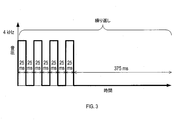
- the alarm sound is generated only for 25 ms, and a pattern not generated for 25 ms is repeated four times, and after the last sound generation, a signal pattern of one cycle 550 ms is not generated for 375 ms including the time not generated for 25 ms.
- the signal generation unit 18 is configured to generate this alarm sound as an audio signal to be an audible sound that simulates the insect's cry.
- the waveform of the insect call may be analyzed and reproduced, or the insect call may be recorded and reproduced as it is.
- the alarm sound of the splinter is less likely to be uncomfortable compared to other sounds of high frequency, such as the sound of other insects, the crack of a crow, and the scratching of a blackboard.
- the signal generation unit 18 modulates the sound wave signal before modulation to a frequency obtained by dividing the sound wave signal before modulation by an arbitrary n, which is an integer of 2 or more, and to include a sound whose frequency after modulation falls within the range of 4 kHz to 5 kHz.
- n which is an integer of 2 or more
- the sparrow's cry includes sounds in the range of 4 kHz to 5 kHz.
- the sound wave is 2 kHz or more when it is an audible sound by modulating the ultrasonic wave because of the characteristic of the shape of the human ear, if it is less than 2 kHz. This is because it was found that there are cases where it is easy to hear and cases where it is difficult to hear depending on the direction of the person's body. Also, it is understood that the alarm sound whose sound frequency is in the range of 4 kHz to 5 kHz is a frequency band where a large sound pressure can be obtained due to the sounding characteristics of the ultrasonic speaker, and attenuation due to distance is small and easy to hear far This is because the.
- the alarm sound of a larger sound pressure is provided to the target person, and the alarm sound is less likely to be masked by the environmental sound.
- FIG. 4 various sounds are decomposed into graphs for each frequency.
- the sound heard by a person is shown by [A]
- the engine sound of a vehicle about 30 m ahead is shown by [B]
- the environmental sounds around the road are shown by [C1]-[C5].
- the sound [A] heard by people exceeds the sound pressure of the environmental sounds [C1]-[C5] if it is approximately 3500 Hz or more.
- the human audible sound [A] is less than the sound pressure of the environmental sounds [C1]-[C5] at about 3500 Hz or less, and is masked by the environmental sounds [C1]-[C5] and becomes difficult to hear.
- the engine sound [B] falls below the sound pressure of the environmental sounds [C1]-[C5] in almost the entire area, and is masked by the environmental sounds [C1]-[C5] and becomes difficult to hear.
- FIG. 5 shows the relationship between the distance from the speaker and the sound pressure level.
- sounds at 500 Hz and 4 kHz were output from the dynamic speaker and the parametric speaker, and attenuation was measured when the distance from the speaker was changed from 50 cm to 200 cm, that is, distance attenuation.
- the sound pressure level decreased by 12 dB when the distance from the speaker was changed from 50 cm to 200 cm.
- the sound pressure level dropped by 28 dB when the distance from the speaker was changed from 50 cm to 200 cm.
- the dynamic speaker is excellent in the characteristic of transmitting the low frequency sound further and inferior in the characteristic of transmitting the high frequency sound further.
- the sound pressure level decreases by 26 dB when the distance from the speaker is changed from 50 cm to 200 cm.
- the sound pressure level dropped by 15 dB when the distance from the speaker was changed from 50 cm to 200 cm.
- the parametric speaker is inferior to the characteristic of transmitting the low frequency sound further than the dynamic speaker, and excellent in the characteristic of transmitting the high frequency sound further. This tendency is also apparent from FIGS. 6 and 7.
- the amount of attenuation with respect to the variation of the distance is large in the frequency band which is approximately less than 2 kHz.
- the amount of attenuation decreases as the frequency increases from 2 kHz to 4 kHz, and the amount of attenuation is approximately constant above 4 kHz.
- the attenuation is substantially constant at 1 kHz or more, and below 1 kHz, the attenuation decreases as the frequency decreases.
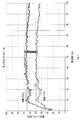
- FIG. 8 is a graph showing the sound pressure level for each frequency when white noise output from the parametric speaker is received by a different microphone.
- the broken line in FIG. 8 indicates the sound pressure level when using a nondirectional microphone at a distance of 1 m from the sound source, and the two solid lines indicate sound pressure levels when using a dummy head microphone.
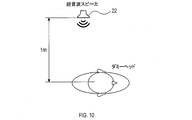
- the dummy head microphone is provided with a microphone in the doll's ear that reproduces the structure of the human ear, and as shown in FIG. 9, when the sound source is installed at a distance of 1 m in front of the doll, The sound pressure level was measured for the case where the sound source was installed at a distance of 1 m on the side of the doll.
- the case where the sound source is installed on the front of the doll is referred to as a dummy head (front), and the case where the sound source is installed on the side of the doll is referred to as a dummy head (side).
- the sound pressure level relative to the change in frequency is relatively small, while in the dummy head microphone the sound pressure level relative to the change in frequency is relatively large.
- the dummy head microphone has a sound pressure substantially lower than that of the nondirectional microphone at a frequency of less than about 2 kHz, and it is difficult to hear the sound. It is considered that such a result is obtained because it is difficult to hear low frequency sound that is hard to diffract due to the structure of the human ear.
- the sound pressure level in the frequency band of about 3 kHz to 6 kHz becomes large and it is easier to hear. It is considered that such a result is obtained because the sound of about 3 kHz to 6 kHz is a frequency band that is easily resonated by the hole of the ear due to the structure of the human ear.
- an alarm sound of about 3 kHz to 6 kHz can be easily heard in consideration of the characteristics of the human ear.
- the output improves at a frequency obtained by dividing 40 kHz by an integer n such as 5, 8, 10, and so on.
- n such as 5, 8, 10, and so on.
- the above-described alarm device 1 includes the signal generation unit 18 and the ultrasonic wave output unit 20.
- the signal generation unit 18 is configured to generate a sound wave signal for outputting an audible sound of a preset frequency by modulating a sound wave signal for outputting an ultrasonic wave.
- the ultrasonic wave output unit 20 is configured to output an alarm sound based on a sound wave signal.
- the alarm device 1 since the alarm sound by the audible sound generated by modulating the ultrasonic wave is output, the alarm sound having a directivity higher than that of the normal audible sound can be output. In the range where the alarm sound can be heard, the sound pressure of the alarm sound can be made higher, so that the alarm sound can be made less likely to be masked by the environmental sound. Therefore, it is possible to make it easy for the person around the vehicle to notice the alarm sound.
- the signal generation unit 18 is configured to generate an audio signal for outputting an audible sound having a pattern of repeating strength and weakness a plurality of times.
- continuous sounds are masked by environmental sounds and hard to hear, but sounds that repeat strong and weak such as intermittent sounds tend not to be masked by environmental sounds and tend to be easy to hear.
- the alarm sound is generated with an audible sound having a pattern of repeating strength and weakness a plurality of times, the alarm sound can be made easy to hear.
- the signal generation unit 18 is configured to generate an audio signal to be an audible sound that simulates the call of an insect.
- an audio signal to be an audible sound that simulates the call of an insect.
- high frequency sounds are unpleasant for humans, but insect sounds are less likely to be unpleasant for high frequency sounds.
- the signal generation unit 18 generates the modulated sound wave signal by modulating the sound wave signal before modulation to a frequency obtained by dividing the sound wave signal by an arbitrary number n which is an integer of 2 or more.
- the output of the sound wave output from the ultrasonic wave output unit 20 can be improved.
- Such an effect is considered to be due to the fact that the timing of the peak of the waveform of the sound wave signal before modulation and the peak of the waveform of the sound wave signal after modulation can be matched.
- the signal generation unit 18 is configured to generate a sound wave signal whose frequency after modulation is 2 kHz or more. Due to the characteristics of the shape of the human ear, it is easy to hear if it is 2 kHz or more if it is a sound wave that is modulated as an audible sound by modulating ultrasound so that the direction of the person's body is less than 2 kHz. It was found that there were cases where it was easy to hear and cases where it was hard to hear.
- an alarm device 1 it is possible to output an alarm sound that can be easily heard by persons around the vehicle regardless of the direction of the person around the vehicle.
- the signal generation unit 18 is configured to generate a sound wave signal whose frequency after modulation is in the range of 4 kHz to 5 kHz.
- the alarm sound whose sound frequency is in the range of 4 kHz to 5 kHz is the frequency band where a large sound pressure can be obtained due to the sounding characteristics of the ultrasonic speaker, and the attenuation due to distance is small and far It was because I understood that it was easy to hear.
- the alarm sound can be transmitted further with small energy.
- the sound wave imitating the roar of the stunt bug containing the sound wave whose sound wave frequency is in the range of 4 kHz to 5 kHz is output as the alarm sound, but it is not limited to this .
- an alarm sound obtained by arbitrarily combining one or more of a sound wave having a frequency of 2 kHz or more, a sound wave having a sound wave frequency of 4 kHz to 5 kHz, and a sound wave repeating strong and weak may be adopted.
- the audible sound is generated by ultrasonic modulation in the above embodiment, this configuration is not essential. Even if the configuration does not use ultrasonic modulation, a configuration that generates an audio signal for outputting an audible sound having a pattern that repeats strength and weakness a plurality of times, and the signal generation unit 18 simulates the call of an insect
- the effects shown in the above (1b) and (1c) can be enjoyed by adopting a configuration that generates an audio signal that becomes an audible sound that is reproduced in a realistic manner.
- the plurality of functions of one component in the above embodiment may be realized by a plurality of components, or one function of one component may be realized by a plurality of components . Also, a plurality of functions possessed by a plurality of components may be realized by one component, or one function realized by a plurality of components may be realized by one component. In addition, part of the configuration of the above embodiment may be omitted. In addition, at least a part of the configuration of the above embodiment may be added to or replaced with the configuration of the other above embodiment.
- the ultrasonic wave output unit 20 corresponds to the alarm sound output unit and the sound generation unit of the present disclosure
- the signal generation unit 18 corresponds to the arithmetic device of the present disclosure.
Landscapes
- Engineering & Computer Science (AREA)
- Automation & Control Theory (AREA)
- Mechanical Engineering (AREA)
- Physics & Mathematics (AREA)
- Acoustics & Sound (AREA)
- Human Computer Interaction (AREA)
- Transportation (AREA)
- Health & Medical Sciences (AREA)
- Audiology, Speech & Language Pathology (AREA)
- General Health & Medical Sciences (AREA)
- Multimedia (AREA)
- Circuit For Audible Band Transducer (AREA)
Priority Applications (3)
| Application Number | Priority Date | Filing Date | Title |
|---|---|---|---|
| DE112018005495.0T DE112018005495T5 (de) | 2017-09-27 | 2018-09-21 | Alarmvorrichtung und Alarmverfahren |
| CN201880062280.5A CN111163973A (zh) | 2017-09-27 | 2018-09-21 | 警报装置以及警报方法 |
| US16/795,407 US11046246B2 (en) | 2017-09-27 | 2020-02-19 | Alarm apparatus and alarming method |
Applications Claiming Priority (2)
| Application Number | Priority Date | Filing Date | Title |
|---|---|---|---|
| JP2017186709A JP6853153B2 (ja) | 2017-09-27 | 2017-09-27 | 警報装置 |
| JP2017-186709 | 2017-09-27 |
Related Child Applications (1)
| Application Number | Title | Priority Date | Filing Date |
|---|---|---|---|
| US16/795,407 Continuation US11046246B2 (en) | 2017-09-27 | 2020-02-19 | Alarm apparatus and alarming method |
Publications (1)
| Publication Number | Publication Date |
|---|---|
| WO2019065520A1 true WO2019065520A1 (ja) | 2019-04-04 |
Family
ID=65903460
Family Applications (1)
| Application Number | Title | Priority Date | Filing Date |
|---|---|---|---|
| PCT/JP2018/035122 Ceased WO2019065520A1 (ja) | 2017-09-27 | 2018-09-21 | 警報装置、および警報方法 |
Country Status (5)
| Country | Link |
|---|---|
| US (1) | US11046246B2 (https=) |
| JP (1) | JP6853153B2 (https=) |
| CN (1) | CN111163973A (https=) |
| DE (1) | DE112018005495T5 (https=) |
| WO (1) | WO2019065520A1 (https=) |
Families Citing this family (12)
| Publication number | Priority date | Publication date | Assignee | Title |
|---|---|---|---|---|
| US11900305B2 (en) | 2014-04-29 | 2024-02-13 | Vivint, Inc. | Occupancy identification for guiding delivery personnel |
| US10534330B2 (en) | 2014-06-13 | 2020-01-14 | Vivint, Inc. | Selecting a level of autonomy |
| US10600305B2 (en) | 2016-04-08 | 2020-03-24 | Vivint, Inc. | Event based monitoring of a person |
| US11941114B1 (en) | 2018-01-31 | 2024-03-26 | Vivint, Inc. | Deterrence techniques for security and automation systems |
| JP2020157928A (ja) | 2019-03-26 | 2020-10-01 | いすゞ自動車株式会社 | クロスメンバ及び車体フレーム |
| US12248892B1 (en) | 2020-02-10 | 2025-03-11 | Vivint Llc | Techniques for lead information sharing |
| US12260737B1 (en) | 2020-09-30 | 2025-03-25 | Vivint, Inc. | Device configured to classify events and identify occupants |
| US12206813B1 (en) | 2021-06-18 | 2025-01-21 | Vivint, Inc | Techniques for camera programming |
| US12302475B2 (en) | 2021-10-08 | 2025-05-13 | Vivint Llc | Apparatus for lighting control |
| US11849521B1 (en) | 2021-10-08 | 2023-12-19 | Vivint, Inc. | Apparatus for lighting control |
| US12579854B2 (en) | 2023-01-31 | 2026-03-17 | Vivint Llc | Lock system with integrated sensors for translatable structure |
| US20230281997A1 (en) * | 2023-03-01 | 2023-09-07 | Vivint, Inc. | Techniques for a smart monitoring system |
Citations (4)
| Publication number | Priority date | Publication date | Assignee | Title |
|---|---|---|---|---|
| JP2011037442A (ja) * | 2010-10-05 | 2011-02-24 | Yasuhiro Kumagai | 低駆動音車両用の接近報知装置、およびこれを搭載した車両 |
| JP2011168202A (ja) * | 2010-02-19 | 2011-09-01 | Denso Corp | 車両存在報知装置 |
| JP2012183933A (ja) * | 2011-03-07 | 2012-09-27 | Denso Corp | 車両存在通報装置 |
| JP2012217015A (ja) * | 2011-03-31 | 2012-11-08 | Nec Casio Mobile Communications Ltd | スピーカ装置及び電子機器 |
Family Cites Families (30)
| Publication number | Priority date | Publication date | Assignee | Title |
|---|---|---|---|---|
| JPS5582982A (en) * | 1978-12-18 | 1980-06-23 | Kazunobu Igarashi | Electronic wrist watch with alarm |
| US4366482A (en) * | 1981-01-23 | 1982-12-28 | Overhead Door Corporation | Transmitter with buzzer |
| US4980837A (en) * | 1988-09-15 | 1990-12-25 | Nunn Ewing D | Circuit and method for automatically sweeping through a plurality of siren modes |
| US6097315A (en) * | 1996-02-15 | 2000-08-01 | Minter; Jerry B. | Multi-indicator aviation pilot collision alert |
| WO2003027947A1 (en) * | 2001-09-25 | 2003-04-03 | Dmatek Ltd. | Multiple broadcasting tag and monitoring systems including the same |
| JP2006005868A (ja) * | 2004-06-21 | 2006-01-05 | Denso Corp | 車両用報知音出力装置及びプログラム |
| JP2008062666A (ja) | 2006-09-04 | 2008-03-21 | Toyota Motor Corp | 車両用警報装置 |
| JP2008101344A (ja) * | 2006-10-17 | 2008-05-01 | Denso Corp | 車両制御システム |
| JP4619415B2 (ja) * | 2008-01-09 | 2011-01-26 | 株式会社リコー | 発振周波数制御回路、その発振周波数制御回路を有するdc−dcコンバータ及び半導体装置 |
| DE102010002700A1 (de) * | 2009-03-11 | 2010-09-30 | Denso Corporation, Kariya-City | Fahrzeuganwesenheitsmeldevorrichtung |
| JP4752963B2 (ja) * | 2009-08-05 | 2011-08-17 | 株式会社デンソー | 車両存在報知装置 |
| JP4798271B2 (ja) * | 2009-08-07 | 2011-10-19 | 株式会社デンソー | 車両存在報知装置 |
| JP2011105288A (ja) | 2009-11-15 | 2011-06-02 | Hidehito Maruyama | 虫の鳴き声のホーンの付いた自動車。 |
| JP5029703B2 (ja) * | 2010-01-15 | 2012-09-19 | 株式会社デンソー | 車両存在報知装置 |
| JP5029706B2 (ja) * | 2010-01-22 | 2012-09-19 | 株式会社デンソー | 車両存在報知装置 |
| US8693708B2 (en) * | 2010-08-24 | 2014-04-08 | Star Headlight & Lantern Co., Inc. | System for operating a device for producing an audible alarm |
| JP2012148642A (ja) * | 2011-01-18 | 2012-08-09 | Denso Corp | 車両接近通報装置 |
| JP5704022B2 (ja) | 2011-08-30 | 2015-04-22 | アンデン株式会社 | 車両接近通報装置 |
| US9123248B2 (en) * | 2011-09-12 | 2015-09-01 | Toyota Jidosha Kabushiki Kaisha | Alarm device |
| JP5344016B2 (ja) * | 2011-09-27 | 2013-11-20 | 株式会社デンソー | 車両存在通報装置 |
| JP6077226B2 (ja) * | 2012-05-31 | 2017-02-08 | 富士通テン株式会社 | レーダ装置、および、信号処理方法 |
| JP6150707B2 (ja) * | 2013-10-21 | 2017-06-21 | オリンパス株式会社 | 音声データ合成端末、音声データ記録端末、音声データ合成方法、音声出力方法、及びプログラム |
| US10588306B2 (en) * | 2015-04-13 | 2020-03-17 | University Of Florida Research Foundation, Inc. | Wireless smart mosquito and insect trap device, network and method of counting a population of the mosquitoes or insects |
| EP3112831B1 (en) * | 2015-07-01 | 2019-05-08 | Nxp B.V. | Environmental parameter sensor |
| US10394518B2 (en) * | 2016-03-10 | 2019-08-27 | Mediatek Inc. | Audio synchronization method and associated electronic device |
| CA3017811C (en) * | 2016-03-21 | 2021-04-27 | Velodyne Lidar, Inc. | Lidar based 3-d imaging with varying pulse repetition |
| JP2017200786A (ja) * | 2016-05-02 | 2017-11-09 | 本田技研工業株式会社 | 車両制御システム、車両制御方法、および車両制御プログラム |
| JP6793478B2 (ja) * | 2016-06-21 | 2020-12-02 | 株式会社デンソーテン | レーダ装置および物標検知方法 |
| JP6673084B2 (ja) * | 2016-08-01 | 2020-03-25 | 株式会社デンソー | 光飛行型測距装置 |
| US20190041865A1 (en) * | 2017-08-02 | 2019-02-07 | GM Global Technology Operations LLC | Method and Apparatus for Parallel Acquisition in Lidar Array |
-
2017
- 2017-09-27 JP JP2017186709A patent/JP6853153B2/ja not_active Expired - Fee Related
-
2018
- 2018-09-21 WO PCT/JP2018/035122 patent/WO2019065520A1/ja not_active Ceased
- 2018-09-21 DE DE112018005495.0T patent/DE112018005495T5/de not_active Withdrawn
- 2018-09-21 CN CN201880062280.5A patent/CN111163973A/zh active Pending
-
2020
- 2020-02-19 US US16/795,407 patent/US11046246B2/en not_active Expired - Fee Related
Patent Citations (4)
| Publication number | Priority date | Publication date | Assignee | Title |
|---|---|---|---|---|
| JP2011168202A (ja) * | 2010-02-19 | 2011-09-01 | Denso Corp | 車両存在報知装置 |
| JP2011037442A (ja) * | 2010-10-05 | 2011-02-24 | Yasuhiro Kumagai | 低駆動音車両用の接近報知装置、およびこれを搭載した車両 |
| JP2012183933A (ja) * | 2011-03-07 | 2012-09-27 | Denso Corp | 車両存在通報装置 |
| JP2012217015A (ja) * | 2011-03-31 | 2012-11-08 | Nec Casio Mobile Communications Ltd | スピーカ装置及び電子機器 |
Also Published As
| Publication number | Publication date |
|---|---|
| CN111163973A (zh) | 2020-05-15 |
| US20200180506A1 (en) | 2020-06-11 |
| JP2019059400A (ja) | 2019-04-18 |
| JP6853153B2 (ja) | 2021-03-31 |
| DE112018005495T5 (de) | 2020-10-15 |
| US11046246B2 (en) | 2021-06-29 |
Similar Documents
| Publication | Publication Date | Title |
|---|---|---|
| US11046246B2 (en) | Alarm apparatus and alarming method | |
| ES2654214T3 (es) | Aparato acústico y funcionamiento | |
| US8532987B2 (en) | Speech masking and cancelling and voice obscuration | |
| Shi et al. | Development of parametric loudspeaker | |
| US20120308056A1 (en) | Three-dimensional sound apparatus | |
| JP6274497B2 (ja) | パラメトリックスピーカ | |
| CN104797462B (zh) | 驾驶支持装置 | |
| JP2019059400A5 (https=) | ||
| US20130034253A1 (en) | Stereophonic sound apparatus for vehicle | |
| KR101031113B1 (ko) | 초소형 마이크로폰 기반 청각 보조장치 | |
| US8320580B2 (en) | System and method for directional sound transmission with a linear array of exponentially spaced loudspeakers | |
| US12354586B2 (en) | System and method of active noise cancellation in open field | |
| JP4222169B2 (ja) | 超音波スピーカ及び超音波スピーカの信号音再生制御方法 | |
| CN110998680A (zh) | 通知方法、通知装置以及发声装置 | |
| WO2019049827A1 (ja) | 超音波出力装置、および発音制御方法 | |
| JP2011239047A (ja) | 音響再生装置 | |
| US20070146123A1 (en) | Multi-tone back-up alarm | |
| WO2018151047A1 (ja) | 視線誘導装置 | |
| JP7143623B2 (ja) | 音響制御装置 | |
| Peterson | Sound | |
| JP5976039B2 (ja) | 生物排除装置 | |
| US10658996B2 (en) | Rendering wideband ultrasonic signals audible | |
| CN120128853A (zh) | 紧凑型音频再现装置的接近度相关声音分布 | |
| TH11983A3 (th) | อุปกรณ์สร้างเสียงเลียนแบบนกนางแอ่น | |
| TH11983C3 (th) | อุปกรณ์สร้างเสียงเลียนแบบนกนางแอ่น |
Legal Events
| Date | Code | Title | Description |
|---|---|---|---|
| 121 | Ep: the epo has been informed by wipo that ep was designated in this application |
Ref document number: 18863326 Country of ref document: EP Kind code of ref document: A1 |
|
| 122 | Ep: pct application non-entry in european phase |
Ref document number: 18863326 Country of ref document: EP Kind code of ref document: A1 |