WO2019049706A1 - メルトブローン不織布およびその製造方法 - Google Patents
メルトブローン不織布およびその製造方法 Download PDFInfo
- Publication number
- WO2019049706A1 WO2019049706A1 PCT/JP2018/031593 JP2018031593W WO2019049706A1 WO 2019049706 A1 WO2019049706 A1 WO 2019049706A1 JP 2018031593 W JP2018031593 W JP 2018031593W WO 2019049706 A1 WO2019049706 A1 WO 2019049706A1
- Authority
- WO
- WIPO (PCT)
- Prior art keywords
- resin
- nonwoven fabric
- woven fabric
- cyclic olefin
- fiber diameter
- Prior art date
- Legal status (The legal status is an assumption and is not a legal conclusion. Google has not performed a legal analysis and makes no representation as to the accuracy of the status listed.)
- Ceased
Links
Images



Classifications
-
- D—TEXTILES; PAPER
- D04—BRAIDING; LACE-MAKING; KNITTING; TRIMMINGS; NON-WOVEN FABRICS
- D04H—MAKING TEXTILE FABRICS, e.g. FROM FIBRES OR FILAMENTARY MATERIAL; FABRICS MADE BY SUCH PROCESSES OR APPARATUS, e.g. FELTS, NON-WOVEN FABRICS; COTTON-WOOL; WADDING ; NON-WOVEN FABRICS FROM STAPLE FIBRES, FILAMENTS OR YARNS, BONDED WITH AT LEAST ONE WEB-LIKE MATERIAL DURING THEIR CONSOLIDATION
- D04H3/00—Non-woven fabrics formed wholly or mainly of yarns or like filamentary material of substantial length
- D04H3/016—Non-woven fabrics formed wholly or mainly of yarns or like filamentary material of substantial length characterised by the fineness
-
- A—HUMAN NECESSITIES
- A61—MEDICAL OR VETERINARY SCIENCE; HYGIENE
- A61K—PREPARATIONS FOR MEDICAL, DENTAL OR TOILETRY PURPOSES
- A61K47/00—Medicinal preparations characterised by the non-active ingredients used, e.g. carriers or inert additives; Targeting or modifying agents chemically bound to the active ingredient
- A61K47/50—Medicinal preparations characterised by the non-active ingredients used, e.g. carriers or inert additives; Targeting or modifying agents chemically bound to the active ingredient the non-active ingredient being chemically bound to the active ingredient, e.g. polymer-drug conjugates
- A61K47/51—Medicinal preparations characterised by the non-active ingredients used, e.g. carriers or inert additives; Targeting or modifying agents chemically bound to the active ingredient the non-active ingredient being chemically bound to the active ingredient, e.g. polymer-drug conjugates the non-active ingredient being a modifying agent
- A61K47/56—Medicinal preparations characterised by the non-active ingredients used, e.g. carriers or inert additives; Targeting or modifying agents chemically bound to the active ingredient the non-active ingredient being chemically bound to the active ingredient, e.g. polymer-drug conjugates the non-active ingredient being a modifying agent the modifying agent being an organic macromolecular compound, e.g. an oligomeric, polymeric or dendrimeric molecule
- A61K47/58—Medicinal preparations characterised by the non-active ingredients used, e.g. carriers or inert additives; Targeting or modifying agents chemically bound to the active ingredient the non-active ingredient being chemically bound to the active ingredient, e.g. polymer-drug conjugates the non-active ingredient being a modifying agent the modifying agent being an organic macromolecular compound, e.g. an oligomeric, polymeric or dendrimeric molecule obtained by reactions only involving carbon-to-carbon unsaturated bonds, e.g. poly[meth]acrylate, polyacrylamide, polystyrene, polyvinylpyrrolidone, polyvinylalcohol or polystyrene sulfonic acid resin
-
- A—HUMAN NECESSITIES
- A61—MEDICAL OR VETERINARY SCIENCE; HYGIENE
- A61K—PREPARATIONS FOR MEDICAL, DENTAL OR TOILETRY PURPOSES
- A61K9/00—Medicinal preparations characterised by special physical form
- A61K9/70—Web, sheet or filament bases ; Films; Fibres of the matrix type containing drug
-
- A—HUMAN NECESSITIES
- A61—MEDICAL OR VETERINARY SCIENCE; HYGIENE
- A61L—METHODS OR APPARATUS FOR STERILISING MATERIALS OR OBJECTS IN GENERAL; DISINFECTION, STERILISATION OR DEODORISATION OF AIR; CHEMICAL ASPECTS OF BANDAGES, DRESSINGS, ABSORBENT PADS OR SURGICAL ARTICLES; MATERIALS FOR BANDAGES, DRESSINGS, ABSORBENT PADS OR SURGICAL ARTICLES
- A61L15/00—Chemical aspects of, or use of materials for, bandages, dressings or absorbent pads
- A61L15/16—Bandages, dressings or absorbent pads for physiological fluids such as urine or blood, e.g. sanitary towels, tampons
- A61L15/22—Bandages, dressings or absorbent pads for physiological fluids such as urine or blood, e.g. sanitary towels, tampons containing macromolecular materials
- A61L15/24—Macromolecular compounds obtained by reactions only involving carbon-to-carbon unsaturated bonds; Derivatives thereof
-
- A—HUMAN NECESSITIES
- A61—MEDICAL OR VETERINARY SCIENCE; HYGIENE
- A61L—METHODS OR APPARATUS FOR STERILISING MATERIALS OR OBJECTS IN GENERAL; DISINFECTION, STERILISATION OR DEODORISATION OF AIR; CHEMICAL ASPECTS OF BANDAGES, DRESSINGS, ABSORBENT PADS OR SURGICAL ARTICLES; MATERIALS FOR BANDAGES, DRESSINGS, ABSORBENT PADS OR SURGICAL ARTICLES
- A61L15/00—Chemical aspects of, or use of materials for, bandages, dressings or absorbent pads
- A61L15/16—Bandages, dressings or absorbent pads for physiological fluids such as urine or blood, e.g. sanitary towels, tampons
- A61L15/42—Use of materials characterised by their function or physical properties
-
- A—HUMAN NECESSITIES
- A61—MEDICAL OR VETERINARY SCIENCE; HYGIENE
- A61L—METHODS OR APPARATUS FOR STERILISING MATERIALS OR OBJECTS IN GENERAL; DISINFECTION, STERILISATION OR DEODORISATION OF AIR; CHEMICAL ASPECTS OF BANDAGES, DRESSINGS, ABSORBENT PADS OR SURGICAL ARTICLES; MATERIALS FOR BANDAGES, DRESSINGS, ABSORBENT PADS OR SURGICAL ARTICLES
- A61L15/00—Chemical aspects of, or use of materials for, bandages, dressings or absorbent pads
- A61L15/16—Bandages, dressings or absorbent pads for physiological fluids such as urine or blood, e.g. sanitary towels, tampons
- A61L15/42—Use of materials characterised by their function or physical properties
- A61L15/425—Porous materials, e.g. foams or sponges
-
- B—PERFORMING OPERATIONS; TRANSPORTING
- B01—PHYSICAL OR CHEMICAL PROCESSES OR APPARATUS IN GENERAL
- B01D—SEPARATION
- B01D39/00—Filtering material for liquid or gaseous fluids
- B01D39/14—Other self-supporting filtering material ; Other filtering material
- B01D39/16—Other self-supporting filtering material ; Other filtering material of organic material, e.g. synthetic fibres
- B01D39/1607—Other self-supporting filtering material ; Other filtering material of organic material, e.g. synthetic fibres the material being fibrous
- B01D39/1623—Other self-supporting filtering material ; Other filtering material of organic material, e.g. synthetic fibres the material being fibrous of synthetic origin
-
- D—TEXTILES; PAPER
- D04—BRAIDING; LACE-MAKING; KNITTING; TRIMMINGS; NON-WOVEN FABRICS
- D04H—MAKING TEXTILE FABRICS, e.g. FROM FIBRES OR FILAMENTARY MATERIAL; FABRICS MADE BY SUCH PROCESSES OR APPARATUS, e.g. FELTS, NON-WOVEN FABRICS; COTTON-WOOL; WADDING ; NON-WOVEN FABRICS FROM STAPLE FIBRES, FILAMENTS OR YARNS, BONDED WITH AT LEAST ONE WEB-LIKE MATERIAL DURING THEIR CONSOLIDATION
- D04H1/00—Non-woven fabrics formed wholly or mainly of staple fibres or like relatively short fibres
- D04H1/40—Non-woven fabrics formed wholly or mainly of staple fibres or like relatively short fibres from fleeces or layers composed of fibres without existing or potential cohesive properties
- D04H1/42—Non-woven fabrics formed wholly or mainly of staple fibres or like relatively short fibres from fleeces or layers composed of fibres without existing or potential cohesive properties characterised by the use of certain kinds of fibres insofar as this use has no preponderant influence on the consolidation of the fleece
- D04H1/4282—Addition polymers
- D04H1/4291—Olefin series
-
- D—TEXTILES; PAPER
- D04—BRAIDING; LACE-MAKING; KNITTING; TRIMMINGS; NON-WOVEN FABRICS
- D04H—MAKING TEXTILE FABRICS, e.g. FROM FIBRES OR FILAMENTARY MATERIAL; FABRICS MADE BY SUCH PROCESSES OR APPARATUS, e.g. FELTS, NON-WOVEN FABRICS; COTTON-WOOL; WADDING ; NON-WOVEN FABRICS FROM STAPLE FIBRES, FILAMENTS OR YARNS, BONDED WITH AT LEAST ONE WEB-LIKE MATERIAL DURING THEIR CONSOLIDATION
- D04H1/00—Non-woven fabrics formed wholly or mainly of staple fibres or like relatively short fibres
- D04H1/40—Non-woven fabrics formed wholly or mainly of staple fibres or like relatively short fibres from fleeces or layers composed of fibres without existing or potential cohesive properties
- D04H1/42—Non-woven fabrics formed wholly or mainly of staple fibres or like relatively short fibres from fleeces or layers composed of fibres without existing or potential cohesive properties characterised by the use of certain kinds of fibres insofar as this use has no preponderant influence on the consolidation of the fleece
- D04H1/4326—Condensation or reaction polymers
- D04H1/435—Polyesters
-
- D—TEXTILES; PAPER
- D04—BRAIDING; LACE-MAKING; KNITTING; TRIMMINGS; NON-WOVEN FABRICS
- D04H—MAKING TEXTILE FABRICS, e.g. FROM FIBRES OR FILAMENTARY MATERIAL; FABRICS MADE BY SUCH PROCESSES OR APPARATUS, e.g. FELTS, NON-WOVEN FABRICS; COTTON-WOOL; WADDING ; NON-WOVEN FABRICS FROM STAPLE FIBRES, FILAMENTS OR YARNS, BONDED WITH AT LEAST ONE WEB-LIKE MATERIAL DURING THEIR CONSOLIDATION
- D04H1/00—Non-woven fabrics formed wholly or mainly of staple fibres or like relatively short fibres
- D04H1/40—Non-woven fabrics formed wholly or mainly of staple fibres or like relatively short fibres from fleeces or layers composed of fibres without existing or potential cohesive properties
- D04H1/54—Non-woven fabrics formed wholly or mainly of staple fibres or like relatively short fibres from fleeces or layers composed of fibres without existing or potential cohesive properties by welding together the fibres, e.g. by partially melting or dissolving
- D04H1/56—Non-woven fabrics formed wholly or mainly of staple fibres or like relatively short fibres from fleeces or layers composed of fibres without existing or potential cohesive properties by welding together the fibres, e.g. by partially melting or dissolving in association with fibre formation, e.g. immediately following extrusion of staple fibres
-
- D—TEXTILES; PAPER
- D04—BRAIDING; LACE-MAKING; KNITTING; TRIMMINGS; NON-WOVEN FABRICS
- D04H—MAKING TEXTILE FABRICS, e.g. FROM FIBRES OR FILAMENTARY MATERIAL; FABRICS MADE BY SUCH PROCESSES OR APPARATUS, e.g. FELTS, NON-WOVEN FABRICS; COTTON-WOOL; WADDING ; NON-WOVEN FABRICS FROM STAPLE FIBRES, FILAMENTS OR YARNS, BONDED WITH AT LEAST ONE WEB-LIKE MATERIAL DURING THEIR CONSOLIDATION
- D04H3/00—Non-woven fabrics formed wholly or mainly of yarns or like filamentary material of substantial length
- D04H3/005—Synthetic yarns or filaments
- D04H3/007—Addition polymers
-
- D—TEXTILES; PAPER
- D04—BRAIDING; LACE-MAKING; KNITTING; TRIMMINGS; NON-WOVEN FABRICS
- D04H—MAKING TEXTILE FABRICS, e.g. FROM FIBRES OR FILAMENTARY MATERIAL; FABRICS MADE BY SUCH PROCESSES OR APPARATUS, e.g. FELTS, NON-WOVEN FABRICS; COTTON-WOOL; WADDING ; NON-WOVEN FABRICS FROM STAPLE FIBRES, FILAMENTS OR YARNS, BONDED WITH AT LEAST ONE WEB-LIKE MATERIAL DURING THEIR CONSOLIDATION
- D04H3/00—Non-woven fabrics formed wholly or mainly of yarns or like filamentary material of substantial length
- D04H3/08—Non-woven fabrics formed wholly or mainly of yarns or like filamentary material of substantial length characterised by the method of strengthening or consolidating
- D04H3/16—Non-woven fabrics formed wholly or mainly of yarns or like filamentary material of substantial length characterised by the method of strengthening or consolidating with bonds between thermoplastic filaments produced in association with filament formation, e.g. immediately following extrusion
-
- A—HUMAN NECESSITIES
- A61—MEDICAL OR VETERINARY SCIENCE; HYGIENE
- A61K—PREPARATIONS FOR MEDICAL, DENTAL OR TOILETRY PURPOSES
- A61K9/00—Medicinal preparations characterised by special physical form
- A61K9/70—Web, sheet or filament bases ; Films; Fibres of the matrix type containing drug
- A61K9/7007—Drug-containing films, membranes or sheets
-
- A—HUMAN NECESSITIES
- A61—MEDICAL OR VETERINARY SCIENCE; HYGIENE
- A61L—METHODS OR APPARATUS FOR STERILISING MATERIALS OR OBJECTS IN GENERAL; DISINFECTION, STERILISATION OR DEODORISATION OF AIR; CHEMICAL ASPECTS OF BANDAGES, DRESSINGS, ABSORBENT PADS OR SURGICAL ARTICLES; MATERIALS FOR BANDAGES, DRESSINGS, ABSORBENT PADS OR SURGICAL ARTICLES
- A61L15/00—Chemical aspects of, or use of materials for, bandages, dressings or absorbent pads
- A61L15/16—Bandages, dressings or absorbent pads for physiological fluids such as urine or blood, e.g. sanitary towels, tampons
- A61L15/42—Use of materials characterised by their function or physical properties
- A61L15/44—Medicaments
-
- B—PERFORMING OPERATIONS; TRANSPORTING
- B01—PHYSICAL OR CHEMICAL PROCESSES OR APPARATUS IN GENERAL
- B01D—SEPARATION
- B01D2239/00—Aspects relating to filtering material for liquid or gaseous fluids
- B01D2239/06—Filter cloth, e.g. knitted, woven non-woven; self-supported material
- B01D2239/0604—Arrangement of the fibres in the filtering material
- B01D2239/0622—Melt-blown
-
- B—PERFORMING OPERATIONS; TRANSPORTING
- B01—PHYSICAL OR CHEMICAL PROCESSES OR APPARATUS IN GENERAL
- B01D—SEPARATION
- B01D2239/00—Aspects relating to filtering material for liquid or gaseous fluids
- B01D2239/12—Special parameters characterising the filtering material
- B01D2239/1233—Fibre diameter
-
- B—PERFORMING OPERATIONS; TRANSPORTING
- B01—PHYSICAL OR CHEMICAL PROCESSES OR APPARATUS IN GENERAL
- B01D—SEPARATION
- B01D2239/00—Aspects relating to filtering material for liquid or gaseous fluids
- B01D2239/12—Special parameters characterising the filtering material
- B01D2239/1258—Permeability
-
- D—TEXTILES; PAPER
- D10—INDEXING SCHEME ASSOCIATED WITH SUBLASSES OF SECTION D, RELATING TO TEXTILES
- D10B—INDEXING SCHEME ASSOCIATED WITH SUBLASSES OF SECTION D, RELATING TO TEXTILES
- D10B2321/00—Fibres made from polymers obtained by reactions only involving carbon-to-carbon unsaturated bonds
- D10B2321/02—Fibres made from polymers obtained by reactions only involving carbon-to-carbon unsaturated bonds polyolefins
Definitions
- the present invention relates to a melt-blown (MB) non-woven fabric and a melt-blown (MB) non-woven fabric which are composed of fibers containing a cyclic olefin-based resin and in which mixing of large diameter fibers is reduced.
- Cyclic olefin resins are molded by various methods due to their features such as high transparency, high heat resistance, chemical resistance, low elution of impurities, low adsorption, etc., and medical applications such as chemical packaging materials and inspection containers, It is used in optical applications such as lenses and optical films, and in electronic device applications.
- Patent Document 1 Japanese Patent Application Laid-Open No. 2001-210549 describes an electret made of a resin composition containing a cyclic hydrocarbon polymer, and the electret is in the form of a film, a sheet, a fiber, a non-woven fabric, etc. It is described that the melt-blowing method is preferable for the electretization of the non-woven fabric.
- Patent Document 1 only describes conditions of a general melt-blowing method with respect to a method of producing a melt-blown non-woven fabric, and only produces a film in the examples.
- an object of the present invention is a meltblown non-woven fabric composed of fibers containing cyclic olefin resin and in which the inclusion of thick fibers is suppressed, a filter using the same, and a support for transdermal administration sheet and transdermal administration sheet (
- the present invention is to provide a percutaneous absorption agent, a patch).
- Another object of the present invention is to provide a method for producing a meltblown non-woven fabric composed of fibers containing a cyclic olefin resin, which can suppress the inclusion of thick fibers.
- the inventors of the present invention conducted intensive studies to achieve the above object, and as a result, when melt-blowing method is applied to (i) cyclic olefin resin, decomposition of the main chain by mechanical energy working at the time of kneading of the resin
- the MB non-woven fabric obtained by using a cyclic olefin-based resin is a bead called a shot, in order to cause a phenomenon called “mechanochemical reaction” in which generated and decomposed double bonds form a new bond and gelation occurs.
- Clumps are generated, and even if shots are not mixed, fibers thicker than fibers of acceptable thickness are mixed as defects due to mechanochemical reaction Found out.
- a meltblown non-woven fabric composed of fibers containing a cyclic olefin-based resin, wherein among fiber diameter data of 100 points randomly selected in an SEM image magnified 1000 times, data from small fiber diameter to large data
- the meltblown nonwoven fabric whose average value of the data with a fiber diameter larger than the 3rd quartile obtained by dividing into 4 quartiles is 30 micrometers or less.
- Aspect 7 A filter using a meltblown non-woven fabric according to any one of aspects 1 to 6.
- a support for use in a transdermal administration sheet for releasing an active ingredient which comprises the meltblown non-woven fabric according to any one of aspects 1-6.
- a transdermal administration sheet comprising at least an active ingredient and the support according to claim 8.
- the MB non-woven fabric of the present invention it is possible to obtain an MB non-woven fabric in which the inclusion of thick fibers is suppressed despite being composed of fibers containing a cyclic olefin-based resin causing a specific side reaction, It is possible to provide a filter using this MB non-woven fabric and a transdermal administration sheet (in particular, a transdermal absorbent, patch).
- the “mechanochemical reaction” specific to cyclic olefin-based resins can be obtained by setting the viscosity of the resin melt before introduction into the kneading section within a specific range. It is possible to provide a method for producing a meltblown non-woven fabric in which occurrence can be suppressed, and as a result, mixing of thick fibers is suppressed.
- the MB non-woven fabric of the present invention is composed of fibers containing a cyclic olefin resin, and among fiber diameter data of 100 points randomly selected in a scanning electron microscope (SEM) image magnified 1000 times, the fiber diameter
- SEM scanning electron microscope
- Quadratile is the value of the position at which the data values are divided into four equal parts when the data values are arranged in ascending order, and the value of the data from the smaller one quarter is the first quartile
- the value of 2/4 data is referred to as the second quartile (median value), and the value of 3/4 data is referred to as the third quartile.
- the MB non-woven fabric of the present invention has few thick fibers derived from mechanochemical reaction, and the third quarter of 100 point fiber diameter data randomly selected in a scanning electron microscope image obtained by enlarging the non-woven fabric 1000 times.
- the average fiber diameter (Db) which is an average value of data (the 76th to 100th data) having a fiber diameter larger than the order number is 30 ⁇ m or less, preferably 20 ⁇ m or less, more preferably 16 ⁇ m or less .
- the lower limit of the average fiber diameter Db is not particularly limited, but may be, for example, the average fiber diameter of the fibers constituting the non-woven fabric.
- the MB nonwoven fabric of the present invention may have an average fiber diameter of, for example, 1 to 15 ⁇ m, preferably 1 to 12 ⁇ m, more preferably 1 to 12 ⁇ m, from the viewpoint of improving the density of the nonwoven fabric. May be 1 to 10 ⁇ m, more preferably 1 to 8 ⁇ m.
- an average fiber diameter means the average value of all the measured fiber diameter data, and is a value measured by the method described in the Example mentioned later.
- the CV value of the average fiber diameter of the fibers constituting the non-woven fabric may be, for example, 110% or less, from the viewpoint of improving the density and uniformity of the non-woven fabric of the MB non-woven fabric of the present invention. Preferably it may be 105% or less.
- the lower limit of the CV value is not particularly limited, but may be 50% or more.
- the CV value of the average fiber diameter refers to the ratio of the standard deviation of the measured fiber diameter data to the average fiber diameter, is an index representing the dispersion of the fiber diameter distribution, and is measured by the method described in the examples described later Value.
- the MB nonwoven fabric of the present invention is a 100 nm fiber diameter data randomly selected in a scanning electron microscope image in which the nonwoven fabric is enlarged by 1000 times from the viewpoint of improving the density and uniformity of the nonwoven fabric.
- the average fiber diameter (Db) which is the average value of the data having the fiber diameter larger than 3 quartiles (the 76th to 100th data), is larger than the 1st quartile, and the 3rd quartile
- Db / Dc may be 4.0 or less with respect to the average fiber diameter (Dc) which is an average value of data (the 26th to 75th data) having a smaller fiber diameter. , Preferably 3.5 or less.
- Db / Dc is preferably 1 or more.
- the fiber which comprises the MB nonwoven fabric of this invention is a fiber containing cyclic olefin resin.
- the resin composition constituting the fiber may contain 50% by mass or more, preferably 80% by mass or more, more preferably 90% by mass or more, and still more preferably 98% by mass or more of cyclic olefin resin. It may be
- the MB non-woven fabric of the present invention is not particularly limited as long as the effects of the present invention can be achieved, and a thermoplastic resin may be contained in addition to the cyclic olefin-based resin described later.
- a thermoplastic resin chain-like polyolefin resin (for example, polyethylene resin, polypropylene resin), polyester resin (for example, polyethylene terephthalate resin, polybutylene terephthalate resin) etc. are mentioned.
- the fiber which comprises the MB nonwoven fabric of this invention may be formed with cyclic olefin resin which the at least one part of the fiber surface mentions later from a low elution viewpoint.
- the fibers constituting the MB non-woven fabric of the present invention are not particularly limited as long as the effects of the present invention can be achieved, and may be composite fibers.
- core-sheath fibers, side-by-side fibers, or It may be a sea-island type fiber.
- the basis weight of the MB non-woven fabric of the present invention can be appropriately determined depending on the application, and the basis weight is not particularly limited.
- the basis weight is, for example, 10 to 50 g / m 2
- the degree may be about 10 to 45 g / m 2 , and more preferably about 10 to 40 g / m 2 .
- a fabric weight is a value measured by the method described in the Example mentioned later.
- the thickness of the MB non-woven fabric of the present invention can be appropriately determined depending on the application, and the thickness is not particularly limited.
- the thickness is, for example, 0.10 to It may be about 1.00 mm, preferably about 0.10 to 0.85 mm, and more preferably about 0.10 to 0.70 mm.
- thickness is a value measured by the method described in the Example mentioned later.
- the air permeability of the MB non-woven fabric of the present invention can be appropriately determined depending on the application, and the air permeability is not particularly limited.
- the air permeability is, for example, 10 to 550 cm 3 / cm It may be about 2 ⁇ s, preferably about 10 to 500 cm 3 / cm 2 ⁇ s, more preferably about 10 to 400 cm 3 / cm 2 ⁇ s.
- air permeability is a value measured by the method described in the Example mentioned later.
- the MB non-woven fabric of the present invention is preferably excellent in compactness despite being thin.
- the ratio of air permeability B (cm 3 / cm 2 ⁇ s) to thickness A (mm) of non-woven fabric (B / A) may be 80 ⁇ B / A ⁇ 800, preferably 90 ⁇ B / A ⁇ 500, and more preferably 100 ⁇ B / A ⁇ 400.
- the MB non-woven fabric of the present invention can be used for various applications such as medical / cosmetic / sanitary materials, industrial material applications, daily necessities and clothing applications.
- various filters such as filters for liquid filtration such as water and air filters (for example, air filters for clean rooms), transdermal administration sheets (for example, transdermal absorbents and patches), and in particular, impurities
- filters for liquid filtration such as water and air filters (for example, air filters for clean rooms), transdermal administration sheets (for example, transdermal absorbents and patches), and in particular, impurities
- filters for liquid filtration and transdermal administration sheets for example, transdermal absorbents, patches.
- the collection efficiency of the filter measured according to JIS T 8151 is preferably 85% or more, more preferably 88% or more, and still more preferably 90% or more. Moreover, 15 Pa or less is preferable, as for the pressure loss of the filter measured based on JIST 8151, 13 Pa or less is more preferable, and 10 Pa or less is still more preferable. In addition, collection efficiency and pressure loss are values measured by the method described in the Example mentioned later.
- the MB non-woven fabric of the present invention is very effective as an air filter with low pressure loss and high collection efficiency.
- the fiber diameter of the MB non-woven fabric may be reduced.
- the average fiber diameter of the MB non-woven fabric may be 1 to 8 ⁇ m, preferably 1 to 7 ⁇ m. Good.
- the MB non-woven fabric of the present invention is excellent in low elution of impurities and can reduce transfer of an active ingredient such as a drug to the non-woven fabric. It can be suitably used in a transdermal administration sheet (preferably a percutaneous absorption agent, patch) for releasing a cosmetically active component, preferably a medicinally active component), said transdermal administration sheet comprising at least the active component And the MB non-woven fabric of the present invention as a support.
- the MB non-woven fabric of the present invention may be used as a support for holding a liquid containing an active ingredient, or support a semisolid or solid containing an active ingredient May be used as a support (backing).
- the cyclic olefin resin is a polymer or copolymer containing a structural unit derived from cyclic olefin in the main chain.
- This cyclic olefin is an unsaturated hydrocarbon compound having at least one olefinic double bond in a cyclic hydrocarbon structure, as represented by norbornene, dicyclopentadiene, tetracyclododecene, etc. It is introduced by using it as a body.
- cyclic olefin resins are cyclic olefin addition polymers or hydrogenated products thereof; addition copolymers of cyclic olefins and ⁇ -olefins or hydrogenated products thereof; and ring opening (co) heavy weight of cyclic olefins A combined or its hydrogenated substance etc. can be mentioned.
- the cyclic olefin-based resin in the present invention may be, for example, an addition copolymer of cyclic olefin and ⁇ -olefin, from the viewpoint of providing both of properties and cost.
- cyclic olefin examples include single-ring cyclic olefins such as cyclopentene, cyclohexene, cyclooctene, cyclopentadiene, 1,3-cyclohexadiene and the like; bicyclo [2.2.1] hept-2-ene (norbornene), 5 -Methyl-bicyclo [2.2.1] hept-2-ene, 5,5-dimethyl-bicyclo [2.2.1] hept-2-ene, 5-ethyl-bicyclo [2.2.1] hepta -2-ene, 5-butyl-bicyclo [2.2.1] hept-2-ene, 5-ethylidene-bicyclo [2.2.1] hept-2-ene, 5-hexyl-bicyclo [2.2 .1] Hept-2-ene, 5-octyl-bicyclo [2.2.1] hept-2-ene, 5-octadecyl
- Bicyclic cyclic olefin tricyclo [4.3.0.1 2,5 ] deca-3,7-diene (dicyclopentadiene), tricyclo [4.3.0.1 2,5 ] dec-3-ene , Tricyclo [4.4.0.1 2,5 ] undeca-3,7-diene or tricyclo [4.4.0.1 2,5 ] undeca-3,8-diene or partial hydrogenated products thereof ( or cyclopentadiene with adducts of cyclohexene) in which tricyclo [4.4.0.1 2, 5] undec-3-ene, 5-cyclopentyl - bicyclo [2.2.1] hept-2-ene, 5- Cyclohexyl-bicyclo [2.2.1] Tricyclic cyclic olefins such as t-2-ene, 5-cyclohexenylbicyclo [2.2.1] hept-2-ene, 5-phenyl-bicyclo [2.2.1] hept-2-ene; 4.4.0.1 2,
- 17 10 dodec-3-ene, 8-propenyl-tetracyclo [4.4.0.1 2,5 . 1 7,10] dodeca-3-cyclic olefin tetracyclic such ene; 8-cyclopentyl-- tetracyclo [4.4.0.1 2, 5. 17 10 ] dodec-3-ene, 8-cyclohexyl-tetracyclo [4.4.0.1 2,5 . 17 10 ] dodec-3-ene, 8-cyclohexenyl-tetracyclo [4.4.0.1 2,5 . 17 10 ] dodec-3-ene, 8-phenyl-cyclopentyl-tetracyclo [4.4.0.1 2,5 .
- ⁇ -olefins copolymerizable with cyclic olefins include ethylene, propylene, 1-butene, 1-pentene, 1-hexene, 3-methyl-1-butene, 3-methyl-1-pentene, 3--3 Ethyl-1-pentene, 4-methyl-1-pentene, 4-methyl-1-hexene, 4,4-dimethyl-1-hexene, 4,4-dimethyl-1-pentene, 4-ethyl-1-hexene , 2-ethyl -1-hexene, 1-octene, 1-decene, 1-dodecene, 1-tetradecene, 1-hexadecene, 1-octadecene, 1-eicosene, etc., having 2 to 20 carbon atoms, preferably 2 to 20 carbon atoms And the like.
- These ⁇ -olefins can be used alone or in combination of two or more.
- the polymerization method and hydrogenation method of the cyclic olefin or the cyclic olefin and the ⁇ -olefin are not particularly limited, and can be carried out according to known methods.
- the cyclic olefin resin of the present invention is preferably a copolymer containing at least a norbornene unit, wherein at least norbornene is used as the cyclic olefin, and a copolymer of ethylene and norbornene is particularly preferable.
- the mass ratio of the norbornene unit to the total of the ethylene unit and the norbornene unit may be 60 to 99% by mass, preferably 63 to 99 from the viewpoint of processability and elution. 90 mass% may be sufficient.
- the method further comprises: a discharge step of discharging the resin kneaded material together with air from a nozzle; and a collection step of collecting discharge filaments discharged from the nozzle on a collection surface to obtain a web.
- FIG. 1 is a schematic cross-sectional view showing an apparatus 100 used to manufacture an MB non-woven fabric according to an embodiment of the present invention.
- the device 100 at least includes an extruder 10, a die 40, and a collection member 60.
- the extruder 10 at least includes a cylinder 30 and a screw 20 that rotates in the cylinder 30.
- the screw 20 includes a supply unit 22 for supplying a resin solid substance, and a kneading unit 24 for kneading the resin supplied from the supply unit 22.
- the resin composition containing the cyclic olefin resin is heated and melted in the supply portion 22 of the screw 20 of the extruder 10 and introduced into the kneading portion 24.
- the kneading unit 24 is configured by the compression unit 26 and the measurement unit 28.
- the solid resin composition (resin solid substance) introduced from the hopper 12 is sent from the supply unit 22 to the kneading unit 24 toward the die 40 by the rotation of the screw 20 in the cylinder 30.
- the supply portion 22 has a groove of the same depth (Hp), and the compression portion 26 has a groove which becomes gradually shallower in the flow direction X.
- the depth of the groove of the screw 20 is the shallowest in the measuring unit 28, and the measuring unit 28 has a groove with the same depth (Hm) (here, Hp> Hm).
- the groove of the screw 20 in the kneading section 24 becomes shallower in the flow direction X, so that the mechanical action acts on the resin melt between the screw 20 and the inner wall of the cylinder 30 as it is propelled in the flow direction X. Energy gets bigger.
- the resin kneaded material that has passed through the kneading unit 24 is then introduced into the die 40.
- the resin kneaded material is discharged from the nozzle 42, and the discharge thread 50 is collected on the collection surface 62, whereby a nonwoven fabric is generated.
- the solid bed is not broken in the feed section, but is broken in the kneading section 24 to form a resin melt.
- a resin melt having a specific viscosity can be formed in the supply unit 22 by raising the heating temperature in the supply unit 22 to such an extent that the solid bed is broken.
- known extruders such as a single screw extruder, a multi-screw extruder (two or more screws) and the like can be used. .
- the resin composition is introduced into the kneading section as a solid or in a state containing a solid, but it has a specific low viscosity in advance before heating and kneading in the kneading section.
- a resin melt By using a resin melt, it is possible to reduce mechanical energy acting on the resin melt such as shear stress due to rotation of the screw in the kneading step, and compression stress applied when supplying to the die or discharging from the nozzle. .
- This makes it possible to suppress the "mechanochemical reaction" characteristically found in cyclic olefin resins, and as a result, it is possible to suppress the formation of thick fibers.
- the heating temperature in the supply unit can be appropriately determined depending on the viscosity characteristics, thermal decomposition temperature, etc. of the cyclic olefin resin and other thermoplastic resins contained in the resin composition, and may be, for example, 200 to 400 ° C. May be 250 to 390.degree. C., more preferably 300 to 380.degree. It is possible to reduce the viscosity ⁇ of the resin melt by increasing the heating temperature in the feed section.
- the viscosity ⁇ of the resin melt at the heating temperature in the feed section may be 80 to 200 poise, preferably 85 to 195 poise, and more preferably 90 to 190 poise.
- a viscosity is a value measured by the method described in the Example mentioned later. The resin melt adjusted to a predetermined viscosity by the supply unit is introduced into the kneading unit.
- the resin melt melted in advance by the supply unit 22 is then introduced into the kneading unit 24, and is kneaded by rotation of the screw 20 under heating in the kneading unit 24 to obtain a resin kneaded material.
- By lowering the viscosity of the resin melt in advance in the feeding step it is possible to suppress the compressive stress applied to the resin kneaded product at the time of introducing the die in the kneading step.
- the product of the ratio Q / N of the discharge amount Q (kg / hr) of the resin kneaded material to the screw rotation speed N (rpm) and the viscosity ⁇ (poise) of the resin melt in the screw Q ⁇ Q) / N may be, for example, 20 to 100, preferably 30 to 90, and more preferably 40 to 80.
- (Q ⁇ ⁇ ) / N is a parameter that reflects the viscosity of the mechanical energy imparted to the resin by the rotation of the screw when the resin is kneaded, and the mechanical energy imparted to the resin by setting it in the above range
- compressive stress can be reduced, and "mechanochemical reaction" occurring in cyclic olefin resins can be suppressed.
- the ratio Q / N of the discharge amount Q (kg / hr) of the resin kneaded material to the screw rotation speed N (rpm) in the discharge step It may be 0.1 to 2.0, preferably 0.2 to 1.5, and more preferably 0.3 to 1.0.
- Q / N refers to the amount of resin treated per screw revolution, and by setting this value in the above range, the mechanical energy received by the resin in the kneading section can be reduced.
- the axial length (L) of the screw and the diameter (D) of the screw may be 15 to 40, preferably 18 to 40, more preferably 20 to 40.
- the heating temperature in the kneading section can be appropriately determined depending on the viscosity characteristics and thermal decomposition temperature of the cyclic olefin resin and other thermoplastic resins contained in the resin composition, and from the viewpoint of reducing the viscosity of the resin kneaded product, for example 230 to 400 ° C., preferably 250 to 390 ° C., more preferably 300 to 380 ° C.
- the obtained resin kneaded material is introduced into a die 40 provided with a nozzle 42 for discharging the resin kneaded material and an air injection groove (not shown) provided on both sides of the nozzle 42, and injected from the air injection groove The air is discharged from the nozzle 42 together with the air.
- the hole diameter of the nozzle is not particularly limited as long as fibers having a predetermined fiber diameter can be obtained, but may be, for example, 0.01 to 1.0 mm, preferably 0.05 to 0.8 mm, more preferably 0. It may be 1 to 0.5 mm.
- the heating temperature in the die that is, the spinning temperature can be appropriately determined depending on the viscosity characteristics and the thermal decomposition temperature of the cyclic olefin resin and the other thermoplastic resin contained in the resin composition, and the adjustment of the discharge amount of the resin kneaded material is said.
- the temperature may be 300 to 400 ° C., preferably 320 to 395 ° C., and more preferably 350 to 390 ° C.
- the collection member 60 is not particularly limited as long as it is generally used as a collection member when manufacturing an MB non-woven fabric, and may be a rotating roll or a conveyor belt.
- the collection member 60 may be a conveyor belt that rotates in one direction, and the discharge filaments 50 are accumulated on the collection surface 62, and as the conveyor belt rotates, MB nonwoven is continuously formed.
- Charging process When the MB non-woven fabric of the present invention is used for various filters, in order to further improve the collection performance of the MB non-woven fabric, charging treatment (processing to impart chargeability) may be performed.
- Charge refers to the state in which the MB non-woven fabric is electrically charged, and is preferably the amount of charge measured using its surface charge density (Faraday cage [electrostatic charge meter) divided by the measurement area] ) Is 1.0 ⁇ 10 ⁇ 10 coulomb / cm 2 or more, more preferably 1.5 ⁇ 10 ⁇ 10 coulomb / cm 2 or more, and even more preferably 2.0 ⁇ 10 ⁇ 10 coulomb / cm 2 or more .
- a method of imparting chargeability to the MB non-woven fabric there is a method of imparting an electric charge by friction or contact, a method of irradiating active energy rays (for example, electron beam, ultraviolet rays, X-rays etc.)
- active energy rays for example, electron beam, ultraviolet rays, X-rays etc.
- a suitable electretization treatment such as a method to be used, a method to use a high electric field, and a hydrocharging method using a polar solvent such as water can be mentioned.
- the corona discharge method and the hydrocharging method are preferred because high chargeability can be obtained with a relatively low amount of power.
- the apparatus and conditions used for the corona discharge method are not particularly limited.
- a DC high voltage stabilized power supply for example, linear distance between electrodes to which a voltage is applied: 5 to 70 mm (preferably 10 to 50 mm), applied voltage:- 50 to -10 kV and / or 10 to 50 kV (preferably -40 to -20 kV and / or 20 to 40 kV), temperature: normal temperature (20 ° C) to 100 ° C (preferably 30 to 80 ° C), treatment time: 0. It can be carried out under the conditions of 1 to 20 seconds (preferably 0.5 to 10 seconds).
- polar solvents such as water and organic solvents (preferably water from the viewpoint of productivity such as waste water treatment, etc.) are sprayed onto the MB non-woven fabric or vibrated while being sprayed.
- the pressure of the polar solvent to collide with the MB non-woven fabric is preferably 0.1 to 5 MPa, more preferably 0.5 to 3 MPa, and the suction pressure from the lower portion is preferably 500 to 5000 mm H 2 O, more preferably 1000 to 1000 It is 3000 mm H 2 O.
- the treatment time for hydrocharging is preferably 0.01 to 5 seconds, more preferably 0.02 to 1 second.
- the charged MB non-woven fabric after the hydrocharging method is preferably dried, for example, at a temperature of 40 to 100 ° C., preferably 50 to 80 ° C.
- the MB non-woven fiber structure was observed using a scanning electron microscope. Measure the diameter of 100 randomly selected fibers from an electron micrograph magnified 1000 times, and from the fiber diameter distribution, the average fiber diameter, CV value, and larger than the first quartile, the third quartile. The average fiber diameter Dc of fibers having a small fiber diameter and the average fiber diameter Db of fibers having a fiber diameter larger than the third quartile were determined.
- the thickness of the MB non-woven fabric was measured according to 6.1 of JIS L 1913 "General non-woven fabric testing method".
- Collection efficiency (%) and pressure loss (Pa) According to JIS T 8151, cut into a size of 11 cm ⁇ of charged non-woven fabric and set it on a sample stand of filtration section 8.6 cm ⁇ (filtration area: 58.1 cm 2 ), air volume 20 L / min, surface speed 5.7 cm The collection efficiency (%) and the pressure drop (Pa) when filtering NaCl particles (average particle size: 0.1 ⁇ m) were measured at 1 / second.
- Example 1 As a cyclic olefin resin, an ethylene-norbornene copolymer (trade name: "TOPAS” 5013, manufactured by Polyplastics Co., Ltd., trade name “TOPAS” 5013) having a norbornene content of 75% by mass is heated and melted at 360 ° C. The product was introduced into the kneading section. The viscosity ( ⁇ ) of the resin melt introduced into the kneading section was 100 poise. In the kneading section, the resin melt was kneaded at a screw rotation speed (N) of 5.0 rpm under heating at 380 ° C.
- N screw rotation speed
- the resin kneaded material was discharged from the nozzle at a spinning temperature of 380 ° C. and a discharge amount (Q) of 2.2 kg / hr while spraying the air at an air amount of 15 Nm 3 / min per 1 m width of the nozzle.
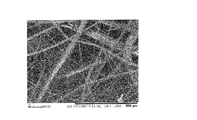
- the discharge thread discharged from the nozzle was collected by a collection net to obtain a cyclic olefin-based meltblown non-woven fabric having a basis weight of 34.2 g / m 2 and a thickness of 0.430 mm.
- the electron microscope enlarged photograph of the obtained meltblown nonwoven fabric is shown in FIG.
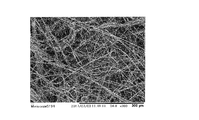
- Example 2 It implemented similarly to Example 1 except setting a nozzle single hole diameter (diameter) to 0.3 mm. It is 31.8 g / m ⁇ 2 > of fabric weight of the obtained meltblown nonwoven fabric, 0.608 mm in thickness, and an electron microscope enlarged photograph is shown in FIG.
- Example 3 The heating temperature in the feeding section is 350 ° C., and the kneading conditions in the kneading section are screw rotational speed (N) 10.5 rpm under heating at 360 ° C., and the spinning conditions are: spinning temperature 360 ° C .; It implemented similarly to Example 2 except having discharged from the nozzle by 3 kg / hr.
- the viscosity ( ⁇ ) of the resin melt introduced into the kneading section was 150 poise.
- the resulting meltblown nonwoven fabric had a basis weight of 31.2 g / m 2 and a thickness of 0.612 mm, and an electron microscopic magnified photograph thereof is shown in FIG. 4.
- Example 4 A resin was used in the same manner as Example 2, except that the resin used was an ethylene-norbornene copolymer (trade name: "TOPAS" 6013, manufactured by Polyplastics Co., Ltd.) having a norbornene content of 75% by mass.
- the viscosity ( ⁇ ) of the resin melt introduced into the kneading section was 180 poise. It is 20.7 g / m ⁇ 2 > of fabric weight of the obtained meltblown nonwoven fabric, 0.268 mm in thickness, and an electron microscope enlarged photograph is shown in FIG.
- the heating temperature in the feeding section is 300 ° C.
- the kneading conditions in the kneading section are the screw rotation speed (N) 10.8 rpm under heating at 320 ° C.
- the spinning conditions are a spinning temperature 320 ° C. and a discharge amount (Q) 4.
- the viscosity ( ⁇ ) of the resin melt introduced into the kneading section was 270 poise.
- the basis weight of the obtained meltblown non-woven fabric is 70.3 g / m 2 and the thickness is 1.154 mm, and an electron microscopic magnified photograph is shown in FIG.
- Comparative Example 1 As shown in Table 1, in Comparative Example 1, the viscosity of the resin melt introduced into the kneading section was high, and (Q ⁇ ⁇ ) / N was also high, so mechanical energy acts on the cyclic olefin resin There were many thick fibers derived from mechanochemical reaction (FIG. 6). Due to the mixing of the thick fibers, the MB non-woven fabric of Comparative Example 1 is larger in average fiber diameter and average fiber diameter Db of fibers larger than the third quartile as compared with the MB non-woven fabrics of Examples 1 to 4 there were. Also, due to the inclusion of thick fibers, the air permeability was increased as compared with Examples 1 to 4, and the compactness was not sufficient.
- Examples 1 to 4 since the viscosity of the resin melt introduced into the kneading section was controlled to be low, the generation of thick fibers derived from mechanochemical reaction could be suppressed (FIGS. 2 to 5). Therefore, the MB non-woven fabrics of Examples 1 to 4 could be made smaller than Comparative Example 1 in any of the average fiber diameter and the average fiber diameter Db of fibers larger than the third quartile.
- the obtained MB fiber had smaller air permeability than Comparative Example 1, and could improve the compactness. Furthermore, in the MB non-woven fabrics of Examples 1, 2 and 4, the air permeability (B / A) per thickness was a small value, and the density was particularly excellent. In particular, in the MB nonwoven fabrics of Examples 2 and 4, the CV value of the average fiber diameter of the constituent fibers could be suppressed to 90% or less, or the hand feel was good.
- Example 5 The meltblown nonwoven fabric obtained in Example 2 was subjected to a charging process by a corona discharge method.
- the specific conditions of the corona discharge method are as follows.
- the collection efficiency (%) and pressure loss (Pa) of the obtained charged nonwoven fabric were measured according to the above-mentioned method. The results are shown in Table 2.
- ⁇ Power supply used DC high voltage stabilized power supply ⁇ Linear distance between electrodes applying voltage: 35 mm ⁇ Applied voltage: -28kV Applied current: 8.0 mA Temperature: 25 ° C Processing time: 1 second
- Example 6 A charged nonwoven fabric was obtained in the same manner as in Example 5, except that the meltblown nonwoven fabric obtained in Example 4 was used instead of the meltblown nonwoven fabric obtained in Example 2.
- the collection efficiency (%) and pressure loss (Pa) of the obtained charged nonwoven fabric were measured according to the above-mentioned method. The results are shown in Table 2.
- the charged nonwoven fabrics obtained in Examples 5 and 6 have a collection efficiency of 85% or more and a pressure loss of 10 Pa or less, and can be suitably used for various filter applications.
- the MB non-woven fabric of the present invention can be used for various applications such as medical / cosmetic / hygiene materials, industrial material applications, daily necessities and clothing applications.
- a filter for liquid filtration an air filter (for example, an air filter for clean room), a percutaneous administration sheet (for example, a percutaneous absorption agent, patch), etc. It can be used.
Landscapes
- Health & Medical Sciences (AREA)
- Engineering & Computer Science (AREA)
- Chemical & Material Sciences (AREA)
- Textile Engineering (AREA)
- Public Health (AREA)
- Veterinary Medicine (AREA)
- Epidemiology (AREA)
- Life Sciences & Earth Sciences (AREA)
- Animal Behavior & Ethology (AREA)
- General Health & Medical Sciences (AREA)
- Materials Engineering (AREA)
- Hematology (AREA)
- Chemical Kinetics & Catalysis (AREA)
- Bioinformatics & Cheminformatics (AREA)
- Medicinal Chemistry (AREA)
- Pharmacology & Pharmacy (AREA)
- Dispersion Chemistry (AREA)
- Nonwoven Fabrics (AREA)
- Filtering Materials (AREA)
- Medicinal Preparation (AREA)
Priority Applications (7)
| Application Number | Priority Date | Filing Date | Title |
|---|---|---|---|
| JP2019540890A JPWO2019049706A1 (ja) | 2017-09-08 | 2018-08-27 | メルトブローン不織布およびその製造方法 |
| KR1020207006778A KR102509148B1 (ko) | 2017-09-08 | 2018-08-27 | 멜트 블론 부직포 및 그 제조 방법 |
| CN202310294595.5A CN116377654B (zh) | 2017-09-08 | 2018-08-27 | 熔喷无纺布 |
| EP18853798.9A EP3666948B1 (en) | 2017-09-08 | 2018-08-27 | Melt-blown nonwoven fabric and manufacturing method therefor |
| CN201880057886.XA CN111094641B (zh) | 2017-09-08 | 2018-08-27 | 熔喷无纺布及其制造方法 |
| JP2022182266A JP7510988B2 (ja) | 2017-09-08 | 2022-11-15 | メルトブローン不織布の製造方法 |
| JP2022182267A JP7556009B2 (ja) | 2017-09-08 | 2022-11-15 | メルトブローン不織布 |
Applications Claiming Priority (2)
| Application Number | Priority Date | Filing Date | Title |
|---|---|---|---|
| JP2017173124 | 2017-09-08 | ||
| JP2017-173124 | 2017-09-08 |
Publications (1)
| Publication Number | Publication Date |
|---|---|
| WO2019049706A1 true WO2019049706A1 (ja) | 2019-03-14 |
Family
ID=65634751
Family Applications (1)
| Application Number | Title | Priority Date | Filing Date |
|---|---|---|---|
| PCT/JP2018/031593 Ceased WO2019049706A1 (ja) | 2017-09-08 | 2018-08-27 | メルトブローン不織布およびその製造方法 |
Country Status (6)
| Country | Link |
|---|---|
| EP (1) | EP3666948B1 (https=) |
| JP (3) | JPWO2019049706A1 (https=) |
| KR (1) | KR102509148B1 (https=) |
| CN (2) | CN111094641B (https=) |
| TW (1) | TWI802589B (https=) |
| WO (1) | WO2019049706A1 (https=) |
Cited By (3)
| Publication number | Priority date | Publication date | Assignee | Title |
|---|---|---|---|---|
| CN112251823A (zh) * | 2020-10-14 | 2021-01-22 | 广州坤立服装有限公司 | 一种可调节喷丝速度的熔喷布生产设备 |
| JP7591875B2 (ja) | 2019-06-14 | 2024-11-29 | 日本バイリーン株式会社 | 貼付剤用基材及び貼付剤 |
| JP7770098B2 (ja) | 2020-05-25 | 2025-11-14 | 日本バイリーン株式会社 | 非水系膏体を備える貼付剤用の基材 |
Families Citing this family (2)
| Publication number | Priority date | Publication date | Assignee | Title |
|---|---|---|---|---|
| KR20200125597A (ko) * | 2018-02-28 | 2020-11-04 | 니폰 제온 가부시키가이샤 | 부직포 및 필터 |
| JPWO2023282088A1 (https=) * | 2021-07-07 | 2023-01-12 |
Citations (5)
| Publication number | Priority date | Publication date | Assignee | Title |
|---|---|---|---|---|
| JP2001210549A (ja) | 1999-11-19 | 2001-08-03 | Mitsui Chemicals Inc | エレクトレット |
| JP2003504523A (ja) * | 1999-07-05 | 2003-02-04 | ティコナ ゲゼルシャフト ミット ベシュレンクテル ハフツング | シクロオレフィンポリマーを含むミクロファイバウェブの製造 |
| JP2011231163A (ja) * | 2010-04-26 | 2011-11-17 | Japan Atomic Energy Agency | 微量金属捕集用液体濾過フィルタ |
| JP2011256490A (ja) * | 2010-06-10 | 2011-12-22 | Nippon Zeon Co Ltd | 繊維または繊維状成形品 |
| JP2015190081A (ja) * | 2014-03-28 | 2015-11-02 | 旭化成せんい株式会社 | メルトブローン不織布 |
Family Cites Families (11)
| Publication number | Priority date | Publication date | Assignee | Title |
|---|---|---|---|---|
| US20030003834A1 (en) * | 2000-11-20 | 2003-01-02 | 3M Innovative Properties Company | Method for forming spread nonwoven webs |
| US7279440B2 (en) * | 2002-05-20 | 2007-10-09 | 3M Innovative Properties Company | Nonwoven amorphous fibrous webs and methods for making them |
| JP2007154013A (ja) | 2005-12-05 | 2007-06-21 | Jsr Corp | 不織布用共重合体、不織布用共重合体組成物、及び不織布 |
| US20090053959A1 (en) * | 2007-08-21 | 2009-02-26 | Sudhin Datta | Soft and Elastic Nonwoven Polypropylene Compositions |
| JP5399046B2 (ja) * | 2008-11-10 | 2014-01-29 | ポリプラスチックス株式会社 | 環状オレフィン系樹脂繊維の製造方法及び該環状オレフィン系樹脂繊維からなる環状オレフィン系樹脂不織布 |
| JP2010116645A (ja) * | 2008-11-13 | 2010-05-27 | Toray Ind Inc | レゾール樹脂繊維の製造方法および繊維および製品 |
| JP2012092484A (ja) * | 2010-09-30 | 2012-05-17 | Sanyo Chem Ind Ltd | 無機繊維不織布用バインダー |
| KR20130111591A (ko) * | 2010-12-06 | 2013-10-10 | 미쓰이 가가쿠 가부시키가이샤 | 멜트블로운 부직포, 그의 제조 방법 및 장치 |
| SG11201401009YA (en) * | 2011-09-28 | 2014-09-26 | Kuraray Co | Extra-fine fiber sheet |
| CN203355473U (zh) * | 2013-04-26 | 2013-12-25 | 秦如新 | 一种空气净化器用复合无纺布 |
| JP6546336B2 (ja) * | 2016-02-16 | 2019-07-17 | 三井化学株式会社 | 不織布、フィルタ及び不織布の製造方法 |
-
2018
- 2018-08-27 CN CN201880057886.XA patent/CN111094641B/zh active Active
- 2018-08-27 KR KR1020207006778A patent/KR102509148B1/ko active Active
- 2018-08-27 WO PCT/JP2018/031593 patent/WO2019049706A1/ja not_active Ceased
- 2018-08-27 EP EP18853798.9A patent/EP3666948B1/en active Active
- 2018-08-27 CN CN202310294595.5A patent/CN116377654B/zh active Active
- 2018-08-27 JP JP2019540890A patent/JPWO2019049706A1/ja active Pending
- 2018-09-06 TW TW107131248A patent/TWI802589B/zh active
-
2022
- 2022-11-15 JP JP2022182267A patent/JP7556009B2/ja active Active
- 2022-11-15 JP JP2022182266A patent/JP7510988B2/ja active Active
Patent Citations (5)
| Publication number | Priority date | Publication date | Assignee | Title |
|---|---|---|---|---|
| JP2003504523A (ja) * | 1999-07-05 | 2003-02-04 | ティコナ ゲゼルシャフト ミット ベシュレンクテル ハフツング | シクロオレフィンポリマーを含むミクロファイバウェブの製造 |
| JP2001210549A (ja) | 1999-11-19 | 2001-08-03 | Mitsui Chemicals Inc | エレクトレット |
| JP2011231163A (ja) * | 2010-04-26 | 2011-11-17 | Japan Atomic Energy Agency | 微量金属捕集用液体濾過フィルタ |
| JP2011256490A (ja) * | 2010-06-10 | 2011-12-22 | Nippon Zeon Co Ltd | 繊維または繊維状成形品 |
| JP2015190081A (ja) * | 2014-03-28 | 2015-11-02 | 旭化成せんい株式会社 | メルトブローン不織布 |
Cited By (3)
| Publication number | Priority date | Publication date | Assignee | Title |
|---|---|---|---|---|
| JP7591875B2 (ja) | 2019-06-14 | 2024-11-29 | 日本バイリーン株式会社 | 貼付剤用基材及び貼付剤 |
| JP7770098B2 (ja) | 2020-05-25 | 2025-11-14 | 日本バイリーン株式会社 | 非水系膏体を備える貼付剤用の基材 |
| CN112251823A (zh) * | 2020-10-14 | 2021-01-22 | 广州坤立服装有限公司 | 一种可调节喷丝速度的熔喷布生产设备 |
Also Published As
| Publication number | Publication date |
|---|---|
| TW201920342A (zh) | 2019-06-01 |
| TWI802589B (zh) | 2023-05-21 |
| JP2023016845A (ja) | 2023-02-02 |
| EP3666948A1 (en) | 2020-06-17 |
| JPWO2019049706A1 (ja) | 2020-11-19 |
| EP3666948B1 (en) | 2022-11-16 |
| CN111094641B (zh) | 2023-04-07 |
| KR102509148B1 (ko) | 2023-03-10 |
| JP7510988B2 (ja) | 2024-07-04 |
| CN116377654B (zh) | 2025-08-22 |
| JP2023022091A (ja) | 2023-02-14 |
| JP7556009B2 (ja) | 2024-09-25 |
| EP3666948A4 (en) | 2020-06-17 |
| KR20200050459A (ko) | 2020-05-11 |
| CN111094641A (zh) | 2020-05-01 |
| CN116377654A (zh) | 2023-07-04 |
Similar Documents
| Publication | Publication Date | Title |
|---|---|---|
| JP7510988B2 (ja) | メルトブローン不織布の製造方法 | |
| CN1107088C (zh) | 各向异性薄膜 | |
| EP1856314B1 (en) | Superhydrophobic fiber mats | |
| EP4237471A1 (de) | Kondensator enthaltend biaxial verstreckte polypropylen-cycloolefinpolymer-folie als dielektrikum und verwendung dieser folie | |
| Alwan et al. | Preparation and characterization of the PVA nanofibers produced by electrospinning | |
| JP3347835B2 (ja) | ポリオレフィン微多孔膜の製造方法 | |
| CN1537053A (zh) | 一个方向有弹性另一个方向可扩展的复合材料 | |
| JPH10512620A (ja) | フルオロポリマーと熱可塑性ポリマーの共連続配合物と製造方法 | |
| JP7138197B2 (ja) | スパンボンド不織布、衛生材料、及びスパンボンド不織布の製造方法 | |
| CN1414843A (zh) | 苯乙烯嵌段共聚物可透气弹性体薄膜 | |
| Yu et al. | Coaxial electrospinning using a concentric Teflon spinneret to prepare biphasic-release nanofibers of helicid | |
| EP3725928B1 (en) | Spun-bonded nonwoven fabric, sanitary material and method for manufacturing spun-bonded nonwoven fabric | |
| FR2585713A1 (fr) | Compositions extrudables a base de polyolefine et procedes de formation de produits elastomeres, tels que textiles non tisses et films, a partir de ces compositions | |
| KR20200107664A (ko) | 정전분말 및 정전섬유로 이루어진 습식 정전 부직포 | |
| WO2019189522A1 (ja) | ポリオレフィン微多孔膜の製造方法及びポリオレフィン微多孔膜 | |
| JP6103602B2 (ja) | キチンナノファイバー分散可塑剤及びキチンナノファイバー入りポリオレフィン微多孔延伸フィルムの製造方法 | |
| JP7427975B2 (ja) | ポリオレフィン微多孔膜の製造方法 | |
| WO2012165438A1 (ja) | 多層弾性フィルム | |
| JP2019176123A (ja) | コンデンサーフィルム用ポリプロピレン系樹脂組成物及びそれからなるコンデンサーフィルム | |
| JP2021161564A (ja) | スパンボンド不織布、衛生材料、及びスパンボンド不織布の延伸方法 | |
| JP2024115948A (ja) | 不織布、フィルタ、プリプレグ、プリント配線基板および電子部品 | |
| JP4409615B2 (ja) | 伸縮性部材および伸縮性不織布積層体 | |
| JP2024111557A (ja) | 多孔質フィルム及びその製造方法 | |
| ITFE20000002A1 (it) | Film multistrato sterilizzabili con radiazioni gamma | |
| JP2024076877A (ja) | 多孔質膜及び多孔質膜の製造方法 |
Legal Events
| Date | Code | Title | Description |
|---|---|---|---|
| 121 | Ep: the epo has been informed by wipo that ep was designated in this application |
Ref document number: 18853798 Country of ref document: EP Kind code of ref document: A1 |
|
| ENP | Entry into the national phase |
Ref document number: 2019540890 Country of ref document: JP Kind code of ref document: A |
|
| NENP | Non-entry into the national phase |
Ref country code: DE |
|
| ENP | Entry into the national phase |
Ref document number: 2018853798 Country of ref document: EP Effective date: 20200310 |