WO2019044872A1 - ローダミン連結化合物 - Google Patents
ローダミン連結化合物 Download PDFInfo
- Publication number
- WO2019044872A1 WO2019044872A1 PCT/JP2018/031869 JP2018031869W WO2019044872A1 WO 2019044872 A1 WO2019044872 A1 WO 2019044872A1 JP 2018031869 W JP2018031869 W JP 2018031869W WO 2019044872 A1 WO2019044872 A1 WO 2019044872A1
- Authority
- WO
- WIPO (PCT)
- Prior art keywords
- group
- general formula
- compound
- preferable
- represented
- Prior art date
- Legal status (The legal status is an assumption and is not a legal conclusion. Google has not performed a legal analysis and makes no representation as to the accuracy of the status listed.)
- Ceased
Links
- 0 *c(c(F)c(c(c(F)c1F)c2c(F)c1F)F)c2F Chemical compound *c(c(F)c(c(c(F)c1F)c2c(F)c1F)F)c2F 0.000 description 6
- KCPCBDMLMFYNLR-UHFFFAOYSA-N CC[IH]C([NH+](C)[O-])=C Chemical compound CC[IH]C([NH+](C)[O-])=C KCPCBDMLMFYNLR-UHFFFAOYSA-N 0.000 description 1
- SPBSFTVMWPMTIA-UHFFFAOYSA-N [O-][N+](c(c1ccc2[N+]([O-])=O)cccc1c2S(O)(=O)=O)=O Chemical compound [O-][N+](c(c1ccc2[N+]([O-])=O)cccc1c2S(O)(=O)=O)=O SPBSFTVMWPMTIA-UHFFFAOYSA-N 0.000 description 1
Images

Classifications
-
- C—CHEMISTRY; METALLURGY
- C09—DYES; PAINTS; POLISHES; NATURAL RESINS; ADHESIVES; COMPOSITIONS NOT OTHERWISE PROVIDED FOR; APPLICATIONS OF MATERIALS NOT OTHERWISE PROVIDED FOR
- C09B—ORGANIC DYES OR CLOSELY-RELATED COMPOUNDS FOR PRODUCING DYES, e.g. PIGMENTS; MORDANTS; LAKES
- C09B11/00—Diaryl- or thriarylmethane dyes
- C09B11/28—Pyronines ; Xanthon, thioxanthon, selenoxanthan, telluroxanthon dyes
-
- G—PHYSICS
- G02—OPTICS
- G02B—OPTICAL ELEMENTS, SYSTEMS OR APPARATUS
- G02B5/00—Optical elements other than lenses
- G02B5/20—Filters
-
- C—CHEMISTRY; METALLURGY
- C07—ORGANIC CHEMISTRY
- C07D—HETEROCYCLIC COMPOUNDS
- C07D311/00—Heterocyclic compounds containing six-membered rings having one oxygen atom as the only hetero atom, condensed with other rings
- C07D311/02—Heterocyclic compounds containing six-membered rings having one oxygen atom as the only hetero atom, condensed with other rings ortho- or peri-condensed with carbocyclic rings or ring systems
- C07D311/78—Ring systems having three or more relevant rings
- C07D311/80—Dibenzopyrans; Hydrogenated dibenzopyrans
- C07D311/82—Xanthenes
Definitions
- the present invention relates to a novel compound used for a color filter or the like, and a coloring composition comprising the compound.
- color filters used in color liquid crystal display devices and color image pickup tube elements are filter segments (pixels) in the form of fine bands (stripes) formed of filter layers of respective colors formed on the surface of a transparent substrate such as glass. Are arranged in parallel or in cross, or in which fine filter segments are arranged in a fixed arrangement in vertical and horizontal directions.
- the quality items required for color filters include lightness and contrast ratio. For example, since color filters with low lightness have low light transmittance and a dark screen, it is required to increase the lightness of the color filters. In addition, a color filter with a low contrast ratio causes a blurred screen, and therefore, a high contrast is required.
- rhodamine dyes used for color filters
- coloring compositions for color filters containing xanthene dyes Patent Document 2
- Non-Patent Document 1 a compound in which rhodamine derivatives having an isothiocyanate group are linked
- Patent Document 3 a compound in which pentacyclic xanthylium derivatives are linked, and the like have been reported.
- rhodamine dyes represented by rhodamine B can suppress the fluorescence yield by forming an association in a high concentration solution, but under low concentration conditions, the association is It was not formed and could not suppress the fluorescence yield. Then, this invention makes it a subject to provide the rhodamine type-dye which can form an aggregate also in low concentration conditions, and can suppress a fluorescence yield.
- a compound represented by the following general formula (1) (hereinafter sometimes abbreviated as the compound of the present invention).
- R 1 to R 6 each independently represent a hydrogen atom or an alkyl group having 1 to 6 carbon atoms
- Y 1 represents -O- or -NH-
- a 1 represents And a linear alkylene group of 1 to 12 carbon atoms which may have a substituent, and the substituent is a hydroxy group, an alkyl group of 1 to 6 carbon atoms, or a group represented by the following general formula (2)
- Represents (In General Formula (2), R 7 represents a hydrogen atom or a methyl group, Y 2 represents -O- or -NH-, and A 2 represents a single bond or a linear alkylene having 1 to 6 carbon atoms Represents a group)
- An - represents an anion; two R 1, two R 2, two R 3, two R 4, two R 5, two R 6, two Y 1 and two An -,
- a 1 is a group represented by the following general formula (3).
- R 8 represents a hydrogen atom, a hydroxy group, an alkyl group having 1 to 6 carbon atoms or a group represented by the general formula (2)
- n 1 represents an integer of 0 to 5
- n 2 represent an integer of 1 to 6
- n 3 represents an integer of 0 to 5
- n 3 R 8 and n 3 n 1 may be the same or different.
- the total number of carbons in the general formula (3) (excluding the number of carbons in R 8 ) is 1 to 12.
- a colored composition comprising the compound according to any one of the above [1] to [5] (hereinafter sometimes abbreviated as the colored composition of the present invention).
- a coloring composition for color filter comprising the compound according to any one of the above [1] to [5].
- the compound of the present invention is capable of forming an aggregate under low concentration conditions, which was difficult with conventional rhodamine dyes, and exhibits an excellent effect of suppressing the fluorescence yield. Therefore, the compound of the present invention is used for forming colored pixels such as color filters used in liquid crystal display (LCD) and solid-state imaging devices (CCD, CMOS etc.), printing ink, inkjet ink, and coating In particular, it is suitable for color filters of liquid crystal display devices. Further, it can be molded into a sheet, a film, a bottle, a cup or the like by a conventionally known molding method and used as a colored resin molded product.
- LCD liquid crystal display
- CCD solid-state imaging devices
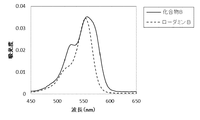
- FIG. 16 is a graph showing the results of absorbance measurement for the compound of the present invention (rhodamine-linked compound: compound 7) obtained in Experimental Example 3 and Rhodamine B.
- FIG. 3 the solid line represents the result of Compound 7, and the broken line represents the result of Rhodamine B. It is a graph which shows the result of the light absorbency measurement with respect to the compound (rhodamine coupling compound: compound 8) of this invention obtained by Experimental example 4, and rhodamine B.
- the solid line represents the result of Compound 8 and the broken line represents the result of Rhodamine B.
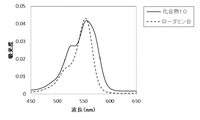
- FIG. 16 is a graph showing the results of absorbance measurement for the compound of the present invention (rhodamine-linked compound: compound 10) obtained in Experimental Example 5 and Rhodamine B.
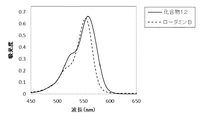
- FIG. 5 the solid line represents the result of Compound 10, and the broken line represents the result of Rhodamine B. It is a graph which shows the result of the light absorbency measurement with respect to the compound (rhodamine coupling compound: compound 12) of this invention obtained by Experimental example 6, and rhodamine B.
- the solid line represents the result of Compound 12, and the broken line represents the result of Rhodamine B.
- R 1 to R 6 each independently represent a hydrogen atom or an alkyl group having 1 to 6 carbon atoms
- Y 1 represents -O- or -NH-
- a 1 represents And a linear alkylene group of 1 to 12 carbon atoms which may have a substituent, and the substituent is a hydroxy group, an alkyl group of 1 to 6 carbon atoms, or a group represented by the following general formula (2)
- Represents (In General Formula (2), R 7 represents a hydrogen atom or a methyl group, Y 2 represents -O- or -NH-, and A 2 represents a single bond or a linear alkylene having 1 to 6 carbon atoms Represents a group)
- An - represents an anion; two R 1, two R 2, two R 3, two R 4, two R 5, two R 6, two Y 1 and two An -, respectively Represents the same thing.
- the alkyl group having 1 to 6 carbon atoms in R 1 to R 6 in the general formula (1) may be linear, branched or cyclic, and among them, linear or branched Is preferred, and linear is more preferred. Further, among the alkyl group having 1 to 6 carbon atoms, one having 1 to 4 carbon atoms is preferable.
- R 1 and R 6 in the general formula (1) a hydrogen atom, a methyl group and an ethyl group are preferable, a hydrogen atom and a methyl group are more preferable, and a hydrogen atom is particularly preferable. Moreover, it is preferable that R 1 and R 6 are the same substituent.
- R 2 and R 5 in the general formula (1) an alkyl group having 1 to 6 carbon atoms is preferable, and a linear or branched alkyl group having 1 to 4 carbon atoms is more preferable, and a methyl group and an ethyl group are preferable. Is more preferred, and ethyl is particularly preferred. Moreover, it is preferable that R 2 and R 5 are the same substituent.
- R 3 and R 4 in the general formula (1) a hydrogen atom and a linear or branched alkyl group having 1 to 4 carbon atoms are preferable, a hydrogen atom, a methyl group and an ethyl group are more preferable, and a hydrogen atom And the ethyl group is more preferable, and the ethyl group is particularly preferable. Moreover, it is preferable that R 3 and R 4 are the same substituent.
- Y 1 in the general formula (1) -O- is preferable.
- the C 1 to C 12 linear alkylene group in the “C 1 to C 12 linear alkylene group which may have a substituent (s)” in A 1 of the general formula (1) has 2 to 8 carbon atoms Are preferable, and those having 2 to 5 carbon atoms are more preferable. Specifically, methylene group, ethylene group, trimethylene group, tetramethylene group, pentamethylene group, hexamethylene group, heptamethylene group, octamethylene group, nonamethylene group, decamethylene group, undecamethylene group, dodecamethylene group are mentioned.
- ethylene, trimethylene, tetramethylene, pentamethylene, hexamethylene, heptamethylene and octamethylene are preferable, and ethylene, trimethylene, tetramethylene and pentamethylene are more preferable.
- the number of substituted linear-containing linear alkylene groups having 1 to 12 carbon atoms in A 1 of General Formula (1) is usually 1 to 5, preferably 1 to 3, more preferably 1 or 2, particularly preferably It has one substituent.
- the substituent is a hydroxy group, an alkyl group having 1 to 6 carbon atoms, or a group represented by the general formula (2). When two or more substituents are present, the substituents may be the same or different, but preferably all of the substituents are the same.
- alkyl group having 1 to 6 carbon atoms in the substituent examples include the same ones as the alkyl group having 1 to 6 carbon atoms in R 1 to R 6 in the general formula (1), and preferable examples are also the same.
- Y 2 in the general formula (2) -O- is preferable. Further, Y 2 in the general formula (2) is preferably the same as Y 1 in the general formula (1), and it is more preferable that both Y 1 and Y 2 be —O—.
- the linear alkylene group having 1 to 6 carbon atoms in A 2 of the general formula (2) is preferably one having 1 to 3 carbon atoms. Specific examples thereof include a methylene group, an ethylene group, a trimethylene group, a tetramethylene group, a pentamethylene group and a hexamethylene group. A methylene group, an ethylene group and a trimethylene group are preferable, and a methylene group is more preferable.
- a 2 in the general formula (2) a single bond and a linear alkylene group having 1 to 3 carbon atoms are preferable, and a single bond and a methylene group are more preferable.
- Preferred examples of the group represented by the general formula (2) include groups represented by the following general formula (2-1). (In general formula (2-1), R 7 and A 2 are the same as above.)
- Preferred specific examples among the groups represented by the general formula (2-1) include groups represented by the following formulas (101) to (108), and among them, the groups represented by the formulas (101) to (104)
- the group represented by the formula (102) or (104) is more preferable, and the group represented by the formula (104) is particularly preferable.
- a substituent of “a C 1 to C 12 linear alkylene group which may have a substituent (s)” in A 1 of General Formula (1) a hydroxy group, a linear or branched C 1 carbon atom, An alkyl group of to 4 and a group represented by formula (2-1) are preferred; a hydroxy group and a group represented by formulas (101) to (108) are more preferable; a hydroxy group and a group represented by formula (101) to (104) More preferred are the groups shown); hydroxy groups are particularly preferred.
- linear alkylene group having 1 to 12 carbon atoms which may have a substituent in A 1 of General Formula (1) include, for example, a group represented by the following General Formula (3).
- R 8 represents a hydrogen atom, a hydroxy group, an alkyl group having 1 to 6 carbon atoms or a group represented by the general formula (2)
- n 1 represents an integer of 0 to 5
- n 2 represent an integer of 1 to 6
- n 3 represents an integer of 0 to 5
- n 3 R 8 and n 3 n 1 may be the same or different.
- the total number of carbons in the general formula (3) (excluding the number of carbons in R 8 ) is 1 to 12.
- Examples of the alkyl group having 1 to 6 carbon atoms in R 8 in the general formula (3) include the same alkyl groups having 1 to 6 carbon atoms in R 1 to R 6 in the general formula (1). It is the same.
- R 8 in the general formula (3) a hydrogen atom, a hydroxy group, a linear or branched alkyl group having 1 to 4 carbon atoms, and a group represented by the general formula (2-1) are preferable; hydrogen An atom, a hydroxy group and a group represented by the formulas (101) to (108) are more preferable; a hydrogen atom, a hydroxy group and a group represented by the formulas (101) to (104) are more preferable; More preferred is a hydrogen atom.
- n 1 in the general formula (3) is preferably an integer of 0 to 3, more preferably 0 or 1, and particularly preferably 1;
- R 8 is not a hydrogen atom (R 8 is In the case of a hydroxy group, an alkyl group having 1 to 6 carbon atoms or a group represented by the general formula (2), an integer of 1 to 3 is preferable, 1 or 2 is more preferable, and 1 is particularly preferable.
- n 2 in the general formula (3) is preferably an integer of 1 to 4, more preferably an integer of 1 to 3, and particularly preferably 2; R 8 is not a hydrogen atom (R When 8 is a hydroxy group, an alkyl group having 1 to 6 carbon atoms or a group represented by the general formula (2), an integer of 1 to 3 is preferable, 1 or 2 is more preferable, and 1 is particularly preferable.
- n 3 in the general formula (3) an integer of 0 to 3 is preferable, 0 or 1 is more preferable, and 1 is particularly preferable.
- the total number of carbons in the general formula (3) (excluding the number of carbons in R 8 ) is preferably 2 to 8, and more preferably 2 to 5.
- the total number indicates the number calculated by the formula “(n 1 +1) ⁇ n 3 + n 2 ”.
- R 9 represents a hydrogen atom, a hydroxy group, a linear or branched alkyl group having 1 to 4 carbon atoms, or a group represented by the general formula (2-1);
- n 4 represents an integer of 0 to 3
- n 5 represents an integer of 1 to 4; and when R 9 is not a hydrogen atom, n 4 and n 5 are each independently And represents an integer of 1 to 3.
- the linear or branched alkyl group having 1 to 4 carbon atoms as R 9 in General Formula (5) includes a methyl group, an ethyl group, an n-propyl group, an isopropyl group, an n-butyl group and an isobutyl group, A sec-butyl group and a tert-butyl group are mentioned, and a methyl group and an ethyl group are preferable.
- a hydrogen atom, a hydroxy group and a group represented by the formulas (101) to (108) are preferable; a hydrogen atom, a hydroxy group and a group represented by the formulas (101) to (104) Hydrogen atom and hydroxy group are more preferable; hydrogen atom is particularly preferable.
- n 4 in the general formula (5) is preferably 0 or 1, and particularly preferably 1;
- R 9 is not a hydrogen atom (R 9 is a hydroxy group, linear or branched) 1 or 2 is more preferable, and 1 is particularly preferable in the case of the following alkyl group having 1 to 4 carbon atoms or the group represented by the general formula (2-1).
- n 5 in the general formula (5) is preferably an integer of 1 to 3, particularly preferably 2; R 9 is not a hydrogen atom (R 9 is a hydroxy group, linear Alternatively, in the case of a branched alkyl group having 1 to 4 carbon atoms or a group represented by the general formula (2-1), 1 or 2 is more preferable, and 1 is particularly preferable.
- R 9 is not a hydrogen atom, n 4 and n 5 are preferably identical.
- Specific examples of the group represented by the general formula (5) include, for example, -(CH 2 ) 2 -,-(CH 2 ) 3 -,-(CH 2 ) 4 -,-(CH 2 ) 5 -,-(CH 2 ) 6 -,-(CH 2 ) 7 -,-( CH 2) 8 -; -CH 2 -CH (OH) -CH 2 -, - CH 2 -CH (OH) - (CH 2) 2 -, - CH 2 -CH (OH) - (CH 2) 3 -, - (CH 2) 2 -CH (OH) - (CH 2) 2 -, - (CH 2) 2 -CH (OH) - (CH 2) 3 -, - (CH 2) 3 -CH (OH) - (CH 2) 3 -; -CH 2 -CH (CH 3) -CH 2 -, - CH 2 -CH (CH 3) - (CH 2) 2 -, - CH 2 -CH (CH 3)
- a group according to group A and a group according to group B are preferred; -(CH 2 ) 2 -,-(CH 2 ) 3 -,-(CH 2 ) 4 -,-(CH 2 ) 5 -,-(CH 2 ) 6 -,-(CH 2 ) 7 -,-( CH 2) 8 -, - CH 2 -CH (OH) -CH 2 -, - CH 2 -CH (OH) - (CH 2) 2 -, - CH 2 -CH (OH) - (CH 2) 3 - ,-(CH 2 ) 2 -CH (OH)-(CH 2 ) 2 -,-(CH 2 ) 2 -CH (OH)-(CH 2 ) 3 -,-(CH 2 ) 3 -CH (OH) -(CH 2 ) 3- , a group according to group A and a group according to group B are preferred; -(CH 2 ) 2 -,-(CH 2 ) 3 -,-(CH
- any anion may be used, and specifically, for example, a halide ion; an aryl group having a substituent with electron withdrawing ability, a sulfonyl group having a substituent with electron withdrawing ability, haloalkyl And anions containing a group or a halogeno group; halogen oxo acid anions; or sulfonate anions (hereinafter sometimes abbreviated as anions according to the present invention).
- the halide ion for example fluoride ion (F -), chloride ion (Cl -), bromide ion (Br -), iodide ion (I -) and the like, chloride Organic ions are preferred.
- the anionic portion of the anions comprising a sulfonyl group or a haloalkyl group having an aryl group, an electron withdrawing substituent having an electron-withdrawing group, for example a sulfonic acid anion, a nitrogen anion (N - And quaternary boron anions, nitrate ions, phosphate ions and the like, and sulfonate anions, nitrogen anions and quaternary boron anions are preferable, and quaternary boron anions are more preferable.
- examples of the anion moiety in the anion containing a halogeno group include a quaternary boron anion, a phosphorus anion, an antimony anion and the like, and a phosphorus anion and an antimony anion are preferable, and a phosphorus anion is more preferable.
- examples of the electron withdrawing substituent in the aryl group having an electron withdrawing substituent or the sulfonyl group having an electron withdrawing substituent include, for example, a haloalkyl group having 1 to 3 carbon atoms, a halogeno Groups, nitro groups and the like, and among them, haloalkyl groups having 1 to 3 carbon atoms and halogeno groups are preferable, and halogeno groups are particularly preferable.
- the haloalkyl group having 1 to 3 carbon atoms as the electron withdrawing group is, for example, chloromethyl group, trichloromethyl group, 2-chloroethyl group, 2,2,2-trichloroethyl group, pentachloroethyl group, 2 Chloroalkyl groups such as -chloropropyl group, 3-chloropropyl group, 2-chloro-2-propyl group, heptachloropropyl group; bromomethyl group, tribromomethyl group, 2-bromoethyl group, 2,2,2-trichloromethyl group Bromoalkyl groups such as bromoethyl group, pentabromoethyl group, 2-bromopropyl group, 3-bromopropyl group, 2-bromo-2-propyl group, heptabromopropyl group, etc .; iodomethyl group, triiodomethyl group, 2- Iodoethyl
- Iodoalkyl group fluoromethyl group, trifluoromethyl group, 2-fluoroethyl group, 2,2,2-trifluoroethyl group, 1,1,2,2-tetrafluoroethyl group, pentafluoroethyl group, 3- And fluoroalkyl groups such as fluoropropyl group, 3,3,3-trifluoropropyl group, 2,2,3,3-tetrafluoropropyl group and heptafluoropropyl group.
- Perhalogeno alkyl groups such as pentafluoroethyl group and heptafluoropropyl group are preferable, perfluoroalkyl groups such as trifluoromethyl group, pentafluoroethyl group and heptafluoropropyl group are more preferable, and trifluoromethyl group is particularly preferable .
- the electron-withdrawing substituent in the aryl group having an electron-withdrawing substituent among the above specific examples, those having a strong electron-withdrawing power are preferable, and specifically, a trifluoromethyl group , A fluoro group and a nitro group are preferable, and a fluoro group is more preferable.
- the electron-withdrawing substituent in the sulfonyl group having an electron-withdrawing substituent among the above specific examples, trifluoromethyl group, pentafluoroethyl group, heptafluoropropyl group, fluoro Groups are preferred.
- a phenyl group, a naphthyl group etc. are mentioned as an aryl group in the aryl group which has a substituent with electron withdrawing property, for example, A phenyl group is preferable.
- aryl group having a substituent with electron withdrawing property in the anion according to the present invention include, for example, those represented by the following general formulas (11) and (12).
- R 41 represents a haloalkyl group having 1 to 3 carbon atoms, a halogeno group or a nitro group, m represents an integer of 1 to 5 and m R 41 are identical or different) May
- k represents an integer of 1 to 7
- R 41 is the same as above, and k R 41 may be the same or different.
- Examples of the haloalkyl group having 1 to 3 carbon atoms of R 41 in the general formula (11) include the same as the haloalkyl group having 1 to 3 carbon atoms as an electron-withdrawing substituent in the anion according to the present invention, Preferred ones are also the same.
- halogeno group R 41 in the general formula (11), fluoro group, chloro group, bromo group, iodo group and the like, fluoro group is preferred.
- R 41 in the general formula (11) are the same as the preferred examples of the electron withdrawing substituent in the above-described aryl group having an electron withdrawing substituent.
- R 41 is a halogeno group, preferably an integer of 2 ⁇ 7;
- R 41 is a case of the nitro group, preferably an integer of 1 to 3, 1 is more preferred;
- R 41 is In the case of a haloalkyl group, an integer of 1 to 7 is preferable, and an integer of 1 to 3 is more preferable.
- Specific examples of the group represented by the general formula (11) include trifluoromethylphenyl group, di (trifluoromethyl) phenyl group, tri (trifluoromethyl) phenyl group, monofluorophenyl group, difluorophenyl group , Trifluorophenyl group, perfluorophenyl group, monochlorophenyl group, dichlorophenyl group, trichlorophenyl group, perchlorophenyl group, monobromophenyl group, dibromophenyl group, tribromophenyl group, perbromophenyl group, monoiodophenyl group, Diiodophenyl group, triiodophenyl group, periodophenyl group, nitrophenyl group, dinitrophenyl group, trinitrophenyl group etc. may be mentioned, and difluorophenyl group, trifluorophenyl group, perfluorophenyl group etc. are
- Specific examples of the group represented by the general formula (12) include trifluoromethylnaphthyl group, di (trifluoromethyl) naphthyl group, tri (trifluoromethyl) naphthyl group, monofluoronaphthyl group, difluoronaphthyl group , Trifluoronaphthyl group, perfluoronaphthyl group, monochloronaphthyl group, dichloronaphthyl group, trichloronaphthyl group, perchloronaphthyl group, monobromonaphthyl group, dibromonaphthyl group, tribromonaphthyl group, perbromonaphthyl group, monoiodonaphthyl group Groups, diiodonaphthyl groups, triiodonaphthyl groups, periodonaphthyl groups, nitronaphthy
- the aryl group having an electron-withdrawing substituent in the anion according to the present invention is preferably a group represented by the general formula (11), and more specifically, a trifluoromethylphenyl group, a nitrophenyl group , Dinitrophenyl group, trinitrophenyl group, monofluorophenyl group, difluorophenyl group, trifluorophenyl group and perfluorophenyl group are preferable, and difluorophenyl group, trifluorophenyl group, nitrophenyl group and perfluorophenyl group are more preferable.
- a perfluorophenyl group is particularly preferred.
- the sulfonyl group having an electron-withdrawing substituent in the anion according to the present invention is, for example, -SO 2 -CF 3 , -SO 2 -C 2 F 5 , -SO 2 -C 3 F 7 , -SO 2- F, -SO 2 -Cl, -SO 2 -Br, -SO 2 -I and the like can be mentioned.
- haloalkyl group in the anion according to the present invention examples include haloalkyl groups having 1 to 3 carbon atoms, among which a perhaloalkyl group is preferable.
- Preferred are a fluoromethyl group, a pentafluoroethyl group and a heptafluoropropyl group.
- halogeno group in the anion which concerns on this invention a fluoro group, a chloro group, a bromo group, an iodo group etc. are mentioned, A fluoro group is preferable.
- examples of the anion containing an aryl group having an electron-withdrawing substituent, a sulfonyl group having an electron-withdrawing substituent, a haloalkyl group or a halogeno group include 13) to those shown in (19).
- R 41 and m are the same as above, and m R 41 may be the same or different.
- R 41 and k are the same as above, and k R 41 may be the same or different.
- R 41 and k are the same as above, and k R 41 may be the same or different.
- each of R 42 to R 45 independently represents a haloalkyl group having 1 to 3 carbon atoms, a halogeno group or a nitro group
- m 2 to m 5 each independently represent 1 to 5 M 2 R 42 , m 3 R 43 , m 4 R 44 and m 5 R 45 may be identical to or different from each other.
- R 46 represents a haloalkyl group having 1 to 3 carbon atoms or a halogeno group, and four R 46 may be the same as or different from each other.
- R 47 and R 48 each independently represent a haloalkyl group having 1 to 3 carbon atoms or a halogeno group, and R 47 and R 48 each represent a halogenated alkylene having 2 to 3 carbon atoms May form a group
- R 49 represents a phosphorus atom or an antimony atom
- X represents a halogeno group
- all six Xs are the same.
- R 41 and m in the general formula (13) examples include those described in the following table.
- the m R 41 groups are independent of one another, but are preferably the same.
- Examples of the combination of R 41 and k in the general formulas (14) and (15) include those described in the following table.
- the k R 41 are independent of each other, but preferably the same.
- Examples of the haloalkyl group having 1 to 3 carbon atoms as R 42 to R 45 in the general formula (16) include the same as the haloalkyl group having 1 to 3 carbon atoms as an electron-withdrawing substituent in the anion according to the present invention And the preferred ones are the same.
- Examples of the halogeno group in R 42 to R 45 of the general formula (16) include a fluoro group, a chloro group, a bromo group, an iodo group and the like, and a fluoro group is preferable.
- Examples of the haloalkyl group having 1 to 3 carbon atoms as R 46 in the general formula (17) include the same ones as the haloalkyl group having 1 to 3 carbon atoms as an electron-withdrawing substituent in the anion according to the present invention. The same is true.
- halogeno group at R 46 of the general formula (17), fluoro group, chloro group, bromo group, iodo group and the like, fluoro group is preferred.
- Preferred specific examples of the anion represented by the general formula (17) include, for example, BF 4 ⁇ , CF 3 BF 3 ⁇ , C 2 F 5 BF 3 ⁇ , C 3 F 7 BF 3 ⁇ , (CF 3 ) 4 B -, (C 2 F 5) 4 B -, (C 3 F 7) 4 B - , and the like.
- Examples of the haloalkyl group having 1 to 3 carbon atoms as R 47 and R 48 in the general formula (18) include the same as the haloalkyl group having 1 to 3 carbon atoms as an electron-withdrawing substituent in the anion according to the present invention And the preferred ones are the same.
- a fluoro group, a chloro group, a bromo group, an iodo group etc. are mentioned as a halogeno group in R 47 and R 48 of General formula (18), A fluoro group is preferable.
- Examples of the halogenated alkylene group having a carbon number of 2 to 3 formed by R 47 and R 48 in the general formula (18) include a tetrafluoroethylene group, a hexafluoropropylene group and the like, and a hexafluoropropylene group is preferable. .
- a bis (trifluoromethane sulfonyl) imide anion is preferable.
- halogeno group in X of General formula (19) a fluoro group, a chloro group, a bromo group, an iodo group etc. are mentioned, A fluoro group is preferable.
- PF 6 ⁇ As preferable specific examples of the anion represented by the general formula (19), for example, PF 6 ⁇ , SbF 6 ⁇ and the like can be mentioned, and PF 6 ⁇ is preferable.
- halogen oxo acid anion in the anion which concerns on this invention a hypochlorite anion, a chlorite anion, a chlorate anion, a perchlorate anion etc. are mentioned, for example, A perchlorate anion is preferable.
- sulfonate anion in the anion according to the present invention include, for example, an alkylsulfonic acid anion having 1 to 20 carbon atoms such as methanesulfonic acid anion; and a halogenated alkyl having 1 to 20 carbon atoms such as trifluoromethanesulfonic acid anion.
- alkylsulfonic acid anion having 1 to 20 carbon atoms
- a halogenated alkyl having 1 to 20 carbon atoms such as trifluoromethanesulfonic acid anion.
- examples thereof include sulfonic acid anions and benzenesulfonic acid anions having a substituent such as benzenesulfonic acid anion and toluenesulfonic acid anion or unsubstituted ones.
- the anion represented by An ⁇ of the general formula (1) is preferable, and a halide ion; and an aryl group having a substituent with electron withdrawing ability, a sulfonyl group having a substituent with electron withdrawing
- An anion containing a haloalkyl group or a halogeno group is more preferred.
- chloride ions and anions represented by general formulas (16) to (19) are preferable, and chloride ions and anions represented by general formula (16), (18) or (19) are more preferable,
- the chloride ion and the anion represented by the general formula (18) or (19) are more preferable, and the chloride ion and the one represented by the general formula (19) are particularly preferable.
- chloride ion, bis (trifluoromethanesulfonyl) imide anion, tetrakis (pentafluorophenyl) boron (IV) anion, PF 6 - are more preferable, and chloride ion, tetrakis ( Pentafluorophenyl) boron (IV) anion, PF 6 - is more preferred, chloride ion, PF 6 - is still more preferred, and chloride ion is particularly preferred.
- Preferred Embodiments of the Compound of the Present Invention include compounds represented by the following general formula (1-2).
- R 1 to R 6 , R 8 , Y 1 , An - and n 1 to n 3 are the same as above; two R 1 , two R 2 , two R 3 , two R 4 , two R 5 , two R 6 , two Y 1 and two An ⁇ each represent the same thing; n 3 R 8 and n 3 n 1 are Each may be the same or different.
- Preferred specific examples of the compound represented by the general formula (1-2) include compounds represented by the following general formula (1-3).
- R 1 to R 6 , R 8 , Y 1 , An ⁇ , n 1 and n 2 are the same as above; two R 1 , two R 2 , two R 3 , two R 4 , two R 5 , two R 6 , two Y 1 and two An ⁇ each represent the same.
- Preferred specific examples of the compound represented by the general formula (1-3) include compounds represented by the following general formula (1-4).
- R 1 to R 3 , R 9 , An ⁇ , n 4 and n 5 are the same as above; four R 1 , four R 2 , four R 3 and two an - represents the same respectively).
- Preferred specific examples of the compound represented by the general formula (1-4) include compounds represented by the following general formula (1-5).
- R 1 ′ represents a hydrogen atom or a methyl group
- R 2 ′ represents a linear or branched alkyl group having 1 to 4 carbon atoms
- R 3 ′ Represents a hydrogen atom, or a linear or branched alkyl group having 1 to 4 carbon atoms
- R 10 represents a hydrogen atom, a hydroxy group or a group represented by formulas (101) to (108);
- An ⁇ , n 4 and n 5 are the same as above; 4 R 1 ′, 4 R 2 ′, 4 R 3 ′ and 2 An ⁇ each represent the same thing.
- R 1 ′ in the general formula (1-5) a hydrogen atom is preferable.
- the linear or branched alkyl group having 1 to 4 carbon atoms as R 2 ′ in the general formula (1-5) includes the linear or branched carbon number in R 9 of the general formula (5)
- the same thing is mentioned with a 1-4 alkyl group, and a preferable thing is also the same.
- R 2 ′ in the general formula (1-5) a methyl group and an ethyl group are preferable, and an ethyl group is more preferable.
- the linear or branched alkyl group having 1 to 4 carbon atoms as R 3 ′ in the general formula (1-5) includes the linear or branched carbon number in R 9 of the general formula (5)
- the same thing is mentioned with a 1-4 alkyl group, and a preferable thing is also the same.
- R 3 ′ in the general formula (1-5) a hydrogen atom, a methyl group or an ethyl group is preferable, a hydrogen atom or an ethyl group is more preferable, and an ethyl group is particularly preferable.
- R 1 ′ to R 3 ′ in the general formula (1-5) examples include those described in Table 1 below.
- a hydrogen atom, a hydroxy group and a group represented by the formulas (101) to (104) are preferable, and a hydrogen atom, a hydroxy group and a group represented by the formula (102) or (104) Group is more preferable, a hydrogen atom and a hydroxy group are more preferable, and a hydrogen atom is particularly preferable.
- Preferred examples of the combination of R 1 ′ to R 3 ′, R 10 , n 4 and n 5 in the general formula (1-5) include, for example, the preferred combinations of R 1 ′ to R 3 ′ described in Table 1 above; R 10 described in Table 2, a combination of the preferred combination of n 4 and n 5 may be mentioned.
- R 1 ′ to R 3 ′, R 10 , n 4 and n 5 in the general formula (1-5) include, for example, combinations 1 to 40 described in Table 3 below, among which combinations 1 to 25 Are preferred, combinations 5, 10, 15, 20 and 25 are more preferred, and combination 15 is particularly preferred.
- a chloride ion, bis (trifluoromethanesulfonyl) imide anion, tetrakis (pentafluorophenyl) boron (IV) anion, PF 6 ⁇ may be mentioned.
- Chloride ion, tetrakis (pentafluorophenyl) boron (IV) anion, PF 6 ⁇ is preferable, chloride ion, PF 6 ⁇ is more preferable, and chloride ion is particularly preferable.
- the compounds of the present invention can be produced by the methods shown below. That is, the compound represented by the general formula (1) can be obtained by reacting the compound represented by the following general formula (21) with the compound represented by the following general formula (31) (Reaction [1]) .
- Preferred specific examples of the compound represented by the general formula (21) include compounds represented by the following general formula (22). (In the general formula (22), R 1 to R 3 and An - are the same as above; two R 1 , two R 2 and two R 3 respectively represent the same.)
- Preferred specific examples of the compound represented by the general formula (22) include compounds represented by the following general formula (23).
- R 1 ′ to R 3 ′ and An ⁇ are the same as above; two R 1 ′, two R 2 ′ and two R 3 ′ represent the same thing respectively .
- Preferred combinations of R 1 ′ to R 3 ′ in the general formula (23) include the same combinations as the preferred combinations of R 1 ′ to R 3 ′ described in Table 1 above.
- An ⁇ used in combination with the combination described in Table 1 above a chloride ion, bis (trifluoromethanesulfonyl) imide anion, tetrakis (pentafluorophenyl) boron (IV) anion, PF 6 ⁇ may be mentioned.
- Preferred specific examples of the compound represented by the general formula (31) include compounds represented by the following general formula (32).
- R 8 , Y 1 and n 1 to n 3 are the same as above; two Y 1 represent the same; n 2 R 8 and n 2 n 1 May be the same or different.
- Preferred specific examples of the compound represented by the general formula (32) include compounds represented by the following general formula (33).
- R 8 , Y 1 , n 1 and n 2 are the same as above; two Y 1 represent the same.
- Preferred specific examples of the compound represented by the general formula (33) include compounds represented by the following general formula (34). (In the general formula (34), R 9 , n 4 and n 5 are the same as above.)
- Preferred specific examples of the compound represented by the general formula (34) include compounds represented by the following general formula (35). (In the general formula (35), R 10 , n 4 and n 5 are the same as above.)
- Specific examples of the compound represented by the general formula (35) include ethylene glycol, 1,3-propanediol, 1,4-butanediol, 1,5-pentanediol, 1,6-hexanediol, and the like. 7-heptanediol, 1,8-octanediol, 1,2,3-propanetriol (glycerin), 1,2,4-butanetriol, 1,2,5-pentanetriol, 1,3,5-pentanetriol And 1,3,6-hexanetriol, 1,4,7-heptanetriol and the following compound group A.
- the compound represented by the general formula (21) and the compound represented by the general formula (31) are generally contained in a solvent in the presence of a dehydration condensation agent, generally 0 ° C. or more and 80 ° C. or less, preferably The reaction may be carried out at 10 ° C. to 50 ° C. for usually 1 hour to 48 hours, preferably 10 hours to 24 hours.
- the solvent examples include ethers such as diethyl ether, diisopropyl ether, ethyl methyl ether, tetrahydrofuran, 1,4-dioxane, dimethoxyethane; eg acetone, dimethyl ketone, methyl ethyl ketone, diethyl ketone, 2-hexanone, tert-butyl methyl Ketones such as ketone, cyclopentanone and cyclohexanone; halogenated hydrocarbons such as chloromethane, chloroform, dichloromethane, dichloroethane, trichloroethane, carbon tetrachloride and chlorobenzene; carbonized such as n-hexane, benzene, toluene and xylene Hydrogens; esters such as ethyl acetate, butyl acetate, methyl propionate and the like; nitriles such
- the amount of the reaction solvent to be used is generally 0.1 mL or more and 50 mL or less, preferably 0.5 mL or more and 10 mL or less, per 1 mmol of the compound represented by the general formula (21).
- any one which is generally used as a dehydration condensation agent may be used.
- inorganic dehydration agents such as phosphorus pentoxide and anhydrous zinc chloride; eg, dicyclohexyl carbodiimide, diisopropyl carbodiimide, 1-ethyl-3-
- Carbodiimides such as (3-dimethylaminopropylcarbodiimide) hydrochloride; for example, polyphosphoric acid, acetic anhydride, sulfuric acid, carbonyldiimidazole, p-toluenesulfonic acid etc. may be mentioned, with preference given to carbodiimides.
- the amount of the dehydrating condensing agent to be used is generally 1 equivalent or more and 20 equivalents or less, preferably 1 equivalent or more and 10 equivalents or less, relative to the number of moles of the compound represented by the general formula (21).
- a catalyst such as dimethylaminopyridine may be used to improve the efficiency of the dehydration condensation agent.
- the amount of the catalyst used is usually 0.1 equivalents or more and 10 equivalents or less based on the number of moles of the compound represented by the general formula (21).
- the amount of the compound represented by the general formula (31) is generally 0.1 equivalent or more and 1 equivalent or less, preferably 0.2 equivalent or more, relative to the number of moles of the compound represented by the general formula (21) It is less than equivalent weight.
- the compound represented by the general formula (1) obtained by the above reaction [1] may be further subjected to a salt exchange reaction.
- the salt exchange reaction is carried out by contacting the salt of a desired anion with a compound represented by the general formula (1) in a solvent.
- the above-mentioned salt exchange reaction is carried out usually at 0 ° C. to 80 ° C., preferably 10 ° C. to 50 ° C., usually 10 minutes to 24 hours, preferably 30 minutes to 10 hours.
- Examples of the solvent in the above salt exchange reaction include organic solvents such as methanol, ethanol, isopropyl alcohol (IPA), tetrahydrofuran (THF), dioxane, N, N-dimethylformamide (DMF), dichloromethane, dichloroethane, ethyl acetate and the like. Among them, ethanol, dichloromethane and ethyl acetate are preferred. These may be used alone or in combination of two or more.
- the amount of the reaction solvent used is usually 0.1 mL or more and 100 mL or less, preferably 1 mL or more and 50 mL or less, per 1 mmol of the compound represented by the general formula (1).
- a salt of the desired anion in the above-mentioned salt exchange reaction it may be suitably selected according to a thing desired as an anion which a final product has, for example, alkali metal salt of a desired anion, or an inorganic acid is mentioned.
- the salt which consists of alkali metals, such as a desired anion and sodium, potassium, lithium, is mentioned.
- the alkali metal salt is preferably potassium or lithium.
- the amount of the alkali metal salt used is usually 2 equivalents or more and 3 equivalents or less, preferably 2 equivalents or more and 2.5 equivalents or less, with respect to the number of moles of the compound represented by the general formula (1).
- Examples of the above-mentioned inorganic acids include mineral acids such as hydrochloric acid, hydrogen bromide, hydrogen iodide, hypochlorous acid, chlorous acid, chloric acid, perchloric acid, hexafluorophosphoric acid, hexafluoroantimonic acid, etc. Perchloric acid, hexafluorophosphoric acid and hexafluoroantimonic acid are preferable, and hexafluorophosphoric acid is more preferable.
- the amount of the inorganic acid used is usually 2 equivalents or more and 50 equivalents or less, preferably 2 equivalents or more and 10 equivalents or less, relative to the number of moles of the compound represented by the general formula (1).
- the salt of the desired anion in the above salt exchange reaction is an alkali metal salt
- the compound represented by the general formula (1) is reacted with an alkali metal salt of the desired anion in the presence of hydrochloric acid in a solvent to give a chloro salt. It is preferable to obtain the compound represented by the general formula (1) salt-exchanged to the desired anion via
- the amount of the hydrochloric acid used is usually 2 equivalents or more and 50 equivalents or less, preferably 2 equivalents or more and 10 equivalents or less, relative to the number of moles of the compound represented by the general formula (1).
- the salt of the desired anion in the salt exchange reaction is an inorganic acid
- the compound represented by the general formula (1) may be reacted with the inorganic acid in a solvent.
- the pressure during each reaction according to the method for producing a compound of the present invention described above is not particularly limited as long as a series of reactions are carried out without failure, and for example, it may be carried out at normal pressure.
- reaction products and products obtained after each reaction according to the method for producing the compound of the present invention described above may be isolated by general post-treatment procedures and purification procedures usually performed in the field, as necessary. Specifically, for example, the reaction product and the product obtained by filtration, washing, extraction, concentration under reduced pressure, recrystallization, distillation, column chromatography and the like may be isolated.
- the coloring composition of the present invention contains at least one compound of the present invention. Since the coloring composition of the present invention uses the compound of the present invention in which the fluorescence yield is suppressed as a dye, it is possible to form an excellent colored cured film in which the fluorescence emission is suppressed. Therefore, the coloring composition of the present invention is used for forming colored pixels such as color filters used in liquid crystal displays (LCDs) and solid-state imaging devices (CCDs, CMOS, etc.), printing inks, inkjet inks, and paints, etc. It can be used, and in particular, it is suitable for color filters of liquid crystal display devices.
- LCDs liquid crystal displays
- CCDs, CMOS, etc. solid-state imaging devices
- the colored composition of the present invention can be formed into a sheet, a film, a bottle, a cup or the like by a conventionally known forming method and used as a colored resin formed product. Therefore, it can be used also for uses, such as glasses and a color contact lens, and it can be used similarly by setting it as a multilayer structure with well-known resin. In addition, it can be used, for example, in applications such as optical films, hair coloring agents, labeling substances for compounds and biological substances, materials for organic solar cells, and the like.
- the coloring composition of the present invention may contain, in addition to the compound of the present invention, additives commonly used in the field according to each application.
- the coloring composition of the present invention when used as a coloring resin application, the coloring composition of the present invention preferably contains at least one compound of the present invention and is mixed with other resins.
- the other resin is not particularly limited, and examples thereof include polyolefin resin, polystyrene resin, polyester resin, polyamide resin, polyurethane resin, polycarbonate resin, epoxy resin, acrylic resin, acrylonitrile resin and the like.
- the mixing ratio should just be suitably set according to the color of the coloring resin calculated
- the coloring composition of the present invention can be used as a lubricant, an antistatic agent, an ultraviolet light inhibitor, in addition to the compound of the present invention and, if necessary, other resins, to the extent that the objects and effects of the present invention are not impaired.
- Additives commonly used in this field such as antioxidants, light stabilizers, dispersants, processing stabilizers, processing aids, impact modifiers, fillers, reinforcing agents, flameproofing agents, plasticizers, foaming agents, etc. It may contain an agent.
- the coloring composition of the present invention when used for forming a colored pixel, contains at least one compound of the present invention, and a polymerization initiator, a binder resin and a radically polymerizable monomer or oligomer Is preferable, and if necessary, pigments, solvents, silane coupling agents, crosslinking agents and the like may be contained.
- the content of the compound of the present invention in the coloring composition of the present invention is 1% by mass to 50% by mass, preferably 5% by mass to 30% by mass, with respect to the mass of the coloring composition of the present invention.
- the mass of the coloring composition of this invention here means the mass of the solid component except a solvent, and, in the following, this invention represents the same meaning.
- a conventionally known thermal polymerization initiator or photopolymerization initiator generally used in this field can be used, and a photopolymerization initiator is preferable.
- diethoxyacetophenone 2-hydroxy-2-methyl-1-phenylpropan-1-one, benzyl dimethyl ketal, 1- (4-isopropylphenyl) -2-hydroxy-2-methylpropane-1 -One, 4- (2-hydroxyethoxy) phenyl- (2-hydroxy-2-propyl) ketone, 1-hydroxycyclohexyl-phenyl ketone, 2-methyl-2-morpholino (4-thiomethylphenyl) propane-1- Acetophenones such as 2-benzyl-2-dimethylamino-1- (4-morpholinophenyl) -butanone; benzoins such as benzoin, benzoin isopropyl ether and benzoin isobutyl ether; 2,4,6
- the said polymerization initiator may be individual or may contain 2 or more types.
- the content is 1% by mass to 50% by mass, preferably 5% by mass to 30% by mass, with respect to the mass of the coloring composition of the present invention.
- binder resin for example, an ethylenically unsaturated monomer having at least one carboxy group or hydroxy group, or an ethylenically unsaturated monomer having the ethylenically unsaturated monomer and an aromatic hydrocarbon group or an aliphatic hydrocarbon group Copolymers thereof, those having an epoxy group at side chains or ends of the copolymers, those having an acrylate added thereto, and the like. These may be individual or may combine 2 or more types.
- ethylenically unsaturated monomer having a carboxy group examples include unsaturated monocarboxylic acids such as acrylic acid, methacrylic acid, benzyl methacrylate, crotonic acid, ⁇ -chloroacrylic acid, ethacrylic acid, cinnamic acid and the like; maleic acid , Unsaturated dicarboxylic acids (anhydrides) such as maleic anhydride, fumaric acid, itaconic acid, itaconic acid, citraconic acid, citraconic acid, citraconic anhydride, mesaconic acid, etc .; unsaturated polyvalent carboxylic acids (anhydrides) having 3 or more valences , 2-acryloyloxyethyl hexahydrophthalic acid, 2-methacryloyloxyethyl hexahydrophthalic acid, 2-methacryloyloxyethyl 2-hydroxypropylphthalic acid, 2-acrylo
- the content of the binder resin is 10% by mass to 50% by mass, preferably 20% by mass to 50% by mass, with respect to the mass of the coloring composition of the present invention.
- Examples of the radically polymerizable monomer or oligomer include polyethylene glycol diacrylate (having an ethylene group number of 2 to 14), polyethylene glycol dimethacrylate (having an ethylene group number of 2 to 14), and trimethylolpropane.
- any pigment may be used as long as it is a pigment used to produce a red, blue or green coloring pattern, and examples thereof include phthalocyanine pigments.
- examples of the phthalocyanine-based pigment include those containing magnesium, titanium, iron, cobalt, nickel, copper, zinc, and aluminum as a central metal, and specific examples thereof include CI pigment red 1 and CI pigment red 2 and CI.
- Pigment red 5 CI pigment red 17, CI pigment red 31, CI pigment red 32, CI pigment red 41, CI pigment red 122, CI pigment red 123, CI pigment red 144, CI pigment red 149, CI pigment red 166, CI Pigment red 168, CI pigment red 170, CI pigment red 171, CI pigment red 175, CI pigment red 176, CI pigment red 177, CI pigment red 178, CI pigment red 179, CI pigment red 180, CI pigment red 185, CI Pigment red 187, CI pigment red 202, CI pigment red 206, CI pigment red 207, CI pigment red 209, CI pigment red 214, CI pigment red 220, CI pigment red 221, CI pigment red 224, CI pigment red 242, CI pigment red 243, CI pigment red 254, CI pigment red 255, CI pigment red 262, CI pigment red 264, CI pigment red 272, CI pigment blue 15, CI pigment blue 15: 1, CI pigment blue 15
- the content of the pigment is 10% by mass to 50% by mass, preferably 10% by mass to 30% by mass, based on the mass of the colored composition of the present invention.
- the coloring composition of the present invention contains the above pigment, it preferably contains a pigment dispersant.
- the pigment dispersant include polyamidoamine and salts thereof, polycarboxylic acids and salts thereof, high molecular weight unsaturated acid ester, modified polyurethane, modified polyester, modified polyacrylate, modified polymethacrylate, acrylic copolymer, methacrylic
- the copolymer includes naphthalenesulfonic acid formalin condensate, polyoxyethylene alkyl phosphate, polyoxyethylene alkylamine, alkanolamine and the like.
- the pigment dispersants may be used alone or in combination of two or more. The content thereof is usually 1% by mass to 80% by mass, preferably 10% by mass to 60% by mass, with respect to the mass of the pigment.
- the solvent may be appropriately selected according to the components contained in the coloring composition of the present invention. Specifically, for example, ethyl acetate, n-butyl acetate, isobutyl acetate, amyl formate, isoamyl acetate, butyl propionate, isopropyl butyrate, ethyl butyrate, butyl butyrate, methyl lactate, ethyl lactate, ethyl lactate, methyl oxyacetate, ethyl oxyacetate , Butyl oxyacetate, methyl methoxyacetate, ethyl methoxyacetate, butyl methoxyacetate, methyl ethoxyacetate, ethyl ethoxyacetate, methyl 3-oxypropionate, ethyl 3-oxypropionate, methyl 3-methoxypropionate, 3-methoxypropionate, 3-methoxypropionate, 3-methoxypropionate, 3-methoxy
- the said silane coupling agent is used when couple
- silane coupling agent conventionally known ones generally used in this field can be used, and as the reactive organic functional group, for example, epoxy group, thiol group, hydroxy group, amino group, ureido group, vinyl group And silane coupling agents having an acryloyl group or the like.
- the silane coupling agent may be used in an amount of usually 0.1% by mass to 10% by mass, preferably 1% by mass to 5% by mass, in the reaction solution.
- the crosslinking agent is not particularly limited as long as it can perform film curing by a crosslinking reaction, and is, for example, at least one selected from (a) epoxy resin, (b) methylol group, alkoxymethyl group and acyloxymethyl group. Phenol compounds substituted by at least one substituent selected from melamine compounds, guanamine compounds, glycoluril compounds or urea compounds, (c) methylol groups, alkoxymethyl groups and acyloxymethyl groups substituted by two substituents And naphthol compounds or hydroxyanthracene compounds. Among them, polyfunctional epoxy resins are preferable.
- the content of the crosslinking agent is 10% by mass to 50% by mass, preferably 20% by mass to 50% by mass, based on the mass of the coloring composition of the present invention.
- the coloring composition of the present invention may contain a polymerization inhibitor, a surfactant, an additive and the like in addition to those described above, and they are not particularly limited as long as they are known per se, and the amount used It is not limited as long as it is an amount generally used in this field.
- the coloring composition of the present invention is prepared by mixing the above-mentioned components.
- the coloring composition of the present invention can be molded into a desired shape by using a mold and a rolling machine according to a molding method known per se. Specifically, for example, injection molding (injection molding), compression molding, injection compression molding, extrusion molding, blow molding, calendar molding, inflation molding, T-die molding, transfer molding, etc. It can be molded into a desired shape by the molding method of
- the coloring composition of the present invention may be applied to other materials (metal, glass, wood, paper, bricks, concrete, polymer material, etc.) by a coating and sticking method known per se, or with other materials. You can also paste them together. Specifically, for example, it can be applied to other materials by a slit coating method, an inkjet method, a spin coating method, a cast coating method, a roll coating method, a screen printing method, or the like.
- the colored composition of the present invention is coated on a substrate such as a glass substrate by a method known per se
- a colored cured film can be obtained by photocuring and / or thermosetting the coated surface.
- the drying method is not particularly limited as long as it is a method known per se, and for example, a hot plate, an oven, an infrared heater, etc. is used, and usually 50 ° C. or more and 200 ° C. or less, preferably 50 ° C. or more 150 C. for 60 seconds or more and 5 hours or less, preferably 60 seconds or more and 1 hour or less.
- the photo-curing method is not particularly limited as long as it is a method known per se, and is performed by irradiating active energy rays such as ultraviolet rays and electron beams to the coated surface.
- active energy rays such as ultraviolet rays and electron beams
- a low pressure mercury lamp, a medium pressure mercury lamp, a high pressure mercury lamp, a metal halide lamp, an LED lamp etc. is used as a light source, and usually 200 nm to 400 nm, preferably 320 nm to 380 nm ultraviolet light, usually 100 mJ / cm 2 or more 3000 mJ / cm 2 or less, preferably done by irradiation with 500 mJ / cm 2 or more 2000 mJ / cm 2 or less of the exposure amount.
- the heat curing method is not particularly limited as long as it is a method known per se, and for example, a hot plate, an oven, an infrared heater or the like is used, and usually 100 ° C. or more and 300 ° C. or less, preferably 150 ° C. or more It is carried out by heating at 250 ° C. or less, usually for 0.1 hours or more and 10 hours or less, preferably 0.1 hours or more and 5 hours or less.
- Example 1 Synthesis of Rhodamine-Linked Compound (Compound 3)
- Rhodamine B Compound 1: manufactured by Wako Pure Chemical Industries, Ltd.
- THF tetrahydrofuran
- ethylene glycol Compound 2: manufactured by Wako Pure Chemical Industries, Ltd.
- DMAP 4-dimethylaminopyridine
- WSC 1-ethyl-3- (3-dimethylaminopropyl) carbodiimide hydrochloride
- reaction solution was washed with water and concentrated under reduced pressure to evaporate the solvent from the reaction solution to obtain a dark red solid.
- the solid was purified by a silica gel column to obtain 0.5 g (yield 10%) of a rhodamine-linked compound (compound 3) as a dark red solid.
- Example 2 Synthesis of Rhodamine-Linked Compound (Compound 5 ) 0.4 g (5.0 mmol) of 1,3-propanediol (Compound 4: manufactured by Wako Pure Chemical Industries, Ltd.) instead of ethylene glycol was used at room temperature for 24 hours In the same manner as in Example 1 except that the reaction was carried out, 0.7 g (yield 14%) of a dark red solid rhodamine-linked compound (compound 5) was obtained.
- Example 3 Synthesis of Rhodamine-Linked Compound (Compound 7) 75 mL of dichloromethane instead of THF, 0.5 g (5.0 mmol ) of 1,4-butanediol (Compound 6: Wako Pure Chemical Industries, Ltd.) instead of ethylene glycol In the same manner as in Example 1 except that the reaction was carried out at room temperature for 22 hours, 0.9 g (yield 18%) of a rhodamine-linked compound (Compound 7) as a dark red solid was obtained.
- Example 4 Synthesis of Rhodamine-Linked Compound (Compound 8)
- 0.3 g (0.3 mmol) of the rhodamine linked compound (compound 7) obtained in Example 3 and 10 mL of dichloromethane were added and dissolved.
- 0.1 g (0.6 mmol) of potassium hexafluorophosphate (manufactured by Wako Pure Chemical Industries, Ltd.) was added, and the reaction was performed at room temperature for 2 hours. After completion of the reaction, the reaction mixture was diluted with dichloromethane and washed with water. The solvent was distilled off from the reaction solution by vacuum concentration to obtain 0.2 g (yield 54%) of a dark red solid rhodamine-linked compound (compound 8) having a hexafluorophosphate anion.
- Example 6 Synthesis of Rhodamine-Linked Compound (Compound 12) Instead of THF, 75 mL of dichloromethane was used, and 0.5 g (5.0 mmol ) of glycerin (Compound 11: manufactured by Wako Pure Chemical Industries, Ltd.) was used instead of ethylene glycol. In the same manner as in Example 1, 0.4 g (yield 8%) of a dark red solid rhodamine-linked compound (Compound 12) was obtained.
- Rhodamine B The absorption characteristic of Rhodamine B was evaluated as follows. That is, 1 mg (2 ⁇ 10 ⁇ 6 mol) of Rhodamine B (manufactured by Wako Pure Chemical Industries, Ltd.) was placed in a vial (glass bottle), and 20 mL of ethanol was added thereto. 0.1 mL of the obtained solution was put into another vial (glass bottle), and the solvent was air-dried using argon gas. 10 mL of water was placed in an air-dried vial (glass bottle) to prepare an aqueous solution of rhodamine B (concentration: 1 ⁇ 10 ⁇ 6 M). The resulting aqueous solution was placed in a cell with an optical path length of 1 cm, and the absorbance was measured using a spectrophotometer (product name: V-670, manufactured by JASCO Corporation).
- the resulting aqueous solution was placed in a cell with an optical path length of 1 cm, and the absorbance was measured using a spectrophotometer (product name: V-670, manufactured by JASCO Corporation).
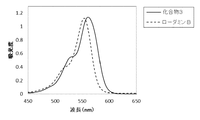
- the measurement results of Experimental Example 1 are shown by solid lines in FIG.
- FIG. 1 what normalized the measurement result of the comparative example 1 to the peak intensity of experiment example 1 is represented by FIG. 1 with a broken line.
- the vertical axis in FIG. 1 represents the absorbance (in Example 1), and the horizontal axis (nm) represents the wavelength.
- Experimental Example 2 Absorption Characteristic Evaluation of Compound 5
- the compound 5 was prepared in the same manner as in Experimental Example 1 except that 0.2 mg (2 ⁇ 10 ⁇ 7 mol) of the compound 5 obtained in Example 2 was used instead of the compound 3. Absorbance characteristics were evaluated (concentration: 4 ⁇ 10 ⁇ 6 M).
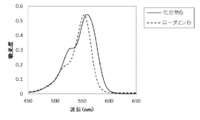
- the measurement result of Experimental example 2 is shown by a solid line in FIG.
- What normalized the measurement result of the comparative example 1 to the peak intensity of Experimental example 2 is represented by a broken line in FIG.
- the vertical axis in FIG. 2 represents the absorbance (in Experimental Example 2), and the horizontal axis (nm) represents the wavelength.
- Experimental Example 3 Absorption Characteristic Evaluation of Compound 7
- the compound 7 was prepared in the same manner as in Experimental Example 1 except that 0.1 mg (1 ⁇ 10 ⁇ 7 mol) of the compound 7 obtained in Example 3 was used instead of the compound 3. Absorbance characteristics were evaluated (concentration: 2 ⁇ 10 ⁇ 6 M).
- the measurement result of Experimental Example 3 is shown by a solid line in FIG.
- What normalized the measurement result of the comparative example 1 to the peak intensity of Experimental example 3 is represented by a broken line in FIG.
- the vertical axis in FIG. 3 represents the absorbance (in Experimental Example 3), and the horizontal axis (nm) represents the wavelength.
- Experimental Example 4 Absorption Characteristic Evaluation of Compound 8
- the compound 8 was prepared in the same manner as in Experimental Example 1 except that 0.03 mg (3 ⁇ 10 ⁇ 8 mol) of the compound 8 obtained in Example 4 was used instead of the compound 3. Absorbance characteristics were evaluated (concentration: 0.5 ⁇ 10 ⁇ 6 M).
- the measurement result of Experimental Example 4 is shown by a solid line in FIG.
- FIG. 4 what normalized the measurement result of the comparative example 1 to the peak intensity of Experimental example 4 is represented by FIG. 4 with a broken line.
- the vertical axis in FIG. 4 represents the absorbance (in Experimental Example 4), and the horizontal axis (nm) represents the wavelength.
- Experimental Example 5 Absorption Characteristic Evaluation of Compound 10
- the compound 10 was prepared in the same manner as in Experimental Example 1 except that 0.2 mg (2 ⁇ 10 ⁇ 7 mol) of the compound 10 obtained in Example 5 was used instead of the compound 3. Absorbance characteristics were evaluated (concentration: 4 ⁇ 10 ⁇ 6 M).
- the measurement result of Experimental example 5 is shown by a solid line in FIG.
- FIG. 5 what normalized the measurement result of the comparative example 1 to the peak intensity of Experimental example 5 is represented by FIG. 5 with a broken line.
- the vertical axis in FIG. 5 represents the absorbance (in Experimental Example 5), and the horizontal axis (nm) represents the wavelength.
- Experimental Example 6 Absorption Characteristic Evaluation of Compound 12
- the compound 12 was prepared in the same manner as in Experimental Example 1 except that 0.4 mg (4 ⁇ 10 ⁇ 7 mol) of the compound 12 obtained in Example 6 was used instead of the compound 3. Absorbance characteristics were evaluated (concentration: 8 ⁇ 10 ⁇ 6 M).
- the measurement result of Experimental Example 6 is shown by a solid line in FIG.
- What normalized the measurement result of the comparative example 1 to the peak intensity of Experimental example 6 is represented by a broken line in FIG.
- the vertical axis in FIG. 6 represents the absorbance (in Experimental Example 6), and the horizontal axis (nm) represents the wavelength.
- Experimental Example 7 Evaluation of Fluorescence Property Regarding the aqueous solution of Compound 7 (concentration: 2 ⁇ 10 ⁇ 6 M) prepared in Experimental Example 3 and the aqueous solution of Compound 10 prepared in Experimental Example 5 (concentration: 4 ⁇ 10 ⁇ 6 M)
- the fluorescence yield was measured using an absolute PL quantum yield measurement apparatus (product name: Quantaurus-QY C11347-01, manufactured by Hamamatsu Photonics K.K.).
- the measurement results of Experimental Example 7 are shown in Table 4.
Landscapes
- Physics & Mathematics (AREA)
- Chemical & Material Sciences (AREA)
- Organic Chemistry (AREA)
- General Physics & Mathematics (AREA)
- Optics & Photonics (AREA)
- Organic Low-Molecular-Weight Compounds And Preparation Thereof (AREA)
- Optical Filters (AREA)
- Pyrane Compounds (AREA)
Abstract
本発明は、低濃度条件下においても会合体を形成し、蛍光収率を抑制し得るローダミン系染料の提供を課題とする。 本発明は、下記一般式(1)で示される化合物等に関する。{一般式(1)中、R1~R6はそれぞれ独立して、水素原子又は炭素数1~6のアルキル基を表し、Y1は、-O-又は-NH-を表し、A1は、置換基を有していてもよい炭素数1~12の直鎖アルキレン基を表し、該置換基は、ヒドロキシ基、炭素数1~6のアルキル基又は下記一般式(2)で示される基を表し;(一般式(2)中、R7は、水素原子又はメチル基を表し、Y2は、-O-又は-NH-を表し、A2は、単結合又は炭素数1~6の直鎖アルキレン基を表す。) An-は、アニオンを表し;2つのR1、2つのR2、2つのR3、2つのR4、2つのR5、2つのR6、2つのY1及び2つのAn-は、それぞれ同じものを表す。}
Description
本発明は、カラーフィルター等に用いられる新規な化合物、及び該化合物を含んでなる着色組成物に関する。
カラー液晶表示装置やカラー撮像管素子に用いられるカラーフィルターは、一般的に、ガラス等の透明な基板の表面に形成された各色のフィルター層からなる微細な帯(ストライプ)状のフィルタセグメント(画素)を、平行又は交差して配置したもの、あるいは微細なフィルタセグメントを縦横一定の配列で配置したものからなっている。
カラーフィルターに要求される品質項目としては、明度とコントラスト比が挙げられる。例えば、明度が低いカラーフィルターは光の透過率が低く、暗い画面となってしまうため、カラーフィルターの高明度化が求められている。また、コントラスト比の低いカラーフィルターはぼやけた画面の原因となるため、高コントラスト化が必要とされている。
そこで、上述した明度とコントラスト比の問題を解決するものとして、ローダミン系色素等のキサンテン骨格を有する染料や、該キサンテン系染料を用いたカラーフィルターが種々報告されている。例えば、カラーフィルターに用いられるローダミン系色素(特許文献1)や、キサンテン系染料を含むカラーフィルター用着色組成物(特許文献2)等が報告されている。
また、ローダミン系色素として、ローダミン誘導体を連結した化合物(ローダミン連結化合物)の報告例もある。例えば、イソチオシアネート基を有するローダミン誘導体同士を連結した化合物(非特許文献1)、五環式キサンチリウム誘導体同士を連結した化合物(特許文献3)等が報告されている。
The Journal of Physical Chemistry A(2003), 107(1), 43-52
しかし、上述したキサンテン系染料は蛍光発光を示すため、コントラスト比が低くなるという問題を有している。また、ローダミンBに代表されるローダミン系色素は、高濃度溶液中において会合体を形成することにより蛍光収率を抑制可能であることは知られていたが、低濃度条件下では当該会合体は形成されず、蛍光収率を抑えることが叶わなかった。
そこで、本発明は、低濃度条件下においても会合体を形成し、蛍光収率を抑制し得るローダミン系染料の提供を課題とする。
そこで、本発明は、低濃度条件下においても会合体を形成し、蛍光収率を抑制し得るローダミン系染料の提供を課題とする。
本発明は、以下の構成よりなる。
[1]下記一般式(1)で示される化合物(以下、本発明の化合物と略記する場合がある)。
 {一般式(1)中、R1~R6はそれぞれ独立して、水素原子又は炭素数1~6のアルキル基を表し、Y1は、-O-又は-NH-を表し、A1は、置換基を有していてもよい炭素数1~12の直鎖アルキレン基を表し、該置換基は、ヒドロキシ基、炭素数1~6のアルキル基又は下記一般式(2)で示される基を表し;
 (一般式(2)中、R7は、水素原子又はメチル基を表し、Y2は、-O-又は-NH-を表し、A2は、単結合又は炭素数1~6の直鎖アルキレン基を表す。)
An-は、アニオンを表し;2つのR1、2つのR2、2つのR3、2つのR4、2つのR5、2つのR6、2つのY1及び2つのAn-は、それぞれ同じものを表す。}
[2]A1が下記一般式(3)で示される基である、上記[1]に記載の化合物。
 {一般式(3)中、R8は、水素原子、ヒドロキシ基、炭素数1~6のアルキル基又は一般式(2)で示される基を表し、n1は、0~5の整数を表し、n2は、1~6の整数を表し、n3は、0~5の整数を表し;n3個のR8及びn3個のn1は、それぞれ同一でも異なっていてもよい。ただし、一般式(3)中の炭素数の総数(R8中の炭素数を除く)は、1~12である。}
[3]A1が下記一般式(4)で示される基である、上記[1]又は[2]に記載の化合物。
 (一般式(4)中、R8は、水素原子、ヒドロキシ基、炭素数1~6のアルキル基又は一般式(2)で示される基を表し、n1は、0~5の整数を表し、n2は、1~6の整数を表す。)
[4]R1とR6、R2とR5、及びR3とR4が、それぞれ同一の置換基である、上記[1]~[3]の何れか1つに記載の化合物。
[5]Y1及びY2が-O-である、上記[1]~[4]の何れか1つに記載の化合物。
[6]上記[1]~[5]の何れか1つに記載の化合物を含んでなる着色組成物(以下、本発明の着色組成物と略記する場合がある)。
[7]上記[1]~[5]の何れか1つに記載の化合物を含んでなるカラーフィルター用着色組成物。
[1]下記一般式(1)で示される化合物(以下、本発明の化合物と略記する場合がある)。
An-は、アニオンを表し;2つのR1、2つのR2、2つのR3、2つのR4、2つのR5、2つのR6、2つのY1及び2つのAn-は、それぞれ同じものを表す。}
[2]A1が下記一般式(3)で示される基である、上記[1]に記載の化合物。
[3]A1が下記一般式(4)で示される基である、上記[1]又は[2]に記載の化合物。
[4]R1とR6、R2とR5、及びR3とR4が、それぞれ同一の置換基である、上記[1]~[3]の何れか1つに記載の化合物。
[5]Y1及びY2が-O-である、上記[1]~[4]の何れか1つに記載の化合物。
[6]上記[1]~[5]の何れか1つに記載の化合物を含んでなる着色組成物(以下、本発明の着色組成物と略記する場合がある)。
[7]上記[1]~[5]の何れか1つに記載の化合物を含んでなるカラーフィルター用着色組成物。
本発明の化合物は、従来のローダミン系色素では困難であった低濃度条件下での会合体形成が可能であり、蛍光収率を抑制するという優れた効果を奏する。
そのため、本発明の化合物は、液晶表示装置(LCD)や固体撮像素子(CCD、CMOS等)に用いられるカラーフィルター等の着色画素形成用途、印刷インキ、インクジェットインキ、及び塗料等の用途に用いることができ、特に、液晶表示装置のカラーフィルター用として好適である。さらに、従来公知の成形方法により、シート、フィルム、ボトル、カップ等に成形して着色樹脂成形物として使用することもできる。よって、メガネ、カラーコンタクトレンズ等の用途にも使用することができ、公知の樹脂との多層構造体とすることによっても同様の用途に使用することができる。その他にも、例えば光学フィルム、ヘアカラーリング剤、化合物や生体物質に対する標識物質、有機太陽電池の材料等の用途にも用いることが可能である。
そのため、本発明の化合物は、液晶表示装置(LCD)や固体撮像素子(CCD、CMOS等)に用いられるカラーフィルター等の着色画素形成用途、印刷インキ、インクジェットインキ、及び塗料等の用途に用いることができ、特に、液晶表示装置のカラーフィルター用として好適である。さらに、従来公知の成形方法により、シート、フィルム、ボトル、カップ等に成形して着色樹脂成形物として使用することもできる。よって、メガネ、カラーコンタクトレンズ等の用途にも使用することができ、公知の樹脂との多層構造体とすることによっても同様の用途に使用することができる。その他にも、例えば光学フィルム、ヘアカラーリング剤、化合物や生体物質に対する標識物質、有機太陽電池の材料等の用途にも用いることが可能である。
[本発明の化合物]
本発明の化合物は、下記一般式(1)で示されるものである。
 {一般式(1)中、R1~R6はそれぞれ独立して、水素原子又は炭素数1~6のアルキル基を表し、Y1は、-O-又は-NH-を表し、A1は、置換基を有していてもよい炭素数1~12の直鎖アルキレン基を表し、該置換基は、ヒドロキシ基、炭素数1~6のアルキル基又は下記一般式(2)で示される基を表し;
 (一般式(2)中、R7は、水素原子又はメチル基を表し、Y2は、-O-又は-NH-を表し、A2は、単結合又は炭素数1~6の直鎖アルキレン基を表す。)
An-は、アニオンを表し;2つのR1、2つのR2、2つのR3、2つのR4、2つのR5、2つのR6、2つのY1及び2つのAn-は、それぞれ同じものを表す。}
本発明の化合物は、下記一般式(1)で示されるものである。
An-は、アニオンを表し;2つのR1、2つのR2、2つのR3、2つのR4、2つのR5、2つのR6、2つのY1及び2つのAn-は、それぞれ同じものを表す。}
一般式(1)のR1~R6における炭素数1~6のアルキル基としては、直鎖状、分枝状及び環状のうちいずれであってもよく、中でも、直鎖状及び分枝状が好ましく、直鎖状がより好ましい。また、炭素数1~6のアルキル基の中でも、炭素数1~4のものが好ましい。具体的には例えば、メチル基、エチル基、n-プロピル基、イソプロピル基、n-ブチル基、イソブチル基、sec-ブチル基、tert-ブチル基、シクロブチル基、n-ペンチル基、イソペンチル基、sec-ペンチル基、tert-ペンチル基、ネオペンチル基、2-メチルブチル基、1,2-ジメチルプロピル基、1-エチルプロピル基、シクロペンチル基、n-ヘキシル基、イソヘキシル基、sec-ヘキシル基、tert-ヘキシル基、ネオヘキシル基、2-メチルペンチル基、1,2-ジメチルブチル基、2,3-ジメチルブチル基、1-エチルブチル基、シクロヘキシル基等が挙げられ、メチル基、エチル基、n-プロピル基、イソプロピル基、n-ブチル基、イソブチル基、sec-ブチル基、tert-ブチル基が好ましく、メチル基、エチル基がより好ましい。
一般式(1)のR1及びR6としては、水素原子、メチル基、エチル基が好ましく、水素原子、メチル基がより好ましく、水素原子が特に好ましい。また、R1とR6とが同一の置換基であるのが好ましい。
一般式(1)のR2及びR5としては、炭素数1~6のアルキル基が好ましく、直鎖状又は分枝状の炭素数1~4のアルキル基がより好ましく、メチル基、エチル基がさらに好ましく、エチル基が特に好ましい。また、R2とR5とが同一の置換基であるのが好ましい。
一般式(1)のR3及びR4としては、水素原子並びに直鎖状又は分枝状の炭素数1~4のアルキル基が好ましく、水素原子、メチル基、エチル基がより好ましく、水素原子、エチル基がさらに好ましく、エチル基が特に好ましい。また、R3とR4とが同一の置換基であるのが好ましい。
一般式(1)のY1としては、-O-が好ましい。
一般式(1)のA1における「置換基を有していてもよい炭素数1~12の直鎖アルキレン基」の炭素数1~12の直鎖アルキレン基としては、炭素数2~8のものが好ましく、炭素数2~5のものがより好ましい。具体的には、メチレン基、エチレン基、トリメチレン基、テトラメチレン基、ペンタメチレン基、ヘキサメチレン基、へプタメチレン基、オクタメチレン基、ノナメチレン基、デカメチレン基、ウンデカメチレン基、ドデカメチレン基が挙げられ、エチレン基、トリメチレン基、テトラメチレン基、ペンタメチレン基、ヘキサメチレン基、へプタメチレン基、オクタメチレン基が好ましく、エチレン基、トリメチレン基、テトラメチレン基、ペンタメチレン基がより好ましい。
一般式(1)のA1における置換基を有する炭素数1~12の直鎖アルキレン基は、通常1~5個、好ましくは1~3個、より好ましくは1個又は2個、特に好ましくは1個の置換基を有する。該置換基は、ヒドロキシ基、炭素数1~6のアルキル基又は一般式(2)で示される基である。2個以上の置換基を有する場合、該置換基は同一でも異なっていてもよいが、全て同一の置換基であるのが好ましい。
該置換基における炭素数1~6のアルキル基としては、一般式(1)のR1~R6における炭素数1~6のアルキル基と同じものが挙げられ、好ましいものも同じである。
一般式(2)のR7としては、メチル基が好ましい。
一般式(2)のY2としては、-O-が好ましい。また、一般式(2)のY2は、一般式(1)のY1と同一であるのが好ましく、Y1及びY2が、共に-O-であるのがより好ましい。
一般式(2)のA2における炭素数1~6の直鎖アルキレン基としては、炭素数1~3のものが好ましい。具体的には、メチレン基、エチレン基、トリメチレン基、テトラメチレン基、ペンタメチレン基、ヘキサメチレン基が挙げられ、メチレン基、エチレン基、トリメチレン基が好ましく、メチレン基がより好ましい。
一般式(2)のA2としては、単結合及び炭素数1~3の直鎖アルキレン基が好ましく、単結合及びメチレン基がより好ましい。
一般式(2)で示される基の中でも好ましい具体例としては、下記一般式(2-1)で示される基が挙げられる。
 (一般式(2-1)中、R7及びA2は、上記と同じ。)
一般式(2-1)で示される基の中でも好ましい具体例としては、下記式(101)~(108)で示される基が挙げられ、中でも式(101)~(104)で示される基が好ましく、式(102)又は(104)で示される基がより好ましく、式(104)で示される基が特に好ましい。
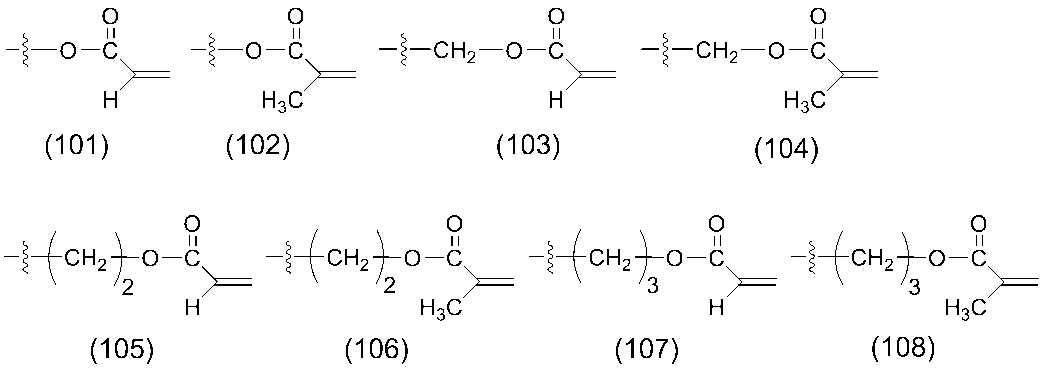
一般式(1)のA1における「置換基を有していてもよい炭素数1~12の直鎖アルキレン基」の置換基としては、ヒドロキシ基、直鎖状又は分枝状の炭素数1~4のアルキル基、並びに一般式(2-1)で示される基が好ましく;ヒドロキシ基及び式(101)~(108)で示される基がより好ましく;ヒドロキシ基及び式(101)~(104)で示される基がさらに好ましく;ヒドロキシ基が特に好ましい。
一般式(1)のA1における置換基を有していてもよい炭素数1~12の直鎖アルキレン基の具体例としては、例えば、下記一般式(3)で示される基が挙げられる。
 {一般式(3)中、R8は、水素原子、ヒドロキシ基、炭素数1~6のアルキル基又は一般式(2)で示される基を表し、n1は、0~5の整数を表し、n2は、1~6の整数を表し、n3は、0~5の整数を表し;n3個のR8及びn3個のn1は、それぞれ同一でも異なっていてもよい。ただし、一般式(3)中の炭素数の総数(R8中の炭素数を除く)は、1~12である。}
一般式(3)のR8における炭素数1~6のアルキル基としては、一般式(1)のR1~R6における炭素数1~6のアルキル基と同じものが挙げられ、好ましいものも同じである。
一般式(3)のR8における一般式(2)で示される基は、一般式(1)のA1中の置換基としての一般式(2)で示される基と同じものである。
一般式(3)のR8としては、水素原子、ヒドロキシ基、直鎖状又は分枝状の炭素数1~4のアルキル基、並びに一般式(2-1)で示される基が好ましく;水素原子、ヒドロキシ基及び式(101)~(108)で示される基がより好ましく;水素原子、ヒドロキシ基及び式(101)~(104)で示される基がさらに好ましく;水素原子、ヒドロキシ基がさらにより好ましく;水素原子が特に好ましい。
一般式(3)のn1としては、R8が水素原子である場合、0~3の整数が好ましく、0又は1がより好ましく、1が特に好ましく;R8が水素原子でない(R8がヒドロキシ基、炭素数1~6のアルキル基又は一般式(2)で示される基である)場合、1~3の整数が好ましく、1又は2がより好ましく、1が特に好ましい。
一般式(3)のn2としては、R8が水素原子である場合、1~4の整数が好ましく、1~3の整数がより好ましく、2が特に好ましく;R8が水素原子でない(R8がヒドロキシ基、炭素数1~6のアルキル基又は一般式(2)で示される基である)場合、1~3の整数が好ましく、1又は2がより好ましく、1が特に好ましい。
一般式(3)のn3としては、0~3の整数が好ましく、0又は1がより好ましく、1が特に好ましい。
一般式(3)中の炭素数の総数(R8中の炭素数を除く)としては、2~8が好ましく、2~5がより好ましい。尚、当該総数は、計算式「(n1+1)×n3+n2」で算出した数を示す。
一般式(3)で示される基の好ましい具体例としては、例えば、下記一般式(4)で示される基が挙げられる。
 (一般式(4)中、R8、n1及びn2は、上記と同じ。)
一般式(4)で示される基の好ましい具体例としては、例えば、下記一般式(5)で示される基が挙げられる。
 (一般式(5)中、R9は、水素原子、ヒドロキシ基、直鎖状もしくは分枝状の炭素数1~4のアルキル基、又は一般式(2-1)で示される基を表し;R9が水素原子である場合、n4は、0~3の整数を表し、n5は、1~4の整数を表し;R9が水素原子でない場合、n4及びn5はそれぞれ独立して、1~3の整数を表す。)
一般式(5)のR9における直鎖状又は分枝状の炭素数1~4のアルキル基としては、メチル基、エチル基、n-プロピル基、イソプロピル基、n-ブチル基、イソブチル基、sec-ブチル基、tert-ブチル基が挙げられ、メチル基、エチル基が好ましい。
一般式(5)のR9における一般式(2-1)で示される基は、一般式(1)のA1中の置換基としての一般式(2-1)で示される基と同じものである。
一般式(5)のR9としては、水素原子、ヒドロキシ基及び式(101)~(108)で示される基が好ましく;水素原子、ヒドロキシ基及び式(101)~(104)で示される基がより好ましく;水素原子、ヒドロキシ基がさらに好ましく;水素原子が特に好ましい。
一般式(5)のn4としては、R9が水素原子である場合、0又は1が好ましく、1が特に好ましく;R9が水素原子でない(R9がヒドロキシ基、直鎖状もしくは分枝状の炭素数1~4のアルキル基、又は一般式(2-1)で示される基である)場合、1又は2がより好ましく、1が特に好ましい。
一般式(5)のn5としては、R9が水素原子である場合、1~3の整数がより好ましく、2が特に好ましく;R9が水素原子でない(R9がヒドロキシ基、直鎖状もしくは分枝状の炭素数1~4のアルキル基、又は一般式(2-1)で示される基である)場合、1又は2がより好ましく、1が特に好ましい。また、R9が水素原子でない場合、n4とn5とが同一であるのが好ましい。
一般式(5)で示される基の具体例としては、例えば、
-(CH2)2-、-(CH2)3-、-(CH2)4-、-(CH2)5-、-(CH2)6-、-(CH2)7-、-(CH2)8-;
-CH2-CH(OH)-CH2-、-CH2-CH(OH)-(CH2)2-、-CH2-CH(OH)-(CH2)3-、-(CH2)2-CH(OH)-(CH2)2-、-(CH2)2-CH(OH)-(CH2)3-、-(CH2)3-CH(OH)-(CH2)3-;
-CH2-CH(CH3)-CH2-、-CH2-CH(CH3)-(CH2)2-、-CH2-CH(CH3)-(CH2)3-、-(CH2)2-CH(CH3)-(CH2)2-、-(CH2)2-CH(CH3)-(CH2)3-、-(CH2)3-CH(CH3)-(CH2)3-;
-CH2-CH(C2H5)-CH2-、-CH2-CH(C2H5)-(CH2)2-、-CH2-CH(C2H5)-(CH2)3-、-(CH2)2-CH(C2H5)-(CH2)2-、-(CH2)2-CH(C2H5)-(CH2)3-、-(CH2)3-CH(C2H5)-(CH2)3-;
下記群Aに記載の基、及び下記群Bに記載の基が挙げられる。
-(CH2)2-、-(CH2)3-、-(CH2)4-、-(CH2)5-、-(CH2)6-、-(CH2)7-、-(CH2)8-;
-CH2-CH(OH)-CH2-、-CH2-CH(OH)-(CH2)2-、-CH2-CH(OH)-(CH2)3-、-(CH2)2-CH(OH)-(CH2)2-、-(CH2)2-CH(OH)-(CH2)3-、-(CH2)3-CH(OH)-(CH2)3-;
-CH2-CH(CH3)-CH2-、-CH2-CH(CH3)-(CH2)2-、-CH2-CH(CH3)-(CH2)3-、-(CH2)2-CH(CH3)-(CH2)2-、-(CH2)2-CH(CH3)-(CH2)3-、-(CH2)3-CH(CH3)-(CH2)3-;
-CH2-CH(C2H5)-CH2-、-CH2-CH(C2H5)-(CH2)2-、-CH2-CH(C2H5)-(CH2)3-、-(CH2)2-CH(C2H5)-(CH2)2-、-(CH2)2-CH(C2H5)-(CH2)3-、-(CH2)3-CH(C2H5)-(CH2)3-;
下記群Aに記載の基、及び下記群Bに記載の基が挙げられる。
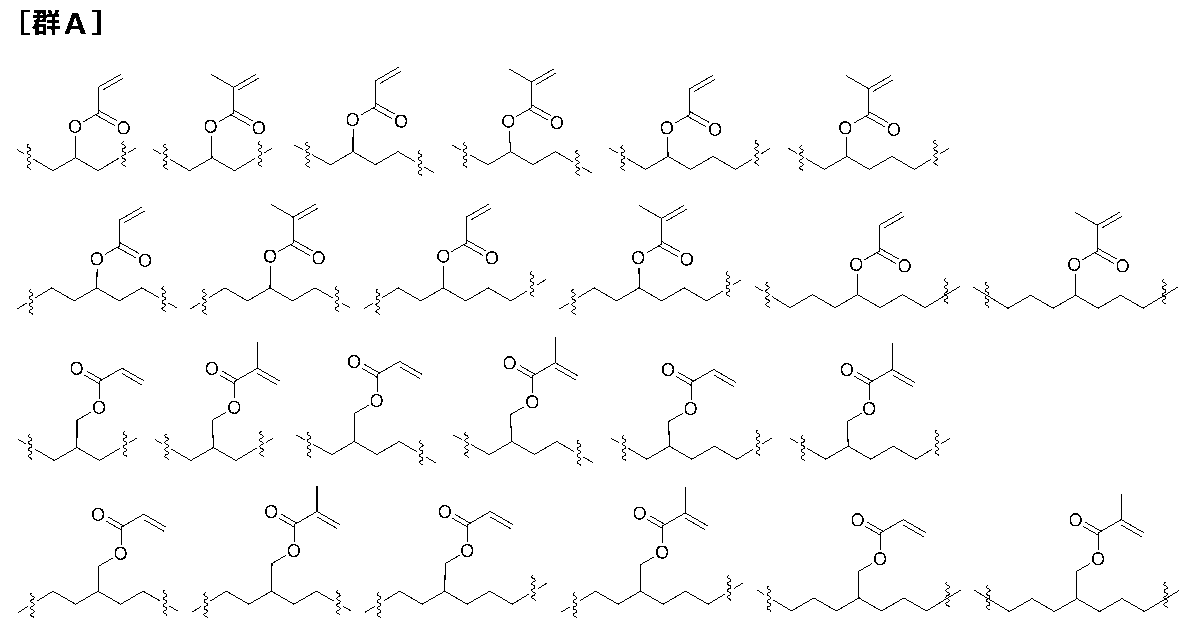

上記具体例の中でも、
-(CH2)2-、-(CH2)3-、-(CH2)4-、-(CH2)5-、-(CH2)6-、-(CH2)7-、-(CH2)8-、-CH2-CH(OH)-CH2-、-CH2-CH(OH)-(CH2)2-、-CH2-CH(OH)-(CH2)3-、-(CH2)2-CH(OH)-(CH2)2-、-(CH2)2-CH(OH)-(CH2)3-、-(CH2)3-CH(OH)-(CH2)3-、群Aに記載の基及び群Bに記載の基が好ましく;
-(CH2)2-、-(CH2)3-、-(CH2)4-、-(CH2)5-、-(CH2)6-、-(CH2)7-、-(CH2)8-、-CH2-CH(OH)-CH2-、-CH2-CH(OH)-(CH2)2-、-CH2-CH(OH)-(CH2)3-、-(CH2)2-CH(OH)-(CH2)2-、-(CH2)2-CH(OH)-(CH2)3-、-(CH2)3-CH(OH)-(CH2)3-及び群Aに記載の基がより好ましく;
-(CH2)2-、-(CH2)3-、-(CH2)4-、-(CH2)5-、-(CH2)6-、-(CH2)7-、-(CH2)8-、-CH2-CH(OH)-CH2-、-CH2-CH(OH)-(CH2)2-、-CH2-CH(OH)-(CH2)3-、-(CH2)2-CH(OH)-(CH2)2-、-(CH2)2-CH(OH)-(CH2)3-、-(CH2)3-CH(OH)-(CH2)3-がさらに好ましい。
-(CH2)2-、-(CH2)3-、-(CH2)4-、-(CH2)5-、-(CH2)6-、-(CH2)7-、-(CH2)8-、-CH2-CH(OH)-CH2-、-CH2-CH(OH)-(CH2)2-、-CH2-CH(OH)-(CH2)3-、-(CH2)2-CH(OH)-(CH2)2-、-(CH2)2-CH(OH)-(CH2)3-、-(CH2)3-CH(OH)-(CH2)3-、群Aに記載の基及び群Bに記載の基が好ましく;
-(CH2)2-、-(CH2)3-、-(CH2)4-、-(CH2)5-、-(CH2)6-、-(CH2)7-、-(CH2)8-、-CH2-CH(OH)-CH2-、-CH2-CH(OH)-(CH2)2-、-CH2-CH(OH)-(CH2)3-、-(CH2)2-CH(OH)-(CH2)2-、-(CH2)2-CH(OH)-(CH2)3-、-(CH2)3-CH(OH)-(CH2)3-及び群Aに記載の基がより好ましく;
-(CH2)2-、-(CH2)3-、-(CH2)4-、-(CH2)5-、-(CH2)6-、-(CH2)7-、-(CH2)8-、-CH2-CH(OH)-CH2-、-CH2-CH(OH)-(CH2)2-、-CH2-CH(OH)-(CH2)3-、-(CH2)2-CH(OH)-(CH2)2-、-(CH2)2-CH(OH)-(CH2)3-、-(CH2)3-CH(OH)-(CH2)3-がさらに好ましい。
さらに、これらの中でも、
-(CH2)2-、-(CH2)3-、-(CH2)4-、-(CH2)5-、-(CH2)6-、-(CH2)7-、-(CH2)8-、-CH2-CH(OH)-CH2-、-(CH2)2-CH(OH)-(CH2)2-、-(CH2)3-CH(OH)-(CH2)3-が好ましく;
-(CH2)2-、-(CH2)3-、-(CH2)4-、-(CH2)5-、-CH2-CH(OH)-CH2-がより好ましく;
-(CH2)4-が特に好ましい。
-(CH2)2-、-(CH2)3-、-(CH2)4-、-(CH2)5-、-(CH2)6-、-(CH2)7-、-(CH2)8-、-CH2-CH(OH)-CH2-、-(CH2)2-CH(OH)-(CH2)2-、-(CH2)3-CH(OH)-(CH2)3-が好ましく;
-(CH2)2-、-(CH2)3-、-(CH2)4-、-(CH2)5-、-CH2-CH(OH)-CH2-がより好ましく;
-(CH2)4-が特に好ましい。
[An - で示されるアニオン]
一般式(1)のAn-としては、アニオンであればよく、具体的には例えば、ハロゲン化物イオン;電子吸引性の置換基を有するアリール基、電子吸引性の置換基を有するスルホニル基、ハロアルキル基もしくはハロゲノ基を含むアニオン;ハロゲンオキソ酸アニオン;又はスルホン酸アニオン(以下、本発明に係るアニオンと略記する場合がある)が挙げられる。
一般式(1)のAn-としては、アニオンであればよく、具体的には例えば、ハロゲン化物イオン;電子吸引性の置換基を有するアリール基、電子吸引性の置換基を有するスルホニル基、ハロアルキル基もしくはハロゲノ基を含むアニオン;ハロゲンオキソ酸アニオン;又はスルホン酸アニオン(以下、本発明に係るアニオンと略記する場合がある)が挙げられる。
本発明に係るアニオンにおいて、ハロゲン化物イオンとしては、例えばフッ化物イオン(F-)、塩化物イオン(Cl-)、臭化物イオン(Br-)、ヨウ化物イオン(I-)等が挙げられ、塩化物イオンが好ましい。
本発明に係るアニオンにおいて、電子吸引性の置換基を有するアリール基、電子吸引性の置換基を有するスルホニル基又はハロアルキル基を含むアニオンにおけるアニオン部分としては、例えばスルホン酸アニオン、窒素アニオン(N-)、4級ホウ素アニオン、硝酸イオン、燐酸イオン等が挙げられ、スルホン酸アニオン、窒素アニオン、4級ホウ素アニオンが好ましく、4級ホウ素アニオンがより好ましい。
本発明に係るアニオンにおいて、ハロゲノ基を含むアニオンにおけるアニオン部分としては、例えば、4級ホウ素アニオン、リンアニオン、アンチモンアニオン等が挙げられ、リンアニオン、アンチモンアニオンが好ましく、リンアニオンがより好ましい。
本発明に係るアニオンにおいて、電子吸引性の置換基を有するアリール基又は電子吸引性の置換基を有するスルホニル基における電子吸引性の置換基としては、例えば、炭素数1~3のハロアルキル基、ハロゲノ基、ニトロ基等が挙げられ、中でも炭素数1~3のハロアルキル基、ハロゲノ基が好ましく、ハロゲノ基が特に好ましい。
上記電子吸引性の置換基としての炭素数1~3のハロアルキル基としては、例えばクロロメチル基、トリクロロメチル基、2-クロロエチル基、2,2,2-トリクロロエチル基、ペンタクロロエチル基、2-クロロプロピル基、3-クロロプロピル基、2-クロロ-2-プロピル基、ヘプタクロロプロピル基等のクロロアルキル基;ブロモメチル基、トリブロモメチル基、2-ブロモエチル基、2,2,2-トリブロモエチル基、ペンタブロモエチル基、2-ブロモプロピル基、3-ブロモプロピル基、2-ブロモ-2-プロピル基、ヘプタブロモプロピル基等のブロモアルキル基;ヨードメチル基、トリヨードメチル基、2-ヨードエチル基、2,2,2-トリヨードエチル基、ペンタヨードエチル基、2-ヨードプロピル基、3-ヨードプロピル基、2-ヨード-2-プロピル基、ヘプタヨードプロピル基等のヨードアルキル基;フルオロメチル基、トリフルオロメチル基、2-フルオロエチル基、2,2,2-トリフルオロエチル基、1,1,2,2-テトラフルオロエチル基、ペンタフルオロエチル基、3-フルオロプロピル基、3,3,3-トリフルオロプロピル基、2,2,3,3-テトラフルオロプロピル基、ヘプタフルオロプロピル基等のフルオロアルキル基が挙げられる。この中でもトリクロロメチル基、ペンタクロロエチル基、ヘプタクロロプロピル基、トリブロモメチル基、ペンタブロモエチル基、ヘプタブロモプロピル基、トリヨードメチル基、ペンタヨードエチル基、ヘプタヨードプロピル基、トリフルオロメチル基、ペンタフルオロエチル基、ヘプタフルオロプロピル基等のパーハロゲノアルキル基が好ましく、トリフルオロメチル基、ペンタフルオロエチル基、ヘプタフルオロプロピル基等のパーフルオロアルキル基がより好ましく、トリフルオロメチル基が特に好ましい。
上記電子吸引性の置換基としてのハロゲノ基としては、フルオロ基、クロロ基、ブロモ基、ヨード基等が挙げられ、フルオロ基が好ましい。
本発明に係るアニオンにおいて、電子吸引性の置換基を有するアリール基中の電子吸引性の置換基としては、上記具体例の中でも電子吸引力が強いものが好ましく、具体的にはトリフルオロメチル基、フルオロ基、ニトロ基が好ましく、フルオロ基がより好ましい。
本発明に係るアニオンにおいて、電子吸引性の置換基を有するスルホニル基中の電子吸引性の置換基としては、上記具体例の中でも、トリフルオロメチル基、ペンタフルオロエチル基、ヘプタフルオロプロピル基、フルオロ基が好ましい。
本発明に係るアニオンにおいて、電子吸引性の置換基を有するアリール基中のアリール基としては、例えば、フェニル基、ナフチル基等が挙げられ、フェニル基が好ましい。
本発明に係るアニオンにおける電子吸引性の置換基を有するアリール基の具体例としては、例えば、下記一般式(11)及び(12)で表されるものが挙げられる。
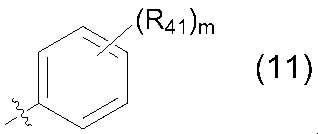 (一般式(11)中、R41は、炭素数1~3のハロアルキル基、ハロゲノ基又はニトロ基を表し、mは、1~5の整数を表し、m個のR41は同一でも異なっていてもよい。)

一般式(11)におけるR41の炭素数1~3のハロアルキル基としては、上記本発明に係るアニオンにおける電子吸引性の置換基としての炭素数1~3のハロアルキル基と同じものが挙げられ、好ましいものも同じである。
一般式(11)におけるR41のハロゲノ基としては、フルオロ基、クロロ基、ブロモ基、ヨード基等が挙げられ、フルオロ基が好ましい。
一般式(11)におけるR41の好ましい具体例としては、上記の電子吸引性の置換基を有するアリール基中の電子吸引性の置換基の好ましいものと同じである。
一般式(11)におけるmとしては、R41がハロゲノ基の場合、2~5の整数が好ましく、3~5の整数がより好ましく、5がさらに好ましく;R41がニトロ基の場合、1~3の整数が好ましく、1がより好ましく;R41がハロアルキル基の場合、1~5の整数が好ましく、1~3の整数がより好ましい。
一般式(12)におけるkとしては、R41がハロゲノ基の場合、2~7の整数が好ましく;R41がニトロ基の場合、1~3の整数が好ましく、1がより好ましく;R41がハロアルキル基の場合、1~7の整数が好ましく、1~3の整数がより好ましい。
一般式(11)で示される基としては、具体的には例えば、トリフルオロメチルフェニル基、ジ(トリフルオロメチル)フェニル基、トリ(トリフルオロメチル)フェニル基、モノフルオロフェニル基、ジフルオロフェニル基、トリフルオロフェニル基、パーフルオロフェニル基、モノクロロフェニル基、ジクロロフェニル基、トリクロロフェニル基、パークロロフェニル基、モノブロモフェニル基、ジブロモフェニル基、トリブロモフェニル基、パーブロモフェニル基、モノヨードフェニル基、ジヨードフェニル基、トリヨードフェニル基、パーヨードフェニル基、ニトロフェニル基、ジニトロフェニル基、トリニトロフェニル基等が挙げられ、ジフルオロフェニル基、トリフルオロフェニル基、パーフルオロフェニル基等が好ましく、パーフルオロフェニル基がより好ましい。
一般式(12)で示される基としては、具体的には例えば、トリフルオロメチルナフチル基、ジ(トリフルオロメチル)ナフチル基、トリ(トリフルオロメチル)ナフチル基、モノフルオロナフチル基、ジフルオロナフチル基、トリフルオロナフチル基、パーフルオロナフチル基、モノクロロナフチル基、ジクロロナフチル基、トリクロロナフチル基、パークロロナフチル基、モノブロモナフチル基、ジブロモナフチル基、トリブロモナフチル基、パーブロモナフチル基、モノヨードナフチル基、ジヨードナフチル基、トリヨードナフチル基、パーヨードナフチル基、ニトロナフチル基、ジニトロナフチル基、トリニトロナフチル基等が挙げられる。
本発明に係るアニオンにおける電子吸引性の置換基を有するアリール基としては、上記具体例の中でも、一般式(11)で示される基が好ましく、具体的にはトリフルオロメチルフェニル基、ニトロフェニル基、ジニトロフェニル基、トリニトロフェニル基、モノフルオロフェニル基、ジフルオロフェニル基、トリフルオロフェニル基、パーフルオロフェニル基が好ましく、ジフルオロフェニル基、トリフルオロフェニル基、ニトロフェニル基、パーフルオロフェニル基がより好ましく、パーフルオロフェニル基が特に好ましい。
本発明に係るアニオンにおける電子吸引性の置換基を有するスルホニル基としては、例えば、-SO2-CF3、-SO2-C2F5、-SO2-C3F7、-SO2-F、-SO2-Cl、-SO2-Br、-SO2-I等が挙げられる。
本発明に係るアニオンにおけるハロアルキル基としては、炭素数1~3のハロアルキル基が挙げられ、中でもパーハロアルキル基が好ましく、具体的には例えば、トリフルオロメチル基、ペンタフルオロエチル基、ヘプタフルオロプロピル基、トリクロロメチル基、ペンタクロロエチル基、ヘプタクロロプロピル基、トリブロモメチル基、ペンタブロモエチル基、ヘプタブロモプロピル基、トリヨードメチル基、ペンタヨードエチル基、ヘプタヨードプロピル基等が挙げられ、トリフルオロメチル基、ペンタフルオロエチル基、ヘプタフルオロプロピル基が好ましい。
本発明に係るアニオンにおけるハロゲノ基としては、フルオロ基、クロロ基、ブロモ基、ヨード基等が挙げられ、フルオロ基が好ましい。
本発明に係るアニオンにおいて、電子吸引性の置換基を有するアリール基、電子吸引性の置換基を有するスルホニル基、ハロアルキル基又はハロゲノ基を含むアニオンとしては、具体的には例えば、下記一般式(13)~(19)で示されるものが挙げられる。
 (一般式(13)中、R41及びmは上記と同じであり、m個のR41は同一でも異なっていてもよい。)
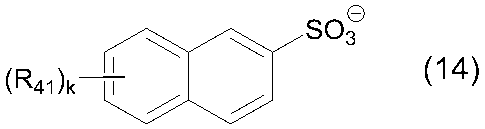

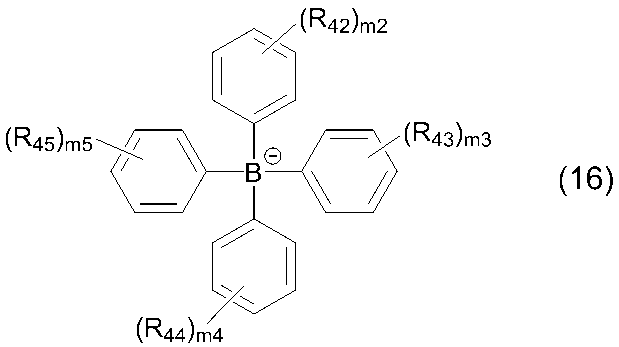

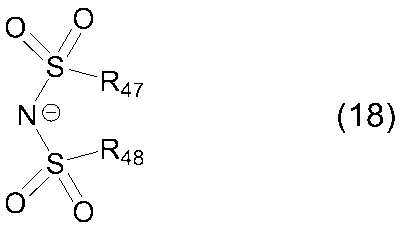

一般式(13)におけるR41及びmの組合せとしては、例えば、下記表記載のものが挙げられる。尚、該m個のR41はそれぞれ独立するものであるが、同じ場合が好ましい。

一般式(13)で示されるアニオンの好ましい具体例としては、例えば、下記のものが挙げられる。

一般式(14)及び(15)におけるR41及びkの組合せとしては、例えば、下記表記載のものが挙げられる。尚、該k個のR41はそれぞれ独立するものであるが、同じ場合が好ましい。
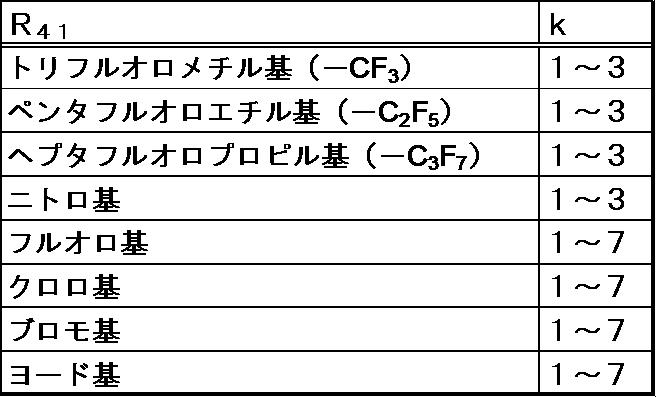
一般式(14)及び(15)で示されるアニオンの好ましい具体例としては、例えば、下記のものが挙げられる。

一般式(16)のR42~R45における炭素数1~3のハロアルキル基としては、本発明に係るアニオンにおける電子吸引性の置換基としての炭素数1~3のハロアルキル基と同じものが挙げられ、好ましいものも同じである。
一般式(16)のR42~R45におけるハロゲノ基としては、フルオロ基、クロロ基、ブロモ基、ヨード基等が挙げられ、フルオロ基が好ましい。
一般式(16)におけるR42~R45及びm2~m5の組合せとしては、例えば、下記表記載のものが挙げられる。

一般式(16)で示されるアニオンの好ましい具体例としては、例えば、下記のものが挙げられる。

上記具体例の中でも、下記のものが好ましく、テトラキス(ペンタフルオロフェニル)ホウ素(IV)アニオンがより好ましい。
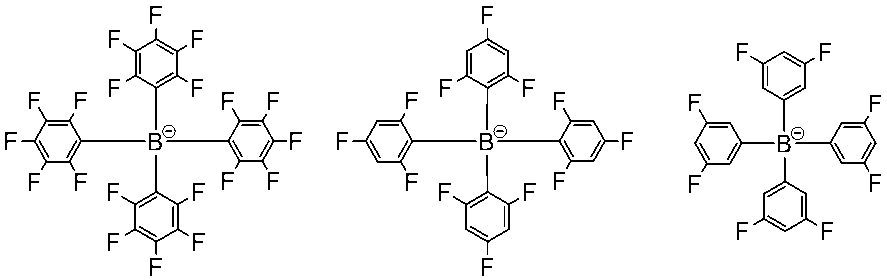
一般式(17)のR46における炭素数1~3のハロアルキル基としては、本発明に係るアニオンにおける電子吸引性の置換基としての炭素数1~3のハロアルキル基と同じものが挙げられ、好ましいものも同じである。
一般式(17)のR46におけるハロゲノ基としては、フルオロ基、クロロ基、ブロモ基、ヨード基等が挙げられ、フルオロ基が好ましい。
一般式(17)で示されるアニオンの好ましい具体例としては、例えば、BF4
-、CF3BF3
-、C2F5BF3
-、C3F7BF3
-、(CF3)4B-、(C2F5)4B-、(C3F7)4B-等が挙げられる。
一般式(18)のR47及びR48における炭素数1~3のハロアルキル基としては、本発明に係るアニオンにおける電子吸引性の置換基としての炭素数1~3のハロアルキル基と同じものが挙げられ、好ましいものも同じである。
一般式(18)のR47及びR48におけるハロゲノ基としては、フルオロ基、クロロ基、ブロモ基、ヨード基等が挙げられ、フルオロ基が好ましい。
一般式(18)のR47とR48とで形成される炭素数2~3のハロゲン化アルキレン基としては、例えばテトラフルオロエチレン基、ヘキサフルオロプロピレン基等が挙げられ、ヘキサフルオロプロピレン基が好ましい。
一般式(18)で示されるアニオンの好ましい具体例としては、例えば、下記のものが挙げられ、ビス(トリフルオロメタンスルホニル)イミドアニオンが好ましい。
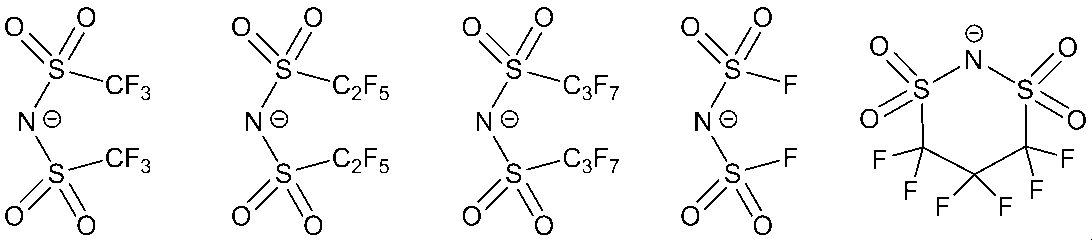
一般式(19)のR49としては、リン原子が好ましい。
一般式(19)のXにおけるハロゲノ基としては、フルオロ基、クロロ基、ブロモ基、ヨード基等が挙げられ、フルオロ基が好ましい。
一般式(19)で示されるアニオンの好ましい具体例としては、例えば、PF6
-、SbF6
-等が挙げられ、PF6
-が好ましい。
本発明に係るアニオンにおけるハロゲンオキソ酸アニオンの具体例としては、例えば、次亜塩素酸アニオン、亜塩素酸アニオン、塩素酸アニオン、過塩素酸アニオン等が挙げられ、過塩素酸アニオンが好ましい。
本発明に係るアニオンにおけるスルホン酸アニオンの具体例としては、例えば、メタンスルホン酸アニオン等の炭素数1~20のアルキルスルホン酸アニオン;トリフルオロメタンスルホン酸アニオン等の炭素数1~20のハロゲン化アルキルスルホン酸アニオン;ベンゼンスルホン酸アニオン、トルエンスルホン酸アニオン等の置換基を有している又は無置換のベンゼンスルホン酸アニオン等が挙げられる。
一般式(1)のAn-で示されるアニオンとしては、本発明に係るアニオンが好ましく、ハロゲン化物イオン;及び、電子吸引性の置換基を有するアリール基、電子吸引性の置換基を有するスルホニル基、ハロアルキル基又はハロゲノ基を含むアニオンがより好ましい。具体的には、塩化物イオン及び一般式(16)~(19)で示されるアニオンが好ましく、塩化物イオン及び一般式(16)、(18)又は(19)で示されるアニオンがより好ましく、塩化物イオン及び一般式(18)又は(19)で示されるアニオンがさらに好ましく、塩化物イオン及び一般式(19)で示されるものが特に好ましい。
上記具体例の中でも、下記のものが好ましく、塩化物イオン、ビス(トリフルオロメタンスルホニル)イミドアニオン、テトラキス(ペンタフルオロフェニル)ホウ素(IV)アニオン、PF6
-がより好ましく、塩化物イオン、テトラキス(ペンタフルオロフェニル)ホウ素(IV)アニオン、PF6
-がさらに好ましく、塩化物イオン、PF6
-がさらにより好ましく、塩化物イオンが特に好ましい。
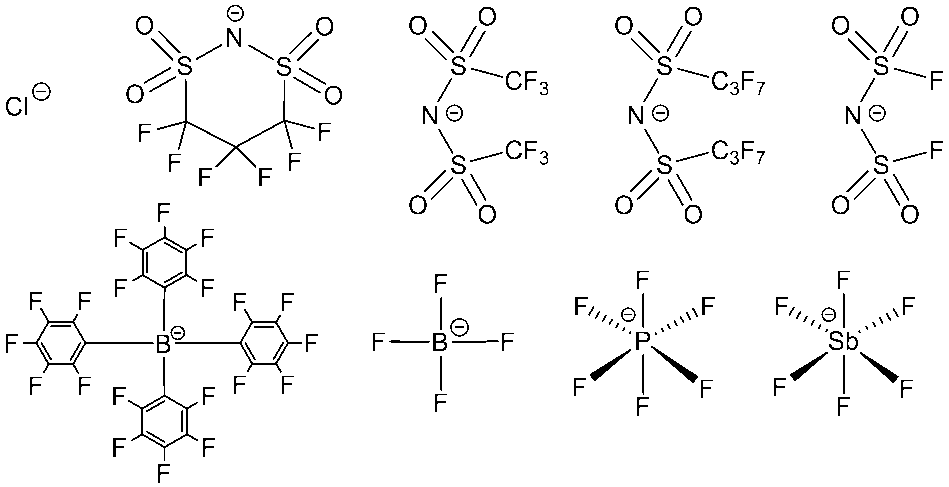
[本発明の化合物の好ましい具体例]
本発明の化合物の好ましい具体例としては、下記一般式(1-2)で示される化合物が挙げられる。
 (一般式(1-2)中、R1~R6、R8、Y1、An-及びn1~n3は、上記と同じであり;2つのR1、2つのR2、2つのR3、2つのR4、2つのR5、2つのR6、2つのY1及び2つのAn-は、それぞれ同じものを表し;n3個のR8及びn3個のn1は、それぞれ同一でも異なっていてもよい。)
本発明の化合物の好ましい具体例としては、下記一般式(1-2)で示される化合物が挙げられる。
一般式(1-2)で示される化合物の好ましい具体例としては、下記一般式(1-3)で示される化合物が挙げられる。
 (一般式(1-3)中、R1~R6、R8、Y1、An-、n1及びn2は、上記と同じであり;2つのR1、2つのR2、2つのR3、2つのR4、2つのR5、2つのR6、2つのY1及び2つのAn-は、それぞれ同じものを表す。)
一般式(1-3)で示される化合物の好ましい具体例としては、下記一般式(1-4)で示される化合物が挙げられる。
 (一般式(1-4)中、R1~R3、R9、An-、n4及びn5は、上記と同じであり;4つのR1、4つのR2、4つのR3及び2つのAn-は、それぞれ同じものを表す。)
一般式(1-4)で示される化合物の好ましい具体例としては、下記一般式(1-5)で示される化合物が挙げられる。
 (一般式(1-5)中、R1'は、水素原子又はメチル基を表し、R2'は、直鎖状又は分枝状の炭素数1~4のアルキル基を表し、R3'は、水素原子、又は直鎖状もしくは分枝状の炭素数1~4のアルキル基を表し、R10は、水素原子、ヒドロキシ基又は式(101)~(108)で示される基を表し;An-、n4及びn5は、上記と同じであり;4つのR1'、4つのR2'、4つのR3'及び2つのAn-は、それぞれ同じものを表す。)
一般式(1-5)のR1'としては、水素原子が好ましい。
一般式(1-5)のR2'における直鎖状又は分枝状の炭素数1~4のアルキル基としては、一般式(5)のR9における直鎖状又は分枝状の炭素数1~4のアルキル基と同じものが挙げられ、好ましいものも同じである。
一般式(1-5)のR2'としては、メチル基、エチル基が好ましく、エチル基がより好ましい。
一般式(1-5)のR3'における直鎖状又は分枝状の炭素数1~4のアルキル基としては、一般式(5)のR9における直鎖状又は分枝状の炭素数1~4のアルキル基と同じものが挙げられ、好ましいものも同じである。
一般式(1-5)のR3'としては、水素原子、メチル基、エチル基が好ましく、水素原子、エチル基がより好ましく、エチル基が特に好ましい。
一般式(1-5)におけるR1'~R3'の好ましい組合せとしては、例えば下記表1記載のものが挙げられる。

一般式(1-5)のR10としては、水素原子、ヒドロキシ基及び式(101)~(104)で示される基が好ましく、水素原子、ヒドロキシ基及び式(102)又は(104)で示される基がより好ましく、水素原子、ヒドロキシ基がさらに好ましく、水素原子が特に好ましい。
一般式(1-5)におけるR1'~R3'、R10、n4及びn5の好ましい組合せとしては、例えば、前記表1記載のR1'~R3'の好ましい組合せと、下記表2記載のR10、n4及びn5の好ましい組合せとを合わせたものが挙げられる。
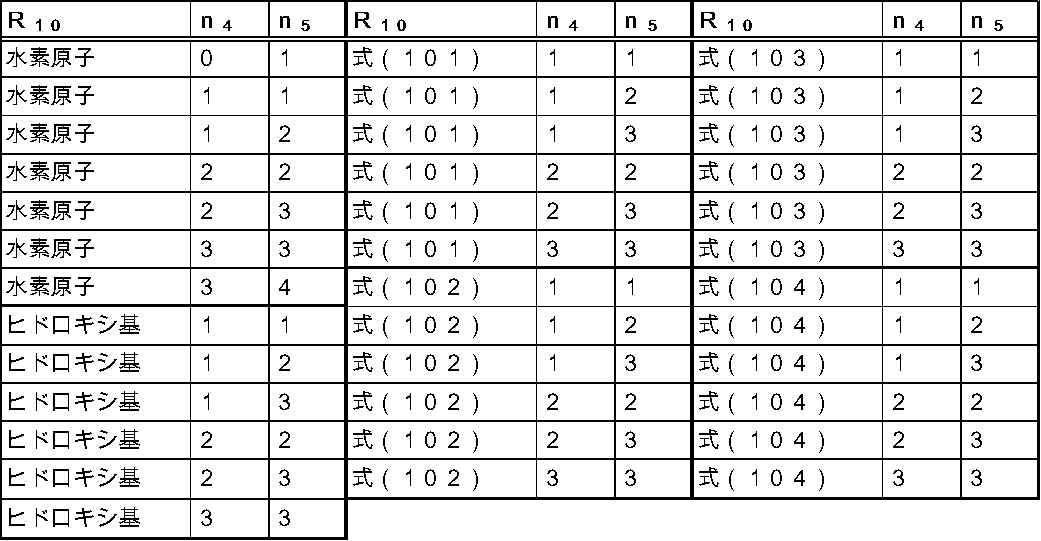
一般式(1-5)におけるR1'~R3'、R10、n4及びn5のより好ましい組合せとしては、例えば下記表3記載の組合せ1~40が挙げられ、中でも組合せ1~25が好ましく、組合せ5、10、15、20及び25がより好ましく、組合せ15が特に好ましい。

また、前記表3記載の組合せと合わせて用いられるAn-としては、塩化物イオン、ビス(トリフルオロメタンスルホニル)イミドアニオン、テトラキス(ペンタフルオロフェニル)ホウ素(IV)アニオン、PF6
-が挙げられ、塩化物イオン、テトラキス(ペンタフルオロフェニル)ホウ素(IV)アニオン、PF6
-が好ましく、塩化物イオン、PF6
-がより好ましく、塩化物イオンが特に好ましい。
[本発明の化合物の製造方法]
本発明の化合物は、次に示す方法で製造することができる。すなわち、下記一般式(21)で示される化合物と下記一般式(31)で示される化合物とを反応させることで、一般式(1)で示される化合物を得ることができる(反応[1])。
本発明の化合物は、次に示す方法で製造することができる。すなわち、下記一般式(21)で示される化合物と下記一般式(31)で示される化合物とを反応させることで、一般式(1)で示される化合物を得ることができる(反応[1])。

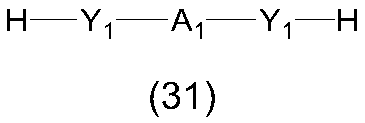
一般式(21)で示される化合物の好ましい具体例としては、下記一般式(22)で示される化合物が挙げられる。
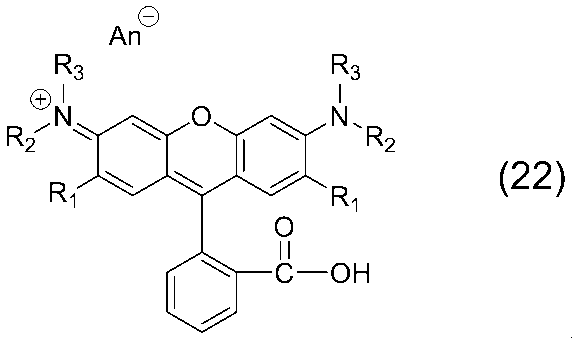 (一般式(22)中、R1~R3及びAn-は、上記と同じであり;2つのR1、2つのR2及び2つのR3は、それぞれ同じものを表す。)
一般式(22)で示される化合物の好ましい具体例としては、下記一般式(23)で示される化合物が挙げられる。
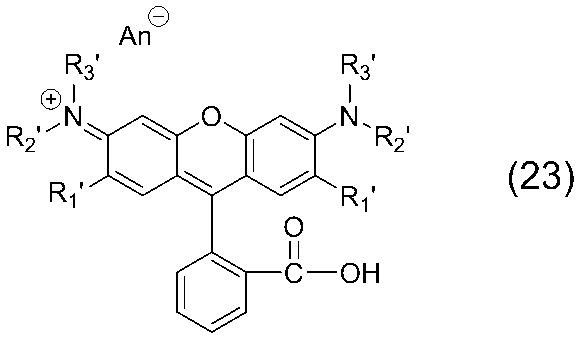 (一般式(23)中、R1'~R3'及びAn-は、上記と同じであり;2つのR1'、2つのR2'及び2つのR3'は、それぞれ同じものを表す。)
一般式(23)におけるR1'~R3'の好ましい組合せとしては、前記表1記載のR1'~R3'の好ましい組合せと同じものが挙げられる。
また、前記表1記載の組合せと合わせて用いられるAn-としては、塩化物イオン、ビス(トリフルオロメタンスルホニル)イミドアニオン、テトラキス(ペンタフルオロフェニル)ホウ素(IV)アニオン、PF6 -が挙げられ、塩化物イオン、テトラキス(ペンタフルオロフェニル)ホウ素(IV)アニオン、PF6 -が好ましく、塩化物イオン、PF6 -がより好ましく、塩化物イオンが特に好ましい。
また、前記表1記載の組合せと合わせて用いられるAn-としては、塩化物イオン、ビス(トリフルオロメタンスルホニル)イミドアニオン、テトラキス(ペンタフルオロフェニル)ホウ素(IV)アニオン、PF6 -が挙げられ、塩化物イオン、テトラキス(ペンタフルオロフェニル)ホウ素(IV)アニオン、PF6 -が好ましく、塩化物イオン、PF6 -がより好ましく、塩化物イオンが特に好ましい。
一般式(23)で示される化合物は、市販のもの、あるいは自体公知の方法によって適宜合成したものを用いればよい。
一般式(31)で示される化合物の好ましい具体例としては、下記一般式(32)で示される化合物が挙げられる。
 (一般式(32)中、R8、Y1及びn1~n3は、上記と同じであり;2つのY1は同じものを表し;n2個のR8及びn2個のn1は、それぞれ同一でも異なっていてもよい。)
一般式(32)で示される化合物の好ましい具体例としては、下記一般式(33)で示される化合物が挙げられる。
 (一般式(33)中、R8、Y1、n1及びn2は、上記と同じであり;2つのY1は同じものを表す。)
一般式(33)で示される化合物の好ましい具体例としては、下記一般式(34)で示される化合物が挙げられる。
 (一般式(34)中、R9、n4及びn5は、上記と同じ。)
一般式(34)で示される化合物の好ましい具体例としては、下記一般式(35)で示される化合物が挙げられる。
 (一般式(35)中、R10、n4及びn5は、上記と同じ。)
一般式(35)で示される化合物の具体例としては、例えば、エチレングリコール、1,3-プロパンジオール、1,4-ブタンジオール、1,5-ペンタンジオール、1,6-ヘキサンジオール、1,7-ヘプタンジオール、1,8-オクタンジオール、1,2,3-プロパントリオール(グリセリン)、1,2,4-ブタントリオール、1,2,5-ペンタントリオール、1,3,5-ペンタントリオール、1,3,6-ヘキサントリオール、1,4,7-ヘプタントリオール及び下記化合物群Aが挙げられる。
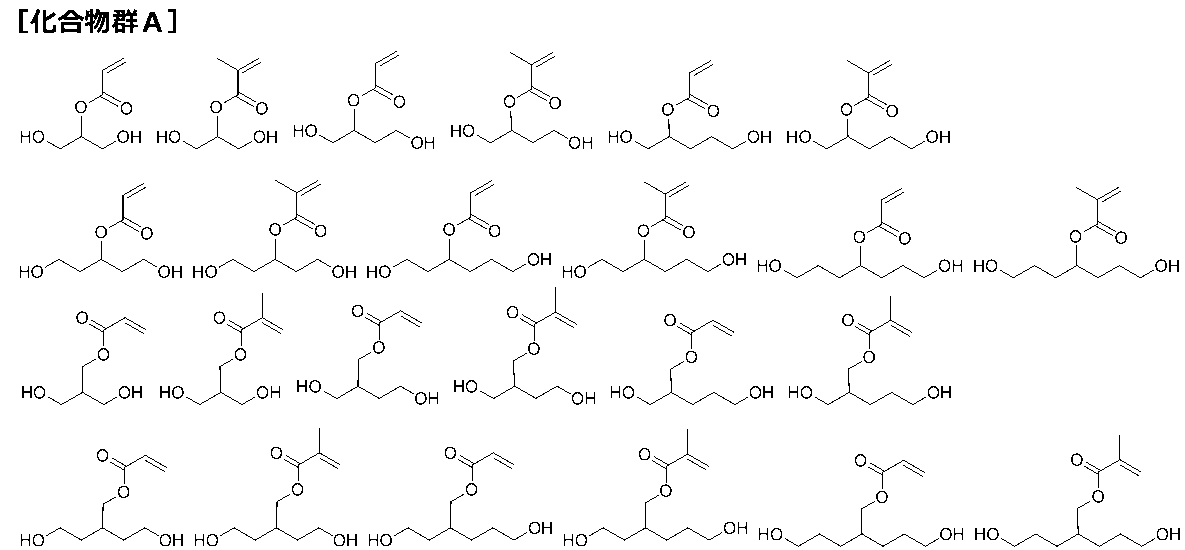
上記具体例の中でも、エチレングリコール、1,3-プロパンジオール、1,4-ブタンジオール、1,5-ペンタンジオール、1,6-ヘキサンジオール、1,7-ヘプタンジオール、1,8-オクタンジオール、1,2,3-プロパントリオール、1,2,4-ブタントリオール、1,2,5-ペンタントリオール、1,3,5-ペンタントリオール、1,3,6-ヘキサントリオール、1,4,7-ヘプタントリオールが好ましく;エチレングリコール、1,3-プロパンジオール、1,4-ブタンジオール、1,5-ペンタンジオール、1,6-ヘキサンジオール、1,7-ヘプタンジオール、1,8-オクタンジオール、1,2,3-プロパントリオール、1,3,5-ペンタントリオール、1,4,7-ヘプタントリオールがより好ましく;エチレングリコール、1,3-プロパンジオール、1,4-ブタンジオール、1,5-ペンタンジオール、1,2,3-プロパントリオールがさらに好ましく;1,4-ブタンジオールが特に好ましい。
一般式(35)で示される化合物は、市販のもの、あるいは自体公知の方法によって適宜合成したものを用いればよい。
上記反応[1]においては、一般式(21)で示される化合物と一般式(31)で示される化合物とを、溶媒中、脱水縮合剤の存在下で通常0℃以上80℃以下、好ましくは10℃以上50℃以下で、通常1時間以上48時間以下、好ましくは10時間以上24時間以下で反応させればよい。
上記溶媒としては、例えばジエチルエーテル、ジイソプロピルエーテル、エチルメチルエーテル、テトラヒドロフラン、1,4-ジオキサン、ジメトキシエタン等のエーテル類;例えばアセトン、ジメチルケトン、メチルエチルケトン、ジエチルケトン、2-ヘキサノン、tert-ブチルメチルケトン、シクロペンタノン、シクロヘキサノン等のケトン類;例えばクロロメタン、クロロホルム、ジクロロメタン、ジクロロエタン、トリクロロエタン、四塩化炭素、クロロベンゼン等のハロゲン化炭化水素類;例えばn-ヘキサン、ベンゼン、トルエン、キシレン等の炭化水素類;例えば酢酸エチル、酢酸ブチル、プロピオン酸メチル等のエステル類;例えばアセトニトリル等のニトリル類;例えばN,N-ジメチルホルムアミド等のアミド類等が挙げられ、中でもエーテル類、ハロゲン化炭化水素類、炭化水素類が好ましく、テトラヒドロフラン、ジクロロメタン、トルエンがより好ましい。これらはそれぞれ単独でも或いは二種以上適宜組み合わせて用いてもよい。反応溶媒の使用量は、一般式(21)で示される化合物1mmolに対して、通常0.1mL以上50mL以下、好ましくは0.5mL以上10mL以下である。
上記脱水縮合剤としては、一般に脱水縮合剤として使用されるものであればよく、例えば五酸化二リン、無水塩化亜鉛等の無機脱水剤類;例えばジシクロヘキシルカルボジイミド、ジイソプロピルカルボジイミド、1-エチル-3-(3-ジメチルアミノプロピルカルボジイミド)塩酸塩等のカルボジイミド類;例えばポリリン酸、無水酢酸、硫酸、カルボニルジイミダゾ-ル、p-トルエンスルホン酸等が挙げられ、カルボジイミド類が好ましい。該脱水縮合剤の使用量は、一般式(21)で示される化合物のmol数に対して、通常1当量以上20当量以下、好ましくは1当量以上10当量以下である。上記反応[1]においては、脱水縮合剤の効率を向上させるために、ジメチルアミノピリジン等の触媒を用いてもよい。該触媒の使用量は、一般式(21)で示される化合物のmol数に対して、通常0.1当量以上10当量以下である。
一般式(31)で示される化合物の使用量は、一般式(21)で示される化合物のmol数に対して、通常0.1当量以上1当量以下、好ましくは0.2当量以上0.7当量以下である。
また、上記反応[1]により得られた一般式(1)で示される化合物を、さらに塩交換反応に付してもよい。該塩交換反応としては、溶媒中、一般式(1)で示される化合物に、所望のアニオンの塩を接触させることによりなされる。
上記塩交換反応は、通常0℃以上80℃以下、好ましくは10℃以上50℃以下で、通常10分以上24時間以下、好ましくは30分以上10時間以下でなされる。
上記塩交換反応における溶媒としては、メタノール、エタノール、イソプロピルアルコール(IPA)、テトラヒドロフラン(THF)、ジオキサン、N,N-ジメチルホルムアミド(DMF)、ジクロロメタン、ジクロロエタン、酢酸エチル等の有機溶媒が挙げられるが、中でもエタノール、ジクロロメタン、酢酸エチルが好ましい。これらはそれぞれ単独でも或いは二種以上適宜組み合わせて用いてもよい。反応溶媒の使用量は、一般式(1)で示される化合物1mmolに対して、通常0.1mL以上100mL以下、好ましくは1mL以上50mL以下である。
上記塩交換反応における所望のアニオンの塩としては、最終生成物の有するアニオンとして所望のものに合わせて適宜選択すれば良く、例えば、所望のアニオンのアルカリ金属塩、又は無機酸が挙げられる。
上記アルカリ金属塩としては、所望のアニオンと、ナトリウム、カリウム、リチウム等のアルカリ金属からなる塩が挙げられる。該アルカリ金属塩としては、カリウム又はリチウムが好ましい。該アルカリ金属塩の使用量は、一般式(1)で示される化合物のmol数に対して、通常2当量以上3当量以下、好ましくは2当量以上2.5当量以下である。
上記無機酸としては、塩酸、臭化水素、ヨウ化水素、次亜塩素酸、亜塩素酸、塩素酸、過塩素酸、ヘキサフルオロリン酸、ヘキサフルオロアンチモン酸等の無機酸が挙げられ、塩酸、過塩素酸、ヘキサフルオロリン酸、ヘキサフルオロアンチモン酸が好ましく、ヘキサフルオロリン酸がより好ましい。該無機酸の使用量は、一般式(1)で示される化合物のmol数に対して、通常2当量以上50当量以下、好ましくは2当量以上10当量以下である。
上記塩交換反応における所望のアニオンの塩がアルカリ金属塩である場合、一般式(1)で示される化合物と所望のアニオンのアルカリ金属塩を、溶媒中、塩酸共存下で反応させ、クロル塩を経由して所望のアニオンに塩交換された一般式(1)で示される化合物を得るのが好ましい。該塩酸の使用量としては、一般式(1)で示される化合物のmol数に対して、通常2当量以上50当量以下、好ましくは2当量以上10当量以下である。
また、上記塩交換反応における所望のアニオンの塩が無機酸である場合、一般式(1)で示される化合物と無機酸を、溶媒中で反応させればよい。
上述した本発明の化合物の製造方法にかかる各反応時の圧力は、一連の反応が滞りなく実施されれば特に制限はなく、例えば常圧で行えばよい。
上述した本発明の化合物の製造方法にかかる各反応後に得られる反応物及び生成物は、必要に応じて、通常この分野で行われる一般的な後処理操作及び精製操作により単離してもよい。具体的には例えば、ろ過、洗浄、抽出、減圧濃縮、再結晶、蒸留、カラムクロマトグラフィ-等を行うことによって得られた反応物及び生成物を単離してもよい。
[本発明の着色組成物]
本発明の着色組成物は、本発明の化合物を少なくとも1種含むものである。
本発明の着色組成物は、蛍光収率が抑制された本発明の化合物を染料としている為、蛍光発光が抑制された優れた着色硬化膜を形成することができる。そのため、本発明の着色組成物は、液晶表示装置(LCD)や固体撮像素子(CCD、CMOS等)に用いられるカラーフィルター等の着色画素形成用途、印刷インキ、インクジェットインキ、および塗料等の用途に用いることができ、特に、液晶表示装置のカラーフィルター用として好適である。さらに、本発明の着色組成物は、従来公知の成形方法により、シート、フィルム、ボトル、カップ等に成形して着色樹脂成形物として使用することもできる。よって、メガネ、カラーコンタクトレンズ等の用途にも使用することができ、公知の樹脂との多層構造体とすることによっても同様に使用することができる。その他にも、例えば光学フィルム、ヘアカラーリング剤、化合物や生体物質に対する標識物質、有機太陽電池の材料等の用途にも用いることが可能である。本発明の着色組成物は、各用途に合わせて、本発明の化合物の他に、この分野で通常用いられる添加剤等を含んでいてもよい。
本発明の着色組成物は、本発明の化合物を少なくとも1種含むものである。
本発明の着色組成物は、蛍光収率が抑制された本発明の化合物を染料としている為、蛍光発光が抑制された優れた着色硬化膜を形成することができる。そのため、本発明の着色組成物は、液晶表示装置(LCD)や固体撮像素子(CCD、CMOS等)に用いられるカラーフィルター等の着色画素形成用途、印刷インキ、インクジェットインキ、および塗料等の用途に用いることができ、特に、液晶表示装置のカラーフィルター用として好適である。さらに、本発明の着色組成物は、従来公知の成形方法により、シート、フィルム、ボトル、カップ等に成形して着色樹脂成形物として使用することもできる。よって、メガネ、カラーコンタクトレンズ等の用途にも使用することができ、公知の樹脂との多層構造体とすることによっても同様に使用することができる。その他にも、例えば光学フィルム、ヘアカラーリング剤、化合物や生体物質に対する標識物質、有機太陽電池の材料等の用途にも用いることが可能である。本発明の着色組成物は、各用途に合わせて、本発明の化合物の他に、この分野で通常用いられる添加剤等を含んでいてもよい。
例えば本発明の着色組成物を着色樹脂用途として用いる場合、本発明の着色組成物は、少なくとも本発明の化合物を1種以上含み、且つ、その他の樹脂と混合しているものが好ましい。その他の樹脂としては特に限定されないが、例えばポリオレフィン樹脂、ポリスチレン樹脂、ポリエステル樹脂、ポリアミド樹脂、ポリウレタン樹脂、ポリカーボネート樹脂、エポキシ樹脂、アクリル樹脂、アクリロニトリル樹脂等が挙げられる。また、その他の樹脂と混合させる場合、その混合割合は、求められる着色樹脂の色に応じて適宜設定されればよい。本発明の着色組成物を着色樹脂として用いる場合、自体公知の成形方法により成形して用いてもよい。さらに、本発明の着色組成物は、本発明の化合物、及び要すればその他の樹脂の他にも、本発明の目的及び効果を妨げない範囲において、滑性剤、帯電防止剤、紫外線防止剤、酸化防止剤、光安定剤、分散剤、加工安定剤、加工助剤、耐衝撃性改良剤、充填剤、補強剤、防炎剤、可塑剤、発泡剤等のこの分野で通常用いられる添加剤を含んでいてもよい。
例えば本発明の着色組成物を着色画素形成用途として用いる場合、本発明の着色組成物は、少なくとも本発明の化合物を1種以上含み、且つ、重合開始剤、バインダー樹脂及びラジカル重合性モノマー又はオリゴマーを含むものが好ましく、必要に応じて、顔料、溶剤、シランカップリング剤、架橋剤等を含んでいてもよい。本発明の着色組成物における本発明の化合物の含有量は、本発明の着色組成物の質量に対して1質量%以上50質量%以下、好ましくは5質量%以上30質量%以下である。尚、ここでいう本発明の着色組成物の質量は、溶剤を除く固形成分の質量を意味し、以下本発明では同様の意味を表す。
上記重合開始剤としては、通常この分野で用いられる従来公知の熱重合開始剤又は光重合開始剤を用いることができ、光重合開始剤が好ましい。具体的には例えば、ジエトキシアセトフェノン、2-ヒドロキシ-2-メチル-1-フェニルプロパン-1-オン、ベンジルジメチルケタール、1-(4-イソプロピルフェニル)-2-ヒドロキシ-2-メチルプロパン-1-オン、4-(2-ヒドロキシエトキシ)フェニル-(2-ヒドロキシ-2-プロピル)ケトン、1-ヒドロキシシクロヘキシル-フェニルケトン、2-メチル-2-モルホリノ(4-チオメチルフェニル)プロパン-1-オン、2-ベンジル-2-ジメチルアミノ-1-(4-モルホリノフェニル)-ブタノン等のアセトフェノン系;ベンゾイン、ベンゾインイソプロピルエーテル、ベンゾインイソブチルエーテル等のベンゾイン系;2,4,6-トリメチルベンゾイルジフェニルホスフィンオキサイド等のアシルホスフィンオキサイド系;ベンジル、メチルフェニルグリオキシエステル系;ベンゾフェノン、ο-ベンゾイル安息香酸メチル、4-フェニルベンゾフェノン、4,4'-ジクロロベンゾフェノン、ヒドロキシベンゾフェノン、4-ベンゾイル-4'-メチル-ジフェニルサルファイド、アクリル化ベンゾフェノン、3,3',4,4'-テトラ(tert-ブチルパーオキシカルボニル)ベンゾフェノン、3,3'-ジメチル-4-メトキシベンゾフェノン等のベンゾフェノン系;2-イソプロピルチオキサントン、2,4-ジメチルチオキサントン、2,4-ジエチルチオキサントン、2,4-ジクロロチオキサントン等のチオキサントン系;ミヒラーケトン、4,4'-ジエチルアミノベンゾフェノン等のアミノベンゾフェノン系;1-[4-(フェニルチオ)フェニル]-1,2-オクタンジオン-2-(ο-ベンゾイルオキシム)、1-[6-(2-メチルベンゾイル)-9-エチル-9H-カルバゾール-3-イル]エタノン-ο-アセチルオキシム等のオキシムエステル系;10-ブチル-2-クロロアクリドン、2-エチルアンスラキノン、9,10-フェナンスレンキノン、カンファーキノン等が挙げられる。
上記重合開始剤は、単独でも2種以上を含有してもよい。その含有量は、本発明の着色組成物の質量に対して1質量%以上50質量%以下、好ましくは5質量%以上30質量%以下である。
上記バインダー樹脂としては、例えば、カルボキシ基又はヒドロキシ基を少なくとも1つ有するエチレン性不飽和モノマー、或いは該エチレン性不飽和モノマーと芳香族炭化水素基や脂肪族炭化水素基を有するエチレン性不飽和モノマーとの共重合体、該共重合体の側鎖もしくは末端等にエポキシ基を有したものや、アクリレートを付加させたもの等が挙げられる。これらは単独でも2種以上を組み合わせてもよい。
上記カルボキシ基を有するエチレン性不飽和モノマーの具体例としては、アクリル酸、メタクリル酸、ベンジルメタクリレート、クロトン酸、α-クロルアクリル酸、エタクリル酸、けい皮酸等の不飽和モノカルボン酸類;マレイン酸、無水マレイン酸、フマル酸、イタコン酸、無水イタコン酸、シトラコン酸、無水シトラコン酸、メサコン酸等の不飽和ジカルボン酸(無水物)類;3価以上の不飽和多価カルボン酸(無水物)類、2-アクリロイロキシエチルヘキサヒドロフタル酸、2-メタクリロイロキシエチルヘキサヒドロフタル酸、2-メタクリロイロキシエチル2-ヒドロキシプロピルフタル酸、2-アクリロイロキシエチル2-ヒドロキシエチルフタル酸等が挙げられる。
上記バインダー樹脂の含有量は、本発明の着色組成物の質量に対して、10質量%以上50質量%以下、好ましくは20質量%以上50質量%以下である。
上記ラジカル重合性モノマーまたはオリゴマーとしては、一例として、ポリエチレングリコールジアクリレート(エチレン基の数が2~14のもの)、ポリエチレングリコールジメタクリレート(エチレン基の数が2~14のもの)、トリメチロールプロパンジアクリレート、トリメチロールプロパンジメタクリレート、トリメチロールプロパントリアクリレート、トリメチロールプロパントリメタクリレート、トリメチロールプロパンエトキシトリアクリレート、トリメチロールプロパンエトキシトリメタクリレート、トリメチロールプロパンプロポキシトリアクリレート、トリメチロールプロパンプロポキシトリメタクリレート、テトラメチロールメタントリアクリレート、テトラメチロールメタントリメタクリレート、テトラメチロールメタンテトラアクリレート、テトラメチロールメタンテトラメタクリレート、ポリプロピレングリコールジアクリレート(プロピレン基の数が2~14のもの)、ポリプロピレングリコールジメタクリレート(プロピレン基の数が2~14のもの)、ジペンタエリスリトールペンタアクリレート、ジペンタエリスリトールペンタメタクリレート、ジペンタエリスリトールヘキサアクリレート、ジペンタエリスリトールヘキサメタクリレート、エトキシ化ペンタエリスリトールテトラアクリレート(エトキシ基が40以下のもの)、プロポキシ化ペンタエリスリトールテトラアクリレート(プロポキシ基が40以下のもの)、エトキシ化トリメチロールプロパントリアクリレート(エトキシ基が40以下のもの)、プロポキシ化トリメチロールプロパントリアクリレート(プロポキシ基が40以下のもの)、ビスフェノールAポリオキシエチレンジアクリレート、ビスフェノールAポリオキシエチレンジメタクリレート、ビスフェノールAジオキシエチレンジアクリレート、ビスフェノールAジオキシエチレンジメタクリレート、ビスフェノールAトリオキシエチレンジアクリレート、ビスフェノールAトリオキシエチレンジメタクリレート、ビスフェノールAデカオキシエチレンジアクリレート、ビスフェノールAデカオキシエチレンジメタクリレート、イソシアヌル酸エトキシ変性トリアクリレート、多価カルボン酸(無水フタル酸等)とヒドロキシ基及びエチレン性不飽和基を有する化合物(β-ヒドロキシエチルアクリレート、β-ヒドロキシエチルメタクリレート等)とのエステル化物、アクリル酸若しくはメタクリル酸のアルキルエステル(アクリル酸メチルエステル、メタクリル酸メチルエステル、アクリル酸エチルエステル、メタクリル酸エチルエステル、アクリル酸ブチルエステル、メタクリル酸ブチルエステル、アクリル酸2-エチルヘキシルエステル、メタクリル酸2-エチルヘキシルエステル等)、2-ヒドロキシエチルアクリレート、2-ヒドロキシエチルメタクリレート、フェノキシエチルアクリレート、フェノキシエチルメタクリレート、N,N-ジメチルアクリルアミド、N,N-ジメチルアミノエチルアクリレート、N,N-ジメチルアミノエチルアクリレートのメチルクロライドによる四級塩化物、N,N-ジメチルアミノプロピルアクリルアミドのメチルクロライドによる四級塩化物、アクリロイルモルホリン、N-イソプロピルアクリルアミド、N,N-ジエチルアクリルアミドなどが挙げられ、中でも、ジペンタエリスリトールペンタアクリレート、ジペンタエリスリトールペンタメタクリレート、ジペンタエリスリトールヘキサアクリレート、ジペンタエリスリトールヘキサメタクリレートが好ましく、ジペンタエリスリトールペンタアクリレート、ジペンタエリスリトールヘキサアクリレートがより好ましい。
上記顔料としては、赤色や青色、緑色の着色パターンを作製するために用いられる顔料であればよく、例えばフタロシアニン系顔料等が挙げられる。該フタロシアニン系顔料としては、中心金属に、マグネシウム、チタン、鉄、コバルト、ニッケル、銅、亜鉛、アルミニウムを含むものが挙げられ、具体的には例えば、C.I.ピグメントレッド1、C.I.ピグメントレッド2、C.I.ピグメントレッド5、C.I.ピグメントレッド17、C.I.ピグメントレッド31、C.I.ピグメントレッド32、C.I.ピグメントレッド41、C.I.ピグメントレッド122、C.I.ピグメントレッド123、C.I.ピグメントレッド144、C.I.ピグメントレッド149、C.I.ピグメントレッド166、C.I.ピグメントレッド168、C.I.ピグメントレッド170、C.I.ピグメントレッド171、C.I.ピグメントレッド175、C.I.ピグメントレッド176、C.I.ピグメントレッド177、C.I.ピグメントレッド178、C.I.ピグメントレッド179、C.I.ピグメントレッド180、C.I.ピグメントレッド185、C.I.ピグメントレッド187、C.I.ピグメントレッド202、C.I.ピグメントレッド206、C.I.ピグメントレッド207、C.I.ピグメントレッド209、C.I.ピグメントレッド214、C.I.ピグメントレッド220、C.I.ピグメントレッド221、C.I.ピグメントレッド224、C.I.ピグメントレッド242、C.I.ピグメントレッド243、C.I.ピグメントレッド254、C.I.ピグメントレッド255、C.I.ピグメントレッド262、C.I.ピグメントレッド264、C.I.ピグメントレッド272、C.I.ピグメントブルー15、C.I.ピグメントブルー15:1、C.I.ピグメントブルー15:2、C.I.ピグメントブルー15:3、C.I.ピグメントブルー15:4、C.I.ピグメントブルー15:5、C.I.ピグメントブルー15:6、C.I.ピグメントブルー16、C.I.ピグメントブルー17:1、C.I.ピグメントブルー75、C.I.ピグメントブルー79、C.I.ピグメントグリーン7、C.I.ピグメントグリーン36、C.I.ピグメントグリーン37、C.I.ピグメントグリーン58、クロロアルミニウムフタロシアニン、ヒドロキシアルミニウムフタロシアニン、アルミニウムフタロシアニンオキシド、亜鉛フタロシアニンが挙げられる。
上記顔料の含有量は、本発明の着色組成物の質量に対して10質量%以上50質量%以下、好ましくは10質量%以上30質量%以下である。
本発明の着色組成物が上記顔料を含む場合、顔料分散剤を含有するのが好ましい。該顔料分散剤としては、例えば、ポリアミドアミン及びその塩、ポリカルボン酸及びその塩、高分子量不飽和酸エステル、変性ポリウレタン、変性ポリエステル、変性ポリアクリレート、変性ポリメタクリレート、アクリル系共重合体、メタクリル系共重合体、ナフタレンスルホン酸ホルマリン縮合物、ポリオキシエチレンアルキルリン酸エステル、ポリオキシエチレンアルキルアミン、アルカノールアミン等が挙げられる。顔料分散剤は、単独で使用しても、2種以上を組み合わせて使用してもよい。その含有量は、顔料の質量に対して、通常1質量%以上80質量%以下であり、好ましくは10質量%以上60質量%以下である。
上記溶剤としては、本発明の着色組成物に含まれる成分に応じて適宜選択すればよい。具体的には例えば、酢酸エチル、酢酸-n-ブチル、酢酸イソブチル、ギ酸アミル、酢酸イソアミル、プロピオン酸ブチル、酪酸イソプロピル、酪酸エチル、酪酸ブチル、乳酸メチル、乳酸エチル、オキシ酢酸メチル、オキシ酢酸エチル、オキシ酢酸ブチル、メトキシ酢酸メチル、メトキシ酢酸エチル、メトキシ酢酸ブチル、エトキシ酢酸メチル、エトキシ酢酸エチル、3-オキシプロピオン酸メチル、3-オキシプロピオン酸エチル、3-メトキシプロピオン酸メチル、3-メトキシプロピオン酸エチル、3-エトキシプロピオン酸メチル、3-エトキシプロピオン酸エチル、2-オキシプロピオン酸メチル、2-オキシプロピオン酸エチル、2-オキシプロピオン酸プロピル、2-メトキシプロピオン酸メチル、2-メトキシプロピオン酸エチル、2-メトキシプロピオン酸プロピル、2-エトキシプロピオン酸メチル、2-エトキシプロピオン酸エチル、2-オキシ-2-メチルプロピオン酸メチル、2-メトキシ-2-メチルプロピオン酸メチル、2-エトキシ-2-メチルプロピオン酸エチル、ピルビン酸メチル、ピルビン酸エチル、ピルビン酸プロピル、アセト酢酸メチル、アセト酢酸エチル、2-オキソブタン酸メチル、2-オキソブタン酸エチル、ジエチレングリコールジメチルエーテル、テトラヒドロフラン、エチレングリコールモノメチルエーテル、エチレングリコールモノエチルエーテル、メチルセロソルブアセテート、エチルセロソルブアセテート、ジエチレングリコールモノメチルエーテル、ジエチレングリコールモノエチルエーテル、ジエチレングリコールモノブチルエーテル、プロピレングリコールモノメチルエーテル、プロピレングリコールモノメチルエーテルアセテート、プロピレングリコールモノエチルエーテルアセテート、プロピレングリコールモノプロピルエーテルアセテート、メチルエチルケトン、シクロヘキサノン、2-ヘプタノン、3-ヘプタノン等が挙げられる。上記溶剤の量は、本発明の着色組成物の濃度が、溶剤中で通常10質量%以上80質量%以下になる量である。
上記シランカップリング剤は、ガラス等の基材に結合する場合に用いられる。該シランカップリング剤としては、通常この分野で用いられる従来公知のものを用いることができ、反応性有機官能基として、例えば、エポキシ基、チオール基、ヒドロキシ基、アミノ基、ウレイド基、ビニル基、アクリロイル基などを有するシランカップリング剤が挙げられる。具体的には例えば、β-(3,4-エポキシシクロヘキシル)エチルトリメトキシシラン、γ-グリシドオキシプロピルトリメトキシシラン、γ-メルカプトプロピルトリメトキシシラン、γ-アミノプロピルトリエトキシシラン、N-β-(アミノエチル)-γ-アミノプロピルトリメトキシシラン、γ-ウレイドプロピルトリエトキシシラン、ビニルトリエトキシシラン、ビニル-トリス(β-メトキシエトキシ)シラン、γ-メタクリロキシプロピルトリメトキシシランが挙げられる。上記シランカップリング剤は、反応溶液中で通常0.1質量%以上10質量%以下、好ましくは1質量%以上5質量%以下となる量を用いればよい。
上記架橋剤としては、架橋反応により膜硬化を行なえるものであれば特に限定されず、例えば、(a)エポキシ樹脂、(b)メチロール基、アルコキシメチル基及びアシロキシメチル基から選ばれる少なくとも1つの置換基で置換された、メラミン化合物、グアナミン化合物、グリコールウリル化合物又はウレア化合物、(c)メチロール基、アルコキシメチル基及びアシロキシメチル基から選ばれる少なくとも1つの置換基で置換された、フェノール化合物、ナフトール化合物又はヒドロキシアントラセン化合物、が挙げられ、中でも、多官能エポキシ樹脂が好ましい。
上記架橋剤の含有量は、本発明の着色組成物の質量に対して、10質量%以上50質量%以下、好ましくは20質量%以上50質量%以下である。
本発明の着色組成物は、上記記載のもの以外に、重合禁止剤、界面活性剤、添加剤等を含んでいてもよく、それらは自体公知のものであれば特に限定されず、用いられる量も通常この分野で用いられる量であれば限定されない。
本発明の着色組成物は、前述の成分を混合して調製される。
本発明の着色組成物は、自体公知の成形方法により種々の金型や圧延機を用いて所望の形状に成形することができる。具体的には例えば、射出成形法(インジェクション成形法)、圧縮成形法、射出圧縮成形法、押出し成形法、ブロー成形法、カレンダー成形法、インフレーション成形法、T-ダイ成形法、トランスファー成形法等の成形法により、所望の形状に成形することができる。また、本発明の着色組成物は、自体公知の塗布・貼付方法により、他の材料(金属、ガラス、木、紙、レンガ、コンクリート、高分子材料等)に塗布することや、他の材料と貼り合わせることもできる。具体的には例えば、スリット塗布法、インクジェット法、回転塗布法、流延塗布法、ロール塗布法、スクリーン印刷法等により他の材料に塗布することができる。
例えば、本発明の着色組成物から着色硬化膜を形成する場合、まずガラス基板等の基板上に自体公知の方法により本発明の着色組成物を塗布し、要すれば塗布面を乾燥させ、次いで、塗布面に対し光硬化及び/又は熱硬化を行うことにより、着色硬化膜を得ることができる。
上記乾燥方法としては、自体公知の方法であれば特に制限されるものではなく、例えば、ホットプレート、オーブン、赤外線加熱機等を使用し、通常50℃以上200℃以下、好ましくは50℃以上150℃以下で、通常60秒以上5時間以下、好ましくは60秒以上1時間以下で加熱乾燥することによりなされる。
上記光硬化方法としては、自体公知の方法であれば特に制限されるものではなく、紫外線や電子線等の活性エネルギー線を塗布面に対し照射することによりなされる。具体的には例えば、光源として低圧水銀灯、中圧水銀灯、高圧水銀灯、メタルハライドランプ、LEDランプ等を使用し、通常200nm以上400nm以下、好ましくは320nm以上380nm以下の紫外線を、通常100mJ/cm2以上3000mJ/cm2以下、好ましくは500mJ/cm2以上2000mJ/cm2以下の露光量で照射することによりなされる。
上記熱硬化方法としては、自体公知の方法であれば特に制限されるものではなく、例えば、ホットプレート、オーブン、赤外線加熱機等を使用し、通常100℃以上300℃以下、好ましくは150℃以上250℃以下で、通常0.1時間以上10時間以下、好ましくは0.1時間以上5時間以下で加熱することによりなされる。
以下に、実施例により本発明をさらに詳細に述べるが、本発明はこれらの実施例に限定されるものではない。
実施例1 ローダミン連結化合物(化合物3)の合成
撹拌装置を備えた丸底フラスコに、ローダミンB(化合物1:和光純薬工業(株)製)5.0g(10.5mmol)及びテトラヒドロフラン(THF)75mLを加えて溶解し、さらにエチレングリコール(化合物2:和光純薬工業(株)製)0.3g(5.0mmol)、4-ジメチルアミノピリジン(DMAP)(和光純薬工業(株)製)0.3g(2.5mmol)及び1-エチル-3-(3-ジメチルアミノプロピル)カルボジイミド塩酸塩(WSC)(東洋紡(株)製)2.9g(15.0mmol)を加え、室温で20時間反応を行った。反応終了後、反応液を水で洗浄し、減圧濃縮によって反応液から溶媒を留去して濃赤色固体を得た。該固体をシリカゲルカラムで精製し、濃赤色固体のローダミン連結化合物(化合物3)0.5g(収率10%)を得た。
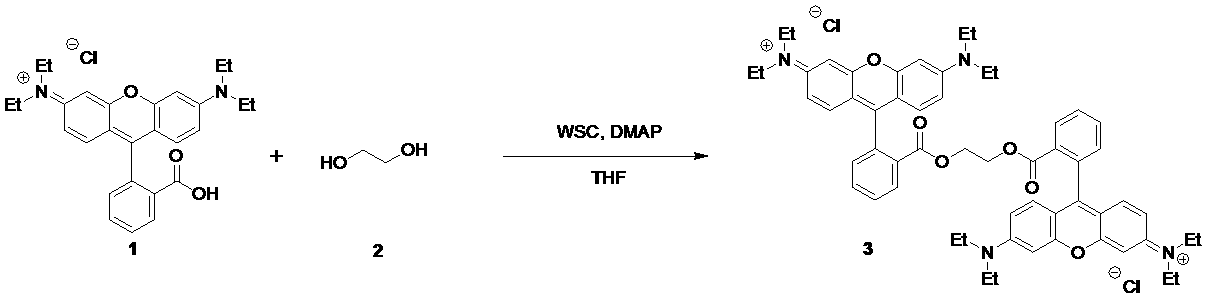
撹拌装置を備えた丸底フラスコに、ローダミンB(化合物1:和光純薬工業(株)製)5.0g(10.5mmol)及びテトラヒドロフラン(THF)75mLを加えて溶解し、さらにエチレングリコール(化合物2:和光純薬工業(株)製)0.3g(5.0mmol)、4-ジメチルアミノピリジン(DMAP)(和光純薬工業(株)製)0.3g(2.5mmol)及び1-エチル-3-(3-ジメチルアミノプロピル)カルボジイミド塩酸塩(WSC)(東洋紡(株)製)2.9g(15.0mmol)を加え、室温で20時間反応を行った。反応終了後、反応液を水で洗浄し、減圧濃縮によって反応液から溶媒を留去して濃赤色固体を得た。該固体をシリカゲルカラムで精製し、濃赤色固体のローダミン連結化合物(化合物3)0.5g(収率10%)を得た。
実施例2 ローダミン連結化合物(化合物5)の合成
エチレングリコールの代わりに1,3-プロパンジオール(化合物4:和光純薬工業(株)製)0.4g(5.0mmol)を用いて、室温で24時間反応を行った以外は、実施例1と同様にして、濃赤色固体のローダミン連結化合物(化合物5)0.7g(収率14%)を得た。

エチレングリコールの代わりに1,3-プロパンジオール(化合物4:和光純薬工業(株)製)0.4g(5.0mmol)を用いて、室温で24時間反応を行った以外は、実施例1と同様にして、濃赤色固体のローダミン連結化合物(化合物5)0.7g(収率14%)を得た。
実施例3 ローダミン連結化合物(化合物7)の合成
THFの代わりにジクロロメタン75mLを、エチレングリコールの代わりに1,4-ブタンジオール(化合物6:和光純薬工業(株)製)0.5g(5.0mmol)を用いて、室温で22時間反応を行った以外は、実施例1と同様にして、濃赤色固体のローダミン連結化合物(化合物7)0.9g(収率18%)を得た。

THFの代わりにジクロロメタン75mLを、エチレングリコールの代わりに1,4-ブタンジオール(化合物6:和光純薬工業(株)製)0.5g(5.0mmol)を用いて、室温で22時間反応を行った以外は、実施例1と同様にして、濃赤色固体のローダミン連結化合物(化合物7)0.9g(収率18%)を得た。
実施例4 ローダミン連結化合物(化合物8)の合成
撹拌装置を備えた丸底フラスコに、実施例3で得たローダミン連結化合物(化合物7)0.3g(0.3mmol)及びジクロロメタン10mLを加えて溶解し、さらにヘキサフルオロリン酸カリウム(和光純薬工業(株)製)0.1g(0.6mmol)を加え、室温で2時間反応を行った。反応終了後、ジクロロメタンで反応液を希釈した後、水で洗浄した。減圧濃縮によって反応液から溶媒を留去し、ヘキサフルオロリン酸アニオンを有する濃赤色固体のローダミン連結化合物(化合物8)0.2g(収率54%)を得た。

撹拌装置を備えた丸底フラスコに、実施例3で得たローダミン連結化合物(化合物7)0.3g(0.3mmol)及びジクロロメタン10mLを加えて溶解し、さらにヘキサフルオロリン酸カリウム(和光純薬工業(株)製)0.1g(0.6mmol)を加え、室温で2時間反応を行った。反応終了後、ジクロロメタンで反応液を希釈した後、水で洗浄した。減圧濃縮によって反応液から溶媒を留去し、ヘキサフルオロリン酸アニオンを有する濃赤色固体のローダミン連結化合物(化合物8)0.2g(収率54%)を得た。
実施例5 ローダミン連結化合物(化合物10)の合成
撹拌装置を備えた丸底フラスコに、ローダミンB(化合物1:和光純薬工業(株)製)2.0g(4.2mmol)及びジクロロメタン30mLを加えて溶解し、さらに1,5-ペンタンジオール(化合物9:和光純薬工業(株)製)0.2g(2.0mmol)、DMAP(和光純薬工業(株)製)0.1g(1.0mmol)及びWSC(東洋紡(株)製)1.2g(6.0mmol)を加え、室温で20時間反応を行った。反応終了後、反応液を水で洗浄し、減圧濃縮によって反応液から溶媒を留去して濃赤色固体を得た。該固体をシリカゲルカラムで精製し、濃赤色固体のローダミン連結化合物(化合物10)0.3g(収率15%)を得た。

撹拌装置を備えた丸底フラスコに、ローダミンB(化合物1:和光純薬工業(株)製)2.0g(4.2mmol)及びジクロロメタン30mLを加えて溶解し、さらに1,5-ペンタンジオール(化合物9:和光純薬工業(株)製)0.2g(2.0mmol)、DMAP(和光純薬工業(株)製)0.1g(1.0mmol)及びWSC(東洋紡(株)製)1.2g(6.0mmol)を加え、室温で20時間反応を行った。反応終了後、反応液を水で洗浄し、減圧濃縮によって反応液から溶媒を留去して濃赤色固体を得た。該固体をシリカゲルカラムで精製し、濃赤色固体のローダミン連結化合物(化合物10)0.3g(収率15%)を得た。
実施例6 ローダミン連結化合物(化合物12)の合成
THFの代わりにジクロロメタン75mLを、エチレングリコールの代わりにグリセリン(化合物11:和光純薬工業(株)製)0.5g(5.0mmol)を用いた以外は、実施例1と同様にして、濃赤色固体のローダミン連結化合物(化合物12)0.4g(収率8%)を得た。

THFの代わりにジクロロメタン75mLを、エチレングリコールの代わりにグリセリン(化合物11:和光純薬工業(株)製)0.5g(5.0mmol)を用いた以外は、実施例1と同様にして、濃赤色固体のローダミン連結化合物(化合物12)0.4g(収率8%)を得た。
比較例1 ローダミンBの吸光特性評価
ローダミンBの吸光特性を下記のようにして評価した。
即ち、ローダミンB(和光純薬工業(株)製)1mg(2×10⁻⁶mol)を、バイアル瓶(ガラス瓶)へ入れ、そこへエタノール20mLを加えた。得られた溶液0.1mLを別のバイアル瓶(ガラス瓶)に入れ、アルゴンガスを用いて溶媒を風乾させた。風乾させたバイアル瓶(ガラス瓶)に水10mLを入れ、ローダミンBの水溶液(濃度:1×10⁻⁶M)を調製した。得られた水溶液を光路長1cmのセルに入れ、分光光度計(製品名:V-670、日本分光(株)製)を用いて吸光度を測定した。
ローダミンBの吸光特性を下記のようにして評価した。
即ち、ローダミンB(和光純薬工業(株)製)1mg(2×10⁻⁶mol)を、バイアル瓶(ガラス瓶)へ入れ、そこへエタノール20mLを加えた。得られた溶液0.1mLを別のバイアル瓶(ガラス瓶)に入れ、アルゴンガスを用いて溶媒を風乾させた。風乾させたバイアル瓶(ガラス瓶)に水10mLを入れ、ローダミンBの水溶液(濃度:1×10⁻⁶M)を調製した。得られた水溶液を光路長1cmのセルに入れ、分光光度計(製品名:V-670、日本分光(株)製)を用いて吸光度を測定した。
実験例1 化合物3の吸光特性評価
化合物3の吸光特性を下記のようにして評価した。
即ち、実施例1で得た化合物3 0.4mg(4×10⁻⁷mol)を、バイアル瓶(ガラス瓶)へ入れ、そこへエタノール10mLを加えた。得られた溶液1mLを別のバイアル瓶(ガラス瓶)に入れ、アルゴンガスを用いて溶媒を風乾させた。風乾させたバイアル瓶(ガラス瓶)に水5mLを入れ、化合物3の水溶液(濃度:8×10⁻⁶M)を調製した。得られた水溶液を光路長1cmのセルに入れ、分光光度計(製品名:V-670、日本分光(株)製)を用いて吸光度を測定した。
実験例1の測定結果を、図1に実線で示す。また、比較例1の測定結果を実験例1のピーク強度に合わせて規格化したものを、図1に破線で表す。尚、図1中の縦軸は(実験例1における)吸光度を表し、横軸(nm)は波長を表す。
化合物3の吸光特性を下記のようにして評価した。
即ち、実施例1で得た化合物3 0.4mg(4×10⁻⁷mol)を、バイアル瓶(ガラス瓶)へ入れ、そこへエタノール10mLを加えた。得られた溶液1mLを別のバイアル瓶(ガラス瓶)に入れ、アルゴンガスを用いて溶媒を風乾させた。風乾させたバイアル瓶(ガラス瓶)に水5mLを入れ、化合物3の水溶液(濃度:8×10⁻⁶M)を調製した。得られた水溶液を光路長1cmのセルに入れ、分光光度計(製品名:V-670、日本分光(株)製)を用いて吸光度を測定した。
実験例1の測定結果を、図1に実線で示す。また、比較例1の測定結果を実験例1のピーク強度に合わせて規格化したものを、図1に破線で表す。尚、図1中の縦軸は(実験例1における)吸光度を表し、横軸(nm)は波長を表す。
実験例2 化合物5の吸光特性評価
化合物3の代わりに、実施例2で得た化合物5 0.2mg(2×10⁻⁷mol)を用いた以外は、実験例1と同様にして、化合物5の吸光特性を評価した(濃度:4×10⁻⁶M)。
実験例2の測定結果を、図2に実線で示す。また、比較例1の測定結果を実験例2のピーク強度に合わせて規格化したものを、図2に破線で表す。尚、図2中の縦軸は(実験例2における)吸光度を表し、横軸(nm)は波長を表す。
化合物3の代わりに、実施例2で得た化合物5 0.2mg(2×10⁻⁷mol)を用いた以外は、実験例1と同様にして、化合物5の吸光特性を評価した(濃度:4×10⁻⁶M)。
実験例2の測定結果を、図2に実線で示す。また、比較例1の測定結果を実験例2のピーク強度に合わせて規格化したものを、図2に破線で表す。尚、図2中の縦軸は(実験例2における)吸光度を表し、横軸(nm)は波長を表す。
実験例3 化合物7の吸光特性評価
化合物3の代わりに、実施例3で得た化合物7 0.1mg(1×10⁻⁷mol)を用いた以外は、実験例1と同様にして、化合物7の吸光特性を評価した(濃度:2×10⁻⁶M)。
実験例3の測定結果を、図3に実線で示す。また、比較例1の測定結果を実験例3のピーク強度に合わせて規格化したものを、図3に破線で表す。尚、図3中の縦軸は(実験例3における)吸光度を表し、横軸(nm)は波長を表す。
化合物3の代わりに、実施例3で得た化合物7 0.1mg(1×10⁻⁷mol)を用いた以外は、実験例1と同様にして、化合物7の吸光特性を評価した(濃度:2×10⁻⁶M)。
実験例3の測定結果を、図3に実線で示す。また、比較例1の測定結果を実験例3のピーク強度に合わせて規格化したものを、図3に破線で表す。尚、図3中の縦軸は(実験例3における)吸光度を表し、横軸(nm)は波長を表す。
実験例4 化合物8の吸光特性評価
化合物3の代わりに、実施例4で得た化合物8 0.03mg(3×10⁻⁸mol)を用いた以外は、実験例1と同様にして、化合物8の吸光特性を評価した(濃度:0.5×10⁻⁶M)。
実験例4の測定結果を、図4に実線で示す。また、比較例1の測定結果を実験例4のピーク強度に合わせて規格化したものを、図4に破線で表す。尚、図4中の縦軸は(実験例4における)吸光度を表し、横軸(nm)は波長を表す。
化合物3の代わりに、実施例4で得た化合物8 0.03mg(3×10⁻⁸mol)を用いた以外は、実験例1と同様にして、化合物8の吸光特性を評価した(濃度:0.5×10⁻⁶M)。
実験例4の測定結果を、図4に実線で示す。また、比較例1の測定結果を実験例4のピーク強度に合わせて規格化したものを、図4に破線で表す。尚、図4中の縦軸は(実験例4における)吸光度を表し、横軸(nm)は波長を表す。
実験例5 化合物10の吸光特性評価
化合物3の代わりに、実施例5で得た化合物10 0.2mg(2×10⁻⁷mol)を用いた以外は、実験例1と同様にして、化合物10の吸光特性を評価した(濃度:4×10⁻⁶M)。
実験例5の測定結果を、図5に実線で示す。また、比較例1の測定結果を実験例5のピーク強度に合わせて規格化したものを、図5に破線で表す。尚、図5中の縦軸は(実験例5における)吸光度を表し、横軸(nm)は波長を表す。
化合物3の代わりに、実施例5で得た化合物10 0.2mg(2×10⁻⁷mol)を用いた以外は、実験例1と同様にして、化合物10の吸光特性を評価した(濃度:4×10⁻⁶M)。
実験例5の測定結果を、図5に実線で示す。また、比較例1の測定結果を実験例5のピーク強度に合わせて規格化したものを、図5に破線で表す。尚、図5中の縦軸は(実験例5における)吸光度を表し、横軸(nm)は波長を表す。
実験例6 化合物12の吸光特性評価
化合物3の代わりに、実施例6で得た化合物12 0.4mg(4×10⁻⁷mol)を用いた以外は、実験例1と同様にして、化合物12の吸光特性を評価した(濃度:8×10⁻⁶M)。
実験例6の測定結果を、図6に実線で示す。また、比較例1の測定結果を実験例6のピーク強度に合わせて規格化したものを、図6に破線で表す。尚、図6中の縦軸は(実験例6における)吸光度を表し、横軸(nm)は波長を表す。
化合物3の代わりに、実施例6で得た化合物12 0.4mg(4×10⁻⁷mol)を用いた以外は、実験例1と同様にして、化合物12の吸光特性を評価した(濃度:8×10⁻⁶M)。
実験例6の測定結果を、図6に実線で示す。また、比較例1の測定結果を実験例6のピーク強度に合わせて規格化したものを、図6に破線で表す。尚、図6中の縦軸は(実験例6における)吸光度を表し、横軸(nm)は波長を表す。
実験例7 蛍光特性評価
実験例3で調整した化合物7の水溶液(濃度:2×10⁻⁶M)、及び実験例5で調製した化合物10の水溶液(濃度:4×10⁻⁶M)について、絶対PL量子収率測定装置(製品名:Quantaurus-QY C11347-01、浜松ホトニクス(株)製)を用いて蛍光収率を測定した。
実験例7の測定結果を表4に示す。
また、参考として、Chemical Physics Letters(1986), 129(6), 607-614のTable1(608頁)に記載されたローダミンBの水溶液(Solvent:W)の蛍光収率(φf)も表4に示す。
実験例3で調整した化合物7の水溶液(濃度:2×10⁻⁶M)、及び実験例5で調製した化合物10の水溶液(濃度:4×10⁻⁶M)について、絶対PL量子収率測定装置(製品名:Quantaurus-QY C11347-01、浜松ホトニクス(株)製)を用いて蛍光収率を測定した。
実験例7の測定結果を表4に示す。
また、参考として、Chemical Physics Letters(1986), 129(6), 607-614のTable1(608頁)に記載されたローダミンBの水溶液(Solvent:W)の蛍光収率(φf)も表4に示す。

上記実験例1~6の結果及び図1~6から、化合物3、5、7、8、10及び12は、ローダミンBよりも波長510nm~540nmでの吸光度が大きく、また長波長側での吸光スペクトルがブロードな形状になる(長波長側での吸光度が全体的に大きい)ことが分かった。これは、本発明の化合物が連結された色素骨格間で強く相互作用し易い構造を有しており、低濃度溶液条件下であっても会合状態を形成したためと考えられる。
また、実験例7の結果及び表1から、化合物7及び10は、低濃度溶液条件下においてローダミンBよりも蛍光収率が低いことが分かった。
以上のことから、本発明の化合物は、従来のローダミン系色素であるローダミンBと比較して、同じ低濃度溶液条件下であっても蛍光を抑制し得るという優れた効果を奏することが分かった。
また、実験例7の結果及び表1から、化合物7及び10は、低濃度溶液条件下においてローダミンBよりも蛍光収率が低いことが分かった。
以上のことから、本発明の化合物は、従来のローダミン系色素であるローダミンBと比較して、同じ低濃度溶液条件下であっても蛍光を抑制し得るという優れた効果を奏することが分かった。
Claims (7)
- 下記一般式(1)で示される化合物。
{一般式(1)中、R1~R6はそれぞれ独立して、水素原子又は炭素数1~6のアルキル基を表し、Y1は、-O-又は-NH-を表し、A1は、置換基を有していてもよい炭素数1~12の直鎖アルキレン基を表し、該置換基は、ヒドロキシ基、炭素数1~6のアルキル基又は下記一般式(2)で示される基を表し;
(一般式(2)中、R7は、水素原子又はメチル基を表し、Y2は、-O-又は-NH-を表し、A2は、単結合又は炭素数1~6の直鎖アルキレン基を表す。)
An-は、アニオンを表し;2つのR1、2つのR2、2つのR3、2つのR4、2つのR5、2つのR6、2つのY1及び2つのAn-は、それぞれ同じものを表す。} - A1が下記一般式(3)で示される基である、請求項1に記載の化合物。
{一般式(3)中、R8は、水素原子、ヒドロキシ基、炭素数1~6のアルキル基又は一般式(2)で示される基を表し、n1は、0~5の整数を表し、n2は、1~6の整数を表し、n3は、0~5の整数を表し;n3個のR8及びn3個のn1は、それぞれ同一でも異なっていてもよい。ただし、一般式(3)中の炭素数の総数(R8中の炭素数を除く)は、1~12である。}
- A1が下記一般式(4)で示される基である、請求項1に記載の化合物。
(一般式(4)中、R8は、水素原子、ヒドロキシ基、炭素数1~6のアルキル基又は一般式(2)で示される基を表し、n1は、0~5の整数を表し、n2は、1~6の整数を表す。)
- R1とR6、R2とR5、及びR3とR4が、それぞれ同一の置換基である、請求項1に記載の化合物。
- Y1及びY2が-O-である、請求項1に記載の化合物。
- 請求項1記載の化合物を含んでなる着色組成物。
- 請求項1記載の化合物を含んでなるカラーフィルター用着色組成物。
Priority Applications (1)
| Application Number | Priority Date | Filing Date | Title |
|---|---|---|---|
| JP2019539559A JPWO2019044872A1 (ja) | 2017-08-31 | 2018-08-29 | ローダミン連結化合物 |
Applications Claiming Priority (2)
| Application Number | Priority Date | Filing Date | Title |
|---|---|---|---|
| JP2017-166981 | 2017-08-31 | ||
| JP2017166981 | 2017-08-31 |
Publications (1)
| Publication Number | Publication Date |
|---|---|
| WO2019044872A1 true WO2019044872A1 (ja) | 2019-03-07 |
Family
ID=65525513
Family Applications (1)
| Application Number | Title | Priority Date | Filing Date |
|---|---|---|---|
| PCT/JP2018/031869 Ceased WO2019044872A1 (ja) | 2017-08-31 | 2018-08-29 | ローダミン連結化合物 |
Country Status (3)
| Country | Link |
|---|---|
| JP (1) | JPWO2019044872A1 (ja) |
| TW (1) | TW201912721A (ja) |
| WO (1) | WO2019044872A1 (ja) |
Cited By (2)
| Publication number | Priority date | Publication date | Assignee | Title |
|---|---|---|---|---|
| JP2022056354A (ja) * | 2020-09-29 | 2022-04-08 | 保土谷化学工業株式会社 | キサンテン色素、該色素を含有する着色組成物、カラーフィルター用着色剤およびカラーフィルター |
| JP7854786B2 (ja) | 2020-09-29 | 2026-05-07 | 保土谷化学工業株式会社 | キサンテン色素、該色素を含有する着色組成物、カラーフィルター用着色剤およびカラーフィルター |
Citations (9)
| Publication number | Priority date | Publication date | Assignee | Title |
|---|---|---|---|---|
| JPS5370792A (en) * | 1976-12-06 | 1978-06-23 | Max Planck Gesellschaft | Dye having base of at least one laser dye molecule and method of producing same |
| JPH0251563A (ja) * | 1988-06-23 | 1990-02-21 | Basf Ag | 塩基性ローダミン染料 |
| JP2000514855A (ja) * | 1996-07-17 | 2000-11-07 | ナルコ ケミカル カンパニー | 誘導されたローダミン染料とそのコポリマー |
| JP2009513753A (ja) * | 2005-10-03 | 2009-04-02 | チバ ホールディング インコーポレーテッド | キサンテン染料 |
| JP2012007121A (ja) * | 2010-06-28 | 2012-01-12 | Sumitomo Chemical Co Ltd | 化合物及び着色組成物 |
| JP2013522419A (ja) * | 2010-03-15 | 2013-06-13 | パーデュー・リサーチ・ファウンデーション | 光学特性が向上した高次構造化色素 |
| JP2013178478A (ja) * | 2012-01-30 | 2013-09-09 | Jsr Corp | 着色剤、着色組成物、カラーフィルタ及び表示素子 |
| WO2015147285A1 (ja) * | 2014-03-28 | 2015-10-01 | 和光純薬工業株式会社 | ローダミン系着色組成物 |
| WO2016002842A1 (ja) * | 2014-07-03 | 2016-01-07 | 和光純薬工業株式会社 | グラフトポリマー、樹脂着色物、その製造方法およびその樹脂着色物を含む樹脂組成物 |
-
2018
- 2018-08-29 WO PCT/JP2018/031869 patent/WO2019044872A1/ja not_active Ceased
- 2018-08-29 JP JP2019539559A patent/JPWO2019044872A1/ja active Pending
- 2018-08-31 TW TW107130446A patent/TW201912721A/zh unknown
Patent Citations (9)
| Publication number | Priority date | Publication date | Assignee | Title |
|---|---|---|---|---|
| JPS5370792A (en) * | 1976-12-06 | 1978-06-23 | Max Planck Gesellschaft | Dye having base of at least one laser dye molecule and method of producing same |
| JPH0251563A (ja) * | 1988-06-23 | 1990-02-21 | Basf Ag | 塩基性ローダミン染料 |
| JP2000514855A (ja) * | 1996-07-17 | 2000-11-07 | ナルコ ケミカル カンパニー | 誘導されたローダミン染料とそのコポリマー |
| JP2009513753A (ja) * | 2005-10-03 | 2009-04-02 | チバ ホールディング インコーポレーテッド | キサンテン染料 |
| JP2013522419A (ja) * | 2010-03-15 | 2013-06-13 | パーデュー・リサーチ・ファウンデーション | 光学特性が向上した高次構造化色素 |
| JP2012007121A (ja) * | 2010-06-28 | 2012-01-12 | Sumitomo Chemical Co Ltd | 化合物及び着色組成物 |
| JP2013178478A (ja) * | 2012-01-30 | 2013-09-09 | Jsr Corp | 着色剤、着色組成物、カラーフィルタ及び表示素子 |
| WO2015147285A1 (ja) * | 2014-03-28 | 2015-10-01 | 和光純薬工業株式会社 | ローダミン系着色組成物 |
| WO2016002842A1 (ja) * | 2014-07-03 | 2016-01-07 | 和光純薬工業株式会社 | グラフトポリマー、樹脂着色物、その製造方法およびその樹脂着色物を含む樹脂組成物 |
Non-Patent Citations (3)
| Title |
|---|
| BOGEN, STEIN-TORE ET AL.: "1,32-Dihydroxy-dotriacontane-bis(Rhodamine) 101 ester A lipid membrane spanning bichromophoric molecule as revealed by intramolecular donor-donor energy migration (DDEM)", JOURNAL OF THE CHEMICAL SOCIETY, FARADAY TRANSACTIONS, vol. 94, no. 16, 1998, pages 2435 - 2440, XP055526251 * |
| CHEN, X. ET AL.: "A New bis(rhodamine)-Based Fluorescent Chemosensor for Fe3+", JOURNAL OF FLUORESCENT, vol. 22, no. 3, 2012, pages 789 - 794, XP035052392 * |
| HALTERMAN, R. L. ET AL.: "Disrupting aggregation of tethered rhodamine B dyads through inclusion in cucurbit[7]uril", JOURNAL OF ORGANIC CHEMISTRY, vol. 73, 2008, pages 3266 - 3269, XP055579727 * |
Cited By (2)
| Publication number | Priority date | Publication date | Assignee | Title |
|---|---|---|---|---|
| JP2022056354A (ja) * | 2020-09-29 | 2022-04-08 | 保土谷化学工業株式会社 | キサンテン色素、該色素を含有する着色組成物、カラーフィルター用着色剤およびカラーフィルター |
| JP7854786B2 (ja) | 2020-09-29 | 2026-05-07 | 保土谷化学工業株式会社 | キサンテン色素、該色素を含有する着色組成物、カラーフィルター用着色剤およびカラーフィルター |
Also Published As
| Publication number | Publication date |
|---|---|
| TW201912721A (zh) | 2019-04-01 |
| JPWO2019044872A1 (ja) | 2020-10-08 |
Similar Documents
| Publication | Publication Date | Title |
|---|---|---|
| CN101981063B (zh) | 聚合性组合物、滤色器、滤色器的制造方法和固体摄像元件 | |
| TWI460234B (zh) | 顏料分散組成物、顏料分散組成物之製法、著色聚合性組成物、彩色濾光片、及彩色濾光片之製法 | |
| KR101340352B1 (ko) | 옥심 유도체, 광중합성 조성물, 컬러필터 및 이것의제조방법 | |
| KR101725262B1 (ko) | 착색 감광성 수지 조성물 | |
| JP6543275B2 (ja) | 着色組成物、カラーフィルタ、パターン形成方法、カラーフィルタの製造方法、固体撮像素子、および、画像表示装置 | |
| US8835081B2 (en) | Polymerizable composition, color filter, method of producing color filter and solid-state image sensor | |
| KR101367581B1 (ko) | 염료를 포함하는 고분자 화합물 및 이를 포함하는 경화성 수지 조성물 | |
| KR101669028B1 (ko) | 염료 화합물, 디피로메텐 금속 착화합물의 제조 방법, 염료 멀티머의 제조 방법, 치환 피롤 화합물, 착색 경화성 조성물, 컬러 필터, 컬러 필터의 제조 방법, 고체 촬상 센서 및 액정 디스플레이 장치 | |
| KR20190065215A (ko) | 착색 분산액 | |
| KR20140141543A (ko) | 착색 감광성 수지 조성물 | |
| EP2483356A1 (en) | Colorant multimer, colored curable composition, color filter and method for producing the same, and solid-state image sensor, image display device, liquid crystal display device and organic el display with the color filter | |
| JP6634753B2 (ja) | カラーフィルタ用感光性着色組成物、感光性着色組成物の製造方法、およびカラーフィルタ | |
| KR20180133568A (ko) | 착색 조성물, 및 이것을 이용한 경화막, 컬러 필터, 패턴 형성 방법, 컬러 필터의 제조 방법, 고체 촬상 소자 및 화상 표시 장치 | |
| KR20150119279A (ko) | 착색 조성물 | |
| JP6493387B2 (ja) | シアニン系着色組成物 | |
| KR20160015251A (ko) | 화합물 및 착색 경화성 수지 조성물 | |
| KR101367572B1 (ko) | 염료를 포함하는 고분자 화합물 및 이를 포함하는 경화성 수지 조성물 | |
| TWI498386B (zh) | 顏料分散組成物、著色感光性組成物、彩色濾光片、彩色濾光片之製造方法、液晶顯示裝置及固體攝影元件 | |
| KR20110103861A (ko) | 착색 감광성 수지 조성물 | |
| JPWO2018052022A1 (ja) | 着色樹脂組成物、硬化物及び画像表示装置 | |
| KR101766745B1 (ko) | 착색 감광성 수지 조성물 및 화합물 | |
| WO2019044872A1 (ja) | ローダミン連結化合物 | |
| JP4864654B2 (ja) | 光硬化性組成物、それを用いたカラーフィルタ及びその製造方法 | |
| JP6911604B2 (ja) | カラーフィルタ用着色剤、カラーフィルタ用着色組成物及びカラーフィルタ | |
| KR101828935B1 (ko) | 신규 화합물, 이를 포함하는 컬러필터용 청색 수지 조성물 및 이를 이용한 컬러필터 |
Legal Events
| Date | Code | Title | Description |
|---|---|---|---|
| 121 | Ep: the epo has been informed by wipo that ep was designated in this application |
Ref document number: 18849967 Country of ref document: EP Kind code of ref document: A1 |
|
| ENP | Entry into the national phase |
Ref document number: 2019539559 Country of ref document: JP Kind code of ref document: A |
|
| NENP | Non-entry into the national phase |
Ref country code: DE |
|
| 122 | Ep: pct application non-entry in european phase |
Ref document number: 18849967 Country of ref document: EP Kind code of ref document: A1 |