WO2019017404A1 - 強化ガラス - Google Patents
強化ガラス Download PDFInfo
- Publication number
- WO2019017404A1 WO2019017404A1 PCT/JP2018/026961 JP2018026961W WO2019017404A1 WO 2019017404 A1 WO2019017404 A1 WO 2019017404A1 JP 2018026961 W JP2018026961 W JP 2018026961W WO 2019017404 A1 WO2019017404 A1 WO 2019017404A1
- Authority
- WO
- WIPO (PCT)
- Prior art keywords
- glass
- less
- content
- tempered glass
- mol
- Prior art date
- Legal status (The legal status is an assumption and is not a legal conclusion. Google has not performed a legal analysis and makes no representation as to the accuracy of the status listed.)
- Ceased
Links
Images


Classifications
-
- C—CHEMISTRY; METALLURGY
- C03—GLASS; MINERAL OR SLAG WOOL
- C03B—MANUFACTURE, SHAPING, OR SUPPLEMENTARY PROCESSES
- C03B27/00—Tempering or quenching glass products
- C03B27/04—Tempering or quenching glass products using gas
-
- C—CHEMISTRY; METALLURGY
- C03—GLASS; MINERAL OR SLAG WOOL
- C03C—CHEMICAL COMPOSITION OF GLASSES, GLAZES OR VITREOUS ENAMELS; SURFACE TREATMENT OF GLASS; SURFACE TREATMENT OF FIBRES OR FILAMENTS MADE FROM GLASS, MINERALS OR SLAGS; JOINING GLASS TO GLASS OR OTHER MATERIALS
- C03C21/00—Treatment of glass, not in the form of fibres or filaments, by diffusing ions or metals in the surface
-
- C—CHEMISTRY; METALLURGY
- C03—GLASS; MINERAL OR SLAG WOOL
- C03C—CHEMICAL COMPOSITION OF GLASSES, GLAZES OR VITREOUS ENAMELS; SURFACE TREATMENT OF GLASS; SURFACE TREATMENT OF FIBRES OR FILAMENTS MADE FROM GLASS, MINERALS OR SLAGS; JOINING GLASS TO GLASS OR OTHER MATERIALS
- C03C3/00—Glass compositions
- C03C3/04—Glass compositions containing silica
- C03C3/062—Glass compositions containing silica with less than 40% silica by weight
-
- C—CHEMISTRY; METALLURGY
- C03—GLASS; MINERAL OR SLAG WOOL
- C03C—CHEMICAL COMPOSITION OF GLASSES, GLAZES OR VITREOUS ENAMELS; SURFACE TREATMENT OF GLASS; SURFACE TREATMENT OF FIBRES OR FILAMENTS MADE FROM GLASS, MINERALS OR SLAGS; JOINING GLASS TO GLASS OR OTHER MATERIALS
- C03C3/00—Glass compositions
- C03C3/04—Glass compositions containing silica
- C03C3/076—Glass compositions containing silica with 40% to 90% silica, by weight
- C03C3/083—Glass compositions containing silica with 40% to 90% silica, by weight containing aluminium oxide or an iron compound
-
- C—CHEMISTRY; METALLURGY
- C03—GLASS; MINERAL OR SLAG WOOL
- C03C—CHEMICAL COMPOSITION OF GLASSES, GLAZES OR VITREOUS ENAMELS; SURFACE TREATMENT OF GLASS; SURFACE TREATMENT OF FIBRES OR FILAMENTS MADE FROM GLASS, MINERALS OR SLAGS; JOINING GLASS TO GLASS OR OTHER MATERIALS
- C03C3/00—Glass compositions
- C03C3/04—Glass compositions containing silica
- C03C3/076—Glass compositions containing silica with 40% to 90% silica, by weight
- C03C3/083—Glass compositions containing silica with 40% to 90% silica, by weight containing aluminium oxide or an iron compound
- C03C3/085—Glass compositions containing silica with 40% to 90% silica, by weight containing aluminium oxide or an iron compound containing an oxide of a divalent metal
-
- C—CHEMISTRY; METALLURGY
- C03—GLASS; MINERAL OR SLAG WOOL
- C03C—CHEMICAL COMPOSITION OF GLASSES, GLAZES OR VITREOUS ENAMELS; SURFACE TREATMENT OF GLASS; SURFACE TREATMENT OF FIBRES OR FILAMENTS MADE FROM GLASS, MINERALS OR SLAGS; JOINING GLASS TO GLASS OR OTHER MATERIALS
- C03C3/00—Glass compositions
- C03C3/04—Glass compositions containing silica
- C03C3/076—Glass compositions containing silica with 40% to 90% silica, by weight
- C03C3/083—Glass compositions containing silica with 40% to 90% silica, by weight containing aluminium oxide or an iron compound
- C03C3/085—Glass compositions containing silica with 40% to 90% silica, by weight containing aluminium oxide or an iron compound containing an oxide of a divalent metal
- C03C3/087—Glass compositions containing silica with 40% to 90% silica, by weight containing aluminium oxide or an iron compound containing an oxide of a divalent metal containing calcium oxide, e.g. common sheet or container glass
-
- C—CHEMISTRY; METALLURGY
- C03—GLASS; MINERAL OR SLAG WOOL
- C03C—CHEMICAL COMPOSITION OF GLASSES, GLAZES OR VITREOUS ENAMELS; SURFACE TREATMENT OF GLASS; SURFACE TREATMENT OF FIBRES OR FILAMENTS MADE FROM GLASS, MINERALS OR SLAGS; JOINING GLASS TO GLASS OR OTHER MATERIALS
- C03C3/00—Glass compositions
- C03C3/04—Glass compositions containing silica
- C03C3/076—Glass compositions containing silica with 40% to 90% silica, by weight
- C03C3/089—Glass compositions containing silica with 40% to 90% silica, by weight containing boron
-
- C—CHEMISTRY; METALLURGY
- C03—GLASS; MINERAL OR SLAG WOOL
- C03C—CHEMICAL COMPOSITION OF GLASSES, GLAZES OR VITREOUS ENAMELS; SURFACE TREATMENT OF GLASS; SURFACE TREATMENT OF FIBRES OR FILAMENTS MADE FROM GLASS, MINERALS OR SLAGS; JOINING GLASS TO GLASS OR OTHER MATERIALS
- C03C3/00—Glass compositions
- C03C3/04—Glass compositions containing silica
- C03C3/076—Glass compositions containing silica with 40% to 90% silica, by weight
- C03C3/089—Glass compositions containing silica with 40% to 90% silica, by weight containing boron
- C03C3/091—Glass compositions containing silica with 40% to 90% silica, by weight containing boron containing aluminium
-
- C—CHEMISTRY; METALLURGY
- C03—GLASS; MINERAL OR SLAG WOOL
- C03C—CHEMICAL COMPOSITION OF GLASSES, GLAZES OR VITREOUS ENAMELS; SURFACE TREATMENT OF GLASS; SURFACE TREATMENT OF FIBRES OR FILAMENTS MADE FROM GLASS, MINERALS OR SLAGS; JOINING GLASS TO GLASS OR OTHER MATERIALS
- C03C3/00—Glass compositions
- C03C3/04—Glass compositions containing silica
- C03C3/076—Glass compositions containing silica with 40% to 90% silica, by weight
- C03C3/097—Glass compositions containing silica with 40% to 90% silica, by weight containing phosphorus, niobium or tantalum
Definitions
- the present invention relates to tempered glass. More specifically, the present invention relates to a tempered glass used as a window glass of a building.
- Patent Document 1 there is a movement to replace ordinary glass windows with tempered glass for safety (prevention of broken glass from falling) when natural disasters such as earthquakes, typhoons and tornadoes occur.
- tempered glass is used as a window, the tensile stress inside the glass is strong, and there is a risk that the glass may be broken and fall when it is broken.
- a tempered glass window is changed to a laminated glass window to prevent falling.
- the thickness of the glass becomes large and it does not enter the existing sash, and in replacement of the window glass only It is necessary to replace every sash by all means.
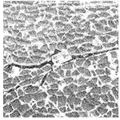
- FIG. 1 is a view showing an example of a glass having many fragments
- FIG. 2 is a view showing an example of a glass having few fragments.
- the present invention aims to provide a tempered glass having high strength due to compressive stress on the surface but having few fragments when broken.
- the present invention provides a tempered glass having a mirror constant A of 2.2 MPa ⁇ m 0.5 or more, a surface compressive stress (CS) of 10 MPa or more, and a thickness t of 1.2 mm or more and 50 mm or less. .
- the tempered glass of the present invention is suitable as a window glass for buildings because it is strong against wind pressure and impact and has few fragments when it breaks.
- FIG. 1 is a view showing an example of a glass having many fragments.
- FIG. 2 is a view showing an example of glass with few fragments.
- FIG. 3 is a view schematically showing a method of cracking around the origin of fracture when a glass having no residual stress inside is broken by uniform tensile stress.
- strengthening processing method of the tempered glass of this invention is not specifically limited, Even if it is the air-cooling tempered glass which gave the wind-cooled reinforcement process, the chemically tempered glass which gave the chemical strengthening process may be sufficient. However, when it is used as a window glass of a building, it is preferable that the glass is wind-cooled and tempered in consideration of the size of the glass which can be easily tempered and the cost.
- glass having a large mirror constant A has a small number of fragments when broken. How to break the tempered glass depends on the characteristics of the glass before the tempering treatment. Therefore, a glass (tempered glass) obtained by subjecting a glass having a large mirror constant A before tempering treatment to tempering treatment (tempered glass) has a small number of fragments even when it is broken, so the fragments are less likely to be scattered and safety is high.
- the mirror constant A does not change before and after the strengthening treatment, hereinafter, in the present specification, the mirror constant A of the glass before the strengthening treatment is the mirror constant A of the tempered glass (tempered glass) I assume.
- the tempered glass of the present invention has a mirror constant A of 2.2 MPa ⁇ m 0.5 or more. This reduces the number of fragments when broken. Therefore, even if it is destroyed, the fragments are unlikely to be scattered and the safety is high.
- Glass of the present invention preferably has a mirror constant A is 2.3 MPa ⁇ m 0.5 or more, more preferably 2.35MPa ⁇ m 0.5 or more, still be at 2.4 MPa ⁇ m 0.5 or more preferably, particularly preferably at 2.45 MPa ⁇ m 0.5 or more, and most preferably 2.5 MPa ⁇ m 0.5 or more.
- the upper limit of the Miller constant A is not particularly limited, but is preferably 5 MPa ⁇ m 0.5 or less in order to maintain the glass structure.
- the tempered glass of the present invention can increase the surface compressive stress CS and / or the depth DOL of the compressive stress layer by the above-mentioned characteristics. If the surface compressive stress CS and / or the depth DOL of the compressive stress layer is increased in order to increase the strength, the internal tensile stress CT increases, so the density of fragments when the glass breaks increases, which may cause a risk. It was said to increase.
- Patent Document 1 discloses the formula (1) indicating the allowable limit of internal tensile stress of tempered glass, and the fragment density even if the strength of the chemically tempered glass is increased by adjusting the following CT ′ to a low value. Is said to be able to obtain chemically strengthened glass with less scattering of fragments.
- CT ′ uses the values of CS and DOL ′ and has a relationship of the following formula (2).
- CT ′ ⁇ ⁇ 38.7 ⁇ ln (t) +48.2 (1)
- CS ⁇ DOL ′ (t ⁇ 2 ⁇ DOL ′) ⁇ CT ′ (2)
- Equation (2) may be rewritten as equation (3).
- CT ′ CS ⁇ DOL ′ / (t ⁇ 2 ⁇ DOL ′) (3)
- the tempered glass of the present invention can be subjected to a tempering treatment exceeding the maximum value of CT ′ represented by the formula (1) because the fractured chip density when broken is low. Since CT ′ has the relationship of CS, DOL ′ and equation (2), when CT ′ goes up, either CS or DOL ′ can be increased and the strength is increased.
- the tempered glass having a large CS is hard to be broken even if the surface is scratched because the surface compressive stress has an effect of narrowing the scratch.
- the tensile stress applied to the outside of the curved surface when the glass sheet is bent is offset by the surface compressive stress, it is difficult to be broken even when the glass sheet is bent. If the DOL is large, it is possible to increase the resistance to the impact of flying objects.
- the tempered glass of the present invention can have a surface compressive stress (CS) of 10 MPa or more for the reasons described above.
- the tempered glass of the present invention preferably has a surface compressive stress (CS) of 15 MPa or more, more preferably 50 MPa or more, more preferably 60 MPa or more, and more preferably 70 MPa or more, 80 MPa More preferably, the pressure is 90 MPa or more, and particularly preferably 100 MPa or more.
- the upper limit of the surface compressive stress (CS) is not particularly limited, but is preferably 2500 MPa or less because excessive compression causes local tensile stress around the microcracks and leads to overall failure.
- the tempered glass of the present invention preferably has a product (CS ⁇ A) of surface compressive stress (CS) and mirror constant A of 22 (MPa) 2 ⁇ m 0.5 or more, 50 (MPa) 2 ⁇ m 0.5 or more Is more preferably 100 (MPa) 2 ⁇ m 0.5 or more, still more preferably 150 (MPa) 2 ⁇ m 0.5 or more, and 200 (MPa) 2 ⁇ m 0.5 or more Is particularly preferred.
- CS ⁇ A product of surface compressive stress (CS) and mirror constant A of 22 (MPa) 2 ⁇ m 0.5 or more, 50 (MPa) 2 ⁇ m 0.5 or more Is more preferably 100 (MPa) 2 ⁇ m 0.5 or more, still more preferably 150 (MPa) 2 ⁇ m 0.5 or more, and 200 (MPa) 2 ⁇ m 0.5 or more Is particularly preferred.
- the thickness t is 1.2 mm or more and 50 mm or less. If the thickness t is 1.2 mm or more, the temperature difference between the surface and the inside is likely to occur, and physical strengthening treatment (also referred to as air-cooling strengthening treatment, hereinafter the same) can be easily performed. If the thickness t is 50 mm or less, the weight of the entire glass is reduced and it is easy to use as a window.
- the thickness t of the tempered glass of the present invention is preferably 1.3 mm or more, more preferably 1.5 mm or more, more preferably 1.7 mm or more, more preferably 1.9 mm or more, 2.0 mm or more It is more preferable, particularly preferably 2.1 mm or more, and most preferably 2.3 mm or more.
- the plate thickness t is preferably 45 mm or less, more preferably 40 mm or less, more preferably 35 mm or less, still more preferably 30 mm or less, particularly preferably 25 mm or less, and most preferably 20 mm or less.
- board thickness t direction of glass means the following.
- the distance in the normal direction from the main surface of the glass plate to the other main surface is t, and this normal direction is defined as the t direction.
- the position of t / 2 in the t direction from the main surface is the central portion in the thickness direction t of the glass.
- the tensile stress becomes maximum at the position of t / 2 in the t direction from the main surface, so the value of the tensile stress in this portion is an important value that determines the fracture characteristics.
- the fictive temperature of the tempered glass particularly the fictive temperature of the central portion in the thickness direction t, is affected by the fictive temperature of the glass before the tempering treatment.
- the virtual temperature does not substantially differ before and after the strengthening treatment.
- the mirror constant A of the glass is 2.2 MPa ⁇ m 0.5 or more, that the fictive temperature of the central portion in the direction of thickness t of the glass is the glass transition point Tg + 60 ° C. or less of the glass Preferred.
- the fictive temperature at the central portion in the thickness direction t of the glass is more preferably Tg + 50 ° C. or less, and still more preferably Tg + 40 ° C. or less.
- the virtual temperature T f in the present invention is a numerical value obtained by the refractive index method described below.
- the specific method of obtaining the virtual temperature T f by the refractive index method is as follows. First, i pieces (i ⁇ 2) of test pieces are prepared from a glass sample whose virtual temperature is to be measured, and the cooling rate is 1000 ° C. after keeping the refractive index in equilibrium at different cooling start temperatures. Cool at least min.
- the cooling start temperature is lower than the glass transition temperature, a sufficiently long holding time is required, so the cooling start temperature is preferably 10 ° C. to 100 ° C. higher than the glass transition temperature.
- the refractive index n d is measured at a specific wavelength (for example, d line of He lamp, 587.6 nm).
- the refractive index n di of the glass quenched from the cooling start temperature is plotted for each cooling start temperature T i , the constants a and b in equation (4) are determined by linear regression, and a calibration curve is created.
- the virtual temperature T f can be cut out from the glass to be measured, the refractive index n dS of the polished test piece can be measured, and the virtual temperature T f of the glass can be determined using a calibration curve.
- the virtual temperature of the glass before tempering can be adjusted by the following procedure.
- a glass material having a predetermined composition is prepared and melted, and then formed into a plate glass.
- the cooling temperature profile at the time of molding the fictive temperature of the glass can be adjusted.
- the cooling rate near the glass transition point for example, the temperature between the annealing point and the strain point
- this can be achieved by setting the temperature to 200 ° C./min or less.
- the fictive temperature of glass can be adjusted by the following procedure.
- a glass raw material of a predetermined composition After preparing and melting a glass raw material of a predetermined composition, it is formed into sheet glass by a known sheet glass forming method (for example, float method, fusion method, roll-out method). After molding, the glass is heated to a predetermined cooling start temperature, and held at that temperature. Thereafter, by adjusting the cooling rate, the fictive temperature of the glass can be adjusted. In order to lower the fictive temperature of the glass, the cooling start temperature may be lowered. In this case, it is preferable that the cooling rate be high, because the virtual temperature is close to the cooling start temperature.
- a known sheet glass forming method for example, float method, fusion method, roll-out method.
- the required holding time varies depending on the cooling start temperature, but is preferably 500 / (cooling start temperature-T g ) min or more, and more preferably 1000 / (cooling start temperature-T g ) min or more.
- the cooling start temperature is preferably Tg + 100 ° C. or less. If it is Tg + 100 ° C. or less, the fictive temperature can be easily lowered even by heat treatment for a short time, so that the time required for the process can be shortened and deformation at the time of holding can be suppressed.
- the cooling start temperature is more preferably Tg + 60 ° C. or less, still more preferably Tg + 30 ° C. or less, and particularly preferably Tg + 20 ° C. or less.
- the cooling rate is preferably 100 ° C./min or more, more preferably 200 ° C./min or more, and still more preferably 300 ° C./min or more.
- the glass after cooling is subjected to a strengthening treatment under predetermined conditions.
- a strengthening treatment under predetermined conditions.
- the center of the thickness t direction is placed in a heating furnace at Tg + 60 ° C to Tg + 110 ° C for a short time (for example, within 7 minutes) and quenched (for example, a cooling rate of 500 ° C / min or more)
- Tg + 60 ° C to Tg + 110 ° C for a short time (for example, within 7 minutes) and quenched (for example, a cooling rate of 500 ° C / min or more)
- the tempered glass of the present invention since the tempered glass of the present invention has a small number of fragments when broken, it can be subjected to tempering treatment exceeding the maximum value of CT ′ represented by the formula (1), and CS and DOL are high. can do.
- the product (CT ⁇ A) of the tensile stress CT at the center in the thickness t direction and the mirror constant A is preferably 11 (MPa) 2 ⁇ m 0.5 or more, and 15 (MPa) It is more preferably 2 ⁇ m 0.5 or more, and still more preferably 20 (MPa) 2 ⁇ m 0.5 or more.
- the compressive stress layer depth DOL can be increased by subjecting the tempered glass to a strengthening treatment exceeding the allowable limit of the internal tensile stress CT ′.
- a tempered glass with a high DOL is difficult to break because the tip of the scratch remains in the compressive stress layer even when a deep scratch occurs.
- the compressive stress layer depth DOL is preferably (1/10) ⁇ t mm or more, (1/8) ⁇ t mm or more Is more preferable, (1/7) ⁇ t mm or more is more preferable, and (1 / 6.5) ⁇ t mm or more is particularly preferable.
- DOL is preferably (1/4) ⁇ t mm or less, more preferably (1 / 4.2) ⁇ t mm or less, and (1 / 4.5) ⁇ t mm or less More preferable. If DOL is (1/4) ⁇ t mm or less, the area where tensile stress occurs is (1 ⁇ 2) ⁇ t mm or less of the plate thickness, and tensile stress CT can be lowered, and many fragments are caused when the tempered glass breaks. The risk of splashing is reduced.
- the compression stress layer depth DOL of the tempered glass of the present invention is preferably 0.150 mm or more, more preferably 0.200 mm or more, and still more preferably 0.300 mm or more.
- the compression stress layer depth DOL is preferably 10 mm or less, more preferably 8 mm or less, more preferably 6 mm or less, still more preferably 5 mm or less, particularly preferably 4.5 mm or less, and most preferably 4 mm or less.
- the tempered glass having a large DOL ' is difficult to be destroyed because the tip of the flaw remains in the compressive stress layer even when a deep flaw occurs.
- the compression stress layer depth DOL 'of the tempered glass of the present invention is preferably 0.150 mm or more, more preferably 0.200 mm or more, and still more preferably 0.300 mm or more.
- the compressive stress layer depth DOL ′ is preferably 10 mm or less, more preferably 8 mm or less, more preferably 6 mm or less, still more preferably 5 mm or less, particularly preferably 4.5 mm or less, and most preferably 4 mm or less.
- the applicant of the present application has obtained the following findings on the relationship between the mirror constant A of glass and the physical properties of glass or the composition of glass.
- the Poisson's ratio of glass is low.
- the Poisson's ratio ⁇ ⁇ ⁇ of the glass is preferably 0.28 or less, more preferably 0.26 or less, and still more preferably 0.24 or less.
- the lower limit of the Poisson's ratio ⁇ ⁇ ⁇ of the glass is not particularly limited, but is preferably 0.1 or more because an elastic deformation range at the time of impact is required to some extent. There are the following means to lower the Poisson's ratio ⁇ of the glass.
- the network in the glass is developed and the glass has more voids. .
- the glass has a space that contracts due to compression, it is easy to obtain a glass with a low Poisson's ratio.
- MgO, ZrO 2 and the like are preferably used because they function as a network formation factor without significantly raising Tg.
- the alkali metal oxide R 2 O is a generic term for Li 2 O, Na 2 O, K 2 O, and Rb 2 O (hereinafter, the same in the present specification).
- the mirror constant A of the glass increases as the Young's modulus E of the glass increases.
- it is effective to increase the Al 2 O 3 content in the glass.
- the SiO 2 content in the glass is high, the network structure of the glass becomes relatively strong, and the Young's modulus of the glass is high.
- the Young's modulus can be increased by increasing the Al 2 O 3 content and repairing the cut network structure.
- alkaline earth metal oxide (RO) is a generic term for MgO, CaO, SrO and BaO (hereinafter, the same in the present specification).
- the glass composition based on the above findings contains 30 to 85% of SiO 2 , 0 to 40% of Al 2 O 3 and 0 to 10% of P 2 O 5 in terms of mole percentage on an oxide basis, and is alkaline A metal oxide (R 2 O) in a total amount of 8 to 40%, an alkaline earth metal oxide (RO) in a total amount of 0 to 40%, and one substantially free of B 2 O 3 is preferable.
- R 2 O alkaline A metal oxide
- RO alkaline earth metal oxide
- an alkali metal oxide Preferably contain 10 to 40% in total, 0 to 40% in total of alkaline earth metal oxides (RO), and substantially do not contain B 2 O 3 .
- a mole percentage based on oxides, SiO 2 35 ⁇ 55%, the ratio of Al 2 O 3 and SiO 2 (Al 2 O 3 / SiO 2) is 0.3 ⁇ 0.6, P 2 O 5 and containing 0-5%, and alkali metal oxides (R 2 O) 20 ⁇ 40 % in a total amount, contains 0-15% alkaline earth metal oxide (RO) in a total volume, B 2 O It is further preferred that substantially no 3 is contained.
- a mole percentage based on oxides, SiO 2 40 ⁇ 50%, the ratio of Al 2 O 3 and SiO 2 (Al 2 O 3 / SiO 2) is 0.5 ⁇ 0.6, P 2 O 5 and containing 0 to 1%, and alkali metal oxides (R 2 O) 20 ⁇ 30 % in a total amount, contains 5-15% alkaline earth metal oxide (RO) in a total volume, B 2 O Particularly preferred is one not substantially containing 3 .
- Young's modulus E of glass will be 68 GPa or more, preferably 70 GPa or more, More preferably, 75 GPa or more, More preferably, 80 GPa or more.
- the upper limit of the Young's modulus of glass is not particularly limited, it is generally 180 GPa or less.
- SiO 2 is a main component of glass. If the content of SiO 2 is 30% or more, the weather resistance is good. The content of SiO 2 is more preferably 35% or more, further preferably 38% or more, and particularly preferably 40% or more. If the content of SiO 2 is 85% or less, devitrification hardly occurs. The content of SiO 2 is more preferably 55% or less, further preferably 50% or less, and particularly preferably 47% or less.
- Al 2 O 3 is a component that improves the weather resistance.
- the content of Al 2 O 3 is 0% or more. When Al 2 O 3 is contained, the weather resistance is improved.
- the content of Al 2 O 3 is more preferably 1% or more, further preferably 3% or more, and particularly preferably 5% or more. If the content of Al 2 O 3 is 40% or less, the solubility is good.
- the content of Al 2 O 3 is more preferably 35% or less, further preferably 32% or less, and particularly preferably 30% or less.
- the ratio of Al 2 O 3 to SiO 2 is 0.3 or more, the structure becomes rigid due to the increase in the number of bonds.
- Al 2 O 3 / SiO 2 0.35 or more is more preferable, and 0.4 or more is more preferable. More preferably, it is 0.5 or more. If the ratio of Al 2 O 3 to SiO 2 (Al 2 O 3 / SiO 2 ) is 0.6 or less, the viscosity of the glass at high temperatures is unlikely to be high, which is preferable.
- Al 2 O 3 / SiO 2 is more preferably 0.55 or less, more preferably 0.52 or less.
- P 2 O 5 is preferably not substantially contained because it is easy to form phase separation and devitrification species, but it may be contained at 10% or less in order to increase DOL.
- the content of P 2 O 5 may be 5% or less, or 1% or less.
- the viscosity of the glass at a high temperature is likely to decrease, so that the glass is easily melted.
- the total amount of R 2 O is more preferably 10% or more, further preferably 12% or more, and particularly preferably 20% or more.
- R 2 O is 40% or less in total, Young's modulus is unlikely to be low.
- the total amount of R 2 O is preferably 35% or less, more preferably 30% or less.
- Li 2 O is an alkali metal oxide component that does not cause a decrease in Young's modulus at room temperature while having the effect of lowering the viscosity of the glass at high temperatures. If the content of Li 2 O is 0.01% or more, the above effect appears. The content of Li 2 O is more preferably 2% or more, and still more preferably 4% or more. If Li 2 O is 20% or less, the network in the glass structure can be maintained. In addition, because the price of Li 2 O is high, the price of the glass to be obtained can be avoided. The content of Li 2 O is more preferably 15% or less, further preferably 10% or less.
- Na 2 O is a component having the effect of lowering the viscosity of the glass at high temperature. If the content of Na 2 O is 5% or more, the above-described effect is obtained. The Na 2 O content is more preferably 10% or more, more preferably 15% or more. If the content of Na 2 O is 40% or less, the network in the glass structure can be maintained. The content of Na 2 O is more preferably 30% or less, and further preferably 20% or less.
- K 2 O like Li 2 O and Na 2 O, is a component having the effect of lowering the viscosity of the glass at high temperature. If the content of K 2 O is 2% or more, the effect of lowering the viscosity becomes stronger. The content of K 2 O is more preferably 3% or more, and still more preferably 5% or more. If the content of K 2 O is 20% or less, the deliquescent of the glass can be reduced to some extent. The K 2 O content is more preferably 15% or less, more preferably 10% or less.
- Rb 2 O like Li 2 O, Na 2 O, K 2 O, etc., is a component having the effect of lowering the viscosity of the glass at high temperatures. If the content of Rb 2 O is 1% or more, it is possible to increase the energy absorbing effect at the time of breakage of the glass by the mixed alkali effect. The content of Rb 2 O is more preferably 1% or more, and further preferably 2% or more. If the content of Rb 2 O is 10% or less, an excessive increase in the weight of glass can be prevented. The content of Rb 2 O is more preferably 5% or less, still more preferably 4% or less.
- the alkaline earth metal oxide (RO) is a component that increases the Miller constant, and thus may be contained in either of physically strengthened glass and chemically strengthened glass. If RO is 3% or more in total, it leads to the rise of the Miller constant. RO may be 5% or more in total. Moreover, if RO is 40% or less in total, it is hard to devitrify. The total amount of RO is more preferably 30% or less, further preferably 25% or less, and particularly preferably 20% or less.
- (CaO + SrO + BaO) in the alkali earth metal oxide (RO) is small, the ion exchange capacity is improved to obtain a large DOL.
- (CaO + SrO + BaO) is preferably 5% or less in total.
- the total amount of (CaO + SrO + BaO) is preferably 4% or less, more preferably 3% or less, and particularly preferably 1% or less.
- (CaO + SrO + BaO) reduces the devitrification of the glass, and a stable glass can be obtained, so (CaO + SrO + BaO) is preferably 0.1% or more in total, and 0.5% or more in total. More preferably, 1% or more is more preferable.
- MgO is a component that increases the mirror radius by increasing the Young's modulus of the glass.
- the content of MgO is more preferably 5% or more, and further preferably 10% or more. If the content of MgO is 35% or less, problems such as devitrification can be avoided.
- the content of MgO is more preferably 30% or less, and still more preferably 25% or less.
- CaO is a component to improve the meltability at high temperatures or to make it difficult to cause devitrification. Therefore, devitrification can be suppressed as long as the content of CaO is 0.1% or more in any of physically strengthened glass and chemically strengthened glass.
- the content of CaO is more preferably 0.5% or more, and further preferably 1% or more. When the content of CaO is 15% or less, both effects of improvement of the meltability and increase of the Young's modulus of the glass can be obtained.
- content of CaO 10% or less is more preferable, and 5% or less is more preferable.
- the content of CaO is preferably 5% or less, because the effect of enhancing DOL can be obtained by reducing the content of CaO.
- the content of CaO is more preferably 3% or less, and further preferably 2% or less.
- SrO is a component to improve the meltability at high temperatures or to make it difficult to cause devitrification. Therefore, in both cases of physically strengthened glass and chemically strengthened glass, if the content of SrO is 0.1% or more, devitrification prevention is effective.
- the content of SrO is more preferably 0.2% or more, and still more preferably 0.3% or more. If the content of SrO is 15% or less, the weight increase of the glass does not become a problem.
- the content of SrO is more preferably 10% or less, still more preferably 5% or less.
- the content of SrO is preferably 5% or less because the effect of enhancing DOL can be obtained by reducing the content of SrO.
- the content of SrO is more preferably 3% or less, and still more preferably 1% or less.
- BaO is a component to improve the meltability at high temperatures or to make it difficult to cause devitrification.
- the content of BaO is 0.1% or more, energy dissipation tends to occur easily due to the mixing effect of the alkaline earth.
- the content of BaO is more preferably 0.2% or more, and further preferably 1% or more.
- the content of BaO is 20% or less, the weight increase of the glass does not matter.
- the content of BaO is more preferably 15% or less, and still more preferably 10% or less.
- the content of BaO is preferably 5% or less.
- the content of BaO is more preferably 3% or less, further preferably 1% or less, and particularly preferably 0.1% or less.
- G E ⁇ 0.013 + ⁇ ⁇ ( ⁇ 6.6) + [Al 2 O 3 ] ⁇ 0.023 + ⁇ RO ⁇ 0.013 (7)
- E Young's modulus (GPa) of the glass
- ⁇ the Poisson's ratio of the glass
- [Al 2 O 3 ] is the content of Al 2 O 3 in the glass (mol% on oxide basis)
- ⁇ RO is the glass Total content of alkaline earth metal oxides in (mol% based on oxides)
- G is more preferably 0.05 or more, further preferably 0.1 or more, and particularly preferably 0.2 or more.
- the upper limit of G is not particularly limited, but may be 10 or less.
- I [Al 2 O 3 ] ⁇ 0.03 + ⁇ RO ⁇ 0.014 (9) (Wherein [Al 2 O 3 ] is the Al 2 O 3 content in the glass (mol% on the basis of oxide), ⁇ RO is the total content of alkaline earth metal oxides in the glass (mol on the oxide basis) %)))
- I is at least 0.45, the mirror constant tends to be large.
- 0.5 or more are more preferable, 0.6 or more are more preferable, and 0.7 or more are especially preferable.
- the upper limit of I is not particularly limited, but is preferably 2 or less in consideration of the amount of Al 2 O 3 or RO that the glass can contain.
- the addition of Al 2 O 3 is not preferable because the Miller constant A of the glass is greatly reduced.
- the alkaline earth metal oxide RO does not greatly change the rigidity of the entire glass, it tends to tetragonize boron, so it is better not to add much alkaline earth metal oxide RO.
- Alkali metal oxide R 2 O not only reduces the rigidity of the entire glass but also tends to make boron tetra-coordinated, so it is better not to add too much. However, since it has the effect of increasing ⁇ LT and ⁇ HT described later, an appropriate amount is added.
- the mirror constant A of the glass increases as the Young's modulus E of the glass increases.
- the component to increase the Young's modulus E of the glass the same as in the case of containing substantially no glass composition of B 2 O 3.
- the relationship between the Young's modulus E of the glass and the mirror constant A is lower than the relationship with the above-mentioned three-coordinate boron.
- the addition of the alkaline earth metal oxide RO increases the Young's modulus E of the glass but tends to tetragonalize the boron and lowers the mirror constant A of the glass. Therefore, in the case of a glass composition containing B 2 O 3 , it is preferable not to increase the content of the alkaline earth metal oxide RO.
- the addition of Al 2 O 3 increases the Young's modulus E of the glass, so the content is preferably higher.
- B 2 O 3 is 0.01-40%, SiO 2 is 40-75%, Al 2 O 3 is 0-20%, P 2 in terms of mole percentage on an oxide basis. It is preferable to contain 0 to 10% of O 5 , and 8 to 40% in total of alkali metal oxides (R 2 O) and 0 to 40% in total of alkaline earth metal oxides (RO). In addition, it contains 5 to 25% of B 2 O 3 , 40 to 73% of SiO 2 , 0 to 20% of Al 2 O 3 , and 0 to 10% of P 2 O 5 in terms of mole percentage on an oxide basis.
- SiO 2 is a main component of glass. If the content of SiO 2 is 40% or more, the weather resistance is good. The content of SiO 2 is more preferably equal to or greater than 43%, more preferably more than 46%. If the content of SiO 2 is 75% or less, devitrification is difficult. The content of SiO 2 is more preferably 70% or less, still more preferably 65% or less, still more preferably 63% or less, particularly preferably 55% or less, and most preferably 50% or less.
- Al 2 O 3 is a component that improves the weather resistance.
- the content of Al 2 O 3 is 0% or more. When Al 2 O 3 is contained, the weather resistance is improved.
- the content of Al 2 O 3 is more preferably 0.1% or more, further preferably 0.3% or more, and particularly preferably 0.5% or more. If the content of Al 2 O 3 is 20% or less, the solubility is good. However, the content is preferably 15% or less, more preferably 10% or less, and particularly preferably 5% or less, since the Miller constant is rapidly reduced when Al 2 O 3 is contained.
- Al 2 O 3 to SiO 2 is 0.01 or more, the bond cut by the alkali metal is repaired, the glass network structure becomes strong, and the hardness is improved. Do. Al 2 O 3 / SiO 2 is more preferably 0.02 or more, more preferably 0.03 or more. If the ratio of Al 2 O 3 to SiO 2 (Al 2 O 3 / SiO 2 ) is 0.5 or less, it is possible to prevent the reduction of the Miller constant. Al 2 O 3 / SiO 2 is more preferably 0.3 or less, more preferably 0.1 or less.
- P 2 O 5 is preferably not substantially contained since it is easy to form phase separation and devitrification species, but it is contained in an amount of 10% or less in order to increase the thickness of the compressive stress layer when used as a chemically strengthened glass It is also good.
- the content of P 2 O 5 may be 5% or less, or 1% or less.
- B 2 O 3 has a large effect as a component to increase the mirror constant, and preferably contains 0.01% or more.
- the content of B 2 O 3 is more preferably 1% or more, further preferably 5% or more, particularly preferably 10% or more, and most preferably 15% or more. If the content of B 2 O 3 is 40% or less, the decrease in Young's modulus can be prevented.
- the content of B 2 O 3 is more preferably 35% or less, further preferably 30% or less, still more preferably 25% or less, particularly preferably 23% or less, and most preferably 20% or less.
- B 2 O 3 and the ratio of the sum of R 2 O (B 2 O 3 / ⁇ R 2 O) is 0.8 or more, 3 since the coordination of boron there are many, would glass large mirror constant Cheap.
- B 2 O 3 / ⁇ R 2 O is more preferably 1.0 or more, more preferably 1.2 or more, particularly preferably 1.3 or more. If B 2 O 3 / ⁇ R 2 O is 2.5 or less, the Tg is not too high and it is easy to handle.
- the B 2 O 3 / ⁇ R 2 O is more preferably 2.0 or less, further preferably 1.8 or less.
- the total amount of alkali metal oxides (R 2 O) is 8% or more, the viscosity of the glass at a high temperature is likely to decrease, and therefore, the glass becomes high in melting property.
- the total amount of R 2 O is more preferably 10% or more, further preferably 12% or more, and particularly preferably 15% or less.
- R 2 O is 40% or less in total, it is possible to prevent a rapid decrease in Young's modulus.
- the total amount of R 2 O is preferably 35% or less, more preferably 30% or less.
- Li 2 O is an alkali metal oxide component that does not cause a decrease in Young's modulus at room temperature while having the effect of lowering the viscosity of the glass at high temperatures. If the content of Li 2 O is 0.01% or more, the above effect appears. The content of Li 2 O is more preferably 2% or more, and still more preferably 4% or more. If the content of Li 2 O is 20% or less, the network in the glass structure can be maintained. In addition, because the price of Li 2 O is high, the price of the glass to be obtained can be avoided. The content of Li 2 O is more preferably 15% or less, further preferably 10% or less.
- Na 2 O is a component having the effect of lowering the viscosity of the glass at high temperature. If the content of Na 2 O is 0.01% or more, the above-described effects are obtained. The content of Na 2 O is more preferably 1% or more, and still more preferably 5% or more. If the content of Na 2 O is 40% or less, the network in the glass structure can be maintained. The Na 2 O content is more preferably 35% or less, more preferably 30% or less.
- K 2 O like Li 2 O and Na 2 O, is a component having the effect of lowering the viscosity of the glass at high temperature. If the content of K 2 O is 0.01% or more, the effect of lowering the viscosity becomes stronger. K 2 O is more preferably at least 2%, still more preferably at least 4%. If the content of K 2 O is 20% or less, the deliquescent of the glass can be reduced to some extent. The K 2 O content is more preferably 15% or less, more preferably 10% or less.
- Rb 2 O like Li 2 O, Na 2 O, K 2 O, etc., is a component having the effect of lowering the viscosity of the glass at high temperatures. If the content of Rb 2 O is 0.01% or more, it is possible to increase the energy absorption effect at the time of breakage of the glass by the mixed alkali effect. The content of Rb 2 O is more preferably 2% or more, and still more preferably 3% or more. If the content of Rb 2 O is 10% or less, an excessive increase in the weight of glass can be prevented. The content of Rb 2 O is more preferably 5% or less, still more preferably 4% or less.
- RO alkaline earth metal oxide
- An alkaline earth metal oxide (RO) may be contained because it is a component that increases the Miller constant. In all cases of physically tempered glass and chemically tempered glass, if RO is 1% or more in total, it leads to an increase in Miller constant. RO is preferably 3% or more in total, more preferably 5% or more. Moreover, if RO is 40% or less in total, the influence of devitrification is small. The total amount of RO is more preferably 35% or less, still more preferably 30% or less, particularly preferably 25% or less, and most preferably 15% or less.
- (CaO + SrO + BaO) is preferably 20% or less in total.
- the total amount of (CaO + SrO + BaO) is preferably 15% or less, more preferably 10% or less, and particularly preferably 5% or less.
- (CaO + SrO + BaO) reduces the devitrification of the glass, and a stable glass can be obtained, so (CaO + SrO + BaO) is preferably 0.1% or more in total, and 0.5% or more More preferably, 1% or more is more preferable.
- MgO is a component that increases the mirror radius by increasing the Young's modulus of the glass.
- the content of MgO is more preferably 3% or more, and further preferably 10% or more. If MgO is 35% or less, problems such as devitrification can be avoided. As for content of MgO, 35% or less is more preferable, and 33% or less is further more preferable.
- the content of MgO is preferably 8% or less because the DOL can be easily increased. As for content of MgO, 5% or less is more preferable, and 4% or less is further more preferable.
- CaO is a component to improve the meltability at high temperatures or to make it difficult to cause devitrification. Therefore, devitrification can be suppressed as long as the content of CaO is 0.1% or more in any of physically strengthened glass and chemically strengthened glass.
- the content of CaO is more preferably 0.5% or more, and further preferably 1% or more. When the content of CaO is 15% or less, both effects of improvement of the meltability and increase of the Young's modulus of the glass can be obtained.
- content of CaO 10% or less is more preferable, and 5% or less is more preferable.
- the content of CaO is preferably 8% or less because DOL can be easily increased. 5% or less is more preferable, 3% or less is more preferable, and 2% or less is particularly preferable.
- SrO is a component to improve the meltability at high temperatures or to make it difficult to cause devitrification. Therefore, in both of physically strengthened glass and chemically strengthened glass, if the content of SrO is 0.1% or more, it is effective in preventing devitrification.
- the content of SrO is more preferably 0.2% or more, and still more preferably 0.3% or more. If the content of SrO is 5% or less, the weight increase of the glass is not a problem.
- the content of SrO is more preferably 3% or less, and still more preferably 1% or less.
- BaO is a component to improve the meltability at high temperatures or to make it difficult to cause devitrification. In the case of physically tempered glass, if the content of BaO is 1% or more, energy dissipation tends to occur easily due to the mixing effect of the alkaline earth.
- the content of BaO is more preferably 2% or more, and still more preferably 2.5% or more.
- the content of BaO is 20% or less, the viscosity is not too high, the meltability is improved, the specific gravity is reduced, and the weight can be reduced, which is preferable. 15% or less is more preferable, 13% or less is further preferable, and 10% or less is particularly preferable.
- the effect of enhancing DOL can be obtained by reducing the content of BaO, so 5% or less is preferable. 3% or less is more preferable, 1% or less is more preferable, and substantially no content is most preferable.
- H B 2 O 3 (three coordination) ⁇ 0.039 + E ⁇ 0.036 + ⁇ RO ⁇ ( ⁇ 0.030) ⁇ 2.3 (8) (Wherein B 2 O 3 (three coordinates) is the three-coordinate boron content in the glass (mol% based on oxide), E is the Young's modulus (GPa) of the glass, ⁇ RO is the alkaline earth in the glass) Total content of metal oxides (mol% based on oxides) If H is 0.4 or more, the mirror constant tends to be large.
- H is more preferably 0.45 or more, further preferably 0.50 or more, and particularly preferably 0.55 or more.
- the upper limit of H is not particularly limited, it is preferably 2 or less, more preferably 1.5 or less, since there is a limit to the fraction of B atoms capable of taking three coordinates out of the total B 2 O 3 content. preferable.
- J [B 2 O 3] ⁇ 0.031-0.026 ⁇ [K 2 O] (10) (Wherein [B 2 O 3 ] is the B 2 O 3 content in the glass (mol% based on oxide), [K 2 O] is the K 2 O content in the glass (mol% based on the oxide )))) If J is at least 0.45, the mirror constant tends to be large. As for J, 0.50 or more is more preferable, and 0.55 or more is further more preferable.
- the upper limit of J is not particularly limited, but when the content of B 2 O 3 and the content of the alkali metal oxide are too large, deliquescence occurs and the surface deterioration particularly in outdoor use becomes remarkable, so 1 or less Is preferable, and 0.8 or less is more preferable.
- the addition of the alkaline earth metal oxide RO to the glass raises the Young's modulus E of the glass.
- the effect of raising the Young's modulus of glass is higher in alkaline earth metal oxides than in alkaline metal oxides, and among alkaline earth metal oxides, CaO is higher than other alkaline earth metal oxides.
- the content of CaO is preferably 0.5% or more, more preferably 1.0% or more, in terms of molar percentage based on the oxide.
- the tempered glass of the present invention preferably has ⁇ M R 2 O 2 > 30 shown by the following formula (11).
- ⁇ M R2O > ⁇ (Mixri) / ⁇ Ri (11)
- Mi is atomic weight of alkali metal
- Ri is content of alkali metal oxide contained in glass (mol% on the basis of oxide)
- ⁇ M R 2 O 2 > is correlated with atomic weight of alkali metal in glass It is a value.
- the tempered glass of the present invention preferably contains substantially no lanthanoid.
- substantially free of lanthanoid means that the lanthanoid is not included unless it is mixed as an unavoidable impurity.
- substantially no lanthanoid By containing substantially no lanthanoid, the weight of the glass can be reduced. In addition, when sunlight strikes the glass, no light emission or luminescence occurs.
- the tempered glass of this invention does not contain F substantially.
- not containing substantially F means not containing F except when it is mixed as an unavoidable impurity. By containing substantially no F, the composition hardly changes even if the glass is heat-treated.
- the glass plate according to the embodiment of the present invention may contain SO 3 .
- SO 3 is mainly derived from sodium sulfate (Na 2 SO 4 ) used as a fining agent.
- the content of SO 3 is preferably 0.001% to 0.2% in terms of mass% based on the oxide. If the content of SO 3 is 0.001% or more, the fining effect at the time of glass melting is good, and bubbles are reduced.
- the content of SO 3 is preferably 0.003% or more, more preferably 0.01% or more, and still more preferably 0.02% or more. If the content of SO 3 is 0.2% or less, the gas component of SO 2 hardly remains in the glass as bubbles.
- the content of SO 3 is preferably 0.1% or less, more preferably 0.05% or less, and still more preferably 0.03% or less.
- the glass plate according to the embodiment of the present invention may contain SnO 2 .
- SnO 2 acts as a fining agent.
- the content of SnO 2 is preferably 0 to 1% in terms of mass% based on the oxide. If SnO 2 is contained, the fining effect at the time of glass melting is good and bubbles are reduced.
- the content of SnO 2 may be 0.1% or more, 0.2% or more, or 0.3% or more. In addition, if the content of SnO 2 is 1% or less, the raw material cost can be suppressed, and the volatilization in the production line is small.
- the content of SnO 2 is more preferably 0.7% or less, further preferably 0.5% or less, and particularly preferably 0.4% or less.
- the glass plate according to the embodiment of the present invention has, for example, Fe 2 O 3 , TiO 2 , CeO 2 , CoO, Se, MnO 2 , MnO, Cr 2 O 3 , V 2 O 5 , NiO, Er 2 O as coloring components. Although 3 may be contained, it is not necessary to contain a coloring component.
- the glass plate of the embodiment of the present invention preferably contains substantially no MnO 2 , MnO, Cr 2 O 3 , V 2 O 5 , NiO or Er 2 O 3 .
- the tempered glass of the present invention is air-cooled and tempered glass, it is preferable to satisfy the low-temperature thermal expansion coefficient ⁇ LT and the high-temperature thermal expansion coefficient ⁇ HT described below from the viewpoint of ease of air-cooling and tempering.
- a cooling medium is sprayed on the surface to rapidly cool the surface to give a residual stress.
- the ease of air-cooling reinforcement in the present specification means that residual stress is easily given when the air-cooling reinforcement treatment is performed in the above-described procedure.
- the average thermal expansion coefficient at 50 to 350 ° C. is taken as the low temperature thermal expansion coefficient ⁇ LT .
- the tempered glass of the present invention preferably has a low temperature thermal expansion coefficient ⁇ LT of 60 ⁇ 10 ⁇ 7 ⁇ K ⁇ 1 or more from the viewpoint of imparting residual stress.
- the tempered glass of the present invention preferably has a low temperature thermal expansion coefficient ⁇ LT of 70 ⁇ 10 ⁇ 7 ⁇ K ⁇ 1 or more, and more preferably 80 ⁇ 10 ⁇ 7 ⁇ K 1 or more.
- a load of 10 g is applied to a sample with a diameter of 5 mm and a length of 20 mm, and a thermal expansion curve obtained by measurement at a temperature rising rate of 5 ° C./min is between the glass transition point and the deformation point
- the local maximum value of the thermal expansion coefficient at the point is taken as the high temperature thermal expansion coefficient ⁇ HT .
- the low temperature thermal expansion coefficient ⁇ LT and the high temperature thermal expansion coefficient ⁇ HT generally have a correlation, and when the low temperature thermal expansion coefficient ⁇ LT is large, the high temperature thermal expansion coefficient ⁇ HT tends to be large.
- the ratio ⁇ HT / ⁇ LT of the high temperature thermal expansion coefficient ⁇ HT to the low temperature thermal expansion coefficient ⁇ LT is preferably 2 or more, more preferably 3 or more, It is more preferably 4 or more, more preferably 5 or more, still more preferably 6 or more, particularly preferably 7 or more, and most preferably 8 or more.
- the residual stress imparted to the glass by the air-cooling tempering treatment is determined by the product ⁇ LT ⁇ E of the low temperature thermal expansion coefficient ⁇ LT of the glass and the Young's modulus E. Therefore, a glass with a larger value of ⁇ LT ⁇ E is preferable as a wind-cooled tempered glass.
- the product ⁇ LT ⁇ E of the low temperature thermal expansion coefficient ⁇ LT and the Young's modulus E is preferably 4 ⁇ 10 5 Pa ⁇ K ⁇ 1 or more, and 5 ⁇ 10 5 Pa ⁇ K ⁇ 1 The above is more preferable, 6 ⁇ 10 5 Pa ⁇ K ⁇ 1 or more is more preferable, and 7 ⁇ 10 5 Pa ⁇ K ⁇ 1 or more is particularly preferable.
- Examples 1-14 are examples, and examples 15-27 are comparative examples.
- a glass raw material was appropriately prepared, heated and melted, then homogenized by defoaming, stirring and the like, and molded by a float method to obtain a glass plate (plate thickness 2.2 mm).
- the compositions (mol% based on oxide) of the glasses used in Examples and Comparative Examples are shown in Tables 1 to 3.
- the content of three-coordinate boron (B (three-coordinate) (mol%)) is represented by the following formulas (12) and (13) Identified.
- I [Al 2 O 3 ] ⁇ 0.03 + ⁇ RO ⁇ 0.014 (9)
- [Al 2 O 3 ] is the Al 2 O 3 content in the glass (mol% on oxide basis)
- ⁇ RO is the total content of alkaline earth metal oxides in the glass (mol% on oxide basis)
- J represented by the following formula (10) was determined.
- the glass plate obtained by the above procedure is processed into a rectangular solid, and the lengths of the long side and the short side of the glass plate are measured by a micrometer with an error of ⁇ 0.01 mm, and the weight of the glass plate is ⁇ 0.02 g It measured and calculated
- ⁇ Young's modulus E, Poisson's ratio >> The Young's modulus E and Poisson's ratio ⁇ of the glass plate obtained by the above procedure were measured by an ultrasonic pulse method. For Examples 1 to 6 and Examples 15 to 22 not containing B 2 O 3 , G represented by the following formula (7) was determined.
- B 2 O 3 (three coordination) ⁇ 0.039 + E ⁇ 0.036 + ⁇ RO ⁇ ( ⁇ 0.030) ⁇ 2.3 (8)
- B 2 O 3 (three coordinates) is the three-coordinate boron content (mol% on the basis of oxide) in the glass
- E is the Young's modulus (GPa) of the glass
- RORO is the alkaline earth metal in the glass Total content of oxide (mol% based on oxide).
- a deformation point (unit: ° C.), a low temperature thermal expansion coefficient ⁇ LT (unit: ⁇ 10 -7 / ° C.), and a high temperature thermal expansion coefficient ⁇ HT (unit: ⁇ 10 -7 / ° C.) were determined.
- Tables 1 to 3 values shown in parentheses are calculated values.
- the fictive temperature of the glass was adjusted by adjusting the cooling rate.
- the fictive temperature of the glass was determined as follows. In the glass of each composition, three plate-like glasses are prepared and suspended at different cooling start temperatures T (° C.) in a platinum crucible and suspended so as not to contact wall surfaces using platinum wires and ceramic rods. It was placed in a held electric furnace. Here, the cooling start temperature and the holding time are kept at Tg + 50 ° C. for 5 minutes, Tg + 30 ° C. for 20 minutes, and Tg + 10 ° C. for 2 hours, and then the glass is taken out of the electric furnace out of the furnace at room temperature about 25 ° C. The cooling was performed at a cooling rate of 1000 ° C./min or more.
- the refractive index n d at the d-line of these glasses is measured using a refractometer (KPR 2000; manufactured by Shimadzu Device Manufacturing Co., Ltd.), and from the refractive index n d and the cooling start temperature T, in equation (4)
- the constants a and b were determined by linear regression.
- processing The glass plate obtained by the above-mentioned procedure was processed into a size of 40 mm ⁇ 6 mm ⁇ 3 mm, and eight glass plates were produced in which front and back surfaces and end faces in the longitudinal direction (four in total) were mirror-polished.
- HMV-2 Vickers hardness tester
- a diamond indenter with a facing angle of 110 ° the indenter was scratched by pressing the indenter under different loads onto eight glass plates.
- the pressing load was set to 0.05 kgf, 0.1 kgf, 0.3 kgf, 0.5 kgf, 0.75 kgf, 1.0 kgf, 2.0 kgf, and 3.0 kgf.
- Heat treatment was performed to remove the influence of strain caused by scratching. The heat treatment was performed by maintaining the cooling start temperature described in Tables 1 to 3 for 1 hour, and cooling to room temperature at a cooling rate described in Tables 1 to 3.
- the span of the jig for 4-point bending was such that the load side (upper): 10 mm and the support side (lower): 30 mm.
- CS surface compressive stress
- DOL compressive stress layer depth
- the number of fractures of the glass after the strengthening treatment was measured by the following procedure. Using an auto punch (automatic punch M with a carbide tip; made by Niigata Seiki Co., Ltd.) against a glass sample (10 cm square) after tempering treatment, an angle of 120 ° is located 10 mm away from one corner of the sample It was crushed by impact with an indenter. The number of broken glass fragments was taken as the number of broken glass. When the glass was not crushed, the number of crushing was set to zero. For the glasses of Examples 1, 3 and 5, the number of fractures of the glass after tempering treatment was measured by the following procedure.
- the tempered glass of each of Examples 1 to 14 in which the Miller constant A is 2.2 MPa ⁇ m 0.5 or more has a fracture number of less than 10 and a small number of fragments.
- the tempered glass of Examples 15 to 27 having a Miller constant A of less than 2.2 MPa ⁇ m 0.5 had a fracture number of 38 or more and a large number of fractured pieces.
- the tempered glass of the present invention is suitably used, for example, as a window glass of a vehicle, a window glass of a building, an outer wall, a solar cell cover glass, particularly as a window glass of a building.
Landscapes
- Chemical & Material Sciences (AREA)
- Materials Engineering (AREA)
- Organic Chemistry (AREA)
- Engineering & Computer Science (AREA)
- Life Sciences & Earth Sciences (AREA)
- Chemical Kinetics & Catalysis (AREA)
- General Chemical & Material Sciences (AREA)
- Geochemistry & Mineralogy (AREA)
- Thermal Sciences (AREA)
- Physics & Mathematics (AREA)
- Ceramic Engineering (AREA)
- Glass Compositions (AREA)
- Re-Forming, After-Treatment, Cutting And Transporting Of Glass Products (AREA)
Abstract
本発明はミラー定数Aが2.2MPa・m0.5以上、表面圧縮応力(CS)が10MPa以上、板厚tが1.2mm以上50mm以下の強化ガラスに関する。
Description
本発明は、強化ガラスに関する。より具体的には、建築物の窓用ガラスとして用いられる強化ガラスに関する。
特許文献1に示されているように、地震や台風や竜巻などの自然災害の発生時の安全(破損ガラスの落下防止)のために普通のガラス窓を強化ガラスに代える動きがある。しかしながら、強化ガラスを窓として使うと、ガラスの内部の引張応力が強いため、割れた際にガラスが粉々になって落下する危険がある。このため、強化ガラス窓を合わせガラス窓に変更して落下を防止することが行われるが、合わせガラスの場合は、ガラスの厚みが大きくなって既存のサッシに入らなくなり、窓ガラスのみの交換ではなく、どうしてもサッシごと取り換える必要がある。
図1は、破砕片が多いガラスの一例を示した図であり、図2は、破砕片が少ないガラスの一例を示した図である。図1、2の比較から明らかなように、割れた際に破砕片が少ないガラスとすることによっても、破砕片が大きく、サッシにガラスが支えられるため、破損ガラスの落下防止は可能である。
本発明は、従来技術の問題点を解決するため、表面に圧縮応力があるため強度は強いが、割れた際に破砕片が少ない強化ガラスの提供を目的とする。
本発明は、上記の目的を達成するため、ミラー定数Aが2.2MPa・m0.5以上、表面圧縮応力(CS)が10MPa以上、板厚tが1.2mm以上50mm以下の強化ガラスを提供する。
本発明の強化ガラスは、風圧や衝撃物に対して強く、万が一割れた際に破砕片が少ないため、建築物の窓用ガラスとして好適である。
以下、本発明の強化ガラスの実施形態について説明する。
なお、本発明の強化ガラスの強化処理方法は特に限定されず、風冷強化処理を施した風冷強化ガラスであっても、化学強化処理を施した化学強化ガラスであってもよい。
但し、建築物の窓用ガラスとして用いる場合、強化処理が行いやすいガラスのサイズ、及びコスト面を考慮すると、風冷強化ガラスであることが好ましい。
なお、本発明の強化ガラスの強化処理方法は特に限定されず、風冷強化処理を施した風冷強化ガラスであっても、化学強化処理を施した化学強化ガラスであってもよい。
但し、建築物の窓用ガラスとして用いる場合、強化処理が行いやすいガラスのサイズ、及びコスト面を考慮すると、風冷強化ガラスであることが好ましい。
ガラスが割れた際、その破断面の形状は応力の大きさによって異なることが知られている。内部に残留応力のないガラス、すなわち、強化処理を施していないガラスが、一様な引張応力によって破壊した場合の破壊起点周辺の割れ方を、図3に模式的に示す。
図3中、黒丸で示す破壊起点の周辺には、ミラー(mirror)面と呼ばれる平滑面が生じる。また、その周囲にはミスト(mist)と呼ばれるややざらざらした境界面が生じ、その先にはハックル(hackle)と呼ばれる粗い面が生じる。図3において、黒丸で示す破壊起点からミラー(mirror)面と、ミスト(mist)面と、の境界までの距離をR(単位:m)とし、破壊を生じさせた応力をσ(単位:MPa)とすると、σはRの平方根の逆数に比例することが知られており、その比例定数がミラー定数A(単位:MPa・m0.5)である。すなわち、下記式に示す関係になる。
σ=A/R1/2
ミラー定数Aは、破壊時の応力σと、破壊起点から、ミラー面とミストとの界面までの距離Rを測定することで、実験的に求められる。
図3中、黒丸で示す破壊起点の周辺には、ミラー(mirror)面と呼ばれる平滑面が生じる。また、その周囲にはミスト(mist)と呼ばれるややざらざらした境界面が生じ、その先にはハックル(hackle)と呼ばれる粗い面が生じる。図3において、黒丸で示す破壊起点からミラー(mirror)面と、ミスト(mist)面と、の境界までの距離をR(単位:m)とし、破壊を生じさせた応力をσ(単位:MPa)とすると、σはRの平方根の逆数に比例することが知られており、その比例定数がミラー定数A(単位:MPa・m0.5)である。すなわち、下記式に示す関係になる。
σ=A/R1/2
ミラー定数Aは、破壊時の応力σと、破壊起点から、ミラー面とミストとの界面までの距離Rを測定することで、実験的に求められる。
また、ミラー定数Aが大きいガラスは、割れたときの破片数が少ない。強化ガラスの割れ方は、強化処理前のガラスの特性に依存する。そのため、強化処理前のミラー定数Aが大きいガラスに強化処理を施したガラス(強化ガラス)は、破壊した場合であっても破片数が少ないので、破片が飛び散りにくく、安全性が高い。
なお、ミラー定数Aは、強化処理の前後で変化しないため、以下、本明細書では、強化処理前のガラスについて求めたミラー定数Aを、強化処理を施したガラス(強化ガラス)のミラー定数Aとする。
なお、ミラー定数Aは、強化処理の前後で変化しないため、以下、本明細書では、強化処理前のガラスについて求めたミラー定数Aを、強化処理を施したガラス(強化ガラス)のミラー定数Aとする。
本発明の強化ガラスは、ミラー定数Aが2.2MPa・m0.5以上である。これにより、割れたときの破片数が少なくなる。そのため、破壊した場合も破片が飛び散りにくく、安全性が高い。
本発明の強化ガラスは、ミラー定数Aが2.3MPa・m0.5以上であることが好ましく、2.35MPa・m0.5以上であることがより好ましく、2.4MPa・m0.5以上であることがさらに好ましく、2.45MPa・m0.5以上であることが特に好ましく、2.5MPa・m0.5以上であることが最も好ましい。ミラー定数Aの上限は特に限定されないが、ガラス構造を保つために5MPa・m0.5以下が好ましい。
本発明の強化ガラスは、ミラー定数Aが2.3MPa・m0.5以上であることが好ましく、2.35MPa・m0.5以上であることがより好ましく、2.4MPa・m0.5以上であることがさらに好ましく、2.45MPa・m0.5以上であることが特に好ましく、2.5MPa・m0.5以上であることが最も好ましい。ミラー定数Aの上限は特に限定されないが、ガラス構造を保つために5MPa・m0.5以下が好ましい。
本発明の強化ガラスは、上述した特性により、表面圧縮応力CS及び/あるいは圧縮応力層の深さDOLを高めることができる。
強度を高くするために表面圧縮応力CS及び/あるいは圧縮応力層の深さDOLを大きくすると、内部引張応力CTが大きくなるために、ガラスが割れた時の破砕片の密度が多くなり危険性が増すといわれていた。
ここで、特許文献1は強化ガラスの内部引張応力の許容限界を示す式(1)を開示し、下記CT’を低い値に調節することで化学強化ガラスの強度を大きくしても破砕片密度が小さく、破片の飛散が少ない化学強化ガラスが得られるとしていた。特許文献1に記載されるように内部引張応力CT’はCSおよびDOL’の値を使用し、下記式(2)の関係を有する。
CT’≦-38.7×ln(t)+48.2 (1)
CS×DOL’=(t-2×DOL’)×CT’ (2)
式(2)は式(3)のように書き換えてもよい。
CT’= CS×DOL’/(t-2×DOL’) (3)
ここで、DOL’はイオン交換層の深さに相当する。
DOLとDOL’は多くの場合一致するが、イオン交換後の熱履歴によっては値が異なる場合もある。本発明の強化ガラスは、割れたときの破砕片密度が少ないため、式(1)で表されるCT’の最大値を超える強化処理を施すことができる。CT’はCS、DOL’と式(2)の関係を有するため、CT’が上がると、CS、DOL’のいずれかを大きくすることができ、強度が上がる。CSが大きい強化ガラスは、表面に傷が生じても、表面圧縮応力によって傷が狭くなる効果があるために割れにくい。また、ガラス板を曲げた時に曲面の外側にかかる引張応力が表面圧縮応力によって相殺されるので、曲げた時にも割れにくい。DOLが大きければ、飛来物の衝突に対する耐性強度を上げることができる。
強度を高くするために表面圧縮応力CS及び/あるいは圧縮応力層の深さDOLを大きくすると、内部引張応力CTが大きくなるために、ガラスが割れた時の破砕片の密度が多くなり危険性が増すといわれていた。
ここで、特許文献1は強化ガラスの内部引張応力の許容限界を示す式(1)を開示し、下記CT’を低い値に調節することで化学強化ガラスの強度を大きくしても破砕片密度が小さく、破片の飛散が少ない化学強化ガラスが得られるとしていた。特許文献1に記載されるように内部引張応力CT’はCSおよびDOL’の値を使用し、下記式(2)の関係を有する。
CT’≦-38.7×ln(t)+48.2 (1)
CS×DOL’=(t-2×DOL’)×CT’ (2)
式(2)は式(3)のように書き換えてもよい。
CT’= CS×DOL’/(t-2×DOL’) (3)
ここで、DOL’はイオン交換層の深さに相当する。
DOLとDOL’は多くの場合一致するが、イオン交換後の熱履歴によっては値が異なる場合もある。本発明の強化ガラスは、割れたときの破砕片密度が少ないため、式(1)で表されるCT’の最大値を超える強化処理を施すことができる。CT’はCS、DOL’と式(2)の関係を有するため、CT’が上がると、CS、DOL’のいずれかを大きくすることができ、強度が上がる。CSが大きい強化ガラスは、表面に傷が生じても、表面圧縮応力によって傷が狭くなる効果があるために割れにくい。また、ガラス板を曲げた時に曲面の外側にかかる引張応力が表面圧縮応力によって相殺されるので、曲げた時にも割れにくい。DOLが大きければ、飛来物の衝突に対する耐性強度を上げることができる。
本発明の強化ガラスは、上述した理由により表面圧縮応力(CS)を10MPa以上にすることができる。本発明の強化ガラスは、表面圧縮応力(CS)が15MPa以上であることが好ましく、50MPa以上であることがより好ましく、60MPa以上であることがより好ましく、70MPa以上であることがより好ましく、80MPa以上であることがさらに好ましく、90MPa以上であることが特に好ましく、100MPa以上であることが最も好ましい。表面圧縮応力(CS)の上限は特に限定されないが、過剰な圧縮により、微小クラック周辺で局所的な引張応力が生じ、全体の破壊につながることが知られているため2500MPa以下が好ましい。
本発明の強化ガラスは、表面圧縮応力(CS)とミラー定数Aとの積(CS×A)が22(MPa)2・m0.5以上であることが好ましく、50(MPa)2・m0.5以上であることがより好ましく、100(MPa)2・m0.5以上であることがさらに好ましく、150(MPa)2・m0.5以上であることがより好ましく、200(MPa)2・m0.5以上であることが特に好ましい。
本発明の強化ガラスは、表面圧縮応力(CS)とミラー定数Aとの積(CS×A)が22(MPa)2・m0.5以上であることが好ましく、50(MPa)2・m0.5以上であることがより好ましく、100(MPa)2・m0.5以上であることがさらに好ましく、150(MPa)2・m0.5以上であることがより好ましく、200(MPa)2・m0.5以上であることが特に好ましい。
本発明の強化ガラスは、建築物の窓用ガラスとして用いられるため、板厚tが1.2mm以上50mm以下である。板厚tが1.2mm以上であれば、表面と内部の温度差がつきやすく物理強化処理(風冷強化処理ともいう。以下同じ)がしやすい。板厚tが50mm以下であれば、ガラス全体の重さが軽くなり窓として使用しやすい。
本発明の強化ガラスは、板厚tが1.3mm以上であることが好ましく、1.5mm以上がより好ましく、1.7mm以上がより好ましく、1.9mm以上がより好ましく、2.0mm以上がさらに好ましく、2.1mm以上が特に好ましく、2.3mm以上が最も好ましい。また、板厚tは45mm以下が好ましく、40mm以下がより好ましく、35mm以下がより好ましく、30mm以下がさらに好ましく、25mm以下が特に好ましく、20mm以下が最も好ましい。
本発明の強化ガラスは、板厚tが1.3mm以上であることが好ましく、1.5mm以上がより好ましく、1.7mm以上がより好ましく、1.9mm以上がより好ましく、2.0mm以上がさらに好ましく、2.1mm以上が特に好ましく、2.3mm以上が最も好ましい。また、板厚tは45mm以下が好ましく、40mm以下がより好ましく、35mm以下がより好ましく、30mm以下がさらに好ましく、25mm以下が特に好ましく、20mm以下が最も好ましい。
強化処理を施していないガラスの物性と、ミラー定数Aとの関連性に着目すると、強化処理を施していないガラスの仮想温度が低いほどミラー定数Aが大きくなる傾向がある。ガラスの破砕は、ガラスの引張応力が最大の部分で進行する。このような引張応力最大の部分とはガラスの板厚t方向の中心部であることから、ガラス全体の破砕の要因となるのはガラスの板厚t方向の中心部のミラー定数である。
なお、本明細書において、ガラスの板厚t方向の中心部とは、以下を意味する。ガラス板の主表面から、もう一方の主表面までの法線方向の距離をtとし、この法線方向をt方向と定義する。主表面からt方向にt/2の位置が、ガラスの板厚t方向の中心部である。通常、ガラスの両表面を同様に強化すると、主表面からt方向にt/2の位置で引張応力が最大になることから、この部分の引張応力の値が破砕の特性を決める重要な値となる。
強化処理を施したガラスの仮想温度、特に板厚t方向の中心部の仮想温度は、強化処理前のガラスの仮想温度の影響を受ける。適切な条件で強化処理を実施すれば、特に板厚t方向の中心部の仮想温度は、強化処理前後で実質的に差が生じない。
本発明の強化ガラスは、ガラスの板厚t方向の中心部の仮想温度が、そのガラスのガラス転移点Tg+60℃以下であることが、ガラスのミラー定数Aを2.2MPa・m0.5以上とするうえで好ましい。
本発明の強化ガラスは、ガラスの板厚t方向の中心部の仮想温度がTg+50℃以下であることがより好ましく、Tg+40℃以下であることがさらに好ましい。
なお、本発明における仮想温度Tfとは、以下に示す、屈折率法によって求められた数値のことをいう。仮想温度Tfは、ガラス断面を研磨し、屈折率nを測定することで測定でき、
Tf=a×n+b (4)
で表すことができる。ここで、a、bはガラス種に固有の定数である。
屈折率法による仮想温度Tfの具体的な求め方は以下の通りである。まず、仮想温度を測定しようとするガラスサンプルからi個(i≧2)の試験片を用意し、それぞれ異なる冷却開始温度に屈折率が平衡状態となるまで保持した後、冷却速度が1000℃/min以上で冷却する。ここで、冷却開始温度がガラス転移温度より低いと、十分に長い保持時間が必要となるので、冷却開始温度はガラス転移温度より10℃~100℃高い温度とすることが好ましい。この条件で冷却されたガラスに対して、特定の波長(例えばHeランプのd線、587.6nm)において屈折率ndを測定する。それぞれの冷却開始温度Tiに対して、その冷却開始温度から急冷したガラスの屈折率ndiをプロットし、線形回帰により式(4)における定数aおよびbを決定し、検量線を作成する。次に、仮想温度Tfを測定したいガラスから切り出し、研磨した試験片の屈折率ndSを測定し、検量線を用いてそのガラスの仮想温度Tfを決定することができる。
なお、本明細書において、ガラスの板厚t方向の中心部とは、以下を意味する。ガラス板の主表面から、もう一方の主表面までの法線方向の距離をtとし、この法線方向をt方向と定義する。主表面からt方向にt/2の位置が、ガラスの板厚t方向の中心部である。通常、ガラスの両表面を同様に強化すると、主表面からt方向にt/2の位置で引張応力が最大になることから、この部分の引張応力の値が破砕の特性を決める重要な値となる。
強化処理を施したガラスの仮想温度、特に板厚t方向の中心部の仮想温度は、強化処理前のガラスの仮想温度の影響を受ける。適切な条件で強化処理を実施すれば、特に板厚t方向の中心部の仮想温度は、強化処理前後で実質的に差が生じない。
本発明の強化ガラスは、ガラスの板厚t方向の中心部の仮想温度が、そのガラスのガラス転移点Tg+60℃以下であることが、ガラスのミラー定数Aを2.2MPa・m0.5以上とするうえで好ましい。
本発明の強化ガラスは、ガラスの板厚t方向の中心部の仮想温度がTg+50℃以下であることがより好ましく、Tg+40℃以下であることがさらに好ましい。
なお、本発明における仮想温度Tfとは、以下に示す、屈折率法によって求められた数値のことをいう。仮想温度Tfは、ガラス断面を研磨し、屈折率nを測定することで測定でき、
Tf=a×n+b (4)
で表すことができる。ここで、a、bはガラス種に固有の定数である。
屈折率法による仮想温度Tfの具体的な求め方は以下の通りである。まず、仮想温度を測定しようとするガラスサンプルからi個(i≧2)の試験片を用意し、それぞれ異なる冷却開始温度に屈折率が平衡状態となるまで保持した後、冷却速度が1000℃/min以上で冷却する。ここで、冷却開始温度がガラス転移温度より低いと、十分に長い保持時間が必要となるので、冷却開始温度はガラス転移温度より10℃~100℃高い温度とすることが好ましい。この条件で冷却されたガラスに対して、特定の波長(例えばHeランプのd線、587.6nm)において屈折率ndを測定する。それぞれの冷却開始温度Tiに対して、その冷却開始温度から急冷したガラスの屈折率ndiをプロットし、線形回帰により式(4)における定数aおよびbを決定し、検量線を作成する。次に、仮想温度Tfを測定したいガラスから切り出し、研磨した試験片の屈折率ndSを測定し、検量線を用いてそのガラスの仮想温度Tfを決定することができる。
強化処理前のガラスの仮想温度は以下の手順で調節できる。
強化ガラスを製造する場合、所定の組成のガラス原料を調合し溶解した後、板ガラスに成形する。この成形時の冷却温度プロファイルを調節することにより、ガラスの仮想温度を調節できる。ガラスの仮想温度を低くする場合は、例えば、ガラス転移温度付近で数時間保持した後に冷却したり、ガラス転移点付近(例えば徐冷点から歪点の間の温度)の冷却速度を小さくする、具体的には200℃/min以下とすることで達成することができる。
または、ガラスの仮想温度は、以下の手順で調整することも可能である。
所定の組成のガラス原料を調合し溶解した後、公知の板状ガラスの成形方法(例えばフロート法やフュージョン法、ロールアウト法)にて板ガラスに成形する。成形後、ガラスを所定の冷却開始温度まで昇温し、その温度にて保持する。その後、冷却速度を調整することにより、ガラスの仮想温度を調節できる。ガラスの仮想温度を低くする場合は、冷却開始温度を低くすればよい。この場合、冷却速度は速いほうが仮想温度が冷却開始温度に近い値となるため、好ましい。必要な保持時間は冷却開始温度により異なるが、500/(冷却開始温度-Tg)分以上が好ましく、1000/(冷却開始温度-Tg)分以上がより好ましい。
冷却開始温度は、Tg+100℃以下とすることが好ましい。Tg+100℃以下であれば、短時間の熱処理でも仮想温度を低くしやすいため工程に必要な時間を短縮したり、保持時の変形を抑制したりすることができる。冷却開始温度は、Tg+60℃以下がより好ましく、Tg+30℃以下がさらに好ましく、Tg+20℃以下が特に好ましい。またこの手順で仮想温度を調整する場合、冷却速度は、100℃/min以上とすることが好ましく、200℃/min以上とすることがより好ましく、300℃/min以上とすることがさらに好ましい。
強化ガラスを製造する場合、所定の組成のガラス原料を調合し溶解した後、板ガラスに成形する。この成形時の冷却温度プロファイルを調節することにより、ガラスの仮想温度を調節できる。ガラスの仮想温度を低くする場合は、例えば、ガラス転移温度付近で数時間保持した後に冷却したり、ガラス転移点付近(例えば徐冷点から歪点の間の温度)の冷却速度を小さくする、具体的には200℃/min以下とすることで達成することができる。
または、ガラスの仮想温度は、以下の手順で調整することも可能である。
所定の組成のガラス原料を調合し溶解した後、公知の板状ガラスの成形方法(例えばフロート法やフュージョン法、ロールアウト法)にて板ガラスに成形する。成形後、ガラスを所定の冷却開始温度まで昇温し、その温度にて保持する。その後、冷却速度を調整することにより、ガラスの仮想温度を調節できる。ガラスの仮想温度を低くする場合は、冷却開始温度を低くすればよい。この場合、冷却速度は速いほうが仮想温度が冷却開始温度に近い値となるため、好ましい。必要な保持時間は冷却開始温度により異なるが、500/(冷却開始温度-Tg)分以上が好ましく、1000/(冷却開始温度-Tg)分以上がより好ましい。
冷却開始温度は、Tg+100℃以下とすることが好ましい。Tg+100℃以下であれば、短時間の熱処理でも仮想温度を低くしやすいため工程に必要な時間を短縮したり、保持時の変形を抑制したりすることができる。冷却開始温度は、Tg+60℃以下がより好ましく、Tg+30℃以下がさらに好ましく、Tg+20℃以下が特に好ましい。またこの手順で仮想温度を調整する場合、冷却速度は、100℃/min以上とすることが好ましく、200℃/min以上とすることがより好ましく、300℃/min以上とすることがさらに好ましい。
冷却後のガラスに所定の条件で強化処理を施す。風冷強化の場合、Tg+60℃~Tg+110℃にて短時間(例えば、7分以内)加熱炉に入れ、急冷(例えば、500℃/min以上の冷却速度)することにより、板厚t方向の中心部の仮想温度に強化処理の前後で実質的に差が生じない。
上述したように、本発明の強化ガラスは、割れたときの破片数が少ないため、式(1)で表されるCT’の最大値を超える強化処理を施すことができ、CS、DOLを高くすることができる。
本発明の強化ガラスは、板厚t方向中心部の引張応力CTと、ミラー定数Aとの積(CT×A)が11(MPa)2・m0.5以上であることが好ましく、15(MPa)2・m0.5以上であることがより好ましく、20(MPa)2・m0.5以上であることがさらに好ましい。
本発明の強化ガラスは、割れたときの破片数が少ないため、内部引張応力CT’の許容限界を超える強化処理を施して、圧縮応力層深さDOLを大きくすることができる。
DOLが大きい強化ガラスは、深い傷が生じた時にも傷の先端が圧縮応力層内に留まることから、破壊しにくい。
本発明の強化ガラスは、板厚をt(単位:mm)としたときに、圧縮応力層深さDOLが(1/10)×tmm以上であることが好ましく、(1/8)×tmm以上であることがより好ましく、(1/7)×tmm以上であることがさらに好ましく、(1/6.5)×tmm以上であることが特に好ましい。但し、DOLは、(1/4)×tmm以下であることが好ましく、(1/4.2)×tmm以下であることがより好ましく、(1/4.5)×tmm以下であることがさらに好ましい。DOLが(1/4)×tmm以下であれば、引張応力が生じる領域が板厚の(1/2)×tmm以下となり、引張応力CTを低くでき、強化ガラスが破損したときに多くの破片が飛び散る危険性が低くなる。
DOLが大きい強化ガラスは、深い傷が生じた時にも傷の先端が圧縮応力層内に留まることから、破壊しにくい。
本発明の強化ガラスは、板厚をt(単位:mm)としたときに、圧縮応力層深さDOLが(1/10)×tmm以上であることが好ましく、(1/8)×tmm以上であることがより好ましく、(1/7)×tmm以上であることがさらに好ましく、(1/6.5)×tmm以上であることが特に好ましい。但し、DOLは、(1/4)×tmm以下であることが好ましく、(1/4.2)×tmm以下であることがより好ましく、(1/4.5)×tmm以下であることがさらに好ましい。DOLが(1/4)×tmm以下であれば、引張応力が生じる領域が板厚の(1/2)×tmm以下となり、引張応力CTを低くでき、強化ガラスが破損したときに多くの破片が飛び散る危険性が低くなる。
DOLが大きい強化ガラスは、深い傷が生じた時にも傷の先端が圧縮応力層内に留まることから、破壊しにくい。
本発明の強化ガラスは、圧縮応力層深さDOLが0.150mm以上であることが好ましく、0.200mm以上がより好ましく、0.300mm以上がさらに好ましい。但し、圧縮応力層深さDOLは10mm以下が好ましく、8mm以下がより好ましく、6mm以下がより好ましく、5mm以下がさらに好ましく、4.5mm以下が特に好ましく、4mm以下が最も好ましい。
本発明の強化ガラスは、圧縮応力層深さDOLが0.150mm以上であることが好ましく、0.200mm以上がより好ましく、0.300mm以上がさらに好ましい。但し、圧縮応力層深さDOLは10mm以下が好ましく、8mm以下がより好ましく、6mm以下がより好ましく、5mm以下がさらに好ましく、4.5mm以下が特に好ましく、4mm以下が最も好ましい。
DOL’が大きい強化ガラスは、深い傷が生じた時にも傷の先端が圧縮応力層内に留まることから、破壊しにくい。
本発明の強化ガラスは、圧縮応力層深さDOL’が0.150mm以上であることが好ましく、0.200mm以上がより好ましく、0.300mm以上がさらに好ましい。また、圧縮応力層深さDOL’は10mm以下が好ましく、8mm以下がより好ましく、6mm以下がより好ましく、5mm以下がさらに好ましく、4.5mm以下が特に好ましく、4mm以下が最も好ましい。
本発明の強化ガラスは、圧縮応力層深さDOL’が0.150mm以上であることが好ましく、0.200mm以上がより好ましく、0.300mm以上がさらに好ましい。また、圧縮応力層深さDOL’は10mm以下が好ましく、8mm以下がより好ましく、6mm以下がより好ましく、5mm以下がさらに好ましく、4.5mm以下が特に好ましく、4mm以下が最も好ましい。
本願出願人は、ガラスのミラー定数Aと、ガラスの物性若しくはガラスの組成との関連性について、以下の知見を得た。
B2O3を実質的に含有しないガラス組成の場合
(1)ガラスのポアソン比νが高いほど、ガラスのミラー定数Aが小さくなる。そのため、ガラスのポアソン比が低いことが好ましい。具体的には、ガラスのポアソン比νが0.28以下であることが好ましく、0.26以下がより好ましく、0.24以下がさらに好ましい。ガラスのポアソン比νの下限は特に限定されないが、衝撃時の弾性変形範囲がある程度必要なため、0.1以上が好ましい。
ガラスのポアソン比νを低くするために、以下の手段がある。ガラス組成中のネットワークフォーマーとなるSiO2、Al2O3、P2O5含有量の割合を高くすることにより、ガラス中のネットワークが発達し、ガラスがより多くの空隙を持つようになる。この場合、ガラスが圧縮によって収縮する空間を有するため、ポアソン比が低いガラスを得やすい。上記ネットワークフォーマー以外のものでは、MgO、ZrO2などもTgを大きく上昇させることなくネットワーク形成因子として働くため、好適に用いられる。一方で、アルカリ金属酸化物R2OやCaO、SrOなどはネットワークを切断し、ガラスのパッキング密度(ガラスを構成する元素のイオン半径の和のガラス全体の体積に対する割合)を上げてポアソン比を上げる傾向がある。希土類の添加によっても結合数が多くなりポアソン比が上がる傾向があるが、同時にヤング率が高くなるため、ミラー定数Aは増大する傾向がある。ここで、アルカリ金属酸化物R2Oとは、Li2O、Na2O、K2O、Rb2Oの総称である(以下、本明細書において同じ。)。また、B2O3を実質的に含有しないとは、B2O3を不可避的な不純物として混入する場合を除き含有しないことを意味する(以下、本明細書において同じ。)。
(2)ガラスのヤング率Eが高いほど、ガラスのミラー定数Aが大きくなる。ガラスのヤング率を高くするためには、ガラス中のAl2O3含有量を高くすることが効果的である。一般的にガラス中のSiO2含有量が高いと、ガラスのネットワーク構造が比較的強固になり、ガラスのヤング率が高い。ガラス中のSiO2含有量が低い場合は、Al2O3含有量を高くして、切断したネットワーク構造を補修することにより、ヤング率を高めることができる。また、ガラスのアルカリ土類金属酸化物(RO)の含有量を高くすることも、ガラスのヤング率を高めるのに効果的である。また、ガラスにNiO、TiO2、ZrO2、HfO2、ThO2などを含有する場合もガラスのヤング率が上昇する。ここで、アルカリ土類金属酸化物(RO)とは、MgO、CaO、SrO、BaOの総称である(以下、本明細書において同じ。)。
ガラスのミラー定数Aには影響しないが、P2O5は分相や失透種を作りやすいのでガラス中に多量には添加しないことが好ましい。
(1)ガラスのポアソン比νが高いほど、ガラスのミラー定数Aが小さくなる。そのため、ガラスのポアソン比が低いことが好ましい。具体的には、ガラスのポアソン比νが0.28以下であることが好ましく、0.26以下がより好ましく、0.24以下がさらに好ましい。ガラスのポアソン比νの下限は特に限定されないが、衝撃時の弾性変形範囲がある程度必要なため、0.1以上が好ましい。
ガラスのポアソン比νを低くするために、以下の手段がある。ガラス組成中のネットワークフォーマーとなるSiO2、Al2O3、P2O5含有量の割合を高くすることにより、ガラス中のネットワークが発達し、ガラスがより多くの空隙を持つようになる。この場合、ガラスが圧縮によって収縮する空間を有するため、ポアソン比が低いガラスを得やすい。上記ネットワークフォーマー以外のものでは、MgO、ZrO2などもTgを大きく上昇させることなくネットワーク形成因子として働くため、好適に用いられる。一方で、アルカリ金属酸化物R2OやCaO、SrOなどはネットワークを切断し、ガラスのパッキング密度(ガラスを構成する元素のイオン半径の和のガラス全体の体積に対する割合)を上げてポアソン比を上げる傾向がある。希土類の添加によっても結合数が多くなりポアソン比が上がる傾向があるが、同時にヤング率が高くなるため、ミラー定数Aは増大する傾向がある。ここで、アルカリ金属酸化物R2Oとは、Li2O、Na2O、K2O、Rb2Oの総称である(以下、本明細書において同じ。)。また、B2O3を実質的に含有しないとは、B2O3を不可避的な不純物として混入する場合を除き含有しないことを意味する(以下、本明細書において同じ。)。
(2)ガラスのヤング率Eが高いほど、ガラスのミラー定数Aが大きくなる。ガラスのヤング率を高くするためには、ガラス中のAl2O3含有量を高くすることが効果的である。一般的にガラス中のSiO2含有量が高いと、ガラスのネットワーク構造が比較的強固になり、ガラスのヤング率が高い。ガラス中のSiO2含有量が低い場合は、Al2O3含有量を高くして、切断したネットワーク構造を補修することにより、ヤング率を高めることができる。また、ガラスのアルカリ土類金属酸化物(RO)の含有量を高くすることも、ガラスのヤング率を高めるのに効果的である。また、ガラスにNiO、TiO2、ZrO2、HfO2、ThO2などを含有する場合もガラスのヤング率が上昇する。ここで、アルカリ土類金属酸化物(RO)とは、MgO、CaO、SrO、BaOの総称である(以下、本明細書において同じ。)。
ガラスのミラー定数Aには影響しないが、P2O5は分相や失透種を作りやすいのでガラス中に多量には添加しないことが好ましい。
上記の知見に基づくガラス組成として、酸化物基準のモル百分率表示で、SiO2を30~85%、Al2O3を0~40%、P2O5を0~10%含有し、かつアルカリ金属酸化物(R2O)を総量で8~40%、アルカリ土類金属酸化物(RO)を総量で0~40%含有し、B2O3を実質的に含有しないものが好ましい。
また、酸化物基準のモル百分率表示で、SiO2を30~85%、Al2O3を0~30%、P2O5を0~10%含有し、かつアルカリ金属酸化物(R2O)を総量で10~40%、アルカリ土類金属酸化物(RO)を総量で0~40%含有し、B2O3を実質的に含有しないものが好ましい。
また、酸化物基準のモル百分率表示で、SiO2を35~55%、Al2O3とSiO2の比(Al2O3/SiO2)が0.3~0.6であり、P2O5を0~5%含有し、かつアルカリ金属酸化物(R2O)を総量で20~40%、アルカリ土類金属酸化物(RO)を総量で0~15%含有し、B2O3を実質的に含有しないものがさらに好ましい。
また、酸化物基準のモル百分率表示で、SiO2を40~50%、Al2O3とSiO2の比(Al2O3/SiO2)が0.5~0.6であり、P2O5を0~1%含有し、かつアルカリ金属酸化物(R2O)を総量で20~30%、アルカリ土類金属酸化物(RO)を総量で5~15%含有し、B2O3を実質的に含有しないものが特に好ましい。
上記のガラス組成とすることにより、ガラスのヤング率Eが68GPa以上、好ましくは70GPa以上、より好ましくは75GPa以上、更に好ましくは80GPa以上となる。なお、ガラスのヤング率の上限は特に限定されないが、一般的には180GPa以下である。
以下、B2O3を実質的に含有しないガラス組成の場合の各成分について説明する。
また、酸化物基準のモル百分率表示で、SiO2を30~85%、Al2O3を0~30%、P2O5を0~10%含有し、かつアルカリ金属酸化物(R2O)を総量で10~40%、アルカリ土類金属酸化物(RO)を総量で0~40%含有し、B2O3を実質的に含有しないものが好ましい。
また、酸化物基準のモル百分率表示で、SiO2を35~55%、Al2O3とSiO2の比(Al2O3/SiO2)が0.3~0.6であり、P2O5を0~5%含有し、かつアルカリ金属酸化物(R2O)を総量で20~40%、アルカリ土類金属酸化物(RO)を総量で0~15%含有し、B2O3を実質的に含有しないものがさらに好ましい。
また、酸化物基準のモル百分率表示で、SiO2を40~50%、Al2O3とSiO2の比(Al2O3/SiO2)が0.5~0.6であり、P2O5を0~1%含有し、かつアルカリ金属酸化物(R2O)を総量で20~30%、アルカリ土類金属酸化物(RO)を総量で5~15%含有し、B2O3を実質的に含有しないものが特に好ましい。
上記のガラス組成とすることにより、ガラスのヤング率Eが68GPa以上、好ましくは70GPa以上、より好ましくは75GPa以上、更に好ましくは80GPa以上となる。なお、ガラスのヤング率の上限は特に限定されないが、一般的には180GPa以下である。
以下、B2O3を実質的に含有しないガラス組成の場合の各成分について説明する。
SiO2はガラスの主要成分である。
SiO2の含有量が30%以上であれば、耐候性が良好である。SiO2の含有量は35%以上がより好ましく、38%以上がさらに好ましく、40%以上が特に好ましい。SiO2の含有量が85%以下であれば、失透しにくい。SiO2の含有量は、55%以下がより好ましく、50%以下がさらに好ましく、47%以下が特に好ましい。
SiO2の含有量が30%以上であれば、耐候性が良好である。SiO2の含有量は35%以上がより好ましく、38%以上がさらに好ましく、40%以上が特に好ましい。SiO2の含有量が85%以下であれば、失透しにくい。SiO2の含有量は、55%以下がより好ましく、50%以下がさらに好ましく、47%以下が特に好ましい。
Al2O3は、耐候性を向上させる成分である。
Al2O3の含有量は0%以上である。Al2O3を含有すると耐候性が良好となる。Al2O3の含有量は、1%以上がより好ましく、3%以上がさらに好ましく、5%以上が特に好ましい。Al2O3の含有量が40%以下であれば、溶解性が良好である。Al2O3の含有量は、35%以下がより好ましく、32%以下がさらに好ましく、30%以下が特に好ましい。
Al2O3の含有量は0%以上である。Al2O3を含有すると耐候性が良好となる。Al2O3の含有量は、1%以上がより好ましく、3%以上がさらに好ましく、5%以上が特に好ましい。Al2O3の含有量が40%以下であれば、溶解性が良好である。Al2O3の含有量は、35%以下がより好ましく、32%以下がさらに好ましく、30%以下が特に好ましい。
Al2O3とSiO2の比(Al2O3/SiO2)が0.3以上であれば、結合数の増加により、構造が強固になる。Al2O3/SiO2は0.35以上がより好ましく、0.4以上がさらに好ましい。さらに好ましくは0.5以上である。Al2O3とSiO2の比(Al2O3/SiO2)が0.6以下であれば、ガラスの高温での粘性が高くなりにくく、好適である。Al2O3/SiO2は0.55以下がより好ましく、0.52以下がさらに好ましい。
P2O5は、分相や失透種を作りやすいので実質的に含有しないことが好ましいが、DOLを大きくするために10%以下含有させてもよい。P2O5の含有量は5%以下であってもよく、1%以下であってもよい。
アルカリ金属酸化物(R2O)が総量で8%以上であれば、高温にした場合のガラスの粘性が下がりやすいため、溶かしやすいガラスとなる。R2Oは総量で10%以上がより好ましく、12%以上がさらに好ましく、20%以上が特に好ましい。また、R2Oが総量で40%以下であれば、ヤング率が低くなりにくい。R2Oは総量で35%以下がより好ましく、30%以下がさらに好ましい。
Li2Oは、ガラスの高温時の粘性を下げる効果をもちながら、室温におけるヤング率低下を生じないアルカリ金属酸化物成分である。Li2Oの含有量が0.01%以上であれば、上記効果が現れる。Li2Oの含有量は、2%以上がより好ましく、4%以上がさらに好ましい。Li2Oが20%以下であれば、ガラス構造におけるネットワークを保つことが出来る。また、Li2Oの値段が高いことから、得られるガラスの値段の高騰を免れる。Li2Oの含有量は、15%以下がより好ましく、10%以下がさらに好ましい。
Na2Oは、Li2Oと同様に、ガラスの高温時の粘性を下げる効果をもつ成分である。Na2Oの含有量が5%以上であれば、上記の効果がある。Na2Oの含有量は、10%以上がより好ましく、15%以上がさらに好ましい。Na2Oの含有量が40%以下であれば、ガラス構造におけるネットワークを保つことが出来る。Na2Oの含有量は、30%以下がより好ましく、20%以下がさらに好ましい。
K2Oは、Li2OやNa2Oと同様に、ガラスの高温時の粘性を下げる効果をもつ成分である。K2Oの含有量が2%以上であれば、粘性を下げる効果がより強くなる。K2Oの含有量は、3%以上がより好ましく、5%以上がさらに好ましい。K2Oの含有量が20%以下であれば、ガラスの潮解性をある程度下げることができる。K2Oの含有量は、15%以下がより好ましく、10%以下がさらに好ましい。
Rb2Oは、Li2O、Na2O、K2Oなどと同様に、ガラスの高温時の粘性を下げる効果をもつ成分である。Rb2Oの含有量が1%以上であれば、混合アルカリ効果により、ガラスの破壊時のエネルギー吸収効果を上げることが可能である。Rb2Oの含有量は、1%以上がより好ましく、2%以上がさらに好ましい。Rb2Oの含有量が10%以下であれば、ガラスの重量の過剰な増加を防ぐことが出来る。Rb2Oの含有量は、5%以下がより好ましく、4%以下がさらに好ましい。
アルカリ土類金属酸化物(RO)はミラー定数を増加させる成分であるため、物理強化ガラスおよび化学強化ガラスの場合のいずれでも、含有してもよい。ROが総量で3%以上であれば、ミラー定数の上昇につながる。ROは総量で5%以上であってもよい。また、ROが総量で40%以下であれば、失透しにくい。ROは総量で30%以下がより好ましく、25%以下がさらに好ましく、20%以下が特に好ましい。
一方、特に化学強化ガラスの場合、アルカリ土類金属酸化物(RO)のうち、MgOを除くアルカリ金属土類酸化物成分、(CaO+SrO+BaO)が少ないとイオン交換能を向上させ、大きなDOLを得ることが出来るようになるため、(CaO+SrO+BaO)は総量で5%以下が好ましい。(CaO+SrO+BaO)は総量で4%以下がより好ましく、3%以下がさらに好ましく、1%以下が特に好ましい。また、(CaO+SrO+BaO)はガラスの失透性を低減し、安定なガラスを得ることが出来るようになることから、(CaO+SrO+BaO)は、総量で0.1%以上が好ましく、0.5%以上がより好ましく、1%以上がさらに好ましい。
一方、特に化学強化ガラスの場合、アルカリ土類金属酸化物(RO)のうち、MgOを除くアルカリ金属土類酸化物成分、(CaO+SrO+BaO)が少ないとイオン交換能を向上させ、大きなDOLを得ることが出来るようになるため、(CaO+SrO+BaO)は総量で5%以下が好ましい。(CaO+SrO+BaO)は総量で4%以下がより好ましく、3%以下がさらに好ましく、1%以下が特に好ましい。また、(CaO+SrO+BaO)はガラスの失透性を低減し、安定なガラスを得ることが出来るようになることから、(CaO+SrO+BaO)は、総量で0.1%以上が好ましく、0.5%以上がより好ましく、1%以上がさらに好ましい。
MgOは、ガラスのヤング率を増加させることでミラー半径を大きくする成分である。物理強化ガラスおよび化学強化ガラスの場合のいずれでも、MgOの含有量が3%以上であれば、ヤング率の増加効果が顕著となる。MgOの含有量は、5%以上がより好ましく、10%以上がさらに好ましい。MgOの含有量が35%以下であれば、失透しやすいなどの問題を回避できる。MgOの含有量は、30%以下がより好ましく、25%以下がさらに好ましい。
CaOは、高温での溶融性を向上させる、または失透を起こりにくくするための成分である。そのため、物理強化ガラスおよび化学強化ガラスの場合のいずれでも、CaOの含有量が0.1%以上であれば、失透を抑制できる。CaOの含有量は、0.5%以上がより好ましく、1%以上がさらに好ましい。CaOの含有量が15%以下であれば、溶融性の向上とガラスのヤング率の上昇いずれの効果も得られる。CaOの含有量は、10%以下がより好ましく、5%以下がさらに好ましい。特に化学強化ガラスの場合、CaOの含有量を少なくすることにより、DOLを高める効果を得ることが出来ることから、CaOの含有量は5%以下が好ましい。CaOの含有量は、3%以下がより好ましく、2%以下がさらに好ましい。
SrOは、高温での溶融性を向上させる、または失透を起こりにくくするための成分である。そのため、物理強化ガラスおよび化学強化ガラスの場合のいずれでも、SrOの含有量が0.1%以上であれば、失透防止に効果がある。SrOの含有量は、0.2%以上がより好ましく、0.3%以上がさらに好ましい。SrOの含有量が15%以下であれば、ガラスの重量上昇が問題とならない。SrOの含有量は、10%以下がより好ましく、5%以下がさらに好ましい。特に化学強化ガラスの場合、SrOの含有量を少なくすることにより、DOLを高める効果を得ることが出来ることから、SrOの含有量は5%以下が好ましい。SrOの含有量は、3%以下がより好ましく、1%以下がさらに好ましい。
BaOは、高温での溶融性を向上させる、または失透を起こりにくくするための成分である。物理強化ガラスの場合、BaOの含有量が0.1%以上であれば、アルカリ土類の混合効果によりエネルギー散逸が生じやすくなる傾向がある。物理強化ガラスの場合、BaOの含有量は、0.2%以上がより好ましく、1%以上がさらに好ましい。物理強化ガラスの場合、BaOの含有量が20%以下であれば、ガラスの重量上昇が問題とならない。物理強化ガラスの場合、BaOの含有量は、15%以下がより好ましく、10%以下がさらに好ましい。また、化学強化ガラスの場合、BaOの含有量を少なくすることにより、DOLを高める効果を得ることが出来ることから、化学強化ガラスの場合、BaOの含有量は5%以下が好ましい。BaOの含有量は、3%以下がより好ましく、1%以下がさらに好ましく、0.1%以下が特に好ましい。
上記の知見に基づき、本発明の強化ガラスはB2O3を実質的に含有しない場合、下記式(7)で表されるGが0以上であることが好ましい。
G=E×0.013+ν×(-6.6)+[Al2O3]×0.023+ΣRO×0.013 (7)
(式中、Eはガラスのヤング率(GPa)、νはガラスのポアソン比、[Al2O3]はガラス中のAl2O3の含有量(酸化物基準のモル%)、ΣROはガラス中のアルカリ土類金属酸化物の合計含有量(酸化物基準のモル%)である。)
Gが0以上であれば、ミラー定数が大きくなる傾向がある。Gは、0.05以上がより好ましく、0.1以上がさらに好ましく、0.2以上が特に好ましい。Gの上限は特に限定されないが、10以下であってよい。
G=E×0.013+ν×(-6.6)+[Al2O3]×0.023+ΣRO×0.013 (7)
(式中、Eはガラスのヤング率(GPa)、νはガラスのポアソン比、[Al2O3]はガラス中のAl2O3の含有量(酸化物基準のモル%)、ΣROはガラス中のアルカリ土類金属酸化物の合計含有量(酸化物基準のモル%)である。)
Gが0以上であれば、ミラー定数が大きくなる傾向がある。Gは、0.05以上がより好ましく、0.1以上がさらに好ましく、0.2以上が特に好ましい。Gの上限は特に限定されないが、10以下であってよい。
また、本発明の強化ガラスがB2O3を実質的に含有しない場合、下記式(9)で表されるIが0.45以上であることが好ましい。
I=[Al2O3]×0.03+ΣRO×0.014 (9)
(式中、[Al2O3]はガラス中のAl2O3含有量(酸化物基準のモル%)、ΣROはガラス中のアルカリ土類金属酸化物の合計含有量(酸化物基準のモル%)である。)
Iが0.45以上であれば、ミラー定数が大きくなる傾向がある。Iは、0.5以上がより好ましく、0.6以上がさらに好ましく、0.7以上が特に好ましい。Iの上限は特に限定されないが、ガラスが含有できるAl2O3やROの量を考慮すると2以下が好ましい。
I=[Al2O3]×0.03+ΣRO×0.014 (9)
(式中、[Al2O3]はガラス中のAl2O3含有量(酸化物基準のモル%)、ΣROはガラス中のアルカリ土類金属酸化物の合計含有量(酸化物基準のモル%)である。)
Iが0.45以上であれば、ミラー定数が大きくなる傾向がある。Iは、0.5以上がより好ましく、0.6以上がさらに好ましく、0.7以上が特に好ましい。Iの上限は特に限定されないが、ガラスが含有できるAl2O3やROの量を考慮すると2以下が好ましい。
B2O3を含有するガラス組成の場合
(1)ガラスに破砕が生じると、ガラス中を亀裂が進展するが、亀裂先端では応力が増大し、これが亀裂の新たな進展につながる。一方で、三配位ホウ素を含むガラスでは、この応力によって三配位ホウ素が四配位ホウ素になり、この配位数変化により破砕エネルギーが消費される。このエネルギー消費により、亀裂の進展に分配されるエネルギーが抑制される。その結果、破砕面の形成が抑制される。破砕面の形成が抑制されると、ミラー面が長く続き、ミスト面になりにくいことから、ミラー定数が大きいガラスとなる。つまり、ガラス中の三配位ホウ素の含有量が高いほど、ガラスのミラー定数Aが大きくなり、好ましい。
一方、Al2O3の添加はガラスのミラー定数Aを大きく下げるので好ましくない。
また、アルカリ土類金属酸化物ROはガラス全体の剛性を大きく変えないが、ホウ素を四配位にする傾向があるため、アルカリ土類金属酸化物ROは多く入れない方がよい。
アルカリ金属酸化物R2Oはガラス全体の剛性を下げるうえ、ホウ素を四配位にする傾向があるため、多く入れない方がよい。ただし、後述するαLT及びαHTを上昇させる効果があるので適量添加する。
(1)ガラスに破砕が生じると、ガラス中を亀裂が進展するが、亀裂先端では応力が増大し、これが亀裂の新たな進展につながる。一方で、三配位ホウ素を含むガラスでは、この応力によって三配位ホウ素が四配位ホウ素になり、この配位数変化により破砕エネルギーが消費される。このエネルギー消費により、亀裂の進展に分配されるエネルギーが抑制される。その結果、破砕面の形成が抑制される。破砕面の形成が抑制されると、ミラー面が長く続き、ミスト面になりにくいことから、ミラー定数が大きいガラスとなる。つまり、ガラス中の三配位ホウ素の含有量が高いほど、ガラスのミラー定数Aが大きくなり、好ましい。
一方、Al2O3の添加はガラスのミラー定数Aを大きく下げるので好ましくない。
また、アルカリ土類金属酸化物ROはガラス全体の剛性を大きく変えないが、ホウ素を四配位にする傾向があるため、アルカリ土類金属酸化物ROは多く入れない方がよい。
アルカリ金属酸化物R2Oはガラス全体の剛性を下げるうえ、ホウ素を四配位にする傾向があるため、多く入れない方がよい。ただし、後述するαLT及びαHTを上昇させる効果があるので適量添加する。
(2)ガラスのヤング率Eが高いほど、ガラスのミラー定数Aが大きくなる。ガラスのヤング率Eを上昇させる成分については、B2O3を実質的に含有しないガラス組成の場合と同様である。但し、上述した三配位ホウ素との関連性に比べると、ガラスのヤング率Eとミラー定数Aとの関連性は低い。
アルカリ土類金属酸化物ROの添加はガラスのヤング率Eを上昇させるが、ホウ素を四配位にする傾向があり、ガラスのミラー定数Aを低くする。そのため、B2O3を含有するガラス組成の場合、アルカリ土類金属酸化物ROの含有量を高くしないことが好ましい。Al2O3の添加はガラスのヤング率Eを上昇させるため、含有量は高い方が好ましい。
アルカリ土類金属酸化物ROの添加はガラスのヤング率Eを上昇させるが、ホウ素を四配位にする傾向があり、ガラスのミラー定数Aを低くする。そのため、B2O3を含有するガラス組成の場合、アルカリ土類金属酸化物ROの含有量を高くしないことが好ましい。Al2O3の添加はガラスのヤング率Eを上昇させるため、含有量は高い方が好ましい。
ガラスのミラー定数Aには影響しないが、P2O5は分相や失透種を作りやすいのでガラス中に多量には添加しないことが好ましい。
上記の知見に基づくガラス組成として、酸化物基準のモル百分率表示で、B2O3を0.01~40%、SiO2を40~75%、Al2O3を0~20%、P2O5を0~10%含有し、かつアルカリ金属酸化物(R2O)を総量で8~40%、アルカリ土類金属酸化物(RO)を総量で0~40%含有するものが好ましい。
また、酸化物基準のモル百分率表示で、B2O3を5~25%、SiO2を40~73%、Al2O3を0~20%、P2O5を0~10%含有し、かつアルカリ金属酸化物(R2O)を総量で10~20%、アルカリ土類金属酸化物(RO)を総量で0~30%含有するものがより好ましい。
また、酸化物基準のモル百分率表示で、B2O3を5~25%、SiO2を43~55%、Al2O3を0~15%、B2O3とR2Oの和との比(B2O3/ΣR2O)が0.8~2.5、P2O5を0~5%含有し、かつアルカリ金属酸化物(R2O)を総量で10~20%、アルカリ土類金属酸化物(RO)を総量で1~25%含有するものがさらに好ましい。
また、酸化物基準のモル百分率表示で、B2O3を5~25%、SiO2を46~50%、Al2O3を0~5%、B2O3とR2Oの和の比(B2O3/ΣR2O)が1.0~2.0、P2O5を0~1%含有し、かつアルカリ金属酸化物(R2O)を総量で15~20%、アルカリ土類金属酸化物(RO)を総量で1~15%含有するものが特に好ましい。
上記のガラス組成とすることにより、ガラスのヤング率Eが70GPa以上、より好ましくは75GPa以上、更に好ましくは80GPa以上となる。なお、ガラスのヤング率の上限は特に限定されないが、一般的には180GPa以下である。
以下、B2O3を含有するガラス組成の場合の各成分について説明する。
また、酸化物基準のモル百分率表示で、B2O3を5~25%、SiO2を40~73%、Al2O3を0~20%、P2O5を0~10%含有し、かつアルカリ金属酸化物(R2O)を総量で10~20%、アルカリ土類金属酸化物(RO)を総量で0~30%含有するものがより好ましい。
また、酸化物基準のモル百分率表示で、B2O3を5~25%、SiO2を43~55%、Al2O3を0~15%、B2O3とR2Oの和との比(B2O3/ΣR2O)が0.8~2.5、P2O5を0~5%含有し、かつアルカリ金属酸化物(R2O)を総量で10~20%、アルカリ土類金属酸化物(RO)を総量で1~25%含有するものがさらに好ましい。
また、酸化物基準のモル百分率表示で、B2O3を5~25%、SiO2を46~50%、Al2O3を0~5%、B2O3とR2Oの和の比(B2O3/ΣR2O)が1.0~2.0、P2O5を0~1%含有し、かつアルカリ金属酸化物(R2O)を総量で15~20%、アルカリ土類金属酸化物(RO)を総量で1~15%含有するものが特に好ましい。
上記のガラス組成とすることにより、ガラスのヤング率Eが70GPa以上、より好ましくは75GPa以上、更に好ましくは80GPa以上となる。なお、ガラスのヤング率の上限は特に限定されないが、一般的には180GPa以下である。
以下、B2O3を含有するガラス組成の場合の各成分について説明する。
SiO2はガラスの主要成分である。
SiO2の含有量が40%以上であれば、耐候性が良好である。SiO2の含有量は43%以上がより好ましく、46%以上がさらに好ましい。SiO2の含有量が75%以下であれば、失透しにくい。SiO2の含有量は、70%以下がより好ましく、65%以下がさらに好ましく、63%以下がよりさらに好ましく、55%以下が特に好ましく、50%以下が最も好ましい。
SiO2の含有量が40%以上であれば、耐候性が良好である。SiO2の含有量は43%以上がより好ましく、46%以上がさらに好ましい。SiO2の含有量が75%以下であれば、失透しにくい。SiO2の含有量は、70%以下がより好ましく、65%以下がさらに好ましく、63%以下がよりさらに好ましく、55%以下が特に好ましく、50%以下が最も好ましい。
Al2O3は、耐候性を向上させる成分である。
Al2O3の含有量は0%以上である。Al2O3を含有すると耐候性が良好となる。Al2O3の含有量は、0.1%以上がより好ましく、0.3%以上がさらに好ましく、0.5%以上が特に好ましい。Al2O3の含有量が20%以下であれば、溶解性が良好である。ただし、Al2O3が含まれるとミラー定数が急激に減少することから、含有量は、15%以下がより好ましく、10%以下がさらに好ましく、5%以下が特に好ましい。
Al2O3の含有量は0%以上である。Al2O3を含有すると耐候性が良好となる。Al2O3の含有量は、0.1%以上がより好ましく、0.3%以上がさらに好ましく、0.5%以上が特に好ましい。Al2O3の含有量が20%以下であれば、溶解性が良好である。ただし、Al2O3が含まれるとミラー定数が急激に減少することから、含有量は、15%以下がより好ましく、10%以下がさらに好ましく、5%以下が特に好ましい。
Al2O3とSiO2の比(Al2O3/SiO2)が0.01以上であれば、アルカリ金属によって切断された結合が補修され、ガラスのネットワーク構造が強固になり、硬度が向上する。Al2O3/SiO2は0.02以上がより好ましく、0.03以上がさらに好ましい。Al2O3とSiO2の比(Al2O3/SiO2)が0.5以下であれば、ミラー定数の低下を防ぐことが可能である。Al2O3/SiO2は0.3以下がより好ましく、0.1以下がさらに好ましい。
P2O5は、分相や失透種を作りやすいので実質的に含有しないことが好ましいが、化学強化ガラスとして利用する際の圧縮応力層の厚みを大きくするために10%以下含有させてもよい。P2O5の含有量は5%以下であってもよく、1%以下であってもよい。
B2O3は、ミラー定数を増加させる成分として効果が大きく、0.01%以上含むことが好ましい。B2O3の含有量は、1%以上がより好ましく、5%以上がさらに好ましく、10%以上が特に好ましく、15%以上が最も好ましい。B2O3の含有量は、40%以下であれば、ヤング率の低下を防止できる。B2O3の含有量は、35%以下がより好ましく、30%以下がさらに好ましく、25%以下がよりさらに好ましく、23%以下が特に好ましく、20%以下が最も好ましい。
B2O3とR2Oの和との比(B2O3/ΣR2O)が0.8以上であれば、3配位のホウ素が多く存在するため、ミラー定数が大きいガラスになりやすい。B2O3/ΣR2Oは、1.0以上がより好ましく、1.2以上がさらに好ましく、1.3以上が特に好ましい。B2O3/ΣR2Oは、2.5以下であれば、Tgが高くなり過ぎず、扱いやすい。B2O3/ΣR2Oは、2.0以下がより好ましく、1.8以下がさらに好ましい。
アルカリ金属酸化物(R2O)が総量で8%以上であれば、高温にした場合のガラスの粘性が下がりやすいため、溶融性の高いガラスとなる。R2Oは総量で10%以上がより好ましく、12%以上がさらに好ましく、15%以下が特に好ましい。また、R2Oが総量で40%以下であれば、ヤング率の急激な低下を防止できる。R2Oは総量で35%以下がより好ましく、30%以下がさらに好ましい。
Li2Oは、ガラスの高温時の粘性を下げる効果をもちながら、室温におけるヤング率低下を生じないアルカリ金属酸化物成分である。Li2Oの含有量が0.01%以上であれば、上記効果が現れる。Li2Oの含有量は、2%以上がより好ましく、4%以上がさらに好ましい。Li2Oの含有量が20%以下であれば、ガラス構造におけるネットワークを保つことが出来る。また、Li2Oの値段が高いことから、得られるガラスの値段の高騰を免れる。Li2Oの含有量は、15%以下がより好ましく、10%以下がさらに好ましい。
Na2Oは、Li2Oと同様に、ガラスの高温時の粘性を下げる効果をもつ成分である。Na2Oの含有量が0.01%以上であれば、上記の効果がある。Na2Oの含有量は、1%以上がより好ましく、5%以上がさらに好ましい。Na2Oの含有量が40%以下であれば、ガラス構造におけるネットワークを保つことが出来る。Na2Oの含有量は、35%以下がより好ましく、30%以下がさらに好ましい。
K2Oは、Li2OやNa2Oと同様に、ガラスの高温時の粘性を下げる効果をもつ成分である。K2Oの含有量が0.01%以上であれば、粘性を下げる効果がより強くなる。K2Oは、2%以上がより好ましく、4%以上がさらに好ましい。K2Oの含有量が20%以下であれば、ガラスの潮解性をある程度下げることができる。K2Oの含有量は、15%以下がより好ましく、10%以下がさらに好ましい。
Rb2Oは、Li2O、Na2O、K2Oなどと同様に、ガラスの高温時の粘性を下げる効果をもつ成分である。Rb2Oの含有量が0.01%以上であれば、混合アルカリ効果により、ガラスの破壊時のエネルギー吸収効果を上げることが可能である。Rb2Oの含有量は、2%以上がより好ましく、3%以上がさらに好ましい。Rb2Oの含有量が10%以下であれば、ガラスの重量の過剰な増加を防ぐことが出来る。Rb2Oの含有量は、5%以下がより好ましく、4%以下がさらに好ましい。
アルカリ土類金属酸化物(RO)はミラー定数を増加させる成分であるため、含有してもよい。物理強化ガラスおよび化学強化ガラスの場合のいずれでも、ROが総量で1%以上であれば、ミラー定数の上昇につながる。ROは総量で3%以上が好ましく、さらに好ましくは5%以上である。また、ROが総量で40%以下であれば、失透による影響が少ない。ROは総量で35%以下がより好ましく、30%以下がさらに好ましく、25%以下が特に好ましく、15%以下が最も好ましい。
一方、特に化学強化ガラスの場合、アルカリ土類金属酸化物(RO)のうち、MgOを除くアルカリ土類金属酸化物成分、(CaO+SrO+BaO)が少ないとイオン交換能を向上させ、大きなDOLを得ることが出来るようになるため、(CaO+SrO+BaO)は総量で20%以下が好ましい。(CaO+SrO+BaO)は、総量で15%以下がより好ましく、10%以下がさらに好ましく、5%以下が特に好ましい。一方、(CaO+SrO+BaO)はガラスの失透性を低減し、安定なガラスを得ることが出来るようになることから、(CaO+SrO+BaO)は、総量で0.1%以上が好ましく、0.5%以上がより好ましく、1%以上がさらに好ましい。
一方、特に化学強化ガラスの場合、アルカリ土類金属酸化物(RO)のうち、MgOを除くアルカリ土類金属酸化物成分、(CaO+SrO+BaO)が少ないとイオン交換能を向上させ、大きなDOLを得ることが出来るようになるため、(CaO+SrO+BaO)は総量で20%以下が好ましい。(CaO+SrO+BaO)は、総量で15%以下がより好ましく、10%以下がさらに好ましく、5%以下が特に好ましい。一方、(CaO+SrO+BaO)はガラスの失透性を低減し、安定なガラスを得ることが出来るようになることから、(CaO+SrO+BaO)は、総量で0.1%以上が好ましく、0.5%以上がより好ましく、1%以上がさらに好ましい。
MgOは、ガラスのヤング率を増加させることでミラー半径を大きくする成分である。物理強化ガラスおよび化学強化ガラスいずれの場合においても、MgOの含有量が1%以上であれば、ヤング率の増加効果が顕著となる。MgOの含有量は、3%以上がより好ましく、10%以上がさらに好ましい。MgOが35%以下であれば、失透しやすいなどの問題を回避できる。MgOの含有量は、35%以下がより好ましく、33%以下がさらに好ましい。一方、化学強化ガラスの場合、DOLを大きくしやすくすることができることから、MgOの含有量は8%以下が好ましい。MgOの含有量は、5%以下がより好ましく、4%以下がさらに好ましい。
CaOは、高温での溶融性を向上させる、または失透を起こりにくくするための成分である。そのため、物理強化ガラスおよび化学強化ガラスのいずれにおいても、CaOの含有量が0.1%以上であれば、失透を抑制できる。CaOの含有量は、0.5%以上がより好ましく、1%以上がさらに好ましい。CaOの含有量が15%以下であれば、溶融性の向上とガラスのヤング率の上昇いずれの効果も得られる。CaOの含有量は、10%以下がより好ましく、5%以下がさらに好ましい。特に化学強化ガラスの場合には、DOLを大きくしやすくすることができることから、CaOの含有量は、8%以下が好ましい。5%以下がより好ましく、3%以下がさらに好ましく、2%以下が特に好ましい。
SrOは、高温での溶融性を向上させる、または失透を起こりにくくするための成分である。そのため、物理強化ガラスおよび化学強化ガラスのいずれにおいても、SrOの含有量が0.1%以上であれば、失透防止に効果がある。SrOの含有量は、0.2%以上がより好ましく、0.3%以上がさらに好ましい。SrOの含有量が5%以下であれば、ガラスの重量上昇が問題とならない。SrOの含有量は、3%以下がより好ましく、1%以下がさらに好ましい。
BaOは、高温での溶融性を向上させる、または失透を起こりにくくするための成分である。物理強化ガラスの場合、BaOの含有量が1%以上であれば、アルカリ土類の混合効果によりエネルギー散逸が生じやすくなる傾向がある。BaOの含有量は、2%以上がより好ましく、2.5%以上がさらに好ましい。また、BaOの含有量が20%以下であると粘性が高くなり過ぎず、溶融性が向上したり、比重が小さくなり軽量化が可能となるため好ましい。15%以下がより好ましく、13%以下が更に好ましく10%以下が特に好ましい。一方、特に化学強化ガラスの場合、BaOの含有量を少なくすることにより、DOLを高める効果を得ることが出来ることから、5%以下が好ましい。3%以下がより好ましく、1%以下がさらに好ましく、実質上含有しないことが最も好ましい。
上記の知見に基づき、本発明の強化ガラスがB2O3を含有する場合、下記式(8)で表されるHが0.4以上であることが好ましい。
H=B2O3(三配位)×0.039+E×0.036+ΣRO×(-0.030)-2.3 (8)
(式中、B2O3(三配位)はガラス中の三配位ホウ素含有量(酸化物基準のモル%)、Eはガラスのヤング率(GPa)、ΣROはガラス中のアルカリ土類金属酸化物の合計含有量(酸化物基準のモル%)である。)
Hが0.4以上であれば、ミラー定数が大きくなる傾向がある。Hは、0.45以上がより好ましく、0.50以上がさらに好ましく、0.55以上が特に好ましい。Hの上限は特に限定されないが、全B2O3含有量のうち、三配位を取ることができるB原子の分率には限度があるため、2以下が好ましく、1.5以下がより好ましい。
H=B2O3(三配位)×0.039+E×0.036+ΣRO×(-0.030)-2.3 (8)
(式中、B2O3(三配位)はガラス中の三配位ホウ素含有量(酸化物基準のモル%)、Eはガラスのヤング率(GPa)、ΣROはガラス中のアルカリ土類金属酸化物の合計含有量(酸化物基準のモル%)である。)
Hが0.4以上であれば、ミラー定数が大きくなる傾向がある。Hは、0.45以上がより好ましく、0.50以上がさらに好ましく、0.55以上が特に好ましい。Hの上限は特に限定されないが、全B2O3含有量のうち、三配位を取ることができるB原子の分率には限度があるため、2以下が好ましく、1.5以下がより好ましい。
上記の知見に基づき、本発明の強化ガラスがB2O3を含有する場合、下記式(10)で表されるJが0.45以上であることが好ましい。
J=[B2O3]×0.031-0.026×[K2O] (10)
(式中、[B2O3]はガラス中のB2O3含有量(酸化物基準のモル%)、[K2O]はガラス中のK2O含有量(酸化物基準のモル%)である。)
Jが0.45以上であれば、ミラー定数が大きくなる傾向がある。Jは、0.50以上がより好ましく、0.55以上がさらに好ましい。Jの上限は特に限定されないが、B2O3の含有量とアルカリ金属酸化物の含有量が多すぎると潮解性が生じ、特に屋外での使用での表面劣化が顕著となるため、1以下が好ましく、0.8以下がより好ましい。
J=[B2O3]×0.031-0.026×[K2O] (10)
(式中、[B2O3]はガラス中のB2O3含有量(酸化物基準のモル%)、[K2O]はガラス中のK2O含有量(酸化物基準のモル%)である。)
Jが0.45以上であれば、ミラー定数が大きくなる傾向がある。Jは、0.50以上がより好ましく、0.55以上がさらに好ましい。Jの上限は特に限定されないが、B2O3の含有量とアルカリ金属酸化物の含有量が多すぎると潮解性が生じ、特に屋外での使用での表面劣化が顕著となるため、1以下が好ましく、0.8以下がより好ましい。
上述したように、ガラスへのアルカリ土類金属酸化物ROの添加は、ガラスのヤング率Eを上昇させる。ガラスのヤング率を上昇させる効果は、アルカリ金属酸化物よりアルカリ土類金属酸化物の方が高く、アルカリ土類金属酸化物の中でもCaOが他のアルカリ土類金属酸化物に比べて高い。CaOの含有量は、酸化物基準のモル百分率表示で、0.5%以上が好ましく、1.0%以上がより好ましい。
アルカリ金属酸化物R2Oの場合は、アルカリ金属の原子量が小さいアルカリ金属酸化物R2Oを添加した方がガラスのネットワーク構造の切断を防止するので、破砕面が形成されにくくなる。このため、ミラー定数Aが大きくなる傾向がある。そのため、ガラスに添加するアルカリ金属酸化物R2Oとしては、K2OよりもNa2Oが好ましく、Li2Oがより好ましい。特にこの傾向はB2O3を含まないガラスにおいて顕著である。
本発明の強化ガラスは、下記式(11)で示される<MR2O>が30以下であることが好ましい。
<MR2O>=Σ(Mi×Ri)/ΣRi (11)
ここで、Miはアルカリ金属の原子量、Riはガラスに含まれるアルカリ金属酸化物の含有量(酸化物基準のモル%)であり、<MR2O>はガラス中のアルカリ金属の原子量に相関がある値である。<MR2O>が小さいほど、ガラスに含まれるアルカリ金属酸化物が軽元素であることが示唆され、軽元素のアルカリ金属酸化物を含むガラスのネットワークはより密になる傾向があるため、ヤング率が高くなる傾向があり、ミラー定数が大きくなる。<MR2O>は20以下がより好ましく、15以下がさらに好ましい。
本発明の強化ガラスは、下記式(11)で示される<MR2O>が30以下であることが好ましい。
<MR2O>=Σ(Mi×Ri)/ΣRi (11)
ここで、Miはアルカリ金属の原子量、Riはガラスに含まれるアルカリ金属酸化物の含有量(酸化物基準のモル%)であり、<MR2O>はガラス中のアルカリ金属の原子量に相関がある値である。<MR2O>が小さいほど、ガラスに含まれるアルカリ金属酸化物が軽元素であることが示唆され、軽元素のアルカリ金属酸化物を含むガラスのネットワークはより密になる傾向があるため、ヤング率が高くなる傾向があり、ミラー定数が大きくなる。<MR2O>は20以下がより好ましく、15以下がさらに好ましい。
本発明の強化ガラスは、ランタノイドを実質的に含有しないことが好ましい。ここで、ランタノイドを実質的に含有しないとは、ランタノイドを不可避的な不純物として混入する場合を除き含有しないことを意味する。ランタノイドを実質的に含有しないことにより、ガラスを軽量とすることができる。また、ガラスに太陽光が当たったときに蓄光や発光が起こらない。
また、本発明の強化ガラスは、Fを実質的に含有しないことが好ましい。ここで、Fを実質的に含有しないとは、Fを不可避的な不純物として混入する場合を除き含有しないことを意味する。Fを実質的に含有しないことにより、ガラスを熱処理しても組成が変化しにくい。
本発明の実施形態によるガラス板は、SO3を含有してもよい。SO3は主として、清澄剤として用いられる芒硝(Na2SO4)に由来する。
本発明の実施形態によるガラス板において、SO3の含有量は、酸化物基準の質量%表示で、0.001%~0.2%が好ましい。SO3の含有量が0.001%以上であれば、ガラス溶融時の清澄効果が良く、泡が少なくなる。SO3の含有量は、0.003%以上が好ましく、0.01%以上がより好ましく、0.02%以上がさらに好ましい。SO3の含有量が0.2%以下であれば、SO2のガス成分が気泡としてガラス中に残りにくい。SO3の含有量は、0.1%以下が好ましく、0.05%以下がより好ましく、0.03%以下がさらに好ましい。
本発明の実施形態によるガラス板において、SO3の含有量は、酸化物基準の質量%表示で、0.001%~0.2%が好ましい。SO3の含有量が0.001%以上であれば、ガラス溶融時の清澄効果が良く、泡が少なくなる。SO3の含有量は、0.003%以上が好ましく、0.01%以上がより好ましく、0.02%以上がさらに好ましい。SO3の含有量が0.2%以下であれば、SO2のガス成分が気泡としてガラス中に残りにくい。SO3の含有量は、0.1%以下が好ましく、0.05%以下がより好ましく、0.03%以下がさらに好ましい。
本発明の実施形態によるガラス板は、SnO2を含有してもよい。SnO2は清澄剤として作用する。
本発明の実施形態によるガラス板において、SnO2の含有量は、酸化物基準の質量%表示で、0~1%が好ましい。SnO2を含有すれば、ガラス溶融時の清澄効果が良く、泡が少なくなる。SnO2の含有量は、0.1%以上であってもよく、0.2%以上であってもよく、0.3%以上であってもよい。また、SnO2の含有量が1%以下であれば、原料コストを抑えることができ、製造ラインでの揮散が少ない。SnO2の含有量は、0.7%以下がより好ましく、0.5%以下がさらに好ましく、0.4%以下が特に好ましい。
本発明の実施形態によるガラス板において、SnO2の含有量は、酸化物基準の質量%表示で、0~1%が好ましい。SnO2を含有すれば、ガラス溶融時の清澄効果が良く、泡が少なくなる。SnO2の含有量は、0.1%以上であってもよく、0.2%以上であってもよく、0.3%以上であってもよい。また、SnO2の含有量が1%以下であれば、原料コストを抑えることができ、製造ラインでの揮散が少ない。SnO2の含有量は、0.7%以下がより好ましく、0.5%以下がさらに好ましく、0.4%以下が特に好ましい。
本発明の実施形態によるガラス板は、着色成分として、例えばFe2O3、TiO2、CeO2、CoO、Se、MnO2、MnO、Cr2O3、V2O5、NiO、Er2O3を含有してもよいが、着色成分を含有しなくてもよい。本発明の実施形態のガラス板は、好ましくは、MnO2、MnO、Cr2O3、V2O5、NiO、Er2O3を実質的に含有しない。
本発明の強化ガラスが風冷強化ガラスの場合、風冷強化のしやすさの観点から、以下に示す低温熱膨張係数αLT、高温熱膨張係数αHTを満たすことが好ましい。
風冷強化処理では、強化処理対象となるガラスを軟化点または屈伏点付近の温度まで加熱した後、表面に冷却媒を吹き付けて急冷することにより残留応力を付与する。
本明細書における風冷強化のしやすさとは、上述した手順で風冷強化処理を実施した際に、残留応力を付与しやすいことを意味する。
風冷強化処理では、強化処理対象となるガラスを軟化点または屈伏点付近の温度まで加熱した後、表面に冷却媒を吹き付けて急冷することにより残留応力を付与する。
本明細書における風冷強化のしやすさとは、上述した手順で風冷強化処理を実施した際に、残留応力を付与しやすいことを意味する。
本明細書において、50~350℃での平均熱膨張係数を低温熱膨張係数αLTとする。
本発明の強化ガラスは、低温熱膨張係数αLTが60×10-7・K-1以上であることが残留応力を付与する観点からは好ましい。
本発明の強化ガラスは、低温熱膨張係数αLTが70×10-7・K-1以上であることがより好ましく、80×10-7・K-1以上であることがさらに好ましい。
本発明の強化ガラスは、低温熱膨張係数αLTが60×10-7・K-1以上であることが残留応力を付与する観点からは好ましい。
本発明の強化ガラスは、低温熱膨張係数αLTが70×10-7・K-1以上であることがより好ましく、80×10-7・K-1以上であることがさらに好ましい。
本明細書において、10gの荷重を直径5mm、長さ20mmのサンプルに印加し、5℃/minの昇温速度で測定して得られた熱膨張曲線において、ガラス転移点と屈伏点との間における熱膨張係数の極大値を高温熱膨張係数αHTとする。
低温熱膨張係数αLTと高温熱膨張係数αHTには通常相関があり、低温熱膨張係数αLTが大きいと高温熱膨張係数αHTも大きくなる傾向がある。低温熱膨張係数αLTが従来のガラスに近い数値である一方、高温熱膨張係数αHTが従来のガラスよりも大きいガラスであれば、ガラスの成形には従来の装置を使用することができる。さらに、風冷強化処理を実施した際に残留応力を付与しやすいガラスにすることが可能である。
この観点から、本発明の強化ガラスは、高温熱膨張係数αHTと低温熱膨張係数αLTとの比αHT/αLTが2以上であることが好ましく、3以上であることがより好ましく、4以上であることがより好ましく、5以上であることがより好ましく、6以上がさらに好ましく、7以上が特に好ましく、8以上が最も好ましい。
低温熱膨張係数αLTと高温熱膨張係数αHTには通常相関があり、低温熱膨張係数αLTが大きいと高温熱膨張係数αHTも大きくなる傾向がある。低温熱膨張係数αLTが従来のガラスに近い数値である一方、高温熱膨張係数αHTが従来のガラスよりも大きいガラスであれば、ガラスの成形には従来の装置を使用することができる。さらに、風冷強化処理を実施した際に残留応力を付与しやすいガラスにすることが可能である。
この観点から、本発明の強化ガラスは、高温熱膨張係数αHTと低温熱膨張係数αLTとの比αHT/αLTが2以上であることが好ましく、3以上であることがより好ましく、4以上であることがより好ましく、5以上であることがより好ましく、6以上がさらに好ましく、7以上が特に好ましく、8以上が最も好ましい。
風冷強化処理によりガラスに付与される残留応力は、ガラスの低温熱膨張係数αLTとヤング率Eとの積αLT×Eによって決まる。そのため、αLT×Eの値がより大きいガラスの方が風冷強化ガラスとして好ましい。
本発明の強化ガラスは、低温熱膨張係数αLTとヤング率Eとの積αLT×Eが4×10⁵Pa・K-1以上であることが好ましく、5×10⁵Pa・K-1以上であることがより好ましく、6×10⁵Pa・K-1以上であることがさらに好ましく、7×10⁵Pa・K-1以上であることが特に好ましい。
本発明の強化ガラスは、低温熱膨張係数αLTとヤング率Eとの積αLT×Eが4×10⁵Pa・K-1以上であることが好ましく、5×10⁵Pa・K-1以上であることがより好ましく、6×10⁵Pa・K-1以上であることがさらに好ましく、7×10⁵Pa・K-1以上であることが特に好ましい。
以下、実施例を用いて本発明をさらに説明する。
例1~14は実施例、例15~27は比較例である。
ガラス原料を適宜調製し、加熱・溶融した後、脱泡、攪拌等により均質化し、フロート法により成形してガラス板(板厚2.2mm)を得た。実施例、比較例に用いたガラスの組成(酸化物基準のモル%)を表1~3に示す。
なお、B2O3を含有する例7~14、例23~27について、三配位ホウ素の含有量(B(三配位)(モル%))は下記式(12)、(13)で特定した。
アルカリ金属酸化物の総量(ΣR2O)がAl2O3の含有量よりも多い場合(ΣR2O>[Al2O3]):[B(三配位)]=[B2O3]-(ΣR2O―[Al2O3]) (12)
アルカリ金属酸化物の総量(ΣR2O)がAl2O3の含有量以下の場合(ΣR2O≦[Al2O3]):[B(三配位)]=[B2O3] (13)
式中、[B(三配位)]はガラス中の三配位ホウ素の含有量(モル%)、[B2O3]はガラス中のB2O3の含有量(酸化物基準のモル%)、[Al2O3]はガラス中のAl2O3の含有量(酸化物基準のモル%)、ΣR2Oはガラス中のアルカリ金属酸化物の合計含有量(酸化物基準のモル%)である。
B2O3を含有しない例1~6、例15~22については、下記式(9)で表されるIを求めた。
I=[Al2O3]×0.03+ΣRO×0.014 (9)
式中、[Al2O3]はガラス中のAl2O3含有量(酸化物基準のモル%)、ΣROはガラス中のアルカリ土類金属酸化物の合計含有量(酸化物基準のモル%)である。
B2O3を含有する例7~14、例23~27については、下記式(10)で表されるJを求めた。
J=[B2O3]×0.031-0.026×[K2O] (10)
式中、[B2O3]はガラス中のB2O3の含有量(酸化物基準のモル%)、[K2O]はガラス中のK2Oの含有量(酸化物基準のモル%)である。
例1~14は実施例、例15~27は比較例である。
ガラス原料を適宜調製し、加熱・溶融した後、脱泡、攪拌等により均質化し、フロート法により成形してガラス板(板厚2.2mm)を得た。実施例、比較例に用いたガラスの組成(酸化物基準のモル%)を表1~3に示す。
なお、B2O3を含有する例7~14、例23~27について、三配位ホウ素の含有量(B(三配位)(モル%))は下記式(12)、(13)で特定した。
アルカリ金属酸化物の総量(ΣR2O)がAl2O3の含有量よりも多い場合(ΣR2O>[Al2O3]):[B(三配位)]=[B2O3]-(ΣR2O―[Al2O3]) (12)
アルカリ金属酸化物の総量(ΣR2O)がAl2O3の含有量以下の場合(ΣR2O≦[Al2O3]):[B(三配位)]=[B2O3] (13)
式中、[B(三配位)]はガラス中の三配位ホウ素の含有量(モル%)、[B2O3]はガラス中のB2O3の含有量(酸化物基準のモル%)、[Al2O3]はガラス中のAl2O3の含有量(酸化物基準のモル%)、ΣR2Oはガラス中のアルカリ金属酸化物の合計含有量(酸化物基準のモル%)である。
B2O3を含有しない例1~6、例15~22については、下記式(9)で表されるIを求めた。
I=[Al2O3]×0.03+ΣRO×0.014 (9)
式中、[Al2O3]はガラス中のAl2O3含有量(酸化物基準のモル%)、ΣROはガラス中のアルカリ土類金属酸化物の合計含有量(酸化物基準のモル%)である。
B2O3を含有する例7~14、例23~27については、下記式(10)で表されるJを求めた。
J=[B2O3]×0.031-0.026×[K2O] (10)
式中、[B2O3]はガラス中のB2O3の含有量(酸化物基準のモル%)、[K2O]はガラス中のK2Oの含有量(酸化物基準のモル%)である。
<比重>
上記の手順で得られたガラス板を直方体に加工し、ガラス板の長辺及び短辺の長さをマイクロメータにより誤差±0.01mmで測定し、ガラス板の重量を誤差±0.02gで測定し、比重を求めた。
<ヤング率E、ポアソン比ν>
上記の手順で得られたガラス板のヤング率Eとポアソン比νを超音波パルス法により測定した。
B2O3を含有しない例1~6、例15~22については、下記式(7)で表されるGを求めた。
G=E×0.013+ν×(-6.6)+[Al2O3]×0.023+ΣRO×0.013 (7)
式中、Eはガラスのヤング率(GPa)、νはガラスのポアソン比、[Al2O3]はガラス中のAl2O3含有量(酸化物基準のモル%)、ΣROはガラス中のアルカリ土類金属酸化物の合計含有量(酸化物基準のモル%)である。
B2O3を含有する例7~14、例23~27については、下記式(8)で表されるHを求めた。
H=B2O3(三配位)×0.039+E×0.036+ΣRO×(-0.030)-2.3 (8)
式中、B2O3(三配位)はガラス中の三配位ホウ素含有量(酸化物基準のモル%)、Eはガラスのヤング率(GPa)、ΣROはガラス中のアルカリ土類金属酸化物の合計含有量(酸化物基準のモル%)である。
上記の手順で得られたガラス板を直方体に加工し、ガラス板の長辺及び短辺の長さをマイクロメータにより誤差±0.01mmで測定し、ガラス板の重量を誤差±0.02gで測定し、比重を求めた。
<ヤング率E、ポアソン比ν>
上記の手順で得られたガラス板のヤング率Eとポアソン比νを超音波パルス法により測定した。
B2O3を含有しない例1~6、例15~22については、下記式(7)で表されるGを求めた。
G=E×0.013+ν×(-6.6)+[Al2O3]×0.023+ΣRO×0.013 (7)
式中、Eはガラスのヤング率(GPa)、νはガラスのポアソン比、[Al2O3]はガラス中のAl2O3含有量(酸化物基準のモル%)、ΣROはガラス中のアルカリ土類金属酸化物の合計含有量(酸化物基準のモル%)である。
B2O3を含有する例7~14、例23~27については、下記式(8)で表されるHを求めた。
H=B2O3(三配位)×0.039+E×0.036+ΣRO×(-0.030)-2.3 (8)
式中、B2O3(三配位)はガラス中の三配位ホウ素含有量(酸化物基準のモル%)、Eはガラスのヤング率(GPa)、ΣROはガラス中のアルカリ土類金属酸化物の合計含有量(酸化物基準のモル%)である。
<低温熱膨張係数αLT、高温熱膨張係数αHT、ガラス転移点Tg、屈伏点>
上記の手順で得られたガラス板を加工して、直径5mm、長さ20mmのガラス棒を作製した。熱膨張計(ブルカー・エイエックスエス社製、TD5010SA)を用い、ガラス棒に10gの荷重を加えて5℃/分の昇温速度で線膨張曲線を測定し、ガラス転移点Tg(単位:℃)、屈伏点(単位:℃)、低温熱膨張係数αLT(単位:×10-7/℃)、高温熱膨張係数αHT(単位:×10-7/℃)を求めた。なお、表1~3において、括弧内に示す値は計算値である。
<仮想温度>
ガラスの仮想温度は、以下の手順で測定を行った。
まず、ガラスの異なる仮想温度のガラスの作製を、以下の手順で行った。所定の組成のガラス原料を調合し溶解した後、板ガラスに成形した。成形後、ガラスをそれぞれ表2及び表3の冷却開始温度で保持した。その後、冷却速度を調整することにより、ガラスの仮想温度を調整した。次に、ガラスの仮想温度を、次のように求めた。それぞれの組成のガラスにおいて、板状のガラスを3個ずつ準備し、白金線とセラミクス棒を用いて白金るつぼ内に壁面に接触しないように吊るした状態でそれぞれ異なる冷却開始温度T(℃)に保持した電気炉に入れた。ここで、冷却開始温度ならびに保持時間は、Tg+50℃で5分、Tg+30℃で20分、Tg+10℃で2時間とし、それぞれ保持した後に、ガラスを電気炉から室温約25℃の炉外に取り出すことによって、1000℃/min以上の冷却速度で冷却した。次に、これらのガラスのd線における屈折率ndを、屈折率計(KPR2000;島津デバイス製造社製)を用いて測定し、屈折率ndと冷却開始温度Tから、式(4)における定数aおよびbを線形回帰により決定した。次に、未知のTfのガラスについて、屈折率ndを測定し、式(4)の関係、Tf=a×nd+bを用いて仮想温度Tfを求めた。
上記の手順で得られたガラス板を加工して、直径5mm、長さ20mmのガラス棒を作製した。熱膨張計(ブルカー・エイエックスエス社製、TD5010SA)を用い、ガラス棒に10gの荷重を加えて5℃/分の昇温速度で線膨張曲線を測定し、ガラス転移点Tg(単位:℃)、屈伏点(単位:℃)、低温熱膨張係数αLT(単位:×10-7/℃)、高温熱膨張係数αHT(単位:×10-7/℃)を求めた。なお、表1~3において、括弧内に示す値は計算値である。
<仮想温度>
ガラスの仮想温度は、以下の手順で測定を行った。
まず、ガラスの異なる仮想温度のガラスの作製を、以下の手順で行った。所定の組成のガラス原料を調合し溶解した後、板ガラスに成形した。成形後、ガラスをそれぞれ表2及び表3の冷却開始温度で保持した。その後、冷却速度を調整することにより、ガラスの仮想温度を調整した。次に、ガラスの仮想温度を、次のように求めた。それぞれの組成のガラスにおいて、板状のガラスを3個ずつ準備し、白金線とセラミクス棒を用いて白金るつぼ内に壁面に接触しないように吊るした状態でそれぞれ異なる冷却開始温度T(℃)に保持した電気炉に入れた。ここで、冷却開始温度ならびに保持時間は、Tg+50℃で5分、Tg+30℃で20分、Tg+10℃で2時間とし、それぞれ保持した後に、ガラスを電気炉から室温約25℃の炉外に取り出すことによって、1000℃/min以上の冷却速度で冷却した。次に、これらのガラスのd線における屈折率ndを、屈折率計(KPR2000;島津デバイス製造社製)を用いて測定し、屈折率ndと冷却開始温度Tから、式(4)における定数aおよびbを線形回帰により決定した。次に、未知のTfのガラスについて、屈折率ndを測定し、式(4)の関係、Tf=a×nd+bを用いて仮想温度Tfを求めた。
<ミラー定数>
下記手順でガラス加工、加傷、熱処理、曲げ試験、破壊面の観察を実施することにより、ミラー定数を測定した。
(加工)
上記の手順で得られたガラス板を40mm×6mm×3mmの大きさに加工し、表裏面と長手方向の端面(合わせて4面)を鏡面研磨したガラス板を8枚作製した。
(加傷)
ビッカース硬度計(HMV-2;島津製作所社製)を用いて対面角110°のダイヤモンド圧子を使用し、8枚のガラス板に異なる荷重で圧子を押し込み、加傷した。押し込み荷重は、0.05kgf、0.1kgf、0.3kgf、0.5kgf、0.75kgf、1.0kgf、2.0kgf、3.0kgfとした。
(熱処理)
加傷による歪の影響を除去するために熱処理を行った。熱処理は、表1~3に記載の冷却開始温度で1時間保持し、表1~3に記載の冷却速度で室温まで冷却することにより行った。
(曲げ試験)
4点曲げ用冶具のスパンは、負荷側(上):10mm、支持側(下):30mmのものを用いた。加傷および熱処理後のガラスの、加傷面の反対の面にテープを貼り、加傷面を下(テープを貼った面を上)にして荷重を印加し、破砕した時の荷重を測定した。以下の式(14)を用いて、測定した荷重から破砕時の応力を求めた。
σ=(3F(Ls-Ll))/(2wh2) (14)
ここで、σ:破砕時の応力(MPa)、F:破砕時の荷重(N)、Ls:下部支点間距離(mm)、Ll:上部荷重点間距離(mm)、w:サンプル幅(mm)、h:サンプル厚さ(mm)である。
(破壊面観察)
破断面をデジタルマイクロスコープ(VHX-5000;KEYENCE社製)を用いて観察し、破壊起点から、ミラー面とミスト面との界面までの距離Rを計測した。観察時は、サンプルの破断面と顕微鏡のレンズの光軸を垂直にし、20×150倍の倍率で観察を行った。
上記の手順で得られた結果から、下記式を用いてミラー定数Aを求めた。
σ=A/R1/2
下記手順でガラス加工、加傷、熱処理、曲げ試験、破壊面の観察を実施することにより、ミラー定数を測定した。
(加工)
上記の手順で得られたガラス板を40mm×6mm×3mmの大きさに加工し、表裏面と長手方向の端面(合わせて4面)を鏡面研磨したガラス板を8枚作製した。
(加傷)
ビッカース硬度計(HMV-2;島津製作所社製)を用いて対面角110°のダイヤモンド圧子を使用し、8枚のガラス板に異なる荷重で圧子を押し込み、加傷した。押し込み荷重は、0.05kgf、0.1kgf、0.3kgf、0.5kgf、0.75kgf、1.0kgf、2.0kgf、3.0kgfとした。
(熱処理)
加傷による歪の影響を除去するために熱処理を行った。熱処理は、表1~3に記載の冷却開始温度で1時間保持し、表1~3に記載の冷却速度で室温まで冷却することにより行った。
(曲げ試験)
4点曲げ用冶具のスパンは、負荷側(上):10mm、支持側(下):30mmのものを用いた。加傷および熱処理後のガラスの、加傷面の反対の面にテープを貼り、加傷面を下(テープを貼った面を上)にして荷重を印加し、破砕した時の荷重を測定した。以下の式(14)を用いて、測定した荷重から破砕時の応力を求めた。
σ=(3F(Ls-Ll))/(2wh2) (14)
ここで、σ:破砕時の応力(MPa)、F:破砕時の荷重(N)、Ls:下部支点間距離(mm)、Ll:上部荷重点間距離(mm)、w:サンプル幅(mm)、h:サンプル厚さ(mm)である。
(破壊面観察)
破断面をデジタルマイクロスコープ(VHX-5000;KEYENCE社製)を用いて観察し、破壊起点から、ミラー面とミスト面との界面までの距離Rを計測した。観察時は、サンプルの破断面と顕微鏡のレンズの光軸を垂直にし、20×150倍の倍率で観察を行った。
上記の手順で得られた結果から、下記式を用いてミラー定数Aを求めた。
σ=A/R1/2
<強化処理>
例1、3、5のガラスについては、450℃の溶融硝酸カリウムに3時間浸漬し、化学強化処理を行った。
例2、4、6、7~27のガラスについては、電気炉で粘性がlogη=9となる温度(およそTg+110~130℃)で加熱し、ガラス表面が該温度になった直後に電気炉からガラスを取り出し、急冷することにより風冷強化処理を行った。
例1、3、5のガラスについては、450℃の溶融硝酸カリウムに3時間浸漬し、化学強化処理を行った。
例2、4、6、7~27のガラスについては、電気炉で粘性がlogη=9となる温度(およそTg+110~130℃)で加熱し、ガラス表面が該温度になった直後に電気炉からガラスを取り出し、急冷することにより風冷強化処理を行った。
<CS、DOL>
強化処理後のガラスの表面圧縮応力(CS)、圧縮応力層深さ(DOL)を以下の手順で算出した。
化学強化処理を行った例1、3、5のガラスについては、表面応力計(FSM6000;折原製作所社製)にて測定を行った。物理強化処理を行った例2、4、6、7~27のガラスについては散乱光光弾性解析装置(SLP-1000;折原製作所社製)にて測定をおこなった。
強化処理後のガラスの表面圧縮応力(CS)、圧縮応力層深さ(DOL)を以下の手順で算出した。
化学強化処理を行った例1、3、5のガラスについては、表面応力計(FSM6000;折原製作所社製)にて測定を行った。物理強化処理を行った例2、4、6、7~27のガラスについては散乱光光弾性解析装置(SLP-1000;折原製作所社製)にて測定をおこなった。
<破砕数>
例2、4、6~27のガラスについては、強化処理後のガラスの破砕数を以下の手順で測定した。
強化処理後のガラスサンプル(10cm角)に対して、オートポンチ(超硬チップ付自動ポンチM型;新潟精機社製)を用いて、サンプルの一つの角から10mm離れたところに角度120°の圧子により衝撃を加えて破砕した。破砕したガラスの破片の数を破砕数とした。なお、ガラスが破砕しなかった場合は破砕数を0とした。
例1、3、5のガラスについては、強化処理後のガラスの破砕数を以下の手順で測定した。
マイクロビッカース硬度計(HMV-2;島津製作所社製)を用いて、正四角錐状60°(対面角)ダイヤモンド圧子を下記圧子負荷速度、荷重4kgf、押し込み時間15secで押し込み、破砕したガラスの破片の数を破砕数とした。なお、ガラスが破砕しなかった場合は破砕数を0とした。
圧子負荷速度:ガラス表面に触れるまでは260μm/sec、ガラス侵入後は5~120μm/sec
例2、4、6~27のガラスについては、強化処理後のガラスの破砕数を以下の手順で測定した。
強化処理後のガラスサンプル(10cm角)に対して、オートポンチ(超硬チップ付自動ポンチM型;新潟精機社製)を用いて、サンプルの一つの角から10mm離れたところに角度120°の圧子により衝撃を加えて破砕した。破砕したガラスの破片の数を破砕数とした。なお、ガラスが破砕しなかった場合は破砕数を0とした。
例1、3、5のガラスについては、強化処理後のガラスの破砕数を以下の手順で測定した。
マイクロビッカース硬度計(HMV-2;島津製作所社製)を用いて、正四角錐状60°(対面角)ダイヤモンド圧子を下記圧子負荷速度、荷重4kgf、押し込み時間15secで押し込み、破砕したガラスの破片の数を破砕数とした。なお、ガラスが破砕しなかった場合は破砕数を0とした。
圧子負荷速度:ガラス表面に触れるまでは260μm/sec、ガラス侵入後は5~120μm/sec

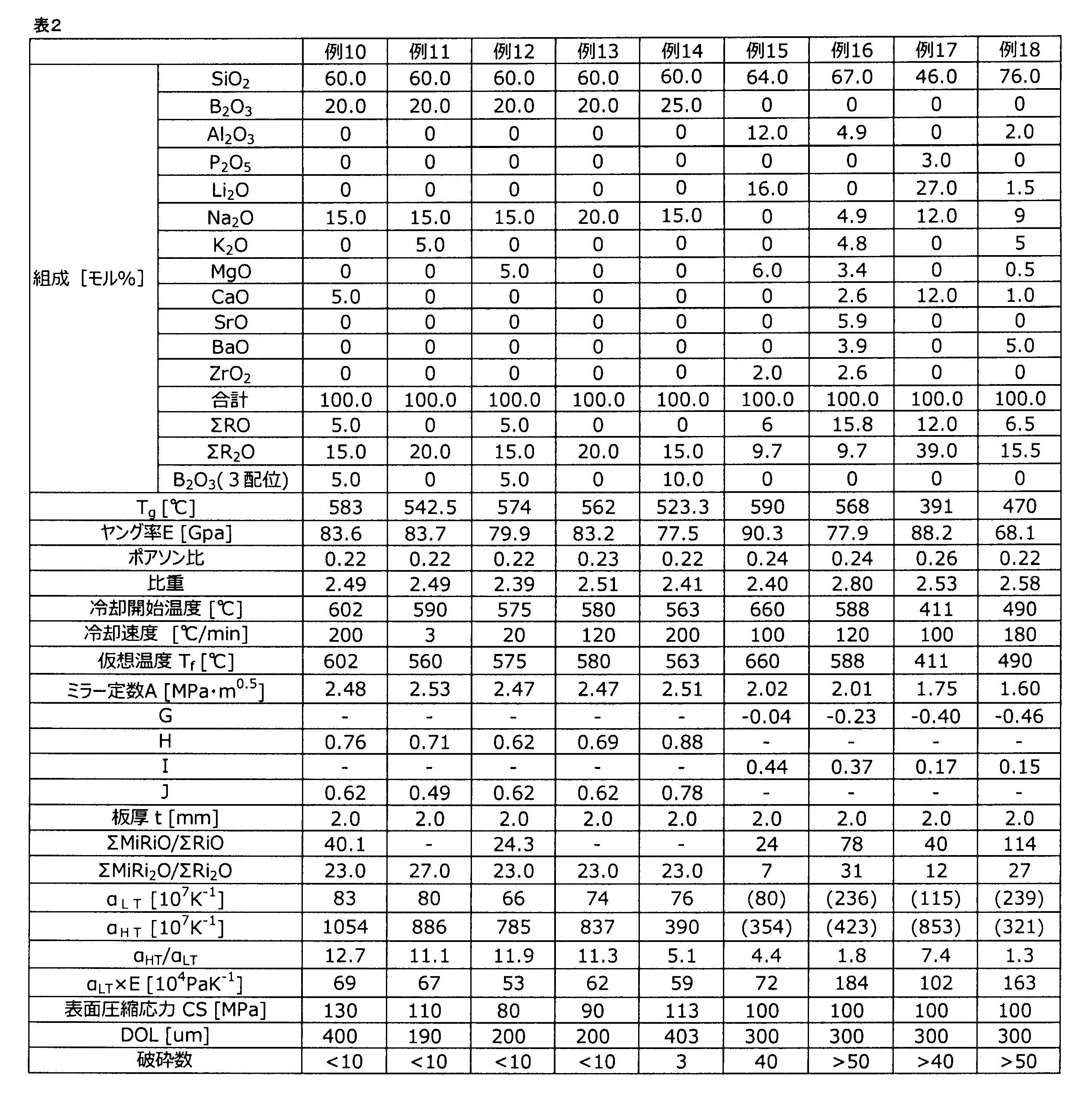
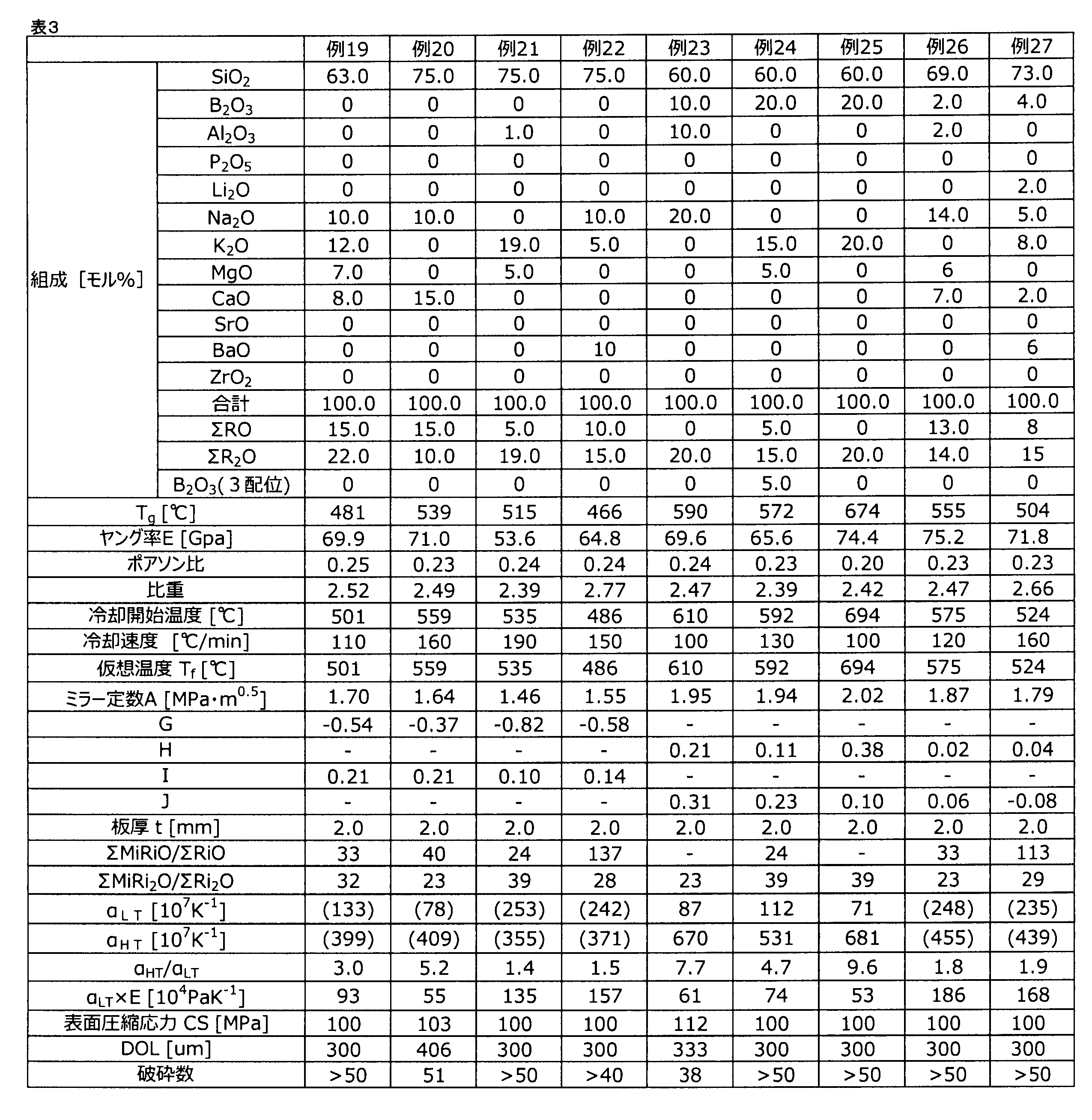
ミラー定数Aが2.2MPa・m0.5以上である例1~14の強化ガラスは、破砕数が10個未満であり、破砕片が少なかった。一方、ミラー定数Aが2.2MPa・m0.5未満である例15~27の強化ガラスは、破砕数が38個以上であり、破砕片が多かった。
本発明を詳細にまた特定の実施態様を参照して説明したが、本発明の精神と範囲を逸脱することなく様々な変更や修正を加えることができることは、当業者にとって明らかである。
本出願は、2017年7月18日出願の日本特許出願2017-138853に基づくものであり、その内容はここに参照として取り込まれる。
本出願は、2017年7月18日出願の日本特許出願2017-138853に基づくものであり、その内容はここに参照として取り込まれる。
本発明の強化ガラスは、例えば、車両の窓用ガラス、建築物の窓用ガラス、外壁、太陽電池カバーガラスとして、特に建築物の窓用ガラスとして好適に用いられる。
Claims (16)
- ミラー定数Aが2.2MPa・m0.5以上であり、表面圧縮応力(CS)が10MPa以上であり、板厚tが1.2mm以上50mm以下である強化ガラス。
- 板厚t方向中心部の仮想温度がガラス転移点Tg+60℃以下である、請求項1に記載の強化ガラス。
- 前記表面圧縮応力(CS)と前記ミラー定数Aとの積(CS×A)が22(MPa)2・m0.5以上である、請求項1または2に記載の強化ガラス。
- 前記板厚をt(単位:mm)としたときに、圧縮応力層深さDOLが(1/10)×tmm以上である、請求項1~3のいずれか一項に記載の強化ガラス。
- 酸化物基準のモル百分率表示で、SiO2を30~85%、Al2O3を0~40%、P2O5を0~10%含有し、かつアルカリ金属酸化物(R2O)を総量で8~40%、アルカリ土類金属酸化物(RO)を総量で0~40%含有し、B2O3を実質的に含有しない、請求項1~4のいずれか一項に記載の強化ガラス。
- ヤング率Eが68GPa以上である、請求項5に記載の強化ガラス。
- 下記式で表されるGが0以上である、請求項5または6に記載の強化ガラス。
G=E×0.013+ν×(-6.6)+[Al2O3]×0.023+ΣRO×0.013
(式中、Eはガラスのヤング率(GPa)、νはガラスのポアソン比、[Al2O3]はガラス中のAl2O3の含有量(酸化物基準のモル%)、ΣROはガラス中のアルカリ土類金属酸化物の合計含有量(酸化物基準のモル%)である。) - 下記式で表されるIが0.45以上である、請求項5~7のいずれか一項に記載の強化ガラス。
I=[Al2O3]×0.03+ΣRO×0.014
(式中、[Al2O3]はガラス中のAl2O3含有量(酸化物基準のモル%)、ΣROはガラス中のアルカリ土類金属酸化物の合計含有量(酸化物基準のモル%)である。) - 酸化物基準のモル百分率表示で、B2O3を0.01~40%、SiO2を40~75%、Al2O3を0~20%、P2O5を0~10%含有し、かつアルカリ金属酸化物(R2O)を総量で8~40%、アルカリ土類金属酸化物(RO)を総量で0~40%含有する、請求項1~4のいずれか一項に記載の強化ガラス。
- ヤング率Eが70GPa以上である、請求項9に記載の強化ガラス。
- 下記式で表されるHが0.4以上である、請求項9または10に記載の強化ガラス。
H=B2O3(三配位)×0.039+E×0.036+ΣRO×(-0.030)-2.3
(式中、B2O3(三配位)はガラス中の三配位ホウ素含有量(酸化物基準のモル%)、Eはガラスのヤング率(GPa)、ΣROはガラス中のアルカリ土類金属酸化物の合計含有量(酸化物基準のモル%)である。) - 下記式で表されるJが0.45以上である、請求項9~11のいずれか一項に記載の強化ガラス。
J=[B2O3]×0.031-0.026×[K2O]
(式中、[B2O3]はガラス中のB2O3含有量(酸化物基準のモル%)、[K2O]はガラス中のK2O含有量(酸化物基準のモル%)である。) - 50~350℃での平均熱膨張係数を低温熱膨張係数αLTとするとき、該低温熱膨張係数αLTが60×10-7・K-1以上である、請求項1~12のいずれか一項に記載の強化ガラス。
- ガラス転移点と屈伏点との間における熱膨張係数の極大値を高温熱膨張係数αHTとするとき、前記高温熱膨張係数αHTと前記低温熱膨張係数αLTとの比αHT/αLTが2以上である、請求項13に記載の強化ガラス。
- 前記低温熱膨張係数αLTと前記ヤング率Eとの積αLT×Eが4×10⁵Pa・K-1以上である、請求項13または14に記載の強化ガラス。
- 風冷強化ガラスである、請求項1~15のいずれか一項に記載の強化ガラス。
Priority Applications (1)
| Application Number | Priority Date | Filing Date | Title |
|---|---|---|---|
| JP2019530577A JP7136100B2 (ja) | 2017-07-18 | 2018-07-18 | 強化ガラス |
Applications Claiming Priority (2)
| Application Number | Priority Date | Filing Date | Title |
|---|---|---|---|
| JP2017138853 | 2017-07-18 | ||
| JP2017-138853 | 2017-07-18 |
Publications (1)
| Publication Number | Publication Date |
|---|---|
| WO2019017404A1 true WO2019017404A1 (ja) | 2019-01-24 |
Family
ID=65015791
Family Applications (1)
| Application Number | Title | Priority Date | Filing Date |
|---|---|---|---|
| PCT/JP2018/026961 Ceased WO2019017404A1 (ja) | 2017-07-18 | 2018-07-18 | 強化ガラス |
Country Status (2)
| Country | Link |
|---|---|
| JP (1) | JP7136100B2 (ja) |
| WO (1) | WO2019017404A1 (ja) |
Cited By (5)
| Publication number | Priority date | Publication date | Assignee | Title |
|---|---|---|---|---|
| JPWO2021172258A1 (ja) * | 2020-02-28 | 2021-09-02 | ||
| JP2023551815A (ja) * | 2020-11-30 | 2023-12-13 | コーニング インコーポレイテッド | ポアソン比が高いガラス組成物 |
| WO2024106354A1 (ja) * | 2022-11-15 | 2024-05-23 | Agc株式会社 | 化学強化ガラス及びその製造方法 |
| WO2025142920A1 (ja) * | 2023-12-27 | 2025-07-03 | Agc株式会社 | 建築用、車両用又はセンサー用ガラス及び合わせガラス |
| WO2025142918A1 (ja) * | 2023-12-27 | 2025-07-03 | Agc株式会社 | 建築用、車両用又はセンサー用ガラス、曲げガラス、風冷強化ガラス及び合わせガラス |
Families Citing this family (7)
| Publication number | Priority date | Publication date | Assignee | Title |
|---|---|---|---|---|
| WO2022266273A1 (en) | 2021-06-18 | 2022-12-22 | Corning Incorporated | Colored glass articles having improved mechanical durability |
| KR20240023516A (ko) | 2021-06-18 | 2024-02-22 | 코닝 인코포레이티드 | 향상된 기계적 내구성을 갖는 착색 유리 물품 |
| US11634354B2 (en) | 2021-06-18 | 2023-04-25 | Corning Incorporated | Colored glass articles having improved mechanical durability |
| US12454479B2 (en) | 2021-06-18 | 2025-10-28 | Corning Incorporated | Gold containing silicate glass |
| US12378152B2 (en) | 2021-06-18 | 2025-08-05 | Corning Incorporated | Colored glass articles having improved mechanical durability |
| US12054422B2 (en) | 2021-06-18 | 2024-08-06 | Corning Incorporated | Colored glass articles having improved mechanical durability |
| US12240782B2 (en) | 2022-05-31 | 2025-03-04 | Corning Incorporated | Ion exchangeable yellow glass articles |
Citations (4)
| Publication number | Priority date | Publication date | Assignee | Title |
|---|---|---|---|---|
| JP2003308792A (ja) * | 2002-04-17 | 2003-10-31 | Nippon Electric Glass Co Ltd | 平面表示装置用板ガラス |
| JP2009137788A (ja) * | 2007-12-05 | 2009-06-25 | Nippon Electric Glass Co Ltd | フラットパネルディスプレイ用のガラス基板 |
| WO2015111524A1 (ja) * | 2014-01-24 | 2015-07-30 | 旭硝子株式会社 | 強化用ガラス組成物、強化ガラス物品およびその製造方法 |
| JP2015178454A (ja) * | 2011-11-18 | 2015-10-08 | 旭硝子株式会社 | ガラス板および化学強化ガラス |
Family Cites Families (2)
| Publication number | Priority date | Publication date | Assignee | Title |
|---|---|---|---|---|
| JP4951838B2 (ja) * | 1999-11-11 | 2012-06-13 | 日本板硝子株式会社 | 強化用板ガラス |
| KR20140018227A (ko) * | 2011-02-28 | 2014-02-12 | 아사히 가라스 가부시키가이샤 | 강화용 유리판 |
-
2018
- 2018-07-18 WO PCT/JP2018/026961 patent/WO2019017404A1/ja not_active Ceased
- 2018-07-18 JP JP2019530577A patent/JP7136100B2/ja active Active
Patent Citations (4)
| Publication number | Priority date | Publication date | Assignee | Title |
|---|---|---|---|---|
| JP2003308792A (ja) * | 2002-04-17 | 2003-10-31 | Nippon Electric Glass Co Ltd | 平面表示装置用板ガラス |
| JP2009137788A (ja) * | 2007-12-05 | 2009-06-25 | Nippon Electric Glass Co Ltd | フラットパネルディスプレイ用のガラス基板 |
| JP2015178454A (ja) * | 2011-11-18 | 2015-10-08 | 旭硝子株式会社 | ガラス板および化学強化ガラス |
| WO2015111524A1 (ja) * | 2014-01-24 | 2015-07-30 | 旭硝子株式会社 | 強化用ガラス組成物、強化ガラス物品およびその製造方法 |
Non-Patent Citations (2)
| Title |
|---|
| BRADT, R. C. ET AL.: "The fractography and crack patterns of broken glass", J. FAIL. ANAL. PREVEN ., vol. 11, no. 2, April 2011 (2011-04-01), pages 79 - 96 * |
| VARNER, J. R. ET AL.: "Surface defects: Their origin, characterization and effects on strength", J. NON-CRYST. SOLIDS, vol. 19, December 1975 (1975-12-01), pages 321 - 333, XP024063595, DOI: doi:10.1016/0022-3093(75)90097-6 * |
Cited By (10)
| Publication number | Priority date | Publication date | Assignee | Title |
|---|---|---|---|---|
| JPWO2021172258A1 (ja) * | 2020-02-28 | 2021-09-02 | ||
| WO2021172258A1 (ja) * | 2020-02-28 | 2021-09-02 | Hoya株式会社 | 成型用ガラス素材 |
| JP2023551815A (ja) * | 2020-11-30 | 2023-12-13 | コーニング インコーポレイテッド | ポアソン比が高いガラス組成物 |
| WO2024106354A1 (ja) * | 2022-11-15 | 2024-05-23 | Agc株式会社 | 化学強化ガラス及びその製造方法 |
| JP7511120B1 (ja) * | 2022-11-15 | 2024-07-05 | Agc株式会社 | 化学強化ガラス及びその製造方法 |
| JP2024110994A (ja) * | 2022-11-15 | 2024-08-16 | Agc株式会社 | 化学強化ガラス及びその製造方法 |
| US12304855B2 (en) | 2022-11-15 | 2025-05-20 | AGC Inc. | Chemically strengthened glass and method for manufacturing same |
| JP7816415B2 (ja) | 2022-11-15 | 2026-02-18 | Agc株式会社 | 化学強化ガラス及びその製造方法 |
| WO2025142920A1 (ja) * | 2023-12-27 | 2025-07-03 | Agc株式会社 | 建築用、車両用又はセンサー用ガラス及び合わせガラス |
| WO2025142918A1 (ja) * | 2023-12-27 | 2025-07-03 | Agc株式会社 | 建築用、車両用又はセンサー用ガラス、曲げガラス、風冷強化ガラス及び合わせガラス |
Also Published As
| Publication number | Publication date |
|---|---|
| JP7136100B2 (ja) | 2022-09-13 |
| JPWO2019017404A1 (ja) | 2020-07-02 |
Similar Documents
| Publication | Publication Date | Title |
|---|---|---|
| JP7327533B2 (ja) | 化学強化用ガラス、化学強化ガラスおよび化学強化ガラスの製造方法 | |
| JP7136096B2 (ja) | 化学強化ガラス、その製造方法および化学強化用ガラス | |
| JP7184073B2 (ja) | 化学強化用ガラス | |
| JP7136100B2 (ja) | 強化ガラス | |
| CN109455926B (zh) | 化学强化玻璃以及化学强化用玻璃 | |
| JP7136101B2 (ja) | 強化ガラス | |
| JP5621239B2 (ja) | ディスプレイ装置用ガラス板、ディスプレイ装置用板ガラスおよびその製造方法 | |
| JP2019147738A (ja) | 化学強化ガラス及び化学強化ガラスの製造方法 | |
| KR102644011B1 (ko) | 화학 강화용 유리 | |
| JP7533456B2 (ja) | ガラス、化学強化ガラスおよびその製造方法 | |
| WO2020008901A1 (ja) | 化学強化ガラスおよびその製造方法 | |
| JP2023118789A (ja) | カバーガラス | |
| JP2025159118A (ja) | 化学強化ガラス物品およびその製造方法 | |
| JP2025103785A (ja) | 化学強化ガラス、化学強化ガラスの製造方法およびカバーガラス |
Legal Events
| Date | Code | Title | Description |
|---|---|---|---|
| 121 | Ep: the epo has been informed by wipo that ep was designated in this application |
Ref document number: 18835402 Country of ref document: EP Kind code of ref document: A1 |
|
| ENP | Entry into the national phase |
Ref document number: 2019530577 Country of ref document: JP Kind code of ref document: A |
|
| NENP | Non-entry into the national phase |
Ref country code: DE |
|
| 122 | Ep: pct application non-entry in european phase |
Ref document number: 18835402 Country of ref document: EP Kind code of ref document: A1 |