WO2019008802A1 - 電極塗工液組成物、該電極塗工液組成物を用いて作製された蓄電デバイス用電極、および該電極を備える蓄電デバイス - Google Patents
電極塗工液組成物、該電極塗工液組成物を用いて作製された蓄電デバイス用電極、および該電極を備える蓄電デバイス Download PDFInfo
- Publication number
- WO2019008802A1 WO2019008802A1 PCT/JP2018/002046 JP2018002046W WO2019008802A1 WO 2019008802 A1 WO2019008802 A1 WO 2019008802A1 JP 2018002046 W JP2018002046 W JP 2018002046W WO 2019008802 A1 WO2019008802 A1 WO 2019008802A1
- Authority
- WO
- WIPO (PCT)
- Prior art keywords
- electrode
- coating liquid
- mass
- liquid composition
- cellulose
- Prior art date
- Legal status (The legal status is an assumption and is not a legal conclusion. Google has not performed a legal analysis and makes no representation as to the accuracy of the status listed.)
- Ceased
Links
Classifications
-
- H—ELECTRICITY
- H01—ELECTRIC ELEMENTS
- H01M—PROCESSES OR MEANS, e.g. BATTERIES, FOR THE DIRECT CONVERSION OF CHEMICAL ENERGY INTO ELECTRICAL ENERGY
- H01M4/00—Electrodes
- H01M4/02—Electrodes composed of, or comprising, active material
- H01M4/04—Processes of manufacture in general
- H01M4/0402—Methods of deposition of the material
- H01M4/0404—Methods of deposition of the material by coating on electrode collectors
-
- H—ELECTRICITY
- H01—ELECTRIC ELEMENTS
- H01G—CAPACITORS; CAPACITORS, RECTIFIERS, DETECTORS, SWITCHING DEVICES, LIGHT-SENSITIVE OR TEMPERATURE-SENSITIVE DEVICES OF THE ELECTROLYTIC TYPE
- H01G11/00—Hybrid capacitors, i.e. capacitors having different positive and negative electrodes; Electric double-layer [EDL] capacitors; Processes for the manufacture thereof or of parts thereof
- H01G11/22—Electrodes
-
- H—ELECTRICITY
- H01—ELECTRIC ELEMENTS
- H01G—CAPACITORS; CAPACITORS, RECTIFIERS, DETECTORS, SWITCHING DEVICES, LIGHT-SENSITIVE OR TEMPERATURE-SENSITIVE DEVICES OF THE ELECTROLYTIC TYPE
- H01G11/00—Hybrid capacitors, i.e. capacitors having different positive and negative electrodes; Electric double-layer [EDL] capacitors; Processes for the manufacture thereof or of parts thereof
- H01G11/22—Electrodes
- H01G11/30—Electrodes characterised by their material
- H01G11/32—Carbon-based
- H01G11/38—Carbon pastes or blends; Binders or additives therein
-
- H—ELECTRICITY
- H01—ELECTRIC ELEMENTS
- H01G—CAPACITORS; CAPACITORS, RECTIFIERS, DETECTORS, SWITCHING DEVICES, LIGHT-SENSITIVE OR TEMPERATURE-SENSITIVE DEVICES OF THE ELECTROLYTIC TYPE
- H01G11/00—Hybrid capacitors, i.e. capacitors having different positive and negative electrodes; Electric double-layer [EDL] capacitors; Processes for the manufacture thereof or of parts thereof
- H01G11/22—Electrodes
- H01G11/30—Electrodes characterised by their material
- H01G11/50—Electrodes characterised by their material specially adapted for lithium-ion capacitors, e.g. for lithium-doping or for intercalation
-
- H—ELECTRICITY
- H01—ELECTRIC ELEMENTS
- H01M—PROCESSES OR MEANS, e.g. BATTERIES, FOR THE DIRECT CONVERSION OF CHEMICAL ENERGY INTO ELECTRICAL ENERGY
- H01M10/00—Secondary cells; Manufacture thereof
- H01M10/05—Accumulators with non-aqueous electrolyte
- H01M10/052—Li-accumulators
- H01M10/0525—Rocking-chair batteries, i.e. batteries with lithium insertion or intercalation in both electrodes; Lithium-ion batteries
-
- H—ELECTRICITY
- H01—ELECTRIC ELEMENTS
- H01M—PROCESSES OR MEANS, e.g. BATTERIES, FOR THE DIRECT CONVERSION OF CHEMICAL ENERGY INTO ELECTRICAL ENERGY
- H01M10/00—Secondary cells; Manufacture thereof
- H01M10/42—Methods or arrangements for servicing or maintenance of secondary cells or secondary half-cells
- H01M10/44—Methods for charging or discharging
-
- H—ELECTRICITY
- H01—ELECTRIC ELEMENTS
- H01M—PROCESSES OR MEANS, e.g. BATTERIES, FOR THE DIRECT CONVERSION OF CHEMICAL ENERGY INTO ELECTRICAL ENERGY
- H01M4/00—Electrodes
- H01M4/02—Electrodes composed of, or comprising, active material
- H01M4/13—Electrodes for accumulators with non-aqueous electrolyte, e.g. for lithium-accumulators; Processes of manufacture thereof
-
- H—ELECTRICITY
- H01—ELECTRIC ELEMENTS
- H01M—PROCESSES OR MEANS, e.g. BATTERIES, FOR THE DIRECT CONVERSION OF CHEMICAL ENERGY INTO ELECTRICAL ENERGY
- H01M4/00—Electrodes
- H01M4/02—Electrodes composed of, or comprising, active material
- H01M4/13—Electrodes for accumulators with non-aqueous electrolyte, e.g. for lithium-accumulators; Processes of manufacture thereof
- H01M4/139—Processes of manufacture
-
- H—ELECTRICITY
- H01—ELECTRIC ELEMENTS
- H01M—PROCESSES OR MEANS, e.g. BATTERIES, FOR THE DIRECT CONVERSION OF CHEMICAL ENERGY INTO ELECTRICAL ENERGY
- H01M4/00—Electrodes
- H01M4/02—Electrodes composed of, or comprising, active material
- H01M4/36—Selection of substances as active materials, active masses, active liquids
- H01M4/362—Composites
- H01M4/366—Composites as layered products
-
- H—ELECTRICITY
- H01—ELECTRIC ELEMENTS
- H01M—PROCESSES OR MEANS, e.g. BATTERIES, FOR THE DIRECT CONVERSION OF CHEMICAL ENERGY INTO ELECTRICAL ENERGY
- H01M4/00—Electrodes
- H01M4/02—Electrodes composed of, or comprising, active material
- H01M4/36—Selection of substances as active materials, active masses, active liquids
- H01M4/38—Selection of substances as active materials, active masses, active liquids of elements or alloys
- H01M4/386—Silicon or alloys based on silicon
-
- H—ELECTRICITY
- H01—ELECTRIC ELEMENTS
- H01M—PROCESSES OR MEANS, e.g. BATTERIES, FOR THE DIRECT CONVERSION OF CHEMICAL ENERGY INTO ELECTRICAL ENERGY
- H01M4/00—Electrodes
- H01M4/02—Electrodes composed of, or comprising, active material
- H01M4/36—Selection of substances as active materials, active masses, active liquids
- H01M4/48—Selection of substances as active materials, active masses, active liquids of inorganic oxides or hydroxides
- H01M4/50—Selection of substances as active materials, active masses, active liquids of inorganic oxides or hydroxides of manganese
- H01M4/505—Selection of substances as active materials, active masses, active liquids of inorganic oxides or hydroxides of manganese of mixed oxides or hydroxides containing manganese for inserting or intercalating light metals, e.g. LiMn2O4 or LiMn2OxFy
-
- H—ELECTRICITY
- H01—ELECTRIC ELEMENTS
- H01M—PROCESSES OR MEANS, e.g. BATTERIES, FOR THE DIRECT CONVERSION OF CHEMICAL ENERGY INTO ELECTRICAL ENERGY
- H01M4/00—Electrodes
- H01M4/02—Electrodes composed of, or comprising, active material
- H01M4/36—Selection of substances as active materials, active masses, active liquids
- H01M4/48—Selection of substances as active materials, active masses, active liquids of inorganic oxides or hydroxides
- H01M4/52—Selection of substances as active materials, active masses, active liquids of inorganic oxides or hydroxides of nickel, cobalt or iron
- H01M4/525—Selection of substances as active materials, active masses, active liquids of inorganic oxides or hydroxides of nickel, cobalt or iron of mixed oxides or hydroxides containing iron, cobalt or nickel for inserting or intercalating light metals, e.g. LiNiO2, LiCoO2 or LiCoOxFy
-
- H—ELECTRICITY
- H01—ELECTRIC ELEMENTS
- H01M—PROCESSES OR MEANS, e.g. BATTERIES, FOR THE DIRECT CONVERSION OF CHEMICAL ENERGY INTO ELECTRICAL ENERGY
- H01M4/00—Electrodes
- H01M4/02—Electrodes composed of, or comprising, active material
- H01M4/36—Selection of substances as active materials, active masses, active liquids
- H01M4/58—Selection of substances as active materials, active masses, active liquids of inorganic compounds other than oxides or hydroxides, e.g. sulfides, selenides, tellurides, halogenides or LiCoFy; of polyanionic structures, e.g. phosphates, silicates or borates
- H01M4/583—Carbonaceous material, e.g. graphite-intercalation compounds or CFx
-
- H—ELECTRICITY
- H01—ELECTRIC ELEMENTS
- H01M—PROCESSES OR MEANS, e.g. BATTERIES, FOR THE DIRECT CONVERSION OF CHEMICAL ENERGY INTO ELECTRICAL ENERGY
- H01M4/00—Electrodes
- H01M4/02—Electrodes composed of, or comprising, active material
- H01M4/62—Selection of inactive substances as ingredients for active masses, e.g. binders, fillers
-
- H—ELECTRICITY
- H01—ELECTRIC ELEMENTS
- H01G—CAPACITORS; CAPACITORS, RECTIFIERS, DETECTORS, SWITCHING DEVICES, LIGHT-SENSITIVE OR TEMPERATURE-SENSITIVE DEVICES OF THE ELECTROLYTIC TYPE
- H01G11/00—Hybrid capacitors, i.e. capacitors having different positive and negative electrodes; Electric double-layer [EDL] capacitors; Processes for the manufacture thereof or of parts thereof
- H01G11/04—Hybrid capacitors
- H01G11/06—Hybrid capacitors with one of the electrodes allowing ions to be reversibly doped thereinto, e.g. lithium ion capacitors [LIC]
-
- H—ELECTRICITY
- H01—ELECTRIC ELEMENTS
- H01M—PROCESSES OR MEANS, e.g. BATTERIES, FOR THE DIRECT CONVERSION OF CHEMICAL ENERGY INTO ELECTRICAL ENERGY
- H01M4/00—Electrodes
- H01M4/02—Electrodes composed of, or comprising, active material
- H01M2004/026—Electrodes composed of, or comprising, active material characterised by the polarity
- H01M2004/027—Negative electrodes
-
- H—ELECTRICITY
- H01—ELECTRIC ELEMENTS
- H01M—PROCESSES OR MEANS, e.g. BATTERIES, FOR THE DIRECT CONVERSION OF CHEMICAL ENERGY INTO ELECTRICAL ENERGY
- H01M4/00—Electrodes
- H01M4/02—Electrodes composed of, or comprising, active material
- H01M2004/026—Electrodes composed of, or comprising, active material characterised by the polarity
- H01M2004/028—Positive electrodes
-
- H—ELECTRICITY
- H01—ELECTRIC ELEMENTS
- H01M—PROCESSES OR MEANS, e.g. BATTERIES, FOR THE DIRECT CONVERSION OF CHEMICAL ENERGY INTO ELECTRICAL ENERGY
- H01M4/00—Electrodes
- H01M4/02—Electrodes composed of, or comprising, active material
- H01M4/62—Selection of inactive substances as ingredients for active masses, e.g. binders, fillers
- H01M4/621—Binders
- H01M4/622—Binders being polymers
-
- Y—GENERAL TAGGING OF NEW TECHNOLOGICAL DEVELOPMENTS; GENERAL TAGGING OF CROSS-SECTIONAL TECHNOLOGIES SPANNING OVER SEVERAL SECTIONS OF THE IPC; TECHNICAL SUBJECTS COVERED BY FORMER USPC CROSS-REFERENCE ART COLLECTIONS [XRACs] AND DIGESTS
- Y02—TECHNOLOGIES OR APPLICATIONS FOR MITIGATION OR ADAPTATION AGAINST CLIMATE CHANGE
- Y02E—REDUCTION OF GREENHOUSE GAS [GHG] EMISSIONS, RELATED TO ENERGY GENERATION, TRANSMISSION OR DISTRIBUTION
- Y02E60/00—Enabling technologies; Technologies with a potential or indirect contribution to GHG emissions mitigation
- Y02E60/10—Energy storage using batteries
Definitions
- the present invention relates to an electrode coating liquid composition, an electrode for a power storage device produced using the electrode coating liquid composition, and a power storage device provided with the electrode.
- a power storage device having a high voltage and a high energy density has been required as a power supply for driving an electronic device.
- lithium ion secondary batteries, lithium ion capacitors and the like are expected as high voltage, high energy density storage devices.
- an electrode used for a storage device is usually manufactured by applying and drying a mixture of electrode active material particles, conductive material particles, and a binder on the surface of a current collector.
- the storage device include a lithium ion secondary battery, an electric double layer capacitor, and a lithium ion capacitor.
- These power storage devices are mainly composed of members such as an electrode, a non-aqueous electrolyte, and a separator.
- an electrode for a storage device is, for example, applying an electrode mixture solution for a storage device, in which an electrode active material and a conductive material are dispersed in an organic solvent or water together with a binder, on a metal foil as a collector surface. It is formed by drying.
- the characteristics of the electricity storage device depend, of course, largely on the main constituent materials such as the electrode particle material, electrolyte, and current collector used, but the binder, thickening stabilizer, and dispersant used as additives It also depends greatly on.
- the binder for a storage battery device is mainly divided into an organic solvent based binder in which a polymer is dissolved in an organic solvent and an aqueous binder in which a polymer is dissolved or dispersed in water.
- an electrode mixture for a water-based storage device using a water-based binder has attracted attention because it can reduce the environmental load and production cost and can improve the working environment.
- electrode materials such as electrode active materials and conductive materials are being made into nanomaterials along with the increase in capacity and energy of batteries.
- a dispersant for improving the dispersion stability is added for the purpose of dispersing and stabilizing the electrode active material and the conductive material, and imparting a viscosity suitable for coating the electrode coating liquid.
- a water-soluble polymer is used as a dispersing agent, and among them, carboxymethyl cellulose salt has excellent dispersion stability and is often used.
- Patent Document 1 Patent Document 2
- the dispersion stability may be insufficient, the dispersion stabilization may take a long time, or the coating failure of the electrode coating liquid There was a problem such as
- the electrode active material is dispersed by mixing the electrode active material, the thickening / stabilizing agent, the dispersion medium, and other components to produce an electrode coating liquid.
- a mixing / dispersing machine having a large dispersing ability.
- Patent Document 5 reports that the dispersibility of the paint is improved and the battery performance is improved by using a cellulose fiber having a nano-sized fiber width.
- the cellulose fiber having a high aspect ratio is present in the paint, the thixotropy of the paint becomes too high, and a uniform coating is stably produced using a coating method such as a roll coater used for mass production of electrodes for storage devices. There is a problem that it is difficult to do.
- the present invention is excellent in the dispersion stability of the electrode active material and the conductive material, and even when using a dispersion apparatus with weak shear force, uniform electrode preparation is possible in a short time, and suitable paint physical properties excellent in mass productivity.
- An object of the present invention is to provide an electrode coating liquid composition, an electrode for a storage device manufactured using the composition, and a storage device including the electrode for the storage device.
- the present inventors have conducted intensive studies to obtain an electrode coating liquid composition which is excellent in the dispersion stability of the electrode active material and the poorly dispersed conductive auxiliary agent, and which can produce a uniform electrode even with a weak shear dispersion device. I piled up.
- the desired problems can be solved by combining the cellulose fibers and additives such as other dispersants in a certain ratio. Reached. That is, the present invention provides the following [1] to [7].
- An electrode coating liquid composition containing an active material, a conductive additive, a dispersant, and a binder, wherein the dispersant contains cellulose fibers satisfying the following (a) to (c),
- the total amount of a dispersing agent and a binder contains 0.5 mass% or more and 15 mass% or less with respect to solid content 100 mass% of an electrode coating liquid composition.
- the number average width of the short width is 2 nm to 200 nm
- the aspect ratio is 7.5 to 75
- cellulose I type crystal and the crystallinity is 70% to 95%
- the anionic functional group is a carboxyl group, and the content of the carboxyl group is 1.2 mmol / g or more and 2.5 mmol / g or less
- a content of the above-mentioned cellulose fiber is 0.05 mass% or more and 5.00 mass% or less with respect to 100 mass% of solid content of the electrode coating liquid composition [1] to [3] ]
- the electrode coating liquid composition as described in any one of the above.
- An electrode for a storage battery device comprising the dried product of the composition for an electrode coating liquid according to any one of [1] to [6].
- a storage device comprising the storage device electrode described in [6].
- an electrode without bias is obtained by uniformly dispersing the electrode material, and the obtained electric storage device has high electron conductivity and accordingly low internal resistance. It has the effect of increasing the battery performance. Furthermore, since the cellulose fiber having a small aspect ratio is included, it is possible to appropriately adjust the coating thixotropy, and it is possible to produce an electrode with high film thickness uniformity using a mass-production coating machine such as a roll coater. It is possible.
- the electrode coating liquid composition of the present invention does not require a strong mechanical dispersion operation conventionally required for uniform dispersion of the electrode coating liquid, and is a simple mechanical having a weak shearing force.
- the dispersing device can uniformly disperse the electrode coating liquid.
- the electrode coating liquid composition of the present invention contains an active material, a conductive aid, a dispersant, and a binder.
- the dispersant contains a predetermined cellulose fiber.
- the above-mentioned cellulose fiber has a number average width of 2 nm or more and 200 nm or less in the short width. If the number average width of the short width is less than 2 nm, the problem of poor dispersion stability occurs, and if it exceeds 200 nm, the problem of poor dispersion performance occurs.
- the number average width can be measured by the following method. That is, an aqueous dispersion of fine cellulose fibers with a solid content of 0.05 to 0.1% by mass is prepared, and the dispersion is cast on a hydrophilized carbon film-coated grid to obtain transmission electron Let it be a sample for observation of a microscope (TEM).
- observation with an electron microscope image is performed at a magnification of 5000 times, 10000 times or 50000 times depending on the size of the fibers to be constructed.
- an axis of an arbitrary image width in the vertical and horizontal directions is assumed in the obtained image, and the sample and observation conditions (such as magnification) are adjusted such that 20 or more fibers intersect with the axis.
- a random axis is drawn for each image of two vertical and horizontal lines per image, and the width of fibers intersecting with the axis is read visually.
- the lower limit of the aspect ratio of the cellulose fiber is 7.5 or more, preferably 25 or more.
- the upper limit is 75 or less, preferably 50 or less. If the aspect ratio is less than 7.5, the dispersibility of the electrode material may be insufficient. If it exceeds 75, the thixotropy of the paint is too high, and a mass-production apparatus such as a roll coater is used. There is a risk that uniform coating will be difficult. In addition, a strong shearing force is required to disperse the electrode material, which may damage the electrode material.
- the aspect ratio of the above-mentioned cellulose fiber can be measured, for example, by the following method, that is, after casting cellulose on a hydrophilized carbon film-coated grid, a TEM image (magnification of magnification) negatively stained with 2% uranyl acetate
- the number average width of the short width of the cellulose fiber and the number average width of the long width were observed from 10000 times). That is, the number average width of the short width and the number average width of the long width were calculated according to each of the methods described above, and the aspect ratio was calculated according to the following equation (1) using these values. .
- Aspect ratio number average width (nm) of the long width side / number average width (nm) of the short width side (1)
- the cellulose fiber has cellulose type I crystals, and the degree of crystallinity is 70% or more. When the degree of crystallinity is less than 70%, the characteristics derived from the cellulose crystal structure can not be expressed, and the dispersibility of the electrode material may be insufficient.
- the degree of crystallinity may more preferably be 80% or more.
- the upper limit of the degree of crystallinity is not particularly limited, but is preferably 95% or less, more preferably 92% or less, from the viewpoint of the shear force required for the dispersion of the electrode material.
- the crystallinity degree of cellulose is a cellulose type I crystallinity degree calculated by the Segal method from the diffraction intensity value by the X-ray diffraction method, and is defined by the following formula (2).
- Cellulose type I crystallinity (%) [(I 22.6 ⁇ I 18.5 ) / I 22.6 ] ⁇ 100 (2)
- cellulose I type is a crystal form of natural cellulose
- cellulose I type crystallinity means the ratio for which the amount of the crystal region occupies in the whole cellulose.
- the cellulose fiber can be produced by a known method. Although not particularly limited, specifically, for example, it can be obtained by suspending natural cellulose fiber in water and treating it with a high-pressure homogenizer, grinder or the like to make it finer.
- the natural cellulose fiber is not particularly limited as long as it is a plant or animal, or a cellulose fiber derived from a microorganism, and kraft pulp or dissolved pulp derived from softwood or hardwood, cotton linter, lignocellulose having low cellulose purity, wood flour, grass cellulose, Bacterial cellulose etc. are mentioned.
- the said cellulose fiber can use the bacterial cellulose fiber produced by bacteria.
- the bacteria include Acetobacter (Acetobacter) genus and the like, and more specifically, Acetobacter aceti (Acetobacter aceti), Acetobacter subsp., Acetobacter xylinum etc. It can be mentioned.
- Acetobacter Acetobacter
- Aceti Acetobacter aceti
- Acetobacter subsp. Acetobacter xylinum etc. It can be mentioned.
- cellulose is produced from the bacteria.
- the resulting product contains bacteria and cellulose fibers (bacterial cellulose) produced from the bacteria and linked to the bacteria, so this product is removed from the culture medium, washed with water, or treated with an alkali, etc. By removing the bacteria, it is possible to obtain water-containing bacterial cellulose free of bacteria.
- the above-mentioned cellulose fiber can maintain I-type crystal structure, and from the viewpoint of being able to fibrillate efficiently to a predetermined fiber diameter, it is a cellulose fiber having an anionic group preferable.
- the anionic group is not particularly limited, and examples thereof include a carboxylic acid group, a phosphoric acid group, a sulfonic acid group, a sulfuric acid group, or a salt of these groups, and any one of these groups is included. And may have two or more. Moreover, you may have a coupling group between the glucose unit which comprises cellulose, and the said anionic group.
- the salt of the anionic group is not particularly limited, and examples thereof include alkali metal salts such as sodium salt, potassium salt and lithium salt, alkaline earth metal salts such as magnesium salt, calcium salt and barium salt, ammonium salt and phosphonium salt Amine salts such as onium salts, primary amines, secondary amines, tertiary amines and the like can be mentioned.
- alkali metal salts such as sodium salt, potassium salt and lithium salt
- alkaline earth metal salts such as magnesium salt, calcium salt and barium salt
- Amine salts such as onium salts, primary amines, secondary amines, tertiary amines and the like can be mentioned.
- the anionic group includes an acid type such as carboxylic acid group, phosphoric acid group, sulfonic acid group and sulfuric acid group, and a salt type such as carboxylic acid group, phosphoric acid group, sulfonic acid group and sulfuric acid base
- a preferred embodiment is that it contains a salt type anionic group, a cellulose fiber having only a salt type anionic group may be used, and a salt type anionic group and an acid type anion You may use the cellulose fiber in which the sex group is mixed.
- an oxidized cellulose formed by oxidizing a hydroxyl group of a glucose unit constituting the cellulose is exemplified to be described more specifically, and a manufacturing method An example is also described.
- the oxidized cellulose is not particularly limited, but it is preferable that the 6-position hydroxyl group of the glucose unit be selectively oxidized. It can be confirmed, for example, by a 13 C-NMR chart that the oxidized cellulose is a selectively oxidized hydroxyl group at the 6-position on the glucose unit.
- the oxidized cellulose may have an aldehyde group or a ketone group together with a carboxylic acid group (COOH) and / or a carboxylic acid group (COOX, wherein X represents a cation forming a salt with the carboxylic acid). Is preferably substantially free of an aldehyde group and a ketone group.
- the content (hereinafter referred to as the carboxyl group weight) of the carboxylic acid group of the cellulose fiber is preferably 1.2 mmol / g or more and more preferably 1.5 mmol / g or more. Moreover, 2.5 mmol / g or less is preferable, More preferably, it is 2.0 mmol / g or less. When the amount of carboxyl groups is in the above range, the dispersibility of the electrode material becomes good.
- the amount of carboxyl groups of the above-mentioned cellulose fiber is measured, for example, by preparing 60 mL of a 0.5 to 1% by mass slurry from a cellulose sample whose dry mass is precisely weighed, and adjusting the pH to about 2.5 with 0.1 M aqueous hydrochloric acid After that, a 0.05 M aqueous solution of sodium hydroxide is dropped to conduct electrical conductivity measurement. The measurement is continued until the pH is about 11. From the amount of sodium hydroxide (V) consumed in the step of neutralization of a weak acid in which the change in electrical conductivity is gradual, the amount of carboxyl groups can be determined according to the following formula (3).
- Carboxyl group content (mmol / g) V (mL) ⁇ [0.05 / cellulose mass] (3)
- adjustment of the amount of carboxyl groups can be performed by controlling the addition amount and reaction time of the co-oxidant used by the oxidation process of a cellulose fiber so that it may mention later.
- the above-mentioned oxidized cellulose fiber uses natural cellulose fiber as a raw material, uses N-oxyl compound as an oxidation catalyst in water, and reacts with a co-oxidant to oxidize the natural cellulose fiber to obtain a reaction product (1) It can be obtained by a manufacturing method including a purification step (2) to obtain a reactant impregnated with water by removing impurities and a dispersion step (3) to disperse the reactant impregnated with water in a solvent.
- (1) Oxidation Reaction Step After the natural cellulose fiber and the N-oxyl compound are dispersed in water (dispersion medium), a co-oxidant is added to start the reaction. During the reaction, 0.5 M aqueous sodium hydroxide solution is added dropwise to keep the pH at 10 to 11, and when no change is observed in the pH, the reaction is regarded as complete.
- the co-oxidant is not a substance that directly oxidizes a cellulose hydroxyl group, but a substance that oxidizes an N-oxyl compound used as an oxidation catalyst.
- the above-mentioned natural cellulose fiber means a purified cellulose fiber isolated from a biosynthetic system of cellulose such as plant, animal and bacteria-produced gel. More specifically, cotton pulp such as softwood pulp, hardwood pulp, cotton linter and cotton lint, non-wood pulp such as straw pulp and bagasse pulp, bacterial cellulose fiber (BC), and cellulose fiber isolated from sea squirt And cellulose fibers etc. isolated from seaweed. These may be used alone or in combination of two or more. Among these, softwood pulp, hardwood pulp, cotton linter such as cotton linters and cotton lint, non-wood pulp such as straw pulp and bagasse pulp are preferable.
- the above-mentioned natural cellulose fiber is preferable because the reaction efficiency can be enhanced and the productivity can be enhanced by subjecting it to a treatment for increasing the surface area such as beating.
- a treatment for increasing the surface area such as beating.
- the reaction efficiency is enhanced. It is preferable because the number average fiber diameter after the refining treatment can be reduced.
- the dispersion medium of the natural cellulose fiber in the above reaction is water, and the natural cellulose fiber concentration in the reaction aqueous solution is arbitrary as long as the reagent (natural cellulose fiber) can be sufficiently diffused.
- the reaction concentration is about 5% or less based on the weight of the reaction aqueous solution, but the reaction concentration can be increased by using an apparatus with strong mechanical stirring power.
- examples of the N-oxyl compound include compounds having a nitroxy radical generally used as an oxidation catalyst.
- the above-mentioned N-oxyl compound is preferably a water-soluble compound, more preferably piperidine nitroxoxy radical, and in particular 2,2,6,6-tetramethylpiperidinooxy radical (TEMPO) or 4-acetamido-TEMPO preferable.
- TEMPO 2,2,6,6-tetramethylpiperidinooxy radical
- 4-acetamido-TEMPO preferable.
- the addition of the N-oxyl compound is sufficient in a catalytic amount, preferably 0.1 to 4 mmol / L, more preferably 0.2 to 2 mmol / L, and added to the aqueous reaction solution.
- Examples of the co-oxidant include hypohalogenous acid or a salt thereof, hypohalogenous acid or a salt thereof, perhalogenated acid or a salt thereof, hydrogen peroxide, perorganic acid and the like. These may be used alone or in combination of two or more. Among them, alkali metal hypohalites such as sodium hypochlorite and sodium hypobromous acid are preferable. And when using the said sodium hypochlorite, it is preferable to advance reaction in presence of alkali metal bromides, such as sodium bromide, from the point of reaction rate.
- the addition amount of the above-mentioned alkali metal bromide is about 1 to 40 times by mole, preferably about 10 to 20 times by mole, with respect to the above-mentioned N-oxyl compound.
- the pH of the reaction aqueous solution is preferably maintained in the range of about 8-11.
- the temperature of the aqueous solution is optional at about 4 to 40 ° C., but the reaction can be carried out at room temperature (25 ° C.), and control of the temperature is not particularly required.
- the degree of oxidation is controlled by the addition amount of the co-oxidant and the reaction time.
- the reaction time is usually complete within about 5 to 120 minutes, at most 240 minutes. Also, by controlling the amount of co-oxidant added and the pH of the reaction aqueous solution, it is possible to control the degree of hydrolysis of cellulose molecules and to arbitrarily set the aspect ratio of cellulose fibers.
- any device can be used as long as it can achieve the above-mentioned purpose, such as a method using centrifugal dehydration (for example, a continuous decanter).
- the aqueous dispersion of reactant fibers obtained in this manner has a solid content (cellulose fiber) concentration in a squeezed state in the range of approximately 10% by mass to 50% by mass.
- the solid content concentration is higher than 50% by mass, since very high energy is required for dispersion.
- Dispersion process fine processing process
- the reaction product (water dispersion) impregnated with water obtained in the above purification step is dispersed in a dispersion medium to carry out dispersion treatment.
- the viscosity increases with the treatment, and a dispersion of finely divided cellulose fibers can be obtained.
- the degree of the refinement processing for example, the treatment shear force of the dispersing machine, the treatment pressure, the number of treatments, the treatment time, etc.
- the degree of the refinement processing for example, the treatment shear force of the dispersing machine, the treatment pressure, the number of treatments, the treatment time, etc.
- the above-mentioned cellulose fiber may be dried if necessary.
- the dispersion medium is water, spray drying, freeze drying, vacuum drying etc.
- the dispersion medium is a mixed solution of water and an organic solvent
- a drying method using a drum dryer, a spray drying method using a spray dryer, or the like is used. In addition, it does not interfere, without drying the dispersion of the said cellulose fiber in the state of a dispersion.
- Dispersers used in the dispersion step include homomixers under high-speed rotation, high-pressure homogenizers, ultra-high pressure homogenizers, ultrasonic dispersion processors, beaters, disc refiners, conical refiners, double disc refiners, grinders, etc.
- the use of a powerful and beating-capable device is preferred in that more efficient and advanced downsizing can be achieved, and a water-containing lubricant composition can be obtained economically and advantageously.
- disperser examples include screw mixers, paddle mixers, disperser mixers, turbine mixers, dispersers, propeller mixers, kneaders, blenders, homogenizers, ultrasonic homogenizers, colloid mills, pebble mills, bead mills, and the like. It may be used. Also, two or more dispersers may be used in combination.
- the above-mentioned cellulose fiber is preferably further subjected to a reduction reaction after the above-mentioned oxidation reaction.
- the finely oxidized cellulose fiber after the oxidation reaction is dispersed in purified water, the pH of the aqueous dispersion is adjusted to about 10, and the reduction reaction is performed with various reducing agents.
- the reducing agent to be used in the present invention general ones can be used, and preferably, LiBH 4 , NaBH 3 CN, NaBH 4 and the like can be mentioned. Among them, NaBH 4 is preferable in terms of cost and availability.
- the amount of the reducing agent is preferably in the range of 0.1 to 4% by mass, particularly preferably in the range of 1 to 3% by mass, based on the finely oxidized cellulose fiber.
- the reaction is carried out at room temperature or at a temperature slightly higher than room temperature, usually for 10 minutes to 10 hours, preferably for 30 minutes to 2 hours.
- the dispersant preferably contains one or more additives having a dispersing function in addition to the cellulose fiber.
- additives can be used, and although not particularly limited, specifically, hydroxymethylcellulose, carboxymethylcellulose, and alkali metal salts thereof, methylcellulose, ethylcellulose, hydroxypropyl methylcellulose, hydroxyethyl Cellulose such as methyl cellulose; Polycarboxylic acid-based compound such as polyacrylic acid and sodium polyacrylate; Compound having a vinylpyrrolidone structure such as polyvinyl pyrrolidone; Polyurethane resin, polyester resin, polyacrylamide, polyethylene oxide, polyvinyl alcohol, alginic acid One or more selected from soda, xanthan gum, carrageenan, guar gum, agarten, starch and the like can be used . Among them, carboxymethylcellulose salts can be suitably used.
- the total amount of the dispersant and the binder in the electrode coating liquid composition of the present invention is 0.5 mass% or more and 15 mass% or less based on 100 mass% of the solid content of the electrode coating liquid composition. is there.
- the content is in the above range, it is possible to obtain an electrode coating composition that is excellent in the dispersibility of the electrode active material and the conductive auxiliary agent and has appropriate thixotropy.
- 1 mass% or more is preferable, and, as for the said content, 2 mass% or more is more preferable.
- 10 mass% or less is preferable, and 5 mass% or less is more preferable.
- content of the said cellulose fiber is 0.05 mass% or more and 5.00 mass% or less with respect to 100 mass% of solid content of the coating liquid composition for electrical storage devices. If the content of the cellulose fiber is less than 0.05% by mass, the dispersion stability may be deteriorated, and if it exceeds 5.00% by mass, the internal resistance of the battery may be increased, and the thixotropy of the paint May be difficult to make the paint.
- the dispersant of the present invention preferably contains the above-mentioned cellulose fiber and the additive having a dispersing function in the range of 40:60 to 5:95.
- the dispersibility and thixotropy of a coating material can be controlled appropriately, and uniform coating in mass-production apparatuses, such as a roll coater, becomes possible.
- Electrode binders can be added to the coating liquid composition for electrodes of the electricity storage device of the present invention as long as the effects of the present invention are not impaired.
- binding agent known ones can be used, and although there is no particular limitation, generally, a polymer compound having water solubility and / or water dispersibility can be mentioned.
- Polyvinylidene fluoride copolymer resins such as vinylidene, polyvinylidene fluoride and hexafluoropropylene, copolymers of perfluoromethyl vinyl ether and tetrafluoroethylene, fluorine resins such as polytetrafluoroethylene and fluororubber, and styrene-butadiene rubber
- Polymers such as ethylene-propylene rubber, styrene-acrylonitrile copolymer, polyurethane resin, acrylic resin, polyester resin, polyimide resin, polyamide resin, and aqueous dispersions such as epoxy resin can be used, but are limited thereto It is not a thing.
- These additives may be used alone or in combination of two or more types, or two or more types of resin composite types.
- Examples of the electricity storage device of the present invention include known electricity storage devices, but are not particularly limited. Specific examples thereof include lithium secondary batteries and lithium ion capacitors.
- the positive electrode active material used for the positive electrode of the lithium secondary battery is not particularly limited as long as lithium ions can be inserted and released.
- Examples include metal oxides such as CuO, Cu 2 O, MnO 2 , MoO 3 , V 2 O 5 , CrO 3 , MoO 3 , Fe 2 O 3 , Ni 2 O 3 , CoO 3 , Li x CoO 2 , Complex oxides of lithium and transition metals such as Li x NiO 2 , Li x Mn 2 O 4 , LiFePO 4 , metal chalcogenides such as TiS 2 , MoS 2 , NbSe 3 , polyacene, polyparaphenylene, polypyrrole, polyaniline And the like.
- complex oxides of at least one selected from transition metals such as cobalt, nickel, manganese, etc. which are generally called high voltage systems, and lithium are preferable from the viewpoint of easy release of lithium ions and high voltage.
- transition metals such as cobalt, nickel, manganese, etc.
- lithium are preferable from the viewpoint of easy release of lithium ions and high voltage.
- the lithium composite oxide may be doped with a small amount of an element such as fluorine, boron, aluminum, chromium, zirconium, molybdenum, iron or the like, or the surface of the lithium composite oxide particles may be carbon, MgO, Al 2 O 3, those surface-treated with SiO 2 or the like can be used.
- the positive electrode active material can be used in combination of two or more.
- any known active material can be used without particular limitation as long as it can insert / release metal lithium or lithium ion.
- carbon materials such as natural graphite, artificial graphite, non-graphitizable carbon, and graphitizable carbon can be used.
- metal lithium, metal alloy such as alloy, tin compound, lithium transition metal nitride, crystalline metal oxide, amorphous metal oxide, silicon compound, conductive polymer, etc. can be used, and specific examples are , Li 4 Ti 5 O 12 , NiSi 5 C 6 and the like.
- an allotrope of carbon is usually used as an electrode active material used for an electrode for an electric double layer capacitor as the storage device of the present invention.
- Specific examples of allotropes of carbon include activated carbon, polyacene, carbon whiskers and graphite, and powders or fibers thereof can be used.
- a preferred electrode active material is activated carbon, and specific examples thereof include activated carbons that use phenol resin, rayon, acrylonitrile resin, pitch, coconut shell and the like as a raw material.
- the electrode active material used for the lithium ion capacitor electrode as an electrode active material used for the positive electrode of the lithium ion capacitor electrode, lithium ions and anions such as tetrafluoroborate can be reversibly supported. It is good if it is. Specifically, an allotrope of carbon is usually used, and an electrode active material used in an electric double layer capacitor can be widely used.
- the electrode active material used for the negative electrode of the said lithium ion capacitor electrode is a substance which can carry
- an electrode active material used in the negative electrode of a lithium ion secondary battery can be widely used.
- crystalline carbon materials such as graphite and non-graphitizable carbon, and the polyacene materials (PAS) described as the positive electrode active material can be mentioned. These carbon materials and PAS carbonize a phenol resin etc., are activated if necessary, and then crushed.
- a conductive support agent is used for the storage device electrode of the present invention as required.
- the conductive aid any electron conductive material that does not adversely affect the cell performance can be used.
- carbon blacks such as acetylene black and kettin black are used, but natural graphite (scaly graphite, scaly graphite, earthy graphite etc.), artificial graphite, carbon whiskers, carbon fibers and metals (copper, nickel, aluminum, etc.)
- It may be a conductive material such as silver, gold, etc.) powder, metal fiber, conductive ceramic material and the like. These can be used as 1 type, or 2 or more types of mixtures.
- the addition amount thereof is preferably 0.1 to 30% by mass, particularly preferably 0.2 to 20% by mass, with respect to the mass of the active material.
- any electron conductor which does not adversely affect the constructed battery can be used.
- aluminum is used for the purpose of improving adhesion, conductivity and oxidation resistance.
- a material obtained by treating the surface of copper or the like with carbon, nickel, titanium, silver or the like can be used.
- the electrode of the storage device of the present invention may be prepared, for example, by mixing an electrode active material, a conductive aid, a collector of the electrode active material, and a binder for binding the electrode active material and the conductive aid to the collector. It can manufacture by preparing slurry-like electrode material, apply
- the method, sequence, etc. of mixing of the above electrode materials are not particularly limited.
- the active material and the conductive auxiliary agent can be mixed in advance, and in that case, a mortar, a mill mixer, a planetary type A ball mill such as a ball mill or a shaker type ball mill, mechanofusion, or the like can be used.
- a mortar, a mill mixer, a planetary type A ball mill such as a ball mill or a shaker type ball mill, mechanofusion, or the like
- the excellent dispersion property of the above-mentioned cellulose fiber makes it possible to prepare a nanomaterial water dispersion having good storage stability.
- the nanomaterial is not limited to the active material and the conductive additive, and the use of a nanomaterial is possible.
- the separator used in the electricity storage device of the present invention may be any separator used in ordinary electricity storage devices without particular limitation, and examples thereof include porous resins and ceramics made of polyethylene, polypropylene, polyolefin, polytetrafluoroethylene, etc. And non-woven fabrics.
- the electrolytic solution used for the electricity storage device of the present invention may be an electrolytic solution used for an ordinary electricity storage device, and general ones such as an organic electrolytic solution and an ionic liquid can be used.
- the electrolyte salt used in the storage device of the present invention include LiPF 6 , LiBF 4 , LiClO 4 , LiAsF 6 , LiCl, LiBr, LiCF 3 SO 3 , LiN (CF 3 SO 2 ) 2 , LiC (CF 3 SO) 2 ) 3 , LiI, LiAlCl 4 , NaClO 4 , NaBF 4 , NaI etc., and in particular, inorganic lithium salts such as LiPF 6 , LiBF 4 , LiClO 4 , LiAsF 6 etc., LiN (SO 2 C x F 2x + 1 ) (SO 2 CyF 2y + 1) organic lithium salt represented by may be mentioned.
- x and y represent 0 or an integer of 1 to 4, and x + y is 2 to 8.
- the organic lithium salt specifically, LiN (SO 2 F) 2 , LiN (SO 2 CF 3) (SO 2 C 2 F 5), LiN (SO 2 CF 3) (SO 2 C 3 F 7) , LiN (SO 2 CF 3) (SO 2 C 4 F 9), LiN (SO 2 C 2 F 5) 2, LiN (SO 2 C 2 F 5) (SO 2 C 3 F 7), LiN (SO 2 C 2 F 5 ) (SO 2 C 4 F 9 ) and the like.
- LiPF 6 LiBF 4 , LiN (CF 3 SO 2 ) 2 , LiN (SO 2 F) 2 , LiN (SO 2 C 2 F 5 ) 2 or the like for the electrolyte because of excellent electric characteristics.
- the electrolyte salt may be used singly or in combination of two or more. It is desirable that such a lithium salt be contained in the electrolytic solution usually at a concentration of 0.1 to 2.0 moL / L, preferably 0.3 to 1.5 moL / L.
- the organic solvent for dissolving the electrolyte salt used in the electricity storage device of the present invention is not particularly limited as long as it is an organic solvent used for the non-aqueous electrolyte solution of the electricity storage device, for example, carbonate compound, lactone compound, ether compound, sulfolane Compounds, dioxolane compounds, ketone compounds, nitrile compounds, halogenated hydrocarbon compounds and the like can be mentioned.
- carbonates such as dimethyl carbonate, methyl ethyl carbonate, diethyl carbonate, ethylene carbonate, propylene carbonate, ethylene glycol dimethyl carbonate, propylene glycol dimethyl carbonate, ethylene glycol diethyl carbonate, vinylene carbonate, lactones such as ⁇ -butyl lactone, Ethers such as dimethoxyethane, tetrahydrofuran, 2-methyltetrahydrofuran, tetrahydropyran, 1,4-dioxane, sulfolanes, sulfolanes such as 3-methylsulfolane, dioxolanes such as 1,3-dioxolane, 4-methyl-2- Ketones such as pentanone, acetonitrile, nitriles such as pyrrolitonitrile, valeronitrile, bensonitrile etc., 1,2-di Halogenated hydrocarbons such as Roroetan, other
- these mixtures may be sufficient.
- organic solvents in particular, it is preferable to contain one or more nonaqueous solvents selected from the group consisting of carbonates, because the solubility, dielectric constant and viscosity of the electrolyte are excellent.
- the electricity storage device of the present invention when used as a polymer electrolyte or polymer gel electrolyte, it is a polymer compound ether, ester, siloxane, acrylonitrile, vinylidene fluoride, hexafluoropropylene, acrylate, methacrylate, styrene, vinyl acetate, chloride
- Polymers such as vinyl and oxetane or polymers having a copolymer structure or cross-linked polymers thereof may be mentioned.
- the polymers may be of one type or two or more types.
- the polymer structure is not particularly limited, but a polymer having an ether structure such as polyethylene oxide is particularly preferable.
- a battery of a liquid type is an electrolytic solution
- a battery of a gel type is a precursor solution in which a polymer is dissolved in an electrolytic solution
- a solid electrolyte battery is a polymer container in which an electrolyte salt is dissolved.
- the electricity storage device can be formed into a cylindrical, coin, square, laminate, or any other shape, and the basic configuration of the battery is the same regardless of the shape, and the design is changed according to the purpose. Can be implemented.
- a wound body obtained by winding a negative electrode formed by applying a negative electrode active material to a negative electrode current collector and a positive electrode formed by applying a positive electrode active material to a positive electrode current collector through a separator. It can be obtained by storing it in a battery can, injecting a non-aqueous electrolyte, and sealing in a state where insulating plates are placed above and below.
- a disk-shaped negative electrode, a separator, a disk-shaped positive electrode, and a stainless steel plate are stacked and stored in a coin-type battery can, and a non-aqueous electrolyte is injected and sealed. .
- the temperature of the reaction solution was maintained at 40.degree.
- the reaction solution was neutralized by the addition of 0.1 N hydrochloric acid, and filtration and washing with water were repeated for purification to obtain a cellulose fiber having an oxidized fiber surface.
- pure water was added to the above-mentioned cellulose fiber to dilute it to 1%, and cellulose fiber A-1 was produced by treating it once under a pressure of 100 MPa using a high pressure homogenizer (H11 manufactured by Sanwa Engineering Co., Ltd.).
- Cellulose fiber A-2 was manufactured according to manufacture of cellulose fiber A-1 except the addition amount of sodium hypochlorite aqueous solution having been 6.0 mmol / g with respect to 1.0 g of said pulp.
- a cellulose fiber A-3 was produced according to the production of the cellulose fiber A-1, except that the addition amount of the sodium hypochlorite aqueous solution was changed to 9.0 mmol / g with respect to 1.0 g of the pulp.
- Cellulose fine particles were produced according to the method described in the example of JP-A-2003-73229. That is, first, a raw material pulp having a degree of polymerization of 760 obtained by cutting a sheet-like purified pulp into chips of 5 mm ⁇ 5 mm is dissolved in a 65 mass% aqueous sulfuric acid solution so that the cellulose concentration is 5 mass% at ⁇ 5 ° C. A clear and viscous cellulose dope was obtained. The cellulose dope was poured into 2.5 volumes of water (5 ° C.) while stirring to flocculate the cellulose into a floc to obtain a dispersion of floc solid.
- This suspension is hydrolyzed at 85 ° C. for 20 minutes, and the sulfuric acid aqueous solution as the dispersion medium is removed by vacuum filtration using a glass filter, and then repeatedly repeatedly washed with water until the pH of the washing solution becomes about 3 Thereafter, the resultant was washed (neutralized) with a dilute aqueous ammonia solution having a pH of about 11, and further washed with ion-exchanged water to obtain a translucent white gel-like product having a cellulose concentration of 6.0% by mass.
- the gel-like substance thus obtained is diluted with ion-exchanged water to prepare a cellulose concentration of 4.0% by mass, and a homomixer (TK Robomix, manufactured by Primix) is used.
- Dispersion treatment was carried out at a rotational speed of 15,000 rpm for 10 minutes, followed by treatment 5 times at an operating pressure of an ultrahigh pressure homogenizer 140 MPa to produce cellulose fiber A'-1.
- the number average width of the cellulose fiber was observed using a transmission electron microscope (TEM) (manufactured by JEOL Ltd., JEM-1400). That is, after casting each cellulose fiber onto a hydrophilized carbon film-coated grid, a short width is obtained according to the method described above from a TEM image (magnification: 10000 times) negatively stained with 2% uranyl acetate. The number average width of was calculated.
- TEM transmission electron microscope
- Aspect ratio number average width (nm) of the long width side / number average width (nm) of the short width side (1)
- Carboxyl group content (mmol / g) V (mL) ⁇ [0.05 / cellulose mass] (3)
- Cellulose A′-2 had a cellulose type I crystal structure, but both the number average width and aspect ratio of the short width were at least the above range upper limit, and the carboxyl group amount was less than the above range lower limit.
- the aspect ratio of the cellulose A′-3 was at least the upper limit of the above range.
- cellulose A-4 it has a sulfonic acid group on the surface.
- celluloses A1 to A3 as a result of confirming by a 13C NMR chart whether or not only the hydroxyl group at the C6 position of the glucose unit on the cellulose surface is selectively oxidized to a carboxyl group etc.
- the peak of 62 ppm corresponding to the C6 position of the primary hydroxyl group of the glucose unit which can be confirmed by the chart, disappeared after the oxidation reaction, and a peak derived from the carboxyl group appeared at 178 ppm instead. From this, it was confirmed that in the cellulose fibers A1 to A5, only the C6-position hydroxyl group of the glucose unit was oxidized to the carboxyl group or the like.
- A-1 1% by mass aqueous dispersion of cellulose fibers A-1
- A-2 1% by mass aqueous dispersion of cellulose fibers A-2
- A-3 1% by mass aqueous dispersion A of cellulose fibers A-3
- 4 1% by mass aqueous dispersion A′-1 of cellulose fiber A-4: 2% by mass aqueous dispersion A′-2 of cellulose fiber A′-1: 2% aqueous dispersion of cellulose fiber A′-2 A′-3: 2% by mass aqueous dispersion of cellulose fiber A′-2
- B-1 Carboxymethyl cellulose salt (manufactured by Daiichi Kogyo Seiyaku Co., Ltd., WS-C)
- B-2 Carboxymethylcellulose salt (manufactured by Daiichi Kogyo Seiyaku Co., Ltd., BSH-1)
- SBR styrene butadiene rubber water dispersion
- PU-A polyurethane water dispersion (Daiichi Kogyo Seiyaku Co., Ltd .; Superflex 130)
- PU-B Polyurethane water dispersion (Daiichi Kogyo Seiyaku Co., Ltd .; Superflex 420)
- PA Polyacrylic acid (Sigma Aldrich, molecular weight 15,000)
- NMC LiNi 1/3 Co 1/3 Mn 1/3 O 2
- LMO LiMn 2 O 4
- LFP LiFePO 4
- LCO LiCoO 2
- (Anode 1) 100 parts by mass of natural graphite as a negative electrode active material, 0.5 parts by mass of carbon black (Super-P (C-3) manufactured by Imerys Co., Ltd., 0.5 parts by mass as a conductive additive, and 1% by mass of cellulose fiber A-1 dispersed as a dispersant 10 parts by mass, carboxymethyl cellulose salt (B-1) (manufactured by Dai-ichi Kogyo Seiyaku Co., Ltd., WS-C) 0.7 parts by mass, 50 mass% solution of styrene butadiene rubber water dispersion (SBR) as a binder 4.0 parts by mass was mixed with a homodisper, and a negative electrode slurry was prepared so as to have a solid content of 50% This negative electrode slurry was applied on a 10 ⁇ m thick electrolytic copper foil by a roll coater (product made by Thunkmetal, product name Cibi coater) Coating was performed, and after drying at 120 ° C.,
- the negative electrode was prepared in the same manner as the negative electrode 1 except that the negative electrode active material, the conductive support agent, the dispersant and the binder were changed as shown in Tables 2 and 3, and Obtained.
- LiNi1 / 3Co1 / 3Mn1 / 3O2 which is a positive electrode active material
- 5 parts by mass of acetylene black made by Denka Co., HS-100
- 1 mass of cellulose fiber A-1 as a dispersant % Aqueous dispersion
- 1 part by mass of carboxymethylcellulose (CMC) B-1 manufactured by Daiichi Kogyo Seiyaku Co., Ltd., WS-C
- polyacrylic acid (PA) as a binder manufactured by Sigma Aldrich, molecular weight 5.7 parts by mass of a 35% by mass solution of 15000
- the positive electrode slurry was coated on a 15 ⁇ m thick electrolytic aluminum foil with a roll coater, dried at 130
- the positive electrode 1 was prepared in the same manner as in the positive electrode 1 except that the types and blending amounts of the positive electrode active material, the conductive agent, the dispersant, and the binder were changed as shown in Tables 4 and 5, and Positive electrodes 2 to 28 were obtained.
- LiNi 1/3 Co 1/3 Mn 1/3 O 2 which is a positive electrode active material
- acetylene black made by Denka, HS-100
- a conduction aid as a binder
- Six parts by mass of polyvinylidene fluoride and 61.3 parts by mass of N-methyl-2-pyrrolidone as a dispersion medium were mixed by a planetary mixer to prepare a positive electrode slurry so as to have a solid content of 65%.
- the positive electrode slurry was coated on a 15 ⁇ m thick aluminum foil by a coating machine, dried at 130 ° C., and roll pressed, to obtain a positive electrode of 13.8 mg / cm 2 of a positive electrode active material.
- TI value (viscosity value under 6 rpm conditions) / (viscosity value under 60 rpm conditions) (4)
- Coating uniformity at the time of coating the paint obtained above with a roll coater was evaluated based on the following criteria. Evaluation criteria: :: Coating with uniform film thickness is possible :: Non-uniform film thickness (such as streaks) X: Can not be applied (a non-applied part occurs)
- Cell impedance The cell impedance was measured for resistance at a frequency of 1 kHz using an impedance analyzer (SP-150 manufactured by biologic).
- CC constant current charging is performed up to 4.2 V at a current density equivalent to 1 C. Then, after switching to CV (constant voltage) charging at 4.2 V and charging for 1.5 hours, 50 cycles of 20 C of CC discharge to 2.7 V at a current density equivalent to 1 C are performed, and the first time at this time The 1 C discharge capacity ratio after 50 cycles to the 1 C discharge capacity was taken as the 1 C charge / discharge cycle retention rate.
- the dispersant of the present invention can be used as a dispersant for an electrode coating liquid of an electricity storage device, and the electrode produced therefrom is used for the production of various electricity storage devices.
- the obtained power storage device can be used in various types of portable devices such as mobile phones, laptop computers, personal digital assistants (PDAs), video cameras, digital cameras, and medium- or large-sized power storage devices mounted on electric bicycles and electric vehicles. It can be used.
Landscapes
- Chemical & Material Sciences (AREA)
- Engineering & Computer Science (AREA)
- Chemical Kinetics & Catalysis (AREA)
- Electrochemistry (AREA)
- General Chemical & Material Sciences (AREA)
- Materials Engineering (AREA)
- Power Engineering (AREA)
- Manufacturing & Machinery (AREA)
- Inorganic Chemistry (AREA)
- Microelectronics & Electronic Packaging (AREA)
- Composite Materials (AREA)
- Battery Electrode And Active Subsutance (AREA)
- Electric Double-Layer Capacitors Or The Like (AREA)
Abstract
電極活物質および導電材の分散安定性に優れ、弱いせん断力の分散装置を使用しても均一な電極作製が可能であり、適切な塗料物性を有する蓄電デバイスの電極塗工液用分散剤を含む組成物を提供すること。 電極活物質、導電助剤、分散剤、および結着剤を含有する電極塗工液組成物であって、分散剤が、下記(a)ないし(c)を満たすセルロース繊維を含有し、分散剤と結着剤の合計量が、電極塗工液組成物の固形分100質量%に対し0.5質量%以上15質量%以下含有することを特徴とする電極塗工液組成物。 (a)短幅の方の数平均幅が2nm以上200nm以下 (b)アスペクト比が7.5以上50以下 (c)セルロースI型結晶を有し、その結晶化度が70%以上95%以下
Description
本発明は、電極塗工液組成物、該電極塗工液組成物を用いて作製された蓄電デバイス用電極、および該電極を備える蓄電デバイスに関するものである。
近年、電子機器の駆動用電源として電圧が高く、高いエネルギー密度を有する蓄電デバイスが要求されている。特にリチウムイオン二次電池、リチウムイオンキャパシタなどは、高電圧、高エネルギー密度の蓄電デバイスとして期待されている。このように蓄電デバイスに使用される電極は、通常は、電極活物質粒子、導電材粒子、結着剤との混合物を集電体表面へ塗布・乾燥することにより製造される。蓄電デバイスの一例として、リチウムイオン二次電池、電気二重層キャパシタ、リチウムイオンキャパシタなどが挙げられる。これらの蓄電デバイスは、主に電極、非水電解液、およびセパレータなどの部材から構成される。
このうち蓄電デバイス用電極は、例えば電極活物質と導電材を結着剤とともに有機溶剤または水に分散させた蓄電デバイス用電極合剤液を、集電体表面である金属箔上に塗布し、乾燥させることにより形成される。蓄電デバイスの特性は、使われる電極粒子材料、電解質、集電体などの主要構成材料によって大きく左右されることはもちろんであるが、添加剤として用いられる結着剤や増粘安定剤、分散剤によっても大きく左右される。蓄電デバイス用結着剤は、主にポリマーを有機溶剤に溶解させた有機溶剤系結着剤と、ポリマーを水に溶解または分散させた水系の結着剤とに分けられる。特に最近は、環境負荷および作製コストを低減できること、及び作業環境を改善できることから、水系の結着剤を用いた、水系蓄電デバイス用電極合剤が注目されている。また電極活物質や導電材といった電極材料は、電池の高容量化・高エネルギー化に伴いナノ材料化が進んでいるのが現状である。
しかし水系蓄電デバイス用電極作製には様々な問題があり、特に正極材料は依然として溶剤系塗料が主流である。電極活物質や導電材は疎水性が高いため、水系媒体に均一に分散させるのが困難であり、分散が不十分な電極合剤を用いると集電体への塗工性が悪化し電極が不均一になり、電極表面に凝集塊が残存し電池にしたときに短絡が生じるなど課題があった。
上記で示した問題改善のため、水系電極塗工液には分散安定性を向上させる分散剤を付与する必要がある。分散剤は電極活物質・導電材を分散、安定化し、電極塗工液の塗工に適した粘性を付与する目的で添加される。従来、分散剤としては水溶性高分子が用いられ、その中でもカルボキシメチルセルロース塩は分散安定力が優れ、よく用いられる。(特許文献1、特許文献2)しかしながら、カルボキシメチルセルロース塩では電極用ナノ材料の種類によっては分散安定性が不足したり、分散安定化に長時間を要したり、電極塗工液の塗工不良が生じるなど課題があった。
特に電極活物質の分散に関しては、電極活物質、増粘・安定剤、分散媒、その他の成分を混合して電極塗工液を作製することで実施される。その際に電極活物質の分散性を上げるためには、分散能力の大きな混合・分散機を用いることが好ましい。(特許文献3、特許文献4)しかし、そのような混合・分散機を用いた場合、電極材料へ強いせん断力をかけすぎると電極活物質表面を損傷・崩壊させる恐れがあり、これは電池特性の劣化にも繋がる。従って、弱いせん断力でも短時間で分散可能な技術および分散剤が求められている。
特許文献5には、ナノサイズの繊維幅を有するセルロース繊維を用いる事で、塗料の分散性を向上させ、電池性能を向上させることが報告されている。しかし、アスペクト比の高いセルロース繊維が塗料中に存在すると、塗料のチクソトロピー性が高くなりすぎ、ロールコーターなど、蓄電デバイス用電極の量産製造に用いられる塗工法を用いて均一な電極を安定に製造する事が難しいという問題がある。
本発明は、電極活物質や導電材の分散安定性に優れ、弱いせん断力の分散装置を使用しても短時間で均一な電極作製が可能であり、量産性に優れた適切な塗料物性を有する、電極塗工液組成物、それを用いて作製された蓄電デバイス用電極、およびその蓄電デバイス用電極を備える蓄電デバイスを提供することを目的とする。
本発明者らは、電極活物質および難分散性の導電助剤の分散安定性に優れ、弱いせん断力の分散装置でも均一な電極が作製可能な電極塗工液組成物を得るべく鋭意研究を重ねた。その研究の過程で、所定の要件を満たすセルロース繊維に着目し、当該セルロース繊維と他分散剤などの添加剤を一定の割合で組み合わせる事で、所期の課題を解決することを見出し、本発明に到達した。即ち本発明は、以下の[1]ないし[7]を提供するものである。
[1]活物質、導電助剤、分散剤、および結着剤を含有する電極塗工液組成物であって、分散剤が、下記(a)ないし(c)を満たすセルロース繊維を含有し、分散剤と結着剤の合計量が、電極塗工液組成物の固形分100質量%に対し0.5質量%以上15質量%以下含有することを特徴とする電極塗工液組成物。
(a)短幅の方の数平均幅が2nm以上200nm以下
(b)アスペクト比が7.5以上75以下
(c)セルロースI型結晶を有し、その結晶化度が70%以上95%以下
(a)短幅の方の数平均幅が2nm以上200nm以下
(b)アスペクト比が7.5以上75以下
(c)セルロースI型結晶を有し、その結晶化度が70%以上95%以下
[2]上記セルロース繊維が更に下記(d)を満たすことを特徴とする[1]に記載の電極塗工液組成物。
(d)アニオン性官能基を有する
(d)アニオン性官能基を有する
[3]上記セルロース繊維が更に下記(e)を満たすことを特徴とする[1]または[2]に記載の電極塗工液組成物。
(e)上記アニオン性官能基がカルボキシル基であり、カルボキシル基の含有量が1.2mmol/g以上2.5mmol/g以下
(e)上記アニオン性官能基がカルボキシル基であり、カルボキシル基の含有量が1.2mmol/g以上2.5mmol/g以下
[4]上記セルロース繊維の含有量が、電極塗工液組成物の固形分100質量%に対し0.05質量%以上5.00質量%以下であることを特徴とする[1]ないし[3]のいずれか1つに記載の電極塗工液組成物。
[5]上記分散剤が、上記セルロース繊維およびカルボキシメチルセルロース塩を含有することを特徴する[1]ないし[4]のいずれか1つに記載の電極塗工液組成物。
[6]上記セルロース繊維とカルボキシメチルセルロース塩の含有量が、質量比で40:60~5:95であることを特徴とする[5]に記載の電極塗工液組成物。
[7][1]ないし[6]のいずれか1つに記載の電極塗工液用組成物の乾燥物を備えることを特徴とする蓄電デバイス用電極。
[8][6]に記載された蓄電デバイス用電極を備えることを特徴とする蓄電デバイス。
本発明の電極塗工液組成物は、電極材料が均一に分散されることで偏りのない電極が得られ、得られる該蓄電デバイスは電子伝導性が高く、それにともなって内部抵抗が低いため、電池性能が高くなる効果がある。さらに、アスペクト比の小さいセルロース繊維を含む事から、塗料チクソ性を適切に調整する事が可能であり、ロールコーターなどの量産塗工機を用いて膜厚均一性の高い電極を作製する事が可能である。
また、本発明の電極塗工液組成物は、従来電極塗工液の均一分散化に必要であった強力な機械的分散操作を必要とすることなく、弱いせん断力を有する簡易的な機械的分散装置にて電極塗工液の均一分散化が可能である。
次に、本発明の実施の形態を詳しく説明する。本発明の電極塗工液組成物は活物質、導電助剤、分散剤、および結着剤を含有する。上記分散剤は所定のセルロース繊維を含有する。
(a)短幅の方の数平均幅
上記セルロース繊維は、短幅の方の数平均幅が2nm以上200nm以下である。短幅の方の数平均幅が2nm未満であれば、分散安定性が悪くなるという不具合が生じ、200nmを超える場合は分散能力が低下する不具合が生じる。上記数平均幅は以下の方法で測定することができる。すなわち、固形分率で0.05~0.1質量%の微細セルロース繊維の水分散体を調製し、その分散体を、親水化処理済みのカーボン膜被覆グリッド上にキャストして、透過型電子顕微鏡(TEM)の観察用試料とする。そして、構成する繊維の大きさに応じて5000倍、10000倍あるいは50000倍のいずれかの倍率で電子顕微鏡画像による観察を行う。その際に、得られた画像内に縦横任意の画像幅の軸を想定し、その軸に対し、20本以上の繊維が交差するよう、試料および観察条件(倍率等)を調節する。そして、この条件を満たす観察画像を得た後、この画像に対し、1枚の画像当たり縦横2本ずつの無作為な軸を引き、軸に交錯する繊維の幅を目視で読み取っていく。このようにして、最低3枚の重複しない表面部分の画像を、電子顕微鏡で撮影し、各々2つの軸に交錯する繊維の幅の値を読み取る(したがって、最低20本×2×3=120本の幅の情報が得られる)。このようにして得られた繊維の数平均幅のデータにより、短幅の方及び長幅の方の数平均幅を算出する。
上記セルロース繊維は、短幅の方の数平均幅が2nm以上200nm以下である。短幅の方の数平均幅が2nm未満であれば、分散安定性が悪くなるという不具合が生じ、200nmを超える場合は分散能力が低下する不具合が生じる。上記数平均幅は以下の方法で測定することができる。すなわち、固形分率で0.05~0.1質量%の微細セルロース繊維の水分散体を調製し、その分散体を、親水化処理済みのカーボン膜被覆グリッド上にキャストして、透過型電子顕微鏡(TEM)の観察用試料とする。そして、構成する繊維の大きさに応じて5000倍、10000倍あるいは50000倍のいずれかの倍率で電子顕微鏡画像による観察を行う。その際に、得られた画像内に縦横任意の画像幅の軸を想定し、その軸に対し、20本以上の繊維が交差するよう、試料および観察条件(倍率等)を調節する。そして、この条件を満たす観察画像を得た後、この画像に対し、1枚の画像当たり縦横2本ずつの無作為な軸を引き、軸に交錯する繊維の幅を目視で読み取っていく。このようにして、最低3枚の重複しない表面部分の画像を、電子顕微鏡で撮影し、各々2つの軸に交錯する繊維の幅の値を読み取る(したがって、最低20本×2×3=120本の幅の情報が得られる)。このようにして得られた繊維の数平均幅のデータにより、短幅の方及び長幅の方の数平均幅を算出する。
(b)アスペクト比
上記セルロース繊維のアスペクト比の下限は7.5以上であり、好ましくは25以上である。また、上限は75以下であり、好ましくは50以下である。上記アスペクト比が7.5未満である場合、電極材料の分散性が不十分となるおそれがあり、75を超える場合は、塗料のチクソ性が高くなりすぎ、ロールコーターなどの量産装置を用いた均一な塗工が難しくなるおそれが生じる。また、電極材料の分散に強いせん断力が必要となり、電極材料を損傷させるおそれがある。
上記セルロース繊維のアスペクト比の下限は7.5以上であり、好ましくは25以上である。また、上限は75以下であり、好ましくは50以下である。上記アスペクト比が7.5未満である場合、電極材料の分散性が不十分となるおそれがあり、75を超える場合は、塗料のチクソ性が高くなりすぎ、ロールコーターなどの量産装置を用いた均一な塗工が難しくなるおそれが生じる。また、電極材料の分散に強いせん断力が必要となり、電極材料を損傷させるおそれがある。
上記セルロース繊維のアスペクト比は、例えば以下の方法で測定することが出来る、すなわち、セルロースを親水化処理済みのカーボン膜被覆グリッド上にキャストした後、2%ウラニルアセテートでネガティブ染色したTEM像(倍率:10000倍)から、セルロース繊維の短幅の方の数平均幅、および長幅の方の数平均幅を観察した。すなわち、各先に述べた方法に従い、短幅の方の数平均幅、および長幅の方の数平均幅を算出し、これらの値を用いてアスペクト比を下記の式(1)に従い算出した。
アスペクト比=長幅の方の数平均幅(nm)/短幅の方の数平均幅(nm)…(1)
(c)セルロースI型結晶化度
上記セルロース繊維は、セルロースI型結晶を有し、その結晶化度が70%以上である。結晶化度が70%未満の場合、セルロース結晶構造に由来する特性を発現することができず、電極材料の分散性が不十分となるおそれがある。結晶化度は、より好ましくは80%以上でもよい。結晶化度の上限は特に限定されないが、電極材料の分散に必要となるせん断力の観点から、95%以下が好ましく、より好ましくは92%以下である。
上記セルロース繊維は、セルロースI型結晶を有し、その結晶化度が70%以上である。結晶化度が70%未満の場合、セルロース結晶構造に由来する特性を発現することができず、電極材料の分散性が不十分となるおそれがある。結晶化度は、より好ましくは80%以上でもよい。結晶化度の上限は特に限定されないが、電極材料の分散に必要となるせん断力の観点から、95%以下が好ましく、より好ましくは92%以下である。
本発明において、セルロースの結晶化度は、X線回折法による回折強度値からSegal法により算出したセルロースI型結晶化度であり、下記式(2)により定義される。
セルロースI型結晶化度(%)=〔(I22.6-I18.5)/I22.6〕×100…(2)
式中、I22.6は、X線回折における格子面(002面)(回折角2θ=22.6°)の回折強度、I18.5は、アモルファス部(回折角2θ=18.5°)の回折強度を示す。なお、セルロースI型とは天然セルロースの結晶形のことであり、セルロースI型結晶化度とは、セルロース全体のうち結晶領域量の占める割合のことを意味する。
式中、I22.6は、X線回折における格子面(002面)(回折角2θ=22.6°)の回折強度、I18.5は、アモルファス部(回折角2θ=18.5°)の回折強度を示す。なお、セルロースI型とは天然セルロースの結晶形のことであり、セルロースI型結晶化度とは、セルロース全体のうち結晶領域量の占める割合のことを意味する。
上記セルロース繊維は、公知の方法で製造することが可能である。特に限定されないが、具体的には、たとえば、天然セルロース繊維を水に懸濁させ、これを高圧ホモジナイザー、またはグラインダーなどで処理して微細化することにより得られる。
天然セルロース繊維としては、植物または動物、微生物由来のセルロース繊維であれば特に限定はなく、針葉樹または広葉樹由来のクラフトパルプや溶解パルプ、コットンリンター、セルロース純度の低いリグノセルロース、木粉、草木セルロース、バクテリアセルロースなどが挙げられる。
また、上記セルロース繊維は、バクテリアによって産生されるバクテリアセルロース繊維を使用することができる。上記バクテリアとしては、アセトバクター(Acetobacter)属等が挙げられ、より具体的には、アセトバクターアセチ(Acetobacter aceti)、アセトバクターサブスピーシーズ(Acetobacter subsp.)、アセトバクターキシリナ(Acetobacter xylinum)等が挙げられる。これらのバクテリアを培養することにより、バクテリアからセルロースが産生される。得られた産生物は、バクテリアとこのバクテリアから産生されて該バクテリアに連なっているセルロース繊維(バクテリアセルロース)とを含むものであるため、この産生物を培地から取り出し、それを水洗、又はアルカリ処理などしてバクテリアを除去することにより、バクテリアを含まない含水バクテリアセルロースを得ることができる。
(d)アニオン性官能基
上記セルロース繊維は、I型結晶構造を維持することができ、所定の繊維径まで効率良く解繊することができる観点から、アニオン性基を有するセルロース繊維であることが好ましい。
上記セルロース繊維は、I型結晶構造を維持することができ、所定の繊維径まで効率良く解繊することができる観点から、アニオン性基を有するセルロース繊維であることが好ましい。
アニオン性基としては、特に限定されないが、カルボン酸基、リン酸基、スルホン酸基、硫酸基、または塩をなしているこれらの基が挙げられ、これらのいずれか1種を有していてもよく、2種以上を有していてもよい。また、セルロースを構成するグルコースユニットと、上記アニオン性基との間に連結基を有していてもよい。
アニオン性基の塩としては、特に限定されないが、ナトリウム塩、カリウム塩、リチウム塩等のアルカリ金属塩、マグネシウム塩、カルシウム塩、バリウム塩等のアルカリ土類金属塩、アンモニウム塩、ホスホニウム塩等のオニウム塩、1級アミン、2級アミン、3級アミン等のアミン塩等が挙げられる。
アニオン性基には、上記のように、カルボン酸基、リン酸基、スルホン酸基、硫酸基等の酸型と、カルボン酸塩基、リン酸塩基、スルホン酸塩基、硫酸塩基等の塩型があるが、好ましい実施形態としては、塩型のアニオン性基を含むことであり、塩型のアニオン性基のみを有するセルロース繊維を使用してもよく、塩型のアニオン性基と酸型のアニオン性基が混在するセルロース繊維を使用してもよい。
ここで、一実施形態に係るアニオン性官能基を有する上記セルロース繊維の例として、セルロースを構成するグルコースユニットの水酸基を酸化してなる酸化セルロースを例示して、より具体的に説明し、製造方法の例についても説明する。
酸化セルロースとしては、特に限定されないが、グルコースユニットの6位の水酸基が選択的に酸化されたものであることが好ましい。酸化セルロースがグルコースユニット上の6位の水酸基が選択的に酸化されたものであることは、例えば、13C-NMRチャートにより確認することができる。
なお、酸化セルロースは、カルボン酸基(COOH)及び/又はカルボン酸塩基(COOX、ここでXはカルボン酸と塩を形成するカチオンを示す)と共に、アルデヒド基又はケトン基を有していてもよいが、アルデヒド基及びケトン基を実質的に有していないことが好ましい。
(e)カルボキシル基含有量
上記セルロース繊維のカルボン酸基の含有量(以下、カルボキシル基量という)は、1.2mmol/g以上が好ましく1.5mmol/g以上がより好ましい。また2.5mmol/g以下が好ましく、より好ましくは2.0mmol/g以下である。上記カルボキシル基量が上記範囲内である場合、電極材料の分散性が良好となる。上記セルロース繊維のカルボキシル基量の測定は、例えば、乾燥質量を精秤したセルロース試料から0.5~1質量%スラリーを60mL調製し、0.1Mの塩酸水溶液によってpHを約2.5とした後、0.05Mの水酸化ナトリウム水溶液を滴下して、電気伝導度測定を行う。測定はpHが約11になるまで続ける。電気伝導度の変化が緩やかな弱酸の中和段階において消費された水酸化ナトリウム量(V)から、下記の式(3)に従いカルボキシル基量を求めることができる。
上記セルロース繊維のカルボン酸基の含有量(以下、カルボキシル基量という)は、1.2mmol/g以上が好ましく1.5mmol/g以上がより好ましい。また2.5mmol/g以下が好ましく、より好ましくは2.0mmol/g以下である。上記カルボキシル基量が上記範囲内である場合、電極材料の分散性が良好となる。上記セルロース繊維のカルボキシル基量の測定は、例えば、乾燥質量を精秤したセルロース試料から0.5~1質量%スラリーを60mL調製し、0.1Mの塩酸水溶液によってpHを約2.5とした後、0.05Mの水酸化ナトリウム水溶液を滴下して、電気伝導度測定を行う。測定はpHが約11になるまで続ける。電気伝導度の変化が緩やかな弱酸の中和段階において消費された水酸化ナトリウム量(V)から、下記の式(3)に従いカルボキシル基量を求めることができる。
カルボキシル基量(mmol/g)=V(mL)×〔0.05/セルロース質量〕…(3)
なお、カルボキシル基量の調整は、後述するように、セルロース繊維の酸化工程で用いる共酸化剤の添加量や反応時間を制御することにより行うことができる。
上記酸化セルロース繊維は、天然セルロース繊維を原料とし、水中においてN - オキシル化合物を酸化触媒とし、共酸化剤を作用させることにより該天然セルロース繊維を酸化して反応物を得る酸化反応工程(1)、不純物を除去して水を含浸させた反応物を得る精製工程(2)、および水を含浸させた反応物を溶媒に分散させる分散工程(3)を含む製造方法により得ることができる。
(1)酸化反応工程
天然セルロース繊維とN-オキシル化合物とを水(分散媒体)に分散させた後、共酸化剤を添加して、反応を開始する。反応中は0.5Mの水酸化ナトリウム水溶液を滴下してpHを10~11に保ち、pHに変化が見られなくなった時点で反応終了と見なす。ここで、共酸化剤とは、直接的にセルロース水酸基を酸化する物質ではなく、酸化触媒として用いられるN-オキシル化合物を酸化する物質のことである。
天然セルロース繊維とN-オキシル化合物とを水(分散媒体)に分散させた後、共酸化剤を添加して、反応を開始する。反応中は0.5Mの水酸化ナトリウム水溶液を滴下してpHを10~11に保ち、pHに変化が見られなくなった時点で反応終了と見なす。ここで、共酸化剤とは、直接的にセルロース水酸基を酸化する物質ではなく、酸化触媒として用いられるN-オキシル化合物を酸化する物質のことである。
上記天然セルロース繊維は、植物,動物,バクテリア産生ゲル等のセルロースの生合成系から単離した精製セルロース繊維を意味する。より具体的には、針葉樹系パルプ、広葉樹系パルプ、コットンリンター,コットンリント等の綿系パルプ、麦わらパルプ,バガスパルプ等の非木材系パルプ、バクテリアセルロース繊維(BC)、ホヤから単離されるセルロース繊維、海草から単離されるセルロース繊維等をあげることができる。これらは単独でもしくは二種以上併せて用いられる。これらのなかでも、針葉樹系パルプ、広葉樹系パルプ、コットンリンター、コットンリント等の綿系パルプ、麦わらパルプ,バガスパルプ等の非木材系パルプが好ましい。上記天然セルロース繊維は、叩解等の表面積を高める処理を施すと、反応効率を高めることができ、生産性を高めることができるため好ましい。また、上記天然セルロース繊維として、単離、精製の後、乾燥させない(ネバードライ)で保存していたものを使用すると、ミクロフィブリルの集束体が膨潤しやすい状態であるため、反応効率を高め、微細化処理後の数平均繊維径を小さくすることができるため好ましい。
上記反応における天然セルロース繊維の分散媒体は水であり、反応水溶液中の天然セルロース繊維濃度は、試薬(天然セルロース繊維)の充分な拡散が可能な濃度であれば任意である。通常は、反応水溶液の質量に対して約5%以下であるが、機械的撹拌力の強い装置を使用することにより反応濃度を上げることができる。
また、上記N-オキシル化合物としては、例えば、一般に酸化触媒として用いられるニトロキシラジカルを有する化合物があげられる。上記N-オキシル化合物は、水溶性の化合物が好ましく、なかでもピペリジンニトロキシオキシラジカルが好ましく、特に2,2,6,6-テトラメチルピペリジノオキシラジカル(TEMPO)または4-アセトアミド-TEMPOが好ましい。上記N-オキシル化合物の添加は、触媒量で充分であり、好ましくは0.1~4mmol/L、さらに好ましくは0.2~2mmol/Lの範囲で反応水溶液に添加する。
上記共酸化剤としては、例えば、次亜ハロゲン酸またはその塩、亜ハロゲン酸またはその塩、過ハロゲン酸またはその塩、過酸化水素、過有機酸等があげられる。これらは単独でもしくは二種以上併せて用いられる。なかでも、次亜塩素酸ナトリウム、次亜臭素酸ナトリウム等のアルカリ金属次亜ハロゲン酸塩が好ましい。そして、上記次亜塩素酸ナトリウムを使用する場合は、反応速度の点から、臭化ナトリウム等の臭化アルカリ金属の存在下で反応を進めることが好ましい。上記臭化アルカリ金属の添加量は、上記N-オキシル化合物に対して約1~40倍モル量、好ましくは約10~20倍モル量である。
上記反応水溶液のpHは約8~11の範囲で維持されることが好ましい。水溶液の温度は約4~40℃において任意であるが、反応は室温(25℃)で行うことが可能であり、特に温度の制御は必要としない。所望のカルボキシル基量等を得るためには、共酸化剤の添加量と反応時間により、酸化の程度を制御する。通常、反応時間は約5~120分、長くとも240分以内に完了する。また、共酸化剤の添加量と反応水溶液のpHを制御する事により、セルロース分子の加水分解の程度を制御しセルロース繊維のアスペクト比を任意に設定することもできる。
(2)精製工程
つぎに、未反応の共酸化剤(次亜塩素酸等)や、各種副生成物等を除く目的で精製を行う。反応物繊維は通常、この段階ではナノファイバー単位までばらばらに分散しているわけではないため、通常の精製法、すなわち水洗とろ過を繰り返すことで高純度(99質量%以上)の反応物繊維と水の分散体とする。
つぎに、未反応の共酸化剤(次亜塩素酸等)や、各種副生成物等を除く目的で精製を行う。反応物繊維は通常、この段階ではナノファイバー単位までばらばらに分散しているわけではないため、通常の精製法、すなわち水洗とろ過を繰り返すことで高純度(99質量%以上)の反応物繊維と水の分散体とする。
上記精製工程における精製方法は、遠心脱水を利用する方法(例えば、連続式デカンダー)のように、上述した目的を達成できる装置であればどのような装置を利用しても差し支えない。このようにして得られる反応物繊維の水分散体は、絞った状態で固形分(セルロース繊維)濃度としておよそ10質量%~50質量%の範囲にある。この後の分散工程を考慮すると、50質量%よりも高い固形分濃度とすると、分散に極めて高いエネルギーが必要となることから好ましくない。
(3)分散工程(微細化処理工程)
上記精製工程にて得られる水を含浸した反応物(水分散体)を、分散媒体中に分散させ分散処理を行う。処理に伴って粘度が上昇し、微細化処理されたセルロース繊維の分散体を得ることができる。なお、セルロース繊維の微細化に伴ってセルロース繊維の長さ方向の切断も同時に生じるため、微細化処理の程度(例えば、分散機の処理せん断力、処理圧力、処理回数、処理時間など)を制御することによって、任意にセルロース繊維のアスペクト比を設定することが可能である。その後、必要に応じて上記セルロース繊維を乾燥してもよく、上記セルロース繊維の分散体の乾燥法としては、例えば、分散媒体が水である場合は、スプレードライ、凍結乾燥法、真空乾燥法等が用いられ、分散媒体が水と有機溶媒の混合溶液である場合は、ドラムドライヤーによる乾燥法、スプレードライヤーによる噴霧乾燥法等が用いられる。なお、上記セルロース繊維の分散体を乾燥することなく、分散体の状態で用いても差し支えない。
上記精製工程にて得られる水を含浸した反応物(水分散体)を、分散媒体中に分散させ分散処理を行う。処理に伴って粘度が上昇し、微細化処理されたセルロース繊維の分散体を得ることができる。なお、セルロース繊維の微細化に伴ってセルロース繊維の長さ方向の切断も同時に生じるため、微細化処理の程度(例えば、分散機の処理せん断力、処理圧力、処理回数、処理時間など)を制御することによって、任意にセルロース繊維のアスペクト比を設定することが可能である。その後、必要に応じて上記セルロース繊維を乾燥してもよく、上記セルロース繊維の分散体の乾燥法としては、例えば、分散媒体が水である場合は、スプレードライ、凍結乾燥法、真空乾燥法等が用いられ、分散媒体が水と有機溶媒の混合溶液である場合は、ドラムドライヤーによる乾燥法、スプレードライヤーによる噴霧乾燥法等が用いられる。なお、上記セルロース繊維の分散体を乾燥することなく、分散体の状態で用いても差し支えない。
上記分散工程で使用する分散機としては、高速回転下でのホモミキサー、高圧ホモジナイザー、超高圧ホモジナイザー、超音波分散処理機、ビーター、ディスク型レファイナー、コニカル型レファイナー、ダブルディスク型レファイナー、グラインダー等の強力で叩解能力のある装置を使用することにより、より効率的かつ高度なダウンサイジングが可能となり、経済的に有利に含水潤滑剤組成物を得ることができる点で好ましい。なお、上記分散機としては、例えば、スクリュー型ミキサー、パドルミキサー、ディスパー型ミキサー、タービン型ミキサー、ディスパー、プロペラミキサー、ニーダー、ブレンダー、ホモジナイザー、超音波ホモジナイザー、コロイドミル、ペブルミル、ビーズミル粉砕機等を用いても差し支えない。また、2種類以上の分散機を組み合わせて用いても差し支えない。
(4)還元工程
上記セルロース繊維は、上記酸化反応後に、さらに還元反応を行うことが好ましい。具体的には、酸化反応後の微細酸化セルロース繊維を精製水に分散し、水分散体のpHを約10に調整し、各種還元剤により還元反応を行う。本発明に使用する還元剤としては、一般的なものを使用することが可能であるが、好ましくは、LiBH4、NaBH3CN、NaBH4等があげられる。なかでも、コストや利用可能性の点から、NaBH4が好ましい。
上記セルロース繊維は、上記酸化反応後に、さらに還元反応を行うことが好ましい。具体的には、酸化反応後の微細酸化セルロース繊維を精製水に分散し、水分散体のpHを約10に調整し、各種還元剤により還元反応を行う。本発明に使用する還元剤としては、一般的なものを使用することが可能であるが、好ましくは、LiBH4、NaBH3CN、NaBH4等があげられる。なかでも、コストや利用可能性の点から、NaBH4が好ましい。
還元剤の量は、微細酸化セルロース繊維を基準として、0.1~4質量%の範囲が好ましく、特に好ましくは1~3質量%の範囲である。反応は、室温または室温より若干高い温度で、通常、10分~10時間、好ましくは30分~2時間行う。上記分散剤は、上記セルロース繊維に加えて、分散機能を有する添加剤が一種以上含まれていることが好ましい。
上記分散機能を有する添加剤としては公知のものを使用することができ、特に制限されないが具体的には、ヒドロキシメチルセルロース、カルボキシメチルセルロース、及びそのアルカリ金属塩、メチルセルロース、エチルセルロース、ヒドロキシプロピルメチルセルロース、ヒドロキシエチルメチルセルロースなどのセルロース類; ポリアクリル酸、ポリアクリル酸ソーダなどのポリカルボン酸系化合物; ポリビニルピロリドンなどのビニルピロリドン構造を有する化合物; ポリウレタン樹脂、ポリエステル樹脂、ポリアクリルアマイド、ポリエチレンオキシド、ポリビニルアルコール、アルギン酸ソーダ、キサンタンガム、カラギーナン、グアーガム、カンテン、デンプンなどから選択された1 種又は2 種以上が使用可能である。なかでも、カルボキシメチルセルロース塩が好適に使用できる。
本発明の電極塗工液組成物は、分散剤と結着剤の合計量が、電極塗工液組成物の固形分100質量%に対し0.5質量%以上15質量%以下含有するものである。含有量が上記範囲の場合、電極活物質や導電助剤の分散性に優れ、適切なチクソ性を有する電極塗工液組成物を得ることができる。上記含有量は1質量%以上が好ましく2質量%以上がより好ましい。また、10質量%以下が好ましく、5質量%以下がより好ましい。
上記セルロース繊維の含有量は、蓄電デバイス用塗工液組成物の固形分100質量%に対し0.05質量%以上5.00質量%以下であることが好ましい。上記セルロース繊維の含有量が0.05質量%未満の場合、分散安定性が悪化するおそれがあり、5.00質量%を超える場合は、電池の内部抵抗が増加するおそれや、塗料のチクソ性が高くなるため塗料作製が困難になるおそれがある。
本発明の分散剤は、上記セルロース繊維と分散機能を有する添加剤の混合比率が40:60~5:95の範囲で含有することが好ましい。上記範囲の比率で混合する事で、塗料の分散性、チクソ性を適切に制御する事ができ、ロールコーターなどの量産装置での均一塗工が可能となる。
本発明の蓄電デバイスの電極用塗工液組成物には、本発明の効果を妨げない範囲で他の電極用結着剤を添加することが出来る。上記該結着剤としては、公知のものを使用する事ができ、特に制限はされないが一般的に水溶性及び/又は水分散性を有する高分子化合物が挙げられる、具体例としては、ポリフッ化ビニリデン、ポリフッ化ビニリデンとヘキサフルオロプロピレンやパーフルオロメチルビニルエーテル及びテトラフルオロエチレンとの共重合体などのポリフッ化ビニリデン共重合体樹脂、ポリテトラフルオロエチレン、フッ素ゴムなどのフッ素系樹脂や、スチレン-ブタジエゴム、エチレン-プロピレンゴム、スチレン-アクリロニトリル共重合体などのポリマー、ポリウレタン樹脂、アクリル樹脂、ポリエステル樹脂、ポリイミド樹脂、ポリアミド樹脂、およびエポキシ樹脂などの水分散物が使用可能であるが、これに限定されるものではない。これらの添加剤は単独で又は二種類以上の併用、あるいは二種類以上の樹脂複合型を使用してもよい。
本発明の蓄電デバイスとしては、公知の蓄電デバイスを挙げることができるが、特に限定されないが具体的にはリチウム二次電池、リチウムイオンキャパシタ等が挙げられる。
上記リチウム二次電池の正極に使用する正極活物質としては、リチウムイオンの挿入、脱離が可能であるものであれば、特に制限されることはない。例としては、CuO、Cu2O、MnO2、MoO3、V2O5、CrO3、MoO3、Fe2O3、Ni2O3、CoO3等の金属酸化物、LixCoO2、LixNiO2、LixMn2O4、LiFePO4等のリチウムと遷移金属との複合酸化物や、TiS2、MoS2、NbSe3等の金属カルコゲン化物、ポリアセン、ポリパラフェニレン、ポリピロール、ポリアニリン等の導電性高分子化合物等が挙げられる。
上記の中でも、一般に高電圧系と呼ばれる、コバルト、ニッケル、マンガン等の遷移金属から選ばれる1種以上とリチウムとの複合酸化物がリチウムイオンの放出性や、高電圧が得られやすい点で好ましい。コバルト、ニッケル、マンガンとリチウムとの複合酸化物の具体例としては、LiCoO2、LiMnO2、LiMn2O4、LiNiO2、LiNixCo(1-x)O2、LiMnaNibCoc(a+b+c=1)などが挙げられる。
また、これらのリチウム複合酸化物に、少量のフッ素、ホウ素、アルミニウム、クロム、ジルコニウム、モリブデン、鉄などの元素をドーブしたものや、リチウム複合酸化物の粒子表面を、炭素、MgO、Al2O3、SiO2等で表面処理したものも使用できる。上記正極活物質は2種類以上を併用することも可能である。
上記リチウム二次電池の負極に使用する負極活物質としては、金属リチウム又はリチウムイオンを挿入/脱離することができるものであれば公知の活物質を特に限定なく用いることができる。たとえば、天然黒鉛、人造黒鉛、難黒鉛化炭素、易黒鉛化炭素などの炭素材料を用いることができる。また、金属リチウムや合金、スズ化合物などの金属材料、リチウム遷移金属窒化物、結晶性金属酸化物、非晶質金属酸化物、ケイ素化合物、導電性ポリマー等を用いることもでき、具体例としては、Li4Ti5O12、NiSi5C6等が挙げられる。
本発明の蓄電デバイスとして、例えば電気二重層キャパシタ用電極に用いる電極活物質としては、通常、炭素の同素体が用いられる。炭素の同素体の具体例としては、活性炭、ポリアセン、カーボンウイスカー及びグラファイト等が挙げられ、これらの粉末または繊維を使用することができる。好ましい電極活物質は活性炭であり、具体的にはフェノール樹脂、レーヨン、アクリロニトリル樹脂、ピッチ、およびヤシ殻等を原料とする活性炭を挙げることができる。
上記リチウムイオンキャパシタ用電極に用いる電極活物質には、リチウムイオンキャパシタ用電極の正極に用いる電極活物質としては、リチウムイオンと、例えばテトラフルオロボレートのようなアニオンとを可逆的に担持できるものであれば良い。具体的には、通常、炭素の同素体が用いられ、電気二重層キャパシタで用いられる電極活物質が広く使用できる。
上記リチウムイオンキャパシタ用電極の負極に用いる電極活物質は、リチウムイオンを可逆的に担持できる物質である。具体的には、リチウムイオン二次電池の負極で用いられる電極活物質が広く使用できる。好ましくは、黒鉛、難黒鉛化炭素等の結晶性炭素材料、上記正極活物質としても記載したポリアセン系物質(PAS)等を挙げることができる。これらの炭素材料及びPASは、フェノール樹脂等を炭化させ、必要に応じて賦活され、次いで粉砕したものが用いられる。
本発明の電極塗工液組成物における電極活物質の含有量は、特に制限されないが全固形分100質量%中60質量%以上97質量%以下である。
本発明の蓄電デバイス用電極には必要に応じて導電助剤が用いられる。該導電助剤としては、電池性能に悪影響を及ぼさない電子伝導性材料であれば使用することができる。通常、アセチレンブラックやケッチンブラック等のカーボンブラックが使用されるが、天然黒鉛(鱗状黒鉛、鱗片状黒鉛、土状黒鉛など)、人造黒鉛、カーボンウイスカー、炭素繊維や金属(銅、ニッケル、アルミニウム、銀、金等)粉末、金属繊維、導電性セラミックス材料等の導電性材料でもよい。これらは1 種又は2 種以上の混合物として使用することができる。その添加量は活物質量に対して0.1~30質量%が好ましく、特に0.2~20質量%が好ましい。
本発明の蓄電デバイスに使用される電極活物質の集電体としては、構成された電池において悪影響を及ぼさない電子伝導体であれば何でも使用可能である。例えば、正極用集電体としては、アルミニウム、チタン、ステンレス鋼、ニッケル、焼成炭素、導電性高分子、導電性ガラス等の他に、接着性、導電性、耐酸化性向上の目的で、アルミニウムや銅等の表面を、カーボン、ニッケル、チタンや銀等で処理した物を用いることができる。また、負極用集電体としては、銅、ステンレス鋼、ニッケル、アルミニウム、チタン、焼成炭素、導電性高分子、導電性ガラス、Al-Cd合金等の他に、接着性、導電性、耐酸化性向上の目的で、銅等の表面をカーボン、ニッケル、チタンや銀等で処理したものを用いることができる。これらの集電体材料は表面を酸化処理することも可能である。また、その形状については、フォイル状の他、フィルム状、シート状、ネット状、パンチ又はエキスパンドされた物、ラス体、多孔質体、発泡体等の成形体も用いられる。厚みは特に限定はないが、1~100μmのものが通常用いられる。
本発明の蓄電デバイスの電極は、例えば電極活物質、導電助剤、電極活物質の集電体、及び電極活物質並びに導電助剤を集電体に結着させる結着剤等を混合してスラリー状の電極材料を調製し、集電体となるアルミ箔或いは銅箔等に塗布して分散媒を揮発させることにより製造することができる。
上記電極材料の混合の方法・順序等は特に限定されず、例えば、活物質と導電助剤は予め混合して用いることが可能であり、その場合の混合には、乳鉢、ミルミキサー、遊星型ボールミル又はシェイカー型ボールミルなどのボールミル、メカノフュージョン等を用いることができる。本発明では活物質と導電助剤を予め混合せずとも用いることが可能であり、上記手法に加え自公転ミキサーや高速ホモミキサーを用いることで、保存安定性の良いナノ材料水分散体の作製が可能である。また本発明では上記セルロース繊維の優れた分散特性により、保存安定性の良いナノ材料水分散体の作製が可能である。該ナノ材料としては、活物質や導電助剤に限定されず、ナノ材料の使用が可能である。
本発明の蓄電デバイスに使用するセパレータは、通常の蓄電デバイスに用いられるセパレータを特に限定なしに使用でき、その例としては、ポリエチレン、ポリプロピレン、ポリオレフィン、ポリテトラフルオロエチレン等よりなる多孔質樹脂、セラミック、不織布などが挙げられる。
本発明の蓄電デバイスに使用する電解液は、通常の蓄電デバイスに用いられる電解液であればよく、有機電解液およびイオン液体等の一般的なものを使用することができる。本発明の蓄電デバイスに使用する電解質塩としては、例えば、LiPF6、LiBF4、LiClO4、LiAsF6、LiCl、LiBr、LiCF3SO3、LiN(CF3SO2)2、LiC(CF3SO2)3、LiI、LiAlCl4、NaClO4、NaBF4、NaI等を挙げることができ、特に、LiPF6、LiBF4、LiClO4、LiAsF6などの無機リチウム塩、LiN(SO2CxF2x+1)(SO2CyF2y+1)で表される有機リチウム塩を挙げることができる。ここで、xおよびyは0又は1~4の整数を表し、また、x+yは2~8である。有機リチウム塩としては、具体的には、LiN(SO2F)2、LiN(SO2CF3)(SO2C2F5)、LiN(SO2CF3)(SO2C3F7)、LiN(SO2CF3)(SO2C4F9)、LiN(SO2C2F5)2、LiN(SO2C2F5)(SO2C3F7)、LiN(SO2C2F5)(SO2C4F9)等が挙げられる。中でも、LiPF6、LiBF4、LiN(CF3SO2)2、LiN(SO2F)2、LiN(SO2C2F5)2などを電解質に使用すると、電気特性に優れるので好ましい。上記電解質塩は1種類用いても2種類以上用いても良い。このようなリチウム塩は、通常、0.1~2.0moL/L、好ましくは0.3~1.5moL/Lの濃度で、電解液に含まれていることが望ましい。
本発明の蓄電デバイスに使用する電解質塩を溶解させる有機溶媒としては、蓄電デバイスの非水電解液に用いられる有機溶媒であれば特に限定されず、例えば、カーボネート化合物、ラクトン化合物、エーテル化合物、スルホラン化合物、ジオキソラン化合物、ケトン化合物、ニトリル化合物、ハロゲン化炭化水素化合物等を挙げることができる。詳しくは、ジメチルカーボネート、メチルエチルカーボネート、ジエチルカーボネート、エチレンカーボネート、プロピレンカーボネート、エチレングリコールジメチルカーボネート、プロピレングリコールジメチルカーボネート、エチレングリコールジエチルカーボネート、ビニレンカーボネート等のカーボネート類、γ-ブチルラクトン等のラクトン類、ジメトキシエタン、テトラヒドロフラン、2-メチルテトラヒドロフラン、テトラヒドロピラン、1,4-ジオキサンなどのエーテル類、スルホラン、3-メチルスルホラン等のスルホラン類、1,3-ジオキソラン等のジオキソラン類、4-メチル-2-ペンタノン等のケトン類、アセトニトリル、ピロピオニトリル、バレロニトリル、ベンソニトリル等のニトリル類、1,2-ジクロロエタン等のハロゲン化炭化水素類、その他のメチルフォルメート、ジメチルホルムアミド、ジエチルホルムアミド、ジメチルスルホキシド、イミダゾリウム塩、4級アンモニウム塩などのイオン性液体等を挙げることができる。さらに、これらの混合物であってもよい。これらの有機溶媒のうち、特に、カーボネート類からなる群より選ばれた非水溶媒を一種類以上含有することが、電解質の溶解性、誘電率および粘度において優れているので好ましい。
本発明の蓄電デバイスにおいて、ポリマー電解質または高分子ゲル電解質に用いる場合は、高分子化合物であるエーテル、エステル、シロキサン、アクリロニトリル、ビニリデンフロライド、ヘキサフルオロプロピレン、アクリレート、メタクリレート、スチレン、酢酸ビニル、塩化ビニル、オキセタンなどの重合体またはその共重合体構造を有する高分子またはその架橋体などが挙げられ、高分子は一種類でも二種類以上でもよい。高分子構造は特に限定されるものではないが、ポリエチレンオキサイドなどのエーテル構造を有する高分子が特に好ましい。
本発明の蓄電デバイスとして、液系の電池は電解液、ゲル系の電池はポリマーを電解液に溶解したプレカーサー溶液、固体電解質電池は電解質塩を溶解した架橋前のポリマーを電池容器内に収容する。
本発明に係る蓄電デバイスは、円筒型、コイン型、角型、ラミネート型、その他任意の形状に形成することができ、電池の基本構成は形状によらず同じであり、目的に応じて設計変更して実施することができる。例えば、円筒型では、負極集電体に負極活物質を塗布してなる負極と、正極集電体に正極活物質を塗布してなる正極とを、セパレータを介して捲回した捲回体を電池缶に収納し、非水電解液を注入し上下に絶縁板を載置した状態で密封して得られる。また、コイン型電池に適用する場合では、円盤状負極、セパレータ、円盤状正極、およびステンレスの板が積層された状態でコイン型電池缶に収納され、非水電解液が注入され、密封される。
つぎに、実施例について比較例とあわせて説明する。ただし、本発明はこれらの実施例に限定されるものではない。なお、例中、「%」とあるのは、特に限定のない限り質量基準を意味する。
〔セルロース繊維A‐1(実施例用)の製造〕
針葉樹パルプ2gに、水150ml、臭化ナトリウム0.25g、TEMPO0.025gを加え、充分撹拌して分散させた後、13質量%次亜塩素酸ナトリウム水溶液(共酸化剤)を、上記パルプ1.0gに対して次亜塩素酸ナトリウム量が4.0mmol/gとなるように加え、反応を開始した。反応の進行に伴いpHが低下するため、pHを11に保持するように0.5N水酸化ナトリウム水溶液を滴下しながら、pHの変化が見られなくなるまで反応させた(反応時間:120分)。なお、反応中は反応液の温度を40℃に保った。反応終了後、0.1N塩酸を添加して中和した後、ろ過と水洗を繰り返して精製し、繊維表面が酸化されたセルロース繊維を得た。つぎに、上記セルロース繊維に純水を加えて1%に希釈し、高圧ホモジナイザー(三和エンジニアリング製、H11)を用いて圧力100MPaで1回処理することにより、セルロース繊維A‐1を製造した。
針葉樹パルプ2gに、水150ml、臭化ナトリウム0.25g、TEMPO0.025gを加え、充分撹拌して分散させた後、13質量%次亜塩素酸ナトリウム水溶液(共酸化剤)を、上記パルプ1.0gに対して次亜塩素酸ナトリウム量が4.0mmol/gとなるように加え、反応を開始した。反応の進行に伴いpHが低下するため、pHを11に保持するように0.5N水酸化ナトリウム水溶液を滴下しながら、pHの変化が見られなくなるまで反応させた(反応時間:120分)。なお、反応中は反応液の温度を40℃に保った。反応終了後、0.1N塩酸を添加して中和した後、ろ過と水洗を繰り返して精製し、繊維表面が酸化されたセルロース繊維を得た。つぎに、上記セルロース繊維に純水を加えて1%に希釈し、高圧ホモジナイザー(三和エンジニアリング製、H11)を用いて圧力100MPaで1回処理することにより、セルロース繊維A‐1を製造した。
〔セルロース繊維A‐2(実施例用)の製造〕
次亜塩素酸ナトリウム水溶液の添加量を、上記パルプ1.0gに対して6.0mmol/gとした以外は、セルロース繊維A‐1の製造に準じて、セルロース繊維A‐2を製造した。
次亜塩素酸ナトリウム水溶液の添加量を、上記パルプ1.0gに対して6.0mmol/gとした以外は、セルロース繊維A‐1の製造に準じて、セルロース繊維A‐2を製造した。
〔セルロース繊維A‐3(実施例用)の製造〕
次亜塩素酸ナトリウム水溶液の添加量を、上記パルプ1.0gに対して9.0mmol/gとした以外は、セルロース繊維A-1の製造に準じて、セルロース繊維A‐3を製造した。
次亜塩素酸ナトリウム水溶液の添加量を、上記パルプ1.0gに対して9.0mmol/gとした以外は、セルロース繊維A-1の製造に準じて、セルロース繊維A‐3を製造した。
〔セルロース繊維A-4(実施例用)の製造〕
平均粒子径が45μmの微小結晶セルロース(日本製紙株式会社製「KCフロックW-50」)10gをガラス製セパラブルフラスコ内で200mLの蒸留水に懸濁させた。このセパラブルフラスコを氷浴中に置き、攪拌しながら系中の温度を40℃以下に維持しながら、最終濃度が48質量%となるまで濃硫酸を徐々に加えた。次いで、この懸濁液を60℃の水浴に移して30分間攪拌を継続した後、粗製物を取り出し、8000rpmで10分間遠心分離を行った。この遠心分離操作により余剰の硫酸を除去し、残留物を蒸留水に再懸濁させ、遠心分離後、再び蒸留水を添加する操作を繰り返して洗浄と再懸濁を5回繰り返した。この操作で得られた残留物を蒸留水に懸濁させ、pHを8に調整した後、固形分濃度が5質量%となるように調整した。その後、得られたセルロース懸濁液を高圧ホモジナイザーを用いて圧力140MPaで1回処理して本発明で用いるセルロース繊維A-4を得た。
平均粒子径が45μmの微小結晶セルロース(日本製紙株式会社製「KCフロックW-50」)10gをガラス製セパラブルフラスコ内で200mLの蒸留水に懸濁させた。このセパラブルフラスコを氷浴中に置き、攪拌しながら系中の温度を40℃以下に維持しながら、最終濃度が48質量%となるまで濃硫酸を徐々に加えた。次いで、この懸濁液を60℃の水浴に移して30分間攪拌を継続した後、粗製物を取り出し、8000rpmで10分間遠心分離を行った。この遠心分離操作により余剰の硫酸を除去し、残留物を蒸留水に再懸濁させ、遠心分離後、再び蒸留水を添加する操作を繰り返して洗浄と再懸濁を5回繰り返した。この操作で得られた残留物を蒸留水に懸濁させ、pHを8に調整した後、固形分濃度が5質量%となるように調整した。その後、得られたセルロース懸濁液を高圧ホモジナイザーを用いて圧力140MPaで1回処理して本発明で用いるセルロース繊維A-4を得た。
〔セルロース繊維A´‐1(比較例用)の製造〕
特開2003-73229公報の実施例に記載の方法に準じ、セルロース微粒子を製造した。すなわち、まず、シート状の精製パルプを5mm×5mmのチップに切断した重合度760の原料パルプを、-5℃でセルロース濃度が5質量%になるように65質量%硫酸水溶液に溶解して、透明かつ粘調なセルロースドープを得た。このセルロースドープを、質量で2.5倍量の水中(5℃)に撹拌しながら注ぎ、セルロースをフロック状に凝集させ、フロック状固体の分散液を得た。この懸濁液を85℃で20分間加水分解させた後、ガラスフィルターを用いた減圧濾過により分散媒である硫酸水溶液を除去し、次いで洗液のpHが3程度になるまで充分に水洗を繰り返した後、pHがおよそ11の希薄なアンモニア水溶液で洗浄(中和)し、さらにイオン交換水で水洗し、セルロース濃度が6.0質量%の半透明白色のゲル状物を得た。このようにして得られたゲル状物を、イオン交換水で希釈し、セルロース濃度が4.0質量%となるように調製し、ホモミキサー(T.K.ロボミックス、プライミクス社製)を用いて15000rpmの回転速度で10分間分散処理を行い、引き続いて超高圧ホモジナイザー140MPaの操作圧力で5回処理し、セルロース繊維A´‐1を製造した。
特開2003-73229公報の実施例に記載の方法に準じ、セルロース微粒子を製造した。すなわち、まず、シート状の精製パルプを5mm×5mmのチップに切断した重合度760の原料パルプを、-5℃でセルロース濃度が5質量%になるように65質量%硫酸水溶液に溶解して、透明かつ粘調なセルロースドープを得た。このセルロースドープを、質量で2.5倍量の水中(5℃)に撹拌しながら注ぎ、セルロースをフロック状に凝集させ、フロック状固体の分散液を得た。この懸濁液を85℃で20分間加水分解させた後、ガラスフィルターを用いた減圧濾過により分散媒である硫酸水溶液を除去し、次いで洗液のpHが3程度になるまで充分に水洗を繰り返した後、pHがおよそ11の希薄なアンモニア水溶液で洗浄(中和)し、さらにイオン交換水で水洗し、セルロース濃度が6.0質量%の半透明白色のゲル状物を得た。このようにして得られたゲル状物を、イオン交換水で希釈し、セルロース濃度が4.0質量%となるように調製し、ホモミキサー(T.K.ロボミックス、プライミクス社製)を用いて15000rpmの回転速度で10分間分散処理を行い、引き続いて超高圧ホモジナイザー140MPaの操作圧力で5回処理し、セルロース繊維A´‐1を製造した。
〔セルロース繊維A´-2(比較例用)の製造〕針葉樹漂白クラフトパルプ(NBKP)50gを水4950gに分散させ、パルプ濃度1質量%の分散液を調整した。この分散液をセレンディピターMKCA6-3(増幸産業(株)製)で10回処理し、セルロース繊維A´-2を得た。
〔セルロース繊維A´‐3(実施例用)の製造〕
反応中の反応液の温度を10℃、pHを10-11として酸化反応時の副反応(セルロース分子の加水分解)をおこりにくくし、次亜塩素酸ナトリウム水溶液の添加量を、上記パルプ1.0gに対して6.5mmol/gとした以外は、セルロース繊維A‐1の製造に準じてセルロース繊維A´‐3を製造した。
反応中の反応液の温度を10℃、pHを10-11として酸化反応時の副反応(セルロース分子の加水分解)をおこりにくくし、次亜塩素酸ナトリウム水溶液の添加量を、上記パルプ1.0gに対して6.5mmol/gとした以外は、セルロース繊維A‐1の製造に準じてセルロース繊維A´‐3を製造した。
〔短幅の方の数平均幅〕
セルロース繊維の数平均幅を、透過型電子顕微鏡(TEM)(日本電子社製、JEM-1400)を用いて観察した。すなわち、各セルロース繊維を親水化処理済みのカーボン膜被覆グリッド上にキャストした後、2%ウラニルアセテートでネガティブ染色したTEM像(倍率:10000倍)から、先に述べた方法に従い、短幅の方の数平均幅を算出した。
セルロース繊維の数平均幅を、透過型電子顕微鏡(TEM)(日本電子社製、JEM-1400)を用いて観察した。すなわち、各セルロース繊維を親水化処理済みのカーボン膜被覆グリッド上にキャストした後、2%ウラニルアセテートでネガティブ染色したTEM像(倍率:10000倍)から、先に述べた方法に従い、短幅の方の数平均幅を算出した。
〔アスペクト比〕
セルロース繊維を親水化処理済みのカーボン膜被覆グリッド上にキャストした後、2%ウラニルアセテートでネガティブ染色したTEM像(倍率:10000倍)から、セルロース繊維の短幅の方の数平均幅、長幅の方の数平均幅を観察した。すなわち、各先に述べた方法に従い、短幅の方の数平均幅、および長幅の方の数平均幅を算出し、これらの値を用いてアスペクト比を下記の式(1)に従い算出した。
セルロース繊維を親水化処理済みのカーボン膜被覆グリッド上にキャストした後、2%ウラニルアセテートでネガティブ染色したTEM像(倍率:10000倍)から、セルロース繊維の短幅の方の数平均幅、長幅の方の数平均幅を観察した。すなわち、各先に述べた方法に従い、短幅の方の数平均幅、および長幅の方の数平均幅を算出し、これらの値を用いてアスペクト比を下記の式(1)に従い算出した。
アスペクト比=長幅の方の数平均幅(nm)/短幅の方の数平均幅(nm)…(1)
〔セルロースI型結晶化度〕
セルロース原料のサンプルのX線回折強度をX線回折法にて測定し、その測定結果からSegal法を用いて下記式(2)により算出した。
セルロース原料のサンプルのX線回折強度をX線回折法にて測定し、その測定結果からSegal法を用いて下記式(2)により算出した。
セルロースI型結晶化度(%)=〔(I22.6-I18.5)/I22.6〕×100…(2)
式中、I22.6は、X線回折における格子面(002面)(回折角2θ=22.6°)の回折強度、I18.5は、アモルファス部(回折角2θ=18.5°)の回折強度を示す。また、サンプルのX線回折強度の測定を、株式会社リガク製の「RINT2200」を用いて以下の条件にて実施した:
X線源:Cu/Kα-radiation
管電圧:40Kv
管電流:30mA
測定範囲:回折角2θ=5~35°
X線のスキャンスピード:10°/min。
式中、I22.6は、X線回折における格子面(002面)(回折角2θ=22.6°)の回折強度、I18.5は、アモルファス部(回折角2θ=18.5°)の回折強度を示す。また、サンプルのX線回折強度の測定を、株式会社リガク製の「RINT2200」を用いて以下の条件にて実施した:
X線源:Cu/Kα-radiation
管電圧:40Kv
管電流:30mA
測定範囲:回折角2θ=5~35°
X線のスキャンスピード:10°/min。
〔カルボキシル基量の測定〕
セルロース0.25gを水に分散させたセルロース水分散体60mlを調製し、0.1Mの塩酸水溶液によってpHを約2.5とした後、0.05Mの水酸化ナトリウム水溶液を滴下して、電気伝導度測定を行った。測定はpHが11になるまで続けた。電気伝導度の変化が緩やかな弱酸の中和段階において、消費された水酸化ナトリウム量(V)から、下の式(3)に従いカルボキシル基量を求めた。
セルロース0.25gを水に分散させたセルロース水分散体60mlを調製し、0.1Mの塩酸水溶液によってpHを約2.5とした後、0.05Mの水酸化ナトリウム水溶液を滴下して、電気伝導度測定を行った。測定はpHが11になるまで続けた。電気伝導度の変化が緩やかな弱酸の中和段階において、消費された水酸化ナトリウム量(V)から、下の式(3)に従いカルボキシル基量を求めた。
カルボキシル基量(mmol/g)=V(mL)×〔0.05/セルロース質量〕…(3)
表1の結果から、実施例用のセルロースA-1~A‐4は、いずれも短幅の方の数平均幅が2~200nmの範囲内で、アスペクト比は7.5~50の範囲内であった。さらにセルロースI型結晶構造を有しており、その結晶化度は80%以上であった。また、セルロースA-1~A-3については、カルボキシル基の含量が1.2~2.5mmol/gの範囲内であった。これに対して、比較例用のセルロースA´-1はセルロースI型結晶構造を持たず、カルボキシル基量、アスペクト比ともに上記範囲下限未満であった。セルロースA´-2は、セルロースI型結晶構造は有していたが、短幅の方の数平均幅、アスペクト比ともに上記範囲上限以上であり、カルボキシル基量は上記範囲下限未満であった。セルロースA´-3に関しては、アスペクト比が上記範囲上限以上であった。セルロースA-4に関しては、表面にスルホン酸基を有する。
また、セルロースA1~A3に関し、セルロース表面上のグルコースユニットのC6位の水酸基のみが選択的にカルボキシル基等に酸化されているかどうかについて、13CNMRチャートで確認した結果、酸化前のセルロースの13C‐NMRチャートで確認できるグルコース単位の1級水酸基のC6位に相当する62ppmのピークが、酸化反応後は消失し、代わりに178ppmにカルボキシル基に由来するピークが現れていた。このことから、セルロース繊維A1~A5は、いずれもグルコース単位のC6位水酸基のみがカルボキシル基等に酸化されていることが確認された。

[塗料・電極の作製]
(分散剤)
A-1:セルロース繊維A-1の1質量%水分散体
A-2:セルロース繊維A-2の1質量%水分散体
A-3:セルロース繊維A-3の1質量%水分散体
A-4:セルロース繊維A-4の1質量%水分散体
A´-1:セルロース繊維A´-1の2質量%水分散体
A´-2:セルロース繊維A´-2の2質量%水分散体
A´-3:セルロース繊維A´-2の2質量%水分散体
B-1:カルボキシメチルセルロース塩(第一工業製薬株式会社製、WS-C)
B-2:カルボキシメチルセルロース塩(第一工業製薬株式会社製、BSH-1)
(分散剤)
A-1:セルロース繊維A-1の1質量%水分散体
A-2:セルロース繊維A-2の1質量%水分散体
A-3:セルロース繊維A-3の1質量%水分散体
A-4:セルロース繊維A-4の1質量%水分散体
A´-1:セルロース繊維A´-1の2質量%水分散体
A´-2:セルロース繊維A´-2の2質量%水分散体
A´-3:セルロース繊維A´-2の2質量%水分散体
B-1:カルボキシメチルセルロース塩(第一工業製薬株式会社製、WS-C)
B-2:カルボキシメチルセルロース塩(第一工業製薬株式会社製、BSH-1)
(導電剤)
SP:カーボンブラック(イメリス社製、Super-P)
AB:アセチレンブラック(デンカ株式会社製、HS-100)
KB:ケッチェンブラック(ライオン株式会社製、EC600JD)
SP:カーボンブラック(イメリス社製、Super-P)
AB:アセチレンブラック(デンカ株式会社製、HS-100)
KB:ケッチェンブラック(ライオン株式会社製、EC600JD)
(結着剤)
SBR:スチレン・ブタジエンゴム水分散物
PU-A:ポリウレタン水分散体(第一工業製薬社製;スーパーフレックス130)
PU-B:ポリウレタン水分散(第一工業製薬社製;スーパーフレックス420)
PA:ポリアクリル酸(シグマ・アルドリッチ製、分子量15000)
SBR:スチレン・ブタジエンゴム水分散物
PU-A:ポリウレタン水分散体(第一工業製薬社製;スーパーフレックス130)
PU-B:ポリウレタン水分散(第一工業製薬社製;スーパーフレックス420)
PA:ポリアクリル酸(シグマ・アルドリッチ製、分子量15000)
(負極活物質)
黒鉛:天然黒鉛
SiO:(平均粒径4.5μm、比表面積5.5m2/g)
グラファイト
LTO:Li4Ti5O12
黒鉛:天然黒鉛
SiO:(平均粒径4.5μm、比表面積5.5m2/g)
グラファイト
LTO:Li4Ti5O12
(正極活物質)
NMC:LiNi1/3Co1/3Mn1/3O2
LMO:LiMn2O4
LFP:LiFePO4
LCO:LiCoO2
NMC:LiNi1/3Co1/3Mn1/3O2
LMO:LiMn2O4
LFP:LiFePO4
LCO:LiCoO2
(負極1)
負極活物質として、天然黒鉛100質量部、導電助剤としてカーボンブラック(イメリス社製、Super-P(C-3)0.5質量部と分散剤としてセルロース繊維A-1の1質量%水分散体10質量部、カルボキシメチルセルロース塩(B-1)(第一工業製薬株式会社製、WS-C) 0.7質量部、結着剤としてスチレン・ブタジエンゴム水分散物(SBR)50質量%溶液4.0質量部をホモディスパーで混合し、固形分50%になるように負極スラリーを調製した。この負極スラリーをロールコーター(サンクメタル製、製品名チビコーター)で厚み10μmの電解銅箔上にコーティングを行い、120℃で乾燥後、ロールプレス処理を行い、負極活物質7mg/cm2の負極1を得た。
負極活物質として、天然黒鉛100質量部、導電助剤としてカーボンブラック(イメリス社製、Super-P(C-3)0.5質量部と分散剤としてセルロース繊維A-1の1質量%水分散体10質量部、カルボキシメチルセルロース塩(B-1)(第一工業製薬株式会社製、WS-C) 0.7質量部、結着剤としてスチレン・ブタジエンゴム水分散物(SBR)50質量%溶液4.0質量部をホモディスパーで混合し、固形分50%になるように負極スラリーを調製した。この負極スラリーをロールコーター(サンクメタル製、製品名チビコーター)で厚み10μmの電解銅箔上にコーティングを行い、120℃で乾燥後、ロールプレス処理を行い、負極活物質7mg/cm2の負極1を得た。
(負極2~22)
負極活物質、導電助剤、分散剤、および結着剤を表2、3に示すとおり変更した以外は負極1と同様に製造し、表2、3に示す活物質量の負極2~22を得た。
負極活物質、導電助剤、分散剤、および結着剤を表2、3に示すとおり変更した以外は負極1と同様に製造し、表2、3に示す活物質量の負極2~22を得た。
[正極の作製]
(正極1)
正極活物質であるLiNi1/3Co1/3Mn1/3O2(NMC)100質量部、導電助剤としてアセチレンブラック (デンカ社製、HS-100)を5質量部、分散剤としてセルロース繊維A-1の1質量%水分散体10質量部、カルボキシメチルセルロース(CMC)B-1(第一工業製薬株式会社製、WS-C) 1質量部、結着剤としてポリアクリル酸(PA)(シグマ・アルドリッチ製、分子量15000)の35質量%溶液5.7質量部をホモディスパーで混合し、固形分50%になるように正極スラリーを調製した。この正極スラリーをロールコーターにて厚み15μmの電解アルミ箔上にコーティングを行い、130℃で乾燥後、ロールプレス処理を行い、正極活物質13.8mg/cm2の正極1を得た。
(正極1)
正極活物質であるLiNi1/3Co1/3Mn1/3O2(NMC)100質量部、導電助剤としてアセチレンブラック (デンカ社製、HS-100)を5質量部、分散剤としてセルロース繊維A-1の1質量%水分散体10質量部、カルボキシメチルセルロース(CMC)B-1(第一工業製薬株式会社製、WS-C) 1質量部、結着剤としてポリアクリル酸(PA)(シグマ・アルドリッチ製、分子量15000)の35質量%溶液5.7質量部をホモディスパーで混合し、固形分50%になるように正極スラリーを調製した。この正極スラリーをロールコーターにて厚み15μmの電解アルミ箔上にコーティングを行い、130℃で乾燥後、ロールプレス処理を行い、正極活物質13.8mg/cm2の正極1を得た。
(正極2~28)
正極活物質、導電剤、分散剤、および結着剤の種類および配合量を表4、5に示したとおり変更した以外は正極1と同様に作成し、表4、5に示す活物質量の正極2ないし28を得た。
正極活物質、導電剤、分散剤、および結着剤の種類および配合量を表4、5に示したとおり変更した以外は正極1と同様に作成し、表4、5に示す活物質量の正極2ないし28を得た。
(正極29)
正極活物質であるLiNi1/3Co1/3Mn1/3O2を100質量部、導電助剤としてアセチレンブラック(デンカ社製、HS-100)を7.8質量部、結着剤としてポリフッ化ビニリデン6質量部、分散媒としてN-メチル-2-ピロリドン61.3質量部を遊星型ミキサーで混合し、固形分65%になるように正極スラリーを調製した。この正極スラリーを塗工機で厚み15μmのアルミニウム箔上にコーティングを行い、130℃で乾燥後、ロールプレス処理を行い、正極活物質13.8mg/cm2の正極を得た。
正極活物質であるLiNi1/3Co1/3Mn1/3O2を100質量部、導電助剤としてアセチレンブラック(デンカ社製、HS-100)を7.8質量部、結着剤としてポリフッ化ビニリデン6質量部、分散媒としてN-メチル-2-ピロリドン61.3質量部を遊星型ミキサーで混合し、固形分65%になるように正極スラリーを調製した。この正極スラリーを塗工機で厚み15μmのアルミニウム箔上にコーティングを行い、130℃で乾燥後、ロールプレス処理を行い、正極活物質13.8mg/cm2の正極を得た。
(塗料物性評価)
(粘度評価)
上記で得られた塗料の作製直後の粘度を回転粘度計(製品名:東機産業製 TVB-10M)で測定し、測定開始後2分経過時点での粘度値を読み取った。(評価時の回転数:6rpm)
(粘度評価)
上記で得られた塗料の作製直後の粘度を回転粘度計(製品名:東機産業製 TVB-10M)で測定し、測定開始後2分経過時点での粘度値を読み取った。(評価時の回転数:6rpm)
(チクソトロピーインデックス(TI)値評価)
上記で得られた塗料の粘度測定において、上記と同様に60rpm条件でも測定を行い、下記の計算式(4)により各塗料のTI値を算出した。
上記で得られた塗料の粘度測定において、上記と同様に60rpm条件でも測定を行い、下記の計算式(4)により各塗料のTI値を算出した。
TI値=(6rpm条件での粘度値)/(60rpm条件での粘度値)…(4)
(塗工性評価)
上記で得られた塗料をロールコーターで塗工した際の塗工均一性を下記の基準で評価した。
評価基準:
○ :膜厚が均一な塗工が可能
△ :膜厚が不均一(スジが入る、など)
× :塗工できない(塗布されていない箇所が発生する)
上記で得られた塗料をロールコーターで塗工した際の塗工均一性を下記の基準で評価した。
評価基準:
○ :膜厚が均一な塗工が可能
△ :膜厚が不均一(スジが入る、など)
× :塗工できない(塗布されていない箇所が発生する)
(電極物性評価)
(凝集物の有無)
上記で得られた電極をSEM-EDX(JEOL JSM-6510A)を用いて5mm×5mmの領域を3箇所観察し、5mm角領域での凝集物の有無を判断した。
評価基準:
◎ :凝集物が0個以上3個未満
○ :凝集物が3個以上6個未満
△ :凝集物が6個以上10個未満
× :凝集物が10個以上
(凝集物の有無)
上記で得られた電極をSEM-EDX(JEOL JSM-6510A)を用いて5mm×5mmの領域を3箇所観察し、5mm角領域での凝集物の有無を判断した。
評価基準:
◎ :凝集物が0個以上3個未満
○ :凝集物が3個以上6個未満
△ :凝集物が6個以上10個未満
× :凝集物が10個以上
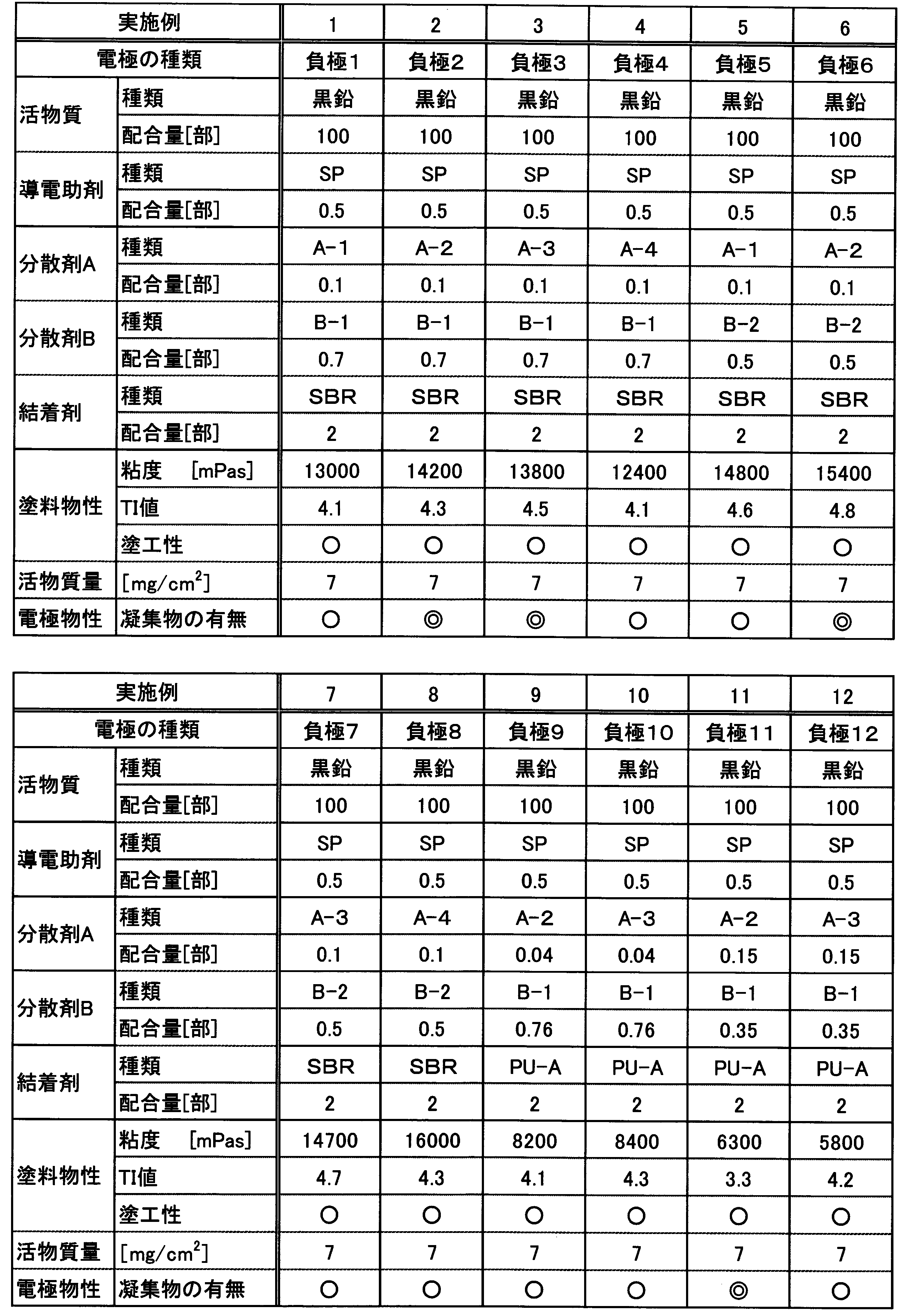
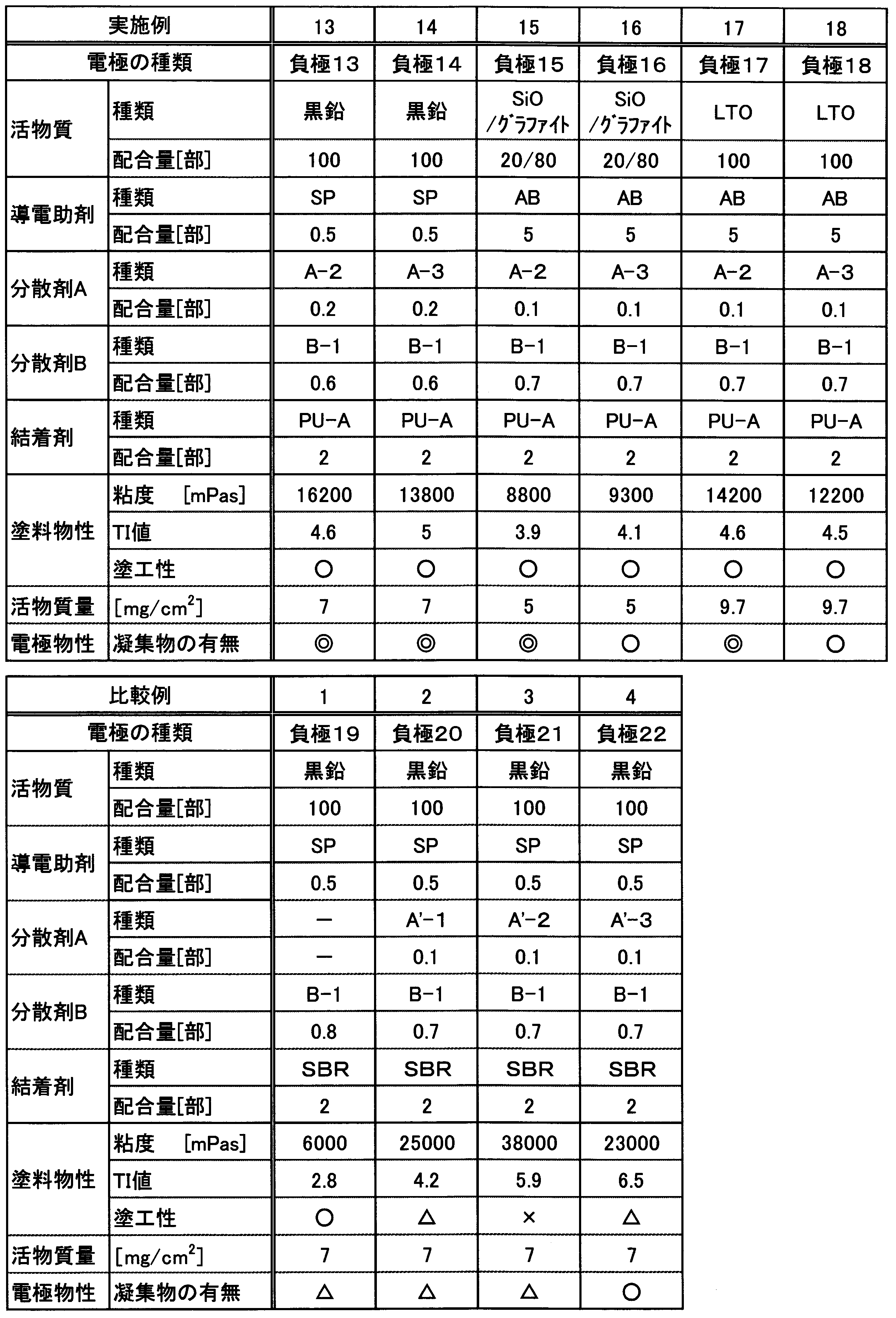

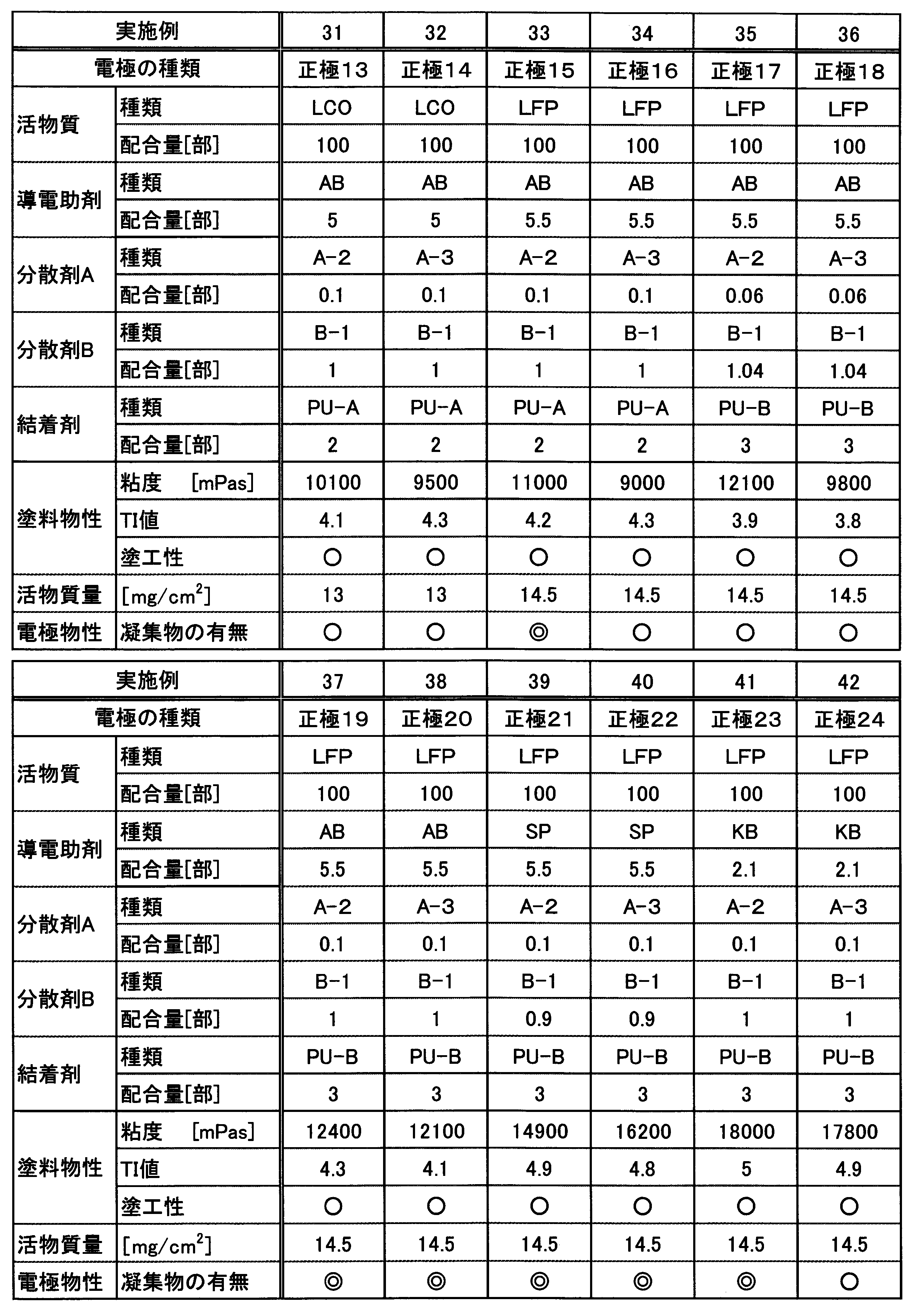
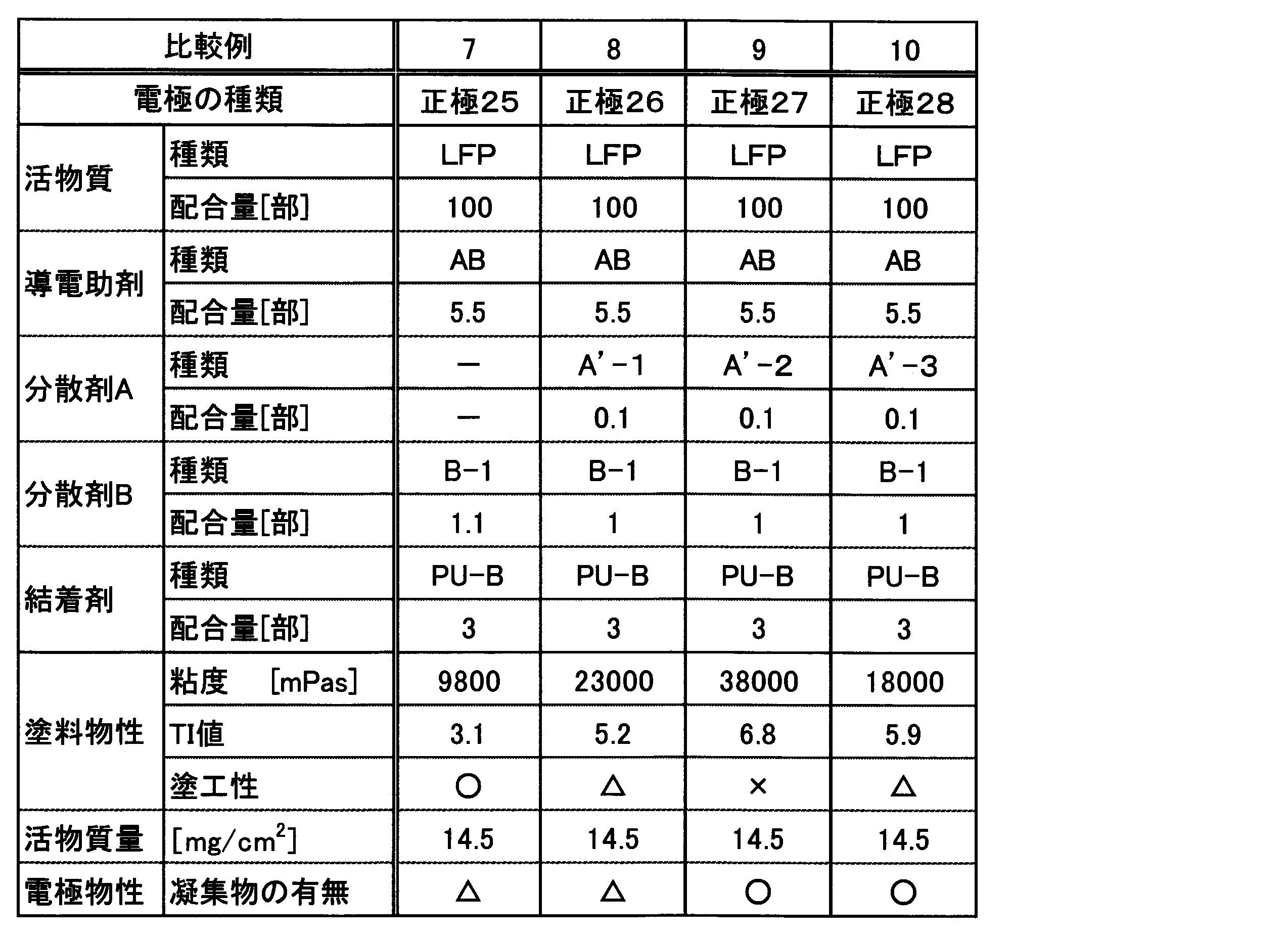
[リチウム二次電池の作製]
上記で得られた正極、負極を下記表7のように組み合わせて、電極間にセパレータとしてポリオレフィン系(PE/PP/PE)セパレータを挟んで積層し、各正負極に正極端子と負極端子を超音波溶接した。この積層体をアルミラミネート包材に入れ、注液用の開口部を残しヒートシールした。正極面積18cm2、負極面積19.8cm2とした注液前電池を作製した。次にエチレンカーボネートとジエチルカーボネート(30/70vol比)とを混合した溶媒にLiPF6(1.0mol/L)を溶解させた電解液を注液し、開口部をヒートシールし、評価用電池を得た。
上記で得られた正極、負極を下記表7のように組み合わせて、電極間にセパレータとしてポリオレフィン系(PE/PP/PE)セパレータを挟んで積層し、各正負極に正極端子と負極端子を超音波溶接した。この積層体をアルミラミネート包材に入れ、注液用の開口部を残しヒートシールした。正極面積18cm2、負極面積19.8cm2とした注液前電池を作製した。次にエチレンカーボネートとジエチルカーボネート(30/70vol比)とを混合した溶媒にLiPF6(1.0mol/L)を溶解させた電解液を注液し、開口部をヒートシールし、評価用電池を得た。

[電池性能の評価]
作製したリチウム二次電池について、20℃における性能試験を行った。試験方法は下記の通りである。試験結果を表5に示す。
作製したリチウム二次電池について、20℃における性能試験を行った。試験方法は下記の通りである。試験結果を表5に示す。
(セルインピーダンス)
セルインピーダンスは、インピーダンスアナライザー(biologic社製 SP-150)を用いて、周波数1kHzでの抵抗値を測定した。
セルインピーダンスは、インピーダンスアナライザー(biologic社製 SP-150)を用いて、周波数1kHzでの抵抗値を測定した。
(充放電サイクル特性)
充放電サイクル特性は、以下の条件で測定した。正極活物質としてLiNi1/3Co1/3Mn1/3O2或いはLiMn2O4、或いはLiCoO2、負極活物質として天然黒鉛を使用した場合は、1C相当の電流密度で4.2VまでCC(定電流)充電を行い、続いて4.2VでCV(定電圧)充電に切り替え、1.5時間充電したのち、1C相当の電流密度で2.7VまでCC放電するサイクルを20℃で300サイクル行い、このときの初回1C放電容量に対する300サイクル後1C放電容量比を1C充放電サイクル保持率とした。
充放電サイクル特性は、以下の条件で測定した。正極活物質としてLiNi1/3Co1/3Mn1/3O2或いはLiMn2O4、或いはLiCoO2、負極活物質として天然黒鉛を使用した場合は、1C相当の電流密度で4.2VまでCC(定電流)充電を行い、続いて4.2VでCV(定電圧)充電に切り替え、1.5時間充電したのち、1C相当の電流密度で2.7VまでCC放電するサイクルを20℃で300サイクル行い、このときの初回1C放電容量に対する300サイクル後1C放電容量比を1C充放電サイクル保持率とした。
正極活物質としてLiFePO4、負極活物質として天然黒鉛を使用した場合は、1C相当の電流密度で4.0VまでCC(定電流)充電を行い、続いて4.0VでCV(定電圧)充電に切り替え、1.5時間充電したのち、1C相当の電流密度で2.0VまでCC放電するサイクルを20℃で300サイクル行い、このときの初回1C放電容量に対する300サイクル後1C放電容量比を1C充放電サイクル保持率とした。
正極活物質としてLiNi1/3Co1/3Mn1/3O2、負極活物質としてLi4Ti5O12を使用した場合は、1C相当の電流密度で2.9VまでCC(定電流)充電を行い、続いて2.9VでCV(定電圧)充電に切り替え、1.5時間充電したのち、1C相当の電流密度で1.0VまでCC放電するサイクルを20℃で300サイクル行い、このときの初回1C放電容量に対する300サイクル後1C放電容量比を1C充放電サイクル保持率とした。
正極活物質としてLiNi1/3Co1/3Mn1/3O2、負極活物質としてSiO/グラファイトを使用した場合は、1C相当の電流密度で4.2VまでCC(定電流)充電を行い、続いて4.2VでCV(定電圧)充電に切り替え、1.5時間充電したのち、1C相当の電流密度で2.7VまでCC放電するサイクルを20℃で50サイクル行い、このときの初回1C放電容量に対する50サイクル後1C放電容量比を1C充放電サイクル保持率とした。

本発明の分散剤は、蓄電デバイスの電極塗工液の分散剤として利用でき、それから製造された電極は各種蓄電デバイスの製造に用いられる。得られた蓄電デバイスは、携帯電話、ノートパソコン、携帯情報端末(PDA)、ビデオカメラ、デジタルカメラなどの各種携帯型機器や、更には電動自転車、電気自動車などに搭載する中型又は大型蓄電デバイスに使用することが出来る。
Claims (8)
- 電極活物質、導電助剤、分散剤、および結着剤を含有する電極塗工液組成物であって、分散剤が、下記(a)ないし(c)を満たすセルロース繊維を含有し、分散剤と結着剤の合計量が、電極塗工液組成物の固形分100質量%に対し0.5質量%以上15質量%以下含有することを特徴とする電極塗工液組成物。
(a)短幅の方の数平均幅が2nm以上200nm以下
(b)アスペクト比が7.5以上75以下
(c)セルロースI型結晶を有し、その結晶化度が70%以上95%以下 - 上記セルロース繊維が更に下記(d)を満たすことを特徴とする請求項1に記載の電極塗工液組成物。
(d)アニオン性官能基を有する - 上記セルロース繊維が更に下記(e)を満たすことを特徴とする請求項1または2に記載の電極塗工液組成物。
(e)上記アニオン性官能基がカルボキシル基であり、カルボキシル基の含有量が1.2mmol/g以上2.5mmol/g以下 - 上記セルロース繊維の含有量が、電極塗工液組成物の固形分100質量%に対し0.05質量%以上5.00質量%以下であることを特徴とする請求項1ないし3のいずれか1項に記載の電極塗工液組成物。
- 上記分散剤が、上記セルロース繊維およびカルボキシメチルセルロース塩を含有することを特徴とする請求項1ないし4のいずれか1項に記載の電極塗工液組成物。
- 上記セルロース繊維と上記カルボキシメチルセルロース塩の含有量が、質量比で40:60~5:95であることを特徴とする請求項5に記載の電極塗工液組成物。
- 請求項1ないし6のいずれか1項に記載の電極塗工液用組成物の乾燥物を備えることを特徴とする蓄電デバイス用電極。
- 請求項7に記載された蓄電デバイス用電極を備えることを特徴とする蓄電デバイス。
Priority Applications (3)
| Application Number | Priority Date | Filing Date | Title |
|---|---|---|---|
| KR1020197037166A KR102504895B1 (ko) | 2017-07-04 | 2018-01-24 | 전극 도공액 조성물, 그 전극 도공액 조성물을 사용하여 제작된 축전 디바이스용 전극, 및 그 전극을 구비하는 축전 디바이스 |
| US16/624,908 US11342560B2 (en) | 2017-07-04 | 2018-01-24 | Electrode coating liquid composition, electrode for power storage device manufactured using the electrode coating liquid composition, and power storage device having the electrode |
| CN201880042069.7A CN110915030B (zh) | 2017-07-04 | 2018-01-24 | 电极涂覆液组合物、用该电极涂覆液组合物制成的蓄电装置用电极和具备该电极的蓄电装置 |
Applications Claiming Priority (2)
| Application Number | Priority Date | Filing Date | Title |
|---|---|---|---|
| JP2017-131255 | 2017-07-04 | ||
| JP2017131255A JP7022525B2 (ja) | 2017-07-04 | 2017-07-04 | 電極塗工液組成物、該電極塗工液組成物を用いて作製された蓄電デバイス用電極、および該電極を備える蓄電デバイス |
Publications (1)
| Publication Number | Publication Date |
|---|---|
| WO2019008802A1 true WO2019008802A1 (ja) | 2019-01-10 |
Family
ID=64949835
Family Applications (1)
| Application Number | Title | Priority Date | Filing Date |
|---|---|---|---|
| PCT/JP2018/002046 Ceased WO2019008802A1 (ja) | 2017-07-04 | 2018-01-24 | 電極塗工液組成物、該電極塗工液組成物を用いて作製された蓄電デバイス用電極、および該電極を備える蓄電デバイス |
Country Status (5)
| Country | Link |
|---|---|
| US (1) | US11342560B2 (ja) |
| JP (1) | JP7022525B2 (ja) |
| KR (1) | KR102504895B1 (ja) |
| CN (1) | CN110915030B (ja) |
| WO (1) | WO2019008802A1 (ja) |
Families Citing this family (6)
| Publication number | Priority date | Publication date | Assignee | Title |
|---|---|---|---|---|
| AU2020257568B2 (en) | 2019-04-17 | 2025-02-27 | Cellicon B.V. | Method for the preparation of micro- or nano crystalline cellulose |
| US11518473B2 (en) * | 2020-02-11 | 2022-12-06 | Harry Philbrook | Balanced motorcycle powertrain |
| JP6856812B1 (ja) * | 2020-10-21 | 2021-04-14 | 第一工業製薬株式会社 | 電極用結着剤組成物、電極用塗工液組成物、蓄電デバイス用電極及び蓄電デバイス |
| WO2023229020A1 (ja) * | 2022-05-27 | 2023-11-30 | パナソニックホールディングス株式会社 | 電極組成物および電池 |
| KR102928152B1 (ko) * | 2023-11-16 | 2026-02-20 | 연세대학교 산학협력단 | 코팅층이 형성된 집전체, 이를 포함하는 무음극 리튬 전지 및 상기 집전체의 제조방법 |
| WO2025126825A1 (ja) * | 2023-12-11 | 2025-06-19 | 東亞合成株式会社 | 樹脂組成物及びその成形体 |
Citations (7)
| Publication number | Priority date | Publication date | Assignee | Title |
|---|---|---|---|---|
| JP2002260663A (ja) * | 2001-02-27 | 2002-09-13 | Toshiba Corp | 非水電解質二次電池 |
| JP2011195659A (ja) * | 2010-03-18 | 2011-10-06 | Toppan Printing Co Ltd | 酸化セルロースの製造方法 |
| JP2013249448A (ja) * | 2012-06-04 | 2013-12-12 | Dai Ichi Kogyo Seiyaku Co Ltd | 無機微粒子含有組成物およびそれを用いた皮膜 |
| JP2014086285A (ja) * | 2012-10-24 | 2014-05-12 | Toppan Printing Co Ltd | 電池電極用組成物およびそれを用いた電池用電極の製造方法 |
| JP2015125920A (ja) * | 2013-12-26 | 2015-07-06 | 第一工業製薬株式会社 | 蓄電デバイスの電極塗工液用増粘・安定剤、該増粘・安定剤を用いて調製された塗工液、該塗工液を用いて製造された電極、該電極を使用した蓄電デバイス |
| WO2015107995A1 (ja) * | 2014-01-17 | 2015-07-23 | 日本製紙株式会社 | アニオン変性セルロースナノファイバーの乾燥固形物及びその製造方法 |
| JP2017130451A (ja) * | 2016-01-19 | 2017-07-27 | 株式会社ダイセル | 結着剤、電極用スラリー、電極及びその製造方法並びに二次電池 |
Family Cites Families (9)
| Publication number | Priority date | Publication date | Assignee | Title |
|---|---|---|---|---|
| KR101613318B1 (ko) | 2008-08-11 | 2016-04-18 | 프라이믹스 가부시키가이샤 | 도료의 제조방법 및 장치 |
| JP4835881B2 (ja) | 2009-03-31 | 2011-12-14 | 宇部興産株式会社 | リチウムイオン電池用電極およびその製造方法 |
| JP2010279896A (ja) | 2009-06-04 | 2010-12-16 | Primix Copr | 攪拌装置 |
| JP2011192610A (ja) | 2010-03-16 | 2011-09-29 | Hitachi Ltd | リチウムイオン電池 |
| WO2013042720A1 (ja) * | 2011-09-20 | 2013-03-28 | 日産化学工業株式会社 | セルロースファイバーをバインダーとして含有するリチウム二次電池電極形成用スラリー組成物及びリチウム二次電池用電極 |
| US20150111025A1 (en) * | 2012-06-26 | 2015-04-23 | Toray Industries, Inc. | Dispersion liquid of carbon nanotube-containing composition and conductive molded body |
| CN103280566B (zh) * | 2013-05-31 | 2015-07-08 | 广东凯德能源科技有限公司 | 一种锂离子电池正负极浆料的制备方法 |
| JP6566622B2 (ja) | 2014-10-02 | 2019-08-28 | 第一工業製薬株式会社 | 蓄電デバイスの電極塗工液用増粘・安定剤、該増粘・安定剤を用いて調製された塗工液、該塗工液を用いて製造された電極、及び該電極を使用した蓄電デバイス |
| WO2018207333A1 (ja) * | 2017-05-11 | 2018-11-15 | 日立化成株式会社 | リチウムイオン二次電池用負極材、リチウムイオン二次電池用負極材の製造方法、リチウムイオン二次電池用負極及びリチウムイオン二次電池 |
-
2017
- 2017-07-04 JP JP2017131255A patent/JP7022525B2/ja active Active
-
2018
- 2018-01-24 US US16/624,908 patent/US11342560B2/en active Active
- 2018-01-24 CN CN201880042069.7A patent/CN110915030B/zh active Active
- 2018-01-24 KR KR1020197037166A patent/KR102504895B1/ko active Active
- 2018-01-24 WO PCT/JP2018/002046 patent/WO2019008802A1/ja not_active Ceased
Patent Citations (7)
| Publication number | Priority date | Publication date | Assignee | Title |
|---|---|---|---|---|
| JP2002260663A (ja) * | 2001-02-27 | 2002-09-13 | Toshiba Corp | 非水電解質二次電池 |
| JP2011195659A (ja) * | 2010-03-18 | 2011-10-06 | Toppan Printing Co Ltd | 酸化セルロースの製造方法 |
| JP2013249448A (ja) * | 2012-06-04 | 2013-12-12 | Dai Ichi Kogyo Seiyaku Co Ltd | 無機微粒子含有組成物およびそれを用いた皮膜 |
| JP2014086285A (ja) * | 2012-10-24 | 2014-05-12 | Toppan Printing Co Ltd | 電池電極用組成物およびそれを用いた電池用電極の製造方法 |
| JP2015125920A (ja) * | 2013-12-26 | 2015-07-06 | 第一工業製薬株式会社 | 蓄電デバイスの電極塗工液用増粘・安定剤、該増粘・安定剤を用いて調製された塗工液、該塗工液を用いて製造された電極、該電極を使用した蓄電デバイス |
| WO2015107995A1 (ja) * | 2014-01-17 | 2015-07-23 | 日本製紙株式会社 | アニオン変性セルロースナノファイバーの乾燥固形物及びその製造方法 |
| JP2017130451A (ja) * | 2016-01-19 | 2017-07-27 | 株式会社ダイセル | 結着剤、電極用スラリー、電極及びその製造方法並びに二次電池 |
Also Published As
| Publication number | Publication date |
|---|---|
| JP7022525B2 (ja) | 2022-02-18 |
| CN110915030B (zh) | 2024-04-05 |
| JP2019016456A (ja) | 2019-01-31 |
| US20210226217A1 (en) | 2021-07-22 |
| CN110915030A (zh) | 2020-03-24 |
| US11342560B2 (en) | 2022-05-24 |
| KR20200026198A (ko) | 2020-03-10 |
| KR102504895B1 (ko) | 2023-02-28 |
Similar Documents
| Publication | Publication Date | Title |
|---|---|---|
| US11437607B2 (en) | Dispersant for electrode coating liquid, electrode coating liquid composition including the dispersant for electrode coating liquid, electrode for power storage device manufactured using the electrode coating liquid composition, and power storage device having the electrode | |
| US11342560B2 (en) | Electrode coating liquid composition, electrode for power storage device manufactured using the electrode coating liquid composition, and power storage device having the electrode | |
| JP6315984B2 (ja) | 蓄電デバイスの電極塗工液用増粘・安定剤、該増粘・安定剤を用いて調製された塗工液、該塗工液を用いて製造された電極、該電極を使用した蓄電デバイス | |
| JP6358256B2 (ja) | リチウムイオン二次電池負極用スラリー組成物、リチウムイオン二次電池負極の製造方法及びリチウムイオン二次電池 | |
| JP6941637B2 (ja) | 電極用結着剤組成物、電極用塗料組成物、蓄電デバイス用電極、および蓄電デバイス | |
| JP2014022039A (ja) | リチウム二次電池用負極バインダー | |
| JP6566622B2 (ja) | 蓄電デバイスの電極塗工液用増粘・安定剤、該増粘・安定剤を用いて調製された塗工液、該塗工液を用いて製造された電極、及び該電極を使用した蓄電デバイス | |
| JP6138554B2 (ja) | 複合材料、この複合材料の製造方法、この複合材料を用いたリチウムイオン二次電池及び電気化学キャパシタ | |
| TW201936492A (zh) | 碳材料、蓄電裝置用電極、蓄電裝置及非水電解質二次電池 | |
| KR20160045064A (ko) | 전기화학 커패시터 | |
| EP4614622A1 (en) | Coating liquid for electrode formation | |
| JP6582879B2 (ja) | 電気化学素子用導電性組成物、電気化学素子電極用組成物、接着剤層付集電体及び電気化学素子用電極 | |
| JP7152945B2 (ja) | リチウムイオン二次電池の負極活物質用ナノ粒子集合体の製造方法 | |
| JP2024065985A (ja) | 電極層形成用塗工液 | |
| WO2025134992A1 (ja) | カーボンナノチューブ分散液、樹脂組成物、合材スラリー、電極膜及びリチウムイオン二次電池 | |
| TW202232805A (zh) | 鋰離子電池用負極、鋰離子電池、鋰離子電池用負極的製造方法及鋰離子電池的製造方法 | |
| JP2024065987A (ja) | 電極層形成用塗工液 | |
| WO2014098007A1 (ja) | 電極材料、該電極材料を備えた蓄電デバイス及び電極材料の製造方法 | |
| JP2021051882A (ja) | 炭素材料複合体、蓄電デバイス用電極材料、及び蓄電デバイス |
Legal Events
| Date | Code | Title | Description |
|---|---|---|---|
| 121 | Ep: the epo has been informed by wipo that ep was designated in this application |
Ref document number: 18828270 Country of ref document: EP Kind code of ref document: A1 |
|
| ENP | Entry into the national phase |
Ref document number: 20197037166 Country of ref document: KR Kind code of ref document: A |
|
| NENP | Non-entry into the national phase |
Ref country code: DE |
|
| 122 | Ep: pct application non-entry in european phase |
Ref document number: 18828270 Country of ref document: EP Kind code of ref document: A1 |