WO2018230459A1 - 口腔用組成物及び口腔内常在菌の生育促進剤 - Google Patents
口腔用組成物及び口腔内常在菌の生育促進剤 Download PDFInfo
- Publication number
- WO2018230459A1 WO2018230459A1 PCT/JP2018/022002 JP2018022002W WO2018230459A1 WO 2018230459 A1 WO2018230459 A1 WO 2018230459A1 JP 2018022002 W JP2018022002 W JP 2018022002W WO 2018230459 A1 WO2018230459 A1 WO 2018230459A1
- Authority
- WO
- WIPO (PCT)
- Prior art keywords
- oral
- formula
- component
- oral cavity
- bacteria
- Prior art date
- Legal status (The legal status is an assumption and is not a legal conclusion. Google has not performed a legal analysis and makes no representation as to the accuracy of the status listed.)
- Ceased
Links
Classifications
-
- A—HUMAN NECESSITIES
- A23—FOODS OR FOODSTUFFS; TREATMENT THEREOF, NOT COVERED BY OTHER CLASSES
- A23J—PROTEIN COMPOSITIONS FOR FOODSTUFFS; WORKING-UP PROTEINS FOR FOODSTUFFS; PHOSPHATIDE COMPOSITIONS FOR FOODSTUFFS
- A23J7/00—Phosphatide compositions for foodstuffs, e.g. lecithin
-
- A—HUMAN NECESSITIES
- A61—MEDICAL OR VETERINARY SCIENCE; HYGIENE
- A61K—PREPARATIONS FOR MEDICAL, DENTAL OR TOILETRY PURPOSES
- A61K31/00—Medicinal preparations containing organic active ingredients
- A61K31/66—Phosphorus compounds
-
- A—HUMAN NECESSITIES
- A61—MEDICAL OR VETERINARY SCIENCE; HYGIENE
- A61K—PREPARATIONS FOR MEDICAL, DENTAL OR TOILETRY PURPOSES
- A61K31/00—Medicinal preparations containing organic active ingredients
- A61K31/66—Phosphorus compounds
- A61K31/683—Diesters of a phosphorus acid with two hydroxy compounds, e.g. phosphatidylinositols
-
- A—HUMAN NECESSITIES
- A61—MEDICAL OR VETERINARY SCIENCE; HYGIENE
- A61K—PREPARATIONS FOR MEDICAL, DENTAL OR TOILETRY PURPOSES
- A61K31/00—Medicinal preparations containing organic active ingredients
- A61K31/66—Phosphorus compounds
- A61K31/683—Diesters of a phosphorus acid with two hydroxy compounds, e.g. phosphatidylinositols
- A61K31/685—Diesters of a phosphorus acid with two hydroxy compounds, e.g. phosphatidylinositols one of the hydroxy compounds having nitrogen atoms, e.g. phosphatidylserine, lecithin
-
- A—HUMAN NECESSITIES
- A61—MEDICAL OR VETERINARY SCIENCE; HYGIENE
- A61K—PREPARATIONS FOR MEDICAL, DENTAL OR TOILETRY PURPOSES
- A61K8/00—Cosmetics or similar toiletry preparations
- A61K8/18—Cosmetics or similar toiletry preparations characterised by the composition
- A61K8/30—Cosmetics or similar toiletry preparations characterised by the composition containing organic compounds
- A61K8/55—Phosphorus compounds
-
- A—HUMAN NECESSITIES
- A61—MEDICAL OR VETERINARY SCIENCE; HYGIENE
- A61P—SPECIFIC THERAPEUTIC ACTIVITY OF CHEMICAL COMPOUNDS OR MEDICINAL PREPARATIONS
- A61P1/00—Drugs for disorders of the alimentary tract or the digestive system
- A61P1/02—Stomatological preparations, e.g. drugs for caries, aphtae, periodontitis
-
- A—HUMAN NECESSITIES
- A61—MEDICAL OR VETERINARY SCIENCE; HYGIENE
- A61P—SPECIFIC THERAPEUTIC ACTIVITY OF CHEMICAL COMPOUNDS OR MEDICINAL PREPARATIONS
- A61P31/00—Antiinfectives, i.e. antibiotics, antiseptics, chemotherapeutics
- A61P31/04—Antibacterial agents
-
- A—HUMAN NECESSITIES
- A61—MEDICAL OR VETERINARY SCIENCE; HYGIENE
- A61P—SPECIFIC THERAPEUTIC ACTIVITY OF CHEMICAL COMPOUNDS OR MEDICINAL PREPARATIONS
- A61P43/00—Drugs for specific purposes, not provided for in groups A61P1/00-A61P41/00
-
- A—HUMAN NECESSITIES
- A61—MEDICAL OR VETERINARY SCIENCE; HYGIENE
- A61Q—SPECIFIC USE OF COSMETICS OR SIMILAR TOILETRY PREPARATIONS
- A61Q11/00—Preparations for care of the teeth, of the oral cavity or of dentures; Dentifrices, e.g. toothpastes; Mouth rinses
-
- A—HUMAN NECESSITIES
- A23—FOODS OR FOODSTUFFS; TREATMENT THEREOF, NOT COVERED BY OTHER CLASSES
- A23F—COFFEE; TEA; THEIR SUBSTITUTES; MANUFACTURE, PREPARATION, OR INFUSION THEREOF
- A23F3/00—Tea; Tea substitutes; Preparations thereof
- A23F3/06—Treating tea before extraction; Preparations produced thereby
- A23F3/14—Tea preparations, e.g. using additives
-
- A—HUMAN NECESSITIES
- A23—FOODS OR FOODSTUFFS; TREATMENT THEREOF, NOT COVERED BY OTHER CLASSES
- A23L—FOODS, FOODSTUFFS OR NON-ALCOHOLIC BEVERAGES, NOT OTHERWISE PROVIDED FOR; PREPARATION OR TREATMENT THEREOF
- A23L2/00—Non-alcoholic beverages; Dry compositions or concentrates therefor; Preparation or treatment thereof
- A23L2/52—Adding ingredients
-
- A—HUMAN NECESSITIES
- A23—FOODS OR FOODSTUFFS; TREATMENT THEREOF, NOT COVERED BY OTHER CLASSES
- A23L—FOODS, FOODSTUFFS OR NON-ALCOHOLIC BEVERAGES, NOT OTHERWISE PROVIDED FOR; PREPARATION OR TREATMENT THEREOF
- A23L33/00—Modifying nutritive qualities of foods; Dietetic products; Preparation or treatment thereof
- A23L33/10—Modifying nutritive qualities of foods; Dietetic products; Preparation or treatment thereof using additives
- A23L33/115—Fatty acids or derivatives thereof; Fats or oils
Definitions
- the present invention relates to a growth promoter for resident bacteria in the oral cavity and an oral composition containing the same.
- the current oral care is aimed at preventing oral diseases such as caries and periodontal disease. For this reason, technologies such as sterilization of pathogenic bacteria and pathogenic bacteria biofilms causing dental caries and periodontal disease, strengthening of tooth quality and gums, and anti-inflammation have been developed and commercialized.
- resident bacteria symbiotic to humans are greatly involved in maintaining and promoting human health. It has been reported that intestinal resident bacteria are important for human intestinal regulation, and that they are involved in improving immunity and obesity. Conventionally, some lactic acid bacteria have been utilized as products represented by yogurt as probiotics.
- oral bacteria As for oral bacteria, it is known that resident bacteria such as Streptococcus and Rothia have antibacterial activity against pathogenic bacteria. Oral diseases are not infections caused by pathogenic bacteria alone, but multiple bacterial infections involving resident bacteria represented by these, and it is considered that resident bacteria other than pathogenic bacteria are involved in the onset and progression of oral diseases. It is done. Furthermore, the relationship between oral bacteria and enteritis and Alzheimer's disease has been reported, and it has begun to be shown that oral bacteria may be involved not only in the oral cavity but also in human general health. Therefore, it is important for oral care not only to eliminate pathogenic bacteria in the oral cavity, but also to maintain resident bacteria and keep them in a particularly healthy state.
- sterilization which is the mainstream of current bacterial control, has a problem of sterilizing and removing not only pathogenic bacteria but also other resident bacteria.
- antibodies have been studied as a technique for selectively suppressing only pathogenic bacteria, but sufficient effects have not been obtained.
- Patent Document 1 Japanese Patent No. 2794072 proposes that phosphatidylglycerol and / or lysophosphatidylglycerol has a good antibacterial action and is effective as an antibacterial agent for cosmetics and the like.
- Patent Document 2 Japanese Patent Laid-Open No.
- a surfactant lysophosphatidylcholine is effective in preventing a decrease in the bactericidal activity of a phenolic fungicide in an oral composition.
- No. 88333 proposes that lysophospholipids such as lysophosphatidic acid have alveolar bone absorption inhibitory action and inflammatory cytokine secretion inhibitory action and are effective in preventing or improving oropharyngeal disease and periodontal disease. is doing.
- Patent Document 4 Japanese Patent Laid-Open No. 7-67552 discloses that acidic phospholipids or lyso forms thereof are excellent in the bitterness reducing effect of bitter substances such as cosmetics as an active ingredient of a bitterness reducing agent.
- the present invention has been made in view of the above circumstances, and an object thereof is to provide a growth promoting agent for oral resident bacteria, which is excellent in the growth promoting effect for oral resident bacteria, and an oral composition containing the same. To do.
- the present inventors have found that a compound represented by Structural Formula (1) or a salt thereof described later, a compound represented by Structural Formula (2) or a salt thereof, and When used in combination at a specific ratio, it has an excellent effect of promoting the growth of oral resident bacteria, and it is found that the composition for oral cavity containing this combination system has an excellent effect of promoting the growth of oral resident bacteria.
- the present invention has been made.
- the mass ratio of (A) / (B) is excellent in the growth promoting effect of oral resident bacteria within a specific range, especially resident other than pathogenic bacteria
- Streptococcus Streptococcus belonging to the Mittis group, it has an action effect that has not been known so far, but promotes its growth, not an antibacterial action.
- the combination of the components (A) and (B) according to the present invention can be used for a new use as a growth promoter for resident bacteria in the oral cavity, and preferably used as an active ingredient for an oral composition.
- some lecithins and lysolecithins have antibacterial activity, but for microorganisms such as bacteria, the action of antibacterial agents is complicated and acts on certain microorganisms. However, it cannot be generally said that it acts on other microorganisms as well.
- the component (A) alone exhibits an antibacterial effect on pathogenic bacteria (periodontopathic bacteria Porphyromonas gingivalis), but otherwise The effect of promoting the growth of the resident bacterium (Streptococcus spp. Of the Mittis group) is not observed (Comparative Example 1), and the component B (B) alone does not promote the growth of the resident bacteria. (Comparative example 2).
- the components (A) and (B) are combined at a specific ratio, surprisingly, there is an excellent effect of promoting the growth of the above-mentioned resident bacteria, It can also give antibacterial effects against pathogenic bacteria.
- Such an effect of the present invention is inferior when the amount ratio of both is inappropriate even when the components (A) and (B) are combined (Comparative Examples 3 and 4), and (A) / ( B) Specific and exceptionally prominent that the ratio can only be obtained within a certain range.
- the pathogenic bacteria are Porphyromonas gingivalis, a causative agent of periodontal disease, and Streptococcus mutans, a causative agent of caries.
- Streptococcus mutans There are only several types of bacteria represented by (Streptococcus mutans). Most of the rest are Streptococcus gordonii, Streptococcus mitis, Streptococcus oralis, and M. streptococcus oralis, which are representative of the mitochondrion of M.
- Bacteria such as Veionella parvula, Neisseria subflava, and Neisseria bacteria such as Neisseria subflava are usually non-pathogenic indigenous bacteria.
- the Streptococcus bacteria of the Mittis group are known to be involved in the elimination of pathogenic bacteria that cause periodontal diseases and the like.
- the growth promoting effect of such oral resident bacteria, particularly Streptococcus bacteria of the Mittis group is excellent, and also has an antibacterial effect on pathogenic bacteria, so that the balance of oral resident bacteria is balanced. It is also possible to prevent it from collapsing and becoming pathogenic and maintaining a healthy state.
- Patent Document 1 lysophosphatidylglycerol and / or phosphatidylglycerol has been confirmed to have antibacterial activity against pathogenic bacteria such as food poisoning bacteria, acne bacteria, and caries fungi, and its efficacy against other bacteria is not described and is unknown.
- Patent Document 1 is different in at least the objective and target bacteria from the growth promoting action of the bacterium according to the present invention, which is the action opposite to that of antibacterial, and particularly the growth promoting action to oral resident bacteria.
- composition for oral cavity containing a compound represented by the formula (1) or a salt thereof, wherein (A) / (B), which represents the ratio of component (A) to component (B), is 0.1 to 10 in terms of mass ratio.
- (A) / (B) is 0.2 to 5 by mass ratio.
- the compound represented by the above formula (1) is at least one lysophosphatidic acid selected from lysophosphatidic acid, lysophosphatidylcholine, lysophosphatidylserine, lysophosphatidylethanolamine, lysophosphatidylinositol and lysophosphatidylglycerin or a derivative thereof [ The composition for oral cavity according to [1] or [2].
- the compound represented by the above formula (2) is at least one phosphatidic acid selected from phosphatidic acid, phosphatidylcholine, phosphatidylserine, phosphatidylethanolamine and phosphatidylinositol or a derivative thereof [1] to [3]
- the composition for oral cavity of description [5] The composition for oral cavity according to any one of [1] to [4], containing 0.001 to 10% by mass of component (A) and 0.001 to 10% by mass of component (B).
- the composition for oral cavity according to any one of [1] to [5] which is a preparation for oral cavity for increasing resident bacteria in the oral cavity.
- a growth promoter for resident bacteria in the oral cavity comprising the compound represented by the above formula (1) or a salt thereof, and (B) the compound represented by the above formula (2) or a salt thereof.
- B the compound represented by the above formula (2) or a salt thereof.
- Oral resident bacteria are Streptococcus mitis, Streptococcus oralis and Streptococcus gordonii selected from one or more mitis group Streptococcus bacteria [7] or [8] .
- a growth promoting agent for oral resident bacteria having an excellent effect of promoting the growth of oral resident bacteria and a composition for oral cavity containing the same. These are also effective in maintaining oral resident bacteria.
- the growth promoting agent for oral resident bacteria of the present invention comprises (A) a compound represented by structural formula (1) or a salt thereof, and (B) a compound represented by structural formula (2) or a salt thereof.
- the active ingredient comprises (A) a compound represented by structural formula (1) or a salt thereof, and (B) a compound represented by structural formula (2) or a salt thereof.
- the component (A) is a compound represented by the following structural formula (1) or a salt thereof. These act as growth promoters for the resident bacteria in the oral cavity in combination with the component (B). It also acts as an antibacterial agent for pathogenic bacteria.
- R 1 and R 2 are —OH and the other is —OCOR (where R is a saturated or unsaturated linear or branched hydrocarbon having 11 to 23 carbon atoms)
- X 1 is —H, —C 2 H 4 N + (CH 3 ) 3 , —C 2 H 3 (N + H 3 ) COOH, —C 2 H 4 N + H 3 , —C 6 H 6 (OH) 5 or —C 2 H 3 (OH) CH 2 (OH).
- R is a saturated or unsaturated linear or branched hydrocarbon group having 11 to 23 carbon atoms, preferably 15 to 21 carbon atoms.
- the compound represented by the above formula (1) is preferably lysophosphatidic acid or a derivative thereof, such as lysophosphatidic acid (LPA, X 1 ; -H), lysophosphatidylcholine (LPC, X 1 ; -C 2).
- LPA lysophosphatidic acid
- LPC lysophosphatidylcholine
- lysophosphatidic acid LPA
- lysophosphatidylcholine LPC
- lysophosphatidylethanolamine LPE
- LPE lysophosphatidylserine
- LPI lysophosphatidylinositol
- LPE lysophosphatidylethanolamine
- LPC lysophosphatidylcholine
- LPE lysophosphatidylethanolamine
- LPC particularly lysophosphatidylcholine
- the above compound may be a salt, and examples of the salt include alkali metal salts such as sodium salts, ammonium salts and the like.
- egg yolk lysolecithin LPL-1 egg yolk lecithin LPL-20W, egg yolk lecithin LPL-20S (manufactured by Kewpie Co., Ltd.), SLP-white lyso, SLP-LPC70, SLP-white lyso H, SLP- Commercial products such as LPC70H (manufactured by Sakai Oil Co., Ltd.) and LIPOID R LPC20 (manufactured by H. Holstein) can be used.
- LPC70H manufactured by Sakai Oil Co., Ltd.
- LIPOID R LPC20 manufactured by H. Holstein
- the component (B) is a compound represented by the following structural formula (2) or a salt thereof. These act as growth promoters for oral resident bacteria when used in combination with the component (A). Moreover, it contributes also to moderate suppression of the antibacterial action by (A) component.
- R 3 and R 4 may be the same or different from each other, and —OCOR 5 (R 5 is a saturated or unsaturated linear or branched chain having 11 to 23 carbon atoms)
- X 2 is —H, —C 2 H 4 N + (CH 3 ) 3 , —C 2 H 3 (N + H 3 ) COOH, —C 2 H 4 N + H 3 , or —C 6 H 6 (OH) 5.
- R 5 is a saturated or unsaturated linear or branched hydrocarbon group having 11 to 23 carbon atoms, preferably 15 to 21 carbon atoms.
- the compound represented by the above formula (2) is preferably phosphatidic acid or a derivative thereof, such as phosphatidic acid (PA, X 2 ; -H), phosphatidylcholine (PC, X 2 ; -C 2 H 4). N + (CH 3) 3) , phosphatidylserine (PS, X 2; -C 2 H 3 (N + H 3) COOH), phosphatidylethanolamine (PE, X 2; -C 2 H 4 N + H 3) Phosphatidylinositol (PI, X 2 ; —C 6 H 6 (OH) 5 ) and the like. These may be used singly or in combination of two or more.
- PA phosphatidic acid
- X 2 ; -H phosphatidylcholine
- PC X 2 ; -C 2 H 4
- N + (CH 3) 3) phosphatidylserine
- PS X 2; -C 2 H 3
- phosphatidic acid (PA), phosphatidylcholine (PC), phosphatidylethanolamine (PE), and particularly phosphatidylcholine (PC) are preferable in terms of the effect of promoting the growth of oral resident bacteria.
- the above compound may be a salt, and examples of the salt include alkali metal salts such as sodium salts, ammonium salts and the like.
- egg yolk lecithin PL-100P egg yolk lecithin PL-30S (manufactured by Kewpie Corporation)
- SLP-white SLP-PC70
- SLP-white H SLP-PC70H
- commercial products such as COATSOME NC-21 (manufactured by NOF Corporation) can be used.
- (A) / (B) indicating the amount ratio of the component (A) to the component (B) is 0.1 to 10, preferably 0.2 to 5, and more preferably 0 as a mass ratio. .25-5. If it is less than 0.1, the effect of promoting the growth of oral resident bacteria is poor. If it exceeds 10, the antibacterial effect due to the component (A) is not suppressed, and antibacterial bacteria other than the pathogenic bacteria are also antibacterial, and the growth promoting effect of oral resident bacteria is poor.
- the composition for oral cavity of the present invention is excellent in the growth promoting action of oral resident bacteria and also has an antibacterial action of oral pathogenic bacteria, the oral resident bacteria and / or the ratio thereof are increased (oral resident in the oral cavity).
- Specific oral preparations include solids, liquids (including those in which some or all of the ingredients are dispersed or suspended without being solubilized; the same applies hereinafter), pastes, gels, etc.
- tablets such as orally disintegrating tablets, chewable tablets, troches, candy, etc., granules such as granules, chewing gum, gummies, beverages, and toothpastes such as toothpaste, liquid toothpaste, liquid toothpaste, and toothpaste, It can be used in various dosage forms such as mouthwash, mouth spray, mouth freshener, and gel for coating.
- the oral preparation may be a concentrated type, and may be prepared, for example, as a concentrated powder beverage that can be appropriately diluted with water.
- the amount of component (A) is preferably 0.001 to 10% (mass%, the same applies hereinafter) of the entire composition, more preferably 0.01 to 5%, still more preferably 0.01 to 1. %.
- the growth promoting effect of oral resident bacteria is sufficiently excellent, and when it is 10% or less, the growth promoting effect is sufficiently maintained.
- the antibacterial action by the component (A) cannot be suppressed, and the growth promoting effect of oral resident bacteria may be inferior.
- the amount of component (B) is not particularly limited, but is preferably 0.001 to 10%, more preferably 0.01 to 5%, still more preferably 0.01 to 1% of the entire composition. .
- the growth promoting effect of oral resident bacteria is sufficiently excellent, and when it is 10% or less, the growth promoting effect is sufficiently maintained. If too much is added, the antibacterial action of the composition on pathogenic bacteria may be reduced, the bacterial flora balance in the oral cavity tends to be dominant, and the effect of maintaining a healthy state may be weakened.
- composition for oral cavity of the present invention known components other than the above components (A) and (B) can be blended as necessary according to the purpose of use, dosage form and the like.
- toothpastes such as toothpastes can be prepared by conventional methods by blending abrasives, thickeners, binders, surfactants, sweeteners, preservatives, colorants, fragrances, active ingredients, and the like. .
- abrasive examples include silica-based abrasives such as precipitated silica, aluminosilicate, zirconosilicate, calcium phosphate-based abrasives, calcium carbonate and the like (the amount is usually 2 to 50%, particularly 10 to 40%). ).
- thickener examples include sugar alcohols such as sorbit and xylit, glycerin, propylene glycol, and polyhydric alcohols such as polyethylene glycol having an average molecular weight of 160 to 4000 (average molecular weight described in Quasi-drug Raw Material Standard 2006) ( The blending amount is usually 5 to 50%).
- binders include cellulose derivatives such as sodium carboxymethyl cellulose, hydroxyethyl cellulose, hydroxypropyl cellulose, alginic acid or its derivatives such as sodium alginate, gums such as xanthan gum, organic binders such as carrageenan, polyvinyl alcohol, and sodium polyacrylate. And inorganic binders such as an agent, gelling silica, gelling aluminum silica, bee gum, and laponite (the blending amount is usually 0.1 to 10%).
- the surfactant examples include an anionic surfactant and a nonionic surfactant.
- the anionic surfactant include alkyl sulfates such as sodium lauryl sulfate and sodium myristyl sulfate, and acyl sarcosine salts.
- Nonionic surfactants include sugar fatty acid esters such as sucrose fatty acid esters, sugar alcohol fatty acid esters, sorbitan fatty acid esters, glycerin fatty acid esters, polyglycerin fatty acid esters, polyoxyethylene sorbitan fatty acid esters, polyoxyethylene hydrogenated castor oil, etc. And polyoxyethylene fatty acid esters, polyoxyethylene higher alcohol ethers such as polyoxyethylene lauryl ether, and the like.
- the blending amount of the surfactant is usually 0.01 to 10%, particularly 0.01 to 5%.
- sweetening agent examples include sodium saccharin
- preservative examples include paraoxybenzoic acid esters such as methyl paraoxybenzoate, benzoic acid such as sodium benzoate, and salts thereof.
- colorant examples include blue No. 1, yellow No. 4, titanium dioxide and the like.
- Perfumes include peppermint oil, spearmint oil, anise oil, eucalyptus oil, winter green oil, cassia oil, clove oil, thyme oil, sage oil, lemon oil, orange oil, peppermint oil, cardamom oil, coriander oil, mandarin oil, Lime oil, lavender oil, rosemary oil, laurel oil, camomil oil, caraway oil, marjoram oil, bay oil, lemongrass oil, origanum oil, pine needle oil, neroli oil, rose oil, jasmine oil, grapefruit oil, sweetie Natural fragrances such as oil, bran oil, Iris concrete, absolute peppermint, absolute rose, orange flower, and processing of these natural fragrances (front reservoir cut, rear reservoir cut, fractional distillation, liquid-liquid extraction, essence, powder Perfumes, etc.) and menthol, Rubon, Anethole, Cineol, Methyl salicylate, Synamic aldehyde, Eugenol, 3-l-Ment
- Active ingredients include fluorine-containing compounds such as sodium fluoride and sodium monofluorophosphate, anti-inflammatory agents, enzymes such as dextranase, water-soluble phosphate compounds and copper compounds, vitamins, plant extracts, and calculus prevention Agents, anti-plaque agents and the like.
- the active ingredient can be blended in an effective amount as long as the effects of the present invention are not hindered.
- each bacterium was added to an evaluation sample or tryptic soy medium (TS medium, manufactured by Becton and Dickinson) to which distilled water (control) was added, in a 96-well plate. And aerobic culture at 37 ° C. for 12 hours. The amount of bacterial growth was measured by turbidity at a wavelength of 550 nm, and the degree of bacterial growth was evaluated. Before measuring the turbidity, the plate was shaken to stir the culture solution.
- TS medium tryptic soy medium, manufactured by Becton and Dickinson
- the growth degree of the bacteria was defined as the relative value Tr (Ts / Tc) of the turbidity (Ts) of the bacterial culture solution to which the evaluation sample was added relative to the turbidity (Tc) of the bacterial culture solution to which control (distilled water) was added. That is, if Tr is greater than 1.0, growth is promoted, and if it is less than 1.0, growth is inhibited (with antibacterial effect).
- Ts / Tc Evaluation criteria Growth promotion effect of oral resident bacteria Tr (Ts / Tc) ⁇ : 1.5 or more ⁇ : 1.1 or more and less than 1.5 ⁇ : more than 1.0 and less than 1.1 ⁇ : 1.0 or less ⁇ : Less than 0.05 ⁇ : 0.05 or more and less than 0.2 ⁇ : 0.2 or more and less than 0.5 ⁇ : 0.5 or more
- the bacteria used for the evaluation were the following bacterial species purchased from American Type Culture Collection (hereinafter abbreviated as ATCC). Oral resident bacteria: Streptococcus mitis ATCC 49456 (hereinafter abbreviated as S.mitis) Streptococcus oralis ATCC 9811 (hereinafter abbreviated as S. oralis) Streptococcus gordonii ATCC 10558 (hereinafter abbreviated as S. gordonii)
- Periodontal pathogens Porphyromonas gingivalis ATCC 33277 (hereinafter abbreviated as P. gingivalis)
- a compounding quantity is a pure part conversion value.
- component (A) and the component (B) The following were used as the component (A) and the component (B).
- Powdered beverage prepared by adding 100 mL of hot water or water
- A -ii 0.5
- B -ii 0.1
- Powdered green tea 1.0
- Total 1.6g (A) / (B) 1.4
Landscapes
- Health & Medical Sciences (AREA)
- Life Sciences & Earth Sciences (AREA)
- Veterinary Medicine (AREA)
- Animal Behavior & Ethology (AREA)
- General Health & Medical Sciences (AREA)
- Public Health (AREA)
- Chemical & Material Sciences (AREA)
- Pharmacology & Pharmacy (AREA)
- Medicinal Chemistry (AREA)
- Epidemiology (AREA)
- Chemical Kinetics & Catalysis (AREA)
- Organic Chemistry (AREA)
- Nuclear Medicine, Radiotherapy & Molecular Imaging (AREA)
- General Chemical & Material Sciences (AREA)
- Engineering & Computer Science (AREA)
- Bioinformatics & Cheminformatics (AREA)
- Birds (AREA)
- Communicable Diseases (AREA)
- Oncology (AREA)
- Oral & Maxillofacial Surgery (AREA)
- Polymers & Plastics (AREA)
- Food Science & Technology (AREA)
- Biochemistry (AREA)
- Cosmetics (AREA)
- Non-Alcoholic Beverages (AREA)
- Pharmaceuticals Containing Other Organic And Inorganic Compounds (AREA)
- Coloring Foods And Improving Nutritive Qualities (AREA)
- Tea And Coffee (AREA)
Abstract
(A)下記構造式(1)で表される化合物又はその塩と、(B)下記構造式(2)で表される化合物又はその塩とからなり、好ましくは(A)/(B)が質量比で0.1~10である口腔内常在菌の生育促進剤、及びこれを含有する口腔用組成物。 (式(1)中、R1及びR2は、一方が-OH、他方が-OCOR(RはC11~23の炭化水素基)、X1は-H、-C2H4N+(CH3)3、-C2H3(N+H3)COOH、-C2H4N+H3、-C6H6(OH)5、又は-C2H3(OH)CH2(OH)。)(式(2)中、R3及びR4は、-OCOR5(R5はC11~23の炭化水素基)、X2は-H、-C2H4N+(CH3)3、-C2H3(N+H3)COOH、-C2H4N+H3、又は-C6H6(OH)5。)
Description
本発明は、口腔内常在菌の生育促進剤及びこれを含有する口腔用組成物に関する。
現在のオーラルケアは、う蝕や歯周病などの口腔疾患の予防が目的である。そのため、う蝕や歯周病の原因となる病原菌及び病原菌バイオフィルムの殺菌、歯質や歯肉の強化、抗炎症といった技術が開発され製品化されている。
一方で、ヒトに共生する常在菌は、ヒトの健康維持や健康増進に大きく関与している。腸内常在菌がヒトの整腸作用に重要であること、更に、免疫力向上や肥満などに関与していることが報告されている。また、従来から、一部の乳酸菌がプロバイオティクスとしてヨーグルトに代表される商品として活用されてきた。
一方で、ヒトに共生する常在菌は、ヒトの健康維持や健康増進に大きく関与している。腸内常在菌がヒトの整腸作用に重要であること、更に、免疫力向上や肥満などに関与していることが報告されている。また、従来から、一部の乳酸菌がプロバイオティクスとしてヨーグルトに代表される商品として活用されてきた。
口腔細菌においても、ストレプトコッカス(Streptococcus)属やロティア(Rothia)属などの常在菌が、病原性細菌に対して抗菌作用を有することが知られている。口腔疾患は、病原菌単独の感染症ではなく、これらに代表される常在菌も関与する複数菌感染症であり、病原性細菌以外の常在菌が口腔疾患の発症や進行に関与するとも考えられる。更に、口腔細菌と腸炎やアルツハイマー疾患との関係が報告されるなど、口腔細菌は、口腔内だけでなくヒトの全身健康にも関与している可能性が示され始めている。そのため、オーラルケアは、単に口腔内の病原性細菌を排除するだけでなく、常在菌を維持し、特に健康な状態に保つことが重要である。しかし、現在の細菌制御の主流である殺菌は、病原菌だけでなくその他の常在菌まで殺菌、除去してしまうという課題があった。そこで、病原菌だけを選択的に抑制する技術として抗体が検討されてきたが、十分な効果は得られていない。
一方、大豆、卵黄等に含まれるリン脂質のレシチン類やリゾレシチン類、例えばホスファチジルコリン、リゾホスファチジルコリン等は、口腔用組成物に界面活性剤等として配合されること、また、抗菌作用を持つものがあることも知られている。
特許文献1(特許第2794072号公報)には、ホスファチジルグリセロール及び/又はリゾホスファチジルグリセロールが良好な抗菌作用を持ち、化粧品等の抗菌剤として有効であることが提案されている。特許文献2(特開平7-149619号公報)は、口腔用組成物においてフェノール系殺菌剤の殺菌活性の低下防止に界面活性剤のリゾホスファチジルコリンが有効であること、特許文献3(特開2014-88333号公報)は、リゾホスファチジン酸等のリゾリン脂質が歯槽骨の吸収抑制作用、炎症性サイトカインの分泌抑制作用を有し、口腔咽頭疾患、歯周病の予防又は改善に有効であることを提案している。特許文献4(特開平7-67552号公報)は、酸性リン脂質又はそのリゾ体が苦味低減剤の有効成分として、化粧料等の苦味物質の苦味低減効果に優れることを開示している。
特許文献1(特許第2794072号公報)には、ホスファチジルグリセロール及び/又はリゾホスファチジルグリセロールが良好な抗菌作用を持ち、化粧品等の抗菌剤として有効であることが提案されている。特許文献2(特開平7-149619号公報)は、口腔用組成物においてフェノール系殺菌剤の殺菌活性の低下防止に界面活性剤のリゾホスファチジルコリンが有効であること、特許文献3(特開2014-88333号公報)は、リゾホスファチジン酸等のリゾリン脂質が歯槽骨の吸収抑制作用、炎症性サイトカインの分泌抑制作用を有し、口腔咽頭疾患、歯周病の予防又は改善に有効であることを提案している。特許文献4(特開平7-67552号公報)は、酸性リン脂質又はそのリゾ体が苦味低減剤の有効成分として、化粧料等の苦味物質の苦味低減効果に優れることを開示している。
従って、常在菌による健康維持にも効果的な、口腔内常在菌の生育を促進する新たな技術の開発が望まれた。
本発明は、上記事情に鑑みなされたもので、口腔内常在菌の生育促進効果が優れる、口腔内常在菌の生育促進剤及びこれを含有する口腔用組成物を提供することを目的とする。
本発明者らは、上記目的を達成するため鋭意検討を行った結果、後述の構造式(1)で表される化合物又はその塩と、構造式(2)で表される化合物又はその塩とを特定割合で併用すると、口腔内常在菌の生育を促進する優れた作用効果を奏し、この併用系を配合した口腔用組成物が、口腔内常在菌の生育促進効果に優れることを知見し、本発明をなすに至った。
本発明では、(A)構造式(1)で表される化合物、特に特定のリゾホスファチジン酸やその誘導体又はこれらの塩と、(B)構造式(2)で表される化合物、特に特定のホスファチジン酸やその誘導体又はこれらの塩とを組み合わせると、(A)/(B)の質量比が特定範囲内において、口腔内常在菌の生育促進効果が優れ、特に病原性細菌以外の常在菌、とりわけミティスグループのストレプトコッカス(連鎖球菌)属細菌に対しては抗菌作用ではなくその生育を促進するという、今まで知られていなかった作用効果を与える。これにより、本発明にかかわる(A)及び(B)成分の組み合わせは、口腔内常在菌の生育促進剤としての新たな用途に使用でき、口腔用組成物用の有効成分として好適に用いることができる。
更に詳述すると、レシチン類やリゾレシチン類に抗菌作用を持つものがあることは知られているが、細菌等の微生物に関しては、抗菌剤等の作用性が複雑であり、ある種の微生物に作用するからといって他の微生物にも同様に作用するとは一概に言えない。これに対して、本発明においては、後述の比較例にも示すように、(A)成分単独では、病原性細菌(歯周病原菌のポルフィロモナス ジンジバリス)には抗菌作用を示すが、それ以外の常在菌(ミティスグループのストレプトコッカス属細菌)の生育を促進する作用が認められず(比較例1)、また、(B)成分単独でも、上記常在菌の生育促進作用は認められない(比較例2)。しかし、後述の実施例にも示すように、(A)及び(B)成分を特定割合で組み合わせると、意外にも、上記の常在菌の生育を促進する優れた作用効果を奏し、また、病原性細菌に対して抗菌効果を与えることもできる。このような本発明の作用効果は、(A)及び(B)成分を組み合わせても両者の量比が不適切な場合には劣る(比較例3、4)ものであり、(A)/(B)比が特定範囲内でのみ得られる特異的かつ格別顕著なものである。
更に詳述すると、レシチン類やリゾレシチン類に抗菌作用を持つものがあることは知られているが、細菌等の微生物に関しては、抗菌剤等の作用性が複雑であり、ある種の微生物に作用するからといって他の微生物にも同様に作用するとは一概に言えない。これに対して、本発明においては、後述の比較例にも示すように、(A)成分単独では、病原性細菌(歯周病原菌のポルフィロモナス ジンジバリス)には抗菌作用を示すが、それ以外の常在菌(ミティスグループのストレプトコッカス属細菌)の生育を促進する作用が認められず(比較例1)、また、(B)成分単独でも、上記常在菌の生育促進作用は認められない(比較例2)。しかし、後述の実施例にも示すように、(A)及び(B)成分を特定割合で組み合わせると、意外にも、上記の常在菌の生育を促進する優れた作用効果を奏し、また、病原性細菌に対して抗菌効果を与えることもできる。このような本発明の作用効果は、(A)及び(B)成分を組み合わせても両者の量比が不適切な場合には劣る(比較例3、4)ものであり、(A)/(B)比が特定範囲内でのみ得られる特異的かつ格別顕著なものである。
なお、口腔内に生育する数百種類もの細菌の中で、病原性を示す細菌は、歯周病の原因菌であるポルフィロモナス ジンジバリス(Porphyromonas gingivalis)、う蝕の原因菌であるストレプトコッカス ミュータンス(Streptococcus mutans)を代表とする数種類の細菌に過ぎない。残りのほとんどは、通常、ヒトへの病原性を示さないストレプトコッカス ゴルドニアイ(Streptococcus gordonii)、ストレプトコッカス ミティス(Streptococcus mitis)、ストレプトコッカス オラリス(Streptococcus oralis)を代表とするミティス(Mitis)グループなどのストレプトコッカス(連鎖球菌)属細菌や、ベイオネラ パービューラ(Veillonella parvula)等のヴェイオネラ属細菌、ナイセリア サブフラバ(Neisseria subflaba)等のナイセリア属細菌などの通常、口腔内においては非病原性の常在菌である。特にミティスグループのストレプトコッカス属細菌は、歯周病等の原因となる病原菌の排除に関与することが知られている。本発明では、このような口腔内常在菌、特にミティスグループのストレプトコッカス属細菌の生育促進効果が優れ、また、病原性細菌への抗菌効果も持つことから、口腔内常在菌のバランスが崩れて病原性に傾くのを防止し、健康な状態に維持することも可能である。
特許文献1では、リゾホスファチジルグリセロール及び/又はホスファチジルグリセロールに食中毒菌、ニキビ菌、虫歯菌等の病原性細菌に対する抗菌性を認めたもので、その他の菌に対する効力は記載がなく不明である。特許文献1は、少なくとも、抗菌とは逆の作用である本発明にかかわる菌の生育促進作用、特に口腔常在菌への生育促進作用とは、目的も対象の菌も異なるものである。
特許文献1では、リゾホスファチジルグリセロール及び/又はホスファチジルグリセロールに食中毒菌、ニキビ菌、虫歯菌等の病原性細菌に対する抗菌性を認めたもので、その他の菌に対する効力は記載がなく不明である。特許文献1は、少なくとも、抗菌とは逆の作用である本発明にかかわる菌の生育促進作用、特に口腔常在菌への生育促進作用とは、目的も対象の菌も異なるものである。
従って、本発明は、下記の口腔用組成物及び口腔内常在菌の生育促進剤を提供する。
〔1〕
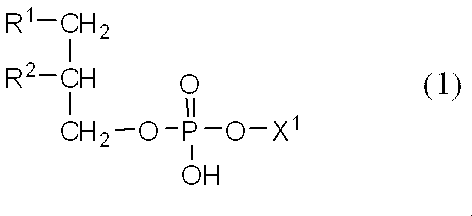
(A)下記構造式(1)

(式(1)中、R1及びR2は、いずれか一方が-OH、他方が-OCOR(Rは、炭素数11~23の飽和又は不飽和の直鎖状又は分岐鎖状の炭化水素基)であり、X1は-H、-C2H4N+(CH3)3、-C2H3(N+H3)COOH、-C2H4N+H3、-C6H6(OH)5、又は-C2H3(OH)CH2(OH)である。)
で表される化合物又はその塩と、
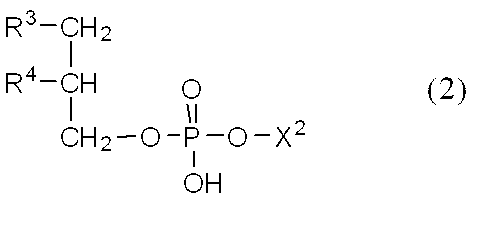
(B)下記構造式(2)

(式(2)中、R3及びR4は、それぞれ互いに同一でも異なってもよく、-OCOR5(R5は、炭素数11~23の飽和又は不飽和の直鎖状又は分岐鎖状の炭化水素基)であり、X2は-H、-C2H4N+(CH3)3、-C2H3(N+H3)COOH、-C2H4N+H3、又は-C6H6(OH)5である。)
で表される化合物又はその塩と
を含有し、(B)成分に対する(A)成分の比率を示す(A)/(B)が、質量比で0.1~10である口腔用組成物。
〔2〕
(A)/(B)が、質量比で0.2~5である〔1〕に記載の口腔用組成物。
〔3〕
上記式(1)で示される化合物が、リゾホスファチジン酸、リゾホスファチジルコリン、リゾホスファチジルセリン、リゾホスファチジルエタノールアミン、リゾホスファチジルイノシトール及びリゾホスファチジルグリセリンから選ばれる1種以上のリゾホスファチジン酸又はその誘導体である〔1〕又は〔2〕に記載の口腔用組成物。
〔4〕
上記式(2)で示される化合物が、ホスファチジン酸、ホスファチジルコリン、ホスファチジルセリン、ホスファチジルエタノールアミン及びホスファチジルイノシトールから選ばれる1種以上のホスファチジン酸又はその誘導体である〔1〕~〔3〕のいずれかに記載の口腔用組成物。
〔5〕
(A)成分を0.001~10質量%、(B)成分を0.001~10質量%含有する〔1〕~〔4〕のいずれかに記載の口腔用組成物。
〔6〕
口腔内常在菌を増加させるための口腔用製剤である〔1〕~〔5〕のいずれかに記載の口腔用組成物。
〔7〕
(A)上記式(1)で表される化合物又はその塩と、(B)上記式(2)で表される化合物又はその塩とからなる口腔内常在菌の生育促進剤。
〔8〕
(B)成分に対する(A)成分の比率を示す(A)/(B)が、質量比で0.1~10である〔7〕に記載の口腔内常在菌の生育促進剤。
〔9〕
口腔内常在菌が、ストレプトコッカス ミティス、ストレプトコッカス オラリス及びストレプトコッカス ゴルドニアイから選ばれる1種以上のミティスグループのストレプトコッカス属細菌である〔7〕又は〔8〕に記載の口腔内常在菌の生育促進剤。
〔1〕
(A)下記構造式(1)
で表される化合物又はその塩と、
(B)下記構造式(2)
で表される化合物又はその塩と
を含有し、(B)成分に対する(A)成分の比率を示す(A)/(B)が、質量比で0.1~10である口腔用組成物。
〔2〕
(A)/(B)が、質量比で0.2~5である〔1〕に記載の口腔用組成物。
〔3〕
上記式(1)で示される化合物が、リゾホスファチジン酸、リゾホスファチジルコリン、リゾホスファチジルセリン、リゾホスファチジルエタノールアミン、リゾホスファチジルイノシトール及びリゾホスファチジルグリセリンから選ばれる1種以上のリゾホスファチジン酸又はその誘導体である〔1〕又は〔2〕に記載の口腔用組成物。
〔4〕
上記式(2)で示される化合物が、ホスファチジン酸、ホスファチジルコリン、ホスファチジルセリン、ホスファチジルエタノールアミン及びホスファチジルイノシトールから選ばれる1種以上のホスファチジン酸又はその誘導体である〔1〕~〔3〕のいずれかに記載の口腔用組成物。
〔5〕
(A)成分を0.001~10質量%、(B)成分を0.001~10質量%含有する〔1〕~〔4〕のいずれかに記載の口腔用組成物。
〔6〕
口腔内常在菌を増加させるための口腔用製剤である〔1〕~〔5〕のいずれかに記載の口腔用組成物。
〔7〕
(A)上記式(1)で表される化合物又はその塩と、(B)上記式(2)で表される化合物又はその塩とからなる口腔内常在菌の生育促進剤。
〔8〕
(B)成分に対する(A)成分の比率を示す(A)/(B)が、質量比で0.1~10である〔7〕に記載の口腔内常在菌の生育促進剤。
〔9〕
口腔内常在菌が、ストレプトコッカス ミティス、ストレプトコッカス オラリス及びストレプトコッカス ゴルドニアイから選ばれる1種以上のミティスグループのストレプトコッカス属細菌である〔7〕又は〔8〕に記載の口腔内常在菌の生育促進剤。
本発明によれば、口腔内常在菌の生育促進効果が優れる、口腔内常在菌の生育促進剤及びこれを含有する口腔用組成物を提供することができる。これらは、口腔内常在菌の維持にも有効である。
以下、本発明につき更に詳述する。本発明の口腔内常在菌の生育促進剤は、(A)構造式(1)で表される化合物又はその塩と、(B)構造式(2)で表される化合物又はその塩とを有効成分とする。
本発明において、(A)成分は、下記構造式(1)で表される化合物又はその塩である。これらは、(B)成分と併用することによって、口腔内常在菌の生育促進剤として作用する。また、病原性細菌の抗菌剤としても作用する。
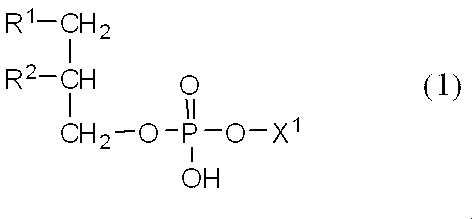
上記式(1)中の-OCORにおいて、Rは炭素数11~23、好ましくは15~21の飽和又は不飽和の直鎖状又は分岐鎖状の炭化水素基である。-OCORの具体例としては、ラウリン酸残基(CH3(CH2)10COO-)、ミリスチン酸残基(CH3(CH2)12COO-)、パルミチン酸残基(CH3(CH2)14COO-)、ステアリン酸残基(CH3(CH2)16COO-)、アラキジン酸残基(CH3(CH2)18COO-)、ベヘン酸残基(CH3(CH2)20COO-)、リグノセリン酸残基(CH3(CH2)22COO-)、パルミトレイン酸残基(CH3(CH2)5CH=CH(CH2)7COO-)、オレイン酸残基(CH3(CH2)7CH=CH(CH2)7COO-)、リノール酸残基(CH3(CH2)4(CH=CHCH2)2(CH2)6COO-)、γリノレン酸残基(CH3(CH2)4(CH=CHCH2)3(CH2)3COO-)、αリノレン酸残基(CH3(CH2)(CH=CHCH2)3(CH2)6COO-)、エルカ酸残基(CH3(CH2)7CH=CH(CH2)11COO-)、エイコペンタエン酸残基(CH3CH2(CH=CHCH2)5(CH2)2COO-)、ドコサヘキサエン酸残基(CH3CH2(CH=CHCH2)6CH2COO-)などが挙げられ、特にパルミチン酸残基(CH3(CH2)14COO-)、ステアリン酸残基(CH3(CH2)16COO-)、オレイン酸残基(CH3(CH2)7CH=CH(CH2)7COO-)、リノール酸残基(CH3(CH2)4(CH=CHCH2)2(CH2)6COO-)が好ましい。
上記式(1)で表される化合物としては、具体的にリゾホスファチジン酸又はその誘導体が好ましく、例えばリゾホスファチジン酸(LPA、X1;-H)、リゾホスファチジルコリン(LPC、X1;-C2H4N+(CH3)3)、リゾホスファチジルセリン(LPS、X1;-C2H3(N+H3)COOH)、リゾホスファチジルエタノールアミン(LPE、X1;-C2H4N+H3)、リゾホスファチジルイノシトール(LPI、X1;-C6H6(OH)5)、リゾホスファチジルグリセリン(LPG、X1;-C2H3(OH)CH2(OH))等が挙げられる。これらは、1種単独でもよいが2種以上を組み合わせて使用してもよい。中でも、リゾホスファチジン酸(LPA)、リゾホスファチジルコリン(LPC)、リゾホスファチジルエタノールアミン(LPE)、リゾホスファチジルセリン(LPS)、リゾホスファチジルイノシトール(LPI)、特にリゾホスファチジン酸(LPA)、リゾホスファチジルコリン(LPC)、リゾホスファチジルエタノールアミン(LPE)、とりわけリゾホスファチジルコリン(LPC)が、口腔内常在菌の生育促進効果の点で好ましい。なお、上記化合物は塩であってもよく、塩としては、ナトリウム塩等のアルカリ金属塩、アンモニウム塩などが挙げられる。
(A)成分としては、卵黄リゾレシチンLPL-1、卵黄レシチンLPL-20W、卵黄レシチンLPL-20S(各キューピー(株)製)、SLP-ホワイトリゾ、SLP-LPC70、SLP-ホワイトリゾH、SLP-LPC70H(各辻製油(株)製)、LIPOID R LPC20(H.Holstein社製)などの市販品を用いることができる。
(B)成分は、下記構造式(2)で表される化合物又はその塩である。これらは、(A)成分と併用することによって、口腔内常在菌の生育促進剤として作用する。また、(A)成分による抗菌作用の適度な抑制にも寄与する。
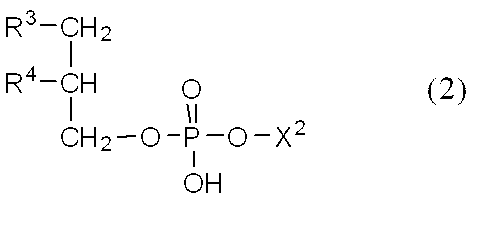
上記式(2)中の-OCOR5において、R5は炭素数11~23、好ましくは15~21の飽和又は不飽和の直鎖状又は分岐鎖状の炭化水素基である。-OCOR5の具体例としては、ラウリン酸残基(CH3(CH2)10COO-)、ミリスチン酸残基(CH3(CH2)12COO-)、パルミチン酸残基(CH3(CH2)14COO-)、ステアリン酸残基(CH3(CH2)16COO-)、アラキジン酸残基(CH3(CH2)18COO-)、ベヘン酸残基(CH3(CH2)20COO-)、リグノセリン酸残基(CH3(CH2)22COO-)、パルミトレイン酸残基(CH3(CH2)5CH=CH(CH2)7COO-)、オレイン酸残基(CH3(CH2)7CH=CH(CH2)7COO-)、リノール酸残基(CH3(CH2)4(CH=CHCH2)2(CH2)6COO-)、γリノレン酸残基(CH3(CH2)4(CH=CHCH2)3(CH2)3COO-)、αリノレン酸残基(CH3(CH2)(CH=CHCH2)3(CH2)6COO-)、エルカ酸残基(CH3(CH2)7CH=CH(CH2)11COO-)、エイコペンタエン酸残基(CH3CH2(CH=CHCH2)5(CH2)2COO-)、ドコサヘキサエン酸残基(CH3CH2(CH=CHCH2)6CH2COO-)などが挙げられ、特にパルミチン酸残基(CH3(CH2)14COO-)、ステアリン酸残基(CH3(CH2)16COO-)、オレイン酸残基(CH3(CH2)7CH=CH(CH2)7COO-)、リノール酸残基(CH3(CH2)4(CH=CHCH2)2(CH2)6COO-)が好ましい。
上記式(2)で表される化合物としては、具体的にはホスファチジン酸又はその誘導体が好ましく、例えばホスファチジン酸(PA、X2;-H)、ホスファチジルコリン(PC、X2;-C2H4N+(CH3)3)、ホスファチジルセリン(PS、X2;-C2H3(N+H3)COOH)、ホスファチジルエタノールアミン(PE、X2;-C2H4N+H3)、ホスファチジルイノシトール(PI、X2;-C6H6(OH)5)等が挙げられる。これらは、1種単独でも2種以上を組み合わせて使用してもよい。中でも、ホスファチジン酸(PA)、ホスファチジルコリン(PC)、ホスファチジルエタノールアミン(PE)、とりわけホスファチジルコリン(PC)が、口腔内常在菌の生育促進効果の点で好ましい。なお、上記化合物は塩であってもよく、塩としては、ナトリウム塩等のアルカリ金属塩、アンモニウム塩などが挙げられる。
(B)成分としては、卵黄レシチンPL-100P、卵黄レシチンPL-30S(各キューピー(株)製)、SLP-ホワイト、SLP-PC70、SLP-ホワイトH、SLP-PC70H(各辻製油(株)製)、COATSOME NC-21(日油(株)製)などの市販品を用いることができる。
本発明において、(B)成分に対する(A)成分の量比を示す(A)/(B)は、質量比として0.1~10であり、好ましくは0.2~5、更に好ましくは0.25~5である。0.1未満であると、口腔内常在菌の生育促進効果が劣る。10を超えると、(A)成分による抗菌効果が抑えられず病原性細菌以外の常在菌まで抗菌されてしまい、口腔内常在菌の生育促進効果が劣る。
本発明の口腔用組成物は、口腔内常在菌の生育促進作用に優れ、かつ口腔内病原菌の抗菌作用も有するため、口腔内常在菌及び/又はその比率を増加させる(口腔内常在菌数を増加させる効果、及び/又は口腔内病原菌数に対する口腔内常在菌数の割合を増加させる)効果を有する。従って、口腔内常在菌及び/又はその比率を増加させるための各種口腔用製剤、更には口腔内を常在菌優位の菌叢とするための各種口腔用製剤として、調製することができる。
具体的な口腔用製剤としては、固体、液体(配合成分の一部又は全部が可溶化せずに分散、懸濁したものも含む。以下、同様)、ペースト状、ゲル状などの形態に調製し、例えば、口腔内崩壊錠、チュアブル錠、トローチ、キャンディー等の錠剤、顆粒等の粒状剤、チューインガム、グミ、飲料などや、練歯磨、液体歯磨、液状歯磨、潤製歯磨等の歯磨剤、洗口剤、マウススプレー、口中清涼剤、塗布用ゲル剤などの各種剤型で使用し得る。なお、口腔用製剤は濃縮タイプであってもよく、例えば、水で適宜希釈して使用し得る濃縮粉末飲料に調製してもよい。
具体的な口腔用製剤としては、固体、液体(配合成分の一部又は全部が可溶化せずに分散、懸濁したものも含む。以下、同様)、ペースト状、ゲル状などの形態に調製し、例えば、口腔内崩壊錠、チュアブル錠、トローチ、キャンディー等の錠剤、顆粒等の粒状剤、チューインガム、グミ、飲料などや、練歯磨、液体歯磨、液状歯磨、潤製歯磨等の歯磨剤、洗口剤、マウススプレー、口中清涼剤、塗布用ゲル剤などの各種剤型で使用し得る。なお、口腔用製剤は濃縮タイプであってもよく、例えば、水で適宜希釈して使用し得る濃縮粉末飲料に調製してもよい。
この場合、(A)成分の配合量は、組成物全体の0.001~10%(質量%、以下同様)が好ましく、より好ましくは0.01~5%、更に好ましくは0.01~1%である。0.001%以上であると、口腔内常在菌の生育促進効果が十分に優れ、10%以下であると生育促進効果が十分に維持される。多く配合し過ぎると、(A)成分による抗菌作用が抑えられなくなり、口腔内常在菌の生育促進効果が劣る場合がある。
また、(B)成分の配合量は、特に限定されないが、組成物全体の0.001~10%が好ましく、より好ましくは0.01~5%、更に好ましくは0.01~1%である。0.001%以上であると、口腔内常在菌の生育促進効果が十分に優れ、10%以下であると生育促進効果が十分に維持される。多く配合し過ぎると、組成物の病原性細菌への抗菌作用が低下して口腔内の菌叢バランスが病原菌優位に傾き、健康な状態に維持する効果が弱くなる場合がある。
更に、本発明の口腔用組成物には、その使用目的、剤型等に応じて、上記の(A)及び(B)成分以外の公知成分を必要に応じて配合することができる。例えば、練歯磨等の歯磨剤には、研磨剤、粘稠剤、粘結剤、界面活性剤、甘味剤、防腐剤、着色剤、香料、有効成分等を配合し、通常の方法で調製できる。
研磨剤としては、沈降性シリカ、アルミノシリケート、ジルコノシリケート等のシリカ系研磨剤、リン酸カルシウム系研磨剤、炭酸カルシウム等が挙げられる(配合量は、通常、2~50%、特に10~40%)。
粘稠剤としては、ソルビット、キシリット等の糖アルコール、グリセリン、プロピレングリコール、平均分子量160~4000(医薬部外品原料規格2006に記載の平均分子量)のポリエチレングリコール等の多価アルコールが挙げられる(配合量は、通常、5~50%)。
粘結剤としては、カルボキシメチルセルロースナトリウム、ヒドロキシエチルセルロース、ヒドロキシプロピルセルロース等のセルロース誘導体、アルギン酸ナトリウム等のアルギン酸又はその誘導体、キサンタンガム等のガム類、カラギーナン、ポリビニルアルコール、ポリアクリル酸ナトリウムなどの有機粘結剤、ゲル化性シリカ、ゲル化性アルミニウムシリカ、ビーガム、ラポナイト等の無機粘結剤が挙げられる(配合量は、通常、0.1~10%)。
界面活性剤としては、アニオン性界面活性剤、ノニオン性界面活性剤等が挙げられる。
アニオン性界面活性剤としては、ラウリル硫酸ナトリウム、ミリスチル硫酸ナトリウム等のアルキル硫酸塩、アシルサルコシン酸塩などが挙げられる。
ノニオン性界面活性剤としては、ショ糖脂肪酸エステル等の糖脂肪酸エステル、糖アルコール脂肪酸エステル、ソルビタン脂肪酸エステル、グリセリン脂肪酸エステル、ポリグリセリン脂肪酸エステル、ポリオキシエチレンソルビタン脂肪酸エステル、ポリオキシエチレン硬化ヒマシ油等のポリオキシエチレン脂肪酸エステル、ポリオキシエチレンラウリルエーテル等のポリオキシエチレン高級アルコールエーテルなどが挙げられる。
界面活性剤の配合量は、通常、0.01~10%、特に0.01~5%である。
アニオン性界面活性剤としては、ラウリル硫酸ナトリウム、ミリスチル硫酸ナトリウム等のアルキル硫酸塩、アシルサルコシン酸塩などが挙げられる。
ノニオン性界面活性剤としては、ショ糖脂肪酸エステル等の糖脂肪酸エステル、糖アルコール脂肪酸エステル、ソルビタン脂肪酸エステル、グリセリン脂肪酸エステル、ポリグリセリン脂肪酸エステル、ポリオキシエチレンソルビタン脂肪酸エステル、ポリオキシエチレン硬化ヒマシ油等のポリオキシエチレン脂肪酸エステル、ポリオキシエチレンラウリルエーテル等のポリオキシエチレン高級アルコールエーテルなどが挙げられる。
界面活性剤の配合量は、通常、0.01~10%、特に0.01~5%である。
甘味剤としてはサッカリンナトリウム等、防腐剤としては、パラオキシ安息香酸メチル等のパラオキシ安息香酸エステル、安息香酸ナトリウム等の安息香酸又はその塩などが挙げられる。
着色剤としては、青色1号、黄色4号、二酸化チタン等が挙げられる。
着色剤としては、青色1号、黄色4号、二酸化チタン等が挙げられる。
香料としては、ペパーミント油、スペアミント油、アニス油、ユーカリ油、ウィンターグリーン油、カシア油、クローブ油、タイム油、セージ油、レモン油、オレンジ油、ハッカ油、カルダモン油、コリアンダー油、マンダリン油、ライム油、ラベンダー油、ローズマリー油、ローレル油、カモミル油、キャラウェイ油、マジョラム油、ベイ油、レモングラス油、オリガナム油、パインニードル油、ネロリ油、ローズ油、ジャスミン油、グレープフルーツ油、スウィーティー油、柚油、イリスコンクリート、アブソリュートペパーミント、アブソリュートローズ、オレンジフラワー等の天然香料や、これら天然香料の加工処理(前溜部カット、後溜部カット、分留、液液抽出、エッセンス化、粉末香料化等)した香料、及び、メントール、カルボン、アネトール、シネオール、サリチル酸メチル、シンナミックアルデヒド、オイゲノール、3-l-メントキシプロパン-1,2-ジオール、チモール、リナロール、リナリールアセテート、リモネン、メントン、メンチルアセテート、N-置換-パラメンタン-3-カルボキサミド、ピネン、オクチルアルデヒド、シトラール、プレゴン、カルビールアセテート、アニスアルデヒド、エチルアセテート、エチルブチレート、アリルシクロヘキサンプロピオネート、メチルアンスラニレート、エチルメチルフェニルグリシデート、バニリン、ウンデカラクトン、ヘキサナール、ブタノール、イソアミルアルコール、ヘキセノール、ジメチルサルファイド、シクロテン、フルフラール、トリメチルピラジン、エチルラクテート、エチルチオアセテート等の単品香料、更に、ストロベリーフレーバー、アップルフレーバー、バナナフレーバー、パイナップルフレーバー、グレープフレーバー、マンゴーフレーバー、バターフレーバー、ミルクフレーバー、フルーツミックスフレーバー、トロピカルフルーツフレーバー等の調合香料等、口腔用組成物に用いられる公知の香料素材を組み合わせて使用することができる。配合量は特に限定されないが、通常、上記の香料素材では0.000001~1%が好ましく、また、上記香料素材を使用した賦香用香料では0.1~2%が好ましい。
有効成分としては、フッ化ナトリウム、モノフルオロリン酸ナトリウム等のフッ素含有化合物、抗炎症剤、デキストラナーゼ等の酵素、水溶性のリン酸化合物や銅化合物、ビタミン類、植物抽出物、歯石防止剤、歯垢防止剤などが挙げられる。有効成分は、本発明の効果を妨げない範囲で有効量配合できる。
以下、実施例及び比較例、処方例を示し、本発明を具体的に説明するが、本発明は下記の実施例に制限されるものではない。なお、下記の例において%は特に断らない限りいずれも質量%を示す。また、配合量は純分換算値である(以下、同様)。
[実施例、比較例]
表1に示す化合物を(A)成分、(B)成分として使用し、表2~4に示す組成の口腔用組成物(洗口剤)を常法で調製し、下記に示す実験方法によって評価した。結果を表2~4に併記した。
表1に示す化合物を(A)成分、(B)成分として使用し、表2~4に示す組成の口腔用組成物(洗口剤)を常法で調製し、下記に示す実験方法によって評価した。結果を表2~4に併記した。
<実験方法>
後述の口腔内常在菌及び歯周病原菌を用い、それぞれの細菌を、評価サンプル又は蒸留水(コントロール)を添加したトリプチックソイ培地(TS培地、Becton and Dickinson社製)200μLで、96穴プレートを用いて37℃で12時間好気培養した。細菌の増殖量は、波長550nmの濁度で測定し、菌の生育度を評価した。なお、濁度測定前にはプレートを振とうして培養液を撹拌した。
菌の生育度は、コントロール(蒸留水)添加の菌培養液の濁度(Tc)に対する評価サンプル添加の菌培養液の濁度(Ts)の相対値Tr(Ts/Tc)とした。すなわち、Trが1.0より大きいと生育が促進され、1.0より小さいと生育が抑制された(抗菌効果有)ことになる。
後述の口腔内常在菌及び歯周病原菌を用い、それぞれの細菌を、評価サンプル又は蒸留水(コントロール)を添加したトリプチックソイ培地(TS培地、Becton and Dickinson社製)200μLで、96穴プレートを用いて37℃で12時間好気培養した。細菌の増殖量は、波長550nmの濁度で測定し、菌の生育度を評価した。なお、濁度測定前にはプレートを振とうして培養液を撹拌した。
菌の生育度は、コントロール(蒸留水)添加の菌培養液の濁度(Tc)に対する評価サンプル添加の菌培養液の濁度(Ts)の相対値Tr(Ts/Tc)とした。すなわち、Trが1.0より大きいと生育が促進され、1.0より小さいと生育が抑制された(抗菌効果有)ことになる。
評価基準
口腔内常在菌の生育促進効果
Tr(Ts/Tc)
◎:1.5以上
○:1.1以上1.5未満
△:1.0を超え1.1未満
×:1.0以下
歯周病菌の抗菌効果
Tr(Ts/Tc)
◎:0.05未満
○:0.05以上0.2未満
△:0.2以上0.5未満
×:0.5以上
口腔内常在菌の生育促進効果
Tr(Ts/Tc)
◎:1.5以上
○:1.1以上1.5未満
△:1.0を超え1.1未満
×:1.0以下
歯周病菌の抗菌効果
Tr(Ts/Tc)
◎:0.05未満
○:0.05以上0.2未満
△:0.2以上0.5未満
×:0.5以上
評価に用いた細菌は、American Type Culture Collection(以下、ATCCと略記。)より購入した、下記の菌種を用いた。
口腔内常在菌:
ストレプトコッカス ミティス ATCC 49456(以下、S.mitisと略記。)
ストレプトコッカス オラリス ATCC 9811(以下、S.oralisと略記。)
ストレプトコッカス ゴルドニアイ ATCC 10558(以下、S.gordoniiと略記。)
歯周病原菌:
ポルフィロモナス ジンジバリス ATCC 33277(以下、P.gingivalisと略記。)
口腔内常在菌:
ストレプトコッカス ミティス ATCC 49456(以下、S.mitisと略記。)
ストレプトコッカス オラリス ATCC 9811(以下、S.oralisと略記。)
ストレプトコッカス ゴルドニアイ ATCC 10558(以下、S.gordoniiと略記。)
歯周病原菌:
ポルフィロモナス ジンジバリス ATCC 33277(以下、P.gingivalisと略記。)
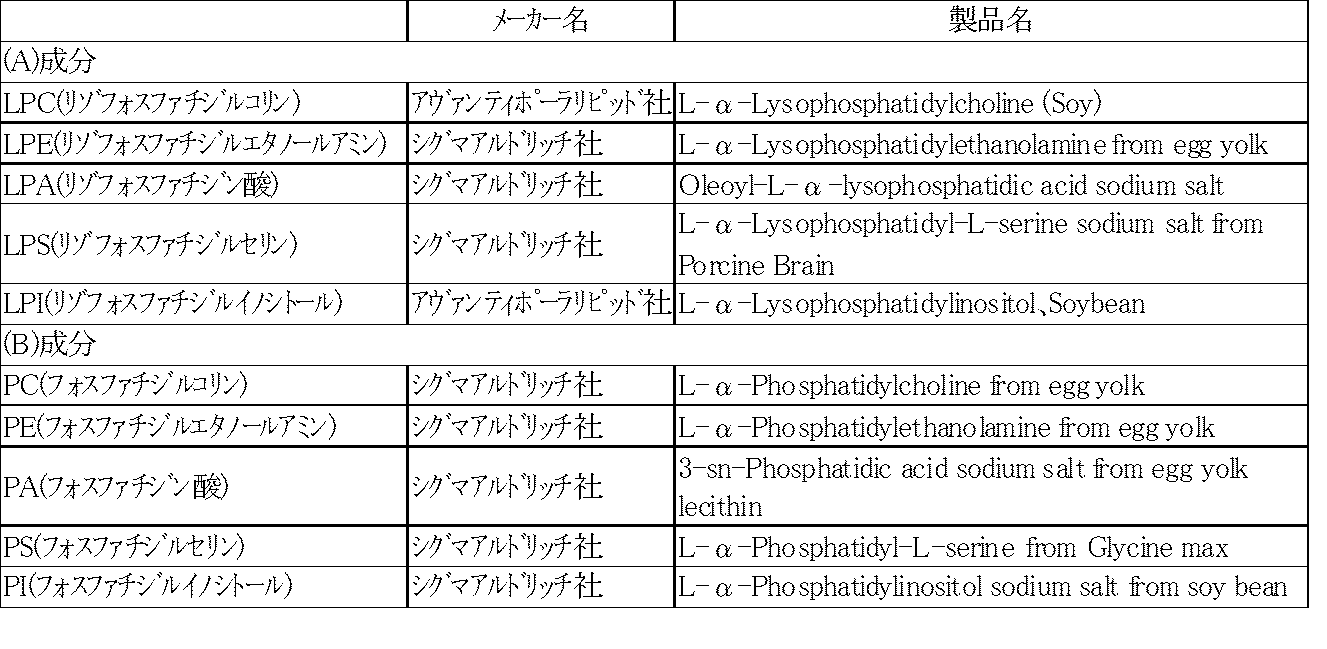
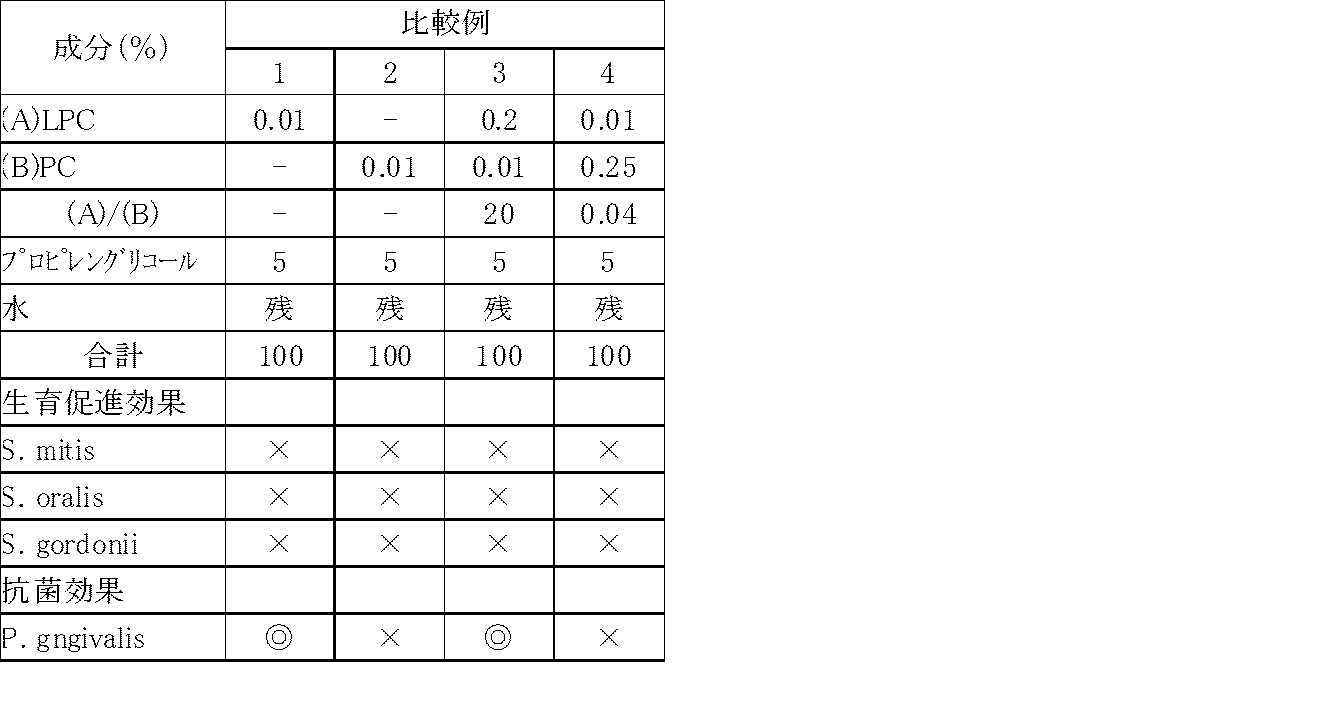
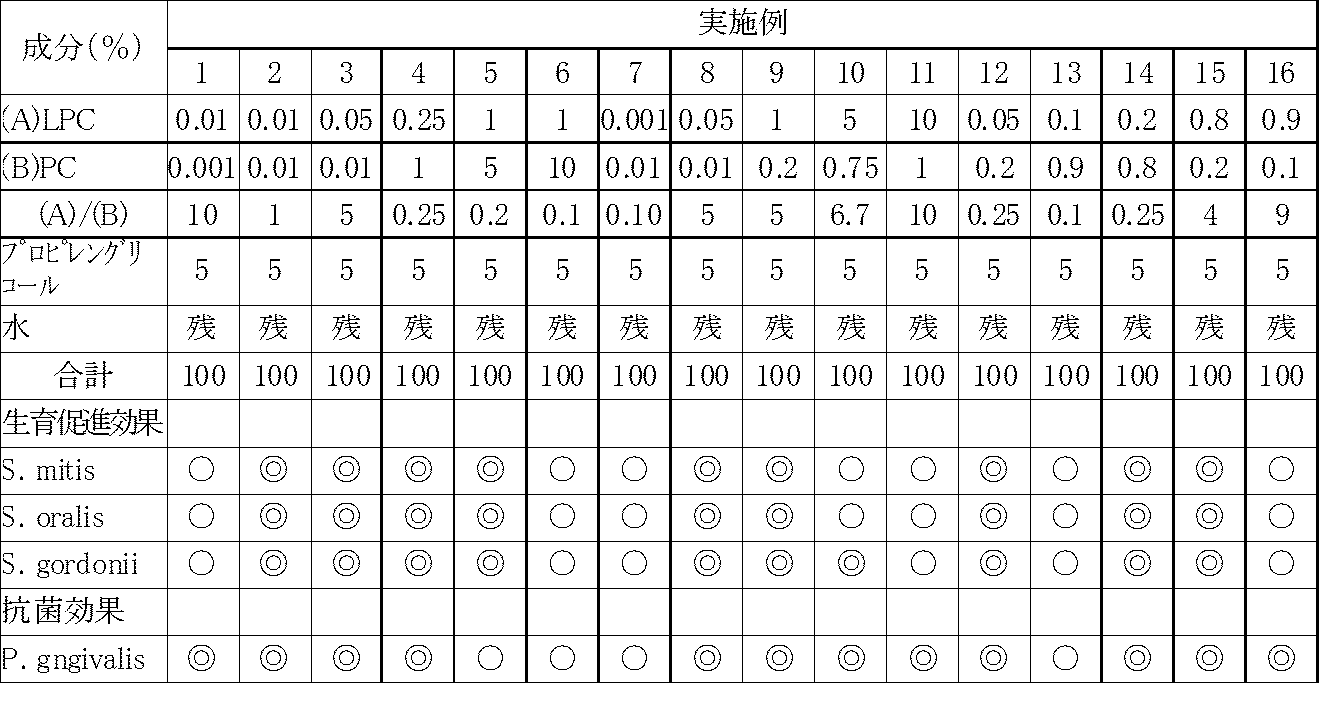
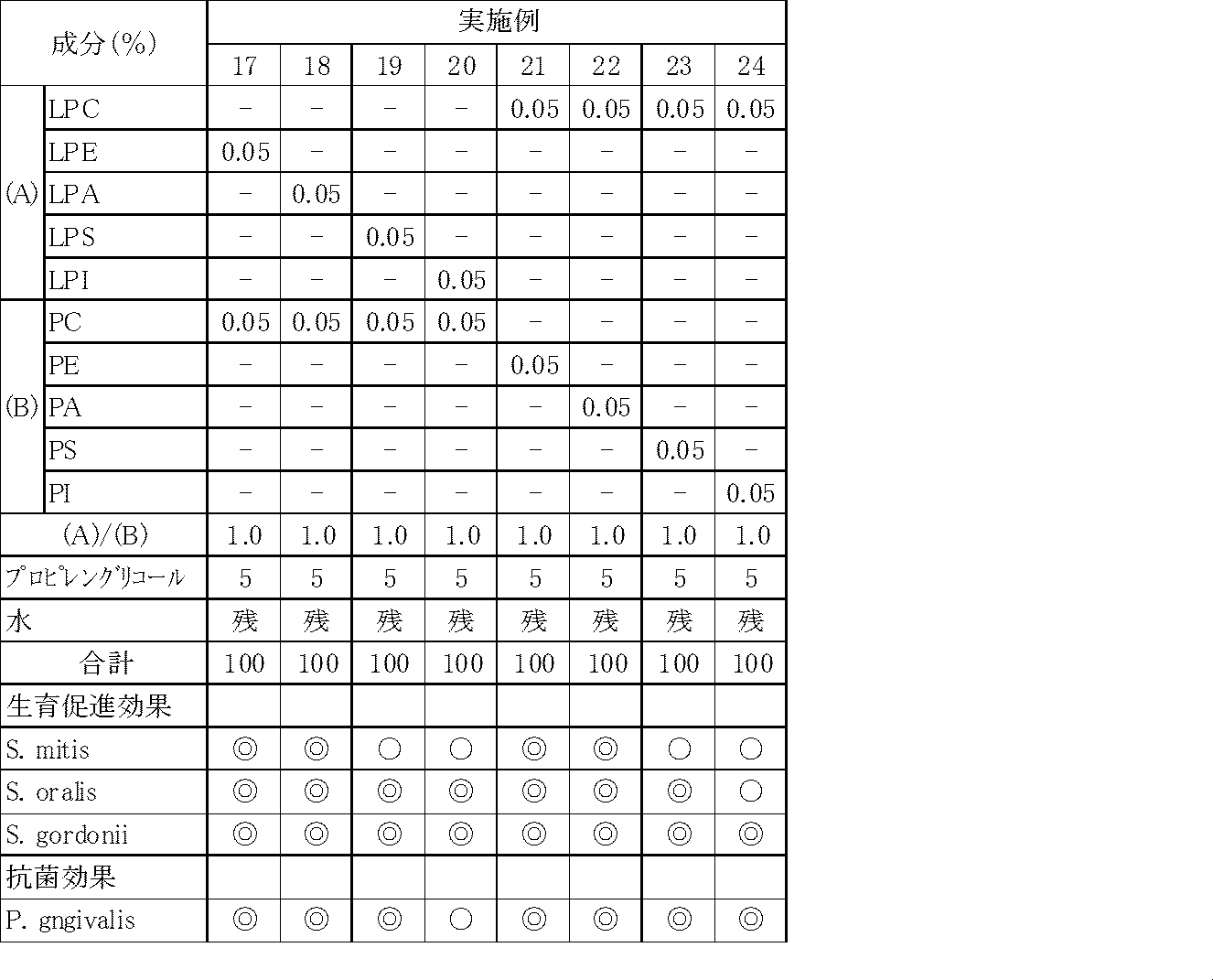
更に、処方例を下記に示す。これらは、口腔内常在菌の生育促進効果が優れた。また、病原菌の抗菌効果も優れ、口腔用組成物として有用である。なお、上述した通り、配合量は純分換算値である。
(A)成分、(B)成分としては下記のものを用いた。
(A)成分
(A)-i:卵黄リゾレシチンLPC-1(キューピー(株)製)
((A)成分:LPC94.5%)
(A)-ii:SLP-ホワイトリゾ(辻製油(株)製)
((A)成分:27.5%(LPC)、(B)成分:24.2%
(PC5.1%、PE3.3%、PI13.5%、PA2.3%))
(A)-iii:SLP-LPC70H(辻製油(株)製)
((A)成分:69.5%(LPC)、(B)成分:7%
(PC2.3%、PE1.8%、PI1.8%、PA1.1%))
(B)成分
(B)-i:卵黄レシチンPL-100P(キューピー(株)製)
((B)成分:97.4%(PC83.2%、PE14.2%)、
(A)成分:0.7%(LPC))
(B)-ii:SLP-ホワイト(辻製油(株)製)
((B)成分:82.4%(PC29.3%、PE24.5%、
PI18.8%、PA9.8)、(A)成分:3.3%(LPC))
(B)-iii:SLP-PC70(辻製油(株)製)
((B)成分:85.2%(PC69.4%、PE13.3%、
PI0.3%、PA2.2)、(A)成分:3.1%(LPC))
(A)成分
(A)-i:卵黄リゾレシチンLPC-1(キューピー(株)製)
((A)成分:LPC94.5%)
(A)-ii:SLP-ホワイトリゾ(辻製油(株)製)
((A)成分:27.5%(LPC)、(B)成分:24.2%
(PC5.1%、PE3.3%、PI13.5%、PA2.3%))
(A)-iii:SLP-LPC70H(辻製油(株)製)
((A)成分:69.5%(LPC)、(B)成分:7%
(PC2.3%、PE1.8%、PI1.8%、PA1.1%))
(B)成分
(B)-i:卵黄レシチンPL-100P(キューピー(株)製)
((B)成分:97.4%(PC83.2%、PE14.2%)、
(A)成分:0.7%(LPC))
(B)-ii:SLP-ホワイト(辻製油(株)製)
((B)成分:82.4%(PC29.3%、PE24.5%、
PI18.8%、PA9.8)、(A)成分:3.3%(LPC))
(B)-iii:SLP-PC70(辻製油(株)製)
((B)成分:85.2%(PC69.4%、PE13.3%、
PI0.3%、PA2.2)、(A)成分:3.1%(LPC))
[処方例1]歯磨剤
無水ケイ酸 15.0
ラウリル硫酸ナトリウム 1.0
キサンタンガム 0.5
アルギン酸ナトリウム 0.5
サッカリンナトリウム 0.1
ソルビトール 10.0
キシリトール 5.0
(A)-i 0.05
(B)-i 0.05
香料 1.0
水 バランス
合計 100.0%
(A)/(B)=0.98
無水ケイ酸 15.0
ラウリル硫酸ナトリウム 1.0
キサンタンガム 0.5
アルギン酸ナトリウム 0.5
サッカリンナトリウム 0.1
ソルビトール 10.0
キシリトール 5.0
(A)-i 0.05
(B)-i 0.05
香料 1.0
水 バランス
合計 100.0%
(A)/(B)=0.98
[処方例2]歯磨剤
無水ケイ酸 15.0
ラウリル硫酸ナトリウム 1.0
カルボキシメチルセルロースナトリウム 1.0
カラギーナン 0.5
サッカリンナトリウム 0.1
グリセリン 15.0
(A)-iii 0.1
(B)-i 0.02
香料 1.0
水 バランス
合計 100.0%
(A)/(B)=3.4
無水ケイ酸 15.0
ラウリル硫酸ナトリウム 1.0
カルボキシメチルセルロースナトリウム 1.0
カラギーナン 0.5
サッカリンナトリウム 0.1
グリセリン 15.0
(A)-iii 0.1
(B)-i 0.02
香料 1.0
水 バランス
合計 100.0%
(A)/(B)=3.4
[処方例3]洗口剤
プロピレングリコール 3.0
グリセンリン 15.0
キシリトール 5.0
(A)-i 0.1
(B)-i 0.05
サッカリンナトリウム 0.2
クエン酸ナトリウム 0.3
クエン酸 0.1
香料 0.5
水 バランス
合計 100.0%
(A)/(B)=2
プロピレングリコール 3.0
グリセンリン 15.0
キシリトール 5.0
(A)-i 0.1
(B)-i 0.05
サッカリンナトリウム 0.2
クエン酸ナトリウム 0.3
クエン酸 0.1
香料 0.5
水 バランス
合計 100.0%
(A)/(B)=2
[処方例4]口中清涼剤
エタノール 10.0
グリセンリン 5.0
キシリトール 20.0
(A)-iii 0.1
(B)-i 0.05
クエン酸ナトリウム 0.3
クエン酸 0.05
香料 1.0
水 バランス
合計 100.0%
(A)/(B)=1.4
エタノール 10.0
グリセンリン 5.0
キシリトール 20.0
(A)-iii 0.1
(B)-i 0.05
クエン酸ナトリウム 0.3
クエン酸 0.05
香料 1.0
水 バランス
合計 100.0%
(A)/(B)=1.4
[処方例5]塗布用ゲル剤
ヒドロキシエチルセルロース 2.0
グリセリン 20.0
ショ糖ステアリン酸エステル 0.5
モノステアリン酸POE(20)ソルビタン 0.2
(A)-i 0.1
(B)-i 0.1
パラオキシ安息香酸エチル 0.03
水 バランス
合計 100.0%
(A)/(B)=0.98
ヒドロキシエチルセルロース 2.0
グリセリン 20.0
ショ糖ステアリン酸エステル 0.5
モノステアリン酸POE(20)ソルビタン 0.2
(A)-i 0.1
(B)-i 0.1
パラオキシ安息香酸エチル 0.03
水 バランス
合計 100.0%
(A)/(B)=0.98
[処方例6]チューインガム
キシリトール 49.8
マルチトール 20.0
ガムベース 20.0
(A)-ii 0.1
(B)-ii 0.1
アラビアガム 9.0
香料 1.0
合計 100.0%
(A)/(B)=0.29
キシリトール 49.8
マルチトール 20.0
ガムベース 20.0
(A)-ii 0.1
(B)-ii 0.1
アラビアガム 9.0
香料 1.0
合計 100.0%
(A)/(B)=0.29
[処方例7]錠剤
ソルビトール 70.0
マルチトール 25.0
(A)-ii 0.5
(B)-iii 0.5
香料 3.5
微粒二酸化ケイ素 0.5
合計 100.0%
(A)/(B)=0.28
ソルビトール 70.0
マルチトール 25.0
(A)-ii 0.5
(B)-iii 0.5
香料 3.5
微粒二酸化ケイ素 0.5
合計 100.0%
(A)/(B)=0.28
[処方例8]グミ
砂糖 30.0
水飴 30.0
ゼラチン 10.0
(A)-ii 0.1
(B)-ii 0.05
香料 0.2
水 バランス
合計 100.0%
(A)/(B)=0.58
砂糖 30.0
水飴 30.0
ゼラチン 10.0
(A)-ii 0.1
(B)-ii 0.05
香料 0.2
水 バランス
合計 100.0%
(A)/(B)=0.58
[処方例9]キャンディー
砂糖 40.0
水飴 40.0
クエン酸 2.0
(A)-ii 0.05
(B)-iii 0.05
l-メントール 0.5
香料 0.2
水 バランス
合計 100.0%
(A)/(B)=0.28
砂糖 40.0
水飴 40.0
クエン酸 2.0
(A)-ii 0.05
(B)-iii 0.05
l-メントール 0.5
香料 0.2
水 バランス
合計 100.0%
(A)/(B)=0.28
[処方例10]飲料
(A)-ii 0.05
(B)-ii 0.05
クエン酸 0.1
ビタミンC 0.04
香料 0.1
水 バランス
合計 100.0%
(A)/(B)=0.29
(A)-ii 0.05
(B)-ii 0.05
クエン酸 0.1
ビタミンC 0.04
香料 0.1
水 バランス
合計 100.0%
(A)/(B)=0.29
[処方例11]粉末飲料(お湯又は水100mLを加えて調製する。)
(A)-ii 0.5
(B)-ii 0.1
粉末緑茶 1.0
合計 1.6g
(A)/(B)=1.4
(A)-ii 0.5
(B)-ii 0.1
粉末緑茶 1.0
合計 1.6g
(A)/(B)=1.4
Claims (9)
- (A)下記構造式(1)

で表される化合物又はその塩と、
(B)下記構造式(2)
で表される化合物又はその塩と
を含有し、(B)成分に対する(A)成分の比率を示す(A)/(B)が、質量比で0.1~10である口腔用組成物。 - (A)/(B)が、質量比で0.2~5である請求項1記載の口腔用組成物。
- 上記式(1)で示される化合物が、リゾホスファチジン酸、リゾホスファチジルコリン、リゾホスファチジルセリン、リゾホスファチジルエタノールアミン、リゾホスファチジルイノシトール及びリゾホスファチジルグリセリンから選ばれる1種以上のリゾホスファチジン酸又はその誘導体である請求項1又は2記載の口腔用組成物。
- 上記式(2)で示される化合物が、ホスファチジン酸、ホスファチジルコリン、ホスファチジルセリン、ホスファチジルエタノールアミン及びホスファチジルイノシトールから選ばれる1種以上のホスファチジン酸又はその誘導体である請求項1~3のいずれか1項記載の口腔用組成物。
- (A)成分を0.001~10質量%、(B)成分を0.001~10質量%含有する請求項1~4のいずれか1項記載の口腔用組成物。
- 口腔内常在菌を増加させるための口腔用製剤である請求項1~5のいずれか1項記載の口腔用組成物。
- (A)下記構造式(1)
で表される化合物又はその塩と、
(B)下記構造式(2)

で表される化合物又はその塩とからなる口腔内常在菌の生育促進剤。 - (B)成分に対する(A)成分の比率を示す(A)/(B)が、質量比で0.1~10である請求項7記載の口腔内常在菌の生育促進剤。
- 口腔内常在菌が、ストレプトコッカス ミティス、ストレプトコッカス オラリス及びストレプトコッカス ゴルドニアイから選ばれる1種以上のミティスグループのストレプトコッカス属細菌である請求項7又は8記載の口腔内常在菌の生育促進剤。
Priority Applications (2)
| Application Number | Priority Date | Filing Date | Title |
|---|---|---|---|
| CN201880039297.9A CN110740721B (zh) | 2017-06-12 | 2018-06-08 | 口腔用组合物和口腔内常驻菌的生长促进剂 |
| KR1020197038567A KR102614880B1 (ko) | 2017-06-12 | 2018-06-08 | 구강용 조성물 및 구강 내 상재균의 생육 촉진제 |
Applications Claiming Priority (2)
| Application Number | Priority Date | Filing Date | Title |
|---|---|---|---|
| JP2017114841A JP6953811B2 (ja) | 2017-06-12 | 2017-06-12 | 口腔用組成物及び口腔内常在菌の生育促進剤 |
| JP2017-114841 | 2017-06-12 |
Publications (1)
| Publication Number | Publication Date |
|---|---|
| WO2018230459A1 true WO2018230459A1 (ja) | 2018-12-20 |
Family
ID=64660023
Family Applications (1)
| Application Number | Title | Priority Date | Filing Date |
|---|---|---|---|
| PCT/JP2018/022002 Ceased WO2018230459A1 (ja) | 2017-06-12 | 2018-06-08 | 口腔用組成物及び口腔内常在菌の生育促進剤 |
Country Status (4)
| Country | Link |
|---|---|
| JP (1) | JP6953811B2 (ja) |
| KR (1) | KR102614880B1 (ja) |
| CN (1) | CN110740721B (ja) |
| WO (1) | WO2018230459A1 (ja) |
Families Citing this family (3)
| Publication number | Priority date | Publication date | Assignee | Title |
|---|---|---|---|---|
| JP7215026B2 (ja) * | 2018-09-13 | 2023-01-31 | ライオン株式会社 | 口腔用組成物 |
| JP7310149B2 (ja) * | 2019-01-22 | 2023-07-19 | ライオン株式会社 | 口腔用組成物 |
| US20220370321A1 (en) * | 2019-12-16 | 2022-11-24 | Firmenich Sa | Flavor compositions for beverage and personal care applications |
Citations (6)
| Publication number | Priority date | Publication date | Assignee | Title |
|---|---|---|---|---|
| JPH03118305A (ja) * | 1989-09-29 | 1991-05-20 | Yakult Honsha Co Ltd | 抗菌剤 |
| JPH05239A (ja) * | 1991-06-21 | 1993-01-08 | Taiyo Kagaku Co Ltd | リポソーム |
| JPH07149619A (ja) * | 1993-11-30 | 1995-06-13 | Earth Chem Corp Ltd | 口腔用組成物 |
| JP2005525335A (ja) * | 2002-02-12 | 2005-08-25 | ウンザー ディ ピストレージ エルヴィラ エ チ. エッセ.ア.エッセ. | N−アシル−ホスファチジル−エタノールアミン類及び/又はn−アシル−エタノールアミン類とホスファチジン酸類又はリゾホスファチジン酸類との混合物 |
| JP2014088333A (ja) * | 2012-10-29 | 2014-05-15 | Univ Of Tokushima | 口腔咽頭用組成物 |
| JP2016501709A (ja) * | 2012-10-24 | 2016-01-21 | カーギル インコーポレイテッド | リン脂質含有乳化剤組成物 |
Family Cites Families (4)
| Publication number | Priority date | Publication date | Assignee | Title |
|---|---|---|---|---|
| JPH02273536A (ja) * | 1989-04-13 | 1990-11-08 | Yakult Honsha Co Ltd | 界面活性剤およびその製造法 |
| US5407921A (en) * | 1993-07-01 | 1995-04-18 | Kao Corporation | Method for suppressing bitter taste |
| JP2717509B2 (ja) | 1993-07-01 | 1998-02-18 | 花王株式会社 | 苦味低減化剤及び苦味低減化法 |
| CN120616104A (zh) * | 2014-10-20 | 2025-09-12 | 国际香料和香精公司 | 香料纳米乳液和制备其的方法 |
-
2017
- 2017-06-12 JP JP2017114841A patent/JP6953811B2/ja active Active
-
2018
- 2018-06-08 CN CN201880039297.9A patent/CN110740721B/zh active Active
- 2018-06-08 WO PCT/JP2018/022002 patent/WO2018230459A1/ja not_active Ceased
- 2018-06-08 KR KR1020197038567A patent/KR102614880B1/ko active Active
Patent Citations (6)
| Publication number | Priority date | Publication date | Assignee | Title |
|---|---|---|---|---|
| JPH03118305A (ja) * | 1989-09-29 | 1991-05-20 | Yakult Honsha Co Ltd | 抗菌剤 |
| JPH05239A (ja) * | 1991-06-21 | 1993-01-08 | Taiyo Kagaku Co Ltd | リポソーム |
| JPH07149619A (ja) * | 1993-11-30 | 1995-06-13 | Earth Chem Corp Ltd | 口腔用組成物 |
| JP2005525335A (ja) * | 2002-02-12 | 2005-08-25 | ウンザー ディ ピストレージ エルヴィラ エ チ. エッセ.ア.エッセ. | N−アシル−ホスファチジル−エタノールアミン類及び/又はn−アシル−エタノールアミン類とホスファチジン酸類又はリゾホスファチジン酸類との混合物 |
| JP2016501709A (ja) * | 2012-10-24 | 2016-01-21 | カーギル インコーポレイテッド | リン脂質含有乳化剤組成物 |
| JP2014088333A (ja) * | 2012-10-29 | 2014-05-15 | Univ Of Tokushima | 口腔咽頭用組成物 |
Also Published As
| Publication number | Publication date |
|---|---|
| JP2019001720A (ja) | 2019-01-10 |
| KR20200014357A (ko) | 2020-02-10 |
| CN110740721B (zh) | 2023-04-28 |
| KR102614880B1 (ko) | 2023-12-18 |
| CN110740721A (zh) | 2020-01-31 |
| JP6953811B2 (ja) | 2021-10-27 |
Similar Documents
| Publication | Publication Date | Title |
|---|---|---|
| JP6318487B2 (ja) | 口腔用組成物 | |
| JP2007332143A (ja) | 口臭を抑える抗菌作用を持った化合物 | |
| JP7423925B2 (ja) | 口腔内常在菌の生育促進剤及び口腔用組成物 | |
| WO2015008823A1 (ja) | 口腔バイオフィルム除去剤及び口腔用組成物 | |
| CN102548526A (zh) | 洁齿剂组合物 | |
| JP2023168549A (ja) | 口腔内病原性細菌の生育抑制剤、口腔用組成物及び促進剤 | |
| JPWO2016093279A1 (ja) | 口腔用組成物 | |
| WO2019208699A1 (ja) | 口腔内菌叢改善剤及び口腔用組成物 | |
| JP6740901B2 (ja) | 口腔用組成物及び口腔用組成物におけるカチオン性殺菌剤の異味抑制方法 | |
| WO2018230459A1 (ja) | 口腔用組成物及び口腔内常在菌の生育促進剤 | |
| JP5493731B2 (ja) | 歯磨剤組成物 | |
| JP6834978B2 (ja) | 歯磨剤組成物及び口腔バイオフィルム除去剤 | |
| JP2020011951A (ja) | 口腔用組成物 | |
| JP2005047855A (ja) | 口腔バイオフィルム抑制剤及び口腔用組成物 | |
| JP2011046654A (ja) | 歯磨剤組成物 | |
| WO2018066341A1 (ja) | 口腔用組成物、及びその製剤変色及び液分離の抑制方法 | |
| JP2017214296A (ja) | 口腔用組成物 | |
| JP7445910B2 (ja) | 口腔常在菌調整剤を含む口腔用組成物、口腔ケア製品及び食品 | |
| JP6547324B2 (ja) | 液体口腔用組成物 | |
| JP2019167297A (ja) | 歯磨剤組成物 | |
| JP2025516761A (ja) | 抗菌性混合物 | |
| JP4158036B2 (ja) | 歯磨剤組成物及びその製造方法 | |
| WO2023100799A1 (ja) | 歯磨剤組成物 | |
| JP6249588B2 (ja) | 口腔用組成物 | |
| JP5471318B2 (ja) | 歯磨剤組成物 |
Legal Events
| Date | Code | Title | Description |
|---|---|---|---|
| 121 | Ep: the epo has been informed by wipo that ep was designated in this application |
Ref document number: 18818537 Country of ref document: EP Kind code of ref document: A1 |
|
| NENP | Non-entry into the national phase |
Ref country code: DE |
|
| ENP | Entry into the national phase |
Ref document number: 20197038567 Country of ref document: KR Kind code of ref document: A |
|
| 122 | Ep: pct application non-entry in european phase |
Ref document number: 18818537 Country of ref document: EP Kind code of ref document: A1 |