WO2018147288A1 - 化学強化ガラス - Google Patents
化学強化ガラス Download PDFInfo
- Publication number
- WO2018147288A1 WO2018147288A1 PCT/JP2018/004079 JP2018004079W WO2018147288A1 WO 2018147288 A1 WO2018147288 A1 WO 2018147288A1 JP 2018004079 W JP2018004079 W JP 2018004079W WO 2018147288 A1 WO2018147288 A1 WO 2018147288A1
- Authority
- WO
- WIPO (PCT)
- Prior art keywords
- glass
- less
- compressive stress
- mpa
- chemically strengthened
- Prior art date
- Legal status (The legal status is an assumption and is not a legal conclusion. Google has not performed a legal analysis and makes no representation as to the accuracy of the status listed.)
- Ceased
Links
Images
Classifications
-
- C—CHEMISTRY; METALLURGY
- C03—GLASS; MINERAL OR SLAG WOOL
- C03C—CHEMICAL COMPOSITION OF GLASSES, GLAZES OR VITREOUS ENAMELS; SURFACE TREATMENT OF GLASS; SURFACE TREATMENT OF FIBRES OR FILAMENTS MADE FROM GLASS, MINERALS OR SLAGS; JOINING GLASS TO GLASS OR OTHER MATERIALS
- C03C21/00—Treatment of glass, not in the form of fibres or filaments, by diffusing ions or metals in the surface
-
- C—CHEMISTRY; METALLURGY
- C03—GLASS; MINERAL OR SLAG WOOL
- C03C—CHEMICAL COMPOSITION OF GLASSES, GLAZES OR VITREOUS ENAMELS; SURFACE TREATMENT OF GLASS; SURFACE TREATMENT OF FIBRES OR FILAMENTS MADE FROM GLASS, MINERALS OR SLAGS; JOINING GLASS TO GLASS OR OTHER MATERIALS
- C03C21/00—Treatment of glass, not in the form of fibres or filaments, by diffusing ions or metals in the surface
- C03C21/001—Treatment of glass, not in the form of fibres or filaments, by diffusing ions or metals in the surface in liquid phase, e.g. molten salts, solutions
- C03C21/002—Treatment of glass, not in the form of fibres or filaments, by diffusing ions or metals in the surface in liquid phase, e.g. molten salts, solutions to perform ion-exchange between alkali ions
-
- C—CHEMISTRY; METALLURGY
- C03—GLASS; MINERAL OR SLAG WOOL
- C03C—CHEMICAL COMPOSITION OF GLASSES, GLAZES OR VITREOUS ENAMELS; SURFACE TREATMENT OF GLASS; SURFACE TREATMENT OF FIBRES OR FILAMENTS MADE FROM GLASS, MINERALS OR SLAGS; JOINING GLASS TO GLASS OR OTHER MATERIALS
- C03C3/00—Glass compositions
- C03C3/04—Glass compositions containing silica
- C03C3/076—Glass compositions containing silica with 40% to 90% silica, by weight
- C03C3/083—Glass compositions containing silica with 40% to 90% silica, by weight containing aluminium oxide or an iron compound
- C03C3/085—Glass compositions containing silica with 40% to 90% silica, by weight containing aluminium oxide or an iron compound containing an oxide of a divalent metal
-
- C—CHEMISTRY; METALLURGY
- C03—GLASS; MINERAL OR SLAG WOOL
- C03C—CHEMICAL COMPOSITION OF GLASSES, GLAZES OR VITREOUS ENAMELS; SURFACE TREATMENT OF GLASS; SURFACE TREATMENT OF FIBRES OR FILAMENTS MADE FROM GLASS, MINERALS OR SLAGS; JOINING GLASS TO GLASS OR OTHER MATERIALS
- C03C3/00—Glass compositions
- C03C3/04—Glass compositions containing silica
- C03C3/076—Glass compositions containing silica with 40% to 90% silica, by weight
- C03C3/083—Glass compositions containing silica with 40% to 90% silica, by weight containing aluminium oxide or an iron compound
- C03C3/085—Glass compositions containing silica with 40% to 90% silica, by weight containing aluminium oxide or an iron compound containing an oxide of a divalent metal
- C03C3/087—Glass compositions containing silica with 40% to 90% silica, by weight containing aluminium oxide or an iron compound containing an oxide of a divalent metal containing calcium oxide, e.g. common sheet or container glass
-
- C—CHEMISTRY; METALLURGY
- C03—GLASS; MINERAL OR SLAG WOOL
- C03C—CHEMICAL COMPOSITION OF GLASSES, GLAZES OR VITREOUS ENAMELS; SURFACE TREATMENT OF GLASS; SURFACE TREATMENT OF FIBRES OR FILAMENTS MADE FROM GLASS, MINERALS OR SLAGS; JOINING GLASS TO GLASS OR OTHER MATERIALS
- C03C3/00—Glass compositions
- C03C3/04—Glass compositions containing silica
- C03C3/076—Glass compositions containing silica with 40% to 90% silica, by weight
- C03C3/089—Glass compositions containing silica with 40% to 90% silica, by weight containing boron
- C03C3/091—Glass compositions containing silica with 40% to 90% silica, by weight containing boron containing aluminium
-
- C—CHEMISTRY; METALLURGY
- C03—GLASS; MINERAL OR SLAG WOOL
- C03C—CHEMICAL COMPOSITION OF GLASSES, GLAZES OR VITREOUS ENAMELS; SURFACE TREATMENT OF GLASS; SURFACE TREATMENT OF FIBRES OR FILAMENTS MADE FROM GLASS, MINERALS OR SLAGS; JOINING GLASS TO GLASS OR OTHER MATERIALS
- C03C3/00—Glass compositions
- C03C3/04—Glass compositions containing silica
- C03C3/076—Glass compositions containing silica with 40% to 90% silica, by weight
- C03C3/089—Glass compositions containing silica with 40% to 90% silica, by weight containing boron
- C03C3/091—Glass compositions containing silica with 40% to 90% silica, by weight containing boron containing aluminium
- C03C3/093—Glass compositions containing silica with 40% to 90% silica, by weight containing boron containing aluminium containing zinc or zirconium
-
- C—CHEMISTRY; METALLURGY
- C03—GLASS; MINERAL OR SLAG WOOL
- C03C—CHEMICAL COMPOSITION OF GLASSES, GLAZES OR VITREOUS ENAMELS; SURFACE TREATMENT OF GLASS; SURFACE TREATMENT OF FIBRES OR FILAMENTS MADE FROM GLASS, MINERALS OR SLAGS; JOINING GLASS TO GLASS OR OTHER MATERIALS
- C03C2204/00—Glasses, glazes or enamels with special properties
Definitions
- the present invention relates to chemically tempered glass.
- ⁇ Chemically tempered glass with a surface layer formed by ion exchange is used in the display and casing body of electronic devices such as mobile phones and smartphones.
- the thickness of this chemically strengthened glass tends to become thinner and thinner for weight reduction (referred to as “thin plate”). And in order to improve the intensity
- the DOL tends to be deeper so that the chemically strengthened glass does not break even when the electronic device is dropped (Patent Document 1).
- the chemically strengthened glass of Patent Document 1 has a problem that the glass breaks when the electronic device falls on the asphalt even though the depth (DOL) of the compressive stress layer is deep.
- this invention aims at providing the chemically strengthened glass which is hard to be broken at the time of the fall to asphalt compared with the past by controlling the balance of the surface compressive stress (CS) and the depth (DOL) of the compressive stress layer.
- the chemically tempered glass of the present invention has a compressive stress of 200 MPa or more on the surface, a depth of the compressive stress layer from the surface when the compressive stress is 50 MPa, and 50 ⁇ m or more from the surface when the compressive stress is 30 MPa.
- the depth of the compressive stress layer is 60 ⁇ m or more
- the critical stress intensity factor K IC Cosmetic Stress Intensity Factor
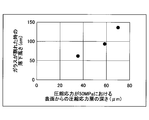
- 4 is a graph showing the relationship between the depth of compressive stress and asphalt dropping when the compressive stress is 50 MPa for the chemically strengthened glasses of Examples 1 to 3.
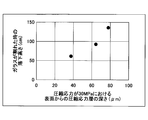
- 5 is a graph showing the relationship between the depth of compressive stress and the asphalt dropping when the compressive stress is 30 MPa for the chemically strengthened glasses of Examples 1 to 3.
- the chemically strengthened glass according to the present embodiment is usually plate-shaped, but it may be a flat plate or a glass plate subjected to bending.
- the chemically strengthened glass according to the present embodiment is a glass plate formed into a flat plate shape by a known glass forming method such as a float method, a fusion method, or a slot down draw method, and has a liquid phase viscosity of 130 dPa ⁇ s or more. It is preferable.
- the chemically tempered glass according to the present embodiment includes a cover glass for a touch panel display and a touch sensor glass, a cover glass for a liquid crystal television, a PC monitor, and the like provided in information devices such as a tablet PC, a notebook PC, a smartphone, and an electronic book reader. It can be used for a cover glass for automobile instrument panels, a cover glass for solar cells, an interior material for building materials, and a multilayer glass used for windows of buildings and houses.
- the chemically strengthened glass according to the present embodiment has dimensions that can be formed by an existing forming method. That is, if it is formed by the float process, ribbon-like glass having a continuous float forming width can be obtained. Moreover, the chemically strengthened glass according to the present embodiment is finally cut into a size suitable for the purpose of use.
- the chemically strengthened glass according to the present embodiment is generally cut into a rectangular shape, but other shapes such as a circular shape or a polygonal shape can be used without any problem, and a glass subjected to drilling is also included.
- the thickness t of the chemically strengthened glass according to the present embodiment is preferably 2000 ⁇ m or less in order to contribute to weight reduction.
- the plate thickness t is more preferably 1500 ⁇ m or less, 1000 ⁇ m or less, 800 ⁇ m or less, 700 ⁇ m or less, 500 ⁇ m or less, 400 ⁇ m or less, 300 ⁇ m or less, 200 ⁇ m or less, or 100 ⁇ m or less.
- the chemically tempered glass according to the present embodiment includes a compressive stress layer on the surface by ion exchange treatment.
- the surface compressive stress (CS) of the chemically strengthened glass is preferably 200 MPa or more, and may be 300 MPa or more, 500 MPa or more, 600 MPa or more, 650 MPa or more, 700 MPa or more, 750 MPa or more, 800 MPa or more, 900 MPa or more, 1000 MPa or more. More preferred.
- the chemically tempered glass according to the present embodiment leads to the destruction of the chemically tempered glass if a scratch having a depth exceeding the value of the depth (DOL) of the compressive stress layer is used when the chemically tempered glass is used.
- a deeper depth (DOL) is preferable.
- the depth (DOL) of the compressive stress layer is preferably 30 ⁇ m or more, 40 ⁇ m or more, 50 ⁇ m or more, 55 ⁇ m or more, 60 ⁇ m or more, 65 ⁇ m or more, 70 ⁇ m or more, 75 ⁇ m or more, 80 ⁇ m or more, 85 ⁇ m or more, 90 ⁇ m or more, 95 ⁇ m. As mentioned above, it is more preferable that they are 100 micrometers or more, 110 micrometers or more, 120 micrometers or more, 130 micrometers or more, 140 micrometers or more, and 150 micrometers or more.
- the relationship with the depth (DOL) of the compressive stress layer when the plate thickness is t ⁇ m is preferably DOL ⁇ 0.10t, DOL ⁇ 0.12t, more preferably DOL ⁇ 0.15t, and particularly preferably DOL ⁇ 0.20t.
- the depth of the compressive stress layer when the compressive stress is 50 MPa is preferably 50 ⁇ m or more.
- the inventors of the present application have found that the deeper the depth at which the compressive stress layer is 50 MPa or more, the harder the phenomenon that a sharp object hits the glass surface due to dropping or the like, resulting in damage and cracking.
- the depth of the compressive stress layer is 55 ⁇ m or more, 60 ⁇ m or more, 65 ⁇ m or more, 70 ⁇ m or more, 75 ⁇ m or more, 80 ⁇ m or more, 85 ⁇ m or more, 90 ⁇ m or more, 95 ⁇ m or more, 100 ⁇ m or more, 110 ⁇ m or more, 120 ⁇ m or more, More preferably, they are 130 micrometers or more, 140 micrometers or more, and 150 micrometers or more. In this case as well, the relationship with the depth (DOL) of the compressive stress layer when the plate thickness is t ⁇ m is as described above.
- the depth of the compressive stress layer when the compressive stress is 30 MPa is preferably 60 ⁇ m or more.
- the inventors of the present application have found that the deeper the depth of the compressive stress layer is 30 MPa or more, the less the phenomenon that the glass surface is scratched due to dropping or the like, and the bending mode is added to cause a cracking phenomenon.
- the depth of the compressive stress is 65 ⁇ m or more, 70 ⁇ m or more, 75 ⁇ m or more, 80 ⁇ m or more, 85 ⁇ m or more, 90 ⁇ m or more, 95 ⁇ m or more, 100 ⁇ m or more, 105 ⁇ m or more, 110 ⁇ m or more, 115 ⁇ m or more, 120 ⁇ m or more, 125 ⁇ m. As mentioned above, it is more preferable that they are 130 micrometers or more, 135 micrometers or more, 140 micrometers or more, and 150 micrometers or more. In this case as well, the relationship with the depth (DOL) of the compressive stress layer when the plate thickness is t ⁇ m is as described above.
- the chemically strengthened glass according to the present embodiment preferably has a critical stress intensity factor K IC (Critical Stress Intensity Factor) of 0.75 MPa ⁇ m 1/2 or more.
- K IC Critical Stress Intensity Factor
- the critical stress intensity factor K IC is 0.77 MPa ⁇ m for the purpose of not only increasing the strength of the glass, but also reducing the friability described later and making it difficult for fragments to scatter when cracked even when a deeper DOL is inserted.
- the chemically strengthened glass according to the present embodiment preferably has a Young's modulus of 70 GPa or more.
- the Young's modulus is not less than 72 GPa, not less than 73 GPa, for the purpose of not only increasing the strength of the glass by improving the critical stress intensity factor K IC but also reducing the ease of crack branching and reducing the crushability described later.
- the chemically strengthened glass according to the present embodiment is an aluminosilicate glass.
- the chemical strengthened glass according to the present embodiment is preferably aluminosilicate glass containing Al 2 O 3 and Li 2 O.
- the glass composition of the chemically strengthened glass may be referred to as a mother composition of the chemically strengthened glass.
- Chemically tempered glass is obtained by forming a compressive stress layer on the surface of chemically strengthened glass by ion exchange treatment.
- the portion having the tensile stress of the chemically strengthened glass (hereinafter also referred to as the tensile stress portion) is a portion that is not ion-exchanged. Therefore, the composition of the tensile stress portion of the chemically strengthened glass may be referred to as the mother composition of the chemically strengthened glass.
- composition of the glass can be simply determined by semi-quantitative analysis by the fluorescent X-ray method, but more accurately, it can be measured by a wet analysis method such as ICP emission analysis.
- each component is expressed in terms of mole percentage based on oxide unless otherwise specified.
- substantially does not contain in the present specification means that it is not contained except for inevitable impurities contained in raw materials or the like, that is, it is not intentionally contained. Specifically, it indicates that the content in the glass composition is less than 0.01 mol%.
- the composition of the glass for chemical strengthening of the present invention (the mother composition of the chemically strengthened glass of the present invention)
- SiO 2 is 50 to 80%
- Al 2 O 3 is 1 to 30%
- B 2 O 3 is 0 to 5%
- P 2 O 5 0-4% Li 2 O 3-20%, Na 2 O 0-8%
- K 2 O 0-10% MgO 0-20%
- SiO 2 is a component constituting the skeleton of glass. Further, a component to increase chemical durability, and a component to reduce the occurrence of cracks when scratched (indentation) on the glass surface, it is preferable that the content of SiO 2 is 50% or more. More preferably, the content of SiO 2 is 54% or more, 58% or more, 60% or more, 63% or more, 66% or more, 68% or more in a stepwise manner. On the other hand, if the content of SiO 2 exceeds 80%, the meltability is remarkably lowered. The content of SiO 2 is 80% or less, more preferably 78% or less, still more preferably 76% or less, particularly preferably 74% or less, and most preferably 72% or less.
- Al 2 O 3 is a component that reduces the friability of chemically strengthened glass.
- the low crushability of the glass means that the number of fragments when the glass is broken is small. Glass with low crushability is highly safe because it is difficult for fragments to scatter when broken.
- the content of Al 2 O 3 is 1% or more. It is preferable.
- Al 2 O 3 is a component that increases the Tg of the glass and is also a component that increases the Young's modulus.
- the content of Al 2 O 3 is more preferably 3% or more, 5% or more, 7% or more, 8% or more, 9% or more, 10% or more, 11% or more, or 12% or more step by step. 13% or more.
- the content of Al 2 O 3 is more than 30%, the acid resistance of the glass is lowered or the devitrification temperature is increased. Further, the viscosity of the glass increases and the meltability decreases.
- the content of Al 2 O 3 is preferably 30% or less, more preferably 25% or less, still more preferably 20% or less, particularly preferably 18% or less, and most preferably 15% or less.
- the content of Al 2 O 3 is large, the temperature at the time of melting the glass increases and the productivity decreases.
- the content of Al 2 O 3 is preferably 11% or less, and stepwise, 10% or less, 9% or less, 8% or less, or 7% or less. Is preferred.
- B 2 O 3 is a component that improves the chipping resistance of the chemically strengthened glass or chemically strengthened glass and improves the meltability.
- B 2 O 3 is not essential, but the content in the case of containing B 2 O 3 is preferably 0.5% or more, more preferably 1% or more, further preferably, in order to improve the meltability. 2% or more.
- the content of B 2 O 3 exceeds 8%, striae are generated at the time of melting, and the quality of the glass for chemical strengthening is liable to deteriorate, so 8% or less is preferable.
- the content of B 2 O 3 is more preferably 5% or less, still more preferably 3% or less, and particularly preferably 1% or less. It is preferably not contained in order to increase acid resistance.
- P 2 O 5 is a component that improves ion exchange performance and chipping resistance.
- P 2 O 5 may not be contained, but the content of the case of containing a P 2 O 5 is preferably not less than 0.01%, more preferably 0.02% or more, 1% or more, further Preferably it is 2% or more.
- the content of P 2 O 5 exceeds 9%, the raw material solubility is deteriorated and the homogeneity is deteriorated, and the acid resistance is remarkably lowered.
- the content of P 2 O 5 is preferably 94% or less, more preferably 6% or less, still more preferably 3% or less, and particularly preferably 1% or less. It is preferably not contained in order to increase acid resistance.
- Li 2 O is a component that exchanges Li ions on the glass surface with Na ions to form surface compressive stress, and is a component that improves the crushability of chemically strengthened glass.
- the content of Li 2 O is preferably 3% or more, more preferably 4% or more, still more preferably 5% or more, particularly preferably 6% or more, and typically 7% or more.
- the content of Li 2 O exceeds 20%, the acid resistance of the glass is significantly reduced.
- the Li 2 O content is preferably 20% or less, more preferably 18% or less, still more preferably 16% or less, particularly preferably 15% or less, and most preferably 13% or less.
- the Li 2 O content is preferably 1% or less.
- Na 2 O is a component that forms a surface compressive stress layer by ion exchange and improves the meltability of the glass, and may be contained when importance is attached to the meltability of the glass.
- the content when Na 2 O is contained is preferably 1% or more.
- the content of Na 2 O is more preferably 2% or more, 2.5% or more, and further preferably 3% or more.
- the content of Na 2 O exceeds 20%, the acid resistance of the glass is significantly reduced.
- the content of Na 2 O is preferably 20% or less, more preferably 18% or less, further preferably 16% or less, particularly preferably 15% or less, and most preferably 14% or less.
- the content of Na 2 O is preferably 10 % Or less, more preferably 9% or less, still more preferably 8% or less, 7% or less, 6% or less, 5% or less, 3% or less. Further, the content of Na 2 O is preferably 2% or more, more preferably 3% or more, and further preferably 4% or more.
- K 2 O may be included to improve ion exchange performance.
- the content is preferably 0.01% or more, 0.02% or more, 0.03% or more, 0.1% or more, 1% or more, more preferably 2% or more, Particularly preferably, it is 3% or more.
- the content of K 2 O is more than 10%, the surface compressive stress is lowered. Therefore, the content of K 2 O is preferably 10% or less.
- the content of K 2 O is more preferably 8% or less, further preferably 6% or less, particularly preferably 4% or less, and most preferably 2% or less.
- MgO is a component that increases the surface compressive stress of chemically strengthened glass, and is a component that improves crushability, and is preferably contained.
- the content is preferably 1% or more, 2% or more, 2.5% or more, 3% or more, 4% or more, 5% or more, 6% or more, 7% or more, 8% That's it.
- the content of MgO exceeds 20%, the glass for chemical strengthening tends to devitrify when melted.
- the content of MgO is preferably 20% or less, more preferably 18% or less, 15% or less, 14% or less, 13% or less, 12% or less, 11% or less, 10% or less stepwise. .
- the MgO content is preferably 9% or less, more preferably 8% or less, and even more preferably 6 .5% or less.
- CaO is a component that improves the meltability of the chemically strengthened glass, and is a component that improves the crushability of the chemically strengthened glass, and may be contained.
- the content when CaO is contained is preferably 0.01% or more, 0.02% or more, 0.03% or more, 0.04% or more, 0.1% or more, 0.5% or more, 1% More preferably, it is 2% or more, particularly preferably 3% or more, and most preferably 5% or more.
- the content of CaO is more preferably 14% or less, and still more preferably 10% or less, 8% or less, 6% or less, 3% or less, 1% or less stepwise.
- SrO is a component that improves the meltability of the chemically strengthened glass, and is a component that improves the crushability of the chemically strengthened glass, and may be contained.
- the content is preferably 0.5% or more, more preferably 1% or more, further preferably 2% or more, particularly preferably 3% or more, and most preferably 5% or more. is there.
- the SrO content exceeds 20%, the ion exchange performance is remarkably lowered, so 20% or less is preferable.
- the content of SrO is more preferably 14% or less, and still more preferably 10% or less, 8% or less, 6% or less, 3% or less, 1% or less stepwise.
- BaO is a component that improves the meltability of the glass for chemical strengthening, and may be contained.
- the content is preferably 0.5% or more, more preferably 1% or more, still more preferably 2% or more, particularly preferably 3% or more, and most preferably 5% or more. is there.
- the content of BaO exceeds 15%, the ion exchange performance is significantly lowered.
- the content of BaO is preferably 15% or less, more preferably 10% or less, 8% or less, 6% or less, 3% or less, 1% or less.
- ZnO is a component that improves the meltability of the glass and may be contained.
- the content is preferably 0.25% or more, 0.3% or more, 0.5% or more, 0.6% or more, 0.7% or more, or 0.8% or more.
- the ZnO content exceeds 10%, the weather resistance of the glass is significantly lowered.
- the content of ZnO is preferably 10% or less, more preferably 7% or less, further preferably 5% or less, particularly preferably 2% or less, and most preferably 1% or less.
- TiO 2 is a component that improves the crushability of chemically strengthened glass, and may be contained.
- the content in the case of containing TiO 2 is preferably 0.01% or more, 0.1% or more, 0.15% or more, and more preferably 0.2% or more.
- the content of TiO 2 is preferably 1% or less, more preferably 0.5% or less, and still more preferably 0.25% or less.
- ZrO 2 is a component that increases the surface compressive stress due to ion exchange, has the effect of improving the crushability of the glass for chemical strengthening, and may be contained.
- the content in the case of containing ZrO 2 is preferably 0.01% or more, 0.05% or more, 0.2% or more, 0.5% or more, 1% or more.
- the content of ZrO 2 is preferably 8% or less, more preferably 6% or less, further preferably 4% or less, particularly preferably 2% or less, and most preferably 1.2% or less. .
- Y 2 O 3 , La 2 O 3 , and Nb 2 O 5 are components that improve the crushability of the chemically strengthened glass, and may be contained.
- the content is preferably 0.5% or more, more preferably 1% or more, still more preferably 1.5% or more, particularly preferably 2% or more, most preferably Preferably it is 2.5% or more.
- the contents of Y 2 O 3 , La 2 O 3 , and Nb 2 O 5 are each over 8%, the glass tends to be devitrified at the time of melting, and the quality of the chemically strengthened glass may be deteriorated.
- Y 2 O 3 , La 2 O 3 and Nb 2 O 5 are each preferably 8% or less, more preferably 6% or less, still more preferably 5% or less, and particularly preferably 4%. Or less, most preferably 3% or less.
- Ta 2 O 5 and Gd 2 O 3 may be contained in a small amount in order to improve the crushability of chemically strengthened glass.
- the refractive index and the reflectance are increased, so 1% or less is preferable, and 0.5% or less. Is more preferable, and it is still more preferable not to contain.
- coloring and using glass you may add a coloring component in the range which does not inhibit achievement of a desired chemical strengthening characteristic.
- the coloring component include Co 3 O 4 , MnO 2 , Fe 2 O 3 , NiO, CuO, Cr 2 O 3 , V 2 O 5 , Bi 2 O 3 , SeO 2 , CeO 2 , Er 2 O 3 , Nd 2 O 3 and the like as preferred.
- the content of the coloring component is preferably in a range of 7% or less in total in terms of oxide-based mole percentage. If it exceeds 7%, the glass tends to be devitrified, which is not desirable. This content is preferably 5% or less, more preferably 3% or less, and even more preferably 1% or less. When giving priority to the visible light transmittance of glass, it is preferable that these components are not substantially contained.
- a fining agent such as SO 3 , chloride, fluoride, SnO 2 may be appropriately contained. It is preferable to use the SO 3, SO 3 concentration is preferably 0.01% remaining in the glass, and more preferably 0.02%, further preferably 0.03% or more. It is preferable not to contain As 2 O 3 or Sb 2 O 3 . When containing SnO 2 is preferably 0.3% or less, more preferably 0.1% or less, and most preferably not contained in terms of color control by valence change of the Fe ions.
- the chemical strengthening treatment can be performed, for example, by immersing the glass plate in a potassium nitrate molten salt at 350 to 500 ° C. for 5 minutes to 60 hours.
- Examples of the molten salt for performing the ion exchange treatment include alkali nitrates such as potassium nitrate, potassium sulfate, potassium carbonate and potassium chloride, alkali sulfate and alkali chloride, and the like. These molten salts may be used alone or in combination of two or more. In order to adjust the chemical strengthening characteristics, a salt containing sodium (Na ion) or lithium (Li ion) may be mixed.
- the processing conditions for the chemical strengthening treatment are not particularly limited, and optimum conditions can be selected in consideration of the characteristics of the glass, the molten salt, and the like.
- the chemically strengthened glass according to the present embodiment is manufactured by, for example, the following steps (1) to (3). Hereinafter, each step will be described.
- the 1st chemical strengthening process which forms a compressive-stress layer in the glass surface by ion-exchange-treating glass is the alkali metal ion (in which the glass used for a chemical strengthening process is contained in the glass (for example, a molten salt containing an alkali metal ion having an ionic radius larger than that of Na ion (for example, potassium salt) is brought into contact with the glass in a temperature range that does not exceed the glass transition temperature, and the alkali metal ion and alkali metal salt ion in the glass In this step, ion exchange is performed with alkali metal ions having a large radius, and a compressive stress is generated on the glass surface due to a difference in the area occupied by the alkali metal ions to form a compressive stress layer.
- a molten salt containing an alkali metal ion having an ionic radius larger than that of Na ion for example, potassium salt
- ion exchange is performed with alkali metal
- the treatment temperature and the treatment time for bringing the glass into contact with the molten salt containing alkali metal ions are appropriately adjusted according to the composition of the glass and the molten salt.
- the heating temperature of the molten salt is usually preferably 350 ° C or higher and more preferably 370 ° C or higher. Moreover, usually 500 degrees C or less is preferable and 450 degrees C or less is more preferable.
- the heating temperature of the molten salt is set to 350 ° C. or higher, it is possible to prevent chemical strengthening from becoming difficult due to a decrease in the ion exchange rate. Moreover, decomposition
- the time for bringing the glass into contact with the molten salt in the step (1) is usually preferably 1 hour or longer, more preferably 2 hours or longer, 3 hours or longer, 4 hours or longer, 5 hours or longer. preferable.
- productivity falls and the compressive stress value decreases due to relaxation. Therefore, it is preferably 200 hours or shorter, more preferably 150 hours or shorter, 100 hours or shorter, 90 hours or shorter, or 80 hours or shorter.
- step (2) Heating step for heat-treating glass
- the glass having a compressive stress layer formed on the glass surface obtained in step (1) is heat-treated so that a larger alkali existing in the compressive stress layer is present.
- This is a step of moving the deepest part of the compressive stress layer from the glass surface to the inside of the glass by moving metal ions, for example, potassium ions, from the surface of the glass to the inside of the glass. This step can be omitted.
- the temperature at which the glass is heat-treated is 50 ° C. or more, preferably 70 ° C. or more, more preferably 100 ° C. or more lower than the glass transition point.
- the time for heat treatment of the glass is preferably adjusted as appropriate according to the heat treatment temperature, and is usually preferably 30 minutes to 2000 minutes, more preferably 30 to 300 minutes.
- Second chemical strengthening step of changing the compressive stress layer on the glass surface by ion exchange treatment of the glass step (3) is the glass surface by ion exchange of the glass obtained in step (2). This is a step of changing the compressive stress layer. By performing ion exchange again in the step (3), the glass surface and the compressive stress layer inside thereof can be changed.
- the ion exchange treatment in step (3) may be performed by the same method as the ion exchange treatment described above in step (1), or may be another method. Another molten salt may be used.
- the treatment temperature and treatment time for bringing the glass into contact with the molten salt containing alkali metal ions are appropriately adjusted according to the composition of the glass and the molten salt.
- the heating temperature of the molten salt is usually preferably 350 ° C or higher and more preferably 370 ° C or higher. Moreover, usually 500 degrees C or less is preferable and 450 degrees C or less is more preferable.
- the heating temperature of the molten salt is set to 350 ° C. or higher, it is possible to prevent chemical strengthening from becoming difficult due to a decrease in the ion exchange rate. Moreover, decomposition
- the time for bringing the glass into contact with the molten salt in the step (3) is usually preferably 5 minutes or longer, 6 minutes or longer, 7 minutes or longer, 8 minutes or longer, 9 minutes or longer, 10 minutes or longer. More than minutes are more preferable. Further, in long-time ion exchange, productivity decreases and the compressive stress value decreases due to relaxation. Therefore, it is preferably 5 hours or less, more preferably 3 hours or less, 2 hours or less, and 1 hour or less.
- Steps (1) to (3) may be performed sequentially on a continuous basis, for example, on a glass ribbon that moves continuously in a glass plate manufacturing step, or may be performed discontinuously online. Good. Further, it is preferable to omit the step (2) from the viewpoint of work efficiency. Furthermore, in order to improve the work efficiency, the step (3) may be omitted. That is, (i) Step (1), Step (2) and Step (3) all, (ii) Step (1) and Step (2) only, (iii) Step (1) and Step (3) only, (Iv) Only one of the steps (1) is performed.
- a treated salt containing at least potassium ions as the molten salt for performing the ion exchange treatment.
- a salt containing 50% by mass or more of potassium nitrate is preferably exemplified.
- the mixed molten salt may contain other components. Examples of other components include alkali sulfates such as sodium sulfate and potassium sulfate, and alkali chlorides such as sodium chloride and potassium chloride.
- the method for producing chemically strengthened glass according to the present embodiment is not particularly limited, and the method for forming molten glass is not particularly limited.
- a glass raw material is appropriately prepared, heated to about 1500-1700 ° C. and melted, and then homogenized by defoaming, stirring, etc., and plate-shaped by a well-known float method, downdraw method (fusion method, etc.), press method, etc. Or cast into a block shape, and after slow cooling, cut into a desired size to produce a glass plate.
- a polishing process is performed as necessary, but it is also possible to treat the glass plate surface with a fluorine agent in addition to or instead of the polishing process.
- the float method or downdraw method is preferred, and in particular, the float method is preferred in consideration of producing large glass plates.
- the cover glass was placed on a smartphone product or a case simulating a smartphone product, and dropped on an asphalt surface processed flat. If the glass is not broken by dropping from a low height (for example, 10 cm), the drop height is gradually increased, and the drop height when the glass is broken is defined as the strength of the glass.
- a low height for example, 10 cm
- the drop height is gradually increased, and the drop height when the glass is broken is defined as the strength of the glass.
- the test casing was dropped on the asphalt, the glass was dropped in such a direction that the glass contacted the asphalt.
- the glass used for the test has a rectangular shape of 120 mm ⁇ 60 mm and has four corners.
- the combined weight of the simulated housing and glass was about 140 g.
- the chemically strengthened glass according to the present embodiment is the size of a display such as a tablet PC or a smartphone, or the size of a window glass of a building or a house.
- the glass of the present invention is generally cut into a rectangle, but other shapes such as a circle or a polygon may be used without any problem, and a glass subjected to drilling is also included.
- the chemically tempered glass according to the present embodiment is preferably subjected to mechanical processing such as cutting, end surface processing and drilling processing according to the application before the chemical tempering treatment.
- the chemically strengthened glass according to this embodiment can be cut after the chemical strengthening treatment.
- a cutting method scribing and breaking with a normal wheel tip cutter can be applied, and laser cutting is also possible.
- the cutting edge may be chamfered after cutting.
- the chamfering may be a mechanical grinding process or a method of treating with a chemical solution such as hydrofluoric acid.
- chemically strengthened glass is not particularly limited. Since chemically strengthened glass has high mechanical strength, it is suitable for use in places where impact due to dropping or contact with other substances is expected.
- mobile phones including multifunctional information terminals such as smartphones
- PHS, PDA, tablet terminals notebook personal computers, game machines, portable music / video players, electronic books, electronic terminals
- Cover glass for display parts such as watches, cameras or GPS, and cover glass for touch panel operation monitors of these devices
- cover glass for cookers such as microwave ovens and oven toasters
- top plates such as electromagnetic cookers, meters
- machines or devices such as cover glass for instruments such as gauges and glass plates for reading parts such as copying machines or scanners.
- window glass for vehicles, ships, airplanes, etc. household or industrial lighting equipment, signals, guide lights, cover boards for electric bulletin boards, showcases, bulletproof glass, etc.
- Examples include a cover glass for protecting a solar cell and a glass material for condensing for increasing the power generation efficiency of the solar cell.
- glass for mirror surfaces there are various glass for mirror surfaces, and further, as a substrate for information storage media such as HDDs, and as a substrate for information recording media such as CDs, DVDs, and Blu-ray discs.
- it can be used as a building material such as an aquarium, dishes such as dishes and cups, various cooking utensils such as bottles or chopping boards, cupboards, shelf boards and walls of refrigerators, roofs or partitions.
- a building material such as an aquarium, dishes such as dishes and cups, various cooking utensils such as bottles or chopping boards, cupboards, shelf boards and walls of refrigerators, roofs or partitions.
- chemically strengthened glass produced after the chemical strengthening treatment is optimal as a glass material for display incorporated in various image display devices such as liquid crystal, plasma, and organic EL.
- Examples 1, 2, and 5 to 7 are examples, and examples 3 and 4 are comparative examples.
- Each of Examples 1 to 3 is expressed in terms of mole percentage based on oxide, and SiO 2 is 64.3%, Al 2 O 3 is 10.5%, Na 2 O is 16.0%, and K 2 O is A glass plate having a composition containing 0.8%, MgO 8.3%, ZrO 2 0.2% and TiO 2 0.04% was manufactured by a float process.
- the composition is an analysis value by fluorescent X-ray. Mineral sand, soda ash, dolomite, feldspar, and mirabilite were used as glass raw materials, melted by natural gas combustion, and formed into a glass ribbon with a float bath.
- Example 4 is expressed as a mole percentage on an oxide basis, with SiO 2 67.1%, B 2 O 3 3.6%, Al 2 O 3 13.1%, Na 2 O 13.7%, It is a glass plate having a composition containing 0.1% K 2 O and 2.3% MgO. This glass plate is a glass plate manufactured by a fusion method.
- Example 5 and 6 in a molar percentage based on oxides, SiO 2 70%, Al 2 O 3 10%, 10% Li 2 O, 4% of Na 2 O, 1% of K 2 O, 4% MgO, 1% ZrO 2 ,
- Example 7 is expressed in terms of mole percentage on an oxide basis, SiO 2 69%, Al 2 O 3 9%, Li 2 O 9.5%, Na the 2 O 4.5%, 1% of K 2 O, MgO 6%, so that the glass composition containing ZrO 2 1% respectively to prepare a glass raw material was weighed so as to 1000g as a glass .
- the raw material was put in a platinum crucible, put in an electric furnace at 1500 to 1700 ° C., melted for about 3 hours, defoamed and homogenized.
- the obtained molten glass was poured into a mold material, held at a temperature of (glass transition point + 50) ° C. for 1 hour, and then cooled to room temperature at a rate of 0.5 ° C./min to obtain a glass block.
- the obtained glass block was cut and ground, and finally both surfaces were mirror-polished to obtain a glass plate having a thickness of 0.8 mm.
- the glass plates of Examples 1 to 3 and 5 to 7 except the glass plate of Example 4 were subjected to an asphalt drop test.
- the glass plates of Examples 1 and 5 to 7 were subjected to the above-described step (1) before the asphalt drop test, and were chemically strengthened under the strengthening conditions described in Table 1.
- the glass plates of Examples 2 and 3 were subjected to the above step (1) before the asphalt drop test, subjected to chemical strengthening treatment under the strengthening conditions described in Table 1, and then subjected to the above step (2).
- Heat treatment was performed under the heat treatment conditions A and B shown in Table 1. After heat treatment under heat treatment condition A, heat treatment was continued under heat treatment condition B.
- the cover glass treated with chemical strengthening was placed in a case simulating a smartphone product and dropped onto a flat asphalt surface. If the glass was not broken by dropping from a low height (for example, 10 cm), the drop height was gradually increased, and the drop height when the glass was broken was recorded. This test was set as one set, and 20 sets were repeated. The average height when the glass was broken was defined as the drop height when the glass was broken. When the test casing was dropped on the asphalt, the glass was dropped in such a direction that the glass contacted the asphalt.
- the glass used for the test has a rectangular shape of 120 mm ⁇ 60 mm and has four corners. The combined weight of the simulated housing and glass was about 140 g.
- the critical stress intensity factor K IC was determined using a K I -V curve obtained by the Double Cleavage Drilled Compression (DCDC) method.
- Table 1 also shows strengthening conditions, heat treatment conditions, and the like.
- FIG. 1 is a graph showing the relationship between the depth of the compressive stress layer and the asphalt drop when the compressive stress is 50 MPa for the chemically strengthened glasses of Examples 1 to 3.
- FIG. 2 is a graph showing the relationship between the depth of the compressive stress layer and the asphalt drop when the compressive stress is 30 MPa for the chemically strengthened glasses of Examples 1 to 3.
- the plate thickness of Examples 1 to 3 is 2 mm.
- this idea can be applied to some extent regardless of the plate thickness. That is, this concept can be applied to glass having a plate thickness of 1 mm or less, 0.8 mm or less, or 0.5 mm or less.
- the critical stress intensity factor K IC of the glass of Example 1 is 0.81 MPa ⁇ m 1/2
- the critical stress intensity factor K IC of the glass of Example 4 is 0.74 MPa ⁇ m 1/2. Met.
- the depth of the compressive stress layer is 50 ⁇ m or more when the compressive stress is 50 MPa
- the depth of the compressive stress layer is 60 ⁇ m when the compressive stress is 30 MPa. Even if it is above, if the critical stress intensity factor K IC is 0.75 MPa ⁇ m 1/2 or less, it is considered that the probability of breakage due to asphalt dropping is greatly increased. That is, a glass having a low critical stress intensity factor K IC has a problem in friability.
Landscapes
- Chemical & Material Sciences (AREA)
- Life Sciences & Earth Sciences (AREA)
- Engineering & Computer Science (AREA)
- Chemical Kinetics & Catalysis (AREA)
- General Chemical & Material Sciences (AREA)
- Geochemistry & Mineralogy (AREA)
- Materials Engineering (AREA)
- Organic Chemistry (AREA)
- Surface Treatment Of Glass (AREA)
- Glass Compositions (AREA)
Abstract
Description
本実施の形態に係る化学強化ガラスは、通常、板形状をしているが、平板でも曲げ加工を施したガラス板でもよい。本実施の形態に係る化学強化ガラスは、フロート法、フュージョン法、スロットダウンドロー法等、既知のガラス成形方法によって平板形状に成形されたガラス板であり、130dPa・s以上の液相粘度を有することが好ましい。
本実施の形態に係る化学強化ガラスは、アルミノシリケートガラスである。なお、本実施の形態に係る化学強化ガラスは、Al2O3及びLi2Oを含有するアルミノシリケートガラスであることが好ましい。
化学強化処理により、大きなイオン半径のアルカリ金属イオン(典型的には、Kイオン)を含むアルカリ金属塩(例えば、硝酸カリウム塩)の融液に浸漬等によって、ガラス基板を接触させることにより、ガラス基板中の小さなイオン半径の金属イオン(典型的には、Naイオン)が大きなイオン半径の金属イオンと置換される。
工程(1)は、化学強化処理に供するガラスをそのガラス中に含まれるアルカリ金属イオン(例えば、Naイオン)よりイオン半径の大きなアルカリ金属イオンを含む溶融塩(例えば、カリウム塩)とガラスの転移温度を超えない温度域で接触させて、ガラス中のアルカリ金属イオンとアルカリ金属塩のイオン半径の大きなアルカリ金属イオンとをイオン交換させ、アルカリ金属イオンの占有面積の差によりガラス表面に圧縮応力を発生させ圧縮応力層を形成する工程である。
工程(2)は、工程(1)で得られたガラス表面に圧縮応力層を形成したガラスを加熱処理することにより、圧縮応力層に存在するより大きなアルカリ金属イオン、例えば、カリウムイオンをガラスの表面からガラス内部の方向に移動させることにより、圧縮応力層の最深部をガラス表面からガラス内部の方向に移動させる工程である。この工程は省略することもできる。
工程(3)は工程(2)で得られたガラスをイオン交換することにより、ガラス表面の圧縮応力層を変化させる工程である。工程(3)において再度イオン交換することにより、ガラス表面及びその内部の圧縮応力層を変化させることができる。工程(3)のイオン交換処理は工程(1)において上述したイオン交換処理と同様の方法により行ってもよいし、別の方法であってもよい。又、別の溶融塩を用いてもよい。
本実施の形態に係る化学強化ガラスの製造方法は特に限定されず、溶融ガラスを成形する方法も特に限定されない。例えば、ガラス原料を適宜調製し、約1500~1700℃に加熱し溶融した後、脱泡、攪拌等により均質化し、周知のフロート法、ダウンドロー法(フュージョン法等)、プレス法等によって板状に、またはキャストしてブロック状に成形し、徐冷後所望のサイズに切断し、ガラス板が製造される。必要に応じて研磨加工を施すが、研磨加工に加えてまたは研磨加工に代えて、ガラス板表面をフッ素剤で処理することも可能である。ガラス板を安定して生産することを考慮すると、フロート法またはダウンドロー法が好ましく、特に大型のガラス板を生産することを考慮するとフロート法が好ましい。
カバーガラスをスマートフォン製品、又はスマートフォン製品を模擬した筐体に設置し、平坦に加工したアスファルト面の上に落下させた。低い高さ(例えば10cm)から落下させてガラスが割れなければ少しずつ落下高さを上げていき、ガラスが割れた時の落下高さをそのガラスの強度とした。試験筐体をアスファルトに落下させる時に、ガラスがアスファルトに接触するような向きに設定して落下させた。試験に使用したガラスは120mm×60mmの略矩形であり、4つのコーナーを有する。模擬筐体とガラスを合わせた重量は約140gとした。

Claims (6)
- 表面の圧縮応力が200MPa以上であり、
圧縮応力が50MPaにおける前記表面からの圧縮応力層の深さが50μm以上であり、
圧縮応力が30MPaにおける前記表面からの圧縮応力層の深さが60μm以上であり、
臨界応力拡大係数KIC(Critical Stress Intensity Factor)が0.75MPa・m1/2以上、
であることを特徴とする化学強化ガラス。 - ヤング率が70GPa以上であることを特徴とする請求項1に記載の化学強化ガラス。
- Al2O3及びB2O3のうち少なくとも一つを含有し、かつ、
アルカリ金属及びアルカリ土類金属のうち少なくとも一つを含有するアルミノシリケートガラスであることを特徴とする請求項1若しくは2に記載の化学強化ガラス。 - Al2O3及びLi2Oを含有することを特徴とする請求項3に記載の化学強化ガラス。
- 板厚が2mm以下であることを特徴とする請求項1~4のいずれか一つに記載の化学強化ガラス。
- 板厚が0.8mm以下であることを特徴とする請求項1~5のいずれか一つに記載の化学強化ガラス。
Priority Applications (5)
| Application Number | Priority Date | Filing Date | Title |
|---|---|---|---|
| KR1020197022429A KR20190112273A (ko) | 2017-02-07 | 2018-02-06 | 화학 강화 유리 |
| CN202211474693.9A CN115716715B (zh) | 2017-02-07 | 2018-02-06 | 化学强化玻璃 |
| JP2018567444A JPWO2018147288A1 (ja) | 2017-02-07 | 2018-02-06 | 化学強化ガラス |
| CN201880009901.3A CN110234616B (zh) | 2017-02-07 | 2018-02-06 | 化学强化玻璃 |
| US16/531,550 US20190352227A1 (en) | 2017-02-07 | 2019-08-05 | Chemically strengthened glass |
Applications Claiming Priority (2)
| Application Number | Priority Date | Filing Date | Title |
|---|---|---|---|
| JP2017-020793 | 2017-02-07 | ||
| JP2017020793 | 2017-02-07 |
Related Child Applications (1)
| Application Number | Title | Priority Date | Filing Date |
|---|---|---|---|
| US16/531,550 Continuation US20190352227A1 (en) | 2017-02-07 | 2019-08-05 | Chemically strengthened glass |
Publications (1)
| Publication Number | Publication Date |
|---|---|
| WO2018147288A1 true WO2018147288A1 (ja) | 2018-08-16 |
Family
ID=63108194
Family Applications (1)
| Application Number | Title | Priority Date | Filing Date |
|---|---|---|---|
| PCT/JP2018/004079 Ceased WO2018147288A1 (ja) | 2017-02-07 | 2018-02-06 | 化学強化ガラス |
Country Status (5)
| Country | Link |
|---|---|
| US (1) | US20190352227A1 (ja) |
| JP (1) | JPWO2018147288A1 (ja) |
| KR (1) | KR20190112273A (ja) |
| CN (2) | CN110234616B (ja) |
| WO (1) | WO2018147288A1 (ja) |
Cited By (1)
| Publication number | Priority date | Publication date | Assignee | Title |
|---|---|---|---|---|
| JP2022515312A (ja) * | 2018-11-01 | 2022-02-18 | コーニング インコーポレイテッド | 遅れ破壊が低下した強化ガラス物品およびその製造方法 |
Families Citing this family (6)
| Publication number | Priority date | Publication date | Assignee | Title |
|---|---|---|---|---|
| US20210292217A1 (en) * | 2018-07-27 | 2021-09-23 | Nippon Electric Glass Co., Ltd. | Tempered glass and glass to be tempered |
| US11447417B2 (en) * | 2018-09-28 | 2022-09-20 | Corning Incorporated | Enhanced ion exchange methods |
| CN111807700B (zh) * | 2020-07-31 | 2023-12-12 | 山东晶峰玻璃科技有限公司 | 一种用于白酒瓶的玻璃组合物 |
| US20230312402A1 (en) * | 2020-09-04 | 2023-10-05 | Ohara Inc. | Crystallized glass and reinforced crystallized glass |
| CN112794653B (zh) * | 2021-02-08 | 2022-03-08 | 清远南玻节能新材料有限公司 | 铝硅酸盐强化玻璃及其制备方法 |
| KR20240116922A (ko) | 2021-11-29 | 2024-07-30 | 코닝 인코포레이티드 | 투명 베타-스포듀멘 유리-세라믹 |
Citations (3)
| Publication number | Priority date | Publication date | Assignee | Title |
|---|---|---|---|---|
| US5078771A (en) * | 1989-02-07 | 1992-01-07 | Canyon Materials, Inc. | Method of making high energy beam sensitive glasses |
| JP2006083045A (ja) * | 2004-09-17 | 2006-03-30 | Hitachi Ltd | ガラス部材 |
| JP2016029010A (ja) * | 2008-03-19 | 2016-03-03 | Hoya株式会社 | 磁気記録媒体基板用ガラス、磁気記録媒体基板、磁気記録媒体およびそれらの製造方法 |
Family Cites Families (7)
| Publication number | Priority date | Publication date | Assignee | Title |
|---|---|---|---|---|
| JP2002174810A (ja) * | 2000-12-08 | 2002-06-21 | Hoya Corp | ディスプレイ用ガラス基板及びその製造方法並びにこれを用いたディスプレイ |
| DE102010009584B4 (de) * | 2010-02-26 | 2015-01-08 | Schott Ag | Chemisch vorgespanntes Glas, Verfahren zu seiner Herstellung sowie Verwendung desselben |
| US20120052271A1 (en) * | 2010-08-26 | 2012-03-01 | Sinue Gomez | Two-step method for strengthening glass |
| JP5255611B2 (ja) * | 2010-09-17 | 2013-08-07 | Hoya株式会社 | ディスプレイ用ガラス基板及びその製造方法並びにこれを用いたディスプレイ |
| JP5612233B1 (ja) * | 2010-12-24 | 2014-10-22 | 旭硝子株式会社 | 化学強化用ガラス |
| CN116282965A (zh) * | 2014-07-25 | 2023-06-23 | 康宁股份有限公司 | 具有深的压缩深度的强化玻璃 |
| CN108046589A (zh) * | 2014-10-08 | 2018-05-18 | 康宁股份有限公司 | 包含金属氧化物浓度梯度的玻璃和玻璃陶瓷 |
-
2018
- 2018-02-06 CN CN201880009901.3A patent/CN110234616B/zh active Active
- 2018-02-06 CN CN202211474693.9A patent/CN115716715B/zh active Active
- 2018-02-06 WO PCT/JP2018/004079 patent/WO2018147288A1/ja not_active Ceased
- 2018-02-06 JP JP2018567444A patent/JPWO2018147288A1/ja not_active Withdrawn
- 2018-02-06 KR KR1020197022429A patent/KR20190112273A/ko not_active Withdrawn
-
2019
- 2019-08-05 US US16/531,550 patent/US20190352227A1/en not_active Abandoned
Patent Citations (3)
| Publication number | Priority date | Publication date | Assignee | Title |
|---|---|---|---|---|
| US5078771A (en) * | 1989-02-07 | 1992-01-07 | Canyon Materials, Inc. | Method of making high energy beam sensitive glasses |
| JP2006083045A (ja) * | 2004-09-17 | 2006-03-30 | Hitachi Ltd | ガラス部材 |
| JP2016029010A (ja) * | 2008-03-19 | 2016-03-03 | Hoya株式会社 | 磁気記録媒体基板用ガラス、磁気記録媒体基板、磁気記録媒体およびそれらの製造方法 |
Cited By (3)
| Publication number | Priority date | Publication date | Assignee | Title |
|---|---|---|---|---|
| JP2022515312A (ja) * | 2018-11-01 | 2022-02-18 | コーニング インコーポレイテッド | 遅れ破壊が低下した強化ガラス物品およびその製造方法 |
| JP7256873B2 (ja) | 2018-11-01 | 2023-04-12 | コーニング インコーポレイテッド | 遅れ破壊が低下した強化ガラス物品およびその製造方法 |
| US12037282B2 (en) | 2018-11-01 | 2024-07-16 | Corning Incorporated | Strengthened glass articles with reduced delayed breakage and methods of making the same |
Also Published As
| Publication number | Publication date |
|---|---|
| CN110234616A (zh) | 2019-09-13 |
| CN115716715B (zh) | 2024-09-17 |
| KR20190112273A (ko) | 2019-10-04 |
| CN110234616B (zh) | 2023-01-03 |
| JPWO2018147288A1 (ja) | 2019-11-07 |
| US20190352227A1 (en) | 2019-11-21 |
| CN115716715A (zh) | 2023-02-28 |
Similar Documents
| Publication | Publication Date | Title |
|---|---|---|
| US20250257004A1 (en) | Chemically strengthened glass, method for producing same, and glass for chemical strengthening | |
| CN110234616B (zh) | 化学强化玻璃 | |
| JP7400738B2 (ja) | 化学強化ガラスおよびその製造方法 | |
| KR102695281B1 (ko) | 화학 강화 유리 | |
| JP6583271B2 (ja) | 化学強化用ガラスおよび化学強化ガラス | |
| JP6137390B2 (ja) | 化学強化用ガラス及び化学強化ガラス並びに化学強化ガラスの製造方法 | |
| JP5621239B2 (ja) | ディスプレイ装置用ガラス板、ディスプレイ装置用板ガラスおよびその製造方法 | |
| KR20200117993A (ko) | 화학 강화용 유리 | |
| CN110546115A (zh) | 化学强化玻璃以及化学强化用玻璃 | |
| CN115231820A (zh) | 化学强化用玻璃及化学强化玻璃 | |
| JPWO2020121888A1 (ja) | 化学強化ガラス板、並びに化学強化ガラスを含むカバーガラス及び電子機器 | |
| WO2011114821A1 (ja) | 化学強化用ガラス組成物及び化学強化ガラス材 | |
| JPWO2014196407A1 (ja) | 化学強化用ガラスおよび化学強化ガラス並びに化学強化ガラスの製造方法 | |
| CN107250072B (zh) | 玻璃和化学强化玻璃以及化学强化玻璃的制造方法 | |
| KR20200139156A (ko) | 화학 강화용 유리 | |
| WO2016104454A1 (ja) | ガラス板 | |
| WO2015166891A1 (ja) | ガラス | |
| WO2018056170A1 (ja) | 化学強化ガラスおよび化学強化用ガラス | |
| WO2023243574A1 (ja) | 化学強化用ガラス及びガラス | |
| WO2017026450A1 (ja) | Duv耐性を有するガラス |
Legal Events
| Date | Code | Title | Description |
|---|---|---|---|
| 121 | Ep: the epo has been informed by wipo that ep was designated in this application |
Ref document number: 18751256 Country of ref document: EP Kind code of ref document: A1 |
|
| ENP | Entry into the national phase |
Ref document number: 20197022429 Country of ref document: KR Kind code of ref document: A |
|
| ENP | Entry into the national phase |
Ref document number: 2018567444 Country of ref document: JP Kind code of ref document: A |
|
| NENP | Non-entry into the national phase |
Ref country code: DE |
|
| 122 | Ep: pct application non-entry in european phase |
Ref document number: 18751256 Country of ref document: EP Kind code of ref document: A1 |